<?xml version="1.0" encoding="ISO-8859-1"?><article xmlns:mml="http://www.w3.org/1998/Math/MathML" xmlns:xlink="http://www.w3.org/1999/xlink" xmlns:xsi="http://www.w3.org/2001/XMLSchema-instance">
<front>
<journal-meta>
<journal-id>1870-249X</journal-id>
<journal-title><![CDATA[Journal of the Mexican Chemical Society]]></journal-title>
<abbrev-journal-title><![CDATA[J. Mex. Chem. Soc]]></abbrev-journal-title>
<issn>1870-249X</issn>
<publisher>
<publisher-name><![CDATA[Sociedad Química de México A.C.]]></publisher-name>
</publisher>
</journal-meta>
<article-meta>
<article-id>S1870-249X2012000200011</article-id>
<title-group>
<article-title xml:lang="en"><![CDATA[Characterization of Anthocyanins from Fruits of Two Mexican Chili Peppers (Capsicum annuum L.)]]></article-title>
</title-group>
<contrib-group>
<contrib contrib-type="author">
<name>
<surname><![CDATA[Aza-González]]></surname>
<given-names><![CDATA[César]]></given-names>
</name>
<xref ref-type="aff" rid="A01"/>
</contrib>
<contrib contrib-type="author">
<name>
<surname><![CDATA[Ochoa-Alejo]]></surname>
<given-names><![CDATA[N.]]></given-names>
</name>
<xref ref-type="aff" rid="A02"/>
</contrib>
</contrib-group>
<aff id="A01">
<institution><![CDATA[,Instituto Politécnico Nacional Centro de Investigación y de Estudios Avanzados Departamento de Ingeniería Genética de Plantas]]></institution>
<addr-line><![CDATA[Irapuato Gto.]]></addr-line>
<country>México</country>
</aff>
<aff id="A02">
<institution><![CDATA[,Instituto Politécnico Nacional Centro de Investigación y de Estudios Avanzados Departamento de Biotecnología y Bioquímica]]></institution>
<addr-line><![CDATA[Irapuato Gto.]]></addr-line>
<country>México</country>
</aff>
<pub-date pub-type="pub">
<day>00</day>
<month>06</month>
<year>2012</year>
</pub-date>
<pub-date pub-type="epub">
<day>00</day>
<month>06</month>
<year>2012</year>
</pub-date>
<volume>56</volume>
<numero>2</numero>
<fpage>149</fpage>
<lpage>151</lpage>
<copyright-statement/>
<copyright-year/>
<self-uri xlink:href="http://www.scielo.org.mx/scielo.php?script=sci_arttext&amp;pid=S1870-249X2012000200011&amp;lng=en&amp;nrm=iso"></self-uri><self-uri xlink:href="http://www.scielo.org.mx/scielo.php?script=sci_abstract&amp;pid=S1870-249X2012000200011&amp;lng=en&amp;nrm=iso"></self-uri><self-uri xlink:href="http://www.scielo.org.mx/scielo.php?script=sci_pdf&amp;pid=S1870-249X2012000200011&amp;lng=en&amp;nrm=iso"></self-uri><abstract abstract-type="short" xml:lang="en"><p><![CDATA[Chili pepper fruits of the Árbol and Uvilla types (Capsicum annuum L.) were analyzed to characterize the anthocyanins that are synthesized and accumulated in the pericarp tissues. The aglycon delphinidin was identified as the only anthocyanidin in both chili peppers. Anthocyanins were separated and identified using HPLC-MS, and delphinidin-3-cis-coumaroylrutinoside-5-glucoside and delphini-din-3-trans-coumaroylrutinoside-5-glucoside were the most abundant components.]]></p></abstract>
<abstract abstract-type="short" xml:lang="es"><p><![CDATA[Frutos de chile de Árbol y Uvilla (Capsicum annuum L.) fueron analizados para caracterizar las antocianinas que se sintetizan y se acumulan en el pericarpio. La aglicona delfinidina fue identificada como la única antocianidina presente en ambos tipos de frutos. Las antocianinas fueron separadas e identificadas por HPLC-MS, y se determinó que la delfinidina-3-cis-cumaroilrutinosido-5-glucósido y la delfinidina-3-trans-cumaroilrutinosido-5-glucósido fueron los componentes más abundantes.]]></p></abstract>
<kwd-group>
<kwd lng="en"><![CDATA[Anthocyanins]]></kwd>
<kwd lng="en"><![CDATA[Capsicum]]></kwd>
<kwd lng="en"><![CDATA[chili pepper]]></kwd>
<kwd lng="en"><![CDATA[fruits]]></kwd>
<kwd lng="en"><![CDATA[pericarp]]></kwd>
<kwd lng="es"><![CDATA[Antocianinas]]></kwd>
<kwd lng="es"><![CDATA[Capsicum]]></kwd>
<kwd lng="es"><![CDATA[chile]]></kwd>
<kwd lng="es"><![CDATA[frutos]]></kwd>
<kwd lng="es"><![CDATA[pericarpio]]></kwd>
</kwd-group>
</article-meta>
</front><body><![CDATA[  	    <p align="justify"><font face="verdana" size="4">Article</font></p>  	    <p align="justify"><font face="verdana" size="2">&nbsp;</font></p>  	    <p align="center"><font face="verdana" size="4"><b>Characterization of Anthocyanins from Fruits of Two Mexican Chili Peppers (<i>Capsicum annuum</i> L.)</b></font></p>  	    <p align="center"><font face="verdana" size="2">&nbsp;</font></p>  	    <p align="center"><font face="verdana" size="2"><b>C&eacute;sar Aza&#150;Gonz&aacute;lez<sup>1</sup> and N. Ochoa&#150;Alejo<sup>1,2</sup>*</b></font></p>  	    <p align="center"><font face="verdana" size="2">&nbsp;</font></p>  	    <p align="justify"><font face="verdana" size="2"><sup>1</sup>&nbsp;<i>Departamento de Ingenier&iacute;a Gen&eacute;tica de Plantas, Centro de Investigaci&oacute;n y de Estudios Avanzados del Instituto Polit&eacute;cnico Nacional (Cinvestav&#150;Unidad Irapuato). Km. 9.6 Libramiento Norte Carretera Irapuato&#150;Le&oacute;n; Apartado Postal 629; 36821&#150;Irapuato, Gto., M&eacute;xico.</i> *<a href="mailto:nochoa@ira.cinvestav.mx">nochoa@ira.cinvestav.mx</a></font></p>      <p align="justify"><font face="verdana" size="2"><sup>2</sup>&nbsp;<i>Departamento de Biotecnolog&iacute;a y Bioqu&iacute;mica, Centro de Investigaci&oacute;n y de Estudios Avanzados del Instituto Polit&eacute;cnico Nacional (Cinvestav&#150;Unidad Irapuato). Km. 9.6 Libramiento Norte Carretera Irapuato&#150;Le&oacute;n; Apartado Postal 629; 36821&#150;Irapuato, Gto., M&eacute;xico.</i></font></p>  	    <p align="justify"><font face="verdana" size="2">&nbsp;</font></p>  	    ]]></body>
<body><![CDATA[<p align="justify"><font face="verdana" size="2">Received October 3, 2011.    <br> 	Accepted March 9, 2012.</font></p>  	    <p align="justify"><font face="verdana" size="2">&nbsp;</font></p>  	    <p align="justify"><font face="verdana" size="2"><b>Abstract</b></font></p>  	    <p align="justify"><font face="verdana" size="2">Chili pepper fruits of the &Aacute;rbol and Uvilla types <i>(Capsicum annuum</i> L.) were analyzed to characterize the anthocyanins that are synthesized and accumulated in the pericarp tissues. The aglycon delphinidin was identified as the only anthocyanidin in both chili peppers. Anthocyanins were separated and identified using HPLC&#150;MS, and delphinidin&#150;3<i>&#150;cis</i>&#150;coumaroylrutinoside&#150;5&#150;glucoside and delphini&#150;din&#150;3<i>&#150;trans</i>&#150;coumaroylrutinoside&#150;5&#150;glucoside were the most abundant components.</font></p>  	    <p align="justify"><font face="verdana" size="2"><b>Key words:</b> Anthocyanins, <i>Capsicum,</i> chili pepper, fruits, pericarp.</font></p>  	    <p align="justify"><font face="verdana" size="2">&nbsp;</font></p>  	    <p align="justify"><font face="verdana" size="2"><b>Resumen</b></font></p>  	    <p align="justify"><font face="verdana" size="2">Frutos de chile de &Aacute;rbol y Uvilla <i>(Capsicum annuum</i> L.) fueron analizados para caracterizar las antocianinas que se sintetizan y se acumulan en el pericarpio. La aglicona delfinidina fue identificada como la &uacute;nica antocianidina presente en ambos tipos de frutos. Las antocianinas fueron separadas e identificadas por HPLC&#150;MS, y se determin&oacute; que la delfinidina&#150;3<i>&#150;cis</i>&#150;cumaroilrutinosido&#150;5&#150;gluc&oacute;sido y la delfinidina&#150;3<i>&#150;trans</i>&#150;cumaroilrutinosido&#150;5&#150;gluc&oacute;sido fueron los componentes m&aacute;s abundantes.</font></p>  	    <p align="justify"><font face="verdana" size="2"><b>Palabras clave:</b> Antocianinas, <i>Capsicum,</i> chile, frutos, pericarpio.</font></p>  	    ]]></body>
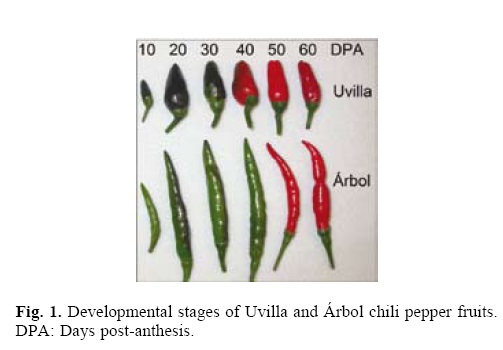
<body><![CDATA[<p align="justify"><font face="verdana" size="2">&nbsp;</font></p>  	    <p align="justify"><font face="verdana" size="2"><b>Introduction</b></font></p>  	    <p align="justify"><font face="verdana" size="2">Chili pepper <i>(Capsicum</i> spp.) is one of the most important food additives worldwide. Its significance derives mainly from the great diversity in fruit shape, size, pungency, color, aroma and flavor. Approximately 27&#150;30 <i>Capsicum</i> species have been described, but only five (<i>Capsicum annuum</i> L., <i>C. baccatum</i> L., <i>C. ch&iacute;nense</i> Jacq., <i>C. frutescens</i> L. and <i>C. pubescens</i> Ruiz &amp; Pavon) have been domesticated and cultivated &#91;1&#93;. In Mexico, chili peppers play fundamental roles in both culture and cuisine as a result of their broad utilization in most typical dishes. The most significant compounds synthesized and accumulated in chili pepper fruits are capsaicinoids (responsible for the pungent taste), vitamins (A, C and E) and pigments (anthocyanins and carotenoids) &#91;2, 3&#93;. Due to the presence of each of these compounds, chili peppers are commonly used in food, pharmaceutical and cosmetic industries.</font></p>  	    <p align="justify"><font face="verdana" size="2">Anthocyanins are pigments widespread in nature that are responsible for fruit, stem, leaf, flower, tuber and root colors (orange, red, purple and blue) in many plant species &#91;4&#150;6&#93;. These compounds have several biological functions, including attracting pollinators and preventing photo&#150;oxidative plant damage. The protection conferred against UV damage is related to their antioxidant capacity, which has been extensively studied in many plants. Anthocyanins have also been shown to display important nutraceutical properties that prevent heart disease and cancer, which may also be linked to their antioxi&#150;dant capacity &#91;7&#150;12&#93;.</font></p>  	    <p align="justify"><font face="verdana" size="2">Studies on anthocyanins in chili pepper are very scarce. Hitherto, few papers have described the presence of anthocyanins in chili pepper fruits. For instance, delphinidin was reported as the possible anthocyanidin present in fruits of an Israeli&#150;cultivar (C. <i>annuum)</i> &#91;13&#93;. Likewise, an analysis of a German chili pepper <i>(C. annuum)</i> revealed that the main anthocyanins were delphinidin&#150;3&#150;trans&#150;coumaroylrutinoside&#150;5&#150;glucoside (na&#150;sunin) and delphinidin&#150;3&#150;cis coumaroylrutinoside&#150;5&#150;glucoside, among others &#91;14&#93;. More recently, delphinidin&#150;3&#150;p&#150;coumaroyl&#150;rutinoside&#150;5&#150;glucoside was reported as the single anthocyanin present in violet and black chili pepper fruits &#91;15&#93;. Additional research aimed at identifying and characterizing anthocyanins from more chili pepper fruit varieties and species is needed to supplement the aforementioned studies. In this study, the identity of anthocyanins in two Mexican chili pepper types was investigated.</font></p>  	    <p align="center"><font face="verdana" size="2">&nbsp;</font></p>  	    <p align="justify"><font face="verdana" size="2"><b>Results and Discussion</b></font></p>  	    <p align="justify"><font face="verdana" size="2">In order to characterize chili pepper anthocyanidins, fruit&#150;meth&#150;anolic extracts were prepared from pericarp tissues of fruits &Aacute;rbol and Uvilla types (C. <i>annuum</i> L.) (<a href="#f1">Fig. 1</a>). Extracts were injected and separated by HPLC, and anthocyanidins were identified by comparison with several commercial standards (<a href="#f2">Fig. 2a</a>). Delphinidin was the only anthocyanidin found in both chili pepper types (<a href="#f2">Fig. 2b</a>). Previously, Borovsky <i>et al.</i> (2004)&#91;13&#93; reported only preliminary evidence suggesting that delphinidin might be the anthocyanidin accumulated in purple chili pepper fruits of the inbred line 5226 (<i>C. annuum</i> L.).</font></p>  	    <p align="center"><font face="verdana" size="2"><a name="f1"></a></font></p>  	    <p align="center"><font face="verdana" size="2"><img src="/img/revistas/jmcs/v56n2/a11f1.jpg"></font></p>  	    ]]></body>
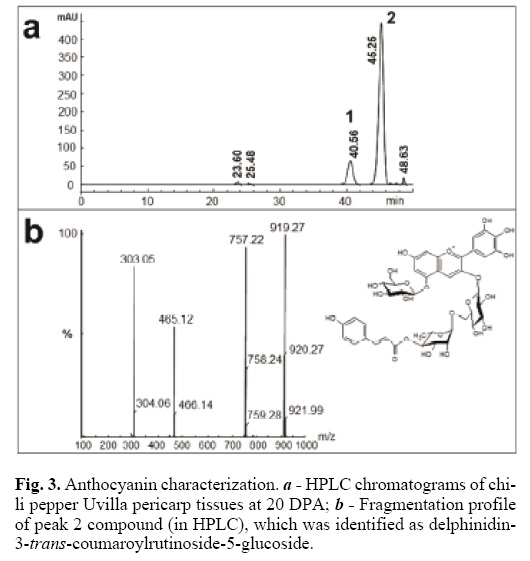
<body><![CDATA[<p align="center"><font face="verdana" size="2"><a name="f2"></a></font></p>  	    <p align="center"><font face="verdana" size="2"><img src="/img/revistas/jmcs/v56n2/a11f2.jpg"></font></p>  	    <p align="justify"><font face="verdana" size="2">HPLC&#150;diode array detector (DAD) and mass spectrometry (MS) were used to identify the anthocyanins in the two Mexican chili pepper types (<a href="#f3">Fig. 3</a>). The main components were found at 40.54 min (peak 1) and 45.25 min (peak 2) (<a href="#f3">Fig. 3a</a>). In order to distinguish the compounds and structures linked to the aglycon delphinidin, the two most abundant components separated by HPLC (peaks 1 and 2) were purified and analyzed by MS (<a href="#f3">Fig. 3a</a>). Both samples yielded the same molecular mass (919) and the same fragmentation profile (757, 465 and 303) (<a href="#f3">Fig. 3b</a>)<i>,</i> which corresponded to nasunin &#91;16&#93;. The fragmentation peaks corresponded to <i>m/z</i> 757 for one hexose loss, to <i>m/z</i> 465 for p&#150;coumaroyl&#150;hexose loss and to <i>m/z</i> 303 for the aglycon del&#150;phinidin &#91;16&#93;. Using the maximum wave&#150;length absorption for each component, 530 nm for <i>trans</i> isomer and 532 nm for <i>cis</i> isomer &#91;14&#93;, the compounds were identified as delphinidin&#150;3&#150;cis&#150;coumaroylrutinoside&#150;5&#150;glucoside (peak 1) and delphinidin&#150;3&#150;trans&#150;coumaroylrutinoside&#150;5&#150;glucoside (peak 2). The relative contributions of these two components was 13.8% for the <i>cis</i> and 84.4% for the <i>trans</i> isomer, which agrees with results reported by Sadilova <i>et al.</i> (2006)&#91;14&#93;, who found 4.6% of the <i>cis</i> and 89% of the <i>trans</i> isomer in violet chili pepper fruits. They also recorded the presence of delphinidin&#150;3&#150;caffeoylru&#150;tinoside&#150;5&#150;glucoside (2.4%), delphinidin&#150;3&#150;feruloylrutinoside&#150;5&#150;hexoside (1.2%), delphinidin&#150;3&#150;rutinoside (0.9%), delphini&#150;din&#150;3&#150;glucoside (0.7%), delphinidin&#150;3&#150;rhamnoside (0.7%) and delphinidin&#150;3&#150;rutinoside&#150;5&#150;glucoside (0.5%). Lightbourn <i>et al.</i> (2008)&#91;15&#93; analyzed anthocyanins extracted from <i>C. annuum</i> genotypes G05C69&#150;12 (black fruit/black foliage) and G05C74&#150;12 (violet fruit/green foliage) and found delphinidin&#150;3&#150;couma&#150;royl&#150;rutinoside&#150;5&#150;glucoside to be the only anthocyanin. Our results provide additional evidence in favor of nasunin as the principal anthocyanin accumulated in partially or completely black anthocyanin&#150;pigmented <i>C. annuum</i> fruits &#91;14&#93;.</font></p>  	    <p align="center"><font face="verdana" size="2"><a name="f3"></a></font></p>  	    <p align="center"><font face="verdana" size="2"><img src="/img/revistas/jmcs/v56n2/a11f3.jpg"></font></p>  	    <p align="justify"><font face="verdana" size="2">In conclusion, &Aacute;rbol and Uvilla chili pepper fruits accumulated only delphinidin derivatives. Delphinidin&#150;3<i>&#150;cis</i>&#150;coumar&#150;oylrutinoside&#150;5&#150;glucoside and delphinidin&#150;3<i>&#150;trans</i>&#150;coumaroyl&#150;rutinoside&#150;5&#150;glucoside were the most important anthocyanins, together representing <i>ca.</i> 98% of the total anthocyanin content. This is the first report on anthocyanin characterization produced by Mexican chili pepper fruits.</font></p>  	    <p align="justify"><font face="verdana" size="2">&nbsp;</font></p>  	    <p align="justify"><font face="verdana" size="2"><b>Experimental section</b></font></p>  	    <p align="justify"><font face="verdana" size="2"><b>Plant material</b></font></p>  	    <p align="justify"><font face="verdana" size="2">Seeds of chili pepper &Aacute;rbol (partially anthocyanin&#150;pigmented fruits) and Uvilla types (totally black anthocyanin&#150;pigmented fruits) <i>(Capsicum annuum</i> L.) were germinated in 100&#150;mL plastic pots, and the seedlings were transplanted to 10&#150;L plastic pots after three weeks of germination. A soil mixture constituted by three parts of Sunshine Mix 3 (SunGro Horticulture, USA), one part of Vermiculite (SunGro Horticulture, USA), one part of Perlite (Perlita de La Laguna, S.A. de C.V., Durango, Mexico), one part of sludge and two parts of forest soil was used for germination and development of plants. Plants were grown under greenhouse conditions and fertilized every two weeks with a FerVialFol (Agroqu&iacute;micos Rivas, Gto., Mexico) solution (N:P: K&#150;30:20:10) containing macro and micronutrients.</font></p>  	    ]]></body>
<body><![CDATA[<p align="justify"><font face="verdana" size="2">Fruits were harvested, the pericarp tissue was directly dissected from the fruits, and immediately immersed into liquid nitrogen and kept at &#150;80 &deg;C. Pericarp tissue was used for an&#150;thocyanin extraction.</font>	</p>     <p align="justify"><font face="verdana" size="2"><b>Analysis of anthocyanidins and anthocyanins</b></font></p>  	    <p align="justify"><font face="verdana" size="2">All anthocyanin protocols were carried out while protecting the samples from direct light. Anthocyanins from only pigmented pericarp tissue (1 g fresh weight; samples stored at &#150;80 &deg;C) from both &Aacute;rbol and Uvilla pepper types were extracted with 10 mL of cooled&#150;acidified methanol (methanol:distilled water: acetic acid 11:5:1 v/v) at room temperature for 30 min under agitation and protected from light, following a previously reported method &#91;13&#93;. Briefly, anthocyanin&#150;methanolic extracts were centrifuged at 12,000 rpm for 10 min at room temperature and the supernatant was concentrated to 0.5 mL under reduced pressure in a rotary evaporator (41 &deg;C). To release the antho&#150;cyanidins (aglycons), the anthocyanin extracts were adjusted to 2 N HCl, hydrolyzed at boiling temperature for 1 h, and then centrifuged at 12,000 rpm for 10 min at room temperature. The supernatant was recovered, treated with an equal volume of ethyl acetate, and centrifuged as described above. The ethyl acetate phase was eliminated, and the treatment step was repeated once more with the aqueous phase. Samples were further heated at 80 &deg;C for 3 min to eliminate ethyl acetate residue, and the anthocyanidins were extracted with an equal volume of isoamyl alcohol. After centrifugation, the isoamyl alcohol phase was recovered and dried at 35 &deg;C. Finally, the residue was dissolved in 1 mL of methanol:HCl (100:0.01 v/v). Antho&#150;cyanidin separation was carried out in a LC&#150;1445 HPLC (GBC, Australia) apparatus equipped with a pump LC1150, a UV&#150;VIS detector LC1205K and a C18 column (Vydac 201SP54, CA). Conditions for separation were according with those previously reported &#91;13&#93;. Detection of anthocyanidins and anthocyanins was carried out at 530 nm. For anthocyanidin identification, the retention times of commercial standards were used (cyanidin, delphinidin, malvidin, pelargonidin and peonidin; ChromaDex, Laguna Hills, CA).</font></p>  	    <p align="justify"><font face="verdana" size="2">Anthocyanins were separated using a 1200 HPLC (Agilent Technologies, Waldbronn, Germany) apparatus equipped with an autosampler G1364C, a pump G1312A, a diode array detector G1315B and an analytical C18 column (Vydac 201SP54, CA), at constant temperature (25 &deg;C) and at 1 mL min<sup>&#150;1</sup> flow rate, according with a previously reported procedure &#91;14&#93;. For anthocyanin characterization, a Micromass Q&#150;Tof Micro Hybrid Quadrupole/Orthogonal Mass Spectrometer system (Waters Corporation, Milford, MA) equipped with a nanospray ionization source was employed. ESI capillary voltage was fixed at 900 V and the cone voltage was set at 35 V. The mass spectrometer was calibrated using a mix of sodium iodide and cesium within a range of 50&#150;2000 Da. Argon was used for collision and the energy employed was between 23 and 45 eV. MassLynx version 4.0 software (Micromass, UK) was used for data analysis.</font></p>  	    <p align="justify"><font face="verdana" size="2">&nbsp;</font></p>  	    <p align="justify"><font face="verdana" size="2"><b>Acknowledgements</b></font></p>  	    <p align="justify"><font face="verdana" size="2">We acknowledge the National Council for Science and Technology (Conacyt; Mexico) for the fellowship to C&eacute;sar Aza&#150;Gonz&aacute;lez. The authors would like to thank Alicia Chagolla for her technical assistance with the anthocyanin&#150;MS analysis. This work was partially supported by grants from Fondos Mixtos Guanajuato (projects GTO&#150;04&#150;C02&#150;24 and GTO&#150;2005&#150;C02&#150;50), Conacyt (Project 55264) and SAGARPA (project 11806).</font></p>  	    <p align="justify"><font face="verdana" size="2">&nbsp;</font></p>  	    <p align="justify"><font face="verdana" size="2"><b>References</b></font></p>  	    <!-- ref --><p align="justify"><font face="verdana" size="2">1.&nbsp;Csill&eacute;ry, G. <i>Acta Agron. Hung.</i> <b>2006,</b> <i>54,</i> 151&#150;166.    &nbsp;&nbsp;&nbsp;&nbsp;&nbsp;&nbsp;&nbsp;&nbsp;[&#160;<a href="javascript:void(0);" onclick="javascript: window.open('/scielo.php?script=sci_nlinks&ref=4947256&pid=S1870-249X201200020001100001&lng=','','width=640,height=500,resizable=yes,scrollbars=1,menubar=yes,');">Links</a>&#160;]<!-- end-ref --></font></p>  	    <!-- ref --><p align="justify"><font face="verdana" size="2">2.&nbsp;Osuna&#150;Garc&iacute;a, J. A.; Wall, M. M.; Waddell, C. A. <i>J. Agric. Food Chem.</i> <b>1998,</b> <i>46,</i> 5093&#150;5096.    &nbsp;&nbsp;&nbsp;&nbsp;&nbsp;&nbsp;&nbsp;&nbsp;[&#160;<a href="javascript:void(0);" onclick="javascript: window.open('/scielo.php?script=sci_nlinks&ref=4947258&pid=S1870-249X201200020001100002&lng=','','width=640,height=500,resizable=yes,scrollbars=1,menubar=yes,');">Links</a>&#160;]<!-- end-ref --></font></p>  	    <!-- ref --><p align="justify"><font face="verdana" size="2">3.&nbsp;Marin, A.; Ferreres, F.; Tom&aacute;s&#150;Barber&aacute;n, F. A.; Gil, M. I. <i>J. Agric. Food Chem.</i> <b>2004,</b> <i>52</i>, 3861&#150;3869.    &nbsp;&nbsp;&nbsp;&nbsp;&nbsp;&nbsp;&nbsp;&nbsp;[&#160;<a href="javascript:void(0);" onclick="javascript: window.open('/scielo.php?script=sci_nlinks&ref=4947260&pid=S1870-249X201200020001100003&lng=','','width=640,height=500,resizable=yes,scrollbars=1,menubar=yes,');">Links</a>&#160;]<!-- end-ref --></font></p>  	    <!-- ref --><p align="justify"><font face="verdana" size="2">4.&nbsp;Holton, T. A.; Cornish, E. <i>Plant Cell</i> <b>1995,</b> <i>7,</i> 1071&#150;1083.    &nbsp;&nbsp;&nbsp;&nbsp;&nbsp;&nbsp;&nbsp;&nbsp;[&#160;<a href="javascript:void(0);" onclick="javascript: window.open('/scielo.php?script=sci_nlinks&ref=4947262&pid=S1870-249X201200020001100004&lng=','','width=640,height=500,resizable=yes,scrollbars=1,menubar=yes,');">Links</a>&#160;]<!-- end-ref --></font></p>  	    <!-- ref --><p align="justify"><font face="verdana" size="2">5.&nbsp;Wu, X.; Prior, R. L. <i>J. Agric. Food Chem.</i> <b>1998,</b> <i>53,</i> 3101&#150;3113.    &nbsp;&nbsp;&nbsp;&nbsp;&nbsp;&nbsp;&nbsp;&nbsp;[&#160;<a href="javascript:void(0);" onclick="javascript: window.open('/scielo.php?script=sci_nlinks&ref=4947264&pid=S1870-249X201200020001100005&lng=','','width=640,height=500,resizable=yes,scrollbars=1,menubar=yes,');">Links</a>&#160;]<!-- end-ref --></font></p>  	    <!-- ref --><p align="justify"><font face="verdana" size="2">6.&nbsp;Grotewold, E. <i>Annu. Rev. Plant Biol.</i> <b>2006,</b> <i>57,</i> 761&#150;780.    &nbsp;&nbsp;&nbsp;&nbsp;&nbsp;&nbsp;&nbsp;&nbsp;[&#160;<a href="javascript:void(0);" onclick="javascript: window.open('/scielo.php?script=sci_nlinks&ref=4947266&pid=S1870-249X201200020001100006&lng=','','width=640,height=500,resizable=yes,scrollbars=1,menubar=yes,');">Links</a>&#160;]<!-- end-ref --></font></p>  	    <!-- ref --><p align="justify"><font face="verdana" size="2">7.&nbsp;Wang, H.; Nair, M. G.; Strasburg, G. M.; Chang, Y. C.; Booren, A. M.; Gray, J. I.; DeWitt, D. L. <i>J. Nat. Prod.</i> <b>1999,</b> <i>62,</i> 294&#150;296.    &nbsp;&nbsp;&nbsp;&nbsp;&nbsp;&nbsp;&nbsp;&nbsp;[&#160;<a href="javascript:void(0);" onclick="javascript: window.open('/scielo.php?script=sci_nlinks&ref=4947268&pid=S1870-249X201200020001100007&lng=','','width=640,height=500,resizable=yes,scrollbars=1,menubar=yes,');">Links</a>&#160;]<!-- end-ref --></font></p>  	    <!-- ref --><p align="justify"><font face="verdana" size="2">8.&nbsp;Chen, P. N.; Chu, S. C.; Chiou, H. L.; Chiang, C. L.; Yang, S. F.; Hsieh, Y. S. <i>Nutr. Cancer</i> <b>2005,</b> <i>53,</i> 232&#150;243.    &nbsp;&nbsp;&nbsp;&nbsp;&nbsp;&nbsp;&nbsp;&nbsp;[&#160;<a href="javascript:void(0);" onclick="javascript: window.open('/scielo.php?script=sci_nlinks&ref=4947270&pid=S1870-249X201200020001100008&lng=','','width=640,height=500,resizable=yes,scrollbars=1,menubar=yes,');">Links</a>&#160;]<!-- end-ref --></font></p>  	    <!-- ref --><p align="justify"><font face="verdana" size="2">9.&nbsp;Reddy, M. K.; Alexander&#150;Lindo, R. L.; Nair, M. G. <i>J. Agric. Food Chem.</i> <b>2005,</b> <i>53,</i> 9268&#150;9273.    &nbsp;&nbsp;&nbsp;&nbsp;&nbsp;&nbsp;&nbsp;&nbsp;[&#160;<a href="javascript:void(0);" onclick="javascript: window.open('/scielo.php?script=sci_nlinks&ref=4947272&pid=S1870-249X201200020001100009&lng=','','width=640,height=500,resizable=yes,scrollbars=1,menubar=yes,');">Links</a>&#160;]<!-- end-ref --></font></p>  	    <!-- ref --><p align="justify"><font face="verdana" size="2">10.&nbsp;Bell, D. R.; Gochenaur, K. <i>J. Appl. Physiol.</i> <b>2006,</b> <i>100,</i> 1164&#150;1170.    &nbsp;&nbsp;&nbsp;&nbsp;&nbsp;&nbsp;&nbsp;&nbsp;[&#160;<a href="javascript:void(0);" onclick="javascript: window.open('/scielo.php?script=sci_nlinks&ref=4947274&pid=S1870-249X201200020001100010&lng=','','width=640,height=500,resizable=yes,scrollbars=1,menubar=yes,');">Links</a>&#160;]<!-- end-ref --></font></p>  	    <!-- ref --><p align="justify"><font face="verdana" size="2">11.&nbsp;Chen, P. N.; Chu, S. C.; Chiou, H. L.; Kuo, W. H.; Chiang, C. L.; Hsieh, Y. S. <i>Cancer Lett.</i> <b>2006,</b> <i>235,</i> 248&#150;259.    &nbsp;&nbsp;&nbsp;&nbsp;&nbsp;&nbsp;&nbsp;&nbsp;[&#160;<a href="javascript:void(0);" onclick="javascript: window.open('/scielo.php?script=sci_nlinks&ref=4947276&pid=S1870-249X201200020001100011&lng=','','width=640,height=500,resizable=yes,scrollbars=1,menubar=yes,');">Links</a>&#160;]<!-- end-ref --></font></p>  	    <!-- ref --><p align="justify"><font face="verdana" size="2">12.&nbsp;Lamy, S.; Lafleur, R.; B&eacute;dard, V.; Moghrabi, A.; Barrette, S.; Gingras, D.; B&eacute;liveau, R. <i>J. Cell. Biochem.</i> <b>2007,</b> <i>100</i>, 100&#150;111.    &nbsp;&nbsp;&nbsp;&nbsp;&nbsp;&nbsp;&nbsp;&nbsp;[&#160;<a href="javascript:void(0);" onclick="javascript: window.open('/scielo.php?script=sci_nlinks&ref=4947278&pid=S1870-249X201200020001100012&lng=','','width=640,height=500,resizable=yes,scrollbars=1,menubar=yes,');">Links</a>&#160;]<!-- end-ref --></font></p>  	    <!-- ref --><p align="justify"><font face="verdana" size="2">13.&nbsp;Borovsky, Y.; Oren&#150;Shamir, M.; Ovadia, R.; De Jong, W.; Paran, I. <i>Theor. Appl. Genet.</i> <b>2004,</b> <i>109,</i> 23&#150;29.    &nbsp;&nbsp;&nbsp;&nbsp;&nbsp;&nbsp;&nbsp;&nbsp;[&#160;<a href="javascript:void(0);" onclick="javascript: window.open('/scielo.php?script=sci_nlinks&ref=4947280&pid=S1870-249X201200020001100013&lng=','','width=640,height=500,resizable=yes,scrollbars=1,menubar=yes,');">Links</a>&#160;]<!-- end-ref --></font></p>  	    <!-- ref --><p align="justify"><font face="verdana" size="2">14.&nbsp;Sadilova, E.; Stintzing, F. C.; Carle, R. <i>Z. Naturforsch. &#91;C&#93;</i> <b>2006,</b> <i>61</i>, 527&#150;535.    &nbsp;&nbsp;&nbsp;&nbsp;&nbsp;&nbsp;&nbsp;&nbsp;[&#160;<a href="javascript:void(0);" onclick="javascript: window.open('/scielo.php?script=sci_nlinks&ref=4947282&pid=S1870-249X201200020001100014&lng=','','width=640,height=500,resizable=yes,scrollbars=1,menubar=yes,');">Links</a>&#160;]<!-- end-ref --></font></p>  	    <!-- ref --><p align="justify"><font face="verdana" size="2">15.&nbsp;Lightbourn, G. J.; Griesbach, R. J.; Novotny, J. A.; Clevidence, B. A.; Rao, D. D.; Stommel, J. R. <i>J. Hered.</i> <b>2008,</b> <i>99</i>, 105&#150;111.    &nbsp;&nbsp;&nbsp;&nbsp;&nbsp;&nbsp;&nbsp;&nbsp;[&#160;<a href="javascript:void(0);" onclick="javascript: window.open('/scielo.php?script=sci_nlinks&ref=4947284&pid=S1870-249X201200020001100015&lng=','','width=640,height=500,resizable=yes,scrollbars=1,menubar=yes,');">Links</a>&#160;]<!-- end-ref --></font></p>  	    <!-- ref --><p align="justify"><font face="verdana" size="2">16.&nbsp;Ichiyanagi, T.; Kashiwada, Y.; Shida, Y.; Ikeshiro, Y.; Kaneyuki, T.; Konishi, T. <i>J. Agric. Food Chem.</i> <b>2005,</b> <i>53</i>, 9472&#150;9477.    &nbsp;&nbsp;&nbsp;&nbsp;&nbsp;&nbsp;&nbsp;&nbsp;[&#160;<a href="javascript:void(0);" onclick="javascript: window.open('/scielo.php?script=sci_nlinks&ref=4947286&pid=S1870-249X201200020001100016&lng=','','width=640,height=500,resizable=yes,scrollbars=1,menubar=yes,');">Links</a>&#160;]<!-- end-ref --></font></p>      ]]></body><back>
<ref-list>
<ref id="B1">
<label>1</label><nlm-citation citation-type="journal">
<person-group person-group-type="author">
<name>
<surname><![CDATA[Csilléry]]></surname>
<given-names><![CDATA[G.]]></given-names>
</name>
</person-group>
<source><![CDATA[Acta Agron. Hung.]]></source>
<year>2006</year>
<volume>54</volume>
<page-range>151-166</page-range></nlm-citation>
</ref>
<ref id="B2">
<label>2</label><nlm-citation citation-type="journal">
<person-group person-group-type="author">
<name>
<surname><![CDATA[Osuna-García]]></surname>
<given-names><![CDATA[J. A.]]></given-names>
</name>
<name>
<surname><![CDATA[Wall]]></surname>
<given-names><![CDATA[M. M.]]></given-names>
</name>
<name>
<surname><![CDATA[Waddell]]></surname>
<given-names><![CDATA[C. A.]]></given-names>
</name>
</person-group>
<source><![CDATA[J. Agric. Food Chem.]]></source>
<year>1998</year>
<volume>46</volume>
<page-range>5093-5096</page-range></nlm-citation>
</ref>
<ref id="B3">
<label>3</label><nlm-citation citation-type="journal">
<person-group person-group-type="author">
<name>
<surname><![CDATA[Marin]]></surname>
<given-names><![CDATA[A.]]></given-names>
</name>
<name>
<surname><![CDATA[Ferreres]]></surname>
<given-names><![CDATA[F.]]></given-names>
</name>
<name>
<surname><![CDATA[Tomás-Barberán]]></surname>
<given-names><![CDATA[F. A.]]></given-names>
</name>
<name>
<surname><![CDATA[Gil]]></surname>
<given-names><![CDATA[M. I.]]></given-names>
</name>
</person-group>
<source><![CDATA[J. Agric. Food Chem.]]></source>
<year>2004</year>
<volume>52</volume>
<page-range>3861-3869</page-range></nlm-citation>
</ref>
<ref id="B4">
<label>4</label><nlm-citation citation-type="journal">
<person-group person-group-type="author">
<name>
<surname><![CDATA[Holton]]></surname>
<given-names><![CDATA[T. A.]]></given-names>
</name>
<name>
<surname><![CDATA[Cornish]]></surname>
<given-names><![CDATA[E.]]></given-names>
</name>
</person-group>
<source><![CDATA[Plant Cell]]></source>
<year>1995</year>
<volume>7</volume>
<page-range>1071-1083</page-range></nlm-citation>
</ref>
<ref id="B5">
<label>5</label><nlm-citation citation-type="journal">
<person-group person-group-type="author">
<name>
<surname><![CDATA[Wu]]></surname>
<given-names><![CDATA[X.]]></given-names>
</name>
<name>
<surname><![CDATA[Prior]]></surname>
<given-names><![CDATA[R. L.]]></given-names>
</name>
</person-group>
<source><![CDATA[J. Agric. Food Chem.]]></source>
<year>1998</year>
<volume>53</volume>
<page-range>3101-3113</page-range></nlm-citation>
</ref>
<ref id="B6">
<label>6</label><nlm-citation citation-type="journal">
<person-group person-group-type="author">
<name>
<surname><![CDATA[Grotewold]]></surname>
<given-names><![CDATA[E.]]></given-names>
</name>
</person-group>
<source><![CDATA[Annu. Rev. Plant Biol.]]></source>
<year>2006</year>
<volume>57</volume>
<page-range>761-780</page-range></nlm-citation>
</ref>
<ref id="B7">
<label>7</label><nlm-citation citation-type="journal">
<person-group person-group-type="author">
<name>
<surname><![CDATA[Wang]]></surname>
<given-names><![CDATA[H.]]></given-names>
</name>
<name>
<surname><![CDATA[Nair]]></surname>
<given-names><![CDATA[M. G.]]></given-names>
</name>
<name>
<surname><![CDATA[Strasburg]]></surname>
<given-names><![CDATA[G. M.]]></given-names>
</name>
<name>
<surname><![CDATA[Chang]]></surname>
<given-names><![CDATA[Y. C.]]></given-names>
</name>
<name>
<surname><![CDATA[Booren]]></surname>
<given-names><![CDATA[A. M.]]></given-names>
</name>
<name>
<surname><![CDATA[Gray]]></surname>
<given-names><![CDATA[J. I.]]></given-names>
</name>
<name>
<surname><![CDATA[DeWitt]]></surname>
<given-names><![CDATA[D. L.]]></given-names>
</name>
</person-group>
<source><![CDATA[J. Nat. Prod.]]></source>
<year>1999</year>
<volume>62</volume>
<page-range>294-296</page-range></nlm-citation>
</ref>
<ref id="B8">
<label>8</label><nlm-citation citation-type="journal">
<person-group person-group-type="author">
<name>
<surname><![CDATA[Chen]]></surname>
<given-names><![CDATA[P. N.]]></given-names>
</name>
<name>
<surname><![CDATA[Chu]]></surname>
<given-names><![CDATA[S. C.]]></given-names>
</name>
<name>
<surname><![CDATA[Chiou]]></surname>
<given-names><![CDATA[H. L.]]></given-names>
</name>
<name>
<surname><![CDATA[Chiang]]></surname>
<given-names><![CDATA[C. L.]]></given-names>
</name>
<name>
<surname><![CDATA[Yang]]></surname>
<given-names><![CDATA[S. F.]]></given-names>
</name>
<name>
<surname><![CDATA[Hsieh]]></surname>
<given-names><![CDATA[Y. S.]]></given-names>
</name>
</person-group>
<source><![CDATA[Nutr. Cancer]]></source>
<year>2005</year>
<volume>53</volume>
<page-range>232-243</page-range></nlm-citation>
</ref>
<ref id="B9">
<label>9</label><nlm-citation citation-type="journal">
<person-group person-group-type="author">
<name>
<surname><![CDATA[Reddy]]></surname>
<given-names><![CDATA[M. K.]]></given-names>
</name>
<name>
<surname><![CDATA[Alexander-Lindo]]></surname>
<given-names><![CDATA[R. L.]]></given-names>
</name>
<name>
<surname><![CDATA[Nair]]></surname>
<given-names><![CDATA[M. G.]]></given-names>
</name>
</person-group>
<source><![CDATA[J. Agric. Food Chem.]]></source>
<year>2005</year>
<volume>53</volume>
<page-range>9268-9273</page-range></nlm-citation>
</ref>
<ref id="B10">
<label>10</label><nlm-citation citation-type="journal">
<person-group person-group-type="author">
<name>
<surname><![CDATA[Bell]]></surname>
<given-names><![CDATA[D. R.]]></given-names>
</name>
<name>
<surname><![CDATA[Gochenaur]]></surname>
<given-names><![CDATA[K.]]></given-names>
</name>
</person-group>
<source><![CDATA[J. Appl. Physiol.]]></source>
<year>2006</year>
<volume>100</volume>
<page-range>1164-1170</page-range></nlm-citation>
</ref>
<ref id="B11">
<label>11</label><nlm-citation citation-type="journal">
<person-group person-group-type="author">
<name>
<surname><![CDATA[Chen]]></surname>
<given-names><![CDATA[P. N.]]></given-names>
</name>
<name>
<surname><![CDATA[Chu]]></surname>
<given-names><![CDATA[S. C.]]></given-names>
</name>
<name>
<surname><![CDATA[Chiou]]></surname>
<given-names><![CDATA[H. L.]]></given-names>
</name>
<name>
<surname><![CDATA[Kuo]]></surname>
<given-names><![CDATA[W. H.]]></given-names>
</name>
<name>
<surname><![CDATA[Chiang]]></surname>
<given-names><![CDATA[C. L.]]></given-names>
</name>
<name>
<surname><![CDATA[Hsieh]]></surname>
<given-names><![CDATA[Y. S.]]></given-names>
</name>
</person-group>
<source><![CDATA[Cancer Lett.]]></source>
<year>2006</year>
<volume>235</volume>
<page-range>248-259</page-range></nlm-citation>
</ref>
<ref id="B12">
<label>12</label><nlm-citation citation-type="journal">
<person-group person-group-type="author">
<name>
<surname><![CDATA[Lamy]]></surname>
<given-names><![CDATA[S.]]></given-names>
</name>
<name>
<surname><![CDATA[Lafleur]]></surname>
<given-names><![CDATA[R.]]></given-names>
</name>
<name>
<surname><![CDATA[Bédard]]></surname>
<given-names><![CDATA[V.]]></given-names>
</name>
<name>
<surname><![CDATA[Moghrabi]]></surname>
<given-names><![CDATA[A.]]></given-names>
</name>
<name>
<surname><![CDATA[Barrette]]></surname>
<given-names><![CDATA[S.]]></given-names>
</name>
<name>
<surname><![CDATA[Gingras]]></surname>
<given-names><![CDATA[D.]]></given-names>
</name>
<name>
<surname><![CDATA[Béliveau]]></surname>
<given-names><![CDATA[R.]]></given-names>
</name>
</person-group>
<source><![CDATA[J. Cell. Biochem.]]></source>
<year>2007</year>
<volume>100</volume>
<page-range>100-111</page-range></nlm-citation>
</ref>
<ref id="B13">
<label>13</label><nlm-citation citation-type="journal">
<person-group person-group-type="author">
<name>
<surname><![CDATA[Borovsky]]></surname>
<given-names><![CDATA[Y.]]></given-names>
</name>
<name>
<surname><![CDATA[Oren-Shamir]]></surname>
<given-names><![CDATA[M.]]></given-names>
</name>
<name>
<surname><![CDATA[Ovadia]]></surname>
<given-names><![CDATA[R.]]></given-names>
</name>
<name>
<surname><![CDATA[De Jong]]></surname>
<given-names><![CDATA[W.]]></given-names>
</name>
<name>
<surname><![CDATA[Paran]]></surname>
<given-names><![CDATA[I.]]></given-names>
</name>
</person-group>
<source><![CDATA[Theor. Appl. Genet.]]></source>
<year>2004</year>
<volume>109</volume>
<page-range>23-29</page-range></nlm-citation>
</ref>
<ref id="B14">
<label>14</label><nlm-citation citation-type="journal">
<person-group person-group-type="author">
<name>
<surname><![CDATA[Sadilova]]></surname>
<given-names><![CDATA[E.]]></given-names>
</name>
<name>
<surname><![CDATA[Stintzing]]></surname>
<given-names><![CDATA[F. C.]]></given-names>
</name>
<name>
<surname><![CDATA[Carle]]></surname>
<given-names><![CDATA[R. Z.]]></given-names>
</name>
</person-group>
<source><![CDATA[Naturforsch]]></source>
<year>2006</year>
<volume>61</volume>
<page-range>527-535</page-range></nlm-citation>
</ref>
<ref id="B15">
<label>15</label><nlm-citation citation-type="journal">
<person-group person-group-type="author">
<name>
<surname><![CDATA[Lightbourn]]></surname>
<given-names><![CDATA[G. J.]]></given-names>
</name>
<name>
<surname><![CDATA[Griesbach]]></surname>
<given-names><![CDATA[R. J.]]></given-names>
</name>
<name>
<surname><![CDATA[Novotny]]></surname>
<given-names><![CDATA[J. A.]]></given-names>
</name>
<name>
<surname><![CDATA[Clevidence]]></surname>
<given-names><![CDATA[B. A.]]></given-names>
</name>
<name>
<surname><![CDATA[Rao]]></surname>
<given-names><![CDATA[D. D.]]></given-names>
</name>
<name>
<surname><![CDATA[Stommel]]></surname>
<given-names><![CDATA[J. R.]]></given-names>
</name>
</person-group>
<source><![CDATA[J. Hered.]]></source>
<year>2008</year>
<volume>99</volume>
<page-range>105-111</page-range></nlm-citation>
</ref>
<ref id="B16">
<label>16</label><nlm-citation citation-type="journal">
<person-group person-group-type="author">
<name>
<surname><![CDATA[Ichiyanagi]]></surname>
<given-names><![CDATA[T.]]></given-names>
</name>
<name>
<surname><![CDATA[Kashiwada]]></surname>
<given-names><![CDATA[Y.]]></given-names>
</name>
<name>
<surname><![CDATA[Shida]]></surname>
<given-names><![CDATA[Y.]]></given-names>
</name>
<name>
<surname><![CDATA[Ikeshiro]]></surname>
<given-names><![CDATA[Y.]]></given-names>
</name>
<name>
<surname><![CDATA[Kaneyuki]]></surname>
<given-names><![CDATA[T.]]></given-names>
</name>
<name>
<surname><![CDATA[Konishi]]></surname>
<given-names><![CDATA[T.]]></given-names>
</name>
</person-group>
<source><![CDATA[J. Agric. Food Chem.]]></source>
<year>2005</year>
<volume>53</volume>
<page-range>9472-9477</page-range></nlm-citation>
</ref>
</ref-list>
</back>
</article>