<?xml version="1.0" encoding="ISO-8859-1"?><article xmlns:mml="http://www.w3.org/1998/Math/MathML" xmlns:xlink="http://www.w3.org/1999/xlink" xmlns:xsi="http://www.w3.org/2001/XMLSchema-instance">
<front>
<journal-meta>
<journal-id>1870-249X</journal-id>
<journal-title><![CDATA[Journal of the Mexican Chemical Society]]></journal-title>
<abbrev-journal-title><![CDATA[J. Mex. Chem. Soc]]></abbrev-journal-title>
<issn>1870-249X</issn>
<publisher>
<publisher-name><![CDATA[Sociedad Química de México A.C.]]></publisher-name>
</publisher>
</journal-meta>
<article-meta>
<article-id>S1870-249X2012000100012</article-id>
<title-group>
<article-title xml:lang="en"><![CDATA[Evaluation of the Extracellular Proteome Profile During the Somatic Embryogenesis Process of Coffea spp.]]></article-title>
</title-group>
<contrib-group>
<contrib contrib-type="author">
<name>
<surname><![CDATA[Mukul-López]]></surname>
<given-names><![CDATA[Héctor Gabriel]]></given-names>
</name>
<xref ref-type="aff" rid="A01"/>
</contrib>
<contrib contrib-type="author">
<name>
<surname><![CDATA[De-la-Peña]]></surname>
<given-names><![CDATA[Clelia]]></given-names>
</name>
<xref ref-type="aff" rid="A02"/>
</contrib>
<contrib contrib-type="author">
<name>
<surname><![CDATA[Galaz-Ávalos]]></surname>
<given-names><![CDATA[Rosa María]]></given-names>
</name>
<xref ref-type="aff" rid="A01"/>
</contrib>
<contrib contrib-type="author">
<name>
<surname><![CDATA[Loyola-Vargas]]></surname>
<given-names><![CDATA[Víctor Manuel]]></given-names>
</name>
<xref ref-type="aff" rid="A01"/>
</contrib>
</contrib-group>
<aff id="A01">
<institution><![CDATA[,Centro de Investigación Científica de Yucatán Unidad de Bioquímica y Biología Molecular de Plantas ]]></institution>
<addr-line><![CDATA[Mérida Yucatán]]></addr-line>
<country>México</country>
</aff>
<aff id="A02">
<institution><![CDATA[,Centro de Investigación Científica de Yucatán Unidad de Biotecnología ]]></institution>
<addr-line><![CDATA[Mérida Yucatán]]></addr-line>
<country>México</country>
</aff>
<pub-date pub-type="pub">
<day>00</day>
<month>03</month>
<year>2012</year>
</pub-date>
<pub-date pub-type="epub">
<day>00</day>
<month>03</month>
<year>2012</year>
</pub-date>
<volume>56</volume>
<numero>1</numero>
<fpage>72</fpage>
<lpage>79</lpage>
<copyright-statement/>
<copyright-year/>
<self-uri xlink:href="http://www.scielo.org.mx/scielo.php?script=sci_arttext&amp;pid=S1870-249X2012000100012&amp;lng=en&amp;nrm=iso"></self-uri><self-uri xlink:href="http://www.scielo.org.mx/scielo.php?script=sci_abstract&amp;pid=S1870-249X2012000100012&amp;lng=en&amp;nrm=iso"></self-uri><self-uri xlink:href="http://www.scielo.org.mx/scielo.php?script=sci_pdf&amp;pid=S1870-249X2012000100012&amp;lng=en&amp;nrm=iso"></self-uri><abstract abstract-type="short" xml:lang="en"><p><![CDATA[The somatic embryogenesis (SE) has been used as an important tool for the study of molecular events in plant cell differentiation. Some studies have revealed that suspensions of somatic embryos secrete a vast array of proteins that could be involved in the regulation of this process. Many of these molecules have been suggested to work as inductors and others as inhibitors of the process. In the present work, suspension cultures of both Coffea canephora and Coffea arabica were used to study the population of proteins secreted into the media. Two types of cultures were used; one for the propagation of suspension cultures (non-embryogenic) and another for the induction of SE (embryogenic). The evaluated days were 14 and 42 for non-embryogenic condition and 21, 42, and 98 for the embryogenic condition. An embryogenic system was established in the C. arabica species, obtaining 4,000 embryos per liter. We analyzed the proteins secreted into the culture media, both under non-embryogenic and SE induction conditions. In C. canephora medium, we found 173 proteins after 14 d of culture under non-embryogenic conditions. In C. arabica we found 523 after 14 d under non-embryogenic conditions. Under embryogenic conditions we found 319, 409 and 175 proteins after 21, 42 and 98 d, respectively. We also determined that some proteins are secreted exclusively under embryogenic conditions and others proteins under non-embryogenic conditions.]]></p></abstract>
<abstract abstract-type="short" xml:lang="es"><p><![CDATA[La embriogénesis somática se ha convertido en una herramienta de gran utilidad en el estudio de los procesos celulares, bioquímicos y moleculares que se llevan a cabo durante el desarrollo de los embriones. Diversos estudios han demostrado que en estos sistemas se excretan proteínas que pueden funcionar como promotores o inhibidores de diferentes procesos biológicos. Estas proteínas pueden ser de alta o de baja masa molecular. En este trabajo se utilizaron suspensiones celulares de las dos especies de Coffea, en la cual se mantuvieron en constante agitación y mantenidas mediante el suministro continuo de nutrientes. Se utilizaron dos tipos de cultivos, uno para la propagación de las células y otro para la inducción de la embriogénesis somática, los días evaluados fueron 14 y 42 para condiciones no em-briogénicas y 21, 42, 98 para la inducción de la ES. Se estableció un sistema embriogénico en la especie C. arabica en el que se obtuvieron 4,000 embriones somáticos por litro de medio de cultivo. Se analizaron las proteínas secretadas en el medio de cultivo bajo condiciones no embriogénicas y en el de inducción. En C. canephora se contabilizó un total de 113 proteínas a los 14 d. En C. arabica se contabilizaron 523 manchas a los 14 d bajo condiciones no embriogénicas y 379, 409 y 175 proteínas en condiciones embriogénicas después de 21, 42 and 98 d, respectivamente. Se observaron proteínas que son exclusivas de las condiciones embriogénicas y otras proteínas que lo son de la condición no embriogénica.]]></p></abstract>
<kwd-group>
<kwd lng="en"><![CDATA[Coffea spp.]]></kwd>
<kwd lng="en"><![CDATA[secreted proteins]]></kwd>
<kwd lng="en"><![CDATA[2-dimensional electrophoresis]]></kwd>
<kwd lng="en"><![CDATA[somatic embryogenesis]]></kwd>
<kwd lng="en"><![CDATA[tissue culture]]></kwd>
<kwd lng="es"><![CDATA[Coffea spp.]]></kwd>
<kwd lng="es"><![CDATA[cultivo de tejidos]]></kwd>
<kwd lng="es"><![CDATA[embriogénesis somática]]></kwd>
<kwd lng="es"><![CDATA[proteínas secretadas]]></kwd>
<kwd lng="es"><![CDATA[electroforesis de doble dimensión]]></kwd>
</kwd-group>
</article-meta>
</front><body><![CDATA[  	    <p align="justify"><font face="verdana" size="4">Article</font></p>  	    <p align="justify"><font face="verdana" size="2">&nbsp;</font></p>  	    <p align="center"><font face="verdana" size="4"><b>Evaluation of the Extracellular Proteome Profile During the Somatic Embryogenesis Process of <i>Coffea spp.</i></b></font></p>  	    <p align="center"><font face="verdana" size="2">&nbsp;</font></p>  	    <p align="center"><font face="verdana" size="2"><b>H&eacute;ctor Gabriel Mukul&#45;L&oacute;pez,<sup>1</sup> Clelia De&#45;la&#45;Pe&ntilde;a,<sup>2</sup> Rosa Mar&iacute;a Galaz&#45;&Aacute;valos,<sup>1</sup> and V&iacute;ctor Manuel Loyola&#45;Vargas<sup>1</sup>*</b></font></p>  	    <p align="justify"><font face="verdana" size="2">&nbsp;</font></p>  	    <p align="justify"><font face="verdana" size="2"><i><sup>1</sup>&nbsp;Unidad de Bioqu&iacute;mica y Biolog&iacute;a Molecular de Plantas, Centro de Investigaci&oacute;n Cient&iacute;fica de Yucat&aacute;n. Calle 43 No. 130, Col. Chuburn&aacute; de Hidalgo, M&eacute;rida, Yucat&aacute;n, M&eacute;xico.</i> <a href="mailto:vmloyola@cicy.mx">vmloyola@cicy.mx</a></font></p>  	    <p align="justify"><font face="verdana" size="2"><i><sup>2</sup>&nbsp;Unidad de Biotecnolog&iacute;a, Centro de Investigaci&oacute;n Cient&iacute;fica de Yucat&aacute;n. Calle 43 No. 130, Col. Chuburn&aacute; de Hidalgo, M&eacute;rida, Yucat&aacute;n, M&eacute;xico.</i></font></p>  	    <p align="justify"><font face="verdana" size="2"></font></p>  	    ]]></body>
<body><![CDATA[<p align="justify"><font face="verdana" size="2">Received April 11, 2011.    <br> 	Accepted September 24, 2011.</font></p>  	    <p align="justify"><font face="verdana" size="2">&nbsp;</font></p>  	    <p align="justify"><font face="verdana" size="2"><b>Abstract</b></font></p>  	    <p align="justify"><font face="verdana" size="2">The somatic embryogenesis (SE) has been used as an important tool for the study of molecular events in plant cell differentiation. Some studies have revealed that suspensions of somatic embryos secrete a vast array of proteins that could be involved in the regulation of this process. Many of these molecules have been suggested to work as inductors and others as inhibitors of the process. In the present work, suspension cultures of both <i>Coffea canephora</i> and <i>Coffea arabica</i> were used to study the population of proteins secreted into the media. Two types of cultures were used; one for the propagation of suspension cultures (non&#45;embryogenic) and another for the induction of SE (embryogenic). The evaluated days were 14 and 42 for non&#45;embryogenic condition and 21, 42, and 98 for the embryogenic condition. An embryogenic system was established in the <i>C. arabica</i> species, obtaining 4,000 embryos per liter. We analyzed the proteins secreted into the culture media, both under non&#45;embryogenic and SE induction conditions. In <i>C. canephora</i> medium, we found 173 proteins after 14 d of culture under non&#45;embryogenic conditions. In <i>C. arabica</i> we found 523 after 14 d under non&#45;embryogenic conditions. Under embryogenic conditions we found 319, 409 and 175 proteins after 21, 42 and 98 d, respectively. We also determined that some proteins are secreted exclusively under embryogenic conditions and others proteins under non&#45;embryogenic conditions.</font></p>  	    <p align="justify"><font face="verdana" size="2"><b>Keywords:</b> <i>Coffea</i> spp., secreted proteins, 2&#45;dimensional electrophoresis, somatic embryogenesis, tissue culture.</font></p>  	    <p align="justify"><font face="verdana" size="2">&nbsp;</font></p>  	    <p align="justify"><font face="verdana" size="2"><b>Resumen</b></font></p>  	    <p align="justify"><font face="verdana" size="2">La embriog&eacute;nesis som&aacute;tica se ha convertido en una herramienta de gran utilidad en el estudio de los procesos celulares, bioqu&iacute;micos y moleculares que se llevan a cabo durante el desarrollo de los embriones. Diversos estudios han demostrado que en estos sistemas se excretan prote&iacute;nas que pueden funcionar como promotores o inhibidores de diferentes procesos biol&oacute;gicos. Estas prote&iacute;nas pueden ser de alta o de baja masa molecular. En este trabajo se utilizaron suspensiones celulares de las dos especies de Coffea, en la cual se mantuvieron en constante agitaci&oacute;n y mantenidas mediante el suministro continuo de nutrientes. Se utilizaron dos tipos de cultivos, uno para la propagaci&oacute;n de las c&eacute;lulas y otro para la inducci&oacute;n de la embriog&eacute;nesis som&aacute;tica, los d&iacute;as evaluados fueron 14 y 42 para condiciones no em&#45;briog&eacute;nicas y 21, 42, 98 para la inducci&oacute;n de la ES. Se estableci&oacute; un sistema embriog&eacute;nico en la especie <i>C. arabica</i> en el que se obtuvieron 4,000 embriones som&aacute;ticos por litro de medio de cultivo. Se analizaron las prote&iacute;nas secretadas en el medio de cultivo bajo condiciones no embriog&eacute;nicas y en el de inducci&oacute;n. En <i>C. canephora</i> se contabiliz&oacute; un total de 113 prote&iacute;nas a los 14 d. En <i>C. arabica</i> se contabilizaron 523 manchas a los 14 d bajo condiciones no embriog&eacute;nicas y 379, 409 y 175 prote&iacute;nas en condiciones embriog&eacute;nicas despu&eacute;s de 21, 42 and 98 d, respectivamente. Se observaron prote&iacute;nas que son exclusivas de las condiciones embriog&eacute;nicas y otras prote&iacute;nas que lo son de la condici&oacute;n no embriog&eacute;nica.</font></p>  	    <p align="justify"><font face="verdana" size="2"><b>Palabras clave:</b> <i>Coffea</i> spp., cultivo de tejidos, embriog&eacute;nesis som&aacute;tica, prote&iacute;nas secretadas, electroforesis de doble dimensi&oacute;n.</font></p>  	    ]]></body>
<body><![CDATA[<p align="justify"><font face="verdana" size="2">&nbsp;</font></p>  	    <p align="justify"><font face="verdana" size="2"><b>Introduction</b></font></p>  	    <p align="justify"><font face="verdana" size="2">Plant tissue culture plays an important role in the agriculture biotechnology. The scale&#45;up in the production of somatic embryos using bioreactor, the production of synthetic seeds, cryopreservation of seeds, somaclonal variation in plants and genetic transformation are the main areas under investigation today &#91;1&#93;.</font></p>  	    <p align="justify"><font face="verdana" size="2">In plants, the embryogenic process usually takes place inside the seed after the pollen fusion with the ovule. However, this process can also be induced by <i>in vitro</i> techniques, either from gametophytic cells without fertilization or from vegetative explants cells. The somatic embryogenesis (SE) process is induced, in general, by exposing the explants to a stress and/or the presence of exogenous growth regulators. The competent cells respond directly by initiating the embryogenesis from the explants or indirectly by producing callus followed by the formation of the somatic embryo &#91;2&#93;. Both, the direct somatic embryogenesis, as well as the indirect somatic embryogenesis can be determined in the same explants and can be determined side by side with shoot morphogenesis and root differentiation. This suggests that individual cells and tissues inside the explants have different capacities to respond to the external signals that induce the morphogenic process and translate in development.</font></p>  	    <p align="justify"><font face="verdana" size="2">There is a considerable interest in SE because it can be used as a tool for clonal propagation for the agricultural sector, genetic transformation, somatic hybridization, somaclonal variation, as well as a model system to understand the plant cells totipontiality. Historically, the emphasis on SE was about to reach and optimize the somatic embryo production in different species more than to understand the subjacent mechanisms involved in their formation. This had generated a wide body of empirical data about the plant tissue culture parameters that influence the different steps of the somatic embryogenesis process.</font></p>  	    <p align="justify"><font face="verdana" size="2">Even though different studies have investigated cellular and molecular changes during SE &#91;3&#45;5&#93;, the molecular bases of the factors involved in the initiation of the genetic and biochemical process leading to SE process are still unknown. A better understanding of the fundamental processes that trigger and control the SE could lead to more rational regeneration protocols.</font></p>  	    <p align="justify"><font face="verdana" size="2">The somatic cells are not terminal in terms of differentiation; they have the capacity to experience continuous divisions and therefore they can regain their totipotency and to begin the development of somatic embryos under appropriate conditions. SE can be done through the manipulation of a very diverse set of factors, such as the culture medium and the incubation conditions &#91;6&#93;. Factors such as the nitrogen and carbon sources, the concentration and type of growth regulators, the addition of several nitrogen compounds to the culture medium, the incubation conditions and the presence of several substances secreted by the cells, play a central role in the induction of SE and the subsequent development of the somatic embryos.</font></p>  	    <p align="justify"><font face="verdana" size="2">From the first studies carried out during the initial steps of SE came the observation of the necessity of an external factor in order to coordinate the cell division and the morphogenesis. This organic factor was found in the culture medium &#91;7&#93;; later, many efforts have been done in order to determine the nature of the molecules secreted by the suspension cultures into the culture medium. Among these compounds we can found poly&#45;saccharides, amino acids, growth regulators, vitamins, low&#45;molecular mass compounds, polypeptides, etc. &#91;8&#93;. Some of these compounds come from the cell wall and others from inside the cell. On the other hand, it has been observed that these molecules play an important role in the development of SE or even in its inhibition &#91;9&#45;11&#93;.</font></p>  	    <p align="justify"><font face="verdana" size="2">As several proteins have been found in the culture medium, some authors have proposed to use them as SE markers &#91;12&#93;. However, only in few cases it has been demonstrated a direct relationship between these proteins and the SE process. The results of several research groups suggest that only few of the proteins secreted into the culture media are involved in the SE process &#91;13&#93;.</font></p>  	    <p align="justify"><font face="verdana" size="2">With all the unresolved questions about proteins that have a potential role in SE, the aim of this work is to evaluate the different patterns of proteins secreted into the medium by two <i>Coffea</i> species under embryogenic and non&#45;embryogenic conditions.</font></p>  	    ]]></body>
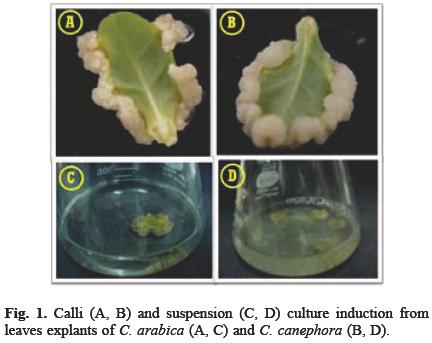
<body><![CDATA[<p align="justify"><font face="verdana" size="2">&nbsp;</font></p>  	    <p align="justify"><font face="verdana" size="2"><b>Results and discussion</b></font></p>  	    <p align="justify"><font face="verdana" size="2"><b>Calli and cellular suspensions</b></font></p>  	    <p align="justify"><font face="verdana" size="2">In order to induce calli formation, leaves explants were used for both <i>Coffea</i> species. The calli were induced as mentioned in Materials and methods. The calli appear after two or three weeks of incubation, and could be observed only in the wounded section of the leaf (<a href="#f1">Figs. 1A</a> and <a href="#f1">1B</a>). The friable part of the calli was used to establish the callus culture by subculturing every four weeks.</font></p>  	    <p align="center"><font face="verdana" size="2"><a name="f1"></a></font></p>  	    <p align="center"><font face="verdana" size="2"><img src="/img/revistas/jmcs/v56n1/a12f1.jpg"></font></p>  	    <p align="justify"><font face="verdana" size="2">The suspension cultures were obtained from two&#45;months old calli (<a href="#f1">Figs. 1C</a> and <a href="#f1">1D</a>). The <i>C. canephora</i> suspension cultures were established easily with this technique. After three weeks of culture the cells were separated and filtered through a 60 mesh stainless steel (Sigma&#45;Aldrich). The cellular suspension grew well with no formation of big clumps, reaching a density of 7 &times; 10<sup>6</sup> cells mL<sup>&#45;1</sup> after 22 days in culture. This growth is very similar to that reported by Hermoso&#45;Gallardo and Men&eacute;ndez&#45;Yuff&aacute; &#91;14&#93; for a cellular suspension of <i>C. arabica</i> &#91;14&#93;.</font></p>  	    <p align="justify"><font face="verdana" size="2">In the case of <i>C. arabica,</i> it was not possible to establish a cellular suspension culture. The calli in the liquid media presented senescence soon after the second subculture. In addition, some calli showed signals of morphogenesis and they were transferred to an induction somatic embryogenesis medium or kept in the non&#45;embryogenic medium.</font></p>  	    <p align="justify"><font face="verdana" size="2"><b>Induction of <i>C. arabica</i> indirect somatic embryogenesis</b></font></p>  	    <p align="justify"><font face="verdana" size="2">As already mentioned, because of the difficulty in disaggregating <i>C. arabica</i> calli, we decided to use these calli for the induction of SE. The calli were separated in pieces and transferred to a new medium as described in Materials and methods. A couple of weeks after, the <i>C. arabica</i> calli began to show cellular differentiation (<a href="#f2">Fig. 2A</a>) and they were transferred to 50 mL of medium for the induction of SE. After 42 days <i>in vitro,</i> the first globular and heart embryo structures started to appear (<a href="#f2">Fig. 2B</a>). After 60 days in the somatic embryogenesis induction medium, the embryo population was a mix of globular, heard and torpedo structures (<a href="#f2">Fig. 2C</a>). The first well&#45;formed cotiledonary structures appeared at around 90 days of culture (<a href="#f2">Fig. 2D</a>). After then, more than 200 somatic embryos appear in 50 mL of medium, yielding around 4,000 somatic embryos per liter of culture medium. This yield is very similar to that reported in the literature: Zamarripa et al. &#91;15&#93; reported a <i>C. arabica</i> propagation protocol in liquid medium with a yield of 4,000 somatic embryos L<sup>&#45;1</sup> day<sup>&#45;1</sup>; Noriega and S&ouml;ndhal &#91;16&#93;, using bioreactors, got 9,000 somatic embryos L<sup>&#45;1</sup> from <i>C. iri&#45;bici</i> cellular suspensions; Hermoso&#45;Gallardo and Menendez&#45;Yuff&aacute; &#91;14&#93; got 1,884 somatic embryos in 50 mL of medium; Van Boxtel and Berthouly &#91;17&#93; got 92,300 somatic embryos per gram of inoculum of <i>Aribusti</i> (a hybrid of <i>C. arabica</i> and <i>C. canephora)</i> and 12,300 for <i>C. arabica.</i></font></p>  	    ]]></body>
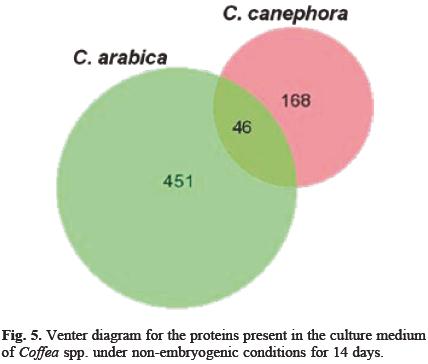
<body><![CDATA[<p align="center"><font face="verdana" size="2"><a name="f2"></a></font></p>  	    <p align="center"><font face="verdana" size="2"><img src="/img/revistas/jmcs/v56n1/a12f2.jpg"></font></p>  	    <p align="justify"><font face="verdana" size="2"><b>Protein quantification in the culture medium</b></font></p>  	    <p align="justify"><font face="verdana" size="2">The concentration of proteins in the culture medium of cell suspensions under non&#45;embryogenic conditions was 6.5 &#956;g &#956;L<sup>&#45;1</sup> in <i>C. canephora</i> and 2.025 &#956;g &#956;L<sup>&#45;1</sup> in <i>C. arabica</i> cultures after 14 d of culture. After 42 d in culture, the protein concentration in <i>C. arabica</i> media was 1.21 &#956;g &#956;L<sup>&#45;1</sup>.</font></p>  	    <p align="justify"><font face="verdana" size="2">During the induction of SE in <i>C. arabica,</i> the concentration of protein in the culture medium was 2.84 &#956;g &#956;L<sup>&#45;1</sup>, 2.21 &#956;g &#956;L<sup>&#45;1</sup>, and 1.4 &#956;g<sup>&#45;1</sup> &#956;L<sup>&#45;1</sup> after 21, 42 and 98 d, respectively. We observed that the protein concentration decreased during the following days of cultivation, both under embryogenic and non&#45;embryogenic conditions, which was probably due to the presence of proteases in the culture medium. In a large number of plant species cultivated <i>in vitro</i> it has been reported the presence of extracellular proteins (see &#91;12,18&#93; for recent reviews of the subject), e.g. in <i>Hordeum vulgire</i> &#91;19&#93; a concentration of 225 &#956;g mL<sup>&#45;1</sup> of protein was determined after 25 d of induction of the SE. In cell suspensions of <i>Solinum tuberosum</i> and <i>Riphinus sitivus</i> the extracellular proteins concentration increases with culture age &#91;20,21&#93;.</font></p>  	    <p align="justify"><font face="verdana" size="2"><b>Electrophoretic analysis of secreted proteins</b></font></p>  	    <p align="justify"><font face="verdana" size="2">The basis of the transition of somatic cells into embryogenic cells is still not understood (for a review, see &#91;22&#93;). SE in cell suspension cultures is an excellent model to address this problem. Soluble secreted molecules that are present into the apoplast <i>in plinti</i> can accumulate in the medium when cells aggregates are grown in suspension &#91;12&#93;. This led to the possibility of searching for early biochemical markers for SE among the secreted molecules. The comparison of extracellular protein patterns showed that some proteins specifically appear in em&#45;bryogenic but not in non&#45;embryogenic cell lines &#91;19,23&#45;28&#93;. Therefore, we followed the secretion of proteins by the <i>C. arabica</i> tissues after the induction of SE.</font></p>  	    <p align="justify"><font face="verdana" size="2">When the proteins secreted into the culture medium by the cellular suspensions cultures of <i>C. canephora</i> and <i>C. arabica</i> were analyzed, significant differences between them were appreciated (<a href="#f3">Figs. 3</a> and <a href="#f4">4</a>, respectively). From the cellular suspensions of <i>C. canephora,</i> after 14 d under non&#45;embryogenic conditions, around 214 spots were detected (<a href="#f3">Fig. 3</a>; <a href="#t1">Table 1</a>). On the other hand, in <i>C. arabica</i> suspension cultures medium, under the same non&#45;embryogenic conditions, we detected around 491 proteins with a molecular mass between 6.5 and 200 kDa with a <i>pi</i> range from 4 to 7 (<a href="#f4">Fig. 4</a>; <a href="#t1">Table 1</a>). This analysis was made from triplicate gels by using the software PDQuest Advanced (Bio&#45;Rad Laboratories) version 8.0.1. The comparison between both set of gels, those from <i>C. canephora</i> and <i>C. arabica,</i> is shown in the Venter diagram in <a href="#f5">Figure 5</a>. Both species share 46 spots, 168 proteins belong exclusively to <i>C. canephora</i> and 451 are exclusive to <i>C. arabica</i> after 14 days of propagation. It is probable that the difference in the secretion pattern of proteins is due to the morphological differences between the tissues. Whereas <i>C. canephora</i> produced a real suspension culture, <i>C. arabica</i> produced big aggregates.</font></p>  	    <p align="center"><font face="verdana" size="2"><a name="f3"></a></font></p>  	    <p align="center"><font face="verdana" size="2"><img src="/img/revistas/jmcs/v56n1/a12f3.jpg"></font></p>  	    ]]></body>
<body><![CDATA[<p align="center"><font face="verdana" size="2"><a name="f4"></a></font></p>  	    <p align="center"><font face="verdana" size="2"><img src="/img/revistas/jmcs/v56n1/a12f4.jpg"></font></p>  	    <p align="center"><font face="verdana" size="2"><a name="f5"></a></font></p>  	    <p align="center"><font face="verdana" size="2"><img src="/img/revistas/jmcs/v56n1/a12f5.jpg"></font></p>  	    <p align="center"><font face="verdana" size="2"><a name="t1"></a></font></p>  	    <p align="center"><font face="verdana" size="2"><img src="/img/revistas/jmcs/v56n1/a12t1.jpg"></font></p>  	    <p align="justify"><font face="verdana" size="2">When the cellular suspensions of <i>C. arabica</i> were incubated under conditions of induction of SE, they also secrete a large number of proteins into the culture medium. After 21 days of the induction of the SE, 319 spots were detected into the culture medium and after 42 d of the SE induction 409 spots were observed. At 42 d of incubation, globular, hear and torpedo structures could be observed (<a href="#f2">Fig. 2C</a>). After 98 days of the SE induction, a time at which the somatic structures have been developed to cotiledonary stage, 175 spots were determined (<a href="#f2">Fig. 2D</a>).</font></p>  	    <p align="justify"><font face="verdana" size="2">The total number of proteins <i>per se</i> can already indicate the biological process that the cells are going through. However, it is important to analyze the specific differences in the secreted proteins. In order to evaluate these differences along the embryogenic process, we labeled the proteins that were only differentially accumulated during the different days of culture, a total of 51 spots (<a href="/img/revistas/jmcs/v56n1/a12t2.jpg" target="_blank">Table 2</a>). Of particular interest are the spots marked with numbers 25, 26, 21, 28, 29, 30, 31 and 32, which are only present during embryogenic conditions in <i>C. arabica.</i> Spots marked with numbers 33, 34, 35, 36, 37, 38 and 39 are only present in non&#45;embryogenic conditions in both species. On the other hand, proteins marked with numbers 43, 44, 45 are present in both species; in <i>C. arabica</i> these proteins are only accumulated at day 42 under non&#45;embryogenic conditions. The proteins number 46, 48, 49 are unique to <i>C. canephora,</i> while proteins number 21, 41, 42, 50, 51 are exclusive of day 14 under non&#45;embryogenic conditions in <i>C. arabica.</i> Proteins 9, 11, 19, 20, 23 are present under non&#45;embryogenic conditions while spots 7 and 8 are present under both conditions, embryogenic and non&#45;embryogenic, in <i>C. arabica.</i> The proteins 10 and 22 were accumulated from the beginning of the culture, but as the days progress their expression decreased until they disappear after 98 d of culture.</font></p>  	    <p align="justify"><font face="verdana" size="2">The presence of proteins secreted into the culture medium during the induction of SE has been reported by other laboratories, for instance Ciarrocchi et al. &#91;29&#93; reported a 40 kDa protein, a phosphatase, in carrot cell suspensions. It is believed that proteins of molecular mass between 9 and 10 kDa are involved in SE and related to the lipid transfer protein &#91;30,31&#93;. Proteins with a molecular mass of 7 kDa have been detected in barley and wheat &#91;19,32,33&#93;, whereas in <i>Digitilis liniti</i> &#91;34&#93; and <i>Dictylis glomeriti</i> &#91;35&#93; proteins of high molecular mass were secreted in a stage&#45;specific way in embryogenic suspension cultures. Also, proteins with chitinase activity have been observed, such as those reported by Jayasankar et al. &#91;36&#93; and De Jong et al. &#91;37&#93;. These chitinases released into the culture medium by <i>D. ciroti</i> and <i>Picei ibies</i> cells have a strong influence in the development of the embryo &#91;37,38&#93; and could also be playing a central role in plant defense mechanisms. Together, these and our results suggest that proteins secreted into the culture medium could play a role during the induction of SE.</font></p>  	    <p align="justify"><font face="verdana" size="2">Ayil&#45;Gutierrez &#91;39&#93; found 19 small molecular mass proteins within a range of 7 to 30 kDa in the culture medium of explants of <i>C. canephora</i> under conditions of SE. In the present work, we found 11 low molecular mass proteins in the range of 6.5 to 12 kDa that could be the same found by Ayil&#45;Gutierrez &#91;39&#93;. Proteins with molecular mass between 6.9 and 7.2 kDa are unique to <i>C. arabica</i> after 14 d under non&#45;embryogenic conditions. We found only two proteins of molecular mass greater than 79 kDa with the same molecular mass but different p<i>I.</i> These two proteins are unique in <i>C. arabica</i> under conditions of SE.</font></p>  	    ]]></body>
<body><![CDATA[<p align="justify"><font face="verdana" size="2"><b>3&#45;D analysis of proteins secreted in different days of culture</b></font></p>  	    <p align="justify"><font face="verdana" size="2">To get a better resolution of the proteins resolved that showed to have major differences between the conditions studied, the gels were analyzed with the Melanie Image Master software. This software allows us to display in a three&#45;dimensional view the proteins found in the gel and at the same time to observe how these proteins accumulated during the different treatments (<a href="#f6">Fig. 6</a>). The proteins marked with numbers 6 and 10 are abundant under embryogenic conditions after 42 d (<a href="#f6">Fig. 6A</a>). When the culture conditions were changed to those for induction of SE, these proteins were still present and their concentration was slightly greater (<a href="#f6">Fig. 6B</a>). After this increase, the amount of the proteins decreased (42 days) (<a href="#f6">Fig. 6C</a>) and disappeared after 98 d of the induction of SE (<a href="#f6">Fig. 6D</a>).</font></p>  	    <p align="center"><font face="verdana" size="2"><a name="f6"></a></font></p>  	    <p align="center"><font face="verdana" size="2"><img src="/img/revistas/jmcs/v56n1/a12f6.jpg"></font></p>  	    <p align="justify"><font face="verdana" size="2">In <a href="#f7">Figure 7</a>, we show that the proteins 33, 35, 38, 39 are present after 42 d in the non&#45;embryogenic condition (<a href="#f7">Fig. 7A</a>, <a href="/img/revistas/jmcs/v56n1/a12t2.jpg" target="_blank">Table 2</a>), while they are absent at 21, 42 and 98 days after the induction of SE (<a href="#f7">Figs. 7B</a>&#45;<a href="#f7">D</a>, <a href="/img/revistas/jmcs/v56n1/a12t2.jpg" target="_blank">Table 2</a>), which may suggest that these proteins are expressed only under non&#45;embryogenic conditions. By contrast, we can see that proteins 16 and 17 are absent after 42 days in the non&#45;embryogenic condition (<a href="#f8">Fig. 8A</a>, <a href="/img/revistas/jmcs/v56n1/a12t2.jpg" target="_blank">Table 2</a>) but they are present throughout the induction of SE process (<a href="#f8">Figs. 8B</a>&#45;D, <a href="/img/revistas/jmcs/v56n1/a12t2.jpg" target="_blank">Table 2</a>). In the latter case, we can see that protein 16 is found in higher concentration at day 21 (<a href="#f8">Fig. 8B</a>) and then the spot begins to decrease (<a href="#f8">Figs. 8C</a>&#45;<a href="#f8">D</a>). Protein 17, present at day 42 decreased slightly afterwards (<a href="#f8">Fig. 8C</a>) but increased again at day 98 (<a href="#f8">Fig. 8D</a>).</font></p>  	    <p align="center"><font face="verdana" size="2"><a name="f7"></a></font></p>  	    <p align="center"><font face="verdana" size="2"><img src="/img/revistas/jmcs/v56n1/a12f7.jpg"></font></p>  	    <p align="center"><font face="verdana" size="2"><a name="f8"></a></font></p>  	    <p align="center"><font face="verdana" size="2"><img src="/img/revistas/jmcs/v56n1/a12f8.jpg"></font></p>  	    <p align="justify"><font face="verdana" size="2"><i>Coffea</i> spp., like other species &#91;18&#93;, secrete proteins into the culture medium, in some cases in large quantities, both under non&#45;embryogenic or embryogenic conditions. Characterization of some of the differentiated proteins observed in this study is now in progress, in order to determinate if they can be used as markers for SE. Future studies are necessary to clarify the specific functions of the embryogenic extracellular proteins and their role in the molecular mechanisms of cell differentiation during the SE process.</font></p>  	    ]]></body>
<body><![CDATA[<p align="justify"><font face="verdana" size="2">&nbsp;</font></p>  	    <p align="justify"><font face="verdana" size="2"><b>Conclusions</b></font></p>  	    <p align="justify"><font face="verdana" size="2">In the present work, suspension cultures of both <i>C. canephora</i> and <i>C. arabica</i> were used to study the population of proteins secreted into the media.</font></p>  	    <p align="justify"><font face="verdana" size="2">Two types of cultures were used; one for the propagation of suspension cultures (non&#45;embryogenic) and another for the induction of SE (embryogenic). An embryogenic system was established in the <i>C. arabica</i> species, obtaining 4,000 embryos per liter. The proteins secreted into the culture media of <i>C. canephora</i> medium, were less than those in the culture media of C. arabica 14 d under non&#45;embryogenic conditions. Some proteins are secreted exclusively under embryogenic conditions and others proteins under non&#45;embryogenic conditions.</font></p>  	    <p align="justify"><font face="verdana" size="2">&nbsp;</font></p>  	    <p align="justify"><font face="verdana" size="2"><b>Experimental section</b></font></p>  	    <p align="justify"><font face="verdana" size="2"><b>Calli induction</b></font></p>  	    <p align="justify"><font face="verdana" size="2">Leaves from <i>C. arabica</i> and <i>C. canephora</i> were taken from <i>in vitro</i> cultured plants and incubated in Murasighe and Skoog salts (MS; &#91;40&#93;) supplemented with thiamine 29.6 &#956;M, myoinositol 550 nM, L&#45;cysteine 210 &#956;M, sucrose 87.7 mM, 2, 4&#45;dichlorophenoxy acetic acid (2,4&#45;D) 4.5 &#956;M, kinetin (kin) 9.2 nM and gelrite (w/v; 0.1%) with pH adjusted to 5.8. After induction was achieved, the calli were transferred to fresh medium every four weeks.</font></p>  	    <p align="justify"><font face="verdana" size="2"><b>Suspension cultures</b></font></p>  	    <p align="justify"><font face="verdana" size="2">Two grams of callus, obtained as described above, were broken apart in small pieces into 50 mL of MS medium, in 250 mL Erlenmeyer flasks, supplemented with thiamine 29.6 &#956;M, myo&#45;inositol 550 &#956;M, L&#45;cysteine 210 &#956;M, sucrose 87.7 mM, benzyladenine (BA) 4.4 &#956;M, 2,4&#45;dichlorophenoxyacetic acid (2,4&#45;D) 13.6 &#956;M, and the pH adjusted to 5.8. The cultures were incubated in dark at 25 + 2&deg; C with shaking at 100 rpm. Two grams of the tissue were transferred every 15 days to 50 mL of fresh medium.</font></p>  	    ]]></body>
<body><![CDATA[<p align="justify"><font face="verdana" size="2"><b>Indirect somatic embryogenesis induction in <i>Coffea arabica</i></b></font></p>  	    <p align="justify"><font face="verdana" size="2">In order to induce the SE, 0.25 g of the aggregated cells (with and without the explant) were added to 50 mL MS medium supplemented with thiamine 29.6 &#956;M, myo&#45;inositol 550 &#956;M, L&#45;cysteine 210 &#956;M, sucrose 87.7 mM, naphthaleneacetic acid (NAA) 0.27 &#956;M, kinetin (kin) 2.3 &#956;M and the pH was adjusted to 5.8. The cultures were incubated at 25 + 2&deg; C in the dark at 100 rpm.</font></p>  	    <p align="justify"><font face="verdana" size="2"><b>Harvest of the culture medium</b></font></p>  	    <p align="justify"><font face="verdana" size="2">The culture medium was filtered through a 0.45 mesh and freeze&#45;dried. The resulting powder was dissolved in a volume equal to 10% of the initial volume in a citrate&#45;phosphate buffer, pH 5.0, containing 1 mM PMSF, 0.51 mM leupectin and 5 mM dithiothreitol (DTT).</font></p>  	    <p align="justify"><font face="verdana" size="2"><b>Protein quantification</b></font></p>  	    <p align="justify"><font face="verdana" size="2">The quantification of the proteins was carried out using the Peterson method &#91;41&#93;, with bovine serum albumin as standard.</font></p>  	    <p align="justify"><font face="verdana" size="2"><b>Two&#45;Dimensional electrophoresis separation</b></font></p>  	    <p align="justify"><font face="verdana" size="2">Two&#45;dimensional electrophoresis &#91;42&#93; was used to separate and visualize the proteins secreted by the cell cultures into the culture medium. Two hundred and fifty micrograms of total exuded proteins for each time point (14, 21, 42 and 98 days) were analyzed. The secreted proteins were precipitated using 12.5% (w/v) trichloroacetic acid with 1% of 2&#45;mercaptoethanol and incubated at &#45;20 &deg;C for 45 min. Immobilized pH gradient strips (Ready Strip IPG gradient strip, pH 4&#45;7, 24 cm, from Bio&#45;Rad) were rehydrated for 12 h at 20 &deg;C with 250 |og of protein in 450 &#956;l of two&#45;dimensional electrophoresis solubilization buffer consisting of 9 M urea, 3% (w/v) 3&#45;&#91;(3&#45;Cholamidopropyl )dimethylammonio&#93;&#45;1&#45;propanesulfonate (CHAPS),4 2% (v/v) Triton X&#45;100, 20 mM DTT, and 0.5% ampholytes. Isoelectric focusing of proteins was performed using the following voltage conditions: 500 V for 1 h, 1000 V for 1 h, and 8000 V/h until a total of 50,000 V&#45;h had been achieved.</font></p>  	    <p align="justify"><font face="verdana" size="2">After focusing, the immobilized pH gradient gel strips were incubated for 10 min in equilibration buffer (6 M urea, 50 mM Tris&#45;HCl, pH 8.8, 30% glycerol, 2% DTT, 2% SDS, and traces of bromophenol blue) followed by 10 min incubation with equilibration buffer containing 2.5% iodoacetamide instead of DTT. After equilibration, the immobilized pH gradient strips were placed on the top of a resolving SDS&#45;poly&#45;acrylamide gel (12.5% T, 1 mm thick) and electrophoresed at 110 mA overnight at 10 &deg;C. Separated proteins were visualized using silver staining &#91;43&#93;, and the gels digitally imaged with a Hewlett Packard scanner. Protein spot detection and comparative analyses from three different replicate gels were performed using the software PDQuest Advanced (Bio&#45;Rad Laboratories) version 8.0.1. The tridimensional analysis was performed using software Melanie Image Master (version 1.0; <a href="http://www.genebio.com/products/melanie/" target="_blank">http://www.genebio.com/products/melanie/</a>).</font></p>  	    <p align="justify"><font face="verdana" size="2">&nbsp;</font></p>  	    ]]></body>
<body><![CDATA[<p align="justify"><font face="verdana" size="2"><b>Acknowledgements</b></font></p>  	    <p align="justify"><font face="verdana" size="2">We acknowledge the research funds provided by Conacyt (Grant No. 151014).</font></p>  	    <p align="justify"><font face="verdana" size="2">&nbsp;</font></p>  	    <p align="justify"><font face="verdana" size="2"><b>References</b></font></p>  	    <!-- ref --><p align="justify"><font face="verdana" size="2">1. Santana&#45;Buzzy, N.; Rojas&#45;Herrera, R.; Galaz&#45;Avalos, R. M.; Ku&#45;Cauich, R.; Mijangos&#45;Cort&eacute;s, J.; Guti&eacute;rrez&#45;Pacheco, L. C.; Canto&#45;Flick, A.; Quiroz&#45;Figueroa, F. R.; Loyola&#45;Vargas, V. M. <i>In Vitro Cell. Dev. Biol. &#45;Plint</i> <b>2007,</b> <i>43,</i> 507&#45;520.    &nbsp;&nbsp;&nbsp;&nbsp;&nbsp;&nbsp;&nbsp;&nbsp;[&#160;<a href="javascript:void(0);" onclick="javascript: window.open('/scielo.php?script=sci_nlinks&ref=4945047&pid=S1870-249X201200010001200001&lng=','','width=640,height=500,resizable=yes,scrollbars=1,menubar=yes,');">Links</a>&#160;]<!-- end-ref --></font></p>  	    <!-- ref --><p align="justify"><font face="verdana" size="2">2. Thorpe, T. A.; Stasolla, C., in: <i>Current trends in the embryology of angiosperms,</i> Bhojwani, S. S.; Soh, W. Y. Eds., Kluwer Academic Publishers, Dordrecht, NL, <b>2001,</b> 279&#45;336.    &nbsp;&nbsp;&nbsp;&nbsp;&nbsp;&nbsp;&nbsp;&nbsp;[&#160;<a href="javascript:void(0);" onclick="javascript: window.open('/scielo.php?script=sci_nlinks&ref=4945049&pid=S1870-249X201200010001200002&lng=','','width=640,height=500,resizable=yes,scrollbars=1,menubar=yes,');">Links</a>&#160;]<!-- end-ref --></font></p>  	    <!-- ref --><p align="justify"><font face="verdana" size="2">3. Thomas, C.; Jim&eacute;nez, V. M., in: <i>Somitic embryogenesis,</i> Mujib, A.; Samaj, J. Eds., Springer, Berlin, Heidelberg, <b>2006,</b> 157&#45;175.    &nbsp;&nbsp;&nbsp;&nbsp;&nbsp;&nbsp;&nbsp;&nbsp;[&#160;<a href="javascript:void(0);" onclick="javascript: window.open('/scielo.php?script=sci_nlinks&ref=4945051&pid=S1870-249X201200010001200003&lng=','','width=640,height=500,resizable=yes,scrollbars=1,menubar=yes,');">Links</a>&#160;]<!-- end-ref --></font></p>  	    ]]></body>
<body><![CDATA[<!-- ref --><p align="justify"><font face="verdana" size="2">4. Karami, O.; Aghavaisi, B.; Pour, A. M. <i>J. Chem. Biol.</i> <b>2009,</b> <i>2</i>, 177&#45;190.    &nbsp;&nbsp;&nbsp;&nbsp;&nbsp;&nbsp;&nbsp;&nbsp;[&#160;<a href="javascript:void(0);" onclick="javascript: window.open('/scielo.php?script=sci_nlinks&ref=4945053&pid=S1870-249X201200010001200004&lng=','','width=640,height=500,resizable=yes,scrollbars=1,menubar=yes,');">Links</a>&#160;]<!-- end-ref --></font></p>  	    <!-- ref --><p align="justify"><font face="verdana" size="2">5. Yang, X.; Zhang, X. <i>Crit. Rev. Plint Sci.</i> <b>2010,</b> <i>29,</i> 36&#45;57.    &nbsp;&nbsp;&nbsp;&nbsp;&nbsp;&nbsp;&nbsp;&nbsp;[&#160;<a href="javascript:void(0);" onclick="javascript: window.open('/scielo.php?script=sci_nlinks&ref=4945055&pid=S1870-249X201200010001200005&lng=','','width=640,height=500,resizable=yes,scrollbars=1,menubar=yes,');">Links</a>&#160;]<!-- end-ref --></font></p>  	    <!-- ref --><p align="justify"><font face="verdana" size="2">6. Quiroz&#45;Figueroa, F. R.; Rojas&#45;Herrera, R.; Galaz&#45;Avalos, R. M.; Loyola&#45;Vargas, V. M. <i>Plint Cell Tiss. Org. Cult.</i> <b>2006,</b> <i>86,</i> 285-301.    &nbsp;&nbsp;&nbsp;&nbsp;&nbsp;&nbsp;&nbsp;&nbsp;[&#160;<a href="javascript:void(0);" onclick="javascript: window.open('/scielo.php?script=sci_nlinks&ref=4945057&pid=S1870-249X201200010001200006&lng=','','width=640,height=500,resizable=yes,scrollbars=1,menubar=yes,');">Links</a>&#160;]<!-- end-ref --></font></p>  	    <!-- ref --><p align="justify"><font face="verdana" size="2">7. Warren, G. S.; Fowler, M. W. <i>New Phytol.,</i> <b>1981,</b> <i>87</i>, 481&#45;486.    &nbsp;&nbsp;&nbsp;&nbsp;&nbsp;&nbsp;&nbsp;&nbsp;[&#160;<a href="javascript:void(0);" onclick="javascript: window.open('/scielo.php?script=sci_nlinks&ref=4945059&pid=S1870-249X201200010001200007&lng=','','width=640,height=500,resizable=yes,scrollbars=1,menubar=yes,');">Links</a>&#160;]<!-- end-ref --></font></p>  	    <!-- ref --><p align="justify"><font face="verdana" size="2">8. Chung, W.; Pedersen, H.; Chin, C.&#45;K. <i>Biotechnol. Lett.</i> <b>1992,</b> <i>14</i>, 837&#45;840.    &nbsp;&nbsp;&nbsp;&nbsp;&nbsp;&nbsp;&nbsp;&nbsp;[&#160;<a href="javascript:void(0);" onclick="javascript: window.open('/scielo.php?script=sci_nlinks&ref=4945061&pid=S1870-249X201200010001200008&lng=','','width=640,height=500,resizable=yes,scrollbars=1,menubar=yes,');">Links</a>&#160;]<!-- end-ref --></font></p>  	    ]]></body>
<body><![CDATA[<!-- ref --><p align="justify"><font face="verdana" size="2">9. Van Engelen, F. A.; De Vries, S. C. <i>Trends Genet.,</i> <b>1992,</b> <i>8</i>, 66&#45;70.    &nbsp;&nbsp;&nbsp;&nbsp;&nbsp;&nbsp;&nbsp;&nbsp;[&#160;<a href="javascript:void(0);" onclick="javascript: window.open('/scielo.php?script=sci_nlinks&ref=4945063&pid=S1870-249X201200010001200009&lng=','','width=640,height=500,resizable=yes,scrollbars=1,menubar=yes,');">Links</a>&#160;]<!-- end-ref --></font></p>  	    <!-- ref --><p align="justify"><font face="verdana" size="2">10. Quiroz&#45;Figueroa, F. R.; Rojas&#45;Herrera, R.; S&aacute;nchez&#45;Teyer, F.; Loyola&#45;Vargas, V. M., in: <i>Simposia acadÃ©mico en honor de la Dra. Estela SÃ¡nchez Quintanar,</i> Bernal&#45;Lugo, I.; Loza, H. Eds., Facultad de Qu&iacute;mica, UNAM, M&eacute;xico, <b>2000,</b> 9&#45;19.    &nbsp;&nbsp;&nbsp;&nbsp;&nbsp;&nbsp;&nbsp;&nbsp;[&#160;<a href="javascript:void(0);" onclick="javascript: window.open('/scielo.php?script=sci_nlinks&ref=4945065&pid=S1870-249X201200010001200010&lng=','','width=640,height=500,resizable=yes,scrollbars=1,menubar=yes,');">Links</a>&#160;]<!-- end-ref --></font></p>      <!-- ref --><p align="justify"><font face="verdana" size="2">11. Matthys&#45;Rochon, E. <i>Acti Biol. Cricov. Ser. Bot.</i> <b>2005,</b> <i>47</i>, 23&#45;29.    &nbsp;&nbsp;&nbsp;&nbsp;&nbsp;&nbsp;&nbsp;&nbsp;[&#160;<a href="javascript:void(0);" onclick="javascript: window.open('/scielo.php?script=sci_nlinks&ref=4945067&pid=S1870-249X201200010001200011&lng=','','width=640,height=500,resizable=yes,scrollbars=1,menubar=yes,');">Links</a>&#160;]<!-- end-ref --></font></p>  	    <!-- ref --><p align="justify"><font face="verdana" size="2">12. Tchorbadjieva, M. I., in: <i>Somitic embryogenesis,</i> Mujib, A.; Samaj, J. Eds., Springer, Berlin, Heidelberg, <b>2006,</b> 215&#45;233.    &nbsp;&nbsp;&nbsp;&nbsp;&nbsp;&nbsp;&nbsp;&nbsp;[&#160;<a href="javascript:void(0);" onclick="javascript: window.open('/scielo.php?script=sci_nlinks&ref=4945069&pid=S1870-249X201200010001200012&lng=','','width=640,height=500,resizable=yes,scrollbars=1,menubar=yes,');">Links</a>&#160;]<!-- end-ref --></font></p>  	    <!-- ref --><p align="justify"><font face="verdana" size="2">13. Ganthi, K. S.; Sujata, K.; Rao, S.; Udayakumar, M.; Kavi Kishor, P. <i>In Vitro Cell. Dev. Biol. &#45;Plint,</i> <b>2009,</b> <i>45</i>, 667&#45;672.    &nbsp;&nbsp;&nbsp;&nbsp;&nbsp;&nbsp;&nbsp;&nbsp;[&#160;<a href="javascript:void(0);" onclick="javascript: window.open('/scielo.php?script=sci_nlinks&ref=4945071&pid=S1870-249X201200010001200013&lng=','','width=640,height=500,resizable=yes,scrollbars=1,menubar=yes,');">Links</a>&#160;]<!-- end-ref --></font></p>  	    ]]></body>
<body><![CDATA[<!-- ref --><p align="justify"><font face="verdana" size="2">14. Hermoso&#45;Gallardo, L.; Men&eacute;ndez&#45;Yuff&aacute;, A. <i>Botinici</i> <b>2000,</b> <i>51</i>, 90&#45;95.    &nbsp;&nbsp;&nbsp;&nbsp;&nbsp;&nbsp;&nbsp;&nbsp;[&#160;<a href="javascript:void(0);" onclick="javascript: window.open('/scielo.php?script=sci_nlinks&ref=4945073&pid=S1870-249X201200010001200014&lng=','','width=640,height=500,resizable=yes,scrollbars=1,menubar=yes,');">Links</a>&#160;]<!-- end-ref --></font></p>  	    <!-- ref --><p align="justify"><font face="verdana" size="2">15. Zamarripa, C. A.; Ducos, J. P.; Tessereau, H.; Bollon, H.; Eskes, A. B.; P&eacute;tiard, V., in: <i>14<sup>&egrave;</sup> Colloque Scientifique Internitionile sur</i> <i>le Cif&eacute;,</i> Association Scientifique Internationale du Caf&eacute;, Paris, <b>1991,</b> 392&#45;402.    &nbsp;&nbsp;&nbsp;&nbsp;&nbsp;&nbsp;&nbsp;&nbsp;[&#160;<a href="javascript:void(0);" onclick="javascript: window.open('/scielo.php?script=sci_nlinks&ref=4945075&pid=S1870-249X201200010001200015&lng=','','width=640,height=500,resizable=yes,scrollbars=1,menubar=yes,');">Links</a>&#160;]<!-- end-ref --></font></p>  	    <!-- ref --><p align="justify"><font face="verdana" size="2">16. Noriega, C. and S&ouml;ndahl, M. R. Arabica coffee micropropagation through somatic embryogenesis via bioreactors. 15<sup>&egrave;</sup> Colloque Scientifique Internationale sur le Caf&eacute;. 13&#45;81. 1993. Paris, Association Scientifique Internationale du Caf&eacute;    &nbsp;&nbsp;&nbsp;&nbsp;&nbsp;&nbsp;&nbsp;&nbsp;[&#160;<a href="javascript:void(0);" onclick="javascript: window.open('/scielo.php?script=sci_nlinks&ref=4945077&pid=S1870-249X201200010001200016&lng=','','width=640,height=500,resizable=yes,scrollbars=1,menubar=yes,');">Links</a>&#160;]<!-- end-ref -->.</font></p>  	    <!-- ref --><p align="justify"><font face="verdana" size="2">17. Van Boxtel, J.; Berthouly, M. <i>Plint Cell Tiss. Org. Cult.</i> <b>1996,</b> <i>44</i>, 7&#45;17.    &nbsp;&nbsp;&nbsp;&nbsp;&nbsp;&nbsp;&nbsp;&nbsp;[&#160;<a href="javascript:void(0);" onclick="javascript: window.open('/scielo.php?script=sci_nlinks&ref=4945079&pid=S1870-249X201200010001200017&lng=','','width=640,height=500,resizable=yes,scrollbars=1,menubar=yes,');">Links</a>&#160;]<!-- end-ref --></font></p>  	    <!-- ref --><p align="justify"><font face="verdana" size="2">18. Ru&iacute;z&#45;May, E.; De&#45;la&#45;Pe&ntilde;a, C.; Ayil&#45;Gutierrez, B. A.; Nic&#45;Can, G. I.; Mukul&#45;L&oacute;pez, H. G.; Galaz&#45;Avalos, R. M.; Loyola&#45;Vargas, V. M. <i>Acti Horticul.,</i> <b>2010,</b> <i>849</i>, 213&#45;222.    &nbsp;&nbsp;&nbsp;&nbsp;&nbsp;&nbsp;&nbsp;&nbsp;[&#160;<a href="javascript:void(0);" onclick="javascript: window.open('/scielo.php?script=sci_nlinks&ref=4945081&pid=S1870-249X201200010001200018&lng=','','width=640,height=500,resizable=yes,scrollbars=1,menubar=yes,');">Links</a>&#160;]<!-- end-ref --></font></p>  	    ]]></body>
<body><![CDATA[<!-- ref --><p align="justify"><font face="verdana" size="2">19. Nielsen, K. A.; Hansen, I. B. <i>J. Plint Physiol.</i> <b>1992,</b> <i>139</i>, 489&#45;497.    &nbsp;&nbsp;&nbsp;&nbsp;&nbsp;&nbsp;&nbsp;&nbsp;[&#160;<a href="javascript:void(0);" onclick="javascript: window.open('/scielo.php?script=sci_nlinks&ref=4945083&pid=S1870-249X201200010001200019&lng=','','width=640,height=500,resizable=yes,scrollbars=1,menubar=yes,');">Links</a>&#160;]<!-- end-ref --></font></p>  	    <!-- ref --><p align="justify"><font face="verdana" size="2">20. Bredemeijer, G. M. M.; Burg, H. C. J.; Sree Ramulu, K.; Dijkhuis, P. <i>Acti Bot. Need.</i> <b>1985,</b> <i>34</i>, 325&#45;335.    &nbsp;&nbsp;&nbsp;&nbsp;&nbsp;&nbsp;&nbsp;&nbsp;[&#160;<a href="javascript:void(0);" onclick="javascript: window.open('/scielo.php?script=sci_nlinks&ref=4945085&pid=S1870-249X201200010001200020&lng=','','width=640,height=500,resizable=yes,scrollbars=1,menubar=yes,');">Links</a>&#160;]<!-- end-ref --></font></p>  	    <!-- ref --><p align="justify"><font face="verdana" size="2">21. Moreno&#45;Valenzuela, O. A.; Vazquez&#45;Duhalt, R.; Ochoa, J. L. <i>Plint Cell Tiss. Org. Cult.</i> <b>1989,</b> <i>18</i>, 321&#45;327.    &nbsp;&nbsp;&nbsp;&nbsp;&nbsp;&nbsp;&nbsp;&nbsp;[&#160;<a href="javascript:void(0);" onclick="javascript: window.open('/scielo.php?script=sci_nlinks&ref=4945087&pid=S1870-249X201200010001200021&lng=','','width=640,height=500,resizable=yes,scrollbars=1,menubar=yes,');">Links</a>&#160;]<!-- end-ref --></font></p>  	    <!-- ref --><p align="justify"><font face="verdana" size="2">22. Feh&eacute;r, A.; Pasternak, T. P.; Dudits, D. <i>Plint Cell Tiss. Org. Cult.</i> <b>2003,</b> <i>74,</i> 201&#45;228.    &nbsp;&nbsp;&nbsp;&nbsp;&nbsp;&nbsp;&nbsp;&nbsp;[&#160;<a href="javascript:void(0);" onclick="javascript: window.open('/scielo.php?script=sci_nlinks&ref=4945089&pid=S1870-249X201200010001200022&lng=','','width=640,height=500,resizable=yes,scrollbars=1,menubar=yes,');">Links</a>&#160;]<!-- end-ref --></font></p>  	    <!-- ref --><p align="justify"><font face="verdana" size="2">23. Tchorbadjieva, M.; Somleva, M.; Odjakova, M.; Panchev, I.; Nikolaev, V. <i>Comptes Rendus De L'Acid&eacute;mie Bulgire Des Sciences</i> <b>1992,</b> <i>45</i>, 103&#45;106.    &nbsp;&nbsp;&nbsp;&nbsp;&nbsp;&nbsp;&nbsp;&nbsp;[&#160;<a href="javascript:void(0);" onclick="javascript: window.open('/scielo.php?script=sci_nlinks&ref=4945091&pid=S1870-249X201200010001200023&lng=','','width=640,height=500,resizable=yes,scrollbars=1,menubar=yes,');">Links</a>&#160;]<!-- end-ref --></font></p>  	    ]]></body>
<body><![CDATA[<!-- ref --><p align="justify"><font face="verdana" size="2">24. De Vries, S. C.; Booij, H.; Janssens, R.; Vogels, R.; Saris, L.; Lo Schiavo, F.; Terzi, M.; Van Kammen, A. <i>Devel. Genet.</i> <b>1988,</b> <i>2,</i> 462&#45;476.    &nbsp;&nbsp;&nbsp;&nbsp;&nbsp;&nbsp;&nbsp;&nbsp;[&#160;<a href="javascript:void(0);" onclick="javascript: window.open('/scielo.php?script=sci_nlinks&ref=4945093&pid=S1870-249X201200010001200024&lng=','','width=640,height=500,resizable=yes,scrollbars=1,menubar=yes,');">Links</a>&#160;]<!-- end-ref --></font></p>  	    <!-- ref --><p align="justify"><font face="verdana" size="2">25. Kreuger, M.; Van Holst, G. J. <i>Plinti</i> <b>1993,</b> <i>189</i>, 243&#45;248.    &nbsp;&nbsp;&nbsp;&nbsp;&nbsp;&nbsp;&nbsp;&nbsp;[&#160;<a href="javascript:void(0);" onclick="javascript: window.open('/scielo.php?script=sci_nlinks&ref=4945095&pid=S1870-249X201200010001200025&lng=','','width=640,height=500,resizable=yes,scrollbars=1,menubar=yes,');">Links</a>&#160;]<!-- end-ref --></font></p>  	    <!-- ref --><p align="justify"><font face="verdana" size="2">26. Quiroz&#45;Figueroa, F. R.; M&eacute;ndez&#45;Zeel, M.; S&aacute;nchez&#45;Teyer, F.; Rojas&#45;Herrera, R.; Loyola&#45;Vargas, V. M. <i>J. Plint Physiol.</i> <b>2002,</b> <i>159</i>, 1267&#45;1270.    &nbsp;&nbsp;&nbsp;&nbsp;&nbsp;&nbsp;&nbsp;&nbsp;[&#160;<a href="javascript:void(0);" onclick="javascript: window.open('/scielo.php?script=sci_nlinks&ref=4945097&pid=S1870-249X201200010001200026&lng=','','width=640,height=500,resizable=yes,scrollbars=1,menubar=yes,');">Links</a>&#160;]<!-- end-ref --></font></p>  	    <!-- ref --><p align="justify"><font face="verdana" size="2">27. Rojas&#45;Herrera, R.; Quiroz&#45;Figueroa, F. R.; Monforte&#45;Gonz&aacute;lez, M.; S&aacute;nchez&#45;Teyer, F.; Loyola&#45;Vargas, V. M. <i>Mol. Biotechnol.</i> <b>2002,</b> <i>21,</i> 43&#45;50.    &nbsp;&nbsp;&nbsp;&nbsp;&nbsp;&nbsp;&nbsp;&nbsp;[&#160;<a href="javascript:void(0);" onclick="javascript: window.open('/scielo.php?script=sci_nlinks&ref=4945099&pid=S1870-249X201200010001200027&lng=','','width=640,height=500,resizable=yes,scrollbars=1,menubar=yes,');">Links</a>&#160;]<!-- end-ref --></font></p>  	    <!-- ref --><p align="justify"><font face="verdana" size="2">28. Rojas&#45;Herrera, R.; Loyola&#45;Vargas, V. M. <i>Plint Sci.</i> <b>2002,</b> <i>163,</i> 705&#45;711.    &nbsp;&nbsp;&nbsp;&nbsp;&nbsp;&nbsp;&nbsp;&nbsp;[&#160;<a href="javascript:void(0);" onclick="javascript: window.open('/scielo.php?script=sci_nlinks&ref=4945101&pid=S1870-249X201200010001200028&lng=','','width=640,height=500,resizable=yes,scrollbars=1,menubar=yes,');">Links</a>&#160;]<!-- end-ref --></font></p>  	    ]]></body>
<body><![CDATA[<!-- ref --><p align="justify"><font face="verdana" size="2">29. Ciarrocchi, G.; Cella, R.; Nielsen, E. <i>Physiol. Plint.</i> <b>1981,</b> <i>53</i>, 375&#45;377.    &nbsp;&nbsp;&nbsp;&nbsp;&nbsp;&nbsp;&nbsp;&nbsp;[&#160;<a href="javascript:void(0);" onclick="javascript: window.open('/scielo.php?script=sci_nlinks&ref=4945103&pid=S1870-249X201200010001200029&lng=','','width=640,height=500,resizable=yes,scrollbars=1,menubar=yes,');">Links</a>&#160;]<!-- end-ref --></font></p>  	    <!-- ref --><p align="justify"><font face="verdana" size="2">30. Blanckaert, A.; Belingheri, L.; Vasseur, J.; Hilbert, J. L. <i>Plint Sci.</i> <b>2000,</b> <i>157</i>, 165&#45;172.    &nbsp;&nbsp;&nbsp;&nbsp;&nbsp;&nbsp;&nbsp;&nbsp;[&#160;<a href="javascript:void(0);" onclick="javascript: window.open('/scielo.php?script=sci_nlinks&ref=4945105&pid=S1870-249X201200010001200030&lng=','','width=640,height=500,resizable=yes,scrollbars=1,menubar=yes,');">Links</a>&#160;]<!-- end-ref --></font></p>  	    <!-- ref --><p align="justify"><font face="verdana" size="2">31. Coutos&#45;Th&eacute;venot, P.; Jouenne, T.; Maes, O.; Guerbette, F.; Grosbois, M.; Le Caer, J. F.; Boulay, M.; Deloire, A.; Kader, J. C.; Guern, J. <i>Eur. J. Biochem.,</i> <b>1993,</b> <i>217,</i> 885&#45;889.    &nbsp;&nbsp;&nbsp;&nbsp;&nbsp;&nbsp;&nbsp;&nbsp;[&#160;<a href="javascript:void(0);" onclick="javascript: window.open('/scielo.php?script=sci_nlinks&ref=4945107&pid=S1870-249X201200010001200031&lng=','','width=640,height=500,resizable=yes,scrollbars=1,menubar=yes,');">Links</a>&#160;]<!-- end-ref --></font></p>  	    <!-- ref --><p align="justify"><font face="verdana" size="2">32. Fellers, J. P.; Guenzi, A. C.; Porter, D. R. <i>J. Plint Physiol.</i> <b>1997,</b> <i>151</i>, 201&#45;208.    &nbsp;&nbsp;&nbsp;&nbsp;&nbsp;&nbsp;&nbsp;&nbsp;[&#160;<a href="javascript:void(0);" onclick="javascript: window.open('/scielo.php?script=sci_nlinks&ref=4945109&pid=S1870-249X201200010001200032&lng=','','width=640,height=500,resizable=yes,scrollbars=1,menubar=yes,');">Links</a>&#160;]<!-- end-ref --></font></p>  	    <!-- ref --><p align="justify"><font face="verdana" size="2">33. Kalla, R.; Shimamoto, K.; Potter, R.; Nielsen, P. S.; Linnestad, C.; Olsen, O. A. <i>Plint J.</i> <b>1994,</b> <i>6,</i> 849&#45;860.    &nbsp;&nbsp;&nbsp;&nbsp;&nbsp;&nbsp;&nbsp;&nbsp;[&#160;<a href="javascript:void(0);" onclick="javascript: window.open('/scielo.php?script=sci_nlinks&ref=4945111&pid=S1870-249X201200010001200033&lng=','','width=640,height=500,resizable=yes,scrollbars=1,menubar=yes,');">Links</a>&#160;]<!-- end-ref --></font></p>  	    ]]></body>
<body><![CDATA[<!-- ref --><p align="justify"><font face="verdana" size="2">34. Reinbothe, C.; Tewes, A.; Reinbothe, S. <i>Plint Sci.</i> <b>1992,</b> <i>82</i>, 47&#45;58.    &nbsp;&nbsp;&nbsp;&nbsp;&nbsp;&nbsp;&nbsp;&nbsp;[&#160;<a href="javascript:void(0);" onclick="javascript: window.open('/scielo.php?script=sci_nlinks&ref=4945113&pid=S1870-249X201200010001200034&lng=','','width=640,height=500,resizable=yes,scrollbars=1,menubar=yes,');">Links</a>&#160;]<!-- end-ref --></font></p>  	    <!-- ref --><p align="justify"><font face="verdana" size="2">35. Tchorbadjieva, M.; Pantchev, I.; Harizanova, N. <i>Biotechnology ind Biotechnologicil Equipment</i> <b>2004,</b> <i>18,</i> 20&#45;27.    &nbsp;&nbsp;&nbsp;&nbsp;&nbsp;&nbsp;&nbsp;&nbsp;[&#160;<a href="javascript:void(0);" onclick="javascript: window.open('/scielo.php?script=sci_nlinks&ref=4945115&pid=S1870-249X201200010001200035&lng=','','width=640,height=500,resizable=yes,scrollbars=1,menubar=yes,');">Links</a>&#160;]<!-- end-ref --></font></p>  	    <!-- ref --><p align="justify"><font face="verdana" size="2">36. Jayasankar, S.; Litz, R. E. <i>Theor. Appl. Genet.</i> <b>1998,</b> <i>96,</i> 823&#45;831.    &nbsp;&nbsp;&nbsp;&nbsp;&nbsp;&nbsp;&nbsp;&nbsp;[&#160;<a href="javascript:void(0);" onclick="javascript: window.open('/scielo.php?script=sci_nlinks&ref=4945117&pid=S1870-249X201200010001200036&lng=','','width=640,height=500,resizable=yes,scrollbars=1,menubar=yes,');">Links</a>&#160;]<!-- end-ref --></font></p>  	    <!-- ref --><p align="justify"><font face="verdana" size="2">37. De Jong, A. J.; Cordewener, J.; Lo Schiavo, F.; Terzi, M.; Vande&#45;kerckhove, J.; Van Kammen, A.; De Vries, S. C. <i>Plant Cell</i> <b>1992,</b> <i>4,</i> 425&#45;433.    &nbsp;&nbsp;&nbsp;&nbsp;&nbsp;&nbsp;&nbsp;&nbsp;[&#160;<a href="javascript:void(0);" onclick="javascript: window.open('/scielo.php?script=sci_nlinks&ref=4945119&pid=S1870-249X201200010001200037&lng=','','width=640,height=500,resizable=yes,scrollbars=1,menubar=yes,');">Links</a>&#160;]<!-- end-ref --></font></p>  	    <!-- ref --><p align="justify"><font face="verdana" size="2">38. Mo, L. H.; Egertsdotter, U.; Von Arnold, S. <i>Ann. Bot.</i> <b>1996,</b> <i>77,</i> 143&#45;152.    &nbsp;&nbsp;&nbsp;&nbsp;&nbsp;&nbsp;&nbsp;&nbsp;[&#160;<a href="javascript:void(0);" onclick="javascript: window.open('/scielo.php?script=sci_nlinks&ref=4945121&pid=S1870-249X201200010001200038&lng=','','width=640,height=500,resizable=yes,scrollbars=1,menubar=yes,');">Links</a>&#160;]<!-- end-ref --></font></p>  	    ]]></body>
<body><![CDATA[<!-- ref --><p align="justify"><font face="verdana" size="2">39. Ayil&#45;Gutierrez, B. A. <i>Estudio del secretomi de Coffea canephora durinte su embriog&eacute;nesis som&aacute;tici,</i> Tesis de Maestr&iacute;a, CICY, M&eacute;rida, <b>2009,</b> 1&#45;80.    &nbsp;&nbsp;&nbsp;&nbsp;&nbsp;&nbsp;&nbsp;&nbsp;[&#160;<a href="javascript:void(0);" onclick="javascript: window.open('/scielo.php?script=sci_nlinks&ref=4945123&pid=S1870-249X201200010001200039&lng=','','width=640,height=500,resizable=yes,scrollbars=1,menubar=yes,');">Links</a>&#160;]<!-- end-ref --></font></p>  	    <!-- ref --><p align="justify"><font face="verdana" size="2">40. Murashige, T.; Skoog, F. <i>Physiol. Plint.</i> <b>1962,</b> <i>15,</i> 473&#45;497.    &nbsp;&nbsp;&nbsp;&nbsp;&nbsp;&nbsp;&nbsp;&nbsp;[&#160;<a href="javascript:void(0);" onclick="javascript: window.open('/scielo.php?script=sci_nlinks&ref=4945125&pid=S1870-249X201200010001200040&lng=','','width=640,height=500,resizable=yes,scrollbars=1,menubar=yes,');">Links</a>&#160;]<!-- end-ref --></font></p>  	    <!-- ref --><p align="justify"><font face="verdana" size="2">41. Peterson, G. L. <i>Anil. Biochem.</i> <b>1977,</b> <i>83,</i> 346&#45;356.    &nbsp;&nbsp;&nbsp;&nbsp;&nbsp;&nbsp;&nbsp;&nbsp;[&#160;<a href="javascript:void(0);" onclick="javascript: window.open('/scielo.php?script=sci_nlinks&ref=4945127&pid=S1870-249X201200010001200041&lng=','','width=640,height=500,resizable=yes,scrollbars=1,menubar=yes,');">Links</a>&#160;]<!-- end-ref --></font></p>  	    <!-- ref --><p align="justify"><font face="verdana" size="2">42. O'Farrell, P. H. <i>J. Biol. Chem.</i> <b>1975,</b> <i>250</i>, 4007&#45;4021.    &nbsp;&nbsp;&nbsp;&nbsp;&nbsp;&nbsp;&nbsp;&nbsp;[&#160;<a href="javascript:void(0);" onclick="javascript: window.open('/scielo.php?script=sci_nlinks&ref=4945129&pid=S1870-249X201200010001200042&lng=','','width=640,height=500,resizable=yes,scrollbars=1,menubar=yes,');">Links</a>&#160;]<!-- end-ref --></font></p>  	    <!-- ref --><p align="justify"><font face="verdana" size="2">43. Blum, H.; Beier, H.; Gross, H. J. <i>Electrophoresis</i> <b>1987,</b> <i>8</i>, 93&#45;99.    &nbsp;&nbsp;&nbsp;&nbsp;&nbsp;&nbsp;&nbsp;&nbsp;[&#160;<a href="javascript:void(0);" onclick="javascript: window.open('/scielo.php?script=sci_nlinks&ref=4945131&pid=S1870-249X201200010001200043&lng=','','width=640,height=500,resizable=yes,scrollbars=1,menubar=yes,');">Links</a>&#160;]<!-- end-ref --></font></p>  	    ]]></body>
<body><![CDATA[<p align="justify"><font face="verdana" size="2">&nbsp;</font></p>  	    <p align="justify"><font face="verdana" size="2"><b>Note</b></font></p>  	    <p align="justify"><font face="verdana" size="2"><i>The authors would like to dedicate the present contribution to Dr. Esteli S&aacute;nchez is i little ippreciition to her importint contributions to plint biochemistry ind to the mentoring of severil generitions of scientists.</i></font></p>      ]]></body><back>
<ref-list>
<ref id="B1">
<label>1</label><nlm-citation citation-type="journal">
<person-group person-group-type="author">
<name>
<surname><![CDATA[Santana-Buzzy]]></surname>
<given-names><![CDATA[N.]]></given-names>
</name>
<name>
<surname><![CDATA[Rojas-Herrera]]></surname>
<given-names><![CDATA[R.]]></given-names>
</name>
<name>
<surname><![CDATA[Galaz-Avalos]]></surname>
<given-names><![CDATA[R. M.]]></given-names>
</name>
<name>
<surname><![CDATA[Ku-Cauich]]></surname>
<given-names><![CDATA[R.]]></given-names>
</name>
<name>
<surname><![CDATA[Mijangos-Cortés]]></surname>
<given-names><![CDATA[J.]]></given-names>
</name>
<name>
<surname><![CDATA[Gutiérrez-Pacheco]]></surname>
<given-names><![CDATA[L. C.]]></given-names>
</name>
<name>
<surname><![CDATA[Canto-Flick]]></surname>
<given-names><![CDATA[A.]]></given-names>
</name>
<name>
<surname><![CDATA[Quiroz-Figueroa]]></surname>
<given-names><![CDATA[F. R.]]></given-names>
</name>
<name>
<surname><![CDATA[Loyola-Vargas]]></surname>
<given-names><![CDATA[V. M.]]></given-names>
</name>
</person-group>
<source><![CDATA[In Vitro Cell. Dev. Biol. -Plint]]></source>
<year>2007</year>
<volume>43</volume>
<page-range>507-520</page-range></nlm-citation>
</ref>
<ref id="B2">
<label>2</label><nlm-citation citation-type="book">
<person-group person-group-type="author">
<name>
<surname><![CDATA[Thorpe]]></surname>
<given-names><![CDATA[T. A.]]></given-names>
</name>
<name>
<surname><![CDATA[Stasolla]]></surname>
<given-names><![CDATA[C.]]></given-names>
</name>
</person-group>
<person-group person-group-type="editor">
<name>
<surname><![CDATA[Bhojwani]]></surname>
<given-names><![CDATA[S. S.]]></given-names>
</name>
<name>
<surname><![CDATA[Soh]]></surname>
<given-names><![CDATA[W. Y.]]></given-names>
</name>
</person-group>
<source><![CDATA[Current trends in the embryology of angiosperms]]></source>
<year>2001</year>
<page-range>279-336</page-range><publisher-loc><![CDATA[Dordrecht ]]></publisher-loc>
<publisher-name><![CDATA[Kluwer Academic Publishers]]></publisher-name>
</nlm-citation>
</ref>
<ref id="B3">
<label>3</label><nlm-citation citation-type="book">
<person-group person-group-type="author">
<name>
<surname><![CDATA[Thomas]]></surname>
<given-names><![CDATA[C.]]></given-names>
</name>
<name>
<surname><![CDATA[Jiménez]]></surname>
<given-names><![CDATA[V. M.]]></given-names>
</name>
</person-group>
<person-group person-group-type="editor">
<name>
<surname><![CDATA[Mujib]]></surname>
<given-names><![CDATA[A.]]></given-names>
</name>
<name>
<surname><![CDATA[Samaj]]></surname>
<given-names><![CDATA[J.]]></given-names>
</name>
</person-group>
<source><![CDATA[Somitic embryogenesis]]></source>
<year>2006</year>
<page-range>157-175</page-range><publisher-loc><![CDATA[BerlinHeidelberg ]]></publisher-loc>
<publisher-name><![CDATA[Springer]]></publisher-name>
</nlm-citation>
</ref>
<ref id="B4">
<label>4</label><nlm-citation citation-type="journal">
<person-group person-group-type="author">
<name>
<surname><![CDATA[Karami]]></surname>
<given-names><![CDATA[O.]]></given-names>
</name>
<name>
<surname><![CDATA[Aghavaisi]]></surname>
<given-names><![CDATA[B.]]></given-names>
</name>
<name>
<surname><![CDATA[Pour]]></surname>
<given-names><![CDATA[A. M.]]></given-names>
</name>
</person-group>
<source><![CDATA[J. Chem. Biol.]]></source>
<year>2009</year>
<volume>2</volume>
<page-range>177-190</page-range></nlm-citation>
</ref>
<ref id="B5">
<label>5</label><nlm-citation citation-type="journal">
<person-group person-group-type="author">
<name>
<surname><![CDATA[Yang]]></surname>
<given-names><![CDATA[X.]]></given-names>
</name>
<name>
<surname><![CDATA[Zhang]]></surname>
<given-names><![CDATA[X.]]></given-names>
</name>
</person-group>
<source><![CDATA[Crit. Rev. Plint Sci.]]></source>
<year>2010</year>
<volume>29</volume>
<page-range>36-57</page-range></nlm-citation>
</ref>
<ref id="B6">
<label>6</label><nlm-citation citation-type="journal">
<person-group person-group-type="author">
<name>
<surname><![CDATA[Quiroz-Figueroa]]></surname>
<given-names><![CDATA[F. R.]]></given-names>
</name>
<name>
<surname><![CDATA[Rojas-Herrera]]></surname>
<given-names><![CDATA[R.]]></given-names>
</name>
<name>
<surname><![CDATA[Galaz-Avalos]]></surname>
<given-names><![CDATA[R. M.]]></given-names>
</name>
<name>
<surname><![CDATA[Loyola-Vargas]]></surname>
<given-names><![CDATA[V. M.]]></given-names>
</name>
</person-group>
<source><![CDATA[Plint Cell Tiss. Org. Cult.]]></source>
<year>2006</year>
<volume>86</volume>
<page-range>285-301</page-range></nlm-citation>
</ref>
<ref id="B7">
<label>7</label><nlm-citation citation-type="journal">
<person-group person-group-type="author">
<name>
<surname><![CDATA[Warren]]></surname>
<given-names><![CDATA[G. S.]]></given-names>
</name>
<name>
<surname><![CDATA[Fowler]]></surname>
<given-names><![CDATA[M. W.]]></given-names>
</name>
</person-group>
<source><![CDATA[New Phytol.]]></source>
<year>1981</year>
<volume>87</volume>
<page-range>481-486</page-range></nlm-citation>
</ref>
<ref id="B8">
<label>8</label><nlm-citation citation-type="journal">
<person-group person-group-type="author">
<name>
<surname><![CDATA[Chung]]></surname>
<given-names><![CDATA[W.]]></given-names>
</name>
<name>
<surname><![CDATA[Pedersen]]></surname>
<given-names><![CDATA[H.]]></given-names>
</name>
<name>
<surname><![CDATA[Chin]]></surname>
<given-names><![CDATA[C.-K.]]></given-names>
</name>
</person-group>
<source><![CDATA[Biotechnol. Lett.]]></source>
<year>1992</year>
<volume>14</volume>
<page-range>837-840</page-range></nlm-citation>
</ref>
<ref id="B9">
<label>9</label><nlm-citation citation-type="journal">
<person-group person-group-type="author">
<name>
<surname><![CDATA[Van Engelen]]></surname>
<given-names><![CDATA[F. A.]]></given-names>
</name>
<name>
<surname><![CDATA[De Vries]]></surname>
<given-names><![CDATA[S. C.]]></given-names>
</name>
</person-group>
<source><![CDATA[Trends Genet.]]></source>
<year>1992</year>
<volume>8</volume>
<page-range>66-70</page-range></nlm-citation>
</ref>
<ref id="B10">
<label>10</label><nlm-citation citation-type="book">
<person-group person-group-type="author">
<name>
<surname><![CDATA[Quiroz-Figueroa]]></surname>
<given-names><![CDATA[F. R.]]></given-names>
</name>
<name>
<surname><![CDATA[Rojas-Herrera]]></surname>
<given-names><![CDATA[R.]]></given-names>
</name>
<name>
<surname><![CDATA[Sánchez-Teyer]]></surname>
<given-names><![CDATA[F.]]></given-names>
</name>
<name>
<surname><![CDATA[Loyola-Vargas]]></surname>
<given-names><![CDATA[V. M.]]></given-names>
</name>
</person-group>
<person-group person-group-type="editor">
<name>
<surname><![CDATA[Bernal-Lugo]]></surname>
<given-names><![CDATA[I.]]></given-names>
</name>
<name>
<surname><![CDATA[Loza]]></surname>
<given-names><![CDATA[H.]]></given-names>
</name>
</person-group>
<source><![CDATA[Simposia académico en honor de la Dra. Estela Sánchez Quintanar]]></source>
<year>2000</year>
<page-range>9-19</page-range><publisher-loc><![CDATA[México ]]></publisher-loc>
<publisher-name><![CDATA[Facultad de Química, UNAM]]></publisher-name>
</nlm-citation>
</ref>
<ref id="B11">
<label>11</label><nlm-citation citation-type="journal">
<person-group person-group-type="author">
<name>
<surname><![CDATA[Matthys-Rochon]]></surname>
<given-names><![CDATA[E.]]></given-names>
</name>
</person-group>
<source><![CDATA[Acti Biol. Cricov. Ser. Bot.]]></source>
<year>2005</year>
<volume>47</volume>
<page-range>23-29</page-range></nlm-citation>
</ref>
<ref id="B12">
<label>12</label><nlm-citation citation-type="book">
<person-group person-group-type="author">
<name>
<surname><![CDATA[Tchorbadjieva]]></surname>
<given-names><![CDATA[M. I.]]></given-names>
</name>
</person-group>
<person-group person-group-type="editor">
<name>
<surname><![CDATA[Mujib]]></surname>
<given-names><![CDATA[A.]]></given-names>
</name>
<name>
<surname><![CDATA[Samaj]]></surname>
<given-names><![CDATA[J.]]></given-names>
</name>
</person-group>
<source><![CDATA[Somitic embryogenesis]]></source>
<year>2006</year>
<page-range>215-233</page-range><publisher-loc><![CDATA[BerlinHeidelberg ]]></publisher-loc>
<publisher-name><![CDATA[Springer]]></publisher-name>
</nlm-citation>
</ref>
<ref id="B13">
<label>13</label><nlm-citation citation-type="journal">
<person-group person-group-type="author">
<name>
<surname><![CDATA[Ganthi]]></surname>
<given-names><![CDATA[K. S.]]></given-names>
</name>
<name>
<surname><![CDATA[Sujata]]></surname>
<given-names><![CDATA[K.]]></given-names>
</name>
<name>
<surname><![CDATA[Rao]]></surname>
<given-names><![CDATA[S.]]></given-names>
</name>
<name>
<surname><![CDATA[Udayakumar]]></surname>
<given-names><![CDATA[M.]]></given-names>
</name>
<name>
<surname><![CDATA[Kavi Kishor]]></surname>
<given-names><![CDATA[P.]]></given-names>
</name>
</person-group>
<source><![CDATA[In Vitro Cell. Dev. Biol. -Plint]]></source>
<year>2009</year>
<volume>45</volume>
<page-range>667-672</page-range></nlm-citation>
</ref>
<ref id="B14">
<label>14</label><nlm-citation citation-type="journal">
<person-group person-group-type="author">
<name>
<surname><![CDATA[Hermoso-Gallardo]]></surname>
<given-names><![CDATA[L.]]></given-names>
</name>
<name>
<surname><![CDATA[Menéndez-Yuffá]]></surname>
<given-names><![CDATA[A.]]></given-names>
</name>
</person-group>
<source><![CDATA[Botinici]]></source>
<year>2000</year>
<volume>51</volume>
<page-range>90-95</page-range></nlm-citation>
</ref>
<ref id="B15">
<label>15</label><nlm-citation citation-type="book">
<person-group person-group-type="author">
<name>
<surname><![CDATA[Zamarripa]]></surname>
<given-names><![CDATA[C. A.]]></given-names>
</name>
<name>
<surname><![CDATA[Ducos]]></surname>
<given-names><![CDATA[J. P.]]></given-names>
</name>
<name>
<surname><![CDATA[Tessereau]]></surname>
<given-names><![CDATA[H.]]></given-names>
</name>
<name>
<surname><![CDATA[Bollon]]></surname>
<given-names><![CDATA[H.]]></given-names>
</name>
<name>
<surname><![CDATA[Eskes]]></surname>
<given-names><![CDATA[A. B.]]></given-names>
</name>
<name>
<surname><![CDATA[Pétiard]]></surname>
<given-names><![CDATA[V.]]></given-names>
</name>
</person-group>
<source><![CDATA[14è Colloque Scientifique Internitionile sur le Cifé]]></source>
<year>1991</year>
<page-range>392-402</page-range><publisher-loc><![CDATA[Paris ]]></publisher-loc>
<publisher-name><![CDATA[Association Scientifique Internationale du Café]]></publisher-name>
</nlm-citation>
</ref>
<ref id="B16">
<label>16</label><nlm-citation citation-type="book">
<person-group person-group-type="author">
<name>
<surname><![CDATA[Noriega]]></surname>
<given-names><![CDATA[C.]]></given-names>
</name>
<name>
<surname><![CDATA[Söndahl]]></surname>
<given-names><![CDATA[M. R.]]></given-names>
</name>
</person-group>
<article-title xml:lang="en"><![CDATA[Arabica coffee micropropagation through somatic embryogenesis via bioreactors]]></article-title>
<source><![CDATA[15è Colloque Scientifique Internationale sur le Café]]></source>
<year>1993</year>
<page-range>13-81</page-range><publisher-loc><![CDATA[Paris ]]></publisher-loc>
<publisher-name><![CDATA[Association Scientifique Internationale du Café]]></publisher-name>
</nlm-citation>
</ref>
<ref id="B17">
<label>17</label><nlm-citation citation-type="journal">
<person-group person-group-type="author">
<name>
<surname><![CDATA[Van Boxtel]]></surname>
<given-names><![CDATA[J.]]></given-names>
</name>
<name>
<surname><![CDATA[Berthouly]]></surname>
<given-names><![CDATA[M.]]></given-names>
</name>
</person-group>
<source><![CDATA[Plint Cell Tiss. Org. Cult.]]></source>
<year>1996</year>
<volume>44</volume>
<page-range>7-17</page-range></nlm-citation>
</ref>
<ref id="B18">
<label>18</label><nlm-citation citation-type="journal">
<person-group person-group-type="author">
<name>
<surname><![CDATA[Ruíz-May]]></surname>
<given-names><![CDATA[E.]]></given-names>
</name>
<name>
<surname><![CDATA[De-la-Peña]]></surname>
<given-names><![CDATA[C.]]></given-names>
</name>
<name>
<surname><![CDATA[Ayil-Gutierrez]]></surname>
<given-names><![CDATA[B. A.]]></given-names>
</name>
<name>
<surname><![CDATA[Nic-Can]]></surname>
<given-names><![CDATA[G. I.]]></given-names>
</name>
<name>
<surname><![CDATA[Mukul-López]]></surname>
<given-names><![CDATA[H. G.]]></given-names>
</name>
<name>
<surname><![CDATA[Galaz-Avalos]]></surname>
<given-names><![CDATA[R. M.]]></given-names>
</name>
<name>
<surname><![CDATA[Loyola-Vargas]]></surname>
<given-names><![CDATA[V. M.]]></given-names>
</name>
</person-group>
<source><![CDATA[Acti Horticul.]]></source>
<year>2010</year>
<volume>849</volume>
<page-range>213-222</page-range></nlm-citation>
</ref>
<ref id="B19">
<label>19</label><nlm-citation citation-type="journal">
<person-group person-group-type="author">
<name>
<surname><![CDATA[Nielsen]]></surname>
<given-names><![CDATA[K. A.]]></given-names>
</name>
<name>
<surname><![CDATA[Hansen]]></surname>
<given-names><![CDATA[I. B.]]></given-names>
</name>
</person-group>
<source><![CDATA[J. Plint Physiol.]]></source>
<year>1992</year>
<volume>139</volume>
<page-range>489-497</page-range></nlm-citation>
</ref>
<ref id="B20">
<label>20</label><nlm-citation citation-type="journal">
<person-group person-group-type="author">
<name>
<surname><![CDATA[Bredemeijer]]></surname>
<given-names><![CDATA[G. M. M.]]></given-names>
</name>
<name>
<surname><![CDATA[Burg]]></surname>
<given-names><![CDATA[H. C. J.]]></given-names>
</name>
<name>
<surname><![CDATA[Sree Ramulu]]></surname>
<given-names><![CDATA[K.]]></given-names>
</name>
<name>
<surname><![CDATA[Dijkhuis]]></surname>
<given-names><![CDATA[P.]]></given-names>
</name>
</person-group>
<source><![CDATA[Acti Bot. Need.]]></source>
<year>1985</year>
<volume>34</volume>
<page-range>325-335</page-range></nlm-citation>
</ref>
<ref id="B21">
<label>21</label><nlm-citation citation-type="journal">
<person-group person-group-type="author">
<name>
<surname><![CDATA[Moreno-Valenzuela]]></surname>
<given-names><![CDATA[O. A.]]></given-names>
</name>
<name>
<surname><![CDATA[Vazquez-Duhalt]]></surname>
<given-names><![CDATA[R.]]></given-names>
</name>
<name>
<surname><![CDATA[Ochoa]]></surname>
<given-names><![CDATA[J. L.]]></given-names>
</name>
</person-group>
<source><![CDATA[Plint Cell Tiss. Org. Cult.]]></source>
<year>1989</year>
<volume>18</volume>
<page-range>321-327</page-range></nlm-citation>
</ref>
<ref id="B22">
<label>22</label><nlm-citation citation-type="journal">
<person-group person-group-type="author">
<name>
<surname><![CDATA[Fehér]]></surname>
<given-names><![CDATA[A.]]></given-names>
</name>
<name>
<surname><![CDATA[Pasternak]]></surname>
<given-names><![CDATA[T. P.]]></given-names>
</name>
<name>
<surname><![CDATA[Dudits]]></surname>
<given-names><![CDATA[D.]]></given-names>
</name>
</person-group>
<source><![CDATA[Plint Cell Tiss. Org. Cult.]]></source>
<year>2003</year>
<volume>74</volume>
<page-range>201-228</page-range></nlm-citation>
</ref>
<ref id="B23">
<label>23</label><nlm-citation citation-type="journal">
<person-group person-group-type="author">
<name>
<surname><![CDATA[Tchorbadjieva]]></surname>
<given-names><![CDATA[M.]]></given-names>
</name>
<name>
<surname><![CDATA[Somleva]]></surname>
<given-names><![CDATA[M.]]></given-names>
</name>
<name>
<surname><![CDATA[Odjakova]]></surname>
<given-names><![CDATA[M.]]></given-names>
</name>
<name>
<surname><![CDATA[Panchev]]></surname>
<given-names><![CDATA[I.]]></given-names>
</name>
<name>
<surname><![CDATA[Nikolaev]]></surname>
<given-names><![CDATA[V.]]></given-names>
</name>
</person-group>
<source><![CDATA[Comptes Rendus De L'Acidémie Bulgire Des Sciences]]></source>
<year>1992</year>
<volume>45</volume>
<page-range>103-106</page-range></nlm-citation>
</ref>
<ref id="B24">
<label>24</label><nlm-citation citation-type="journal">
<person-group person-group-type="author">
<name>
<surname><![CDATA[De Vries]]></surname>
<given-names><![CDATA[S. C.]]></given-names>
</name>
<name>
<surname><![CDATA[Booij]]></surname>
<given-names><![CDATA[H.]]></given-names>
</name>
<name>
<surname><![CDATA[Janssens]]></surname>
<given-names><![CDATA[R.]]></given-names>
</name>
<name>
<surname><![CDATA[Vogels]]></surname>
<given-names><![CDATA[R.]]></given-names>
</name>
<name>
<surname><![CDATA[Saris]]></surname>
<given-names><![CDATA[L.]]></given-names>
</name>
<name>
<surname><![CDATA[Lo Schiavo]]></surname>
<given-names><![CDATA[F.]]></given-names>
</name>
<name>
<surname><![CDATA[Terzi]]></surname>
<given-names><![CDATA[M.]]></given-names>
</name>
<name>
<surname><![CDATA[Van Kammen]]></surname>
<given-names><![CDATA[A.]]></given-names>
</name>
</person-group>
<source><![CDATA[Devel. Genet.]]></source>
<year>1988</year>
<volume>2</volume>
<page-range>462-476</page-range></nlm-citation>
</ref>
<ref id="B25">
<label>25</label><nlm-citation citation-type="journal">
<person-group person-group-type="author">
<name>
<surname><![CDATA[Kreuger]]></surname>
<given-names><![CDATA[M.]]></given-names>
</name>
<name>
<surname><![CDATA[Van Holst]]></surname>
<given-names><![CDATA[G.]]></given-names>
</name>
</person-group>
<source><![CDATA[J. Plinti]]></source>
<year>1993</year>
<volume>189</volume>
<page-range>243-248</page-range></nlm-citation>
</ref>
<ref id="B26">
<label>26</label><nlm-citation citation-type="journal">
<person-group person-group-type="author">
<name>
<surname><![CDATA[Quiroz-Figueroa]]></surname>
<given-names><![CDATA[F. R.]]></given-names>
</name>
<name>
<surname><![CDATA[Méndez-Zeel]]></surname>
<given-names><![CDATA[M.]]></given-names>
</name>
<name>
<surname><![CDATA[Sánchez-Teyer]]></surname>
<given-names><![CDATA[F.]]></given-names>
</name>
<name>
<surname><![CDATA[Rojas-Herrera]]></surname>
<given-names><![CDATA[R.]]></given-names>
</name>
<name>
<surname><![CDATA[Loyola-Vargas]]></surname>
<given-names><![CDATA[V. M.]]></given-names>
</name>
</person-group>
<source><![CDATA[J. Plint Physiol.]]></source>
<year>2002</year>
<volume>159</volume>
<page-range>1267-1270</page-range></nlm-citation>
</ref>
<ref id="B27">
<label>27</label><nlm-citation citation-type="journal">
<person-group person-group-type="author">
<name>
<surname><![CDATA[Rojas-Herrera]]></surname>
<given-names><![CDATA[R.]]></given-names>
</name>
<name>
<surname><![CDATA[Quiroz-Figueroa]]></surname>
<given-names><![CDATA[F. R.]]></given-names>
</name>
<name>
<surname><![CDATA[Monforte-González]]></surname>
<given-names><![CDATA[M.]]></given-names>
</name>
<name>
<surname><![CDATA[Sánchez-Teyer]]></surname>
<given-names><![CDATA[F.]]></given-names>
</name>
<name>
<surname><![CDATA[Loyola-Vargas]]></surname>
<given-names><![CDATA[V. M.]]></given-names>
</name>
</person-group>
<source><![CDATA[Mol. Biotechnol.]]></source>
<year>2002</year>
<volume>21</volume>
<page-range>43-50</page-range></nlm-citation>
</ref>
<ref id="B28">
<label>28</label><nlm-citation citation-type="journal">
<person-group person-group-type="author">
<name>
<surname><![CDATA[Rojas-Herrera]]></surname>
<given-names><![CDATA[R.]]></given-names>
</name>
<name>
<surname><![CDATA[Loyola-Vargas]]></surname>
<given-names><![CDATA[V. M.]]></given-names>
</name>
</person-group>
<source><![CDATA[Plint Sci.]]></source>
<year>2002</year>
<volume>163</volume>
<page-range>705-711</page-range></nlm-citation>
</ref>
<ref id="B29">
<label>29</label><nlm-citation citation-type="journal">
<person-group person-group-type="author">
<name>
<surname><![CDATA[Ciarrocchi]]></surname>
<given-names><![CDATA[G.]]></given-names>
</name>
<name>
<surname><![CDATA[Cella]]></surname>
<given-names><![CDATA[R.]]></given-names>
</name>
<name>
<surname><![CDATA[Nielsen]]></surname>
<given-names><![CDATA[E.]]></given-names>
</name>
</person-group>
<source><![CDATA[Physiol. Plint.]]></source>
<year>1981</year>
<volume>53</volume>
<page-range>375-377</page-range></nlm-citation>
</ref>
<ref id="B30">
<label>30</label><nlm-citation citation-type="journal">
<person-group person-group-type="author">
<name>
<surname><![CDATA[Blanckaert]]></surname>
<given-names><![CDATA[A.]]></given-names>
</name>
<name>
<surname><![CDATA[Belingheri]]></surname>
<given-names><![CDATA[L.]]></given-names>
</name>
<name>
<surname><![CDATA[Vasseur]]></surname>
<given-names><![CDATA[J.]]></given-names>
</name>
<name>
<surname><![CDATA[Hilbert]]></surname>
<given-names><![CDATA[J. L.]]></given-names>
</name>
</person-group>
<source><![CDATA[Plint Sci.]]></source>
<year>2000</year>
<volume>157</volume>
<page-range>165-172</page-range></nlm-citation>
</ref>
<ref id="B31">
<label>31</label><nlm-citation citation-type="journal">
<person-group person-group-type="author">
<name>
<surname><![CDATA[Coutos-Thévenot]]></surname>
<given-names><![CDATA[P.]]></given-names>
</name>
<name>
<surname><![CDATA[Jouenne]]></surname>
<given-names><![CDATA[T.]]></given-names>
</name>
<name>
<surname><![CDATA[Maes]]></surname>
<given-names><![CDATA[O.]]></given-names>
</name>
<name>
<surname><![CDATA[Guerbette]]></surname>
<given-names><![CDATA[F.]]></given-names>
</name>
<name>
<surname><![CDATA[Grosbois]]></surname>
<given-names><![CDATA[M.]]></given-names>
</name>
<name>
<surname><![CDATA[Le Caer]]></surname>
<given-names><![CDATA[J. F.]]></given-names>
</name>
<name>
<surname><![CDATA[Boulay]]></surname>
<given-names><![CDATA[M.]]></given-names>
</name>
<name>
<surname><![CDATA[Deloire]]></surname>
<given-names><![CDATA[A.]]></given-names>
</name>
<name>
<surname><![CDATA[Kader]]></surname>
<given-names><![CDATA[J. C.]]></given-names>
</name>
<name>
<surname><![CDATA[Guern]]></surname>
<given-names><![CDATA[J.]]></given-names>
</name>
</person-group>
<source><![CDATA[Eur. J. Biochem.]]></source>
<year>1993</year>
<volume>217</volume>
<page-range>885-889</page-range></nlm-citation>
</ref>
<ref id="B32">
<label>32</label><nlm-citation citation-type="journal">
<person-group person-group-type="author">
<name>
<surname><![CDATA[Fellers]]></surname>
<given-names><![CDATA[J. P.]]></given-names>
</name>
<name>
<surname><![CDATA[Guenzi]]></surname>
<given-names><![CDATA[A. C.]]></given-names>
</name>
<name>
<surname><![CDATA[Porter]]></surname>
<given-names><![CDATA[D. R.]]></given-names>
</name>
</person-group>
<source><![CDATA[J. Plint Physiol.]]></source>
<year>1997</year>
<volume>151</volume>
<page-range>201-208</page-range></nlm-citation>
</ref>
<ref id="B33">
<label>33</label><nlm-citation citation-type="journal">
<person-group person-group-type="author">
<name>
<surname><![CDATA[Kalla]]></surname>
<given-names><![CDATA[R.]]></given-names>
</name>
<name>
<surname><![CDATA[Shimamoto]]></surname>
<given-names><![CDATA[K.]]></given-names>
</name>
<name>
<surname><![CDATA[Potter]]></surname>
<given-names><![CDATA[R.]]></given-names>
</name>
<name>
<surname><![CDATA[Nielsen]]></surname>
<given-names><![CDATA[P. S.]]></given-names>
</name>
<name>
<surname><![CDATA[Linnestad]]></surname>
<given-names><![CDATA[C.]]></given-names>
</name>
<name>
<surname><![CDATA[Olsen]]></surname>
<given-names><![CDATA[O. A.]]></given-names>
</name>
</person-group>
<source><![CDATA[Plint J.]]></source>
<year>1994</year>
<volume>6</volume>
<page-range>849-860</page-range></nlm-citation>
</ref>
<ref id="B34">
<label>34</label><nlm-citation citation-type="journal">
<person-group person-group-type="author">
<name>
<surname><![CDATA[Reinbothe]]></surname>
<given-names><![CDATA[C.]]></given-names>
</name>
<name>
<surname><![CDATA[Tewes]]></surname>
<given-names><![CDATA[A.]]></given-names>
</name>
<name>
<surname><![CDATA[Reinbothe]]></surname>
<given-names><![CDATA[S.]]></given-names>
</name>
</person-group>
<source><![CDATA[Plint Sci.]]></source>
<year>1992</year>
<volume>82</volume>
<page-range>47-58</page-range></nlm-citation>
</ref>
<ref id="B35">
<label>35</label><nlm-citation citation-type="journal">
<person-group person-group-type="author">
<name>
<surname><![CDATA[Tchorbadjieva]]></surname>
<given-names><![CDATA[M.]]></given-names>
</name>
<name>
<surname><![CDATA[Pantchev]]></surname>
<given-names><![CDATA[I.]]></given-names>
</name>
<name>
<surname><![CDATA[Harizanova]]></surname>
<given-names><![CDATA[N.]]></given-names>
</name>
</person-group>
<source><![CDATA[Biotechnology ind Biotechnologicil Equipment]]></source>
<year>2004</year>
<volume>18</volume>
<page-range>20-27</page-range></nlm-citation>
</ref>
<ref id="B36">
<label>36</label><nlm-citation citation-type="journal">
<person-group person-group-type="author">
<name>
<surname><![CDATA[Jayasankar]]></surname>
<given-names><![CDATA[S.]]></given-names>
</name>
<name>
<surname><![CDATA[Litz]]></surname>
<given-names><![CDATA[R. E.]]></given-names>
</name>
</person-group>
<source><![CDATA[Theor. Appl. Genet.]]></source>
<year>1998</year>
<volume>96</volume>
<page-range>823-831</page-range></nlm-citation>
</ref>
<ref id="B37">
<label>37</label><nlm-citation citation-type="journal">
<person-group person-group-type="author">
<name>
<surname><![CDATA[De Jong]]></surname>
<given-names><![CDATA[A. J.]]></given-names>
</name>
<name>
<surname><![CDATA[Cordewener]]></surname>
<given-names><![CDATA[J.]]></given-names>
</name>
<name>
<surname><![CDATA[Lo Schiavo]]></surname>
<given-names><![CDATA[F.]]></given-names>
</name>
<name>
<surname><![CDATA[Terzi]]></surname>
<given-names><![CDATA[M.]]></given-names>
</name>
<name>
<surname><![CDATA[Vande-kerckhove]]></surname>
<given-names><![CDATA[J.]]></given-names>
</name>
<name>
<surname><![CDATA[Van Kammen]]></surname>
<given-names><![CDATA[A.]]></given-names>
</name>
<name>
<surname><![CDATA[De Vries]]></surname>
<given-names><![CDATA[S. C.]]></given-names>
</name>
</person-group>
<source><![CDATA[Plant Cell]]></source>
<year>1992</year>
<volume>4</volume>
<page-range>425-433</page-range></nlm-citation>
</ref>
<ref id="B38">
<label>38</label><nlm-citation citation-type="journal">
<person-group person-group-type="author">
<name>
<surname><![CDATA[Mo]]></surname>
<given-names><![CDATA[L. H.]]></given-names>
</name>
<name>
<surname><![CDATA[Egertsdotter]]></surname>
<given-names><![CDATA[U.]]></given-names>
</name>
<name>
<surname><![CDATA[Von Arnold]]></surname>
<given-names><![CDATA[S.]]></given-names>
</name>
</person-group>
<source><![CDATA[Ann. Bot.]]></source>
<year>1996</year>
<volume>77</volume>
<page-range>143-152</page-range></nlm-citation>
</ref>
<ref id="B39">
<label>39</label><nlm-citation citation-type="">
<person-group person-group-type="author">
<name>
<surname><![CDATA[Ayil-Gutierrez]]></surname>
<given-names><![CDATA[B. A.]]></given-names>
</name>
</person-group>
<source><![CDATA[Estudio del secretomi de Coffea canephora durinte su embriogénesis somátici]]></source>
<year></year>
<page-range>1-80</page-range></nlm-citation>
</ref>
<ref id="B40">
<label>40</label><nlm-citation citation-type="journal">
<person-group person-group-type="author">
<name>
<surname><![CDATA[Murashige]]></surname>
<given-names><![CDATA[T.]]></given-names>
</name>
<name>
<surname><![CDATA[Skoog]]></surname>
<given-names><![CDATA[F.]]></given-names>
</name>
</person-group>
<source><![CDATA[Physiol. Plint.]]></source>
<year>1962</year>
<volume>15</volume>
<page-range>473-497</page-range></nlm-citation>
</ref>
<ref id="B41">
<label>41</label><nlm-citation citation-type="journal">
<person-group person-group-type="author">
<name>
<surname><![CDATA[Peterson]]></surname>
<given-names><![CDATA[G. L.]]></given-names>
</name>
</person-group>
<source><![CDATA[Anil. Biochem.]]></source>
<year>1977</year>
<volume>83</volume>
<page-range>346-356</page-range></nlm-citation>
</ref>
<ref id="B42">
<label>42</label><nlm-citation citation-type="journal">
<person-group person-group-type="author">
<name>
<surname><![CDATA[O'Farrell]]></surname>
<given-names><![CDATA[P. H.]]></given-names>
</name>
</person-group>
<source><![CDATA[J. Biol. Chem.]]></source>
<year>1975</year>
<volume>250</volume>
<page-range>4007-4021</page-range></nlm-citation>
</ref>
<ref id="B43">
<label>43</label><nlm-citation citation-type="journal">
<person-group person-group-type="author">
<name>
<surname><![CDATA[Blum]]></surname>
<given-names><![CDATA[H.]]></given-names>
</name>
<name>
<surname><![CDATA[Beier]]></surname>
<given-names><![CDATA[H.]]></given-names>
</name>
<name>
<surname><![CDATA[Gross]]></surname>
<given-names><![CDATA[H.]]></given-names>
</name>
</person-group>
<source><![CDATA[J. Electrophoresis]]></source>
<year>1987</year>
<volume>8</volume>
<page-range>93-99</page-range></nlm-citation>
</ref>
</ref-list>
</back>
</article>