<?xml version="1.0" encoding="ISO-8859-1"?><article xmlns:mml="http://www.w3.org/1998/Math/MathML" xmlns:xlink="http://www.w3.org/1999/xlink" xmlns:xsi="http://www.w3.org/2001/XMLSchema-instance">
<front>
<journal-meta>
<journal-id>1870-249X</journal-id>
<journal-title><![CDATA[Journal of the Mexican Chemical Society]]></journal-title>
<abbrev-journal-title><![CDATA[J. Mex. Chem. Soc]]></abbrev-journal-title>
<issn>1870-249X</issn>
<publisher>
<publisher-name><![CDATA[Sociedad Química de México A.C.]]></publisher-name>
</publisher>
</journal-meta>
<article-meta>
<article-id>S1870-249X2012000100011</article-id>
<title-group>
<article-title xml:lang="en"><![CDATA[Cuticular Wax Composition of Coconut Palms and their Susceptibility to Lethal Yellowing Disease]]></article-title>
</title-group>
<contrib-group>
<contrib contrib-type="author">
<name>
<surname><![CDATA[Arroyo-Serralta]]></surname>
<given-names><![CDATA[Gabriela A.]]></given-names>
</name>
<xref ref-type="aff" rid="A01"/>
</contrib>
<contrib contrib-type="author">
<name>
<surname><![CDATA[Zizumbo-Villareal]]></surname>
<given-names><![CDATA[Daniel]]></given-names>
</name>
<xref ref-type="aff" rid="A02"/>
</contrib>
<contrib contrib-type="author">
<name>
<surname><![CDATA[Escalante Erosa]]></surname>
<given-names><![CDATA[Fabiola]]></given-names>
</name>
<xref ref-type="aff" rid="A01"/>
</contrib>
<contrib contrib-type="author">
<name>
<surname><![CDATA[Peña-Rodríguez]]></surname>
<given-names><![CDATA[Luis M.]]></given-names>
</name>
<xref ref-type="aff" rid="A01"/>
</contrib>
</contrib-group>
<aff id="A01">
<institution><![CDATA[,Centro de Investigación Científica de Yucatán Unidad de Biotecnología Laboratorio de Química Orgánica]]></institution>
<addr-line><![CDATA[Mérida Yucatán]]></addr-line>
<country>México</country>
</aff>
<aff id="A02">
<institution><![CDATA[,Centro de Investigación Científica de Yucatán Unidad de Recursos Naturales ]]></institution>
<addr-line><![CDATA[Mérida Yucatán]]></addr-line>
<country>México</country>
</aff>
<pub-date pub-type="pub">
<day>00</day>
<month>03</month>
<year>2012</year>
</pub-date>
<pub-date pub-type="epub">
<day>00</day>
<month>03</month>
<year>2012</year>
</pub-date>
<volume>56</volume>
<numero>1</numero>
<fpage>67</fpage>
<lpage>71</lpage>
<copyright-statement/>
<copyright-year/>
<self-uri xlink:href="http://www.scielo.org.mx/scielo.php?script=sci_arttext&amp;pid=S1870-249X2012000100011&amp;lng=en&amp;nrm=iso"></self-uri><self-uri xlink:href="http://www.scielo.org.mx/scielo.php?script=sci_abstract&amp;pid=S1870-249X2012000100011&amp;lng=en&amp;nrm=iso"></self-uri><self-uri xlink:href="http://www.scielo.org.mx/scielo.php?script=sci_pdf&amp;pid=S1870-249X2012000100011&amp;lng=en&amp;nrm=iso"></self-uri><abstract abstract-type="short" xml:lang="en"><p><![CDATA[A number of metabolites isolated and identified from cuticular waxes have been used as chemotaxonomical markers and to explain the role of the wax layer in plant-insect and plant-pathogen interactions. Chromatographic analysis of the cuticular wax from pinnae of five coconut palm ecotypes showed that the three main components (I, II, III) in the wax can be used as chemotaxonomical markers for classification. The positive correlation found between the content of metabolites I, II, and III in the wax from the various ecotypes and their resistance or susceptibility to the lethal yellowing disease of coconut palms, did not coincide with the results obtained in an antifeedant assay. The results suggest that while the individual components do not play a significant role in the palm-insect interaction, the full composition of the cuticular wax does.]]></p></abstract>
<abstract abstract-type="short" xml:lang="es"><p><![CDATA[Un número de metabolitos aislados e identificados de ceras epicuticulares se han utilizado como marcadores quimiotaxonómicos y para explicar el papel de las ceras en las interacciones planta-insecto y planta patógeno. El análisis cromatográfico de la cera epicuticular de las pinas de cinco ecotipos de cocotero mostró que los tres componentes principales (I, II, III) en la cera se pueden utilizar como marcadores quimiotaxonómicos de clasificación. La correlación positiva entre el contenido de los metabolitos I, II y III en la cera de los diferentes ecotipos y su resistencia o susceptibilidad a la enfermedad del amarillamiento letal en palmas de cocotero, no coincidió con los resultados obtenidos en un bioensayo de actividad antialimentaria. Los resultados sugieren que mientras los componentes puros no juegan un papel importante en la interacción palma-insecto, la composición total de la cera epicuticular si lo hace.]]></p></abstract>
<kwd-group>
<kwd lng="en"><![CDATA[Skimmiwallin]]></kwd>
<kwd lng="en"><![CDATA[isoskimmiwallin]]></kwd>
<kwd lng="en"><![CDATA[lupeol methylether]]></kwd>
<kwd lng="en"><![CDATA[Cocos nucifera]]></kwd>
<kwd lng="en"><![CDATA[cuticular wax]]></kwd>
<kwd lng="en"><![CDATA[pinnae]]></kwd>
<kwd lng="en"><![CDATA[cycloartenols]]></kwd>
<kwd lng="es"><![CDATA[Eskimiwalina]]></kwd>
<kwd lng="es"><![CDATA[isoskimiwalina]]></kwd>
<kwd lng="es"><![CDATA[lupeolmetiléster]]></kwd>
<kwd lng="es"><![CDATA[Cocos nucifera]]></kwd>
<kwd lng="es"><![CDATA[cera epicuticular]]></kwd>
<kwd lng="es"><![CDATA[pinas]]></kwd>
<kwd lng="es"><![CDATA[cicloartenoles]]></kwd>
</kwd-group>
</article-meta>
</front><body><![CDATA[  	    <p align="justify"><font face="verdana" size="4">Article</font></p>  	    <p align="justify"><font face="verdana" size="2">&nbsp;</font></p>  	    <p align="center"><font face="verdana" size="4"><b>Cuticular Wax Composition of Coconut Palms and their Susceptibility to Lethal Yellowing Disease</b></font></p>  	    <p align="center"><font face="verdana" size="2">&nbsp;</font></p>  	    <p align="center"><font face="verdana" size="2"><b>Gabriela A. Arroyo&#45;Serralta,<sup>1</sup> Daniel Zizumbo&#45;Villareal,<sup>2</sup> Fabiola Escalante Erosa,<sup>1</sup> and Luis M. Pe&ntilde;a&#45;Rodr&iacute;guez<sup>1</sup>*</b></font></p>  	    <p align="justify"><font face="verdana" size="2">&nbsp;</font></p>  	    <p align="justify"><font face="verdana" size="2"><i><sup>1</sup> Laboratorio de Qu&iacute;mica Org&aacute;nica, Unidad de Biotecnolog&iacute;a, Centro de Investigaci&oacute;n Cient&iacute;fica de Yucat&aacute;n, Calle 43, No. 130, Col. Chuburn&aacute; de Hidalgo, M&eacute;rida, Yucat&aacute;n, M&eacute;xico, 97200. Tel. +52 (999) 981&#45;3923; Fax. (999) 981&#45;3900.</i> <a href="mailto:lmanuel@cicy.mx">lmanuel@cicy.mx</a></font></p>  	    <p align="justify"><font face="verdana" size="2"><i><sup>2</sup> Unidad de Recursos Naturales, Centro de Investigaci&oacute;n Cient&iacute;fica de Yucat&aacute;n, M&eacute;rida, Yucat&aacute;n, M&eacute;xico 97200.</i></font></p>  	    <p align="justify"><font face="verdana" size="2">&nbsp;</font></p>  	    ]]></body>
<body><![CDATA[<p align="justify"><font face="verdana" size="2">Received March 11, 2011.    <br> 	Accepted August 9, 2011.</font></p>  	    <p align="justify"><font face="verdana" size="2">&nbsp;</font></p>  	    <p align="justify"><font face="verdana" size="2"><b>Abstract</b></font></p>  	    <p align="justify"><font face="verdana" size="2">A number of metabolites isolated and identified from cuticular waxes have been used as chemotaxonomical markers and to explain the role of the wax layer in plant&#45;insect and plant&#45;pathogen interactions. Chromatographic analysis of the cuticular wax from pinnae of five coconut palm ecotypes showed that the three main components (<b>I</b>, <b>II</b>, <b>III</b>) in the wax can be used as chemotaxonomical markers for classification. The positive correlation found between the content of metabolites <b>I</b>, <b>II</b>, and <b>III</b> in the wax from the various ecotypes and their resistance or susceptibility to the lethal yellowing disease of coconut palms, did not coincide with the results obtained in an antifeedant assay. The results suggest that while the individual components do not play a significant role in the palm&#45;insect interaction, the full composition of the cuticular wax does.</font></p>  	    <p align="justify"><font face="verdana" size="2"><b>Key words:</b> Skimmiwallin, isoskimmiwallin, lupeol methylether, <i>Cocos nucifera</i>, cuticular wax, pinnae, cycloartenols.</font></p>  	    <p align="justify"><font face="verdana" size="2">&nbsp;</font></p>  	    <p align="justify"><font face="verdana" size="2"><b>Resumen</b></font></p>  	    <p align="justify"><font face="verdana" size="2">Un n&uacute;mero de metabolitos aislados e identificados de ceras epicuticulares se han utilizado como marcadores quimiotaxon&oacute;micos y para explicar el papel de las ceras en las interacciones planta&#45;insecto y planta pat&oacute;geno. El an&aacute;lisis cromatogr&aacute;fico de la cera epicuticular de las pinas de cinco ecotipos de cocotero mostr&oacute; que los tres componentes principales (<b>I</b>, <b>II</b>, <b>III</b>) en la cera se pueden utilizar como marcadores quimiotaxon&oacute;micos de clasificaci&oacute;n. La correlaci&oacute;n positiva entre el contenido de los metabolitos <b>I</b>, <b>II</b> y <b>III</b> en la cera de los diferentes ecotipos y su resistencia o susceptibilidad a la enfermedad del amarillamiento letal en palmas de cocotero, no coincidi&oacute; con los resultados obtenidos en un bioensayo de actividad antialimentaria. Los resultados sugieren que mientras los componentes puros no juegan un papel importante en la interacci&oacute;n palma&#45;insecto, la composici&oacute;n total de la cera epicuticular si lo hace.</font></p>  	    <p align="justify"><font face="verdana" size="2"><b>Palabras clave:</b> Eskimiwalina, isoskimiwalina, lupeolmetil&eacute;ster, <i>Cocos nucifera</i>, cera epicuticular, pinas, cicloartenoles.</font></p>  	    ]]></body>
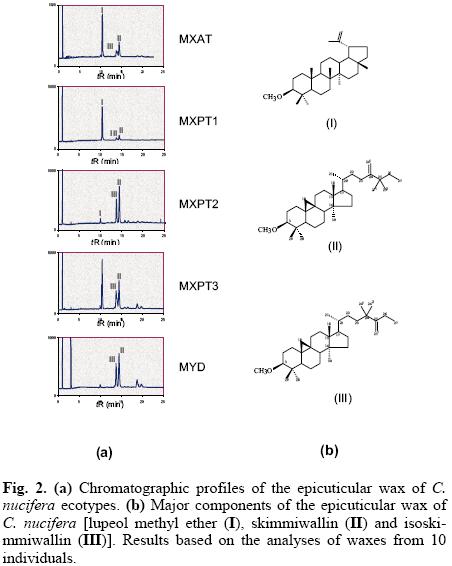
<body><![CDATA[<p align="justify"><font face="verdana" size="2">&nbsp;</font></p>  	    <p align="justify"><font face="verdana" size="2"><b>Introduction</b></font></p>  	    <p align="justify"><font face="verdana" size="2">The coconut palm (<i>Cocos nucifera</i> L.) is cultivated in more than a hundred countries around the world, covering a surface of approximately twelve million hectares and producing ten million metric tons of copra. Mexico, with approximately 160,000 hectares, is the first copra producer in Latin America and the seventh one in the world &#91;1, 2&#93;.</font></p>  	    <p align="justify"><font face="verdana" size="2">One of the factors that seriously affects the production of copra in many parts of the world, particularly in Central America, the Caribbean and Africa, is the lethal yellowing disease (LYD) of coconut palms; this disease is believed to be caused by a phytoplasm which is transmitted by at least one homopterous insect of the Cixiidae family, <i>Myndus crudus</i> Van Duzee &#91;3&#93;.</font></p>  	    <p align="justify"><font face="verdana" size="2">Palms with LYD generally die within months of being infected. Although a number of strategies have been attempted to contain the destructive effects of the disease, including the use of insecticides to control the vector and of antibiotics to eliminate the phytoplasm, to date, replanting the affected zones with resistant varieties of coconut palms appears to be the best option &#91;4&#93;.</font></p>  	    <p align="justify"><font face="verdana" size="2">A comprehensive evaluation which included morphological, physiological and isoenzymatic studies of the 18 major populations of <i>C. nucifera</i> growing in different regions of Mexico, allowed recognition of five ecotypes or groups of coconut palms considered to be phenotypically different. These ecotypes have been registered, following international nomenclature, as Mexican Atlantic Tall (MXAT), Malayan Yellow Dwarf (MYD), Mexican Pacific Tall 1 (MXPT1), Mexican Pacific Tall 2 (MXPT2), and Mexican Pacific Tall 3 (MXPT3) &#91;5, 6&#93;.</font></p>  	    <p align="justify"><font face="verdana" size="2">When maintained under similar conditions, coconut palms of the five ecotypes described above showed a differential response against LYD, with MXAT and MYD individuals showing the most and least susceptibility to the disease, respectively. Of the remaining ecotypes, MXPT2 showed the second&#45;highest resistance to LYD, followed by MXPT1 and MXPT3 &#91;6, 7&#93;.</font></p>  	    <p align="justify"><font face="verdana" size="2">In some higher plants, morphological and chemical studies carried out on cuticular waxes have been used both as a chemo&#45;taxonomic marker for classification and to correlate the nature and the chemical composition of the wax, with the susceptibility of the plant to insect attack or to chemical agents &#91;8&#45;23&#93;.</font></p>  	    <p align="justify"><font face="verdana" size="2">Studies carried out on the chemical composition of the cuticular waxes from various palm species have resulted in the isolation and identification of a number of triterpenes, including lupeol methylether from <i>Orbignya speciosa, Butia capitata and Orbignya phalerata</i>, and cylindrin from <i>Orbignya cohune</i> &#91;22&#93;. Recently, the three main components of the cuticular wax of <i>C. nucifera</i> were identified as lupeol methylether (<b>I</b>) and the novel isomeric cycloartanes skimmiwallin (<b>II</b>) and isoskimmiwallin (<b>III</b>) (Fig. (<a href="#f1">1</a>) <a href="#f2">2b</a>) &#91;24&#93;. Here we wish to report on the variation in total content and chemical composition of the cuticular wax of the five main ecotypes of <i>C. nucifera</i> growing in Mexico, together with the possible use of the chemical composition of the cuticular wax as a chemotaxonomical marker for classification, and the importance of the composition of the cuticular wax of a given palm ecotype in its resistance or susceptibility to LYD.</font></p>  	    <p align="center"><font face="verdana" size="2"><a name="f1"></a></font></p>  	    ]]></body>
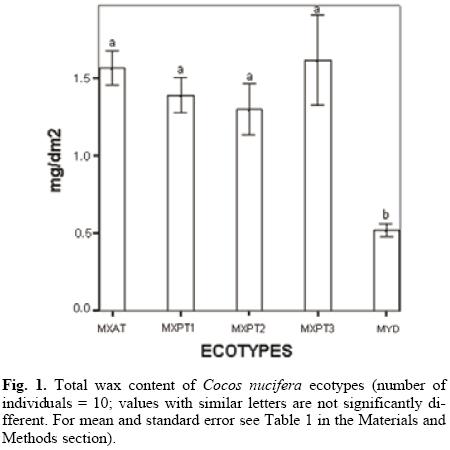
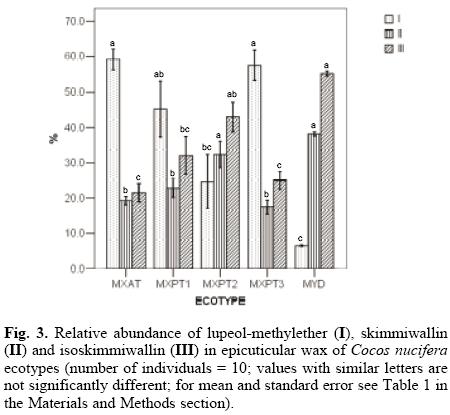
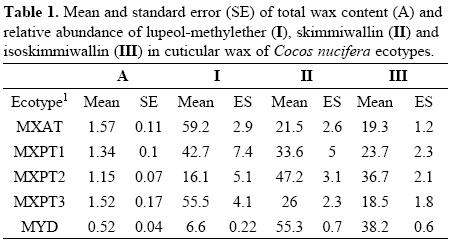
<body><![CDATA[<p align="center"><font face="verdana" size="2"><img src="/img/revistas/jmcs/v56n1/a11f1.jpg"></font></p>  	    <p align="center"><font face="verdana" size="2"><a name="f2"></a></font></p>  	    <p align="center"><font face="verdana" size="2"><img src="/img/revistas/jmcs/v56n1/a11f2.jpg"></font></p>  	    <p align="justify"><font face="verdana" size="2">&nbsp;</font></p>  	    <p align="justify"><font face="verdana" size="2"><b>Results and Discussion</b></font></p>  	    <p align="justify"><font face="verdana" size="2">The results on the total yield of cuticular wax of the different ecotypes showed that palms belonging to the MYD ecotype had the lowest amount of wax (<a href="#f1">Fig. 1</a>). This finding could explain the high susceptibility of the MYD ecotype to drought conditions, since previous reports have shown that cuticular wax content in drought&#45;tolerant <i>C. nucifera</i> genotypes is usually higher than in those that are drought&#45;susceptible &#91;25&#93;. At the same time, the low amount of cuticular wax in the MYD ecotype seriously challenges the argument that the resistance of MYD ecotypes to LYD is simply due to the cuticular wax acting as a physical barrier against insect attack. Statistical analyses of the total wax content of the different coconut palm ecotypes showed that while the total wax content in the MYD ecotype is clearly different to that of the remaining ecotypes, the differences between the four "tall" ecotypes are not statistically significant (<a href="#f1">Fig. 1</a>).</font></p>  	    <p align="justify"><font face="verdana" size="2">The GC analyses of the different cuticular wax extracts showed chromatographic profiles that were qualitatively similar, but quantitatively different, i.e. they all contained the same three major components, namely lupeol methylether (<b>I</b>), skimmiwallin (<b>II</b>) and isoskimmiwallin (<b>III</b>), but in different proportions (<a href="#f2">Fig. 2a</a>). A recent study has confirmed that <b>I</b>, <b>II</b> and <b>III</b> are the major components in all coconut palm wax extracts, and that these three metabolites, together with minor amounts of lupane methylether, lupeol and the acetylated derivatives of lupeol, isoskimmiwallinol and skimmiwallinol, represent 95% of the total wax content in all ecotypes; with the remaining 5% including non&#45;identified triterpenoids, sterols, primary alcohols and fatty acids &#91;26, 27&#93;.</font></p>  	    <p align="center"><font face="verdana" size="2"><a name="f2"></a></font></p>  	    <p align="center"><font face="verdana" size="2"><img src="/img/revistas/jmcs/v56n1/a11f2.jpg"></font></p>  	    <p align="justify"><font face="verdana" size="2">The chromatographic profiles of the wax extracts showed that the similarities in the chemical composition of the cuticular wax of the five ecotypes, appeared to be in agreement with their degree of susceptibility or resistance to LYD, i.e. the chromatographic profile of the cuticular wax of the most susceptible MXAT ecotype was similar to those of the MXPT1 and MXPT3 ecotypes; while the chromatographic profile of the resistant MYD ecotype was similar to that of the second most&#45;resistant MXPT2 ecotype (<a href="#f2">Fig. 2a</a>). GC analyses of the cuticular wax extracts of each ecotype showed that while lupeol&#45;methylether (<b>I</b>) is the most abundant component in the cuticular wax from both the MXAT and MXPT3 ecotypes, its presence in the wax of the LYD&#45;resistant MYD ecotype is hardly noticeable (<a href="#f3">Fig. 3</a>). Similarly, the content of skimmiwallin (<b>II</b>) and isoskimmiwallin (<b>III</b>) is considerably larger in the wax extracts of the MYD and MXPT2 ecotypes, when compared to that in similar extracts from LYD&#45;susceptible MXAT, MXPT1 or MXPT3 ecotypes (<a href="#f3">Fig. 3</a>).</font></p>  	    ]]></body>
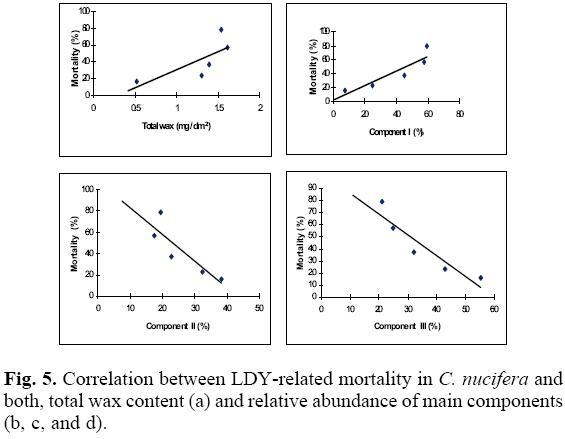
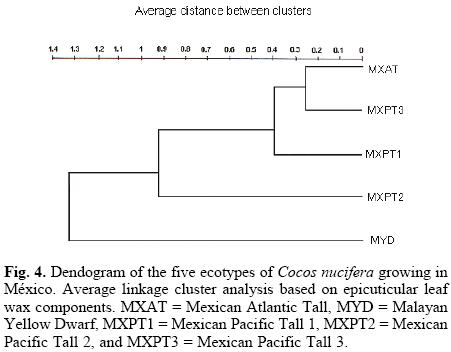
<body><![CDATA[<p align="center"><font face="verdana" size="2"><a name="f3"></a></font></p>  	    <p align="center"><font face="verdana" size="2"><img src="/img/revistas/jmcs/v56n1/a11f3.jpg"></font></p>  	    <p align="justify"><font face="verdana" size="2">A dendogram obtained through the analysis of hierarchical conglomerates showed five definite branches (<a href="#f4">Fig. 4</a>); the presence of two main branches, one including the MYD ecotype and the other one the rest of the "tall" ecotypes, clearly indicated that the former is well differentiated from the rest. However, the presence of the MXPT2 ecotype in the first secondary branch confirms the close relationship between this ecotype and the MYD; at the same time, the close relationship between the MYD and MXPT2 ecotypes can explain their being the two most resistant ecotypes to LYD. Additionally, the location of the MXAT ecotype in the fifth branch clearly shows that this and MYD are the two most differentiated ecotypes. Again, these differences between the MXAT and MYD ecotypes correlate with their higher susceptibility and resistance to LYD, respectively. Finally, all of these results coincide with those reported earlier using both morphological, physiological, and molecular characters &#91;5, 6&#93;, and confirm the importance of the amount and chemical composition of the cuticular waxes of <i>C. nucifera</i> ecotypes as chemotaxonomical markers for classification.</font></p>  	    <p align="center"><font face="verdana" size="2"><a name="f4"></a></font></p>  	    <p align="center"><font face="verdana" size="2"><img src="/img/revistas/jmcs/v56n1/a11f4.jpg"></font></p>  	    <p align="justify"><font face="verdana" size="2">Taking into account that the amount and composition of cuticular waxes are important factors in plant&#45;insect interactions &#91;9, 11, 13&#45;21, 23&#93;, and being that LYD is believed to be an insect&#45;transmitted disease, the possible correlation between LYD susceptibility and both total wax content and abundance of components <b>I</b>, <b>II</b> and <b>III</b> in the cuticular wax from the five ecotypes was explored. This was done by using a simple regression analysis of the average values for each variable and the LYD&#45;related mortality data for each ecotype &#91;6, 7&#93;. The results showed that while the correlation between total wax content and LYD&#45;related mortality was not significant (<a href="#f5">Fig. 5a</a>; <i>P</i> = 0.15), the correlation between the content of lupeol&#45;methylether (<b>I</b>) and LYD&#45;related mortality was positive and significant (<a href="#f5">Fig. 5b</a>, <i>P</i> = 0.03); this last result suggested that coconut palms having cuticular waxes with high concentrations of <b>I</b> are likely to have a higher susceptibility to LYD. Similarly, the negative correlation observed between LYD&#45;related mortality and the concentration of skimmiwallin (<b>II</b>) and isoskimmiwallin (<b>III</b>) in the cuticular wax (<a href="#f5">Figs. 5c</a> and <a href="#f5">5d</a>, <i>P</i> = 0.06 and 0.02) suggests that ecotypes with cuticular waxes higher concentrations of metabolites <b>II</b> and <b>III</b> are more likely to resist LYD.</font></p>  	    <p align="center"><font face="verdana" size="2"><a name="f5"></a></font></p>  	    <p align="center"><font face="verdana" size="2"><img src="/img/revistas/jmcs/v56n1/a11f5.jpg"></font></p>  	    <p align="justify"><font face="verdana" size="2">A recent evaluation of the antifeedant activity of the cuticular wax extracts of the five ecotypes, as well as of the purified metabolites <b>I</b>, <b>II</b> and <b>III</b>, showed that only the MYD wax extract has a significant antifeeding activity when tested against <i>Diaphania hyalinata</i> L. (Crambidae) (unpublished data); the wax extracts from MXPT1 and MXPT2, and the pure metabolites <b>I</b>, <b>II</b>, and <b>III</b>, only showed a moderate activity when tested using the same assay. These results do not coincide with those mentioned above and suggest that although it has been reported that a number of triterpenes present in cuticular waxes are associated with resistance to insect attack &#91;18, 22&#93;, lupeol&#45;methylether (<b>I</b>), skimmiwallin (<b>II</b>) and isoskimmiwallin (<b>III</b>) appear not to play a significant role in the palm&#45;insect interaction. Alternatively, the antifeeding activity shown by the LYD&#45;resistant MYD wax extract, and the lack of antifeedant activity observed for the LYD&#45;susceptible MXAT and MXPT3 wax extracts, strongly suggests that the complete secondary metabolite composition of the cuticular wax is important for the resistance or susceptibility of a particular palm ecotype to LYD.</font></p>  	    <p align="justify"><font face="verdana" size="2">&nbsp;</font></p>  	    ]]></body>
<body><![CDATA[<p align="justify"><font face="verdana" size="2"><b>Experimental</b></font></p>  	    <p align="justify"><font face="verdana" size="2">Biological materials were collected in a coconut palm plantation kept by CICY in San Crisanto, Municipality of Sinanch&eacute;, Yucat&aacute;n, M&eacute;xico. The area has a semiarid climate with a sandy soil, an annual rainfall of 670 mm, and an average temperature of 26 &deg;C. For this study, plants growing in similar environmental conditions, and with healthy and vigorous vegetative development, were selected. The collection of pinnae from coconut palms was carried out on April 19, 1999.</font></p>  	    <p align="justify"><font face="verdana" size="2">One&#45;month old pinnae (five pinnae per individual; ten individuals of each ecotype) were first dusted with tissue paper and folded to bring together the base and the tip of the pinna, cutting the excess of material so that the folded pinna had a length of 26 cm. Folded pinnae were dipped for 40 sec in 250 ml of hexane contained in a measuring cylinder, being careful not to submerge the cut off ends. The solvent was evaporated under reduced pressure and the wax residue was transferred to a vial using dichloromethane; the solvent was eliminated using a flow of nitrogen and the vials were placed in a dessicator under high vacuum, until they reached constant weight.</font></p>  	    <p align="justify"><font face="verdana" size="2">After extraction, the adaxial surface of each pine was photocopied and the foliar area was calculated using an image&#45;digitalizer connected to a computer which integrated and registered the values using the Agimagen<sup>&reg;</sup> program. The yield of cuticular wax was calculated by dividing the amount of wax between the foliar area.</font></p>  	    <p align="justify"><font face="verdana" size="2">Gas Chromatography analyses of cuticular wax extracts (1%) were carried out in triplicate, using a Hewlett Packard 5890 Gas Chromatographer equipped with an Ultra 1 column (25 m &times; 0.2mm), a flow rate (Nitrogen) of 1 mL/min, and a temperature program of T<sub>1</sub> = 280 &deg;C (2 min), T<sub>2</sub> = 300 &deg;C (5 min), gradient = 5 &deg;C/min. Wax extracts were not subjected to pre&#45;purification nor derivatization prior to their GC analyses.</font></p>  	    <p align="justify"><font face="verdana" size="2">Statistical analyses were carried out using the Statistical Analysis System software Release 6.12 &#91;28&#93;. The classification study (<a href="#f4">Fig. 4</a>) was performed using an agglomerative hierarchical cluster analysis, using a CLUSTER procedure to examine the clustering pattern of the various ecotypes. The analyses were carried out on the basis of each ecotype's matrix of means; the elements of the matrix were standardized to mean 0 and standard deviation 1, and from this the matrix of similarities of the Euclidean distance. Clustering was done by using the un&#45;weighted pair group method with arithmetic averages (UP&#45;GMA). The resulting tree is not rooted. The differences in total wax content (<a href="#f1">Fig. 1</a> and <a href="#t1">Table 1</a>), and the differences in the relative amount of each component in the cuticular wax of the various ecotypes (<a href="#f3">Fig. 3</a> and <a href="#t1">Table 1</a>), were established by means of a series of one&#45;way analyses of variance (ANOVA) and comparison of means through Tukey's test (<i>P</i> &gt; 0.05). The correlation between cuticular wax composition and susceptibility to LYD (<a href="#f5">Fig. 5</a>) was established using the linear regression equation: <i>Y</i> = <i>a + bX</i>.</font></p>  	    <p align="center"><font face="verdana" size="2"><a name="t1"></a></font></p>  	    <p align="center"><font face="verdana" size="2"><img src="/img/revistas/jmcs/v56n1/a11t1.jpg"></font></p>  	    <p align="justify"><font face="verdana" size="2">&nbsp;</font></p>  	    <p align="justify"><font face="verdana" size="2"><b>Acknowledgements</b></font></p>  	    ]]></body>
<body><![CDATA[<p align="justify"><font face="verdana" size="2">The authors wish to thank Miguel Fern&aacute;ndez for helping to collect the plant material and both Anne E. Osbourn and Reinhard Jetter for their valuable comments on reviewing the manuscript.</font></p>  	    <p align="justify"><font face="verdana" size="2">&nbsp;</font></p>  	    <p align="justify"><font face="verdana" size="2"><b>References</b></font></p>  	    <!-- ref --><p align="justify"><font face="verdana" size="2">1. Taufikkurahman, L. Coconut Statistical Yearbook. <i>Asian and Pacific Community.</i> 2. <b>1993.    &nbsp;&nbsp;&nbsp;&nbsp;&nbsp;&nbsp;&nbsp;&nbsp;[&#160;<a href="javascript:void(0);" onclick="javascript: window.open('/scielo.php?script=sci_nlinks&ref=4950904&pid=S1870-249X201200010001100001&lng=','','width=640,height=500,resizable=yes,scrollbars=1,menubar=yes,');">Links</a>&#160;]<!-- end-ref --></b></font></p>  	    <!-- ref --><p align="justify"><font face="verdana" size="2">2. Zizumbo&#45;Villarreal, D.; Been, B.; Tupinanmba, E.; Castillo, R.; Oropeza, C., in: <i>Status of coconut genetic resources</i>, Batugal, P.; Rao, R.; Oliver, J. (eds), COGENT&#45;IPGRI&#45;APO, Serdang, Malaysia, <b>2005</b>, 573&#45;580.    &nbsp;&nbsp;&nbsp;&nbsp;&nbsp;&nbsp;&nbsp;&nbsp;[&#160;<a href="javascript:void(0);" onclick="javascript: window.open('/scielo.php?script=sci_nlinks&ref=4950906&pid=S1870-249X201200010001100002&lng=','','width=640,height=500,resizable=yes,scrollbars=1,menubar=yes,');">Links</a>&#160;]<!-- end-ref --></font></p>  	    <!-- ref --><p align="justify"><font face="verdana" size="2">3. Howard, F. W. World. <i>FAO Plant Bull. Protect</i>. <b>1983</b>, <i>34</i>, 101&#45;103.    &nbsp;&nbsp;&nbsp;&nbsp;&nbsp;&nbsp;&nbsp;&nbsp;[&#160;<a href="javascript:void(0);" onclick="javascript: window.open('/scielo.php?script=sci_nlinks&ref=4950908&pid=S1870-249X201200010001100003&lng=','','width=640,height=500,resizable=yes,scrollbars=1,menubar=yes,');">Links</a>&#160;]<!-- end-ref --></font></p>  	    <!-- ref --><p align="justify"><font face="verdana" size="2">4. Oropeza, C.; Escamilla, J.; Mora, G.; Zizumbo, D.; Harrison, N., in: <i>Status of coconut genetic resources</i>, Batugal, P.; Rao, P.; Oliver, J. (eds.), COGENT&#45;IPGRI&#45;APO, Serdang, Malaysia, <b>2005</b>, 449&#45;463.    &nbsp;&nbsp;&nbsp;&nbsp;&nbsp;&nbsp;&nbsp;&nbsp;[&#160;<a href="javascript:void(0);" onclick="javascript: window.open('/scielo.php?script=sci_nlinks&ref=4950910&pid=S1870-249X201200010001100004&lng=','','width=640,height=500,resizable=yes,scrollbars=1,menubar=yes,');">Links</a>&#160;]<!-- end-ref --></font></p>  	    <!-- ref --><p align="justify"><font face="verdana" size="2">5. Zizumbo&#45;Villarreal, D.; Hern&aacute;ndez, F.; Harries, H. C. <i>Econ. Bot.</i> <b>1993</b>, <i>47</i>, 65&#45;78.    &nbsp;&nbsp;&nbsp;&nbsp;&nbsp;&nbsp;&nbsp;&nbsp;[&#160;<a href="javascript:void(0);" onclick="javascript: window.open('/scielo.php?script=sci_nlinks&ref=4950912&pid=S1870-249X201200010001100005&lng=','','width=640,height=500,resizable=yes,scrollbars=1,menubar=yes,');">Links</a>&#160;]<!-- end-ref --></font></p>  	    <!-- ref --><p align="justify"><font face="verdana" size="2">6. Zizumbo&#45;Villarreal, D.; Ruiz&#45;Rodriguez, M.; Harries, H.; Colunga&#45;Garc&iacute;amar&iacute;n P<b>.</b> <i>Crop Sci.</i> <b>2006</b>, <i>46</i>, 2509&#45;2516.    &nbsp;&nbsp;&nbsp;&nbsp;&nbsp;&nbsp;&nbsp;&nbsp;[&#160;<a href="javascript:void(0);" onclick="javascript: window.open('/scielo.php?script=sci_nlinks&ref=4950914&pid=S1870-249X201200010001100006&lng=','','width=640,height=500,resizable=yes,scrollbars=1,menubar=yes,');">Links</a>&#160;]<!-- end-ref --></font></p>  	    <!-- ref --><p align="justify"><font face="verdana" size="2">7. Zizumbo&#45;Villarreal, D.; Fern&aacute;ndez, M.; Torres, N.; Carde&ntilde;a, R., in: <i>Current Plant Science in Biotechnology and Agriculture</i>, Oropeza, C.; Verdell, J. L.; Asburner, G. R.; Carde&ntilde;a, R.; Santamar&iacute;a, J. M. (eds), Kluwer Academic Publishers, <b>1999</b>, 131&#45;159.    &nbsp;&nbsp;&nbsp;&nbsp;&nbsp;&nbsp;&nbsp;&nbsp;[&#160;<a href="javascript:void(0);" onclick="javascript: window.open('/scielo.php?script=sci_nlinks&ref=4950916&pid=S1870-249X201200010001100007&lng=','','width=640,height=500,resizable=yes,scrollbars=1,menubar=yes,');">Links</a>&#160;]<!-- end-ref --></font></p>  	    <!-- ref --><p align="justify"><font face="verdana" size="2">8. Szafranek, B.; Tomaszewski, D.; Pokrzywinska, K.; Golebiowski, M. <i>Acta Biol. Cracov., Series Botanica</i> <b>2008</b>, <i>50</i>, 49&#45;54.    &nbsp;&nbsp;&nbsp;&nbsp;&nbsp;&nbsp;&nbsp;&nbsp;[&#160;<a href="javascript:void(0);" onclick="javascript: window.open('/scielo.php?script=sci_nlinks&ref=4950918&pid=S1870-249X201200010001100008&lng=','','width=640,height=500,resizable=yes,scrollbars=1,menubar=yes,');">Links</a>&#160;]<!-- end-ref --></font></p>  	    <!-- ref --><p align="justify"><font face="verdana" size="2">9. Buschhaus, C.; Herz, H.; Jetter, R. <i>Ann. Bot.</i> <b>2007</b>, <i>100</i>, 1557&#45;1564.    &nbsp;&nbsp;&nbsp;&nbsp;&nbsp;&nbsp;&nbsp;&nbsp;[&#160;<a href="javascript:void(0);" onclick="javascript: window.open('/scielo.php?script=sci_nlinks&ref=4950920&pid=S1870-249X201200010001100009&lng=','','width=640,height=500,resizable=yes,scrollbars=1,menubar=yes,');">Links</a>&#160;]<!-- end-ref --></font></p>  	    <!-- ref --><p align="justify"><font face="verdana" size="2">10. Haas, K.; Bauer, M.; Wollenweber, E. <i>Z. Naturforsch.</i> <b>2003</b>, <i>58c</i>, 464&#45;470.    &nbsp;&nbsp;&nbsp;&nbsp;&nbsp;&nbsp;&nbsp;&nbsp;[&#160;<a href="javascript:void(0);" onclick="javascript: window.open('/scielo.php?script=sci_nlinks&ref=4950922&pid=S1870-249X201200010001100010&lng=','','width=640,height=500,resizable=yes,scrollbars=1,menubar=yes,');">Links</a>&#160;]<!-- end-ref --></font></p>  	    <!-- ref --><p align="justify"><font face="verdana" size="2">11. Riedel, M.; Eichner, A.; Jetter, R. <i>Planta</i> <b>2003</b>, <i>218</i>, 87&#45;97.    &nbsp;&nbsp;&nbsp;&nbsp;&nbsp;&nbsp;&nbsp;&nbsp;[&#160;<a href="javascript:void(0);" onclick="javascript: window.open('/scielo.php?script=sci_nlinks&ref=4950924&pid=S1870-249X201200010001100011&lng=','','width=640,height=500,resizable=yes,scrollbars=1,menubar=yes,');">Links</a>&#160;]<!-- end-ref --></font></p>  	    <!-- ref --><p align="justify"><font face="verdana" size="2">12. Teusink, R. S.; Rahman, M.; Bressan, R. A.; Jenks, M. A. <i>Int. J. Plant Sci.</i> <b>2002</b>, <i>163</i>, 309&#45;315.    &nbsp;&nbsp;&nbsp;&nbsp;&nbsp;&nbsp;&nbsp;&nbsp;[&#160;<a href="javascript:void(0);" onclick="javascript: window.open('/scielo.php?script=sci_nlinks&ref=4950926&pid=S1870-249X201200010001100012&lng=','','width=640,height=500,resizable=yes,scrollbars=1,menubar=yes,');">Links</a>&#160;]<!-- end-ref --></font></p>  	    <!-- ref --><p align="justify"><font face="verdana" size="2">13. Fr&ouml;hlich, B.; Riederer, M.; Tautz, J. <i>Apidologie</i> <b>2001</b>, <i>32</i>, 1&#45;10.    &nbsp;&nbsp;&nbsp;&nbsp;&nbsp;&nbsp;&nbsp;&nbsp;[&#160;<a href="javascript:void(0);" onclick="javascript: window.open('/scielo.php?script=sci_nlinks&ref=4950928&pid=S1870-249X201200010001100013&lng=','','width=640,height=500,resizable=yes,scrollbars=1,menubar=yes,');">Links</a>&#160;]<!-- end-ref --></font></p>  	    <!-- ref --><p align="justify"><font face="verdana" size="2">14. Fr&ouml;hlich, B.; Tautz, J.; Riederer, M. <i>J. Chem. Ecol.</i> <b>2000</b>, <i>26</i>, 123&#45;137.    &nbsp;&nbsp;&nbsp;&nbsp;&nbsp;&nbsp;&nbsp;&nbsp;[&#160;<a href="javascript:void(0);" onclick="javascript: window.open('/scielo.php?script=sci_nlinks&ref=4950930&pid=S1870-249X201200010001100014&lng=','','width=640,height=500,resizable=yes,scrollbars=1,menubar=yes,');">Links</a>&#160;]<!-- end-ref --></font></p>  	    <!-- ref --><p align="justify"><font face="verdana" size="2">15. Jetter, R.; Sch&auml;ffer, S.; Riederer, M. <i>Plant Cell Environ.</i> <b>2000</b>, <i>23</i>, 619&#45;628.    &nbsp;&nbsp;&nbsp;&nbsp;&nbsp;&nbsp;&nbsp;&nbsp;[&#160;<a href="javascript:void(0);" onclick="javascript: window.open('/scielo.php?script=sci_nlinks&ref=4950932&pid=S1870-249X201200010001100015&lng=','','width=640,height=500,resizable=yes,scrollbars=1,menubar=yes,');">Links</a>&#160;]<!-- end-ref --></font></p>  	    <!-- ref --><p align="justify"><font face="verdana" size="2">16. Shepherd, T.; Robertson, G. W.; Griffiths, D. W.; Birch, A. N. E. <i>Phytochemistry</i> <b>1999</b>, <i>52</i>, 1255&#45;1267.    &nbsp;&nbsp;&nbsp;&nbsp;&nbsp;&nbsp;&nbsp;&nbsp;[&#160;<a href="javascript:void(0);" onclick="javascript: window.open('/scielo.php?script=sci_nlinks&ref=4950934&pid=S1870-249X201200010001100016&lng=','','width=640,height=500,resizable=yes,scrollbars=1,menubar=yes,');">Links</a>&#160;]<!-- end-ref --></font></p>  	    <!-- ref --><p align="justify"><font face="verdana" size="2">17. Berenbaum, M. R.; Zangerl, A. R. <i>Proc. Natl. Acad. Sci</i>. USA <b>1998</b>, <i>95</i>, 13743&#45;13748.    &nbsp;&nbsp;&nbsp;&nbsp;&nbsp;&nbsp;&nbsp;&nbsp;[&#160;<a href="javascript:void(0);" onclick="javascript: window.open('/scielo.php?script=sci_nlinks&ref=4950936&pid=S1870-249X201200010001100017&lng=','','width=640,height=500,resizable=yes,scrollbars=1,menubar=yes,');">Links</a>&#160;]<!-- end-ref --></font></p>  	    <!-- ref --><p align="justify"><font face="verdana" size="2">18. Eigenbrode, S. D.; Pillai, S. K. <i>J. Chem. Ecol.</i> <b>1998</b>, <i>24</i>, 1611&#45;1627.    &nbsp;&nbsp;&nbsp;&nbsp;&nbsp;&nbsp;&nbsp;&nbsp;[&#160;<a href="javascript:void(0);" onclick="javascript: window.open('/scielo.php?script=sci_nlinks&ref=4950938&pid=S1870-249X201200010001100018&lng=','','width=640,height=500,resizable=yes,scrollbars=1,menubar=yes,');">Links</a>&#160;]<!-- end-ref --></font></p>  	    <!-- ref --><p align="justify"><font face="verdana" size="2">19. Rhee, Y.; Hlousek&#45;Radojcic, A.; Ponsamuel, J.; Liu, D.; Post&#45;Beittenmiller, D. <i>Plant Physiol.</i> <b>1998</b>, <i>116</i>, 901&#45;911.    &nbsp;&nbsp;&nbsp;&nbsp;&nbsp;&nbsp;&nbsp;&nbsp;[&#160;<a href="javascript:void(0);" onclick="javascript: window.open('/scielo.php?script=sci_nlinks&ref=4950940&pid=S1870-249X201200010001100019&lng=','','width=640,height=500,resizable=yes,scrollbars=1,menubar=yes,');">Links</a>&#160;]<!-- end-ref --></font></p>  	    <!-- ref --><p align="justify"><font face="verdana" size="2">20. Rashotte, A. M.; Jenks, M. A.; Nguyen, T. D.; Feldmann, K. A. <i>Phytochemistry</i> <b>1997,</b> <i>45</i>, 251&#45;255.    &nbsp;&nbsp;&nbsp;&nbsp;&nbsp;&nbsp;&nbsp;&nbsp;[&#160;<a href="javascript:void(0);" onclick="javascript: window.open('/scielo.php?script=sci_nlinks&ref=4950942&pid=S1870-249X201200010001100020&lng=','','width=640,height=500,resizable=yes,scrollbars=1,menubar=yes,');">Links</a>&#160;]<!-- end-ref --></font></p>  	    <!-- ref --><p align="justify"><font face="verdana" size="2">21. Berenbaum, M. R. <i>Proc. Natl. Acad. Sci</i>., USA <b>1995</b>, <i>92</i>, 2&#45;8.    &nbsp;&nbsp;&nbsp;&nbsp;&nbsp;&nbsp;&nbsp;&nbsp;[&#160;<a href="javascript:void(0);" onclick="javascript: window.open('/scielo.php?script=sci_nlinks&ref=4950944&pid=S1870-249X201200010001100021&lng=','','width=640,height=500,resizable=yes,scrollbars=1,menubar=yes,');">Links</a>&#160;]<!-- end-ref --></font></p>  	    <!-- ref --><p align="justify"><font face="verdana" size="2">22. Garc&iacute;a, S.; Heinzen, H.; Hubbuch, C.; Mart&iacute;nez, R.; De Vries, X.; Moyna, P. <i>Phytochemistry</i> <b>1995</b>, <i>39</i>, 1381&#45;1382.    &nbsp;&nbsp;&nbsp;&nbsp;&nbsp;&nbsp;&nbsp;&nbsp;[&#160;<a href="javascript:void(0);" onclick="javascript: window.open('/scielo.php?script=sci_nlinks&ref=4950946&pid=S1870-249X201200010001100022&lng=','','width=640,height=500,resizable=yes,scrollbars=1,menubar=yes,');">Links</a>&#160;]<!-- end-ref --></font></p>  	    <!-- ref --><p align="justify"><font face="verdana" size="2">23. Manners, G. D.; Davis, D. G. <i>Phytochemistry</i> <b>1984</b>, <i>23</i>, 1059&#45;1062.    &nbsp;&nbsp;&nbsp;&nbsp;&nbsp;&nbsp;&nbsp;&nbsp;[&#160;<a href="javascript:void(0);" onclick="javascript: window.open('/scielo.php?script=sci_nlinks&ref=4950948&pid=S1870-249X201200010001100023&lng=','','width=640,height=500,resizable=yes,scrollbars=1,menubar=yes,');">Links</a>&#160;]<!-- end-ref --></font></p>  	    <!-- ref --><p align="justify"><font face="verdana" size="2">24. Escalante&#45;Erosa, F.; Gamboa&#45;Le&oacute;n, M. R.; Lecher, J. G.; Arroyo&#45;Serralta, G. A.; Zizumbo&#45;Villareal, D.; Oropeza&#45;Sal&iacute;n, C.; Pe&ntilde;a&#45;Rodr&iacute;guez L. M. <i>Rev. Soc. Qu&iacute;m. M&eacute;x.</i>, <b>2002</b>, <i>46</i>, 247&#45;250.    &nbsp;&nbsp;&nbsp;&nbsp;&nbsp;&nbsp;&nbsp;&nbsp;[&#160;<a href="javascript:void(0);" onclick="javascript: window.open('/scielo.php?script=sci_nlinks&ref=4950950&pid=S1870-249X201200010001100024&lng=','','width=640,height=500,resizable=yes,scrollbars=1,menubar=yes,');">Links</a>&#160;]<!-- end-ref --></font></p>  	    <!-- ref --><p align="justify"><font face="verdana" size="2">25. Kurup, V. V. G. K.; Voleti, S. R.; Rajagopal, V. <i>J. Plant. Crops</i> <b>1993</b>, <i>21</i>, 71&#45;80.    &nbsp;&nbsp;&nbsp;&nbsp;&nbsp;&nbsp;&nbsp;&nbsp;[&#160;<a href="javascript:void(0);" onclick="javascript: window.open('/scielo.php?script=sci_nlinks&ref=4950952&pid=S1870-249X201200010001100025&lng=','','width=640,height=500,resizable=yes,scrollbars=1,menubar=yes,');">Links</a>&#160;]<!-- end-ref --></font></p>  	    <!-- ref --><p align="justify"><font face="verdana" size="2">26. Riedel, M.; Riederer, M.; Becker, D.; Herran, A.; Kullaya, A.; Arana&#45;L&oacute;pez, G.; Pe&ntilde;a&#45;Rodr&iacute;guez, L.M.; Billote, N.; Sniady, V.; Ritter, E.; Rohde, W. <i>Tree Genet. Genom.</i> <b>2009</b>, <i>5</i>, 53&#45;69.    &nbsp;&nbsp;&nbsp;&nbsp;&nbsp;&nbsp;&nbsp;&nbsp;[&#160;<a href="javascript:void(0);" onclick="javascript: window.open('/scielo.php?script=sci_nlinks&ref=4950954&pid=S1870-249X201200010001100026&lng=','','width=640,height=500,resizable=yes,scrollbars=1,menubar=yes,');">Links</a>&#160;]<!-- end-ref --></font></p>  	    <!-- ref --><p align="justify"><font face="verdana" size="2">27. Escalante&#45;Erosa, F.; Arv&iacute;zu&#45;M&eacute;ndez, G. E.; Pe&ntilde;a&#45;Rodr&iacute;guez, L. M. <i>Phytochem. Anal.</i> <b>2007</b>, <i>18</i>, 188&#45;192.    &nbsp;&nbsp;&nbsp;&nbsp;&nbsp;&nbsp;&nbsp;&nbsp;[&#160;<a href="javascript:void(0);" onclick="javascript: window.open('/scielo.php?script=sci_nlinks&ref=4950956&pid=S1870-249X201200010001100027&lng=','','width=640,height=500,resizable=yes,scrollbars=1,menubar=yes,');">Links</a>&#160;]<!-- end-ref --></font></p>  	    <!-- ref --><p align="justify"><font face="verdana" size="2">28. SAS, SAS/STAT User's guide, release 6.12 edition. SAS Institute Inc., Cary, NC. <b>1997</b>.    &nbsp;&nbsp;&nbsp;&nbsp;&nbsp;&nbsp;&nbsp;&nbsp;[&#160;<a href="javascript:void(0);" onclick="javascript: window.open('/scielo.php?script=sci_nlinks&ref=4950958&pid=S1870-249X201200010001100028&lng=','','width=640,height=500,resizable=yes,scrollbars=1,menubar=yes,');">Links</a>&#160;]<!-- end-ref --></font></p>  	    <p align="justify"><font face="verdana" size="2">&nbsp;</font></p>  	    ]]></body>
<body><![CDATA[<p align="justify"><font face="verdana" size="2"><b>Note</b></font></p>  	    <p align="justify"><font face="verdana" size="2"><i>Dedicated to Dr. Estela S&aacute;nchez de Jim&eacute;nez for her invaluable contributions to plant biochemistry.</i></font></p>      ]]></body><back>
<ref-list>
<ref id="B1">
<label>1</label><nlm-citation citation-type="book">
<person-group person-group-type="author">
<name>
<surname><![CDATA[Taufikkurahman]]></surname>
<given-names><![CDATA[L.]]></given-names>
</name>
</person-group>
<source><![CDATA[Coconut Statistical Yearbook]]></source>
<year>1993</year>
<volume>2</volume>
<publisher-name><![CDATA[Asian and Pacific Community]]></publisher-name>
</nlm-citation>
</ref>
<ref id="B2">
<label>2</label><nlm-citation citation-type="book">
<person-group person-group-type="author">
<name>
<surname><![CDATA[Zizumbo-Villarreal]]></surname>
<given-names><![CDATA[D.]]></given-names>
</name>
<name>
<surname><![CDATA[Been]]></surname>
<given-names><![CDATA[B.]]></given-names>
</name>
<name>
<surname><![CDATA[Tupinanmba]]></surname>
<given-names><![CDATA[E.]]></given-names>
</name>
<name>
<surname><![CDATA[Castillo]]></surname>
<given-names><![CDATA[R.]]></given-names>
</name>
<name>
<surname><![CDATA[Oropeza]]></surname>
<given-names><![CDATA[C.]]></given-names>
</name>
</person-group>
<person-group person-group-type="editor">
<name>
<surname><![CDATA[Batugal]]></surname>
<given-names><![CDATA[P.]]></given-names>
</name>
<name>
<surname><![CDATA[Rao]]></surname>
<given-names><![CDATA[R.]]></given-names>
</name>
<name>
<surname><![CDATA[Oliver]]></surname>
<given-names><![CDATA[J.]]></given-names>
</name>
</person-group>
<source><![CDATA[Status of coconut genetic resources]]></source>
<year>2005</year>
<page-range>573-580</page-range><publisher-loc><![CDATA[Serdang ]]></publisher-loc>
<publisher-name><![CDATA[COGENTIPGRIAPO]]></publisher-name>
</nlm-citation>
</ref>
<ref id="B3">
<label>3</label><nlm-citation citation-type="journal">
<person-group person-group-type="author">
<name>
<surname><![CDATA[Howard]]></surname>
<given-names><![CDATA[F. W.]]></given-names>
</name>
</person-group>
<source><![CDATA[World. FAO Plant Bull. Protect.]]></source>
<year>1983</year>
<volume>34</volume>
<page-range>101-103</page-range></nlm-citation>
</ref>
<ref id="B4">
<label>4</label><nlm-citation citation-type="book">
<person-group person-group-type="author">
<name>
<surname><![CDATA[Oropeza]]></surname>
<given-names><![CDATA[C.]]></given-names>
</name>
<name>
<surname><![CDATA[Escamilla]]></surname>
<given-names><![CDATA[J.]]></given-names>
</name>
<name>
<surname><![CDATA[Mora]]></surname>
<given-names><![CDATA[G.]]></given-names>
</name>
<name>
<surname><![CDATA[Zizumbo]]></surname>
<given-names><![CDATA[D.]]></given-names>
</name>
<name>
<surname><![CDATA[Harrison]]></surname>
<given-names><![CDATA[N.]]></given-names>
</name>
</person-group>
<person-group person-group-type="editor">
<name>
<surname><![CDATA[Batugal]]></surname>
<given-names><![CDATA[P.]]></given-names>
</name>
<name>
<surname><![CDATA[Rao]]></surname>
<given-names><![CDATA[P.]]></given-names>
</name>
<name>
<surname><![CDATA[Oliver]]></surname>
<given-names><![CDATA[J.]]></given-names>
</name>
</person-group>
<source><![CDATA[Status of coconut genetic resources]]></source>
<year>2005</year>
<page-range>449-463</page-range><publisher-loc><![CDATA[Serdang ]]></publisher-loc>
<publisher-name><![CDATA[COGENTIPGRIAPO]]></publisher-name>
</nlm-citation>
</ref>
<ref id="B5">
<label>5</label><nlm-citation citation-type="journal">
<person-group person-group-type="author">
<name>
<surname><![CDATA[Zizumbo-Villarreal]]></surname>
<given-names><![CDATA[D.]]></given-names>
</name>
<name>
<surname><![CDATA[Hernández]]></surname>
<given-names><![CDATA[F.]]></given-names>
</name>
<name>
<surname><![CDATA[Harries]]></surname>
<given-names><![CDATA[H. C.]]></given-names>
</name>
</person-group>
<source><![CDATA[Econ. Bot.]]></source>
<year>1993</year>
<volume>47</volume>
<page-range>65-78</page-range></nlm-citation>
</ref>
<ref id="B6">
<label>6</label><nlm-citation citation-type="journal">
<person-group person-group-type="author">
<name>
<surname><![CDATA[Zizumbo-Villarreal]]></surname>
<given-names><![CDATA[D.]]></given-names>
</name>
<name>
<surname><![CDATA[Ruiz-Rodriguez]]></surname>
<given-names><![CDATA[M.]]></given-names>
</name>
<name>
<surname><![CDATA[Harries]]></surname>
<given-names><![CDATA[H.]]></given-names>
</name>
<name>
<surname><![CDATA[Colunga-Garcíamarín]]></surname>
<given-names><![CDATA[P.]]></given-names>
</name>
</person-group>
<source><![CDATA[Crop Sci.]]></source>
<year>2006</year>
<volume>46</volume>
<page-range>2509-2516</page-range></nlm-citation>
</ref>
<ref id="B7">
<label>7</label><nlm-citation citation-type="book">
<person-group person-group-type="author">
<name>
<surname><![CDATA[Zizumbo-Villarreal]]></surname>
<given-names><![CDATA[D.]]></given-names>
</name>
<name>
<surname><![CDATA[Fernández]]></surname>
<given-names><![CDATA[M.]]></given-names>
</name>
<name>
<surname><![CDATA[Torres]]></surname>
<given-names><![CDATA[N.]]></given-names>
</name>
<name>
<surname><![CDATA[Cardeña]]></surname>
<given-names><![CDATA[R.]]></given-names>
</name>
</person-group>
<person-group person-group-type="editor">
<name>
<surname><![CDATA[Oropeza]]></surname>
<given-names><![CDATA[C.]]></given-names>
</name>
<name>
<surname><![CDATA[Verdell]]></surname>
<given-names><![CDATA[J. L.]]></given-names>
</name>
<name>
<surname><![CDATA[Asburner]]></surname>
<given-names><![CDATA[G. R.]]></given-names>
</name>
<name>
<surname><![CDATA[Cardeña]]></surname>
<given-names><![CDATA[R.]]></given-names>
</name>
<name>
<surname><![CDATA[Santamaría]]></surname>
<given-names><![CDATA[J. M.]]></given-names>
</name>
</person-group>
<source><![CDATA[Current Plant Science in Biotechnology and Agriculture]]></source>
<year>1999</year>
<page-range>131-159</page-range><publisher-name><![CDATA[Kluwer Academic Publishers]]></publisher-name>
</nlm-citation>
</ref>
<ref id="B8">
<label>8</label><nlm-citation citation-type="journal">
<person-group person-group-type="author">
<name>
<surname><![CDATA[Szafranek]]></surname>
<given-names><![CDATA[B.]]></given-names>
</name>
<name>
<surname><![CDATA[Tomaszewski]]></surname>
<given-names><![CDATA[D.]]></given-names>
</name>
<name>
<surname><![CDATA[Pokrzywinska]]></surname>
<given-names><![CDATA[K.]]></given-names>
</name>
<name>
<surname><![CDATA[Golebiowski]]></surname>
<given-names><![CDATA[M.]]></given-names>
</name>
</person-group>
<source><![CDATA[Acta Biol. Cracov., Series Botanica]]></source>
<year>2008</year>
<volume>50</volume>
<page-range>49-54</page-range></nlm-citation>
</ref>
<ref id="B9">
<label>9</label><nlm-citation citation-type="journal">
<person-group person-group-type="author">
<name>
<surname><![CDATA[Buschhaus]]></surname>
<given-names><![CDATA[C.]]></given-names>
</name>
<name>
<surname><![CDATA[Herz]]></surname>
<given-names><![CDATA[H.]]></given-names>
</name>
<name>
<surname><![CDATA[Jetter]]></surname>
<given-names><![CDATA[R.]]></given-names>
</name>
</person-group>
<source><![CDATA[Ann. Bot.]]></source>
<year>2007</year>
<volume>100</volume>
<page-range>1557-1564</page-range></nlm-citation>
</ref>
<ref id="B10">
<label>10</label><nlm-citation citation-type="journal">
<person-group person-group-type="author">
<name>
<surname><![CDATA[Haas]]></surname>
<given-names><![CDATA[K.]]></given-names>
</name>
<name>
<surname><![CDATA[Bauer]]></surname>
<given-names><![CDATA[M.]]></given-names>
</name>
<name>
<surname><![CDATA[Wollenweber]]></surname>
<given-names><![CDATA[E. Z.]]></given-names>
</name>
</person-group>
<source><![CDATA[Naturforsch.]]></source>
<year>2003</year>
<volume>58</volume>
<page-range>464-470</page-range></nlm-citation>
</ref>
<ref id="B11">
<label>11</label><nlm-citation citation-type="journal">
<person-group person-group-type="author">
<name>
<surname><![CDATA[Riedel]]></surname>
<given-names><![CDATA[M.]]></given-names>
</name>
<name>
<surname><![CDATA[Eichner]]></surname>
<given-names><![CDATA[A.]]></given-names>
</name>
<name>
<surname><![CDATA[Jetter]]></surname>
<given-names><![CDATA[R.]]></given-names>
</name>
</person-group>
<source><![CDATA[Planta]]></source>
<year>2003</year>
<volume>218</volume>
<page-range>87-97</page-range></nlm-citation>
</ref>
<ref id="B12">
<label>12</label><nlm-citation citation-type="journal">
<person-group person-group-type="author">
<name>
<surname><![CDATA[Teusink]]></surname>
<given-names><![CDATA[R. S.]]></given-names>
</name>
<name>
<surname><![CDATA[Rahman]]></surname>
<given-names><![CDATA[M.]]></given-names>
</name>
<name>
<surname><![CDATA[Bressan]]></surname>
<given-names><![CDATA[R. A.]]></given-names>
</name>
<name>
<surname><![CDATA[Jenks]]></surname>
<given-names><![CDATA[M. A.]]></given-names>
</name>
</person-group>
<source><![CDATA[Int. J. Plant Sci.]]></source>
<year>2002</year>
<volume>163</volume>
<page-range>309-315</page-range></nlm-citation>
</ref>
<ref id="B13">
<label>13</label><nlm-citation citation-type="journal">
<person-group person-group-type="author">
<name>
<surname><![CDATA[Fröhlich]]></surname>
<given-names><![CDATA[B.]]></given-names>
</name>
<name>
<surname><![CDATA[Riederer]]></surname>
<given-names><![CDATA[M.]]></given-names>
</name>
<name>
<surname><![CDATA[Tautz]]></surname>
<given-names><![CDATA[J.]]></given-names>
</name>
</person-group>
<source><![CDATA[Apidologie]]></source>
<year>2001</year>
<volume>32</volume>
<page-range>1-10</page-range></nlm-citation>
</ref>
<ref id="B14">
<label>14</label><nlm-citation citation-type="journal">
<person-group person-group-type="author">
<name>
<surname><![CDATA[Fröhlich]]></surname>
<given-names><![CDATA[B.]]></given-names>
</name>
<name>
<surname><![CDATA[Tautz]]></surname>
<given-names><![CDATA[J.]]></given-names>
</name>
<name>
<surname><![CDATA[Riederer]]></surname>
<given-names><![CDATA[M.]]></given-names>
</name>
</person-group>
<source><![CDATA[J. Chem. Ecol.]]></source>
<year>2000</year>
<volume>26</volume>
<page-range>123-137</page-range></nlm-citation>
</ref>
<ref id="B15">
<label>15</label><nlm-citation citation-type="journal">
<person-group person-group-type="author">
<name>
<surname><![CDATA[Jetter]]></surname>
<given-names><![CDATA[R.]]></given-names>
</name>
<name>
<surname><![CDATA[Schäffer]]></surname>
<given-names><![CDATA[S.]]></given-names>
</name>
<name>
<surname><![CDATA[Riederer]]></surname>
<given-names><![CDATA[M.]]></given-names>
</name>
</person-group>
<source><![CDATA[Plant Cell Environ.]]></source>
<year>2000</year>
<volume>23</volume>
<page-range>619-628</page-range></nlm-citation>
</ref>
<ref id="B16">
<label>16</label><nlm-citation citation-type="journal">
<person-group person-group-type="author">
<name>
<surname><![CDATA[Shepherd]]></surname>
<given-names><![CDATA[T.]]></given-names>
</name>
<name>
<surname><![CDATA[Robertson]]></surname>
<given-names><![CDATA[G. W.]]></given-names>
</name>
<name>
<surname><![CDATA[Griffiths]]></surname>
<given-names><![CDATA[D. W.]]></given-names>
</name>
<name>
<surname><![CDATA[Birch]]></surname>
<given-names><![CDATA[A. N. E.]]></given-names>
</name>
</person-group>
<source><![CDATA[Phytochemistry]]></source>
<year>1999</year>
<volume>52</volume>
<page-range>1255-1267</page-range></nlm-citation>
</ref>
<ref id="B17">
<label>17</label><nlm-citation citation-type="journal">
<person-group person-group-type="author">
<name>
<surname><![CDATA[Berenbaum]]></surname>
<given-names><![CDATA[M. R.]]></given-names>
</name>
<name>
<surname><![CDATA[Zangerl]]></surname>
<given-names><![CDATA[A. R.]]></given-names>
</name>
</person-group>
<source><![CDATA[Proc. Natl. Acad. Sci.]]></source>
<year>1998</year>
<volume>95</volume>
<page-range>13743-13748</page-range></nlm-citation>
</ref>
<ref id="B18">
<label>18</label><nlm-citation citation-type="journal">
<person-group person-group-type="author">
<name>
<surname><![CDATA[Eigenbrode]]></surname>
<given-names><![CDATA[S. D.]]></given-names>
</name>
<name>
<surname><![CDATA[Pillai]]></surname>
<given-names><![CDATA[S. K.]]></given-names>
</name>
</person-group>
<source><![CDATA[J. Chem. Ecol.]]></source>
<year>1998</year>
<volume>24</volume>
<page-range>1611-1627</page-range></nlm-citation>
</ref>
<ref id="B19">
<label>19</label><nlm-citation citation-type="journal">
<person-group person-group-type="author">
<name>
<surname><![CDATA[Rhee]]></surname>
<given-names><![CDATA[Y.]]></given-names>
</name>
<name>
<surname><![CDATA[Hlousek-Radojcic]]></surname>
<given-names><![CDATA[A.]]></given-names>
</name>
<name>
<surname><![CDATA[Ponsamuel]]></surname>
<given-names><![CDATA[J.]]></given-names>
</name>
<name>
<surname><![CDATA[Liu]]></surname>
<given-names><![CDATA[D.]]></given-names>
</name>
<name>
<surname><![CDATA[Post-Beittenmiller]]></surname>
<given-names><![CDATA[D.]]></given-names>
</name>
</person-group>
<source><![CDATA[Plant Physiol.]]></source>
<year>1998</year>
<volume>116</volume>
<page-range>901-911</page-range></nlm-citation>
</ref>
<ref id="B20">
<label>20</label><nlm-citation citation-type="journal">
<person-group person-group-type="author">
<name>
<surname><![CDATA[Rashotte]]></surname>
<given-names><![CDATA[A. M.]]></given-names>
</name>
<name>
<surname><![CDATA[Jenks]]></surname>
<given-names><![CDATA[M. A.]]></given-names>
</name>
<name>
<surname><![CDATA[Nguyen]]></surname>
<given-names><![CDATA[T. D.]]></given-names>
</name>
<name>
<surname><![CDATA[Feldmann]]></surname>
<given-names><![CDATA[K. A.]]></given-names>
</name>
</person-group>
<source><![CDATA[Phytochemistry]]></source>
<year>1997</year>
<volume>45</volume>
<page-range>251-255</page-range></nlm-citation>
</ref>
<ref id="B21">
<label>21</label><nlm-citation citation-type="journal">
<person-group person-group-type="author">
<name>
<surname><![CDATA[Berenbaum]]></surname>
<given-names><![CDATA[M. R.]]></given-names>
</name>
</person-group>
<source><![CDATA[Proc. Natl. Acad. Sci.]]></source>
<year>1995</year>
<volume>92</volume>
<page-range>2-8</page-range></nlm-citation>
</ref>
<ref id="B22">
<label>22</label><nlm-citation citation-type="journal">
<person-group person-group-type="author">
<name>
<surname><![CDATA[García]]></surname>
<given-names><![CDATA[S.]]></given-names>
</name>
<name>
<surname><![CDATA[Heinzen]]></surname>
<given-names><![CDATA[H.]]></given-names>
</name>
<name>
<surname><![CDATA[Hubbuch]]></surname>
<given-names><![CDATA[C.]]></given-names>
</name>
<name>
<surname><![CDATA[Martínez]]></surname>
<given-names><![CDATA[R.]]></given-names>
</name>
<name>
<surname><![CDATA[De Vries]]></surname>
<given-names><![CDATA[X.]]></given-names>
</name>
<name>
<surname><![CDATA[Moyna]]></surname>
<given-names><![CDATA[P.]]></given-names>
</name>
</person-group>
<source><![CDATA[Phytochemistry]]></source>
<year>1995</year>
<volume>39</volume>
<page-range>1381-1382</page-range></nlm-citation>
</ref>
<ref id="B23">
<label>23</label><nlm-citation citation-type="journal">
<person-group person-group-type="author">
<name>
<surname><![CDATA[Manners]]></surname>
<given-names><![CDATA[G. D.]]></given-names>
</name>
<name>
<surname><![CDATA[Davis]]></surname>
<given-names><![CDATA[D. G.]]></given-names>
</name>
</person-group>
<source><![CDATA[Phytochemistry]]></source>
<year>1984</year>
<volume>23</volume>
<page-range>1059-1062</page-range></nlm-citation>
</ref>
<ref id="B24">
<label>24</label><nlm-citation citation-type="journal">
<person-group person-group-type="author">
<name>
<surname><![CDATA[Escalante-Erosa]]></surname>
<given-names><![CDATA[F.]]></given-names>
</name>
<name>
<surname><![CDATA[Gamboa-León]]></surname>
<given-names><![CDATA[M. R.]]></given-names>
</name>
<name>
<surname><![CDATA[Lecher]]></surname>
<given-names><![CDATA[J. G.]]></given-names>
</name>
<name>
<surname><![CDATA[Arroyo-Serralta]]></surname>
<given-names><![CDATA[G. A.]]></given-names>
</name>
<name>
<surname><![CDATA[Zizumbo-Villareal]]></surname>
<given-names><![CDATA[D.]]></given-names>
</name>
<name>
<surname><![CDATA[Oropeza-Salín]]></surname>
<given-names><![CDATA[C.]]></given-names>
</name>
<name>
<surname><![CDATA[Peña-Rodríguez]]></surname>
<given-names><![CDATA[L. M.]]></given-names>
</name>
</person-group>
<source><![CDATA[Rev. Soc. Quím. Méx.]]></source>
<year>2002</year>
<volume>46</volume>
<page-range>247-250</page-range></nlm-citation>
</ref>
<ref id="B25">
<label>25</label><nlm-citation citation-type="journal">
<person-group person-group-type="author">
<name>
<surname><![CDATA[Kurup, V.]]></surname>
<given-names><![CDATA[V. G. K.]]></given-names>
</name>
<name>
<surname><![CDATA[Voleti]]></surname>
<given-names><![CDATA[S. R.]]></given-names>
</name>
<name>
<surname><![CDATA[Rajagopal]]></surname>
<given-names><![CDATA[V.]]></given-names>
</name>
</person-group>
<source><![CDATA[J. Plant. Crops]]></source>
<year>1993</year>
<volume>21</volume>
<page-range>71-80</page-range></nlm-citation>
</ref>
<ref id="B26">
<label>26</label><nlm-citation citation-type="journal">
<person-group person-group-type="author">
<name>
<surname><![CDATA[Riedel]]></surname>
<given-names><![CDATA[M.]]></given-names>
</name>
<name>
<surname><![CDATA[Riederer]]></surname>
<given-names><![CDATA[M.]]></given-names>
</name>
<name>
<surname><![CDATA[Becker]]></surname>
<given-names><![CDATA[D.]]></given-names>
</name>
<name>
<surname><![CDATA[Herran]]></surname>
<given-names><![CDATA[A.]]></given-names>
</name>
<name>
<surname><![CDATA[Kullaya]]></surname>
<given-names><![CDATA[A.]]></given-names>
</name>
<name>
<surname><![CDATA[Arana-López]]></surname>
<given-names><![CDATA[G.]]></given-names>
</name>
<name>
<surname><![CDATA[Peña-Rodríguez]]></surname>
<given-names><![CDATA[L.M.]]></given-names>
</name>
<name>
<surname><![CDATA[Billote]]></surname>
<given-names><![CDATA[N.]]></given-names>
</name>
<name>
<surname><![CDATA[Sniady]]></surname>
<given-names><![CDATA[V.]]></given-names>
</name>
<name>
<surname><![CDATA[Ritter]]></surname>
<given-names><![CDATA[E.]]></given-names>
</name>
<name>
<surname><![CDATA[Rohde]]></surname>
<given-names><![CDATA[W.]]></given-names>
</name>
</person-group>
<source><![CDATA[Tree Genet. Genom.]]></source>
<year>2009</year>
<volume>5</volume>
<page-range>53-69</page-range></nlm-citation>
</ref>
<ref id="B27">
<label>27</label><nlm-citation citation-type="journal">
<person-group person-group-type="author">
<name>
<surname><![CDATA[Escalante-Erosa]]></surname>
<given-names><![CDATA[F.]]></given-names>
</name>
<name>
<surname><![CDATA[Arvízu-Méndez]]></surname>
<given-names><![CDATA[G. E.]]></given-names>
</name>
<name>
<surname><![CDATA[Peña-Rodríguez]]></surname>
<given-names><![CDATA[L. M.]]></given-names>
</name>
</person-group>
<source><![CDATA[Phytochem. Anal.]]></source>
<year>2007</year>
<volume>18</volume>
<page-range>188-192</page-range></nlm-citation>
</ref>
<ref id="B28">
<label>28</label><nlm-citation citation-type="book">
<collab>SAS</collab>
<source><![CDATA[SAS/STAT User's guide]]></source>
<year>1997</year>
<edition>12</edition>
<publisher-loc><![CDATA[Cary^eNC NC]]></publisher-loc>
<publisher-name><![CDATA[SAS Institute Inc.]]></publisher-name>
</nlm-citation>
</ref>
</ref-list>
</back>
</article>