<?xml version="1.0" encoding="ISO-8859-1"?><article xmlns:mml="http://www.w3.org/1998/Math/MathML" xmlns:xlink="http://www.w3.org/1999/xlink" xmlns:xsi="http://www.w3.org/2001/XMLSchema-instance">
<front>
<journal-meta>
<journal-id>1870-249X</journal-id>
<journal-title><![CDATA[Journal of the Mexican Chemical Society]]></journal-title>
<abbrev-journal-title><![CDATA[J. Mex. Chem. Soc]]></abbrev-journal-title>
<issn>1870-249X</issn>
<publisher>
<publisher-name><![CDATA[Sociedad Química de México A.C.]]></publisher-name>
</publisher>
</journal-meta>
<article-meta>
<article-id>S1870-249X2012000100005</article-id>
<title-group>
<article-title xml:lang="en"><![CDATA[Sanguinarine and Dihydrosanguinarine Accumulation in Argemone mexicana (L) Cell Suspension Cultures Exposed to Yeast Extract]]></article-title>
</title-group>
<contrib-group>
<contrib contrib-type="author">
<name>
<surname><![CDATA[Guízar-González]]></surname>
<given-names><![CDATA[Cecilia]]></given-names>
</name>
<xref ref-type="aff" rid="A01"/>
</contrib>
<contrib contrib-type="author">
<name>
<surname><![CDATA[Trujillo-Villanueva]]></surname>
<given-names><![CDATA[Karen]]></given-names>
</name>
<xref ref-type="aff" rid="A01"/>
</contrib>
<contrib contrib-type="author">
<name>
<surname><![CDATA[Monforte-González]]></surname>
<given-names><![CDATA[Miriam]]></given-names>
</name>
<xref ref-type="aff" rid="A01"/>
</contrib>
<contrib contrib-type="author">
<name>
<surname><![CDATA[Vázquez-Flota]]></surname>
<given-names><![CDATA[Felipe]]></given-names>
</name>
<xref ref-type="aff" rid="A01"/>
</contrib>
</contrib-group>
<aff id="A01">
<institution><![CDATA[,Centro de Investigación Científica de Yucatán Unidad de Bioquímica y Biología Molecular de Plantas Graduate Program in Biological Sciences]]></institution>
<addr-line><![CDATA[Mérida Yucatán]]></addr-line>
</aff>
<pub-date pub-type="pub">
<day>00</day>
<month>03</month>
<year>2012</year>
</pub-date>
<pub-date pub-type="epub">
<day>00</day>
<month>03</month>
<year>2012</year>
</pub-date>
<volume>56</volume>
<numero>1</numero>
<fpage>19</fpage>
<lpage>22</lpage>
<copyright-statement/>
<copyright-year/>
<self-uri xlink:href="http://www.scielo.org.mx/scielo.php?script=sci_arttext&amp;pid=S1870-249X2012000100005&amp;lng=en&amp;nrm=iso"></self-uri><self-uri xlink:href="http://www.scielo.org.mx/scielo.php?script=sci_abstract&amp;pid=S1870-249X2012000100005&amp;lng=en&amp;nrm=iso"></self-uri><self-uri xlink:href="http://www.scielo.org.mx/scielo.php?script=sci_pdf&amp;pid=S1870-249X2012000100005&amp;lng=en&amp;nrm=iso"></self-uri><abstract abstract-type="short" xml:lang="en"><p><![CDATA[Alkaloid contents in Argemone mexicana cell line AMMiF were analyzed during a 36-day culture cycle. The benzophenanthridine sanguinarine (SA) represented the main alkaloid. Dihydrosanguinarine (DHSA), a SA biosynthetic precursor and a less toxic benzophenanthridine, was also identified, based on chromatographic properties and further confirmed by gas chromatography coupled to mass spectrometry. Along the culture cycle, SA contents increased simultaneously while DHSA decrease, suggesting their biosynthetic conversion. Upon exposure to yeast extract as an inducer of secondary metabolism, there was an increase in SA content, which was preceded by DHS accumulation. However, after a long exposure (72 h), contents of both SA and DHSA were noticeable elevated, with close to 20% of the total alkaloid produced being recovered from the external medium. These results suggest the operation of a cell mechanism to avoid damage inflicted by the excessive accumulation of SA.]]></p></abstract>
<abstract abstract-type="short" xml:lang="es"><p><![CDATA[Los contenidos de alcaloides en cultivos celulares de Argemone mexicana, línea AMMiF, fueron analizados a lo largo de un ciclo de 36 días. Se encontró que la benzofenantridina sanguinarina (SA) fue el alcaloide principal. La dihidrosanguinarina (DHSA), precursor biosintético de la SA y una forma menos tóxica, también fue identificada con base en sus propiedades cromatográficas y confirmada por cromatografía de gases acoplada a espectrofotometría de masas. A lo largo del ciclo de cultivo, los contenidos de SA aumentaron mientras los de DHSA disminuyeron, lo que sugiere la interconversión biosintética. Tras la exposición al extracto de levadura, como inductor del metabolismo secundario, se observó un aumento en el contenido de SA, que fue precedido por la acumulación de DHSA. Sin embargo, después de una larga exposición (72 h), los contenidos de SA y DHSA fueron notablemente elevados, recuperándose cerca del 20% del total de los alcaloides del medio externo. Estos resultados sugieren la operación de un mecanismo celular para reducir los daños ocasionados por la acumulación excesiva de DHSA.]]></p></abstract>
<kwd-group>
<kwd lng="en"><![CDATA[Argemone mexicana]]></kwd>
<kwd lng="en"><![CDATA[benzophenathridines]]></kwd>
<kwd lng="en"><![CDATA[dihydrosanguinarine]]></kwd>
<kwd lng="en"><![CDATA[sanguinarine]]></kwd>
<kwd lng="es"><![CDATA[Argemone mexicana]]></kwd>
<kwd lng="es"><![CDATA[benzofenantridinas]]></kwd>
<kwd lng="es"><![CDATA[dihidrosanguinarina]]></kwd>
<kwd lng="es"><![CDATA[sanguinarina]]></kwd>
</kwd-group>
</article-meta>
</front><body><![CDATA[  	    <p align="justify"><font face="verdana" size="4">Article</font></p>  	    <p align="justify"><font face="verdana" size="2">&nbsp;</font></p>  	    <p align="center"><font face="verdana" size="4"><b>Sanguinarine and Dihydrosanguinarine Accumulation in <i>Argemone mexicana</i> (L) Cell Suspension Cultures Exposed to Yeast Extract</b></font></p>  	    <p align="center"><font face="verdana" size="2">&nbsp;</font></p>  	    <p align="center"><font face="verdana" size="2"><b>Cecilia Gu&iacute;zar&#150;Gonz&aacute;lez, Karen Trujillo&#150;Villanueva, Miriam Monforte&#150;Gonz&aacute;lez, and Felipe V&aacute;zquez&#150;Flota*</b></font></p>  	    <p align="justify"><font face="verdana" size="2">&nbsp;</font></p>  	    <p align="justify"><font face="verdana" size="2"><i>Unidad de Bioqu&iacute;mica y Biolog&iacute;a Molecular de Plantas and Graduate Program in Biological Sciences, Centro de Investigaci&oacute;n Cient&iacute;fica de Yucat&aacute;n, Calle 43 No. 130 Chuburna 97205 M&eacute;rida Yucat&aacute;n.</i> <a href="mailto:felipe@cicy.mx">felipe@cicy.mx</a></font></p>  	    <p align="justify"><font face="verdana" size="2">&nbsp;</font></p>  	    <p align="justify"><font face="verdana" size="2">Received February 14, 2011.    ]]></body>
<body><![CDATA[<br> 	Accepted April 20, 2011.</font></p>  	    <p align="justify"><font face="verdana" size="2">&nbsp;</font></p>  	    <p align="justify"><font face="verdana" size="2"><b>Abstract</b></font></p>  	    <p align="justify"><font face="verdana" size="2">Alkaloid contents in <i>Argemone mexicana</i> cell line AMMiF were analyzed during a 36&#150;day culture cycle. The benzophenanthridine sanguinarine (SA) represented the main alkaloid. Dihydrosanguinarine (DHSA), a SA biosynthetic precursor and a less toxic benzophenanthridine, was also identified, based on chromatographic properties and further confirmed by gas chromatography coupled to mass spectrometry. Along the culture cycle, SA contents increased simultaneously while DHSA decrease, suggesting their biosynthetic conversion. Upon exposure to yeast extract as an inducer of secondary metabolism, there was an increase in SA content, which was preceded by DHS accumulation. However, after a long exposure (72 h), contents of both SA and DHSA were noticeable elevated, with close to 20% of the total alkaloid produced being recovered from the external medium. These results suggest the operation of a cell mechanism to avoid damage inflicted by the excessive accumulation of SA.</font></p>  	    <p align="justify"><font face="verdana" size="2"><b>Key words:</b> <i>Argemone mexicana,</i> benzophenathridines, dihydrosanguinarine, sanguinarine.</font></p>  	    <p align="justify"><font face="verdana" size="2">&nbsp;</font></p>  	    <p align="justify"><font face="verdana" size="2"><b>Resumen</b></font></p>  	    <p align="justify"><font face="verdana" size="2">Los contenidos de alcaloides en cultivos celulares de <i>Argemone mexicana,</i> l&iacute;nea AMMiF, fueron analizados a lo largo de un ciclo de 36 d&iacute;as. Se encontr&oacute; que la benzofenantridina sanguinarina (SA) fue el alcaloide principal. La dihidrosanguinarina (DHSA), precursor biosint&eacute;tico de la SA y una forma menos t&oacute;xica, tambi&eacute;n fue identificada con base en sus propiedades cromatogr&aacute;ficas y confirmada por cromatograf&iacute;a de gases acoplada a espectrofotometr&iacute;a de masas. A lo largo del ciclo de cultivo, los contenidos de SA aumentaron mientras los de DHSA disminuyeron, lo que sugiere la interconversi&oacute;n biosint&eacute;tica. Tras la exposici&oacute;n al extracto de levadura, como inductor del metabolismo secundario, se observ&oacute; un aumento en el contenido de SA, que fue precedido por la acumulaci&oacute;n de DHSA. Sin embargo, despu&eacute;s de una larga exposici&oacute;n (72 h), los contenidos de SA y DHSA fueron notablemente elevados, recuper&aacute;ndose cerca del 20% del total de los alcaloides del medio externo. Estos resultados sugieren la operaci&oacute;n de un mecanismo celular para reducir los da&ntilde;os ocasionados por la acumulaci&oacute;n excesiva de DHSA.</font></p>  	    <p align="justify"><font face="verdana" size="2"><b>Palabras clave:</b> <i>Argemone mexicana,</i> benzofenantridinas, dihidrosanguinarina, sanguinarina.</font></p>  	    <p align="justify"><font face="verdana" size="2">&nbsp;</font></p>  	    ]]></body>
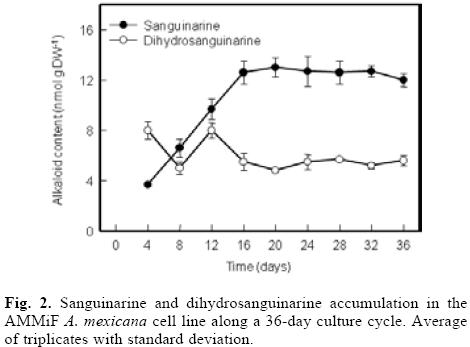
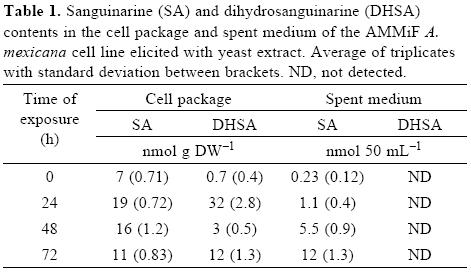
<body><![CDATA[<p align="justify"><font face="verdana" size="2"><b>Introduction</b></font></p>  	    <p align="justify"><font face="verdana" size="2"><i>Argemone mexicana</i> (L) (Papaveraceae) is a plant used in the Mexican traditional medicine. The healing properties of <i>A. mexicana</i> were presumably well known to ancient Mesoamerican cultures, prior to the arrival of Europeans &#91;1&#93;. The presence of a number of benzylisoquinoline alkaloids (BIA) may explain such medicinal effects. For example, the benzophenanthridines sanguinarine (SA) and dihydrosanguinarine (DHSA) display antimicrobiae and cytotoxic activities. These alkaloids are accumulated in roots and mature seeds, whereas berberine, a protoberberine alkaloid with antiviral properties, is accrued both in aerial and underground tissues &#91;2&#93;. The toxic nature of these compounds suggests an ecological role in the chemical defense against herbivores &#91;3&#93;. BIA's are formed from two units of tyrosine which after a series hydroxylation, deamination and decarboxylation reactions, are condensed into norcoclaurine. Further enzymatic reactions transform this intermediary into the benzophenanthridines alkaloids &#91;4&#93;. In accordance to their protective role, the biosynthesis of BIA's is transcriptionally activated in response to environmental injury and this has been applied with biotechnological purposes to increase alkaloid production in <i>in vitro</i> cell cultures &#91;5&#93;. These cultures exposed to conditions mimicking a pathogenic attack increase SA biosynthesis and some portion of it is excreted to the external medium &#91;6&#93;. Furthermore, part of this newly synthesized SA is reduced to the less toxic DHSA suggesting the operation of an enzymatic detoxification mechanism &#91;6, 7&#93;. We have an <i>A. mexicana</i> cell suspension culture, namely AMMiF, which produces significant amounts of SA and DHSA, even without any induction treatment &#91;7&#93;. Interestingly, SA accumulation increased when DHSA decreased, implying the conversion of one into the other. Upon induction with yeast extract, the accumulation of both SA and DHSA increased, although in a limited fashion in comparison to cultures of other SA producing species &#91;7&#93; and also following different patterns, which may point to the operation of a cellular mechanism to avoid damage from an excessive accumulation of SA.</font></p>  	    <p align="justify"><font face="verdana" size="2">&nbsp;</font></p>  	    <p align="justify"><font face="verdana" size="2"><b>Results</b></font></p>  	    <p align="justify"><font face="verdana" size="2">Alkaloids were extracted from <i>A. mexicana</i> cell suspensions and analyzed by TLC. Under UV long wavelength light (365 nm), SA was identified by its red&#150;orange fluorescence at Rf 0.70, identical to the standard. A second red&#150;orange fluorescent spot at Rf 0.89 was also recorded (<a href="#f1">Fig. 1</a>). Fluorescence properties suggest that this compound was a benzophenanthridine.</font> <font face="verdana" size="2">Besides SA, other benzophenantrhridines have been identified in <i>A. mexicana</i> tissues, mainly DHSA, chelerythrine, dihydro&#150;chelerythrine and chelidoline &#91;2&#93;. In order to assign an identity to this unknown compound, extracts were analyzed by GC&#150;MS. The unknown compound and SA resolved at t<sub>R</sub> of 14.732 and 16.731 min, respectively. Mass spectra of the unknown compound m/z 333 &#91;M+&#93; (86), 332 (100), 318 (5), 317 (4), 203 (15), corresponded to DHSA, whereas that of SA m/z 332 &#91;M+&#93; (5), 317 (100) 258 (8); 290 (46), was similar to the standard and as has been previously reported &#91;9&#93;. Therefore, based on MS data, and the well known metabolic interconversion between SA and DHSA &#91;6&#93;, the unknown benzophenanthridine was identified as DHSA.</font></p>     <p align="center"><font face="verdana" size="2"><a name="f1"></a></font></p> 	    <p align="center"><font face="verdana" size="2"><img src="/img/revistas/jmcs/v56n1/a5f1.jpg"></font></p>      <p align="justify"><font face="verdana" size="2">Along the first phase of a culture cycle, DHSA contents decreased while those of SA steadily increased to a maximum, nearing to 14 nmol g DW<sup>&#150;1</sup>. Interestingly, maximal SA content was attained simultaneously to DHSA lowest contents (near to 6 nmol g DW<sup>&#150;1</sup>; <a href="#f2">Fig. 2</a>). SA is the result of DHSA oxidation; hence, these results indicate that the biosynthetic pathway leading to sanguinarine formation is fully active in the AMMiF cell line.</font></p>  	    <p align="center"><font face="verdana" size="2"><a name="f2"></a></font></p>  	    <p align="center"><font face="verdana" size="2"><img src="/img/revistas/jmcs/v56n1/a5f2.jpg"></font></p>  	    ]]></body>
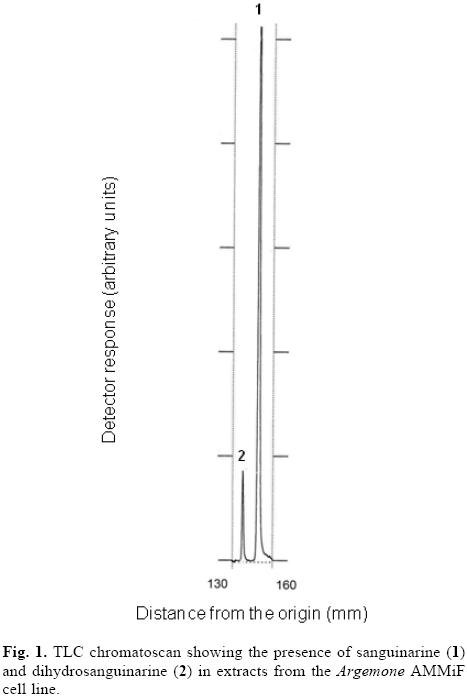
<body><![CDATA[<p align="justify"><font face="verdana" size="2">In order to induce alkaloid accumulation, <i>Argemone</i> cell suspensions were exposed to yeast extract (200 mg L<sup>&#150;1</sup>). This dose probed to be the most effective &#91;8&#93;. Prior to cell exposure, SA was the prominent alkaloid with little DHSA found. During the first 24 h of exposure, DHSA content increased markedly (from 0.7 to 32 nmol g DW<sup>&#150;1</sup>; i.e a 42&#150;fold increase), whereas the initial SA contents only increased around 2.5&#150;fold (from 7 to 19 nmol g DW<sup>&#150;1</sup>). However, after 48 h DHSA returned to its initial values, while SA amounts remained at a similar level, and after 72 h, both SA and DHSA presented similar amounts. It is noteworthy to mention that a significant amount of SA was recovered from the spent medium, but no DHSA was detected (<a href="#t1">Table 1</a>).</font></p>  	    <p align="center"><font face="verdana" size="2"><a name="t1"></a></font></p>  	    <p align="center"><font face="verdana" size="2"><img src="/img/revistas/jmcs/v56n1/a5t1.jpg"></font></p>  	    <p align="justify"><font face="verdana" size="2">&nbsp;</font></p>  	    <p align="justify"><font face="verdana" size="2"><b>Discussion</b></font></p>  	    <p align="justify"><font face="verdana" size="2">Successful plant chemical defense requires a delicate balance involving production of noxious compounds in amounts enough to repel herbivore or pathogen attack while preventing their toxic effects in the cells that produces or accumulates them. Through the course of evolution, different mechanisms have developed to achieve this goal, including the sequestering of toxic compounds in vesicles, their chemical modification to less toxic forms, readily reconverted to the more active forms when required, and their excretion &#91;10&#93;. SA displays a cationic nature which allows it to bind to the negatively charged membranes and proteins, interfering with their functioning. The reduction of SA to its dihydro form diminishes these effects, resulting in a less toxic compound &#91;6&#93;. The first response to YE elicitation of the <i>Argemone</i> AMMiF cell line involved a pronounced accumulation of DHSA, with little effect on SA levels (<a href="#t1">Table 1</a>). Since DHSA is the precursor of SA in the biosynthetic pathway (<a href="#f1">Fig. 1</a>), this result suggests, that at these early phases of induction, DHSA concentration in the cell built up prior its oxidation to SA. As the response progressed, DHSA was transformed into SA, which then was apparently excreted (<a href="#t1">Table 1</a>; 48 h), preventing in this way its possible toxic effects. At longer periods, when the maximal response was reached (<a href="#t1">Table 1</a>; 72 h), it appeared that either the rate of DHSA oxidation to SA decreased, or that SA was reduced back to DHSA (<a href="#f1">Fig. 1</a>). Interestingly, only SA, but not DHSA, was recovered from the medium, and in substantially lesser amounts than those extracted from the cell package (<a href="#t1">Table 1</a>). In an alternative manner, SA could also have been degraded. Chromatographic analysis revealed the presence of putative benzophenanthridines, which could not be identified due to their unstable nature. The formation of these unstable, short&#150;lived, products has been previously observed &#91;6&#93;. Finally, such response suggests the operation of a mechanism to cope with the deleterious effects of SA inside the cell &#91;7&#93;, which involves the control of the internal amounts of the oxidized form by reducing it to DHSA, and/or excreting it to the external medium.</font></p>  	    <p align="justify"><font face="verdana" size="2">&nbsp;</font></p>  	    <p align="justify"><font face="verdana" size="2"><b>Conclusion</b></font></p>  	    <p align="justify"><font face="verdana" size="2">In <i>A. mexicana</i> cell suspension cultures, the toxic effects of a high benzophenanthridine accumulation, induced by YE, are managed through reducing the internal contents of the oxidized (SA) to the less toxic dihydro (DHSA) forms or its excretion to the medium.</font></p>  	    <p align="justify"><font face="verdana" size="2">&nbsp;</font></p>  	    ]]></body>
<body><![CDATA[<p align="justify"><font face="verdana" size="2"><b>Experimental section</b></font></p>  	    <p align="justify"><font face="verdana" size="2">Biological materials. The <i>Argemone mexicana</i> cell line AM&#150;MiF has been maintained through biweekly subcultures in PC&#150;BN medium (inorganic salts and vitamins of Phillips and Collins medium, supplemented with 0.5 and 1.5 mg L<sup>&#150;1</sup> of benzyladenine and naphtalenacetic acid, respectively and 20 g L<sup>&#150;1</sup> of sucrose &#91;8&#93;. For the culture cycle, 5 mL of a 14&#150;day old cell suspension (representing between 0.20 and 0.22 g FW mL<sup>&#150;1</sup> were transferred to 250 mL Erlenmeyer flasks, containing 50 mL of the PC&#150;BN medium and maintained for up to 30 days, taking samples by triplicate as indicated in the Figures. Sanguinarine biosynthesis was induced with 200 mg L<sup>&#150;1</sup> yeast extract (YE; Sigma&#150;Aldrich, St. Louis MO). Briefly, 10 day&#150;old cultures received 1.0 mL of a YE solution, previously filter sterilized through a 0.2 pore size nylon sterile membrane (Corning, NY), to render the desired concentration &#91;8&#93;. Controls were mock induced with water. Samples, by triplicate, were collected as indicated in Figures, recording growth as fresh weight prior to freezing them in liquid nitrogen.</font></p>  	    <p align="justify"><font face="verdana" size="2">Analytical procedures. Alkaloids were extracted from freeze dried tissues with HCl 0.5% in methanol (v/v). Between 100 and 150 mg of ground tissues were incubated at 45 &deg;C with gently shaking for 2 h. Cell debris was removed by filtration and the acidic extract was reduced to dryness at low pressure. Residue was dissolved in 1 mL of methanol and alkaloids were separated by thin layer chromatography (TLC), using as mobile phase a benzene/ethanol (9/1 by vol.) mixture. SA and DHSA were quantified by <i>in situ</i> fluorescence (325 and 545 nm for excitation and emission, respectively) using a Shimadzu CS&#150;930 dual wavelength chromatoscanner, equipped with a DR 2 data collector (Kyoto Japan). Alkaloid identity was assigned based on Rf's values, and further confirmed by gas chromatography coupled to mass spectroscopy (GC&#150;MS). GC&#150;MS was carried out in an Agilent Technologies 6890N gas chromatographer coupled to a 5975B mass detector, using a glass capillary column (25 m &times; 0.32 mm i.d &times; 30 &#956;m). Nitrogen was used as carrier gas at a flow rate of 45 mL min<sup>&#150;1</sup>. Injector and detector temperatures were set at 150 and 300 &deg;C, respectively. Initial column temperature was 80 &deg;C, then increased to 300 &deg;C (2 min), and finally kept at 300 &deg;C (10 min). Alkaloids were identified comparing fragmentation patterns to those previously reported &#91;9&#93;.</font></p>  	    <p align="justify"><font face="verdana" size="2">&nbsp;</font></p>  	    <p align="justify"><font face="verdana" size="2"><b>Acknowledgments</b></font></p>  	    <p align="justify"><font face="verdana" size="2">This work was supported by Consejo Nacional de Ciencia y Tecnolog&iacute;a (CONACYT, grant P60746) and The Academy of Sciences for the Developing World (TWAS), 06&#150;177 RG/BIO/ LA&#150;UNESCO FR:3240157854TWAS. CG&#150;G is recipient of a CONACYT scholarship for doctoral studies. The authors wish to thank Dr. M.L. Miranda Ham for her critical review of the manuscript, as well as Silvia Andrade and Dr. L.M. Pe&ntilde;a&#150;Rodr&iacute;guez for their assistance in the GC&#150;MS analysis and data interpretation.</font></p>  	    <p align="justify"><font face="verdana" size="2">&nbsp;</font></p>  	    <p align="justify"><font face="verdana" size="2"><b>References</b></font></p>  	    <!-- ref --><p align="justify"><font face="verdana" size="2">1. Reyna Robles, R. M.; Gonz&aacute;lez Quintero L. <i>Arqueobotanica</i> <b>1278,</b> <i>63,</i> 33&#150;41.    &nbsp;&nbsp;&nbsp;&nbsp;&nbsp;&nbsp;&nbsp;&nbsp;[&#160;<a href="javascript:void(0);" onclick="javascript: window.open('/scielo.php?script=sci_nlinks&ref=4921175&pid=S1870-249X201200010000500001&lng=','','width=640,height=500,resizable=yes,scrollbars=1,menubar=yes,');">Links</a>&#160;]<!-- end-ref --></font></p>  	    ]]></body>
<body><![CDATA[<!-- ref --><p align="justify"><font face="verdana" size="2">2. Chang, Y. C.; Chang, F. R.; Khalil, A. T.; Hsieh, P. W.; Wu, Y. C. <i>Z Naturforsch &#91;C&#93;</i> <b>2003,</b> <i>58,</i> 521&#150;526.    &nbsp;&nbsp;&nbsp;&nbsp;&nbsp;&nbsp;&nbsp;&nbsp;[&#160;<a href="javascript:void(0);" onclick="javascript: window.open('/scielo.php?script=sci_nlinks&ref=4921177&pid=S1870-249X201200010000500002&lng=','','width=640,height=500,resizable=yes,scrollbars=1,menubar=yes,');">Links</a>&#160;]<!-- end-ref --></font></p>  	    <!-- ref --><p align="justify"><font face="verdana" size="2">3. Cho, H. Y.; Lee&#150;Parson, S. Y.; Yoon, S. Y. H.; Rhee, H. S.; Park, J. M. <i>Biotechnol. Lett.</i> <b>2007,</b> <i>29,</i> 2001&#150;2005.    &nbsp;&nbsp;&nbsp;&nbsp;&nbsp;&nbsp;&nbsp;&nbsp;[&#160;<a href="javascript:void(0);" onclick="javascript: window.open('/scielo.php?script=sci_nlinks&ref=4921179&pid=S1870-249X201200010000500003&lng=','','width=640,height=500,resizable=yes,scrollbars=1,menubar=yes,');">Links</a>&#160;]<!-- end-ref --></font></p>  	    <!-- ref --><p align="justify"><font face="verdana" size="2">4. Ziegler, J.; Facchini, P. <i>Ann Rev Plant Biol</i> <b>2008,</b> <i>59</i>, 735&#150;769.    &nbsp;&nbsp;&nbsp;&nbsp;&nbsp;&nbsp;&nbsp;&nbsp;[&#160;<a href="javascript:void(0);" onclick="javascript: window.open('/scielo.php?script=sci_nlinks&ref=4921181&pid=S1870-249X201200010000500004&lng=','','width=640,height=500,resizable=yes,scrollbars=1,menubar=yes,');">Links</a>&#160;]<!-- end-ref --></font></p>  	    <!-- ref --><p align="justify"><font face="verdana" size="2">5. Eilert, U.; Kurz, W. G. W.; Constabel, F. <i>J. Plant Physiol.</i> <b>1985,</b> <i>119,</i> 65&#150;76.    &nbsp;&nbsp;&nbsp;&nbsp;&nbsp;&nbsp;&nbsp;&nbsp;[&#160;<a href="javascript:void(0);" onclick="javascript: window.open('/scielo.php?script=sci_nlinks&ref=4921183&pid=S1870-249X201200010000500005&lng=','','width=640,height=500,resizable=yes,scrollbars=1,menubar=yes,');">Links</a>&#160;]<!-- end-ref --></font></p>  	    <!-- ref --><p align="justify"><font face="verdana" size="2">6. Weiss, D.; Baumert, A. A.; Vogel M.; Roos, W. <i>Plant Cell Environ</i> <b>2006,</b> <i>29</i>, 291&#150;302.    &nbsp;&nbsp;&nbsp;&nbsp;&nbsp;&nbsp;&nbsp;&nbsp;[&#160;<a href="javascript:void(0);" onclick="javascript: window.open('/scielo.php?script=sci_nlinks&ref=4921185&pid=S1870-249X201200010000500006&lng=','','width=640,height=500,resizable=yes,scrollbars=1,menubar=yes,');">Links</a>&#160;]<!-- end-ref --></font></p>  	    ]]></body>
<body><![CDATA[<!-- ref --><p align="justify"><font face="verdana" size="2">7. Trujillo&#150;Villanueva, K.; Rubio&#150;Pi&ntilde;a, J.; Monforte&#150;Gonz&aacute;lez, M.; V&aacute;zquez&#150;Flota, F. <i>Biotechnol Lett</i> <b>2010,</b> <i>32</i>, 1005&#150;1009.    &nbsp;&nbsp;&nbsp;&nbsp;&nbsp;&nbsp;&nbsp;&nbsp;[&#160;<a href="javascript:void(0);" onclick="javascript: window.open('/scielo.php?script=sci_nlinks&ref=4921187&pid=S1870-249X201200010000500007&lng=','','width=640,height=500,resizable=yes,scrollbars=1,menubar=yes,');">Links</a>&#160;]<!-- end-ref --></font></p>  	    <!-- ref --><p align="justify"><font face="verdana" size="2">8. V&aacute;zquez&#150;Flota, F.; Monforte&#150;Gonz&aacute;lez, M.; Gu&iacute;zar&#150;Gonz&aacute;lez, C.;&nbsp;Rubio&#150;Pi&ntilde;a, J.; Trujillo&#150;Villanueva, K., in: <i>Plant Cell Culture Protocols Third Edition,</i> Loyola&#150;Vargas, V.; Ochoa&#150;Alejo, N., Eds.,&nbsp;Humana Press Totowa N. J., In press.    &nbsp;&nbsp;&nbsp;&nbsp;&nbsp;&nbsp;&nbsp;&nbsp;[&#160;<a href="javascript:void(0);" onclick="javascript: window.open('/scielo.php?script=sci_nlinks&ref=4921189&pid=S1870-249X201200010000500008&lng=','','width=640,height=500,resizable=yes,scrollbars=1,menubar=yes,');">Links</a>&#160;]<!-- end-ref --></font></p> 	    <!-- ref --><p align="justify"><font face="verdana" size="2">9. P&eacute;rez&#150;Guti&eacute;rrez, R. M.; Vargas&#150;Sol&iacute;s, R.; D&iacute;az&#150;Guti&eacute;rrez, G.; Mart&iacute;nez&#150;Mart&iacute;nez F. J. <i>Phytochem. Anal.</i> <b>2002,</b> <i>13</i>, 177&#150;180.    &nbsp;&nbsp;&nbsp;&nbsp;&nbsp;&nbsp;&nbsp;&nbsp;[&#160;<a href="javascript:void(0);" onclick="javascript: window.open('/scielo.php?script=sci_nlinks&ref=4921191&pid=S1870-249X201200010000500009&lng=','','width=640,height=500,resizable=yes,scrollbars=1,menubar=yes,');">Links</a>&#160;]<!-- end-ref --></font></p>      <!-- ref --><p align="justify"><font face="verdana" size="2">10. Bennett, R. N. and Wallsgrove R. M. <i>NewPhytol.</i> <b>1994,</b> <i>127</i>, 617&#150;633.    &nbsp;&nbsp;&nbsp;&nbsp;&nbsp;&nbsp;&nbsp;&nbsp;[&#160;<a href="javascript:void(0);" onclick="javascript: window.open('/scielo.php?script=sci_nlinks&ref=4921193&pid=S1870-249X201200010000500010&lng=','','width=640,height=500,resizable=yes,scrollbars=1,menubar=yes,');">Links</a>&#160;]<!-- end-ref --></font></p>  	    <p align="justify"><font face="verdana" size="2">&nbsp;</font></p>  	    <p align="justify"><font face="verdana" size="2"><b>Note</b></font></p>  	    ]]></body>
<body><![CDATA[<p align="justify"><font face="verdana" size="2"><i>Dedicated to Dr. Estela S&aacute;nchez de Jim&eacute;nez for her valuable contributions to plant biochemistry.</i></font></p>      ]]></body><back>
<ref-list>
<ref id="B1">
<label>1</label><nlm-citation citation-type="journal">
<person-group person-group-type="author">
<name>
<surname><![CDATA[Reyna Robles]]></surname>
<given-names><![CDATA[R. M.]]></given-names>
</name>
<name>
<surname><![CDATA[González Quintero]]></surname>
<given-names><![CDATA[L.]]></given-names>
</name>
</person-group>
<source><![CDATA[Arqueobotanica]]></source>
<year></year>
<volume>1278</volume>
<numero>63</numero>
<issue>63</issue>
<page-range>33-41</page-range></nlm-citation>
</ref>
<ref id="B2">
<label>2</label><nlm-citation citation-type="journal">
<person-group person-group-type="author">
<name>
<surname><![CDATA[Chang]]></surname>
<given-names><![CDATA[Y. C.]]></given-names>
</name>
<name>
<surname><![CDATA[Chang]]></surname>
<given-names><![CDATA[F. R.]]></given-names>
</name>
<name>
<surname><![CDATA[Khalil]]></surname>
<given-names><![CDATA[A. T.]]></given-names>
</name>
<name>
<surname><![CDATA[Hsieh]]></surname>
<given-names><![CDATA[P. W.]]></given-names>
</name>
<name>
<surname><![CDATA[Wu]]></surname>
<given-names><![CDATA[Y. C. Z]]></given-names>
</name>
</person-group>
<source><![CDATA[Naturforsch]]></source>
<year>2003</year>
<volume>58</volume>
<page-range>521-526</page-range></nlm-citation>
</ref>
<ref id="B3">
<label>3</label><nlm-citation citation-type="journal">
<person-group person-group-type="author">
<name>
<surname><![CDATA[Cho]]></surname>
<given-names><![CDATA[H. Y.]]></given-names>
</name>
<name>
<surname><![CDATA[Lee-Parson]]></surname>
<given-names><![CDATA[S. Y.]]></given-names>
</name>
<name>
<surname><![CDATA[Yoon]]></surname>
<given-names><![CDATA[S. Y. H.]]></given-names>
</name>
<name>
<surname><![CDATA[Rhee]]></surname>
<given-names><![CDATA[H. S.]]></given-names>
</name>
<name>
<surname><![CDATA[Park]]></surname>
<given-names><![CDATA[J. M.]]></given-names>
</name>
</person-group>
<source><![CDATA[Biotechnol. Lett.]]></source>
<year>2007</year>
<volume>29</volume>
<page-range>2001-2005</page-range></nlm-citation>
</ref>
<ref id="B4">
<label>4</label><nlm-citation citation-type="journal">
<person-group person-group-type="author">
<name>
<surname><![CDATA[Ziegler]]></surname>
<given-names><![CDATA[J.]]></given-names>
</name>
<name>
<surname><![CDATA[Facchini]]></surname>
<given-names><![CDATA[P.]]></given-names>
</name>
</person-group>
<source><![CDATA[Ann Rev Plant Biol]]></source>
<year>2008</year>
<volume>59</volume>
<page-range>735-769</page-range></nlm-citation>
</ref>
<ref id="B5">
<label>5</label><nlm-citation citation-type="journal">
<person-group person-group-type="author">
<name>
<surname><![CDATA[Eilert]]></surname>
<given-names><![CDATA[U.]]></given-names>
</name>
<name>
<surname><![CDATA[Kurz]]></surname>
<given-names><![CDATA[W. G. W.]]></given-names>
</name>
<name>
<surname><![CDATA[Constabel]]></surname>
<given-names><![CDATA[F.]]></given-names>
</name>
</person-group>
<source><![CDATA[J. Plant Physiol.]]></source>
<year>1985</year>
<volume>119</volume>
<page-range>65-76</page-range></nlm-citation>
</ref>
<ref id="B6">
<label>6</label><nlm-citation citation-type="journal">
<person-group person-group-type="author">
<name>
<surname><![CDATA[Weiss]]></surname>
<given-names><![CDATA[D.]]></given-names>
</name>
<name>
<surname><![CDATA[Baumert]]></surname>
<given-names><![CDATA[A. A.]]></given-names>
</name>
<name>
<surname><![CDATA[Vogel]]></surname>
<given-names><![CDATA[M.]]></given-names>
</name>
<name>
<surname><![CDATA[Roos]]></surname>
<given-names><![CDATA[W.]]></given-names>
</name>
</person-group>
<source><![CDATA[Plant Cell Environ]]></source>
<year>2006</year>
<volume>29</volume>
<page-range>291-302</page-range></nlm-citation>
</ref>
<ref id="B7">
<label>7</label><nlm-citation citation-type="journal">
<person-group person-group-type="author">
<name>
<surname><![CDATA[Trujillo-Villanueva]]></surname>
<given-names><![CDATA[K.]]></given-names>
</name>
<name>
<surname><![CDATA[Rubio-Piña]]></surname>
<given-names><![CDATA[J.]]></given-names>
</name>
<name>
<surname><![CDATA[Monforte-González]]></surname>
<given-names><![CDATA[M.]]></given-names>
</name>
<name>
<surname><![CDATA[Vázquez-Flota]]></surname>
<given-names><![CDATA[F.]]></given-names>
</name>
</person-group>
<source><![CDATA[Biotechnol Lett]]></source>
<year>2010</year>
<volume>32</volume>
<page-range>1005-1009</page-range></nlm-citation>
</ref>
<ref id="B8">
<label>8</label><nlm-citation citation-type="book">
<person-group person-group-type="author">
<name>
<surname><![CDATA[Vázquez-Flota]]></surname>
<given-names><![CDATA[F.]]></given-names>
</name>
<name>
<surname><![CDATA[Monforte-González]]></surname>
<given-names><![CDATA[M.]]></given-names>
</name>
<name>
<surname><![CDATA[Guízar-González]]></surname>
<given-names><![CDATA[C.]]></given-names>
</name>
<name>
<surname><![CDATA[Rubio-Piña]]></surname>
<given-names><![CDATA[J.]]></given-names>
</name>
<name>
<surname><![CDATA[Trujillo-Villanueva]]></surname>
<given-names><![CDATA[K.]]></given-names>
</name>
</person-group>
<person-group person-group-type="editor">
<name>
<surname><![CDATA[Loyola-Vargas]]></surname>
<given-names><![CDATA[V.]]></given-names>
</name>
<name>
<surname><![CDATA[Ochoa-Alejo]]></surname>
<given-names><![CDATA[N.]]></given-names>
</name>
</person-group>
<source><![CDATA[Plant Cell Culture Protocols]]></source>
<year></year>
<edition>Third</edition>
<publisher-loc><![CDATA[^eN. J. N. J.]]></publisher-loc>
<publisher-name><![CDATA[Humana Press]]></publisher-name>
</nlm-citation>
</ref>
<ref id="B9">
<label>9</label><nlm-citation citation-type="journal">
<person-group person-group-type="author">
<name>
<surname><![CDATA[Pérez-Gutiérrez]]></surname>
<given-names><![CDATA[R. M.]]></given-names>
</name>
<name>
<surname><![CDATA[Vargas-Solís]]></surname>
<given-names><![CDATA[R.]]></given-names>
</name>
<name>
<surname><![CDATA[Díaz-Gutiérrez]]></surname>
<given-names><![CDATA[G.]]></given-names>
</name>
<name>
<surname><![CDATA[Martínez-Martínez]]></surname>
<given-names><![CDATA[F.]]></given-names>
</name>
</person-group>
<source><![CDATA[J. Phytochem. Anal.]]></source>
<year>2002</year>
<volume>13</volume>
<page-range>177-180</page-range></nlm-citation>
</ref>
<ref id="B10">
<label>10</label><nlm-citation citation-type="journal">
<person-group person-group-type="author">
<name>
<surname><![CDATA[Bennett]]></surname>
<given-names><![CDATA[R. N.]]></given-names>
</name>
<name>
<surname><![CDATA[Wallsgrove]]></surname>
<given-names><![CDATA[R. M.]]></given-names>
</name>
</person-group>
<source><![CDATA[NewPhytol.]]></source>
<year>1994</year>
<volume>127</volume>
<page-range>617-633</page-range></nlm-citation>
</ref>
</ref-list>
</back>
</article>