<?xml version="1.0" encoding="ISO-8859-1"?><article xmlns:mml="http://www.w3.org/1998/Math/MathML" xmlns:xlink="http://www.w3.org/1999/xlink" xmlns:xsi="http://www.w3.org/2001/XMLSchema-instance">
<front>
<journal-meta>
<journal-id>1870-249X</journal-id>
<journal-title><![CDATA[Journal of the Mexican Chemical Society]]></journal-title>
<abbrev-journal-title><![CDATA[J. Mex. Chem. Soc]]></abbrev-journal-title>
<issn>1870-249X</issn>
<publisher>
<publisher-name><![CDATA[Sociedad Química de México A.C.]]></publisher-name>
</publisher>
</journal-meta>
<article-meta>
<article-id>S1870-249X2012000100004</article-id>
<title-group>
<article-title xml:lang="en"><![CDATA[Determination of Antioxidants in Fruit Tissues from Three Accessions of Habanero Pepper (Capsicum chinense Jacq.)]]></article-title>
</title-group>
<contrib-group>
<contrib contrib-type="author">
<name>
<surname><![CDATA[Castro-Concha]]></surname>
<given-names><![CDATA[Lizbeth A.]]></given-names>
</name>
<xref ref-type="aff" rid="A01"/>
</contrib>
<contrib contrib-type="author">
<name>
<surname><![CDATA[Canche-Chuc]]></surname>
<given-names><![CDATA[Ismael]]></given-names>
</name>
<xref ref-type="aff" rid="A01"/>
</contrib>
<contrib contrib-type="author">
<name>
<surname><![CDATA[Miranda-Ham]]></surname>
<given-names><![CDATA[María de Lourdes]]></given-names>
</name>
<xref ref-type="aff" rid="A01"/>
</contrib>
</contrib-group>
<aff id="A01">
<institution><![CDATA[,Centro de Investigación Científica de Yucatán Unidad de Bioquímica y Biología Molecular de Plantas ]]></institution>
<addr-line><![CDATA[Mérida Yucatán]]></addr-line>
<country>México</country>
</aff>
<pub-date pub-type="pub">
<day>00</day>
<month>03</month>
<year>2012</year>
</pub-date>
<pub-date pub-type="epub">
<day>00</day>
<month>03</month>
<year>2012</year>
</pub-date>
<volume>56</volume>
<numero>1</numero>
<fpage>15</fpage>
<lpage>18</lpage>
<copyright-statement/>
<copyright-year/>
<self-uri xlink:href="http://www.scielo.org.mx/scielo.php?script=sci_arttext&amp;pid=S1870-249X2012000100004&amp;lng=en&amp;nrm=iso"></self-uri><self-uri xlink:href="http://www.scielo.org.mx/scielo.php?script=sci_abstract&amp;pid=S1870-249X2012000100004&amp;lng=en&amp;nrm=iso"></self-uri><self-uri xlink:href="http://www.scielo.org.mx/scielo.php?script=sci_pdf&amp;pid=S1870-249X2012000100004&amp;lng=en&amp;nrm=iso"></self-uri><abstract abstract-type="short" xml:lang="en"><p><![CDATA[Three accessions of habanero pepper (Capsicum chínense Jacq.), differing in the color of the fruits throughout the maturation process, were analyzed for antioxidants, namely carotenoids, ascorbate and glutathione. The mature fruits from the three accessions contained high levels of the above mentioned antioxidants. Accession MR8H presented the highest content of red carotenoids, while in SBN01, the ascorbate level was the maximal found regardless of the maturation stage.]]></p></abstract>
<abstract abstract-type="short" xml:lang="es"><p><![CDATA[Se determinaron los antioxidantes: carotenoides, ascorbato y glutatión, en tres accesiones de chile habanero (Capsicum chinense Jacq.), que contrastaban en sus patrones de maduración. Los frutos maduros de las tres accesiones mostraron niveles altos de los tres tipos de antioxidantes mencionados. La accesión MR8H presentó el nivel más alto de carotenoides rojos, mientras que en la SBN01 se observó el contenido máximo de ascorbato sin importar el grado de maduración de los frutos.]]></p></abstract>
<kwd-group>
<kwd lng="en"><![CDATA[Capsicum chinense]]></kwd>
<kwd lng="en"><![CDATA[carotenoids]]></kwd>
<kwd lng="en"><![CDATA[ascorbate]]></kwd>
<kwd lng="en"><![CDATA[glutathione]]></kwd>
<kwd lng="es"><![CDATA[Capsicum chinense]]></kwd>
<kwd lng="es"><![CDATA[carotenoides]]></kwd>
<kwd lng="es"><![CDATA[ascorbato]]></kwd>
<kwd lng="es"><![CDATA[glutatión]]></kwd>
</kwd-group>
</article-meta>
</front><body><![CDATA[  	    <p align="justify"><font face="verdana" size="4">Article</font></p>  	    <p align="justify"><font face="verdana" size="2">&nbsp;</font></p>  	    <p align="center"><font face="verdana" size="4"><b>Determination of Antioxidants in Fruit Tissues from Three Accessions of Habanero Pepper (<i>Capsicum chinense</i> Jacq.)</b></font></p>  	    <p align="center"><font face="verdana" size="2">&nbsp;</font></p>  	    <p align="center"><font face="verdana" size="2"><b>Lizbeth A. Castro&#150;Concha, Ismael Canche&#150;Chuc, and Mar&iacute;a de Lourdes Miranda&#150;Ham*</b></font></p>  	    <p align="justify"><font face="verdana" size="2">&nbsp;</font></p>  	    <p align="justify"><font face="verdana" size="2"><i>Unidad de Bioqu&iacute;mica y Biolog&iacute;a Molecular de Plantas, Centro de Investigaci&oacute;n Cient&iacute;fica de Yucat&aacute;n, Calle 43 # 130, Chuburn&aacute; de Hidalgo, M&eacute;rida, Yucat&aacute;n, M&eacute;xico. Tel.: (999) 9428330 Ext. 228. Fax: (999) 9813900.</i> <a href="mailto:mirham@cicy.mx">mirham@cicy.mx</a></font></p>  	    <p align="justify"><font face="verdana" size="2"></font></p>  	    <p align="justify"><font face="verdana" size="2">Received January 31, 2011.    ]]></body>
<body><![CDATA[<br> 	Accepted April 15, 2011.</font></p>  	    <p align="justify"><font face="verdana" size="2">&nbsp;</font></p>  	    <p align="justify"><font face="verdana" size="2"><b>Abstract</b></font></p>  	    <p align="justify"><font face="verdana" size="2">Three accessions of habanero pepper (<i>Capsicum ch&iacute;nense</i> Jacq.), differing in the color of the fruits throughout the maturation process, were analyzed for antioxidants, namely carotenoids, ascorbate and glutathione. The mature fruits from the three accessions contained high levels of the above mentioned antioxidants. Accession MR8H presented the highest content of red carotenoids, while in SBN01, the ascorbate level was the maximal found regardless of the maturation stage.</font></p>  	    <p align="justify"><font face="verdana" size="2"><b>Key words:</b> <i>Capsicum chinense,</i> carotenoids, ascorbate, glutathione.</font></p>  	    <p align="justify"><font face="verdana" size="2">&nbsp;</font></p>  	    <p align="justify"><font face="verdana" size="2"><b>Resumen</b></font></p>  	    <p align="justify"><font face="verdana" size="2">Se determinaron los antioxidantes: carotenoides, ascorbato y glutati&oacute;n, en tres accesiones de chile habanero (<i>Capsicum chinense</i> Jacq.), que contrastaban en sus patrones de maduraci&oacute;n. Los frutos maduros de las tres accesiones mostraron niveles altos de los tres tipos de antioxidantes mencionados. La accesi&oacute;n MR8H present&oacute; el nivel m&aacute;s alto de carotenoides rojos, mientras que en la SBN01 se observ&oacute; el contenido m&aacute;ximo de ascorbato sin importar el grado de maduraci&oacute;n de los frutos.</font></p>  	    <p align="justify"><font face="verdana" size="2"><b>Palabras clave:</b> <i>Capsicum chinense,</i> carotenoides, ascorbato, glutati&oacute;n.</font></p>  	    <p align="justify"><font face="verdana" size="2">&nbsp;</font></p>  	    ]]></body>
<body><![CDATA[<p align="justify"><font face="verdana" size="2"><b>Introduction</b></font></p>  	    <p align="justify"><font face="verdana" size="2">Recently, antioxidants have become an active research topic, given their protective properties towards oxidative damage in living organisms. The accumulation of reactive oxygen species have been linked to a number of diseases, including cancer, diabetes, cardiovascular and neurological disorders, and other aging related processes &#91;1&#93;. Antioxidants are frequently found in plant tissues, and include a wide range of metabolites from phenol acids, flavonoids, saponins, tannins, alkaloids, polysac&#150;charides, to the most common one, ascorbic acid or vitamin C. Carotenoids also display an important antioxidant potential, and are vital for the mammalian diet, since they represent the precursors to vitamin A, whose deficiency causes a number of disorders ranging from impaired iron mobilization, growth retardation and blindness, to depressed immune response and increased susceptibility to infectious disease &#91;2&#93;. Besides the health benefits mentioned above, carotenoid accumulation in vegetables represent a desirable trait, since it confers them color, an attribute that influence consumers' choice.</font></p>  	    <p align="justify"><font face="verdana" size="2">Color intensity in fresh habanero peppers <i>(Capsicum chinense</i> Jacq.) is a valuable comercial feature &#91;3&#93;, resulting from the accumulation of chlorophylls and yellow, orange and red carotenoids &#91;4&#93;. Interestingly, peppers also represent an excellent dietary source of antioxidants, including vitamins C and E, among others &#91;1&#93;. Prior to ripening, habanero pods are green&#150;colored, turning to orange or red as they ripen. Some other cultivars can turn from green to orange, red or purple, while others turn from white or light green to red directly &#91;1&#93;.</font></p>  	    <p align="justify"><font face="verdana" size="2">Habanero peppers are mainly appreciated for their extreme hotness or pungency, and most plant inventories focus on variations of capsaicin content among different varieties &#91;5&#93;. However, in general, peppers are considered an alternative source for vitamin C and other antioxidants, and thus these compounds may constitute an added value for their cultivation and human consumption. Antioxidant and other nutrimental properties can widely vary depending on genotype, developmental stage and plant growing conditions. Hence in the present work, we have analyzed the content of carotenoids, chlorophylls, ascorbate and glutathione in the pericarp and placental tissues from three accessions of <i>C. chinense</i> differing in the color of the fruits throughout the maturation process. These accessions were taken from a collection cultivated in the state of Yucatan, which possess the largest genetic diversity in M&eacute;xico. Our results provide useful information to choose the best cultivar for human consumption given its nutraceutical value, based on anti&#150;oxidant levels.</font></p>  	    <p align="justify"><font face="verdana" size="2">&nbsp;</font></p>  	    <p align="justify"><font face="verdana" size="2"><b>Results and Discussion</b></font></p>  	    <p align="justify"><font face="verdana" size="2">Pods from accessions MR8H, SBR01 and SBN01 were evaluated at different stages of maturation. Accession MR8H showed the largest variation in color during ripening: immature fruits were light green (1&#150;15 d after anthesis), while the mature ones were bright red (36&#150;45 d after anthesis), with intermediate bright green (16&#150;25 d after anthesis) and orange (26&#150;35 d after anthesis) stages. In contrast, accession SBR01 only turned from light green (1&#150;30 d after anthesis) to bright red (31&#150;45 d after anthesis), whereas accession SBN01, from bright green (1&#150;30 d after anthesis) to orange (31&#150;45 d after anthesis). Color in pepper pods results mainly from the accumulation of chlorophylls and carotenoids, which can function both as antioxidants as well as ultraviolet and visible light protectants &#91;1&#93;.</font></p>  	    <p align="justify"><font face="verdana" size="2">In order to compare the available accessions regarding to their antioxidants' contents, levels of carotenoid, ascorbate and glutathione were analyzed in the pericarp and the placental tissue separately. Both tissues constitute the edible parts of the fruit, being the placenta the one responsible for pepper hotness &#91;6&#93;.</font></p>  	    <p align="justify"><font face="verdana" size="2">Chlorophyll and carotenoid contents in the pericarp and placenta of the fruits from the different accessions at different stages are shown in <a href="/img/revistas/jmcs/v56n1/a4t1.jpg" target="_blank">Table 1</a>. At comparative stages (namely bright green), the MR8H accession accumulated highest contents of total chlorophylls, and even when both MR8H and SBR01 ripen to red, red carotenoid content in the former was twice of those in the second one (<a href="/img/revistas/jmcs/v56n1/a4t1.jpg" target="_blank">Table 1</a>). The main carot&#150;enoids in red pepper pods are capsanthin and capsorubin which display maximal absorbance in the region between 440 and 460 nm &#91;3&#93;, coinciding with those observed in the chromatogram from pod extracts (data not shown). Interestingly, orange color in pericarps of SBN01 accession was not due to p&#150;carotene, but to other yellow carotenoids, such as violaxanthin, anthe&#150;raxanthin, lutein and zeaxanthin, that have been found in <i>C. annuum</i> &#91;3&#93;.</font></p>  	    <p align="justify"><font face="verdana" size="2">Ascorbate and glutathione are amongst the major components of the antioxidant system in plants, and take part in the Halliwell&#150;Asada cycle, that provides a regular supply of reduced molecules, which are involved in the detoxification of reactive oxygen species in most cells. Total ascorbate contents were in similar levels among the three accessions analyzed, along the fruit maturation process (<a href="/img/revistas/jmcs/v56n1/a4t1.jpg" target="_blank">Table 1</a>). However, some variations were detected in glutathione levels (<a href="/img/revistas/jmcs/v56n1/a4t1.jpg" target="_blank">Table 1</a>). In MR8H, glutathione increased as pods ripened (<a href="/img/revistas/jmcs/v56n1/a4t1.jpg" target="_blank">Table 1</a>). An opposite trend was found for SBN01, which presented its highest glutathione levels prior to ripening. No variations were detected in pods from SBR01 (<a href="/img/revistas/jmcs/v56n1/a4t1.jpg" target="_blank">Table 1</a>).</font></p>  	    ]]></body>
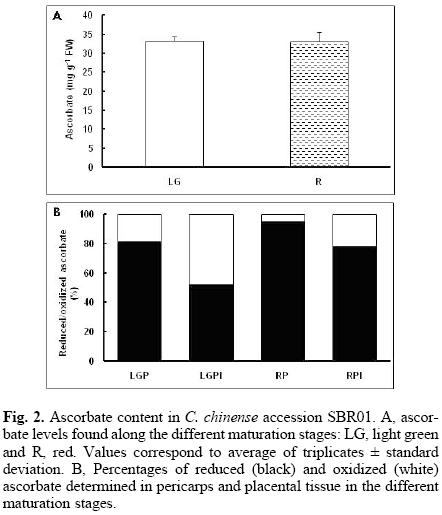
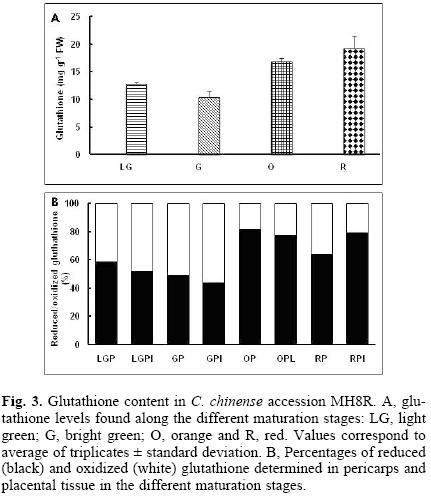
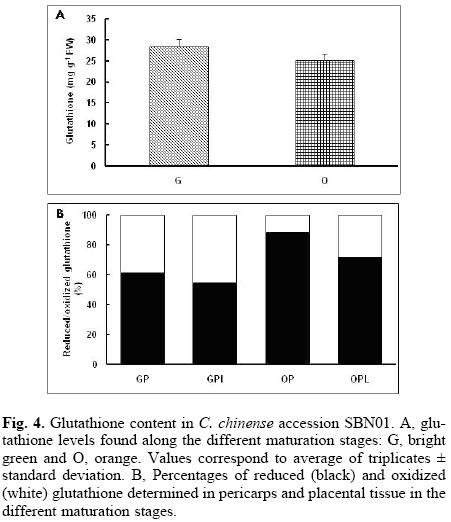
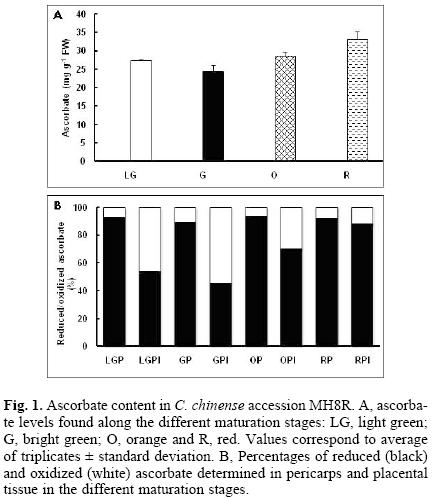
<body><![CDATA[<p align="justify"><font face="verdana" size="2">The correct functioning of the Halliwell&#150;Asada cycle is cumbersome to cellular homeostasis since it can provide reducing power for growth and development. It is noteworthy that in pericarps from the four stages in MR8H, the balance is tipped to the reduced form of ascorbate, where it represents more than the 90% of the total (<a href="#f1">Fig. 1</a>). However, in the immature stages in placental tissue, the oxidized form or dehydroascorbate represents approximately 50% of the total and, as the ripening process develops, this percentage gradually changes to present a maximum level of reduced ascorbate (<a href="#f1">Fig. 1</a>). Similar patterns were detected in SBR01 and SBN01 accessions, i.e., pericarps presented the most ascorbate in the reduced form (above 80%), while in the placental tissue, this form increased its contents as ripening proceeded (<a href="#f2">Fig. 2</a>).</font></p>  	    <p align="center"><font face="verdana" size="2"><a name="f1"></a></font></p>  	    <p align="center"><font face="verdana" size="2"><img src="/img/revistas/jmcs/v56n1/a4f1.jpg"></font></p>  	    <p align="center"><font face="verdana" size="2"><a name="f2"></a></font></p>  	    <p align="center"><font face="verdana" size="2"><img src="/img/revistas/jmcs/v56n1/a4f2.jpg"></font></p>  	    <p align="justify"><font face="verdana" size="2">Total glutathione content in accession MR8H increased along ripening (<a href="#f3">Fig. 3</a>), but the balance between the oxidized and the reduced forms was different to that observed for ascorbate. Ratio between reduced and oxidized glutathione was 1, both at light and bright green stages (pericarps and placentas), whereas at more mature stages (orange and red), the balance tended towards the reduced form, representing between 65 to 80% of the total content (<a href="#f3">Fig. 3</a>). In the other two accessions, though total glutathione contents were similar for the different maturation stages, when the ratio between the reduced and oxidized forms was analyzed, a trend that has been previously observed in the MR8H accession, appeared, i.e. both the pericarp and placental tissue from the green fruits showed a ratio of 1, while in the mature (orange) stage, the reduced form was the major one (<a href="#f4">Fig. 4</a>).</font></p>  	    <p align="center"><font face="verdana" size="2"><a name="f3"></a></font></p>  	    <p align="center"><font face="verdana" size="2"><img src="/img/revistas/jmcs/v56n1/a4f3.jpg"></font></p>  	    <p align="center"><font face="verdana" size="2"><a name="f4"></a></font></p>  	    <p align="center"><font face="verdana" size="2"><img src="/img/revistas/jmcs/v56n1/a4f4.jpg"></font></p>  	    ]]></body>
<body><![CDATA[<p align="justify"><font face="verdana" size="2">Yellow and red carotenoids contents are comparable to those found in <i>Capsicum annuum</i> (0.09&#150;0.36 and 4.19 mg/100 g fresh weight (FW), respectively) &#91;3&#93;, tomato puree (&#946;&#150;carotene, 0.63 mg/100 g FW) &#91;7&#93; and gazpacho (&#946;&#150;carotene, 0.345 mg/100 g FW) &#91;8&#93;. In contrast, the ascorbic acid content in <i>C. ch&iacute;nense</i> pepper pods is several&#150;fold higher in the studied accessions than the levels found in other <i>Capsicum</i> species: seven&#150;fold higher than in <i>C. annuum</i> c.v. Signal (392 mg/100 g FW) &#91;3&#93;, ten to twenty&#150;fold in several <i>C. annuum and C. fru&#150;tescens</i> varieties (280&#150; 137.5 mg/100 g FW) &#91;9&#93;, and fifty&#150;fold in freshly squeezed orange juice (47.96 mg/100 ml) &#91;10&#93;.</font></p>  	    <p align="justify"><font face="verdana" size="2">&nbsp;</font></p>  	    <p align="justify"><font face="verdana" size="2"><b>Conclusions</b></font></p>  	    <p align="justify"><font face="verdana" size="2">The present study demonstrated that the largest concentrations of carotenoids, ascorbate and glutathione were found in the pericarps from ripe fruits from the three <i>C. ch&iacute;nense</i> accessions, thus they may provide more potential benefits for the maintenance of health compared to immature habanero peppers and even to other classical sources of antioxidants, such as tomato or orange juice. Therefore, habanero peppers should not only be considered a valuable spice, but also an important alternate source of antioxidants.</font></p>  	    <p align="justify"><font face="verdana" size="2">&nbsp;</font></p>  	    <p align="justify"><font face="verdana" size="2"><b>Experimental Section</b></font></p>  	    <p align="justify"><font face="verdana" size="2"><i>Plant material.</i> Chili peppers from accession MR8H were collected in Cuzam&aacute; Yucatan (20&deg; 40' N; 89&deg; 18' W), while accessions SBR1 and SBN1 were obtained from Kanas&iacute;n Yucat&aacute;n (20&deg;53' N; 89&deg;28' W) . The three varieties were collected in October&#150;December 2009. Fruits were obtained at different stages, ranging from immature (light or bright green) to fully mature (orange or red). Fruits from each accession were collected from at least ten individual plants. They were transported to the laboratory and they were washed in soapy water and rinsed thoroughly before pericarps and placental tissues were delicately separated. Tissues were weighed, then frozen with liquid nitrogen and stored at &#150;80&deg;C until analysis.</font></p>  	    <p align="justify"><font face="verdana" size="2"><i>Pigment extraction.</i> Pigments (chlorophylls and carotenoids) were extracted as described by Hern&aacute;ndez <i>et al.</i> &#91;11&#93;, with some modifications. Fresh tissue (1 g fresh weight, FW) was ground with liquid nitrogen, extracted with 4 ml acetone (HPLC grade, J.T. Baker) and stored in the dark at 4&deg;C for 24 h. The homogenate was centrifuged at 2561 x g for 20 min at 4&deg;C to remove cell debris. The clear supernatant was collected and stored in the dark and 4&deg;C until analysis.</font></p>  	    <p align="justify"><font face="verdana" size="2"><i>HPLC separation and quantitation of carotenoids.</i> It was performed using an HPLC HP Agilent 1200 system, with a PDA detector and a C&#150;8 ZORBAX reverse&#150;phase column (4.6 &times; 150 mm, 5 urn). The composition of mobile phase was a binary gradient elution system of: A) methanol/1 M ammonium acetate (70:30) and B) 100% methanol at a flow rate of 1 mL/min. Detection of pigment separation was performed at two wavelengths, 440 and 667 nm. Standards and samples were filtered and mixed with 1 M ammonium acetate in a ratio of 2:1. Twenty &#956;L of the mixture were injected into the HPLC system, where the temperature was set to 25&deg;C. Concentrations were calculated using their corresponding standard curves.</font></p>  	    <p align="justify"><font face="verdana" size="2"><i>Ascorbate and glutathione determinations.</i> Two&#150;gram samples of pericarp or placental tissue were first ground with liquid nitrogen, and then homogenized with 2.6 mL 2.5 M H<sub>3</sub>PO<sub>4</sub>. Samples were centrifuged at 15,710 &times; g for 15 min at 4&deg;C. Then, enough 1.25 M K<sub>2</sub>CO<sub>3</sub> was added to reach pH 5.6. Extracts were centrifuged again at 15,710 &times; g for 5 min to remove any precipitate, and the clear supernatants were used to assay ascorbate and glutathione contents. Ascorbate and dehy&#150;droascorbate were determined as described by Foyer <i>et al.</i> &#91; 12&#93;. The assay is based on the oxidation of ascorbate by ascorbate oxidase in an acidic solution at 265 nm.</font></p>  	    ]]></body>
<body><![CDATA[<p align="justify"><font face="verdana" size="2">Reduced (GSH) and oxidized (GSSG) glutathione were determined according to Griffith &#91;13&#93;. Total glutathione content was quantified by reducing GSSG to GSH using yeast glutathione reductase, 5, 5'&#150;dithio&#150;bis&#150;nitrobenzoic acid and NADPH and measuring its absorbance at 412 nm. GSSG was determined by the same method in the presence of 2&#150;vinylpyridine. GSH content was calculated by subtracting the GSSG content from total glutathione level.</font></p>  	    <p align="justify"><font face="verdana" size="2">&nbsp;</font></p>  	    <p align="justify"><font face="verdana" size="2"><b>Acknowledgements</b></font></p>  	    <p align="justify"><font face="verdana" size="2">We gratefully acknowledge support for this project from Consejo Nacional de Ciencia y Tecnolog&iacute;a, M&eacute;xico (CONACyT), application 0104051. We are indebted to Dr. Felipe A. V&aacute;zquez&#150;Flota for his critical review, and Dr. Nancy Santana for supplying us with <i>C. ch&iacute;nense</i> accessions SBN01 and SBR01.</font></p>  	    <p align="justify"><font face="verdana" size="2">&nbsp;</font></p>  	    <p align="justify"><font face="verdana" size="2"><b>References</b></font></p>  	    <!-- ref --><p align="justify"><font face="verdana" size="2">1. Sun&#150;Hwa, H.; Jung&#150;Bong, K.; Jong&#150;Sug, P.; Shin&#150;Woo, L.; Kang&#150;Jim Ch. <i>J. Exp. Bot.</i> <b>2007,</b> <i>58,</i> 3135&#150;3144.    &nbsp;&nbsp;&nbsp;&nbsp;&nbsp;&nbsp;&nbsp;&nbsp;[&#160;<a href="javascript:void(0);" onclick="javascript: window.open('/scielo.php?script=sci_nlinks&ref=4946280&pid=S1870-249X201200010000400001&lng=','','width=640,height=500,resizable=yes,scrollbars=1,menubar=yes,');">Links</a>&#160;]<!-- end-ref --></font></p>  	    <!-- ref --><p align="justify"><font face="verdana" size="2">2. Cuttriss, A. J.; Mimica, J. L.; Howitt, C. A.; Pogson, B. J., in: <i>The Structure and Function of Plastids,</i> Cap. 16, Wise, R. R.; Hoober, J. K., Eds., Springer, New York, <b>2007,</b> pp. 315&#150;334.    &nbsp;&nbsp;&nbsp;&nbsp;&nbsp;&nbsp;&nbsp;&nbsp;[&#160;<a href="javascript:void(0);" onclick="javascript: window.open('/scielo.php?script=sci_nlinks&ref=4946282&pid=S1870-249X201200010000400002&lng=','','width=640,height=500,resizable=yes,scrollbars=1,menubar=yes,');">Links</a>&#160;]<!-- end-ref --></font></p>  	    ]]></body>
<body><![CDATA[<!-- ref --><p align="justify"><font face="verdana" size="2">3. Matsufuji, H.; Ishikawa, K.; Nunomura, O.; Chino, M.; Takeda, M. <i>Int. J. Food Sci. Technol.</i> <b>2007,</b> 42, 1482&#150;1488.    &nbsp;&nbsp;&nbsp;&nbsp;&nbsp;&nbsp;&nbsp;&nbsp;[&#160;<a href="javascript:void(0);" onclick="javascript: window.open('/scielo.php?script=sci_nlinks&ref=4946284&pid=S1870-249X201200010000400003&lng=','','width=640,height=500,resizable=yes,scrollbars=1,menubar=yes,');">Links</a>&#160;]<!-- end-ref --></font></p>  	    <!-- ref --><p align="justify"><font face="verdana" size="2">4. Hornero&#150;M&eacute;ndez, D.; Ladr&oacute;n&#150;G&oacute;mez, R. <i>J. Agric. Food Chem.</i> <b>2000,</b> <i>48,</i> 3857&#150;3864.    &nbsp;&nbsp;&nbsp;&nbsp;&nbsp;&nbsp;&nbsp;&nbsp;[&#160;<a href="javascript:void(0);" onclick="javascript: window.open('/scielo.php?script=sci_nlinks&ref=4946286&pid=S1870-249X201200010000400004&lng=','','width=640,height=500,resizable=yes,scrollbars=1,menubar=yes,');">Links</a>&#160;]<!-- end-ref --></font></p>  	    <!-- ref --><p align="justify"><font face="verdana" size="2">5. Canto&#150;Flick, A.; Balam&#150;Uc, E, Bello&#150;Bello, J.; Lecona&#150;Guzm&aacute;n, C.; Sol&iacute;s&#150;Marroqu&iacute;n, D.; &Aacute;viles&#150;Vi&ntilde;as, S.; G&oacute;mez&#150;Uc, E.; L&oacute;pez&#150;Puc, G.; Iglesias&#150;Andreu, L.; Santana&#150;Buzzy, N. <i>HortScience</i> <b>2008,</b> <i>43,</i> 1344&#150;1349.    &nbsp;&nbsp;&nbsp;&nbsp;&nbsp;&nbsp;&nbsp;&nbsp;[&#160;<a href="javascript:void(0);" onclick="javascript: window.open('/scielo.php?script=sci_nlinks&ref=4946288&pid=S1870-249X201200010000400005&lng=','','width=640,height=500,resizable=yes,scrollbars=1,menubar=yes,');">Links</a>&#160;]<!-- end-ref --></font></p>  	    <!-- ref --><p align="justify"><font face="verdana" size="2">6. V&aacute;zquez&#150;Flota, F.; Miranda&#150;Ham, M.L.; Monforte&#150;Gonz&aacute;lez, M.; Guti&eacute;rrez&#150;Carbajal, G.; Vel&aacute;zquez&#150;Garc&iacute;a, C.; Nieto&#150;Pelayo, Y. <i>Revista Fitotecnia Mexicana</i> <b>2007,</b> <i>30,</i> 353&#150;360.    &nbsp;&nbsp;&nbsp;&nbsp;&nbsp;&nbsp;&nbsp;&nbsp;[&#160;<a href="javascript:void(0);" onclick="javascript: window.open('/scielo.php?script=sci_nlinks&ref=4946290&pid=S1870-249X201200010000400006&lng=','','width=640,height=500,resizable=yes,scrollbars=1,menubar=yes,');">Links</a>&#160;]<!-- end-ref --></font></p>  	    <!-- ref --><p align="justify"><font face="verdana" size="2">7. S&aacute;nchez&#150;Moreno, C.; Plaza, L.; De Ancos, B.; Cano, M. P. <i>Eur. Food Res. Technol.</i> <b>2004,</b> 219, 151&#150;160.    &nbsp;&nbsp;&nbsp;&nbsp;&nbsp;&nbsp;&nbsp;&nbsp;[&#160;<a href="javascript:void(0);" onclick="javascript: window.open('/scielo.php?script=sci_nlinks&ref=4946292&pid=S1870-249X201200010000400007&lng=','','width=640,height=500,resizable=yes,scrollbars=1,menubar=yes,');">Links</a>&#160;]<!-- end-ref --></font></p>  	    ]]></body>
<body><![CDATA[<!-- ref --><p align="justify"><font face="verdana" size="2">8. Plaza, L.; S&aacute;nchez&#150;Moreno, C.; De Ancos, B.; Cano, M. P. <i>Eur.</i> <i>Food Res. Technol.</i> <b>2006,</b> <i>223,</i> 210&#150;215.    &nbsp;&nbsp;&nbsp;&nbsp;&nbsp;&nbsp;&nbsp;&nbsp;[&#160;<a href="javascript:void(0);" onclick="javascript: window.open('/scielo.php?script=sci_nlinks&ref=4946294&pid=S1870-249X201200010000400008&lng=','','width=640,height=500,resizable=yes,scrollbars=1,menubar=yes,');">Links</a>&#160;]<!-- end-ref --></font></p>  	    <!-- ref --><p align="justify"><font face="verdana" size="2">9. Kumar, O. A.; Tata, S. S. <i>Not. Sci. Biol.</i> <b>2009,</b> 1, 50&#150;52.    &nbsp;&nbsp;&nbsp;&nbsp;&nbsp;&nbsp;&nbsp;&nbsp;[&#160;<a href="javascript:void(0);" onclick="javascript: window.open('/scielo.php?script=sci_nlinks&ref=4946296&pid=S1870-249X201200010000400009&lng=','','width=640,height=500,resizable=yes,scrollbars=1,menubar=yes,');">Links</a>&#160;]<!-- end-ref --></font></p>  	    <!-- ref --><p align="justify"><font face="verdana" size="2">10. Plaza, L.; S&aacute;nchez&#150;Moreno, C.; Elez&#150;Mart&iacute;nez, P.; De Ancos, B.; Mart&iacute;n&#150;Belloso, O.; Cano, M. P. <i>Eur. Food Res. Technol.</i> <b>2006,</b> <i>223,</i> 487&#150;493.    &nbsp;&nbsp;&nbsp;&nbsp;&nbsp;&nbsp;&nbsp;&nbsp;[&#160;<a href="javascript:void(0);" onclick="javascript: window.open('/scielo.php?script=sci_nlinks&ref=4946298&pid=S1870-249X201200010000400010&lng=','','width=640,height=500,resizable=yes,scrollbars=1,menubar=yes,');">Links</a>&#160;]<!-- end-ref --></font></p>  	    <!-- ref --><p align="justify"><font face="verdana" size="2">11. Hern&aacute;ndez Sandoval, F. E.; Ibarra Mart&iacute;nez, L. I., in: <i>M&eacute;todos y Herramientas Anal&iacute;ticas en la Evaluaci&oacute;n de la Biomasa Microalgal,</i> Cap. 8, Arredondo&#150;Vega, B. O.; Voltolina, D., Eds., CIBNOR, La Paz, <b>2007,</b> 69&#150;79.    &nbsp;&nbsp;&nbsp;&nbsp;&nbsp;&nbsp;&nbsp;&nbsp;[&#160;<a href="javascript:void(0);" onclick="javascript: window.open('/scielo.php?script=sci_nlinks&ref=4946300&pid=S1870-249X201200010000400011&lng=','','width=640,height=500,resizable=yes,scrollbars=1,menubar=yes,');">Links</a>&#160;]<!-- end-ref --></font></p>  	    <!-- ref --><p align="justify"><font face="verdana" size="2">12. Foyer, C. H.; Halliwell, B. <i>Planta</i> <b>1983,</b> 157, 239&#150;244.    &nbsp;&nbsp;&nbsp;&nbsp;&nbsp;&nbsp;&nbsp;&nbsp;[&#160;<a href="javascript:void(0);" onclick="javascript: window.open('/scielo.php?script=sci_nlinks&ref=4946302&pid=S1870-249X201200010000400012&lng=','','width=640,height=500,resizable=yes,scrollbars=1,menubar=yes,');">Links</a>&#160;]<!-- end-ref --></font></p>  	    ]]></body>
<body><![CDATA[<!-- ref --><p align="justify"><font face="verdana" size="2">13. Griffith, O. W. <i>Anal. Biochem.</i> <b>1980,</b> 106, 207&#150;212.    &nbsp;&nbsp;&nbsp;&nbsp;&nbsp;&nbsp;&nbsp;&nbsp;[&#160;<a href="javascript:void(0);" onclick="javascript: window.open('/scielo.php?script=sci_nlinks&ref=4946304&pid=S1870-249X201200010000400013&lng=','','width=640,height=500,resizable=yes,scrollbars=1,menubar=yes,');">Links</a>&#160;]<!-- end-ref --></font></p>  	    <p align="justify"><font face="verdana" size="2">&nbsp;</font></p>  	    <p align="justify"><font face="verdana" size="2"><b>Note</b></font></p>  	    <p align="justify"><font face="verdana" size="2"><i>Dedicated to Dra. Estela S&aacute;nchez de Jim&eacute;nez in celebration of a life full of achievements, and to the memory of a great teacher, Q. Alicia Ben&iacute;tez de Altamirano.</i></font></p>      ]]></body><back>
<ref-list>
<ref id="B1">
<label>1</label><nlm-citation citation-type="journal">
<person-group person-group-type="author">
<name>
<surname><![CDATA[Sun-Hwa]]></surname>
<given-names><![CDATA[H.]]></given-names>
</name>
<name>
<surname><![CDATA[Jung-Bong]]></surname>
<given-names><![CDATA[K.]]></given-names>
</name>
<name>
<surname><![CDATA[Jong-Sug]]></surname>
<given-names><![CDATA[P.]]></given-names>
</name>
<name>
<surname><![CDATA[Shin-Woo]]></surname>
<given-names><![CDATA[L.]]></given-names>
</name>
<name>
<surname><![CDATA[Kang-Jim]]></surname>
<given-names><![CDATA[Ch.]]></given-names>
</name>
</person-group>
<source><![CDATA[J. Exp. Bot.]]></source>
<year>2007</year>
<volume>58</volume>
<page-range>3135-3144</page-range></nlm-citation>
</ref>
<ref id="B2">
<label>2</label><nlm-citation citation-type="book">
<person-group person-group-type="author">
<name>
<surname><![CDATA[Cuttriss]]></surname>
<given-names><![CDATA[A. J.]]></given-names>
</name>
<name>
<surname><![CDATA[Mimica]]></surname>
<given-names><![CDATA[J. L.]]></given-names>
</name>
<name>
<surname><![CDATA[Howitt]]></surname>
<given-names><![CDATA[C. A.]]></given-names>
</name>
<name>
<surname><![CDATA[Pogson]]></surname>
<given-names><![CDATA[B. J.]]></given-names>
</name>
</person-group>
<person-group person-group-type="editor">
<name>
<surname><![CDATA[Wise]]></surname>
<given-names><![CDATA[R. R.]]></given-names>
</name>
<name>
<surname><![CDATA[Hoober]]></surname>
<given-names><![CDATA[J. K.]]></given-names>
</name>
</person-group>
<source><![CDATA[The Structure and Function of Plastids]]></source>
<year>2007</year>
<page-range>315-334</page-range><publisher-loc><![CDATA[New York ]]></publisher-loc>
<publisher-name><![CDATA[Springer]]></publisher-name>
</nlm-citation>
</ref>
<ref id="B3">
<label>3</label><nlm-citation citation-type="journal">
<person-group person-group-type="author">
<name>
<surname><![CDATA[Matsufuji]]></surname>
<given-names><![CDATA[H.]]></given-names>
</name>
<name>
<surname><![CDATA[Ishikawa]]></surname>
<given-names><![CDATA[K.]]></given-names>
</name>
<name>
<surname><![CDATA[Nunomura]]></surname>
<given-names><![CDATA[O.]]></given-names>
</name>
<name>
<surname><![CDATA[Chino]]></surname>
<given-names><![CDATA[M.]]></given-names>
</name>
<name>
<surname><![CDATA[Takeda]]></surname>
<given-names><![CDATA[M.]]></given-names>
</name>
</person-group>
<source><![CDATA[Int. J. Food Sci. Technol.]]></source>
<year>2007</year>
<volume>42</volume>
<page-range>1482-1488</page-range></nlm-citation>
</ref>
<ref id="B4">
<label>4</label><nlm-citation citation-type="journal">
<person-group person-group-type="author">
<name>
<surname><![CDATA[Hornero-Méndez]]></surname>
<given-names><![CDATA[D.]]></given-names>
</name>
<name>
<surname><![CDATA[Ladrón-Gómez]]></surname>
<given-names><![CDATA[R.]]></given-names>
</name>
</person-group>
<source><![CDATA[J. Agric. Food Chem.]]></source>
<year>2000</year>
<volume>48</volume>
<page-range>3857-3864</page-range></nlm-citation>
</ref>
<ref id="B5">
<label>5</label><nlm-citation citation-type="journal">
<person-group person-group-type="author">
<name>
<surname><![CDATA[Canto-Flick]]></surname>
<given-names><![CDATA[A.]]></given-names>
</name>
<name>
<surname><![CDATA[Balam-Uc]]></surname>
<given-names><![CDATA[E]]></given-names>
</name>
<name>
<surname><![CDATA[Bello-Bello]]></surname>
<given-names><![CDATA[J.]]></given-names>
</name>
<name>
<surname><![CDATA[Lecona-Guzmán]]></surname>
<given-names><![CDATA[C.]]></given-names>
</name>
<name>
<surname><![CDATA[Solís-Marroquín]]></surname>
<given-names><![CDATA[D.]]></given-names>
</name>
<name>
<surname><![CDATA[Áviles-Viñas]]></surname>
<given-names><![CDATA[S.]]></given-names>
</name>
<name>
<surname><![CDATA[Gómez-Uc]]></surname>
<given-names><![CDATA[E.]]></given-names>
</name>
<name>
<surname><![CDATA[López-Puc]]></surname>
<given-names><![CDATA[G.]]></given-names>
</name>
<name>
<surname><![CDATA[Iglesias-Andreu]]></surname>
<given-names><![CDATA[L.]]></given-names>
</name>
<name>
<surname><![CDATA[Santana-Buzzy]]></surname>
<given-names><![CDATA[N.]]></given-names>
</name>
</person-group>
<source><![CDATA[HortScience]]></source>
<year>2008</year>
<volume>43</volume>
<page-range>1344-1349</page-range></nlm-citation>
</ref>
<ref id="B6">
<label>6</label><nlm-citation citation-type="journal">
<person-group person-group-type="author">
<name>
<surname><![CDATA[Vázquez-Flota]]></surname>
<given-names><![CDATA[F.]]></given-names>
</name>
<name>
<surname><![CDATA[Miranda-Ham]]></surname>
<given-names><![CDATA[M.L.]]></given-names>
</name>
<name>
<surname><![CDATA[Monforte-González]]></surname>
<given-names><![CDATA[M.]]></given-names>
</name>
<name>
<surname><![CDATA[Gutiérrez-Carbajal]]></surname>
<given-names><![CDATA[G.]]></given-names>
</name>
<name>
<surname><![CDATA[Velázquez-García]]></surname>
<given-names><![CDATA[C.]]></given-names>
</name>
<name>
<surname><![CDATA[Nieto-Pelayo]]></surname>
<given-names><![CDATA[Y.]]></given-names>
</name>
</person-group>
<source><![CDATA[Revista Fitotecnia Mexicana]]></source>
<year>2007</year>
<volume>30</volume>
<page-range>353-360</page-range></nlm-citation>
</ref>
<ref id="B7">
<label>7</label><nlm-citation citation-type="journal">
<person-group person-group-type="author">
<name>
<surname><![CDATA[Sánchez-Moreno]]></surname>
<given-names><![CDATA[C.]]></given-names>
</name>
<name>
<surname><![CDATA[Plaza]]></surname>
<given-names><![CDATA[L.]]></given-names>
</name>
<name>
<surname><![CDATA[De Ancos]]></surname>
<given-names><![CDATA[B.]]></given-names>
</name>
<name>
<surname><![CDATA[Cano]]></surname>
<given-names><![CDATA[M. P.]]></given-names>
</name>
</person-group>
<source><![CDATA[Eur. Food Res. Technol.]]></source>
<year>2004</year>
<volume>219</volume>
<page-range>151-160</page-range></nlm-citation>
</ref>
<ref id="B8">
<label>8</label><nlm-citation citation-type="journal">
<person-group person-group-type="author">
<name>
<surname><![CDATA[Plaza]]></surname>
<given-names><![CDATA[L.]]></given-names>
</name>
<name>
<surname><![CDATA[Sánchez-Moreno]]></surname>
<given-names><![CDATA[C.]]></given-names>
</name>
<name>
<surname><![CDATA[De Ancos]]></surname>
<given-names><![CDATA[B.]]></given-names>
</name>
<name>
<surname><![CDATA[Cano]]></surname>
<given-names><![CDATA[M. P.]]></given-names>
</name>
</person-group>
<source><![CDATA[Eur. Food Res. Technol.]]></source>
<year>2006</year>
<volume>223</volume>
<page-range>210-215</page-range></nlm-citation>
</ref>
<ref id="B9">
<label>9</label><nlm-citation citation-type="journal">
<person-group person-group-type="author">
<name>
<surname><![CDATA[Kumar]]></surname>
<given-names><![CDATA[O. A.]]></given-names>
</name>
<name>
<surname><![CDATA[Tata]]></surname>
<given-names><![CDATA[S. S.]]></given-names>
</name>
</person-group>
<source><![CDATA[Not. Sci. Biol.]]></source>
<year>2009</year>
<volume>1</volume>
<page-range>50-52</page-range></nlm-citation>
</ref>
<ref id="B10">
<label>10</label><nlm-citation citation-type="journal">
<person-group person-group-type="author">
<name>
<surname><![CDATA[Plaza]]></surname>
<given-names><![CDATA[L.]]></given-names>
</name>
<name>
<surname><![CDATA[Sánchez-Moreno]]></surname>
<given-names><![CDATA[C.]]></given-names>
</name>
<name>
<surname><![CDATA[Elez-Martínez]]></surname>
<given-names><![CDATA[P.]]></given-names>
</name>
<name>
<surname><![CDATA[De Ancos]]></surname>
<given-names><![CDATA[B.]]></given-names>
</name>
<name>
<surname><![CDATA[Martín-Belloso]]></surname>
<given-names><![CDATA[O.]]></given-names>
</name>
<name>
<surname><![CDATA[Cano]]></surname>
<given-names><![CDATA[M. P.]]></given-names>
</name>
</person-group>
<source><![CDATA[Eur. Food Res. Technol.]]></source>
<year>2006</year>
<volume>223</volume>
<page-range>487-493</page-range></nlm-citation>
</ref>
<ref id="B11">
<label>11</label><nlm-citation citation-type="book">
<person-group person-group-type="author">
<name>
<surname><![CDATA[Hernández Sandoval]]></surname>
<given-names><![CDATA[F. E.]]></given-names>
</name>
<name>
<surname><![CDATA[Ibarra Martínez]]></surname>
<given-names><![CDATA[L. I.]]></given-names>
</name>
</person-group>
<person-group person-group-type="editor">
<name>
<surname><![CDATA[Arredondo-Vega]]></surname>
<given-names><![CDATA[B. O.]]></given-names>
</name>
<name>
<surname><![CDATA[Voltolina]]></surname>
<given-names><![CDATA[D.]]></given-names>
</name>
</person-group>
<source><![CDATA[Métodos y Herramientas Analíticas en la Evaluación de la Biomasa Microalgal]]></source>
<year>2007</year>
<page-range>69-79</page-range><publisher-loc><![CDATA[La Paz ]]></publisher-loc>
<publisher-name><![CDATA[CIBNOR]]></publisher-name>
</nlm-citation>
</ref>
<ref id="B12">
<label>12</label><nlm-citation citation-type="journal">
<person-group person-group-type="author">
<name>
<surname><![CDATA[Foyer]]></surname>
<given-names><![CDATA[C. H.]]></given-names>
</name>
<name>
<surname><![CDATA[Halliwell]]></surname>
<given-names><![CDATA[B.]]></given-names>
</name>
</person-group>
<source><![CDATA[Planta]]></source>
<year>1983</year>
<volume>157</volume>
<page-range>239-244</page-range></nlm-citation>
</ref>
<ref id="B13">
<label>13</label><nlm-citation citation-type="journal">
<person-group person-group-type="author">
<name>
<surname><![CDATA[Griffith]]></surname>
<given-names><![CDATA[O. W.]]></given-names>
</name>
</person-group>
<source><![CDATA[Anal. Biochem.]]></source>
<year>1980</year>
<volume>106</volume>
<page-range>207-212</page-range></nlm-citation>
</ref>
</ref-list>
</back>
</article>