<?xml version="1.0" encoding="ISO-8859-1"?><article xmlns:mml="http://www.w3.org/1998/Math/MathML" xmlns:xlink="http://www.w3.org/1999/xlink" xmlns:xsi="http://www.w3.org/2001/XMLSchema-instance">
<front>
<journal-meta>
<journal-id>1870-0462</journal-id>
<journal-title><![CDATA[Tropical and subtropical agroecosystems]]></journal-title>
<abbrev-journal-title><![CDATA[Trop. subtrop. agroecosyt]]></abbrev-journal-title>
<issn>1870-0462</issn>
<publisher>
<publisher-name><![CDATA[Universidad Autónoma de Yucatán, Facultad de Medicina Veterinaria]]></publisher-name>
</publisher>
</journal-meta>
<article-meta>
<article-id>S1870-04622011000400007</article-id>
<title-group>
<article-title xml:lang="en"><![CDATA[Effect of integrated soil fertility management interventions on the abundance and diversity of soil Collembola in Embu and Taita Districts, Kenya]]></article-title>
<article-title xml:lang="es"><![CDATA[Efecto del manejo integrado de la fertilidad del suelo sobre la abundancia y diversidad de Collembola en suelos de los Distritos de Embu y Taita, Kenia]]></article-title>
</title-group>
<contrib-group>
<contrib contrib-type="author">
<name>
<surname><![CDATA[Muturi]]></surname>
<given-names><![CDATA[J. J.]]></given-names>
</name>
<xref ref-type="aff" rid="A01"/>
</contrib>
<contrib contrib-type="author">
<name>
<surname><![CDATA[Mbugi]]></surname>
<given-names><![CDATA[J. P.]]></given-names>
</name>
<xref ref-type="aff" rid="A01"/>
</contrib>
<contrib contrib-type="author">
<name>
<surname><![CDATA[Mueke]]></surname>
<given-names><![CDATA[J. M.]]></given-names>
</name>
<xref ref-type="aff" rid="A01"/>
</contrib>
<contrib contrib-type="author">
<name>
<surname><![CDATA[Lagerlöf]]></surname>
<given-names><![CDATA[J.]]></given-names>
</name>
<xref ref-type="aff" rid="A02"/>
</contrib>
<contrib contrib-type="author">
<name>
<surname><![CDATA[Mung'atu]]></surname>
<given-names><![CDATA[J. K.]]></given-names>
</name>
<xref ref-type="aff" rid="A03"/>
</contrib>
<contrib contrib-type="author">
<name>
<surname><![CDATA[Nyamasyo]]></surname>
<given-names><![CDATA[G.]]></given-names>
</name>
<xref ref-type="aff" rid="A04"/>
</contrib>
<contrib contrib-type="author">
<name>
<surname><![CDATA[Gikungu]]></surname>
<given-names><![CDATA[M]]></given-names>
</name>
<xref ref-type="aff" rid="A05"/>
</contrib>
</contrib-group>
<aff id="A01">
<institution><![CDATA[,Kenyatta University Department of Zoological Sciences ]]></institution>
<addr-line><![CDATA[ ]]></addr-line>
</aff>
<aff id="A02">
<institution><![CDATA[,Swedish University of Agricultural Sciences Department of Ecology ]]></institution>
<addr-line><![CDATA[Uppsala ]]></addr-line>
<country>Sweden</country>
</aff>
<aff id="A03">
<institution><![CDATA[,Jomo Kenyatta University of Agriculture and Technology Department of Statistics and Actuarial Science ]]></institution>
<addr-line><![CDATA[Nairobi ]]></addr-line>
<country>Kenya</country>
</aff>
<aff id="A04">
<institution><![CDATA[,University of Nairobi School of Biological Sciences ]]></institution>
<addr-line><![CDATA[Nairobi ]]></addr-line>
<country>Kenya</country>
</aff>
<aff id="A05">
<institution><![CDATA[,National Museums of Kenya  ]]></institution>
<addr-line><![CDATA[Nairobi ]]></addr-line>
<country>Kenya</country>
</aff>
<pub-date pub-type="pub">
<day>00</day>
<month>00</month>
<year>2011</year>
</pub-date>
<pub-date pub-type="epub">
<day>00</day>
<month>00</month>
<year>2011</year>
</pub-date>
<volume>13</volume>
<numero>1</numero>
<fpage>35</fpage>
<lpage>42</lpage>
<copyright-statement/>
<copyright-year/>
<self-uri xlink:href="http://www.scielo.org.mx/scielo.php?script=sci_arttext&amp;pid=S1870-04622011000400007&amp;lng=en&amp;nrm=iso"></self-uri><self-uri xlink:href="http://www.scielo.org.mx/scielo.php?script=sci_abstract&amp;pid=S1870-04622011000400007&amp;lng=en&amp;nrm=iso"></self-uri><self-uri xlink:href="http://www.scielo.org.mx/scielo.php?script=sci_pdf&amp;pid=S1870-04622011000400007&amp;lng=en&amp;nrm=iso"></self-uri><abstract abstract-type="short" xml:lang="en"><p><![CDATA[The study aimed at identifying soil fertility management practices that promote the Collembola population, diversity and survival in the soil. Soil samples were randomly collected from on farm plots amended with: 1-Mavuno ((Ma)-is a compound fertilizer containing 26% Potassium, 10% Nitrogen, 10% Calcium, 4% Sulphur, 4% Magnesium and trace elements like Zinc, Copper, Boron, Molybdenum and Manganese)), 2-Manure (Mn), 3-Trichoderna (Tr) inoculant (is a soil and compost-borne antagonistic fungus used as biological control agent against plant fungal diseases), 4-Farmers practice ((FP) where Tripple Super Phosphate (T.S.P.) and Calcium Ammonium Nitrate (C.A.N.) fertilizers are applied in the soil in mixed form), 5-Tripple Super Phosphate (T.S.P.), 6-Calcium Ammonium Nitrate (C.A.N.). These treatments were compared with 7-Control (Co) (where soil fertility management interventions where not applied). Soil Collembola were extracted using dynamic behavioural modified Berlese funnel and identified to the genus level. Occurrence of Collembola was significantly affected by soil fertility amendments in both Taita and Embu study sites (P<0.05). Twenty two genera of soil dwelling Collembola were recorded, with control and organic manure treated plots recording high diversity with a Shannon 1.86 in Embu and a Shannon 2.09 in Taita, respectively. There was significant difference (P<0.05) of seasonality on soil Collembola occurrence at both Embu and Taita. Application of cow manure and addition of Trichoderma inoculants promoted the soil Collembola. The study has demonstrated that application of organic amendments encouraged the soil Collembola while inorganic fertilizers negatively impacted on these soil organisms.]]></p></abstract>
<kwd-group>
<kwd lng="en"><![CDATA[Soil Collembola]]></kwd>
<kwd lng="en"><![CDATA[Trichoderma]]></kwd>
<kwd lng="en"><![CDATA[Organic manure and inorganic fertilizers]]></kwd>
</kwd-group>
</article-meta>
</front><body><![CDATA[  	    <p align="justify"><font face="verdana" size="4">Art&iacute;culos de investigaci&oacute;n</font></p>  	    <p align="justify"><font face="verdana" size="2">&nbsp;</font></p>  	    <p align="center"><font face="verdana" size="4"><b>Effect of integrated soil fertility management interventions on the abundance and diversity of soil Collembola in Embu and Taita Districts, Kenya</b></font></p>  	    <p align="justify"><font face="verdana" size="2">&nbsp;</font></p>  	    <p align="center"><font face="verdana" size="3"><b>Efecto del manejo integrado de la fertilidad del suelo sobre la abundancia y diversidad de Collembola en suelos de los Distritos de Embu y Taita, Kenia</b></font></p>  	    <p align="justify"><font face="verdana" size="2">&nbsp;</font></p>  	    <p align="center"><font face="verdana" size="2"><b>J. J. Muturi<sup>1</sup>*, J. P. Mbugi<sup>1</sup>, J. M. Mueke<sup>1</sup>, J. Lagerl&ouml;f<sup>2</sup>, J. K. Mung'atu<sup>3</sup>, G. Nyamasyo<sup>4</sup> and M. Gikungu<sup>5</sup></b></font></p>  	    <p align="justify"><font face="verdana" size="2">&nbsp;</font></p>  	    <p align="justify"><font face="verdana" size="2"><i><sup>1</sup> Department of Zoological Sciences, Kenyatta University, P.O. Box 43844&#45;00100,</i> <i>Nairobi, Kenya *Corresponding author Email: </i><a href="mailto:jjamkenya@yahoo.com">jjamkenya@yahoo.com</a></font></p>  	    ]]></body>
<body><![CDATA[<p align="justify"><font face="verdana" size="2"><i><sup>2</sup> Swedish University of Agricultural Sciences, Department of Ecology, P. O. Box 7044, SE&#45;75007 Uppsala, Sweden</i></font></p>  	    <p align="justify"><font face="verdana" size="2"><i><sup>3</sup> Department of Statistics and Actuarial Science, Jomo Kenyatta University of Agriculture and Technology P. O. Box 62000&#45;00200, Nairobi, Kenya</i></font></p>  	    <p align="justify"><font face="verdana" size="2"><i><sup>4</sup> School of Biological Sciences, University of Nairobi, P.O. Box 30197&#45; 00100, Nairobi, Kenya</i></font></p>  	    <p align="justify"><font face="verdana" size="2"><i><sup>5</sup> National Museums of Kenya P.O. Box 40658&#45;00100, Nairobi, Kenya.</i></font></p>  		        <p align="justify"><font face="verdana" size="2">&nbsp;</font></p>  	    <p align="justify"><font face="verdana" size="2">Submitted May 6, 2010    <br> 	Accepted June 9, 2010    <br> 	Revised received November 16, 2010</font></p>  	    <p align="justify"><font face="verdana" size="2">&nbsp;</font></p>  	    <p align="justify"><font face="verdana" size="2"><b>Abstract</b></font></p>  	    ]]></body>
<body><![CDATA[<p align="justify"><font face="verdana" size="2">The study aimed at identifying soil fertility management practices that promote the Collembola population, diversity and survival in the soil. Soil samples were randomly collected from on farm plots amended with: 1&#45;Mavuno ((Ma)&#45;is a compound fertilizer containing 26% Potassium, 10% Nitrogen, 10% Calcium, 4% Sulphur, 4% Magnesium and trace elements like Zinc, Copper, Boron, Molybdenum and Manganese)), 2&#45;Manure (Mn), <i>3&#45;Trichoderna</i> (Tr) inoculant (is a soil and compost&#45;borne antagonistic fungus used as biological control agent against plant fungal diseases), 4&#45;Farmers practice ((FP) where Tripple Super Phosphate (T.S.P.) and Calcium Ammonium Nitrate (C.A.N.) fertilizers are applied in the soil in mixed form), 5&#45;Tripple Super Phosphate (T.S.P.), 6&#45;Calcium Ammonium Nitrate (C.A.N.). These treatments were compared with 7&#45;Control (Co) (where soil fertility management interventions where not applied). Soil Collembola were extracted using dynamic behavioural modified Berlese funnel and identified to the genus level. Occurrence of Collembola was significantly affected by soil fertility amendments in both Taita and Embu study sites (P&lt;0.05). Twenty two genera of soil dwelling Collembola were recorded, with control and organic manure treated plots recording high diversity with a Shannon 1.86 in Embu and a Shannon 2.09 in Taita, respectively. There was significant difference (P&lt;0.05) of seasonality on soil Collembola occurrence at both Embu and Taita. Application of cow manure and addition of <i>Trichoderma</i> inoculants promoted the soil Collembola. The study has demonstrated that application of organic amendments encouraged the soil Collembola while inorganic fertilizers negatively impacted on these soil organisms.</font></p>  	    <p align="justify"><font face="verdana" size="2"><b>Key words:</b> Soil Collembola; <i>Trichoderma;</i> Organic manure and inorganic fertilizers.</font></p>  	    <p align="justify"><font face="verdana" size="2">&nbsp;</font></p>  	    <p align="justify"><font face="verdana" size="2"><b>INTRODUCTION</b></font></p>  	    <p align="justify"><font face="verdana" size="2">Low soil fertility is a major constraint affecting agricultural production in sub&#45;Saharan Africa, leading to decline in per capita food production (Mokwunye <i>et al.,</i> 1996; Sanchez <i>et al,</i> 1997). Soil fertility degradation is "alteration to all aspects of the natural (or biophysical) environment by human actions leading to detrimental effects on vegetation, soils, landform, water and ecosystems" (Swift and Shepherd, 2007). Loss of vegetation leads to soil degradation and in turn reduces biodiversity. Soil is a habitat representing a complex mixture of inorganic and organic fractions, with water and living organisms. An array of the living organisms in three taxonomic domains is common in the soil (Woese <i>et al,</i> 1990). These are grouped into three broad diverse assemblage of the belowground biodiversity namely Bacteria, Arcaea and Eucaryota. The soil fauna, a part of Eucaryota is grouped into macrofauna, mesofauna and microfauna (Giller <i>et al.,</i> 1997). These soil biota contribute positively to ecosystem processes (Swift and Bignell, 2000, Wall, 2004) which in turn support provision of ecosystems services that contribute to the maintenance and productivity of ecosystems by influencing soil quality and health (Brussaard <i>et al.,</i> 1997; Kibblewhite <i>et al.,</i> 2008). The soil quality and health influence fauna abundance and diversity. The belowground biodiversity has notable relevance to the health of crops, trees and plants desirable to man. Microorganisms like <i>Trichoderma</i> also play key roles in suppressing soil&#45;borne plant diseases and promoting plant growth (Garbeva <i>et al.,</i> 2004). Soil fauna play an important role of transforming the quality of soil by regulating the structure and functioning of microbial communities, shredding and digesting organic matter (Ponge <i>et al.,</i> 2003). Among the mesofauna organisms, the CoUembola contribute immensely to the addition of soil nutrients through organic matter decomposition (Ponge <i>et al.,</i> 2003).</font></p>  	    <p align="justify"><font face="verdana" size="2">Agricultural intensification involves high input application to replenish soil fertility, especially the use of inorganic fertilizers (Shriar, 2000; TSBF, 2003). Continued use of inorganic fertilizers has not only altered the pH soil, soil structure and texture but also disrupted the niches for micro&#45;and mesofauna, which are essential for nutrient recycling (Ponge <i>et al.,</i> 2003; Moreira <i>et al.,</i> 2006). Presently, increased emphasis is on application of Integrated Pest Management (IPM). Farming practices such as IPM may affect abundance and diversity of the CoUembola as they are very sensitive to alteration in crop management practices (Rebek <i>et al.,</i> 2002). Studies conducted on the effect of land use intensification, soil chemistry and soil organic matter on the abundance and diversity of CoUembola in France, Portugal and Brazil, have shown that, they have a significant effect on the population of CoUembola communities (Ponge <i>et al.,</i> 2003; Jose' <i>et al.,</i> 2004; 2005; Syrek <i>et al.,</i> 2006). The CoUembola are sensitive to a wide range of micro&#45;climatic changes and disturbances, inclusive of human activities hence are important bioindicators of the human induced changes in the soil systems (Lauga&#45;Reyrel and Deconchat, 1999). There is limited information in Kenya on the influence of land use practices on belowground biodiversity (BGDB) especially the CoUembola communities which play a key role in organic matter decomposition. The purpose of the current study was to evaluate the effect of application of organic and inorganic fertilizer and <i>Trichoderma</i> in the soil on the abundance and diversity of the CoUembola communities.</font></p>  	    <p align="justify"><font face="verdana" size="2">&nbsp;</font></p>  	    <p align="justify"><font face="verdana" size="2"><b>MATERIALS AND METHODS</b></font></p>  	    <p align="justify"><font face="verdana" size="2">The study was conducted in two districts of Kenya, in Embu, Eastern Province and the Taita&#45;Taveta in Coast Province, during the wet cropping and dry seasons of 2007 to 2009. The site in Embu was located at the Agricultural Training College (ATC) farm in Embu, at an altitude of 1480 m above sea level (Kiome and Muya, 1999). The soils are deep, well weathered with friable texture, with moderate to high fertility (Gachimbi, 2002). They are mainly Humic Nitisols (Jaetzold and Schmidt, 1983). The site in Taita&#45;Taveta was located at the Taita Agricultural Training College (ATC) farm within Wundanyi division, at altitude 580 m above sea level. The soils are deep, well drained, dark brown varying from sandy clay loam to clay. In both sites the plots were established in an area which had been left fallow for two years. A block with seven plots, each measuring 3 m by 3 m with one meter footpath around the plots were established. All the plots were cultivated with a fork and properly leveled with a rake. Soil treatments/soil amendments were randomly allocated per plot except one plot which acted as control where no treatment was applied. This kind of set up was replicated five times hence five blocks each with seven plots. The soil treatment involved application of the following soil amendments; 1&#45;Mavuno (Ma) P 50 kg per hectare, 2&#45;Manure (Mn) 10 tons per hectare, <i>3&#45;Trichoderna</i> (Tr) seeds were coated with <i>Trichoderma</i> at rate of 2 grams of <i>Trichoderma</i> per one kilogram of seeds and gum Arabic used as a sticker, and 4&#45;FP (Farmers practice where Triple Super Phosphate (T.S.P.) P 50 kg per hectare and Calcium Ammonium Nitrate (C.A.N.) N 100 kg per hectare was used), 5&#45; Triple Super Phosphate (T.S.P.), 6&#45;Calcium Ammonium Nitrate (C.A.N.) fertilizers was applied and 7&#45;Control (Co)(plots where soil fertility management interventions where not applied). In the plots were <i>Trichoderma</i> was used, the seeds were inoculated through seed coating with <i>Trichoderma</i> at rate of 2 grams of <i>Trichoderma</i> per one kilogram of seeds and gum Arabic used as a sticker before planting. After broadcasting the inputs, they were mixed with the soil with a rake. All the plots including the control were then sown with maize (511 hybrid) at a spacing of 90cm x 30 cm, two seeds per hole and beans (Rose coco) two seeds per hole at spacing of 30 cm in alternate rows. The experiment was repeated for four consecutive seasons. In each plot, nine sub&#45;samples of soil were collected to make composite of three samples. CoUembola were sampled using a soil core of 5 cm wide and at depth of 5 cm. CoUembola were extracted using dynamic behavioural modified Berlese funnel (Moriera <i>et al.,</i> 2008) and were identified to the genus level (Hopkin, 2007).</font></p>  	    <p align="justify"><font face="verdana" size="2">&nbsp;</font></p>  	    ]]></body>
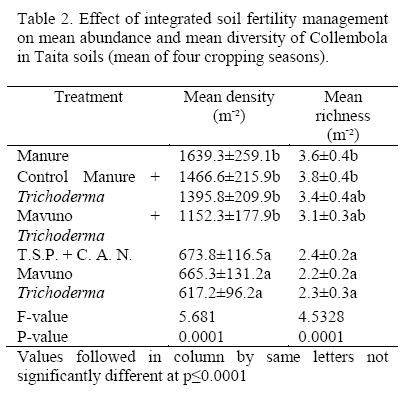
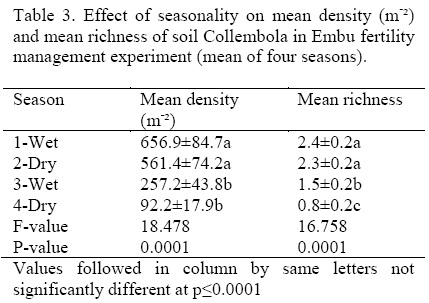
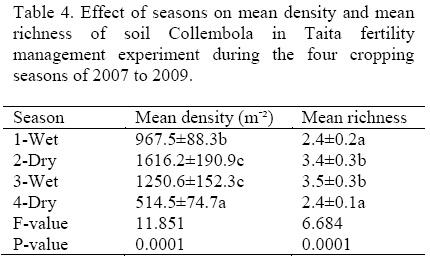
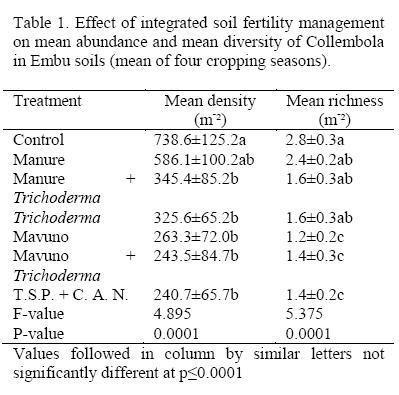
<body><![CDATA[<p align="justify"><font face="verdana" size="2"><b>Data analysis</b></font></p>  	    <p align="justify"><font face="verdana" size="2">Data collected was analyzed using analysis of variance (ANOVA). Prior to analysis, data were normalized using log transformation. Biodiversity descriptions estimated; genera abundance, richness StatSoft, 2003, Shannon diversity index (Kindt and Coe, 2005) and Renyi index. The mean values were compared using the Student Newmen Keulis Test (SNK) test (Zar, 1999) when ANOVAs were significant.</font></p>  	    <p align="justify"><font face="verdana" size="2">&nbsp;</font></p>  	    <p align="justify"><font face="verdana" size="2"><b>RESULTS</b></font></p>  	    <p align="justify"><font face="verdana" size="2">There were significant differences among soil fertility management treatments p&#8804;0.0001 in terms of mean density of CoUembola in Embu and Taita soils (<a href="#t1">Table 1</a> and <a href="#t2">2</a>). In Embu, there was significant difference in mean density between control and all the other treatments. Application of organic inputs (cow manure and <i>Trichoderma)</i> increased abundance of the soil CoUembola while inorganic fertilisers impacted negatively p&#8804;0.0001. In Embu the highest mean density of CoUembola was found in the control plots where no soil amendments was done, followed by treatments with manure and other organic treatments and the lowest abundance in treatments with inorganic amendments. In Taita, there was significant difference in mean density between organic amendments and inorganic amendments with low density recorded in plots with inorganic amendments. But densities were generally twice as high in Taita as in Embu. CoUembola sampled showed higher diversity in soils amended with organic manure to inorganic fertilisers.</font></p>  	    <p align="center"><font face="verdana" size="2"><a name="t1"></a></font></p>  	    <p align="center"><font face="verdana" size="2"><img src="/img/revistas/tsa/v13n1/a7t1.jpg"></font></p>  	    <p align="center"><font face="verdana" size="2"><a name="t2"></a></font></p>  	    <p align="center"><font face="verdana" size="2"><img src="/img/revistas/tsa/v13n1/a7t2.jpg"></font></p>  	    <p align="justify"><font face="verdana" size="2">There was higher abundance of CoUembola in year one than in second year. In both years during the four seasons both in Embu and in Taita, the highest mean density was recorded in the wet season and the lowest recorded in dry season. The same trend was evident with the mean richness, where diversity reduced with the increase in dry spell (<a href="#t3">Table 3</a> and <a href="#t4">4</a>).</font></p>  	    ]]></body>
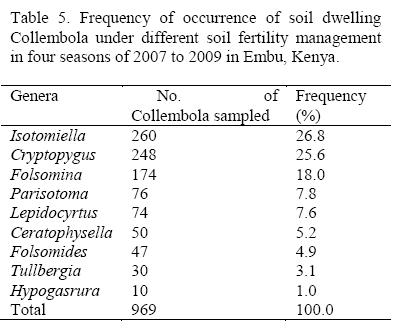
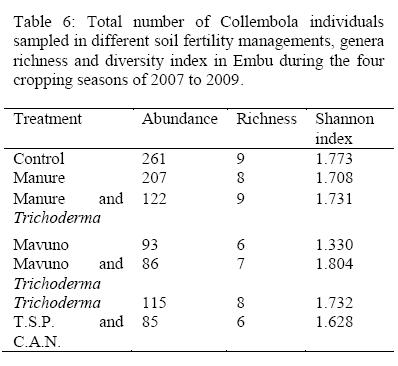
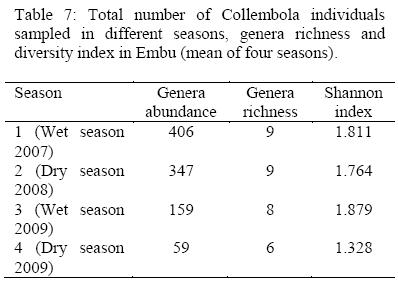
<body><![CDATA[<p align="center"><font face="verdana" size="2"><a></a></font><a name="t3" id="t3"></a></p>      <p align="center"><font face="verdana" size="2"><img src="/img/revistas/tsa/v13n1/a7t3.jpg"></font></p>     <p align="center"><a name="t4"></a></p>     <p align="center"><font face="verdana" size="2"><img src="/img/revistas/tsa/v13n1/a7t4.jpg"></font></p>      <p align="justify"><font face="verdana" size="2">A total of 969 individuals of soil dwelling Collembolan representing four families and nine genera were sampled from all the plots under different soil fertility management regimes in Embu. The genus <i>Isotomiella</i> was the most frequently sampled with cumulative frequency of 26.8%. Other genera were: <i>Cryptopygus, Folsomina, Parisotoma, Lepidocyrtus, Ceratophysella, Folsomides, Tullbergia</i> and <i>Hypogastrura</i> (<a href="#t5">Table 5</a>). Most of the soil dwelling Collembola were sampled in control plots. Among the soil amendments, plots with cow manure and <i>Trichoderma</i> had the highest densities while lower densities were found in soils were only inorganic fertilisers were applied (<a href="#t6">Table 6</a>). High and diverse soil Collembolan population were sampled in rainy season but, the trend is reversed in subsequent seasons. Organic amendments favoured species richness Shannon 1.861 (<a href="#t7">Table 7</a>).</font></p>  	    <p align="center"><font face="verdana" size="2"><a name="t5"></a></font></p>  	    <p align="center"><font face="verdana" size="2"><img src="/img/revistas/tsa/v13n1/a7t5.jpg"></font></p>  	    <p align="center"><font face="verdana" size="2"><a name="t6"></a></font></p>  	    <p align="center"><font face="verdana" size="2"><img src="/img/revistas/tsa/v13n1/a7t6.jpg"></font></p>  	    <p align="center"><font face="verdana" size="2"><a name="t7"></a></font></p>  	    ]]></body>
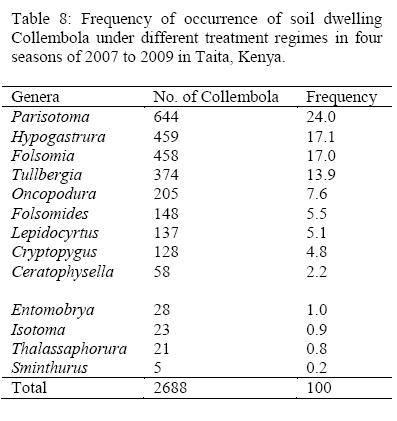
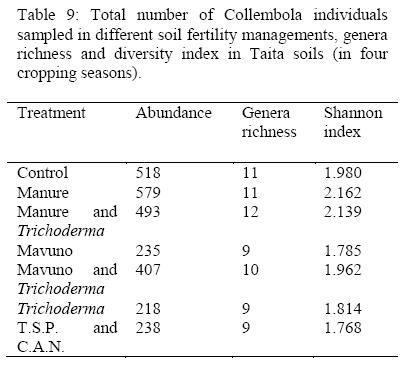
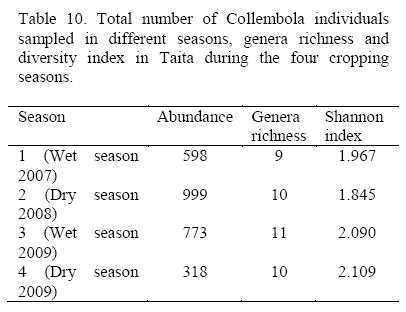
<body><![CDATA[<p align="center"><font face="verdana" size="2"><img src="/img/revistas/tsa/v13n1/a7t7.jpg"></font></p>  	    <p align="center"><font face="verdana" size="2">&nbsp;</font></p>  	    <p align="justify"><font face="verdana" size="2">In Taita a total of 2688 soil dwelling Collembola represented in seven families and thirteen genera were sampled from all the plots under different integrated soil fertility management regimes. The genus <i>Parisotoma</i> was the most frequently sampled with cumulative frequency of 24.0%. Other genera were: <i>Folsomia, Tullbergia, Oncopodura, Folsomides, Lepidocyrtus, Cryptopygus, Ceratophysella, Entomobrya, Isotoma, Thalassaphorura</i> and <i>Sminthurus</i> (<a href="#t8">Table 8</a>). High numbers of soil dwelling Collembola were sampled in control plots followed by plots with cow manure. A decrease in soil Collembola population was observed in soils were inorganic fertilisers like T.S.P. and C.A.N. were applied (<a href="#t9">Table 9</a>). High soil Collembola population densities were sampled in season 1 and 2 but, numbers reduced progressively with higher diversity being realised in season 3 and 4. Cow manure and Trichoderma favoured species richness, Shannon 2.093 (<a href="#t10">Table 10</a>).</font></p>  	    <p align="center"><font face="verdana" size="2"><a name="t8"></a></font></p>  	    <p align="center"><font face="verdana" size="2"><img src="/img/revistas/tsa/v13n1/a7t8.jpg"></font></p>  	    <p align="center"><font face="verdana" size="2"><a name="t9"></a></font></p>  	    <p align="center"><font face="verdana" size="2"><img src="/img/revistas/tsa/v13n1/a7t9.jpg"></font></p>  	    <p align="center"><font face="verdana" size="2"><a name="t10"></a></font></p>  	    <p align="center"><font face="verdana" size="2"><img src="/img/revistas/tsa/v13n1/a7t10.jpg"></font></p>  	    <p align="justify"><font face="verdana" size="2">The diversity profiles both in Embu and Taita of soil dwelling Collembola in the four seasons showed that wet season exhibited a higher diversity of Collembola than in the dry season. Plots with organic amendments and those which had no applications of any soil amendment supported a more diverse soil Collembola community than those where the inorganic fertilisers were used. The evenness profiles showed that wet season was most even with dry season being the least even. The treatment evenness profiles show that the plots where soil had been treated with cow manure and <i>Trichoderma</i> were more even while, the plots treated with inorganic fertilisers were less even.</font></p>  	    ]]></body>
<body><![CDATA[<p align="justify"><font face="verdana" size="2">&nbsp;</font></p>  	    <p align="justify"><font face="verdana" size="2"><b>DISCUSSION</b></font></p>  	    <p align="justify"><font face="verdana" size="2">Application of cow manure and <i>Trichoderma</i> in the soil during the growth period of the crop supported high abundance and diversity of Collembola as evidenced by the high numbers sampled in plots treated with the same. Several Collembola genera were sampled during the study. The genera include <i>Isotomiella, Cryptopygus, Folsomina, Parisotoma, Lepidocyrtus, Folsomina, Oncopodura, Entomobrya, Isotoma, Thalassaphorura and Sminthurus.</i> The varied genera occurrence may have been influenced by organic amendments which provided organic matter. The organic matter improves soil conditions, soil pH, and structure, water holding capacity and directly provide food resource for the eudaphic Collembola and indirectly crop growth like root residues. The findings agree with studies by (Lagerlof and Andr&eacute;n, 1991, Mader <i>et al.,</i> 1997 and Wardle <i>et al.,</i> 1999a) who found that arthropod taxa are generally high at high organic matter input or in organic farming systems. Wachira, (2009) while evaluating the effect of organic amendments on nematode&#45;destroying fungi and plant parasitic nematodes found that the use of chicken manure stimulated build&#45;up of the nematode destroying fungi. We recorded few soil Collembola in plots that were treated with inorganic fertilisers (Mavuno, T.S.P. and C.A.N) over the four seasons. Probably, this may have been due to reduction in organic food resource and changes in soil conditions like soil pH, water holding capacity, bulk density and soil temperature. Similarly, inorganic fertilisers cause increased crop growth hence more water usage by the plant making the soil to have low moisture content essential for the Collembola. Filser <i>et al.,</i> (1999) found that soil management practices contributed to the variation of microbial biomass. From this study, cow manure, application of <i>Trichoderma</i> on seeds before planting and the combination of cow manure and <i>Trichoderma</i> as well as lack of application of amendments over the time favoured Collembola population build up and diversity. Application of <i>Trichoderma</i> may have increased fungal flora and positively provided substrate for Collembola. Wachira, (2009) and Okoth, <i>et al.,</i> (2009) have reported enhanced population build up of fungi like <i>arthrobotrys</i> species in organic amendment plots. High organic matter, shade, high soil carbon and nitrogen have a significant influence in supporting high population of soil Collembola and Mites (Muturi <i>et al.,</i> 2009 and Maribie, 2009). The presence of organic manure resulted in an increase in the abundance and diversity of total collembolan. The genera <i>Parisotoma</i> and <i>Isotomiella</i> in the family Isotomidae were predominant which indicated that they benefited from the organic litter coming from manure which may have increased microbial biomass in the rhizosphere of roots. Rosilda <i>et al.,</i> (2002) found that populations of soil Acari and Collembola increased with increase in organic matter content of the soil. The low numbers in presence of inorganic fertilisers implied that they negatively impacted on populations of Collembola. In this study high numbers of soil Collembola were sampled in the wet seasons in Embu and Taita. It implies that, soil Collembola population were dependant on soil moisture and to some extent the soil temperatures. The weather variation witnessed during the study characterised by the high temperatures may have led to either vertical migration of soil Collembola to the lower soil levels, aestivation, eggs remaining dormant or lower reproductive rate hence, the low counts recorded in the last dry season. Members of the family Isotomidae were most predominant in almost all plots may be due to their high reproductive rate and adaptive ability. The varied species abundance and diversity in the different seasons and in varied integrated soil fertility management practices is consistent with the findings by lauga&#45;Reyrel and Deconchat, (1999) and Rosilda <i>et ah,</i> (2002), who reported that the group respond to changes in land use and soil conditions.</font></p>  	    <p align="justify"><font face="verdana" size="2">In conclusion the study has demonstrated the potential of organic soil amendments in enhancing edaphic soil Collembola as well as diversity due to the increased substrate niche for soil Collembola. However, dry conditions negatively affect the trend. Therefore, use of organic manure in agricultural fields would not only boost agricultural food production, but, also sustain soil Collembola which are important in nutrient cycling.</font></p>  	    <p align="justify"><font face="verdana" size="2">&nbsp;</font></p>  	    <p align="justify"><font face="verdana" size="2"><b>ACKNOWLEDGEMENT</b></font></p>  	    <p align="justify"><font face="verdana" size="2">We would like to thank GEF for providing the financial support for this work and UNEP for providing the implementation support through the global project Conservation and Sustainable Management of Below&#45;Ground Biodiversity (BGBD project) that is being implemented in seven tropical countries namely: Brazil, Cote d'lvoire, India, Indonesia, Kenya, Mexico and Uganda. TSBF&#45;CIAT is acknowledged for planning and coordinating project activities. Special thanks to Dr. Sheila Okoth, the Below Ground Project Coordinator in Kenya for her enviable support throughout the study period. We sincerely thank Dr. Arne Fjellberg and Prof. Louis Deharveng for assisting in the systematic of Collembola. Special thanks are also extended to Dr. Wachira, Mr. Crispus Maribie, Miss Agnes Mkamaghanga, Mr. Munyi and Mr Josek Mugendi for their support both in the field and in the laboratory.</font></p>  	    <p align="justify"><font face="verdana" size="2">&nbsp;</font></p>  	    <p align="justify"><font face="verdana" size="2"><b>REFERENCES</b></font></p>  	    <!-- ref --><p align="justify"><font face="verdana" size="2">Brussaard, L.; Behan&#45;Pellertier, V.; Bignell, D.; Brown, V.; Didden, W.; Folgarait, P.; Fragoso, C; Freckman, D.; Gupta, V.; Hattori, T.; Hawksworth, D.; Klopatek, C; Lavelle, P.; Malloch, D.; Rusek, I; Soderstrom, B.; Tiedje, J. and Virginia, R. 1997. Biodiversity and ecosystem functioning in soil, Ambio, 26:563&#45;570</font>&nbsp;&nbsp;&nbsp;&nbsp;&nbsp;&nbsp;&nbsp;&nbsp;[&#160;<a href="javascript:void(0);" onclick="javascript: window.open('/scielo.php?script=sci_nlinks&ref=10055529&pid=S1870-0462201100040000700001&lng=','','width=640,height=500,resizable=yes,scrollbars=1,menubar=yes,');">Links</a>&#160;]<!-- end-ref --><!-- ref --><p align="justify"><font face="verdana" size="2">Filser, J.; Fromm, H.; Lang, A.; Mebes, K. H.; Munch, J. C; Nagel, R.; Winter, K.; Beese, F. 1999. Reactions of soil organisms to site&#45;specific management: the first long&#45;term study at the landscape scale. In: Windhorst, W., Enckell, P. H. (Eds), Proceedings of the Conference "Sustainable Landuse Management&#45;The Challenge of Ecosystem protection", 28.9.&#45;1.10.99, Salzau Federal Cultural Center, Organizers: University of Kiel/European Ecological Federation. Verein Zur F&ouml;rderung der &Ouml;kosystem forsclung an Kiele. V., ISSN 0940&#45;7782. Ecosystems Supplementary Biodiversity, 28, 139&#45;147</font>&nbsp;&nbsp;&nbsp;&nbsp;&nbsp;&nbsp;&nbsp;&nbsp;[&#160;<a href="javascript:void(0);" onclick="javascript: window.open('/scielo.php?script=sci_nlinks&ref=10055530&pid=S1870-0462201100040000700002&lng=','','width=640,height=500,resizable=yes,scrollbars=1,menubar=yes,');">Links</a>&#160;]<!-- end-ref --><!-- ref --><p align="justify"><font face="verdana" size="2">Fjelberg, A. 1997. Nordic Collembola: Identification keys to genera. Checklist of species. Swedish University of Agricultural Sciences (mimeograph), 30p</font>&nbsp;&nbsp;&nbsp;&nbsp;&nbsp;&nbsp;&nbsp;&nbsp;[&#160;<a href="javascript:void(0);" onclick="javascript: window.open('/scielo.php?script=sci_nlinks&ref=10055531&pid=S1870-0462201100040000700003&lng=','','width=640,height=500,resizable=yes,scrollbars=1,menubar=yes,');">Links</a>&#160;]<!-- end-ref --><!-- ref --><p align="justify"><font face="verdana" size="2">Gachimbi, L. N. 2002. Technical Report of Soil Survey and Sampling results: Embu Mbeere Districts, Kenya. The land use change, Impacts and Dynamics project working paper Number: 9</font>&nbsp;&nbsp;&nbsp;&nbsp;&nbsp;&nbsp;&nbsp;&nbsp;[&#160;<a href="javascript:void(0);" onclick="javascript: window.open('/scielo.php?script=sci_nlinks&ref=10055532&pid=S1870-0462201100040000700004&lng=','','width=640,height=500,resizable=yes,scrollbars=1,menubar=yes,');">Links</a>&#160;]<!-- end-ref --><!-- ref --><p align="justify"><font face="verdana" size="2">Garbeva P.; van Veen and van Elsas, J. D. 2004. Microbial diversity in soil: selection of microbial populations by plant and soil type and implications for disease suppressiveness. Annual Review Phytopathology 42: 243&#45;270</font>&nbsp;&nbsp;&nbsp;&nbsp;&nbsp;&nbsp;&nbsp;&nbsp;[&#160;<a href="javascript:void(0);" onclick="javascript: window.open('/scielo.php?script=sci_nlinks&ref=10055533&pid=S1870-0462201100040000700005&lng=','','width=640,height=500,resizable=yes,scrollbars=1,menubar=yes,');">Links</a>&#160;]<!-- end-ref --><!-- ref --><p align="justify"><font face="verdana" size="2">Giller, K. E.; Beare, G. G.; Lavelle, P.; Izaac, A. M. M. and Swift, M. J. 1997. Agricultural intensification, Soil biodiversity and agro ecosystems function. In Swift, M. J. (ed.), Soil biodiversity agricultural intensification and ecosystem function. Applied Soil Ecology 6: 3&#45;16</font>&nbsp;&nbsp;&nbsp;&nbsp;&nbsp;&nbsp;&nbsp;&nbsp;[&#160;<a href="javascript:void(0);" onclick="javascript: window.open('/scielo.php?script=sci_nlinks&ref=10055534&pid=S1870-0462201100040000700006&lng=','','width=640,height=500,resizable=yes,scrollbars=1,menubar=yes,');">Links</a>&#160;]<!-- end-ref --><!-- ref --><p align="justify"><font face="verdana" size="2">Hopkin, S. P. 2007. A Key to the Collembola (Springtails) of Britain and Ireland. 1<sup>st</sup> edition, FSC Publications Shropshire, UK</font>&nbsp;&nbsp;&nbsp;&nbsp;&nbsp;&nbsp;&nbsp;&nbsp;[&#160;<a href="javascript:void(0);" onclick="javascript: window.open('/scielo.php?script=sci_nlinks&ref=10055535&pid=S1870-0462201100040000700007&lng=','','width=640,height=500,resizable=yes,scrollbars=1,menubar=yes,');">Links</a>&#160;]<!-- end-ref --><!-- ref --><p align="justify"><font face="verdana" size="2">Jeatzold, R. and Schmidt, H. 1983. Farm Management Handbook of Kenya. Vol. II/L. East Kenya. Ministry of Agriculture. Nairobi, Kenya</font>&nbsp;&nbsp;&nbsp;&nbsp;&nbsp;&nbsp;&nbsp;&nbsp;[&#160;<a href="javascript:void(0);" onclick="javascript: window.open('/scielo.php?script=sci_nlinks&ref=10055536&pid=S1870-0462201100040000700008&lng=','','width=640,height=500,resizable=yes,scrollbars=1,menubar=yes,');">Links</a>&#160;]<!-- end-ref --><!-- ref --><p align="justify"><font face="verdana" size="2">Jos&eacute;, P. S., Maria, M. G., Cristina, P., Antonio, K., Filipa C, Marco, L., Catarina, C, Taigo, L., Pedro, L. and Susana, D. 2004. Effect of land use on Collembola diversity patterns in a Mediterranean landscape. Pedobiologia 48: 609&#45;622</font>&nbsp;&nbsp;&nbsp;&nbsp;&nbsp;&nbsp;&nbsp;&nbsp;[&#160;<a href="javascript:void(0);" onclick="javascript: window.open('/scielo.php?script=sci_nlinks&ref=10055537&pid=S1870-0462201100040000700009&lng=','','width=640,height=500,resizable=yes,scrollbars=1,menubar=yes,');">Links</a>&#160;]<!-- end-ref --><!-- ref --><p align="justify"><font face="verdana" size="2">Jos&eacute;, P. S., Thomas, B., Maria, M. M., Thomas, L., Jean&#45;Francios, P., Carlos, S., Georgy, T., Adam, J. V, Aoife, B., Florence, D. Eva, I., Anto'nio, K., Silvia, S. and Allan, D. W. 2005. Changes in Collembola richness and diversity along a gradient of land&#45;use intensity: A pan European study. Pedobiologia 50: 147&#45;156</font>&nbsp;&nbsp;&nbsp;&nbsp;&nbsp;&nbsp;&nbsp;&nbsp;[&#160;<a href="javascript:void(0);" onclick="javascript: window.open('/scielo.php?script=sci_nlinks&ref=10055538&pid=S1870-0462201100040000700010&lng=','','width=640,height=500,resizable=yes,scrollbars=1,menubar=yes,');">Links</a>&#160;]<!-- end-ref --><!-- ref --><p align="justify"><font face="verdana" size="2">Kibblewhite, M. G.; Ritz, K. and Swift, M. J. 2008. Soil health in agricultural systems. Philosophical Transactions of the Royal Society Series B 363: 685&#45;701</font>&nbsp;&nbsp;&nbsp;&nbsp;&nbsp;&nbsp;&nbsp;&nbsp;[&#160;<a href="javascript:void(0);" onclick="javascript: window.open('/scielo.php?script=sci_nlinks&ref=10055539&pid=S1870-0462201100040000700011&lng=','','width=640,height=500,resizable=yes,scrollbars=1,menubar=yes,');">Links</a>&#160;]<!-- end-ref --><!-- ref --><p align="justify"><font face="verdana" size="2">Kindt, R and Coe, R. 2005. Tree diversity analysis. A manual and sotware for common statistical methods for ecological and biodiversity studies. Nairobi: World Agro&#45;forestry Center (ICRAF). Pg 196</font>&nbsp;&nbsp;&nbsp;&nbsp;&nbsp;&nbsp;&nbsp;&nbsp;[&#160;<a href="javascript:void(0);" onclick="javascript: window.open('/scielo.php?script=sci_nlinks&ref=10055540&pid=S1870-0462201100040000700012&lng=','','width=640,height=500,resizable=yes,scrollbars=1,menubar=yes,');">Links</a>&#160;]<!-- end-ref --><!-- ref --><p align="justify"><font face="verdana" size="2">Kiome, R. L. and Muya, E. M. 1999. Characterisation of soil Embu and Kiambu PLEC sites. PBL. Kenya Soil Survey. Site Evaluation report no. 61</font>&nbsp;&nbsp;&nbsp;&nbsp;&nbsp;&nbsp;&nbsp;&nbsp;[&#160;<a href="javascript:void(0);" onclick="javascript: window.open('/scielo.php?script=sci_nlinks&ref=10055541&pid=S1870-0462201100040000700013&lng=','','width=640,height=500,resizable=yes,scrollbars=1,menubar=yes,');">Links</a>&#160;]<!-- end-ref --><!-- ref --><p align="justify"><font face="verdana" size="2">Lag&ouml;rlof, J. and Andr&eacute;n, O. 1991. Abundance and activity of Collembola, Protura and Diplura (Insecta, Apterygota) in four cropping systems. Pedobiologia, 35: 337&#45;50.    &nbsp;&nbsp;&nbsp;&nbsp;&nbsp;&nbsp;&nbsp;&nbsp;[&#160;<a href="javascript:void(0);" onclick="javascript: window.open('/scielo.php?script=sci_nlinks&ref=10055542&pid=S1870-0462201100040000700014&lng=','','width=640,height=500,resizable=yes,scrollbars=1,menubar=yes,');">Links</a>&#160;]<!-- end-ref --></font></p>  	    <!-- ref --><p align="justify"><font face="verdana" size="2">Luanga&#45;Reyrel, F. and Deconchat, M. 1999. Diversity within the Collembolan community in fragmented coppice forests in South&#45;Western France. European journal of Soil Biology 35: 177&#45;187</font>&nbsp;&nbsp;&nbsp;&nbsp;&nbsp;&nbsp;&nbsp;&nbsp;[&#160;<a href="javascript:void(0);" onclick="javascript: window.open('/scielo.php?script=sci_nlinks&ref=10055544&pid=S1870-0462201100040000700015&lng=','','width=640,height=500,resizable=yes,scrollbars=1,menubar=yes,');">Links</a>&#160;]<!-- end-ref --><!-- ref --><p align="justify"><font face="verdana" size="2">M&auml;der, P.; Pfiffner, L.; Flie&#223;bach, A.; von L&uuml;tzow, M; Munch, J. C. 1997. Soil ecology&#45;the impact of organic and conventional agriculture on soil biota and its significance for soil fertility. In: &#216;stergaard, T. V. (Ed), Fundamentals of Organic Agriculture. Proceedings of the 11<sup>th</sup> IFQAM International Scientific Conference, vol. 1, pp. 24&#45;46, Copenhagen</font>&nbsp;&nbsp;&nbsp;&nbsp;&nbsp;&nbsp;&nbsp;&nbsp;[&#160;<a href="javascript:void(0);" onclick="javascript: window.open('/scielo.php?script=sci_nlinks&ref=10055545&pid=S1870-0462201100040000700016&lng=','','width=640,height=500,resizable=yes,scrollbars=1,menubar=yes,');">Links</a>&#160;]<!-- end-ref --><!-- ref --><p align="justify"><font face="verdana" size="2">Maribie, C. W. 2009. Survey of soil mites (Acari) abundance and diversity in different land use types in Embu and Taita districts, Kenya Msc Thesis University of Nairobi</font>&nbsp;&nbsp;&nbsp;&nbsp;&nbsp;&nbsp;&nbsp;&nbsp;[&#160;<a href="javascript:void(0);" onclick="javascript: window.open('/scielo.php?script=sci_nlinks&ref=10055546&pid=S1870-0462201100040000700017&lng=','','width=640,height=500,resizable=yes,scrollbars=1,menubar=yes,');">Links</a>&#160;]<!-- end-ref --><!-- ref --><p align="justify"><font face="verdana" size="2">Mokwunye, A. U.; De Jager and Smaling, E. M. A. (ed). 1996. Restoring and maintaining the productivity of West African soils: Key to sustainable development. Misc. Fert. Stud. 14. Int. Fert. Dev. Ctr. &#45; Africa. Lome, Togo</font>&nbsp;&nbsp;&nbsp;&nbsp;&nbsp;&nbsp;&nbsp;&nbsp;[&#160;<a href="javascript:void(0);" onclick="javascript: window.open('/scielo.php?script=sci_nlinks&ref=10055547&pid=S1870-0462201100040000700018&lng=','','width=640,height=500,resizable=yes,scrollbars=1,menubar=yes,');">Links</a>&#160;]<!-- end-ref --><!-- ref --><p align="justify"><font face="verdana" size="2">Moreira, F. M. S.; Huising, E. J.; Bignell, D. E. 2008. A Handbook of Tropical Soil Biology: Sampling and Characterization of Below Ground Biodiversity. Earthscan, UK 218 pp.    &nbsp;&nbsp;&nbsp;&nbsp;&nbsp;&nbsp;&nbsp;&nbsp;[&#160;<a href="javascript:void(0);" onclick="javascript: window.open('/scielo.php?script=sci_nlinks&ref=10055548&pid=S1870-0462201100040000700019&lng=','','width=640,height=500,resizable=yes,scrollbars=1,menubar=yes,');">Links</a>&#160;]<!-- end-ref --></font></p>  	    ]]></body>
<body><![CDATA[<!-- ref --><p align="justify"><font face="verdana" size="2">Moriera, F. M. S.; Siquera, J. O. and Brassard, L. 2006. Soil organisms in Tropical Ecosystems: a key role for Brazil in the Global Quest for the conservation and sustainable use of Biodiversity. Soil Biodiversity in Amazonian and other Brazilian Ecosystems, CAB International, Wallingfork, UK, pp 1&#45;12</font>&nbsp;&nbsp;&nbsp;&nbsp;&nbsp;&nbsp;&nbsp;&nbsp;[&#160;<a href="javascript:void(0);" onclick="javascript: window.open('/scielo.php?script=sci_nlinks&ref=10055550&pid=S1870-0462201100040000700020&lng=','','width=640,height=500,resizable=yes,scrollbars=1,menubar=yes,');">Links</a>&#160;]<!-- end-ref --><!-- ref --><p align="justify"><font face="verdana" size="2">Muturi, J. J.; Mbugi, J. P.; Mueke, J. M.; Lagerl&oacute;f, J.; Mungatu, J. K.; Nyamasyo, D. and Gikungu, M. 2009. Collembola density and diversity along a gradient of land&#45;use types in Embu district, Eastern Kenya. Tropical and Subtropical Agroecosystems, 11, 361&#45;369</font>&nbsp;&nbsp;&nbsp;&nbsp;&nbsp;&nbsp;&nbsp;&nbsp;[&#160;<a href="javascript:void(0);" onclick="javascript: window.open('/scielo.php?script=sci_nlinks&ref=10055551&pid=S1870-0462201100040000700021&lng=','','width=640,height=500,resizable=yes,scrollbars=1,menubar=yes,');">Links</a>&#160;]<!-- end-ref --><!-- ref --><p align="justify"><font face="verdana" size="2">Okoth, S. A.; Okoth, P.; Wachira, P. M. amd Roimen, H. 2009. Spatial distribution of Trichoderma spp. In Embu and Taita regions, Kenya. Tropical and Subtropical Agroecosystems. 11:291&#45;302</font>&nbsp;&nbsp;&nbsp;&nbsp;&nbsp;&nbsp;&nbsp;&nbsp;[&#160;<a href="javascript:void(0);" onclick="javascript: window.open('/scielo.php?script=sci_nlinks&ref=10055552&pid=S1870-0462201100040000700022&lng=','','width=640,height=500,resizable=yes,scrollbars=1,menubar=yes,');">Links</a>&#160;]<!-- end-ref --><!-- ref --><p align="justify"><font face="verdana" size="2">Ponge, J. F., Gillet, S., Dubs, F., Fedoroff, E., Haese, L., Sousa, P. J. and Lavelle, P. 2003. Collembola communities as bioindicators of land use intensification. Soil biology and biochemistry 35: 813&#45;826</font>&nbsp;&nbsp;&nbsp;&nbsp;&nbsp;&nbsp;&nbsp;&nbsp;[&#160;<a href="javascript:void(0);" onclick="javascript: window.open('/scielo.php?script=sci_nlinks&ref=10055553&pid=S1870-0462201100040000700023&lng=','','width=640,height=500,resizable=yes,scrollbars=1,menubar=yes,');">Links</a>&#160;]<!-- end-ref --><!-- ref --><p align="justify"><font face="verdana" size="2">Rebek, E. J.; Hogg, D. B. and Young D. K. 2002. Effect of four cropping systems on the abundance and diversity of epedaphic springtails (Hexapoda: Parainsecta : Collembola) in Southern Wisconsin. Environmental Entomology 31: 37&#45;46</font>&nbsp;&nbsp;&nbsp;&nbsp;&nbsp;&nbsp;&nbsp;&nbsp;[&#160;<a href="javascript:void(0);" onclick="javascript: window.open('/scielo.php?script=sci_nlinks&ref=10055554&pid=S1870-0462201100040000700024&lng=','','width=640,height=500,resizable=yes,scrollbars=1,menubar=yes,');">Links</a>&#160;]<!-- end-ref --><!-- ref --><p align="justify"><font face="verdana" size="2">Rosilda, M.M., Silvana de Paula, Q. S., Sandra, V., and Valdirene, R. S. 2002. Study of Acari and Collembola Populations in Four Cultivation systems in Dourados&#45;MS. Brazilian Archives Biology Technology. 45 : 257&#45;264.    &nbsp;&nbsp;&nbsp;&nbsp;&nbsp;&nbsp;&nbsp;&nbsp;[&#160;<a href="javascript:void(0);" onclick="javascript: window.open('/scielo.php?script=sci_nlinks&ref=10055555&pid=S1870-0462201100040000700025&lng=','','width=640,height=500,resizable=yes,scrollbars=1,menubar=yes,');">Links</a>&#160;]<!-- end-ref --></font></p>  	    <!-- ref --><p align="justify"><font face="verdana" size="2">Sanchez, P. A.; Sheperd, K.D.; Soule, F.; Place, M.; Buresh, R. J. and Izac, A. M. N. 1997. Soil Fertility repleshment in Africa. An investment in Natural Resource Capital. In: R. J. Buresh <i>et al</i> (Ed) Replenishing soil fertility in Africa. SSA Spec. Publ. 51. SSSA, Madison, W. I.    &nbsp;&nbsp;&nbsp;&nbsp;&nbsp;&nbsp;&nbsp;&nbsp;[&#160;<a href="javascript:void(0);" onclick="javascript: window.open('/scielo.php?script=sci_nlinks&ref=10055557&pid=S1870-0462201100040000700026&lng=','','width=640,height=500,resizable=yes,scrollbars=1,menubar=yes,');">Links</a>&#160;]<!-- end-ref --></font></p>  	    <!-- ref --><p align="justify"><font face="verdana" size="2">Shriar, A. J. 2000. Agricultural intensity and its measurement in frontier regions. Agroforestry systems 49: 301&#45;318</font>&nbsp;&nbsp;&nbsp;&nbsp;&nbsp;&nbsp;&nbsp;&nbsp;[&#160;<a href="javascript:void(0);" onclick="javascript: window.open('/scielo.php?script=sci_nlinks&ref=10055559&pid=S1870-0462201100040000700027&lng=','','width=640,height=500,resizable=yes,scrollbars=1,menubar=yes,');">Links</a>&#160;]<!-- end-ref --><!-- ref --><p align="justify"><font face="verdana" size="2">StaftSoft, Inc, 2001. STATISTICA (Data Analysis Software System), Version 6. Tulsa, OK, USA</font>&nbsp;&nbsp;&nbsp;&nbsp;&nbsp;&nbsp;&nbsp;&nbsp;[&#160;<a href="javascript:void(0);" onclick="javascript: window.open('/scielo.php?script=sci_nlinks&ref=10055560&pid=S1870-0462201100040000700028&lng=','','width=640,height=500,resizable=yes,scrollbars=1,menubar=yes,');">Links</a>&#160;]<!-- end-ref --><!-- ref --><p align="justify"><font face="verdana" size="2">Swift, M. J. and Bignell, D. (eds), 2000. Standard methods for assessment of soil biodiversity and land use practice. Alternatives to Slash and Burn Project. ICRAF, Nairobi. 41pp</font>&nbsp;&nbsp;&nbsp;&nbsp;&nbsp;&nbsp;&nbsp;&nbsp;[&#160;<a href="javascript:void(0);" onclick="javascript: window.open('/scielo.php?script=sci_nlinks&ref=10055561&pid=S1870-0462201100040000700029&lng=','','width=640,height=500,resizable=yes,scrollbars=1,menubar=yes,');">Links</a>&#160;]<!-- end-ref --><!-- ref --><p align="justify"><font face="verdana" size="2">Swift, M. J. and Shepherd K. D. (eds), 2007. Saving Africa's Soils: Science and Technology for Improved Soil Management in Africa: World Agroforestry Centre.    &nbsp;&nbsp;&nbsp;&nbsp;&nbsp;&nbsp;&nbsp;&nbsp;[&#160;<a href="javascript:void(0);" onclick="javascript: window.open('/scielo.php?script=sci_nlinks&ref=10055562&pid=S1870-0462201100040000700030&lng=','','width=640,height=500,resizable=yes,scrollbars=1,menubar=yes,');">Links</a>&#160;]<!-- end-ref --></font></p>  	    <!-- ref --><p align="justify"><font face="verdana" size="2">Syrek, D., Wiener, W. M.., Wolty, M. Olszowska, G. and Kwapis, Z. 2006. Species abundance distribution of Collembolan communities in forest soils polluted with heavy metals. Agriculture, ecosystems and environment. Applied Soil Ecology. 31: 239&#45;250</font>&nbsp;&nbsp;&nbsp;&nbsp;&nbsp;&nbsp;&nbsp;&nbsp;[&#160;<a href="javascript:void(0);" onclick="javascript: window.open('/scielo.php?script=sci_nlinks&ref=10055564&pid=S1870-0462201100040000700031&lng=','','width=640,height=500,resizable=yes,scrollbars=1,menubar=yes,');">Links</a>&#160;]<!-- end-ref --><!-- ref --><p align="justify"><font face="verdana" size="2">TSBF, 2003. Conservation and Sustainable management of below ground biodiversity. Proceedings of the global workshop held in February 24&#45;28, 2003 in Sumberjaya, Lampurg, Indonesia. Global workshop report No. 11</font>&nbsp;&nbsp;&nbsp;&nbsp;&nbsp;&nbsp;&nbsp;&nbsp;[&#160;<a href="javascript:void(0);" onclick="javascript: window.open('/scielo.php?script=sci_nlinks&ref=10055565&pid=S1870-0462201100040000700032&lng=','','width=640,height=500,resizable=yes,scrollbars=1,menubar=yes,');">Links</a>&#160;]<!-- end-ref --><!-- ref --><p align="justify"><font face="verdana" size="2">Wachira, P. M. 2009. Effect of land use and soil fertility management practices on nematodes destroying fungi in Taita Taveta, Kenya PhD Thesis University of Nairobi</font>&nbsp;&nbsp;&nbsp;&nbsp;&nbsp;&nbsp;&nbsp;&nbsp;[&#160;<a href="javascript:void(0);" onclick="javascript: window.open('/scielo.php?script=sci_nlinks&ref=10055566&pid=S1870-0462201100040000700033&lng=','','width=640,height=500,resizable=yes,scrollbars=1,menubar=yes,');">Links</a>&#160;]<!-- end-ref --><!-- ref --><p align="justify"><font face="verdana" size="2">Wall, D. H. (ed) 2004. Sustaining Biodiversity and Ecosystem Services in Soils and Sediments, Island Press, Wahington, D. C.    &nbsp;&nbsp;&nbsp;&nbsp;&nbsp;&nbsp;&nbsp;&nbsp;[&#160;<a href="javascript:void(0);" onclick="javascript: window.open('/scielo.php?script=sci_nlinks&ref=10055567&pid=S1870-0462201100040000700034&lng=','','width=640,height=500,resizable=yes,scrollbars=1,menubar=yes,');">Links</a>&#160;]<!-- end-ref --></font></p>  	    <!-- ref --><p align="justify"><font face="verdana" size="2">Wardle, D. A.; Nicholson, K. S.; Bonner, K. I.; Yeates, G. W. 1999a. Effects of agricultural intensification on soil&#45;associated arthropod population dynamics, community structure, diversity and temporal variability over a seven&#45;year period. Soil Biology biochemistry. 31, 1691&#45;1706</font>&nbsp;&nbsp;&nbsp;&nbsp;&nbsp;&nbsp;&nbsp;&nbsp;[&#160;<a href="javascript:void(0);" onclick="javascript: window.open('/scielo.php?script=sci_nlinks&ref=10055569&pid=S1870-0462201100040000700035&lng=','','width=640,height=500,resizable=yes,scrollbars=1,menubar=yes,');">Links</a>&#160;]<!-- end-ref --><!-- ref --><p align="justify"><font face="verdana" size="2">Woese, C. R.; Kandler, O. and Wheelis, M. L. 1990. 'Towards a natural system of organisms: proposal for the domains Archaea Bacteria, and Eucarya', Proceedings of the national Academy of Sciences USA, vol, pp 4576&#45;4579 87</font>&nbsp;&nbsp;&nbsp;&nbsp;&nbsp;&nbsp;&nbsp;&nbsp;[&#160;<a href="javascript:void(0);" onclick="javascript: window.open('/scielo.php?script=sci_nlinks&ref=10055570&pid=S1870-0462201100040000700036&lng=','','width=640,height=500,resizable=yes,scrollbars=1,menubar=yes,');">Links</a>&#160;]<!-- end-ref --><!-- ref --><p align="justify"><font face="verdana" size="2">Zar, J. (1999). Biostatistical Analysis. (4<sup>th</sup> ed.) Upper Saddle River, NJ, Prentice Hall</font>&nbsp;&nbsp;&nbsp;&nbsp;&nbsp;&nbsp;&nbsp;&nbsp;[&#160;<a href="javascript:void(0);" onclick="javascript: window.open('/scielo.php?script=sci_nlinks&ref=10055571&pid=S1870-0462201100040000700037&lng=','','width=640,height=500,resizable=yes,scrollbars=1,menubar=yes,');">Links</a>&#160;]<!-- end-ref --> ]]></body><back>
<ref-list>
<ref id="B1">
<nlm-citation citation-type="journal">
<person-group person-group-type="author">
<name>
<surname><![CDATA[Brussaard]]></surname>
<given-names><![CDATA[L.]]></given-names>
</name>
<name>
<surname><![CDATA[Behan-Pellertier]]></surname>
<given-names><![CDATA[V.]]></given-names>
</name>
<name>
<surname><![CDATA[Bignell]]></surname>
<given-names><![CDATA[D.]]></given-names>
</name>
<name>
<surname><![CDATA[Brown]]></surname>
<given-names><![CDATA[V.]]></given-names>
</name>
<name>
<surname><![CDATA[Didden]]></surname>
<given-names><![CDATA[W.]]></given-names>
</name>
<name>
<surname><![CDATA[Folgarait]]></surname>
<given-names><![CDATA[P.]]></given-names>
</name>
<name>
<surname><![CDATA[Fragoso]]></surname>
<given-names><![CDATA[C]]></given-names>
</name>
<name>
<surname><![CDATA[Freckman]]></surname>
<given-names><![CDATA[D.]]></given-names>
</name>
<name>
<surname><![CDATA[Gupta]]></surname>
<given-names><![CDATA[V.]]></given-names>
</name>
<name>
<surname><![CDATA[Hattori]]></surname>
<given-names><![CDATA[T.]]></given-names>
</name>
<name>
<surname><![CDATA[Hawksworth]]></surname>
<given-names><![CDATA[D.]]></given-names>
</name>
<name>
<surname><![CDATA[Klopatek]]></surname>
<given-names><![CDATA[C]]></given-names>
</name>
<name>
<surname><![CDATA[Lavelle]]></surname>
<given-names><![CDATA[P.]]></given-names>
</name>
<name>
<surname><![CDATA[Malloch]]></surname>
<given-names><![CDATA[D.]]></given-names>
</name>
<name>
<surname><![CDATA[Rusek]]></surname>
<given-names><![CDATA[I]]></given-names>
</name>
<name>
<surname><![CDATA[Soderstrom]]></surname>
<given-names><![CDATA[B.]]></given-names>
</name>
<name>
<surname><![CDATA[Tiedje]]></surname>
<given-names><![CDATA[J.]]></given-names>
</name>
<name>
<surname><![CDATA[Virginia]]></surname>
<given-names><![CDATA[R]]></given-names>
</name>
</person-group>
<source><![CDATA[Biodiversity and ecosystem functioning in soil, Ambio]]></source>
<year>1997</year>
<volume>26</volume>
<page-range>563-570</page-range></nlm-citation>
</ref>
<ref id="B2">
<nlm-citation citation-type="">
<person-group person-group-type="author">
<name>
<surname><![CDATA[Filser]]></surname>
<given-names><![CDATA[J.]]></given-names>
</name>
<name>
<surname><![CDATA[Fromm]]></surname>
<given-names><![CDATA[H.]]></given-names>
</name>
<name>
<surname><![CDATA[Lang]]></surname>
<given-names><![CDATA[A.]]></given-names>
</name>
<name>
<surname><![CDATA[Mebes]]></surname>
<given-names><![CDATA[K. H.]]></given-names>
</name>
<name>
<surname><![CDATA[Munch]]></surname>
<given-names><![CDATA[J. C]]></given-names>
</name>
<name>
<surname><![CDATA[Nagel]]></surname>
<given-names><![CDATA[R.]]></given-names>
</name>
<name>
<surname><![CDATA[Winter]]></surname>
<given-names><![CDATA[K.]]></given-names>
</name>
<name>
<surname><![CDATA[Beese]]></surname>
<given-names><![CDATA[F.]]></given-names>
</name>
</person-group>
<article-title xml:lang="es"><![CDATA[Reactions of soil organisms to site-specific management: the first long-term study at the landscape scale]]></article-title>
<person-group person-group-type="editor">
<name>
<surname><![CDATA[Windhorst]]></surname>
<given-names><![CDATA[W.]]></given-names>
</name>
<name>
<surname><![CDATA[Enckell]]></surname>
<given-names><![CDATA[P. H.]]></given-names>
</name>
</person-group>
<source><![CDATA[Proceedings of the Conference "Sustainable Landuse Management-The Challenge of Ecosystem protection"]]></source>
<year>1999</year>
<page-range>139-147</page-range></nlm-citation>
</ref>
<ref id="B3">
<nlm-citation citation-type="book">
<person-group person-group-type="author">
<name>
<surname><![CDATA[Fjelberg]]></surname>
<given-names><![CDATA[A.]]></given-names>
</name>
</person-group>
<source><![CDATA[Nordic Collembola: Identification keys to genera. Checklist of species]]></source>
<year>1997</year>
<page-range>30</page-range><publisher-name><![CDATA[Swedish University of Agricultural Sciences]]></publisher-name>
</nlm-citation>
</ref>
<ref id="B4">
<nlm-citation citation-type="">
<person-group person-group-type="author">
<name>
<surname><![CDATA[Gachimbi]]></surname>
<given-names><![CDATA[L. N.]]></given-names>
</name>
</person-group>
<source><![CDATA[Technical Report of Soil Survey and Sampling results: Embu Mbeere Districts, Kenya. The land use change]]></source>
<year>2002</year>
</nlm-citation>
</ref>
<ref id="B5">
<nlm-citation citation-type="journal">
<person-group person-group-type="author">
<name>
<surname><![CDATA[Garbeva]]></surname>
<given-names><![CDATA[P]]></given-names>
</name>
<name>
<surname><![CDATA[van Veen]]></surname>
</name>
<name>
<surname><![CDATA[van Elsas]]></surname>
<given-names><![CDATA[J. D.]]></given-names>
</name>
</person-group>
<article-title xml:lang="en"><![CDATA[Microbial diversity in soil: selection of microbial populations by plant and soil type and implications for disease suppressiveness]]></article-title>
<source><![CDATA[Annual Review Phytopathology]]></source>
<year>2004</year>
<volume>42</volume>
<page-range>243-27</page-range></nlm-citation>
</ref>
<ref id="B6">
<nlm-citation citation-type="journal">
<person-group person-group-type="author">
<name>
<surname><![CDATA[Giller]]></surname>
<given-names><![CDATA[K. E.]]></given-names>
</name>
<name>
<surname><![CDATA[Beare]]></surname>
<given-names><![CDATA[G. G.]]></given-names>
</name>
<name>
<surname><![CDATA[Lavelle]]></surname>
<given-names><![CDATA[P.]]></given-names>
</name>
<name>
<surname><![CDATA[Izaac]]></surname>
<given-names><![CDATA[A. M. M.]]></given-names>
</name>
<name>
<surname><![CDATA[Swift]]></surname>
<given-names><![CDATA[M. J.]]></given-names>
</name>
</person-group>
<article-title xml:lang="en"><![CDATA[Agricultural intensification, Soil biodiversity and agro ecosystems function]]></article-title>
<source><![CDATA[Applied Soil Ecology]]></source>
<year>1997</year>
<volume>6</volume>
<page-range>3-16</page-range></nlm-citation>
</ref>
<ref id="B7">
<nlm-citation citation-type="book">
<person-group person-group-type="author">
<name>
<surname><![CDATA[Hopkin]]></surname>
<given-names><![CDATA[S. P.]]></given-names>
</name>
</person-group>
<source><![CDATA[A Key to the Collembola (Springtails) of Britain and Ireland]]></source>
<year>2007</year>
<publisher-name><![CDATA[FSC Publications Shropshire]]></publisher-name>
</nlm-citation>
</ref>
<ref id="B8">
<nlm-citation citation-type="book">
<person-group person-group-type="author">
<name>
<surname><![CDATA[Jeatzold]]></surname>
<given-names><![CDATA[R.]]></given-names>
</name>
<name>
<surname><![CDATA[Schmidt]]></surname>
<given-names><![CDATA[H.]]></given-names>
</name>
</person-group>
<source><![CDATA[Farm Management Handbook of Kenya]]></source>
<year>1983</year>
<volume>II</volume>
<publisher-loc><![CDATA[Nairobi ]]></publisher-loc>
<publisher-name><![CDATA[Ministry of Agriculture]]></publisher-name>
</nlm-citation>
</ref>
<ref id="B9">
<nlm-citation citation-type="journal">
<person-group person-group-type="author">
<name>
<surname><![CDATA[José]]></surname>
<given-names><![CDATA[P. S.]]></given-names>
</name>
<name>
<surname><![CDATA[Maria]]></surname>
<given-names><![CDATA[M. G.]]></given-names>
</name>
<name>
<surname><![CDATA[Cristina]]></surname>
<given-names><![CDATA[P.]]></given-names>
</name>
<name>
<surname><![CDATA[Antonio]]></surname>
<given-names><![CDATA[K.]]></given-names>
</name>
<name>
<surname><![CDATA[Filipa]]></surname>
</name>
<name>
<surname><![CDATA[Marco]]></surname>
<given-names><![CDATA[L.]]></given-names>
</name>
<name>
<surname><![CDATA[Catarina]]></surname>
<given-names><![CDATA[C]]></given-names>
</name>
<name>
<surname><![CDATA[Taigo]]></surname>
<given-names><![CDATA[L.]]></given-names>
</name>
<name>
<surname><![CDATA[Pedro]]></surname>
<given-names><![CDATA[L.]]></given-names>
</name>
<name>
<surname><![CDATA[Susana]]></surname>
<given-names><![CDATA[D.]]></given-names>
</name>
</person-group>
<article-title xml:lang="en"><![CDATA[Effect of land use on Collembola diversity patterns in a Mediterranean landscape]]></article-title>
<source><![CDATA[Pedobiologia]]></source>
<year>2004</year>
<volume>48</volume>
<page-range>609-62</page-range></nlm-citation>
</ref>
<ref id="B10">
<nlm-citation citation-type="journal">
<person-group person-group-type="author">
<name>
<surname><![CDATA[José]]></surname>
<given-names><![CDATA[P. S.]]></given-names>
</name>
<name>
<surname><![CDATA[Thomas]]></surname>
<given-names><![CDATA[B.]]></given-names>
</name>
<name>
<surname><![CDATA[Maria]]></surname>
<given-names><![CDATA[M. M.]]></given-names>
</name>
<name>
<surname><![CDATA[Thomas]]></surname>
<given-names><![CDATA[L.]]></given-names>
</name>
<name>
<surname><![CDATA[Jean-Francios]]></surname>
<given-names><![CDATA[P.]]></given-names>
</name>
<name>
<surname><![CDATA[Carlos]]></surname>
<given-names><![CDATA[S.]]></given-names>
</name>
<name>
<surname><![CDATA[Georgy]]></surname>
<given-names><![CDATA[T.]]></given-names>
</name>
<name>
<surname><![CDATA[Adam]]></surname>
<given-names><![CDATA[J. V]]></given-names>
</name>
<name>
<surname><![CDATA[Aoife]]></surname>
<given-names><![CDATA[B.]]></given-names>
</name>
<name>
<surname><![CDATA[Florence]]></surname>
<given-names><![CDATA[D.]]></given-names>
</name>
<name>
<surname><![CDATA[Eva]]></surname>
<given-names><![CDATA[I.]]></given-names>
</name>
<name>
<surname><![CDATA[Anto'nio]]></surname>
<given-names><![CDATA[K.]]></given-names>
</name>
<name>
<surname><![CDATA[Silvia]]></surname>
<given-names><![CDATA[S.]]></given-names>
</name>
<name>
<surname><![CDATA[Allan]]></surname>
<given-names><![CDATA[D. W.]]></given-names>
</name>
</person-group>
<article-title xml:lang="en"><![CDATA[Changes in Collembola richness and diversity along a gradient of land-use intensity: A pan European study]]></article-title>
<source><![CDATA[Pedobiologia]]></source>
<year>2005</year>
<volume>50</volume>
<page-range>147-15</page-range></nlm-citation>
</ref>
<ref id="B11">
<nlm-citation citation-type="journal">
<person-group person-group-type="author">
<name>
<surname><![CDATA[Kibblewhite]]></surname>
<given-names><![CDATA[M. G.]]></given-names>
</name>
<name>
<surname><![CDATA[Ritz]]></surname>
<given-names><![CDATA[K.]]></given-names>
</name>
<name>
<surname><![CDATA[Swift]]></surname>
<given-names><![CDATA[M. J.]]></given-names>
</name>
</person-group>
<article-title xml:lang="en"><![CDATA[Soil health in agricultural systems]]></article-title>
<source><![CDATA[Philosophical Transactions of the Royal Society Series B]]></source>
<year>2008</year>
<volume>363</volume>
<page-range>685-70</page-range></nlm-citation>
</ref>
<ref id="B12">
<nlm-citation citation-type="book">
<person-group person-group-type="author">
<name>
<surname><![CDATA[Kindt]]></surname>
<given-names><![CDATA[R]]></given-names>
</name>
<name>
<surname><![CDATA[Coe]]></surname>
<given-names><![CDATA[R.]]></given-names>
</name>
</person-group>
<source><![CDATA[Tree diversity analysis. A manual and sotware for common statistical methods for ecological and biodiversity studies]]></source>
<year>2005</year>
<page-range>196</page-range><publisher-loc><![CDATA[Nairobi ]]></publisher-loc>
<publisher-name><![CDATA[World Agro-forestry Center (ICRAF)]]></publisher-name>
</nlm-citation>
</ref>
<ref id="B13">
<nlm-citation citation-type="book">
<person-group person-group-type="author">
<name>
<surname><![CDATA[Kiome]]></surname>
<given-names><![CDATA[R. L.]]></given-names>
</name>
<name>
<surname><![CDATA[Muya]]></surname>
<given-names><![CDATA[E. M.]]></given-names>
</name>
</person-group>
<source><![CDATA[Characterisation of soil Embu and Kiambu PLEC sites]]></source>
<year>1999</year>
<publisher-name><![CDATA[PBL. Kenya Soil Survey]]></publisher-name>
</nlm-citation>
</ref>
<ref id="B14">
<nlm-citation citation-type="journal">
<person-group person-group-type="author">
<name>
<surname><![CDATA[Lagörlof]]></surname>
<given-names><![CDATA[J.]]></given-names>
</name>
<name>
<surname><![CDATA[Andrén]]></surname>
<given-names><![CDATA[O.]]></given-names>
</name>
</person-group>
<article-title xml:lang="en"><![CDATA[Abundance and activity of Collembola, Protura and Diplura (Insecta, Apterygota) in four cropping systems]]></article-title>
<source><![CDATA[Pedobiologia]]></source>
<year>1991</year>
<volume>35</volume>
<page-range>337-50</page-range></nlm-citation>
</ref>
<ref id="B15">
<nlm-citation citation-type="journal">
<person-group person-group-type="author">
<name>
<surname><![CDATA[Luanga-Reyrel]]></surname>
<given-names><![CDATA[F.]]></given-names>
</name>
<name>
<surname><![CDATA[Deconchat]]></surname>
<given-names><![CDATA[M.]]></given-names>
</name>
</person-group>
<article-title xml:lang="en"><![CDATA[Diversity within the Collembolan community in fragmented coppice forests in South-Western France]]></article-title>
<source><![CDATA[European journal of Soil Biology]]></source>
<year>1999</year>
<volume>35</volume>
<page-range>177-18</page-range></nlm-citation>
</ref>
<ref id="B16">
<nlm-citation citation-type="">
<person-group person-group-type="author">
<name>
<surname><![CDATA[Mäder]]></surname>
<given-names><![CDATA[P.]]></given-names>
</name>
<name>
<surname><![CDATA[Pfiffner]]></surname>
<given-names><![CDATA[L.]]></given-names>
</name>
<name>
<surname><![CDATA[Fließbach]]></surname>
<given-names><![CDATA[A.]]></given-names>
</name>
<name>
<surname><![CDATA[von Lützow]]></surname>
<given-names><![CDATA[M]]></given-names>
</name>
<name>
<surname><![CDATA[Munch]]></surname>
<given-names><![CDATA[J. C.]]></given-names>
</name>
</person-group>
<article-title xml:lang="es"><![CDATA[Soil ecology-the impact of organic and conventional agriculture on soil biota and its significance for soil fertility]]></article-title>
<person-group person-group-type="editor">
<name>
<surname><![CDATA[Řstergaard]]></surname>
<given-names><![CDATA[T. V.]]></given-names>
</name>
</person-group>
<source><![CDATA[Fundamentals of Organic Agriculture. Proceedings of the 11th IFQAM International Scientific Conference]]></source>
<year>1997</year>
<volume>1</volume>
<page-range>24-46</page-range><publisher-loc><![CDATA[Copenhagen ]]></publisher-loc>
</nlm-citation>
</ref>
<ref id="B17">
<nlm-citation citation-type="">
<person-group person-group-type="author">
<name>
<surname><![CDATA[Maribie]]></surname>
<given-names><![CDATA[C. W.]]></given-names>
</name>
</person-group>
<source><![CDATA[Survey of soil mites (Acari) abundance and diversity in different land use types in Embu and Taita districts]]></source>
<year>2009</year>
</nlm-citation>
</ref>
<ref id="B18">
<nlm-citation citation-type="">
<person-group person-group-type="author">
<name>
<surname><![CDATA[Mokwunye]]></surname>
<given-names><![CDATA[A. U.]]></given-names>
</name>
<name>
<surname><![CDATA[De Jager]]></surname>
</name>
<name>
<surname><![CDATA[Smaling]]></surname>
<given-names><![CDATA[E. M. A.]]></given-names>
</name>
</person-group>
<source><![CDATA[Restoring and maintaining the productivity of West African soils: Key to sustainable development]]></source>
<year>1996</year>
<publisher-loc><![CDATA[Lome ]]></publisher-loc>
</nlm-citation>
</ref>
<ref id="B19">
<nlm-citation citation-type="book">
<person-group person-group-type="author">
<name>
<surname><![CDATA[Moreira]]></surname>
<given-names><![CDATA[F. M. S.]]></given-names>
</name>
<name>
<surname><![CDATA[Huising]]></surname>
<given-names><![CDATA[E. J.]]></given-names>
</name>
<name>
<surname><![CDATA[Bignell]]></surname>
<given-names><![CDATA[D. E.]]></given-names>
</name>
</person-group>
<source><![CDATA[A Handbook of Tropical Soil Biology: Sampling and Characterization of Below Ground Biodiversity]]></source>
<year>2008</year>
<page-range>218</page-range><publisher-name><![CDATA[Earthscan]]></publisher-name>
</nlm-citation>
</ref>
<ref id="B20">
<nlm-citation citation-type="book">
<person-group person-group-type="author">
<name>
<surname><![CDATA[Moriera]]></surname>
<given-names><![CDATA[F. M. S.]]></given-names>
</name>
<name>
<surname><![CDATA[Siquera]]></surname>
<given-names><![CDATA[J. O.]]></given-names>
</name>
<name>
<surname><![CDATA[Brassard]]></surname>
<given-names><![CDATA[L.]]></given-names>
</name>
</person-group>
<article-title xml:lang="en"><![CDATA[Soil organisms in Tropical Ecosystems: a key role for Brazil in the Global Quest for the conservation and sustainable use of Biodiversity]]></article-title>
<source><![CDATA[Soil Biodiversity in Amazonian and other Brazilian Ecosystems]]></source>
<year>2006</year>
<page-range>1-12</page-range><publisher-loc><![CDATA[Wallingfork ]]></publisher-loc>
<publisher-name><![CDATA[CAB International]]></publisher-name>
</nlm-citation>
</ref>
<ref id="B21">
<nlm-citation citation-type="journal">
<person-group person-group-type="author">
<name>
<surname><![CDATA[Muturi]]></surname>
<given-names><![CDATA[J. J.]]></given-names>
</name>
<name>
<surname><![CDATA[Mbugi]]></surname>
<given-names><![CDATA[J. P.]]></given-names>
</name>
<name>
<surname><![CDATA[Mueke]]></surname>
<given-names><![CDATA[J. M.]]></given-names>
</name>
<name>
<surname><![CDATA[Lagerlóf]]></surname>
<given-names><![CDATA[J.]]></given-names>
</name>
<name>
<surname><![CDATA[Mungatu]]></surname>
<given-names><![CDATA[J. K.]]></given-names>
</name>
<name>
<surname><![CDATA[Nyamasyo]]></surname>
<given-names><![CDATA[D.]]></given-names>
</name>
<name>
<surname><![CDATA[Gikungu]]></surname>
<given-names><![CDATA[M.]]></given-names>
</name>
</person-group>
<article-title xml:lang="en"><![CDATA[Collembola density and diversity along a gradient of land-use types in Embu district, Eastern Kenya]]></article-title>
<source><![CDATA[Tropical and Subtropical Agroecosystems]]></source>
<year>2009</year>
<volume>11</volume>
<page-range>361-369</page-range></nlm-citation>
</ref>
<ref id="B22">
<nlm-citation citation-type="journal">
<person-group person-group-type="author">
<name>
<surname><![CDATA[Okoth]]></surname>
<given-names><![CDATA[S. A.]]></given-names>
</name>
<name>
<surname><![CDATA[Okoth]]></surname>
<given-names><![CDATA[P.]]></given-names>
</name>
<name>
<surname><![CDATA[Wachira]]></surname>
<given-names><![CDATA[P. M.]]></given-names>
</name>
<name>
<surname><![CDATA[Roimen]]></surname>
<given-names><![CDATA[H.]]></given-names>
</name>
</person-group>
<article-title xml:lang="en"><![CDATA[Spatial distribution of Trichoderma spp. In Embu and Taita regions, Kenya]]></article-title>
<source><![CDATA[Tropical and Subtropical Agroecosystems]]></source>
<year>2009</year>
<volume>11</volume>
<page-range>291-30</page-range></nlm-citation>
</ref>
<ref id="B23">
<nlm-citation citation-type="journal">
<person-group person-group-type="author">
<name>
<surname><![CDATA[Ponge]]></surname>
<given-names><![CDATA[J. F.]]></given-names>
</name>
<name>
<surname><![CDATA[Gillet]]></surname>
<given-names><![CDATA[S.]]></given-names>
</name>
<name>
<surname><![CDATA[Dubs]]></surname>
<given-names><![CDATA[F.]]></given-names>
</name>
<name>
<surname><![CDATA[Fedoroff]]></surname>
<given-names><![CDATA[E.]]></given-names>
</name>
<name>
<surname><![CDATA[Haese]]></surname>
<given-names><![CDATA[L]]></given-names>
</name>
<name>
<surname><![CDATA[Sousa]]></surname>
<given-names><![CDATA[P. J.]]></given-names>
</name>
<name>
<surname><![CDATA[Lavelle]]></surname>
<given-names><![CDATA[P.]]></given-names>
</name>
</person-group>
<article-title xml:lang="en"><![CDATA[Collembola communities as bioindicators of land use intensification]]></article-title>
<source><![CDATA[Soil biology and biochemistry]]></source>
<year>2003</year>
<volume>35</volume>
<page-range>813-82</page-range></nlm-citation>
</ref>
<ref id="B24">
<nlm-citation citation-type="journal">
<person-group person-group-type="author">
<name>
<surname><![CDATA[Rebek]]></surname>
<given-names><![CDATA[E. J.]]></given-names>
</name>
<name>
<surname><![CDATA[Hogg]]></surname>
<given-names><![CDATA[D. B.]]></given-names>
</name>
<name>
<surname><![CDATA[Young]]></surname>
<given-names><![CDATA[D. K.]]></given-names>
</name>
</person-group>
<article-title xml:lang="en"><![CDATA[Effect of four cropping systems on the abundance and diversity of epedaphic springtails (Hexapoda: Parainsecta : Collembola) in Southern Wisconsin]]></article-title>
<source><![CDATA[Environmental Entomology]]></source>
<year>2002</year>
<volume>31</volume>
<page-range>37-4</page-range></nlm-citation>
</ref>
<ref id="B25">
<nlm-citation citation-type="journal">
<person-group person-group-type="author">
<name>
<surname><![CDATA[Rosilda]]></surname>
<given-names><![CDATA[M.M.]]></given-names>
</name>
<name>
<surname><![CDATA[Silvana de Paula]]></surname>
<given-names><![CDATA[Q. S.]]></given-names>
</name>
<name>
<surname><![CDATA[Sandra]]></surname>
<given-names><![CDATA[V.]]></given-names>
</name>
<name>
<surname><![CDATA[Valdirene]]></surname>
<given-names><![CDATA[R. S.]]></given-names>
</name>
</person-group>
<article-title xml:lang="en"><![CDATA[Study of Acari and Collembola Populations in Four Cultivation systems in Dourados-MS.]]></article-title>
<source><![CDATA[Brazilian Archives Biology Technology]]></source>
<year>2002</year>
<volume>45</volume>
<page-range>257-264</page-range></nlm-citation>
</ref>
<ref id="B26">
<nlm-citation citation-type="book">
<person-group person-group-type="author">
<name>
<surname><![CDATA[Sanchez]]></surname>
<given-names><![CDATA[P. A.]]></given-names>
</name>
<name>
<surname><![CDATA[Sheperd]]></surname>
<given-names><![CDATA[K.D.]]></given-names>
</name>
<name>
<surname><![CDATA[Soule]]></surname>
<given-names><![CDATA[F.]]></given-names>
</name>
<name>
<surname><![CDATA[Place]]></surname>
<given-names><![CDATA[M.]]></given-names>
</name>
<name>
<surname><![CDATA[Buresh]]></surname>
<given-names><![CDATA[R. J.]]></given-names>
</name>
<name>
<surname><![CDATA[Izac]]></surname>
<given-names><![CDATA[A. M. N.]]></given-names>
</name>
</person-group>
<article-title xml:lang="es"><![CDATA[Soil Fertility repleshment in Africa. An investment in Natural Resource Capital]]></article-title>
<person-group person-group-type="editor">
<name>
<surname><![CDATA[Buresh]]></surname>
<given-names><![CDATA[R. J.]]></given-names>
</name>
</person-group>
<source><![CDATA[Replenishing soil fertility in Africa]]></source>
<year>1997</year>
<publisher-loc><![CDATA[Madison^eW. I. W. I.]]></publisher-loc>
<publisher-name><![CDATA[SSSA]]></publisher-name>
</nlm-citation>
</ref>
<ref id="B27">
<nlm-citation citation-type="journal">
<person-group person-group-type="author">
<name>
<surname><![CDATA[Shriar]]></surname>
<given-names><![CDATA[A. J.]]></given-names>
</name>
</person-group>
<article-title xml:lang="en"><![CDATA[Agricultural intensity and its measurement in frontier regions]]></article-title>
<source><![CDATA[Agroforestry systems]]></source>
<year>2000</year>
<volume>49</volume>
<page-range>301-31</page-range></nlm-citation>
</ref>
<ref id="B28">
<nlm-citation citation-type="">
<collab>StaftSoft, Inc</collab>
<source><![CDATA[STATISTICA (Data Analysis Software System), Version 6]]></source>
<year>2001</year>
<publisher-loc><![CDATA[Tulsa^eOK OK]]></publisher-loc>
</nlm-citation>
</ref>
<ref id="B29">
<nlm-citation citation-type="book">
<person-group person-group-type="author">
<name>
<surname><![CDATA[Swift]]></surname>
<given-names><![CDATA[M. J.]]></given-names>
</name>
<name>
<surname><![CDATA[Bignell]]></surname>
<given-names><![CDATA[D.]]></given-names>
</name>
</person-group>
<source><![CDATA[Standard methods for assessment of soil biodiversity and land use practice. Alternatives to Slash and Burn Project]]></source>
<year>2000</year>
<page-range>41</page-range><publisher-loc><![CDATA[Nairobi ]]></publisher-loc>
<publisher-name><![CDATA[ICRAF]]></publisher-name>
</nlm-citation>
</ref>
<ref id="B30">
<nlm-citation citation-type="book">
<person-group person-group-type="author">
<name>
<surname><![CDATA[Swift]]></surname>
<given-names><![CDATA[M. J.]]></given-names>
</name>
<name>
<surname><![CDATA[Shepherd]]></surname>
<given-names><![CDATA[K. D.]]></given-names>
</name>
</person-group>
<source><![CDATA[Saving Africa's Soils: Science and Technology for Improved Soil Management in Africa]]></source>
<year>2007</year>
<publisher-name><![CDATA[World Agroforestry Centre]]></publisher-name>
</nlm-citation>
</ref>
<ref id="B31">
<nlm-citation citation-type="journal">
<person-group person-group-type="author">
<name>
<surname><![CDATA[Syrek]]></surname>
<given-names><![CDATA[D.]]></given-names>
</name>
<name>
<surname><![CDATA[Wiener]]></surname>
<given-names><![CDATA[W. M..]]></given-names>
</name>
<name>
<surname><![CDATA[Wolty]]></surname>
<given-names><![CDATA[M.]]></given-names>
</name>
<name>
<surname><![CDATA[Olszowska]]></surname>
</name>
<name>
<surname><![CDATA[Kwapis]]></surname>
<given-names><![CDATA[Z.]]></given-names>
</name>
</person-group>
<article-title xml:lang="en"><![CDATA[Species abundance distribution of Collembolan communities in forest soils polluted with heavy metals. Agriculture, ecosystems and environment]]></article-title>
<source><![CDATA[Applied Soil Ecology]]></source>
<year>2006</year>
<volume>31</volume>
<page-range>239-25</page-range></nlm-citation>
</ref>
<ref id="B32">
<nlm-citation citation-type="">
<collab>TSBF</collab>
<article-title xml:lang="en"><![CDATA[Conservation and Sustainable management of below ground biodiversity]]></article-title>
<source><![CDATA[Proceedings of the global workshop held]]></source>
<year>2003</year>
<month>Fe</month>
<day>br</day>
<publisher-loc><![CDATA[Sumberjaya^eLampurg Lampurg]]></publisher-loc>
</nlm-citation>
</ref>
<ref id="B33">
<nlm-citation citation-type="">
<person-group person-group-type="author">
<name>
<surname><![CDATA[Wachira]]></surname>
<given-names><![CDATA[P. M.]]></given-names>
</name>
</person-group>
<source><![CDATA[Effect of land use and soil fertility management practices on nematodes destroying fungi in Taita Taveta]]></source>
<year>2009</year>
</nlm-citation>
</ref>
<ref id="B34">
<nlm-citation citation-type="book">
<person-group person-group-type="author">
<name>
<surname><![CDATA[Wall]]></surname>
<given-names><![CDATA[D. H.]]></given-names>
</name>
</person-group>
<source><![CDATA[Sustaining Biodiversity and Ecosystem Services in Soils and Sediments]]></source>
<year>2004</year>
<publisher-loc><![CDATA[Wahington^eD. C. D. C.]]></publisher-loc>
<publisher-name><![CDATA[Island Press]]></publisher-name>
</nlm-citation>
</ref>
<ref id="B35">
<nlm-citation citation-type="journal">
<person-group person-group-type="author">
<name>
<surname><![CDATA[Wardle]]></surname>
<given-names><![CDATA[D. A.]]></given-names>
</name>
<name>
<surname><![CDATA[Nicholson]]></surname>
<given-names><![CDATA[K. S.]]></given-names>
</name>
<name>
<surname><![CDATA[Bonner]]></surname>
<given-names><![CDATA[K. I.]]></given-names>
</name>
<name>
<surname><![CDATA[Yeates]]></surname>
<given-names><![CDATA[G. W]]></given-names>
</name>
</person-group>
<article-title xml:lang="en"><![CDATA[Effects of agricultural intensification on soil-associated arthropod population dynamics, community structure, diversity and temporal variability over a seven-year period]]></article-title>
<source><![CDATA[Soil Biology biochemistry]]></source>
<year>1999</year>
<month>a</month>
<volume>31</volume>
<page-range>1691-1706</page-range></nlm-citation>
</ref>
<ref id="B36">
<nlm-citation citation-type="">
<person-group person-group-type="author">
<name>
<surname><![CDATA[Woese]]></surname>
<given-names><![CDATA[C. R.]]></given-names>
</name>
<name>
<surname><![CDATA[Kandler]]></surname>
<given-names><![CDATA[O.]]></given-names>
</name>
<name>
<surname><![CDATA[Wheelis]]></surname>
<given-names><![CDATA[M. L]]></given-names>
</name>
</person-group>
<article-title xml:lang="en"><![CDATA[Towards a natural system of organisms: proposal for the domains Archaea Bacteria, and Eucarya]]></article-title>
<source><![CDATA[Proceedings of the national Academy of Sciences USA]]></source>
<year>1990</year>
<page-range>4576-4579 87</page-range></nlm-citation>
</ref>
<ref id="B37">
<nlm-citation citation-type="book">
<person-group person-group-type="author">
<name>
<surname><![CDATA[Zar]]></surname>
<given-names><![CDATA[J.]]></given-names>
</name>
</person-group>
<source><![CDATA[Biostatistical Analysis]]></source>
<year>1999</year>
<edition>4</edition>
<publisher-loc><![CDATA[NJ ]]></publisher-loc>
<publisher-name><![CDATA[Upper Saddle RiverPrentice Hall]]></publisher-name>
</nlm-citation>
</ref>
</ref-list>
</back>
</article>