<?xml version="1.0" encoding="ISO-8859-1"?><article xmlns:mml="http://www.w3.org/1998/Math/MathML" xmlns:xlink="http://www.w3.org/1999/xlink" xmlns:xsi="http://www.w3.org/2001/XMLSchema-instance">
<front>
<journal-meta>
<journal-id>1870-0462</journal-id>
<journal-title><![CDATA[Tropical and subtropical agroecosystems]]></journal-title>
<abbrev-journal-title><![CDATA[Trop. subtrop. agroecosyt]]></abbrev-journal-title>
<issn>1870-0462</issn>
<publisher>
<publisher-name><![CDATA[Universidad Autónoma de Yucatán, Facultad de Medicina Veterinaria]]></publisher-name>
</publisher>
</journal-meta>
<article-meta>
<article-id>S1870-04622011000300028</article-id>
<title-group>
<article-title xml:lang="en"><![CDATA[Biological activity and phytochemical screening of the oleoresin of Shorea robusta Gaertn. f.]]></article-title>
<article-title xml:lang="es"><![CDATA[Actividad biológica y exploración fitoquímica de la oleoresina de Shorea robusta Gaertn. f.]]></article-title>
</title-group>
<contrib-group>
<contrib contrib-type="author">
<name>
<surname><![CDATA[Murthy]]></surname>
<given-names><![CDATA[K. Sri Rama]]></given-names>
</name>
<xref ref-type="aff" rid="A01"/>
</contrib>
<contrib contrib-type="author">
<name>
<surname><![CDATA[Lakshmi]]></surname>
<given-names><![CDATA[N.]]></given-names>
</name>
<xref ref-type="aff" rid="A01"/>
</contrib>
<contrib contrib-type="author">
<name>
<surname><![CDATA[Ramulu]]></surname>
<given-names><![CDATA[D. Raghu]]></given-names>
</name>
<xref ref-type="aff" rid="A02"/>
</contrib>
</contrib-group>
<aff id="A01">
<institution><![CDATA[,Montessori Mahila Kalasala Department of Biotechnology School of Conservation Biology and Plant Biotechnology]]></institution>
<addr-line><![CDATA[Andhra Pradesh ]]></addr-line>
<country>India</country>
</aff>
<aff id="A02">
<institution><![CDATA[,Sri Krishnadevaraya University Department of Botany ]]></institution>
<addr-line><![CDATA[Andhra Pradesh ]]></addr-line>
<country>India</country>
</aff>
<pub-date pub-type="pub">
<day>00</day>
<month>12</month>
<year>2011</year>
</pub-date>
<pub-date pub-type="epub">
<day>00</day>
<month>12</month>
<year>2011</year>
</pub-date>
<volume>14</volume>
<numero>3</numero>
<fpage>787</fpage>
<lpage>791</lpage>
<copyright-statement/>
<copyright-year/>
<self-uri xlink:href="http://www.scielo.org.mx/scielo.php?script=sci_arttext&amp;pid=S1870-04622011000300028&amp;lng=en&amp;nrm=iso"></self-uri><self-uri xlink:href="http://www.scielo.org.mx/scielo.php?script=sci_abstract&amp;pid=S1870-04622011000300028&amp;lng=en&amp;nrm=iso"></self-uri><self-uri xlink:href="http://www.scielo.org.mx/scielo.php?script=sci_pdf&amp;pid=S1870-04622011000300028&amp;lng=en&amp;nrm=iso"></self-uri><abstract abstract-type="short" xml:lang="en"><p><![CDATA[Shorea robusta Gaertn.f. oleoresin (gum) extracts are used against the skin allergies, diarrhea, dysentery, astringency and is wide spread in different parts of Eastern Ghats of Southern Peninsular India. The objective of the present study was to evaluate the antimicrobial and phytochemical activity of resin extract against pathogenic microorganisms. Successive petroleum ether, methanol, benzene and aqueous extracts of Shorea robusta resin were tested for their phytochemical constituents, antibacterial and antifungal activity. The aqueous and methanolic extracts were found to be most effective against most of the tested organisms. The results confirmed the potential of this plant in the indigenous systems of medicine.]]></p></abstract>
<abstract abstract-type="short" xml:lang="es"><p><![CDATA[Los extractos de oleoresina (goma) de Shorea robusta Gaertn.f son empleados para el tratamiento de alergias cutáneas, diarrea, disentería y como astrigente y se encuentra presente en diferentes áreas de los Ghats occidentales de la región sur de la India. El objetivo del presente estudio fue evaluar la actividad antimicrobial y actividad fitoquímica del extracto de la resina. Se realizaron extracciones de éter de petróleo, metanol, benzeno y acuoso y se evaluaron sus constituyentes fitoquímicos y la actividad antibacterial y antifúngica. Los extractos acuosos y metanolicos fueron los más efectivos en los organismos estudiados. Los resultados confirman el potencial de esta planta en la medicina tradicional.]]></p></abstract>
<kwd-group>
<kwd lng="en"><![CDATA[Shorea robusta]]></kwd>
<kwd lng="en"><![CDATA[phytochemical screening]]></kwd>
<kwd lng="en"><![CDATA[biological activity]]></kwd>
<kwd lng="es"><![CDATA[Shorea robusta]]></kwd>
<kwd lng="es"><![CDATA[exploración fitoquímica]]></kwd>
<kwd lng="es"><![CDATA[actividad biológica]]></kwd>
</kwd-group>
</article-meta>
</front><body><![CDATA[  	    <p align="justify"><font face="verdana" size="4">Nota corta</font></p>  	    <p align="justify"><font face="verdana" size="2">&nbsp;</font></p>  	    <p align="center"><font face="verdana" size="4"><b>Biological activity and phytochemical screening of the oleoresin of <i>Shorea robusta</i> Gaertn. f.</b></font></p>  	    <p align="justify"><font face="verdana" size="2">&nbsp;</font></p>  	    <p align="center"><font face="verdana" size="3"><b>Actividad biol&oacute;gica y exploraci&oacute;n fitoqu&iacute;mica de la oleoresina de <i>Shorea robusta</i> Gaertn. f.</b></font></p>  	    <p align="justify"><font face="verdana" size="2">&nbsp;</font></p>  	    <p align="center"><font face="verdana" size="2"><b>K. Sri Rama Murthy<sup>1*</sup>, N. Lakshmi<sup>1</sup> and D. Raghu Ramulu<sup>2</sup></b></font></p>  	    <p align="justify"><font face="verdana" size="2">&nbsp;</font></p>  	    <p align="justify"><font face="verdana" size="2"><i><sup>1</sup> School of Conservation Biology and Plant Biotechnology, Department of Biotechnology, Montessori Mahila Kalasala, Vijayawada &#45; 520 010, Andhra Pradesh, India.</i> E&#45;mail: <a href="mailto:drksrmurthy@yahoo.com">drksrmurthy@yahoo.com</a></font></p>  	    ]]></body>
<body><![CDATA[<p align="justify"><font face="verdana" size="2"><i><sup>2</sup> Department of Botany, Sri Krishnadevaraya University, Anantapur &#45; 515 003, Andhra Pradesh, India</i></font></p>  	    <p align="justify"><font face="verdana" size="2">* Corresponding author</font></p>  	    <p align="justify"><font face="verdana" size="2">&nbsp;</font></p>  	    <p align="justify"><font face="verdana" size="2">Submitted January 30, 2010    <br> 	Accepted July 07, 2010    <br> 	Revised received June 22, 2011</font></p>  	    <p align="justify"><font face="verdana" size="2">&nbsp;</font></p>  	    <p align="justify"><font face="verdana" size="2"><b>Abstract</b></font></p>  	    <p align="justify"><font face="verdana" size="2"><i>Shorea robusta</i> Gaertn.f. oleoresin (gum) extracts are used against the skin allergies, diarrhea, dysentery, astringency and is wide spread in different parts of Eastern Ghats of Southern Peninsular India. The objective of the present study was to evaluate the antimicrobial and phytochemical activity of resin extract against pathogenic microorganisms. Successive petroleum ether, methanol, benzene and aqueous extracts of <i>Shorea robusta</i> resin were tested for their phytochemical constituents, antibacterial and antifungal activity. The aqueous and methanolic extracts were found to be most effective against most of the tested organisms. The results confirmed the potential of this plant in the indigenous systems of medicine.</font></p>  	    <p align="justify"><font face="verdana" size="2"><b>Key words:</b> <i>Shorea robusta;</i> phytochemical screening; biological activity.</font></p>  	    ]]></body>
<body><![CDATA[<p align="justify"><font face="verdana" size="2">&nbsp;</font></p>  	    <p align="justify"><font face="verdana" size="2"><b>Resumen</b></font></p>  	    <p align="justify"><font face="verdana" size="2">Los extractos de oleoresina (goma) de Shorea robusta Gaertn.f son empleados para el tratamiento de alergias cut&aacute;neas, diarrea, disenter&iacute;a y como astrigente y se encuentra presente en diferentes &aacute;reas de los Ghats occidentales de la regi&oacute;n sur de la India. El objetivo del presente estudio fue evaluar la actividad antimicrobial y actividad fitoqu&iacute;mica del extracto de la resina. Se realizaron extracciones de &eacute;ter de petr&oacute;leo, metanol, benzeno y acuoso y se evaluaron sus constituyentes fitoqu&iacute;micos y la actividad antibacterial y antif&uacute;ngica. Los extractos acuosos y metanolicos fueron los m&aacute;s efectivos en los organismos estudiados. Los resultados confirman el potencial de esta planta en la medicina tradicional.</font></p>  	    <p align="justify"><font face="verdana" size="2"><b>Palabras clave:</b> <i>Shorea robusta;</i> exploraci&oacute;n fitoqu&iacute;mica; actividad biol&oacute;gica.</font></p>  	    <p align="justify"><font face="verdana" size="2">&nbsp;</font></p>  	    <p align="justify"><font face="verdana" size="2"><b>INTRODUCTION</b></font></p>  	    <p align="justify"><font face="verdana" size="2"><i>Shorea robusta</i> Gaertn.f. (Dipterocarpaceae) is widely distributed in India, Nepal and Bhutan. In India, the species is distributed from Himachal Pradesh to Assam, Tripura, West Bengal, Bihar and Orissa, Eastern districts of Madhya Pradesh extending further to the Eastern Ghats of Andhra Pradesh. The oleoresin (gum) of the aerial parts has been reported in indigenous system of medicine as it also used as an ingredient of ointments to heal wounds, burns, pains, skin diseases and to control diarrhea and dysentery (Saraswathy et al., 1992; Pullaiah and Rani 1999; Upadhyay et al., 1998; Misra and Ahmad 1997). The literature survey reveled that no biological activity and phytochemical works has been done so far with the oleoresin of this plant. The biological activity was screened against the micro organisms causing skin allergies, diarrhea and dysentery.</font></p>  	    <p align="justify"><font face="verdana" size="2">Medicinal Plants have been used for centuries as remedies for human diseases, because, they contain components of therapeutic value (Nostro et al., 2000). It is estimated that there are about 250,000 species of higher plants and the majority of them have not been examined for their pharmacological activities. The antimicrobial properties of certain Indian medicinal plants were reported based on folklore information (Ram et al., 2000; Nagalakshmi et al., 2001; Jayasinghea, 2002; Chowdhury et al., 2003; Mishra et al., 2005; Lavanya et al., 2006; Murthy and Kandimalla, 2008) and a few attempts were made on inhibitory activity against certain pathogenic bacteria and fungi (Taylor et al., 1995). The plant is well reputed in traditional system of medicine and used by tribal people to treat various diseases like skin allergies, diarrhea, dysentery and also used as an astringent (Pullaiah and Rani, 1999). These are common in most of the tribal inhabitants due to lack of sanitation, potable water and awareness of hygienic food habits. Thus there is an increased need for the development of alternative antipathogenic substances. One possible approach is to screen local medicinal plants in search of suitable chemotherapeutic antibacterial and antifungal substances.</font></p>  	    <p align="justify"><font face="verdana" size="2">&nbsp;</font></p>  	    <p align="justify"><font face="verdana" size="2"><b>MATERIALS AND METHODS</b></font></p>  	    ]]></body>
<body><![CDATA[<p align="justify"><font face="verdana" size="2"><b>Plant material</b></font></p>  	    <p align="justify"><font face="verdana" size="2">Oleoresin of <i>Shorea robusta</i> (gum) collected from the evergreen forest of Donubai hills ranges of Srikakulam district of Eastern Ghats, in February 2006. The ethanobotanical information regarding the drug&#45;yielding plant was recorded using the standard methods (Croom, 1983, Hamilton, 1995). The information on name, part used, purpose, mode of administrations were recorded in the field notebooks as well as on the audiotapes. The sample specimens were collected in bulk quantities for analysis. Based on the folk evidences regarding the effective utilization for different skin allergies, diarrhea, dysentery and astringent, the samples were collected and screened for antimicrobial properties. The voucher specimens (No.2095) were identified with the help of regional floras (Pullaiah and Rani, 1999) and deposited in MMK Herbarium, Vijayawada.</font></p>  	    <p align="justify"><font face="verdana" size="2">&nbsp;</font></p>  	    <p align="justify"><font face="verdana" size="2"><b>Preparation of extracts</b></font></p>  	    <p align="justify"><font face="verdana" size="2">The plant oleoresin (gum) was shade dried (about 60g) and successively extracted with different solvents (250 ml) using a soxhlet apparatus for 6 h. The extracts were filtered and concentrated under reduced pressure, below 40&deg;C to dryness. Phytochemical analysis for major phytoconstituents of the plant extracts were undertaken using standard qualitative methods as described by various authors (Rizk and Bashir 1980, Fadeyi et al., 1989, Odebiyi and Sofowora, 1990). The plant extracts were screened for the presence of biologically active compounds like alkaloids, flavonoids, glycosides, phenolics, saponins, steroids, tannins, Triterpenoids.</font></p>  	    <p align="justify"><font face="verdana" size="2">&nbsp;</font></p>  	    <p align="justify"><font face="verdana" size="2"><b>Microorganisms and culture media</b></font></p>  	    <p align="justify"><font face="verdana" size="2"><i>Bacillus subtilis, Bacillus licheniformis, Bacillus coagulans, Bacillus cereus, Staphylococcus aureus, Staphylococcus epidermidis, Staphylococcus griseus,</i> (gram positive) <i>Escherichia coli, Proteus vulgaris, Pseudomonas fluorescence,</i> (gram negative) <i>Aspergillus flavus, Aspergillus niger, Candida albicans, Penicillium chrysogenum</i> (fungi) were obtained from the Institute of Microbial Technology (IMTECH), Chandigarh, India. The tested organisms were sub&#45;cultured at 37&deg;C and maintained on nutrient agar media for bacteria and sabouraud agar medium for <i>Candida albicans.</i></font></p>  	    <p align="justify"><font face="verdana" size="2">&nbsp;</font></p>  	    <p align="justify"><font face="verdana" size="2"><b>Antimicrobial assay</b></font></p>  	    ]]></body>
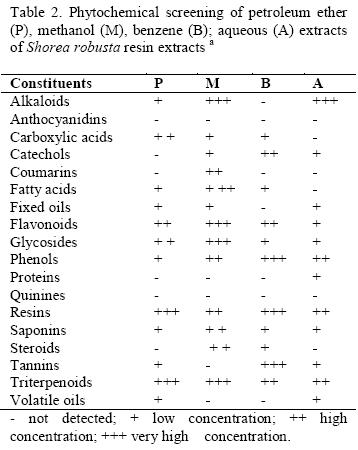
<body><![CDATA[<p align="justify"><font face="verdana" size="2">The antimicrobial activity of the ethanol extracts of each sample was evaluated by using disc diffusion method (Bauer <i>et al.,</i> 1966). Petriplates containing the aliquotes 20 ml of respective medium was seeded with selected microbial strains. Five millimeters of nutrient broth was inoculated with a loop (6 mm) of bacteria / yeast and incubated at 35&deg;C for 6 h. One milimeter of broth was taken at 0.6 optical density (at log phase, ca.108 cells/ml) and inoculated on the nutrient agar and transferred to 180 x 20 mm petri dishes. The sterile Whatmann No. 1 filter paper discs of 6 mm diameter were impregnated with 1000&#45;5000 ug of concentrated plant extracts and placed on the surface of the freshly inoculated medium. Standard antibiotic discs viz. Ampicillin, Tetracycline, Gentamycine, and Clotrimazole (Hi&#45;Media, Mumbai) were used as positive controls. Ethanol and water alone served as negative controls. The assessment of antimicrobial activity was based on measurement of inhibition zones formed around the discs. The media were incubated for 24 hrs at 37C and the diameters of the inhibition zones were recorded. Three independent trials were conducted for each concentration.</font></p>  	    <p align="justify"><font face="verdana" size="2">&nbsp;</font></p>  	    <p align="justify"><font face="verdana" size="2"><b>RESULTS AND DISCUSSION</b></font></p>  	    <p align="justify"><font face="verdana" size="2">The aqueous, methanol, petroleum and benzene extract of oleoresin of <i>Shorea robusta</i> were tested (<a href="/img/revistas/tsa/v14n3/a28t1.jpg" target="_blank">Table 1</a>). Different extracts inhibited the growth of 12, 11,9 and 6 of the 15 used microorganisms, respectively. Aqueous extracts of <i>Shorea robusta</i> exhibits significant activity against <i>Bacillus coagulans, Escherichia coli, Bacillus cereus</i> and moderate inhibition on <i>Salmonella typhi</i> and <i>Bacillus subtilis</i> and less activity against <i>Proteus vulgaris</i> and <i>Pseudomonas fluorescence.</i> However, ethanolic extracts also exhibited significant activity against <i>Staphylococcus aureus, S. epidermidis</i> and <i>Escherichia coli,</i> moderate inhibition on <i>Candida albicans</i> and <i>Bacillus coagulans.</i> In a nutshell, methanol extract showed more significant activity. The petroleum ether and benzene extracts showed less inhibitory activity when compare with the above two extracts. The Petroleum ether showed activity against <i>Escherichia coli, Aspergillus flavus</i> and <i>Candida albicans</i> and whereas benzene extracts worked against <i>Bacillus licheniformis, Bacillus cereus ana Aspergillus flavus.</i></font></p>  	    <p align="justify"><font face="verdana" size="2">Phytochemical screening of these extracts showed the presence of alkaloids, carboxylic acids, fatty acids, phenols, saponins and steroids (<a href="#t2">Table 2</a>.) Catechols, coumarins, proteins, tannins, volatile oils were observed in low concentrations. We suspect that the tannins found in the phytochemical analysis of the extracts could be responsible for the antibacterial activity. Triterpenoids have astringent actions, which form the basis for their therapeutic applications (Edward <i>et al,</i> 1970). It was found that the plants which contain triterpenoids had antimicrobial activity (Trease and Evans, 1989).</font></p>  	    <p align="center"><font face="verdana" size="2"><a name="t2"></a><img src="/img/revistas/tsa/v14n3/a28t2.jpg"></font></p>  	    <p align="justify"><font face="verdana" size="2">&nbsp;</font></p>  	    <p align="justify"><font face="verdana" size="2">The results of antimicrobial activity are comparable with the results of the previous researches using extracts of other species like <i>Azadirachta indica</i> (Ram et al., 2000), <i>Chukrasia tabularis</i> (Nagalakshmi et al., 2001), <i>Toona ciliata</i> and <i>Amoora rohituka</i> (Chowdhury et al., 2003), <i>Aglaia spectabilis</i> (Lavanya et al ., 2006), <i>Walsura trifoliate</i> (Murthy and Kandimalla 2008). The effectiveness may be due to the cumulative action of different compounds present in the plant parts (Bai 1990). They include alkaloids, Flavonoids, triterpenoids and other compounds of phenolic nature and are classified as active antimicrobial compounds (Rojas et al ., 1992).This study revealed that the oleoresin extracts of <i>Shorea robusta</i> had antimicrobial activity on certain pathogens with a broad spectrum result to standard antibiotics.</font></p>  	    <p align="justify"><font face="verdana" size="2">&nbsp;</font></p>  	    <p align="justify"><font face="verdana" size="2"><b>CONCLUSION</b></font></p>  	    ]]></body>
<body><![CDATA[<p align="justify"><font face="verdana" size="2">Based on the results obtained in the current study, it may be concluded that <i>Shorea robusta</i> resin have a stronger and broader spectrum of antimicrobial activity against a number of pathogenic microorganisms and the extracts may be used to discover bioactive natural products that may serve as basic source for the development of new drugs for therapy of skin allergies, diarrhea, dysentery and astringency. The results obtained also provide support to the uses of the plants in traditional medicine. However, the toxicological analysis of the active compounds is necessary in order to assess its tolerance in the human body when administered.</font></p>  	    <p align="justify"><font face="verdana" size="2">&nbsp;</font></p>  	    <p align="justify"><font face="verdana" size="2"><b>ACKNOWLEDGEMENTS</b></font></p>  	    <p align="justify"><font face="verdana" size="2">KSM is grateful to the Department of Science and Technology, New Delhi for the award of DST&#45; SERC Young Scientist grant no SR/FT/L&#45;16/2003.</font></p>  	    <p align="justify"><font face="verdana" size="2">&nbsp;</font></p>  	    <p align="justify"><font face="verdana" size="2"><b>REFERENCES</b></font></p>  	    <!-- ref --><p align="justify"><font face="verdana" size="2">Bai D. 1990.Traditional Chinese materia; a respect and prospect. Plant Medica. 56:5002.    &nbsp;&nbsp;&nbsp;&nbsp;&nbsp;&nbsp;&nbsp;&nbsp;[&#160;<a href="javascript:void(0);" onclick="javascript: window.open('/scielo.php?script=sci_nlinks&ref=10056602&pid=S1870-0462201100030002800001&lng=','','width=640,height=500,resizable=yes,scrollbars=1,menubar=yes,');">Links</a>&#160;]<!-- end-ref --></font></p>  	    <!-- ref --><p align="justify"><font face="verdana" size="2">Bauer A.W, Kirby M.D.K, Sherris J.C and Truck M. 1966. Antibiotic susceptibility testing by standard single disc diffusion method. American Journal of Clinical Pathology. 45: 493&#45; 496.    &nbsp;&nbsp;&nbsp;&nbsp;&nbsp;&nbsp;&nbsp;&nbsp;[&#160;<a href="javascript:void(0);" onclick="javascript: window.open('/scielo.php?script=sci_nlinks&ref=10056604&pid=S1870-0462201100030002800002&lng=','','width=640,height=500,resizable=yes,scrollbars=1,menubar=yes,');">Links</a>&#160;]<!-- end-ref --></font></p>  	    ]]></body>
<body><![CDATA[<!-- ref --><p align="justify"><font face="verdana" size="2">Chowdhury R, Choudhury M and Mohammad H, 2003. Rashid A. Antimicrobial activity of <i>Toona ciliata</i> and <i>Amoora rohituka</i> Fitoterapia. 74: 155&#45;158.    &nbsp;&nbsp;&nbsp;&nbsp;&nbsp;&nbsp;&nbsp;&nbsp;[&#160;<a href="javascript:void(0);" onclick="javascript: window.open('/scielo.php?script=sci_nlinks&ref=10056606&pid=S1870-0462201100030002800003&lng=','','width=640,height=500,resizable=yes,scrollbars=1,menubar=yes,');">Links</a>&#160;]<!-- end-ref --></font></p>  	    <!-- ref --><p align="justify"><font face="verdana" size="2">Croom E.M. 1983. Documenting and evaluating herbal remedies. Economic Botany. 37: 13&#45;27.    &nbsp;&nbsp;&nbsp;&nbsp;&nbsp;&nbsp;&nbsp;&nbsp;[&#160;<a href="javascript:void(0);" onclick="javascript: window.open('/scielo.php?script=sci_nlinks&ref=10056608&pid=S1870-0462201100030002800004&lng=','','width=640,height=500,resizable=yes,scrollbars=1,menubar=yes,');">Links</a>&#160;]<!-- end-ref --></font></p>  	    <!-- ref --><p align="justify"><font face="verdana" size="2">Edward P.C, Varrd E.T, and Lynn RB. 1970. <i>A Textbook of Pharmacognosy,</i> Henry Kinston, London.    &nbsp;&nbsp;&nbsp;&nbsp;&nbsp;&nbsp;&nbsp;&nbsp;[&#160;<a href="javascript:void(0);" onclick="javascript: window.open('/scielo.php?script=sci_nlinks&ref=10056610&pid=S1870-0462201100030002800005&lng=','','width=640,height=500,resizable=yes,scrollbars=1,menubar=yes,');">Links</a>&#160;]<!-- end-ref --></font></p>  	    <!-- ref --><p align="justify"><font face="verdana" size="2">Fadeyi M.Q, Adeoye A.E and Olowokudejo J.D 1989. Epidermal and Phytochemical studies in the genus <i>Boerhavia</i> (Nyctanginaceae) in Nigeria. International Journal of Crude Drug Research; 29: 178&#45;184.    &nbsp;&nbsp;&nbsp;&nbsp;&nbsp;&nbsp;&nbsp;&nbsp;[&#160;<a href="javascript:void(0);" onclick="javascript: window.open('/scielo.php?script=sci_nlinks&ref=10056612&pid=S1870-0462201100030002800006&lng=','','width=640,height=500,resizable=yes,scrollbars=1,menubar=yes,');">Links</a>&#160;]<!-- end-ref --></font></p>  	    <!-- ref --><p align="justify"><font face="verdana" size="2">Hamilton A. 1995. The People and Plants' initiative. In: Martin, G.J. (Ed.), Ethnobotany: A methods manual. WWF International. Chapman &amp; Hall, London.    &nbsp;&nbsp;&nbsp;&nbsp;&nbsp;&nbsp;&nbsp;&nbsp;[&#160;<a href="javascript:void(0);" onclick="javascript: window.open('/scielo.php?script=sci_nlinks&ref=10056614&pid=S1870-0462201100030002800007&lng=','','width=640,height=500,resizable=yes,scrollbars=1,menubar=yes,');">Links</a>&#160;]<!-- end-ref --></font></p>  	    ]]></body>
<body><![CDATA[<!-- ref --><p align="justify"><font face="verdana" size="2">Jayasinghea U.L.B 2002. Jayasooriyaa C.P, Bandarab B.M.R, Ekanayakec S.P, Merlinid L, and Assantee G. Antimicrobial activity of some Sri Lankan Rubiaceae and Meliaceae, Fitoterapia. 73:424 &#45; 427.    &nbsp;&nbsp;&nbsp;&nbsp;&nbsp;&nbsp;&nbsp;&nbsp;[&#160;<a href="javascript:void(0);" onclick="javascript: window.open('/scielo.php?script=sci_nlinks&ref=10056616&pid=S1870-0462201100030002800008&lng=','','width=640,height=500,resizable=yes,scrollbars=1,menubar=yes,');">Links</a>&#160;]<!-- end-ref --></font></p>  	    <!-- ref --><p align="justify"><font face="verdana" size="2">Lavanya T.M, Murthy K.S.R, Reddy N.S, and Rao K.R.S.S. 2006. Phytochemical and antimicrobial study of <i>Aglaia spectabilis</i> leaf extracts. Journal of Tropical Medicinal Plants. 7: 163&#45;168.    &nbsp;&nbsp;&nbsp;&nbsp;&nbsp;&nbsp;&nbsp;&nbsp;[&#160;<a href="javascript:void(0);" onclick="javascript: window.open('/scielo.php?script=sci_nlinks&ref=10056618&pid=S1870-0462201100030002800009&lng=','','width=640,height=500,resizable=yes,scrollbars=1,menubar=yes,');">Links</a>&#160;]<!-- end-ref --></font></p>  	    <!-- ref --><p align="justify"><font face="verdana" size="2">Mishra V, Parveen N, Singhal K.C and Khana N.U. 2005. Antifilarial activity of <i>Azadirachta indica</i> on cattle filarial parasite <i>Setaria cervi.</i> Fitoterapia. 76, 54&#45;61.    &nbsp;&nbsp;&nbsp;&nbsp;&nbsp;&nbsp;&nbsp;&nbsp;[&#160;<a href="javascript:void(0);" onclick="javascript: window.open('/scielo.php?script=sci_nlinks&ref=10056620&pid=S1870-0462201100030002800010&lng=','','width=640,height=500,resizable=yes,scrollbars=1,menubar=yes,');">Links</a>&#160;]<!-- end-ref --></font></p>  	    <!-- ref --><p align="justify"><font face="verdana" size="2">Misra LN, and Ahmad A. 1997. Triterpenoids from <i>Shorea robusta</i> resin, Phytochemistry. 45, 575&#45;578.    &nbsp;&nbsp;&nbsp;&nbsp;&nbsp;&nbsp;&nbsp;&nbsp;[&#160;<a href="javascript:void(0);" onclick="javascript: window.open('/scielo.php?script=sci_nlinks&ref=10056622&pid=S1870-0462201100030002800011&lng=','','width=640,height=500,resizable=yes,scrollbars=1,menubar=yes,');">Links</a>&#160;]<!-- end-ref --></font></p>  	    <!-- ref --><p align="justify"><font face="verdana" size="2">Murthy K.S.R and Kandimalla, N. Antimicrobial spectrum and Phytochemical study of <i>Walsura trifoliata</i> (A.Juss.) Harms. (Meliaceae) bark extracts Journal of Pharmacology and Toxicology. 2008; 3: 267&#45;71.    &nbsp;&nbsp;&nbsp;&nbsp;&nbsp;&nbsp;&nbsp;&nbsp;[&#160;<a href="javascript:void(0);" onclick="javascript: window.open('/scielo.php?script=sci_nlinks&ref=10056624&pid=S1870-0462201100030002800012&lng=','','width=640,height=500,resizable=yes,scrollbars=1,menubar=yes,');">Links</a>&#160;]<!-- end-ref --></font></p>  	    ]]></body>
<body><![CDATA[<!-- ref --><p align="justify"><font face="verdana" size="2">Nagalakshmi M.A.H, Thangaduri, D, Muralidharrao, D and Pullaiah T. 2001 Photochemical and antimicrobial study of <i>Chukrasia tabularis</i> leaves. Fitoterapia. 72: 62&#45;64.    &nbsp;&nbsp;&nbsp;&nbsp;&nbsp;&nbsp;&nbsp;&nbsp;[&#160;<a href="javascript:void(0);" onclick="javascript: window.open('/scielo.php?script=sci_nlinks&ref=10056626&pid=S1870-0462201100030002800013&lng=','','width=640,height=500,resizable=yes,scrollbars=1,menubar=yes,');">Links</a>&#160;]<!-- end-ref --></font></p>  	    <!-- ref --><p align="justify"><font face="verdana" size="2">Nostro A, Germano MP, Amgelo VA, Marino A and Car&iacute;nate Hi MA. 2000. Extraction methods and bioautography for evolution of medicinal plant antimicrobial activity. Letters in Applied Microbiology. 30, 379 &#45;388.    &nbsp;&nbsp;&nbsp;&nbsp;&nbsp;&nbsp;&nbsp;&nbsp;[&#160;<a href="javascript:void(0);" onclick="javascript: window.open('/scielo.php?script=sci_nlinks&ref=10056628&pid=S1870-0462201100030002800014&lng=','','width=640,height=500,resizable=yes,scrollbars=1,menubar=yes,');">Links</a>&#160;]<!-- end-ref --></font></p>  	    <!-- ref --><p align="justify"><font face="verdana" size="2">Odebiyi A and Sofowora A.E. 1990. Phytochemical screening of Nigerian medicinal plants. Part III. Lloydia. 41: 234&#45;246.    &nbsp;&nbsp;&nbsp;&nbsp;&nbsp;&nbsp;&nbsp;&nbsp;[&#160;<a href="javascript:void(0);" onclick="javascript: window.open('/scielo.php?script=sci_nlinks&ref=10056630&pid=S1870-0462201100030002800015&lng=','','width=640,height=500,resizable=yes,scrollbars=1,menubar=yes,');">Links</a>&#160;]<!-- end-ref --></font></p>  	    <!-- ref --><p align="justify"><font face="verdana" size="2">Pullaiah T and Rani S.S. 1999. Trees of Andhra Pradesh. Regency Publications, New Delhi, India.    &nbsp;&nbsp;&nbsp;&nbsp;&nbsp;&nbsp;&nbsp;&nbsp;[&#160;<a href="javascript:void(0);" onclick="javascript: window.open('/scielo.php?script=sci_nlinks&ref=10056632&pid=S1870-0462201100030002800016&lng=','','width=640,height=500,resizable=yes,scrollbars=1,menubar=yes,');">Links</a>&#160;]<!-- end-ref --></font></p>  	    <!-- ref --><p align="justify"><font face="verdana" size="2">Ram M.S, Ilavazhagan G, Sharma S.K, Dhanraj S.A, Suresh B, Parida M.M, Jana A.M, Kumar Devendr&aacute; and Selvamurthy W. 2000. Antimicrobial activity of a new vaginal contraceptive NIM&#45;76 from neem oil <i>{Azadirachta indica).</i> Journal of Ethnopharmacology. 71: 377&#45;382.    &nbsp;&nbsp;&nbsp;&nbsp;&nbsp;&nbsp;&nbsp;&nbsp;[&#160;<a href="javascript:void(0);" onclick="javascript: window.open('/scielo.php?script=sci_nlinks&ref=10056634&pid=S1870-0462201100030002800017&lng=','','width=640,height=500,resizable=yes,scrollbars=1,menubar=yes,');">Links</a>&#160;]<!-- end-ref --></font></p>  	    ]]></body>
<body><![CDATA[<!-- ref --><p align="justify"><font face="verdana" size="2">Rizk A, Bashir M. 1980. A chemical survey of sixty plants. Fitoterapia. 53: 35&#45;44.    &nbsp;&nbsp;&nbsp;&nbsp;&nbsp;&nbsp;&nbsp;&nbsp;[&#160;<a href="javascript:void(0);" onclick="javascript: window.open('/scielo.php?script=sci_nlinks&ref=10056636&pid=S1870-0462201100030002800018&lng=','','width=640,height=500,resizable=yes,scrollbars=1,menubar=yes,');">Links</a>&#160;]<!-- end-ref --></font></p>  	    <!-- ref --><p align="justify"><font face="verdana" size="2">Rojas A, Hernandez, Pereda&#45;Miranda R and Mata R. 1992. Screening for antimicrobical of crude drug extracts and pure natural products from Mexican medicinal plants. Journal of Ethnopharmacology. 35: 275&#45;285.    &nbsp;&nbsp;&nbsp;&nbsp;&nbsp;&nbsp;&nbsp;&nbsp;[&#160;<a href="javascript:void(0);" onclick="javascript: window.open('/scielo.php?script=sci_nlinks&ref=10056638&pid=S1870-0462201100030002800019&lng=','','width=640,height=500,resizable=yes,scrollbars=1,menubar=yes,');">Links</a>&#160;]<!-- end-ref --></font></p>  	    <!-- ref --><p align="justify"><font face="verdana" size="2">Saraswathy A, Purushothaman KK, Patra A, Dey AK and Kundu AB. 1992. Shoreaphenol, a polyphenol from <i>Shorea robusta.</i> Phytochemistry. 31: 2561&#45;2562.    &nbsp;&nbsp;&nbsp;&nbsp;&nbsp;&nbsp;&nbsp;&nbsp;[&#160;<a href="javascript:void(0);" onclick="javascript: window.open('/scielo.php?script=sci_nlinks&ref=10056640&pid=S1870-0462201100030002800020&lng=','','width=640,height=500,resizable=yes,scrollbars=1,menubar=yes,');">Links</a>&#160;]<!-- end-ref --></font></p>  	    <!-- ref --><p align="justify"><font face="verdana" size="2">Taylor R. S. 1995, Manandhar N.P and Towers G.H.N 1995. Screening of selected medicinal plants of Nepal for antimicrobial activities. Journal of Ethnopharmacology. 46: 153&#45;159.    &nbsp;&nbsp;&nbsp;&nbsp;&nbsp;&nbsp;&nbsp;&nbsp;[&#160;<a href="javascript:void(0);" onclick="javascript: window.open('/scielo.php?script=sci_nlinks&ref=10056642&pid=S1870-0462201100030002800021&lng=','','width=640,height=500,resizable=yes,scrollbars=1,menubar=yes,');">Links</a>&#160;]<!-- end-ref --></font></p>  	    <!-- ref --><p align="justify"><font face="verdana" size="2">Trease, G.E and Evans W.C. 1989. Pharmacognosy, Balleire Tindal, London.    &nbsp;&nbsp;&nbsp;&nbsp;&nbsp;&nbsp;&nbsp;&nbsp;[&#160;<a href="javascript:void(0);" onclick="javascript: window.open('/scielo.php?script=sci_nlinks&ref=10056644&pid=S1870-0462201100030002800022&lng=','','width=640,height=500,resizable=yes,scrollbars=1,menubar=yes,');">Links</a>&#160;]<!-- end-ref --></font></p>  	    ]]></body>
<body><![CDATA[<!-- ref --><p align="justify"><font face="verdana" size="2">Upadhyay O.P, Kaushal Kumar and Tiwari R.K. 1998. Ethnobotanical study of skin treatment uses of medicinal plants of Bihar. Pharmaceutical Biology. 36: 167&#45;172.    &nbsp;&nbsp;&nbsp;&nbsp;&nbsp;&nbsp;&nbsp;&nbsp;[&#160;<a href="javascript:void(0);" onclick="javascript: window.open('/scielo.php?script=sci_nlinks&ref=10056646&pid=S1870-0462201100030002800023&lng=','','width=640,height=500,resizable=yes,scrollbars=1,menubar=yes,');">Links</a>&#160;]<!-- end-ref --></font></p>      ]]></body><back>
<ref-list>
<ref id="B1">
<nlm-citation citation-type="journal">
<person-group person-group-type="author">
<name>
<surname><![CDATA[Bai]]></surname>
<given-names><![CDATA[D.]]></given-names>
</name>
</person-group>
<article-title xml:lang="en"><![CDATA[Traditional Chinese materia; a respect and prospect]]></article-title>
<source><![CDATA[Plant Medica]]></source>
<year>1990</year>
<volume>56</volume>
<page-range>5002</page-range></nlm-citation>
</ref>
<ref id="B2">
<nlm-citation citation-type="journal">
<person-group person-group-type="author">
<name>
<surname><![CDATA[Bauer]]></surname>
<given-names><![CDATA[A.W]]></given-names>
</name>
<name>
<surname><![CDATA[Kirby]]></surname>
<given-names><![CDATA[M.D.K]]></given-names>
</name>
<name>
<surname><![CDATA[Sherris]]></surname>
<given-names><![CDATA[J.C]]></given-names>
</name>
<name>
<surname><![CDATA[Truck]]></surname>
<given-names><![CDATA[M.]]></given-names>
</name>
</person-group>
<article-title xml:lang="en"><![CDATA[Antibiotic susceptibility testing by standard single disc diffusion method]]></article-title>
<source><![CDATA[American Journal of Clinical Pathology]]></source>
<year>1966</year>
<volume>45</volume>
<page-range>493- 496</page-range></nlm-citation>
</ref>
<ref id="B3">
<nlm-citation citation-type="journal">
<person-group person-group-type="author">
<name>
<surname><![CDATA[Chowdhury]]></surname>
<given-names><![CDATA[R]]></given-names>
</name>
<name>
<surname><![CDATA[Choudhury]]></surname>
<given-names><![CDATA[M]]></given-names>
</name>
<name>
<surname><![CDATA[Mohammad]]></surname>
<given-names><![CDATA[H]]></given-names>
</name>
</person-group>
<article-title xml:lang="en"><![CDATA[Rashid A. Antimicrobial activity of Toona ciliata and Amoora rohituka]]></article-title>
<source><![CDATA[Fitoterapia]]></source>
<year>2003</year>
<volume>74</volume>
<page-range>155-158</page-range></nlm-citation>
</ref>
<ref id="B4">
<nlm-citation citation-type="journal">
<person-group person-group-type="author">
<name>
<surname><![CDATA[Croom]]></surname>
<given-names><![CDATA[E.M.]]></given-names>
</name>
</person-group>
<article-title xml:lang="en"><![CDATA[Documenting and evaluating herbal remedies]]></article-title>
<source><![CDATA[Economic Botany]]></source>
<year>1983</year>
<volume>37</volume>
<page-range>13-27</page-range></nlm-citation>
</ref>
<ref id="B5">
<nlm-citation citation-type="">
<person-group person-group-type="author">
<name>
<surname><![CDATA[Edward]]></surname>
<given-names><![CDATA[P.C]]></given-names>
</name>
<name>
<surname><![CDATA[Varrd]]></surname>
<given-names><![CDATA[E.T]]></given-names>
</name>
<name>
<surname><![CDATA[Lynn]]></surname>
<given-names><![CDATA[RB]]></given-names>
</name>
</person-group>
<source><![CDATA[A Textbook of Pharmacognosy]]></source>
<year>1970</year>
<publisher-loc><![CDATA[London ]]></publisher-loc>
</nlm-citation>
</ref>
<ref id="B6">
<nlm-citation citation-type="journal">
<person-group person-group-type="author">
<name>
<surname><![CDATA[Fadeyi]]></surname>
<given-names><![CDATA[M.Q]]></given-names>
</name>
<name>
<surname><![CDATA[Adeoye]]></surname>
<given-names><![CDATA[A.E]]></given-names>
</name>
<name>
<surname><![CDATA[Olowokudejo]]></surname>
<given-names><![CDATA[J.D]]></given-names>
</name>
</person-group>
<article-title xml:lang="en"><![CDATA[Epidermal and Phytochemical studies in the genus Boerhavia (Nyctanginaceae) in Nigeria]]></article-title>
<source><![CDATA[International Journal of Crude Drug Research]]></source>
<year>1989</year>
<volume>29</volume>
<page-range>178-184</page-range></nlm-citation>
</ref>
<ref id="B7">
<nlm-citation citation-type="book">
<person-group person-group-type="author">
<name>
<surname><![CDATA[Hamilton]]></surname>
<given-names><![CDATA[A.]]></given-names>
</name>
</person-group>
<article-title xml:lang="en"><![CDATA[The People and Plants' initiative]]></article-title>
<person-group person-group-type="editor">
<name>
<surname><![CDATA[Martin]]></surname>
<given-names><![CDATA[G.J.]]></given-names>
</name>
</person-group>
<source><![CDATA[Ethnobotany: A methods manual]]></source>
<year>1995</year>
<publisher-loc><![CDATA[London ]]></publisher-loc>
<publisher-name><![CDATA[WWF InternationalChapman & Hall]]></publisher-name>
</nlm-citation>
</ref>
<ref id="B8">
<nlm-citation citation-type="journal">
<person-group person-group-type="author">
<name>
<surname><![CDATA[Jayasinghea]]></surname>
<given-names><![CDATA[U.L.B]]></given-names>
</name>
<name>
<surname><![CDATA[Jayasooriyaa]]></surname>
<given-names><![CDATA[C.P]]></given-names>
</name>
<name>
<surname><![CDATA[Bandarab]]></surname>
<given-names><![CDATA[B.M.R]]></given-names>
</name>
<name>
<surname><![CDATA[Ekanayakec]]></surname>
<given-names><![CDATA[S.P]]></given-names>
</name>
<name>
<surname><![CDATA[Merlinid]]></surname>
<given-names><![CDATA[L]]></given-names>
</name>
<name>
<surname><![CDATA[Assantee]]></surname>
<given-names><![CDATA[G.]]></given-names>
</name>
</person-group>
<article-title xml:lang="en"><![CDATA[Antimicrobial activity of some Sri Lankan Rubiaceae and Meliaceae]]></article-title>
<source><![CDATA[Fitoterapia]]></source>
<year></year>
<volume>73</volume>
<page-range>424 - 427</page-range></nlm-citation>
</ref>
<ref id="B9">
<nlm-citation citation-type="journal">
<person-group person-group-type="author">
<name>
<surname><![CDATA[Lavanya]]></surname>
<given-names><![CDATA[T.M]]></given-names>
</name>
<name>
<surname><![CDATA[Murthy]]></surname>
<given-names><![CDATA[K.S.R]]></given-names>
</name>
<name>
<surname><![CDATA[Reddy]]></surname>
<given-names><![CDATA[N.S]]></given-names>
</name>
<name>
<surname><![CDATA[Rao]]></surname>
<given-names><![CDATA[K.R.S.S]]></given-names>
</name>
</person-group>
<article-title xml:lang="en"><![CDATA[Phytochemical and antimicrobial study of Aglaia spectabilis leaf extracts]]></article-title>
<source><![CDATA[Journal of Tropical Medicinal Plants]]></source>
<year>2006</year>
<volume>7</volume>
<page-range>163-168</page-range></nlm-citation>
</ref>
<ref id="B10">
<nlm-citation citation-type="journal">
<person-group person-group-type="author">
<name>
<surname><![CDATA[Mishra]]></surname>
<given-names><![CDATA[V]]></given-names>
</name>
<name>
<surname><![CDATA[Parveen]]></surname>
<given-names><![CDATA[N]]></given-names>
</name>
<name>
<surname><![CDATA[Singhal]]></surname>
<given-names><![CDATA[K.C]]></given-names>
</name>
<name>
<surname><![CDATA[Khana]]></surname>
<given-names><![CDATA[N.U]]></given-names>
</name>
</person-group>
<article-title xml:lang="en"><![CDATA[Antifilarial activity of Azadirachta indica on cattle filarial parasite Setaria cervi]]></article-title>
<source><![CDATA[Fitoterapia]]></source>
<year>2005</year>
<volume>76</volume>
<page-range>54-61</page-range></nlm-citation>
</ref>
<ref id="B11">
<nlm-citation citation-type="journal">
<person-group person-group-type="author">
<name>
<surname><![CDATA[Misra]]></surname>
<given-names><![CDATA[LN]]></given-names>
</name>
<name>
<surname><![CDATA[Ahmad]]></surname>
<given-names><![CDATA[A.]]></given-names>
</name>
</person-group>
<article-title xml:lang="en"><![CDATA[Triterpenoids from Shorea robusta resin]]></article-title>
<source><![CDATA[Phytochemistry]]></source>
<year>1997</year>
<volume>45</volume>
<page-range>575-578</page-range></nlm-citation>
</ref>
<ref id="B12">
<nlm-citation citation-type="journal">
<person-group person-group-type="author">
<name>
<surname><![CDATA[Murthy]]></surname>
<given-names><![CDATA[K.S.R]]></given-names>
</name>
<name>
<surname><![CDATA[Kandimalla]]></surname>
<given-names><![CDATA[N.]]></given-names>
</name>
</person-group>
<article-title xml:lang="en"><![CDATA[Antimicrobial spectrum and Phytochemical study of Walsura trifoliata (A.Juss.) Harms. (Meliaceae) bark extracts]]></article-title>
<source><![CDATA[Journal of Pharmacology and Toxicology]]></source>
<year>2008</year>
<volume>3</volume>
<page-range>267-71</page-range></nlm-citation>
</ref>
<ref id="B13">
<nlm-citation citation-type="journal">
<person-group person-group-type="author">
<name>
<surname><![CDATA[Nagalakshmi]]></surname>
<given-names><![CDATA[M.A.H]]></given-names>
</name>
<name>
<surname><![CDATA[Thangaduri]]></surname>
<given-names><![CDATA[D]]></given-names>
</name>
<name>
<surname><![CDATA[Muralidharrao]]></surname>
<given-names><![CDATA[D]]></given-names>
</name>
<name>
<surname><![CDATA[Pullaiah]]></surname>
<given-names><![CDATA[T.]]></given-names>
</name>
</person-group>
<article-title xml:lang="en"><![CDATA[Photochemical and antimicrobial study of Chukrasia tabularis leaves]]></article-title>
<source><![CDATA[Fitoterapia]]></source>
<year>2001</year>
<volume>72</volume>
<page-range>62-64</page-range></nlm-citation>
</ref>
<ref id="B14">
<nlm-citation citation-type="journal">
<person-group person-group-type="author">
<name>
<surname><![CDATA[Nostro]]></surname>
<given-names><![CDATA[A]]></given-names>
</name>
<name>
<surname><![CDATA[Germano]]></surname>
<given-names><![CDATA[MP]]></given-names>
</name>
<name>
<surname><![CDATA[Amgelo]]></surname>
<given-names><![CDATA[VA]]></given-names>
</name>
<name>
<surname><![CDATA[Marino]]></surname>
<given-names><![CDATA[A]]></given-names>
</name>
<name>
<surname><![CDATA[Carínate]]></surname>
<given-names><![CDATA[Hi MA]]></given-names>
</name>
</person-group>
<article-title xml:lang="en"><![CDATA[Extraction methods and bioautography for evolution of medicinal plant antimicrobial activity]]></article-title>
<source><![CDATA[Letters in Applied Microbiology]]></source>
<year>2000</year>
<volume>30</volume>
<page-range>379 -388</page-range></nlm-citation>
</ref>
<ref id="B15">
<nlm-citation citation-type="journal">
<person-group person-group-type="author">
<name>
<surname><![CDATA[Odebiyi]]></surname>
<given-names><![CDATA[A]]></given-names>
</name>
<name>
<surname><![CDATA[Sofowora]]></surname>
<given-names><![CDATA[A.E.]]></given-names>
</name>
</person-group>
<article-title xml:lang="en"><![CDATA[Phytochemical screening of Nigerian medicinal plants. Part III]]></article-title>
<source><![CDATA[Lloydia]]></source>
<year>1990</year>
<volume>41</volume>
<page-range>234-246</page-range></nlm-citation>
</ref>
<ref id="B16">
<nlm-citation citation-type="book">
<person-group person-group-type="author">
<name>
<surname><![CDATA[Pullaiah]]></surname>
<given-names><![CDATA[T]]></given-names>
</name>
<name>
<surname><![CDATA[Rani]]></surname>
<given-names><![CDATA[S.S]]></given-names>
</name>
</person-group>
<source><![CDATA[Trees of Andhra Pradesh]]></source>
<year>1999</year>
<publisher-loc><![CDATA[New Delhi ]]></publisher-loc>
<publisher-name><![CDATA[Regency Publications]]></publisher-name>
</nlm-citation>
</ref>
<ref id="B17">
<nlm-citation citation-type="journal">
<person-group person-group-type="author">
<name>
<surname><![CDATA[Ram]]></surname>
<given-names><![CDATA[M.S]]></given-names>
</name>
<name>
<surname><![CDATA[Ilavazhagan]]></surname>
<given-names><![CDATA[G]]></given-names>
</name>
<name>
<surname><![CDATA[Sharma]]></surname>
<given-names><![CDATA[S.K]]></given-names>
</name>
<name>
<surname><![CDATA[Dhanraj]]></surname>
<given-names><![CDATA[S.A]]></given-names>
</name>
<name>
<surname><![CDATA[Suresh]]></surname>
<given-names><![CDATA[B]]></given-names>
</name>
<name>
<surname><![CDATA[Parida]]></surname>
<given-names><![CDATA[M.M]]></given-names>
</name>
<name>
<surname><![CDATA[Jana]]></surname>
<given-names><![CDATA[A.M]]></given-names>
</name>
<name>
<surname><![CDATA[Kumar]]></surname>
<given-names><![CDATA[Devendrá]]></given-names>
</name>
<name>
<surname><![CDATA[Selvamurthy]]></surname>
<given-names><![CDATA[W.]]></given-names>
</name>
</person-group>
<article-title xml:lang="en"><![CDATA[Antimicrobial activity of a new vaginal contraceptive NIM-76 from neem oil {Azadirachta indica)]]></article-title>
<source><![CDATA[Journal of Ethnopharmacology]]></source>
<year>2000</year>
<volume>71</volume>
<page-range>377-382</page-range></nlm-citation>
</ref>
<ref id="B18">
<nlm-citation citation-type="journal">
<person-group person-group-type="author">
<name>
<surname><![CDATA[Rizk]]></surname>
<given-names><![CDATA[A]]></given-names>
</name>
<name>
<surname><![CDATA[Bashir]]></surname>
<given-names><![CDATA[M.]]></given-names>
</name>
</person-group>
<article-title xml:lang="en"><![CDATA[A chemical survey of sixty plants]]></article-title>
<source><![CDATA[Fitoterapia]]></source>
<year>1980</year>
<volume>53</volume>
<page-range>35-44</page-range></nlm-citation>
</ref>
<ref id="B19">
<nlm-citation citation-type="journal">
<person-group person-group-type="author">
<name>
<surname><![CDATA[Rojas]]></surname>
<given-names><![CDATA[A]]></given-names>
</name>
<name>
<surname><![CDATA[Hernandez, Pereda-Miranda]]></surname>
<given-names><![CDATA[R]]></given-names>
</name>
<name>
<surname><![CDATA[Mata]]></surname>
<given-names><![CDATA[R.]]></given-names>
</name>
</person-group>
<article-title xml:lang="en"><![CDATA[Screening for antimicrobical of crude drug extracts and pure natural products from Mexican medicinal plants]]></article-title>
<source><![CDATA[Journal of Ethnopharmacology]]></source>
<year>1992</year>
<volume>35</volume>
<page-range>275-285</page-range></nlm-citation>
</ref>
<ref id="B20">
<nlm-citation citation-type="journal">
<person-group person-group-type="author">
<name>
<surname><![CDATA[Saraswathy]]></surname>
<given-names><![CDATA[A]]></given-names>
</name>
<name>
<surname><![CDATA[Purushothaman]]></surname>
<given-names><![CDATA[KK]]></given-names>
</name>
<name>
<surname><![CDATA[Patra]]></surname>
<given-names><![CDATA[A]]></given-names>
</name>
<name>
<surname><![CDATA[Dey]]></surname>
<given-names><![CDATA[AK]]></given-names>
</name>
<name>
<surname><![CDATA[Kundu]]></surname>
<given-names><![CDATA[AB]]></given-names>
</name>
</person-group>
<article-title xml:lang="en"><![CDATA[Shoreaphenol, a polyphenol from Shorea robusta]]></article-title>
<source><![CDATA[Phytochemistry]]></source>
<year>1992</year>
<volume>31</volume>
<page-range>2561-2562</page-range></nlm-citation>
</ref>
<ref id="B21">
<nlm-citation citation-type="journal">
<person-group person-group-type="author">
<name>
<surname><![CDATA[Taylor]]></surname>
<given-names><![CDATA[R. S.]]></given-names>
</name>
<name>
<surname><![CDATA[Manandhar]]></surname>
<given-names><![CDATA[N.P]]></given-names>
</name>
<name>
<surname><![CDATA[Towers]]></surname>
<given-names><![CDATA[G.H.N]]></given-names>
</name>
</person-group>
<article-title xml:lang="en"><![CDATA[Screening of selected medicinal plants of Nepal for antimicrobial activities]]></article-title>
<source><![CDATA[Journal of Ethnopharmacology]]></source>
<year></year>
<volume>46</volume>
<page-range>153-159</page-range></nlm-citation>
</ref>
<ref id="B22">
<nlm-citation citation-type="book">
<person-group person-group-type="author">
<name>
<surname><![CDATA[Trease]]></surname>
<given-names><![CDATA[G.E]]></given-names>
</name>
<name>
<surname><![CDATA[Evans]]></surname>
<given-names><![CDATA[W.C.]]></given-names>
</name>
</person-group>
<source><![CDATA[Pharmacognosy]]></source>
<year>1989</year>
<publisher-loc><![CDATA[London ]]></publisher-loc>
<publisher-name><![CDATA[Balleire Tindal]]></publisher-name>
</nlm-citation>
</ref>
<ref id="B23">
<nlm-citation citation-type="journal">
<person-group person-group-type="author">
<name>
<surname><![CDATA[Upadhyay]]></surname>
<given-names><![CDATA[O.P]]></given-names>
</name>
<name>
<surname><![CDATA[Kaushal]]></surname>
<given-names><![CDATA[Kumar]]></given-names>
</name>
<name>
<surname><![CDATA[Tiwari]]></surname>
<given-names><![CDATA[R.K]]></given-names>
</name>
</person-group>
<article-title xml:lang="en"><![CDATA[Ethnobotanical study of skin treatment uses of medicinal plants of Bihar]]></article-title>
<source><![CDATA[Pharmaceutical Biology]]></source>
<year>1998</year>
<volume>36</volume>
<page-range>167-172</page-range></nlm-citation>
</ref>
</ref-list>
</back>
</article>
