<?xml version="1.0" encoding="ISO-8859-1"?><article xmlns:mml="http://www.w3.org/1998/Math/MathML" xmlns:xlink="http://www.w3.org/1999/xlink" xmlns:xsi="http://www.w3.org/2001/XMLSchema-instance">
<front>
<journal-meta>
<journal-id>1870-0462</journal-id>
<journal-title><![CDATA[Tropical and subtropical agroecosystems]]></journal-title>
<abbrev-journal-title><![CDATA[Trop. subtrop. agroecosyt]]></abbrev-journal-title>
<issn>1870-0462</issn>
<publisher>
<publisher-name><![CDATA[Universidad Autónoma de Yucatán, Facultad de Medicina Veterinaria]]></publisher-name>
</publisher>
</journal-meta>
<article-meta>
<article-id>S1870-04622011000300003</article-id>
<title-group>
<article-title xml:lang="en"><![CDATA[Vermicomposting as a process to stabilize organic waste and sewage sludge as an apllication for soil]]></article-title>
<article-title xml:lang="es"><![CDATA[El vermicomposteo como proceso estabilizador de residuos orgánicos y los lodos residuales como una aplicación a suelos]]></article-title>
</title-group>
<contrib-group>
<contrib contrib-type="author">
<name>
<surname><![CDATA[Águila Juárez]]></surname>
<given-names><![CDATA[Pedro Del]]></given-names>
</name>
<xref ref-type="aff" rid="A01"/>
</contrib>
<contrib contrib-type="author">
<name>
<surname><![CDATA[Lugo de la Fuente]]></surname>
<given-names><![CDATA[Jorge]]></given-names>
</name>
<xref ref-type="aff" rid="A01"/>
</contrib>
<contrib contrib-type="author">
<name>
<surname><![CDATA[Vaca Paulín]]></surname>
<given-names><![CDATA[Rocío]]></given-names>
</name>
<xref ref-type="aff" rid="A01"/>
</contrib>
</contrib-group>
<aff id="A01">
<institution><![CDATA[,Autonomous University of the State of Mexico Faculty of Sciences Laboratory of Edaphology and Environment]]></institution>
<addr-line><![CDATA[Toluca ]]></addr-line>
<country>Mexico</country>
</aff>
<pub-date pub-type="pub">
<day>00</day>
<month>12</month>
<year>2011</year>
</pub-date>
<pub-date pub-type="epub">
<day>00</day>
<month>12</month>
<year>2011</year>
</pub-date>
<volume>14</volume>
<numero>3</numero>
<fpage>949</fpage>
<lpage>963</lpage>
<copyright-statement/>
<copyright-year/>
<self-uri xlink:href="http://www.scielo.org.mx/scielo.php?script=sci_arttext&amp;pid=S1870-04622011000300003&amp;lng=en&amp;nrm=iso"></self-uri><self-uri xlink:href="http://www.scielo.org.mx/scielo.php?script=sci_abstract&amp;pid=S1870-04622011000300003&amp;lng=en&amp;nrm=iso"></self-uri><self-uri xlink:href="http://www.scielo.org.mx/scielo.php?script=sci_pdf&amp;pid=S1870-04622011000300003&amp;lng=en&amp;nrm=iso"></self-uri><abstract abstract-type="short" xml:lang="en"><p><![CDATA[The issue of organic waste generation is a constant nowadays; recycling and reduction are expensive physical and chemical processes, so the use of vermicomposting techniques reduces production costs and decontaminates the environment. Earthworms decompose organic matter and generate a product called vermicompost. Vermicompost is obtained from a wide variety of organic waste including residual sludge; when sewage sludge is managed with vermicomposting techniques, the resulting product supplies nutriments, more stable organic matter and works as a soil conditioner. The present bibliographic review underscores its importance via the use of diverse sorts of organic waste to reincorpórate them into the environment. The parameters considered to produce vermicompost are: pH, temperature, moisture, total solid contents, nitrogen, carbon, C/N ratio and humic acids. The importance of this text is to be found in the need to use vermicompost amendments from the use of sewage sludge to be transformed into fertilizer and be utilized in the growth of plants, thus turning it into an alternative in agricultural soils and a solution for its final end. Separately, earthworms take part as agents that bio-accumulate heavy metals and reduce the levels of toxicity in the environments; thereby these organisms, in addition to produce vermicompost, are considered an agent that bio-accumulates heavy metals from the environment.]]></p></abstract>
<abstract abstract-type="short" xml:lang="es"><p><![CDATA[La problemática que se presenta en la generación de los residuos orgánicos es una constante de esta época, las acciones de reciclamiento y reducción son procesos físicos y químicos que resultan costosos, por lo que el emplear técnicas de vermicomposteo reduce costos de producción y descontamina al ambiente. La lombriz de tierra descompone la materia orgánica y genera un producto que se denomina vermicomposta. La vermicomposta se obtiene a partir de una gran variedad de residuos orgánicos incluyendo a los lodos residuales. Cuando el lodo residual se maneja con la técnica de vermicomposteo, el producto que se forma aporta nutrimentos, materia orgánica más estable y sirve como mejorador del suelo. La presente revisión bibliográfica resalta la importancia por el empleo de diversos tipos de residuos orgánicos para su reincorporación al ambiente. Los parámetros que se consideran para preparar una vermicomposta son: el pH, temperatura, humedad, contenido de sólidos totales, nitrógeno, carbono, relación C/N y ácidos húmicos. La importancia de este texto reside en la necesidad de utilizar enmiendas vermicomposteadas, a partir del empleo de lodos residuales para su uso como abono y para el crecimiento de la planta y de esta manera sea una alternativa en suelos agrícolas y una solución a su disposición final. Por otra parte la lombriz de tierra participa como agente que bioacumula metales pesados y reducen los niveles de toxicidad en el ambiente, por lo que este organismo además de elaborar vermicomposta es considerado un agente que bioacumula metales del ambiente.]]></p></abstract>
<kwd-group>
<kwd lng="en"><![CDATA[vermicompost]]></kwd>
<kwd lng="en"><![CDATA[earthworm]]></kwd>
<kwd lng="en"><![CDATA[sewage sludge]]></kwd>
<kwd lng="es"><![CDATA[Vermicomposteo]]></kwd>
<kwd lng="es"><![CDATA[lombriz de tierra]]></kwd>
<kwd lng="es"><![CDATA[lodo residual]]></kwd>
</kwd-group>
</article-meta>
</front><body><![CDATA[  	    <p align="justify"><font face="verdana" size="4">Revisi&oacute;n</font></p>  	    <p align="justify"><font face="verdana" size="2">&nbsp;</font></p>  	    <p align="center"><font face="verdana" size="4"><b>Vermicomposting as a process to stabilize organic waste and sewage sludge as an apllication for soil</b></font></p>  	    <p align="justify"><font face="verdana" size="2">&nbsp;</font></p>  	    <p align="center"><font face="verdana" size="3"><b>El vermicomposteo como proceso estabilizador de residuos org&aacute;nicos y los lodos residuales como una aplicaci&oacute;n a suelos</b></font></p>  	    <p align="justify"><font face="verdana" size="2">&nbsp;</font></p>  	    <p align="center"><font face="verdana" size="2"><b>Pedro Del &Aacute;guila Ju&aacute;rez*, Jorge Lugo de la Fuente, Roc&iacute;o Vaca Paul&iacute;n</b></font></p>  	    <p align="justify"><font face="verdana" size="2">&nbsp;</font></p>  	    <p align="justify"><font face="verdana" size="2"><i>Laboratory of Edaphology and Environment, Faculty of Sciences, Autonomous University of the State of Mexico, Instituto Literario 100. Toluca Mexico.</i> Email: <a href="mailto:daguila@uaemex.mx">daguila@uaemex.mx</a>*</font></p>  	    ]]></body>
<body><![CDATA[<p align="justify"><font face="verdana" size="2">* Corresponding author</font></p>  	    <p align="justify"><font face="verdana" size="2">&nbsp;</font></p>  	    <p align="justify"><font face="verdana" size="2">Submitted March 17, 2011    <br> 	Accepted May 04, 2011    <br> 	Revised received July 11, 2011</font></p>  	    <p align="justify"><font face="verdana" size="2">&nbsp;</font></p>  	    <p align="justify"><font face="verdana" size="2"><b>Abstract</b></font></p>  	    <p align="justify"><font face="verdana" size="2">The issue of organic waste generation is a constant nowadays; recycling and reduction are expensive physical and chemical processes, so the use of vermicomposting techniques reduces production costs and decontaminates the environment. Earthworms decompose organic matter and generate a product called vermicompost. Vermicompost is obtained from a wide variety of organic waste including residual sludge; when sewage sludge is managed with vermicomposting techniques, the resulting product supplies nutriments, more stable organic matter and works as a soil conditioner. The present bibliographic review underscores its importance via the use of diverse sorts of organic waste to reincorp&oacute;rate them into the environment. The parameters considered to produce vermicompost are: pH, temperature, moisture, total solid contents, nitrogen, carbon, C/N ratio and humic acids. The importance of this text is to be found in the need to use vermicompost amendments from the use of sewage sludge to be transformed into fertilizer and be utilized in the growth of plants, thus turning it into an alternative in agricultural soils and a solution for its final end. Separately, earthworms take part as agents that bio&#45;accumulate heavy metals and reduce the levels of toxicity in the environments; thereby these organisms, in addition to produce vermicompost, are considered an agent that bio&#45;accumulates heavy metals from the environment.</font></p>  	    <p align="justify"><font face="verdana" size="2"><b>Key words:</b> vermicompost; earthworm; sewage sludge.</font></p>  	    <p align="justify"><font face="verdana" size="2">&nbsp;</font></p>  	    ]]></body>
<body><![CDATA[<p align="justify"><font face="verdana" size="2"><b>Resumen</b></font></p>  	    <p align="justify"><font face="verdana" size="2">La problem&aacute;tica que se presenta en la generaci&oacute;n de los residuos org&aacute;nicos es una constante de esta &eacute;poca, las acciones de reciclamiento y reducci&oacute;n son procesos f&iacute;sicos y qu&iacute;micos que resultan costosos, por lo que el emplear t&eacute;cnicas de vermicomposteo reduce costos de producci&oacute;n y descontamina al ambiente. La lombriz de tierra descompone la materia org&aacute;nica y genera un producto que se denomina vermicomposta. La vermicomposta se obtiene a partir de una gran variedad de residuos org&aacute;nicos incluyendo a los lodos residuales. Cuando el lodo residual se maneja con la t&eacute;cnica de vermicomposteo, el producto que se forma aporta nutrimentos, materia org&aacute;nica m&aacute;s estable y sirve como mejorador del suelo. La presente revisi&oacute;n bibliogr&aacute;fica resalta la importancia por el empleo de diversos tipos de residuos org&aacute;nicos para su reincorporaci&oacute;n al ambiente. Los par&aacute;metros que se consideran para preparar una vermicomposta son: el pH, temperatura, humedad, contenido de s&oacute;lidos totales, nitr&oacute;geno, carbono, relaci&oacute;n C/N y &aacute;cidos h&uacute;micos. La importancia de este texto reside en la necesidad de utilizar enmiendas vermicomposteadas, a partir del empleo de lodos residuales para su uso como abono y para el crecimiento de la planta y de esta manera sea una alternativa en suelos agr&iacute;colas y una soluci&oacute;n a su disposici&oacute;n final. Por otra parte la lombriz de tierra participa como agente que bioacumula metales pesados y reducen los niveles de toxicidad en el ambiente, por lo que este organismo adem&aacute;s de elaborar vermicomposta es considerado un agente que bioacumula metales del ambiente.</font></p>  	    <p align="justify"><font face="verdana" size="2"><b>Palabras claves:</b> Vermicomposteo; lombriz de tierra; lodo residual.</font></p>  	    <p align="justify"><font face="verdana" size="2">&nbsp;</font></p>  	    <p align="justify"><font face="verdana" size="2"><b>INTRODUCTION</b></font></p>  	    <p align="justify"><font face="verdana" size="2">In sustainable development one of the greatest challenges is to have an integrated system of organic solid waste, both in the city and the countryside (Armijo <i>et al.,</i> 2007). The "General Law for Conservation and Integral Management of Residues" <i>(Ley General para la Conservaci&oacute;n y Gesti&oacute;n Integral de Residuos)</i> proposes to make a better management of urban solid waste so that it is incorporated into nature in the short and medium term, hence reduce environmental pollution (Rodriguez and Cordova, 2006; Montenegro <i>et al,</i> 2007).</font></p>  	    <p align="justify"><font face="verdana" size="2">There is a wide variety of worms that decompose organic matter (OM) and among them one finds <i>Eisenia f&eacute;tida,</i> an organism that produces stable humus and nutriments available for the plants (Garg <i>et al,</i> 2005). Vermicompost requires a good balance of C and N that is beneficial for the worm (in biomass, reproduction and reduction of mortality rates). There is a broad spectrum of organic waste in the diet of the worm that comes from animals, vegetables, alimentary, textile, winemaking industries and sewage sludge (SS) (Gupta and Garg, 2008).</font></p>  	    <p align="justify"><font face="verdana" size="2">SS generation is a problem that appears because of population growth in the cities and waste from industry (Bernache, 2007). In Mexico, 1.6 million metric tons (henceforth only ton) of SS are produced every year (Colin <i>et al.,</i> 2006) which is below the 7 million tons a year produced by the United States (Adegbidi and Briggs, 2003); these differences are due to the fact that the U.S. has a higher index of urbanization than Mexico (L&oacute;pez, 1994). A good management of SS has to undertake techniques that work as compost amendment for soil (Quincha and Carmona, 2004). The product from vermicompost is useful for regeneration of soils, energy as liquids and combustible gases (L&oacute;pez, 1994). During the process to produce vermicompost, it is considered important to monitor the routine parameters, namely: temperature, moisture, pH and airing that predict stability, quality and the maturity of the vermicompost (Sharma <i>et al.,</i> 2005).</font></p>  	    <p align="justify"><font face="verdana" size="2">Vermicompost has substances such as humic acids (HA) and hormones that together regulate the growth and production of plants (Atiyeh <i>et al.,</i> 2000), and in the environmental field the worm helps alleviate environmental pollution and takes part into bio&#45;accumulation and bio&#45;remediation processes (Delgado <i>et al.,</i> 2004).</font></p>  	    <p align="justify"><font face="verdana" size="2">The need to use SS as amendments arose from the interest of the governments in implementing environmental policies to reduce the effect of the pollution that comes from this sludge; in Europe, SS recycling practices are carried out by means of composting and vermicomposting, and the product is considered good quality manure (Mora, 2000; Khwairakpan and Bhargava, 2009), which favors the reduction of heavy metals and mitigates their effect in the environment (Soto and Mu&ntilde;oz, 2002; Cabrera <i>et al,</i> 2007).</font></p>  	    ]]></body>
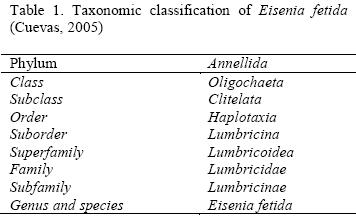
<body><![CDATA[<p align="justify"><font face="verdana" size="2">&nbsp;</font></p>  	    <p align="justify"><font face="verdana" size="2"><b>The earthworm</b></font></p>  	    <p align="justify"><font face="verdana" size="2">Earthworm belongs to <i>Annelida</i> phylum and to <i>Oligochaeta</i> class that comprises more than 1300 species; most of the species belong to <i>Lumbricidae</i> family, than comprehends the genera: <i>Allolophora, Aporrectodea, Bimastos, Dendrobaena, Eisenia, Lumbricus</i> and many more. Until the end of the XX century, there was a counting of 3500 earthworm species known to man (Bohlen, 2002; Garc&iacute;a, 2006). <i>E. f&eacute;tida</i> (Savigny, 1826) is known as redworm, brandling worm, red wiggler worm and it is classified as shown in <a href="#t1">Table 1</a> (Manna <i>et al,</i> 2003).</font></p>  	    <p align="center"><font face="verdana" size="2"><a name="t1"></a><img src="/img/revistas/tsa/v14n3/a3t1.jpg"></font></p>  	    <p align="justify"><font face="verdana" size="2">&nbsp;</font></p>  	    <p align="justify"><font face="verdana" size="2">On the basis of its feeding habits, the worm is classified into two types: detritivore and geophagous. The former feeds on leaves, dead roots, plant residues and animal scats on the ground surface; the latter only consumes large amounts of organic soil and is located under the surface. The worms that produce humus are divided into epigeal and anecie. The epigeal live on the surface and feed on organic matter and detritus, an instance of them are <i>E. f&eacute;tida, E. andrei, Perionyx excavatus, P. sansibaricus,</i> and <i>Eudrilus eugenie.</i> The anecie live in vertical burrows, an instance of them is <i>Lumbricus terrestris</i> (Sharma <i>et al,</i> 2005).</font></p>  	    <p align="justify"><font face="verdana" size="2">The main systemic characteristic of earthworms is that they possess an internal and external bilateral symmetry, extremely segmented. They do not have a skeleton and are hermaphrodite; their gonads are located in a specific manner with variations according to their taxa (Edwards and Bohlen, 1996). The maturity of the worm is reached at 90 days and when mating, two worms make ventral contract in opposing directions and adhere at the clitellum, which is located in the fore third and the contact sends sperm to the other worm in order to fecundate (Garc&iacute;a, 2006). The clitellum is a thickened area and the region where two to five cocoons are produced weekly, they might produce from one to seven individuals that undergo an incubation process in the soil, where they develop from a juvenile stage to maturity or adulthood (Sharma <i>et al,</i> 2005). <i>E. f&eacute;tida</i> can produce 12.3 cocoons per organism with 88.3% of viability and each cocoon produces on average 3.8 individuals (Holmstrup, 2001; Dom&iacute;nguez <i>et al,</i> 2003).</font></p>  	    <p align="justify"><font face="verdana" size="2">The size of the adult organism is 8&#45;10 cm in length on average, and it weighs a gram; the color of the organism ranges from pale pink to white, passing through brown or gray (Garc&iacute;a, 2006). The reddish coloration in <i>E. f&eacute;tida</i> comes from the presence of hemoglobin, which appears because of the existence of two blood vessels that run along its body (Bohlem, 2002). Its body has spines called bristles or setae, which have a ringed appearance, these are separated by grooves called septa and in the fore end there is the mouth called prostomium and at the rear end there is the anus, located in the last segment called periproctal (Cuevas, 2005).</font></p>  	    <p align="justify"><font face="verdana" size="2">&nbsp;</font></p>  	    <p align="justify"><font face="verdana" size="2"><b>Physiology of earthworm and sorts of organic residues in its diet</b></font></p>  	    ]]></body>
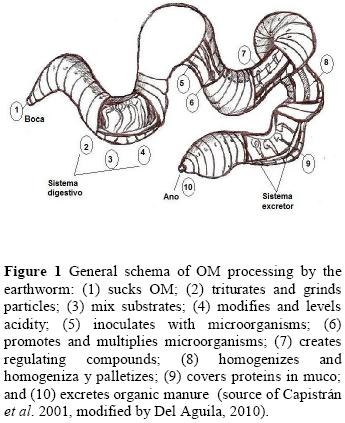
<body><![CDATA[<p align="justify"><font face="verdana" size="2">Vermicomposting consists in a bio&#45;oxidative process where the earthworm takes part (Santamar&iacute;a and Ferrera, 2002; Aira <i>et al,</i> 2008). The conversion of OM by the worm in its digestive tract occurs in two stages (<a href="#f1">figure 1</a>); in the first stage (physical&#45;mechanical) one notices airing, mixing and milling of OM; in the second (biochemical) labile substrates (sugars, amino acids, lipds and cellulose), which are decomposed by bacteria, are produced. In this second stage the maturing of C sources and recalcitrant substances and materials (hemicellulose and lignin) is finished, as well as the formation of stable humic substances (Soto and Mu&ntilde;oz, 2002; Moreno <i>et al.,</i> 2005).</font></p>  	    <p align="center"><font face="verdana" size="2"><a name="f1"></a><img src="/img/revistas/tsa/v14n3/a3f1.jpg"></font></p>  	    <p align="justify"><font face="verdana" size="2">&nbsp;</font></p>  	    <p align="justify"><font face="verdana" size="2">As the earthworm uses OM as food source, it requires help from protozoans, rotifers, nematodes, bacteria and fungi to acquire its nutriments; its digestive system is composed of oral cavity, pharynx, crop, esophagus, gizzard, calciferous glands, intestine and anus (Edwards and Bohlen, 1996; Garc&iacute;a, 2006). Each earthworm consumes about 100&#45;300 mg/g dry weight a day of food and can increase its live weight in circa 300&#45;450 mg in 90 days (Sharma <i>et al,</i> 2005). The material eaten by the worm is distributed between 5&#45;10% for growth and metabolic activities; the other 85% is excreted as vermicompost that contains urine (as ammonia) and mucoproteins (Blair <i>et al.</i> 1997). There are, in the digestive tract, enzymes and microflora that carry out the digestion of OM; enzymes such as amylase, endoclunease, protease, lipase, cellulose, alkaline phosphate, acid and nitrate reduc&iacute;ase, all of them turn proteins and carbohydrates into energy and unfold other organic components with structural complexity (Cuevas, 2005; Prabna <i>et al,</i> 2007).</font></p>  	    <p align="justify"><font face="verdana" size="2">The alimentary requirements of the worm are composed of four basic elements, namely: green residues (high N content), brown residues (high C content), water (moisture) and air (oxygen and ventilation) (Sharma <i>et al,</i> 2005). The largest content of organic C comprises proteins, hemicellulose, cellulose and lignin. Proteins are the most abundant form of N in organisms and are the main constituent of every life form (Paul and Clark, 1996). The contents of C and N have to be adequate dosages to perform a good process (Ndegwa and Thompsom, 2000); if there is too much C, it becomes slow, and if there is more N, it creates bad odors and produces a viscous mixture (Rodriguez and Cordova, 2006). In <a href="/img/revistas/tsa/v14n3/a3t2.jpg" target="_blank">table 2</a> we describe the sort of source, organic residue, and the cares necessary to produce compost and vermicompost.</font></p>  	    <p align="justify"><font face="verdana" size="2">Earthworms can feed on conventional organic residues (vegetal and animal), and to a lesser extent on those non&#45;conventional, which are residues from alimentary and paper industries, winemaking, wild animals, including SS (municipal origin) (Sharma <i>et al,</i> 2005). A good selection of food in quantity and quality (N source) determines the good development of earthworms as for biomass, fertility and mortality rate (Lowe and Butt, 2005). The worm chooses the sort of food based on its enzymatic activity, works by Prabna and collaborators (2007) measured the enzymatic activity of cellulose in two worm species, <i>E. f&eacute;tida</i> and <i>M. guillelmi,</i> finding that <i>E. f&eacute;tida</i> (152.8&Uuml;8 ug cellulose g<sup>&#45;1</sup> of dry weight worm) had preference for wheat in relation to <i>M. guillelmi</i> (18.9 &plusmn; 1.3 ug glucose g<sup>&#45;1</sup> of dry weight worm) due to a higher enzymatic activity. Other studies report a biomass increase of 250% in the case of water hyacinth <i>(Eichhornia crassipie,</i> Mart. Solm) and <i>E. euginaea</i> (Gajalaksmi <i>et al.,</i> 2001). The increase in reproductive rate and egg production in <i>P. sensibaricus</i> yielded satisfactory results using vegetal residues and dead leaves (Suthar, 2007). The same researcher (Suthar, 2009b), two years later however, worked with <i>E. f&eacute;tida</i> and mixtures of market vegetal residues and wheat (1:1) to amend and the obtained product improved the C/N ratio (20) and the content of N (31.3 g kg<sup>&#45;1</sup>), available P (8.7 g kg<sup>&#45;1</sup>) and interchangeable K (20.7 g kg<sup>&#45;1</sup>).</font></p>  	    <p align="justify"><font face="verdana" size="2">There are differences in residues from animals to favor the increment of biomass, the manure which the worm <i>(E. f&eacute;tida)</i> assimilates best to obtain larger biomass comes from ovine (55.3 &plusmn;1.9 mg/g) and the least from camel (32.5 &plusmn; 1.4 mg/g), out of a series of manures under study and in ascending biomass order they were: sheep&gt;donkey&gt;buffalo&gt;goat=cow=horse&gt;camel. In egg production, the largest number was obtained with sheep manure (0.44&plusmn; 0.052), being 25.3% higher than with buffalo manure (0.19&plusmn;0.072) in ascending order we have: sheep&gt;cow=horse=goat&gt;camel&gt;donkey&gt;buffalo (Garg <i>et al.,</i> 2005). Cow, horse, goat and sheep scats adequately respond to the growth and reproduction of <i>E. f&eacute;tida,</i> however there is very little experience in studies that employ wild animal organic residues so it is required to have more nonconventional sources of C and N to be recycled and used.</font></p>  	    <p align="justify"><font face="verdana" size="2">Organic residues that are generated in the city and the countryside can be used as a mixture; works by Sangwan and collaborators (2008) are based on the use of mixtures of animal and vegetal residues, thus they achieved a maximal growth of <i>E. f&eacute;tida,</i> for instance, when they use a proportion of 90% horse manure and 10% of sugar residue. Other studies mention mixtures of residues from textile industry and bird feces (40% textiles, 60% bird feces) that favor the development and reproduction of <i>E. f&eacute;tida</i> (Garg and Kaushik, 2005). Both a good selection of residues and a good balance of them in the worm diet have as a result a good development, biomass production and vermicompost; however, if the organic residues have potentially toxic substances, such as ammonia and salts present in animal manure or tannins and acid substances, found in vegetal residues, the problem has to be sold carrying out a pre&#45;composting on the organic residues (Gunadi <i>et al.,</i> 2002).</font></p>  	    <p align="justify"><font face="verdana" size="2">&nbsp;</font></p>  	    <p align="justify"><font face="verdana" size="2"><b>Physical and chemical characteristics that govern the development of vermicomposting</b></font></p>  	    ]]></body>
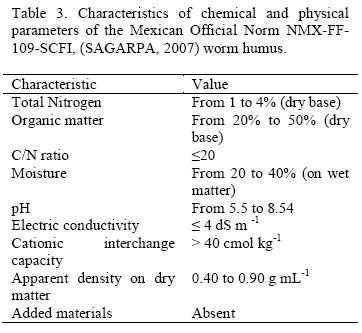
<body><![CDATA[<p align="justify"><font face="verdana" size="2">In order to learn whether a vermicompost meets the standards for its use as a soil conditioner, there is need for the monitoring of parameters such as: temperature, moisture, pH, airing, particle size, capacity of cationic interchange (CCI), organism matter (OM), nitrogen (N) and C/N ratio (Garc&iacute;a, 2006). These parameters regulate all the biological activities of the worm; temperature helps manipulate the lifecycle of the worm (Lowe and Butt, 2005), the optimal temperature for the development of <i>E. f&eacute;tida</i> is between 15&deg; C and 25&deg; C. At low temperatures (3&#45;5&deg;C) the incubation of <i>L. terrestres</i> is inhibited, this worm gains weight if temperature rises (2.6 g) to 20&deg;C from the 16<sup>th</sup> week and it loses weight if temperature drops (0.25 g) to 5&deg;C (Mangrich <i>et al,</i> 2000; Santamar&iacute;a and Ferrera, 2002).</font></p>  	    <p align="justify"><font face="verdana" size="2">Moisture helps the worm <i>(E. f&eacute;tida)</i> to have a thin film of water to carry out gas interchanges, the optimal moisture level is between 60 and 80% which prevents the worm from losing weight and dehydration (Manna <i>et al,</i> 2003; Lowe and Butt, 2005). Moisture is also related to the age of the worm, if there are moistures between 70% and 80% they are adults, and with 60% and 70% they are juvenile (Gunadi <i>et al.,</i> 2002).</font></p>  	    <p align="justify"><font face="verdana" size="2">Airing favors the increase of the population of worms due to the high requirements of oxygen and this process of the physical and manual kind that facilitates the passive diffusion of air. The recommended particle size is 5 cm, for it supplies a larger exposure surface; large fragments of manure favor airing, yet they take longer to degrade (Garc&iacute;a, 2006).</font></p>  	    <p align="justify"><font face="verdana" size="2">The habitat of the worm requires a pH from 6.8 to 7.8 to grow and reproduce (Garg <i>et al.,</i> 2006); if pH decreases by the end of the process, it is due to the production of CO<sub>2</sub> and organic acids (Premuzic <i>et al.,</i> 2002; Kaushik and Garg, 2004). In an acid environment, the worm secretes calcium carbonate to neutralize the acidity of the environment and so avoid mortality (Dekker, 2002). It is also recognized that changes in pH take place during microbial decomposition, mineralization of N and P in nitrite/nitrate and orthophosphates (Sutarh, 2009a).</font></p>  	    <p align="justify"><font face="verdana" size="2">The capacity of cationic interchange (CCI) increases by the end of the process (Garg <i>et al.,</i> 2005) and it is considered an indicator of the degree of maturity and stability due to the presence of radical groups (carboxylic and phenolic), which helps increase the interchange places to improve the enriching of the humic fraction (Yagi <i>et al.,</i> 2003; Romero <i>et al.,</i> 2007). In the compost CCI (400 meq kg<sup>&#45;</sup>1) is larger than that in a mineral soil (150 meq kg<sup>&#45;1</sup>) (Mathur <i>et al.,</i> 1993).</font></p>  	    <p align="justify"><font face="verdana" size="2">As the worm processes OM, it modifies the sources of C, N and by means of the C/N ratio, it reports on the quality of the obtained product. Organic C decreases by the end of vermicomposting, from different factors, namely: i) the worm consumption of organic C; ii) the transformation into CO<sub>2</sub> by the respiratory activity; iii) the formation of humic fraction that makes room for mature vermicompost (Singh <i>et al.,</i> 2005; Garg <i>et al.,</i> 2006; Suthar, 2009a). On the other side N increases by the end of the process and responds to i) the elaboration of products (metabolites) that contain N by the worm; ii) the excrete of mucus that is a fluid rich in N eliminated by the worm; iii) the substratum enzymes, NH<sub>4</sub><sup>+</sup>, dead tissue rich in N; and iv) the mineralization process during vermicomposting (Chaudhuri <i>et al,</i> 2000; Aira <i>et al,</i> 2006; Muthukumaravel <i>et al,</i> 2008). C/N ratio expresses the quantity of C and N that has to be included to elaborate a vermicompost and it decreases by the end of the process (Yadav and Garg, 2009). The optimal C/N ratio is between 20:1 and 30:1, according to Soto and Mu&ntilde;oz, (2002); Orozco and collaborators (2000). Works by Garc&iacute;a (2006), Palsania and collaborators (2008) mention that the process shall begin with a C/N ratio of 60 and end with a value of 20; moreover, the C/N ratio determines the age of the worm, a value under 20 indicates the presence of mature organisms (60%) and above 20 indicates the presence of juvenile organisms (70%) and an incubation period (Aira <i>et al,</i> 2007).</font></p>  	    <p align="justify"><font face="verdana" size="2">A faulty management of the aforementioned parameters brings along a bad quality vermicompost, and it can pollute the ground, plants and animals, due to the presence of noxious substances. Nowadays the General Law of Prevention and Integral Management of Residues does not consider a specific regulation that analyzes a regulation to produce composts, however the Mexican Norm of humus, worm, specifications and testing methods <i>{Norma Mexicana de humus, lombriz, especificaciones y m&eacute;todos de prueba, SAGARPA, 2007)</i> takes into account the characterization of the most important parameters that shall be considered to sell composts (<a href="#t3">table 3</a>). The sale of vermicompost must be certified and supported by laboratories that indicate that said product can be used as a soil improver or organic fertilizer.</font></p>  	    <p align="center"><font face="verdana" size="2"><a name="t3"></a><img src="/img/revistas/tsa/v14n3/a3t3.jpg"></font></p>  	    <p align="justify"><font face="verdana" size="2">&nbsp;</font></p>  	    <p align="justify"><font face="verdana" size="2"><b>The importance of humic acids</b></font></p>  	    ]]></body>
<body><![CDATA[<p align="justify"><font face="verdana" size="2">Worm stabilize OM, and in it one finds humic acids (HA) which are substances that provide vermicompost with an aliphatic character (Mangrich <i>et al,</i> 2000; Campitelli and Ceppi, 2008) and that benefit the development and growth of the plants (Suthar, 2008). Vermicompost has complex organic structures (Santamar&iacute;a and Ferrera, 2002; Romero <i>et al,</i> 2007), which undergo chemical and enzymatic degradation and become a complex mixture that in the laboratory is broken into three fractions based on their aqueous solubility: (1) humic acids (HA), (2) fulvic acids, and (3) humic substances. HA are amorphous mixtures of heavy molecular weight, black in color and it is the main constituent of humic substances (Porta <i>et al,</i> 2003).</font></p>  	    <p align="justify"><font face="verdana" size="2">Depending on the origin of the organic residue (sheep, goat, cow and rabbit), the vermicompost will present a variety of functional groups in HA and rich in N, O, and H, such as chemical structures (aromatic rings, carboxylic, phenolic, hydroxyl and alcoholic groups). The total acidity of HA determines the addition of carboxylic and phenolic groups (Masini <i>et al,</i> 1998).</font></p>  	    <p align="justify"><font face="verdana" size="2">HA restitute the fertility potential of the soil when it is present in vermicompost and modify the physical and chemical properties of the soil (Cuevas, 2005; Pramaik <i>et al,</i> 2007). HA have their diverse origin in different organic residues (animal, vegetal, sewage sludge, paper industry, etc.) and their use as a remedy in cultivation soils yields satisfactory results (<a href="/img/revistas/tsa/v14n3/a3t4.jpg" target="_blank">table 4</a>); studies in the agricultural field point out that HA improve the germination and growth of seeds and increase the production of ornate plants and also for human consumption, which besides act together with auxins, gibberellins and cytokinins as growth regulating hormones (Canellas <i>et al,</i> 2002).</font></p>  	    <p align="justify"><font face="verdana" size="2">Currently the mechanisms that unleash the growth of a large variety of ornate and human consumption plants are not known in HA, so this field of study demands attention (Atiyeh <i>et al.</i>, 2002). The use of HA (from a vermicompost) as a liquid fosters a better development of the plants and roots in a barley cultivation in relation to chemical fertilizer (Ortega and Fern&aacute;ndez, 2007); works that evaluate mono&#45; and poly&#45;cultivations in the field and relate HA, N, P, K choose poly&#45;cultivations because this systems favors the increment of the production of the plant by adding HA and nutriments (Kankan and Balasubramanian, 2007). Other benefits of HA are of the environmental kind, as they sequestrate heavy metals and herbicides by means of chemical complexation and adsorption of toxic organic compounds (Mangrich <i>et al.,</i> 2000; Atiyeh <i>et al,</i> 2002).</font></p>  	    <p align="justify"><font face="verdana" size="2">&nbsp;</font></p>  	    <p align="justify"><font face="verdana" size="2"><b>Composting of sewage sludge and its use</b></font></p>  	    <p align="justify"><font face="verdana" size="2">Vermiculture is an agricultural activity that has been on the increase as from the 1990's in Mexico (Cardoso, 2002). In China vermicomposting techniques have been known for more than 6000 years; nowadays, vermicomposting techniques are commercially applied in countries such as the United States, Canada, Japan and the Philippines; as an instance, the city of Ontario, Canada, processes near 75 tons a week (Rodriguez and Cordova, 2006).</font></p>  	    <p align="justify"><font face="verdana" size="2">The organic residues that are used in the elaboration of vermicompost are mainly manures; the accumulation of manure generates pollution from odors, nitrates and salts. In Mexico there is a variety of manures, namely: bovine, from fowl, pigs, rabbits and goats. Bovine manure is one of the residues that contain good levels of N and some 3 thousand tons a week are produced (Lu&eacute;vano and Velasquez, 2001). In <a href="/img/revistas/tsa/v14n3/a3t5.jpg" target="_blank">Table 5</a> we show studies that employ different sorts of organic residues as ameliorations, where bovine manure and <i>K f&eacute;tida</i> species are the most reported, as this species presents a broad adaptation to the environment (Suthar, 2009b).</font></p>  	    <p align="justify"><font face="verdana" size="2">Vermicomposting techniques represent and important alternative to solve many of the pollution problems in disposing SS (Velasco and Wolke, 2003); in the past SS were sent to the seabed and to the open; nowadays however, they are treated and are utilized as soil improvers and conditioners. In the frame of sustainable development, the use of organic products with high content of stabilized OM and nutriments that increase the quality of depleted agricultural soils is required (Cuevas and Walter, 2004). In the United States and Europe SS are subject to composting techniques to reduce pollution from this sludge, under programs and environmental policies that order to recycle them and dispose of them in the soil (Smith, 2009). In the United Kingdom, 44% of the total sludge production is composted; in France 7% and in the United States only 33% (Ced&uacute; <i>et al,</i> 2005). In Mexico there are no precise figures for this process, yet the pioneering studies on vermicomposting of SS date back to the end of the 1970's (Cardoso, 2002).</font></p>  	    <p align="justify"><font face="verdana" size="2">The practice of using organic fertilizers in Mexico goes back to ancient times; nevertheless, during the Green Revolution and the widespread use of soil fertilization was focused on applying chemical fertilizers of N and P, marginalizing organic manures, which were the base and sustain of agriculture for several centuries (L&oacute;pez <i>et al.,</i> 2001). Although plenty of information on the use of SS has been generated in different countries, the valuing of their use as organic fertilizer in Mexico has been both scantly explored and documented (Salcedo <i>et al.,</i> 2007). Composting and vermicomposting techniques are processes to stabilize organic residues; in composting two stages are distinguished: (i) the first one is called thermophilic, in which OM is decomposed with great intensity; and (ii) the second is a maturity stage, in which a mesophilic phase which consists in slowly degrading organic compounds (Boyle, 1990).</font></p>  	    ]]></body>
<body><![CDATA[<p align="justify"><font face="verdana" size="2">Vermicomposting involves bio&#45;oxidation and stabilization of organic residues by the action of the worm which stimulates the microorganisms that take part in biochemical activities degrading OM (Lazcano <i>et al,</i> 2008). As from recent decades the stabilization and maturity processes of the compost have been based on determining volatile solids (Boyle, 1990); nevertheless, nowadays parameters that measure stability have been increased, namely: plant growth, respiration speed, humification index, C/N ratio, content of pathogens, metal bio&#45;availability, bad odor, toxic organic substances and production of methane (Tognettie/a/., 2007).</font></p>  	    <p align="justify"><font face="verdana" size="2">The stabilization of SS via vermicomposting or composting generates a series of advantages which are:</font></p>  	    <p align="justify"><font face="verdana" size="2">&bull; Turn SS in an article with added value;</font></p>  	    <p align="justify"><font face="verdana" size="2">&bull; Measure and control pollutants (Campitelli and Ceppi, 2008);</font></p>  	    <p align="justify"><font face="verdana" size="2">&bull; Attenuate the content of metals available in the soil by means of the complexation of these on organic residues;</font></p>  	    <p align="justify"><font face="verdana" size="2">&bull; Reduce the availability and adsorption of metal in plants (Boyle, 1990);</font></p>  	    <p align="justify"><font face="verdana" size="2">&bull; Decrease the levels of pathogens in organic residues; and,</font></p>  	    <p align="justify"><font face="verdana" size="2">&bull; Facilitate enzymatic and microbial activities, and make the nutriments for plants available (Nair <i>et al,</i> 2006).</font></p>  	    <p align="justify"><font face="verdana" size="2">&bull; Some works point out the benefits of stabilized SS and the use of pre&#45;composted amendments which improve the quality of OM and favor mineralization between 25.4 and 39.8% (Adegbidi and Briggs, 2003). Another field study demonstrated that when 50 t kg<sup>&#45;1</sup> of composted SS are applied, maize production increases <i>{Zea mays L)</i> and the metals do not pose a threat to plants and livestock feeding because of their low mobility and bio&#45;availability (Cuevas and Walter, 2004). In the present day, the application of mixed type organic amendments based on SS and organic residues, as a mixture of 20% SS and 80% bovine manure provides better stability to the soil aggregates (Suthar and Singh, 2008) and when SS and urea are used with a dosage from 12 to 40 t ha<sup>&#45;1</sup> of SS and 350 kg ha"<sup>1</sup> of urea, for cultivations of tomato <i>{Lycopersicon esculentum Mill),</i> spinach <i>{Spinacia oler&aacute;cea L.</i>), lentil <i>{Lens esculenta Moench)</i> and maize <i>{Zea mays L)</i> improve the productivity of cultivation and it has been demonstrated that metal contents do not do harm to the plant (Albiach <i>et al.,</i> 2001). Mix amendments in the diet of the worm <i>{E. f&eacute;tida)</i> favor the increase of biomass and the number of eggs when mixtures with 70% of SS and 30% of water lily (Cardoso, 2002).</font></p>  	    <p align="justify"><font face="verdana" size="2">The importance of applying composting and vermicomposting technology to organic residues is that mainly decreases the chemical extiactability and solubility of metals (Smith, 2009); the combination of both techniques leads to a better stabilization of organic residues and also to sustainability, because it improves the economic cost to produce organic fertilizers due to their easy and environmental operation (Nair <i>et al,</i> 2006). These experiences in the agricultural sphere are oriented to the culture of organic fertilizers use, since the countryside is still invaded by chemical fertilizers that cause soil degradation. The use of SS composted by worms will favor the reduction of pollution, fostering the reuse and recycling of solid organic residues that are generated on a daily basis both in the countryside and the city (L&oacute;pez, 1994). The management of SS must consider there is a metal transit via the trophic chain of the worm, which may pose a risk and the probability that the metal moves toward other organisms, such as birds (Suthar, 2008).</font></p>  	    ]]></body>
<body><![CDATA[<p align="justify"><font face="verdana" size="2">&nbsp;</font></p>  	    <p align="justify"><font face="verdana" size="2"><b>Heavy metals in sewage sludge and their impact on the worm and environment</b></font></p>  	    <p align="justify"><font face="verdana" size="2">Any kind of municipal solid waste contains more heavy metals than those existing in the ground (Smith, 2009); because of this the Mexican Official Norm NOM&#45;004 (SEMARNAT, 2002) regulates the application of sewage sludge in function of its content of heavy metals and pathogens.</font></p>  	    <p align="justify"><font face="verdana" size="2">Heavy metals are in the environment, soil, food and their use is widespread in the manufacture of these service products, so they need to be recycled and transferred as composted organic residues (Smith, 2009). It is important to know the contents of heavy metals in SS before being applied to agricultural soils due to their high risk and toxicity (Jamali <i>et al,</i> 2009).</font></p>  	    <p align="justify"><font face="verdana" size="2">These considerations come from taking into account the application of SS in the soil and the how metals are found:</font></p>  	    <p align="justify"><font face="verdana" size="2">&bull; As ions in solution;</font></p>  	    <p align="justify"><font face="verdana" size="2">&bull; As interchange ions;</font></p>  	    <p align="justify"><font face="verdana" size="2">&bull; Bound to the surface of organic colloids; and,</font></p>  	    <p align="justify"><font face="verdana" size="2">&bull; Occluded or co&#45;precipitated with metallic rusts, carbonates, phosphates, and other secondary minerals (Smith, 2009).</font></p>  	    <p align="justify"><font face="verdana" size="2">Pathogens such as bacteria <i>(Salmonellae),</i> viruses and parasitic worms (<i>Ascaris</i> spp) are to be taken into account when applying SS, the persistence of these agents is favored by low temperatures, alkaline pH, a high OM content and moisture (Boyle, 1990).</font></p>  	    ]]></body>
<body><![CDATA[<p align="justify"><font face="verdana" size="2">Metals are known as potentially toxic elements (PTE) and the most likely to be found in SS are: Zn, Cu, Ni, Cd, Pb, Hg and Cr, being their origin the contribution of urban and industrial sort. The PTE that are shown in <a href="/img/revistas/tsa/v14n3/a3t6.jpg" target="_blank">table 6</a> are found booth in the city and countryside and with a higher frequency they are Cu with 589 mg kg<sup>&#45;1</sup> and Zn with 1144 mg kg<sup>&#45;1</sup> (Delgado <i>et al,</i> 2002).</font></p>  	    <p align="justify"><font face="verdana" size="2">PTE can pose high risk when they enter into the trophic chain of human beings and affect the primary and secondary producers who are exposed to them (Suthar and Sing, 2008). The damage in the plant is determined by the sort of metal, availability and content (Sandoval <i>et al,</i> 2001). Zn, Cu and Ni present in SS must be regulated to be agriculturally applied; Zn and Cu affect the growth of many vegetal species within a range of 200&#45;300 mg of Zn kg<sup>&#45;1</sup> and 15&#45;20 mg of Cu kg<sup>&#45;1</sup> dry weight. Cu tends to be heavily absorbed by the soil and the plant regulates its absorption. The reduction of the phytotoxicity of Zn, Cu, and Ni in the plant tissue is improved if there is a fine texture and a pH of 6.8 (Smith, 2009). Ni, Cd and Pb are phytotoxic in contents of 10&#45;100 mg kg<sup>&#45;1</sup>,5&#45;30 mg kg<sup>&#45;1</sup> and 30&#45;300 mg kg<sup>&#45;1</sup> (dry weight), respectively. Zn in excess favors the presence of yellow stripes and brown spots on the leaves; this metal moves fast into the plant tissue (Smith, 1996). Ni in excess provokes the appearance of brown spots on the leaves and white stripes along them. If Cd surpasses the permissible, brownish&#45;reddish spots appear on the leaves and damage the stem (Pereira <i>et al,</i> 2003). Cr does not have adverse effects, yet if it is found as Cr (VI), it is highly toxic for plants (Smith, 1996). Phytoavailability is corrected if the soil presents a slightly alkaline pH and the composted SS amendment is applied (Smith, 2009).</font></p>  	    <p align="justify"><font face="verdana" size="2">If PTE enter into the diet of human beings, they harm health. Zn does not represent a toxic effect (Zhou and Wong, 2001; Volke <i>et al,</i> 2005). Cd is toxic in human diets; however the tolerance value for human consumption is 16.2 ug of Cd a day (Pereira <i>et al,</i> 2003). Pb poses a risk in child diets, causing serious problems of encephalitis and neuronal damages (Acarasquero <i>et al,</i> 2006). Pb shows a low availability in cultivations for human consumption and if SS is applied to cultivation soils there is an increase of 25000 mg of Pb kg<sup>&#45;1</sup> of soil. Cu only presents toxic effects in grazing animals (Smith, 1996).</font></p>  	    <p align="justify"><font face="verdana" size="2">Industrial activities still damage the environment, which makes a reflection on the ameliorating technologies necessary (Fern&aacute;ndez <i>et al,</i> 2006), and to do so one can resort to composting and vermicomposting techniques where the former performs a chemoremediation, sequestering heavy metals, being Pb the one with the strongest chemical binding, above Ni, Zn, Cu and Cd. In vermicomposting the worm is known as a bioremediation agent (Boyle, 1990; Baker, and Kryson, 2002). In organisms bioavailability is determined in a laboratory and in the field by means of geochemical techniques of sequential extraction, and more recently using bio&#45;indicators; these last are based upon the determination of a metal in the tissue of the organisms by exposure to pollutants (Sandoval <i>et al,</i> 2001). The function of the bio&#45;remediating agent consists in removing (extracting), degrading (biodegrading) or transforming (biotransforming) toxic organic compounds into less toxic or innocuous metabolic products (Velasco and Wolke, 2003). An instance of bioremediation is the earthworm <i>(E. f&eacute;tida)</i> that removes metals from SS from sugar industry and reduces the content of Zn (20.5&#45;43.8%), Fe (23.6&#45;34%), Mn (18&#45;45%), and Cu (29&#45;58.1%) (Suthar, 2008).</font></p>  	    <p align="justify"><font face="verdana" size="2">The worm presents selectivity between metals and the tissue where it is absorbed; the bioaccumulation of Cd and Ni in the worm tissue represents a linear relation between the metal in the tissue and time (Aleagha <i>et al,</i> 2009). Chronic exposure to Cd and Cu generates changes in metabolism and decreases the production of carbohydrates, lipids, proteins in the worm (Shukla and Kumar, 2006; Prabna <i>et al,</i> 2007). The chemical selectivity in adsorbing metals in the tissue presents the following ascending order Zn&gt;Cu&gt;Pb&gt;Hg (Maboeta and Rensburg, 2003): an instance of this is in the bioaccumulation in the tissue of <i>E. f&eacute;tida</i> for Cu (16 &#45; 27 mg kg<sup>&#45;1</sup>), Fe (42&#45;89 mg kg<sup>&#45;1</sup>), Zn (58 &#45;75 mg kg<sup>&#45;1</sup>) and Pb (1.7&#45;12.4 mg kg<sup>&#45;1</sup>) analyzing SS that underwent vermicomposting and the most frequently selected tissue was from kidney and liver (Carpene <i>et al,</i> 2005; Renoux <i>et ah,</i> 2007).</font></p>  	    <p align="justify"><font face="verdana" size="2">Because of the great importance that the environment has in correcting the problem of pollution from organic residues promoted by industrialization and urbanization, which have generated a large amount of organic residues, it is necessary to implement techniques where worm, in addition to produce biomass (providing), performs another task that consists in being a bio&#45;remediation to regulate the environment via reducing and bio&#45;transforming organic residues and making them useful, in benefit of society.</font></p>  	    <p align="justify"><font face="verdana" size="2">&nbsp;</font></p>  	    <p align="justify"><font face="verdana" size="2"><b>CONCLUSIONS</b></font></p>  	    <p align="justify"><font face="verdana" size="2">From the previous revision earthworm is considered an organism that decomposes and stabilizes OM, due to the contribution of nutriments available to the soil and plant. Vermiculture reduces the production costs of organic fertilizers and in the agricultural sector, requires experiences where new nonconventional sources of C and N are studied, such as SS, in which the biological, physical and chemical parts of the worm are known so that with the help from practitioners, can attack the problem from the productive and environmental viewpoint. Because of this, it is necessary to continue testing dosages and different mixtures, and apply them as an alternative in the short and middle terms in the agricultural and forest spheres in Mexico. The Mexican Official Norm NMX&#45;FF&#45;109&#45;SCFI (SARPA, 2007) states that the product can be commercialized and become a sustainable industry to solve pollution problems where organic residues are involved (SS included). The worm has to be seen as a bio&#45;remediating organism as it accumulates and cleanses polluted soils, so it is required to carry out new studies that respond to the challenges of bio&#45;remediation, when one works with residues that contain heavy metals and other compounds from SS and conventional organic residues. In Mexico, the use of conventional organic residues from the agricultural sector (manure from bovines, horses, pigs, birds) have been successful in its application, however the use of nonconventional residues generated in the city and industry (residues from alimentary, textile, paper, winemaking industries and municipal sludge) have been very sporadically used. So it is needed to continue working and testing these sorts of residues in benefit of the environment and meeting the environmental criterion as for the reduction of weight and volume, hence favoring the reduction of pollution in the planet.</font></p>  	    <p align="justify"><font face="verdana" size="2">&nbsp;</font></p>  	    ]]></body>
<body><![CDATA[<p align="justify"><font face="verdana" size="2"><b>REFERENCES</b></font></p>  	    <!-- ref --><p align="justify"><font face="verdana" size="2">Acarasquero, D., Flores, I., Perozo, C, Permaleto, Z. 2006. Immobilization of lead by a vermicompost and its effect on white bean <i>(Vigna Sinenis</i> var. Apure) uptake. International Journal Environmental Science. Technology. 3:203&#45;210.    &nbsp;&nbsp;&nbsp;&nbsp;&nbsp;&nbsp;&nbsp;&nbsp;[&#160;<a href="javascript:void(0);" onclick="javascript: window.open('/scielo.php?script=sci_nlinks&ref=10096536&pid=S1870-0462201100030000300001&lng=','','width=640,height=500,resizable=yes,scrollbars=1,menubar=yes,');">Links</a>&#160;]<!-- end-ref --></font></p>  	    <!-- ref --><p align="justify"><font face="verdana" size="2">Adegbidi, H.G., Briggs, R.H. 2003. Nitrogen mineralization of sewage sludge and composted poultry manure applied to willow in a greenhouse. Journal Biomolecular. Bioenergy. 25: 665&#45;673.    &nbsp;&nbsp;&nbsp;&nbsp;&nbsp;&nbsp;&nbsp;&nbsp;[&#160;<a href="javascript:void(0);" onclick="javascript: window.open('/scielo.php?script=sci_nlinks&ref=10096538&pid=S1870-0462201100030000300002&lng=','','width=640,height=500,resizable=yes,scrollbars=1,menubar=yes,');">Links</a>&#160;]<!-- end-ref --></font></p>  	    <!-- ref --><p align="justify"><font face="verdana" size="2">Adir, A.J., Nor, Z.M. 2009. Waste recycling: Utilization of coffee grounds and kitchen waste in vermicomposting. Bioresource Technology. 100:1027&#45;1030.    &nbsp;&nbsp;&nbsp;&nbsp;&nbsp;&nbsp;&nbsp;&nbsp;[&#160;<a href="javascript:void(0);" onclick="javascript: window.open('/scielo.php?script=sci_nlinks&ref=10096540&pid=S1870-0462201100030000300003&lng=','','width=640,height=500,resizable=yes,scrollbars=1,menubar=yes,');">Links</a>&#160;]<!-- end-ref --></font></p>  	    <!-- ref --><p align="justify"><font face="verdana" size="2">Aira, M., Monroy, F., Dom&iacute;nguez, J. 2006. C to N ratio strongly affects population structure of <i>Eisenia f&eacute;tida</i> in vermicomposting systems. Europan Journal Soil Biology. 42: s127&#45;s131.    &nbsp;&nbsp;&nbsp;&nbsp;&nbsp;&nbsp;&nbsp;&nbsp;[&#160;<a href="javascript:void(0);" onclick="javascript: window.open('/scielo.php?script=sci_nlinks&ref=10096542&pid=S1870-0462201100030000300004&lng=','','width=640,height=500,resizable=yes,scrollbars=1,menubar=yes,');">Links</a>&#160;]<!-- end-ref --></font></p>  	    <!-- ref --><p align="justify"><font face="verdana" size="2">Aira, M., Monroy, F., Dom&iacute;nguez, J. 2007. <i>Eisenia f&eacute;tida (Oligochaeta Lumbricidae)</i> modifies the structure and physiological capabilities of microbial communities improving carbon mineralization during vermicomposting of pig manure. Microbiology Ecology. 54:662&#45;671.    &nbsp;&nbsp;&nbsp;&nbsp;&nbsp;&nbsp;&nbsp;&nbsp;[&#160;<a href="javascript:void(0);" onclick="javascript: window.open('/scielo.php?script=sci_nlinks&ref=10096544&pid=S1870-0462201100030000300005&lng=','','width=640,height=500,resizable=yes,scrollbars=1,menubar=yes,');">Links</a>&#160;]<!-- end-ref --></font></p>  	    <!-- ref --><p align="justify"><font face="verdana" size="2">Aira, M., Sampdero, L., Monroy, F., Dom&iacute;nguez, J. 2008. Detritivorous earthworms directly modify the structure, thus altering the functioning of a microdecomposer food web. Soil Biology &amp; Biochemistry. 40:2511&#45;2516.    &nbsp;&nbsp;&nbsp;&nbsp;&nbsp;&nbsp;&nbsp;&nbsp;[&#160;<a href="javascript:void(0);" onclick="javascript: window.open('/scielo.php?script=sci_nlinks&ref=10096546&pid=S1870-0462201100030000300006&lng=','','width=640,height=500,resizable=yes,scrollbars=1,menubar=yes,');">Links</a>&#160;]<!-- end-ref --></font></p>  	    <!-- ref --><p align="justify"><font face="verdana" size="2">Albiach, R., Canet, R., Pomares, F., Ingelmo, F. 2001. Organic matter components and aggregates stability after the application of different amendments to a horticultural soil. Bioresource Technology.76: 125&#45;129.    &nbsp;&nbsp;&nbsp;&nbsp;&nbsp;&nbsp;&nbsp;&nbsp;[&#160;<a href="javascript:void(0);" onclick="javascript: window.open('/scielo.php?script=sci_nlinks&ref=10096548&pid=S1870-0462201100030000300007&lng=','','width=640,height=500,resizable=yes,scrollbars=1,menubar=yes,');">Links</a>&#160;]<!-- end-ref --></font></p>  	    <!-- ref --><p align="justify"><font face="verdana" size="2">Aleagha, M.H., Pedrau, H., Omani, G. 2009. Bioaccumulation of heavy metals by Iranian earthworms <i>{Eisenia f&eacute;tida)</i> in the process of vermicomposting. Europan Journal Agricultural Environmental Science. 4: 480&#45;484.    &nbsp;&nbsp;&nbsp;&nbsp;&nbsp;&nbsp;&nbsp;&nbsp;[&#160;<a href="javascript:void(0);" onclick="javascript: window.open('/scielo.php?script=sci_nlinks&ref=10096550&pid=S1870-0462201100030000300008&lng=','','width=640,height=500,resizable=yes,scrollbars=1,menubar=yes,');">Links</a>&#160;]<!-- end-ref --></font></p>  	    <!-- ref --><p align="justify"><font face="verdana" size="2">Arancon, Q. N, Clive, A., Stephen, L.E., BYrne, R. 2006. Effects of humic acids from vermicompost on plant growth. Europan Journal Biology. 42: S65&#45;S67.    &nbsp;&nbsp;&nbsp;&nbsp;&nbsp;&nbsp;&nbsp;&nbsp;[&#160;<a href="javascript:void(0);" onclick="javascript: window.open('/scielo.php?script=sci_nlinks&ref=10096552&pid=S1870-0462201100030000300009&lng=','','width=640,height=500,resizable=yes,scrollbars=1,menubar=yes,');">Links</a>&#160;]<!-- end-ref --></font></p>  	    <!-- ref --><p align="justify"><font face="verdana" size="2">Armijo, V., Ojeda, B.S., Ram&iacute;rez, B. M.E. 2007. Caracterizaci&oacute;n de residuos s&oacute;lidos el potencial de reciclaje para una instituci&oacute;n de educaci&oacute;n superior. Encuentro Nacional de Expertos en Residuos S&oacute;lidos. Universidad Aut&oacute;noma de Baja California, M&eacute;xico. ISBN 970&#45;735&#45;075&#45;X: pp. 66&#45;77.    &nbsp;&nbsp;&nbsp;&nbsp;&nbsp;&nbsp;&nbsp;&nbsp;[&#160;<a href="javascript:void(0);" onclick="javascript: window.open('/scielo.php?script=sci_nlinks&ref=10096554&pid=S1870-0462201100030000300010&lng=','','width=640,height=500,resizable=yes,scrollbars=1,menubar=yes,');">Links</a>&#160;]<!-- end-ref --></font></p>  	    <!-- ref --><p align="justify"><font face="verdana" size="2">Atiyeh, R. M. Subler, S., Edwards, C. A., Bachman, G., Metzger, J. D., Shuster, W. 2000. Effects of vermicomposts and composts on plant growth in horticultural container media and soil. Pedobiologia. 44: 579&#45;590.    &nbsp;&nbsp;&nbsp;&nbsp;&nbsp;&nbsp;&nbsp;&nbsp;[&#160;<a href="javascript:void(0);" onclick="javascript: window.open('/scielo.php?script=sci_nlinks&ref=10096556&pid=S1870-0462201100030000300011&lng=','','width=640,height=500,resizable=yes,scrollbars=1,menubar=yes,');">Links</a>&#160;]<!-- end-ref --></font></p>  	    <!-- ref --><p align="justify"><font face="verdana" size="2">Atiyeh, R.M., Lee, S., Edwards, C.A., Arancon, N.O., Metzge, J.D. 2002. The influence of humic acids derived from earthwoms&#45;proced organics wastes on plant growth. Bioresource Technology. 84: 7&#45;14.    &nbsp;&nbsp;&nbsp;&nbsp;&nbsp;&nbsp;&nbsp;&nbsp;[&#160;<a href="javascript:void(0);" onclick="javascript: window.open('/scielo.php?script=sci_nlinks&ref=10096558&pid=S1870-0462201100030000300012&lng=','','width=640,height=500,resizable=yes,scrollbars=1,menubar=yes,');">Links</a>&#160;]<!-- end-ref --></font></p>  	    <!-- ref --><p align="justify"><font face="verdana" size="2">Baker, V.A., Kryson, G.M. 2002. Bioremediation of heavy metals and organic toxicants by composting. Science. World Journal. 2: 407&#45;420.    &nbsp;&nbsp;&nbsp;&nbsp;&nbsp;&nbsp;&nbsp;&nbsp;[&#160;<a href="javascript:void(0);" onclick="javascript: window.open('/scielo.php?script=sci_nlinks&ref=10096560&pid=S1870-0462201100030000300013&lng=','','width=640,height=500,resizable=yes,scrollbars=1,menubar=yes,');">Links</a>&#160;]<!-- end-ref --></font></p>  	    <!-- ref --><p align="justify"><font face="verdana" size="2">Bernache, G. 2007. Los Estudios de Basura en M&eacute;xico. Una Retrospectiva. Encuentro Nacional de Expertos en Residuos S&oacute;lidos. Universidad Aut&oacute;noma de Baja California, M&eacute;xico. ISBN 970&#45;735&#45;075&#45;X. pp. 7&#45;30.    &nbsp;&nbsp;&nbsp;&nbsp;&nbsp;&nbsp;&nbsp;&nbsp;[&#160;<a href="javascript:void(0);" onclick="javascript: window.open('/scielo.php?script=sci_nlinks&ref=10096562&pid=S1870-0462201100030000300014&lng=','','width=640,height=500,resizable=yes,scrollbars=1,menubar=yes,');">Links</a>&#160;]<!-- end-ref --></font></p>  	    <!-- ref --><p align="justify"><font face="verdana" size="2">Blair, J.M., Parmelee, R.W., Allen, M.F., McCartney, D.A., Stinner, B.R. 1997. Changes in soil N pools in response to earthworm population manipulations in agroecosystem with different N sources. Soil Biology &amp; Biochemistry. 29: 361&#45;367.    &nbsp;&nbsp;&nbsp;&nbsp;&nbsp;&nbsp;&nbsp;&nbsp;[&#160;<a href="javascript:void(0);" onclick="javascript: window.open('/scielo.php?script=sci_nlinks&ref=10096564&pid=S1870-0462201100030000300015&lng=','','width=640,height=500,resizable=yes,scrollbars=1,menubar=yes,');">Links</a>&#160;]<!-- end-ref --></font></p>  	    <!-- ref --><p align="justify"><font face="verdana" size="2">Bohlen. 2002. Earthworms.. Encyclopedia of Soil Science. R. Lai (ed). Florida, United State American, pp 370&#45;373.    &nbsp;&nbsp;&nbsp;&nbsp;&nbsp;&nbsp;&nbsp;&nbsp;[&#160;<a href="javascript:void(0);" onclick="javascript: window.open('/scielo.php?script=sci_nlinks&ref=10096566&pid=S1870-0462201100030000300016&lng=','','width=640,height=500,resizable=yes,scrollbars=1,menubar=yes,');">Links</a>&#160;]<!-- end-ref --></font></p>  	    <!-- ref --><p align="justify"><font face="verdana" size="2">Boyle, M. 1990. Biodegradation of land&#45;applied sludge. Journal Environmental Quality. 11:640&#45;643.    &nbsp;&nbsp;&nbsp;&nbsp;&nbsp;&nbsp;&nbsp;&nbsp;[&#160;<a href="javascript:void(0);" onclick="javascript: window.open('/scielo.php?script=sci_nlinks&ref=10096568&pid=S1870-0462201100030000300017&lng=','','width=640,height=500,resizable=yes,scrollbars=1,menubar=yes,');">Links</a>&#160;]<!-- end-ref --></font></p>  	    <!-- ref --><p align="justify"><font face="verdana" size="2">Cabrera, C R.E., Gordillo M. A.J., Hern&aacute;ndez M. A. 2007. Propuesta de planificaci&oacute;n para la gesti&oacute;n integral de residuos s&oacute;lidos en el estado de Hidalgo, M&eacute;xico. Encuentro Nacional de Expertos en Residuos S&oacute;lidos. Universidad Aut&oacute;noma de Baja California, M&eacute;xico. ISBN 970&#45;735&#45;075&#45;X. pp. 313&#45;324.    &nbsp;&nbsp;&nbsp;&nbsp;&nbsp;&nbsp;&nbsp;&nbsp;[&#160;<a href="javascript:void(0);" onclick="javascript: window.open('/scielo.php?script=sci_nlinks&ref=10096570&pid=S1870-0462201100030000300018&lng=','','width=640,height=500,resizable=yes,scrollbars=1,menubar=yes,');">Links</a>&#160;]<!-- end-ref --></font></p>  	    <!-- ref --><p align="justify"><font face="verdana" size="2">Campitelli, P., y Ceppi, P. 2008. Chemical, physical and biological compost and vermicompost characterization: A chemometric study. Chem. Intell. Lab. Syst.90: 64&#45;71s.    &nbsp;&nbsp;&nbsp;&nbsp;&nbsp;&nbsp;&nbsp;&nbsp;[&#160;<a href="javascript:void(0);" onclick="javascript: window.open('/scielo.php?script=sci_nlinks&ref=10096572&pid=S1870-0462201100030000300019&lng=','','width=640,height=500,resizable=yes,scrollbars=1,menubar=yes,');">Links</a>&#160;]<!-- end-ref --></font></p>  	    <!-- ref --><p align="justify"><font face="verdana" size="2">Canellas, L.P., Olivares, F.L.; Okokrokova&#45;Facanha, A.L., Fancanha, A.O. 2002. Humic acids isolated from earthworms compost enhance root elongation, lateral root emergence and plasma membrane H+&#45;ATPase activity in maize roots. Plant Physiololgy . 30: 1951&#45;1957.    &nbsp;&nbsp;&nbsp;&nbsp;&nbsp;&nbsp;&nbsp;&nbsp;[&#160;<a href="javascript:void(0);" onclick="javascript: window.open('/scielo.php?script=sci_nlinks&ref=10096574&pid=S1870-0462201100030000300020&lng=','','width=640,height=500,resizable=yes,scrollbars=1,menubar=yes,');">Links</a>&#160;]<!-- end-ref --></font></p>  	    <!-- ref --><p align="justify"><font face="verdana" size="2">Capistr&aacute;n, F., E. Aranda, Romero, J.C. 2001. Manual de reciclaje, compostaje y lombricompostaje. Instituto de Ecolog&iacute;a, A.C. Xalapa, M&eacute;xico. 150 p.    &nbsp;&nbsp;&nbsp;&nbsp;&nbsp;&nbsp;&nbsp;&nbsp;[&#160;<a href="javascript:void(0);" onclick="javascript: window.open('/scielo.php?script=sci_nlinks&ref=10096576&pid=S1870-0462201100030000300021&lng=','','width=640,height=500,resizable=yes,scrollbars=1,menubar=yes,');">Links</a>&#160;]<!-- end-ref --></font></p>  	    <!-- ref --><p align="justify"><font face="verdana" size="2">Cardoso, V.L. 2002. Sistema de vermiestabilizaci&oacute;n para plantas de tratamientos municipal. Congreso Interamericano de Ingenier&iacute;a Sanitaria y Ambiental. 28. Canc&uacute;n, M&eacute;xico. 27 oct&#45;1 nov.    &nbsp;&nbsp;&nbsp;&nbsp;&nbsp;&nbsp;&nbsp;&nbsp;[&#160;<a href="javascript:void(0);" onclick="javascript: window.open('/scielo.php?script=sci_nlinks&ref=10096578&pid=S1870-0462201100030000300022&lng=','','width=640,height=500,resizable=yes,scrollbars=1,menubar=yes,');">Links</a>&#160;]<!-- end-ref --></font></p>  	    <!-- ref --><p align="justify"><font face="verdana" size="2">Carpene, E., Andreana, G., Morani, M., Gast&oacute;te, C, Isari, G. 2005. Distribution of Cd, Zn, Cu, and Fe among selected tissues of the earthworm <i>(Allolophora caliginoasa)</i> and Eurasian Wordcok <i>(Scolopax raticula).</i> Science Total Environmental. 363:126&#45;135.    &nbsp;&nbsp;&nbsp;&nbsp;&nbsp;&nbsp;&nbsp;&nbsp;[&#160;<a href="javascript:void(0);" onclick="javascript: window.open('/scielo.php?script=sci_nlinks&ref=10096580&pid=S1870-0462201100030000300023&lng=','','width=640,height=500,resizable=yes,scrollbars=1,menubar=yes,');">Links</a>&#160;]<!-- end-ref --></font></p>  	    <!-- ref --><p align="justify"><font face="verdana" size="2">Cedu, F., Oitrenaud, M., Houot, S. 2005. Stabilization of process and feedstock compost. Science Utilization. 13: 72&#45;73.    &nbsp;&nbsp;&nbsp;&nbsp;&nbsp;&nbsp;&nbsp;&nbsp;[&#160;<a href="javascript:void(0);" onclick="javascript: window.open('/scielo.php?script=sci_nlinks&ref=10096582&pid=S1870-0462201100030000300024&lng=','','width=640,height=500,resizable=yes,scrollbars=1,menubar=yes,');">Links</a>&#160;]<!-- end-ref --></font></p>  	    <!-- ref --><p align="justify"><font face="verdana" size="2">Chaudhuri, P.S., Pal, T.K., Bhattacharjee, G., Dey, S.K. 2000. Chemical changes vermicomposting <i>(Periony excavatus)</i> of kitchen waste. Tropical Ecology. 41:107&#45;110.    &nbsp;&nbsp;&nbsp;&nbsp;&nbsp;&nbsp;&nbsp;&nbsp;[&#160;<a href="javascript:void(0);" onclick="javascript: window.open('/scielo.php?script=sci_nlinks&ref=10096584&pid=S1870-0462201100030000300025&lng=','','width=640,height=500,resizable=yes,scrollbars=1,menubar=yes,');">Links</a>&#160;]<!-- end-ref --></font></p>  	    <!-- ref --><p align="justify"><font face="verdana" size="2">Cuevas, G.R. 2005. Desarrollo de la lombriz <i>Eisenia f&eacute;tida</i> Sar. En dos localidades y efecto de la lombricomposta en ma&iacute;z en el Soconusco Chiapas. Tesis de Maestr&iacute;a. Universidad Aut&oacute;noma del Chiapas. M&eacute;xico. 64 p.    &nbsp;&nbsp;&nbsp;&nbsp;&nbsp;&nbsp;&nbsp;&nbsp;[&#160;<a href="javascript:void(0);" onclick="javascript: window.open('/scielo.php?script=sci_nlinks&ref=10096586&pid=S1870-0462201100030000300026&lng=','','width=640,height=500,resizable=yes,scrollbars=1,menubar=yes,');">Links</a>&#160;]<!-- end-ref --></font></p>  	    <!-- ref --><p align="justify"><font face="verdana" size="2">Cuevas, G., Walter, I. 2004. Metales pesados en ma&iacute;z <i>{Zea mays L.)</i> cultivado en un suelo enmendado con diferentes dosis de compost de lodo residual. Revista Internacional de Contaminaci&oacute;n Ambiental. 20: 56&#45;68.    &nbsp;&nbsp;&nbsp;&nbsp;&nbsp;&nbsp;&nbsp;&nbsp;[&#160;<a href="javascript:void(0);" onclick="javascript: window.open('/scielo.php?script=sci_nlinks&ref=10096588&pid=S1870-0462201100030000300027&lng=','','width=640,height=500,resizable=yes,scrollbars=1,menubar=yes,');">Links</a>&#160;]<!-- end-ref --></font></p>  	    <!-- ref --><p align="justify"><font face="verdana" size="2">Col&iacute;n, C.A., Ayester&aacute;n, H.L.M., Guti&eacute;rrez, S.E.F., Torres, P.J. 2006. Nuevas aplicaciones de lodos residuales. Revista Internacional de Contaminaci&oacute;n Ambiental. 1&#45;10.    &nbsp;&nbsp;&nbsp;&nbsp;&nbsp;&nbsp;&nbsp;&nbsp;[&#160;<a href="javascript:void(0);" onclick="javascript: window.open('/scielo.php?script=sci_nlinks&ref=10096590&pid=S1870-0462201100030000300028&lng=','','width=640,height=500,resizable=yes,scrollbars=1,menubar=yes,');">Links</a>&#160;]<!-- end-ref --></font></p>  	    <!-- ref --><p align="justify"><font face="verdana" size="2">Dekker, H. 2002. Earthworms. Encyclopedia of Soil Sci. pp. 370&#45;373.    &nbsp;&nbsp;&nbsp;&nbsp;&nbsp;&nbsp;&nbsp;&nbsp;[&#160;<a href="javascript:void(0);" onclick="javascript: window.open('/scielo.php?script=sci_nlinks&ref=10096592&pid=S1870-0462201100030000300029&lng=','','width=640,height=500,resizable=yes,scrollbars=1,menubar=yes,');">Links</a>&#160;]<!-- end-ref --></font></p>  	    <!-- ref --><p align="justify"><font face="verdana" size="2">Delgado, A. M.D.H., Porcel, C.M.A., Millarez, D.I.H.R., Beltr&aacute;n, R.F., Beringola, B. L., Mart&iacute;n, S.J.V. 2002. Sewage sludge compost fertilizer effects on maize yield and soil heavy metal concentration. Revista Internacional de Contaminaci&oacute;n Ambiental. 8: 47&#45;50.    &nbsp;&nbsp;&nbsp;&nbsp;&nbsp;&nbsp;&nbsp;&nbsp;[&#160;<a href="javascript:void(0);" onclick="javascript: window.open('/scielo.php?script=sci_nlinks&ref=10096594&pid=S1870-0462201100030000300030&lng=','','width=640,height=500,resizable=yes,scrollbars=1,menubar=yes,');">Links</a>&#160;]<!-- end-ref --></font></p>  	    <!-- ref --><p align="justify"><font face="verdana" size="2">Delgado, A. M.D.H., Porcel, C.M.A., Millares, D.I.H.R., Beltr&aacute;n, R.F., Beringola, B. L., Mart&iacute;n, S.J.V. 2004. Efecto de la vermicultura en la descomposici&oacute;n de residuos org&aacute;nicos. Revista Internacional de Contaminaci&oacute;n Ambiental. 18: 147&#45;150.    &nbsp;&nbsp;&nbsp;&nbsp;&nbsp;&nbsp;&nbsp;&nbsp;[&#160;<a href="javascript:void(0);" onclick="javascript: window.open('/scielo.php?script=sci_nlinks&ref=10096596&pid=S1870-0462201100030000300031&lng=','','width=640,height=500,resizable=yes,scrollbars=1,menubar=yes,');">Links</a>&#160;]<!-- end-ref --></font></p>  	    <!-- ref --><p align="justify"><font face="verdana" size="2">Dom&iacute;nguez, J., Velando, J., Aira, M, Monroy, F. 2003. Uniparental reproduction of <i>Eisenia f&eacute;tida</i> and <i>E. Andrei</i> (Oligochaeta: Lumbricidae): evidence of self&#45;insemination. Pedobiologia. 47: 530&#45;534.    &nbsp;&nbsp;&nbsp;&nbsp;&nbsp;&nbsp;&nbsp;&nbsp;[&#160;<a href="javascript:void(0);" onclick="javascript: window.open('/scielo.php?script=sci_nlinks&ref=10096598&pid=S1870-0462201100030000300032&lng=','','width=640,height=500,resizable=yes,scrollbars=1,menubar=yes,');">Links</a>&#160;]<!-- end-ref --></font></p>  	    <!-- ref --><p align="justify"><font face="verdana" size="2">Elvira, C, Sampedro, L., Ben&iacute;tez, E., Nogales, R. 1998. Vermicomposting of sludge from paper mill and dairy industries with <i>Esenia andrei:</i> A pilot&#45;scale study. Bioresource Technology. 3:205&#45;211.    &nbsp;&nbsp;&nbsp;&nbsp;&nbsp;&nbsp;&nbsp;&nbsp;[&#160;<a href="javascript:void(0);" onclick="javascript: window.open('/scielo.php?script=sci_nlinks&ref=10096600&pid=S1870-0462201100030000300033&lng=','','width=640,height=500,resizable=yes,scrollbars=1,menubar=yes,');">Links</a>&#160;]<!-- end-ref --></font></p>  	    <!-- ref --><p align="justify"><font face="verdana" size="2">Edwars, C.A., Bohlen, PJ. 1996. Biology and Ecology of earthworms. Chapman &amp; Hall. Third edition. Great Britain. 426 p.    &nbsp;&nbsp;&nbsp;&nbsp;&nbsp;&nbsp;&nbsp;&nbsp;[&#160;<a href="javascript:void(0);" onclick="javascript: window.open('/scielo.php?script=sci_nlinks&ref=10096602&pid=S1870-0462201100030000300034&lng=','','width=640,height=500,resizable=yes,scrollbars=1,menubar=yes,');">Links</a>&#160;]<!-- end-ref --></font></p>  	    <!-- ref --><p align="justify"><font face="verdana" size="2">Fern&aacute;ndez, L. L.C., Rojas, A. N.G., Carrillo, R. T.G., Islas, R. M. E., Mart&iacute;nez, Z. H.G., Hern&aacute;ndez, U. R., &Aacute;vila, R. J.R., Hern&aacute;ndez, F.D., Ortega, AJ.M. 2006. Maual of analysis techniques of soils applied to remediation of polluted places. SEMARNAT, INE, IMP. 177p.    &nbsp;&nbsp;&nbsp;&nbsp;&nbsp;&nbsp;&nbsp;&nbsp;[&#160;<a href="javascript:void(0);" onclick="javascript: window.open('/scielo.php?script=sci_nlinks&ref=10096604&pid=S1870-0462201100030000300035&lng=','','width=640,height=500,resizable=yes,scrollbars=1,menubar=yes,');">Links</a>&#160;]<!-- end-ref --></font></p>  	    <!-- ref --><p align="justify"><font face="verdana" size="2">Frederickson, J., Kevin, R., Butt, R., Morris, M., Daniel, C. 1997. Combining vermiculture with traditional green waste composting systems. Soil Biology and Biochemistry. 29: 725&#45;730.    &nbsp;&nbsp;&nbsp;&nbsp;&nbsp;&nbsp;&nbsp;&nbsp;[&#160;<a href="javascript:void(0);" onclick="javascript: window.open('/scielo.php?script=sci_nlinks&ref=10096606&pid=S1870-0462201100030000300036&lng=','','width=640,height=500,resizable=yes,scrollbars=1,menubar=yes,');">Links</a>&#160;]<!-- end-ref --></font></p>  	    <!-- ref --><p align="justify"><font face="verdana" size="2">Gajalaksmi, S., Rasamany, E.V., Abbasi, S.A. 2001.Potencial of two epigeic and two anecie earthworm species in vermicommposting of water hyacinth. Bioresource Technology. 76: 177&#45;181.    &nbsp;&nbsp;&nbsp;&nbsp;&nbsp;&nbsp;&nbsp;&nbsp;[&#160;<a href="javascript:void(0);" onclick="javascript: window.open('/scielo.php?script=sci_nlinks&ref=10096608&pid=S1870-0462201100030000300037&lng=','','width=640,height=500,resizable=yes,scrollbars=1,menubar=yes,');">Links</a>&#160;]<!-- end-ref --></font></p>  	    <!-- ref --><p align="justify"><font face="verdana" size="2">Garc&iacute;a, P. R. E. 2006. La lombriz de tierra como biotecnolog&iacute;a en agricultura. Tesis de licenciatura. Universidad Aut&oacute;noma de Chapingo. Mexico. 177p.    &nbsp;&nbsp;&nbsp;&nbsp;&nbsp;&nbsp;&nbsp;&nbsp;[&#160;<a href="javascript:void(0);" onclick="javascript: window.open('/scielo.php?script=sci_nlinks&ref=10096610&pid=S1870-0462201100030000300038&lng=','','width=640,height=500,resizable=yes,scrollbars=1,menubar=yes,');">Links</a>&#160;]<!-- end-ref --></font></p>  	    <!-- ref --><p align="justify"><font face="verdana" size="2">Garg, V.K., Chand, S., Chhillar, A., Yadav, A. 2005. Growth and reproduction of <i>Esenia foetida</i> in varios animal waste during vermicomposting. Applied Ecology and Environmental Resource. 3: 51&#45;59.    &nbsp;&nbsp;&nbsp;&nbsp;&nbsp;&nbsp;&nbsp;&nbsp;[&#160;<a href="javascript:void(0);" onclick="javascript: window.open('/scielo.php?script=sci_nlinks&ref=10096612&pid=S1870-0462201100030000300039&lng=','','width=640,height=500,resizable=yes,scrollbars=1,menubar=yes,');">Links</a>&#160;]<!-- end-ref --></font></p>  	    <!-- ref --><p align="justify"><font face="verdana" size="2">Garg, V.K., Kaushik, K.P. 2005. Vermistabilization of textile mill sludge with poultry dropping by an epigeic earthworm <i>Eisenia foetida.</i> Bioresource Technology. 96:1063&#45;1071.    &nbsp;&nbsp;&nbsp;&nbsp;&nbsp;&nbsp;&nbsp;&nbsp;[&#160;<a href="javascript:void(0);" onclick="javascript: window.open('/scielo.php?script=sci_nlinks&ref=10096614&pid=S1870-0462201100030000300040&lng=','','width=640,height=500,resizable=yes,scrollbars=1,menubar=yes,');">Links</a>&#160;]<!-- end-ref --></font></p>  	    <!-- ref --><p align="justify"><font face="verdana" size="2">Garg, P., Gupta, A., Satya, S. 2006. Vermicomposting of different types of waste using: A comparative study. Bioresource Technology. 97: 391&#45;395.    &nbsp;&nbsp;&nbsp;&nbsp;&nbsp;&nbsp;&nbsp;&nbsp;[&#160;<a href="javascript:void(0);" onclick="javascript: window.open('/scielo.php?script=sci_nlinks&ref=10096616&pid=S1870-0462201100030000300041&lng=','','width=640,height=500,resizable=yes,scrollbars=1,menubar=yes,');">Links</a>&#160;]<!-- end-ref --></font></p>  	    <!-- ref --><p align="justify"><font face="verdana" size="2">Gunadi, B., Blount, C, Clive, A.E. 2002. The growth and fecundity <i>o&iacute; Eisenia f&eacute;tida</i> (Savingny) in cattle solids pre&#45;composted for different periods. Pediobiologia. 46: 15&#45;23.    &nbsp;&nbsp;&nbsp;&nbsp;&nbsp;&nbsp;&nbsp;&nbsp;[&#160;<a href="javascript:void(0);" onclick="javascript: window.open('/scielo.php?script=sci_nlinks&ref=10096618&pid=S1870-0462201100030000300042&lng=','','width=640,height=500,resizable=yes,scrollbars=1,menubar=yes,');">Links</a>&#160;]<!-- end-ref --></font></p>  	    <!-- ref --><p align="justify"><font face="verdana" size="2">Gupta, R., Garg.VK. 2008. Stabilization of primary sewage sludge during vermicomposting. Journal Hazard Material. 153: 1023&#45;1030.    &nbsp;&nbsp;&nbsp;&nbsp;&nbsp;&nbsp;&nbsp;&nbsp;[&#160;<a href="javascript:void(0);" onclick="javascript: window.open('/scielo.php?script=sci_nlinks&ref=10096620&pid=S1870-0462201100030000300043&lng=','','width=640,height=500,resizable=yes,scrollbars=1,menubar=yes,');">Links</a>&#160;]<!-- end-ref --></font></p>  	    <!-- ref --><p align="justify"><font face="verdana" size="2">Holmstrup, M. 2001. Sensitivity of life history parameters in the earthworm <i>Aporrectodea caliginosa</i> to small changes in soil water potential. Soil Biology &amp; Biochemistry .33, 1217&#45;1223.    &nbsp;&nbsp;&nbsp;&nbsp;&nbsp;&nbsp;&nbsp;&nbsp;[&#160;<a href="javascript:void(0);" onclick="javascript: window.open('/scielo.php?script=sci_nlinks&ref=10096622&pid=S1870-0462201100030000300044&lng=','','width=640,height=500,resizable=yes,scrollbars=1,menubar=yes,');">Links</a>&#160;]<!-- end-ref --></font></p>  	    <!-- ref --><p align="justify"><font face="verdana" size="2">Jamali, M.K., Kazi, T.G., Arain, M.B., Afruidi, H.I., Jalnbani, N., Kandhru, G.A., Shah, A.Q., Baig, J.A. 2009. Heavy metal accumulation in different varieties of wheat <i>(Triticum aestivum)</i> grown in soil amended with domestic sewage sludge. Journal Hazard Material. 164:1386&#45;1391.    &nbsp;&nbsp;&nbsp;&nbsp;&nbsp;&nbsp;&nbsp;&nbsp;[&#160;<a href="javascript:void(0);" onclick="javascript: window.open('/scielo.php?script=sci_nlinks&ref=10096624&pid=S1870-0462201100030000300045&lng=','','width=640,height=500,resizable=yes,scrollbars=1,menubar=yes,');">Links</a>&#160;]<!-- end-ref --></font></p>  	    <!-- ref --><p align="justify"><font face="verdana" size="2">Kannan, R., Balasubramanian, A. 2007. Efficacy of vermicomposting in relation to humic acid and NPK content. Pollution Resource. 26: 719&#45;724.    &nbsp;&nbsp;&nbsp;&nbsp;&nbsp;&nbsp;&nbsp;&nbsp;[&#160;<a href="javascript:void(0);" onclick="javascript: window.open('/scielo.php?script=sci_nlinks&ref=10096626&pid=S1870-0462201100030000300046&lng=','','width=640,height=500,resizable=yes,scrollbars=1,menubar=yes,');">Links</a>&#160;]<!-- end-ref --></font></p>  	    <!-- ref --><p align="justify"><font face="verdana" size="2">Kaushik, O., y Garg, V.K. 2004. Dynamics of biological and chemical parameters during vermicomposting of solid textile mill sludge mixed with cow dun and agricultural residues. Bioresource Technology. 94:203&#45;209.    &nbsp;&nbsp;&nbsp;&nbsp;&nbsp;&nbsp;&nbsp;&nbsp;[&#160;<a href="javascript:void(0);" onclick="javascript: window.open('/scielo.php?script=sci_nlinks&ref=10096628&pid=S1870-0462201100030000300047&lng=','','width=640,height=500,resizable=yes,scrollbars=1,menubar=yes,');">Links</a>&#160;]<!-- end-ref --></font></p>  	    <!-- ref --><p align="justify"><font face="verdana" size="2">Khwairakpan, M., Bhargava, R. 2009. Vermitechnology for sewage sludge recycling. Journal Hazard Material. 1:1&#45;7.    &nbsp;&nbsp;&nbsp;&nbsp;&nbsp;&nbsp;&nbsp;&nbsp;[&#160;<a href="javascript:void(0);" onclick="javascript: window.open('/scielo.php?script=sci_nlinks&ref=10096630&pid=S1870-0462201100030000300048&lng=','','width=640,height=500,resizable=yes,scrollbars=1,menubar=yes,');">Links</a>&#160;]<!-- end-ref --></font></p>  	    <!-- ref --><p align="justify"><font face="verdana" size="2">Kizilkaya, R. 2005. The role of different organic waste on zinc bioaccumulation by earthworm <i>Lumbricus terrestris L.</i> (Oligochaeta) in successive Zn added soil. Ecology Engenery. 25:322&#45;331.    &nbsp;&nbsp;&nbsp;&nbsp;&nbsp;&nbsp;&nbsp;&nbsp;[&#160;<a href="javascript:void(0);" onclick="javascript: window.open('/scielo.php?script=sci_nlinks&ref=10096632&pid=S1870-0462201100030000300049&lng=','','width=640,height=500,resizable=yes,scrollbars=1,menubar=yes,');">Links</a>&#160;]<!-- end-ref --></font></p>  	    <!-- ref --><p align="justify"><font face="verdana" size="2">Lazcano, C, Brandon, G. M., Dom&iacute;nguez. 2008. Comparison of the effectiveness of composting and vermicomposting for the biological stabilization of cattle manure. Chemosphere. 22: 1013&#45;1019.    &nbsp;&nbsp;&nbsp;&nbsp;&nbsp;&nbsp;&nbsp;&nbsp;[&#160;<a href="javascript:void(0);" onclick="javascript: window.open('/scielo.php?script=sci_nlinks&ref=10096634&pid=S1870-0462201100030000300050&lng=','','width=640,height=500,resizable=yes,scrollbars=1,menubar=yes,');">Links</a>&#160;]<!-- end-ref --></font></p>  	    <!-- ref --><p align="justify"><font face="verdana" size="2">L&oacute;pez, B.D. 1994. El medio ambiente. Ed. C&aacute;tedra. Madrid. Espa&ntilde;a. 385p.    &nbsp;&nbsp;&nbsp;&nbsp;&nbsp;&nbsp;&nbsp;&nbsp;[&#160;<a href="javascript:void(0);" onclick="javascript: window.open('/scielo.php?script=sci_nlinks&ref=10096636&pid=S1870-0462201100030000300051&lng=','','width=640,height=500,resizable=yes,scrollbars=1,menubar=yes,');">Links</a>&#160;]<!-- end-ref --></font></p>  	    <!-- ref --><p align="justify"><font face="verdana" size="2">L&oacute;pez, M.J.D., D&iacute;az, E.A., Mart&iacute;nez, R.E., Valdez, C.R.D. 2001. Abonos org&aacute;nicos y su efecto en propiedades f&iacute;sicas y qu&iacute;micas del suelo y rendimiento en ma&iacute;z. Terra.4: 293&#45;299.    &nbsp;&nbsp;&nbsp;&nbsp;&nbsp;&nbsp;&nbsp;&nbsp;[&#160;<a href="javascript:void(0);" onclick="javascript: window.open('/scielo.php?script=sci_nlinks&ref=10096638&pid=S1870-0462201100030000300052&lng=','','width=640,height=500,resizable=yes,scrollbars=1,menubar=yes,');">Links</a>&#160;]<!-- end-ref --></font></p>  	    <!-- ref --><p align="justify"><font face="verdana" size="2">L&oacute;pez C.R., Gallegos, A., Pe&ntilde;a, E., Castro, R., Franco, J., Ch&aacute;vez, J.F.J. 2006. Sustancias h&uacute;micas de origen diverso en algunas propiedades f&iacute;sicas de un suelo. Terra. 24: 303&#45;310.    &nbsp;&nbsp;&nbsp;&nbsp;&nbsp;&nbsp;&nbsp;&nbsp;[&#160;<a href="javascript:void(0);" onclick="javascript: window.open('/scielo.php?script=sci_nlinks&ref=10096640&pid=S1870-0462201100030000300053&lng=','','width=640,height=500,resizable=yes,scrollbars=1,menubar=yes,');">Links</a>&#160;]<!-- end-ref --></font></p>  	    <!-- ref --><p align="justify"><font face="verdana" size="2">Lowe, C. N., Butt, K.R. 2005. Culture techniques for soil dwelling earthworms: A Review. Pedobiologia. 49: 401&#45;413.    &nbsp;&nbsp;&nbsp;&nbsp;&nbsp;&nbsp;&nbsp;&nbsp;[&#160;<a href="javascript:void(0);" onclick="javascript: window.open('/scielo.php?script=sci_nlinks&ref=10096642&pid=S1870-0462201100030000300054&lng=','','width=640,height=500,resizable=yes,scrollbars=1,menubar=yes,');">Links</a>&#160;]<!-- end-ref --></font></p>  	    <!-- ref --><p align="justify"><font face="verdana" size="2">Lu&eacute;vano, G.A., Velasquez, G. N. E. 2001. Ejemplo singular en los agronegocios esti&eacute;rcol vacuno: de problema ambiental a excelente recurso. Revista Mexicana de Agronom&iacute;a .9: 306&#45;320.    &nbsp;&nbsp;&nbsp;&nbsp;&nbsp;&nbsp;&nbsp;&nbsp;[&#160;<a href="javascript:void(0);" onclick="javascript: window.open('/scielo.php?script=sci_nlinks&ref=10096644&pid=S1870-0462201100030000300055&lng=','','width=640,height=500,resizable=yes,scrollbars=1,menubar=yes,');">Links</a>&#160;]<!-- end-ref --></font></p>  	    <!-- ref --><p align="justify"><font face="verdana" size="2">Maboeta, M.S., Rensbourg, L. 2003. Vermicomposting of industrially produce woodchips and sewage sludge utilizing <i>Eisenia f&eacute;tida.</i> Ecotoxology Environmental Safety. 65:265&#45;270.    &nbsp;&nbsp;&nbsp;&nbsp;&nbsp;&nbsp;&nbsp;&nbsp;[&#160;<a href="javascript:void(0);" onclick="javascript: window.open('/scielo.php?script=sci_nlinks&ref=10096646&pid=S1870-0462201100030000300056&lng=','','width=640,height=500,resizable=yes,scrollbars=1,menubar=yes,');">Links</a>&#160;]<!-- end-ref --></font></p>  	    <!-- ref --><p align="justify"><font face="verdana" size="2">Mangrich, A. S., Lobo M.A., Tanck, C.B., Wypych, F. E., Toledo, B. S., Guimaraes E. 2000. Cnterious Preparation and Characterization of Earthworm&#45;composts in View of Animal Waste Recycling. Part I. Correlation Between Chemical, Thermal and FTIR Spectroscopic Analyses of Four Humic Acids from Earthworm&#45;composted Animal Manure. Journal Brazil Chemistry Society. 2: 164&#45;169.    &nbsp;&nbsp;&nbsp;&nbsp;&nbsp;&nbsp;&nbsp;&nbsp;[&#160;<a href="javascript:void(0);" onclick="javascript: window.open('/scielo.php?script=sci_nlinks&ref=10096648&pid=S1870-0462201100030000300057&lng=','','width=640,height=500,resizable=yes,scrollbars=1,menubar=yes,');">Links</a>&#160;]<!-- end-ref --></font></p>  	    <!-- ref --><p align="justify"><font face="verdana" size="2">Manna, H.C., Jha, C, Ghosh, P.K., Acharya, C.L. 2003. Comparative efficacy of three epigeic earthworms under deciduous forest litters decomposition. Bioresource Technology. 88:197&#45;206.    &nbsp;&nbsp;&nbsp;&nbsp;&nbsp;&nbsp;&nbsp;&nbsp;[&#160;<a href="javascript:void(0);" onclick="javascript: window.open('/scielo.php?script=sci_nlinks&ref=10096650&pid=S1870-0462201100030000300058&lng=','','width=640,height=500,resizable=yes,scrollbars=1,menubar=yes,');">Links</a>&#160;]<!-- end-ref --></font></p>  	    <!-- ref --><p align="justify"><font face="verdana" size="2">Masini, J.C., Abate, G., Lima, E.C., Hahn, L.C., Nakamura, M.S., Liehtig, J., Nagatomy, H.D. 1998. Comparison of methodologies for determination of carboxylic and phenolic groups in humic acids. Analitycal Chemistry . 364:223&#45;233.    &nbsp;&nbsp;&nbsp;&nbsp;&nbsp;&nbsp;&nbsp;&nbsp;[&#160;<a href="javascript:void(0);" onclick="javascript: window.open('/scielo.php?script=sci_nlinks&ref=10096652&pid=S1870-0462201100030000300059&lng=','','width=640,height=500,resizable=yes,scrollbars=1,menubar=yes,');">Links</a>&#160;]<!-- end-ref --></font></p>  	    <!-- ref --><p align="justify"><font face="verdana" size="2">Mathur, P., Owen, G., Dinel H., Schnitzer, M. 1993. Determination of compost biomaturity. Biology, Agricultural &amp; Horticultural. 10. 65&#45;85.    &nbsp;&nbsp;&nbsp;&nbsp;&nbsp;&nbsp;&nbsp;&nbsp;[&#160;<a href="javascript:void(0);" onclick="javascript: window.open('/scielo.php?script=sci_nlinks&ref=10096654&pid=S1870-0462201100030000300060&lng=','','width=640,height=500,resizable=yes,scrollbars=1,menubar=yes,');">Links</a>&#160;]<!-- end-ref --></font></p>  	    <!-- ref --><p align="justify"><font face="verdana" size="2">Montenegro, M. M. Y., Ojeda, B. S., Hidalgo, S. H. 2007. Identificaci&oacute;n de patrones de comportamiento ambiental por tipolog&iacute;a familiar en la generaci&oacute;n de RSD: Estudio de Caso. Encuentro Nacional de Expertos en Residuos S&oacute;lidos. Universidad Aut&oacute;noma de Baja California, M&eacute;xico. ISBN 970&#45;735&#45;075&#45;X. pp. 40&#45;53.    &nbsp;&nbsp;&nbsp;&nbsp;&nbsp;&nbsp;&nbsp;&nbsp;[&#160;<a href="javascript:void(0);" onclick="javascript: window.open('/scielo.php?script=sci_nlinks&ref=10096656&pid=S1870-0462201100030000300061&lng=','','width=640,height=500,resizable=yes,scrollbars=1,menubar=yes,');">Links</a>&#160;]<!-- end-ref --></font></p>  	    <!-- ref --><p align="justify"><font face="verdana" size="2">Mora, D.J.R. 2000. Contribuciones del compost al mejoramiento de la fertilidad del suelo. Univ. De Caldas Manizales&#45;Colombia. Revista Luna Azul. 5:87&#45;99.    &nbsp;&nbsp;&nbsp;&nbsp;&nbsp;&nbsp;&nbsp;&nbsp;[&#160;<a href="javascript:void(0);" onclick="javascript: window.open('/scielo.php?script=sci_nlinks&ref=10096658&pid=S1870-0462201100030000300062&lng=','','width=640,height=500,resizable=yes,scrollbars=1,menubar=yes,');">Links</a>&#160;]<!-- end-ref --></font></p>  	    <!-- ref --><p align="justify"><font face="verdana" size="2">Moreno, R.A., Vald&eacute;s, P.M.T., Zarate, L.T. 2005. Desarrollo de tomate en sustratos de vermicompost/arena bajo condiciones de invernadero. Revista de Agricultura y T&eacute;cnica de Chile. 65: 26&#45;34.    &nbsp;&nbsp;&nbsp;&nbsp;&nbsp;&nbsp;&nbsp;&nbsp;[&#160;<a href="javascript:void(0);" onclick="javascript: window.open('/scielo.php?script=sci_nlinks&ref=10096660&pid=S1870-0462201100030000300063&lng=','','width=640,height=500,resizable=yes,scrollbars=1,menubar=yes,');">Links</a>&#160;]<!-- end-ref --></font></p>  	    <!-- ref --><p align="justify"><font face="verdana" size="2">Muthukumaravel, K., Amsath, A., Sukumaran, M. 2008. Vermicomposting of vegetable waste using cow dung. European Journal Chemistry. 5:810&#45;813.    &nbsp;&nbsp;&nbsp;&nbsp;&nbsp;&nbsp;&nbsp;&nbsp;[&#160;<a href="javascript:void(0);" onclick="javascript: window.open('/scielo.php?script=sci_nlinks&ref=10096662&pid=S1870-0462201100030000300064&lng=','','width=640,height=500,resizable=yes,scrollbars=1,menubar=yes,');">Links</a>&#160;]<!-- end-ref --></font></p>  	    <!-- ref --><p align="justify"><font face="verdana" size="2">Nair, J., Seckiozoic, T., Anda, M. 2006. Effect of pre&#45;composting on vermicomposting of kitchen waste. Bioresource Technology. 97: 2091&#45;2095.    &nbsp;&nbsp;&nbsp;&nbsp;&nbsp;&nbsp;&nbsp;&nbsp;[&#160;<a href="javascript:void(0);" onclick="javascript: window.open('/scielo.php?script=sci_nlinks&ref=10096664&pid=S1870-0462201100030000300065&lng=','','width=640,height=500,resizable=yes,scrollbars=1,menubar=yes,');">Links</a>&#160;]<!-- end-ref --></font></p>  	    <!-- ref --><p align="justify"><font face="verdana" size="2">Ndegwa, P.M., Thompson, S.A. 2000. Effects of C&#45;to&#45;N ratio on vermicomposting of biosolids. Bioresource Technology. 75: 7&#45;12.    &nbsp;&nbsp;&nbsp;&nbsp;&nbsp;&nbsp;&nbsp;&nbsp;[&#160;<a href="javascript:void(0);" onclick="javascript: window.open('/scielo.php?script=sci_nlinks&ref=10096666&pid=S1870-0462201100030000300066&lng=','','width=640,height=500,resizable=yes,scrollbars=1,menubar=yes,');">Links</a>&#160;]<!-- end-ref --></font></p>  	    <!-- ref --><p align="justify"><font face="verdana" size="2">Orozco, F. H., Cegarra, J., Trujillo, L. M., Roig, A. 2000. Vermicomposting of coffee pulp using the earthworm <i>Eisenia f&eacute;tida:</i> Effects on C and N contents and the availability of nutrients. Bioresource Fertility and Soils. 22:162&#45;166.    &nbsp;&nbsp;&nbsp;&nbsp;&nbsp;&nbsp;&nbsp;&nbsp;[&#160;<a href="javascript:void(0);" onclick="javascript: window.open('/scielo.php?script=sci_nlinks&ref=10096668&pid=S1870-0462201100030000300067&lng=','','width=640,height=500,resizable=yes,scrollbars=1,menubar=yes,');">Links</a>&#160;]<!-- end-ref --></font></p>  	    <!-- ref --><p align="justify"><font face="verdana" size="2">Ortega, R., Fernandez, M. 2007. Agronomic evaluation of liquid humus derived from earthworm humic substances. Journal, Plant Nutrition.30: 2019&#45;2104.    &nbsp;&nbsp;&nbsp;&nbsp;&nbsp;&nbsp;&nbsp;&nbsp;[&#160;<a href="javascript:void(0);" onclick="javascript: window.open('/scielo.php?script=sci_nlinks&ref=10096670&pid=S1870-0462201100030000300068&lng=','','width=640,height=500,resizable=yes,scrollbars=1,menubar=yes,');">Links</a>&#160;]<!-- end-ref --></font></p>  	    <!-- ref --><p align="justify"><font face="verdana" size="2">Palsania, J., Shrama, R., Srivastava, J.K., Sharma, D. 2008. Effects of moisture content variation over kinetic reaction rate during vermicomposting process. Application Ecology Environmental Resource. 6: 49&#45;61.    &nbsp;&nbsp;&nbsp;&nbsp;&nbsp;&nbsp;&nbsp;&nbsp;[&#160;<a href="javascript:void(0);" onclick="javascript: window.open('/scielo.php?script=sci_nlinks&ref=10096672&pid=S1870-0462201100030000300069&lng=','','width=640,height=500,resizable=yes,scrollbars=1,menubar=yes,');">Links</a>&#160;]<!-- end-ref --></font></p>  	    <!-- ref --><p align="justify"><font face="verdana" size="2">Pasqualalto, L., Lopez, O.F., Okorokova, F.L., Rocha, F.A. 2002. Humic acids isolated from earthworms compost enhance toot elongation, lateral root emergence and plasma membrane M+&#45;ATPasa activated in maize roots. Plant Physiology. 130:1951&#45;1957.    &nbsp;&nbsp;&nbsp;&nbsp;&nbsp;&nbsp;&nbsp;&nbsp;[&#160;<a href="javascript:void(0);" onclick="javascript: window.open('/scielo.php?script=sci_nlinks&ref=10096674&pid=S1870-0462201100030000300070&lng=','','width=640,height=500,resizable=yes,scrollbars=1,menubar=yes,');">Links</a>&#160;]<!-- end-ref --></font></p>  	    <!-- ref --><p align="justify"><font face="verdana" size="2">Plaza, C., Nogales, R., Senesi, N., Ben&iacute;tez. E., Polo, A. 2008. Organic matter humification by vermicomposting of cattle manure alone and mixed two&#45;phase olive pomace. Bioresource Technology. 99&#45;5085&#45;5089.    &nbsp;&nbsp;&nbsp;&nbsp;&nbsp;&nbsp;&nbsp;&nbsp;[&#160;<a href="javascript:void(0);" onclick="javascript: window.open('/scielo.php?script=sci_nlinks&ref=10096676&pid=S1870-0462201100030000300071&lng=','','width=640,height=500,resizable=yes,scrollbars=1,menubar=yes,');">Links</a>&#160;]<!-- end-ref --></font></p>  	    <!-- ref --><p align="justify"><font face="verdana" size="2">Paul, E.A., Clark, F.E. 1996. Soil microbiology and biochemistry. Academic Pres. United State Americam 340 p.    &nbsp;&nbsp;&nbsp;&nbsp;&nbsp;&nbsp;&nbsp;&nbsp;[&#160;<a href="javascript:void(0);" onclick="javascript: window.open('/scielo.php?script=sci_nlinks&ref=10096678&pid=S1870-0462201100030000300072&lng=','','width=640,height=500,resizable=yes,scrollbars=1,menubar=yes,');">Links</a>&#160;]<!-- end-ref --></font></p>  	    <!-- ref --><p align="justify"><font face="verdana" size="2">Prabna, M.L., Jayaraai, I. A., Jeyaraai, R., Rao, S. 2007. Comparative studies on the digestive enzymes in the gut of earthworms, <i>Eudeilus eugeniae</i> and <i>Eisenia f&eacute;tida.</i> Indian Journal Biotechnology. 6: 567&#45;569.    &nbsp;&nbsp;&nbsp;&nbsp;&nbsp;&nbsp;&nbsp;&nbsp;[&#160;<a href="javascript:void(0);" onclick="javascript: window.open('/scielo.php?script=sci_nlinks&ref=10096680&pid=S1870-0462201100030000300073&lng=','','width=640,height=500,resizable=yes,scrollbars=1,menubar=yes,');">Links</a>&#160;]<!-- end-ref --></font></p>  	    <!-- ref --><p align="justify"><font face="verdana" size="2">Pereira, M, Azura, M. A. 2003. vermicompost as a natural absorbent material: Characterization and potentialities for cadmium adsorption. Chemistry Society. 4:39&#45;47.    &nbsp;&nbsp;&nbsp;&nbsp;&nbsp;&nbsp;&nbsp;&nbsp;[&#160;<a href="javascript:void(0);" onclick="javascript: window.open('/scielo.php?script=sci_nlinks&ref=10096682&pid=S1870-0462201100030000300074&lng=','','width=640,height=500,resizable=yes,scrollbars=1,menubar=yes,');">Links</a>&#160;]<!-- end-ref --></font></p>  	    <!-- ref --><p align="justify"><font face="verdana" size="2">Pramaik, K.O., Ghosh, G.K., Ghosal, P.K., Bonik, P. 2007. Changes inorganic&#45;C, N,P and K and enzyme activities in vermicompost of biodegradable organic wastes under liming and microbial inoculants. Bioresource Technology. 98:2485&#45;2494.    &nbsp;&nbsp;&nbsp;&nbsp;&nbsp;&nbsp;&nbsp;&nbsp;[&#160;<a href="javascript:void(0);" onclick="javascript: window.open('/scielo.php?script=sci_nlinks&ref=10096684&pid=S1870-0462201100030000300075&lng=','','width=640,height=500,resizable=yes,scrollbars=1,menubar=yes,');">Links</a>&#160;]<!-- end-ref --></font></p>  	    <!-- ref --><p align="justify"><font face="verdana" size="2">Premuzic, Z., Brichta, J.P., Rendina, A.E., Louo, A.F. 2002. Fertility and toxicity parameters for the commercialization of a soil additive using muds from the Mantanza river in Argentina. Informaci&oacute;n Tecnol&oacute;gica. 13: 25&#45;29.    &nbsp;&nbsp;&nbsp;&nbsp;&nbsp;&nbsp;&nbsp;&nbsp;[&#160;<a href="javascript:void(0);" onclick="javascript: window.open('/scielo.php?script=sci_nlinks&ref=10096686&pid=S1870-0462201100030000300076&lng=','','width=640,height=500,resizable=yes,scrollbars=1,menubar=yes,');">Links</a>&#160;]<!-- end-ref --></font></p>  	    <!-- ref --><p align="justify"><font face="verdana" size="2">Porta, C. J., L&oacute;pez, A. R. M, Roquero, L.C. 2003. Edafolog&iacute;a: para la agricultura y el medio ambiente. Ed. Mundi&#45;Prensa. Espa&ntilde;a. 849 p.    &nbsp;&nbsp;&nbsp;&nbsp;&nbsp;&nbsp;&nbsp;&nbsp;[&#160;<a href="javascript:void(0);" onclick="javascript: window.open('/scielo.php?script=sci_nlinks&ref=10096688&pid=S1870-0462201100030000300077&lng=','','width=640,height=500,resizable=yes,scrollbars=1,menubar=yes,');">Links</a>&#160;]<!-- end-ref --></font></p>  	    <!-- ref --><p align="justify"><font face="verdana" size="2">Quincha, A. M, y Carmona, D. M. 2004. Factibilidad de disposici&oacute;n de los bios&oacute;lidos generados en una planta de tratamiento de aguas residuales combinada. Revista EIA. 2: 89&#45;108.    &nbsp;&nbsp;&nbsp;&nbsp;&nbsp;&nbsp;&nbsp;&nbsp;[&#160;<a href="javascript:void(0);" onclick="javascript: window.open('/scielo.php?script=sci_nlinks&ref=10096690&pid=S1870-0462201100030000300078&lng=','','width=640,height=500,resizable=yes,scrollbars=1,menubar=yes,');">Links</a>&#160;]<!-- end-ref --></font></p>  	    <!-- ref --><p align="justify"><font face="verdana" size="2">Renoux, A., Rocheleau, S., Surrazin, M, Sunahara, G.I., Blair, J.F. 2007. Assessment of sewage sludge treatment of cadmium, copper and zinc bioavailability in barley, ryegrass and earthworms. Environmental. Pollution. 145:41&#45;50.    &nbsp;&nbsp;&nbsp;&nbsp;&nbsp;&nbsp;&nbsp;&nbsp;[&#160;<a href="javascript:void(0);" onclick="javascript: window.open('/scielo.php?script=sci_nlinks&ref=10096692&pid=S1870-0462201100030000300079&lng=','','width=640,height=500,resizable=yes,scrollbars=1,menubar=yes,');">Links</a>&#160;]<!-- end-ref --></font></p>  	    <!-- ref --><p align="justify"><font face="verdana" size="2">Rodr&iacute;guez, S.M.A., Cordova, V.A. 2006. Manual de compostaje municipal: tratamiento de residuos s&oacute;lidos urbanos. SEMARNAT, EME Y GTZ. M&eacute;xico. 101 p.    &nbsp;&nbsp;&nbsp;&nbsp;&nbsp;&nbsp;&nbsp;&nbsp;[&#160;<a href="javascript:void(0);" onclick="javascript: window.open('/scielo.php?script=sci_nlinks&ref=10096694&pid=S1870-0462201100030000300080&lng=','','width=640,height=500,resizable=yes,scrollbars=1,menubar=yes,');">Links</a>&#160;]<!-- end-ref --></font></p>  	    <!-- ref --><p align="justify"><font face="verdana" size="2">Romero, E., Plaza, C, Senesi., N., Nogales, R., Polo, A. 2007. Humic acid&#45;like fractions in raw and vermicomposted winery and distillery wastes. Geoderma. 139: 397&#45;406.    &nbsp;&nbsp;&nbsp;&nbsp;&nbsp;&nbsp;&nbsp;&nbsp;[&#160;<a href="javascript:void(0);" onclick="javascript: window.open('/scielo.php?script=sci_nlinks&ref=10096696&pid=S1870-0462201100030000300081&lng=','','width=640,height=500,resizable=yes,scrollbars=1,menubar=yes,');">Links</a>&#160;]<!-- end-ref --></font></p>  	    <!-- ref --><p align="justify"><font face="verdana" size="2">SAGARPA. 2007. Norma Mexicana de humus y lombriz, especificaciones y m&eacute;todos de prueba. Web site: <a href="www:Ordenjuicio.gob.mx/FEDERAL/PE/ADF/SAGARPA/Normas/Oficiales/nmx-ff-109-scfi-2007.pdf" target="_blank">www:Ordenjuicio.gob.mx/FEDERAL/PE/ADF/SAGARPA/Normas/Oficiales/nmx&#45;ff&#45;109&#45;scfi&#45;2007.pdf</a>. (Consultada 5/junio/2010).    &nbsp;&nbsp;&nbsp;&nbsp;&nbsp;&nbsp;&nbsp;&nbsp;[&#160;<a href="javascript:void(0);" onclick="javascript: window.open('/scielo.php?script=sci_nlinks&ref=10096698&pid=S1870-0462201100030000300082&lng=','','width=640,height=500,resizable=yes,scrollbars=1,menubar=yes,');">Links</a>&#160;]<!-- end-ref --></font></p>  	    <!-- ref --><p align="justify"><font face="verdana" size="2">Salcedo, P.E., V&aacute;zquez, A.A., Krishnumurthy, L., Zamora, H. F., Hern&aacute;ndez, A.E., Rodr&iacute;guez, M.R. 2007. Evaluaci&oacute;n de lodos residuales como abono org&aacute;nico en suelos volc&aacute;nicos de uso agr&iacute;cola y forestal en Jalisco. M&eacute;xico. InterCiencia. 32: 115&#45;120.    &nbsp;&nbsp;&nbsp;&nbsp;&nbsp;&nbsp;&nbsp;&nbsp;[&#160;<a href="javascript:void(0);" onclick="javascript: window.open('/scielo.php?script=sci_nlinks&ref=10096700&pid=S1870-0462201100030000300083&lng=','','width=640,height=500,resizable=yes,scrollbars=1,menubar=yes,');">Links</a>&#160;]<!-- end-ref --></font></p>  	    <!-- ref --><p align="justify"><font face="verdana" size="2">Sandoval, CM., Veiga, M., Hilton, J., Klein, B. 2001. Review of biological indicators for metal mining effluents: a proposed protocol using earthworm. Proceeding of the 25<sup>th</sup> Annual British Columbia Reclamation Symposium. Sep.23&#45;27. pp 67&#45;79.    &nbsp;&nbsp;&nbsp;&nbsp;&nbsp;&nbsp;&nbsp;&nbsp;[&#160;<a href="javascript:void(0);" onclick="javascript: window.open('/scielo.php?script=sci_nlinks&ref=10096702&pid=S1870-0462201100030000300084&lng=','','width=640,height=500,resizable=yes,scrollbars=1,menubar=yes,');">Links</a>&#160;]<!-- end-ref --></font></p>  	    <!-- ref --><p align="justify"><font face="verdana" size="2">Sangwan, P. Kauship, C.P., Garg, V.K. 2008. Feasibility of utilization of horse dung spiked filter cake in vermicomposts using exotic earthworms <i>Eisenia foetida.</i> Bioresource Technology. 99: 2442&#45;2448.    &nbsp;&nbsp;&nbsp;&nbsp;&nbsp;&nbsp;&nbsp;&nbsp;[&#160;<a href="javascript:void(0);" onclick="javascript: window.open('/scielo.php?script=sci_nlinks&ref=10096704&pid=S1870-0462201100030000300085&lng=','','width=640,height=500,resizable=yes,scrollbars=1,menubar=yes,');">Links</a>&#160;]<!-- end-ref --></font></p>  	    <!-- ref --><p align="justify"><font face="verdana" size="2">Santamar&iacute;a, R. S., Ferrera, C. R. 2002. Din&aacute;mica poblacional de <i>Eisenia andrei</i> (bouche, 1972) en diferentes residuos org&aacute;nicos. Terra. 20: 303&#45;310.    &nbsp;&nbsp;&nbsp;&nbsp;&nbsp;&nbsp;&nbsp;&nbsp;[&#160;<a href="javascript:void(0);" onclick="javascript: window.open('/scielo.php?script=sci_nlinks&ref=10096706&pid=S1870-0462201100030000300086&lng=','','width=640,height=500,resizable=yes,scrollbars=1,menubar=yes,');">Links</a>&#160;]<!-- end-ref --></font></p>  	    <!-- ref --><p align="justify"><font face="verdana" size="2">SEMARNAT. 2002. Norma Oficial Mexicana NOM&#45;004, Protecci&oacute;n ambiental. &#45; lodos y bios&oacute;lidos&#45; Especificaciones y l&iacute;mites m&aacute;ximos permisibles de contaminantes para su aprovechamiento y disposici&oacute;n oficial. Diario Oficial viernes 15 de agosto de 2003. Pagina en red: <a href="http://www.semarnat.gob.mx/.../NOM-004-SEMARNAT-2002.pdf" target="_blank">www.semarnat.gob.mx/.../NOM&#45;004&#45;SEMARNAT&#45;2002.pdf</a>. (Consultada el 5 de febrero del 2010).    &nbsp;&nbsp;&nbsp;&nbsp;&nbsp;&nbsp;&nbsp;&nbsp;[&#160;<a href="javascript:void(0);" onclick="javascript: window.open('/scielo.php?script=sci_nlinks&ref=10096708&pid=S1870-0462201100030000300087&lng=','','width=640,height=500,resizable=yes,scrollbars=1,menubar=yes,');">Links</a>&#160;]<!-- end-ref --></font></p>  	    <!-- ref --><p align="justify"><font face="verdana" size="2">Sharma, S., Pradham, K., Satya, S., Vasudevan, P. 2005. Potentiality of earthworms for waste management and in other Use&#45;A Review. Journal American Science. 1:4&#45;16.    &nbsp;&nbsp;&nbsp;&nbsp;&nbsp;&nbsp;&nbsp;&nbsp;[&#160;<a href="javascript:void(0);" onclick="javascript: window.open('/scielo.php?script=sci_nlinks&ref=10096710&pid=S1870-0462201100030000300088&lng=','','width=640,height=500,resizable=yes,scrollbars=1,menubar=yes,');">Links</a>&#160;]<!-- end-ref --></font></p>  	    <!-- ref --><p align="justify"><font face="verdana" size="2">Shukla, V., Kumar, K. 2006. Toxic effect of heavy metals (cadmium and copper) or biochemical parameters of earthworms. Journal Ecobiology.19: 347&#45;354.    &nbsp;&nbsp;&nbsp;&nbsp;&nbsp;&nbsp;&nbsp;&nbsp;[&#160;<a href="javascript:void(0);" onclick="javascript: window.open('/scielo.php?script=sci_nlinks&ref=10096712&pid=S1870-0462201100030000300089&lng=','','width=640,height=500,resizable=yes,scrollbars=1,menubar=yes,');">Links</a>&#160;]<!-- end-ref --></font></p>  	    <!-- ref --><p align="justify"><font face="verdana" size="2">Singh, N.B., Khare, A.H., Bhargava, D.S., Bhattacharya, S. 2005. Effect of initial substrate pH on vermicomposting using <i>Perionyx excavatus</i> (Perrier, 1872). Application Ecology Environmental Resource. 4: 85&#45;97.    &nbsp;&nbsp;&nbsp;&nbsp;&nbsp;&nbsp;&nbsp;&nbsp;[&#160;<a href="javascript:void(0);" onclick="javascript: window.open('/scielo.php?script=sci_nlinks&ref=10096714&pid=S1870-0462201100030000300090&lng=','','width=640,height=500,resizable=yes,scrollbars=1,menubar=yes,');">Links</a>&#160;]<!-- end-ref --></font></p>  	    <!-- ref --><p align="justify"><font face="verdana" size="2">Smith, S. R. 1996. Agricultural recycling of sewage sludge and the environment. CAB international. United King. 382 p.    &nbsp;&nbsp;&nbsp;&nbsp;&nbsp;&nbsp;&nbsp;&nbsp;[&#160;<a href="javascript:void(0);" onclick="javascript: window.open('/scielo.php?script=sci_nlinks&ref=10096716&pid=S1870-0462201100030000300091&lng=','','width=640,height=500,resizable=yes,scrollbars=1,menubar=yes,');">Links</a>&#160;]<!-- end-ref --></font></p>  	    <!-- ref --><p align="justify"><font face="verdana" size="2">Smith, S. R. 2009. A critical review of the bioavailability and impacts of heavy metals in municipal solid waste compost compared to sewage sludge. Environmental International. 35: 142&#45;156.    &nbsp;&nbsp;&nbsp;&nbsp;&nbsp;&nbsp;&nbsp;&nbsp;[&#160;<a href="javascript:void(0);" onclick="javascript: window.open('/scielo.php?script=sci_nlinks&ref=10096718&pid=S1870-0462201100030000300092&lng=','','width=640,height=500,resizable=yes,scrollbars=1,menubar=yes,');">Links</a>&#160;]<!-- end-ref --></font></p>  	    <!-- ref --><p align="justify"><font face="verdana" size="2">Soto, G., y Mu&ntilde;oz, C. 2002. Consideraciones te&oacute;ricas y pr&aacute;cticas sobre el compost y su empleo en la agricultura org&aacute;nica. Manejo Integrado de Plagas. Costa Rica. 65:123&#45;129.    &nbsp;&nbsp;&nbsp;&nbsp;&nbsp;&nbsp;&nbsp;&nbsp;[&#160;<a href="javascript:void(0);" onclick="javascript: window.open('/scielo.php?script=sci_nlinks&ref=10096720&pid=S1870-0462201100030000300093&lng=','','width=640,height=500,resizable=yes,scrollbars=1,menubar=yes,');">Links</a>&#160;]<!-- end-ref --></font></p>  	    <!-- ref --><p align="justify"><font face="verdana" size="2">Suthar, S. 2007. Vermicomposting potential of <i>Perionyx sansibaricus</i> (Perrier) in different waste materials. Bioresource Technology. 98: 1231&#45;1237.    &nbsp;&nbsp;&nbsp;&nbsp;&nbsp;&nbsp;&nbsp;&nbsp;[&#160;<a href="javascript:void(0);" onclick="javascript: window.open('/scielo.php?script=sci_nlinks&ref=10096722&pid=S1870-0462201100030000300094&lng=','','width=640,height=500,resizable=yes,scrollbars=1,menubar=yes,');">Links</a>&#160;]<!-- end-ref --></font></p>  	    <!-- ref --><p align="justify"><font face="verdana" size="2">Suthar, S., Sing, S. 2008. Vermicomposting of domestics waste by using two epigei earthworms <i>{Perionyx excavatus</i> and <i>Perionyx sansibarious).</i> International Journal Environmental Technology. 5: 99&#45;106.    &nbsp;&nbsp;&nbsp;&nbsp;&nbsp;&nbsp;&nbsp;&nbsp;[&#160;<a href="javascript:void(0);" onclick="javascript: window.open('/scielo.php?script=sci_nlinks&ref=10096724&pid=S1870-0462201100030000300095&lng=','','width=640,height=500,resizable=yes,scrollbars=1,menubar=yes,');">Links</a>&#160;]<!-- end-ref --></font></p>  	    <!-- ref --><p align="justify"><font face="verdana" size="2">Suthar, S. 2009a. Vermistablization of municipal sewage sludge amended with surgarcane trash using epigeic <i>Eisenia f&eacute;tida</i> (Oligochaeta). Journal Hazard Material. 163: 199&#45;206.    &nbsp;&nbsp;&nbsp;&nbsp;&nbsp;&nbsp;&nbsp;&nbsp;[&#160;<a href="javascript:void(0);" onclick="javascript: window.open('/scielo.php?script=sci_nlinks&ref=10096726&pid=S1870-0462201100030000300096&lng=','','width=640,height=500,resizable=yes,scrollbars=1,menubar=yes,');">Links</a>&#160;]<!-- end-ref --></font></p>  	    <!-- ref --><p align="justify"><font face="verdana" size="2">Suthar, S. 2009b. Vermicomposting of vegetable&#45;market solid waste using <i>Eisenia f&eacute;tida:</i> Impact of bulking material on earthworm growth and decomposition rate. Ecology Enginery. 35: 914&#45;920.    &nbsp;&nbsp;&nbsp;&nbsp;&nbsp;&nbsp;&nbsp;&nbsp;[&#160;<a href="javascript:void(0);" onclick="javascript: window.open('/scielo.php?script=sci_nlinks&ref=10096728&pid=S1870-0462201100030000300097&lng=','','width=640,height=500,resizable=yes,scrollbars=1,menubar=yes,');">Links</a>&#160;]<!-- end-ref --></font></p>  	    <!-- ref --><p align="justify"><font face="verdana" size="2">Tognetti, C, Mazzarino, H.J., Laos, F. 2007. Improving the quality organic municipal waste compost. Bioresource Technology. 98: 1067&#45;1076.    &nbsp;&nbsp;&nbsp;&nbsp;&nbsp;&nbsp;&nbsp;&nbsp;[&#160;<a href="javascript:void(0);" onclick="javascript: window.open('/scielo.php?script=sci_nlinks&ref=10096730&pid=S1870-0462201100030000300098&lng=','','width=640,height=500,resizable=yes,scrollbars=1,menubar=yes,');">Links</a>&#160;]<!-- end-ref --></font></p>  	    <!-- ref --><p align="justify"><font face="verdana" size="2">Velasco, J.A., Wolke, S.T.L. 2003. El composteo una alternativa tecnol&oacute;gica para la biorremediaci&oacute;n de suelos en M&eacute;xico. Gaceta Ecol&oacute;gica. 66:41&#45;53.    &nbsp;&nbsp;&nbsp;&nbsp;&nbsp;&nbsp;&nbsp;&nbsp;[&#160;<a href="javascript:void(0);" onclick="javascript: window.open('/scielo.php?script=sci_nlinks&ref=10096732&pid=S1870-0462201100030000300099&lng=','','width=640,height=500,resizable=yes,scrollbars=1,menubar=yes,');">Links</a>&#160;]<!-- end-ref --></font></p>  	    <!-- ref --><p align="justify"><font face="verdana" size="2">Volke, S. T., Velasco, T.J.A., de la Rosa, P. D.A. 2005. Suelos contaminados por metales y metaloides: muestreo y alternativas para su remediaci&oacute;n. Secretaria de Medio Ambiente y Recursos Naturales. Instituto Nacional de Ecolog&iacute;a. M&eacute;xico. 141 p.    &nbsp;&nbsp;&nbsp;&nbsp;&nbsp;&nbsp;&nbsp;&nbsp;[&#160;<a href="javascript:void(0);" onclick="javascript: window.open('/scielo.php?script=sci_nlinks&ref=10096734&pid=S1870-0462201100030000300100&lng=','','width=640,height=500,resizable=yes,scrollbars=1,menubar=yes,');">Links</a>&#160;]<!-- end-ref --></font></p>  	    <!-- ref --><p align="justify"><font face="verdana" size="2">Yagi, R., Ferreira, M.E., Pesso&oacute;a, D.L. C.M.C., Barbosa, J.C. 2003. Organic matter fractions and soil fertility unde the influence of liming vermicompost and cattle manure. Ciencia Agricola.60:549&#45;557.    &nbsp;&nbsp;&nbsp;&nbsp;&nbsp;&nbsp;&nbsp;&nbsp;[&#160;<a href="javascript:void(0);" onclick="javascript: window.open('/scielo.php?script=sci_nlinks&ref=10096736&pid=S1870-0462201100030000300101&lng=','','width=640,height=500,resizable=yes,scrollbars=1,menubar=yes,');">Links</a>&#160;]<!-- end-ref --></font></p>  	    <!-- ref --><p align="justify"><font face="verdana" size="2">Yadav, A., Garg, V.k. 2009. Feasibility of nutrient recovery from industrial sludge by vermicomposting technology. Journal Hazard Material. 168:262&#45;268.    &nbsp;&nbsp;&nbsp;&nbsp;&nbsp;&nbsp;&nbsp;&nbsp;[&#160;<a href="javascript:void(0);" onclick="javascript: window.open('/scielo.php?script=sci_nlinks&ref=10096738&pid=S1870-0462201100030000300102&lng=','','width=640,height=500,resizable=yes,scrollbars=1,menubar=yes,');">Links</a>&#160;]<!-- end-ref --></font></p>  	    <!-- ref --><p align="justify"><font face="verdana" size="2">Zhou, L., Wong, J. 2001. Effects of dissolved organic matter from sludge and sludge compost on soil Koper sorption. Environmental Quality Journal. 30: 878&#45;883.    &nbsp;&nbsp;&nbsp;&nbsp;&nbsp;&nbsp;&nbsp;&nbsp;[&#160;<a href="javascript:void(0);" onclick="javascript: window.open('/scielo.php?script=sci_nlinks&ref=10096740&pid=S1870-0462201100030000300103&lng=','','width=640,height=500,resizable=yes,scrollbars=1,menubar=yes,');">Links</a>&#160;]<!-- end-ref --></font></p>      ]]></body><back>
<ref-list>
<ref id="B1">
<nlm-citation citation-type="journal">
<person-group person-group-type="author">
<name>
<surname><![CDATA[Acarasquero]]></surname>
<given-names><![CDATA[D.]]></given-names>
</name>
<name>
<surname><![CDATA[Flores]]></surname>
<given-names><![CDATA[I.]]></given-names>
</name>
<name>
<surname><![CDATA[Perozo]]></surname>
<given-names><![CDATA[C]]></given-names>
</name>
<name>
<surname><![CDATA[Permaleto]]></surname>
<given-names><![CDATA[Z.]]></given-names>
</name>
</person-group>
<article-title xml:lang="en"><![CDATA[Immobilization of lead by a vermicompost and its effect on white bean (Vigna Sinenis var. Apure) uptake]]></article-title>
<source><![CDATA[International Journal Environmental Science. Technology]]></source>
<year>2006</year>
<volume>3</volume>
<page-range>203-210</page-range></nlm-citation>
</ref>
<ref id="B2">
<nlm-citation citation-type="journal">
<person-group person-group-type="author">
<name>
<surname><![CDATA[Adegbidi]]></surname>
<given-names><![CDATA[H.G.]]></given-names>
</name>
<name>
<surname><![CDATA[Briggs]]></surname>
<given-names><![CDATA[R.H.]]></given-names>
</name>
</person-group>
<article-title xml:lang="en"><![CDATA[Nitrogen mineralization of sewage sludge and composted poultry manure applied to willow in a greenhouse]]></article-title>
<source><![CDATA[Journal Biomolecular. Bioenergy]]></source>
<year>2003</year>
<volume>25</volume>
<page-range>665-673</page-range></nlm-citation>
</ref>
<ref id="B3">
<nlm-citation citation-type="journal">
<person-group person-group-type="author">
<name>
<surname><![CDATA[Adir]]></surname>
<given-names><![CDATA[A.J.]]></given-names>
</name>
<name>
<surname><![CDATA[Nor]]></surname>
<given-names><![CDATA[Z.M.]]></given-names>
</name>
</person-group>
<article-title xml:lang="en"><![CDATA[Waste recycling: Utilization of coffee grounds and kitchen waste in vermicomposting]]></article-title>
<source><![CDATA[Bioresource Technology]]></source>
<year>2009</year>
<volume>100</volume>
<page-range>1027-1030</page-range></nlm-citation>
</ref>
<ref id="B4">
<nlm-citation citation-type="journal">
<person-group person-group-type="author">
<name>
<surname><![CDATA[Aira]]></surname>
<given-names><![CDATA[M.]]></given-names>
</name>
<name>
<surname><![CDATA[Monroy]]></surname>
<given-names><![CDATA[F.]]></given-names>
</name>
<name>
<surname><![CDATA[Domínguez]]></surname>
<given-names><![CDATA[J.]]></given-names>
</name>
</person-group>
<article-title xml:lang="en"><![CDATA[C to N ratio strongly affects population structure of Eisenia fétida in vermicomposting systems]]></article-title>
<source><![CDATA[Europan Journal Soil Biology]]></source>
<year>2006</year>
<volume>42</volume>
<page-range>s127-s131</page-range></nlm-citation>
</ref>
<ref id="B5">
<nlm-citation citation-type="journal">
<person-group person-group-type="author">
<name>
<surname><![CDATA[Aira]]></surname>
<given-names><![CDATA[M.]]></given-names>
</name>
<name>
<surname><![CDATA[Monroy]]></surname>
<given-names><![CDATA[F.]]></given-names>
</name>
<name>
<surname><![CDATA[Domínguez]]></surname>
<given-names><![CDATA[J.]]></given-names>
</name>
</person-group>
<article-title xml:lang="en"><![CDATA[Eisenia fétida (Oligochaeta Lumbricidae) modifies the structure and physiological capabilities of microbial communities improving carbon mineralization during vermicomposting of pig manure]]></article-title>
<source><![CDATA[Microbiology Ecology]]></source>
<year>2007</year>
<volume>54</volume>
<page-range>662-671</page-range></nlm-citation>
</ref>
<ref id="B6">
<nlm-citation citation-type="journal">
<person-group person-group-type="author">
<name>
<surname><![CDATA[Aira]]></surname>
<given-names><![CDATA[M.]]></given-names>
</name>
<name>
<surname><![CDATA[Sampdero]]></surname>
<given-names><![CDATA[L.]]></given-names>
</name>
<name>
<surname><![CDATA[Monroy]]></surname>
<given-names><![CDATA[F.]]></given-names>
</name>
<name>
<surname><![CDATA[Domínguez]]></surname>
<given-names><![CDATA[J.]]></given-names>
</name>
</person-group>
<article-title xml:lang="en"><![CDATA[Detritivorous earthworms directly modify the structure, thus altering the functioning of a microdecomposer food web]]></article-title>
<source><![CDATA[Soil Biology & Biochemistry]]></source>
<year>2008</year>
<volume>40</volume>
<page-range>2511-2516</page-range></nlm-citation>
</ref>
<ref id="B7">
<nlm-citation citation-type="journal">
<person-group person-group-type="author">
<name>
<surname><![CDATA[Albiach]]></surname>
<given-names><![CDATA[R.]]></given-names>
</name>
<name>
<surname><![CDATA[Canet]]></surname>
<given-names><![CDATA[R.]]></given-names>
</name>
<name>
<surname><![CDATA[Pomares]]></surname>
<given-names><![CDATA[F.]]></given-names>
</name>
<name>
<surname><![CDATA[Ingelmo]]></surname>
<given-names><![CDATA[F.]]></given-names>
</name>
</person-group>
<article-title xml:lang="en"><![CDATA[Organic matter components and aggregates stability after the application of different amendments to a horticultural soil]]></article-title>
<source><![CDATA[Bioresource Technology]]></source>
<year>2001</year>
<volume>76</volume>
<page-range>125-129</page-range></nlm-citation>
</ref>
<ref id="B8">
<nlm-citation citation-type="journal">
<person-group person-group-type="author">
<name>
<surname><![CDATA[Aleagha]]></surname>
<given-names><![CDATA[M.H.]]></given-names>
</name>
<name>
<surname><![CDATA[Pedrau]]></surname>
<given-names><![CDATA[H.]]></given-names>
</name>
<name>
<surname><![CDATA[Omani]]></surname>
<given-names><![CDATA[G.]]></given-names>
</name>
</person-group>
<article-title xml:lang="en"><![CDATA[Bioaccumulation of heavy metals by Iranian earthworms {Eisenia fétida) in the process of vermicomposting]]></article-title>
<source><![CDATA[Europan Journal Agricultural Environmental Science]]></source>
<year>2009</year>
<volume>4</volume>
<page-range>480-484</page-range></nlm-citation>
</ref>
<ref id="B9">
<nlm-citation citation-type="journal">
<person-group person-group-type="author">
<name>
<surname><![CDATA[Arancon]]></surname>
<given-names><![CDATA[Q. N]]></given-names>
</name>
<name>
<surname><![CDATA[Clive]]></surname>
<given-names><![CDATA[A.]]></given-names>
</name>
<name>
<surname><![CDATA[Stephen]]></surname>
<given-names><![CDATA[L.E.]]></given-names>
</name>
<name>
<surname><![CDATA[BYrne]]></surname>
<given-names><![CDATA[R.]]></given-names>
</name>
</person-group>
<article-title xml:lang="en"><![CDATA[Effects of humic acids from vermicompost on plant growth]]></article-title>
<source><![CDATA[Europan Journal Biology]]></source>
<year>2006</year>
<volume>42</volume>
<page-range>S65-S67</page-range></nlm-citation>
</ref>
<ref id="B10">
<nlm-citation citation-type="confpro">
<person-group person-group-type="author">
<name>
<surname><![CDATA[Armijo]]></surname>
<given-names><![CDATA[V.]]></given-names>
</name>
<name>
<surname><![CDATA[Ojeda]]></surname>
<given-names><![CDATA[B.S.]]></given-names>
</name>
<name>
<surname><![CDATA[Ramírez]]></surname>
<given-names><![CDATA[B. M.E.]]></given-names>
</name>
</person-group>
<source><![CDATA[Caracterización de residuos sólidos el potencial de reciclaje para una institución de educación superior]]></source>
<year>2007</year>
<conf-name><![CDATA[ Encuentro Nacional de Expertos en Residuos Sólidos]]></conf-name>
<conf-loc> </conf-loc>
<page-range>66-77</page-range></nlm-citation>
</ref>
<ref id="B11">
<nlm-citation citation-type="journal">
<person-group person-group-type="author">
<name>
<surname><![CDATA[Atiyeh]]></surname>
<given-names><![CDATA[R. M.]]></given-names>
</name>
<name>
<surname><![CDATA[Subler]]></surname>
<given-names><![CDATA[S.]]></given-names>
</name>
<name>
<surname><![CDATA[Edwards]]></surname>
<given-names><![CDATA[C. A.]]></given-names>
</name>
<name>
<surname><![CDATA[Bachman]]></surname>
<given-names><![CDATA[G.]]></given-names>
</name>
<name>
<surname><![CDATA[Metzger]]></surname>
<given-names><![CDATA[J. D.]]></given-names>
</name>
<name>
<surname><![CDATA[Shuster]]></surname>
<given-names><![CDATA[W.]]></given-names>
</name>
</person-group>
<article-title xml:lang="en"><![CDATA[Effects of vermicomposts and composts on plant growth in horticultural container media and soil]]></article-title>
<source><![CDATA[Pedobiologia]]></source>
<year>2000</year>
<volume>44</volume>
<page-range>579-590</page-range></nlm-citation>
</ref>
<ref id="B12">
<nlm-citation citation-type="journal">
<person-group person-group-type="author">
<name>
<surname><![CDATA[Atiyeh]]></surname>
<given-names><![CDATA[R.M.]]></given-names>
</name>
<name>
<surname><![CDATA[Lee]]></surname>
<given-names><![CDATA[S.]]></given-names>
</name>
<name>
<surname><![CDATA[Edwards]]></surname>
<given-names><![CDATA[C.A.]]></given-names>
</name>
<name>
<surname><![CDATA[Arancon]]></surname>
<given-names><![CDATA[N.O.]]></given-names>
</name>
<name>
<surname><![CDATA[Metzge]]></surname>
<given-names><![CDATA[J.D.]]></given-names>
</name>
</person-group>
<article-title xml:lang="en"><![CDATA[The influence of humic acids derived from earthwoms-proced organics wastes on plant growth]]></article-title>
<source><![CDATA[Bioresource Technology]]></source>
<year>2002</year>
<volume>84</volume>
<page-range>7-14</page-range></nlm-citation>
</ref>
<ref id="B13">
<nlm-citation citation-type="journal">
<person-group person-group-type="author">
<name>
<surname><![CDATA[Baker]]></surname>
<given-names><![CDATA[V.A.]]></given-names>
</name>
<name>
<surname><![CDATA[Kryson]]></surname>
<given-names><![CDATA[G.M.]]></given-names>
</name>
</person-group>
<article-title xml:lang="en"><![CDATA[Bioremediation of heavy metals and organic toxicants by composting]]></article-title>
<source><![CDATA[Science. World Journal]]></source>
<year>2002</year>
<volume>2</volume>
<page-range>407-420</page-range></nlm-citation>
</ref>
<ref id="B14">
<nlm-citation citation-type="confpro">
<person-group person-group-type="author">
<name>
<surname><![CDATA[Bernache]]></surname>
<given-names><![CDATA[G.]]></given-names>
</name>
</person-group>
<source><![CDATA[Los Estudios de Basura en México. Una Retrospectiva]]></source>
<year>2007</year>
<conf-name><![CDATA[ Encuentro Nacional de Expertos en Residuos Sólidos]]></conf-name>
<conf-loc> </conf-loc>
<page-range>7-30</page-range></nlm-citation>
</ref>
<ref id="B15">
<nlm-citation citation-type="journal">
<person-group person-group-type="author">
<name>
<surname><![CDATA[Blair]]></surname>
<given-names><![CDATA[J.M.]]></given-names>
</name>
<name>
<surname><![CDATA[Parmelee]]></surname>
<given-names><![CDATA[R.W.]]></given-names>
</name>
<name>
<surname><![CDATA[Allen]]></surname>
<given-names><![CDATA[M.F.]]></given-names>
</name>
<name>
<surname><![CDATA[McCartney]]></surname>
<given-names><![CDATA[D.A.]]></given-names>
</name>
<name>
<surname><![CDATA[Stinner]]></surname>
<given-names><![CDATA[B.R.]]></given-names>
</name>
</person-group>
<article-title xml:lang="en"><![CDATA[Changes in soil N pools in response to earthworm population manipulations in agroecosystem with different N sources]]></article-title>
<source><![CDATA[Soil Biology & Biochemistry]]></source>
<year>1997</year>
<volume>29</volume>
<page-range>361-367</page-range></nlm-citation>
</ref>
<ref id="B16">
<nlm-citation citation-type="">
<person-group person-group-type="author">
<name>
<surname><![CDATA[Bohlen]]></surname>
</name>
</person-group>
<article-title xml:lang="en"><![CDATA[Earthworms]]></article-title>
<person-group person-group-type="editor">
<name>
<surname><![CDATA[Lai]]></surname>
<given-names><![CDATA[R.]]></given-names>
</name>
</person-group>
<source><![CDATA[Encyclopedia of Soil Science]]></source>
<year>2002</year>
<page-range>370-373</page-range><publisher-loc><![CDATA[Florida ]]></publisher-loc>
</nlm-citation>
</ref>
<ref id="B17">
<nlm-citation citation-type="journal">
<person-group person-group-type="author">
<name>
<surname><![CDATA[Boyle]]></surname>
<given-names><![CDATA[M.]]></given-names>
</name>
</person-group>
<article-title xml:lang="en"><![CDATA[Biodegradation of land-applied sludge]]></article-title>
<source><![CDATA[Journal Environmental Quality]]></source>
<year>1990</year>
<volume>11</volume>
<page-range>640-643</page-range></nlm-citation>
</ref>
<ref id="B18">
<nlm-citation citation-type="confpro">
<person-group person-group-type="author">
<name>
<surname><![CDATA[Cabrera]]></surname>
<given-names><![CDATA[C R.E.]]></given-names>
</name>
<name>
<surname><![CDATA[Gordillo]]></surname>
<given-names><![CDATA[M. A.J.]]></given-names>
</name>
<name>
<surname><![CDATA[Hernández]]></surname>
<given-names><![CDATA[M. A.]]></given-names>
</name>
</person-group>
<source><![CDATA[Propuesta de planificación para la gestión integral de residuos sólidos en el estado de Hidalgo, México]]></source>
<year>2007</year>
<conf-name><![CDATA[ Encuentro Nacional de Expertos en Residuos Sólidos]]></conf-name>
<conf-loc> </conf-loc>
<page-range>313-324</page-range></nlm-citation>
</ref>
<ref id="B19">
<nlm-citation citation-type="journal">
<person-group person-group-type="author">
<name>
<surname><![CDATA[Campitelli]]></surname>
<given-names><![CDATA[P.]]></given-names>
</name>
<name>
<surname><![CDATA[Ceppi]]></surname>
<given-names><![CDATA[P.]]></given-names>
</name>
</person-group>
<article-title xml:lang="en"><![CDATA[Chemical, physical and biological compost and vermicompost characterization: A chemometric study]]></article-title>
<source><![CDATA[Chem. Intell. Lab. Syst]]></source>
<year>2008</year>
<volume>90</volume>
<page-range>64-71s</page-range></nlm-citation>
</ref>
<ref id="B20">
<nlm-citation citation-type="journal">
<person-group person-group-type="author">
<name>
<surname><![CDATA[Canellas]]></surname>
<given-names><![CDATA[L.P.]]></given-names>
</name>
<name>
<surname><![CDATA[Olivares]]></surname>
<given-names><![CDATA[F.L.]]></given-names>
</name>
<name>
<surname><![CDATA[Okokrokova-Facanha]]></surname>
<given-names><![CDATA[A.L.]]></given-names>
</name>
<name>
<surname><![CDATA[Fancanha]]></surname>
<given-names><![CDATA[A.O.]]></given-names>
</name>
</person-group>
<article-title xml:lang="en"><![CDATA[Humic acids isolated from earthworms compost enhance root elongation, lateral root emergence and plasma membrane H+-ATPase activity in maize roots]]></article-title>
<source><![CDATA[Plant Physiololgy]]></source>
<year>2002</year>
<volume>30</volume>
<page-range>1951-1957</page-range></nlm-citation>
</ref>
<ref id="B21">
<nlm-citation citation-type="book">
<person-group person-group-type="author">
<name>
<surname><![CDATA[Capistrán]]></surname>
<given-names><![CDATA[F.]]></given-names>
</name>
<name>
<surname><![CDATA[Aranda]]></surname>
<given-names><![CDATA[E.]]></given-names>
</name>
<name>
<surname><![CDATA[Romero]]></surname>
<given-names><![CDATA[J.C.]]></given-names>
</name>
</person-group>
<source><![CDATA[Manual de reciclaje, compostaje y lombricompostaje]]></source>
<year>2001</year>
<page-range>150</page-range><publisher-loc><![CDATA[Xalapa ]]></publisher-loc>
<publisher-name><![CDATA[Instituto de Ecología, A.C.]]></publisher-name>
</nlm-citation>
</ref>
<ref id="B22">
<nlm-citation citation-type="confpro">
<person-group person-group-type="author">
<name>
<surname><![CDATA[Cardoso]]></surname>
<given-names><![CDATA[V.L.]]></given-names>
</name>
</person-group>
<source><![CDATA[Sistema de vermiestabilización para plantas de tratamientos municipal]]></source>
<year>2002</year>
<conf-name><![CDATA[ Congreso Interamericano de Ingeniería Sanitaria y Ambiental]]></conf-name>
<conf-loc>Cancún </conf-loc>
</nlm-citation>
</ref>
<ref id="B23">
<nlm-citation citation-type="journal">
<person-group person-group-type="author">
<name>
<surname><![CDATA[Carpene]]></surname>
<given-names><![CDATA[E.]]></given-names>
</name>
<name>
<surname><![CDATA[Andreana]]></surname>
<given-names><![CDATA[G.]]></given-names>
</name>
<name>
<surname><![CDATA[Morani]]></surname>
<given-names><![CDATA[M.]]></given-names>
</name>
<name>
<surname><![CDATA[Gastóte]]></surname>
<given-names><![CDATA[C]]></given-names>
</name>
<name>
<surname><![CDATA[Isari]]></surname>
<given-names><![CDATA[G.]]></given-names>
</name>
</person-group>
<article-title xml:lang="en"><![CDATA[Distribution of Cd, Zn, Cu, and Fe among selected tissues of the earthworm (Allolophora caliginoasa) and Eurasian Wordcok (Scolopax raticula)]]></article-title>
<source><![CDATA[Science Total Environmental]]></source>
<year>2005</year>
<volume>363</volume>
<page-range>126-135</page-range></nlm-citation>
</ref>
<ref id="B24">
<nlm-citation citation-type="journal">
<person-group person-group-type="author">
<name>
<surname><![CDATA[Cedu]]></surname>
<given-names><![CDATA[F.]]></given-names>
</name>
<name>
<surname><![CDATA[Oitrenaud]]></surname>
<given-names><![CDATA[M.]]></given-names>
</name>
<name>
<surname><![CDATA[Houot]]></surname>
<given-names><![CDATA[S.]]></given-names>
</name>
</person-group>
<article-title xml:lang="en"><![CDATA[Stabilization of process and feedstock compost]]></article-title>
<source><![CDATA[Science Utilization]]></source>
<year>2005</year>
<volume>13</volume>
<page-range>72-73</page-range></nlm-citation>
</ref>
<ref id="B25">
<nlm-citation citation-type="journal">
<person-group person-group-type="author">
<name>
<surname><![CDATA[Chaudhuri]]></surname>
<given-names><![CDATA[P.S.]]></given-names>
</name>
<name>
<surname><![CDATA[Pal]]></surname>
<given-names><![CDATA[T.K.]]></given-names>
</name>
<name>
<surname><![CDATA[Bhattacharjee]]></surname>
<given-names><![CDATA[G.]]></given-names>
</name>
<name>
<surname><![CDATA[Dey]]></surname>
<given-names><![CDATA[S.K.]]></given-names>
</name>
</person-group>
<article-title xml:lang="en"><![CDATA[Chemical changes vermicomposting (Periony excavatus) of kitchen waste]]></article-title>
<source><![CDATA[Tropical Ecology]]></source>
<year>2000</year>
<volume>41</volume>
<page-range>107-110</page-range></nlm-citation>
</ref>
<ref id="B26">
<nlm-citation citation-type="">
<person-group person-group-type="author">
<name>
<surname><![CDATA[Cuevas]]></surname>
<given-names><![CDATA[G.R.]]></given-names>
</name>
</person-group>
<source><![CDATA[Desarrollo de la lombriz Eisenia fétida Sar. En dos localidades y efecto de la lombricomposta en maíz en el Soconusco Chiapas]]></source>
<year>2005</year>
<page-range>64</page-range></nlm-citation>
</ref>
<ref id="B27">
<nlm-citation citation-type="journal">
<person-group person-group-type="author">
<name>
<surname><![CDATA[Cuevas]]></surname>
<given-names><![CDATA[G.]]></given-names>
</name>
<name>
<surname><![CDATA[Walter]]></surname>
<given-names><![CDATA[I.]]></given-names>
</name>
</person-group>
<article-title xml:lang="es"><![CDATA[Metales pesados en maíz {Zea mays L.) cultivado en un suelo enmendado con diferentes dosis de compost de lodo residual]]></article-title>
<source><![CDATA[Revista Internacional de Contaminación Ambiental]]></source>
<year>2004</year>
<volume>20</volume>
<page-range>56-68</page-range></nlm-citation>
</ref>
<ref id="B28">
<nlm-citation citation-type="journal">
<person-group person-group-type="author">
<name>
<surname><![CDATA[Colín]]></surname>
<given-names><![CDATA[C.A.]]></given-names>
</name>
<name>
<surname><![CDATA[Ayesterán]]></surname>
<given-names><![CDATA[H.L.M.]]></given-names>
</name>
<name>
<surname><![CDATA[Gutiérrez]]></surname>
<given-names><![CDATA[S.E.F.]]></given-names>
</name>
<name>
<surname><![CDATA[Torres]]></surname>
<given-names><![CDATA[P.J.]]></given-names>
</name>
</person-group>
<article-title xml:lang="es"><![CDATA[Nuevas aplicaciones de lodos residuales]]></article-title>
<source><![CDATA[Revista Internacional de Contaminación Ambiental]]></source>
<year>2006</year>
<page-range>1-10</page-range></nlm-citation>
</ref>
<ref id="B29">
<nlm-citation citation-type="">
<person-group person-group-type="author">
<name>
<surname><![CDATA[Dekker]]></surname>
<given-names><![CDATA[H.]]></given-names>
</name>
</person-group>
<article-title xml:lang="en"><![CDATA[Earthworms]]></article-title>
<source><![CDATA[Encyclopedia of Soil Sci]]></source>
<year>2002</year>
<page-range>370-373</page-range></nlm-citation>
</ref>
<ref id="B30">
<nlm-citation citation-type="journal">
<person-group person-group-type="author">
<name>
<surname><![CDATA[Delgado]]></surname>
<given-names><![CDATA[A. M.D.H.]]></given-names>
</name>
<name>
<surname><![CDATA[Porcel]]></surname>
<given-names><![CDATA[C.M.A.]]></given-names>
</name>
<name>
<surname><![CDATA[Millarez]]></surname>
<given-names><![CDATA[D.I.H.R.]]></given-names>
</name>
<name>
<surname><![CDATA[Beltrán]]></surname>
<given-names><![CDATA[R.F.]]></given-names>
</name>
<name>
<surname><![CDATA[Beringola]]></surname>
<given-names><![CDATA[B. L.]]></given-names>
</name>
<name>
<surname><![CDATA[Martín]]></surname>
<given-names><![CDATA[S.J.V.]]></given-names>
</name>
</person-group>
<article-title xml:lang="en"><![CDATA[Sewage sludge compost fertilizer effects on maize yield and soil heavy metal concentration]]></article-title>
<source><![CDATA[Revista Internacional de Contaminación Ambiental]]></source>
<year>2002</year>
<volume>8</volume>
<page-range>47-50</page-range></nlm-citation>
</ref>
<ref id="B31">
<nlm-citation citation-type="journal">
<person-group person-group-type="author">
<name>
<surname><![CDATA[Delgado]]></surname>
<given-names><![CDATA[A. M.D.H.]]></given-names>
</name>
<name>
<surname><![CDATA[Porcel]]></surname>
<given-names><![CDATA[C.M.A.]]></given-names>
</name>
<name>
<surname><![CDATA[Millares]]></surname>
<given-names><![CDATA[D.I.H.R.]]></given-names>
</name>
<name>
<surname><![CDATA[Beltrán]]></surname>
<given-names><![CDATA[R.F.]]></given-names>
</name>
<name>
<surname><![CDATA[Beringola]]></surname>
<given-names><![CDATA[B. L.]]></given-names>
</name>
<name>
<surname><![CDATA[Martín]]></surname>
<given-names><![CDATA[S.J.V.]]></given-names>
</name>
</person-group>
<article-title xml:lang="es"><![CDATA[Efecto de la vermicultura en la descomposición de residuos orgánicos]]></article-title>
<source><![CDATA[Revista Internacional de Contaminación Ambiental]]></source>
<year>2004</year>
<volume>18</volume>
<page-range>147-150</page-range></nlm-citation>
</ref>
<ref id="B32">
<nlm-citation citation-type="journal">
<person-group person-group-type="author">
<name>
<surname><![CDATA[Domínguez]]></surname>
<given-names><![CDATA[J.]]></given-names>
</name>
<name>
<surname><![CDATA[Velando]]></surname>
<given-names><![CDATA[J.]]></given-names>
</name>
<name>
<surname><![CDATA[Aira]]></surname>
<given-names><![CDATA[M]]></given-names>
</name>
<name>
<surname><![CDATA[Monroy]]></surname>
<given-names><![CDATA[F.]]></given-names>
</name>
</person-group>
<article-title xml:lang="en"><![CDATA[Uniparental reproduction of Eisenia fétida and E. Andrei (Oligochaeta: Lumbricidae): evidence of self-insemination]]></article-title>
<source><![CDATA[Pedobiologia]]></source>
<year>2003</year>
<volume>47</volume>
<page-range>530-534</page-range></nlm-citation>
</ref>
<ref id="B33">
<nlm-citation citation-type="journal">
<person-group person-group-type="author">
<name>
<surname><![CDATA[Elvira]]></surname>
<given-names><![CDATA[C]]></given-names>
</name>
<name>
<surname><![CDATA[Sampedro]]></surname>
<given-names><![CDATA[L.]]></given-names>
</name>
<name>
<surname><![CDATA[Benítez]]></surname>
<given-names><![CDATA[E.]]></given-names>
</name>
<name>
<surname><![CDATA[Nogales]]></surname>
<given-names><![CDATA[R.]]></given-names>
</name>
</person-group>
<article-title xml:lang="en"><![CDATA[Vermicomposting of sludge from paper mill and dairy industries with Esenia andrei: A pilot-scale study]]></article-title>
<source><![CDATA[Bioresource Technology]]></source>
<year>1998</year>
<volume>3</volume>
<page-range>205-211</page-range></nlm-citation>
</ref>
<ref id="B34">
<nlm-citation citation-type="book">
<person-group person-group-type="author">
<name>
<surname><![CDATA[Edwars]]></surname>
<given-names><![CDATA[C.A.]]></given-names>
</name>
<name>
<surname><![CDATA[Bohlen]]></surname>
<given-names><![CDATA[PJ]]></given-names>
</name>
</person-group>
<source><![CDATA[Biology and Ecology of earthworms]]></source>
<year>1996</year>
<edition>Third</edition>
<page-range>426</page-range><publisher-name><![CDATA[Chapman & Hall]]></publisher-name>
</nlm-citation>
</ref>
<ref id="B35">
<nlm-citation citation-type="book">
<person-group person-group-type="author">
<name>
<surname><![CDATA[Fernández]]></surname>
<given-names><![CDATA[L. L.C.]]></given-names>
</name>
<name>
<surname><![CDATA[Rojas]]></surname>
<given-names><![CDATA[A. N.G.]]></given-names>
</name>
<name>
<surname><![CDATA[Carrillo]]></surname>
<given-names><![CDATA[R. T.G.]]></given-names>
</name>
<name>
<surname><![CDATA[Islas]]></surname>
<given-names><![CDATA[R. M. E.]]></given-names>
</name>
<name>
<surname><![CDATA[Martínez]]></surname>
<given-names><![CDATA[Z. H.G.]]></given-names>
</name>
<name>
<surname><![CDATA[Hernández]]></surname>
<given-names><![CDATA[U. R.]]></given-names>
</name>
<name>
<surname><![CDATA[Ávila]]></surname>
<given-names><![CDATA[R. J.R.]]></given-names>
</name>
<name>
<surname><![CDATA[Hernández]]></surname>
<given-names><![CDATA[F.D.]]></given-names>
</name>
<name>
<surname><![CDATA[Ortega]]></surname>
<given-names><![CDATA[AJ.M.]]></given-names>
</name>
</person-group>
<source><![CDATA[Maual of analysis techniques of soils applied to remediation of polluted places]]></source>
<year>2006</year>
<page-range>177</page-range><publisher-name><![CDATA[SEMARNATINEIMP]]></publisher-name>
</nlm-citation>
</ref>
<ref id="B36">
<nlm-citation citation-type="journal">
<person-group person-group-type="author">
<name>
<surname><![CDATA[Frederickson]]></surname>
<given-names><![CDATA[J.]]></given-names>
</name>
<name>
<surname><![CDATA[Kevin]]></surname>
<given-names><![CDATA[R.]]></given-names>
</name>
<name>
<surname><![CDATA[Butt]]></surname>
<given-names><![CDATA[R.]]></given-names>
</name>
<name>
<surname><![CDATA[Morris]]></surname>
<given-names><![CDATA[M.]]></given-names>
</name>
<name>
<surname><![CDATA[Daniel]]></surname>
<given-names><![CDATA[C.]]></given-names>
</name>
</person-group>
<article-title xml:lang="en"><![CDATA[Combining vermiculture with traditional green waste composting systems]]></article-title>
<source><![CDATA[Soil Biology and Biochemistry]]></source>
<year>1997</year>
<volume>29</volume>
<page-range>725-730</page-range></nlm-citation>
</ref>
<ref id="B37">
<nlm-citation citation-type="journal">
<person-group person-group-type="author">
<name>
<surname><![CDATA[Gajalaksmi]]></surname>
<given-names><![CDATA[S.]]></given-names>
</name>
<name>
<surname><![CDATA[Rasamany]]></surname>
<given-names><![CDATA[E.V.]]></given-names>
</name>
<name>
<surname><![CDATA[Abbasi]]></surname>
<given-names><![CDATA[S.A.]]></given-names>
</name>
</person-group>
<article-title xml:lang="en"><![CDATA[Potencial of two epigeic and two anecie earthworm species in vermicommposting of water hyacinth]]></article-title>
<source><![CDATA[Bioresource Technology]]></source>
<year>2001</year>
<volume>76</volume>
<page-range>177-181</page-range></nlm-citation>
</ref>
<ref id="B38">
<nlm-citation citation-type="">
<person-group person-group-type="author">
<name>
<surname><![CDATA[García]]></surname>
<given-names><![CDATA[P. R. E.]]></given-names>
</name>
</person-group>
<source><![CDATA[La lombriz de tierra como biotecnología en agricultura]]></source>
<year>2006</year>
<page-range>177</page-range></nlm-citation>
</ref>
<ref id="B39">
<nlm-citation citation-type="journal">
<person-group person-group-type="author">
<name>
<surname><![CDATA[Garg]]></surname>
<given-names><![CDATA[V.K.]]></given-names>
</name>
<name>
<surname><![CDATA[Chand]]></surname>
<given-names><![CDATA[S.]]></given-names>
</name>
<name>
<surname><![CDATA[Chhillar]]></surname>
<given-names><![CDATA[A.]]></given-names>
</name>
<name>
<surname><![CDATA[Yadav]]></surname>
<given-names><![CDATA[A.]]></given-names>
</name>
</person-group>
<article-title xml:lang="en"><![CDATA[Growth and reproduction of Esenia foetida in varios animal waste during vermicomposting]]></article-title>
<source><![CDATA[Applied Ecology and Environmental Resource]]></source>
<year>2005</year>
<volume>3</volume>
<page-range>51-59</page-range></nlm-citation>
</ref>
<ref id="B40">
<nlm-citation citation-type="journal">
<person-group person-group-type="author">
<name>
<surname><![CDATA[Garg]]></surname>
<given-names><![CDATA[V.K.]]></given-names>
</name>
<name>
<surname><![CDATA[Kaushik]]></surname>
<given-names><![CDATA[K.P.]]></given-names>
</name>
</person-group>
<article-title xml:lang="en"><![CDATA[Vermistabilization of textile mill sludge with poultry dropping by an epigeic earthworm Eisenia foetida]]></article-title>
<source><![CDATA[Bioresource Technology]]></source>
<year>2005</year>
<volume>96</volume>
<page-range>1063-1071</page-range></nlm-citation>
</ref>
<ref id="B41">
<nlm-citation citation-type="journal">
<person-group person-group-type="author">
<name>
<surname><![CDATA[Garg]]></surname>
<given-names><![CDATA[P.]]></given-names>
</name>
<name>
<surname><![CDATA[Gupta]]></surname>
<given-names><![CDATA[A.]]></given-names>
</name>
<name>
<surname><![CDATA[Satya]]></surname>
<given-names><![CDATA[S.]]></given-names>
</name>
</person-group>
<article-title xml:lang="en"><![CDATA[Vermicomposting of different types of waste using: A comparative study]]></article-title>
<source><![CDATA[Bioresource Technology]]></source>
<year>2006</year>
<volume>97</volume>
<page-range>391-395</page-range></nlm-citation>
</ref>
<ref id="B42">
<nlm-citation citation-type="journal">
<person-group person-group-type="author">
<name>
<surname><![CDATA[Gunadi]]></surname>
<given-names><![CDATA[B.]]></given-names>
</name>
<name>
<surname><![CDATA[Blount]]></surname>
<given-names><![CDATA[C]]></given-names>
</name>
<name>
<surname><![CDATA[Clive]]></surname>
<given-names><![CDATA[A.E.]]></given-names>
</name>
</person-group>
<article-title xml:lang="en"><![CDATA[The growth and fecundity oí Eisenia fétida (Savingny) in cattle solids pre-composted for different periods]]></article-title>
<source><![CDATA[Pediobiologia]]></source>
<year>2002</year>
<volume>46</volume>
<page-range>15-23</page-range></nlm-citation>
</ref>
<ref id="B43">
<nlm-citation citation-type="journal">
<person-group person-group-type="author">
<name>
<surname><![CDATA[Gupta]]></surname>
<given-names><![CDATA[R.]]></given-names>
</name>
<name>
<surname><![CDATA[Garg]]></surname>
<given-names><![CDATA[VK.]]></given-names>
</name>
</person-group>
<article-title xml:lang="en"><![CDATA[Stabilization of primary sewage sludge during vermicomposting]]></article-title>
<source><![CDATA[Journal Hazard Material]]></source>
<year>2008</year>
<volume>153</volume>
<page-range>1023-1030</page-range></nlm-citation>
</ref>
<ref id="B44">
<nlm-citation citation-type="journal">
<person-group person-group-type="author">
<name>
<surname><![CDATA[Holmstrup]]></surname>
<given-names><![CDATA[M.]]></given-names>
</name>
</person-group>
<article-title xml:lang="en"><![CDATA[Sensitivity of life history parameters in the earthworm Aporrectodea caliginosa to small changes in soil water potential]]></article-title>
<source><![CDATA[Soil Biology & Biochemistry]]></source>
<year>2001</year>
<volume>33</volume>
<page-range>1217-1223</page-range></nlm-citation>
</ref>
<ref id="B45">
<nlm-citation citation-type="journal">
<person-group person-group-type="author">
<name>
<surname><![CDATA[Jamali]]></surname>
<given-names><![CDATA[M.K.]]></given-names>
</name>
<name>
<surname><![CDATA[Kazi]]></surname>
<given-names><![CDATA[T.G.]]></given-names>
</name>
<name>
<surname><![CDATA[Arain]]></surname>
<given-names><![CDATA[M.B.]]></given-names>
</name>
<name>
<surname><![CDATA[Afruidi]]></surname>
<given-names><![CDATA[H.I.]]></given-names>
</name>
<name>
<surname><![CDATA[Jalnbani]]></surname>
<given-names><![CDATA[N.]]></given-names>
</name>
<name>
<surname><![CDATA[Kandhru]]></surname>
<given-names><![CDATA[G.A.]]></given-names>
</name>
<name>
<surname><![CDATA[Shah]]></surname>
<given-names><![CDATA[A.Q.]]></given-names>
</name>
<name>
<surname><![CDATA[Baig]]></surname>
<given-names><![CDATA[J.A.]]></given-names>
</name>
</person-group>
<article-title xml:lang="en"><![CDATA[Heavy metal accumulation in different varieties of wheat (Triticum aestivum) grown in soil amended with domestic sewage sludge]]></article-title>
<source><![CDATA[Journal Hazard Material]]></source>
<year>2009</year>
<volume>164</volume>
<page-range>1386-1391</page-range></nlm-citation>
</ref>
<ref id="B46">
<nlm-citation citation-type="journal">
<person-group person-group-type="author">
<name>
<surname><![CDATA[Kannan]]></surname>
<given-names><![CDATA[R.]]></given-names>
</name>
<name>
<surname><![CDATA[Balasubramanian]]></surname>
<given-names><![CDATA[A.]]></given-names>
</name>
</person-group>
<article-title xml:lang="en"><![CDATA[Efficacy of vermicomposting in relation to humic acid and NPK content]]></article-title>
<source><![CDATA[Pollution Resource]]></source>
<year>2007</year>
<volume>26</volume>
<page-range>719-724</page-range></nlm-citation>
</ref>
<ref id="B47">
<nlm-citation citation-type="journal">
<person-group person-group-type="author">
<name>
<surname><![CDATA[Kaushik]]></surname>
<given-names><![CDATA[O.]]></given-names>
</name>
<name>
<surname><![CDATA[Garg]]></surname>
<given-names><![CDATA[V.K.]]></given-names>
</name>
</person-group>
<article-title xml:lang="en"><![CDATA[Dynamics of biological and chemical parameters during vermicomposting of solid textile mill sludge mixed with cow dun and agricultural residues]]></article-title>
<source><![CDATA[Bioresource Technology]]></source>
<year>2004</year>
<volume>94</volume>
<page-range>203-209</page-range></nlm-citation>
</ref>
<ref id="B48">
<nlm-citation citation-type="journal">
<person-group person-group-type="author">
<name>
<surname><![CDATA[Khwairakpan]]></surname>
<given-names><![CDATA[M.]]></given-names>
</name>
<name>
<surname><![CDATA[Bhargava]]></surname>
<given-names><![CDATA[R.]]></given-names>
</name>
</person-group>
<article-title xml:lang="en"><![CDATA[Vermitechnology for sewage sludge recycling]]></article-title>
<source><![CDATA[Journal Hazard Material]]></source>
<year>2009</year>
<volume>1</volume>
<page-range>1-7</page-range></nlm-citation>
</ref>
<ref id="B49">
<nlm-citation citation-type="journal">
<person-group person-group-type="author">
<name>
<surname><![CDATA[Kizilkaya]]></surname>
<given-names><![CDATA[R.]]></given-names>
</name>
</person-group>
<article-title xml:lang="en"><![CDATA[The role of different organic waste on zinc bioaccumulation by earthworm Lumbricus terrestris L. (Oligochaeta) in successive Zn added soil]]></article-title>
<source><![CDATA[Ecology Engenery]]></source>
<year>2005</year>
<volume>25</volume>
<page-range>322-331</page-range></nlm-citation>
</ref>
<ref id="B50">
<nlm-citation citation-type="journal">
<person-group person-group-type="author">
<name>
<surname><![CDATA[Lazcano]]></surname>
<given-names><![CDATA[C]]></given-names>
</name>
<name>
<surname><![CDATA[Brandon]]></surname>
<given-names><![CDATA[G. M.]]></given-names>
</name>
<name>
<surname><![CDATA[Domínguez]]></surname>
</name>
</person-group>
<article-title xml:lang="en"><![CDATA[Comparison of the effectiveness of composting and vermicomposting for the biological stabilization of cattle manure]]></article-title>
<source><![CDATA[Chemosphere]]></source>
<year>2008</year>
<volume>22</volume>
<page-range>1013-1019</page-range></nlm-citation>
</ref>
<ref id="B51">
<nlm-citation citation-type="book">
<person-group person-group-type="author">
<name>
<surname><![CDATA[López]]></surname>
<given-names><![CDATA[B.D.]]></given-names>
</name>
</person-group>
<source><![CDATA[El medio ambiente]]></source>
<year>1994</year>
<page-range>385</page-range><publisher-loc><![CDATA[Madrid ]]></publisher-loc>
<publisher-name><![CDATA[Cátedra]]></publisher-name>
</nlm-citation>
</ref>
<ref id="B52">
<nlm-citation citation-type="journal">
<person-group person-group-type="author">
<name>
<surname><![CDATA[López]]></surname>
<given-names><![CDATA[M.J.D.]]></given-names>
</name>
<name>
<surname><![CDATA[Díaz]]></surname>
<given-names><![CDATA[E.A.]]></given-names>
</name>
<name>
<surname><![CDATA[Martínez]]></surname>
<given-names><![CDATA[R.E.]]></given-names>
</name>
<name>
<surname><![CDATA[Valdez]]></surname>
<given-names><![CDATA[C.R.D.]]></given-names>
</name>
</person-group>
<article-title xml:lang="es"><![CDATA[Abonos orgánicos y su efecto en propiedades físicas y químicas del suelo y rendimiento en maíz]]></article-title>
<source><![CDATA[Terra]]></source>
<year>2001</year>
<volume>4</volume>
<page-range>293-299</page-range></nlm-citation>
</ref>
<ref id="B53">
<nlm-citation citation-type="journal">
<person-group person-group-type="author">
<name>
<surname><![CDATA[López]]></surname>
<given-names><![CDATA[C.R.]]></given-names>
</name>
<name>
<surname><![CDATA[Gallegos]]></surname>
<given-names><![CDATA[A.]]></given-names>
</name>
<name>
<surname><![CDATA[Peña]]></surname>
<given-names><![CDATA[E.]]></given-names>
</name>
<name>
<surname><![CDATA[Castro]]></surname>
<given-names><![CDATA[R.]]></given-names>
</name>
<name>
<surname><![CDATA[Franco]]></surname>
<given-names><![CDATA[J.]]></given-names>
</name>
<name>
<surname><![CDATA[Chávez]]></surname>
<given-names><![CDATA[J.F.J.]]></given-names>
</name>
</person-group>
<article-title xml:lang="es"><![CDATA[Sustancias húmicas de origen diverso en algunas propiedades físicas de un suelo]]></article-title>
<source><![CDATA[Terra]]></source>
<year>2006</year>
<volume>24</volume>
<page-range>303-310</page-range></nlm-citation>
</ref>
<ref id="B54">
<nlm-citation citation-type="journal">
<person-group person-group-type="author">
<name>
<surname><![CDATA[Lowe]]></surname>
<given-names><![CDATA[C. N.]]></given-names>
</name>
<name>
<surname><![CDATA[Butt]]></surname>
<given-names><![CDATA[K.R.]]></given-names>
</name>
</person-group>
<article-title xml:lang="en"><![CDATA[Culture techniques for soil dwelling earthworms: A Review]]></article-title>
<source><![CDATA[Pedobiologia]]></source>
<year>2005</year>
<volume>49</volume>
<page-range>401-413</page-range></nlm-citation>
</ref>
<ref id="B55">
<nlm-citation citation-type="journal">
<person-group person-group-type="author">
<name>
<surname><![CDATA[Luévano]]></surname>
<given-names><![CDATA[G.A.]]></given-names>
</name>
<name>
<surname><![CDATA[Velasquez]]></surname>
<given-names><![CDATA[G. N. E.]]></given-names>
</name>
</person-group>
<article-title xml:lang="es"><![CDATA[Ejemplo singular en los agronegocios estiércol vacuno: de problema ambiental a excelente recurso]]></article-title>
<source><![CDATA[Revista Mexicana de Agronomía]]></source>
<year>2001</year>
<volume>9</volume>
<page-range>306-320</page-range></nlm-citation>
</ref>
<ref id="B56">
<nlm-citation citation-type="journal">
<person-group person-group-type="author">
<name>
<surname><![CDATA[Maboeta]]></surname>
<given-names><![CDATA[M.S.]]></given-names>
</name>
<name>
<surname><![CDATA[Rensbourg]]></surname>
<given-names><![CDATA[L.]]></given-names>
</name>
</person-group>
<article-title xml:lang="en"><![CDATA[Vermicomposting of industrially produce woodchips and sewage sludge utilizing Eisenia fétida]]></article-title>
<source><![CDATA[Ecotoxology Environmental Safety]]></source>
<year>2003</year>
<volume>65</volume>
<page-range>265-270</page-range></nlm-citation>
</ref>
<ref id="B57">
<nlm-citation citation-type="journal">
<person-group person-group-type="author">
<name>
<surname><![CDATA[Mangrich]]></surname>
<given-names><![CDATA[A. S.]]></given-names>
</name>
<name>
<surname><![CDATA[Lobo]]></surname>
<given-names><![CDATA[M.A.]]></given-names>
</name>
<name>
<surname><![CDATA[Tanck]]></surname>
<given-names><![CDATA[C.B.]]></given-names>
</name>
<name>
<surname><![CDATA[Wypych]]></surname>
<given-names><![CDATA[F. E.]]></given-names>
</name>
<name>
<surname><![CDATA[Toledo]]></surname>
<given-names><![CDATA[B. S.]]></given-names>
</name>
<name>
<surname><![CDATA[Guimaraes]]></surname>
<given-names><![CDATA[E.]]></given-names>
</name>
</person-group>
<article-title xml:lang="en"><![CDATA[Cnterious Preparation and Characterization of Earthworm-composts in View of Animal Waste Recycling. Part I. Correlation Between Chemical, Thermal and FTIR Spectroscopic Analyses of Four Humic Acids from Earthworm-composted Animal Manure]]></article-title>
<source><![CDATA[Journal Brazil Chemistry Society]]></source>
<year>2000</year>
<volume>2</volume>
<page-range>164-169</page-range></nlm-citation>
</ref>
<ref id="B58">
<nlm-citation citation-type="journal">
<person-group person-group-type="author">
<name>
<surname><![CDATA[Manna]]></surname>
<given-names><![CDATA[H.C.]]></given-names>
</name>
<name>
<surname><![CDATA[Jha]]></surname>
<given-names><![CDATA[C]]></given-names>
</name>
<name>
<surname><![CDATA[Ghosh]]></surname>
<given-names><![CDATA[P.K.]]></given-names>
</name>
<name>
<surname><![CDATA[Acharya]]></surname>
<given-names><![CDATA[C.L.]]></given-names>
</name>
</person-group>
<article-title xml:lang="en"><![CDATA[Comparative efficacy of three epigeic earthworms under deciduous forest litters decomposition]]></article-title>
<source><![CDATA[Bioresource Technology]]></source>
<year>2003</year>
<volume>88</volume>
<page-range>197-206</page-range></nlm-citation>
</ref>
<ref id="B59">
<nlm-citation citation-type="journal">
<person-group person-group-type="author">
<name>
<surname><![CDATA[Masini]]></surname>
<given-names><![CDATA[J.C.]]></given-names>
</name>
<name>
<surname><![CDATA[Abate]]></surname>
<given-names><![CDATA[G.]]></given-names>
</name>
<name>
<surname><![CDATA[Lima]]></surname>
<given-names><![CDATA[E.C.]]></given-names>
</name>
<name>
<surname><![CDATA[Hahn]]></surname>
<given-names><![CDATA[L.C.]]></given-names>
</name>
<name>
<surname><![CDATA[Nakamura]]></surname>
<given-names><![CDATA[M.S.]]></given-names>
</name>
<name>
<surname><![CDATA[Liehtig]]></surname>
<given-names><![CDATA[J.]]></given-names>
</name>
<name>
<surname><![CDATA[Nagatomy]]></surname>
<given-names><![CDATA[H.D.]]></given-names>
</name>
</person-group>
<article-title xml:lang="en"><![CDATA[Comparison of methodologies for determination of carboxylic and phenolic groups in humic acids]]></article-title>
<source><![CDATA[Analitycal Chemistry]]></source>
<year>1998</year>
<volume>364</volume>
<page-range>223-233</page-range></nlm-citation>
</ref>
<ref id="B60">
<nlm-citation citation-type="journal">
<person-group person-group-type="author">
<name>
<surname><![CDATA[Mathur]]></surname>
<given-names><![CDATA[P.]]></given-names>
</name>
<name>
<surname><![CDATA[Owen]]></surname>
<given-names><![CDATA[G.]]></given-names>
</name>
<name>
<surname><![CDATA[Dinel]]></surname>
<given-names><![CDATA[H.]]></given-names>
</name>
<name>
<surname><![CDATA[Schnitzer]]></surname>
<given-names><![CDATA[M.]]></given-names>
</name>
</person-group>
<article-title xml:lang="en"><![CDATA[Determination of compost biomaturity]]></article-title>
<source><![CDATA[Biology, Agricultural & Horticultural]]></source>
<year>1993</year>
<volume>10</volume>
<page-range>65-85</page-range></nlm-citation>
</ref>
<ref id="B61">
<nlm-citation citation-type="confpro">
<person-group person-group-type="author">
<name>
<surname><![CDATA[Montenegro]]></surname>
<given-names><![CDATA[M. M. Y.]]></given-names>
</name>
<name>
<surname><![CDATA[Ojeda]]></surname>
<given-names><![CDATA[B. S.]]></given-names>
</name>
<name>
<surname><![CDATA[Hidalgo]]></surname>
<given-names><![CDATA[S. H.]]></given-names>
</name>
</person-group>
<source><![CDATA[Identificación de patrones de comportamiento ambiental por tipología familiar en la generación de RSD: Estudio de Caso]]></source>
<year>2007</year>
<conf-name><![CDATA[ Encuentro Nacional de Expertos en Residuos Sólidos]]></conf-name>
<conf-loc> </conf-loc>
<page-range>40-53</page-range></nlm-citation>
</ref>
<ref id="B62">
<nlm-citation citation-type="journal">
<person-group person-group-type="author">
<name>
<surname><![CDATA[Mora]]></surname>
<given-names><![CDATA[D.J.R.]]></given-names>
</name>
</person-group>
<article-title xml:lang="es"><![CDATA[Contribuciones del compost al mejoramiento de la fertilidad del suelo. Univ. De Caldas Manizales-Colombia]]></article-title>
<source><![CDATA[Revista Luna Azul]]></source>
<year>2000</year>
<volume>5</volume>
<page-range>87-99</page-range></nlm-citation>
</ref>
<ref id="B63">
<nlm-citation citation-type="journal">
<person-group person-group-type="author">
<name>
<surname><![CDATA[Moreno]]></surname>
<given-names><![CDATA[R.A.]]></given-names>
</name>
<name>
<surname><![CDATA[Valdés]]></surname>
<given-names><![CDATA[P.M.T.]]></given-names>
</name>
<name>
<surname><![CDATA[Zarate]]></surname>
<given-names><![CDATA[L.T.]]></given-names>
</name>
</person-group>
<article-title xml:lang="es"><![CDATA[Desarrollo de tomate en sustratos de vermicompost/arena bajo condiciones de invernadero]]></article-title>
<source><![CDATA[Revista de Agricultura y Técnica de Chile]]></source>
<year>2005</year>
<volume>65</volume>
<page-range>26-34</page-range></nlm-citation>
</ref>
<ref id="B64">
<nlm-citation citation-type="journal">
<person-group person-group-type="author">
<name>
<surname><![CDATA[Muthukumaravel]]></surname>
<given-names><![CDATA[K.]]></given-names>
</name>
<name>
<surname><![CDATA[Amsath]]></surname>
<given-names><![CDATA[A.]]></given-names>
</name>
<name>
<surname><![CDATA[Sukumaran]]></surname>
<given-names><![CDATA[M.]]></given-names>
</name>
</person-group>
<article-title xml:lang="en"><![CDATA[Vermicomposting of vegetable waste using cow dung]]></article-title>
<source><![CDATA[European Journal Chemistry]]></source>
<year>2008</year>
<volume>5</volume>
<page-range>810-813</page-range></nlm-citation>
</ref>
<ref id="B65">
<nlm-citation citation-type="journal">
<person-group person-group-type="author">
<name>
<surname><![CDATA[Nair]]></surname>
<given-names><![CDATA[J.]]></given-names>
</name>
<name>
<surname><![CDATA[Seckiozoic]]></surname>
<given-names><![CDATA[T.]]></given-names>
</name>
<name>
<surname><![CDATA[Anda]]></surname>
<given-names><![CDATA[M.]]></given-names>
</name>
</person-group>
<article-title xml:lang="en"><![CDATA[Effect of pre-composting on vermicomposting of kitchen waste]]></article-title>
<source><![CDATA[Bioresource Technology]]></source>
<year>2006</year>
<volume>97</volume>
<page-range>2091-2095</page-range></nlm-citation>
</ref>
<ref id="B66">
<nlm-citation citation-type="journal">
<person-group person-group-type="author">
<name>
<surname><![CDATA[Ndegwa]]></surname>
<given-names><![CDATA[P.M.]]></given-names>
</name>
<name>
<surname><![CDATA[Thompson]]></surname>
<given-names><![CDATA[S.A.]]></given-names>
</name>
</person-group>
<article-title xml:lang="en"><![CDATA[Effects of C-to-N ratio on vermicomposting of biosolids]]></article-title>
<source><![CDATA[Bioresource Technology]]></source>
<year>2000</year>
<volume>75</volume>
<page-range>7-12</page-range></nlm-citation>
</ref>
<ref id="B67">
<nlm-citation citation-type="journal">
<person-group person-group-type="author">
<name>
<surname><![CDATA[Orozco]]></surname>
<given-names><![CDATA[F. H.]]></given-names>
</name>
<name>
<surname><![CDATA[Cegarra]]></surname>
<given-names><![CDATA[J.]]></given-names>
</name>
<name>
<surname><![CDATA[Trujillo]]></surname>
<given-names><![CDATA[L. M.]]></given-names>
</name>
<name>
<surname><![CDATA[Roig]]></surname>
<given-names><![CDATA[A.]]></given-names>
</name>
</person-group>
<article-title xml:lang="en"><![CDATA[Vermicomposting of coffee pulp using the earthworm Eisenia fétida: Effects on C and N contents and the availability of nutrients]]></article-title>
<source><![CDATA[Bioresource Fertility and Soils]]></source>
<year>2000</year>
<volume>22</volume>
<page-range>162-166</page-range></nlm-citation>
</ref>
<ref id="B68">
<nlm-citation citation-type="journal">
<person-group person-group-type="author">
<name>
<surname><![CDATA[Ortega]]></surname>
<given-names><![CDATA[R.]]></given-names>
</name>
<name>
<surname><![CDATA[Fernandez]]></surname>
<given-names><![CDATA[M.]]></given-names>
</name>
</person-group>
<article-title xml:lang="en"><![CDATA[Agronomic evaluation of liquid humus derived from earthworm humic substances]]></article-title>
<source><![CDATA[Journal, Plant Nutrition]]></source>
<year>2007</year>
<volume>30</volume>
<page-range>2019-2104</page-range></nlm-citation>
</ref>
<ref id="B69">
<nlm-citation citation-type="journal">
<person-group person-group-type="author">
<name>
<surname><![CDATA[Palsania]]></surname>
<given-names><![CDATA[J.]]></given-names>
</name>
<name>
<surname><![CDATA[Shrama]]></surname>
<given-names><![CDATA[R.]]></given-names>
</name>
<name>
<surname><![CDATA[Srivastava]]></surname>
<given-names><![CDATA[J.K.]]></given-names>
</name>
<name>
<surname><![CDATA[Sharma]]></surname>
<given-names><![CDATA[D.]]></given-names>
</name>
</person-group>
<article-title xml:lang="en"><![CDATA[Effects of moisture content variation over kinetic reaction rate during vermicomposting process]]></article-title>
<source><![CDATA[Application Ecology Environmental Resource]]></source>
<year>2008</year>
<volume>6</volume>
<page-range>49-61</page-range></nlm-citation>
</ref>
<ref id="B70">
<nlm-citation citation-type="journal">
<person-group person-group-type="author">
<name>
<surname><![CDATA[Pasqualalto]]></surname>
<given-names><![CDATA[L.]]></given-names>
</name>
<name>
<surname><![CDATA[Lopez]]></surname>
<given-names><![CDATA[O.F.]]></given-names>
</name>
<name>
<surname><![CDATA[Okorokova]]></surname>
<given-names><![CDATA[F.L.]]></given-names>
</name>
<name>
<surname><![CDATA[Rocha]]></surname>
<given-names><![CDATA[F.A.]]></given-names>
</name>
</person-group>
<article-title xml:lang="en"><![CDATA[Humic acids isolated from earthworms compost enhance toot elongation, lateral root emergence and plasma membrane M+-ATPasa activated in maize roots]]></article-title>
<source><![CDATA[Plant Physiology]]></source>
<year>2002</year>
<volume>130</volume>
<page-range>1951-1957</page-range></nlm-citation>
</ref>
<ref id="B71">
<nlm-citation citation-type="journal">
<person-group person-group-type="author">
<name>
<surname><![CDATA[Plaza]]></surname>
<given-names><![CDATA[C.]]></given-names>
</name>
<name>
<surname><![CDATA[Nogales]]></surname>
<given-names><![CDATA[R.]]></given-names>
</name>
<name>
<surname><![CDATA[Senesi]]></surname>
<given-names><![CDATA[N.]]></given-names>
</name>
<name>
<surname><![CDATA[Benítez]]></surname>
<given-names><![CDATA[E.]]></given-names>
</name>
<name>
<surname><![CDATA[Polo]]></surname>
<given-names><![CDATA[A.]]></given-names>
</name>
</person-group>
<article-title xml:lang="en"><![CDATA[Organic matter humification by vermicomposting of cattle manure alone and mixed two-phase olive pomace]]></article-title>
<source><![CDATA[Bioresource Technology]]></source>
<year>2008</year>
<volume>99</volume>
<page-range>5085-5089</page-range></nlm-citation>
</ref>
<ref id="B72">
<nlm-citation citation-type="book">
<person-group person-group-type="author">
<name>
<surname><![CDATA[Paul]]></surname>
<given-names><![CDATA[E.A.]]></given-names>
</name>
<name>
<surname><![CDATA[Clark]]></surname>
<given-names><![CDATA[F.E.]]></given-names>
</name>
</person-group>
<source><![CDATA[Soil microbiology and biochemistry]]></source>
<year>1996</year>
<page-range>340</page-range><publisher-name><![CDATA[Academic Pres. United State Americam]]></publisher-name>
</nlm-citation>
</ref>
<ref id="B73">
<nlm-citation citation-type="journal">
<person-group person-group-type="author">
<name>
<surname><![CDATA[Prabna]]></surname>
<given-names><![CDATA[M.L.]]></given-names>
</name>
<name>
<surname><![CDATA[Jayaraai]]></surname>
<given-names><![CDATA[I. A.]]></given-names>
</name>
<name>
<surname><![CDATA[Jeyaraai]]></surname>
<given-names><![CDATA[R.]]></given-names>
</name>
<name>
<surname><![CDATA[Rao]]></surname>
<given-names><![CDATA[S.]]></given-names>
</name>
</person-group>
<article-title xml:lang="en"><![CDATA[Comparative studies on the digestive enzymes in the gut of earthworms, Eudeilus eugeniae and Eisenia fétida]]></article-title>
<source><![CDATA[Indian Journal Biotechnology]]></source>
<year>2007</year>
<volume>6</volume>
<page-range>567-569</page-range></nlm-citation>
</ref>
<ref id="B74">
<nlm-citation citation-type="journal">
<person-group person-group-type="author">
<name>
<surname><![CDATA[Pereira]]></surname>
<given-names><![CDATA[M]]></given-names>
</name>
<name>
<surname><![CDATA[Azura]]></surname>
<given-names><![CDATA[M. A.]]></given-names>
</name>
</person-group>
<article-title xml:lang="en"><![CDATA[vermicompost as a natural absorbent material: Characterization and potentialities for cadmium adsorption]]></article-title>
<source><![CDATA[Chemistry Society]]></source>
<year>2003</year>
<volume>4</volume>
<page-range>39-47</page-range></nlm-citation>
</ref>
<ref id="B75">
<nlm-citation citation-type="journal">
<person-group person-group-type="author">
<name>
<surname><![CDATA[Pramaik]]></surname>
<given-names><![CDATA[K.O.]]></given-names>
</name>
<name>
<surname><![CDATA[Ghosh]]></surname>
<given-names><![CDATA[G.K.]]></given-names>
</name>
<name>
<surname><![CDATA[Ghosal]]></surname>
<given-names><![CDATA[P.K.]]></given-names>
</name>
<name>
<surname><![CDATA[Bonik]]></surname>
<given-names><![CDATA[P.]]></given-names>
</name>
</person-group>
<article-title xml:lang="en"><![CDATA[Changes inorganic-C, N,P and K and enzyme activities in vermicompost of biodegradable organic wastes under liming and microbial inoculants]]></article-title>
<source><![CDATA[Bioresource Technology]]></source>
<year>2007</year>
<volume>98</volume>
<page-range>2485-2494</page-range></nlm-citation>
</ref>
<ref id="B76">
<nlm-citation citation-type="journal">
<person-group person-group-type="author">
<name>
<surname><![CDATA[Premuzic]]></surname>
<given-names><![CDATA[Z.]]></given-names>
</name>
<name>
<surname><![CDATA[Brichta]]></surname>
<given-names><![CDATA[J.P.]]></given-names>
</name>
<name>
<surname><![CDATA[Rendina]]></surname>
<given-names><![CDATA[A.E.]]></given-names>
</name>
<name>
<surname><![CDATA[Louo]]></surname>
<given-names><![CDATA[A.F.]]></given-names>
</name>
</person-group>
<article-title xml:lang="en"><![CDATA[Fertility and toxicity parameters for the commercialization of a soil additive using muds from the Mantanza river in Argentina]]></article-title>
<source><![CDATA[Información Tecnológica]]></source>
<year>2002</year>
<volume>13</volume>
<page-range>25-29</page-range></nlm-citation>
</ref>
<ref id="B77">
<nlm-citation citation-type="book">
<person-group person-group-type="author">
<name>
<surname><![CDATA[Porta]]></surname>
<given-names><![CDATA[C. J.]]></given-names>
</name>
<name>
<surname><![CDATA[López]]></surname>
<given-names><![CDATA[A. R. M]]></given-names>
</name>
<name>
<surname><![CDATA[Roquero]]></surname>
<given-names><![CDATA[L.C.]]></given-names>
</name>
</person-group>
<source><![CDATA[Edafología: para la agricultura y el medio ambiente]]></source>
<year>2003</year>
<page-range>849</page-range><publisher-name><![CDATA[Mundi-Prensa]]></publisher-name>
</nlm-citation>
</ref>
<ref id="B78">
<nlm-citation citation-type="journal">
<person-group person-group-type="author">
<name>
<surname><![CDATA[Quincha]]></surname>
<given-names><![CDATA[A. M]]></given-names>
</name>
<name>
<surname><![CDATA[Carmona]]></surname>
<given-names><![CDATA[D. M.]]></given-names>
</name>
</person-group>
<article-title xml:lang="es"><![CDATA[Factibilidad de disposición de los biosólidos generados en una planta de tratamiento de aguas residuales combinada]]></article-title>
<source><![CDATA[Revista EIA]]></source>
<year>2004</year>
<volume>2</volume>
<page-range>89-108</page-range></nlm-citation>
</ref>
<ref id="B79">
<nlm-citation citation-type="journal">
<person-group person-group-type="author">
<name>
<surname><![CDATA[Renoux]]></surname>
<given-names><![CDATA[A.]]></given-names>
</name>
<name>
<surname><![CDATA[Rocheleau]]></surname>
<given-names><![CDATA[S.]]></given-names>
</name>
<name>
<surname><![CDATA[Surrazin]]></surname>
<given-names><![CDATA[M]]></given-names>
</name>
<name>
<surname><![CDATA[Sunahara]]></surname>
<given-names><![CDATA[G.I.]]></given-names>
</name>
<name>
<surname><![CDATA[Blair]]></surname>
<given-names><![CDATA[J.F.]]></given-names>
</name>
</person-group>
<article-title xml:lang="en"><![CDATA[Assessment of sewage sludge treatment of cadmium, copper and zinc bioavailability in barley, ryegrass and earthworms]]></article-title>
<source><![CDATA[Environmental. Pollution]]></source>
<year>2007</year>
<volume>145</volume>
<page-range>41-50</page-range></nlm-citation>
</ref>
<ref id="B80">
<nlm-citation citation-type="book">
<person-group person-group-type="author">
<name>
<surname><![CDATA[Rodríguez]]></surname>
<given-names><![CDATA[S.M.A.]]></given-names>
</name>
<name>
<surname><![CDATA[Cordova]]></surname>
<given-names><![CDATA[V.A.]]></given-names>
</name>
</person-group>
<source><![CDATA[Manual de compostaje municipal: tratamiento de residuos sólidos urbanos]]></source>
<year>2006</year>
<page-range>101</page-range><publisher-name><![CDATA[SEMARNATEMEGTZ]]></publisher-name>
</nlm-citation>
</ref>
<ref id="B81">
<nlm-citation citation-type="journal">
<person-group person-group-type="author">
<name>
<surname><![CDATA[Romero]]></surname>
<given-names><![CDATA[E.]]></given-names>
</name>
<name>
<surname><![CDATA[Plaza]]></surname>
<given-names><![CDATA[C]]></given-names>
</name>
<name>
<surname><![CDATA[Senesi]]></surname>
<given-names><![CDATA[N.]]></given-names>
</name>
<name>
<surname><![CDATA[Nogales]]></surname>
<given-names><![CDATA[R.]]></given-names>
</name>
<name>
<surname><![CDATA[Polo]]></surname>
<given-names><![CDATA[A.]]></given-names>
</name>
</person-group>
<article-title xml:lang="en"><![CDATA[Humic acid-like fractions in raw and vermicomposted winery and distillery wastes]]></article-title>
<source><![CDATA[Geoderma]]></source>
<year>2007</year>
<volume>139</volume>
<page-range>397-406</page-range></nlm-citation>
</ref>
<ref id="B82">
<nlm-citation citation-type="">
<collab>SAGARPA</collab>
<source><![CDATA[Norma Mexicana de humus y lombriz, especificaciones y métodos de prueba]]></source>
<year>2007</year>
</nlm-citation>
</ref>
<ref id="B83">
<nlm-citation citation-type="journal">
<person-group person-group-type="author">
<name>
<surname><![CDATA[Salcedo]]></surname>
<given-names><![CDATA[P.E.]]></given-names>
</name>
<name>
<surname><![CDATA[Vázquez]]></surname>
<given-names><![CDATA[A.A.]]></given-names>
</name>
<name>
<surname><![CDATA[Krishnumurthy]]></surname>
<given-names><![CDATA[L.]]></given-names>
</name>
<name>
<surname><![CDATA[Zamora]]></surname>
<given-names><![CDATA[H. F.]]></given-names>
</name>
<name>
<surname><![CDATA[Hernández]]></surname>
<given-names><![CDATA[A.E.]]></given-names>
</name>
<name>
<surname><![CDATA[Rodríguez]]></surname>
<given-names><![CDATA[M.R.]]></given-names>
</name>
</person-group>
<article-title xml:lang="es"><![CDATA[Evaluación de lodos residuales como abono orgánico en suelos volcánicos de uso agrícola y forestal en Jalisco. México]]></article-title>
<source><![CDATA[InterCiencia]]></source>
<year>2007</year>
<volume>32</volume>
<page-range>115-120</page-range></nlm-citation>
</ref>
<ref id="B84">
<nlm-citation citation-type="confpro">
<person-group person-group-type="author">
<name>
<surname><![CDATA[Sandoval]]></surname>
<given-names><![CDATA[CM]]></given-names>
</name>
<name>
<surname><![CDATA[Veiga]]></surname>
<given-names><![CDATA[M.]]></given-names>
</name>
<name>
<surname><![CDATA[Hilton]]></surname>
<given-names><![CDATA[J.]]></given-names>
</name>
<name>
<surname><![CDATA[Klein]]></surname>
<given-names><![CDATA[B.]]></given-names>
</name>
</person-group>
<source><![CDATA[Review of biological indicators for metal mining effluents: a proposed protocol using earthworm]]></source>
<year>2001</year>
<conf-name><![CDATA[25th Annual British Columbia Reclamation Symposium]]></conf-name>
<conf-loc> </conf-loc>
<page-range>67-79</page-range></nlm-citation>
</ref>
<ref id="B85">
<nlm-citation citation-type="journal">
<person-group person-group-type="author">
<name>
<surname><![CDATA[Sangwan]]></surname>
<given-names><![CDATA[P.]]></given-names>
</name>
<name>
<surname><![CDATA[Kauship]]></surname>
<given-names><![CDATA[C.P.]]></given-names>
</name>
<name>
<surname><![CDATA[Garg]]></surname>
<given-names><![CDATA[V.K.]]></given-names>
</name>
</person-group>
<article-title xml:lang="en"><![CDATA[Feasibility of utilization of horse dung spiked filter cake in vermicomposts using exotic earthworms Eisenia foetida]]></article-title>
<source><![CDATA[Bioresource Technology]]></source>
<year>2008</year>
<volume>99</volume>
<page-range>2442-2448</page-range></nlm-citation>
</ref>
<ref id="B86">
<nlm-citation citation-type="journal">
<person-group person-group-type="author">
<name>
<surname><![CDATA[Santamaría]]></surname>
<given-names><![CDATA[R. S.]]></given-names>
</name>
<name>
<surname><![CDATA[Ferrera]]></surname>
<given-names><![CDATA[C. R.]]></given-names>
</name>
</person-group>
<article-title xml:lang="es"><![CDATA[Dinámica poblacional de Eisenia andrei (bouche, 1972) en diferentes residuos orgánicos]]></article-title>
<source><![CDATA[Terra]]></source>
<year>2002</year>
<volume>20</volume>
<page-range>303-310</page-range></nlm-citation>
</ref>
<ref id="B87">
<nlm-citation citation-type="journal">
<collab>SEMARNAT</collab>
<article-title xml:lang="es"><![CDATA[Norma Oficial Mexicana NOM-004, Protección ambiental. - lodos y biosólidos- Especificaciones y límites máximos permisibles de contaminantes para su aprovechamiento y disposición oficial]]></article-title>
<source><![CDATA[Diario Oficial]]></source>
<year>2002</year>
<month>vi</month>
<day>er</day>
</nlm-citation>
</ref>
<ref id="B88">
<nlm-citation citation-type="journal">
<person-group person-group-type="author">
<name>
<surname><![CDATA[Sharma]]></surname>
<given-names><![CDATA[S.]]></given-names>
</name>
<name>
<surname><![CDATA[Pradham]]></surname>
<given-names><![CDATA[K.]]></given-names>
</name>
<name>
<surname><![CDATA[Satya]]></surname>
<given-names><![CDATA[S.]]></given-names>
</name>
<name>
<surname><![CDATA[Vasudevan]]></surname>
<given-names><![CDATA[P.]]></given-names>
</name>
</person-group>
<article-title xml:lang="en"><![CDATA[Potentiality of earthworms for waste management and in other Use-A Review]]></article-title>
<source><![CDATA[Journal American Science]]></source>
<year>2005</year>
<volume>1</volume>
<page-range>4-16</page-range></nlm-citation>
</ref>
<ref id="B89">
<nlm-citation citation-type="journal">
<person-group person-group-type="author">
<name>
<surname><![CDATA[Shukla]]></surname>
<given-names><![CDATA[V.]]></given-names>
</name>
<name>
<surname><![CDATA[Kumar]]></surname>
<given-names><![CDATA[K.]]></given-names>
</name>
</person-group>
<article-title xml:lang="en"><![CDATA[Toxic effect of heavy metals (cadmium and copper) or biochemical parameters of earthworms]]></article-title>
<source><![CDATA[Journal Ecobiology]]></source>
<year>2006</year>
<volume>19</volume>
<page-range>347-354</page-range></nlm-citation>
</ref>
<ref id="B90">
<nlm-citation citation-type="journal">
<person-group person-group-type="author">
<name>
<surname><![CDATA[Singh]]></surname>
<given-names><![CDATA[N.B.]]></given-names>
</name>
<name>
<surname><![CDATA[Khare]]></surname>
<given-names><![CDATA[A.H.]]></given-names>
</name>
<name>
<surname><![CDATA[Bhargava]]></surname>
<given-names><![CDATA[D.S.]]></given-names>
</name>
<name>
<surname><![CDATA[Bhattacharya]]></surname>
<given-names><![CDATA[S.]]></given-names>
</name>
</person-group>
<article-title xml:lang="en"><![CDATA[Effect of initial substrate pH on vermicomposting using Perionyx excavatus (Perrier, 1872)]]></article-title>
<source><![CDATA[Application Ecology Environmental Resource]]></source>
<year>2005</year>
<volume>4</volume>
<page-range>85-97</page-range></nlm-citation>
</ref>
<ref id="B91">
<nlm-citation citation-type="book">
<person-group person-group-type="author">
<name>
<surname><![CDATA[Smith]]></surname>
<given-names><![CDATA[S. R.]]></given-names>
</name>
</person-group>
<source><![CDATA[Agricultural recycling of sewage sludge and the environment]]></source>
<year>1996</year>
<page-range>382</page-range><publisher-name><![CDATA[CAB international]]></publisher-name>
</nlm-citation>
</ref>
<ref id="B92">
<nlm-citation citation-type="journal">
<person-group person-group-type="author">
<name>
<surname><![CDATA[Smith]]></surname>
<given-names><![CDATA[S. R.]]></given-names>
</name>
</person-group>
<article-title xml:lang="en"><![CDATA[A critical review of the bioavailability and impacts of heavy metals in municipal solid waste compost compared to sewage sludge]]></article-title>
<source><![CDATA[Environmental International]]></source>
<year>2009</year>
<volume>35</volume>
<page-range>142-156</page-range></nlm-citation>
</ref>
<ref id="B93">
<nlm-citation citation-type="journal">
<person-group person-group-type="author">
<name>
<surname><![CDATA[Soto]]></surname>
<given-names><![CDATA[G.]]></given-names>
</name>
<name>
<surname><![CDATA[Muñoz]]></surname>
<given-names><![CDATA[C.]]></given-names>
</name>
</person-group>
<article-title xml:lang="es"><![CDATA[Consideraciones teóricas y prácticas sobre el compost y su empleo en la agricultura orgánica. Manejo Integrado de Plagas]]></article-title>
<source><![CDATA[Costa Rica]]></source>
<year>2002</year>
<volume>65</volume>
<page-range>123-129</page-range></nlm-citation>
</ref>
<ref id="B94">
<nlm-citation citation-type="journal">
<person-group person-group-type="author">
<name>
<surname><![CDATA[Suthar]]></surname>
<given-names><![CDATA[S.]]></given-names>
</name>
</person-group>
<article-title xml:lang="en"><![CDATA[Vermicomposting potential of Perionyx sansibaricus (Perrier) in different waste materials]]></article-title>
<source><![CDATA[Bioresource Technology]]></source>
<year>2007</year>
<volume>98</volume>
<page-range>1231-1237</page-range></nlm-citation>
</ref>
<ref id="B95">
<nlm-citation citation-type="journal">
<person-group person-group-type="author">
<name>
<surname><![CDATA[Suthar]]></surname>
<given-names><![CDATA[S.]]></given-names>
</name>
<name>
<surname><![CDATA[Sing]]></surname>
<given-names><![CDATA[S.]]></given-names>
</name>
</person-group>
<article-title xml:lang="en"><![CDATA[Vermicomposting of domestics waste by using two epigei earthworms {Perionyx excavatus and Perionyx sansibarious)]]></article-title>
<source><![CDATA[International Journal Environmental Technology]]></source>
<year>2008</year>
<volume>5</volume>
<page-range>99-106</page-range></nlm-citation>
</ref>
<ref id="B96">
<nlm-citation citation-type="journal">
<person-group person-group-type="author">
<name>
<surname><![CDATA[Suthar]]></surname>
<given-names><![CDATA[S.]]></given-names>
</name>
</person-group>
<article-title xml:lang="en"><![CDATA[Vermistablization of municipal sewage sludge amended with surgarcane trash using epigeic Eisenia fétida (Oligochaeta)]]></article-title>
<source><![CDATA[Journal Hazard Material]]></source>
<year>2009</year>
<volume>163</volume>
<page-range>199-206</page-range></nlm-citation>
</ref>
<ref id="B97">
<nlm-citation citation-type="journal">
<person-group person-group-type="author">
<name>
<surname><![CDATA[Suthar]]></surname>
<given-names><![CDATA[S.]]></given-names>
</name>
</person-group>
<article-title xml:lang="en"><![CDATA[Vermicomposting of vegetable-market solid waste using Eisenia fétida: Impact of bulking material on earthworm growth and decomposition rate]]></article-title>
<source><![CDATA[Ecology Enginery]]></source>
<year>2009</year>
<volume>35</volume>
<page-range>914-920</page-range></nlm-citation>
</ref>
<ref id="B98">
<nlm-citation citation-type="journal">
<person-group person-group-type="author">
<name>
<surname><![CDATA[Tognetti]]></surname>
<given-names><![CDATA[C]]></given-names>
</name>
<name>
<surname><![CDATA[Mazzarino]]></surname>
<given-names><![CDATA[H.J.]]></given-names>
</name>
<name>
<surname><![CDATA[Laos]]></surname>
<given-names><![CDATA[F.]]></given-names>
</name>
</person-group>
<article-title xml:lang="en"><![CDATA[Improving the quality organic municipal waste compost]]></article-title>
<source><![CDATA[Bioresource Technology]]></source>
<year>2007</year>
<volume>98</volume>
<page-range>1067-1076</page-range></nlm-citation>
</ref>
<ref id="B99">
<nlm-citation citation-type="journal">
<person-group person-group-type="author">
<name>
<surname><![CDATA[Velasco]]></surname>
<given-names><![CDATA[J.A.]]></given-names>
</name>
<name>
<surname><![CDATA[Wolke]]></surname>
<given-names><![CDATA[S.T.L.]]></given-names>
</name>
</person-group>
<article-title xml:lang="es"><![CDATA[El composteo una alternativa tecnológica para la biorremediación de suelos en México]]></article-title>
<source><![CDATA[Gaceta Ecológica]]></source>
<year>2003</year>
<volume>66</volume>
<page-range>41-53</page-range></nlm-citation>
</ref>
<ref id="B100">
<nlm-citation citation-type="book">
<person-group person-group-type="author">
<name>
<surname><![CDATA[Volke]]></surname>
<given-names><![CDATA[S. T.]]></given-names>
</name>
<name>
<surname><![CDATA[Velasco]]></surname>
<given-names><![CDATA[T.J.A.]]></given-names>
</name>
<name>
<surname><![CDATA[de la Rosa]]></surname>
<given-names><![CDATA[P. D.A.]]></given-names>
</name>
</person-group>
<source><![CDATA[Suelos contaminados por metales y metaloides: muestreo y alternativas para su remediación]]></source>
<year>2005</year>
<page-range>141</page-range><publisher-name><![CDATA[Secretaria de Medio Ambiente y Recursos NaturalesInstituto Nacional de Ecología]]></publisher-name>
</nlm-citation>
</ref>
<ref id="B101">
<nlm-citation citation-type="journal">
<person-group person-group-type="author">
<name>
<surname><![CDATA[Yagi]]></surname>
<given-names><![CDATA[R.]]></given-names>
</name>
<name>
<surname><![CDATA[Ferreira]]></surname>
<given-names><![CDATA[M.E.]]></given-names>
</name>
<name>
<surname><![CDATA[Pessoóa]]></surname>
<given-names><![CDATA[D.L. C.M.C.]]></given-names>
</name>
<name>
<surname><![CDATA[Barbosa]]></surname>
<given-names><![CDATA[J.C.]]></given-names>
</name>
</person-group>
<article-title xml:lang="en"><![CDATA[Organic matter fractions and soil fertility unde the influence of liming vermicompost and cattle manure]]></article-title>
<source><![CDATA[Ciencia Agricola]]></source>
<year>2003</year>
<volume>60</volume>
<page-range>549-557</page-range></nlm-citation>
</ref>
<ref id="B102">
<nlm-citation citation-type="journal">
<person-group person-group-type="author">
<name>
<surname><![CDATA[Yadav]]></surname>
<given-names><![CDATA[A.]]></given-names>
</name>
<name>
<surname><![CDATA[Garg]]></surname>
<given-names><![CDATA[V.k.]]></given-names>
</name>
</person-group>
<article-title xml:lang="en"><![CDATA[Feasibility of nutrient recovery from industrial sludge by vermicomposting technology]]></article-title>
<source><![CDATA[Journal Hazard Material]]></source>
<year>2009</year>
<volume>168</volume>
<page-range>262-268</page-range></nlm-citation>
</ref>
<ref id="B103">
<nlm-citation citation-type="journal">
<person-group person-group-type="author">
<name>
<surname><![CDATA[Zhou]]></surname>
<given-names><![CDATA[L.]]></given-names>
</name>
<name>
<surname><![CDATA[Wong]]></surname>
<given-names><![CDATA[J.]]></given-names>
</name>
</person-group>
<article-title xml:lang="en"><![CDATA[Effects of dissolved organic matter from sludge and sludge compost on soil Koper sorption]]></article-title>
<source><![CDATA[Environmental Quality Journal]]></source>
<year>2001</year>
<volume>30</volume>
<page-range>878-883</page-range></nlm-citation>
</ref>
</ref-list>
</back>
</article>