<?xml version="1.0" encoding="ISO-8859-1"?><article xmlns:mml="http://www.w3.org/1998/Math/MathML" xmlns:xlink="http://www.w3.org/1999/xlink" xmlns:xsi="http://www.w3.org/2001/XMLSchema-instance">
<front>
<journal-meta>
<journal-id>1870-0462</journal-id>
<journal-title><![CDATA[Tropical and subtropical agroecosystems]]></journal-title>
<abbrev-journal-title><![CDATA[Trop. subtrop. agroecosyt]]></abbrev-journal-title>
<issn>1870-0462</issn>
<publisher>
<publisher-name><![CDATA[Universidad Autónoma de Yucatán, Facultad de Medicina Veterinaria]]></publisher-name>
</publisher>
</journal-meta>
<article-meta>
<article-id>S1870-04622011000200037</article-id>
<title-group>
<article-title xml:lang="en"><![CDATA[Chemical analysis and nutritional assessment of two less known pulses of genus Vigna]]></article-title>
<article-title xml:lang="es"><![CDATA[Análisis químico y evaluación nutricional de dos frijoles poco conocidos del genero Vigna]]></article-title>
</title-group>
<contrib-group>
<contrib contrib-type="author">
<name>
<surname><![CDATA[Tresina Soris]]></surname>
<given-names><![CDATA[Pious]]></given-names>
</name>
<xref ref-type="aff" rid="A01"/>
</contrib>
<contrib contrib-type="author">
<name>
<surname><![CDATA[Mohan]]></surname>
<given-names><![CDATA[Veerabahu Ramasamy]]></given-names>
</name>
<xref ref-type="aff" rid="A01"/>
</contrib>
</contrib-group>
<aff id="A01">
<institution><![CDATA[,Chidambaram College Research Department of Botany Ethnopharmacology unit]]></institution>
<addr-line><![CDATA[ ]]></addr-line>
</aff>
<pub-date pub-type="pub">
<day>00</day>
<month>08</month>
<year>2011</year>
</pub-date>
<pub-date pub-type="epub">
<day>00</day>
<month>08</month>
<year>2011</year>
</pub-date>
<volume>14</volume>
<numero>2</numero>
<fpage>473</fpage>
<lpage>484</lpage>
<copyright-statement/>
<copyright-year/>
<self-uri xlink:href="http://www.scielo.org.mx/scielo.php?script=sci_arttext&amp;pid=S1870-04622011000200037&amp;lng=en&amp;nrm=iso"></self-uri><self-uri xlink:href="http://www.scielo.org.mx/scielo.php?script=sci_abstract&amp;pid=S1870-04622011000200037&amp;lng=en&amp;nrm=iso"></self-uri><self-uri xlink:href="http://www.scielo.org.mx/scielo.php?script=sci_pdf&amp;pid=S1870-04622011000200037&amp;lng=en&amp;nrm=iso"></self-uri><abstract abstract-type="short" xml:lang="en"><p><![CDATA[Raw seeds of tribal pulses Vigna aconitifolia (Jacq.) Marechal and Vigna unguiculata subsp unguiculata (L.) Walp (black and maroon coloured seed coats) were analyzed for proximate and mineral composition, vitamins (niacin and ascorbic acids), seed protein amino acid profiles, fatty acid profiles of lipids and antinutritional factors. The seeds of V. aconitifolia had a higher content of crude protein than the commonly consumed Indian pulses. All the investigated pulses appeared to be good sources of minerals: potassium, sodium, calcium, magnesium and iron. The essential amino acid profiles of total seed proteins were compared favorably with FAO/WHO (1991) requirement pattern. There were deficiencies of sulphur containing amino acids in V. aconitifolia and V. unguiculata subsp unguiculata (maroon sample) and tryptophan in V. unguiculata subsp unguiculata (maroon sample). Fatty acids such as oleic acid, linoleic acid and linolenic acids were found to be relatively high in the investigated tribal pulses. Antinutritional factors like total free phenolics, tannins, L-DOPA, phytic acid, hydrogen cyanide, trypsin inhibitor, oligosaccharide and phytohaemagglutinating activity were analyzed.]]></p></abstract>
<abstract abstract-type="short" xml:lang="es"><p><![CDATA[Semillas crudas de Vigna aconitifolia (Jacq.) Marechal y Vigna unguiculata subsp unguiculata (L.) Walp (semillas de color negro y morado) fueron analiadas para conocer su composición próximal, minerales, vitaminas (niacina y ácido ascorbico), proteína y perfil de amino ácidos, perfil de ácidos grasos y factores antinutricionales. Las semillas de V. aconitifolia tuvieron un contenido mayor de proteína cruda que los fríjoles de consumo común en la India. Los frijoles analizados son una buena fuente de minerales: Potasio, sodio, calcio, magnesio y hierro. El perfil de aminos ácidos esenciales se compara de manera favorable con el perfil FAO/WHO (1991), excepto por deficiencias en amino ácidos azufrados en V. aconitifolia y V. unguiculata subsp unguiculata (muestra color morado) y triptófano en V. unguiculata subsp unguiculata (muestra color morado). Se encontró un contenido relativamente alto de ácido oleico, linoleico y linolénico. Se analizó para el contenido de fenoles totals, taninos, L-Dopa, ácido fítico, ácido cianhidríco, oligosacaridos y actividades fitohemaglutinante.]]></p></abstract>
<kwd-group>
<kwd lng="en"><![CDATA[Vigna aconitifolia]]></kwd>
<kwd lng="en"><![CDATA[vitamins]]></kwd>
<kwd lng="en"><![CDATA[fatty acid profiles]]></kwd>
<kwd lng="en"><![CDATA[IVPD]]></kwd>
<kwd lng="en"><![CDATA[antinutrient]]></kwd>
<kwd lng="es"><![CDATA[Vigna aconitifolia]]></kwd>
<kwd lng="es"><![CDATA[vitaminas]]></kwd>
<kwd lng="es"><![CDATA[perfil ácidos grasos]]></kwd>
<kwd lng="es"><![CDATA[factores antinutricionales]]></kwd>
<kwd lng="es"><![CDATA[digestibilidad in vitro]]></kwd>
</kwd-group>
</article-meta>
</front><body><![CDATA[  	    <p align="justify"><font face="verdana" size="4">Nota corta</font></p>  	    <p align="justify"><font face="verdana" size="2">&nbsp;</font></p>  	    <p align="center"><font face="verdana" size="4"><b>Chemical analysis and nutritional assessment of two less known pulses of genus <i>Vigna</i></b></font></p>  	    <p align="justify"><font face="verdana" size="2">&nbsp;</font></p>  	    <p align="center"><font face="verdana" size="3"><b>An&aacute;lisis qu&iacute;mico y evaluaci&oacute;n nutricional de dos frijoles poco conocidos del genero <i>Vigna</i></b></font></p>  	    <p align="justify"><font face="verdana" size="2">&nbsp;</font></p>  	    <p align="center"><font face="verdana" size="2"><b>Pious Tresina Soris and Veerabahu Ramasamy Mohan*</b></font></p>  	    <p align="justify"><font face="verdana" size="2">&nbsp;</font></p>  	    <p align="justify"><font face="verdana" size="2"><i>Ethnopharmacology unit, Research Department of Botany, V.O.Chidambaram College, Tuticorin&#45;628008, Tamil Nadu, India. *Corresponding Author E&#45;mail:</i> <a href="mailto:vrmohan_2005@yahoo.com">vrmohan_2005@yahoo.com</a></font>	</p> 	    ]]></body>
<body><![CDATA[<p align="justify">&nbsp;</p> 	    <p align="justify"><font face="verdana" size="2">Submitted May 10, 2009    <br>     Accepted December 03, 2010    <br>     Revised received December 06, 2010</font></p>      <p align="justify"><font face="verdana" size="2">&nbsp;</font></p>  	    <p align="justify"><font face="verdana" size="2"><b>Abstract</b></font></p>  	    <p align="justify"><font face="verdana" size="2">Raw seeds of tribal pulses <i>Vigna aconitifolia</i> (Jacq.) Marechal and <i>Vigna unguiculata</i> subsp <i>unguiculata</i> (L.) Walp (black and maroon coloured seed coats) were analyzed for proximate and mineral composition, vitamins (niacin and ascorbic acids), seed protein amino acid profiles, fatty acid profiles of lipids and antinutritional factors. The seeds of <i>V. aconitifolia</i> had a higher content of crude protein than the commonly consumed Indian pulses. All the investigated pulses appeared to be good sources of minerals: potassium, sodium, calcium, magnesium and iron. The essential amino acid profiles of total seed proteins were compared favorably with FAO/WHO (1991) requirement pattern. There were deficiencies of sulphur containing amino acids in <i>V.</i> <i>aconitifolia</i> and <i>V.</i> <i>unguiculata</i> subsp <i>unguiculata</i> (maroon sample) and tryptophan in <i>V.</i> <i>unguiculata</i> subsp <i>unguiculata</i> (maroon sample). Fatty acids such as oleic acid, linoleic acid and linolenic acids were found to be relatively high in the investigated tribal pulses. Antinutritional factors like total free phenolics, tannins, L&#45;DOPA, phytic acid, hydrogen cyanide, trypsin inhibitor, oligosaccharide and phytohaemagglutinating activity were analyzed.</font></p>  	    <p align="justify"><font face="verdana" size="2"><b>Key words:</b> <i>Vigna aconitifolia;</i> vitamins; fatty acid profiles; IVPD; antinutrient.</font></p>  	    <p align="justify"><font face="verdana" size="2">&nbsp;</font></p>  	    <p align="justify"><font face="verdana" size="2"><b>Resumen</b></font></p>  	    ]]></body>
<body><![CDATA[<p align="justify"><font face="verdana" size="2">Semillas crudas de <i>Vigna aconitifolia</i> (Jacq.) Marechal y <i>Vigna unguiculata</i> subsp <i>unguiculata</i> (L.) Walp (semillas de color negro y morado) fueron analiadas para conocer su composici&oacute;n pr&oacute;ximal, minerales, vitaminas (niacina y &aacute;cido ascorbico), prote&iacute;na y perfil de amino &aacute;cidos, perfil de &aacute;cidos grasos y factores antinutricionales. Las semillas de <i>V. aconitifolia</i> tuvieron un contenido mayor de prote&iacute;na cruda que los fr&iacute;joles de consumo com&uacute;n en la India. Los frijoles analizados son una buena fuente de minerales: Potasio, sodio, calcio, magnesio y hierro. El perfil de aminos &aacute;cidos esenciales se compara de manera favorable con el perfil FAO/WHO (1991), excepto por deficiencias en amino &aacute;cidos azufrados en <i>V. aconitifolia</i> y <i>V. unguiculata</i> subsp <i>unguiculata</i> (muestra color morado) y tript&oacute;fano en <i>V. unguiculata</i> subsp <i>unguiculata</i> (muestra color morado). Se encontr&oacute; un contenido relativamente alto de &aacute;cido oleico, linoleico y linol&eacute;nico. Se analiz&oacute; para el contenido de fenoles totals, taninos, L&#45;Dopa, &aacute;cido f&iacute;tico, &aacute;cido cianhidr&iacute;co, oligosacaridos y actividades fitohemaglutinante.</font></p>  	    <p align="justify"><font face="verdana" size="2"><b>Palabras clave:</b> <i>Vigna aconitifolia;</i> vitaminas; perfil &aacute;cidos grasos; factores antinutricionales, digestibilidad in vitro.</font></p>  	    <p align="justify"><font face="verdana" size="2">&nbsp;</font></p>  	    <p align="justify"><font face="verdana" size="2"><b>INTRODUCTION</b></font></p>  	    <p align="justify"><font face="verdana" size="2">Inadequate availability and consumption of protein foods in developing countries like India are a major concern as large segments of population of these countries suffer from protein malnutrition. Leguminous seeds constitute one of the richest and cheapest sources of proteins and are consequently an important part of the people's diet in many parts of the world. But with increasing interest in new food sources and in improved genetic diversity within domesticated lines the seeds of wild plants including tribal pulses are now receiving more attention. (Arinathan <i>et al</i>., 2003; 2009, Vadivel and Pugalenthi, 2008; Kamatchi Kala <i>et al</i>., 2010). In this context, in the present investigation, an attempt has been made to understand the chemical composition and antinutritional factors of the tribal pulses to suggest ways and means to remove the antinutritional / toxins and make the edible plants safe protein sources for mass consumption. With this view the tribal pulses taken up for study are <i>Vigna</i> <i>aconitifolia</i> (Jacq.) Marechal, <i>V</i>.<i>unguiculata</i> subsp <i>unguiculata</i> (L.) Walp (Black coloured seed coat) and <i>V. unguiculata</i> subsp <i>unguiculata</i> (L.) Walp (maroon coloured seed coat). The mature seeds of <i>V.unguiculata</i> subsp <i>unguiculata</i> are known to be eaten boiled by an Indian tribal sect called <i>PaIliyars</i> (Arinathan <i>et al</i>., 2007). The mature seeds of <i>V.aconitifolia</i>, were originally eaten by the tribal people. Now the seeds are cooked and eaten by rural people (Janardhanan <i>et al</i>., 2003a).</font></p>  	    <p align="justify"><font face="verdana" size="2">&nbsp;</font></p>  	    <p align="justify"><font face="verdana" size="2"><b>MATERIALS AND METHODS</b></font></p>  	    <p align="justify"><font face="verdana" size="2"><b>Collection of seed samples</b></font></p>  	    <p align="justify"><font face="verdana" size="2">The seed samples of <i>Vigna aconitifolia</i> (Jacq.) Marechal and <i>Vigna unguiculata</i> subsp <i>unguic</i><i>ulata</i> (L.) Walp (black and maroon coloured seed coats) were collected from Sivagiri Reserve Forest, Western Ghats, Tamil Nadu, India. With the help of local flora, the plants were botanically identified. The collected pods were thoroughly sun dried, the pods were thrashed to remove seeds. The seeds, after thorough cleaning and removal of broken seeds, foreign materials and immature seeds, were stored in airtight plastic jars at room temperature (25&deg;C).</font></p>  	    <p align="justify"><font face="verdana" size="2">&nbsp;</font></p>  	    ]]></body>
<body><![CDATA[<p align="justify"><font face="verdana" size="2"><b>Proximate composition</b></font></p>  	    <p align="justify"><font face="verdana" size="2">The moisture content was determined by drying 50 transversely cut seed in an oven at 80&deg;C for 24 hr and is expressed on a percentage basis. The air&#45;dried samples were powdered separately in a Wiley mill (Scientific Equipment, Delhi, India) to 60&#45;mesh size and stored in screw capped bottles at room temperature for further analysis.</font></p>  	    <p align="justify"><font face="verdana" size="2">The nitrogen content was estimated by the micro&#45;Kjeldahl method (Humphries, 1956) and the crude protein content was calculated (N x 6.25). Crude lipid content was determined using Soxhlet apparatus (AOAC 2005).The ash content was determined by heating 2g of the dried sample in a silica dish at 600&deg;C for 6hr (AOAC 2005). Total dietary fibre (TDF) was estimated by the non&#45;enzymatic&#45;gravimetric method (Li and Cardozo, 1994). To determine the TDF, duplicate 500 mg ground samples were taken in separate 250 ml beakers. To each beaker 25 ml water was added and gently stirred until the samples were thoroughly wetted, (i.e. no clumps were noticed). The beakers were covered with Al foil and allowed to stand 90 min without stirring in an incubator maintained at 37&deg;C. After that, 100 ml 95% ethanol was added to each beaker and allowed to stand for 1 hr at room temperature (25&plusmn;2&deg;C). The residue was collected under vacuum in a pre&#45;weighed crucible containing filter aid. The residue was washed successively with 20 ml of 78% ethanol, 10 ml of 95% ethanol and 10 ml acetone. The crucible containing the residue was dried &ge; 2 hr at 105&deg;C and then cooled &ge; 2 hr in a desiccator and weighed. One crucible containing residue was used for ash determination at 525&deg;C for 5 hr. The ash&#45;containing crucible was cooled for &ge; 2hr in a desiccator and weighed. The residue from the remaining duplicate crucible was used for crude protein determination by the micro&#45;Kjeldahl method as already mentioned. The TDF was calculated as follows.</font></p>  	    <p align="center"><font face="verdana" size="2"><img src="/img/revistas/tsa/v14n2/a37e1.jpg"></font></p>  	    <p align="justify"><font face="verdana" size="2">Where <i>Wr</i> is the mg residue, <i>P</i> is the % protein in the residue; <i>A</i> is the % ash in the residue, and <i>Ws</i> is the mg sample.</font></p>  	    <p align="justify"><font face="verdana" size="2">The nitrogen free extract (NFE) was obtained by difference (Muller and Tobin, 1980). The energy value of the seed (kJ) was estimated by multiplying the percentages of crude protein, crude lipid and NFE by the factors 16.7, 37.7 and 16.7, respectively (Siddhuraju <i>et al.,</i> 1996).</font></p>  	    <p align="justify"><font face="verdana" size="2">&nbsp;</font></p>  	    <p align="justify"><font face="verdana" size="2"><b>Minerals and vitamins analysis</b></font></p>  	    <p align="justify"><font face="verdana" size="2">Five hundred milligrams of the ground legume seed was digested with a mixture of 10ml concentrated nitric acid, 4ml of 60% perchloric acid and 1ml of concentrated sulphuric acid. After cooling, the digest was diluted with 50ml of deionised distilled water, filtered with Whatman No. 42 filter paper and the filtrates were made up to 100ml in a glass volumetric flask with deionised distilled water. All the minerals except phosphorus were analysed from a triple acid&#45;digested sample by an atomic absorption spectrophotometer &#150; ECIL (Electronic Corporation of India Ltd., India) (Issac and Johnson, 1975). The phosphorus content in the triple acid digested extract was determined colorimetrically (Dickman and Bray, 1940).</font></p>  	    <p align="justify"><font face="verdana" size="2">Ascorbic acid and niacin contents were extracted and estimated as per the method given by (Sadasivam and Manickam, 1996). For the extraction of ascorbic acid, 3g air&#45;dried powdered sample was ground with 25ml of 4% oxalic acid and filtered. Bromine water was added drop by drop to 10ml of the filtrate until it turned orange&#45;yellow to remove the enolic hydrogen atoms. The excess of bromine was expelled by blowing in air. This filtrate was made up to 25ml with 4% oxalic acid and used for ascorbic acid estimation. Two millilitres of the extract was made up to 3ml with distilled H2O in a test tube. One millilitre of 2% 2, 4&#45;dinitrophenyl hydrazine reagent and a few drops of thiourea were added. The contents of the test tube were mixed thoroughly. After 3hr incubation at 37&deg;C, 7ml of 80% H2SO4 was added to dissolve the osazone crystals and the absorbance was measured at 540nm against a reagent blank.</font></p>  	    ]]></body>
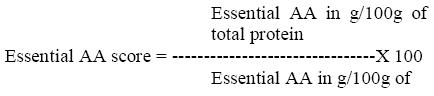
<body><![CDATA[<p align="justify"><font face="verdana" size="2">For the extraction of niacin, 5g air&#45;dried powdered sample was steamed with 30ml concentrated H<sub>2</sub>SO<sub>4</sub> for 30min. After cooling, this suspension was made up to 50ml with distilled H<sub>2</sub>O and filtered. Five millilitres of 60% basic lead acetate was added to 25ml of the filtrate. The pH was adjusted to 9.5 and centrifuged to collect the supernatant. Two millilitres of concentrated H<sub>2</sub>SO<sub>4</sub> was added to the supernatant. The mixture was allowed to stand for 1hr and centrifuged. The 5ml of 40% ZnSO4 was added to the supernatant. The pH was adjusted to 8.4 and centrifuged again. Then the pH of the collected supernatant was adjusted to 7 and used as the niacin extract. For estimation, 1ml extract was made up to 6ml with distilled water in a test tube, 3ml cyanogen bromide was added and shaken well, followed by addition of 1ml of 4% aniline. The yellow colour that developed after 5min was measured at 420nm against a reagent blank. The ascorbic acid and niacin contents present in the sample were calculated by referring to a standard graph and expressed as milligrams per 100grams of powdered samples.</font></p>  	    <p align="justify"><font face="verdana" size="2">&nbsp;</font></p>  	    <p align="justify"><font face="verdana" size="2"><b>Lipid extraction and fatty acid analysis</b></font></p>  	    <p align="justify"><font face="verdana" size="2">The total lipid was extracted from the seeds according to the method of (Folch <i>et al.,</i> 1957) using chloroform and methanol mixture in ratio of 2: 1 (v/v). Methyl esters were prepared from the total lipids by the method of (Metcalfe <i>et a., l</i>1966). Fatty acid analysis was performed by gas chromatography (ASHMACO, Japan; Model No: ABD20A) using an instrument equipped with a flame ionization detector and a glass column (2mX3mm) packed with 1% diethylene glycol succinate on chromosorb W. The temperature conditions for GC were injector 200&deg;C and detector 210&deg;C. The temperature of the oven was programmed from 180&deg;C and the carrier gas was nitrogen at a flow rate of 30ml/min. Peaks were identified by comparison with authentic standards, quantified by peak area integration and expressed as weight percentage of total methyl esters; the relative weight percentage of each fatty acid was determined from integrated peak areas.</font></p>  	    <p align="justify"><font face="verdana" size="2">&nbsp;</font></p>  	    <p align="justify"><font face="verdana" size="2"><b>Amino acid analysis</b></font></p>  	    <p align="justify"><font face="verdana" size="2">The total seed protein was extracted by a modified method of (Basha <i>et al.,</i> 1976). The extracted proteins were purified by precipitation with cold 20% trichloroacetic acid (TCA). A protein sample of 30mg was hydrolysed by 6N HCL (5ml) in an evacuated sealed tube, which was kept in an air oven maintained at 110&deg;C for 24 hr. The sealed tube was broken and the acid removed completely by repeated flash evaporation after the addition of de&#45;ionized water. Dilution was effected by means of citrate buffer pH 2.2 to such an extent that the solution contained 0.5 mg protein ml<sup>&#45;1</sup>. The solution was passed through a millipore filter (0.45&micro;M) and derivitized with O&#45;phthaldialdehyde by using an automated pre&#45;column (OPA). Aminoacids were analysed by a reverse &#150; phase HPLC (Method L 7400, HITACHI, Japan) fitted with a denali C<sub>18</sub> 5 micron column (4.6X 150mm). The flow rate was 1 ml min<sup>&#45;1</sup> with fluorescence detector. The cystine content of protein sample was obtained separately by the (Liddelle and Saville, 1959) method. For the determination of tryptophan content of proteins, aliquots containing known amounts of proteins were dispersed into glass ampoules together with 1 ml 5M NaOH. The ampoules were flame sealed and incubated at 110&deg;C for 18 hr. The tryptophan contents of the alkaline hydrolysates were determined colorimetrically using the method of (Spies and Chambers, 1949) as modified by (Rama Rao <i>et al</i>., 1974). The contents of the different amino acids (AA) were expressed as g100g&#45;1 proteins and were compared with FAO/WHO (1991) reference pattern. The essential amino acid score was calculated as follows:</font></p>  	    <p align="center"><font face="verdana" size="2"><img src="/img/revistas/tsa/v14n2/a37e2.jpg"></font></p>  	    <p align="justify"><font face="verdana" size="2">FAO/WHO (1991) reference pattern</font></p>  	    <p align="justify"><font face="verdana" size="2">&nbsp;</font></p>  	    ]]></body>
<body><![CDATA[<p align="justify"><font face="verdana" size="2"><b>Analysis of antinutritional compounds</b></font></p>  	    <p align="justify"><font face="verdana" size="2">The antinutritional compounds, total free phenolics (Bray and Thorne, 1954), tannins (Burns, 1971), the non&#45;protein amino acid, L&#45;DOPA (3, 4&#45;dihydroxyphenylalanine) (Brain, 1976), phytic acid (Wheeler and Ferrel, 1971) and hydrogen cyanide (Jackson, 1967) were quantified. Trypsin inhibitor activity was determined by the enzyme assay of (Kakade <i>et al.,</i> 1974) by using benzoil&#45;DL&#45;arginin&#45;<i>p</i>&#45;nitroanilide (BAPNA) as a substrate. One trypsin inhibitor unit (TIU) has been expressed as an increase of 0.01 absorbance units per 10ml of reaction mixture at 410nm. Trypsin inhibitor activity has been defined in terms of trypsin units inhibited per mg protein.</font></p>  	    <p align="justify"><font face="verdana" size="2">&nbsp;</font></p>  	    <p align="justify"><font face="verdana" size="2"><b>Extraction, TLC separation and estimation of Oligosaccharides</b></font></p>  	    <p align="justify"><font face="verdana" size="2">Extraction of oligosaccharides was done following the method of (Somiari and Balogh, 1993). Five grams each of all the samples of seed flours were extracted with 50 ml of 70% (v/v) aqueous ethanol and kept on an orbital shaker at 130 rpm for 13 hr and then filtered through Whatman No. 1 filter paper. Residue was further washed with 25 ml of 70% (v/v) ethanol. The filtrates obtained were pooled and vacuum&#45;dried at 45&deg;C. The concentrated sugar syrup was dissolved in five ml of double&#45;distilled water.</font></p>  	    <p align="justify"><font face="verdana" size="2">Separation of oligosaccharides was done by TLC. Thirty g of cellulose&#45;G powder were dissolved in 45 ml of double distilled water and shaken well until the slurry was homogeneous. TLC plates were coated with the slurry and air&#45;dried. Spotting of the sugar samples was done by using micropipettes. Five &micro;l aliquots of each sample were spotted thrice separately. The plates were developed by using a solvent system of n&#45;propanol, ethyl acetate and distilled water (6:1:3), and dried (Tanaka <i>et al.,</i> 1975). The plates were sprayed with &#945; &#150;naphthol reagent (1%, w/v). Plates were dried in a hot&#45;air oven. The separated spots were compared with standard sugar spots. A standard sugar mixture containing raffinose, stachyose and verbascose (procured from sigma chemical co., St. Louis, USA). Separated sugars that appeared were verbascose, stachyose and raffinose. The sugar spots were scrapped, eluted in 2 ml of distilled water kept overnight and filtered through Whatman No. 1 filter paper. The filtrates were subjected to quantitative estimation.</font></p>  	    <p align="justify"><font face="verdana" size="2">The eluted individual oligosaccharides were estimated by the method of (Tanaka <i>et a.,l</i> 1975). One ml of the eluted and filtered sugar solution was treated with one ml of 0.2 M thiobarbituric acid and one ml of concentrated HCL. The tubes were boiled in a water bath for exactly 6 min. After cooling, the oligosaccharide contents were quantified in an Elico UV&#45;Spectrophotometer model SL 150 at 432 nm. Average values of triplicate estimations were calculated and the content of oligosaccharides was expressed on dry weight basis.</font></p>  	    <p align="justify"><font face="verdana" size="2">&nbsp;</font></p>  	    <p align="justify"><font face="verdana" size="2"><b>Quantitative determination of phytohaemagglutinating (Lectin) activity</b></font></p>  	    <p align="justify"><font face="verdana" size="2">Lectin activity was determined by the method of (Almedia <i>et al.,</i> 1991). One g of air&#45;dried seed flour was stirred with 10ml of 0.15N sodium chloride solution for 2hours and the pH was adjusted to 4.0. The contents were centrifuged at 10,000 X g for 20min. and the supernatants were collected separately. The protein content was estimated by the (Lowry <i>et al</i>., 1951) method. Human blood (blood groups A, B and O) was procured from the blood bank of Jothi Clinical Laboratory, Tuticorin.</font></p>  	    ]]></body>
<body><![CDATA[<p align="justify"><font face="verdana" size="2">Blood erythrocyte suspensions were prepared by washing the blood samples separately with phosphate&#45;buffered saline and centrifuged for 3min at low speed. Supernatants were removed with Pasteur pipettes. The washing procedure was repeated three times. The washed cells were diluted by one drop of cells with 24 drops of phosphate &#150; buffered saline.</font></p>  	    <p align="justify"><font face="verdana" size="2">The determination of lectin was done by the method of Tan <i>et al</i> (1983). Clear supernatant (50&micro;l) was poured into the depression (pit) on a micro&#45;titration plate and serially diluted 1:2 with normal saline. The human blood erythrocyte (A, B and O blood groups) suspensions (25&micro;l) were added to each of the twenty depressions. The plates were incubated for 3 hours at room temperature. After the incubation period, the titre values were recorded. One haemagglutinating unit (HU) is defined as the least amount of haemagglutinin that will produce positive evidence of agglutination of 25&micro;l of a blood group erythrocyte after 3hr incubation at room temperature. The phytohaemagglutinating activity was expressed as haemagglutinating units (HU) / mg protein.</font></p>  	    <p align="justify"><font face="verdana" size="2">&nbsp;</font></p>  	    <p align="justify"><font face="verdana" size="2"><b>Determination of in vitro protein digestibility (IVPD)</b></font></p>  	    <p align="justify"><font face="verdana" size="2">This was determined using the multi&#45;enzyme technique (Hsu <i>et al.,</i>1977). The enzymes used for IVPD were purchased from Sigma Chemical Co., St. Louis, MO, USA. Calculated amounts of the control (casein) and sample were weighed out, hydrated in 10ml of distilled water and refrigerated at 5&deg;C for 1h. The samples containing protein and enzymes were all adjusted to pH 8.0 at 37&deg;C. The IVPD was determined by the sequential digestion of the samples containing protein with a multi&#45;enzyme mixture (trypsin, &#8734;&#45;chymotrypsin and peptidase) at 37&deg;C followed by protease at 55&deg;C. The pH drop of the samples from pH 8.0 was recorded after 20min of incubation. The IVPD was calculated according to the regression equation <i>Y</i>= 234.84 &#150; 22.56 <i>X</i>, where <i>Y</i> is the % digestibility and <i>X</i> the pH drop.</font></p>  	    <p align="justify"><font face="verdana" size="2">&nbsp;</font></p>  	    <p align="justify"><font face="verdana" size="2"><b>Statistical analysis</b></font></p>  	    <p align="justify"><font face="verdana" size="2">Proximate composition, minerals, vitamins (niacin and ascorbic acid), antinutritional factors like total free phenolics, tannins, L&#45;DOPA, phytic acid, hydrogen cyanide and oligosaccharides were estimated in triplicate determinations. Data were analyzed using the statistical analysis system SPSS (SPSS software for windows release 11.5; SPSS Inc., Chicago IL, USA) Estimates of mean, standard error for aforesaid parameters were calculated.</font></p>  	    <p align="justify"><font face="verdana" size="2">&nbsp;</font></p>  	    <p align="justify"><font face="verdana" size="2"><b>RESULTS AND DISCUSSION</b></font></p>  	    ]]></body>
<body><![CDATA[<p align="justify"><font face="verdana" size="2">The proximate composition of <i>Vigna</i> species were shown in <a href="/img/revistas/tsa/v14n2/a37t1.jpg" target="_blank">Table 1</a>. The crude protein content of <i>V. aconitifolia</i> and <i>V. unguiculata</i> subsp <i>unguiculata</i> (both samples) was higher than the commonly cultivated legumes like <i>Cajanus cajan</i> (Kumar <i>et al .</i>,1991); <i>Cicer arietinum</i> (Srivastava and Ali, 2004); tribal pulses like <i>Dolichos trilobus, Rhynchosia cana, R. suaveolens, Vigna radiata</i> var. <i>sublobata</i> and <i>V. unguiculata</i> subsp. <i>cylindrica</i> (Arinathan <i>et al</i>., 2009). The remarkably high level of protein in the wild legume under study underscores their importance as source of this vital nutrient. Similarly, <i>V. aconitifolia</i> and <i>V. unguiculata</i> subsp. <i>unguiculata</i> (both samples) contained higher lipids than those in other tribal pulses, <i>V. capensis</i> and <i>V. sinensis</i> (Mohan and Janardhanan, 1993). The high NFE content of <i>V. unguiculata</i> subsp <i>unguiculata</i> (both samples) enable this legume to act as a good source of calories which would be antimarasmus, especially infant nutrition (Vadivel and Janardhanan, 2000). The range in calorific values exceeds energy values of cowpea, green gram, horse gram, moth bean and peas (Rao <i>et al.,</i> 1989), which are in the range of 1318&#45;1394kJ100g<sup>&#45;1</sup>DM. Food legumes are a good source of minerals such as calcium, iron, copper, zinc, potassium and magnesium (Salunkhe <i>et al</i>., 1985). <a href="/img/revistas/tsa/v14n2/a37t2.jpg" target="_blank">Table 2</a> showed the mineral composition of the samples. In the present investigation, all the <i>Vigna</i> species registered a higher level of potassium when compared with recommended dietary allowance value of infants and children (&lt;1550mg) (NRS / NAS 1980). The high content of potassium can be utilized beneficially in the diets of people who take diuretics to control hypertension and suffer from excessive excretion of potassium through the body fluid (Siddhuraju <i>et al</i>., 2001). All the investigated <i>Vigna</i> species contained higher levels of sodium, calcium, magnesium and iron when compared with <i>Phaseolus vulgaris, P.limensis, Vigna unguiculata, Pisum sativum, Lens culinaris</i> and <i>Cicer arietinum</i> (Meiners <i>et al</i> ., 1976). The phosphorus content was found to be higher than the <i>Dolichos trilobus, Tamarindus indica</i> and <i>Vigna radiata</i> var. <i>sublobata</i> (Arinathan <i>et al</i>., 2009).</font></p>  	    <p align="justify"><font face="verdana" size="2">The presently investigated tribal pulses exhibits the highest level of niacin content (<a href="/img/revistas/tsa/v14n2/a37t3.jpg" target="_blank">Table 3</a>) which was found to be higher than that of an earlier report in <i>Cajanus cajan, Dolichos lablab, D.biflorus, Mucuna pruriens Phaseolus mungo, Vigna catjang</i> and <i>Vigna</i> species (Rajyalakshmi and Geervani, 1994) and <i>Vigna unguiculata</i> subsp. <i>cylindrica</i> (Arinathan <i>et al</i>., 2009). The tribal pulses also registered higher level of ascorbic acid content than <i>Cicer arietinum</i> (Fernandez and Berry, 1988) and <i>Teramnus labialis</i> (Arinathan <i>et al</i>., 2009).</font></p>  	    <p align="justify"><font face="verdana" size="2">The fatty acid composition of the total seed lipids of <i>Vigna aconitifolia</i> and <i>V. unguiculata</i> subsp <i>unguiculata</i> (both samples) were given in <a href="/img/revistas/tsa/v14n2/a37t4.jpg" target="_blank">Table 4</a>. The data revealed that, all the seed lipids were rich in unsaturated fatty acids (73.51&#45;74.26%) and had very high contents of linoleic acid (20.54 &#45; 22.06%). These values are nutritionally desirable and also comparable to those of certain common legume seeds <i>Vigna radiata</i> (Salunkhe <i>et al</i>., 1982) and <i>Phaseolus vulgaris</i> (Omogbai, 1990). The palmitic acid content of <i>V.aconitifolia</i> was higher than the other legumes such as <i>Vigna radiata</i> (Salunkhe <i>et al</i>., 1982); <i>V.unguiculata, Phaseolus vulgaris</i> (Omogbai, 1990) and <i>Glycine max</i> (Ologhobo and Fetuga,1984).</font></p>  	    <p align="justify"><font face="verdana" size="2">The amino acid profiles of the purified seed proteins and the essential amino acid score was presented in <a href="/img/revistas/tsa/v14n2/a37t5.jpg" target="_blank">Table 5</a>. The content of sulphur containing amino acid in <i>V.aconitifolia, V. unguiculata</i> subsp <i>unguiculata</i> (maroon sample) and tryptophan in <i>V. unguiculata</i> subsp <i>unguiculata</i> (maroon sample) seem to be deficient where as other essential amino acids were found to be higher when compared to the FAO / WHO (1991) requirement pattern. Among the investigated <i>Vigna</i> species, <i>V. unguiculata</i> subsp <i>unguiculata</i> (Black sample) registered highest level of <i>in vitro</i> protein digestibility (74.21%) and higher than that of an earlier investigation in the seeds of <i>Dolichos lablab</i> var. <i>vulgaris</i> (Vijayakumari <i>et al</i>., 1995).</font></p>  	    <p align="justify"><font face="verdana" size="2">Although legumes provide 20% of all plant protein in human diets and are even more important in the diets of livestock, their usefulness is decreased by antinutritional or toxic compounds associated with the large content of protein in their seeds (Nowacki, 1980). For this reason, a preliminary evaluation of some of these factors in raw pulses was made (<a href="/img/revistas/tsa/v14n2/a37t6.jpg" target="_blank">Table 6</a>). The content of total free phenolics of currently investigated tribal pulses appears to be higher than the earlier reports in <i>Vigna sesquipedalis, V. sinensis</i> (two different germplasms), <i>V. umbellata</i> var. RBL40 and K1 (Rajaram and Janardhanan, 1990) and different varieties of <i>V. umbellata</i> (Mohan and Janardhanan, 1994) and lower than those of other tribal pulses such as <i>Entada rheedi, Mucuna atropurpurea, Rhyncosia cana, R.suaveolens, Tamarindus indica, Teramnus labialis</i> and <i>V.unguiculata</i> var <i>cylindrica</i> (Arinathan <i>et al</i>., 2009). The tannin content of the investigated samples was relatively lower than the domesticated legumes like black gram, chick pea, cow pea and green gram (Khan <i>et al</i> ., 1979; Rao and Deosthale, 1982) red gram, bengal gram, lentil (Salunke <i>e al</i>., 2006) and different chick pea cultivars (Zia Ul&#45;Huq <i>et al</i>., 2007). Phenolics and tannins are known to inhibit activities of digestive enzymes and hence, the presence of even low levels of tannins and phenolics is not desirable from a nutritional point of view. However, in legumes, the soaking and cooking process is known to reduce phenolics and tannins significantly (Vadivel and Pugalenthi, 2008). Recently plant phenolics are increasingly gaining importance in relation to human health as wellness since they exhibit anticarcinogenic, antioxidant, antiviral, antimicrobial, anti&#45;inflammatory and hypotensive properties (Shetty, 1977).</font></p>  	    <p align="justify"><font face="verdana" size="2">Among the investigated seeds, <i>Vigna aconitifolia</i> contained the highest level of L&#45;DOPA (3.27%) when compared with other <i>Vigna</i> species investigated earlier (Mohan and Janardhanan, 1993; Arinathan <i>et al</i>., 2003; 2009). The content of L&#45;DOPA was low compared with those of other tribal pulses such as <i>Mucuna utilis, Mucuna monosperma, M. pruriens, M. pruriens var utilis</i> and <i>M. atropurpurea</i> (Sivagiri accession) (Mohan and Janardhanan, 1995; Vadivel and Janardhanan, 2000, Vadivel and Pugalenthi, 2008, Kamatchi Kala <i>et al.,</i> 2010).</font></p>  	    <p align="justify"><font face="verdana" size="2">Phytic acid has an antinutritional property because of its ability to lower the bioavailability of essential minerals, and to form a complex with protein, thereby inhibiting the enzymatic digestion of investigated protein (Nolan and Duffin, 1987). Phytic acid content of investigated seed samples was found to be low when compared with that of some commonly consumed legumes, <i>Vigna mungo</i> (Kataria <i>et al</i>., 1989); <i>Dolichos lablab</i> var. <i>vulgaris</i> (Vijayakumari <i>et al</i>., 1996); tribal pulses <i>Mucuna pruriens</i> var. <i>utilis</i> (Janardhanan <i>et al.,</i>2003b) and <i>M.</i> <i>atropurpurea</i> (Saduragiri, Sivagiri and Ayanarkoil accessions) (Kamatchikala <i>et al</i>., 2010). Hydrogen cyanide is known to cause acute or chronic toxicity. The content of HCN level in the presently investigated legume was far below the lethal level i.e., 36mg / 100g (Oke, 1969) and comparable with those of <i>Vigna sinensis</i> and <i>Pisum sativum</i> (Montgomery, 1980) and certain tribal pulses (Arinathan <i>et al</i> ., 2003; 2009). The trypsin inhibitor activities of all the studied samples were higher than that of cowpea (2.54mg /g), <i>Phaseolus</i> <i>lunatus</i> and <i>Dolichos lablab</i> (2.11mg /g) (Aletor and Aladetimi, 1989) and different cultivars of <i>Vicia faba</i> (1.72&#45; 3.35 mg /g) (Makkar <i>et al</i>., 1997) and they seem to be lower than that of Pigeon pea (67.1 &#45; 71.3 mg /g) (Singh and Eggum, 1984). Stachyose seems to be the principle oligosaccharide of investigated <i>V.</i> <i>aconitifolia</i> and <i>V. unguiculata</i> subsp <i>unguiculata</i> (both samples). It was in conformity with the earlier reports in cowpea (Onigbinde and Akinyele, 1983); jack bean, lima and sword bean (Ravilleza <i>et al</i>., 1990) and <i>Dolichos</i> <i>lablab</i> var <i>vulgaris</i> (Vijayakumari <i>et al</i>., 1995). The lectin (phytohaemagglutinating activity) of seed samples exhibit a high level of agglutination activity specifically in 'B' group compared to other two blood group 'A' and 'O'. This is in good agreement with earlier reports in the tribal pulse <i>Dolichos lablab</i> var <i>vulgaris</i> (Vijayakumari <i>et al</i>., 1995).</font></p>  	    <p align="justify"><font face="verdana" size="2">&nbsp;</font></p>  	    <p align="justify"><font face="verdana" size="2"><b>CONCLUSION</b></font></p>  	    <p align="justify"><font face="verdana" size="2">On the basis of the above findings, it is concluded that the tribal pulses investigated seem to be a good source of protein, essential amino acids, essential fatty acid, minerals and vitamins. All the antinutritional factors reported except L&#45;DOPA are heat labile. Hence they can be removed by wet or dry thermal treatment. It has been demonstrated that, the level of L&#45;DOPA is significantly eliminated by soaking and autoclaving (Vadivel and Pugalenthi, 2008).</font></p>  	    ]]></body>
<body><![CDATA[<p align="justify"><font face="verdana" size="2">&nbsp;</font></p>  	    <p align="justify"><font face="verdana" size="2"><b>REFERENCES</b></font></p>  	    <!-- ref --><p align="justify"><font face="verdana" size="2">Aletor, V.A., Aladetimi, O.O. 1989. Compositional evaluation of some Cowpea varieties and under utilized edible legumes in Nigeria. Die, 33: 999&#45;1007</font>&nbsp;&nbsp;&nbsp;&nbsp;&nbsp;&nbsp;&nbsp;&nbsp;[&#160;<a href="javascript:void(0);" onclick="javascript: window.open('/scielo.php?script=sci_nlinks&ref=10084798&pid=S1870-0462201100020003700001&lng=','','width=640,height=500,resizable=yes,scrollbars=1,menubar=yes,');">Links</a>&#160;]<!-- end-ref --><!-- ref --><p align="justify"><font face="verdana" size="2">Almedia, N.G., Calderon de la Barca, A.M., Valencia, M.E. 1991. Effect of different heat treatments on the anti&#45;nutritional activity of <i>Phaseolus</i> <i>vulgaris</i> (variety ojode Carbra) lution<i>.</i> Journal of Agricultural Food Chemistry, 39: 1627 &#150;1630.    &nbsp;&nbsp;&nbsp;&nbsp;&nbsp;&nbsp;&nbsp;&nbsp;[&#160;<a href="javascript:void(0);" onclick="javascript: window.open('/scielo.php?script=sci_nlinks&ref=10084799&pid=S1870-0462201100020003700002&lng=','','width=640,height=500,resizable=yes,scrollbars=1,menubar=yes,');">Links</a>&#160;]<!-- end-ref --></font></p>  	    <!-- ref --><p align="justify"><font face="verdana" size="2">AOAC. 2005. Official Methods of Analysis (18th edn.). Association of Official Analytical Chemists. Washington. DC.    &nbsp;&nbsp;&nbsp;&nbsp;&nbsp;&nbsp;&nbsp;&nbsp;[&#160;<a href="javascript:void(0);" onclick="javascript: window.open('/scielo.php?script=sci_nlinks&ref=10084801&pid=S1870-0462201100020003700003&lng=','','width=640,height=500,resizable=yes,scrollbars=1,menubar=yes,');">Links</a>&#160;]<!-- end-ref --></font></p>  	    <!-- ref --><p align="justify"><font face="verdana" size="2">Arinathan, V., Mohan, V. R., Maruthupandian, A., Athiperumalsami, T. 2009. Chemical evaluation of raw seeds of certain tribal pulses in Tamil Nadu, India. Tropical and Subtropical Agroecosystems, 10: 287 &#150; 294.    &nbsp;&nbsp;&nbsp;&nbsp;&nbsp;&nbsp;&nbsp;&nbsp;[&#160;<a href="javascript:void(0);" onclick="javascript: window.open('/scielo.php?script=sci_nlinks&ref=10084803&pid=S1870-0462201100020003700004&lng=','','width=640,height=500,resizable=yes,scrollbars=1,menubar=yes,');">Links</a>&#160;]<!-- end-ref --></font></p>  	    <!-- ref --><p align="justify"><font face="verdana" size="2">Arinathan, V., Mohan, V.R., John de Britto, A. 2003. Chemical composition of certain tribal pulses in South India. International Journal of Food Science and Nutrition, 54: 209 &#150; 217.    &nbsp;&nbsp;&nbsp;&nbsp;&nbsp;&nbsp;&nbsp;&nbsp;[&#160;<a href="javascript:void(0);" onclick="javascript: window.open('/scielo.php?script=sci_nlinks&ref=10084805&pid=S1870-0462201100020003700005&lng=','','width=640,height=500,resizable=yes,scrollbars=1,menubar=yes,');">Links</a>&#160;]<!-- end-ref --></font></p>  	    <!-- ref --><p align="justify"><font face="verdana" size="2">Arinathan, V., Mohan, V.R., John De Britto, A., Murugan, C. 2007. Wild edibles used by <i>Palliyars</i> of the Western Ghats, Tamil Nadu. Indian Journal of Traditional Knowledge, 6: 163&#45;168.    &nbsp;&nbsp;&nbsp;&nbsp;&nbsp;&nbsp;&nbsp;&nbsp;[&#160;<a href="javascript:void(0);" onclick="javascript: window.open('/scielo.php?script=sci_nlinks&ref=10084807&pid=S1870-0462201100020003700006&lng=','','width=640,height=500,resizable=yes,scrollbars=1,menubar=yes,');">Links</a>&#160;]<!-- end-ref --></font></p>  	    <!-- ref --><p align="justify"><font face="verdana" size="2">Basha, S.M.M., Cherry, J.P., Young, C.T. 1976. Changes in free amino acids, Carbohydrates and proteins of maturity seeds from various peas (<i>Arachis hypogaea</i>) cultivars. Cereal Chemistry, 53: 583 &#150; 597.    &nbsp;&nbsp;&nbsp;&nbsp;&nbsp;&nbsp;&nbsp;&nbsp;[&#160;<a href="javascript:void(0);" onclick="javascript: window.open('/scielo.php?script=sci_nlinks&ref=10084809&pid=S1870-0462201100020003700007&lng=','','width=640,height=500,resizable=yes,scrollbars=1,menubar=yes,');">Links</a>&#160;]<!-- end-ref --></font></p>  	    <!-- ref --><p align="justify"><font face="verdana" size="2">Brain, K.R. 1976. Accumulation of L&#45;DOPA in cultures from <i>Mucuna pruriens.</i> Plant Science Letters<i>,</i> 7: 157&#45;161.    &nbsp;&nbsp;&nbsp;&nbsp;&nbsp;&nbsp;&nbsp;&nbsp;[&#160;<a href="javascript:void(0);" onclick="javascript: window.open('/scielo.php?script=sci_nlinks&ref=10084811&pid=S1870-0462201100020003700008&lng=','','width=640,height=500,resizable=yes,scrollbars=1,menubar=yes,');">Links</a>&#160;]<!-- end-ref --></font></p>  	    <!-- ref --><p align="justify"><font face="verdana" size="2">Bray, H.G., Thorne, W.V. 1954. Analysis of phenolic compounds methods. Biochemical Analyst, 1: 27&#45;52.    &nbsp;&nbsp;&nbsp;&nbsp;&nbsp;&nbsp;&nbsp;&nbsp;[&#160;<a href="javascript:void(0);" onclick="javascript: window.open('/scielo.php?script=sci_nlinks&ref=10084813&pid=S1870-0462201100020003700009&lng=','','width=640,height=500,resizable=yes,scrollbars=1,menubar=yes,');">Links</a>&#160;]<!-- end-ref --></font></p>  	    <!-- ref --><p align="justify"><font face="verdana" size="2">Burns, R.B., 1971. Methods of estimation of tannin in the grain, sorghum. Agronomy J. 63: 511 &#45;512.    &nbsp;&nbsp;&nbsp;&nbsp;&nbsp;&nbsp;&nbsp;&nbsp;[&#160;<a href="javascript:void(0);" onclick="javascript: window.open('/scielo.php?script=sci_nlinks&ref=10084815&pid=S1870-0462201100020003700010&lng=','','width=640,height=500,resizable=yes,scrollbars=1,menubar=yes,');">Links</a>&#160;]<!-- end-ref --></font></p>  	    <!-- ref --><p align="justify"><font face="verdana" size="2">Dickman, S.R., Bray, R.H. 1940. Colorimetric determination of phosphate. Industrial Engineering Chemistry Analytical Education, 12: 665&#45;668.    &nbsp;&nbsp;&nbsp;&nbsp;&nbsp;&nbsp;&nbsp;&nbsp;[&#160;<a href="javascript:void(0);" onclick="javascript: window.open('/scielo.php?script=sci_nlinks&ref=10084817&pid=S1870-0462201100020003700011&lng=','','width=640,height=500,resizable=yes,scrollbars=1,menubar=yes,');">Links</a>&#160;]<!-- end-ref --></font></p>  	    <!-- ref --><p align="justify"><font face="verdana" size="2">FAO/WHO. 1991. Protein quality evaluation, (p 66). Rome, Italy: Food and Agricultural Organization of the United Nations.    &nbsp;&nbsp;&nbsp;&nbsp;&nbsp;&nbsp;&nbsp;&nbsp;[&#160;<a href="javascript:void(0);" onclick="javascript: window.open('/scielo.php?script=sci_nlinks&ref=10084819&pid=S1870-0462201100020003700012&lng=','','width=640,height=500,resizable=yes,scrollbars=1,menubar=yes,');">Links</a>&#160;]<!-- end-ref --></font></p>  	    <!-- ref --><p align="justify"><font face="verdana" size="2">Fernandez, M.L., Berry, J.W. 1988. Nutritional evaluation of chick pea and germinated chickpea flours. Plant Foods Human Nutrition, 38: 127&#45;134.    &nbsp;&nbsp;&nbsp;&nbsp;&nbsp;&nbsp;&nbsp;&nbsp;[&#160;<a href="javascript:void(0);" onclick="javascript: window.open('/scielo.php?script=sci_nlinks&ref=10084821&pid=S1870-0462201100020003700013&lng=','','width=640,height=500,resizable=yes,scrollbars=1,menubar=yes,');">Links</a>&#160;]<!-- end-ref --></font></p>  	    <!-- ref --><p align="justify"><font face="verdana" size="2">Folch, J., Lees, M., Solane&#45;Stanly, G.M. 1957. A simple method for the isolation and purification of total lipids from animal tissues. Journal of Biological Chemistry, 226:497 &#150; 506.    &nbsp;&nbsp;&nbsp;&nbsp;&nbsp;&nbsp;&nbsp;&nbsp;[&#160;<a href="javascript:void(0);" onclick="javascript: window.open('/scielo.php?script=sci_nlinks&ref=10084823&pid=S1870-0462201100020003700014&lng=','','width=640,height=500,resizable=yes,scrollbars=1,menubar=yes,');">Links</a>&#160;]<!-- end-ref --></font></p>  	    <!-- ref --><p align="justify"><font face="verdana" size="2">Hsu, H.W., Vavak, D.L., Satterlee, L.D., Miller, G.A. 1977. A multi&#45;enzyme technique for estimating protein digestibility. Journal of Food Science, 42: 1269 &#150; 1271.    &nbsp;&nbsp;&nbsp;&nbsp;&nbsp;&nbsp;&nbsp;&nbsp;[&#160;<a href="javascript:void(0);" onclick="javascript: window.open('/scielo.php?script=sci_nlinks&ref=10084825&pid=S1870-0462201100020003700015&lng=','','width=640,height=500,resizable=yes,scrollbars=1,menubar=yes,');">Links</a>&#160;]<!-- end-ref --></font></p>  	    <!-- ref --><p align="justify"><font face="verdana" size="2">Humphries, E.C. 1956. Mineral composition and ash analysis In: Peach K. and M.V. Tracey (eds.) Modern Methods of Plant Analysis Vol.1, Springer&#45;Verlag, Berlin, pp: 468&#45;502.    &nbsp;&nbsp;&nbsp;&nbsp;&nbsp;&nbsp;&nbsp;&nbsp;[&#160;<a href="javascript:void(0);" onclick="javascript: window.open('/scielo.php?script=sci_nlinks&ref=10084827&pid=S1870-0462201100020003700016&lng=','','width=640,height=500,resizable=yes,scrollbars=1,menubar=yes,');">Links</a>&#160;]<!-- end-ref --></font></p>  	    <!-- ref --><p align="justify"><font face="verdana" size="2">Issac, R.A. and W.C. Johnson, 1975. Collaborative study of wet and dry techniques for the elemental analysis of plant tissue by Atomic Absorption Spectrophotometer. Journal of Association of Official Analytical Chemist, 58: 376&#45;38<i>.    &nbsp;&nbsp;&nbsp;&nbsp;&nbsp;&nbsp;&nbsp;&nbsp;[&#160;<a href="javascript:void(0);" onclick="javascript: window.open('/scielo.php?script=sci_nlinks&ref=10084829&pid=S1870-0462201100020003700017&lng=','','width=640,height=500,resizable=yes,scrollbars=1,menubar=yes,');">Links</a>&#160;]<!-- end-ref --></i></font></p>  	    <!-- ref --><p align="justify"><font face="verdana" size="2">Jackson, M&#45;L. 1967. Cyanide in Plant tissue. In: Soil Chemical Analysis. Asia Publishing House New Delhi India. pp. 337.    &nbsp;&nbsp;&nbsp;&nbsp;&nbsp;&nbsp;&nbsp;&nbsp;[&#160;<a href="javascript:void(0);" onclick="javascript: window.open('/scielo.php?script=sci_nlinks&ref=10084831&pid=S1870-0462201100020003700018&lng=','','width=640,height=500,resizable=yes,scrollbars=1,menubar=yes,');">Links</a>&#160;]<!-- end-ref --></font></p>  	    <!-- ref --><p align="justify"><font face="verdana" size="2">Janardhanan, K., Vadivel, V., Pugalenthi, M. 2003a. Biodiversity in India underexploited tribal pulses. In: PK Jaiwal &amp; RP Singh (eds) Improvement strategies for Leguminosae biotechnology, Great Britain: Kluwer, pp: 353&#45;405.    &nbsp;&nbsp;&nbsp;&nbsp;&nbsp;&nbsp;&nbsp;&nbsp;[&#160;<a href="javascript:void(0);" onclick="javascript: window.open('/scielo.php?script=sci_nlinks&ref=10084833&pid=S1870-0462201100020003700019&lng=','','width=640,height=500,resizable=yes,scrollbars=1,menubar=yes,');">Links</a>&#160;]<!-- end-ref --></font></p>  	    <!-- ref --><p align="justify"><font face="verdana" size="2">Janardhanan, K., Gurumoorthi, P., Pugalenthi, M. 2003b. Nutritional potential of five accessions of a south Indian pulse, <i>Mucuna</i> <i>pruriens</i> var <i>utilis</i>. The effects of processing methods on the content of L&#45;DOPA, phytic acid and oligosaccharides. Tropical and Subtropical Agroecosystems, 1: 141&#45; 152.    &nbsp;&nbsp;&nbsp;&nbsp;&nbsp;&nbsp;&nbsp;&nbsp;[&#160;<a href="javascript:void(0);" onclick="javascript: window.open('/scielo.php?script=sci_nlinks&ref=10084835&pid=S1870-0462201100020003700020&lng=','','width=640,height=500,resizable=yes,scrollbars=1,menubar=yes,');">Links</a>&#160;]<!-- end-ref --></font></p>  	    <!-- ref --><p align="justify"><font face="verdana" size="2">Kakade, M.L., Rackis, J.J., McGhce, J.E., Puski, G. 1974. Determination of trypsin inhibitor activity of soy products: a collaborative analysis of an improved procedure. Cereal Chemistry<b>,</b> 51: 376 &#45;38</font>&nbsp;&nbsp;&nbsp;&nbsp;&nbsp;&nbsp;&nbsp;&nbsp;[&#160;<a href="javascript:void(0);" onclick="javascript: window.open('/scielo.php?script=sci_nlinks&ref=10084837&pid=S1870-0462201100020003700021&lng=','','width=640,height=500,resizable=yes,scrollbars=1,menubar=yes,');">Links</a>&#160;]<!-- end-ref --><!-- ref --><p align="justify"><font face="verdana" size="2">Kamatchi Kala, B., Kalidass, C., Mohan, V.R. 2010. Nutritional and antinutritional potential of five accessions of a South Indian tribal pulse <i>Mucuna atropurpurea</i> DC. Tropical and Subtropical Agroecosystems, 12: 339&#45;352.    &nbsp;&nbsp;&nbsp;&nbsp;&nbsp;&nbsp;&nbsp;&nbsp;[&#160;<a href="javascript:void(0);" onclick="javascript: window.open('/scielo.php?script=sci_nlinks&ref=10084838&pid=S1870-0462201100020003700022&lng=','','width=640,height=500,resizable=yes,scrollbars=1,menubar=yes,');">Links</a>&#160;]<!-- end-ref --></font></p>  	    <!-- ref --><p align="justify"><font face="verdana" size="2">Kataria, A., Chauhan, B.M., Gandhi, S. 1988. Effect of domestic processing and cooking on the antinutrients of black gram. Food Chemistry, 30: 149 &#150; 156.    &nbsp;&nbsp;&nbsp;&nbsp;&nbsp;&nbsp;&nbsp;&nbsp;[&#160;<a href="javascript:void(0);" onclick="javascript: window.open('/scielo.php?script=sci_nlinks&ref=10084840&pid=S1870-0462201100020003700023&lng=','','width=640,height=500,resizable=yes,scrollbars=1,menubar=yes,');">Links</a>&#160;]<!-- end-ref --></font></p>  	    <!-- ref --><p align="justify"><font face="verdana" size="2">Kataria, A., Chauhan, B.M., Punia, D. 1989. Antinutrients and protein digestibility (<i>invitro</i>) of mungo bean as affected by domestic processing and cooking. Food Chemistry, 32:9 &#150; 17.    &nbsp;&nbsp;&nbsp;&nbsp;&nbsp;&nbsp;&nbsp;&nbsp;[&#160;<a href="javascript:void(0);" onclick="javascript: window.open('/scielo.php?script=sci_nlinks&ref=10084842&pid=S1870-0462201100020003700024&lng=','','width=640,height=500,resizable=yes,scrollbars=1,menubar=yes,');">Links</a>&#160;]<!-- end-ref --></font></p>  	    <!-- ref --><p align="justify"><font face="verdana" size="2">Khan, M.A, Jacobsen, I., Eggum, B.D. 1979. Nutritive value of some improved varieties of legumes. Journal of Science Food and Agriculture, 30:395&#45;400.    &nbsp;&nbsp;&nbsp;&nbsp;&nbsp;&nbsp;&nbsp;&nbsp;[&#160;<a href="javascript:void(0);" onclick="javascript: window.open('/scielo.php?script=sci_nlinks&ref=10084844&pid=S1870-0462201100020003700025&lng=','','width=640,height=500,resizable=yes,scrollbars=1,menubar=yes,');">Links</a>&#160;]<!-- end-ref --></font></p>  	    ]]></body>
<body><![CDATA[<!-- ref --><p align="justify"><font face="verdana" size="2">Kumar. S., Kumar, S., Singh, G.K., Kumar, R., Bhatia, N.K., Awasthi, C.P. 1991: Variation in quality traits of Pigeon Pea (<i>Cajanus cajan</i> L.Mill sp) varieties. Journal of Food Science and technology, 28: 173&#45;174.    &nbsp;&nbsp;&nbsp;&nbsp;&nbsp;&nbsp;&nbsp;&nbsp;[&#160;<a href="javascript:void(0);" onclick="javascript: window.open('/scielo.php?script=sci_nlinks&ref=10084846&pid=S1870-0462201100020003700026&lng=','','width=640,height=500,resizable=yes,scrollbars=1,menubar=yes,');">Links</a>&#160;]<!-- end-ref --></font></p>  	    <!-- ref --><p align="justify"><font face="verdana" size="2">Li, B.W., Cardozo, M.S. 1994. Determination of total dietary fiber in foods and products with little or no starch, non&#45;enzymatic gravimetric method: collaborative study. Journal of Association of Official Analytical Chemists International, 77: 687 &#45;689.    &nbsp;&nbsp;&nbsp;&nbsp;&nbsp;&nbsp;&nbsp;&nbsp;[&#160;<a href="javascript:void(0);" onclick="javascript: window.open('/scielo.php?script=sci_nlinks&ref=10084848&pid=S1870-0462201100020003700027&lng=','','width=640,height=500,resizable=yes,scrollbars=1,menubar=yes,');">Links</a>&#160;]<!-- end-ref --></font></p>  	    <!-- ref --><p align="justify"><font face="verdana" size="2">Liddell, H.F., Saville, B. 1959. Colorimetric determination of cysteine. Analyst, 84: 133 &#45;137.    &nbsp;&nbsp;&nbsp;&nbsp;&nbsp;&nbsp;&nbsp;&nbsp;[&#160;<a href="javascript:void(0);" onclick="javascript: window.open('/scielo.php?script=sci_nlinks&ref=10084850&pid=S1870-0462201100020003700028&lng=','','width=640,height=500,resizable=yes,scrollbars=1,menubar=yes,');">Links</a>&#160;]<!-- end-ref --></font></p>  	    <!-- ref --><p align="justify"><font face="verdana" size="2">Lowry, O.H., Rorebrough, N.J., Farr, A.L., Randall, R.J. 1951. Protein measurement with folin phenol reagent. Journal of Biological Chemistry, 193: 265 &#150; 275.    &nbsp;&nbsp;&nbsp;&nbsp;&nbsp;&nbsp;&nbsp;&nbsp;[&#160;<a href="javascript:void(0);" onclick="javascript: window.open('/scielo.php?script=sci_nlinks&ref=10084852&pid=S1870-0462201100020003700029&lng=','','width=640,height=500,resizable=yes,scrollbars=1,menubar=yes,');">Links</a>&#160;]<!-- end-ref --></font></p>  	    <!-- ref --><p align="justify"><font face="verdana" size="2">Makkar, H.P.S., Becker, K., Sporer, F., Wink, M. 1997. Studies on nutritive potential and toxic constituents of different provinces of <i>Jatropa</i> <i>curcas</i>. Journal of Agricultural and Food Chemistry, 45:3152&#45;315.    &nbsp;&nbsp;&nbsp;&nbsp;&nbsp;&nbsp;&nbsp;&nbsp;[&#160;<a href="javascript:void(0);" onclick="javascript: window.open('/scielo.php?script=sci_nlinks&ref=10084854&pid=S1870-0462201100020003700030&lng=','','width=640,height=500,resizable=yes,scrollbars=1,menubar=yes,');">Links</a>&#160;]<!-- end-ref --></font></p>  	    ]]></body>
<body><![CDATA[<!-- ref --><p align="justify"><font face="verdana" size="2">Metcalfe, L.D., Schemitz, A.A., Pelka, J.R. 1966. Rapid preparation of fatty acid esters from lipids for gas chromatographic analysis. Analytical Chemistry, 38: 514 &#150; 515.    &nbsp;&nbsp;&nbsp;&nbsp;&nbsp;&nbsp;&nbsp;&nbsp;[&#160;<a href="javascript:void(0);" onclick="javascript: window.open('/scielo.php?script=sci_nlinks&ref=10084856&pid=S1870-0462201100020003700031&lng=','','width=640,height=500,resizable=yes,scrollbars=1,menubar=yes,');">Links</a>&#160;]<!-- end-ref --></font></p>  	    <!-- ref --><p align="justify"><font face="verdana" size="2">Mieners, C.R., Derise, N.L., Lau, H.C., Crews, M.G., Ritchey, S.J., Murphy, E.W. 1976. The content of nine mineral elements raw and cooked mature dry legumes. Journal of Agricultural and Food Chemistry, 24: 1126&#45;1130.    &nbsp;&nbsp;&nbsp;&nbsp;&nbsp;&nbsp;&nbsp;&nbsp;[&#160;<a href="javascript:void(0);" onclick="javascript: window.open('/scielo.php?script=sci_nlinks&ref=10084858&pid=S1870-0462201100020003700032&lng=','','width=640,height=500,resizable=yes,scrollbars=1,menubar=yes,');">Links</a>&#160;]<!-- end-ref --></font></p>  	    <!-- ref --><p align="justify"><font face="verdana" size="2">Mohan, V.R., Janardhanan, K. 1993. Chemical and nutritional evaluation of two little&#45;known species of <i>Vigna</i>. Food Chemistry, 48: 367&#45;371.    &nbsp;&nbsp;&nbsp;&nbsp;&nbsp;&nbsp;&nbsp;&nbsp;[&#160;<a href="javascript:void(0);" onclick="javascript: window.open('/scielo.php?script=sci_nlinks&ref=10084860&pid=S1870-0462201100020003700033&lng=','','width=640,height=500,resizable=yes,scrollbars=1,menubar=yes,');">Links</a>&#160;]<!-- end-ref --></font></p>  	    <!-- ref --><p align="justify"><font face="verdana" size="2">Mohan, V.R., Janardhanan, K. 1994. Chemical composition and nutritional evaluation of raw seeds of six ricebean varieties. Journal of Indian Botanical society, 73: 259&#45;263.    &nbsp;&nbsp;&nbsp;&nbsp;&nbsp;&nbsp;&nbsp;&nbsp;[&#160;<a href="javascript:void(0);" onclick="javascript: window.open('/scielo.php?script=sci_nlinks&ref=10084862&pid=S1870-0462201100020003700034&lng=','','width=640,height=500,resizable=yes,scrollbars=1,menubar=yes,');">Links</a>&#160;]<!-- end-ref --></font></p>  	    <!-- ref --><p align="justify"><font face="verdana" size="2">Mohan, V.R., Janardhanan, K. 1995. Chemical analysis of nutritional assessment of lesser known pulses of the genus, <i>Mucuna</i>. Food Chemistry, 52: 275&#45;280.    &nbsp;&nbsp;&nbsp;&nbsp;&nbsp;&nbsp;&nbsp;&nbsp;[&#160;<a href="javascript:void(0);" onclick="javascript: window.open('/scielo.php?script=sci_nlinks&ref=10084864&pid=S1870-0462201100020003700035&lng=','','width=640,height=500,resizable=yes,scrollbars=1,menubar=yes,');">Links</a>&#160;]<!-- end-ref --></font></p>  	    ]]></body>
<body><![CDATA[<!-- ref --><p align="justify"><font face="verdana" size="2">Montgomery, RD. 1980. Cyanogens. In: Liener IE, editor. Toxic constitutes of Plant Food Stuffs. 2nd ed. Newyork: Academic Press. pp.158 &#150; 160.    &nbsp;&nbsp;&nbsp;&nbsp;&nbsp;&nbsp;&nbsp;&nbsp;[&#160;<a href="javascript:void(0);" onclick="javascript: window.open('/scielo.php?script=sci_nlinks&ref=10084866&pid=S1870-0462201100020003700036&lng=','','width=640,height=500,resizable=yes,scrollbars=1,menubar=yes,');">Links</a>&#160;]<!-- end-ref --></font></p>  	    <!-- ref --><p align="justify"><font face="verdana" size="2">Muller, H.G., Tobin, G. 1980. Nutrition and food processing, London : Croom Helm Ltd.    &nbsp;&nbsp;&nbsp;&nbsp;&nbsp;&nbsp;&nbsp;&nbsp;[&#160;<a href="javascript:void(0);" onclick="javascript: window.open('/scielo.php?script=sci_nlinks&ref=10084868&pid=S1870-0462201100020003700037&lng=','','width=640,height=500,resizable=yes,scrollbars=1,menubar=yes,');">Links</a>&#160;]<!-- end-ref --></font></p>  	    <!-- ref --><p align="justify"><font face="verdana" size="2">Nolan, K., Duffin, PA. 1987. Effect of phytate on mineral bioavailability. <i>In vitro</i> studies on Mg<sup>2+</sup>, Ca<sup>2+</sup>, Fe<sup>2+</sup>, Cu<sup>2+</sup> and Zn<sup>2+</sup> solubilities in the presence of phytate. Journal of Science and Food Agriculture<i>,</i> 40:79&#45;83.    &nbsp;&nbsp;&nbsp;&nbsp;&nbsp;&nbsp;&nbsp;&nbsp;[&#160;<a href="javascript:void(0);" onclick="javascript: window.open('/scielo.php?script=sci_nlinks&ref=10084870&pid=S1870-0462201100020003700038&lng=','','width=640,height=500,resizable=yes,scrollbars=1,menubar=yes,');">Links</a>&#160;]<!-- end-ref --></font></p>  	    <!-- ref --><p align="justify"><font face="verdana" size="2">Nowacki, E. 1980. Heat&#45;stable antinutritional factors in leguminous plants. In Advances in Legume Science, eds R.J. Summerfield &amp; A.H.Bunting. Royal Botanic Gardens, Kew, Richmond, Survey, UK, 171 &#150; 177.    &nbsp;&nbsp;&nbsp;&nbsp;&nbsp;&nbsp;&nbsp;&nbsp;[&#160;<a href="javascript:void(0);" onclick="javascript: window.open('/scielo.php?script=sci_nlinks&ref=10084872&pid=S1870-0462201100020003700039&lng=','','width=640,height=500,resizable=yes,scrollbars=1,menubar=yes,');">Links</a>&#160;]<!-- end-ref --></font></p>  	    <!-- ref --><p align="justify"><font face="verdana" size="2">NRC / NAS 1980. National Research Council Committee on Dietary Allowances. Recommended Dietary Allowances 9th edn. National Academy of Science Press. Washington, DC. USA</font>&nbsp;&nbsp;&nbsp;&nbsp;&nbsp;&nbsp;&nbsp;&nbsp;[&#160;<a href="javascript:void(0);" onclick="javascript: window.open('/scielo.php?script=sci_nlinks&ref=10084874&pid=S1870-0462201100020003700040&lng=','','width=640,height=500,resizable=yes,scrollbars=1,menubar=yes,');">Links</a>&#160;]<!-- end-ref --><!-- ref --><p align="justify"><font face="verdana" size="2">Oke, O.L. 1969. The role of hydrocyanic acid in nutrition<i>.</i> World Review of Nutrition and Dietetis, 11: 118&#45;147.    &nbsp;&nbsp;&nbsp;&nbsp;&nbsp;&nbsp;&nbsp;&nbsp;[&#160;<a href="javascript:void(0);" onclick="javascript: window.open('/scielo.php?script=sci_nlinks&ref=10084875&pid=S1870-0462201100020003700041&lng=','','width=640,height=500,resizable=yes,scrollbars=1,menubar=yes,');">Links</a>&#160;]<!-- end-ref --></font></p>  	    <!-- ref --><p align="justify"><font face="verdana" size="2">Ologhobo, A.D., Fetuga, B.L. 1984. Distribution of P and phytate in some Nigerian varieties of legumes and some effects of processing. Journal of Food Science, 49: 199&#45;203.    &nbsp;&nbsp;&nbsp;&nbsp;&nbsp;&nbsp;&nbsp;&nbsp;[&#160;<a href="javascript:void(0);" onclick="javascript: window.open('/scielo.php?script=sci_nlinks&ref=10084877&pid=S1870-0462201100020003700042&lng=','','width=640,height=500,resizable=yes,scrollbars=1,menubar=yes,');">Links</a>&#160;]<!-- end-ref --></font></p>  	    <!-- ref --><p align="justify"><font face="verdana" size="2">Omogbai, F.E. 1990. Lipid composition of tropical seeds used in the Nigerian diet. Journal of Science Food and Agriculture<i>,</i> 50: 253 &#150;255.    &nbsp;&nbsp;&nbsp;&nbsp;&nbsp;&nbsp;&nbsp;&nbsp;[&#160;<a href="javascript:void(0);" onclick="javascript: window.open('/scielo.php?script=sci_nlinks&ref=10084879&pid=S1870-0462201100020003700043&lng=','','width=640,height=500,resizable=yes,scrollbars=1,menubar=yes,');">Links</a>&#160;]<!-- end-ref --></font></p>  	    <!-- ref --><p align="justify"><font face="verdana" size="2">Onigbinde, A.O., Akinyele, I.O. 1983. Oligosaccharide content of 20 varieties of Cowpea in Nigeria. Journal of food Science, 48: 1250&#45;1254.    &nbsp;&nbsp;&nbsp;&nbsp;&nbsp;&nbsp;&nbsp;&nbsp;[&#160;<a href="javascript:void(0);" onclick="javascript: window.open('/scielo.php?script=sci_nlinks&ref=10084881&pid=S1870-0462201100020003700044&lng=','','width=640,height=500,resizable=yes,scrollbars=1,menubar=yes,');">Links</a>&#160;]<!-- end-ref --></font></p>  	    <!-- ref --><p align="justify"><font face="verdana" size="2">Rajaram, N., Janardhanan, K. 1990. Chemical composition and Nutritional evaluation of certain under&#45;exploited <i>Vigna</i> sp. Food Science and Nutrition, 42: 213&#45;221.    &nbsp;&nbsp;&nbsp;&nbsp;&nbsp;&nbsp;&nbsp;&nbsp;[&#160;<a href="javascript:void(0);" onclick="javascript: window.open('/scielo.php?script=sci_nlinks&ref=10084883&pid=S1870-0462201100020003700045&lng=','','width=640,height=500,resizable=yes,scrollbars=1,menubar=yes,');">Links</a>&#160;]<!-- end-ref --></font></p>  	    <!-- ref --><p align="justify"><font face="verdana" size="2">Rajyalakshmi, P., Geervani, P. 1994. Nutritive value of the foods cultivated and consumed by the tribals South India. Plant Foods for Human Nutrition, 46: 53 &#45;61.    &nbsp;&nbsp;&nbsp;&nbsp;&nbsp;&nbsp;&nbsp;&nbsp;[&#160;<a href="javascript:void(0);" onclick="javascript: window.open('/scielo.php?script=sci_nlinks&ref=10084885&pid=S1870-0462201100020003700046&lng=','','width=640,height=500,resizable=yes,scrollbars=1,menubar=yes,');">Links</a>&#160;]<!-- end-ref --></font></p>  	    <!-- ref --><p align="justify"><font face="verdana" size="2">Rama Rao, M.V., Tara, M.R., Krishnan, C.K. 1974. Colorimetric estimation of tryptophan content of pulses. Journal of Food Science and Technology, (Mysore), 11: 13&#150; 216.    &nbsp;&nbsp;&nbsp;&nbsp;&nbsp;&nbsp;&nbsp;&nbsp;[&#160;<a href="javascript:void(0);" onclick="javascript: window.open('/scielo.php?script=sci_nlinks&ref=10084887&pid=S1870-0462201100020003700047&lng=','','width=640,height=500,resizable=yes,scrollbars=1,menubar=yes,');">Links</a>&#160;]<!-- end-ref --></font></p>  	    <!-- ref --><p align="justify"><font face="verdana" size="2">Rao, N., Deosthale, B.S., Pant, Y.G., K.C.1989. Nutritive Value of Indian Foods. Hyderabad, India: National Institute of Nutrition, Indian Council of Medical Research.    &nbsp;&nbsp;&nbsp;&nbsp;&nbsp;&nbsp;&nbsp;&nbsp;[&#160;<a href="javascript:void(0);" onclick="javascript: window.open('/scielo.php?script=sci_nlinks&ref=10084889&pid=S1870-0462201100020003700048&lng=','','width=640,height=500,resizable=yes,scrollbars=1,menubar=yes,');">Links</a>&#160;]<!-- end-ref --></font></p>  	    <!-- ref --><p align="justify"><font face="verdana" size="2">Rao, P.U., Deosthale, Y.G. 1982. Tannin content of pulses: Varietal differences and effects of germination and cooking. Journal of Science Food and Agriculture, 33: 1013&#45;1016.    &nbsp;&nbsp;&nbsp;&nbsp;&nbsp;&nbsp;&nbsp;&nbsp;[&#160;<a href="javascript:void(0);" onclick="javascript: window.open('/scielo.php?script=sci_nlinks&ref=10084891&pid=S1870-0462201100020003700049&lng=','','width=640,height=500,resizable=yes,scrollbars=1,menubar=yes,');">Links</a>&#160;]<!-- end-ref --></font></p>  	    <!-- ref --><p align="justify"><font face="verdana" size="2">Ravilleza, M.J.R., Mendoza, E.M.T., Raymundo, L.C. 1990. Oligosaccharides in several Philippine indigenous food legumes: determination, localization and removal. Plant Foods for Human Nutrition, 40:83&#45;93.    &nbsp;&nbsp;&nbsp;&nbsp;&nbsp;&nbsp;&nbsp;&nbsp;[&#160;<a href="javascript:void(0);" onclick="javascript: window.open('/scielo.php?script=sci_nlinks&ref=10084893&pid=S1870-0462201100020003700050&lng=','','width=640,height=500,resizable=yes,scrollbars=1,menubar=yes,');">Links</a>&#160;]<!-- end-ref --></font></p>  	    <!-- ref --><p align="justify"><font face="verdana" size="2">Sadasivam, S., Manickam, A. 1996. Biochemical methods, New age International (P) limited publishers, New Delhi, India.    &nbsp;&nbsp;&nbsp;&nbsp;&nbsp;&nbsp;&nbsp;&nbsp;[&#160;<a href="javascript:void(0);" onclick="javascript: window.open('/scielo.php?script=sci_nlinks&ref=10084895&pid=S1870-0462201100020003700051&lng=','','width=640,height=500,resizable=yes,scrollbars=1,menubar=yes,');">Links</a>&#160;]<!-- end-ref --></font></p>  	    <!-- ref --><p align="justify"><font face="verdana" size="2">Salunke, B.K., Patil, K.P., Wani, M.R., Maheswari, V.L. 2006. Antinutritional constituents of different grain legumes grown in North Maharastra. Journal of Food Science and Technology, 43: 519&#45;521.    &nbsp;&nbsp;&nbsp;&nbsp;&nbsp;&nbsp;&nbsp;&nbsp;[&#160;<a href="javascript:void(0);" onclick="javascript: window.open('/scielo.php?script=sci_nlinks&ref=10084897&pid=S1870-0462201100020003700052&lng=','','width=640,height=500,resizable=yes,scrollbars=1,menubar=yes,');">Links</a>&#160;]<!-- end-ref --></font></p>  	    <!-- ref --><p align="justify"><font face="verdana" size="2">Salunkhe, D. K., Sathe, S.K., Reddy, N.R. 1982. Legume lipids. In Chemistry and Biochemistry of Legumes, ed. S. K. Arora. Oxford &amp; IBH, New Delhi, 51&#45;109.    &nbsp;&nbsp;&nbsp;&nbsp;&nbsp;&nbsp;&nbsp;&nbsp;[&#160;<a href="javascript:void(0);" onclick="javascript: window.open('/scielo.php?script=sci_nlinks&ref=10084899&pid=S1870-0462201100020003700053&lng=','','width=640,height=500,resizable=yes,scrollbars=1,menubar=yes,');">Links</a>&#160;]<!-- end-ref --></font></p>  	    <!-- ref --><p align="justify"><font face="verdana" size="2">Salunkhe, DK., Kadam, SS., Chavan, Jk. 1985. Chemical composition. In: DK. Salunkhe, SS. Kadam and JK. Chavan (eds). Post harvest Biotechnology of Food legumes. CRC press Inc: Boca Rabon, FL. pp29&#45;52.    &nbsp;&nbsp;&nbsp;&nbsp;&nbsp;&nbsp;&nbsp;&nbsp;[&#160;<a href="javascript:void(0);" onclick="javascript: window.open('/scielo.php?script=sci_nlinks&ref=10084901&pid=S1870-0462201100020003700054&lng=','','width=640,height=500,resizable=yes,scrollbars=1,menubar=yes,');">Links</a>&#160;]<!-- end-ref --></font></p>  	    <!-- ref --><p align="justify"><font face="verdana" size="2">Shetty, K. 1997. Biotechnology to harness the benefits of dietary phenolics; focus on lamiaceae. Asia Pacific Journal of Clinical Nutrition, 6: 162&#45;71</font>&nbsp;&nbsp;&nbsp;&nbsp;&nbsp;&nbsp;&nbsp;&nbsp;[&#160;<a href="javascript:void(0);" onclick="javascript: window.open('/scielo.php?script=sci_nlinks&ref=10084903&pid=S1870-0462201100020003700055&lng=','','width=640,height=500,resizable=yes,scrollbars=1,menubar=yes,');">Links</a>&#160;]<!-- end-ref --><!-- ref --><p align="justify"><font face="verdana" size="2">Siddhuraju, P., Becker, K., Makkar<i>,</i> H.S. 2001. Chemical composition, protein fractionation, essential amino acid potential and antimetabolic constituents of an unconventional legume, Gila bean (<i>Entada phaseoloides</i> Merrill.) seed kernel. Journal of Science Food and Agriculture, 82: 192 &#45;202.    &nbsp;&nbsp;&nbsp;&nbsp;&nbsp;&nbsp;&nbsp;&nbsp;[&#160;<a href="javascript:void(0);" onclick="javascript: window.open('/scielo.php?script=sci_nlinks&ref=10084904&pid=S1870-0462201100020003700056&lng=','','width=640,height=500,resizable=yes,scrollbars=1,menubar=yes,');">Links</a>&#160;]<!-- end-ref --></font></p>  	    ]]></body>
<body><![CDATA[<!-- ref --><p align="justify"><font face="verdana" size="2">Siddhuraju, P., Vijayakumari, K., Janardhanan, K. 1996. Chemical composition and protein quality of the little known legume, velvet bean &#91;<i>Mucuna pruriens</i> (L.) DC.&#93;. Journal of Agriculture and Food Chemistry, 44: 2636 &#150;2641.    &nbsp;&nbsp;&nbsp;&nbsp;&nbsp;&nbsp;&nbsp;&nbsp;[&#160;<a href="javascript:void(0);" onclick="javascript: window.open('/scielo.php?script=sci_nlinks&ref=10084906&pid=S1870-0462201100020003700057&lng=','','width=640,height=500,resizable=yes,scrollbars=1,menubar=yes,');">Links</a>&#160;]<!-- end-ref --></font></p>  	    <!-- ref --><p align="justify"><font face="verdana" size="2">Singh, V., Eggum, B.O. 1984. Factors affecting the protein quality of pigeon pea (<i>Cajanus cajan</i> L.) Plant Foods for Human Nutrition, 34: 273&#150; 283</font>&nbsp;&nbsp;&nbsp;&nbsp;&nbsp;&nbsp;&nbsp;&nbsp;[&#160;<a href="javascript:void(0);" onclick="javascript: window.open('/scielo.php?script=sci_nlinks&ref=10084908&pid=S1870-0462201100020003700058&lng=','','width=640,height=500,resizable=yes,scrollbars=1,menubar=yes,');">Links</a>&#160;]<!-- end-ref --><!-- ref --><p align="justify"><font face="verdana" size="2">Somiari, R.T., Balogh, E. 1993. Effect of soaking, cooking and alpha&#45; galactoside treatment on the oligosaccharide content of cowpea flours. Journal of Science Food and Agricultural, 61: 339 &#150; 343.    &nbsp;&nbsp;&nbsp;&nbsp;&nbsp;&nbsp;&nbsp;&nbsp;[&#160;<a href="javascript:void(0);" onclick="javascript: window.open('/scielo.php?script=sci_nlinks&ref=10084909&pid=S1870-0462201100020003700059&lng=','','width=640,height=500,resizable=yes,scrollbars=1,menubar=yes,');">Links</a>&#160;]<!-- end-ref --></font></p>  	    <!-- ref --><p align="justify"><font face="verdana" size="2">Spies, J.R., Chamber, D.C. 1949. Chemical determination of tryptophan in proleins<i>.</i> Analytical Chemistry, 21: 1249 &#150; 1266.    &nbsp;&nbsp;&nbsp;&nbsp;&nbsp;&nbsp;&nbsp;&nbsp;[&#160;<a href="javascript:void(0);" onclick="javascript: window.open('/scielo.php?script=sci_nlinks&ref=10084911&pid=S1870-0462201100020003700060&lng=','','width=640,height=500,resizable=yes,scrollbars=1,menubar=yes,');">Links</a>&#160;]<!-- end-ref --></font></p>  	    <!-- ref --><p align="justify"><font face="verdana" size="2">Srivastava, R.P., Masood Ali. 2004. Nutritional quality of common pulses. Indian Institute of Pulses Research, Kanpur, India.    &nbsp;&nbsp;&nbsp;&nbsp;&nbsp;&nbsp;&nbsp;&nbsp;[&#160;<a href="javascript:void(0);" onclick="javascript: window.open('/scielo.php?script=sci_nlinks&ref=10084913&pid=S1870-0462201100020003700061&lng=','','width=640,height=500,resizable=yes,scrollbars=1,menubar=yes,');">Links</a>&#160;]<!-- end-ref --></font></p>  	    <!-- ref --><p align="justify"><font face="verdana" size="2">Tan, N.H., Rahim, Z.H.A., Khor, H.T., Wong, K.C. 1983. Winged bean (<i>Psophocarpus tetragonolobus</i>). Tannin level, phytate content and haemagglutinating activity. Journal of Agricultural Food Chemistry<i>,</i> 31: 916 &#150; 917</font>&nbsp;&nbsp;&nbsp;&nbsp;&nbsp;&nbsp;&nbsp;&nbsp;[&#160;<a href="javascript:void(0);" onclick="javascript: window.open('/scielo.php?script=sci_nlinks&ref=10084915&pid=S1870-0462201100020003700062&lng=','','width=640,height=500,resizable=yes,scrollbars=1,menubar=yes,');">Links</a>&#160;]<!-- end-ref --><!-- ref --><p align="justify"><font face="verdana" size="2">Tanaka, M., Thanankul, D., Lee, T.C., Chichester, L.O. 1975. A simplified method for the quantitative determination of sucrose, raffinose and stachyose in legume seeds. Journal of Food Science, 40: 1087 &#150; 1088</font>&nbsp;&nbsp;&nbsp;&nbsp;&nbsp;&nbsp;&nbsp;&nbsp;[&#160;<a href="javascript:void(0);" onclick="javascript: window.open('/scielo.php?script=sci_nlinks&ref=10084916&pid=S1870-0462201100020003700063&lng=','','width=640,height=500,resizable=yes,scrollbars=1,menubar=yes,');">Links</a>&#160;]<!-- end-ref --><!-- ref --><p align="justify"><font face="verdana" size="2">Vadivel, V., Janardhanan, K. 2000.Chemical composition of the underutilized legume <i>Cassia hirsuta</i> L. Plant Foods for Human Nutrition<i>,</i> 55: 369&#45;381.    &nbsp;&nbsp;&nbsp;&nbsp;&nbsp;&nbsp;&nbsp;&nbsp;[&#160;<a href="javascript:void(0);" onclick="javascript: window.open('/scielo.php?script=sci_nlinks&ref=10084917&pid=S1870-0462201100020003700064&lng=','','width=640,height=500,resizable=yes,scrollbars=1,menubar=yes,');">Links</a>&#160;]<!-- end-ref --></font></p>  	    <!-- ref --><p align="justify"><font face="verdana" size="2">Vadivel, V., Pugalenthi M. 2008. Removal of antinutritional / toxic substances and improvement in the protein digestibility of velvet bean (<i>Mucuna pruriens</i>) seeds during processing. Journal of Food Science and Technology, 45(3), 242&#45;246.    &nbsp;&nbsp;&nbsp;&nbsp;&nbsp;&nbsp;&nbsp;&nbsp;[&#160;<a href="javascript:void(0);" onclick="javascript: window.open('/scielo.php?script=sci_nlinks&ref=10084919&pid=S1870-0462201100020003700065&lng=','','width=640,height=500,resizable=yes,scrollbars=1,menubar=yes,');">Links</a>&#160;]<!-- end-ref --></font></p>  	    <!-- ref --><p align="justify"><font face="verdana" size="2">Vijayakumari, K., Siddhuraju, P., Janardhanan, K. 1995. Effects of various water or hydrothermal treatments on certain antinutritional compounds in the seeds of the tribal pulse, <i>Dolichos lablab</i> var. <i>vulgaris</i> L. Plant Foods for Human Nutrition, 48: 17&#45;29.    &nbsp;&nbsp;&nbsp;&nbsp;&nbsp;&nbsp;&nbsp;&nbsp;[&#160;<a href="javascript:void(0);" onclick="javascript: window.open('/scielo.php?script=sci_nlinks&ref=10084921&pid=S1870-0462201100020003700066&lng=','','width=640,height=500,resizable=yes,scrollbars=1,menubar=yes,');">Links</a>&#160;]<!-- end-ref --></font></p>  	    <!-- ref --><p align="justify"><font face="verdana" size="2">Wheeler, E.L., Ferrel, R.E. 1971. A method for phytic acid determination in wheat and wheat fractions. Cereal Chemistry, 48: 312 &#150; 320.    &nbsp;&nbsp;&nbsp;&nbsp;&nbsp;&nbsp;&nbsp;&nbsp;[&#160;<a href="javascript:void(0);" onclick="javascript: window.open('/scielo.php?script=sci_nlinks&ref=10084923&pid=S1870-0462201100020003700067&lng=','','width=640,height=500,resizable=yes,scrollbars=1,menubar=yes,');">Links</a>&#160;]<!-- end-ref --></font></p>  	    <!-- ref --><p align="justify"><font face="verdana" size="2">Zia&#45;Ul&#45;Huq, M., Iqbal, S., Ahmad, S., Imran, M., Niaz, Abdul., Bhanger, M.I. 2007. Nutritional and compositional study on Desi chickpea (<i>Cicer arietinum</i> L.) cultivars grown in Punjab, Pakistan. Food Chemistry, 105: 1357&#45;1363.    &nbsp;&nbsp;&nbsp;&nbsp;&nbsp;&nbsp;&nbsp;&nbsp;[&#160;<a href="javascript:void(0);" onclick="javascript: window.open('/scielo.php?script=sci_nlinks&ref=10084925&pid=S1870-0462201100020003700068&lng=','','width=640,height=500,resizable=yes,scrollbars=1,menubar=yes,');">Links</a>&#160;]<!-- end-ref --></font></p>      ]]></body><back>
<ref-list>
<ref id="B1">
<nlm-citation citation-type="journal">
<person-group person-group-type="author">
<name>
<surname><![CDATA[Aletor]]></surname>
<given-names><![CDATA[V.A.]]></given-names>
</name>
<name>
<surname><![CDATA[Aladetimi]]></surname>
<given-names><![CDATA[O.O.]]></given-names>
</name>
</person-group>
<article-title xml:lang="en"><![CDATA[Compositional evaluation of some Cowpea varieties and under utilized edible legumes in Nigeria]]></article-title>
<source><![CDATA[Die]]></source>
<year>1989</year>
<volume>33</volume>
<page-range>999-100</page-range></nlm-citation>
</ref>
<ref id="B2">
<nlm-citation citation-type="journal">
<person-group person-group-type="author">
<name>
<surname><![CDATA[Almedia]]></surname>
<given-names><![CDATA[N.G.]]></given-names>
</name>
<name>
<surname><![CDATA[Calderon de la Barca]]></surname>
<given-names><![CDATA[A.M.]]></given-names>
</name>
<name>
<surname><![CDATA[Valencia]]></surname>
<given-names><![CDATA[M.E.]]></given-names>
</name>
</person-group>
<article-title xml:lang="en"><![CDATA[Effect of different heat treatments on the anti-nutritional activity of Phaseolus vulgaris (variety ojode Carbra) lution]]></article-title>
<source><![CDATA[Journal of Agricultural Food Chemistry]]></source>
<year>1991</year>
<volume>39</volume>
<page-range>1627 -1630</page-range></nlm-citation>
</ref>
<ref id="B3">
<nlm-citation citation-type="book">
<collab>AOAC</collab>
<source><![CDATA[Official Methods of Analysis (18th edn.)]]></source>
<year>2005</year>
<publisher-loc><![CDATA[Washington^eDC DC]]></publisher-loc>
<publisher-name><![CDATA[Association of Official Analytical Chemists]]></publisher-name>
</nlm-citation>
</ref>
<ref id="B4">
<nlm-citation citation-type="journal">
<person-group person-group-type="author">
<name>
<surname><![CDATA[Arinathan]]></surname>
<given-names><![CDATA[V.]]></given-names>
</name>
<name>
<surname><![CDATA[Mohan]]></surname>
<given-names><![CDATA[V. R.]]></given-names>
</name>
<name>
<surname><![CDATA[Maruthupandian]]></surname>
<given-names><![CDATA[A.]]></given-names>
</name>
<name>
<surname><![CDATA[Athiperumalsami]]></surname>
<given-names><![CDATA[T.]]></given-names>
</name>
</person-group>
<article-title xml:lang="en"><![CDATA[Chemical evaluation of raw seeds of certain tribal pulses in Tamil Nadu, India]]></article-title>
<source><![CDATA[Tropical and Subtropical Agroecosystems]]></source>
<year>2009</year>
<volume>10</volume>
<page-range>287 - 294</page-range></nlm-citation>
</ref>
<ref id="B5">
<nlm-citation citation-type="journal">
<person-group person-group-type="author">
<name>
<surname><![CDATA[Arinathan]]></surname>
<given-names><![CDATA[V.]]></given-names>
</name>
<name>
<surname><![CDATA[Mohan]]></surname>
<given-names><![CDATA[V.R.]]></given-names>
</name>
<name>
<surname><![CDATA[John de Britto]]></surname>
<given-names><![CDATA[A.]]></given-names>
</name>
</person-group>
<article-title xml:lang="en"><![CDATA[Chemical composition of certain tribal pulses in South India]]></article-title>
<source><![CDATA[International Journal of Food Science and Nutrition]]></source>
<year>2003</year>
<volume>54</volume>
<page-range>209 - 217</page-range></nlm-citation>
</ref>
<ref id="B6">
<nlm-citation citation-type="journal">
<person-group person-group-type="author">
<name>
<surname><![CDATA[Arinathan]]></surname>
<given-names><![CDATA[V.]]></given-names>
</name>
<name>
<surname><![CDATA[Mohan]]></surname>
<given-names><![CDATA[V.R.]]></given-names>
</name>
<name>
<surname><![CDATA[John De Britto]]></surname>
<given-names><![CDATA[A.]]></given-names>
</name>
<name>
<surname><![CDATA[Murugan]]></surname>
<given-names><![CDATA[C.]]></given-names>
</name>
</person-group>
<article-title xml:lang="en"><![CDATA[Wild edibles used by Palliyars of the Western Ghats, Tamil Nadu]]></article-title>
<source><![CDATA[Indian Journal of Traditional Knowledge]]></source>
<year>2007</year>
<volume>6</volume>
<page-range>163-168</page-range></nlm-citation>
</ref>
<ref id="B7">
<nlm-citation citation-type="journal">
<person-group person-group-type="author">
<name>
<surname><![CDATA[Basha]]></surname>
<given-names><![CDATA[S.M.M.]]></given-names>
</name>
<name>
<surname><![CDATA[Cherry]]></surname>
<given-names><![CDATA[J.P.]]></given-names>
</name>
<name>
<surname><![CDATA[Young]]></surname>
<given-names><![CDATA[C.T.]]></given-names>
</name>
</person-group>
<article-title xml:lang="en"><![CDATA[Changes in free amino acids, Carbohydrates and proteins of maturity seeds from various peas (Arachis hypogaea) cultivars]]></article-title>
<source><![CDATA[Cereal Chemistry]]></source>
<year>1976</year>
<volume>53</volume>
<page-range>583 - 597</page-range></nlm-citation>
</ref>
<ref id="B8">
<nlm-citation citation-type="journal">
<person-group person-group-type="author">
<name>
<surname><![CDATA[Brain]]></surname>
<given-names><![CDATA[K.R.]]></given-names>
</name>
</person-group>
<article-title xml:lang="en"><![CDATA[Accumulation of L-DOPA in cultures from Mucuna pruriens]]></article-title>
<source><![CDATA[Plant Science Letters]]></source>
<year>1976</year>
<volume>7</volume>
<page-range>157-161</page-range></nlm-citation>
</ref>
<ref id="B9">
<nlm-citation citation-type="journal">
<person-group person-group-type="author">
<name>
<surname><![CDATA[Bray]]></surname>
<given-names><![CDATA[H.G.]]></given-names>
</name>
<name>
<surname><![CDATA[Thorne]]></surname>
<given-names><![CDATA[W.V.]]></given-names>
</name>
</person-group>
<article-title xml:lang="en"><![CDATA[Analysis of phenolic compounds methods]]></article-title>
<source><![CDATA[Biochemical Analyst]]></source>
<year>1954</year>
<volume>1</volume>
<page-range>27-52</page-range></nlm-citation>
</ref>
<ref id="B10">
<nlm-citation citation-type="journal">
<person-group person-group-type="author">
<name>
<surname><![CDATA[Burns]]></surname>
<given-names><![CDATA[R.B.]]></given-names>
</name>
</person-group>
<article-title xml:lang="en"><![CDATA[Methods of estimation of tannin in the grain, sorghum]]></article-title>
<source><![CDATA[Agronomy J]]></source>
<year>1971</year>
<volume>63</volume>
<page-range>511 -512</page-range></nlm-citation>
</ref>
<ref id="B11">
<nlm-citation citation-type="journal">
<person-group person-group-type="author">
<name>
<surname><![CDATA[Dickman]]></surname>
<given-names><![CDATA[S.R.]]></given-names>
</name>
<name>
<surname><![CDATA[Bray]]></surname>
<given-names><![CDATA[R.H.]]></given-names>
</name>
</person-group>
<article-title xml:lang="en"><![CDATA[Colorimetric determination of phosphate]]></article-title>
<source><![CDATA[Industrial Engineering Chemistry Analytical Education]]></source>
<year>1940</year>
<volume>12</volume>
<page-range>665-668</page-range></nlm-citation>
</ref>
<ref id="B12">
<nlm-citation citation-type="book">
<collab>FAO</collab>
<collab>WHO</collab>
<source><![CDATA[Protein quality evaluation]]></source>
<year>1991</year>
<page-range>66</page-range><publisher-loc><![CDATA[Rome ]]></publisher-loc>
<publisher-name><![CDATA[Food and Agricultural Organization of the United Nations]]></publisher-name>
</nlm-citation>
</ref>
<ref id="B13">
<nlm-citation citation-type="journal">
<person-group person-group-type="author">
<name>
<surname><![CDATA[Fernandez]]></surname>
<given-names><![CDATA[M.L.]]></given-names>
</name>
<name>
<surname><![CDATA[Berry]]></surname>
<given-names><![CDATA[J.W.]]></given-names>
</name>
</person-group>
<article-title xml:lang="en"><![CDATA[Nutritional evaluation of chick pea and germinated chickpea flours]]></article-title>
<source><![CDATA[Plant Foods Human Nutrition]]></source>
<year>1988</year>
<volume>38</volume>
<page-range>127-134</page-range></nlm-citation>
</ref>
<ref id="B14">
<nlm-citation citation-type="journal">
<person-group person-group-type="author">
<name>
<surname><![CDATA[Folch]]></surname>
<given-names><![CDATA[J.]]></given-names>
</name>
<name>
<surname><![CDATA[Lees]]></surname>
<given-names><![CDATA[M.]]></given-names>
</name>
<name>
<surname><![CDATA[Solane-Stanly]]></surname>
<given-names><![CDATA[G.M.]]></given-names>
</name>
</person-group>
<article-title xml:lang="en"><![CDATA[A simple method for the isolation and purification of total lipids from animal tissues]]></article-title>
<source><![CDATA[Journal of Biological Chemistry]]></source>
<year>1957</year>
<volume>226</volume>
<page-range>497 - 506</page-range></nlm-citation>
</ref>
<ref id="B15">
<nlm-citation citation-type="journal">
<person-group person-group-type="author">
<name>
<surname><![CDATA[Hsu]]></surname>
<given-names><![CDATA[H.W.]]></given-names>
</name>
<name>
<surname><![CDATA[Vavak]]></surname>
<given-names><![CDATA[D.L.]]></given-names>
</name>
<name>
<surname><![CDATA[Satterlee]]></surname>
<given-names><![CDATA[L.D.]]></given-names>
</name>
<name>
<surname><![CDATA[Miller]]></surname>
<given-names><![CDATA[G.A.]]></given-names>
</name>
</person-group>
<article-title xml:lang="en"><![CDATA[A multi-enzyme technique for estimating protein digestibility]]></article-title>
<source><![CDATA[Journal of Food Science]]></source>
<year>1977</year>
<volume>42</volume>
<page-range>1269 - 1271</page-range></nlm-citation>
</ref>
<ref id="B16">
<nlm-citation citation-type="book">
<person-group person-group-type="author">
<name>
<surname><![CDATA[Humphries]]></surname>
<given-names><![CDATA[E.C.]]></given-names>
</name>
</person-group>
<article-title xml:lang="en"><![CDATA[Mineral composition and ash analysis]]></article-title>
<person-group person-group-type="editor">
<name>
<surname><![CDATA[Peach]]></surname>
<given-names><![CDATA[K.]]></given-names>
</name>
<name>
<surname><![CDATA[Tracey]]></surname>
<given-names><![CDATA[M.V.]]></given-names>
</name>
</person-group>
<source><![CDATA[Modern Methods of Plant Analysis]]></source>
<year>1956</year>
<volume>1</volume>
<page-range>468-502</page-range><publisher-loc><![CDATA[Berlin ]]></publisher-loc>
<publisher-name><![CDATA[Springer-Verlag]]></publisher-name>
</nlm-citation>
</ref>
<ref id="B17">
<nlm-citation citation-type="journal">
<person-group person-group-type="author">
<name>
<surname><![CDATA[Issac]]></surname>
<given-names><![CDATA[R.A.]]></given-names>
</name>
<name>
<surname><![CDATA[Johnson]]></surname>
<given-names><![CDATA[W.C.]]></given-names>
</name>
</person-group>
<article-title xml:lang="en"><![CDATA[Collaborative study of wet and dry techniques for the elemental analysis of plant tissue by Atomic Absorption Spectrophotometer]]></article-title>
<source><![CDATA[Journal of Association of Official Analytical Chemist]]></source>
<year>1975</year>
<volume>58</volume>
<page-range>376-38</page-range></nlm-citation>
</ref>
<ref id="B18">
<nlm-citation citation-type="book">
<person-group person-group-type="author">
<name>
<surname><![CDATA[Jackson]]></surname>
<given-names><![CDATA[M-L]]></given-names>
</name>
</person-group>
<article-title xml:lang="en"><![CDATA[Cyanide in Plant tissue]]></article-title>
<source><![CDATA[Soil Chemical Analysis]]></source>
<year>1967</year>
<page-range>337</page-range><publisher-loc><![CDATA[New Delhi ]]></publisher-loc>
<publisher-name><![CDATA[Asia Publishing House]]></publisher-name>
</nlm-citation>
</ref>
<ref id="B19">
<nlm-citation citation-type="book">
<person-group person-group-type="author">
<name>
<surname><![CDATA[Janardhanan]]></surname>
<given-names><![CDATA[K.]]></given-names>
</name>
<name>
<surname><![CDATA[Vadivel]]></surname>
<given-names><![CDATA[V.]]></given-names>
</name>
<name>
<surname><![CDATA[Pugalenthi]]></surname>
<given-names><![CDATA[M.]]></given-names>
</name>
</person-group>
<article-title xml:lang="en"><![CDATA[Biodiversity in India underexploited tribal pulses]]></article-title>
<person-group person-group-type="editor">
<name>
<surname><![CDATA[Jaiwal]]></surname>
<given-names><![CDATA[PK]]></given-names>
</name>
<name>
<surname><![CDATA[Singh]]></surname>
<given-names><![CDATA[RP]]></given-names>
</name>
</person-group>
<source><![CDATA[Improvement strategies for Leguminosae biotechnology]]></source>
<year>2003</year>
<page-range>353-405</page-range><publisher-name><![CDATA[Kluwer]]></publisher-name>
</nlm-citation>
</ref>
<ref id="B20">
<nlm-citation citation-type="journal">
<person-group person-group-type="author">
<name>
<surname><![CDATA[Janardhanan]]></surname>
<given-names><![CDATA[K.]]></given-names>
</name>
<name>
<surname><![CDATA[Gurumoorthi]]></surname>
<given-names><![CDATA[P.]]></given-names>
</name>
<name>
<surname><![CDATA[Pugalenthi]]></surname>
<given-names><![CDATA[M.]]></given-names>
</name>
</person-group>
<article-title xml:lang="en"><![CDATA[Nutritional potential of five accessions of a south Indian pulse, Mucuna pruriens var utilis. The effects of processing methods on the content of L-DOPA, phytic acid and oligosaccharides]]></article-title>
<source><![CDATA[Tropical and Subtropical Agroecosystems]]></source>
<year>2003</year>
<volume>1</volume>
<page-range>141- 152</page-range></nlm-citation>
</ref>
<ref id="B21">
<nlm-citation citation-type="journal">
<person-group person-group-type="author">
<name>
<surname><![CDATA[Kakade]]></surname>
<given-names><![CDATA[M.L.]]></given-names>
</name>
<name>
<surname><![CDATA[Rackis]]></surname>
<given-names><![CDATA[J.J.]]></given-names>
</name>
<name>
<surname><![CDATA[McGhce]]></surname>
<given-names><![CDATA[J.E.]]></given-names>
</name>
<name>
<surname><![CDATA[Puski]]></surname>
<given-names><![CDATA[G.]]></given-names>
</name>
</person-group>
<article-title xml:lang="en"><![CDATA[Determination of trypsin inhibitor activity of soy products: a collaborative analysis of an improved procedure]]></article-title>
<source><![CDATA[Cereal Chemistry]]></source>
<year>1974</year>
<volume>51</volume>
<page-range>376 -3</page-range></nlm-citation>
</ref>
<ref id="B22">
<nlm-citation citation-type="journal">
<person-group person-group-type="author">
<name>
<surname><![CDATA[Kamatchi Kala]]></surname>
<given-names><![CDATA[B.]]></given-names>
</name>
<name>
<surname><![CDATA[Kalidass]]></surname>
<given-names><![CDATA[C.]]></given-names>
</name>
<name>
<surname><![CDATA[Mohan]]></surname>
<given-names><![CDATA[V.R.]]></given-names>
</name>
</person-group>
<article-title xml:lang="en"><![CDATA[Nutritional and antinutritional potential of five accessions of a South Indian tribal pulse Mucuna atropurpurea DC]]></article-title>
<source><![CDATA[Tropical and Subtropical Agroecosystems]]></source>
<year>2010</year>
<volume>12</volume>
<page-range>339-352</page-range></nlm-citation>
</ref>
<ref id="B23">
<nlm-citation citation-type="journal">
<person-group person-group-type="author">
<name>
<surname><![CDATA[Kataria]]></surname>
<given-names><![CDATA[A.]]></given-names>
</name>
<name>
<surname><![CDATA[Chauhan]]></surname>
<given-names><![CDATA[B.M.]]></given-names>
</name>
<name>
<surname><![CDATA[Gandhi]]></surname>
<given-names><![CDATA[S.]]></given-names>
</name>
</person-group>
<article-title xml:lang="en"><![CDATA[Effect of domestic processing and cooking on the antinutrients of black gram]]></article-title>
<source><![CDATA[Food Chemistry]]></source>
<year>1988</year>
<volume>30</volume>
<page-range>149 - 156</page-range></nlm-citation>
</ref>
<ref id="B24">
<nlm-citation citation-type="journal">
<person-group person-group-type="author">
<name>
<surname><![CDATA[Kataria]]></surname>
<given-names><![CDATA[A.]]></given-names>
</name>
<name>
<surname><![CDATA[Chauhan]]></surname>
<given-names><![CDATA[B.M.]]></given-names>
</name>
<name>
<surname><![CDATA[Punia]]></surname>
<given-names><![CDATA[D.]]></given-names>
</name>
</person-group>
<article-title xml:lang="en"><![CDATA[Antinutrients and protein digestibility (invitro) of mungo bean as affected by domestic processing and cooking]]></article-title>
<source><![CDATA[Food Chemistry]]></source>
<year>1989</year>
<volume>32</volume>
<page-range>9 - 17</page-range></nlm-citation>
</ref>
<ref id="B25">
<nlm-citation citation-type="journal">
<person-group person-group-type="author">
<name>
<surname><![CDATA[Khan]]></surname>
<given-names><![CDATA[M.A]]></given-names>
</name>
<name>
<surname><![CDATA[Jacobsen]]></surname>
<given-names><![CDATA[I.]]></given-names>
</name>
<name>
<surname><![CDATA[Eggum]]></surname>
<given-names><![CDATA[B.D.]]></given-names>
</name>
</person-group>
<article-title xml:lang="en"><![CDATA[Nutritive value of some improved varieties of legumes]]></article-title>
<source><![CDATA[Journal of Science Food and Agriculture]]></source>
<year>1979</year>
<volume>30</volume>
<page-range>395-400</page-range></nlm-citation>
</ref>
<ref id="B26">
<nlm-citation citation-type="journal">
<person-group person-group-type="author">
<name>
<surname><![CDATA[Kumar]]></surname>
<given-names><![CDATA[S.]]></given-names>
</name>
<name>
<surname><![CDATA[Kumar]]></surname>
<given-names><![CDATA[S.]]></given-names>
</name>
<name>
<surname><![CDATA[Singh]]></surname>
<given-names><![CDATA[G.K.]]></given-names>
</name>
<name>
<surname><![CDATA[Kumar]]></surname>
<given-names><![CDATA[R.]]></given-names>
</name>
<name>
<surname><![CDATA[Bhatia]]></surname>
<given-names><![CDATA[N.K.]]></given-names>
</name>
<name>
<surname><![CDATA[Awasthi]]></surname>
<given-names><![CDATA[C.P.]]></given-names>
</name>
</person-group>
<source><![CDATA[Journal of Food Science and technology]]></source>
<year>1991</year>
<volume>28</volume>
<page-range>173-174</page-range></nlm-citation>
</ref>
<ref id="B27">
<nlm-citation citation-type="journal">
<person-group person-group-type="author">
<name>
<surname><![CDATA[Li]]></surname>
<given-names><![CDATA[B.W.]]></given-names>
</name>
<name>
<surname><![CDATA[Cardozo]]></surname>
<given-names><![CDATA[M.S.]]></given-names>
</name>
</person-group>
<article-title xml:lang="en"><![CDATA[Determination of total dietary fiber in foods and products with little or no starch, non-enzymatic gravimetric method: collaborative study]]></article-title>
<source><![CDATA[Journal of Association of Official Analytical Chemists International]]></source>
<year>1994</year>
<volume>77</volume>
<page-range>687 -689</page-range></nlm-citation>
</ref>
<ref id="B28">
<nlm-citation citation-type="journal">
<person-group person-group-type="author">
<name>
<surname><![CDATA[Liddell]]></surname>
<given-names><![CDATA[H.F.]]></given-names>
</name>
<name>
<surname><![CDATA[Saville]]></surname>
<given-names><![CDATA[B.]]></given-names>
</name>
</person-group>
<article-title xml:lang="en"><![CDATA[Colorimetric determination of cysteine]]></article-title>
<source><![CDATA[Analyst]]></source>
<year>1959</year>
<volume>84</volume>
<page-range>133 -137</page-range></nlm-citation>
</ref>
<ref id="B29">
<nlm-citation citation-type="journal">
<person-group person-group-type="author">
<name>
<surname><![CDATA[Lowry]]></surname>
<given-names><![CDATA[O.H.]]></given-names>
</name>
<name>
<surname><![CDATA[Rorebrough]]></surname>
<given-names><![CDATA[N.J.]]></given-names>
</name>
<name>
<surname><![CDATA[Farr]]></surname>
<given-names><![CDATA[A.L.]]></given-names>
</name>
<name>
<surname><![CDATA[Randall]]></surname>
<given-names><![CDATA[R.J.]]></given-names>
</name>
</person-group>
<article-title xml:lang="en"><![CDATA[Protein measurement with folin phenol reagent]]></article-title>
<source><![CDATA[Journal of Biological Chemistry]]></source>
<year>1951</year>
<volume>193</volume>
<page-range>265 - 275</page-range></nlm-citation>
</ref>
<ref id="B30">
<nlm-citation citation-type="journal">
<person-group person-group-type="author">
<name>
<surname><![CDATA[Makkar]]></surname>
<given-names><![CDATA[H.P.S.]]></given-names>
</name>
<name>
<surname><![CDATA[Becker]]></surname>
<given-names><![CDATA[K.]]></given-names>
</name>
<name>
<surname><![CDATA[Sporer]]></surname>
<given-names><![CDATA[F.]]></given-names>
</name>
<name>
<surname><![CDATA[Wink]]></surname>
<given-names><![CDATA[M.]]></given-names>
</name>
</person-group>
<article-title xml:lang="en"><![CDATA[Studies on nutritive potential and toxic constituents of different provinces of Jatropa curcas]]></article-title>
<source><![CDATA[Journal of Agricultural and Food Chemistry]]></source>
<year>1997</year>
<volume>45</volume>
<page-range>3152-315</page-range></nlm-citation>
</ref>
<ref id="B31">
<nlm-citation citation-type="journal">
<person-group person-group-type="author">
<name>
<surname><![CDATA[Metcalfe]]></surname>
<given-names><![CDATA[L.D.]]></given-names>
</name>
<name>
<surname><![CDATA[Schemitz]]></surname>
<given-names><![CDATA[A.A.]]></given-names>
</name>
<name>
<surname><![CDATA[Pelka]]></surname>
<given-names><![CDATA[J.R.]]></given-names>
</name>
</person-group>
<article-title xml:lang="en"><![CDATA[Rapid preparation of fatty acid esters from lipids for gas chromatographic analysis]]></article-title>
<source><![CDATA[Analytical Chemistry]]></source>
<year>1966</year>
<volume>38</volume>
<page-range>514 - 515</page-range></nlm-citation>
</ref>
<ref id="B32">
<nlm-citation citation-type="journal">
<person-group person-group-type="author">
<name>
<surname><![CDATA[Mieners]]></surname>
<given-names><![CDATA[C.R.]]></given-names>
</name>
<name>
<surname><![CDATA[Derise]]></surname>
<given-names><![CDATA[N.L.]]></given-names>
</name>
<name>
<surname><![CDATA[Lau]]></surname>
<given-names><![CDATA[H.C.]]></given-names>
</name>
<name>
<surname><![CDATA[Crews]]></surname>
<given-names><![CDATA[M.G.]]></given-names>
</name>
<name>
<surname><![CDATA[Ritchey]]></surname>
<given-names><![CDATA[S.J.]]></given-names>
</name>
<name>
<surname><![CDATA[Murphy]]></surname>
<given-names><![CDATA[E.W.]]></given-names>
</name>
</person-group>
<article-title xml:lang="en"><![CDATA[The content of nine mineral elements raw and cooked mature dry legumes]]></article-title>
<source><![CDATA[Journal of Agricultural and Food Chemistry]]></source>
<year>1976</year>
<volume>24</volume>
<page-range>1126-1130</page-range></nlm-citation>
</ref>
<ref id="B33">
<nlm-citation citation-type="journal">
<person-group person-group-type="author">
<name>
<surname><![CDATA[Mohan]]></surname>
<given-names><![CDATA[V.R.]]></given-names>
</name>
<name>
<surname><![CDATA[Janardhanan]]></surname>
<given-names><![CDATA[K.]]></given-names>
</name>
</person-group>
<article-title xml:lang="en"><![CDATA[Chemical and nutritional evaluation of two little-known species of Vigna]]></article-title>
<source><![CDATA[Food Chemistry]]></source>
<year>1993</year>
<volume>48</volume>
<page-range>367-371</page-range></nlm-citation>
</ref>
<ref id="B34">
<nlm-citation citation-type="journal">
<person-group person-group-type="author">
<name>
<surname><![CDATA[Mohan]]></surname>
<given-names><![CDATA[V.R.]]></given-names>
</name>
<name>
<surname><![CDATA[Janardhanan]]></surname>
<given-names><![CDATA[K.]]></given-names>
</name>
</person-group>
<article-title xml:lang="en"><![CDATA[Chemical composition and nutritional evaluation of raw seeds of six ricebean varieties]]></article-title>
<source><![CDATA[Journal of Indian Botanical society]]></source>
<year>1994</year>
<volume>73</volume>
<page-range>259-263</page-range></nlm-citation>
</ref>
<ref id="B35">
<nlm-citation citation-type="journal">
<person-group person-group-type="author">
<name>
<surname><![CDATA[Mohan]]></surname>
<given-names><![CDATA[V.R.]]></given-names>
</name>
<name>
<surname><![CDATA[Janardhanan]]></surname>
<given-names><![CDATA[K.]]></given-names>
</name>
</person-group>
<article-title xml:lang="en"><![CDATA[Chemical analysis of nutritional assessment of lesser known pulses of the genus, Mucuna]]></article-title>
<source><![CDATA[Food Chemistry]]></source>
<year>1995</year>
<volume>52</volume>
<page-range>275-280</page-range></nlm-citation>
</ref>
<ref id="B36">
<nlm-citation citation-type="book">
<person-group person-group-type="author">
<name>
<surname><![CDATA[Montgomery]]></surname>
<given-names><![CDATA[RD.]]></given-names>
</name>
</person-group>
<article-title xml:lang="en"><![CDATA[Cyanogens]]></article-title>
<person-group person-group-type="editor">
<name>
<surname><![CDATA[Liener]]></surname>
<given-names><![CDATA[IE]]></given-names>
</name>
</person-group>
<source><![CDATA[Toxic constitutes of Plant Food Stuffs]]></source>
<year>1980</year>
<edition>2</edition>
<page-range>158 - 160</page-range><publisher-loc><![CDATA[Newyork ]]></publisher-loc>
<publisher-name><![CDATA[Academic Press]]></publisher-name>
</nlm-citation>
</ref>
<ref id="B37">
<nlm-citation citation-type="book">
<person-group person-group-type="author">
<name>
<surname><![CDATA[Muller]]></surname>
<given-names><![CDATA[H.G.]]></given-names>
</name>
<name>
<surname><![CDATA[Tobin]]></surname>
<given-names><![CDATA[G]]></given-names>
</name>
</person-group>
<source><![CDATA[Nutrition and food processing]]></source>
<year>1980</year>
<publisher-loc><![CDATA[London ]]></publisher-loc>
<publisher-name><![CDATA[Croom Helm Ltd]]></publisher-name>
</nlm-citation>
</ref>
<ref id="B38">
<nlm-citation citation-type="journal">
<person-group person-group-type="author">
<name>
<surname><![CDATA[Nolan]]></surname>
<given-names><![CDATA[K.]]></given-names>
</name>
<name>
<surname><![CDATA[Duffin]]></surname>
<given-names><![CDATA[PA.]]></given-names>
</name>
</person-group>
<article-title xml:lang="en"><![CDATA[Effect of phytate on mineral bioavailability. In vitro studies on Mg2+, Ca2+, Fe2+, Cu2+ and Zn2+ solubilities in the presence of phytate]]></article-title>
<source><![CDATA[Journal of Science and Food Agriculture]]></source>
<year>1987</year>
<volume>40</volume>
<page-range>79-83</page-range></nlm-citation>
</ref>
<ref id="B39">
<nlm-citation citation-type="">
<person-group person-group-type="author">
<name>
<surname><![CDATA[Nowacki]]></surname>
<given-names><![CDATA[E.]]></given-names>
</name>
</person-group>
<article-title xml:lang="en"><![CDATA[Heat-stable antinutritional factors in leguminous plants]]></article-title>
<person-group person-group-type="editor">
<name>
<surname><![CDATA[Summerfield]]></surname>
<given-names><![CDATA[R.J.]]></given-names>
</name>
<name>
<surname><![CDATA[Bunting]]></surname>
<given-names><![CDATA[A.H.]]></given-names>
</name>
</person-group>
<source><![CDATA[Advances in Legume ScienceRoyal Botanic Gardens]]></source>
<year>1980</year>
<page-range>171 - 177</page-range><publisher-loc><![CDATA[Richmond^eSurvey Survey]]></publisher-loc>
</nlm-citation>
</ref>
<ref id="B40">
<nlm-citation citation-type="book">
<collab>NRC</collab>
<collab>NAS</collab>
<source><![CDATA[National Research Council Committee on Dietary Allowances. Recommended Dietary Allowances]]></source>
<year>1980</year>
<edition>9</edition>
<publisher-loc><![CDATA[Washington^eDC DC]]></publisher-loc>
<publisher-name><![CDATA[National Academy of Science Press]]></publisher-name>
</nlm-citation>
</ref>
<ref id="B41">
<nlm-citation citation-type="journal">
<person-group person-group-type="author">
<name>
<surname><![CDATA[Oke]]></surname>
<given-names><![CDATA[O.L.]]></given-names>
</name>
</person-group>
<article-title xml:lang="en"><![CDATA[The role of hydrocyanic acid in nutrition]]></article-title>
<source><![CDATA[World Review of Nutrition and Dietetis]]></source>
<year>1969</year>
<volume>11</volume>
<page-range>118-147</page-range></nlm-citation>
</ref>
<ref id="B42">
<nlm-citation citation-type="journal">
<person-group person-group-type="author">
<name>
<surname><![CDATA[Ologhobo]]></surname>
<given-names><![CDATA[A.D.]]></given-names>
</name>
<name>
<surname><![CDATA[Fetuga]]></surname>
<given-names><![CDATA[B.L.]]></given-names>
</name>
</person-group>
<article-title xml:lang="en"><![CDATA[Distribution of P and phytate in some Nigerian varieties of legumes and some effects of processing]]></article-title>
<source><![CDATA[Journal of Food Science]]></source>
<year>1984</year>
<volume>49</volume>
<page-range>199-203</page-range></nlm-citation>
</ref>
<ref id="B43">
<nlm-citation citation-type="journal">
<person-group person-group-type="author">
<name>
<surname><![CDATA[Omogbai]]></surname>
<given-names><![CDATA[F.E.]]></given-names>
</name>
</person-group>
<article-title xml:lang="en"><![CDATA[Lipid composition of tropical seeds used in the Nigerian diet]]></article-title>
<source><![CDATA[Journal of Science Food and Agriculture]]></source>
<year>1990</year>
<volume>50</volume>
<page-range>253 -255</page-range></nlm-citation>
</ref>
<ref id="B44">
<nlm-citation citation-type="journal">
<person-group person-group-type="author">
<name>
<surname><![CDATA[Onigbinde]]></surname>
<given-names><![CDATA[A.O.]]></given-names>
</name>
<name>
<surname><![CDATA[Akinyele]]></surname>
<given-names><![CDATA[I.O.]]></given-names>
</name>
</person-group>
<article-title xml:lang="en"><![CDATA[Oligosaccharide content of 20 varieties of Cowpea in Nigeria]]></article-title>
<source><![CDATA[Journal of food Science]]></source>
<year>1983</year>
<volume>48</volume>
<page-range>1250-1254</page-range></nlm-citation>
</ref>
<ref id="B45">
<nlm-citation citation-type="journal">
<person-group person-group-type="author">
<name>
<surname><![CDATA[Rajaram]]></surname>
<given-names><![CDATA[N.]]></given-names>
</name>
<name>
<surname><![CDATA[Janardhanan]]></surname>
<given-names><![CDATA[K.]]></given-names>
</name>
</person-group>
<article-title xml:lang="en"><![CDATA[Chemical composition and Nutritional evaluation of certain under-exploited Vigna sp]]></article-title>
<source><![CDATA[Food Science and Nutrition]]></source>
<year>1990</year>
<volume>42</volume>
<page-range>213-221</page-range></nlm-citation>
</ref>
<ref id="B46">
<nlm-citation citation-type="journal">
<person-group person-group-type="author">
<name>
<surname><![CDATA[Rajyalakshmi]]></surname>
<given-names><![CDATA[P.]]></given-names>
</name>
<name>
<surname><![CDATA[Geervani]]></surname>
<given-names><![CDATA[P.]]></given-names>
</name>
</person-group>
<article-title xml:lang="en"><![CDATA[Nutritive value of the foods cultivated and consumed by the tribals South India]]></article-title>
<source><![CDATA[Plant Foods for Human Nutrition]]></source>
<year>1994</year>
<volume>46</volume>
<page-range>53 -61</page-range></nlm-citation>
</ref>
<ref id="B47">
<nlm-citation citation-type="journal">
<person-group person-group-type="author">
<name>
<surname><![CDATA[Rama Rao]]></surname>
<given-names><![CDATA[M.V.]]></given-names>
</name>
<name>
<surname><![CDATA[Tara]]></surname>
<given-names><![CDATA[M.R.]]></given-names>
</name>
<name>
<surname><![CDATA[Krishnan]]></surname>
<given-names><![CDATA[C.K.]]></given-names>
</name>
</person-group>
<article-title xml:lang="en"><![CDATA[Colorimetric estimation of tryptophan content of pulses]]></article-title>
<source><![CDATA[Journal of Food Science and Technology, (Mysore)]]></source>
<year>1974</year>
<volume>11</volume>
<page-range>13- 216</page-range></nlm-citation>
</ref>
<ref id="B48">
<nlm-citation citation-type="book">
<person-group person-group-type="author">
<name>
<surname><![CDATA[Rao]]></surname>
<given-names><![CDATA[N.]]></given-names>
</name>
<name>
<surname><![CDATA[Deosthale]]></surname>
<given-names><![CDATA[B.S.]]></given-names>
</name>
<name>
<surname><![CDATA[Pant]]></surname>
<given-names><![CDATA[Y.G.]]></given-names>
</name>
</person-group>
<source><![CDATA[Nutritive Value of Indian Foods. Hyderabad, India]]></source>
<year>1989</year>
<publisher-name><![CDATA[National Institute of Nutrition, Indian Council of Medical Research]]></publisher-name>
</nlm-citation>
</ref>
<ref id="B49">
<nlm-citation citation-type="journal">
<person-group person-group-type="author">
<name>
<surname><![CDATA[Rao]]></surname>
<given-names><![CDATA[P.U.]]></given-names>
</name>
<name>
<surname><![CDATA[Deosthale]]></surname>
<given-names><![CDATA[Y.G.]]></given-names>
</name>
</person-group>
<article-title xml:lang="en"><![CDATA[Tannin content of pulses: Varietal differences and effects of germination and cooking]]></article-title>
<source><![CDATA[Journal of Science Food and Agriculture]]></source>
<year>1982</year>
<volume>33</volume>
<page-range>1013-1016</page-range></nlm-citation>
</ref>
<ref id="B50">
<nlm-citation citation-type="journal">
<person-group person-group-type="author">
<name>
<surname><![CDATA[Ravilleza]]></surname>
<given-names><![CDATA[M.J.R.]]></given-names>
</name>
<name>
<surname><![CDATA[Mendoza]]></surname>
<given-names><![CDATA[E.M.T.]]></given-names>
</name>
<name>
<surname><![CDATA[Raymundo]]></surname>
<given-names><![CDATA[L.C.]]></given-names>
</name>
</person-group>
<article-title xml:lang="en"><![CDATA[Oligosaccharides in several Philippine indigenous food legumes: determination, localization and removal]]></article-title>
<source><![CDATA[Plant Foods for Human Nutrition]]></source>
<year>1990</year>
<volume>40</volume>
<page-range>83-93</page-range></nlm-citation>
</ref>
<ref id="B51">
<nlm-citation citation-type="">
<person-group person-group-type="author">
<name>
<surname><![CDATA[Sadasivam]]></surname>
<given-names><![CDATA[S.]]></given-names>
</name>
<name>
<surname><![CDATA[Manickam]]></surname>
<given-names><![CDATA[A.]]></given-names>
</name>
</person-group>
<source><![CDATA[Biochemical methods, New age International (P) limited publishers]]></source>
<year>1996</year>
<publisher-loc><![CDATA[New Delhi ]]></publisher-loc>
</nlm-citation>
</ref>
<ref id="B52">
<nlm-citation citation-type="journal">
<person-group person-group-type="author">
<name>
<surname><![CDATA[Salunke]]></surname>
<given-names><![CDATA[B.K.]]></given-names>
</name>
<name>
<surname><![CDATA[Patil]]></surname>
<given-names><![CDATA[K.P.]]></given-names>
</name>
<name>
<surname><![CDATA[Wani]]></surname>
<given-names><![CDATA[M.R.]]></given-names>
</name>
<name>
<surname><![CDATA[Maheswari]]></surname>
<given-names><![CDATA[V.L.]]></given-names>
</name>
</person-group>
<article-title xml:lang="en"><![CDATA[Antinutritional constituents of different grain legumes grown in North Maharastra]]></article-title>
<source><![CDATA[Journal of Food Science and Technology]]></source>
<year>2006</year>
<volume>43</volume>
<page-range>519-521</page-range></nlm-citation>
</ref>
<ref id="B53">
<nlm-citation citation-type="book">
<person-group person-group-type="author">
<name>
<surname><![CDATA[Salunkhe]]></surname>
<given-names><![CDATA[D. K.]]></given-names>
</name>
<name>
<surname><![CDATA[Sathe]]></surname>
<given-names><![CDATA[S.K.]]></given-names>
</name>
<name>
<surname><![CDATA[Reddy]]></surname>
<given-names><![CDATA[N.R.]]></given-names>
</name>
</person-group>
<article-title xml:lang="en"><![CDATA[Legume lipids]]></article-title>
<person-group person-group-type="editor">
<name>
<surname><![CDATA[Arora]]></surname>
<given-names><![CDATA[S. K.]]></given-names>
</name>
</person-group>
<source><![CDATA[Chemistry and Biochemistry of Legumes]]></source>
<year>1982</year>
<page-range>51-109</page-range><publisher-loc><![CDATA[New Delhi ]]></publisher-loc>
<publisher-name><![CDATA[OxfordIBH]]></publisher-name>
</nlm-citation>
</ref>
<ref id="B54">
<nlm-citation citation-type="book">
<person-group person-group-type="author">
<name>
<surname><![CDATA[Salunkhe]]></surname>
<given-names><![CDATA[DK.]]></given-names>
</name>
<name>
<surname><![CDATA[Kadam]]></surname>
<given-names><![CDATA[SS.]]></given-names>
</name>
<name>
<surname><![CDATA[Chavan]]></surname>
<given-names><![CDATA[Jk.]]></given-names>
</name>
</person-group>
<article-title xml:lang="es"><![CDATA[Chemical composition]]></article-title>
<person-group person-group-type="editor">
<name>
<surname><![CDATA[Salunkhe]]></surname>
<given-names><![CDATA[DK.]]></given-names>
</name>
<name>
<surname><![CDATA[Kadam]]></surname>
<given-names><![CDATA[SS.]]></given-names>
</name>
<name>
<surname><![CDATA[Chavan]]></surname>
<given-names><![CDATA[JK.]]></given-names>
</name>
</person-group>
<source><![CDATA[Post harvest Biotechnology of Food legumes]]></source>
<year>1985</year>
<page-range>29-52</page-range><publisher-loc><![CDATA[Boca Rabon^eFL FL]]></publisher-loc>
<publisher-name><![CDATA[CRC press Inc]]></publisher-name>
</nlm-citation>
</ref>
<ref id="B55">
<nlm-citation citation-type="journal">
<person-group person-group-type="author">
<name>
<surname><![CDATA[Shetty]]></surname>
<given-names><![CDATA[K.]]></given-names>
</name>
</person-group>
<article-title xml:lang="en"><![CDATA[Biotechnology to harness the benefits of dietary phenolics; focus on lamiaceae]]></article-title>
<source><![CDATA[Asia Pacific Journal of Clinical Nutrition]]></source>
<year>1997</year>
<volume>6</volume>
<page-range>162-7</page-range></nlm-citation>
</ref>
<ref id="B56">
<nlm-citation citation-type="journal">
<person-group person-group-type="author">
<name>
<surname><![CDATA[Siddhuraju]]></surname>
<given-names><![CDATA[P.]]></given-names>
</name>
<name>
<surname><![CDATA[Becker]]></surname>
<given-names><![CDATA[K.]]></given-names>
</name>
<name>
<surname><![CDATA[Makkar]]></surname>
<given-names><![CDATA[H.S.]]></given-names>
</name>
</person-group>
<article-title xml:lang="en"><![CDATA[Chemical composition, protein fractionation, essential amino acid potential and antimetabolic constituents of an unconventional legume, Gila bean (Entada phaseoloides Merrill.) seed kernel]]></article-title>
<source><![CDATA[Journal of Science Food and Agriculture]]></source>
<year>2001</year>
<volume>82</volume>
<page-range>192 -202</page-range></nlm-citation>
</ref>
<ref id="B57">
<nlm-citation citation-type="journal">
<person-group person-group-type="author">
<name>
<surname><![CDATA[Siddhuraju]]></surname>
<given-names><![CDATA[P.]]></given-names>
</name>
<name>
<surname><![CDATA[Vijayakumari]]></surname>
<given-names><![CDATA[K.]]></given-names>
</name>
<name>
<surname><![CDATA[Janardhanan]]></surname>
<given-names><![CDATA[K.]]></given-names>
</name>
</person-group>
<article-title xml:lang="en"><![CDATA[Chemical composition and protein quality of the little known legume, velvet bean [Mucuna pruriens (L.) DC.]]]></article-title>
<source><![CDATA[Journal of Agriculture and Food Chemistry]]></source>
<year>1996</year>
<volume>44</volume>
<page-range>2636 -2641</page-range></nlm-citation>
</ref>
<ref id="B58">
<nlm-citation citation-type="journal">
<person-group person-group-type="author">
<name>
<surname><![CDATA[Singh]]></surname>
<given-names><![CDATA[V.]]></given-names>
</name>
<name>
<surname><![CDATA[Eggum]]></surname>
<given-names><![CDATA[B.O.]]></given-names>
</name>
</person-group>
<article-title xml:lang="en"><![CDATA[Factors affecting the protein quality of pigeon pea (Cajanus cajan L.)]]></article-title>
<source><![CDATA[Plant Foods for Human Nutrition]]></source>
<year>1984</year>
<volume>34</volume>
<page-range>273- 283</page-range></nlm-citation>
</ref>
<ref id="B59">
<nlm-citation citation-type="journal">
<person-group person-group-type="author">
<name>
<surname><![CDATA[Somiari]]></surname>
<given-names><![CDATA[R.T.]]></given-names>
</name>
<name>
<surname><![CDATA[Balogh]]></surname>
<given-names><![CDATA[E.]]></given-names>
</name>
</person-group>
<article-title xml:lang="en"><![CDATA[Effect of soaking, cooking and alpha- galactoside treatment on the oligosaccharide content of cowpea flours]]></article-title>
<source><![CDATA[Journal of Science Food and Agricultural]]></source>
<year>1993</year>
<volume>61</volume>
<page-range>339 - 343</page-range></nlm-citation>
</ref>
<ref id="B60">
<nlm-citation citation-type="journal">
<person-group person-group-type="author">
<name>
<surname><![CDATA[Spies]]></surname>
<given-names><![CDATA[J.R.]]></given-names>
</name>
<name>
<surname><![CDATA[Chamber]]></surname>
<given-names><![CDATA[D.C.]]></given-names>
</name>
</person-group>
<article-title xml:lang="en"><![CDATA[Chemical determination of tryptophan in proleins]]></article-title>
<source><![CDATA[Analytical Chemistry]]></source>
<year>1949</year>
<volume>21</volume>
<page-range>1249 - 1266</page-range></nlm-citation>
</ref>
<ref id="B61">
<nlm-citation citation-type="book">
<person-group person-group-type="author">
<name>
<surname><![CDATA[Srivastava]]></surname>
<given-names><![CDATA[R.P.]]></given-names>
</name>
<name>
<surname><![CDATA[Masood]]></surname>
<given-names><![CDATA[Ali]]></given-names>
</name>
</person-group>
<source><![CDATA[Nutritional quality of common pulses]]></source>
<year>2004</year>
<publisher-loc><![CDATA[Kanpur ]]></publisher-loc>
<publisher-name><![CDATA[Indian Institute of Pulses Research]]></publisher-name>
</nlm-citation>
</ref>
<ref id="B62">
<nlm-citation citation-type="journal">
<person-group person-group-type="author">
<name>
<surname><![CDATA[Tan]]></surname>
<given-names><![CDATA[N.H.]]></given-names>
</name>
<name>
<surname><![CDATA[Rahim]]></surname>
<given-names><![CDATA[Z.H.A.]]></given-names>
</name>
<name>
<surname><![CDATA[Khor]]></surname>
<given-names><![CDATA[H.T.]]></given-names>
</name>
<name>
<surname><![CDATA[Wong]]></surname>
<given-names><![CDATA[K.C.]]></given-names>
</name>
</person-group>
<article-title xml:lang="en"><![CDATA[Winged bean (Psophocarpus tetragonolobus). Tannin level, phytate content and haemagglutinating activity]]></article-title>
<source><![CDATA[Journal of Agricultural Food Chemistry]]></source>
<year>1983</year>
<volume>31</volume>
<page-range>916 - 91</page-range></nlm-citation>
</ref>
<ref id="B63">
<nlm-citation citation-type="journal">
<person-group person-group-type="author">
<name>
<surname><![CDATA[Tanaka]]></surname>
<given-names><![CDATA[M.]]></given-names>
</name>
<name>
<surname><![CDATA[Thanankul]]></surname>
<given-names><![CDATA[D.]]></given-names>
</name>
<name>
<surname><![CDATA[Lee]]></surname>
<given-names><![CDATA[T.C.]]></given-names>
</name>
<name>
<surname><![CDATA[Chichester]]></surname>
<given-names><![CDATA[L.O.]]></given-names>
</name>
</person-group>
<article-title xml:lang="en"><![CDATA[A simplified method for the quantitative determination of sucrose, raffinose and stachyose in legume seeds]]></article-title>
<source><![CDATA[Journal of Food Science]]></source>
<year>1975</year>
<volume>40</volume>
<page-range>1087 - 108</page-range></nlm-citation>
</ref>
<ref id="B64">
<nlm-citation citation-type="journal">
<person-group person-group-type="author">
<name>
<surname><![CDATA[Vadivel]]></surname>
<given-names><![CDATA[V.]]></given-names>
</name>
<name>
<surname><![CDATA[Janardhanan]]></surname>
<given-names><![CDATA[K]]></given-names>
</name>
</person-group>
<article-title xml:lang="en"><![CDATA[Chemical composition of the underutilized legume Cassia hirsuta L.]]></article-title>
<source><![CDATA[Plant Foods for Human Nutrition]]></source>
<year>2000</year>
<volume>55</volume>
<page-range>369-381</page-range></nlm-citation>
</ref>
<ref id="B65">
<nlm-citation citation-type="journal">
<person-group person-group-type="author">
<name>
<surname><![CDATA[Vadivel]]></surname>
<given-names><![CDATA[V.]]></given-names>
</name>
<name>
<surname><![CDATA[Pugalenthi]]></surname>
<given-names><![CDATA[M.]]></given-names>
</name>
</person-group>
<article-title xml:lang="en"><![CDATA[Removal of antinutritional / toxic substances and improvement in the protein digestibility of velvet bean (Mucuna pruriens) seeds during processing]]></article-title>
<source><![CDATA[Journal of Food Science and Technology]]></source>
<year>2008</year>
<volume>45</volume>
<numero>3</numero>
<issue>3</issue>
<page-range>242-246</page-range></nlm-citation>
</ref>
<ref id="B66">
<nlm-citation citation-type="journal">
<person-group person-group-type="author">
<name>
<surname><![CDATA[Vijayakumari]]></surname>
<given-names><![CDATA[K.]]></given-names>
</name>
<name>
<surname><![CDATA[Siddhuraju]]></surname>
<given-names><![CDATA[P.]]></given-names>
</name>
<name>
<surname><![CDATA[Janardhanan]]></surname>
<given-names><![CDATA[K.]]></given-names>
</name>
</person-group>
<article-title xml:lang="en"><![CDATA[Effects of various water or hydrothermal treatments on certain antinutritional compounds in the seeds of the tribal pulse, Dolichos lablab var. vulgaris L]]></article-title>
<source><![CDATA[Plant Foods for Human Nutrition]]></source>
<year>1995</year>
<volume>48</volume>
<page-range>17-29</page-range></nlm-citation>
</ref>
<ref id="B67">
<nlm-citation citation-type="journal">
<person-group person-group-type="author">
<name>
<surname><![CDATA[Wheeler]]></surname>
<given-names><![CDATA[E.L.]]></given-names>
</name>
<name>
<surname><![CDATA[Ferrel]]></surname>
<given-names><![CDATA[R.E.]]></given-names>
</name>
</person-group>
<article-title xml:lang="en"><![CDATA[A method for phytic acid determination in wheat and wheat fractions]]></article-title>
<source><![CDATA[Cereal Chemistry]]></source>
<year>1971</year>
<volume>48</volume>
<page-range>312 - 320</page-range></nlm-citation>
</ref>
<ref id="B68">
<nlm-citation citation-type="journal">
<person-group person-group-type="author">
<name>
<surname><![CDATA[Zia-Ul-Huq]]></surname>
<given-names><![CDATA[M.]]></given-names>
</name>
<name>
<surname><![CDATA[Iqbal]]></surname>
<given-names><![CDATA[S.]]></given-names>
</name>
<name>
<surname><![CDATA[Ahmad]]></surname>
<given-names><![CDATA[S.]]></given-names>
</name>
<name>
<surname><![CDATA[Imran]]></surname>
<given-names><![CDATA[M.]]></given-names>
</name>
<name>
<surname><![CDATA[Niaz]]></surname>
<given-names><![CDATA[Abdul]]></given-names>
</name>
<name>
<surname><![CDATA[Bhanger]]></surname>
<given-names><![CDATA[M.I.]]></given-names>
</name>
</person-group>
<article-title xml:lang="en"><![CDATA[Nutritional and compositional study on Desi chickpea (Cicer arietinum L.) cultivars grown in Punjab, Pakistan]]></article-title>
<source><![CDATA[Food Chemistry]]></source>
<year>2007</year>
<volume>105</volume>
<page-range>1357-1363</page-range></nlm-citation>
</ref>
</ref-list>
</back>
</article>