<?xml version="1.0" encoding="ISO-8859-1"?><article xmlns:mml="http://www.w3.org/1998/Math/MathML" xmlns:xlink="http://www.w3.org/1999/xlink" xmlns:xsi="http://www.w3.org/2001/XMLSchema-instance">
<front>
<journal-meta>
<journal-id>1665-8906</journal-id>
<journal-title><![CDATA[Migraciones internacionales]]></journal-title>
<abbrev-journal-title><![CDATA[Migr. Inter]]></abbrev-journal-title>
<issn>1665-8906</issn>
<publisher>
<publisher-name><![CDATA[El Colegio de la Frontera Norte A.C.]]></publisher-name>
</publisher>
</journal-meta>
<article-meta>
<article-id>S1665-89062014000200010</article-id>
<title-group>
<article-title xml:lang="en"><![CDATA[Children Returning from the U.S. to Mexico: School Sweet School?]]></article-title>
<article-title xml:lang="es"><![CDATA[Niños de retorno de Estados Unidos a México: ¿Escuela, dulce escuela?]]></article-title>
</title-group>
<contrib-group>
<contrib contrib-type="author">
<name>
<surname><![CDATA[Román González]]></surname>
<given-names><![CDATA[Betsabé]]></given-names>
</name>
<xref ref-type="aff" rid="A01"/>
</contrib>
<contrib contrib-type="author">
<name>
<surname><![CDATA[Zúñiga]]></surname>
<given-names><![CDATA[Víctor]]></given-names>
</name>
<xref ref-type="aff" rid="A02"/>
</contrib>
</contrib-group>
<aff id="A01">
<institution><![CDATA[,Instituto Tecnológico y de Estudios Superiores de Monterrey  ]]></institution>
<addr-line><![CDATA[Monterrey Nuevo León]]></addr-line>
<country>México</country>
</aff>
<aff id="A02">
<institution><![CDATA[,Universidad de Monterrey  ]]></institution>
<addr-line><![CDATA[Monterrey Nuevo León]]></addr-line>
<country>México</country>
</aff>
<pub-date pub-type="pub">
<day>00</day>
<month>12</month>
<year>2014</year>
</pub-date>
<pub-date pub-type="epub">
<day>00</day>
<month>12</month>
<year>2014</year>
</pub-date>
<volume>7</volume>
<numero>4</numero>
<fpage>277</fpage>
<lpage>286</lpage>
<copyright-statement/>
<copyright-year/>
<self-uri xlink:href="http://www.scielo.org.mx/scielo.php?script=sci_arttext&amp;pid=S1665-89062014000200010&amp;lng=en&amp;nrm=iso"></self-uri><self-uri xlink:href="http://www.scielo.org.mx/scielo.php?script=sci_abstract&amp;pid=S1665-89062014000200010&amp;lng=en&amp;nrm=iso"></self-uri><self-uri xlink:href="http://www.scielo.org.mx/scielo.php?script=sci_pdf&amp;pid=S1665-89062014000200010&amp;lng=en&amp;nrm=iso"></self-uri></article-meta>
</front><body><![CDATA[ <p align="left"><font face="verdana" size="4">Notas cr&iacute;ticas</font></p>     <p align="left">&nbsp;</p>     <p align="center"><font face="verdana" size="4"><b>Children Returning from the U.S. to Mexico: School Sweet School?</b></font></p>     <p align="center">&nbsp;</p>  	    <p align="center"><font face="verdana" size="3"><b>Ni&ntilde;os de retorno de Estados Unidos a M&eacute;xico: &iquest;Escuela, dulce escuela?</b></font></p>     <p align="center">&nbsp;</p>  	    <p align="center"><font face="verdana" size="2"><b>Betsab&eacute; Rom&aacute;n Gonz&aacute;lez*  y V&iacute;ctor Z&uacute;&ntilde;iga**</b></font></p>     <p align="center">&nbsp;</p> 	    <p align="justify"><font face="verdana" size="2"><i>* Instituto Tecnol&oacute;gico de Monterrey.</i> Correo electr&oacute;nico: <a href="mailto:brg384.br@gmail.com">brg384.br@gmail.com</a></font></p>  	    <p align="justify"><font face="verdana" size="2"><i>** Universidad de Monterrey.</i>  Correo electr&oacute;nico: <a href="mailto:victor.zuniga@udem.edu">victor.zuniga@udem.edu</a></font></p> 	    ]]></body>
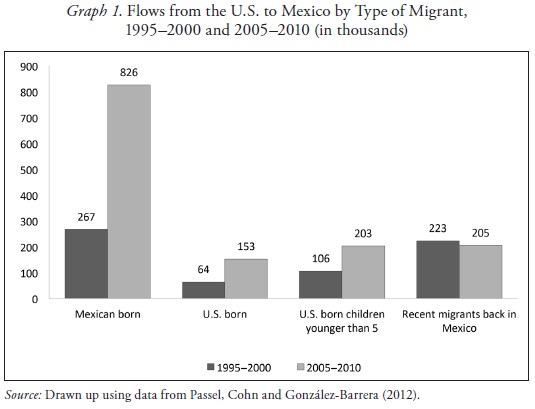
<body><![CDATA[<p align="justify">&nbsp;</p>  	    <p align="justify"><font face="verdana" size="2"><b><i>Introduction</i></b></font></p>  	    <p align="justify"><font face="verdana" size="2">Children are international migrants who are not generally considered in migration studies, either in the U.S. or Mexico. In order to explain this gap in international migration research in Mexico, a brief overview will be provided of how migration patterns between Mexico and the United States have evolved over the years. During the long, initial phase, including the Bracero Program and the period of undocumented flows (1934&#45;1986), migration from Mexico to the U.S. was circular and short&#45;term. Migrants were generally young male adults from rural zones, whose wives and children stayed in their home country (Escobar <i>et al.,</i> 1999; Zhou, 2003; Pedraza, 1991; Bustamante and Alem&aacute;n, 2007). A second, more recent phase began with the <i>Immigration Reform and Control Act</i> (IRCA), where many families were reunited in the North (Uribe, Ram&iacute;rez and Labarthe, 2012) because over two million Mexican migrants benefited from the amnesty granted by the IRCA. Family reunification processes in the U.S. transformed Mexico/U.S. migration from a young&#45;single&#45;male migration pattern to that of a family movement from South to North. As a result, women began traveling alone with some children traveling alone (Pedraza, 1991; Hondagneu&#45;Sotelo, 1999; L&oacute;pez, 2007; Chavez and Menj&iacute;var, 2010). Family reunification in the United States contributed to the increasing number of both adult migrants and Mexican&#45;born children in the United States (Batalova, 2008; Batalova and Fix, 2010).</font></p>  	    <p align="justify"><font face="verdana" size="2">A third recent phase began with the passage of the 1996 <i>Illegal Immigration Reform and Immigrant Responsibility Act</i> (IIRIRA) (Rodr&iacute;guez and Hagan, 2004; Hagan, Eschbach and Rodr&iacute;guez, 2008; INM, 2011). This not only led to a widespread anti&#45;migrant attitude, especially towards Mexicans, in various states, but also to their deportation (Ch&aacute;vez, 2008). Moreover, many jobs that had been attractive to Mexican workers were eliminated in the wake of the economic recession of 2007. As a result, many families were separated through deportation, but reunified in their home country. This phase is characterized, therefore, by the return of adult migrants and their families from the United States to Mexico, including their Mexican&#45;and U.S.&#45;born children (Zu&ntilde;iga, in press).</font></p>     <p align="justify">&nbsp;</p>  	    <p align="justify"><font face="verdana" size="2"><i><b>Adults and Child Returnees: A Quantitative Approach</b></i></font></p>  	    <p align="justify"><font face="verdana" size="2">In this section, various sources are used to quantify return migration from the U.S. to Mexico. In 2007, eight million jobs were lost in the U.S. labor market as a whole. As a result, the flow of Mexicans to that country was halved between 2007 and 2010 (Ram&iacute;rez and Meza, 2011), while 1.4 million moved from the United States back to Mexico between 2005 and 2010. Twenty&#45;five percent were 19 years old or under (Giorguli and Guti&eacute;rrez, 2011).</font></p>  	    <p align="justify"><font face="verdana" size="2">In <a href="#g1">graph 1</a>, four main groups are observed in the total number of U.S.&#45;to Mexico&#45;migrants in 2010: <i>1)</i> Mexican&#45;born adults who lived in the U.S. for five years and were back in Mexico at the time of the census; <i>2)</i> U.S.&#45;born children who had lived in the U.S. for five years before the census; <i>3)</i> U.S.&#45;born children under 5 who had been brought to Mexico by the census date; and <i>4)</i> "Recent migrants," who were in the United States for no more than five years (Passel, Cohn, and Gonz&aacute;lez&#45;Barrera, 2012:12). The number of Mexican&#45;born migrants returning to Mexico almost tripled, the graph for U.S.&#45;born children doubled, while fewer people stayed in the U.S. for over five years.</font></p> 	    <p align="center"><a name="g1"></a></p> 	    <p align="center"><img src="/img/revistas/migra/v7n4/a10g1.jpg"></p> 	     ]]></body>
<body><![CDATA[<p align="justify"><font face="verdana" size="2">In 2010, the Mexican Census reported the arrival of approximately 500 000 U.S.&#45;born children of Mexican parents (Passel, Cohn and Gonz&aacute;lez&#45;Barrera, 2012). Moreover, the census showed that 6.5 percent of youth under 19 in Mexican schools, had had an international experience, including 2.7 million minors (Escobar <i>et</i> <i>al,</i> 2013).</font></p>     <p align="justify">&nbsp;</p>  	    <p align="justify"><font face="verdana" size="2"><i><b>Child Returnees: Realities and Challenges</b></i></font></p>  	    <p align="justify"><font face="verdana" size="2">The point emphasized in this last section is that when families move back to Mexico from the United States, they enrol their children in schools (Z&uacute;&ntilde;iga, 2000). This proves Mazurek's (2009) point that migration not only involves moving, but also the role of public institutions in the integration or reintegration of migrants, their families and children.</font></p>  	    <p align="justify"><font face="verdana" size="2">Children who return from the U.S. to Mexico are not a homogeneous population. On the one hand, there are Mexican&#45;born children who left for the United States at a very early age with their parents and now are back in Mexico while on the other, there are U.S.&#45;born children who came to Mexico for the first time when their parents returned, all of whom have dual nationality. In addition, one must consider other taxonomies of children in terms of their school experiences. There are some who arrived in Mexico with a short or long school experience in the U.S., while others came to Mexico before school age.</font></p>  	    <p align="justify"><font face="verdana" size="2">The latest research on the school integration of child returnees in Mexico yields at least five conclusions. First, child returnees are "invisible" since there is little or no evidence of their educational background or mobility in either country (S&aacute;nchez and Z&uacute;&ntilde;iga, 2010). Moreover, the U.S. and the Mexican governments see migration policies as independent of and sometimes even contradictory to each other (Z&uacute;&ntilde;iga, 2000). Some teachers even claimed that they did not know they had children with U.S. school backgrounds in their classrooms until they repeatedly failed history or Spanish. These children know about American history and have never taken so much Spanish grammar and reading.</font></p>  	    <p align="justify"><font face="verdana" size="2">Second, children report that they feel frustrated and unrecognized when they arrive in the classroom, with some teachers even calling them "liars" or "shy" when they cannot complete their school&#45;work or read and/or write accurately. They therefore feel that their school skills are insufficient for succeeding in Mexican classrooms and tend to leave school before the year ends or miss classes as much as possible.</font></p>  	    <p align="justify"><font face="verdana" size="2">Third, children think that teachers in Mexico do not respond to their needs. They often feel embarrassed and unappreciated when teachers mock them in front of other students by making them read out loud or by asking questions they know they cannot answer. When children were asked if the principal knew about these problems in the classroom, they said that everybody knew but nobody cared. They feel as if they are alone in a world where no&#45;one understands them.</font></p>  	    <p align="justify"><font face="verdana" size="2">Hamann (2001) argues this, adding that these children and youth need to be protected by two worlds but instead, are abandoned by both. At the same time, they are required to develop meta&#45;cognitive abilities to interact in multiple places and cultures (Z&uacute;&ntilde;iga and Hamann, 2013). It is therefore important to include their experience of social and institutional integration in the study of return migration.</font></p>  	    <p align="justify"><font face="verdana" size="2">Fourth, compared to United States policies and programs, little has been done in Mexico to incorporate immigrant children into the school system (Z&uacute;&ntilde;iga and Hamann, 2008). Children of return migration, whether Mexican&#45;or U.S.&#45;born, agree that in American schools they were enrolled in different programs for language acquisition, reading, writing, sports and so on. When they compare their school experience in the U.S. and in Mexico, they often talk about all the activities they engaged in both during and after school in addition to the technology they used to have in their classrooms and at home.</font></p>  	    ]]></body>
<body><![CDATA[<p align="justify"><font face="verdana" size="2">Fifth, children face several everyday ruptures when enrolling in Mexican schools, not only in terms of contents and materials, but also in school practices, forms and rates of evaluation, teaching styles, criteria for success or failure, types of pedagogical feedback, the role played by parents and other family members, school timetables, homework and/or other responsibilities (Hamann and Z&uacute;&ntilde;iga, 2011). In general, one can conclude that there are no school <i>transitions</i> from the U.S. to Mexico, but rather school <i>ruptures.</i> In other words, child returnees are not welcome at Mexican schools.</font></p>     <p align="justify">&nbsp;</p>  	    <p align="justify"><font face="verdana" size="2"><i><b>Concluding Remarks: What is Being Done in Mexico to Welcome Child Returnees?</b></i></font></p>  	    <p align="justify"><font face="verdana" size="2">The Binational Program for the Education of Migrants in Mexico and the United States (Probem in Spanish) was launched in Mexico in 1982, with annual conferences, which focused on creating educational material for teachers and students and administrative issues, rather than incorporating children into the school community. There has been no further news about this program since 2006 (SEP, 2006). In 1990, the Probem incorporated the Memorandum of Understanding on Education between the Mexican and United States Governments (DGRI, 1990), in which governmental and non&#45;governmental authorities promoted a dialogue between teachers, researchers and students in both countries. The strategy was intended to locate and follow immigrant students' geographical mobility to track their academic achievement.</font></p>  	    <p align="justify"><font face="verdana" size="2">In the state of Morelos, for example&#45;where a research project on a sample of return migration students has been implemented&#45;Probem implemented an ambitious database to locate most of the children who returned or came to Mexico for the first time with their family members since 2010 at every school. Although this has been a difficult task requiring the full&#45;time dedication of four people, their hard work has achieved workshops not only for principals, classroom teachers, English teachers and special education teachers, but also for parents, and most importantly, for children. These workshops include drawing and writing contests, sports competitions, monthly visits to schools with free, updated material and help with paperwork.</font></p>  	    <p align="justify"><font face="verdana" size="2">Unfortunately, a second Probem initiative, known as Basic Education Program without Borders, designed to "contribute to improving school achievement among students returning to Mexico from other countries who are enrolled in the National Educational System and to promote appropriate school services for children who leave our country," was shelved in 2013 due to changes and decisions taken at the federal Secretar&iacute;a de Educaci&oacute;n P&uacute;blica (Secretariat of Public Education) (SEP, 2008). That program was especially designed to support international migrant children, recognizing them as vulnerable children who require institutional responses to meet their particular needs.</font></p>     <p align="justify">&nbsp;</p>  	    <p align="justify"><font face="verdana" size="2"><b>References</b></font></p>  	    <!-- ref --><p align="justify"><font face="verdana" size="2">BATALOVA, Jeanne, 2008, <i>Mexican Immigrants in the United States. Migration Information Source.</i> Available at &lt;<a href="http://www.migrationinformation.org/USFocus/display.cfm?ID=679" target="_blank">http://www.migrationinformation.org/USFocus/display.cfm?ID=679</a>&gt; (last accessed on December 17, 2012).    &nbsp;&nbsp;&nbsp;&nbsp;&nbsp;&nbsp;&nbsp;&nbsp;[&#160;<a href="javascript:void(0);" onclick="javascript: window.open('/scielo.php?script=sci_nlinks&ref=5332436&pid=S1665-8906201400020001000001&lng=','','width=640,height=500,resizable=yes,scrollbars=1,menubar=yes,');">Links</a>&#160;]<!-- end-ref --></font></p>  	    ]]></body>
<body><![CDATA[<!-- ref --><p align="justify"><font face="verdana" size="2">BATALOVA, Jeanne and Michael FIX, 2010, <i>Children of Immigrants in US Schools: A Portrait,</i> Washington, DC, Migration Policy Institute/National Center on Immigrant Integration Policy.    &nbsp;&nbsp;&nbsp;&nbsp;&nbsp;&nbsp;&nbsp;&nbsp;[&#160;<a href="javascript:void(0);" onclick="javascript: window.open('/scielo.php?script=sci_nlinks&ref=5332438&pid=S1665-8906201400020001000002&lng=','','width=640,height=500,resizable=yes,scrollbars=1,menubar=yes,');">Links</a>&#160;]<!-- end-ref --></font></p>  	    <!-- ref --><p align="justify"><font face="verdana" size="2">BUSTAMANTE, Juan J., and Carlos ALEM&Aacute;N, 2007, "Perpetuating Split&#45;household Families. The Case of Mexican So&#45;journers in Mid&#45;Michigan and their Transnational Fatherhood Practices," <i>Migraciones Internacionales</i> 12<i>,</i> Vol. 4, No. 1, January&#45;June, pp. 65&#45;86.    &nbsp;&nbsp;&nbsp;&nbsp;&nbsp;&nbsp;&nbsp;&nbsp;[&#160;<a href="javascript:void(0);" onclick="javascript: window.open('/scielo.php?script=sci_nlinks&ref=5332440&pid=S1665-8906201400020001000003&lng=','','width=640,height=500,resizable=yes,scrollbars=1,menubar=yes,');">Links</a>&#160;]<!-- end-ref --></font></p>  	    <!-- ref --><p align="justify"><font face="verdana" size="2">CH&Aacute;VEZ, Leo R., 2008, <i>The Latino Threat: Constructing Immigrants, Citizens, and the Nation,</i> Stanford, Stanford University Press.    &nbsp;&nbsp;&nbsp;&nbsp;&nbsp;&nbsp;&nbsp;&nbsp;[&#160;<a href="javascript:void(0);" onclick="javascript: window.open('/scielo.php?script=sci_nlinks&ref=5332442&pid=S1665-8906201400020001000004&lng=','','width=640,height=500,resizable=yes,scrollbars=1,menubar=yes,');">Links</a>&#160;]<!-- end-ref --></font></p>  	    <!-- ref --><p align="justify"><font face="verdana" size="2">CH&Aacute;VEZ, Lilian and Cecilia MENJ&Iacute;VAR, 2010, "Children without Borders: A Mapping of the Literature on Unaccompanied Migrant Children to the United States," <i>Migraciones Internacionales</i> 18<i>,</i> Vol. 5, No. 3, January&#45;June, pp. 71&#45;111.    &nbsp;&nbsp;&nbsp;&nbsp;&nbsp;&nbsp;&nbsp;&nbsp;[&#160;<a href="javascript:void(0);" onclick="javascript: window.open('/scielo.php?script=sci_nlinks&ref=5332444&pid=S1665-8906201400020001000005&lng=','','width=640,height=500,resizable=yes,scrollbars=1,menubar=yes,');">Links</a>&#160;]<!-- end-ref --></font></p>  	    <!-- ref --><p align="justify"><font face="verdana" size="2">DIRECCI&Oacute;N GENERAL DE RELACIONES INTERNACIONALES (DGRI), 1990, "Memor&aacute;ndum de entendimiento sobre educaci&oacute;n entre el gobierno de los Estados Unidos Mexicanos y el gobierno de los Estados Unidos de Am&eacute;rica," Washington, DC, August 8. Available at &lt;<a href="http://www.dgri.sep.gob.mx/conve/3_adn_eu1.pdf" target="_blank">http://www.dgri.sep.gob.mx/conve/3_adn_eu1.pdf</a>&gt; (last accessed on November 17, 2012).    &nbsp;&nbsp;&nbsp;&nbsp;&nbsp;&nbsp;&nbsp;&nbsp;[&#160;<a href="javascript:void(0);" onclick="javascript: window.open('/scielo.php?script=sci_nlinks&ref=5332446&pid=S1665-8906201400020001000006&lng=','','width=640,height=500,resizable=yes,scrollbars=1,menubar=yes,');">Links</a>&#160;]<!-- end-ref --></font></p>  	    ]]></body>
<body><![CDATA[<!-- ref --><p align="justify"><font face="verdana" size="2">ESCOBAR LATAP&Iacute;, Agust&iacute;n, Frank D. BEAN, and Sidney WEINTRAUB, 1999, <i>La din&aacute;mica de la emigraci&oacute;n mexicana,</i> Mexico City, CIESAS.    &nbsp;&nbsp;&nbsp;&nbsp;&nbsp;&nbsp;&nbsp;&nbsp;[&#160;<a href="javascript:void(0);" onclick="javascript: window.open('/scielo.php?script=sci_nlinks&ref=5332448&pid=S1665-8906201400020001000007&lng=','','width=640,height=500,resizable=yes,scrollbars=1,menubar=yes,');">Links</a>&#160;]<!-- end-ref --></font></p>  	    <!-- ref --><p align="justify"><font face="verdana" size="2">ESCOBAR LATAP&Iacute;, Agust&iacute;n; Lindsay LOWELL and Susan MARTIN, 2013, <i>Binational Dialogue on Mexican Migrants in the U.S. and in Mexico: Final Report,</i> Mexico City/Washington, DC, CIESAS/Georgetown University.    &nbsp;&nbsp;&nbsp;&nbsp;&nbsp;&nbsp;&nbsp;&nbsp;[&#160;<a href="javascript:void(0);" onclick="javascript: window.open('/scielo.php?script=sci_nlinks&ref=5332450&pid=S1665-8906201400020001000008&lng=','','width=640,height=500,resizable=yes,scrollbars=1,menubar=yes,');">Links</a>&#160;]<!-- end-ref --></font></p>  	    <!-- ref --><p align="justify"><font face="verdana" size="2">GIORGULI, Silvia E. and Edith Y. GUTI&Eacute;RREZ, 2011, "Ni&ntilde;os y j&oacute;venes en el contexto de la migraci&oacute;n internacional entre M&eacute;xico y Estados Unidos," <i>Coyuntura Demogr&aacute;fica,</i> Somede, No. 1, pp. 21&#45;25.    &nbsp;&nbsp;&nbsp;&nbsp;&nbsp;&nbsp;&nbsp;&nbsp;[&#160;<a href="javascript:void(0);" onclick="javascript: window.open('/scielo.php?script=sci_nlinks&ref=5332452&pid=S1665-8906201400020001000009&lng=','','width=640,height=500,resizable=yes,scrollbars=1,menubar=yes,');">Links</a>&#160;]<!-- end-ref --></font></p>  	    <!-- ref --><p align="justify"><font face="verdana" size="2">HAGAN, Jacqueline Maria; Karl ESCHBACH, and Nestor Rodr&iacute;guez, 2008, "U.S. Deportation Policy, Family Separation, and Circular Migration," <i>International Migration Review,</i> Vol. 42, No. 1, pp. 64&#45;88.    &nbsp;&nbsp;&nbsp;&nbsp;&nbsp;&nbsp;&nbsp;&nbsp;[&#160;<a href="javascript:void(0);" onclick="javascript: window.open('/scielo.php?script=sci_nlinks&ref=5332454&pid=S1665-8906201400020001000010&lng=','','width=640,height=500,resizable=yes,scrollbars=1,menubar=yes,');">Links</a>&#160;]<!-- end-ref --></font></p>  	    <!-- ref --><p align="justify"><font face="verdana" size="2">HAMANN, Edmund T., 2001, "Theorizing the Sojourner Student (with a Sketch of Appropriate School Responsiveness)," in MaryCarol Hopkins and Nancy Wllmeier, eds., <i>Negotiating Transnationalism: Selected Papers on Refugees and Immigrants,</i> Vol. IX, Arlington, U. S., American Anthropological Association, pp. 32&#45;71.    &nbsp;&nbsp;&nbsp;&nbsp;&nbsp;&nbsp;&nbsp;&nbsp;[&#160;<a href="javascript:void(0);" onclick="javascript: window.open('/scielo.php?script=sci_nlinks&ref=5332456&pid=S1665-8906201400020001000011&lng=','','width=640,height=500,resizable=yes,scrollbars=1,menubar=yes,');">Links</a>&#160;]<!-- end-ref --></font></p>  	    ]]></body>
<body><![CDATA[<!-- ref --><p align="justify"><font face="verdana" size="2">HAMANN, Edmund T. and V&iacute;ctor Z&Uacute;&Ntilde;IGA, 2011, "Schooling and the Everyday Ruptures Transnational Children Encounter in the United States and Mexico," in Catt Coe, Rachel R. Reynolds, Deborah A. Boehm, Julia M. Hess and Heather Rae&#45;Espinoza, eds., <i>Everyday Ruptures. Children, Youth, and Migration in Global Perspective,</i> Nashville, Vanderbilt University Press, pp. 141&#45;160.    &nbsp;&nbsp;&nbsp;&nbsp;&nbsp;&nbsp;&nbsp;&nbsp;[&#160;<a href="javascript:void(0);" onclick="javascript: window.open('/scielo.php?script=sci_nlinks&ref=5332458&pid=S1665-8906201400020001000012&lng=','','width=640,height=500,resizable=yes,scrollbars=1,menubar=yes,');">Links</a>&#160;]<!-- end-ref --></font></p>  	    <!-- ref --><p align="justify"><font face="verdana" size="2">HONDAGNEU&#45;SOTELO, Pierrette, 1999, "Women and their Children First: New Directions in Anti&#45;immigrant Politics," in Stephanie Coontz, Maya Parson and Gabrielle Raley, eds., <i>American Families: A Multicultural Reader,</i> New York, Routledge, pp. 288 &#45;304.    &nbsp;&nbsp;&nbsp;&nbsp;&nbsp;&nbsp;&nbsp;&nbsp;[&#160;<a href="javascript:void(0);" onclick="javascript: window.open('/scielo.php?script=sci_nlinks&ref=5332460&pid=S1665-8906201400020001000013&lng=','','width=640,height=500,resizable=yes,scrollbars=1,menubar=yes,');">Links</a>&#160;]<!-- end-ref --></font></p>  	    <!-- ref --><p align="justify"><font face="verdana" size="2">INSTITUTO NACIONAL DE MIGRACI&Oacute;N (INM), 2011, <i>Eventos de repatriaci&oacute;n de mexicanos desde Estados Unidos, seg&uacute;n entidad federativa y punto de repatriaci&oacute;n, 1995&#45;2010,</i> Mexico City, INM.    &nbsp;&nbsp;&nbsp;&nbsp;&nbsp;&nbsp;&nbsp;&nbsp;[&#160;<a href="javascript:void(0);" onclick="javascript: window.open('/scielo.php?script=sci_nlinks&ref=5332462&pid=S1665-8906201400020001000014&lng=','','width=640,height=500,resizable=yes,scrollbars=1,menubar=yes,');">Links</a>&#160;]<!-- end-ref --></font></p>  	    <!-- ref --><p align="justify"><font face="verdana" size="2">L&Oacute;PEZ CASTRO, Gustavo, 2007, "Ni&ntilde;os, socializaci&oacute;n y migraci&oacute;n a Estados Unidos," in Marina Ariza and Alejandro Portes, eds., <i>El pa&iacute;s transnacional: Migraci&oacute;n mexicana y cambio social a trav&eacute;s de la frontera,</i> Mexico City, Instituto de Investigaciones Sociales&#45;UNAM, pp. 545&#45;570.    &nbsp;&nbsp;&nbsp;&nbsp;&nbsp;&nbsp;&nbsp;&nbsp;[&#160;<a href="javascript:void(0);" onclick="javascript: window.open('/scielo.php?script=sci_nlinks&ref=5332464&pid=S1665-8906201400020001000015&lng=','','width=640,height=500,resizable=yes,scrollbars=1,menubar=yes,');">Links</a>&#160;]<!-- end-ref --></font></p>  	    <!-- ref --><p align="justify"><font face="verdana" size="2">MAZUREK, Hubert, 2009, "Migraciones y din&aacute;micas territoriales," in C. Salazar, ed., <i>Migraciones contempor&aacute;neas: Contribuci&oacute;n al debate,</i> La Paz, Bolivia, Plural Editores, pp. 11&#45;33.    &nbsp;&nbsp;&nbsp;&nbsp;&nbsp;&nbsp;&nbsp;&nbsp;[&#160;<a href="javascript:void(0);" onclick="javascript: window.open('/scielo.php?script=sci_nlinks&ref=5332466&pid=S1665-8906201400020001000016&lng=','','width=640,height=500,resizable=yes,scrollbars=1,menubar=yes,');">Links</a>&#160;]<!-- end-ref --></font></p>  	    ]]></body>
<body><![CDATA[<!-- ref --><p align="justify"><font face="verdana" size="2">PASSEL, Jeffrey; D'Vera COHN, and Ana GONZ&Aacute;LEZ&#45;BARRERA, 2012, <i>Net Migration from Mexico Falls to Zero&#45;and Perhaps Less.</i> Available at &lt;<a href="http://www.pewhispanic.org/files/2012/04/Mexican-migrants-report_final.pdf" target="_blank">http://www.pewhispanic.org/files/2012/04/Mexican&#45;migrants&#45;report_final.pdf</a>&gt; (last accessed on October 12, 2012).    &nbsp;&nbsp;&nbsp;&nbsp;&nbsp;&nbsp;&nbsp;&nbsp;[&#160;<a href="javascript:void(0);" onclick="javascript: window.open('/scielo.php?script=sci_nlinks&ref=5332468&pid=S1665-8906201400020001000017&lng=','','width=640,height=500,resizable=yes,scrollbars=1,menubar=yes,');">Links</a>&#160;]<!-- end-ref --></font></p>  	    <!-- ref --><p align="justify"><font face="verdana" size="2">PEDRAZA, Silvia, 1991, "Women and Migration: The Social Consequences of Gender," <i>Annual Review of Sociology,</i> Vol. 17, pp. 303&#45;325.    &nbsp;&nbsp;&nbsp;&nbsp;&nbsp;&nbsp;&nbsp;&nbsp;[&#160;<a href="javascript:void(0);" onclick="javascript: window.open('/scielo.php?script=sci_nlinks&ref=5332470&pid=S1665-8906201400020001000018&lng=','','width=640,height=500,resizable=yes,scrollbars=1,menubar=yes,');">Links</a>&#160;]<!-- end-ref --></font></p>  	    <!-- ref --><p align="justify"><font face="verdana" size="2">RAM&Iacute;REZ GARC&Iacute;A, Tel&eacute;sforo and Liliana MEZA GONZ&Aacute;LEZ, 2011, "Emigraci&oacute;n M&eacute;xico&#45;Estados Unidos: Balance antes y despu&eacute;s de la recesi&oacute;n econ&oacute;mica estadounidense," in <i>Situaci&oacute;n demogr&aacute;fica de M&eacute;xico 2011,</i> Mexico City, Conapo, pp. 241 &#45;259.    &nbsp;&nbsp;&nbsp;&nbsp;&nbsp;&nbsp;&nbsp;&nbsp;[&#160;<a href="javascript:void(0);" onclick="javascript: window.open('/scielo.php?script=sci_nlinks&ref=5332472&pid=S1665-8906201400020001000019&lng=','','width=640,height=500,resizable=yes,scrollbars=1,menubar=yes,');">Links</a>&#160;]<!-- end-ref --></font></p>  	    <!-- ref --><p align="justify"><font face="verdana" size="2">RODR&Iacute;GUEZ, Nestor and Jacqueline Maria HAGAN, 2004, "Fractured Families and Communities: Effects of Immigration Reform in Texas, Mexico, and El Salvador," <i>Latino Studies,</i> Vol. 2, No. 3, December, pp. 328&#45;351.    &nbsp;&nbsp;&nbsp;&nbsp;&nbsp;&nbsp;&nbsp;&nbsp;[&#160;<a href="javascript:void(0);" onclick="javascript: window.open('/scielo.php?script=sci_nlinks&ref=5332474&pid=S1665-8906201400020001000020&lng=','','width=640,height=500,resizable=yes,scrollbars=1,menubar=yes,');">Links</a>&#160;]<!-- end-ref --> </font></p> 	    <!-- ref --><p align="justify"><font face="verdana" size="2">S&Aacute;NCHEZ GARC&Iacute;A, Juan and V&iacute;ctor Z&Uacute;&Ntilde;IGA, 2010, "Educational History of Transnational Students in Mexico: Intercultural Proposal of Educational Attention," <i>Trayectorias,</i> Vol. 12, No. 30, pp. 5&#45;23.    &nbsp;&nbsp;&nbsp;&nbsp;&nbsp;&nbsp;&nbsp;&nbsp;[&#160;<a href="javascript:void(0);" onclick="javascript: window.open('/scielo.php?script=sci_nlinks&ref=5332476&pid=S1665-8906201400020001000021&lng=','','width=640,height=500,resizable=yes,scrollbars=1,menubar=yes,');">Links</a>&#160;]<!-- end-ref --></font></p>  	    ]]></body>
<body><![CDATA[<!-- ref --><p align="justify"><font face="verdana" size="2">SECRETAR&Iacute;A DE EDUCACI&Oacute;N P&Uacute;BLICA (SEP), 2006, "Programa Binacional de Educaci&oacute;n Migrante". &#91;Available at &lt;<a href="http://www.sep.gob.mx/work/appsite/probem/index.html" target="_blank">http://www.sep.gob.mx/work/appsite/probem/index.html</a>&gt;, (last accessed on November 11, 2012).    &nbsp;&nbsp;&nbsp;&nbsp;&nbsp;&nbsp;&nbsp;&nbsp;[&#160;<a href="javascript:void(0);" onclick="javascript: window.open('/scielo.php?script=sci_nlinks&ref=5332478&pid=S1665-8906201400020001000022&lng=','','width=640,height=500,resizable=yes,scrollbars=1,menubar=yes,');">Links</a>&#160;]<!-- end-ref --></font></p>  	    <!-- ref --><p align="justify"><font face="verdana" size="2">SECRETAR&Iacute;A DE EDUCACI&Oacute;N P&Uacute;BLICA (SEP), 2008, "Proyecto educaci&oacute;n b&aacute;sica sin fronteras. (Atenci&oacute;n educativa intercultural a estudiantes de educaci&oacute;n b&aacute;sica inmigrantes y emigrantes)," Mexico City, Direcci&oacute;n General de Desarrollo de la Gesti&oacute;n e Innovaci&oacute;n Educativa, June 3. Available at &lt;<a href="http://basica.sep.gob.mx/dgdgie/cva/sitio/start.php?act=notasec62" target="_blank">http://basica.sep.gob.mx/dgdgie/cva/sitio/start.php?act=notasec62</a>&gt; (last accessed on November 20, 2013).    &nbsp;&nbsp;&nbsp;&nbsp;&nbsp;&nbsp;&nbsp;&nbsp;[&#160;<a href="javascript:void(0);" onclick="javascript: window.open('/scielo.php?script=sci_nlinks&ref=5332480&pid=S1665-8906201400020001000023&lng=','','width=640,height=500,resizable=yes,scrollbars=1,menubar=yes,');">Links</a>&#160;]<!-- end-ref --></font></p>  	    <!-- ref --><p align="justify"><font face="verdana" size="2">URIBE VARGAS, Luz M; Tel&eacute;sforo RAM&Iacute;REZ GARC&Iacute;A, and Rodrigo LABARTHE &Aacute;LVAREZ, 2012, <i>&Iacute;ndices de intensidad migratoria M&eacute;xico&#45;Estados Unidos 2010,</i> Mexico City, Conapo.    &nbsp;&nbsp;&nbsp;&nbsp;&nbsp;&nbsp;&nbsp;&nbsp;[&#160;<a href="javascript:void(0);" onclick="javascript: window.open('/scielo.php?script=sci_nlinks&ref=5332482&pid=S1665-8906201400020001000024&lng=','','width=640,height=500,resizable=yes,scrollbars=1,menubar=yes,');">Links</a>&#160;]<!-- end-ref --></font></p>  	    <!-- ref --><p align="justify"><font face="verdana" size="2">ZHOU, Min, 2003, "Contemporary Trends in Immigration to the United States: Gender, Labor Market Incorporation, and Implications for Family Formation," <i>Migraciones Internacionales 5,</i> Vol. 2, No. 2, July&#45;December, pp. 77&#45;95.    &nbsp;&nbsp;&nbsp;&nbsp;&nbsp;&nbsp;&nbsp;&nbsp;[&#160;<a href="javascript:void(0);" onclick="javascript: window.open('/scielo.php?script=sci_nlinks&ref=5332484&pid=S1665-8906201400020001000025&lng=','','width=640,height=500,resizable=yes,scrollbars=1,menubar=yes,');">Links</a>&#160;]<!-- end-ref --></font></p>  	    <!-- ref --><p align="justify"><font face="verdana" size="2">NZ&Uacute;&Ntilde;IGA, V&iacute;ctor, 2000, "Migrantes internacionales de M&eacute;xico a Estados Unidos: Hacia la creaci&oacute;n de pol&iacute;ticas educativas binacionales," <i>Migraci&oacute;n M&eacute;xico&#45;Estados Unidos. Opciones de Pol&iacute;tica.</i> Available at &lt;<a href="www.conapo.gob.mx/work/models/CONAPO/migracion_internacional/MigracionOpPolitica/12.pdf" target="_blank">www.conapo.gob.mx/work/models/CONAPO/migracion_internacional/MigracionOpPolitica/12.pdf</a>&gt;, (last accessed on October 12, 2012).    &nbsp;&nbsp;&nbsp;&nbsp;&nbsp;&nbsp;&nbsp;&nbsp;[&#160;<a href="javascript:void(0);" onclick="javascript: window.open('/scielo.php?script=sci_nlinks&ref=5332486&pid=S1665-8906201400020001000026&lng=','','width=640,height=500,resizable=yes,scrollbars=1,menubar=yes,');">Links</a>&#160;]<!-- end-ref --> </font></p> 	    ]]></body>
<body><![CDATA[<!-- ref --><p align="justify"><font face="verdana" size="2">Z&Uacute;&Ntilde;IGA, V&iacute;ctor, "Ni&ntilde;os y adolescentes separados de sus familias por la migraci&oacute;n internacional: El caso de cuatro estados de M&eacute;xico," <i>Estudios Sociol&oacute;gicos,</i> No. 97, El Colegio de M&eacute;xico (in press).    &nbsp;&nbsp;&nbsp;&nbsp;&nbsp;&nbsp;&nbsp;&nbsp;[&#160;<a href="javascript:void(0);" onclick="javascript: window.open('/scielo.php?script=sci_nlinks&ref=5332488&pid=S1665-8906201400020001000027&lng=','','width=640,height=500,resizable=yes,scrollbars=1,menubar=yes,');">Links</a>&#160;]<!-- end-ref --></font></p>  	    <!-- ref --><p align="justify"><font face="verdana" size="2">Z&Uacute;&Ntilde;IGA, V&iacute;ctor and Edmund T. HAMANN, 2008, "Escuelas nacionales, alumnos transnacionales: La migraci&oacute;n M&eacute;xico/ Estados Unidos como fen&oacute;meno escolar," <i>Estudios Sociol&oacute;gicos,</i> Vol. XXVI, No. 76, El Colegio de M&eacute;xico, pp. 65&#45;85.    &nbsp;&nbsp;&nbsp;&nbsp;&nbsp;&nbsp;&nbsp;&nbsp;[&#160;<a href="javascript:void(0);" onclick="javascript: window.open('/scielo.php?script=sci_nlinks&ref=5332490&pid=S1665-8906201400020001000028&lng=','','width=640,height=500,resizable=yes,scrollbars=1,menubar=yes,');">Links</a>&#160;]<!-- end-ref --></font></p>  	    <!-- ref --><p align="justify"><font face="verdana" size="2">Z&Uacute;&Ntilde;IGA, V&iacute;ctor and Edmund T. HAMANN, 2013, "Understanding American&#45;Mexican Children," in Bryant Jensen and Adam Sawyer, eds., <i>Regarding Education: Mexican&#45;American Schooling, Immigration, and Bi&#45;national Improvement,</i> New York, Teachers College Press/Columbia University, pp. 172&#45;188.    &nbsp;&nbsp;&nbsp;&nbsp;&nbsp;&nbsp;&nbsp;&nbsp;[&#160;<a href="javascript:void(0);" onclick="javascript: window.open('/scielo.php?script=sci_nlinks&ref=5332492&pid=S1665-8906201400020001000029&lng=','','width=640,height=500,resizable=yes,scrollbars=1,menubar=yes,');">Links</a>&#160;]<!-- end-ref --></font></p>     <p align="justify">&nbsp;</p>     <p align="justify"><font face="verdana" size="2"><b>INFORMACI&Oacute;N SOBRE EL AUTORES</b></font></p>          	    <p align="justify"><font face="verdana" size="2"><b>BETSAB&Eacute; ROM&Aacute;N GONZ&Aacute;LEZ</b> es maestra en investigaci&oacute;n en psicolog&iacute;a aplicada a la educaci&oacute;n por la Universidad Veracruzana y obtuvo la licenciatura en Child Development and Learning por el Maryville College. Al finalizar la maestr&iacute;a, obtuvo menci&oacute;n honor&iacute;fica por la UNAM y la Fundaci&oacute;n Macotela por la "Mejor tesis en psicolog&iacute;a educativa 2011". Actualmente es becaria del Conacyt y estudiante de tiempo completo en el Doctorado en Ciencias Sociales del Tecnol&oacute;gico de Monterrey, donde funge como asistente de coordinaci&oacute;n. Es miembro activo del Seminario Interinstitucional: "Migraci&oacute;n internacional, escuela, familia y retorno", del Conacyt. Su l&iacute;nea de inter&eacute;s e investigaci&oacute;n se centra en la migraci&oacute;n de retorno y la educaci&oacute;n b&aacute;sica en M&eacute;xico. Actualmente est&aacute; llevando a cabo su investigaci&oacute;n doctoral en el estado de Morelos con alumnos transnacionales de cuarto a sexto grado de primaria y de primero a tercero de secundaria reci&eacute;n retornados de Estados Unidos. </font></p>  	    <p align="justify"><font face="verdana" size="2"><b>V&Iacute;CTOR Z&Uacute;&Ntilde;IGA</b> obtuvo el doctorado y la maestr&iacute;a en la Universit&eacute; Paris VIII y la licenciatura en la Universidad de Monterrey (UDEM). Es profesor de sociolog&iacute;a en la Udem adscrito a los departamentos de humanidades y educaci&oacute;n. Actualmente dirige la Divisi&oacute;n de Investigaci&oacute;n y Extensi&oacute;n de la Udem. Es investigador del SNI, nivel III. Es director de la revista <i>Trace (Procesos Mexicanos y Centroamericanos)</i> y ha sido profesor visitante en universidades de Canad&aacute;, Estados Unidos, Francia y Chile. Recientemente public&oacute;, en coautor&iacute;a con E. T. Hamann, el cap&iacute;tulo "Understanding American&#45;Mexican Children", en Bryant Jensen y Adam Sawyer, edits., <i>Regarding Educaci&oacute;n: Mexican&#45;American Schooling, Immigration, and Binational Improvement</i> (Teachers College Press, 2013). En los &uacute;ltimos 15 a&ntilde;os ha estado estudiando las trayectorias escolares y simb&oacute;licas de los ni&ntilde;os y adolescentes migrantes internacionales.</font></p>     ]]></body>
<body><![CDATA[ ]]></body><back>
<ref-list>
<ref id="B1">
<nlm-citation citation-type="">
<person-group person-group-type="author">
<name>
<surname><![CDATA[BATALOVA]]></surname>
<given-names><![CDATA[Jeanne]]></given-names>
</name>
</person-group>
<source><![CDATA[Mexican Immigrants in the United States. Migration Information Source]]></source>
<year>2008</year>
</nlm-citation>
</ref>
<ref id="B2">
<nlm-citation citation-type="">
<person-group person-group-type="author">
<name>
<surname><![CDATA[BATALOVA]]></surname>
<given-names><![CDATA[Jeanne]]></given-names>
</name>
<name>
<surname><![CDATA[FIX]]></surname>
<given-names><![CDATA[Michael]]></given-names>
</name>
</person-group>
<source><![CDATA[Children of Immigrants in US Schools: A Portrait]]></source>
<year>2010</year>
<publisher-loc><![CDATA[Washington^eDC DC]]></publisher-loc>
</nlm-citation>
</ref>
<ref id="B3">
<nlm-citation citation-type="journal">
<person-group person-group-type="author">
<name>
<surname><![CDATA[BUSTAMANTE]]></surname>
<given-names><![CDATA[Juan J.]]></given-names>
</name>
<name>
<surname><![CDATA[ALEMÁN]]></surname>
<given-names><![CDATA[Carlos]]></given-names>
</name>
</person-group>
<article-title xml:lang="en"><![CDATA[Perpetuating Split-household Families. The Case of Mexican So-journers in Mid-Michigan and their Transnational Fatherhood Practices]]></article-title>
<source><![CDATA[Migraciones Internacionales 12]]></source>
<year>2007</year>
<volume>4</volume>
<numero>1</numero>
<issue>1</issue>
<page-range>65-86</page-range></nlm-citation>
</ref>
<ref id="B4">
<nlm-citation citation-type="book">
<person-group person-group-type="author">
<name>
<surname><![CDATA[CHÁVEZ]]></surname>
<given-names><![CDATA[Leo R.]]></given-names>
</name>
</person-group>
<source><![CDATA[The Latino Threat: Constructing Immigrants, Citizens, and the Nation]]></source>
<year>2008</year>
<publisher-loc><![CDATA[Stanford ]]></publisher-loc>
<publisher-name><![CDATA[Stanford University Press]]></publisher-name>
</nlm-citation>
</ref>
<ref id="B5">
<nlm-citation citation-type="journal">
<person-group person-group-type="author">
<name>
<surname><![CDATA[CHÁVEZ]]></surname>
<given-names><![CDATA[Lilian]]></given-names>
</name>
<name>
<surname><![CDATA[MENJÍVAR]]></surname>
<given-names><![CDATA[Cecilia]]></given-names>
</name>
</person-group>
<article-title xml:lang="en"><![CDATA[Children without Borders: A Mapping of the Literature on Unaccompanied Migrant Children to the United States]]></article-title>
<source><![CDATA[Migraciones Internacionales 18]]></source>
<year>2010</year>
<volume>5</volume>
<numero>3</numero>
<issue>3</issue>
<page-range>71-111</page-range></nlm-citation>
</ref>
<ref id="B6">
<nlm-citation citation-type="">
<collab>DIRECCIÓN GENERAL DE RELACIONES INTERNACIONALES</collab>
<source><![CDATA[Memorándum de entendimiento sobre educación entre el gobierno de los Estados Unidos Mexicanos y el gobierno de los Estados Unidos de América]]></source>
<year>1990</year>
<publisher-loc><![CDATA[Washington^eDC DC]]></publisher-loc>
</nlm-citation>
</ref>
<ref id="B7">
<nlm-citation citation-type="book">
<person-group person-group-type="author">
<name>
<surname><![CDATA[ESCOBAR LATAPÍ]]></surname>
<given-names><![CDATA[Agustín]]></given-names>
</name>
<name>
<surname><![CDATA[BEAN]]></surname>
<given-names><![CDATA[Frank D.]]></given-names>
</name>
<name>
<surname><![CDATA[WEINTRAUB]]></surname>
<given-names><![CDATA[Sidney]]></given-names>
</name>
</person-group>
<source><![CDATA[La dinámica de la emigración mexicana]]></source>
<year>1999</year>
<publisher-loc><![CDATA[Mexico City ]]></publisher-loc>
<publisher-name><![CDATA[CIESAS]]></publisher-name>
</nlm-citation>
</ref>
<ref id="B8">
<nlm-citation citation-type="book">
<person-group person-group-type="author">
<name>
<surname><![CDATA[ESCOBAR LATAPÍ]]></surname>
<given-names><![CDATA[Agustín]]></given-names>
</name>
<name>
<surname><![CDATA[LOWELL]]></surname>
<given-names><![CDATA[Lindsay]]></given-names>
</name>
<name>
<surname><![CDATA[MARTIN]]></surname>
<given-names><![CDATA[Susan]]></given-names>
</name>
</person-group>
<source><![CDATA[Binational Dialogue on Mexican Migrants in the U.S. and in Mexico: Final Report]]></source>
<year>2013</year>
<publisher-loc><![CDATA[Mexico City^eDCWashington DC]]></publisher-loc>
<publisher-name><![CDATA[CIESASGeorgetown University]]></publisher-name>
</nlm-citation>
</ref>
<ref id="B9">
<nlm-citation citation-type="journal">
<person-group person-group-type="author">
<name>
<surname><![CDATA[GIORGULI]]></surname>
<given-names><![CDATA[Silvia E.]]></given-names>
</name>
<name>
<surname><![CDATA[GUTIÉRREZ]]></surname>
<given-names><![CDATA[Edith Y.]]></given-names>
</name>
</person-group>
<article-title xml:lang="es"><![CDATA[Niños y jóvenes en el contexto de la migración internacional entre México y Estados Unidos]]></article-title>
<source><![CDATA[Coyuntura Demográfica]]></source>
<year>2011</year>
<numero>1</numero>
<issue>1</issue>
<page-range>21-25</page-range><publisher-name><![CDATA[Somede]]></publisher-name>
</nlm-citation>
</ref>
<ref id="B10">
<nlm-citation citation-type="journal">
<person-group person-group-type="author">
<name>
<surname><![CDATA[HAGAN]]></surname>
<given-names><![CDATA[Jacqueline Maria]]></given-names>
</name>
<name>
<surname><![CDATA[ESCHBACH]]></surname>
<given-names><![CDATA[Karl]]></given-names>
</name>
<name>
<surname><![CDATA[Rodríguez]]></surname>
<given-names><![CDATA[Nestor]]></given-names>
</name>
</person-group>
<article-title xml:lang="en"><![CDATA[U.S. Deportation Policy, Family Separation, and Circular Migration]]></article-title>
<source><![CDATA[International Migration Review]]></source>
<year>2008</year>
<volume>42</volume>
<numero>1</numero>
<issue>1</issue>
<page-range>64-88</page-range></nlm-citation>
</ref>
<ref id="B11">
<nlm-citation citation-type="book">
<person-group person-group-type="author">
<name>
<surname><![CDATA[HAMANN]]></surname>
<given-names><![CDATA[Edmund T.]]></given-names>
</name>
</person-group>
<article-title xml:lang="en"><![CDATA[Theorizing the Sojourner Student (with a Sketch of Appropriate School Responsiveness)]]></article-title>
<person-group person-group-type="editor">
<name>
<surname><![CDATA[Hopkins]]></surname>
<given-names><![CDATA[MaryCarol]]></given-names>
</name>
<name>
<surname><![CDATA[Wllmeier]]></surname>
<given-names><![CDATA[Nancy]]></given-names>
</name>
</person-group>
<source><![CDATA[Negotiating Transnationalism: Selected Papers on Refugees and Immigrants]]></source>
<year>2001</year>
<volume>IX</volume>
<page-range>32-71</page-range><publisher-loc><![CDATA[Arlington ]]></publisher-loc>
<publisher-name><![CDATA[American Anthropological Association]]></publisher-name>
</nlm-citation>
</ref>
<ref id="B12">
<nlm-citation citation-type="book">
<person-group person-group-type="author">
<name>
<surname><![CDATA[HAMANN]]></surname>
<given-names><![CDATA[Edmund T.]]></given-names>
</name>
<name>
<surname><![CDATA[ZÚÑIGA]]></surname>
<given-names><![CDATA[Víctor]]></given-names>
</name>
</person-group>
<article-title xml:lang="en"><![CDATA[Schooling and the Everyday Ruptures Transnational Children Encounter in the United States and Mexico]]></article-title>
<person-group person-group-type="editor">
<name>
<surname><![CDATA[Coe]]></surname>
<given-names><![CDATA[Catt]]></given-names>
</name>
<name>
<surname><![CDATA[Reynolds]]></surname>
<given-names><![CDATA[Rachel R.]]></given-names>
</name>
<name>
<surname><![CDATA[Boehm]]></surname>
<given-names><![CDATA[Deborah A.]]></given-names>
</name>
<name>
<surname><![CDATA[Hess]]></surname>
<given-names><![CDATA[Julia M.]]></given-names>
</name>
<name>
<surname><![CDATA[Rae-Espinoza]]></surname>
<given-names><![CDATA[Heather]]></given-names>
</name>
</person-group>
<source><![CDATA[Everyday Ruptures. Children, Youth, and Migration in Global Perspective]]></source>
<year>2011</year>
<page-range>141-160</page-range><publisher-loc><![CDATA[Nashville ]]></publisher-loc>
<publisher-name><![CDATA[Vanderbilt University Press]]></publisher-name>
</nlm-citation>
</ref>
<ref id="B13">
<nlm-citation citation-type="book">
<person-group person-group-type="author">
<name>
<surname><![CDATA[HONDAGNEU-SOTELO]]></surname>
<given-names><![CDATA[Pierrette]]></given-names>
</name>
</person-group>
<article-title xml:lang="en"><![CDATA[Women and their Children First: New Directions in Anti-immigrant Politics]]></article-title>
<person-group person-group-type="editor">
<name>
<surname><![CDATA[Coontz]]></surname>
<given-names><![CDATA[Stephanie]]></given-names>
</name>
<name>
<surname><![CDATA[Parson]]></surname>
<given-names><![CDATA[Maya]]></given-names>
</name>
<name>
<surname><![CDATA[Raley]]></surname>
<given-names><![CDATA[Gabrielle]]></given-names>
</name>
</person-group>
<source><![CDATA[American Families: A Multicultural Reader]]></source>
<year>1999</year>
<page-range>288 -304</page-range><publisher-loc><![CDATA[New York ]]></publisher-loc>
<publisher-name><![CDATA[Routledge]]></publisher-name>
</nlm-citation>
</ref>
<ref id="B14">
<nlm-citation citation-type="book">
<collab>INSTITUTO NACIONAL DE MIGRACIÓN</collab>
<source><![CDATA[Eventos de repatriación de mexicanos desde Estados Unidos, según entidad federativa y punto de repatriación, 1995-2010]]></source>
<year>2011</year>
<publisher-loc><![CDATA[Mexico City ]]></publisher-loc>
<publisher-name><![CDATA[INM]]></publisher-name>
</nlm-citation>
</ref>
<ref id="B15">
<nlm-citation citation-type="book">
<person-group person-group-type="author">
<name>
<surname><![CDATA[LÓPEZ CASTRO]]></surname>
<given-names><![CDATA[Gustavo]]></given-names>
</name>
</person-group>
<article-title xml:lang="es"><![CDATA[Niños, socialización y migración a Estados Unidos,]]></article-title>
<person-group person-group-type="editor">
<name>
<surname><![CDATA[Ariza]]></surname>
<given-names><![CDATA[Marina]]></given-names>
</name>
<name>
<surname><![CDATA[Portes]]></surname>
<given-names><![CDATA[Alejandro]]></given-names>
</name>
</person-group>
<source><![CDATA[El país transnacional: Migración mexicana y cambio social a través de la frontera]]></source>
<year>2007</year>
<page-range>545-570</page-range><publisher-loc><![CDATA[Mexico City ]]></publisher-loc>
<publisher-name><![CDATA[Instituto de Investigaciones Sociales-UNAM]]></publisher-name>
</nlm-citation>
</ref>
<ref id="B16">
<nlm-citation citation-type="book">
<person-group person-group-type="author">
<name>
<surname><![CDATA[MAZUREK]]></surname>
<given-names><![CDATA[Hubert]]></given-names>
</name>
</person-group>
<article-title xml:lang="es"><![CDATA[Migraciones y dinámicas territoriales]]></article-title>
<person-group person-group-type="editor">
<name>
<surname><![CDATA[Salazar]]></surname>
<given-names><![CDATA[C.]]></given-names>
</name>
</person-group>
<source><![CDATA[Migraciones contemporáneas: Contribución al debate]]></source>
<year>2009</year>
<page-range>11-33</page-range><publisher-loc><![CDATA[La Paz ]]></publisher-loc>
<publisher-name><![CDATA[Plural Editores]]></publisher-name>
</nlm-citation>
</ref>
<ref id="B17">
<nlm-citation citation-type="">
<person-group person-group-type="author">
<name>
<surname><![CDATA[PASSEL]]></surname>
<given-names><![CDATA[Jeffrey]]></given-names>
</name>
<name>
<surname><![CDATA[COHN]]></surname>
<given-names><![CDATA[D'Vera]]></given-names>
</name>
<name>
<surname><![CDATA[GONZÁLEZ-BARRERA]]></surname>
<given-names><![CDATA[Ana]]></given-names>
</name>
</person-group>
<source><![CDATA[Net Migration from Mexico Falls to Zero-and Perhaps Less]]></source>
<year>2012</year>
</nlm-citation>
</ref>
<ref id="B18">
<nlm-citation citation-type="journal">
<person-group person-group-type="author">
<name>
<surname><![CDATA[PEDRAZA]]></surname>
<given-names><![CDATA[Silvia]]></given-names>
</name>
</person-group>
<article-title xml:lang="en"><![CDATA[Women and Migration: The Social Consequences of Gender]]></article-title>
<source><![CDATA[Annual Review of Sociology]]></source>
<year>1991</year>
<volume>17</volume>
<page-range>303-325</page-range></nlm-citation>
</ref>
<ref id="B19">
<nlm-citation citation-type="journal">
<person-group person-group-type="author">
<name>
<surname><![CDATA[RAMÍREZ GARCÍA]]></surname>
<given-names><![CDATA[Telésforo]]></given-names>
</name>
<name>
<surname><![CDATA[MEZA GONZÁLEZ]]></surname>
<given-names><![CDATA[Liliana]]></given-names>
</name>
</person-group>
<article-title xml:lang="es"><![CDATA[Emigración México-Estados Unidos: Balance antes y después de la recesión económica estadounidense]]></article-title>
<source><![CDATA[Situación demográfica de México 2011]]></source>
<year>2011</year>
<page-range>241 -259</page-range><publisher-loc><![CDATA[Mexico City ]]></publisher-loc>
<publisher-name><![CDATA[Conapo]]></publisher-name>
</nlm-citation>
</ref>
<ref id="B20">
<nlm-citation citation-type="journal">
<person-group person-group-type="author">
<name>
<surname><![CDATA[RODRÍGUEZ]]></surname>
<given-names><![CDATA[Nestor]]></given-names>
</name>
<name>
<surname><![CDATA[HAGAN]]></surname>
<given-names><![CDATA[Jacqueline Maria]]></given-names>
</name>
</person-group>
<article-title xml:lang="en"><![CDATA[Fractured Families and Communities: Effects of Immigration Reform in Texas, Mexico, and El Salvador]]></article-title>
<source><![CDATA[Latino Studies]]></source>
<year>2004</year>
<volume>2</volume>
<numero>3</numero>
<issue>3</issue>
<page-range>328-351</page-range></nlm-citation>
</ref>
<ref id="B21">
<nlm-citation citation-type="journal">
<person-group person-group-type="author">
<name>
<surname><![CDATA[SÁNCHEZ GARCÍA]]></surname>
<given-names><![CDATA[Juan]]></given-names>
</name>
<name>
<surname><![CDATA[ZÚÑIGA]]></surname>
<given-names><![CDATA[Víctor]]></given-names>
</name>
</person-group>
<article-title xml:lang="en"><![CDATA[Educational History of Transnational Students in Mexico: Intercultural Proposal of Educational Attention]]></article-title>
<source><![CDATA[Trayectorias]]></source>
<year>2010</year>
<volume>12</volume>
<numero>30</numero>
<issue>30</issue>
<page-range>5-23</page-range></nlm-citation>
</ref>
<ref id="B22">
<nlm-citation citation-type="">
<collab>SECRETARÍA DE EDUCACIÓN PÚBLICA</collab>
<source><![CDATA[Programa Binacional de Educación Migrante]]></source>
<year>2006</year>
</nlm-citation>
</ref>
<ref id="B23">
<nlm-citation citation-type="book">
<collab>SECRETARÍA DE EDUCACIÓN PÚBLICA</collab>
<source><![CDATA[Proyecto educación básica sin fronteras. (Atención educativa intercultural a estudiantes de educación básica inmigrantes y emigrantes)]]></source>
<year>2008</year>
<publisher-loc><![CDATA[Mexico City ]]></publisher-loc>
<publisher-name><![CDATA[Dirección General de Desarrollo de la Gestión e Innovación Educativa]]></publisher-name>
</nlm-citation>
</ref>
<ref id="B24">
<nlm-citation citation-type="book">
<person-group person-group-type="author">
<name>
<surname><![CDATA[URIBE VARGAS]]></surname>
<given-names><![CDATA[Luz M]]></given-names>
</name>
<name>
<surname><![CDATA[RAMÍREZ GARCÍA]]></surname>
<given-names><![CDATA[Telésforo]]></given-names>
</name>
<name>
<surname><![CDATA[LABARTHE ÁLVAREZ]]></surname>
<given-names><![CDATA[Rodrigo]]></given-names>
</name>
</person-group>
<source><![CDATA[Índices de intensidad migratoria México-Estados Unidos 2010]]></source>
<year>2012</year>
<publisher-loc><![CDATA[Mexico City ]]></publisher-loc>
<publisher-name><![CDATA[Conapo]]></publisher-name>
</nlm-citation>
</ref>
<ref id="B25">
<nlm-citation citation-type="journal">
<person-group person-group-type="author">
<name>
<surname><![CDATA[ZHOU]]></surname>
<given-names><![CDATA[Min]]></given-names>
</name>
</person-group>
<article-title xml:lang="en"><![CDATA[Contemporary Trends in Immigration to the United States: Gender, Labor Market Incorporation, and Implications for Family Formation]]></article-title>
<source><![CDATA[Migraciones Internacionales 5]]></source>
<year>2003</year>
<volume>2</volume>
<numero>2</numero>
<issue>2</issue>
<page-range>77-95</page-range></nlm-citation>
</ref>
<ref id="B26">
<nlm-citation citation-type="">
<person-group person-group-type="author">
<name>
<surname><![CDATA[ZÚÑIGA]]></surname>
<given-names><![CDATA[Víctor]]></given-names>
</name>
</person-group>
<article-title xml:lang="es"><![CDATA[Migrantes internacionales de México a Estados Unidos: Hacia la creación de políticas educativas binacionales]]></article-title>
<source><![CDATA[Migración México-Estados Unidos. Opciones de Política]]></source>
<year>2000</year>
</nlm-citation>
</ref>
<ref id="B27">
<nlm-citation citation-type="journal">
<person-group person-group-type="author">
<name>
<surname><![CDATA[ZÚÑIGA]]></surname>
<given-names><![CDATA[Víctor]]></given-names>
</name>
</person-group>
<article-title xml:lang="es"><![CDATA[Niños y adolescentes separados de sus familias por la migración internacional: El caso de cuatro estados de México]]></article-title>
<source><![CDATA[Estudios Sociológicos]]></source>
<year></year>
<numero>97</numero>
<issue>97</issue>
<publisher-name><![CDATA[El Colegio de México]]></publisher-name>
</nlm-citation>
</ref>
<ref id="B28">
<nlm-citation citation-type="journal">
<person-group person-group-type="author">
<name>
<surname><![CDATA[ZÚÑIGA]]></surname>
<given-names><![CDATA[Víctor]]></given-names>
</name>
<name>
<surname><![CDATA[HAMANN]]></surname>
<given-names><![CDATA[Edmund T.]]></given-names>
</name>
</person-group>
<article-title xml:lang="es"><![CDATA[Escuelas nacionales, alumnos transnacionales: La migración México/ Estados Unidos como fenómeno escolar]]></article-title>
<source><![CDATA[Estudios Sociológicos]]></source>
<year>2008</year>
<volume>XXVI</volume>
<numero>76</numero>
<issue>76</issue>
<page-range>65-85</page-range><publisher-name><![CDATA[El Colegio de México]]></publisher-name>
</nlm-citation>
</ref>
<ref id="B29">
<nlm-citation citation-type="book">
<person-group person-group-type="author">
<name>
<surname><![CDATA[ZÚÑIGA]]></surname>
<given-names><![CDATA[Víctor]]></given-names>
</name>
<name>
<surname><![CDATA[HAMANN]]></surname>
<given-names><![CDATA[Edmund T.]]></given-names>
</name>
</person-group>
<article-title xml:lang="en"><![CDATA[Understanding American-Mexican Children]]></article-title>
<person-group person-group-type="editor">
<name>
<surname><![CDATA[Jensen]]></surname>
<given-names><![CDATA[Bryant]]></given-names>
</name>
<name>
<surname><![CDATA[Sawyer]]></surname>
<given-names><![CDATA[Adam]]></given-names>
</name>
</person-group>
<source><![CDATA[Regarding Education: Mexican-American Schooling, Immigration, and Bi-national Improvement]]></source>
<year>2013</year>
<page-range>172-188</page-range><publisher-loc><![CDATA[New York ]]></publisher-loc>
<publisher-name><![CDATA[Teachers College PressColumbia University]]></publisher-name>
</nlm-citation>
</ref>
</ref-list>
</back>
</article>
