<?xml version="1.0" encoding="ISO-8859-1"?><article xmlns:mml="http://www.w3.org/1998/Math/MathML" xmlns:xlink="http://www.w3.org/1999/xlink" xmlns:xsi="http://www.w3.org/2001/XMLSchema-instance">
<front>
<journal-meta>
<journal-id>1665-8906</journal-id>
<journal-title><![CDATA[Migraciones internacionales]]></journal-title>
<abbrev-journal-title><![CDATA[Migr. Inter]]></abbrev-journal-title>
<issn>1665-8906</issn>
<publisher>
<publisher-name><![CDATA[El Colegio de la Frontera Norte A.C.]]></publisher-name>
</publisher>
</journal-meta>
<article-meta>
<article-id>S1665-89062014000100002</article-id>
<title-group>
<article-title xml:lang="en"><![CDATA[Connected Immigrants? Four Methodological Challenges for the Analysis of ICT Use through Survey Data]]></article-title>
<article-title xml:lang="es"><![CDATA[¿Inmigrantes conectados? Cuatro desafíos metodológicos en el análisis del uso de las TIC a través de datos de encuestas]]></article-title>
</title-group>
<contrib-group>
<contrib contrib-type="author">
<name>
<surname><![CDATA[Vancea]]></surname>
<given-names><![CDATA[Mihaela]]></given-names>
</name>
<xref ref-type="aff" rid="A01"/>
</contrib>
<contrib contrib-type="author">
<name>
<surname><![CDATA[Boso]]></surname>
<given-names><![CDATA[Àlex]]></given-names>
</name>
<xref ref-type="aff" rid="A01"/>
</contrib>
</contrib-group>
<aff id="A01">
<institution><![CDATA[,Universitat Pompeu Fabra  ]]></institution>
<addr-line><![CDATA[ ]]></addr-line>
</aff>
<pub-date pub-type="pub">
<day>00</day>
<month>06</month>
<year>2014</year>
</pub-date>
<pub-date pub-type="epub">
<day>00</day>
<month>06</month>
<year>2014</year>
</pub-date>
<volume>7</volume>
<numero>3</numero>
<fpage>43</fpage>
<lpage>72</lpage>
<copyright-statement/>
<copyright-year/>
<self-uri xlink:href="http://www.scielo.org.mx/scielo.php?script=sci_arttext&amp;pid=S1665-89062014000100002&amp;lng=en&amp;nrm=iso"></self-uri><self-uri xlink:href="http://www.scielo.org.mx/scielo.php?script=sci_abstract&amp;pid=S1665-89062014000100002&amp;lng=en&amp;nrm=iso"></self-uri><self-uri xlink:href="http://www.scielo.org.mx/scielo.php?script=sci_pdf&amp;pid=S1665-89062014000100002&amp;lng=en&amp;nrm=iso"></self-uri><abstract abstract-type="short" xml:lang="en"><p><![CDATA[Both the sociology of migration and the academic literature on network society tend to highlight the penetration of new information and communication technologies (ICT) in the migrant population. While there have been significant contributions to this area of knowledge from qualitative studies, very few quantitative studies examine the relationship between the migrant population and new technologies. This article outlines four methodological challenges in the analysis of migrant populations' adaptation to the network society through survey data: absence of relevant variables, possible measurement errors in the dependent variable, data collection problems and endogeneity.]]></p></abstract>
<abstract abstract-type="short" xml:lang="es"><p><![CDATA[Tanto la sociología de la migración como la literatura académica especializada en el estudio de la sociedad red tienden a destacar la penetración de las nuevas tecnologías de la información y la comunicación (TIC) en la población inmigrante. Mientras que existen aportaciones relevantes en esta área de conocimiento que provienen de investigaciones de naturaleza cualitativa, escasean las aproximaciones cuantitativas al estudio de la relación entre la población inmigrada y las nuevas tecnologías. Este artículo detalla cuatro de los principales desafíos metodológicos para el análisis de esta temática mediante datos de encuestas: la ausencia de variables relevantes, los errores de medida en la variable dependiente, las dificultades en la fase de la recogida de datos y la endogeneidad.]]></p></abstract>
<kwd-group>
<kwd lng="en"><![CDATA[network society]]></kwd>
<kwd lng="en"><![CDATA[surveys]]></kwd>
<kwd lng="en"><![CDATA[information and communication technologies (ICT)]]></kwd>
<kwd lng="en"><![CDATA[migrant population]]></kwd>
<kwd lng="en"><![CDATA[methodology]]></kwd>
<kwd lng="es"><![CDATA[sociedad red]]></kwd>
<kwd lng="es"><![CDATA[encuestas]]></kwd>
<kwd lng="es"><![CDATA[tecnologías de la información y la comunicación (TIC)]]></kwd>
<kwd lng="es"><![CDATA[población inmigrante]]></kwd>
<kwd lng="es"><![CDATA[metodología]]></kwd>
</kwd-group>
</article-meta>
</front><body><![CDATA[  	    <p align="justify"><font face="verdana" size="4">Art&iacute;culos</font></p>  	    <p align="justify"><font face="verdana" size="2">&nbsp;</font></p>  	    <p align="center"><font face="verdana" size="4"><b>Connected Immigrants? Four Methodological Challenges for the Analysis of ICT Use through Survey Data<a href="#nota">*</a></b></font></p>  	    <p align="center"><font face="verdana" size="2">&nbsp;</font></p>  	    <p align="center"><font face="verdana" size="3"><b>&iquest;Inmigrantes conectados? Cuatro desaf&iacute;os metodol&oacute;gicos en el an&aacute;lisis del uso de las TIC a trav&eacute;s de datos de encuestas</b></font></p>  	    <p align="center"><font face="verdana" size="2">&nbsp;</font></p>  	    <p align="center"><font face="verdana" size="2"><b>Mihaela Vancea y &Agrave;lex Boso</b></font></p>  	    <p align="justify"><font face="verdana" size="2">&nbsp;</font></p>  	    <p align="justify"><font face="verdana" size="2"><i>Universitat Pompeu Fabra. </i>Direcciones electr&oacute;nicas: <a href="mailto:mihaela.vancea@upf.edu">mihaela.vancea@upf.edu</a>, <a href="mailto:alex.boso@upf.edu">alex.boso@upf.edu</a>.</font></p>      ]]></body>
<body><![CDATA[<p align="justify"><font face="verdana" size="2">&nbsp;</font></p>  	    <p align="justify"><font face="verdana" size="2">Date of receipt: June 28, 2012.    <br> 	Date of acceptance: January 14, 2013.</font></p>  	    <p align="justify"><font face="verdana" size="2">&nbsp;</font></p>  	    <p align="justify"><font face="verdana" size="2"><b>Abstract</b></font></p>  	    <p align="justify"><font face="verdana" size="2">Both the sociology of migration and the academic literature on network society tend to highlight the penetration of new information and communication technologies (ICT) in the migrant population. While there have been significant contributions to this area of knowledge from qualitative studies, very few quantitative studies examine the relationship between the migrant population and new technologies. This article outlines four methodological challenges in the analysis of migrant populations' adaptation to the network society through survey data: absence of relevant variables, possible measurement errors in the dependent variable, data collection problems and endogeneity.</font></p>  	    <p align="justify"><font face="verdana" size="2"><b>Keywords:</b>  network society,  surveys,  information and communication technologies (ICT),  migrant population,  methodology.</font></p>  	    <p align="justify"><font face="verdana" size="2">&nbsp;</font></p>  	    <p align="justify"><font face="verdana" size="2"><b>Resumen</b></font></p>  	    <p align="justify"><font face="verdana" size="2">Tanto la sociolog&iacute;a de la migraci&oacute;n como la literatura acad&eacute;mica especializada en el estudio de la sociedad red tienden a destacar la penetraci&oacute;n de las nuevas tecnolog&iacute;as de la informaci&oacute;n y la comunicaci&oacute;n (TIC) en la poblaci&oacute;n inmigrante. Mientras que existen aportaciones relevantes en esta &aacute;rea de conocimiento que provienen de investigaciones de naturaleza cualitativa, escasean las aproximaciones cuantitativas al estudio de la relaci&oacute;n entre la poblaci&oacute;n inmigrada y las nuevas tecnolog&iacute;as. Este art&iacute;culo detalla cuatro de los principales desaf&iacute;os metodol&oacute;gicos para el an&aacute;lisis de esta tem&aacute;tica mediante datos de encuestas: la ausencia de variables relevantes, los errores de medida en la variable dependiente, las dificultades en la fase de la recogida de datos y la endogeneidad.</font></p>  	    ]]></body>
<body><![CDATA[<p align="justify"><font face="verdana" size="2"><b>Palabras clave:</b>  sociedad red,  encuestas,  tecnolog&iacute;as de la informaci&oacute;n y la comunicaci&oacute;n (TIC),  poblaci&oacute;n inmigrante,  metodolog&iacute;a.</font></p>  	    <p align="justify"><font face="verdana" size="2">&nbsp;</font></p>  	    <p align="justify"><font face="verdana" size="2"><b><i>Introduction</i></b></font></p>  	    <p align="justify"><font face="verdana" size="2">The rapid spread of new information and communication technologies (ICT) in recent decades has provided the public with unprecedented access to large amounts of information and changed patterns of interaction and communication between people, communities and institutions. Technologies such as the Internet and mobile phones have transformed the way many people communicate, work, study and live (Vancea and Olivera, 2012).</font></p>  	    <p align="justify"><font face="verdana" size="2">Some authors have postulated the advent of the socalled mobility paradigm, which emphasizes the changes produced by the current movements and multiple connections between individuals in the way they communicate, relate and understand social life (Sheller and Urry, 2006). Following this line of argument, the mobility paradigm also requires a change in the "a&#45;mobile", reductionist way of conducting research in the social sciences (Sheller and Urry, 2006:208).</font></p>  	    <p align="justify"><font face="verdana" size="2">The technological transformation that took place at the end of last century in conjunction with the arrival of an emerging culture of digital social networks has substantively changed the social organization of industrial societies (Castells, 2000, 2001; Castells <i>et al.,</i> 2007). The network society, based on networks activated by information and communication technologies, has developed as a new global social structure (Castells <i>et al.,</i> 2003:22; Castells, 2009:50&#45;51). However, given the centrality the network society confers on ICTs, lack of access to digital information and communication networks has emerged as a new form of social exclusion in contemporary societies (Castells, 2001).</font></p>  	    <p align="justify"><font face="verdana" size="2">The immigrant population appears to be increasingly engaged in communication and information networks that go beyond physical or spatial boundaries. The reduction of the cost of access to communication and information that characterizes the new network societies and cheaper air fares constitute key factors in facilitating the permanent connection between immigrants and their countries or communities of origin (Castles and Miller, 2009; Vertovec, 2004). Various studies show how immigrants live across state borders, regularly traveling from one country to another (when their administrative and financial situation allows), and so acquire and develop transnational links and multiple affiliations (economic, political and social&#45;cultural) in more than one country (Landolt, 2008; Portes, Escobar, and Walton, 2007; &#216;stergaard&#45;Nielsen, 2003).</font></p>  	    <p align="justify"><font face="verdana" size="2">This new scenario explains the surge of interest and research on the connection between ICTs and the immigrant population in recent years in the study of the sociology of migration. Several authors such as Castells (2000), Horst and Miller (2006), Diminescu (2008) and Nedelcu (2009) argue that access to ICTs turns immigrant populations into powerful connectivity nodes. Thus immigrants are usually defined in the literature as the main promoters of a digital network culture, which seamlessly adapts to their spirit of mobility (Diminescu, 2002, 2004, 2008; Urry, 2000; Larsen, Urry, and Axhausen, 2006; Nedelcu, 2009; Ros, 2010).</font></p>  	    <p align="justify"><font face="verdana" size="2">Current international migration processes should therefore be understood as a dynamic process that spreads throughout transnational space (Nedelcu, 2009; Levitt and Glick&#45;Schiller, 2004; Portes, 2003; Basch, Glick&#45;Schiller, and Szanton, 2003; &#216;stergaard&#45;Nielsen, 2003). Conceiving of migration as a dynamic process breaks with the traditional epistemological assumption that the contours of society coincide with those of the nation&#45;state (Wimmer and Glick&#45;Schiller, 2003; Llopis&#45;Goig, 2007). Indeed, several authors have pointed out the drawbacks of "methodological nationalism"&#151;the assumption that the triad of nation, state and society is the natural social and political form of the modern world (Wimmer and Glick&#45;Schiller, 2003)&#151;for studying international migration processes within the current context of globalization, where global interconnections have increased and nation&#45;states as the unit of organization of social and political life have been challenged by global flows of communication, information, goods and people (Beck, 1999, 2004; Smith, 1979; Wallerstein, 1974).</font></p>  	    <p align="justify"><font face="verdana" size="2">Trying to understand and analyze human behavior simultaneously in more than one location and thereby overcome the constraints of methodological nationalism poses a substantive epistemological and methodological challenge for social sciences as a whole. From an epistemological point of view, this new perspective, which does not regard states or societies of origin and destination as nationally&#45;bounded entities, may contribute to overcoming the dichotomy between countries of origin and countries of destination, thereby promoting a reconceptualization of migration and the incorporation or integration of immigrants (Vancea, 2009).</font></p>  	    ]]></body>
<body><![CDATA[<p align="justify"><font face="verdana" size="2">Analyzing the migratory phenomenon as a two&#45;way dynamic process through a transnational social space also has certain methodological implications. One of the most conspicuous is the quality of the data social scientists rely on to draw valid descriptive and explanatory inferences. Social scientists must be provided with better data sources that encourage the acquisition of a fuller understanding of the migration processes (especially as regards adaptation and integration) of people in today's network societies and new forms of identification and transnational participation.</font></p>  	    <p align="justify"><font face="verdana" size="2">This article discusses some of the main methodological challenges faced by social researchers when drawing valid inferences about the immigrant population and their adaptation to the network society on the basis of survey data. An analysis of the characteristics and potential of various surveys as a tool for the systematic study of the problems described identified four possible methodological problems to be solved: <i>1)</i> lack of key variables, <i>2)</i> measurement errors in the dependent variable, <i>3)</i> difficulties during the data collection phase and <i>4)</i> endogeneity. Most of the methodological problems detected and analyzed in this study correspond to surveys such as Eurostat's (European Commission, 2012) "Community Survey on ICTs Usage in Households and by Individual", particularly the "Survey on the Equipment and Use of Information and Communication Technologies in Households" (henceforth referred to as ICT&#45;H) (INE, 2009, 2012), although they can in fact be extended to other existing data bases. The article also uses data taken from certain studies undertaken for the case of Spain and Catalonia in order to provide an empirical basis for the methodological reflections made.</font></p>  	    <p align="justify"><font face="verdana" size="2">&nbsp;</font></p>  	    <p align="justify"><font face="verdana" size="2"><b><i>Immigrants and New Technologies in Surveys</i></b></font></p>  	    <p align="justify"><font face="verdana" size="2">The results of recent studies on ICT use by the immigrant population in Europe, both qualitative and quantitative, appear to coincide, noting that the immigrant population has become a regular ICTs user. Reports by Codagnone and Kluzer (2011) and Kluzer, Hach&eacute;, and Codagnone (2008) on digital inclusion, with data on ICTs and the integration of immigrants into several European countries and other exploratory work, appear to reinforce this hypothesis (Boso and Ros, 2010; Ofcom, 2008).</font></p>  	    <p align="justify"><font face="verdana" size="2">Qualitative research has demonstrated the role of ICT in the integration of immigrants and the promotion of cultural diversity in the new network societies (Hepp, Welling, and Aksen, 2009; Maya <i>et al.,</i> 2009; Diminescu, 2002, 2004; Nedelcu, 2009). In the current context of the network society, the integration of immigrants seems to imply much more than a simple process of socioeconomic insertion, civic and political participation or the mere internalization of the social norms and cultural values of the destination country. The integration of the immigrant population into the network society means "being connected", in other words, <i>1)</i> being able to intelligently combine mobility, autonomy and communication, <i>2)</i> knowing how to make strategic use of connectivity networks and <i>3)</i> striking a balance between relations with the country of origin and the destination country (Diminescu, 2008).</font></p>  	    <p align="justify"><font face="verdana" size="2">Following Diminescu's (2008) definition of "connected immigrants", in this article, the adaptation or integration of the immigrant population into the network society is not only understood as this segment of the population's participation in the economic, political, social and cultural life of the host society but also as the degree of mobility and digital connectivity of these people in the various areas of their lives as residents of another country or society. While most of these qualitative studies suggest that the provision of information and social networks is a key component in the social inclusion of people of immigrant origin, relatively little is known about how newcomers to the host country locate and access information or what kind of communication networks and information they use. There is a similar lack of information about their attitudes, values and level of awareness regarding the use of various channels of information and communication offered by ICTs.</font></p>  	    <p align="justify"><font face="verdana" size="2">This is partly due to the heterogeneity of immigrants as a new technology user group. Immigrants tend to simultaneously belong to several socio&#45;demographic and legal categories (skilled workers, sponsored family members, business people, refugees, foreign students or temporary workers). They often have varying cultural profiles together with different levels of familiarity with the institutions and values of the destination society. However, the lack of key quantitative data for linking the immigrant population to key institutions and agents in the so&#45;called "network society" is one of the main causes of the dearth of quantitative studies for exploring this issue.</font></p>  	    <p align="justify"><font face="verdana" size="2">At present, the main tools for the quantitative analysis of the insertion of citizens into the network society are Eurostat's "Community Survey on ICTs Usage in Households and by Individual" (European Commision, 2012) at the European level, and the itch surveys by the National Statistics Institute (Instituto Nacional de Estad&iacute;stica or INE) for Spain. Both surveys are cross&#45;sectional and published annually.</font></p>  	    <p align="justify"><font face="verdana" size="2">The survey on "Community Survey on ICTs Usage in Households and by Individual" were introduced in 2002 by the European Commission to measure the development of ICTs among individuals and in their households. Eurostat coordinates these survey, undertaken annually at the national level. The survey questionnaire, developed in collaboration with members states and the Organisation for Economic Cooperation and Development (OECD), is adapted to the changing needs of users and political agents. Surveys typically include six question modules on new technologies, ICTs access, computer use, Internet use, e&#45;government, e&#45;commerce and digital skills or competencies (to search, obtain, process and transmit information), together with a question module on respondents' socio&#45;demographic characteristics.</font></p>  	    ]]></body>
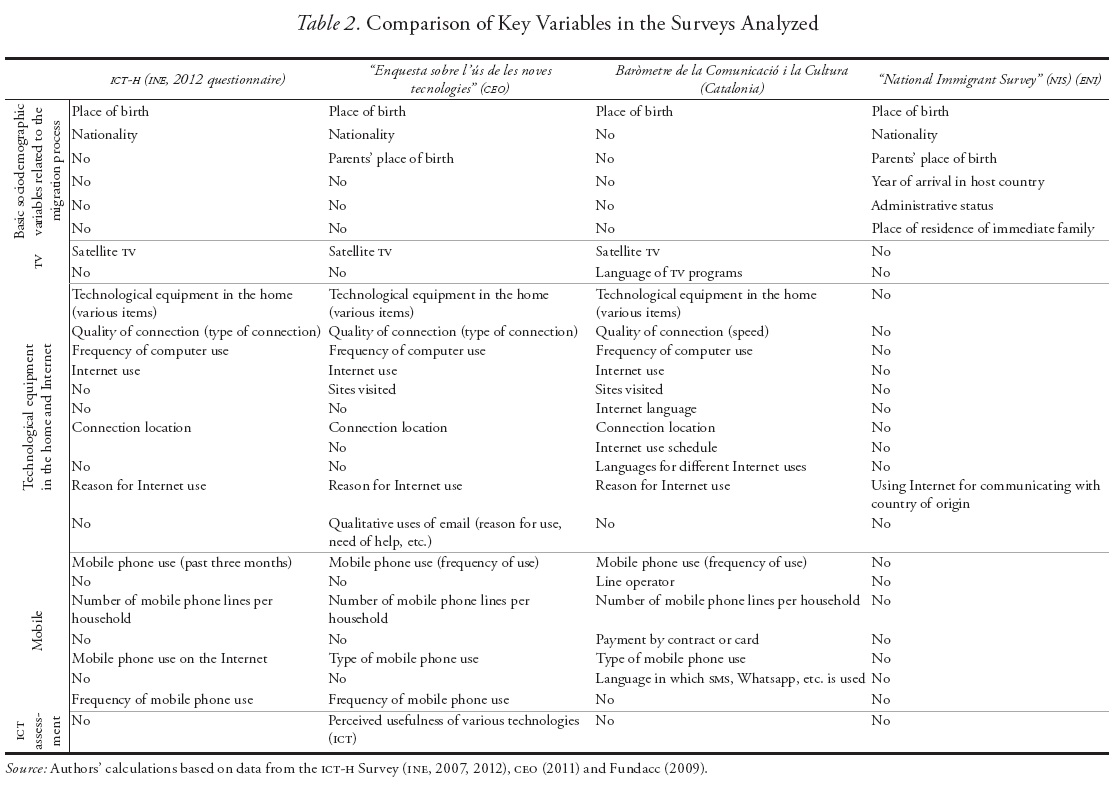
<body><![CDATA[<p align="justify"><font face="verdana" size="2">The ITC&#45;H, which follows the methodological recommendations of Eurostat (the data it yields are comparable to those of other European countries), collects data on the various information and communication technologies in Spanish households as well as the uses to which citizens put these products. The ICT&#45;H survey also focuses on the use children make of new technologies. The data are available to the public and may be downloaded from the National Statistics Institute website (INE, 2009, 0212).</font></p>  	    <p align="justify"><font face="verdana" size="2">Compared with other surveys that address issues related to ICTs and/or the immigrant population, this data source has a significant advantage for the purposes of sociological research. The immigrant population is relatively well represented (it constitutes about 10 % of the sample, with certain variations per year), meaning that its level of ICTs ownership and use can be compared with the behavior of the native population. But, although the "National Immigrant Survey" (NIS)&#151;"Encuesta Nacional de Inmigrantes" (ENI)&#151;is currently the best source of information on the immigrant population in Spain, the survey does not collect detailed information on ICT issues nor does it enable effective comparisons to be carried out between the Spanish and foreign population. On the other hand, at the autonomous level, there are a number of outstanding data matrices such as the <i>El Bar&ograve;metre de la Comunicaci&oacute; i la Cultura</i> (with its excellent fieldwork) (Fundacc, 2009) and "L'Enquesta sobre l'&uacute;s de les noves technologies" by the Centro d'Estudios de Opini&oacute;n (CEO, 2006, 2008, 2011) of the Generalitat de Catalunya, with its wealth of variables. However, the problem of the difficulty of extrapolating results from the study of Catalan case to a more general level, is compounded by the difficulty of access to these two data matrices, since, as can be seen from <a href="/img/revistas/migra/v7n3/a2t1.jpg" target="_blank">table 1</a>, in neither case is access completely free.</font></p>  	    <p align="justify"><font face="verdana" size="2">&nbsp;</font></p>  	    <p align="justify"><font face="verdana" size="2"><i><b>Absence of Key Variables</b></i></font></p>  	    <p align="justify"><font face="verdana" size="2">When social scientists attempt to study the adaptation of the immigrant population in the network society through survey data, the first methodological problem they may encounter is how to overcome the absence of key variables in available data sources. This problem makes it difficult to draw valid inferences, and for one reason or another, affects all the data matrices analyzed to date.</font></p>  	    <p align="justify"><font face="verdana" size="2">The first drawback of surveys on the study of the immigrant population is the definition of the concept of immigrant. The notion of "immigrant" is sometimes used without it being clear whether a person is so defined because of his nationality, country of birth or that of his parents.<a href="#nota"><sup>1</sup></a> From a sociological point of view, nationality is a normative attribute that is less important than one's country of birth. A person's nationality indicates the legal status of this person in terms of rights (and duties), which may or may not coincide with his original nationality. However, a person's country of birth is a characteristic that largely determines his culture and family structure and even influences the process of regularization of this person's administrative status or naturalization, and in the case of ICTs may be associated with certain distinct technological uses.</font></p>  	    <p align="justify"><font face="verdana" size="2">In order for a given survey to be a useful tool in the comparison of human behavior, its questionnaire should collect detailed data on individual characteristics such as country of birth (of both the respondent and his household), length of residence, immigration trajectory, administrative status and nationality of the person interviewed.</font></p>  	    <p align="justify"><font face="verdana" size="2">In the Spanish context, the only survey that currently provides substantive information on immigrants is the nis&#45;2007 (INE, 2007). However, the problem with this survey is that in addition to only having been conducted once, it barely explores technological variables. No questions are asked about ICTs possession or use, meaning that this information can only partially be inferred from certain indicators on the means used by immigrants to contact their families in the country of origin and ICTs use for jobseeking and sending remittances.</font></p>  	    <p align="center"><font face="verdana" size="2"><a href="/img/revistas/migra/v7n3/a2t2.jpg" target="_blank">Table</a> <a href="/img/revistas/migra/v7n3/a2t2.jpg">2</a></font></p>  	    <p align="justify"><font face="verdana" size="2">At the European level, there is a conspicuous lack of survey data taking into account sociologically relevant aspects that characterize the immigrant population. A notable exception is the remarkable effort by the recent "Immigrant Citizens Survey" (Huddleston, Dag, and Callier, 2012), undertaken by the King Baudouin Foundation and the Migration Policy Group. This is the first transnational study to record the views of the immigrant population on the integration policies adopted by various administrations. The survey, conducted on 7 000 immigrants legally resident in 15 cities and six E.U. countries (Germany, Belgium, Spain, France, Hungary, and Portugal) focuses on analyzing respondents' perception of the labor market, participation social and education. However, the survey barely analyzes technological variables.</font></p>  	    ]]></body>
<body><![CDATA[<p align="justify"><font face="verdana" size="2">Eurostat surveys on "Community Survey on ICT Usage in Households and by Individual" have also overlooked fundamental aspects in the study of the immigrant population such as the respondent's country of birth (European Commission, 2012). In the Spanish case, even though the country of birth is recorded in the fieldwork, this datum is not fully transferred to the data matrix, thereby constituting an information processing error. Not having a correctly categorized variable on the country of birth entails a significant loss of information for the study of the adaptation of the immigrant population to the network society.</font></p>  	    <p align="justify"><font face="verdana" size="2">For example, the Spanish "Community Survey on ICT Usage in Households and by Individual" (2009) asks, "What is your country of birth?" (the interviewer describes the country) and the datum is entered in the re&#45;encrypted data matrix in one of the following three categories: "Spain", "another European Union country", "a country outside the European Union". This oversight makes it difficult for researchers to make valid descriptive inferences, since it assumes that the behavior of those in the three categories of country of birth is homogeneous.</font></p>  	    <p align="justify"><font face="verdana" size="2">Data from the <i>Bar&ograve;metre de la Comunicaci&oacute; i la Cultura</i> in Catalonia (<a href="/img/revistas/migra/v7n3/a2t3.jpg" target="_blank">table 3</a>) suggest that within the group of interviewees categorized by the surveys derived from Eurostat as people from "a country outside the European Union", respondents' patterns of behavior are particularly heterogeneous, with a high variation as regards their origin (by region). The Latin American community, for example, shows high levels of ICT use, whereas the Sub&#45;Saharan and Maghreb groups display relatively low percentages, except as regards use of the mobile telephone, the most universal technology. However, these data are unable to account for possible variations in the technological behavior of these people as a function of their country of birth.</font></p>  	    <p align="justify"><font face="verdana" size="2">Incorporating respondents' country of birth into survey data at both the European and national level is a necessary step in the advancement of studies concerned with analyzing how ICTs can contribute to the everyday economic, social, civic and political integration of the immigrant population.</font></p>  	    <p align="justify"><font face="verdana" size="2">Poor coding of the origin variable is certainly the most obvious case of the omission of sociologically relevant variables for a descriptive analysis of the behavior of the immigrant population. However, the absence of potentially relevant variables also increases the risk of introducing biases into the causal inferences that associate differences in ICT equipment, use or evaluation with the respondent's origin. Methodologically, as will be seen below, this is a more serious problem.</font></p>  	    <p align="justify"><font face="verdana" size="2">There are many studies and reports that have described different behavior patterns and technological attitudes between the native and immigrant population. In Germany, the "Migranten und Medien 2007" survey (ARD/ZDF Medienkommission, 2007) provides data indicating that the introduction of mobile phones and computers is higher among groups of immigrant origin. In Spain, certain studies (Boso and Ros, 2010; Kluzer, Hache, and Codagnone, 2008) point to a process of convergence on the quantitative use of ICT, yet indicate statistically significant differences in type of use, place of access and attitudes towards ICT. Despite the importance of this information, no study has succeeded in proving whether the differences in behavior and attitude found are actually due to the effect of the source variable or to other social factors intervening in the relationship. It is conceivable that the relative neglect of causal analysis in this area of knowledge is conditioned by the absence of key variables in the survey data.</font></p>  	    <p align="justify"><font face="verdana" size="2">Analytically, when one wishes to make a causal estimation through statistical survey analysis, the causal effect of <i>X</i> on <i>Y</i> is often expressed as <i>&#946;<sub>1</sub>,</i> whose value can be calculated by a certain type of equation that provides an estimate of <i>b<sub>1</sub>.</i> However, as is well known, when a sociologically relevant control variable, <i>X<sub>2</sub></i> is omitted, it may create a significant methodological problem. In other words, if the surveys through which researchers attempt to link certain attributes of individuals, such as being born in another country, with uses, behavior or attitudes regarding ICT, fail to provide information on certain key variables, the causal effects they are analyzing may be biased.</font></p>  	    <p align="justify"><font face="verdana" size="2">The years of residence, administrative status, or family's place of residence of the immigrant respondent are other examples of potentially relevant variables that do not usually appear in technological surveys questionnaires. This problem may be illustrated by the following example. Imagine that the immigrant population has a higher level of Internet access (<i>Y</i>) than the native population. In other words, the aim is to test the hypothesis that the effect of the origin variable (<i>X</i><sub>1</sub>) on the Internet access (<i>Y</i>) variable is not null, and therefore <i>X<sub>1</sub></i> could be classified as a conditioning factor of <i>Y.</i> This would happen provided:</font></p>  	    <p align="center"><font face="verdana" size="2"><i>P(Y/X<sub>1</sub>) &gt; P(&#562;/X<sub>1</sub>)</i></font></p>  	    <p align="justify"><font face="verdana" size="2">In other words, <i>X</i><sub>1</sub> (being a person of immigrant origin), will be a determining factor of <i>Y</i> (Internet access) when the probability that <i>Y</i> occurs and, given that one knows that <i>X<sub>1</sub></i> is occurring, is more likely than the fact that <i>Y</i> will occur, given that <i>X</i><sub>1</sub> is known not to happen.</font></p>  	    ]]></body>
<body><![CDATA[<p align="justify"><font face="verdana" size="2">Imagine, on the other hand, that the longer an immigrant spends in the destination country, the more his level of access to Internet will decline and approach that of the native population (for example, because that person has already managed to reunite with his family with whom he previously communicated). If a researcher does not have the "years of residence in the country" ( <i>X<sub>2</sub>)</i> variable, and if &#45;as happens in most surveys&#45; the immigrant population with more years of residence is overrepresented in the sample, when he analyzes the data, he may be including errors in his inferences. In other words, if the latter variable has an independent effect on the dependent variable <i>Y,</i> the researcher's inferences may show an "omitted variable bias" (King, Keohane, and Verba, 2000:179) since he is unable to control this effect. The <i>b</i><sub>1</sub> estimate of <i>&#946;</i><sub>1</sub> would be incorrect because it would not have taken into account the effect of another explanatory variable <i>X<sub>2.</sub></i></font></p>  	    <p align="justify"><font face="verdana" size="2">&nbsp;</font></p>  	    <p align="justify"><font face="verdana" size="2"><i><b>Measurement Problems in the Dependent Variable</b></i></font></p>  	    <p align="justify"><font face="verdana" size="2">A key aspect of all sociological research is to solve the measurement problem. In other words, all empirical research must find ways of transforming empirical operations commonly used in the social sciences into abstract concepts and to do so by meeting the criteria of validity and reliability. Questions in technological survey questionnaires on citizens' evaluation and attitudes towards ICT, often contain measurement errors.<sup><a href="#nota">2</a></sup></font></p>  	    <p align="justify"><font face="verdana" size="2">In the current empirical research on the adaptation of the immigrant population to the network society, there is interest in determining the attitudes of the various groups of immigrants towards ICTs. The set of a person's tendencies and feelings, prejudices and preconceived ideas, notions, fears, concerns and beliefs towards ICTs is a type of attribute that is more difficult to record than other aspects such as the use or possession of the latter. This may explain why, in general, the assessment of ICTs and their emotional aspects is among the least explored elements of social research, and is not usually recorded in the questionnaires of the most important surveys.</font></p>  	    <p align="justify"><font face="verdana" size="2">So much so that the technological survey questionnaires modeled on Eurostat lack any questions about the attitudes or opinions of citizens surveyed about ICTs. Very few surveys contain questions of this kind in their questionnaires, whereas in surveys with attitudinal variables, they are often inaccurate or insufficiently elaborated. Surveys by the Centre d'Estudis d'Opini&oacute; in Catalonia (CEO, 2006, 2008, 2009, 2011), for example, use self&#45;positioning interval scales in which the two extreme categories are the only significant ones. In other words, in this survey questionnaire, respondents must assess the "usefulness" of a particular ICTs, such as Internet, mobile phone, cable TV, in an interval with a range of 0 to 10. The information yielded by the survey on the population's attitudes towards ICT is not that rich and its validity questionable.</font></p>  	    <p align="justify"><font face="verdana" size="2">First, as one can see in <a href="/img/revistas/migra/v7n3/a2g1.jpg" target="_blank">graph 1</a>, most answers tend to be concentrated in the extreme positive response values. The generic formulation of the question makes it impossible to effectively capture possible variations in the assessment of ICTs, possibly because participants may choose to give socially desirable responses to overly&#45;generic questions. The usefulness of the Internet in the context of the network society is particularly noticeable in the media. A respondent might therefore place a high value on the usefulness of this particular ICTs, whereas in fact he only values it positively because of the possibilities it affords him of communicating with his family of origin and believes that it is not very useful in other significant areas of his life.</font></p>  	    <p align="justify"><font face="verdana" size="2">Scales simplified into a single element, in this case usefulness, are usually less valid when it comes to correctly registering a concept as abstract as the perception of ICTs. In order to advance the understanding of human behavior in the context of the network society, and more specifically, in the analysis of the adaptation of the immigrant population to this new technological environment, it is undoubtedly necessary to advance the construction of additive scales capable of empirically recording the multiple dimensions of people's attitudes towards ICTs.</font></p>  	    <p align="justify"><font face="verdana" size="2">A common methodological problem in survey&#45;based research is the procedure for estimating and finding out about people who cannot be interviewed (because they do not have a telephone for telephone surveys, for example). Technically, this problem, defined as a coverage error, occurs when certain units of the target population are not considered within the population from which the sample is drawn. It is a well&#45;known fact that the main drawback created by the non&#45;coverage of a particular group of people in a survey is the loss of representation of the general population from which the researcher seeks to draw inferences, since by ignoring a segment of the population, a selection bias is introduced into the inference process (Groves, 2004:54&#45;85).</font></p>  	    <p align="justify"><font face="verdana" size="2">In the case of the immigrant population, coverage errors are common in surveys. Gaining access to the immigrant population usually requires overcoming a series of obstacles, such as the lack of reliable census data on this group, the presence of immigrants with irregular immigration status, the gender role attributed to women, attitudes of suspicion or rejection regarding scientific research or simply the desire to go unnoticed (Maya, 2001).</font></p>  	    ]]></body>
<body><![CDATA[<p align="justify"><font face="verdana" size="2">First of all, accurate information is not usually available on the population of reference. Many immigrants with irregular migratory status are ignored in official records. The unstable work and social situation of many immigrants leads to many "entries and exits" in their current residence or work permits. Consequently, census and voting data and any other official records often contain inaccurate information on the immigrant population. In the absence of a complete list of the latter it is impossible to assign a known probability to all the units comprising it so that they can be included in the sample. In other words, without a complete list of all the immigrants living in a particular country, it is difficult to obtain a random sample that is representative of this population.</font></p>  	    <p align="justify"><font face="verdana" size="2">Second, quite apart from the problem of the lack of a complete list of the immigrant population, there are often problems of access to certain strata of this sector. It is a well&#45;known fact that certain groups are difficult to interview, either because of language difficulties, certain cultural biases, or problems of social visibility. Gaining entry to the immigrant community, in other words, establishing preliminary contacts and conducting initial interviews is not usually a simple task. Sometimes the incentives or methods used to record native participants are not valid for the immigrant population and long periods of time are required to overcome psychological or cultural resistance and obtain an adequate selection of respondents.</font></p>  	    <p align="justify"><font face="verdana" size="2">Once the problem of access to the immigrant population has been overcome, the next challenge is to obtain a high response rate and a sufficiently heterogeneous sample in demographic variables. The problems of size and representativeness of the sample are often the result of excessive concentration in groups that are more readily accessible to interviewers. These two problems jeopardize both the validity of the construct and the external validity of the results. In numerous surveys, the low "N" of participants of immigrant origin means that in the multivariate statistical analysis, it is impossible to make correct causal inferences.</font></p>  	    <p align="justify"><font face="verdana" size="2">Finally, the third source of coverage error arises from the telephone data collection method used by most of the surveys that serve as the basis for empirical research on immigration and ICT. Despite the wide use of the telephone in most households in the host country, not all members of the immigrant population have one in their homes. In Spain, as one can see from <a href="/img/revistas/migra/v7n3/a2t4.jpg" target="_blank">table 4</a>, about 4 in 10 immigrants have no landline in their homes.</font></p>  	    <p align="justify"><font face="verdana" size="2">Note that the key to the methodological problem caused by coverage errors in telephone surveys linking new technologies to respondents of immigrant origin is not so much the omission of this stratum of the population itself as the fact that the subjects included in the sample possess a series of attributes that make them different from those who are outside it, which have implications as regards their attitudes, behavior and ownership of ICTs.</font></p>  	    <p align="justify"><font face="verdana" size="2">Numerous studies, including the classic one by Trewin and Lee (1988), show how households with telephones differ from households without telephones in key variables for sociological analysis such as household size, income level or regime of housing ownership or rental. Peleteiro and Gabardo (2006:22) note that in Spain, people who do not have landlines at home tend to be younger than the average population, are more likely to be single or divorced and to form part of the workforce than the rest of the population while one in four is foreign. Also, within the immigrant population, the segment with landlines at home usually enjoys a higher social status than the rest of the immigrant population that does not have a landline.</font></p>  	    <p align="justify"><font face="verdana" size="2">For the above reasons, the risk of introducing a bias into inferences about the relationship between certain properties that characterize the immigrant population and certain uses and appraisals of ICTs is extremely high. In general, when a selection bias is made, it means that data have been collected incorrectly, since the researcher's observations are limited to a smaller range of changes than those that would occur in a sociologically relevant variable in the real world.</font></p>  	    <p align="justify"><font face="verdana" size="2">If one of the selection criteria for the sample (in this case, having a landline) correlates with some of the dependent variables most commonly addressed in studies on immigration and new technologies, the mean of the estimates of the studies based on data from telephone surveys is likely to be artificially low. In other words, the numerical estimates of the causal effects studied can be assumed to be closer to zero than they are in actual fact.</font></p>  	    <p align="justify"><font face="verdana" size="2">&nbsp;</font></p>  	    <p align="justify"><font face="verdana" size="2"><i><b>Endogeneity Due to Reverse Causality</b></i></font></p>  	    ]]></body>
<body><![CDATA[<p align="justify"><font face="verdana" size="2">The study of the adaptation of the immigrant population to the network society is usually approached from the analysis of the relationship between ICT and the incorporation of this group into the workforce. Chiswick and Miller (2007), for example, note that the fact that the bulk of the immigrant population is in a worse socioeconomic situation than the native population, may partly explain some of the differences observed in ICT ownership or use. Following their analysis model, an individual i's possession of a computer in the home (<i>D</i><sub><i>t</i></sub><i><sub>&iexcl;</sub></i>) depends on <i>D<sub>t&iexcl;</sub></i> = <i>f</i> (price, individual characteristics, characteristics of the other components of the home, family structure, level of paternalism).</font></p>  	    <p align="justify"><font face="verdana" size="2">Note that computer ownership at home is therefore, at least partially, a result of variables such as family income, the head of household's status in the work force or the educational attainment of household members. At the same time, however, in the academic literature on the network society, it has been argued that the greater capacity of access to ICTs, which can partly be materialized in the fact of having a computer and Internet at home, or the computer skills of certain individuals, is precisely the fact that determines wealth or social status in the network society (Castells, 2001; Castells and Cardoso, 2005; Diminescu <i>et al.,</i> 2009; Garrido <i>et al.,</i> 2010).</font></p>  	    <p align="justify"><font face="verdana" size="2">Communication appears to have a key value in immigrants' training in today's society (Sen, 1999) and even in achieving "competitive advantages" (Van Dijk, 2005) in the medium and long term. Those who have the means and skills to manage communication and information flows in the network society will obtain competitive advantages that will presumably enable them to gain access to higher earnings.</font></p>  	    <p align="justify"><font face="verdana" size="2">The factors that appear to cause variations in computer ownership may also be a consequence of the latter. Most studies serve as sources of cross&#45;sectional data that prevent an accurate estimation of the timing between these components. Thus one of the main methodological challenges in the study of the economic integration of the immigrant population in the network society is to ensure the absence of endogeneity in the explanations that researchers bring to this area of knowledge.</font></p>  	    <p align="justify"><font face="verdana" size="2">In the processes of drawing causal inferences, social researchers must ensure compliance with the assumption of "conditional independence". In other words, the values attributed to explanatory variables must be independent of dependent variables. Observance of this principle is often defined as the absence of endogeneity. As illustrated in the previous example, causal models experience problems of endogeneity when the factors assumed to affect a particular estimate, depend in turn on that result. Endogeneity problems due to reverse causation affect several research papers analyzing the social processes and dynamics governing the network society.<sup><a href="#nota">3</a></sup> Despite growing interest in the detection and correction of such problems in the social sciences (Hamilton and Nickerson, 2003), studies that have attempted to show the links between the fact of being an immigrant and differential ICT use equipment are not immune to this problem.</font></p>  	    <p align="justify"><font face="verdana" size="2">Since 1974, econometric techniques to control for endogeneity have greatly increased and developed (Heckman, 1974; Lee, 1978). Although these processes may help clarify the causal sequence of a problem as described above, the data provided by surveys of a cross&#45;cutting nature remain poorly suited to overcoming this obstacle. In order to assess the possible effects of empowerment ICTs can provide for certain strata of society, longitudinal data are required that will allow us to find the causal links between the temporality of events.</font></p>  	    <p align="justify"><font face="verdana" size="2">&nbsp;</font></p>  	    <p align="justify"><font face="verdana" size="2"><i><b>Conclusions</b></i></font></p>  	    <p align="justify"><font face="verdana" size="2">Determining the processes of adaptation of the immigrant population in the network society poses a significant challenge to the sociology of migration. How does the immigrant population use ICTs in the various spheres of its life? Does it use them to access public services or training opportunities? What effects does ICTs use have on the composition of migratory social networks; the linking and orientation of the extrapolation of the uses and patterns of communication and access to information on the developmental needs created at the different stages of the migration cycle? To what extent do the integration models in each E.U. country help or hinder the ability of the immigrant population to access or use ICTs? What are the consequences of the digital gap on certain segments of the immigrant population? The purpose of understanding the links between digital inclusion and the full insertion of the immigrant population into host societies tests existing sources of quantitative data.</font></p>  	    <p align="justify"><font face="verdana" size="2">Although the results of a number of recent studies on ICT use by the immigrant population in Europe, both qualitative and quantitative, appear to converge, noting that the immigrant population has become a regular ICT user, some sociologically relevant issues remain unanswered, partly as a result of the difficulty of overcoming any of the four methodological challenges outlined in this article.</font></p>  	    ]]></body>
<body><![CDATA[<p align="justify"><font face="verdana" size="2">There are data matrices with considerable potential to address these challenges, such as the Eurostat annual surveys on "Community Survey on ICTs Usage in Households and by Individual". However, some of the reasons why there is an urgent need to improve their performance have already been pointed out. Coverage errors may be corrected by acting in both directions. Likewise, the problem of the difficulty of access to the immigrant population can be solved by investing more resources during the phase of locating subjects. It is worth making as many visits to the home of the sample subjects as necessary. Channels of location can be expanded and there are increasing possibilities of using the mobile phone or the Internet as tools for collecting complementary data. Quite apart from the above, data collection may be enhanced by devoting more time and resources to translating questionnaires into different languages.</font></p>  	    <p align="justify"><font face="verdana" size="2">The problems of measuring indicators that attempt to empirically capture citizens' appraisal and attitudes towards ICTs can also be addressed. In order to provide the attitudinal variables of technological surveys with a certain degree of content validity, the conceptualization of this appraisal should be enhanced in order to determine the main dimensions. This theoretical work should facilitate the reconfiguration of survey questionnaires by improving data collection on this aspect of ICTs.</font></p>  	    <p align="justify"><font face="verdana" size="2">Lastly, the development of longitudinal data matrices on the adaptation of the population in network societies would provide a solid foundation for social researchers to make explanatory inferences efficiently and avoid problems stemming from the uncertainty of the timing of the causes and effects studied. Access to longitudinal data would make it easier for social researchers to avoid problems of endogeneity due to reverse causality between variables such as socio&#45;economic status and ICT use in the study of the immigrant population.</font></p>  	    <p align="justify"><font face="verdana" size="2">&nbsp;</font></p>  	    <p align="justify"><font face="verdana" size="2"><i><b>References</b></i></font></p>  	    <!-- ref --><p align="justify"><font face="verdana" size="2">ARD/ZDF&#45;MEDIENKOMMISSION, 2007, "Migranten und Medien 2007", in <i>Heinrich&#45;B&ouml;ll&#45;Stiftung,</i> pp. 1&#45;112. Available at &lt;<a href="http://www.migration-boell.de/downloads/diversity/ZDF_ARD_Migranten_und_Medien_2007_Handout_neu.pdf" target="_blank">http://www.migration&#45;boell.de/downloads/diversity/ZDF&#95;ARD&#95;Migranten&#95;und&#95;Medien&#95;2007&#95;Handout&#95;neu.pdf</a>&gt; (last accessed on February 15, 2013.    &nbsp;&nbsp;&nbsp;&nbsp;&nbsp;&nbsp;&nbsp;&nbsp;[&#160;<a href="javascript:void(0);" onclick="javascript: window.open('/scielo.php?script=sci_nlinks&ref=5330202&pid=S1665-8906201400010000200001&lng=','','width=640,height=500,resizable=yes,scrollbars=1,menubar=yes,');">Links</a>&#160;]<!-- end-ref --></font></p>  	    <!-- ref --><p align="justify"><font face="verdana" size="2">BASCH, Linda; Nina GLICK&#45;SCHILLER, and Cristina SZAN&#45;TON BLANC, 2003, <i>Nations Unbound: Transnational Projects, Postcolonial Predicaments and Deterritorialized Nation&#45;States,</i> London, Routledge.    &nbsp;&nbsp;&nbsp;&nbsp;&nbsp;&nbsp;&nbsp;&nbsp;[&#160;<a href="javascript:void(0);" onclick="javascript: window.open('/scielo.php?script=sci_nlinks&ref=5330204&pid=S1665-8906201400010000200002&lng=','','width=640,height=500,resizable=yes,scrollbars=1,menubar=yes,');">Links</a>&#160;]<!-- end-ref --></font></p>  	    <!-- ref --><p align="justify"><font face="verdana" size="2">BECK, Ulrik, 1999, <i>&iquest;Qu&eacute; es la globalizaci&oacute;n?,</i> Barcelona, Paid&oacute;s.    &nbsp;&nbsp;&nbsp;&nbsp;&nbsp;&nbsp;&nbsp;&nbsp;[&#160;<a href="javascript:void(0);" onclick="javascript: window.open('/scielo.php?script=sci_nlinks&ref=5330206&pid=S1665-8906201400010000200003&lng=','','width=640,height=500,resizable=yes,scrollbars=1,menubar=yes,');">Links</a>&#160;]<!-- end-ref --></font></p>  	    <!-- ref --><p align="justify"><font face="verdana" size="2">BECK, Ulrik, 2004, <i>Poder y contrapoder en la era global,</i> Barcelona, Paid&oacute;s.    &nbsp;&nbsp;&nbsp;&nbsp;&nbsp;&nbsp;&nbsp;&nbsp;[&#160;<a href="javascript:void(0);" onclick="javascript: window.open('/scielo.php?script=sci_nlinks&ref=5330208&pid=S1665-8906201400010000200004&lng=','','width=640,height=500,resizable=yes,scrollbars=1,menubar=yes,');">Links</a>&#160;]<!-- end-ref --></font></p>  	    <!-- ref --><p align="justify"><font face="verdana" size="2">BOSO, &Agrave;lex and Adela ROS &#91;lecture&#93;, 2010, "Immigrants' Accommodation to the Network Society: High Access for Staying in the Same Place?", Gothenburg, XVII ISA World Congress of Sociology, July 11&#45;17.    &nbsp;&nbsp;&nbsp;&nbsp;&nbsp;&nbsp;&nbsp;&nbsp;[&#160;<a href="javascript:void(0);" onclick="javascript: window.open('/scielo.php?script=sci_nlinks&ref=5330210&pid=S1665-8906201400010000200005&lng=','','width=640,height=500,resizable=yes,scrollbars=1,menubar=yes,');">Links</a>&#160;]<!-- end-ref --></font></p>  	    <!-- ref --><p align="justify"><font face="verdana" size="2">CASTELLS, Manuel, 2000, <i>The Rise of the Network Society,</i> Oxford, Blackwell.    &nbsp;&nbsp;&nbsp;&nbsp;&nbsp;&nbsp;&nbsp;&nbsp;[&#160;<a href="javascript:void(0);" onclick="javascript: window.open('/scielo.php?script=sci_nlinks&ref=5330212&pid=S1665-8906201400010000200006&lng=','','width=640,height=500,resizable=yes,scrollbars=1,menubar=yes,');">Links</a>&#160;]<!-- end-ref --></font></p>  	    <!-- ref --><p align="justify"><font face="verdana" size="2">CASTELLS, Manuel, 2001, <i>The Internet Galaxy: Reflections on the Internet, Business and Society,</i> Oxford, Oxford University Press.    &nbsp;&nbsp;&nbsp;&nbsp;&nbsp;&nbsp;&nbsp;&nbsp;[&#160;<a href="javascript:void(0);" onclick="javascript: window.open('/scielo.php?script=sci_nlinks&ref=5330214&pid=S1665-8906201400010000200007&lng=','','width=640,height=500,resizable=yes,scrollbars=1,menubar=yes,');">Links</a>&#160;]<!-- end-ref --></font></p>  	    <!-- ref --><p align="justify"><font face="verdana" size="2">CASTELLS, Manuel, 2009, <i>Comunicaci&oacute; i poder,</i> Barcelona, Editorial UOC.    &nbsp;&nbsp;&nbsp;&nbsp;&nbsp;&nbsp;&nbsp;&nbsp;[&#160;<a href="javascript:void(0);" onclick="javascript: window.open('/scielo.php?script=sci_nlinks&ref=5330216&pid=S1665-8906201400010000200008&lng=','','width=640,height=500,resizable=yes,scrollbars=1,menubar=yes,');">Links</a>&#160;]<!-- end-ref --></font></p>  	    <!-- ref --><p align="justify"><font face="verdana" size="2">CASTELLS, Manuel and Gustavo CARDOSO, 2005, eds., <i>The</i> <i>Network Society. From Knowledge to Policy,</i> Washington, DC, Johns Hopkins Center for Transatlantic Relations.    &nbsp;&nbsp;&nbsp;&nbsp;&nbsp;&nbsp;&nbsp;&nbsp;[&#160;<a href="javascript:void(0);" onclick="javascript: window.open('/scielo.php?script=sci_nlinks&ref=5330218&pid=S1665-8906201400010000200009&lng=','','width=640,height=500,resizable=yes,scrollbars=1,menubar=yes,');">Links</a>&#160;]<!-- end-ref --></font></p>  	    <!-- ref --><p align="justify"><font face="verdana" size="2">CASTELLS, Manuel <i>et al.,</i> 2003, <i>La societat xarxa a Catalunya,</i> Barcelona, Random House&#45;Mondadori/Rosa dels Vents/Editorial UOC.    &nbsp;&nbsp;&nbsp;&nbsp;&nbsp;&nbsp;&nbsp;&nbsp;[&#160;<a href="javascript:void(0);" onclick="javascript: window.open('/scielo.php?script=sci_nlinks&ref=5330220&pid=S1665-8906201400010000200010&lng=','','width=640,height=500,resizable=yes,scrollbars=1,menubar=yes,');">Links</a>&#160;]<!-- end-ref --></font></p>  	    <!-- ref --><p align="justify"><font face="verdana" size="2">CASTELLS, Manuel <i>et al.,</i> 2007, <i>Mobile Communication and Society. A Global Perspective,</i> Cambridge, United States, The MIT Press.    &nbsp;&nbsp;&nbsp;&nbsp;&nbsp;&nbsp;&nbsp;&nbsp;[&#160;<a href="javascript:void(0);" onclick="javascript: window.open('/scielo.php?script=sci_nlinks&ref=5330222&pid=S1665-8906201400010000200011&lng=','','width=640,height=500,resizable=yes,scrollbars=1,menubar=yes,');">Links</a>&#160;]<!-- end-ref --></font></p>  	    <!-- ref --><p align="justify"><font face="verdana" size="2">CASTLES, Stephen and Mark J. MILLER, 2009, <i>The Age of Migration,</i> London, Palgrave.    &nbsp;&nbsp;&nbsp;&nbsp;&nbsp;&nbsp;&nbsp;&nbsp;[&#160;<a href="javascript:void(0);" onclick="javascript: window.open('/scielo.php?script=sci_nlinks&ref=5330224&pid=S1665-8906201400010000200012&lng=','','width=640,height=500,resizable=yes,scrollbars=1,menubar=yes,');">Links</a>&#160;]<!-- end-ref --></font></p>  	    <!-- ref --><p align="justify"><font face="verdana" size="2">CENTRE D'ESTUDIS D'OPINI&Oacute; (CEO), 2006, "Enquesta sobre l'&uacute;s de les noves tecnologies 2006", in <i>Els estudis d'opini&oacute; de la Generalitat de Catalunya al vostre abast,</i> Generalitat de Catalunya, October 27 (Registre d'Estudis d'Opini&oacute;, no. 364). Available at &lt;<a href="http://www.ceo.gencat.cat/ceop/AppJava/pages/estudis/registrats/" target="_blank">http://www.ceo.gencat.cat/ceop/AppJava/pages/estudis/registrats/</a>&gt; (last accessed on February 15, 2013).    &nbsp;&nbsp;&nbsp;&nbsp;&nbsp;&nbsp;&nbsp;&nbsp;[&#160;<a href="javascript:void(0);" onclick="javascript: window.open('/scielo.php?script=sci_nlinks&ref=5330226&pid=S1665-8906201400010000200013&lng=','','width=640,height=500,resizable=yes,scrollbars=1,menubar=yes,');">Links</a>&#160;]<!-- end-ref --></font></p>  	    <!-- ref --><p align="justify"><font face="verdana" size="2">CENTRE D'ESTUDIS D'OPINI&Oacute;, 2008, "Estudi quantitatiu sobre el context en qu&egrave; es mouen els serveis d'informaci&oacute; i atenci&oacute; de la Generalitat de Catalunya i el grau de coneixement de les noves tecnologies per part de la ciutadania 2008", in <i>Els estudis d'opini&oacute; de la Generalitat de Catalunya al vostre abast,</i> Generalitat de Catalunya, July 31 (Registre d'Estudis d'Opini&oacute;, no. 451). Available at &lt;<a href="http://www.ceo.gencat.cat/ceop/AppJava/pages/estudis/registrats/" target="_blank">http://www.ceo.gencat.cat/ceop/AppJava/pages/estudis/registrats/</a>&gt; (last accessed on February 15, 2013).    &nbsp;&nbsp;&nbsp;&nbsp;&nbsp;&nbsp;&nbsp;&nbsp;[&#160;<a href="javascript:void(0);" onclick="javascript: window.open('/scielo.php?script=sci_nlinks&ref=5330228&pid=S1665-8906201400010000200014&lng=','','width=640,height=500,resizable=yes,scrollbars=1,menubar=yes,');">Links</a>&#160;]<!-- end-ref --></font></p>  	    <!-- ref --><p align="justify"><font face="verdana" size="2">CENTRE D'ESTUDIS D'OPINI&Oacute;, 2009, "Estudi quantitatiu per con&egrave;ixer l'evoluci&oacute; del coneixement i &uacute;s de les noves tecnologies i dels serveis d'atenci&oacute; als ciutadans. Onada 2008", in <i>Els estudis d'opini&oacute; de la Generalitat de Catalunya al vostre abast,</i> Generalitat de Catalunya/Registre d'Estudis d'Opini&oacute;, June 2 (Registre d'Estudis d'Opini&oacute;, no. 510). Available at &lt;<a href="http://www.ceo.gencat.cat/ceop/AppJava/pages/estudis/registrats/" target="_blank">http://www.ceo.gencat.cat/ceop/AppJava/pages/estudis/registrats/</a>&gt; (last accessed on February 15, 2013).    &nbsp;&nbsp;&nbsp;&nbsp;&nbsp;&nbsp;&nbsp;&nbsp;[&#160;<a href="javascript:void(0);" onclick="javascript: window.open('/scielo.php?script=sci_nlinks&ref=5330230&pid=S1665-8906201400010000200015&lng=','','width=640,height=500,resizable=yes,scrollbars=1,menubar=yes,');">Links</a>&#160;]<!-- end-ref --></font></p>  	    <!-- ref --><p align="justify"><font face="verdana" size="2">CENTRE D'ESTUDIS D'OPINI&Oacute;, 2010, "Estudi quantitatiu per con&egrave;ixer l'evoluci&oacute; del coneixement i &uacute;s de les noves tecnologies i dels serveis d'atenci&oacute; als ciutadans. Onada 2009", in <i>Els estudis d'opini&oacute; de la Generalitat de Catalunya al vostre abast,</i> Generalitat de Catalunya, June 2 (Registre d'Estudis d'Opini&oacute;, no. 583). Available at &lt;<a href="http://www.ceo.gencat.cat/ceop/AppJava/pages/estudis/registrats/" target="_blank">http://www.ceo.gencat.cat/ceop/AppJava/pages/estudis/registrats/</a>&gt; (last accessed on February 15, 2013).    &nbsp;&nbsp;&nbsp;&nbsp;&nbsp;&nbsp;&nbsp;&nbsp;[&#160;<a href="javascript:void(0);" onclick="javascript: window.open('/scielo.php?script=sci_nlinks&ref=5330232&pid=S1665-8906201400010000200016&lng=','','width=640,height=500,resizable=yes,scrollbars=1,menubar=yes,');">Links</a>&#160;]<!-- end-ref --></font></p>  	    <!-- ref --><p align="justify"><font face="verdana" size="2">CENTRE D'ESTUDIS D'OPINI&Oacute;, 2011, "Estudi quantitatiu per con&egrave;ixer l'evoluci&oacute; del coneixement i &uacute;s de les tecnologies de la informaci&oacute; i la comunicaci&oacute; i dels serveis d'atenci&oacute; de la Generalitat de Catalunya entre la ciutadania en l'any 2010", in <i>Els estudis d'opini&oacute; de la Generalitat de Catalunya al vostre abast,</i> Generalitat de Catalunya, June 2 (Registre d'Estudis d'Opini&oacute;, no. 627). Available at &lt;<a href="http://www.ceo.gencat.cat/ceop/AppJava/pages/estudis/registrats/" target="_blank">http://www.ceo.gencat.cat/ceop/AppJava/pages/estudis/registrats/</a>&gt; (last accessed on February 15, 2013).    &nbsp;&nbsp;&nbsp;&nbsp;&nbsp;&nbsp;&nbsp;&nbsp;[&#160;<a href="javascript:void(0);" onclick="javascript: window.open('/scielo.php?script=sci_nlinks&ref=5330234&pid=S1665-8906201400010000200017&lng=','','width=640,height=500,resizable=yes,scrollbars=1,menubar=yes,');">Links</a>&#160;]<!-- end-ref --></font></p>  	    <!-- ref --><p align="justify"><font face="verdana" size="2">CHISWICK, Barry and Paul MILLER, 2007, "Computer Usage, Destination Language Proficiency and the Earnings of Natives and Immigrants", <i>Review of Economics of the Household,</i> vol. 5, no. 2, pp. 129&#45;157.    &nbsp;&nbsp;&nbsp;&nbsp;&nbsp;&nbsp;&nbsp;&nbsp;[&#160;<a href="javascript:void(0);" onclick="javascript: window.open('/scielo.php?script=sci_nlinks&ref=5330236&pid=S1665-8906201400010000200018&lng=','','width=640,height=500,resizable=yes,scrollbars=1,menubar=yes,');">Links</a>&#160;]<!-- end-ref --></font></p>  	    <!-- ref --><p align="justify"><font face="verdana" size="2">CODAGNONE, Cristiano and Stefano KLUZER, 2011, "ICT for the Social and Economic Integration of Migrants into Europe, EUR 24719 EN &#45; 2011", <i>JRC</i> <i>Scientific and Technical Reports,</i> Luxembourg. Available at &lt;<a href="http://ftp.jrc.es/EURdoc/jRC63183.pdf" target="_blank">http://ftp.jrc.es/EURdoc/jRC63183.pdf</a>&gt; (last accessed on June 18, 2012).    &nbsp;&nbsp;&nbsp;&nbsp;&nbsp;&nbsp;&nbsp;&nbsp;[&#160;<a href="javascript:void(0);" onclick="javascript: window.open('/scielo.php?script=sci_nlinks&ref=5330238&pid=S1665-8906201400010000200019&lng=','','width=640,height=500,resizable=yes,scrollbars=1,menubar=yes,');">Links</a>&#160;]<!-- end-ref --></font></p>  	    <!-- ref --><p align="justify"><font face="verdana" size="2">DIMINESCU, Dana, 2002, "L'usage du t&eacute;l&eacute;phone portable par les migrants en situation pr&eacute;caire", <i>Hommes et Migrations,</i> no. 1240, pp. 66&#45;81.    &nbsp;&nbsp;&nbsp;&nbsp;&nbsp;&nbsp;&nbsp;&nbsp;[&#160;<a href="javascript:void(0);" onclick="javascript: window.open('/scielo.php?script=sci_nlinks&ref=5330240&pid=S1665-8906201400010000200020&lng=','','width=640,height=500,resizable=yes,scrollbars=1,menubar=yes,');">Links</a>&#160;]<!-- end-ref --></font></p>  	    <!-- ref --><p align="justify"><font face="verdana" size="2">DIMINESCU, Dana, 2004, "Le migrant connect&eacute;", <i>Migrations/</i> <i>Soci&eacute;t&eacute;,</i> vol. 17, no. 102, pp. 275&#45;292.    &nbsp;&nbsp;&nbsp;&nbsp;&nbsp;&nbsp;&nbsp;&nbsp;[&#160;<a href="javascript:void(0);" onclick="javascript: window.open('/scielo.php?script=sci_nlinks&ref=5330242&pid=S1665-8906201400010000200021&lng=','','width=640,height=500,resizable=yes,scrollbars=1,menubar=yes,');">Links</a>&#160;]<!-- end-ref --></font></p>  	    <!-- ref --><p align="justify"><font face="verdana" size="2">DIMINESCU, Dana, 2008, "The Connected Migrant: An Epistemological Manifesto", <i>Social Science Information,</i> vol. 47, no. 4, pp. 565&#45;579.    &nbsp;&nbsp;&nbsp;&nbsp;&nbsp;&nbsp;&nbsp;&nbsp;[&#160;<a href="javascript:void(0);" onclick="javascript: window.open('/scielo.php?script=sci_nlinks&ref=5330244&pid=S1665-8906201400010000200022&lng=','','width=640,height=500,resizable=yes,scrollbars=1,menubar=yes,');">Links</a>&#160;]<!-- end-ref --></font></p>  	    <!-- ref --><p align="justify"><font face="verdana" size="2">DIMINESCU, Dana <i>et al.,</i> 2009, "ICT for Integration, Social Inclusion and Economic Participation of Immigrants and Ethnic Minorities: Case Studies from France", <i>JRC</i> <i>Technical Notes,</i> Sevilla, European Commission. Available at &lt;<a href="http://ftp.jrc.es/EURdoc/JRC51834_TN.pdf" target="_blank">http://ftp.jrc.es/EURdoc/JRC51834&#95;TN.pdf</a>&gt; (last accessed on June 18, 2012).    &nbsp;&nbsp;&nbsp;&nbsp;&nbsp;&nbsp;&nbsp;&nbsp;[&#160;<a href="javascript:void(0);" onclick="javascript: window.open('/scielo.php?script=sci_nlinks&ref=5330246&pid=S1665-8906201400010000200023&lng=','','width=640,height=500,resizable=yes,scrollbars=1,menubar=yes,');">Links</a>&#160;]<!-- end-ref --></font></p>  	    <!-- ref --><p align="justify"><font face="verdana" size="2">EUROPEAN COMMISSION, 2012, "Community Survey on ICT Usage in Households and by Individual", <i>Eurostat.</i> Available at &lt;<a href="http://epp.eurostat.ec.europa.eu/statistics_explained/index.php/Glossary:Community_survey_on_ICT_usage_in_households_and_by_individuals" target="_blank">http://epp.eurostat.ec.europa.eu/statistics_explained/index.php/Glossary:Community&#95;survey&#95;on&#95;ICT&#95;usage&#95;in&#95;households&#95;and&#95;by&#95;individuals</a>&gt; (last accessed on February 15, 2013).    &nbsp;&nbsp;&nbsp;&nbsp;&nbsp;&nbsp;&nbsp;&nbsp;[&#160;<a href="javascript:void(0);" onclick="javascript: window.open('/scielo.php?script=sci_nlinks&ref=5330248&pid=S1665-8906201400010000200024&lng=','','width=640,height=500,resizable=yes,scrollbars=1,menubar=yes,');">Links</a>&#160;]<!-- end-ref --></font></p>  	    <!-- ref --><p align="justify"><font face="verdana" size="2">FUNDACI&Oacute; AUDI&Egrave;NCIES DE LA COMUNICACI&Oacute; I LA CULTURA (FUNDACC) &#91;digital publication&#93;, 2009, "Resum 1a onada 2009. Bar&ograve;metre de la Comunicaci&oacute; i la Cultura. Catalunya", <i>El Bar&ograve;metre de la Comunicaci&oacute; i la Cultura,</i> Barcelona, Fundacc (REO, no. 484). Available at &lt;<a href="http://www.fundacc.org/docroot/fundacc/pdf/resum_any_natural_08_barometre_cat.pdf" target="_blank">http://www.fundacc.org/docroot/fundacc/pdf/resum&#95;any&#95;natural&#95;08&#95;barometre&#95;cat.pdf</a>&gt; (last accessed on February 15, 2013).    &nbsp;&nbsp;&nbsp;&nbsp;&nbsp;&nbsp;&nbsp;&nbsp;[&#160;<a href="javascript:void(0);" onclick="javascript: window.open('/scielo.php?script=sci_nlinks&ref=5330250&pid=S1665-8906201400010000200025&lng=','','width=640,height=500,resizable=yes,scrollbars=1,menubar=yes,');">Links</a>&#160;]<!-- end-ref --></font></p>  	    <!-- ref --><p align="justify"><font face="verdana" size="2">GARRIDO, Mar&iacute;a <i>et al.,</i> 2010, "Immigrant Women, E&#45;skills &amp; Employability in Europe: The Case of Hungary, Italy, the Netherlands, Romania, and Spain", Seattle, Technology &amp; Social Change Group&#45;University of Washington.    &nbsp;&nbsp;&nbsp;&nbsp;&nbsp;&nbsp;&nbsp;&nbsp;[&#160;<a href="javascript:void(0);" onclick="javascript: window.open('/scielo.php?script=sci_nlinks&ref=5330252&pid=S1665-8906201400010000200026&lng=','','width=640,height=500,resizable=yes,scrollbars=1,menubar=yes,');">Links</a>&#160;]<!-- end-ref --></font></p>  	    <!-- ref --><p align="justify"><font face="verdana" size="2">GROVES, Robert, 2004, <i>Survey Errors and Survey Costs,</i> New Jersey, John Wiley &amp; Sons.    &nbsp;&nbsp;&nbsp;&nbsp;&nbsp;&nbsp;&nbsp;&nbsp;[&#160;<a href="javascript:void(0);" onclick="javascript: window.open('/scielo.php?script=sci_nlinks&ref=5330254&pid=S1665-8906201400010000200027&lng=','','width=640,height=500,resizable=yes,scrollbars=1,menubar=yes,');">Links</a>&#160;]<!-- end-ref --></font></p>  	    <!-- ref --><p align="justify"><font face="verdana" size="2">HAMILTON, Barton H. and Jackson A. NICKERSON, 2003, "Correcting for Endogeneity in Strategic Management Research", <i>Strategic Organization,</i> vol. 1, no. 1, pp. 51&#45;78.    &nbsp;&nbsp;&nbsp;&nbsp;&nbsp;&nbsp;&nbsp;&nbsp;[&#160;<a href="javascript:void(0);" onclick="javascript: window.open('/scielo.php?script=sci_nlinks&ref=5330256&pid=S1665-8906201400010000200028&lng=','','width=640,height=500,resizable=yes,scrollbars=1,menubar=yes,');">Links</a>&#160;]<!-- end-ref --></font></p>  	    <!-- ref --><p align="justify"><font face="verdana" size="2">HORST, Heather and Daniel MILLER, 2006, <i>The Cell Phone: An Anthropology of Communication,</i> Oxford/New York, Berg.    &nbsp;&nbsp;&nbsp;&nbsp;&nbsp;&nbsp;&nbsp;&nbsp;[&#160;<a href="javascript:void(0);" onclick="javascript: window.open('/scielo.php?script=sci_nlinks&ref=5330258&pid=S1665-8906201400010000200029&lng=','','width=640,height=500,resizable=yes,scrollbars=1,menubar=yes,');">Links</a>&#160;]<!-- end-ref --></font></p>  	    <!-- ref --><p align="justify"><font face="verdana" size="2">HECKMAN, James, 1974, "Shadow Prices, Market Wages, and Labor Supply", <i>Econometrica,</i> vol. 42, no. 4, pp. 679&#45;694.    &nbsp;&nbsp;&nbsp;&nbsp;&nbsp;&nbsp;&nbsp;&nbsp;[&#160;<a href="javascript:void(0);" onclick="javascript: window.open('/scielo.php?script=sci_nlinks&ref=5330260&pid=S1665-8906201400010000200030&lng=','','width=640,height=500,resizable=yes,scrollbars=1,menubar=yes,');">Links</a>&#160;]<!-- end-ref --></font></p>  	    <!-- ref --><p align="justify"><font face="verdana" size="2">HEPP, Andreas; Stefan WELLING, and Bora AKSEN, 2009, "ICT for Integration, Social Inclusion and Economic Participation of Immigrants and Ethnic Minorities: Case Studies from Germany", <i>JRC</i> <i>Technical Notes,</i> Seville, European Commission. Available at &lt;<a href="http://ftp.jrc.es/EURdoc/JRC53397_TN.pdf" target="_blank">http://ftp.jrc.es/EURdoc/JRC53397&#95;TN.pdf</a>&gt; (last accessed on June 18, 2012).    &nbsp;&nbsp;&nbsp;&nbsp;&nbsp;&nbsp;&nbsp;&nbsp;[&#160;<a href="javascript:void(0);" onclick="javascript: window.open('/scielo.php?script=sci_nlinks&ref=5330262&pid=S1665-8906201400010000200031&lng=','','width=640,height=500,resizable=yes,scrollbars=1,menubar=yes,');">Links</a>&#160;]<!-- end-ref --></font></p>     <!-- ref --><p align="justify"><font face="verdana" size="2">HUDDLESTON, Thomas; Jasper DAG TJADEN, and Louise CALLIER, 2012, <i>Immigrant Citizens Survey. How Immigrants Experience Integration in 15 European Cities,</i> Brussels, King Baudouin Foundation/Migration Policy Group, pp. 1&#45;92. Available at &lt;<a href="http://www.immigrantsurvey.org/downloads/ICS_ENG_Full.pdf" target="_blank">http://www.immigrantsurvey.org/downloads/ICS&#95;ENG&#95;Full.pdf</a>&gt; (last accessed on February 15, 2013).    &nbsp;&nbsp;&nbsp;&nbsp;&nbsp;&nbsp;&nbsp;&nbsp;[&#160;<a href="javascript:void(0);" onclick="javascript: window.open('/scielo.php?script=sci_nlinks&ref=5330264&pid=S1665-8906201400010000200032&lng=','','width=640,height=500,resizable=yes,scrollbars=1,menubar=yes,');">Links</a>&#160;]<!-- end-ref --></font></p>  	    <!-- ref --><p align="justify"><font face="verdana" size="2">INSTITUTO NACIONAL DE ESTAD&Iacute;STICA (INE), 2007, "National Immigrant Survey 2007 (NIS&#45;2007)", INE/Ministerio de Trabajo e Inmigraci&oacute;n/Universidad Complutense de Madrid. Available at &lt;<a href="http://www.ine.es/jaxi/menu.do;jsessionid=4BE0D4091BB0A2D8E6152333F52BE6FC.jaxi03?type=pcaxis&path=%2Ft20%2Fp319&file=inebase&L=1" target="_blank">http://www.ine.es/jaxi/menu.do;jsessionid=4BE0D4091BB0A2D8E6152333F52BE6FC.jaxi03?type=pcaxis&amp;path=%2Ft20%2Fp319&amp;file=inebase&amp;L=1</a>&gt; (last accessed on February 15, 2013).    &nbsp;&nbsp;&nbsp;&nbsp;&nbsp;&nbsp;&nbsp;&nbsp;[&#160;<a href="javascript:void(0);" onclick="javascript: window.open('/scielo.php?script=sci_nlinks&ref=5330266&pid=S1665-8906201400010000200033&lng=','','width=640,height=500,resizable=yes,scrollbars=1,menubar=yes,');">Links</a>&#160;]<!-- end-ref --></font></p>  	    <!-- ref --><p align="justify"><font face="verdana" size="2">INSTITUTO NACIONAL DE ESTAD&Iacute;STICA, 2009, "Survey on Equipment and Use of Information and Communication Technologies in Households (ICT&#45;H)", INE. Available at &lt;<a href="http://www.ine.es/ss/Satellite?L=en_GB&c=INEPublicacion_C&cid=1259925186941&p=1254735110606&pagename=ProductosYServicios%2FPYSLayout&tittema=Society" target="_blank">http://www.ine.es/ss/Satellite?L=en_GB&amp;c=INEPublicacion_C&amp;cid=1259925186941&amp;p=1254735110606&amp;pagename=ProductosYServicios%2FPYSLayout&amp;tittema=Society</a>&gt; (last accessed on February 15, 2013).    &nbsp;&nbsp;&nbsp;&nbsp;&nbsp;&nbsp;&nbsp;&nbsp;[&#160;<a href="javascript:void(0);" onclick="javascript: window.open('/scielo.php?script=sci_nlinks&ref=5330268&pid=S1665-8906201400010000200034&lng=','','width=640,height=500,resizable=yes,scrollbars=1,menubar=yes,');">Links</a>&#160;]<!-- end-ref --></font></p>  	    <!-- ref --><p align="justify"><font face="verdana" size="2">INSTITUTO NACIONAL DE ESTAD&Iacute;STICA, 2012, "Survey on Equipment and Use of Information and Communication Technologies in Households (ICT&#45;H)", INE. Available at &lt;<a href="http://www.ine.es/ss/Satellite?L=en_GB&c=INEPublicacion_C&cid=1259925186941&p=1254735110606&pagename=ProductosYServicios%2FPYSLayout&tittema=Society" target="_blank">http://www.ine.es/ss/Satellite?L=en_GB&amp;c=INEPublicacion_C&amp;cid=1259925186941&amp;p=1254735110606&amp;pagename=ProductosYServicios%2FPYSLayout&amp;tittema=Society</a>&gt; (last accesed on December 10, 2013).    &nbsp;&nbsp;&nbsp;&nbsp;&nbsp;&nbsp;&nbsp;&nbsp;[&#160;<a href="javascript:void(0);" onclick="javascript: window.open('/scielo.php?script=sci_nlinks&ref=5330270&pid=S1665-8906201400010000200035&lng=','','width=640,height=500,resizable=yes,scrollbars=1,menubar=yes,');">Links</a>&#160;]<!-- end-ref --></font></p>  	    <!-- ref --><p align="justify"><font face="verdana" size="2">INTERNATIONAL ORGANIZATION FOR MIGRATION (IOM), 2010, <i>World Migration Report 2010. The Future of Migration: Building Capacities for Change,</i> Geneva, IOM. Available at &lt;<a href="http://publications.iom.int/bookstore/free/WMR_2010_ENGLISH.pdf" target="_blank">http://publications.iom.int/bookstore/free/WMR&#95;2010&#95;ENGLISH.pdf</a>&gt; (last accessed on 23, 2012).    &nbsp;&nbsp;&nbsp;&nbsp;&nbsp;&nbsp;&nbsp;&nbsp;[&#160;<a href="javascript:void(0);" onclick="javascript: window.open('/scielo.php?script=sci_nlinks&ref=5330272&pid=S1665-8906201400010000200036&lng=','','width=640,height=500,resizable=yes,scrollbars=1,menubar=yes,');">Links</a>&#160;]<!-- end-ref --></font></p>  	    <!-- ref --><p align="justify"><font face="verdana" size="2">KING, Gary; Robert O. KEOHANE, and Sidney VERBA, 2000, <i>El dise&ntilde;o de la investigaci&oacute;n social. La inferencia cient&iacute;fica en los estudios cualitativos,</i> Madrid, Alianza.    &nbsp;&nbsp;&nbsp;&nbsp;&nbsp;&nbsp;&nbsp;&nbsp;[&#160;<a href="javascript:void(0);" onclick="javascript: window.open('/scielo.php?script=sci_nlinks&ref=5330274&pid=S1665-8906201400010000200037&lng=','','width=640,height=500,resizable=yes,scrollbars=1,menubar=yes,');">Links</a>&#160;]<!-- end-ref --></font></p>  	    <!-- ref --><p align="justify"><font face="verdana" size="2">KLUZER, Stefano; Alexandra HACH&Eacute;, and Cristiano CODAGNONE, 2008, "Overview of Digital Support Initiatives for/by Immigrants and Ethnic Minorities in the EU27", Seville, Institute for Prospective Technological Studies/<i>JRC</i>- European Comission. Available at &lt;<a href="http://ftp.jrc.es/EURdoc/JRC48588.pdf" target="_blank">http://ftp.jrc.es/EURdoc/JRC48588.pdf</a>&gt; (last accessed on May 21, 2012).    &nbsp;&nbsp;&nbsp;&nbsp;&nbsp;&nbsp;&nbsp;&nbsp;[&#160;<a href="javascript:void(0);" onclick="javascript: window.open('/scielo.php?script=sci_nlinks&ref=5330276&pid=S1665-8906201400010000200038&lng=','','width=640,height=500,resizable=yes,scrollbars=1,menubar=yes,');">Links</a>&#160;]<!-- end-ref --></font></p>     <!-- ref --><p align="justify"><font face="verdana" size="2">LANDOLT, Patricia, 2008, "The Transnational Geographies of Immigrant Politics: Insights from a Comparative Study of Migrant Grassroots Organizing", <i>The Sociological Quarterly,</i> vol. 49, no. 1, pp. 53&#45;77.    &nbsp;&nbsp;&nbsp;&nbsp;&nbsp;&nbsp;&nbsp;&nbsp;[&#160;<a href="javascript:void(0);" onclick="javascript: window.open('/scielo.php?script=sci_nlinks&ref=5330278&pid=S1665-8906201400010000200039&lng=','','width=640,height=500,resizable=yes,scrollbars=1,menubar=yes,');">Links</a>&#160;]<!-- end-ref --></font></p>  	    <!-- ref --><p align="justify"><font face="verdana" size="2">LARSEN, Jonas; John URRY, and Kay AXHAUSEN, 2006, <i>Mobilities, Networks, Geographies,</i> Hampshire, Ashgate.    &nbsp;&nbsp;&nbsp;&nbsp;&nbsp;&nbsp;&nbsp;&nbsp;[&#160;<a href="javascript:void(0);" onclick="javascript: window.open('/scielo.php?script=sci_nlinks&ref=5330280&pid=S1665-8906201400010000200040&lng=','','width=640,height=500,resizable=yes,scrollbars=1,menubar=yes,');">Links</a>&#160;]<!-- end-ref --></font></p>  	    <!-- ref --><p align="justify"><font face="verdana" size="2">LEE, Lung&#45;Fei, 1978, "Unionism and Wage Rates: A Simultaneous Equation Model with Qualitative and Limited (Censored) Dependent Variables", <i>International Economic Review,</i> vol. 19, no. 2, pp. 415&#45;433.    &nbsp;&nbsp;&nbsp;&nbsp;&nbsp;&nbsp;&nbsp;&nbsp;[&#160;<a href="javascript:void(0);" onclick="javascript: window.open('/scielo.php?script=sci_nlinks&ref=5330282&pid=S1665-8906201400010000200041&lng=','','width=640,height=500,resizable=yes,scrollbars=1,menubar=yes,');">Links</a>&#160;]<!-- end-ref --></font></p>  	    <!-- ref --><p align="justify"><font face="verdana" size="2">LEVITT, Peggy and Nina GLICK&#45;SCHILLER, 2004, "Conceptualizing Simultaneity: A Transnational Social Field Perspective on Society", <i>International Migration Review,</i> vol. 38, no. 3, pp. 1002&#45;1039.    &nbsp;&nbsp;&nbsp;&nbsp;&nbsp;&nbsp;&nbsp;&nbsp;[&#160;<a href="javascript:void(0);" onclick="javascript: window.open('/scielo.php?script=sci_nlinks&ref=5330284&pid=S1665-8906201400010000200042&lng=','','width=640,height=500,resizable=yes,scrollbars=1,menubar=yes,');">Links</a>&#160;]<!-- end-ref --></font></p>  	    <!-- ref --><p align="justify"><font face="verdana" size="2">LLOPIS&#45;GOIG, Ram&oacute;n, 2007, "El 'nacionalismo metodol&oacute;gico' como obst&aacute;culo en la investigaci&oacute;n sociol&oacute;gica sobre migraciones internacionales", <i>Empiria. Revista de Metodolog&iacute;a de Ciencias Sociales,</i> no. 13, January&#45;June, pp. 101&#45;117.    &nbsp;&nbsp;&nbsp;&nbsp;&nbsp;&nbsp;&nbsp;&nbsp;[&#160;<a href="javascript:void(0);" onclick="javascript: window.open('/scielo.php?script=sci_nlinks&ref=5330286&pid=S1665-8906201400010000200043&lng=','','width=640,height=500,resizable=yes,scrollbars=1,menubar=yes,');">Links</a>&#160;]<!-- end-ref --></font></p>  	    <!-- ref --><p align="justify"><font face="verdana" size="2">MARTON, Adam, 1988, <i>Sampling and Non&#45;sampling Errors in Surveys,</i> Vitoria, Basque Country, Euskal Estatistika Erakun&#45;dea&#45;Basque Government.    &nbsp;&nbsp;&nbsp;&nbsp;&nbsp;&nbsp;&nbsp;&nbsp;[&#160;<a href="javascript:void(0);" onclick="javascript: window.open('/scielo.php?script=sci_nlinks&ref=5330288&pid=S1665-8906201400010000200044&lng=','','width=640,height=500,resizable=yes,scrollbars=1,menubar=yes,');">Links</a>&#160;]<!-- end-ref --></font></p>  	    <!-- ref --><p align="justify"><font face="verdana" size="2">MAYA JARIEGO, Isidro, 2001, "Sesgos de medida y problemas de muestreo en las encuestas de poblaciones inmigrantes", <i>Metodolog&iacute;a de Encuestas,</i> vol. 3, no. 2, pp. 197&#45;213.    &nbsp;&nbsp;&nbsp;&nbsp;&nbsp;&nbsp;&nbsp;&nbsp;[&#160;<a href="javascript:void(0);" onclick="javascript: window.open('/scielo.php?script=sci_nlinks&ref=5330290&pid=S1665-8906201400010000200045&lng=','','width=640,height=500,resizable=yes,scrollbars=1,menubar=yes,');">Links</a>&#160;]<!-- end-ref --></font></p>  	    <!-- ref --><p align="justify"><font face="verdana" size="2">MAYA JARIEGO, Isidro <i>et al.,</i> 2009, "ICT for Integration, Social Inclusion and Economic Participation of Immigrants and Ethnic Minorities: Case Studies from Spain", <i>JRC</i> <i>Technical Notes,</i> Sevilla, European Commission. Available at &lt;<a href="http://ftp.jrc.es/EURdoc/JRC51774_TN.pdf" target="_blank">http://ftp.jrc.es/EURdoc/JRC51774&#95;TN.pdf</a>&gt; (last accessed on February 25, 2012).    &nbsp;&nbsp;&nbsp;&nbsp;&nbsp;&nbsp;&nbsp;&nbsp;[&#160;<a href="javascript:void(0);" onclick="javascript: window.open('/scielo.php?script=sci_nlinks&ref=5330292&pid=S1665-8906201400010000200046&lng=','','width=640,height=500,resizable=yes,scrollbars=1,menubar=yes,');">Links</a>&#160;]<!-- end-ref --></font></p>  	    <!-- ref --><p align="justify"><font face="verdana" size="2">NEDELCU, Mihaela, 2009, <i>Le migrant online. Nouveaux mod&egrave;les migratoires &agrave; l'&egrave;re du num&eacute;rique,</i> Paris, L'Harmattan.    &nbsp;&nbsp;&nbsp;&nbsp;&nbsp;&nbsp;&nbsp;&nbsp;[&#160;<a href="javascript:void(0);" onclick="javascript: window.open('/scielo.php?script=sci_nlinks&ref=5330294&pid=S1665-8906201400010000200047&lng=','','width=640,height=500,resizable=yes,scrollbars=1,menubar=yes,');">Links</a>&#160;]<!-- end-ref --></font></p>  	    <!-- ref --><p align="justify"><font face="verdana" size="2">OFFICE OF COMMUNICATION (OFCOM) &#91;research document&#93;, 2007, "Communications Market Special Report. Ethnic Minority Groups and Communications Services", June 21. Available at &lt;<a href="http://stakeholders.ofcom.org.uk/binaries/research/cmr/ethnic_grps.pdf" target="_blank">http://stakeholders.ofcom.org.uk/binaries/research/cmr/ethnic&#95;grps.pdf</a>&gt;, last accessed on October 16, 2013.    &nbsp;&nbsp;&nbsp;&nbsp;&nbsp;&nbsp;&nbsp;&nbsp;[&#160;<a href="javascript:void(0);" onclick="javascript: window.open('/scielo.php?script=sci_nlinks&ref=5330296&pid=S1665-8906201400010000200048&lng=','','width=640,height=500,resizable=yes,scrollbars=1,menubar=yes,');">Links</a>&#160;]<!-- end-ref --></font></p>  	    <!-- ref --><p align="justify"><font face="verdana" size="2">OFFICE OF COMMUNICATION, 2008, "Media Literacy Audit: Report on UK Adults from Ethnic Minority Groups". Available at &lt;<a href="http://stakeholders.ofcom.org.uk/binaries/research/media-literacy/ml_emg.pdf" target="_blank">http://stakeholders.ofcom.org.uk/binaries/research/media&#45;literacy/ml_emg.pdf</a>&gt; (last accessed on October 16, 2013).    &nbsp;&nbsp;&nbsp;&nbsp;&nbsp;&nbsp;&nbsp;&nbsp;[&#160;<a href="javascript:void(0);" onclick="javascript: window.open('/scielo.php?script=sci_nlinks&ref=5330298&pid=S1665-8906201400010000200049&lng=','','width=640,height=500,resizable=yes,scrollbars=1,menubar=yes,');">Links</a>&#160;]<!-- end-ref --></font></p>  	    <!-- ref --><p align="justify"><font face="verdana" size="2">&#216;STERGAARD&#45;NIELSEN, Eva, 2003, "The Politics of Migrants' Transnational Political Practices", <i>International Migration Review,</i> vol. 37, no. 3, pp. 760&#45;786.    &nbsp;&nbsp;&nbsp;&nbsp;&nbsp;&nbsp;&nbsp;&nbsp;[&#160;<a href="javascript:void(0);" onclick="javascript: window.open('/scielo.php?script=sci_nlinks&ref=5330300&pid=S1665-8906201400010000200050&lng=','','width=640,height=500,resizable=yes,scrollbars=1,menubar=yes,');">Links</a>&#160;]<!-- end-ref --></font></p>  	    <!-- ref --><p align="justify"><font face="verdana" size="2">PELETEIRO, Isabel and Jos&eacute; Andr&eacute;s GABARDO, 2006, "Los hogares 'exclusivamente m&oacute;viles' en la investigaci&oacute;n telef&oacute;nica de audiencia", <i>Metodolog&iacute;a de Encuestas,</i> vol. 7, no. 3, pp. 17&#45;40.    &nbsp;&nbsp;&nbsp;&nbsp;&nbsp;&nbsp;&nbsp;&nbsp;[&#160;<a href="javascript:void(0);" onclick="javascript: window.open('/scielo.php?script=sci_nlinks&ref=5330302&pid=S1665-8906201400010000200051&lng=','','width=640,height=500,resizable=yes,scrollbars=1,menubar=yes,');">Links</a>&#160;]<!-- end-ref --></font></p>  	    <!-- ref --><p align="justify"><font face="verdana" size="2">PORTES, Alejandro, 2003, "Conclusion: Theoretical Convergencies and Empirical Evidence in the Study of Immigrant Transnationalism", <i>International Migration Review,</i> vol. 37, no. 3, September, pp. 874&#45;892.    &nbsp;&nbsp;&nbsp;&nbsp;&nbsp;&nbsp;&nbsp;&nbsp;[&#160;<a href="javascript:void(0);" onclick="javascript: window.open('/scielo.php?script=sci_nlinks&ref=5330304&pid=S1665-8906201400010000200052&lng=','','width=640,height=500,resizable=yes,scrollbars=1,menubar=yes,');">Links</a>&#160;]<!-- end-ref --></font></p>  	    <!-- ref --><p align="justify"><font face="verdana" size="2">PORTES, Alejandro; Cristina ESCOBAR, and Alexandria WALTON RADFORD, 2007, "Immigrant Transnational Organizations and Development: A Comparative Study", <i>International Migration Review,</i> vol. 41, no. 1, March, pp. 242&#45;281.    &nbsp;&nbsp;&nbsp;&nbsp;&nbsp;&nbsp;&nbsp;&nbsp;[&#160;<a href="javascript:void(0);" onclick="javascript: window.open('/scielo.php?script=sci_nlinks&ref=5330306&pid=S1665-8906201400010000200053&lng=','','width=640,height=500,resizable=yes,scrollbars=1,menubar=yes,');">Links</a>&#160;]<!-- end-ref --></font></p>  	    <!-- ref --><p align="justify"><font face="verdana" size="2">ROS, Adela, 2010, "Interconnected Immigrant in the Information Society", in Andoni Alonso and Pedro J. Oiarzabal, eds., <i>Diasporas in the New Media Age: Identity, Politics and Community,</i> Reno, United States, University of Nevada Press, pp. 19&#45;38.    &nbsp;&nbsp;&nbsp;&nbsp;&nbsp;&nbsp;&nbsp;&nbsp;[&#160;<a href="javascript:void(0);" onclick="javascript: window.open('/scielo.php?script=sci_nlinks&ref=5330308&pid=S1665-8906201400010000200054&lng=','','width=640,height=500,resizable=yes,scrollbars=1,menubar=yes,');">Links</a>&#160;]<!-- end-ref --></font></p>  	    <!-- ref --><p align="justify"><font face="verdana" size="2">SEN, Amartya, 1999, <i>Development as Freedom,</i> New York, Knopf Press.    &nbsp;&nbsp;&nbsp;&nbsp;&nbsp;&nbsp;&nbsp;&nbsp;[&#160;<a href="javascript:void(0);" onclick="javascript: window.open('/scielo.php?script=sci_nlinks&ref=5330310&pid=S1665-8906201400010000200055&lng=','','width=640,height=500,resizable=yes,scrollbars=1,menubar=yes,');">Links</a>&#160;]<!-- end-ref --></font></p>  	    <!-- ref --><p align="justify"><font face="verdana" size="2">SHELLER, Mimi and John URRY, 2006, "The New Mobilities Paradigm", <i>Environment and Planning A,</i> vol. 38, no. 2, pp. 207&#45;226.    &nbsp;&nbsp;&nbsp;&nbsp;&nbsp;&nbsp;&nbsp;&nbsp;[&#160;<a href="javascript:void(0);" onclick="javascript: window.open('/scielo.php?script=sci_nlinks&ref=5330312&pid=S1665-8906201400010000200056&lng=','','width=640,height=500,resizable=yes,scrollbars=1,menubar=yes,');">Links</a>&#160;]<!-- end-ref --></font></p>  	    <!-- ref --><p align="justify"><font face="verdana" size="2">SMITH, Anthony D., 1979, <i>Nationalism in the Twentieth Century,</i> Oxford, Oxford University Press.    &nbsp;&nbsp;&nbsp;&nbsp;&nbsp;&nbsp;&nbsp;&nbsp;[&#160;<a href="javascript:void(0);" onclick="javascript: window.open('/scielo.php?script=sci_nlinks&ref=5330314&pid=S1665-8906201400010000200057&lng=','','width=640,height=500,resizable=yes,scrollbars=1,menubar=yes,');">Links</a>&#160;]<!-- end-ref --></font></p>  	    <!-- ref --><p align="justify"><font face="verdana" size="2">TREWIN, Dennis and Geoff LEE, 1988, "International Comparisons of Telephone Coverage", in Robert M. Groves <i>et al.,</i> eds., <i>Telephone Survey Methodology,</i> New York, John Wiley &amp; Sons, pp. 9&#45;24.    &nbsp;&nbsp;&nbsp;&nbsp;&nbsp;&nbsp;&nbsp;&nbsp;[&#160;<a href="javascript:void(0);" onclick="javascript: window.open('/scielo.php?script=sci_nlinks&ref=5330316&pid=S1665-8906201400010000200058&lng=','','width=640,height=500,resizable=yes,scrollbars=1,menubar=yes,');">Links</a>&#160;]<!-- end-ref --></font></p>  	    <!-- ref --><p align="justify"><font face="verdana" size="2">URRY, John, 2000, <i>Sociology beyond Societies. Mobilities for the Twenty&#45;First Century,</i> London, Routledge.    &nbsp;&nbsp;&nbsp;&nbsp;&nbsp;&nbsp;&nbsp;&nbsp;[&#160;<a href="javascript:void(0);" onclick="javascript: window.open('/scielo.php?script=sci_nlinks&ref=5330318&pid=S1665-8906201400010000200059&lng=','','width=640,height=500,resizable=yes,scrollbars=1,menubar=yes,');">Links</a>&#160;]<!-- end-ref --></font></p>  	    <!-- ref --><p align="justify"><font face="verdana" size="2">VAN DIJK, Jean, 2005, <i>The Deepening Divide. Inequality in the Information Society,</i> Thousand Oaks, United States, Sage Publications.    &nbsp;&nbsp;&nbsp;&nbsp;&nbsp;&nbsp;&nbsp;&nbsp;[&#160;<a href="javascript:void(0);" onclick="javascript: window.open('/scielo.php?script=sci_nlinks&ref=5330320&pid=S1665-8906201400010000200060&lng=','','width=640,height=500,resizable=yes,scrollbars=1,menubar=yes,');">Links</a>&#160;]<!-- end-ref --></font></p>  	    <!-- ref --><p align="justify"><font face="verdana" size="2">VANCEA, Mihaela &#91;doctoral dissertation&#93;, 2009, "The Political Transnationalism of Immigrant Associations in Barcelona", Barcelona, Departamento de Ciencias Pol&iacute;ticas y Sociales&#45;Universitat Pompeu Fabra.    &nbsp;&nbsp;&nbsp;&nbsp;&nbsp;&nbsp;&nbsp;&nbsp;[&#160;<a href="javascript:void(0);" onclick="javascript: window.open('/scielo.php?script=sci_nlinks&ref=5330322&pid=S1665-8906201400010000200061&lng=','','width=640,height=500,resizable=yes,scrollbars=1,menubar=yes,');">Links</a>&#160;]<!-- end-ref --></font></p>  	    <!-- ref --><p align="justify"><font face="verdana" size="2">VANCEA, Mihaela and Nihil OLIVERA, 2012, "Emigrant Women in Catalonia: Mobile Phone Use and Maintenance of Family", <i>Gender, Development and Technology,</i> vol. 17, no. 2, July, pp. 179&#45;203.    &nbsp;&nbsp;&nbsp;&nbsp;&nbsp;&nbsp;&nbsp;&nbsp;[&#160;<a href="javascript:void(0);" onclick="javascript: window.open('/scielo.php?script=sci_nlinks&ref=5330324&pid=S1665-8906201400010000200062&lng=','','width=640,height=500,resizable=yes,scrollbars=1,menubar=yes,');">Links</a>&#160;]<!-- end-ref --></font></p>  	    <!-- ref --><p align="justify"><font face="verdana" size="2">VERTOVEC, Steven, 2004, "Cheap Calls: The Social Glue of Migrant Transnationalism", <i>Global Networks,</i> vol. 4, no. 2, pp. 219&#45;224.    &nbsp;&nbsp;&nbsp;&nbsp;&nbsp;&nbsp;&nbsp;&nbsp;[&#160;<a href="javascript:void(0);" onclick="javascript: window.open('/scielo.php?script=sci_nlinks&ref=5330326&pid=S1665-8906201400010000200063&lng=','','width=640,height=500,resizable=yes,scrollbars=1,menubar=yes,');">Links</a>&#160;]<!-- end-ref --></font></p>  	    <!-- ref --><p align="justify"><font face="verdana" size="2">WALLERSTEIN, Immanuel, 1974, <i>The Modern World System,</i> New York, Academic Press.    &nbsp;&nbsp;&nbsp;&nbsp;&nbsp;&nbsp;&nbsp;&nbsp;[&#160;<a href="javascript:void(0);" onclick="javascript: window.open('/scielo.php?script=sci_nlinks&ref=5330328&pid=S1665-8906201400010000200064&lng=','','width=640,height=500,resizable=yes,scrollbars=1,menubar=yes,');">Links</a>&#160;]<!-- end-ref --></font></p>  	    <!-- ref --><p align="justify"><font face="verdana" size="2">WIMMER, Andreas and Nina GLICK&#45;SCHILLER, 2003, "Methodological Nationalism, the Social Sciences, and the Study of Migration: An Essay in Historical Epistemology", <i>International Migration Review,</i> vol. 37, no. 3, September, pp. 576&#45;610.    &nbsp;&nbsp;&nbsp;&nbsp;&nbsp;&nbsp;&nbsp;&nbsp;[&#160;<a href="javascript:void(0);" onclick="javascript: window.open('/scielo.php?script=sci_nlinks&ref=5330330&pid=S1665-8906201400010000200065&lng=','','width=640,height=500,resizable=yes,scrollbars=1,menubar=yes,');">Links</a>&#160;]<!-- end-ref --></font></p>  	    <!-- ref --><p align="justify"><font face="verdana" size="2">ZHAN, Yujie <i>et al.,</i> 2009, "Bridge Employment and Retirees' Health: A Longitudinal Investigation", <i>Journal of Occupational Health Psychology,</i> vol. 14, no. 4, pp. 374&#45;389.    &nbsp;&nbsp;&nbsp;&nbsp;&nbsp;&nbsp;&nbsp;&nbsp;[&#160;<a href="javascript:void(0);" onclick="javascript: window.open('/scielo.php?script=sci_nlinks&ref=5330332&pid=S1665-8906201400010000200066&lng=','','width=640,height=500,resizable=yes,scrollbars=1,menubar=yes,');">Links</a>&#160;]<!-- end-ref --></font></p>  	    <p align="justify"><font face="verdana" size="2">&nbsp;</font></p>  	    <p align="justify"><font face="verdana" size="2"><a name="nota"></a><b>Notas</b></font></p>  	    <p align="justify"><font face="verdana" size="2">* Text originally written in Spanish.</font></p>  	    ]]></body>
<body><![CDATA[<p align="justify"><font face="verdana" size="2"><sup>1</sup> The International Organization for Migration (iom, 2010) defines an immigrant as an individual who resides in a country different from that of his birth (whether or not on a regular basis), for a period of up to or over a year. The choice of a period of one year is not arbitrary; it is the period that the scientific community deems necessary to distinguish an immigrant from a person in another type of situation involving mobility such as tourism or transit migration.</font></p>  	    <p align="justify"><font face="verdana" size="2"><sup>2</sup> Following Marton (1988:17), the measurement error can be defined as, "The difference between the observed value and the actual value of a given unit", and originates in the lack of fit between the data collected and the concept used.</font></p>  	    <p align="justify"><font face="verdana" size="2"><sup>3</sup> The following examples may serve to illustrate this fact. A recent study conducted by researchers at the University of Maryland states that retirees who continue to work are healthier (Zhan <i>et al.,</i> 2009). However, extreme caution must be used in evaluating these results, since it is plausible that the health of retirees who are working part&#45;time is not actually better but rather that retirees who are healthier are those who choose to continue working. If so, this would be a problem of endogeneity due to reverse causality.</font></p>  	    <p align="justify"><font face="verdana" size="2">&nbsp;</font></p>  	    <p align="justify"><font face="verdana" size="2"><b>INFORMACI&Oacute;N SOBRE LOS AUTORES</b></font></p>  	    <p align="justify"><font face="verdana" size="2"><b>MIHAELA VANCEA:</b> es doctora en ciencias pol&iacute;ticas por la Universitat Pompeu Fabra de Barcelona y licenciada en sociolog&iacute;a y matem&aacute;ticas por la Universitatea Babes&#45;Bolyai (Rumania). Es profesora&#45;investigadora posdoctoral en el Departamento de Ciencias Pol&iacute;ticas y Sociales de la Universitat Pompeu Fabra de Barcelona. Realiz&oacute; estancias de posgrado en el Departamento de Sociolog&iacute;a de la Lund University (Suecia) y en el Instituto Internacional de Sociolog&iacute;a Jur&iacute;dica de O&ntilde;ati (Pa&iacute;s Vasco). Tambi&eacute;n fue investigadora posdoctoral del Internet Interdisciplinary Institute de la Universitat Oberta de Catalunya. Sus principales l&iacute;neas de investigaci&oacute;n son el estudio de los procesos migratorios en la sociedad red, la sociolog&iacute;a de las migraciones, y los derechos humanos. Ha publicado diversos art&iacute;culos en revistas internacionales entre los que destacan: "Emigrant Women in Catalonia: Mobile Phone Use and Maintenance&#45;of Family Relationships", <i>Gender, Technology and Development</i> (vol. 17, n&uacute;m. 2, 2013), y (en coautor&iacute;a con &Agrave;lex Boso) "Basic Income for Immigrants? Reflections on the Pull Effect of Social Benefits", en <i>Basic Income Studies</i> (vol. 7, n&uacute;m. 1, 2012). </font></p>  	    <p align="justify"><font face="verdana" size="2"><b>&Agrave;LEX BOSO:</b> es doctor por el Departamento de Teor&iacute;a Sociol&oacute;gica, Filosof&iacute;a del Derecho y Metodolog&iacute;a de las Ciencias Sociales de la Universitat de Barcelona y licenciado en sociolog&iacute;a por la misma universidad. Actualmente, es profesor en el Department of Political and Social Sciences de la Universitat Pompeu Fabra de Barcelona y en la Facultad de Ciencias de la Salud y Bienestar de la Universitat de Vic. Sus principales l&iacute;neas de investigaci&oacute;n son la sociolog&iacute;a de las migraciones y el an&aacute;lisis de pol&iacute;ticas medioambientales y de la salud. Ha sido investigador visitante del Centro de Investigaciones Filos&oacute;ficas de Buenos Aires y del Internet Interdisciplinary Institute de la Universitat Oberta de Catalunya. Es autor o coautor de diversas publicaciones, entre las que destacan: "A Qualitative Study of Users' Engagement with Real&#45;time Feedback from In&#45;house Energy Consumption Displays", en <i>Energy Policy</i> (2013), y "Basic Income for Immigrants? Reflections on the Pull Effect of Social Benefits" (en coautor&iacute;a con Mihaela Vancea), en <i>Basic Income Studies</i> (vol. 7, n&uacute;m. 1, 2012). </font></p>      ]]></body><back>
<ref-list>
<ref id="B1">
<nlm-citation citation-type="">
<collab>ARD/ZDF-MEDIENKOMMISSION</collab>
<article-title xml:lang="de"><![CDATA[Migranten und Medien 2007]]></article-title>
<source><![CDATA[Heinrich-Böll-Stiftung]]></source>
<year>2007</year>
<page-range>1-112</page-range></nlm-citation>
</ref>
<ref id="B2">
<nlm-citation citation-type="">
<person-group person-group-type="author">
<name>
<surname><![CDATA[BASCH]]></surname>
<given-names><![CDATA[Linda]]></given-names>
</name>
<name>
<surname><![CDATA[GLICK-SCHILLER]]></surname>
<given-names><![CDATA[Nina]]></given-names>
</name>
<name>
<surname><![CDATA[SZAN-TON BLANC]]></surname>
<given-names><![CDATA[Cristina]]></given-names>
</name>
</person-group>
<source><![CDATA[Nations Unbound: Transnational Projects, Postcolonial Predicaments and Deterritorialized Nation-States]]></source>
<year>2003</year>
</nlm-citation>
</ref>
<ref id="B3">
<nlm-citation citation-type="book">
<person-group person-group-type="author">
<name>
<surname><![CDATA[BECK]]></surname>
<given-names><![CDATA[Ulrik]]></given-names>
</name>
</person-group>
<source><![CDATA[¿Qué es la globalización?]]></source>
<year>1999</year>
<publisher-loc><![CDATA[Barcelona ]]></publisher-loc>
<publisher-name><![CDATA[Paidós]]></publisher-name>
</nlm-citation>
</ref>
<ref id="B4">
<nlm-citation citation-type="book">
<person-group person-group-type="author">
<name>
<surname><![CDATA[BECK]]></surname>
<given-names><![CDATA[Ulrik]]></given-names>
</name>
</person-group>
<source><![CDATA[Poder y contrapoder en la era global]]></source>
<year>2004</year>
<publisher-loc><![CDATA[Barcelona ]]></publisher-loc>
<publisher-name><![CDATA[Paidós]]></publisher-name>
</nlm-citation>
</ref>
<ref id="B5">
<nlm-citation citation-type="">
<person-group person-group-type="author">
<name>
<surname><![CDATA[BOSO]]></surname>
<given-names><![CDATA[Àlex]]></given-names>
</name>
<name>
<surname><![CDATA[ROS]]></surname>
<given-names><![CDATA[Adela]]></given-names>
</name>
</person-group>
<article-title xml:lang="en"><![CDATA[Immigrants' Accommodation to the Network Society: High Access for Staying in the Same Place?]]></article-title>
<source><![CDATA[XVII ISA World Congress of Sociology]]></source>
<year>2010</year>
<month>Ju</month>
<day>ly</day>
<publisher-loc><![CDATA[Gothenburg ]]></publisher-loc>
</nlm-citation>
</ref>
<ref id="B6">
<nlm-citation citation-type="book">
<person-group person-group-type="author">
<name>
<surname><![CDATA[CASTELLS]]></surname>
<given-names><![CDATA[Manuel]]></given-names>
</name>
</person-group>
<source><![CDATA[The Rise of the Network Society]]></source>
<year>2000</year>
<publisher-loc><![CDATA[Oxford ]]></publisher-loc>
<publisher-name><![CDATA[Blackwell]]></publisher-name>
</nlm-citation>
</ref>
<ref id="B7">
<nlm-citation citation-type="">
<person-group person-group-type="author">
<name>
<surname><![CDATA[CASTELLS]]></surname>
<given-names><![CDATA[Manuel]]></given-names>
</name>
</person-group>
<source><![CDATA[The Internet Galaxy: Reflections on the Internet]]></source>
<year>2001</year>
</nlm-citation>
</ref>
<ref id="B8">
<nlm-citation citation-type="book">
<person-group person-group-type="author">
<name>
<surname><![CDATA[CASTELLS]]></surname>
<given-names><![CDATA[Manuel]]></given-names>
</name>
</person-group>
<source><![CDATA[Comunicació i poder]]></source>
<year>2009</year>
<publisher-loc><![CDATA[Barcelona ]]></publisher-loc>
<publisher-name><![CDATA[Editorial UOC]]></publisher-name>
</nlm-citation>
</ref>
<ref id="B9">
<nlm-citation citation-type="book">
<person-group person-group-type="author">
<name>
<surname><![CDATA[CASTELLS]]></surname>
<given-names><![CDATA[Manuel]]></given-names>
</name>
<name>
<surname><![CDATA[CARDOSO]]></surname>
<given-names><![CDATA[Gustavo]]></given-names>
</name>
</person-group>
<source><![CDATA[The Network Society. From Knowledge to Policy]]></source>
<year>2005</year>
<publisher-loc><![CDATA[Washington^eDC DC]]></publisher-loc>
<publisher-name><![CDATA[Johns Hopkins Center for Transatlantic Relations]]></publisher-name>
</nlm-citation>
</ref>
<ref id="B10">
<nlm-citation citation-type="book">
<person-group person-group-type="author">
<name>
<surname><![CDATA[CASTELLS]]></surname>
<given-names><![CDATA[Manuel]]></given-names>
</name>
</person-group>
<source><![CDATA[La societat xarxa a Catalunya]]></source>
<year>2003</year>
<publisher-loc><![CDATA[Barcelona ]]></publisher-loc>
<publisher-name><![CDATA[Random House-MondadoriRosa dels VentsEditorial UOC]]></publisher-name>
</nlm-citation>
</ref>
<ref id="B11">
<nlm-citation citation-type="book">
<person-group person-group-type="author">
<name>
<surname><![CDATA[CASTELLS]]></surname>
<given-names><![CDATA[Manuel]]></given-names>
</name>
</person-group>
<source><![CDATA[Mobile Communication and Society. A Global Perspective]]></source>
<year>2007</year>
<publisher-loc><![CDATA[Cambridge ]]></publisher-loc>
<publisher-name><![CDATA[The MIT Press]]></publisher-name>
</nlm-citation>
</ref>
<ref id="B12">
<nlm-citation citation-type="book">
<person-group person-group-type="author">
<name>
<surname><![CDATA[CASTLES]]></surname>
<given-names><![CDATA[Stephen]]></given-names>
</name>
<name>
<surname><![CDATA[MILLER]]></surname>
<given-names><![CDATA[Mark J.]]></given-names>
</name>
</person-group>
<source><![CDATA[The Age of Migration]]></source>
<year>2009</year>
<publisher-loc><![CDATA[London ]]></publisher-loc>
<publisher-name><![CDATA[Palgrave]]></publisher-name>
</nlm-citation>
</ref>
<ref id="B13">
<nlm-citation citation-type="">
<collab>CENTRE D'ESTUDIS D'OPINIÓ</collab>
<article-title xml:lang="ca"><![CDATA[Enquesta sobre l'ús de les noves tecnologies 2006]]></article-title>
<source><![CDATA[Els estudis d'opinió de la Generalitat de Catalunya al vostre abast: Generalitat de Catalunya]]></source>
<year>2006</year>
</nlm-citation>
</ref>
<ref id="B14">
<nlm-citation citation-type="">
<collab>CENTRE D'ESTUDIS D'OPINIÓ</collab>
<article-title xml:lang="ca"><![CDATA[Estudi quantitatiu sobre el context en què es mouen els serveis d'informació i atenció de la Generalitat de Catalunya i el grau de coneixement de les noves tecnologies per part de la ciutadania 2008]]></article-title>
<source><![CDATA[Els estudis d'opinió de la Generalitat de Catalunya al vostre abast: Generalitat de Catalunya]]></source>
<year>2008</year>
</nlm-citation>
</ref>
<ref id="B15">
<nlm-citation citation-type="">
<collab>CENTRE D'ESTUDIS D'OPINIÓ</collab>
<article-title xml:lang="ca"><![CDATA[Estudi quantitatiu per conèixer l'evolució del coneixement i ús de les noves tecnologies i dels serveis d'atenció als ciutadans. Onada 2008]]></article-title>
<source><![CDATA[Els estudis d'opinió de la Generalitat de Catalunya al vostre abast: Generalitat de Catalunya/Registre d'Estudis d'Opinió]]></source>
<year>2009</year>
</nlm-citation>
</ref>
<ref id="B16">
<nlm-citation citation-type="">
<collab>CENTRE D'ESTUDIS D'OPINIÓ</collab>
<article-title xml:lang="ca"><![CDATA[Estudi quantitatiu per conèixer l'evolució del coneixement i ús de les noves tecnologies i dels serveis d'atenció als ciutadans. Onada 2009]]></article-title>
<source><![CDATA[Els estudis d'opinió de la Generalitat de Catalunya al vostre abast: Generalitat de Catalunya]]></source>
<year>2010</year>
</nlm-citation>
</ref>
<ref id="B17">
<nlm-citation citation-type="">
<collab>CENTRE D'ESTUDIS D'OPINIÓ</collab>
<article-title xml:lang="ca"><![CDATA[Estudi quantitatiu per conèixer l'evolució del coneixement i ús de les tecnologies de la informació i la comunicació i dels serveis d'atenció de la Generalitat de Catalunya entre la ciutadania en l'any 2010]]></article-title>
<source><![CDATA[Els estudis d'opinió de la Generalitat de Catalunya al vostre abast: Generalitat de Catalunya]]></source>
<year>2011</year>
</nlm-citation>
</ref>
<ref id="B18">
<nlm-citation citation-type="journal">
<person-group person-group-type="author">
<name>
<surname><![CDATA[CHISWICK]]></surname>
<given-names><![CDATA[Barry]]></given-names>
</name>
<name>
<surname><![CDATA[MILLER]]></surname>
<given-names><![CDATA[Paul]]></given-names>
</name>
</person-group>
<article-title xml:lang="en"><![CDATA[Computer Usage, Destination Language Proficiency and the Earnings of Natives and Immigrants]]></article-title>
<source><![CDATA[Review of Economics of the Household]]></source>
<year>2007</year>
<volume>5</volume>
<numero>2</numero>
<issue>2</issue>
<page-range>129-157</page-range></nlm-citation>
</ref>
<ref id="B19">
<nlm-citation citation-type="">
<person-group person-group-type="author">
<name>
<surname><![CDATA[CODAGNONE]]></surname>
<given-names><![CDATA[Cristiano]]></given-names>
</name>
<name>
<surname><![CDATA[KLUZER]]></surname>
<given-names><![CDATA[Stefano]]></given-names>
</name>
</person-group>
<article-title xml:lang="en"><![CDATA[ICT for the Social and Economic Integration of Migrants into Europe, EUR 24719 EN - 2011]]></article-title>
<source><![CDATA[JRC Scientific and Technical Reports]]></source>
<year>2011</year>
<publisher-loc><![CDATA[Luxembourg ]]></publisher-loc>
</nlm-citation>
</ref>
<ref id="B20">
<nlm-citation citation-type="journal">
<person-group person-group-type="author">
<name>
<surname><![CDATA[DIMINESCU]]></surname>
<given-names><![CDATA[Dana]]></given-names>
</name>
</person-group>
<article-title xml:lang="fr"><![CDATA[L'usage du téléphone portable par les migrants en situation précaire]]></article-title>
<source><![CDATA[Hommes et Migrations]]></source>
<year>2002</year>
<numero>1240</numero>
<issue>1240</issue>
<page-range>66-81</page-range></nlm-citation>
</ref>
<ref id="B21">
<nlm-citation citation-type="journal">
<person-group person-group-type="author">
<name>
<surname><![CDATA[DIMINESCU]]></surname>
<given-names><![CDATA[Dana]]></given-names>
</name>
</person-group>
<article-title xml:lang="fr"><![CDATA[Le migrant connecté]]></article-title>
<source><![CDATA[Migrations/ Société]]></source>
<year>2004</year>
<volume>17</volume>
<numero>102</numero>
<issue>102</issue>
<page-range>275-292</page-range></nlm-citation>
</ref>
<ref id="B22">
<nlm-citation citation-type="journal">
<person-group person-group-type="author">
<name>
<surname><![CDATA[DIMINESCU]]></surname>
<given-names><![CDATA[Dana]]></given-names>
</name>
</person-group>
<article-title xml:lang="en"><![CDATA[The Connected Migrant: An Epistemological Manifest]]></article-title>
<source><![CDATA[Social Science Information]]></source>
<year>2008</year>
<volume>47</volume>
<numero>4</numero>
<issue>4</issue>
<page-range>565-579</page-range></nlm-citation>
</ref>
<ref id="B23">
<nlm-citation citation-type="book">
<person-group person-group-type="author">
<name>
<surname><![CDATA[DIMINESCU]]></surname>
<given-names><![CDATA[Dana]]></given-names>
</name>
</person-group>
<article-title xml:lang="en"><![CDATA[ICT for Integration, Social Inclusion and Economic Participation of Immigrants and Ethnic Minorities: Case Studies from France]]></article-title>
<source><![CDATA[JRC Technical Notes]]></source>
<year>2009</year>
<publisher-loc><![CDATA[Sevilla ]]></publisher-loc>
<publisher-name><![CDATA[European Commission]]></publisher-name>
</nlm-citation>
</ref>
<ref id="B24">
<nlm-citation citation-type="">
<collab>EUROPEAN COMMISSION</collab>
<article-title xml:lang="en"><![CDATA[Community Survey on ICT Usage in Households and by Individual]]></article-title>
<source><![CDATA[Eurostat]]></source>
<year>2012</year>
</nlm-citation>
</ref>
<ref id="B25">
<nlm-citation citation-type="book">
<collab>FUNDACIÓ AUDIÈNCIES DE LA COMUNICACIÓ I LA CULTURA</collab>
<article-title xml:lang="ca"><![CDATA[Resum 1a onada 2009. Baròmetre de la Comunicació i la Cultura. Catalunya]]></article-title>
<source><![CDATA[El Baròmetre de la Comunicació i la Cultura]]></source>
<year>2009</year>
<publisher-loc><![CDATA[Barcelona ]]></publisher-loc>
<publisher-name><![CDATA[Fundacc]]></publisher-name>
</nlm-citation>
</ref>
<ref id="B26">
<nlm-citation citation-type="book">
<person-group person-group-type="author">
<name>
<surname><![CDATA[GARRIDO]]></surname>
<given-names><![CDATA[María]]></given-names>
</name>
</person-group>
<source><![CDATA[Immigrant Women, E-skills & Employability in Europe: The Case of Hungary, Italy, the Netherlands, Romania, and Spain]]></source>
<year>2010</year>
<publisher-loc><![CDATA[Seattle ]]></publisher-loc>
<publisher-name><![CDATA[Technology & Social Change Group-University of Washington]]></publisher-name>
</nlm-citation>
</ref>
<ref id="B27">
<nlm-citation citation-type="book">
<person-group person-group-type="author">
<name>
<surname><![CDATA[GROVES]]></surname>
<given-names><![CDATA[Robert]]></given-names>
</name>
</person-group>
<source><![CDATA[Survey Errors and Survey Costs]]></source>
<year>2004</year>
<publisher-loc><![CDATA[New Jersey ]]></publisher-loc>
<publisher-name><![CDATA[John Wiley & Sons]]></publisher-name>
</nlm-citation>
</ref>
<ref id="B28">
<nlm-citation citation-type="journal">
<person-group person-group-type="author">
<name>
<surname><![CDATA[HAMILTON]]></surname>
<given-names><![CDATA[Barton H.]]></given-names>
</name>
<name>
<surname><![CDATA[NICKERSON]]></surname>
<given-names><![CDATA[Jackson A.]]></given-names>
</name>
</person-group>
<article-title xml:lang="ca"><![CDATA[Correcting for Endogeneity in Strategic Management Research]]></article-title>
<source><![CDATA[Strategic Organization]]></source>
<year>2003</year>
<volume>1</volume>
<numero>1</numero>
<issue>1</issue>
<page-range>51-78</page-range></nlm-citation>
</ref>
<ref id="B29">
<nlm-citation citation-type="book">
<person-group person-group-type="author">
<name>
<surname><![CDATA[HORST]]></surname>
<given-names><![CDATA[Heather]]></given-names>
</name>
<name>
<surname><![CDATA[MILLER]]></surname>
<given-names><![CDATA[Daniel]]></given-names>
</name>
</person-group>
<source><![CDATA[The Cell Phone: An Anthropology of Communication]]></source>
<year>2006</year>
<publisher-loc><![CDATA[OxfordNew York ]]></publisher-loc>
<publisher-name><![CDATA[Berg]]></publisher-name>
</nlm-citation>
</ref>
<ref id="B30">
<nlm-citation citation-type="journal">
<person-group person-group-type="author">
<name>
<surname><![CDATA[HECKMAN]]></surname>
<given-names><![CDATA[James]]></given-names>
</name>
</person-group>
<article-title xml:lang="ca"><![CDATA[Shadow Prices, Market Wages, and Labor Supply]]></article-title>
<source><![CDATA[Econometrica]]></source>
<year>1974</year>
<volume>42</volume>
<numero>4</numero>
<issue>4</issue>
<page-range>679-694</page-range></nlm-citation>
</ref>
<ref id="B31">
<nlm-citation citation-type="book">
<person-group person-group-type="author">
<name>
<surname><![CDATA[HEPP]]></surname>
<given-names><![CDATA[Andreas]]></given-names>
</name>
<name>
<surname><![CDATA[WELLING]]></surname>
<given-names><![CDATA[Stefan]]></given-names>
</name>
<name>
<surname><![CDATA[AKSEN]]></surname>
<given-names><![CDATA[Bora]]></given-names>
</name>
</person-group>
<article-title xml:lang="ca"><![CDATA[ICT for Integration, Social Inclusion and Economic Participation of Immigrants and Ethnic Minorities: Case Studies from Germany]]></article-title>
<source><![CDATA[JRC Technical Notes]]></source>
<year>2009</year>
<publisher-loc><![CDATA[Seville ]]></publisher-loc>
<publisher-name><![CDATA[European Commission]]></publisher-name>
</nlm-citation>
</ref>
<ref id="B32">
<nlm-citation citation-type="book">
<person-group person-group-type="author">
<name>
<surname><![CDATA[HUDDLESTON]]></surname>
<given-names><![CDATA[Thomas]]></given-names>
</name>
<name>
<surname><![CDATA[DAG TJADEN]]></surname>
<given-names><![CDATA[Jasper]]></given-names>
</name>
<name>
<surname><![CDATA[CALLIER]]></surname>
<given-names><![CDATA[Louise]]></given-names>
</name>
</person-group>
<source><![CDATA[Immigrant Citizens Survey. How Immigrants Experience Integration in 15 European Cities]]></source>
<year>2012</year>
<page-range>1-92</page-range><publisher-loc><![CDATA[Brussels ]]></publisher-loc>
<publisher-name><![CDATA[King Baudouin FoundationMigration Policy Group]]></publisher-name>
</nlm-citation>
</ref>
<ref id="B33">
<nlm-citation citation-type="book">
<collab>INSTITUTO NACIONAL DE ESTADÍSTICA</collab>
<source><![CDATA[National Immigrant Survey 2007 (NIS-2007)]]></source>
<year>2007</year>
<publisher-name><![CDATA[INEMinisterio de Trabajo e InmigraciónUniversidad Complutense de Madrid]]></publisher-name>
</nlm-citation>
</ref>
<ref id="B34">
<nlm-citation citation-type="book">
<collab>INSTITUTO NACIONAL DE ESTADÍSTICA</collab>
<source><![CDATA[Survey on Equipment and Use of Information and Communication Technologies in Households (ICT-H)]]></source>
<year>2009</year>
<publisher-name><![CDATA[INE]]></publisher-name>
</nlm-citation>
</ref>
<ref id="B35">
<nlm-citation citation-type="book">
<collab>INSTITUTO NACIONAL DE ESTADÍSTICA</collab>
<source><![CDATA[Survey on Equipment and Use of Information and Communication Technologies in Households (ICT-H)]]></source>
<year>2012</year>
<publisher-name><![CDATA[INE]]></publisher-name>
</nlm-citation>
</ref>
<ref id="B36">
<nlm-citation citation-type="book">
<collab>INTERNATIONAL ORGANIZATION FOR MIGRATION</collab>
<source><![CDATA[World Migration Report 2010. The Future of Migration: Building Capacities for Change]]></source>
<year>2010</year>
<publisher-loc><![CDATA[Geneva ]]></publisher-loc>
<publisher-name><![CDATA[IOM]]></publisher-name>
</nlm-citation>
</ref>
<ref id="B37">
<nlm-citation citation-type="book">
<person-group person-group-type="author">
<name>
<surname><![CDATA[KING]]></surname>
<given-names><![CDATA[Gary]]></given-names>
</name>
<name>
<surname><![CDATA[KEOHANE]]></surname>
<given-names><![CDATA[Robert O.]]></given-names>
</name>
<name>
<surname><![CDATA[VERBA]]></surname>
<given-names><![CDATA[Sidney]]></given-names>
</name>
</person-group>
<source><![CDATA[El diseño de la investigación social: La inferencia científica en los estudios cualitativos]]></source>
<year>2000</year>
<publisher-loc><![CDATA[Madrid ]]></publisher-loc>
<publisher-name><![CDATA[Alianza]]></publisher-name>
</nlm-citation>
</ref>
<ref id="B38">
<nlm-citation citation-type="book">
<person-group person-group-type="author">
<name>
<surname><![CDATA[KLUZER]]></surname>
<given-names><![CDATA[Stefano]]></given-names>
</name>
<name>
<surname><![CDATA[HACHÉ]]></surname>
<given-names><![CDATA[Alexandra]]></given-names>
</name>
<name>
<surname><![CDATA[CODAGNONE]]></surname>
<given-names><![CDATA[Cristiano]]></given-names>
</name>
</person-group>
<source><![CDATA[Overview of Digital Support Initiatives for/by Immigrants and Ethnic Minorities in the EU27]]></source>
<year>2008</year>
<publisher-loc><![CDATA[Seville ]]></publisher-loc>
<publisher-name><![CDATA[Institute for Prospective Technological StudiesJRC- European Comission]]></publisher-name>
</nlm-citation>
</ref>
<ref id="B39">
<nlm-citation citation-type="journal">
<person-group person-group-type="author">
<name>
<surname><![CDATA[LANDOLT]]></surname>
<given-names><![CDATA[Patricia]]></given-names>
</name>
</person-group>
<article-title xml:lang="en"><![CDATA[The Transnational Geographies of Immigrant Politics: Insights from a Comparative Study of Migrant Grassroots Organizing]]></article-title>
<source><![CDATA[The Sociological Quarterly]]></source>
<year>2008</year>
<volume>49</volume>
<numero>1</numero>
<issue>1</issue>
<page-range>53-77</page-range></nlm-citation>
</ref>
<ref id="B40">
<nlm-citation citation-type="book">
<person-group person-group-type="author">
<name>
<surname><![CDATA[LARSEN]]></surname>
<given-names><![CDATA[Jonas]]></given-names>
</name>
<name>
<surname><![CDATA[URRY]]></surname>
<given-names><![CDATA[John]]></given-names>
</name>
<name>
<surname><![CDATA[AXHAUSEN]]></surname>
<given-names><![CDATA[Kay]]></given-names>
</name>
</person-group>
<source><![CDATA[Mobilities, Networks, Geographies]]></source>
<year>2006</year>
<publisher-loc><![CDATA[Hampshire ]]></publisher-loc>
<publisher-name><![CDATA[Ashgate]]></publisher-name>
</nlm-citation>
</ref>
<ref id="B41">
<nlm-citation citation-type="journal">
<person-group person-group-type="author">
<name>
<surname><![CDATA[LEE]]></surname>
<given-names><![CDATA[Lung-Fei]]></given-names>
</name>
</person-group>
<article-title xml:lang="en"><![CDATA[Unionism and Wage Rates: A Simultaneous Equation Model with Qualitative and Limited (Censored) Dependent Variables]]></article-title>
<source><![CDATA[International Economic Review]]></source>
<year>1978</year>
<volume>19</volume>
<numero>2</numero>
<issue>2</issue>
<page-range>415-433</page-range></nlm-citation>
</ref>
<ref id="B42">
<nlm-citation citation-type="journal">
<person-group person-group-type="author">
<name>
<surname><![CDATA[LEVITT]]></surname>
<given-names><![CDATA[Peggy]]></given-names>
</name>
<name>
<surname><![CDATA[GLICK-SCHILLER]]></surname>
<given-names><![CDATA[Nina]]></given-names>
</name>
</person-group>
<article-title xml:lang="en"><![CDATA[Conceptualizing Simultaneity: A Transnational Social Field Perspective on Society]]></article-title>
<source><![CDATA[International Migration Review]]></source>
<year>2004</year>
<volume>38</volume>
<numero>3</numero>
<issue>3</issue>
<page-range>1002-1039</page-range></nlm-citation>
</ref>
<ref id="B43">
<nlm-citation citation-type="journal">
<person-group person-group-type="author">
<name>
<surname><![CDATA[LLOPIS-GOIG]]></surname>
<given-names><![CDATA[Ramón]]></given-names>
</name>
</person-group>
<article-title xml:lang="es"><![CDATA[El 'nacionalismo metodológico' como obstáculo en la investigación sociológica sobre migraciones internacionales]]></article-title>
<source><![CDATA[Empiria. Revista de Metodología de Ciencias Sociales]]></source>
<year>2007</year>
<numero>13</numero>
<issue>13</issue>
<page-range>101-117</page-range></nlm-citation>
</ref>
<ref id="B44">
<nlm-citation citation-type="book">
<person-group person-group-type="author">
<name>
<surname><![CDATA[MARTON]]></surname>
<given-names><![CDATA[Adam]]></given-names>
</name>
</person-group>
<source><![CDATA[Sampling and Non-sampling Errors in Surveys]]></source>
<year>1988</year>
<publisher-loc><![CDATA[Vitoria ]]></publisher-loc>
<publisher-name><![CDATA[Euskal Estatistika Erakun-dea-Basque Government]]></publisher-name>
</nlm-citation>
</ref>
<ref id="B45">
<nlm-citation citation-type="journal">
<person-group person-group-type="author">
<name>
<surname><![CDATA[MAYA JARIEGO]]></surname>
<given-names><![CDATA[Isidro]]></given-names>
</name>
</person-group>
<article-title xml:lang="es"><![CDATA[Sesgos de medida y problemas de muestreo en las encuestas de poblaciones inmigrantes]]></article-title>
<source><![CDATA[Metodología de Encuestas]]></source>
<year>2001</year>
<volume>3</volume>
<numero>2</numero>
<issue>2</issue>
<page-range>197-213</page-range></nlm-citation>
</ref>
<ref id="B46">
<nlm-citation citation-type="book">
<person-group person-group-type="author">
<name>
<surname><![CDATA[MAYA JARIEGO]]></surname>
<given-names><![CDATA[Isidro]]></given-names>
</name>
</person-group>
<article-title xml:lang="en"><![CDATA[ICT for Integration, Social Inclusion and Economic Participation of Immigrants and Ethnic Minorities: Case Studies from Spain]]></article-title>
<source><![CDATA[JRC Technical Notes]]></source>
<year>2009</year>
<publisher-loc><![CDATA[Sevilla ]]></publisher-loc>
<publisher-name><![CDATA[European Commission]]></publisher-name>
</nlm-citation>
</ref>
<ref id="B47">
<nlm-citation citation-type="book">
<person-group person-group-type="author">
<name>
<surname><![CDATA[NEDELCU]]></surname>
<given-names><![CDATA[Mihaela]]></given-names>
</name>
</person-group>
<source><![CDATA[Le migrant online. Nouveaux modèles migratoires à l'ère du numérique]]></source>
<year>2009</year>
<publisher-loc><![CDATA[Paris ]]></publisher-loc>
<publisher-name><![CDATA[L'Harmattan]]></publisher-name>
</nlm-citation>
</ref>
<ref id="B48">
<nlm-citation citation-type="">
<collab>OFFICE OF COMMUNICATION</collab>
<source><![CDATA[Communications Market Special Report. Ethnic Minority Groups and Communications Services]]></source>
<year>2007</year>
</nlm-citation>
</ref>
<ref id="B49">
<nlm-citation citation-type="">
<collab>OFFICE OF COMMUNICATION</collab>
<source><![CDATA[Media Literacy Audit: Report on UK Adults from Ethnic Minority Groups]]></source>
<year>2008</year>
</nlm-citation>
</ref>
<ref id="B50">
<nlm-citation citation-type="journal">
<person-group person-group-type="author">
<name>
<surname><![CDATA[ØSTERGAARD-NIELSEN]]></surname>
<given-names><![CDATA[Eva]]></given-names>
</name>
</person-group>
<article-title xml:lang="en"><![CDATA[The Politics of Migrants' Transnational Political Practices]]></article-title>
<source><![CDATA[International Migration Review]]></source>
<year>2003</year>
<volume>37</volume>
<numero>3</numero>
<issue>3</issue>
<page-range>760-786</page-range></nlm-citation>
</ref>
<ref id="B51">
<nlm-citation citation-type="journal">
<person-group person-group-type="author">
<name>
<surname><![CDATA[PELETEIRO]]></surname>
<given-names><![CDATA[Isabel]]></given-names>
</name>
<name>
<surname><![CDATA[GABARDO]]></surname>
<given-names><![CDATA[José Andrés]]></given-names>
</name>
</person-group>
<article-title xml:lang="es"><![CDATA[Los hogares 'exclusivamente móviles' en la investigación telefónica de audiencia]]></article-title>
<source><![CDATA[Metodología de Encuestas]]></source>
<year>2006</year>
<volume>7</volume>
<numero>3</numero>
<issue>3</issue>
<page-range>17-40</page-range></nlm-citation>
</ref>
<ref id="B52">
<nlm-citation citation-type="journal">
<person-group person-group-type="author">
<name>
<surname><![CDATA[PORTES]]></surname>
<given-names><![CDATA[Alejandro]]></given-names>
</name>
</person-group>
<article-title xml:lang="en"><![CDATA[Conclusion: Theoretical Convergencies and Empirical Evidence in the Study of Immigrant Transnationalism]]></article-title>
<source><![CDATA[International Migration Review]]></source>
<year>2003</year>
<volume>37</volume>
<numero>3</numero>
<issue>3</issue>
<page-range>874-892</page-range></nlm-citation>
</ref>
<ref id="B53">
<nlm-citation citation-type="journal">
<person-group person-group-type="author">
<name>
<surname><![CDATA[PORTES]]></surname>
<given-names><![CDATA[Alejandro]]></given-names>
</name>
<name>
<surname><![CDATA[ESCOBAR]]></surname>
<given-names><![CDATA[Cristina]]></given-names>
</name>
<name>
<surname><![CDATA[WALTON RADFORD]]></surname>
</name>
</person-group>
<article-title xml:lang="en"><![CDATA[Immigrant Transnational Organizations and Development: A Comparative Study]]></article-title>
<source><![CDATA[International Migration Review]]></source>
<year>2007</year>
<volume>41</volume>
<numero>1</numero>
<issue>1</issue>
<page-range>242-281</page-range></nlm-citation>
</ref>
<ref id="B54">
<nlm-citation citation-type="book">
<person-group person-group-type="author">
<name>
<surname><![CDATA[ROS]]></surname>
<given-names><![CDATA[Adela]]></given-names>
</name>
</person-group>
<article-title xml:lang="en"><![CDATA[Interconnected Immigrant in the Information Society]]></article-title>
<person-group person-group-type="editor">
<name>
<surname><![CDATA[Alonso]]></surname>
<given-names><![CDATA[Andoni]]></given-names>
</name>
<name>
<surname><![CDATA[Oiarzabal]]></surname>
<given-names><![CDATA[Pedro J.]]></given-names>
</name>
</person-group>
<source><![CDATA[Diasporas in the New Media Age: Identity, Politics and Community]]></source>
<year>2010</year>
<page-range>19-38</page-range><publisher-loc><![CDATA[Reno ]]></publisher-loc>
<publisher-name><![CDATA[University of Nevada Press]]></publisher-name>
</nlm-citation>
</ref>
<ref id="B55">
<nlm-citation citation-type="book">
<person-group person-group-type="author">
<name>
<surname><![CDATA[SEN]]></surname>
<given-names><![CDATA[Amartya]]></given-names>
</name>
</person-group>
<source><![CDATA[Development as Freedom]]></source>
<year>1999</year>
<publisher-loc><![CDATA[New York ]]></publisher-loc>
<publisher-name><![CDATA[Knopf Press]]></publisher-name>
</nlm-citation>
</ref>
<ref id="B56">
<nlm-citation citation-type="journal">
<person-group person-group-type="author">
<name>
<surname><![CDATA[SHELLER]]></surname>
<given-names><![CDATA[Mimi]]></given-names>
</name>
<name>
<surname><![CDATA[URRY]]></surname>
<given-names><![CDATA[John]]></given-names>
</name>
</person-group>
<article-title xml:lang="en"><![CDATA[The New Mobilities Paradigm]]></article-title>
<source><![CDATA[Environment and Planning A]]></source>
<year>2006</year>
<volume>38</volume>
<numero>2</numero>
<issue>2</issue>
<page-range>207-226</page-range></nlm-citation>
</ref>
<ref id="B57">
<nlm-citation citation-type="book">
<person-group person-group-type="author">
<name>
<surname><![CDATA[SMITH]]></surname>
<given-names><![CDATA[Anthony D.]]></given-names>
</name>
</person-group>
<source><![CDATA[Nationalism in the Twentieth Century]]></source>
<year>1979</year>
<publisher-loc><![CDATA[Oxford ]]></publisher-loc>
<publisher-name><![CDATA[Oxford University Press]]></publisher-name>
</nlm-citation>
</ref>
<ref id="B58">
<nlm-citation citation-type="book">
<person-group person-group-type="author">
<name>
<surname><![CDATA[TREWIN]]></surname>
<given-names><![CDATA[Dennis]]></given-names>
</name>
<name>
<surname><![CDATA[LEE]]></surname>
<given-names><![CDATA[Geoff]]></given-names>
</name>
</person-group>
<article-title xml:lang="en"><![CDATA[International Comparisons of Telephone Coverage]]></article-title>
<person-group person-group-type="editor">
<name>
<surname><![CDATA[Groves]]></surname>
<given-names><![CDATA[Robert M.]]></given-names>
</name>
</person-group>
<source><![CDATA[Telephone Survey Methodology]]></source>
<year>1988</year>
<edition>New York</edition>
<page-range>9-24</page-range><publisher-name><![CDATA[John Wiley & Sons]]></publisher-name>
</nlm-citation>
</ref>
<ref id="B59">
<nlm-citation citation-type="book">
<person-group person-group-type="author">
<name>
<surname><![CDATA[URRY]]></surname>
<given-names><![CDATA[John]]></given-names>
</name>
</person-group>
<source><![CDATA[Sociology beyond Societies: Mobilities for the Twenty-First Century]]></source>
<year>2000</year>
<publisher-loc><![CDATA[London ]]></publisher-loc>
<publisher-name><![CDATA[Routledge]]></publisher-name>
</nlm-citation>
</ref>
<ref id="B60">
<nlm-citation citation-type="book">
<person-group person-group-type="author">
<name>
<surname><![CDATA[VAN DIJK]]></surname>
<given-names><![CDATA[Jean]]></given-names>
</name>
</person-group>
<source><![CDATA[The Deepening Divide: Inequality in the Information Society]]></source>
<year>2005</year>
<publisher-loc><![CDATA[Thousand Oaks ]]></publisher-loc>
<publisher-name><![CDATA[Sage Publications]]></publisher-name>
</nlm-citation>
</ref>
<ref id="B61">
<nlm-citation citation-type="book">
<person-group person-group-type="author">
<name>
<surname><![CDATA[VANCEA]]></surname>
<given-names><![CDATA[Mihaela]]></given-names>
</name>
</person-group>
<source><![CDATA[The Political Transnationalism of Immigrant Associations in Barcelona]]></source>
<year>2009</year>
<publisher-loc><![CDATA[Barcelona ]]></publisher-loc>
<publisher-name><![CDATA[Departamento de Ciencias Políticas y Sociales-Universitat Pompeu Fabra]]></publisher-name>
</nlm-citation>
</ref>
<ref id="B62">
<nlm-citation citation-type="journal">
<person-group person-group-type="author">
<name>
<surname><![CDATA[VANCEA]]></surname>
<given-names><![CDATA[Mihaela]]></given-names>
</name>
<name>
<surname><![CDATA[OLIVERA]]></surname>
<given-names><![CDATA[Nihil]]></given-names>
</name>
</person-group>
<article-title xml:lang="en"><![CDATA[Emigrant Women in Catalonia: Mobile Phone Use and Maintenance of Family]]></article-title>
<source><![CDATA[Gender, Development and Technology]]></source>
<year>2012</year>
<volume>17</volume>
<numero>2</numero>
<issue>2</issue>
<page-range>179-203</page-range></nlm-citation>
</ref>
<ref id="B63">
<nlm-citation citation-type="journal">
<person-group person-group-type="author">
<name>
<surname><![CDATA[VERTOVEC]]></surname>
<given-names><![CDATA[Steven]]></given-names>
</name>
</person-group>
<article-title xml:lang="en"><![CDATA[Cheap Calls: The Social Glue of Migrant Transnationalism]]></article-title>
<source><![CDATA[Global Networks]]></source>
<year>2004</year>
<volume>4</volume>
<numero>2</numero>
<issue>2</issue>
<page-range>219-224</page-range></nlm-citation>
</ref>
<ref id="B64">
<nlm-citation citation-type="book">
<person-group person-group-type="author">
<name>
<surname><![CDATA[WALLERSTEIN]]></surname>
<given-names><![CDATA[Immanuel]]></given-names>
</name>
</person-group>
<source><![CDATA[The Modern World System]]></source>
<year>1974</year>
<publisher-loc><![CDATA[New York ]]></publisher-loc>
<publisher-name><![CDATA[Academic Press]]></publisher-name>
</nlm-citation>
</ref>
<ref id="B65">
<nlm-citation citation-type="journal">
<person-group person-group-type="author">
<name>
<surname><![CDATA[WIMMER]]></surname>
<given-names><![CDATA[Andreas]]></given-names>
</name>
<name>
<surname><![CDATA[GLICK-SCHILLER]]></surname>
<given-names><![CDATA[Nina]]></given-names>
</name>
</person-group>
<article-title xml:lang="en"><![CDATA[Methodological Nationalism, the Social Sciences, and the Study of Migration: An Essay in Historical Epistemology]]></article-title>
<source><![CDATA[International Migration Review]]></source>
<year>2003</year>
<volume>37</volume>
<numero>3</numero>
<issue>3</issue>
<page-range>576-610</page-range></nlm-citation>
</ref>
<ref id="B66">
<nlm-citation citation-type="journal">
<person-group person-group-type="author">
<name>
<surname><![CDATA[ZHAN]]></surname>
<given-names><![CDATA[Yujie]]></given-names>
</name>
</person-group>
<article-title xml:lang="en"><![CDATA[Bridge Employment and Retirees' Health: A Longitudinal Investigation]]></article-title>
<source><![CDATA[Journal of Occupational Health Psychology]]></source>
<year>2009</year>
<volume>14</volume>
<numero>4</numero>
<issue>4</issue>
<page-range>374-389</page-range></nlm-citation>
</ref>
</ref-list>
</back>
</article>