Linguistic Integration of the Descendants of Foreign Immigrants in Catalonia
La integración lingüística de los descendientes de inmigrantes extranjeros en Cataluña
Amado Alarcón Alarcón* and Sònia Parella Rubio**
* Universidad Rovira i Virgili. Dirección electrónica: amado.alarcon@urv.cat.
]]> ** Universitat Autònoma de Barcelona. Dirección electrónica: sonia.parella@uab.es.
Date of receipt: June 10, 2011.
Date of acceptance: December 16, 2011.
Abstract
This article analyzes the linguistic integration of the second generation of immigrants in Catalonia on the basis of the theory of segmented assimilation. The main objectives are to discover which factors help to determine the preference for the Catalan language (to the detriment of Spanish and the languages of origin) and the acquisition of written skills in Catalan among these young people. The sample comprises 3 578 descendants of foreign immigrants aged between 12 and 17. Various multivariable logistic regression models have been carried out on the basis of theoretically relevant predictors. The results of the analysis show that there are different itineraries for linguistic adaptation among the teenage children of immigrants, reflecting a linguistic segmentation. The text examines the theoretical and political implications of the results in the Catalan context.
Keywords: segmented assimilation, linguistic preferences, linguistic skills, descendants of immigrants, Catalonia.
Resumen
]]> Este artículo analiza la integración lingüística de la segunda generación de inmigrantes en Cataluña a partir de la teoría de la asimilación segmentada. Los principales objetivos son conocer qué factores ayudan a determinar la preferencia por la lengua catalana –en detrimento de la castellana y las lenguas de origen– y la adquisición de competencias escritas en catalán entre estos jóvenes. La muestra la componen 3 578 descendientes de inmigrantes extranjeros entre 12 y 17 años. Se han efectuado diferentes modelos de regresión logística multivariable a partir de predictores teóricamente pertinentes. Los resultados del análisis muestran que hay distintos itinerarios de adaptación entre los adolescentes hijos de inmigrantes, lo que refleja una segmentación lingüística. El texto examina las implicaciones teóricas y políticas de los resultados en el contexto catalán.Palabras clave: asimilación segmentada, preferencias lingüísticas, competencias lingüísticas, descendientes de inmigrantes, Cataluña.
Introduction1
The incorporation of immigrants and their descendants into bilingual societies raises the question of the language or languages in which assimilation into the receiving society takes place. Situations of bilingualism provide interesting challenges for the theory of segmented assimilation and the model of assimilation in three generations into the language/s of the destination society (Fishman, 1972; Veltman, 1983; Portes and Hao, 1998; Alba and Nee, 2003; Portes, Fernández-Kelly and Haller, 2009).
Catalonia is an interesting sphere of analysis for these dynamics, since it is a receiving context of international migration in which two official languages coexist. After Spain's transition to democracy and various stages of prohibition and persecution, the Catalan language was legally established as the language of Catalonia, jointly official with Spanish, Spain's official language. Catalan became the main vehicular language of the education system, giving rise to one of the most successful experiences at the international level of the recovery of the language of a stateless nation (Fishman, 1991).
In order to understand the link between migration and language in Catalonia, it is important to consider that knowledge of Catalan has had an important effect on the social promotion of previous generations of internal Spanish-speaking migrants. Solé (1981) and Woolard's research (1989) shows that in the late 1970s in Barcelona and its metropolitan area (the economic engine of the region and the main immigration reception area), immigrants perceived Catalan as the language of prestige at the local level and as a necessary language (in addition to Spanish, which is almost universal and widely used socially), for achieving upward social mobility. Subsequent research has found that the population expresses a significant consensus over the fact that knowledge of Catalan, together with Spanish, provides greater facilities for securing employment and promotion at work (Solé, 1988; CIS, 1997). Moreover, recent years have seen that written skills in Catalan increase the likelihood of being employed in Catalonia and earning a higher income by up to 18 percent ceteris paribus, in the case of those born outside Catalonia (Rendon, 2007; Di Paolo and Raymond, 2010).2
These data reflect a positive link between immigrants' knowledge of Catalan and upward social mobility. This would contribute to the fact that Spanish and Catalan acquire different values in immigrants' representations (Gore, 2002; Woolard, 2003; Pujolar, 2010). This text seeks to analyze the role played by this situation in the dynamics of the linguistic integration of the second generation of external or international immigration. The aim is to determine the extent to which linguistic integration can be achieved by acquiring skills in Catalan in addition to identifying with this language over others.
The hypothesis of this article is the link between the social and demolinguistic structure of Catalan society as regards determining whether different itineraries of linguistic adaptation occur between immigrants' teenage children. One would expect young people from families with greater economic and cultural capital, high educational aspirations and expectations as well as academic success to achieve better knowledge of Catalan and to prefer Catalan over other languages. Patterns of linguistic integration, linked to other factors, will have repercussions on the types of itineraries of adaptation that will followed by immigrants' offspring in Catalonia as well as their possibilities of upward social mobility.
The data used in the analysis are drawn from the first stage of a longitudinal study carried out in Madrid and Barcelona, coordinated by Alejandro Portes (Center for Migration and Development, Princeton University) and Rosa Aparicio (Universidad Pontificia Comillas),3 from which we analyzed the data from the survey of a statistically representative sample of second-generation students at public education centers concentrated in the Barcelona metropolitan area. Although Catalonia as a whole has the same linguistic model within the education system, the social use of Spanish and Catalan varies enormously within the territory. In this respect, the metropolitan area of Barcelona has the highest concentration of population from the previous internal migration flows, resulting in a low social use of Catalan outside the classroom.
]]>Conceptual Bases: The Theory of Segmented Assimilation
Our approach to linguistic integration in Catalonia is framed within the theory of segmented assimilation. Its hypotheses take one back to the early studies by Zhou (1992, 1997) and Portes and Zhou (1993, 1995), which question whether immigrants' children will necessarily join the U.S. middle-class, by considering the possibility that some of them, particularly the least skilled, may form part of other segments, in the face of a progressively polarized labor market revolving around the dynamics of deindustrialization and the growth of the service-based economy.
Segmented assimilation is the term used to define the different alternatives of adaptation adopted by immigrants' children, which oscillate between those that encourage upward social mobility and those that lead to and reinforce poverty and marginalization (Portes, Fernández-Kelly, and Haller, 2006). Its main contribution is to question "classic assimilationism" as the only possible means of successful incorporation into the receiving society. To this end, ethnic capital is introduced as a resource that should not only be linked to the "refuge" or "resistance" strategies for coping with assimilation or as a symptom of "escapism" in the face of a structure of opportunities perceived as being blocked, but also as a source of networks and motivations capable of creating hybrid forms of incorporation that are also successful (Portes, 1996; Portes and Rumbaut, 2001). Thus, ethnic networks become the result of rational strategies that pursue the capitalization of material and moral resources (Portes, 1995).
The theoretical framework of segmented assimilation is based on the CILS (Children of Immigrants Longitudinal Study) project, which follows up on 5 262 children of immigrants between 1992 and 2003 (Portes and Rumbaut, 2001, 2005). A summary of the three key factors is given below: the parents' human capital (academic training and professional skills), the type of receiving context encountered by the new arrivals and the composition of the migrant family. This paper therefore describes the alternative adaptation trajectories that depend on the coordination of various factors, the most decisive of which are given below: the rate of acculturation between parents and children; the cultural and economic barriers faced by the second generation and the resources provided by the family and the community (ethnic networks) in order to be able to overcome or reduce these constraints.
Thus, some immigrants with high cultural capital choose to socialize their children from the parameters of the language and culture of the receiving society (consonant acculturation), which will provide them with successful occupations as professionals and business owners. Other immigrants with a similar or less advantageous background will opt for selective acculturation, consisting of the adaptation to the American way of life (mainstream); while preserving the identity elements of the immigrants' countries of origin (fluency in the language, strong community links, etc.). Therefore, selective acculturation processes show that immigrants without high levels of educational attainment may nonetheless promote the educational success and social mobility of their offspring if they have strong family structures and supportive communities capable of generating the necessary social capital (Portes and Rumbaut, 2001:69). Lastly, when working class origins coincide with weak community links, immigrants probably experience processes of dissonant acculturation, marked by difficulties when it comes to providing help for young people and the concentration in urban zones, where children often attend poor quality schools. In these cases, acculturation based on the assimilation of the norms and values of the receiving society is not a means of achieving greater social status and instead, translates into a tendency towards social marginalization.
The theory of segmented assimilation provides useful tools for dealing with linguistic adaptation processes. Using data from the CILS study, Portes and Hao (1998, 2002) and Portes and Rumbaut (2001) bridge the existing divide between foreign monolingualism and the full adoption of English as the main language of communication (English monolingualism). Their data show that other types of linguistic adaptation occur as a result of the existence of ethnic networks and social capital, expressed in situations of fluent bilingualism, which encourages family relations and young people's psychosocial adjustment.
Studies by Portes and Rumbaut (2001) attribute different assimilation itineraries and results to linguistic adaptation. Consonant acculturation assumes that parents and children learn English, which over time becomes the dominant language within the home, as an adaptation strategy to the American mainstream and as a platform of upward social mobility for the children. Conversely, in the contexts in which dissonant acculturation takes place, parents with few educational resources use their language of origin virtually exclusively, whereas their children shift towards English and adopt it as the dominant language. This practice, however, far from enabling immigrants' offspring to become assimilated into the mainstream, relegates them to inner-city subcultures, creating stagnation in the least qualified segments of labor markets and in marginalization.
This theory is used to question whether the bilingualism of immigrants' children should only be interpreted as a "transition stage" towards monolingualism (Linton and Jiménez, 2009). In the selective acculturation process mentioned earlier, ethnic networks and community support not only provide young people with resources for overcoming prejudice but also encourage identities based on bilingualism and biculturalism (Portes and Rumbaut, 2001).
The incorporation of immigrants and their descendants into bilingual societies raises new challenges for the theory of segmented assimilation, insofar as it is based on incorporation into a receiving context already characterized by hybridity or the combination of changing identities and subjectivities, and often historically constructed out of antagonism and asymmetry. According to the results of Dallaire (2003), in his study of French-speaking Canadian youth, French- and English-speaking identity is neither static nor antagonistic. Both identities shift from dynamics of disruption and integration, which produce hybrid cultural and linguistic practices. Young people are active agents in this hybridity, capable of handling their practices and sense of belonging in a strategic, situational fashion. They engage in identity discourses and practices based on a context that places both languages and identities within asymmetric relations. Consequently, for these young people, giving up a monolithic Francophone identity and opting for hybrid forms of belonging and cultural practices (including the knowledge and linguistic use of English and French) enables them not to give up the dominant society (primarily English-speaking) and social mobility, while maintaining French-speaking cultural specificity over generations (Dallaire, 2003). The incorporation of second-generation youth into this hybrid reality requires greater complexity when it comes to designing strategies for linguistic incorporation and evaluating their impact.
]]> On the basis of these elements, the theory of segmented assimilation enables one to raise interesting hypotheses about the adaptive trajectories that will be followed by second-generation young people in Catalonia, as well as their determinants and implications. In the case of Catalonia, this theory must be considered in a reception context where two official languages coexist. Since bilingualism is often associated with differences in the social status of each language, the type of linguistic adaptations carried out by these young people regarding linguistic uses, preferences and skills may constitute a key predictor in the trajectories of mobility between generations. This is the case in the context of a society with its own language, Catalan, with marked symbolism, whose use and knowledge have favored, according to the scientific literature mentioned in the introduction, upward social mobility trajectories within Catalan society.
Official Bilingualism, Immigration and Education System in Catalonia
The linguistic origin of the Catalan population can be explained by the main migratory stages that took place during the last century in Catalonia. An intense migratory stage took place between the 1950s and 1970s, as a result of which in 1971, 42.9 percent of the inhabitants of Catalonia had been born in other parts of Spain (Solé, 1981). The last stage characterized by external immigration is reflected in the fact that although in 2008, the foreign-born population accounted for 16.3 percent of the total, in 2000, it accounted for a mere four percent. The population rose to 7.3 million in 2008, compared with just over six million a decade earlier (Idescat, 2009).
Given these migratory flows, in 2008, the group with Spanish as its mother language accounted for 55 percent of the population, whereas the group of Catalan speakers totaled 31.6 percent. Among the foreign-born population, 49 percent have Spanish as their mother tongue. Just 25.2 percent of the foreign-born population have written skills in Catalan, as opposed to 85 percent of those born in Catalonia (Idescat, 2009).
The children of external immigrants have become an extremely large group in the education system. According to the Catalonia Department of Education, compared with two percent during the 1997-1998 school year, during the 2008-2009 school year, foreign students accounted for 15.1 percent of the total in elementary education (between the ages of 6 and 11) and 17.5 percent (47 528) of those in Compulsory Secondary Education—ESO (12 to 16 years). Most immigrants' children are still concentrated in the initial stages of the education system and mainly at state schools (84.4 %).
In regard to linguistic assimilation, the linguistic model of the education system has promoted bilingualism in Spanish and Catalan since the 1980s. This model, known as "school conjunction", educates students together, adopting Catalan as the main, vehicular language of teaching, regardless of their first language. As for the effects of this model, although the differences in competence levels are reduced in time, foreign immigrants' children, especially non-Spanish speakers, fail to catch up with their native peers in linguistic terms (Huguet and Navarro, 2005). The results question the widespread idea that second-generation students of immigrant origin do not have linguistic problems and can be treated as native speakers (Oller, 2008). There is also the linguistic segregation between centers with a majority of Catalan- and Spanish-speakers, which can largely be explained by the social and residential segregation due to socioeconomic reasons (Benito and González, 2009).
Results Patterns of Linguistic Incorporation of the Second Generation of Immigrants and their Determinants
Methodology and Characteristics of the Sample
]]> The data used in the analysis are drawn from the survey on second-generation students in public education centers, in the metropolitan area of Barcelona, which form part of the first stage of the Longitudinal Study of the Second Generation—Investigación Longitudinal de la Segunda Generación (Ilseg)—, carried out in Madrid and Barcelona. This study replicates the methodological design of the Children of Immigrants Longitudinal Study (CILS) in the United States, undertaken by Alejandro Portes and Rubén G. Rumbaut between 1991 and 2006. The same methodological design of the study was used in Spain to test the "segmented assimilation" model in a different migratory context.Sampling was carried out in two stages in the two metropolitan areas with the greatest concentration of immigrants: Madrid and Barcelona. First of all, both public and chartered junior high schools were randomly selected (private schools were excluded). Subsequently, an intentional sample of public schools in areas with a high concentration of immigrants was added. In the centers comprising the sample, all students regarded as "second generation" were included. According to the criteria established in the CILS study, these students are defined as young people born in Spain with a foreign mother or father or born abroad but resident in Spain from an early age (the "1.5" generation) (Portes et al., 2011). A total of 101 schools in the metropolitan area of Madrid and 79 schools in the metropolitan area of Barcelona participated. The survey was undertaken during the fall of 2008 and gathered data on second and third year ESO students (with an age range of 12 to 17 in the sample) of both sexes and of every nationality of origin. Our analysis was restricted to the Barcelona sample, with a total of 3 578 statistically representative cases of the universe of second-generation youths in the zone studied.
In order to guarantee data comparability in the Ilseg and CILS study, the questionnaire used for the Ilseg project is a translation of the CILS study questionnaire, with a slight adaptation of certain questions to the social and cultural context in Spain. The fact that the survey was conducted in classrooms under the supervision of the project-researchers and that the anonymity of the respondents was guaranteed has had a positive repercussion on participation and reduced the number of those refusing to take part (Portes, et al., 2011).4
Data analysis was divided into two different stages: an initial bivariant analysis verified the links between theoretically independent variables and linguistic integration. To this end, on the basis of the postulates of the theory of segmented assimilation, variables concerning the parents' socioeconomic status were combined with those describing the characteristics and attitudes of young people, including basic sociodemographic aspects, academic performance, subjective language skills (aspirations and expectations), linguistic preferences and uses and variables of belonging and rootedness.5 The results of this first bivariant analysis permitted the selection of independent and dependent variables that will form part of the multivariant regression analysis to explain linguistic integration, in which only variables showing statistical significance with the bivariant model are included.
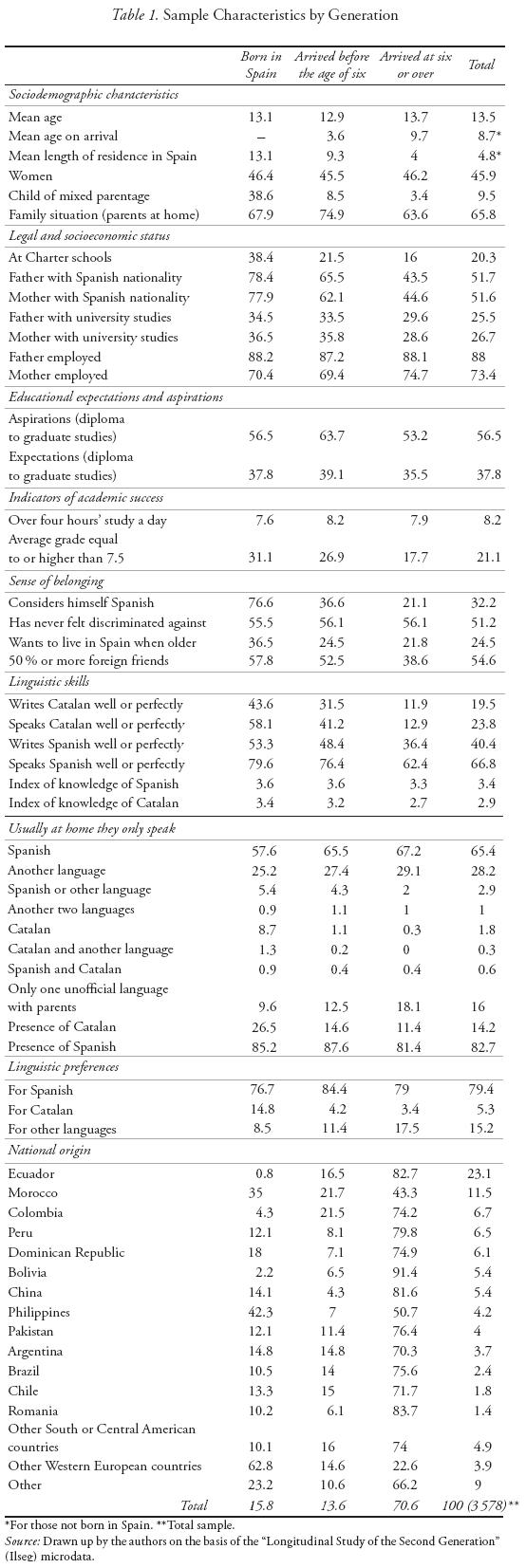
Data in table 1 show that the sample consists mainly of foreign-born youths (1.5 generation), with only 15.8 percent having been born in Spain, reflecting the relatively recent nature of external immigration. A total of 70.6 percent moved to Spain after the age of six, with a median age of 9.7 at the time of arrival. An analysis of national origin—a variable recoded on the basis of the young person's country of birth for those not born in Spain and on the basis of the parents' country of birth for youths born in Spain—,6 shows a marked Latin Americanization of the sample. The majority of young people opt for Spanish as their preferred language. Only 15.2 percent preferred another unofficial language, while Catalan was the first choice for just 5.3 percent of cases. At the skills level, the group as a whole had greater skill in Spanish than Catalan. Predictably, young people who were born in Spain or arrived before the age of six have a higher index of knowledge of both languages (index of knowledge of Catalan and index of knowledge of Spanish),7 as a result of having been taught in both official languages since their first entry into the education system.
Preliminary Results on the Basis of the Bivariant Analysis
Table 2 shows the results of the significant crossing between the main predictors drawn from the theoretical framework and the preference for Catalan and written skills in the Catalan language respectively. As for young people's preference for Catalan, a person's generation has a significant although weak association with preferences (the Cramer V value is 0.183). Preference for Catalan increases for those born in Spain (14 %) and declines significantly both for those who arrived before the age of 6 (4.2 %) and for those that arrived afterwards (3.4 %). National origin shows a significant link (Cramer's V is 0.241), reflected in higher percentages of preference for Catalan for certain Latin American countries, such as: Argentina (9.3 %), Chile and Peru (each with 5 %), together with other countries with non-Romance languages, such as Morocco (6.6 %), China (6.4 %) and Pakistan (5.4 %). In any case, the higher percentage of preference for Catalan occurs among European Community members, with nearly 29 percent. In nationals of Spanish-speaking countries with the highest number of migrants in Spain (such as Bolivia, Ecuador, Colombia and Dominican Republic), the preference for Catalan declines. Being the child of mixed parentage (with a Spanish father or mother) conditions preferences (20.7 % prefer Catalan) in that it increases the possibility that one of the parents has Catalan as his or her mother tongue, even though the degree of association is not that high (Cramer's V is 0.226).
]]> The influence of the family's socioeconomic status is measured through the following indicators: whether the father or mother has a university degree, the parents' professional prestige8 and the index of family socioeconomic status,9 as a synthesis of the four previous indicators. Crosses with the preference for Catalan shows that there is indeed a significant link between the father's educational attainment (in the case of the mother, the Chi square is not significant) as well as the professional prestige of each parent and the family socioeconomic status index, although there is only a slight link. The children of parents with university studies or who engage in more prestigious occupations therefore show a greater preference for Catalan than their peers. Another predictor directly related to the family's social class is the type of school. Although the percentage of students who prefer Catalan is higher in charter schools (8.9 versus 4.4 %), the link is extremely tenuous (0.082).As for subjective skills in Catalan, it was decided to specifically examine one of the skills that most effectively determine young people's linguistic integration: writing. Oral and written understanding (listening and reading) of the Catalan language only allows one to discriminate between young people during the early stage of their residence and is not an effective discriminator of linguistic integration strategies. Belonging to a particular generation shows a significant link, with those born in Spain reporting greater proficiency in written Catalan (88.6 % report writing it well or perfectly) compared with those who arrived after the age of six and have therefore been resident in Spain for a shorter period of time.
As regards national origin, although the link is weak (with a Cramer's V of 0.218 and a gamma value of 0.150), writing skills display the same patterns as those identified for preferences. Some origins belonging to countries with Romance languages, such as Argentina (74.8 %), Rumania (70 %) and Chile (68.3 %) report better writing skills. Nevertheless, the skills reported by young people from Morocco (83.4 %) and Pakistan (79.1 %), neither of which has a Romance language, are clearly superior. In the case of Morocco, the high percentage may be due to the fact that it is one of the groups with the longest residence in Spain. Once again, those from Spanish-speaking countries with the largest number of immigrants in Spain (Ecuador, Colombia and Bolivia) and a recent migratory flow (late 1990s and early 2000) report lower writing skills in Catalan.
As for the predictors linked to family structure and their economic and cultural resources, subjective skills in Catalan increase when both parents live at home—although the link is weak—and when respondents are the children of mixed marriages. Being the child of mixed parentage is positively linked to the level of skills, with a difference of nearly 20 points over those that are not. Thus, the fact that both the father and the mother have pursued university studies has a significant influence on skills. The influence of the mother's studies—which had not shown a significant link for linguistic preference—reflects what other studies have found regarding the influence of mothers' cultural capital in children's academic evolution, since they are more involved in their intellectual development (Elzo, 2009).
Lastly, it is worth mentioning that although certain variables related to the educational setting of the young person do not show a significant link with writing, we have proved that they are linked to oral skills. Having more than 50 percent of foreign friends, achieving good grades as well as expecting and hoping to pursue a university degree increase the likelihood that a person will speak Catalan well or perfectly. Moreover, feeling Spanish has a positive link and translates into higher oral skills in Catalan.
Preliminary Results on the Basis of the Bivariant Analysis
Variables Considered
The multivariant logistic regression analyses shown in this section are binomial for the analysis of the "linguistic preference for Catalan" dependent variable and an ordinal logistic regression has been carried out for the "skill in written Catalan" variable.
The categories considered in the analysis for linguistic preferences are: "preference for Catalan" as opposed to "others" (reference category). It was decided to measure subjective skills only through writing, since it is the indicator that most effectively discriminates the formal acquisition of skills through education institutions. For the original analysis, written skills were arranged on the basis of the following values: 1: "Not very much"; 2: "Moderately"; 3: "Well" and 4: "Perfectly". As for independent variables, the study used 27 which, according to theoretical precedents and bivariable analyses, are able to predict linguistic preferences and skills. These 27 variables have yielded 13 predictors that have proved to determine the different regression analyses carried out.
]]> The predictors have been incorporated into the regression models in three stages (step-by-step). The first and second step include predictors for which there is a theoretical justification of causal relations between variables. Subjective variables were incorporated into the last step in order to determine whether there is a correlation or association once the variables incorporated into the previous steps have been controlled for. These subjective variables do not give rise to obvious causal links from a theoretical point of view, given the impossibility of determining whether they predict linguistic behavior or its consequences.In the first step, objective predictors have been considered such as sex, age, and number of years in Spain. It has also taken into account the fact of belonging to families where one of the parents is Spanish. Two socioeconomic variables have been introduced into the models: "Type of school" (state or chartered) and "Family socioeconomic status". During the second stage, the "parents' national origin" variable was incorporated. We have grouped together the 13 main nationalities present in the sample and grouped the remainder into three categories of "other".
Subjective aspects were incorporated into the third stage. Specifically, education factors were included such as academic expectations, average grade and number of hours a day spent on homework or extra-curricular activities. Variables have also been introduced that reflect other aspects of the setting of the young person's integration, such as "considering oneself Spanish" and "percentage of foreign friends".
Results for Written Skills
In the first stage (model 1), the analysis shows, extremely significantly (p < 0.001), that age has a negative coefficient (-0.254) and that the number of years spent in Spain has a positive coefficient (0.231) in written skills assessment. This suggests that written skills are negatively affected in those who joined the education system later, as one would expect. The type of school shows a significant, negative effect, at the p < 0.05 level. In alternative regressions, we see that the coefficient of an education center affiliated to charter schools acquires a positive value when the parents' socioeconomic status is extracted from the model.10 In this model, predictors such as sex, having mixed parentage and family socioeconomic status did not prove to be significant predictors. Conversely, the importance of family organization is borne out by the fact that when we observe families with two parents at home, this has a positive, significant effect on the acquisition of written skills in Catalan.
During the second stage of the analysis (model 2), we considered national origins as predictors. Most of the estimates are negative, since members of the "others" category (a reference category in the analysis) display above average written skills. Some young people of Hispanic origin are openly critical of their Catalan skills. The Hispanic nationalities with the largest number of nationals in Spain (Ecuador, Colombia, Peru, Dominican Republic and Bolivia) clearly follow this pattern. Young people of Chinese origin experience the greatest difficulty in acquiring writing skills in Catalan, with the most negative (-1.622) estimate of the model. However, the fact that they do not speak a Romance language does not significantly affect those of Moroccan origin.
In the third step of the analysis (model 3), we observe subjective predictors, once the effect of all the previous objective predictors has been controlled for. Age and year of arrival continue to emerge as the main determinants. At the same time, the type of family structure is no longer determinant, which may reflect the fact that the types of families in which the two parents do not live together predominate in certain specific national groups (particularly those from Latin America). In general terms, the effects of national origin did not undergo significant changes. Once subjective predictors are introduced, academic success, measured through average grades, is the determinant with the greatest estimated value (0.639) and a value six times higher than the typical error, although the direction of the causality between variables should be treated with caution. Having fewer than 50 percent of foreign friends (0.210) and "feeling Spanish" (0.276), aspects related to the young person's form of integration into the receiving society, show positive, significant effects on Catalan skills.11
Once the predictors incorporated into the model have been controlled for, acquisition of written Catalan skills depends largely on age and number of years in Spain, in other words, the moment the young person was incorporated into the Catalan education system. Together with the aspects concerning the schooling process, one of the main factors that positively influences the acquisition of written skills is a family structure with two parents in the household. Conversely, negative factors include being of Latin American or Chinese origin and, albeit with a low level of significance, studying at a charter school once the family socioeconomic situation has been controlled for. Lastly, Catalan skills correlate positively with the expectation of studying a university degree, achieving good academic grades, feeling Spanish and having friends, less than half of whom are foreign.
]]> Results for Preference for Catalan
In regard to the preference for Catalan, the first step of our binary logistic regression (model 1) shows that having a high family socioeconomic status (0.951), mixed parentage (1.496) and number of years in Spain are determining factors in preference for Catalan at a significance level of p < 0.001. These determinants differ considerably from those that determine written skills. The variables concerning the parents' professional prestige and educational capital, expressed through the family socioeconomic status index, acquire greater significance and value in the coefficients, as shown by the bivariant analysis. In this first stage, the explanatory capacity of the model (Nagelkerke R2 of 0.176) is lower than the explanatory capacity of the model in the case of written skills (0.209).
The model's explanatory capacity increases when national origins are incorporated (Nagelkerke R2 of 0.212). Table 3 shows a negative effect among young people of Latin American origin on the preference for Catalan. Conversely, Chinese and Moroccan groups adopt positive values in their preference for Catalan. However, values are only significant in the case of those from the most developed countries in western Europe, with positive coefficients (0.900) towards Catalan, and remain as predictors in step 3 of the analysis. Preference for Catalan appears to be practically unrelated—or at least no significant links in the case studied were observed—to the linguistic root of the languages of origin of young people. Conversely, the fact of being students from more developed countries (western Europe) has a significant effect on preference for Catalan, even when family socioeconomic status has been controlled for. This points to the link between linguistic inequality—in our case, inequality of linguistic preferences—and the inequalities existing by level of wealth in young people's countries of origin.
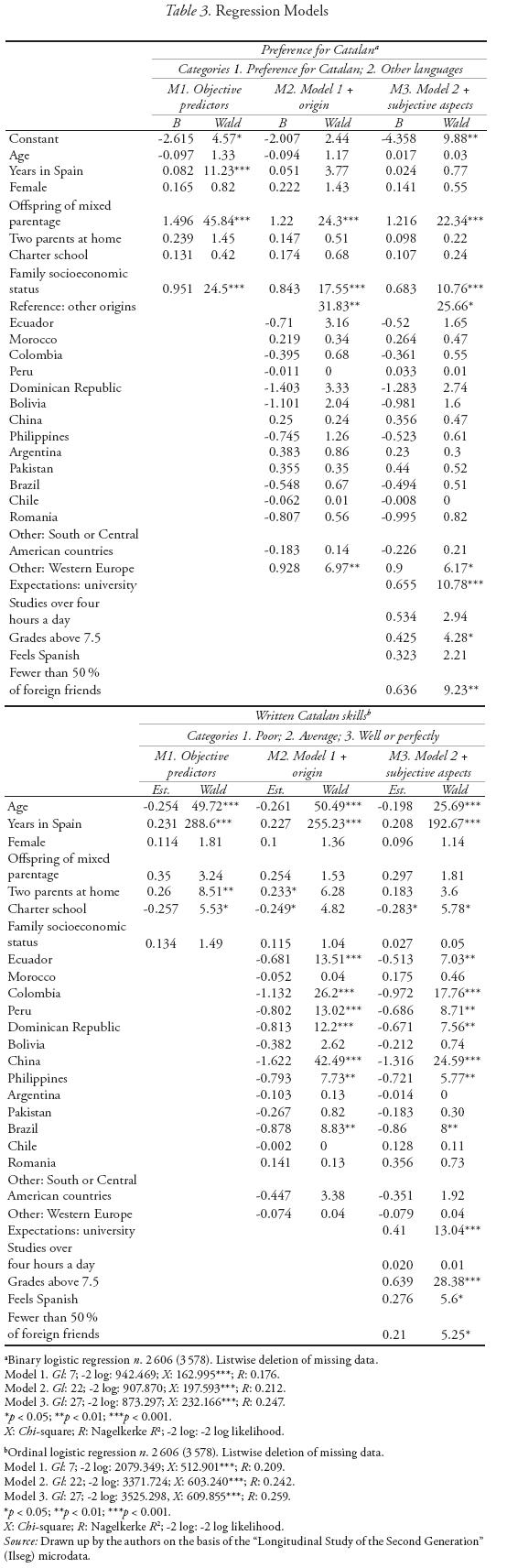
In the third step (model 3), once the previous factors were controlled for, the subjective aspects associated with the preference for Catalan include the expectation of going to university (0.655), high academic grades (0.425) and having fewer than 50 percent of foreign friends (0.636). At this stage of our analysis, the family's socioeconomic level continues to be determinant at the highest level of significance, as well the "children of mixed parentage" predictor. In both model 2 and 3, the number of years in Spain has stopped being a determinant in the explanation of linguistic preferences, with family socioeconomic status and the presence of a Spanish parent in the family clearly predominating.
Before providing the final details of the results, despite the obvious differences in the determinants of writing in Catalan and preference for Catalan, the subjective variables introduced into the third model—academic expectations, grades and percentage of foreign friends—follow a very similar pattern of relations in regard to dependent variables. Causal relations between these variables and dependent variables are problematic, in that they reflect, like the dependent variables in our models, a successful school career and the characteristics of their integration into the host society. The fact that these variables have high, positive significant values regarding preferences and written skills in Catalan, even after controlling for other variables, clearly indicates that they are associated with the upward mobility of the second generation in Catalonia.
By Way of a Conclusion
The theory of segmented assimilation shows that not all processes of sociocultural assimilation are the same nor do they produce the same itinerary of socioeconomic integration. The quantitative analysis carried out shows that the tendency towards linguistic adaptation follows different patterns among new members of the second generation in Catalonia. These differences can be explained by variables linked to the year of arrival and length of residence, as one would expect. However, the fact that the parents' socioeconomic situation and the type of family structure are significant predictors enable one to interpret these results as future processes of segmented assimilation when these young people enter the labor market, unless proper compensatory mechanisms are implemented.
]]> Both skills in Catalan and the preference for Catalan show a positive link with academic performance and the expectations of pursuing university studies in the future. However, the regression models indicate that the predictors of skills and preferences are very different. Skills acquisition is largely determined by age and number of years in Spain, in other words, by the moment a person enters the Catalan education system. Conversely, these variables no longer serve as determinants for explaining the preference for Catalan. In this case, the factors determining preference are socioeconomic, together with the fact of having at least one parent who was born in Spain. Moreover, national origins, unlike what happens with skills in Catalan, are unimportant when it comes to explaining the preference for Catalan.These observations point to different types of linguistic incorporation into Catalan society. First of all, we have a relatively small sub-group in which a consonant process of acculturation is produced in terms of the theory of segmented assimilation. The Catalan language (preferences and skills) are introduced into a subgroup of young people characterized by having parents with high educational and professional levels, a family structure with two parents at home, good academic grades, higher educational expectations and a small number of foreign friends. This casuistry must be understood within the framework of the processes of social reproduction in families with professional prestige and high educational attainment. Moreover, when one of the parents is Spanish or the parents are from Western Europe, linguistic preference for Catalan is reinforced.
Secondly, a third of the participants in the research stated that their Catalan skills were poor or average. This can largely be explained by their late incorporation into the education system, although other factors intervene, such as the fact of not belonging to two-parent households (single parenthood). In these cases, preference for Catalan is virtually non-existent. Given the high rates of academic failure, which mainly affect the immigrant population, it is extremely likely that young persons will finish their compulsory education without sufficient skills in Catalan. Given the possible link between the deficit in linguistic skills (linguistic integration) and future socioeconomic position, within the framework of the theory of segmented assimilation, it is essential to analyze the ability of Catalan society to generate labor transitions that are not marked by frustration and do not relegate certain groups of young people to the lowest levels of the labor market or even to marginalization. Since socioeconomic opportunities for young people who do not incorporate the Catalan language may be negatively affected, this must be corroborated through future longitudinal analyses.
A third, majority group is characterized by satisfactorily evaluating linguistic skills, without showing a particular preference for Catalan. Most of the questions about what their future socioeconomic incorporation will focus on this majority. Institutions in Catalan society—specially the education system—convey the centrality of the Catalan language as a common public language, capable of placing people on a level of equality and preventing the risk of exclusion (Pujolar, 2010). That is why structural mechanisms must be guaranteed to ensure that immigrants' children do not have to subsequently face discrimination at work similar to that of their parents, based on ethnic social markers that involve with the characteristics of their parents, the color of the skins, their religion or national origin, among other factors.
Although the Latin American linguistic origin of migrants' young children is crucial to explaining their preference for Spanish and positive attitudes towards that language, in the long run, it will not be a sufficient reason (Huguet and Janés, 2008). We must remember that after several generations in Catalonia, internal immigrants of Spanish-speaking origin have adopted Catalan as their own or usual language (Idescat, 2009). The explanation for this phenomenon, which requires establishing a link between sociolinguistic and socioeconomic integration, is one of the main gaps in sociolinguistic research in Catalonia. It is therefore essential not only to undertake longitudinal research with the new generations of external immigration but also to carry out retrospective studies on the connection between language, status and internal migrations. This line of research will undoubtedly benefit from the contributions from the theory of segmented assimilation. Lastly, it is essential to explore how languages are taught at school. In the current migratory context of Catalonia, the theory of segmented assimilation offers a number of elements for reflection. In order to have processes of selective acculturation, it is essential not only to have ethnic networks and community support but also for the education system to provide the necessary resources for immigrants' young children. Valuing and teaching family languages, in addition to English, are necessary, not only as a means of boosting these young people's self-esteem but in order to expand their skills in a globalized works in which Catalan is a local language (Carrasco, Pàmies, and Bertran, 2009). The fact that Catalan is the language of access to the rest of the curriculum may convey exclusive messages for many young people who arrive in Catalonia, who may regard the use of Spanish or another family language as a handicap or cultural deficit for their integration into school.
References
ALBA, Richard, and Victor NEE, 2003, Remaking the American Mainstream. Assimilation and Contemporary Immigration, Cambridge, United States, Harvard University Press. [ Links ]
BENITO PÉREZ, Ricard, and Isaac GONZÁLEZ BALLETBÓ, 2009, "The Intensity and Nature of Linguistic Segregation in Catalan Schools", Noves SL. Revista de Sociolingüística, Winter. [ Links ]
CARABAÑA, Julio, and Carmen GÓMEZ BUENO, 1996, Escalas de prestigio profesional, Madrid, Centro de Investigaciones Sociológicas. [ Links ]
CARRASCO, Silvia; Jordi PÀMIES, and Marta BERTRAN, 2009, "Familias inmigrantes y escuela: Desencuentros, estrategias y capital social", Revista Complutense de Educación, vol. 20, no. 1, pp. 55-78. [ Links ]
CENTRO DE INVESTIGACIONES SOCIOLÓGICAS (CIS), 1997, "Mi tierra, mi lengua", Datos de Opinión. Boletín del Centro de Investigaciones Sociológicas, Madrid, no. 9, February. [ Links ]
DALLAIRE, Christine, 2003, "'Not Just Francophones': The Hybridity of Minority Francophone Youths in Canada", International Journal of Canadian Studies, no. 28, pp. 163-199. [ Links ]
DI PAOLO, Antonio, and Josep Lluís RAYMOND, 2010, "Language Knowledge and Earnings in Catalonia", Barcelona, Xarxa de Referència en Economia Aplicada (Working Paper XREAP2010-7). [ Links ]
ELZO IMAZ, Javier, 2009, coord., Models educatius familiars a Catalunya, Barcelona, Fundació Jaume Bofill (Informes Breus, no. 18). [ Links ]
FISHMAN, Joshua Aaron, 1972, ed., The Sociology of Language: An Interdisciplinary Social Science Approach to Language in Society, Rowley, United States, Newbury House Publishers. [ Links ]
FISHMAN, Joshua Aaron, 1991, Reversing Language Shift, Clevedon, United Kingdom, Multilingual Matters. [ Links ]
GORE, Sarah, 2002, "The Catalan Language and Immigrants from outside the European Union", International Journal of Iberian Studies, vol. 15, no. 2, pp. 91-102. [ Links ]
HUGUET CANALÍS, Ángel, and José Luis NAVARRO SIERRA, 2005, "Inmigrantes en la escuela. Una revisión de estudios sobre las relaciones entre rendimiento escolar e inmigración", in David Lasagabaster, and Juan Manuel Sierra, eds., Multilingüismo, competencia lingüística y nuevas tecnologías, Barcelona, Horsori, pp. 53-74. [ Links ]
HUGUET CANALÍS, Ángel, and Judith JANÉS, 2008, "Mother Tongue as a Determinant Variable in Language Attitudes. The Case of Immigrant Latin American Students in Spain", Language and Intercultural Communication, vol. 8, no. 4, pp. 246-260. [ Links ]
INSTITUT D'ESTADÍSTICA DE CATALUNYA (Idescat), 2009, Encuesta de usos lingüísticos de la población 2008, Barcelona, Generalitat de Catalunya. [ Links ]
LINTON, April, and Tomás JIMÉNEZ, 2009, "Contexts for Bilingualism among US-Born Latinos", Ethnic and Racial Studies, vol. 32, no. 6, pp. 967-995. [ Links ]
OLLER, Judith [paper], 2008, "El conocimiento de catalán y castellano del alumnado extranjero de la educación primaria de Catalonia: Factores explicativos", in "Congreso Internacional de Psicología y Educación", Oviedo, Spain, April 23-25. [ Links ]
PORTES, Alejandro, 1995. "Economic Sociology and the Sociology of Immigration: An Overview", in Alejandro Portes, ed., The Economic Sociology of Immigration, New York, Russell Sage Foundation. [ Links ]
PORTES, Alejandro, 1996, The New Second Generation, New York, Russell Sage Foundation. [ Links ]
PORTES, Alejandro, and Min ZHOU, 1993, "The New Second Generation: Segmented Assimilation and its Variants", The Annals of the American Academy of Political and Social Science, vol. 530, no. 1, November, pp. 74-96. [ Links ]
PORTES, Alejandro, and Min ZHOU, 1995, "Divergent Destinies: Immigration, Poverty, and Entrepreneurship in the United States", in Katherine McFate, Roger Lawson, and William Julius Wilson, eds., Poverty, Inequality and the Future of Social Policy: Western States in the New World Order, New York, Russell Sage Foundation, pp. 489-520. [ Links ]
PORTES, Alejandro, and Lingxin HAO, 1998, "E Pluribus Unum: Bilingualism and Loss of Language in the Second Generation", Sociology of Education, no. 71, October, pp. 269-294. [ Links ]
PORTES, Alejandro, and Lingxin HAO, 2002, "The Price of Uniformity: Language, Family, and Personality Adjustment in the Second Generation", Ethnic and Racial Studies, vol. 25, no. 6, pp. 889-912. [ Links ]
PORTES, Alejandro, and Rubén RUMBAUT, 2001, Legacies: The Story of the Immigrant Second Generation, Berkeley, University of California Press/Russell Sage Foundation. [ Links ]
PORTES, Alejandro, and Rubén RUMBAUT, 2005, "Introduction: The Second Generation and the Children of Immigrants Longitudinal Study", Ethnic and Racial Studies, vol. 28, no. 6, pp. 983-999. [ Links ]
PORTES, Alejandro; Patricia FERNÁNDEZ-KELLY, and William HALLER, 2006, "La asimilación segmentada sobre el terreno: La nueva segunda generación al inicio de la vida adulta", Migraciones, no. 19, June, pp. 7-58. [ Links ]
PORTES, Alejandro; Patricia FERNÁNDEZ-KELLY, and William HALLER, 2009, "The Adaptation of the Immigrant Second Generation in America: A Theoretical Overview and Recent Evidence", Journal of Ethnic and Migration Studies, vol. 35, no. 7, pp. 1077-1104. [ Links ]
PORTES, Alejandro et al., 2011, "Progresar en Madrid: Aspiraciones y expectativas de la segunda generación en España", Revista Española de Investigaciones Sociológicas, no. 134, April-June, pp. 55-86. [ Links ]
PUJOLAR, Joan, 2010, "Immigration and Language Education in Catalonia: Between National and Social Agendas", Linguistics and Education, vol. 21, no. 3, pp. 229-243. [ Links ]
RENDON, Silvio, 2007, "The Catalan Premium: Language and Employment in Catalonia", Journal of Population Economics, vol. 20, no. 3, July, pp. 669-686. [ Links ]
SOLÉ, Carlota, 1981, La integración sociocultural de los inmigrantes en Cataluña, Madrid, Centro de Investigaciones Sociológicas. [ Links ]
SOLÉ, Carlota, 1988, Catalonia: Societat receptora d'immigrants. Análisi comparativa de dues enquestes: 1978 i 1983, Barcelona, Institut d'Estudis Catalans. [ Links ]
VELTMAN, Calvin, 1983, Language Shift in the United States, New York, Mouton. [ Links ]
WOOLARD, Kathryn Ann, 1989, Double Talk. Bilingualism and the Politics of Ethnicity in Catalonia, Stanford, United States, Stanford University Press. [ Links ]
WOOLARD, Kathryn Ann, 2003, "'We Don't Speak Catalan Because We Are Marginalized': Ethnic and Class Meanings of Language in Barcelona", in Richard K. Blot, ed., Language and Social Identity, Westport, United States, Praeger Publishers, pp. 85-103. [ Links ]
ZHOU, Min, 1992, Chinatown: The Socioeconomic Potential of an Urban Enclave, Philadelphia, Temple University Press. [ Links ]
ZHOU, Min, 1997, "Growing up American: The Challenge Confronting Immigrant Children and Children of Immigrants", Annual Review of Sociology, no. 23, pp. 63-95. [ Links ]
]]> Notas
1 The authors would like to thank Alejandro Portes (Princeton University) for his comments, observations and corrections throughout the process of drafting the text. We would also like to thank the Centre for Migration and Development for allowing us to access their data, use their services and engage in academic and scientific debate with their researchers.
2 Together with these elements that show the value of the Catalan language at work, we should also consider the demographic importance of Spanish, its official nature in Spain as a whole and its role in the world as an international market language. Therefore, when we refer to the instrumental value of Catalan in social mobility, we are referring to the local linguistic social rules and logic that have been historically acquired.
3 This study was carried out as a result of an institutional agreement between the Universidad Pontificia Comillas (Spain) and the University of Princeton (United States), with funding from The Spencer Foundation of Chicago.
4 The surveys were carried out with the support of the Conselleria d'Educació de la Generalitat de Catalonia with the consent of the school principals and the students' parents.
5 In analyzing linguistic integration and uses and preferences regarding the Catalan language, a key dimension is the type of family migratory project, in the sense of regarding the stay in Catalonia as definitive or provisional. The questionnaire did not permit the measurement of the family migratory project. The only approximate indicator is the question on whether the respondent "wishes to live in Spain when (s)he is older" (see table 1). It was not incorporated into the regression models since it did not reveal significant links.
6 In the case of mixed couples with one Spanish parent, the origin of the foreign parent has been used.
7 Index obtained from the mean score obtained in each of the four linguistic skills (understanding, speaking, reading and listening) evaluated as "poor", "average", "good" or "perfect".
8 In order to obtain the score of professional prestige, the Presca-2 scale developed by Carabaña and Gómez (1996) was used. In the sample analyzed, values oscillated between 46 and 267.
9 According to Portes et al. (2011), "Family socioeconomic status (FSES)" is a continuous variable that has been constructed as the sum of the father and mother's education and professional prestige in a standardized form. All the components of the index were standardized with a mean of 0 and typical deviation of 1. The unweighted sum was divided into four, obtaining a mean and a similar typical deviation. Cases with scores of over 0.5, which includes 21.5 percent of the valid cases, have been regarded as having "high family socioeconomic status".
]]> 10 There are correlation effects between professional status and the type of center chosen (Phi 0.290, Chi-square 280.201, sig. 0).11 In alternative analyses, we individually observed the choice of Spanish or another unofficial language (Moroccan, Chinese, Portuguese, etc.). The binomial regression analysis shows that Spanish emerges as a language linked to low educational attainment in the parents and less dedication to study outside school. Once the country of origin is incorporated into the model, the positive effect played by this variable on the preference for Spanish is obvious in the case of young persons of Latin American origin.
INFORMACIÓN SOBRE LOS AUTORES
AMADO ALARCÓN ALARCÓN es doctor en sociología por la Universitat Autònoma de Barcelona (UAB). Actualmente es profesor de sociología en el Departament de Gestió d'Empreses de la Universitat Rovira i Virgili (URV). Pertenece al grupo de investigación Análisis Social i Organitzativo de la URV y es miembro del Grupo de Estudios de Inmigración y Minorías Étnicas (Gedime) de la UAB. Es vicepresidente del Research Committee on Language and Society RC25 de la Asociación Internacional de Sociología de la Universidad Complutense (España). Su actividad investigadora se centra en las relaciones entre migraciones, lengua y actividad económica. Ha dirigido diversas investigaciones para los ministerios de Educación, Cultura y Deporte y de Economía y Competitividad del gobierno de España, y para la Secretaria de Joventut y la Secretaria per a la Immigració de la Generalitat de Catalunya. Recientemente publicó, en coautoría con Josiah Mc Heyman, el artículo "Límites socioeconómicos a la expansión de la lengua española en Estados Unidos", en REIS. Revista Española de Investigaciones Sociológicas (núm. 139, 2012).
SÒNIA PARELLA RUBIO es doctora en sociología por la Universitat Autònoma de Barcelona (UAB) y profesora en el Departamento de Sociología de la misma universidad. Es investigadora del Grupo de Estudios de Inmigración y Minorías Étnicas (Gedime) desde 1996 y miembro del Centre d'Estudis i de Recerca en Migracions de la UAB. Sus principales líneas de investigación son migración y género, y análisis de procesos y prácticas transnacionales en contextos de migración. Publicó, en coautoría con Alisa Petroff y Carlota Solé, el artículo "The Upward Occupational Mobility of Immigrant Women in Spain", en Journal of Ethnic and Migration Studies (en prensa, 2013). Es coautora, con Laura Oso, del artículo "Inmigración, género y mercado de trabajo: Una panorámica de la investigación sobre la inserción laboral de las mujeres inmigrantes en España", en Cuadernos de Relaciones Laborales (vol. 30, núm. 29, 2012). Ha realizado estancias de investigación posdoctorales en la Princeton University y en la University of California at Irvine.
]]>