The Role of the New Media in the Migratory Experiences of Brazilian Footwear Industry Workers in the South of China*
El rol de los nuevos medios de comunicación en las experiencias migratorias de trabajadores de la industria brasileña del calzado en el sur de China
Norberto Kuhn Junior*, Margarete Fagundes Nunes**
Universidade Feevale. *Dirección electrónica: nkjunior@feevale.br, **nunes.margarete@gmail.com.
]]>Date of receipt: September 30, 2010.
Date of acceptance: February 10, 2011.
Abstract
Migratory experiences are part of the representative phenomena of contemporary social arrangements since not only goods and capital but also persons move from one part of the earth to another, joining the synergic flows of capitalism organized on a global scale. Empirically, we refer to the migratory experiences of footwear industry workers from Novo Hamburgo, Brazil, who have immigrated to China in recent years. We analyze the strategies adopted by these groups to support their projects to migrate to and settle in China. Above all, we focus on the role played by communications media in the construction of links between the community of origin and the new ethnic environment recreated in foreign lands.
Keywords: work, information and communications technologies, communications media, Brazil, China.
Resumen
Las experiencias migratorias están entre los fenómenos representativos de los arreglos sociales contemporáneos, toda vez que no solamente bienes y capitales, sino también personas, se desplazan de un área a otra del planeta, integrándose a los flujos sinérgicos del capitalismo organizado en escala global. Empíricamente, nos referimos a las experiencias migratorias de trabajadores de la industria del calzado de Novo Hamburgo, Brasil, que han emigrado hacia China durante los últimos años. Analizamos las estrategias adoptadas por estos colectivos en la sustentación de sus proyectos de migración y permanencia en China. Destacamos, sobre todo, el rol que cumplen las mediaciones comunicacionales en la construcción de las conexiones entre la comunidad de origen y el nuevo ambiente étnico constituido en tierras extranjeras.
]]> Palabras clave: trabajo, tecnologías de la información y la comunicación, mediaciones comunicacionales, Brasil, China.
Introduction1
Migratory experiences are among the representative phenomena of contemporary social arrangements since not only goods and capital but also persons move from one part of the earth to another, joining the synergic flows of capitalism organized on a global scale (Castells, 1999).
Within this framework of the restructuring of the world of work, in this article, we focus on the migratory experiences that workers in the footwear sector in Novo Hamburgo and their region2 experienced over the past two decades. We also attempt to reveal the living conditions of Brazilian immigrants in China and the settlement projects implied by their migratory experiences.
We refer to this phenomenon on the basis of the notion of the transnationalization of migratory flows (Cogo, Gutiérrez, and Huertas, 2008) and associate these migratory experiences with the productive restructuring and deindustrialization of footwear production in the Novo Hamburgo region, experienced from the 1990s onward. This has entailed the redefinition of the means of participation of this sector in the national economy and in the international division of labor.
We seek to highlight the aspects of sociability that emerge when an individual becomes involved in a migratory experience, the reasons for emigrating and the implications of labor relations, family links and the presence of communications media for migration and settlement projects (Sales, 1999) in foreign lands.
This article is structured as follows: we begin with historical information on Novo Hamburgo and the region (Martins, and Becker, 2005) and subsequently identify the social and economic factors associated with the migratory flows recently experienced by workers in this region. Having indicated the transformations undergone by the world of work, we refer to the migratory experiences of these workers, which we call migration and settlement projects, highlighting aspects related to the reasons for emigration, the centrality of work, the family base and communications media in the migratory context.
The analyses and interpretations of this article were made possible by the above mentioned research project, which sought to combine declarations from and information on Brazilians from Vale do Rio dos Sinos who reside in China or returned from that country in 2008 or 2009. Access to these immigrants was provided by what we call a network of mediations, in other words, informants working in the footwear producing region of Novo Hamburgo, in order to establish contact with individuals who have lived as immigrants in China, with whom the first interviews were carried out. The questions in this study were based on the thematic axes created on the basis of another research experience undertaken as part of the Brazil-Capes/Unisinos and Spain-Mec/ Autonomous University of Barcelona International Cooperation Project, in which Norberto Kuhn Junior was a doctoral student grant holder. The results of this project are systematized in Migraciones transnacionales (Cogo, Gutiérrez, and Huertas, 2008).
]]> Productive Restructuring, Deindustrialization and Transnationalization of Migratory Flows
Footwear production in Brazil is concentrated in production centers in Rio Grande do Sul,3 the third largest nationwide, followed by the states of Ceará and São Paulo. Río Grande do Sul directly employs 111 966 salaried workers, accounting for 37 percent of the total number of salaried workers in the footwear production sector. It is followed by Ceará and São Paulo, with 17 percent each; Bahía with nine percent, and Minas Gerais, with eight percent (Abicalçados, 2009).
During the 1970s, Vale dos Sinos became a magnet for intense internal migratory flows due to the proliferation of its industries, particularly the metallurgy and leather and footwear industry, which to a certain extent materialized the "dream of modernization", attracting the inhabitants of small cities in the provinces to the cidade grande. The industrial growth of this region is associated with the national development project, especially during the period from 1968 to 1978. Martins and Becker (2005:85) demonstrate the local consequences of this project, designed to make industrialized products hegemonic in Brazil's external sales. In other words, rather than importing finished products, it promoted the importation of machines for the production and exportation of those products.
During this period of industrial expansion, characterized by footwear exports, Novo Hamburgo became increasingly associated with the images and representations of a city of work, prosperity and progress. During the 1970s, it achieved the great myth of progress, while industrial work served as the basis for the construction of a social memory (Nunes, 2009). It was during the 1990s particularly that the development model of the region, based on those ideals, underwent a number of changes and was materially and symbolically threatened. The time of crisis was juxtaposed with the time of employment, demanding a reorganization of that working community.
Local firms felt a growing need to join production networks structured on a world scale, whose main expression is cities and global regions. Ianni (2002) reflects on these global production networks and their implications in the restructuring of productive processes, such as mechanization, robotization and informatization, and the deindustrialization of various cities and regions throughout the world. He notes the paradoxes of this global articulation, revealing its impacts on the labor field which, in the sphere of local communities, is expressed in the reduction of available jobs, either due to the replacement of labor by technological devices, the closure of firms unable to adapt to the new logic of production or even to their complete or partial transfer to other states or countries.
Within this phenomenon of the restructuring of the world economy, the internationalization of the Chinese economy plays a key role, due to a broad process of opening up its markets to direct external markets and international loans. This process began gradually in the 1970s and culminated with China's insertion into the World Trade Organization in 2001. Its restructuring revolved around the installation of special economic zones (Shenzhen, Zhuhai, Shantou, Xiamen, Hainan), cities and open ports: this set of cities and ports became responsible for implementing economic policies oriented towards the exportation and assimilation of advanced technologies, linking industry, commerce, science and technology. As a result of this trade liberalization policy, Chinese international business, which in 1950, consisted of 1.13 billion dollars, reached 400 billion in 2000 (Pomar, 2003:148; Shin, 2008).
This policy led to investment in international business in China, which went from being a primary goods exporter (from 53.5 % in 1958 to 11.2 % in 2000) to an industrial goods exporter (from 46.5 % in 1958 to 88.8 % in 2000) (Pomar, 2003:150). According to information from the Ministério das Relações Exteriores (MRE, 2010), the expansion of international business originating in China reached Brazil, meaning that in 2009, China became Brazil's main trading partner exceeding the United States (36.1 billion U.S. dollars with China as opposed to 35.6 billion U.S. dollars with the United States). A decisive factor in this process was the creation of the Comissão Sino-Brasileira de Alto Nível de Concertação e Cooperação (Cosban)—Top-Level Sino-Brazilian Commission of Agreement and Cooperation—, responsible for drawing up and providing strategic orientation for the development of support and bilateral cooperation through joint action plans by the Brazilian and Chinese governments.
Within this context of the internationalization of the market, the Chinese footwear production is inserted in the world market, meaning that China is now the leading footwear producer, followed by India and Brazil in second and third place respectively (Abicalçados, 2009).
Within the international business sphere, the survival strategies of Brazilian firms facing competition in the Chinese market are protected by institutionalized policies within the sphere of the Agência Brasileira de Promoção de Exportações e Investimentos (Apex Brasil)—Export and Investment Promotion Agency— which promotes Brazilian products and services throughout the world. In the specific case of competition between the Brazilian and Chinese footwear sectors, the strategy to enable these firms to obtain economic advantages in their internationalization through the Chinese market was to sign agreements with firms in that country (Rigelo and Dos Santos, 2008). Firms, however, experience the paradox of assuming both a liberal discourse of internationalized performance, based on a competitive position, while seeking protectionist measures for domestic production through the Brazilian state.
There are representative associations that assume the issue of international competitiveness. This is the case of Abicalçados, which, through the Brazilian Footwear program, begun in 2000, seeks to promote the international insertion of Brazilian footwear in conjunction with Apex Brasil: "The project proposes firms' participation in international events such as fairs and showrooms and undertakes prospecting missions in search of new markets. It also invites importers and opinion makers to find out about Brazil" (Abicalçados, 2010). For its part, the Associação Brasileira de Empresas de Componentes para Couro, Calçados e Artefatos (Assintecal by Brazil)—the Brazilian Association of Leather Component, Leather Footwear Firms—represents over 300 associated firms and, with the support of Apex, undertakes actions to promote the insertion of firms in new markets. It also plays the role of the political representation of the sector with the state. This front for defending the interests of business owners in the sector tends to deal with the issue of international competitiveness on the basis of internal issues, called Custo Brasil (Cost Brazil), assuming positions to protect and strengthen national footwear. From this perspective, the loss of competitiveness in the sector is due to high taxes and social demands that could create problems for production (Decker, 2007).
]]> So the leather and footwear industries in Novo Hamburgo, the basis of the regional economy, were faced with the need to adjust to the new logic of the global market led by China, which involved the productive restructuring and deindustrialization/ transfer of its industrial plants. Both processes, while increasing the labor surplus, provide skilled workers who can be transferred by their firms to other parts of the world in search of new work places. Thus, certain footwear companies transferred to other parts of Brazil, particularly in the northeast states, where they obtained tax benefits and labor cost reductions (Nunes, 2009). For this reason, and realizing that the internationalization of business is a strategy for ensuring the competitiveness of their products, certain local producers were attracted by the Chinese market and moved to China. This movement also affected the factories that produced inputs for shoes—a whole production chain including tanneries—and plastic and metallurgical industries that were closed or relocated due to the low production of footwear.4
Brazilian Communities Abroad: The Case of China
In the diagnosis he drew up for the General Under-Ministry for Brazilian Communities abroad, George Firmeza (2007), of the Ministry of Foreign Affairs, pointed to the lack of deeper knowledge on the status of the national diaspora and stated the need to conduct a census of Brazilians abroad. According to Firmeza (2007:240-241):
There are no accurate data available about the scope of the overseas Brazilian population. In Itamaraty, the authorities work with a sum of the estimates of the network of [consular] offices. The lack of a census of Brazilians abroad is not the only gap in the elements required for drawing up public policies on migration ... The irregular migratory status of a substantial proportion of Brazilians abroad increases the margin for error in these estimates, with the exception of Japan, where the predominantly regular migratory status of the Brazilians differs from that of other receiving countries ... There is also a certain lack of information in other respects, such as, for example, the volume and type of remittances, their geographical destination and economic use. Nor are there accurate data on the consequences of international migration on the communities of origin in Brazil or on women's participation in international migratory flows [authors' translation].
According to the compilation of data requested from Brazilian consulates, in 2005, there were 2.6 million Brazilians resident abroad (Firmeza, 2007:240-241). According to the latest figures, published by the Under-Ministry General of Brazilian Communities Abroad, in September 2009, there are estimated to have been 3 040 993 Brazilians living outside the country, 5 700 of which are resident in China (MRE, 2009).5
Dongguan and Guangzhou are the Chinese cities with the largest influx of Brazilian immigrants. These cities are located in the province of Guangdong, in areas known as special economic zones and ports open to foreign countries. This province currently has the largest volume of international business in China (Rigelo and Dos Santos, 2008). Guangzhou hosts the Canton Fair, the leading international business fair in China (Pomar, 2003).
The following section deals with some of the aspects of sociability derived from the migratory experience: the motivation to emigrate and work, the reconfiguration of family ties and the place of communication technologies as the basis for the emigration project and settlement in the place of destination. Guided by these aspects, we then present the data from this research project, which attempts to provide a glance at Brazilian immigrants living in China and the projects involved in their migratory experiences.
]]> Migration Project: Reasons for Emigrating, the Centrality of Work and Family Ties in Migration Projects
This research project studies 86 cases of Brazilians resident in China in the period from 2008 to 2009. The sample was defined by the criterion of heterogeneity regarding length of migration, sex, age range and marital status. The sample is not representative of the universe of Brazilian immigrants in China and was created using a network of mediations. In other words, on the basis of informants working in the footwear production region of Novo Hamburgo, we contacted Brazilian immigrants in China and conducted the first interviews on the basis of these contacts. We expanded the network of contact on the basis of information provided by the individuals studied. The cases were analyzed using two instruments: a questionnaire for profile analysis and interviews carried out in person or using voice over Internet protocols such as Messenger and Skype.
The purpose of the study is to understand this movement of thousands of Brazilians as a social and cultural behavior based on the association of motives around an ideology (desires) of fulfillment and leading a better life. From this perspective, the experience of transnational migration—which adds individual/particular experiences to those experienced by large groups—involves a set of strategies and resources for mobility for these populations in the quest for better living conditions, creating what Cogo (2002), and Cogo, Gutiérrez and Huertas (2008) calls migration projects.
At this point in the article, we will focus on the main motives and desires that led respondents to leave their country of origin and choose China as a migration destination.
The population in this study consists mainly of educated, white youths who are beginning their adult lives already inserted in the labor market. These young adults emigrate with their spouses, since emigrating constitutes preserving their existing work status and therefore pursuing their personal objectives. This is what encourages them to emigrate, by their own account, and includes both factors related to their professional and financial lives and their personal fulfillment. The principal destinations of this population are the cities of Dongguan (64 %) and Guangzhou (19 %).
It is important to note that in most cases, settlement in China exceeds a period of two years.
The emigration project to China is closely linked to the reproduction of the footwear industry business in that part of the world. Associated with this condition is the decision to emigrate, which is also linked to family ties and friendship circuits, in other words, the displacement of these individuals to China (mainly to Dong-guan and Guangzhou) continues to regard kinship groups as a fundamental reference in this process.
In the context analyzed, the networks of personal relations, either of kinship or friendship, in the work sphere, had, more than other means of communication, the effect of spreading the belief that China is a place of possibilities for professional and personal fulfillment (work). However, family rather than business circuits constitute an important network of trust for those that make the decision to emigrate to that far-off place. Of the immigrants interviewed, 54.6 percent indicated that in the decision to emigrate, support from family circuits (spouse and family) was crucial. Only 11.7 percent declared that the influence of work relations (company directors and work colleagues) was decisive. The data observed also show that most of the individuals comprising the sample (69 %) are currently living in China with their spouses or relatives.
The work contracts involving Brazilian workers in the footwear sector in China—which comprise the sample in this research project—are predominantly mediated by Brazilian firms associated with or in collaboration with Chinese and foreign firms (from the United States, Spain and Italy). They are regular work contracts that follow the procedures imposed by the Chinese government on those that obtain temporary or permanent visas.6 These are the two forms of visas obtained in the majority of the cases analyzed: 21 percent are permanent residents. In other words, they formalize their condition with permanent visas, while 37 percent acquire temporary workers' visas (see table 1).
Nevertheless, the accounts of some of our respondents also suggest a degree of engagement in informal work, especially on the part of family members who accompany their spouses and do not have formal links with firms, which usually occurs with women or wives. This is the case of 39-year-old Luciana, who has a work visa (when a couple is formally married, the entire family receives the same work visa as the husband) and tells us:
]]>I have been in China since November 2006, but until early 2010, I was a housewife, since we lived in another place where there was no place for informal activity, but after we moved to Donguang, there was an opportunity to work. Several Brazilians live there, in a community of nearly 3 000 Brazilians. That is why it is possible to work informally in various areas, offering these Brazilians food, handicrafts, Brazilian clothes, the organization of children's parties, particularly birthdays, decoration and lots of other things. Here, everything that Brazilian women make is sold, especially if it is a home-made product. And here there are several women with informal jobs and ever since I came to this city a year ago [2010] I did not think twice about working and offering something to these people and so I began to produce frozen [food] such as pizzas, lasagnas and party food but the main thing I made was pizzas. I hate to blow my own trumpet but I do it very well and people love it! (Luciana, Novo Hamburgo, July 2010) [authors' translation].
In the data analysis we were struck by the fact that the condition of "accompanying relatives" in the sense attributed by what it means to "live in China" appeared in 20 percent of the answers and was only mentioned by women. This observation takes us back to the reflections of Glaucia de Oliveira (2007) on the implications of gender in family arrangements and re-arrangements in migration contexts.
Among the variety of factors given as "reasons for emigrating" (economic, cognitive, affective and academic) are the factors associated with professional fulfillment ("opportunity for professional experience" and "need for professional growth") as well as those linked to personal, cognitive and affective experiences ("acquire general knowledge" and also "accompany relatives"). These two types of motivation represent two thirds of the answers, in that the reasons related to financial issues ("improving salaries", "guaranteeing financial stability" and "economic needs") constitute a third of the respondents' answers.
This study seeks to contextualize the importance of this type of motivation (professional and personal fulfillment) in the construction of the migration project. The shift from the 1990s to the 2000s in the metropolitan region of Porto Alegre saw the highest unemployment rates in the past two decades (FEE-RS, 2010), coinciding with the period of the greatest flow of migrant workers to China. Within the sphere of the experience of some of these workers, we tried to determine the link between the motive for emigrating and the opportunity to have a job. Our hypothesis was that the majority of the emigrant population consisted of unemployed persons and that this condition was the main incentive for leaving their country of origin and emigrating to China. However, we found that only 16.3 percent indicated that they were unemployed in Brazil and that going to China offered an opportunity to secure a better job. Of this percentage, 2.3 percent declared that migrating to China was regarded as "a last resort for getting a good job". In the words of Adão Luiz Correa:
The firm where I used to work ... already operated in China and they asked the firm to take over operations here [in China]. So they were already planning for certain people from here to go to China.
At the same time, business here in Brazil was declining. The sector where I used to work disappeared, all our clients had left. So my boss and I, a young man from the technical area and I formed the team that ended up going to China. We left because we had no choice! It was also obviously an opportunity to travel and find out about another country and culture and so on. But that's what happened: either I went to China or I'd have to start looking for a job. Given the situation, we ended up leaving (Adão Luiz Correa, Novo Hamburgo, June 2009) [authors' translation].
The majority, however, said that they were employed in Brazil and that going off to live in China would provide an opportunity for a "better job" or allow them to "go on working".
When asked about their expectations about the place to which they had emigrated, we noticed that both the financial improvement and new experiences were mentioned by 60 percent of the respondents, followed by the expectation of professional qualification, mentioned in 30 percent of the answers.
]]> This shows that when one tries to find the reason for emigration, there is no clear distinction between what emigrants cite as a motive or objective circumstance and what they give as an expectation or desire. Moreover, they combine these objective and ideal dimensions in their answers. However, in this combination, work appears as the center of the mobilization of efforts in the construction of a migration project, either in the objective terms of keeping one's job, professional fulfillment or improving one's financial situation. This is the main purpose of immigrating to China: maintaining the (objective) condition of employment associated with the opportunity (desire) for a better job, with a higher salary.In these terms, what underlies the mobility of these groups is in the economic order but is also associated with the search for autonomy or citizenship that permits access to the basic conditions for the reproduction of social life for a predominantly young population.
The fact that work is the central motive in the mobilization of efforts to construct a migration project—a predominant factor in that migratory flow of workers who are already employed—is associated with the process of productive restructuring undergone by footwear industries since the 1990s. According to Dos Santos (2006), this restructuring was far more closely linked to innovations in managerial and administrative strategies than to the incorporation of modern machines and equipment. "Innovations in labor management were introduced that may or may not have been linked to processes of industrial automation" (Dos Santos, 2006). These administrative innovations required more highly qualified professionals and the higher the level of qualification, the greater the possibility of "reducing" the distances that separate them from the new centers of production of the globalized marked where they will find work opportunities. It is precisely this professional—qualified within the sphere of innovations in managerial and administrative strategies and a participant in the various strategies comprising the footwear business—who will form part of the collective of transnational immigrants that move to China.
This country is the world's largest footwear producer and the presence of specialized labor available in the Novo Hamburgo region is one of the factors that attracted Chinese business owners, who ended up absorbing the skilled labor from that region, particularly in the areas where Vale dos Sinos has made the greatest innovations (personnel management and production). It is not our goal here to explore, within this relational issue, the reasons why the region attracts the attention of Chinese business owners. It should be noted that the accounts of these business owners indicate how much specialized local workers—whether or not they are unemployed—represent the potential for technology transfer and production management for the Chinese market. This is aptly summarized in the words of Schmitt (interview, 2008):
And there, the great footwear cluster today is Dongguan. The shoe cluster has been transferred from Novo Hamburgo to Dongguan. But they do not train people; you do not see any universities offering training. What there is are people from Rio Grande do Sul, "making the business progress" for the Chinese and training people. It is those in Rio Grande do Sul, installed as technicians in the main companies and developing ... who are doing all the production there. And they are teaching people. There's a bit of design, but not focusing on footwear, like we have here today [Brazil]. Before the footwear cluster was Spain... it was Italy; it moved to Spain before 1970. After the period from 1960 to 1970, it moved to Brazil. So the last footwear destination before China was Brazil. That is why they came to look for technicians here in Brazil. Large firms have put Brazilian technicians there. There are very few technicians of other nationalities; in the factories and companies there they are either Chinese or Brazilian. What they do have is designers who come from other countries, although very few stay in China; they tend to come and go. They go there, fill out the orders and go back to the United States and Europe [authors' translation].
Although the footwear production process is complex and consists of various stages and tasks (Dos Santos, 2006) and immigrants' professional activities are mainly associated with the technical management of production, these professionals are increasingly present in the administration and management of the global footwear business (production, representation, sales and brands). The profile verified in our research is that of an employee who occupies more skilled positions during the work processes. The data obtained indicate that professional performance is concentrated in the areas of personnel management and production. By grouping together the distribution of the professional activities of the individuals in our sample, we can see that 52.3 percent of persons are engaged in those focusing on management, administration and supervision. The rest are distributed among operative activities and product development (10.5 %), consultancy activities (7 %) and office, general, and auxiliary administrative services (5.8 %).
Overseas Settlement Project: Ethnic Orientation and Communication Eticities
Considering the migratory experience based on the ethnic space enables us to understand some of the components that justify keeping maintaining a settlement project a long way from home. By ethnic space, we understand a group's ability to organize its everyday life based on the demarcation of a territoriality of ways of being. Linked to this project to construct ethnic space are the various strategies adopted by those immigrants to reproduce similar situations of sociability to those experienced in the community of origin that affect the definitions and redefinitions of their temporary expectations, in other words, how long to remain in the country in which they arrived as immigrants and when to return to their country of origin.
]]> The expression that best translates the construction of this environment, in the case of the Brazilian immigrants, is, "It seems as though we are in Brazil". Teresa Sales (1999) observes this creation of an ethnic environment in her book, Brasileiros longe de casa (Brazilians far from home), where she studies the case of Brazilians who have emigrated to the United States. In our study, we attempt to determine whether as part of this concern with reproducing a model of organization of everyday life based on the demarcation of a territoriality of ways of being, Brazilian individuals recreated their environment within the sphere of the migratory experience of Brazilians in China.In our study, respondents highlighted the importance of various resources for preserving references to their communities of origin and thereby devising the idea that "it seems as though we are in Brazil", in everyday life. The concept of a community of Brazilians emerges in the respondents' accounts while the everyday lives of friends and neighbors reinforce the sense of belonging to this community. In the words of Tiago Lucas (Novo Hamburgo, June 2009):
In the beginning it was easy, because there were several Brazilians living in the city [Dongguan]. It was easy because of the euphoria of having a new challenge (I am a person who enjoys challenges). [In China] I met several Brazilians, several people I had worked with. So I did not have any problems. It was easier for me because when I arrived, there were people I knew waiting for me. First of all, I living in a housing complex inhabited by 25 000 persons: Chinese, Brazilian, American, [people] of various nationalities. But the second month, I had several difficulties due to emotional issues. Whenever I had a problem, I wanted to go home, but that was only during the second month.
Thus, for example, 90 percent of Brazilians' leisure and entertainment activities during their stay in China occurred exclusively in the company of their fellow countrymen. A total of 5.8 percent of the population interviewed said that they engaged in these activities with other foreigners while only 4.7 percent of the respondents said that they had engaged in them with Chinese people.
In addition to socializing with Brazilians, our respondents highlighted other resources they regarded as important for preserving references to their community of origin and thereby creating their ethnic environment. The main ones included continuing to eat the same food and consuming typical products (43 % of the responses), communication with Brazil (28 % of the answers) and listening to music from their country of origin (15 % of their answers).
In the office where I worked, I had a lot of [Brazilian] acquaintances and I started making a group of friends through people I knew. We would usually all eat together or have dinner or a barbecue. When I arrived, I was welcomed with a barbecue ... I used to go out to eat at a restaurant where they served Brazilian food. So it was very easy (Tiago Lucas, Novo Hamburgo, June 2009).
We were struck by the fact that among these results there were a considerable number of references to "Communication with Brazil" as one of the ways of preserving identity references. It is therefore worth reflecting on the way communication technologies and their use in the context of migratory experiences make it possible to maintain links with communities of origin by extending the creation of these ethnic environments to the sphere of communication media.
Our theoretical starting point is the notion of mediation (Martín-Barbero, 1987) to understand how, through communications devices, links with the country of origin—especially family and kinship links—are strengthened, a mediated ethnic environment is created and a territoriality deanchored from ways of being, which we call communicative eticity, is created. Spatial-temporal de-anchoring is a condition of modernity that results from the operation of abstract systems. In Giddens's view (1991), they refer to symbolically constituted mechanisms based on technical specialties and devices that enable subjects that exercise and acknowledge them to establish relations de-anchored from both place and time and precisely because of this, real-time, face-less relations. We understand that this "faceless" situation is being replaced by new forms of symbolic-digital faces characteristic of an abstract blend of communication eticities (Gorczevski, Kuhn, and Da Silva, 2008).
]]> By operating with the notion of mediation, we understand that everyday (sociocultural) practices cannot be dissociated from communications technologies and that media practices (and the associated communications technologies) comprise a way of being in the world; that is to say, media programs are assimilated into the everyday lives of uses (Martín-Barbero, 1987) and create a new way of organization society that becomes autonomous in relation to other fields (whether social, economic or political) and are over superimposed over them.Relationships that develop through and within certain technicities and the capacity to establish events through them constitute a time and an experience of life in that time, which consolidate media ways of being and becoming, which Suzana Kilpp (2003) has explained through the concept of eticity: everyday relations are increasingly dependent on this learning of trust confirmed by fidelity bonds virtualized by different types of mediation; everyday life is de-anchored and re-anchored in an abstract blend of communications eticities: newspapers, television, the Internet (virtual communities, albums and galleries; blogs, personal sites and other forms of composing experiences of interaction).
This new form of interaction and social reproduction is based on the genetic links between communication technologies and the material and symbolic means of production of contemporary capitalism. In other words, it is necessarily impregnated with the cultural forms and paradigms characteristic of global capitalism. This is what Castells (1999) calls information capitalism, and Giddens (1991) calls institutional reflexivity, that is to say, the systematic use of information for the reproduction of a social system. Within this information matrix, there are hundreds of services, products and audiovisual programs such as those offered by media firms, such as Internet portals and providers.
Media practices are therefore the basis of this new eticity. When we speak of the notion of eticities, we are referring to the way human groups have certain technicities in the composition of their relations and everyday behavior, which constitute the framework of the societal relations of which they form part. So by reflecting on the migratory experiences associated with these eticities, we wonder to what extent the definitions and redefinitions of their temporary expectations and being identified with the place, whether the place of origin/birth or the place where they arrive as a foreigner, are constructed/preserved in the spheres of media eticities.
It is not the purpose of this article to outline or explore the specific uses and contents of interactions carried out within the sphere of media devices but merely to perceive the extent to which they comprise media flows (Cogo, Gutiérrez, and Huertas, 2008), which are used and occupy a central position in the processes of sociability and the composition of an ethnic environment.
In the population we researched, we can see that the new communications technologies, mediated by the use of the computer, are at the core of this preservation of contact with the community of origin, and play a key role in sustaining the settlement projects (Sales, 1999) of immigrants in such far-off lands with such a different culture. Both in the cases where families establish their residence in China and in those where they only live temporarily (with three month visas), in 40 percent of all cases they establish daily contact and in 55 percent they contact them once or twice a week.
It is important to note that the purpose of these contacts is primarily communication between relatives (85 % of cases). The remainder establish contact with Brazilian friends (9 %) or are professional contacts (6 %) with colleagues from work and other firms. These data confirm the fact that relatives, like the professional relations created in the labor sphere, continue to be a crucial reference for the organization of everyday life within the context of migration processes. The most commonly used media for contacting relatives are Messenger (cited in 43.3 % of the replies),7 followed by Skype (25.6 %) and the telephone (24.4 %).8
We also understand that the interest in "being up to date on what is happening in Brazil" strengthens the preservation of the link with the country of origin through the composition of a thematic agenda of collective interest and shows the role played by the media in the settlement project of these Brazilians in China. Fifty-three percent declared that their interest in keeping up to data on what happens in Brazil increased after they moved to Brazil; 31 percent said that this interest continued after they emigrated while 15 percent stated that they had lost interest in keeping up to date with what goes on in their country.
They also stated that the Internet is the most commonly used communications resource for keeping up to date with events in Brazil (used to access Brazilian newspapers, movies and programs) followed by personal contacts through Messenger and the e-mail.
The population researched also indicated that once they became immigrants, they began using the various computer-mediated communications resources more often (e-mail, Messenger, Skype, photo blogs, and Orkut).
]]>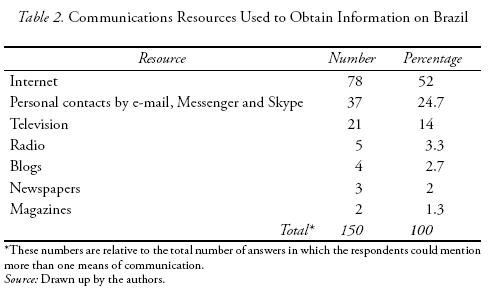
In general, the results show that the migratory experience takes places significantly within the sphere of communications eticities, especially those based on web support, where radio, newspapers, television and various instant audiovisual communication tools, such as Messenger and Skype, converge. Within the sphere of these new mediations, links with the community of origin are reinforced. Immigrants seek elements of symbolic identification (García, 1994) and ontological security (Giddens, 1991) for the composition of their ethnic environments, crucial to the construction of their settlement projects, in other words, the idea that "it is as though we are in Brazil".
Conclusion
Since the 1990s, the Chinese cities of Dongguan and Guangzou became the destination of Brazilian firms related to the leather and footwear industry, which generated new migratory flows involving workers from Novo Hamburgo and the surrounding area. The scenario is broad and linked to the place China occupied in this context and the restructuring of capitalism on a global scale. This brand of capitalism displaces industries towards various parts of the world, particularly towards cities and regions offering the best conditions for the generation of capital (flexibility of labor legislation and lower cost of labor, flexibility of environmental legislation, tax exemption and tax benefits).
This study specifically considers the migratory flows that lead many workers to leave the region of Novo Hamburgo for China. Within the context analyzed, what would appear to be a personal emigration project might in fact be a work project, in other words, a condition for a person to remain employed and to be, together with his personal projects, where business is. That is to say, the displacement of both capital and skilled labor is involved. In this movement, working in China is more important than moving to China. This combination of business and its consequences for migratory projects acquires the following meaning, present in the respondents' declarations: "in order to have a job, I emigrate with the work that emigrates".
It is important to note that Novo Hamburgo and the surrounding region have been preserved as a working community yet assimilated into the mercantile logic that spreads across the world. In other words, despite the processes of local deindustrialization, resulting from the reconfigurations of the footwear producing market on a global scale, the value of work is maintained and socially reproduced as the historical basis of local identity. This identification is recurrent in the narratives of workers that emigrate since the place of origin is preserved as a place-reference, since it where the workers now in China leave from "making business progress for the Chinese and training people" (Schmitt, interview, 2008).
Thus, the main motivation for the migration project is employment and emigrating with the status of a worker legitimized by the social memory of his community of origin—a community of workers—provides a fundamental basis for the insertion of this worker into the Chinese footwear industries. Together with this component of local culture, we perceive the extent to which the subjective and affective bases produced within the sphere of family relations, kinship and friendship are crucial to the migration projects. In the cases analyzed, the security mechanisms activated in the migratory process are heavily dependent on family references or those of acquaintances: relatives and friends who comprise the spheres of sociability, creating a network of trust enabling individuals to feel safe at different moments of their experience—from the decision to emigrate to settling into their new situation as an emigrant.
This network of trust is crucial to the formation of ethnic environments specifically created in Brazilian communities in China and operate to make the settlement project viable. As we saw, everyday socialization among Brazilians (from leisure to work) and in this context, the preservation of eating habits are crucial to sustaining this ethnic environment.
This suggests that the main strategies for creating a settlement project lies in strengthening the links between the community of origin and the new ethnic environment created abroad, which depends precisely on preserving the place of origin as a place of reference. Within this context, we focus on the role played by the media in the construction of links between the community of origin and the new ethnic environment recreated in foreign lands, creating what we call communications eticity: virtual spheres of socialization that permit the preservation of the place of origin as a place of reference through the intensification of relations with the community of origin and the preservation of family and friendship links in a conditions of spatial de-anchoring.
]]> The new communications technologies, mediated by the use of the computer, are at the core of this preservation of contact with the community of origin, and play a key role in sustaining the settlement projects of those immigrants in such far-off lands with such a different culture. In the case studied, distance—objectivized in discourse not only by geographical condition but also by situations indicated by the interviewees such as behavior—do not constitute a break with the country of origin. These mediations —which strengthen links with Brazil and make the preservation of family and friendship links viable—contribute to enabling the settlement project. They not only make it possible to share what is happening in Brazil in terms of news but also recreate environments that make distances relative and above all, position the place of origin as a place of reference and of belonging.We perceive that from their working community of origin (Novo Hamburgo and its region), whose identity values are preserved and reproduced in the migratory experience through ethnic environments and communication eticities-these immigrant workers use conditions that permit their personal and professional affirmation in their status as foreigners (laowai). This article contains contributions for new reflections on community identity marks (and local memories) and their reflections on what we could call transnational citizenship.
References
ABICALÇADOS, 2009 [digital publicactions], Resenha estatística 2009, Novo Hamburgo, Brazil, Associação Brasileira das Indústrias de Calçados/Unidade de Inteligência Comercial, 53 pp. Available at <http://www.sebrae.com.br/setor/couro-e-calcados/resenha_estatistica2009.pdf> (last accessed on May 1st, 2010). [ Links ]
ABICALÇADOS, 2010, "Perfil", Abicalçados, Novo Hamburgo, Brazil, Associação Brasileira das Indústrias de Calçados. Available at <http://www.abicalcados.com.br/perfil.html> (last accessed on February 24, 2011). [ Links ]
CASTELLS, Manuel, 1999, A sociedade em rede, São Paulo, Editora Paz e Terra. [ Links ]
]]>COGO, Denise, 2002, "O outro imigrante: As estratégias de midiatização das migrações contemporâneas na mídia impressa brasileira", Ciberlegenda, Rio de Janeiro, no. 10, pp. 1-11. Available at <http://www.uff.br/mestcii/denise1.htm> (last accessed on April 30, 2008). [ Links ]
COGO, Denise; María GUTIÉRREZ, and Amparo HUERTAS, 2008, coords., Migraciones transnacionales y medios de comunicación: Relatos desde Barcelona y Porto Alegre, Madrid, Catarata. [ Links ]
CONSULATE GENERAL OF BRAZIL IN SHANGHAI, 2010, "Types of Visa: Description of Purpose of Trip", in Itamaraty, Ministério das Relações Exteriores, Brasilia. Available at <http://xangai.itamaraty.gov.br/en-us/visas.xml> (last accessed on February 27, 2011). [ Links ]
DE OLIVEIRA, Glaucia, 2007, "Mulheres migrantes no passado e no presente: Gênero, redes sociais e migração internacional", Estudos Feministas, Florianópolis, Brazil, vol. 3, no. 15, September-December, pp. 745-772. [ Links ]
DECKER, Aurelio, 2007, "Luis Cláudio Amaral - Assintecal by Brasil", China, ameaça ou oportunidade, Novo Hamburgo, Brazil, Decker Comunicação, pp. 121-125. [ Links ]
]]>DOS SANTOS, Tania Steren, 2006, "Divisão sexual do trabalho na indústria calçadista do Vale do Sinos, Rio Grande do Sul: Visibilizando práticas e representações - 2004", Mulher e Trabalho, vol. 6. [ Links ]
FUNDAÇÃO DE ECONOMIA E ESTATÍSTICA-RIO GRANDE DO SUL (FEE-RS), 2009, "População", in Fundação de Economia e Estatística, Porto Alegre, FEE Centro de Pesquisa de Emprego e Desemprego. Available at <http://www.fee.tche.br/sitefee/download/populacao/02-populacao-total-rs-municipio-sexo-2000-a-2010.xls> (last accessed on May 26, 2012). [ Links ]
FUNDAÇÃO DE ECONOMIA E ESTATÍSTICA-RIO GRANDE DO SUL, 2010, "Informe ped - Série Histórica Mensal", in Fundação de Economia e Estatística, Porto Alegre, fee Centro de Pesquisa de Emprego e Desemprego, April 29. Available at <http://www.fee.tche.br/sitefee/pt/content/publicacoes/pg_boletins_ped_mensal_sh.php> (last accessed on May 1st, 2010). [ Links ]
FIRMEZA, George Torquato, 2007, Brasileiros no exterior, Brasilia, Fundação Alexandre de Gusmão/Ministério das Relações Exteriores. [ Links ]
GARCÍA CANCLINI, Néstor, 1994, Consumidores e cidadãos. Conflitos multiculturais da globalização, 4th ed., Rio de Janeiro, Universidade Federal do Rio de Janeiro, pp. 75-94. [ Links ]
]]>GIDDENS, Anthony, 1991, As conseqüências da modernidade, 2nd ed., São Paulo, Universidade Estadual Paulista. [ Links ]
GORCZEVSKI, Deisimer; Norberto KUHN JUNIOR, and Denise Teresinha DA SILVA, 2008, "Trayectos migratorios: Factores que influyen en la decisión", in Denise Cogo, María Gutiérrez, and Amparo Huertas, coords., Migraciones transnacionales y medios de comunicación: Relatos desde Barcelona y Porto Alegre, Madrid, Catarata, pp. 23-41. [ Links ]
IANNI, Octavio, 2002, A era do globalismo, 7th ed., Rio de Janeiro, Civilização Brasileira. [ Links ]
JARDIM, Lauro, 2006, "China. Brechas na muralha", Veja on line, São Paulo, Editora Abril, August 9, 2006. Available at <http://veja.abril.com.br/idade/exclusivo/090806/p_160.html> (last accessed on February 20, 2011). [ Links ]
KILPP, Suzana, 2003, Ethicidades televisivas, São Leopoldo, Unisinos. [ Links ]
]]>MARTÍN-BARBERO, Jesús, 1987, De los medios a las mediaciones: Comunicación, cultura y hegemonía, Barcelona, Editorial Gustavo Gilli. [ Links ]
MARTINS, Rodrigo Perla, and Gisele BECKER, 2005, "O Vale do Rio dos Sinos e a inserção internacional do Brasil no contexto do nacional desenvolvimentismo: 1968-1978", in Margarete Panerai Araujo, and Maristela Mercedes Bauer, orgs., Desenvolvimento regional e responsabilidade social: Construindo e consolidando valores, Novo Hamburgo, Brazil, Editora Feevale, pp. 81-88. [ Links ]
MINISTÉRIO DAS RELAÇÕES EXTERIORES (MRE) [digital publication], 2009, "Brasileiros no mundo: Estimativas", in MRE, Brasilia, DAC-DCB-Subsecretaria Geral das Comunidades Brasileiras no Exterior, 2nd ed., September. Available at <http://sistemas.mre.gov.br/kitweb/datafiles/BRMundo/pt-br/file/Brasileiros%20no%20Mundo%202009%20-%20Estimativas%20-%20FINAL.pdf> (last accessed on February 20, 2011). [ Links ]
MINISTÉRIO DAS RELAÇÕES EXTERIORES (MRE) [digital publication], 2010, "Relações bilaterais Brasil-China", in Itamaraty, Ministério das Relações Exteriores, Brasilia. Available at <http://www.itamaraty.gov.br/temas/temas-politicos-e-relacoes-bilaterais/asia-e-oceania/china/pdf> (last accessed on February 20, 2011). [ Links ]
NUNES, Margarete Fagundes, 2009 [Ph.D. thesis], "O negro no mundo alemão: Cidade, memória e ações afirmativas no tempo da globalização", Florianópolis, Brazil, Centro de Filosofia e Ciências Humanas-Universidade Federal de Santa Catarina. [ Links ]
]]>POMAR, Wladimir, 2003, A revolução chinesa, São Paulo, Unesp. [ Links ]
RIGELO PEIXOTO, Aline and Suelma Rosa DOS SANTOS, 2008, "Estudo de oportunidades. China 2008", in Apex Brasil. Agência Brasileira de Promoção de Exportações e Investimentos, Brasilia. Available at <http://www.apexbrasil.com.br/portal/publicacao/download.wsp?tmp.arquivo=438> (last accessed on February 27, 2011). [ Links ]
SALES, Teresa, 1999, Brasileiros longe de casa, São Paulo, Cortez. [ Links ]
SCHMITT, Luís Cláudio [interview], 2008, by Margarete Fagundes Nunes [field work], "O negro no mundo alemão: Cidade, memória e ações afirmativas no tempo da globalização", Novo Hamburgo, Brazil. [ Links ]
SHIN, Wong K., 2008, A China explicada para brasileiros, São Paulo, Atlas. [ Links ]
]]>* Text originally written in Spanish.
1 This article is the result of the research project on "Ethicidades comunicacionais e experiências migratórias: O caso dos trabalhadores gaúchos do setor calçadista na China" (Communications eticities and migratory experiences: The case of Rio Grande do Sul footwear sector workers in China) undertaken by the Universidad Feevale with the collaboration of Fundação de Amparo à Pesquisa do Estado de Rio Grande do Sul (FAPERGS).
2 We used the criteria adopted by the Associação Brasileira das Indústrias de Calçados (Brazilian Association of Footwear Industries), which groups together the municipalities of the footwear sector into regional poles, of which we considered two: Vale do Sinos and Vale do Paranhana. According to estimates by the Fundação de Economia e Estatística—Economics and Statistics Foundation—(FEE-RS, 2009), in 2008 the municipalities of this region had a combined population of 1 139 493 inhabitants.
3 In Rio Grande do Sul, production was concentrated in Vale dos Sinos and Vale do Paranhana.
4 Some firms in the sector that transferred their business to China include Paramont, which set up its factory in Dongguan in the late 1990s (Jardim, 2006); Strada Shoes, with five tertiarized units in China, and the Brazilian footwear brand Arezzo, with sales points in various countries, including China (Shin, 2008:21).
5 The first edition of the report called Brasileiros no mundo (Brazilians in the World), which contains the directory of Brazilians abroad, was published in 2008. Among the various Brazilian civil society organizations that have collaborated with the General Under Ministry in that document are, in the case of Brazilians in China, the Brazil Hong Kong Association (ABHK), Brazilians in Beijing (Brapeq) and Farrapos Futebol Clube (MRE, 2009).
6 In regard to legal conditions for living in China, there are three types of visa: tourist, temporary (business and services, artistic activities, study and work) and permanent (family reunification) (Consulate General of Brazil in Shanghai, 2010).
7 These percentages are relative to the total number of answers in which the respondents can refer to the use of more than one means of communication.
]]> 8 Messenger: Instant communication service-product on the Internet, provided by Microsoft Corporation and its suppliers, One Microsoft Way; Skype: Instant communication product-service on the Internet (between computers) which allows contact with any telephone by contracting Skype Communications Sàrl telephone credit.
Información sobre los autores
Norberto Kuhn Junior es sociólogo y doctor en ciencias de la comunicación por la Universidade do Rio dos Sinos e investigador de la maestría profesional en inclusión social y accesibilidad en la Universidade Feevale. En 2006 inició sus estudios sobre las estrategias de mediatización de las migraciones contemporáneas con una beca en el Programa Académico de Cooperación Internacional Brasil (Capes/Unisinos) y España (MEC/UAB) "medios de comunicación e interculturalidad". En 2010 coordinó la investigación "Ethicidades comunicacionais e experiências migratórias: O caso dos trabalhadores gaúchos do setor calçadista na China", con apoyo financiero de la Fundação de Amparo à Pesquisa do Estado do Río Grande do Sul (FAPERGS). Es coautor, con Cristina Ennes da Silva, del artículo "Nas profundezas da terra: redes relacionais nas minas subterrâneas de carvão no sul do Brasil", publicado en la Revista Latinoamericana de Estudos do Trabalho (año 16, núm. 25, 2011).
Margarete Fagundes Nunes es doctora en antropología social por la universidade Federal de Santa Catarina, Brasil. Es autora del artículo "Diálogos en las fronteras disciplinarias: Las aventuras del trabajo antropológico", publicado en Cuadernos de Investigación Interdisciplinaria en Ciencias Humanas/UFSC (vol. 11, 2010). Publicó, en coautoría con Ana Luiza Carvalho da Rocha, el artículo "Etnografando narrativas étnicas no espaço da cidade: Os negros e as ações afirmativas na sociedade brasileira contemporânea", en Iluminuras (vol. 10, núm. 23, 2009). Actualmente desarrolla actividades de gestión y administración como asesora del posgrado stricto sensu en la universidade Feevale. Es afiliada, en la misma universidad, del grupo de investigación Cultura e memória da Comunidad. Es investigadora colaboradora del Banco de Imagens e Efeitos Visuais (BIEV) de la Universidade Federal do Río Grande do Sul.
]]>