<?xml version="1.0" encoding="ISO-8859-1"?><article xmlns:mml="http://www.w3.org/1998/Math/MathML" xmlns:xlink="http://www.w3.org/1999/xlink" xmlns:xsi="http://www.w3.org/2001/XMLSchema-instance">
<front>
<journal-meta>
<journal-id>1665-8906</journal-id>
<journal-title><![CDATA[Migraciones internacionales]]></journal-title>
<abbrev-journal-title><![CDATA[Migr. Inter]]></abbrev-journal-title>
<issn>1665-8906</issn>
<publisher>
<publisher-name><![CDATA[El Colegio de la Frontera Norte A.C.]]></publisher-name>
</publisher>
</journal-meta>
<article-meta>
<article-id>S1665-89062011000200008</article-id>
<title-group>
<article-title xml:lang="en"><![CDATA[Beyond Chapala and Cancún: Grappling with the Impact of American Migration to Mexico]]></article-title>
<article-title xml:lang="es"><![CDATA[Más allá de Chapala y Cancún: Lidiando con el impacto de la migración estadounidense en México]]></article-title>
</title-group>
<contrib-group>
<contrib contrib-type="author">
<name>
<surname><![CDATA[Schafran]]></surname>
<given-names><![CDATA[Alex]]></given-names>
</name>
<xref ref-type="aff" rid="A01"/>
</contrib>
<contrib contrib-type="author">
<name>
<surname><![CDATA[Monkkonen]]></surname>
<given-names><![CDATA[Paavo]]></given-names>
</name>
<xref ref-type="aff" rid="A02"/>
</contrib>
</contrib-group>
<aff id="A01">
<institution><![CDATA[,University of California  ]]></institution>
<addr-line><![CDATA[Berkeley ]]></addr-line>
</aff>
<aff id="A02">
<institution><![CDATA[,University of Hong Kong  ]]></institution>
<addr-line><![CDATA[ ]]></addr-line>
</aff>
<pub-date pub-type="pub">
<day>00</day>
<month>12</month>
<year>2011</year>
</pub-date>
<pub-date pub-type="epub">
<day>00</day>
<month>12</month>
<year>2011</year>
</pub-date>
<volume>6</volume>
<numero>2</numero>
<fpage>223</fpage>
<lpage>258</lpage>
<copyright-statement/>
<copyright-year/>
<self-uri xlink:href="http://www.scielo.org.mx/scielo.php?script=sci_arttext&amp;pid=S1665-89062011000200008&amp;lng=en&amp;nrm=iso"></self-uri><self-uri xlink:href="http://www.scielo.org.mx/scielo.php?script=sci_abstract&amp;pid=S1665-89062011000200008&amp;lng=en&amp;nrm=iso"></self-uri><self-uri xlink:href="http://www.scielo.org.mx/scielo.php?script=sci_pdf&amp;pid=S1665-89062011000200008&amp;lng=en&amp;nrm=iso"></self-uri><abstract abstract-type="short" xml:lang="en"><p><![CDATA[Over the past two decades, a twist in the migratory relationship between Mexico and the United States has begun to attract the attention of policy makers and scholars: a growing stream of people moving permanently or semi-permanently from the United States to Mexico. The general understanding of this phenomenon until recently has been that these migrants are wealthy retirees moving to isolated resort-type complexes in beach cities. However, the present paper demonstrates that the migration is actually heterogeneous in terms of its people, places and impacts. Thus, we argue that study of the phenomenon must be expanded to include not only a better understanding of the migrants themselves, but also the impacts on the receiving localities. To this end, we propose a framework for a research agenda, creating a typology of receiving places and the settlements within these places.]]></p></abstract>
<abstract abstract-type="short" xml:lang="es"><p><![CDATA[A lo largo de las dos últimas décadas, un viraje en la relación migratoria entre México y Estados Unidos ha comenzado a captar el interés de políticos e investigadores: se trata del flujo en el aumento de estadounidenses que se trasladan a vivir a México de manera temporal o permanente. Hasta hace poco, la interpretación general de este fenómeno era que se trataba de migrantes jubilados y solventes que se dirigían a centros turísticos exclusivos en diversas ciudades costeras. Este trabajo pone de manifiesto que esta migración es en extremo heterogénea en cuanto a las personas, los destinos y sus efectos. Además argumenta que el análisis de este fenómeno debería enfocarse no sólo en los migrantes sino también en el impacto del flujo migratorio sobre las localidades receptoras. Con este fin, se propone un esquema para una nueva línea de investigación con una tipología de las localidades receptoras y sus asentamientos. Esta tipología nos permite acceder a la literatura académica para la investigación de la migración de estadounidenses a México.]]></p></abstract>
<kwd-group>
<kwd lng="en"><![CDATA[retirement migration]]></kwd>
<kwd lng="en"><![CDATA[urban planning]]></kwd>
<kwd lng="en"><![CDATA[tourism geographies]]></kwd>
<kwd lng="en"><![CDATA[Mexico]]></kwd>
<kwd lng="en"><![CDATA[United States]]></kwd>
<kwd lng="es"><![CDATA[migración de retiro]]></kwd>
<kwd lng="es"><![CDATA[urbanismo]]></kwd>
<kwd lng="es"><![CDATA[geografía del turismo]]></kwd>
<kwd lng="es"><![CDATA[México]]></kwd>
<kwd lng="es"><![CDATA[Estados Unidos]]></kwd>
</kwd-group>
</article-meta>
</front><body><![CDATA[  	    <p align="justify"><font face="verdana" size="4">Art&iacute;culos</font></p>  	    <p align="justify"><font face="verdana" size="2">&nbsp;</font></p>  	    <p align="center"><font face="verdana" size="4"><b>Beyond Chapala and Canc&uacute;n: Grappling with the Impact of American Migration to Mexico</b></font></p>  	    <p align="center"><font face="verdana" size="2">&nbsp;</font></p>  	    <p align="center"><font face="verdana" size="3"><b>M&aacute;s all&aacute; de Chapala y Canc&uacute;n: Lidiando con el impacto de la migraci&oacute;n estadounidense en M&eacute;xico</b></font></p>  	    <p align="center"><font face="verdana" size="2">&nbsp;</font></p>  	    <p align="center"><font face="verdana" size="2"><b>Alex Schafran* y Paavo Monkkonen**</b></font></p>  	    <p align="center"><font face="verdana" size="2">&nbsp;</font></p>  	    <p align="justify"><font face="verdana" size="2"><i>*University of California, Berkeley.</i> Direcci&oacute;n electr&oacute;nica: <a href="mailto:schafran@gmail.com">schafran@gmail.com</a>.</font></p>  	    ]]></body>
<body><![CDATA[<p align="justify"><font face="verdana" size="2">**<i>University of Hong Kong.</i> Direcci&oacute;n electr&oacute;nica: <a href="mailto:monkkonen@gmail.com">monkkonen@gmail.com</a>.</font></p>  	    <p align="justify"><font face="verdana" size="2">&nbsp;</font></p>  	    <p align="justify"><font face="verdana" size="2">Date of receipt: March 3, 2010.    <br> 	Date of acceptance: June 8, 2010.</font></p>  	    <p align="justify"><font face="verdana" size="2">&nbsp;</font></p>  	    <p align="justify"><font face="verdana" size="2"><b>Abstract</b></font></p>  	    <p align="justify"><font face="verdana" size="2">Over the past two decades, a twist in the migratory relationship between Mexico and the United States has begun to attract the attention of policy makers and scholars: a growing stream of people moving permanently or semi&#150;permanently from the United States to Mexico. The general understanding of this phenomenon until recently has been that these migrants are wealthy retirees moving to isolated resort&#150;type complexes in beach cities. However, the present paper demonstrates that the migration is actually heterogeneous in terms of its people, places and impacts. Thus, we argue that study of the phenomenon must be expanded to include not only a better understanding of the migrants themselves, but also the impacts on the receiving localities. To this end, we propose a framework for a research agenda, creating a typology of receiving places and the settlements within these places.</font></p>  	    <p align="justify"><font face="verdana" size="2"><b>Keywords:</b> retirement migration, urban planning, tourism geographies, Mexico, United States.</font></p>  	    <p align="justify"><font face="verdana" size="2">&nbsp;</font></p>  	    <p align="justify"><font face="verdana" size="2"><b>Resumen</b></font></p>  	    ]]></body>
<body><![CDATA[<p align="justify"><font face="verdana" size="2">A lo largo de las dos &uacute;ltimas d&eacute;cadas, un viraje en la relaci&oacute;n migratoria entre M&eacute;xico y Estados Unidos ha comenzado a captar el inter&eacute;s de pol&iacute;ticos e investigadores: se trata del flujo en el aumento de estadounidenses que se trasladan a vivir a M&eacute;xico de manera temporal o permanente. Hasta hace poco, la interpretaci&oacute;n general de este fen&oacute;meno era que se trataba de migrantes jubilados y solventes que se dirig&iacute;an a centros tur&iacute;sticos exclusivos en diversas ciudades costeras. Este trabajo pone de manifiesto que esta migraci&oacute;n es en extremo heterog&eacute;nea en cuanto a las personas, los destinos y sus efectos. Adem&aacute;s argumenta que el an&aacute;lisis de este fen&oacute;meno deber&iacute;a enfocarse no s&oacute;lo en los migrantes sino tambi&eacute;n en el impacto del flujo migratorio sobre las localidades receptoras. Con este fin, se propone un esquema para una nueva l&iacute;nea de investigaci&oacute;n con una tipolog&iacute;a de las localidades receptoras y sus asentamientos. Esta tipolog&iacute;a nos permite acceder a la literatura acad&eacute;mica para la investigaci&oacute;n de la migraci&oacute;n de estadounidenses a M&eacute;xico.</font></p>  	    <p align="justify"><font face="verdana" size="2"><b>Palabras clave:</b> migraci&oacute;n de retiro, urbanismo, geograf&iacute;a del turismo, M&eacute;xico, Estados Unidos.</font></p>  	    <p align="justify"><font face="verdana" size="2">&nbsp;</font></p>  	    <p align="justify"><font face="verdana" size="2"><b><i>Introduction</i></b></font></p>  	    <p align="justify"><font face="verdana" size="2">Over the past two decades, a handful of expatriate enclaves has grown into a "steadily growing stream" of U.S. Citizens moving permanently or semi&#150;permanently to Latin America in general and Mexico in particular (Migration Policy Institute, 2006). Upwards of one million U.S. citizens reside at least part&#150;time in Mexico, with as many as eight million more expected in the coming two decades. The potential economic, environmental and socio cultural impact of U.S. migrants and related capital flows is considerable&#151;a now decade&#150;old study estimated that a 2025 population of close to 600 000 U.S. citizens could spend close to one billion US dollars per month in Mexico (Otero and Melton, 1997).</font></p>  	    <p align="justify"><font face="verdana" size="2">To date the phenomenon has received relatively little direct attention in the academic literature and has only recently begun to attract the mainstream media.<sup><a href="#notas">1</a></sup> Academic literature on the topic that does exist is limited in scope but comes from a wide variety of disciplines (gerontology, tourism geography, public health, environmental policy, migration studies) and is consistent in its emphasis on the importance of future research due to the seemingly exponential possibilities for growth in the North American population in Latin America. Most work has been carried out by those who study migration, including a recent report by the Migration Policy Institute (MPI, 2006) that provides the most comprehensive analysis of existing data on the flow of U.S. migrants to Mexico. Though Latin American academia is equally quiet, what has been found and forecast comes to a similar conclusion&#151;U.S. migrants are coming, in large quantities, and in a way that will have a profound effect on the Mexican places they inhabit.</font></p>  	    <p align="justify"><font face="verdana" size="2">This latter point is the focus of this paper. Of the myriad ways in which researchers have explored this trend, there is a gap in terms of attention paid to the impact of this migration on Mexico and Mexican space and place.<sup><a href="#notas">2</a></sup> As southward migration has been on the radar of retirement and migration researchers for some time, we have a better understanding of the motivations and lives of migrants than we do of the impact of foreign residents on receiving localities. Truly (2002), Banks (2004) and Sunil, Rojas and Bradley (2007), drawing on earlier ethographies by Stokes (1990) and Holder (1976) give us an initial understanding of the differing mentalities of U.S. migrants with regards to integration, but they look only at Lake Chapala, the oldest and largest American expat community, and do not compare data across different spaces or types of built environments even within Lakeside, as the greater Chapala area is known to its <i>norteamericano</i> residents. They also fail to significantly consider the Mexican side of the story, what Plotnicov (1994) refers to as the "<i>costos intangibles</i> (intangible costs)" of the "<i>agringamiento</i>" of Mexico.<sup><a href="#notas">3</a></sup> This is a challenge urban research can no longer afford to ignore.</font></p>  	    <p align="justify"><font face="verdana" size="2">The impact of foreigners on Mexican urban development has been the subject of one important area of research in the past decade: mass tourism (Brenner, 2005; Brenner and Aguilar, 2002; Clancy, 2000; Dove J., 2007; Everitt <i>et al.</i>, 2008; Gullette, 2007; Torres and Momsen, 2005a, 2005b; Wilson, 2008; Clancy, 1999; Enr&iacute;quez, 2008). The literature has both documented the rise of a massive Mexican federal program to promote large&#150;scale tourism in a handful of scattered locations along Mexico's multiple coasts, raising important questions both in terms of the unintended impacts and unmet development goals of places like Canc&uacute;n, Huatulco Bay, Loreto Bay and Puerto Vallarta. This begs the question of whether an increase in permanent and semipermanent residents mirrors mass tourism development. We argue that although much can be learned from the study of mass tourism development and its linkages with migration, the two issues are not synonymous. American migration to Mexico is extremely heterogeneous, both in terms of migrants and receiving locales. Migration is occurring in places far removed from the large Fonatur<a href="#notas"><sup>4</sup></a> sites, requiring a more nuanced typology of American settlements which pays closer attention to the heterogeneity of migrating populations, destinations and development types.<sup><a href="#notas">5</a></sup></font></p>  	    <p align="justify"><font face="verdana" size="2">This paper has three goals. First, it clarifies the place of research on U.S. migrants within the context of migration studies, urban research and research on tourism, drawing important lessons from all three. Second, utilizing Mexican census data and periodicals, we demonstrate the heterogeneity of the phenomenon and the importance of more detailed analysis of it. Finally, it pro&#150;vides a framework for the study of this phenomenon. In order to accomplish these goals, we first examine the flow of migrants, in particular the factors driving the migration, the diversity of northerners making the move south and the diverse geography of destinations. We then focus on the impacts of the flow, including internal migration and labor market effects. These two sections allow us to create a typology of the places to which retirees are moving in Mexico, and the settlements to which they are moving in these places. The two typologies allow us to draw on existing literature to propose directions for a research project on U.S. emigration to Mexico.</font></p>  	    <p align="justify"><font face="verdana" size="2">&nbsp;</font></p>  	    ]]></body>
<body><![CDATA[<p align="justify"><font face="verdana" size="2"><b><i>Flows</i></b></font></p> 	    <p align="justify"><font face="verdana" size="2">One of the foremost challenges in wrangling with the subject of American southward migration is coming up with an accurate estimate of the number of U.S. migrants who now live south of the border. A review of more than three dozen articles in both the mainstream North American and Mexican media over the past few years yields estimates ranging from 200 000 to 1 000 000 U.S. migrants living in Mexico. The academic literature is equally vague (Herzog, 2003). Governmental sources offer some sense of proportion, but little exactitude. The year 2000 Mexican census puts the number of U.S.&#150;born residents of Mexico at 358 614 (Migration Policy Institute, 2006; Bosque and Montes de Oca, 2006). This compares with a 1999 U.S. State Department estimate that there are 1 036 300 American citizens living in Mexico (Migration Policy Institute, 2006). Some of the discrepancy between estimates is likely due to the fact that they are counting different populations. The Mexican authorities are counting all people <i>born</i> in the U.S., while the U.S. count includes many Mexican&#150;Americans who may have been born in Mexico, lived in the U.S. long enough to obtain citizenship (or at least social security), and have now repatriated. The Mexican government does not count them as U.S. citizens&#151;they are simply Mexican. Add to the discussion that 1 in 7 U.S. residents are Latino and measurement becomes incredibly messy (Dear and Burridge, 2005).</font></p> 	    <p align="justify"><font face="verdana" size="2">A secondary challenge stems from the fact that the concept of resident is somewhat murky in this case. How does one separate a second&#150;home owner, who may come down for a few months per year, from a resident? While some retirees may elect to establish Mexican residency and even citizenship, it appears that there are a wide variety of practices that make counting residents difficult if not impossible. Mexico allows retirees who earn more than 1 000 US dollars from pensions or investments (1 500 US dollars for a couple) a special non&#150;immigrant visa for retirees, allowing them to reside in Mexico for up to five years without establishing any official resident status, and without any requirements with regards to the length of time one must stay in the country to maintain status (Migration Policy Institute, 2006). Yet there does not seem to be any particular hurry on the part of either government to refine or improve their count, especially on the U.S. side. Despite significant urging on behalf of one of the larger expatriate groups, the U.S. Department of the Census has decided that counting overseas U.S. citizens is both cost&#150;prohibitive and methodologically overwhelming (American Citizens Abroad&#151;ACA&#151;, 1999; Kincannon, 2004).</font></p> 	    <p align="justify"><font face="verdana" size="2">Amidst the uncertainty of the current quantity of the migration, perhaps the only number that truly matters is 76 million&#151;the number of U.S. residents expected to reach retirement age over the next 20 years (Sunil, Rojas and Bradley, 2007). As the baby boomers age, the migratory patterns of "the world's wealthiest generation" will have a profound effect on both the places they come from and the new spaces they occupy. It is a shift noted not only by American migration scholars (Truly, 2002; Sunil, Rojas and Bradley, 2007; Torres and Momsen, 2005a; Coates, Healy and Morrison, 2002; Warner and Jahnke, 2001), but also by Mexican scholars and elected officials. In a 2007 speech to the Graduate School of Business at the University of Chicago, then Mexican Secretary of Public Finance and Credit Agust&iacute;n Carstens noted that the Mexican government expects a significant increase of U.S. and Canadian retirees over the next five to ten years (Chicago Graduate School of Business News, 2007). This mimics a conclusion reached by Bosque and Montes de Oca Zavala (2006), who anticipate an "unstoppable" migration, even if the current flow diminishes, and by Liz&aacute;rraga Morales (2008a, 2008b, 2010), whose concern with the planning, environmental and labor force impacts of this migration we undoubtedly share.</font></p>     <p align="justify"><font face="verdana" size="2">A further complication comes from the large number of children born in the U.S. to Mexican families along the border. Using household data from the Mexican census, concentrations of U.S.&#150;born people in Mexican cities were identified, and households were labeled as "mixed" if they had both Mexico&#150; and U.S.born members, and "U.S.&#150;born only" if they did not. Seventeen cities with more than 200 U.S.&#150;born residents in U.S.&#150;born only households were identified (see <a href="#t1">table 1</a>). When combined with existing academic research and content analysis of periodicals and migrant publications, a heterogeneous migration emerges, both geographically and sociologically.</font></p>     <p align="center"><font face="verdana" size="2"><a name="t1"></a></font></p>     <p align="center"><font face="verdana" size="2"><img src="/img/revistas/migra/v6n2/a8t1.jpg"></font></p>     <p align="justify"><font face="verdana" size="2">&nbsp;</font></p>     <p align="justify"><font face="verdana" size="2"><b><i>The Economic Diversity of U.S. Migrants</i></b></font></p>     <p align="justify"><font face="verdana" size="2">This is not a migration exclusively for the well&#150;to&#150;do. <a href="#t2">Table 2</a> examines household incomes, ages and education of U.S.&#150;born in these municipalities. While many cities show a U.S. population that is older and wealthier, indicative of middle and upper&#150;middle class U.S. retirees, the incomes decrease significantly along the border, in destinations reachable by car from the United States.</font></p>     ]]></body>
<body><![CDATA[<p align="center"><font face="verdana" size="2"><a name="t2"></a></font></p>     <p align="center"><font face="verdana" size="2"><img src="/img/revistas/migra/v6n2/a8t2.jpg"></font></p>     <p align="justify"><font face="verdana" size="2">There is a distinct geography to these variations in age, income and education. Baja California beach cities seem to attract less educated migrants, while the longtime migrant havens Chapala and San Miguel de Allende seem to attract older, highly educated migrants. While the income figures reported in <a href="#t2">table 2</a> must be taken with a caveat&#151;many U.S.&#150;born households did not report their incomes to census takers&#151;this diversity in income levels is consistent with the few studies that have examined the issue (Liz&aacute;rraga Morales, 2010; Migration Policy Institute, 2006).</font></p>     <p align="justify"><font face="verdana" size="2">The empirical evidence of heterogeneity in the migrant flow is also supported both by the migration literature and by a reading of the recent popular press. While mass aging is not a phenomenon unique to the U.S., what appears to be different in the U.S. are the economic push factors influencing migration, as opposed to the pull factors common to retirees throughout the colder parts of the global north. A 2005 Gallup Poll indicates that 40 percent of U.S. residents are somewhat or very worried about not having enough money during retirement. Steadily increasing health care costs, the lack of retirement savings and the erosion of the welfare state are critical factors in the decisions of American to move to Mexico (Otero and Melton, 1997; Truly, 2002; Sunil, Rojas and Bradley, 2007; Torres and Momsen, 2005a; Coates, Healy and Morrison, 2002; Warner and Jahnke, 2001).<sup><a href="#notas">6</a></sup></font></p>     <p align="justify"><font face="verdana" size="2">Sunil, Rojas and Bradley (2007) found that more than 50 percent of migrants in the Lake Chapala region agreed or strongly agreed with the statement "My decision to move to Mexico was mainly economic" and "I live here because health&#150;care is affordable". More than 80 percent cited the affordability of housing as key factors in their decision. They also found that the median income of retirees before retirement was between 46 000 and 50 000 US dollars, roughly equal to the median household in&#150;come in the United States (48 451 US dollars) in 2006.<sup><a href="#notas">7</a></sup> More importantly, their median income dropped <i>by half</i> upon retirement, and the majority of respondents were renters, rather than owners. Combined with the findings in <a href="#t2">table 2</a>, this challenges the idea of the wealthy or upper&#150;middle class "amenity seekers" as the exclusive or even dominant form of U.S. migrant.</font></p>     <p align="justify"><font face="verdana" size="2">A reading of the mainstream American media supports the notion of a growing number of economic migrants, or at least migrants heavily affected by economic factors. More specifically, the high cost of end&#150;of&#150;life care in the U.S. makes Mexico particularly attractive. In 2006, a private room in a nursing home cost on average 206 US dollars <i>per day</i> in the United States (Hawley, 2007). Whether for retirees with limited pensions, or families with elderly members incapable of caring for themselves, Mexico's growing number of retirement homes (based in large part on dramatically lower wages) and a national health insurance system open to non&#150;immigrant foreigners are providing a lifeline to lower&#150; and middle&#150;income U.S. migrants (Sunil, Rojas and Bradley, 2007). One article quotes Thomas Kessler, whose mother suffers from manic depression and lives at a retirement home near Lake Chapala. Referring to the Mexican home, Kessler opines, "... basically, they've kept our family finances from falling off a cliff" (Hawley, 2007).</font></p>     <p align="justify"><font face="verdana" size="2">The flip side of this distinctly middle class migration is a lifestyle unattainable in the United States at the same income. A common trope throughout both the academic literature and recent media coverage is that the affordability of domestic service work, when combined with low taxes, cheap and accessible health care and reduced housing costs allows many middle&#150;income U.S. migrants a form of class mobility. What is often referred to as a better "quality of life" means something very specific&#151;the ability to afford in&#150;house service workers (Croucher, 2007), and the purchase of a dream house. As one migrant commented about her Cliffside home, "It's the American Dream, it's Just in Mexico" (Holguin, 2004).</font></p>     <p align="justify"><font face="verdana" size="2">&nbsp;</font></p>     <p align="justify"><font face="verdana" size="2"><b><i>Additional Drivers in a Post&#150;NAFTA World</i></b></font></p>     <p align="justify"><font face="verdana" size="2">The push and pull factors driving U.S. migrants to Mexico are aided by key enabling factors that have helped make the flow formidable. Although Mike Davis (2006) argues that Americans are bringing the big box stores with them, it appears that the causal arrow points the other way. Truly (2002) points out that the post&#150;North American Free Trade Agreement (nafta) arrival of large American chains, in particular big box stores like WalMart and Home Depot, have made "American" lifestyles all the more feasible in Mexico. Living in Mexico no longer means having to cart down refrigerators, building supplies and electronic goods&#151;which are subject to customs duties and limitations&#151;simply drive to a Lowe's for a virtually identical shopping experience as in San Antonio, Moline or Decatur.</font></p>  	    ]]></body>
<body><![CDATA[<p align="justify"><font face="verdana" size="2">Changes in Mexican real estate law and practice have also made it easier and more accessible for U.S. migrants to buy property, despite provision in the Mexican constitution that prohibits foreign ownership within 62 miles of the U.S. border and 31 miles of the coastline. In 1997, the Mexican Congress passed a law clarifying the practice of <i>fideicomiso</i>, a form of trust where a bank owns the land in name only, but the lessee holds virtually complete rights to buy, sell and lease the land. It has also become easier for U.S. migrants to get title insurance and financing, often held by U.S.based companies. Whereas U.S. migrants used to have to negotiate an unknown process entirely in Mexico, more and more they are working with North American&#150;based real estate professionals (or Mexico&#150;based U.S. migrants) through a known process that seems more comfortable, familiar and certain. They can shop for homes on the Internet, visit chat rooms and the innumerable websites offering advice, services and support to American buyers, and even take virtual tours of new developments (Migration Policy Institute, 2006). The Internet has also dramatically reduced the space between their new Mexican home and family and friends back in America (Truly, 2002; Croucher, 2007). Voice&#150;over ip, Internet chat, and satellite television have made an evening at home in San Miguel de Allende seem more familiar, and have allowed many U.S. migrants to work from home/abroad in Mexico (Pender, 2007).</font></p> 	    <p align="justify"><font face="verdana" size="2">&nbsp;</font></p> 	    <p align="justify"><font face="verdana" size="2"><b><i>The Places: Location, Size, Migration, Employment, Taxation</i></b></font></p>     <p align="justify"><font face="verdana" size="2">The diversity of the migrating population is matched by a significant heterogeneity in terms of receiving locales. This geographic diversity of where migrants move exists at both the urban scale (type of city) and at the sub&#150;urban scale (type of neighborhood). This section considers the former, examining evidence of the distribution and developing a two&#150;part typology based on the city and neighborhoods receiving migrants. We then examine and theorize impacts by looking at internal migration patterns, employment and property tax base.<sup><a href="#notas">8</a></sup></font></p>  	    <p align="justify"><font face="verdana" size="2">Not only are the receiving locales spread across the country, they are also diverse in terms of population size, geographic location (border, coast, inland), and the age of the city (see <a href="#t3">table 3</a>). There is a significant American presence in small municipalities such as Chapala and Playas de Rosarito, as well as larger cities such as M&eacute;rida and Canc&uacute;n. Although coastal cities predominate, inland, and border cities are also significantly represented. Colonial cities (which may occur in any of the other three locations) also play a significant role.</font></p> 	    <p align="center"><font face="verdana" size="2"><a name="t3"></a></font></p> 	    <p align="center"><font face="verdana" size="2"><img src="/img/revistas/migra/v6n2/a8t3.jpg"></font></p>      <p align="justify"><font face="verdana" size="2">In addition to these rough geographic characteristics and origins of the 17 cities with concentrations of U.S.&#150;born in Mexico, <a href="#t3">table 3</a> also reports the difference between the U.S.&#150;born population and the rest of the city, in terms of incomes and ages. These differences were confirmed using two&#150;sample difference of means t&#150;tests that tested the null hypothesis of difference between average ages and average incomes of U.S.&#150;born and non&#150;U.S.&#150;born in the 17 cities. As illustrated in the table, the U.S.&#150;born were significantly richer and older in most cases. However, in the cities of Tijuana, Ciudad Ju&aacute;rez, Chihuahua, Matamoros, and Nuevo Laredo, they were neither. For this reason, we are excluding these five cities from the remainder of the analysis, since we consider that the U.S.&#150;born population should not be considered as U.S. migrants. Instead, these individuals can be seen to represent a separate phenomenon of trans&#150;border citizenship, rather than traditional migration (Sadowski&#150;Smith, 2002; Herzog, 2003).</font></p> 	    <p align="justify"><font face="verdana" size="2">&nbsp;</font></p> 	    <p align="justify"><font face="verdana" size="2"><b><i>Internal Migration, Employment and Property Tax Base</i></b></font></p>     ]]></body>
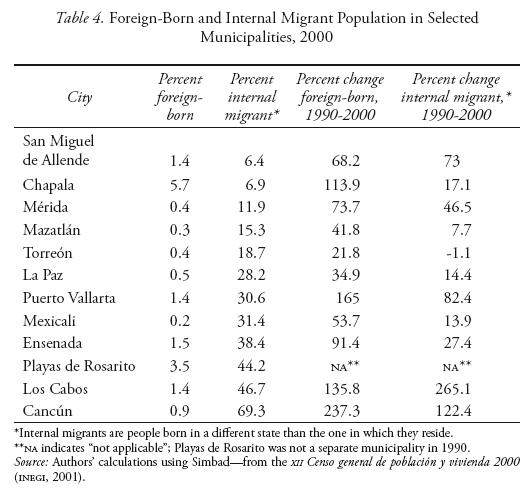
<body><![CDATA[<p align="justify"><font face="verdana" size="2">Size and location are just the beginning. With the dearth of attention paid to impacts by the migration literature, research on the impacts of tourism development provide the best guide to understanding and evaluating the impacts of this phenomenon. In this next section, we take guidance from Wilson (2008) and Tamborini (2007) in examining the internal migration and employment impacts of North American migration. As planners concerned with issues of governance and service delivery, we also examine property tax data as a means of assessing impacts on municipal services.</font></p>     <p align="justify"><font face="verdana" size="2"><i>Migration</i></font></p>     <p align="justify"><font face="verdana" size="2">There are three large cities, with a population of over 500 000 (Mexicali, Torre&oacute;n and M&eacute;rida) which are likely to be least affected by migration. In contrast, cities like Chapala, San Miguel de Allende, Los Cabos, and Playas de Rosarito, which have a population of fewer than 150 000 people, are renowned for their foreign&#150;born population, which has had a defining influence on their development. Finally, the medium&#150;sized cities, with a population of between 200 000 and 500 000, are the cities of La Paz, Canc&uacute;n, Mazatl&aacute;n, Ensenada, and Puerto Vallarta. Interestingly, although the foreign&#150;born <i>resident</i> population has probably not had a pronounced influence on these cities, they are all, with the exception of Ensenada, cities whose urban and economic development depends on tourism, most of which is foreign.</font></p>  	    <p align="justify"><font face="verdana" size="2">In order to examine the importance of the foreign&#150;born in these cities in greater detail, we look at their relative presence and growth trends. <a href="#t4">Table 4</a> shows the share of the population that is foreign&#150;born residents and the share that is internal migrants, as well as changes in those percentages during the 1990s. In the large cities, less than 0.5 percent of the population is foreignborn, while for the smaller cities other than La Paz, it is between 1.4 and 5.7 percent. Nationwide, 18 percent of the population in Mexico was an internal migrant in the year 2000, meaning that the majority of the municipalities to which U.S. migrants are moving are places that are growing, notably the beach&#150;tourism cities of Canc&uacute;n, Los Cabos and Playas de Rosarito. Interestingly, Chapala and San Miguel de Allende, the places with the longest standing foreign population, have an extremely low proportion of internal migrants.</font></p> 	    <p align="center"><font face="verdana" size="2"><a name="t4"></a></font></p> 	    <p align="center"><font face="verdana" size="2"><img src="/img/revistas/migra/v6n2/a8t4.jpg"></font></p>     <p align="justify"><font face="verdana" size="2">Finally, although there is no significant relationship between the share of cities' populations that is foreign&#150;born and that comprising internal migrants, the changes in these two populations are positively correlated (Spearman coefficient of 0.85, born residents have also seen an increase in residents born in other states.<sup><a href="#notas">9</a></sup></font></p>     <p align="justify"><font face="verdana" size="2"><i>Employment</i></font></p>     <p align="justify"><font face="verdana" size="2">As mentioned previously, the economic base of a city that receives U.S. migrants is important in determining the impacts of the same. <a href="#t5">Table 5</a> presents employment data from the economic census of 1999, showing the absolute and relative shares of salaried employment in manufacturing, real estate, and hotels and restaurants for the dozen cities identified earlier as well as the entire country. There is a clear distinction between cities whose economies are based on tourism and those that depend on manufacturing. Though some cities combine significant percentages of both industries, the share of employment in both the real estate services sector and the hotels and restaurants sector are significantly negatively correlated with the share of employment in manufacturing (Spearman coefficients of &#150;0.86 and &#150;0.87 respectively, significant to the 0.01 level). While it is hardly surprising that there is much more manufacturing employment in cities such as Torre&oacute;n, Ensenada, M&eacute;rida, or Mexicali, it is surprising that other places like Los Cabos, Puerto Vallarta and San Miguel de Allende have a larger share of jobs in manufacturing than in hotel and restaurant work.</font></p>     <p align="center"><font face="verdana" size="2"><a name="t5"></a></font></p>     ]]></body>
<body><![CDATA[<p align="center"><font face="verdana" size="2"><img src="/img/revistas/migra/v6n2/a8t5.jpg"></font></p>     <p align="justify"><font face="verdana" size="2">Clearly, linking the presence of U.S. expatriates and increased employment is difficult because many of the jobs generated are the same as those in tourism, such as work in hotels and restaurants. For that reason it is not surprising that there is no correlation between the share of foreign&#150;born residents and employment in hotels and restaurants. One might think that employment in real estate services would be more closely correlated with U.S. expatriate residents rather than simply tourists, but this is not the case either. Further research using more specific job sector data from the economic census of Mexico might be able to resolve some of this confusion, although not all of it.</font></p>     <p align="justify"><font face="verdana" size="2"><i>Property Taxes</i></font></p>     <p align="justify"><font face="verdana" size="2">Although the employment impacts of new U.S. migrants in Mexican cities will be relatively independent of government action, their impact on urban services will largely depend on the ability and willingness of local governments to tax them appropriately. Theoretically, property tax revenues depend on property values and the rate of taxation; however, due to inconsistencies in local government administrative capabilities in Mexico and the in&#150;complete new federalist program of decentralization (Dalsgaard, 2000; Rodr&iacute;guez, 1997), cities often do not levy appropriate taxes, and property values are commonly underreported.</font></p>  	    <p align="justify"><font face="verdana" size="2">Analysis of INEGI public finance data fails to reveal any association between property tax collection and the higher housing prices associated with U.S. migrants, but a lack of price data prevents any statistical tests. Anecdotally, property tax collection as a percentage of local revenues in noticeably high priced cities such as San Miguel de Allende or Chapala is uneven. While Chapala saw property taxes increase to more than a quarter of municipal revenues by 2005, San Miguel remains at 10 percent, lower than the national average for 2005 of 10.7 percent. The huge jump in property tax revenues in Ensenada (12.6 % in 2000, 21 % in 2005) and Mexicali (9.8 % in 2000, 21.3 % in 2005) stems from a massive effort to reform property tax and cadastral records in the state of Baja California (Andelson, 2000).</font></p>  	    <p align="justify"><font face="verdana" size="2">The potential inequity caused by the arrival of U.S. migrants in a Mexican municipality stems from the way in which urban development and urban infrastructure is funded in Mexico. In general, property taxes are very low in Mexico; in fact, many new arrivals cite low property taxes as a core consideration in moving south&#151;some pay less than 100 US dollars per year on houses worth over 300 000 US dollars. Local government revenues are principally obtained from direct transfers from the federal and state government. Despite a new federalist agenda in the 1990s, in 2005, on average, only 9&#150;12 percent of all local government revenues came from locally applied taxes. Thus, cities may not see a tax windfall from the increase in real estate values associated with this migration (Migration Policy Institute, 2006), an assumption one could make in the United States. U.S. expatriates who own houses and visit infrequently may not only drive up surrounding real estate value but may also receive a share of the limited services that are implicitly subsidized by income taxes, money from the Mexican petroleum company Pemex, and other revenues from federal government used to fund local governments.</font></p> 	    <p align="justify"><font face="verdana" size="2">&nbsp;</font></p> 	    <p align="justify"><font face="verdana" size="2"><b><i>Settlement Types: Towards a Research Agenda</i></b></font></p>     <p align="justify"><font face="verdana" size="2">In the same way that the characteristics of the cities to which U.S. retirees are moving matter in considering their impacts on these places, so do the types of settlements to which they move&#151;the impact of a large beach trailer park will have far different impacts than a new community of U.S. migrants in a city center. The age of the housing, the degree to which it is integrated with housing for local residents, and its location in the urban fabric, and its historic or social meaning are critical analytical dimensions which must inform our considerations of impacts. Content analysis of academic literature, North American newspapers and periodicals and migrant&#150;oriented websites suggests four distinct types of migrant settlement emerging&#151;the center, the periphery, the compound and the trailer.<sup><a href="#notas">10</a></sup> This initial typology of migrant settlements helps identify other areas of scholarship which may provide some clues as to potential impacts.</font></p>  	    <p align="justify"><font face="verdana" size="2"><i>The Center</i></font></p>  	    ]]></body>
<body><![CDATA[<p align="justify"><font face="verdana" size="2">Many communities of U.S. retirees are forming at the heart of older Mexican cities, both on the coast and inland. Settlements of this type are found in San Miguel de Allende, Mazatl&aacute;n, M&eacute;rida, and to a lesser extent Puerto Vallarta. Some older developments in Chapala and Ajijic also fall into this category. These are urban in nature, and U.S. migrants are generally focused on buying older buildings in the center of the city. They are more likely to be integrated into the city, being highly present in plazas, restaurants, theatres, galleries and other public and quasi&#150;public spaces in the city center. U.S. migrants living in these communities are more likely to have Mexican neighbors. They are also more likely to exert significant pressure on real estate markets in the city center, and to have a much more profound effect&#151;both positively and negatively&#151;on what could be considered Mexican space.</font></p>  	    <p align="justify"><font face="verdana" size="2"><i>The Periphery</i></font></p>  	    <p align="justify"><font face="verdana" size="2">These are largely gated communities, many of which are emerging outside of the same communities mentioned earlier, particularly Chapala and Ajijic, San Miguel de Allende, and Puerto Vallarta. They are also very common along the northern Baja Coast, especially outside Playas de Rosarito and Ensenada. These communities are less integrated physically and socially than the central communities, and their residents less integrated into Mexican space, but they are not completely removed from the urban fabric, and generally rely on local stores for products and services.</font></p> 	    <p align="justify"><font face="verdana" size="2">These communities may logically follow from the existence of the first community, which "paved the way" for the existence of this more separate and exclusive form. Much of the literature on expats refers to explicit conflict between older expats, who chose the former type, and newer expats, who seem more likely to live apart from both Mexicans and their fellow expats. These communities may or may not have large populations of Mexican middle&#150;class residents, and it should not be assumed that those in the periphery have less neighborly contact with Mexicans&#151;just with different types of Mexicans.</font></p>     <p align="justify"><font face="verdana" size="2"><i>The Compound</i></font></p>  	    <p align="justify"><font face="verdana" size="2">Although similarly gated, the development of new mega&#150;resort residences seems to be qualitatively different from the above category. These would include Loreto Bay, Trump Ocean World, and other massive luxury compounds that appear to be a hybrid between an exclusive tourist space and a residential community. These are more likely to be almost completely removed from Mexican space, with residents relying on service workers to pro&#150;vide most of their basic needs. They are also massive in scale, with hundreds if not thousands of units, and are more likely to be located in rural or isolated areas, in particular near previously small seaside villages. There seems to be a particular emphasis on this type of development in Baja California Sur, in and around Los Cabos and La Paz. Although these new developments will be almost completely removed from Mexican communities, it is likely that some residents will be Mexican.</font></p>  	    <p align="justify"><font face="verdana" size="2"><i>The Trailer</i></font></p>  	    <p align="justify"><font face="verdana" size="2">The fourth and final type of settlement are the semi&#150;permanent agglomerations of rvs, trailers, mobile homes and small houses that have cropped up all along the Pacific coast, in particular in Baja California, Baja California Sur and Nayarit. Similar to the other types, this is a mix of year round residents, "snowbirds", and "snowflakes" (Coates, Healy and Morrison, 2002). These communities are far more likely to consist of working&#150;class and middleclass residents, and may be fairly isolated from local Mexican towns, although there is of course a strong relationship in terms of services and supplies. They may be highly rural in nature, although some are adjacent to existing beach communities like Sayulita and Bucer&iacute;as in Nayarit, or Playas de Rosarito and Bah&iacute;ade Los &Aacute;ngeles in Baja California. There is little written about these communities in Mexico, although there is a fair amount of literature about rv communities in Arizona and other southern states in the U.S. (Coates, Healy and Morrison, 2002).</font></p> 	    <p align="justify"><font face="verdana" size="2">&nbsp;</font></p> 	    <p align="justify"><font face="verdana" size="2"><b><i>From Typology to Research Questions</i></b></font></p>     ]]></body>
<body><![CDATA[<p align="justify"><font face="verdana" size="2">Not only do the above typologies allow us to better illustrate variation, they also enable us to draw on research into other urban phenomena more accurately. In general, tourism geography scholars have been quite critical of Mexico's mass tourism industry&#151;some based on its failure to deliver promised development goals (Brenner, 2005; Brenner and Aguilar, 2002; Wilson, 2008), others based on the social and economic exclusion created by the actual development (Torres and Momsen, 2005a; Wilson, 2008; Enr&iacute;quez, 2008; L&oacute;pez&#150;L&oacute;pez, 2006). They raise important questions that can help us understand this new phenomenon. As these realms of investigation do not necessarily apply to the phenomenon as a whole, we use the above typology&#151;that of the center, the periphery, the compound and the trailer&#151;to bring in others research which may be helpful in theorizing impacts and crafting a research agenda.</font></p>  	    <p align="justify"><font face="verdana" size="2"><i>Gentrification and the Center</i></font></p>  	    <p align="justify"><font face="verdana" size="2">To view the growth of American communities in the center of colonial cities as something other than a form of gentrification is to ignore both reality and the opportunity to learn from past experience. Although there remains some debate as to the effects of gentrification on displacement,<sup><a href="#notas">11</a></sup> the changes on the ground in M&eacute;rida, Mazatl&aacute;n and San Miguel de Allende clearly meet some of the more widely accepted definitions of gentrification&#151;what Hackworth (2002) calls "the production of urban space for progressively more affluent users".</font></p>  	    <p align="justify"><font face="verdana" size="2">Supply&#150;side theories of gentrification (Smith and Williams, 1986; Smith, 1996; Hackworth, 2002) bring to light the critical role of the state in either directly producing gentrification through subsidization, tax incentives, rezoning and redevelopment, or more indirectly through enforcement/ignorance of zoning codes, rent regulations and historic districts. The myriad components of the Mexican state seem to be playing a similarly active role in encouraging the growth of American communities, and like many of the state&#150;driven gentrifications in the global north, it is unclear whether anyone is working to mitigate the negative aspects of this transformation on the existing Mexican population.</font></p>  	    <p align="justify"><font face="verdana" size="2">Freeman's (2006) focus on race and the cultural conflicts in gentrifying communities may also prove helpful to our understanding of the impacts in the Center. As we have discussed, much of the attention has been focused on migrants and little on the communities where they now reside. Croucher (2007) and Johnson (2007) touch on the double&#150;edged sword feeling that seems to be present amongst Mexicans&#151;the new business is good, the high real estate prices and feeling of being a second&#150;class citizen in your own country is bad&#151;a feeling that Freeman illustrates clearly in his study of gentrifying African&#150;American neighborhoods in New York City.</font></p>  	    <p align="justify"><font face="verdana" size="2">Finally, the race/class debate within gentrification theory offers both guidance and a warning. If one substituted nationality for race, the similarities are evident. It is unclear to what degree Mexican middle and upper classes are both participants in and driving forces behind some of the transformations, much as African&#150;American real estate investors and homeowners have had a mixed and often complex relationship with gentrification in the U.S. Are the colonial centers becoming nationally heterogeneous and socio&#150;economically homogeneous? The presence of U.S.&#150;born Latinos in the mix complicates things even further. If we are going to fully understand the impacts of the changes on Mexicans, we should ask ourselves which Mexicans we are talking about, and whether their Mexicaness is truly the fundamental issue, rather than their class and the subsequent citizenship rights it entails under the current regime.</font></p>     <p align="justify"><font face="verdana" size="2"><i>The Gated Periphery</i></font></p>  	    <p align="justify"><font face="verdana" size="2">A similar comparative lens utilizes the vast and growing literature on gated communities in Latin America and the United States. Although that literature primarily focuses on increasing segregation between co&#150;nationals, the parallels in terms of class division, urban form and spatial location are worth exploring, as is the concern with segregation noted in studies of tourism geographies. (Torres and Momsen, 2005a, 2005b; L&oacute;pez&#150;L&oacute;pez, 2006). Like gentrification, the gated community literature provides some key questions with regards to the role of the state. Are developers in Mexico exploiting the weakness of local governments to build large enclaves on the periphery, as De Duren (2006) argues they are doing in Buenos Aires? Or do they actually represent a more activist state, one that is actively encouraging large&#150;scale investment in redevelopment for new migrants? Another connection would examine issues of community and segregation, a theme that unites both the American and the Latin American literatures with some of the initial ethnographies of American enclaves in Lake Chapala. Croucher (2007) and Sunil, Rojas and Bradley (2007) both indicate that there is some concern amongst the expatriates themselves about the increasing prevalance of gated <i>fraccionamientos</i> in American communities. Yet how integrated werethose communities in the first place? &Aacute;lvarez&#150;Rivadulla (2007) argues that the new gated communities in Montevideo do not in&#150;crease segregation because their denizens largely lived apart from lower&#150;income communities in the first place. Are U.S. migrants moving from the inner core to more peripheral gated communities, or are these communities mostly taking in newcomers?</font></p>  	    <p align="justify"><font face="verdana" size="2">Along a similar line of logic, to what extent does this model represent a form of "social fracture", <i>&agrave; la</i> Svampa (2001)? To what degree do the gated communities contain mixed populations of U.S. migrants and Mexicans? How unified are the processes of gating by Mexican and U.S. nationals in and around Mexican cities? Is there a connection with the fear and talk of crime that has been shown to be integral to gating and fortification in both the U.S. and Latin America (Caldeira, 2000)? Does the growth of U.S. migrant communities and the flow of foreign capital into gated communities in Mexico help enable the fracturing process already underway? With regards to gating, the most critical issue is one pointed to by Caldeira (2000), and P&iacute;rez (2002)&#151;the tendency of gated communities in Latin America to be located bear to low&#150;income communities, with a symbiotic relationship based on cheap domestic labor and a settlement pattern which P&iacute;rez (2002:149) calls the "micro&#150;fragmentation" of the city.</font></p>  	    <p align="justify"><font face="verdana" size="2"><i>The Compound and the</i> Maquila</font></p>  	    ]]></body>
<body><![CDATA[<p align="justify"><font face="verdana" size="2">As the size of both American communities and the real estate developments designed to accommodate them grow, it becomes even more critical to examine the flow not only in terms of American spending in Mexico, but as a form of foreign direct investment (FDI). Whereas the initial migrations to Chapala, San Miguel de Allende and Baja California may have generally taken the form of individuals buying homes and plots of land, the presence of major real estate development companies and massive real estate developments force us to broaden our search for useful analytics. Foreign direct investment in construction in Mexico more than tripled between 1999 and 2006, rising from roughly 100 million US dollars annually to over 300.</font></p>  	    <p align="justify"><font face="verdana" size="2">The megaproject of Loreto Bay, north of La Paz on the gulf coast of Baja California Sur, is projected to contain 6 000 housing units on 8 000 acres. It is a classic example of how new fdi is pursuing the U.S. migrant market&#151;created by a company based in Phoenix (whose head is a prominent Canadian developer), designed by new urbanism's most prominent firm out of Miami and enabled through a partnership with Fonatur, Loreto Bay takes Herzog's (2003) "post&#150;nafta neighborhood" to a new level&#151;this is a post&#150;nafta city. Development on this scale, driven so deeply by foreign investment, leads to an uncomfortable yet relevant comparison with the most (in)famous physical manifestation of American fdi in Mexico&#151;the <i>maquila</i>.</font></p>  	    <p align="justify"><font face="verdana" size="2">Both are being driven by changes in trade law&#151;the <i>maquila's</i> by Item 807 of the U.S. Tariff Code, Loreto Bay's by chapter 11 of nafta. Likewise, both are heavily driven by both foreign capital and policy decisions in the Federal District, and are sold as solutions to local economic development problems. Both depend on large, low&#150;paid workforces for production&#151;the aforementioned maids, gardeners and cooks for the residential compounds; seamstresses, cutters, and dyers in an apparel <i>maquila</i> (Collins, 2003). Both can stimulate internal migrations&#151;the massive growth of Baja's northern cities is due to <i>maquila</i>&#151;induced migration (Lucero, 2003), while Canc&uacute;n's tourism and second home industry depends on a massive pool of migrants from both the villages of Quintana Roo and elsewhere in mainland Mexico to support it (Torres and Momsen, 2005b). Is there necessarily a major qualitative difference between an informal settlement whose population supplies domestic labor to a fortified enclave and one that pro&#150;vides the same function for a blue jeans factory?</font></p>  	    <p align="justify"><font face="verdana" size="2">This comparison is not made to be confrontational or hyperbolic, but because there exists a significant body of research into the effects of <i>maquilas</i> on Mexican space that can provide insights into the potential impacts of large&#150;scale real estate fdi and the means of channeling that investment into real benefits for local Mexican economies and the people that depend on them. Gereffi, Humphrey and Sturgeon (2005) and Collins (2003) clearly show how one of the fundamental failures of the <i>maquila</i> model with regards to local economies is their failure to grow beyond low&#150;wage service work into "full&#150;package" manufacturing, which adds higher value stages in the global commodity chain (design, marketing) to the lower value components present under the <i>maquiladora</i> regime. Gereffi, Humphrey and Sturgeon's story of the failure of Torre&oacute;n, Mexico to produce true economic development, even after some nafta&#150;induced progress towards full&#150;package production, is linked in part to the oligarchical control of manufacturing in Torre&oacute;n and the subsequent suffering of small, locally&#150;owned subcontractors. It is a story with striking parallels in Canc&uacute;n&#151;although the vast majority of hotels are Mexicanowned, they are largely controlled by a handful of families in Mexico City and Monterrey, accruing a very limited set of benefits to local residents (Torres and Momsen, 2005a).<sup><a href="#notas">12</a></sup></font></p>  	    <p align="justify"><font face="verdana" size="2">Conceptualizing the phenomenon as a restructuring of local labor relationships and transnational flows also forces us to consider deterritorialization more deeply. Using Garc&iacute;a Canclini, Dear and Leclerc (2003) make the explicit connection between transnationalism and deterritorialization, a link that also runs strongly through much of the theorizing on global labor markets. If we are to truly address the dislocation that Dear and Leclerc see as one part of the dialectic of the post&#150;border city, it is critical to theorize the compound as being more than a new form of residential segregation&#151;it must also be seen as a key plank in a changing labor economy, which Plotnicov (1994) somewhat presciently calls "a new industry". The justification for large&#150;scale state intervention on behalf of the new built environment of U.S. migration is not that it will improve Mexican housing but that it will provide Mexican jobs&#151;much as <i>maquilas</i> were meant to do in the 1970s and 1980s.</font></p>  	    <p align="justify"><font face="verdana" size="2">Developing a "full&#150;package" economy in and around growing enclaves means treating career ladders, backward linkages and the integration of local small businesses with the same amount of attention as the more obvious effects on public space, real estate markets, housing affordability, and the political process. By viewing these growing enclaves as critical new twists in both the residential and employment spheres of Mexican life, we can better understand the production of these new forms of space and the true impact of this phenomenon on the lives of Mexicans.</font></p>     <p align="justify"><font face="verdana" size="2"><i>Trailers and Informality</i></font></p>  	    <p align="justify"><font face="verdana" size="2">Finally, the growth of rv and trailer communities, especially on the coasts of Baja California, can be considered as a form of postmillenial developed world informality. Although many northerners may be guilty of assuming that informality&#151;what Roy and AlSayyad (2004) define as "the manifestation of informal processes in the urban environment"&#151;is purely a condition of the developing world, Ward (2004) has clearly shown otherwise. More importantly for this case study, trailer and rv communities on the Baja California coast appear to share some of the characteristics of informal settlement&#151;poorer than average residents, limited access to services, weak tenure and land rights (Dibble, 2002). As this is the least understood community in terms of migrants, this comparison is similarly at its infancy. Yet some key questions from the research on informality are worth raising in this context. How do residents of these informal communities obtain services? Will they some day demand more formal legal recognition? To what extent is the informal nature of these settlements encouraged or condoned by the Mexican state?<sup><a href="#notas">13</a></sup></font></p> 	    <p align="justify"><font face="verdana" size="2">&nbsp;</font></p> 	    <p align="justify"><font face="verdana" size="2"><b><i>Conclusion</i></b></font></p>     ]]></body>
<body><![CDATA[<p align="justify"><font face="verdana" size="2">With mounting evidence that "this is a process that is just beginning (Dibble and Weisberg, 2005)", deepening our understanding of the range of both positive and negative effects on Mexican communities is critical to the ability of policymakers to both mitigate or prevent the negative impacts and channel the massive flows into positive gains for local communities. To this end, in&#150;depth research is needed on the nature of the impacts of U.S. migrants on the places in Mexico to which they are moving. We have demonstrated that the incoming population is heterogeneous, a finding consistent with prior research on the phenomenon. With this in mind, we speculated on the expected impacts of the immigration of retirees from the United States on Mexican cities, focusing on the variation in two dimensions of the migration phenomenon in a given place: the characteristics of the receiving municipality, and the characteristics of its settlement type. Size, existing growth trends, the city's economic base, and the ability of local government to regulate urban development will determine how this migration is received and perceived. A new housing development for expats will have greater implications for urban form and functioning and related employment in a small city such as Chapala as compared to much larger cities such as M&eacute;rida or Mazatl&aacute;n. Existing urban development trends will also matter, although whether they will mitigate or exacerbate the impact of new arrivals' is unclear. It is possible that growing cities will be able to incorporate the influx of new migrants more easily.</font></p>      <p align="justify"><font face="verdana" size="2">The largest and most direct benefit to Mexican cities from U.S. expats is likely to be the capital migrants bring with them. They eat in restaurants, visit tourist attractions, go to the movies, and purchase clothes, cars and gasoline, among other consumer goods. This spending results in an increase in service jobs and taxes paid&#151;Value Added Tax in Mexico is 16 percent except in designated border regions in the north and south of the country where it is 11 percent. Additionally, expats employ construction workers, maids, and gardeners, often renovating homes or installing additional conveniences. Many are also involved in philanthropic communities, especially in older communities with well&#150;established American populations who arrived during an earlier era, such as San Miguel de Allende. Locally, employment impacts will be felt more strongly in places with weaker economic bases. M&eacute;rida, for example, which has recently lost a large share of its manufacturing employment, will likely benefit more from the new jobs than a city such as La Paz, which has a diverse employment base and large numbers of non&#150;service jobs.</font></p>     <p align="justify"><font face="verdana" size="2">Where and how new migrants live within the municipality will impact several aspects of Mexican urban life, from estate markets and urban development to labor markets and segregation/ exclusion. By developing useable working typologies of migrant settlements, we can learn from previous research on gentrification, gating, <i>maquilas</i> and informality to guide our research on a complex and heterogeneous phenomenon. This typology remains hypothetical, and must be tested with in&#150;depth field work. The question also remains as to the link between the heterogeneity of incoming migrants and the specific settlement types being developed for and by them.</font></p>  	    <p align="justify"><font face="verdana" size="2">We must also keep in mind two critical impacts not dealt with in depth in this paper. The first is potential environmental damage caused by new developments, an issue in particular for coastal areas that cater to U.S. retirees. Weak urban development regulation by local governments can lead to environmental problems in the location and size of resort developments in coastal areas. For example, there is evidence of the environmental impacts of unchecked growth on Loreto in Baja California Sur, the site of the aforementioned "sustainable" megadevelopment (Steinitz <i>et al.</i>, 2005). This problem, however, is not exclusive to developments for U.S. expatriates but applies to all urban development, be it for locals, tourists or expatriates, and is well&#150;documented (Dove J., 2007; Everitt, <i>et al.</i>, 2008).</font></p>  	    <p align="justify"><font face="verdana" size="2">The second relates to the way in which migrants are involved in the place to which they move&#151;their length of stay and activities once they arrive&#151;a concern that brings us back to the migration literature with which we began (Migration Policy Institute, 2006; Truly, 2002; Sunil, Rojas and Bradley, 2007; Otero and Melton, 1997). Research has thus far paid attention primarily to social and economic integration&#151;there is a vast difference in the impact of a family purchasing a vacation home which they visit one month a year as compared to those that move permanently, with the former providing far less benefits for the receiving locality. Furthermore, the "depth" of involvement of the migrants&#151;their command of Spanish, involvement in local activities and contribution to the city's economy can partly offset other negative impacts. In M&eacute;rida, for example, some U.S. expats actually serve as boosters for the city.<sup><a href="#notas">14</a></sup> Yet we would like to raise one question with regards to integration that may not be relevant today but will surely be at some point&#151;what happens when migrants begin to assert a political voice? Will migrants claim Mexican citizenship and attempt to participate politically? Will they use their status as landowners to make claims in terms of services and taxation?</font></p>  	    <p align="justify"><font face="verdana" size="2">North American migration to Mexico is part of a larger global trend of comparatively affluent northerners moving, often in retirement, to cheaper and warmer locations in the Global South (Warnes, 2001). Assessing its impact means going beyond the lives of migrants to the impacts on Mexico and Mexican space. Doing so means not only adopting the critical eye of different urban geographies, but doing so at a level of geographic specificity demanded by the refusal of the phenomenon to fit into an easily understood box.</font></p> 	    <p align="justify"><font face="verdana" size="2">&nbsp;</font></p> 	    <p align="justify"><font face="verdana" size="2"><b><i>References</i></b></font></p>     <!-- ref --><p align="justify"><font face="verdana" size="2">&Aacute;lvarez&#150;Rivadulla, M. J., 2007, "Golden Ghettos: Gated Communities and Class Residential Segregation in Montevideo, Uruguay", <i>Environment and Planning A</i>, vol. 39, num. 1, pp. 47&#150;63.    &nbsp;&nbsp;&nbsp;&nbsp;&nbsp;&nbsp;&nbsp;&nbsp;[&#160;<a href="javascript:void(0);" onclick="javascript: window.open('/scielo.php?script=sci_nlinks&ref=5320004&pid=S1665-8906201100020000800001&lng=','','width=640,height=500,resizable=yes,scrollbars=1,menubar=yes,');">Links</a>&#160;]<!-- end-ref --></font></p>     ]]></body>
<body><![CDATA[<!-- ref --><p align="justify"><font face="verdana" size="2">American Citizens Abroad (ACA), 1999, "Myths and Facts: Including Americans Abroad in Census 2000". Available at &lt;<a href="http://www.aca.ch/mythfac.htm" target="_blank">http://www.aca.ch/mythfac.htm</a>&gt; (last accessed on July 19, 2009).    &nbsp;&nbsp;&nbsp;&nbsp;&nbsp;&nbsp;&nbsp;&nbsp;[&#160;<a href="javascript:void(0);" onclick="javascript: window.open('/scielo.php?script=sci_nlinks&ref=5320006&pid=S1665-8906201100020000800002&lng=','','width=640,height=500,resizable=yes,scrollbars=1,menubar=yes,');">Links</a>&#160;]<!-- end-ref --></font></p>     <!-- ref --><p align="justify"><font face="verdana" size="2">Andelson, R. V., 2000, "Land&#150;value Taxation around the World", <i>American Journal of Economics and Sociology</i>, vol. 59, num. 5, Supplement, p. 490.    &nbsp;&nbsp;&nbsp;&nbsp;&nbsp;&nbsp;&nbsp;&nbsp;[&#160;<a href="javascript:void(0);" onclick="javascript: window.open('/scielo.php?script=sci_nlinks&ref=5320008&pid=S1665-8906201100020000800003&lng=','','width=640,height=500,resizable=yes,scrollbars=1,menubar=yes,');">Links</a>&#160;]<!-- end-ref --></font></p>     <!-- ref --><p align="justify"><font face="verdana" size="2">Banks, S. P., 2004, "Identity Narratives by American and Canadian Retirees in Mexico", <i>Journal of Cross&#150;Cultural Gerontology</i>, vol. 19, num. 4, December, pp. 361&#150;381.    &nbsp;&nbsp;&nbsp;&nbsp;&nbsp;&nbsp;&nbsp;&nbsp;[&#160;<a href="javascript:void(0);" onclick="javascript: window.open('/scielo.php?script=sci_nlinks&ref=5320010&pid=S1665-8906201100020000800004&lng=','','width=640,height=500,resizable=yes,scrollbars=1,menubar=yes,');">Links</a>&#160;]<!-- end-ref --></font></p>     <!-- ref --><p align="justify"><font face="verdana" size="2">Bosque, R. L., and V. Z. Montes de Oca Zavala &#91;conference&#93;, 2006, "An&aacute;lisis comparado de la migraci&oacute;n internacional de vejez hacia Espa&ntilde;a y M&eacute;xico", II Congreso de la Asociaci&oacute;n Latinoamericana de Poblaci&oacute;n, Guadalajara, Mexico, September 3&#150;5.    &nbsp;&nbsp;&nbsp;&nbsp;&nbsp;&nbsp;&nbsp;&nbsp;[&#160;<a href="javascript:void(0);" onclick="javascript: window.open('/scielo.php?script=sci_nlinks&ref=5320012&pid=S1665-8906201100020000800005&lng=','','width=640,height=500,resizable=yes,scrollbars=1,menubar=yes,');">Links</a>&#160;]<!-- end-ref --></font></p>  	    <!-- ref --><p align="justify"><font face="verdana" size="2">Brenner, L., 2005, "State&#150;planned Tourism Destinations: The Case of Huatulco, Mexico", <i>Tourism Geographies</i>, vol. 7, num. 2, pp. 138&#150;164.    &nbsp;&nbsp;&nbsp;&nbsp;&nbsp;&nbsp;&nbsp;&nbsp;[&#160;<a href="javascript:void(0);" onclick="javascript: window.open('/scielo.php?script=sci_nlinks&ref=5320014&pid=S1665-8906201100020000800006&lng=','','width=640,height=500,resizable=yes,scrollbars=1,menubar=yes,');">Links</a>&#160;]<!-- end-ref --></font></p>  	    ]]></body>
<body><![CDATA[<!-- ref --><p align="justify"><font face="verdana" size="2">Brenner, L. and A. G. Aguilar, 2002, "Luxury Tourism and Regional Economic Development in Mexico", <i>The Professional Geographer</i>, vol. 54, num. 4, pp. 500&#150;520.    &nbsp;&nbsp;&nbsp;&nbsp;&nbsp;&nbsp;&nbsp;&nbsp;[&#160;<a href="javascript:void(0);" onclick="javascript: window.open('/scielo.php?script=sci_nlinks&ref=5320016&pid=S1665-8906201100020000800007&lng=','','width=640,height=500,resizable=yes,scrollbars=1,menubar=yes,');">Links</a>&#160;]<!-- end-ref --></font></p>      <!-- ref --><p align="justify"><font face="verdana" size="2">Caldeira, T. P. R., 2000, <i>City of Walls: Crime, Segregation, and Citizenship in S&atilde;o Paulo</i>, Berkeley, California, University of California Press.    &nbsp;&nbsp;&nbsp;&nbsp;&nbsp;&nbsp;&nbsp;&nbsp;[&#160;<a href="javascript:void(0);" onclick="javascript: window.open('/scielo.php?script=sci_nlinks&ref=5320018&pid=S1665-8906201100020000800008&lng=','','width=640,height=500,resizable=yes,scrollbars=1,menubar=yes,');">Links</a>&#160;]<!-- end-ref --></font></p>  	    <!-- ref --><p align="justify"><font face="verdana" size="2">Chicago Graduate School of Business News, 2007, "Mexican&#150;U.S. Migration could Flow Both Ways", <i>Chicago GSB News</i>, Chicago, Illinois, The University of Chicago Booth School of Business, June 14. Available at &lt;<a href="http://www.chicagogsb.edu/news/200706–14_carstens.aspx" target="_blank">http//www.chicagogsb.edu/news/200706&#150;14_carstens.aspx</a>&gt; (last accessed on June 14, 2007).    &nbsp;&nbsp;&nbsp;&nbsp;&nbsp;&nbsp;&nbsp;&nbsp;[&#160;<a href="javascript:void(0);" onclick="javascript: window.open('/scielo.php?script=sci_nlinks&ref=5320020&pid=S1665-8906201100020000800009&lng=','','width=640,height=500,resizable=yes,scrollbars=1,menubar=yes,');">Links</a>&#160;]<!-- end-ref --></font></p>  	    <!-- ref --><p align="justify"><font face="verdana" size="2">Clancy, M. J., 1999, "Tourism and Development Evidence from Mexico", <i>Annals of Tourism Research</i>, vol. 26, num. 1, pp. 1&#150;20.    &nbsp;&nbsp;&nbsp;&nbsp;&nbsp;&nbsp;&nbsp;&nbsp;[&#160;<a href="javascript:void(0);" onclick="javascript: window.open('/scielo.php?script=sci_nlinks&ref=5320022&pid=S1665-8906201100020000800010&lng=','','width=640,height=500,resizable=yes,scrollbars=1,menubar=yes,');">Links</a>&#160;]<!-- end-ref --></font></p>  	    <!-- ref --><p align="justify"><font face="verdana" size="2">Clancy, M. J., 2000, "Mexican Tourism: Export Growth and Structural Change since 1970", <i>Latin American Research Review</i>, vol. 36, num 1, pp. 128&#150;150.    &nbsp;&nbsp;&nbsp;&nbsp;&nbsp;&nbsp;&nbsp;&nbsp;[&#160;<a href="javascript:void(0);" onclick="javascript: window.open('/scielo.php?script=sci_nlinks&ref=5320024&pid=S1665-8906201100020000800011&lng=','','width=640,height=500,resizable=yes,scrollbars=1,menubar=yes,');">Links</a>&#160;]<!-- end-ref --></font></p>  	    ]]></body>
<body><![CDATA[<!-- ref --><p align="justify"><font face="verdana" size="2">Coates, K. S., R. Healy and W. R. Morrison, 2002, "Tracking the Snowbirds: Seasonal Migration from Canada to the USA and Mexico", <i>American Review of Canadian Studies</i>, vol. 32, num. 3, pp. 433&#150;452.    &nbsp;&nbsp;&nbsp;&nbsp;&nbsp;&nbsp;&nbsp;&nbsp;[&#160;<a href="javascript:void(0);" onclick="javascript: window.open('/scielo.php?script=sci_nlinks&ref=5320026&pid=S1665-8906201100020000800012&lng=','','width=640,height=500,resizable=yes,scrollbars=1,menubar=yes,');">Links</a>&#160;]<!-- end-ref --></font></p>  	    <!-- ref --><p align="justify"><font face="verdana" size="2">Collins, J. L., 2003, <i>Threads: Gender, Labor, and Power in the Global Apparel Industry</i>, Chicago, Illinois, University of Chicago Press.    &nbsp;&nbsp;&nbsp;&nbsp;&nbsp;&nbsp;&nbsp;&nbsp;[&#160;<a href="javascript:void(0);" onclick="javascript: window.open('/scielo.php?script=sci_nlinks&ref=5320028&pid=S1665-8906201100020000800013&lng=','','width=640,height=500,resizable=yes,scrollbars=1,menubar=yes,');">Links</a>&#160;]<!-- end-ref --></font></p>  	    <!-- ref --><p align="justify"><font face="verdana" size="2">Croucher, S., 2007, "'They Love Us Here': American Migrants in Mexico", <i>Dissent</i>, Winter. Available at &lt;<a href="http://www.dissentmagazine.org/article/?article=723" target="_blank">http://www.dissentmagazine.org/article/?article=723</a>&gt; (last accessed on July 19, 2009).    &nbsp;&nbsp;&nbsp;&nbsp;&nbsp;&nbsp;&nbsp;&nbsp;[&#160;<a href="javascript:void(0);" onclick="javascript: window.open('/scielo.php?script=sci_nlinks&ref=5320030&pid=S1665-8906201100020000800014&lng=','','width=640,height=500,resizable=yes,scrollbars=1,menubar=yes,');">Links</a>&#160;]<!-- end-ref --></font></p>      <!-- ref --><p align="justify"><font face="verdana" size="2">Dalsgaard, T., 2000, <i>The Tax System in Mexico: A Need for Strength ening the Revenue&#150;Raising Capacity</i>, Paris, Organisation for Economic Co&#150;operation and Development &#91;ECO/ WKP(2000)6. Unclassified&#93;    &nbsp;&nbsp;&nbsp;&nbsp;&nbsp;&nbsp;&nbsp;&nbsp;[&#160;<a href="javascript:void(0);" onclick="javascript: window.open('/scielo.php?script=sci_nlinks&ref=5320032&pid=S1665-8906201100020000800015&lng=','','width=640,height=500,resizable=yes,scrollbars=1,menubar=yes,');">Links</a>&#160;]<!-- end-ref -->.</font></p>  	    <!-- ref --><p align="justify"><font face="verdana" size="2">Davis, M., 2006, "Mexico's Immigration Problem (Excerpted from no one Is Illegal)", <i>TomPaine.Com</i>. Available at &lt;<a href="http://www.tompaine.com/articles/2006/09/25/mexicos_immigration_problem.php" target="_blank">http://www.tompaine.com/articles/2006/09/25/mexicos_immigration_problem.php</a>&gt; (last accessed on September 25, 2006).    &nbsp;&nbsp;&nbsp;&nbsp;&nbsp;&nbsp;&nbsp;&nbsp;[&#160;<a href="javascript:void(0);" onclick="javascript: window.open('/scielo.php?script=sci_nlinks&ref=5320034&pid=S1665-8906201100020000800016&lng=','','width=640,height=500,resizable=yes,scrollbars=1,menubar=yes,');">Links</a>&#160;]<!-- end-ref --></font></p>      ]]></body>
<body><![CDATA[<!-- ref --><p align="justify"><font face="verdana" size="2">De Duren, N. L., 2006, "Planning <i>&agrave; la carte</i>: The Location Patterns of Gated Communities around Buenos Aires in a Decentralized Planning Context", <i>International Journal of Urban and Regional Research</i>, vol. 30, num. 2, pp. 308&#150;327.    &nbsp;&nbsp;&nbsp;&nbsp;&nbsp;&nbsp;&nbsp;&nbsp;[&#160;<a href="javascript:void(0);" onclick="javascript: window.open('/scielo.php?script=sci_nlinks&ref=5320036&pid=S1665-8906201100020000800017&lng=','','width=640,height=500,resizable=yes,scrollbars=1,menubar=yes,');">Links</a>&#160;]<!-- end-ref --></font></p>  	    <!-- ref --><p align="justify"><font face="verdana" size="2">Dear, M. and A. Burridge, 2005, "Cultural Integration and Hybridization in the United States&#150;Mexico Borderlands", <i>Cahiers de G&eacute;ographie du Qu&eacute;bec</i>, vol. 49, num. 138, pp. 301&#150;318.    &nbsp;&nbsp;&nbsp;&nbsp;&nbsp;&nbsp;&nbsp;&nbsp;[&#160;<a href="javascript:void(0);" onclick="javascript: window.open('/scielo.php?script=sci_nlinks&ref=5320038&pid=S1665-8906201100020000800018&lng=','','width=640,height=500,resizable=yes,scrollbars=1,menubar=yes,');">Links</a>&#160;]<!-- end-ref --></font></p>  	    <!-- ref --><p align="justify"><font face="verdana" size="2">Dear, M. J. and G. Leclerc, eds., 2003, <i>Postborder City: Cultural Spaces of Bajalta California</i>", New York, Routledge.    &nbsp;&nbsp;&nbsp;&nbsp;&nbsp;&nbsp;&nbsp;&nbsp;[&#160;<a href="javascript:void(0);" onclick="javascript: window.open('/scielo.php?script=sci_nlinks&ref=5320040&pid=S1665-8906201100020000800019&lng=','','width=640,height=500,resizable=yes,scrollbars=1,menubar=yes,');">Links</a>&#160;]<!-- end-ref --></font></p>  	    <!-- ref --><p align="justify"><font face="verdana" size="2">Dibble, S., 2002, "Foreigners could Lose Oceanfront Residences in Mexico; Southern Baja Homes Violating Coastal Law", <i>The San Diego Union&#150;Tribun</i>e, San Diego, California, April 3, p. B1, 2002.    &nbsp;&nbsp;&nbsp;&nbsp;&nbsp;&nbsp;&nbsp;&nbsp;[&#160;<a href="javascript:void(0);" onclick="javascript: window.open('/scielo.php?script=sci_nlinks&ref=5320042&pid=S1665-8906201100020000800020&lng=','','width=640,height=500,resizable=yes,scrollbars=1,menubar=yes,');">Links</a>&#160;]<!-- end-ref --></font></p>  	    <!-- ref --><p align="justify"><font face="verdana" size="2">Dibble, S. and L. Weisberg, 2005, "Baja's Building Boom", <i>Copley News Service</i>, San Diego, California. Available at &lt;<a href="http://www.signonsandiego.com/uniontrib/20051002/news_1n2rush.html" target="_blank">http://www.signonsandiego.com/uniontrib/20051002/news_1n2rush.html</a>&gt; (last accessed on October 3, 2005).    &nbsp;&nbsp;&nbsp;&nbsp;&nbsp;&nbsp;&nbsp;&nbsp;[&#160;<a href="javascript:void(0);" onclick="javascript: window.open('/scielo.php?script=sci_nlinks&ref=5320044&pid=S1665-8906201100020000800021&lng=','','width=640,height=500,resizable=yes,scrollbars=1,menubar=yes,');">Links</a>&#160;]<!-- end-ref --></font></p>      ]]></body>
<body><![CDATA[<!-- ref --><p align="justify"><font face="verdana" size="2">Dove J., 2007, "Tourist Impact on the Yucat&aacute;n Peninsula", <i>Geography Review</i>, vol. 20, num. 5, pp. 2&#150;4.    &nbsp;&nbsp;&nbsp;&nbsp;&nbsp;&nbsp;&nbsp;&nbsp;[&#160;<a href="javascript:void(0);" onclick="javascript: window.open('/scielo.php?script=sci_nlinks&ref=5320046&pid=S1665-8906201100020000800022&lng=','','width=640,height=500,resizable=yes,scrollbars=1,menubar=yes,');">Links</a>&#160;]<!-- end-ref --></font></p>  	    <!-- ref --><p align="justify"><font face="verdana" size="2">Enr&iacute;quez Acosta, J. &Aacute;., 2008, "Segregaci&oacute;n y fragmentaci&oacute;n en las nuevas ciudades para el turismo: Caso Puerto Pe&ntilde;asco, Sonora, M&eacute;xico", <i>Topofilia</i>, vol. 1, num. 1. Available at &lt;<a href="http://topofilia.net/enriquez.html" target="_blank">http://topofilia.net/enriquez.html</a>&gt; (last accessed on July 19, 2009).    &nbsp;&nbsp;&nbsp;&nbsp;&nbsp;&nbsp;&nbsp;&nbsp;[&#160;<a href="javascript:void(0);" onclick="javascript: window.open('/scielo.php?script=sci_nlinks&ref=5320048&pid=S1665-8906201100020000800023&lng=','','width=640,height=500,resizable=yes,scrollbars=1,menubar=yes,');">Links</a>&#160;]<!-- end-ref --></font></p>      <!-- ref --><p align="justify"><font face="verdana" size="2">Everitt, J. <i>et al.</i>, 2008, "The Imprints of Tourism on Puerto Vallarta, Jalisco, Mexico", <i>Canadian Geographer/Le Geographe Canadien</i>, vol. 52, num. 1, pp. 83&#150;104.    &nbsp;&nbsp;&nbsp;&nbsp;&nbsp;&nbsp;&nbsp;&nbsp;[&#160;<a href="javascript:void(0);" onclick="javascript: window.open('/scielo.php?script=sci_nlinks&ref=5320050&pid=S1665-8906201100020000800024&lng=','','width=640,height=500,resizable=yes,scrollbars=1,menubar=yes,');">Links</a>&#160;]<!-- end-ref --></font></p>  	    <!-- ref --><p align="justify"><font face="verdana" size="2">Freeman, L., 2006, <i>There Goes the Hood: Views of Gentrification from the Ground up</i>, Philadelphia, Temple University Press.    &nbsp;&nbsp;&nbsp;&nbsp;&nbsp;&nbsp;&nbsp;&nbsp;[&#160;<a href="javascript:void(0);" onclick="javascript: window.open('/scielo.php?script=sci_nlinks&ref=5320052&pid=S1665-8906201100020000800025&lng=','','width=640,height=500,resizable=yes,scrollbars=1,menubar=yes,');">Links</a>&#160;]<!-- end-ref --></font></p>  	    <!-- ref --><p align="justify"><font face="verdana" size="2">Freeman, L. and F. Braconi, 2004, "Gentrification and Displacement: New York City in the 1990's", <i>Journal of the American Planning Association,</i> vol. 70, num. 1, pp. 39&#150;52.    &nbsp;&nbsp;&nbsp;&nbsp;&nbsp;&nbsp;&nbsp;&nbsp;[&#160;<a href="javascript:void(0);" onclick="javascript: window.open('/scielo.php?script=sci_nlinks&ref=5320054&pid=S1665-8906201100020000800026&lng=','','width=640,height=500,resizable=yes,scrollbars=1,menubar=yes,');">Links</a>&#160;]<!-- end-ref --></font></p>  	    ]]></body>
<body><![CDATA[<!-- ref --><p align="justify"><font face="verdana" size="2">Gereffi, G., J. Humphrey and T. Sturgeon, 2005, "The Governance of Global Value Chains", <i>Review of International Political Economy</i>, vol. 12, num. 1, pp. 78&#150;104.    &nbsp;&nbsp;&nbsp;&nbsp;&nbsp;&nbsp;&nbsp;&nbsp;[&#160;<a href="javascript:void(0);" onclick="javascript: window.open('/scielo.php?script=sci_nlinks&ref=5320056&pid=S1665-8906201100020000800027&lng=','','width=640,height=500,resizable=yes,scrollbars=1,menubar=yes,');">Links</a>&#160;]<!-- end-ref --></font></p>  	    <!-- ref --><p align="justify"><font face="verdana" size="2">Gullette, G. S., 2007, "Development Economics, Developing Migration: Targeted Economic Development Initiatives as Drivers in International Migration", <i>Human Organization</i>, vol. 66, num. 4, pp. 366&#150;379.    &nbsp;&nbsp;&nbsp;&nbsp;&nbsp;&nbsp;&nbsp;&nbsp;[&#160;<a href="javascript:void(0);" onclick="javascript: window.open('/scielo.php?script=sci_nlinks&ref=5320058&pid=S1665-8906201100020000800028&lng=','','width=640,height=500,resizable=yes,scrollbars=1,menubar=yes,');">Links</a>&#160;]<!-- end-ref --></font></p>  	    <!-- ref --><p align="justify"><font face="verdana" size="2">Hackworth, J., 2002, "Postrecession Gentrification in New York City", <i>Urban Affairs Review</i>, vol. 37, num. 6, pp. 815&#150;843.    &nbsp;&nbsp;&nbsp;&nbsp;&nbsp;&nbsp;&nbsp;&nbsp;[&#160;<a href="javascript:void(0);" onclick="javascript: window.open('/scielo.php?script=sci_nlinks&ref=5320060&pid=S1665-8906201100020000800029&lng=','','width=640,height=500,resizable=yes,scrollbars=1,menubar=yes,');">Links</a>&#160;]<!-- end-ref --></font></p>  	    <!-- ref --><p align="justify"><font face="verdana" size="2">Hawley, C., 2007, "Seniors Head to Mexico for Cheaper Nursing Care: Despite Quality Concerns, Prices Prove Appealing", <i>The Arizona Republic</i>, August 16.    &nbsp;&nbsp;&nbsp;&nbsp;&nbsp;&nbsp;&nbsp;&nbsp;[&#160;<a href="javascript:void(0);" onclick="javascript: window.open('/scielo.php?script=sci_nlinks&ref=5320062&pid=S1665-8906201100020000800030&lng=','','width=640,height=500,resizable=yes,scrollbars=1,menubar=yes,');">Links</a>&#160;]<!-- end-ref --></font></p>  	    <!-- ref --><p align="justify"><font face="verdana" size="2">Herzog, L., 2003, "Global Tijuana: The Seven Ecologies of the Border", in M. J. Dear and G. Leclerc, eds., <i>Postborder City: Cultural Spaces of Bajalta California</i>, New York, Routledge, pp. 119&#150;142.    &nbsp;&nbsp;&nbsp;&nbsp;&nbsp;&nbsp;&nbsp;&nbsp;[&#160;<a href="javascript:void(0);" onclick="javascript: window.open('/scielo.php?script=sci_nlinks&ref=5320064&pid=S1665-8906201100020000800031&lng=','','width=640,height=500,resizable=yes,scrollbars=1,menubar=yes,');">Links</a>&#160;]<!-- end-ref --></font></p>  	    ]]></body>
<body><![CDATA[<!-- ref --><p align="justify"><font face="verdana" size="2">Holder, V. H., 1976, <i>The Migration of Retirees to Mexico, a Survey and Case Study of Guadalajara, Mexico</i>, Minneapolis, Minnesota, University of Minnesota.    &nbsp;&nbsp;&nbsp;&nbsp;&nbsp;&nbsp;&nbsp;&nbsp;[&#160;<a href="javascript:void(0);" onclick="javascript: window.open('/scielo.php?script=sci_nlinks&ref=5320066&pid=S1665-8906201100020000800032&lng=','','width=640,height=500,resizable=yes,scrollbars=1,menubar=yes,');">Links</a>&#160;]<!-- end-ref --></font></p>  	    <!-- ref --><p align="justify"><font face="verdana" size="2">Holguin, Jaime, 2004, "More Retirees Migrating South: Growing Stream of Americans Running to Mexico", <i>CBS Evening News</i>, Playas de Rosarito, Mexico, May 19, 2004. Available at &lt;<a href="http://www.cbsnews.com/stories/2004/05/19/eveningnews/main618600.shtml" target="_blank">http://www.cbsnews.com/stories/2004/05/19/eveningnews/main618600.shtml</a>&gt; (last accessed on May 1, 2011).    &nbsp;&nbsp;&nbsp;&nbsp;&nbsp;&nbsp;&nbsp;&nbsp;[&#160;<a href="javascript:void(0);" onclick="javascript: window.open('/scielo.php?script=sci_nlinks&ref=5320068&pid=S1665-8906201100020000800033&lng=','','width=640,height=500,resizable=yes,scrollbars=1,menubar=yes,');">Links</a>&#160;]<!-- end-ref --></font></p>      <!-- ref --><p align="justify"><font face="verdana" size="2">INEGI, 1999, <i>Censos econ&oacute;micos 1999</i>, Aguascalientes, Mexico, Instituto Nacional de Estad&iacute;stica y Geograf&iacute;a. Available at &lt;<a href="http://www.inegi.org.mx/est/contenidos/espanol/proyectos/censos/ce1999/saic/default.asp?modelo=CMAP&s=est&c=10354" target="_blank">http://www.inegi.org.mx/est/contenidos/espanol/proyectos/censos/ce1999/saic/default.asp?modelo=CMAP&amp;s=est&amp;c=10354</a>&gt; (last accessed on May 10, 2011).    &nbsp;&nbsp;&nbsp;&nbsp;&nbsp;&nbsp;&nbsp;&nbsp;[&#160;<a href="javascript:void(0);" onclick="javascript: window.open('/scielo.php?script=sci_nlinks&ref=5320070&pid=S1665-8906201100020000800034&lng=','','width=640,height=500,resizable=yes,scrollbars=1,menubar=yes,');">Links</a>&#160;]<!-- end-ref --></font></p>      <!-- ref --><p align="justify"><font face="verdana" size="2">INEGI, 2001, <i>XII Censo general de poblaci&oacute;n y vivienda 2000</i>, Aguascalientes, Mexico, Instituto Nacional de Estad&iacute;stica y Geograf&iacute;a.    &nbsp;&nbsp;&nbsp;&nbsp;&nbsp;&nbsp;&nbsp;&nbsp;[&#160;<a href="javascript:void(0);" onclick="javascript: window.open('/scielo.php?script=sci_nlinks&ref=5320072&pid=S1665-8906201100020000800035&lng=','','width=640,height=500,resizable=yes,scrollbars=1,menubar=yes,');">Links</a>&#160;]<!-- end-ref --></font></p>  	    <!-- ref --><p align="justify"><font face="verdana" size="2">Johnson, R., 2007, "Taking Baja South", <i>Los Angeles Times</i>, Los Angeles, October 14. Available at &lt;<a href="http://articles.latimes.com/2007/oct/14/magazine/tm-bajaboom28" target="_blank">http://articles.latimes.com/2007/oct/14/magazine/tm&#150;bajaboom28</a>&gt; (last accessed on July 19, 2009).    &nbsp;&nbsp;&nbsp;&nbsp;&nbsp;&nbsp;&nbsp;&nbsp;[&#160;<a href="javascript:void(0);" onclick="javascript: window.open('/scielo.php?script=sci_nlinks&ref=5320074&pid=S1665-8906201100020000800036&lng=','','width=640,height=500,resizable=yes,scrollbars=1,menubar=yes,');">Links</a>&#160;]<!-- end-ref --></font></p>      ]]></body>
<body><![CDATA[<!-- ref --><p align="justify"><font face="verdana" size="2">Kincannon, C. L., 2004, "Counting Americans Overseas: Lessons Learned from the 2004 Overseas Enumeration Test", U.S. Census Bureau, U.S. House of Representatives, September 14.    &nbsp;&nbsp;&nbsp;&nbsp;&nbsp;&nbsp;&nbsp;&nbsp;[&#160;<a href="javascript:void(0);" onclick="javascript: window.open('/scielo.php?script=sci_nlinks&ref=5320076&pid=S1665-8906201100020000800037&lng=','','width=640,height=500,resizable=yes,scrollbars=1,menubar=yes,');">Links</a>&#160;]<!-- end-ref --></font></p>     <!-- ref --><p align="justify"><font face="verdana" size="2">Liz&aacute;rraga Morales, O., 2008a, "La inmigraci&oacute;n de jubilados estadounidenses en M&eacute;xico y sus pr&aacute;cticas transnacionales: Estudio de caso en Mazatl&aacute;n, Sinaloa y Cabo San Lucas, Baja California Sur", <i>Migraci&oacute;n y Desarrollo</i>, num. 11, pp. 97&#150;117.    &nbsp;&nbsp;&nbsp;&nbsp;&nbsp;&nbsp;&nbsp;&nbsp;[&#160;<a href="javascript:void(0);" onclick="javascript: window.open('/scielo.php?script=sci_nlinks&ref=5320078&pid=S1665-8906201100020000800038&lng=','','width=640,height=500,resizable=yes,scrollbars=1,menubar=yes,');">Links</a>&#160;]<!-- end-ref --></font></p>  	    <!-- ref --><p align="justify"><font face="verdana" size="2">Liz&aacute;rraga Morales, O., 2008b, "Los inmigrantes estadounidenses en Mazatl&aacute;n y Los Cabos", <i>Arenas: Revista Sinaloense de Ciencias Sociales</i>, num. 16, pp. 103&#150;115.    &nbsp;&nbsp;&nbsp;&nbsp;&nbsp;&nbsp;&nbsp;&nbsp;[&#160;<a href="javascript:void(0);" onclick="javascript: window.open('/scielo.php?script=sci_nlinks&ref=5320080&pid=S1665-8906201100020000800039&lng=','','width=640,height=500,resizable=yes,scrollbars=1,menubar=yes,');">Links</a>&#160;]<!-- end-ref --></font></p>  	    <!-- ref --><p align="justify"><font face="verdana" size="2">Liz&aacute;rraga Morales, O., 2010, "The U.S. Citizens' Retirement Migration to Los Cabos, Mexico", <i>Recreation and Society in Africa, Asia, &amp; Latin America (RASALA)</i>, vol. 1, num. 1, pp. 75&#150;92.    &nbsp;&nbsp;&nbsp;&nbsp;&nbsp;&nbsp;&nbsp;&nbsp;[&#160;<a href="javascript:void(0);" onclick="javascript: window.open('/scielo.php?script=sci_nlinks&ref=5320082&pid=S1665-8906201100020000800040&lng=','','width=640,height=500,resizable=yes,scrollbars=1,menubar=yes,');">Links</a>&#160;]<!-- end-ref --></font></p>  	    <!-- ref --><p align="justify"><font face="verdana" size="2">L&oacute;pez&#150;L&oacute;pez, A., 2006, "Segregation of Tourist Space in Los Cabos, Mexico", <i>Tourism Geographies</i>, vol. 8, num. 4, pp. 359&#150;379.    &nbsp;&nbsp;&nbsp;&nbsp;&nbsp;&nbsp;&nbsp;&nbsp;[&#160;<a href="javascript:void(0);" onclick="javascript: window.open('/scielo.php?script=sci_nlinks&ref=5320084&pid=S1665-8906201100020000800041&lng=','','width=640,height=500,resizable=yes,scrollbars=1,menubar=yes,');">Links</a>&#160;]<!-- end-ref --></font></p>  	    ]]></body>
<body><![CDATA[<!-- ref --><p align="justify"><font face="verdana" size="2">Lucero, H. M., 2003, "Peopling Baja California", in M. J. Dear and G. Leclerc, eds., 2003, <i>Postborder City: Cultural Spaces of Bajalta California</i>, New York, Routledge.    &nbsp;&nbsp;&nbsp;&nbsp;&nbsp;&nbsp;&nbsp;&nbsp;[&#160;<a href="javascript:void(0);" onclick="javascript: window.open('/scielo.php?script=sci_nlinks&ref=5320086&pid=S1665-8906201100020000800042&lng=','','width=640,height=500,resizable=yes,scrollbars=1,menubar=yes,');">Links</a>&#160;]<!-- end-ref --></font></p>  	    <!-- ref --><p align="justify"><font face="verdana" size="2">Migration Policy Institute (MPI), 2006, <i>America's Emigrants: U.S. Retirement Migration to Mexico and Panama.</i> Available at &lt;<a href="http://www.migrationpolicy.org/pubs/americas_emigrants.php" target="_blank">http://www.migrationpolicy.org/pubs/americas_emigrants.php</a>&gt; (last accessed on July 19, 2009).    &nbsp;&nbsp;&nbsp;&nbsp;&nbsp;&nbsp;&nbsp;&nbsp;[&#160;<a href="javascript:void(0);" onclick="javascript: window.open('/scielo.php?script=sci_nlinks&ref=5320088&pid=S1665-8906201100020000800043&lng=','','width=640,height=500,resizable=yes,scrollbars=1,menubar=yes,');">Links</a>&#160;]<!-- end-ref --></font></p>      <!-- ref --><p align="justify"><font face="verdana" size="2">Newman, K. and E. Wyly, 2006, "The Right to Stay Put, Revisited: Gentrification and Resistance to Displacement in New York City", <i>Urban Studies</i>, vol. 43, num. 1, pp. 23&#150;57.    &nbsp;&nbsp;&nbsp;&nbsp;&nbsp;&nbsp;&nbsp;&nbsp;[&#160;<a href="javascript:void(0);" onclick="javascript: window.open('/scielo.php?script=sci_nlinks&ref=5320090&pid=S1665-8906201100020000800044&lng=','','width=640,height=500,resizable=yes,scrollbars=1,menubar=yes,');">Links</a>&#160;]<!-- end-ref --></font></p>  	    <!-- ref --><p align="justify"><font face="verdana" size="2">Otero, Y. and L. Melton, 1997, "U.S. Retired Persons in Mexico", <i>American Behavioral Scientist</i>, vol. 40, num. 7, p. 914.    &nbsp;&nbsp;&nbsp;&nbsp;&nbsp;&nbsp;&nbsp;&nbsp;[&#160;<a href="javascript:void(0);" onclick="javascript: window.open('/scielo.php?script=sci_nlinks&ref=5320092&pid=S1665-8906201100020000800045&lng=','','width=640,height=500,resizable=yes,scrollbars=1,menubar=yes,');">Links</a>&#160;]<!-- end-ref --></font></p>  	    <!-- ref --><p align="justify"><font face="verdana" size="2">Pender, K., 2007, "Tales of Buying Property South of the Border", <i>San Francisco Chronicle</i>, San Francisco, California, November 11. Available at &lt;<a href="http://articles.sfgate.com/200711-11/business/17268094_1_panama-central-america-healthcare" target="_blank">http://articles.sfgate.com/200711&#150;11/business/17268094_1_panama&#150;central&#150;america&#150;healthcare</a>&gt; (last accessed on July 19, 2009).    &nbsp;&nbsp;&nbsp;&nbsp;&nbsp;&nbsp;&nbsp;&nbsp;[&#160;<a href="javascript:void(0);" onclick="javascript: window.open('/scielo.php?script=sci_nlinks&ref=5320094&pid=S1665-8906201100020000800046&lng=','','width=640,height=500,resizable=yes,scrollbars=1,menubar=yes,');">Links</a>&#160;]<!-- end-ref --></font></p>      ]]></body>
<body><![CDATA[<!-- ref --><p align="justify"><font face="verdana" size="2">P&iacute;rez, P., 2002, "Buenos Aires: Fragmentation and Privatization of the Metropolitan City", <i>Environment and Urbanization</i>, vol. 14, num. 1, April, p. 145.    &nbsp;&nbsp;&nbsp;&nbsp;&nbsp;&nbsp;&nbsp;&nbsp;[&#160;<a href="javascript:void(0);" onclick="javascript: window.open('/scielo.php?script=sci_nlinks&ref=5320096&pid=S1665-8906201100020000800047&lng=','','width=640,height=500,resizable=yes,scrollbars=1,menubar=yes,');">Links</a>&#160;]<!-- end-ref --></font></p>  	    <!-- ref --><p align="justify"><font face="verdana" size="2">Plotnicov, L., 1994, "El atractivo de ciudades medias", <i>Estudios Demogr&aacute;ficos y Urbanos</i>, vol. 9, num. 2, pp. 283&#150;301.    &nbsp;&nbsp;&nbsp;&nbsp;&nbsp;&nbsp;&nbsp;&nbsp;[&#160;<a href="javascript:void(0);" onclick="javascript: window.open('/scielo.php?script=sci_nlinks&ref=5320098&pid=S1665-8906201100020000800048&lng=','','width=640,height=500,resizable=yes,scrollbars=1,menubar=yes,');">Links</a>&#160;]<!-- end-ref --></font></p>  	    <!-- ref --><p align="justify"><font face="verdana" size="2">Rodr&iacute;guez, V. E., 1997, <i>Decentralization in Mexico: From</i> Reforma Municipal <i>to</i> Solidaridad <i>to</i> Nuevo Federalismo, Boulder, Colorado, Westview Press.    &nbsp;&nbsp;&nbsp;&nbsp;&nbsp;&nbsp;&nbsp;&nbsp;[&#160;<a href="javascript:void(0);" onclick="javascript: window.open('/scielo.php?script=sci_nlinks&ref=5320100&pid=S1665-8906201100020000800049&lng=','','width=640,height=500,resizable=yes,scrollbars=1,menubar=yes,');">Links</a>&#160;]<!-- end-ref --></font></p>  	    <!-- ref --><p align="justify"><font face="verdana" size="2">Roy, A. and N. AlSayyad, 2004, <i>Urban Informality: Transnational Perspectives from the Middle East, Latin America, and South Asia</i>, Lanham, Maryland, Lexington Books.    &nbsp;&nbsp;&nbsp;&nbsp;&nbsp;&nbsp;&nbsp;&nbsp;[&#160;<a href="javascript:void(0);" onclick="javascript: window.open('/scielo.php?script=sci_nlinks&ref=5320102&pid=S1665-8906201100020000800050&lng=','','width=640,height=500,resizable=yes,scrollbars=1,menubar=yes,');">Links</a>&#160;]<!-- end-ref --></font></p>  	    <!-- ref --><p align="justify"><font face="verdana" size="2">Sadowski&#150;Smith, C., 2002, <i>Globalization on the Line: Culture, Capital, and Citizenship at U.S. borders</i>, New York, Palgrave Macmillan.    &nbsp;&nbsp;&nbsp;&nbsp;&nbsp;&nbsp;&nbsp;&nbsp;[&#160;<a href="javascript:void(0);" onclick="javascript: window.open('/scielo.php?script=sci_nlinks&ref=5320104&pid=S1665-8906201100020000800051&lng=','','width=640,height=500,resizable=yes,scrollbars=1,menubar=yes,');">Links</a>&#160;]<!-- end-ref --></font></p>  	    ]]></body>
<body><![CDATA[<!-- ref --><p align="justify"><font face="verdana" size="2">Smith, N., 1996, <i>The New Urban Frontier: Gentrification and the Revanchist City</i>, New York, Routledge.    &nbsp;&nbsp;&nbsp;&nbsp;&nbsp;&nbsp;&nbsp;&nbsp;[&#160;<a href="javascript:void(0);" onclick="javascript: window.open('/scielo.php?script=sci_nlinks&ref=5320106&pid=S1665-8906201100020000800052&lng=','','width=640,height=500,resizable=yes,scrollbars=1,menubar=yes,');">Links</a>&#160;]<!-- end-ref --></font></p>  	    <!-- ref --><p align="justify"><font face="verdana" size="2">Smith, N. and P. Williams, 1986, <i>Gentrification of the City</i>, Boston, Massachusetts, Allen &amp; Unwin.    &nbsp;&nbsp;&nbsp;&nbsp;&nbsp;&nbsp;&nbsp;&nbsp;[&#160;<a href="javascript:void(0);" onclick="javascript: window.open('/scielo.php?script=sci_nlinks&ref=5320108&pid=S1665-8906201100020000800053&lng=','','width=640,height=500,resizable=yes,scrollbars=1,menubar=yes,');">Links</a>&#160;]<!-- end-ref --></font></p>  	    <!-- ref --><p align="justify"><font face="verdana" size="2">Steinitz, C. <i>et al.</i>, 2005, "Alternative Futures for the Region of Loreto, Baja California Sur, Mexico", report from Harvard University's Graduate School of Design/Universidad Aut&oacute;noma de Baja California Sur/University of Arizona/CIBNOR/San Diego State University/Scripps Institute of Oceanography/Municipality of Loreto, B. C. S., November 17.    &nbsp;&nbsp;&nbsp;&nbsp;&nbsp;&nbsp;&nbsp;&nbsp;[&#160;<a href="javascript:void(0);" onclick="javascript: window.open('/scielo.php?script=sci_nlinks&ref=5320110&pid=S1665-8906201100020000800054&lng=','','width=640,height=500,resizable=yes,scrollbars=1,menubar=yes,');">Links</a>&#160;]<!-- end-ref --></font></p>  	    <!-- ref --><p align="justify"><font face="verdana" size="2">Stokes, E. M., 1990, "Ethnography of a Social Border: The Case of an American Retirement Community in Mexico", <i>Journal of Cross&#150;Cultural Gerontology</i>, vol. 5, num. 2, pp. 169&#150;182.    &nbsp;&nbsp;&nbsp;&nbsp;&nbsp;&nbsp;&nbsp;&nbsp;[&#160;<a href="javascript:void(0);" onclick="javascript: window.open('/scielo.php?script=sci_nlinks&ref=5320112&pid=S1665-8906201100020000800055&lng=','','width=640,height=500,resizable=yes,scrollbars=1,menubar=yes,');">Links</a>&#160;]<!-- end-ref --></font></p>  	    <!-- ref --><p align="justify"><font face="verdana" size="2">Sunil, T. S., V. Rojas and D. E. Bradley, 2007, "United States' International Retirement Migration: The Reasons for Retiring to the Environs of Lake Chapala, Mexico", <i>Ageing and Society</i>, vol. 27, num. 04, pp. 489&#150;510.    &nbsp;&nbsp;&nbsp;&nbsp;&nbsp;&nbsp;&nbsp;&nbsp;[&#160;<a href="javascript:void(0);" onclick="javascript: window.open('/scielo.php?script=sci_nlinks&ref=5320114&pid=S1665-8906201100020000800056&lng=','','width=640,height=500,resizable=yes,scrollbars=1,menubar=yes,');">Links</a>&#160;]<!-- end-ref --></font></p>  	    ]]></body>
<body><![CDATA[<!-- ref --><p align="justify"><font face="verdana" size="2">Svampa, M., 2001, <i>Los que ganaron. La vida en los</i> countries <i>y barrios privados</i>, Buenos Aires, Biblos.    &nbsp;&nbsp;&nbsp;&nbsp;&nbsp;&nbsp;&nbsp;&nbsp;[&#160;<a href="javascript:void(0);" onclick="javascript: window.open('/scielo.php?script=sci_nlinks&ref=5320116&pid=S1665-8906201100020000800057&lng=','','width=640,height=500,resizable=yes,scrollbars=1,menubar=yes,');">Links</a>&#160;]<!-- end-ref --></font></p>  	    <!-- ref --><p align="justify"><font face="verdana" size="2">Tamborini, C. R., 2007, "Work, Wages and Gender in Export&#150;Oriented Cities: Global Assembly versus International Tourism in Mexico", <i>Bulletin of Latin American Research</i>, vol. 26, num. 1, pp. 24&#150;49.    &nbsp;&nbsp;&nbsp;&nbsp;&nbsp;&nbsp;&nbsp;&nbsp;[&#160;<a href="javascript:void(0);" onclick="javascript: window.open('/scielo.php?script=sci_nlinks&ref=5320118&pid=S1665-8906201100020000800058&lng=','','width=640,height=500,resizable=yes,scrollbars=1,menubar=yes,');">Links</a>&#160;]<!-- end-ref --></font></p>  	    <!-- ref --><p align="justify"><font face="verdana" size="2">Torres R. and J. Momsen, 2005a, "Planned Tourism Development in Quintana Roo, Mexico: Engine for Regional Development or Prescription for Inequitable Growth?", <i>Current Issues in Tourism</i>, vol. 8, num. 4, pp. 259&#150;285.    &nbsp;&nbsp;&nbsp;&nbsp;&nbsp;&nbsp;&nbsp;&nbsp;[&#160;<a href="javascript:void(0);" onclick="javascript: window.open('/scielo.php?script=sci_nlinks&ref=5320120&pid=S1665-8906201100020000800059&lng=','','width=640,height=500,resizable=yes,scrollbars=1,menubar=yes,');">Links</a>&#160;]<!-- end-ref --></font></p>  	    <!-- ref --><p align="justify"><font face="verdana" size="2">Torres R. and J. Momsen, 2005b, "<i>Gringolandia</i>: The Construction of a New Tourist Space in Mexico", <i>Annals of the Association of American Geographers</i>, vol. 95, num. 2, pp. 314&#150;335.    &nbsp;&nbsp;&nbsp;&nbsp;&nbsp;&nbsp;&nbsp;&nbsp;[&#160;<a href="javascript:void(0);" onclick="javascript: window.open('/scielo.php?script=sci_nlinks&ref=5320122&pid=S1665-8906201100020000800060&lng=','','width=640,height=500,resizable=yes,scrollbars=1,menubar=yes,');">Links</a>&#160;]<!-- end-ref --></font></p>      <!-- ref --><p align="justify"><font face="verdana" size="2">Truly, D., 2002, "International Retirement Migration and Tourism along the Lake Chapala Riviera: Developing a Matrix of Retirement Migration Behaviour", <i>Tourism Geographies</i>, vol. 4, num. 3, pp. 261&#150;281.    &nbsp;&nbsp;&nbsp;&nbsp;&nbsp;&nbsp;&nbsp;&nbsp;[&#160;<a href="javascript:void(0);" onclick="javascript: window.open('/scielo.php?script=sci_nlinks&ref=5320124&pid=S1665-8906201100020000800061&lng=','','width=640,height=500,resizable=yes,scrollbars=1,menubar=yes,');">Links</a>&#160;]<!-- end-ref --></font></p>  	    ]]></body>
<body><![CDATA[<!-- ref --><p align="justify"><font face="verdana" size="2">U.S. Census Bureau, 2006, <i>American Community Survey</i>. Available at &lt;<a href="http://www.census.gov" target="_blank">http//www.census.gov</a>&gt; (last accessed on November 12, 2007).    &nbsp;&nbsp;&nbsp;&nbsp;&nbsp;&nbsp;&nbsp;&nbsp;[&#160;<a href="javascript:void(0);" onclick="javascript: window.open('/scielo.php?script=sci_nlinks&ref=5320126&pid=S1665-8906201100020000800062&lng=','','width=640,height=500,resizable=yes,scrollbars=1,menubar=yes,');">Links</a>&#160;]<!-- end-ref --></font></p>  	    <!-- ref --><p align="justify"><font face="verdana" size="2">Ward, P. M., 2004, "Informality of Housing Production at the Urban&#150;Rural Interface: The Not&#150;so&#150;Strange Case of the Texas Colonias", in R. Ananya and N. AlSayyad, eds., <i>Urban Informality: Transnational Perspectives from the Middle East, Latin America, and South Asia</i>, Lanham, Maryland, Lexington Books, pp. 243&#150;270.    &nbsp;&nbsp;&nbsp;&nbsp;&nbsp;&nbsp;&nbsp;&nbsp;[&#160;<a href="javascript:void(0);" onclick="javascript: window.open('/scielo.php?script=sci_nlinks&ref=5320128&pid=S1665-8906201100020000800063&lng=','','width=640,height=500,resizable=yes,scrollbars=1,menubar=yes,');">Links</a>&#160;]<!-- end-ref --></font></p>  	    <!-- ref --><p align="justify"><font face="verdana" size="2">Warner, D. C. and L. R. Jahnke, 2001, "Toward Better Access to Health Insurance Coverage for U.S. Retirees in Mexico", <i>Salud P&uacute;blica de M&eacute;xico</i>, vol. 43, num. 1, pp. 59&#150;66.    &nbsp;&nbsp;&nbsp;&nbsp;&nbsp;&nbsp;&nbsp;&nbsp;[&#160;<a href="javascript:void(0);" onclick="javascript: window.open('/scielo.php?script=sci_nlinks&ref=5320130&pid=S1665-8906201100020000800064&lng=','','width=640,height=500,resizable=yes,scrollbars=1,menubar=yes,');">Links</a>&#160;]<!-- end-ref --></font></p>  	    <!-- ref --><p align="justify"><font face="verdana" size="2">Warnes, A. M., 2001, "The International Dispersal of Pensioners from Affluent Countries", <i>International Journal of Population Geography</i>, vol. 7, num 5, pp. 373&#150;388<i>.    &nbsp;&nbsp;&nbsp;&nbsp;&nbsp;&nbsp;&nbsp;&nbsp;[&#160;<a href="javascript:void(0);" onclick="javascript: window.open('/scielo.php?script=sci_nlinks&ref=5320132&pid=S1665-8906201100020000800065&lng=','','width=640,height=500,resizable=yes,scrollbars=1,menubar=yes,');">Links</a>&#160;]<!-- end-ref --></i></font></p>  	    <!-- ref --><p align="justify"><font face="verdana" size="2">Wilson, T. D., 2008, "Economic and Social Impacts of Tourism in Mexico", <i>Latin American Perspectives</i>, vol. 35, num. 3, p. 37.    &nbsp;&nbsp;&nbsp;&nbsp;&nbsp;&nbsp;&nbsp;&nbsp;[&#160;<a href="javascript:void(0);" onclick="javascript: window.open('/scielo.php?script=sci_nlinks&ref=5320134&pid=S1665-8906201100020000800066&lng=','','width=640,height=500,resizable=yes,scrollbars=1,menubar=yes,');">Links</a>&#160;]<!-- end-ref --></font></p>  	    ]]></body>
<body><![CDATA[<p align="justify"><font face="verdana" size="2">&nbsp;</font></p>  	    <p align="justify"><font face="verdana" size="2"><a name="notas"></a><b><i>Notas</i></b></font></p>  	    <p align="justify"><font face="verdana" size="2"><sup>1</sup> What began as a handful of short articles in the <i>New York Times</i>, <i>U.S.A. Today</i> and the retirement magazines grew in 2007 into multi&#150;part features on southward migration in the <i>Los Angeles Times</i> and the <i>San Francisco Chronicle.</i></font></p>  	    <p align="justify"><font face="verdana" size="2"><sup>2</sup> An important exception to this is the recent work of Liz&aacute;rraga Morales (2008a, 2008b, 2010), which while not formally about planning considers both the heterogeneity of migration, focuses on migrants rather than tourists, and considers the impact of this migration on several Mexican cities.</font></p>  	    <p align="justify"><font face="verdana" size="2"><sup>3</sup> It is interesting to note that one of the few academic articles to think broadly about the impacts of this phenomenon is a speculative piece by an anthropologist. His argument, originally presented in 1992, states that medium&#150;sized cities in Mexico should focus on luring American retirees as a means of preventing the continued growth of Mexico City.</font></p>  	    <p align="justify"><font face="verdana" size="2"><sup>4</sup> Fonatur (National Trust Fund for Tourism Development in English) is a public&#150;private partnership chartered by the Mexican federal government to promote tourism development. Fonatur has played a major role in the development of some of Mexico's largest tourist destinations, including Canc&uacute;n and Los Cabos.</font></p>  	    <p align="justify"><font face="verdana" size="2"><sup>5</sup> For instance, Liz&aacute;rraga Morales (2010) shows that 66 percent of U.S. migrants in Los Cabos are under 65, and that more than 1 in 5 earn between 1 000 and 2 300 US dollars per month&#151;high by Mexican standards but low by American standards.</font></p> 	    <p align="justify"><font face="verdana" size="2"><sup>6</sup>This is one area where there seems to be significant research, led by scholars on retirement, gerontology and migration, who have applied a mixture of methodologies to understand the motivations of migrants.</font></p>         <p align="justify"><font face="verdana" size="2"><sup>7</sup>Source: <i>American Community Survey</i> (U.S. Census Bureau, 2006). Comparison between the study and census data is difficult as it is unclear whether the study considered income as a household, family or individual. In the U.S., there is a wide gap between the median income of non&#150;family households (&lt; 30k) and married&#150;couple families (close to 70k). The median family income was just over 58 000 US dollars, meaning that it is possible that the retirees in Chapala actually had a lower income than Americans as a whole.</font></p>         <p align="justify"><font face="verdana" size="2"><sup>8</sup>Clearly, this leaves critical environmental impacts off the table. It is an issue raised by tourism geographers (Steinitz <i>et al.</i>, 2005), but one that lies outside our area of expertise. This does not mean we do not recognize its importance, and it will be raised in 4<sup>th</sup> part when we consider a research agenda.</font></p>         ]]></body>
<body><![CDATA[<p align="justify"><font face="verdana" size="2"><sup>9</sup>Chapala is an outlier, with a large increase in the share of foreign&#150;born residents but not of internal migrants.</font></p>         <p align="justify"><font face="verdana" size="2"><sup>10</sup>We reviewed more than 30 separate articles in two dozen publications focusing on the phenomenon, a series of websites devoted to migrant living, and the websites of new real estate developments aimed at foreign migrants.</font></p>         <p align="justify"><font face="verdana" size="2"><sup>11</sup>See the debate between Lance Freeman and Frank Braconi (2004) and Kathe Newman and Elvin Wyly (2006).</font></p>         <p align="justify"><font face="verdana" size="2"><sup>12</sup>Tamborini (2007) makes the explicit comparison between two regions, Ciudad Ju&aacute;rez and Canc&uacute;n, the former having a <i>maquila</i>&#150;based economy and the latter a tourism&#150;based economy. He is skeptical of claims of the purely exploitative nature of globalization based&#150;economies. Although his results are mixed, the power of the comparison is critical. Moreover, his work is only at the macro&#150;level of the region, and fails to consider the individual development type. This latter point is critical if we are to understand the differing impact of each settlement type.</font></p>         <p align="justify"><font face="verdana" size="2"><sup>13</sup>It is also worth considering whether the ongoing economic downturn in America, which will likely have long&#150;lasting impacts on the middle and working class, will not shift some of the migration movement into this category from the more middle and upper class versions.</font></p>         <p align="justify"><font face="verdana" size="2"><sup>14</sup>The expat website <a href="http://www.yucatanliving.com" target="_blank">http://www.yucatanliving.com</a>&gt; is a prime example of this trend.</font></p>         <p align="justify"><font face="verdana" size="2">&nbsp;</font></p>         <p align="justify"><font face="verdana" size="2"><b><i>Informaci&oacute;n sobre los autores</i></b></font></p>     <p align="justify"><font face="verdana" size="2"><b>ALEX SCHAFRAN</b> tiene maestr&iacute;a en planificaci&oacute;n urbana por Hunter College, City University de Nueva York, y es candidato a doctor por la Universidad de California en Berkeley, instituci&oacute;n donde su investigaci&oacute;n se centra en la reestructuraci&oacute;n del capital, la pol&iacute;tica y la demograf&iacute;a a trav&eacute;s de m&uacute;ltiples escalas. La tesis doctoral que est&aacute; por finalizar analiza la transformaci&oacute;n de la bah&iacute;a de San Francisco en las &uacute;ltimas tres d&eacute;cadas, y la manera en que dej&oacute; partes de la regi&oacute;n como epicentros clave en la crisis hipotecaria nacional. Su documento titulado "Outside Endopolis: Notes from Contra Costa County" gan&oacute; el Premio Edward W. Soja al Pensamiento Cr&iacute;tico Urbano.</font></p>  	    <p align="justify"><font face="verdana" size="2"><b>PAAVO MONKKONEN</b> curs&oacute; la maestr&iacute;a en pol&iacute;ticas p&uacute;blicas enla Universidad de California en Los &Aacute;ngeles y obtuvo el doctorado en planeaci&oacute;n urbana y regional en la Universidad de California en Berkeley. Es profesor del Departamento de Planeaci&oacute;n y Dise&ntilde;o Urbano de la Universidad de Hong Kong. Su investigaci&oacute;n se enfoca en el papel que juegan los sistemas de finanzas, las regulaciones del uso de suelo, y la geograf&iacute;a econ&oacute;mica en la formaci&oacute;n de los mercados de vivienda y la estructura de las ciudades. As&iacute; mismo trabaja los temas de pol&iacute;ticas de vivienda para grupos de bajos ingresos y la relaci&oacute;n entre los mercados de vivienda y la formaci&oacute;n de hogares. En 2011 public&oacute; los art&iacute;culos "The Housing Transition in Mexico: Expanding Access to Housing Finance", en <i>Urban Affairs Review</i>, y "The Demand for Land Regularization: Theory and Evidence from Tijuana, Mexico", en <i>Urban Studies</i>. Su tesis de doctorado gan&oacute; el Aareal Award of Excellence in Real Estate Research 2010 del Instituto de Gesti&oacute;n Inmobiliaria de la Escuela Europea de Negocios.</font></p>     ]]></body>
<body><![CDATA[ ]]></body><back>
<ref-list>
<ref id="B1">
<nlm-citation citation-type="journal">
<person-group person-group-type="author">
<name>
<surname><![CDATA[Álvarez-Rivadulla]]></surname>
<given-names><![CDATA[M. J.]]></given-names>
</name>
</person-group>
<article-title xml:lang="en"><![CDATA[Golden Ghettos: Gated Communities and Class Residential Segregation in Montevideo, Uruguay]]></article-title>
<source><![CDATA[Environment and Planning A]]></source>
<year>2007</year>
<volume>39</volume>
<numero>1</numero>
<issue>1</issue>
<page-range>47-63</page-range></nlm-citation>
</ref>
<ref id="B2">
<nlm-citation citation-type="">
<collab>American Citizens Abroad</collab>
<source><![CDATA[Myths and Facts: Including Americans Abroad in Census 2000]]></source>
<year>1999</year>
</nlm-citation>
</ref>
<ref id="B3">
<nlm-citation citation-type="journal">
<person-group person-group-type="author">
<name>
<surname><![CDATA[Andelson]]></surname>
<given-names><![CDATA[R. V.]]></given-names>
</name>
</person-group>
<article-title xml:lang="en"><![CDATA[Land-value Taxation around the World]]></article-title>
<source><![CDATA[American Journal of Economics and Sociology]]></source>
<year>2000</year>
<volume>59</volume>
<numero>5^sSupplement</numero>
<issue>5^sSupplement</issue>
<supplement>Supplement</supplement>
<page-range>490</page-range></nlm-citation>
</ref>
<ref id="B4">
<nlm-citation citation-type="journal">
<person-group person-group-type="author">
<name>
<surname><![CDATA[Banks]]></surname>
<given-names><![CDATA[S. P.]]></given-names>
</name>
</person-group>
<article-title xml:lang="en"><![CDATA[Identity Narratives by American and Canadian Retirees in Mexico]]></article-title>
<source><![CDATA[Journal of Cross-Cultural Gerontology]]></source>
<year>2004</year>
<volume>19</volume>
<numero>4</numero>
<issue>4</issue>
<page-range>361-381</page-range></nlm-citation>
</ref>
<ref id="B5">
<nlm-citation citation-type="confpro">
<person-group person-group-type="author">
<name>
<surname><![CDATA[Bosque]]></surname>
<given-names><![CDATA[R. L.]]></given-names>
</name>
<name>
<surname><![CDATA[Montes de Oca Zavala]]></surname>
<given-names><![CDATA[V. Z.]]></given-names>
</name>
</person-group>
<article-title xml:lang="es"><![CDATA[Análisis comparado de la migración internacional de vejez hacia España y México]]></article-title>
<source><![CDATA[]]></source>
<year>2006</year>
<conf-name><![CDATA[ II Congreso de la Asociación Latinoamericana de Población]]></conf-name>
<conf-loc>Guadalajara </conf-loc>
</nlm-citation>
</ref>
<ref id="B6">
<nlm-citation citation-type="journal">
<person-group person-group-type="author">
<name>
<surname><![CDATA[Brenner]]></surname>
<given-names><![CDATA[L.]]></given-names>
</name>
</person-group>
<article-title xml:lang="en"><![CDATA[State-planned Tourism Destinations: The Case of Huatulco, Mexico]]></article-title>
<source><![CDATA[Tourism Geographies]]></source>
<year>2005</year>
<volume>7</volume>
<numero>2</numero>
<issue>2</issue>
<page-range>138-164</page-range></nlm-citation>
</ref>
<ref id="B7">
<nlm-citation citation-type="journal">
<person-group person-group-type="author">
<name>
<surname><![CDATA[Brenner]]></surname>
<given-names><![CDATA[L.]]></given-names>
</name>
<name>
<surname><![CDATA[Aguilar]]></surname>
<given-names><![CDATA[A. G.]]></given-names>
</name>
</person-group>
<article-title xml:lang="en"><![CDATA[Luxury Tourism and Regional Economic Development in Mexico]]></article-title>
<source><![CDATA[The Professional Geographer]]></source>
<year>2002</year>
<volume>54</volume>
<numero>4</numero>
<issue>4</issue>
<page-range>500-520</page-range></nlm-citation>
</ref>
<ref id="B8">
<nlm-citation citation-type="book">
<person-group person-group-type="author">
<name>
<surname><![CDATA[Caldeira]]></surname>
<given-names><![CDATA[T. P. R.]]></given-names>
</name>
</person-group>
<source><![CDATA[City of Walls: Crime, Segregation, and Citizenship in São Paulo]]></source>
<year>2000</year>
<publisher-loc><![CDATA[Berkeley^eCalifornia California]]></publisher-loc>
<publisher-name><![CDATA[University of California Press]]></publisher-name>
</nlm-citation>
</ref>
<ref id="B9">
<nlm-citation citation-type="journal">
<collab>Chicago Graduate School of Business News</collab>
<article-title xml:lang="en"><![CDATA[Mexican-U.S. Migration could Flow Both Ways]]></article-title>
<source><![CDATA[Chicago GSB News]]></source>
<year>2007</year>
<publisher-loc><![CDATA[Chicago ]]></publisher-loc>
<publisher-name><![CDATA[The University of Chicago Booth School of Business]]></publisher-name>
</nlm-citation>
</ref>
<ref id="B10">
<nlm-citation citation-type="journal">
<person-group person-group-type="author">
<name>
<surname><![CDATA[Clancy]]></surname>
<given-names><![CDATA[M. J.]]></given-names>
</name>
</person-group>
<article-title xml:lang="en"><![CDATA[Tourism and Development Evidence from Mexico]]></article-title>
<source><![CDATA[Annals of Tourism Research]]></source>
<year>1999</year>
<volume>26</volume>
<numero>1</numero>
<issue>1</issue>
<page-range>1-20</page-range></nlm-citation>
</ref>
<ref id="B11">
<nlm-citation citation-type="journal">
<person-group person-group-type="author">
<name>
<surname><![CDATA[Clancy]]></surname>
<given-names><![CDATA[M. J.]]></given-names>
</name>
</person-group>
<article-title xml:lang="en"><![CDATA[Mexican Tourism: Export Growth and Structural Change since 1970]]></article-title>
<source><![CDATA[Latin American Research Review]]></source>
<year>2000</year>
<volume>36</volume>
<numero>1</numero>
<issue>1</issue>
<page-range>128-150</page-range></nlm-citation>
</ref>
<ref id="B12">
<nlm-citation citation-type="journal">
<person-group person-group-type="author">
<name>
<surname><![CDATA[Coates]]></surname>
<given-names><![CDATA[K. S.]]></given-names>
</name>
<name>
<surname><![CDATA[Healy]]></surname>
<given-names><![CDATA[R.]]></given-names>
</name>
<name>
<surname><![CDATA[Morrison]]></surname>
<given-names><![CDATA[W. R.]]></given-names>
</name>
</person-group>
<article-title xml:lang="en"><![CDATA[Tracking the Snowbirds: Seasonal Migration from Canada to the USA and Mexico]]></article-title>
<source><![CDATA[American Review of Canadian Studies]]></source>
<year>2002</year>
<volume>32</volume>
<numero>3</numero>
<issue>3</issue>
<page-range>433-452</page-range></nlm-citation>
</ref>
<ref id="B13">
<nlm-citation citation-type="book">
<person-group person-group-type="author">
<name>
<surname><![CDATA[Collins]]></surname>
<given-names><![CDATA[J. L.]]></given-names>
</name>
</person-group>
<source><![CDATA[Threads: Gender, Labor, and Power in the Global Apparel Industry]]></source>
<year>2003</year>
<publisher-loc><![CDATA[Chicago^eIllinois Illinois]]></publisher-loc>
<publisher-name><![CDATA[University of Chicago Press]]></publisher-name>
</nlm-citation>
</ref>
<ref id="B14">
<nlm-citation citation-type="journal">
<person-group person-group-type="author">
<name>
<surname><![CDATA[Croucher]]></surname>
<given-names><![CDATA[S.]]></given-names>
</name>
</person-group>
<article-title xml:lang="en"><![CDATA['They Love Us Here': American Migrants in Mexico]]></article-title>
<source><![CDATA[Dissent]]></source>
<year>2007</year>
</nlm-citation>
</ref>
<ref id="B15">
<nlm-citation citation-type="book">
<person-group person-group-type="author">
<name>
<surname><![CDATA[Dalsgaard]]></surname>
<given-names><![CDATA[T.]]></given-names>
</name>
</person-group>
<source><![CDATA[The Tax System in Mexico: A Need for Strength ening the Revenue-Raising Capacity]]></source>
<year>2000</year>
<publisher-loc><![CDATA[Paris ]]></publisher-loc>
<publisher-name><![CDATA[Organisation for Economic Co-operation and Development]]></publisher-name>
</nlm-citation>
</ref>
<ref id="B16">
<nlm-citation citation-type="journal">
<person-group person-group-type="author">
<name>
<surname><![CDATA[Davis]]></surname>
<given-names><![CDATA[M.]]></given-names>
</name>
</person-group>
<article-title xml:lang="en"><![CDATA[Mexico's Immigration Problem (Excerpted from no one Is Illegal)]]></article-title>
<source><![CDATA[TomPaine.Com]]></source>
<year>2006</year>
</nlm-citation>
</ref>
<ref id="B17">
<nlm-citation citation-type="journal">
<person-group person-group-type="author">
<name>
<surname><![CDATA[De Duren]]></surname>
<given-names><![CDATA[N. L.]]></given-names>
</name>
</person-group>
<article-title xml:lang="en"><![CDATA[Planning à la carte: The Location Patterns of Gated Communities around Buenos Aires in a Decentralized Planning Context]]></article-title>
<source><![CDATA[International Journal of Urban and Regional Research]]></source>
<year>2006</year>
<volume>30</volume>
<numero>2</numero>
<issue>2</issue>
<page-range>308-327</page-range></nlm-citation>
</ref>
<ref id="B18">
<nlm-citation citation-type="journal">
<person-group person-group-type="author">
<name>
<surname><![CDATA[Dear]]></surname>
<given-names><![CDATA[M.]]></given-names>
</name>
<name>
<surname><![CDATA[Burridge]]></surname>
<given-names><![CDATA[A.]]></given-names>
</name>
</person-group>
<article-title xml:lang="en"><![CDATA[Cultural Integration and Hybridization in the United States-Mexico Borderlands]]></article-title>
<source><![CDATA[Cahiers de Géographie du Québec]]></source>
<year>2005</year>
<volume>49</volume>
<numero>138</numero>
<issue>138</issue>
<page-range>301-318</page-range></nlm-citation>
</ref>
<ref id="B19">
<nlm-citation citation-type="book">
<person-group person-group-type="author">
<name>
<surname><![CDATA[Dear]]></surname>
<given-names><![CDATA[M. J.]]></given-names>
</name>
<name>
<surname><![CDATA[Leclerc]]></surname>
<given-names><![CDATA[G.]]></given-names>
</name>
</person-group>
<source><![CDATA[Postborder City: Cultural Spaces of Bajalta California]]></source>
<year>2003</year>
<publisher-loc><![CDATA[New York ]]></publisher-loc>
<publisher-name><![CDATA[Routledge]]></publisher-name>
</nlm-citation>
</ref>
<ref id="B20">
<nlm-citation citation-type="journal">
<person-group person-group-type="author">
<name>
<surname><![CDATA[Dibble]]></surname>
<given-names><![CDATA[S.]]></given-names>
</name>
</person-group>
<article-title xml:lang="en"><![CDATA[Foreigners could Lose Oceanfront Residences in Mexico; Southern Baja Homes Violating Coastal Law]]></article-title>
<source><![CDATA[The San Diego Union-Tribune]]></source>
<year>2002</year>
<month>20</month>
<day>02</day>
<page-range>B1</page-range><publisher-loc><![CDATA[San Diego ]]></publisher-loc>
</nlm-citation>
</ref>
<ref id="B21">
<nlm-citation citation-type="journal">
<person-group person-group-type="author">
<name>
<surname><![CDATA[Dibble]]></surname>
<given-names><![CDATA[S.]]></given-names>
</name>
<name>
<surname><![CDATA[Weisberg]]></surname>
<given-names><![CDATA[L.]]></given-names>
</name>
</person-group>
<article-title xml:lang="en"><![CDATA[Baja's Building Boom]]></article-title>
<source><![CDATA[Copley News Service]]></source>
<year>2005</year>
<publisher-loc><![CDATA[San Diego ]]></publisher-loc>
</nlm-citation>
</ref>
<ref id="B22">
<nlm-citation citation-type="journal">
<person-group person-group-type="author">
<name>
<surname><![CDATA[Dove]]></surname>
<given-names><![CDATA[J.]]></given-names>
</name>
</person-group>
<article-title xml:lang="en"><![CDATA[Tourist Impact on the Yucatán Peninsula]]></article-title>
<source><![CDATA[Geography Review]]></source>
<year>2007</year>
<volume>20</volume>
<numero>5</numero>
<issue>5</issue>
<page-range>2-4</page-range></nlm-citation>
</ref>
<ref id="B23">
<nlm-citation citation-type="journal">
<person-group person-group-type="author">
<name>
<surname><![CDATA[Enríquez Acosta]]></surname>
<given-names><![CDATA[J. Á.]]></given-names>
</name>
</person-group>
<article-title xml:lang="es"><![CDATA[Segregación y fragmentación en las nuevas ciudades para el turismo: Caso Puerto Peñasco, Sonora, México]]></article-title>
<source><![CDATA[Topofilia]]></source>
<year>2008</year>
<volume>1</volume>
<numero>1</numero>
<issue>1</issue>
</nlm-citation>
</ref>
<ref id="B24">
<nlm-citation citation-type="journal">
<person-group person-group-type="author">
<name>
<surname><![CDATA[Everitt]]></surname>
<given-names><![CDATA[J.]]></given-names>
</name>
</person-group>
<article-title xml:lang="en"><![CDATA[The Imprints of Tourism on Puerto Vallarta, Jalisco, Mexico]]></article-title>
<source><![CDATA[Canadian Geographer/Le Geographe Canadien]]></source>
<year>2008</year>
<volume>52</volume>
<numero>1</numero>
<issue>1</issue>
<page-range>83-104</page-range></nlm-citation>
</ref>
<ref id="B25">
<nlm-citation citation-type="book">
<person-group person-group-type="author">
<name>
<surname><![CDATA[Freeman]]></surname>
<given-names><![CDATA[L.]]></given-names>
</name>
</person-group>
<source><![CDATA[There Goes the Hood: Views of Gentrification from the Ground up]]></source>
<year>2006</year>
<publisher-loc><![CDATA[Philadelphia ]]></publisher-loc>
<publisher-name><![CDATA[Temple University Press]]></publisher-name>
</nlm-citation>
</ref>
<ref id="B26">
<nlm-citation citation-type="journal">
<person-group person-group-type="author">
<name>
<surname><![CDATA[Freeman]]></surname>
<given-names><![CDATA[L.]]></given-names>
</name>
<name>
<surname><![CDATA[Braconi]]></surname>
<given-names><![CDATA[F.]]></given-names>
</name>
</person-group>
<article-title xml:lang="en"><![CDATA[Gentrification and Displacement: New York City in the 1990's]]></article-title>
<source><![CDATA[Journal of the American Planning Association]]></source>
<year>2004</year>
<volume>70</volume>
<numero>1</numero>
<issue>1</issue>
<page-range>39-52</page-range></nlm-citation>
</ref>
<ref id="B27">
<nlm-citation citation-type="journal">
<person-group person-group-type="author">
<name>
<surname><![CDATA[Gereffi]]></surname>
<given-names><![CDATA[G.]]></given-names>
</name>
<name>
<surname><![CDATA[Humphrey]]></surname>
<given-names><![CDATA[J.]]></given-names>
</name>
<name>
<surname><![CDATA[Sturgeon]]></surname>
<given-names><![CDATA[T.]]></given-names>
</name>
</person-group>
<article-title xml:lang="en"><![CDATA[The Governance of Global Value Chains]]></article-title>
<source><![CDATA[Review of International Political Economy]]></source>
<year>2005</year>
<volume>12</volume>
<numero>1</numero>
<issue>1</issue>
<page-range>78-104</page-range></nlm-citation>
</ref>
<ref id="B28">
<nlm-citation citation-type="journal">
<person-group person-group-type="author">
<name>
<surname><![CDATA[Gullette]]></surname>
<given-names><![CDATA[G. S.]]></given-names>
</name>
</person-group>
<article-title xml:lang="en"><![CDATA[Development Economics, Developing Migration: Targeted Economic Development Initiatives as Drivers in International Migration]]></article-title>
<source><![CDATA[Human Organization]]></source>
<year>2007</year>
<volume>66</volume>
<numero>4</numero>
<issue>4</issue>
<page-range>366-379</page-range></nlm-citation>
</ref>
<ref id="B29">
<nlm-citation citation-type="journal">
<person-group person-group-type="author">
<name>
<surname><![CDATA[Hackworth]]></surname>
<given-names><![CDATA[J.]]></given-names>
</name>
</person-group>
<article-title xml:lang="en"><![CDATA[Postrecession Gentrification in New York City]]></article-title>
<source><![CDATA[Urban Affairs Review]]></source>
<year>2002</year>
<volume>37</volume>
<numero>6</numero>
<issue>6</issue>
<page-range>815-843</page-range></nlm-citation>
</ref>
<ref id="B30">
<nlm-citation citation-type="journal">
<person-group person-group-type="author">
<name>
<surname><![CDATA[Hawley]]></surname>
<given-names><![CDATA[C.]]></given-names>
</name>
</person-group>
<article-title xml:lang="en"><![CDATA[Seniors Head to Mexico for Cheaper Nursing Care: Despite Quality Concerns, Prices Prove Appealing]]></article-title>
<source><![CDATA[The Arizona Republic]]></source>
<year>2007</year>
</nlm-citation>
</ref>
<ref id="B31">
<nlm-citation citation-type="book">
<person-group person-group-type="author">
<name>
<surname><![CDATA[Herzog]]></surname>
<given-names><![CDATA[L.]]></given-names>
</name>
</person-group>
<article-title xml:lang="en"><![CDATA[Global Tijuana: The Seven Ecologies of the Border]]></article-title>
<person-group person-group-type="editor">
<name>
<surname><![CDATA[Dear]]></surname>
<given-names><![CDATA[M. J.]]></given-names>
</name>
<name>
<surname><![CDATA[Leclerc]]></surname>
<given-names><![CDATA[G.]]></given-names>
</name>
</person-group>
<source><![CDATA[Postborder City: Cultural Spaces of Bajalta California]]></source>
<year>2003</year>
<page-range>119-142</page-range><publisher-loc><![CDATA[New York ]]></publisher-loc>
<publisher-name><![CDATA[Routledge]]></publisher-name>
</nlm-citation>
</ref>
<ref id="B32">
<nlm-citation citation-type="book">
<person-group person-group-type="author">
<name>
<surname><![CDATA[Holder]]></surname>
<given-names><![CDATA[V. H.]]></given-names>
</name>
</person-group>
<source><![CDATA[The Migration of Retirees to Mexico, a Survey and Case Study of Guadalajara, Mexico]]></source>
<year>1976</year>
<publisher-loc><![CDATA[Minneapolis^eMinnesota Minnesota]]></publisher-loc>
<publisher-name><![CDATA[University of Minnesota]]></publisher-name>
</nlm-citation>
</ref>
<ref id="B33">
<nlm-citation citation-type="journal">
<person-group person-group-type="author">
<name>
<surname><![CDATA[Holguin]]></surname>
<given-names><![CDATA[Jaime]]></given-names>
</name>
</person-group>
<article-title xml:lang="en"><![CDATA[More Retirees Migrating South: Growing Stream of Americans Running to Mexico]]></article-title>
<source><![CDATA[CBS Evening News]]></source>
<year>2004</year>
<month>Ma</month>
<day>y </day>
<publisher-loc><![CDATA[Playas de Rosarito ]]></publisher-loc>
</nlm-citation>
</ref>
<ref id="B34">
<nlm-citation citation-type="book">
<collab>INEGI</collab>
<source><![CDATA[Censos económicos 1999]]></source>
<year>1999</year>
<publisher-loc><![CDATA[Aguascalientes ]]></publisher-loc>
<publisher-name><![CDATA[Instituto Nacional de Estadística y Geografía]]></publisher-name>
</nlm-citation>
</ref>
<ref id="B35">
<nlm-citation citation-type="book">
<collab>INEGI</collab>
<source><![CDATA[XII Censo general de población y vivienda 2000]]></source>
<year>2001</year>
<publisher-loc><![CDATA[Aguascalientes ]]></publisher-loc>
<publisher-name><![CDATA[Instituto Nacional de Estadística y Geografía]]></publisher-name>
</nlm-citation>
</ref>
<ref id="B36">
<nlm-citation citation-type="journal">
<person-group person-group-type="author">
<name>
<surname><![CDATA[Johnson]]></surname>
<given-names><![CDATA[R.]]></given-names>
</name>
</person-group>
<article-title xml:lang="en"><![CDATA[Taking Baja South]]></article-title>
<source><![CDATA[Los Angeles Times]]></source>
<year>2007</year>
<publisher-loc><![CDATA[Los Angeles ]]></publisher-loc>
</nlm-citation>
</ref>
<ref id="B37">
<nlm-citation citation-type="book">
<person-group person-group-type="author">
<name>
<surname><![CDATA[Kincannon]]></surname>
<given-names><![CDATA[C. L.]]></given-names>
</name>
</person-group>
<source><![CDATA[Counting Americans Overseas: Lessons Learned from the 2004 Overseas Enumeration Test]]></source>
<year>2004</year>
<publisher-name><![CDATA[U.S. Census Bureau, U.S. House of Representatives]]></publisher-name>
</nlm-citation>
</ref>
<ref id="B38">
<nlm-citation citation-type="journal">
<person-group person-group-type="author">
<name>
<surname><![CDATA[Lizárraga Morales]]></surname>
<given-names><![CDATA[O.]]></given-names>
</name>
</person-group>
<article-title xml:lang="en"><![CDATA[La inmigración de jubilados estadounidenses en México y sus prácticas transnacionales: Estudio de caso en Mazatlán, Sinaloa y Cabo San Lucas, Baja California Sur]]></article-title>
<source><![CDATA[Migración y Desarrollo]]></source>
<year>2008</year>
<month>a</month>
<numero>11</numero>
<issue>11</issue>
<page-range>97-117</page-range></nlm-citation>
</ref>
<ref id="B39">
<nlm-citation citation-type="journal">
<person-group person-group-type="author">
<name>
<surname><![CDATA[Lizárraga Morales]]></surname>
<given-names><![CDATA[O.]]></given-names>
</name>
</person-group>
<article-title xml:lang="es"><![CDATA[Los inmigrantes estadounidenses en Mazatlán y Los Cabos]]></article-title>
<source><![CDATA[Arenas: Revista Sinaloense de Ciencias Sociales]]></source>
<year>2008</year>
<month>b</month>
<numero>16</numero>
<issue>16</issue>
<page-range>103-115</page-range></nlm-citation>
</ref>
<ref id="B40">
<nlm-citation citation-type="journal">
<person-group person-group-type="author">
<name>
<surname><![CDATA[Lizárraga Morales]]></surname>
<given-names><![CDATA[O]]></given-names>
</name>
</person-group>
<article-title xml:lang="en"><![CDATA[The U.S. Citizens' Retirement Migration to Los Cabos, Mexico]]></article-title>
<source><![CDATA[Recreation and Society in Africa, Asia, & Latin America]]></source>
<year>2010</year>
<volume>1</volume>
<numero>1</numero>
<issue>1</issue>
<page-range>75-92</page-range></nlm-citation>
</ref>
<ref id="B41">
<nlm-citation citation-type="journal">
<person-group person-group-type="author">
<name>
<surname><![CDATA[López-López]]></surname>
<given-names><![CDATA[A.]]></given-names>
</name>
</person-group>
<article-title xml:lang="en"><![CDATA[Segregation of Tourist Space in Los Cabos, Mexico]]></article-title>
<source><![CDATA[Tourism Geographies]]></source>
<year>2006</year>
<volume>8</volume>
<numero>4</numero>
<issue>4</issue>
<page-range>359-379</page-range></nlm-citation>
</ref>
<ref id="B42">
<nlm-citation citation-type="book">
<person-group person-group-type="author">
<name>
<surname><![CDATA[Lucero]]></surname>
<given-names><![CDATA[H. M.]]></given-names>
</name>
</person-group>
<article-title xml:lang="en"><![CDATA[Peopling Baja California]]></article-title>
<person-group person-group-type="editor">
<name>
<surname><![CDATA[Dear]]></surname>
<given-names><![CDATA[M. J.]]></given-names>
</name>
<name>
<surname><![CDATA[Leclerc]]></surname>
<given-names><![CDATA[G.]]></given-names>
</name>
</person-group>
<source><![CDATA[Postborder City: Cultural Spaces of Bajalta California]]></source>
<year>2003</year>
<month>20</month>
<day>03</day>
<publisher-loc><![CDATA[New York ]]></publisher-loc>
<publisher-name><![CDATA[Routledge]]></publisher-name>
</nlm-citation>
</ref>
<ref id="B43">
<nlm-citation citation-type="">
<collab>Migration Policy Institute</collab>
<source><![CDATA[America's Emigrants: U.S. Retirement Migration to Mexico and Panama]]></source>
<year>2006</year>
</nlm-citation>
</ref>
<ref id="B44">
<nlm-citation citation-type="journal">
<person-group person-group-type="author">
<name>
<surname><![CDATA[Newman]]></surname>
<given-names><![CDATA[K.]]></given-names>
</name>
<name>
<surname><![CDATA[Wyly]]></surname>
<given-names><![CDATA[E.]]></given-names>
</name>
</person-group>
<article-title xml:lang="en"><![CDATA[The Right to Stay Put, Revisited: Gentrification and Resistance to Displacement in New York City]]></article-title>
<source><![CDATA[Urban Studies]]></source>
<year>2006</year>
<volume>43</volume>
<numero>1</numero>
<issue>1</issue>
<page-range>23-57</page-range></nlm-citation>
</ref>
<ref id="B45">
<nlm-citation citation-type="journal">
<person-group person-group-type="author">
<name>
<surname><![CDATA[Otero]]></surname>
<given-names><![CDATA[Y.]]></given-names>
</name>
<name>
<surname><![CDATA[Melton]]></surname>
<given-names><![CDATA[L.]]></given-names>
</name>
</person-group>
<source><![CDATA[American Behavioral Scientist]]></source>
<year>1997</year>
<volume>40</volume>
<numero>7</numero>
<issue>7</issue>
<page-range>914</page-range></nlm-citation>
</ref>
<ref id="B46">
<nlm-citation citation-type="journal">
<person-group person-group-type="author">
<name>
<surname><![CDATA[Pender]]></surname>
<given-names><![CDATA[K.]]></given-names>
</name>
</person-group>
<article-title xml:lang="en"><![CDATA[Tales of Buying Property South of the Border]]></article-title>
<source><![CDATA[San Francisco Chronicle]]></source>
<year>2007</year>
<publisher-loc><![CDATA[San Francisco ]]></publisher-loc>
</nlm-citation>
</ref>
<ref id="B47">
<nlm-citation citation-type="journal">
<person-group person-group-type="author">
<name>
<surname><![CDATA[Pírez]]></surname>
<given-names><![CDATA[P.]]></given-names>
</name>
</person-group>
<article-title xml:lang="en"><![CDATA[Buenos Aires: Fragmentation and Privatization of the Metropolitan City]]></article-title>
<source><![CDATA[Environment and Urbanization]]></source>
<year>2002</year>
<volume>14</volume>
<numero>1</numero>
<issue>1</issue>
<page-range>145</page-range></nlm-citation>
</ref>
<ref id="B48">
<nlm-citation citation-type="journal">
<person-group person-group-type="author">
<name>
<surname><![CDATA[Plotnicov]]></surname>
<given-names><![CDATA[L.]]></given-names>
</name>
</person-group>
<article-title xml:lang="es"><![CDATA[El atractivo de ciudades medias]]></article-title>
<source><![CDATA[Estudios Demográficos y Urbanos]]></source>
<year>1994</year>
<volume>9</volume>
<numero>2</numero>
<issue>2</issue>
<page-range>283-301</page-range></nlm-citation>
</ref>
<ref id="B49">
<nlm-citation citation-type="book">
<person-group person-group-type="author">
<name>
<surname><![CDATA[Rodríguez]]></surname>
<given-names><![CDATA[V. E.]]></given-names>
</name>
</person-group>
<source><![CDATA[Decentralization in Mexico: From Reforma Municipal to Solidaridad to Nuevo Federalismo]]></source>
<year>1997</year>
<publisher-loc><![CDATA[Boulder^eColorado Colorado]]></publisher-loc>
<publisher-name><![CDATA[Westview Press]]></publisher-name>
</nlm-citation>
</ref>
<ref id="B50">
<nlm-citation citation-type="book">
<person-group person-group-type="author">
<name>
<surname><![CDATA[Roy]]></surname>
<given-names><![CDATA[A.]]></given-names>
</name>
<name>
<surname><![CDATA[AlSayyad]]></surname>
<given-names><![CDATA[N.]]></given-names>
</name>
</person-group>
<source><![CDATA[Urban Informality: Transnational Perspectives from the Middle East, Latin America, and South Asia]]></source>
<year>2004</year>
<publisher-loc><![CDATA[Lanham^eMaryland Maryland]]></publisher-loc>
<publisher-name><![CDATA[Lexington Books]]></publisher-name>
</nlm-citation>
</ref>
<ref id="B51">
<nlm-citation citation-type="book">
<person-group person-group-type="author">
<name>
<surname><![CDATA[Sadowski-Smith]]></surname>
<given-names><![CDATA[C.]]></given-names>
</name>
</person-group>
<source><![CDATA[Globalization on the Line: Culture, Capital, and Citizenship at U.S. borders]]></source>
<year>2002</year>
<publisher-loc><![CDATA[New York ]]></publisher-loc>
<publisher-name><![CDATA[Palgrave Macmillan]]></publisher-name>
</nlm-citation>
</ref>
<ref id="B52">
<nlm-citation citation-type="book">
<person-group person-group-type="author">
<name>
<surname><![CDATA[Smith]]></surname>
<given-names><![CDATA[N.]]></given-names>
</name>
</person-group>
<source><![CDATA[The New Urban Frontier: Gentrification and the Revanchist City]]></source>
<year>1996</year>
<publisher-loc><![CDATA[New York ]]></publisher-loc>
<publisher-name><![CDATA[Routledge]]></publisher-name>
</nlm-citation>
</ref>
<ref id="B53">
<nlm-citation citation-type="book">
<person-group person-group-type="author">
<name>
<surname><![CDATA[Smith]]></surname>
<given-names><![CDATA[N.]]></given-names>
</name>
<name>
<surname><![CDATA[Williams]]></surname>
<given-names><![CDATA[P.]]></given-names>
</name>
</person-group>
<source><![CDATA[Gentrification of the City]]></source>
<year>1986</year>
<publisher-loc><![CDATA[Boston ]]></publisher-loc>
<publisher-name><![CDATA[Massachusetts, Allen & Unwin]]></publisher-name>
</nlm-citation>
</ref>
<ref id="B54">
<nlm-citation citation-type="book">
<person-group person-group-type="author">
<name>
<surname><![CDATA[Steinitz]]></surname>
<given-names><![CDATA[C.]]></given-names>
</name>
</person-group>
<source><![CDATA[Alternative Futures for the Region of Loreto, Baja California Sur, Mexico]]></source>
<year>2005</year>
<publisher-loc><![CDATA[^eB. C. S. B. C. S.]]></publisher-loc>
<publisher-name><![CDATA[Universidad Autónoma de Baja California SurUniversity of ArizonaCIBNORSan Diego State UniversityScripps Institute of OceanographyMunicipality of Loreto]]></publisher-name>
</nlm-citation>
</ref>
<ref id="B55">
<nlm-citation citation-type="journal">
<person-group person-group-type="author">
<name>
<surname><![CDATA[Stokes]]></surname>
<given-names><![CDATA[E. M.]]></given-names>
</name>
</person-group>
<article-title xml:lang="en"><![CDATA[Ethnography of a Social Border: The Case of an American Retirement Community in Mexico]]></article-title>
<source><![CDATA[Journal of Cross-Cultural Gerontology]]></source>
<year>1990</year>
<volume>5</volume>
<numero>2</numero>
<issue>2</issue>
<page-range>169-182</page-range></nlm-citation>
</ref>
<ref id="B56">
<nlm-citation citation-type="journal">
<person-group person-group-type="author">
<name>
<surname><![CDATA[Sunil]]></surname>
<given-names><![CDATA[T. S.]]></given-names>
</name>
<name>
<surname><![CDATA[Rojas]]></surname>
<given-names><![CDATA[V.]]></given-names>
</name>
<name>
<surname><![CDATA[Bradley]]></surname>
<given-names><![CDATA[D. E.]]></given-names>
</name>
</person-group>
<article-title xml:lang="en"><![CDATA[United States' International Retirement Migration: The Reasons for Retiring to the Environs of Lake Chapala, Mexico]]></article-title>
<source><![CDATA[Ageing and Society]]></source>
<year>2007</year>
<volume>27</volume>
<numero>04</numero>
<issue>04</issue>
<page-range>489-510</page-range></nlm-citation>
</ref>
<ref id="B57">
<nlm-citation citation-type="book">
<person-group person-group-type="author">
<name>
<surname><![CDATA[Svampa]]></surname>
<given-names><![CDATA[M.]]></given-names>
</name>
</person-group>
<source><![CDATA[Los que ganaron. La vida en los countries y barrios privados]]></source>
<year>2001</year>
<publisher-loc><![CDATA[Buenos Aires ]]></publisher-loc>
<publisher-name><![CDATA[Biblos]]></publisher-name>
</nlm-citation>
</ref>
<ref id="B58">
<nlm-citation citation-type="journal">
<person-group person-group-type="author">
<name>
<surname><![CDATA[Tamborini]]></surname>
<given-names><![CDATA[C. R.]]></given-names>
</name>
</person-group>
<article-title xml:lang="en"><![CDATA[Work, Wages and Gender in Export-Oriented Cities: Global Assembly versus International Tourism in Mexico]]></article-title>
<source><![CDATA[Bulletin of Latin American Research]]></source>
<year>2007</year>
<volume>26</volume>
<numero>1</numero>
<issue>1</issue>
<page-range>24-49</page-range></nlm-citation>
</ref>
<ref id="B59">
<nlm-citation citation-type="journal">
<person-group person-group-type="author">
<name>
<surname><![CDATA[Torres]]></surname>
<given-names><![CDATA[R.]]></given-names>
</name>
<name>
<surname><![CDATA[Momsen]]></surname>
<given-names><![CDATA[J.]]></given-names>
</name>
</person-group>
<article-title xml:lang="en"><![CDATA[Planned Tourism Development in Quintana Roo, Mexico: Engine for Regional Development or Prescription for Inequitable Growth?]]></article-title>
<source><![CDATA[Current Issues in Tourism]]></source>
<year>2005</year>
<month>a</month>
<volume>8</volume>
<numero>4</numero>
<issue>4</issue>
<page-range>259-285</page-range></nlm-citation>
</ref>
<ref id="B60">
<nlm-citation citation-type="journal">
<person-group person-group-type="author">
<name>
<surname><![CDATA[Torres]]></surname>
<given-names><![CDATA[R.]]></given-names>
</name>
<name>
<surname><![CDATA[Momsen]]></surname>
<given-names><![CDATA[J.]]></given-names>
</name>
</person-group>
<article-title xml:lang="en"><![CDATA[Gringolandia: The Construction of a New Tourist Space in Mexico]]></article-title>
<source><![CDATA[Annals of the Association of American Geographers]]></source>
<year>2005</year>
<month>b</month>
<volume>95</volume>
<numero>2</numero>
<issue>2</issue>
<page-range>314-335</page-range></nlm-citation>
</ref>
<ref id="B61">
<nlm-citation citation-type="journal">
<person-group person-group-type="author">
<name>
<surname><![CDATA[Truly]]></surname>
<given-names><![CDATA[D.]]></given-names>
</name>
</person-group>
<article-title xml:lang="en"><![CDATA[International Retirement Migration and Tourism along the Lake Chapala Riviera: Developing a Matrix of Retirement Migration Behaviour]]></article-title>
<source><![CDATA[Tourism Geographies]]></source>
<year>2002</year>
<volume>4</volume>
<numero>3</numero>
<issue>3</issue>
<page-range>261-281</page-range></nlm-citation>
</ref>
<ref id="B62">
<nlm-citation citation-type="">
<collab>U.S. Census Bureau</collab>
<source><![CDATA[American Community Survey]]></source>
<year>2006</year>
</nlm-citation>
</ref>
<ref id="B63">
<nlm-citation citation-type="book">
<person-group person-group-type="author">
<name>
<surname><![CDATA[Ward]]></surname>
<given-names><![CDATA[P. M.]]></given-names>
</name>
</person-group>
<article-title xml:lang="en"><![CDATA[Informality of Housing Production at the Urban-Rural Interface: The Not-so-Strange Case of the Texas Colonias]]></article-title>
<person-group person-group-type="editor">
<name>
<surname><![CDATA[Ananya]]></surname>
<given-names><![CDATA[R.]]></given-names>
</name>
<name>
<surname><![CDATA[AlSayyad]]></surname>
<given-names><![CDATA[N.]]></given-names>
</name>
</person-group>
<source><![CDATA[Urban Informality: Transnational Perspectives from the Middle East, Latin America, and South Asia]]></source>
<year>2004</year>
<page-range>243-270</page-range><publisher-loc><![CDATA[Lanham^eMaryland Maryland]]></publisher-loc>
<publisher-name><![CDATA[Lexington Books]]></publisher-name>
</nlm-citation>
</ref>
<ref id="B64">
<nlm-citation citation-type="journal">
<person-group person-group-type="author">
<name>
<surname><![CDATA[Warner]]></surname>
<given-names><![CDATA[D. C.]]></given-names>
</name>
<name>
<surname><![CDATA[Jahnke]]></surname>
<given-names><![CDATA[L. R.]]></given-names>
</name>
</person-group>
<article-title xml:lang="en"><![CDATA[Toward Better Access to Health Insurance Coverage for U.S. Retirees in Mexico]]></article-title>
<source><![CDATA[Salud Pública de México]]></source>
<year>2001</year>
<volume>43</volume>
<numero>1</numero>
<issue>1</issue>
<page-range>59-66</page-range></nlm-citation>
</ref>
<ref id="B65">
<nlm-citation citation-type="journal">
<person-group person-group-type="author">
<name>
<surname><![CDATA[Warnes]]></surname>
<given-names><![CDATA[A. M.]]></given-names>
</name>
</person-group>
<article-title xml:lang="en"><![CDATA[The International Dispersal of Pensioners from Affluent Countries]]></article-title>
<source><![CDATA[International Journal of Population Geography]]></source>
<year>2001</year>
<volume>7</volume>
<numero>5</numero>
<issue>5</issue>
<page-range>373-388</page-range></nlm-citation>
</ref>
<ref id="B66">
<nlm-citation citation-type="journal">
<person-group person-group-type="author">
<name>
<surname><![CDATA[Wilson]]></surname>
<given-names><![CDATA[T. D.]]></given-names>
</name>
</person-group>
<article-title xml:lang="en"><![CDATA[Economic and Social Impacts of Tourism in Mexico]]></article-title>
<source><![CDATA[Latin American Perspectives]]></source>
<year>2008</year>
<volume>35</volume>
<numero>3</numero>
<issue>3</issue>
<page-range>37</page-range></nlm-citation>
</ref>
</ref-list>
</back>
</article>