<?xml version="1.0" encoding="ISO-8859-1"?><article xmlns:mml="http://www.w3.org/1998/Math/MathML" xmlns:xlink="http://www.w3.org/1999/xlink" xmlns:xsi="http://www.w3.org/2001/XMLSchema-instance">
<front>
<journal-meta>
<journal-id>1665-8906</journal-id>
<journal-title><![CDATA[Migraciones internacionales]]></journal-title>
<abbrev-journal-title><![CDATA[Migr. Inter]]></abbrev-journal-title>
<issn>1665-8906</issn>
<publisher>
<publisher-name><![CDATA[El Colegio de la Frontera Norte A.C.]]></publisher-name>
</publisher>
</journal-meta>
<article-meta>
<article-id>S1665-89062008000100005</article-id>
<title-group>
<article-title xml:lang="en"><![CDATA[Borderplex Population Modeling]]></article-title>
</title-group>
<contrib-group>
<contrib contrib-type="author">
<name>
<surname><![CDATA[Fullerton]]></surname>
<given-names><![CDATA[Thomas M.]]></given-names>
</name>
<xref ref-type="aff" rid="A01"/>
</contrib>
<contrib contrib-type="author">
<name>
<surname><![CDATA[Barraza de Anda]]></surname>
<given-names><![CDATA[Martha Patricia]]></given-names>
</name>
<xref ref-type="aff" rid="A02"/>
</contrib>
</contrib-group>
<aff id="A01">
<institution><![CDATA[,University of Texas at El Paso  ]]></institution>
<addr-line><![CDATA[ ]]></addr-line>
</aff>
<aff id="A02">
<institution><![CDATA[,Universidad Autónoma de Ciudad Juárez  ]]></institution>
<addr-line><![CDATA[ ]]></addr-line>
</aff>
<pub-date pub-type="pub">
<day>00</day>
<month>06</month>
<year>2008</year>
</pub-date>
<pub-date pub-type="epub">
<day>00</day>
<month>06</month>
<year>2008</year>
</pub-date>
<volume>4</volume>
<numero>3</numero>
<fpage>91</fpage>
<lpage>104</lpage>
<copyright-statement/>
<copyright-year/>
<self-uri xlink:href="http://www.scielo.org.mx/scielo.php?script=sci_arttext&amp;pid=S1665-89062008000100005&amp;lng=en&amp;nrm=iso"></self-uri><self-uri xlink:href="http://www.scielo.org.mx/scielo.php?script=sci_abstract&amp;pid=S1665-89062008000100005&amp;lng=en&amp;nrm=iso"></self-uri><self-uri xlink:href="http://www.scielo.org.mx/scielo.php?script=sci_pdf&amp;pid=S1665-89062008000100005&amp;lng=en&amp;nrm=iso"></self-uri><abstract abstract-type="short" xml:lang="en"><p><![CDATA[Numerous studies have examined international migratory trends. Many of them have analyzed migratory flows from Mexico to the United States. A substantial body of work has also looked at the various ways in which border-region demographics differ from demographics associated with the nations that lie adjacent to each other. Although the research to date is very useful, one problem that currently hampers analyses of border-region population economics between Mexico and the United States is the general absence of time series data on the breakdowns between international and domestic migration flows at the metropolitan level. This article is designed to partially address this gap by developing new migration data estimates for Ciudad Juárez. It also reviews how cross-border metropolitan area migratory flows might be jointly modeled, utilizing the 215-equation University of Texas at El Paso (UTEP) borderplex econometric forecasting model as the basic framework for developing such a system.]]></p></abstract>
<abstract abstract-type="short" xml:lang="es"><p><![CDATA[Se han publicado muchos estudios que analizan los flujos migratorios internacionales, incluyendo varios que consideran los patrones de migración entre México y Estados Unidos. Muchos estudios también consideran las diversas maneras en que la demografía fronteriza difiere de los patrones demográficos asociados con los países adyacentes a estas regiones. Aunque las investigaciones previas son muy valiosas, un problema que obstaculiza los análisis de la demografía económica fronteriza entre México y Estados Unidos es la ausencia de series de tiempo sobre flujos migratorios internos e internacionales en el nivel metropolitano. Este estudio está diseñado para llenar parcialmente esa brecha estadística con el desarrollo de estimados migratorios para Ciudad Juárez. También presenta una estrategia para modelar conjuntamente flujos migratorios fronterizos metropolitanos. Ese paso utiliza el sistema simultáneo de 215 ecuaciones econométricas de la región fronteriza del Departamento de Economía y Finanzas de la Universidad de Texas en El Paso (UTEP).]]></p></abstract>
<kwd-group>
<kwd lng="en"><![CDATA[Border region]]></kwd>
<kwd lng="en"><![CDATA[population]]></kwd>
<kwd lng="en"><![CDATA[applied econometrics]]></kwd>
<kwd lng="en"><![CDATA[international migration]]></kwd>
<kwd lng="en"><![CDATA[Ciudad Juárez]]></kwd>
<kwd lng="es"><![CDATA[Región fronteriza]]></kwd>
<kwd lng="es"><![CDATA[población]]></kwd>
<kwd lng="es"><![CDATA[econometría aplicada]]></kwd>
<kwd lng="es"><![CDATA[migración internacional]]></kwd>
<kwd lng="es"><![CDATA[Ciudad Juárez]]></kwd>
</kwd-group>
</article-meta>
</front><body><![CDATA[ <p align="justify"><font face="verdana" size="4">Art&iacute;culos</font></p>     <p align="justify"><font face="verdana" size="2">&nbsp;</font></p>     <p align="center"><font face="verdana" size="4"><strong>Borderplex Population Modeling</strong></font></p>     <p align="center"><font face="verdana" size="2">&nbsp;</font></p>     <p align="center"><font face="verdana" size="2"><b>Thomas M. Fullerton, Jr.* and Martha Patricia Barraza de Anda**</b></font></p>     <p align="justify"><font face="verdana" size="2">&nbsp;</font></p>     <p align="justify"><font face="verdana" size="2"><i>*University of Texas at El Paso. Direcci&oacute;n electr&oacute;nica:</i> <a href="mailto:tomf@utep.edu">tomf@utep.edu</a></font></p>     <p align="justify"><font face="verdana" size="2"><i>**Universidad Aut&oacute;noma de Ciudad Ju&aacute;rez. Direcci&oacute;n electr&oacute;nica: </i><a href="mailto:mbarraza@uacj.mx">mbarraza@uacj.mx</a></font></p>     <p align="justify"><font face="verdana" size="2">&nbsp;</font></p>     <p align="justify"><font face="verdana" size="2">Fecha de recepci&oacute;n: 15 de junio de 2007     ]]></body>
<body><![CDATA[<br> Fecha de aceptaci&oacute;n: 26 de septiembre de 2007</font></p>     <p align="justify"><font face="verdana" size="2">&nbsp;</font></p>     <p align="justify"><font face="verdana" size="2"><b>Abstract</b></font></p>     <p align="justify"><font face="verdana" size="2">Numerous studies have examined international migratory trends. Many of them have analyzed migratory flows from Mexico to the United States. A substantial body of work has also looked at the various ways in which border&#150;region demographics differ from demographics associated with the nations that lie adjacent to each other. Although the research to date is very useful, one problem that currently hampers analyses of border&#150;region population economics between Mexico and the United States is the general absence of time series data on the breakdowns between international and domestic migration flows at the metropolitan level. This article is designed to partially address this gap by developing new migration data estimates for Ciudad Ju&aacute;rez. It also reviews how cross&#150;border metropolitan area migratory flows might be jointly modeled, utilizing the 215&#150;equation University of Texas at El Paso (UTEP) borderplex econometric forecasting model as the basic framework for developing such a system.</font></p>     <p align="justify"><font face="verdana" size="2"><b>Keywords: </b>Border region, population, applied econometrics, international migration, Ciudad Ju&aacute;rez.</font></p>     <p align="justify"><font face="verdana" size="2">&nbsp;</font></p>     <p align="justify"><font face="verdana" size="2"><b>Resumen</b></font></p>     <p align="justify"><font face="verdana" size="2">Se han publicado muchos estudios que analizan los flujos migratorios internacionales, incluyendo varios que consideran los patrones de migraci&oacute;n entre M&eacute;xico y Estados Unidos. Muchos estudios tambi&eacute;n consideran las diversas maneras en que la demograf&iacute;a fronteriza difiere de los patrones demogr&aacute;ficos asociados con los pa&iacute;ses adyacentes a estas regiones. Aunque las investigaciones previas son muy valiosas, un problema que obstaculiza los an&aacute;lisis de la demograf&iacute;a econ&oacute;mica fronteriza entre M&eacute;xico y Estados Unidos es la ausencia de series de tiempo sobre flujos migratorios internos e internacionales en el nivel metropolitano. Este estudio est&aacute; dise&ntilde;ado para llenar parcialmente esa brecha estad&iacute;stica con el desarrollo de estimados migratorios para Ciudad Ju&aacute;rez. Tambi&eacute;n presenta una estrategia para modelar conjuntamente flujos migratorios fronterizos metropolitanos. Ese paso utiliza el sistema simult&aacute;neo de 215 ecuaciones econom&eacute;tricas de la regi&oacute;n fronteriza del Departamento de Econom&iacute;a y Finanzas de la Universidad de Texas en El Paso (UTEP). </font></p>     <p align="justify"><font face="verdana" size="2"><b>Palabras clave: </b>Regi&oacute;n fronteriza, poblaci&oacute;n, econometr&iacute;a aplicada, migraci&oacute;n internacional, Ciudad Ju&aacute;rez.</font></p>     <p align="justify"><font face="verdana" size="2">&nbsp;</font></p>     ]]></body>
<body><![CDATA[<p align="justify"><font face="verdana" size="2"><b><i>Introduction</i></b><sup><a href="#notas">1</a>, <a href="#notas">2</a></sup></font></p>     <p align="justify"><font face="verdana" size="2">There have been numerous studies that examine international migratory trends (Borjas, 1994). A combination of relatively high unemployment plus lagging income performance is usually sufficient to trigger migratory outflows from low earnings regions to higher income markets (Harris and Todaro, 1970). Many of these studies have analyzed migratory flows from Mexico to the United States (Durand, Massey, and Zenteno, 2001). Uneven economic performance in Mexico served as a strong "push factor" for multiple waves of northbound workers throughout the past 100 years (Orrenius, 2001; Fullerton and Sprinkle, 2003).</font></p>     <p align="justify"><font face="verdana" size="2">A substantial body of work has also looked at the various ways in which border region demographics differ from those associated with the nations that lie adjacent to each other. Many of these efforts focus on Mexico and the United States and how income differentials affect conditions on either side of the international boundary (Peach and Williams, 1994). Regional economic performance differentials that are influenced by direct foreign investment patterns have also been shown to lead to domestic migratory responses that, in turn, impact upon international border metropolitan economies (Young and Fort, 1994). Labor and capital flows of this nature generally lead to important regional wage, income, and productivity impacts (Corden and Findlay, 1975; Calder&oacute;n and Mendoza Cota, 2000).</font></p>     <p align="justify"><font face="verdana" size="2">While the research to date is very useful, one problem that currently hampers analyses of border region population economics between Mexico and the United States is the general absence of time series data on the breakdowns between international and domestic migration flows at the metropolitan level. Limited time series data are available for border counties in the United States from 1984 forward. At present, however, the same level of coverage is not available for municipalities on the Mexican side of the border. While cross sectional studies can be designed to shed light on different aspects on the interplay between demographics and the economy (Robertson, 2000; Hanson, 2001), in&#150;depth case studies of border metropolitan migration patterns are more difficult to engage. The latter include time series analyses involving studies of the interplay of cross&#150;border business cycles between the two national economies (Mendoza Cota, 2006). Development of those data sets will complement ongoing demographic studies regarding metropolitan area fertility patterns in border areas (Anguiano T&eacute;llez, 1999).</font></p>     <p align="justify"><font face="verdana" size="2">The research proposed herein is designed to partially overcome this gap by developing new migration data estimates for Ciudad Ju&aacute;rez. It will further review how cross border metropolitan area migratory flows can potentially be jointly modeled. The latter will utilize the 215&#150;equation University of Texas at El Paso (UTEP) borderplex econometric forecasting model as the basic framework for developing such a system (Fullerton, 2001).</font></p>     <p align="justify"><font face="verdana" size="2">&nbsp;</font></p>     <p align="justify"><font face="verdana" size="2"><b><i>Modeling Overview</i></b></font></p>     <p align="justify"><font face="verdana" size="2">The diagram presented in <a href="#f1">Figure 1</a> provides a basic flowchart of the El Paso &#150; Ciudad Ju&aacute;rez borderplex model initially developed at UTEP in 1996 (Fullerton and Kelley, 2006). For the demographic equation block in the El Paso portion of the model, data limitations are less severe than those for Ciudad Ju&aacute;rez. Current year population in El Paso is modeled as the sum of its own lag, natural increase, and net migration. Net migration is the sum of net domestic migration and net international migration. Unfortunately, data for the latter two series cannot be broken into their component parts and have to be modeled directly.</font></p>     <p align="center"><font face="verdana" size="2"><a name="f1"></a></font></p>     <p align="center"><font face="verdana" size="2"><img src="/img/revistas/migra/v4n3/a5f1.jpg"></font></p>     ]]></body>
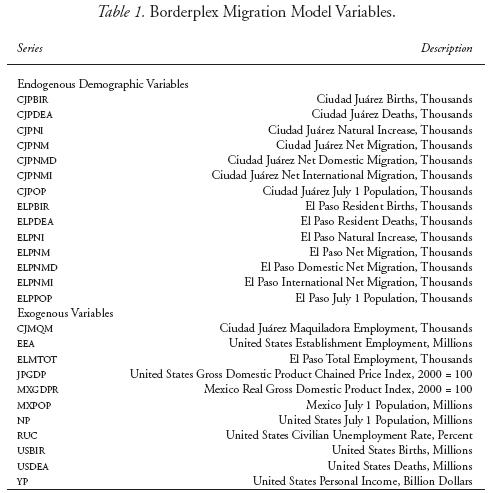
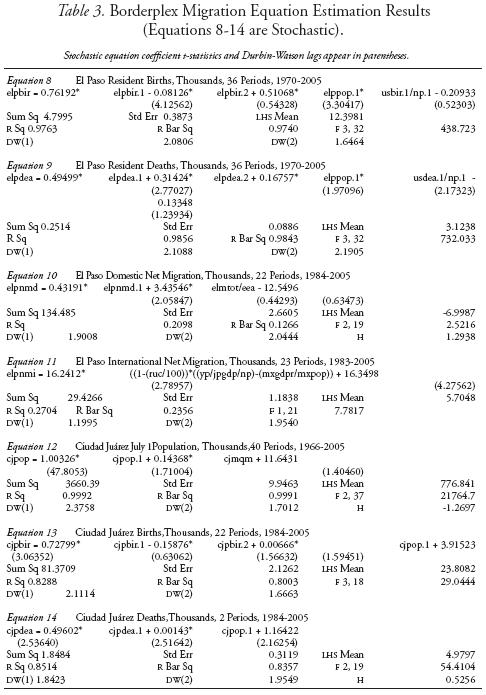
<body><![CDATA[<p align="justify"><font face="verdana" size="2">In addition to series decomposition constraints, the number of annual observations for domestic and international migratory flows to and from El Paso is very limited. At present, the data for these two series go back only to 1984. That represents an improvement from 2005 when historical estimates were available only back to 1991. Although the birth and death components of natural increase have been modeled with some success, obtaining reliable specifications for the two El Paso migration series has required testing many alternatives.</font></p>     <p align="justify"><font face="verdana" size="2">For Ciudad Ju&aacute;rez, total population is modeled directly instead of being calculated using an identity. Cyclical migratory factors in that equation are approximated by total maquiladora employment (Fullerton, Tinajero, and Barraza de Anda, 2006). Births and deaths are also modeled stochastically. The output from those equations is used to estimate natural increase. Natural increase is then subtracted from population change to obtain annual net migration.</font></p>     <p align="justify"><font face="verdana" size="2">Estimates for net domestic migration to and from Ciudad Ju&aacute;rez do not presently exist. That gap in the regional economic profile for this large city will probably be addressed at some point using a combination of Mexican social security, income tax, census, and State of Chihuahua civil registry data. For now, it represents a significant obstacle with respect to accurate modeling and simulation analysis for the entire borderplex economy. Further complicating matters is the fact that historical estimates for the data series that do exist are subject to periodic large scale revisions. Because of that, it is important to update data series frequently in order to insure that the most recent information is included in the modeling effort.</font></p>     <p align="justify"><font face="verdana" size="2">To attempt to overcome that barrier, a simplifying assumption has been made. Namely, annual net international migration to and from Ciudad Ju&aacute;rez is set equal to the negative of what is calculated for El Paso. That figure is then subtracted from net migration to provide an estimate of annual domestic net migration to and from Ciudad Ju&aacute;rez. Whether that assumption is reasonable is not known. Regional sociologists and demographers familiar with the borderplex region are evenly divided about the geographic sources and destinations of migrants to Ciudad Ju&aacute;rez and El Paso. Opinion is also inconclusive with respect to whether international migrants immediately bypass El Paso for other destinations within the United States.</font></p>     <p align="justify"><font face="verdana" size="2">While uncertainty remains in relation to whether the basic strategy employed to overcoming the migration data gap in Ciudad Ju&aacute;rez is reasonable, the model forecasts are used by a wide variety of organizations. As noted by Tayman and Swanson (1996), many customers purchase population forecasts. In the case of the borderplex forecasts, the subscribers include public utilities, commercial banks, builders, chambers of commerce, transportation planners, government agencies, colleges, public school districts, realtors, and cement manufacturers. Those subscriptions provide indirect evidence that regional organizations regard the approach as potentially helpful.</font></p>     <p align="justify"><font face="verdana" size="2">&nbsp;</font></p>     <p align="justify"><font face="verdana" size="2"><b><i>Empirical Results</i></b></font></p>     <p align="justify"><font face="verdana" size="2">Parameter estimation is carried out using a nonlinear autoregressive moving average exogenous (ARMAX) methodology (Pagan, 1974). The ARMAX procedure is often useful in regional and international settings because it can handle autoregressive, moving average, and mixed data generating processes (Fullerton, 2004). <a href="#t1">Table 1</a> lists and describes the variables included in the demographic equations of the borderplex model. <a href="#t2">Table 2</a> summarizes the parameter estimation results for the demographic block of the model. It also lists the identities utilized in this equation block.</font></p>     <p align="center"><font face="verdana" size="2"><a name="t1"></a></font></p>     <p align="center"><font face="verdana" size="2"><img src="/img/revistas/migra/v4n3/a5t1.jpg"></font></p>     ]]></body>
<body><![CDATA[<p align="center"><font face="verdana" size="2">&nbsp;</font></p>     <p align="center"><font face="verdana" size="2"><a name="t2"></a></font></p>     <p align="center"><font face="verdana" size="2"><img src="/img/revistas/migra/v4n3/a5t2.jpg"></font></p>     <p align="justify"><font face="verdana" size="2">There are a total of 14 demographic equations in the model. Equations 1 through 7 are identities. In El Paso, natural increase is calculated as the difference between resident births and resident deaths (Equation 1). Because El Paso provides many types of medical services to patients from Mexico, occurrence births are generally about 20 percent higher than resident births. Texas Bureau of Vital Statistics data indicate that occurrence deaths tend to exceed their resident counterpart measure by approximately 7.5 percent per year (<a href="http://www.dshs.state.tx.us/" target="_blank">www.dshs.state.texas.us</a>), accessed 17 October 2006).</font></p>     <p align="justify"><font face="verdana" size="2">The stochastic specifications for El Paso resident births and El Paso resident deaths are identical to each other (Equations 8 and 9). Both include two autoregressive lags plus scaled, one&#150;period lags of national population ratios. Those measures are the United States births to population and United States deaths to population ratios, scaled by the population of El Paso. The objective is to capture local as well as national trends related to these demographic items. While the specifications are relatively simple, both exhibit good statistical diagnostics. As noted by Smith (1997) and Booth (2006), mathematical simplicity does not preclude demographic forecast accuracy.</font></p>     <p align="justify"><font face="verdana" size="2">El Paso net migration is calculated as the sum of net domestic migration and net international migration (Equation 2). Domestic net migration has proven difficult to model. The current specification shown in Equation 10 contains a one&#150;period autoregressive lag plus the ratio of total El Paso employment to United States non&#150;agricultural employment. While the parameter estimate for the latter regressor exhibits the hypothesized positive sign, it is not statistically significant at the 5&#150;percent level. Experimentation with other specifications involving cyclical and structural measures such as local versus national unemployment rates have not yielded satisfactory diagnostics (Clark and Murphy, 1996). Given that, the current equation will receive additional attention in the future. Part of the difficulty for this equation may reflect measurement errors that historically affect population estimates for heavily Hispanic regions of the United States such as El Paso (Smith and Nogle, 2004).</font></p>     <p align="justify"><font face="verdana" size="2">Various specifications have also been tested for El Paso net international migration (Equation 11). The version shown below is a variant of the standard economic model for worker relocation (Harris and Todaro, 1970; Corden and Findlay, 1975). In it, the effective wage differential is approximated by the gap between United States real per capita income, multiplied by the probability of employment, and real per capita gross domestic product in Mexico. Although the coefficient of determination for the equation is below 30 percent, the computed t&#150;statistics for its regression coefficients are statistically significant. From a potential simulation accuracy perspective, it is worth noting that the ratio of the standard error of regression to the dependent variable mean for this equation is 0.21, much lower than what might be expected on the basis of the coefficient of determination.</font></p>     <p align="justify"><font face="verdana" size="2">Total El Paso population is then determined by the sum of the prior year population with current year natural increase and net migration (Equation 3). This basic components approach to the population identity is similar to what has historically been applied in other regional econometric models (Fullerton and West, 1998). Because of the dual domestic and international migration data constraints mentioned above, it is not feasible to replicate this procedure for Ciudad Ju&aacute;rez.</font></p>     <p align="justify"><font face="verdana" size="2">Ciudad Ju&aacute;rez natural increase is calculated as the difference between births and deaths (Equation 3). The specifications for births and deaths on the south side of the river vary relative to those for El Paso. For births in Ciudad Ju&aacute;rez, a two&#150;period autoregressive lag plus a one&#150;period lag of total population is employed (Equation 13). For deaths, a one&#150;period autoregressive lag and one&#150;period population lag is utilized (Equation 14). It seems reasonable to conjecture that overall trends for births and deaths in Ciudad Ju&aacute;rez share at least some commonalities with Mexico as a whole. Eventually, it may be helpful to also test whether the inclusion of scaled national data in these specifications yields results similar to those documented for El Paso.</font></p>     <p align="justify"><font face="verdana" size="2">Another curious difference between equation specifications on the two sides of the river can be observed in Equations 5, 6, and 7. Those differences are motivated by the metropolitan data constraints encountered in Mexico. The identity employed to estimate net international migration as the negative of its El Paso counterpart (Equation 6) is discussed above. That result is then used in Equation 7 to provide an estimate of net domestic migration for Ciudad Ju&aacute;rez.</font></p>     ]]></body>
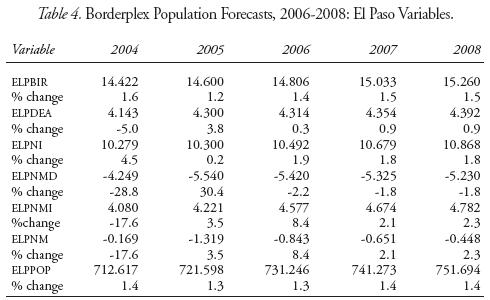
<body><![CDATA[<p align="justify"><font face="verdana" size="2">The Ciudad Ju&aacute;rez net migration identity in Equation 5 represents a departure from the usual approach to regional econometric population modeling such as that discussed for Equation 3. The re&#150;arrangement of the latter identity means that population is treated stochastically rather than a sum of component parts. The specification shown in Equation 12 attempts to include account for both structural trend as well as cyclical components in Ciudad Ju&aacute;rez population growth.</font></p>     <p align="justify"><font face="verdana" size="2">While that may sound daunting, the specification itself is also relatively simple. The first regressor in Equation 12 is a one&#150;period autoregressive lag of the dependent variable. In recent decades, most of the population growth in Ciudad Ju&aacute;rez is a consequence of net migration from other regions of Mexico. The latter is primarily in response to formal sector job opportunities in the in&#150;bond manufacturing sector (Young and Fort, 1994; Ch&aacute;vez, 2004). Accordingly, a contemporaneous lag of maquiladora employment is also included to account for business cycle fluctuations. That variable is modeled in a separate block of equations also included in the borderplex econometric forecasting system (Fullerton, 2001).</font></p>     <p align="justify"><font face="verdana" size="2">For many of the demographic series being forecast, it is still too early to formally assess out&#150;of&#150;sample simulation accuracy. Due to that degrees of freedom limitation, a description of a recent borderplex population forecast is offered instead as an example of how the model simulations are utilized. The data shown in <a href="#t3">Table 3</a> include two years of historical estimates and three years of forecasts for each borderplex demographic variable listed in <a href="#t1">Table 1</a>. The data are from a recent UTEP forecast report for the regional economy (Fullerton and Kelley, 2006).</font></p>     <p align="center"><font face="verdana" size="2"><a name="t3"></a></font></p>     <p align="center"><font face="verdana" size="2"><img src="/img/revistas/migra/v4n3/a5t3.jpg"></font></p>     <p align="justify"><font face="verdana" size="2"><a href="#t3">Table 3</a> exemplifies much of the uncertainty associated with borderplex migration modeling (Weeks and Ham&#150;Chande, 1992). The combined impacts of cross&#150;border regional and national business cycles often produce year&#150;to&#150;year demographic changes that are fairly large. Between 1999 and 2002, net domestic migration out of El Paso averaged more than 9.5 thousand persons per year. By 2004, that number dropped to only 4.25 thousand, in large part due increased troop levels at Fort Bliss military base located inside the city limits. That pattern is likely to continue as a consequence of the Base Realignment and Closure Commission decisions to expand activities at Fort Bliss in future years (Kolenc, 2006)</font></p>     <p align="left"><font face="verdana" size="2">Net international migration generally adds residents to El Paso. From 1999 to 2002, net international migration averaged more than 5.0 thousand persons per year. Reduced migratory pressures due to improved economic performance in Mexico caused that number to drop to approximately 4.1 thousand in 2004. Although economic conditions in the United States should be stronger than those south of the border, net migration into <a href="#t4">El Paso</a> is not forecast to return to pre&#150;2004 levels. Combined with a relatively stable outlook for natural increase, these items translate into a population growth rate of roughly 1.5 percent per year through 2008.</font></p>     <p align="center"><font face="verdana" size="2"><a name="t4"></a></font></p>     <p align="center"><font face="verdana" size="2"><img src="/img/revistas/migra/v4n3/a5t4.jpg"></font></p>     <p align="justify"><font face="verdana" size="2">In <a href="#t5">Ciudad Ju&aacute;rez</a>, recovery in the maquiladora and other sectors of the economy cause the rate of population growth to accelerate from 2.8 percent in 2005 to more than 3.2 percent per year between 2006 and 2008. Natural increase accounts for a small portion of that growth as births outpace deaths during the out&#150;of&#150;sample simulation period. However, the bulk of the increased rate of population change is attributable to an upsurge in net domestic migration that results from better labor market conditions. In 2004 and 2005, net migration averages approximately 19.25 thousand. During the forecast period, it oscillates near the 25.6 thousand mark.</font></p>     ]]></body>
<body><![CDATA[<p align="center"><font face="verdana" size="2"><a name="t5"></a></font></p>     <p align="center"><font face="verdana" size="2"><img src="/img/revistas/migra/v4n3/a5t5.jpg"></font></p>     <p align="justify"><font face="verdana" size="2">The material in <a href="#t3">Table 3</a> is illustrative of the various kinds of changes that characterize border region demography over time (Weeks and Ham&#150;Chande, 1992). To try to capture these types of patterns in an econometric model has required some imagination and simplifying assumptions. In the absence of more complete data samples on both sides of the river, there is little else that can be done at present. Population plays such a predominant role in regional economics, that some effort along these lines is mandatory if a structural model is going to be able to realistically simulate local business conditions. Whether such an effort is successful can eventually be addressed once the out&#150;of&#150;sample predictive track record can be tabulated.</font></p>     <p align="justify"><font face="verdana" size="2">&nbsp;</font></p>     <p align="justify"><font face="verdana" size="2"><b><i>Conclusion</i></b></font></p>     <p align="justify"><font face="verdana" size="2">El Paso domestic and international migration flows have only been added to the UTEP borderplex model since 2005. Similarly, Ciudad Ju&aacute;rez natural increase components were utilized in a forecasting context for the first time in September 2006. Due to those factors, it is not yet possible to quantitatively assess the accuracy of this modeling approach. In the current version of the model, net international migration for Ciudad Ju&aacute;rez is set equal to the negative of its counterpart estimate for El Paso. Eventually, the calculation of domestic migration estimates for Ciudad Ju&aacute;rez will eliminate the need for this admittedly unsatisfactory construct. Until such time, however, this artifice is potentially the best alternative available to border region analysts.</font></p>     <p align="justify"><font face="verdana" size="2">A careful statistical assessment of the forecast precision of the population block of the UTEP borderplex model is not yet feasible. The estimation results indicate that at least some of the in&#150;sample modeling results are satisfactory. Although the current equations are based on relatively basic specifications, the historical track records for demographic forecasts in other regions indicate that this may be a reliable approach.</font></p>     <p align="justify"><font face="verdana" size="2">Until more historical and forecast data for the borderplex become available, it would be helpful to examine whether the modeling strategy developed for El Paso and Ciudad Ju&aacute;rez is applicable to other regions along the boundary of the United States and Mexico. Candidate city pairs include Brownsville&#150;Matamoros, McAllen&#150;Reynosa, Laredo&#150;Nuevo Laredo, Douglas&#150;Agua Prieta, Calexico&#150;Mexicali, and San Diego&#150;Tijuana. There is a good range of population sizes and economic conditions that differ from those of the sample analyzed herein. Accordingly, they would potentially provide good contrasts to the material discussed above.</font></p>     <p align="justify"><font face="verdana" size="2">&nbsp;</font></p>     <p align="justify"><font face="verdana" size="2"><b><i>Bibliography</i></b></font></p>     ]]></body>
<body><![CDATA[<!-- ref --><p align="justify"><font face="verdana" size="2">Anguiano T&eacute;llez, Mar&iacute;a Eugenia, "El estudio binacional M&eacute;xico&#150;Estados Unidos sobre migraci&oacute;n y la investigaci&oacute;n reciente", <i>Frontera Norte, </i>11 (21), January&#150;June 1999, pp. 147&#150;156. </font>&nbsp;&nbsp;&nbsp;&nbsp;&nbsp;&nbsp;&nbsp;&nbsp;[&#160;<a href="javascript:void(0);" onclick="javascript: window.open('/scielo.php?script=sci_nlinks&ref=5307502&pid=S1665-8906200800010000500001&lng=','','width=640,height=500,resizable=yes,scrollbars=1,menubar=yes,');">Links</a>&#160;]<!-- end-ref --><!-- ref --><p align="justify"><font face="verdana" size="2">Booth, Heather, "Demographic Forecasting: 1980 to 2005 in Review", <i>International Journal of Forecasting, </i>22(3), 2006, pp. 547&#150;581. </font>&nbsp;&nbsp;&nbsp;&nbsp;&nbsp;&nbsp;&nbsp;&nbsp;[&#160;<a href="javascript:void(0);" onclick="javascript: window.open('/scielo.php?script=sci_nlinks&ref=5307503&pid=S1665-8906200800010000500002&lng=','','width=640,height=500,resizable=yes,scrollbars=1,menubar=yes,');">Links</a>&#160;]<!-- end-ref --><!-- ref --><p align="justify"><font face="verdana" size="2">Borjas, George J., "The Economics of Immigration", <i>Journal of Economic </i><i>Literature, </i>32(4), 1994, pp. 1667&#150;1717. </font>&nbsp;&nbsp;&nbsp;&nbsp;&nbsp;&nbsp;&nbsp;&nbsp;[&#160;<a href="javascript:void(0);" onclick="javascript: window.open('/scielo.php?script=sci_nlinks&ref=5307504&pid=S1665-8906200800010000500003&lng=','','width=640,height=500,resizable=yes,scrollbars=1,menubar=yes,');">Links</a>&#160;]<!-- end-ref --><!-- ref --><p align="justify"><font face="verdana" size="2">Calder&oacute;n Villarreal, Cuauht&eacute;moc &amp; Jorge E. Mendoza Cota, "Demanda regional de Trabajo en la industria maquiladora de exportaci&oacute;n en los estados de la frontera norte", <i>Frontera Norte, </i>12(24), 2000, pp. 59&#150;84. </font>&nbsp;&nbsp;&nbsp;&nbsp;&nbsp;&nbsp;&nbsp;&nbsp;[&#160;<a href="javascript:void(0);" onclick="javascript: window.open('/scielo.php?script=sci_nlinks&ref=5307505&pid=S1665-8906200800010000500004&lng=','','width=640,height=500,resizable=yes,scrollbars=1,menubar=yes,');">Links</a>&#160;]<!-- end-ref --><!-- ref --><p align="justify"><font face="verdana" size="2">Ch&aacute;vez, Javier, Adri&aacute;n X. Esparza &amp; Brigitte S. Waldorf, "Localized Effects of Globalization: The Case of Ciudad Juarez, Chihuahua, Mexico", <i>Urban Geography, </i>25(2), 2004, pp. 120&#150;138. </font>&nbsp;&nbsp;&nbsp;&nbsp;&nbsp;&nbsp;&nbsp;&nbsp;[&#160;<a href="javascript:void(0);" onclick="javascript: window.open('/scielo.php?script=sci_nlinks&ref=5307506&pid=S1665-8906200800010000500005&lng=','','width=640,height=500,resizable=yes,scrollbars=1,menubar=yes,');">Links</a>&#160;]<!-- end-ref --><!-- ref --><p align="justify"><font face="verdana" size="2">Clark, David E. &amp; Christopher A. Murphy, "Countywide Employment and Population Growth: An Analysis of the 1980s", <i>Journal of Regional </i><i>Science, </i>36(2), 1996, pp. 235&#150;256. </font>&nbsp;&nbsp;&nbsp;&nbsp;&nbsp;&nbsp;&nbsp;&nbsp;[&#160;<a href="javascript:void(0);" onclick="javascript: window.open('/scielo.php?script=sci_nlinks&ref=5307507&pid=S1665-8906200800010000500006&lng=','','width=640,height=500,resizable=yes,scrollbars=1,menubar=yes,');">Links</a>&#160;]<!-- end-ref --><!-- ref --><p align="justify"><font face="verdana" size="2">Corden, Warner Max &amp; Ronald Findlay, "Urban Unemployment, Intersectoral Capital Mobility, and Development Policy", <i>Economica, </i>42(165), 1975, pp. 59&#150;78.</font>&nbsp;&nbsp;&nbsp;&nbsp;&nbsp;&nbsp;&nbsp;&nbsp;[&#160;<a href="javascript:void(0);" onclick="javascript: window.open('/scielo.php?script=sci_nlinks&ref=5307508&pid=S1665-8906200800010000500007&lng=','','width=640,height=500,resizable=yes,scrollbars=1,menubar=yes,');">Links</a>&#160;]<!-- end-ref --><!-- ref --><p align="justify"><font face="verdana" size="2">Durand, Jorge, Douglas S. Massey &amp; Ren&eacute; M. Zenteno, "Mexican Immigration to the United States: Continuities and Changes", <i>Latin American Research Review, </i>36(1), 2001, pp. 107&#150;127.</font>&nbsp;&nbsp;&nbsp;&nbsp;&nbsp;&nbsp;&nbsp;&nbsp;[&#160;<a href="javascript:void(0);" onclick="javascript: window.open('/scielo.php?script=sci_nlinks&ref=5307509&pid=S1665-8906200800010000500008&lng=','','width=640,height=500,resizable=yes,scrollbars=1,menubar=yes,');">Links</a>&#160;]<!-- end-ref --><!-- ref --><p align="justify"><font face="verdana" size="2">Fullerton Jr., Thomas M., "Specification of a Borderplex Econometric Forecasting Model", <i>International Regional Science Review, </i>24(2), 2001, pp. 245&#150;260.</font>&nbsp;&nbsp;&nbsp;&nbsp;&nbsp;&nbsp;&nbsp;&nbsp;[&#160;<a href="javascript:void(0);" onclick="javascript: window.open('/scielo.php?script=sci_nlinks&ref=5307510&pid=S1665-8906200800010000500009&lng=','','width=640,height=500,resizable=yes,scrollbars=1,menubar=yes,');">Links</a>&#160;]<!-- end-ref --><!-- ref --><p align="justify"><font face="verdana" size="2">&#150;&#150;&#150;&#150;&#150;&#150;&#150;&#150;&#150;&#150;, "Borderplex Bridge and Air Econometric Forecast Accuracy", <i>Journal of Transportation &amp; Statistics, </i>7(1), 2004, pp. 7&#150;21.</font>&nbsp;&nbsp;&nbsp;&nbsp;&nbsp;&nbsp;&nbsp;&nbsp;[&#160;<a href="javascript:void(0);" onclick="javascript: window.open('/scielo.php?script=sci_nlinks&ref=5307511&pid=S1665-8906200800010000500010&lng=','','width=640,height=500,resizable=yes,scrollbars=1,menubar=yes,');">Links</a>&#160;]<!-- end-ref --><!-- ref --><p align="justify"><font face="verdana" size="2">&#150;&#150;&#150;&#150;&#150;&#150;&#150;&#150;&#150;&#150;&amp; Richard L. Sprinkle, "Border Controls, Public Policy, Immigration, and Trade with Mexico", <i>Texas Hispanic Journal of Law &amp; Policy, </i>10(1), Fall 2004, pp. 67&#150;77.</font>&nbsp;&nbsp;&nbsp;&nbsp;&nbsp;&nbsp;&nbsp;&nbsp;[&#160;<a href="javascript:void(0);" onclick="javascript: window.open('/scielo.php?script=sci_nlinks&ref=5307512&pid=S1665-8906200800010000500011&lng=','','width=640,height=500,resizable=yes,scrollbars=1,menubar=yes,');">Links</a>&#160;]<!-- end-ref --><!-- ref --><p align="justify"><font face="verdana" size="2">Fullerton Jr., Thomas M., &amp; Brian W. Kelley, "Borderplex Economic Outlook: 2006&#150;2008. Business Report SR06&#150;2" (El Paso, University of Texas at El Paso, Border Region Modeling Project, 2006).</font>&nbsp;&nbsp;&nbsp;&nbsp;&nbsp;&nbsp;&nbsp;&nbsp;[&#160;<a href="javascript:void(0);" onclick="javascript: window.open('/scielo.php?script=sci_nlinks&ref=5307513&pid=S1665-8906200800010000500012&lng=','','width=640,height=500,resizable=yes,scrollbars=1,menubar=yes,');">Links</a>&#160;]<!-- end-ref --><!-- ref --><p align="justify"><font face="verdana" size="2">Fullerton Jr., Thomas M., Roberto Tinajero &amp; Martha P. Barraza de Anda, "Short&#150;term Water Consumption Patterns in Ciudad Ju&aacute;rez, M&eacute;xico", <i>Atlantic Economic Journal, </i>34, 2006, pp. 467&#150;479.</font>&nbsp;&nbsp;&nbsp;&nbsp;&nbsp;&nbsp;&nbsp;&nbsp;[&#160;<a href="javascript:void(0);" onclick="javascript: window.open('/scielo.php?script=sci_nlinks&ref=5307514&pid=S1665-8906200800010000500013&lng=','','width=640,height=500,resizable=yes,scrollbars=1,menubar=yes,');">Links</a>&#160;]<!-- end-ref --><!-- ref --><p align="justify"><font face="verdana" size="2">Fullerton Jr., Thomas M. &amp; Carol T. West, "Regional Econometric Housing Start Forecast Accuracy in Florida", <i>Review ofRegional Studies, </i>28, 1998, pp. 15&#150;41.</font>&nbsp;&nbsp;&nbsp;&nbsp;&nbsp;&nbsp;&nbsp;&nbsp;[&#160;<a href="javascript:void(0);" onclick="javascript: window.open('/scielo.php?script=sci_nlinks&ref=5307515&pid=S1665-8906200800010000500014&lng=','','width=640,height=500,resizable=yes,scrollbars=1,menubar=yes,');">Links</a>&#160;]<!-- end-ref --><!-- ref --><p align="justify"><font face="verdana" size="2">Hanson, Gordon H., "U.S.&#150;Mexico Integration and Regional Economies: Evidence from Border&#150;city Pairs", <i>Journal of* Urban Economics, </i>50 (2), 2001, pp. 259&#150;287.</font>&nbsp;&nbsp;&nbsp;&nbsp;&nbsp;&nbsp;&nbsp;&nbsp;[&#160;<a href="javascript:void(0);" onclick="javascript: window.open('/scielo.php?script=sci_nlinks&ref=5307516&pid=S1665-8906200800010000500015&lng=','','width=640,height=500,resizable=yes,scrollbars=1,menubar=yes,');">Links</a>&#160;]<!-- end-ref --><!-- ref --><p align="justify"><font face="verdana" size="2">Harris, John R. &amp; Michael P. Todaro, "Migration, Unemployment, and Development", <i>American Economic Review, </i>60(1), 1970, pp. 126&#150;142.</font>&nbsp;&nbsp;&nbsp;&nbsp;&nbsp;&nbsp;&nbsp;&nbsp;[&#160;<a href="javascript:void(0);" onclick="javascript: window.open('/scielo.php?script=sci_nlinks&ref=5307517&pid=S1665-8906200800010000500016&lng=','','width=640,height=500,resizable=yes,scrollbars=1,menubar=yes,');">Links</a>&#160;]<!-- end-ref --><!-- ref --><p align="justify"><font face="verdana" size="2">Kolenc, Vic, "Fort Bliss Influx Offers Optimistic Outlook for City", <i>El Paso Times, </i>2006, 1d.</font>&nbsp;&nbsp;&nbsp;&nbsp;&nbsp;&nbsp;&nbsp;&nbsp;[&#160;<a href="javascript:void(0);" onclick="javascript: window.open('/scielo.php?script=sci_nlinks&ref=5307518&pid=S1665-8906200800010000500017&lng=','','width=640,height=500,resizable=yes,scrollbars=1,menubar=yes,');">Links</a>&#160;]<!-- end-ref --><!-- ref --><p align="justify"><font face="verdana" size="2">Mendoza Cota, Jorge E., "Determinantes macroecon&oacute;micos regionales de la migraci&oacute;n mexicana", <i>Migraciones Internacionales, </i>3, 4(11), July&#150;December 2006, pp. 118&#150;145.</font>&nbsp;&nbsp;&nbsp;&nbsp;&nbsp;&nbsp;&nbsp;&nbsp;[&#160;<a href="javascript:void(0);" onclick="javascript: window.open('/scielo.php?script=sci_nlinks&ref=5307519&pid=S1665-8906200800010000500018&lng=','','width=640,height=500,resizable=yes,scrollbars=1,menubar=yes,');">Links</a>&#160;]<!-- end-ref --><!-- ref --><p align="justify"><font face="verdana" size="2">Orrenius, Pia M., "Illegal Immigration and Enforcement along the U.S.&#150;Mexico Border", <i>Federal Reserve Bank of Dallas Economic &amp; Financial Review, </i>First Quarter, 2001, pp. 1&#150;11.</font>&nbsp;&nbsp;&nbsp;&nbsp;&nbsp;&nbsp;&nbsp;&nbsp;[&#160;<a href="javascript:void(0);" onclick="javascript: window.open('/scielo.php?script=sci_nlinks&ref=5307520&pid=S1665-8906200800010000500019&lng=','','width=640,height=500,resizable=yes,scrollbars=1,menubar=yes,');">Links</a>&#160;]<!-- end-ref --><!-- ref --><p align="justify"><font face="verdana" size="2">Pagan, Adrian R., "A Generalised Approach to the Treatment of Autocorrelation", <i>Australian Economic Papers, </i>13(23), 1974, pp. 267&#150;280.</font>&nbsp;&nbsp;&nbsp;&nbsp;&nbsp;&nbsp;&nbsp;&nbsp;[&#160;<a href="javascript:void(0);" onclick="javascript: window.open('/scielo.php?script=sci_nlinks&ref=5307521&pid=S1665-8906200800010000500020&lng=','','width=640,height=500,resizable=yes,scrollbars=1,menubar=yes,');">Links</a>&#160;]<!-- end-ref --><!-- ref --><p align="justify"><font face="verdana" size="2">Peach, James T. &amp; James D. Williams, "Demographic Change in the El Paso&#150;Ju&aacute;rez&#150;Las Cruces Region", <i>Estudios Fronterizos, </i>34, 1994, pp. 117&#150;138.</font>&nbsp;&nbsp;&nbsp;&nbsp;&nbsp;&nbsp;&nbsp;&nbsp;[&#160;<a href="javascript:void(0);" onclick="javascript: window.open('/scielo.php?script=sci_nlinks&ref=5307522&pid=S1665-8906200800010000500021&lng=','','width=640,height=500,resizable=yes,scrollbars=1,menubar=yes,');">Links</a>&#160;]<!-- end-ref --><!-- ref --><p align="justify"><font face="verdana" size="2">Robertson, Raymond, "Wage Shocks and North&#150;American Labor Market Integration", <i>American Economic Review, </i>90(4), 2000, pp. 742&#150;764.</font>&nbsp;&nbsp;&nbsp;&nbsp;&nbsp;&nbsp;&nbsp;&nbsp;[&#160;<a href="javascript:void(0);" onclick="javascript: window.open('/scielo.php?script=sci_nlinks&ref=5307523&pid=S1665-8906200800010000500022&lng=','','width=640,height=500,resizable=yes,scrollbars=1,menubar=yes,');">Links</a>&#160;]<!-- end-ref --><!-- ref --><p align="justify"><font face="verdana" size="2">Smith, Stanley K., "Further Thoughts on Simplicity and Complexity in Population Projection Models", <i>International Journal of Forecasting, </i>13(4), 1997, pp. 557&#150;565.</font>&nbsp;&nbsp;&nbsp;&nbsp;&nbsp;&nbsp;&nbsp;&nbsp;[&#160;<a href="javascript:void(0);" onclick="javascript: window.open('/scielo.php?script=sci_nlinks&ref=5307524&pid=S1665-8906200800010000500023&lng=','','width=640,height=500,resizable=yes,scrollbars=1,menubar=yes,');">Links</a>&#160;]<!-- end-ref --><!-- ref --><p align="justify"><font face="verdana" size="2">&#150;&#150;&#150;&#150;&#150;&#150;&#150;&#150;&#150;&#150;&amp; June M. Nogle, "An Evaluation of Hispanic Population Estimates", <i>Social Science Quarterly, </i>85(3), 2004, pp. 731&#150;745.</font>&nbsp;&nbsp;&nbsp;&nbsp;&nbsp;&nbsp;&nbsp;&nbsp;[&#160;<a href="javascript:void(0);" onclick="javascript: window.open('/scielo.php?script=sci_nlinks&ref=5307525&pid=S1665-8906200800010000500024&lng=','','width=640,height=500,resizable=yes,scrollbars=1,menubar=yes,');">Links</a>&#160;]<!-- end-ref --><!-- ref --><p align="justify"><font face="verdana" size="2">Tayman, Jeff &amp; David A. Swanson, "On the Utility of Population Forecasts", <i>Demography, </i>33(4), 1996, pp. 523&#150;528.</font>&nbsp;&nbsp;&nbsp;&nbsp;&nbsp;&nbsp;&nbsp;&nbsp;[&#160;<a href="javascript:void(0);" onclick="javascript: window.open('/scielo.php?script=sci_nlinks&ref=5307526&pid=S1665-8906200800010000500025&lng=','','width=640,height=500,resizable=yes,scrollbars=1,menubar=yes,');">Links</a>&#160;]<!-- end-ref --><!-- ref --><p align="justify"><font face="verdana" size="2">Texas Department of Health Bureau of Vital Statistics, <a href="http://www.dshs.state.tx.us/" target="_blank">www.dshs.state.texas.us</a>, accessed October 17, 2006.</font>&nbsp;&nbsp;&nbsp;&nbsp;&nbsp;&nbsp;&nbsp;&nbsp;[&#160;<a href="javascript:void(0);" onclick="javascript: window.open('/scielo.php?script=sci_nlinks&ref=5307527&pid=S1665-8906200800010000500026&lng=','','width=640,height=500,resizable=yes,scrollbars=1,menubar=yes,');">Links</a>&#160;]<!-- end-ref --><!-- ref --><p align="justify"><font face="verdana" size="2">Weeks, John R. &amp; Roberto Ham&#150;Chande (eds.), <i>Demographic Dynamics of the U.S.&#150;Mexico Border, </i>El Paso, Texas Western Press, 1992.</font>&nbsp;&nbsp;&nbsp;&nbsp;&nbsp;&nbsp;&nbsp;&nbsp;[&#160;<a href="javascript:void(0);" onclick="javascript: window.open('/scielo.php?script=sci_nlinks&ref=5307528&pid=S1665-8906200800010000500027&lng=','','width=640,height=500,resizable=yes,scrollbars=1,menubar=yes,');">Links</a>&#160;]<!-- end-ref --><!-- ref --><p align="justify"><font face="verdana" size="2">Young, Gay &amp; Lucinda Fort, "Household Responses to Economic Change: Migration and Maquiladora Work in Ciudad Ju&aacute;rez, Mexico", <i>Social Science Quarterly, </i>75(3), 1994, pp. 656&#150;670.</font>&nbsp;&nbsp;&nbsp;&nbsp;&nbsp;&nbsp;&nbsp;&nbsp;[&#160;<a href="javascript:void(0);" onclick="javascript: window.open('/scielo.php?script=sci_nlinks&ref=5307529&pid=S1665-8906200800010000500028&lng=','','width=640,height=500,resizable=yes,scrollbars=1,menubar=yes,');">Links</a>&#160;]<!-- end-ref --><p align="justify"><font face="verdana" size="2">&nbsp;</font></p>     <p align="justify"><font face="verdana" size="2"><b><a name="notas"></a>Notas</b></font></p>     ]]></body>
<body><![CDATA[<p align="justify"><font face="verdana" size="2"><sup>1</sup>&nbsp;A preliminary version of this research was presented at the 2006 <i>Lineae Terrarum International Borders Conference </i>in Ciudad Ju&aacute;rez, Chihuahua, and appears in the conference proceedings.</font></p>     <p align="justify"><font face="verdana" size="2"><sup>2</sup>&nbsp;Funding support for this research was provided by National Science Foundation Grant SES&#150;0332001, El Paso Electric Company, Hunt Communities, and Wells Fargo Bank of El Paso. Helpful suggestions and comments were provided by Miguel M&aacute;rquez Blanco, Rodolfo Corona, and two anonymous referees. Econometric research assistance was provided by Marycruz de Le&oacute;n, Irma Torres Rodr&iacute;guez, and George Novela.</font></p>      ]]></body><back>
<ref-list>
<ref id="B1">
<nlm-citation citation-type="journal">
<person-group person-group-type="author">
<name>
<surname><![CDATA[Anguiano Téllez]]></surname>
<given-names><![CDATA[María Eugenia]]></given-names>
</name>
</person-group>
<article-title xml:lang="es"><![CDATA["El estudio binacional México-Estados Unidos sobre migración y la investigación reciente"]]></article-title>
<source><![CDATA[Frontera Norte]]></source>
<year>Janu</year>
<month>ar</month>
<day>y-</day>
<volume>11</volume>
<numero>21</numero>
<issue>21</issue>
<page-range>147-156</page-range></nlm-citation>
</ref>
<ref id="B2">
<nlm-citation citation-type="journal">
<person-group person-group-type="author">
<name>
<surname><![CDATA[Booth]]></surname>
<given-names><![CDATA[Heather]]></given-names>
</name>
</person-group>
<article-title xml:lang="en"><![CDATA["Demographic Forecasting: 1980 to 2005 in Review"]]></article-title>
<source><![CDATA[International Journal of Forecasting]]></source>
<year>2006</year>
<volume>22</volume>
<numero>3</numero>
<issue>3</issue>
<page-range>547-581</page-range></nlm-citation>
</ref>
<ref id="B3">
<nlm-citation citation-type="journal">
<person-group person-group-type="author">
<name>
<surname><![CDATA[Borjas]]></surname>
<given-names><![CDATA[George J.]]></given-names>
</name>
</person-group>
<article-title xml:lang="en"><![CDATA["The Economics of Immigration"]]></article-title>
<source><![CDATA[Journal of Economic Literature]]></source>
<year>1994</year>
<volume>32</volume>
<numero>4</numero>
<issue>4</issue>
<page-range>1667-1717</page-range></nlm-citation>
</ref>
<ref id="B4">
<nlm-citation citation-type="journal">
<person-group person-group-type="author">
<name>
<surname><![CDATA[Calderón Villarreal]]></surname>
<given-names><![CDATA[Cuauhtémoc]]></given-names>
</name>
<name>
<surname><![CDATA[Mendoza Cota]]></surname>
<given-names><![CDATA[Jorge E.]]></given-names>
</name>
</person-group>
<article-title xml:lang="es"><![CDATA["Demanda regional de Trabajo en la industria maquiladora de exportación en los estados de la frontera norte"]]></article-title>
<source><![CDATA[Frontera Norte]]></source>
<year>2000</year>
<volume>12</volume>
<numero>24</numero>
<issue>24</issue>
<page-range>59-84</page-range></nlm-citation>
</ref>
<ref id="B5">
<nlm-citation citation-type="journal">
<person-group person-group-type="author">
<name>
<surname><![CDATA[Chávez]]></surname>
<given-names><![CDATA[Javier]]></given-names>
</name>
<name>
<surname><![CDATA[Esparza]]></surname>
<given-names><![CDATA[Adrián X.]]></given-names>
</name>
<name>
<surname><![CDATA[Waldorf]]></surname>
<given-names><![CDATA[Brigitte S.]]></given-names>
</name>
</person-group>
<article-title xml:lang="en"><![CDATA["Localized Effects of Globalization: The Case of Ciudad Juarez, Chihuahua, Mexico"]]></article-title>
<source><![CDATA[Urban Geography]]></source>
<year>2004</year>
<volume>25</volume>
<numero>2</numero>
<issue>2</issue>
<page-range>120-138</page-range></nlm-citation>
</ref>
<ref id="B6">
<nlm-citation citation-type="journal">
<person-group person-group-type="author">
<name>
<surname><![CDATA[Clark]]></surname>
<given-names><![CDATA[David E.]]></given-names>
</name>
<name>
<surname><![CDATA[Murphy]]></surname>
<given-names><![CDATA[Christopher A.]]></given-names>
</name>
</person-group>
<article-title xml:lang="en"><![CDATA["Countywide Employment and Population Growth: An Analysis of the 1980s"]]></article-title>
<source><![CDATA[Journal of Regional Science]]></source>
<year>1996</year>
<volume>36</volume>
<numero>2</numero>
<issue>2</issue>
<page-range>235-256</page-range></nlm-citation>
</ref>
<ref id="B7">
<nlm-citation citation-type="journal">
<person-group person-group-type="author">
<name>
<surname><![CDATA[Corden]]></surname>
<given-names><![CDATA[Warner Max]]></given-names>
</name>
<name>
<surname><![CDATA[Findlay]]></surname>
<given-names><![CDATA[Ronald]]></given-names>
</name>
</person-group>
<article-title xml:lang="en"><![CDATA["Urban Unemployment, Intersectoral Capital Mobility, and Development Policy"]]></article-title>
<source><![CDATA[Economica]]></source>
<year>1975</year>
<volume>42</volume>
<numero>165</numero>
<issue>165</issue>
<page-range>59-78</page-range></nlm-citation>
</ref>
<ref id="B8">
<nlm-citation citation-type="journal">
<person-group person-group-type="author">
<name>
<surname><![CDATA[Durand]]></surname>
<given-names><![CDATA[Jorge]]></given-names>
</name>
<name>
<surname><![CDATA[Massey]]></surname>
<given-names><![CDATA[Douglas S.]]></given-names>
</name>
<name>
<surname><![CDATA[Zenteno]]></surname>
<given-names><![CDATA[René M.]]></given-names>
</name>
</person-group>
<article-title xml:lang="en"><![CDATA["Mexican Immigration to the United States: Continuities and Changes"]]></article-title>
<source><![CDATA[Latin American Research Review]]></source>
<year>2001</year>
<volume>36</volume>
<numero>1</numero>
<issue>1</issue>
<page-range>107-127</page-range></nlm-citation>
</ref>
<ref id="B9">
<nlm-citation citation-type="journal">
<person-group person-group-type="author">
<name>
<surname><![CDATA[Fullerton]]></surname>
<given-names><![CDATA[Thomas M.]]></given-names>
</name>
</person-group>
<article-title xml:lang="en"><![CDATA["Specification of a Borderplex Econometric Forecasting Model"]]></article-title>
<source><![CDATA[International Regional Science Review]]></source>
<year>2001</year>
<volume>24</volume>
<numero>2</numero>
<issue>2</issue>
<page-range>245-260</page-range></nlm-citation>
</ref>
<ref id="B10">
<nlm-citation citation-type="journal">
<person-group person-group-type="author">
<name>
<surname><![CDATA[Fullerton]]></surname>
<given-names><![CDATA[Thomas M.]]></given-names>
</name>
</person-group>
<article-title xml:lang="en"><![CDATA["Borderplex Bridge and Air Econometric Forecast Accuracy"]]></article-title>
<source><![CDATA[Journal of Transportation & Statistics]]></source>
<year>2004</year>
<volume>7</volume>
<numero>1</numero>
<issue>1</issue>
<page-range>7-21</page-range></nlm-citation>
</ref>
<ref id="B11">
<nlm-citation citation-type="journal">
<person-group person-group-type="author">
<name>
<surname><![CDATA[Fullerton]]></surname>
<given-names><![CDATA[Thomas M.]]></given-names>
</name>
<name>
<surname><![CDATA[Sprinkle]]></surname>
<given-names><![CDATA[Richard L.]]></given-names>
</name>
</person-group>
<article-title xml:lang="en"><![CDATA["Border Controls, Public Policy, Immigration, and Trade with Mexico"]]></article-title>
<source><![CDATA[Texas Hispanic Journal of Law & Policy]]></source>
<year>2004</year>
<volume>10</volume>
<numero>1</numero>
<issue>1</issue>
<page-range>67-77</page-range></nlm-citation>
</ref>
<ref id="B12">
<nlm-citation citation-type="book">
<person-group person-group-type="author">
<name>
<surname><![CDATA[Fullerton]]></surname>
<given-names><![CDATA[Thomas M.]]></given-names>
</name>
<name>
<surname><![CDATA[Kelley]]></surname>
<given-names><![CDATA[Brian W.]]></given-names>
</name>
</person-group>
<source><![CDATA["Borderplex Economic Outlook: 2006-2008. Business Report SR06-2"]]></source>
<year>2006</year>
<publisher-loc><![CDATA[El Paso ]]></publisher-loc>
<publisher-name><![CDATA[University of Texas at El Paso, Border Region Modeling Project]]></publisher-name>
</nlm-citation>
</ref>
<ref id="B13">
<nlm-citation citation-type="journal">
<person-group person-group-type="author">
<name>
<surname><![CDATA[Fullerton]]></surname>
<given-names><![CDATA[Thomas M.]]></given-names>
</name>
<name>
<surname><![CDATA[Tinajero]]></surname>
<given-names><![CDATA[Roberto]]></given-names>
</name>
<name>
<surname><![CDATA[Barraza de Anda]]></surname>
<given-names><![CDATA[Martha P.]]></given-names>
</name>
</person-group>
<article-title xml:lang="en"><![CDATA["Short-term Water Consumption Patterns in Ciudad Juárez, México"]]></article-title>
<source><![CDATA[Atlantic Economic Journal]]></source>
<year>2006</year>
<volume>34</volume>
<page-range>467-479</page-range></nlm-citation>
</ref>
<ref id="B14">
<nlm-citation citation-type="journal">
<person-group person-group-type="author">
<name>
<surname><![CDATA[Fullerton]]></surname>
<given-names><![CDATA[Thomas M.]]></given-names>
</name>
<name>
<surname><![CDATA[West]]></surname>
<given-names><![CDATA[Carol T.]]></given-names>
</name>
</person-group>
<article-title xml:lang="en"><![CDATA["Regional Econometric Housing Start Forecast Accuracy in Florida"]]></article-title>
<source><![CDATA[Review ofRegional Studies]]></source>
<year>1998</year>
<volume>28</volume>
<page-range>15-41</page-range></nlm-citation>
</ref>
<ref id="B15">
<nlm-citation citation-type="journal">
<person-group person-group-type="author">
<name>
<surname><![CDATA[Hanson]]></surname>
<given-names><![CDATA[Gordon H.]]></given-names>
</name>
</person-group>
<article-title xml:lang="en"><![CDATA["U.S.-Mexico Integration and Regional Economies: Evidence from Border-city Pairs"]]></article-title>
<source><![CDATA[Journal of* Urban Economics]]></source>
<year>2001</year>
<volume>50</volume>
<numero>2</numero>
<issue>2</issue>
<page-range>259-287</page-range></nlm-citation>
</ref>
<ref id="B16">
<nlm-citation citation-type="journal">
<person-group person-group-type="author">
<name>
<surname><![CDATA[Harris]]></surname>
<given-names><![CDATA[John R.]]></given-names>
</name>
<name>
<surname><![CDATA[Todaro]]></surname>
<given-names><![CDATA[Michael P.]]></given-names>
</name>
</person-group>
<article-title xml:lang="en"><![CDATA["Migration, Unemployment, and Development"]]></article-title>
<source><![CDATA[American Economic Review]]></source>
<year>1970</year>
<volume>60</volume>
<numero>1</numero>
<issue>1</issue>
<page-range>126-142</page-range></nlm-citation>
</ref>
<ref id="B17">
<nlm-citation citation-type="journal">
<person-group person-group-type="author">
<name>
<surname><![CDATA[Kolenc]]></surname>
<given-names><![CDATA[Vic]]></given-names>
</name>
</person-group>
<article-title xml:lang="en"><![CDATA["Fort Bliss Influx Offers Optimistic Outlook for City"]]></article-title>
<source><![CDATA[El Paso Times]]></source>
<year>2006</year>
</nlm-citation>
</ref>
<ref id="B18">
<nlm-citation citation-type="journal">
<person-group person-group-type="author">
<name>
<surname><![CDATA[Mendoza Cota]]></surname>
<given-names><![CDATA[Jorge E.]]></given-names>
</name>
</person-group>
<article-title xml:lang="es"><![CDATA["Determinantes macroeconómicos regionales de la migración mexicana"]]></article-title>
<source><![CDATA[Migraciones Internacionales]]></source>
<year>July</year>
<month>-D</month>
<day>ec</day>
<volume>3</volume>
<numero>4</numero><numero>11</numero>
<issue>4</issue><issue>11</issue>
<page-range>118-145</page-range></nlm-citation>
</ref>
<ref id="B19">
<nlm-citation citation-type="">
<person-group person-group-type="author">
<name>
<surname><![CDATA[Orrenius]]></surname>
<given-names><![CDATA[Pia M.]]></given-names>
</name>
</person-group>
<article-title xml:lang="en"><![CDATA["Illegal Immigration and Enforcement along the U.S.-Mexico Border"]]></article-title>
<source><![CDATA[Federal Reserve Bank of Dallas Economic & Financial Review]]></source>
<year>2001</year>
<page-range>1-11</page-range></nlm-citation>
</ref>
<ref id="B20">
<nlm-citation citation-type="journal">
<person-group person-group-type="author">
<name>
<surname><![CDATA[Pagan]]></surname>
<given-names><![CDATA[Adrian R.]]></given-names>
</name>
</person-group>
<article-title xml:lang="en"><![CDATA["A Generalised Approach to the Treatment of Autocorrelation"]]></article-title>
<source><![CDATA[Australian Economic Papers]]></source>
<year>1974</year>
<volume>13</volume>
<numero>23</numero>
<issue>23</issue>
<page-range>267-280</page-range></nlm-citation>
</ref>
<ref id="B21">
<nlm-citation citation-type="journal">
<person-group person-group-type="author">
<name>
<surname><![CDATA[Peach]]></surname>
<given-names><![CDATA[James T.]]></given-names>
</name>
<name>
<surname><![CDATA[Williams]]></surname>
<given-names><![CDATA[James D.]]></given-names>
</name>
</person-group>
<article-title xml:lang="en"><![CDATA["Demographic Change in the El Paso-Juárez-Las Cruces Region"]]></article-title>
<source><![CDATA[Estudios Fronterizos]]></source>
<year>1994</year>
<volume>34</volume>
<page-range>117-138</page-range></nlm-citation>
</ref>
<ref id="B22">
<nlm-citation citation-type="journal">
<person-group person-group-type="author">
<name>
<surname><![CDATA[Robertson]]></surname>
<given-names><![CDATA[Raymond]]></given-names>
</name>
</person-group>
<article-title xml:lang="en"><![CDATA["Wage Shocks and North-American Labor Market Integration"]]></article-title>
<source><![CDATA[American Economic Review]]></source>
<year>2000</year>
<volume>90</volume>
<numero>4</numero>
<issue>4</issue>
<page-range>742-764</page-range></nlm-citation>
</ref>
<ref id="B23">
<nlm-citation citation-type="journal">
<person-group person-group-type="author">
<name>
<surname><![CDATA[Smith]]></surname>
<given-names><![CDATA[Stanley K.]]></given-names>
</name>
</person-group>
<article-title xml:lang="en"><![CDATA["Further Thoughts on Simplicity and Complexity in Population Projection Models"]]></article-title>
<source><![CDATA[International Journal of Forecasting]]></source>
<year>1997</year>
<volume>13</volume>
<numero>4</numero>
<issue>4</issue>
<page-range>557-565</page-range></nlm-citation>
</ref>
<ref id="B24">
<nlm-citation citation-type="journal">
<person-group person-group-type="author">
<name>
<surname><![CDATA[Smith]]></surname>
<given-names><![CDATA[Stanley K.]]></given-names>
</name>
<name>
<surname><![CDATA[Nogle]]></surname>
<given-names><![CDATA[June M.]]></given-names>
</name>
</person-group>
<article-title xml:lang="en"><![CDATA["An Evaluation of Hispanic Population Estimates"]]></article-title>
<source><![CDATA[Social Science Quarterly]]></source>
<year>2004</year>
<volume>85</volume>
<numero>3</numero>
<issue>3</issue>
<page-range>731-745</page-range></nlm-citation>
</ref>
<ref id="B25">
<nlm-citation citation-type="journal">
<person-group person-group-type="author">
<name>
<surname><![CDATA[Tayman]]></surname>
<given-names><![CDATA[Jeff]]></given-names>
</name>
<name>
<surname><![CDATA[Swanson]]></surname>
<given-names><![CDATA[David A.]]></given-names>
</name>
</person-group>
<article-title xml:lang="en"><![CDATA["On the Utility of Population Forecasts"]]></article-title>
<source><![CDATA[Demography]]></source>
<year>1996</year>
<volume>33</volume>
<numero>4</numero>
<issue>4</issue>
<page-range>523-528</page-range></nlm-citation>
</ref>
<ref id="B26">
<nlm-citation citation-type="">
<collab>Texas Department of Health Bureau of Vital Statistics</collab>
<source><![CDATA[]]></source>
<year></year>
</nlm-citation>
</ref>
<ref id="B27">
<nlm-citation citation-type="book">
<person-group person-group-type="author">
<name>
<surname><![CDATA[Weeks]]></surname>
<given-names><![CDATA[John R.]]></given-names>
</name>
<name>
<surname><![CDATA[Ham-Chande]]></surname>
<given-names><![CDATA[Roberto]]></given-names>
</name>
</person-group>
<source><![CDATA[Demographic Dynamics of the U.S.-Mexico Border]]></source>
<year>1992</year>
<publisher-loc><![CDATA[El Paso ]]></publisher-loc>
<publisher-name><![CDATA[Texas Western Press]]></publisher-name>
</nlm-citation>
</ref>
<ref id="B28">
<nlm-citation citation-type="journal">
<person-group person-group-type="author">
<name>
<surname><![CDATA[Young]]></surname>
<given-names><![CDATA[Gay]]></given-names>
</name>
<name>
<surname><![CDATA[Fort]]></surname>
<given-names><![CDATA[Lucinda]]></given-names>
</name>
</person-group>
<article-title xml:lang="en"><![CDATA["Household Responses to Economic Change: Migration and Maquiladora Work in Ciudad Juárez, Mexico"]]></article-title>
<source><![CDATA[Social Science Quarterly]]></source>
<year>1994</year>
<volume>75</volume>
<numero>3</numero>
<issue>3</issue>
<page-range>656-670</page-range></nlm-citation>
</ref>
</ref-list>
</back>
</article>