<?xml version="1.0" encoding="ISO-8859-1"?><article xmlns:mml="http://www.w3.org/1998/Math/MathML" xmlns:xlink="http://www.w3.org/1999/xlink" xmlns:xsi="http://www.w3.org/2001/XMLSchema-instance">
<front>
<journal-meta>
<journal-id>1665-7381</journal-id>
<journal-title><![CDATA[Ingeniería mecánica, tecnología y desarrollo]]></journal-title>
<abbrev-journal-title><![CDATA[Ingenier. mecáni. tecnolog. desarroll]]></abbrev-journal-title>
<issn>1665-7381</issn>
<publisher>
<publisher-name><![CDATA[Sociedad Mexicana de Ingeniería Mecánica]]></publisher-name>
</publisher>
</journal-meta>
<article-meta>
<article-id>S1665-73812012000200002</article-id>
<title-group>
<article-title xml:lang="en"><![CDATA[Effect of Walls on Synchronization of Thermostatic Room-Temperature Oscillations]]></article-title>
</title-group>
<contrib-group>
<contrib contrib-type="author">
<name>
<surname><![CDATA[Sen]]></surname>
<given-names><![CDATA[Mihir]]></given-names>
</name>
<xref ref-type="aff" rid="A01"/>
</contrib>
</contrib-group>
<aff id="A01">
<institution><![CDATA[,University of Notre Dame Department of Aerospace and Mechanical Engineering ]]></institution>
<addr-line><![CDATA[Notre Dame ]]></addr-line>
<country>U.S.A.</country>
</aff>
<pub-date pub-type="pub">
<day>00</day>
<month>00</month>
<year>2012</year>
</pub-date>
<pub-date pub-type="epub">
<day>00</day>
<month>00</month>
<year>2012</year>
</pub-date>
<volume>4</volume>
<numero>3</numero>
<fpage>81</fpage>
<lpage>88</lpage>
<copyright-statement/>
<copyright-year/>
<self-uri xlink:href="http://www.scielo.org.mx/scielo.php?script=sci_arttext&amp;pid=S1665-73812012000200002&amp;lng=en&amp;nrm=iso"></self-uri><self-uri xlink:href="http://www.scielo.org.mx/scielo.php?script=sci_abstract&amp;pid=S1665-73812012000200002&amp;lng=en&amp;nrm=iso"></self-uri><self-uri xlink:href="http://www.scielo.org.mx/scielo.php?script=sci_pdf&amp;pid=S1665-73812012000200002&amp;lng=en&amp;nrm=iso"></self-uri><abstract abstract-type="short" xml:lang="en"><p><![CDATA[Thermostatic control with hysteresis causes temperature fluctuations in rooms that are being heated or cooled. Usually there are upper and lower temperature limits at which the heater or cooler cuts out. Simple first-order lumped parameter models can predict the dynamic behavior of such systems. However, the presence of adjacent walls greatly influences the temperature oscillations in a room. The walls store more than 100 times the internal energy of the air, but it is the air that is monitored and that is heated or cooled. In this work a mathematical model that takes into account the presence of the wall is developed. The model is for an arbitrary number of rooms in the form of a ring. Detailed numerical solutions are shown for a small number of rooms both with and without energy storage in walls. A perturbation analysis helps in understanding the physics of the process.]]></p></abstract>
<abstract abstract-type="short" xml:lang="es"><p><![CDATA[El control termostático con histéresis causa oscilaciones de temperatura en cuartos que están calentados o enfriados. Normalmente hay límites superiores e inferiores en temperatura donde el calentador o enfriador deja de funcionar. Modelos sencillos de primer orden con parámetros concentrados pueden predecir el comportamiento dinámico de estos sistemas. Sin embargo, la presencia de paredes adyacentes influye mucho en las oscilaciones de la temperatura en el cuarto. Las paredes almacenan 100 veces más energía interna que el aire, pero es el aire a quien se monitorea ya que este se calienta y/o enfría. En este trabajo se desarrolla un modelo matemático que toma en cuenta la presencia de la pared. El modelo es para un número arbitrario de cuartos en la forma de un anillo. Se muestran soluciones numéricas detalladas para un número pequeño de cuartos con y sin almacenamiento de energía en las paredes. El análisis de perturbación ayuda a entender la física del proceso.]]></p></abstract>
<kwd-group>
<kwd lng="en"><![CDATA[Synchronization]]></kwd>
<kwd lng="en"><![CDATA[oscillations]]></kwd>
<kwd lng="en"><![CDATA[thermostatic control]]></kwd>
<kwd lng="es"><![CDATA[Sincronización]]></kwd>
<kwd lng="es"><![CDATA[oscilaciones]]></kwd>
<kwd lng="es"><![CDATA[control termostático]]></kwd>
</kwd-group>
</article-meta>
</front><body><![CDATA[  	    <p align="justify"><font face="verdana" size="4">Art&iacute;culos</font></p>          <p align="justify"><font face="verdana" size="2">&nbsp;</font></p>              <p align="center"><font face="verdana" size="4"><b>Effect of Walls on Synchronization of Thermostatic Room&#45;Temperature Oscillations</b></font></p>          <p align="center"><font face="verdana" size="2">&nbsp;</font></p>          <p align="center"><font face="verdana" size="2"><b>Mihir Sen</b></font></p>          <p align="justify"><font face="verdana" size="2">&nbsp;</font></p>              <p align="justify"><font face="verdana" size="2"><i>Department of Aerospace and Mechanical Engineering University of Notre Dame, Notre Dame, IN 46556, U.S.A. Tel.: 575&#45;631&#45;5975, Fax: 575&#45;631&#45;8314.</i> <a href="mailto:Mihir.Sen.1@nd.edu">Mihir.Sen.1@nd.edu</a>.</font></p>          <p align="justify"><font face="verdana" size="2">&nbsp;</font></p>  	    <p align="justify"><font face="verdana" size="2">Fecha de recepci&oacute;n: 25&#45;03&#45;2012    ]]></body>
<body><![CDATA[<br>     Fecha de aceptaci&oacute;n: 31&#45;05&#45;2012</font></p> 	    <p align="justify">&nbsp;</p> 	    <p align="justify"><font size="2" face="verdana"><b>Abstract</b></font></p>     <p align="justify"><font face="verdana" size="2">Thermostatic control with hysteresis causes temperature fluctuations in rooms that are being heated or cooled. Usually there are upper and lower temperature limits at which the heater or cooler cuts out. Simple first&#45;order lumped parameter models can predict the dynamic behavior of such systems. However, the presence of adjacent walls greatly influences the temperature oscillations in a room. The walls store more than 100 times the internal energy of the air, but it is the air that is monitored and that is heated or cooled. In this work a mathematical model that takes into account the presence of the wall is developed. The model is for an arbitrary number of rooms in the form of a ring. Detailed numerical solutions are shown for a small number of rooms both with and without energy storage in walls. A perturbation analysis helps in understanding the physics of the process.</font></p>  	    <p align="justify"><font face="verdana" size="2"><b>Keywords:</b> Synchronization, oscillations, thermostatic control.</font></p> 	    <p align="justify">&nbsp;</p> 	    <p align="justify"><font face="verdana" size="2"><b>Resumen</b></font></p>         <p align="justify"><font face="verdana" size="2">El control termost&aacute;tico con hist&eacute;resis causa oscilaciones de temperatura en cuartos que est&aacute;n calentados o enfriados. Normalmente hay l&iacute;mites superiores e inferiores en temperatura donde el calentador o enfriador deja de funcionar. Modelos sencillos de primer orden con par&aacute;metros concentrados pueden predecir el comportamiento din&aacute;mico de estos sistemas. Sin embargo, la presencia de paredes adyacentes influye mucho en las oscilaciones de la temperatura en el cuarto. Las paredes almacenan 100 veces m&aacute;s energ&iacute;a interna que el aire, pero es el aire a quien se monitorea ya que este se calienta y/o enfr&iacute;a. En este trabajo se desarrolla un modelo matem&aacute;tico que toma en cuenta la presencia de la pared. El modelo es para un n&uacute;mero arbitrario de cuartos en la forma de un anillo. Se muestran soluciones num&eacute;ricas detalladas para un n&uacute;mero peque&ntilde;o de cuartos con y sin almacenamiento de energ&iacute;a en las paredes. El an&aacute;lisis de perturbaci&oacute;n ayuda a entender la f&iacute;sica del proceso.</font></p>         <p align="justify"><font face="verdana" size="2"><b>Palabras clave:</b> Sincronizaci&oacute;n, oscilaciones, control termost&aacute;tico.</font></p>     <p align="justify"><font face="verdana" size="2">&nbsp;</font></p>              ]]></body>
<body><![CDATA[<p align="justify"><font face="verdana" size="2"><b>Nomenclatura</b></font></p>              <p align="justify"><font face="verdana" size="2"><i>A</i><sub>&infin;</sub> heat transfer area with exterior</font></p>              <p align="justify"><font face="verdana" size="2"><i>A</i> heat transfer area between rooms</font></p>              <p align="justify"><font face="verdana" size="2"><i>c</i> specific heat</font></p>              <p align="justify"><font face="verdana" size="2"><i>h</i> convective heat transfer coefficient</font></p>              <p align="justify"><font face="verdana" size="2"><i>K</i> ratio of thermal resistances</font></p>              <p align="justify"><font face="verdana" size="2"><i>m</i> ratio of heat capacities</font></p>              <p align="justify"><font face="verdana" size="2"><i>M</i> mass</font></p>              <p align="justify"><font face="verdana" size="2"><i>n</i> number of rooms</font></p>              <p align="justify"><font face="verdana" size="2"><i>Q</i> heat rate from heater</font></p>              ]]></body>
<body><![CDATA[<p align="justify"><font face="verdana" size="2"><i>t</i> time</font></p>              <p align="justify"><font face="verdana" size="2"><i>T</i> temperature</font></p>              <p align="justify"><font face="verdana" size="2"><i>T</i><sub>&infin;</sub> exterior temperature</font></p>              <p align="justify"><font face="verdana" size="2"><i>U</i><sub>&infin;</sub> overall heat transfer coefficient with exterior</font></p>              <p align="justify"><font face="verdana" size="2"><b><i>Greek symbols</i></b></font></p>              <p align="justify"><font face="verdana" size="2">&#8712; K/m</font></p>              <p align="justify"><font face="verdana" size="2">&#964;<sub>1,2</sub> times scales</font></p>              <p align="justify"><font face="verdana" size="2"><b><i>Subscripts and superscripts</i></b></font></p>              <p align="justify"><font face="verdana" size="2"><i>a</i> room air</font></p>              <p align="justify"><font face="verdana" size="2"><i>i</i> room number</font></p>              ]]></body>
<body><![CDATA[<p align="justify"><font face="verdana" size="2"><i>i</i> &plusmn; &#189; wall number</font></p>              <p align="justify"><font face="verdana" size="2"><i>L</i> lower temperature limit</font></p>              <p align="justify"><font face="verdana" size="2"><i>max</i> temperatures with heaters always on</font></p>              <p align="justify"><font face="verdana" size="2"><i>U</i> upper temperature limit</font></p>              <p align="justify"><font face="verdana" size="2"><i>w</i> wall</font></p>              <p align="justify"><font face="verdana" size="2">* dimensional quantity</font></p>              <p align="justify"><font face="verdana" size="2">&nbsp;</font></p>              <p align="justify"><font face="verdana" size="2"><b>Introduction</b></font></p> 	         <p align="justify"><font face="verdana" size="2">The possibility of synchronization of weakly&#45;connected self&#45;excited oscillations has been known for a long time (Pikovsky, A., Rosenblum, M., and Kurths, J., 2001, Stro&#45;gatz, S., 2003, Manrubia, S., Mikhailov, A., and Zanette, D., 2004). A mechanical example is the synchronization of pendulums supported on the same structure (Bennett, M., Schatz, M., Rockwood, H., and Wiesenfeld, K., 2002, Wiesenfeld, K., and Borrero&#45;Echeverry, D., 2011, Li, A., Zeng, J., Yang, H., and Xiao,J., 2011). Very few thermal systems have been investigated in this regard though the possibility certainly exists. Synchronization of temperature oscillations in a thermal&#45;hydraulic network has been experimentally observed (Cai, W., Sen, M., Yang, K., and Mc&#45;Clain, R., 2006). Temperature fluctuations due to heating or cooling in individual rooms of buildings is another example of the thermal problem which may lead to synchronization. These fluctuations are the product not only of external temperature variations, but also of thermal control systems which attempt to regulate room temperatures. It is important to understand these oscillations because of the effect that they have on overall building energy usage.</font></p>              <p align="justify"><font face="verdana" size="2">As a simplified version of a multiple&#45;roomed building we consider a ring of rooms in which each room has a heater that goes <i>on</i> or <i>off</i> depending on the temperature of the air in that room. Though the cooling problem is very similar, we will assume that there is only heating. A little hysteresis, i.e. a dead band, is built into the thermostat in the form of a difference in temperatures at which the heater goes <i>on</i> and that at which it goes <i>off.</i></font></p>              ]]></body>
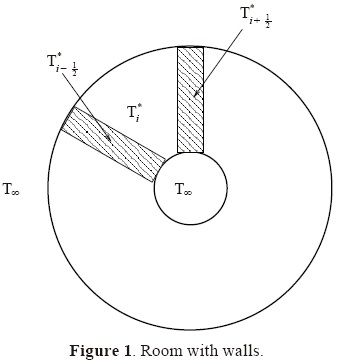
<body><![CDATA[<p align="justify"><font face="verdana" size="2">First&#45;order lumped parameter models have been postulated for the analysis of these temperature oscillations (Cai, W., and Sen, M., 2008, O'Brien, J., and Sen, M., 2011). However, these studies have not taken the presence of walls into account. Though the air temperature determines the comfort level, the walls are the ones that store heat. The walls thus strongly affect the dynamics of thermal energy in buildings, even though it is the air that is being heated. It is thus important to include both air and walls, and to understand the effect of interaction between them.</font></p>  	    <p align="justify"><font face="verdana" size="2">The objective is to analyze the temperature dynamics in <i>n</i> rooms in the form of a ring as shown in <a href="#f1">Fig. 1</a>. The dimensional air temperature in room i is <i>T<sup>*</sup><sub>i</sub></i> (<i>t<sup>*</sup></i>), where <i>t<sup>*</sup></i> is dimensional time, and the dimensional wall temperatures on either side of it are <i>T<sup>*</sup></i><sub>i-&#189;</sub> (<i>t<sup>*</sup></i>) and <i>T<sup>*</sup></i><sub><i>i</i>+&#189;</sub> (<i>t<sup>*</sup></i>). Integer subscripts are used for the air and fractional for the walls on either side.</font></p>  	    <p align="center"><font face="verdana" size="2"><a name="f1"></a></font></p> 	         <p align="center"><font face="verdana" size="2"><img src="/img/revistas/imtd/v4n3/a2f1.jpg"></font></p>              <p align="justify"><font face="verdana" size="2">Of course, being a ring, <i>i</i> = <i>n</i> + 1 is the same as <i>i</i> = 1, and i= <i>n</i> + &#189; the same as i = &#189;. There is convective heat transfer from the air in each room to the walls. There is also heat exchange from the room to the exterior and interior spaces which are both at temperature <i>T</i><sub>&infin;</sub>.</font></p>              <p align="justify"><font face="verdana" size="2">&nbsp;</font></p>              <p align="justify"><font face="verdana" size="2"><b>Model of n Rooms with Walls</b></font></p>              <p align="justify"><font face="verdana" size="2">We will use a lumped parameter analysis, and neglect radiation both within the rooms as well as outside. For simplicity, all rooms and walls are taken to be identical. Energy balance for the air in the rooms gives</font></p>  	    <p align="center"><font face="verdana" size="2"><img src="/img/revistas/imtd/v4n3/a2s1.jpg"></font></p> 	         <p align="justify"><font face="verdana" size="2">where <i>M<sub>a</sub></i> is the mass of the air, <i>c<sub>a</sub></i> is the specific heat of air at constant pressure, <i>h</i> and <i>A</i> are the heat transfer coefficient and area for convective heat transfer between the air and the wall, respectively, and <i>U<sub>&infin;</sub></i> and <i>A<sub>&infin;</sub></i> are the overall heat transfer coefficient and area for heat exchange with <i>T</i><sub>&infin;</sub>. The heat input is</font></p> 	         ]]></body>
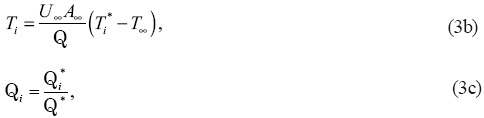
<body><![CDATA[<p align="center"><font face="verdana" size="2"><img src="/img/revistas/imtd/v4n3/a2s1b.jpg"></font></p>              <p align="justify"><font face="verdana" size="2">Energy balance for the walls gives</font></p> 	         <p align="center"><font face="verdana" size="2"><img src="/img/revistas/imtd/v4n3/a2s1c.jpg"></font></p>              <p align="justify"><font face="verdana" size="2">The unknowns in Eqs. (1) are <i>T<sub>i</sub><sup>*</sup></i> (<i>t<sup>*</sup></i>), <i>T<sup>*</sup></i><sub><i>i</i>+&#189;</sub> (<i>t<sup>*</sup></i>), and <i>Q<sub>i</sub><sup>*</sup>(t<sup>*</sup>)</i> for <i>i</i>= 1, 2, ..., <i>n</i>, with initial conditions <i>T<sub>i</sub><sup>*</sup></i>(0), <i>T<sup>*</sup></i><sub><i>i</i>+&#189;</sub>(0), and <i>Q<sub>i</sub><sup>*</sup></i>(0). It must be emphasized that the equations are nonlinear because the instants at which the heating switches from <i>on</i> to <i>off,</i> or vice versa, are not a priori known but depend on <i>T<sub>i</sub><sup>*</sup></i> <i>(t<sup>*</sup>)</i>.</font></p>          <p align="justify"><font face="verdana" size="2">The limits of operation of the thermostats must also be prescribed. They have an upper limit <i>T<sub>U</sub><sup>*</sup></i> at which they switch off, and a lower limit <i>T<sub>L</sub><sup>*</sup></i> at which they come <i>on</i>.</font></p>          <p align="justify"><font face="verdana" size="2">If the heater is kept always on, the final steady state temperatures of both wall and air, <i>T<sup>*</sup><sub>i,max</sub></i> and <i>T<sup>*</sup></i><sub><i>i</i>+&#189;, <i>max</i></sub>, respectively, given by Eq. (1) will be</font></p>              <p align="center"><font face="verdana" size="2"><img src="/img/revistas/imtd/v4n3/a2s2.jpg"></font></p>              <p align="justify"><font face="verdana" size="2"><b>Nondimcnsional equations</b></font></p>              <p align="justify"><font face="verdana" size="2">To nondimensionalize Eqs. and dependent variables</font></p>          <p align="center"><font face="verdana" size="2"><img src="/img/revistas/imtd/v4n3/a2s3a.jpg"></font></p>              ]]></body>
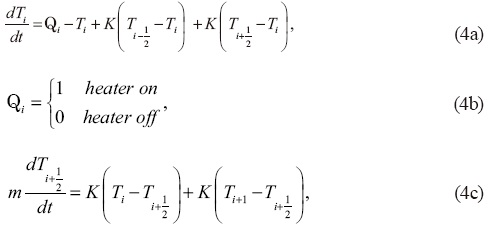
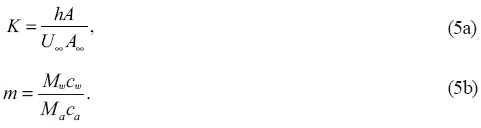
<body><![CDATA[<p align="center"><font face="verdana" size="2"><img src="/img/revistas/imtd/v4n3/a2s3b.jpg"></font></p>              <p align="justify"><font face="verdana" size="2">are used. The governing equations become</font></p>              <p align="center"><font face="verdana" size="2"><img src="/img/revistas/imtd/v4n3/a2s4.jpg"></font></p>              <p align="justify"><font face="verdana" size="2">with given initial conditions <i>T<sub>i</sub></i>(0), <i>T<sub>i-</sub></i><sub>&#189;</sub>(0), and <i>Q<sub>i</sub></i>(0), where</font></p>              <p align="center"><font face="verdana" size="2"><img src="/img/revistas/imtd/v4n3/a2s5.jpg"></font></p>              <p align="justify"><font face="verdana" size="2">&nbsp;</font></p>          <p align="justify"><font face="verdana" size="2"><b>Parameters</b></font></p>              <p align="justify"><font face="verdana" size="2">The parameter <i>K</i> represents the ratio of the thermal resistance between the air in the room and the outside to that between the air and the walls. The value depends greatly on the geometry of the design, the materials used, and the prevailing wind and atmospheric conditions. Nonetheless, one has to have some idea for the value of <i>K</i> to search for solutions in that range. Of the two areas, A may be much larger that <i>A</i><sub>&infin;</sub>, or may be of comparable size. The convective heat transfer coefficient h is generally small because it is mostly due to natural convection. <i>U</i><sub>&infin;</sub> is affected by insulation in the outer walls which tends to reduce its value, and by the winds blowing on the exterior which will increase it.</font></p>              <p align="justify"><font face="verdana" size="2">The other parameter <i>m</i> is the ratio of the heat capacity of a wall compared to that of the air in the room. This is the parameter that controls the effect of the wall on the room temperature, and it is usually large.</font></p>  	    <p align="justify"><font face="verdana" size="2">To get an idea of the numerical values of the parameters, let the volume of air=27m<sup>3</sup> per room, the mass of each wall=6210 kg. We also take <i>A</i>=9m<sup>2</sup>, <i>A</i><sub>&infin;</sub>=24m<sup>2</sup>, and <i>c<sub>w</sub></i>=0.75 kJ/kg&middot;K. This gives <i>m</i>=142.4. The two heat transfer coefficients, one internal and the other external, are much more problematic (Longstaff, R., and Finnigan, J., 1983, Hagishi&#45;ma, A., and Tanimoto, J., 2003, Hagishima, A., Tanimoto, J., and Narita, K., 2005, Emmel, M., Abadie, M., and Mendes, N., 2007, Palyvos, J., 2008, Shao, J., Liu, J., Zhao, J., Zhang, W., Sun, D., and Fu, Z., 2009, Defraeye, T., Blocken, B., and Carmeliet, J., 2011, Luo, C., Moghtaderi, B., Hands, S., and Page, A., 2011). There are some values available in the literature for this, but the numbers obviously depend strongly on airflow conditions. If we take <i>h</i>=5 W/m<sup>2</sup>&middot;K, <i>U</i><sub>&infin;</sub>=10 W/m<sup>2</sup>&middot;K, we get <i>K</i> = 0.188. The value of <i>K</i> is important since the appearance of in&#45;phase and out&#45;of&#45;phase synchronization is sensitive to it. For the present, however, fixed values of <i>K</i>=0.1 and <i>m</i>=100, which are reasonable, will be taken.</font></p>          ]]></body>
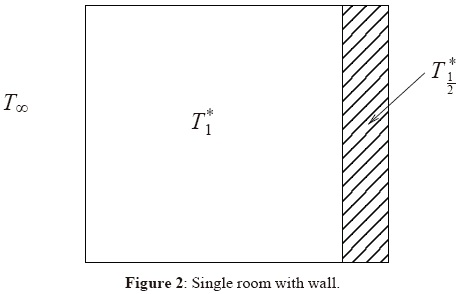
<body><![CDATA[<p align="justify"><font face="verdana" size="2">The heat rate <i>Q *</i> is another parameter that must be chosen. Assuming that the heater, if it is always on, can produce maximum air and wall temperatures of <i>T<sup>*</sup><sub>i, max</sub> = T<sup>*</sup><sub>i</sub></i><sub>+&#189;,</sub><i><sub> max</sub></i> = (40+T )&deg;C, then <i>Q *</i> = 9.6 kW. If we take <i>T<sub>U</sub><sup>*</sup></i>= (17.6 + <i>T</i><sub>&infin;</sub>)&deg;C and <i>T<sub>L</sub><sup>*</sup></i> = (8.8 + <i>T</i><sub>&infin;</sub>)&deg;C, then their non&#45;dimensional counterparts are <i>T<sub>U</sub></i> = 0.44 and <i>T<sub>L</sub></i> = 0.22, which are the values chosen in this study.</font></p>  	    <p align="justify"><font face="verdana" size="2">Initial conditions will be taken to be <i>T<sub>L</sub></i> for all the rooms as well as the walls, and the heater is initially assumed to be on.</font></p>  	    <p align="justify"><font face="verdana" size="2">&nbsp;</font></p>  	    <p align="justify"><font face="verdana" size="2"><b>Specific Configurations</b></font></p> 	         <p align="justify"><font face="verdana" size="2">The problem of an arbitrary number of rooms is difficult to solve and analyze due to the nonlinearities and large number of parameters involved, so we will begin with a small number of rooms.</font></p>  	    <p align="justify"><font face="verdana" size="2">&nbsp;</font></p>  	    <p align="justify"><font face="verdana" size="2"><b>Single room,</b> <i>n</i> = 1</font></p> 	         <p align="justify"><font face="verdana" size="2">Though this is not a ring, as shown in <a href="#f2">Fig. 2</a>, it is a simple configuration which yields valuable information to which the other solutions can be compared.</font></p>  	    <p align="center"><font face="verdana" size="2"><a name="f2"></a></font></p> 	         <p align="center"><font face="verdana" size="2"><img src="/img/revistas/imtd/v4n3/a2f2.jpg"></font></p> 	         ]]></body>
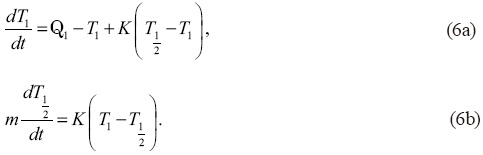
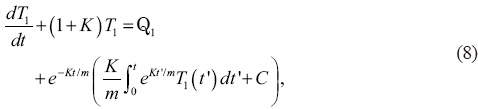
<body><![CDATA[<p align="justify"><font face="verdana" size="2">Here, Eqns. (4) become</font></p> 	         <p align="center"><font face="verdana" size="2"><img src="/img/revistas/imtd/v4n3/a2s6.jpg"></font></p>              <p align="justify"><font face="verdana" size="2">The solution of Eq. (6b) is</font></p> 	         <p align="center"><font face="verdana" size="2"><img src="/img/revistas/imtd/v4n3/a2s7.jpg"></font></p> 	         <p align="justify"><font face="verdana" size="2">Substituting in Eq. (6a) gives</font></p> 	         <p align="center"><font face="verdana" size="2"><img src="/img/revistas/imtd/v4n3/a2s8.jpg"></font></p> 	         <p align="justify"><font face="verdana" size="2">which upon differentiation is equivalent to</font></p> 	         <p align="center"><font face="verdana" size="2"><img src="/img/revistas/imtd/v4n3/a2s9.jpg"></font></p> 	         <p align="justify"><font face="verdana" size="2">The solution for values of <i>K</i> and m in the range we are considering is</font></p> 	         <p align="center"><font face="verdana" size="2"><img src="/img/revistas/imtd/v4n3/a2s10.jpg"></font></p> 	         ]]></body>
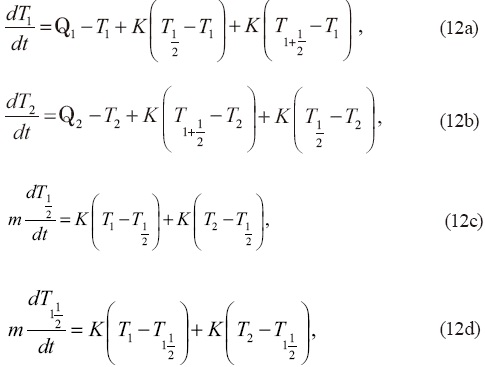
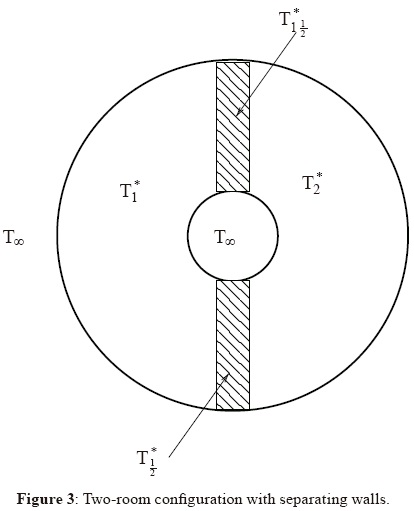
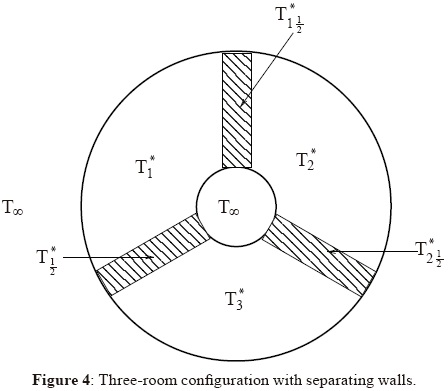
<body><![CDATA[<p align="justify"><font face="verdana" size="2">where</font></p> 	         <p align="center"><font face="verdana" size="2"><img src="/img/revistas/imtd/v4n3/a2s11.jpg"></font></p> 	         <p align="justify"><font face="verdana" size="2">There are two time scales &#964;<sub>1</sub> and &#964;<sub>2</sub>.</font></p> 	         <p align="justify"><font face="verdana" size="2">Two rooms, <i>n</i> = 2</font></p>  	    <p align="justify"><font face="verdana" size="2">This is shown in <a href="#f3">Fig. 3</a>. Eqns. (4) are</font></p>  	    <p align="center"><font face="verdana" size="2"><img src="/img/revistas/imtd/v4n3/a2s12.jpg"></font></p> 	         <p align="center"><font face="verdana" size="2"><a name="f3"></a></font></p> 	         <p align="center"><font face="verdana" size="2"><img src="/img/revistas/imtd/v4n3/a2f3.jpg"></font></p> 	         <p align="justify"><font face="verdana" size="2"><b>Three rooms,</b> <i>n</i> = 3</font></p> 	         <p align="justify"><font face="verdana" size="2">Three rooms are shown in <a href="#f4">Fig. 4</a>. The equations are similar to Eq. (12) above, but with a third room and wall added.</font></p>  	    ]]></body>
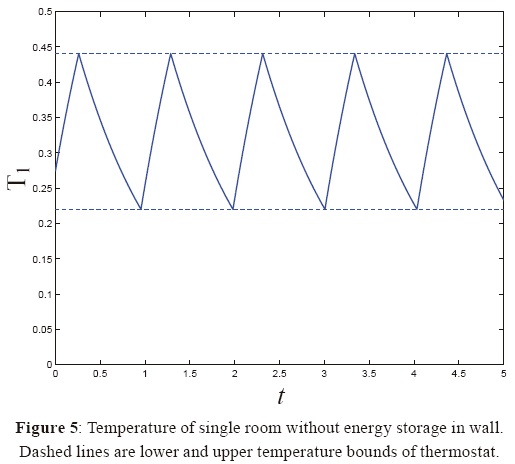
<body><![CDATA[<p align="center"><font face="verdana" size="2"><a name="f4"></a></font></p> 	         <p align="center"><font face="verdana" size="2"><img src="/img/revistas/imtd/v4n3/a2f4.jpg"></font></p> 	         <p align="justify"><font face="verdana" size="2">&nbsp;</font></p>  	    <p align="justify"><font face="verdana" size="2"><b>Limiting Analyses</b></font></p> 	         <p align="justify"><font face="verdana" size="2"><b>No energy storage in walls,</b> <i>m</i> = 0</font></p>  	    <p align="justify"><font face="verdana" size="2">This is equivalent to ignoring the energy storage capacity of the wall. For n = 1, Eqs. (6) give</font></p>  	    <p align="center"><font face="verdana" size="2"><img src="/img/revistas/imtd/v4n3/a2s13.jpg"></font></p> 	         <p align="center"><font face="verdana" size="2"><img src="/img/revistas/imtd/v4n3/a2s14.jpg"></font></p> 	         <p align="justify"><font face="verdana" size="2"><a href="#f5">Fig. 5</a> shows the temperature and <a href="#f6">Fig. 6</a> the heat rate. The time constant of the first&#45;order system is unity.</font></p>          <p align="center"><font face="verdana" size="2"><a name="f5"></a></font></p>              ]]></body>
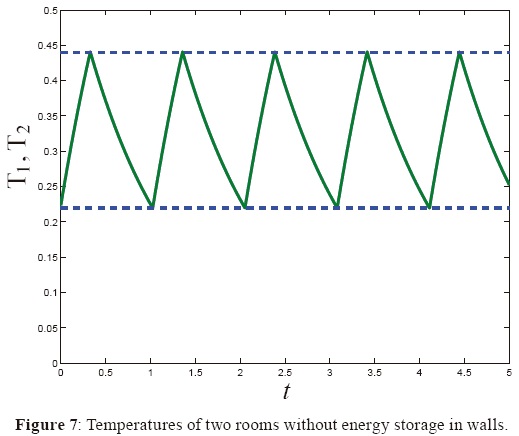
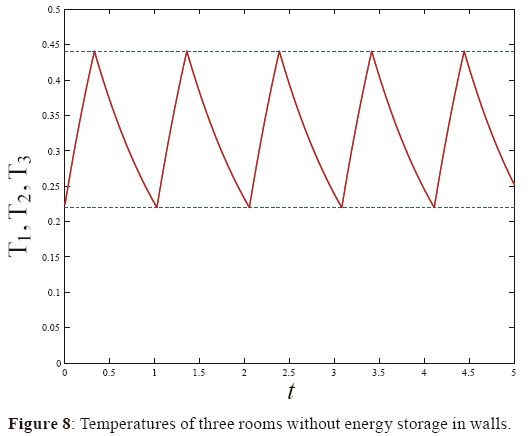
<body><![CDATA[<p align="center"><font face="verdana" size="2"><img src="/img/revistas/imtd/v4n3/a2f5.jpg"></font></p>              <p align="center"><font face="verdana" size="2"><a name="f6"></a></font></p>              <p align="center"><font face="verdana" size="2"><img src="/img/revistas/imtd/v4n3/a2f6.jpg"></font></p>              <p align="justify"><font face="verdana" size="2">These graphs and those that follow are generated using an explicit Euler method with a step size in time of 0.001. Integration is performed up to 50,000 time steps, but only the last 5 time units are shown. This is done to enable the transients in the system to die out. The steady&#45;state dynamics of the system is strongly dependent on the system parameters and initial conditions chosen. At this stage a comprehensive study of all possibilities has not been carried out.In the following graphs the values of the parameters and initial conditions are the same as mentioned before, except in <a href="#f9">Fig. 9</a> (<a href="#f7">7</a>&#45;<a href="#f8">8</a>) where the values are different and indicated in its caption.</font></p>              <p align="center"><font face="verdana" size="2"><a name="f7"></a></font></p>              <p align="center"><font face="verdana" size="2"><img src="/img/revistas/imtd/v4n3/a2f7.jpg"></font></p>              <p align="center"><font face="verdana" size="2"><a name="f8"></a></font></p>              <p align="center"><font face="verdana" size="2"><img src="/img/revistas/imtd/v4n3/a2f8.jpg"></font></p>              <p align="center"><font face="verdana" size="2"><a name="f9"></a></font></p>              <p align="center"><font face="verdana" size="2"><img src="/img/revistas/imtd/v4n3/a2f9.jpg"></font></p> 	         ]]></body>
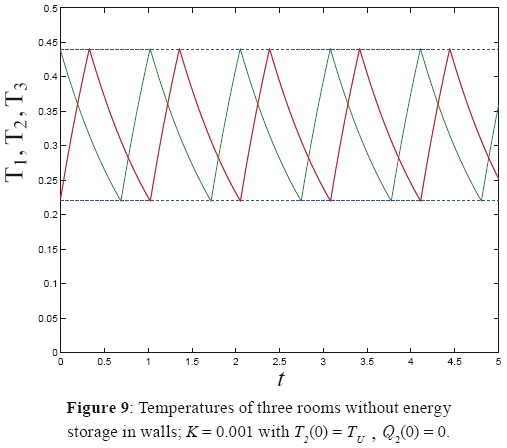
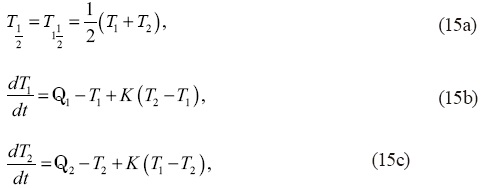
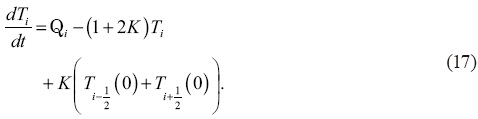
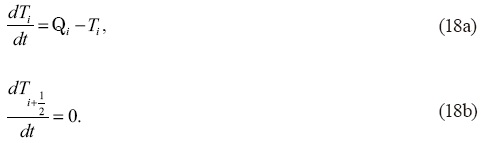
<body><![CDATA[<p align="justify"><font face="verdana" size="2">For <i>n</i> = 2, Eqns. (12) give</font></p>              <p align="center"><font face="verdana" size="2"><img src="/img/revistas/imtd/v4n3/a2s15.jpg"></font></p>              <p align="justify"><font face="verdana" size="2">The temperature&#45;time responses for n = 2 are shown in <a href="#f7">Fig. 7</a>, and for n = 3 in <a href="#f8">Fig. 8</a>.</font></p>              <p align="justify"><font face="verdana" size="2">So far only in&#45;phase synchronization has been shown. <a href="#f9">Fig. (9)</a> shows a situation in which an out&#45;of&#45;phase synchronization appears. Note that all the parameter values are the same as before, except those indicated in the caption.</font></p>          <p align="justify"><font face="verdana" size="2"><b>Infinitely massive walls,</b> <i>m</i> &#8594; &infin; </font></p>              <p align="justify"><font face="verdana" size="2">For this, Eq. (4c) shows that</font></p> 	         <p align="center"><font face="verdana" size="2"><img src="/img/revistas/imtd/v4n3/a2s16.jpg"></font></p> 	         <p align="justify"><font face="verdana" size="2">The walls are so massive that their temperatures remain constant with time, equal to the initial values <i>T<sub>i</sub></i><sub>,&#189;</sub>(0). Eq. (4a) then shows that</font></p> 	         <p align="center"><font face="verdana" size="2"><img src="/img/revistas/imtd/v4n3/a2s17.jpg"></font></p> 	         <p align="justify"><font face="verdana" size="2">The last term in this equation is a constant, and the problem, even with multiple rooms, is then equivalent to that for a single room without a wall. The dynamics of the rooms are decoupled. Note also that the time constant of the first&#45;order system is 1/(1 + 2<i>K</i>).</font></p>              ]]></body>
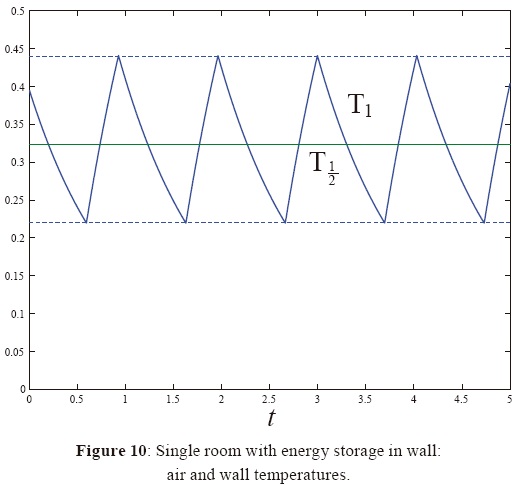
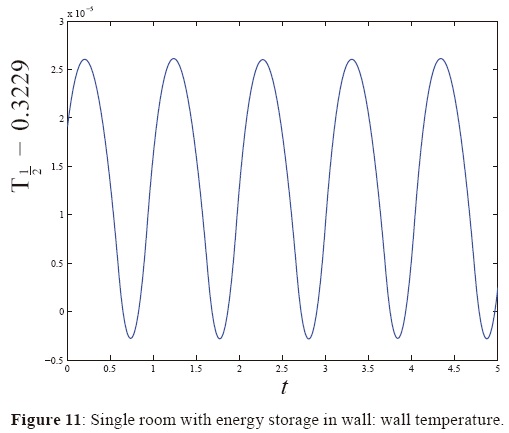
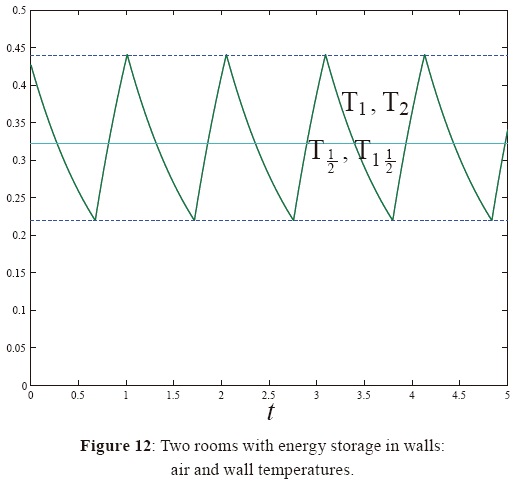
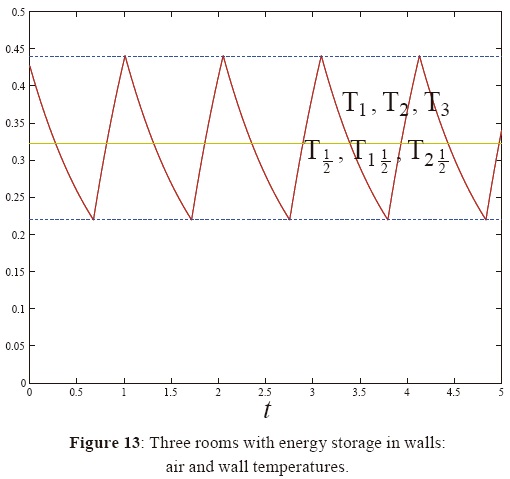
<body><![CDATA[<p align="justify"><font face="verdana" size="2"><b>No heat exchange with wall,</b> <i>K</i> = 0</font></p>              <p align="justify"><font face="verdana" size="2">For this</font></p>  	    <p align="center"><font face="verdana" size="2"><img src="/img/revistas/imtd/v4n3/a2s18.jpg"></font></p> 	         <p align="justify"><font face="verdana" size="2">This is essentially the same as taking <i>m</i> = 0 discussed previously. The air temperature equation is the same while the wall temperature is constant in time.</font></p> 	         <p align="justify"><font face="verdana" size="2">&nbsp;</font></p>          <p align="justify"><font face="verdana" size="2"><b>Dynamics with Energy Storage in Walls</b></font></p>              <p align="justify"><font face="verdana" size="2">In reality, <i>m</i> is neither zero nor infinity, and the dynamics has to be calculated numerically. Solutions for a single room with a wall are shown in <a href="#f10">Fig. 10</a>. <a href="#f11">Fig. 11</a> shows <i>(T</i><sub>&#189;</sub> &#45; 0.3229) in an expanded scale to be able to appreciate the small amplitude temperature oscillations in the wall, being about 0.01 % of those in the air. <a href="#f12">Fig. 12</a> shows the temperature fluctuations for two rooms, and <a href="#f13">Fig. 13</a> for three rooms.</font></p>          <p align="center"><font face="verdana" size="2"><a name="f10"></a></font></p>              <p align="center"><font face="verdana" size="2"><img src="/img/revistas/imtd/v4n3/a2f10.jpg"></font></p>              <p align="center"><font face="verdana" size="2"><a name="f11"></a></font></p>              ]]></body>
<body><![CDATA[<p align="center"><font face="verdana" size="2"><img src="/img/revistas/imtd/v4n3/a2f11.jpg"></font></p>              <p align="center"><font face="verdana" size="2"><a name="f12"></a></font></p>              <p align="center"><font face="verdana" size="2"><img src="/img/revistas/imtd/v4n3/a2f12.jpg"></font></p>              <p align="center"><font face="verdana" size="2"><a name="f13"></a></font></p>              <p align="center"><font face="verdana" size="2"><img src="/img/revistas/imtd/v4n3/a2f13.jpg"></font></p>              <p align="justify"><font face="verdana" size="2">&nbsp;</font></p>              <p align="justify"><font face="verdana" size="2"><b>Perturbation Analysis</b></font></p>              <p align="justify"><font face="verdana" size="2">To simplify the analysis, we will assume that &#8712; = <i>K/m &lt;&lt;</i> 1. The perturbation is regular, so that</font></p>  	    <p align="center"><font face="verdana" size="2"><img src="/img/revistas/imtd/v4n3/a2s19.jpg"></font></p> 	         <p align="center"><font face="verdana" size="2"><img src="/img/revistas/imtd/v4n3/a2s20.jpg"></font></p> 	         ]]></body>
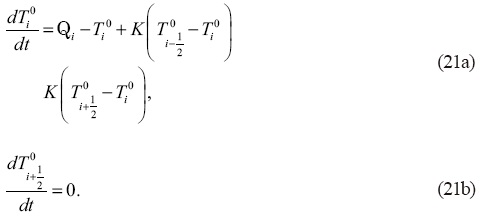
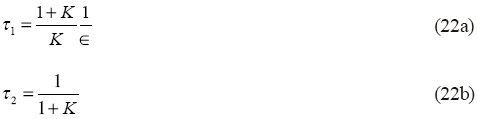
<body><![CDATA[<p align="justify"><font face="verdana" size="2">Thus, to lowest order</font></p> 	         <p align="center"><font face="verdana" size="2"><img src="/img/revistas/imtd/v4n3/a2s21.jpg"></font></p> 	         <p align="justify"><font face="verdana" size="2">The wall temperatures, <i>T<sup>0</sup><sub>i</sub></i><sub>+&#189;</sub> = <i>T<sub>i</sub></i><sub>+&#189;</sub>(0), are constant. Eq. (21a) is similar to that studied previously where <i>m</i> = 0. Thus the lowest order solutions are as if they were without energy storage in walls. The time constant is 1/(1 + 2<i>K</i>).</font></p> 	         <p align="justify"><font face="verdana" size="2">To the next order the time scales from Eqs. (11) are</font></p> 	         <p align="center"><font face="verdana" size="2"><img src="/img/revistas/imtd/v4n3/a2s22.jpg"></font></p> 	         <p align="justify"><font face="verdana" size="2">The ratio of the two is large, so this problem is stiff. The second time scale is the same one obtained from Eqs. (6) with <i>K</i>= 0 and <i>T</i><sub>&#189;</sub> constant. So the first one, which is large, is due to the presence of the wall.</font></p>  	    <p align="justify"><font face="verdana" size="2">&nbsp;</font></p>  	    <p align="justify"><font face="verdana" size="2"><b>Conclusions</b></font></p> 	         <p align="justify"><font face="verdana" size="2">Though human comfort is felt through the air, thermal energy storage is in the walls. Roughly 100 times the energy in the air is stored in the walls. The massiveness of the walls serves to damp out the temperature oscillations in the air as well as introduce a large time scale. Thus a slow and small&#45; amplitude modulation is introduced into the temperature dynamics by the walls. The nature of the solution depends on a large number of parameters: initial conditions, low and high temperature cutoffs for the thermostat, and parameters <i>K</i> and m. Some of these will lead to in&#45;phase synchronization, as in <a href="#f8">Fig. 8</a>, and others to out&#45;of&#45;phase, as <a href="#f9">Fig. 9</a>. This was not studied here in any detail. The stiffness of the governing equations is a primary obstacle to an easy numerical solution of the problem. Nonlinearity is a second impediment. To a lesser degree, the third is the number of parameters and initial conditions that must be specified. Even for the same set of parameters, different initial conditions may lead to different long time behaviors. Of practical interest are the bifurcations that exist as a parameter such as <i>m</i> or <i>K</i> is changed through a wide range of values. This co&#45;existence of attractors is an interesting phenomenon that will be investigated in future work.</font></p> 	         <p align="justify"><font face="verdana" size="2">&nbsp;</font></p>          ]]></body>
<body><![CDATA[<p align="justify"><font face="verdana" size="2"><b>References</b></font></p>              <!-- ref --><p align="justify"><font face="verdana" size="2">Pikovsky, A., Rosenblum, M., and Kurths, J., 2001. <i>Universal Concept in Nonlinear Sciences.</i> Cambridge University Press, Cambridge.    &nbsp;&nbsp;&nbsp;&nbsp;&nbsp;&nbsp;&nbsp;&nbsp;[&#160;<a href="javascript:void(0);" onclick="javascript: window.open('/scielo.php?script=sci_nlinks&ref=4363035&pid=S1665-7381201200020000200001&lng=','','width=640,height=500,resizable=yes,scrollbars=1,menubar=yes,');">Links</a>&#160;]<!-- end-ref --></font></p>  	    <!-- ref --><p align="justify"><font face="verdana" size="2">Strogatz, S., 2003. <i>Sync: The Emerging Science of Spontaneous Order.</i> Theia, New York.    &nbsp;&nbsp;&nbsp;&nbsp;&nbsp;&nbsp;&nbsp;&nbsp;[&#160;<a href="javascript:void(0);" onclick="javascript: window.open('/scielo.php?script=sci_nlinks&ref=4363037&pid=S1665-7381201200020000200002&lng=','','width=640,height=500,resizable=yes,scrollbars=1,menubar=yes,');">Links</a>&#160;]<!-- end-ref --></font></p>  	    <!-- ref --><p align="justify"><font face="verdana" size="2">Manrubia, S., Mikhailov, A., and Zanette, D., 2004. <i>Emergence of Dynamical Order: Synchronization Phenomena in Complex Systems.</i> World Scientific, New Jersey.    &nbsp;&nbsp;&nbsp;&nbsp;&nbsp;&nbsp;&nbsp;&nbsp;[&#160;<a href="javascript:void(0);" onclick="javascript: window.open('/scielo.php?script=sci_nlinks&ref=4363039&pid=S1665-7381201200020000200003&lng=','','width=640,height=500,resizable=yes,scrollbars=1,menubar=yes,');">Links</a>&#160;]<!-- end-ref --></font></p>  	    <!-- ref --><p align="justify"><font face="verdana" size="2">Bennett, M., Schatz, M., Rockwood, H., and Wiesenfeld, K., 2002. <i>"Huygens's clocks".</i> Proceedings of the Royal Society, Series A, Mathematical, Physical and Engineering Sciences, 458(2019), pp. 563&#45;579.    &nbsp;&nbsp;&nbsp;&nbsp;&nbsp;&nbsp;&nbsp;&nbsp;[&#160;<a href="javascript:void(0);" onclick="javascript: window.open('/scielo.php?script=sci_nlinks&ref=4363041&pid=S1665-7381201200020000200004&lng=','','width=640,height=500,resizable=yes,scrollbars=1,menubar=yes,');">Links</a>&#160;]<!-- end-ref --></font></p>  	    <!-- ref --><p align="justify"><font face="verdana" size="2">Wiesenfeld, K., and Borrero&#45;Echeverry, D., Art. No. 047515, 2011. <i>"Huygens (and others) revisited".</i> Chaos, 21(4).    &nbsp;&nbsp;&nbsp;&nbsp;&nbsp;&nbsp;&nbsp;&nbsp;[&#160;<a href="javascript:void(0);" onclick="javascript: window.open('/scielo.php?script=sci_nlinks&ref=4363043&pid=S1665-7381201200020000200005&lng=','','width=640,height=500,resizable=yes,scrollbars=1,menubar=yes,');">Links</a>&#160;]<!-- end-ref --></font></p>  	    <!-- ref --><p align="justify"><font face="verdana" size="2">Li, A., Zeng, J., Yang, H., and Xiao, J., 2011. <i>"A laboratory experiment on coupled non&#45;identical pendulums".</i> European Journal of Physics, 32(5), pp. 1251&#45;1257.    &nbsp;&nbsp;&nbsp;&nbsp;&nbsp;&nbsp;&nbsp;&nbsp;[&#160;<a href="javascript:void(0);" onclick="javascript: window.open('/scielo.php?script=sci_nlinks&ref=4363045&pid=S1665-7381201200020000200006&lng=','','width=640,height=500,resizable=yes,scrollbars=1,menubar=yes,');">Links</a>&#160;]<!-- end-ref --></font></p> 	     <!-- ref --><p align="justify"><font face="verdana" size="2">Cai, W., Sen, M., Yang, K., and Mc&#45; Clain, R., 2006. <i>"Synchronization of self&#45;sustained thermostatic oscillations in a thermal&#45;hydraulic network".</i> International Journal of Heat and Mass Transfer, 49(23&#45;24), pp. 4444&#45;4453.    &nbsp;&nbsp;&nbsp;&nbsp;&nbsp;&nbsp;&nbsp;&nbsp;[&#160;<a href="javascript:void(0);" onclick="javascript: window.open('/scielo.php?script=sci_nlinks&ref=4363047&pid=S1665-7381201200020000200007&lng=','','width=640,height=500,resizable=yes,scrollbars=1,menubar=yes,');">Links</a>&#160;]<!-- end-ref --></font></p> 	         <!-- ref --><p align="justify"><font face="verdana" size="2">Cai, W., and Sen, M., 2008. <i>"Synchronization of thermostatically controlledfirst&#45;order systems'".</i> International Journal of Heat and Mass transfer, 51(11&#45;12), pp. 3032&#45;3043.    &nbsp;&nbsp;&nbsp;&nbsp;&nbsp;&nbsp;&nbsp;&nbsp;[&#160;<a href="javascript:void(0);" onclick="javascript: window.open('/scielo.php?script=sci_nlinks&ref=4363049&pid=S1665-7381201200020000200008&lng=','','width=640,height=500,resizable=yes,scrollbars=1,menubar=yes,');">Links</a>&#160;]<!-- end-ref --></font></p> 	         <!-- ref --><p align="justify"><font face="verdana" size="2">O'Brien, J., and Sen, M., IMECE2011&#45;63153, 2011. <i>"Temperature synchronization, phase dynamics and oscillation death in a ring of thermally&#45;coupled rooms".</i> In Proceedings of the International Mechanical Engineering Congress and Exposition (IMECE), Nov. 11&#45;17, 2011, Denver, CO, U.S.A.    &nbsp;&nbsp;&nbsp;&nbsp;&nbsp;&nbsp;&nbsp;&nbsp;[&#160;<a href="javascript:void(0);" onclick="javascript: window.open('/scielo.php?script=sci_nlinks&ref=4363051&pid=S1665-7381201200020000200009&lng=','','width=640,height=500,resizable=yes,scrollbars=1,menubar=yes,');">Links</a>&#160;]<!-- end-ref --></font></p>              <!-- ref --><p align="justify"><font face="verdana" size="2">Longstaff, R., and Finnigan, I, 1983. "A wind&#45;tunnel model study of forced convective heat&#45;transfer from a horizontal grain storage shed". Journal of Stored Products Research, 19(2), pp. 81&#45;87.    &nbsp;&nbsp;&nbsp;&nbsp;&nbsp;&nbsp;&nbsp;&nbsp;[&#160;<a href="javascript:void(0);" onclick="javascript: window.open('/scielo.php?script=sci_nlinks&ref=4363053&pid=S1665-7381201200020000200010&lng=','','width=640,height=500,resizable=yes,scrollbars=1,menubar=yes,');">Links</a>&#160;]<!-- end-ref --></font></p>          <!-- ref --><p align="justify"><font face="verdana" size="2">Hagishima, A., and Tanimoto, J., 2003. <i>"Field measurements for estimating the convective heat transfer coefficient at building surfaces".</i> Building and Environment, 38(7), pp. 873&#45;881.    &nbsp;&nbsp;&nbsp;&nbsp;&nbsp;&nbsp;&nbsp;&nbsp;[&#160;<a href="javascript:void(0);" onclick="javascript: window.open('/scielo.php?script=sci_nlinks&ref=4363055&pid=S1665-7381201200020000200011&lng=','','width=640,height=500,resizable=yes,scrollbars=1,menubar=yes,');">Links</a>&#160;]<!-- end-ref --></font></p>              <!-- ref --><p align="justify"><font face="verdana" size="2">Hagishima, A., Tanimoto, J., and Narita, K., 2005. <i>"Intercom&#45;parisons of experimental convective heat transfer coefficients and mass transfer coefficients of urban surfaces".</i> Boundary&#45;Layer Meteorology, 117(3), pp. 551&#45;576.    &nbsp;&nbsp;&nbsp;&nbsp;&nbsp;&nbsp;&nbsp;&nbsp;[&#160;<a href="javascript:void(0);" onclick="javascript: window.open('/scielo.php?script=sci_nlinks&ref=4363057&pid=S1665-7381201200020000200012&lng=','','width=640,height=500,resizable=yes,scrollbars=1,menubar=yes,');">Links</a>&#160;]<!-- end-ref --></font></p>  	    <!-- ref --><p align="justify"><font face="verdana" size="2">Emmel, M., Abadie, M., and Mendes, N., 2007. <i>"New external convective heat transfer coefficient correlations for isolated low&#45;rise buildings".</i> Energy and Buildings, 39(3), pp. 335&#45;342.    &nbsp;&nbsp;&nbsp;&nbsp;&nbsp;&nbsp;&nbsp;&nbsp;[&#160;<a href="javascript:void(0);" onclick="javascript: window.open('/scielo.php?script=sci_nlinks&ref=4363059&pid=S1665-7381201200020000200013&lng=','','width=640,height=500,resizable=yes,scrollbars=1,menubar=yes,');">Links</a>&#160;]<!-- end-ref --></font></p>  	    <!-- ref --><p align="justify"><font face="verdana" size="2">Palyvos, J., 2008. "A survey of wind convection coefficient correlations for building envelope energy systems' modeling". Applied Thermal Engineering, 28(8&#45;9), pp. 801&#45;808.    &nbsp;&nbsp;&nbsp;&nbsp;&nbsp;&nbsp;&nbsp;&nbsp;[&#160;<a href="javascript:void(0);" onclick="javascript: window.open('/scielo.php?script=sci_nlinks&ref=4363061&pid=S1665-7381201200020000200014&lng=','','width=640,height=500,resizable=yes,scrollbars=1,menubar=yes,');">Links</a>&#160;]<!-- end-ref --><!-- ref --> Shao, J., Liu, J., Zhao, J., Zhang, W., Sun, D., and Fu, Z., 2009. "A novel method for full&#45;scale measurement of the external convective heat transfer coefficient for building horizontal roof". Energy and Buildings, 41(8), pp. 840&#45;847.    &nbsp;&nbsp;&nbsp;&nbsp;&nbsp;&nbsp;&nbsp;&nbsp;[&#160;<a href="javascript:void(0);" onclick="javascript: window.open('/scielo.php?script=sci_nlinks&ref=4363062&pid=S1665-7381201200020000200015&lng=','','width=640,height=500,resizable=yes,scrollbars=1,menubar=yes,');">Links</a>&#160;]<!-- end-ref --></font></p>  	    ]]></body>
<body><![CDATA[<!-- ref --><p align="justify"><font face="verdana" size="2">Defraeye, T., Blocken, B., and Carmeliet, J., 2011. <i>"Convective heat transfer coefficients for exterior building surfaces: Existing correlations and CFD modelling".</i> Energy Conversion and Management, 52(1), pp. 512&#45;522.    &nbsp;&nbsp;&nbsp;&nbsp;&nbsp;&nbsp;&nbsp;&nbsp;[&#160;<a href="javascript:void(0);" onclick="javascript: window.open('/scielo.php?script=sci_nlinks&ref=4363064&pid=S1665-7381201200020000200016&lng=','','width=640,height=500,resizable=yes,scrollbars=1,menubar=yes,');">Links</a>&#160;]<!-- end-ref --></font></p>  	    <!-- ref --><p align="justify"><font face="verdana" size="2">Luo, C., Moghtaderi, B., Hands, S., and Page, A., 2011. <i>"Determining the thermal capacitance, conductivity and the convective heat transfer coefficient of a brick wall by annually monitored temperatures and total heat fluxes".</i> Energy and Buildings, 43(2&#45;3), pp. 379&#45;385.    &nbsp;&nbsp;&nbsp;&nbsp;&nbsp;&nbsp;&nbsp;&nbsp;[&#160;<a href="javascript:void(0);" onclick="javascript: window.open('/scielo.php?script=sci_nlinks&ref=4363066&pid=S1665-7381201200020000200017&lng=','','width=640,height=500,resizable=yes,scrollbars=1,menubar=yes,');">Links</a>&#160;]<!-- end-ref --> </font></p>      ]]></body><back>
<ref-list>
<ref id="B1">
<nlm-citation citation-type="book">
<person-group person-group-type="author">
<name>
<surname><![CDATA[Pikovsky]]></surname>
<given-names><![CDATA[A.]]></given-names>
</name>
<name>
<surname><![CDATA[Rosenblum]]></surname>
<given-names><![CDATA[M.]]></given-names>
</name>
<name>
<surname><![CDATA[Kurths]]></surname>
<given-names><![CDATA[J.]]></given-names>
</name>
</person-group>
<source><![CDATA[Universal Concept in Nonlinear Sciences.]]></source>
<year>2001</year>
<publisher-loc><![CDATA[Cambridge ]]></publisher-loc>
<publisher-name><![CDATA[Cambridge University Press]]></publisher-name>
</nlm-citation>
</ref>
<ref id="B2">
<nlm-citation citation-type="book">
<person-group person-group-type="author">
<name>
<surname><![CDATA[Strogatz]]></surname>
<given-names><![CDATA[S.]]></given-names>
</name>
</person-group>
<source><![CDATA[Sync: The Emerging Science of Spontaneous Order.]]></source>
<year>2003</year>
<publisher-loc><![CDATA[New York ]]></publisher-loc>
<publisher-name><![CDATA[Theia]]></publisher-name>
</nlm-citation>
</ref>
<ref id="B3">
<nlm-citation citation-type="book">
<person-group person-group-type="author">
<name>
<surname><![CDATA[Manrubia]]></surname>
<given-names><![CDATA[S.]]></given-names>
</name>
<name>
<surname><![CDATA[Mikhailov]]></surname>
<given-names><![CDATA[A.]]></given-names>
</name>
<name>
<surname><![CDATA[Zanette]]></surname>
<given-names><![CDATA[D.]]></given-names>
</name>
</person-group>
<source><![CDATA[Emergence of Dynamical Order: Synchronization Phenomena in Complex Systems]]></source>
<year>2004</year>
<publisher-loc><![CDATA[New Jersey ]]></publisher-loc>
<publisher-name><![CDATA[World Scientific]]></publisher-name>
</nlm-citation>
</ref>
<ref id="B4">
<nlm-citation citation-type="journal">
<person-group person-group-type="author">
<name>
<surname><![CDATA[Bennett]]></surname>
<given-names><![CDATA[M.]]></given-names>
</name>
<name>
<surname><![CDATA[Schatz]]></surname>
<given-names><![CDATA[M.]]></given-names>
</name>
<name>
<surname><![CDATA[Rockwood]]></surname>
<given-names><![CDATA[H.]]></given-names>
</name>
<name>
<surname><![CDATA[Wiesenfeld]]></surname>
<given-names><![CDATA[K.]]></given-names>
</name>
</person-group>
<article-title xml:lang="en"><![CDATA[Huygens's clocks]]></article-title>
<source><![CDATA[Proceedings of the Royal Society]]></source>
<year>2002</year>
<volume>458</volume>
<numero>2019</numero>
<issue>2019</issue>
<page-range>563-579</page-range></nlm-citation>
</ref>
<ref id="B5">
<nlm-citation citation-type="journal">
<person-group person-group-type="author">
<name>
<surname><![CDATA[Wiesenfeld]]></surname>
<given-names><![CDATA[K.]]></given-names>
</name>
<name>
<surname><![CDATA[Borrero-Echeverry]]></surname>
<given-names><![CDATA[D.]]></given-names>
</name>
</person-group>
<article-title xml:lang="en"><![CDATA[Huygens (and others) revisited]]></article-title>
<source><![CDATA[Chaos]]></source>
<year>2011</year>
<volume>21</volume>
<numero>4</numero>
<issue>4</issue>
</nlm-citation>
</ref>
<ref id="B6">
<nlm-citation citation-type="journal">
<person-group person-group-type="author">
<name>
<surname><![CDATA[Li]]></surname>
<given-names><![CDATA[A.]]></given-names>
</name>
<name>
<surname><![CDATA[Zeng]]></surname>
<given-names><![CDATA[J.]]></given-names>
</name>
<name>
<surname><![CDATA[Yang]]></surname>
<given-names><![CDATA[H.]]></given-names>
</name>
<name>
<surname><![CDATA[Xiao]]></surname>
<given-names><![CDATA[J.]]></given-names>
</name>
</person-group>
<article-title xml:lang="en"><![CDATA[A laboratory experiment on coupled non-identical pendulums]]></article-title>
<source><![CDATA[European Journal of Physics]]></source>
<year>2011</year>
<volume>32</volume>
<numero>5</numero>
<issue>5</issue>
<page-range>1251-1257</page-range></nlm-citation>
</ref>
<ref id="B7">
<nlm-citation citation-type="journal">
<person-group person-group-type="author">
<name>
<surname><![CDATA[Cai]]></surname>
<given-names><![CDATA[W.]]></given-names>
</name>
<name>
<surname><![CDATA[Sen]]></surname>
<given-names><![CDATA[M.]]></given-names>
</name>
<name>
<surname><![CDATA[Yang]]></surname>
<given-names><![CDATA[K.]]></given-names>
</name>
<name>
<surname><![CDATA[Mc- Clain]]></surname>
<given-names><![CDATA[R.]]></given-names>
</name>
</person-group>
<article-title xml:lang="en"><![CDATA[Synchronization of self-sustained thermostatic oscillations in a thermal-hydraulic network]]></article-title>
<source><![CDATA[International Journal of Heat and Mass Transfer]]></source>
<year>2006</year>
<volume>49</volume>
<numero>23</numero><numero>24</numero>
<issue>23</issue><issue>24</issue>
<page-range>4444-4453</page-range></nlm-citation>
</ref>
<ref id="B8">
<nlm-citation citation-type="journal">
<person-group person-group-type="author">
<name>
<surname><![CDATA[Cai]]></surname>
<given-names><![CDATA[W.]]></given-names>
</name>
<name>
<surname><![CDATA[Sen]]></surname>
<given-names><![CDATA[M.]]></given-names>
</name>
</person-group>
<article-title xml:lang="en"><![CDATA[Synchronization of thermostatically controlledfirst-order systems]]></article-title>
<source><![CDATA[International Journal of Heat and Mass transfer]]></source>
<year>2008</year>
<volume>51</volume>
<numero>11</numero><numero>12</numero>
<issue>11</issue><issue>12</issue>
<page-range>3032-3043</page-range></nlm-citation>
</ref>
<ref id="B9">
<nlm-citation citation-type="">
<person-group person-group-type="author">
<name>
<surname><![CDATA[O'Brien]]></surname>
<given-names><![CDATA[J.]]></given-names>
</name>
<name>
<surname><![CDATA[Sen]]></surname>
<given-names><![CDATA[M.]]></given-names>
</name>
</person-group>
<article-title xml:lang="en"><![CDATA[Temperature synchronization, phase dynamics and oscillation death in a ring of thermally-coupled rooms]]></article-title>
<source><![CDATA[Proceedings of the International Mechanical Engineering Congress and Exposition (IMECE), Nov. 11-17]]></source>
<year>2011</year>
<month>20</month>
<day>11</day>
<publisher-loc><![CDATA[Denver^eCO CO]]></publisher-loc>
</nlm-citation>
</ref>
<ref id="B10">
<nlm-citation citation-type="journal">
<person-group person-group-type="author">
<name>
<surname><![CDATA[Longstaff]]></surname>
<given-names><![CDATA[R.]]></given-names>
</name>
<name>
<surname><![CDATA[Finnigan]]></surname>
<given-names><![CDATA[I]]></given-names>
</name>
</person-group>
<article-title xml:lang="en"><![CDATA[A wind-tunnel model study of forced convective heat-transfer from a horizontal grain storage shed]]></article-title>
<source><![CDATA[Journal of Stored Products Research]]></source>
<year>1983</year>
<volume>19</volume>
<numero>2</numero>
<issue>2</issue>
<page-range>81-87</page-range></nlm-citation>
</ref>
<ref id="B11">
<nlm-citation citation-type="journal">
<person-group person-group-type="author">
<name>
<surname><![CDATA[Hagishima]]></surname>
<given-names><![CDATA[A.]]></given-names>
</name>
<name>
<surname><![CDATA[Tanimoto]]></surname>
<given-names><![CDATA[J.]]></given-names>
</name>
</person-group>
<article-title xml:lang="en"><![CDATA[Field measurements for estimating the convective heat transfer coefficient at building surfaces]]></article-title>
<source><![CDATA[Building and Environment]]></source>
<year>2003</year>
<volume>38</volume>
<numero>7</numero>
<issue>7</issue>
<page-range>873-881</page-range></nlm-citation>
</ref>
<ref id="B12">
<nlm-citation citation-type="journal">
<person-group person-group-type="author">
<name>
<surname><![CDATA[Hagishima]]></surname>
<given-names><![CDATA[A.]]></given-names>
</name>
<name>
<surname><![CDATA[Tanimoto]]></surname>
<given-names><![CDATA[J.]]></given-names>
</name>
<name>
<surname><![CDATA[Narita]]></surname>
<given-names><![CDATA[K.]]></given-names>
</name>
</person-group>
<article-title xml:lang="en"><![CDATA[Intercom-parisons of experimental convective heat transfer coefficients and mass transfer coefficients of urban surfaces]]></article-title>
<source><![CDATA[Boundary-Layer Meteorology]]></source>
<year>2005</year>
<volume>117</volume>
<numero>3</numero>
<issue>3</issue>
<page-range>551-576</page-range></nlm-citation>
</ref>
<ref id="B13">
<nlm-citation citation-type="journal">
<person-group person-group-type="author">
<name>
<surname><![CDATA[Emmel]]></surname>
<given-names><![CDATA[M.]]></given-names>
</name>
<name>
<surname><![CDATA[Abadie]]></surname>
<given-names><![CDATA[M.]]></given-names>
</name>
<name>
<surname><![CDATA[Mendes]]></surname>
<given-names><![CDATA[N.]]></given-names>
</name>
</person-group>
<article-title xml:lang="en"><![CDATA[New external convective heat transfer coefficient correlations for isolated low-rise buildings]]></article-title>
<source><![CDATA[Energy and Buildings]]></source>
<year>2007</year>
<volume>39</volume>
<numero>3</numero>
<issue>3</issue>
<page-range>335-342</page-range></nlm-citation>
</ref>
<ref id="B14">
<nlm-citation citation-type="journal">
<person-group person-group-type="author">
<name>
<surname><![CDATA[Palyvos]]></surname>
<given-names><![CDATA[J.]]></given-names>
</name>
</person-group>
<article-title xml:lang="en"><![CDATA[A survey of wind convection coefficient correlations for building envelope energy systems' modeling]]></article-title>
<source><![CDATA[Applied Thermal Engineering]]></source>
<year>2008</year>
<volume>28</volume>
<numero>8</numero><numero>9</numero>
<issue>8</issue><issue>9</issue>
<page-range>801-808.</page-range></nlm-citation>
</ref>
<ref id="B15">
<nlm-citation citation-type="journal">
<person-group person-group-type="author">
<name>
<surname><![CDATA[Shao]]></surname>
<given-names><![CDATA[J.]]></given-names>
</name>
<name>
<surname><![CDATA[Liu]]></surname>
<given-names><![CDATA[J.]]></given-names>
</name>
<name>
<surname><![CDATA[Zhao]]></surname>
<given-names><![CDATA[J.]]></given-names>
</name>
<name>
<surname><![CDATA[Zhang]]></surname>
<given-names><![CDATA[W.]]></given-names>
</name>
<name>
<surname><![CDATA[Sun]]></surname>
<given-names><![CDATA[D.]]></given-names>
</name>
<name>
<surname><![CDATA[Fu]]></surname>
<given-names><![CDATA[Z.]]></given-names>
</name>
</person-group>
<article-title xml:lang="en"><![CDATA[A novel method for full-scale measurement of the external convective heat transfer coefficient for building horizontal roof]]></article-title>
<source><![CDATA[Energy and Buildings]]></source>
<year>2009</year>
<volume>41</volume>
<numero>8</numero>
<issue>8</issue>
<page-range>840-847</page-range></nlm-citation>
</ref>
<ref id="B16">
<nlm-citation citation-type="journal">
<person-group person-group-type="author">
<name>
<surname><![CDATA[Defraeye]]></surname>
<given-names><![CDATA[T.]]></given-names>
</name>
<name>
<surname><![CDATA[Blocken]]></surname>
<given-names><![CDATA[B.]]></given-names>
</name>
<name>
<surname><![CDATA[Carmeliet]]></surname>
<given-names><![CDATA[J.]]></given-names>
</name>
</person-group>
<article-title xml:lang="en"><![CDATA[Convective heat transfer coefficients for exterior building surfaces: Existing correlations and CFD modelling]]></article-title>
<source><![CDATA[Energy Conversion and Management]]></source>
<year>2011</year>
<volume>52</volume>
<numero>1</numero>
<issue>1</issue>
<page-range>512-522</page-range></nlm-citation>
</ref>
<ref id="B17">
<nlm-citation citation-type="journal">
<person-group person-group-type="author">
<name>
<surname><![CDATA[Luo]]></surname>
<given-names><![CDATA[C.]]></given-names>
</name>
<name>
<surname><![CDATA[Moghtaderi]]></surname>
<given-names><![CDATA[B.]]></given-names>
</name>
<name>
<surname><![CDATA[Hands]]></surname>
<given-names><![CDATA[S.]]></given-names>
</name>
<name>
<surname><![CDATA[Page]]></surname>
<given-names><![CDATA[A.]]></given-names>
</name>
</person-group>
<article-title xml:lang="en"><![CDATA[Determining the thermal capacitance, conductivity and the convective heat transfer coefficient of a brick wall by annually monitored temperatures and total heat fluxes]]></article-title>
<source><![CDATA[Energy and Buildings]]></source>
<year>2011</year>
<volume>43</volume>
<numero>2</numero><numero>3</numero>
<issue>2</issue><issue>3</issue>
<page-range>379-385</page-range></nlm-citation>
</ref>
</ref-list>
</back>
</article>