<?xml version="1.0" encoding="ISO-8859-1"?><article xmlns:mml="http://www.w3.org/1998/Math/MathML" xmlns:xlink="http://www.w3.org/1999/xlink" xmlns:xsi="http://www.w3.org/2001/XMLSchema-instance">
<front>
<journal-meta>
<journal-id>1665-7381</journal-id>
<journal-title><![CDATA[Ingeniería mecánica, tecnología y desarrollo]]></journal-title>
<abbrev-journal-title><![CDATA[Ingenier. mecáni. tecnolog. desarroll]]></abbrev-journal-title>
<issn>1665-7381</issn>
<publisher>
<publisher-name><![CDATA[Sociedad Mexicana de Ingeniería Mecánica]]></publisher-name>
</publisher>
</journal-meta>
<article-meta>
<article-id>S1665-73812009000100005</article-id>
<title-group>
<article-title xml:lang="en"><![CDATA[Virtual Assembly Rapid Prototyping of Near Net Shapes]]></article-title>
</title-group>
<contrib-group>
<contrib contrib-type="author">
<name>
<surname><![CDATA[Lim]]></surname>
<given-names><![CDATA[Theodore]]></given-names>
</name>
<xref ref-type="aff" rid="A01"/>
</contrib>
<contrib contrib-type="author">
<name>
<surname><![CDATA[Medellin]]></surname>
<given-names><![CDATA[Hugo]]></given-names>
</name>
<xref ref-type="aff" rid="A02"/>
</contrib>
<contrib contrib-type="author">
<name>
<surname><![CDATA[Sung]]></surname>
<given-names><![CDATA[Raymond]]></given-names>
</name>
<xref ref-type="aff" rid="A01"/>
</contrib>
<contrib contrib-type="author">
<name>
<surname><![CDATA[Ritchie]]></surname>
<given-names><![CDATA[James]]></given-names>
</name>
<xref ref-type="aff" rid="A01"/>
</contrib>
<contrib contrib-type="author">
<name>
<surname><![CDATA[Corney]]></surname>
<given-names><![CDATA[Jonathan]]></given-names>
</name>
<xref ref-type="aff" rid="A03"/>
</contrib>
</contrib-group>
<aff id="A01">
<institution><![CDATA[,Heriot-Watt University Mechanical Engineering Department ]]></institution>
<addr-line><![CDATA[Scotland ]]></addr-line>
<country>UK</country>
</aff>
<aff id="A02">
<institution><![CDATA[,Universidad Autónoma de San Luis Potosí Facultad de Ingeniería Área Mecánica y Eléctrica]]></institution>
<addr-line><![CDATA[ S.L.P.]]></addr-line>
<country>México</country>
</aff>
<aff id="A03">
<institution><![CDATA[,University of Strathclyde  ]]></institution>
<addr-line><![CDATA[Glasgow ]]></addr-line>
<country>Scotland</country>
</aff>
<pub-date pub-type="pub">
<day>00</day>
<month>03</month>
<year>2009</year>
</pub-date>
<pub-date pub-type="epub">
<day>00</day>
<month>03</month>
<year>2009</year>
</pub-date>
<volume>3</volume>
<numero>2</numero>
<fpage>66</fpage>
<lpage>76</lpage>
<copyright-statement/>
<copyright-year/>
<self-uri xlink:href="http://www.scielo.org.mx/scielo.php?script=sci_arttext&amp;pid=S1665-73812009000100005&amp;lng=en&amp;nrm=iso"></self-uri><self-uri xlink:href="http://www.scielo.org.mx/scielo.php?script=sci_abstract&amp;pid=S1665-73812009000100005&amp;lng=en&amp;nrm=iso"></self-uri><self-uri xlink:href="http://www.scielo.org.mx/scielo.php?script=sci_pdf&amp;pid=S1665-73812009000100005&amp;lng=en&amp;nrm=iso"></self-uri><abstract abstract-type="short" xml:lang="en"><p><![CDATA[Virtual reality (VR) provides another dimension to many engineering applications. Its immersive and interactive nature allows an intuitive approach to study both cognitive activities and performance evaluation. Market competitiveness means having products meet form, fit and function quickly. Rapid Prototyping and Manufacturing (RP&M) technologies are increasingly being applied to produce functional prototypes and the direct manufacturing of small components. Despite its flexibility, these systems have common drawbacks such as slow build rates, a limited number of build axes (typically one) and the need for post processing. This paper presents a Virtual Assembly Rapid Prototyping (VARP) project which involves evaluating cognitive activities in assembly tasks based on the adoption of immersive virtual reality along with a novel non-layered rapid prototyping for near net shape (NNS) manufacturing of components. It is envisaged that this integrated project will facilitate a better understanding of design for manufacture and assembly by utilising equivalent scale digital and physical prototyping in one rapid prototyping system. The state of the art of the VARP project is also presented in this paper.]]></p></abstract>
<abstract abstract-type="short" xml:lang="es"><p><![CDATA[La realidad virtual (por sus siglas en ingles VR) proporciona otra dimensión para muchas aplicaciones en ingeniería. Su naturaleza inmersiva e interactiva permite utilizar un método intuitivo para estudiar o analizar actividades cognitivas y evaluación del desempeño. La competitividad en el mercado significa lograr de manera rápida productos que cumplan las características de forma, dimensiones y funcionalidad deseadas. Las tecnologías de prototipado y manufactura rápida (por sus siglas en inglés, RP&M), están incrementando su uso en la producción de prototipos funcionales y la manufactura directa de componentes pequeños. A pesar de su flexibilidad, estos sistemas tienen algunas desventajas o limitantes tales como la velocidad baja de producción, un número limitado de ejes o direcciones de construcción (típicamente uno) y la necesidad de un post-procesamiento después de su construcción. Este artículo presenta un proyecto denominado Virtual Assembly Rapid Prototyping (VARP) el cual involucra la evaluación de actividades cognitivas durante la realización de tareas de ensamble en un ambiente de realidad virtual y utilizando una técnica novedosa de prototipado rápido de forma casi final (near net shape, NNS) la cual no utiliza una descomposición en capas. Se contempla que este proyecto integral facilitará el entendimiento del diseño para manufactura y ensamble mediante la integración del prototipado virtual y el prototipado físico en un solo sistema de prototipado rápido. El estado del arte del proyecto VARP también se presenta en este artículo.]]></p></abstract>
<kwd-group>
<kwd lng="en"><![CDATA[Virtual Reality]]></kwd>
<kwd lng="en"><![CDATA[rapid prototyping]]></kwd>
<kwd lng="en"><![CDATA[assembly planning]]></kwd>
<kwd lng="en"><![CDATA[near net shape]]></kwd>
<kwd lng="es"><![CDATA[Realidad virtual]]></kwd>
<kwd lng="es"><![CDATA[prototipado rápido]]></kwd>
<kwd lng="es"><![CDATA[planeación del ensamble]]></kwd>
<kwd lng="es"><![CDATA[forma casi final]]></kwd>
</kwd-group>
</article-meta>
</front><body><![CDATA[  	    <p align="justify"><font face="verdana" size="4">Art&iacute;culos</font></p>  	    <p align="justify"><font face="verdana" size="2">&nbsp;</font></p>  	    <p align="center"><font face="verdana" size="4"><b>Virtual Assembly Rapid Prototyping of Near Net Shapes</b></font></p>  	    <p align="justify"><font face="verdana" size="2">&nbsp;</font></p>  	    <p align="center"><font face="verdana" size="2"><b><sup>1</sup> Lim Theodore, <sup>2</sup> Medellin Hugo, <sup>1</sup> Sung Raymond, <sup>1</sup> Ritchie James <sup>3</sup> &amp; Corney Jonathan</b></font></p>  	    <p align="justify"><font face="verdana" size="2">&nbsp;</font></p>  	    <p align="justify"><font face="verdana" size="2"><sup><i>1 </i></sup><i>Mechanical Engineering Department, Heriot&#45;Watt University, Edinburgh, Scotland, UK</i></font></p>  	    <p align="justify"><font face="verdana" size="2"><i><sup>2</sup> &Aacute;rea Mec&aacute;nica y El&eacute;ctrica, Facultad de Ingenier&iacute;a, Universidad Aut&oacute;noma de San Luis Potos&iacute;, S.L.P., M&eacute;xico.</i></font></p>  	    <p align="justify"><font face="verdana" size="2"><i><sup>3</sup> University of Strathclyde, Glasgow, Scotland, UK</i></font></p>  	    ]]></body>
<body><![CDATA[<p align="justify"><font face="verdana" size="2">&nbsp;</font></p>  	    <p align="justify"><font face="verdana" size="2">Fecha de recepci&oacute;n: 18&#45;02&#45;08    <br> 	Fecha de aceptaci&oacute;n: 28&#45;03&#45;09</font></p>  	    <p align="justify"><font face="verdana" size="2">&nbsp;</font></p>  	    <p align="justify"><font face="verdana" size="2"><b>Abstract</b></font></p>  	    <p align="justify"><font face="verdana" size="2">Virtual reality (VR) provides another dimension to many engineering applications. Its immersive and interactive nature allows an intuitive approach to study both cognitive activities and performance evaluation. Market competitiveness means having products meet form, fit and function quickly. Rapid Prototyping and Manufacturing (RP&amp;M) technologies are increasingly being applied to produce functional prototypes and the direct manufacturing of small components. Despite its flexibility, these systems have common drawbacks such as slow build rates, a limited number of build axes (typically one) and the need for post processing. This paper presents a Virtual Assembly Rapid Prototyping (VARP) project which involves evaluating cognitive activities in assembly tasks based on the adoption of immersive virtual reality along with a novel non&#45;layered rapid prototyping for near net shape (NNS) manufacturing of components. It is envisaged that this integrated project will facilitate a better understanding of design for manufacture and assembly by utilising equivalent scale digital and physical prototyping in one rapid prototyping system. The state of the art of the VARP project is also presented in this paper.</font></p>  	    <p align="justify"><font face="verdana" size="2"><b>Keywords:</b> Virtual Reality, rapid prototyping, assembly planning, near net shape.</font></p>  	    <p align="justify"><font face="verdana" size="2">&nbsp;</font></p>  	    <p align="justify"><font face="verdana" size="2"><b>Resumen</b></font></p>  	    <p align="justify"><font face="verdana" size="2">La realidad virtual (por sus siglas en ingles VR) proporciona otra dimensi&oacute;n para muchas aplicaciones en ingenier&iacute;a. Su naturaleza inmersiva e interactiva permite utilizar un m&eacute;todo intuitivo para estudiar o analizar actividades cognitivas y evaluaci&oacute;n del desempe&ntilde;o. La competitividad en el mercado significa lograr de manera r&aacute;pida productos que cumplan las caracter&iacute;sticas de forma, dimensiones y funcionalidad deseadas. Las tecnolog&iacute;as de prototipado y manufactura r&aacute;pida (por sus siglas en ingl&eacute;s, RP&amp;M), est&aacute;n incrementando su uso en la producci&oacute;n de prototipos funcionales y la manufactura directa de componentes peque&ntilde;os. A pesar de su flexibilidad, estos sistemas tienen algunas desventajas o limitantes tales como la velocidad baja de producci&oacute;n, un n&uacute;mero limitado de ejes o direcciones de construcci&oacute;n (t&iacute;picamente uno) y la necesidad de un post&#45;procesamiento despu&eacute;s de su construcci&oacute;n. Este art&iacute;culo presenta un proyecto denominado Virtual Assembly Rapid Prototyping (VARP) el cual involucra la evaluaci&oacute;n de actividades cognitivas durante la realizaci&oacute;n de tareas de ensamble en un ambiente de realidad virtual y utilizando una t&eacute;cnica novedosa de prototipado r&aacute;pido de forma casi final (near net shape, NNS) la cual no utiliza una descomposici&oacute;n en capas. Se contempla que este proyecto integral facilitar&aacute; el entendimiento del dise&ntilde;o para manufactura y ensamble mediante la integraci&oacute;n del prototipado virtual y el prototipado f&iacute;sico en un solo sistema de prototipado r&aacute;pido. El estado del arte del proyecto VARP tambi&eacute;n se presenta en este art&iacute;culo</font></p>  	    ]]></body>
<body><![CDATA[<p align="justify"><font face="verdana" size="2"><b>Palabras clave:</b> Realidad virtual, prototipado r&aacute;pido, planeaci&oacute;n del ensamble, forma casi final.</font></p>  	    <p align="justify"><font face="verdana" size="2">&nbsp;</font></p>  	    <p align="justify"><font face="verdana" size="2"><b>Introduction</b></font></p>  	    <p align="justify"><font face="verdana" size="2">The success of a manufacturing business enterprise not only requires short product inception but also necessitates the integration of engineering, marketing and production components. Therefore it is important that manufacturing planning and analysis methods work within the framework of the product design cycle (McLeod, 1988). To improve the value added to a product, technology development is critical and tools such as virtual reality (VR) and rapid prototyping (RP) can provide combined advantages to manufacturing enterprises.</font></p>  	    <p align="justify"><font face="verdana" size="2">Rapid prototyping is a manufacturing process where pre&#45;production models are built to test various aspects of a design's functionality. RP is an additive process in which parts are built by adding material layer upon layer as opposed to traditional techniques such as machining which is subtractive (i.e. removing material). Wholers (2006) indicated that 27.3% of the RP parts are used as functional models and fi t and assembly, meanwhile, visual applications account for 26.3%. More than 29% of customers use the parts for tooling components, such as mould inserts, and patterns for urethane and metal castings. Meanwhile, rapid manufacturing&#151;the direct production of fi nished goods from additive fabrication&#151;account for 9.6%.</font></p>  	    <p align="justify"><font face="verdana" size="2">The creation of assemblies is also fundamental to modern manufacturing economies. Indeed, around 40% of a product's cost has been attributed to the assembly stage (Massie ans Salisbury, 1994). Assembly planning traditionally has been an intuitive, heuristic and lengthy process based upon the skills and subjective experience of an 'expert' planner. This expert produces a formal assembly plan usually after most of the important design, and manufacturing decisions are finalised.</font></p>  	    <p align="justify"><font face="verdana" size="2">This paper presents how VR can be used as a tool to evaluate and improve the effi ciency of the RP process. It briefly outlines the current state&#45;of&#45;the&#45;art in assembly planning research and describes an investigation into the use of Virtual Environments (VEs) to address this problem. This has led to the proposal of a novel approach utilising immersive Virtual Reality to enhance the assembly expert's role during the planning process. A novel non&#45;layered RP&amp;M technique based on direct interaction with 3D solid models, CNC and robotic assembly is then outlined; the system under development, referred to as RPBloX, has the potential to either supplement current RP techniques or act as a standalone method. Although both feasibility studies are being investigated separately, they are integrated to form the Virtual Assembly Rapid Prototyping (VARP) test bed.</font></p>  	    <p align="justify"><font face="verdana" size="2">&nbsp;</font></p>  	    <p align="justify"><font face="verdana" size="2"><b>Research Related Work</b></font></p>  	    <p align="justify"><font face="verdana" size="2">Traditionally assembly plans were generated only after the product design had been completed, approved and authorized. Assembly guidelines typically comprise a combination of experiential, analytical and theory&#45;base recommendations. Human factors are decisive in assembly rationalization. In the last years, assembly planning has been subject to signifi cant research efforts with most work concentrating on attempting to semi&#45; or automate the sequencing process. Bekey (1991) reports that these efforts have had limited success outside the research community. This is due to a number of reasons:</font></p>  	    ]]></body>
<body><![CDATA[<blockquote> 		    <p align="justify"><font face="verdana" size="2">&bull; Algorithms are computationally expensive for realistic assemblies.</font></p>  		    <p align="justify"><font face="verdana" size="2">&bull; Narrow selection criteria means multitude of sequences generated by such systems detract from the credibility of the results.</font></p>  		    <p align="justify"><font face="verdana" size="2">&bull; There is a natural delay in the transfer of knowledge to industry.</font></p> 	</blockquote>  	    <p align="justify"><font face="verdana" size="2">Common research relating to assembly planning automation includes sequence representation, generation, evaluation and optimisation; process accuracy and effi ciency, and motion planner integration (de Mello and Sukhan, 1991). Assembly sequence generation has primarily focused on algorithms for the fast and effi cient generation of feasible assembly plans. Most of the assembly sequence generators transform the problem of generating assembly sequences into the problem of generating disassembly sequences. To evaluate the feasibility of an assembly sequence, various issues must be considered: geometrical, mechanical, manipulability, accessibility, stability, visibility, and material. The geometrical feasibility is one of the most important criteria to evaluate an assembly sequence because it validates collision between parts (Medell&iacute;n, Corney, Ritchie, Lim and Davies, 2007). Bourjault (1984) made a signifi cant early contribution to assembly planning by proposing an interactive method based on liaison precedence to generate all valid assembly sequences for a product. Homem and Sanderson (1990) used AND/OR graphs to show all the possible assembly operations including sub&#45;assembly confi gurations, thus substantially reducing the size of the data tree required to represent the full set of assembly sequences. Disassembly analysis is also claimed as an attribute of this approach. Latombe et al. (1 197) described assembly sequencing as "intractable" and claim that this has caused contemporary researchers to restrict their work to small areas of interest in the fi eld limited to small assembly families with tightly controlled product representations.</font></p>  	    <p align="justify"><font face="verdana" size="2">In terms of optimising sequences Baldwin et al. (1991) reduce the number of sequences by displaying different components in their assembled state on a computer screen; users then choose and delete the undesirable ones. This work is taken a step further by Wilson (1995) who uses a CAD model to answer most of the precedence type questions then the user eliminates interactively, undesirable states. He contends that, for the foreseeable future, human intuition is necessary to make decisions on some of the assembly constraints. It can be noted in passing that the systems described based on interrogation of CAD models are generally concerned with assemblies comprising rigid components. This is a significant limitation in the long run when it is remembered that many assemblies include flexible and deformable components; a prime example in electro&#45;mechanical products is the cable harness.</font></p>  	    <p align="justify"><font face="verdana" size="2">Automation of process planning in RP is also an emerging research topic. In RP a significant amount of human intervention is required to produce an optimal part, a feature of the process similar to assembly planning. Process planning is therefore required to determine build orientation, support and part specific fixturing or tooling, to generate slicing and selection process parameters and to minimise human intervention (Bourdell, Beaman, Marcus and Barlow, 1990).</font></p>  	    <p align="justify"><font face="verdana" size="2">The use of VR tools has been recently introduced to provide three&#45;dimensional input and stereoscopic viewing to perform, verify, and plan the assembly of components, and for training purposes. Virtual reality environments offer a more natural, powerful, economic, fl exible platform than a traditional engineering environment to support assembly planning (Nong, Prashant, Amarnath and Fred, 1999). Several investigations into virtual environments for design and assembly tasks make extensive use of advanced computer graphics. However, screen&#45;based CAD/CAM, which only stimulates the visual senses, has made actual physical contact during product development an increasingly rare occurrence. Engineers still find the sensation of handling a physical prototype or experiencing manufacturing processes useful and intuitive; indeed, hands&#45;on experience reinforces the understanding of the physical, operational and visual aspects of engineered items (Lim, Ritchie, Dewar, Corney, Wilkinson, Calis, Desmulliez and Fang, 2007). To facilitate this, the sense of touch and kinesthesia have been introduced in computer based design and manufacturing environments by using haptic devices, (for instance see Howard, Vance(2007) and Garbaya, Zaldivar(2007)), which enables manual force&#45;feedback interaction with virtual environments or teleoperated remote systems. Force feedback devices, such as SensAble's Phantom Haptic Device, Massie and Salisbury( 1994) has been a research topic in the development of advanced computer&#45;aided design systems, gaming and other simulated environments. However, very little work has been done towards the development of haptic human&#45;computer interface for assembly process planning.</font></p>  	    <p align="justify"><font face="verdana" size="2">&nbsp;</font></p>  	    <p align="justify"><font face="verdana" size="2"><b>Virtual Reality in Rapid Prototyping and Assembly</b></font></p>  	    ]]></body>
<body><![CDATA[<p align="justify"><font face="verdana" size="2">Immersive VR is an attractive option since it offers the user a sense of being immersed in the data where objects have a sense of 'presence', Lanzagorta, Rosenberg, Rosenblum and Kou (2000), and allows them to interface with the data at full scale if required. A design, after all, begins with an image or idea and the concept is disseminated via hand gestures, diagrams and descriptive speech. Depending on the industry, it is almost certain that pre&#45;production prototypes are required, either as virtual or physical artefacts. These prototypes can be near net shapes. Cost is always a factor and whilst a physical prototype may ultimately be needed, its virtual counterpart is studied to improve product design, quality and performance, assembly and other issues. This reduces manufacturing risks of prototypes early in the product development cycle, and consequently reduces the number of costly design&#45;build&#45;test cycles, Choi and Samavedam (2001).</font></p>  	    <p align="justify"><font face="verdana" size="2">The quality requirements in RP demand a signifi cant degree of expertise, especially where consistency is concerned. Design by virtue is an iterative process and building prototypes can be costly, often based upon trial&#45;and&#45;error. Although computer based manufacturing systems provide useful tools to prove conceptual designs its interaction is usually limited to a 2.5D plane.</font></p>  	    <p align="justify"><font face="verdana" size="2">So can VR be benefi cial to the RP process and who needs it? VR has been suggested as a complementary technology to RP, Gibson, Brown, Cobb and Eastgate (1993). It is expected that the attributes of VR and RP will lead to more effi cient product development. Another contribution of VR in RP is the visualisation of support structures and for correcting STL List fi les, Fadel, Crane, Dooley and Geist (1995), Morvan ans Fa&#45;del (1996). Surveys and review articles have indicated that virtual prototyping is both attractive and benefi cial, Zheng, Chan and Gibson (1998), Zorriassatine, Wykes, Parkinn and Gindy (2003). For novice RP&#45;users, virtual environment systems would help them gain a better global view of RP technology. The virtual environment can also assist take in of well&#45;founded decisions for investment or even outsourcing of RP tasks to meet the quick and diverse appearance of new and improved processes. However, it is the contention of this paper that VR has an important role to play as a front end to the development of physical prototypes, especially in the assembly&#45;planning domain.</font></p>  	    <p align="justify"><font face="verdana" size="2">An important observation from the plethora of literature on process planning systems is the lack of practical use in industry. Although academically challenging and effective for tightly restricted or very simple families of assemblies, the nature of the work is such that industrial testing is seldom attempted. Burgoyne and Murray (1989) describe some early solutions to the problems of applying modelling in industrial situations and reusing CAD and other design information. This is typical of how many companies have since applied multi&#45;media and other modern 3D CAD tools to their assembly planning solutions. The systems developed certainly make good use of the interactive nature of computer software but do not incorporate assembly intelligence, assembly intent or any means by which assembly sequences can be automatically generated during or after assembly planner use.</font></p>  	    <p align="justify"><font face="verdana" size="2">Work by Ritchie et al (1999), has shown that immersive VR can be used to effectively generate assembly sequences and process plans. It was also apparent that, in comparison to CAD environments, immersive VR offered an unrestrained, real&#45;time means of interaction at full scale; other scales being possible if necessary. The system utilised 3D CAD models and user interaction as its key inputs. The combination of the latter including the recording activities carried out during the virtual assembly process forms the basis for VARP.</font></p>  	    <p align="justify"><font face="verdana" size="2">&nbsp;</font></p>  	    <p align="justify"><font face="verdana" size="2"><b>Virtual Assembly Rapid Prototyping</b></font></p>  	    <p align="justify"><font face="verdana" size="2">VARP is essentially being developed on two fronts, i.e. rapid prototyping and virtual assembly. The signifi cance of VARP is in the utilisation of VR to support the design and rapid prototyping of large scale prototypes. The platform also addresses issues relating to design for manufacture and assembly (DFMA) while human factors are considered by evaluating cognitive activities as the user interacts within the virtual environment.</font></p>  	    <p align="justify"><font face="verdana" size="2">&nbsp;</font></p>  	    <p align="justify"><font face="verdana" size="2"><b>Rapid Prototyping with RPBLOX</b></font></p>  	    ]]></body>
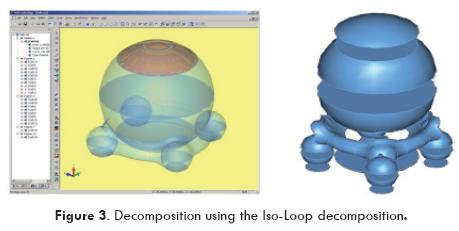
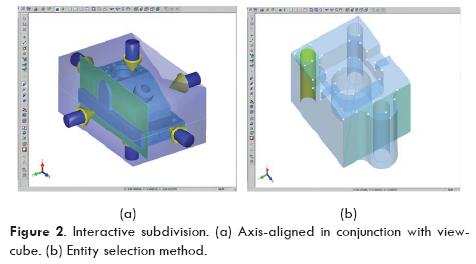
<body><![CDATA[<p align="justify"><font face="verdana" size="2">RPBloX follows the use of conventional workshop machinery and technology, Lim, Corney, Ritchie and Davies (2002), Lim, Corney, Ritchie and Davies. The RPBloX methodology involves a cellular approach to building up a part. Rather than slicing up the CAD model into numerous thin sheets, RPBloX segments the model into 3D cells (or Blox) of varying sizes. One of the main advantages of the RPBloX system over other RP techniques is the reduction of the build time especially when large and/or tick wall components are fabricated. Consequently, production costs could be signifi cantly reduced without the forfeiting accuracy and timeliness.</font></p>  	    <p align="justify"><font face="verdana" size="2">&nbsp;</font></p>  	    <p align="justify"><font face="verdana" size="2"><b>RPBloX architecture</b></font></p>  	    <p align="justify"><font face="verdana" size="2">The architecture has three main steps: discretization of 3D models into Bloxs; perform DFMA; generate machining and robotic assembly code for manufacturing. The user interface allows interactive decomposition of a digital model, assembly sequencing and modifi cations to Blox units. The architecture is open and additional functions to support manufacturability and assembly assessment can be easily added. For example, a fitness test can be applied to the Blox set to determine which Blox within the set would pose manufacturing difficulties or perhaps prevent robot pick up. <a href="/img/revistas/imtd/v3n2/a5f1.jpg" target="_blank">Figure 1</a> presents an overview of the RPBloX system.</font></p>  	    <p align="justify"><font face="verdana" size="2">&nbsp;</font></p>  	    <p align="justify"><font face="verdana" size="2"><b>Subdivision methods and Blox generation</b></font></p>  	    <p align="justify"><font face="verdana" size="2">Unlike 2D slicing of an STL model, RPBloX works directly with a 3D model and allows mixed slicing in any orientation. For full interactive slicing users can select from axis&#45;aligned means to entity (e.g. face, vertex) selection methods to generate any number of slicing planes as required (<a href="#f2">Figure 2</a>).</font></p>  	    <p align="center"><font face="verdana" size="2"><a name="f2"></a></font></p>  	    <p align="center"><font face="verdana" size="2"><img src="/img/revistas/imtd/v3n2/a5f2.jpg"></font></p>  	    <p align="justify"><font face="verdana" size="2">Various automatic and semi&#45;automatic slicing algorithms have also been incorporated. Loops and isolines as segmentation tools for prismatic and complex curved surface components are extremely powerful. The Iso&#45;Loop decomposition algorithm identifi es holes and bosses on a face. When a boss is found, a slicing plane with the same surface type as the face on which the loop lies, is used to separate the boss at its base. The use of isolines is twofold; the main use is in the segmentation of curved faces. Since isolines lie on the surface they can also be used to detect inflexion curvatures on complex surfaces. Using the isoline as a guide a slicing plane is generated and the component segmented. <a href="#f3">Figure 3</a> shows the results of decomposition using the iso&#45;loop method. The example component has several similarities to medical implants such as hip replacements units.</font></p>  	    ]]></body>
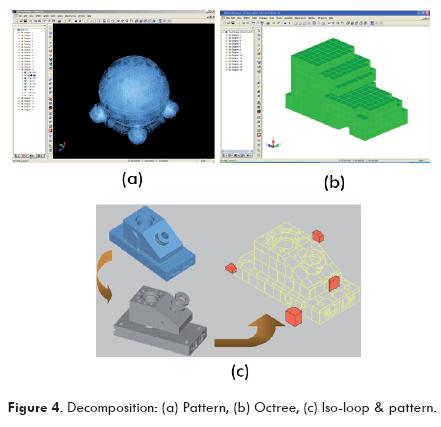
<body><![CDATA[<p align="center"><font face="verdana" size="2"><a name="f3"></a></font></p>  	    <p align="center"><font face="verdana" size="2"><img src="/img/revistas/imtd/v3n2/a5f3.jpg"></font></p>  	    <p align="justify"><font face="verdana" size="2">A pattern can then be applied to the component for further decomposition. Patterns are repeating shapes and in this case the profile of a cross&#45;shaped bar stock is used (<a href="#f4">Figure 4a</a>). The end result is a Blox set and the prototype that can be assembled like stacking bricks.</font></p>  	    <p align="center"><font face="verdana" size="2"><a name="f4"></a></font></p>  	    <p align="center"><font face="verdana" size="2"><img src="/img/revistas/imtd/v3n2/a5f4.jpg"></font></p>  	    <p align="justify"><font face="verdana" size="2">RPBloX also supports Octree decomposition which is a hierarchical form of tessellation. A number of well known Octree algorithms for subdivision, neighbour finding and tree traversal have been implemented (<a href="#f4">Figure 4b</a>) Medellin, Corney, Davies Lim and Ritchie (2006). Combined methods for the generation of Blox are also available in the RPBloX system. <a href="#f4">Figure 4c</a> presents a decomposition of a 3D model using a combination of iso&#45;loop and pattern methods.</font></p>  	    <p align="justify"><font face="verdana" size="2">&nbsp;</font></p>  	    <p align="justify"><font face="verdana" size="2"><b>Design for manufacturing and assembly (DFMA)</b></font></p>  	    <p align="justify"><font face="verdana" size="2">In general, any component can be subdivided in smaller parts by an array of orthogonal planes but the shapes resulting from such a brute force approach could have geometries that are diffi cult to produce accurately on many manufacturing or rapid prototyping systems. Typically, complications arise when features have insuffi cient strength to withstand fi nishing processes or have a cross&#45;section prone to distortion (e.g. warping) during the build process (e.g. thin sections and cusps). The DFMA module in the RPBloX system creates a decomposition designed for both Rapid Prototyping (DFRP) and assembly (DFA) Medellin, Corney, Davies Lim and Ritchie (2007). An overview of the DFMA module is shown in <a href="/img/revistas/imtd/v3n2/a5f5.jpg" target="_blank">Figure 5</a>.</font></p>  	    <p align="justify"><font face="verdana" size="2">This DFMA comprises:</font></p>  	    ]]></body>
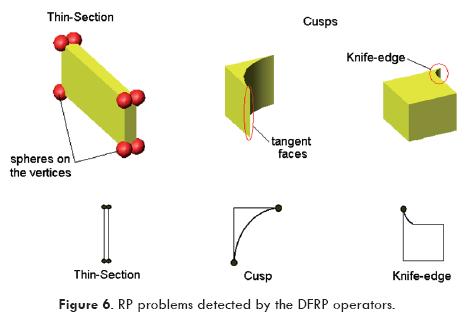
<body><![CDATA[<p align="justify"><font face="verdana" size="2">1. Design for RP (DFRP) operators that modify the initial set of 3D units (3DU) or Blox on the basis of geometric tests that detect potential manufacturing difficulties.</font></p>  	    <p align="justify"><font face="verdana" size="2">2. An assembly feature generator (AFG) that creates unique pairs of male/female matching features between the Blox to add location during fabrication (e.g. gluing) and improve the mechanical properties of the entire component.</font></p>  	    <p align="justify"><font face="verdana" size="2">3. Generation of stl fi les of the Blox set for RP production.</font></p>  	    <p align="justify"><font face="verdana" size="2">The manufacturability for RP production of the Blox set is assessed using three discreet functions referred to as DFRP operators. These operators perform geometric tests to identify the presence of features known to cause RP problems such as thin sections, cusps, and knife&#45;edges. Depending on the problem identifi ed, partitioning boundaries are modifi ed by selective merging of adjacent Blox. The process of refi ning the decomposition is iterative and each DFRP operator can be applied several times. Currently the RPBloX system uses three DFRP operators to evaluate and, where necessary, modify the partition boundaries of individual Blox. The DFRP operators use selective merging functions for Blox boundary refi nement. Merging is performed by the removal of internal faces that defi ne the Blox boundary. The selection of the Blox to merge is directly determined by the presence of manufacturing problems. The three DFRP operators are named as Op_thin, Op_cusp, and Op_vol. Thin&#45;sections are detected by positioning spheres (default 1.5mm radius) on all the vertices of the Blox to test for intersections, <a href="#f6">Figure 6</a>. When any pair of vertex spheres intersects, a thin&#45;section is deemed to exist. The operator responds by selective merging of adjacent Blox. Cusps are found by evaluating the local geometry adjacent to an edge.</font></p>  	    <p align="center"><font face="verdana" size="2"><a name="f6"></a></font></p>  	    <p align="center"><font face="verdana" size="2"><img src="/img/revistas/imtd/v3n2/a5f6.jpg"></font></p>  	    <p align="justify"><font face="verdana" size="2">This classification examines both the type and tangent relationships between faces meeting at an edge as illustrated in <a href="#f6">Figure 6</a>. The operator responds by selective merging of adjacent Blox. Undersized volumes, i.e. small Blox, are detected by querying the mass properties of each unit and comparing the value to a threshold defi ned according to the characteristics of the manufacturing system being used (default minimum volume 15mmx15mmx15mm). The operator responds by selective merging the 3DU.</font></p>  	    <p align="justify"><font face="verdana" size="2">&nbsp;</font></p>  	    <p align="justify"><font face="verdana" size="2"><b>Machining and robotic assembly code</b></font></p>  	    <p align="justify"><font face="verdana" size="2">The generation of CNC code for machining the Blox set is an ongoing work. Some of the results have shown that CNC code for machining the Blox set can be generated (<a href="/img/revistas/imtd/v3n2/a5f7.jpg" target="_blank">Figure 7</a>).</font></p>  	    ]]></body>
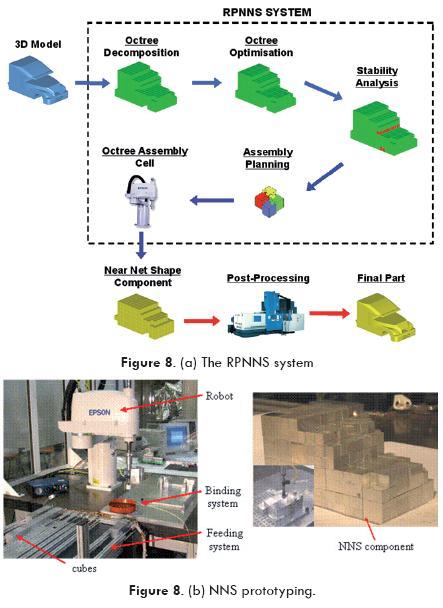
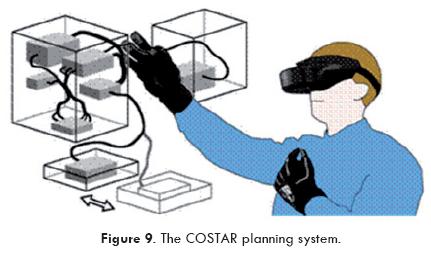
<body><![CDATA[<p align="justify"><font face="verdana" size="2">Assembly planning and automatic generation of robotic instructions have been implemented in the RPBloX system. As a result, an integrated subsystem for the production of near net shape components based on the Octree decomposition of 3D models has been developed (<a href="#f8">Figure 8a</a>). The subsystem RPN&#45;NS (rapid production of near net shapes) Medellin, Corney, Davies Lim and Ritchie (2008), works by subdividing a 3D model into cubes of various sizes using an Octree decomposition and optimisation method to reduce the number of cubes required without affecting the accuracy of the approximation. Once the Octree model has been verified for physical fabrication, the system generates instructions for a robot to construct the NNS model (<a href="#f8">Figure 8b</a>).</font></p>  	    <p align="center"><font face="verdana" size="2"><a name="f8"></a></font></p>  	    <p align="center"><font face="verdana" size="2"><img src="/img/revistas/imtd/v3n2/a5f8.jpg"></font></p>  	    <p align="justify"><font face="verdana" size="2">&nbsp;</font></p>  	    <p align="justify"><font face="verdana" size="2"><b>Virtual Assembly Planning</b></font></p>  	    <p align="justify"><font face="verdana" size="2">Two experimental platforms have been developed to investigate assembly planning in virtual reality. These two platforms, named as COSTAR (Cable Organisation System Through Alternative Reality) and HAMMS (Haptic Assembly, Manufacturing and Machining System), are presented in this section.</font></p>  	    <p align="justify"><font face="verdana" size="2">&nbsp;</font></p>  	    <p align="justify"><font face="verdana" size="2"><b>COSTAR</b></font></p>  	    <p align="justify"><font face="verdana" size="2">The COSTAR project began in 2001 to investigate the benefits of using VR to design and route cable harnesses, Ng FM (1999). The results showed that VR gave productivity benefits over CAD during creative cable routing design activities. Follow&#45;on work was aimed at understanding how various aspects of the immersive VR system were contributing to these benefits and how engineering design and planning processes could be analysed as they are being carried out. This was performed using comprehensive user&#45;logging to non&#45;intrusively collect detailed information relating to design solutions and assembly planning approaches used by a number of engineers. The COSTAR system logs all the user's interactions in the virtual environment. The contents of the log file includes the user's head and hand positions, menu options selected, design changes made together with a timestamp for each logged event. User tests have been performed to evaluate the effectiveness of the system and also to compare its performance with traditional 2D CAD systems, Ritchie, Sung, Robinson, Day, Dewar and Simmons (2007).</font></p>  	    <p align="justify"><font face="verdana" size="2">In COSTAR the user wears a Virtual Research V8 head&#45;mounted display (HMD) and Pinch&reg; Gloves to operate the system, <a href="#f9">Figure 9</a>. To track the user's head and hand movements, an Ascension Flock of Birds&reg; electromagnetic tracking system is used. The VR application was developed using SENSE8&reg;'s WorldToolKit&reg; release 9.</font></p>  	    ]]></body>
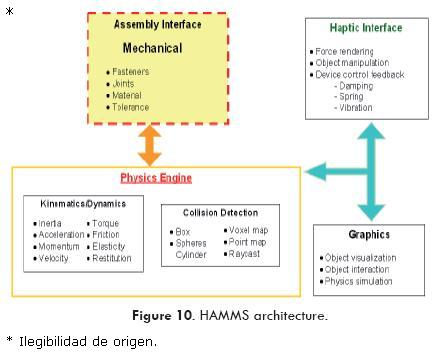
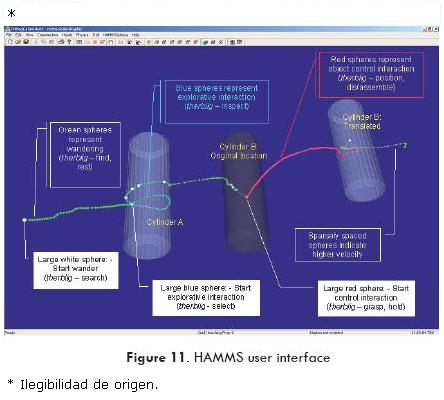
<body><![CDATA[<p align="center"><font face="verdana" size="2"><a name="f9"></a></font></p>  	    <p align="center"><font face="verdana" size="2"><img src="/img/revistas/imtd/v3n2/a5f9.jpg"></font></p>  	    <p align="justify"><font face="verdana" size="2">When the user carries out a design task in the virtual environment, all their actions are logged into a text file. Since each logged event has a timestamp, chronological account of what happened during the session and how long the user spent on each specific task can be done. Post&#45;processing of the logged text file has been automated so a large amount of files can be processed to extract assembly plans.</font></p>  	    <p align="justify"><font face="verdana" size="2">&nbsp;</font></p>  	    <p align="justify"><font face="verdana" size="2"><b>HAMMS</b></font></p>  	    <p align="justify"><font face="verdana" size="2">The HAMMS (Haptic Assembly, Manufacturing and Machining System) system has been developed as a test bed to investigate the user interactions and response while performing various engineering tasks using a haptic device in a virtual environment. The hardware comprises a Phantom haptic device and uses a pair of CrystalEyes&reg; stereoscopic glasses for stereo viewing. The systems' architecture is presented in <a href="#f10">Figure 10</a>.</font></p>  	    <p align="center"><font face="verdana" size="2"><a name="f10"></a></font></p>  	    <p align="center"><font face="verdana" size="2"><img src="/img/revistas/imtd/v3n2/a5f10.jpg"></font></p>  	    <p align="justify"><font face="verdana" size="2">The HAMMS environment allows objects to have their physical state modifi ed and user/device/object interactions logged in real&#45;time. The basic logged data comprises position, orientation, time stamps, velocity and an object index. <a href="#f11">Figure 11</a> illustrates the HAMMS GUI and the color&#45;coded therblig units, Johnson, Ogilvie (1972), adapted by HAMMS. To visualize the data stream, large spheres are used to signify the start of an event, while smaller contiguous spheres indicate the direction, speed, and location of exploration or controlled displacements. Green indicates search, fi nd or rest. Blue represents selection and inspection. Red identifi es control events such as grasping, holding, translation, dis/assembly operations. Velocity changes are indicated by the separation of the spheres, i.e. sparsely spaced spheres equate to higher velocity. The line joining all spheres is referred as the motion&#45;time&#45;line (MTL). Detailed information regarding HAMMS can be found in, Ritchie, Lim, Sung, Corney, and Rea (2008).</font></p>  	    <p align="center"><font face="verdana" size="2"><a name="f11"></a></font></p>  	    ]]></body>
<body><![CDATA[<p align="center"><font face="verdana" size="2"><img src="/img/revistas/imtd/v3n2/a5f11.jpg"></font></p>  	    <p align="justify"><font face="verdana" size="2">The logged data in the HAMMS system is stored as a text file which is then used to extract and generate the assembly plan. This file contains information of the ther&#45;blig units associated with the virtual assembly process. By using a data parser, assembly operations can be identified, filtered and extracted to generate assembly plans as shown in <a href="/img/revistas/imtd/v3n2/a5f12.jpg" target="_blank">Figure 12</a>.</font></p>  	    <p align="justify"><font face="verdana" size="2">The results of the tests carried out to evaluate the HAMM systems have clearly shown that the chronocycle data and the logged file can be used to identify individual assembly tasks and motions performed by the user during the assembly. These assembly details can be further used to automatically generate assembly plans associated to physical operations.</font></p>  	    <p align="justify"><font face="verdana" size="2">&nbsp;</font></p>  	    <p align="justify"><font face="verdana" size="2"><b>The Varp System</b></font></p>  	    <p align="justify"><font face="verdana" size="2">The classical context regarding assembly sequences has been to try to replace the human planner with systems which attempt to take most or all of the decision making away from the expert and replace their function with semi&#45;automated or automated systems. In contrast VARP allows the user to interactively decompose models, perform design changes, analyse assembly processes, analyse manufacturing processes, carry out assembly tasks, evaluate cognitive design and manufacturing activities, and produce assembly and manufacturing plans via an immersive virtual and haptic interface. An overview of the proposed VARP system is presented in <a href="/img/revistas/imtd/v3n2/a5f13.jpg" target="_blank">Figure 13</a>.</font></p>  	    <p align="justify"><font face="verdana" size="2">The advantage of VARP is its unique sensory environment to explore and analyse assembly options. It will also enable walk&#45;through so that one can see the build process, the pit falls of a portion of the design, and to make amendments before production. By collecting and analysing data in realtime, process parameters can be validated and subsequently applied or transferred to real manufacturing machines such as CNC machines, robots or RP machines. From this rich data source, cognitive evaluation of design and manufacturing processes can be used to push information to novice users and burgeoning designers.</font></p>  	    <p align="justify"><font face="verdana" size="2">&nbsp;</font></p>  	    <p align="justify"><font face="verdana" size="2"><b>Conclusions</b></font></p>  	    <p align="justify"><font face="verdana" size="2">This paper presents an alternative approach based on the adoption of immersive virtual reality and haptic interface for design and manufacture that can be used to produce practical downstream manufacturing information for non&#45;layered physical prototypes. The development of a virtual reality&#45;based assembly system can shorten the product innovation cycle and capitalise the experience of assembly operators. By analysing expert usage within the system a better understanding of the implications of virtual technologies and the cognitive association to product design can be gathered.</font></p>  	    ]]></body>
<body><![CDATA[<p align="justify"><font face="verdana" size="2">The elements of VARP are a short step away from full integration. RPBloX and the virtual systems COSTAR and HAMMS will form the basis of the unifi ed platform. Further developments are also earmarked in the area of Blox manufacturing planning, analysis for rapid prototyping and manufacturabi&#45;lity and on geometric evaluations.</font></p> 	    <p align="justify"><font face="verdana" size="2">Finally, the unique combination of digital and physical prototyping will enable various forms of prototyping to be evaluated within the context of the product development.</font></p> 	    <p align="justify"><font face="verdana" size="2">&nbsp;</font></p>  	    <p align="justify"><font face="verdana" size="2"><b>Acknowledgments</b></font></p>  	    <p align="justify"><font face="verdana" size="2">We would like to acknowledge funding of this work by the UK EPSRC IMRC grant GR/R35285/01. The authors also gratefully acknowledge the support of numerous industrial partners involved in the project and the Fund for Research Support (FAI) of the UASLP and the Secretaria de Educacion Publica (SEP) of M&eacute;xico.</font></p>  	    <p align="justify"><font face="verdana" size="2">&nbsp;</font></p>  	    <p align="justify"><font face="verdana" size="2"><b>REFERENCES</b></font></p>  	    <!-- ref --><p align="justify"><font face="verdana" size="2">McLeod, J. Superfast simulators make it a lot easier to skip prototyping. Electronics, 1988, 60(1 1), 61&#45;68.    &nbsp;&nbsp;&nbsp;&nbsp;&nbsp;&nbsp;&nbsp;&nbsp;[&#160;<a href="javascript:void(0);" onclick="javascript: window.open('/scielo.php?script=sci_nlinks&ref=4318421&pid=S1665-7381200900010000500001&lng=','','width=640,height=500,resizable=yes,scrollbars=1,menubar=yes,');">Links</a>&#160;]<!-- end-ref --></font></p>  	    <!-- ref --><p align="justify"><font face="verdana" size="2">Wholers, T., Rapid prototyping and manufacturing: State of the industry &#45; Annual World Wide Progress Report, 2006, Wohlers Associates.    &nbsp;&nbsp;&nbsp;&nbsp;&nbsp;&nbsp;&nbsp;&nbsp;[&#160;<a href="javascript:void(0);" onclick="javascript: window.open('/scielo.php?script=sci_nlinks&ref=4318423&pid=S1665-7381200900010000500002&lng=','','width=640,height=500,resizable=yes,scrollbars=1,menubar=yes,');">Links</a>&#160;]<!-- end-ref --></font></p>  	    <!-- ref --><p align="justify"><font face="verdana" size="2">Bullinger, H.J. and Richter, M. Integrated Design and Assembly Planning. Computer Integrated Manufacturing Systems, 1991, 4(4), 239&#45;247.    &nbsp;&nbsp;&nbsp;&nbsp;&nbsp;&nbsp;&nbsp;&nbsp;[&#160;<a href="javascript:void(0);" onclick="javascript: window.open('/scielo.php?script=sci_nlinks&ref=4318425&pid=S1665-7381200900010000500003&lng=','','width=640,height=500,resizable=yes,scrollbars=1,menubar=yes,');">Links</a>&#160;]<!-- end-ref --></font></p>  	    <!-- ref --><p align="justify"><font face="verdana" size="2">Bekey, G.A. Foreword (from Computer&#45;Aided Mechanical Assembly Planning, Ed. Homem de Mello L.S., Lee S.), 1991 (Kluwer Academic Publishers, Norwell, Massachusetts), ix&#45;xi.    &nbsp;&nbsp;&nbsp;&nbsp;&nbsp;&nbsp;&nbsp;&nbsp;[&#160;<a href="javascript:void(0);" onclick="javascript: window.open('/scielo.php?script=sci_nlinks&ref=4318427&pid=S1665-7381200900010000500004&lng=','','width=640,height=500,resizable=yes,scrollbars=1,menubar=yes,');">Links</a>&#160;]<!-- end-ref --></font></p>  	    <!-- ref --><p align="justify"><font face="verdana" size="2">Homem de Mello Luiz S., Lee Sukhan, "Computer&#45;Aided Mechanical Assembly Planning", foreword by George A. Bekey, Kluwer Academic Publishers, 1991.    &nbsp;&nbsp;&nbsp;&nbsp;&nbsp;&nbsp;&nbsp;&nbsp;[&#160;<a href="javascript:void(0);" onclick="javascript: window.open('/scielo.php?script=sci_nlinks&ref=4318429&pid=S1665-7381200900010000500005&lng=','','width=640,height=500,resizable=yes,scrollbars=1,menubar=yes,');">Links</a>&#160;]<!-- end-ref --></font></p>  	    <!-- ref --><p align="justify"><font face="verdana" size="2">H. Medell&iacute;n, J. Corney, J.M. Ritchie, T. Lim, J.B.C. Davies, A Novel Approach to the Generation of Automatic and Manual Assembly Plans Using Octrees, IEEE Proceedings of the Fourth Electronics, Robotics and Automative Mechanics Conference (CERMA 2007), September 25&#45;28, 2007, pp.614&#45;619.    &nbsp;&nbsp;&nbsp;&nbsp;&nbsp;&nbsp;&nbsp;&nbsp;[&#160;<a href="javascript:void(0);" onclick="javascript: window.open('/scielo.php?script=sci_nlinks&ref=4318431&pid=S1665-7381200900010000500006&lng=','','width=640,height=500,resizable=yes,scrollbars=1,menubar=yes,');">Links</a>&#160;]<!-- end-ref --></font></p>  	    <!-- ref --><p align="justify"><font face="verdana" size="2">Bourjault, A. Contribution a une approche m&eacute;thodologique de l'assemblage automis&eacute;:Elaboration automatique des s&eacute;quences op&eacute;ratoires. PhD Thesis, 1984 (l'Universit&eacute; de Franche&#45;Compt&eacute;, France).    &nbsp;&nbsp;&nbsp;&nbsp;&nbsp;&nbsp;&nbsp;&nbsp;[&#160;<a href="javascript:void(0);" onclick="javascript: window.open('/scielo.php?script=sci_nlinks&ref=4318433&pid=S1665-7381200900010000500007&lng=','','width=640,height=500,resizable=yes,scrollbars=1,menubar=yes,');">Links</a>&#160;]<!-- end-ref --></font></p>  	    <!-- ref --><p align="justify"><font face="verdana" size="2">Homem de Mello, L.S. and Sanderson, A.C. AND/OR Graph Representation of Assembly Plans. IEEE Transactions on Robotics and Automation, 1990, 6(2), 188&#45;199.    &nbsp;&nbsp;&nbsp;&nbsp;&nbsp;&nbsp;&nbsp;&nbsp;[&#160;<a href="javascript:void(0);" onclick="javascript: window.open('/scielo.php?script=sci_nlinks&ref=4318435&pid=S1665-7381200900010000500008&lng=','','width=640,height=500,resizable=yes,scrollbars=1,menubar=yes,');">Links</a>&#160;]<!-- end-ref --></font></p>  	    <!-- ref --><p align="justify"><font face="verdana" size="2">Latombe, J&#45;C, Wilson, R.H. and Cazals, F. Assembly Sequencing with Toleranced Parts. Computer Aided Design, 1997, 29(2), 159&#45;174.    &nbsp;&nbsp;&nbsp;&nbsp;&nbsp;&nbsp;&nbsp;&nbsp;[&#160;<a href="javascript:void(0);" onclick="javascript: window.open('/scielo.php?script=sci_nlinks&ref=4318437&pid=S1665-7381200900010000500009&lng=','','width=640,height=500,resizable=yes,scrollbars=1,menubar=yes,');">Links</a>&#160;]<!-- end-ref --></font></p>  	    <!-- ref --><p align="justify"><font face="verdana" size="2">Baldwin, D.F., Abell, T.E., Lui, M.M., De Fazio, T.L. and Whitney, D.E. An Integrated Computer Aid for Generating and Evaluating Assembly Sequences for Mechanical Products. IEEE Transactions on Robotics and Automation, 1991, 7( 1), 78&#45;94.    &nbsp;&nbsp;&nbsp;&nbsp;&nbsp;&nbsp;&nbsp;&nbsp;[&#160;<a href="javascript:void(0);" onclick="javascript: window.open('/scielo.php?script=sci_nlinks&ref=4318439&pid=S1665-7381200900010000500010&lng=','','width=640,height=500,resizable=yes,scrollbars=1,menubar=yes,');">Links</a>&#160;]<!-- end-ref --></font></p>  	    <!-- ref --><p align="justify"><font face="verdana" size="2">Wilson, R.H. Minimizing User Queries in Interactive Assembly Planning. IEEE Transactions on Robotics and Automation, 1995, 1 1(2), 308&#45;312.    &nbsp;&nbsp;&nbsp;&nbsp;&nbsp;&nbsp;&nbsp;&nbsp;[&#160;<a href="javascript:void(0);" onclick="javascript: window.open('/scielo.php?script=sci_nlinks&ref=4318441&pid=S1665-7381200900010000500011&lng=','','width=640,height=500,resizable=yes,scrollbars=1,menubar=yes,');">Links</a>&#160;]<!-- end-ref --></font></p>  	    <!-- ref --><p align="justify"><font face="verdana" size="2">Bourell, D.L., Beaman, J.J., Marcus, H.L., and Barlow, J.W. Solid freeform fabricationL an advanced manufacturing approach. Proceedings of the SFF Symposium, 1990, pp. 1&#45;7.    &nbsp;&nbsp;&nbsp;&nbsp;&nbsp;&nbsp;&nbsp;&nbsp;[&#160;<a href="javascript:void(0);" onclick="javascript: window.open('/scielo.php?script=sci_nlinks&ref=4318443&pid=S1665-7381200900010000500012&lng=','','width=640,height=500,resizable=yes,scrollbars=1,menubar=yes,');">Links</a>&#160;]<!-- end-ref --></font></p>  	    <!-- ref --><p align="justify"><font face="verdana" size="2">Ye Nong, Banerjee Prashant, Banerjee Amarnath, and Dech Fred, A Comparative Study of Assembly Planning in Traditional and Virtual Environments. In IEEE Transactions on Systems, Man, and Cybernetics&#151;Part G Applications and Reviews, Vol. 29, No. 4, 1999.    &nbsp;&nbsp;&nbsp;&nbsp;&nbsp;&nbsp;&nbsp;&nbsp;[&#160;<a href="javascript:void(0);" onclick="javascript: window.open('/scielo.php?script=sci_nlinks&ref=4318445&pid=S1665-7381200900010000500013&lng=','','width=640,height=500,resizable=yes,scrollbars=1,menubar=yes,');">Links</a>&#160;]<!-- end-ref --></font></p>  	    <!-- ref --><p align="justify"><font face="verdana" size="2">Lim T., Ritchie J.M., Dewar R.G., Corney J.R., Wilkinson P., Calis M., Desmulliez M., Fang J.J., Factors affecting user performance in haptic assembly. In Virtual Reality, Vol. 1 1, No. 4, 2007, Springer.    &nbsp;&nbsp;&nbsp;&nbsp;&nbsp;&nbsp;&nbsp;&nbsp;[&#160;<a href="javascript:void(0);" onclick="javascript: window.open('/scielo.php?script=sci_nlinks&ref=4318447&pid=S1665-7381200900010000500014&lng=','','width=640,height=500,resizable=yes,scrollbars=1,menubar=yes,');">Links</a>&#160;]<!-- end-ref --></font></p>  	    <!-- ref --><p align="justify"><font face="verdana" size="2">Howard B.M., Vance J.M., Desktop haptic virtual assembly using physically based modeling. In Virtual Reality, Vol. 1 1, No. 4, 2007, Springer.    &nbsp;&nbsp;&nbsp;&nbsp;&nbsp;&nbsp;&nbsp;&nbsp;[&#160;<a href="javascript:void(0);" onclick="javascript: window.open('/scielo.php?script=sci_nlinks&ref=4318449&pid=S1665-7381200900010000500015&lng=','','width=640,height=500,resizable=yes,scrollbars=1,menubar=yes,');">Links</a>&#160;]<!-- end-ref --></font></p>  	    <!-- ref --><p align="justify"><font face="verdana" size="2">Garbaya Samir, Zaldivar&#45;Colado U., The affect of contact force sensations on user performance in virtual assembly tasks. In Virtual Reality, Vol. 1 1, No. 4, 2007, Springer.    &nbsp;&nbsp;&nbsp;&nbsp;&nbsp;&nbsp;&nbsp;&nbsp;[&#160;<a href="javascript:void(0);" onclick="javascript: window.open('/scielo.php?script=sci_nlinks&ref=4318451&pid=S1665-7381200900010000500016&lng=','','width=640,height=500,resizable=yes,scrollbars=1,menubar=yes,');">Links</a>&#160;]<!-- end-ref --></font></p>  	    <!-- ref --><p align="justify"><font face="verdana" size="2">Massie T. and Salisbury K., The PHANTOM Haptic Interface: A Device for probing Virtual Objects. In ASME Winter Annual Meeting, DSC&#45;Vol. 55&#45;1, pp. 295&#45;300, 1994.    &nbsp;&nbsp;&nbsp;&nbsp;&nbsp;&nbsp;&nbsp;&nbsp;[&#160;<a href="javascript:void(0);" onclick="javascript: window.open('/scielo.php?script=sci_nlinks&ref=4318453&pid=S1665-7381200900010000500017&lng=','','width=640,height=500,resizable=yes,scrollbars=1,menubar=yes,');">Links</a>&#160;]<!-- end-ref --></font></p>  	    <!-- ref --><p align="justify"><font face="verdana" size="2">Lanzagorta, M., Rosenberg, R., Rosenblum, L.J., and Kuo, E.Y. Rapid prototyping of virtual environments. Computing in Science & Engineering, 2(3), 2000, pp. 68&#45;73.    &nbsp;&nbsp;&nbsp;&nbsp;&nbsp;&nbsp;&nbsp;&nbsp;[&#160;<a href="javascript:void(0);" onclick="javascript: window.open('/scielo.php?script=sci_nlinks&ref=4318455&pid=S1665-7381200900010000500018&lng=','','width=640,height=500,resizable=yes,scrollbars=1,menubar=yes,');">Links</a>&#160;]<!-- end-ref --></font></p>  	    <!-- ref --><p align="justify"><font face="verdana" size="2">Choi, S.H. and Samavedam, S. Visualisation of rapid prototyping. Rapid Prototyping Journal, 7(2), 2001, pp. 99&#45;1 14.    &nbsp;&nbsp;&nbsp;&nbsp;&nbsp;&nbsp;&nbsp;&nbsp;[&#160;<a href="javascript:void(0);" onclick="javascript: window.open('/scielo.php?script=sci_nlinks&ref=4318457&pid=S1665-7381200900010000500019&lng=','','width=640,height=500,resizable=yes,scrollbars=1,menubar=yes,');">Links</a>&#160;]<!-- end-ref --></font></p>  	    <!-- ref --><p align="justify"><font face="verdana" size="2">Gibson, I., Brown, D., Cobb, S., and Eastgate, R. Virtual Reality and Rapid Prototyping. Proceedings of IEE workshop on Virtual Reality in Engineering, 1993, 51&#45;63.    &nbsp;&nbsp;&nbsp;&nbsp;&nbsp;&nbsp;&nbsp;&nbsp;[&#160;<a href="javascript:void(0);" onclick="javascript: window.open('/scielo.php?script=sci_nlinks&ref=4318459&pid=S1665-7381200900010000500020&lng=','','width=640,height=500,resizable=yes,scrollbars=1,menubar=yes,');">Links</a>&#160;]<!-- end-ref --></font></p>  	    <!-- ref --><p align="justify"><font face="verdana" size="2">Fadel, G.M., Crane, D., Dooley, L., and Geist, R. Support structure visualisation in a Virtual Reality environment. Proceedings of the 6th Int'l Conf. On Rapid Prototyping, Dayton, 1995.    &nbsp;&nbsp;&nbsp;&nbsp;&nbsp;&nbsp;&nbsp;&nbsp;[&#160;<a href="javascript:void(0);" onclick="javascript: window.open('/scielo.php?script=sci_nlinks&ref=4318461&pid=S1665-7381200900010000500021&lng=','','width=640,height=500,resizable=yes,scrollbars=1,menubar=yes,');">Links</a>&#160;]<!-- end-ref --></font></p>  	    <!-- ref --><p align="justify"><font face="verdana" size="2">Morvan, S.M. and Fadel, G.M. IVCES: interactively correcting STL fi les in a virtual environment. Proceedings of the 1996 ASME Design and Engineering Technical Conference, 1996.    &nbsp;&nbsp;&nbsp;&nbsp;&nbsp;&nbsp;&nbsp;&nbsp;[&#160;<a href="javascript:void(0);" onclick="javascript: window.open('/scielo.php?script=sci_nlinks&ref=4318463&pid=S1665-7381200900010000500022&lng=','','width=640,height=500,resizable=yes,scrollbars=1,menubar=yes,');">Links</a>&#160;]<!-- end-ref --></font></p>  	    <!-- ref --><p align="justify"><font face="verdana" size="2">Zheng, J.M., Chan, K.W., and Gibson, I. Virtual reality &#151; A real world review on a somewhat touchy subject. IEEE Potentials, 17(2), 1998, pp. 20&#45;23.    &nbsp;&nbsp;&nbsp;&nbsp;&nbsp;&nbsp;&nbsp;&nbsp;[&#160;<a href="javascript:void(0);" onclick="javascript: window.open('/scielo.php?script=sci_nlinks&ref=4318465&pid=S1665-7381200900010000500023&lng=','','width=640,height=500,resizable=yes,scrollbars=1,menubar=yes,');">Links</a>&#160;]<!-- end-ref --></font></p>  	    <!-- ref --><p align="justify"><font face="verdana" size="2">Zorriassatine, F., Wykes, C., Parkin, R., and Gindy, N. A survey of virtual prototyping techniques for mechanical product development. Proceeding Instn. Mech. Engrs Part B: J. Engineering Manufacture, 2003, 217, pp. 51 3&#45;530.    &nbsp;&nbsp;&nbsp;&nbsp;&nbsp;&nbsp;&nbsp;&nbsp;[&#160;<a href="javascript:void(0);" onclick="javascript: window.open('/scielo.php?script=sci_nlinks&ref=4318467&pid=S1665-7381200900010000500024&lng=','','width=640,height=500,resizable=yes,scrollbars=1,menubar=yes,');">Links</a>&#160;]<!-- end-ref --></font></p>  	    <!-- ref --><p align="justify"><font face="verdana" size="2">Burgoyne, D. and Murray, J.L. The Specifi cation and Development of a Computer Aided Assembly Planning System Suitable for Electro&#45;Mechanical Products. 5th International Conference on Computer Aided Production Engineering, Edinburgh, 1989, pp. 1&#45;4.    &nbsp;&nbsp;&nbsp;&nbsp;&nbsp;&nbsp;&nbsp;&nbsp;[&#160;<a href="javascript:void(0);" onclick="javascript: window.open('/scielo.php?script=sci_nlinks&ref=4318469&pid=S1665-7381200900010000500025&lng=','','width=640,height=500,resizable=yes,scrollbars=1,menubar=yes,');">Links</a>&#160;]<!-- end-ref --></font></p>  	    <!-- ref --><p align="justify"><font face="verdana" size="2">Ritchie, J.M., Dewar, R.D., Simmons, J.E.L. The Generation and Practical Use of Plans for Manual Assembly using Immersive Virtual Reality Journal of Engineering Manufacture, IMechE Part B, 1999, v21 3, pp. 461 &#45;474.    &nbsp;&nbsp;&nbsp;&nbsp;&nbsp;&nbsp;&nbsp;&nbsp;[&#160;<a href="javascript:void(0);" onclick="javascript: window.open('/scielo.php?script=sci_nlinks&ref=4318471&pid=S1665-7381200900010000500026&lng=','','width=640,height=500,resizable=yes,scrollbars=1,menubar=yes,');">Links</a>&#160;]<!-- end-ref --></font></p>  	    <!-- ref --><p align="justify"><font face="verdana" size="2">T. Lim, J. Corney, J.M. Ritchie, and J.B.C. Davies,"RPBloX rapid prototyping &#45; More than just layers", Proc. DETC'02 ASME, Montreal, Canada, 2002, DETC2002/DFM&#45;34165.    &nbsp;&nbsp;&nbsp;&nbsp;&nbsp;&nbsp;&nbsp;&nbsp;[&#160;<a href="javascript:void(0);" onclick="javascript: window.open('/scielo.php?script=sci_nlinks&ref=4318473&pid=S1665-7381200900010000500027&lng=','','width=640,height=500,resizable=yes,scrollbars=1,menubar=yes,');">Links</a>&#160;]<!-- end-ref --></font></p>  	    <!-- ref --><p align="justify"><font face="verdana" size="2">T. Lim, J. Corney, J.M. Ritchie, and J.B.C. Davies, RPBloX &#45; a novel approach towards rapid prototyping, In: Third National Conference on Rapid Prototyping, Tooling, and Manufacturing, (Eds: A E W Rennie, D M Jacobson, C E Bocking), Professional Engineering Publishing, ISBN: 1860583741.    &nbsp;&nbsp;&nbsp;&nbsp;&nbsp;&nbsp;&nbsp;&nbsp;[&#160;<a href="javascript:void(0);" onclick="javascript: window.open('/scielo.php?script=sci_nlinks&ref=4318475&pid=S1665-7381200900010000500028&lng=','','width=640,height=500,resizable=yes,scrollbars=1,menubar=yes,');">Links</a>&#160;]<!-- end-ref --></font></p>  	    <!-- ref --><p align="justify"><font face="verdana" size="2">Medell&iacute;n H., Corney J., Davies J.B.C., Lim T., Ritchie J. M., "Algorithms for the physical rendering and assembly of octree models", Computer Aided Design, 38, 2006, pp. 69&#45;85.    &nbsp;&nbsp;&nbsp;&nbsp;&nbsp;&nbsp;&nbsp;&nbsp;[&#160;<a href="javascript:void(0);" onclick="javascript: window.open('/scielo.php?script=sci_nlinks&ref=4318477&pid=S1665-7381200900010000500029&lng=','','width=640,height=500,resizable=yes,scrollbars=1,menubar=yes,');">Links</a>&#160;]<!-- end-ref --></font></p>  	    <!-- ref --><p align="justify"><font face="verdana" size="2">H. Medell&iacute;n, J. Corney, T. Lim, J.B.C. Davies, J.M. Ritchie, "Automatic Subdivision and Refi nement of Large Components for Rapid Prototyping Production", Journal of Computing and Information Science in Engineering, ASME, Vol. 7, No. 3, pp. 249&#45;258, 2007.    &nbsp;&nbsp;&nbsp;&nbsp;&nbsp;&nbsp;&nbsp;&nbsp;[&#160;<a href="javascript:void(0);" onclick="javascript: window.open('/scielo.php?script=sci_nlinks&ref=4318479&pid=S1665-7381200900010000500030&lng=','','width=640,height=500,resizable=yes,scrollbars=1,menubar=yes,');">Links</a>&#160;]<!-- end-ref --></font></p>  	    <!-- ref --><p align="justify"><font face="verdana" size="2">H. Medell&iacute;n, J. R. Corney, J. B. C. Davies, T. Lim, and J. M. Ritchie, Octree&#45;Based Production of Near Net Shape Components, IEEE Transactions on Automation Science and Engineering, vol. 5, no. 3, July 2008, pp. 457&#45;466.    &nbsp;&nbsp;&nbsp;&nbsp;&nbsp;&nbsp;&nbsp;&nbsp;[&#160;<a href="javascript:void(0);" onclick="javascript: window.open('/scielo.php?script=sci_nlinks&ref=4318481&pid=S1665-7381200900010000500031&lng=','','width=640,height=500,resizable=yes,scrollbars=1,menubar=yes,');">Links</a>&#160;]<!-- end-ref --></font></p>  	    <!-- ref --><p align="justify"><font face="verdana" size="2">Ng FM, Virtual Reality and Computer&#45;Based Tools for the Routing of Cable Harnesses. PhD Thesis 1999, Heriot&#45;Watt University, Edinburgh, UK.    &nbsp;&nbsp;&nbsp;&nbsp;&nbsp;&nbsp;&nbsp;&nbsp;[&#160;<a href="javascript:void(0);" onclick="javascript: window.open('/scielo.php?script=sci_nlinks&ref=4318483&pid=S1665-7381200900010000500032&lng=','','width=640,height=500,resizable=yes,scrollbars=1,menubar=yes,');">Links</a>&#160;]<!-- end-ref --></font></p>  	    <!-- ref --><p align="justify"><font face="verdana" size="2">Ritchie J. M., Sung R. C. W., Robinson G., Day P. N., Dewar R. G. and Simmons J. E. L., Cable harness design, assembly and installation using immersive virtual reality, Virtual Reality Journal, 11, 2007, 261&#45;274.    &nbsp;&nbsp;&nbsp;&nbsp;&nbsp;&nbsp;&nbsp;&nbsp;[&#160;<a href="javascript:void(0);" onclick="javascript: window.open('/scielo.php?script=sci_nlinks&ref=4318485&pid=S1665-7381200900010000500033&lng=','','width=640,height=500,resizable=yes,scrollbars=1,menubar=yes,');">Links</a>&#160;]<!-- end-ref --></font></p>  	    <!-- ref --><p align="justify"><font face="verdana" size="2">Robinson G., Ritchie J. M., Day P. N. and Dewar R. G.: System design and user evaluation of CoStar: an immersive stereoscopic system for cable harness design, Computer&#45;Aided Design, 2007, 39, 245&#45;257.    &nbsp;&nbsp;&nbsp;&nbsp;&nbsp;&nbsp;&nbsp;&nbsp;[&#160;<a href="javascript:void(0);" onclick="javascript: window.open('/scielo.php?script=sci_nlinks&ref=4318487&pid=S1665-7381200900010000500034&lng=','','width=640,height=500,resizable=yes,scrollbars=1,menubar=yes,');">Links</a>&#160;]<!-- end-ref --></font></p>  	    <!-- ref --><p align="justify"><font face="verdana" size="2">Johnson Stanley, Ogilvie Grant, Work Analysis, London, But&#45;terworths, 1972, Chapter 4, pp. 56.    &nbsp;&nbsp;&nbsp;&nbsp;&nbsp;&nbsp;&nbsp;&nbsp;[&#160;<a href="javascript:void(0);" onclick="javascript: window.open('/scielo.php?script=sci_nlinks&ref=4318489&pid=S1665-7381200900010000500035&lng=','','width=640,height=500,resizable=yes,scrollbars=1,menubar=yes,');">Links</a>&#160;]<!-- end-ref --></font></p>  	    <!-- ref --><p align="justify"><font face="verdana" size="2">Ritchie J. M., Lim T., Sung R.S., Corney J.R., Rea H., The Analysis of Design and Manufacturing Tasks Using Haptics and Immerse VR: Some case Studies'. In Talaba Doru and Amditis Angelos (eds.): Product Engineering: Tools and Methods Based on Virtual Reality, 2008, 507&#45;522. Springer, Netherlands.    &nbsp;&nbsp;&nbsp;&nbsp;&nbsp;&nbsp;&nbsp;&nbsp;[&#160;<a href="javascript:void(0);" onclick="javascript: window.open('/scielo.php?script=sci_nlinks&ref=4318491&pid=S1665-7381200900010000500036&lng=','','width=640,height=500,resizable=yes,scrollbars=1,menubar=yes,');">Links</a>&#160;]<!-- end-ref --></font></p>      ]]></body><back>
<ref-list>
<ref id="B1">
<nlm-citation citation-type="journal">
<person-group person-group-type="author">
<name>
<surname><![CDATA[McLeod]]></surname>
<given-names><![CDATA[J]]></given-names>
</name>
</person-group>
<article-title xml:lang="en"><![CDATA[Superfast simulators make it a lot easier to skip prototyping]]></article-title>
<source><![CDATA[Electronics]]></source>
<year>1988</year>
<volume>60</volume>
<numero>11</numero>
<issue>11</issue>
<page-range>61-68</page-range></nlm-citation>
</ref>
<ref id="B2">
<nlm-citation citation-type="book">
<person-group person-group-type="author">
<name>
<surname><![CDATA[Wholers]]></surname>
<given-names><![CDATA[T]]></given-names>
</name>
</person-group>
<source><![CDATA[Rapid prototyping and manufacturing: State of the industry - Annual World Wide Progress Report]]></source>
<year>2006</year>
<publisher-name><![CDATA[Wohlers Associates]]></publisher-name>
</nlm-citation>
</ref>
<ref id="B3">
<nlm-citation citation-type="journal">
<person-group person-group-type="author">
<name>
<surname><![CDATA[Bullinger]]></surname>
<given-names><![CDATA[H.J.]]></given-names>
</name>
<name>
<surname><![CDATA[Richter]]></surname>
<given-names><![CDATA[M]]></given-names>
</name>
</person-group>
<article-title xml:lang="en"><![CDATA[Integrated Design and Assembly Planning]]></article-title>
<source><![CDATA[Computer Integrated Manufacturing Systems]]></source>
<year>1991</year>
<volume>4</volume>
<numero>4</numero>
<issue>4</issue>
<page-range>239-247</page-range></nlm-citation>
</ref>
<ref id="B4">
<nlm-citation citation-type="book">
<person-group person-group-type="author">
<name>
<surname><![CDATA[Bekey]]></surname>
<given-names><![CDATA[G.A.]]></given-names>
</name>
<name>
<surname><![CDATA[Homem de Mello]]></surname>
<given-names><![CDATA[L.S.]]></given-names>
</name>
<name>
<surname><![CDATA[Lee]]></surname>
<given-names><![CDATA[S]]></given-names>
</name>
</person-group>
<source><![CDATA[Foreword (from Computer-Aided Mechanical Assembly Planning]]></source>
<year>1991</year>
<page-range>ix-xi</page-range><publisher-loc><![CDATA[Norwell^eMassachusetts Massachusetts]]></publisher-loc>
<publisher-name><![CDATA[Kluwer Academic Publishers]]></publisher-name>
</nlm-citation>
</ref>
<ref id="B5">
<nlm-citation citation-type="book">
<person-group person-group-type="author">
<name>
<surname><![CDATA[Homem de Mello]]></surname>
<given-names><![CDATA[Luiz S]]></given-names>
</name>
<name>
<surname><![CDATA[Lee]]></surname>
<given-names><![CDATA[Sukhan]]></given-names>
</name>
<name>
<surname><![CDATA[Bekey]]></surname>
<given-names><![CDATA[George A.]]></given-names>
</name>
</person-group>
<source><![CDATA[Computer-Aided Mechanical Assembly Planning]]></source>
<year>1991</year>
<publisher-name><![CDATA[Kluwer Academic Publishers]]></publisher-name>
</nlm-citation>
</ref>
<ref id="B6">
<nlm-citation citation-type="">
<person-group person-group-type="author">
<name>
<surname><![CDATA[Medellín]]></surname>
<given-names><![CDATA[H]]></given-names>
</name>
<name>
<surname><![CDATA[Corney]]></surname>
<given-names><![CDATA[J]]></given-names>
</name>
<name>
<surname><![CDATA[Ritchie]]></surname>
<given-names><![CDATA[J.M.]]></given-names>
</name>
<name>
<surname><![CDATA[Lim]]></surname>
<given-names><![CDATA[T]]></given-names>
</name>
<name>
<surname><![CDATA[Davies]]></surname>
<given-names><![CDATA[J.B.C.]]></given-names>
</name>
</person-group>
<article-title xml:lang="en"><![CDATA[A Novel Approach to the Generation of Automatic and Manual Assembly Plans Using Octrees]]></article-title>
<source><![CDATA[IEEE Proceedings of the Fourth Electronics, Robotics and Automative Mechanics Conference]]></source>
<year>Sept</year>
<month>em</month>
<day>be</day>
<page-range>614-619</page-range></nlm-citation>
</ref>
<ref id="B7">
<nlm-citation citation-type="">
<person-group person-group-type="author">
<name>
<surname><![CDATA[Bourjault]]></surname>
<given-names><![CDATA[A]]></given-names>
</name>
</person-group>
<source><![CDATA[Contribution a une approche méthodologique de l'assemblage automisé:Elaboration automatique des séquences opératoires]]></source>
<year></year>
</nlm-citation>
</ref>
<ref id="B8">
<nlm-citation citation-type="journal">
<person-group person-group-type="author">
<name>
<surname><![CDATA[Homem de Mello]]></surname>
<given-names><![CDATA[L.S.]]></given-names>
</name>
<name>
<surname><![CDATA[Sanderson]]></surname>
<given-names><![CDATA[A.C.]]></given-names>
</name>
</person-group>
<article-title xml:lang="en"><![CDATA[AND/OR Graph Representation of Assembly Plans]]></article-title>
<source><![CDATA[IEEE Transactions on Robotics and Automation]]></source>
<year>1990</year>
<volume>6</volume>
<numero>2</numero>
<issue>2</issue>
<page-range>188-199</page-range></nlm-citation>
</ref>
<ref id="B9">
<nlm-citation citation-type="journal">
<person-group person-group-type="author">
<name>
<surname><![CDATA[Latombe]]></surname>
<given-names><![CDATA[J-C]]></given-names>
</name>
<name>
<surname><![CDATA[Wilson]]></surname>
<given-names><![CDATA[R.H.]]></given-names>
</name>
<name>
<surname><![CDATA[Cazals]]></surname>
<given-names><![CDATA[F]]></given-names>
</name>
</person-group>
<article-title xml:lang="en"><![CDATA[Assembly Sequencing with Toleranced Parts]]></article-title>
<source><![CDATA[Computer Aided Design]]></source>
<year>1997</year>
<volume>29</volume>
<numero>2</numero>
<issue>2</issue>
<page-range>159-174</page-range></nlm-citation>
</ref>
<ref id="B10">
<nlm-citation citation-type="journal">
<person-group person-group-type="author">
<name>
<surname><![CDATA[Baldwin]]></surname>
<given-names><![CDATA[D.F.]]></given-names>
</name>
<name>
<surname><![CDATA[Abell]]></surname>
<given-names><![CDATA[T.E.]]></given-names>
</name>
<name>
<surname><![CDATA[Lui]]></surname>
<given-names><![CDATA[M.M.]]></given-names>
</name>
<name>
<surname><![CDATA[De Fazio]]></surname>
<given-names><![CDATA[T.L.]]></given-names>
</name>
<name>
<surname><![CDATA[Whitney]]></surname>
<given-names><![CDATA[D.E.]]></given-names>
</name>
</person-group>
<article-title xml:lang="en"><![CDATA[An Integrated Computer Aid for Generating and Evaluating Assembly Sequences for Mechanical Products]]></article-title>
<source><![CDATA[IEEE Transactions on Robotics and Automation]]></source>
<year>1991</year>
<volume>7</volume>
<numero>1</numero>
<issue>1</issue>
<page-range>78-94</page-range></nlm-citation>
</ref>
<ref id="B11">
<nlm-citation citation-type="journal">
<person-group person-group-type="author">
<name>
<surname><![CDATA[Wilson]]></surname>
<given-names><![CDATA[R.H.]]></given-names>
</name>
</person-group>
<article-title xml:lang="en"><![CDATA[Minimizing User Queries in Interactive Assembly Planning]]></article-title>
<source><![CDATA[IEEE Transactions on Robotics and Automation]]></source>
<year>1995</year>
<volume>11</volume>
<numero>2</numero>
<issue>2</issue>
<page-range>308-312</page-range></nlm-citation>
</ref>
<ref id="B12">
<nlm-citation citation-type="">
<person-group person-group-type="author">
<name>
<surname><![CDATA[Bourell]]></surname>
<given-names><![CDATA[D.L.]]></given-names>
</name>
<name>
<surname><![CDATA[Beaman]]></surname>
<given-names><![CDATA[J.J.]]></given-names>
</name>
<name>
<surname><![CDATA[Marcus]]></surname>
<given-names><![CDATA[H.L.]]></given-names>
</name>
<name>
<surname><![CDATA[Barlow]]></surname>
<given-names><![CDATA[J.W.]]></given-names>
</name>
</person-group>
<article-title xml:lang="en"><![CDATA[Solid freeform fabricationL an advanced manufacturing approach]]></article-title>
<source><![CDATA[Proceedings of the SFF Symposium]]></source>
<year>1990</year>
<page-range>1-7</page-range></nlm-citation>
</ref>
<ref id="B13">
<nlm-citation citation-type="journal">
<person-group person-group-type="author">
<name>
<surname><![CDATA[Ye]]></surname>
<given-names><![CDATA[Nong]]></given-names>
</name>
<name>
<surname><![CDATA[Banerjee]]></surname>
<given-names><![CDATA[Prashant]]></given-names>
</name>
<name>
<surname><![CDATA[Banerjee]]></surname>
<given-names><![CDATA[Amarnath]]></given-names>
</name>
<name>
<surname><![CDATA[Dech]]></surname>
<given-names><![CDATA[Fred]]></given-names>
</name>
</person-group>
<article-title xml:lang="en"><![CDATA[A Comparative Study of Assembly Planning in Traditional and Virtual Environments]]></article-title>
<source><![CDATA[IEEE Transactions on Systems, Man, and Cybernetics-Part G Applications and Reviews]]></source>
<year>1999</year>
<volume>29</volume>
<numero>4</numero>
<issue>4</issue>
</nlm-citation>
</ref>
<ref id="B14">
<nlm-citation citation-type="journal">
<person-group person-group-type="author">
<name>
<surname><![CDATA[Lim]]></surname>
<given-names><![CDATA[T]]></given-names>
</name>
<name>
<surname><![CDATA[Ritchie]]></surname>
<given-names><![CDATA[J.M.]]></given-names>
</name>
<name>
<surname><![CDATA[Dewar]]></surname>
<given-names><![CDATA[R.G.]]></given-names>
</name>
<name>
<surname><![CDATA[Corney]]></surname>
<given-names><![CDATA[J.R.]]></given-names>
</name>
<name>
<surname><![CDATA[Wilkinson]]></surname>
<given-names><![CDATA[P]]></given-names>
</name>
<name>
<surname><![CDATA[Calis]]></surname>
<given-names><![CDATA[M]]></given-names>
</name>
<name>
<surname><![CDATA[Desmulliez]]></surname>
<given-names><![CDATA[M]]></given-names>
</name>
<name>
<surname><![CDATA[Fang]]></surname>
<given-names><![CDATA[J.J.]]></given-names>
</name>
</person-group>
<article-title xml:lang="en"><![CDATA[Factors affecting user performance in haptic assembly]]></article-title>
<source><![CDATA[Virtual Reality]]></source>
<year>2007</year>
<volume>11</volume>
<numero>4</numero>
<issue>4</issue>
<publisher-name><![CDATA[Springer]]></publisher-name>
</nlm-citation>
</ref>
<ref id="B15">
<nlm-citation citation-type="journal">
<person-group person-group-type="author">
<name>
<surname><![CDATA[Howard]]></surname>
<given-names><![CDATA[B.M.]]></given-names>
</name>
<name>
<surname><![CDATA[Vance]]></surname>
<given-names><![CDATA[J.M.]]></given-names>
</name>
</person-group>
<article-title xml:lang="en"><![CDATA[Desktop haptic virtual assembly using physically based modeling]]></article-title>
<source><![CDATA[Virtual Reality]]></source>
<year>2007</year>
<volume>11</volume>
<numero>4</numero>
<issue>4</issue>
<publisher-name><![CDATA[Springer]]></publisher-name>
</nlm-citation>
</ref>
<ref id="B16">
<nlm-citation citation-type="journal">
<person-group person-group-type="author">
<name>
<surname><![CDATA[Garbaya]]></surname>
<given-names><![CDATA[Samir]]></given-names>
</name>
<name>
<surname><![CDATA[Zaldivar-Colado]]></surname>
<given-names><![CDATA[U]]></given-names>
</name>
</person-group>
<article-title xml:lang="en"><![CDATA[The affect of contact force sensations on user performance in virtual assembly tasks]]></article-title>
<source><![CDATA[Virtual Reality]]></source>
<year>2007</year>
<volume>11</volume>
<numero>4</numero>
<issue>4</issue>
<publisher-name><![CDATA[Springer]]></publisher-name>
</nlm-citation>
</ref>
<ref id="B17">
<nlm-citation citation-type="">
<person-group person-group-type="author">
<name>
<surname><![CDATA[Massie]]></surname>
<given-names><![CDATA[T]]></given-names>
</name>
<name>
<surname><![CDATA[Salisbury]]></surname>
<given-names><![CDATA[K]]></given-names>
</name>
</person-group>
<article-title xml:lang="en"><![CDATA[The PHANTOM Haptic Interface: A Device for probing Virtual Objects]]></article-title>
<source><![CDATA[ASME Winter Annual Meeting]]></source>
<year>1994</year>
<volume>55-1</volume>
<page-range>295-300</page-range></nlm-citation>
</ref>
<ref id="B18">
<nlm-citation citation-type="journal">
<person-group person-group-type="author">
<name>
<surname><![CDATA[Lanzagorta]]></surname>
<given-names><![CDATA[M]]></given-names>
</name>
<name>
<surname><![CDATA[Rosenberg]]></surname>
<given-names><![CDATA[R]]></given-names>
</name>
<name>
<surname><![CDATA[Rosenblum]]></surname>
<given-names><![CDATA[L.J.]]></given-names>
</name>
<name>
<surname><![CDATA[Kuo]]></surname>
<given-names><![CDATA[E.Y.]]></given-names>
</name>
</person-group>
<article-title xml:lang="en"><![CDATA[Rapid prototyping of virtual environments]]></article-title>
<source><![CDATA[Computing in Science & Engineering]]></source>
<year>2000</year>
<volume>2</volume>
<numero>3</numero>
<issue>3</issue>
<page-range>68-73</page-range></nlm-citation>
</ref>
<ref id="B19">
<nlm-citation citation-type="journal">
<person-group person-group-type="author">
<name>
<surname><![CDATA[Choi]]></surname>
<given-names><![CDATA[S.H.]]></given-names>
</name>
<name>
<surname><![CDATA[Samavedam]]></surname>
<given-names><![CDATA[S]]></given-names>
</name>
</person-group>
<article-title xml:lang="en"><![CDATA[Visualisation of rapid prototyping]]></article-title>
<source><![CDATA[Rapid Prototyping Journal]]></source>
<year>2001</year>
<volume>7</volume>
<numero>2</numero>
<issue>2</issue>
<page-range>99-1 14</page-range></nlm-citation>
</ref>
<ref id="B20">
<nlm-citation citation-type="confpro">
<person-group person-group-type="author">
<name>
<surname><![CDATA[Gibson]]></surname>
<given-names><![CDATA[I]]></given-names>
</name>
<name>
<surname><![CDATA[Brown]]></surname>
<given-names><![CDATA[D]]></given-names>
</name>
<name>
<surname><![CDATA[Cobb]]></surname>
<given-names><![CDATA[S]]></given-names>
</name>
<name>
<surname><![CDATA[Eastgate]]></surname>
<given-names><![CDATA[R]]></given-names>
</name>
</person-group>
<article-title xml:lang="en"><![CDATA[Virtual Reality and Rapid Prototyping]]></article-title>
<source><![CDATA[Proceedings]]></source>
<year></year>
<conf-name><![CDATA[ IEE workshop on Virtual Reality in Engineering]]></conf-name>
<conf-date>1993</conf-date>
<conf-loc> </conf-loc>
<page-range>51-63</page-range></nlm-citation>
</ref>
<ref id="B21">
<nlm-citation citation-type="confpro">
<person-group person-group-type="author">
<name>
<surname><![CDATA[Fadel]]></surname>
<given-names><![CDATA[G.M.]]></given-names>
</name>
<name>
<surname><![CDATA[Crane]]></surname>
<given-names><![CDATA[D]]></given-names>
</name>
<name>
<surname><![CDATA[Dooley]]></surname>
<given-names><![CDATA[L]]></given-names>
</name>
<name>
<surname><![CDATA[Geist]]></surname>
<given-names><![CDATA[R]]></given-names>
</name>
</person-group>
<article-title xml:lang="en"><![CDATA[Support structure visualisation in a Virtual Reality environment]]></article-title>
<source><![CDATA[Proceedings]]></source>
<year></year>
<conf-name><![CDATA[6 Int'l Conf. On Rapid Prototyping]]></conf-name>
<conf-date>1995</conf-date>
<conf-loc>Dayton </conf-loc>
</nlm-citation>
</ref>
<ref id="B22">
<nlm-citation citation-type="confpro">
<person-group person-group-type="author">
<name>
<surname><![CDATA[Morvan]]></surname>
<given-names><![CDATA[S.M.]]></given-names>
</name>
<name>
<surname><![CDATA[Fadel]]></surname>
<given-names><![CDATA[G.M.]]></given-names>
</name>
</person-group>
<article-title xml:lang="en"><![CDATA[IVCES: interactively correcting STL fi les in a virtual environment]]></article-title>
<source><![CDATA[]]></source>
<year></year>
<conf-name><![CDATA[ Proceedings of the 1996 ASME Design and Engineering Technical Conference]]></conf-name>
<conf-date>1996</conf-date>
<conf-loc> </conf-loc>
</nlm-citation>
</ref>
<ref id="B23">
<nlm-citation citation-type="journal">
<person-group person-group-type="author">
<name>
<surname><![CDATA[Zheng]]></surname>
<given-names><![CDATA[J.M.]]></given-names>
</name>
<name>
<surname><![CDATA[Chan]]></surname>
<given-names><![CDATA[K.W.]]></given-names>
</name>
<name>
<surname><![CDATA[Gibson]]></surname>
<given-names><![CDATA[I]]></given-names>
</name>
</person-group>
<article-title xml:lang="en"><![CDATA[Virtual reality - A real world review on a somewhat touchy subject]]></article-title>
<source><![CDATA[IEEE Potentials]]></source>
<year>1998</year>
<volume>17</volume>
<numero>2</numero>
<issue>2</issue>
<page-range>20-23</page-range></nlm-citation>
</ref>
<ref id="B24">
<nlm-citation citation-type="">
<person-group person-group-type="author">
<name>
<surname><![CDATA[Zorriassatine]]></surname>
<given-names><![CDATA[F]]></given-names>
</name>
<name>
<surname><![CDATA[Wykes]]></surname>
<given-names><![CDATA[C]]></given-names>
</name>
<name>
<surname><![CDATA[Parkin]]></surname>
<given-names><![CDATA[R]]></given-names>
</name>
<name>
<surname><![CDATA[Gindy]]></surname>
<given-names><![CDATA[N]]></given-names>
</name>
</person-group>
<article-title xml:lang="en"><![CDATA[A survey of virtual prototyping techniques for mechanical product development]]></article-title>
<source><![CDATA[Proceeding Instn. Mech. Engrs Part B]]></source>
<year>2003</year>
<volume>217</volume>
<page-range>513-530</page-range></nlm-citation>
</ref>
<ref id="B25">
<nlm-citation citation-type="confpro">
<person-group person-group-type="author">
<name>
<surname><![CDATA[Burgoyne]]></surname>
<given-names><![CDATA[D]]></given-names>
</name>
<name>
<surname><![CDATA[Murray]]></surname>
<given-names><![CDATA[J.L.]]></given-names>
</name>
</person-group>
<source><![CDATA[The Specifi cation and Development of a Computer Aided Assembly Planning System Suitable for Electro-Mechanical Products]]></source>
<year></year>
<conf-name><![CDATA[5 International Conference on Computer Aided Production Engineering]]></conf-name>
<conf-date>1989</conf-date>
<conf-loc>Edinburgh </conf-loc>
<page-range>1-4</page-range></nlm-citation>
</ref>
<ref id="B26">
<nlm-citation citation-type="journal">
<person-group person-group-type="author">
<name>
<surname><![CDATA[Ritchie]]></surname>
<given-names><![CDATA[J.M.]]></given-names>
</name>
<name>
<surname><![CDATA[Dewar]]></surname>
<given-names><![CDATA[R.D.]]></given-names>
</name>
<name>
<surname><![CDATA[Simmons]]></surname>
<given-names><![CDATA[J.E.L.]]></given-names>
</name>
</person-group>
<article-title xml:lang="en"><![CDATA[The Generation and Practical Use of Plans for Manual Assembly]]></article-title>
<source><![CDATA[Immersive Virtual Reality Journal of Engineering Manufacture]]></source>
<year>1999</year>
<volume>213</volume>
<page-range>461 -474</page-range></nlm-citation>
</ref>
<ref id="B27">
<nlm-citation citation-type="">
<person-group person-group-type="author">
<name>
<surname><![CDATA[Lim]]></surname>
<given-names><![CDATA[T]]></given-names>
</name>
<name>
<surname><![CDATA[Corney]]></surname>
<given-names><![CDATA[J]]></given-names>
</name>
<name>
<surname><![CDATA[Ritchie]]></surname>
<given-names><![CDATA[J. M.]]></given-names>
</name>
<name>
<surname><![CDATA[Davies]]></surname>
<given-names><![CDATA[J.B.C.]]></given-names>
</name>
</person-group>
<article-title xml:lang="en"><![CDATA[RPBloX rapid prototyping - More than just layers]]></article-title>
<source><![CDATA[Proc. DETC'02 ASME]]></source>
<year>2002</year>
<publisher-loc><![CDATA[Montreal ]]></publisher-loc>
</nlm-citation>
</ref>
<ref id="B28">
<nlm-citation citation-type="confpro">
<person-group person-group-type="author">
<name>
<surname><![CDATA[Lim]]></surname>
<given-names><![CDATA[T]]></given-names>
</name>
<name>
<surname><![CDATA[Corney]]></surname>
<given-names><![CDATA[J]]></given-names>
</name>
<name>
<surname><![CDATA[Ritchie]]></surname>
<given-names><![CDATA[J.M.]]></given-names>
</name>
<name>
<surname><![CDATA[Davies]]></surname>
<given-names><![CDATA[J.B.C.]]></given-names>
</name>
</person-group>
<article-title xml:lang="en"><![CDATA[RPBloX - a novel approach towards rapid prototyping]]></article-title>
<person-group person-group-type="editor">
<name>
<surname><![CDATA[Rennie]]></surname>
<given-names><![CDATA[A E W]]></given-names>
</name>
<name>
<surname><![CDATA[Jacobson]]></surname>
<given-names><![CDATA[D M]]></given-names>
</name>
<name>
<surname><![CDATA[Bocking]]></surname>
<given-names><![CDATA[C E]]></given-names>
</name>
</person-group>
<source><![CDATA[]]></source>
<year></year>
<conf-name><![CDATA[Third National Conference on Rapid Prototyping, Tooling, and Manufacturing]]></conf-name>
<conf-loc> </conf-loc>
<publisher-name><![CDATA[Professional Engineering Publishing]]></publisher-name>
</nlm-citation>
</ref>
<ref id="B29">
<nlm-citation citation-type="journal">
<person-group person-group-type="author">
<name>
<surname><![CDATA[Medellín]]></surname>
<given-names><![CDATA[H]]></given-names>
</name>
<name>
<surname><![CDATA[Corney]]></surname>
<given-names><![CDATA[J]]></given-names>
</name>
<name>
<surname><![CDATA[Davies]]></surname>
<given-names><![CDATA[J.B.C.]]></given-names>
</name>
<name>
<surname><![CDATA[Lim]]></surname>
<given-names><![CDATA[T]]></given-names>
</name>
<name>
<surname><![CDATA[Ritchie]]></surname>
<given-names><![CDATA[J. M.]]></given-names>
</name>
</person-group>
<article-title xml:lang="en"><![CDATA[Algorithms for the physical rendering and assembly of octree models]]></article-title>
<source><![CDATA[Computer Aided Design]]></source>
<year>2006</year>
<volume>38</volume>
<page-range>69-85</page-range></nlm-citation>
</ref>
<ref id="B30">
<nlm-citation citation-type="journal">
<person-group person-group-type="author">
<name>
<surname><![CDATA[Medellín]]></surname>
<given-names><![CDATA[H]]></given-names>
</name>
<name>
<surname><![CDATA[Corney]]></surname>
<given-names><![CDATA[J]]></given-names>
</name>
<name>
<surname><![CDATA[Lim]]></surname>
<given-names><![CDATA[T]]></given-names>
</name>
<name>
<surname><![CDATA[Davies]]></surname>
<given-names><![CDATA[J.B.C.]]></given-names>
</name>
<name>
<surname><![CDATA[Ritchie]]></surname>
<given-names><![CDATA[J.M.]]></given-names>
</name>
</person-group>
<article-title xml:lang="en"><![CDATA[Automatic Subdivision and Refi nement of Large Components for Rapid Prototyping Production]]></article-title>
<source><![CDATA[Journal of Computing and Information Science in Engineering]]></source>
<year>2007</year>
<volume>7</volume>
<numero>3</numero>
<issue>3</issue>
<page-range>249-258</page-range><publisher-name><![CDATA[ASME]]></publisher-name>
</nlm-citation>
</ref>
<ref id="B31">
<nlm-citation citation-type="journal">
<person-group person-group-type="author">
<name>
<surname><![CDATA[Medellín]]></surname>
<given-names><![CDATA[H]]></given-names>
</name>
<name>
<surname><![CDATA[Corney]]></surname>
<given-names><![CDATA[J. R.]]></given-names>
</name>
<name>
<surname><![CDATA[Davies]]></surname>
<given-names><![CDATA[J. B. C.]]></given-names>
</name>
<name>
<surname><![CDATA[Lim]]></surname>
<given-names><![CDATA[T]]></given-names>
</name>
<name>
<surname><![CDATA[Ritchie]]></surname>
<given-names><![CDATA[J. M.]]></given-names>
</name>
</person-group>
<article-title xml:lang="en"><![CDATA[Octree-Based Production of Near Net Shape Components]]></article-title>
<source><![CDATA[IEEE Transactions on Automation Science and Engineering]]></source>
<year>July</year>
<month> 2</month>
<day>00</day>
<volume>5</volume>
<numero>3</numero>
<issue>3</issue>
<page-range>457-466</page-range></nlm-citation>
</ref>
<ref id="B32">
<nlm-citation citation-type="">
<person-group person-group-type="author">
<name>
<surname><![CDATA[Ng]]></surname>
<given-names><![CDATA[FM]]></given-names>
</name>
</person-group>
<source><![CDATA[Virtual Reality and Computer-Based Tools for the Routing of Cable Harnesses]]></source>
<year></year>
</nlm-citation>
</ref>
<ref id="B33">
<nlm-citation citation-type="journal">
<person-group person-group-type="author">
<name>
<surname><![CDATA[Ritchie]]></surname>
<given-names><![CDATA[J. M.]]></given-names>
</name>
<name>
<surname><![CDATA[Sung]]></surname>
<given-names><![CDATA[R. C. W.]]></given-names>
</name>
<name>
<surname><![CDATA[Robinson]]></surname>
<given-names><![CDATA[G]]></given-names>
</name>
<name>
<surname><![CDATA[Day]]></surname>
<given-names><![CDATA[P. N.]]></given-names>
</name>
<name>
<surname><![CDATA[Dewar]]></surname>
<given-names><![CDATA[R. G.]]></given-names>
</name>
<name>
<surname><![CDATA[Simmons]]></surname>
<given-names><![CDATA[J. E. L.]]></given-names>
</name>
</person-group>
<article-title xml:lang="en"><![CDATA[Cable harness design, assembly and installation using immersive virtual reality]]></article-title>
<source><![CDATA[Virtual Reality Journal]]></source>
<year>2007</year>
<volume>11</volume>
<page-range>261-274</page-range></nlm-citation>
</ref>
<ref id="B34">
<nlm-citation citation-type="book">
<person-group person-group-type="author">
<name>
<surname><![CDATA[Robinson]]></surname>
<given-names><![CDATA[G]]></given-names>
</name>
<name>
<surname><![CDATA[Ritchie]]></surname>
<given-names><![CDATA[J. M.]]></given-names>
</name>
<name>
<surname><![CDATA[Day]]></surname>
<given-names><![CDATA[P. N.]]></given-names>
</name>
<name>
<surname><![CDATA[Dewar]]></surname>
<given-names><![CDATA[R. G.]]></given-names>
</name>
</person-group>
<source><![CDATA[System design and user evaluation of CoStar: an immersive stereoscopic system for cable harness design]]></source>
<year>2007</year>
<volume>39</volume>
<page-range>245-257</page-range><publisher-name><![CDATA[Computer-Aided Design]]></publisher-name>
</nlm-citation>
</ref>
<ref id="B35">
<nlm-citation citation-type="">
<person-group person-group-type="author">
<name>
<surname><![CDATA[Stanley]]></surname>
<given-names><![CDATA[Johnson]]></given-names>
</name>
<name>
<surname><![CDATA[Grant]]></surname>
<given-names><![CDATA[Ogilvie]]></given-names>
</name>
</person-group>
<source><![CDATA[Work Analysis]]></source>
<year>1972</year>
<page-range>56</page-range><publisher-loc><![CDATA[LondonButterworths ]]></publisher-loc>
</nlm-citation>
</ref>
<ref id="B36">
<nlm-citation citation-type="book">
<person-group person-group-type="author">
<name>
<surname><![CDATA[Ritchie]]></surname>
<given-names><![CDATA[J. M.]]></given-names>
</name>
<name>
<surname><![CDATA[Lim]]></surname>
<given-names><![CDATA[T]]></given-names>
</name>
<name>
<surname><![CDATA[Sung]]></surname>
<given-names><![CDATA[R.S.]]></given-names>
</name>
<name>
<surname><![CDATA[Corney]]></surname>
<given-names><![CDATA[J.R.]]></given-names>
</name>
<name>
<surname><![CDATA[Rea]]></surname>
<given-names><![CDATA[H]]></given-names>
</name>
</person-group>
<article-title xml:lang="en"><![CDATA[The Analysis of Design and Manufacturing Tasks Using Haptics and Immerse VR: Some case Studies']]></article-title>
<person-group person-group-type="editor">
<name>
<surname><![CDATA[Talaba]]></surname>
<given-names><![CDATA[Doru]]></given-names>
</name>
<name>
<surname><![CDATA[Amditis]]></surname>
<given-names><![CDATA[Angelos]]></given-names>
</name>
</person-group>
<source><![CDATA[Product Engineering: Tools and Methods Based on Virtual Reality]]></source>
<year>2008</year>
<page-range>507-522</page-range><publisher-name><![CDATA[Springer]]></publisher-name>
</nlm-citation>
</ref>
</ref-list>
</back>
</article>