<?xml version="1.0" encoding="ISO-8859-1"?><article xmlns:mml="http://www.w3.org/1998/Math/MathML" xmlns:xlink="http://www.w3.org/1999/xlink" xmlns:xsi="http://www.w3.org/2001/XMLSchema-instance">
<front>
<journal-meta>
<journal-id>1665-3521</journal-id>
<journal-title><![CDATA[Superficies y vacío]]></journal-title>
<abbrev-journal-title><![CDATA[Superf. vacío]]></abbrev-journal-title>
<issn>1665-3521</issn>
<publisher>
<publisher-name><![CDATA[Sociedad Mexicana de Ciencia y Tecnología de Superficies y Materiales A.C.]]></publisher-name>
</publisher>
</journal-meta>
<article-meta>
<article-id>S1665-35212014000100005</article-id>
<title-group>
<article-title xml:lang="en"><![CDATA[Plasma gradient modified scaffolds to generate a chemoattractant surface]]></article-title>
</title-group>
<contrib-group>
<contrib contrib-type="author">
<name>
<surname><![CDATA[Ramírez-Fernández]]></surname>
<given-names><![CDATA[O.]]></given-names>
</name>
<xref ref-type="aff" rid="A01"/>
</contrib>
<contrib contrib-type="author">
<name>
<surname><![CDATA[Godínez]]></surname>
<given-names><![CDATA[R.]]></given-names>
</name>
<xref ref-type="aff" rid="A01"/>
</contrib>
<contrib contrib-type="author">
<name>
<surname><![CDATA[Zúñiga-Aguilar]]></surname>
<given-names><![CDATA[E.]]></given-names>
</name>
<xref ref-type="aff" rid="A01"/>
</contrib>
<contrib contrib-type="author">
<name>
<surname><![CDATA[López-Cobá]]></surname>
<given-names><![CDATA[C. A.]]></given-names>
</name>
<xref ref-type="aff" rid="A02"/>
</contrib>
<contrib contrib-type="author">
<name>
<surname><![CDATA[Morales]]></surname>
<given-names><![CDATA[J.]]></given-names>
</name>
<xref ref-type="aff" rid="A02"/>
</contrib>
<contrib contrib-type="author">
<name>
<surname><![CDATA[Olayo]]></surname>
<given-names><![CDATA[R.]]></given-names>
</name>
<xref ref-type="aff" rid="A02"/>
</contrib>
</contrib-group>
<aff id="A01">
<institution><![CDATA[,Universidad Autónoma Metropolitana, Unidad Iztapalapa Departamento de Ingeniería Eléctrica ]]></institution>
<addr-line><![CDATA[México D.F.]]></addr-line>
</aff>
<aff id="A02">
<institution><![CDATA[,Universidad Autónoma Metropolitana, Unidad Iztapalapa Departamento de Física ]]></institution>
<addr-line><![CDATA[México D.F.]]></addr-line>
</aff>
<pub-date pub-type="pub">
<day>00</day>
<month>00</month>
<year>2014</year>
</pub-date>
<pub-date pub-type="epub">
<day>00</day>
<month>00</month>
<year>2014</year>
</pub-date>
<volume>27</volume>
<numero>1</numero>
<fpage>20</fpage>
<lpage>23</lpage>
<copyright-statement/>
<copyright-year/>
<self-uri xlink:href="http://www.scielo.org.mx/scielo.php?script=sci_arttext&amp;pid=S1665-35212014000100005&amp;lng=en&amp;nrm=iso"></self-uri><self-uri xlink:href="http://www.scielo.org.mx/scielo.php?script=sci_abstract&amp;pid=S1665-35212014000100005&amp;lng=en&amp;nrm=iso"></self-uri><self-uri xlink:href="http://www.scielo.org.mx/scielo.php?script=sci_pdf&amp;pid=S1665-35212014000100005&amp;lng=en&amp;nrm=iso"></self-uri><abstract abstract-type="short" xml:lang="en"><p><![CDATA[A gradient of plasma polymerization of pyrrole was generated to model a chemoattractant surface; it was obtained by changing the polymerization time to manipulate the thickness and the deposited layer. The polymerization was generated with a power of 30W on a cylindrical vacuum reactor, the coverslip was polymerized covered by a cavity with a surface exposed of 0.7 cm every 35 min., the cells seeded were liver stellate cells (Ito); it was evaluated against a coverslip with continuous plasma polymerization of pyrrole (Ppy). The results show similar protein secretions, but cells proliferation was selective in the surface gradient regions.]]></p></abstract>
<kwd-group>
<kwd lng="en"><![CDATA[Chemotaxis]]></kwd>
<kwd lng="en"><![CDATA[Chemoattractant]]></kwd>
<kwd lng="en"><![CDATA[Plasma Polypyrrole]]></kwd>
<kwd lng="en"><![CDATA[Ito cells]]></kwd>
<kwd lng="en"><![CDATA[Cell Culture]]></kwd>
<kwd lng="en"><![CDATA[Modified Surfaces]]></kwd>
<kwd lng="en"><![CDATA[Biomaterials]]></kwd>
</kwd-group>
</article-meta>
</front><body><![CDATA[  	    <p align="center"><font face="verdana" size="4"><b>Plasma gradient modified scaffolds to generate a chemoattractant surface</b></font></p>  	    <p>&nbsp;</p>  	    <p align="center"><font face="verdana" size="2"><b>Ram&iacute;rez&#45;Fern&aacute;ndez O.*, God&iacute;nez R.*, Z&uacute;&ntilde;iga&#45;Aguilar E.*, L&oacute;pez&#45;Cob&aacute; C. A.**, Morales J.**, Olayo R.**</b></font></p>  	    <p>&nbsp;</p>  	    <p align="justify"><font face="verdana" size="2"><i>* Departamento de Ingenier&iacute;a El&eacute;ctrica Universidad Aut&oacute;noma Metropolitana, Unidad Iztapalapa Apdo. Postal 55&#45;534, Iztapalapa, M&eacute;xico, D.F.</i> *<a href="mailto:odinramirezfernandez@gmail.com">odinramirezfernandez@gmail.com</a>.</font></p>  	    <p align="justify"><font face="verdana" size="2">** <i>Departamento de F&iacute;sica Universidad Aut&oacute;noma Metropolitana, Unidad Iztapalapa Apdo. Postal 55&#45;534, Iztapalapa, M&eacute;xico, D.F.</i></font></p>  	    <p>&nbsp;</p>  	    <p align="justify"><font face="verdana" size="2">Recibido: 28 de noviembre de 2013;    <br> 	Aceptado: 27 de febrero de 2014.</font></p>  	    ]]></body>
<body><![CDATA[<p>&nbsp;</p>  	    <p align="justify"><font face="verdana" size="2"><b>Abstract</b></font></p>  	    <p align="justify"><font face="verdana" size="2">A gradient of plasma polymerization of pyrrole was generated to model a chemoattractant surface; it was obtained by changing the polymerization time to manipulate the thickness and the deposited layer. The polymerization was generated with a power of 30W on a cylindrical vacuum reactor, the coverslip was polymerized covered by a cavity with a surface exposed of 0.7 cm every 35 min., the cells seeded were liver stellate cells (Ito); it was evaluated against a coverslip with continuous plasma polymerization of pyrrole (Ppy). The results show similar protein secretions, but cells proliferation was selective in the surface gradient regions.</font></p>  	    <p align="justify"><font face="verdana" size="2"><b>Keywords:</b> Chemotaxis; Chemoattractant; Plasma Polypyrrole; Ito cells; Cell Culture; Modified Surfaces; Biomaterials.</font></p>  	    <p>&nbsp;</p>  	    <p align="justify"><font face="verdana" size="2"><b>1. Introduction</b></font></p>  	    <p align="justify"><font face="verdana" size="2">The aim of tissue engineering is to obtain tissue models that regenerate and replace a functional tissue or organ &#91;1&#93;. The tendency of the in vitro culture is to generate physiologically functional tissue to generate models of complex biological tissues &#91;2&#93;.</font></p>  	    <p align="justify"><font face="verdana" size="2">The cell culture surfaces are designed to support cell growth and perform specific functions, as those tissues in vivo &#91;3, 4&#93;. The cell culture often requires designed substrates or scaffolds that allow control over cell proliferation and function &#91;5&#93;.</font></p>  	    <p align="justify"><font face="verdana" size="2">At present, a set of biological, physical, and chemical methods are used to do surface modifications on biomedical devices and biomaterials &#91;6&#93;. These approaches can be used to tune a range of properties, including biostability and/or chemical inertness and cellular adhesion &#91;7, 8&#93;. The materials derived from the pyrrole are being used as an alternative to cultivate tissue. In biological environments the biocompatibility of the Ppy was tested both in vitro and in vivo &#91;9, 10&#93;.</font></p>  	    <p align="justify"><font face="verdana" size="2">Plasma polymers differ from the conventionally synthesized polymers with their highly complex structure, with branched or cross linked chains &#91;11&#93;. The course of plasma polymerization involves the generation and dissociation of complicated reactive species such as electrons, ions, radicals, atoms and molecules. Therefore, only limited supporting literature detailed the relationships between the deposition kinetics with the physical&#45;chemical properties of plasma polymers &#91;12&#45;16&#93;.</font></p>  	    ]]></body>
<body><![CDATA[<p align="justify"><font face="verdana" size="2">The final properties of the tissue will be in function of their movements responding to the chemical environment (chemotaxis) &#91;17&#93;. Gradient surfaces have recently been established as tools allowing the screening of cell proliferation towards its possible optimization. Plasma polymerization lends itself to surface gradient formation, since it supports the introduction of a wide range of surface chemistries and forms well&#45;adherent layers on a range of substrates &#91;18&#45;21&#93;. The technique also allows surfaces to be modified independently of the underlying substrate, with little change to surface topography &#91;22&#93;.</font></p>  	    <p align="justify"><font face="verdana" size="2">In a modified culture surface it is possible to create a layer of cells with the most convenient geometry for the culture. In case of cocultures the different cells location plays a vital role because the organ functionality are strongly linked to the cell structure. For the particular case of the liver, the stellate cells synthesize extracellular matrix (ECM) components including collagen, which has the role of natural scaffolds then it is important to manipulate the regions where the stellate cells are growing.&#91;10&#93;</font></p>  	    <p align="justify"><font face="verdana" size="2">A chemoattractant model was created with the gradient coverslip using liver stellate cells. It was evaluated against a coverslip with continuous Ppy. The cells morphology were registered by microscopy, to corroborate the cell proliferation on the material, pictures of the samples with the cells were taken three times a week. Finally the metabolic functionality was measure with the protein secretion rate in the supernatant and was compared with the control material. In conclusion we obtain a Ppy surface that optimizes the conditions for the best cell culture.</font></p>  	    <p>&nbsp;</p>  	    <p align="justify"><font face="verdana" size="2"><b>2. Materials and Methods</b></font></p>  	    <p align="justify"><font face="verdana" size="2"><i>2.1. Plasma Polymerization</i></font></p>  	    <p align="justify"><font face="verdana" size="2">The coverslips were modified in the surface with polypyrrole (Aldrich 98%) by plasma glow discharge with the following reactor conditions: pressure was on 9x10&#45;2 Torr, measured with a vacuum sensor (Edwards Active Gauge Control), power of 30 watts, obtained from a source of radio frequency at 13.5 MHz (Dressler Cesar RF). Reaction time was 30 minutes &#91;8&#93;. The gradient of Ppy was generated with a power of 30W on a cylindrical reactor, and the substrate was moved into the cavity 0.7 cm every 35 min. as shown in <a href="#f1">figure 1</a>.</font></p>  	    <p align="center"><font face="verdana" size="2"><a name="f1"></a></font></p>  	    <p align="center"><font face="verdana" size="2"><img src="/img/revistas/sv/v27n1/a5f1.jpg"></font></p>  	    <p align="justify"><font face="verdana" size="2"><i>2.2. Cell cultures</i></font></p>  	    ]]></body>
<body><![CDATA[<p align="justify"><font face="verdana" size="2">The stellate cells were routinely grown in a monolayer culture in the presence of a Williams E medium (Gibco 12551) supplemented with 10% fetal bovine serum (Gibco 16000), penicillin (100 units /ml) and streptomycin (100 mg/ml). Cells were grown at 37 &deg;C in disposable plastic bottles (Nunc, USA), in a humidified atmosphere of 5% CO2 and 95% air. The medium was replaced twice a week, and cells were trypsinized and re&#45;seeded every 7 days at a ratio of 1:3. &#91;10&#93;.</font></p>  	    <p>&nbsp;</p>  	    <p align="justify"><font face="verdana" size="2"><b>3. Experimental Design</b></font></p>  	    <p align="justify"><font face="verdana" size="2">Stellate cells were seeded (5 x 10<sup>5</sup> cells per coverslip) directly on the gradient coverslip. It was evaluated against a coverslip with continuous Ppy surface polymerized at 30w for 20 min. Each coverslip was made in triplicate, n = 3, the dimensions of the coverslip are as follows: long 6.0 cm, width 2.0 cm; thickness 0.05 cm. The culture medium was sampled daily by 7 days. The experiment was repeated with the continuous coverslip.</font></p>  	    <p align="justify"><font face="verdana" size="2"><i>3.1.&nbsp;Total protein rate</i></font></p>  	    <p align="justify"><font face="verdana" size="2">Bicinchoninic acid (BCA) protein analysis kit (Thermo Scientific 23225) was used to determine the total protein in supernatant, which works with colorimetry, at a wavelength of 562 nm. The standard curve was obtained initially obtained using Bovine Seric Albumin (BSA) at various concentrations provided by the kit. Samples of 0.5 ml were taken of the supernatant daily, they were placed in a 96&#45;well plate to measure the concentration in a multimodal detector plates DTX 880 (Beckman Coulter) &#91;10&#93;.</font></p>  	    <p align="justify"><font face="verdana" size="2"><i>3.2.&nbsp;Distribution of living cells</i></font></p>  	    <p align="justify"><font face="verdana" size="2">To identify the cells those were staining with immunofluorescence technique of Hoetscht. This technique allowed observing the nucleus of functional stellate cells which were marked with fluorescent material. In addition to show the cell distribution in the modified coverslip; also it serves to identify the viable cells, since it reacts only with the functional cell nucleus. The photographs were taken in random way, in different zones of the coverslip to probe the different cells distribution.</font></p>  	    <p align="justify"><font face="verdana" size="2"><i>3.3.&nbsp;Data analysis</i></font></p>  	    <p align="justify"><font face="verdana" size="2">Data are reported as mean &plusmn;SE for at least three independent experiments carried out in triplicate. The Origin package version 8.1 was used for statistical significance. Comparison among groups was done by means of ANOVA. Tukey's method was used for multiple comparisons. A P&lt;0.05 was considered as statistically significant.</font></p>  	    ]]></body>
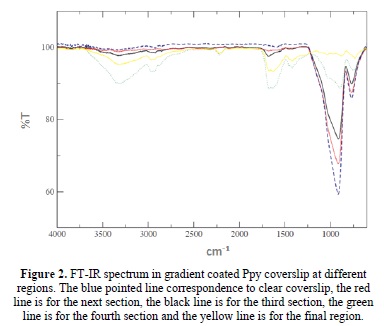
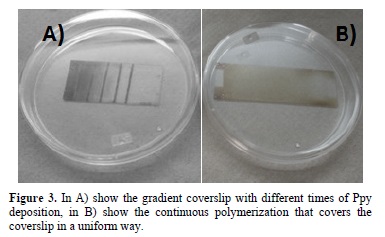
<body><![CDATA[<p>&nbsp;</p>  	    <p align="justify"><font face="verdana" size="2"><b>4. Results and discussion</b></font></p>  	    <p align="justify"><font face="verdana" size="2">The FT&#45;IR spectrum for the control coverslip at 30 watts 30 minutes was presented in previous works, and the values show the vibration of primary amines at 3350cm<sup>&#45;1</sup>, the aliphatic carbons at 2964cm<sup>&#45;1</sup>, the nitrile groups at 2200cm<sup>&#45;1</sup>, at 1624cm<sup>&#45;1</sup>carbonyl groups &#91;8&#93;. <a href="#f2">Figure 2</a> shows the Ppy composition for the different sections of the gradient Ppy coverslip that change along the film thickness direction of the gradient. As show in the peak for the silicates (principal component of glass) at 850 cm<sup>&#45;1</sup> &#91;23&#93;; where the pointed blue line is for the clear glass and the yellow line is for the largest reaction time. The silicate peak absorbance, decrease in function of exposure time. The better culture regions show a largest aliphatic and primary amines peaks which are presents in the second, third and fourth increase exposure regions that correspondence to red, black and green lines. We suppose that those chemical groups increase the cellular adhesion and eventually the proliferation.</font></p>  	    <p align="center"><font face="verdana" size="2"><a name="f2"></a></font></p>  	    <p align="center"><font face="verdana" size="2"><img src="/img/revistas/sv/v27n1/a5f2.jpg"></font></p>  	    <p align="justify"><font face="verdana" size="2"><a href="#f3">Figure 3</a> shows the results of the polymerization in the surface of the coverslips, been the principal indicator of the Ppy thin film, the brown color; this film cover all the structure in a way that depends of the time exposure. When the regions and the exposure time were controlled the coverslip shows a concentration gradient showed on the thickness of the Ppy.</font></p>  	    <p align="center"><font face="verdana" size="2"><a name="f3"></a></font></p>  	    <p align="center"><font face="verdana" size="2"><img src="/img/revistas/sv/v27n1/a5f3.jpg"></font></p>  	    <p align="justify"><font face="verdana" size="2">In previous experiments the film thicknesses were characterized in base of the exposure time of the coverslips and they were correlated with the cell viability and their physiology, in base of these results we obtain a coverslip where we control the cell proliferation by regions with different Ppy concentrations. Because the stellate cell plays a scaffold role in the liver coculture and the extracellular matrix don't have a specific protein to measure, we decide to measure the total protein secreted to the supernatant.</font></p>  	    <p align="justify"><font face="verdana" size="2">The comparison of stellate cell cultures, using the coverslips with Ppy and the gradient coat was done, 5x10<sup>5</sup> cells by coverslip were used; passage 5; with 15 ml of culture medium for 5 days in a CO2 incubator.</font></p>  	    ]]></body>
<body><![CDATA[<p align="justify"><font face="verdana" size="2"><a href="#f4">Figure 4</a> shows, the cell culture on continuous coverslip (A) with a uniform cell distribution, and the cell culture on the gradient coverslip from the bigger to the lower Ppy deposition (B to F); the proliferation increases in the central zones, the typical cell shape in the scaffold is marked in a black circle.</font></p>  	    <p align="center"><font face="verdana" size="2"><a name="f4"></a></font></p>  	    <p align="center"><font face="verdana" size="2"><img src="/img/revistas/sv/v27n1/a5f4.jpg"></font></p>  	    <p align="justify"><font face="verdana" size="2">To probe the cellular distribution in the gradient surface at day 5, the cells were marked with Hoetscht stain to identify the cell nucleus. <a href="#f5">Figure 5</a> shows the photographs of the stained cells with the fluorescent marker (A to F), it shows the cellular distribution on the gradient scaffold from less to greater concentration of Ppy, the dyed cells are shown in cyan color. G Shows the cellular distribution on the continuous Ppy coverslip, there are clusters of dyed cells in the entire surface.</font></p>  	    <p align="center"><font face="verdana" size="2"><a name="f5"></a></font></p>  	    <p align="center"><font face="verdana" size="2"><img src="/img/revistas/sv/v27n1/a5f5.jpg"></font></p>  	    <p align="justify"><font face="verdana" size="2">In the gradient coverslip the cells prefer the central places to proliferate and it decrease in function of either lower or larger concentration of Ppy, since the F sample shows only 2 cells in the caption, the central regions have a similar concentration of Ppy as the continuous coverslip.</font></p>  	    <p align="justify"><font face="verdana" size="2">The cell adhesion, commonly known as; a direct reflection of the amount of Ppy functionalities on the surface of materials, did not correspond to the higher deposition time or to the thicker plasma polymerized thin film. We didn't observed morphological differences between the coated surfaces.</font></p>  	    <p align="justify"><font face="verdana" size="2"><a href="#f6">Figure 6</a> show the total protein rate in the supernatant of the cell culture medium. In the figure, the black squares line, represents the change of protein secretion in the medium after 5 days of culture on the gradient coverslip. The white squares line shows the total protein secretion in the continuous coverslip. As it can be seen, there is no significant difference in the two experiments.</font></p>  	    <p align="center"><font face="verdana" size="2"><a name="f6"></a></font></p>  	    ]]></body>
<body><![CDATA[<p align="center"><font face="verdana" size="2"><img src="/img/revistas/sv/v27n1/a5f6.jpg"></font></p>  	    <p align="justify"><font face="verdana" size="2">Also, we analyzed the whole supernatant protein secreted, the results show similar values in the secreted protein when we used the Ppy gradient in comparison to the continuous surface, we obtained maximums of 14 &#956; g/ml with no significant differences. That suggests that the cell physiology is strongly linked to the cell distribution.</font></p>  	    <p>&nbsp;</p>  	    <p align="justify"><font face="verdana" size="2"><b>5. Conclusion</b></font></p>  	    <p align="justify"><font face="verdana" size="2">In this work is describing a novel method to fabricate plasma polymer gradients by using a tilted mask to control the concentration of plasma in the substrate. By forming a gradient layer of Ppy film, we created a chemical gradient surface suitable to examine the effect of cell proliferation and spreading on stellate cells protein secretion. The cells colony and morphology correlated with the continuous coverslip as show in the nucleus cell markers photographs. Cell protein response was similar in both experiments that show a comfortable surface for the cells. In conclusion we obtain a Ppy surface that models the conditions of chemoattractant surface to obtain a controlled cell culture.</font></p>  	    <p>&nbsp;</p>  	    <p align="justify"><font face="verdana" size="2"><b>Acknowledgements</b></font></p>  	    <p align="justify"><font face="verdana" size="2">The authors would like to thanks to Universidad Autonoma Metropolitana (UAM), Consejo Nacional de Ciencia y Tecnologia (CONACYT) (project 155239) and Instituto de Ciencia Y Tecnologia Del D.F. (ICyT&#45;DF) (PIUTE 10&#45;63276/2010) y (PICSA 11&#45;14/2011), for their collaboration to bring to perform this work.</font></p>  	    <p>&nbsp;</p>  	    <p align="justify"><font face="verdana" size="2"><b>References</b></font></p>  	    ]]></body>
<body><![CDATA[<!-- ref --><p align="justify"><font face="verdana" size="2">&#91;1&#93;&nbsp;R. I. Freshney, Culture of Animal Cells, a Manual of Basic Technique, Chapter 12, Subculture and Cell Lines 6th Ed. (Hoboken NJ, John Wiley &amp; Sons, 2011) p. 187&#45;206.    &nbsp;&nbsp;&nbsp;&nbsp;&nbsp;&nbsp;&nbsp;&nbsp;[&#160;<a href="javascript:void(0);" onclick="javascript: window.open('/scielo.php?script=sci_nlinks&ref=9703326&pid=S1665-3521201400010000500001&lng=','','width=640,height=500,resizable=yes,scrollbars=1,menubar=yes,');">Links</a>&#160;]<!-- end-ref --></font></p>  	    <!-- ref --><p align="justify"><font face="verdana" size="2">&#91;2&#93; M. Bokhari, R. Carnachan, N. Cameron and S. PrzyborskiJ. Anat. <b>211,</b> 567 (2007).    &nbsp;&nbsp;&nbsp;&nbsp;&nbsp;&nbsp;&nbsp;&nbsp;[&#160;<a href="javascript:void(0);" onclick="javascript: window.open('/scielo.php?script=sci_nlinks&ref=9703328&pid=S1665-3521201400010000500002&lng=','','width=640,height=500,resizable=yes,scrollbars=1,menubar=yes,');">Links</a>&#160;]<!-- end-ref --></font></p>  	    <!-- ref --><p align="justify"><font face="verdana" size="2">&#91;3&#93; M Geetha., A.K. Singh, R. Asokamani, A.K. Gogia, Progress in Materials Science <b>54,</b> 397 (2009)</font>&nbsp;&nbsp;&nbsp;&nbsp;&nbsp;&nbsp;&nbsp;&nbsp;[&#160;<a href="javascript:void(0);" onclick="javascript: window.open('/scielo.php?script=sci_nlinks&ref=9703330&pid=S1665-3521201400010000500003&lng=','','width=640,height=500,resizable=yes,scrollbars=1,menubar=yes,');">Links</a>&#160;]<!-- end-ref --><!-- ref --><p align="justify"><font face="verdana" size="2">&#91;4&#93; R.P. Lanza, R. Langer, J. Vacanti, Principles of tissue engineering. (Ed.Academic Press. 2000) p.215&#45;289</font>&nbsp;&nbsp;&nbsp;&nbsp;&nbsp;&nbsp;&nbsp;&nbsp;[&#160;<a href="javascript:void(0);" onclick="javascript: window.open('/scielo.php?script=sci_nlinks&ref=9703331&pid=S1665-3521201400010000500004&lng=','','width=640,height=500,resizable=yes,scrollbars=1,menubar=yes,');">Links</a>&#160;]<!-- end-ref --><!-- ref --><p align="justify"><font face="verdana" size="2">&#91;5&#93; S. R.Moosvi, R.M. Day, ActaBiomaterialia, <b>5,</b> 76 (2009).    &nbsp;&nbsp;&nbsp;&nbsp;&nbsp;&nbsp;&nbsp;&nbsp;[&#160;<a href="javascript:void(0);" onclick="javascript: window.open('/scielo.php?script=sci_nlinks&ref=9703332&pid=S1665-3521201400010000500005&lng=','','width=640,height=500,resizable=yes,scrollbars=1,menubar=yes,');">Links</a>&#160;]<!-- end-ref --></font></p>  	    <!-- ref --><p align="justify"><font face="verdana" size="2">&#91;6&#93; Y.Shoufeng, L. Kah&#45;Fai, D. Zhaohui, C. Chee&#45;Kai, Tissue Engineering, <b>7,</b> 679 (2001).    &nbsp;&nbsp;&nbsp;&nbsp;&nbsp;&nbsp;&nbsp;&nbsp;[&#160;<a href="javascript:void(0);" onclick="javascript: window.open('/scielo.php?script=sci_nlinks&ref=9703334&pid=S1665-3521201400010000500006&lng=','','width=640,height=500,resizable=yes,scrollbars=1,menubar=yes,');">Links</a>&#160;]<!-- end-ref --></font></p>  	    ]]></body>
<body><![CDATA[<!-- ref --><p align="justify"><font face="verdana" size="2">&#91;7&#93; G. Cruz, R. Mondragon&#45;Lozano, A. Diaz&#45;Ruiz, J. Manjarrez, R. Olayo, H. Salgado&#45;Ceballos, M.G. Olayo, J. Morales Journal of Materials Science:Materials in Medicine. <b>23,</b> 2583 (2012).    &nbsp;&nbsp;&nbsp;&nbsp;&nbsp;&nbsp;&nbsp;&nbsp;[&#160;<a href="javascript:void(0);" onclick="javascript: window.open('/scielo.php?script=sci_nlinks&ref=9703336&pid=S1665-3521201400010000500007&lng=','','width=640,height=500,resizable=yes,scrollbars=1,menubar=yes,');">Links</a>&#160;]<!-- end-ref --></font></p>  	    <!-- ref --><p align="justify"><font face="verdana" size="2">&#91;8&#93; Cruz G.J, Morales J., Olayo R. Thin solid Films <b>342,</b> 119(1999).    &nbsp;&nbsp;&nbsp;&nbsp;&nbsp;&nbsp;&nbsp;&nbsp;[&#160;<a href="javascript:void(0);" onclick="javascript: window.open('/scielo.php?script=sci_nlinks&ref=9703338&pid=S1665-3521201400010000500008&lng=','','width=640,height=500,resizable=yes,scrollbars=1,menubar=yes,');">Links</a>&#160;]<!-- end-ref --></font></p>  	    <!-- ref --><p align="justify"><font face="verdana" size="2">&#91;9&#93; H. Biederman,,D. Slavinska, Surface and Coatings Technology <b>125,</b> 371 (2000)</font>&nbsp;&nbsp;&nbsp;&nbsp;&nbsp;&nbsp;&nbsp;&nbsp;[&#160;<a href="javascript:void(0);" onclick="javascript: window.open('/scielo.php?script=sci_nlinks&ref=9703340&pid=S1665-3521201400010000500009&lng=','','width=640,height=500,resizable=yes,scrollbars=1,menubar=yes,');">Links</a>&#160;]<!-- end-ref --><!-- ref --><p align="justify"><font face="verdana" size="2">&#91;10&#93; O.Ramirez&#45;Fernandez, R. Godinez, J. Morales, L. G&oacute;mez&#45;Quiroz, M.C. Guti&eacute;rrez&#45;Ruiz, E. Zu&ntilde;iga&#45;Aguilar, R. Olayo, Revista Mexicana de Ingenieria Biomedica <b>33,</b> 2 (2012).    &nbsp;&nbsp;&nbsp;&nbsp;&nbsp;&nbsp;&nbsp;&nbsp;[&#160;<a href="javascript:void(0);" onclick="javascript: window.open('/scielo.php?script=sci_nlinks&ref=9703341&pid=S1665-3521201400010000500010&lng=','','width=640,height=500,resizable=yes,scrollbars=1,menubar=yes,');">Links</a>&#160;]<!-- end-ref --></font></p>  	    <!-- ref --><p align="justify"><font face="verdana" size="2">&#91;11&#93;&nbsp;Harding F. "Assessing embryonic stem cell response to surface chemistry using plasma polymer gradients" ActaBiomaterialia <b>8,</b> 1739 (2012).    &nbsp;&nbsp;&nbsp;&nbsp;&nbsp;&nbsp;&nbsp;&nbsp;[&#160;<a href="javascript:void(0);" onclick="javascript: window.open('/scielo.php?script=sci_nlinks&ref=9703343&pid=S1665-3521201400010000500011&lng=','','width=640,height=500,resizable=yes,scrollbars=1,menubar=yes,');">Links</a>&#160;]<!-- end-ref --></font></p>  	    <!-- ref --><p align="justify"><font face="verdana" size="2">&#91;12&#93; I. Gancarz, G. Pozniak, M. Bryjak, W. Tylus, Eur. Polym. J. <b>38,</b> 1937 (2002).    &nbsp;&nbsp;&nbsp;&nbsp;&nbsp;&nbsp;&nbsp;&nbsp;[&#160;<a href="javascript:void(0);" onclick="javascript: window.open('/scielo.php?script=sci_nlinks&ref=9703345&pid=S1665-3521201400010000500012&lng=','','width=640,height=500,resizable=yes,scrollbars=1,menubar=yes,');">Links</a>&#160;]<!-- end-ref --></font></p>  	    <!-- ref --><p align="justify"><font face="verdana" size="2">&#91;13&#93; G. Pozniak, I. Gancarz, M. Bryjak, W. Tylus, Desalination <b>146,</b> 293 (2002).    &nbsp;&nbsp;&nbsp;&nbsp;&nbsp;&nbsp;&nbsp;&nbsp;[&#160;<a href="javascript:void(0);" onclick="javascript: window.open('/scielo.php?script=sci_nlinks&ref=9703347&pid=S1665-3521201400010000500013&lng=','','width=640,height=500,resizable=yes,scrollbars=1,menubar=yes,');">Links</a>&#160;]<!-- end-ref --></font></p>  	    <!-- ref --><p align="justify"><font face="verdana" size="2">&#91;14&#93; F. Truica&#45;Marasescu, M.R. Wertheimer, Plasma Process. Polym. <b>5,</b> 44 (2008).    &nbsp;&nbsp;&nbsp;&nbsp;&nbsp;&nbsp;&nbsp;&nbsp;[&#160;<a href="javascript:void(0);" onclick="javascript: window.open('/scielo.php?script=sci_nlinks&ref=9703349&pid=S1665-3521201400010000500014&lng=','','width=640,height=500,resizable=yes,scrollbars=1,menubar=yes,');">Links</a>&#160;]<!-- end-ref --></font></p>  	    <!-- ref --><p align="justify"><font face="verdana" size="2">&#91;15&#93; J. Xu, K.K. Gleason, Chem. Mater. <b>22,</b> 1732 (2010).    &nbsp;&nbsp;&nbsp;&nbsp;&nbsp;&nbsp;&nbsp;&nbsp;[&#160;<a href="javascript:void(0);" onclick="javascript: window.open('/scielo.php?script=sci_nlinks&ref=9703351&pid=S1665-3521201400010000500015&lng=','','width=640,height=500,resizable=yes,scrollbars=1,menubar=yes,');">Links</a>&#160;]<!-- end-ref --></font></p>  	    <!-- ref --><p align="justify"><font face="verdana" size="2">&#91;16&#93; J.L. Baher, J. Yang, D.V. Kosynkin, M.J. Bronikowski, R.E. Smalley, J.M. Tour, J. Am.Chem. Soc. <b>123,</b> 6536 (2001).    &nbsp;&nbsp;&nbsp;&nbsp;&nbsp;&nbsp;&nbsp;&nbsp;[&#160;<a href="javascript:void(0);" onclick="javascript: window.open('/scielo.php?script=sci_nlinks&ref=9703353&pid=S1665-3521201400010000500016&lng=','','width=640,height=500,resizable=yes,scrollbars=1,menubar=yes,');">Links</a>&#160;]<!-- end-ref --></font></p>  	    <!-- ref --><p align="justify"><font face="verdana" size="2">&#91;17&#93; D. Mangindaan, W. Kuo, C. Chang, S. Wang, H. Liu, M. Wang, Surface &amp; Coatings Technology <b>206,</b> 1299 (2011).    &nbsp;&nbsp;&nbsp;&nbsp;&nbsp;&nbsp;&nbsp;&nbsp;[&#160;<a href="javascript:void(0);" onclick="javascript: window.open('/scielo.php?script=sci_nlinks&ref=9703355&pid=S1665-3521201400010000500017&lng=','','width=640,height=500,resizable=yes,scrollbars=1,menubar=yes,');">Links</a>&#160;]<!-- end-ref --></font></p>  	    <!-- ref --><p align="justify"><font face="verdana" size="2">&#91;18&#93; L.&#45;Q. Chu, W. Knoll, R. F&ouml;rch, Langmuir <b>22,</b> 5548 (2006).    &nbsp;&nbsp;&nbsp;&nbsp;&nbsp;&nbsp;&nbsp;&nbsp;[&#160;<a href="javascript:void(0);" onclick="javascript: window.open('/scielo.php?script=sci_nlinks&ref=9703357&pid=S1665-3521201400010000500018&lng=','','width=640,height=500,resizable=yes,scrollbars=1,menubar=yes,');">Links</a>&#160;]<!-- end-ref --></font></p>  	    <!-- ref --><p align="justify"><font face="verdana" size="2">&#91;19&#93; A.J. Choudhury, J. Chutia, H. Kakati, S.A. Barve, A.R. Pal, N.S. Sarma, D. Chowdhury,D.S. Patil, Vacuum <b>84,</b> 1327 (2010).    &nbsp;&nbsp;&nbsp;&nbsp;&nbsp;&nbsp;&nbsp;&nbsp;[&#160;<a href="javascript:void(0);" onclick="javascript: window.open('/scielo.php?script=sci_nlinks&ref=9703359&pid=S1665-3521201400010000500019&lng=','','width=640,height=500,resizable=yes,scrollbars=1,menubar=yes,');">Links</a>&#160;]<!-- end-ref --></font></p>  	    <!-- ref --><p align="justify"><font face="verdana" size="2">&#91;20&#93; L. Denis, D. Thiry, D. Cossement, P. Gerbaux, F. Brusciotti, I. Van De Keere, V.Goossens, H. Terryn, M. Hecq, R. Snyders, Prog. Org. Coat. <b>70,</b> 134 (2011).    &nbsp;&nbsp;&nbsp;&nbsp;&nbsp;&nbsp;&nbsp;&nbsp;[&#160;<a href="javascript:void(0);" onclick="javascript: window.open('/scielo.php?script=sci_nlinks&ref=9703361&pid=S1665-3521201400010000500020&lng=','','width=640,height=500,resizable=yes,scrollbars=1,menubar=yes,');">Links</a>&#160;]<!-- end-ref --></font></p>  	    <!-- ref --><p align="justify"><font face="verdana" size="2">&#91;21&#93; D. Mangindaan, W.&#45;H. Kuo, Y.&#45;L.Wang, M.&#45;J. Wang, (Plasma Process. Polym. San Diago CA, pp. 7754 2010).    &nbsp;&nbsp;&nbsp;&nbsp;&nbsp;&nbsp;&nbsp;&nbsp;[&#160;<a href="javascript:void(0);" onclick="javascript: window.open('/scielo.php?script=sci_nlinks&ref=9703363&pid=S1665-3521201400010000500021&lng=','','width=640,height=500,resizable=yes,scrollbars=1,menubar=yes,');">Links</a>&#160;]<!-- end-ref --></font></p>  	    <!-- ref --><p align="justify"><font face="verdana" size="2">&#91;22&#93; A. Choukourov, H. Biederman, I. Kholodkov, D. Slavinska, M. Trchova, A. Hollander, J.Appl. Polym. Sci. <b>92,</b> 979 (2004).    &nbsp;&nbsp;&nbsp;&nbsp;&nbsp;&nbsp;&nbsp;&nbsp;[&#160;<a href="javascript:void(0);" onclick="javascript: window.open('/scielo.php?script=sci_nlinks&ref=9703365&pid=S1665-3521201400010000500022&lng=','','width=640,height=500,resizable=yes,scrollbars=1,menubar=yes,');">Links</a>&#160;]<!-- end-ref --></font></p>  	    <!-- ref --><p align="justify"><font face="verdana" size="2">&#91;23&#93; Xia L., Xiupeng W., Dannong H. and Jianlin S., J. Mater. Chem., <b>18,</b> 4103 (2008).    &nbsp;&nbsp;&nbsp;&nbsp;&nbsp;&nbsp;&nbsp;&nbsp;[&#160;<a href="javascript:void(0);" onclick="javascript: window.open('/scielo.php?script=sci_nlinks&ref=9703367&pid=S1665-3521201400010000500023&lng=','','width=640,height=500,resizable=yes,scrollbars=1,menubar=yes,');">Links</a>&#160;]<!-- end-ref --></font></p>      ]]></body><back>
<ref-list>
<ref id="B1">
<label>1</label><nlm-citation citation-type="book">
<person-group person-group-type="author">
<name>
<surname><![CDATA[Freshney]]></surname>
<given-names><![CDATA[R. I.]]></given-names>
</name>
</person-group>
<source><![CDATA[Culture of Animal Cells, a Manual of Basic Technique, Chapter 12, Subculture and Cell Lines]]></source>
<year>2011</year>
<edition>6th</edition>
<page-range>187-206</page-range><publisher-loc><![CDATA[Hoboken^eNJ NJ]]></publisher-loc>
<publisher-name><![CDATA[John Wiley & Sons]]></publisher-name>
</nlm-citation>
</ref>
<ref id="B2">
<label>2</label><nlm-citation citation-type="journal">
<person-group person-group-type="author">
<name>
<surname><![CDATA[Bokhari]]></surname>
<given-names><![CDATA[M.]]></given-names>
</name>
<name>
<surname><![CDATA[Carnachan]]></surname>
<given-names><![CDATA[R.]]></given-names>
</name>
<name>
<surname><![CDATA[Cameron]]></surname>
<given-names><![CDATA[N.]]></given-names>
</name>
<name>
<surname><![CDATA[PrzyborskiJ]]></surname>
<given-names><![CDATA[S.]]></given-names>
</name>
</person-group>
<source><![CDATA[Anat.]]></source>
<year>2007</year>
<volume>211</volume>
<page-range>567</page-range></nlm-citation>
</ref>
<ref id="B3">
<label>3</label><nlm-citation citation-type="journal">
<person-group person-group-type="author">
<name>
<surname><![CDATA[Geetha]]></surname>
<given-names><![CDATA[M]]></given-names>
</name>
<name>
<surname><![CDATA[Singh]]></surname>
<given-names><![CDATA[A.K.]]></given-names>
</name>
<name>
<surname><![CDATA[Asokamani]]></surname>
<given-names><![CDATA[R.]]></given-names>
</name>
<name>
<surname><![CDATA[Gogia]]></surname>
<given-names><![CDATA[A.K.]]></given-names>
</name>
</person-group>
<source><![CDATA[Progress in Materials Science]]></source>
<year>2009</year>
<volume>54</volume>
<page-range>397</page-range></nlm-citation>
</ref>
<ref id="B4">
<label>4</label><nlm-citation citation-type="book">
<person-group person-group-type="author">
<name>
<surname><![CDATA[Lanza]]></surname>
<given-names><![CDATA[R.P.]]></given-names>
</name>
<name>
<surname><![CDATA[Langer]]></surname>
<given-names><![CDATA[R.]]></given-names>
</name>
<name>
<surname><![CDATA[Vacanti]]></surname>
<given-names><![CDATA[J.]]></given-names>
</name>
</person-group>
<source><![CDATA[Principles of tissue engineering]]></source>
<year>2000</year>
<page-range>215-289</page-range><publisher-name><![CDATA[Ed.Academic Press]]></publisher-name>
</nlm-citation>
</ref>
<ref id="B5">
<label>5</label><nlm-citation citation-type="journal">
<person-group person-group-type="author">
<name>
<surname><![CDATA[Moosvi]]></surname>
<given-names><![CDATA[S. R.]]></given-names>
</name>
<name>
<surname><![CDATA[Day]]></surname>
<given-names><![CDATA[R.M.]]></given-names>
</name>
</person-group>
<source><![CDATA[ActaBiomaterialia]]></source>
<year>2009</year>
<volume>5</volume>
<page-range>76</page-range></nlm-citation>
</ref>
<ref id="B6">
<label>6</label><nlm-citation citation-type="journal">
<person-group person-group-type="author">
<name>
<surname><![CDATA[Shoufeng]]></surname>
<given-names><![CDATA[Y.]]></given-names>
</name>
<name>
<surname><![CDATA[Kah-Fai]]></surname>
<given-names><![CDATA[L.]]></given-names>
</name>
<name>
<surname><![CDATA[Zhaohui]]></surname>
<given-names><![CDATA[D.]]></given-names>
</name>
<name>
<surname><![CDATA[Chee-Kai]]></surname>
<given-names><![CDATA[C.]]></given-names>
</name>
</person-group>
<source><![CDATA[Tissue Engineering]]></source>
<year>2001</year>
<volume>7</volume>
<page-range>679</page-range></nlm-citation>
</ref>
<ref id="B7">
<label>7</label><nlm-citation citation-type="journal">
<person-group person-group-type="author">
<name>
<surname><![CDATA[Cruz]]></surname>
<given-names><![CDATA[G.]]></given-names>
</name>
<name>
<surname><![CDATA[Mondragon-Lozano]]></surname>
<given-names><![CDATA[R.]]></given-names>
</name>
<name>
<surname><![CDATA[Diaz-Ruiz]]></surname>
<given-names><![CDATA[A.]]></given-names>
</name>
<name>
<surname><![CDATA[Manjarrez]]></surname>
<given-names><![CDATA[J.]]></given-names>
</name>
<name>
<surname><![CDATA[Olayo]]></surname>
<given-names><![CDATA[R.]]></given-names>
</name>
<name>
<surname><![CDATA[Salgado-Ceballos]]></surname>
<given-names><![CDATA[H.]]></given-names>
</name>
<name>
<surname><![CDATA[Olayo]]></surname>
<given-names><![CDATA[M.G.]]></given-names>
</name>
<name>
<surname><![CDATA[Morales]]></surname>
<given-names><![CDATA[J.]]></given-names>
</name>
</person-group>
<source><![CDATA[Journal of Materials Science:Materials in Medicine]]></source>
<year>2012</year>
<volume>23</volume>
<page-range>2583</page-range></nlm-citation>
</ref>
<ref id="B8">
<label>8</label><nlm-citation citation-type="journal">
<person-group person-group-type="author">
<name>
<surname><![CDATA[Cruz]]></surname>
<given-names><![CDATA[G.J]]></given-names>
</name>
<name>
<surname><![CDATA[Morales]]></surname>
<given-names><![CDATA[J.]]></given-names>
</name>
<name>
<surname><![CDATA[Olayo]]></surname>
<given-names><![CDATA[R.]]></given-names>
</name>
</person-group>
<source><![CDATA[Thin solid Films]]></source>
<year>1999</year>
<volume>342</volume>
<page-range>119</page-range></nlm-citation>
</ref>
<ref id="B9">
<label>9</label><nlm-citation citation-type="journal">
<person-group person-group-type="author">
<name>
<surname><![CDATA[Biederman]]></surname>
<given-names><![CDATA[H.]]></given-names>
</name>
<name>
<surname><![CDATA[Slavinska]]></surname>
<given-names><![CDATA[D.]]></given-names>
</name>
</person-group>
<source><![CDATA[Surface and Coatings Technology]]></source>
<year>2000</year>
<volume>125</volume>
<page-range>371</page-range></nlm-citation>
</ref>
<ref id="B10">
<label>10</label><nlm-citation citation-type="journal">
<person-group person-group-type="author">
<name>
<surname><![CDATA[Ramirez-Fernandez]]></surname>
<given-names><![CDATA[O.]]></given-names>
</name>
<name>
<surname><![CDATA[Godinez]]></surname>
<given-names><![CDATA[R.]]></given-names>
</name>
<name>
<surname><![CDATA[Morales]]></surname>
<given-names><![CDATA[J.]]></given-names>
</name>
<name>
<surname><![CDATA[Gómez-Quiroz]]></surname>
<given-names><![CDATA[L.]]></given-names>
</name>
<name>
<surname><![CDATA[Gutiérrez-Ruiz]]></surname>
<given-names><![CDATA[M.C.]]></given-names>
</name>
<name>
<surname><![CDATA[Zuñiga-Aguilar]]></surname>
<given-names><![CDATA[E.]]></given-names>
</name>
<name>
<surname><![CDATA[Olayo]]></surname>
<given-names><![CDATA[R.]]></given-names>
</name>
</person-group>
<source><![CDATA[Revista Mexicana de Ingenieria Biomedica]]></source>
<year>2012</year>
<volume>33</volume>
<page-range>2</page-range></nlm-citation>
</ref>
<ref id="B11">
<label>11</label><nlm-citation citation-type="journal">
<person-group person-group-type="author">
<name>
<surname><![CDATA[Harding]]></surname>
<given-names><![CDATA[F.]]></given-names>
</name>
</person-group>
<article-title xml:lang="en"><![CDATA[Assessing embryonic stem cell response to surface chemistry using plasma polymer gradients]]></article-title>
<source><![CDATA[ActaBiomaterialia]]></source>
<year>2012</year>
<volume>8</volume>
<page-range>1739</page-range></nlm-citation>
</ref>
<ref id="B12">
<label>12</label><nlm-citation citation-type="journal">
<person-group person-group-type="author">
<name>
<surname><![CDATA[Gancarz]]></surname>
<given-names><![CDATA[I.]]></given-names>
</name>
<name>
<surname><![CDATA[Pozniak]]></surname>
<given-names><![CDATA[G.]]></given-names>
</name>
<name>
<surname><![CDATA[Bryjak]]></surname>
<given-names><![CDATA[M.]]></given-names>
</name>
<name>
<surname><![CDATA[Tylus]]></surname>
<given-names><![CDATA[W.]]></given-names>
</name>
</person-group>
<source><![CDATA[Eur. Polym. J.]]></source>
<year>2002</year>
<volume>38</volume>
<page-range>1937</page-range></nlm-citation>
</ref>
<ref id="B13">
<label>13</label><nlm-citation citation-type="journal">
<person-group person-group-type="author">
<name>
<surname><![CDATA[Pozniak]]></surname>
<given-names><![CDATA[G.]]></given-names>
</name>
<name>
<surname><![CDATA[Gancarz]]></surname>
<given-names><![CDATA[I.]]></given-names>
</name>
<name>
<surname><![CDATA[Bryjak]]></surname>
<given-names><![CDATA[M.]]></given-names>
</name>
<name>
<surname><![CDATA[Tylus]]></surname>
<given-names><![CDATA[W.]]></given-names>
</name>
</person-group>
<source><![CDATA[Desalination]]></source>
<year>2002</year>
<volume>146</volume>
<page-range>293</page-range></nlm-citation>
</ref>
<ref id="B14">
<label>14</label><nlm-citation citation-type="journal">
<person-group person-group-type="author">
<name>
<surname><![CDATA[Truica-Marasescu]]></surname>
<given-names><![CDATA[F.]]></given-names>
</name>
<name>
<surname><![CDATA[Wertheimer]]></surname>
<given-names><![CDATA[M.R.]]></given-names>
</name>
</person-group>
<source><![CDATA[Plasma Process. Polym.]]></source>
<year>2008</year>
<volume>5</volume>
<page-range>44</page-range></nlm-citation>
</ref>
<ref id="B15">
<label>15</label><nlm-citation citation-type="journal">
<person-group person-group-type="author">
<name>
<surname><![CDATA[Xu]]></surname>
<given-names><![CDATA[J.]]></given-names>
</name>
<name>
<surname><![CDATA[Gleason]]></surname>
<given-names><![CDATA[K.K.]]></given-names>
</name>
</person-group>
<source><![CDATA[Chem. Mater.]]></source>
<year>2010</year>
<volume>22</volume>
<page-range>1732</page-range></nlm-citation>
</ref>
<ref id="B16">
<label>16</label><nlm-citation citation-type="journal">
<person-group person-group-type="author">
<name>
<surname><![CDATA[Baher]]></surname>
<given-names><![CDATA[J.L.]]></given-names>
</name>
<name>
<surname><![CDATA[Yang]]></surname>
<given-names><![CDATA[J.]]></given-names>
</name>
<name>
<surname><![CDATA[Kosynkin]]></surname>
<given-names><![CDATA[D.V.]]></given-names>
</name>
<name>
<surname><![CDATA[Bronikowski]]></surname>
<given-names><![CDATA[M.J.]]></given-names>
</name>
<name>
<surname><![CDATA[Smalley]]></surname>
<given-names><![CDATA[R.E.]]></given-names>
</name>
<name>
<surname><![CDATA[Tour]]></surname>
<given-names><![CDATA[J.M.]]></given-names>
</name>
</person-group>
<source><![CDATA[J. Am.Chem. Soc.]]></source>
<year>2001</year>
<volume>123</volume>
<page-range>6536</page-range></nlm-citation>
</ref>
<ref id="B17">
<label>17</label><nlm-citation citation-type="journal">
<person-group person-group-type="author">
<name>
<surname><![CDATA[Mangindaan]]></surname>
<given-names><![CDATA[D.]]></given-names>
</name>
<name>
<surname><![CDATA[Kuo]]></surname>
<given-names><![CDATA[W.]]></given-names>
</name>
<name>
<surname><![CDATA[Chang]]></surname>
<given-names><![CDATA[C.]]></given-names>
</name>
<name>
<surname><![CDATA[Wang]]></surname>
<given-names><![CDATA[S.]]></given-names>
</name>
<name>
<surname><![CDATA[Liu]]></surname>
<given-names><![CDATA[H.]]></given-names>
</name>
<name>
<surname><![CDATA[Wang]]></surname>
<given-names><![CDATA[M.]]></given-names>
</name>
</person-group>
<source><![CDATA[Surface & Coatings Technology]]></source>
<year>2011</year>
<volume>206</volume>
<page-range>1299</page-range></nlm-citation>
</ref>
<ref id="B18">
<label>18</label><nlm-citation citation-type="journal">
<person-group person-group-type="author">
<name>
<surname><![CDATA[Chu]]></surname>
<given-names><![CDATA[L.-Q.]]></given-names>
</name>
<name>
<surname><![CDATA[Knoll]]></surname>
<given-names><![CDATA[W.]]></given-names>
</name>
<name>
<surname><![CDATA[Förch]]></surname>
<given-names><![CDATA[R.]]></given-names>
</name>
</person-group>
<source><![CDATA[Langmuir]]></source>
<year>2006</year>
<volume>22</volume>
<page-range>5548</page-range></nlm-citation>
</ref>
<ref id="B19">
<label>19</label><nlm-citation citation-type="journal">
<person-group person-group-type="author">
<name>
<surname><![CDATA[Choudhury]]></surname>
<given-names><![CDATA[A.J.]]></given-names>
</name>
<name>
<surname><![CDATA[Chutia]]></surname>
<given-names><![CDATA[J.]]></given-names>
</name>
<name>
<surname><![CDATA[Kakati]]></surname>
<given-names><![CDATA[H.]]></given-names>
</name>
<name>
<surname><![CDATA[Barve]]></surname>
<given-names><![CDATA[S.A.]]></given-names>
</name>
<name>
<surname><![CDATA[Pal]]></surname>
<given-names><![CDATA[A.R.]]></given-names>
</name>
<name>
<surname><![CDATA[Sarma]]></surname>
<given-names><![CDATA[N.S.]]></given-names>
</name>
<name>
<surname><![CDATA[Chowdhury]]></surname>
<given-names><![CDATA[D.]]></given-names>
</name>
<name>
<surname><![CDATA[Patil]]></surname>
<given-names><![CDATA[D.S.]]></given-names>
</name>
</person-group>
<source><![CDATA[Vacuum]]></source>
<year>2010</year>
<volume>84</volume>
<page-range>1327</page-range></nlm-citation>
</ref>
<ref id="B20">
<label>20</label><nlm-citation citation-type="journal">
<person-group person-group-type="author">
<name>
<surname><![CDATA[Denis]]></surname>
<given-names><![CDATA[L.]]></given-names>
</name>
<name>
<surname><![CDATA[Thiry]]></surname>
<given-names><![CDATA[D.]]></given-names>
</name>
<name>
<surname><![CDATA[Cossement]]></surname>
<given-names><![CDATA[D.]]></given-names>
</name>
<name>
<surname><![CDATA[Gerbaux]]></surname>
<given-names><![CDATA[P.]]></given-names>
</name>
<name>
<surname><![CDATA[Brusciotti]]></surname>
<given-names><![CDATA[F.]]></given-names>
</name>
<name>
<surname><![CDATA[De Keere]]></surname>
<given-names><![CDATA[I. Van]]></given-names>
</name>
<name>
<surname><![CDATA[Goossens]]></surname>
<given-names><![CDATA[V.]]></given-names>
</name>
<name>
<surname><![CDATA[Terryn]]></surname>
<given-names><![CDATA[H.]]></given-names>
</name>
<name>
<surname><![CDATA[Hecq]]></surname>
<given-names><![CDATA[M.]]></given-names>
</name>
<name>
<surname><![CDATA[Snyders]]></surname>
<given-names><![CDATA[R.]]></given-names>
</name>
</person-group>
<source><![CDATA[Prog. Org. Coat.]]></source>
<year>2011</year>
<volume>70</volume>
<page-range>134</page-range></nlm-citation>
</ref>
<ref id="B21">
<label>21</label><nlm-citation citation-type="book">
<person-group person-group-type="author">
<name>
<surname><![CDATA[Mangindaan]]></surname>
<given-names><![CDATA[D.]]></given-names>
</name>
<name>
<surname><![CDATA[Kuo]]></surname>
<given-names><![CDATA[W.-H.]]></given-names>
</name>
<name>
<surname><![CDATA[Wang]]></surname>
<given-names><![CDATA[Y.-L.]]></given-names>
</name>
<name>
<surname><![CDATA[Wang]]></surname>
<given-names><![CDATA[M.-J.]]></given-names>
</name>
</person-group>
<source><![CDATA[]]></source>
<year></year>
<page-range>7754 2010</page-range><publisher-loc><![CDATA[San Diago^eCA CA]]></publisher-loc>
<publisher-name><![CDATA[Plasma Process. Polym.]]></publisher-name>
</nlm-citation>
</ref>
<ref id="B22">
<label>22</label><nlm-citation citation-type="journal">
<person-group person-group-type="author">
<name>
<surname><![CDATA[Choukourov]]></surname>
<given-names><![CDATA[A.]]></given-names>
</name>
<name>
<surname><![CDATA[Biederman]]></surname>
<given-names><![CDATA[H.]]></given-names>
</name>
<name>
<surname><![CDATA[Kholodkov]]></surname>
<given-names><![CDATA[I.]]></given-names>
</name>
<name>
<surname><![CDATA[Slavinska]]></surname>
<given-names><![CDATA[D.]]></given-names>
</name>
<name>
<surname><![CDATA[Trchova]]></surname>
<given-names><![CDATA[M.]]></given-names>
</name>
<name>
<surname><![CDATA[Hollander]]></surname>
<given-names><![CDATA[A.]]></given-names>
</name>
</person-group>
<source><![CDATA[J.Appl. Polym. Sci.]]></source>
<year>2004</year>
<volume>92</volume>
<page-range>979</page-range></nlm-citation>
</ref>
<ref id="B23">
<label>23</label><nlm-citation citation-type="journal">
<person-group person-group-type="author">
<name>
<surname><![CDATA[Xia]]></surname>
<given-names><![CDATA[L.]]></given-names>
</name>
<name>
<surname><![CDATA[Xiupeng]]></surname>
<given-names><![CDATA[W.]]></given-names>
</name>
<name>
<surname><![CDATA[Dannong]]></surname>
<given-names><![CDATA[H.]]></given-names>
</name>
<name>
<surname><![CDATA[Jianlin]]></surname>
<given-names><![CDATA[S.]]></given-names>
</name>
</person-group>
<source><![CDATA[J. Mater. Chem.]]></source>
<year>2008</year>
<volume>18</volume>
<page-range>4103</page-range></nlm-citation>
</ref>
</ref-list>
</back>
</article>