<?xml version="1.0" encoding="ISO-8859-1"?><article xmlns:mml="http://www.w3.org/1998/Math/MathML" xmlns:xlink="http://www.w3.org/1999/xlink" xmlns:xsi="http://www.w3.org/2001/XMLSchema-instance">
<front>
<journal-meta>
<journal-id>1665-2738</journal-id>
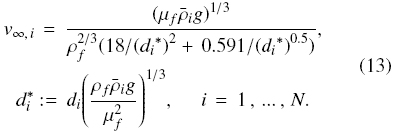
<journal-title><![CDATA[Revista mexicana de ingeniería química]]></journal-title>
<abbrev-journal-title><![CDATA[Rev. Mex. Ing. Quím]]></abbrev-journal-title>
<issn>1665-2738</issn>
<publisher>
<publisher-name><![CDATA[Universidad Autónoma Metropolitana, División de Ciencias Básicas e Ingeniería]]></publisher-name>
</publisher>
</journal-meta>
<article-meta>
<article-id>S1665-27382012000300017</article-id>
<title-group>
<article-title xml:lang="en"><![CDATA[Operation and design of a liquid fluidized bed classifier for polydisperse suspensions of equal-density solid particles through modeling and simulation]]></article-title>
<article-title xml:lang="es"><![CDATA[Operación y diseño de un clasificador de lecho fluidizado líquido para suspensiones polidispersas de partículas sólidas de igual densidad por medio de modelado y simulación]]></article-title>
</title-group>
<contrib-group>
<contrib contrib-type="author">
<name>
<surname><![CDATA[García]]></surname>
<given-names><![CDATA[A.]]></given-names>
</name>
<xref ref-type="aff" rid="A01"/>
</contrib>
<contrib contrib-type="author">
<name>
<surname><![CDATA[López]]></surname>
<given-names><![CDATA[G.]]></given-names>
</name>
</contrib>
</contrib-group>
<aff id="A01">
<institution><![CDATA[,Universidad Católica del Norte Facultad de Ingeniería y Ciencias Geológicas Departamento de Ingeniería Metalúrgica]]></institution>
<addr-line><![CDATA[ ]]></addr-line>
</aff>
<pub-date pub-type="pub">
<day>00</day>
<month>12</month>
<year>2012</year>
</pub-date>
<pub-date pub-type="epub">
<day>00</day>
<month>12</month>
<year>2012</year>
</pub-date>
<volume>11</volume>
<numero>3</numero>
<fpage>513</fpage>
<lpage>532</lpage>
<copyright-statement/>
<copyright-year/>
<self-uri xlink:href="http://www.scielo.org.mx/scielo.php?script=sci_arttext&amp;pid=S1665-27382012000300017&amp;lng=en&amp;nrm=iso"></self-uri><self-uri xlink:href="http://www.scielo.org.mx/scielo.php?script=sci_abstract&amp;pid=S1665-27382012000300017&amp;lng=en&amp;nrm=iso"></self-uri><self-uri xlink:href="http://www.scielo.org.mx/scielo.php?script=sci_pdf&amp;pid=S1665-27382012000300017&amp;lng=en&amp;nrm=iso"></self-uri><abstract abstract-type="short" xml:lang="en"><p><![CDATA[For polydisperse suspensions with equal-density solid particles and continuous particle size distribution, design and operation methodologies of a liquid fluidized bedclassifier (LFBC) ere mtroduced, both based on a modified version of the generalized clarifier-thickener (GCT) model presented by Bürger, García, Karlsen, y Towers (2008) Computers and Chemical Engineering 32, 1181-1202. The LFBC is a special case of the GCT characterized by an upwards-directed flow of liquid at the lower end of the unit. Moreover, a versatile way to discretize the particle size variable for the numerical solution of this equation is presented. Numerical examples illustrate the performance of the model and the effectiveness of design and operation methodologies.]]></p></abstract>
<abstract abstract-type="short" xml:lang="es"><p><![CDATA[Para suspensiones polidispersas de partículas sólidas de la misma densidad y distribución continua de tamaño, se presentan metodologías de diseño y operación de un clasificador de lecho fluidizado líquido (LFBC), ambos basados en una version modificada del modelo del clarificador-espesador generalizado (GCT) presentado por Bürger, García, Karlsen, y Towers (2008) Computers and Chemical Engineering 32, 1181-1202. El LFBC es un caso especial del GCT que se caracteriza por un fluja de líquido dirigido hacia arriba en el extremo inferior de la unidad. Por otra parte, se presenta una forma versátil de discretizar la variable de tamaño de las partículas para la solución numérica de esta ecuación. Ejemplos numéricos ilustran el funcionamiento del modelo y la eficacia de las metodologías de diseño y operación.]]></p></abstract>
<kwd-group>
<kwd lng="en"><![CDATA[suspension]]></kwd>
<kwd lng="en"><![CDATA[fluidization]]></kwd>
<kwd lng="en"><![CDATA[modeling]]></kwd>
<kwd lng="en"><![CDATA[simulation]]></kwd>
<kwd lng="en"><![CDATA[classifier]]></kwd>
<kwd lng="en"><![CDATA[design]]></kwd>
<kwd lng="en"><![CDATA[operation]]></kwd>
<kwd lng="es"><![CDATA[suspensión]]></kwd>
<kwd lng="es"><![CDATA[fluidizacion]]></kwd>
<kwd lng="es"><![CDATA[modelado]]></kwd>
<kwd lng="es"><![CDATA[simulación]]></kwd>
<kwd lng="es"><![CDATA[clasificador]]></kwd>
<kwd lng="es"><![CDATA[diseño]]></kwd>
<kwd lng="es"><![CDATA[operación]]></kwd>
</kwd-group>
</article-meta>
</front><body><![CDATA[  	    <p align="justify"><font face="verdana" size="4">Simulaci&oacute;n y control</font></p>  	    <p align="justify"><font face="verdana" size="2">&nbsp;</font></p>  	    <p align="center"><font face="verdana" size="4"><b>Operation and design of a liquid fluidized bed classifier for polydisperse suspensions of equal&#45;density solid particles through modeling and simulation</b></font></p>  	    <p align="center"><font face="verdana" size="2">&nbsp;</font></p>  	    <p align="center"><font face="verdana" size="3"><b>Operaci&oacute;n y dise&ntilde;o de un clasificador de lecho fluidizado l&iacute;quido para suspensiones polidispersas de part&iacute;culas s&oacute;lidas de igual densidad por medio de modelado y simulaci&oacute;n</b></font></p>  	    <p align="center"><font face="verdana" size="2">&nbsp;</font></p>  	    <p align="center"><font face="verdana" size="2"><b>A. Garc&iacute;a<sup>1,2*</sup> and G. L&oacute;pez<sup>3</sup></b></font></p>  	    <p align="justify"><font face="verdana" size="2">&nbsp;</font></p>  	    <p align="justify"><font face="verdana" size="2"><sup><i>1</i></sup> <i>Departamento de Ingenier&iacute;a Metal&uacute;rgica, Facultad de Ingenier&iacute;a y Ciencias Geol&oacute;gicas, Universidad Cat&oacute;lica del Norte, Antofagasta, Chile.</i> <i>* Corresponding author. E&#45;mail:</i> <a href="mailto:agarcia@ucn.cl">agarcia@ucn.cl</a> <i>56 55 355645; Fax: 56 55 355664</i></font></p>  	    ]]></body>
<body><![CDATA[<p align="justify"><font face="verdana" size="2"><i><sup>2</sup> Centro de Investigaci&oacute;n Cient&iacute;fico Tecnol&oacute;gico para la Miner&iacute;a, CICITEM, Antofagasta, Chile.</i></font></p>  	    <p align="justify"><font face="verdana" size="2"><i><sup>3</sup> Divisi&oacute;n El Salvador, Codelco, Chile.</i></font></p>  	    <p align="justify"><font face="verdana" size="2">&nbsp;</font></p>  	    <p align="justify"><font face="verdana" size="2">Received 13 of September 2011    <br> 	Accepted 4 of June 2012</font></p>  	    <p align="justify"><font face="verdana" size="2">&nbsp;</font></p>  	    <p align="justify"><font face="verdana" size="2"><b>Abstract</b></font></p>  	    <p align="justify"><font face="verdana" size="2">For polydisperse suspensions with equal&#45;density solid particles and continuous particle size distribution, design and operation methodologies of a liquid fluidized bedclassifier (LFBC) ere mtroduced, both based on a modified version of the generalized clarifier&#45;thickener (GCT) model presented by B&uuml;rger, Garc&iacute;a, Karlsen, y Towers (2008) <i>Computers and Chemical Engineering</i> 32, 1181&#45;1202. The LFBC is a special case of the GCT characterized by an upwards&#45;directed flow of liquid at the lower end of the unit. Moreover, a versatile way to discretize the particle size variable for the numerical solution of this equation is presented. Numerical examples illustrate the performance of the model and the effectiveness of design and operation methodologies.</font></p>  	    <p align="justify"><font face="verdana" size="2"><b>Keywords:</b> suspension, fluidization, modeling, simulation, classifier, design, operation.</font></p>  	    <p align="justify"><font face="verdana" size="2">&nbsp;</font></p>  	    ]]></body>
<body><![CDATA[<p align="justify"><font face="verdana" size="2"><b>Resumen</b></font></p>  	    <p align="justify"><font face="verdana" size="2">Para suspensiones polidispersas de part&iacute;culas s&oacute;lidas de la misma densidad y distribuci&oacute;n continua de tama&ntilde;o, se presentan metodolog&iacute;as de dise&ntilde;o y operaci&oacute;n de un clasificador de lecho fluidizado l&iacute;quido (LFBC), ambos basados en una version modificada del modelo del clarificador&#45;espesador generalizado (GCT) presentado por B&uuml;rger, Garc&iacute;a, Karlsen, y Towers (2008) <i>Computers and Chemical Engineering</i> 32, 1181&#45;1202. El LFBC es un caso especial del GCT que se caracteriza por un fluja de l&iacute;quido dirigido hacia arriba en el extremo inferior de la unidad. Por otra parte, se presenta una forma vers&aacute;til de discretizar la variable de tama&ntilde;o de las part&iacute;culas para la soluci&oacute;n num&eacute;rica de esta ecuaci&oacute;n. Ejemplos num&eacute;ricos ilustran el funcionamiento del modelo y la eficacia de las metodolog&iacute;as de dise&ntilde;o y operaci&oacute;n.</font></p>  	    <p align="justify"><font face="verdana" size="2"><b>Palabras clave:</b> suspensi&oacute;n, fluidizacion, modelado, simulaci&oacute;n, clasificador, dise&ntilde;o, operaci&oacute;n.</font></p>  	    <p align="justify"><font face="verdana" size="2">&nbsp;</font></p>  	    <p align="justify"><font face="verdana" size="2"><b>1 Introduction</b></font></p>  	    <p align="justify"><font face="verdana" size="2">Mixtures of disperse solid particles of diverse size and/or density in a fluid, called solid&#45;fluid polydisperse suspensions, are encountered in operations as diverse as mineral processing and food industry, where usually, it is important to group together particles of similar sizes or densities, which is called classification. The classification of particles in solid&#45;liquid systems has been the subject of many theoretical and experimental investigations for several decades.</font></p>  	    <p align="justify"><font face="verdana" size="2">When a polydisperse suspension is subject to sedimentation, particles of different densities and sizes settle at distinct velocities. Consequently, the final sediment consists of several layers of different composition of particles. This form of segregation is known as differential sedimentation, with faster settling species forming the bottom&#45;most layers, and is commonly used to classify particles in industrial processes. For a system consisting of N different sizes, but equal densities, of particles, N zones of settling suspension are formed, with clear liquid above and a sediment layer at the bottom. The lowest zone, just above the early sediment boundary, contains all particle species at their initial concentration, whereas the region immediately above it is devoid of the largest particles. Each successive zone contains one fewer species than the zone below, with the upper zone containing only the smallest particles.</font></p>  	    <p align="justify"><font face="verdana" size="2">The author and collaborators (B&uuml;rger et al., 2008) present a model for continuous separation and classification of polydisperse suspensions, which extends the model of clarifier&#45;thickener (CT) (Berres et al., 2004; B&uuml;rger et al., 2004; Diehl, 2006; Zeidan et al., 2004). The feature is singular sinks describing the continuous discharge of products at several points, whose composition will vary during a transient startup procedure. The well&#45;posedness of the resulting model and the convergence of a numerical scheme for N = 1 are proved by B&uuml;rger et al. (2006). They therein formulate a model for a generalized clarifier&#45;thickener (GCT) setup, which may include several sinks, can be operated as a fluidization column, and is allowed to have a varying cross&#45;sectional area. They also define a numerical scheme for its simulation.</font></p>  	    <p align="justify"><font face="verdana" size="2">Several groups of researchers have conducted experiments with separation devices that are special cases of the GCT setup, and proposed mathematical models for them. Nasr&#45;el&#45;Din et al. (1988; 1990; 1999) study columns for the gravity separation and classification of polydisperse suspensions, that have a feed source at a central depth level and, which are tapped near the top and bottom ends. They also present a mathematical model for the steady&#45;state case only. Experimental results for a similar setup are also presented by Spannenberg et al. (1996). Chen et al. (2002a; 2002b) carry out experiments and develop models of a liquid fluidized&#45;bed classifier for steady state (Chen et al., 2002a) and for the transient case (Chen et al., 2002b). A closely related experimental study is that of Mitsutani et al. (2005).</font></p>  	    <p align="justify"><font face="verdana" size="2">There are many papers about design and operation for separators and classifiers. On design of thickeners with methods based on Kynch's theory exist the papers by Talmage and Fitch (1955), Hassett (1958; 1968), Moncrieff (1963/64), Wilhelm and Naide (1981), Lev et al. (1986), Waters and Galvin (1991), Yong et al . (1996) and&nbsp;Chancelier&nbsp;et&nbsp;al . (1997), see also the reviews by Concha and Barrientos (1993) and Schubert (1998); based on computational fluid dynamics (CFD) and numerical simulation there are the articles of Kahane et al. (2002), Garrido et al. (2003), Martin (2004) and Burgos and Concha (2005). On design of hydrocyclones with empirical models, there are the works by Castilho and Medronho (2000) and Kraipech et al. (2006); and with CFD there are the articles of Olson and Van Ommen (2004), Slack et al. (2003) and Delgadillo and Rajamani (2005a; 2005b; 2007).</font></p>  	    ]]></body>
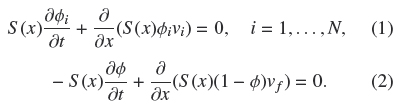
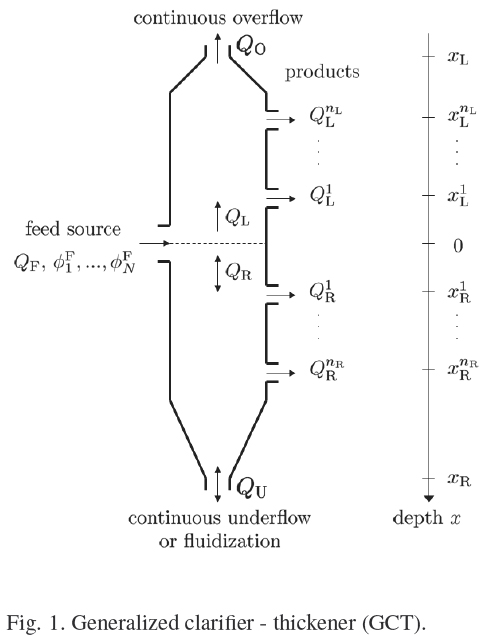
<body><![CDATA[<p align="justify"><font face="verdana" size="2">In this paper, we propose a methodology to design a liquid fluidized bed classifier (LFBC) for suspensions with solid particles of equal&#45;density and continuous particle size distribution, and present a methodology of operation of a LFBC. We also modify the model for continuous separation and classification of polydisperse suspensions proposed by B&uuml;rger et al. (2008), by considering a hindered&#45;settling factor whose exponent depends on the size particle and a continuous formula for that exponent, among others. Moreover, a versatile way to discretize the particle size variable for the numerical solution of this equation is introduced. We present numerical examples, in part adopting data from the literature.</font></p>  	    <p align="justify"><font face="verdana" size="2">&nbsp;</font></p>  	    <p align="justify"><font face="verdana" size="2"><b>2 Mathematical model of polydisperse suspension sedimentation</b></font></p>  	    <p align="justify"><font face="verdana" size="2">Kinematic models are common approximate descriptions for multiphase flows that are essentially one&#45;dimensional, for example in columns and ducts that are aligned with the driving body force. Usually, in these applications one continuous phase (for solidliquid suspensions, the fluid), and N disperse phases (solid species) are distinguished. We here consider polydisperse suspensions with a finite number N of solid particle species, where particles of species i have mean diameter <i>d<sub>i</sub></i> and density <i>&#961;</i><sub><i>i</i></sub>, and <i>d<sub>i</sub></i> <i>&#8225;</i> d<i><sub>j</sub></i> or <i>&#961;</i><sub><i>i</i></sub> <i>&#8225;</i> <i>&#961;</i><sub><i>i</i></sub> for <i>i &#8225; j</i>.</font></p>  	    <p align="justify"><font face="verdana" size="2">Kinematic models are based on the specification of the velocity of each species relative to that of the fluid as a function of the local concentrations of all species.</font></p>  	    <p align="justify"><font face="verdana" size="2">For batch settling, this leads to a strongly coupled system of N nonlinear and spatially one&#45;dimensional scalar conservation laws for the vector &#934;&nbsp;:= (<i>&#934;</i><sub><i>1</i></sub>...,<i>&#934;</i><sub><i>N</i></sub>)<sup><i>T</i></sup> of volume fractions of all species. The extension to a continuously operated clarifier&#45;thickener (CT) unit with a singular feed source leads to a system with an additional transport flux whose velocity is a discontinuous function of the spatial position.</font></p>  	    <p align="justify"><font face="verdana" size="2">A one&#45;dimensional description is adequate, since for small particles in liquid&#45;solid fluidized beds, velocities and compositions are mostly constant on the perpendicular plane to the direction of gravity force. In addition, the model used herein is supposed to form the basis of design and control calculations, for which low computational cost is desirable. This view is implicitly adapted in many engineering treatments of fluidized beds, see for example (Chen et al., 2002a; Chen et al., 2002b; Greenspan and Ungarish, 1982; Kim and Klima, 2004; Nasr&#45;El&#45;Din et al., 1988; Nasr&#45;El&#45;Din et al., 1990; Nasr&#45;El&#45;Din et al., 1999; Zeidan et al., 2004), and other work cited herein.</font></p>  	    <p align="justify"><font face="verdana" size="2">&nbsp;</font></p>  	    <p align="justify"><font face="verdana" size="2"><i>2.1 Model equations</i></font></p>  	    <p align="justify"><font face="verdana" size="2">We consider a vessel as shown in <a href="#f1">Fig. 1</a>. We denote by <i>&#934;</i> : = <i>&#934;</i><sub>1</sub> &#43; ... &#43; <i>&#934;<sub>N</sub></i> the total solids concentration. If <i>V<sub>f</sub></i> is the fluid phase velocity, and <i>S (x</i>) is the crosssectional area of the vessel at depth <i>x (x</i>&#45;axis has the origin at the level of feeding and growing downward), then the one&#45;dimensional continuity equations for the N solids phases can be written as</font></p>  	    ]]></body>
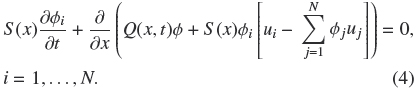
<body><![CDATA[<p align="center"><font face="verdana" size="2"><img src="/img/revistas/rmiq/v11n3/a17e1.jpg"></font></p>  	    <p align="justify"><font face="verdana" size="2">&nbsp;</font></p>  	    <p align="center"><font face="verdana" size="2"><a name="f1"></a></font></p>  	    <p align="center"><font face="verdana" size="2"><img src="/img/revistas/rmiq/v11n3/a17f1.jpg"></font></p>  	    <p align="center"><font face="verdana" size="2">&nbsp;</font></p>  	    <p align="justify"><font face="verdana" size="2">Introducing the volume flow,</font></p>  	    <p align="center"><font face="verdana" size="2"><img src="/img/revistas/rmiq/v11n3/a17e2.jpg"></font></p>  	    <p align="justify"><font face="verdana" size="2">we obtain by adding eqs. (1) and (2) the mixture continuity equation &#8706;Q(x, t)/&#8706;x = 0. Since a constitutive equation will be introduced for the solidfluid relative velocities or slip velocities <i>u<sub>i</sub></i> := <i>v<sub>i</sub></i> &#45; <i>v<sub>f</sub>,,</i> <i>i</i> = 1,..., N , we use Eq. (3) and &#8706;Q(<i>x, t</i>)/&#8706;x = 0 to rewrite Eq. (1) as</font></p>  	    <p align="center"><font face="verdana" size="2"><img src="/img/revistas/rmiq/v11n3/a17e3.jpg"></font></p>  	    <p align="justify"><font face="verdana" size="2">We define the parameters <i>&#948;<sub>i</sub></i> := <i>d<sub>i</sub></i>/<i>d<sub>1</sub></i> and <img src="/img/revistas/rmiq/v11n3/a17e4.jpg">:= <i>&#961;<sub>i</sub></i> &#45; <i>&#961;<sub>f</sub></i> for <i>i</i> = 1,...,N , and <i>&#956;</i> := <i>gd<sub>1</sub></i>/(18 <i>&#956;<sub>f</sub></i> ), where <i>&#961;<sub>f</sub></i> and <i>&#956;<sub>f</sub></i> are the density and the viscosity of the fluid, respectively, and g is the acceleration of gravity, in addition, we specify the phase space of physically relevant concentrations as</font></p>  	    ]]></body>
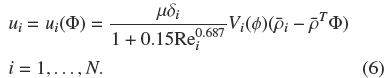
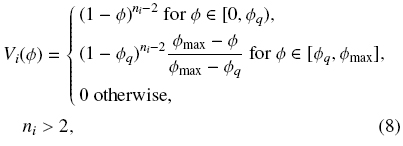
<body><![CDATA[<p align="center"><font face="verdana" size="2"><img src="/img/revistas/rmiq/v11n3/a17e5.jpg"></font></p>  	    <p align="justify"><font face="verdana" size="2">where 0 &#60;&nbsp;<i>&#934;</i><sub>max</sub> <img src="/img/revistas/rmiq/v11n3/a17e6.jpg">&nbsp;1 is the maximal solids concentration.</font></p>  	    <p align="justify"><font face="verdana" size="2">Within the Masliyah&#45;Lockett&#45;Bassoon (MLB) model (Lockett and Bassoon, 1979; Masliyah, 1979), u<i><sub>i</sub></i> is specified as</font></p>  	    <p align="center"><font face="verdana" size="2"><img src="/img/revistas/rmiq/v11n3/a17e8.jpg"></font></p>  	    <p align="justify"><font face="verdana" size="2">for Re<sub>i</sub>&#45; &#60;&nbsp;1000, where <img src="/img/revistas/rmiq/v11n3/a17e9.jpg"> := (<img src="/img/revistas/rmiq/v11n3/a17e4.jpg"><sub>1</sub>,...,<img src="/img/revistas/rmiq/v11n3/a17e9.jpg"><sub>N</sub>)<sup>T</sup> and V<i><sub>i</sub></i>(<i>&#934;</i>) is a hindered settling factor that takes into account the presence of other particles. This function can for example, be chosen as</font></p>  	    <p align="center"><font face="verdana" size="2"><img src="/img/revistas/rmiq/v11n3/a17e10.jpg"></font></p>  	    <p align="justify"><font face="verdana" size="2">according to Richardson and Zaki (1954), where <i>n<sub>i</sub></i> is a number specified later.</font></p>  	    <p align="justify"><font face="verdana" size="2">To ensure that the solution assumes values in <i>D</i><sub><i>&#934;max</i></sub>, we herein choose V<sub><i>i</i></sub>(<i>&#934;</i>) as</font></p>  	    <p align="center"><font face="verdana" size="2"><img src="/img/revistas/rmiq/v11n3/a17e11.jpg"></font></p>  	    <p align="justify"><font face="verdana" size="2">which continuously goes to zero as <i>F</i> &#8594; <i>&#934;<sub>max</sub></i> and, where <i>&#934;</i> &#60;&nbsp;<i>&#934;</i><sub><i>q</i></sub> &#60;&nbsp;<i>&#934;</i><sub>max</sub> is a parameter.</font></p>  	    ]]></body>
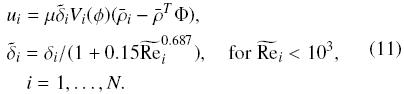
<body><![CDATA[<p align="justify"><font face="verdana" size="2">Re<sub><i>i</i></sub> is the particle Reynolds number for species <i>i</i>,</font></p>  	    <p align="center"><font face="verdana" size="2"><img src="/img/revistas/rmiq/v11n3/a17e12.jpg"></font></p>  	    <p align="justify"><font face="verdana" size="2">The pair of equations (6) and (9) defines <i>u<sub>i</sub></i> implicitly. To avoid this implicit form and to be consistent with previous work, in particular, with the stability analysis of Basson et al. (2009), we approximate Re<i><sub>i</sub></i> by</font></p>  	    <p align="center"><font face="verdana" size="2"><img src="/img/revistas/rmiq/v11n3/a17e13.jpg"></font></p>  	    <p align="justify"><font face="verdana" size="2">where <i>&#946;</i> &#62;&nbsp;0 is a constant parameter that has to be adjusted, and the exponent <i>n<sub>i</sub></i> is specified below. Then, we utilize</font></p>  	    <p align="center"><font face="verdana" size="2"><img src="/img/revistas/rmiq/v11n3/a17e14.jpg"></font></p>  	    <p align="justify"><font face="verdana" size="2">For spherical particles, the exponent <i>n<sub>i</sub></i> depends on the particle Reynolds number at infinite dilution, Re<sub>&#8734;,i</sub>, and may be given by</font></p>  	    <p align="center"><font face="verdana" size="2"><img src="/img/revistas/rmiq/v11n3/a17e15.jpg"></font></p>  	    <p align="justify"><font face="verdana" size="2">according to Garside and Al&#45;Dibouni (1977). Re<sub>&#8734;,i</sub>, := <sub><i>&#961;f</i></sub><i><sub>i</sub></i>v<sub>&#8734;</sub>, <sub><i>i</i></sub><i>d<sub>i</sub></i>/<i>&#956;f</i> is the particle Reynolds number based on the particle settling velocity at infinite dilution, v<sub>&#8734;,i</sub>, which we calculate as follows (Kunii and Levenspiel, 1991):</font></p>  	    <p align="center"><font face="verdana" size="2"><img src="/img/revistas/rmiq/v11n3/a17e16.jpg"></font></p>  	    ]]></body>
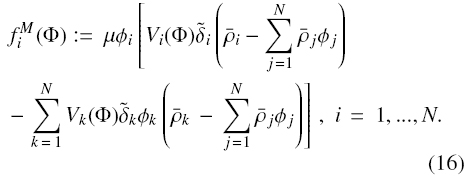
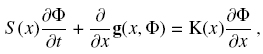
<body><![CDATA[<p align="center"><font face="verdana" size="2">&nbsp;</font></p>  	    <p align="left"><font face="verdana" size="2">Inserting Eq. (11) into Eq. (4) yields the system of conservation laws</font></p>  	    <p align="center"><font face="verdana" size="2"><img src="/img/revistas/rmiq/v11n3/a17e17.jpg"></font></p>  	    <p align="justify"><font face="verdana" size="2">where the components of the vector</font></p>  	    <p align="center"><font face="verdana" size="2"><img src="/img/revistas/rmiq/v11n3/a17e18.jpg"></font></p>  	    <p align="justify"><font face="verdana" size="2">are the MLB flux functions given by</font></p>  	    <p align="center"><font face="verdana" size="2"><img src="/img/revistas/rmiq/v11n3/a17e19.jpg"></font></p>  	    <p align="justify"><font face="verdana" size="2">For the stability analysis of the model for the slip velocity presented here, the reader may refer to work of Basson et al. (2009).</font></p>  	    <p align="justify"><font face="verdana" size="2">&nbsp;</font></p>  	    <p align="justify"><font face="verdana" size="2"><b>3 The renewed clarifier&#45;thickener model</b></font></p>  	    ]]></body>
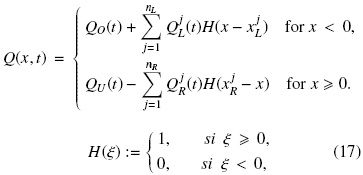
<body><![CDATA[<p align="justify"><font face="verdana" size="2">B&uuml;rger et al. (2008) consider a vessel with axisymmetric circular interior cross&#45;sectional area and circular cylindrical outer pipes as shown in <a href="#f1">Fig. 1.</a> This unit can be operated continuously in two modes, the clarifier&#45;thickener (CT) mode and the fluidization column (FC) mode. In the CT mode, the feed flow is divided into upwards&#45; and downwards&#45;directed bulk flows, and the upper and lower ends of the unit are identified as overflow and underflow levels, respectively, whereas in the FC mode, there is an additional counter&#45;gravity bulk inflow of liquid from x = x<sub>R</sub>.</font></p>  	    <p align="justify"><font face="verdana" size="2">We herein subdivide the unit into four different zones: the overflow zone (x &#60;&nbsp;x<sub>L</sub>), the clarification zone (x<sub>L</sub> &#60;&nbsp;x &#60;&nbsp;0), the settling zone (in CT mode) or fluidization zone (in FC mode) (0 &#60;&nbsp;x &#60;&nbsp;x<sub>R</sub>), and the underflow zone (in CT mode) or water inflow zone (in FC mode) (x &#62;&nbsp;x<sub>R</sub>). The vessel is continuously fed at depth x = 0, the feed level, with fresh feed suspension, and it has discharge outlets for products at different depths located above and below the feed point.</font></p>  	    <p align="justify"><font face="verdana" size="2">&nbsp;</font></p>  	    <p align="justify"><font face="verdana" size="2"><i>3.1 Suspension bulk flows</i></font></p>  	    <p align="justify"><font face="verdana" size="2">The suspension is fed at the volume rate Q<sub>F</sub>(t) &#8805;&nbsp;0 and, Qo(t) and Qu(t) are the volume bulk flows at overflow and underflow, respectively, where Q<sub>u</sub>(t) &#62;&nbsp;0 and Q<sub>u</sub>(t) &#8804;&nbsp;0 in the CT and FC modes, respectively, and Qo(t) &#8804;&nbsp;0.</font></p>  	    <p align="justify"><font face="verdana" size="2">Now let us include discharge openings located at <img src="/img/revistas/rmiq/v11n3/a17e20.jpg"> associated with the respective discharge rates <img src="/img/revistas/rmiq/v11n3/a17e21.jpg">. We can write the bulk flow as</font></p>  	    <p align="center"><font face="verdana" size="2"><img src="/img/revistas/rmiq/v11n3/a17e22.jpg"></font></p>  	    <p align="justify"><font face="verdana" size="2"><i>3.2 Solids feed and sink terms</i></font></p>  	    <p align="justify"><font face="verdana" size="2">As in B&uuml;rger et al. (2008), we assume that for x &#62;&nbsp;x<sub>R</sub> and x &#60;&nbsp;x<sub>L</sub>, the cross sectional area shrinks to a very small value, so that these zones actually correspond to transport pipes in which all solids (if any) move with the velocity of the fluid. Consequently, the slip velocities u<sub>i</sub>,..., u<sub>N</sub> are "switched off" outside the vessel interior (x<sub>L</sub>, x<sub>R</sub>) by the discontinuous function</font></p>  	    <p align="center"><font face="verdana" size="2"><img src="/img/revistas/rmiq/v11n3/a17e23.jpg"></font></p>  	    ]]></body>


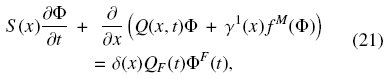
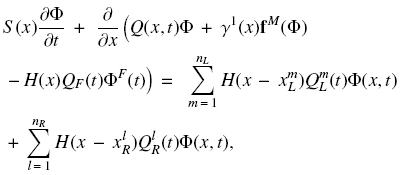
<body><![CDATA[<p align="justify"><font face="verdana" size="2">The next step is to replace Eq. (14) by the system of equations</font></p>  	    <p align="center"><font face="verdana" size="2"><img src="/img/revistas/rmiq/v11n3/a17e24.jpg"></font></p>  	    <p align="justify"><font face="verdana" size="2">where Q(x, t) is given by Eq. (17). Next, we consider that at x = 0, the unit is fed at a volume rate Q<sub>F</sub>(t) &#8805;&nbsp;0 with feed suspension that contains solids of species 1 to N at the volume fractions <img src="/img/revistas/rmiq/v11n3/a17e25.jpg">. We assume</font></p>  	    <p align="center"><font face="verdana" size="2"><img src="/img/revistas/rmiq/v11n3/a17e26.jpg"></font></p>  	    <p align="justify"><font face="verdana" size="2">The feed mechanism gives rise to an additional singular source term to Eq. (19), so that we now consider the equation</font></p>  	    <p align="center"><font face="verdana" size="2"><img src="/img/revistas/rmiq/v11n3/a17e27.jpg"></font></p>  	    <p align="justify"><font face="verdana" size="2">where &#948;(x) is the Dirac delta function centered at x = 0. Using the Heaviside function we may absorb the right&#45;hand side of Eq. (21) into the flux function. Furthermore, we take into account that the sink terms model the discharge of suspension of unknown concentration. This leads to the equation</font></p>  	    <p align="center"><font face="verdana" size="2"><img src="/img/revistas/rmiq/v11n3/a17e28.jpg"></font></p>  	    <p align="justify"><font face="verdana" size="2">which can be rewritten as</font></p>  	    <p align="center"><font face="verdana" size="2"><img src="/img/revistas/rmiq/v11n3/a17e29.jpg"></font></p>  	    ]]></body>
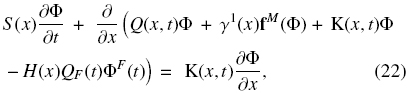
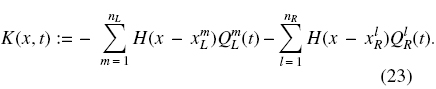
<body><![CDATA[<p align="justify"><font face="verdana" size="2">where we define the piecewise constant (with respect to x) function</font></p>  	    <p align="center"><font face="verdana" size="2"><img src="/img/revistas/rmiq/v11n3/a17e30.jpg"></font></p>  	    <p align="justify"><font face="verdana" size="2"><i>3.3 Final form of the mathematical model</i></font></p>  	    <p align="justify"><font face="verdana" size="2">We assume that the control variables Q<sub>F</sub>(t), Q<sub>u</sub>(t) and Q<sub>o</sub>(t) as well as the discharge fluxes controlling the sink terms are constant. Then, in view of Eq. (17), and adding the constant vector &#45;Q<sub>O</sub>&#934;<sup>F</sup> into the spatial derivative of the left&#45;hand side of Eq. (22), we can rewrite Eq. (22) as</font></p>  	    <p align="center"><font face="verdana" size="2"><img src="/img/revistas/rmiq/v11n3/a17e31.jpg"></font></p>  	    <p align="justify"><font face="verdana" size="2">where we define</font></p>  	    <p align="center"><font face="verdana" size="2"><img src="/img/revistas/rmiq/v11n3/a17e32.jpg"></font></p>  	    <p align="justify"><font face="verdana" size="2">and K(x) is the time&#45;independent version of K(x, t).</font></p>  	    <p align="justify"><font face="verdana" size="2">Defining the discontinuous parameter</font></p>  	    <p align="center"><font face="verdana" size="2"><img src="/img/revistas/rmiq/v11n3/a17e33.jpg"></font></p>  	    ]]></body>
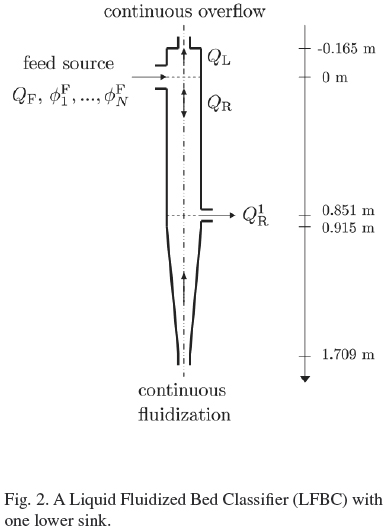
<body><![CDATA[<p align="justify"><font face="verdana" size="2">and the vector &#978;(x) := (&#978;<sup>1</sup>(x), y<sup>2</sup>(x)), we obtain</font></p>  	    <p align="center"><font face="verdana" size="2"><img src="/img/revistas/rmiq/v11n3/a17e34.jpg"></font></p>  	    <p align="justify"><font face="verdana" size="2">This yields the governing equation</font></p>  	    <p align="center"><font face="verdana" size="2"><img src="/img/revistas/rmiq/v11n3/a17e35.jpg"></font></p>  	    <p align="left"><font face="verdana" size="2">This system is&nbsp;solved together&nbsp;with the&nbsp;initial condition</font></p>  	    <p align="center"><font face="verdana" size="2"><img src="/img/revistas/rmiq/v11n3/a17e36.jpg"></font></p>  	    <p align="justify"><font face="verdana" size="2">&nbsp;</font></p>  	    <p align="justify"><font face="verdana" size="2"><b>4 The liquid fluidized bed classifier</b></font></p>  	    <p align="justify"><font face="verdana" size="2"><i>4.1 Preliminaries</i></font></p>  	    <p align="justify"><font face="verdana" size="2">In this section, we determine conditions on the crosssectional area and volume flow rates of a Liquid Fluidized Bed Classifier (LFBC) (see <a href="#f2">Fig. 2</a>) under which the MLB mathematical model predicts the existence of different compositions inside the unit and of the overflow, underflow and discharge streams, for given volume flow rates Q<sub>F</sub> and Q<sub>u</sub>, and concentration vector &#934;<sup>F</sup>. We consider suspensions in which the solid species differ in size only (i.e., <i>p</i><sub>1</sub> = <i>p</i><sub>2</sub> = ... = <i>p</i><sub>N</sub> =: p<sub>s</sub>), then Eq. (16) simplifies to the following equation:</font></p>  	    ]]></body>
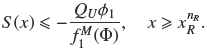
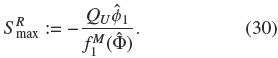
<body><![CDATA[<p align="center"><font face="verdana" size="2"><img src="/img/revistas/rmiq/v11n3/a17e37.jpg"></font></p>  	    <p align="center"><font face="verdana" size="2"><a name="f2"></a></font></p>  	    <p align="center"><font face="verdana" size="2"><img src="/img/revistas/rmiq/v11n3/a17f2.jpg"></font></p>  	    <p align="justify"><font face="verdana" size="2">&nbsp;</font></p>  	    <p align="justify"><font face="verdana" size="2"><i>4.2 Design of a LFBC</i></font></p>  	    <p align="justify"><font face="verdana" size="2"><i>4.2.1. Criterion 1</i></font></p>  	    <p align="justify"><font face="verdana" size="2">We choose as first criterion for design of a LFBC that particles of the largest species (species 1) do not leave the column by the underflow, with the purpose of do not block the pipe for the fluidization liquid. Then, in the zone below the lowest sink, the value of the flux of the largest species must be less than or equal to zero, i.e.</font></p>  	    <p align="center"><font face="verdana" size="2"><img src="/img/revistas/rmiq/v11n3/a17e38.jpg"></font></p>  	    <p align="justify"><font face="verdana" size="2">from which we obtain</font></p>  	    <p align="center"><font face="verdana" size="2"><img src="/img/revistas/rmiq/v11n3/a17e39.jpg"></font></p>  	    ]]></body>
<body><![CDATA[<p align="justify"><font face="verdana" size="2">Moreover, we may expect that the largest species is the only present in that zone, so the volume fraction vector has the form</font></p>  	    <p align="center"><font face="verdana" size="2"><img src="/img/revistas/rmiq/v11n3/a17e40.jpg"></font></p>  	    <p align="justify"><font face="verdana" size="2">Therefore, for given Q<sub>u</sub> &#60;&nbsp;0 and <img src="/img/revistas/rmiq/v11n3/a17e41.jpg"><sup>1</sup>such that 0 &#60;&nbsp;&nbsp;<img src="/img/revistas/rmiq/v11n3/a17e41.jpg"><sub>1</sub>&nbsp;<img src="/img/revistas/rmiq/v11n3/a17e6.jpg"> <i>&#934;</i><sub>max</sub>, the maximum cross&#45;sectional area of the column in the fluidization zone is given by</font></p>  	    <p align="center"><font face="verdana" size="2"><img src="/img/revistas/rmiq/v11n3/a17e42.jpg"></font></p>  	    <p align="justify"><font face="verdana" size="2">&nbsp;</font></p>  	    <p align="justify"><font face="verdana" size="2"><i>4.2.2. Criterion 2</i></font></p>  	    <p align="justify"><font face="verdana" size="2">A second criterion for design of a LFBC is that particles of the smallest species (species N) do not leave the column by the overflow, with the purpose of obtaining a clean liquid. Then, in the zone over the uppermost sink, the value of the flux of the smallest species must be greater than or equal to zero, i.e.</font></p>  	    <p align="center"><font face="verdana" size="2"><img src="/img/revistas/rmiq/v11n3/a17e43.jpg"></font></p>  	    <p align="justify"><font face="verdana" size="2">from which we obtain</font></p>  	    <p align="center"><font face="verdana" size="2"><img src="/img/revistas/rmiq/v11n3/a17e44.jpg"></font></p>  	    ]]></body>
<body><![CDATA[<p align="justify"><font face="verdana" size="2">Moreover, we may suppose that the smallest species is the only present in that zone, so the volume fraction vector has the form</font></p>  	    <p align="center"><font face="verdana" size="2"><img src="/img/revistas/rmiq/v11n3/a17e45.jpg"></font></p>  	    <p align="justify"><font face="verdana" size="2">Therefore, for given Q<sub>O</sub> &#60;&nbsp;0 and <img src="/img/revistas/rmiq/v11n3/a17e46.jpg"><sub>N</sub> such that 0 &#60;&nbsp;<img src="/img/revistas/rmiq/v11n3/a17e46.jpg"><sub>N</sub> <img src="/img/revistas/rmiq/v11n3/a17e6.jpg">&nbsp; <i>&#934;</i><sub>max</sub>, the minimum cross&#45;sectional area of the column in the clarification zone is given by</font></p>  	    <p align="center"><font face="verdana" size="2"><img src="/img/revistas/rmiq/v11n3/a17e47.jpg"></font></p>  	    <p align="justify"><font face="verdana" size="2">&nbsp;</font></p>  	    <p align="justify"><font face="verdana" size="2"><i>4.3 Operation of a LFBC</i></font></p>  	    <p align="justify"><font face="verdana" size="2">We denote x<sup>+</sup> and x<sup>&#45;</sup> as the right and left limits of x, respectively. Furthermore, in this section for a general function G(x, t), because t = to is given, we simplify the notation in the following way: G(x<sup>+</sup>) := G(x<sup>+</sup>, t<sub>0</sub>), G(x<sup>&#150;</sup>) := G(x<sup>&#150;</sup>, t0).</font></p>  	    <p align="justify"><font face="verdana" size="2"><i>4.3.1. Volume balance for each species in a node with singular source or sink located at x = <img src="/img/revistas/rmiq/v11n3/a17e48.jpg"></i></font></p>  	    <p align="justify"><font face="verdana" size="2">This volume balance will be useful for studying the bulk flows and concentrations around singular sources and sinks. For species i, F<sub>i</sub>(x, t) represents the flux function in x&#45;direction and F<sup><i>s</i></sup><i><sub>1</sub></i> (t) is the singular flux term located at x = <img src="/img/revistas/rmiq/v11n3/a17e48.jpg">, then the volume balance for species i in a control volume with center at x = <img src="/img/revistas/rmiq/v11n3/a17e48.jpg"> and thickness 25 is the following</font></p>  	    <p align="center"><font face="verdana" size="2"><img src="/img/revistas/rmiq/v11n3/a17e49.jpg"></font></p>  	    ]]></body>
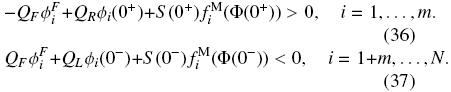
<body><![CDATA[<p align="justify"><font face="verdana" size="2">Let &#948; &#8594; 0, then the volume balance for each species at x = <img src="/img/revistas/rmiq/v11n3/a17e48.jpg"> results</font></p>  	    <p align="center"><font face="verdana" size="2"><img src="/img/revistas/rmiq/v11n3/a17e50.jpg"></font></p>  	    <p align="justify"><font face="verdana" size="2">And as t = t<sub>0</sub> is given, we simplify the notation of the above equation as follows:</font></p>  	    <p align="center"><font face="verdana" size="2"><img src="/img/revistas/rmiq/v11n3/a17e51.jpg"></font></p>  	    <p align="justify"><font face="verdana" size="2">Then, for the volume balance at x = 0 for each species, we apply the Eq. (34) to yield</font></p>  	    <p align="center"><font face="verdana" size="2"><img src="/img/revistas/rmiq/v11n3/a17e52.jpg"></font></p>  	    <p align="justify"><font face="verdana" size="2">&nbsp;</font></p>  	    <p align="justify"><font face="verdana" size="2"><i>4.3.2. Condition 1:</i></font></p>  	    <p align="justify"><font face="verdana" size="2">Separation of species 1, ... ,m from species m &#43; 1,... ,N in the feed point at x = 0</font></p>  	    <p align="justify"><font face="verdana" size="2">This condition means that no particles of species 1 to m in x &#60;&nbsp;0, and no particles of species m &#43; 1 to N in x &#62;&nbsp;0, or equivalently particles of species 1 to m move downward in x &#60;&nbsp;0, and particles of species m &#43; 1 to N move upward in x &#62;&nbsp;0. Then, the following flux relations are valid</font></p>  	    ]]></body>
<body><![CDATA[<p align="center"><font face="verdana" size="2"><img src="/img/revistas/rmiq/v11n3/a17e53.jpg"></font></p>  	    <p align="justify"><font face="verdana" size="2">&nbsp;</font></p>  	    <p align="justify"><font face="verdana" size="2">which we replace in Eq. (35) to produce the following relations</font></p>  	    <p align="center"><font face="verdana" size="2"><img src="/img/revistas/rmiq/v11n3/a17e54.jpg"></font></p>  	    <p align="justify"><font face="verdana" size="2">Because of the numeration of solid particles species of same density, relations (36) and (37) can be reduced to the following ones</font></p>  	    <p align="center"><font face="verdana" size="2"><img src="/img/revistas/rmiq/v11n3/a17e55.jpg"></font></p>  	    <p align="justify"><font face="verdana" size="2">from which we obtain the relation for our Condition 1</font></p>  	    <p align="center"><font face="verdana" size="2"><img src="/img/revistas/rmiq/v11n3/a17e56.jpg"></font></p>  	    <p align="justify"><font face="verdana" size="2">with</font></p>  	    <p align="center"><font face="verdana" size="2"><img src="/img/revistas/rmiq/v11n3/a17e57.jpg"></font></p>  	    ]]></body>
<body><![CDATA[<p align="justify"><font face="verdana" size="2">and</font></p>  	    <p align="center"><font face="verdana" size="2"><img src="/img/revistas/rmiq/v11n3/a17e58.jpg"></font></p>  	    <p align="justify"><font face="verdana" size="2">&nbsp;</font></p>  	    <p align="justify"><font face="verdana" size="2"><i>4.3.3. Condition 2: Separation of species m from species 1,... ,m &#45; 1 in the sink point at x = x<sup>1</sup><sub>R</sub></i></font></p>  	    <p align="justify"><font face="verdana" size="2">This condition means that all particles of species m in x &#62;&nbsp;0 go through the sink at x = x<sup>1</sup><sub>R</sub>. The generalization of this case to others sink points is simple.</font></p>  	    <p align="justify"><font face="verdana" size="2">First, we require that particles of species m move downward, i.e.</font></p>  	    <p align="center"><font face="verdana" size="2"><img src="/img/revistas/rmiq/v11n3/a17e59.jpg"></font></p>  	    <p align="justify"><font face="verdana" size="2">Second, we need that all particles of species m in x &#62;&nbsp;0 go through the sink, then</font></p>  	    <p align="center"><font face="verdana" size="2"><img src="/img/revistas/rmiq/v11n3/a17e60.jpg"></font></p>  	    <p align="justify"><font face="verdana" size="2">Finally, because the water flow for fluidization, the volume fraction of species m in the sink is less or equal than that above the sink level, i.e.</font></p>  	    ]]></body>
<body><![CDATA[<p align="center"><font face="verdana" size="2"><img src="/img/revistas/rmiq/v11n3/a17e61.jpg"></font></p>  	    <p align="justify"><font face="verdana" size="2">The Condition 2 of separation of species is obtained combining the relations (41), (42) and (43), in the following one</font></p>  	    <p align="center"><font face="verdana" size="2"><img src="/img/revistas/rmiq/v11n3/a17e62.jpg"></font></p>  	    <p align="justify"><font face="verdana" size="2">For the scalar case, the above relation (44) can be derived from the jump conditions given by B&uuml;rger et al. (2006).</font></p>  	    <p align="justify"><font face="verdana" size="2">&nbsp;</font></p>  	    <p align="justify"><font face="verdana" size="2"><b>5 Numerical scheme</b></font></p>  	    <p align="justify"><font face="verdana" size="2"><i>5.1 Discretization of the interior of the GCT</i></font></p>  	    <p align="justify"><font face="verdana" size="2">We discretize the spatial domain into cells I<sub>j</sub> := &#91;x<sub>j&#45;1/2</sub>, x<sub>j+1/2</sub>), j &#8712; &#123;0, &#177;1, &#177;2,...&#125;, where x<sub>k</sub> = k&#916;x for k &#8712; &#123;0, &#177;1/2, &#177;1, &#177;3/2,...&#125;. Similarly, the time interval (0, T ) is discretized via t<sub>n</sub> = n&#916;t for n &#8712; &#123;0,..., N&#125;, where N = &#91;T/&#916;t&#93; &#43; 1, which results in the time strips I<sup>n</sup> : = &#91;t<sub>n</sub>, t<sub>n</sub> &#43;<sub>1</sub>), n &#8712; &#123;0,...,N &#45; 1&#125;. Here &#916;x &#62;&nbsp;0 and &#916;t &#62;&nbsp;0 denote the spatial and temporal discretization parameters, respectively. We set &#916;x := L/(J &#43;1) where L is the height of the column and J is a natural number, and &#916;t is chosen so that the following stability condition (CFL condition) holds:</font></p>  	    <p align="center"><font face="verdana" size="2"><img src="/img/revistas/rmiq/v11n3/a17e63.jpg"></font></p>  	    <p align="justify"><font face="verdana" size="2">where <i>p</i>(&#183;) denotes the spectral radius, J<sub>f</sub> (&#978;, &#934;) the N x N Jacobiano <i>f</i> (&#978;, &#934;), and S min = minx<sub>x&#8712;(&#45;&#8734;, &#8734;)</sub>S (x).</font></p>  	    ]]></body>
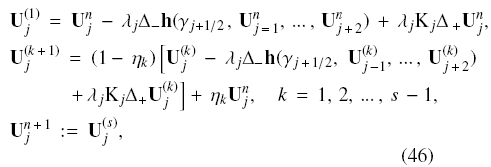
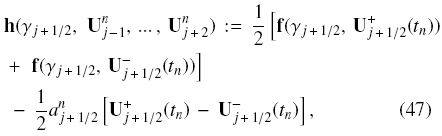
<body><![CDATA[<p align="justify"><font face="verdana" size="2">In the numerical scheme, we approximate max <i>p</i>(<i>J<sub>f</sub></i> (&#978;, &#934;)) by</font></p>  	    <p align="center"><font face="verdana" size="2"><img src="/img/revistas/rmiq/v11n3/a17e64.jpg"></font></p>  	    <p align="justify"><font face="verdana" size="2">where S<sub>max</sub> = max<sub>x&#8712;(&#45;&#8734;, &#8734;)</sub> S (x), and &#957;<sup>1</sup><sub>&#8734;</sub> is given by Eq. (13) with d and <i>p<sub>s</sub></i> replaced by <i>d<sub>i</sub></i> and <i>p<sub>i</sub></i>, respectively.</font></p>  	    <p align="justify"><font face="verdana" size="2">We denote by G(x<sup>&#45;</sup>) the limit of a function G(&#958;) for &#958; &#8594; x, &#958; &#60;&nbsp;x, and introduce the difference operators &#916;_V<sub>j</sub>&nbsp;:= V<sub>j</sub> &#45;V<sub>j&#45;1</sub>&nbsp;and &#916;&#43; Vj := V<sub>j+1</sub> &#45; V<sub>j</sub></font></p>  	    <p align="justify"><font face="verdana" size="2">Our scheme is a direct modification of the one described by Kurganov and Tadmor (2000). Let U<sub>j</sub><sup>n</sup> := (U<sup>n</sup><sub>1,j</sub>, ..., U<sup>n</sup><sub>N,j</sub>)<sup>T</sup> denote our approximation to &#934;(x<sub>j</sub>, t<sub>n</sub>). Expressed in terms of the forward Euler solver, we consider the one&#45;parameter family of Runge&#45;Kutta schemes</font></p>  	    <p align="center"><font face="verdana" size="2"><img src="/img/revistas/rmiq/v11n3/a17e65.jpg"></font></p>  	    <p align="justify"><font face="verdana" size="2">where &#978;j&#43;1/2 := &#978;(x<sup>&#45;</sup><sub>&#43;1/2</sub>), &nbsp;&#955;j := &#916;t/(S<sub>j</sub> &#916;x) with S<sub>j</sub> := S(x<sub>j</sub><sup>&#45;</sup>), K<sub>j</sub> := K(x<sub>j</sub><sup>&#45;</sup>), and U<sub>j</sub><sup>0</sup> := &#934;<sub>0</sub>(x<sub>j</sub><sup>&#45;</sup>). We employ second&#45;order time differencing (s = 2), for which &#951;<sub>1</sub> = 1/2; for third&#45;order time differencing (s = 3), the appropriate values are &#951;<sub>1</sub>= 3/4 and &#951;<sub>2</sub> = 1/3.</font></p>  	    <p align="justify"><font face="verdana" size="2">The numerical flux vector <b>h</b> appearing in Eq. (46) is given by</font></p>  	    <p align="center"><font face="verdana" size="2"><img src="/img/revistas/rmiq/v11n3/a17e66.jpg"></font></p>  	    <p align="justify"><font face="verdana" size="2">which is expressed in terms of the intermediate values</font></p>  	    ]]></body>
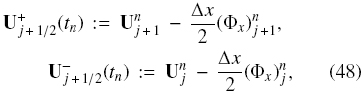
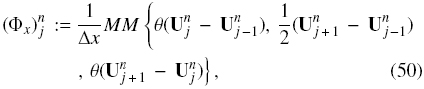
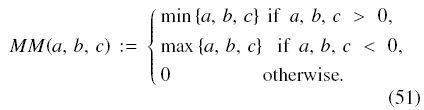
<body><![CDATA[<p align="center"><font face="verdana" size="2"><img src="/img/revistas/rmiq/v11n3/a17e67.jpg"></font></p>  	    <p align="justify"><font face="verdana" size="2">and the local speeds of propagation a<sup>n</sup><sub>j+1/2</sub>, which we estimate by</font></p>  	    <p align="center"><font face="verdana" size="2"><img src="/img/revistas/rmiq/v11n3/a17e68.jpg"></font></p>  	    <p align="justify"><font face="verdana" size="2">The numerical derivatives are determined by</font></p>  	    <p align="center"><font face="verdana" size="2"><img src="/img/revistas/rmiq/v11n3/a17e69.jpg"></font></p>  	    <p align="justify"><font face="verdana" size="2">where &#952; &#8712; &#91;1, 2&#93; is a parameter and MM(&#183;, &#183;, &#183;, ) is the minmod function:</font></p>  	    <p align="center"><font face="verdana" size="2"><img src="/img/revistas/rmiq/v11n3/a17e70.jpg"></font></p>  	    <p align="justify"><font face="verdana" size="2">As stated by Kurganov and Tadmor (2000), in the scalar case (N = 1) the value &#952; = 2 corresponds to the least dissipative limiter, while &#952; = 1 ensures the nonoscillatory nature of the approximate solution. The best choice of &#952; depends on the model considered. For systems, the optimal values of &#952; vary between 1.1 and 1.5 (Kurganov and Tadmor, 2000). As a compromise, and following previous works (Berres et al., 2004; Qian et al, 2005), we choose &#952; = 1.3 in all examples.</font></p>  	    <p align="justify"><font face="verdana" size="2">For the justification of the numerical scheme the reader may refer to work of B&uuml;rger et al. (2008).</font></p>  	    <p align="justify"><font face="verdana" size="2">&nbsp;</font></p>  	    ]]></body>
<body><![CDATA[<p align="justify"><font face="verdana" size="2"><b>6 Discretization of a suspension with CPSD</b></font></p>  	    <p align="justify"><font face="verdana" size="2"><i>6.1 Reduced size</i></font></p>  	    <p align="justify"><font face="verdana" size="2"><b>Definition 1</b>. Let d be the particle diameter, d<sub>max</sub> be the diameter of the largest particle, and k &#62;&nbsp;0 a parameter. We define the Reduced Size as</font></p>  	    <p align="center"><font face="verdana" size="2"><img src="/img/revistas/rmiq/v11n3/a17e71.jpg"></font></p>  	    <p align="justify"><font face="verdana" size="2">In function of &#958;, the Rosin&#45;Rammler particle size distribution is written as</font></p>  	    <p align="center"><font face="verdana" size="2"><img src="/img/revistas/rmiq/v11n3/a17e72.jpg"></font></p>  	    <p align="justify"><font face="verdana" size="2">where <i>l</i> is a characteristic size and <i>m</i> is a uniformity coefficient.</font></p>  	    <p align="justify"><font face="verdana" size="2"><b>Definition 2</b> (Normalized Rosin&#45;Rammler). Since F<sub>RR</sub>(1) &#60;&nbsp;1, we define the Normalized Rosin&#45;Rammler particle size distribution as</font></p>  	    <p align="center"><font face="verdana" size="2"><img src="/img/revistas/rmiq/v11n3/a17e73.jpg"></font></p>  	    <p align="justify"><font face="verdana" size="2">&nbsp;</font></p>  	    ]]></body>
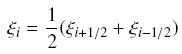
<body><![CDATA[<p align="justify"><font face="verdana" size="2"><b>6.2 Discretization of a CPSD</b></font></p>  	    <p align="justify"><font face="verdana" size="2">We discretize the Reduced Size by defining</font></p>  	    <p align="center"><font face="verdana" size="2"><img src="/img/revistas/rmiq/v11n3/a17e74.jpg"></font></p>  	    <p align="justify"><font face="verdana" size="2">for <i>i = 0</i>; ...; <i>N</i>, where <i>N</i> &#8712; <i>N</i> and &#916;&#958; := 1=<i>N</i>.</font></p>  	    <p align="justify"><font face="verdana" size="2"><b>Definition 3</b> (Species in a CPSD). We call "Species <i>i</i>" for <i>i</i> = 1, . . . , <i>N</i>, the solid particles with sizes between &#958;<sub><i>i+1/2</i></sub> and &#958;<sub><i>i+1/2</i></sub>.</font></p>  	    <p align="justify"><font face="verdana" size="2">Herein, we assign to species i the mean reduced size</font></p>  	    <p align="center"><font face="verdana" size="2"><img src="/img/revistas/rmiq/v11n3/a17e75.jpg"></font></p>  	    <p align="justify"><font face="verdana" size="2">If <i>&#934;</i><sup>n</sup>(t) denotes the total solids volume fraction of a feed suspension, the feed volume fraction of the species i is given by</font></p>  	    <p align="center"><font face="verdana" size="2"><img src="/img/revistas/rmiq/v11n3/a17e76.jpg"></font></p>  	    <p align="justify"><font face="verdana" size="2">&nbsp;</font></p>  	    ]]></body>
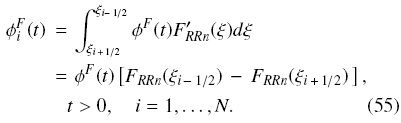
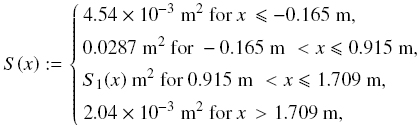
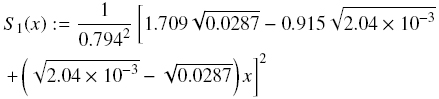
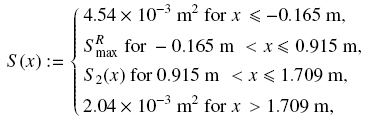
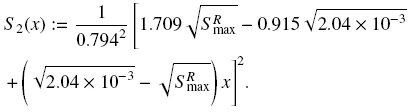
<body><![CDATA[<p align="justify"><font face="verdana" size="2"><b>Remark 1</b>. Our definition of the Reduced Size is very useful. For example, when Gates&#45;Gaudin&#45;Schumann CPSD, <i>F<sub>GGS</sub></i>(d) := (d=d<i><sub>max</sub></i>)<sup>m</sup>, d &#8712; &#91;0; d<i><sub>max</sub></i>&#93;, m &#62; 0 is used and if we choose k = 1=m, then <i>&#934;<sub>i</sub></i><sup>F</sup> (<i>t</i>) = <i>&#934;</i><sup>F</sup>(t)/N. Moreover, if k = 1, then <i>d<sub>i</sub></i> = d<i><sub>max&#958;i</sub></i>, for i = 1; ...; <i>N</i>.</font></p>  	    <p align="justify"><font face="verdana" size="2"><b>Remark 2</b>. Herein we use the arithmetic mean to determine the mean reduced size of each species, but it is possible to improve the calculation of that, considering the particle size distribution inside each species. Of course, while the number of species be greater, the difference between both means will be less.</font></p>  	    <p align="center"><font face="verdana" size="2"><a name="t1" id="t1"></a></font></p>  	    <p align="center"><font face="verdana" size="2"><img src="/img/revistas/rmiq/v11n3/a17t1.jpg"></font></p>  	    <p align="justify"><font face="verdana" size="2">&nbsp;</font></p>  	    <p align="justify"><font face="verdana" size="2"><b>7 Numerical examples</b></font></p>  	    <p align="justify"><font face="verdana" size="2"><i>7.1 Example 1: Model fit</i></font></p>  	    <p align="justify"><font face="verdana" size="2">We here adopt experimental data from the work of Chen et al. (2002a) for the steady&#45;state separation of a bidisperse suspension in a liquid fluidized bed classifier. The vessel, <a href="#f2">Fig. 2</a>, corresponds to equipment "T&#45;2" of Chen et al . (2002a), and is described by its interior cross&#45;sectional area</font></p>  	    <p align="center"><font face="verdana" size="2"><img src="/img/revistas/rmiq/v11n3/a17e77.jpg"></font></p>  	    <p align="justify"><font face="verdana" size="2">&nbsp;</font></p>  	    ]]></body>
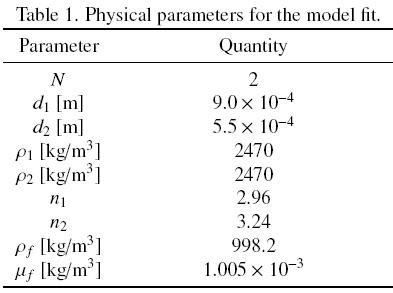
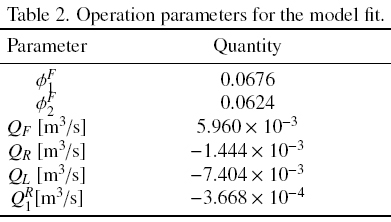
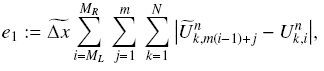
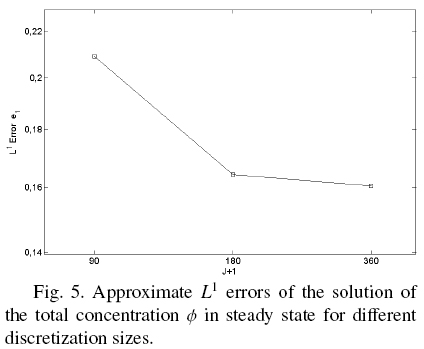
<body><![CDATA[<p align="justify"><font face="verdana" size="2">including a conical segment defined by</font></p>  	    <p align="center"><font face="verdana" size="2"><img src="/img/revistas/rmiq/v11n3/a17e78.jpg"></font></p>  	    <p align="center"><font face="verdana" size="2">&nbsp;</font></p>  	    <p align="justify"><font face="verdana" size="2">The solids parameters correspond to glass beads of two sizes. For this suspension, we use Eq. (8) with <i>&#934;</i><sub><i>q</i></sub>= 0.63 and <i>&#934;</i><sub><i>max</i></sub> = 0.68, and use Eq. (10) with <i>&#946;</i> = 0.19.</font></p>  	    <p align="justify"><font face="verdana" size="2">The physical and operation parameters are given in <a href="#t1">tables 1</a> and <a href="#t2">2</a>, respectively.</font></p>  	    <p align="center"><font face="verdana" size="2"><a name="t2"></a></font></p>  	    <p align="center"><font face="verdana" size="2"><img src="/img/revistas/rmiq/v11n3/a17t2.jpg"></font></p>  	    <p align="justify"><font face="verdana" size="2">In this example we record an approximate <i>L</i><sup>1</sup> error defined with respect to a reference solution, to evaluate the performance of the scheme. We introduce a L<sup>1</sup> error, denoted by e1, which is defined by</font></p>  	    <p align="center"><font face="verdana" size="2"><img src="/img/revistas/rmiq/v11n3/a17e79.jpg"></font></p>  	    <p align="justify"><font face="verdana" size="2">where &#360;<sup>n</sup><sub><i>k,1</i></sub> &#9632; and U<sup>n</sup><sub><i>k,1</i></sub> are the reference solution at x = x<sub><i>i</i></sub>; and the approximate solution at x = x<sub><i>i</i></sub>, respectively, both for species k at t = t<sub><i>n</i></sub>; <i>m</i> is the value of the division between &#916;x of the approximate solution and that of the reference solution; M<sub>L</sub> and M<sub>R</sub> are the indices of the positions between which we calculate the errors of the numerical approximation; and <img src="/img/revistas/rmiq/v11n3/a17e80.jpg"> is the spatial discretization parameter of the reference solution. The reference solution was calculated with the discretization parameters &#916;x = 3.470 x 10<sup>&#45;3</sup> m and &#916;t = 7.352 x 10<sup>&#45;5</sup> s.</font></p>  	    ]]></body>
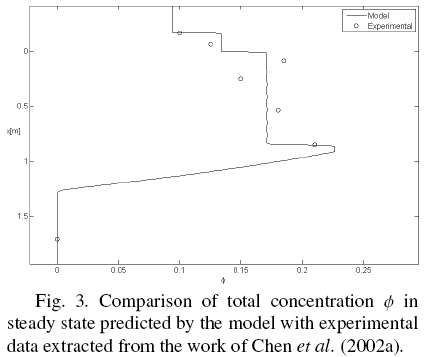
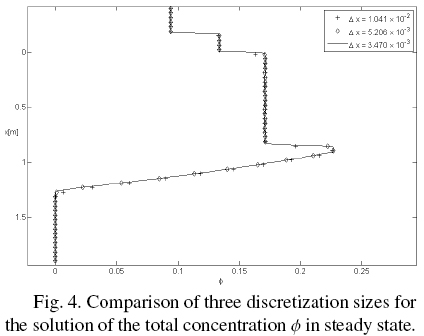
<body><![CDATA[<p align="justify"><font face="verdana" size="2"><a href="#f3">Fig. 3</a> indicates that the model fits reasonably well the experimental data reported in <a href="#f3">Fig. 3</a> by Chen et al. (2002a) that have been obtained by sampling.</font></p>  	    <p align="center"><font face="verdana" size="2"><a name="f3"></a></font></p>  	    <p align="center"><font face="verdana" size="2"><img src="/img/revistas/rmiq/v11n3/a17f3.jpg"></font></p>  	    <p align="justify"><font face="verdana" size="2">In <a href="#f4">figs. 4</a> and <a href="#f5">5</a> we observe that the numerical scheme converges to the reference solution.</font></p>  	    <p align="center"><font face="verdana" size="2"><a name="f4"></a></font></p>  	    <p align="center"><font face="verdana" size="2"><img src="/img/revistas/rmiq/v11n3/a17f4.jpg"></font></p>  	    <p align="center"><font face="verdana" size="2">&nbsp;</font></p>  	    <p align="center"><font face="verdana" size="2"><a name="f5"></a></font></p>  	    <p align="center"><font face="verdana" size="2"><img src="/img/revistas/rmiq/v11n3/a17f5.jpg"></font></p>  	    <p align="justify"><font face="verdana" size="2">&nbsp;</font></p>  	    ]]></body>
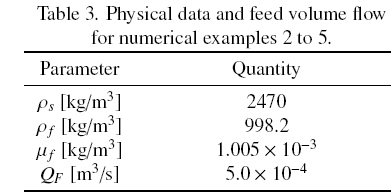
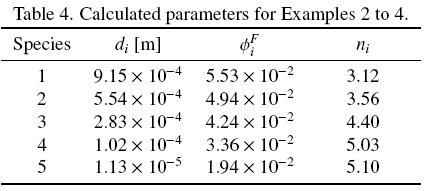
<body><![CDATA[<p align="justify"><font face="verdana" size="2"><i>Data for next examples</i></font></p>  	    <p align="justify"><font face="verdana" size="2">In all next examples, the vessels are similar to that of the model fit (<a href="#t2">Fig. 2</a>), i.e., it has one only sink located under the feed point. On the other hand, the fluid is water at 20 &ordm;C, the solid is a chalcopyrite concentrate with continuous particle size distribution with Rosin&#45;Rammler parameters d<sub>max</sub> = 1.13 x 10<sup>&#45;3</sup> &#91;m&#93;, m = 0.7254 and l = 8.0495, and the reduced size parameter k = 0.5.</font></p>  	    <p align="justify"><font face="verdana" size="2">The common physical and operational data for the examples are given in <a href="#t3">Table 3</a>.</font></p>  	    <p align="center"><font face="verdana" size="2"><a name="t3"></a></font></p>  	    <p align="center"><font face="verdana" size="2"><img src="/img/revistas/rmiq/v11n3/a17t3.jpg"></font></p>  	    <p align="justify"><font face="verdana" size="2">&nbsp;</font></p>  	    <p align="justify"><font face="verdana" size="2">For Examples 2, 3 and 4 the set of particles with continuous size distribution is divided in 5 species. The calculated parameters for they are given in <a href="#t4">Table 4</a>.</font></p>  	    <p align="center"><font face="verdana" size="2"><a name="t4"></a></font></p>  	    <p align="center"><font face="verdana" size="2"><img src="/img/revistas/rmiq/v11n3/a17t4.jpg"></font></p>  	    <p align="justify"><font face="verdana" size="2">&nbsp;</font></p>  	    ]]></body>
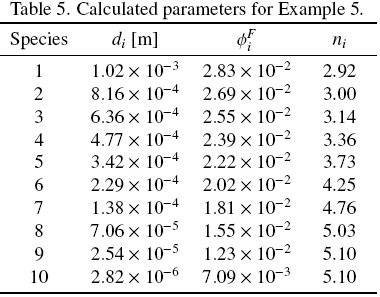
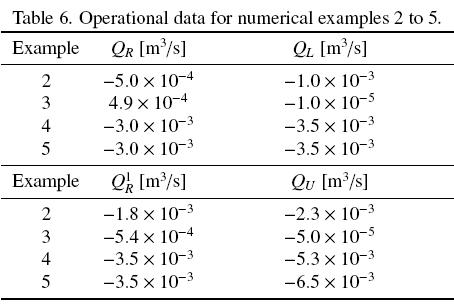
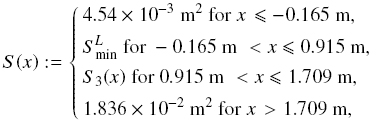
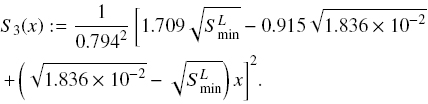
<body><![CDATA[<p align="justify"><font face="verdana" size="2">For Example 5 the set of particles with continuous size distribution is divided in 10 species. The calculated parameters for it are given in <a href="#t5">Table 5</a>.</font></p>  	    <p align="center"><font face="verdana" size="2"><a name="t5"></a></font></p>  	    <p align="center"><font face="verdana" size="2"><img src="/img/revistas/rmiq/v11n3/a17t5.jpg"></font></p>  	    <p align="justify"><font face="verdana" size="2">&nbsp;</font></p>  	    <p align="justify"><font face="verdana" size="2">The operational parameters for numerical examples 2 to 5 are given in <a href="#t6">Table 6</a>.</font></p>  	    <p align="center"><font face="verdana" size="2"><a name="t6"></a></font></p>  	    <p align="center"><font face="verdana" size="2"><img src="/img/revistas/rmiq/v11n3/a17t6.jpg"></font></p>  	    <p align="justify"><font face="verdana" size="2">&nbsp;</font></p>  	    <p align="justify"><font face="verdana" size="2"><i>7.2 Example 2: Design&nbsp;of&nbsp;a&nbsp;classifier according to Criterion 1</i></font></p>  	    <p align="justify"><font face="verdana" size="2">In this example, the criterion for designing a classifier is that the largest particles must not leave the column by the underflow. The vessel is described by</font></p>  	    ]]></body>
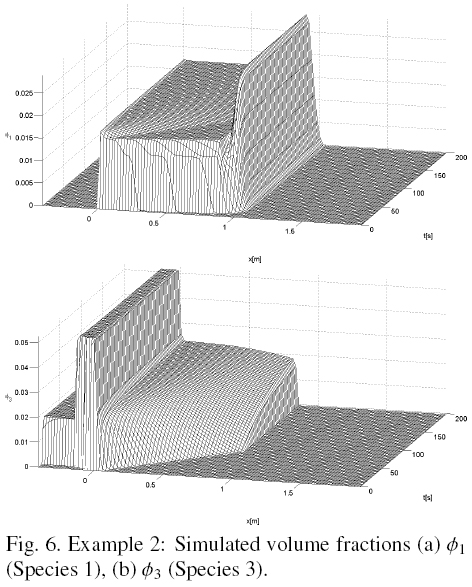
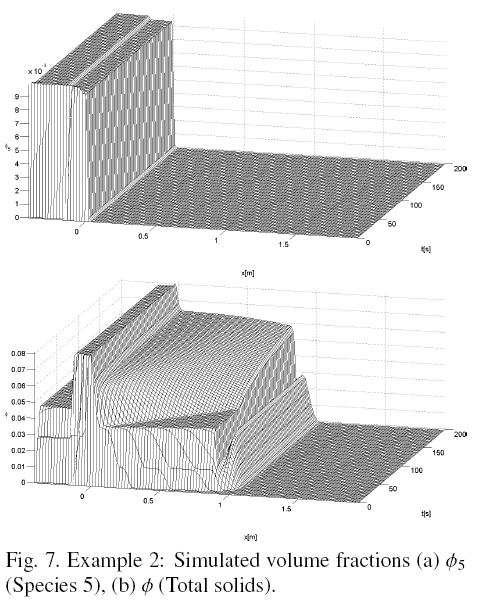
<body><![CDATA[<p align="center"><font face="verdana" size="2"><img src="/img/revistas/rmiq/v11n3/a17e81.jpg"></font></p>  	    <p align="justify"><font face="verdana" size="2">&nbsp;</font></p>  	    <p align="justify"><font face="verdana" size="2">including a conical segment defined by</font></p>  	    <p align="center"><font face="verdana" size="2"><img src="/img/revistas/rmiq/v11n3/a17e82.jpg"></font></p>  	    <p align="justify"><font face="verdana" size="2">The expected volume fraction of species 1 in the zone below the sink is <i>&#934;</i><sub>1</sub> = 0.03. Then, according to Eq. (30), the maximum cross&#45;sectional area in the zone below the sink is S<sup>R</sup><sub>max</sub> = 1.851 x 10<sup>&#45;2</sup> &#91;m<sup>2</sup>&#93;.</font></p>  	    <p align="justify"><font face="verdana" size="2"><a href="#f6">Figs. 6</a> and <a href="#f7">7</a> show the simulated volume fractions until steady state is reached of species 1 and 3 and, species 5 and total, respectively. <a href="/img/revistas/rmiq/v11n3/a17f8.jpg" target="_blank">Fig. 8</a> shows the volume fractions of each species and total, versus x in steady state. <a href="/img/revistas/rmiq/v11n3/a17f8.jpg" target="_blank">Fig. 8</a> shows that the species 1, which is the largest, not output from the underflow and reaches a volume fraction equal to 0.03, which is the expected concentration. Furthermore, it is seen that 1 is the only species present in the area below the sink.</font></p>  	    <p align="center"><font face="verdana" size="2"><a name="f6" id="f6"></a></font></p>  	    <p align="center"><font face="verdana" size="2"><img src="/img/revistas/rmiq/v11n3/a17f6.jpg"></font></p>  	    <p align="center"><font face="verdana" size="2">&nbsp;</font></p>  	    <p align="center"><font face="verdana" size="2"><a name="f7"></a></font></p>  	    ]]></body>
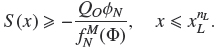
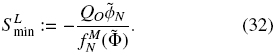
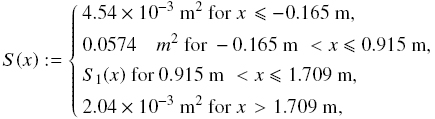
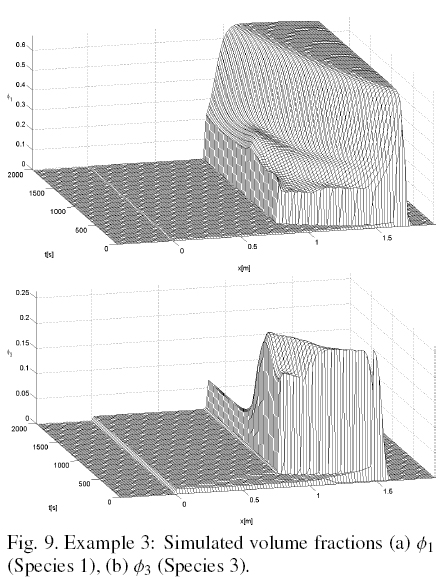
<body><![CDATA[<p align="center"><font face="verdana" size="2"><img src="/img/revistas/rmiq/v11n3/a17f7.jpg"></font></p>  	    <p align="justify"><font face="verdana" size="2">&nbsp;</font></p>  	    <p align="justify"><font face="verdana" size="2"><i>7.3 Example 3: Design&nbsp;of&nbsp;a&nbsp;classifier according to Criterion 2</i></font></p>  	    <p align="justify"><font face="verdana" size="2">In this example, the criterion for designing a classifier is that the smallest particles must not leave the column by the overflow. The vessel is described by</font></p>  	    <p align="center"><font face="verdana" size="2"><img src="/img/revistas/rmiq/v11n3/a17e83.jpg"></font></p>  	    <p align="justify"><font face="verdana" size="2">&nbsp;</font></p>  	    <p align="justify"><font face="verdana" size="2">including a conical segment defined by</font></p>  	    <p align="center"><font face="verdana" size="2"><img src="/img/revistas/rmiq/v11n3/a17e84.jpg"></font></p>  	    <p align="justify"><font face="verdana" size="2">&nbsp;</font></p>  	    <p align="justify"><font face="verdana" size="2">The expected volume fraction of species N in the zone above the uppermost sink is <i>&#934;</i><sub>N</sub> = 0.04. Then, according to Eq. (32), the minimum cross&#45;sectional area in that zone is S<sup>L</sup><sub>min</sub> = 0.1208 &#91;m<sup>2</sup>&#93;.</font></p>  	    ]]></body>
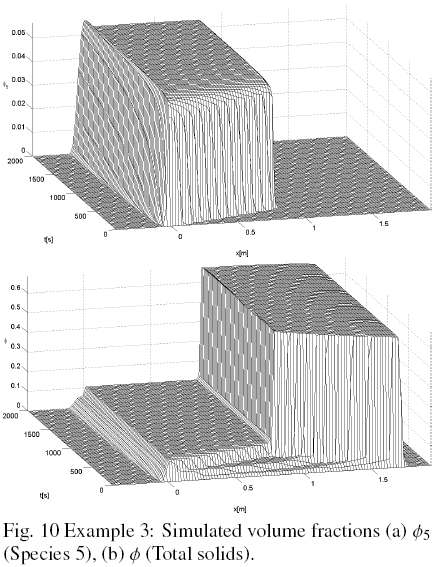
<body><![CDATA[<p align="justify"><font face="verdana" size="2"><a href="#f9">Figs. 9</a> and <a href="#f10">10</a> show the simulated volume fractions until steady state is reached of species 1 and 3, and species 5 and total, respectively. <a href="/img/revistas/rmiq/v11n3/a17f11.jpg" target="_blank">Fig. 11</a> shows the volume fractions of all species and total, versus x in steady state. <a href="/img/revistas/rmiq/v11n3/a17f11.jpg" target="_blank">Fig. 11</a> shows that the species 5, which is the smallest, not output from the overflow. Furthermore, it is seen that 5 is the only species present in the area above the feeder.</font></p>  	    <p align="center"><font face="verdana" size="2"><a name="f9"></a></font></p>  	    <p align="center"><font face="verdana" size="2"><img src="/img/revistas/rmiq/v11n3/a17f9.jpg"></font></p>  	    <p align="center"><font face="verdana" size="2">&nbsp;</font></p>  	    <p align="center"><font face="verdana" size="2"><a name="f10"></a></font></p>  	    <p align="center"><font face="verdana" size="2"><img src="/img/revistas/rmiq/v11n3/a17f10.jpg"></font></p>  	    <p align="justify"><font face="verdana" size="2">&nbsp;</font></p>  	    <p align="justify"><font face="verdana" size="2"><i>7.4 Example 4: Operation of a classifier enforcing Condition 1</i></font></p>  	    <p align="justify"><font face="verdana" size="2">In this example, the condition for operation is that no particles of species 1 to m in x &#60;&nbsp;0, and no particles of species m &#43; 1 to N in x &#62;&nbsp;0. The vessel is described by</font></p>  	    <p align="center"><font face="verdana" size="2"><img src="/img/revistas/rmiq/v11n3/a17e85.jpg"></font></p>  	    ]]></body>
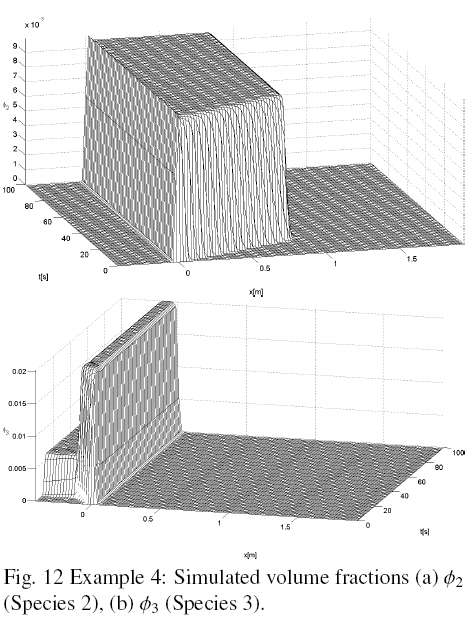
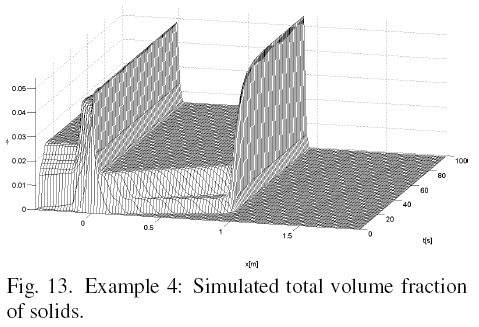
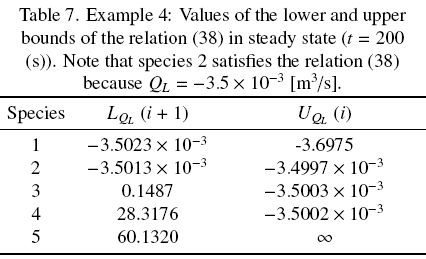
<body><![CDATA[<p align="justify"><font face="verdana" size="2">&nbsp;</font></p>  	    <p align="justify"><font face="verdana" size="2"><a href="#f12">Figs. 12</a> and <a href="#f13">13</a> show the simulated volume fractions of species 2 and 3, and total, respectively, until steady state is reached. <a href="/img/revistas/rmiq/v11n3/a17f14.jpg" target="_blank">Fig. 14</a> shows the volume fractions of each species and total, versus x in steady state. <a href="/img/revistas/rmiq/v11n3/a17f14.jpg" target="_blank">Fig. 14</a> shows that species 2 and 3 are separated into the feeder. The species 2 that is larger is directed downward, while the species 3 is smaller than species 2 is directed upwards.</font></p>  	    <p align="center"><font face="verdana" size="2"><a name="f12"></a></font></p>  	    <p align="center"><font face="verdana" size="2"><img src="/img/revistas/rmiq/v11n3/a17f12.jpg"></font></p>  	    <p align="center"><font face="verdana" size="2">&nbsp;</font></p>  	    <p align="center"><font face="verdana" size="2"><a name="f13"></a></font></p>  	    <p align="center"><font face="verdana" size="2"><img src="/img/revistas/rmiq/v11n3/a17f13.jpg"></font></p>  	    <p align="justify"><font face="verdana" size="2">&nbsp;</font></p>  	    <p align="justify"><font face="verdana" size="2">In <a href="#t7">Table 7</a>, the values of the lower and upper bounds of the relation (38) at time t = 200 (s), when the system is in steady state, are given. <a href="#t7">Table 7</a> confirms what is observed in <a href="#f12">Figs. 12</a> and <a href="/img/revistas/rmiq/v11n3/a17f14.jpg" target="_blank">14</a>, in the sense that species 2 and 3 are separated in the feed point, as for the species 2 is satisfied the relation (38).</font></p>  	    <p align="center"><font face="verdana" size="2"><a name="t7"></a></font></p>  	    ]]></body>
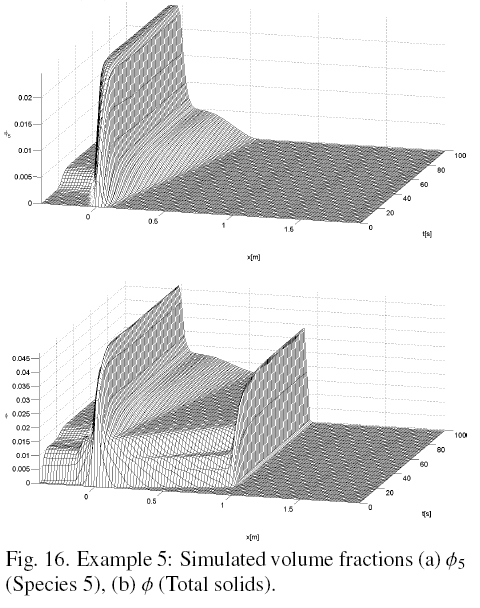
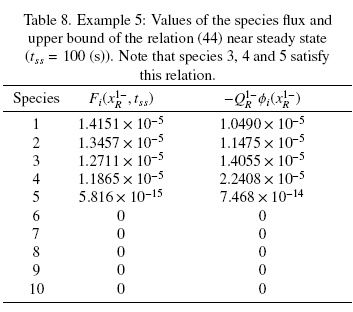
<body><![CDATA[<p align="center"><font face="verdana" size="2"><img src="/img/revistas/rmiq/v11n3/a17t7.jpg"></font></p>  	    <p align="justify"><font face="verdana" size="2">&nbsp;</font></p>  	    <p align="justify"><font face="verdana" size="2"><i>7.5 Example 5: Operation of a classifier enforcing Condition 2</i></font></p>  	    <p align="justify"><font face="verdana" size="2">Here, the condition for operation is that all particles of species <i>m</i> in <i>x</i> &#62;&nbsp;0 go through the sink at x = x<sup>1/R</sup>. The vessel is the same of the Example 4.</font></p>  	    <p align="justify"><font face="verdana" size="2"><a href="/img/revistas/rmiq/v11n3/a17f15.jpg" target="_blank">Figs. 15</a> and <a href="#f16">16</a> show the simulated volume fractions of species 2 and 3, and 5 and total, respectively. <a href="/img/revistas/rmiq/v11n3/a17f17.jpg" target="_blank">Fig. 17</a> shows the volume fractions of each species and total, versus x near steady state. <a href="/img/revistas/rmiq/v11n3/a17f17.jpg" target="_blank">Fig. 17</a> shows that in steady state the species 3 does not lower the level of the sink located at x<sup>1/R</sup> and leaves the unit for it. Species 1 and 2 which are larger, lower&#45;level sink at x<sup>1/R</sup>.</font></p>  	    <p align="center"><font face="verdana" size="2"><a name="f16"></a></font></p>  	    <p align="center"><font face="verdana" size="2"><img src="/img/revistas/rmiq/v11n3/a17f16.jpg"></font></p>  	    <p align="justify"><font face="verdana" size="2">&nbsp;</font></p>  	    <p align="justify"><font face="verdana" size="2">In <a href="#t8">Table 8</a>, the values of the species flux and upper bound of the relation (44) at time t<sub>ss</sub> = 100 (s), when the system is near steady state, are given. <a href="#t8">Table 8</a> shows that not only species 3 and 4 do not cross the level of the sink, as shown in <a href="/img/revistas/rmiq/v11n3/a17f17.jpg" target="_blank">Fig. 17</a>, but so does the species 5, as for these three species satisfies the relation (44).</font></p>  	    <p align="center"><font face="verdana" size="2"><a name="t8"></a></font></p>  	    ]]></body>
<body><![CDATA[<p align="center"><font face="verdana" size="2"><img src="/img/revistas/rmiq/v11n3/a17t8.jpg"></font></p>  	    <p align="justify"><font face="verdana" size="2">&nbsp;</font></p>  	    <p align="justify"><font face="verdana" size="2"><b>Conclusions</b></font></p>  	    <p align="justify"><font face="verdana" size="2">The contribution of this work is summarized as follows:</font></p>  	    <blockquote> 		    <p align="justify"><font face="verdana" size="2">&#8226;&nbsp;&nbsp;Progress in the model of the generalized clarifier&#45;thickener, presented by B&uuml;rger et al. (2008), primarily through the adoption of a hindered settling function for each kind of solid particles.</font></p>  		    <p align="justify"><font face="verdana" size="2">&#8226;&nbsp;Proposition of a method to discretize the variables particle size and volume fraction of species, of a suspension with continuous particle size distribution.</font></p>  		    <p align="justify"><font face="verdana" size="2">&#8226;&nbsp;Presentation of a methodology for designing a liquid fluidized bed classifier (LFBC), in the sense of calculating cross&#45;sectional areas as operational constraints of the equipment, i.e. the non&#45;blocking with solid particles of the pipe that feeds water for fluidization and the collection of clear water by the upper duct.</font></p>  		    <p align="justify"><font face="verdana" size="2">&#8226;&nbsp;Development of a methodology of operation of a LFBC, in the sense of handling the control variables such as volumetric flow at the entrances and exits of the unit, to obtain the desired products.</font></p> 	</blockquote>  	    <p align="justify"><font face="verdana" size="2">In the work of B&uuml;rger et al. (2008), for all species of particles one hindered settling function V(<i>&#934;</i>) are considered, specifically the same exponent in this function, which is calculated as the arithmetic average of the exponents calculated for each species of particles. This assumption we believe is improvable, as in steady state, in the equipment zones of different composition of particles are produced according to their size and density, for example in the case of a suspension of particles of the same density, the lower zone of the equipment is occupied by larger particles, and the upper zone, by smaller particles, so we believe that every species must have its own hindered settling function. Other changes to the model presented by B&uuml;rger et al. (2008) are the elimination of the discontinuity in Re; = 0.1 for the formula of the solid&#45;fluid relative velocity u<sub>i</sub>, the change in the formula for calculating the exponent of the hindered settling function, from the formula of Richardson and Zaki (1954), which is discontinuous, to the formula of Garside and Al&#45;Dibouni (1977), which is continuous, and the relocation of the adjustable parameter in the formula for Re<sub>i</sub>, so as to increase their range of validity. This work could be useful not only for the design and operation of a LFBC, but also for all equipment whose operation can be modeled with the equations presented here, such as sedimentation of non&#45;flocculated suspensions.</font></p>  	    ]]></body>
<body><![CDATA[<p align="justify"><font face="verdana" size="2">&nbsp;</font></p>  	    <p align="justify"><font face="verdana" size="2"><b>Nomenclature</b></font></p>  	    <p align="justify"><font face="verdana" size="2"><img src="/img/revistas/rmiq/v11n3/a17n1.jpg"></font></p>  	    <p align="justify"><font face="verdana" size="2">&nbsp;</font></p>  	    <p align="justify"><font face="verdana" size="2"><b>Acknowledgments</b></font></p>  	    <p align="justify"><font face="verdana" size="2">AG acknowledges support by FONDECYT Project 11085069 and Centro de Investigaci&oacute;n Cient&iacute;fico Tecnol&oacute;gico para la Miner&iacute;a, CICITEM.</font></p>  	    <p align="justify"><font face="verdana" size="2">&nbsp;</font></p>  	    <p align="justify"><font face="verdana" size="2"><b>References</b></font></p>  	    <!-- ref --><p align="justify"><font face="verdana" size="2">Basson, D. K., Berres, S. and B&uuml;rger, R. (2009). On models of polydisperse sedimentation with particle&#45;size&#45;specific hindered&#45;settling factors. <i>Applied Mathematical Modelling 33</i>, 1815&#45;1835.    &nbsp;&nbsp;&nbsp;&nbsp;&nbsp;&nbsp;&nbsp;&nbsp;[&#160;<a href="javascript:void(0);" onclick="javascript: window.open('/scielo.php?script=sci_nlinks&ref=8623293&pid=S1665-2738201200030001700001&lng=','','width=640,height=500,resizable=yes,scrollbars=1,menubar=yes,');">Links</a>&#160;]<!-- end-ref --></font></p>  	    ]]></body>
<body><![CDATA[<!-- ref --><p align="justify"><font face="verdana" size="2">Berres, S., B&uuml;rger, R., and Karlsen, K.H. (2004). Central schemes and systems of conservation laws with discontinuous coefficients modeling gravity separation of polydisperse suspensions. <i>Journal of Computational and Applied Mathematics 164&#45;165</i>, 53&#45;80.    &nbsp;&nbsp;&nbsp;&nbsp;&nbsp;&nbsp;&nbsp;&nbsp;[&#160;<a href="javascript:void(0);" onclick="javascript: window.open('/scielo.php?script=sci_nlinks&ref=8623295&pid=S1665-2738201200030001700002&lng=','','width=640,height=500,resizable=yes,scrollbars=1,menubar=yes,');">Links</a>&#160;]<!-- end-ref --></font></p>  	    <!-- ref --><p align="justify"><font face="verdana" size="2">Burgos, R. and Concha, F. (2005). Further development of software for the design and simulation of industrial thickeners. <i>Chemical Engineering Journal 111</i>, 135&#45;144</font>&nbsp;&nbsp;&nbsp;&nbsp;&nbsp;&nbsp;&nbsp;&nbsp;[&#160;<a href="javascript:void(0);" onclick="javascript: window.open('/scielo.php?script=sci_nlinks&ref=8623297&pid=S1665-2738201200030001700003&lng=','','width=640,height=500,resizable=yes,scrollbars=1,menubar=yes,');">Links</a>&#160;]<!-- end-ref --><!-- ref --><p align="justify"><font face="verdana" size="2">B&uuml;rger, R., Garc&iacute;a, A., Karlsen, K.H. and Towers, J.D. (2006). On an extended clarifier&#45;thickener model with singular source and sink terms. <i>European Journal of Applied Mathematics 17</i>, 257&#45;292.    &nbsp;&nbsp;&nbsp;&nbsp;&nbsp;&nbsp;&nbsp;&nbsp;[&#160;<a href="javascript:void(0);" onclick="javascript: window.open('/scielo.php?script=sci_nlinks&ref=8623298&pid=S1665-2738201200030001700004&lng=','','width=640,height=500,resizable=yes,scrollbars=1,menubar=yes,');">Links</a>&#160;]<!-- end-ref --></font></p>  	    <!-- ref --><p align="justify"><font face="verdana" size="2">B&uuml;rger, R., Garc&iacute;a, A., Karlsen, K.H. and Towers, J.D. (2008). A kinematic model of continuous separation and classification of polydisperse suspensions. <i>Computers and Chemical Engineering</i> 32, 1181&#45;1202.    &nbsp;&nbsp;&nbsp;&nbsp;&nbsp;&nbsp;&nbsp;&nbsp;[&#160;<a href="javascript:void(0);" onclick="javascript: window.open('/scielo.php?script=sci_nlinks&ref=8623300&pid=S1665-2738201200030001700005&lng=','','width=640,height=500,resizable=yes,scrollbars=1,menubar=yes,');">Links</a>&#160;]<!-- end-ref --></font></p>  	    <!-- ref --><p align="justify"><font face="verdana" size="2">B&uuml;rger, R., Karlsen, K.H., Risebro, N.H. and Towers, J.D. (2004). Well&#45;posedness in BVt and convergence of a difference scheme for continuous sedimentation in ideal clarifier&#45;thickener units. <i>Numerische Mathematik</i> 97,2565.    &nbsp;&nbsp;&nbsp;&nbsp;&nbsp;&nbsp;&nbsp;&nbsp;[&#160;<a href="javascript:void(0);" onclick="javascript: window.open('/scielo.php?script=sci_nlinks&ref=8623302&pid=S1665-2738201200030001700006&lng=','','width=640,height=500,resizable=yes,scrollbars=1,menubar=yes,');">Links</a>&#160;]<!-- end-ref --></font></p>  	    <!-- ref --><p align="justify"><font face="verdana" size="2">Castilho, L.R. and Medronho, R.A. (2000). A simple procedure for design and performance prediction of Bradley and Rietema hydrocyclones. <i>Minerals Engineering 13</i>, 183191.    &nbsp;&nbsp;&nbsp;&nbsp;&nbsp;&nbsp;&nbsp;&nbsp;[&#160;<a href="javascript:void(0);" onclick="javascript: window.open('/scielo.php?script=sci_nlinks&ref=8623304&pid=S1665-2738201200030001700007&lng=','','width=640,height=500,resizable=yes,scrollbars=1,menubar=yes,');">Links</a>&#160;]<!-- end-ref --></font></p>  	    <!-- ref --><p align="justify"><font face="verdana" size="2">Chancelier, J.P., Cohen de Lara, M., Joannis, C. and Pacard, F. (1997). New insights in dynamic modeling of a secondary settler I. Flux theory and steady&#45;states analysis. <i>Water Research 31</i>, 1847&#45;1856.    &nbsp;&nbsp;&nbsp;&nbsp;&nbsp;&nbsp;&nbsp;&nbsp;[&#160;<a href="javascript:void(0);" onclick="javascript: window.open('/scielo.php?script=sci_nlinks&ref=8623306&pid=S1665-2738201200030001700008&lng=','','width=640,height=500,resizable=yes,scrollbars=1,menubar=yes,');">Links</a>&#160;]<!-- end-ref --></font></p>  	    <!-- ref --><p align="justify"><font face="verdana" size="2">Chen, A., Grace, J.R., Epstein, N. and Lim, C.J. (2002a). Steady state dispersion of monosize, binary and multi&#45;size particles in a liquid fluidized bed classifier. <i>Chemical Engineering Science 57</i>,991&#45;1002.    &nbsp;&nbsp;&nbsp;&nbsp;&nbsp;&nbsp;&nbsp;&nbsp;[&#160;<a href="javascript:void(0);" onclick="javascript: window.open('/scielo.php?script=sci_nlinks&ref=8623308&pid=S1665-2738201200030001700009&lng=','','width=640,height=500,resizable=yes,scrollbars=1,menubar=yes,');">Links</a>&#160;]<!-- end-ref --></font></p>  	    <!-- ref --><p align="justify"><font face="verdana" size="2">Chen, A., Grace, J.R., Epstein, N. and Lim, C.J. (2002b). Unsteady state hydrodynamic model and dynamic behavior of a liquid fluidized&#45;bed classifier. <i>Chemical Engineering Science 57</i>, 1003&#45;1010.    &nbsp;&nbsp;&nbsp;&nbsp;&nbsp;&nbsp;&nbsp;&nbsp;[&#160;<a href="javascript:void(0);" onclick="javascript: window.open('/scielo.php?script=sci_nlinks&ref=8623310&pid=S1665-2738201200030001700010&lng=','','width=640,height=500,resizable=yes,scrollbars=1,menubar=yes,');">Links</a>&#160;]<!-- end-ref --></font></p>  	    <!-- ref --><p align="justify"><font face="verdana" size="2">Concha, F. and Barrientos, A. (1993). A critical review of thickener design methods. <i>KONA Powder and Particle Journal 11</i>, 79&#45;104.    &nbsp;&nbsp;&nbsp;&nbsp;&nbsp;&nbsp;&nbsp;&nbsp;[&#160;<a href="javascript:void(0);" onclick="javascript: window.open('/scielo.php?script=sci_nlinks&ref=8623312&pid=S1665-2738201200030001700011&lng=','','width=640,height=500,resizable=yes,scrollbars=1,menubar=yes,');">Links</a>&#160;]<!-- end-ref --></font></p>  	    <!-- ref --><p align="justify"><font face="verdana" size="2">Delgadillo, J.A. and Rajamani, R.K. (2005a). A comparative study of three turbulence&#45;closure models for the hydrocyclone problem. <i>International Journal of Mineral Processing 77</i>, 217&#45;230.    &nbsp;&nbsp;&nbsp;&nbsp;&nbsp;&nbsp;&nbsp;&nbsp;[&#160;<a href="javascript:void(0);" onclick="javascript: window.open('/scielo.php?script=sci_nlinks&ref=8623314&pid=S1665-2738201200030001700012&lng=','','width=640,height=500,resizable=yes,scrollbars=1,menubar=yes,');">Links</a>&#160;]<!-- end-ref --></font></p>  	    <!-- ref --><p align="justify"><font face="verdana" size="2">Delgadillo, J.A. and Rajamani, R.K. (2005b). Hydrocyclone modeling: large&#45;eddy simulation CFD approach. <i>Minerals and Metallurgical Processing 22</i>, 225&#45;232.    &nbsp;&nbsp;&nbsp;&nbsp;&nbsp;&nbsp;&nbsp;&nbsp;[&#160;<a href="javascript:void(0);" onclick="javascript: window.open('/scielo.php?script=sci_nlinks&ref=8623316&pid=S1665-2738201200030001700013&lng=','','width=640,height=500,resizable=yes,scrollbars=1,menubar=yes,');">Links</a>&#160;]<!-- end-ref --></font></p>  	    <!-- ref --><p align="justify"><font face="verdana" size="2">Delgadillo, J.A. and Rajamani, R.K. (2007). Exploration of hydrocyclone designs using computational fluid dynamics. <i>International Journal of Mineral Processing 84</i>, 252&#45;261.    &nbsp;&nbsp;&nbsp;&nbsp;&nbsp;&nbsp;&nbsp;&nbsp;[&#160;<a href="javascript:void(0);" onclick="javascript: window.open('/scielo.php?script=sci_nlinks&ref=8623318&pid=S1665-2738201200030001700014&lng=','','width=640,height=500,resizable=yes,scrollbars=1,menubar=yes,');">Links</a>&#160;]<!-- end-ref --></font></p>  	    <!-- ref --><p align="justify"><font face="verdana" size="2">Diehl, S. (2006). Operating charts for continuous sedimentation III: Control of step input. <i>Journal of Engineering Mathematics 54</i>, 225&#45;259.    &nbsp;&nbsp;&nbsp;&nbsp;&nbsp;&nbsp;&nbsp;&nbsp;[&#160;<a href="javascript:void(0);" onclick="javascript: window.open('/scielo.php?script=sci_nlinks&ref=8623320&pid=S1665-2738201200030001700015&lng=','','width=640,height=500,resizable=yes,scrollbars=1,menubar=yes,');">Links</a>&#160;]<!-- end-ref --></font></p>  	    <!-- ref --><p align="justify"><font face="verdana" size="2">Garrido, P., Burgos, R., Concha, F. and B&uuml;rger, R. (2003). Software for the design and simulation of gravity thickeners. <i>Minerals Engineering 16</i>, 85&#45;92.    &nbsp;&nbsp;&nbsp;&nbsp;&nbsp;&nbsp;&nbsp;&nbsp;[&#160;<a href="javascript:void(0);" onclick="javascript: window.open('/scielo.php?script=sci_nlinks&ref=8623322&pid=S1665-2738201200030001700016&lng=','','width=640,height=500,resizable=yes,scrollbars=1,menubar=yes,');">Links</a>&#160;]<!-- end-ref --></font></p>  	    <!-- ref --><p align="justify"><font face="verdana" size="2">Garside, J. and Al&#45;Dibouni, M. R. (1977). Velocity&#45;voidage relationship for fluidization and sedimentation in solid&#45;liquid system. <i>Industrial</i> <i>&amp; Engineering Chemistry Process Design and Development 16</i>, 206&#45;214.    &nbsp;&nbsp;&nbsp;&nbsp;&nbsp;&nbsp;&nbsp;&nbsp;[&#160;<a href="javascript:void(0);" onclick="javascript: window.open('/scielo.php?script=sci_nlinks&ref=8623324&pid=S1665-2738201200030001700017&lng=','','width=640,height=500,resizable=yes,scrollbars=1,menubar=yes,');">Links</a>&#160;]<!-- end-ref --></font></p>  	    <!-- ref --><p align="justify"><font face="verdana" size="2">Greenspan, H.P. and Ungarish, M. (1982). On hindered settling of particles of different sizes. <i>International Journal of Multiphase Flow 8</i>, 587&#45;604.    &nbsp;&nbsp;&nbsp;&nbsp;&nbsp;&nbsp;&nbsp;&nbsp;[&#160;<a href="javascript:void(0);" onclick="javascript: window.open('/scielo.php?script=sci_nlinks&ref=8623326&pid=S1665-2738201200030001700018&lng=','','width=640,height=500,resizable=yes,scrollbars=1,menubar=yes,');">Links</a>&#160;]<!-- end-ref --></font></p>  	    <!-- ref --><p align="justify"><font face="verdana" size="2">Hassett, N.J. (1958). Design and operation of continuous thickeners. <i>Industrial Chemist 34, 116&#45;120, 169&#45;172</i>, 489&#45;494.    &nbsp;&nbsp;&nbsp;&nbsp;&nbsp;&nbsp;&nbsp;&nbsp;[&#160;<a href="javascript:void(0);" onclick="javascript: window.open('/scielo.php?script=sci_nlinks&ref=8623328&pid=S1665-2738201200030001700019&lng=','','width=640,height=500,resizable=yes,scrollbars=1,menubar=yes,');">Links</a>&#160;]<!-- end-ref --></font></p>  	    <!-- ref --><p align="justify"><font face="verdana" size="2">Hassett, N.J. (1968). Thickening in theory and practice. <i>Minerals Science and Engineering 1</i>, 24&#45;40.    &nbsp;&nbsp;&nbsp;&nbsp;&nbsp;&nbsp;&nbsp;&nbsp;[&#160;<a href="javascript:void(0);" onclick="javascript: window.open('/scielo.php?script=sci_nlinks&ref=8623330&pid=S1665-2738201200030001700020&lng=','','width=640,height=500,resizable=yes,scrollbars=1,menubar=yes,');">Links</a>&#160;]<!-- end-ref --></font></p>  	    <!-- ref --><p align="justify"><font face="verdana" size="2">Kahane, R., Nguyen, T. and Schwarz, M.P. (2002). CFD modelling of thickeners at Worsley Alumina Pty Ltd. <i>Applied Mathematical Modelling 26</i>, 281&#45;296.    &nbsp;&nbsp;&nbsp;&nbsp;&nbsp;&nbsp;&nbsp;&nbsp;[&#160;<a href="javascript:void(0);" onclick="javascript: window.open('/scielo.php?script=sci_nlinks&ref=8623332&pid=S1665-2738201200030001700021&lng=','','width=640,height=500,resizable=yes,scrollbars=1,menubar=yes,');">Links</a>&#160;]<!-- end-ref --></font></p>  	    <!-- ref --><p align="justify"><font face="verdana" size="2">Kim, B.H. and Klima, M.S. (2004). Development and application of a dynamic model for hindered&#45;settling column separations. <i>Minerals Engineering 17</i>,403&#45;410.    &nbsp;&nbsp;&nbsp;&nbsp;&nbsp;&nbsp;&nbsp;&nbsp;[&#160;<a href="javascript:void(0);" onclick="javascript: window.open('/scielo.php?script=sci_nlinks&ref=8623334&pid=S1665-2738201200030001700022&lng=','','width=640,height=500,resizable=yes,scrollbars=1,menubar=yes,');">Links</a>&#160;]<!-- end-ref --></font></p>  	    <!-- ref --><p align="justify"><font face="verdana" size="2">Kraipech, W., Chen, W., Dyakowski, T. and Nowakowski, A. (2006). The performance of the empirical models on industrial hydrocyclone design. <i>International Journal of Mineral Processing 80</i>, 100&#45;115.    &nbsp;&nbsp;&nbsp;&nbsp;&nbsp;&nbsp;&nbsp;&nbsp;[&#160;<a href="javascript:void(0);" onclick="javascript: window.open('/scielo.php?script=sci_nlinks&ref=8623336&pid=S1665-2738201200030001700023&lng=','','width=640,height=500,resizable=yes,scrollbars=1,menubar=yes,');">Links</a>&#160;]<!-- end-ref --></font></p>  	    <!-- ref --><p align="justify"><font face="verdana" size="2">Kunii, D. and Levenspiel, O. (1991). <i>Fluidization Engineering</i>. 2nd edition. Butterworth Heinemann, Jordan Hill, UK.    &nbsp;&nbsp;&nbsp;&nbsp;&nbsp;&nbsp;&nbsp;&nbsp;[&#160;<a href="javascript:void(0);" onclick="javascript: window.open('/scielo.php?script=sci_nlinks&ref=8623338&pid=S1665-2738201200030001700024&lng=','','width=640,height=500,resizable=yes,scrollbars=1,menubar=yes,');">Links</a>&#160;]<!-- end-ref --></font></p>  	    <!-- ref --><p align="justify"><font face="verdana" size="2">Kurganov, A. and Tadmor, E. (2000). New high resolution central schemes for nonlinear conservation laws and convection&#45;diffusion equations. <i>Journal of Computational Physics 160</i>, 241&#45;282.    &nbsp;&nbsp;&nbsp;&nbsp;&nbsp;&nbsp;&nbsp;&nbsp;[&#160;<a href="javascript:void(0);" onclick="javascript: window.open('/scielo.php?script=sci_nlinks&ref=8623340&pid=S1665-2738201200030001700025&lng=','','width=640,height=500,resizable=yes,scrollbars=1,menubar=yes,');">Links</a>&#160;]<!-- end-ref --></font></p>  	    <!-- ref --><p align="justify"><font face="verdana" size="2">Kynch, G.J. (1952). A theory of sedimentation. <i>Transactions of the Faraday Society 48</i>, 166176.    &nbsp;&nbsp;&nbsp;&nbsp;&nbsp;&nbsp;&nbsp;&nbsp;[&#160;<a href="javascript:void(0);" onclick="javascript: window.open('/scielo.php?script=sci_nlinks&ref=8623342&pid=S1665-2738201200030001700026&lng=','','width=640,height=500,resizable=yes,scrollbars=1,menubar=yes,');">Links</a>&#160;]<!-- end-ref --></font></p>  	    <!-- ref --><p align="justify"><font face="verdana" size="2">Lev, O., Rubin, E. and Sheintuch, M. (1986). Steady state analysis of a continuous clarifier&#45;thickener system. <i>AIChE Journal 32</i>, 1516&#45;1525.    &nbsp;&nbsp;&nbsp;&nbsp;&nbsp;&nbsp;&nbsp;&nbsp;[&#160;<a href="javascript:void(0);" onclick="javascript: window.open('/scielo.php?script=sci_nlinks&ref=8623344&pid=S1665-2738201200030001700027&lng=','','width=640,height=500,resizable=yes,scrollbars=1,menubar=yes,');">Links</a>&#160;]<!-- end-ref --></font></p>  	    <!-- ref --><p align="justify"><font face="verdana" size="2">Lockett, M.J. and Bassoon, K.S. (1979). Sedimentation of binary particle mixtures. <i>Powder Technology 24</i>, 1&#45;7.    &nbsp;&nbsp;&nbsp;&nbsp;&nbsp;&nbsp;&nbsp;&nbsp;[&#160;<a href="javascript:void(0);" onclick="javascript: window.open('/scielo.php?script=sci_nlinks&ref=8623346&pid=S1665-2738201200030001700028&lng=','','width=640,height=500,resizable=yes,scrollbars=1,menubar=yes,');">Links</a>&#160;]<!-- end-ref --></font></p>  	    <!-- ref --><p align="justify"><font face="verdana" size="2">Martin, A. D. (2004). Optimization of clarifier&#45;thickeners processing stable suspensions for turn&#45;up/turn&#45;down. <i>Water Research 38</i>, 1568&#45;1578.    &nbsp;&nbsp;&nbsp;&nbsp;&nbsp;&nbsp;&nbsp;&nbsp;[&#160;<a href="javascript:void(0);" onclick="javascript: window.open('/scielo.php?script=sci_nlinks&ref=8623348&pid=S1665-2738201200030001700029&lng=','','width=640,height=500,resizable=yes,scrollbars=1,menubar=yes,');">Links</a>&#160;]<!-- end-ref --></font></p>  	    <!-- ref --><p align="justify"><font face="verdana" size="2">Masliyah, J.H. (1979). Hindered settling in a multiple&#45;species particle system. <i>Chemical Engineering Science 34</i>, 1166&#45;1168.    &nbsp;&nbsp;&nbsp;&nbsp;&nbsp;&nbsp;&nbsp;&nbsp;[&#160;<a href="javascript:void(0);" onclick="javascript: window.open('/scielo.php?script=sci_nlinks&ref=8623350&pid=S1665-2738201200030001700030&lng=','','width=640,height=500,resizable=yes,scrollbars=1,menubar=yes,');">Links</a>&#160;]<!-- end-ref --></font></p>  	    <!-- ref --><p align="justify"><font face="verdana" size="2">Mitsutani, K., Grace, J.R. and Lim, C.J. (2005). Residence time distribution of particles in a continuous liquid&#45;solid classifier. <i>Chemical Engineering Science 60</i>, 2703&#45;2713.    &nbsp;&nbsp;&nbsp;&nbsp;&nbsp;&nbsp;&nbsp;&nbsp;[&#160;<a href="javascript:void(0);" onclick="javascript: window.open('/scielo.php?script=sci_nlinks&ref=8623352&pid=S1665-2738201200030001700031&lng=','','width=640,height=500,resizable=yes,scrollbars=1,menubar=yes,');">Links</a>&#160;]<!-- end-ref --></font></p>  	    <!-- ref --><p align="justify"><font face="verdana" size="2">Moncrieff, A.G. (1963/64). Theory of thickener design based on batch sedimentation tests. <i>Transactions of the Institution of Mining and Metallurgy 73</i>, 729&#45;759.    &nbsp;&nbsp;&nbsp;&nbsp;&nbsp;&nbsp;&nbsp;&nbsp;[&#160;<a href="javascript:void(0);" onclick="javascript: window.open('/scielo.php?script=sci_nlinks&ref=8623354&pid=S1665-2738201200030001700032&lng=','','width=640,height=500,resizable=yes,scrollbars=1,menubar=yes,');">Links</a>&#160;]<!-- end-ref --></font></p>  	    <!-- ref --><p align="justify"><font face="verdana" size="2">Nasr&#45;El&#45;Din, H., Masliyah, J.H. and Nandakumar, K. (1990). Continuous gravity separation of concentrated bidisperse suspensions in a vertical column. <i>Chemical Engineering Science 45</i>, 849&#45;857.    &nbsp;&nbsp;&nbsp;&nbsp;&nbsp;&nbsp;&nbsp;&nbsp;[&#160;<a href="javascript:void(0);" onclick="javascript: window.open('/scielo.php?script=sci_nlinks&ref=8623356&pid=S1665-2738201200030001700033&lng=','','width=640,height=500,resizable=yes,scrollbars=1,menubar=yes,');">Links</a>&#160;]<!-- end-ref --></font></p>  	    <!-- ref --><p align="justify"><font face="verdana" size="2">Nasr&#45;El&#45;Din, H., Masliyah, J.H. and Nandakumar, K. (1999). Continuous separation of suspensions containing light and heavy particle species. <i>Canadian Journal of Chemical Engineering 77</i>, 1003&#45;1012.    &nbsp;&nbsp;&nbsp;&nbsp;&nbsp;&nbsp;&nbsp;&nbsp;[&#160;<a href="javascript:void(0);" onclick="javascript: window.open('/scielo.php?script=sci_nlinks&ref=8623358&pid=S1665-2738201200030001700034&lng=','','width=640,height=500,resizable=yes,scrollbars=1,menubar=yes,');">Links</a>&#160;]<!-- end-ref --></font></p>  	    <!-- ref --><p align="left"><font face="verdana" size="2">Nasr&#45;El&#45;Din, H., Masliyah, J.H., Nandakumar, K. and Law, D.H.&#45;S. (1988). Continuous gravity separation&nbsp;of&nbsp;a bidisperse&nbsp;suspension&nbsp;in a vertical column. <i>Chemical Engineering Science 43</i>, 3225&#45;3234.    &nbsp;&nbsp;&nbsp;&nbsp;&nbsp;&nbsp;&nbsp;&nbsp;[&#160;<a href="javascript:void(0);" onclick="javascript: window.open('/scielo.php?script=sci_nlinks&ref=8623360&pid=S1665-2738201200030001700035&lng=','','width=640,height=500,resizable=yes,scrollbars=1,menubar=yes,');">Links</a>&#160;]<!-- end-ref --></font></p>  	    <!-- ref --><p align="justify"><font face="verdana" size="2">Olson, T.J. and Van Ommen, R. (2004). Optimizing hydrocyclone design using advanced CFD model. <i>Minerals Engineering 17</i>, 713&#45;720.    &nbsp;&nbsp;&nbsp;&nbsp;&nbsp;&nbsp;&nbsp;&nbsp;[&#160;<a href="javascript:void(0);" onclick="javascript: window.open('/scielo.php?script=sci_nlinks&ref=8623362&pid=S1665-2738201200030001700036&lng=','','width=640,height=500,resizable=yes,scrollbars=1,menubar=yes,');">Links</a>&#160;]<!-- end-ref --></font></p>  	    <!-- ref --><p align="justify"><font face="verdana" size="2">Qian, S., B&uuml;rger, R. and Bau, H.H. (2005). Analysis of sedimentation biodetectors. &nbsp;C<i>hemical</i> <i>Engineering Science 60</i>, 2585&#45;2598.    &nbsp;&nbsp;&nbsp;&nbsp;&nbsp;&nbsp;&nbsp;&nbsp;[&#160;<a href="javascript:void(0);" onclick="javascript: window.open('/scielo.php?script=sci_nlinks&ref=8623364&pid=S1665-2738201200030001700037&lng=','','width=640,height=500,resizable=yes,scrollbars=1,menubar=yes,');">Links</a>&#160;]<!-- end-ref --></font></p>  	    <!-- ref --><p align="justify"><font face="verdana" size="2">Richardson, J.F. and Zaki, W.N. (1954). Sedimentation and fluidization: Part I. <i>Transactions of the Institution of Chemical Engineers (London) 32</i>, 35&#45;53.    &nbsp;&nbsp;&nbsp;&nbsp;&nbsp;&nbsp;&nbsp;&nbsp;[&#160;<a href="javascript:void(0);" onclick="javascript: window.open('/scielo.php?script=sci_nlinks&ref=8623366&pid=S1665-2738201200030001700038&lng=','','width=640,height=500,resizable=yes,scrollbars=1,menubar=yes,');">Links</a>&#160;]<!-- end-ref --></font></p>  	    <!-- ref --><p align="justify"><font face="verdana" size="2">Schubert, H. (1998). Zur&nbsp;Auslegung&nbsp;von Schwerkrafteindickern/On the design of thickeners. <i>Aufbereitungs&#45;technik 39</i>, 593&#45;606.    &nbsp;&nbsp;&nbsp;&nbsp;&nbsp;&nbsp;&nbsp;&nbsp;[&#160;<a href="javascript:void(0);" onclick="javascript: window.open('/scielo.php?script=sci_nlinks&ref=8623368&pid=S1665-2738201200030001700039&lng=','','width=640,height=500,resizable=yes,scrollbars=1,menubar=yes,');">Links</a>&#160;]<!-- end-ref --></font></p>  	    <!-- ref --><p align="justify"><font face="verdana" size="2">Slack, M.D., Del Porte, S. and Engelman, M.S. (2003). Designing auto&#45; mated computational fluid dynamics modeling tools for hydrocyclone design. <i>Minerals Engineering 17</i>, 705&#45;711.    &nbsp;&nbsp;&nbsp;&nbsp;&nbsp;&nbsp;&nbsp;&nbsp;[&#160;<a href="javascript:void(0);" onclick="javascript: window.open('/scielo.php?script=sci_nlinks&ref=8623370&pid=S1665-2738201200030001700040&lng=','','width=640,height=500,resizable=yes,scrollbars=1,menubar=yes,');">Links</a>&#160;]<!-- end-ref --></font></p>  	    <!-- ref --><p align="justify"><font face="verdana" size="2">Spannenberg, A.,&nbsp;Galvin, K., Raven, J. and Scarboro, M. (1996). Continuous differential sedimentation of a binary suspension. <i>Chemical Engineering in Australia 21</i>, 7&#45;11.    &nbsp;&nbsp;&nbsp;&nbsp;&nbsp;&nbsp;&nbsp;&nbsp;[&#160;<a href="javascript:void(0);" onclick="javascript: window.open('/scielo.php?script=sci_nlinks&ref=8623372&pid=S1665-2738201200030001700041&lng=','','width=640,height=500,resizable=yes,scrollbars=1,menubar=yes,');">Links</a>&#160;]<!-- end-ref --></font></p>  	    <!-- ref --><p align="justify"><font face="verdana" size="2">Talmage, W.P. and Fitch, E.B. (1955). Determining thickener unit areas. <i>Industrial and Engineering Chemistry 47</i>, 38&#45;41.    &nbsp;&nbsp;&nbsp;&nbsp;&nbsp;&nbsp;&nbsp;&nbsp;[&#160;<a href="javascript:void(0);" onclick="javascript: window.open('/scielo.php?script=sci_nlinks&ref=8623374&pid=S1665-2738201200030001700042&lng=','','width=640,height=500,resizable=yes,scrollbars=1,menubar=yes,');">Links</a>&#160;]<!-- end-ref --></font></p>  	    <!-- ref --><p align="justify"><font face="verdana" size="2">Waters, A.G. and Galvin, K.P. (1991). Theory and application of thickener design. <i>Filtration and Separation 28</i>, 110&#45;116.    &nbsp;&nbsp;&nbsp;&nbsp;&nbsp;&nbsp;&nbsp;&nbsp;[&#160;<a href="javascript:void(0);" onclick="javascript: window.open('/scielo.php?script=sci_nlinks&ref=8623376&pid=S1665-2738201200030001700043&lng=','','width=640,height=500,resizable=yes,scrollbars=1,menubar=yes,');">Links</a>&#160;]<!-- end-ref --></font></p>  	    <!-- ref --><p align="justify"><font face="verdana" size="2">Wilhelm, J.H. and Naide, Y. (1981). Sizing and operation of continuous thickeners. <i>Minerals Engineering 33</i>, 1710&#45;1718.    &nbsp;&nbsp;&nbsp;&nbsp;&nbsp;&nbsp;&nbsp;&nbsp;[&#160;<a href="javascript:void(0);" onclick="javascript: window.open('/scielo.php?script=sci_nlinks&ref=8623378&pid=S1665-2738201200030001700044&lng=','','width=640,height=500,resizable=yes,scrollbars=1,menubar=yes,');">Links</a>&#160;]<!-- end-ref --></font></p>  	    <!-- ref --><p align="justify"><font face="verdana" size="2">Yong, K., Xiaomin, H., Changlie, D. and Qian, L. (1996). Determining thickener underflow concentration and unit area. <i>The Transactions of Nonferrous Metals Society of China 6</i>, 29&#45;35.    &nbsp;&nbsp;&nbsp;&nbsp;&nbsp;&nbsp;&nbsp;&nbsp;[&#160;<a href="javascript:void(0);" onclick="javascript: window.open('/scielo.php?script=sci_nlinks&ref=8623380&pid=S1665-2738201200030001700045&lng=','','width=640,height=500,resizable=yes,scrollbars=1,menubar=yes,');">Links</a>&#160;]<!-- end-ref --></font></p>  	    <!-- ref --><p align="justify"><font face="verdana" size="2">Zeidan, A., Rohani, S. and Bassi, A. (2004). Dynamic and steady&#45;state sedimentation of polydisperse suspension and prediction of outlets particle&#45;size distribution. <i>Chemical Engineering Science 59</i>, 2619&#45;2632.    &nbsp;&nbsp;&nbsp;&nbsp;&nbsp;&nbsp;&nbsp;&nbsp;[&#160;<a href="javascript:void(0);" onclick="javascript: window.open('/scielo.php?script=sci_nlinks&ref=8623382&pid=S1665-2738201200030001700046&lng=','','width=640,height=500,resizable=yes,scrollbars=1,menubar=yes,');">Links</a>&#160;]<!-- end-ref --></font></p>      ]]></body><back>
<ref-list>
<ref id="B1">
<nlm-citation citation-type="journal">
<person-group person-group-type="author">
<name>
<surname><![CDATA[Basson]]></surname>
<given-names><![CDATA[D. K.]]></given-names>
</name>
<name>
<surname><![CDATA[Berres]]></surname>
<given-names><![CDATA[S.]]></given-names>
</name>
<name>
<surname><![CDATA[Bürger]]></surname>
<given-names><![CDATA[R.]]></given-names>
</name>
</person-group>
<article-title xml:lang="en"><![CDATA[On models of polydisperse sedimentation with particle-size-specific hindered-settling factors]]></article-title>
<source><![CDATA[Applied Mathematical Modelling]]></source>
<year>2009</year>
<volume>33</volume>
<page-range>1815-1835</page-range></nlm-citation>
</ref>
<ref id="B2">
<nlm-citation citation-type="journal">
<person-group person-group-type="author">
<name>
<surname><![CDATA[Berres]]></surname>
<given-names><![CDATA[S.]]></given-names>
</name>
<name>
<surname><![CDATA[Bürger]]></surname>
<given-names><![CDATA[R.]]></given-names>
</name>
<name>
<surname><![CDATA[Karlsen]]></surname>
<given-names><![CDATA[K.H.]]></given-names>
</name>
</person-group>
<article-title xml:lang="en"><![CDATA[Central schemes and systems of conservation laws with discontinuous coefficients modeling gravity separation of polydisperse suspensions]]></article-title>
<source><![CDATA[Journal of Computational and Applied Mathematics]]></source>
<year>2004</year>
<volume>164</volume><volume>165</volume>
<page-range>53-80</page-range></nlm-citation>
</ref>
<ref id="B3">
<nlm-citation citation-type="journal">
<person-group person-group-type="author">
<name>
<surname><![CDATA[Burgos]]></surname>
<given-names><![CDATA[R.]]></given-names>
</name>
<name>
<surname><![CDATA[Concha]]></surname>
<given-names><![CDATA[F.]]></given-names>
</name>
</person-group>
<article-title xml:lang="en"><![CDATA[Further development of software for the design and simulation of industrial thickeners]]></article-title>
<source><![CDATA[Chemical Engineering Journal]]></source>
<year>2005</year>
<volume>111</volume>
<page-range>135-144</page-range></nlm-citation>
</ref>
<ref id="B4">
<nlm-citation citation-type="journal">
<person-group person-group-type="author">
<name>
<surname><![CDATA[Bürger]]></surname>
<given-names><![CDATA[R.]]></given-names>
</name>
<name>
<surname><![CDATA[García]]></surname>
<given-names><![CDATA[A.]]></given-names>
</name>
<name>
<surname><![CDATA[Karlsen]]></surname>
<given-names><![CDATA[K.H.]]></given-names>
</name>
<name>
<surname><![CDATA[Towers]]></surname>
<given-names><![CDATA[J.D.]]></given-names>
</name>
</person-group>
<article-title xml:lang="en"><![CDATA[On an extended clarifier-thickener model with singular source and sink terms]]></article-title>
<source><![CDATA[European Journal of Applied Mathematics]]></source>
<year>2006</year>
<volume>17</volume>
<page-range>257-292</page-range></nlm-citation>
</ref>
<ref id="B5">
<nlm-citation citation-type="journal">
<person-group person-group-type="author">
<name>
<surname><![CDATA[Bürger]]></surname>
<given-names><![CDATA[R.]]></given-names>
</name>
<name>
<surname><![CDATA[García]]></surname>
<given-names><![CDATA[A.]]></given-names>
</name>
<name>
<surname><![CDATA[Karlsen]]></surname>
<given-names><![CDATA[K.H.]]></given-names>
</name>
<name>
<surname><![CDATA[Towers]]></surname>
<given-names><![CDATA[J.D.]]></given-names>
</name>
</person-group>
<article-title xml:lang="en"><![CDATA[A kinematic model of continuous separation and classification of polydisperse suspensions]]></article-title>
<source><![CDATA[Computers and Chemical Engineering]]></source>
<year>2008</year>
<volume>32</volume>
<page-range>1181-1202</page-range></nlm-citation>
</ref>
<ref id="B6">
<nlm-citation citation-type="journal">
<person-group person-group-type="author">
<name>
<surname><![CDATA[Bürger]]></surname>
<given-names><![CDATA[R.]]></given-names>
</name>
<name>
<surname><![CDATA[Karlsen]]></surname>
<given-names><![CDATA[K.H.]]></given-names>
</name>
<name>
<surname><![CDATA[Risebro]]></surname>
<given-names><![CDATA[N.H.]]></given-names>
</name>
<name>
<surname><![CDATA[Towers]]></surname>
<given-names><![CDATA[J.D.]]></given-names>
</name>
</person-group>
<article-title xml:lang="en"><![CDATA[Well-posedness in BVt and convergence of a difference scheme for continuous sedimentation in ideal clarifier-thickener units]]></article-title>
<source><![CDATA[Numerische Mathematik]]></source>
<year>2004</year>
<volume>97</volume>
<page-range>2565</page-range></nlm-citation>
</ref>
<ref id="B7">
<nlm-citation citation-type="journal">
<person-group person-group-type="author">
<name>
<surname><![CDATA[Castilho]]></surname>
<given-names><![CDATA[L.R.]]></given-names>
</name>
<name>
<surname><![CDATA[Medronho]]></surname>
<given-names><![CDATA[R.A.]]></given-names>
</name>
</person-group>
<article-title xml:lang="en"><![CDATA[A simple procedure for design and performance prediction of Bradley and Rietema hydrocyclones]]></article-title>
<source><![CDATA[Minerals Engineering]]></source>
<year>2000</year>
<volume>13</volume>
<page-range>183191</page-range></nlm-citation>
</ref>
<ref id="B8">
<nlm-citation citation-type="journal">
<person-group person-group-type="author">
<name>
<surname><![CDATA[Chancelier]]></surname>
<given-names><![CDATA[J.P.]]></given-names>
</name>
<name>
<surname><![CDATA[Cohen de Lara]]></surname>
<given-names><![CDATA[M.]]></given-names>
</name>
<name>
<surname><![CDATA[Joannis]]></surname>
<given-names><![CDATA[C.]]></given-names>
</name>
<name>
<surname><![CDATA[Pacard]]></surname>
<given-names><![CDATA[F.]]></given-names>
</name>
</person-group>
<article-title xml:lang="en"><![CDATA[New insights in dynamic modeling of a secondary settler I. Flux theory and steady-states analysis]]></article-title>
<source><![CDATA[Water Research]]></source>
<year>1997</year>
<volume>31</volume>
<page-range>1847-1856</page-range></nlm-citation>
</ref>
<ref id="B9">
<nlm-citation citation-type="journal">
<person-group person-group-type="author">
<name>
<surname><![CDATA[Chen]]></surname>
<given-names><![CDATA[A.]]></given-names>
</name>
<name>
<surname><![CDATA[Grace]]></surname>
<given-names><![CDATA[J.R.]]></given-names>
</name>
<name>
<surname><![CDATA[Epstein]]></surname>
<given-names><![CDATA[N.]]></given-names>
</name>
<name>
<surname><![CDATA[Lim]]></surname>
<given-names><![CDATA[C.J.]]></given-names>
</name>
</person-group>
<article-title xml:lang="en"><![CDATA[Steady state dispersion of monosize, binary and multi-size particles in a liquid fluidized bed classifier]]></article-title>
<source><![CDATA[Chemical Engineering Science]]></source>
<year>2002</year>
<volume>57</volume>
<page-range>991-1002</page-range></nlm-citation>
</ref>
<ref id="B10">
<nlm-citation citation-type="journal">
<person-group person-group-type="author">
<name>
<surname><![CDATA[Chen]]></surname>
<given-names><![CDATA[A.]]></given-names>
</name>
<name>
<surname><![CDATA[Grace]]></surname>
<given-names><![CDATA[J.R.]]></given-names>
</name>
<name>
<surname><![CDATA[Epstein]]></surname>
<given-names><![CDATA[N.]]></given-names>
</name>
<name>
<surname><![CDATA[Lim]]></surname>
<given-names><![CDATA[C.J.]]></given-names>
</name>
</person-group>
<article-title xml:lang="en"><![CDATA[Unsteady state hydrodynamic model and dynamic behavior of a liquid fluidized-bed classifier]]></article-title>
<source><![CDATA[Chemical Engineering Science]]></source>
<year>2002</year>
<volume>57</volume>
<page-range>1003-1010</page-range></nlm-citation>
</ref>
<ref id="B11">
<nlm-citation citation-type="journal">
<person-group person-group-type="author">
<name>
<surname><![CDATA[Concha]]></surname>
<given-names><![CDATA[F.]]></given-names>
</name>
<name>
<surname><![CDATA[Barrientos]]></surname>
<given-names><![CDATA[A.]]></given-names>
</name>
</person-group>
<article-title xml:lang="en"><![CDATA[A critical review of thickener design methods]]></article-title>
<source><![CDATA[KONA Powder and Particle Journal]]></source>
<year>1993</year>
<volume>11</volume>
<page-range>79-104</page-range></nlm-citation>
</ref>
<ref id="B12">
<nlm-citation citation-type="journal">
<person-group person-group-type="author">
<name>
<surname><![CDATA[Delgadillo]]></surname>
<given-names><![CDATA[J.A.]]></given-names>
</name>
<name>
<surname><![CDATA[Rajamani]]></surname>
<given-names><![CDATA[R.K.]]></given-names>
</name>
</person-group>
<article-title xml:lang="en"><![CDATA[A comparative study of three turbulence-closure models for the hydrocyclone problem]]></article-title>
<source><![CDATA[International Journal of Mineral Processing]]></source>
<year>2005</year>
<volume>77</volume>
<page-range>217-230</page-range></nlm-citation>
</ref>
<ref id="B13">
<nlm-citation citation-type="journal">
<person-group person-group-type="author">
<name>
<surname><![CDATA[Delgadillo]]></surname>
<given-names><![CDATA[J.A.]]></given-names>
</name>
<name>
<surname><![CDATA[Rajamani]]></surname>
<given-names><![CDATA[R.K.]]></given-names>
</name>
</person-group>
<article-title xml:lang="en"><![CDATA[Hydrocyclone modeling: large-eddy simulation CFD approach]]></article-title>
<source><![CDATA[Minerals and Metallurgical Processing]]></source>
<year>2005</year>
<volume>22</volume>
<page-range>225-232</page-range></nlm-citation>
</ref>
<ref id="B14">
<nlm-citation citation-type="journal">
<person-group person-group-type="author">
<name>
<surname><![CDATA[Delgadillo]]></surname>
<given-names><![CDATA[J.A.]]></given-names>
</name>
<name>
<surname><![CDATA[Rajamani]]></surname>
<given-names><![CDATA[R.K.]]></given-names>
</name>
</person-group>
<article-title xml:lang="en"><![CDATA[Exploration of hydrocyclone designs using computational fluid dynamics]]></article-title>
<source><![CDATA[International Journal of Mineral Processing]]></source>
<year>2007</year>
<volume>84</volume>
<page-range>252-261</page-range></nlm-citation>
</ref>
<ref id="B15">
<nlm-citation citation-type="journal">
<person-group person-group-type="author">
<name>
<surname><![CDATA[Diehl]]></surname>
<given-names><![CDATA[S.]]></given-names>
</name>
</person-group>
<article-title xml:lang="en"><![CDATA[Operating charts for continuous sedimentation III: Control of step input]]></article-title>
<source><![CDATA[Journal of Engineering Mathematics]]></source>
<year>2006</year>
<volume>54</volume>
<page-range>225-259</page-range></nlm-citation>
</ref>
<ref id="B16">
<nlm-citation citation-type="journal">
<person-group person-group-type="author">
<name>
<surname><![CDATA[Garrido]]></surname>
<given-names><![CDATA[P.]]></given-names>
</name>
<name>
<surname><![CDATA[Burgos]]></surname>
<given-names><![CDATA[R.]]></given-names>
</name>
<name>
<surname><![CDATA[Concha]]></surname>
<given-names><![CDATA[F.]]></given-names>
</name>
<name>
<surname><![CDATA[Bürger]]></surname>
<given-names><![CDATA[R.]]></given-names>
</name>
</person-group>
<article-title xml:lang="en"><![CDATA[Software for the design and simulation of gravity thickeners]]></article-title>
<source><![CDATA[Minerals Engineering]]></source>
<year>2003</year>
<volume>16</volume>
<page-range>85-92</page-range></nlm-citation>
</ref>
<ref id="B17">
<nlm-citation citation-type="journal">
<person-group person-group-type="author">
<name>
<surname><![CDATA[Garside]]></surname>
<given-names><![CDATA[J.]]></given-names>
</name>
<name>
<surname><![CDATA[Al-Dibouni]]></surname>
<given-names><![CDATA[M. R.]]></given-names>
</name>
</person-group>
<article-title xml:lang="en"><![CDATA[Velocity-voidage relationship for fluidization and sedimentation in solid-liquid system]]></article-title>
<source><![CDATA[Industrial & Engineering Chemistry Process Design and Development]]></source>
<year>1977</year>
<volume>16</volume>
<page-range>206-214</page-range></nlm-citation>
</ref>
<ref id="B18">
<nlm-citation citation-type="journal">
<person-group person-group-type="author">
<name>
<surname><![CDATA[Greenspan]]></surname>
<given-names><![CDATA[H.P.]]></given-names>
</name>
<name>
<surname><![CDATA[Ungarish]]></surname>
<given-names><![CDATA[M.]]></given-names>
</name>
</person-group>
<article-title xml:lang="en"><![CDATA[On hindered settling of particles of different sizes]]></article-title>
<source><![CDATA[International Journal of Multiphase Flow]]></source>
<year>1982</year>
<volume>8</volume>
<page-range>587-604</page-range></nlm-citation>
</ref>
<ref id="B19">
<nlm-citation citation-type="journal">
<person-group person-group-type="author">
<name>
<surname><![CDATA[Hassett]]></surname>
<given-names><![CDATA[N.J.]]></given-names>
</name>
</person-group>
<article-title xml:lang="en"><![CDATA[Design and operation of continuous thickeners]]></article-title>
<source><![CDATA[Industrial Chemist]]></source>
<year>1958</year>
<volume>34</volume>
<page-range>116-120, 169-172, 489-494</page-range></nlm-citation>
</ref>
<ref id="B20">
<nlm-citation citation-type="journal">
<person-group person-group-type="author">
<name>
<surname><![CDATA[Hassett]]></surname>
<given-names><![CDATA[N.J.]]></given-names>
</name>
</person-group>
<article-title xml:lang="en"><![CDATA[Thickening in theory and practice]]></article-title>
<source><![CDATA[Minerals Science and Engineering]]></source>
<year>1968</year>
<volume>1</volume>
<page-range>24-40</page-range></nlm-citation>
</ref>
<ref id="B21">
<nlm-citation citation-type="journal">
<person-group person-group-type="author">
<name>
<surname><![CDATA[Kahane]]></surname>
<given-names><![CDATA[R.]]></given-names>
</name>
<name>
<surname><![CDATA[Nguyen]]></surname>
<given-names><![CDATA[T.]]></given-names>
</name>
<name>
<surname><![CDATA[Schwarz]]></surname>
<given-names><![CDATA[M.P.]]></given-names>
</name>
</person-group>
<article-title xml:lang="en"><![CDATA[CFD modelling of thickeners at Worsley Alumina Pty Ltd]]></article-title>
<source><![CDATA[Applied Mathematical Modelling]]></source>
<year>2002</year>
<volume>26</volume>
<page-range>281-296</page-range></nlm-citation>
</ref>
<ref id="B22">
<nlm-citation citation-type="journal">
<person-group person-group-type="author">
<name>
<surname><![CDATA[Kim]]></surname>
<given-names><![CDATA[B.H.]]></given-names>
</name>
<name>
<surname><![CDATA[Klima]]></surname>
<given-names><![CDATA[M.S.]]></given-names>
</name>
</person-group>
<article-title xml:lang="en"><![CDATA[Development and application of a dynamic model for hindered-settling column separations]]></article-title>
<source><![CDATA[Minerals Engineering]]></source>
<year>2004</year>
<volume>17</volume>
<page-range>403-410</page-range></nlm-citation>
</ref>
<ref id="B23">
<nlm-citation citation-type="journal">
<person-group person-group-type="author">
<name>
<surname><![CDATA[Kraipech]]></surname>
<given-names><![CDATA[W.]]></given-names>
</name>
<name>
<surname><![CDATA[Chen]]></surname>
<given-names><![CDATA[W.]]></given-names>
</name>
<name>
<surname><![CDATA[Dyakowski]]></surname>
<given-names><![CDATA[T.]]></given-names>
</name>
<name>
<surname><![CDATA[Nowakowski]]></surname>
<given-names><![CDATA[A.]]></given-names>
</name>
</person-group>
<article-title xml:lang="en"><![CDATA[The performance of the empirical models on industrial hydrocyclone design]]></article-title>
<source><![CDATA[International Journal of Mineral Processing]]></source>
<year>2006</year>
<volume>80</volume>
<page-range>100-115</page-range></nlm-citation>
</ref>
<ref id="B24">
<nlm-citation citation-type="book">
<person-group person-group-type="author">
<name>
<surname><![CDATA[Kunii]]></surname>
<given-names><![CDATA[D.]]></given-names>
</name>
<name>
<surname><![CDATA[Levenspiel]]></surname>
<given-names><![CDATA[O.]]></given-names>
</name>
</person-group>
<source><![CDATA[Fluidization Engineering]]></source>
<year>1991</year>
<edition>2</edition>
<publisher-name><![CDATA[Butterworth HeinemannJordan Hill]]></publisher-name>
</nlm-citation>
</ref>
<ref id="B25">
<nlm-citation citation-type="journal">
<person-group person-group-type="author">
<name>
<surname><![CDATA[Kurganov]]></surname>
<given-names><![CDATA[A.]]></given-names>
</name>
<name>
<surname><![CDATA[Tadmor]]></surname>
<given-names><![CDATA[E.]]></given-names>
</name>
</person-group>
<article-title xml:lang="en"><![CDATA[New high resolution central schemes for nonlinear conservation laws and convection-diffusion equations]]></article-title>
<source><![CDATA[Journal of Computational Physics]]></source>
<year>2000</year>
<volume>160</volume>
<page-range>241-282</page-range></nlm-citation>
</ref>
<ref id="B26">
<nlm-citation citation-type="journal">
<person-group person-group-type="author">
<name>
<surname><![CDATA[Kynch]]></surname>
<given-names><![CDATA[G.J.]]></given-names>
</name>
</person-group>
<article-title xml:lang="en"><![CDATA[A theory of sedimentation]]></article-title>
<source><![CDATA[Transactions of the Faraday Society]]></source>
<year>1952</year>
<volume>48</volume>
<page-range>166176</page-range></nlm-citation>
</ref>
<ref id="B27">
<nlm-citation citation-type="journal">
<person-group person-group-type="author">
<name>
<surname><![CDATA[Lev]]></surname>
<given-names><![CDATA[O.]]></given-names>
</name>
<name>
<surname><![CDATA[Rubin]]></surname>
<given-names><![CDATA[E.]]></given-names>
</name>
<name>
<surname><![CDATA[Sheintuch]]></surname>
<given-names><![CDATA[M.]]></given-names>
</name>
</person-group>
<article-title xml:lang="en"><![CDATA[Steady state analysis of a continuous clarifier-thickener system]]></article-title>
<source><![CDATA[AIChE Journal]]></source>
<year>1986</year>
<volume>32</volume>
<page-range>1516-1525</page-range></nlm-citation>
</ref>
<ref id="B28">
<nlm-citation citation-type="journal">
<person-group person-group-type="author">
<name>
<surname><![CDATA[Lockett]]></surname>
<given-names><![CDATA[M.J.]]></given-names>
</name>
<name>
<surname><![CDATA[Bassoon]]></surname>
<given-names><![CDATA[K.S.]]></given-names>
</name>
</person-group>
<article-title xml:lang="en"><![CDATA[Sedimentation of binary particle mixtures]]></article-title>
<source><![CDATA[Powder Technology]]></source>
<year>1979</year>
<volume>24</volume>
<page-range>1-7</page-range></nlm-citation>
</ref>
<ref id="B29">
<nlm-citation citation-type="journal">
<person-group person-group-type="author">
<name>
<surname><![CDATA[Martin]]></surname>
<given-names><![CDATA[A. D.]]></given-names>
</name>
</person-group>
<article-title xml:lang="en"><![CDATA[Optimization of clarifier-thickeners processing stable suspensions for turn-up/turn-down]]></article-title>
<source><![CDATA[Water Research]]></source>
<year>2004</year>
<volume>38</volume>
<page-range>1568-1578</page-range></nlm-citation>
</ref>
<ref id="B30">
<nlm-citation citation-type="journal">
<person-group person-group-type="author">
<name>
<surname><![CDATA[Masliyah]]></surname>
<given-names><![CDATA[J.H.]]></given-names>
</name>
</person-group>
<article-title xml:lang="en"><![CDATA[Hindered settling in a multiple-species particle system]]></article-title>
<source><![CDATA[Chemical Engineering Science]]></source>
<year>1979</year>
<volume>34</volume>
<page-range>1166-1168</page-range></nlm-citation>
</ref>
<ref id="B31">
<nlm-citation citation-type="journal">
<person-group person-group-type="author">
<name>
<surname><![CDATA[Mitsutani]]></surname>
<given-names><![CDATA[K.]]></given-names>
</name>
<name>
<surname><![CDATA[Grace]]></surname>
<given-names><![CDATA[J.R.]]></given-names>
</name>
<name>
<surname><![CDATA[Lim]]></surname>
<given-names><![CDATA[C.J.]]></given-names>
</name>
</person-group>
<article-title xml:lang="en"><![CDATA[Residence time distribution of particles in a continuous liquid-solid classifier]]></article-title>
<source><![CDATA[Chemical Engineering Science]]></source>
<year>2005</year>
<volume>60</volume>
<page-range>2703-2713</page-range></nlm-citation>
</ref>
<ref id="B32">
<nlm-citation citation-type="journal">
<person-group person-group-type="author">
<name>
<surname><![CDATA[Moncrieff]]></surname>
<given-names><![CDATA[A.G.]]></given-names>
</name>
</person-group>
<article-title xml:lang="en"><![CDATA[Theory of thickener design based on batch sedimentation tests]]></article-title>
<source><![CDATA[Transactions of the Institution of Mining and Metallurgy]]></source>
<year>1963</year>
<volume>73</volume>
<page-range>729-759</page-range></nlm-citation>
</ref>
<ref id="B33">
<nlm-citation citation-type="journal">
<person-group person-group-type="author">
<name>
<surname><![CDATA[Nasr-El-Din]]></surname>
<given-names><![CDATA[H.]]></given-names>
</name>
<name>
<surname><![CDATA[Masliyah]]></surname>
<given-names><![CDATA[J.H.]]></given-names>
</name>
<name>
<surname><![CDATA[Nandakumar]]></surname>
<given-names><![CDATA[K.]]></given-names>
</name>
</person-group>
<article-title xml:lang="en"><![CDATA[Continuous gravity separation of concentrated bidisperse suspensions in a vertical column]]></article-title>
<source><![CDATA[Chemical Engineering Science]]></source>
<year>1990</year>
<volume>45</volume>
<page-range>849-857</page-range></nlm-citation>
</ref>
<ref id="B34">
<nlm-citation citation-type="journal">
<person-group person-group-type="author">
<name>
<surname><![CDATA[Nasr-El-Din]]></surname>
<given-names><![CDATA[H.]]></given-names>
</name>
<name>
<surname><![CDATA[Masliyah]]></surname>
<given-names><![CDATA[J.H.]]></given-names>
</name>
<name>
<surname><![CDATA[Nandakumar]]></surname>
<given-names><![CDATA[K.]]></given-names>
</name>
</person-group>
<article-title xml:lang="en"><![CDATA[Continuous separation of suspensions containing light and heavy particle species]]></article-title>
<source><![CDATA[Canadian Journal of Chemical Engineering]]></source>
<year>1999</year>
<volume>77</volume>
<page-range>1003-1012</page-range></nlm-citation>
</ref>
<ref id="B35">
<nlm-citation citation-type="journal">
<person-group person-group-type="author">
<name>
<surname><![CDATA[Nasr-El-Din]]></surname>
<given-names><![CDATA[H.]]></given-names>
</name>
<name>
<surname><![CDATA[Masliyah]]></surname>
<given-names><![CDATA[J.H.]]></given-names>
</name>
<name>
<surname><![CDATA[Nandakumar]]></surname>
<given-names><![CDATA[K.]]></given-names>
</name>
<name>
<surname><![CDATA[Law]]></surname>
<given-names><![CDATA[D.H.-S.]]></given-names>
</name>
</person-group>
<article-title xml:lang="en"><![CDATA[Continuous gravity separation of a bidisperse suspension in a vertical column]]></article-title>
<source><![CDATA[Chemical Engineering Science]]></source>
<year>1988</year>
<volume>43</volume>
<page-range>3225-3234</page-range></nlm-citation>
</ref>
<ref id="B36">
<nlm-citation citation-type="journal">
<person-group person-group-type="author">
<name>
<surname><![CDATA[Olson]]></surname>
<given-names><![CDATA[T.J.]]></given-names>
</name>
<name>
<surname><![CDATA[Van Ommen]]></surname>
<given-names><![CDATA[R.]]></given-names>
</name>
</person-group>
<article-title xml:lang="en"><![CDATA[Optimizing hydrocyclone design using advanced CFD model]]></article-title>
<source><![CDATA[Minerals Engineering]]></source>
<year>2004</year>
<volume>17</volume>
<page-range>713-720</page-range></nlm-citation>
</ref>
<ref id="B37">
<nlm-citation citation-type="journal">
<person-group person-group-type="author">
<name>
<surname><![CDATA[Qian]]></surname>
<given-names><![CDATA[S.]]></given-names>
</name>
<name>
<surname><![CDATA[Bürger]]></surname>
<given-names><![CDATA[R.]]></given-names>
</name>
<name>
<surname><![CDATA[Bau]]></surname>
<given-names><![CDATA[H.H.]]></given-names>
</name>
</person-group>
<article-title xml:lang="en"><![CDATA[Analysis of sedimentation biodetectors]]></article-title>
<source><![CDATA[Chemical Engineering Science]]></source>
<year>2005</year>
<volume>60</volume>
<page-range>2585-2598</page-range></nlm-citation>
</ref>
<ref id="B38">
<nlm-citation citation-type="journal">
<person-group person-group-type="author">
<name>
<surname><![CDATA[Richardson]]></surname>
<given-names><![CDATA[J.F.]]></given-names>
</name>
<name>
<surname><![CDATA[Zaki]]></surname>
<given-names><![CDATA[W.N.]]></given-names>
</name>
</person-group>
<article-title xml:lang="en"><![CDATA[Sedimentation and fluidization: Part I]]></article-title>
<source><![CDATA[Transactions of the Institution of Chemical Engineers]]></source>
<year>1954</year>
<volume>32</volume>
<page-range>35-53</page-range><publisher-loc><![CDATA[London ]]></publisher-loc>
</nlm-citation>
</ref>
<ref id="B39">
<nlm-citation citation-type="journal">
<person-group person-group-type="author">
<name>
<surname><![CDATA[Schubert]]></surname>
<given-names><![CDATA[H.]]></given-names>
</name>
</person-group>
<article-title xml:lang="en"><![CDATA[Zur Auslegung von Schwerkrafteindickern/On the design of thickeners]]></article-title>
<source><![CDATA[Aufbereitungs-technik]]></source>
<year>1998</year>
<volume>39</volume>
<page-range>593-606</page-range></nlm-citation>
</ref>
<ref id="B40">
<nlm-citation citation-type="journal">
<person-group person-group-type="author">
<name>
<surname><![CDATA[Slack]]></surname>
<given-names><![CDATA[M.D.]]></given-names>
</name>
<name>
<surname><![CDATA[Porte]]></surname>
<given-names><![CDATA[S.]]></given-names>
</name>
<name>
<surname><![CDATA[Engelman]]></surname>
<given-names><![CDATA[M.S.]]></given-names>
</name>
</person-group>
<article-title xml:lang="en"><![CDATA[Designing auto- mated computational fluid dynamics modeling tools for hydrocyclone design]]></article-title>
<source><![CDATA[Minerals Engineering]]></source>
<year>2003</year>
<volume>17</volume>
<page-range>705-711</page-range></nlm-citation>
</ref>
<ref id="B41">
<nlm-citation citation-type="journal">
<person-group person-group-type="author">
<name>
<surname><![CDATA[Spannenberg]]></surname>
<given-names><![CDATA[A.]]></given-names>
</name>
<name>
<surname><![CDATA[Galvin]]></surname>
<given-names><![CDATA[K.]]></given-names>
</name>
<name>
<surname><![CDATA[Raven]]></surname>
<given-names><![CDATA[J.]]></given-names>
</name>
<name>
<surname><![CDATA[Scarboro]]></surname>
<given-names><![CDATA[M.]]></given-names>
</name>
</person-group>
<article-title xml:lang="en"><![CDATA[Continuous differential sedimentation of a binary suspension]]></article-title>
<source><![CDATA[Chemical Engineering in Australia]]></source>
<year>1996</year>
<volume>21</volume>
<page-range>7-11</page-range></nlm-citation>
</ref>
<ref id="B42">
<nlm-citation citation-type="journal">
<person-group person-group-type="author">
<name>
<surname><![CDATA[Talmage]]></surname>
<given-names><![CDATA[W.P.]]></given-names>
</name>
<name>
<surname><![CDATA[Fitch]]></surname>
<given-names><![CDATA[E.B.]]></given-names>
</name>
</person-group>
<article-title xml:lang="en"><![CDATA[Determining thickener unit areas]]></article-title>
<source><![CDATA[Industrial and Engineering Chemistry]]></source>
<year>1955</year>
<volume>47</volume>
<page-range>38-41</page-range></nlm-citation>
</ref>
<ref id="B43">
<nlm-citation citation-type="journal">
<person-group person-group-type="author">
<name>
<surname><![CDATA[Waters]]></surname>
<given-names><![CDATA[A.G.]]></given-names>
</name>
<name>
<surname><![CDATA[Galvin]]></surname>
<given-names><![CDATA[K.P.]]></given-names>
</name>
</person-group>
<article-title xml:lang="en"><![CDATA[Theory and application of thickener design]]></article-title>
<source><![CDATA[Filtration and Separation]]></source>
<year>1991</year>
<volume>28</volume>
<page-range>110-116</page-range></nlm-citation>
</ref>
<ref id="B44">
<nlm-citation citation-type="journal">
<person-group person-group-type="author">
<name>
<surname><![CDATA[Wilhelm]]></surname>
<given-names><![CDATA[J.H.]]></given-names>
</name>
<name>
<surname><![CDATA[Naide]]></surname>
<given-names><![CDATA[Y.]]></given-names>
</name>
</person-group>
<article-title xml:lang="en"><![CDATA[Sizing and operation of continuous thickeners]]></article-title>
<source><![CDATA[Minerals Engineering]]></source>
<year>1981</year>
<volume>33</volume>
<page-range>1710-1718</page-range></nlm-citation>
</ref>
<ref id="B45">
<nlm-citation citation-type="journal">
<person-group person-group-type="author">
<name>
<surname><![CDATA[Yong]]></surname>
<given-names><![CDATA[K.]]></given-names>
</name>
<name>
<surname><![CDATA[Xiaomin]]></surname>
<given-names><![CDATA[H.]]></given-names>
</name>
<name>
<surname><![CDATA[Changlie]]></surname>
<given-names><![CDATA[D.]]></given-names>
</name>
<name>
<surname><![CDATA[Qian]]></surname>
<given-names><![CDATA[L.]]></given-names>
</name>
</person-group>
<article-title xml:lang="en"><![CDATA[Determining thickener underflow concentration and unit area]]></article-title>
<source><![CDATA[The Transactions of Nonferrous Metals Society of China]]></source>
<year>1996</year>
<volume>6</volume>
<page-range>29-35</page-range></nlm-citation>
</ref>
<ref id="B46">
<nlm-citation citation-type="journal">
<person-group person-group-type="author">
<name>
<surname><![CDATA[Zeidan]]></surname>
<given-names><![CDATA[A.]]></given-names>
</name>
<name>
<surname><![CDATA[Rohani]]></surname>
<given-names><![CDATA[S.]]></given-names>
</name>
<name>
<surname><![CDATA[Bassi]]></surname>
<given-names><![CDATA[A.]]></given-names>
</name>
</person-group>
<article-title xml:lang="en"><![CDATA[Dynamic and steady-state sedimentation of polydisperse suspension and prediction of outlets particle-size distribution]]></article-title>
<source><![CDATA[Chemical Engineering Science]]></source>
<year>2004</year>
<volume>59</volume>
<page-range>2619-2632</page-range></nlm-citation>
</ref>
</ref-list>
</back>
</article>