<?xml version="1.0" encoding="ISO-8859-1"?><article xmlns:mml="http://www.w3.org/1998/Math/MathML" xmlns:xlink="http://www.w3.org/1999/xlink" xmlns:xsi="http://www.w3.org/2001/XMLSchema-instance">
<front>
<journal-meta>
<journal-id>1665-2738</journal-id>
<journal-title><![CDATA[Revista mexicana de ingeniería química]]></journal-title>
<abbrev-journal-title><![CDATA[Rev. Mex. Ing. Quím]]></abbrev-journal-title>
<issn>1665-2738</issn>
<publisher>
<publisher-name><![CDATA[Universidad Autónoma Metropolitana, División de Ciencias Básicas e Ingeniería]]></publisher-name>
</publisher>
</journal-meta>
<article-meta>
<article-id>S1665-27382012000300012</article-id>
<title-group>
<article-title xml:lang="en"><![CDATA[Self-assembly of size-selected clusters and nanoparticles of Cu, Ag and Au in mordenite matrix]]></article-title>
<article-title xml:lang="es"><![CDATA[Auto-ensamble de cúmulos y nanoparticulas de Cu, Ag y Au de tamaños selectos en matrices de mordenita]]></article-title>
</title-group>
<contrib-group>
<contrib contrib-type="author">
<name>
<surname><![CDATA[Smolentseva]]></surname>
<given-names><![CDATA[E.]]></given-names>
</name>
<xref ref-type="aff" rid="A01"/>
</contrib>
<contrib contrib-type="author">
<name>
<surname><![CDATA[Gurin]]></surname>
<given-names><![CDATA[V.]]></given-names>
</name>
<xref ref-type="aff" rid="A02"/>
</contrib>
<contrib contrib-type="author">
<name>
<surname><![CDATA[Petranovskii]]></surname>
<given-names><![CDATA[V.]]></given-names>
</name>
<xref ref-type="aff" rid="A01"/>
</contrib>
</contrib-group>
<aff id="A01">
<institution><![CDATA[,Universidad Nacional Autónoma de México Centro de Nanociencias y Nanotecnología ]]></institution>
<addr-line><![CDATA[Ensenada Baja California]]></addr-line>
<country>México</country>
</aff>
<aff id="A02">
<institution><![CDATA[,Belarusian State University Physico-Chemical Research Institute ]]></institution>
<addr-line><![CDATA[Minsk ]]></addr-line>
<country>Belarus</country>
</aff>
<pub-date pub-type="pub">
<day>00</day>
<month>12</month>
<year>2012</year>
</pub-date>
<pub-date pub-type="epub">
<day>00</day>
<month>12</month>
<year>2012</year>
</pub-date>
<volume>11</volume>
<numero>3</numero>
<fpage>469</fpage>
<lpage>474</lpage>
<copyright-statement/>
<copyright-year/>
<self-uri xlink:href="http://www.scielo.org.mx/scielo.php?script=sci_arttext&amp;pid=S1665-27382012000300012&amp;lng=en&amp;nrm=iso"></self-uri><self-uri xlink:href="http://www.scielo.org.mx/scielo.php?script=sci_abstract&amp;pid=S1665-27382012000300012&amp;lng=en&amp;nrm=iso"></self-uri><self-uri xlink:href="http://www.scielo.org.mx/scielo.php?script=sci_pdf&amp;pid=S1665-27382012000300012&amp;lng=en&amp;nrm=iso"></self-uri><abstract abstract-type="short" xml:lang="en"><p><![CDATA[In the present work, the self-assembly of Cu, Ag and Au clusters and nanoparticles in mordenite channels was considered. It was revealed that Si/Al molar ratio and the experimental conditions are the key factors in nanospecies formation. Ag8 clusters can be easily assembled in the mordenite; copper demonstrates multiples reduced forms, while gold preferably forms nanoparticles with average diameter 7.5 nm and plasma resonance peak observed even in freshly prepared samples. The temperature increase up to 500°C leads to aggregation of gold particles.]]></p></abstract>
<abstract abstract-type="short" xml:lang="es"><p><![CDATA[En el trabajo presente discutimos el auto-ensamble de cúmulos y nanopartículas de Cu, Ag y Au en canales de mordenita. Se encontró que la relación molar Si/Al y las condiciones experimentales son los factores claves en la formación de estas nanoespecies. Los cúmulos de plata Ag8 pueden ser fácilmente ensamblados en la mordenita; el cobre muestra múltiples formas reducidas, mientras el oro preferentemente forma nanopartículas con diámetro promedio de 7.5 nm y el pico de plasma resonancia, observado desde las primeras etapas de su preparación. El aumento de la temperatura hasta 500°C promueve la agregación de las partículas de oro.]]></p></abstract>
<kwd-group>
<kwd lng="en"><![CDATA[mordenite]]></kwd>
<kwd lng="en"><![CDATA[nanoparticles]]></kwd>
<kwd lng="en"><![CDATA[clusters]]></kwd>
<kwd lng="en"><![CDATA[copper]]></kwd>
<kwd lng="en"><![CDATA[silver]]></kwd>
<kwd lng="en"><![CDATA[gold]]></kwd>
<kwd lng="es"><![CDATA[mordenita]]></kwd>
<kwd lng="es"><![CDATA[nanopartículas]]></kwd>
<kwd lng="es"><![CDATA[cúmulos]]></kwd>
<kwd lng="es"><![CDATA[cobre]]></kwd>
<kwd lng="es"><![CDATA[plata]]></kwd>
<kwd lng="es"><![CDATA[oro]]></kwd>
</kwd-group>
</article-meta>
</front><body><![CDATA[  	    <p align="justify"><font face="verdana" size="4">Cat&aacute;lisis, cin&eacute;tica y reactores</font></p>  	    <p align="justify"><font face="verdana" size="2">&nbsp;</font></p>  	    <p align="center"><font face="verdana" size="4"><b>Self&#45;assembly of size&#45;selected clusters and nanoparticles of Cu, Ag and Au in mordenite matrix</b></font></p>  	    <p align="center"><font face="verdana" size="2">&nbsp;</font></p>  	    <p align="center"><font face="verdana" size="3"><b>Auto&#45;ensamble de c&uacute;mulos y nanoparticulas de Cu, Ag y Au de tama&ntilde;os selectos en matrices de mordenita</b></font></p>  	    <p align="center"><font face="verdana" size="2">&nbsp;</font></p>  	    <p align="center"><font face="verdana" size="2"><b>E. Smolentseva<sup>1*</sup>, V. Gurin<sup>2</sup> and V. Petranovskii<sup>1</sup></b></font></p>  	    <p align="justify"><font face="verdana" size="2">&nbsp;</font></p>  	    <p align="justify"><font face="verdana" size="2"><sup><i>1</i></sup> <i>Universidad Nacional Aut&oacute;noma de M&eacute;xico, Centro de Nanociencias y Nanotecnolog&iacute;a, Km. 107 Carretera Tijuana a Ensenada, C.P. 22860, Ensenada, Baja California, M&eacute;xico.</i> <i>* Corresponding author. E&#45;mail:</i> <a href="mailto:elena@cnyn.unam.mx">elena@cnyn.unam.mx</a> <i>Tel. 646&#45;174&#45;4602 ext. 456, Fax 646&#45;174&#45;4603</i></font></p>  	    ]]></body>
<body><![CDATA[<p align="justify"><font face="verdana" size="2"><i><sup>2</sup> Physico&#45;Chemical Research Institute, Belarusian State University, Minsk, 220080, Belarus.</i></font></p>  	    <p align="justify"><font face="verdana" size="2">&nbsp;</font></p>  	    <p align="justify"><font face="verdana" size="2">Received 20 of February 2012    <br> 	Accepted 31 of October 20 12</font></p>  	    <p align="justify"><font face="verdana" size="2">&nbsp;</font></p>  	    <p align="justify"><font face="verdana" size="2"><b>Abstract</b></font></p>  	    <p align="justify"><font face="verdana" size="2">In the present work, the self&#45;assembly of Cu, Ag and Au clusters and nanoparticles in mordenite channels was considered. It was revealed that Si/Al molar ratio and the experimental conditions are the key factors in nanospecies formation. Ag<sub>8</sub> clusters can be easily assembled in the mordenite; copper demonstrates multiples reduced forms, while gold preferably forms nanoparticles with average diameter 7.5 nm and plasma resonance peak observed even in freshly prepared samples. The temperature increase up to 500<sup>&#176;</sup>C leads to aggregation of gold particles.</font></p>  	    <p align="justify"><font face="verdana" size="2"><b>Keywords:</b> mordenite, nanoparticles, clusters, copper, silver, gold.</font></p>  	    <p align="justify"><font face="verdana" size="2">&nbsp;</font></p>  	    <p align="justify"><font face="verdana" size="2"><b>Resumen</b></font></p>  	    ]]></body>
<body><![CDATA[<p align="justify"><font face="verdana" size="2">En el trabajo presente discutimos el auto&#45;ensamble de c&uacute;mulos y nanopart&iacute;culas de Cu, Ag y Au en canales de mordenita. Se encontr&oacute; que la relaci&oacute;n molar Si/Al y las condiciones experimentales son los factores claves en la formaci&oacute;n de estas nanoespecies. Los c&uacute;mulos de plata Ag<sub>8</sub> pueden ser f&aacute;cilmente ensamblados en la mordenita; el cobre muestra m&uacute;ltiples formas reducidas, mientras el oro preferentemente forma nanopart&iacute;culas con di&aacute;metro promedio de 7.5 nm y el pico de plasma resonancia, observado desde las primeras etapas de su preparaci&oacute;n. El aumento de la temperatura hasta 500<sup>&#176;</sup>C promueve la agregaci&oacute;n de las part&iacute;culas de oro.</font></p>  	    <p align="justify"><font face="verdana" size="2"><b>Palabras clave:</b> mordenita, nanopart&iacute;culas, c&uacute;mulos, cobre, plata, oro.</font></p>  	    <p align="justify"><font face="verdana" size="2">&nbsp;</font></p>  	    <p align="justify"><font face="verdana" size="2"><b>1 Introduction</b></font></p>  	    <p align="justify"><font face="verdana" size="2">The study of small metal particles is interesting for at least two reasons: firstly, they appear in many materials of practical importance (catalysts, colored glasses, metalopolymers, etc.) Fendler (1998) and secondly, they result in nontrivial features in many phenomena due to unusual size&#45;dependent electronic properties Schmid et al. (1998). Coinage metals (Cu, Ag, Au) are of great interest due to the importance of their catalytic properties. For example, gold and silver nanoparticles supported on TiO<sub>2</sub>, demonstrated great catalytic properties in the oxidesulfurization of organosulfur compounds Zanella et al. (2007). Nanoparticles of iron oxyhydroxides supported on a mesoporous material SBA&#45;15 permitted to eliminate organic pollutants from the water by advanced oxidation processes Vergara&#45;Sanchez et al. (2012).</font></p>  	    <p align="justify"><font face="verdana" size="2">Zeolites, which are nanoporous materials possessing cages or channels of 2.5 to 12 &#197; in size, are well&#45;suited starting materials for purposeful assembly of clusters and nanoparticles and connected to this design electronic, magnetic and optical properties of obtained composites. Zeolite matrices, with their excellent ion&#45;exchange properties and multi&#45;porous structure have been used in the fabrication of metal&#45;containing systems, mainly with the purpose of preparing special catalysts, and in general, zeolites open the possibility of the regulation both the concentration of exchanged ions and the strength of the metal ion bonding with the matrix Breck (1974). The zeolitic nanopores can be filled with inorganic guest molecules; the arrangement of the guest molecules is geometrically confined by the host pore system. Metal&#45;containing zeolites are of great importance as challenging new catalysts for de NO<sub>x</sub> reactions Parvulescu et al. (1998), Van der Waal et al. (1998), Putluru et al. (2011).</font></p>  	    <p align="justify"><font face="verdana" size="2">Cu, Ag and Au can be easily incorporated into zeolites by the ion&#45;exchange from solutions and reduced under heat treatment in reducing gaseous media. A final state of reduced species depends on the type of zeolite, their SiO<sub>2</sub>/Al<sub>2</sub>O<sub>3</sub> molar ratio (MR) and processing conditions. A number of species of the ionic nature was detected in the prepared samples; neutral small metal particles and few atomic clusters maybe possible products of ion transformations. We have already shown that under certain conditions the reduction of silver in zeolites can lead to the selfassembly and stabilization of Ag<sub>8</sub> clusters Gurin et al. (2001) and that the reduction of copper supported in zeolites can lead to a variety of different Cu species Gurin et al. (2002), Petranovskii et al. (2005), Lashkul et al. (2011), L&oacute;pez&#45;Bastidas et al. (2012).</font></p>  	    <p align="justify"><font face="verdana" size="2">It's known that the spacing between the clusters may be varied, depending on the size and spacing of the zeolite voids and the electronic properties can be changed vastly due to the clusters' interactions. In fact, such research suggests that zeolites may have a role in "bootstrapping" of more sophisticated molecular assemblers.</font></p>  	    <p align="justify"><font face="verdana" size="2">There are several important features of zeolites that permit governing the properties of such composite materials. Those features are monosized voids in the crystal lattice, variable Si/Al ratio of zeolite matrix, the amount of metal ions tolerated by the Si/Al ratio, nature of counter&#45;ion, amount and the particle size of introduced material, as well as the nature of the introduced material (metal, semiconductor, insulator, etc.). The inertness of the Si&#45;O&#45;Si framework is especially important in the applications, as there is minimal interaction of the framework with the guests; they are free to interact with each other or with diffusing through zeolite lattice reagents.</font></p>  	    <p align="justify"><font face="verdana" size="2">&nbsp;</font></p>  	    ]]></body>
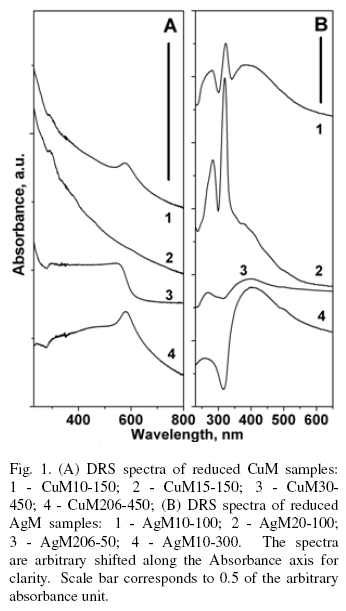
<body><![CDATA[<p align="justify"><font face="verdana" size="2"><b>2&nbsp;Experimental</b></font></p>  	    <p align="justify"><font face="verdana" size="2">Protonated forms of mordenites (HM) with 10 &#8804;&nbsp;MR &#8804;&nbsp;206 were supplied by the TOSOH Corporation, Japan. Copper and silver ion exchange was carried out from 0.1 M aqueous solutions of corresponding nitrates, and prepared samples (CuM and AgM) were filtered, washed with deionized water and dried under ambient conditions followed by heating in a H<sub>2</sub> flow at temperatures from 150 to 450&#176;C for 4 h. Both copper and silver content measured by energy dispersive spectroscopy (EDS) was approximately 1 wt. &#37;.</font></p>  	    <p align="justify"><font face="verdana" size="2">Gold was ion&#45;exchanged in zeolites from aqueous solution of &#91;Au(NH<sub>3</sub>)<sub>4</sub>&#93;(NO<sub>3</sub>)<sub>3</sub> complex synthesized from HAuCl<sub>4</sub> (Alfa&#45;Aesar) and NH<sub>4</sub>NO<sub>3</sub> according to procedure described by Bogdanchikova et al. (2008). Gold exchanged samples were washed with deionized water and dried at 60 <sup>&#176;</sup>C for 6 h in air. Then, AuM samples were calcined at selected temperatures in the range of 100&#45;500 &#176;C for 1 h. The gold loading measured by EDS was &#126; 2.7 wt. &#37;.</font></p>  	    <p align="justify"><font face="verdana" size="2">Samples were studied by UV&#45;Visible diffuse reflectance spectroscopy (DRS) using a CARY 300 SCAN (Varian) spectrometer. Transmission electron microscopy (TEM) was performed with a JEOL 2010 microscope. The sample was dispersed in isopropanol and dropped on a copper grid coated with carbon film. To determine the mean diameter of gold particles more than 150 particles were chosen.</font></p>  	    <p align="justify"><font face="verdana" size="2">The obtained copper, silver or gold samples are abbreviated as (Cu/Ag/Au)M followed by MR of mordenite and temperature of reduction.</font></p>  	    <p align="justify"><font face="verdana" size="2">&nbsp;</font></p>  	    <p align="justify"><font face="verdana" size="2"><b>3&nbsp;Results</b></font></p>  	    <p align="justify"><font face="verdana" size="2">DRS spectra of CuM and AgM samples with different MR reduced at different temperatures are shown at <a href="#f1">Fig. 1</a>. After reduction treatment the DRS spectra of AgM10 and AgM20 demonstrate the development of pronounced absorption peaks at 285&#45;290 nm and 320323 nm (curves 1 and 2, <a href="#f1">Fig. 1B</a>). These peaks were assigned to the Ag8 cluster in the correspondence with the data on its optical absorption in solutions according to Ershov et al. (1993) and frozen rare gases according to Fedrigo et al. (1993). Those clusters may be formed within the mordenite intracrystalline channels with cross section 0.65 x 0.7 nm as reported by Bogdanchikova et al. (1999), Bogdanchikova et al. (2000). In line with cluster peaks, wide band of plasma resonance from silver nanoparticles at &#126; 400 nm appears at increasing of reduction temperature, while cluster peaks gradually disappear. The absorption at &#955; &gt;&nbsp;350 nm is usual for ultrafine silver species and associated with the plasma resonance in silver nanoparticles bigger than 10 nm according to Kreibig et al. (1995). A broadening of this band shows that particles have wide size distribution. Because of their size, exceeding diameters of regular mordenite channels, these particles may be localized at the outer surface of mordenite crystals or at the specific sites inside of the mesoporous volume of zeolite matrix like cleaved areas, defects, uneven surface, etc.</font></p>  	    <p align="center"><font face="verdana" size="2"><a name="f1"></a></font></p>  	    <p align="center"><font face="verdana" size="2"><img src="/img/revistas/rmiq/v11n3/a12f1.jpg"></font></p>  	    ]]></body>
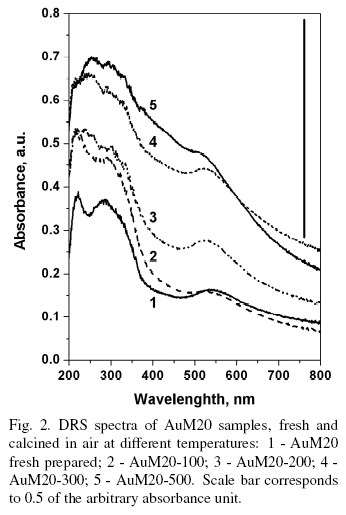
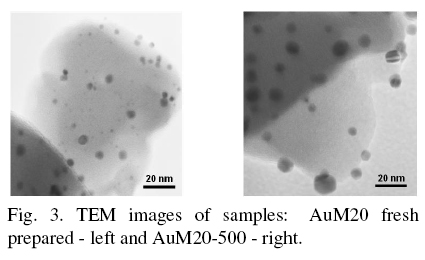
<body><![CDATA[<p align="justify"><font face="verdana" size="2">Copper is similar to silver in chemical behavior, but copper chemistry is more complicated due to the two main valence states, Cu(I) and Cu(II), occurring in different environment. An unambiguous detection of copper clusters of the low nuclearity is more problematic than analogous silver species. Probably, weak peak at &#126; 290 nm for the CuM10&#45;150 and CuM15&#45;150 (curves 1 and 2, <a href="#f1">Fig. 1A</a>) may be due to some amount of unidentified copper clusters. With increasing of temperature this peak disappears, while plasma resonance band (&#955; &#126; 550&#45;600 nm) due to copper nanoparticles starts growing. The corresponding plasmon peak appearance is governed by the same logic as the silver band &#45; high temperatures favor the efficient copper nanoparticle formation (<a href="#f1">Fig.</a> ). The shape of this band is sensitive to MR and reduction temperature.</font></p>  	    <p align="justify"><font face="verdana" size="2">UV&#45;visible spectra of AuM samples (<a href="#f2">Fig. 2</a>) present three pronounced signals at around 220, 280320 and 540 nm. The signal at 540 nm was assigned to the plasma resonance of the metallic gold particles as mentioned by Salama et al. (1996), Kuge et al. (2003), Chen et al. (2003), Smolentseva et al. (2012). Gold metal particles with size around 7.5 nm were presented in freshly prepared samples (<a href="#f3">Fig. 3</a>, left). The blue shift was observed in UV&#45;Visible spectra in the region of 540&#45;520 nm. It may be caused by the difference of gold particles size. TEM images showed that gold particles were growing up to 20 nm with increase of samples calcination temperature (see <a href="#f3">Fig. 3</a>, right). It is well known, that the majority of zeolites are characterized with existence of channels with radii around 2 nm, Hernandez et al. (2005). Thus, the main portion of gold nanoparticles was located on the external surface of zeolite and in the mesoporous voids of zeolite matrix.</font></p>  	    <p align="center"><font face="verdana" size="2"><a name="f2"></a></font></p>  	    <p align="center"><font face="verdana" size="2"><img src="/img/revistas/rmiq/v11n3/a12f2.jpg"></font></p>  	    <p align="center"><font face="verdana" size="2">&nbsp;</font></p>  	    <p align="center"><font face="verdana" size="2"><a name="f3"></a></font></p>  	    <p align="center"><font face="verdana" size="2"><img src="/img/revistas/rmiq/v11n3/a12f3.jpg"></font></p>  	    <p align="justify"><font face="verdana" size="2">According to Pestryakov et al. (2005), Smolentseva et al. (2007) peaks at 220 and 280&#45;320 nm were assigned to the gold charged clusters Au<sub>n</sub><sup>&#43;</sup> with different size and effective charge. These sta2es were formed as results of partial reduction of gold oxides. Subsequent temperature increase leads to the increment of spectra intensity and band at around 220 nm was almost overlapped with band at 280 nm.</font></p>  	    <p align="justify"><font face="verdana" size="2">Thus, the whole series of AgM, CuM and AuM samples allow formation of the two types of reduced products: few atomic clusters and nanoparticles. The effect of long&#45;term stabilization of few atomic silver clusters for Ag&#45;mordenite can be associated with geometrical matching of the cluster size (in particular Ag<sub>8</sub>) and the size of intracrystalline cavities. Cu and Au atoms have different size referring to Ag atoms; so, for long&#45;term stabilization of copper and gold clusters inside intracrystalline cavities and/or channels it is necessary to search for zeolites with slightly different size of voids.</font></p>  	    <p align="justify"><font face="verdana" size="2">&nbsp;</font></p>  	    ]]></body>
<body><![CDATA[<p align="justify"><font face="verdana" size="2"><b>4 Discussion</b></font></p>  	    <p align="justify"><font face="verdana" size="2">Gold, silver and copper belongs to so&#45;called coinage metals those are distinguished from other metals by ability to have noticeable color in visible range. In the case of small particles this ability becomes much more expressed and under appropriate conditions the particles can cover all colors. The mentioned above is due to the absorption maxima lying in visible range those are commonly accepted to associate with plasmon resonance in small particles, which is characteristic for particles of any metal. Position of the band varies from metal to metal depending on characteristics of conductivity electrons in them. A theory of light absorption by metal particles (Mie theory and it developments) is based on analysis of classical interaction of electromagnetic waves with dipole oscillators. In general, absorption on particles with size less than wavelength does not contain a size&#45;dependency explicitly. The main dependence consists in the term with combination of dielectric constants <i>&#949;</i><sub>1</sub> and <i>&#949;</i><sub>2</sub> (these two values determine any dielectric response of a matter with respect to variable electromagnetic field rather than one &#949; in the static limit) and <i>&#949;</i><sub>m</sub>, dielectric function of a medium. <i>&#949;</i><sub>1</sub> and <i>&#949;</i><sub>2</sub> are phenomenological values and tabulated for many compounds, they both include contributions from different light absorption mechanisms.</font></p>  	    <p align="justify"><font face="verdana" size="2">he criterion of appearance of a maximum in absorption is very simple and looks as <i>&#949;</i><sub>1</sub> = <i>&#949;</i><sub>2</sub> * <i>&#949;</i><sub>m</sub>, or in the case of medium with <i>&#949;</i><sub>m</sub> = 1, =&gt; <i>&#949;</i><sub>1</sub> = <i>&#949;</i><sub>2</sub>. That means that the function of <i>&#949;</i>(&#969;), where &#969; is frequency, determines the fact of absorption maximum of small particles and, it has universal character, but in most cases a maximum enters IR (semiconductors) or UV (most of other metals) range. In the visible range this criterion obeys the above mentioned set of "coinage" metals. The existing difference in spectra of Ag, Au and Cu originates from contribution of many factors into the dielectric function. The plasmon resonance (excitation of oscillating charges) is the main factor. The plasmon frequency depends on the concentration of charges (N), and the effective mass (m), according to the formula (1):</font></p>  	    <p align="center"><font face="verdana" size="2"><img src="/img/revistas/rmiq/v11n3/a12e1.jpg"></font></p>  	    <p align="justify"><font face="verdana" size="2">The plasmon oscillations themselves are not specific for small metal particles, surface and bulk ones exist in metals, but the Mie theory shows that the resonance oscillations in small particles are associated with the plasmon oscillations. In other words, an absorbed light excites surface plasmon in particles, which raise this contribution due to large part of surface in any ensemble of small particles.</font></p>  	    <p align="justify"><font face="verdana" size="2">The most "pure" form of the plasmon resonance in small metal particle among coinage metals occurs for silver. Silver is most close to so&#45;called simple metals (the typical ones are alkali), which atoms have a single electron and remaining core in the electronic shell is completely occupied (5s&#45;electron). That provides the high intensity of the plasmon resonance. Different situation occurs with copper and gold. They both scarcely could be assigned to "simple" metals, their conductivity electrons have less concentration than in silver, and the plasmon resonance is red&#45;shifted from that in Ag. Also, d&#45;electrons contribute more noticeably into the electronic spectrum of Cu and Au. The inter&#45;band transitions in these metals are distinguished in energies: from &#126; 4 eV in Ag (again, the reason of the more value is "closed" d&#45;shell) to 22.5 eV in Cu and Au. So, plasmon peaks for Cu and Au are overlapped with inter&#45;band (d&#45;s) transitions. The latter provides more complex outlook of an absorption spectrum for copper and gold particles.</font></p>  	    <p align="justify"><font face="verdana" size="2">Another important factor that distorts the Cu plasmon resonance is the higher chemical activity of copper that results in appearance of some surface compounds on particles and the more particle&#45;matrix interaction. The chemical effects lead to absorption from Cu<sup>2&#43;</sup> and Cu<sup>&#43;</sup> states those enter the ranges from low&#45;energy side and higher&#45;energy side from the plasmon resonance, respectively. Ag, and, in particular, Au are subjected much less to these effects, and ions like Ag<sup>&#43;</sup>, Au<sup>&#43;</sup> absorb in the UV&#45;range far from the plasmon resonance.</font></p>  	    <p align="justify"><font face="verdana" size="2">The above mentioned peak of Cu plasmon resonance is subjected to variations in the position and shape as well as the plasmon resonance peaks of Ag and Au nanoparticles. They are affected by size, shape, environment medium, and aggregation of particles. The different factors changing the plasmon resonance acts as some counterpart of an ideal resonance of perfect sphere of small radius (with respect to wavelength) in vacuum. Some observations are known in the case of Ag particles when a little blue&#45;shift appears due to peculiar charge transfer between surface and interior of a particle, and they are possible as well for Cu, however, this effect cannot be very high. Thus, one of the possible ways of interpretations of short wavelength absorption in the case of Cu (as well as of Ag and Au) is clusters with size too small to develop a natural plasmon resonance but with allowed inter&#45;level transitions similar to the absorption in molecular systems.</font></p>  	    <p align="justify"><font face="verdana" size="2">&nbsp;</font></p>  	    <p align="justify"><font face="verdana" size="2"><b>Conclusions</b></font></p>  	    ]]></body>
<body><![CDATA[<p align="justify"><font face="verdana" size="2">In spite of notable difference in chemical properties of three coinage metals, process of their reduction and followed self&#45;assembling of metal atoms in the process of aggregation shows some similarity. A first step of the assembling, and then chemistry of ion reduction and neutral atoms formation occurs inside of zeolite channels, and it is very different for studied CuM, AgM and AuM systems. Clusters stability in the case of AgM is high due to "cluster sieving effect" of matching of mordenite channel and Ag<sub>8</sub> cluster sizes. Under increased temperature the diffusion of reduced species from the channels of zeolite to mesoporous voids, and on the outer surface of the mordenite crystals equalize the differences between the metal properties, and nanoparticles characterized with plasma resonance bands are formed as the final step of self&#45;assembling.</font></p>  	    <p align="justify"><font face="verdana" size="2">&nbsp;</font></p>  	    <p align="justify"><font face="verdana" size="2"><b>Acknowledgements</b></font></p>  	    <p align="justify"><font face="verdana" size="2">The authors thank E. Flores, I. Gradilla, E. Aparicio, F. Ruiz, P. Casillas, J. Peralta and J. Palomares, for the precious technical support. This research was supported by CONACYT through grant # 102907.</font></p>  	    <p align="justify"><font face="verdana" size="2">&nbsp;</font></p>  	    <p align="justify"><font face="verdana" size="2"><b>References</b></font></p>  	    <!-- ref --><p align="justify"><font face="verdana" size="2">Bogdanchikova N., Petranovskii V., Machorro R., Sugi Y., Soto V.M. and Fuentes S. (1999). Stability of silver clusters in mordenites with different SiO<sub>2</sub>/Al<sub>2</sub>O<sub>3</sub> molar ratio. <i>Applied Surface Science 150</i>, 58&#45;64.    &nbsp;&nbsp;&nbsp;&nbsp;&nbsp;&nbsp;&nbsp;&nbsp;[&#160;<a href="javascript:void(0);" onclick="javascript: window.open('/scielo.php?script=sci_nlinks&ref=8608457&pid=S1665-2738201200030001200001&lng=','','width=640,height=500,resizable=yes,scrollbars=1,menubar=yes,');">Links</a>&#160;]<!-- end-ref --></font></p>  	    <!-- ref --><p align="justify"><font face="verdana" size="2">Bogdanchikova N., Petranovskii V., Fuentes S., Paukshtis E., Sugi Y. and Licea&#45;Claverie A. (2000). Role of mordenite acid properties in silver cluster stabilization. <i>Materials Science and Engineering A 276</i>, 236&#45;242.    &nbsp;&nbsp;&nbsp;&nbsp;&nbsp;&nbsp;&nbsp;&nbsp;[&#160;<a href="javascript:void(0);" onclick="javascript: window.open('/scielo.php?script=sci_nlinks&ref=8608459&pid=S1665-2738201200030001200002&lng=','','width=640,height=500,resizable=yes,scrollbars=1,menubar=yes,');">Links</a>&#160;]<!-- end-ref --></font></p>  	    ]]></body>
<body><![CDATA[<!-- ref --><p align="justify"><font face="verdana" size="2">Bogdanchikova N., Simakov A., Smolentseva E., Pestryakov A., Farias M., D&iacute;az A., Tompos A. and Avalos M. (2008). Stabilization of catalytically active gold species in Fe&#45;modified zeolites. <i>Applied Surface Science 254</i>, 40754083.    &nbsp;&nbsp;&nbsp;&nbsp;&nbsp;&nbsp;&nbsp;&nbsp;[&#160;<a href="javascript:void(0);" onclick="javascript: window.open('/scielo.php?script=sci_nlinks&ref=8608461&pid=S1665-2738201200030001200003&lng=','','width=640,height=500,resizable=yes,scrollbars=1,menubar=yes,');">Links</a>&#160;]<!-- end-ref --></font></p>  	    <!-- ref --><p align="justify"><font face="verdana" size="2">Breck D. (1974). <i>Zeolite Molecular Sieves</i>. J. Wiley &amp;&nbsp;Sons, Inc., New York.    &nbsp;&nbsp;&nbsp;&nbsp;&nbsp;&nbsp;&nbsp;&nbsp;[&#160;<a href="javascript:void(0);" onclick="javascript: window.open('/scielo.php?script=sci_nlinks&ref=8608463&pid=S1665-2738201200030001200004&lng=','','width=640,height=500,resizable=yes,scrollbars=1,menubar=yes,');">Links</a>&#160;]<!-- end-ref --></font></p>  	    <!-- ref --><p align="justify"><font face="verdana" size="2">Chen W., Zhang J. and Cai W. (2003). Sonochemical preparation of Au, Ag, Pd/SiO<sub>2</sub> mesoporous nanocomposites. Scripta Materialia 48, 1061&#45;1066.    &nbsp;&nbsp;&nbsp;&nbsp;&nbsp;&nbsp;&nbsp;&nbsp;[&#160;<a href="javascript:void(0);" onclick="javascript: window.open('/scielo.php?script=sci_nlinks&ref=8608465&pid=S1665-2738201200030001200005&lng=','','width=640,height=500,resizable=yes,scrollbars=1,menubar=yes,');">Links</a>&#160;]<!-- end-ref --></font></p>  	    <!-- ref --><p align="justify"><font face="verdana" size="2">Ershov B.G., Janata E. and Henglein A. (1993). Growth of Silver Particles in Aqueous Solution: Long&#45;Lived "Magic" Clusters and Ionic Strength Effects. <i>Journal of Physical Chemistry 97</i>, 339&#45;343.    &nbsp;&nbsp;&nbsp;&nbsp;&nbsp;&nbsp;&nbsp;&nbsp;[&#160;<a href="javascript:void(0);" onclick="javascript: window.open('/scielo.php?script=sci_nlinks&ref=8608467&pid=S1665-2738201200030001200006&lng=','','width=640,height=500,resizable=yes,scrollbars=1,menubar=yes,');">Links</a>&#160;]<!-- end-ref --></font></p>  	    <!-- ref --><p align="justify"><font face="verdana" size="2">Fedrigo S., Harbich W. and Buttet J. (1993). Collective dipole oscillations in small silver clusters embedded in rare&#45;gas matrices. <i>Physical Review B 47</i>, 10706&#45;10715.    &nbsp;&nbsp;&nbsp;&nbsp;&nbsp;&nbsp;&nbsp;&nbsp;[&#160;<a href="javascript:void(0);" onclick="javascript: window.open('/scielo.php?script=sci_nlinks&ref=8608469&pid=S1665-2738201200030001200007&lng=','','width=640,height=500,resizable=yes,scrollbars=1,menubar=yes,');">Links</a>&#160;]<!-- end-ref --></font></p>  	    ]]></body>
<body><![CDATA[<!-- ref --><p align="justify"><font face="verdana" size="2">Fendler J.H. (1998). <i>Nanoparticles and nanostructured films: preparation, characterization and application</i>. Wiley&#45;VCH: Weinheim, Germany.    &nbsp;&nbsp;&nbsp;&nbsp;&nbsp;&nbsp;&nbsp;&nbsp;[&#160;<a href="javascript:void(0);" onclick="javascript: window.open('/scielo.php?script=sci_nlinks&ref=8608471&pid=S1665-2738201200030001200008&lng=','','width=640,height=500,resizable=yes,scrollbars=1,menubar=yes,');">Links</a>&#160;]<!-- end-ref --></font></p>  	    <!-- ref --><p align="justify"><font face="verdana" size="2">Gurin V., Bogdanchikova N. and Petranovskii V. (2001). Self&#45;assembling of silver and copper small clusters within the zeolite cavities: prediction of geometry. <i>Materials Science and Engineering C18</i>, 37&#45;44.    &nbsp;&nbsp;&nbsp;&nbsp;&nbsp;&nbsp;&nbsp;&nbsp;[&#160;<a href="javascript:void(0);" onclick="javascript: window.open('/scielo.php?script=sci_nlinks&ref=8608473&pid=S1665-2738201200030001200009&lng=','','width=640,height=500,resizable=yes,scrollbars=1,menubar=yes,');">Links</a>&#160;]<!-- end-ref --></font></p>  	    <!-- ref --><p align="justify"><font face="verdana" size="2">Gurin V., Bogdanchikova N. and Petranovskii V. (2002). Metal clusters and nanoparticles assembled in zeolites: an example of stable materials with controllable particle size. <i>Materials Science and Engineering C 19</i>, 327&#45;331.    &nbsp;&nbsp;&nbsp;&nbsp;&nbsp;&nbsp;&nbsp;&nbsp;[&#160;<a href="javascript:void(0);" onclick="javascript: window.open('/scielo.php?script=sci_nlinks&ref=8608475&pid=S1665-2738201200030001200010&lng=','','width=640,height=500,resizable=yes,scrollbars=1,menubar=yes,');">Links</a>&#160;]<!-- end-ref --></font></p>  	    <!-- ref --><p align="justify"><font face="verdana" size="2">Hern&aacute;ndez M.A., Rojas F., Corona L., Lara V.H., Portillo R., Salgado M.A. and Petranovskii V. (2005). Evaluaci&oacute;n de la porosidad de zeolitas naturales por medio de curvas diferenciales de adsorci&oacute;n. <i>Revista Internacional de Contaminaci&oacute;n Ambiental 21</i>, 71&#45;81.    &nbsp;&nbsp;&nbsp;&nbsp;&nbsp;&nbsp;&nbsp;&nbsp;[&#160;<a href="javascript:void(0);" onclick="javascript: window.open('/scielo.php?script=sci_nlinks&ref=8608477&pid=S1665-2738201200030001200011&lng=','','width=640,height=500,resizable=yes,scrollbars=1,menubar=yes,');">Links</a>&#160;]<!-- end-ref --></font></p>  	    <!-- ref --><p align="justify"><font face="verdana" size="2">Kreibig U., Vollmer M. (1995). <i>Optical Properties of Metal Clusters. Springer&#45;Verlag</i>, Berlin.    &nbsp;&nbsp;&nbsp;&nbsp;&nbsp;&nbsp;&nbsp;&nbsp;[&#160;<a href="javascript:void(0);" onclick="javascript: window.open('/scielo.php?script=sci_nlinks&ref=8608479&pid=S1665-2738201200030001200012&lng=','','width=640,height=500,resizable=yes,scrollbars=1,menubar=yes,');">Links</a>&#160;]<!-- end-ref --></font></p>  	    ]]></body>
<body><![CDATA[<!-- ref --><p align="justify"><font face="verdana" size="2">Kuge K. and Calzaferry G. (2003) Gold&#45;loaded zeolite A. <i>Microporous and Mesoporous Materials 66</i>, 15&#45;20.    &nbsp;&nbsp;&nbsp;&nbsp;&nbsp;&nbsp;&nbsp;&nbsp;[&#160;<a href="javascript:void(0);" onclick="javascript: window.open('/scielo.php?script=sci_nlinks&ref=8608481&pid=S1665-2738201200030001200013&lng=','','width=640,height=500,resizable=yes,scrollbars=1,menubar=yes,');">Links</a>&#160;]<!-- end-ref --></font></p>  	    <!-- ref --><p align="justify"><font face="verdana" size="2">Lashkul A., Pleshakov I.V., Glebova N.V., Nechitailov A.A., Kuzmin Yu.I., Matveev V.V., Pyatyshev E.N., Kazakin A.N. and Glukhovskoi A.V. (2011). Investigation of composite structure of magnetically ordered material&#45;semiconductor composite based on cobalt and porous silicon. <i>Technical Physics Letters 37</i>, 664&#45;666.    &nbsp;&nbsp;&nbsp;&nbsp;&nbsp;&nbsp;&nbsp;&nbsp;[&#160;<a href="javascript:void(0);" onclick="javascript: window.open('/scielo.php?script=sci_nlinks&ref=8608483&pid=S1665-2738201200030001200014&lng=','','width=640,height=500,resizable=yes,scrollbars=1,menubar=yes,');">Links</a>&#160;]<!-- end-ref --></font></p>  	    <!-- ref --><p align="justify"><font face="verdana" size="2">L&oacute;pez&#45;Bastidas C., Petranovskii V. and Machorro R. (2012). Optical response of Cu clusters in zeolite template. <i>Journal of Colloid and Interface Science 375</i>, 60&#45;64.    &nbsp;&nbsp;&nbsp;&nbsp;&nbsp;&nbsp;&nbsp;&nbsp;[&#160;<a href="javascript:void(0);" onclick="javascript: window.open('/scielo.php?script=sci_nlinks&ref=8608485&pid=S1665-2738201200030001200015&lng=','','width=640,height=500,resizable=yes,scrollbars=1,menubar=yes,');">Links</a>&#160;]<!-- end-ref --></font></p>  	    <!-- ref --><p align="justify"><font face="verdana" size="2">P&acirc;rvulescu V., Grange P. and Delmon B. (1998). Catalytic removal of NO. <i>Catalysis Today 46</i>, 233&#45;316.    &nbsp;&nbsp;&nbsp;&nbsp;&nbsp;&nbsp;&nbsp;&nbsp;[&#160;<a href="javascript:void(0);" onclick="javascript: window.open('/scielo.php?script=sci_nlinks&ref=8608487&pid=S1665-2738201200030001200016&lng=','','width=640,height=500,resizable=yes,scrollbars=1,menubar=yes,');">Links</a>&#160;]<!-- end-ref --></font></p>  	    <!-- ref --><p align="justify"><font face="verdana" size="2">Pestryakov A., Tuzovskaya I., Smolentseva E., Bogdanchikova N., Jentoft F.C. and Knop&#45;Gericke A. (2005). Formation of gold nanoparticles in zeolites. <i>International Journal of Modern Physics B 19</i>, 2321&#45;2326.    &nbsp;&nbsp;&nbsp;&nbsp;&nbsp;&nbsp;&nbsp;&nbsp;[&#160;<a href="javascript:void(0);" onclick="javascript: window.open('/scielo.php?script=sci_nlinks&ref=8608489&pid=S1665-2738201200030001200017&lng=','','width=640,height=500,resizable=yes,scrollbars=1,menubar=yes,');">Links</a>&#160;]<!-- end-ref --></font></p>  	    ]]></body>
<body><![CDATA[<!-- ref --><p align="justify"><font face="verdana" size="2">Petranovskii V., Gurin V. and Machorro R. (2005). Spectroscopic observation and ab&#45;initio simulation of copper clusters in zeolites. <i>Catalysis Today 107</i>&#45;108, 892&#45;900.    &nbsp;&nbsp;&nbsp;&nbsp;&nbsp;&nbsp;&nbsp;&nbsp;[&#160;<a href="javascript:void(0);" onclick="javascript: window.open('/scielo.php?script=sci_nlinks&ref=8608491&pid=S1665-2738201200030001200018&lng=','','width=640,height=500,resizable=yes,scrollbars=1,menubar=yes,');">Links</a>&#160;]<!-- end-ref --></font></p>  	    <!-- ref --><p align="justify"><font face="verdana" size="2">Putluru R.S.S., Riisager A. and Fehrmann R. (2011). Alkali resistant Cu/zeolite deNO<sub>x</sub> catalysts for flue gas cleaning in biomass fired applications. <i>Applied Catalysis B: Environmental 101</i>, 183&#45;188.    &nbsp;&nbsp;&nbsp;&nbsp;&nbsp;&nbsp;&nbsp;&nbsp;[&#160;<a href="javascript:void(0);" onclick="javascript: window.open('/scielo.php?script=sci_nlinks&ref=8608493&pid=S1665-2738201200030001200019&lng=','','width=640,height=500,resizable=yes,scrollbars=1,menubar=yes,');">Links</a>&#160;]<!-- end-ref --></font></p>  	    <!-- ref --><p align="justify"><font face="verdana" size="2">Schmid G. and Chi L.F. (1998). Metal clasters and colloids. <i>Advanced Materials 10</i>, 515&#45;526.    &nbsp;&nbsp;&nbsp;&nbsp;&nbsp;&nbsp;&nbsp;&nbsp;[&#160;<a href="javascript:void(0);" onclick="javascript: window.open('/scielo.php?script=sci_nlinks&ref=8608495&pid=S1665-2738201200030001200020&lng=','','width=640,height=500,resizable=yes,scrollbars=1,menubar=yes,');">Links</a>&#160;]<!-- end-ref --></font></p>  	    <!-- ref --><p align="justify"><font face="verdana" size="2">Smolentseva E., Simakov A., Beloshapkin S., Estrada M., Vargas E., Sobolev V., Kenzhin R. and Fuentes S. (2011). Gold catalysts supported on nanostructured Ce&#45;Al&#45;O mixed oxides prepared by organic sol&#45;gel. <i>Applied Catalysis B: Environmental 115&#45;116</i>, 117&#45;128.    &nbsp;&nbsp;&nbsp;&nbsp;&nbsp;&nbsp;&nbsp;&nbsp;[&#160;<a href="javascript:void(0);" onclick="javascript: window.open('/scielo.php?script=sci_nlinks&ref=8608497&pid=S1665-2738201200030001200021&lng=','','width=640,height=500,resizable=yes,scrollbars=1,menubar=yes,');">Links</a>&#160;]<!-- end-ref --></font></p>  	    <!-- ref --><p align="justify"><font face="verdana" size="2">Smolentseva E., Bogdanchikova N., Simakov A., Pestryakov A., Gurin V., Avalos M., Farias M., D&iacute;az A. and Tompos A. (2007). Catalytic activity of gold nanoparticles incorporated into modified zeolites. <i>Journal of Nanoscience and Nanotechnology 7</i>, 1882&#45;1886.    &nbsp;&nbsp;&nbsp;&nbsp;&nbsp;&nbsp;&nbsp;&nbsp;[&#160;<a href="javascript:void(0);" onclick="javascript: window.open('/scielo.php?script=sci_nlinks&ref=8608499&pid=S1665-2738201200030001200022&lng=','','width=640,height=500,resizable=yes,scrollbars=1,menubar=yes,');">Links</a>&#160;]<!-- end-ref --></font></p>  	    ]]></body>
<body><![CDATA[<!-- ref --><p align="justify"><font face="verdana" size="2">Van der Waal J.C. and Van Bekkum H. (1998). Molecular sieves, multifunctional microporous materials in organic synthesis. <i>Journal of Porous Materials 5</i>, 289&#45;303.    &nbsp;&nbsp;&nbsp;&nbsp;&nbsp;&nbsp;&nbsp;&nbsp;[&#160;<a href="javascript:void(0);" onclick="javascript: window.open('/scielo.php?script=sci_nlinks&ref=8608501&pid=S1665-2738201200030001200023&lng=','','width=640,height=500,resizable=yes,scrollbars=1,menubar=yes,');">Links</a>&#160;]<!-- end-ref --></font></p>  	    <!-- ref --><p align="justify"><font face="verdana" size="2">Vergara&#45;S&aacute;nchez J., P&eacute;rez&#45;Orozco J.P., Su&aacute;rez&#45;Parra R. and Hern&aacute;ndez&#45;P&eacute;rez I. (2012). Degradation of reactive red 120 azo dye in aqueous solutions using homogeneous/heterogeneous iron systems. <i>Revista Mexicana de Ingenier&iacute;a Qu&iacute;mica 11</i>, 121&#45;131.    &nbsp;&nbsp;&nbsp;&nbsp;&nbsp;&nbsp;&nbsp;&nbsp;[&#160;<a href="javascript:void(0);" onclick="javascript: window.open('/scielo.php?script=sci_nlinks&ref=8608503&pid=S1665-2738201200030001200024&lng=','','width=640,height=500,resizable=yes,scrollbars=1,menubar=yes,');">Links</a>&#160;]<!-- end-ref --></font></p>  	    <!-- ref --><p align="justify"><font face="verdana" size="2">Zanella R., Cedeno&#45;Caero L., Viveros O. and Mireles E. (2007). Oxidesulfurization of organosulfur compounds with gold and silver catalysts supported on titania. <i>Revista Mexicana de Ingenier&iacute;a Qu&iacute;mica 6</i>, 147&#45;156.    &nbsp;&nbsp;&nbsp;&nbsp;&nbsp;&nbsp;&nbsp;&nbsp;[&#160;<a href="javascript:void(0);" onclick="javascript: window.open('/scielo.php?script=sci_nlinks&ref=8608505&pid=S1665-2738201200030001200025&lng=','','width=640,height=500,resizable=yes,scrollbars=1,menubar=yes,');">Links</a>&#160;]<!-- end-ref --></font></p>      ]]></body><back>
<ref-list>
<ref id="B1">
<nlm-citation citation-type="journal">
<person-group person-group-type="author">
<name>
<surname><![CDATA[Bogdanchikova]]></surname>
<given-names><![CDATA[N.]]></given-names>
</name>
<name>
<surname><![CDATA[Petranovskii]]></surname>
<given-names><![CDATA[V.]]></given-names>
</name>
<name>
<surname><![CDATA[Machorro]]></surname>
<given-names><![CDATA[R.]]></given-names>
</name>
<name>
<surname><![CDATA[Sugi]]></surname>
<given-names><![CDATA[Y.]]></given-names>
</name>
<name>
<surname><![CDATA[Soto]]></surname>
<given-names><![CDATA[V.M]]></given-names>
</name>
<name>
<surname><![CDATA[Fuentes]]></surname>
<given-names><![CDATA[S.]]></given-names>
</name>
</person-group>
<article-title xml:lang="en"><![CDATA[Stability of silver clusters in mordenites with different SiO2/Al2O3 molar ratio]]></article-title>
<source><![CDATA[Applied Surface Science]]></source>
<year>1999</year>
<volume>150</volume>
<page-range>58-64</page-range></nlm-citation>
</ref>
<ref id="B2">
<nlm-citation citation-type="journal">
<person-group person-group-type="author">
<name>
<surname><![CDATA[Bogdanchikova]]></surname>
<given-names><![CDATA[N.]]></given-names>
</name>
<name>
<surname><![CDATA[Petranovskii]]></surname>
<given-names><![CDATA[V.]]></given-names>
</name>
<name>
<surname><![CDATA[Fuentes]]></surname>
<given-names><![CDATA[S.]]></given-names>
</name>
<name>
<surname><![CDATA[Paukshtis]]></surname>
<given-names><![CDATA[E.]]></given-names>
</name>
<name>
<surname><![CDATA[Sugi]]></surname>
<given-names><![CDATA[Y.]]></given-names>
</name>
<name>
<surname><![CDATA[Licea-Claverie]]></surname>
<given-names><![CDATA[A.]]></given-names>
</name>
</person-group>
<article-title xml:lang="en"><![CDATA[Role of mordenite acid properties in silver cluster stabilization]]></article-title>
<source><![CDATA[Materials Science and Engineering A]]></source>
<year>2000</year>
<volume>276</volume>
<page-range>236-242</page-range></nlm-citation>
</ref>
<ref id="B3">
<nlm-citation citation-type="journal">
<person-group person-group-type="author">
<name>
<surname><![CDATA[Bogdanchikova]]></surname>
<given-names><![CDATA[N.]]></given-names>
</name>
<name>
<surname><![CDATA[Simakov]]></surname>
<given-names><![CDATA[A.]]></given-names>
</name>
<name>
<surname><![CDATA[Smolentseva]]></surname>
<given-names><![CDATA[E.]]></given-names>
</name>
<name>
<surname><![CDATA[Pestryakov]]></surname>
<given-names><![CDATA[A.]]></given-names>
</name>
<name>
<surname><![CDATA[Farias]]></surname>
<given-names><![CDATA[M.]]></given-names>
</name>
<name>
<surname><![CDATA[Díaz]]></surname>
<given-names><![CDATA[A.]]></given-names>
</name>
<name>
<surname><![CDATA[Tompos]]></surname>
<given-names><![CDATA[A.]]></given-names>
</name>
<name>
<surname><![CDATA[Avalos]]></surname>
<given-names><![CDATA[M.]]></given-names>
</name>
</person-group>
<article-title xml:lang="en"><![CDATA[Stabilization of catalytically active gold species in Fe-modified zeolites]]></article-title>
<source><![CDATA[Applied Surface Science]]></source>
<year>2008</year>
<volume>254</volume>
<page-range>40754083</page-range></nlm-citation>
</ref>
<ref id="B4">
<nlm-citation citation-type="book">
<person-group person-group-type="author">
<name>
<surname><![CDATA[Breck]]></surname>
<given-names><![CDATA[D.]]></given-names>
</name>
</person-group>
<source><![CDATA[Zeolite Molecular Sieves]]></source>
<year>1974</year>
<publisher-loc><![CDATA[New York ]]></publisher-loc>
<publisher-name><![CDATA[J. Wiley & Sons, Inc.]]></publisher-name>
</nlm-citation>
</ref>
<ref id="B5">
<nlm-citation citation-type="journal">
<person-group person-group-type="author">
<name>
<surname><![CDATA[Chen]]></surname>
<given-names><![CDATA[W.]]></given-names>
</name>
<name>
<surname><![CDATA[Zhang]]></surname>
<given-names><![CDATA[J.]]></given-names>
</name>
<name>
<surname><![CDATA[Cai]]></surname>
<given-names><![CDATA[W.]]></given-names>
</name>
</person-group>
<article-title xml:lang="en"><![CDATA[Sonochemical preparation of Au, Ag, Pd/SiO2 mesoporous nanocomposites]]></article-title>
<source><![CDATA[Scripta Materialia]]></source>
<year>2003</year>
<volume>48</volume>
<page-range>1061-1066</page-range></nlm-citation>
</ref>
<ref id="B6">
<nlm-citation citation-type="journal">
<person-group person-group-type="author">
<name>
<surname><![CDATA[Ershov]]></surname>
<given-names><![CDATA[B.G.]]></given-names>
</name>
<name>
<surname><![CDATA[Janata]]></surname>
<given-names><![CDATA[E.]]></given-names>
</name>
<name>
<surname><![CDATA[Henglein]]></surname>
<given-names><![CDATA[A.]]></given-names>
</name>
</person-group>
<article-title xml:lang="en"><![CDATA[Growth of Silver Particles in Aqueous Solution: Long-Lived "Magic" Clusters and Ionic Strength Effects]]></article-title>
<source><![CDATA[Journal of Physical Chemistry]]></source>
<year>1993</year>
<volume>97</volume>
<page-range>339-343</page-range></nlm-citation>
</ref>
<ref id="B7">
<nlm-citation citation-type="journal">
<person-group person-group-type="author">
<name>
<surname><![CDATA[Fedrigo]]></surname>
<given-names><![CDATA[S.]]></given-names>
</name>
<name>
<surname><![CDATA[Harbich]]></surname>
<given-names><![CDATA[W.]]></given-names>
</name>
<name>
<surname><![CDATA[Buttet]]></surname>
<given-names><![CDATA[J.]]></given-names>
</name>
</person-group>
<article-title xml:lang="en"><![CDATA[Collective dipole oscillations in small silver clusters embedded in rare-gas matrices]]></article-title>
<source><![CDATA[Physical Review B]]></source>
<year>1993</year>
<volume>47</volume>
<page-range>10706-10715</page-range></nlm-citation>
</ref>
<ref id="B8">
<nlm-citation citation-type="book">
<person-group person-group-type="author">
<name>
<surname><![CDATA[Fendler]]></surname>
<given-names><![CDATA[J.H.]]></given-names>
</name>
</person-group>
<source><![CDATA[Nanoparticles and nanostructured films: preparation, characterization and application]]></source>
<year>1998</year>
<publisher-loc><![CDATA[Weinheim ]]></publisher-loc>
<publisher-name><![CDATA[Wiley-VCH]]></publisher-name>
</nlm-citation>
</ref>
<ref id="B9">
<nlm-citation citation-type="journal">
<person-group person-group-type="author">
<name>
<surname><![CDATA[Gurin]]></surname>
<given-names><![CDATA[V.]]></given-names>
</name>
<name>
<surname><![CDATA[Bogdanchikova]]></surname>
<given-names><![CDATA[N.]]></given-names>
</name>
<name>
<surname><![CDATA[Petranovskii]]></surname>
<given-names><![CDATA[V.]]></given-names>
</name>
</person-group>
<article-title xml:lang="en"><![CDATA[Self-assembling of silver and copper small clusters within the zeolite cavities: prediction of geometry]]></article-title>
<source><![CDATA[Materials Science and Engineering]]></source>
<year>2001</year>
<volume>18</volume>
<page-range>37-44</page-range></nlm-citation>
</ref>
<ref id="B10">
<nlm-citation citation-type="journal">
<person-group person-group-type="author">
<name>
<surname><![CDATA[Gurin]]></surname>
<given-names><![CDATA[V.]]></given-names>
</name>
<name>
<surname><![CDATA[Bogdanchikova]]></surname>
<given-names><![CDATA[N.]]></given-names>
</name>
<name>
<surname><![CDATA[Petranovskii]]></surname>
<given-names><![CDATA[V.]]></given-names>
</name>
</person-group>
<article-title xml:lang="en"><![CDATA[Metal clusters and nanoparticles assembled in zeolites: an example of stable materials with controllable particle size]]></article-title>
<source><![CDATA[Materials Science and Engineering C]]></source>
<year>2002</year>
<volume>19</volume>
<page-range>327-331</page-range></nlm-citation>
</ref>
<ref id="B11">
<nlm-citation citation-type="journal">
<person-group person-group-type="author">
<name>
<surname><![CDATA[Hernández]]></surname>
<given-names><![CDATA[M.A.]]></given-names>
</name>
<name>
<surname><![CDATA[Rojas]]></surname>
<given-names><![CDATA[F.]]></given-names>
</name>
<name>
<surname><![CDATA[Corona]]></surname>
<given-names><![CDATA[L.]]></given-names>
</name>
<name>
<surname><![CDATA[Lara]]></surname>
<given-names><![CDATA[V.H.]]></given-names>
</name>
<name>
<surname><![CDATA[Portillo]]></surname>
<given-names><![CDATA[R.]]></given-names>
</name>
<name>
<surname><![CDATA[Salgado]]></surname>
<given-names><![CDATA[M.A.]]></given-names>
</name>
<name>
<surname><![CDATA[Petranovskii]]></surname>
<given-names><![CDATA[V.]]></given-names>
</name>
</person-group>
<article-title xml:lang="en"><![CDATA[Evaluación de la porosidad de zeolitas naturales por medio de curvas diferenciales de adsorción]]></article-title>
<source><![CDATA[Revista Internacional de Contaminación Ambiental]]></source>
<year>2005</year>
<volume>21</volume>
<page-range>71-81</page-range></nlm-citation>
</ref>
<ref id="B12">
<nlm-citation citation-type="book">
<person-group person-group-type="author">
<name>
<surname><![CDATA[Kreibig]]></surname>
<given-names><![CDATA[U.]]></given-names>
</name>
<name>
<surname><![CDATA[Vollmer]]></surname>
<given-names><![CDATA[M.]]></given-names>
</name>
</person-group>
<source><![CDATA[Optical Properties of Metal Clusters]]></source>
<year>1995</year>
<publisher-loc><![CDATA[Berlin ]]></publisher-loc>
<publisher-name><![CDATA[SpringerVerlag]]></publisher-name>
</nlm-citation>
</ref>
<ref id="B13">
<nlm-citation citation-type="journal">
<person-group person-group-type="author">
<name>
<surname><![CDATA[Kuge]]></surname>
<given-names><![CDATA[K.]]></given-names>
</name>
<name>
<surname><![CDATA[Calzaferry]]></surname>
<given-names><![CDATA[G.]]></given-names>
</name>
</person-group>
<article-title xml:lang="en"><![CDATA[Gold-loaded zeolite A]]></article-title>
<source><![CDATA[Microporous and Mesoporous Materials]]></source>
<year>2003</year>
<volume>66</volume>
<page-range>15-20</page-range></nlm-citation>
</ref>
<ref id="B14">
<nlm-citation citation-type="journal">
<person-group person-group-type="author">
<name>
<surname><![CDATA[Lashkul]]></surname>
<given-names><![CDATA[A.]]></given-names>
</name>
<name>
<surname><![CDATA[Pleshakov]]></surname>
<given-names><![CDATA[I.V.]]></given-names>
</name>
<name>
<surname><![CDATA[Glebova]]></surname>
<given-names><![CDATA[N.V.]]></given-names>
</name>
<name>
<surname><![CDATA[Nechitailov]]></surname>
<given-names><![CDATA[A.A.]]></given-names>
</name>
<name>
<surname><![CDATA[Kuzmin]]></surname>
<given-names><![CDATA[Yu.I.]]></given-names>
</name>
<name>
<surname><![CDATA[Matveev]]></surname>
<given-names><![CDATA[V.V.]]></given-names>
</name>
<name>
<surname><![CDATA[Pyatyshev]]></surname>
<given-names><![CDATA[E.N.]]></given-names>
</name>
<name>
<surname><![CDATA[Kazakin]]></surname>
<given-names><![CDATA[A.N.]]></given-names>
</name>
<name>
<surname><![CDATA[Glukhovskoi]]></surname>
<given-names><![CDATA[A.V.]]></given-names>
</name>
</person-group>
<article-title xml:lang="en"><![CDATA[Investigation of composite structure of magnetically ordered material-semiconductor composite based on cobalt and porous silicon]]></article-title>
<source><![CDATA[Technical Physics Letters]]></source>
<year>2011</year>
<volume>37</volume>
<page-range>664-666</page-range></nlm-citation>
</ref>
<ref id="B15">
<nlm-citation citation-type="journal">
<person-group person-group-type="author">
<name>
<surname><![CDATA[López-Bastidas]]></surname>
<given-names><![CDATA[C.]]></given-names>
</name>
<name>
<surname><![CDATA[Petranovskii]]></surname>
<given-names><![CDATA[V.]]></given-names>
</name>
<name>
<surname><![CDATA[Machorro]]></surname>
<given-names><![CDATA[R.]]></given-names>
</name>
</person-group>
<source><![CDATA[Journal of Colloid and Interface Science]]></source>
<year></year>
<volume>375</volume>
<page-range>60-64</page-range></nlm-citation>
</ref>
<ref id="B16">
<nlm-citation citation-type="journal">
<person-group person-group-type="author">
<name>
<surname><![CDATA[Pârvulescu]]></surname>
<given-names><![CDATA[V.]]></given-names>
</name>
<name>
<surname><![CDATA[Grange]]></surname>
<given-names><![CDATA[P.]]></given-names>
</name>
<name>
<surname><![CDATA[Delmon]]></surname>
<given-names><![CDATA[B.]]></given-names>
</name>
</person-group>
<article-title xml:lang="en"><![CDATA[Catalytic removal of NO]]></article-title>
<source><![CDATA[Catalysis Today]]></source>
<year>1998</year>
<volume>46</volume>
<page-range>233-316</page-range></nlm-citation>
</ref>
<ref id="B17">
<nlm-citation citation-type="journal">
<person-group person-group-type="author">
<name>
<surname><![CDATA[Pestryakov]]></surname>
<given-names><![CDATA[A.]]></given-names>
</name>
<name>
<surname><![CDATA[Tuzovskaya]]></surname>
<given-names><![CDATA[I.]]></given-names>
</name>
<name>
<surname><![CDATA[Smolentseva]]></surname>
<given-names><![CDATA[E.]]></given-names>
</name>
<name>
<surname><![CDATA[Bogdanchikova]]></surname>
<given-names><![CDATA[N.]]></given-names>
</name>
<name>
<surname><![CDATA[Jentoft]]></surname>
<given-names><![CDATA[F.C.]]></given-names>
</name>
<name>
<surname><![CDATA[Knop-Gericke]]></surname>
<given-names><![CDATA[A.]]></given-names>
</name>
</person-group>
<article-title xml:lang="en"><![CDATA[Formation of gold nanoparticles in zeolites]]></article-title>
<source><![CDATA[International Journal of Modern Physics B]]></source>
<year>2005</year>
<volume>19</volume>
<page-range>2321-2326</page-range></nlm-citation>
</ref>
<ref id="B18">
<nlm-citation citation-type="journal">
<person-group person-group-type="author">
<name>
<surname><![CDATA[Petranovskii]]></surname>
<given-names><![CDATA[V.]]></given-names>
</name>
<name>
<surname><![CDATA[Gurin]]></surname>
<given-names><![CDATA[V.]]></given-names>
</name>
<name>
<surname><![CDATA[Machorro]]></surname>
<given-names><![CDATA[R.]]></given-names>
</name>
</person-group>
<article-title xml:lang="en"><![CDATA[Spectroscopic observation and ab-initio simulation of copper clusters in zeolites]]></article-title>
<source><![CDATA[Catalysis Today]]></source>
<year>2005</year>
<volume>107</volume><volume>108</volume>
<page-range>892-900</page-range></nlm-citation>
</ref>
<ref id="B19">
<nlm-citation citation-type="journal">
<person-group person-group-type="author">
<name>
<surname><![CDATA[Putluru]]></surname>
<given-names><![CDATA[R.S.S.]]></given-names>
</name>
<name>
<surname><![CDATA[Riisager]]></surname>
<given-names><![CDATA[A.]]></given-names>
</name>
<name>
<surname><![CDATA[Fehrmann]]></surname>
<given-names><![CDATA[R.]]></given-names>
</name>
</person-group>
<article-title xml:lang="en"><![CDATA[Alkali resistant Cu/zeolite deNOx catalysts for flue gas cleaning in biomass fired applications]]></article-title>
<source><![CDATA[Applied Catalysis B: Environmental]]></source>
<year>2011</year>
<volume>101</volume>
<page-range>183-188</page-range></nlm-citation>
</ref>
<ref id="B20">
<nlm-citation citation-type="journal">
<person-group person-group-type="author">
<name>
<surname><![CDATA[Schmid]]></surname>
<given-names><![CDATA[G.]]></given-names>
</name>
<name>
<surname><![CDATA[Chi]]></surname>
<given-names><![CDATA[L.F.]]></given-names>
</name>
</person-group>
<article-title xml:lang="en"><![CDATA[Metal clasters and colloids]]></article-title>
<source><![CDATA[Advanced Materials]]></source>
<year>1998</year>
<volume>10</volume>
<page-range>515-526</page-range></nlm-citation>
</ref>
<ref id="B21">
<nlm-citation citation-type="journal">
<person-group person-group-type="author">
<name>
<surname><![CDATA[Smolentseva]]></surname>
<given-names><![CDATA[E.]]></given-names>
</name>
<name>
<surname><![CDATA[Simakov]]></surname>
<given-names><![CDATA[A.]]></given-names>
</name>
<name>
<surname><![CDATA[Beloshapkin]]></surname>
<given-names><![CDATA[S.]]></given-names>
</name>
<name>
<surname><![CDATA[Estrada]]></surname>
<given-names><![CDATA[M.]]></given-names>
</name>
<name>
<surname><![CDATA[Vargas]]></surname>
<given-names><![CDATA[E.]]></given-names>
</name>
<name>
<surname><![CDATA[Sobolev]]></surname>
<given-names><![CDATA[V.]]></given-names>
</name>
<name>
<surname><![CDATA[Kenzhin]]></surname>
<given-names><![CDATA[R.]]></given-names>
</name>
<name>
<surname><![CDATA[Fuentes]]></surname>
<given-names><![CDATA[S.]]></given-names>
</name>
</person-group>
<article-title xml:lang="en"><![CDATA[Gold catalysts supported on nanostructured Ce-Al-O mixed oxides prepared by organic sol-gel]]></article-title>
<source><![CDATA[Applied Catalysis B: Environmental]]></source>
<year>2011</year>
<volume>115</volume><volume>116</volume>
<page-range>117-128</page-range></nlm-citation>
</ref>
<ref id="B22">
<nlm-citation citation-type="journal">
<person-group person-group-type="author">
<name>
<surname><![CDATA[Smolentseva]]></surname>
<given-names><![CDATA[E.]]></given-names>
</name>
<name>
<surname><![CDATA[Bogdanchikova]]></surname>
<given-names><![CDATA[N.]]></given-names>
</name>
<name>
<surname><![CDATA[Simakov]]></surname>
<given-names><![CDATA[A.]]></given-names>
</name>
<name>
<surname><![CDATA[Pestryakov]]></surname>
<given-names><![CDATA[A.]]></given-names>
</name>
<name>
<surname><![CDATA[Gurin]]></surname>
<given-names><![CDATA[V.]]></given-names>
</name>
<name>
<surname><![CDATA[Avalos]]></surname>
<given-names><![CDATA[M.]]></given-names>
</name>
<name>
<surname><![CDATA[Farias]]></surname>
<given-names><![CDATA[M.]]></given-names>
</name>
<name>
<surname><![CDATA[Díaz]]></surname>
<given-names><![CDATA[A.]]></given-names>
</name>
<name>
<surname><![CDATA[Tompos]]></surname>
<given-names><![CDATA[A.]]></given-names>
</name>
</person-group>
<article-title xml:lang="en"><![CDATA[Catalytic activity of gold nanoparticles incorporated into modified zeolites]]></article-title>
<source><![CDATA[Journal of Nanoscience and Nanotechnology]]></source>
<year>2007</year>
<volume>7</volume>
<page-range>1882-1886</page-range></nlm-citation>
</ref>
<ref id="B23">
<nlm-citation citation-type="journal">
<person-group person-group-type="author">
<name>
<surname><![CDATA[Van der Waal]]></surname>
<given-names><![CDATA[J.C.]]></given-names>
</name>
<name>
<surname><![CDATA[Van Bekkum]]></surname>
<given-names><![CDATA[H.]]></given-names>
</name>
</person-group>
<article-title xml:lang="en"><![CDATA[Molecular sieves, multifunctional microporous materials in organic synthesis]]></article-title>
<source><![CDATA[Journal of Porous Materials]]></source>
<year>1998</year>
<volume>5</volume>
<page-range>289-303</page-range></nlm-citation>
</ref>
<ref id="B24">
<nlm-citation citation-type="journal">
<person-group person-group-type="author">
<name>
<surname><![CDATA[Vergara-Sánchez]]></surname>
<given-names><![CDATA[J.]]></given-names>
</name>
<name>
<surname><![CDATA[Pérez-Orozco]]></surname>
<given-names><![CDATA[J.P.]]></given-names>
</name>
<name>
<surname><![CDATA[Suárez-Parra]]></surname>
<given-names><![CDATA[R.]]></given-names>
</name>
<name>
<surname><![CDATA[Hernández-Pérez]]></surname>
<given-names><![CDATA[I.]]></given-names>
</name>
</person-group>
<article-title xml:lang="en"><![CDATA[Degradation of reactive red 120 azo dye in aqueous solutions using homogeneous/heterogeneous iron systems]]></article-title>
<source><![CDATA[Revista Mexicana de Ingeniería Química]]></source>
<year>2012</year>
<volume>11</volume>
<page-range>121-131</page-range></nlm-citation>
</ref>
<ref id="B25">
<nlm-citation citation-type="journal">
<person-group person-group-type="author">
<name>
<surname><![CDATA[Zanella]]></surname>
<given-names><![CDATA[R.]]></given-names>
</name>
<name>
<surname><![CDATA[Cedeno-Caero]]></surname>
<given-names><![CDATA[L.]]></given-names>
</name>
<name>
<surname><![CDATA[Viveros]]></surname>
<given-names><![CDATA[O.]]></given-names>
</name>
<name>
<surname><![CDATA[Mireles]]></surname>
<given-names><![CDATA[E.]]></given-names>
</name>
</person-group>
<article-title xml:lang="en"><![CDATA[Oxidesulfurization of organosulfur compounds with gold and silver catalysts supported on titania]]></article-title>
<source><![CDATA[Revista Mexicana de Ingeniería Química]]></source>
<year>2007</year>
<volume>6</volume>
<page-range>147-156</page-range></nlm-citation>
</ref>
</ref-list>
</back>
</article>