<?xml version="1.0" encoding="ISO-8859-1"?><article xmlns:mml="http://www.w3.org/1998/Math/MathML" xmlns:xlink="http://www.w3.org/1999/xlink" xmlns:xsi="http://www.w3.org/2001/XMLSchema-instance">
<front>
<journal-meta>
<journal-id>1665-2738</journal-id>
<journal-title><![CDATA[Revista mexicana de ingeniería química]]></journal-title>
<abbrev-journal-title><![CDATA[Rev. Mex. Ing. Quím]]></abbrev-journal-title>
<issn>1665-2738</issn>
<publisher>
<publisher-name><![CDATA[Universidad Autónoma Metropolitana, División de Ciencias Básicas e Ingeniería]]></publisher-name>
</publisher>
</journal-meta>
<article-meta>
<article-id>S1665-27382012000100001</article-id>
<title-group>
<article-title xml:lang="en"><![CDATA[Effect of solvent-temperature extraction conditions on the initial antioxidant activity and total phenolic content of muitle extracts and their decay upon storage at different pH]]></article-title>
<article-title xml:lang="es"><![CDATA[Efecto de las condiciones de extracción solvente-temperatura en la actividad antioxidante y contenido de fenoles totales en extractos de muitle y su pérdida durante el almacenamiento a diferentes valores de pH]]></article-title>
</title-group>
<contrib-group>
<contrib contrib-type="author">
<name>
<surname><![CDATA[García-Márquez]]></surname>
<given-names><![CDATA[E.]]></given-names>
</name>
<xref ref-type="aff" rid="A01"/>
</contrib>
<contrib contrib-type="author">
<name>
<surname><![CDATA[Román-Guerrero]]></surname>
<given-names><![CDATA[A.]]></given-names>
</name>
<xref ref-type="aff" rid="A01"/>
</contrib>
<contrib contrib-type="author">
<name>
<surname><![CDATA[Pérez-Alonso]]></surname>
<given-names><![CDATA[C.]]></given-names>
</name>
<xref ref-type="aff" rid="A02"/>
</contrib>
<contrib contrib-type="author">
<name>
<surname><![CDATA[Cruz-Sosa]]></surname>
<given-names><![CDATA[F.]]></given-names>
</name>
<xref ref-type="aff" rid="A01"/>
</contrib>
<contrib contrib-type="author">
<name>
<surname><![CDATA[Jiménez-Alvarado]]></surname>
<given-names><![CDATA[R.]]></given-names>
</name>
<xref ref-type="aff" rid="A03"/>
</contrib>
<contrib contrib-type="author">
<name>
<surname><![CDATA[Vernon-Carter]]></surname>
<given-names><![CDATA[E.J.]]></given-names>
</name>
<xref ref-type="aff" rid="A04"/>
</contrib>
</contrib-group>
<aff id="A01">
<institution><![CDATA[,Universidad Autónoma Metropolitana-Iztapalapa Departamento de Biotecnología ]]></institution>
<addr-line><![CDATA[D.F. ]]></addr-line>
<country>México</country>
</aff>
<aff id="A02">
<institution><![CDATA[,Universidad Autónoma del Estado de México Facultad de Química Departamento de Ingeniería Química]]></institution>
<addr-line><![CDATA[Toluca Edo. Méx.]]></addr-line>
<country>México</country>
</aff>
<aff id="A03">
<institution><![CDATA[,Universidad de la Cañada Jefatura de Carrera de Ingeniería en Agroindustrias ]]></institution>
<addr-line><![CDATA[Teotitlán de Flores Magón Oaxaca]]></addr-line>
<country>México</country>
</aff>
<aff id="A04">
<institution><![CDATA[,Universidad Autónoma Metropolitana-Iztapalapa Departamento de Ingeniería de Procesos e Hidráulica ]]></institution>
<addr-line><![CDATA[D.F. ]]></addr-line>
<country>México</country>
</aff>
<pub-date pub-type="pub">
<day>00</day>
<month>04</month>
<year>2012</year>
</pub-date>
<pub-date pub-type="epub">
<day>00</day>
<month>04</month>
<year>2012</year>
</pub-date>
<volume>11</volume>
<numero>1</numero>
<fpage>1</fpage>
<lpage>10</lpage>
<copyright-statement/>
<copyright-year/>
<self-uri xlink:href="http://www.scielo.org.mx/scielo.php?script=sci_arttext&amp;pid=S1665-27382012000100001&amp;lng=en&amp;nrm=iso"></self-uri><self-uri xlink:href="http://www.scielo.org.mx/scielo.php?script=sci_abstract&amp;pid=S1665-27382012000100001&amp;lng=en&amp;nrm=iso"></self-uri><self-uri xlink:href="http://www.scielo.org.mx/scielo.php?script=sci_pdf&amp;pid=S1665-27382012000100001&amp;lng=en&amp;nrm=iso"></self-uri><abstract abstract-type="short" xml:lang="en"><p><![CDATA[The effect of sotvent and extraction temperature on the initial antioxidani activity (AA) and total phenolic content (TPC) of Muitle (Justicia spicigera) extracts and their decay upon storage at different pH values was studied. Extraction with aqueous solvents, at either 25 or 60 °C, produced fresh extracts (pH 7.4) with higher initial TPC and AA. Extracts were adjusted to different pH's displayed different TPC and AAA dec ay rates upon storage. TPC had fiest order decay kinetics, characterized by e relatively quick constant (k1) at relatively short storage times followed by a relatively slow constant (k2) at relatively large storage times. ABTS and DPPH assays estimated different AA in the extracts, attributed to compatibility differences between the bioactive species and the free radicals.]]></p></abstract>
<abstract abstract-type="short" xml:lang="es"><p><![CDATA[Se estudió el efecto del solvente y la temperatura de extracción en la actividad antioxidante inicial (AA) y el contenido de fenoles totales (TPC) en extractos de Muitle (Justicia spicigera) y su pérdida durante el almacenamiento a diferentes valores de pH. La extracción con solventes acuosos, a 225 o 60°C, produjeron extractos frescos (pH 7.4) con mayor TPC y AA iniciales. Los extractos fueron ajustados a diferentes valores de pH mostrando diferentes TPC y tasas de perdida de AAA durante el almacenamiento. TPC mostró una cinética de pérdida de primer orden caracterizada por una constante relativamente rápida (k1) a tiempos relativamente cortos seguida de una constante relativamente lenta (k2) a tiempos de almacenamiento largos. Pruebas de ABTS y DPPH estimaron diferentes AA en los extractos, atribuido a las diferencias de compatibilidad entre las especies bioactivas y los radicales libres.]]></p></abstract>
<kwd-group>
<kwd lng="en"><![CDATA[Justicia spicigera]]></kwd>
<kwd lng="en"><![CDATA[total phenolic content]]></kwd>
<kwd lng="en"><![CDATA[antioxidant activity]]></kwd>
<kwd lng="en"><![CDATA[extraction conditions]]></kwd>
<kwd lng="en"><![CDATA[decay kinetics]]></kwd>
<kwd lng="es"><![CDATA[Justicia spicigera]]></kwd>
<kwd lng="es"><![CDATA[contenido de fenoles totales]]></kwd>
<kwd lng="es"><![CDATA[actividad antioxidante]]></kwd>
<kwd lng="es"><![CDATA[condiciones de extracción]]></kwd>
<kwd lng="es"><![CDATA[cinéticas de pérdida]]></kwd>
</kwd-group>
</article-meta>
</front><body><![CDATA[  	    <p align="justify"><font face="verdana" size="4">Ingenier&iacute;a de alimentos</font></p>  	    <p align="justify"><font face="verdana" size="2">&nbsp;</font></p>  	    <p align="center"><font face="verdana" size="4"><b>Effect of solvent&#45;temperature extraction conditions on the initial antioxidant activity and total phenolic content of muitle extracts and their decay upon storage at different pH</b></font></p>  	    <p align="justify"><font face="verdana" size="2">&nbsp;</font></p>  	    <p align="center"><font face="verdana" size="3"><b>Efecto de las condiciones de extracci&oacute;n solvente&#45;temperatura en la actividad antioxidante y contenido de fenoles totales en extractos de muitle y su p&eacute;rdida durante el almacenamiento a diferentes valores de pH</b></font></p>  	    <p align="justify"><font face="verdana" size="2">&nbsp;</font></p>  	    <p align="center"><font face="verdana" size="2"><b>E. Garc&iacute;a&#45;M&aacute;rquez<sup>1</sup>, A. Rom&aacute;n&#45;Guerrero<sup>1</sup>*, C. P&eacute;rez&#45;Alonso<sup>2</sup>, F. Cruz&#45;Sosa<sup>1</sup>, R. Jim&eacute;nez&#45;Alvarado<sup>3</sup> and E.J. Vernon&#45;Carter<sup>4</sup></b></font></p>  	    <p align="justify"><font face="verdana" size="2">&nbsp;</font></p>  	    <p align="justify"><font face="verdana" size="2"><i><sup>1</sup> Departamento de Biotecnolog&iacute;a, Universidad Aut&oacute;noma Metropolitana&#45;Iztapalapa. San Rafael Atlixco No. 186Col. Vicentina, CP 09340 Mexico, D.F., M&eacute;xico</i>. *<i>Corresponding author. E&#45;mail:</i> <a href="mailto:aromangro@gmail.com">aromangro@gmail.com</a> <i>Tel.: +52 55 5804 4934; fax: +52 55 5804 4900</i>.</font></p>  	    ]]></body>
<body><![CDATA[<p align="justify"><font face="verdana" size="2"><i><sup>2</sup> Departamento de Ingenier&iacute;a Qu&iacute;mica, Facultad de Qu&iacute;mica, Universidad Aut&oacute;noma del Estado de M&eacute;xico, Paseo Col&oacute;n esq. Paseo Tollocan s/n, Col. Residencial Col&oacute;n, CP 50120, Toluca, Edo. M&eacute;x., M&eacute;xico.</i></font></p>  	    <p align="justify"><font face="verdana" size="2"><i><sup>3</sup> Universidad de la Ca&ntilde;ada, Jefatura de Carrera de Ingenier&iacute;a en Agroindustrias, Carretera Teotitl&aacute;n&#45;San Antonio Nanahuatipan km 1.7 s/n, Paraje Titlacuatitla, CP 68540 Teotitl&aacute;n de Flores Mag&oacute;n, Oaxaca, M&eacute;xico.</i></font></p>  	    <p align="justify"><font face="verdana" size="2"><i><sup>4</sup> Departamento de Ingenier&iacute;a de Procesos e Hidr&aacute;ulica, Universidad Aut&oacute;noma Metropolitana&#45;Iztapalapa. San Rafael Atlixco No. 186 Col. Vicentina, CP 09340 M&eacute;xico, D.F., M&eacute;xico.</i></font></p>  	    <p align="justify"><font face="verdana" size="2">&nbsp;</font></p>  	    <p align="justify"><font face="verdana" size="2">Received 9 of November 2011    <br> 	Accepted 15 of November 2011</font></p>  	    <p align="justify"><font face="verdana" size="2">&nbsp;</font></p>  	    <p align="justify"><font face="verdana" size="2"><b>Abstract</b></font></p>  	    <p align="justify"><font face="verdana" size="2">The effect of sotvent and extraction temperature on the initial antioxidani activity (AA) and total phenolic content (TPC) of Muitle <i>(Justicia spicigera)</i> extracts and their decay upon storage at different pH values was studied. Extraction with aqueous solvents, at either 25 or 60 &deg;C, produced fresh extracts (pH 7.4) with higher initial TPC and AA. Extracts were adjusted to different pH's displayed different TPC and AAA dec ay rates upon storage. TPC had fiest order decay kinetics, characterized by e relatively quick constant (k<sub>1</sub>) at relatively short storage times followed by a relatively slow constant (k<sub>2</sub>) at relatively large storage times. ABTS and DPPH assays estimated different AA in the extracts, attributed to compatibility differences between the bioactive species and the free radicals.</font></p>  	    <p align="justify"><font face="verdana" size="2"><b>Keywords:</b> <i>Justicia spicigera,</i> total phenolic content, antioxidant activity, extraction conditions, decay kinetics.</font></p>  	    ]]></body>
<body><![CDATA[<p align="justify"><font face="verdana" size="2">&nbsp;</font></p>  	    <p align="justify"><font face="verdana" size="2"><b>Resumen</b></font></p>  	    <p align="justify"><font face="verdana" size="2">Se estudi&oacute; el efecto del solvente y la temperatura de extracci&oacute;n en la actividad antioxidante inicial (AA) y el contenido de fenoles totales (TPC) en extractos de Muitle <i>(Justicia spicigera)</i> y su p&eacute;rdida durante el almacenamiento a diferentes valores de pH. La extracci&oacute;n con solventes acuosos, a 225 o 60&deg;C, produjeron extractos frescos (pH 7.4) con mayor TPC y AA iniciales. Los extractos fueron ajustados a diferentes valores de pH mostrando diferentes TPC y tasas de perdida de AAA durante el almacenamiento. TPC mostr&oacute; una cin&eacute;tica de p&eacute;rdida de primer orden caracterizada por una constante relativamente r&aacute;pida (k<sub>1</sub>) a tiempos relativamente cortos seguida de una constante relativamente lenta (k<sub>2</sub>) a tiempos de almacenamiento largos. Pruebas de ABTS y DPPH estimaron diferentes AA en los extractos, atribuido a las diferencias de compatibilidad entre las especies bioactivas y los radicales libres.</font></p>  	    <p align="justify"><font face="verdana" size="2"><b>Palabras clave:</b> <i>Justicia spicigera,</i> contenido de fenoles totales, actividad antioxidante, condiciones de extracci&oacute;n, cin&eacute;ticas de p&eacute;rdida.</font></p>  	    <p align="justify"><font face="verdana" size="2">&nbsp;</font></p>  	    <p align="justify"><font face="verdana" size="2"><b>1 Introduction</b></font></p>  	    <p align="justify"><font face="verdana" size="2">Aqueous extracts of aerial parts of Muitle <i>(Justicia spicigera</i> Schechtendal) have been used in traditional medicine in Mexico and elsewhere as antipyretic, blood depurative, anti&#45;inflammatory, for treatment of diarrhea and diabetes, uterine cancer, amenorrhea, and have shown cytotoxic activities against human leukemic cells (Wong, 1976; Mahabir and Gulliford, 1997; Marquez <i>et al.,</i> 1999; Sepulveda Jim&eacute;nez <i>et al.,</i> 2009). Likewise, ethanolic extracts have demonstrated activity against Giardia duodenalis (Ponce&#45;Macotela <i>et al.,</i> 2001). The main compounds found in <i>J. spicigera</i> are kaempferitrin, O&#45;sitosterol&#45;3&#45;&#946;&#45;glycoside, allantoin and cryptoxanthin, and are probably responsible for these activities (Euler and Alam, 1982; Dom&iacute;nguez <i>et al.,</i> 1990). However, antioxidant activity studies of <i>J. spicigera</i> and other species from this genus are scarce. Sepu&iacute;lveda&#45;Jim&eacute;nez <i>et al.</i> (2009) were the first in describing the antioxidant activity from <i>J. spicigera,</i> where the phenolic compounds and flavonoids contributed to this activity, suggesting <i>J. spicigera</i> as potential source of antioxidants for use against various free radical&#45;related disorders.</font></p>  	    <p align="justify"><font face="verdana" size="2">The interest in phenolic compounds has been related primarily to their antioxidant activity; they also show important biological activity in vivo and may be beneficial in combating diseases related to excessive oxygen radical formation, where the antioxidant defense capacity of the human body is exceeded (Morell&oacute; <i>et al.,</i> 2004; Mulero <i>et al.,</i> 2010). However, these natural antioxidants are fairly unstable during harvesting, transportation, storage and processing (Reyes&#45;Mungu&iacute;a <i>et al.,</i> 2009). On the other hand, the initial phenolic content and antioxidant activity of the extracts depends on the solvent and extraction conditions used, mainly due to the complex interrelationship between the solvents and phenolics polarities and solubilities (Serrano&#45;Maldonado <i>et al.,</i> 2011; Ares <i>et al.,</i> 2010). Also it is important to understand how storage time and pH of the phenolic compounds affects their stability before proceeding to use them in a commercial basis (Xu and Chang, 2007).</font></p>  	    <p align="justify"><font face="verdana" size="2">Thus, the aims of this work were: (a) to evaluate the effect of the solvent and temperature extraction conditions on the initial total phenolic content and antioxidant activity of Muitle extracts; and (b) to determine the decay of these two parameters in extracts at different pH values stored for 20 days at 25 &ordf;C.</font></p>  	    <p align="justify"><font face="verdana" size="2">&nbsp;</font></p>  	    ]]></body>
<body><![CDATA[<p align="justify"><font face="verdana" size="2"><b>2 Materials and methods</b></font></p>  	    <p align="justify"><font face="verdana" size="2"><i>2.1&nbsp;Plant material and reagents</i></font></p>  	    <p align="justify"><font face="verdana" size="2">Leaves of Muitle <i>(J. spicigera</i> Schechtendal) from adult plants were collected in the month of June from Tepoztlan, Morelos, Mexico. Analytical reagents and standards used for the determination of total phenolic content (TPC), and antioxidant activity (AA) were: Folin&#45;Ciocalteau reagent (FCR) and sodium azide (SA) both purchased from Hycel de Mexico, S.A. de C.V., Mexico, D.F., Mexico; 2,2&#45;azino&#45;bis&#45;3&#45;ethylbenzothiazoline&#45;6&#45;sulfonic acid (ABTS) 2,2&#45;diphenyl&#45;1&#45; picrylhydrazyl (DPPH), 6&#45;hydroxy&#45;2,5,7,8&#45;tetramethylchroman&#45; 2&#45;carboxylic acid (TROLOX), gallic acid standard (GAS), potassium persulfate (PPS), glycerol (G, Sigma Ultra, 99% GC) were obtained from Sigma&#45;Aldrich Quimica, S.A. de C.V., Toluca, State of Mexico, Mexico; anhydrous sodium acetate (ASA), glacial acetic acid (GAA), hydrochloric acid (HCl), methanol (MeOH), and sodium hydroxide (NaOH) were acquired from J.T. Baker, S.A. de C.V. (Xalostoc, State of Mexico, Mexico); sodium carbonate (SC) was provided by Qu&iacute;&iacute;mica Meyer (Mexico, D.F., Mexico); absolute ethanol (E<sub>100</sub>) was procured from Tecsiquim S.A. de C.V. (Toluca, State of Mexico, Mexico); and propylenglycol (PG) was gotten from Polioles, S.A. de C.V. (Toluca, State ofMexico, Mexico). Deionized water (W) was used in all the experiments.</font></p>  	    <p align="justify"><font face="verdana" size="2"><i>2.2&nbsp;Preparation of Muitle extracts</i></font></p>  	    <p align="justify"><font face="verdana" size="2">Muitle stems and leaves were dried for 72 h at 38&deg;C in an oven (SW&#45;17TA, Blue&#45;M, New Columbia, PA, USA). The dry vegetable material was finely milled and sieved using a Mesh 35, and 2.5 g of mill were extracted by maceration for 12 h with 100 g of different extraction solvents (two mono&#45;component and three binary systems) at 25 and 60&deg; C, respectively. These temperatures were chosen from preliminary experiments because high phenolic compounds extraction and a relatively low degradation caused by thermal effects were achieved. Codification of extraction conditions was done in base to the solvent&iacute;s abbreviation followed by the temperature used, as follows: Water (W25, W60), absolute ethanol (E<sub>100</sub>25, E<sub>100</sub>60), ethanol 500 g kg<sup>&#45;1</sup> (E<sub>50</sub>25, E<sub>50</sub>60), glycerol 50 g kg<sup>&#45;1</sup> (G<sub>5</sub>25, G<sub>5</sub>60), and propylenglycol 50 g kg<sup>&#45;1</sup> (PG<sub>5</sub>25, PG<sub>5</sub>60). The extracts were filtered using Whatman 4 filter paper. Fresh Muitle extracts presented an initial pH of 7.4, independently of the extraction conditions used.</font></p>  	    <p align="justify"><font face="verdana" size="2"><i>2.3&nbsp;Characterization of Muitle extracts</i></font></p>  	    <p align="justify"><font face="verdana" size="2">Fresh Muitle extracts were diluted with the corresponding solvent system used in the extraction to 500 g kg<sup>&#45;1</sup>. The pH of the dilutions remained at 7.4. In order to obtain solutions at pH 3.5 and 5.5, the requisite amount of 1.0N HCl was added. All the extracts were stored for 20 days at 25 &deg;C at the three pH values (3.5, 5.5, and 7.4), and their TPC and AA were determined up to 20 days. These pH values were chosen because they cover the pH range most used in the beverage, food and pharmaceuticals industries.</font></p>  	    <p align="justify"><font face="verdana" size="2"><i>2.4&nbsp;Total phenolic content (TPC) determination</i></font></p>  	    <p align="justify"><font face="verdana" size="2">TPC was measured using the method Yim <i>et al.</i> (2012), with slight modifications. In short, 0.02 mL of Muitle extract was mixed with 0.1 mL of FCR (500 g kg<sup>&#45;1</sup>). After 3 min, 0.3 mL of SC (200 g kg<sup>&#45;1</sup>) were added to the mixture and adjusted to 2 mL with deionized water. The mixture was allowed to stand in dark environment for 90 min. Absorbance was measured against the blank reagent at 725 nm using a Spectronic GENESYS 2 UV&#45;Vis Spectrophotometer (Thermo Fisher Scientific, Inc., Waltham, MA, USA). GAS was used for the calibration curve with a concentration range of 80&#45;1000 mg kg<sup>&#45;1</sup> (R<sup>2</sup> = 0.99) and analyzed as above. Results were expressed as mg of Gallic Acid Equivalent (GAE) per kg (mg<sub>GAE</sub> kg<sup>&#45;1</sup>).</font></p>  	    <p align="justify"><font face="verdana" size="2"><i>2.5&nbsp;ABTS radical scavenging activity</i></font></p>  	    ]]></body>
<body><![CDATA[<p align="justify"><font face="verdana" size="2">The capacity of the extracts to scavenge ABTS + was based on that reported by Gong <i>et al.</i> (2012), with slight modifications. ABTS<sup>.+</sup> was prepared by mixing an ABTS stock solution (7 mM) with 2.45 mM PPS. This mixture was allowed to stand for 12&#45;16 h at room temperature in the dark. The ABTS<sup>.+</sup> working solution was obtained by diluting the stock solution in MeOH to an absorbance of 0.7 &plusmn; 0.02 at 747 nm. Then 0.02 mL of the appropriately diluted sample was added to 3 mL of ABTS<sup>.+</sup> working solution and mixed thoroughly. The reaction mixture was kept at room temperature in the dark for 1 h, and the absorbance was read at 747 nm during 20 days. A reagent control was measured in the same way. The data were reported as TROLOX equivalents (TEAC, mM). TEAC was calculated from the calibration curve using a range of 0.5&#45;10 mM of TROLOX.</font></p>  	    <p align="justify"><font face="verdana" size="2"><i>2.6&nbsp;DPPH radical scavenging activity</i></font></p>  	    <p align="justify"><font face="verdana" size="2">Radical scavenging activity of the Muitle extracts was evaluated using DPPH<sup>.+</sup> radicals as reported by Yim <i>et al.</i> (2012). Stock solution of DPPH (0.075 mM) in methanol was prepared daily. 3.8 mL of DPPH<sup>.+</sup> working solution was mixed with 0.02 mL of Muitle extract. The mixture was shaken vigorously for 1 min and left to stand at room temperature in the dark for 30 min. Absorbance was measured against a blank reagent at 517 nm. Radical scavenging activity was determined by calculating the TEAC concentration using the TROLOX calibration curve mentioned above.</font></p>  	    <p align="justify"><font face="verdana" size="2"><i>2.7&nbsp;Extracts TPC decay kinetics</i></font></p>  	    <p align="justify"><font face="verdana" size="2">The Muitle extracts obtained with different solvents and adjusted to pH values of 3.5, 5.5, and 7.4 were monitored for TPC during storage at 25 <sup>&deg;</sup>C, and the decay in TPC determined using a first order kinetic model with the following Eq. (1):</font></p>  	    <p align="center"><font face="verdana" size="2"><img src="/img/revistas/rmiq/v11n1/a1e1.jpg"></font></p>  	    <p align="justify"><font face="verdana" size="2">where &#91;TPC&#93;<sub>t</sub> is the TPC concentration (mg<sub>GAE</sub> kg<sup>&#45;1</sup>) at time <i>t</i> (h), &#91;TPC&#93;0 is the initial TPC concentration in Muitle extracts, and <i>k</i> is the decay rate constant (h<sup>&#45;1</sup>).</font></p>  	    <p align="justify"><font face="verdana" size="2">The variation in concentration with time provides a highly detailed description of how fast a reaction is occurring. In many circumstances, though, it is desirable to have a simple, approximate measure of the reaction rate, and the half&#45;life (t<sub>1/</sub><sub>2</sub>) provides such a measure, and is given for a first order model (Walstra, 2002) as shown in Eq. (2).</font></p>  	    <p align="center"><font face="verdana" size="2"><img src="/img/revistas/rmiq/v11n1/a1e2.jpg"></font></p>  	    <p align="justify"><font face="verdana" size="2"><i>t</i><sub>1/2</sub> is the time it takes for one&#45;half of the original amount of material to react (assuming the compound in question is a limiting reactant) expressed in days. Intuitively, the faster the reaction proceeds the shorter <i>t</i><sub>1/2</sub> will be.</font></p>  	    ]]></body>
<body><![CDATA[<p align="justify"><font face="verdana" size="2"><i>2.8&nbsp;Statistical analysis</i></font></p>  	    <p align="justify"><font face="verdana" size="2">Analyses were performed in triplicate for each sample for all the tests, and data is presented as means &plusmn; standard deviation (SD). Analysis of variance and comparison of treatment means (LSD 5% level) were performed using SPSS Statistics 17.0 (IBM Corporation, NY, USA).</font></p>  	    <p align="justify"><font face="verdana" size="2">&nbsp;</font></p>  	    <p align="justify"><font face="verdana" size="2"><b>3 Results and discussion</b></font></p>  	    <p align="justify"><font face="verdana" size="2"><i>3.1 Effect of extraction solvent on initial TPC</i></font></p>  	    <p align="justify"><font face="verdana" size="2">The solvent system used affected the fresh Muitle extracts initial TPC as can be observed in <a href="/img/revistas/rmiq/v11n1/a1t1.jpg" target="_blank">Table 1</a>. All the fresh extracts had a pH of 7.4, independently of the solvent used in the extraction with a solid content ranged from 1.5&#45;1.6% (w/w). Initial TPC was higher than 700 mg<sub>GAE</sub> kg<sup>&#45;1</sup> for most solvents, excepting E<sub>100</sub>. Given the poor TPC yield by E<sub>100</sub>25, this extract was not considered in the following assays. Nonsignificant highest initial TPC contents were displayed by E<sub>50</sub>25, E<sub>50</sub>60, PG560 and G525, with W showing significantly lower values than the former solvents, but significantly higher than the E<sub>100</sub> solvent. These variations in the initial TPC can be attributed to the difference in polarity of the solvent systems used. The solvents with intermediate polarity, i.e., E<sub>50</sub> &#91;&#948; = 52.5&#93;, PG<sub>5</sub> &#91;&#948; = 77.6&#93;, and G<sub>5</sub> &#91;&#948; = 78.3&#93;, showed higher initial TPC than those with lower polarity (E<sub>100</sub> &#91;&#948; = 25&#93;) or higher polarity (W &#91;&#948; = 82&#93;). It has been reported that Ginkgo leaves <i>(Ginkgo biloba</i> L.) and Henna leaves <i>(Lawsonia inermis)</i> extracts showed a significant difference in phenolic compounds content when extracted with solvents with different polarities (Ding, 1999; Uma <i>et al.,</i> 2010). According to Li (1994), the solvents most used for extracting phenolic compounds (flavonoids) include water and aqueous methanol, ethanol, and acetone, without considering the possible toxicity associated with the residues of some of these solvents. While water is rather safe to use and is a good solvent for some flavonoid glycosides, its high polarity renders it a bad solvent for other flavonoids. Mixtures of alcohols and water are frequently used because they are more efficient in extracting phenolic compounds than mono&#45;component solvent systems (Spigno and Faveri, 2007) probably because a more polar medium is created which facilitates the extraction of polyphenols. In this work the solvents used for the extraction of Muitle leaves was done based firstly on their safety and secondly on their ability to provide high TPC yields.</font></p>     <p align="justify"><font face="verdana" size="2"><i>3.2 Effect of extraction temperature on initial TPC</i></font></p>  	    <p align="justify"><font face="verdana" size="2">The fresh Muitle extracts (pH 7.4) obtained with solvents W, E<sub>50</sub> and PG<sub>5</sub> showed non&#45;significant differences in initial TPC when extraction temperature was 25 or 60 &deg;C, but a significant effect was observed on initial TPC when using E<sub>100</sub> and G<sub>5</sub> solvents (<a href="/img/revistas/rmiq/v11n1/a1t1.jpg" target="_blank">Table 1</a>). While initial TPC decreased for G5 it increased for E<sub>100</sub> as extraction temperature was raised from 25 to 60 <sup>&deg;</sup>C. It has been reported that with certain materials, an increase in temperature promotes solvent extraction by enhancing both diffusion coefficients and the solubility of polyphenol content (Al&#45;Farsi and Lee, 2008), and promotes the release of bound polyphenols by breaking the cellular constituents of plant cells (Wang <i>et al.,</i> 2007). However, elevated temperatures may not be suitable for all kinds of phenolic compounds (Too <i>et al.,</i> 2010), as they may degrade or coagulate with proteins (Spigno and Faveri, 2007). When the phenolic compounds are thermally stable, it may be inferred that the rate of extraction is higher than the rate of decomposition in the temperature range studied (Liyana&#45;Pathirana and Shahidi, 2005).</font></p>  	    <p align="justify"><font face="verdana" size="2"><i>3.3 Effect of pH on TPC during storage</i></font></p>  	    <p align="justify"><font face="verdana" size="2">The Muitle extracts were adjusted to different pH values which caused slight variations in the initial TPC content (<a href="/img/revistas/rmiq/v11n1/a1t1.jpg" target="_blank">Table 1</a>). The extracts at different pH values (3.5, 5.5 and 7.4) were stored at 25 <sup>&deg;</sup>C and monitored for TPC for 20 days. In order to establish a comparative basis of the relative TPC degradation of the extracts, TPC values were normalized by plotting the ratio of TPC at time = t and t = 0 versus storage time. <a href="/img/revistas/rmiq/v11n1/a1f1.jpg" target="_blank">Fig. 1</a> shows the degradation profiles of Muitle extracts obtained at 60<sup>&deg;</sup>C with storage time at different pH values. A similar behavior was found for the extracts obtained at 25<sup>&deg;</sup>C (data not shown). The extraction conditions and pH affected TPC degradation. TPC degradation from lowest to highest was at pH 3.5: E&#94;60 &lt; E<sub>50</sub>60 &lt; E<sub>50</sub>25 &lt; W25 &lt; W60 &lt; PG560 &lt; PG525 &lt; G525 &lt; G560; at pH 5.5: E<sub>50</sub>25 &lt; W60 &lt; PG560 &lt; W25 &lt; G560 &lt; E<sub>50</sub>60 &lt; PG525 &lt; E<sub>100</sub>60; and at pH 7.4: E&#94;60 &lt; E<sub>50</sub>25 &lt; W60 &lt; E<sub>50</sub>60 &lt; G560 &lt; W25 &lt; PG525 &lt; PG560 &lt; G525, respectively.</font></p>  	    ]]></body>
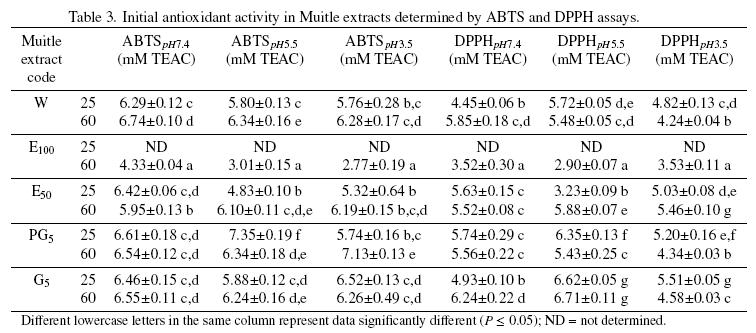
<body><![CDATA[<p align="justify"><font face="verdana" size="2">The rate at which TPC&#45;time experimental data decreased were adjusted to several models (data not shown), but the model that best fitted the experimental data (R2 from 0.95 to 0.99) in all cases was a first&#45;order model (Eq. 1). The experimental data fitting was made in two consecutive single processes with different kinetic rates: (1) An initial stage characterized by a steep gradient induced by the high initial TPC loss, probably promoted by reactive oxygen species (ROS), such as light and oxygen, that react with the phenolic compounds in a relatively short storage time (from t = 0 to <i>t</i> = <i>t</i><sub>1</sub>, with <i>t</i><sub>1</sub> varying between 31.3 to 80.4 h), and (2) a second stage occurring at longer storage time (from <i>t</i> = <i>t</i><sub>1</sub> to t = 480 h), where the TPC&#45;time gradient is drastically diminished, probably because most of the phenolic compounds in the extracts have already reacted with ROS, resulting in a slowing down in the rate ofloss. A representative graph depicting both the steep and the relatively flat gradient stages for PG<sub>5</sub>25 at pH 3.5 is presented in <a href="#f2">Fig. 2</a>. The rate constants corresponding to the steep (k<sub>1</sub>) and relatively flat (k<sub>2</sub>) gradients of TPC&#45;time decay are given in <a href="#t2">Table 2</a>. The variability in the rate constants <i>k</i>1 and <i>k</i>2 for the Muitle extracts obtained with different extraction conditions and pH does not allow to establish a generalized behavior in the degradation pattern of TPC during storage time, other than the loss of TPC is considerable. Half&#45;life time (t1 /2) was calculated using k1 values, because is in the first gradient when a greater loss in TPC was found.</font></p>  	    <p align="center"><font face="verdana" size="2"><a name="f2"></a></font></p>  	    <p align="center"><font face="verdana" size="2"><img src="/img/revistas/rmiq/v11n1/a1f2.jpg"></font></p>  	    <p align="center"><font face="verdana" size="2"><a name="t2"></a></font></p>  	    <p align="center"><font face="verdana" size="2"><img src="/img/revistas/rmiq/v11n1/a1t2.jpg"></font></p>  	    <p align="justify"><font face="verdana" size="2"><a href="#t2">Table 2</a> shows the <i>t</i><sub>1/2</sub> for the extracts at different pH values. Since <i>t</i><sub>1/2</sub> is a function of the initial TPC value, the TPC at <i>t</i><sub>1/2</sub> may be higher for a given extract despite having a shorter <i>t</i><sub>1/2</sub>. This effect can be clearly discerned from our experimental data. While the highest half&#45;life time (186.33 days) was displayed by PG56O at pH 5.5, followed by E<sub>100</sub>6O (106.57 days) and E<sub>50</sub>60 (76.41 days), the latter two at pH 3.5, their TPC concentrations at <i>t</i><sub>1/2</sub> were of 424.81, 304.30, and 484.90 <i>mg<sub>GAE</sub></i> kg<sup>&#45;1</sup>, respectively; whereas, the lowest half&#45;life times were exhibited by E<sub>50</sub>25 (6.05 days), PG525 (6.73 days) and E<sub>100</sub>60 (7.89 days), all at pH 5.5, and their TPC concentrations at <i>t</i><sub>1/2</sub> were of 488.25, 509.07, and 364.72 mgGAE kg<sup>&#45;1</sup>, respectively.</font></p>  	    <p align="justify"><font face="verdana" size="2"><i>3.4 Effect of extraction solvent on initial antioxidant activity</i></font></p>  	    <p align="justify"><font face="verdana" size="2">It has been reported that solvent clearly influences the antioxidant capacity assay, but not all in the same way. The two most used assays for determining antioxidant activity of phenolic compounds are ABTS and DPPH. In the case of ABTS, the more polar the solvent is, the greater the ABTS value (P&eacute;rez&#45;Jim&eacute;nez and Saura&#45;Calixto, 2006), while in the case of DPPH, the use of solvents with high polarity, seem to give low values for the extent of reduction (Molyneux, 2004).</font></p>  	    <p align="justify"><font face="verdana" size="2">Antioxidant activity was expressed as mM of Trolox equivalents (TEAC) as a more meaningful and descriptive expression than assays that express antioxidant activity as the percentage decrease in absorbance. Solvents used for polyphenol extraction had significant effects on ABTS, where the blue color due to the formation of ABTS free radicals (ABTS +) is sensitive to the presence of antioxidants. Discoloration following sample addition indicates that ABTS radicals were quenched or reduced by the antioxidants. The order from higher to lower initial antioxidant activity determined by ABTS in the fresh Muitle extracts at pH 7.4 was: W60 <u>&gt;</u> PG525, G560, PG560, G525, E<sub>50</sub>25 <u>&gt;</u> W25 &gt; E<sub>50</sub>60 &gt; E<sub>100</sub>60 (<a href="/img/revistas/rmiq/v11n1/a1t3.jpg" target="_blank">Table</a> <a href="/img/revistas/rmiq/v11n1/a1t3.jpg">3</a>).</font></p>  	    <p align="justify"><font face="verdana" size="2">In the case of DPPH assay, which is a very fast method to evaluate the AA, it is possible to determine the antiradical power of an antioxidant by measuring the decrease in absorbance of an alcoholic solution of DPPH at 515 nm in the presence of a hydrogen donating antioxidant. Resulting from a color change from purple to yellow the absorbance decreased when the DPPH was scavenged by an antioxidant through donation of hydrogen to form a stable DPPH molecule. In the radical form this molecule had an absorbance at 515 nm which disappeared after acceptance of an electron or hydrogen radical from an antioxidant compound to become a stable diamagnetic molecule (Juntachote and Berghofer, 2005; Turkmen <i>et al.,</i> 2006). The scavenging activity in fresh Muitle extracts from higher to lower was as follows: G<sub>5</sub>60 <u>&gt;</u> W60 <u>&gt;</u> PG525, E<sub>50</sub>25, E<sub>50</sub>60 &gt; PG560, G525,W25 &gt; E<sub>100</sub>60 (<a href="/img/revistas/rmiq/v11n1/a1t3.jpg" target="_blank">Table 3</a>).</font></p>  	    ]]></body>
<body><![CDATA[<p align="justify"><font face="verdana" size="2">The differences in AA thrown by the ABTS and DPPH assays may be due to the nature of the solvent and the radicals, as the type of solvent and polarity may affect the single electron transfer and the hydrogen atom transfer, which are the main aspects in the measurements of AA. Also the presence of non&#45;antioxidant compounds in extracts could affect the results (P&eacute;rez&#45;Jim&eacute;nez and Saura&#45;Calixto, 2006).</font></p>  	    <p align="justify"><font face="verdana" size="2">In practical terms, our results indicate that the Muitle extracts contain diverse phenolic compounds whose extraction is directly related to the compatibility of the compounds with the solvent system, and the antioxidant activity is a result of the reaction of the sum of the individual components of the substrate with the free radical molecule used for the assay, be it ABTS or DPPH. Thus, on the end, AA will depend on the type of phenolic compounds extracted by a given extraction system and on the nature of the scavenging molecule (Molyneux, 2004).</font></p>  	    <p align="justify"><font face="verdana" size="2"><i>3.5 Effect of extraction temperature on initial antioxidant activity</i></font></p>  	    <p align="justify"><font face="verdana" size="2">The extraction temperature had a significant effect on AA, determined by ABTS and DPPH, when extraction was performed with W and E<sub>50</sub>. With W, an increase in extraction temperature produced an increase in AA, but the opposite effect occurred with E<sub>50</sub>. Extraction temperature variation did not affect significantly AA with the rest of the solvents, excepting G<sub>5</sub>25, which displayed an increase in AA (determined by DPPH) as temperature increased (<a href="/img/revistas/rmiq/v11n1/a1t3.jpg" target="_blank">Table 3</a>). These changes could be due to the equilibrium principle, in which higher temperatures could increase the extraction rate and reach maximum phenolic compounds content recovery and therefore higher antioxidant compounds content. However, elevated temperatures may not be suitable for all kinds of phenolic compounds. Liyana&#45;Pathirana and Shahidi (2005) reported that only samples with higher proportions of thermally stable polyphenols are more appropriate to extract under elevated temperatures. Thus, from our results it may be inferred that most of the phenolic compounds extracted from <i>J. spicigera</i> are thermo&#45;stable.</font></p>  	    <p align="justify"><font face="verdana" size="2"><i>3.6 Effect of extract pH on antioxidant activity during storage</i></font></p>  	    <p align="justify"><font face="verdana" size="2">Changing the pH of the fresh Muitle extracts from 7.4&nbsp;to 3.5 and 5.5 affected differently the initial AA, depending on the solvent system and on the assay used to determine AA (<a href="/img/revistas/rmiq/v11n1/a1t3.jpg" target="_blank">Table 3</a>). Because of the lowest TPC yield displayed by E<sub>100</sub>25, this extract either was not considered in AA assays. With ABTS, lowest initial AA occurred with E<sub>100</sub>60 regardless of the pH of the extract, whereas at pH 5.5 highest initial AA corresponded to PG525, and at pH 3.5 to PG<sub>5</sub>60, respectively. With DPPH, also lowest AA happened with E<sub>100</sub>60 regardless of the pH of the extract, at pH 5.5&nbsp;highest initial AA corresponded to G5, and at pH 3.5 to G<sub>5</sub>25 and E<sub>50</sub>60, respectively. The results could be attributed to the different conformations adopted by the different phenolic compounds as result of the different degree of dissociation of OH groups induced by the changes in pH, affecting the number of active ionized groups partaking in the reaction with the free radical molecules of ABTS<sup>.+</sup> and DPPH<sup>.+</sup>, and causing changes in AA (Akrem <i>et al.,</i> 2007; Juntachote and Berghofer, 2005).</font></p>  	    <p align="justify"><font face="verdana" size="2"><a href="/img/revistas/rmiq/v11n1/a1t4.jpg" target="_blank">Table 4</a> shows the loss in AA exhibited by the Muitle extracts after 20 days of storage. With the ABTS assay, the highest loss was displayed by E<sub>100</sub> 60 at all pH's tested. Non&#45;significant lowest AA loss was exhibited at pH 7.4 by W25 and G<sub>5</sub>60, at pH 5.5 by W25, G<sub>5</sub>60, and E<sub>50</sub>60, and at pH 3.5 by E<sub>50</sub>25, E<sub>50</sub>60, PG<sub>5</sub>25 and G<sub>5</sub>60. With the DPPH assay the lowest AA loss occurred for the ethanolic extracts (E<sub>100</sub> and E<sub>50</sub>), while the highest loss happened for W60, followed by W25, all these results regardless of pH value. The differences in the results obtained using the ABTS and DPPH assays are most likely due to the compatibility of the extracts with free radicals of different chemical nature. Both methods are complementary and allow for a more thorough understanding of the factors affecting the stability and functionality of the Muitle extracts.</font></p>  	    <p align="justify"><font face="verdana" size="2">&nbsp;</font></p>  	    <p align="justify"><font face="verdana" size="2"><b>Conclusions</b></font></p>  	    <p align="justify"><font face="verdana" size="2">The solvent and temperature extraction conditions significantly affected the initial total phenolic content and the antioxidant activity of the Muitle extracts. Adjusting the pH also had a significant effect on the total phenolic contents and antioxidant activity of the extracts with storage time. The extracts obtained using solvents with higher polarity displayed more effective radical&#45;scavenging activity than those obtained using less polar solvents. These results indicate that the selective extraction from botanicals sources, by appropriate solvents and suitable methods, is important for obtaining bioactive compounds with high phenolic contents and antioxidant activities. Thus, this work establishes the importance of employing adequate solvent and temperature extraction conditions for obtaining extracts from <i>Justicia spicigera</i> with high initial total phenolic contents and antioxidant activities, and for minimizing their degradation with storage time at specific pH's, and contributes for a better performance of these extracts in practical applications.</font></p>  	    ]]></body>
<body><![CDATA[<p align="justify"><font face="verdana" size="2">&nbsp;</font></p>  	    <p align="justify"><font face="verdana" size="2"><b>Acknowledgement</b></font></p>  	    <p align="justify"><font face="verdana" size="2">The authors wish to thank the Consejo Nacional de Ciencia y Tecnolog&iacute;a (CONACyT) of Mexico for partially financing this project through grant U&#45;81157&#45;Z.</font></p>  	    <p align="justify"><font face="verdana" size="2">&nbsp;</font></p>  	    <p align="justify"><font face="verdana" size="2"><b>References</b></font></p>  	    <!-- ref --><p align="justify"><font face="verdana" size="2">Akrem, H. E., Abedrabba, M., Bouix, M. and Hamdi, M. (2007). The effects of solvents and extraction method on the phenolic contents and biological activities <i>in vitro</i> of Tunisian <i>Quercus coccifera</i> L. and <i>Juniperus phoenicea</i> L. fruit extracts. <i>Food Chemistry 105,</i> 1126&#45;1134.    &nbsp;&nbsp;&nbsp;&nbsp;&nbsp;&nbsp;&nbsp;&nbsp;[&#160;<a href="javascript:void(0);" onclick="javascript: window.open('/scielo.php?script=sci_nlinks&ref=8601369&pid=S1665-2738201200010000100001&lng=','','width=640,height=500,resizable=yes,scrollbars=1,menubar=yes,');">Links</a>&#160;]<!-- end-ref --></font></p>  	    <!-- ref --><p align="justify"><font face="verdana" size="2">Al&#45;Farsi, M.A. and Lee, C.Y. (2008). Optimization of phenolics and dietary fibre extraction from date seeds. <i>Food Chemistry 108,</i> 977&#45;985.    &nbsp;&nbsp;&nbsp;&nbsp;&nbsp;&nbsp;&nbsp;&nbsp;[&#160;<a href="javascript:void(0);" onclick="javascript: window.open('/scielo.php?script=sci_nlinks&ref=8601371&pid=S1665-2738201200010000100002&lng=','','width=640,height=500,resizable=yes,scrollbars=1,menubar=yes,');">Links</a>&#160;]<!-- end-ref --></font></p>  	    <!-- ref --><p align="justify"><font face="verdana" size="2">Ares, G., Barreiro, C. and Gambaro, A. (2010). Evaluation of antioxidant extracts from Uruguayan native plants: importance of sensory characteristics. <i>CyTA&#45;Journal of Food 8,</i> 201&#45;207.    &nbsp;&nbsp;&nbsp;&nbsp;&nbsp;&nbsp;&nbsp;&nbsp;[&#160;<a href="javascript:void(0);" onclick="javascript: window.open('/scielo.php?script=sci_nlinks&ref=8601373&pid=S1665-2738201200010000100003&lng=','','width=640,height=500,resizable=yes,scrollbars=1,menubar=yes,');">Links</a>&#160;]<!-- end-ref --></font></p>  	    <!-- ref --><p align="justify"><font face="verdana" size="2">Ding, Z. (1999). Studies on extraction and isolation flavonoids from Ginkgo leaves. <i>Journal of Food Quality 22,</i> 693&#45;700.    &nbsp;&nbsp;&nbsp;&nbsp;&nbsp;&nbsp;&nbsp;&nbsp;[&#160;<a href="javascript:void(0);" onclick="javascript: window.open('/scielo.php?script=sci_nlinks&ref=8601375&pid=S1665-2738201200010000100004&lng=','','width=640,height=500,resizable=yes,scrollbars=1,menubar=yes,');">Links</a>&#160;]<!-- end-ref --></font></p>  	    <!-- ref --><p align="justify"><font face="verdana" size="2">Dom&iacute;nguez, X.A., Achenbach, H., Gonz&aacute;lez, C., and Ferr&eacute;&#45;D'Amare, A.R. (1990). Estudio qu&iacute;mico del muitle <i>(Justicia spicigera). Revista Latinoamericana de Qu&iacute;mica 21,</i> 142&#45;143.    &nbsp;&nbsp;&nbsp;&nbsp;&nbsp;&nbsp;&nbsp;&nbsp;[&#160;<a href="javascript:void(0);" onclick="javascript: window.open('/scielo.php?script=sci_nlinks&ref=8601377&pid=S1665-2738201200010000100005&lng=','','width=640,height=500,resizable=yes,scrollbars=1,menubar=yes,');">Links</a>&#160;]<!-- end-ref --></font></p>  	    <!-- ref --><p align="justify"><font face="verdana" size="2">Euler K.L. and Alam, M. (1982). Isolation of Kaempferitrin from <i>Justicia spicigera. Journal of Natural Products 45,</i> 220&#45;222.    &nbsp;&nbsp;&nbsp;&nbsp;&nbsp;&nbsp;&nbsp;&nbsp;[&#160;<a href="javascript:void(0);" onclick="javascript: window.open('/scielo.php?script=sci_nlinks&ref=8601379&pid=S1665-2738201200010000100006&lng=','','width=640,height=500,resizable=yes,scrollbars=1,menubar=yes,');">Links</a>&#160;]<!-- end-ref --></font></p>  	    <!-- ref --><p align="justify"><font face="verdana" size="2">Gong, Y., Hou, Z., Gao, Y., Xue, Y., Liu, X. and Liu, G. (2012). Optimization of extraction parameters of bioactive components from defatted marigold <i>(Tagetes erecta</i> L.) residue using response surface methodology. <i>Food and Bioproducts Processing 90,</i> 9&#45;16.    &nbsp;&nbsp;&nbsp;&nbsp;&nbsp;&nbsp;&nbsp;&nbsp;[&#160;<a href="javascript:void(0);" onclick="javascript: window.open('/scielo.php?script=sci_nlinks&ref=8601381&pid=S1665-2738201200010000100007&lng=','','width=640,height=500,resizable=yes,scrollbars=1,menubar=yes,');">Links</a>&#160;]<!-- end-ref --></font></p>  	    <!-- ref --><p align="justify"><font face="verdana" size="2">Juntachote, T. and Berghofer, E. (2005). Antioxidative properties and stability of ethanolic extracts of Holy basil and Galangal. <i>Food Chemistry 92,</i> 193&#45;202.    &nbsp;&nbsp;&nbsp;&nbsp;&nbsp;&nbsp;&nbsp;&nbsp;[&#160;<a href="javascript:void(0);" onclick="javascript: window.open('/scielo.php?script=sci_nlinks&ref=8601383&pid=S1665-2738201200010000100008&lng=','','width=640,height=500,resizable=yes,scrollbars=1,menubar=yes,');">Links</a>&#160;]<!-- end-ref --></font></p>  	    <!-- ref --><p align="justify"><font face="verdana" size="2">Li, Z.L. (1994). Using resins and enzymes to extract flavonoids from Ginkgo leaves. <i>Patent in Traditional Chinese Medicine 16,</i> 52&#45;53.    &nbsp;&nbsp;&nbsp;&nbsp;&nbsp;&nbsp;&nbsp;&nbsp;[&#160;<a href="javascript:void(0);" onclick="javascript: window.open('/scielo.php?script=sci_nlinks&ref=8601385&pid=S1665-2738201200010000100009&lng=','','width=640,height=500,resizable=yes,scrollbars=1,menubar=yes,');">Links</a>&#160;]<!-- end-ref --></font></p>  	    <!-- ref --><p align="justify"><font face="verdana" size="2">Liyana&#45;Pathirana, C. and Shahidi, F. (2005). Optimization of extraction of phenolic compounds from wheat using response surface methodology. <i>Food Chemistry 93,</i>47&#45;56.    &nbsp;&nbsp;&nbsp;&nbsp;&nbsp;&nbsp;&nbsp;&nbsp;[&#160;<a href="javascript:void(0);" onclick="javascript: window.open('/scielo.php?script=sci_nlinks&ref=8601387&pid=S1665-2738201200010000100010&lng=','','width=640,height=500,resizable=yes,scrollbars=1,menubar=yes,');">Links</a>&#160;]<!-- end-ref --></font></p>  	    <!-- ref --><p align="justify"><font face="verdana" size="2">Mahabir, D. and Gulliford M.C. (1997). Use of medicinal plants for diabetes in Trinidad and Tobago. <i>American Journal of Public Health</i> 1,174&#45;179.    &nbsp;&nbsp;&nbsp;&nbsp;&nbsp;&nbsp;&nbsp;&nbsp;[&#160;<a href="javascript:void(0);" onclick="javascript: window.open('/scielo.php?script=sci_nlinks&ref=8601389&pid=S1665-2738201200010000100011&lng=','','width=640,height=500,resizable=yes,scrollbars=1,menubar=yes,');">Links</a>&#160;]<!-- end-ref --></font></p>  	    <!-- ref --><p align="justify"><font face="verdana" size="2">M&aacute;rquez, C., Lara, F., Rodr&iacute;guez B.E. and Mata, R. (1999). <i>Plantas medicinales de Mexico: Composici&oacute;n, Usos y Actividad Biol&oacute;gica.</i> UNAM, M&eacute;xico.    &nbsp;&nbsp;&nbsp;&nbsp;&nbsp;&nbsp;&nbsp;&nbsp;[&#160;<a href="javascript:void(0);" onclick="javascript: window.open('/scielo.php?script=sci_nlinks&ref=8601391&pid=S1665-2738201200010000100012&lng=','','width=640,height=500,resizable=yes,scrollbars=1,menubar=yes,');">Links</a>&#160;]<!-- end-ref --></font></p>  	    <!-- ref --><p align="justify"><font face="verdana" size="2">Molyneux, P. (2004). The use of the stable free radical diphenylpricryl&#45;hydrazyl (DPPH) for estimating antioxidant activity. <i>Songklanakarin Journal of Science and Technology 26,</i> 211&#45;219.    &nbsp;&nbsp;&nbsp;&nbsp;&nbsp;&nbsp;&nbsp;&nbsp;[&#160;<a href="javascript:void(0);" onclick="javascript: window.open('/scielo.php?script=sci_nlinks&ref=8601393&pid=S1665-2738201200010000100013&lng=','','width=640,height=500,resizable=yes,scrollbars=1,menubar=yes,');">Links</a>&#160;]<!-- end-ref --></font></p>  	    <!-- ref --><p align="justify"><font face="verdana" size="2">Morell&oacute;, J.R., Motilva, M.J., Tovar, M.J. and Romero, M.P. (2004). Changes in commercial virgin olive oil (cv Arbequina) during storage, with special emphasis on the phenolic fraction. <i>Food Chemistry 85,</i> 357&#45;364.    &nbsp;&nbsp;&nbsp;&nbsp;&nbsp;&nbsp;&nbsp;&nbsp;[&#160;<a href="javascript:void(0);" onclick="javascript: window.open('/scielo.php?script=sci_nlinks&ref=8601395&pid=S1665-2738201200010000100014&lng=','','width=640,height=500,resizable=yes,scrollbars=1,menubar=yes,');">Links</a>&#160;]<!-- end-ref --></font></p>  	    <!-- ref --><p align="justify"><font face="verdana" size="2">Mulero, J., Pardo, F. and Zafrilla, P. (2010). Antioxidant activity and phenolic compounds in conventional and organic red grapes (var. Monastrell). <i>CyTA&#45;Journal of Food 8,</i> 185&#45;191.    &nbsp;&nbsp;&nbsp;&nbsp;&nbsp;&nbsp;&nbsp;&nbsp;[&#160;<a href="javascript:void(0);" onclick="javascript: window.open('/scielo.php?script=sci_nlinks&ref=8601397&pid=S1665-2738201200010000100015&lng=','','width=640,height=500,resizable=yes,scrollbars=1,menubar=yes,');">Links</a>&#160;]<!-- end-ref --></font></p>  	    <!-- ref --><p align="justify"><font face="verdana" size="2">P&eacute;rez&#45;Jim&eacute;nez, J. and Saura&#45;Calixto, F. (2006). Effect of solvent and certain food constituents on different antioxidant capacity assays. <i>Food Research International 39,</i> 791&#45;800.    &nbsp;&nbsp;&nbsp;&nbsp;&nbsp;&nbsp;&nbsp;&nbsp;[&#160;<a href="javascript:void(0);" onclick="javascript: window.open('/scielo.php?script=sci_nlinks&ref=8601399&pid=S1665-2738201200010000100016&lng=','','width=640,height=500,resizable=yes,scrollbars=1,menubar=yes,');">Links</a>&#160;]<!-- end-ref --></font></p>  	    <!-- ref --><p align="justify"><font face="verdana" size="2">Ponce&#45;Macotela, M., Rufino&#45;Gonz&aacute;lez Y., de la Mora&#45;de la Mora J.I., Gonz&aacute;lez&#45;Maciel, A., Reynoso&#45;Robles, R.R. and Mart&iacute;nez&#45;Gordillo, M.N. (2001). Mortality and morphological changes in <i>Giardia duodenalis</i> induced by exposure to ethanolic extracts of <i>Justicia spicigera. Proceedings of the Western Pharmacology Society 44,</i> 151&#45;152.    &nbsp;&nbsp;&nbsp;&nbsp;&nbsp;&nbsp;&nbsp;&nbsp;[&#160;<a href="javascript:void(0);" onclick="javascript: window.open('/scielo.php?script=sci_nlinks&ref=8601401&pid=S1665-2738201200010000100017&lng=','','width=640,height=500,resizable=yes,scrollbars=1,menubar=yes,');">Links</a>&#160;]<!-- end-ref --></font></p>  	    <!-- ref --><p align="justify"><font face="verdana" size="2">Reyes&#45;Mungu&iacute;a, A., Azu&iacute;ara&#45;Nieto, E., Beristain, C.I., Cruz&#45;Sosa, F. and Vernon&#45;Carter, E.J. (2009). Purple maguey <i>(Rhoeo discolor)</i> antioxidant properties. <i>CyTA&#45;Journal of Food 7,</i> 209&#45;216.    &nbsp;&nbsp;&nbsp;&nbsp;&nbsp;&nbsp;&nbsp;&nbsp;[&#160;<a href="javascript:void(0);" onclick="javascript: window.open('/scielo.php?script=sci_nlinks&ref=8601403&pid=S1665-2738201200010000100018&lng=','','width=640,height=500,resizable=yes,scrollbars=1,menubar=yes,');">Links</a>&#160;]<!-- end-ref --></font></p>  	    <!-- ref --><p align="justify"><font face="verdana" size="2">Sep&uacute;lveda&#45;Jim&eacute;nez, G., Reyna&#45;Aquino, C., Chaires&#45;Mart&iacute;nez, L., Berm&uacute;dez&#45;Torres, K. and Rodr&iacute;guez&#45;Monroy, M. (2009). Antioxidant activity and content of phenolic compounds and flavonoids from <i>Justicia spicigera. Journal of Biological Sciences 9,</i> 629&#45;632.    &nbsp;&nbsp;&nbsp;&nbsp;&nbsp;&nbsp;&nbsp;&nbsp;[&#160;<a href="javascript:void(0);" onclick="javascript: window.open('/scielo.php?script=sci_nlinks&ref=8601405&pid=S1665-2738201200010000100019&lng=','','width=640,height=500,resizable=yes,scrollbars=1,menubar=yes,');">Links</a>&#160;]<!-- end-ref --></font></p>  	    <!-- ref --><p align="justify"><font face="verdana" size="2">Serrano&#45;Maldonado, M.J., Guerrero&#45;Legarreta, I., de la Paz P&eacute;rez&#45;Olvera, C. and Soriano&#45;Santos, J. (2011). Antioxidant activity and citotoxic effect of <i>Cladocolea loniceroides</i> (van Tieghem) Kuijt (Loranthaceae). <i>Revista Mexicana de Ingenier&iacute;a Qu&iacute;mica 10,</i> 161&#45;170.    &nbsp;&nbsp;&nbsp;&nbsp;&nbsp;&nbsp;&nbsp;&nbsp;[&#160;<a href="javascript:void(0);" onclick="javascript: window.open('/scielo.php?script=sci_nlinks&ref=8601407&pid=S1665-2738201200010000100020&lng=','','width=640,height=500,resizable=yes,scrollbars=1,menubar=yes,');">Links</a>&#160;]<!-- end-ref --></font></p>  	    <!-- ref --><p align="justify"><font face="verdana" size="2">Spigno, G. and DeFaveri, D.M. (2007). Antioxidants from grape stalks and marc: Influence of extraction procedure on yield, purity and antioxidant power of the extracts. <i>Journal of Food Engineering 78,</i> 793&#45;801.    &nbsp;&nbsp;&nbsp;&nbsp;&nbsp;&nbsp;&nbsp;&nbsp;[&#160;<a href="javascript:void(0);" onclick="javascript: window.open('/scielo.php?script=sci_nlinks&ref=8601409&pid=S1665-2738201200010000100021&lng=','','width=640,height=500,resizable=yes,scrollbars=1,menubar=yes,');">Links</a>&#160;]<!-- end-ref --></font></p>  	    <!-- ref --><p align="justify"><font face="verdana" size="2">Too, Y.Y., Ho, S.K., Liang, J.Y., Ho, C.W. and Tan, C.P. (2010). Effects of binary extraction system, extraction time and extraction temperature on phenolic antioxidants and antioxidant capacity of mengkudu <i>(Morinda citrifolia). Food Chemistry 120,</i> 290&#45;295.    &nbsp;&nbsp;&nbsp;&nbsp;&nbsp;&nbsp;&nbsp;&nbsp;[&#160;<a href="javascript:void(0);" onclick="javascript: window.open('/scielo.php?script=sci_nlinks&ref=8601411&pid=S1665-2738201200010000100022&lng=','','width=640,height=500,resizable=yes,scrollbars=1,menubar=yes,');">Links</a>&#160;]<!-- end-ref --></font></p>  	    <!-- ref --><p align="justify"><font face="verdana" size="2">Turkmen, N., Sari, F. and Velioglu, Y.S. (2006). Effects on extraction solvents on concentration and antioxidant activity of black mate tea polyphenols determined by ferrous tartrate and Folin&#45;Ciocalteau methods. <i>Food Chemistry 99,</i> 835&#45;841.    &nbsp;&nbsp;&nbsp;&nbsp;&nbsp;&nbsp;&nbsp;&nbsp;[&#160;<a href="javascript:void(0);" onclick="javascript: window.open('/scielo.php?script=sci_nlinks&ref=8601413&pid=S1665-2738201200010000100023&lng=','','width=640,height=500,resizable=yes,scrollbars=1,menubar=yes,');">Links</a>&#160;]<!-- end-ref --></font></p>  	    <!-- ref --><p align="justify"><font face="verdana" size="2">Uma, D.B., Ho, C.W. and Wan Aida, W.M. (2010). Optimization of extraction parameters of total phenolic compounds from Henna <i>(Lawsonia inermis)</i> leaves. <i>Sains Malaysiana 39,</i> 119&#45;128.    &nbsp;&nbsp;&nbsp;&nbsp;&nbsp;&nbsp;&nbsp;&nbsp;[&#160;<a href="javascript:void(0);" onclick="javascript: window.open('/scielo.php?script=sci_nlinks&ref=8601415&pid=S1665-2738201200010000100024&lng=','','width=640,height=500,resizable=yes,scrollbars=1,menubar=yes,');">Links</a>&#160;]<!-- end-ref --></font></p>  	    <!-- ref --><p align="justify"><font face="verdana" size="2">Walstra, P. (2002). Reaction kinetics. In: <i>Physical Chemistry of Foods.</i> (Walstra, P. ed.), Pp. 5258. Marcel Dekker Inc., New York.    &nbsp;&nbsp;&nbsp;&nbsp;&nbsp;&nbsp;&nbsp;&nbsp;[&#160;<a href="javascript:void(0);" onclick="javascript: window.open('/scielo.php?script=sci_nlinks&ref=8601417&pid=S1665-2738201200010000100025&lng=','','width=640,height=500,resizable=yes,scrollbars=1,menubar=yes,');">Links</a>&#160;]<!-- end-ref --></font></p>  	    <!-- ref --><p align="justify"><font face="verdana" size="2">Wang, J., Sun, B., Cao, Y., Tian, Y. and Li, X. (2007). Optimization of ultrasound&#45;assisted extraction of phenolic compounds from wheat bran. <i>FoodChemistry 106,</i> 804&#45;810.    &nbsp;&nbsp;&nbsp;&nbsp;&nbsp;&nbsp;&nbsp;&nbsp;[&#160;<a href="javascript:void(0);" onclick="javascript: window.open('/scielo.php?script=sci_nlinks&ref=8601419&pid=S1665-2738201200010000100026&lng=','','width=640,height=500,resizable=yes,scrollbars=1,menubar=yes,');">Links</a>&#160;]<!-- end-ref --></font></p>  	    <!-- ref --><p align="justify"><font face="verdana" size="2">Wong W. (1976). Some folk medicinal plants from Trinidad. <i>Economic Botanic 30,</i> 103&#45;142.    &nbsp;&nbsp;&nbsp;&nbsp;&nbsp;&nbsp;&nbsp;&nbsp;[&#160;<a href="javascript:void(0);" onclick="javascript: window.open('/scielo.php?script=sci_nlinks&ref=8601421&pid=S1665-2738201200010000100027&lng=','','width=640,height=500,resizable=yes,scrollbars=1,menubar=yes,');">Links</a>&#160;]<!-- end-ref --></font></p>  	    <!-- ref --><p align="justify"><font face="verdana" size="2">Xu, B.J. and Chang, S.K.C. (2007). A comparative study on phenolic profiles and antioxidant activities of legumes as affected by extraction solvents. <i>Journal of Food Science 72,</i> S159&#45;S166.    &nbsp;&nbsp;&nbsp;&nbsp;&nbsp;&nbsp;&nbsp;&nbsp;[&#160;<a href="javascript:void(0);" onclick="javascript: window.open('/scielo.php?script=sci_nlinks&ref=8601423&pid=S1665-2738201200010000100028&lng=','','width=640,height=500,resizable=yes,scrollbars=1,menubar=yes,');">Links</a>&#160;]<!-- end-ref --></font></p>  	    <!-- ref --><p align="justify"><font face="verdana" size="2">Yim, H.S., Chye, F.Y., Koo, S.M., Matanjun, P., How, S.E. and Ho, C.W. (2012). Optimization of extraction time and temperature for antioxidant activity of edible wild mushroom, <i>Pleurotus porrigens. Food and Bioproducts Processing 90,</i> 235&#45;242.    &nbsp;&nbsp;&nbsp;&nbsp;&nbsp;&nbsp;&nbsp;&nbsp;[&#160;<a href="javascript:void(0);" onclick="javascript: window.open('/scielo.php?script=sci_nlinks&ref=8601425&pid=S1665-2738201200010000100029&lng=','','width=640,height=500,resizable=yes,scrollbars=1,menubar=yes,');">Links</a>&#160;]<!-- end-ref --></font></p>      ]]></body><back>
<ref-list>
<ref id="B1">
<nlm-citation citation-type="journal">
<person-group person-group-type="author">
<name>
<surname><![CDATA[Akrem]]></surname>
<given-names><![CDATA[H. E.]]></given-names>
</name>
<name>
<surname><![CDATA[Abedrabba]]></surname>
<given-names><![CDATA[M.]]></given-names>
</name>
<name>
<surname><![CDATA[Bouix]]></surname>
<given-names><![CDATA[M.]]></given-names>
</name>
<name>
<surname><![CDATA[Hamdi]]></surname>
<given-names><![CDATA[M.]]></given-names>
</name>
</person-group>
<article-title xml:lang="en"><![CDATA[The effects of solvents and extraction method on the phenolic contents and biological activities in vitro of Tunisian Quercus coccifera L. and Juniperus phoenicea L. fruit extracts]]></article-title>
<source><![CDATA[Food Chemistry]]></source>
<year>2007</year>
<volume>105</volume>
<page-range>1126-1134</page-range></nlm-citation>
</ref>
<ref id="B2">
<nlm-citation citation-type="journal">
<person-group person-group-type="author">
<name>
<surname><![CDATA[Al-Farsi]]></surname>
<given-names><![CDATA[M.A.]]></given-names>
</name>
<name>
<surname><![CDATA[Lee]]></surname>
<given-names><![CDATA[C.Y.]]></given-names>
</name>
</person-group>
<article-title xml:lang="en"><![CDATA[Optimization of phenolics and dietary fibre extraction from date seeds]]></article-title>
<source><![CDATA[Food Chemistry]]></source>
<year>2008</year>
<volume>108</volume>
<page-range>977-985</page-range></nlm-citation>
</ref>
<ref id="B3">
<nlm-citation citation-type="journal">
<person-group person-group-type="author">
<name>
<surname><![CDATA[Ares]]></surname>
<given-names><![CDATA[G.]]></given-names>
</name>
<name>
<surname><![CDATA[Barreiro]]></surname>
<given-names><![CDATA[C.]]></given-names>
</name>
<name>
<surname><![CDATA[Gambaro]]></surname>
<given-names><![CDATA[A.]]></given-names>
</name>
</person-group>
<article-title xml:lang="en"><![CDATA[Evaluation of antioxidant extracts from Uruguayan native plants: importance of sensory characteristics]]></article-title>
<source><![CDATA[CyTA-Journal of Food]]></source>
<year>2010</year>
<volume>8</volume>
<page-range>201-207</page-range></nlm-citation>
</ref>
<ref id="B4">
<nlm-citation citation-type="journal">
<person-group person-group-type="author">
<name>
<surname><![CDATA[Ding]]></surname>
<given-names><![CDATA[Z.]]></given-names>
</name>
</person-group>
<article-title xml:lang="en"><![CDATA[Studies on extraction and isolation flavonoids from Ginkgo leaves]]></article-title>
<source><![CDATA[Journal of Food Quality]]></source>
<year>1999</year>
<volume>22</volume>
<page-range>693-700</page-range></nlm-citation>
</ref>
<ref id="B5">
<nlm-citation citation-type="journal">
<person-group person-group-type="author">
<name>
<surname><![CDATA[Domínguez]]></surname>
<given-names><![CDATA[X.A.]]></given-names>
</name>
<name>
<surname><![CDATA[Achenbach]]></surname>
<given-names><![CDATA[H.]]></given-names>
</name>
<name>
<surname><![CDATA[González]]></surname>
<given-names><![CDATA[C.]]></given-names>
</name>
<name>
<surname><![CDATA[Ferré-D'Amare]]></surname>
<given-names><![CDATA[A.R.]]></given-names>
</name>
</person-group>
<article-title xml:lang="es"><![CDATA[Estudio químico del muitle (Justicia spicigera)]]></article-title>
<source><![CDATA[Revista Latinoamericana de Química]]></source>
<year>1990</year>
<volume>21</volume>
<page-range>142-143</page-range></nlm-citation>
</ref>
<ref id="B6">
<nlm-citation citation-type="journal">
<person-group person-group-type="author">
<name>
<surname><![CDATA[Euler]]></surname>
<given-names><![CDATA[K.L.]]></given-names>
</name>
<name>
<surname><![CDATA[Alam]]></surname>
<given-names><![CDATA[M.]]></given-names>
</name>
</person-group>
<article-title xml:lang="en"><![CDATA[Isolation of Kaempferitrin from Justicia spicigera]]></article-title>
<source><![CDATA[Journal of Natural Products]]></source>
<year>1982</year>
<volume>45</volume>
<page-range>220-222</page-range></nlm-citation>
</ref>
<ref id="B7">
<nlm-citation citation-type="journal">
<person-group person-group-type="author">
<name>
<surname><![CDATA[Gong]]></surname>
<given-names><![CDATA[Y.]]></given-names>
</name>
<name>
<surname><![CDATA[Hou]]></surname>
<given-names><![CDATA[Z.]]></given-names>
</name>
<name>
<surname><![CDATA[Gao]]></surname>
<given-names><![CDATA[Y.]]></given-names>
</name>
<name>
<surname><![CDATA[Xue]]></surname>
<given-names><![CDATA[Y.]]></given-names>
</name>
<name>
<surname><![CDATA[Liu]]></surname>
<given-names><![CDATA[X.]]></given-names>
</name>
<name>
<surname><![CDATA[Liu]]></surname>
<given-names><![CDATA[G.]]></given-names>
</name>
</person-group>
<article-title xml:lang="en"><![CDATA[Optimization of extraction parameters of bioactive components from defatted marigold (Tagetes erecta L.) residue using response surface methodology]]></article-title>
<source><![CDATA[Food and Bioproducts Processing]]></source>
<year>2012</year>
<volume>90</volume>
<page-range>9-16</page-range></nlm-citation>
</ref>
<ref id="B8">
<nlm-citation citation-type="journal">
<person-group person-group-type="author">
<name>
<surname><![CDATA[Juntachote]]></surname>
<given-names><![CDATA[T.]]></given-names>
</name>
<name>
<surname><![CDATA[Berghofer]]></surname>
<given-names><![CDATA[E.]]></given-names>
</name>
</person-group>
<article-title xml:lang="en"><![CDATA[Antioxidative properties and stability of ethanolic extracts of Holy basil and Galangal]]></article-title>
<source><![CDATA[Food Chemistry]]></source>
<year>2005</year>
<volume>92</volume>
<page-range>193-202</page-range></nlm-citation>
</ref>
<ref id="B9">
<nlm-citation citation-type="journal">
<person-group person-group-type="author">
<name>
<surname><![CDATA[Li]]></surname>
<given-names><![CDATA[Z.L.]]></given-names>
</name>
</person-group>
<article-title xml:lang="en"><![CDATA[Using resins and enzymes to extract flavonoids from Ginkgo leaves]]></article-title>
<source><![CDATA[Patent in Traditional Chinese Medicine]]></source>
<year>1994</year>
<volume>16</volume>
<page-range>52-53</page-range></nlm-citation>
</ref>
<ref id="B10">
<nlm-citation citation-type="journal">
<person-group person-group-type="author">
<name>
<surname><![CDATA[Liyana-Pathirana]]></surname>
<given-names><![CDATA[C.]]></given-names>
</name>
<name>
<surname><![CDATA[Shahidi]]></surname>
<given-names><![CDATA[F.]]></given-names>
</name>
</person-group>
<article-title xml:lang="en"><![CDATA[Optimization of extraction of phenolic compounds from wheat using response surface methodology]]></article-title>
<source><![CDATA[Food Chemistry]]></source>
<year>2005</year>
<volume>93</volume>
<page-range>47-56</page-range></nlm-citation>
</ref>
<ref id="B11">
<nlm-citation citation-type="journal">
<person-group person-group-type="author">
<name>
<surname><![CDATA[Mahabir]]></surname>
<given-names><![CDATA[D.]]></given-names>
</name>
<name>
<surname><![CDATA[Gulliford]]></surname>
<given-names><![CDATA[M.C.]]></given-names>
</name>
</person-group>
<article-title xml:lang="en"><![CDATA[Use of medicinal plants for diabetes in Trinidad and Tobago]]></article-title>
<source><![CDATA[American Journal of Public Health]]></source>
<year>1997</year>
<volume>1</volume>
<page-range>174-179</page-range></nlm-citation>
</ref>
<ref id="B12">
<nlm-citation citation-type="book">
<person-group person-group-type="author">
<name>
<surname><![CDATA[Márquez]]></surname>
<given-names><![CDATA[C.]]></given-names>
</name>
<name>
<surname><![CDATA[Lara]]></surname>
<given-names><![CDATA[F.]]></given-names>
</name>
<name>
<surname><![CDATA[Rodríguez]]></surname>
<given-names><![CDATA[B.E.]]></given-names>
</name>
<name>
<surname><![CDATA[Mata]]></surname>
<given-names><![CDATA[R.]]></given-names>
</name>
</person-group>
<source><![CDATA[Plantas medicinales de Mexico: Composición, Usos y Actividad Biológica]]></source>
<year>1999</year>
<publisher-loc><![CDATA[México ]]></publisher-loc>
<publisher-name><![CDATA[UNAM]]></publisher-name>
</nlm-citation>
</ref>
<ref id="B13">
<nlm-citation citation-type="journal">
<person-group person-group-type="author">
<name>
<surname><![CDATA[Molyneux]]></surname>
<given-names><![CDATA[P.]]></given-names>
</name>
</person-group>
<article-title xml:lang="en"><![CDATA[The use of the stable free radical diphenylpricryl-hydrazyl (DPPH) for estimating antioxidant activity]]></article-title>
<source><![CDATA[Songklanakarin Journal of Science and Technology]]></source>
<year>2004</year>
<volume>26</volume>
<page-range>211-219</page-range></nlm-citation>
</ref>
<ref id="B14">
<nlm-citation citation-type="journal">
<person-group person-group-type="author">
<name>
<surname><![CDATA[Morelló]]></surname>
<given-names><![CDATA[J.R.]]></given-names>
</name>
<name>
<surname><![CDATA[Motilva]]></surname>
<given-names><![CDATA[M.J.]]></given-names>
</name>
<name>
<surname><![CDATA[Tovar]]></surname>
<given-names><![CDATA[M.J.]]></given-names>
</name>
<name>
<surname><![CDATA[Romero]]></surname>
<given-names><![CDATA[M.P.]]></given-names>
</name>
</person-group>
<article-title xml:lang="en"><![CDATA[Changes in commercial virgin olive oil (cv Arbequina) during storage, with special emphasis on the phenolic fraction]]></article-title>
<source><![CDATA[Food Chemistry]]></source>
<year>2004</year>
<volume>85</volume>
<page-range>357-364</page-range></nlm-citation>
</ref>
<ref id="B15">
<nlm-citation citation-type="journal">
<person-group person-group-type="author">
<name>
<surname><![CDATA[Mulero]]></surname>
<given-names><![CDATA[J.]]></given-names>
</name>
<name>
<surname><![CDATA[Pardo]]></surname>
<given-names><![CDATA[F.]]></given-names>
</name>
<name>
<surname><![CDATA[Zafrilla]]></surname>
<given-names><![CDATA[P.]]></given-names>
</name>
</person-group>
<article-title xml:lang="en"><![CDATA[Antioxidant activity and phenolic compounds in conventional and organic red grapes (var. Monastrell)]]></article-title>
<source><![CDATA[CyTA-Journal of Food]]></source>
<year>2010</year>
<volume>8</volume>
<page-range>185-191</page-range></nlm-citation>
</ref>
<ref id="B16">
<nlm-citation citation-type="journal">
<person-group person-group-type="author">
<name>
<surname><![CDATA[Pérez-Jiménez]]></surname>
<given-names><![CDATA[J.]]></given-names>
</name>
<name>
<surname><![CDATA[Saura-Calixto]]></surname>
<given-names><![CDATA[F.]]></given-names>
</name>
</person-group>
<article-title xml:lang="en"><![CDATA[Effect of solvent and certain food constituents on different antioxidant capacity assays]]></article-title>
<source><![CDATA[Food Research International]]></source>
<year>2006</year>
<volume>39</volume>
<page-range>791-800</page-range></nlm-citation>
</ref>
<ref id="B17">
<nlm-citation citation-type="journal">
<person-group person-group-type="author">
<name>
<surname><![CDATA[Ponce-Macotela]]></surname>
<given-names><![CDATA[M.]]></given-names>
</name>
<name>
<surname><![CDATA[Rufino-González]]></surname>
<given-names><![CDATA[Y.]]></given-names>
</name>
<name>
<surname><![CDATA[de la Mora-de la Mora]]></surname>
<given-names><![CDATA[J.I.]]></given-names>
</name>
<name>
<surname><![CDATA[González-Maciel]]></surname>
<given-names><![CDATA[A.]]></given-names>
</name>
<name>
<surname><![CDATA[Reynoso-Robles]]></surname>
<given-names><![CDATA[R.R.]]></given-names>
</name>
<name>
<surname><![CDATA[Martínez-Gordillo]]></surname>
<given-names><![CDATA[M.N.]]></given-names>
</name>
</person-group>
<article-title xml:lang="en"><![CDATA[Mortality and morphological changes in Giardia duodenalis induced by exposure to ethanolic extracts of Justicia spicigera]]></article-title>
<source><![CDATA[Proceedings of the Western Pharmacology Society]]></source>
<year>2001</year>
<volume>44</volume>
<page-range>151-152</page-range></nlm-citation>
</ref>
<ref id="B18">
<nlm-citation citation-type="journal">
<person-group person-group-type="author">
<name>
<surname><![CDATA[Reyes-Munguía]]></surname>
<given-names><![CDATA[A.]]></given-names>
</name>
<name>
<surname><![CDATA[Azuíara-Nieto]]></surname>
<given-names><![CDATA[E.]]></given-names>
</name>
<name>
<surname><![CDATA[Beristain]]></surname>
<given-names><![CDATA[C.I.]]></given-names>
</name>
<name>
<surname><![CDATA[Cruz-Sosa]]></surname>
<given-names><![CDATA[F.]]></given-names>
</name>
<name>
<surname><![CDATA[Vernon-Carter]]></surname>
<given-names><![CDATA[E.J.]]></given-names>
</name>
</person-group>
<article-title xml:lang="en"><![CDATA[Purple maguey (Rhoeo discolor) antioxidant properties]]></article-title>
<source><![CDATA[CyTA-Journal of Food]]></source>
<year>2009</year>
<volume>7</volume>
<page-range>209-216</page-range></nlm-citation>
</ref>
<ref id="B19">
<nlm-citation citation-type="journal">
<person-group person-group-type="author">
<name>
<surname><![CDATA[Sepúlveda-Jiménez]]></surname>
<given-names><![CDATA[G.]]></given-names>
</name>
<name>
<surname><![CDATA[Reyna-Aquino]]></surname>
<given-names><![CDATA[C.]]></given-names>
</name>
<name>
<surname><![CDATA[Chaires-Martínez]]></surname>
<given-names><![CDATA[L.]]></given-names>
</name>
<name>
<surname><![CDATA[Bermúdez-Torres]]></surname>
<given-names><![CDATA[K.]]></given-names>
</name>
<name>
<surname><![CDATA[Rodríguez-Monroy]]></surname>
<given-names><![CDATA[M.]]></given-names>
</name>
</person-group>
<article-title xml:lang="en"><![CDATA[Antioxidant activity and content of phenolic compounds and flavonoids from Justicia spicigera]]></article-title>
<source><![CDATA[Journal of Biological Sciences]]></source>
<year>2009</year>
<volume>9</volume>
<page-range>629-632</page-range></nlm-citation>
</ref>
<ref id="B20">
<nlm-citation citation-type="journal">
<person-group person-group-type="author">
<name>
<surname><![CDATA[Serrano-Maldonado]]></surname>
<given-names><![CDATA[M.J.]]></given-names>
</name>
<name>
<surname><![CDATA[Guerrero-Legarreta]]></surname>
<given-names><![CDATA[I.]]></given-names>
</name>
<name>
<surname><![CDATA[de la Paz Pérez-Olvera]]></surname>
<given-names><![CDATA[C.]]></given-names>
</name>
<name>
<surname><![CDATA[Soriano-Santos]]></surname>
<given-names><![CDATA[J.]]></given-names>
</name>
</person-group>
<article-title xml:lang="en"><![CDATA[Antioxidant activity and citotoxic effect of Cladocolea loniceroides (van Tieghem) Kuijt (Loranthaceae)]]></article-title>
<source><![CDATA[Revista Mexicana de Ingeniería Química]]></source>
<year>2011</year>
<volume>10</volume>
<page-range>161-170</page-range></nlm-citation>
</ref>
<ref id="B21">
<nlm-citation citation-type="journal">
<person-group person-group-type="author">
<name>
<surname><![CDATA[Spigno]]></surname>
<given-names><![CDATA[G.]]></given-names>
</name>
<name>
<surname><![CDATA[DeFaveri]]></surname>
<given-names><![CDATA[D.M.]]></given-names>
</name>
</person-group>
<article-title xml:lang="en"><![CDATA[Antioxidants from grape stalks and marc: Influence of extraction procedure on yield, purity and antioxidant power of the extracts]]></article-title>
<source><![CDATA[Journal of Food Engineering]]></source>
<year>2007</year>
<volume>78</volume>
<page-range>793-801</page-range></nlm-citation>
</ref>
<ref id="B22">
<nlm-citation citation-type="journal">
<person-group person-group-type="author">
<name>
<surname><![CDATA[Too]]></surname>
<given-names><![CDATA[Y.Y.]]></given-names>
</name>
<name>
<surname><![CDATA[Ho]]></surname>
<given-names><![CDATA[S.K.]]></given-names>
</name>
<name>
<surname><![CDATA[Liang]]></surname>
<given-names><![CDATA[J.Y.]]></given-names>
</name>
<name>
<surname><![CDATA[Ho]]></surname>
<given-names><![CDATA[C.W.]]></given-names>
</name>
<name>
<surname><![CDATA[Tan]]></surname>
<given-names><![CDATA[C.P.]]></given-names>
</name>
</person-group>
<article-title xml:lang="en"><![CDATA[Effects of binary extraction system, extraction time and extraction temperature on phenolic antioxidants and antioxidant capacity of mengkudu (Morinda citrifolia)]]></article-title>
<source><![CDATA[Food Chemistry]]></source>
<year>2010</year>
<volume>120</volume>
<page-range>290-295</page-range></nlm-citation>
</ref>
<ref id="B23">
<nlm-citation citation-type="journal">
<person-group person-group-type="author">
<name>
<surname><![CDATA[Turkmen]]></surname>
<given-names><![CDATA[N.]]></given-names>
</name>
<name>
<surname><![CDATA[Sari]]></surname>
<given-names><![CDATA[F.]]></given-names>
</name>
<name>
<surname><![CDATA[Velioglu]]></surname>
<given-names><![CDATA[Y.S.]]></given-names>
</name>
</person-group>
<article-title xml:lang="en"><![CDATA[Effects on extraction solvents on concentration and antioxidant activity of black mate tea polyphenols determined by ferrous tartrate and Folin-Ciocalteau methods]]></article-title>
<source><![CDATA[Food Chemistry]]></source>
<year>2006</year>
<volume>99</volume>
<page-range>835-841</page-range></nlm-citation>
</ref>
<ref id="B24">
<nlm-citation citation-type="journal">
<person-group person-group-type="author">
<name>
<surname><![CDATA[Uma]]></surname>
<given-names><![CDATA[D.B.]]></given-names>
</name>
<name>
<surname><![CDATA[Ho]]></surname>
<given-names><![CDATA[C.W.]]></given-names>
</name>
<name>
<surname><![CDATA[Wan Aida]]></surname>
<given-names><![CDATA[W.M.]]></given-names>
</name>
</person-group>
<article-title xml:lang="en"><![CDATA[Optimization of extraction parameters of total phenolic compounds from Henna (Lawsonia inermis) leaves]]></article-title>
<source><![CDATA[Sains Malaysiana]]></source>
<year>2010</year>
<volume>39</volume>
<page-range>119-128</page-range></nlm-citation>
</ref>
<ref id="B25">
<nlm-citation citation-type="book">
<person-group person-group-type="author">
<name>
<surname><![CDATA[Walstra]]></surname>
<given-names><![CDATA[P.]]></given-names>
</name>
</person-group>
<article-title xml:lang="en"><![CDATA[Reaction kinetics]]></article-title>
<person-group person-group-type="editor">
<name>
<surname><![CDATA[Walstra]]></surname>
<given-names><![CDATA[P.]]></given-names>
</name>
</person-group>
<source><![CDATA[Physical Chemistry of Foods]]></source>
<year>2002</year>
<page-range>5258</page-range><publisher-loc><![CDATA[New York ]]></publisher-loc>
<publisher-name><![CDATA[Marcel Dekker Inc.]]></publisher-name>
</nlm-citation>
</ref>
<ref id="B26">
<nlm-citation citation-type="journal">
<person-group person-group-type="author">
<name>
<surname><![CDATA[Wang]]></surname>
<given-names><![CDATA[J.]]></given-names>
</name>
<name>
<surname><![CDATA[Sun]]></surname>
<given-names><![CDATA[B.]]></given-names>
</name>
<name>
<surname><![CDATA[Cao]]></surname>
<given-names><![CDATA[Y.]]></given-names>
</name>
<name>
<surname><![CDATA[Tian]]></surname>
<given-names><![CDATA[Y.]]></given-names>
</name>
<name>
<surname><![CDATA[Li]]></surname>
<given-names><![CDATA[X.]]></given-names>
</name>
</person-group>
<article-title xml:lang="en"><![CDATA[Optimization of ultrasound-assisted extraction of phenolic compounds from wheat bran]]></article-title>
<source><![CDATA[FoodChemistry]]></source>
<year>2007</year>
<volume>106</volume>
<page-range>804-810</page-range></nlm-citation>
</ref>
<ref id="B27">
<nlm-citation citation-type="journal">
<person-group person-group-type="author">
<name>
<surname><![CDATA[Wong]]></surname>
<given-names><![CDATA[W.]]></given-names>
</name>
</person-group>
<article-title xml:lang="en"><![CDATA[Some folk medicinal plants from Trinidad]]></article-title>
<source><![CDATA[Economic Botanic]]></source>
<year>1976</year>
<volume>30</volume>
<page-range>103-142</page-range></nlm-citation>
</ref>
<ref id="B28">
<nlm-citation citation-type="journal">
<person-group person-group-type="author">
<name>
<surname><![CDATA[Xu]]></surname>
<given-names><![CDATA[B.J.]]></given-names>
</name>
<name>
<surname><![CDATA[Chang]]></surname>
<given-names><![CDATA[S.K.C.]]></given-names>
</name>
</person-group>
<article-title xml:lang="en"><![CDATA[A comparative study on phenolic profiles and antioxidant activities of legumes as affected by extraction solvents]]></article-title>
<source><![CDATA[Journal of Food Science]]></source>
<year>2007</year>
<volume>72</volume>
<page-range>S159-S166</page-range></nlm-citation>
</ref>
<ref id="B29">
<nlm-citation citation-type="journal">
<person-group person-group-type="author">
<name>
<surname><![CDATA[Yim]]></surname>
<given-names><![CDATA[H.S.]]></given-names>
</name>
<name>
<surname><![CDATA[Chye]]></surname>
<given-names><![CDATA[F.Y.]]></given-names>
</name>
<name>
<surname><![CDATA[Koo]]></surname>
<given-names><![CDATA[S.M.]]></given-names>
</name>
<name>
<surname><![CDATA[Matanjun]]></surname>
<given-names><![CDATA[P.]]></given-names>
</name>
<name>
<surname><![CDATA[How]]></surname>
<given-names><![CDATA[S.E.]]></given-names>
</name>
<name>
<surname><![CDATA[Ho]]></surname>
<given-names><![CDATA[C.W.]]></given-names>
</name>
</person-group>
<article-title xml:lang="en"><![CDATA[Optimization of extraction time and temperature for antioxidant activity of edible wild mushroom, Pleurotus porrigens]]></article-title>
<source><![CDATA[Food and Bioproducts Processing]]></source>
<year>2012</year>
<volume>90</volume>
<page-range>235-242</page-range></nlm-citation>
</ref>
</ref-list>
</back>
</article>