<?xml version="1.0" encoding="ISO-8859-1"?><article xmlns:mml="http://www.w3.org/1998/Math/MathML" xmlns:xlink="http://www.w3.org/1999/xlink" xmlns:xsi="http://www.w3.org/2001/XMLSchema-instance">
<front>
<journal-meta>
<journal-id>1665-2738</journal-id>
<journal-title><![CDATA[Revista mexicana de ingeniería química]]></journal-title>
<abbrev-journal-title><![CDATA[Rev. Mex. Ing. Quím]]></abbrev-journal-title>
<issn>1665-2738</issn>
<publisher>
<publisher-name><![CDATA[Universidad Autónoma Metropolitana, División de Ciencias Básicas e Ingeniería]]></publisher-name>
</publisher>
</journal-meta>
<article-meta>
<article-id>S1665-27382011000100007</article-id>
<title-group>
<article-title xml:lang="en"><![CDATA[Assessment of the local hydrodynamic zones in a three-phase airlift reactor: looking for the lowest liquid-phase Re]]></article-title>
<article-title xml:lang="es"><![CDATA[Evaluación de las zonas hidrodinámicas locales en un reactor airlift trifásico: buscando el Re de fase líquida más bajo]]></article-title>
</title-group>
<contrib-group>
<contrib contrib-type="author">
<name>
<surname><![CDATA[Lizardi-Jiménez]]></surname>
<given-names><![CDATA[M.A.]]></given-names>
</name>
<xref ref-type="aff" rid="A01"/>
</contrib>
<contrib contrib-type="author">
<name>
<surname><![CDATA[Gutiérrez-Rojas]]></surname>
<given-names><![CDATA[M.]]></given-names>
</name>
<xref ref-type="aff" rid="A01"/>
</contrib>
</contrib-group>
<aff id="A01">
<institution><![CDATA[,Universidad Autónoma Metropolitana Unidad Iztapalapa Departamento de Biotecnología]]></institution>
<addr-line><![CDATA[Ciudad de México ]]></addr-line>
<country>México</country>
</aff>
<pub-date pub-type="pub">
<day>00</day>
<month>04</month>
<year>2011</year>
</pub-date>
<pub-date pub-type="epub">
<day>00</day>
<month>04</month>
<year>2011</year>
</pub-date>
<volume>10</volume>
<numero>1</numero>
<fpage>59</fpage>
<lpage>65</lpage>
<copyright-statement/>
<copyright-year/>
<self-uri xlink:href="http://www.scielo.org.mx/scielo.php?script=sci_arttext&amp;pid=S1665-27382011000100007&amp;lng=en&amp;nrm=iso"></self-uri><self-uri xlink:href="http://www.scielo.org.mx/scielo.php?script=sci_abstract&amp;pid=S1665-27382011000100007&amp;lng=en&amp;nrm=iso"></self-uri><self-uri xlink:href="http://www.scielo.org.mx/scielo.php?script=sci_pdf&amp;pid=S1665-27382011000100007&amp;lng=en&amp;nrm=iso"></self-uri><abstract abstract-type="short" xml:lang="en"><p><![CDATA[Hydrodynamic in main airlift reactor (ALR) zones (riser and downcomer) was evaluated in order to find the lowest Reynolds number (Re) in a three-phase ALR. In our study, three phases were identified: one gaseous (air) and two liquids (oil and aqueous). Two Re of the liquid species, one for each phase, were defined: Re aq and Re oil corresponding to the aqueous and oil phase, respectively. Since gas phase was considered by hold up (&#949;g) in our work. In 10 L ALR, riser showed turbulent aqueous phase flow (4000 < Re aq < 9000) whereas downcomer exhibited non-turbulent flow (1250 < Re aq < 4000). Re oil in riser (5000 < Re oil < 10000) was higher than Re aq; whereas in downcomer, Re oil was lower than Re aq (200 < Re oil < 2200). The oil phase into the downcomer zone was demonstrated to be the most important hydrodynamic constraint and consequently limited mass transfer should be expected. The complexity of three-phase flow and the limited measurement technologies have generated few studies regarding the local hydrodynamics properties restricting three-phase reactors optimization and commercialization: our study is a contribution to identify such restrictions.]]></p></abstract>
<abstract abstract-type="short" xml:lang="es"><p><![CDATA[Se evaluó la hidrodinámica en las principales zonas (ascenso y descenso) de un reactor airlift (ALR) trifásico para encontrar el numero de Reynolds (Re) más bajo. Las fases del estudio fueron: una gaseosa (aire) y dos líquidas (hidrocarburos y agua). Se definieron dos Re en las fases líquidas: Re aq y Re oil correspondientes a las fases acuosa y oleosa. La fase gaseosa fue considerada mediante el coeficiente de retención (&#949;g). En el ALR (10 L) la zona de ascenso mostró flujo turbulento (4000 < Re aq < 9000) mientras que en la zona de descenso no se observó flujo turbulento (1250 < Re aq < 4000). El Re oil en la zona de ascenso (5000 < Re oil < 10000) fue mayor que el Re aq; mientras que en la zona de descenso fue menor (200 < Re oil < 2200). La fase oleosa en la zona de descenso fue la limitante hidrodinámica y consecuentemente se debería esperar una limitación en la transferencia de masa. La complejidad del flujo trifásico y las limitadas tecnologías para su medición han generado pocos estudios relacionados con las propiedades hidrodinámicas locales restringiendo la optimización y comercialización de los reactores trifásicos; nuestro estudio es una contribución a la identificación de este tipo de restricciones.]]></p></abstract>
<kwd-group>
<kwd lng="en"><![CDATA[airlift]]></kwd>
<kwd lng="en"><![CDATA[hydrodynamics]]></kwd>
<kwd lng="en"><![CDATA[riser]]></kwd>
<kwd lng="en"><![CDATA[downcomer]]></kwd>
<kwd lng="en"><![CDATA[three-phase]]></kwd>
<kwd lng="en"><![CDATA[Re]]></kwd>
<kwd lng="es"><![CDATA[airlift]]></kwd>
<kwd lng="es"><![CDATA[hidrodinámica]]></kwd>
<kwd lng="es"><![CDATA[ascenso]]></kwd>
<kwd lng="es"><![CDATA[descenso]]></kwd>
<kwd lng="es"><![CDATA[trifásico]]></kwd>
<kwd lng="es"><![CDATA[Re]]></kwd>
</kwd-group>
</article-meta>
</front><body><![CDATA[ <p align="justify"><font face="verdana" size="4">Fen&oacute;menos de transporte</font></p>     <p align="justify"><font face="verdana" size="4">&nbsp;</font></p>     <p align="center"><font face="verdana" size="4"><b>Assessment of the local hydrodynamic zones in a three&#150;phase airlift reactor: looking for the lowest liquid&#150;phase Re</b></font></p>     <p align="center"><font face="verdana" size="2">&nbsp;</font></p>     <p align="center"><font face="verdana" size="3"><b>Evaluaci&oacute;n de las zonas hidrodin&aacute;micas locales en un reactor airlift trif&aacute;sico: buscando el Re de fase l&iacute;quida m&aacute;s bajo</b></font></p>     <p align="center"><font face="verdana" size="2">&nbsp;</font></p>     <p align="center"><font face="verdana" size="2"><b>M.A. Lizardi&#150;Jim&eacute;nez* and M. Guti&eacute;rrez&#150;Rojas</b></font></p>     <p align="justify"><font face="verdana" size="2">&nbsp;</font></p>     <p align="justify"><font face="verdana" size="2"><i>Departamento de Biotecnolog&iacute;a,  Universidad Aut&oacute;noma Metropolitana&#150;Iztapalapa, Av. San Rafael Atlixco No. 186 Col. Vicentina, C.P. 09340, Ciudad de M&eacute;xico, M&eacute;xico. *Corresponding author. E&#150;mail</i>: <a href="mailto:cbs204381858@xanum.uam.mx">cbs204381858@xanum.uam.mx</a> <i>Tel. + 52 (55) 5804 6505, Fax + 52 (55) 5804 6407</i></font></p>     <p align="justify"><font face="verdana" size="2">&nbsp;</font></p>     ]]></body>
<body><![CDATA[<p align="justify"><font face="verdana" size="2">Received 6 of October 2010.    <br> Accepted 2 of February 2011.</font></p>     <p align="justify"><font face="verdana" size="2">&nbsp;</font></p>     <p align="justify"><font face="verdana" size="2"><b>Abstract</b></font></p>     <p align="justify"><font face="verdana" size="2">Hydrodynamic in main airlift reactor (ALR) zones (riser and downcomer) was evaluated in order to find the lowest Reynolds number (Re) in a three&#150;phase ALR. In our study, three phases were identified: one gaseous (air) and two liquids (oil and aqueous). Two Re of the liquid species, one for each phase, were defined: Re<i><sub>aq</sub> </i>and Re<i><sub>oil</sub></i> corresponding to the aqueous and oil phase, respectively. Since gas phase was considered by hold up (<i>&#949;g</i>) in our work. In 10 L ALR, riser showed turbulent aqueous phase flow (4000 &lt; Re<i><sub>aq</sub> </i>&lt; 9000) whereas downcomer exhibited non&#150;turbulent flow (1250 &lt; Re<i><sub>aq</sub> </i>&lt; 4000). Re<i><sub>oil</sub> </i>in riser (5000 &lt; Re<i><sub>oil</sub> </i>&lt; 10000) was higher than Re<i><sub>aq</sub></i>; whereas in downcomer, Re<i><sub>oil</sub></i> was lower than Re<i><sub>aq</sub> </i>(200 &lt; Re<i><sub>oil</sub></i> &lt; 2200). The oil phase into the downcomer zone was demonstrated to be the most important hydrodynamic constraint and consequently limited mass transfer should be expected. The complexity of three&#150;phase flow and the limited measurement technologies have generated few studies regarding the local hydrodynamics properties restricting three&#150;phase reactors optimization and commercialization: our study is a contribution to identify such restrictions.</font></p>     <p align="justify"><font face="verdana" size="2"><b>Keywords: </b>airlift, hydrodynamics, riser, downcomer, three&#150;phase, Re.</font></p>     <p align="justify"><font face="verdana" size="2">&nbsp;</font></p>     <p align="justify"><font face="verdana" size="2"><b>Resumen</b></font></p>     <p align="justify"><font face="verdana" size="2">Se evalu&oacute; la hidrodin&aacute;mica en las principales zonas (ascenso y descenso) de un reactor airlift (ALR) trif&aacute;sico para encontrar el numero de Reynolds (Re) m&aacute;s bajo. Las fases del estudio fueron: una gaseosa (aire) y dos l&iacute;quidas (hidrocarburos y agua). Se definieron dos Re en las fases l&iacute;quidas: Re<i><sub>aq</sub> </i>y Re<i><sub>oil</sub></i> correspondientes a las fases acuosa y oleosa. La fase gaseosa fue considerada mediante el coeficiente de retenci&oacute;n (<i>&#949;g</i>). En el ALR (10 L) la zona de ascenso mostr&oacute; flujo turbulento (4000 &lt; Re<i><sub>aq</sub> </i>&lt; 9000) mientras que en la zona de descenso no se observ&oacute; flujo turbulento (1250 &lt; Re<i><sub>aq</sub> </i>&lt; 4000). El Re<i><sub>oil</sub> </i>en la zona de ascenso (5000 &lt; Re<i><sub>oil</sub> </i>&lt; 10000) fue mayor que el Re<i><sub>aq</sub></i>; mientras que en la zona de descenso fue menor (200 &lt; Re<i><sub>oil</sub> </i>&lt; 2200). La fase oleosa en la zona de descenso fue la limitante hidrodin&aacute;mica y consecuentemente se deber&iacute;a esperar una limitaci&oacute;n en la transferencia de masa. La complejidad del flujo trif&aacute;sico y las limitadas tecnolog&iacute;as para su medici&oacute;n han generado pocos estudios relacionados con las propiedades hidrodin&aacute;micas locales restringiendo la optimizaci&oacute;n y comercializaci&oacute;n de los reactores trif&aacute;sicos; nuestro estudio es una contribuci&oacute;n a la identificaci&oacute;n de este tipo de restricciones.</font></p>     <p align="justify"><font face="verdana" size="2"><b>Palabras clave: </b>airlift, hidrodin&aacute;mica, ascenso, descenso, trif&aacute;sico, Re.</font></p>     ]]></body>
<body><![CDATA[<p align="justify"><font face="verdana" size="2">&nbsp;</font></p>     <p align="justify"><font face="verdana" size="2"><b>1 Introduction</b></font></p>     <p align="justify"><font face="verdana" size="2">Airlift reactor (ALR) is a pneumatic reactor agitated with a continuous gas phase provided in form of bubbles, breaking&#150;up towards the liquid phase resulting in an isothermal expansion to keep homogeneity (Chisti, 1989). In case of ALR performance, attention has been focused on two fundamental phenomena: (i) agitation for well mixed liquid phases (Gumery <i>et al.,</i> 2009) and (ii) oxygen mass transfer considering geometrics in internal loop reactors (Cerri <i>et al.,</i> 2010) and CFD simulations (Huang <i>et al.,</i> 2010; Luo <i>et al.,</i> 2011). Agitation and mixing is often related to the Reynolds number (Re) as a global hydrodynamic parameter i.e., a bulk Re or a liquid phase Re (Wongsuchoto and Pavasant, 2004). Recent studies in ALR allow emphasizing the role of aqueous phase Re in two&#150;phase ALR performance. Unfortunately, none of the works is oriented to study the different local hydrodynamic zones. For all types of ALR, it is possible to distinguish four different local hydrodynamic zones: riser, downcomer, top and bottom clearance (see <a href="#f1">Fig. 1</a>). Although the hydrodynamic importance of zones in ALR performance is well documented (S&aacute;nchez&#150;Mir&oacute;n <i>et al.,</i> 2004; Kilonzo <i>et al.,</i> 2006) most of ALR studies neither take into account zones or non&#150;soluble aqueous substrates (e.g. oil) in three&#150;phase systems. Studying aqueous and oil phase hydrodynamics in main three&#150;phase ALR zones is very important because hydrodynamic is strongly implicated in both, aqueous soluble and non&#150;soluble substrates and mass transfer phenomena and the resulting ALR performance; for example, bioengineering and oil biodesulfuration purposes (Mehrnia <i>et al.,</i> 2005; Shariati <i>et al.,</i> 2007) or using silicone oil as an effective mass transfer vector (Quijano <i>et al.,</i> 2009). The aim of this work is to assess, in a trhee&#150;phase ALR, the local hydrodynamic zone (riser or downcomer) with lower Re by measuring fluid velocities in the aqueous and oil phases.</font></p>     <p align="center"><font face="verdana" size="2"><a name="f1"></a></font></p>     <p align="center"><font face="verdana" size="2"><img src="/img/revistas/rmiq/v10n1/a7f1.jpg"></font></p>     <p align="justify"><font face="verdana" size="2">&nbsp;</font></p>     <p align="justify"><font face="verdana" size="2"><b>2 Materials and methods</b></font></p>     <p align="justify"><font face="verdana" size="2"><i>2.1 Reactor</i></font></p>     <p align="justify"><font face="verdana" size="2">A 10&#150;L operation volume airlift reactor (ALR) was used. The ALR cylindrical vessel was built in Pyrex glass (0.005 m of wall thickness). Gas phase was introduced into the ALR draft tube. Draft tube was located 0.035 m above the bottom. Geometrical relations and the flow pattern are shown in <a href="#f1">Fig. 1</a>, in brief: D1 and D2 are reactor (0.14 m) and draft tube (0.09 m) diameter, respectively; L1 and L2 represent reactor (0.70 m) and draft tube (0.54 m) height; riser, top clearance, downcomer and bottom clearance are identified. Geometrical relations: D2/D1 = 0.65, L2/L1 = 0.77 and L1/D1 = 5 were used.</font></p>      <p align="justify"><font face="verdana" size="2"><i>2.2 Gas sparger</i></font></p>     ]]></body>
<body><![CDATA[<p align="justify"><font face="verdana" size="2">Air was sparged through the draft tube with an L&#150;form perforated (7 orifices; 0.001 m of diameter and 0.004 m of separation) stainless steel tubing (0.006 m internal diameter) driving out air downwards.</font></p>     <p align="justify"><font face="verdana" size="2"><i>2.3 Two&#150;liquid phase model medium</i></font></p>     <p align="justify"><font face="verdana" size="2">In order to adjust surface tension (<i>&#963;</i>), a model medium was designed using reference values (50 &#150; 65 dynes cm<sup>&#150;1</sup>) as suggested elsewhere (Bai <i>et al.,</i> 1997; Quijano <i>et al.,</i> 2010) by adding different Tween 20 (0&#150;0.15 mL L<sup>&#150;1</sup>) concentrations and 13g L<sup>&#150;1</sup> of hexadecane (HXD). &#963; was measured with a Manual Fisher Surface Tensiometer Model 20 (Fisher Scientific International, Wisconsin, USA). Viscosity (<i>&#956;</i>) was determined by using a<b> </b>viscometer Physica MCR Model 300 (Sttuttgart, Germany).</font></p>     <p align="justify"><font face="verdana" size="2"><i>2.4 Hydrodynamic parameters</i></font></p>     <p align="justify"><font face="verdana" size="2"><b>2.4.1 Gas hold up</b></font></p>     <p align="justify"><font face="verdana" size="2">Gas hold up (<i>&#949;g</i>) was evaluated into riser and downcomer by photographic method (Ribeiro and Lage, 2004) using a digital camera (Pentax Optio 50) and image analysis software (Image Pro plus 4.1).</font></p>     <p align="justify"><font face="verdana" size="2"><b>2.4.2 Aqueous and oil phase hydrodynamic</b></font></p>     <p align="justify"><font face="verdana" size="2">Three phases (air, aqueous and oil) were involved in ALR, the two slow&#150;moving phases (aqueous and oil) velocities were experimentally evaluated. In order to clearly follow flow patterns thorough model medium, we used two substances simulating water (sodium polyacrylate hydrogel; <i>&#961; </i>= 1.0 g cm<i><sup>&#150;</sup></i><sup>3</sup>) and oil (oligosyloxane stained spheres; <i>&#961; </i>= 0.77 g cm<i><sup>&#150;</sup></i><sup>3</sup>). A digital videocamera (Sony HD) and on&#150;line chronometer (StopWatch software) were used to monitoring velocities of single spheres as path length/elapsed time ratio in both ALR zones: riser and downcomer. In order to contrast sphere images, HXD was previously<b></b>stained  with  red  chillies  (<i>Capsicum  annuum</i>) oleoresin (Montoya&#150;Ballesteros <i>et al</i>., 2010), also known as rodophile (Bioquimex&#150;Reka, M&eacute;xico; 25.1 g of carotenoid kg<i><sup>&#150;</sup></i><sup>1</sup>) (see <a href="/img/revistas/rmiq/v10n1/a7f2.jpg" target="_blank">Fig.   2</a>).   The resulting velocities were used to calculate two individual Reynolds numbers (Nielsen <i>et al</i>., 2003) as follows:</font></p>     <p align="center"><font face="verdana" size="2"><img src="/img/revistas/rmiq/v10n1/a7s1.jpg"></font></p>     <p align="center"><font face="verdana" size="2"><img src="/img/revistas/rmiq/v10n1/a7s2.jpg"></font></p>     ]]></body>
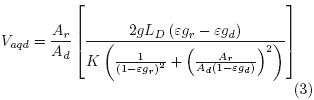
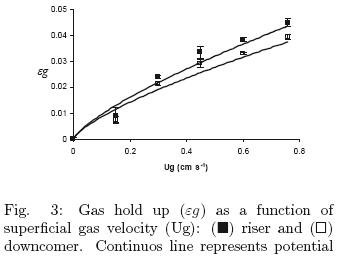
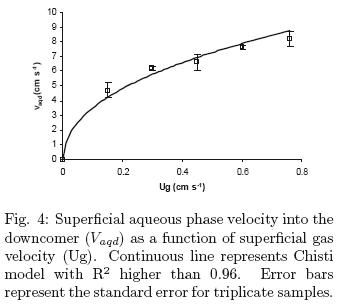
<body><![CDATA[<p align="justify"><font face="verdana" size="2">Where: Re<i><sub>aq</sub> </i>and Re<i><sub>oil</sub> </i>are aqueous and oil phase Reynolds number, respectively. D = D2 for riser zone; and D = (D1&#150;D2) for downcomer zone; D1 is the ALR diameter, cm; D2 draft tube diameter, cm; V<i><sub>aq</sub> </i>aqueous phase velocity, cm s<i><sup>&#150;</sup></i><sup>1</sup>; V<i><sub>oil</sub> </i>oil phase velocity, cm s<i><sup>&#150;</sup></i><sup>1</sup>; <i>&#961;<sub>aq</sub> </i>aqueous phase density, g cm<i><sup>&#150;</sup></i><sup>3</sup>; <i>&#961;<sub>oil</sub> </i>oil phase density, g cm<i><sup>&#150;</sup></i><sup>3</sup>; <i>&#956; </i>bulk viscosity (oil in water emulsion), g cm s<i><sup>&#150;</sup></i><sup>1</sup>. In order to validate our method, the V<i><sub>aqd</sub> </i>values obtained were compared with acid pulse method (Sanchez&#150; Miron <i>et al</i>., 2004) . Chisti model (Chisti <i>et al</i>., 1988; Abashar <i>et al</i>., 1998) and the continuity criterion (Chisti, 1989) was used in order to predict superficial aqueous phase velocity (<i>V<sub>aqd</sub></i>) into downcomer using <i>&#949;g </i>as follows:</font></p>     <p align="center"><font face="verdana" size="2"><img src="/img/revistas/rmiq/v10n1/a7s3.jpg"></font></p>     <p align="justify"><font face="verdana" size="2">Where: <i>A<sub>r</sub> </i>and <i>A<sub>d</sub> </i>are cross section area for riser and downcomer, m<sup>2</sup>, respectively. <i>&#949;g<sub>r</sub> </i>and <i>&#949;g<sub>d</sub> </i>are gas hold up in riser and downcomer, dimensionless, respectively, K is the loss friction coefficient, dimensionless, g is the gravitational acceleration constat, m s<i><sup>&#150;</sup></i><sup>2</sup> and <i>L<sub>D</sub> </i>is the draft tube lenght, m.</font></p>     <p align="justify"><font face="verdana" size="2">The model assumes the following: (1) steady&#150;state conditions, (2) isothermal conditions, (3) the energy losses terms due to the skin friction in the riser and the downcomer are negligible in comparison to the others dissipation terms, (4) the presure drop due to acceleration is negligible.</font></p>     <p align="justify"><font face="verdana" size="2"><b>2.4.3 Statistical analyses</b></font></p>     <p align="justify"><font face="verdana" size="2">Data analyses were carried out by using NCSS&#150;2000, version 2001 (Copyright 2001 by Jerry Hintze). Analysis of variance (ANOVA) was performed by comparing tests with p &lt; 0.05.</font></p>     <p align="justify"><font face="verdana" size="2">&nbsp;</font></p>     <p align="justify"><font face="verdana" size="2"><b>3 Results and discussion</b></font></p>     <p align="justify"><font face="verdana" size="2">In order to evaluate hydrodynamic behavior in our three&#150;phase ALR, <i>&#949;g</i>, liquid phases velocities, Re<i><sub>aq</sub> </i>and Re<i><sub>oil</sub> </i>were measured using geometrical relations D2/D1 = 0.65 and L2/L1 = 0.77. The choice of this configuration is partially according to a similar hydrocarbon/liquid ALR (Gumery <i>et al</i>., 2005) studying dynamics and macro&#150;mixing for design and scale&#150;up purposes. <a href="#f3">Fig. 3</a> shows <i>&#949;g </i>as a function of Ug into riser and downcomer. The <i>&#949;g </i>in the riser was slightly higher than in the downcomer. A potential model: <i>&#949;g </i>= <i>aUg<sup>b </sup></i>(where <i>a </i>and <i>b </i>depend on local hydrodynamic) was used for both: riser (<i>a </i>= 0.053 and <i>b </i>= 0.74; R<sup>2</sup> = 0.99) and downcomer (<i>a </i>= 0.045 and <i>b </i>= 0.72; R<sup>2</sup> = 0.98). The differences between <i>&#949;g </i>in riser and downcomer caused liquid phases circulation. The potential model data obtained from <a href="#f3">Fig. 3</a> were used in order to predict superficial aqueous phase velocities into downcomer (V<i><sub>aqd</sub></i>) using the Chisti model, see Eq. 3. <a href="#f4">Fig. 4</a> shows experimental data of V<i><sub>aqd</sub> </i>as a function of Ug in addition to V<i><sub>aqd</sub> </i>values predicted by the Chisti model. A good fitting value for the loss friction coefficient (K) of 4, close to other work (1.8) with water and kerosene (Abashar <i>et al</i>., 1998), was found.</font></p>     <p align="center"><font face="verdana" size="2"><a name="f3"></a></font></p>     ]]></body>
<body><![CDATA[<p align="center"><font face="verdana" size="2"><img src="/img/revistas/rmiq/v10n1/a7f3.jpg"></font></p>     <p align="center"><font face="verdana" size="2"><a name="f4"></a></font></p>     <p align="center"><font face="verdana" size="2"><img src="/img/revistas/rmiq/v10n1/a7f4.jpg"></font></p>     <p align="justify"><font face="verdana" size="2"><a href="/img/revistas/rmiq/v10n1/a7f5.jpg" target="_blank">Fig. 5</a> shows Re<i><sub>aq</sub> </i>as a function of Ug and <i>&#963;</i>, for the selected configuration in riser (3a) and downcomer (3b). As expected, in riser and downcomer, Re increased as Ug increased. On the other hand Re<i><sub>aq</sub> </i>slightly decreased as <i>&#963; </i>increased. A similar performance was also observed in other pneumatic reactors working with two&#150;phase systems (Kantarci <i>et al</i>., 2005). Riser shows turbulent flow (Re<i><sub>aq</sub> </i>&gt; 4000; see red zone in <a href="/img/revistas/rmiq/v10n1/a7f2.jpg" target="_blank">Fig. 2a</a>) when Ug was higher than 0.4 cm s<i><sup>&#150;</sup></i><sup>1</sup>, whilst downcomer do not (red zone is absent in <a href="#f3">Fig. 3b</a>). Re<i><sub>aq</sub> </i>increased as Ug probably due to differences in gas hold up between riser and downcomer, which produces differences in hydrostatic pressure at the ALR bottom, these differences in hydrostatic pressure produce the liquid phase being in continuos movement. The Re<i><sub>aq</sub> </i>decreasing as surface tension increased could be explained by reason of gas hold up decreased as a result of larger bubbles with lower residence time and the resultant decreasing in the differences in hydrostatic pressure. Moreover, lower Re<i><sub>aq</sub> </i>in downcomer (not turbulent) supposes a hydrodynamics limitation for mixing probably imposing mass transfer limitation (Nielsen <i>et al</i>., 2003); this limitation is worst for oil phase as can be seen in <a href="#f3">figs. 3c</a> and <a href="#f3">3d</a>. Figures show Re<i><sub>oil</sub> </i>as a function of Ug and surface tension. Re<i><sub>oil</sub> </i>in riser (5000 &lt; Re<i><sub>oil</sub> </i>&lt; 10000) (<a href="#f3">Fig. 3c</a>) was higher than Re<i><sub>aq</sub></i>; whereas in downcomer was lower (200 &lt; Re<i><sub>oil</sub> </i>&lt; 2200) (<a href="#f3">Fig. 3d</a>). Re<i><sub>oil</sub> </i>in riser and downcomer were higher and lower than Re<i><sub>aq</sub></i>, respectively, due to densities differences. Lower Re<i><sub>oil</sub> </i>values in downcomer involve an increasing in boundary layer between oil and aqueous phase, probably resulting in mass transfer constraints (Cerri <i>et al</i>., 2010). Our results suggest that a carefully evaluation of the two Re species, involved in performance of three&#150;phase ALR was needed since oil phase into the downcomer supposed a clear hydrodynamic and probably mass transfer limitation. Traditional two&#150;phase model that considers only aqueous phase is not enough to explain oil in water reactors. For example, oil&#150;degrading microorganism growth (Medina&#150;Moreno <i>et al</i>., 2009) should consider oil transfer constraints in the bulk. The complexity of three&#150;phase flow and the limited measurement technologies have generated few studies regarding the local hydrodynamics properties restricting three&#150;phase reactors optimization and commercialization.</font></p>     <p align="justify"><font face="verdana" size="2">&nbsp;</font></p>     <p align="justify"><font face="verdana" size="2"><b>Conclusion</b></font></p>     <p align="justify"><font face="verdana" size="2">Aqueous and oil phase Re for main ALR local hydrodynamics zones, riser and downcomer, in a three&#150;phase ALR were evaluated in this work. Riser shows turbulent aqueous phase flow: 4000 &lt; Re<i><sub>aq</sub> </i>&lt; 9000 for 0.15 &lt;<i> Ug </i>&lt; 0.76 cm s<i><sup>&#150;</sup></i><sup>1 </sup>whereas downcomer shows non&#150;turbulent aqueous phase flow: 1250 &lt; Re<i><sub>aq</sub> </i>&lt; 4000 at the same above mentioned Ug values. Oil phase Re in riser (5000 &lt; Re<i><sub>oil</sub> </i>&lt; 10000) was higher than Re<i><sub>aq</sub></i>; whereas in downcomer, Re<i><sub>oil</sub> </i>was lower than Re<i><sub>aq</sub> </i>(200 &lt; Re<i><sub>oil</sub> </i>&lt; 2200). Re<i><sub>oil</sub> </i>into downcomer zone is supposed to be the most important hydrodynamic constraint allowing us to identify the downcomer as a relevant mass transfer limitation zone.</font></p>     <p align="justify"><font face="verdana" size="2">&nbsp;</font></p>     <p align="justify"><font face="verdana" size="2"><b>Acknowledgements</b></font></p>     <p align="justify"><font face="verdana" size="2">We acknowledge CONACYT (Consejo Nacional de Ciencia y Tecnolog&iacute;a) by scholarship to M. A. Lizardi&#150;Jimenez and PEMEX&#150;Refinaci&oacute;n for partial support. Thanks are due to Dr. J. Vernon in providing rhodophile pigment solution.</font></p>     ]]></body>
<body><![CDATA[<p align="justify"><font face="verdana" size="2">&nbsp;</font></p>     <p align="justify"><font face="verdana" size="2"><b>References</b></font></p>     <!-- ref --><p align="justify"><font face="verdana" size="2">Abashar, M.E., Narssing, U., Rouilliard, A. E. (1998). Hydrodynamic Flow Regimes, Gas Holdup, and Liquid Circulation in Airlift Reactors. <i>Industrial and Engineering Chemistry Research 199</i>, 1251&#150;1259</font>&nbsp;&nbsp;&nbsp;&nbsp;&nbsp;&nbsp;&nbsp;&nbsp;[&#160;<a href="javascript:void(0);" onclick="javascript: window.open('/scielo.php?script=sci_nlinks&ref=8545743&pid=S1665-2738201100010000700001&lng=','','width=640,height=500,resizable=yes,scrollbars=1,menubar=yes,');">Links</a>&#160;]<!-- end-ref --><!-- ref --><p align="justify"><font face="verdana" size="2">Bai, G., Brusseau, M.L. and Miller, R.M. (1997). Biosurfactant&#150;enhaced removal of residual hydrocarbon from soil. <i>Journal of Contaminant Hydrology 25</i>, 157&#150;170.    &nbsp;&nbsp;&nbsp;&nbsp;&nbsp;&nbsp;&nbsp;&nbsp;[&#160;<a href="javascript:void(0);" onclick="javascript: window.open('/scielo.php?script=sci_nlinks&ref=8545744&pid=S1665-2738201100010000700002&lng=','','width=640,height=500,resizable=yes,scrollbars=1,menubar=yes,');">Links</a>&#160;]<!-- end-ref --></font></p>     <!-- ref --><p align="justify"><font face="verdana" size="2">Cerri, M.O., Policarpo, L.M. and Badino, A. C. (2010). Gas Hold&#150;Up and mass transfer in three geometrically similar internal loop airlift reactors using newtonian fluids. <i>International Journal of Chemical Reactor Engineering 8</i>, 1&#150;14.    &nbsp;&nbsp;&nbsp;&nbsp;&nbsp;&nbsp;&nbsp;&nbsp;[&#160;<a href="javascript:void(0);" onclick="javascript: window.open('/scielo.php?script=sci_nlinks&ref=8545746&pid=S1665-2738201100010000700003&lng=','','width=640,height=500,resizable=yes,scrollbars=1,menubar=yes,');">Links</a>&#160;]<!-- end-ref --></font></p>     <!-- ref --><p align="justify"><font face="verdana" size="2">Chisti, Y. Halard, B., Moo&#150;yung, M. (1988). Liquid circulation in airlift reactor. <i>Chemical Engineering Science 43</i>, 451&#150;456</font>&nbsp;&nbsp;&nbsp;&nbsp;&nbsp;&nbsp;&nbsp;&nbsp;[&#160;<a href="javascript:void(0);" onclick="javascript: window.open('/scielo.php?script=sci_nlinks&ref=8545748&pid=S1665-2738201100010000700004&lng=','','width=640,height=500,resizable=yes,scrollbars=1,menubar=yes,');">Links</a>&#160;]<!-- end-ref --><!-- ref --><p align="justify"><font face="verdana" size="2">Chisti, Y. (1989). <i>Airlift Bioreactors</i>. Elsevier Science Publishers, New York.    &nbsp;&nbsp;&nbsp;&nbsp;&nbsp;&nbsp;&nbsp;&nbsp;[&#160;<a href="javascript:void(0);" onclick="javascript: window.open('/scielo.php?script=sci_nlinks&ref=8545749&pid=S1665-2738201100010000700005&lng=','','width=640,height=500,resizable=yes,scrollbars=1,menubar=yes,');">Links</a>&#160;]<!-- end-ref --></font></p>     ]]></body>
<body><![CDATA[<!-- ref --><p align="justify"><font face="verdana" size="2">Gumery, F., Ein&#150;Mozaffari, F. and Dahman, Y.    (2009). Characteristics    of    local flow dynamics and macro&#150;mixing in airlift column reactors for reliable design and scale&#150;Up. <i>International Journal of Chemical Reactor Engineering 7, </i>1&#150;45.    &nbsp;&nbsp;&nbsp;&nbsp;&nbsp;&nbsp;&nbsp;&nbsp;[&#160;<a href="javascript:void(0);" onclick="javascript: window.open('/scielo.php?script=sci_nlinks&ref=8545751&pid=S1665-2738201100010000700006&lng=','','width=640,height=500,resizable=yes,scrollbars=1,menubar=yes,');">Links</a>&#160;]<!-- end-ref --></font></p>     <!-- ref --><p align="justify"><font face="verdana" size="2">Huang, Q., Yang, C, Yu, g., Mao, Z. (2010). CFD simulation of hydrodynamics and mass transfer in an internal airlift loop reactor using a steady two&#150;fluid model. <i>Chemical Engineering Science 65, </i>5527&#150;5536.    &nbsp;&nbsp;&nbsp;&nbsp;&nbsp;&nbsp;&nbsp;&nbsp;[&#160;<a href="javascript:void(0);" onclick="javascript: window.open('/scielo.php?script=sci_nlinks&ref=8545753&pid=S1665-2738201100010000700007&lng=','','width=640,height=500,resizable=yes,scrollbars=1,menubar=yes,');">Links</a>&#160;]<!-- end-ref --></font></p>     <!-- ref --><p align="justify"><font face="verdana" size="2">Kantarci, N., Borak, F. and Klutlu, O. (2005). Bubble column reactors. <i>Process Biochemistry 40, </i>2263&#150;2283.    &nbsp;&nbsp;&nbsp;&nbsp;&nbsp;&nbsp;&nbsp;&nbsp;[&#160;<a href="javascript:void(0);" onclick="javascript: window.open('/scielo.php?script=sci_nlinks&ref=8545755&pid=S1665-2738201100010000700008&lng=','','width=640,height=500,resizable=yes,scrollbars=1,menubar=yes,');">Links</a>&#160;]<!-- end-ref --></font></p>     <!-- ref --><p align="justify"><font face="verdana" size="2">Kilonzo, P.M., Margaritis, A., Bergougnou, M.A., Yu, J.T. and Qin, Y. (2006). Influence of the baffle clearance design on hydrodynamics of a two riser rectangular airlift reactor with inverse internal loop and expanded gas&#150;liquid separator. <i>Chemical Engineering Journal 121, </i>17&#150;26.    &nbsp;&nbsp;&nbsp;&nbsp;&nbsp;&nbsp;&nbsp;&nbsp;[&#160;<a href="javascript:void(0);" onclick="javascript: window.open('/scielo.php?script=sci_nlinks&ref=8545757&pid=S1665-2738201100010000700009&lng=','','width=640,height=500,resizable=yes,scrollbars=1,menubar=yes,');">Links</a>&#160;]<!-- end-ref --></font></p>     <!-- ref --><p align="justify"><font face="verdana" size="2">Luo, H.P., Al&#150;Dahhan, H. (2011). Verification and validation of CFD simulations for local flow dynamics in a draft tube airlift bioreactor. <i>Chemical Engineerig Science 66, </i>907&#150;923.    &nbsp;&nbsp;&nbsp;&nbsp;&nbsp;&nbsp;&nbsp;&nbsp;[&#160;<a href="javascript:void(0);" onclick="javascript: window.open('/scielo.php?script=sci_nlinks&ref=8545759&pid=S1665-2738201100010000700010&lng=','','width=640,height=500,resizable=yes,scrollbars=1,menubar=yes,');">Links</a>&#160;]<!-- end-ref --></font></p>     ]]></body>
<body><![CDATA[<!-- ref --><p align="justify"><font face="verdana" size="2">Medina&#150;Moreno, S.A., Huerta&#150;Ochoa, S., Lucho&#150;Constantino, C.A., Aguilera&#150;V&aacute;zquez, L., Jim&eacute;nez&#150;Gonz&aacute;lez, A. and Guti&eacute;rrez&#150;Rojas, M. (2009). Biodegradation modeling of sludge bioreactors of total petroleum hydrocarbons weathering in soil and sediments. <i>Revista Mexicana de Ingenier&iacute;a Qu&iacute;mica 8, </i>245&#150;258.    &nbsp;&nbsp;&nbsp;&nbsp;&nbsp;&nbsp;&nbsp;&nbsp;[&#160;<a href="javascript:void(0);" onclick="javascript: window.open('/scielo.php?script=sci_nlinks&ref=8545761&pid=S1665-2738201100010000700011&lng=','','width=640,height=500,resizable=yes,scrollbars=1,menubar=yes,');">Links</a>&#160;]<!-- end-ref --></font></p>     <!-- ref --><p align="justify"><font face="verdana" size="2">Mehrnia, M., Towfighi, J., Bonakdarpour, B. and Akbainejad, M. (2005). Gas hold&#150;up and oxygen transfer in a draft&#150;tube airlift bioreactor with petroleum based liquids. <i>Biochemical Engineering Journal 22, </i>105&#150;110.    &nbsp;&nbsp;&nbsp;&nbsp;&nbsp;&nbsp;&nbsp;&nbsp;[&#160;<a href="javascript:void(0);" onclick="javascript: window.open('/scielo.php?script=sci_nlinks&ref=8545763&pid=S1665-2738201100010000700012&lng=','','width=640,height=500,resizable=yes,scrollbars=1,menubar=yes,');">Links</a>&#160;]<!-- end-ref --></font></p>     <!-- ref --><p align="justify"><font face="verdana" size="2">Montoya&#150;Ballesteros, L.C., Gardea&#150;B&eacute;jar, A., Ayala&#150;Ch&aacute;vez G.M., Mart&iacute;nez&#150;Nunez Y.Y. and Robles&#150;Ozuna, L.E. (2010). Capsaicinoids and color in chilpetin (Capsicum annuum var. aviculare). Processing effect on sauces and pickles. <i>Revista Mexicana de Ingenier&iacute;a Qu&iacute;mica 9, </i>197&#150;207.    &nbsp;&nbsp;&nbsp;&nbsp;&nbsp;&nbsp;&nbsp;&nbsp;[&#160;<a href="javascript:void(0);" onclick="javascript: window.open('/scielo.php?script=sci_nlinks&ref=8545765&pid=S1665-2738201100010000700013&lng=','','width=640,height=500,resizable=yes,scrollbars=1,menubar=yes,');">Links</a>&#160;]<!-- end-ref --></font></p>     <!-- ref --><p align="justify"><font face="verdana" size="2">Nielsen, J., Villadsen, J. and Liden, G. (2003). Mass transfer. In: <i>Bioreactor Engineering Principles</i>. Kuwler Academic/Plenum Publishers, New York.    &nbsp;&nbsp;&nbsp;&nbsp;&nbsp;&nbsp;&nbsp;&nbsp;[&#160;<a href="javascript:void(0);" onclick="javascript: window.open('/scielo.php?script=sci_nlinks&ref=8545767&pid=S1665-2738201100010000700014&lng=','','width=640,height=500,resizable=yes,scrollbars=1,menubar=yes,');">Links</a>&#160;]<!-- end-ref --></font></p>     <!-- ref --><p align="justify"><font face="verdana" size="2">Quijano, G., Revah, S., Guti&eacute;rrez&#150;Rojas, M., Flores&#150;Cotera, L. and Thalasso F. (2009). Oxygen transfer in three&#150;phase airlift and stirred tank reactors using silicone oil as transfer vector. <i>Process Biochemistry 44</i>, 619&#150;624.    &nbsp;&nbsp;&nbsp;&nbsp;&nbsp;&nbsp;&nbsp;&nbsp;[&#160;<a href="javascript:void(0);" onclick="javascript: window.open('/scielo.php?script=sci_nlinks&ref=8545769&pid=S1665-2738201100010000700015&lng=','','width=640,height=500,resizable=yes,scrollbars=1,menubar=yes,');">Links</a>&#160;]<!-- end-ref --></font></p>     ]]></body>
<body><![CDATA[<!-- ref --><p align="justify"><font face="verdana" size="2">Quijano, G., Huerta&#150;Ochoa, S. and Guti&eacute;rrez&#150;Rojas, M. (2010). Assessment of the limiting step of mass transfer in n&#150;hexadecane biodegradation in a bubble column reactor. <i>Water Science and Technology 62</i>, 906&#150;914.    &nbsp;&nbsp;&nbsp;&nbsp;&nbsp;&nbsp;&nbsp;&nbsp;[&#160;<a href="javascript:void(0);" onclick="javascript: window.open('/scielo.php?script=sci_nlinks&ref=8545771&pid=S1665-2738201100010000700016&lng=','','width=640,height=500,resizable=yes,scrollbars=1,menubar=yes,');">Links</a>&#160;]<!-- end-ref --></font></p>     <!-- ref --><p align="justify"><font face="verdana" size="2">Ribeiro, Jr C. P. and Lage, P. L. C. (2004). Experimental study on bubble size distributions in a direct contact evaporator. <i>Brazilian Journal of Chemical Engineering 21</i>, 69&#150;81.    &nbsp;&nbsp;&nbsp;&nbsp;&nbsp;&nbsp;&nbsp;&nbsp;[&#160;<a href="javascript:void(0);" onclick="javascript: window.open('/scielo.php?script=sci_nlinks&ref=8545773&pid=S1665-2738201100010000700017&lng=','','width=640,height=500,resizable=yes,scrollbars=1,menubar=yes,');">Links</a>&#160;]<!-- end-ref --></font></p>     <!-- ref --><p align="justify"><font face="verdana" size="2">Sanchez&#150;Mir&oacute;n, A., Cer&oacute;n&#150;Garcia, M.C, Garcia&#150;Camacho, F., Molina&#150;Grima, E. and Chisti, Y. (2004). Mixing in bubble column and airlift reactors. <i>Transactions Institution of Chemical Engineers Part A. Chemical Engineering Research and design 82</i>, 1367&#150;1374.    &nbsp;&nbsp;&nbsp;&nbsp;&nbsp;&nbsp;&nbsp;&nbsp;[&#160;<a href="javascript:void(0);" onclick="javascript: window.open('/scielo.php?script=sci_nlinks&ref=8545775&pid=S1665-2738201100010000700018&lng=','','width=640,height=500,resizable=yes,scrollbars=1,menubar=yes,');">Links</a>&#160;]<!-- end-ref --></font></p>     <!-- ref --><p align="justify"><font face="verdana" size="2">Shariati, F.P., Bonakdarpour, B. and Mehrnia, M.R. (2007). Hydrodynamics and oxygen transfer behaviour of water in diesel microemulsions in a draft tube airlift bioreactor. <i>Chemical Engineering and Processing 46</i>, 334&#150;342.    &nbsp;&nbsp;&nbsp;&nbsp;&nbsp;&nbsp;&nbsp;&nbsp;[&#160;<a href="javascript:void(0);" onclick="javascript: window.open('/scielo.php?script=sci_nlinks&ref=8545777&pid=S1665-2738201100010000700019&lng=','','width=640,height=500,resizable=yes,scrollbars=1,menubar=yes,');">Links</a>&#160;]<!-- end-ref --></font></p>     <!-- ref --><p align="justify"><font face="verdana" size="2">Wongsuchoto, P. and Pavasant, P. (2004). Internal liquid circulation in annulus sparged internal loop airlift contactors. <i>Chemical Engineering Journal 100</i>, 1&#150;9.    &nbsp;&nbsp;&nbsp;&nbsp;&nbsp;&nbsp;&nbsp;&nbsp;[&#160;<a href="javascript:void(0);" onclick="javascript: window.open('/scielo.php?script=sci_nlinks&ref=8545779&pid=S1665-2738201100010000700020&lng=','','width=640,height=500,resizable=yes,scrollbars=1,menubar=yes,');">Links</a>&#160;]<!-- end-ref --></font></p>     ]]></body>
<body><![CDATA[ ]]></body><back>
<ref-list>
<ref id="B1">
<nlm-citation citation-type="journal">
<person-group person-group-type="author">
<name>
<surname><![CDATA[Abashar]]></surname>
<given-names><![CDATA[M.E.]]></given-names>
</name>
<name>
<surname><![CDATA[Narssing]]></surname>
<given-names><![CDATA[U.]]></given-names>
</name>
<name>
<surname><![CDATA[Rouilliard]]></surname>
<given-names><![CDATA[A. E.]]></given-names>
</name>
</person-group>
<article-title xml:lang="en"><![CDATA[Hydrodynamic Flow Regimes, Gas Holdup, and Liquid Circulation in Airlift Reactors]]></article-title>
<source><![CDATA[Industrial and Engineering Chemistry Research]]></source>
<year>1998</year>
<volume>199</volume>
<page-range>1251-1259</page-range></nlm-citation>
</ref>
<ref id="B2">
<nlm-citation citation-type="journal">
<person-group person-group-type="author">
<name>
<surname><![CDATA[Bai]]></surname>
<given-names><![CDATA[G.]]></given-names>
</name>
<name>
<surname><![CDATA[Brusseau]]></surname>
<given-names><![CDATA[M.L.]]></given-names>
</name>
<name>
<surname><![CDATA[Miller]]></surname>
<given-names><![CDATA[R.M.]]></given-names>
</name>
</person-group>
<article-title xml:lang="en"><![CDATA[Biosurfactant-enhaced removal of residual hydrocarbon from soil]]></article-title>
<source><![CDATA[Journal of Contaminant Hydrology]]></source>
<year>1997</year>
<volume>25</volume>
<page-range>157-170</page-range></nlm-citation>
</ref>
<ref id="B3">
<nlm-citation citation-type="journal">
<person-group person-group-type="author">
<name>
<surname><![CDATA[Cerri]]></surname>
<given-names><![CDATA[M.O.]]></given-names>
</name>
<name>
<surname><![CDATA[Policarpo]]></surname>
<given-names><![CDATA[L.M.]]></given-names>
</name>
<name>
<surname><![CDATA[Badino]]></surname>
<given-names><![CDATA[A. C.]]></given-names>
</name>
</person-group>
<article-title xml:lang="en"><![CDATA[Gas Hold-Up and mass transfer in three geometrically similar internal loop airlift reactors using newtonian fluids]]></article-title>
<source><![CDATA[International Journal of Chemical Reactor Engineering]]></source>
<year>2010</year>
<volume>8</volume>
<page-range>1-14</page-range></nlm-citation>
</ref>
<ref id="B4">
<nlm-citation citation-type="journal">
<person-group person-group-type="author">
<name>
<surname><![CDATA[Chisti]]></surname>
<given-names><![CDATA[Y.]]></given-names>
</name>
<name>
<surname><![CDATA[Halard]]></surname>
<given-names><![CDATA[B.]]></given-names>
</name>
<name>
<surname><![CDATA[Moo-yung]]></surname>
<given-names><![CDATA[M.]]></given-names>
</name>
</person-group>
<article-title xml:lang="en"><![CDATA[Liquid circulation in airlift reactor]]></article-title>
<source><![CDATA[Chemical Engineering Science]]></source>
<year>1988</year>
<volume>43</volume>
<page-range>451-456</page-range></nlm-citation>
</ref>
<ref id="B5">
<nlm-citation citation-type="book">
<person-group person-group-type="author">
<name>
<surname><![CDATA[Chisti]]></surname>
<given-names><![CDATA[Y.]]></given-names>
</name>
</person-group>
<source><![CDATA[Airlift Bioreactors]]></source>
<year>1989</year>
<publisher-loc><![CDATA[New York ]]></publisher-loc>
<publisher-name><![CDATA[Elsevier Science Publishers]]></publisher-name>
</nlm-citation>
</ref>
<ref id="B6">
<nlm-citation citation-type="journal">
<person-group person-group-type="author">
<name>
<surname><![CDATA[Gumery]]></surname>
<given-names><![CDATA[F.]]></given-names>
</name>
<name>
<surname><![CDATA[Ein-Mozaffari]]></surname>
<given-names><![CDATA[F.]]></given-names>
</name>
<name>
<surname><![CDATA[Dahman]]></surname>
<given-names><![CDATA[Y.]]></given-names>
</name>
</person-group>
<article-title xml:lang="en"><![CDATA[Characteristics of local flow dynamics and macro-mixing in airlift column reactors for reliable design and scale-Up]]></article-title>
<source><![CDATA[International Journal of Chemical Reactor Engineering]]></source>
<year>2009</year>
<volume>7</volume>
<page-range>1-45</page-range></nlm-citation>
</ref>
<ref id="B7">
<nlm-citation citation-type="journal">
<person-group person-group-type="author">
<name>
<surname><![CDATA[Huang]]></surname>
<given-names><![CDATA[Q.]]></given-names>
</name>
<name>
<surname><![CDATA[Yang]]></surname>
<given-names><![CDATA[C]]></given-names>
</name>
<name>
<surname><![CDATA[Yu]]></surname>
<given-names><![CDATA[g.]]></given-names>
</name>
<name>
<surname><![CDATA[Mao]]></surname>
<given-names><![CDATA[Z.]]></given-names>
</name>
</person-group>
<article-title xml:lang="en"><![CDATA[CFD simulation of hydrodynamics and mass transfer in an internal airlift loop reactor using a steady two-fluid model]]></article-title>
<source><![CDATA[Chemical Engineering Science]]></source>
<year>2010</year>
<volume>65</volume>
<page-range>5527-5536</page-range></nlm-citation>
</ref>
<ref id="B8">
<nlm-citation citation-type="journal">
<person-group person-group-type="author">
<name>
<surname><![CDATA[Kantarci]]></surname>
<given-names><![CDATA[N.]]></given-names>
</name>
<name>
<surname><![CDATA[Borak]]></surname>
<given-names><![CDATA[F.]]></given-names>
</name>
<name>
<surname><![CDATA[Klutlu]]></surname>
<given-names><![CDATA[O.]]></given-names>
</name>
</person-group>
<article-title xml:lang="en"><![CDATA[Bubble column reactors]]></article-title>
<source><![CDATA[Process Biochemistry]]></source>
<year>2005</year>
<volume>40</volume>
<page-range>2263-2283</page-range></nlm-citation>
</ref>
<ref id="B9">
<nlm-citation citation-type="journal">
<person-group person-group-type="author">
<name>
<surname><![CDATA[Kilonzo]]></surname>
<given-names><![CDATA[P.M.]]></given-names>
</name>
<name>
<surname><![CDATA[Margaritis]]></surname>
<given-names><![CDATA[A.]]></given-names>
</name>
<name>
<surname><![CDATA[Bergougnou]]></surname>
<given-names><![CDATA[M.A.]]></given-names>
</name>
<name>
<surname><![CDATA[Yu]]></surname>
<given-names><![CDATA[J.T.]]></given-names>
</name>
<name>
<surname><![CDATA[Qin]]></surname>
<given-names><![CDATA[Y.]]></given-names>
</name>
</person-group>
<article-title xml:lang="en"><![CDATA[Influence of the baffle clearance design on hydrodynamics of a two riser rectangular airlift reactor with inverse internal loop and expanded gas-liquid separator]]></article-title>
<source><![CDATA[Chemical Engineering Journal]]></source>
<year>2006</year>
<volume>121</volume>
<page-range>17-26</page-range></nlm-citation>
</ref>
<ref id="B10">
<nlm-citation citation-type="journal">
<person-group person-group-type="author">
<name>
<surname><![CDATA[Luo]]></surname>
<given-names><![CDATA[H.P.]]></given-names>
</name>
<name>
<surname><![CDATA[Al-Dahhan]]></surname>
<given-names><![CDATA[H.]]></given-names>
</name>
</person-group>
<article-title xml:lang="en"><![CDATA[Verification and validation of CFD simulations for local flow dynamics in a draft tube airlift bioreactor]]></article-title>
<source><![CDATA[Chemical Engineerig Science]]></source>
<year>2011</year>
<volume>66</volume>
<page-range>907-923</page-range></nlm-citation>
</ref>
<ref id="B11">
<nlm-citation citation-type="journal">
<person-group person-group-type="author">
<name>
<surname><![CDATA[Medina-Moreno]]></surname>
<given-names><![CDATA[S.A.]]></given-names>
</name>
<name>
<surname><![CDATA[Huerta-Ochoa]]></surname>
<given-names><![CDATA[S.]]></given-names>
</name>
<name>
<surname><![CDATA[Lucho-Constantino]]></surname>
<given-names><![CDATA[C.A.]]></given-names>
</name>
<name>
<surname><![CDATA[Aguilera-Vázquez]]></surname>
<given-names><![CDATA[L.]]></given-names>
</name>
<name>
<surname><![CDATA[Jiménez-González]]></surname>
<given-names><![CDATA[A.]]></given-names>
</name>
<name>
<surname><![CDATA[Gutiérrez-Rojas]]></surname>
<given-names><![CDATA[M.]]></given-names>
</name>
</person-group>
<article-title xml:lang="en"><![CDATA[Biodegradation modeling of sludge bioreactors of total petroleum hydrocarbons weathering in soil and sediments]]></article-title>
<source><![CDATA[Revista Mexicana de Ingeniería Química]]></source>
<year>2009</year>
<volume>8</volume>
<page-range>245-258</page-range></nlm-citation>
</ref>
<ref id="B12">
<nlm-citation citation-type="journal">
<person-group person-group-type="author">
<name>
<surname><![CDATA[Mehrnia]]></surname>
<given-names><![CDATA[M.]]></given-names>
</name>
<name>
<surname><![CDATA[Towfighi]]></surname>
<given-names><![CDATA[J.]]></given-names>
</name>
<name>
<surname><![CDATA[Bonakdarpour]]></surname>
<given-names><![CDATA[B.]]></given-names>
</name>
<name>
<surname><![CDATA[Akbainejad]]></surname>
<given-names><![CDATA[M.]]></given-names>
</name>
</person-group>
<article-title xml:lang="en"><![CDATA[Gas hold-up and oxygen transfer in a draft-tube airlift bioreactor with petroleum based liquids]]></article-title>
<source><![CDATA[Biochemical Engineering Journal]]></source>
<year>2005</year>
<volume>22</volume>
<page-range>105-110</page-range></nlm-citation>
</ref>
<ref id="B13">
<nlm-citation citation-type="journal">
<person-group person-group-type="author">
<name>
<surname><![CDATA[Montoya-Ballesteros]]></surname>
<given-names><![CDATA[L.C.]]></given-names>
</name>
<name>
<surname><![CDATA[Gardea-Béjar]]></surname>
<given-names><![CDATA[A.]]></given-names>
</name>
<name>
<surname><![CDATA[Ayala-Chávez]]></surname>
<given-names><![CDATA[G.M.]]></given-names>
</name>
<name>
<surname><![CDATA[Martínez-Nunez]]></surname>
<given-names><![CDATA[Y.Y.]]></given-names>
</name>
<name>
<surname><![CDATA[Robles-Ozuna]]></surname>
<given-names><![CDATA[L.E.]]></given-names>
</name>
</person-group>
<article-title xml:lang="en"><![CDATA[Capsaicinoids and color in chilpetin (Capsicum annuum var. aviculare). Processing effect on sauces and pickles]]></article-title>
<source><![CDATA[Revista Mexicana de Ingeniería Química]]></source>
<year>2010</year>
<volume>9</volume>
<page-range>197-207</page-range></nlm-citation>
</ref>
<ref id="B14">
<nlm-citation citation-type="book">
<person-group person-group-type="author">
<name>
<surname><![CDATA[Nielsen]]></surname>
<given-names><![CDATA[J.]]></given-names>
</name>
<name>
<surname><![CDATA[Villadsen]]></surname>
<given-names><![CDATA[J.]]></given-names>
</name>
<name>
<surname><![CDATA[Liden]]></surname>
<given-names><![CDATA[G.]]></given-names>
</name>
</person-group>
<article-title xml:lang="en"><![CDATA[Mass transfer]]></article-title>
<source><![CDATA[Bioreactor Engineering Principles]]></source>
<year>2003</year>
<publisher-loc><![CDATA[New York ]]></publisher-loc>
<publisher-name><![CDATA[Kuwler AcademicPlenum Publishers]]></publisher-name>
</nlm-citation>
</ref>
<ref id="B15">
<nlm-citation citation-type="journal">
<person-group person-group-type="author">
<name>
<surname><![CDATA[Quijano]]></surname>
<given-names><![CDATA[G.]]></given-names>
</name>
<name>
<surname><![CDATA[Revah]]></surname>
<given-names><![CDATA[S.]]></given-names>
</name>
<name>
<surname><![CDATA[Gutiérrez-Rojas]]></surname>
<given-names><![CDATA[M.]]></given-names>
</name>
<name>
<surname><![CDATA[Flores-Cotera]]></surname>
<given-names><![CDATA[L.]]></given-names>
</name>
<name>
<surname><![CDATA[Thalasso]]></surname>
<given-names><![CDATA[F.]]></given-names>
</name>
</person-group>
<article-title xml:lang="en"><![CDATA[Oxygen transfer in three-phase airlift and stirred tank reactors using silicone oil as transfer vector]]></article-title>
<source><![CDATA[Process Biochemistry]]></source>
<year>2009</year>
<volume>44</volume>
<page-range>619-624</page-range></nlm-citation>
</ref>
<ref id="B16">
<nlm-citation citation-type="journal">
<person-group person-group-type="author">
<name>
<surname><![CDATA[Quijano]]></surname>
<given-names><![CDATA[G.]]></given-names>
</name>
<name>
<surname><![CDATA[Huerta-Ochoa]]></surname>
<given-names><![CDATA[S.]]></given-names>
</name>
<name>
<surname><![CDATA[Gutiérrez-Rojas]]></surname>
<given-names><![CDATA[M.]]></given-names>
</name>
</person-group>
<article-title xml:lang="en"><![CDATA[Assessment of the limiting step of mass transfer in n-hexadecane biodegradation in a bubble column reactor]]></article-title>
<source><![CDATA[Water Science and Technology]]></source>
<year>2010</year>
<volume>62</volume>
<page-range>906-914</page-range></nlm-citation>
</ref>
<ref id="B17">
<nlm-citation citation-type="journal">
<person-group person-group-type="author">
<name>
<surname><![CDATA[Ribeiro]]></surname>
<given-names><![CDATA[Jr C. P.]]></given-names>
</name>
<name>
<surname><![CDATA[Lage]]></surname>
<given-names><![CDATA[P. L. C.]]></given-names>
</name>
</person-group>
<article-title xml:lang="en"><![CDATA[Experimental study on bubble size distributions in a direct contact evaporator]]></article-title>
<source><![CDATA[Brazilian Journal of Chemical Engineering]]></source>
<year>2004</year>
<volume>21</volume>
<page-range>69-81</page-range></nlm-citation>
</ref>
<ref id="B18">
<nlm-citation citation-type="journal">
<person-group person-group-type="author">
<name>
<surname><![CDATA[Sanchez-Mirón]]></surname>
<given-names><![CDATA[A.]]></given-names>
</name>
<name>
<surname><![CDATA[Cerón-Garcia]]></surname>
<given-names><![CDATA[M.C]]></given-names>
</name>
<name>
<surname><![CDATA[Garcia-Camacho]]></surname>
<given-names><![CDATA[F.]]></given-names>
</name>
<name>
<surname><![CDATA[Molina-Grima]]></surname>
<given-names><![CDATA[E.]]></given-names>
</name>
<name>
<surname><![CDATA[Chisti]]></surname>
<given-names><![CDATA[Y.]]></given-names>
</name>
</person-group>
<article-title xml:lang="en"><![CDATA[Mixing in bubble column and airlift reactors. Transactions Institution of Chemical Engineers Part A]]></article-title>
<source><![CDATA[Chemical Engineering Research and design]]></source>
<year>2004</year>
<volume>82</volume>
<page-range>1367-1374</page-range></nlm-citation>
</ref>
<ref id="B19">
<nlm-citation citation-type="journal">
<person-group person-group-type="author">
<name>
<surname><![CDATA[Shariati]]></surname>
<given-names><![CDATA[F.P.]]></given-names>
</name>
<name>
<surname><![CDATA[Bonakdarpour]]></surname>
<given-names><![CDATA[B.]]></given-names>
</name>
<name>
<surname><![CDATA[Mehrnia]]></surname>
<given-names><![CDATA[M.R.]]></given-names>
</name>
</person-group>
<article-title xml:lang="en"><![CDATA[Hydrodynamics and oxygen transfer behaviour of water in diesel microemulsions in a draft tube airlift bioreactor]]></article-title>
<source><![CDATA[Chemical Engineering and Processing]]></source>
<year>2007</year>
<volume>46</volume>
<page-range>334-342</page-range></nlm-citation>
</ref>
<ref id="B20">
<nlm-citation citation-type="journal">
<person-group person-group-type="author">
<name>
<surname><![CDATA[Wongsuchoto]]></surname>
<given-names><![CDATA[P.]]></given-names>
</name>
<name>
<surname><![CDATA[Pavasant]]></surname>
<given-names><![CDATA[P.]]></given-names>
</name>
</person-group>
<article-title xml:lang="en"><![CDATA[Internal liquid circulation in annulus sparged internal loop airlift contactors]]></article-title>
<source><![CDATA[Chemical Engineering Journal]]></source>
<year>2004</year>
<volume>100</volume>
<page-range>1-9</page-range></nlm-citation>
</ref>
</ref-list>
</back>
</article>