<?xml version="1.0" encoding="ISO-8859-1"?><article xmlns:mml="http://www.w3.org/1998/Math/MathML" xmlns:xlink="http://www.w3.org/1999/xlink" xmlns:xsi="http://www.w3.org/2001/XMLSchema-instance">
<front>
<journal-meta>
<journal-id>1665-2738</journal-id>
<journal-title><![CDATA[Revista mexicana de ingeniería química]]></journal-title>
<abbrev-journal-title><![CDATA[Rev. Mex. Ing. Quím]]></abbrev-journal-title>
<issn>1665-2738</issn>
<publisher>
<publisher-name><![CDATA[Universidad Autónoma Metropolitana, División de Ciencias Básicas e Ingeniería]]></publisher-name>
</publisher>
</journal-meta>
<article-meta>
<article-id>S1665-27382010000100009</article-id>
<title-group>
<article-title xml:lang="en"><![CDATA[Photothermal selective coatings of black molybdenum]]></article-title>
<article-title xml:lang="es"><![CDATA[Recubrimientos selectivos fototérmicos de molibdeno negro]]></article-title>
</title-group>
<contrib-group>
<contrib contrib-type="author">
<name>
<surname><![CDATA[González]]></surname>
<given-names><![CDATA[F.]]></given-names>
</name>
<xref ref-type="aff" rid="A01"/>
</contrib>
<contrib contrib-type="author">
<name>
<surname><![CDATA[Barrera C.]]></surname>
<given-names><![CDATA[E.]]></given-names>
</name>
<xref ref-type="aff" rid="A01"/>
</contrib>
<contrib contrib-type="author">
<name>
<surname><![CDATA[Rosas C.]]></surname>
<given-names><![CDATA[R.]]></given-names>
</name>
<xref ref-type="aff" rid="A01"/>
</contrib>
</contrib-group>
<aff id="A01">
<institution><![CDATA[,Universidad Autónoma Metropolitana Departamento de lngeniería de Procesos e Hidráulica ]]></institution>
<addr-line><![CDATA[México D.F.]]></addr-line>
<country>México</country>
</aff>
<pub-date pub-type="pub">
<day>00</day>
<month>04</month>
<year>2010</year>
</pub-date>
<pub-date pub-type="epub">
<day>00</day>
<month>04</month>
<year>2010</year>
</pub-date>
<volume>9</volume>
<numero>1</numero>
<fpage>79</fpage>
<lpage>83</lpage>
<copyright-statement/>
<copyright-year/>
<self-uri xlink:href="http://www.scielo.org.mx/scielo.php?script=sci_arttext&amp;pid=S1665-27382010000100009&amp;lng=en&amp;nrm=iso"></self-uri><self-uri xlink:href="http://www.scielo.org.mx/scielo.php?script=sci_abstract&amp;pid=S1665-27382010000100009&amp;lng=en&amp;nrm=iso"></self-uri><self-uri xlink:href="http://www.scielo.org.mx/scielo.php?script=sci_pdf&amp;pid=S1665-27382010000100009&amp;lng=en&amp;nrm=iso"></self-uri><abstract abstract-type="short" xml:lang="en"><p><![CDATA[Thin and adherent coatings of molybdenum black solar selective coatings have been produced on copper substrates by immersion in solutions with different concentration of ammonium molybdate. The copper sheet was polished prior to immersion in the molybdate solution. XRD analyses showed that the coating consists of different oxides of copper and molybdenum. The maximum solar absorptance of the resulting molybdenum black coating was 0.87 for which the thermal emittance was 0.45. The best selectivity of 4.05 was obtained for a coating made in three days in an 8.0 mM solution of ammonium molybdate, for which the absorptance was 0.81 and thermal emittance, 0.2.]]></p></abstract>
<abstract abstract-type="short" xml:lang="es"><p><![CDATA[Se produjeron recubrimientos solares selectivos delgados de molibdeno negro sobre sustratos de cobre. La técnica de crecimiento empleada fue por inmersión en soluciones con diferente concentración de molibdato de amonio. Los sustratos de cobre fueron pulidos antes de introducirse en la solución con el fin de garantizar la adherencia. El análisis de difracción de rayos X revelo que los recubrimientos consisten de óxidos de cobre y molibdeno. La máxima absortancia solar de los recubrimientos de molibdeno negro resultó ser de 0.87 con un valor correspondiente de 0.45 para la emitancia térmica. La mejor selectividad alcanzada fue de 4.05 para el recubrimiento depositado durante tres días en una solución 8.0 mM de molibdato de amonio, en el que la absortancia fue de 0.81 y la emitancia térmica de 0.2.]]></p></abstract>
<kwd-group>
<kwd lng="en"><![CDATA[solar selective coatings]]></kwd>
<kwd lng="en"><![CDATA[optical properties]]></kwd>
<kwd lng="en"><![CDATA[microstructural properties]]></kwd>
<kwd lng="en"><![CDATA[chemical bath]]></kwd>
<kwd lng="en"><![CDATA[molybdenum black]]></kwd>
<kwd lng="es"><![CDATA[recubrimientos solares selectivos]]></kwd>
<kwd lng="es"><![CDATA[propiedades ópticas]]></kwd>
<kwd lng="es"><![CDATA[propiedades microestructurales]]></kwd>
<kwd lng="es"><![CDATA[baño químico]]></kwd>
<kwd lng="es"><![CDATA[molibdeno negro]]></kwd>
</kwd-group>
</article-meta>
</front><body><![CDATA[  	    <p align="justify"><font face="verdana" size="4">Materiales</font></p>  	    <p align="justify"><font face="verdana" size="2">&nbsp;</font></p>  	    <p align="center"><font face="verdana" size="4"><b>Photothermal selective coatings of black molybdenum</b></font></p>  	    <p align="center"><font face="verdana" size="2">&nbsp;</font></p>  	    <p align="center"><font face="verdana" size="3"><b>Recubrimientos selectivos fotot&eacute;rmicos de molibdeno negro</b></font></p>  	    <p align="center"><font face="verdana" size="2">&nbsp;</font></p>  	    <p align="center"><font face="verdana" size="2"><b>F. Gonz&aacute;lez, E. Barrera C.* and R. Rosas C.</b></font></p>  	    <p align="justify"><font face="verdana" size="2">&nbsp;</font></p>  	    <p align="justify"><font face="verdana" size="2"><i>Departamento de lngenier&iacute;a de Procesos e Hidr&aacute;ulica, Universidad Aut&oacute;noma Metropolitana&#45;Iztapalapa, Av. San Rafael Atlixco No. 186, Col. Vicentina, Iztapalapa, C.P. 09340, M&eacute;xico, D.F. M&eacute;xico. *Corresponding author. E&#45;mail:</i> <a href="mailto:ebc@xanum.uam.mx">ebc@xanum.uam.mx</a> <i>Tel. 58044644&#45;107 Fax 58044900.</i></font></p>  	    ]]></body>
<body><![CDATA[<p align="justify"><font face="verdana" size="2">&nbsp;</font></p>  	    <p align="justify"><font face="verdana" size="2">Received 10 of July 2009;    <br> 	Accepted 29 of January 2010</font></p>  	    <p align="justify"><font face="verdana" size="2">&nbsp;</font></p>  	    <p align="justify"><font face="verdana" size="2"><b>Abstract</b></font></p>  	    <p align="justify"><font face="verdana" size="2">Thin and adherent coatings of molybdenum black solar selective coatings have been produced on copper substrates by immersion in solutions with different concentration of ammonium molybdate. The copper sheet was polished prior to immersion in the molybdate solution. XRD analyses showed that the coating consists of different oxides of copper and molybdenum. The maximum solar absorptance of the resulting molybdenum black coating was 0.87 for which the thermal emittance was 0.45. The best selectivity of 4.05 was obtained for a coating made in three days in an 8.0 mM solution of ammonium molybdate, for which the absorptance was 0.81 and thermal emittance, 0.2.</font></p>  	    <p align="justify"><font face="verdana" size="2"><b>Keywords:</b> solar selective coatings, optical properties, microstructural properties, chemical bath, molybdenum black.</font></p>  	    <p align="justify"><font face="verdana" size="2">&nbsp;</font></p>  	    <p align="justify"><font face="verdana" size="2"><b>Resumen</b></font></p>  	    <p align="justify"><font face="verdana" size="2">Se produjeron recubrimientos solares selectivos delgados de molibdeno negro sobre sustratos de cobre. La t&eacute;cnica de crecimiento empleada fue por inmersi&oacute;n en soluciones con diferente concentraci&oacute;n de molibdato de amonio. Los sustratos de cobre fueron pulidos antes de introducirse en la soluci&oacute;n con el fin de garantizar la adherencia. El an&aacute;lisis de difracci&oacute;n de rayos X revelo que los recubrimientos consisten de &oacute;xidos de cobre y molibdeno. La m&aacute;xima absortancia solar de los recubrimientos de molibdeno negro result&oacute; ser de 0.87 con un valor correspondiente de 0.45 para la emitancia t&eacute;rmica. La mejor selectividad alcanzada fue de 4.05 para el recubrimiento depositado durante tres d&iacute;as en una soluci&oacute;n 8.0 mM de molibdato de amonio, en el que la absortancia fue de 0.81 y la emitancia t&eacute;rmica de 0.2.</font></p>  	    ]]></body>
<body><![CDATA[<p align="justify"><font face="verdana" size="2"><b>Palabras clave:</b> recubrimientos solares selectivos, propiedades &oacute;pticas, propiedades microestructurales, ba&ntilde;o qu&iacute;mico, molibdeno negro.</font></p>  	    <p align="justify"><font face="verdana" size="2">&nbsp;</font></p>  	    <p align="justify"><font face="verdana" size="2"><b>1. Introduction</b></font></p>  	    <p align="justify"><font face="verdana" size="2">Selective coatings formation in a simple and reproducible way is a key issue for photo thermal conversion of solar energy. These coatings are the technological base to produce solar collectors and other interestingly applications (Dali and Keil 1975). A spectrally selective surface should capture the maximum solar energy and should have minimum emittance for thermal IR radiation. To enhance the total solar absorptance of the coating, the high intensity visible spectral region should have the lowest possible reflectance and, to suppress the emittance, the thermal radiation should have highest possible reflectance.</font></p>  	    <p align="justify"><font face="verdana" size="2">The photo thermal materials of flat solar collectors regularly are made of copper or aluminum. However, these metals need to be coated with tight bonded selective films. There are a lot of methods to prepare the coatings, and many types of these ones.</font></p>  	    <p align="justify"><font face="verdana" size="2">Molybdenum black coatings have been prepared by different synthesis techniques, including electrochemical deposited coatings (Anicai <i>et al.</i> 2008, Patil <i>et al.</i> 2008) and chemical conversion method (Jahan and Smith 1997, Jahan and Smith 1992). The substrates used in these reports were aluminum foils, zinc sheets and nickel cobalt&#45;plated copper sheets. The typical optical values for solar absortance and thermal emittance have values between 0.84 and 0.93 and between 0.13 and 0.25, respectively.</font></p>  	    <p align="justify"><font face="verdana" size="2">In this work we present a straightforward method to prepare black molybdenum by immersion in a chemical solution bath. We establish the optimum condition to grow the selective coatings on copper sheets. Additionally optical and chemical characterizations were done.</font></p>  	    <p align="justify"><font face="verdana" size="2">&nbsp;</font></p>  	    <p align="justify"><font face="verdana" size="2"><b>2. Experimental</b></font></p>  	    <p align="justify"><font face="verdana" size="2">2.1. <i>Coating preparation</i></font></p>  	    ]]></body>
<body><![CDATA[<p align="justify"><font face="verdana" size="2">Commercially available copper sheets of thickness around 1 mm were cut in pieces of around 10 cm<sup>2</sup> and used as substrates. In order to obtain uniform coatings, the copper surface was polished by using SiC paper of grade 1200. Then the substrates were washed with distilled water and dried with gaseous N<sub>2</sub>. Following the cleaning step, the copper sheets were immersed into the chemical bath to grow the coating at room temperature. The solution consisted of ammonium paramolyb&#45;date (NH<sub>4</sub>)<sub>6</sub>M<sub>o7</sub>O<sub>24</sub>&#183;4H<sub>2</sub>O and deionized water. The initial pH solution (before copper sheets immersion) was 4.5. Looking for the optimum result (highest value of the ratio <i>&#945;/&#949;</i>) different concentration of (NH<sub>4</sub>)<sub>6</sub>Mo<sub>7</sub>O<sub>24</sub>&#183;4H<sub>2</sub>O in the solution, bath A (8.0 mM), bath AB (8.0 mM), bath B (4.0 mM) and bath CB (2.0 mM) and deposition time, (1 to 4 days) were used. After deposition of the coatings, they were washed with distilled water and dried with gaseous N<sub>2</sub>. The color of the coating depended on the time of immersion. As this time increased, the coating became darker. All coatings were grown at room temperature. Concerning the uniformity of the coatings, due to the nature of the chemical deposition we have obtained, to the naked eye, uniform deposition over the whole area where the solution and substrate are in contact. Typical coating rate is 1 <i>&#956;</i>m/day.</font></p>          <p align="justify"><font face="verdana" size="2"><i>2.2. Characterization</i></font></p>  	    <p align="justify"><font face="verdana" size="2">The composition of the coatings was determined by X&#45;ray powder diffraction at room temperature with CuK &#945; radiation by using a D 500 Siemens diffractometer. The solar absorption (&#945;<sub>s</sub>) and the emittance of the coatings were determined by using the Duffie and Beckman approach (Duffie and Beckman 1991). The total hemispherical reflectance, between 0.3 and 2.5 <i>&#956;</i>m corresponding to the solar spectrum was recorded by using a Cary 5 E spectrophotometer equipped with an integrating sphere operating in the reflectance mode. The emittance was obtained from specular reflectance measurements in the infrared region (2.5&#45;25 <i>&#956;</i>m) using a Nicolet 750 FTIR spectrometer and, a gold mirror was employed as the 100 % reflectance reference. Chemical composition of coatings was determined by SEM&#45;EDS using a JEOL 5900 LV microscope with OXFORD ISIS equipment. An Ambios atomic force microscope in non&#45;contact mode was used to investigate the surface morphology of the coatings. The RMS roughness was calculated from the experimental data.</font></p>          <p align="justify"><font face="verdana" size="2">&nbsp;</font></p>  	    <p align="justify"><font face="verdana" size="2"><b>3. Results and discussion</b></font></p>  	    <p align="justify"><font face="verdana" size="2"><i>3.1. Structure and compositional analysis</i></font></p>  	    <p align="justify"><font face="verdana" size="2">The structure and composition are of primary importance to understand the selective properties of a coating. The XRD patterns of the deposited Mo&#45;black coatings indicate their polycrystalline and multi compound nature (<a href="#f1">Fig. 1a</a>). From the Bragg reflections it was possible to determine the presence of (NH<sub>4</sub>)<sub>2</sub>Cu(MoO<sub>4</sub>)<sub>2</sub> (JCPDS 40&#45;1490), Cu<sub>3</sub>Mo<sub>2</sub>O<sub>9</sub> (JCPDS 22&#45;0609) and MoO<sub>3</sub> (JCPDS 65&#45;7675). Actually, from a literature survey we found that the entire identification of the compounds in other Mo&#45;black coating is not trivial, but a complicated work (Jahan <i>et al.</i> 1997). In the previous reports it was found that the Mo&#45;black coatings were both, non&#45;crystalline (Potdar <i>et al.</i> 1987) and polycrystalline (Jahan <i>et al.</i> 1997) in nature. However all of them agree with the fact that Mo has a high oxidation state (between 5 and 6+); for example Potdar <i>et al.</i> using XPS reported a non&#45;crystalline phase, which is compatible with MoO<sub>3</sub>, and Jahan <i>et al.,</i> found evidence of the Mo<sub>4</sub>O<sub>11</sub> crystalline phase in the as prepared coatings from electron diffraction. The effect on the optical properties of the different compounds present in the coatings is an open question, and further work must be done to establish it. The compounds with copper provide evidence of a probable activation of this element in the deposition process, as is expected in the chemical conversion process. The EDS analysis performed on samples for different deposition times, reveals the presence of the expected elements, i.e., O, Mo and Cu (see <a href="#f1">Fig.1b</a>).</font></p>          <p align="center"><font face="verdana" size="2"><a name="f1"></a></font></p>          <p align="center"><font face="verdana" size="2"><img src="/img/revistas/rmiq/v9n1/a9f1.jpg"></font></p>          <p align="justify"><font face="verdana" size="2"><i>3.2. Morphology</i></font></p>  	    ]]></body>
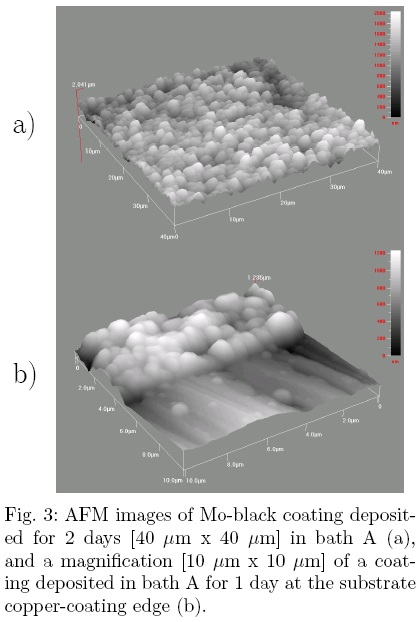
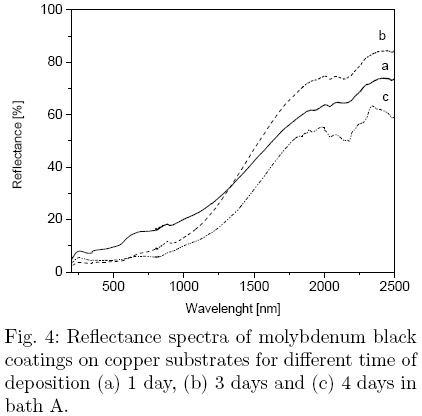
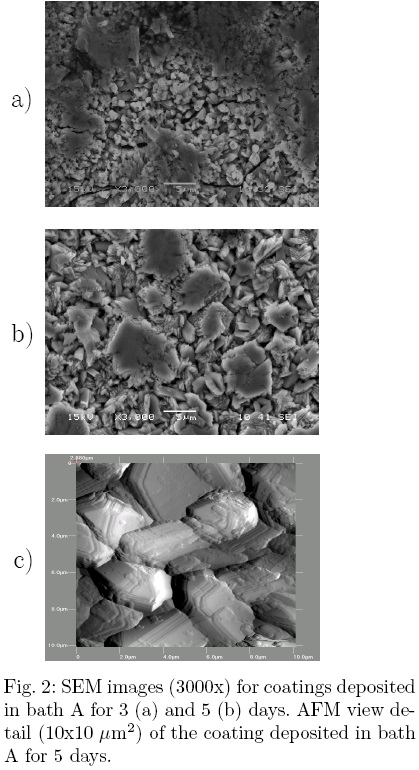
<body><![CDATA[<p align="justify"><font face="verdana" size="2">The surface morphology was studied by scanning electron microscopy (SEM) and atomic force microscopy (AFM). A typical surface morphology images are shown in <a href="#f2">Fig. 2</a>. The surface consists of a large number of flake&#45;like grains, ranging in size from 0.1 to 4 <i>&#956;</i>m. From <a href="#f2">figs. 2 (a)</a> and <a href="#f2">(b)</a> it is observed that as the deposition time increases, the grain size increases too. These features: shape and size can be explained by the mechanism of grain growth. In <a href="#f2">Fig. 2 (c)</a> is shown an AFM image of 10 x 10 <i>&#956;</i>m<sup>2</sup> area of the coating. The grains exhibit a layer&#45;by&#45;layer grain growth; in that way it is possible to increase the size preserving the shape at anytime through the deposition process.</font></p>             <p align="center"><font face="verdana" size="2"><a name="f2"></a></font></p>             <p align="center"><font face="verdana" size="2"><img src="/img/revistas/rmiq/v9n1/a9f2.jpg"></font></p>             <p align="justify"><font face="verdana" size="2">In <a href="#f3">Fig. 3</a>, AFM images deposited in bath A for 1 day are depicted. The RMS roughness of the <a href="#f3">Fig. 3(a)</a> has a value of 286 nm. As the surface roughness is of the order of solar radiation wavelengths, it does not affect the emittance value significantly. The rate of coating deposition was estimated from <a href="#f3">Fig. 3(b)</a>, resulting in 1 <i>&#956;</i>m per day.</font></p>             <p align="center"><font face="verdana" size="2"><a name="f3"></a></font></p>             <p align="center"><font face="verdana" size="2"><img src="/img/revistas/rmiq/v9n1/a9f3.jpg"></font></p>             <p align="justify"><font face="verdana" size="2"><i>3.3. Optical properties</i></font></p>  	    <p align="justify"><font face="verdana" size="2">The total reflectance spectra of the Mo&#45;black coatings on copper substrates are shown in <a href="#f4">Fig. 4</a> for 1, 3 and 4 days of deposition time in bath A. No peaks are observed in the region below 0.7 <i>&#956;</i>m, but a monotonous increase in the reflectance is present for all spectra. The coatings have lowest reflectance in the UV and visible region. As the deposition time increases, the reflectance has lower values in that region, due to the absorption improvement; however, in the near infrared (NIR) region, the reflectance reaches its maximum value for deposition during 3 days, and then decreases as the deposition time increases. This effect is related with the thickness of the coating. The thinner coatings appear to be transparent to IR radiation and the thermal radiation is reflected from the substrate itself. As the coating thickness increases, the coating becomes opaque to IR radiation and the emittance increases. The values of the absortance and the emittance for different deposition time are presented in <a href="/img/revistas/rmiq/v9n1/a9t1.jpg" target="_blank">Table 1</a>. The deposition time was found to be the critical parameter to achieve minimum emittance with the best selectivity factor, 4.05. The absorption increases gradually and reaches a maximum value of 0.87, while the emittance has a minimum value of 0.2 reached at different durations, depending on the bath composition. The values for the solar absortance and the thermal emittance in the coating with improved selectivity are comparable with those reported in the literature for similar coatings.</font></p>             <p align="center"><font face="verdana" size="2"><a name="f4"></a></font></p>             <p align="center"><font face="verdana" size="2"><img src="/img/revistas/rmiq/v9n1/a9f4.jpg"></font></p>             ]]></body>
<body><![CDATA[<p align="justify"><font face="verdana" size="2">However, the distinguishable feature of the method reported in the present work is its simplicity to grow the selective coatings. Finally, we can say that our coatings exhibit good adhesion to the substrate and preliminary results concerning thermal stability have shown no appreciable changes in optical properties for heat treated coatings up to 150 &deg; C. Manufacturing selective coatings through our process is non expensive and easy, compared with other techniques such as sputtering or electro&#45;deposition. Despite the consuming time to achieve an optimal coating, the chemical conversion does not require additional resources, thus complying with the processes demanded in the industry.</font></p>  	    <p align="justify"><font face="verdana" size="2">&nbsp;</font></p>  	    <p align="justify"><font face="verdana" size="2"><b>Conclusions</b></font></p>  	    <p align="justify"><font face="verdana" size="2">Deep black coatings consisting of a mixture of molybdenum compounds, MoO<sub>3</sub>, Cu<sub>3</sub>Mo<sub>2</sub>O<sub>9</sub> and (NH<sub>4</sub>)<sub>2</sub> Cu(MoO<sub>4</sub>)<sub>2</sub>, were obtained by using a chemical oxidation dipping technique from ammonium molybdate diluted solutions. Samples with 1, 2, 3, 4 dipping days were made having interesting solar optical properties and, for the simple way to synthesize the material it is a very attractive technique to made coatings in a large surface areas for several solar applications.</font></p>  	    <p align="justify"><font face="verdana" size="2">The rate of deposition of molybdenum oxide black films on copper substrate is higher in the bath A in relation to bath B and C. Bath A gives a deposition rate of around 1 micron in the molybdenum black coating per day. Currently experiments are being conducted in our laboratory in order to get a better understanding on the effect of molybdenum concentration, bath temperature and deposition times.</font></p>  	    <p align="justify"><font face="verdana" size="2">&nbsp;</font></p>  	    <p align="justify"><font face="verdana" size="2"><b>Acknowledgement</b></font></p>  	    <p align="justify"><font face="verdana" size="2">This work was partially carried out with the financial support of CONACYT, project 60781&#45;Y.</font></p>  	    <p align="justify"><font face="verdana" size="2">&nbsp;</font></p>  	    <p align="justify"><font face="verdana" size="2"><b>References</b></font></p>  	    ]]></body>
<body><![CDATA[<!-- ref --><p align="justify"><font face="verdana" size="2">Anicai L. Pertache A. and Visanb T. (2008) Thin black layers on aluminum substrate &#45; electrochemical synthesis and characterization. <i>Surface and Interface Analysis 40,</i> 818&#45;821.    &nbsp;&nbsp;&nbsp;&nbsp;&nbsp;&nbsp;&nbsp;&nbsp;[&#160;<a href="javascript:void(0);" onclick="javascript: window.open('/scielo.php?script=sci_nlinks&ref=8540944&pid=S1665-2738201000010000900001&lng=','','width=640,height=500,resizable=yes,scrollbars=1,menubar=yes,');">Links</a>&#160;]<!-- end-ref --></font></p>  	    <!-- ref --><p align="justify"><font face="verdana" size="2">Dali C.M. and Keil R.G. (1975). On the anodic oxidation of molybdenum. <i>Journal of The Electrochemical Society 122,</i> 350&#45;353.    &nbsp;&nbsp;&nbsp;&nbsp;&nbsp;&nbsp;&nbsp;&nbsp;[&#160;<a href="javascript:void(0);" onclick="javascript: window.open('/scielo.php?script=sci_nlinks&ref=8540946&pid=S1665-2738201000010000900002&lng=','','width=640,height=500,resizable=yes,scrollbars=1,menubar=yes,');">Links</a>&#160;]<!-- end-ref --></font></p>  	    <!-- ref --><p align="justify"><font face="verdana" size="2">Duffie J.A. and Beckman W. A. (1991). <i>Solar engineering of thermal processes.</i> John Wiley and Sons, New York.    &nbsp;&nbsp;&nbsp;&nbsp;&nbsp;&nbsp;&nbsp;&nbsp;[&#160;<a href="javascript:void(0);" onclick="javascript: window.open('/scielo.php?script=sci_nlinks&ref=8540948&pid=S1665-2738201000010000900003&lng=','','width=640,height=500,resizable=yes,scrollbars=1,menubar=yes,');">Links</a>&#160;]<!-- end-ref --></font></p>  	    <!-- ref --><p align="justify"><font face="verdana" size="2">Jahan F. I. and Smith B.E. (1997). Characterization of molybdenum black coatings on zinc substrates. <i>Journal of Materials Science 32,</i> 3869&#45;3874.    &nbsp;&nbsp;&nbsp;&nbsp;&nbsp;&nbsp;&nbsp;&nbsp;[&#160;<a href="javascript:void(0);" onclick="javascript: window.open('/scielo.php?script=sci_nlinks&ref=8540950&pid=S1665-2738201000010000900004&lng=','','width=640,height=500,resizable=yes,scrollbars=1,menubar=yes,');">Links</a>&#160;]<!-- end-ref --></font></p>  	    <!-- ref --><p align="justify"><font face="verdana" size="2">Jahan F. I. and Smith B.E. (1992). Investigation of solar selective and microstructural properties of molybdenum black immersion coatings on cobalt substrates. <i>Journal of Materials Science 27,</i> 625&#45;636.    &nbsp;&nbsp;&nbsp;&nbsp;&nbsp;&nbsp;&nbsp;&nbsp;[&#160;<a href="javascript:void(0);" onclick="javascript: window.open('/scielo.php?script=sci_nlinks&ref=8540952&pid=S1665-2738201000010000900005&lng=','','width=640,height=500,resizable=yes,scrollbars=1,menubar=yes,');">Links</a>&#160;]<!-- end-ref --></font></p>  	    ]]></body>
<body><![CDATA[<!-- ref --><p align="justify"><font face="verdana" size="2">Patil R.S., Uplane M.D. and Patil P.S. (2008). Electrosynthesis of electrochromic molybdenum oxide thin films with rod&#45;like features. <i>International Journal of Electrochemical Science 3,</i> 259&#45;265.    &nbsp;&nbsp;&nbsp;&nbsp;&nbsp;&nbsp;&nbsp;&nbsp;[&#160;<a href="javascript:void(0);" onclick="javascript: window.open('/scielo.php?script=sci_nlinks&ref=8540954&pid=S1665-2738201000010000900006&lng=','','width=640,height=500,resizable=yes,scrollbars=1,menubar=yes,');">Links</a>&#160;]<!-- end-ref --></font></p>  	    <!-- ref --><p align="justify"><font face="verdana" size="2">Potdar H.S., Mandale A. B., Sathaye S.D. and Sinha A.P.B. (1987). Characterization of solar selective molybdenum black films. <i>Journal of Materials Science 22,</i> 2023&#45;2031.    &nbsp;&nbsp;&nbsp;&nbsp;&nbsp;&nbsp;&nbsp;&nbsp;[&#160;<a href="javascript:void(0);" onclick="javascript: window.open('/scielo.php?script=sci_nlinks&ref=8540956&pid=S1665-2738201000010000900007&lng=','','width=640,height=500,resizable=yes,scrollbars=1,menubar=yes,');">Links</a>&#160;]<!-- end-ref --></font></p>      ]]></body><back>
<ref-list>
<ref id="B1">
<nlm-citation citation-type="journal">
<person-group person-group-type="author">
<name>
<surname><![CDATA[Anicai]]></surname>
<given-names><![CDATA[L.]]></given-names>
</name>
<name>
<surname><![CDATA[Pertache]]></surname>
<given-names><![CDATA[A.]]></given-names>
</name>
<name>
<surname><![CDATA[Visanb]]></surname>
<given-names><![CDATA[T.]]></given-names>
</name>
</person-group>
<article-title xml:lang="en"><![CDATA[Thin black layers on aluminum substrate - electrochemical synthesis and characterization]]></article-title>
<source><![CDATA[Surface and Interface Analysis]]></source>
<year>2008</year>
<volume>40</volume>
<page-range>818-821</page-range></nlm-citation>
</ref>
<ref id="B2">
<nlm-citation citation-type="journal">
<person-group person-group-type="author">
<name>
<surname><![CDATA[Dali]]></surname>
<given-names><![CDATA[C.M.]]></given-names>
</name>
<name>
<surname><![CDATA[Keil]]></surname>
<given-names><![CDATA[R.G.]]></given-names>
</name>
</person-group>
<article-title xml:lang="en"><![CDATA[On the anodic oxidation of molybdenum]]></article-title>
<source><![CDATA[Journal of The Electrochemical Society]]></source>
<year>1975</year>
<volume>122</volume>
<page-range>350-353</page-range></nlm-citation>
</ref>
<ref id="B3">
<nlm-citation citation-type="book">
<person-group person-group-type="author">
<name>
<surname><![CDATA[Duffie]]></surname>
<given-names><![CDATA[J.A.]]></given-names>
</name>
<name>
<surname><![CDATA[Beckman]]></surname>
<given-names><![CDATA[W. A.]]></given-names>
</name>
</person-group>
<source><![CDATA[Solar engineering of thermal processes]]></source>
<year>1991</year>
<publisher-loc><![CDATA[New York ]]></publisher-loc>
<publisher-name><![CDATA[John Wiley and Sons]]></publisher-name>
</nlm-citation>
</ref>
<ref id="B4">
<nlm-citation citation-type="journal">
<person-group person-group-type="author">
<name>
<surname><![CDATA[Jahan]]></surname>
<given-names><![CDATA[F. I.]]></given-names>
</name>
<name>
<surname><![CDATA[Smith]]></surname>
<given-names><![CDATA[B.E.]]></given-names>
</name>
</person-group>
<article-title xml:lang="en"><![CDATA[Characterization of molybdenum black coatings on zinc substrates]]></article-title>
<source><![CDATA[Journal of Materials Science]]></source>
<year>1997</year>
<volume>32</volume>
<page-range>3869-3874</page-range></nlm-citation>
</ref>
<ref id="B5">
<nlm-citation citation-type="journal">
<person-group person-group-type="author">
<name>
<surname><![CDATA[Jahan]]></surname>
<given-names><![CDATA[F. I.]]></given-names>
</name>
<name>
<surname><![CDATA[Smith]]></surname>
<given-names><![CDATA[B.E.]]></given-names>
</name>
</person-group>
<article-title xml:lang="en"><![CDATA[Investigation of solar selective and microstructural properties of molybdenum black immersion coatings on cobalt substrates]]></article-title>
<source><![CDATA[Journal of Materials Science]]></source>
<year>1992</year>
<volume>27</volume>
<page-range>625-636</page-range></nlm-citation>
</ref>
<ref id="B6">
<nlm-citation citation-type="journal">
<person-group person-group-type="author">
<name>
<surname><![CDATA[Patil]]></surname>
<given-names><![CDATA[R.S.]]></given-names>
</name>
<name>
<surname><![CDATA[Uplane]]></surname>
<given-names><![CDATA[M.D.]]></given-names>
</name>
<name>
<surname><![CDATA[Patil]]></surname>
<given-names><![CDATA[P.S.]]></given-names>
</name>
</person-group>
<article-title xml:lang="en"><![CDATA[Electrosynthesis of electrochromic molybdenum oxide thin films with rod-like features]]></article-title>
<source><![CDATA[International Journal of Electrochemical Science]]></source>
<year>2008</year>
<volume>3</volume>
<page-range>259-265</page-range></nlm-citation>
</ref>
<ref id="B7">
<nlm-citation citation-type="journal">
<person-group person-group-type="author">
<name>
<surname><![CDATA[Potdar]]></surname>
<given-names><![CDATA[H.S.]]></given-names>
</name>
<name>
<surname><![CDATA[Mandale]]></surname>
<given-names><![CDATA[A. B.]]></given-names>
</name>
<name>
<surname><![CDATA[Sathaye]]></surname>
<given-names><![CDATA[S.D.]]></given-names>
</name>
<name>
<surname><![CDATA[Sinha]]></surname>
<given-names><![CDATA[A.P.B.]]></given-names>
</name>
</person-group>
<article-title xml:lang="en"><![CDATA[Characterization of solar selective molybdenum black films]]></article-title>
<source><![CDATA[Journal of Materials Science]]></source>
<year>1987</year>
<volume>22</volume>
<page-range>2023-2031</page-range></nlm-citation>
</ref>
</ref-list>
</back>
</article>