We present some results from a research study in which five mathematics teachers worked on a functional graphic approach to solve inequalities. We developed activities using algebraic, graphic and natural language registers (Duval, 1995, 2000) in order to engage teachers in the solution treatment within different registers and in conversions between them so they might become aware of the errors they make when using algebraic methods in the light of comparisons with graphical methods. Analyses of teachers' protocols were undertaken to identify formal, intuitive and algorithmic aspects (Fischbein, 1993). Our findings showed that teachers did not search for mathematical reasons as why their algebraic and graphical strategies resulted in different solutions, suggesting that they had not fully appropriated the formal aspects of the algebraic solving methods they normally use to solve inequations.
Presentamos algunos resultados de una encuesta aplicada a cinco maestros de matemáticas que trabajaran con un método gráfico para resolver desigualdades. Las actividades se desarrollaron utilizando registros algebraicos, gráficos y en lenguaje natural (Duval, 1995, 2000), lo cual llevó a un proceso de tratamientos y conversiones, que dejó ver las faltas cometidas por los maestros al utilizar los métodos algebraicos y al comparar estos últimos con los gráficos de resolución. Analizamos los protocolos de los maestros en busca de aspectos formales, intuitivos y algorítmicos (Fischbein, 1993). Los análisis mostraron que los maestros no explican por qué los métodos algebraicos y gráficos que utilizaron presentan diferentes soluciones. Esto último es evidencia de que ellos no dominan los aspectos formales de los métodos algebraicos de resolución que a menudo utilizan en sus clases.
Apresentamos alguns resultados de uma pesquisa com cinco professores de Matemática que trabalharam com uma abordagem funcional gráfica para resolver inequações. Desenvolvemos e aplicamos atividades usando os registros algébrico, gráfico e da língua materna (Duval, 1995, 2000), provocando tratamentos e conversões, buscando trazer à tona as falhas cometidas por estes professores ao usarem métodos algébricos, por meio da comparação desses com métodos gráficos de resolução. Analisamos os protocolos dos professores em busca de aspectos formais, intuitivos e algorítmicos (Fischbein, 1993) e esta análise mostrou que esses professores não procuram justificativas matemáticas para explicar porque os métodos algébricos e gráficos usados apresentaram soluções diferentes, o que evidenciou que não dominam os aspectos formais dos métodos de resolução algébrica que, em geral, usam em salas de aula para resolver inequações.
Présentons quelques résultats d'une recherche avec cinq professeurs de mathématiques travailland sur une approche fonctionnelle graphique pour résoudre inéquations. Nous avons développé des activités en utilisant les registres algébrique, graphique et de la langue materne (Duval, 1995, 2000), pour provoquer traitements et conversions, en cherchant à mettre en évidence les fautes commises par ces enseignants quand ils utilisent des méthodes algébriques, en comparant ces méthodes avec les résolutions graphiques. Protocoles d'enseignants ont été analysés pour chercher aspects formel, intuitifs et algorithmique (Fischbein, 1993). Nos résultats montrent que ces enseignants ne utilisent pas des raisons mathématiques pour expliquer porquoi les méthodes algébriques et les méthodes graphiques fournis des solutions différentes, montrant qu'ils ne dominent pas les aspects formels de la résolution algébrique, qu'ils utilisent habituellement dans leurs classes.
Mots clés: Fonction, Graphiques, Inegalité, Fischbein, Aspects.
1. INTRODUCTION
Inspired by a question posed by Kieran (2004) on the difference between "solving an equation" and "solving an inequality":
]]>
"... What is the nature of instructional support that can generate in students the kinds of mental representations that will enable them to think about these critical differences when engaging in symbol manipulation activity involving inequalities?" (Kieran, 2004, p. 1-147).
and by a recommendation made by Radford (2004):
"... We also need a better concept of predication capable of integrating into itself the plurality of semiotic systems that students and teachers use, such as speech, gestures, graphs, bodily action, etc..." (Radford, 2004, p. 1-165).
We decided to investigate the possibility of our subjects to compare methods for solving inequations (in this paper, we give the name 'inequation' to 'an inequality with one real variable') by using the registers associated with three different semiotic systems of representation (Duval, 1995, 2000): algebraic, graphic and natural language, in an approach that we have called functional graphic approach.
Functional: we look at each side of an inequation as a function, that is we have two functions, which share the same variable (the unknown quantity), to work with. This is an algebraic approach that lends itself to graphical representation.
Graphic: we use the graphs associated to each one of these functions, hence we have two graphs to look at while solving an inequation. We conjecture that the use of graphs makes the difference between ƒ (x) = g (x) and ƒ (x) < g (x) more "visible": by analysing a graph, it is possible to determine the values of x with the required characteristics, and to perceive that a set of solutions for an inequation can be given in the form of an interval, many intervals or a single value (Tsamir & Bazzini, 2001). Additionally, when the functions are continuous, the values of x that satisfy f (x) = g (x) represent an algebraic way of determining the solutions of the inequations ƒ (x) < g (x) and ƒ (x) > g (x).
The study involved the design of a set of five activities (De Souza, 2008) which were undertaken by and discussed with five Brazilian mathematics teachers, during 12 weekly meetings each of which lasted for two and a half hours. We analysed teachers' written protocols, looking for formal, intuitive and algorithmic aspects of their methods and we also documented any interactions between these different aspects. Our aim in undertaking this analysis was to explore Fischbein's claim that, "in analysing the students' mathematical behaviour, one has to take into account three basic aspects: the formal, the algorithmic, and the intuitive" (Fischbein, 1993, p. 244). Our interpretation of this claim is that mathematics teachers need to promote and value all three aspects and interactions between them in every mathematical activity developed in their classrooms.
]]>
2. FOCUS
The focus of our research was to investigate the extent to which a functional graphic approach to the resolution of inequations, using three systems of semiotic representation - algebraic, graphic and natural language - may help subjects to interrelate formal, intuitive and algorithmic aspects of algebraic solutions.
3. THEORETICAL AND METHODOLOGICAL CONSIDERATIONS
Ideas from two cognitive theories were used to provide the theoretical support for our research. The first idea is that a subject must discriminate between and use at least two semiotic systems of representation (Duval, 1995, 2000), in order not to confuse the mathematical object with its representation when acting with or communicating about any mathematical content. In relation to this idea, we used three semiotic systems in the design of the activities that composed our functional graphic approach: algebraic, graphic and natural language. The algebraic system was used because, in Brazil, it is the most usual and cannot be ignored. The graphic system was chosen because evidence from previous studies has indicated that its visual characteristics can help students to understand the differences between equalities and inequalities and the meanings of the different signs used to express these relationships (Kieran, 2004; Radford, 2004). The natural language register was incorporated into the activities, following Radford's (2004) recommendations that it represents the natural way for individuals to express themselves when explaining their reasoning. This register was also intended to serve as the medium through which confrontations between the algebraic and graphic registers might be negotiated. We hoped that the negotiations of these confrontations would provide one way through which the participants in our study would become more aware of the many difficulties associated with the use of algebraic registers to solve inequations that have been presented in the literature (Tsamir, Almog, & Tirosh, 1998; Kieran, 2004; Sackur, 2004; Tsamir & Bazzini, 2002; De Souza & Campos, 2005).
According to Sackur (2004), the graphic approach to solve inequations may bring new difficulties for the subjects, because the transformation from graphic to algebraic registers and vice-versa is difficult, and also because graphs of different inequations can have the same solution set. In this way, she argues that one cannot take for granted that subjects learn the same mathematics when they deal with graphic and algebraic methods. In our view, when working with inequations, this "different mathematics" can be essential, because graphs can be used to show, for example, that is equivalent to (x-1) · (x-2) < 0, in terms of their solution sets, although their graphic representations are different. In addition, such a change of registers is important because the graph of a quadratic function is more usual for Brazilian students than the graph of a rational function. The difficulties that Sackur (2004) points to in her research emerged during the interactions in an environment in which students were dealing mainly with algebraic and graphic registers. We believe that the natural language register in a functional graphic approach, alongside the algebraic and graphic registers, may be of vital importance to help subjects surpass these difficulties as well as those related to a strictly algebraic resolution.
The second theoretical idea that influenced our research activities was drawn from Fischbein's perspective and his view that mathematical activities should involve learners in considering the formal, algorithmic and intuitive aspects of the objects under study (Fischbein, 1993). As mentioned above, this idea guided the analysis of the teachers' protocols.
For Fischbein (1993), formal aspects related with axioms, definitions and theorems are integral components of mathematical reasoning processes, which need to be invented or learned, organized, checked, and used actively by students.
However, formal aspects on their own do not provide the necessary background for individuals to master solution procedures. The algorithmic aspect is unavoidable:
]]>
We need skills and not only understanding, and skills can be acquired only by practical, systematic training. ... Mathematical reasoning cannot be reduced to a system of solving procedures. ... Solving procedures that are not supported by a formal, explicit justification are forgotten sooner or later. (Fischbein, 1993, p. 232.)
For instance, an individual may know the multiplicative principle of inequations (a formal aspect) but, because of its logical structure based on two sentences of the kind "if ... then", he/she may find it difficult to apply the algorithmic aspect to solve an inequation like .
The third aspect described by Fischbein (1993), the intuitive aspect, is related to intuitive cognition, understanding and solutions. For him, this aspect is also essential to the mathematical activity because intuitive interpretations are profoundly rooted in individual experience and can cause coercive action.
Intuitions may play a facilitating role in the instructional process, but, very often contradictions may appear: Intuition may become obstacles -epistemological obstacles1 (Bachelard) - in the learning, solving, or invention processes (Fischbein, 1993).
Intuitive beliefs may be stronger than any formal knowledge in the case of algebraic methods for solving inequations, as argued by Tsamir, Almog, and Tirosh (1998), Kieran (2004), Sackur (2004), Tsamir and Bazzini (2002) and De Souza and Campos (2005). In these research studies, students from Israel (16-17 year-olds), Japan (14 year-olds), France (16-17 year-olds), Italy (16-17 year-olds) and Brazil (20 year-olds) respectively misused methods for solving equations to solve inequations. Tsamir, Almog, and Tirosh (1998) also believe, like us, that using graphs to solve rational and quadratic inequations may be associated with more successful results.
Following Fischbein, our point of view is that an individual understands a mathematical idea if he or she is capable of interacting with its formal, intuitive and algorithmic aspects, and we have analysed whether teachers used these aspects when working with the proposed activities. Our conjecture is that the use of our functional graphic approach may have a role in motivating learners to attend to interactions between the formal, algorithmic and intuitive aspects (Fischbein, 1993) that are connected to the content in question: algebraic methods for solving inequations.
We also believe that making conversions between registers represents an effective way to involve individuals in the interrelation between formal, intuitive and algorithmic aspects of mathematical activity, and that using the natural language register to analyse and explain an algebraic solution and connect it with a graphic solution may help individuals to better understand the importance of interactions between the three different aspects, and to encourage teachers to work with all of them in their classrooms.
4. RESEARCH METHOD
]]>
We developed a research study using a qualitative approach and organized into four steps: analysis of Brazilian textbooks; design and administration of three activities concerning generic functions and their graphs; design and administration of the set of activities regarding the functional graphic approach; and data analysis. The analysis of textbooks was undertaken to identify the approaches that are used to solve inequations, and to pinpoint which aspects, algorithmic, formal or intuitive, these approaches emphasize. The three activities regarding functions involved reference and associate functions, using graphic, algebraic and natural language registers. The set of activities for the functional graphic approach was composed of five activities. Activity 1 used the dynamism of Cabri-Géomètre II Plus to discuss the description of points in the plane located above and below y = a in both the natural language and the algebraic systems, and similarly to discuss points located to the left or to the right of x = b, with a, b ∈ ℝ. In Activity 2, two straight lines were given, one with a positive slope, and the other with a negative one, and the teachers were asked to describe, in their natural language and algebraically, each value of x, the relationships between the points on the straight lines that are to the left and to the right of the intersection point. Activity 3 was aimed at describing the points belonging to ƒ (x) = , making connections between these points and < 1, and graphically solving this inequation and the equation = 1. Activity 4 was aimed at comparing algebraic and graphical methods for solving an inequation, in order to draw attention to the kinds of errors that can be made when non equivalent expressions are produced through algebraic methods, for instance, by multiplying both sides by an expression that might have a negative value. Activity 5 was aimed at solving a quadratic inequation of the kind x2 < a, which involved making explicit the fact that . The equations and functions in our activities were not selected from any particular textbook or study, but were included on the basis of the characteristics of inequations and their solutions that we wished to emphasize (the process of activity design is presented in detail in De Souza, 2008).
In this paper, we present the analysis of three questions from Activity 4, which we consider as illustrative of the study as a whole. Before presenting our findings, however, in the next section, we explore the ideas associated with comparing between algebraic and functional graphic approaches.
5. ALGEBRAIC APPROACH VERSUS FUNCTIONAL GRAPHIC APPROACH
In order to master algebraic methods for solving inequalities, in general, it is necessary to understand at least two formal algebraic principles - the additive and multiplicative principles of inequalities. The additive principle is the same for equations and inequations, but the multiplicative one is not. This is because in equations it is possible to multiply both sides by any expression, regardless of its sign. This is not true for inequalities. The multiplicative principle is a logical sentence with a relatively complex nature: it entails operating with two sentences of the kind "if ... then":
If c >0 and α < b, then αc < bc; if c <0 and α< b, then αc > bc.
Solving an algebraic inequation with a functional graphic approach involves considering each side of the inequation as a function, plotting the graphs of these functions, analysing the regions between the graphs and identifying the values of the independent variable which satisfy the mathematical statement. Plotting graphs is a task that can be outsourced to digital tools such as graphic calculators or graphic software. The key element in the functional graphic solution process is the analysis of graphs and of the values of the independent variable. It is necessary to understand that although each point has two coordinates, the solution set of an inequation is related to an interval (or intervals) on the x axis and not to a set of points that compose a particular section of either of the two graphs. On one hand, some difficulties may be expected while identifying points of the graph with the corresponding interval in the x-axis but, on the other hand, the use of graphs can make the difference between solving an equality (looking at the intersection of graphs) or an inequality (looking at the regions of the plane limited by those intersections) more obvious.
Furthermore, because the graph shows the solutions in a straightforward manner, while the algebraic approach demands a manipulation of algebraic sentences, comparing between algebraic and functional graphic approaches may help to highlight mistakes in algebraic solving methods, for example, failure to respect the multiplicative principle. In addition, such comparison can show that "x = 3 can be the solution of an inequality" (Tsamir & Bazzini, 2001) or that the solution can be an empty set.
Another very important contribution, in our view, of the functional graphic approach is that it is possible to solve different kinds of inequations, and not to work only with first and second degree inequations, or rational ones, as tends to be the case in the Brazilian textbooks we analyzed.
]]>
6. SAMPLE DATA
The three questions from Activity 4 that we analyzed in the remainder of this paper all involve comparisons between algebraic and graphical methods. Question 1 (Figure 1) involved the teachers in analysing a fictional student response to a rational inequation.
In this question, the student's response includes both the algebraic and natural language registers. The idea is that, by comparing the fictional student's solution with a graphical solution of their own, the teachers might become more aware of the algorithmic and formal aspects inherent in the algebraic methods.
Protocol analysis showed a tendency amongst the teachers to accept that graphic and algebraic methods could result in different solutions for the same inequation. One teacher wrote:
'Yes. For the inequation: every x >2 satisfies the quotient condition 1 over x -1. But if we had a function, part of the graph is not taken into account.' (our italics)
This teacher agreed that the student's solution was correct even though he knew from his graphical approach that this solution is incomplete. Apparently, he does not perceive that both algebraic and graphic solving methods must give the same solution set. Hence, his answer lacks logical aspects because the (italics) sentence has a "if ... then" form, while solving an inequation involves obtaining all possible solutions, which implies a logical sentence of the form "if and only if". We believe that this teacher is using intuitive aspects to deal with the question, because he relies on an algebraic method used for solving equations rather than inequations. It seems that he is not relating the intuitive aspects with the formal ones, nor with the algorithmic ones, which are not in consonance with formal ones.
Another teacher wrote:
]]>
"To solve an inequation, we must analyse all values of x satisfying the condition <1, with x different from 1. Multiplying it by (x-1) is an algebraic procedure used in equations, that leads us to an incomplete conclusion for the proposed situation, hence we must analyse 1<(x-1), either when x > 0 or when x < 0 and not treat it as an equation because, in this case, we have an inequality."
This teacher seems to master the logical aspects that underpin the mathematical sentence. Because of this, he realizes that both algebraic and graphical methods have to result in the same solution set, and that, to solve the inequation algebraically it is necessary to use the multiplicative principle of inequalities. When doing so, he appears to treat representation as object (Duval, 1995, 2000), stating the need to explore x > 0 and x < 0 instead of x-1 > 0 and x-1 < 0. He seems to master some formal aspects related to multiplicative principle of inequations, but lacks algorithmic and logical ones when applying this principle.
A third teacher answered:
"In the previous activity, after observing the graph, it is possible to conclude that x belongs to the set ]-∞,1[∪]2,+∞[; solving algebraically, we would only conclude that x > 2."
This teacher was able to find the correct set of solutions by graphical means and to see the difference between what he had observed when using the graphical register and what was presented in the student's algebraic response. He seemed to suggest that there is a problem with the algebraic solving method, but he does not explain or justify this. Although he seems to master the aspects related to the graphical solving method, he, apparently, does not relate them to algorithmic and formal aspects of the algebraic solving method.
It is important to emphasize that none of the teachers provided answers to the request that they should "Explain your reasoning".
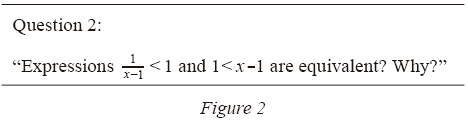
In the next question (Figure 2) the teachers were asked to check graphically the non equivalence of the inequations used by the student in Question 1, in order that they would notice that the student's solution was incorrect.
]]>
To answer this question, each teacher was provided with pictures of the graphs of functions defined by ƒ (x) = and g(x) = x-1 in distinct Cartesian systems. In this way, the functional graphic approach could be used, focusing on all the three registers as aimed in this research.
All five teachers accepted these inequations as non-equivalent: four teachers looked at the graphs, and one just looked at the algebraic expressions. Two of the teachers who consulted the graphs compared the solution sets in order to respond, and, at least in this case, they seemed to have passed from natural language, when reading the question, to the algebraic register of the two inequations; from algebraic to graphic register, when analysing the given graphs; from graphic to natural language, when concluding that the solution sets are not the same; and from natural language to algebraic register, when accepting that the inequations were not equivalent.
The other two teachers answered "no" because "graphs are different", showing the difficulty highlighted by Sackur (2004) that the equivalence or not of two inequations was not determined by the solution set, but by the shape of the graph. It seems that these two teachers did not interrelate any aspect; they only used intuitive ones, looking at the differences between graphs, instead of dealing with the concept of equivalent inequations.
The teacher who only compared the algebraic expressions, wrote:
"(x ≠1) No. Because in the first expression we need to find numbers that can be the denominators of fractions and that can satisfy this inequation condition, the quotient of 1 by numbers take away 1 must be less than 1. And, in the second expression, we need to find numbers take away 1 that are less than 1."
By the kind of argumentation presented by this teacher, we believe that he uses just intuitive aspects because he only tries to describe and compare the algebraic expressions, instead of trying values (intuitive numerical aspect); making attempts to solve (algorithmic aspect); or discussing solution sets (formal aspect).
It seems that the teachers accepted graphical methods as possible solution strategies, despite the fact that they did not connect these methods with formal aspects in general: none of the teachers gave a reasonable explanation for differences and similarities between both their solution sets, obtained algebraically and graphically.
The next question (Figure 3) was intended to provoke the teachers to reflect upon the multiplicative principle of inequalities and to justify why the student's solution was incomplete.
]]>
Our aim was that the teacher could use the functional graphic approach to create a conflict regarding the use of the multiplicative principle for inequations when the inequation is multiplied by a factor that depends on the variable.
Three teachers pointed to procedures for solving equations as the cause of error. One of them wrote
"The student used a procedure to solve equations. In the case of inequations, when one multiplies by any value, one may not have the whole truth."
It might appear that this teacher was connecting formal and algorithmic aspects, but he did not explain which "truth" he was referring to, the procedure or the solution. Bazzini and Tsamir (2003) also evidenced the inappropriate use of procedures for solving equations while solving an inequation that this teacher highlighted.
Another teacher said that
"The student just worked with the expression's denominator."
]]>
In this answer, the teacher did not explain what he meant, suggesting that he had not caught the "spirit" of the question. We cannot know for sure whether, in the teacher's interpretation, the student made a mistake or not, nor, if so, what the mistake was, particularly because it is possible to work with the expression's denominator and still solve correctly the inequation.
Another teacher writes
". When multiplying the inequation by (x -1), one must observe that x ≠1, because with x = 1 one have 0 < 0, impossible!"
This teacher seems to be using only intuitive aspects because he accepted that the multiplicative principle of inequalities was the same for equations, arguing that the mistake of the student was to multiply both sides of the inequation by (x-1) when there is a value for x in which the expression (x-1) is zero. Additionally, he judges that x = 1 is not solution after multiplying both sides by (x -1), which is incorrect, and ignores the fact that x = 1 makes the denominator equal to zero.
None of the teachers gave any formal explanation to, for example, when and how it is possible to multiply an inequality by a factor. This evidences that they do not relate formal, algorithmic and intuitive aspects when dealing with methods for solving inequations.
7. RESULTS
Although we were dealing with five Mathematics teachers, each one of them with at least seven years of teaching experience, we observed in our analyses of their protocols a lack of attention to formal aspects when solving inequations using either algebraic or graphical solving methods. For instance, some teachers were not able to explain the mistake in the student's algebraic solution, or to realize that different graphs can give the same solution set. This compromised the whole process of relating both kinds of methods and understanding what the incorrect steps in the algebraic solution were, which was our main intention.
We have also observed an emphasis on intuitive aspects, with some teachers accepting that it is possible to solve inequations by using the algebraic principles associated with equations, or using x > 0 instead of (x-1) > 0 when trying to justify the student's mistake in the algebraic solution of the inequation. Our results indicated that the teachers had a reasonable understanding of algorithmic aspects of the graphic solving method for the proposed inequations, although they still failed to connect graphic and algebraic solving methods, showing a lack of interrelation between formal, algorithmic and intuitive aspects in dealing with the graphic solving method.
]]>
Every time that the teachers made attempts to solve the inequation algebraically, they exhibited a lack of understanding of the algorithmic aspects associated with such methods, multiplying both sides by (x-1) before taking into account that this expression could have a negative value. This also shows that they do not understand the formal aspects related to the multiplicative principle of inequalities. In our opinion, this is because they have difficulties with mathematical phrases such as "if p then q", which are involved in the multiplicative principle, and are related to logical formal aspects of solving inequalities, and this can be explained by a lack of interrelation between algebraic, formal and intuitive aspects of mathematical content related to the algebraic methods for inequalities.
Furthermore, most of them did not give any justification to the posed questions, even if asked to do so. We believe that this shows their understanding of inequalities is solely based in algorithmic aspects, and not in interrelations between all three aspects: formal, algorithmic and intuitive.
8. CONCLUSIONS
In our research study, we intended to use three different registers of representation: algebraic, graphic and natural language to create an environment that would encourage teachers to compare algebraic and graphic methods for solving inequalities and to perceive the flaws in the algebraic methods they use.
Our findings show that the teachers have accepted the algorithmic aspects related to graphic methods for solving the proposed inequations, agreeing that the use of such methods is valid for solving them. On the other hand, the use of graphic methods did not result in robust understandings justifying why the graphic and algebraic methods gave different results. The teachers had flaws in their general formal and intuitive mathematical backgrounds and could not convert between graphic and algebraic methods. This, in turn, meant that they did not compare these methods in order to discuss their mistakes or doubts related to the algebraic register. Neither were the three aspects interrelated during the work within different registers in our study.
Our point of view is that there was something missing in our intervention which might have helped the teachers to make the interrelations that we were hoping for. Perhaps, it would have been useful if, before the functional graphic approach was applied, there had been some discussion about logical aspects of solving processes for inequalities. Analysing the equivalence between steps in these processes should feature as a central concern in such discussions. That is, whether the strategies involve treatments within one kind of register or conversions between registers, the importance of analysing whether the steps of the solution are equivalent or not should be emphasized. Moreover, teachers need to appreciate that when treatments or conversions result in non-equivalent expressions, it is necessary to verify that all valid solutions are contemplated, with no gains or losses along the solving process.
We do believe, however, that the use of three different systems of representation was useful as an "instructional support" (Kieran, 2004) to help some of the teachers understand that solving an inequation is not the same as solving an equation. This approach also enabled teachers to experience how, when using graphs to solve inequalities, the natural language register can be employed without the use of algebraic symbolism and to accept that this is a strategy that their students can also use, as suggested by Radford (2004).
The approach we adopted seemed not to be enough to encourage teachers to make connections between algebraic and graphic methods when solving inequalities, neither did it provoke them to reflect upon the difficulties in using and teaching algebraic methods to solve inequalities, as presented in the literature (Tsamir, Almog, & Tirosh, 1998; Kieran, 2004; Sackur, 2004; Tsamir & Bazzini, 2002; De Souza & Campos, 2005).
Given this picture, we believe that the greatest difficulty in the teaching of techniques for solving inequations does not lie in the use of various semiotic systems of representation, as claimed by Sackur (2004). This use only becomes possible because we learn to use them ... by using them!
]]>
We end by raising some questions: "What failed in our approach?"; "How should formal aspects of mathematics be introduced to students when dealing with inequalities?"; "Why is there such a strong emphasis on the use of algebraic methods alone?". The ideas of Borello and Lezama (2011) suggest a possible answer to these questions: before discussing techniques to solve inequations with students, we could use algebraic and graphic approaches to discuss the meaning of inequalities - and not just inequations in mathematics - and to consider formal and logical aspects of the phrase "If c > 0 and α < b, then αc < bc; if c < 0 and α< b, then αc > bc", whose understanding seemed essential to understand the techniques for solving inequations. Without doubt, answers to these questions, at least in the context of algebraic methods for solving inequalities, require much more research. We believe the functional graphic approach could be used alongside algebraic methods to discuss formal aspects of inequations with students, and to emphasize the interrelation of algorithmic, intuitive and formal aspects, rather than privileging only one of them.
BIBLIOGRAPHICAL REFERENCES
Bachelard, G. (1996). A formação do espírito científico (1a ed.). (E. Abreu, Trad.). Rio de Janeiro, Brasil: Contraponto. [ Links ] (Reimpreso de La Formation de l'esprit scientifique: contribution à une psychanalyse de la connaissance, 1938, Paris, França: Libraine Philosophique J. Vrin). [ Links ]
Bazzini, L. & Tsamir, P. (2003). Connections between theory and research findings: the case of inequalities. In M. A. Mariotti (Ed.), Proceedings of the 3rd Conference of the European Society for Research in Mathematics Education (Vol. 10, pp. 1-3). Bellaria, Italia: ERME. [ Links ]
Borello, M. y Lezama, J. (2011). Hacia una resignificacion de las desigualdades e inequaciones a partir de las prácticas del profesor. En P. Lestón (Ed.), Acta Latinoamericana de Matemática Educativa (Vol. 24, pp. 921-929). México, DF: RELME. [ Links ]
]]>
De Souza, V. H. (2008). O uso de vários registros na resolução de inequações - uma abordagem funcional gráfica (Tese de Doutorado inédita). Pontificia Universidade Católica de São Paulo, São Paulo, Brazil. [ Links ]
De Souza, V. H. & Campos, T. M. (2005). Sobre a resolução da inequacao x∧2 < 25. IX Encontro Brasileiro de Estudantes de Pós-Graduação em Educação Matemática (Vol. 1, p. 40). São Paulo, Brazil: FEUSP. [ Links ]
Duval, R. (2000). Basic issues for research in Mathematics Education. In M. J. Hoines, & A. B. Fuglestad (Eds.), Proceedings of the 24th Conference fo the International Group for the Psychology of Mathematics Education (Vol. 1, pp. 55-69). Hiroshima, Japan: PME. [ Links ]
Duval, R. (1995). Sémiosis etpensée humaine. Registres sémiotiques et apprentissages intellectuels. Neuchâtel, Suisse: Peter Lang. [ Links ]
Fischbein, E. (1993). The interaction between the formal, the algorithmic and the intuitive components in a mathematical activity. In R. Biehler, R. W. Scholz, R. Strässer, B. Winkelmann (Eds.), Didactics of Mathematics as a scientific discipline (pp. 231-240). Dordrecht, HO: Kluwer. [ Links ]
]]>
Kieran, C. (2004). The equation/inequality connection in constructing meaning for inequality situations. In M. J. Hoines & A. B. Fuglestad (Eds.), Proceedings of the 28th Conference of the International Group for the Psychology of Mathematics Education (Vol. 1, pp. 143-147). Bergen, Norway: PME. [ Links ]
Radford, L. (2004). Syntax and meaning. In M. J. Hoines, & A. B. Fuglestad (Eds.), Proceedings of the 28th Conference of the International Group for the Psychology of Mathematics Education (Vol. 1, pp. 161-166). Bergen, Norway: PME. [ Links ]
Sackur, C. (2004). Problems related to the use of graphs in solving inequalities. In M. J. Hoines, & A. B. Fuglestad (Ed.), Proceedings of the 28th Conference of the International Group for the Psychology of Mathematics Education (Vol. 1, pp. 148-152). Bergen, Norway: PME. [ Links ]
Tsamir, P. & Bazzini, L. (2001). Can x=3 be the solution of an inequality? A study of Italian and Israeli students. In M. van den Heuvel-Panhuizen (Ed.), Proceedings of the 25th Conference of the International Group for the Psychology of Mathematics Education (Vol. 4, pp. 303-310). Utrecht, Holland: PME. [ Links ]
Tsamir, P. & Bazzini, L. (2002). Student's algorithmic, formal and intuitive knowledge: the case of inequalities. In I. Vakalis, D. H. Hallett, D. Quinney, C. Kourouniotis, & C. Tzanakis (Eds.), Proceedings of the Second International Conference on the Teaching of Mathematics. Crete, Greece: ICTM. Recuperado de http://www.math.uoc.gr/~ictm2/Proceedings/pap511.pdf [ Links ]
Tsamir, P., Almog, N. & Tirosh, D. (1998). Students' solution of inequalities. In A. Olivier and K. Newstead (Eds.), Proceedings of the 22nd Conference of the International Group for the Psychology of Mathematics Education (Vol. 4, pp. 129-136). Stellenbosch, South Africa: PME. [ Links ]
Nota
1 According to Bachelard (1996), an epistemological obstacle is the cause of inertia in the act of knowing, and it is internal to such act.
 is equivalent to (x-1) · (x-2) < 0, in terms of their solution sets, although their graphic representations are different. In addition, such a change of registers is important because the graph of a quadratic function is more usual for Brazilian students than the graph of a rational function. The difficulties that Sackur (2004) points to in her research emerged during the interactions in an environment in which students were dealing mainly with algebraic and graphic registers. We believe that the natural language register in a functional graphic approach, alongside the algebraic and graphic registers, may be of vital importance to help subjects surpass these difficulties as well as those related to a strictly algebraic resolution.
 .
. , making connections between these points and
  . The equations and functions in our activities were not selected from any particular textbook or study, but were included on the basis of the characteristics of inequations and their solutions that we wished to emphasize (the process of activity design is presented in detail in De Souza, 2008).

 . When multiplying the inequation by (x -1), one must observe that x ≠1, because with x = 1 one have 0 < 0, impossible!"