<?xml version="1.0" encoding="ISO-8859-1"?><article xmlns:mml="http://www.w3.org/1998/Math/MathML" xmlns:xlink="http://www.w3.org/1999/xlink" xmlns:xsi="http://www.w3.org/2001/XMLSchema-instance">
<front>
<journal-meta>
<journal-id>1665-2045</journal-id>
<journal-title><![CDATA[Economía mexicana. Nueva época]]></journal-title>
<abbrev-journal-title><![CDATA[Econ. mex. Nueva época]]></abbrev-journal-title>
<issn>1665-2045</issn>
<publisher>
<publisher-name><![CDATA[Centro de Investigación y Docencia Económicas A.C.]]></publisher-name>
</publisher>
</journal-meta>
<article-meta>
<article-id>S1665-20452013000200006</article-id>
<title-group>
<article-title xml:lang="en"><![CDATA[Trust, Information Acquisition and Financial Decisions: A Field Experiment]]></article-title>
<article-title xml:lang="es"><![CDATA[Confianza, adquisición de información y decisiones financieras: Un experimento de campo]]></article-title>
</title-group>
<contrib-group>
<contrib contrib-type="author">
<name>
<surname><![CDATA[Di Giannatale]]></surname>
<given-names><![CDATA[Sonia]]></given-names>
</name>
<xref ref-type="aff" rid="A01"/>
</contrib>
<contrib contrib-type="author">
<name>
<surname><![CDATA[Elbittar]]></surname>
<given-names><![CDATA[Alexander]]></given-names>
</name>
<xref ref-type="aff" rid="A02"/>
</contrib>
<contrib contrib-type="author">
<name>
<surname><![CDATA[López Rodríguez]]></surname>
<given-names><![CDATA[Patricia]]></given-names>
</name>
<xref ref-type="aff" rid="A03"/>
</contrib>
<contrib contrib-type="author">
<name>
<surname><![CDATA[Roa]]></surname>
<given-names><![CDATA[María José]]></given-names>
</name>
<xref ref-type="aff" rid="A04"/>
</contrib>
</contrib-group>
<aff id="A01">
<institution><![CDATA[,Centro de Investigación de Docencia Económica Department of Economics ]]></institution>
<addr-line><![CDATA[ ]]></addr-line>
</aff>
<aff id="A02">
<institution><![CDATA[,Centro de Investigación de Docencia Económica Department of Economics ]]></institution>
<addr-line><![CDATA[ ]]></addr-line>
</aff>
<aff id="A03">
<institution><![CDATA[,Universidad Iberoamericana Department of Economics ]]></institution>
<addr-line><![CDATA[ ]]></addr-line>
</aff>
<aff id="A04">
<institution><![CDATA[,Center for Latin American Monetary Studies Economic Research Department ]]></institution>
<addr-line><![CDATA[Mexico ]]></addr-line>
</aff>
<pub-date pub-type="pub">
<day>00</day>
<month>00</month>
<year>2013</year>
</pub-date>
<pub-date pub-type="epub">
<day>00</day>
<month>00</month>
<year>2013</year>
</pub-date>
<volume>22</volume>
<numero>2</numero>
<fpage>375</fpage>
<lpage>401</lpage>
<copyright-statement/>
<copyright-year/>
<self-uri xlink:href="http://www.scielo.org.mx/scielo.php?script=sci_arttext&amp;pid=S1665-20452013000200006&amp;lng=en&amp;nrm=iso"></self-uri><self-uri xlink:href="http://www.scielo.org.mx/scielo.php?script=sci_abstract&amp;pid=S1665-20452013000200006&amp;lng=en&amp;nrm=iso"></self-uri><self-uri xlink:href="http://www.scielo.org.mx/scielo.php?script=sci_pdf&amp;pid=S1665-20452013000200006&amp;lng=en&amp;nrm=iso"></self-uri><abstract abstract-type="short" xml:lang="en"><p><![CDATA[We study the relationship between information acquisition and trust in financial decision making. A field experiment with a variation of the trust game was conducted with the partners of a financial cooperative located in a Mexican rural area. Individuals who frequently visit friends are more trustful, those who visit their families regularly reciprocate less, and active cooperative partners reciprocate more. Individuals show interest in acquiring information on the financial status and participation in social networks of other people with whom they may establish financial transactions. However, information does not appear to affect transfers; trust seems to overshadow information acquisition in financial decision making.]]></p></abstract>
<abstract abstract-type="short" xml:lang="es"><p><![CDATA[Estudiamos la relación entre la adquisición de información y la confianza en la toma de decisiones financieras. Se implementa un experimento de campo con los socios de una cooperativa financiera en México. Los individuos que visitan frecuentemente a sus amistades son más confiados, aquellos que visitan regularmente a sus familiares son menos recíprocos, y los socios más activos son más recíprocos. Los individuos mostraron interés en adquirir información sobre la situación financiera y participación en redes sociales de otros individuos con los cuales llevan a cabo transacciones financieras. No obstante, la información no parece afectar las transferencias; la confianza podría reducir el papel de la información.]]></p></abstract>
<kwd-group>
<kwd lng="en"><![CDATA[social networks]]></kwd>
<kwd lng="en"><![CDATA[information]]></kwd>
<kwd lng="en"><![CDATA[social preferences]]></kwd>
<kwd lng="en"><![CDATA[field experiments]]></kwd>
<kwd lng="en"><![CDATA[trust]]></kwd>
<kwd lng="en"><![CDATA[reciprocity]]></kwd>
<kwd lng="en"><![CDATA[financial development]]></kwd>
<kwd lng="es"><![CDATA[redes sociales]]></kwd>
<kwd lng="es"><![CDATA[información]]></kwd>
<kwd lng="es"><![CDATA[preferencias sociales]]></kwd>
<kwd lng="es"><![CDATA[experimentos de campo]]></kwd>
<kwd lng="es"><![CDATA[confianza]]></kwd>
<kwd lng="es"><![CDATA[reciprocidad]]></kwd>
<kwd lng="es"><![CDATA[desarrollo financiero]]></kwd>
</kwd-group>
</article-meta>
</front><body><![CDATA[  	    <p align="justify"><font face="verdana" size="4">Art&iacute;culos</font></p>  	    <p align="center"><font face="verdana" size="2">&nbsp;</font></p>  	    <p align="center"><font face="verdana" size="4"><b>Trust, Information Acquisition and Financial Decisions: A Field Experiment</b></font></p>  	    <p align="center"><font face="verdana" size="2">&nbsp;</font></p>  	    <p align="center"><font face="verdana" size="3"><b>Confianza, adquisici&oacute;n de informaci&oacute;n y decisiones financieras: Un experimento de campo</b></font></p>  	    <p align="center"><font face="verdana" size="2">&nbsp;</font></p>  	    <p align="center"><font face="verdana" size="2"><b>Sonia Di Giannatale<sup>1</sup>, Alexander Elbittar<sup>2</sup>, Patricia L&oacute;pez Rodr&iacute;guez<sup>3</sup> and Mar&iacute;a Jos&eacute; Roa<sup>4</sup><a href="#nota">*</a></b></font></p>  	    <p align="justify"><font face="verdana" size="2">&nbsp;</font></p>  	    <p align="justify"><font face="verdana" size="2"><i><sup>1</sup>Associate professor of Economics, Department of Economics, CIDE;</i> <a href="mailto:sonia.digiannatale@cide.edu">sonia.digiannatale@cide.edu</a></font></p>  	    ]]></body>
<body><![CDATA[<p align="justify"><font face="verdana" size="2"><sup><i>2</i></sup><i>Aassociate professor of Economics, Department of Economics, CIDE.</i> <a href="mailto:elbittar@gmail.com">elbittar@gmail.com</a></font></p>      <p align="justify"><font face="verdana" size="2"><sup><i>3</i></sup><i>Professor, Department of Economics, Universidad Iberoamericana.</i> <a href="mailto:patyloro@hotmail.com">patyloro@hotmail.com</a></font></p>      <p align="justify"><font face="verdana" size="2"><sup><i>4</i></sup><i>Researcher, Economic Research Department, CEMLA (Center for Latin American Monetary Studies). Mexico City.</i> <a href="mailto:roa@cemla.org">roa@cemla.org</a></font></p>      <p align="justify"><font face="verdana" size="2">&nbsp;</font></p>  	    <p align="justify"><font face="verdana" size="2">Fecha de recepci&oacute;n: 17 de enero de 2011;    <br> 	Fecha de aceptaci&oacute;n: 16 de agosto de 2011.</font></p>  	    <p align="justify"><font face="verdana" size="2">&nbsp;</font></p>  	    <p align="justify"><font face="verdana" size="2"><b>Abstract</b></font></p>  	    <p align="justify"><font face="verdana" size="2">We study the relationship between information acquisition and trust in financial decision making. A field experiment with a variation of the trust game was conducted with the partners of a financial cooperative located in a Mexican rural area. Individuals who frequently visit friends are more trustful, those who visit their families regularly reciprocate less, and active cooperative partners reciprocate more. Individuals show interest in acquiring information on the financial status and participation in social networks of other people with whom they may establish financial transactions. However, information does not appear to affect transfers; trust seems to overshadow information acquisition in financial decision making.</font></p>  	    <p align="justify"><font face="verdana" size="2"><b>Keywords</b>: social networks, information, social preferences, field experiments, trust, reciprocity, financial development.</font></p>  	    ]]></body>
<body><![CDATA[<p align="justify"><font face="verdana" size="2">&nbsp;</font></p>  	    <p align="justify"><font face="verdana" size="2"><b>Resumen</b></font></p>  	    <p align="justify"><font face="verdana" size="2">Estudiamos la relaci&oacute;n entre la adquisici&oacute;n de informaci&oacute;n y la confianza en la toma de decisiones financieras. Se implementa un experimento de campo con los socios de una cooperativa financiera en M&eacute;xico. Los individuos que visitan frecuentemente a sus amistades son m&aacute;s confiados, aquellos que visitan regularmente a sus familiares son menos rec&iacute;procos, y los socios m&aacute;s activos son m&aacute;s rec&iacute;procos. Los individuos mostraron inter&eacute;s en adquirir informaci&oacute;n sobre la situaci&oacute;n financiera y participaci&oacute;n en redes sociales de otros individuos con los cuales llevan a cabo transacciones financieras. No obstante, la informaci&oacute;n no parece afectar las transferencias; la confianza podr&iacute;a reducir el papel de la informaci&oacute;n.</font></p>  	    <p align="justify"><font face="verdana" size="2"><b>Palabras clave</b>: redes sociales, informaci&oacute;n, preferencias sociales, experimentos de campo, confianza, reciprocidad, desarrollo financiero.</font></p>  	    <p align="justify"><font face="verdana" size="2"><i>JEL classification:</i> O12, O16, C93, Z13.</font></p>  	    <p align="justify"><font face="verdana" size="2">&nbsp;</font></p>  	    <p align="justify"><font face="verdana" size="2"><b>Introduction</b></font></p>  	    <p align="justify"><font face="verdana" size="2">In this paper we analyze individuals' willingness to pay to acquire information about another individual before making a financial decision. To achieve this goal we conducted a field experiment using the trust game (Berg, Dickhaut and McCabe, 1995) with the members of a financial cooperative located in rural Mexico.</font></p>  	    <p align="justify"><font face="verdana" size="2">The motivation for this analysis comes from the role of information acquisition costs in determining the structure of financial markets, along with transaction costs and contract enforcement costs (Levine, 2005). In particular, information acquisition costs are relevant in credit markets because asymmetric information between the borrower and the lender can lead to adverse selection problems, in which the lender is unable to distinguish between types of borrowers, and moral hazard problems, in which there is a probability that the borrower does not pay the money back to the lender. These types of informational problems arise in credit markets of both developed and developing economies, being the latter more adversely affected by those problems. The role of financial markets in the process of economic development has been largely discussed by some authors; see, for example, Ray (1998). In general, the financial systems of developing countries are characterized by high levels of the three types of costs mentioned above. Moreover, there is empirical evidence that their financial institutions are less efficient than those of the developed countries in fulfilling the objectives of the financial system, such as risk diversification, information production, and allocation and supervision of investment resources (Demirguc&#45;Kunt and Levine, 2001).</font></p>  	    <p align="justify"><font face="verdana" size="2">On the other hand, there is ample evidence in the literature that social networks and trust play a role in reducing problems of asymmetric information, more so in developing countries, by complementing or substituting formal financial markets and institutions (Townsend, 1994; Foster and Rosenzweig, 1995; Easterly and Levine, 1997; Zak and Knack, 2001; Guiso <i>et al.,</i> 2001; Adato <i>et al.,</i> 2006; Chantarat and Barret, 2007). The central idea is that social networks develop direct monitoring mechanisms that produce information about the financial behavior of the individuals that belong to such networks. Also, social networks tend to use social sanctions to improve the enforcement of contracts. Hence, social networks might play a role in reducing the informational costs inherent to the financial sector. Furthermore, this literature sustains that the operation of financial institutions is always &#151;regardless of the degree of development&#151; based on trust. Trust and social networks can improve the efficiency of a society by facilitating the coordination of actions (Putnam, 1993). Furthermore, according to Guiso <i>et al.</i> (2001) and Ferrary (2003), the existence of social networks and trust translates into greater degrees of development and institutionalization of the financial sector.</font></p>  	    ]]></body>
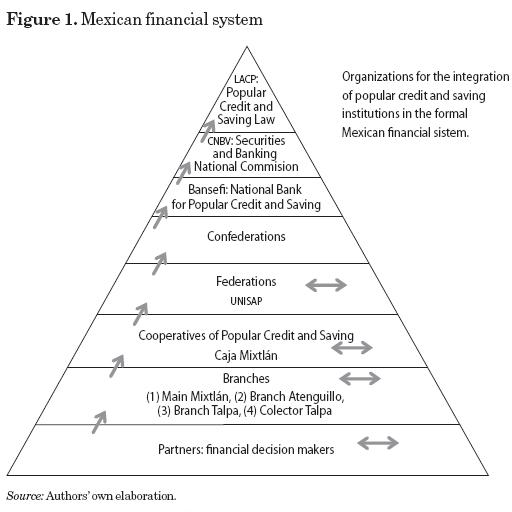
<body><![CDATA[<p align="justify"><font face="verdana" size="2">However, some articles (Uzzi, 1996; La Porta <i>et al.,</i> 1997a, b; Guiso <i>et al.</i>, 2001), based on Fukuyama (1995), state that in societies where family networks prevail, the emergence of large companies and impersonal organizations, frequently observed in developed societies, might show delays. They maintain that family businesses reduce transparency in view of external investors or partners, and that the prevalence of this type of networks is one of the reasons behind the existence of a strong, inefficient informal financial sector in developing countries.</font></p>  	    <p align="justify"><font face="verdana" size="2">In addition, Lussardi and Mitchell (2009) state that the individuals' educational level and the availability of financial information are partially relevant to assure a suitable handling of personal finances. However, these two elements have not been sufficient to explain the high rates of indebtedness and its possible consequences of non&#45;payment, as well as the low levels of financial forecast for retirement. Intertemporal, social, and risk preferences, participation in networks, and cognitive abilities seem to be more relevant (De Meza <i>et al.</i>, 2008; Meier and Sprenger, 2010; Barr <i>et al.</i>, 2009).</font></p>  	    <p align="justify"><font face="verdana" size="2">In this paper we analyze the interaction and relationship between financial decisions, information acquisition and trust. In particular, we work with the hypothesis that financial transactions depend not only on economic variables, but also on variables such as the level of trust, reciprocity and association among individuals. Also, individuals' willingness to acquire and process information relevant to perform financial transactions is related not only to their cognitive abilities, but also to the level of trust they have in the individuals with whom they perform those transactions.</font></p>  	    <p align="justify"><font face="verdana" size="2">The experimental protocol known in the literature as the trust or investment game (Berg, Dickhaut and McCabe, 1995) has been used to measure the degree of trust and reciprocity between the players. This game has been implemented in laboratories as well as in the field. Karlan (2005) conducted a field experiment in Peru in which individuals played the trust or investment game, and found that the strategies of one type of players correlate with some measures of social capital identified as trust. A similar methodology was used by Johansson&#45;Stenman <i>et al.</i> (2009).</font></p>  	    <p align="justify"><font face="verdana" size="2">In order to simultaneously study the role of trust and information acquisition behavior when individuals perform financial transactions, we conducted a field experiment using the trust or investment game with two important variations, as well as a survey with the objective of gathering prior information about the potential participants in the field experiment. Our unit of analysis is Caja Mixtl&aacute;n, a credit and savings cooperative located in the mountains of the state of Jalisco, Mexico. This cooperative has been functioning for over 50 years and serves a rural population in situation of poverty. We expect the information acquisition behavior to be the highlight of our analysis on financial decision making of this population, which is a fairly closed community with supposedly strong ties among family members and cooperative partners. That is, given the characteristics of this community, our hypothesis is that trust is an important component in the process of the individuals' financial decision making, while information acquisition, being an activity that for our experimental subjects is costly and in which they are very likely to be inexperienced, is performed more tentatively and with little sophistication. It is possible that, for those individuals, trust overshadows the role of information acquisition in financial decision making.</font></p>  	    <p align="justify"><font face="verdana" size="2">The paper is organized as follows: in section I, we present a brief description of our unit of analysis; in section II, we describe our methodology; in section III, we present some of our results; and, in section IV, we offer some concluding remarks.</font></p>  	    <p align="justify"><font face="verdana" size="2">&nbsp;</font></p>  	    <p align="justify"><font face="verdana" size="2"><b>I. Description of the unit of analysis: Caja Mixtl&aacute;n</b></font></p>  	    <p align="justify"><font face="verdana" size="2">We undertook our study based on Caja Mixtl&aacute;n, a credit and savings cooperative belonging to the UNISAP Federation located in the Mexican state of Jalisco. We decided to work within the Mexican financial hierarchy, depicted in <a href="#f1">figure 1</a>, in order to analyze the financial decisions of individuals in a framework that includes the possibility of horizontal and vertical social networks. We chose the UNISAP Federation because it is one of the federations with greatest financial development and heterogeneity. We specifically selected Caja Mixtl&aacute;n because it is one of the cooperatives with greatest diversity in terms of the population it serves, and because it has been operating for more than 50 years. Caja Mixtl&aacute;n is located in a rural area and offers financial services to a population in a situation of poverty.</font></p>  	    <p align="center"><font face="verdana" size="2"><a name="f1"></a></font></p>  	    ]]></body>
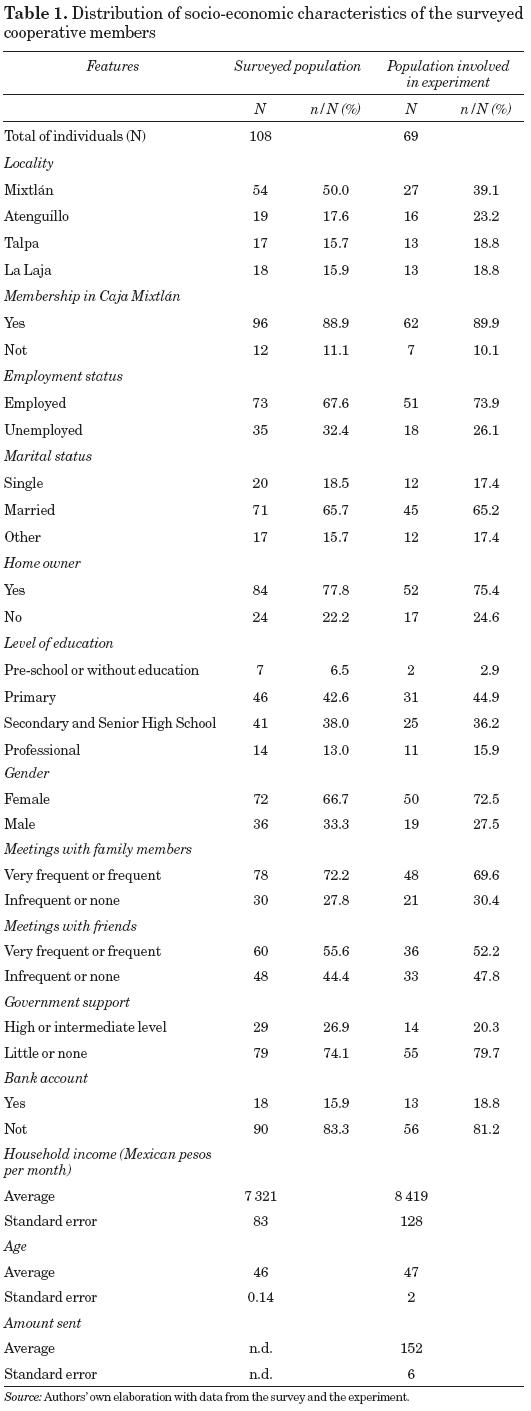
<body><![CDATA[<p align="center"><font face="verdana" size="2"><img src="/img/revistas/emne/v22n2/a6f1.jpg"></font></p>  	    <p align="justify"><font face="verdana" size="2">We use the cluster sampling methodology and select the sampling units taking into account their levels of access to the financial services of Caja Mixtl&aacute;n. We consider four clusters: Caja Mixtl&aacute;n's main office (Mixtl&aacute;n), two branches (Talpa and Atenguillo) and a mobile branch (La Laja). We have to highlight that these four communities are heterogeneous. Talpa is the most developed community because it has the highest level of commercial activity generated by the Sanctuary of the Virgin of Talpa, and a factory of guava products. La Laja is a very remote community located in the mountains, and does not have any commercial activity.</font></p>  	    <p align="justify"><font face="verdana" size="2">The Talpa and Atenguillo branches are located approximately 21 and 23 kms. from the main office in Mixtl&aacute;n, and have some 35 and 197 partners respectively. La Laja mobile branch is a meeting point at a distant town, about 145 km. from Mixtl&aacute;n, where the partners (approximately 154) perform their financial transactions with Caja Mixtl&aacute;n through a representative of the institution, who travels to La Laja once a week.</font></p>  	    <p align="justify"><font face="verdana" size="2">The unit of selection and observation consists of the partners of each of the clusters. We take as our primary unit of analysis the partners who are heads of a household. We define the head of a household as the individual who makes the financial decisions within the household. If the head of the household was absent at the sampling moment, we consider the spouse or the second adult (18 years or older) in charge of the household. From a universe of around 1,066 active partners belonging to Caja Mixtl&aacute;n, we selected a sample of 418 partners. By cluster, the sample is of approximately 195 partners in Mixtl&aacute;n, 104 in Talpa, 108 in La Laja, and 11 in Atenguillo.</font></p>  	    <p align="justify"><font face="verdana" size="2">The clusters are located in rural communities in which most of the partners are engaged in activities related to agriculture, livestock, services and small retail businesses. This population is characterized by high levels of migration to the United States or to nearby cities (Guadalajara or Puerto Vallarta), so there are cases where partners are registered in Caja Mixtl&aacute;n but do not live in the locality. To ensure the presence of partners in the locality at the moment of sampling, the sample size was reduced to registered partners who live in the locality and that were present at the time of applying the methodology.</font></p>  	    <p align="justify"><font face="verdana" size="2">&nbsp;</font></p>  	    <p align="justify"><font face="verdana" size="2"><b>II. Methodology</b></font></p>  	    <p align="justify"><font face="verdana" size="2">Our field work started with a survey that was applied to 108 members of Caja Mixtl&aacute;n from October the 6<sup>th</sup> through October the 10<sup>th</sup>, 2008. The sampling dates were selected to ensure the presence of a higher number of migrants in the locality. Although they are not present in their communities throughout the year, we considered it important to capture information from migrant partners because the level of their financial transactions with Caja Mixtl&aacute;n is high due to the remittances they send when they are away. Moreover, the reception of remittances is an important source of financial transactions in Caja Mixtl&aacute;n.</font></p>  	    <p align="justify"><font face="verdana" size="2">The survey consists of 80 questions divided in two sections. In the first section we collect data on the personal, financial and socio&#45;economic characteristics of the individuals. This section also collects information about their levels of participation in social networks and of trust in other individuals, in Caja Mixtl&aacute;n and in some governmental institutions; these questions were based on those of the General Social Survey. In the second section we ask each respondent to specify the amounts of money that he would return to a potential sender (Type A individual), conditional on the several possible monetary amounts this individual could send in return. Respondents were notified that their responses could be taken into consideration at the moment of assigning payments to them in case of their being selected for the field experiment a posteriori. Both the survey and the experimental activity were carried on dates of local holidays in which the migrants tend to go back to their communities of origin.</font></p>  	    <p align="justify"><font face="verdana" size="2"><a href="#t1">Table 1</a> shows a distribution of the general characteristics of the population reported in the survey. From the survey results, we can infer that the degree of acquaintanceship and trust are important in financial decision&#45;making. Closed social networks (relatives and friends) prevail in these communities. On the other hand, we observe that there is limited use of a variety of financial services on the part of Caja Mixtl&aacute;n's partners. Most of the individuals reported that they save in Caja Mixtl&aacute;n, and only a very low percentage reported having accounts in other formal financial institutions. The percentage of partners that reported saving in informal financial institutions is also very low. Thus, partners are characterized by low levels of financial diversification and sophistication. The answers to the questions associated with membership and participation in activities of Caja Mixtl&aacute;n show that this institution has a fundamental role in the creation of social networks among the partners and with its authorities. When asked directly, most of the partners reported that they would not participate in another credit and savings cooperative for trust&#45;related reasons. In percentage terms, 18.12 per cent of the surveyed partners save in a bank, 1.18 per cent of them have investment funds, and 13.97 per cent of them participate in informal savings institutions. Finally, almost all partners indicated that they feel Caja Mixtl&aacute;n has benefited the community.</font></p>  	    ]]></body>
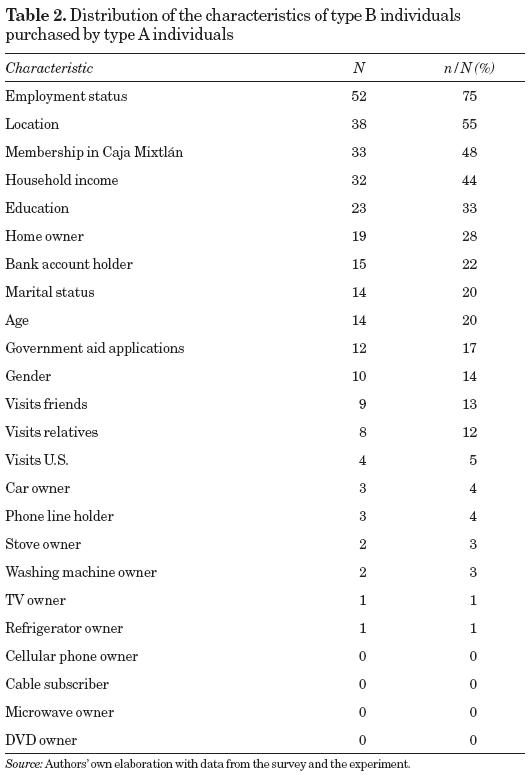
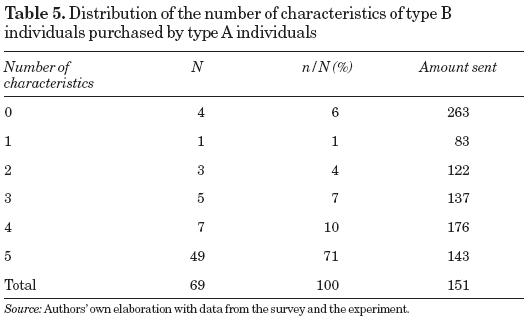
<body><![CDATA[<p align="center"><font face="verdana" size="2"><a name="t1"></a></font></p>  	    <p align="center"><font face="verdana" size="2"><img src="/img/revistas/emne/v22n2/a6t1.jpg"></font></p>  	    <p align="justify"><font face="verdana" size="2">Once the information collected in the survey had been processed, our second step was to undertake the field experiment from January the 12<sup>th</sup> to January the 16<sup>th</sup>, 2009. The experiment was applied to 69 members of the population initially surveyed.</font></p>  	    <p align="justify"><font face="verdana" size="2">The field experiment implemented for this study (the Script of this experiment is in <a href="/img/revistas/emne/v22n2/html/a6anexo.html" target="_blank">Appendix A</a>) consists of a variant of the protocol known in the literature as the trust game (Berg, Dickhaut and McCabe, 1995). In this game, a type A individual has the task of deciding how much money to send to a type B individual, who is anonymous, and how much of an initial capital to keep. The type B individual receives the amount sent by the type A individual multiplied by three. Then, the type B individual decides how much money he wants to return to the type A individual and how much money he wants to retain. The amount of money which may be received and retained by any of the two types of individuals is a decision that is exclusive to the subjects of the experiment. That is, they do not receive suggestions or pre&#45;established rules that might lead them to behave in a specific way.</font></p>  	    <p align="justify"><font face="verdana" size="2">The results of this experiment have been interpreted in the literature as a measure of the degree of trust and reciprocity that can exist between types A and B individuals. To observe these types of behavior among individuals, it is necessary that the type A individual transfers resources to the type B individual trusting to receive some future return, and that the type B individual acts reciprocally by transferring resources back to the type A individual (Camerer, 2003). Thus, the quantity sent by the type A individual is considered to be a measure of trust, and the amount returned by the type B individual is considered to be a measure of reciprocity.</font></p>  	    <p align="justify"><font face="verdana" size="2">With the objective of studying the effect of knowing certain information about the type B individual on the monetary quantities sent initially by the type A individual, we introduced two important variants to the original game. First, the type A individual has the opportunity to send money to three different type B individuals. Second, the type A individual has the opportunity to acquire information about some relevant features of each type B individual. The acquisition of information about these features has a cost. The type A individual receives an initial amount of money which he may or may not use for the purchase of information.</font></p>  	    <p align="justify"><font face="verdana" size="2">To implement this activity we designed an activity book in which each of the 69 participants was given the possibility of acting as a type A individual and deciding the different amounts he could send to three possible type B individuals. In addition, participants were shown a set of pieces of information about type B individuals, which the type A individuals could acquire (up to a maximum of five pieces) before making their decisions about monetary quantities to be sent to the type B individuals. Once the type A individuals decided the amounts to be sent to the three possible type B individuals, just one type B individual (out of the three type B individuals considered) was chosen at random and we looked at how he had answered the question on the initial survey as to the amount of money he would send back to the type A individual in case of receiving that specific monetary quantity.</font></p>  	    <p align="justify"><font face="verdana" size="2">The amount of money given to the type A individuals was 300 Mexican pesos. Those individuals could send multiples of 50, from 0 to 300 Mexican pesos. They also received a payment of 50 Mexican pesos that they could use, if they wished, to buy information about type B individuals.<sup><a href="#nota">1</a></sup> The cost of each piece of information was 10 Mexican pesos.</font></p>  	    <p align="justify"><font face="verdana" size="2"><a href="#t2">Table 2</a> shows the list of features about type B individuals that type A individuals could buy. We considered demographic, financial and social network participation characteristics. Including those variables enables us to analyze the hypothesis that social variables are relevant when individuals make financial decisions. To construct the list of pieces of information we took as a starting point a series of questions included in the survey in which partners of Caja Mixtl&aacute;n were asked about factors that were relevant for them when lending or borrowing money. Those factors which appeared most often, along with some control variables, were included in the list of pieces of information that the type A individuals could purchase.<sup><a href="#nota">2</a></sup></font></p>  	    <p align="center"><font face="verdana" size="2"><a name="t2"></a></font></p>  	    ]]></body>
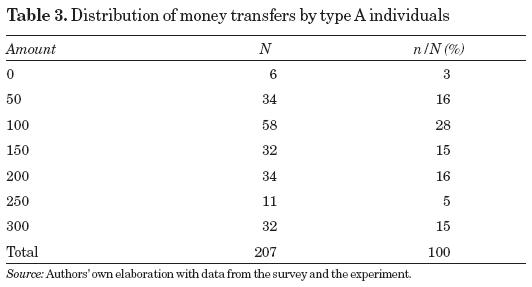
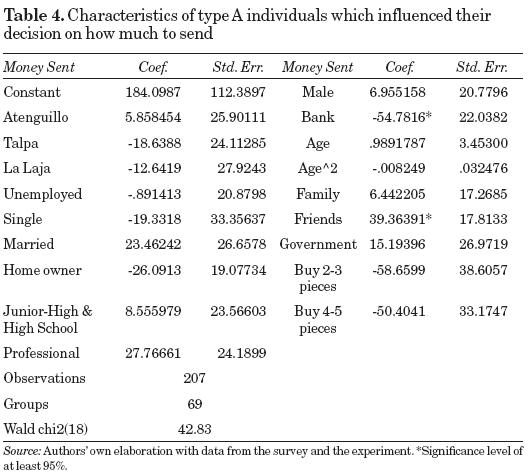
<body><![CDATA[<p align="center"><font face="verdana" size="2"><img src="/img/revistas/emne/v22n2/a6t2.jpg"></font></p>  	    <p align="justify">&nbsp;</p> 	    <p align="justify"><font face="verdana" size="2"><b>III. Results</b></font></p>      <p align="justify"><font face="verdana" size="2">In this section we present and discuss our principal results.</font></p>  	    <p align="justify"><font face="verdana" size="2"><i>Transfers Made by Type A Individuals</i></font></p>  	    <p align="justify"><font face="verdana" size="2"><a href="#t3">Table 3</a> reports the distribution of payments sent by type A individuals. Even though the mode of the payments was 100 Mexican pesos, the average and median were approximately 152 Mexican pesos, with a standard error of 6 Mexican pesos. This heterogeneity in the decisions as to the amount of the original payments contrasts with the results observed in laboratories with students as experimental subjects, in which cases payments are relatively constant at approximately half of the capital available (Camerer, 2003). To estimate the characteristics that are relevant for the type A individuals when deciding the amount of money to be sent to type B individuals, we use the ordinary&#45;least&#45;squares model with random effects.</font></p>  	    <p align="center"><font face="verdana" size="2"><a name="t3"></a></font></p>  	    <p align="center"><font face="verdana" size="2"><img src="/img/revistas/emne/v22n2/a6t3.jpg"></font></p>  	    <p align="justify"><font face="verdana" size="2">As can be observed in <a href="#t4">table 4</a>, among the personal features of type A individuals that seemed to affect the amounts they transferred was whether they had bank accounts and with what frequency they visited friends. Specifically, individuals who reported having a bank account tended to send 55 Mexican pesos more than those who reported not having a bank account. This result is consistent with the idea that those individuals more familiar with financial interaction are more trusting. Barr (2004) reports results of a field experiment conducted in Zimbabwe, in which individuals less familiar with the economic and social rules of the environment where they are settled tend to be less trusting. On the other hand, those individuals who reported visiting their friends regularly tended to send 39 Mexican pesos more than those who reported visiting their friends rarely or never.</font></p>  	    <p align="center"><font face="verdana" size="2"><a name="t4"></a></font></p>  	    ]]></body>
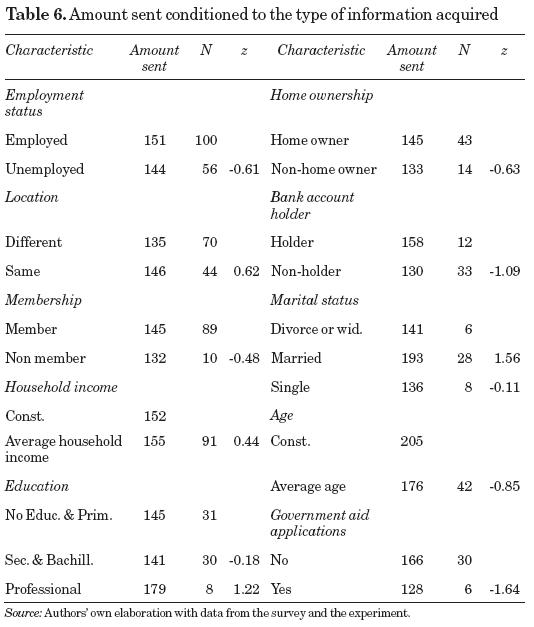
<body><![CDATA[<p align="center"><font face="verdana" size="2"><img src="/img/revistas/emne/v22n2/a6t4.jpg"></font></p>  	    <p align="justify"><font face="verdana" size="2">Even though home owners tended to send more, and those who bought from two to five pieces of information tended to send smaller amounts of money, the coefficients are not significant.</font></p>  	    <p align="justify"><font face="verdana" size="2"><i>III.2 Information Purchased by Type A Individuals</i></font></p>  	    <p align="justify"><font face="verdana" size="2"><a href="#t5">Table 5</a> reports the distribution of the number of characteristics of type B individuals purchased by type A individuals. As can be observed, more than 2/3 of the individuals in the sample decided to buy the five pieces of information and only 6 per cent of them decided not to find out anything about the type B individuals.</font></p>  	    <p align="center"><font face="verdana" size="2"><a name="t5"></a></font></p>  	    <p align="center"><font face="verdana" size="2"><img src="/img/revistas/emne/v22n2/a6t5.jpg"></font></p>  	    <p align="justify"><font face="verdana" size="2">In <a href="#t2">Table 2</a> we show the distribution of features of type B individuals that could be purchased by type A individuals. The first five features include: the employment status of the individual (75%), location (55%), membership in Caja Mixtl&aacute;n (48%), household income (45%) and educational level (33%). Thus, individuals were not only interested in financial variables. Participation in Caja Mixtl&aacute;n and the proximity to their community were also relevant variables. However, as seen in <a href="#t6">table 6</a>, t&#45;tests for differences between populations show that there is no significant relation between these variables and the amounts of money sent. As noted in the previous section, the number of pieces of information purchased does not prove to be significant in the decisions of type A individuals as to how much money they sent to type B individuals.</font></p>  	    <p align="center"><font face="verdana" size="2"><a name="t6"></a></font></p>  	    <p align="center"><font face="verdana" size="2"><img src="/img/revistas/emne/v22n2/a6t6.jpg"></font></p>  	    <p align="justify"><font face="verdana" size="2"><i>III.3 Conditional Amounts Type B Individuals Return, Given the Transfers of Type A Individuals</i></font></p>  	    ]]></body>
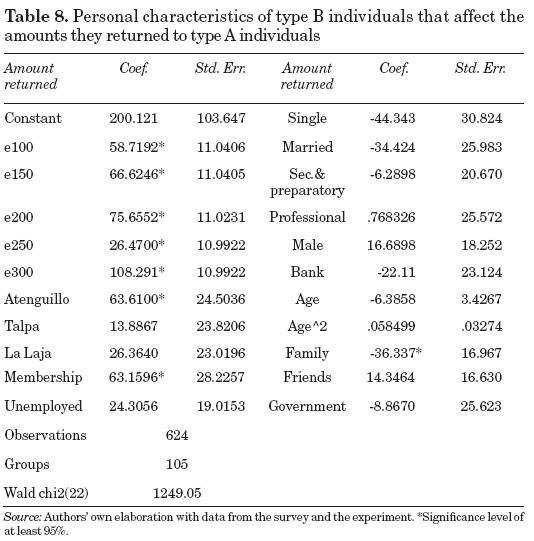
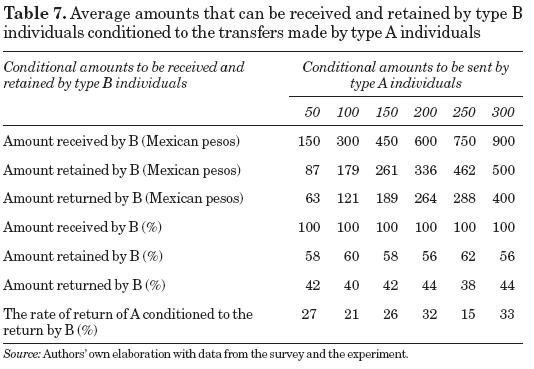
<body><![CDATA[<p align="justify"><font face="verdana" size="2"><a href="#t7">Table 7</a> reports the average monetary amounts type B individuals received from and returned to type A individuals; the amounts returned being conditional on the amounts received. As shown in this table, type B individuals tended to return monetary amounts that increased in accordance with the amounts they received from type A individuals. However, the average retention for each of the possible transfers from type A individuals is quite stable, at an average of 58 per cent of the amount received. The monetary amounts that type B individuals returned to type A individuals was greater than the amounts that type A individuals had originally sent. This result contrasts with experiments in developed countries where type B individuals tend to return less money than the transfer sent by type A individuals; that amount has been tripled. In our study the average rate of return for type A individuals is approximately 27 per cent of the amount originally sent.</font></p>  	    <p align="center"><font face="verdana" size="2"><a name="t7"></a></font></p>  	    <p align="center"><font face="verdana" size="2"><img src="/img/revistas/emne/v22n2/a6t7.jpg"></font></p>  	    <p align="justify"><font face="verdana" size="2"><a href="#t8">Table 8</a> shows the personal characteristics reported by type B individuals that affect the conditional amounts they returned to type A individuals. The specification includes dummy variables (e100, e150, e200, e250, e300) that were equal to one whenever they received an amount higher than 50 pesos. All these coefficients were significant and positive, indicating an increasing function on the contributions.</font></p>  	    <p align="center"><font face="verdana" size="2"><a name="t8"></a></font></p>  	    <p align="center"><font face="verdana" size="2"><img src="/img/revistas/emne/v22n2/a6t8.jpg"></font></p>  	    <p align="justify"><font face="verdana" size="2">The estimation also considers other variables that include living location, active membership in Caja Mixtl&aacute;n, bank account holding, level of education, civil status, age, frequency of visiting family and friends, and requiring assistance from government. Active partners of Caja Mixtl&aacute;n<sup><a href="#nota">3</a></sup> and individuals who live in Atenguillo returned higher amounts (63 Mexican pesos more). The individuals that reported visiting their relatives frequently returned 36 Mexican pesos less. Older people returned less up until a minimum, after which the amount of money returned increased.<sup><a href="#nota">4</a></sup></font></p>  	    <p align="justify">&nbsp;</p> 	    <p align="justify"><font face="verdana" size="2"><b>IV. Discussion and Future Research</b></font></p>      <p align="justify"><font face="verdana" size="2">Our experimental results highlight the interest that individuals show in acquiring specific information on the financial status and participation in social networks of other people with whom they may establish financial transactions. Just over 2/3 of the participants purchased the maximum number of five pieces of information. Only 6 per cent of the subjects decided not to buy any information. However, we have found no evidence that the information acquired had any impact on the amounts type A individuals sent to type B individuals. This result allows us to conclude that the acquisition of the pieces of information offered to the participants has little impact on their financial decision making process; a process that is based on pre&#45;existent levels of trust among the individuals who are immersed in vertical and horizontal social networks.</font></p>  	    ]]></body>
<body><![CDATA[<p align="justify"><font face="verdana" size="2">The broad support of the distribution of the transfers type A individuals send to type B individuals highlights the heterogeneity of individuals' preferences with respect to the agreements based on trust they wish to reach. At the same time, the degree of concentration around the range between 100 and 150 Mexican pesos provides us with a basis for further research. With respect to the behavior of type B individuals, we find a high degree of reciprocity compared with that found in studies of a similar nature conducted in developed countries. Preferences for reciprocity are fairly homogeneous. We also find that those individuals who meet with friends more often show greater trust. However, the individuals that frequently visit their relatives show a lower level of reciprocity. The active members of Caja Mixtl&aacute;n show a greater level of reciprocity, which reinforces the perception that the cooperative plays a role in the formation of social networks in this community.</font></p>  	    <p align="justify"><font face="verdana" size="2">We can thus conclude that in locations where closed social networks prevail, financial transactions depend not only on economic variables but also on other variables such as the individual's level of trust, reciprocity and association. Another point is that, in communities like those involved in this study, the level of sophistication of the use of information when making financial decisions and of the diversity of financial instruments they use and, concomitantly, the degree of financial development, tends to be low. In general, the level of trust seems to be high, although preferences over trust are quite heterogeneous. Moreover, for the case of our experimental subjects, trust seems to overshadow the role of information acquisition while making financial decisions, because they seem interested in acquiring information but they do not use the information they purchase in their financial decision making, relying on pre&#45;existent levels of trust they have in the individuals of their social group.</font></p>  	    <p align="justify"><font face="verdana" size="2">To have a better map of individuals' preferences on trust and reciprocity and of the impact of new information on their financial decisions and economic cooperation agreements, it is necessary to study other populations. For this reason, and given the differences in the level of development between rural and urban areas, we intend to apply this methodology in different regions within Mexico to capture the dynamic element in our idea about the relationship between financial development, trust and information acquisition.</font></p>  	    <p align="justify"><font face="verdana" size="2">&nbsp;</font></p>  	    <p align="justify"><font face="verdana" size="2"><b>References</b></font></p>  	    <!-- ref --><p align="justify"><font face="verdana" size="2">Adato, M., M. R. Carter and J. May (2006), "Exploring Poverty Traps and Social Exclusion in South Africa Using Qualitative and Quantitative Data", <i>Journal of Development Studies,</i> 42 (2), pp. 226&#45;247.    &nbsp;&nbsp;&nbsp;&nbsp;&nbsp;&nbsp;&nbsp;&nbsp;[&#160;<a href="javascript:void(0);" onclick="javascript: window.open('/scielo.php?script=sci_nlinks&ref=2844255&pid=S1665-2045201300020000600001&lng=','','width=640,height=500,resizable=yes,scrollbars=1,menubar=yes,');">Links</a>&#160;]<!-- end-ref --></font></p>  	    <!-- ref --><p align="justify"><font face="verdana" size="2">Barr, A. (2004), "Kinship, Familiarity and Trust: An Experimental Investigation", in J. Henrich, R. Boyd, S. Bowles, C. Camerer and H. Gintis (eds.), <i>Foundation of Human Sociality,</i> Oxford, Oxford University Press.    &nbsp;&nbsp;&nbsp;&nbsp;&nbsp;&nbsp;&nbsp;&nbsp;[&#160;<a href="javascript:void(0);" onclick="javascript: window.open('/scielo.php?script=sci_nlinks&ref=2844257&pid=S1665-2045201300020000600002&lng=','','width=640,height=500,resizable=yes,scrollbars=1,menubar=yes,');">Links</a>&#160;]<!-- end-ref --></font></p>  	    <!-- ref --><p align="justify"><font face="verdana" size="2">Barr, A., M. Dekker and M. Fafchamps (2009), "Who Shares Risk with Whom under Different Enforcement Mechanisms?", Centre for The Study of African Economies, Oxford University, mimeo.    &nbsp;&nbsp;&nbsp;&nbsp;&nbsp;&nbsp;&nbsp;&nbsp;[&#160;<a href="javascript:void(0);" onclick="javascript: window.open('/scielo.php?script=sci_nlinks&ref=2844259&pid=S1665-2045201300020000600003&lng=','','width=640,height=500,resizable=yes,scrollbars=1,menubar=yes,');">Links</a>&#160;]<!-- end-ref --></font></p>  	    <!-- ref --><p align="justify"><font face="verdana" size="2">Berg, J., J. Dickhaut and K. McCabe (1995), "Trust, Reciprocity and Social History", <i>Games and Economic Behavior,</i> 10 (1), pp. 122&#45;142.    &nbsp;&nbsp;&nbsp;&nbsp;&nbsp;&nbsp;&nbsp;&nbsp;[&#160;<a href="javascript:void(0);" onclick="javascript: window.open('/scielo.php?script=sci_nlinks&ref=2844261&pid=S1665-2045201300020000600004&lng=','','width=640,height=500,resizable=yes,scrollbars=1,menubar=yes,');">Links</a>&#160;]<!-- end-ref --></font></p>  	    <!-- ref --><p align="justify"><font face="verdana" size="2">Camerer, C. (2003), <i>Behavioral Game Theory: Experiments on Strategic Interaction,</i> Princeton, Princeton University Press.    &nbsp;&nbsp;&nbsp;&nbsp;&nbsp;&nbsp;&nbsp;&nbsp;[&#160;<a href="javascript:void(0);" onclick="javascript: window.open('/scielo.php?script=sci_nlinks&ref=2844263&pid=S1665-2045201300020000600005&lng=','','width=640,height=500,resizable=yes,scrollbars=1,menubar=yes,');">Links</a>&#160;]<!-- end-ref --></font></p>  	    <!-- ref --><p align="justify"><font face="verdana" size="2">Chantarat, S. and C. B. Barrett (2007), "Social Network Capital", <i>Economic Mobility and Poverty Traps,</i> MRA Paper 1947, pp. 1&#45;56.    &nbsp;&nbsp;&nbsp;&nbsp;&nbsp;&nbsp;&nbsp;&nbsp;[&#160;<a href="javascript:void(0);" onclick="javascript: window.open('/scielo.php?script=sci_nlinks&ref=2844265&pid=S1665-2045201300020000600006&lng=','','width=640,height=500,resizable=yes,scrollbars=1,menubar=yes,');">Links</a>&#160;]<!-- end-ref --></font></p>  	    <!-- ref --><p align="justify"><font face="verdana" size="2">De Meza, F., B. Irlenbusch and D. Reyniers (2008), "Financial Capability: A Behavioural Economics Perspective", prepared for the Financial Services Authority, London School of Economics.    &nbsp;&nbsp;&nbsp;&nbsp;&nbsp;&nbsp;&nbsp;&nbsp;[&#160;<a href="javascript:void(0);" onclick="javascript: window.open('/scielo.php?script=sci_nlinks&ref=2844267&pid=S1665-2045201300020000600007&lng=','','width=640,height=500,resizable=yes,scrollbars=1,menubar=yes,');">Links</a>&#160;]<!-- end-ref --></font></p>  	    <!-- ref --><p align="justify"><font face="verdana" size="2">Demirguc&#45;Kunt, A. and R. Levine (2001), "Bank&#45;Based and Market&#45;Based Financial Institutions: Cross Country Comparisons", in A. Demirguc&#45;Kunt and R. Levine (eds.), <i>Financial Structure and Economic Growth: A Cross Country Comparison of Banks, Markets and Development,</i> MIT Press.    &nbsp;&nbsp;&nbsp;&nbsp;&nbsp;&nbsp;&nbsp;&nbsp;[&#160;<a href="javascript:void(0);" onclick="javascript: window.open('/scielo.php?script=sci_nlinks&ref=2844269&pid=S1665-2045201300020000600008&lng=','','width=640,height=500,resizable=yes,scrollbars=1,menubar=yes,');">Links</a>&#160;]<!-- end-ref --></font></p>  	    <!-- ref --><p align="justify"><font face="verdana" size="2">Easterly, W. and R. Levine (1997), "Africa's Growth Tragedy: Politics and Ethnic Divisions", <i>Quarterly Journal of Economics,</i> 112 (4), pp. 1203-1250.    &nbsp;&nbsp;&nbsp;&nbsp;&nbsp;&nbsp;&nbsp;&nbsp;[&#160;<a href="javascript:void(0);" onclick="javascript: window.open('/scielo.php?script=sci_nlinks&ref=2844271&pid=S1665-2045201300020000600009&lng=','','width=640,height=500,resizable=yes,scrollbars=1,menubar=yes,');">Links</a>&#160;]<!-- end-ref --></font></p>  	    <!-- ref --><p align="justify"><font face="verdana" size="2">Ferrary, M. (2003), "Trust and Social Capital in the Regulation of Lending Activities", <i>Journal of Socio&#45;Economics,</i> 31 (6), pp. 673&#45;699.    &nbsp;&nbsp;&nbsp;&nbsp;&nbsp;&nbsp;&nbsp;&nbsp;[&#160;<a href="javascript:void(0);" onclick="javascript: window.open('/scielo.php?script=sci_nlinks&ref=2844273&pid=S1665-2045201300020000600010&lng=','','width=640,height=500,resizable=yes,scrollbars=1,menubar=yes,');">Links</a>&#160;]<!-- end-ref --></font></p>  	    <!-- ref --><p align="justify"><font face="verdana" size="2">Foster, A. and M. Rosenzweig (1995), "Learning by Doing and Learning from Others: Human Capital and Technical Change in Agriculture", <i>Journal of Political Economy</i> 103 (6), pp. 1176&#45;1209.    &nbsp;&nbsp;&nbsp;&nbsp;&nbsp;&nbsp;&nbsp;&nbsp;[&#160;<a href="javascript:void(0);" onclick="javascript: window.open('/scielo.php?script=sci_nlinks&ref=2844275&pid=S1665-2045201300020000600011&lng=','','width=640,height=500,resizable=yes,scrollbars=1,menubar=yes,');">Links</a>&#160;]<!-- end-ref --></font></p>  	    <!-- ref --><p align="justify"><font face="verdana" size="2">Fukuyama, F. (1995), <i>Trust: The Social Virtues and the Creation of Prosperity,</i> New York, The Free Press.    &nbsp;&nbsp;&nbsp;&nbsp;&nbsp;&nbsp;&nbsp;&nbsp;[&#160;<a href="javascript:void(0);" onclick="javascript: window.open('/scielo.php?script=sci_nlinks&ref=2844277&pid=S1665-2045201300020000600012&lng=','','width=640,height=500,resizable=yes,scrollbars=1,menubar=yes,');">Links</a>&#160;]<!-- end-ref --></font></p>  	    <!-- ref --><p align="justify"><font face="verdana" size="2">Guiso, L., P. Sapienza and L. Zingales (2001), "The Role of Social Capital in Financial Development", <i>The American Economic Review,</i> 94 (3), pp. 526&#45;556.    &nbsp;&nbsp;&nbsp;&nbsp;&nbsp;&nbsp;&nbsp;&nbsp;[&#160;<a href="javascript:void(0);" onclick="javascript: window.open('/scielo.php?script=sci_nlinks&ref=2844279&pid=S1665-2045201300020000600013&lng=','','width=640,height=500,resizable=yes,scrollbars=1,menubar=yes,');">Links</a>&#160;]<!-- end-ref --></font></p>  	    <!-- ref --><p align="justify"><font face="verdana" size="2">Johansson&#45;Stenman, O., M. Mahmud and P. Martinsson (2009), "Trust and Religion: Experimental Evidence from Bangladesh", <i>Economica,</i> 76 (303), pp. 462&#45;485.    &nbsp;&nbsp;&nbsp;&nbsp;&nbsp;&nbsp;&nbsp;&nbsp;[&#160;<a href="javascript:void(0);" onclick="javascript: window.open('/scielo.php?script=sci_nlinks&ref=2844281&pid=S1665-2045201300020000600014&lng=','','width=640,height=500,resizable=yes,scrollbars=1,menubar=yes,');">Links</a>&#160;]<!-- end-ref --></font></p>  	    <!-- ref --><p align="justify"><font face="verdana" size="2">Karlan, D. (2005), "Using Experimental Economics to Measure Social Capital and to Predict Financial Decisions", <i>The American Economic</i> <i>Review,</i> 95 (5), pp. 1688&#45;16899.    &nbsp;&nbsp;&nbsp;&nbsp;&nbsp;&nbsp;&nbsp;&nbsp;[&#160;<a href="javascript:void(0);" onclick="javascript: window.open('/scielo.php?script=sci_nlinks&ref=2844283&pid=S1665-2045201300020000600015&lng=','','width=640,height=500,resizable=yes,scrollbars=1,menubar=yes,');">Links</a>&#160;]<!-- end-ref --></font></p>  	    <!-- ref --><p align="justify"><font face="verdana" size="2">La Porta, R., F. L&oacute;pez de Silanes, A. Shleifer and R. Vishny (1997a), "Trust in Large Organizations", <i>The American Economic Review,</i> 87 (2), pp. 333&#45;338.    &nbsp;&nbsp;&nbsp;&nbsp;&nbsp;&nbsp;&nbsp;&nbsp;[&#160;<a href="javascript:void(0);" onclick="javascript: window.open('/scielo.php?script=sci_nlinks&ref=2844285&pid=S1665-2045201300020000600016&lng=','','width=640,height=500,resizable=yes,scrollbars=1,menubar=yes,');">Links</a>&#160;]<!-- end-ref --></font></p>  	    <!-- ref --><p align="justify"><font face="verdana" size="2">&#45;&#45;&#45;&#45;&#45;&#45;&#45;&#45;&#45;&#45; (1997b), "Legal Determinants of External Finance", <i>The Journal of</i> <i>Finance,</i> 52 (3), pp. 1131&#45;1150.    &nbsp;&nbsp;&nbsp;&nbsp;&nbsp;&nbsp;&nbsp;&nbsp;[&#160;<a href="javascript:void(0);" onclick="javascript: window.open('/scielo.php?script=sci_nlinks&ref=2844287&pid=S1665-2045201300020000600017&lng=','','width=640,height=500,resizable=yes,scrollbars=1,menubar=yes,');">Links</a>&#160;]<!-- end-ref --></font></p>  	    <!-- ref --><p align="justify"><font face="verdana" size="2">Levine, R. (2005), "Finance and Growth: Theory and Evidence", in P. Aghion and S. Durlauf (eds.), <i>Handbook of Economic Growth,</i> Elsevier Science.    &nbsp;&nbsp;&nbsp;&nbsp;&nbsp;&nbsp;&nbsp;&nbsp;[&#160;<a href="javascript:void(0);" onclick="javascript: window.open('/scielo.php?script=sci_nlinks&ref=2844289&pid=S1665-2045201300020000600018&lng=','','width=640,height=500,resizable=yes,scrollbars=1,menubar=yes,');">Links</a>&#160;]<!-- end-ref --></font></p>  	    <!-- ref --><p align="justify"><font face="verdana" size="2">Lussardi, A. and O. S. Mitchell (2009), "How Ordinary Consumers Make Complex Economic Decisions: Financial Literacy and Retirement Readiness", National Bureau of Economic Research, Working Paper No. 15350.    &nbsp;&nbsp;&nbsp;&nbsp;&nbsp;&nbsp;&nbsp;&nbsp;[&#160;<a href="javascript:void(0);" onclick="javascript: window.open('/scielo.php?script=sci_nlinks&ref=2844291&pid=S1665-2045201300020000600019&lng=','','width=640,height=500,resizable=yes,scrollbars=1,menubar=yes,');">Links</a>&#160;]<!-- end-ref --></font></p>  	    <!-- ref --><p align="justify"><font face="verdana" size="2">Meier, S. and C. Sprenger (2010), "Present&#45;Biased Preferences and Credit Card Borrowing", <i>American Economic Journal: Applied Economics,</i> 2 (1), pp. 193&#45;210.    &nbsp;&nbsp;&nbsp;&nbsp;&nbsp;&nbsp;&nbsp;&nbsp;[&#160;<a href="javascript:void(0);" onclick="javascript: window.open('/scielo.php?script=sci_nlinks&ref=2844293&pid=S1665-2045201300020000600020&lng=','','width=640,height=500,resizable=yes,scrollbars=1,menubar=yes,');">Links</a>&#160;]<!-- end-ref --></font></p>  	    <!-- ref --><p align="justify"><font face="verdana" size="2">Putnam, R. (1993), <i>Making Democracy Work: Civic Traditions in Modern</i> <i>Italy,</i> Princeton, Princeton University Press. Ray, D. (1998), <i>Development Economics,</i> Princeton, Princeton University Press.    &nbsp;&nbsp;&nbsp;&nbsp;&nbsp;&nbsp;&nbsp;&nbsp;[&#160;<a href="javascript:void(0);" onclick="javascript: window.open('/scielo.php?script=sci_nlinks&ref=2844295&pid=S1665-2045201300020000600021&lng=','','width=640,height=500,resizable=yes,scrollbars=1,menubar=yes,');">Links</a>&#160;]<!-- end-ref --></font></p>  	    <!-- ref --><p align="justify"><font face="verdana" size="2">Townsend, R. (1994), "Risk and Insurance in Village India", <i>Econometrica,</i> 62 (3), pp. 539&#45;591.    &nbsp;&nbsp;&nbsp;&nbsp;&nbsp;&nbsp;&nbsp;&nbsp;[&#160;<a href="javascript:void(0);" onclick="javascript: window.open('/scielo.php?script=sci_nlinks&ref=2844297&pid=S1665-2045201300020000600022&lng=','','width=640,height=500,resizable=yes,scrollbars=1,menubar=yes,');">Links</a>&#160;]<!-- end-ref --></font></p>  	    <!-- ref --><p align="justify"><font face="verdana" size="2">Uzzi, B. (1996), "The Sources and Consequences of Embeddedness for the Economic Performance of Organizations: The Network Effect", <i>American Sociological Review,</i> 61 (4), pp. 674&#45;698.    &nbsp;&nbsp;&nbsp;&nbsp;&nbsp;&nbsp;&nbsp;&nbsp;[&#160;<a href="javascript:void(0);" onclick="javascript: window.open('/scielo.php?script=sci_nlinks&ref=2844299&pid=S1665-2045201300020000600023&lng=','','width=640,height=500,resizable=yes,scrollbars=1,menubar=yes,');">Links</a>&#160;]<!-- end-ref --></font></p>  	    <!-- ref --><p align="justify"><font face="verdana" size="2">Zak, P.J. and S. Knack (2001), "Trust and Growth", <i>The Economic Journal,</i> 111 (470), pp. 295&#45;321.    &nbsp;&nbsp;&nbsp;&nbsp;&nbsp;&nbsp;&nbsp;&nbsp;[&#160;<a href="javascript:void(0);" onclick="javascript: window.open('/scielo.php?script=sci_nlinks&ref=2844301&pid=S1665-2045201300020000600024&lng=','','width=640,height=500,resizable=yes,scrollbars=1,menubar=yes,');">Links</a>&#160;]<!-- end-ref --></font></p>  	    <p align="justify"><font face="verdana" size="2">&nbsp;</font></p>  	    <p align="justify"><font face="verdana" size="2"><a name="nota"></a><b>Notes</b></font></p>  	    <p align="justify"><font face="verdana" size="2">*The authors thank two anonymous referees for many valuable comments, which greatly improved the quality and exposition of the paper. We also have benefited from comments and suggestions by Blanca Aldasoro, Ferr&aacute;n Mart&iacute;nez, Pablo Bra&ntilde;as Garza, Ricardo Smith, Alfredo Ram&iacute;rez, and participants at the cide seminar and the 2008 Meeting of Cooperation Through the Ages: The Social and Psychological Dynamics of Cooperation and Punishment, Barcelona Meeting of TECT Groups. We also wish to thank Rodrigo Aranda, Ika Sarait C&aacute;rdenas, Mart&iacute;n Lima, Alejandro Montesinos, Iv&aacute;n Osnaya, Wendy S&aacute;nchez, Oscar Santiago y Ana Priscila Torres for their work as research assistants. We express our enormous gratitude to the members and authorities of Caja Mixtl&aacute;n for their cooperation and patience. Finally, we thank AFIEMA&#45;USAID/Mexico and the Instituto de Investigaciones Econ&oacute;micas y Sociales "Francisco de Vitoria", Madrid, for the financial aid they granted to this project.</font></p>  	    <p align="justify"><font face="verdana" size="2"><sup>1</sup> The simultaneous implementation of this protocol without the possibility of acquiring information about type B individuals would allow us to study the relationship between anonymity and the degree of cooperation between types A and B individuals.</font></p>  	    <p align="justify"><font face="verdana" size="2"><sup>2</sup> Monetary amounts returned by type B individuals are obtained from the answers to the questions included in the second part of the survey.</font></p>  	    <p align="justify"><font face="verdana" size="2"><sup>3</sup> We consider that active partners of Caja Mixtl&aacute;n are those partners who attend the meetings organized by the authorities of Caja Mixtl&aacute;n and make frequent use of the financial services offered by Caja Mixtl&aacute;n.</font></p>  	    <p align="justify"><font face="verdana" size="2"><sup>4</sup> The level of significance of this variable is 10 per cent.</font></p>     ]]></body>
<body><![CDATA[ ]]></body><back>
<ref-list>
<ref id="B1">
<nlm-citation citation-type="journal">
<person-group person-group-type="author">
<name>
<surname><![CDATA[Adato]]></surname>
<given-names><![CDATA[M.]]></given-names>
</name>
<name>
<surname><![CDATA[Carter]]></surname>
<given-names><![CDATA[M. R.]]></given-names>
</name>
<name>
<surname><![CDATA[May]]></surname>
<given-names><![CDATA[J.]]></given-names>
</name>
</person-group>
<article-title xml:lang="en"><![CDATA[Exploring Poverty Traps and Social Exclusion in South Africa Using Qualitative and Quantitative Data]]></article-title>
<source><![CDATA[Journal of Development Studies]]></source>
<year>2006</year>
<volume>42</volume>
<numero>2</numero>
<issue>2</issue>
<page-range>226-247</page-range></nlm-citation>
</ref>
<ref id="B2">
<nlm-citation citation-type="book">
<person-group person-group-type="author">
<name>
<surname><![CDATA[Barr]]></surname>
<given-names><![CDATA[A.]]></given-names>
</name>
</person-group>
<article-title xml:lang="en"><![CDATA[Kinship, Familiarity and Trust: An Experimental Investigation]]></article-title>
<person-group person-group-type="editor">
<name>
<surname><![CDATA[Henrich]]></surname>
<given-names><![CDATA[J.]]></given-names>
</name>
<name>
<surname><![CDATA[Boyd]]></surname>
<given-names><![CDATA[R.]]></given-names>
</name>
<name>
<surname><![CDATA[Bowles]]></surname>
<given-names><![CDATA[S.]]></given-names>
</name>
<name>
<surname><![CDATA[Camerer]]></surname>
<given-names><![CDATA[C.]]></given-names>
</name>
<name>
<surname><![CDATA[Gintis]]></surname>
<given-names><![CDATA[H.]]></given-names>
</name>
</person-group>
<source><![CDATA[Foundation of Human Sociality]]></source>
<year>2004</year>
<publisher-loc><![CDATA[Oxford ]]></publisher-loc>
<publisher-name><![CDATA[Oxford University Press]]></publisher-name>
</nlm-citation>
</ref>
<ref id="B3">
<nlm-citation citation-type="book">
<person-group person-group-type="author">
<name>
<surname><![CDATA[Barr]]></surname>
<given-names><![CDATA[A.]]></given-names>
</name>
<name>
<surname><![CDATA[Dekker]]></surname>
<given-names><![CDATA[M.]]></given-names>
</name>
<name>
<surname><![CDATA[Fafchamps]]></surname>
<given-names><![CDATA[M.]]></given-names>
</name>
</person-group>
<source><![CDATA[Who Shares Risk with Whom under Different Enforcement Mechanisms?]]></source>
<year>2009</year>
<publisher-name><![CDATA[Centre for The Study of African EconomiesOxford University]]></publisher-name>
</nlm-citation>
</ref>
<ref id="B4">
<nlm-citation citation-type="journal">
<person-group person-group-type="author">
<name>
<surname><![CDATA[Berg]]></surname>
<given-names><![CDATA[J.]]></given-names>
</name>
<name>
<surname><![CDATA[Dickhaut]]></surname>
<given-names><![CDATA[J.]]></given-names>
</name>
<name>
<surname><![CDATA[McCabe]]></surname>
<given-names><![CDATA[K.]]></given-names>
</name>
</person-group>
<article-title xml:lang="en"><![CDATA[Trust, Reciprocity and Social History]]></article-title>
<source><![CDATA[Games and Economic Behavior]]></source>
<year>1995</year>
<volume>10</volume>
<numero>1</numero>
<issue>1</issue>
<page-range>122-142</page-range></nlm-citation>
</ref>
<ref id="B5">
<nlm-citation citation-type="book">
<person-group person-group-type="author">
<name>
<surname><![CDATA[Camerer]]></surname>
<given-names><![CDATA[C.]]></given-names>
</name>
</person-group>
<source><![CDATA[Behavioral Game Theory: Experiments on Strategic Interaction]]></source>
<year>2003</year>
<publisher-loc><![CDATA[Princeton ]]></publisher-loc>
<publisher-name><![CDATA[Princeton University Press]]></publisher-name>
</nlm-citation>
</ref>
<ref id="B6">
<nlm-citation citation-type="journal">
<person-group person-group-type="author">
<name>
<surname><![CDATA[Chantarat]]></surname>
<given-names><![CDATA[S.]]></given-names>
</name>
<name>
<surname><![CDATA[Barrett]]></surname>
<given-names><![CDATA[C. B.]]></given-names>
</name>
</person-group>
<article-title xml:lang="en"><![CDATA[Social Network Capital]]></article-title>
<source><![CDATA[Economic Mobility and Poverty Traps]]></source>
<year>2007</year>
<month>19</month>
<day>47</day>
<page-range>1-56</page-range><publisher-name><![CDATA[MRA Paper]]></publisher-name>
</nlm-citation>
</ref>
<ref id="B7">
<nlm-citation citation-type="book">
<person-group person-group-type="author">
<name>
<surname><![CDATA[De Meza]]></surname>
<given-names><![CDATA[F.]]></given-names>
</name>
<name>
<surname><![CDATA[Irlenbusch]]></surname>
<given-names><![CDATA[B.]]></given-names>
</name>
<name>
<surname><![CDATA[Reyniers]]></surname>
<given-names><![CDATA[D.]]></given-names>
</name>
</person-group>
<source><![CDATA[Financial Capability: A Behavioural Economics Perspective", prepared for the Financial Services Authority,]]></source>
<year>2008</year>
<publisher-name><![CDATA[London School of Economics]]></publisher-name>
</nlm-citation>
</ref>
<ref id="B8">
<nlm-citation citation-type="book">
<person-group person-group-type="author">
<name>
<surname><![CDATA[Demirguc-Kunt]]></surname>
<given-names><![CDATA[A.]]></given-names>
</name>
<name>
<surname><![CDATA[Levine]]></surname>
<given-names><![CDATA[R.]]></given-names>
</name>
</person-group>
<article-title xml:lang="en"><![CDATA[Bank-Based and Market-Based Financial Institutions: Cross Country Comparisons]]></article-title>
<person-group person-group-type="editor">
<name>
<surname><![CDATA[Demirguc-Kunt]]></surname>
<given-names><![CDATA[A.]]></given-names>
</name>
<name>
<surname><![CDATA[Levine]]></surname>
<given-names><![CDATA[R.]]></given-names>
</name>
</person-group>
<source><![CDATA[Financial Structure and Economic Growth: A Cross Country Comparison of Banks, Markets and Development]]></source>
<year>2001</year>
<publisher-name><![CDATA[MIT Press]]></publisher-name>
</nlm-citation>
</ref>
<ref id="B9">
<nlm-citation citation-type="journal">
<person-group person-group-type="author">
<name>
<surname><![CDATA[Easterly]]></surname>
<given-names><![CDATA[W.]]></given-names>
</name>
<name>
<surname><![CDATA[Levine]]></surname>
<given-names><![CDATA[R.]]></given-names>
</name>
</person-group>
<article-title xml:lang="en"><![CDATA[Africa's Growth Tragedy: Politics and Ethnic Divisions]]></article-title>
<source><![CDATA[Quarterly Journal of Economics]]></source>
<year>1997</year>
<volume>112</volume>
<numero>4</numero>
<issue>4</issue>
<page-range>1203-1250</page-range></nlm-citation>
</ref>
<ref id="B10">
<nlm-citation citation-type="journal">
<person-group person-group-type="author">
<name>
<surname><![CDATA[Ferrary]]></surname>
<given-names><![CDATA[M.]]></given-names>
</name>
</person-group>
<article-title xml:lang="en"><![CDATA[Trust and Social Capital in the Regulation of Lending Activities]]></article-title>
<source><![CDATA[Journal of Socio-Economics]]></source>
<year>2003</year>
<volume>31</volume>
<numero>6</numero>
<issue>6</issue>
<page-range>673-699</page-range></nlm-citation>
</ref>
<ref id="B11">
<nlm-citation citation-type="journal">
<person-group person-group-type="author">
<name>
<surname><![CDATA[Foster]]></surname>
<given-names><![CDATA[A.]]></given-names>
</name>
<name>
<surname><![CDATA[Rosenzweig]]></surname>
<given-names><![CDATA[M.]]></given-names>
</name>
</person-group>
<article-title xml:lang="en"><![CDATA[Learning by Doing and Learning from Others: Human Capital and Technical Change in Agriculture]]></article-title>
<source><![CDATA[Journal of Political Economy]]></source>
<year>1995</year>
<volume>103</volume>
<numero>6</numero>
<issue>6</issue>
<page-range>1176-1209</page-range></nlm-citation>
</ref>
<ref id="B12">
<nlm-citation citation-type="book">
<person-group person-group-type="author">
<name>
<surname><![CDATA[Fukuyama]]></surname>
<given-names><![CDATA[F.]]></given-names>
</name>
</person-group>
<source><![CDATA[Trust: The Social Virtues and the Creation of Prosperity]]></source>
<year>1995</year>
<publisher-loc><![CDATA[New York ]]></publisher-loc>
<publisher-name><![CDATA[The Free Press]]></publisher-name>
</nlm-citation>
</ref>
<ref id="B13">
<nlm-citation citation-type="journal">
<person-group person-group-type="author">
<name>
<surname><![CDATA[Guiso]]></surname>
<given-names><![CDATA[L.]]></given-names>
</name>
<name>
<surname><![CDATA[Sapienza]]></surname>
<given-names><![CDATA[P.]]></given-names>
</name>
<name>
<surname><![CDATA[Zingales]]></surname>
<given-names><![CDATA[L.]]></given-names>
</name>
</person-group>
<article-title xml:lang="en"><![CDATA[The Role of Social Capital in Financial Development]]></article-title>
<source><![CDATA[The American Economic Review]]></source>
<year>2001</year>
<volume>94</volume>
<numero>3</numero>
<issue>3</issue>
<page-range>526-556</page-range></nlm-citation>
</ref>
<ref id="B14">
<nlm-citation citation-type="journal">
<person-group person-group-type="author">
<name>
<surname><![CDATA[Johansson-Stenman]]></surname>
<given-names><![CDATA[O.]]></given-names>
</name>
<name>
<surname><![CDATA[Mahmud]]></surname>
<given-names><![CDATA[M.]]></given-names>
</name>
<name>
<surname><![CDATA[Martinsson]]></surname>
<given-names><![CDATA[P.]]></given-names>
</name>
</person-group>
<article-title xml:lang="en"><![CDATA[Trust and Religion: Experimental Evidence from Bangladesh]]></article-title>
<source><![CDATA[Economica]]></source>
<year>2009</year>
<volume>76</volume>
<numero>303</numero>
<issue>303</issue>
<page-range>462-485</page-range></nlm-citation>
</ref>
<ref id="B15">
<nlm-citation citation-type="journal">
<person-group person-group-type="author">
<name>
<surname><![CDATA[Karlan]]></surname>
<given-names><![CDATA[D.]]></given-names>
</name>
</person-group>
<article-title xml:lang="en"><![CDATA[Using Experimental Economics to Measure Social Capital and to Predict Financial Decisions]]></article-title>
<source><![CDATA[The American Economic Review]]></source>
<year>2005</year>
<volume>95</volume>
<numero>5</numero>
<issue>5</issue>
<page-range>1688-16899</page-range></nlm-citation>
</ref>
<ref id="B16">
<nlm-citation citation-type="journal">
<person-group person-group-type="author">
<name>
<surname><![CDATA[La Porta]]></surname>
<given-names><![CDATA[R.]]></given-names>
</name>
<name>
<surname><![CDATA[López de Silanes]]></surname>
<given-names><![CDATA[F.]]></given-names>
</name>
<name>
<surname><![CDATA[Shleifer]]></surname>
<given-names><![CDATA[A.]]></given-names>
</name>
<name>
<surname><![CDATA[Vishny]]></surname>
<given-names><![CDATA[R.]]></given-names>
</name>
</person-group>
<article-title xml:lang="en"><![CDATA[Trust in Large Organizations]]></article-title>
<source><![CDATA[The American Economic Review]]></source>
<year>1997</year>
<volume>87</volume>
<numero>2</numero>
<issue>2</issue>
<page-range>333-338</page-range></nlm-citation>
</ref>
<ref id="B17">
<nlm-citation citation-type="journal">
<person-group person-group-type="author">
<name>
<surname><![CDATA[La Porta]]></surname>
<given-names><![CDATA[R.]]></given-names>
</name>
</person-group>
<article-title xml:lang="en"><![CDATA[Legal Determinants of External Finance]]></article-title>
<source><![CDATA[The Journal of Finance]]></source>
<year>1997</year>
<volume>52</volume>
<numero>3</numero>
<issue>3</issue>
<page-range>1131-1150</page-range></nlm-citation>
</ref>
<ref id="B18">
<nlm-citation citation-type="journal">
<person-group person-group-type="author">
<name>
<surname><![CDATA[Levine]]></surname>
<given-names><![CDATA[R.]]></given-names>
</name>
</person-group>
<article-title xml:lang="en"><![CDATA[Finance and Growth: Theory and Evidence]]></article-title>
<source><![CDATA[Handbook of Economic Growth]]></source>
<year>2005</year>
<publisher-name><![CDATA[Elsevier Science]]></publisher-name>
</nlm-citation>
</ref>
<ref id="B19">
<nlm-citation citation-type="journal">
<person-group person-group-type="author">
<name>
<surname><![CDATA[Lussardi]]></surname>
<given-names><![CDATA[A.]]></given-names>
</name>
<name>
<surname><![CDATA[Mitchell]]></surname>
<given-names><![CDATA[O. S.]]></given-names>
</name>
</person-group>
<article-title xml:lang="en"><![CDATA[How Ordinary Consumers Make Complex Economic Decisions: Financial Literacy and Retirement Readiness]]></article-title>
<source><![CDATA[National Bureau of Economic Research, Working Paper]]></source>
<year>2009</year>
<numero>15350</numero>
<issue>15350</issue>
</nlm-citation>
</ref>
<ref id="B20">
<nlm-citation citation-type="journal">
<person-group person-group-type="author">
<name>
<surname><![CDATA[Meier]]></surname>
<given-names><![CDATA[S.]]></given-names>
</name>
<name>
<surname><![CDATA[Sprenger]]></surname>
<given-names><![CDATA[C.]]></given-names>
</name>
</person-group>
<article-title xml:lang="en"><![CDATA[Present-Biased Preferences and Credit Card Borrowing]]></article-title>
<source><![CDATA[American Economic Journal: Applied Economics]]></source>
<year>2010</year>
<volume>2</volume>
<numero>1</numero>
<issue>1</issue>
<page-range>193-210</page-range></nlm-citation>
</ref>
<ref id="B21">
<nlm-citation citation-type="journal">
<person-group person-group-type="author">
<name>
<surname><![CDATA[Putnam]]></surname>
<given-names><![CDATA[R.]]></given-names>
</name>
</person-group>
<source><![CDATA[Development EconomicsMaking Democracy Work: Civic Traditions in Modern Italy,]]></source>
<year>1993</year>
<publisher-loc><![CDATA[PrincetonPrinceton ]]></publisher-loc>
<publisher-name><![CDATA[Princeton University PressPrinceton University Press]]></publisher-name>
</nlm-citation>
</ref>
<ref id="B22">
<nlm-citation citation-type="journal">
<person-group person-group-type="author">
<name>
<surname><![CDATA[Townsend]]></surname>
<given-names><![CDATA[R.]]></given-names>
</name>
</person-group>
<article-title xml:lang="en"><![CDATA[Risk and Insurance in Village India]]></article-title>
<source><![CDATA[Econometrica]]></source>
<year>1994</year>
<volume>62</volume>
<numero>3</numero>
<issue>3</issue>
<page-range>539-591</page-range></nlm-citation>
</ref>
<ref id="B23">
<nlm-citation citation-type="journal">
<person-group person-group-type="author">
<name>
<surname><![CDATA[Uzzi]]></surname>
<given-names><![CDATA[B.]]></given-names>
</name>
</person-group>
<article-title xml:lang="en"><![CDATA[The Sources and Consequences of Embeddedness for the Economic Performance of Organizations: The Network Effect]]></article-title>
<source><![CDATA[American Sociological Review]]></source>
<year>1996</year>
<volume>61</volume>
<numero>4</numero>
<issue>4</issue>
<page-range>674-698</page-range></nlm-citation>
</ref>
<ref id="B24">
<nlm-citation citation-type="journal">
<person-group person-group-type="author">
<name>
<surname><![CDATA[Zak]]></surname>
<given-names><![CDATA[P.J.]]></given-names>
</name>
<name>
<surname><![CDATA[Knack]]></surname>
<given-names><![CDATA[S.]]></given-names>
</name>
</person-group>
<article-title xml:lang="en"><![CDATA[Trust and Growth]]></article-title>
<source><![CDATA[The Economic Journal]]></source>
<year>2001</year>
<volume>111</volume>
<numero>470</numero>
<issue>470</issue>
<page-range>295-321</page-range></nlm-citation>
</ref>
</ref-list>
</back>
</article>