<?xml version="1.0" encoding="ISO-8859-1"?><article xmlns:mml="http://www.w3.org/1998/Math/MathML" xmlns:xlink="http://www.w3.org/1999/xlink" xmlns:xsi="http://www.w3.org/2001/XMLSchema-instance">
<front>
<journal-meta>
<journal-id>1665-2045</journal-id>
<journal-title><![CDATA[Economía mexicana. Nueva época]]></journal-title>
<abbrev-journal-title><![CDATA[Econ. mex. Nueva época]]></abbrev-journal-title>
<issn>1665-2045</issn>
<publisher>
<publisher-name><![CDATA[Centro de Investigación y Docencia Económicas A.C.]]></publisher-name>
</publisher>
</journal-meta>
<article-meta>
<article-id>S1665-20452013000200005</article-id>
<title-group>
<article-title xml:lang="en"><![CDATA[Fiscal Decentralization in Specific Areas of Government: A Technical Note]]></article-title>
<article-title xml:lang="es"><![CDATA[Descentralización fiscal en áreas específicas de la gestión pública: Una nota técnica]]></article-title>
</title-group>
<contrib-group>
<contrib contrib-type="author">
<name>
<surname><![CDATA[Letelier S]]></surname>
<given-names><![CDATA[Leonardo]]></given-names>
</name>
</contrib>
<contrib contrib-type="author">
<name>
<surname><![CDATA[Sáez Lozano]]></surname>
<given-names><![CDATA[José Luis]]></given-names>
</name>
</contrib>
</contrib-group>
<aff id="A01">
<institution><![CDATA[,University of Chile Institute of Public Affairs ]]></institution>
<addr-line><![CDATA[ ]]></addr-line>
</aff>
<aff id="A02">
<institution><![CDATA[,University of Chile Institute of Public Affairs ]]></institution>
<addr-line><![CDATA[Granada ]]></addr-line>
<country>Spain</country>
</aff>
<pub-date pub-type="pub">
<day>00</day>
<month>00</month>
<year>2013</year>
</pub-date>
<pub-date pub-type="epub">
<day>00</day>
<month>00</month>
<year>2013</year>
</pub-date>
<volume>22</volume>
<numero>2</numero>
<fpage>357</fpage>
<lpage>371</lpage>
<copyright-statement/>
<copyright-year/>
<self-uri xlink:href="http://www.scielo.org.mx/scielo.php?script=sci_arttext&amp;pid=S1665-20452013000200005&amp;lng=en&amp;nrm=iso"></self-uri><self-uri xlink:href="http://www.scielo.org.mx/scielo.php?script=sci_abstract&amp;pid=S1665-20452013000200005&amp;lng=en&amp;nrm=iso"></self-uri><self-uri xlink:href="http://www.scielo.org.mx/scielo.php?script=sci_pdf&amp;pid=S1665-20452013000200005&amp;lng=en&amp;nrm=iso"></self-uri><abstract abstract-type="short" xml:lang="en"><p><![CDATA[This study makes a contribution in two basic areas. First, it sets up a model which combines efficiency as well as political economy aspects in explaining the degree of fiscal decentralization. It innovates in making explicit the benefits from better informed politicians and policy makers (Von Hayek effect) and the potential cost push effect on public services and public goods (Scale Effect) resulting from decentralization. It takes advantage of previous literature in recognizing the extent of the ideological distance between the local and the national median voter as a third factor worth considering in the social cost benefit analysis of decentralization. Second, the aforementioned effects are put into the context of specific functional areas of government, each of them having a particular set of characteristics which lead to a different degree of decentralization. The net outcome will be the result of combining the rent seeking orientation of the central government with the particular median voter demand for each different public good.]]></p></abstract>
<abstract abstract-type="short" xml:lang="es"><p><![CDATA[Este trabajo hace una contribución en dos áreas básicas. Primero, presenta un modelo que combina el concepto de eficiencia con elementos de economía política a fin de explicar el grado de descentralización fiscal. La innovación en este caso consiste en hacer explícito el efecto del mejoramiento en información (efecto Von Hayek) y el impacto sobre el costo de producir bienes públicos (efecto Escala) emanados de la descentralización. En el marco de aportes previos sobre el tema, se reconoce también el impacto de la descentralización sobre la distancia ideológica entre el votante mediano nacional y el votante mediano local como un tercer factor digno de ser considerado en el costo social de la descentralización. Segundo, los efectos antes mencionados se ponen en el contexto de áreas funcionales específicas del gobierno; cada una de las cuales tiene un conjunto particular de características que condicionan su grado de descentralización. El efecto neto será el resultado de combinar el interés del gobierno central de generar rentas a partir de su control del gasto público, con la demanda específica del votante mediano respecto de cada uno de los distintos bienes públicos.]]></p></abstract>
<kwd-group>
<kwd lng="en"><![CDATA[political economy]]></kwd>
<kwd lng="en"><![CDATA[median voter]]></kwd>
<kwd lng="en"><![CDATA[fiscal federalism]]></kwd>
<kwd lng="en"><![CDATA[decentralization]]></kwd>
<kwd lng="es"><![CDATA[economía política]]></kwd>
<kwd lng="es"><![CDATA[votante mediano]]></kwd>
<kwd lng="es"><![CDATA[federalismo fiscal]]></kwd>
<kwd lng="es"><![CDATA[descentralización]]></kwd>
</kwd-group>
</article-meta>
</front><body><![CDATA[  	    <p align="justify"><font face="verdana" size="4">Art&iacute;culos</font></p>  	    <p align="center"><font face="verdana" size="2">&nbsp;</font></p>  	    <p align="center"><font face="verdana" size="4"><b>Fiscal Decentralization in Specific Areas of Government</b>. <b>A Technical Note</b></font></p>  	    <p align="center"><font face="verdana" size="2">&nbsp;</font></p>  	    <p align="center"><font face="verdana" size="3"><b>Descentralizaci&oacute;n fiscal en &aacute;reas espec&iacute;ficas de la gesti&oacute;n p&uacute;blica: Una nota t&eacute;cnica</b></font></p>  	    <p align="center"><font face="verdana" size="2">&nbsp;</font></p>  	    <p align="center"><font face="verdana" size="2"><b>Leonardo Letelier S. and Jos&eacute; Luis S&aacute;ez Lozano<a href="#nota">*</a></b></font></p>  	    <p align="justify"><font face="verdana" size="2">&nbsp;</font></p>  	    <p align="justify"><font face="verdana" size="2"><i> Senior lecturer, Institute of Public Affairs, University of Chile. Santiago de Chile.</i> <a href="mailto:lletelie@iap.uchile.cl">lletelie@iap.uchile.cl</a></font></p>  	    ]]></body>
<body><![CDATA[<p align="justify"><font face="verdana" size="2"><i> Aassociate professor, Department of International and Spain's Economics (tenured), University of Granada. Granada, Spain.</i> <a href="mailto:josaez@ugr.es">josaez@ugr.es</a></font></p>  	    <p align="justify"><font face="verdana" size="2">&nbsp;</font></p>  	    <p align="justify"><font face="verdana" size="2">Fecha de recepci&oacute;n: 23 de marzo de 2011;    <br> 	fecha de aceptaci&oacute;n: 7 de noviembre de 2011.</font></p>  	    <p align="justify"><font face="verdana" size="2">&nbsp;</font></p>  	    <p align="justify"><font face="verdana" size="2"><b>Abstract</b></font></p>  	    <p align="justify"><font face="verdana" size="2">This study makes a contribution in two basic areas. First, it sets up a model which combines efficiency as well as political economy aspects in explaining the degree of fiscal decentralization. It innovates in making explicit the benefits from better informed politicians and policy makers (Von Hayek effect) and the potential cost push effect on public services and public goods (Scale Effect) resulting from decentralization. It takes advantage of previous literature in recognizing the extent of the ideological distance between the local and the national median voter as a third factor worth considering in the social cost benefit analysis of decentralization. Second, the aforementioned effects are put into the context of specific functional areas of government, each of them having a particular set of characteristics which lead to a different degree of decentralization. The net outcome will be the result of combining the rent seeking orientation of the central government with the particular median voter demand for each different public good.</font></p>  	    <p align="justify"><font face="verdana" size="2"><b>Keywords</b>: political economy, median voter, fiscal federalism, decentralization.</font></p>  	    <p align="justify"><font face="verdana" size="2">&nbsp;</font></p>  	    <p align="justify"><font face="verdana" size="2"><b>Resumen</b></font></p>  	    ]]></body>
<body><![CDATA[<p align="justify"><font face="verdana" size="2">Este trabajo hace una contribuci&oacute;n en dos &aacute;reas b&aacute;sicas. Primero, presenta un modelo que combina el concepto de eficiencia con elementos de econom&iacute;a pol&iacute;tica a fin de explicar el grado de descentralizaci&oacute;n fiscal. La innovaci&oacute;n en este caso consiste en hacer expl&iacute;cito el efecto del mejoramiento en informaci&oacute;n (efecto Von Hayek) y el impacto sobre el costo de producir bienes p&uacute;blicos (efecto Escala) emanados de la descentralizaci&oacute;n. En el marco de aportes previos sobre el tema, se reconoce tambi&eacute;n el impacto de la descentralizaci&oacute;n sobre la distancia ideol&oacute;gica entre el votante mediano nacional y el votante mediano local como un tercer factor digno de ser considerado en el costo social de la descentralizaci&oacute;n. Segundo, los efectos antes mencionados se ponen en el contexto de &aacute;reas funcionales espec&iacute;ficas del gobierno; cada una de las cuales tiene un conjunto particular de caracter&iacute;sticas que condicionan su grado de descentralizaci&oacute;n. El efecto neto ser&aacute; el resultado de combinar el inter&eacute;s del gobierno central de generar rentas a partir de su control del gasto p&uacute;blico, con la demanda espec&iacute;fica del votante mediano respecto de cada uno de los distintos bienes p&uacute;blicos.</font></p>  	    <p align="justify"><font face="verdana" size="2"><b>Palabras clave</b>: econom&iacute;a pol&iacute;tica, votante mediano, federalismo fiscal, descentralizaci&oacute;n.</font></p>  	    <p align="justify"><font face="verdana" size="2"><i>JEL classification:</i> D720, H110, H710, H770.</font></p>  	    <p align="justify"><font face="verdana" size="2">&nbsp;</font></p>  	    <p align="justify"><font face="verdana" size="2"><b>Introduction</b></font></p>  	    <p align="justify"><font face="verdana" size="2">Fiscal decentralization (FD) has turned into a topic of major academic and political interest over the last two decades. Its theoretical modelling as well as the empirical research upon its potential effects has moved from the traditional normative public finance framework (Oates, 1972), to the more recent political economy approach (Lockwood, 2006). This latter impulse has been popularized as the <i>second generation of fiscal federalism</i> (Oates, 2008), and is the one that inspires our contribution.</font></p>  	    <p align="justify"><font face="verdana" size="2">While the existing empirical evidence about the potential effects of FD is rather ample and usually favourable to the hypothesis that it positively contributes to people's welfare (Letelier, 2012; Voigt and Blume, 2012), there is still an active controversy about the case of specific public goods. For example, despite the fact that FD appears to have positive effects on both the level of expenditure in education and the country's educational performance (Lindaman and Thurmaier, 2002; Barankay and Lockhood, 2007; Faguet and S&aacute;nchez, 2007; Letelier, 2010), some evidence shows that it also tends to make this performance more heterogeneous across the national territory (Zhao, 2009). Similar evidence may be found in health, in which positive effects of FD on the service quality (Enikolopov and Zhuravskaya, 2007; Uchimura and J&uuml;tting, 2009) are potentially compensated by a negative effect on this function's logistics (Bossert <i>et al.</i>, 2007). A recent empirical research about the relationship between FD and "government's quality" based on a sample of OECD countries (Kyriacou and Roca&#45;Sagal&egrave;s, 2011) concludes that decentralization affects this quality in a positive way, albeit such effect diminishes when FD is combined with multiple overlapping politically autonomous sub&#45;national governments. A similar controversy exists regarding the so called "governance" (Neyapti, 2006; Hankla, 2009), the territorial equity (Bonet, 2006; Rodr&iacute;guez&#45;Pose and Ezcurra, 2009), the danger of elite capture (Bardhan and Mookherjee, 2006), the fiscal balance (Ebel and Yilmaz, 2002; Thornton, 2007) and the economic growth (Mart&iacute;nez&#45;V&aacute;zquez and McNab, 2003; Qiao <i>et al.</i>, 2008). Along the same lines, the international comparative experience suggests that FD encompasses a broad and generic concept, which admits multiple specific nuances in the cases of particular State's functions (Osterkamp and Eller, 2003; Hooghe and Marks, 2009). At the one end, garbage collection is usually considered a local government's duty. At the other, national defence exhibits almost no exceptions in this function being a national responsibility. In between those extremes we are likely to find a wide variety of functions for which the existing degree of FD originates in a combination of historical, political and public sector's efficiency factors.</font></p>  	    <p align="justify"><font face="verdana" size="2">Diverse hypotheses have been put forward to explain the behaviour of FD over time as well as its variation across countries. If we were to highlight some usually considered explanatory variables, these include income per head (Wheare, 1964; Pryor, 1967; Pommerehne, 1977; Marlow, 1988; Wallis and Oates, 1988), population density (Litvack and Oates, 1971) and the degree of population heterogeneity (Tiebout, 1956), among others. Evidence in favour of such hypotheses is also ample and robust (Panizza, 1999; Letelier, 2005; Arzaghi and Henderson, 2005). More recently, related theoretical modelling has used political economy models, thereby a trade off is usually presented between the benefits of centralization for the central government and the costs of it for the country as a whole. In this spirit we find the contribution by Panizza (1999), in which an "agenda setter" central government determines the degree of FD and the model proposed by Arzaghi and Henderson (2005), thereby each nation's region decides about staying as members of a unitary country versus the option of becoming autonomous in a federation. Nevertheless, there still exists a vacuum regarding the reason why some specific State's functions exhibit different degrees of FD. The wide variety of publicly provided services requires a case specific approach that takes due account of the benefits, costs and production function at stake in every case.</font></p>  	    <p align="justify"><font face="verdana" size="2">In such a context, the present paper is intended to explain FD by type of public good. Our contribution builds upon Panizza (1999), albeit it deviates from it when focusing on the specific nature of particular services. It is stated that the socially optimum degree of FD hinges upon a public good specific trade&#45;off between a pro&#45;decentralization target, thereby a deeper specific knowledge of jurisdiction's demands is achieved by delegating powers onto lower tiers of government ("Von Hayek Effect": VHE), versus the centralizing target that takes proper advantage from scale economies in delivering efficiently produced public goods ("Scale Effect": SCE). Since former effects are likely to be different across State's functions, it follows that FD will also differ across types of public goods.</font></p>  	    <p align="justify"><font face="verdana" size="2">The remaining of this paper is organized as follows. Section I addresses the theoretical context; section II describes the problem faced by the median voter (MV); section III presents the government's problem, and section IV examines the effect of exogenous factors in the model. Conclusions are presented in section V.</font></p>  	    ]]></body>
<body><![CDATA[<p align="justify"><font face="verdana" size="2">&nbsp;</font></p>  	    <p align="justify"><font face="verdana" size="2"><b>I. The Theoretical Context</b></font></p>  	    <p align="justify"><font face="verdana" size="2">Our contribution to the existing theoretical debate is twofold. First, it is explicitly acknowledged that decentralization entails a potential positive effect on the quality of public goods, which results from the information advantage being held by sub&#45;national governments in their effort to identify real needs and demands of their local constituency (Hayek, 1945). Second, we also recognize that decentralization may take us away from the optimal scale level in delivering specific public goods. Excess decentralization may result in too small jurisdictions being forced to funding and/or producing scale sensitive services, leading to a high price&#45;quality ratio. As stated above, these two opposing effects will be called VHE and SCE respectively. Along the same lines, the so called <i>Median Voter's ideological distance,</i> which is assumed to be a unique general public good variable in Panizza (1999), may now be assigned a specific dimension for each type of public good.</font></p>  	    <p align="justify"><font face="verdana" size="2">It will be assumed that the general government (central plus decentralized levels) spends G, which is a combination of <i>n</i> different public goods. The effect of consuming public good <i>x<sub>h</sub></i> by individual "<i>i</i>" will be inversely related to the distance between <i>i</i>'s preferences and the median voters', which is defined by Panizza (1999) as <i>&#945;&#91;&#952;</i><i>l<sub>im</sub> +</i> (1 &#45; <i>&#952;</i><i>)l<sub>ij</sub>&#93;</i>. Parameter <i>&#945;</i> represents the degree of diversity in the spectrum of preferences among voters, <i>&#952;</i> is the degree of centralization, <i>l<sub>im</sub></i> is the distance of individual <i>i</i> from the national median, and<i> l<sub>ij </sub></i>is the distance between individual <i>i</i> and the local MV. This assumes that the degree of decentralization is the same regardless of the particular public good we are dealing with. Correspondingly, we can define the extent of proximity between voters' <i>i</i> and the median as <i>K<sub>hi</sub></i> <i>=</i> 1 &#45; <i>&#945;<sub>h</sub>&#91;&#952;<sub>h</sub></i><i>l<sub>im</sub></i> + (1 &#45; <i>&#952;</i><i><sub>h</sub>)l<sub>ij</sub>&#93;.</i> Coefficient <i>K<sub>hi</sub></i> will only be one in case voter <i>i</i> coincides with the local as well as with the national MV.</font></p>      <p align="justify"><font face="verdana" size="2">As far as relative prices are concerned, the private good will be defined as a numerare (p<sub>n+1</sub> = 1). Voters are assumed to assign a specific price to each public good which relates to the level of taxes they pay. Public good prices will depend on the so called <i>Scale Effect</i> (SCE) parameter. This captures the cost saving effect of centralization. Since this effect differs across public goods, we can state that <i>&#8706; p<sub>h</sub>/&#8706; &#952;<sub>h</sub></i> &#8804; 0 &#8704; <i>p<sub>h</sub> &gt;</i> 0. It follows that the price being paid for the public good <i>x<sub>h</sub></i> will be an inverse function of the degree of centralization and the corresponding scale economies attached to the provision of that particular good. It will be assumed that all jurisdictions have the same number of tax payers, so that no reference is made to the effect of population itself in the unit price of public good h.</font></p>  	    <p align="justify"><font face="verdana" size="2">Given that the marginal utility from <i>x<sub>h</sub></i> depends on the quantity as much as on the quality of it (Faguet, 2001), a coefficient called <i>&#960;<sub>h</sub></i> will be introduced to capture the probability that <i>x<sub>h</sub></i> posses exactly those characteristics being demanded by individual "i", so that <i>&#960;<sub>h</sub></i> <i>=</i> <i>&#960;<sub>h</sub> &#91;&#952;<sub>h</sub>&#93;</i> and <i>&#960;'<sub>h</sub></i>&lt; 0. A maximum quality will be achieved when <i>&#960;<sub>h</sub></i> <i>=</i> 1. In the opposite case, a very low quality leads to <i>n<sub>h</sub></i> = 0. It will be assumed that the specific knowledge on the MV's needs being held by the current government is inversely related to the degree of centralization. Assuming that <i>n</i> different public goods and a single private good exist, every voter will express his demand on <i>n</i> + 1 options, of which <i>n</i> are public goods and the remaining one is a private good (it will be called "x<sub>n+1</sub>").</font></p>  	    <p align="justify"><font face="verdana" size="2">Formally, this amounts to saying that every voter should express his preferences on every available option, such as that, x<sub>1</sub> &#8805; 0, ..., <i>x<sub>h</sub></i> &#8805; 0,..., <i>x<sub>n</sub></i> &#8805;0, x<sub>n</sub>+<sub>1</sub> &#8805; 0, where x<sub>1</sub>,... , <i>x<sub>n</sub></i> represent the demands for every public good, and x<sub>n</sub>+<sub>1</sub> is the demand for the private good. Prices are represented by <i>p<sub>1</sub></i> &gt; 0,... , <i>p<sub>h</sub></i> &gt; 0,...,<i>p<sub>n</sub></i> &gt; 0 for the <i>n</i> public goods, and <i>p<sub>n</sub>+<sub>1</sub></i> = 1 for the single private good. As opposed to Panizza (1999), individuals maximize a utility function "u", which entails an <i>n +</i> 1 dimensional solution (equation 1):</font></p>  	    <p align="center"><font face="verdana" size="2"><img src="/img/revistas/emne/v22n2/a5fo1.jpg"></font></p>  	    <p align="justify"><font face="verdana" size="2">The solution for the generic public good <i>x</i><i>h</i> and the private good <i>x</i><sub><i>n</i>+1</sub> for voter "i" is the following:</font></p>  	    <p align="center"><font face="verdana" size="2"><img src="/img/revistas/emne/v22n2/a5fo2ay2b.jpg"></font></p>  	    ]]></body>
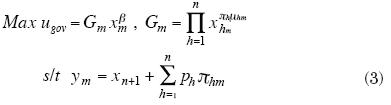
<body><![CDATA[<p align="justify"><font face="verdana" size="2">&nbsp;</font></p>  	    <p align="justify"><font face="verdana" size="2"><b>II. The Median Voter</b></font></p>  	    <p align="justify"><font face="verdana" size="2">Providing that all individuals settled down in particular jurisdictions chose their location on the basis of their preferences (Tiebout, 1956), and that space localization may be represented as a continuum of symmetrically distributed jurisdictions around the median voter, Panizza (1999) shows that the MV will choose a national level of <i>x<sub>h</sub><sub>&#8800;n+1</sub></i> = <i>x<sub>m</sub>,</i> such that <i>x<sub>m</sub></i> = <i>&#956;y<sub>m</sub></i> / (<i>&#956;</i> + <i>&#946;)</i> and <i>&#956; =</i> 1 &#45; <i>&#945; &#91;&#952;</i>(S/4) + (1 &#45; &#952;) <i>(S/4J)&#93;,</i> where 1 &#45;<i>&#956;</i> may be interpreted as the <i>ideological distance relative to the center, S</i> is the country's territory and <i>J</i> is the number of jurisdictions.</font></p>  	    <p align="justify"><font face="verdana" size="2">In the context of a perfectly representative democracy, the national government decides on the level of decentralization by setting up an agenda, thereby it will try to centralize its power over the budget in order to maximize rents being produced from staying in power. As the political system becomes less representative, the ruling national government's power rises and so does its capacity to keep budget control by avoiding fiscal devolution to sub&#45;national governments. Such a behavior confronts the wills of the national MV, whose problem may be presented as follows:</font></p>  	    <p align="center"><font face="verdana" size="2"><img src="/img/revistas/emne/v22n2/a5fo3.jpg"></font></p>  	    <p align="justify"><font face="verdana" size="2">The solution to (3) will be:</font></p>  	    <p align="center"><font face="verdana" size="2"><img src="/img/revistas/emne/v22n2/a5fo4ay4b.jpg"></font></p>  	    <p align="justify"><font face="verdana" size="2">where <img src="/img/revistas/emne/v22n2/a5focm.jpg">Sub index <i>"m"</i> stands for the MV. Note that results from (3) differ from (1) in the term <i>&#956;<sub>hm</sub>,</i> which corresponds to the expression <i>k<sub>hi</sub></i> for the generic voter <i>"i".</i></font></p>  	    <p align="justify"><font face="verdana" size="2">&nbsp;</font></p>  	    <p align="justify"><font face="verdana" size="2"><b>III. The Government's Problem</b></font></p>  	    ]]></body>
<body><![CDATA[<p align="justify"><font face="verdana" size="2">Under the assumptions that <i>1)</i> MV's reasoning is known for government, and <i>2)</i> every different public good has a particular production function and a case specific information advantage from decentralization, the ruling national government will choose the degree of decentralization for each public good <i>(</i>&#952;<i><sub>h</sub></i> &#8704;<i>j</i> = 1, ..n) by solving the following problem:</font></p>  	    <p align="center"><font face="verdana" size="2"><img src="/img/revistas/emne/v22n2/a5fo5.jpg"></font></p>  	    <p align="justify"><font face="verdana" size="2">Sub&#45;index <i>m</i> will be omitted from now on. By substituting 4a and 4b into 5, and assuming that <i>n</i> = 2, it can be shown that government's optimum &#952;<i><sub>h</sub></i> for <i>h</i> = 1 hinges upon the following first order condition (equation 6), which assumes that MV's utility function is homogenous of degree one on the whole set of consumption options (see the <a href="/img/revistas/emne/v22n2/html/a5anexo.html" target="_blank">appendix</a> for details).</font></p>  	    <p align="center"><font face="verdana" size="2"><img src="/img/revistas/emne/v22n2/a5fo6.jpg"></font></p>  	    <p align="justify"><font face="verdana" size="2">While the "non <i>opportunistic''</i> component of government's behavior in equation 6 is being timed by &#966;, the opportunistic part is being timed by (1 &#45; &#966;). Formally, it can be stated that three endogenous effects and a set of exogenous factors (&#949;) will determine government's optimum degree of centralization on x<sub>1</sub>. Formally, this implies that &#952;*<sub>1</sub> = &#952;*<sub>1</sub> &#91;<i>&#956;</i>'<sub>1</sub>,<i>&#960;</i>'<sub>1</sub>,p'<sub>1</sub>, &#949;&#93;, where &#952;*<sub>1</sub> stands for government's optimum. First, a more centralized delivery of public good <i>h</i> = 1 will rise the average ideological distance between individual voters and the median, turning this public good less representative of local preferences. Term <i>&#956;</i>'<sub>1</sub> accounts for this effect in equation 6. It will be called the <i>Ideological Effect of centralization</i> (IE). Second, regardless of the extent to which the specific characteristics of public good <i>h</i> = 1 fit voters' preferences, a more centralized delivery of x<sub>1</sub> worsens its quality (VHE), this being captured by <i>&#960;</i>'<sub>1</sub>. The effect on government's welfare depends on the strength of democracy (&#966;) and the degree to which a lower (higher) &#952;<sub>1</sub> expands (reduces) government's expenditures. Third, a lower (higher) &#952;<sub>1</sub> raises (reduces) the price of x<sub>h</sub>, which further reduces (rises) demand for x<sub>1</sub> (SCE).</font></p>  	    <p align="justify"><font face="verdana" size="2">The term (&#947;<sub>0</sub>) captures the opportunistic impact on <i>u<sub>gov</sub></i> caused by a &#952;<sub>1</sub> induced change on x<sub>1</sub> expenditure. Coefficient &#947;<i><sub>1</sub></i> (VHE) depends on the MV's welfare loss from more centralization on x<sub>1</sub> (&#966;<i>U<sub>m</sub></i>p<sub>1</sub>) and the effect on government's welfare from the potential for increased decentralized expenditure resulting from &#945; rise in &#952;<sub>1</sub> (&rho;<sub>2</sub>). A similar interpretation should be given to g<sub>1</sub>, although in this case the effect of a change in &#952;<sub>1</sub> is being channeled through <i>&#960;</i><sub>1</sub>. Finally, &#947;<i><sub>2</sub></i> stands for the shift in demand for x<sub>1</sub> as a response to a decline on p<sub>1</sub> resulting from more centralization (SCE). Exogenous factors are accounted for in set &#949;. The following proposition is in order:</font></p>  	    <p align="justify"><font face="verdana" size="2"><b><i>Proposition 1.</i></b> In trying to set up the optimum degree of centralization, the central government will assign different degrees of centralization to different public goods. Government's optimum will differ across public goods, all of them being (potentially) different from each other regarding the median voter distance between the national median and the jurisdiction median for each particular public good, their quality sensitivity to decentralization (VHE), and the cost push effect of decentralization (SCE).</font></p> 	    <p align="justify">&nbsp;</p>      <p align="justify"><font face="verdana" size="2"><b>IV. Exogenous Factors</b></font></p>  	    <p align="justify"><font face="verdana" size="2">Variations in the model's exogenous variables will affect centralization as long as they change central government's marginal utility with respect to each public good's centralization level. Formally, this implies that first order condition (equation 6) should be differentiated with respect to the set of exogenous variables (&epsilon;). It follows that the central government will centralize more in case any derivative from equations 7a to 7c (bellow) is positive.</font></p>  	    ]]></body>

<body><![CDATA[<p align="center"><font face="verdana" size="2"><img src="/img/revistas/emne/v22n2/a5fo7abc.jpg"></font></p>  	    <p align="justify"><font face="verdana" size="2">In a non democratic world <i>(</i>&#966; = 0) with a single public good "G", with neither VHE nor SCE (p'<sub>1</sub> <i>, &#960;</i>'<sub>1</sub>= 0), and identical preferences between the national and the local MV (<i>&#956;</i>'<sub>1</sub> = 0), a rise in MV's income will also rise the expenditure on this generic public good, which directly improves government's welfare (equation 7a)':</font></p>  	    <p align="center"><font face="verdana" size="2"><img src="/img/revistas/emne/v22n2/a5fo7a.jpg"></font></p>  	    <p align="justify"><font face="verdana" size="2">In a democratic context (&#966; &gt; 0) the MV prevents these rents from being too high by reducing his demand for <i>G,</i> leading to a lower central government's marginal utility from centralization. Strictly speaking, this might be reversed if the opportunistic part in (7a) is larger in absolute terms than the non&#45;opportunistic one, and 1&#45;p<sub>1</sub> &#951;<sup>1</sup><sub>y</sub> &gt; 0. The reason being that a low h and/or |p'<sub>1</sub>| are likely to induce very little changes in central government's rents as a response to variations in the median income. Nevertheless, if we assume that p'<sub>h</sub>&lt; 0, <i>&#960;</i>'<sub>h</sub>&lt; 0 and accept that <i>n</i> &gt; 1, the impact of income on decentralization becomes less clear since a high income elasticity of this public good &#951;<sup>h</sup><sub>y</sub><i>&gt;</i> 1 may produce a substantial cost reducing effect, turning more centralization into a welfare winning option for the median as his income rises. We can state the following propositions:</font></p>  	    <p align="justify"><font face="verdana" size="2"><b><i>Proposition 2:</i></b> If <i>&#960;</i>'<sub>1</sub> = 0, p'<sub>1</sub> = 0 and 1 &#45; p<sub>1</sub> &#951;<sup>1</sup><sub>y</sub>&#8804; 0, an increase in the median voter's income unambiguously lowers government's marginal utility from centralization and leads to more decentralization. This result might be reversed if 1 &#45;p<sub>1</sub> &#951;<sup>1</sup><sub>y</sub><i>&gt;</i> 0 and the opportunistic component in equation 7a is larger &#151;in absolute terms&#151; than the non opportunistic one. Since this is likely to be different across public goods, a rise in income will have different implications on every different public good.</font></p>  	    <p align="justify"><font face="verdana" size="2"><b><i>Proposition 3:</i></b> If <i>&#960;</i>'<sub>1</sub>&#8804; 0, p<sub>1</sub>' &lt; 0 and 1 &#45; p<sub>1</sub> &#951;<sup>1</sup><sub>y</sub>&#8804; 0, proposition 2 still holds as long as 1 &#45; &#951;<sup>1</sup><sub>y</sub>&#8804; 0. In case 1 &#45; &#951;<sup>1</sup><sub>y</sub><i>&gt;</i> 0, the sign in 7a depends on how strong the SCE of centralization is.</font></p>  	    <p align="justify"><font face="verdana" size="2">As in Panizza (1999), <i>S</i> (surface) has an "ideological" impact on the median voter's welfare. A larger territory lowers <i>&#956;<sub>h</sub></i> (see the <a href="/img/revistas/emne/v22n2/html/a5anexo.html" target="_blank">Appendix</a>) and therefore raises 1 &#45; <i>&#956;</i><i><sub>h</sub></i><i>,</i> which is formally defined as the ideological distance relative to the center. In our analytical frame nevertheless, this is conditioned upon the specific nature of each different public good. For example, welfare implications resulting from public goods which mostly benefit a particular jurisdiction (as is the case of school and hospital infrastructure) are more likely to differ significantly between the local and the national MV. As expected, such a divergence diminishes as the national benefit becomes larger with respect to the local one. If public good&#45;specificness were ruled out, a larger territory would lead to a rise in 1 &#45;<i>&#956;</i><i><sub>h</sub></i><i>,</i> which stands for the ideological distance from the center. Since this affects <i>x<sub>1</sub></i> as well as x<sub>2</sub> it is not clear that MV's marginal utility &#151;and also his demand&#151; for x<sub>1</sub> will be reduced. On the one hand, the non opportunistic part in equation 7b will tend to be positive as long as the demand for <i>x</i><sub>1</sub> rises along with S. This will be further strengthened if the scale effect (p'<sub>1</sub>) is significant. On the other hand, the opportunistic component will also get larger as <i>S</i> raises the demand for x<sub>1</sub>. The net effect on government's marginal utility from a change in <i>S</i> depends on the sign as much as on the magnitude of the opportunistic and non opportunistic components all together. Given that &#945;is also common to all public goods, the above argument is equally valid as far as variations on population heterogeneity are concerned.</font></p>      <p align="justify"><font face="verdana" size="2"><b><i>Proposition 4:</i></b> Different degrees of population homogeneity (&#945;) as well as different country sizes (S) have an ambiguous effect of &#952;<sub>h</sub>. The net effect depends on whether changes on <i>&#945;</i> and/or <i>S</i> rise or reduce the demand for x<sub>h</sub>.</font></p>  	    <p align="justify"><font face="verdana" size="2">&nbsp;</font></p>  	    <p align="justify"><font face="verdana" size="2"><b>V. Conclusions</b></font></p>  	    ]]></body>
<body><![CDATA[<p align="justify"><font face="verdana" size="2">The present paper builds on previous literature by presenting a model in which the central government runs the agenda; thereby the degree of FD is defined. It innovates in making an explicit acknowledgement that functional areas of governments should be given a specific treatment regarding the quality and the cost implications of decentralization. As opposed to the general government definition of FD, the degree of FD on specific public goods can be said to depend on three separate factors. They are the potential for information and public goods quality benefit from decentralization (VHE), the ideological affinity between the local median and the central median voter (IE), and the cost increasing effect of having a smaller scale of operation (SCE). Since these effects are likely to differ across public goods, the model predicts that government's optimal FD is public good specific.</font></p>  	    <p align="justify"><font face="verdana" size="2">In the context of the model, a rise in the MV's income does not necessarily lead to more decentralization, as in the one public good case. On the one hand, more centralization benefits central government as public goods expenditure rises. On the other, given that public goods have different income elasticities, the cost reducing effect of centralization may further strengthen centralization for the median voter in some cases, making the net effect on FD ambiguous. Functional areas of government in which the cost benefit of centralization is very important are likely to be less centralized. Conversely, public goods in which the quality benefit of decentralization and/or the ideological sensitivity of widening the gap between the local and central MV is high, are likely to be more decentralized.</font></p>  	    <p align="justify"><font face="verdana" size="2">Both the country's territory and the degree of population diversity have ambiguous effects on the degree of FD chosen by the central government. Since these two variables affect all public goods, the net impact on FD depends on how strong the cost reducing effect is in one public good relative to all others. On the one hand, the non opportunistic part of government's behavior will push government to decentralize more as long as the demand for a specific public good rises as a response to a larger <i>S</i> and/ or &#945;. This will be further strengthened if the scale effect (p'<sub>1</sub> ) is significant. On the other hand, the opportunistic component will also get larger as changes in S and/or <i>&#945;</i> rises the demand for x<sub>1</sub>.</font></p>  	    <p align="justify"><font face="verdana" size="2">&nbsp;</font></p>  	    <p align="justify"><font face="verdana" size="2"><b>References</b></font></p>  	    <!-- ref --><p align="justify"><font face="verdana" size="2">Arzaghi, M. and V. Henderson (2005) "Why Countries are Fiscally Decentralizing", <i>Journal of Public Economics,</i> 89 (7), pp. 1157&#45;1189.    &nbsp;&nbsp;&nbsp;&nbsp;&nbsp;&nbsp;&nbsp;&nbsp;[&#160;<a href="javascript:void(0);" onclick="javascript: window.open('/scielo.php?script=sci_nlinks&ref=2844042&pid=S1665-2045201300020000500001&lng=','','width=640,height=500,resizable=yes,scrollbars=1,menubar=yes,');">Links</a>&#160;]<!-- end-ref --></font></p>  	    <!-- ref --><p align="justify"><font face="verdana" size="2">Barankay, I. and B. Lockwood (2007), "Decentralization and the Productive Efficiency of Government: Evidence from the Swiss Cantons", <i>Journal of Public Economics,</i> 91 (5&#45;6), pp. 1197&#45;1218.    &nbsp;&nbsp;&nbsp;&nbsp;&nbsp;&nbsp;&nbsp;&nbsp;[&#160;<a href="javascript:void(0);" onclick="javascript: window.open('/scielo.php?script=sci_nlinks&ref=2844044&pid=S1665-2045201300020000500002&lng=','','width=640,height=500,resizable=yes,scrollbars=1,menubar=yes,');">Links</a>&#160;]<!-- end-ref --></font></p>  	    <!-- ref --><p align="justify"><font face="verdana" size="2">Bardhan, P. and D. Mookherjee (2006), "Pro&#45;Poor Targeting and Accountability of Local Governments in West Bengal", <i>Journal of Development Economics,</i> 79 (2), pp. 303&#45;327.    &nbsp;&nbsp;&nbsp;&nbsp;&nbsp;&nbsp;&nbsp;&nbsp;[&#160;<a href="javascript:void(0);" onclick="javascript: window.open('/scielo.php?script=sci_nlinks&ref=2844046&pid=S1665-2045201300020000500003&lng=','','width=640,height=500,resizable=yes,scrollbars=1,menubar=yes,');">Links</a>&#160;]<!-- end-ref --></font></p>  	    <!-- ref --><p align="justify"><font face="verdana" size="2">Bonet, J. (2006), "Fiscal Decentralization and Regional Income Disparities: Evidence from Colombian Experience", <i>Annals of Regional Science,</i> 40 (3), 661&#45;676.    &nbsp;&nbsp;&nbsp;&nbsp;&nbsp;&nbsp;&nbsp;&nbsp;[&#160;<a href="javascript:void(0);" onclick="javascript: window.open('/scielo.php?script=sci_nlinks&ref=2844048&pid=S1665-2045201300020000500004&lng=','','width=640,height=500,resizable=yes,scrollbars=1,menubar=yes,');">Links</a>&#160;]<!-- end-ref --></font></p>  	    <!-- ref --><p align="justify"><font face="verdana" size="2">Bossert, T., D. Bowser and J. Amenyah (2007), "Is Decentralization Good for Logistic Systems? Evidence on Essential Medicine Logistics in Ghana and Guatemala", <i>Health Policy and Planning,</i> 22 (2), pp. 73&#45;82.    &nbsp;&nbsp;&nbsp;&nbsp;&nbsp;&nbsp;&nbsp;&nbsp;[&#160;<a href="javascript:void(0);" onclick="javascript: window.open('/scielo.php?script=sci_nlinks&ref=2844050&pid=S1665-2045201300020000500005&lng=','','width=640,height=500,resizable=yes,scrollbars=1,menubar=yes,');">Links</a>&#160;]<!-- end-ref --></font></p>  	    <!-- ref --><p align="justify"><font face="verdana" size="2">Ebel, D. and S. Yilmaz (2002), "On the Measurement and Impact of Fiscal Decentralisation", <i>World Bank Policy Research Working Paper</i> 2809, World Bank, Washington D. C.    &nbsp;&nbsp;&nbsp;&nbsp;&nbsp;&nbsp;&nbsp;&nbsp;[&#160;<a href="javascript:void(0);" onclick="javascript: window.open('/scielo.php?script=sci_nlinks&ref=2844052&pid=S1665-2045201300020000500006&lng=','','width=640,height=500,resizable=yes,scrollbars=1,menubar=yes,');">Links</a>&#160;]<!-- end-ref --></font></p>  	    <!-- ref --><p align="justify"><font face="verdana" size="2">Enikolopov, R. and E. Zhuravskaya (2007), "Decentralization and Political Institutions", <i>Journal of Public Economics,</i> 91 (11&#45;12), pp. 2261-2290.    &nbsp;&nbsp;&nbsp;&nbsp;&nbsp;&nbsp;&nbsp;&nbsp;[&#160;<a href="javascript:void(0);" onclick="javascript: window.open('/scielo.php?script=sci_nlinks&ref=2844054&pid=S1665-2045201300020000500007&lng=','','width=640,height=500,resizable=yes,scrollbars=1,menubar=yes,');">Links</a>&#160;]<!-- end-ref --></font></p>  	    <!-- ref --><p align="justify"><font face="verdana" size="2">Faguet, J. P. and F. S&aacute;nchez (2007), "Decentralization's Effects on Educational Outcomes in Bolivia and Colombia", <i>World Development,</i> 36 (7), pp. 1294&#45;1316.    &nbsp;&nbsp;&nbsp;&nbsp;&nbsp;&nbsp;&nbsp;&nbsp;[&#160;<a href="javascript:void(0);" onclick="javascript: window.open('/scielo.php?script=sci_nlinks&ref=2844056&pid=S1665-2045201300020000500008&lng=','','width=640,height=500,resizable=yes,scrollbars=1,menubar=yes,');">Links</a>&#160;]<!-- end-ref --></font></p>  	    <!-- ref --><p align="justify"><font face="verdana" size="2">&#45;&#45;&#45;&#45;&#45;&#45;&#45;&#45;&#45;&#45; (2001), "Does Decentralization Increase Responsiveness to Local Needs? Evidence from Bolivia", Policy Research Working Paper 2561, World Bank.    &nbsp;&nbsp;&nbsp;&nbsp;&nbsp;&nbsp;&nbsp;&nbsp;[&#160;<a href="javascript:void(0);" onclick="javascript: window.open('/scielo.php?script=sci_nlinks&ref=2844058&pid=S1665-2045201300020000500009&lng=','','width=640,height=500,resizable=yes,scrollbars=1,menubar=yes,');">Links</a>&#160;]<!-- end-ref --></font></p>  	    <!-- ref --><p align="justify"><font face="verdana" size="2">Hankla, C. R. (2009) "When is Fiscal Decentralization Good for Governance?", <i>Publius,</i> 39 (4), pp. 632&#45;650.    &nbsp;&nbsp;&nbsp;&nbsp;&nbsp;&nbsp;&nbsp;&nbsp;[&#160;<a href="javascript:void(0);" onclick="javascript: window.open('/scielo.php?script=sci_nlinks&ref=2844060&pid=S1665-2045201300020000500010&lng=','','width=640,height=500,resizable=yes,scrollbars=1,menubar=yes,');">Links</a>&#160;]<!-- end-ref --></font></p>  	    <!-- ref --><p align="justify"><font face="verdana" size="2">Hayek, V. F. (1945), "The Use of Knowledge in Society", <i>American Economic Review,</i> 35 (4), pp. 519&#45;530.    &nbsp;&nbsp;&nbsp;&nbsp;&nbsp;&nbsp;&nbsp;&nbsp;[&#160;<a href="javascript:void(0);" onclick="javascript: window.open('/scielo.php?script=sci_nlinks&ref=2844062&pid=S1665-2045201300020000500011&lng=','','width=640,height=500,resizable=yes,scrollbars=1,menubar=yes,');">Links</a>&#160;]<!-- end-ref --></font></p>  	    <!-- ref --><p align="justify"><font face="verdana" size="2">Hooghe, L. and G. Marks (2009), "Does Efficiency Shape the Territorial Structure of Government?", <i>Annual Review of Political Science,</i> 12, pp. 225&#45;241.    &nbsp;&nbsp;&nbsp;&nbsp;&nbsp;&nbsp;&nbsp;&nbsp;[&#160;<a href="javascript:void(0);" onclick="javascript: window.open('/scielo.php?script=sci_nlinks&ref=2844064&pid=S1665-2045201300020000500012&lng=','','width=640,height=500,resizable=yes,scrollbars=1,menubar=yes,');">Links</a>&#160;]<!-- end-ref --></font></p>  	    <!-- ref --><p align="justify"><font face="verdana" size="2">Kyriacou, A. P. and O. Roca&#45;Sagal&eacute;s (2011), "Fiscal Decentralization and Government Quality in the OECD", <i>Economics Letters,</i> 111 (3), pp. 191&#45;193.    &nbsp;&nbsp;&nbsp;&nbsp;&nbsp;&nbsp;&nbsp;&nbsp;[&#160;<a href="javascript:void(0);" onclick="javascript: window.open('/scielo.php?script=sci_nlinks&ref=2844066&pid=S1665-2045201300020000500013&lng=','','width=640,height=500,resizable=yes,scrollbars=1,menubar=yes,');">Links</a>&#160;]<!-- end-ref --></font></p>  	    <!-- ref --><p align="justify"><font face="verdana" size="2">Letelier, S. L. (2005), "Explaining Fiscal Decentralization", <i>Public Finance Review,</i> 33 (2), pp. 155&#45;183.    &nbsp;&nbsp;&nbsp;&nbsp;&nbsp;&nbsp;&nbsp;&nbsp;[&#160;<a href="javascript:void(0);" onclick="javascript: window.open('/scielo.php?script=sci_nlinks&ref=2844068&pid=S1665-2045201300020000500014&lng=','','width=640,height=500,resizable=yes,scrollbars=1,menubar=yes,');">Links</a>&#160;]<!-- end-ref --></font></p>  	    <!-- ref --><p align="justify"><font face="verdana" size="2">&#45;&#45;&#45;&#45;&#45;&#45;&#45;&#45;&#45;&#45; (2010), "Efecto de la descentralizaci&oacute;n fiscal sobre la eficiencia t&eacute;cnica en la gesti&oacute;n de la educaci&oacute;n y la salud", <i>Documentos y Aportes en Administraci&oacute;n P&uacute;blica y Gesti&oacute;n Estatal,</i> 14, pp. 7&#45;24, Universidad Nacional del Litoral, Rep&uacute;blica Argentina.    &nbsp;&nbsp;&nbsp;&nbsp;&nbsp;&nbsp;&nbsp;&nbsp;[&#160;<a href="javascript:void(0);" onclick="javascript: window.open('/scielo.php?script=sci_nlinks&ref=2844070&pid=S1665-2045201300020000500015&lng=','','width=640,height=500,resizable=yes,scrollbars=1,menubar=yes,');">Links</a>&#160;]<!-- end-ref --></font></p>  	    <!-- ref --><p align="justify"><font face="verdana" size="2">&#45;&#45;&#45;&#45;&#45;&#45;&#45;&#45;&#45;&#45; (2012) "Teor&iacute;a y pr&aacute;ctica de la descentralizaci&oacute;n fiscal", Ediciones U. C., Pontificia Universidad Cat&oacute;lica de Chile.    &nbsp;&nbsp;&nbsp;&nbsp;&nbsp;&nbsp;&nbsp;&nbsp;[&#160;<a href="javascript:void(0);" onclick="javascript: window.open('/scielo.php?script=sci_nlinks&ref=2844072&pid=S1665-2045201300020000500016&lng=','','width=640,height=500,resizable=yes,scrollbars=1,menubar=yes,');">Links</a>&#160;]<!-- end-ref --></font></p>  	    <!-- ref --><p align="justify"><font face="verdana" size="2">Lindaman, K. and K. Thurmaier (2002), "Beyond Efficiency and Economy: An Examination of Basic Needs and Fiscal Decentralization", <i>Economic Development and Cultural Change,</i> 50 (4), pp. 915&#45;934.    &nbsp;&nbsp;&nbsp;&nbsp;&nbsp;&nbsp;&nbsp;&nbsp;[&#160;<a href="javascript:void(0);" onclick="javascript: window.open('/scielo.php?script=sci_nlinks&ref=2844074&pid=S1665-2045201300020000500017&lng=','','width=640,height=500,resizable=yes,scrollbars=1,menubar=yes,');">Links</a>&#160;]<!-- end-ref --></font></p>  	    <!-- ref --><p align="justify"><font face="verdana" size="2">Litvack, J. and W. Oates (1971), "Group Size and the Output of Public Goods: Theory and Application to State&#45;Local Finance in the United States", <i>Public Finance,</i> 25 (2), pp. 42&#45;58.    &nbsp;&nbsp;&nbsp;&nbsp;&nbsp;&nbsp;&nbsp;&nbsp;[&#160;<a href="javascript:void(0);" onclick="javascript: window.open('/scielo.php?script=sci_nlinks&ref=2844076&pid=S1665-2045201300020000500018&lng=','','width=640,height=500,resizable=yes,scrollbars=1,menubar=yes,');">Links</a>&#160;]<!-- end-ref --></font></p>  	    <!-- ref --><p align="justify"><font face="verdana" size="2">Lockwood, B. (2006), "The Political Economy of Decentralization", in E. Ahmad and G. Brosio (eds.), <i>Handbook of Fiscal Federalism,</i> Northampton, MA, Edward Elgar Publishing, pp. 33&#45;60.    &nbsp;&nbsp;&nbsp;&nbsp;&nbsp;&nbsp;&nbsp;&nbsp;[&#160;<a href="javascript:void(0);" onclick="javascript: window.open('/scielo.php?script=sci_nlinks&ref=2844078&pid=S1665-2045201300020000500019&lng=','','width=640,height=500,resizable=yes,scrollbars=1,menubar=yes,');">Links</a>&#160;]<!-- end-ref --></font></p>  	    <!-- ref --><p align="justify"><font face="verdana" size="2">Marlow, M. (1988), "Fiscal Decentralization and Government Size", <i>Public Choice,</i> 56 (3), pp. 259&#45;269.    &nbsp;&nbsp;&nbsp;&nbsp;&nbsp;&nbsp;&nbsp;&nbsp;[&#160;<a href="javascript:void(0);" onclick="javascript: window.open('/scielo.php?script=sci_nlinks&ref=2844080&pid=S1665-2045201300020000500020&lng=','','width=640,height=500,resizable=yes,scrollbars=1,menubar=yes,');">Links</a>&#160;]<!-- end-ref --></font></p>  	    <!-- ref --><p align="justify"><font face="verdana" size="2">Martinez&#45;Vazquez, J. and R. McNab (2003), "Fiscal Decentralization and Economic Growth", <i>World Development,</i> 31(9), pp. 1597&#45;1616.    &nbsp;&nbsp;&nbsp;&nbsp;&nbsp;&nbsp;&nbsp;&nbsp;[&#160;<a href="javascript:void(0);" onclick="javascript: window.open('/scielo.php?script=sci_nlinks&ref=2844082&pid=S1665-2045201300020000500021&lng=','','width=640,height=500,resizable=yes,scrollbars=1,menubar=yes,');">Links</a>&#160;]<!-- end-ref --></font></p>  	    <!-- ref --><p align="justify"><font face="verdana" size="2">Neyapti, B. (2006), "Revenue Decentralization and Income Distribution", <i>Economics Letters,</i> 92 (3), pp. 409&#45;416.    &nbsp;&nbsp;&nbsp;&nbsp;&nbsp;&nbsp;&nbsp;&nbsp;[&#160;<a href="javascript:void(0);" onclick="javascript: window.open('/scielo.php?script=sci_nlinks&ref=2844084&pid=S1665-2045201300020000500022&lng=','','width=640,height=500,resizable=yes,scrollbars=1,menubar=yes,');">Links</a>&#160;]<!-- end-ref --></font></p>  	    <!-- ref --><p align="justify"><font face="verdana" size="2">Oates, W. (1972), <i>Fiscal Federalism,</i> New York, Harcourt, Brace, Jovanovich.    &nbsp;&nbsp;&nbsp;&nbsp;&nbsp;&nbsp;&nbsp;&nbsp;[&#160;<a href="javascript:void(0);" onclick="javascript: window.open('/scielo.php?script=sci_nlinks&ref=2844086&pid=S1665-2045201300020000500023&lng=','','width=640,height=500,resizable=yes,scrollbars=1,menubar=yes,');">Links</a>&#160;]<!-- end-ref --></font></p>  	    <!-- ref --><p align="justify"><font face="verdana" size="2">&#45;&#45;&#45;&#45;&#45;&#45;&#45;&#45;&#45;&#45; (2008) "On the Evolution of Fiscal Federalism: Theory and Institutions", <i>National Tax Journal,</i> 61 (2), pp. 313&#45;334.    &nbsp;&nbsp;&nbsp;&nbsp;&nbsp;&nbsp;&nbsp;&nbsp;[&#160;<a href="javascript:void(0);" onclick="javascript: window.open('/scielo.php?script=sci_nlinks&ref=2844088&pid=S1665-2045201300020000500024&lng=','','width=640,height=500,resizable=yes,scrollbars=1,menubar=yes,');">Links</a>&#160;]<!-- end-ref --></font></p>  	    <!-- ref --><p align="justify"><font face="verdana" size="2">Osterkamp, R. and M. Eller (2003), "Functional Fiscal Decentralization", <i>Journal of Institutional Comparisons,</i> 1 (3), Autumn, pp. 15&#45;20.    &nbsp;&nbsp;&nbsp;&nbsp;&nbsp;&nbsp;&nbsp;&nbsp;[&#160;<a href="javascript:void(0);" onclick="javascript: window.open('/scielo.php?script=sci_nlinks&ref=2844090&pid=S1665-2045201300020000500025&lng=','','width=640,height=500,resizable=yes,scrollbars=1,menubar=yes,');">Links</a>&#160;]<!-- end-ref --></font></p>  	    <!-- ref --><p align="justify"><font face="verdana" size="2">Panizza, U. (1999), "On the Determinants of Fiscal Centralization: Theory and Evidence", <i>Journal of Public Economics,</i> 74 (1), pp. 97&#45;134.    &nbsp;&nbsp;&nbsp;&nbsp;&nbsp;&nbsp;&nbsp;&nbsp;[&#160;<a href="javascript:void(0);" onclick="javascript: window.open('/scielo.php?script=sci_nlinks&ref=2844092&pid=S1665-2045201300020000500026&lng=','','width=640,height=500,resizable=yes,scrollbars=1,menubar=yes,');">Links</a>&#160;]<!-- end-ref --></font></p>  	    <!-- ref --><p align="justify"><font face="verdana" size="2">Pommerehne, W. (1977), "Quantitative Aspects of Federalism: A Study of Six Countries", in W. Oates (ed.), <i>The Political Economy of Fiscal Federalism,</i> New York, Lexington.    &nbsp;&nbsp;&nbsp;&nbsp;&nbsp;&nbsp;&nbsp;&nbsp;[&#160;<a href="javascript:void(0);" onclick="javascript: window.open('/scielo.php?script=sci_nlinks&ref=2844094&pid=S1665-2045201300020000500027&lng=','','width=640,height=500,resizable=yes,scrollbars=1,menubar=yes,');">Links</a>&#160;]<!-- end-ref --></font></p>  	    <!-- ref --><p align="justify"><font face="verdana" size="2">Pryor, F. (1967), "Elements of a Positive Theory of Public Expenditures", <i>Finanzarchiv,</i> 26 (3), pp. 405&#45;430.    &nbsp;&nbsp;&nbsp;&nbsp;&nbsp;&nbsp;&nbsp;&nbsp;[&#160;<a href="javascript:void(0);" onclick="javascript: window.open('/scielo.php?script=sci_nlinks&ref=2844096&pid=S1665-2045201300020000500028&lng=','','width=640,height=500,resizable=yes,scrollbars=1,menubar=yes,');">Links</a>&#160;]<!-- end-ref --></font></p>  	    <!-- ref --><p align="justify"><font face="verdana" size="2">Qiao, B., J. Martinez&#45;Vazquez and Y. Xu (2008), "The Tradeoff between Growth and Equity in Decentralization Policy: China's Experience", <i>Journal of Development Economics,</i> 86 (1), pp. 112&#45;128.    &nbsp;&nbsp;&nbsp;&nbsp;&nbsp;&nbsp;&nbsp;&nbsp;[&#160;<a href="javascript:void(0);" onclick="javascript: window.open('/scielo.php?script=sci_nlinks&ref=2844098&pid=S1665-2045201300020000500029&lng=','','width=640,height=500,resizable=yes,scrollbars=1,menubar=yes,');">Links</a>&#160;]<!-- end-ref --></font></p>  	    <!-- ref --><p align="justify"><font face="verdana" size="2">Rodr&iacute;guez&#45;Pose, A. and R. Ezcurra (2009), "Does Decentralization Matter for Regional Disparities? A Cross Country Analysis", <i>Journal of Economic Geography,</i> 10 (5), September, pp. 1&#45;26.    &nbsp;&nbsp;&nbsp;&nbsp;&nbsp;&nbsp;&nbsp;&nbsp;[&#160;<a href="javascript:void(0);" onclick="javascript: window.open('/scielo.php?script=sci_nlinks&ref=2844100&pid=S1665-2045201300020000500030&lng=','','width=640,height=500,resizable=yes,scrollbars=1,menubar=yes,');">Links</a>&#160;]<!-- end-ref --></font></p>  	    <!-- ref --><p align="justify"><font face="verdana" size="2">Thornton, J. (2007), "Fiscal Decentralization and Economic Growth Reconsidered", <i>Journal of Urban Economics,</i> 61 (1), pp. 64&#45;70.    &nbsp;&nbsp;&nbsp;&nbsp;&nbsp;&nbsp;&nbsp;&nbsp;[&#160;<a href="javascript:void(0);" onclick="javascript: window.open('/scielo.php?script=sci_nlinks&ref=2844102&pid=S1665-2045201300020000500031&lng=','','width=640,height=500,resizable=yes,scrollbars=1,menubar=yes,');">Links</a>&#160;]<!-- end-ref --></font></p>  	    <!-- ref --><p align="justify"><font face="verdana" size="2">Tiebout, C.M. (1956), "A Pure Theory of Local Expenditures", <i>Journal of Political Economy,</i> 64, October, pp. 416&#45;424.    &nbsp;&nbsp;&nbsp;&nbsp;&nbsp;&nbsp;&nbsp;&nbsp;[&#160;<a href="javascript:void(0);" onclick="javascript: window.open('/scielo.php?script=sci_nlinks&ref=2844104&pid=S1665-2045201300020000500032&lng=','','width=640,height=500,resizable=yes,scrollbars=1,menubar=yes,');">Links</a>&#160;]<!-- end-ref --></font></p>  	    <!-- ref --><p align="justify"><font face="verdana" size="2">Uchimura, H. and J. P. J&uuml;tting (2009), "Fiscal Decentralization, Chinese Style: Good for Health Outcomes?", <i>World Development,</i> 37 (12), pp. 1926&#45;1934.    &nbsp;&nbsp;&nbsp;&nbsp;&nbsp;&nbsp;&nbsp;&nbsp;[&#160;<a href="javascript:void(0);" onclick="javascript: window.open('/scielo.php?script=sci_nlinks&ref=2844106&pid=S1665-2045201300020000500033&lng=','','width=640,height=500,resizable=yes,scrollbars=1,menubar=yes,');">Links</a>&#160;]<!-- end-ref --></font></p>  	    <!-- ref --><p align="justify"><font face="verdana" size="2">Voigt, S. and L. Blume (2012), "The Economic Effects of Federalism and Decentralization; A Cross&#45;country Assessment", <i>Public Choice,</i> 151 (1&#45;2), pp. 229&#45;254.    &nbsp;&nbsp;&nbsp;&nbsp;&nbsp;&nbsp;&nbsp;&nbsp;[&#160;<a href="javascript:void(0);" onclick="javascript: window.open('/scielo.php?script=sci_nlinks&ref=2844108&pid=S1665-2045201300020000500034&lng=','','width=640,height=500,resizable=yes,scrollbars=1,menubar=yes,');">Links</a>&#160;]<!-- end-ref --></font></p>  	    <!-- ref --><p align="justify"><font face="verdana" size="2">Wallis, J. and W. Oates (1988), "Decentralization in the Public Sector: An Empirical Study of State and Local Government", in H. Rosen (ed.), <i>Fiscal Federalism: Quantitative Studies,</i> Chicago, University of Chicago Press.    &nbsp;&nbsp;&nbsp;&nbsp;&nbsp;&nbsp;&nbsp;&nbsp;[&#160;<a href="javascript:void(0);" onclick="javascript: window.open('/scielo.php?script=sci_nlinks&ref=2844110&pid=S1665-2045201300020000500035&lng=','','width=640,height=500,resizable=yes,scrollbars=1,menubar=yes,');">Links</a>&#160;]<!-- end-ref --></font></p>  	    <!-- ref --><p align="justify"><font face="verdana" size="2">Wheare, K. C. (1964), <i>Federal Government,</i> London, Oxford University Press.    &nbsp;&nbsp;&nbsp;&nbsp;&nbsp;&nbsp;&nbsp;&nbsp;[&#160;<a href="javascript:void(0);" onclick="javascript: window.open('/scielo.php?script=sci_nlinks&ref=2844112&pid=S1665-2045201300020000500036&lng=','','width=640,height=500,resizable=yes,scrollbars=1,menubar=yes,');">Links</a>&#160;]<!-- end-ref --></font></p>  	    <!-- ref --><p align="justify"><font face="verdana" size="2">Zhao L. (2009), "Between Local Community and Central State: Financing Basic Education in China", <i>International Journal of Educational Development,</i> 29 (4), pp. 366&#45;373.    &nbsp;&nbsp;&nbsp;&nbsp;&nbsp;&nbsp;&nbsp;&nbsp;[&#160;<a href="javascript:void(0);" onclick="javascript: window.open('/scielo.php?script=sci_nlinks&ref=2844114&pid=S1665-2045201300020000500037&lng=','','width=640,height=500,resizable=yes,scrollbars=1,menubar=yes,');">Links</a>&#160;]<!-- end-ref --></font></p>  	    <p align="justify"><font face="verdana" size="2">&nbsp;</font></p>  	    ]]></body>
<body><![CDATA[<p align="justify"><font face="verdana" size="2"><a name="nota"></a><b>Note</b></font></p>  	    <p align="justify"><font face="verdana" size="2">*The authors acknowledge the support from the Interministerial Commission on Science and Technology (CICYT: CSO2011&#45;29346).</font></p>      ]]></body><back>
<ref-list>
<ref id="B1">
<nlm-citation citation-type="journal">
<person-group person-group-type="author">
<name>
<surname><![CDATA[Arzaghi]]></surname>
<given-names><![CDATA[M.]]></given-names>
</name>
<name>
<surname><![CDATA[Henderson]]></surname>
<given-names><![CDATA[V.]]></given-names>
</name>
</person-group>
<article-title xml:lang="en"><![CDATA[Why Countries are Fiscally Decentralizing]]></article-title>
<source><![CDATA[Journal of Public Economics]]></source>
<year>2005</year>
<volume>89</volume>
<numero>7</numero>
<issue>7</issue>
<page-range>1157-1189</page-range></nlm-citation>
</ref>
<ref id="B2">
<nlm-citation citation-type="journal">
<person-group person-group-type="author">
<name>
<surname><![CDATA[Barankay]]></surname>
<given-names><![CDATA[I.]]></given-names>
</name>
<name>
<surname><![CDATA[Lockwood]]></surname>
<given-names><![CDATA[B.]]></given-names>
</name>
</person-group>
<article-title xml:lang="en"><![CDATA[Decentralization and the Productive Efficiency of Government: Evidence from the Swiss Cantons]]></article-title>
<source><![CDATA[Journal of Public Economics]]></source>
<year>2007</year>
<volume>91</volume>
<numero>5-6</numero>
<issue>5-6</issue>
<page-range>1197-1218</page-range></nlm-citation>
</ref>
<ref id="B3">
<nlm-citation citation-type="journal">
<person-group person-group-type="author">
<name>
<surname><![CDATA[Bardhan]]></surname>
<given-names><![CDATA[P.]]></given-names>
</name>
<name>
<surname><![CDATA[Mookherjee]]></surname>
<given-names><![CDATA[D.]]></given-names>
</name>
</person-group>
<article-title xml:lang="en"><![CDATA[Pro-Poor Targeting and Accountability of Local Governments in West Bengal]]></article-title>
<source><![CDATA[Journal of Development Economics]]></source>
<year>2006</year>
<volume>79</volume>
<numero>2</numero>
<issue>2</issue>
<page-range>303-327</page-range></nlm-citation>
</ref>
<ref id="B4">
<nlm-citation citation-type="journal">
<person-group person-group-type="author">
<name>
<surname><![CDATA[Bonet]]></surname>
<given-names><![CDATA[J.]]></given-names>
</name>
</person-group>
<article-title xml:lang="en"><![CDATA[Fiscal Decentralization and Regional Income Disparities: Evidence from Colombian Experience]]></article-title>
<source><![CDATA[Annals of Regional Science]]></source>
<year>2006</year>
<volume>40</volume>
<numero>3</numero>
<issue>3</issue>
<page-range>661-676</page-range></nlm-citation>
</ref>
<ref id="B5">
<nlm-citation citation-type="journal">
<person-group person-group-type="author">
<name>
<surname><![CDATA[Bossert]]></surname>
<given-names><![CDATA[T.]]></given-names>
</name>
<name>
<surname><![CDATA[Bowser]]></surname>
<given-names><![CDATA[D.]]></given-names>
</name>
<name>
<surname><![CDATA[Amenyah]]></surname>
<given-names><![CDATA[J.]]></given-names>
</name>
</person-group>
<article-title xml:lang="en"><![CDATA[Is Decentralization Good for Logistic Systems? Evidence on Essential Medicine Logistics in Ghana and Guatemala]]></article-title>
<source><![CDATA[Health Policy and Planning]]></source>
<year>2007</year>
<volume>22</volume>
<numero>2</numero>
<issue>2</issue>
<page-range>73-82</page-range></nlm-citation>
</ref>
<ref id="B6">
<nlm-citation citation-type="journal">
<person-group person-group-type="author">
<name>
<surname><![CDATA[Ebel]]></surname>
<given-names><![CDATA[D.]]></given-names>
</name>
<name>
<surname><![CDATA[Yilmaz]]></surname>
<given-names><![CDATA[S.]]></given-names>
</name>
</person-group>
<article-title xml:lang="en"><![CDATA[On the Measurement and Impact of Fiscal Decentralisation]]></article-title>
<source><![CDATA[World Bank Policy Research Working Paper]]></source>
<year>2002</year>
<numero>2809</numero>
<issue>2809</issue>
<publisher-loc><![CDATA[Washington D. C ]]></publisher-loc>
<publisher-name><![CDATA[World Bank]]></publisher-name>
</nlm-citation>
</ref>
<ref id="B7">
<nlm-citation citation-type="journal">
<person-group person-group-type="author">
<name>
<surname><![CDATA[Enikolopov]]></surname>
<given-names><![CDATA[R.]]></given-names>
</name>
<name>
<surname><![CDATA[Zhuravskaya]]></surname>
<given-names><![CDATA[E.]]></given-names>
</name>
</person-group>
<article-title xml:lang="en"><![CDATA[Decentralization and Political Institutions]]></article-title>
<source><![CDATA[Journal of Public Economics]]></source>
<year>2007</year>
<volume>91</volume>
<numero>11-12</numero>
<issue>11-12</issue>
<page-range>2261-2290</page-range></nlm-citation>
</ref>
<ref id="B8">
<nlm-citation citation-type="journal">
<person-group person-group-type="author">
<name>
<surname><![CDATA[Faguet]]></surname>
<given-names><![CDATA[J. P.]]></given-names>
</name>
<name>
<surname><![CDATA[Sánchez]]></surname>
<given-names><![CDATA[F.]]></given-names>
</name>
</person-group>
<article-title xml:lang="en"><![CDATA[Decentralization's Effects on Educational Outcomes in Bolivia and Colombia]]></article-title>
<source><![CDATA[World Development]]></source>
<year>2007</year>
<volume>36</volume>
<numero>7</numero>
<issue>7</issue>
<page-range>1294-1316</page-range></nlm-citation>
</ref>
<ref id="B9">
<nlm-citation citation-type="journal">
<person-group person-group-type="author">
<name>
<surname><![CDATA[Faguet]]></surname>
<given-names><![CDATA[J. P.]]></given-names>
</name>
</person-group>
<article-title xml:lang="en"><![CDATA[Does Decentralization Increase Responsiveness to Local Needs? Evidence from Bolivia]]></article-title>
<source><![CDATA[Policy Research Working Paper]]></source>
<year>2001</year>
<numero>2561</numero>
<issue>2561</issue>
<publisher-name><![CDATA[World Bank]]></publisher-name>
</nlm-citation>
</ref>
<ref id="B10">
<nlm-citation citation-type="journal">
<person-group person-group-type="author">
<name>
<surname><![CDATA[Hankla]]></surname>
<given-names><![CDATA[C. R.]]></given-names>
</name>
</person-group>
<article-title xml:lang="en"><![CDATA[When is Fiscal Decentralization Good for Governance?]]></article-title>
<source><![CDATA[Publius]]></source>
<year>2009</year>
<volume>39</volume>
<numero>4</numero>
<issue>4</issue>
<page-range>632-650</page-range></nlm-citation>
</ref>
<ref id="B11">
<nlm-citation citation-type="journal">
<person-group person-group-type="author">
<name>
<surname><![CDATA[Hayek]]></surname>
<given-names><![CDATA[V. F.]]></given-names>
</name>
</person-group>
<article-title xml:lang="en"><![CDATA[The Use of Knowledge in Society]]></article-title>
<source><![CDATA[American Economic Review]]></source>
<year>1945</year>
<volume>35</volume>
<numero>4</numero>
<issue>4</issue>
<page-range>519-530</page-range></nlm-citation>
</ref>
<ref id="B12">
<nlm-citation citation-type="journal">
<person-group person-group-type="author">
<name>
<surname><![CDATA[Hooghe]]></surname>
<given-names><![CDATA[L.]]></given-names>
</name>
<name>
<surname><![CDATA[Marks]]></surname>
<given-names><![CDATA[G.]]></given-names>
</name>
</person-group>
<article-title xml:lang="en"><![CDATA[Does Efficiency Shape the Territorial Structure of Government?]]></article-title>
<source><![CDATA[Annual Review of Political Science]]></source>
<year>2009</year>
<volume>12</volume>
<page-range>225-241</page-range></nlm-citation>
</ref>
<ref id="B13">
<nlm-citation citation-type="journal">
<person-group person-group-type="author">
<name>
<surname><![CDATA[Kyriacou]]></surname>
<given-names><![CDATA[A. P.]]></given-names>
</name>
<name>
<surname><![CDATA[Roca-Sagalés]]></surname>
<given-names><![CDATA[O.]]></given-names>
</name>
</person-group>
<article-title xml:lang="en"><![CDATA[Fiscal Decentralization and Government Quality in the OECD]]></article-title>
<source><![CDATA[Economics Letters]]></source>
<year>2011</year>
<volume>111</volume>
<numero>3</numero>
<issue>3</issue>
<page-range>191-193</page-range></nlm-citation>
</ref>
<ref id="B14">
<nlm-citation citation-type="journal">
<person-group person-group-type="author">
<name>
<surname><![CDATA[Letelier]]></surname>
<given-names><![CDATA[S. L.]]></given-names>
</name>
</person-group>
<article-title xml:lang="en"><![CDATA[Explaining Fiscal Decentralization]]></article-title>
<source><![CDATA[Public Finance Review]]></source>
<year>2005</year>
<volume>33</volume>
<numero>2</numero>
<issue>2</issue>
<page-range>155-183</page-range></nlm-citation>
</ref>
<ref id="B15">
<nlm-citation citation-type="journal">
<person-group person-group-type="author">
<name>
<surname><![CDATA[Letelier]]></surname>
<given-names><![CDATA[S. L.]]></given-names>
</name>
</person-group>
<article-title xml:lang="es"><![CDATA[Efecto de la descentralización fiscal sobre la eficiencia técnica en la gestión de la educación y la salud]]></article-title>
<source><![CDATA[Documentos y Aportes en Administración Pública y Gestión Estatal]]></source>
<year>2010</year>
<volume>14</volume>
<page-range>7-24</page-range><publisher-name><![CDATA[Universidad Nacional del Litoral]]></publisher-name>
</nlm-citation>
</ref>
<ref id="B16">
<nlm-citation citation-type="book">
<person-group person-group-type="author">
<name>
<surname><![CDATA[Letelier]]></surname>
<given-names><![CDATA[S. L.]]></given-names>
</name>
</person-group>
<person-group person-group-type="editor">
<name>
</name>
</person-group>
<source><![CDATA[Teoría y práctica de la descentralización fiscal]]></source>
<year>2012</year>
<publisher-name><![CDATA[Ediciones U. C.Pontificia Universidad Católica de Chile]]></publisher-name>
</nlm-citation>
</ref>
<ref id="B17">
<nlm-citation citation-type="journal">
<person-group person-group-type="author">
<name>
<surname><![CDATA[Lindaman]]></surname>
<given-names><![CDATA[K.]]></given-names>
</name>
<name>
<surname><![CDATA[Thurmaier]]></surname>
<given-names><![CDATA[K.]]></given-names>
</name>
</person-group>
<article-title xml:lang="en"><![CDATA[Beyond Efficiency and Economy: An Examination of Basic Needs and Fiscal Decentralization]]></article-title>
<source><![CDATA[Economic Development and Cultural Change]]></source>
<year>2002</year>
<volume>50</volume>
<numero>4</numero>
<issue>4</issue>
<page-range>915-934</page-range></nlm-citation>
</ref>
<ref id="B18">
<nlm-citation citation-type="journal">
<person-group person-group-type="author">
<name>
<surname><![CDATA[Litvack]]></surname>
<given-names><![CDATA[J.]]></given-names>
</name>
<name>
<surname><![CDATA[Oates]]></surname>
<given-names><![CDATA[W.]]></given-names>
</name>
</person-group>
<article-title xml:lang="en"><![CDATA[Group Size and the Output of Public Goods: Theory and Application to State-Local Finance in the United States]]></article-title>
<source><![CDATA[Public Finance]]></source>
<year>1971</year>
<volume>25</volume>
<numero>2</numero>
<issue>2</issue>
<page-range>42-58</page-range></nlm-citation>
</ref>
<ref id="B19">
<nlm-citation citation-type="book">
<person-group person-group-type="author">
<name>
<surname><![CDATA[Lockwood]]></surname>
<given-names><![CDATA[B.]]></given-names>
</name>
</person-group>
<article-title xml:lang="en"><![CDATA[The Political Economy of Decentralization]]></article-title>
<person-group person-group-type="editor">
<name>
<surname><![CDATA[Ahmad]]></surname>
<given-names><![CDATA[E.]]></given-names>
</name>
<name>
<surname><![CDATA[Brosio]]></surname>
<given-names><![CDATA[G.]]></given-names>
</name>
</person-group>
<source><![CDATA[Handbook of Fiscal Federalism]]></source>
<year>2006</year>
<page-range>33-60</page-range><publisher-loc><![CDATA[Northampton^eMA MA]]></publisher-loc>
<publisher-name><![CDATA[Edward Elgar Publishing]]></publisher-name>
</nlm-citation>
</ref>
<ref id="B20">
<nlm-citation citation-type="journal">
<person-group person-group-type="author">
<name>
<surname><![CDATA[Marlow]]></surname>
<given-names><![CDATA[M.]]></given-names>
</name>
</person-group>
<article-title xml:lang="en"><![CDATA[Fiscal Decentralization and Government Size]]></article-title>
<source><![CDATA[Public Choice]]></source>
<year>1988</year>
<volume>56</volume>
<numero>3</numero>
<issue>3</issue>
<page-range>259-269</page-range></nlm-citation>
</ref>
<ref id="B21">
<nlm-citation citation-type="journal">
<person-group person-group-type="author">
<name>
<surname><![CDATA[Martinez-Vazquez]]></surname>
<given-names><![CDATA[J.]]></given-names>
</name>
<name>
<surname><![CDATA[McNab]]></surname>
<given-names><![CDATA[R.]]></given-names>
</name>
</person-group>
<article-title xml:lang="en"><![CDATA[Fiscal Decentralization and Economic Growth]]></article-title>
<source><![CDATA[World Development]]></source>
<year>2003</year>
<volume>31</volume>
<numero>9</numero>
<issue>9</issue>
<page-range>1597-1616</page-range></nlm-citation>
</ref>
<ref id="B22">
<nlm-citation citation-type="journal">
<person-group person-group-type="author">
<name>
<surname><![CDATA[Neyapti]]></surname>
<given-names><![CDATA[B.]]></given-names>
</name>
</person-group>
<article-title xml:lang="en"><![CDATA[Revenue Decentralization and Income Distribution]]></article-title>
<source><![CDATA[Economics Letters]]></source>
<year>2006</year>
<volume>92</volume>
<numero>3</numero>
<issue>3</issue>
<page-range>409-416</page-range></nlm-citation>
</ref>
<ref id="B23">
<nlm-citation citation-type="book">
<person-group person-group-type="author">
<name>
<surname><![CDATA[Oates]]></surname>
<given-names><![CDATA[W.]]></given-names>
</name>
</person-group>
<source><![CDATA[Fiscal Federalism]]></source>
<year>1972</year>
<publisher-loc><![CDATA[New York ]]></publisher-loc>
<publisher-name><![CDATA[HarcourtBraceJovanovich]]></publisher-name>
</nlm-citation>
</ref>
<ref id="B24">
<nlm-citation citation-type="journal">
<person-group person-group-type="author">
<name>
<surname><![CDATA[Oates]]></surname>
<given-names><![CDATA[W.]]></given-names>
</name>
</person-group>
<article-title xml:lang="en"><![CDATA[On the Evolution of Fiscal Federalism: Theory and Institutions]]></article-title>
<source><![CDATA[National Tax Journal]]></source>
<year>2008</year>
<volume>61</volume>
<numero>2</numero>
<issue>2</issue>
<page-range>313-334</page-range></nlm-citation>
</ref>
<ref id="B25">
<nlm-citation citation-type="journal">
<person-group person-group-type="author">
<name>
<surname><![CDATA[Osterkamp]]></surname>
<given-names><![CDATA[R.]]></given-names>
</name>
<name>
<surname><![CDATA[Eller]]></surname>
<given-names><![CDATA[M.]]></given-names>
</name>
</person-group>
<article-title xml:lang="en"><![CDATA[Functional Fiscal Decentralization]]></article-title>
<source><![CDATA[Journal of Institutional Comparisons]]></source>
<year>2003</year>
<volume>1</volume>
<numero>3</numero>
<issue>3</issue>
<page-range>15-20</page-range><publisher-name><![CDATA[Autumn]]></publisher-name>
</nlm-citation>
</ref>
<ref id="B26">
<nlm-citation citation-type="journal">
<person-group person-group-type="author">
<name>
<surname><![CDATA[Panizza]]></surname>
<given-names><![CDATA[U.]]></given-names>
</name>
</person-group>
<article-title xml:lang="en"><![CDATA[On the Determinants of Fiscal Centralization: Theory and Evidence]]></article-title>
<source><![CDATA[Journal of Public Economics]]></source>
<year>1999</year>
<volume>74</volume>
<numero>1</numero>
<issue>1</issue>
<page-range>97-134</page-range></nlm-citation>
</ref>
<ref id="B27">
<nlm-citation citation-type="book">
<person-group person-group-type="author">
<name>
<surname><![CDATA[Pommerehne]]></surname>
<given-names><![CDATA[W.]]></given-names>
</name>
</person-group>
<article-title xml:lang="en"><![CDATA[Quantitative Aspects of Federalism: A Study of Six Countries]]></article-title>
<person-group person-group-type="editor">
<name>
<surname><![CDATA[Oates]]></surname>
<given-names><![CDATA[W.]]></given-names>
</name>
</person-group>
<source><![CDATA[The Political Economy of Fiscal Federalism]]></source>
<year>1977</year>
<publisher-loc><![CDATA[New York ]]></publisher-loc>
<publisher-name><![CDATA[Lexington]]></publisher-name>
</nlm-citation>
</ref>
<ref id="B28">
<nlm-citation citation-type="journal">
<person-group person-group-type="author">
<name>
<surname><![CDATA[Pryor]]></surname>
<given-names><![CDATA[F.]]></given-names>
</name>
</person-group>
<article-title xml:lang="en"><![CDATA[Elements of a Positive Theory of Public Expenditures]]></article-title>
<source><![CDATA[Finanzarchiv]]></source>
<year>1967</year>
<volume>26</volume>
<numero>3</numero>
<issue>3</issue>
<page-range>405-430</page-range></nlm-citation>
</ref>
<ref id="B29">
<nlm-citation citation-type="journal">
<person-group person-group-type="author">
<name>
<surname><![CDATA[Qiao]]></surname>
<given-names><![CDATA[B.]]></given-names>
</name>
<name>
<surname><![CDATA[Martinez-Vazquez]]></surname>
<given-names><![CDATA[J.]]></given-names>
</name>
<name>
<surname><![CDATA[Xu]]></surname>
<given-names><![CDATA[Y.]]></given-names>
</name>
</person-group>
<article-title xml:lang="en"><![CDATA[The Tradeoff between Growth and Equity in Decentralization Policy: China's Experience]]></article-title>
<source><![CDATA[Journal of Development Economics]]></source>
<year>2008</year>
<volume>86</volume>
<numero>1</numero>
<issue>1</issue>
<page-range>112-128</page-range></nlm-citation>
</ref>
<ref id="B30">
<nlm-citation citation-type="journal">
<person-group person-group-type="author">
<name>
<surname><![CDATA[Rodríguez-Pose]]></surname>
<given-names><![CDATA[A.]]></given-names>
</name>
<name>
<surname><![CDATA[Ezcurra]]></surname>
<given-names><![CDATA[R.]]></given-names>
</name>
</person-group>
<article-title xml:lang="en"><![CDATA[Does Decentralization Matter for Regional Disparities? A Cross Country Analysis]]></article-title>
<source><![CDATA[Journal of Economic Geography]]></source>
<year>2009</year>
<volume>10</volume>
<numero>5</numero>
<issue>5</issue>
<page-range>1-26</page-range></nlm-citation>
</ref>
<ref id="B31">
<nlm-citation citation-type="journal">
<person-group person-group-type="author">
<name>
<surname><![CDATA[Thornton]]></surname>
<given-names><![CDATA[J.]]></given-names>
</name>
</person-group>
<article-title xml:lang="en"><![CDATA[Fiscal Decentralization and Economic Growth Reconsidered]]></article-title>
<source><![CDATA[Journal of Urban Economics]]></source>
<year>2007</year>
<volume>61</volume>
<numero>1</numero>
<issue>1</issue>
<page-range>64-70</page-range></nlm-citation>
</ref>
<ref id="B32">
<nlm-citation citation-type="journal">
<person-group person-group-type="author">
<name>
<surname><![CDATA[Tiebout]]></surname>
<given-names><![CDATA[C.M.]]></given-names>
</name>
</person-group>
<article-title xml:lang="en"><![CDATA[A Pure Theory of Local Expenditures]]></article-title>
<source><![CDATA[Journal of Political Economy]]></source>
<year>1956</year>
<volume>64</volume>
<page-range>416-424</page-range></nlm-citation>
</ref>
<ref id="B33">
<nlm-citation citation-type="journal">
<person-group person-group-type="author">
<name>
<surname><![CDATA[Uchimura]]></surname>
<given-names><![CDATA[H.]]></given-names>
</name>
<name>
<surname><![CDATA[Jütting]]></surname>
<given-names><![CDATA[J. P.]]></given-names>
</name>
</person-group>
<article-title xml:lang="en"><![CDATA[Fiscal Decentralization, Chinese Style: Good for Health Outcomes?]]></article-title>
<source><![CDATA[World Development]]></source>
<year>2009</year>
<volume>37</volume>
<numero>12</numero>
<issue>12</issue>
<page-range>1926-1934</page-range></nlm-citation>
</ref>
<ref id="B34">
<nlm-citation citation-type="journal">
<person-group person-group-type="author">
<name>
<surname><![CDATA[Voigt]]></surname>
<given-names><![CDATA[S.]]></given-names>
</name>
<name>
<surname><![CDATA[Blume]]></surname>
<given-names><![CDATA[L.]]></given-names>
</name>
</person-group>
<article-title xml:lang="en"><![CDATA[The Economic Effects of Federalism and Decentralization; A Cross-country Assessment]]></article-title>
<source><![CDATA[Public Choice]]></source>
<year>2012</year>
<volume>151</volume>
<numero>1-2</numero>
<issue>1-2</issue>
<page-range>229-254</page-range></nlm-citation>
</ref>
<ref id="B35">
<nlm-citation citation-type="book">
<person-group person-group-type="author">
<name>
<surname><![CDATA[Wallis]]></surname>
<given-names><![CDATA[J.]]></given-names>
</name>
<name>
<surname><![CDATA[Oates]]></surname>
<given-names><![CDATA[W.]]></given-names>
</name>
</person-group>
<article-title xml:lang="en"><![CDATA[Decentralization in the Public Sector: An Empirical Study of State and Local Government]]></article-title>
<person-group person-group-type="editor">
<name>
<surname><![CDATA[Rosen]]></surname>
<given-names><![CDATA[H.]]></given-names>
</name>
</person-group>
<source><![CDATA[Fiscal Federalism: Quantitative Studies]]></source>
<year>1988</year>
<publisher-loc><![CDATA[Chicago ]]></publisher-loc>
<publisher-name><![CDATA[University of Chicago Press]]></publisher-name>
</nlm-citation>
</ref>
<ref id="B36">
<nlm-citation citation-type="book">
<person-group person-group-type="author">
<name>
<surname><![CDATA[Wheare]]></surname>
<given-names><![CDATA[K. C.]]></given-names>
</name>
</person-group>
<source><![CDATA[Federal Government]]></source>
<year>1964</year>
<publisher-loc><![CDATA[London ]]></publisher-loc>
<publisher-name><![CDATA[Oxford University Press]]></publisher-name>
</nlm-citation>
</ref>
<ref id="B37">
<nlm-citation citation-type="journal">
<person-group person-group-type="author">
<name>
<surname><![CDATA[Zhao]]></surname>
<given-names><![CDATA[L.]]></given-names>
</name>
</person-group>
<article-title xml:lang="en"><![CDATA[Between Local Community and Central State: Financing Basic Education in China]]></article-title>
<source><![CDATA[International Journal of Educational Development]]></source>
<year>2009</year>
<volume>29</volume>
<numero>4</numero>
<issue>4</issue>
<page-range>366-373</page-range></nlm-citation>
</ref>
</ref-list>
</back>
</article>