<?xml version="1.0" encoding="ISO-8859-1"?><article xmlns:mml="http://www.w3.org/1998/Math/MathML" xmlns:xlink="http://www.w3.org/1999/xlink" xmlns:xsi="http://www.w3.org/2001/XMLSchema-instance">
<front>
<journal-meta>
<journal-id>1607-4041</journal-id>
<journal-title><![CDATA[Revista electrónica de investigación educativa]]></journal-title>
<abbrev-journal-title><![CDATA[REDIE]]></abbrev-journal-title>
<issn>1607-4041</issn>
<publisher>
<publisher-name><![CDATA[Universidad Autónoma de Baja California, Instituto de Investigación y Desarrollo Educativo]]></publisher-name>
</publisher>
</journal-meta>
<article-meta>
<article-id>S1607-40412015000200008</article-id>
<title-group>
<article-title xml:lang="en"><![CDATA[Multimedia Instruction & Language Learning Attitudes: A Study with University Students]]></article-title>
<article-title xml:lang="es"><![CDATA[Enseñanza multimedia y actitudes hacia el aprendizaje de lenguas en contexto universitario]]></article-title>
</title-group>
<contrib-group>
<contrib contrib-type="author">
<name>
<surname><![CDATA[Izquierdo]]></surname>
<given-names><![CDATA[Jesús]]></given-names>
</name>
<xref ref-type="aff" rid="A01"/>
</contrib>
<contrib contrib-type="author">
<name>
<surname><![CDATA[Simard]]></surname>
<given-names><![CDATA[Daphnée]]></given-names>
</name>
<xref ref-type="aff" rid="A02"/>
</contrib>
<contrib contrib-type="author">
<name>
<surname><![CDATA[Garza Pulido]]></surname>
<given-names><![CDATA[María Guadalupe]]></given-names>
</name>
<xref ref-type="aff" rid="A02"/>
</contrib>
</contrib-group>
<aff id="A01">
<institution><![CDATA[,Universidad Juárez Autónoma de Tabasco  ]]></institution>
<addr-line><![CDATA[Villahermosa Tabasco]]></addr-line>
<country>México</country>
</aff>
<aff id="A02">
<institution><![CDATA[,Universite du Quebec a Montreal  ]]></institution>
<addr-line><![CDATA[Montreal Quebec]]></addr-line>
<country>Canadá</country>
</aff>
<pub-date pub-type="pub">
<day>00</day>
<month>00</month>
<year>2015</year>
</pub-date>
<pub-date pub-type="epub">
<day>00</day>
<month>00</month>
<year>2015</year>
</pub-date>
<volume>17</volume>
<numero>2</numero>
<fpage>101</fpage>
<lpage>115</lpage>
<copyright-statement/>
<copyright-year/>
<self-uri xlink:href="http://www.scielo.org.mx/scielo.php?script=sci_arttext&amp;pid=S1607-40412015000200008&amp;lng=en&amp;nrm=iso"></self-uri><self-uri xlink:href="http://www.scielo.org.mx/scielo.php?script=sci_abstract&amp;pid=S1607-40412015000200008&amp;lng=en&amp;nrm=iso"></self-uri><self-uri xlink:href="http://www.scielo.org.mx/scielo.php?script=sci_pdf&amp;pid=S1607-40412015000200008&amp;lng=en&amp;nrm=iso"></self-uri><abstract abstract-type="short" xml:lang="en"><p><![CDATA[This study examined the effects of two types of Multimedia Instruction (MI) and learners' second language (L2) proficiency on language learning attitudes. During four weeks, university learners of French received MI on the distinctive use of the perfective and the imperfective past in one of the four following conditions: learners with low L2 proficiency level exposed to MI with (n=17) or without language awareness tasks (n=17), and learners with intermediate L2 proficiency level exposed to MI with (n=14) or without language awareness tasks (n=28). Before and after the experiment, participants completed the Attitude/Motivation Test Battery (AMTB). Non-parametric analyses revealed a positive enhancement of classroom-related attitudes only among intermediate learners exposed to MI without Language Awareness Tasks. Nevertheless, the results showed similar as well as stable attitudes towards language learning in all the experimental conditions.]]></p></abstract>
<abstract abstract-type="short" xml:lang="es"><p><![CDATA[Este estudio examinó el impacto de dos tipos de enseñanza multimedia (MI), implementada con estudiantes de distintos niveles de competencia en Francés, en diferentes tipos de actitudes hacia el aprendizaje de una lengua extranjera. Durante cuatro semanas, los participantes trabajaron con ambientes multimedia que favorecían el aprendizaje de los tiempos verbales en cuatro condiciones experimentales. Estudiantes con poco conocimiento (n=17) o conocimiento intermedio (n=14) de los tiempos verbales utilizaron MI que permitía el empleo comunicativo y la sensibilización lingüística hacia estas estructuras (MI+LATS). Otros estudiantes con poco conocimiento (n=17) o conocimiento intermedio (n=28) de los tiempos gramaticales utilizaron MI que sólo permitía el empleo comunicativo de las estructuras (MI-LATS). Los análisis no-paramétricos de una prueba actitudinal, que los estudiantes respondieron antes y después del experimento, sólo revelaron cambios positivos en las actitudes hacía la clase, en los estudiantes de nivel intermedio en la condición MI-LATS.]]></p></abstract>
<kwd-group>
<kwd lng="en"><![CDATA[Second language learning]]></kwd>
<kwd lng="en"><![CDATA[multimedia instruction]]></kwd>
<kwd lng="en"><![CDATA[learner attitudes]]></kwd>
<kwd lng="es"><![CDATA[Aprendizaje de lenguas]]></kwd>
<kwd lng="es"><![CDATA[enseñanza multimedia]]></kwd>
<kwd lng="es"><![CDATA[actitudes de aprendizaje]]></kwd>
</kwd-group>
</article-meta>
</front><body><![CDATA[  	    <p align="left"><font face="verdana" size="4">Art&iacute;culos</font></p>  	    <p>&nbsp;</p>  	    <p align="center"><font face="verdana" size="4"><b>Multimedia Instruction &amp; Language Learning Attitudes: A Study with University&nbsp;Students<sup><a href="#notas">1</a></sup></b></font></p>  	    <p>&nbsp;</p>  	    <p align="center"><font face="verdana" size="3"><b>Ense&ntilde;anza multimedia y actitudes hacia el aprendizaje de lenguas en contexto universitario</b></font></p>  	    <p>&nbsp;</p>  	    <p align="center"><font face="verdana" size="2"><b>Jes&uacute;s Izquierdo<sup>1</sup>, Daphn&eacute;e Simard<sup>2</sup>, Mar&iacute;a Guadalupe Garza Pulido<sup>1</sup></b></font></p>  	    <p>&nbsp;</p>  	    <p align="justify"><font face="verdana" size="2"><sup><i>1</i></sup> <i>Universidad Ju&aacute;rez Aut&oacute;noma de Tabasco.</i> <a href="mailto:jesus.izquierdo@mail.mcgill.ca">jesus.izquierdo@mail.mcgill.ca</a>, <a href="mailto:gpegarza21@gmail.com">gpegarza21@gmail.com</a></font></p>  	    ]]></body>
<body><![CDATA[<p align="justify"><font face="verdana" size="2"><sup><i>2</i></sup> <i>Universit&eacute; du Qu&eacute;bec &agrave; Montr&eacute;al.</i> <a href="mailto:simard.daphnee@uqam.ca">simard.daphnee@uqam.ca</a></font></p>  	    <p>&nbsp;</p>  	    <p align="justify"><font face="verdana" size="2">Recibido: 3 de julio de 2013;    <br> 	Aceptado para su publicaci&oacute;n: 12 de enero de 2015.</font></p>  	    <p>&nbsp;</p>  	    <p align="justify"><font face="verdana" size="2"><b>Abstract</b></font></p>  	    <p align="justify"><font face="verdana" size="2">This study examined the effects of two types of Multimedia Instruction (MI) and learners' second language (L2) proficiency on language learning attitudes. During four weeks, university learners of French received MI&nbsp;on the distinctive use of the perfective and the imperfective past in one of the four following conditions: learners with low L2 proficiency level exposed to&nbsp;MI&nbsp;with (<i>n</i>=17) or without language awareness tasks (<i>n</i>=17), and learners with intermediate L2 proficiency level exposed to&nbsp;MI&nbsp;with (<i>n</i>=14) or without language awareness tasks (<i>n</i>=28). Before and after the experiment, participants completed the Attitude/Motivation Test Battery (AMTB). Non&#45;parametric analyses revealed a positive enhancement of classroom&#45;related attitudes only among intermediate learners exposed to&nbsp;MI&nbsp;without Language Awareness Tasks. Nevertheless, the results showed similar as well as stable attitudes towards language learning in all the experimental conditions.</font></p>  	    <p align="justify"><font face="verdana" size="2"><b>Keywords:</b>&nbsp;Second language learning, multimedia instruction, learner attitudes.</font></p>  	    <p>&nbsp;</p>  	    <p align="justify"><font face="verdana" size="2"><b>Resumen</b></font></p>  	    ]]></body>
<body><![CDATA[<p align="justify"><font face="verdana" size="2">Este estudio examin&oacute; el impacto de dos tipos de ense&ntilde;anza multimedia (MI), implementada con estudiantes de distintos niveles de competencia en Franc&eacute;s, en diferentes tipos de actitudes hacia el aprendizaje de una lengua extranjera. Durante cuatro semanas, los participantes trabajaron con ambientes multimedia que favorec&iacute;an el aprendizaje de los tiempos verbales en cuatro condiciones experimentales. Estudiantes con poco conocimiento (<i>n</i>=17) o conocimiento intermedio (<i>n</i>=14) de los tiempos verbales utilizaron MI que permit&iacute;a el empleo comunicativo y la sensibilizaci&oacute;n ling&uuml;&iacute;stica hacia estas estructuras (MI+LATS). Otros estudiantes con poco conocimiento (<i>n</i>=17) o conocimiento intermedio (<i>n</i>=28) de los tiempos gramaticales utilizaron MI que s&oacute;lo permit&iacute;a el empleo comunicativo de las estructuras (MI&#45;LATS). Los an&aacute;lisis no&#45;param&eacute;tricos de una prueba actitudinal, que los estudiantes respondieron antes y despu&eacute;s del experimento, s&oacute;lo revelaron cambios positivos en las actitudes hac&iacute;a la clase, en los estudiantes de nivel intermedio en la condici&oacute;n MI&#45;LATS.</font></p>  	    <p align="justify"><font face="verdana" size="2"><b>Palabras clave</b>: Aprendizaje de lenguas, ense&ntilde;anza multimedia, actitudes de aprendizaje.</font></p>  	    <p>&nbsp;</p>  	    <p align="justify"><font face="verdana" size="2"><b>I. Introduction&nbsp;</b></font></p>  	    <p align="justify"><font face="verdana" size="2">Multimedia instruction (MI) can be defined as instructional procedures that integrate online or onsite computer environments where the combination of text, sound, images, and interactivity in learning tasks helps students advance their second language (L2) knowledge (Plass &amp; Jones, 2005). To favour&nbsp;MI&nbsp;language education, the positive attitudes that L2 learners show toward the Computer&#45;Assisted Language Learning (CALL) materials have been emphasized (e.g., Leakey &amp; Ranchoux, 2006; Sagarra &amp; Zapata, 2008). </font></p>  	    <p align="justify"><font face="verdana" size="2">In previous research, the examination of learner attitudes has constituted an&nbsp;<i>ad hoc</i>&nbsp;component, where the conceptualization and design have not directly built upon the relationship between&nbsp;MI&nbsp;and L2 attitudes. For research to be informative with respect to the relationship between computers and learner attitudes, its constructs and design should be directly linked to previous L2 theoretical and empirical work so as to address the variables influencing the attitudinal results (see Reeder, Heift, Roch, Tabyanian, &amp; G&ouml;lz, 2004). In this regard, the results from&nbsp;CALL&nbsp;research point out the need to address different types of variables that can interact in&nbsp;MI&nbsp;(see Ayres 2002; Mahfouz &amp; Ihmeideh, 2009). While the examination of all the variables intervening in&nbsp;CALL&nbsp;instruction is difficult, if indeed it is even possible (Reeder et al. 2003, p. 261), this study will address the following three variables. </font></p>  	    <p align="justify"><font face="verdana" size="2">The main variable of this study relates to the type of L2 attitudes on which&nbsp;MI&nbsp;can have an influence. While there is not yet a consensus on the attitudes to explore (e.g., Ayres, 2002; Mahfouz &amp; Ihmeideh, 2009; VanAacken, 1999), some L2 investigations have built upon Gardner's (1985a, 1985b) socio&#45;educational model of learner motivation and attitudes. This model differentiates between learner attitudes towards the learning of a particular group's language, the L2 learning itself, and the learning context. The first attitude type is part of the <i>integrativeness</i>&nbsp;construct and reflects the learners' desire to acquire a L2 to integrate into the L2 community. The second attitude type includes attitudes toward L2 learning, which are part of the&nbsp;<i>learner motivation to learn the</i>&nbsp;<i>L2</i>. These attitudes denote learners' willingness to make efforts during the learning process. Finally,&nbsp;<i>attitudes toward the L2 learning context</i>&nbsp;refer to learner appreciation of the course instructor and the French course. </font></p>  	    <p align="justify"><font face="verdana" size="2">Congruent with this differentiation, in a meta&#45;analysis conducted with 75 research samples including 10,489 participants, Masgoret and Gardner (2003) found a strong correlation between learners' motivation, which involves attitudes toward L2 learning, and L2 achievement. Weaker correlations were found between L2 achievement and integrativeness, which reflects learner attitudes toward the L2 speakers, and between L2 achievement and attitudes toward the learning context (see also Gardner, Lalonde, &amp; Moorcroft, 1985; Gardner &amp; MacIntyre, 1985; Gardner, Tremblay, &amp; Masgoret, 1997). Based on these results, various authors highlight the importance of exploring in&nbsp;MI&nbsp;the attitudes that strongly correlate with L2 learning (Ayres, 2002; Mahfouz &amp; Ihmeideh, 2009; VanAacken, 1999). </font></p>  	    <p align="justify"><font face="verdana" size="2">The second variable to explore during&nbsp;MI&nbsp;is the type of instruction that learners receive. Following Krashen's (1992, 1994) comprehensible input hypothesis,&nbsp;MI&nbsp;research has provided learners with rich exposure to the L2 in meaning&#45;based tasks built upon different media features (Plass &amp; Jones, 2005, p. 469). Studies have examined grammar and lexical growth, for instance, when the target linguistic elements are visually enhanced through textual highlights, glosses, captioning or hyperlinks in the production and comprehension tasks or when the completion of the multimedia tasks pushes learners to process the target L2 elements for meaning (Izquierdo, 2014). </font></p>  	    <p align="justify"><font face="verdana" size="2">With the exception of a few studies (e.g., Sanz, 2004; Sanz &amp; Morgan&#45;Short, 2004), learners' exposure to&nbsp;MI&nbsp;has been fostered without tasks that overtly draw learner attention to the L2 targets. Yet, in L2 acquisition research, <i>language awareness tasks</i>&nbsp;(LATS), or tasks designed to overtly raise learner awareness of the relationship between the L2 forms and their communicative function, are recommended (Morales &amp; Izquierdo, 2011). While several issues remain to be addressed (Ellis, 2001; Simard &amp; Wong, 2004), L2 acquisition reviews and meta&#45;analyses indicate that L2 instruction including&nbsp;LATS&nbsp;leads to stronger L2 learning effects than L2 instruction without&nbsp;LATS&nbsp;(e.g., Lyster, 2004; Spada &amp; Tomita, 2010). However, a distinction should be drawn between&nbsp;LATSand computer&#45;based drills (Chapelle, 1998, 2001). LATS&nbsp;raise learners' awareness of the form and function of L2 forms in meaning&#45;oriented tasks. They constitute a step within an instructional sequence providing learners with sustained exposure to L2 form&#45;meaning (Lyster, 2004; Simard &amp; Wong, 2004). Drills, however, are isolated computer&#45;based decontextualized mechanical exercises, which do not foster the communicative value of L2 forms (Chapelle, 2001). Krashen (1992, 1994), moreover, has stated that L2 instruction including overt attention to L2 grammar is detrimental for learning, as it increases learner anxiety and decreases learning interest. </font></p>  	    ]]></body>
<body><![CDATA[<p align="justify"><font face="verdana" size="2">Finally, the third variable of this study is the level of L2 competency at which learners receive&nbsp;MI. In studies exploring&nbsp;MI&nbsp;and L2 lexical development, the&nbsp;<i>ad&#45;hoc</i>&nbsp;examinations of learner attitudes have pointed to similar attitudes across all learners irrespective of L2 knowledge differences. Kawauchi (2005), for instance, examined the effects of computer&#45;enhanced lexical growth among learners from two L2 levels. The analyses of the participants' gains pointed to better scores among learners in the lowest level; yet, learners' appreciation of the computer instruction was positive and similar irrespective of their L2 level (see also De la Cruz &amp; Izquierdo, 2014). </font></p>  	    <p align="justify"><font face="verdana" size="2">In contrast to these attitudinal results, a recent study revealed that L2 learners' grammar mastery influenced interest in&nbsp;MI&nbsp;task completion (Izquierdo, 2007). Based on the patterns of L2 French past&#45;tense development (see Bardovi&#45;Harlig, 2000; Harley, 1992), Izquierdo (2007) exposed learners from two past&#45;tense proficiency levels to one of two sets of&nbsp;MI&nbsp;experimental materials, including four one&#45;hour lessons teaching the perfective and imperfective past:&nbsp;<i>pass&eacute; compos&eacute; and imparfait</i>, respectively. Through meaning&#45;based tasks, Set 1 exposed learners to past&#45;tense forms representing past&#45;tense emerging use. These forms require the perfective with telic predicates, whose meaning implies that the action must come to an end in order to occur (e.g., to eat an apple, to arrive, to open a book), and the imperfective with atelic predicates (e.g., to be Mexican, to watch&nbsp;TV, to walk in a park), which are verbal predicates denoting a permanent state or actions that do not have an inherent end (Andersen, 1991, 2002), as Example 1 illustrates.</font></p>  	    <p align="justify"><font face="verdana" size="2">Example 1. Emerging use of L2 French past tense</font></p>  	    <p align="center"><font face="verdana" size="2"><img src="/img/revistas/redie/v17n2/a8i1.jpg"></font></p>  	    <p align="justify"><font face="verdana" size="2">Set 2 included the same meaning&#45;oriented multimedia tasks, but required an advanced use of the perfective and imperfective forms. In these forms, the learners mark the perfective past with atelic predicates and the imperfective with telic predicates (Andersen, 1991, 2002), as Example 2 illustrates. </font></p>  	    <p align="justify"><font face="verdana" size="2">Example 2. Advanced use of the L2 French past tense</font></p>  	    <p align="center"><font face="verdana" size="2"><img src="/img/revistas/redie/v17n2/a8i2.jpg"></font></p>  	    <p align="justify"><font face="verdana" size="2">The analyses of learner performance throughout the&nbsp;MI&nbsp;materials revealed larger error rates among the less proficient learners using Set 2 and more advanced learners using Set 1. In these conditions, the participant dropout rate during the experiment was higher. Learner answers in a questionnaire and informal interviews evaluating the suitability of the environments showed that the less proficient learners using Set 2 felt overwhelmed with the L2 level of the materials, whereas the most past&#45;tense proficient learners using Set 1 reported interest loss in task completion, as they felt they were not learning.</font></p>  	    <p>&nbsp;</p>  	    <p align="justify"><font face="verdana" size="2"><b>II. Method</b></font></p>  	    ]]></body>
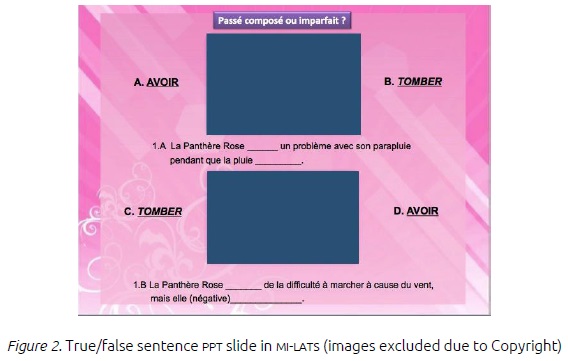
<body><![CDATA[<p align="justify"><font face="verdana" size="2">Based on these issues, this study examined the interplay between the type of&nbsp;MI, L2 proficiency level and different types of L2 learner attitudes. Specifically, the purpose of this study was to identify the effects of two types of&nbsp;MI&nbsp;(i.e.,&nbsp;MI&nbsp;with or without&nbsp;LATS) among learners of French from two L2 proficiency levels (i.e., low or intermediate) on two types of L2 learner attitudes (i.e., attitudes towards L2 learning or towards the L2 class). </font></p>  	    <p align="justify"><font face="verdana" size="2"><i>Participants.</i>&nbsp;A total of 76 participants, who were enrolled in five different sections of a&nbsp;BA&nbsp;in Modern Languages, participated in the study. In addition to French, they were learning English and Italian as part of the&nbsp;BA&nbsp;program. The French courses focused on the development of L2 communication, linguistic awareness, and cultural knowledge. The teachers rarely used multimedia&nbsp;CD&#45;ROMs or presentations to cover the course topics. Most of the learners (<i>n</i>=70) were between 19 and 24 years old (<i>M</i><sub>age</sub>=21,&nbsp;<i>SD</i>=2). There were 14 male and 62 female learners. Over half of the participants (<i>n</i>=44) had just begun learning French in the&nbsp;BA, whereas 32 had learned French in language institutes. </font></p>  	    <p align="justify"><font face="verdana" size="2"><i>Treatment Materials</i>. Two sets of multimedia materials were developed to teach the distinctive use of the French perfective "<i>pass&eacute; compos&eacute;</i>" and imperfective "<i>imparfait</i>." The perfective marks the completeness of events, whereas the imperfective indicates the manner in which events unfold (i.e., habituality, continuity, progression). These forms were selected, because their contrastive use constitutes a documented L2 acquisition challenge. In immersion programs in Canada (Harley, 1992; Harley &amp; Swain, 1978) and language classes in North America (Izquierdo &amp; Collins, 2008; Izquierdo, 2009, 2014) and Europe (Howard, 2001, 2002), learners with high L2 proficiency levels often exhibit a preference for the use of emerging past&#45;tense forms (See Example 1) in contexts where the French native speakers would prefer forms characterizing the advanced use of the past tense (See Example 2). </font></p>  	    <p align="justify"><font face="verdana" size="2">To expose learners to the target forms, two sets of&nbsp;MI&nbsp;materials were designed. Set 1 operationalized&nbsp;MI&nbsp;without Language Awareness Tasks (MI&#45;LATS), whereas Set 2 was designed to include&nbsp;MI&nbsp;with Language Awareness Tasks (MI+LATS). Both sets included the same contexts (<i>n</i>=96) for the treatment of emergent and advanced perfective and imperfective forms. Two silent episodes of The Pink Panther Show were used to contextualize the use of the past tense forms. Lesson 1 and 2 built upon the&nbsp;<i>Put&#45;Put</i>,&nbsp;<i>Pink</i>&nbsp;episode (Ryan, 1968), whereas Lessons 3 and 4 dealt with the&nbsp;<i>Pink Panic</i>&nbsp;episode (Dunn, 1967). <a href="/img/revistas/redie/v17n2/a8t1.jpg" target="_blank">Table I</a> displays&nbsp;MI&nbsp;material organization.</font></p>  	    <p align="justify"><font face="verdana" size="2">Set 1 exposed learners to the use of the past tense through meaning&#45;based&nbsp;MI&nbsp;via comprehension and production tasks only. Following the design of previous&nbsp;MI&nbsp;studies (Izquierdo, 2007, 2014), Lessons 1 and 3 were implemented through comprehension&#45;based tasks using a&nbsp;CD&#45;ROM&nbsp;application, which the participants used individually under teacher surveillance in the computer lab during in&#45;class time. The application required learners to identify a series of sentences about the lesson video story as true or false. Throughout the application, interactive annotations with definitions and pictures were provided in the lower part of the screen for potentially unknown words. The application presented the video&#45;cartoon in eight segments. Prior to watching each segment, learners read four statements about the story (<a href="#f1">Figure 1</a>). After the segment, the four statements were presented again. If learners were ready to answer, they moved through a series of screens to indicate, using true or false push buttons, the veracity of the statements. Correct answers led to a cheering statement and feedback on the video cartoon plot. No feedback on form was provided on the&nbsp;CD&nbsp;materials (for a discussion on the distinction between feedback on form and meaning, see Lyster &amp; Izquierdo, 2009). If the answer was not correct, an incorrect selection statement and a textual and a pictorial explanation were provided (see Izquierdo, 2014, p. 200).</font></p>  	    <p align="center"><font face="verdana" size="2">&nbsp;<a name="f1"></a></font></p>  	    <p align="center"><font face="verdana" size="2"><img src="/img/revistas/redie/v17n2/a8f1.jpg"></font></p>  	    <p align="justify"><font face="verdana" size="2">During Lessons 2 and 4, the production tasks were implemented using PowerPoint (PPT) presentations. These lessons were teacher&#45;fronted and acted as classroom follow&#45;up lessons to help learners consolidate Lessons 1 and 3. For each lesson, a&nbsp;PPT&nbsp;including 64 true/false sentences about the story plot was used. Each sentence was presented on a&nbsp;PPT&nbsp;slide (See <a href="#f1">Figure 1</a>). After reading two sentences, learners worked in triads to discuss the sentence veracity. Then, triads discussed their answer with the class. Finally, the teacher clicked on the&nbsp;PPT presentation to show the target sentences and pictures from the cartoon to confirm or dismiss the class answers. In order to help learners visually perceive the target forms, the verbs with the perfective were highlighted in blue and the verbs in imperfective were in green.</font></p>  	    <p align="justify"><font face="verdana" size="2">Set 2 exposed learners to meaning&#45;based&nbsp;MI&nbsp;with&nbsp;LATs. Following the design of L2 studies including&nbsp;LATs that led to significant L2 learning effects in regular classroom contexts (see Lyster, 2004), this&nbsp;MI&nbsp;type included tasks providing learners with opportunities to discuss the form&#45;meaning relationship of the past tense in sentences embedded in meaning&#45;oriented contexts. </font></p>  	    <p align="justify"><font face="verdana" size="2">The comprehension&#45;based tasks from Lessons 1 and 3 in Set 1 were retained in Set 2 to present identical meaning&#45;oriented contexts across the experimental sets. Nevertheless, the production tasks in Lessons 2 and 4 from Set 1 were slightly modified for Set 2 to help learners reflect upon the use of L2 past&#45;tense forms in the true/false meaning&#45;oriented sentences. In the&nbsp;PPT&nbsp;sentences, the verbs were removed and presented on the slide margin. In addition, an image from the video cartoon was presented to illustrate the event referred to in the sentence. After the teacher presented two sentences, the learners, again in triads, agreed on the verb missing in the sentence and the past marker rendering the story event referred to in the video&#45;cartoon image. Then, the learners discussed their verb and past tense choice. After the discussion, the teacher clicked on the&nbsp;PPT&nbsp;to complete the sentence and checked the class' answer.</font></p>  	    ]]></body>
<body><![CDATA[<p align="center"><font face="verdana" size="2"><img src="/img/revistas/redie/v17n2/a8f2.jpg"></font></p>  	    <p align="justify"><font face="verdana" size="2">During a three&#45;hour workshop, the researchers presented the project and the materials to the participating lecturers, who agreed to implement one of the&nbsp;MI&nbsp;sets in their classes, as their syllabi required them to review the past tense forms. The lecturers selected their corresponding&nbsp;MI&nbsp;set in line with their teaching preference. Set 1 was implemented in three French sections, whereas Set 2 was implemented in two sections. Each set included an implementation manual. In order not to bias the project results, the lecturers agreed to cover the French past using the&nbsp;MI&nbsp;set only.</font></p>  	    <p align="justify"><font face="verdana" size="2"><i>Proficiency test</i>. Following the methodology of L2 developmental studies (see Bardovi&#45;Harlig, 2000; Collins, 2002), a past&#45;tense knowledge test was designed to group learners&nbsp;into the two proficiency levels.<sup><a href="#notas">2</a></sup> It included 20 written passages with short dialogues and narratives. In the passages, the verbs were removed from the sentences and provided in parentheses. Based on each passage story plot, learners inflected the verbs for present, past or future, as the excerpt below illustrates. </font></p>  	    <p align="justify"><font face="verdana" size="2">Excerpt from the proficiency test (Situation12) </font></p>  	    <p align="justify"><font face="verdana" size="2">A: Hein ! J'ai entendu dire que ton p&egrave;re a gagn&eacute; le loto. </font></p>  	    <p align="justify"><font face="verdana" size="2">B: Oui. Durant le week&#45;end, je (visionner) ___________ mon film favorite quand ma s&oelig;ur m'a t&eacute;l&eacute;phon&eacute; pour m'annoncer la nouvelle. </font></p>  	    <p align="justify"><font face="verdana" size="2">Excerpt translation&nbsp;</font></p>  	    <p align="justify"><font face="verdana" size="2">A: Hey, I heard your dad won the lottery!&nbsp;</font></p>  	    <p align="justify"><font face="verdana" size="2">B: Yes. Last weekend, I (watch) _________my favourite film when my sister rang me up to share the news. </font></p>  	    <p align="justify"><font face="verdana" size="2">The test included 50 obligatory contexts for the use of the perfective and imperfective and 18 distractors eliciting present (<i>n</i>=9) and future (<i>n</i>=9) forms. The use of the target L2 forms across the 74 verbs was piloted with nine university&#45;educated Francophones (aged 28&#45;50 years). To avoid high scores resulting from biased production of emergent past&#45;tense forms only, the 50 past&#45;tense items included a balanced number of contexts (25 for each) for the emergent and advanced use of the perfective and imperfective (for details, see Izquierdo &amp; Collins, 2008). </font></p>  	    ]]></body>
<body><![CDATA[<p align="justify"><font face="verdana" size="2">The learners received one point for each correct answer for both the perfective and imperfective items. Thus, their scores could range from 0 to 50. Using the Francophones' answers, two research assistants scored each test independently. The comparisons between the research assistants' scores yielded a disagreement rate of 39% (30/76). Yet, an inter&#45;rater reliability check for the overall test score agreement of the two research assistants yielded a high Pearson correlation coefficient,&nbsp;<i>r</i>=.996,&nbsp;<i>&#961;</i>&lt;.001. Nevertheless, the assistants scored the problematic tests again and reached a consensus. </font></p>  	    <p align="justify"><font face="verdana" size="2"><i>Attitude/Motivation Test Battery (AMTB)</i>. To examine the learner attitudes toward the L2 class and L2 learning, Gardner's (1985b) revised version of the&nbsp;AMTB&nbsp;was chosen, as its items were designed for L2 learners of French and were validated in various international contexts. The&nbsp;AMTB&nbsp;was developed for English&#45;speaking Canadian learners of French. Thus, some sections elicited opinions toward French Canadians, interest in integrating in French&#45;speaking Canada and the utilitarian value of French in Canada. Due to this issue, only the seven&nbsp;AMTB sections presented in <a href="/img/revistas/redie/v17n2/a8t2.jpg" target="_blank">Table II</a> were&nbsp;retained<sup><a href="#notas">3</a></sup> as they related to the learner attitudes of interest for the study. The test was translated to Spanish and piloted with learners of French at the participating university's language center. The piloting revealed no problems with the Spanish version.</font></p> 	    <p align="justify"><font face="verdana" size="2">From Sections 1 to 3, answers related to agreement reactions with a statement (Example 3). The items in the remaining sections elicited the learners' evaluative reactions toward the French class (Example 4; the scores underneath the scale choices were omitted in the test). For all items, the scores ranged from one to seven depending on how positive the expressed opinion was. Two counter&#45;balanced versions of the&nbsp;AMTB&nbsp;were used. The same items were presented in reverse order. During the pre&#45;test, half the learners answered version A and the other half answered version B. During the post&#45;test, the test versions were alternated. </font></p>     <p align="justify"><font face="verdana" size="2">Example 3. Section 2, Item 1 (Gardner, 1985b, pp. 17&#45;18) </font></p>  	    <p align="justify"><font face="verdana" size="2">Circle the alternative below the statement which best indicates your feeling.</font></p>  	    <p align="justify"><font face="verdana" size="2">If I were visiting a foreign country, I would like to be able to speak the language of the people.</font></p>  	    <p align="center"><font face="verdana" size="2"><img src="/img/revistas/redie/v17n2/a8i3.jpg"></font></p>  	    <p align="justify"><font face="verdana" size="2">Example 4. Section 16, Item 1 (Gardner, 1985b, pp. 23, 25) </font></p>  	    <p align="justify"><font face="verdana" size="2">Place a checkmark in the scale below to rate your French course. </font></p>  	    <p align="justify"><font face="verdana" size="2">1. My French course is</font></p>  	    ]]></body>
<body><![CDATA[<p align="center"><font face="verdana" size="2"><img src="/img/revistas/redie/v17n2/a8i4.jpg"></font></p>  	    <p align="justify"><font face="verdana" size="2">The learners received one score for each of the seven&nbsp;AMTB&nbsp;sections retained for the study, as the value given through the evaluation reactions were added up by section. For each testing occasion, seven scores were computed per learner. In total, 1064 scores were included in the statistical analyses. Two research assistants scored each test independently. Although the comparisons between the research assistants' scores yielded a disagreement rate of 1% (11/1064), an inter&#45;rater reliability check for overall agreement on the answer codifications revealed a Cronbach's alpha coefficient of 1. The assistants computed the problematic scores again to reach a consensus. </font></p>  	    <p align="justify"><font face="verdana" size="2"><i>Experimental Conditions</i>. Within their French sections, participants were classified into one of two past&#45;tense proficiency levels based on the results of the past&#45;tense test. In the test, the scores ranged from 1 to 44 points. To create two equal score ranges, the split point was set at 22. Participants with a score between one and 22 points were classified at a low past&#45;tense proficiency level (<i>n</i>=34,&nbsp;<i>M</i>=16.65,&nbsp;<i>SD</i>=3.76). Participants who scored over 22 points were classified at an intermediate past&#45;tense proficiency level (<i>n</i>=42, <i>M</i>=31.17,&nbsp;<i>SD</i>=6.70). The combination of the learner past&#45;tense proficiency and the&nbsp;MI&nbsp;implemented in the French sections led to four experimental conditions: learners with low past&#45;tense proficiency exposed to&nbsp;MI+LATS&nbsp;(<i>n</i>=17,&nbsp;<i>M</i>=16.35,&nbsp;<i>SD</i>=3.67) and&nbsp;MI&#45;LATS&nbsp;(<i>n</i>=17,&nbsp;<i>M</i>=16.94,&nbsp;<i>SD</i>=3.93); and learners with intermediate past&#45;tense proficiency exposed to&nbsp;MI+LATS (<i>n</i>=14,&nbsp;<i>M</i>= 29.79,&nbsp;<i>SD</i>=6.29) and&nbsp;MI&#45;LATS&nbsp;(<i>n</i>=28,&nbsp;<i>M</i>=31.86,&nbsp;<i>SD</i>=6.91). </font></p>  	    <p align="justify"><font face="verdana" size="2">Two&#45;way&nbsp;ANOVAs&nbsp;were conducted to identify significant effects for L2 past&#45;tense knowledge and type of&nbsp;MI&nbsp;across conditions. With &#945;=.05, the results yielded a significant effect for past&#45;tense proficiency only,&nbsp;<i>F</i>(1,72)=113.67, <i>&#961;</i>&lt;.001, with a large Cohen's effect size,&nbsp;<i>d</i>=2.78, and thus, confirmed that learners classified at an intermediate level had more control over past&#45;tense forms than their less proficient counterparts.</font></p>  	    <p>&nbsp;</p>  	    <p align="justify"><font face="verdana" size="2"><b>III. Analyses &amp; Results&nbsp;</b></font></p>  	    <p align="justify"><font face="verdana" size="2"><i>Statistical Analyses Procedures.</i>&nbsp;To identify significant effects between and within the experimental conditions, the data from each&nbsp;AMTB&nbsp;section were analysed independently using three types of non&#45;parametric analyses. Non&#45;parametric tests were selected due to the ordinal nature of the&nbsp;AMTB&nbsp;rating scales (Romano, Kromrey, Coraggio &amp; Skowronek, 2006). The Wilcoxon test was used to identify attitudinal changes within each experimental condition, as the data were elicited from the same learners but at two different testing times (see Fields, 2005). To examine attitudinal differences between the four experimental conditions, the Kruskal&#45;Wallis test was used, as the data came from more than two groups during the same testing time (Fields, 2005). Effects were significant when their p was smaller than &#945;=.05. </font></p>  	    <p align="justify"><font face="verdana" size="2">When the Kruskal&#45;Wallis test revealed a significant effect, two<i>&nbsp;post&#45;hoc</i>&nbsp;pairwise comparisons were conducted using the Mann&#45;Whitney test. One comparison was made between the learners with low past&#45;tense proficiency exposed to&nbsp;MI+LATS&nbsp;and&nbsp;MI&#45;LATS. The second comparison was made between learners with intermediate past&#45;tense proficiency exposed to&nbsp;MI+LATS&nbsp;and&nbsp;MI&#45;LATS. The Mann&#45;Whitney test was selected, as the data came from two experimental conditions during the same testing time (Fields, 2005). To avoid the Type I error during the post&#45;hoc comparisons, the &#945; was adjusted to .025 using the&nbsp;<i>Bonferroni</i>&nbsp;method (Fields, 2005). This alpha resulted from dividing .05 by the number of&nbsp;<i>post&#45;hoc</i>&nbsp;comparisons. </font></p>  	    <p align="justify"><font face="verdana" size="2">For significant group differences, the effect size estimate,&nbsp;<i>r</i>, was computed by dividing the<i>&nbsp;z</i>&#45;score test statistic provided by the statistical software,<i>&nbsp;SPSS</i>&nbsp;v.18, for the group comparison by the square root of the total number of participants involved in the group comparison. An&nbsp;<i>r</i>&nbsp;below .3 represented a small effect size; an<i>&nbsp;r</i>&nbsp;between .3 and .5 indicated a medium effect size; finally, an&nbsp;<i>r&nbsp;</i>above .5 indicated a large effect size (Fields, 2005). </font></p>  	    <p align="justify"><font face="verdana" size="2"><i>AMTB version score differences.</i> Prior to analyzing the effects of the MI experimental conditions on the attitudinal scores, Mann&#45;Whitney analyses were conducted on the global AMTB scores to identify differences between&nbsp;AMTB versions at each testing time. The analyses yielded no significant differences between version A (<i>n</i>=40, <i>Mdn</i>=283) and version B (<i>n</i>=36, <i>Mdn</i>=273) during the pre&#45;test,&nbsp;<i>U</i>=569,&nbsp;<i>&#961;</i>=.116. Neither did the analyses reveal a significant difference between version A (<i>n</i>=37,&nbsp;<i>Mdn</i>=278) and B (<i>n</i>=39,&nbsp;<i>Mdn</i>=275) during the post&#45;test,&nbsp;<i>U</i>=713, <i>&#961;</i>=.930. Thus, the versions were pooled.</font></p>  	    ]]></body>
<body><![CDATA[<p align="justify"><font face="verdana" size="2"><i>AMTB&nbsp;score differences between experimental conditions during the pre&#45;test</i>. Across the four experimental groups, the Kruskal&#45;Willis test results in <a href="/img/revistas/redie/v17n2/a8t3.jpg" target="_blank">Table III</a> indicated similar levels of interest in foreign languages, attitudes toward learning French, French course evaluation, French course difficulty, and French course utility in the pre&#45;test. The pre&#45;test score analyses pointed to between&#45;groups differences only with respect to learners' anxiety and interest in the class. Yet, the&nbsp;<i>post&#45;hoc</i>&nbsp;comparisons presented in <a href="/img/revistas/redie/v17n2/a8t4.jpg" target="_blank">Table IV</a> did not reveal significant differences between&nbsp;MI&#45;LATS&nbsp;and&nbsp;MI+LATS&nbsp;within each past&#45;tense condition. In terms of learner anxiety, the&nbsp;<i>post&#45;hoc</i>&nbsp;comparisons revealed similar anxiety levels between learners at early stages of past&#45;tense marking exposed to&nbsp;MI+LATS&nbsp;and&nbsp;MI&#45;LATS (<i>U</i>=107, <i>&#961;</i>=.195) and between learners at late stages of past&#45;tense marking exposed to&nbsp;MI+LATS&nbsp;and&nbsp;MI&#45;LATS, (<i>U</i>=123.5,&nbsp;<i>&#961;</i>=.05). In terms of course interest, the&nbsp;<i>post&#45;hoc</i>&nbsp;comparisons did not reveal significant differences between learners at early stages of past&#45;tense marking exposed to&nbsp;MI+LATS&nbsp;and&nbsp;MI&#45;LATS&nbsp;(<i>U</i>=96, <i>&#961;</i>=.09) or between learners at late stages of past&#45;tense marking exposed to&nbsp;MI+LATS&nbsp;and&nbsp;MI&#45;LATS, (<i>U</i>=122.5, <i>&#961;</i>=.04).</font></p>  	    <p align="justify"><font face="verdana" size="2"><i>AMTB&nbsp;score changes within experimental conditions</i>. The Wilcoxon results, presented in <a href="/img/revistas/redie/v17n2/a8t5.jpg" target="_blank">Table V</a>, revealed that neither type of&nbsp;MI&nbsp;led to attitude changes among low&#45;proficient learners from pre&#45;test to post test. Yet, within the more proficient learners, the analyses revealed the evolution of different attitudes depending on&nbsp;MI&nbsp;condition (see <a href="/img/revistas/redie/v17n2/a8t3.jpg" target="_blank">Table III</a>). MI+LATS&nbsp;did not alter any of the learner attitudes between the pre and post&#45;tests. However,&nbsp;MI&#45;LATS&nbsp;led to positive changes with respect to attitudes toward learning French,&nbsp;<i>&#961;</i>=.03,&nbsp;<i>r</i>=.39, French course evaluation,&nbsp;<i>&#961;</i>=.01, <i>r</i>=.49, and French course interest,&nbsp;<i>&#961;</i>=.01, <i>r</i>=.72.</font></p>  	    <p>&nbsp;</p>  	    <p align="justify"><font face="verdana" size="2"><b>IV. Discussion</b></font></p>  	    <p align="justify"><font face="verdana" size="2">The attitudes teachers and students hold toward technology can intervene in the successful integration of computers in educational practices (Bax, 2003; O'Connor &amp; Gatton, 2003). To expand our understanding of the variables influencing L2 learner attitudes, this study examined the relationship between the type of&nbsp;MI, the L2 learner proficiency profile, and various L2 learner attitude types. </font></p>  	    <p align="justify"><font face="verdana" size="2">Our results suggest that&nbsp;LATS&nbsp;were well received among the participants in&nbsp;MI, since their use did not alter the various attitude types examined among the learners with different past&#45;tense proficiency levels. The meaning&#45;based&nbsp;MI&nbsp;condition (i.e.,&nbsp;MI&#45;LATS), however, prompted positive changes among the most past&#45;tense proficient learners with respect to their attitudes toward learning French, their French course evaluation, and their French course interest. These findings suggest that the&nbsp;MI&nbsp;type can interact with the L2 proficiency of learners affecting different learner attitude types. </font></p>  	    <p align="justify"><font face="verdana" size="2">These findings are congruent with previous research showing that the&nbsp;MI&nbsp;experience can foster positive L2 learner attitudes toward the instructional materials (e.g., Ayres, 2002; Leakey &amp; Ranchoux, 2006; Sagarra &amp; Zapata, 2008). These results lend support to the need for a differentiation in the attitude types that intervene during computer instruction (e.g., Mahfouz &amp; Ihmeideh, 2009; VanAacken, 1999). They provide support for the arguments that&nbsp;CALL&nbsp;research should explore the manner in which variations in the learner profile and the instructional approach within a computerized learning context influence L2 learner results (Chapelle, 2004; Izquierdo, 2014; Reeder et al, 2004). </font></p>  	    <p align="justify"><font face="verdana" size="2">While&nbsp;MI&nbsp;positively influenced learners' attitudes toward the L2 class, learner attitudes towards the process of L2 learning remained stable within the meaning&#45;based group during the experiment. Gardner (1985a) and his associates argued that learner attitudes toward the instructional context could vary depending on the learners' likes and dislikes of teaching strategies and the teacher. Learner attitudes toward L2 learning, however, are deeply rooted in the willingness, desire and efforts of learners to learn a new language. Due to this difference, it might then be possible that&nbsp;MI&nbsp;could lead to a gradual development of L2 learner attitudes, where&nbsp;MI&nbsp;would, first, influence classroom&#45;related attitudes and, then, attitudes toward L2 learning. Given the classroom nature of the experiment, the participating teachers' syllabus compliance with time played a determinant role in the length of the MI administered. Thus, future research could address the impact of&nbsp;MI&nbsp;delivered over longer periods of times and sustained instructional approaches on the gradual development of the various types of L2 learner attitudes in classrooms. </font></p>  	    <p align="justify"><font face="verdana" size="2">The learner attitude responses to&nbsp;MI&#45;LATS&nbsp;were partially congruent with two assumptions behind the study. Building upon Krashen's (1992, 1994) argument that overt instruction on the L2 increases anxiety, learner attitudes were expected to negatively respond to&nbsp;MI+LATS. Yet, the statistical results were not in line with this expectation. The second assumption was that the absence of&nbsp;LATS&nbsp;in&nbsp;MI&nbsp;would foster a large range of attitudinal changes. Nonetheless, as previously discussed, changes were only observed with respect to learner attitudes towards the classroom context. These reactions towards&nbsp;LATS&nbsp;could relate to the prior instruction experience of the participants. In their L2 program, learners usually complete tasks that overtly draw their attention to L2 communicative competence and linguistic awareness. This learning experience resembled the L2 instructional approach of&nbsp;MI+LATS. Thus, for these participants,&nbsp;MI+LATS&nbsp;represented a change in the instructional modality, since teachers rarely used multimedia, but did not involve an instructional approach change. MI&#45;LATS, however, implied a higher degree of instructional novelty due to a change in the instructional approach, as the learners fully experienced meaning&#45;based instruction with respect to grammar learning, and in a new instructional modality, as the L2 exposure occurred through multimedia. Indeed, studies conducted in various instructional contexts indicate that a change in the instructional approach and modality could lead to divergent attitudes among L2 learners (e.g., Leakey &amp; Ranchoux, 2006; Loucky, 2005; Sagarra &amp; Zapata, 2008). However, research is needed to determine the extent to which the novelty effect can foster long&#45;term L2 learning benefits (Chapelle, 2001).</font></p> 	    <p align="justify"><font face="verdana" size="2">The attitude changes that&nbsp;MI&#45;LATS&nbsp;fostered among the most proficient past&#45;tense learners provide empirical support for our argument that the stage of L2 grammar development at which learners receive a certain type of&nbsp;MI&nbsp;could have an impact on their attitudes (De la Cruz &amp; Izquierdo, 2014; Izquierdo, 2007, 2014). Unlike our previous studies (Izquierdo, 2007, 2014), in the current study, learners from both L2 past&#45;tense knowledge proficiency levels were exposed to the same level of L2 complexity, as the multimedia materials included an equal number of emergent and advanced developmental forms. Nevertheless, while this exposure might have provided learners in both proficiency conditions with an appropriate L2 learning challenge level, the&nbsp;MI&nbsp;type whereby the target forms were delivered interacted with the L2 learner profile. During the classroom&#45;based tasks, learners needed to interact with their peers in the L2. Among learners in the&nbsp;MI+LATS, one difficulty might have related to the language and terminology required to explain their past&#45;tense choices. Indeed, L2 acquisition research has provided evidence that the language required to talk about the language can intervene with task completion (Garc&iacute;a&#45;Mayo, 2007). The least proficient learners using&nbsp;MI&#45;LATS&nbsp;also needed the L2 to justify the veracity of the true&#45;false statements and, to do so these learners might have needed lexical and grammatical forms beyond their L2 capabilities.</font></p>     ]]></body>
<body><![CDATA[<p>&nbsp;</p>  	    <p align="justify"><font face="verdana" size="2"><b>V. Conclusion</b></font></p>  	    <p align="justify"><font face="verdana" size="2">Our results suggest that attitudinal changes could occur once the learners have attained a late stage of L2 grammar proficiency. Nevertheless, their acquaintance with&nbsp;LATS&nbsp;through their regular classroom&#45;learning experience could have influenced the results. MI+LATS&nbsp;mostly represented an instructional modality change (i.e., multimedia). Yet,&nbsp;MI&#45;LATS&nbsp;involved a change in both instruction type and modality. The most proficient learners could have found extensive opportunities to practice the L2 forms that they were ready for in the meaning&#45;oriented nature of&nbsp;MI&#45;LATS, outside their regular classroom learning conditions. These results point to the importance of varying the instructional materials and tasks as learner proficiency and learning experience evolve. Moreover, they suggest that changes towards classroom&#45;related attitudes prompted through instructional modality might not necessarily foster changes in attitudes intrinsically rooted in the willingness, desire and efforts to learn a new language.</font></p>  	    <p>&nbsp;</p>  	    <p align="justify"><font face="verdana" size="2"><b>Referencias</b></font></p>  	    <!-- ref --><p align="justify"><font face="verdana" size="2">Andersen, R. W. (1991). Developmental sequences: The emergence of aspect marking in second language acquisition. In C. A. Ferguson &amp; T. Huebner (Eds.),&nbsp;<i>Crosscurrents in second language acquisition and linguistic theories</i>&nbsp;(pp. 305&#45;324). Amsterdam: John Benjamins.    &nbsp;&nbsp;&nbsp;&nbsp;&nbsp;&nbsp;&nbsp;&nbsp;[&#160;<a href="javascript:void(0);" onclick="javascript: window.open('/scielo.php?script=sci_nlinks&ref=7039238&pid=S1607-4041201500020000800001&lng=','','width=640,height=500,resizable=yes,scrollbars=1,menubar=yes,');">Links</a>&#160;]<!-- end-ref --></font></p>  	    <!-- ref --><p align="justify"><font face="verdana" size="2">Andersen, R. W. (2002). The dimensions of pastness. In R. Salaberry &amp; Y. Shirai (Eds.),&nbsp;<i>The L2 acquisition of tense&#45;aspect morphology</i>&nbsp;(pp. 79&#45;105). Amsterdam: John Benjamins.    &nbsp;&nbsp;&nbsp;&nbsp;&nbsp;&nbsp;&nbsp;&nbsp;[&#160;<a href="javascript:void(0);" onclick="javascript: window.open('/scielo.php?script=sci_nlinks&ref=7039240&pid=S1607-4041201500020000800002&lng=','','width=640,height=500,resizable=yes,scrollbars=1,menubar=yes,');">Links</a>&#160;]<!-- end-ref --></font></p>  	    <!-- ref --><p align="justify"><font face="verdana" size="2">Ayres, R. (2002). Learner attitudes towards the use of&nbsp;CALL. <i>Computer Assisted Language Learning, 15</i>, 241&#45;249.    &nbsp;&nbsp;&nbsp;&nbsp;&nbsp;&nbsp;&nbsp;&nbsp;[&#160;<a href="javascript:void(0);" onclick="javascript: window.open('/scielo.php?script=sci_nlinks&ref=7039242&pid=S1607-4041201500020000800003&lng=','','width=640,height=500,resizable=yes,scrollbars=1,menubar=yes,');">Links</a>&#160;]<!-- end-ref --></font></p>  	    <!-- ref --><p align="justify"><font face="verdana" size="2">Bardovi&#45;Harlig, K. (2000). <i>Tense and aspect in second language acquisition: Form, meaning, and use</i>. Oxford: Blackwell.    &nbsp;&nbsp;&nbsp;&nbsp;&nbsp;&nbsp;&nbsp;&nbsp;[&#160;<a href="javascript:void(0);" onclick="javascript: window.open('/scielo.php?script=sci_nlinks&ref=7039244&pid=S1607-4041201500020000800004&lng=','','width=640,height=500,resizable=yes,scrollbars=1,menubar=yes,');">Links</a>&#160;]<!-- end-ref --> </font></p>  	    <!-- ref --><p align="justify"><font face="verdana" size="2">Bax, S. (2003).<i>&nbsp;CALL&nbsp;&#45;past, present and future. System,&nbsp;31</i>, 13&#45;28.    &nbsp;&nbsp;&nbsp;&nbsp;&nbsp;&nbsp;&nbsp;&nbsp;[&#160;<a href="javascript:void(0);" onclick="javascript: window.open('/scielo.php?script=sci_nlinks&ref=7039246&pid=S1607-4041201500020000800005&lng=','','width=640,height=500,resizable=yes,scrollbars=1,menubar=yes,');">Links</a>&#160;]<!-- end-ref --></font></p>  	    <!-- ref --><p align="justify"><font face="verdana" size="2">Chapelle, C. (1998). Multimedia&nbsp;CALL: Lessons to be learned from research on instructed&nbsp;SLA. <i>Language Learning and Technology, 2</i>, 22&#45;34.    &nbsp;&nbsp;&nbsp;&nbsp;&nbsp;&nbsp;&nbsp;&nbsp;[&#160;<a href="javascript:void(0);" onclick="javascript: window.open('/scielo.php?script=sci_nlinks&ref=7039248&pid=S1607-4041201500020000800006&lng=','','width=640,height=500,resizable=yes,scrollbars=1,menubar=yes,');">Links</a>&#160;]<!-- end-ref --> </font></p>  	    <!-- ref --><p align="justify"><font face="verdana" size="2">Chapelle, C. (2001). <i>Computer applications in second language acquisition.</i> New York: Cambridge University Press.    &nbsp;&nbsp;&nbsp;&nbsp;&nbsp;&nbsp;&nbsp;&nbsp;[&#160;<a href="javascript:void(0);" onclick="javascript: window.open('/scielo.php?script=sci_nlinks&ref=7039250&pid=S1607-4041201500020000800007&lng=','','width=640,height=500,resizable=yes,scrollbars=1,menubar=yes,');">Links</a>&#160;]<!-- end-ref --></font></p>  	    <!-- ref --><p align="justify"><font face="verdana" size="2">Chapelle, C. (2004). Technology and second language learning: Expanding methods and agendas. <i>System</i>,&nbsp;<i>32</i>, 593&#45;601.    &nbsp;&nbsp;&nbsp;&nbsp;&nbsp;&nbsp;&nbsp;&nbsp;[&#160;<a href="javascript:void(0);" onclick="javascript: window.open('/scielo.php?script=sci_nlinks&ref=7039252&pid=S1607-4041201500020000800008&lng=','','width=640,height=500,resizable=yes,scrollbars=1,menubar=yes,');">Links</a>&#160;]<!-- end-ref --> </font></p>  	    <!-- ref --><p align="justify"><font face="verdana" size="2">Collins, L. (2002). The role of L1 influence and lexical aspect in the acquisition of temporal morphology. <i>Language Learning</i>,&nbsp;<i>52</i>, 43&#45;94.    &nbsp;&nbsp;&nbsp;&nbsp;&nbsp;&nbsp;&nbsp;&nbsp;[&#160;<a href="javascript:void(0);" onclick="javascript: window.open('/scielo.php?script=sci_nlinks&ref=7039254&pid=S1607-4041201500020000800009&lng=','','width=640,height=500,resizable=yes,scrollbars=1,menubar=yes,');">Links</a>&#160;]<!-- end-ref --> </font></p>  	    <!-- ref --><p align="justify"><font face="verdana" size="2">De la Cruz, V., &amp; Izquierdo, J. (2014). Multimedia Instruction on Latin Roots of the English Language and L2 Vocabulary Learning in Higher Education Contexts: Learner Proficiency Effects. <i>Sin&eacute;ctica</i>,&nbsp;<i>Revista Electr&oacute;nica de Educaci&oacute;n</i>,&nbsp;<i>42</i>, 1&#45;11.    &nbsp;&nbsp;&nbsp;&nbsp;&nbsp;&nbsp;&nbsp;&nbsp;[&#160;<a href="javascript:void(0);" onclick="javascript: window.open('/scielo.php?script=sci_nlinks&ref=7039256&pid=S1607-4041201500020000800010&lng=','','width=640,height=500,resizable=yes,scrollbars=1,menubar=yes,');">Links</a>&#160;]<!-- end-ref --> </font></p>  	    <!-- ref --><p align="justify"><font face="verdana" size="2">Dunn, J. W. (Writer) (1967). Pink Panic, <i>The Pink Panther Show. </i>U.S.A.: United Artists.    &nbsp;&nbsp;&nbsp;&nbsp;&nbsp;&nbsp;&nbsp;&nbsp;[&#160;<a href="javascript:void(0);" onclick="javascript: window.open('/scielo.php?script=sci_nlinks&ref=7039258&pid=S1607-4041201500020000800011&lng=','','width=640,height=500,resizable=yes,scrollbars=1,menubar=yes,');">Links</a>&#160;]<!-- end-ref --></font></p>  	    <!-- ref --><p align="justify"><font face="verdana" size="2">Ellis, R. (2001). Investigating form&#45;focussed instruction. <i>Language Learning</i>,&nbsp;<i>51</i>, 1&#45;46.    &nbsp;&nbsp;&nbsp;&nbsp;&nbsp;&nbsp;&nbsp;&nbsp;[&#160;<a href="javascript:void(0);" onclick="javascript: window.open('/scielo.php?script=sci_nlinks&ref=7039260&pid=S1607-4041201500020000800012&lng=','','width=640,height=500,resizable=yes,scrollbars=1,menubar=yes,');">Links</a>&#160;]<!-- end-ref --> </font></p>  	    <!-- ref --><p align="justify"><font face="verdana" size="2">Felix, U. (2008). The unreasonable effectiveness of&nbsp;CALL: What have we learned in two decades of research? <i>ReCALL</i>,&nbsp;<i>20</i>, 141&#45;161.    &nbsp;&nbsp;&nbsp;&nbsp;&nbsp;&nbsp;&nbsp;&nbsp;[&#160;<a href="javascript:void(0);" onclick="javascript: window.open('/scielo.php?script=sci_nlinks&ref=7039262&pid=S1607-4041201500020000800013&lng=','','width=640,height=500,resizable=yes,scrollbars=1,menubar=yes,');">Links</a>&#160;]<!-- end-ref --></font></p>  	    <!-- ref --><p align="justify"><font face="verdana" size="2">Fields, A. (2005). <i>Discovering statistics using&nbsp;SPSS</i>. London,&nbsp;UK:&nbsp;SAGE.    &nbsp;&nbsp;&nbsp;&nbsp;&nbsp;&nbsp;&nbsp;&nbsp;[&#160;<a href="javascript:void(0);" onclick="javascript: window.open('/scielo.php?script=sci_nlinks&ref=7039264&pid=S1607-4041201500020000800014&lng=','','width=640,height=500,resizable=yes,scrollbars=1,menubar=yes,');">Links</a>&#160;]<!-- end-ref --> </font></p>  	    <!-- ref --><p align="justify"><font face="verdana" size="2">Garc&iacute;a&#45;Mayo, M. P. (Ed.) (2007).<i>&nbsp;Investigating tasks in formal language learning</i>. Clevedon,&nbsp;UK: Multilingual Matters.    &nbsp;&nbsp;&nbsp;&nbsp;&nbsp;&nbsp;&nbsp;&nbsp;[&#160;<a href="javascript:void(0);" onclick="javascript: window.open('/scielo.php?script=sci_nlinks&ref=7039266&pid=S1607-4041201500020000800015&lng=','','width=640,height=500,resizable=yes,scrollbars=1,menubar=yes,');">Links</a>&#160;]<!-- end-ref --> </font></p>  	    <!-- ref --><p align="justify"><font face="verdana" size="2">Gardner, R. (1985a). <i>Social psychology and language learning: The role of attitudes and motivation</i>. London: Edward Arnold.    &nbsp;&nbsp;&nbsp;&nbsp;&nbsp;&nbsp;&nbsp;&nbsp;[&#160;<a href="javascript:void(0);" onclick="javascript: window.open('/scielo.php?script=sci_nlinks&ref=7039268&pid=S1607-4041201500020000800016&lng=','','width=640,height=500,resizable=yes,scrollbars=1,menubar=yes,');">Links</a>&#160;]<!-- end-ref --> </font></p>  	    <!-- ref --><p align="justify"><font face="verdana" size="2">Gardner, R. (1985b). <i>The Attitude/Motivation Test Battery: Technical Report</i>. London,&nbsp;ON: University of Western Ontario.    &nbsp;&nbsp;&nbsp;&nbsp;&nbsp;&nbsp;&nbsp;&nbsp;[&#160;<a href="javascript:void(0);" onclick="javascript: window.open('/scielo.php?script=sci_nlinks&ref=7039270&pid=S1607-4041201500020000800017&lng=','','width=640,height=500,resizable=yes,scrollbars=1,menubar=yes,');">Links</a>&#160;]<!-- end-ref --> </font></p>  	    <!-- ref --><p align="justify"><font face="verdana" size="2">Gardner, R., Lalonde, R., &amp; Moorcroft, R. (1985). The role of attitudes and motivation in second language learning: Correlational and experimental correlations. <i>Language Learning</i>,&nbsp;<i>35</i>, 207&#45;227.    &nbsp;&nbsp;&nbsp;&nbsp;&nbsp;&nbsp;&nbsp;&nbsp;[&#160;<a href="javascript:void(0);" onclick="javascript: window.open('/scielo.php?script=sci_nlinks&ref=7039272&pid=S1607-4041201500020000800018&lng=','','width=640,height=500,resizable=yes,scrollbars=1,menubar=yes,');">Links</a>&#160;]<!-- end-ref --> </font></p>  	    <!-- ref --><p align="justify"><font face="verdana" size="2">Gardner, R., &amp; MacIntyre, P. (1985). An instrumental motivation study in language study<i>. Studies in Second Language Acquisition</i>,&nbsp;<i>13</i>, 57&#45;72.    &nbsp;&nbsp;&nbsp;&nbsp;&nbsp;&nbsp;&nbsp;&nbsp;[&#160;<a href="javascript:void(0);" onclick="javascript: window.open('/scielo.php?script=sci_nlinks&ref=7039274&pid=S1607-4041201500020000800019&lng=','','width=640,height=500,resizable=yes,scrollbars=1,menubar=yes,');">Links</a>&#160;]<!-- end-ref --></font></p>  	    <!-- ref --><p align="justify"><font face="verdana" size="2">Gardner, R., Tremblay, P., &amp; Masgoret, A. (1997). Towards a full model of second language learning: An empirical investigation. <i>The Modern Language Journal</i>,&nbsp;<i>81</i>, 344&#45;362.    &nbsp;&nbsp;&nbsp;&nbsp;&nbsp;&nbsp;&nbsp;&nbsp;[&#160;<a href="javascript:void(0);" onclick="javascript: window.open('/scielo.php?script=sci_nlinks&ref=7039276&pid=S1607-4041201500020000800020&lng=','','width=640,height=500,resizable=yes,scrollbars=1,menubar=yes,');">Links</a>&#160;]<!-- end-ref --> </font></p>  	    <!-- ref --><p align="justify"><font face="verdana" size="2">Harley, B. (1992). Patterns of second language in French immersion. <i>French Language Studies</i>,&nbsp;<i>2</i>, 35&#45;79.    &nbsp;&nbsp;&nbsp;&nbsp;&nbsp;&nbsp;&nbsp;&nbsp;[&#160;<a href="javascript:void(0);" onclick="javascript: window.open('/scielo.php?script=sci_nlinks&ref=7039278&pid=S1607-4041201500020000800021&lng=','','width=640,height=500,resizable=yes,scrollbars=1,menubar=yes,');">Links</a>&#160;]<!-- end-ref --></font></p>  	    <!-- ref --><p align="justify"><font face="verdana" size="2">Harley, B., &amp; Swain, M. (1978). An analysis of the verb system used by young learners of French. <i>Interlanguage Studies Bulleting, 3</i>, 35&#45;79.    &nbsp;&nbsp;&nbsp;&nbsp;&nbsp;&nbsp;&nbsp;&nbsp;[&#160;<a href="javascript:void(0);" onclick="javascript: window.open('/scielo.php?script=sci_nlinks&ref=7039280&pid=S1607-4041201500020000800022&lng=','','width=640,height=500,resizable=yes,scrollbars=1,menubar=yes,');">Links</a>&#160;]<!-- end-ref --></font></p>  	    <!-- ref --><p align="justify"><font face="verdana" size="2">Howard, M. (2001). The effects of study abroad on the L2 learner's structural skills. <i>EUROSLA&nbsp;Yearbook</i>,&nbsp;<i>1</i>, 123&#45;141.    &nbsp;&nbsp;&nbsp;&nbsp;&nbsp;&nbsp;&nbsp;&nbsp;[&#160;<a href="javascript:void(0);" onclick="javascript: window.open('/scielo.php?script=sci_nlinks&ref=7039282&pid=S1607-4041201500020000800023&lng=','','width=640,height=500,resizable=yes,scrollbars=1,menubar=yes,');">Links</a>&#160;]<!-- end-ref --> </font></p>  	    <!-- ref --><p align="justify"><font face="verdana" size="2">Howard, M. (2002). Prototypical and non&#45;prototypical marking in the advanced learner's aspectuo&#45;temporal system. <i>EUROSLA&nbsp;Yearbook</i>,&nbsp;<i>2</i>, 87&#45;113.    &nbsp;&nbsp;&nbsp;&nbsp;&nbsp;&nbsp;&nbsp;&nbsp;[&#160;<a href="javascript:void(0);" onclick="javascript: window.open('/scielo.php?script=sci_nlinks&ref=7039284&pid=S1607-4041201500020000800024&lng=','','width=640,height=500,resizable=yes,scrollbars=1,menubar=yes,');">Links</a>&#160;]<!-- end-ref --> </font></p>  	    <!-- ref --><p align="justify"><font face="verdana" size="2">Izquierdo, J. (2014). Multimedia instruction in foreign language classrooms: Effects on the acquisition of the French perfective and imperfective distinction. <i>The Canadian Modern Language Review</i>,&nbsp;<i>70</i>&nbsp;(2), 188&#45;219.    &nbsp;&nbsp;&nbsp;&nbsp;&nbsp;&nbsp;&nbsp;&nbsp;[&#160;<a href="javascript:void(0);" onclick="javascript: window.open('/scielo.php?script=sci_nlinks&ref=7039286&pid=S1607-4041201500020000800025&lng=','','width=640,height=500,resizable=yes,scrollbars=1,menubar=yes,');">Links</a>&#160;]<!-- end-ref --> </font></p>  	    <!-- ref --><p align="justify"><font face="verdana" size="2">Izquierdo, J. (2009). L'aspect lexical et la production des temps du pass&eacute; en fran&ccedil;ais L2: une &eacute;tude quantitative aupr&egrave;s d'apprenants hispanophones  &#45;<i>&nbsp;La revue canadienne de langues vivantes</i>,&nbsp;<i>65</i>, 587&#45;613.    &nbsp;&nbsp;&nbsp;&nbsp;&nbsp;&nbsp;&nbsp;&nbsp;[&#160;<a href="javascript:void(0);" onclick="javascript: window.open('/scielo.php?script=sci_nlinks&ref=7039288&pid=S1607-4041201500020000800026&lng=','','width=640,height=500,resizable=yes,scrollbars=1,menubar=yes,');">Links</a>&#160;]<!-- end-ref --> </font></p>  	    <!-- ref --><p align="justify"><font face="verdana" size="2">Izquierdo, J., &amp; Collins, L. (2008). The facilitative effects of L1 influence on L2 tense&#45;aspect marking: Hispanophones and Anglophones learning French. <i>The Modern Language Journal</i>,&nbsp;<i>93</i>, 350&#45;368.    &nbsp;&nbsp;&nbsp;&nbsp;&nbsp;&nbsp;&nbsp;&nbsp;[&#160;<a href="javascript:void(0);" onclick="javascript: window.open('/scielo.php?script=sci_nlinks&ref=7039290&pid=S1607-4041201500020000800027&lng=','','width=640,height=500,resizable=yes,scrollbars=1,menubar=yes,');">Links</a>&#160;]<!-- end-ref --> </font></p>  	    <!-- ref --><p align="justify"><font face="verdana" size="2">Izquierdo, J. (2007). <i>Multimedia instruction in foreign language classrooms: Effects on the acquisition of the French perfective and imperfective distinction</i>. PhD dissertation, McGill University, Canada.    &nbsp;&nbsp;&nbsp;&nbsp;&nbsp;&nbsp;&nbsp;&nbsp;[&#160;<a href="javascript:void(0);" onclick="javascript: window.open('/scielo.php?script=sci_nlinks&ref=7039292&pid=S1607-4041201500020000800028&lng=','','width=640,height=500,resizable=yes,scrollbars=1,menubar=yes,');">Links</a>&#160;]<!-- end-ref --> </font></p>  	    <!-- ref --><p align="justify"><font face="verdana" size="2">Kawauchi, C. (2005). <i>Proficiency Differences in&nbsp;CALL&nbsp;Based Vocabulary Learning: The Effectiveness of Using "PowerWords"&nbsp;FLEAT&nbsp;5</i>, 55&#45;65.    &nbsp;&nbsp;&nbsp;&nbsp;&nbsp;&nbsp;&nbsp;&nbsp;[&#160;<a href="javascript:void(0);" onclick="javascript: window.open('/scielo.php?script=sci_nlinks&ref=7039294&pid=S1607-4041201500020000800029&lng=','','width=640,height=500,resizable=yes,scrollbars=1,menubar=yes,');">Links</a>&#160;]<!-- end-ref --> </font></p>  	    <!-- ref --><p align="justify"><font face="verdana" size="2">Krashen, S. (1992). Teaching issues: Formal grammar instruction. <i>TESOL&nbsp;Quarterly</i>,&nbsp;<i>26</i>, 409&#45;411.    &nbsp;&nbsp;&nbsp;&nbsp;&nbsp;&nbsp;&nbsp;&nbsp;[&#160;<a href="javascript:void(0);" onclick="javascript: window.open('/scielo.php?script=sci_nlinks&ref=7039296&pid=S1607-4041201500020000800030&lng=','','width=640,height=500,resizable=yes,scrollbars=1,menubar=yes,');">Links</a>&#160;]<!-- end-ref --> </font></p>  	    <!-- ref --><p align="justify"><font face="verdana" size="2">Krashen, S. (1994). The input hypothesis and its rivals. In N. Ellis (Ed.),&nbsp;<i>Implicit and explicit learning of languages</i> (pp. 45&#45;77). London: Academic Press.    &nbsp;&nbsp;&nbsp;&nbsp;&nbsp;&nbsp;&nbsp;&nbsp;[&#160;<a href="javascript:void(0);" onclick="javascript: window.open('/scielo.php?script=sci_nlinks&ref=7039298&pid=S1607-4041201500020000800031&lng=','','width=640,height=500,resizable=yes,scrollbars=1,menubar=yes,');">Links</a>&#160;]<!-- end-ref --> </font></p>  	    <!-- ref --><p align="justify"><font face="verdana" size="2">Leakey, J., &amp; Ranchoux, A. (2006). BLINGUA. A blended language learning approach for&nbsp;CALL. <i>Computer assisted language learning</i>,&nbsp;<i>19</i>, 357&#45;372.    &nbsp;&nbsp;&nbsp;&nbsp;&nbsp;&nbsp;&nbsp;&nbsp;[&#160;<a href="javascript:void(0);" onclick="javascript: window.open('/scielo.php?script=sci_nlinks&ref=7039300&pid=S1607-4041201500020000800032&lng=','','width=640,height=500,resizable=yes,scrollbars=1,menubar=yes,');">Links</a>&#160;]<!-- end-ref --> </font></p>  	    <!-- ref --><p align="justify"><font face="verdana" size="2">Loucky, J. P. (2005). Combining the benefits of electronic and online dictionaries with&nbsp;CALL&nbsp;Web sites to produce effective and enjoyable vocabulary and language learning lessons. <i>Computer Assisted Language Learning</i>, <i>18</i>, 389  &#45; 416.    &nbsp;&nbsp;&nbsp;&nbsp;&nbsp;&nbsp;&nbsp;&nbsp;[&#160;<a href="javascript:void(0);" onclick="javascript: window.open('/scielo.php?script=sci_nlinks&ref=7039302&pid=S1607-4041201500020000800033&lng=','','width=640,height=500,resizable=yes,scrollbars=1,menubar=yes,');">Links</a>&#160;]<!-- end-ref --> </font></p>  	    <!-- ref --><p align="justify"><font face="verdana" size="2">Lyster, R., &amp; Izquierdo, J. (2009). Prompts versus recasts in dyadic interaction.<i>&nbsp;Language Learning</i>,&nbsp;<i>59</i>, 453&#45;498.    &nbsp;&nbsp;&nbsp;&nbsp;&nbsp;&nbsp;&nbsp;&nbsp;[&#160;<a href="javascript:void(0);" onclick="javascript: window.open('/scielo.php?script=sci_nlinks&ref=7039304&pid=S1607-4041201500020000800034&lng=','','width=640,height=500,resizable=yes,scrollbars=1,menubar=yes,');">Links</a>&#160;]<!-- end-ref --> </font></p>  	    <!-- ref --><p align="justify"><font face="verdana" size="2">Lyster, R. (2004). Research on form&#45;focused instruction in immersion classrooms: implications for theory and practice. <i>Journal of French Language Studies</i>,&nbsp;<i>14</i>, 321&#45;341.    &nbsp;&nbsp;&nbsp;&nbsp;&nbsp;&nbsp;&nbsp;&nbsp;[&#160;<a href="javascript:void(0);" onclick="javascript: window.open('/scielo.php?script=sci_nlinks&ref=7039306&pid=S1607-4041201500020000800035&lng=','','width=640,height=500,resizable=yes,scrollbars=1,menubar=yes,');">Links</a>&#160;]<!-- end-ref --> </font></p>  	    <!-- ref --><p align="justify"><font face="verdana" size="2">Masgoret, A., &amp; Gardner, R. (2003). Attitudes, motivation and second language learning: A meta&#45;analysis of studies conducted by Gardner and associates. <i>Language Learning</i>,&nbsp;<i>53</i>, 123&#45;163.    &nbsp;&nbsp;&nbsp;&nbsp;&nbsp;&nbsp;&nbsp;&nbsp;[&#160;<a href="javascript:void(0);" onclick="javascript: window.open('/scielo.php?script=sci_nlinks&ref=7039308&pid=S1607-4041201500020000800036&lng=','','width=640,height=500,resizable=yes,scrollbars=1,menubar=yes,');">Links</a>&#160;]<!-- end-ref --> </font></p>  	    <!-- ref --><p align="justify"><font face="verdana" size="2">Mahfouz, S. &amp; Ihmeideh, F. (2009). Attitudes of Jordanian university students toward using online chat discourse with native speakers of English for improving their language proficiency. <i>Computer Assisted Language Learning</i>, <i>22</i>, 207&#45;227.    &nbsp;&nbsp;&nbsp;&nbsp;&nbsp;&nbsp;&nbsp;&nbsp;[&#160;<a href="javascript:void(0);" onclick="javascript: window.open('/scielo.php?script=sci_nlinks&ref=7039310&pid=S1607-4041201500020000800037&lng=','','width=640,height=500,resizable=yes,scrollbars=1,menubar=yes,');">Links</a>&#160;]<!-- end-ref --> </font></p>  	    <!-- ref --><p align="justify"><font face="verdana" size="2">Morales, D. &amp; Izquierdo, J. (2011). L2 Phonology Learning among Young&#45;Adult Learners of English: Effects of Regular Classroom&#45;based Instruction and L2 Proficiency. <i>Revista Electr&oacute;nica de Investigaci&oacute;n Educativa</i>,&nbsp;<i>13</i>, 1, 1&#45;22.    &nbsp;&nbsp;&nbsp;&nbsp;&nbsp;&nbsp;&nbsp;&nbsp;[&#160;<a href="javascript:void(0);" onclick="javascript: window.open('/scielo.php?script=sci_nlinks&ref=7039312&pid=S1607-4041201500020000800038&lng=','','width=640,height=500,resizable=yes,scrollbars=1,menubar=yes,');">Links</a>&#160;]<!-- end-ref --> </font></p>  	    <!-- ref --><p align="justify"><font face="verdana" size="2">O'Connor, P. &amp; Gatton, W. (2003). Implementing multimedia in a university&nbsp;EFL&nbsp;program: A case study in&nbsp;CALL. In S. Fotos and C. Browne (Eds). <i>New perspectives on&nbsp;CALL&nbsp;for second language classroooms</i>&nbsp;(pp. 199&#45;224). Mahwah,&nbsp;NJ: Lawrence Erlbaum.    &nbsp;&nbsp;&nbsp;&nbsp;&nbsp;&nbsp;&nbsp;&nbsp;[&#160;<a href="javascript:void(0);" onclick="javascript: window.open('/scielo.php?script=sci_nlinks&ref=7039314&pid=S1607-4041201500020000800039&lng=','','width=640,height=500,resizable=yes,scrollbars=1,menubar=yes,');">Links</a>&#160;]<!-- end-ref --> </font></p>  	    <!-- ref --><p align="justify"><font face="verdana" size="2">Plass, J. L., &amp; Jones, L. C. (2005). Multimedia learning in second language acquisition. In R. E. Mayer (Ed.),&nbsp;<i>The Cambridge handbook of multimedia learning</i>&nbsp;(pp. 467&#45;488). New York: Cambridge University Press.    &nbsp;&nbsp;&nbsp;&nbsp;&nbsp;&nbsp;&nbsp;&nbsp;[&#160;<a href="javascript:void(0);" onclick="javascript: window.open('/scielo.php?script=sci_nlinks&ref=7039316&pid=S1607-4041201500020000800040&lng=','','width=640,height=500,resizable=yes,scrollbars=1,menubar=yes,');">Links</a>&#160;]<!-- end-ref --> </font></p>  	    <!-- ref --><p align="justify"><font face="verdana" size="2">Reeder, K., Heift, T., Roch, J., Tabyanian, S., &amp; G&ouml;lz, P. (2004). Toward a E/Valuation for Second Language Learning Media. In S. Fotos and C. Browne (Eds). <i>New perspectives on&nbsp;CALL&nbsp;for second language classroooms</i> (pp.255 &#45;278). Mahwah,&nbsp;NJ: Lawrence Erlbaum.    &nbsp;&nbsp;&nbsp;&nbsp;&nbsp;&nbsp;&nbsp;&nbsp;[&#160;<a href="javascript:void(0);" onclick="javascript: window.open('/scielo.php?script=sci_nlinks&ref=7039318&pid=S1607-4041201500020000800041&lng=','','width=640,height=500,resizable=yes,scrollbars=1,menubar=yes,');">Links</a>&#160;]<!-- end-ref --> </font></p>  	    <!-- ref --><p align="justify"><font face="verdana" size="2">Romano, J., Kromrey, J., Coraggio, J., and Skowronek, J. (2006). <i>Appropriate statistics for ordinal level data: Should we really be using t&#45;test and Cohen's d for evaluating group differences on the&nbsp;NSSE&nbsp;and other surveys?</i> Paper presented at the Annual Meeting of the Florida Association of Institutional Research, Cocoa Beach, Florida.    &nbsp;&nbsp;&nbsp;&nbsp;&nbsp;&nbsp;&nbsp;&nbsp;[&#160;<a href="javascript:void(0);" onclick="javascript: window.open('/scielo.php?script=sci_nlinks&ref=7039320&pid=S1607-4041201500020000800042&lng=','','width=640,height=500,resizable=yes,scrollbars=1,menubar=yes,');">Links</a>&#160;]<!-- end-ref --></font></p>  	    <!-- ref --><p align="justify"><font face="verdana" size="2">Ryan, J. (Writer) (1968). Put&#45;Put, Pink, <i>The Pink Panther Show</i>. U.S.A.: DePatie&#45;Freleng Enterprises.    &nbsp;&nbsp;&nbsp;&nbsp;&nbsp;&nbsp;&nbsp;&nbsp;[&#160;<a href="javascript:void(0);" onclick="javascript: window.open('/scielo.php?script=sci_nlinks&ref=7039322&pid=S1607-4041201500020000800043&lng=','','width=640,height=500,resizable=yes,scrollbars=1,menubar=yes,');">Links</a>&#160;]<!-- end-ref --> </font></p>  	    <!-- ref --><p align="justify"><font face="verdana" size="2">Sagarra, N., &amp; Zapata, G. (2008). Blending classroom instruction with online homework: a study of student perceptions of computer&#45;assisted L2 learning. <i>ReCALL</i>,&nbsp;<i>20</i>, 208&#45;244.    &nbsp;&nbsp;&nbsp;&nbsp;&nbsp;&nbsp;&nbsp;&nbsp;[&#160;<a href="javascript:void(0);" onclick="javascript: window.open('/scielo.php?script=sci_nlinks&ref=7039324&pid=S1607-4041201500020000800044&lng=','','width=640,height=500,resizable=yes,scrollbars=1,menubar=yes,');">Links</a>&#160;]<!-- end-ref --> </font></p>  	    <!-- ref --><p align="justify"><font face="verdana" size="2">Sanz, C. (2004). Computer&#45;delivered implicit versus explicit feedback in processing instruction. In B. VanPatten (Ed.),&nbsp;<i>Processing instruction</i>&nbsp;(pp. 227&#45;240). Mahwah,&nbsp;NJ: Lawrence Erlbaum.    &nbsp;&nbsp;&nbsp;&nbsp;&nbsp;&nbsp;&nbsp;&nbsp;[&#160;<a href="javascript:void(0);" onclick="javascript: window.open('/scielo.php?script=sci_nlinks&ref=7039326&pid=S1607-4041201500020000800045&lng=','','width=640,height=500,resizable=yes,scrollbars=1,menubar=yes,');">Links</a>&#160;]<!-- end-ref --> </font></p>  	    <!-- ref --><p align="justify"><font face="verdana" size="2">Sanz, C., &amp; Morgan&#45;Short, K. (2004). Positive evidence versus explicit rule presentation and explicit negative feedback: A computer&#45;assisted study.<i>&nbsp;Language Learning</i>,<i>&nbsp;54</i>, 35&#45;78.    &nbsp;&nbsp;&nbsp;&nbsp;&nbsp;&nbsp;&nbsp;&nbsp;[&#160;<a href="javascript:void(0);" onclick="javascript: window.open('/scielo.php?script=sci_nlinks&ref=7039328&pid=S1607-4041201500020000800046&lng=','','width=640,height=500,resizable=yes,scrollbars=1,menubar=yes,');">Links</a>&#160;]<!-- end-ref --> </font></p>  	    <!-- ref --><p align="justify"><font face="verdana" size="2">Simard, D., &amp; Wong, W. (2004). Language awareness and its multiple possibilities for the L2 classroom. <i>Foreign Language Annals</i>,&nbsp;<i>37</i>, 96&#45;110.    &nbsp;&nbsp;&nbsp;&nbsp;&nbsp;&nbsp;&nbsp;&nbsp;[&#160;<a href="javascript:void(0);" onclick="javascript: window.open('/scielo.php?script=sci_nlinks&ref=7039330&pid=S1607-4041201500020000800047&lng=','','width=640,height=500,resizable=yes,scrollbars=1,menubar=yes,');">Links</a>&#160;]<!-- end-ref --> </font></p>  	    <!-- ref --><p align="justify"><font face="verdana" size="2">Spada, N., &amp; Tomita, Y. (2010). Interactions between type of instruction and type of language feature: A meta&#45;analysis. <i>Language Learning</i>,&nbsp;<i>60</i>, 263&#45;308.    &nbsp;&nbsp;&nbsp;&nbsp;&nbsp;&nbsp;&nbsp;&nbsp;[&#160;<a href="javascript:void(0);" onclick="javascript: window.open('/scielo.php?script=sci_nlinks&ref=7039332&pid=S1607-4041201500020000800048&lng=','','width=640,height=500,resizable=yes,scrollbars=1,menubar=yes,');">Links</a>&#160;]<!-- end-ref --> </font></p>  	    <!-- ref --><p align="justify"><font face="verdana" size="2">VanAacken, S. (1999). What motivates L2 learners in the acquisition of Kanji using&nbsp;CALL: A case study. <i>Computer Assisted Language Learning</i>,&nbsp;<i>12</i>, 113&#45;136.    &nbsp;&nbsp;&nbsp;&nbsp;&nbsp;&nbsp;&nbsp;&nbsp;[&#160;<a href="javascript:void(0);" onclick="javascript: window.open('/scielo.php?script=sci_nlinks&ref=7039334&pid=S1607-4041201500020000800049&lng=','','width=640,height=500,resizable=yes,scrollbars=1,menubar=yes,');">Links</a>&#160;]<!-- end-ref --></font></p>  	    <p>&nbsp;</p>  	    <p align="justify"><font face="verdana" size="2"><a name="notas"></a><b>Notas</b></font></p>  	    <p align="justify"><font face="verdana" size="2"><sup>1</sup> We acknowledge the contribution of our participants and research assistants throughout the study. We are grateful to Stephen MacDonald for his feedback on previous versions of the manuscript. Funding for this project was obtained by the first author through an Institutional Research Grant (PFICA&nbsp;2008,&nbsp;POA&nbsp;20090368). Preliminary results of the study were presented at the 2011 Congress of the Computer Assisted Language Learning Consortium. University of Victoria, Victoria, Canada. </font></p>  	    <p align="justify"><font face="verdana" size="2"><sup>2</sup> Further information on the development and use of the test to determine the L2 past&#45;tense stage of learners of French can be found in Izquierdo and Collins (2008). </font></p>  	    <p align="justify"><font face="verdana" size="2"><sup>3</sup> Item 2 from Section 2 was excluded, as it related to the Canadian context.</font></p>      ]]></body><back>
<ref-list>
<ref id="B1">
<nlm-citation citation-type="book">
<person-group person-group-type="author">
<name>
<surname><![CDATA[Andersen]]></surname>
<given-names><![CDATA[R. W.]]></given-names>
</name>
</person-group>
<article-title xml:lang="en"><![CDATA[Developmental sequences: The emergence of aspect marking in second language acquisition]]></article-title>
<person-group person-group-type="editor">
<name>
<surname><![CDATA[Ferguson]]></surname>
<given-names><![CDATA[C. A.]]></given-names>
</name>
<name>
<surname><![CDATA[Huebner]]></surname>
<given-names><![CDATA[T.]]></given-names>
</name>
</person-group>
<source><![CDATA[Crosscurrents in second language acquisition and linguistic theories]]></source>
<year>1991</year>
<page-range>305-324</page-range><publisher-loc><![CDATA[Amsterdam ]]></publisher-loc>
<publisher-name><![CDATA[John Benjamins]]></publisher-name>
</nlm-citation>
</ref>
<ref id="B2">
<nlm-citation citation-type="book">
<person-group person-group-type="author">
<name>
<surname><![CDATA[Andersen]]></surname>
<given-names><![CDATA[R. W.]]></given-names>
</name>
</person-group>
<article-title xml:lang="en"><![CDATA[The dimensions of pastness]]></article-title>
<person-group person-group-type="editor">
<name>
<surname><![CDATA[Salaberry]]></surname>
<given-names><![CDATA[R.]]></given-names>
</name>
<name>
<surname><![CDATA[Shirai]]></surname>
<given-names><![CDATA[Y.]]></given-names>
</name>
</person-group>
<source><![CDATA[The L2 acquisition of tense-aspect morphology]]></source>
<year>2002</year>
<page-range>79-105</page-range><publisher-loc><![CDATA[Amsterdam ]]></publisher-loc>
<publisher-name><![CDATA[John Benjamins]]></publisher-name>
</nlm-citation>
</ref>
<ref id="B3">
<nlm-citation citation-type="journal">
<person-group person-group-type="author">
<name>
<surname><![CDATA[Ayres]]></surname>
<given-names><![CDATA[R.]]></given-names>
</name>
</person-group>
<article-title xml:lang="en"><![CDATA[Learner attitudes towards the use of CALL]]></article-title>
<source><![CDATA[Computer Assisted Language Learning]]></source>
<year>2002</year>
<volume>15</volume>
<page-range>241-249</page-range></nlm-citation>
</ref>
<ref id="B4">
<nlm-citation citation-type="book">
<person-group person-group-type="author">
<name>
<surname><![CDATA[Bardovi-Harlig]]></surname>
<given-names><![CDATA[K.]]></given-names>
</name>
</person-group>
<source><![CDATA[Tense and aspect in second language acquisition: Form, meaning, and use]]></source>
<year>2000</year>
<publisher-loc><![CDATA[Oxford ]]></publisher-loc>
<publisher-name><![CDATA[Blackwell]]></publisher-name>
</nlm-citation>
</ref>
<ref id="B5">
<nlm-citation citation-type="journal">
<person-group person-group-type="author">
<name>
<surname><![CDATA[Bax]]></surname>
<given-names><![CDATA[S.]]></given-names>
</name>
</person-group>
<article-title xml:lang="en"><![CDATA[CALL -past, present and future]]></article-title>
<source><![CDATA[System]]></source>
<year>2003</year>
<volume>31</volume>
<page-range>13-28</page-range></nlm-citation>
</ref>
<ref id="B6">
<nlm-citation citation-type="journal">
<person-group person-group-type="author">
<name>
<surname><![CDATA[Chapelle]]></surname>
<given-names><![CDATA[C.]]></given-names>
</name>
</person-group>
<article-title xml:lang="en"><![CDATA[Multimedia CALL: Lessons to be learned from research on instructed SLA]]></article-title>
<source><![CDATA[Language Learning and Technology]]></source>
<year>1998</year>
<volume>2</volume>
<page-range>22-34</page-range></nlm-citation>
</ref>
<ref id="B7">
<nlm-citation citation-type="book">
<person-group person-group-type="author">
<name>
<surname><![CDATA[Chapelle]]></surname>
<given-names><![CDATA[C.]]></given-names>
</name>
</person-group>
<source><![CDATA[Computer applications in second language acquisition]]></source>
<year>2001</year>
<publisher-loc><![CDATA[New York ]]></publisher-loc>
<publisher-name><![CDATA[Cambridge University Press]]></publisher-name>
</nlm-citation>
</ref>
<ref id="B8">
<nlm-citation citation-type="journal">
<person-group person-group-type="author">
<name>
<surname><![CDATA[Chapelle]]></surname>
<given-names><![CDATA[C.]]></given-names>
</name>
</person-group>
<article-title xml:lang="en"><![CDATA[Technology and second language learning: Expanding methods and agendas]]></article-title>
<source><![CDATA[System]]></source>
<year>2004</year>
<volume>32</volume>
<page-range>593-601</page-range></nlm-citation>
</ref>
<ref id="B9">
<nlm-citation citation-type="journal">
<person-group person-group-type="author">
<name>
<surname><![CDATA[Collins]]></surname>
<given-names><![CDATA[L.]]></given-names>
</name>
</person-group>
<article-title xml:lang="en"><![CDATA[The role of L1 influence and lexical aspect in the acquisition of temporal morphology]]></article-title>
<source><![CDATA[Language Learning]]></source>
<year>2002</year>
<volume>52</volume>
<page-range>43-94</page-range></nlm-citation>
</ref>
<ref id="B10">
<nlm-citation citation-type="journal">
<person-group person-group-type="author">
<name>
<surname><![CDATA[De la Cruz]]></surname>
<given-names><![CDATA[V]]></given-names>
</name>
<name>
<surname><![CDATA[Izquierdo]]></surname>
<given-names><![CDATA[J.]]></given-names>
</name>
</person-group>
<article-title xml:lang="en"><![CDATA[Multimedia Instruction on Latin Roots of the English Language and L2 Vocabulary Learning in Higher Education Contexts: Learner Proficiency Effects]]></article-title>
<source><![CDATA[Sinéctica, Revista Electrónica de Educación]]></source>
<year>2014</year>
<volume>42</volume>
<page-range>1-11</page-range></nlm-citation>
</ref>
<ref id="B11">
<nlm-citation citation-type="book">
<person-group person-group-type="author">
<name>
<surname><![CDATA[Dunn]]></surname>
<given-names><![CDATA[J. W.]]></given-names>
</name>
</person-group>
<source><![CDATA[Pink Panic, The Pink Panther Show]]></source>
<year>1967</year>
<publisher-name><![CDATA[United Artists]]></publisher-name>
</nlm-citation>
</ref>
<ref id="B12">
<nlm-citation citation-type="journal">
<person-group person-group-type="author">
<name>
<surname><![CDATA[Ellis]]></surname>
<given-names><![CDATA[R.]]></given-names>
</name>
</person-group>
<article-title xml:lang="en"><![CDATA[Investigating form-focussed instruction]]></article-title>
<source><![CDATA[Language Learning]]></source>
<year>2001</year>
<volume>51</volume>
<page-range>1-46</page-range></nlm-citation>
</ref>
<ref id="B13">
<nlm-citation citation-type="journal">
<person-group person-group-type="author">
<name>
<surname><![CDATA[Felix]]></surname>
<given-names><![CDATA[U.]]></given-names>
</name>
</person-group>
<article-title xml:lang="en"><![CDATA[The unreasonable effectiveness of CALL: What have we learned in two decades of research?]]></article-title>
<source><![CDATA[ReCALL]]></source>
<year>2008</year>
<volume>20</volume>
<page-range>141-161</page-range></nlm-citation>
</ref>
<ref id="B14">
<nlm-citation citation-type="book">
<person-group person-group-type="author">
<name>
<surname><![CDATA[Fields]]></surname>
<given-names><![CDATA[A.]]></given-names>
</name>
</person-group>
<source><![CDATA[Discovering statistics using SPSS]]></source>
<year>2005</year>
<publisher-loc><![CDATA[London ]]></publisher-loc>
<publisher-name><![CDATA[SAGE]]></publisher-name>
</nlm-citation>
</ref>
<ref id="B15">
<nlm-citation citation-type="book">
<person-group person-group-type="author">
<name>
<surname><![CDATA[García-Mayo]]></surname>
<given-names><![CDATA[M. P.]]></given-names>
</name>
</person-group>
<source><![CDATA[Investigating tasks in formal language learning]]></source>
<year>2007</year>
<publisher-loc><![CDATA[Clevedon ]]></publisher-loc>
<publisher-name><![CDATA[Multilingual Matters]]></publisher-name>
</nlm-citation>
</ref>
<ref id="B16">
<nlm-citation citation-type="book">
<person-group person-group-type="author">
<name>
<surname><![CDATA[Gardner]]></surname>
<given-names><![CDATA[R.]]></given-names>
</name>
</person-group>
<source><![CDATA[Social psychology and language learning: The role of attitudes and motivation]]></source>
<year>1985</year>
<publisher-loc><![CDATA[London ]]></publisher-loc>
<publisher-name><![CDATA[Edward Arnold]]></publisher-name>
</nlm-citation>
</ref>
<ref id="B17">
<nlm-citation citation-type="book">
<person-group person-group-type="author">
<name>
<surname><![CDATA[Gardner]]></surname>
<given-names><![CDATA[R.]]></given-names>
</name>
</person-group>
<source><![CDATA[The Attitude/Motivation Test Battery: Technical Report]]></source>
<year>1985</year>
<publisher-loc><![CDATA[London^eON ON]]></publisher-loc>
<publisher-name><![CDATA[University of Western Ontario]]></publisher-name>
</nlm-citation>
</ref>
<ref id="B18">
<nlm-citation citation-type="journal">
<person-group person-group-type="author">
<name>
<surname><![CDATA[Gardner]]></surname>
<given-names><![CDATA[R.]]></given-names>
</name>
<name>
<surname><![CDATA[Lalonde]]></surname>
<given-names><![CDATA[R.]]></given-names>
</name>
<name>
<surname><![CDATA[Moorcroft]]></surname>
<given-names><![CDATA[R.]]></given-names>
</name>
</person-group>
<article-title xml:lang="en"><![CDATA[The role of attitudes and motivation in second language learning: Correlational and experimental correlations]]></article-title>
<source><![CDATA[Language Learning]]></source>
<year>1985</year>
<volume>35</volume>
<page-range>207-227</page-range></nlm-citation>
</ref>
<ref id="B19">
<nlm-citation citation-type="journal">
<person-group person-group-type="author">
<name>
<surname><![CDATA[Gardner]]></surname>
<given-names><![CDATA[R.]]></given-names>
</name>
<name>
<surname><![CDATA[MacIntyre]]></surname>
<given-names><![CDATA[P.]]></given-names>
</name>
</person-group>
<article-title xml:lang="en"><![CDATA[An instrumental motivation study in language study]]></article-title>
<source><![CDATA[Studies in Second Language Acquisition]]></source>
<year>1985</year>
<volume>13</volume>
<page-range>57-72</page-range></nlm-citation>
</ref>
<ref id="B20">
<nlm-citation citation-type="journal">
<person-group person-group-type="author">
<name>
<surname><![CDATA[Gardner]]></surname>
<given-names><![CDATA[R.]]></given-names>
</name>
<name>
<surname><![CDATA[Tremblay]]></surname>
<given-names><![CDATA[P.]]></given-names>
</name>
<name>
<surname><![CDATA[Masgoret]]></surname>
<given-names><![CDATA[A.]]></given-names>
</name>
</person-group>
<article-title xml:lang="en"><![CDATA[Towards a full model of second language learning: An empirical investigation]]></article-title>
<source><![CDATA[The Modern Language Journal]]></source>
<year>1997</year>
<volume>81</volume>
<page-range>344-362</page-range></nlm-citation>
</ref>
<ref id="B21">
<nlm-citation citation-type="journal">
<person-group person-group-type="author">
<name>
<surname><![CDATA[Harley]]></surname>
<given-names><![CDATA[B.]]></given-names>
</name>
</person-group>
<article-title xml:lang="en"><![CDATA[Patterns of second language in French immersion]]></article-title>
<source><![CDATA[French Language Studies]]></source>
<year>1992</year>
<volume>2</volume>
<page-range>35-79</page-range></nlm-citation>
</ref>
<ref id="B22">
<nlm-citation citation-type="journal">
<person-group person-group-type="author">
<name>
<surname><![CDATA[Harley]]></surname>
<given-names><![CDATA[B.]]></given-names>
</name>
<name>
<surname><![CDATA[Swain]]></surname>
<given-names><![CDATA[M.]]></given-names>
</name>
</person-group>
<article-title xml:lang="en"><![CDATA[An analysis of the verb system used by young learners of French]]></article-title>
<source><![CDATA[Interlanguage Studies Bulleting]]></source>
<year>1978</year>
<volume>3</volume>
<page-range>35-79</page-range></nlm-citation>
</ref>
<ref id="B23">
<nlm-citation citation-type="journal">
<person-group person-group-type="author">
<name>
<surname><![CDATA[Howard]]></surname>
<given-names><![CDATA[M.]]></given-names>
</name>
</person-group>
<article-title xml:lang="en"><![CDATA[The effects of study abroad on the L2 learner's structural skills]]></article-title>
<source><![CDATA[EUROSLA Yearbook]]></source>
<year>2001</year>
<volume>1</volume>
<page-range>123-141</page-range></nlm-citation>
</ref>
<ref id="B24">
<nlm-citation citation-type="journal">
<person-group person-group-type="author">
<name>
<surname><![CDATA[Howard]]></surname>
<given-names><![CDATA[M.]]></given-names>
</name>
</person-group>
<article-title xml:lang="en"><![CDATA[Prototypical and non-prototypical marking in the advanced learner's aspectuo-temporal system]]></article-title>
<source><![CDATA[EUROSLA Yearbook]]></source>
<year>2002</year>
<volume>2</volume>
<page-range>87-113</page-range></nlm-citation>
</ref>
<ref id="B25">
<nlm-citation citation-type="journal">
<person-group person-group-type="author">
<name>
<surname><![CDATA[Izquierdo]]></surname>
<given-names><![CDATA[J.]]></given-names>
</name>
</person-group>
<article-title xml:lang="en"><![CDATA[Multimedia instruction in foreign language classrooms: Effects on the acquisition of the French perfective and imperfective distinction]]></article-title>
<source><![CDATA[The Canadian Modern Language Review]]></source>
<year>2014</year>
<volume>70</volume>
<numero>2</numero>
<issue>2</issue>
<page-range>188-219</page-range></nlm-citation>
</ref>
<ref id="B26">
<nlm-citation citation-type="journal">
<person-group person-group-type="author">
<name>
<surname><![CDATA[Izquierdo]]></surname>
<given-names><![CDATA[J.]]></given-names>
</name>
</person-group>
<article-title xml:lang="fr"><![CDATA[L'aspect lexical et la production des temps du passé en français L2: une étude quantitative auprès d'apprenants hispanophones]]></article-title>
<source><![CDATA[La revue canadienne de langues vivantes]]></source>
<year>2009</year>
<volume>65</volume>
<page-range>587-613</page-range></nlm-citation>
</ref>
<ref id="B27">
<nlm-citation citation-type="journal">
<person-group person-group-type="author">
<name>
<surname><![CDATA[Izquierdo]]></surname>
<given-names><![CDATA[J.]]></given-names>
</name>
<name>
<surname><![CDATA[Collins]]></surname>
<given-names><![CDATA[L.]]></given-names>
</name>
</person-group>
<article-title xml:lang="en"><![CDATA[The facilitative effects of L1 influence on L2 tense-aspect marking: Hispanophones and Anglophones learning French]]></article-title>
<source><![CDATA[The Modern Language Journal]]></source>
<year>2008</year>
<volume>93</volume>
<page-range>350-368</page-range></nlm-citation>
</ref>
<ref id="B28">
<nlm-citation citation-type="">
<person-group person-group-type="author">
<name>
<surname><![CDATA[Izquierdo]]></surname>
<given-names><![CDATA[J.]]></given-names>
</name>
</person-group>
<source><![CDATA[Multimedia instruction in foreign language classrooms: Effects on the acquisition of the French perfective and imperfective distinction]]></source>
<year>2007</year>
</nlm-citation>
</ref>
<ref id="B29">
<nlm-citation citation-type="journal">
<person-group person-group-type="author">
<name>
<surname><![CDATA[Kawauchi]]></surname>
<given-names><![CDATA[C.]]></given-names>
</name>
</person-group>
<article-title xml:lang="en"><![CDATA[Proficiency Differences in CALL Based Vocabulary Learning: The Effectiveness of Using "PowerWords"]]></article-title>
<source><![CDATA[FLEAT]]></source>
<year>2005</year>
<volume>5</volume>
<page-range>55-65</page-range></nlm-citation>
</ref>
<ref id="B30">
<nlm-citation citation-type="journal">
<person-group person-group-type="author">
<name>
<surname><![CDATA[Krashen]]></surname>
<given-names><![CDATA[S.]]></given-names>
</name>
</person-group>
<article-title xml:lang="en"><![CDATA[Teaching issues: Formal grammar instruction]]></article-title>
<source><![CDATA[TESOL Quarterly]]></source>
<year>1992</year>
<volume>26</volume>
<page-range>409-411</page-range></nlm-citation>
</ref>
<ref id="B31">
<nlm-citation citation-type="book">
<person-group person-group-type="author">
<name>
<surname><![CDATA[Krashen]]></surname>
<given-names><![CDATA[S.]]></given-names>
</name>
</person-group>
<article-title xml:lang="en"><![CDATA[The input hypothesis and its rivals]]></article-title>
<person-group person-group-type="editor">
<name>
<surname><![CDATA[Ellis]]></surname>
<given-names><![CDATA[N.]]></given-names>
</name>
</person-group>
<source><![CDATA[Implicit and explicit learning of languages]]></source>
<year>1994</year>
<page-range>45-77</page-range><publisher-loc><![CDATA[London ]]></publisher-loc>
<publisher-name><![CDATA[Academic Press]]></publisher-name>
</nlm-citation>
</ref>
<ref id="B32">
<nlm-citation citation-type="journal">
<person-group person-group-type="author">
<name>
<surname><![CDATA[Leakey]]></surname>
<given-names><![CDATA[J.]]></given-names>
</name>
<name>
<surname><![CDATA[Ranchoux]]></surname>
<given-names><![CDATA[A.]]></given-names>
</name>
</person-group>
<article-title xml:lang="en"><![CDATA[BLINGUA. A blended language learning approach for CALL]]></article-title>
<source><![CDATA[Computer assisted language learning]]></source>
<year>2006</year>
<volume>19</volume>
<page-range>357-372</page-range></nlm-citation>
</ref>
<ref id="B33">
<nlm-citation citation-type="journal">
<person-group person-group-type="author">
<name>
<surname><![CDATA[Loucky]]></surname>
<given-names><![CDATA[J. P.]]></given-names>
</name>
</person-group>
<article-title xml:lang="en"><![CDATA[Combining the benefits of electronic and online dictionaries with CALL Web sites to produce effective and enjoyable vocabulary and language learning lessons]]></article-title>
<source><![CDATA[Computer Assisted Language Learning]]></source>
<year>2005</year>
<volume>18</volume>
<page-range>389 - 416</page-range></nlm-citation>
</ref>
<ref id="B34">
<nlm-citation citation-type="journal">
<person-group person-group-type="author">
<name>
<surname><![CDATA[Lyster]]></surname>
<given-names><![CDATA[R.]]></given-names>
</name>
<name>
<surname><![CDATA[Izquierdo]]></surname>
<given-names><![CDATA[J.]]></given-names>
</name>
</person-group>
<article-title xml:lang="en"><![CDATA[Prompts versus recasts in dyadic interaction]]></article-title>
<source><![CDATA[Language Learning]]></source>
<year>2009</year>
<volume>59</volume>
<page-range>453-498</page-range></nlm-citation>
</ref>
<ref id="B35">
<nlm-citation citation-type="journal">
<person-group person-group-type="author">
<name>
<surname><![CDATA[Lyster]]></surname>
<given-names><![CDATA[R.]]></given-names>
</name>
</person-group>
<article-title xml:lang="en"><![CDATA[Research on form-focused instruction in immersion classrooms: implications for theory and practice]]></article-title>
<source><![CDATA[Journal of French Language Studies]]></source>
<year>2004</year>
<volume>14</volume>
<page-range>321-341</page-range></nlm-citation>
</ref>
<ref id="B36">
<nlm-citation citation-type="journal">
<person-group person-group-type="author">
<name>
<surname><![CDATA[Masgoret]]></surname>
<given-names><![CDATA[A.]]></given-names>
</name>
<name>
<surname><![CDATA[Gardner]]></surname>
<given-names><![CDATA[R.]]></given-names>
</name>
</person-group>
<article-title xml:lang="en"><![CDATA[Attitudes, motivation and second language learning: A meta-analysis of studies conducted by Gardner and associates]]></article-title>
<source><![CDATA[Language Learning]]></source>
<year>2003</year>
<volume>53</volume>
<page-range>123-163</page-range></nlm-citation>
</ref>
<ref id="B37">
<nlm-citation citation-type="journal">
<person-group person-group-type="author">
<name>
<surname><![CDATA[Mahfouz]]></surname>
<given-names><![CDATA[S.]]></given-names>
</name>
<name>
<surname><![CDATA[Ihmeideh]]></surname>
<given-names><![CDATA[F.]]></given-names>
</name>
</person-group>
<article-title xml:lang="en"><![CDATA[Attitudes of Jordanian university students toward using online chat discourse with native speakers of English for improving their language proficiency]]></article-title>
<source><![CDATA[Computer Assisted Language Learning]]></source>
<year>2009</year>
<volume>22</volume>
<page-range>207-227</page-range></nlm-citation>
</ref>
<ref id="B38">
<nlm-citation citation-type="journal">
<person-group person-group-type="author">
<name>
<surname><![CDATA[Morales]]></surname>
<given-names><![CDATA[D.]]></given-names>
</name>
<name>
<surname><![CDATA[Izquierdo]]></surname>
<given-names><![CDATA[J.]]></given-names>
</name>
</person-group>
<article-title xml:lang="en"><![CDATA[L2 Phonology Learning among Young-Adult Learners of English: Effects of Regular Classroom-based Instruction and L2 Proficiency]]></article-title>
<source><![CDATA[Revista Electrónica de Investigación Educativa]]></source>
<year>2011</year>
<volume>13</volume>
<numero>1</numero>
<issue>1</issue>
<page-range>1-22</page-range></nlm-citation>
</ref>
<ref id="B39">
<nlm-citation citation-type="book">
<person-group person-group-type="author">
<name>
<surname><![CDATA[O'Connor]]></surname>
<given-names><![CDATA[P.]]></given-names>
</name>
<name>
<surname><![CDATA[Gatton]]></surname>
<given-names><![CDATA[W.]]></given-names>
</name>
</person-group>
<article-title xml:lang="en"><![CDATA[Implementing multimedia in a university EFL program: A case study in CALL]]></article-title>
<person-group person-group-type="editor">
<name>
<surname><![CDATA[Fotos]]></surname>
<given-names><![CDATA[S.]]></given-names>
</name>
<name>
<surname><![CDATA[Browne]]></surname>
<given-names><![CDATA[C.]]></given-names>
</name>
</person-group>
<source><![CDATA[New perspectives on CALL for second language classroooms]]></source>
<year>2003</year>
<page-range>199-224</page-range><publisher-loc><![CDATA[Mahwah^eNJ NJ]]></publisher-loc>
<publisher-name><![CDATA[Lawrence Erlbaum]]></publisher-name>
</nlm-citation>
</ref>
<ref id="B40">
<nlm-citation citation-type="book">
<person-group person-group-type="author">
<name>
<surname><![CDATA[Plass]]></surname>
<given-names><![CDATA[J. L.]]></given-names>
</name>
<name>
<surname><![CDATA[Jones]]></surname>
<given-names><![CDATA[L. C.]]></given-names>
</name>
</person-group>
<article-title xml:lang="en"><![CDATA[Multimedia learning in second language acquisition]]></article-title>
<person-group person-group-type="editor">
<name>
<surname><![CDATA[Mayer]]></surname>
<given-names><![CDATA[R. E.]]></given-names>
</name>
</person-group>
<source><![CDATA[The Cambridge handbook of multimedia learning]]></source>
<year>2005</year>
<page-range>467-488</page-range><publisher-loc><![CDATA[New York ]]></publisher-loc>
<publisher-name><![CDATA[Cambridge University Press]]></publisher-name>
</nlm-citation>
</ref>
<ref id="B41">
<nlm-citation citation-type="book">
<person-group person-group-type="author">
<name>
<surname><![CDATA[Reeder]]></surname>
<given-names><![CDATA[K.]]></given-names>
</name>
<name>
<surname><![CDATA[Heift]]></surname>
<given-names><![CDATA[T.]]></given-names>
</name>
<name>
<surname><![CDATA[Roch]]></surname>
<given-names><![CDATA[J.]]></given-names>
</name>
<name>
<surname><![CDATA[Tabyanian]]></surname>
<given-names><![CDATA[S.]]></given-names>
</name>
<name>
<surname><![CDATA[Gölz]]></surname>
<given-names><![CDATA[P.]]></given-names>
</name>
</person-group>
<article-title xml:lang="en"><![CDATA[Toward a E/Valuation for Second Language Learning Media]]></article-title>
<person-group person-group-type="editor">
<name>
<surname><![CDATA[Fotos]]></surname>
<given-names><![CDATA[S.]]></given-names>
</name>
<name>
<surname><![CDATA[Browne]]></surname>
<given-names><![CDATA[C.]]></given-names>
</name>
</person-group>
<source><![CDATA[New perspectives on CALL for second language classroooms]]></source>
<year>2004</year>
<page-range>255 -278</page-range><publisher-loc><![CDATA[Mahwah^eNJ NJ]]></publisher-loc>
<publisher-name><![CDATA[Lawrence Erlbaum]]></publisher-name>
</nlm-citation>
</ref>
<ref id="B42">
<nlm-citation citation-type="book">
<person-group person-group-type="author">
<name>
<surname><![CDATA[Romano]]></surname>
<given-names><![CDATA[J.]]></given-names>
</name>
<name>
<surname><![CDATA[Kromrey]]></surname>
<given-names><![CDATA[J.]]></given-names>
</name>
<name>
<surname><![CDATA[Coraggio]]></surname>
<given-names><![CDATA[J.]]></given-names>
</name>
<name>
<surname><![CDATA[Skowronek]]></surname>
<given-names><![CDATA[J.]]></given-names>
</name>
</person-group>
<source><![CDATA[Appropriate statistics for ordinal level data: Should we really be using t-test and Cohen's d for evaluating group differences on the NSSE and other surveys?]]></source>
<year>2006</year>
<publisher-loc><![CDATA[Cocoa Beach^eFlorida Florida]]></publisher-loc>
<publisher-name><![CDATA[Annual Meeting of the Florida Association of Institutional Research]]></publisher-name>
</nlm-citation>
</ref>
<ref id="B43">
<nlm-citation citation-type="book">
<person-group person-group-type="author">
<name>
<surname><![CDATA[Ryan]]></surname>
<given-names><![CDATA[J.]]></given-names>
</name>
</person-group>
<source><![CDATA[Put-Put, Pink, The Pink Panther Show]]></source>
<year>1968</year>
<publisher-name><![CDATA[DePatie-Freleng Enterprises]]></publisher-name>
</nlm-citation>
</ref>
<ref id="B44">
<nlm-citation citation-type="journal">
<person-group person-group-type="author">
<name>
<surname><![CDATA[Sagarra]]></surname>
<given-names><![CDATA[N.]]></given-names>
</name>
<name>
<surname><![CDATA[Zapata]]></surname>
<given-names><![CDATA[G.]]></given-names>
</name>
</person-group>
<article-title xml:lang="en"><![CDATA[Blending classroom instruction with online homework: a study of student perceptions of computer-assisted L2 learning]]></article-title>
<source><![CDATA[ReCALL]]></source>
<year>2008</year>
<volume>20</volume>
<page-range>208-244</page-range></nlm-citation>
</ref>
<ref id="B45">
<nlm-citation citation-type="book">
<person-group person-group-type="author">
<name>
<surname><![CDATA[Sanz]]></surname>
<given-names><![CDATA[C.]]></given-names>
</name>
</person-group>
<article-title xml:lang="en"><![CDATA[Computer-delivered implicit versus explicit feedback in processing instruction]]></article-title>
<person-group person-group-type="editor">
<name>
<surname><![CDATA[VanPatten]]></surname>
<given-names><![CDATA[B.]]></given-names>
</name>
</person-group>
<source><![CDATA[Processing instruction]]></source>
<year>2004</year>
<page-range>227-240</page-range><publisher-loc><![CDATA[Mahwah^eNJ NJ]]></publisher-loc>
<publisher-name><![CDATA[Lawrence Erlbaum]]></publisher-name>
</nlm-citation>
</ref>
<ref id="B46">
<nlm-citation citation-type="journal">
<person-group person-group-type="author">
<name>
<surname><![CDATA[Sanz]]></surname>
<given-names><![CDATA[C.]]></given-names>
</name>
<name>
<surname><![CDATA[Morgan-Short]]></surname>
<given-names><![CDATA[K.]]></given-names>
</name>
</person-group>
<article-title xml:lang="en"><![CDATA[Positive evidence versus explicit rule presentation and explicit negative feedback: A computer-assisted study]]></article-title>
<source><![CDATA[Language Learning]]></source>
<year>2004</year>
<volume>54</volume>
<page-range>35-78</page-range></nlm-citation>
</ref>
<ref id="B47">
<nlm-citation citation-type="journal">
<person-group person-group-type="author">
<name>
<surname><![CDATA[Simard]]></surname>
<given-names><![CDATA[D.]]></given-names>
</name>
<name>
<surname><![CDATA[Wong]]></surname>
<given-names><![CDATA[W.]]></given-names>
</name>
</person-group>
<article-title xml:lang="en"><![CDATA[Language awareness and its multiple possibilities for the L2 classroom]]></article-title>
<source><![CDATA[Foreign Language Annals]]></source>
<year>2004</year>
<volume>37</volume>
<page-range>96-110</page-range></nlm-citation>
</ref>
<ref id="B48">
<nlm-citation citation-type="journal">
<person-group person-group-type="author">
<name>
<surname><![CDATA[Spada]]></surname>
<given-names><![CDATA[N.]]></given-names>
</name>
<name>
<surname><![CDATA[Tomita]]></surname>
<given-names><![CDATA[Y.]]></given-names>
</name>
</person-group>
<article-title xml:lang="en"><![CDATA[Interactions between type of instruction and type of language feature: A meta-analysis]]></article-title>
<source><![CDATA[Language Learning]]></source>
<year>2010</year>
<volume>60</volume>
<page-range>263-308</page-range></nlm-citation>
</ref>
<ref id="B49">
<nlm-citation citation-type="journal">
<person-group person-group-type="author">
<name>
<surname><![CDATA[VanAacken]]></surname>
<given-names><![CDATA[S.]]></given-names>
</name>
</person-group>
<article-title xml:lang="en"><![CDATA[What motivates L2 learners in the acquisition of Kanji using CALL: A case study]]></article-title>
<source><![CDATA[Computer Assisted Language Learning]]></source>
<year>1999</year>
<volume>12</volume>
<page-range>113-13</page-range></nlm-citation>
</ref>
</ref-list>
</back>
</article>