<?xml version="1.0" encoding="ISO-8859-1"?><article xmlns:mml="http://www.w3.org/1998/Math/MathML" xmlns:xlink="http://www.w3.org/1999/xlink" xmlns:xsi="http://www.w3.org/2001/XMLSchema-instance">
<front>
<journal-meta>
<journal-id>1607-4041</journal-id>
<journal-title><![CDATA[Revista electrónica de investigación educativa]]></journal-title>
<abbrev-journal-title><![CDATA[REDIE]]></abbrev-journal-title>
<issn>1607-4041</issn>
<publisher>
<publisher-name><![CDATA[Universidad Autónoma de Baja California, Instituto de Investigación y Desarrollo Educativo]]></publisher-name>
</publisher>
</journal-meta>
<article-meta>
<article-id>S1607-40412014000200004</article-id>
<title-group>
<article-title xml:lang="en"><![CDATA[Representations of Academic Life: Institutional and Personal Values]]></article-title>
<article-title xml:lang="es"><![CDATA[Representaciones de la vida académica: valores institucionales y personales]]></article-title>
</title-group>
<contrib-group>
<contrib contrib-type="author">
<name>
<surname><![CDATA[Vieira]]></surname>
<given-names><![CDATA[Flavia]]></given-names>
</name>
<xref ref-type="aff" rid="A01"/>
</contrib>
<contrib contrib-type="author">
<name>
<surname><![CDATA[Morgado]]></surname>
<given-names><![CDATA[José Carlos]]></given-names>
</name>
<xref ref-type="aff" rid="A01"/>
</contrib>
<contrib contrib-type="author">
<name>
<surname><![CDATA[Almeida]]></surname>
<given-names><![CDATA[Judite]]></given-names>
</name>
<xref ref-type="aff" rid="A01"/>
</contrib>
<contrib contrib-type="author">
<name>
<surname><![CDATA[Silva]]></surname>
<given-names><![CDATA[Manuela]]></given-names>
</name>
<xref ref-type="aff" rid="A01"/>
</contrib>
<contrib contrib-type="author">
<name>
<surname><![CDATA[Sá]]></surname>
<given-names><![CDATA[Joaquim]]></given-names>
</name>
<xref ref-type="aff" rid="A01"/>
</contrib>
</contrib-group>
<aff id="A01">
<institution><![CDATA[,Universidade do Minho  ]]></institution>
<addr-line><![CDATA[Braga ]]></addr-line>
<country>Portugal</country>
</aff>
<pub-date pub-type="pub">
<day>00</day>
<month>00</month>
<year>2014</year>
</pub-date>
<pub-date pub-type="epub">
<day>00</day>
<month>00</month>
<year>2014</year>
</pub-date>
<volume>16</volume>
<numero>2</numero>
<fpage>52</fpage>
<lpage>67</lpage>
<copyright-statement/>
<copyright-year/>
<self-uri xlink:href="http://www.scielo.org.mx/scielo.php?script=sci_arttext&amp;pid=S1607-40412014000200004&amp;lng=en&amp;nrm=iso"></self-uri><self-uri xlink:href="http://www.scielo.org.mx/scielo.php?script=sci_abstract&amp;pid=S1607-40412014000200004&amp;lng=en&amp;nrm=iso"></self-uri><self-uri xlink:href="http://www.scielo.org.mx/scielo.php?script=sci_pdf&amp;pid=S1607-40412014000200004&amp;lng=en&amp;nrm=iso"></self-uri><abstract abstract-type="short" xml:lang="en"><p><![CDATA[The way academics construct professional identities and operate in a complex profession that is under pressure depends on how they position themselves in relation to institutional cultures. In order to investigate faculty representations of academic life, a survey case study (questionnaire and interviews) focusing on potential dissonance between institutional and personal values was conducted at the University of Minho (Braga-Portugal), a research-teaching university. Dissonance was found related to teaching, research, working climate, relationships and leadership, suggesting a person-organization misfit. Dissatisfaction arising from values incongruence co-exists with efforts for self-fulfilment as academics struggle to preserve their identity while realizing that institutional priorities may run counter to their ideals. Acknowledging dissonance as a vital element within a culture of respect for diversity would foster the negotiation of understandings about what the academic community is and might be. Institution-specific inquiry into academic experience should not only be expanded but also become part of the strategic (re)definition of institutional development policies.]]></p></abstract>
<abstract abstract-type="short" xml:lang="es"><p><![CDATA[La manera de actuar y construir la identidad profesional de los académicos en una profesión compleja y sujeta a presiones, depende de la postura asumida en su cultura institucional. Se sondearon, mediante un cuestionario y entrevistas, las representaciones de la vida académica en la Universidad de Minho (Braga-Portugal), una universidad de enseñanza-investigación, según la potencial disonancia entre valores institucionales y personales. Se identificaron disonancias concernientes a enseñanza, investigación, clima laboral, relaciones y liderazgo, reflejo del desajuste persona/organización. La insatisfacción resultante coexiste con esfuerzos de autorrealización. Los académicos luchan por preservar su identidad, sabiendo que las prioridades institucionales pueden contrariar sus ideales. Reconocer la disonancia como elemento vital en una cultura de respeto hacia la diversidad, permitiría negociar entendimientos entre la comunidad académica real o factible. La investigación de la experiencia académica debería expandirse e introducirse en la (re)definición estratégica de las políticas de desarrollo institucional.]]></p></abstract>
<kwd-group>
<kwd lng="en"><![CDATA[Representations]]></kwd>
<kwd lng="en"><![CDATA[academic life]]></kwd>
<kwd lng="en"><![CDATA[values]]></kwd>
<kwd lng="en"><![CDATA[dissonance]]></kwd>
<kwd lng="es"><![CDATA[Representaciones]]></kwd>
<kwd lng="es"><![CDATA[vida académica]]></kwd>
<kwd lng="es"><![CDATA[valores]]></kwd>
<kwd lng="es"><![CDATA[disonancia]]></kwd>
</kwd-group>
</article-meta>
</front><body><![CDATA[  	    <p align="justify"><font face="verdana" size="4">Art&iacute;culos</font></p>  	    <p align="justify"><font face="verdana" size="2">&nbsp;</font></p>  	    <p align="center"><font face="verdana" size="4"><b>Representations of Academic Life:</b> <b>Institutional and Personal Values</b></font></p>  	    <p align="justify"><font face="verdana" size="2">&nbsp;</font></p>  	    <p align="center"><font face="verdana" size="3"><b>Representaciones de la vida acad&eacute;mica: valores institucionales y personales</b></font></p>  	    <p align="justify"><font face="verdana" size="2">&nbsp;</font></p>  	    <p align="center"><font face="verdana" size="2"><b>Flavia Vieira*, Jos&eacute; Carlos Morgado*, Judite Almeida*, Manuela Silva*, Joaquim S&aacute;*</b></font></p>  	    <p align="justify"><font face="verdana" size="2">&nbsp;</font></p>  	    <p align="justify"><font face="verdana" size="2">* <i>Universidade do Minho. Campus de Gualtar, Braga, Portugal.</i> <a href="mailto:flaviav@ie.uminho.pt">flaviav@ie.uminho.pt</a>, <a href="mailto:jmorgado@ie.uminho.pt">jmorgado@ie.uminho.pt</a>, <a href="mailto:juditealmeida@bio.uminho.pt">juditealmeida@bio.uminho.pt</a>, <a href="mailto:nini@quimica.uminho.pt">nini@quimica.uminho.pt</a>, <a href="mailto:jgsa@ie.uminho.pt">jgsa@ie.uminho.pt</a></font></p>  	    ]]></body>
<body><![CDATA[<p align="justify"><font face="verdana" size="2">&nbsp;</font></p>  	    <p align="justify"><font face="verdana" size="2">Recibido: 9 de junio de 2013;    <br> 	Aceptado para su publicaci&oacute;n: 5 de marzo de 2014.</font></p>  	    <p align="justify"><font face="verdana" size="2">&nbsp;</font></p>  	    <p align="justify"><font face="verdana" size="2"><b>Abstract</b></font></p>  	    <p align="justify"><font face="verdana" size="2">The way academics construct professional identities and operate in a complex profession that is under pressure depends on how they position themselves in relation to institutional cultures. In order to investigate faculty representations of academic life, a survey case study (questionnaire and interviews) focusing on potential dissonance between institutional and personal values was conducted at the University of Minho (Braga&#45;Portugal), a research&#45;teaching university. Dissonance was found related to teaching, research, working climate, relationships and leadership, suggesting a person&#45;organization misfit. Dissatisfaction arising from values incongruence co&#45;exists with efforts for self&#45;fulfilment as academics struggle to preserve their identity while realizing that institutional priorities may run counter to their ideals. Acknowledging dissonance as a vital element within a culture of respect for diversity would foster the negotiation of understandings about what the academic community is and might be. Institution&#45;specific inquiry into academic experience should not only be expanded but also become part of the strategic (re)definition of institutional development policies.</font></p>  	    <p align="justify"><font face="verdana" size="2"><b>Keywords:</b> Representations, academic life, values, dissonance.</font></p>  	    <p align="justify"><font face="verdana" size="2">&nbsp;</font></p>  	    <p align="justify"><font face="verdana" size="2"><b>Resumen</b></font></p>  	    <p align="justify"><font face="verdana" size="2">La manera de actuar y construir la identidad profesional de los acad&eacute;micos en una profesi&oacute;n compleja y sujeta a presiones, depende de la postura asumida en su cultura institucional. Se sondearon, mediante un cuestionario y entrevistas, las representaciones de la vida acad&eacute;mica en la Universidad de Minho (Braga&#45;Portugal), una universidad de ense&ntilde;anza&#45;investigaci&oacute;n, seg&uacute;n la potencial disonancia entre valores institucionales y personales. Se identificaron disonancias concernientes a ense&ntilde;anza, investigaci&oacute;n, clima laboral, relaciones y liderazgo, reflejo del desajuste persona/organizaci&oacute;n. La insatisfacci&oacute;n resultante coexiste con esfuerzos de autorrealizaci&oacute;n. Los acad&eacute;micos luchan por preservar su identidad, sabiendo que las prioridades institucionales pueden contrariar sus ideales. Reconocer la disonancia como elemento vital en una cultura de respeto hacia la diversidad, permitir&iacute;a negociar entendimientos entre la comunidad acad&eacute;mica real o factible. La investigaci&oacute;n de la experiencia acad&eacute;mica deber&iacute;a expandirse e introducirse en la (re)definici&oacute;n estrat&eacute;gica de las pol&iacute;ticas de desarrollo institucional.</font></p>  	    ]]></body>
<body><![CDATA[<p align="justify"><font face="verdana" size="2"><b>Palabras clave:</b> Representaciones, vida acad&eacute;mica, valores, disonancia.</font></p>  	    <p align="justify"><font face="verdana" size="2">&nbsp;</font></p>  	    <p align="justify"><font face="verdana" size="2"><b>I. The need to inquire into academic life on campus</b></font></p>  	    <p align="justify"><font face="verdana" size="2">Extraordinarily, universities, while claiming to be in the business of knowledge, know very little about themselves (Barnett, 1997, p. 17).</font></p>  	    <p align="justify"><font face="verdana" size="2">What Barnett suggested long ago still holds true in many settings. And even though knowledge about the higher education landscape has increased immensely, we still know too little about our own institutions. Yet, how can the quality of academic life on campus be improved without inquiring into it? As Johnsrud (2002, p. 393) argues, "colleges and universities pay a price for ignoring the quality of worklife experienced by members of their faculty and administrative staff. (...) The vitality and quality of the entire academic enterprise depends on their performance".</font></p>  	    <p align="justify"><font face="verdana" size="2">Inquiry into institution&#45;specific academic experience is particularly urgent given the crisis in the hegemony and legitimacy of the 20th century university and the changing face of the profession, namely as regards the implications of globalization and managerialism upon the redefinition of higher education purposes, policies, and academic roles and identities (see Altbach <i>et al.</i>, 2009; Barnett, 1997; Coaldrake and Stedman, 1999; Courtney, 2013; Fredman and Doughney, 2012; Henkel, 2007; Morley, 2003; Meek <i>et al.</i>, 2009; Santos, 2008). Even though current conditions may stimulate professional growth and satisfaction (Locke and Bennion, 2010), experts' views at the UNESCO Forum for Higher Education, Research and Knowledge 2001&#45;2009 indicate that "the notion of a 'profession under pressure' is more often presented than one of improving quality and relevance and than one of an increasingly satisfying professional situation" (Teichler and Ya&#287;c&#305;, 2009, p. 107).</font></p>  	    <p align="justify"><font face="verdana" size="2">The way academics build professional identities and operate in a complex profession under pressure depends on how they position themselves in relation to institutional cultures, here defined as dominant patterns of espoused values considered to be valid on the basis of shared experience and problem&#45;solving (Schein, 2010). Organizational cohesion and growth are enhanced when culture has a holographic quality through the representation and enactment of shared systems of meanings (Morgan, 2006). However, higher education institutions are sites where competing rationalities create a struggle of opposites, reflecting the fact that "any system development always contains elements of counterdevelopment" (p. 282). Conflicting work ideologies provoke fractures in academic identity especially when personal autonomy is threatened by measures that reinforce internal quality control towards collective action and institutional autonomy (Henkel, 2007; Waitere <i>et al.</i>, 2011; Winter, 2009). Moreover, when managers create survival anxiety or guilt for resisting dominant discourses and practices, they may generate learning anxiety, denial, scapegoating, maneuvering and bargaining (Schein, 2010). Institutions may even become unsafe places where incivility, alienation and occupational stress seriously affect academics' well&#45;being and productivity (Ditton, 2009; Morley, 2003; Twale and De Luca, 2008).</font></p>  	    <p align="justify"><font face="verdana" size="2">Enhancing faculty engagement requires investing in the intellectual capital of institutions and cultivating a culture of respect for diversity (Gapa, Austin and Trice, 2007). Therefore, we need to know more about academics' views of worklife and inquire into dissonance between perceived dominant values and personal values. This was the main purpose of the exploratory case study here reported. Even though it focuses on one institution and only touches the surface of a complex phenomenon, it may resonate in similar settings and contribute to an increase in debate on dissonance as a vital element of inclusive academic life, allowing us to get a grasp on "repressed forces lurking in the shadow of rationality" (Morgan, 2006, p. 237).</font></p>  	    <p align="justify"><font face="verdana" size="2">When dissonance is dismissed or silenced, issues that affect us deeply as professionals tend to become naturalized and culturally accepted. On the contrary, when it is voiced and acknowledged, a space is created for liberation, dialogue and transformation. From this perspective, research that seeks to disclose, interrogate and reframe understandings of institutions can be empowering. It entails "a return to the beginning: What sort of community is desired?" (Schostak and Schostak 2008, p. 250). To a certain extent, our study seeks provisional answers to this unsettling question.</font></p>  	    <p align="justify"><font face="verdana" size="2">&nbsp;</font></p>  	    ]]></body>
<body><![CDATA[<p align="justify"><font face="verdana" size="2"><b>II. Inquiring into views of academic life: A survey case study</b></font></p>  	    <p align="justify"><font face="verdana" size="2"><b>2.1 Research context and objetives</b></font></p>  	    <p align="justify"><font face="verdana" size="2">The survey case study here reported was conducted in 2009/2010 at our university. The University of Minho (Braga&#45;Portugal) is a teaching&#45;research institution founded in 1973 that offers a wide range of undergraduate and graduate programs involving around 1,200 faculty and 18,000 students within eleven colleges. Like other institutions across the country, it has struggled to keep up with escalating quality demands deriving from transnational, managerial trends and policies in a context of national economic crisis. There appears to be a growing divide between "academic managers" and "managed academics" as regards academic values (Winter, 2009), reinforced by a mismatch between quality demands (related to expanded roles and professionalism, fund raising, internationalization, accountability, excellence, and collective commitment to institutional development) and the deterioration of working conditions resulting from funding cuts, growing job insecurity, reduced autonomy and opportunities for promotion, increased workload and bureaucracy, and lack of support structures for change (see Santiago and Carvalho 2008, 2012).</font></p>  	    <p align="justify"><font face="verdana" size="2">In this scenario, our study proposed to: (1) compare perceived institutional values with personal/ideal values in diverse domains of academic life; (2) gain insight into the impact of values incongruence on the way academics perceive and (re)shape professional experience; (3) identify the conditions necessary for a culture of greater respect for diversity.</font></p>  	    <p align="justify"><font face="verdana" size="2">To our knowledge, no study of this kind had been conducted before in the country, where research on academic work is an emergent field and has focused primarily on management issues. We found ourselves entering a sensitive terrain that involved self&#45;exposure and an inquiry stance towards the institutional culture, and this determined some of our decisions regarding methodological procedures.</font></p>  	    <p align="justify"><font face="verdana" size="2"><b>2.2 Research procedures and participants</b></font></p>  	    <p align="justify"><font face="verdana" size="2">An anonymous survey questionnaire was designed and reviewed by three colleagues from other universities and a foreign expert (Ronald Barnett). The final version integrates 20 closed questions focusing on various facets of five domains of academic life: academic activities; assessment of teaching and research; career promotion; leadership; working climate and relationships (see sample questions in Appendix 1). Respondents were asked to express their opinion about a) what is valued (important or present) in the institution (perceived institutional values), and b) what should be valued (personal/ideal values). They also expressed average (dis)satisfaction regarding the five domains on a 9&#45;point scale (&#45;4=Completely Dissatisfied; 0=Neutral Position; +4=Completely Satisfied). This scale was later converted to a 1&#45;9 scale in order to calculate mean and standard deviation values. Personal data collected was minimal in order to protect identity (college, academic position, length of experience in higher education, age range, and gender).</font></p>  	    <p align="justify"><font face="verdana" size="2">The questionnaire and a project summary were first posted to the Rectorship Office, the Quality Assurance Office, college directors, and heads of departments so as to inform the administrative staff about the study. Shortly thereafter, the questionnaire, a project summary and a return envelope were posted to all faculty (n=1153). For a period of about one month, regular e&#45;emails were sent across campus to ask and thank for collaboration.</font></p>  	    <p align="justify"><font face="verdana" size="2">The response rate was 25.1% (n=290), which means that this study is exploratory and caution needs to be taken regarding the significance of results. The sample distribution across colleges/disciplinary fields and academic positions matches roughly the distribution on campus. It is also heterogeneous as regards type of appointment (equitative distribution of non tenure&#45;track and tenure&#45;track faculty), gender (equitative distribution of male and female respondents), and length of experience in higher education (from 1&#45;5 to +20 years).</font></p>  	    <p align="justify"><font face="verdana" size="2">Although we might expect a higher response rate in a study on worklife experience, we need to consider the sensitive and marginal nature of the study and the fact that the survey was not launched by the Quality Assurance Office. Asking it to sponsor the study would probably guarantee a higher response rate, and this possibility was considered, but it might also reduce our research autonomy and generate a need for compliance on the part of respondents.</font></p>  	    ]]></body>
<body><![CDATA[<p align="justify"><font face="verdana" size="2">A descriptive statistical analysis of the survey data was done and two open seminars were organized on campus to discuss results with participants and invite them to volunteer for a semi&#45;structured interview aimed at collecting personal accounts. This procedure was based on the assumption that seminar attendants would be interested in the study and thus more willing to be interviewed. Around 30 colleagues attended the seminars and 9 colleagues from 4 different colleges later contacted the team coordinator to be interviewed. Given the short number of interviews, they were used to get some insights into and illustrate the way academics experience life on campus.</font></p>  	    <p align="justify"><font face="verdana" size="2">The interview protocol integrated 18 open&#45;ended questions about three topics: management of academic activities, institutional climate, and the importance of academic life issues (see sample questions in Appendix 2). The protocol was sent to the interviewees in advance so that they could get acquainted with it and feel more comfortable about participating. The interviews were conducted and tape&#45;recorded by the coordinator, and later transcribed by team members in order to ensure maximum confidentiality. The transcriptions were sent to the interviewees for content validation.</font></p>  	    <p align="justify"><font face="verdana" size="2">The fact that the study went against the grain seems to be confirmed by the rather low participation rate and also the absence of feedback on the final internal report, which was e&#45;mailed to all faculty, the Rectorship Office, and the Quality Assurance Office. It is our assumption that in settings where academic life is seldom discussed, this kind of research tends to be undervalued and needs to be expanded so as to disclose what would otherwise remain concealed, helping institutions better appreciate and cater to diversity.</font></p>  	    <p align="justify"><font face="verdana" size="2">&nbsp;</font></p>  	    <p align="justify"><font face="verdana" size="2"><b>III. Results: Dissonance between perceived and ideal values</b></font></p>  	    <p align="justify"><font face="verdana" size="2">This section is organized into two themes: teaching and research; working climate, relationships, and leadership. We will focus on dissonance between perceived institutional values and personal/ideal values, which suggests a person&#45;organization mismatch resulting from values incongruence (Winter, 2009). Interview accounts will be used to expand and illustrate some of the issues raised.</font></p>  	    <p align="justify"><font face="verdana" size="2">In the tables below, the percentages refer to the frequency of responses. Percentages related to perceived institutional values are always in decreasing order. For both institutional and personal values, we include higher ratings (Very Important + Important or Very Present + Present). Dissonance or incongruity for each item is represented by the subtraction between the percentage related to perceived culture and the percentage related to personal perspective. The minus symbol signals a negative dissonance, i.e., the percentage of respondents who value a given item is higher than the percentage of those who perceive it to be valued in the institution. Average satisfaction levels refer to mean values on a scale from 1 to 9 (from completely dissatisfied to completely satisfied). Standard deviation values (SD) are also provided on the basis of the same scale.</font></p>  	    <p align="justify"><font face="verdana" size="2"><b>3.1 Teaching and research: what is (not) valued</b></font></p>  	    <p align="justify"><font face="verdana" size="2">Respondents put a high value on teaching, research and service, even though dissonance with perceived institutional values can be found in the cases of teaching and service (<a href="#t1">Table I</a>). Average satisfaction levels are higher for teaching and research, but standard deviation values (SD=7) show that there is a lot of variation in this regard. Average satisfaction with the conciliation of the four activities is not high (5.14/ SD=2.06).</font></p>  	    <p align="center"><font face="verdana" size="2"><a name="t1"></a></font></p>  	    ]]></body>
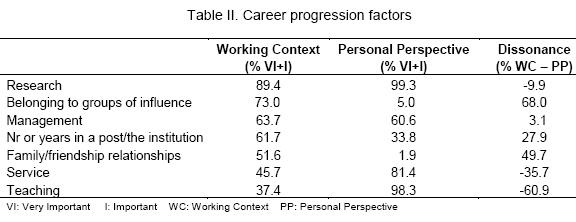
<body><![CDATA[<p align="center"><font face="verdana" size="2"><img src="/img/revistas/redie/v16n2/a4t1.jpg"></font></p>  	    <p align="justify"><font face="verdana" size="2">The most significant insight from the interviews as regards the management of academic work is that even though teaching and research are both highly valued, investment in teaching means time lost for research, and only research is perceived to give legitimacy to one's career as an academic (see Gottlieb and Keith, 1997; Maison and Schapper, 2012).</font></p>  	    <p align="justify"><font face="verdana" size="2">On the other hand, teaching itself presents problems. The interviewees stress the deprofessionalizing effects of excessive workloads, increased bureaucracy and accountability, and also of having to teach subjects outside their areas of expertise due to the growing diversity of teaching programs, which is seen as a hindrance not only to good teaching (see McInnis 2010) but also to research and its articulation with teaching. Attempts to innovate do exist and seem to depend more on faculty values and experience than on top&#45;down demands. In fact, recent reforms emphasizing the need to increase learner&#45;centeredness tend to be seen as rethorical and largely ineffective, mainly due to the lack of support and reward systems.</font></p>  	    <p align="justify"><font face="verdana" size="2">Not surprisingly, the survey findings show that teaching is seen to occupy the lowest place as to what counts for promotion, whereas personal values signal the desire for a more balanced and holistic appreciation of academic work (<a href="#t2">Table II</a>). Moreover, teaching (along with service) is perceived to be given less importance than non&#45;academic factors like belonging to groups of influence and family/friendship ties, which indicates the existence of "political scripts" to deal with tensions between private and organizational interests, often resting in alliances operating informally and invisibly through "gamesmanship and other forms of wheeling and dealing" (Morgan, 2006, p. 204). Overall, satisfaction with career advancement is not high (5.4/ SD=2.54).</font></p>  	    <p align="center"><font face="verdana" size="2"><a name="t2"></a></font></p>  	    <p align="center"><font face="verdana" size="2"><img src="/img/revistas/redie/v16n2/a4t2.jpg"></font></p>  	    <p align="justify"><font face="verdana" size="2">Values incongruence within teaching and research become evident in the respondents' views about what is and should be assessed as regards quality (<a href="#t3">Tables III</a> and <a href="#t4">IV</a>).</font></p>  	    <p align="center"><font face="verdana" size="2"><a name="t3"></a></font></p>  	    <p align="center"><font face="verdana" size="2"><img src="/img/revistas/redie/v16n2/a4t3.jpg"></font></p>  	    <p align="center"><font face="verdana" size="2"><a name="t4"></a></font></p>  	    ]]></body>
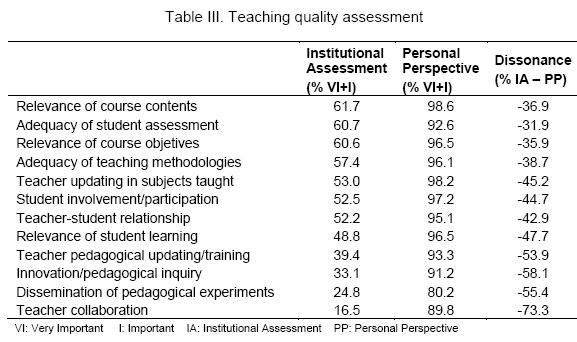
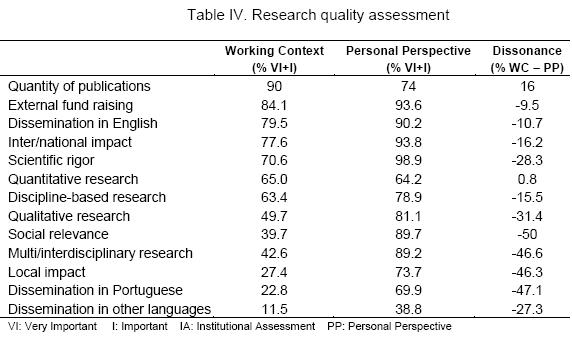
<body><![CDATA[<p align="center"><font face="verdana" size="2"><img src="/img/revistas/redie/v16n2/a4t4.jpg"></font></p>  	    <p align="justify"><font face="verdana" size="2">In our institution teaching quality is assessed every semester on the basis of a student feedback questionnaire focused on instructional aspects. Our survey presented a list of quality criteria that included those aspects but also other criteria related to learner&#45;centeredness and a 'scholarship of teaching and learning' (SoTL). As regards the criteria presented, negative dissonance between institutional and personal values ranges from &#45;31.9% to &#45;73.3% (<a href="#t3">Table III</a>). Dissonance increases as we move from teacher&#45;dependent instructional aspects (appropriateness of objetives, contents, methodologies and assessement) to aspects that are more learner/interaction&#45;dependent (student involvement/participation, relevance of learning and teacher&#45;student relationships), and to those that are related to SoTL &#150; pedagogical training, innovation and inquiry, dissemination of practice, and peer collaboration.</font></p>  	    <p align="justify"><font face="verdana" size="2">Even though SoTL fosters the transformation of teaching cultures by enhancing responsive professional collegiality, continuing professional development and bottom&#45;up quality improvement strategies (Boyer, 1990; Shulman, 2004), it has played a marginal role in institutional agendas (see Vieira, 2009) and institutions do not have established academic development systems. This might explain why most respondents consider the impact of teaching assessments on campus&#45;wide change to be low.</font></p>  	    <p align="justify"><font face="verdana" size="2">The respondents' average satisfaction with teaching assessment results is moderate (6.97/ SD=1.55) and those results are perceived to have some impact on their personal practices. Given the existence of values incongruence as regards criteria for assessing teaching quality (<a href="#t3">Table III</a> above), we might ask: Do their practices conform to or move beyond the perceived assessment criteria?</font></p>  	    <p align="justify"><font face="verdana" size="2">As for the assessment of research quality in working contexts, which is done every year, dissonance is globally lower than in the case of teaching (<a href="#t4">Table IV</a>).</font></p>  	    <p align="justify"><font face="verdana" size="2">Perceived and ideal values tend to converge in aspects that have been emphasized as indicators of excellence in external assessments and fund allocation policies&#150;quantity of publications, fund raising, quantitative and discipline&#45;based research, inter/national impact, and publishing in English. However, dissonance increases (ranging from &#45;31.4% to &#45;50%) as to the importance of qualitative and multi/interdisciplinary research, the local impact and social relevance of research, and dissemination in the native language. Many academics appear to wish that these aspects were more valued, and in fact there has been controversy about the way research policies have disregarded them. Yet, their average level of satisfaction with assessment results is not low (6.03/SD=1.92) and most of them feel that those results have an impact on their research practices. Again, we might ask: Do their research practices conform to or move beyond the perceived dominant criteria?</font></p>  	    <p align="justify"><font face="verdana" size="2">The results presented so far indicate that although most respondents are moderately satisfied with their own teaching and research, their ideal perspectives on the quality of both and on the role of teaching in career advancement diverge significantly from perceived demands, and there seems to be a predisposition to embrace a more holistic understanding of academic work.</font></p>  	    <p align="justify"><font face="verdana" size="2">The tension between real and ideal emerged in the interviews. In coping with "the rules of the game", attitudes vary from conformity to resistance, but the consequences of swimming with or against the tide are always assumed:</font></p>  	    <blockquote> 		    <p align="justify"><font face="verdana" size="2">(...) I don't think I should measure what I deserve &#91;in terms of career promotion&#93; according to the &#91;teaching&#93; work I did, or my investment, or my dedication only, because if I do not have a product... The institutional culture is as it is, I knew it was like that and so I knew the rules of the game... (I9).</font></p>  		    ]]></body>
<body><![CDATA[<p align="justify"><font face="verdana" size="2">The pressure &#91;from institutional demands&#93; is enormous. The pressure is enormous. I have been very affected by that pressure. Now I realize that in order to survive the best thing is... I mean... to understand the rules of the game... but not let myself be totally conditioned by them, and so what I try to do is a bit like... walking between the rain drops, you see? (...) Sometimes I do not agree with demands and I have to take a stand and say I&lsquo;m against them, but I never put myself in the position of not fulfilling minimum obligations and rules. (I2).</font></p> 	</blockquote>  	    <p align="justify"><font face="verdana" size="2">When the interviews were conducted, a new internal system for assessing faculty productivity in all areas of academic work was being devised, and while the interviewees felt that they would probably have to adjust to that system, they also feared its consequences on their personal value systems and the relevance of their work. The following account comes from a teacher trainer who had been integrating service and research by visiting schools and working with schoolteachers:</font></p>  	    <blockquote> 		    <p align="justify"><font face="verdana" size="2">(...) &#91;the new evaluation system&#93; may oblige me to be more rational, stop doing what I see as a priority for the university and society, and think about what is a priority for keeping my job. That's life... (...) For example, it will no longer make sense to visit thirty schools as I did last year... It would rather make more sense to follow the six schools I am now working with in teacher education (...). Of course it makes sense to me (...) as a social response &#91;to the needs of schools&#93; but it does't make sense in terms of research benefits. (I5).</font></p> 	</blockquote>  	    <p align="justify"><font face="verdana" size="2">Although no one denied the value of research and publication, what is personally relevant may not count much according to dominant policies:</font></p>  	    <blockquote> 		    <p align="justify"><font face="verdana" size="2">The publication of books is not valued. Well, I don't care. If studies are developed by me or with my collaboration, and they cannot be published as articles abroad, which is now the band&#45;wagon, I don't worry a bit... I am about to publish a book. I know it counts for nothing but I don't care because it's a personal imperative to publish this book, which will reach a lot of people. It counts for nothing in my career, not even in our research unit or the research group I belong to, but that's no reason why I shouldn't publish it. (I1).</font></p> 	</blockquote>  	    <p align="justify"><font face="verdana" size="2">Actually, the social relevance of mainstream research is called into question:</font></p>  	    <p align="justify"><font face="verdana" size="2">I am not sure that the research we do here in our college contributes in some way to the collective good and to a better, more just society where people can understand one another... that is, a humanist society... (I4)</font></p>  	    <p align="justify"><font face="verdana" size="2">Values incongruence pervades academics' experience of teaching and research. This is also true, as we will see next, of working climate, relationships, and leadership.</font></p>  	    ]]></body>
<body><![CDATA[<p align="justify"><font face="verdana" size="2"><b>3.2 Working climate, relationships, and leadership: what is (not) valued</b></font></p>  	    <p align="justify"><font face="verdana" size="2">Average satisfaction with the working climate and relationships in working contexts is not high (5.69/ SD=2.08) and negative dissonance was found especially as regards a democratic culture of respect, professional motivation and a sense of job security (<a href="#t5">Table V</a>).</font></p>  	    <p align="center"><font face="verdana" size="2"><a name="t5"></a></font></p>  	    <p align="center"><font face="verdana" size="2"><img src="/img/revistas/redie/v16n2/a4t5.jpg"></font></p>  	    <p align="justify"><font face="verdana" size="2">Interviewees also took a critical stance towards their working environments and discontent was often voiced. When reporting on positive and negative episodes from experience, they focused on issues of support, mutual respect, justice and integrity and their impact on self&#45;esteem, morale and proactiveness. In some cases, the effects of negative experiences are devastating. One of the interviewees, after being accused of seeking attention because s/he organized an event for the department, felt that s/he had been disrespected both personally and professionally, and decided to assume "the attitude of being like a shadow at work":</font></p>  	    <blockquote> 		    <p align="justify"><font face="verdana" size="2">(...) the situation was discussed in my department when I was not there, and I never had a word from the person who caused this mess, and I did not know what had happened... I never had a say in the matter, before, during or afterwards. (...) At the time, it made me... I was going mad. After that I realized that any personal initiative for my students, the department or myself, even with the best of intentions, can be misinterpreted in unimaginable ways. So from then on I assumed the attitude of being like a shadow at work. (I8)</font></p> 	</blockquote>  	    <p align="justify"><font face="verdana" size="2">Not feeling valued by peers may lead to isolation and disengagement, which hinders the achievement of collective institutional goals (Gappa <i>et al.</i>, 2007). Furthermore, workplace environments characterized by poor communication and low participation in decision&#45;making may foster a climate of mistrust and unspoken fear, leading to conformity, discontent and disempowerment:</font></p>  	    <blockquote> 		    <p align="justify"><font face="verdana" size="2">(...) there are many situations in which I keep silent and many people keep silent because they know that if they don't keep silent they will have problems. If they use their freedom of thought they will probably have some problems. (I4)</font></p>  		    ]]></body>
<body><![CDATA[<p align="justify"><font face="verdana" size="2">In the department meetings I feel that most people take an acquiescent position, thinking: "What does the head of the department think? I will vote in accord with that" ... instead of assuming a clear position, and trusting the head of department, and thinking that if they assume a position that is contrary to his, they will not suffer any retaliation for it. I think people live in that fear. (I7)</font></p>  		    <p align="justify"><font face="verdana" size="2">In my college (...) everthing is done behind scenes. (...) there is a very small group of people who are really in charge and make decisions for others, and there is nothing you can do about it. (...) Obviously, when those decisions have to do with you, it makes you feel down. But you cannot talk about it because if you talk it will get to the director. So, in a way there is a climate of... I do not want to use the term fear, but there is not a climate of openness, dialogue, clarification of doubts... Decisions are often made without taking into consideration the people in question... and this causes some discomfort and discontent. (I6)</font></p> 	</blockquote>  	    <p align="justify"><font face="verdana" size="2">The above accounts draw our attention to leadership, since it influences the working atmosphere. Actually, the survey results indicate that satisfaction with leadership is quite low (4.88/ SD=2,13) and a significant negative mismatch is observed between what academics experience and value, particularly as regards collegiality and equity (<a href="#t6">Table VI</a>). These aspects have been threatened by a growing managerial type of governance that entails the centralization of political and strategic power (see Santiago and Carvalho 2012), even though the stated mission of the university advocates freedom of thought, plurality of ideas, humanism, creativity, innovation, sustainable development, well&#45;being, and solidarity. When asked about whether that mission is reflected in practice, most interviewees showed signs of scepticism and disbelief. A schism between rethoric and reality, as well as between &#8213;"academic managers" (they) and "managed academics" (we), surfaced in their discourse (cf. Winter, 2009).</font></p>  	    <p align="center"><font face="verdana" size="2"><a name="t6"></a></font></p>  	    <p align="center"><font face="verdana" size="2"><img src="/img/revistas/redie/v16n2/a4t6.jpg"></font></p>  	    <p align="justify"><font face="verdana" size="2">Personal commitment to collective welfare was also pointed out as crucial. By taking a critical stance towards negative facets of the institutional culture, academics can become cultural drivers and leaders of institutional change, which means that &#8213;"the interface between leadership and ownership is a critical one" (Gordon, 2010, p. 101):</font></p>  	    <blockquote> 		    <p align="justify"><font face="verdana" size="2">People need to have some sense of agency, to realize that they have some responsibility for changing the working climate, and I think people often tend to say "poor me", "I'm the victim", "I'm a just a poor guy in the middle of all this", and they do not assume the responsibility they have, right? (...) I believe that constraints should raise our awareness and our ability to design our own paths, to know where we can go, and if we have a rock in the way we should pull it aside or go around it. I think there are conditions in which to enact the mission. (I3)</font></p> 	</blockquote>  	    <p align="justify"><font face="verdana" size="2">Dealing with conflicting rationalities may, however, induce a sense of disempowerment and create the need to be told what (not) to do, which will reinforce the culture that is criticized for being alien to one's aspirations and efforts. The interviewee who claimed that publishing a book that counts for nothing was a personal imperative also stated the following:</font></p>  	    <blockquote> 		    ]]></body>
<body><![CDATA[<p align="justify"><font face="verdana" size="2">We have always been very autonomous. There was never anyone telling us what to do and perhaps that's one of the problems. (...) In this college there was never a policy, a policy of growth or criteria towards this or that area, either in teaching or research. (I1)</font></p> 	</blockquote>  	    <p align="justify"><font face="verdana" size="2">Overall, this second set of findings suggests that there is a person&#45;organization misfit as regards representations of working climate, relationships and leadership. Working contexts appear to suppress rather than encourage dissent, open communication and the negotiation of perspectives, which reinforces the need for further research into life experience on campus as a way to open up the road for reflection and debate towards a culture of respect for diversity. What seems to constrain the development of institutional self&#45;inquiry also justifies its potential relevance.</font></p>  	    <p align="justify"><font face="verdana" size="2">&nbsp;</font></p>  	    <p align="justify"><font face="verdana" size="2"><b>IV. Conclusions and implications</b></font></p>  	    <p align="justify"><font face="verdana" size="2">Rather than presenting a holographic view of the institutional culture, academics' representations of life on campus reveal that personal values differ significantly from perceived institutional values as regards teaching, research, working climate, relationships, and leadership. This is evident in the survey data and in interview accounts where interviewees present "narratives of constraint" but also "narratives of growth" as they struggle for what makes their work meaningful (O'Meara et al., 2008). Discontent seems to co&#45;exist with efforts to pursue one's cherished values while realizing that institutional priorities may run counter to ideals. This duality seems important to understand how academics operate in complex settings under pressure, and attention must be paid to whether and how dissent can be integrated into a dialogical framework that accomodates and promotes diversity (Gordon, 2010). Values incongruence may create "identity schisms" (Winter, 2009) as well as "a latent tendency &#91;of institutions&#93; to move in diverse directions and sometimes fall apart" (Morgan, 2006, p. 203). Because rationality is always interest based and political, competing rationalities cannot be ignored if we are to understand how institutions develop.</font></p>  	    <p align="justify"><font face="verdana" size="2">Rather than suppressing diversity and favoring dogma, institutions probabaly need to acknowledge and explore dissonance as a potential source of energy requiring pluralist, learning&#45;oriented management, enacted by leaders who have "a keen ability to be aware of conflict&#45;prone areas, to read the latent tendencies and pressures beneath the surface actions of organizational life, and to initiate appropriate responses" (Morgan, 2006, p. 198&#45;199). Protecting the integrity of academic work by enhancing more inclusive management practices (Kenny, 2009), as well as acknowledging different forms of scholarship and recognizing the need for differentiated career paths, would promote "a multi&#45;vocal institutional identity" (Winter, 2009, p. 128) and allow faculty to work "more on a dialogical frame than on a confrontational frame" (Bergquist and Pawlak 2008, p. 238). This implies some resistance to managerial modes of governance where collegiality and professional autonomy are neutralized and where institutional goals and strategies are defined within a narrow view of productivity and quality.</font></p>  	    <p align="justify"><font face="verdana" size="2">Billot (2010) argues that nowadays there is a fine line between academic and institutional identity, meaning that staff need to be flexible and adapt to new demands by "grappling with a fluid identity" (p. 718) rather than hanging on to "imagined identities" based on past values that are not aligned with real circumstances, like collegiality, collaborative management and academic freedom (p. 712). In fact, research seems to indicate that "while there are increasing social demands being placed on higher education there remains a strong commitment to autonomy, independence and academic freedom, which quality assurance procedures sometimes rub up against" (Harvey and Williams, 2010, p. 107). Should we then abandon "old" values? In exchange for what?</font></p>  	    <p align="justify"><font face="verdana" size="2">Whatever our answer is, self&#45;renewing academics are value&#45;driven and future&#45;oriented. Ideal perspectives, like those we found in our study, far from being exclusively based on the past (which was not idyllic anyway!), might portray an imagined future and fuel transformation. This seems particularly important if we want to reframe higher education purposes with reference to its social usefulness for serving the common good in the best interests of humanity (Barnett and Maxwell 2008; Henkel, 2007). Can higher education be socially useful if academics' aspirations are overlooked and life on campus becomes socially degraded?</font></p>  	    <p align="justify"><font face="verdana" size="2">Going back to the question posed by Schostak and Schostak (2008, p. 250)&#151;What sort of community is desired?&#151;our study reveals conflicting views and perhaps irresolvable tensions as regards life in academe. Acknowledging the importance of dissonance may be the first step towards empowering faculty to negotiate understandings of what their community is and might be. This means that institution&#45;specific inquiry into academic experience should not only be expanded but also become part of the strategic (re)definition of institutional growth policies.</font></p>  	    <p align="justify"><font face="verdana" size="2">&nbsp;</font></p>  	    ]]></body>
<body><![CDATA[<p align="justify"><font face="verdana" size="2"><b>Acknowledgements</b></font></p>  	    <p align="justify"><font face="verdana" size="2">We would like to thank all the colleagues who participated in the study and those who commented in a preliminary version of the survey questionnaire. The study was funded by the Research Center of Education (University of Minho, Institute of Education, Braga&#45;Portugal; Project PEst&#45;OE/CED/UI1661/2014,CIEd&#45;UM).</font></p>  	    <p align="justify"><font face="verdana" size="2">&nbsp;</font></p>  	    <p align="justify"><font face="verdana" size="2"><b>References</b></font></p>  	    <!-- ref --><p align="justify"><font face="verdana" size="2">Altbach, P. G., Reisberg, L. &amp; Rumbley, L. E. (2009). <i>Trends in global higher education: Tracking an academic revolution.</i> Report on the UNESCO 2009 World Conference on Higher Education, Paris. Retrieved from <a href="http://portal.unesco.org/education/en/ev.php&#45;URL_ID=59371&URL_DO=DO_TOPIC&URL_SECTION=201.html" target="_blank">http://portal.unesco.org/education/en/ev.php&#45;URL_ID=59371&amp;URL_DO=DO_TOPIC&amp;URL_SECTION=201.html</a></font>&nbsp;&nbsp;&nbsp;&nbsp;&nbsp;&nbsp;&nbsp;&nbsp;[&#160;<a href="javascript:void(0);" onclick="javascript: window.open('/scielo.php?script=sci_nlinks&ref=7160383&pid=S1607-4041201400020000400001&lng=','','width=640,height=500,resizable=yes,scrollbars=1,menubar=yes,');">Links</a>&#160;]<!-- end-ref --><!-- ref --><p align="justify"><font face="verdana" size="2">Barnett, R. (1997). <i>Realizing the university.</i> London: Institute of Education, University of London.    &nbsp;&nbsp;&nbsp;&nbsp;&nbsp;&nbsp;&nbsp;&nbsp;[&#160;<a href="javascript:void(0);" onclick="javascript: window.open('/scielo.php?script=sci_nlinks&ref=7160384&pid=S1607-4041201400020000400002&lng=','','width=640,height=500,resizable=yes,scrollbars=1,menubar=yes,');">Links</a>&#160;]<!-- end-ref --></font></p>  	    <!-- ref --><p align="justify"><font face="verdana" size="2">Barnett, R. &amp; Maxwell, N. (Eds.) (2008). <i>Wisdom in the university.</i> Milton Park: Routledge.    &nbsp;&nbsp;&nbsp;&nbsp;&nbsp;&nbsp;&nbsp;&nbsp;[&#160;<a href="javascript:void(0);" onclick="javascript: window.open('/scielo.php?script=sci_nlinks&ref=7160386&pid=S1607-4041201400020000400003&lng=','','width=640,height=500,resizable=yes,scrollbars=1,menubar=yes,');">Links</a>&#160;]<!-- end-ref --></font></p>  	    <!-- ref --><p align="justify"><font face="verdana" size="2">Bergquist, W. &amp; Pawlak, K. (2008). <i>Engaging the six cultures of the academy.</i> San Francisco: Jossey&#45;Bass Publishers.    &nbsp;&nbsp;&nbsp;&nbsp;&nbsp;&nbsp;&nbsp;&nbsp;[&#160;<a href="javascript:void(0);" onclick="javascript: window.open('/scielo.php?script=sci_nlinks&ref=7160388&pid=S1607-4041201400020000400004&lng=','','width=640,height=500,resizable=yes,scrollbars=1,menubar=yes,');">Links</a>&#160;]<!-- end-ref --></font></p>  	    <!-- ref --><p align="justify"><font face="verdana" size="2">Billot, J. (2010). The imagined and the real: Identifying the tensions for academic identity. <i>Higher Education Research &amp; Development, 29</i>(6), 709&#45;21.    &nbsp;&nbsp;&nbsp;&nbsp;&nbsp;&nbsp;&nbsp;&nbsp;[&#160;<a href="javascript:void(0);" onclick="javascript: window.open('/scielo.php?script=sci_nlinks&ref=7160390&pid=S1607-4041201400020000400005&lng=','','width=640,height=500,resizable=yes,scrollbars=1,menubar=yes,');">Links</a>&#160;]<!-- end-ref --></font></p>  	    <!-- ref --><p align="justify"><font face="verdana" size="2">Boyer, E. (1990). <i>Scholarship reconsidered: Priorities of the professoriate.</i> Princeton: The Carnegie Foundation for the Advancement of Teaching.    &nbsp;&nbsp;&nbsp;&nbsp;&nbsp;&nbsp;&nbsp;&nbsp;[&#160;<a href="javascript:void(0);" onclick="javascript: window.open('/scielo.php?script=sci_nlinks&ref=7160392&pid=S1607-4041201400020000400006&lng=','','width=640,height=500,resizable=yes,scrollbars=1,menubar=yes,');">Links</a>&#160;]<!-- end-ref --></font></p>  	    <!-- ref --><p align="justify"><font face="verdana" size="2">Coaldrake, P. &amp; Stedman, L. (1999). <i>Academic work on the twenty&#45;first century: Changing roles and policies.</i> Commonwealth of Australia 1999: Higher Education Division Department of Education, Training and Youth Affairs&#45;Occasional Paper Series.    &nbsp;&nbsp;&nbsp;&nbsp;&nbsp;&nbsp;&nbsp;&nbsp;[&#160;<a href="javascript:void(0);" onclick="javascript: window.open('/scielo.php?script=sci_nlinks&ref=7160394&pid=S1607-4041201400020000400007&lng=','','width=640,height=500,resizable=yes,scrollbars=1,menubar=yes,');">Links</a>&#160;]<!-- end-ref --></font></p>  	    <!-- ref --><p align="justify"><font face="verdana" size="2">Courtney, K. (2013). Adapting higher education through changes in academic work. <i>Higher Education Quaterly, 67</i>(1), 40&#45;55.    &nbsp;&nbsp;&nbsp;&nbsp;&nbsp;&nbsp;&nbsp;&nbsp;[&#160;<a href="javascript:void(0);" onclick="javascript: window.open('/scielo.php?script=sci_nlinks&ref=7160396&pid=S1607-4041201400020000400008&lng=','','width=640,height=500,resizable=yes,scrollbars=1,menubar=yes,');">Links</a>&#160;]<!-- end-ref --></font></p>  	    <!-- ref --><p align="justify"><font face="verdana" size="2">Ditton, M. J. (2009). How social relationships influence academic health in the 'enterprise university': An insight into productivity of knowledge workers. <i>Higher Education Research &amp; Development, 28</i>(2), 151&#45;64.    &nbsp;&nbsp;&nbsp;&nbsp;&nbsp;&nbsp;&nbsp;&nbsp;[&#160;<a href="javascript:void(0);" onclick="javascript: window.open('/scielo.php?script=sci_nlinks&ref=7160398&pid=S1607-4041201400020000400009&lng=','','width=640,height=500,resizable=yes,scrollbars=1,menubar=yes,');">Links</a>&#160;]<!-- end-ref --></font></p>  	    <!-- ref --><p align="justify"><font face="verdana" size="2">Fredman. N. &amp; Doughney, J. (2012). Academic dissatisfaction, managerial change and neo&#45;liberalism. <i>Higher Education, 64</i>, 41&#45;58.    &nbsp;&nbsp;&nbsp;&nbsp;&nbsp;&nbsp;&nbsp;&nbsp;[&#160;<a href="javascript:void(0);" onclick="javascript: window.open('/scielo.php?script=sci_nlinks&ref=7160400&pid=S1607-4041201400020000400010&lng=','','width=640,height=500,resizable=yes,scrollbars=1,menubar=yes,');">Links</a>&#160;]<!-- end-ref --></font></p>  	    <!-- ref --><p align="justify"><font face="verdana" size="2">Gapa, J. M., Austin, A. E. &amp; Trice, A. G. (2007). <i>Rethinking faculty work: Higher</i> <i>educations'</i> <i>strategic imperative.</i> San Francisco: Jossey&#45;Bass Publishers.    &nbsp;&nbsp;&nbsp;&nbsp;&nbsp;&nbsp;&nbsp;&nbsp;[&#160;<a href="javascript:void(0);" onclick="javascript: window.open('/scielo.php?script=sci_nlinks&ref=7160402&pid=S1607-4041201400020000400011&lng=','','width=640,height=500,resizable=yes,scrollbars=1,menubar=yes,');">Links</a>&#160;]<!-- end-ref --></font></p>  	    <!-- ref --><p align="justify"><font face="verdana" size="2">Gordon, G. (2010). The roles of leadership and ownership in building and effective quality culture. <i>Quality in Higher Education, 8</i>(1), 97&#45;106.    &nbsp;&nbsp;&nbsp;&nbsp;&nbsp;&nbsp;&nbsp;&nbsp;[&#160;<a href="javascript:void(0);" onclick="javascript: window.open('/scielo.php?script=sci_nlinks&ref=7160404&pid=S1607-4041201400020000400012&lng=','','width=640,height=500,resizable=yes,scrollbars=1,menubar=yes,');">Links</a>&#160;]<!-- end-ref --></font></p>  	    <!-- ref --><p align="justify"><font face="verdana" size="2">Gottlieb, E. &amp; Keith, B. (1997). The academic research&#45;teaching nexus in eight advanced&#45;industrialized countries. <i>Higher Education, 34,</i> 397&#45;420.    &nbsp;&nbsp;&nbsp;&nbsp;&nbsp;&nbsp;&nbsp;&nbsp;[&#160;<a href="javascript:void(0);" onclick="javascript: window.open('/scielo.php?script=sci_nlinks&ref=7160406&pid=S1607-4041201400020000400013&lng=','','width=640,height=500,resizable=yes,scrollbars=1,menubar=yes,');">Links</a>&#160;]<!-- end-ref --></font></p>  	    <!-- ref --><p align="justify"><font face="verdana" size="2">Henkel, M. (2007). Can academic autonomy survive in the knowledge society? A perspective from Britain. <i>Higher Education Research &amp; Development, 26</i>(1), 87&#45;99.    &nbsp;&nbsp;&nbsp;&nbsp;&nbsp;&nbsp;&nbsp;&nbsp;[&#160;<a href="javascript:void(0);" onclick="javascript: window.open('/scielo.php?script=sci_nlinks&ref=7160408&pid=S1607-4041201400020000400014&lng=','','width=640,height=500,resizable=yes,scrollbars=1,menubar=yes,');">Links</a>&#160;]<!-- end-ref --></font></p>  	    <!-- ref --><p align="justify"><font face="verdana" size="2">Harvey, L. &amp; Williams, J. (2010). Fifteen years of quality in higher education (Part Two). <i>Quality in Higher Education, 16</i>(2), 81&#45;113.    &nbsp;&nbsp;&nbsp;&nbsp;&nbsp;&nbsp;&nbsp;&nbsp;[&#160;<a href="javascript:void(0);" onclick="javascript: window.open('/scielo.php?script=sci_nlinks&ref=7160410&pid=S1607-4041201400020000400015&lng=','','width=640,height=500,resizable=yes,scrollbars=1,menubar=yes,');">Links</a>&#160;]<!-- end-ref --></font></p>  	    <!-- ref --><p align="justify"><font face="verdana" size="2">Johnsrud, L. (2002). Measuring the quality of faculty and administrative worklife: Implications for college and university campuses. <i>Research in Higher Education, 43</i>(3), 379&#45;395.    &nbsp;&nbsp;&nbsp;&nbsp;&nbsp;&nbsp;&nbsp;&nbsp;[&#160;<a href="javascript:void(0);" onclick="javascript: window.open('/scielo.php?script=sci_nlinks&ref=7160412&pid=S1607-4041201400020000400016&lng=','','width=640,height=500,resizable=yes,scrollbars=1,menubar=yes,');">Links</a>&#160;]<!-- end-ref --></font></p>  	    <!-- ref --><p align="justify"><font face="verdana" size="2">Kenny, J. D. (2009). Managing a modern university: Is it time for a rethink? <i>Higher Education Research &amp; Development, 28</i>(6), 629&#45;42.    &nbsp;&nbsp;&nbsp;&nbsp;&nbsp;&nbsp;&nbsp;&nbsp;[&#160;<a href="javascript:void(0);" onclick="javascript: window.open('/scielo.php?script=sci_nlinks&ref=7160414&pid=S1607-4041201400020000400017&lng=','','width=640,height=500,resizable=yes,scrollbars=1,menubar=yes,');">Links</a>&#160;]<!-- end-ref --></font></p>  	    <!-- ref --><p align="justify"><font face="verdana" size="2">Locke, W. &amp; Bennion, A. (2010). <i>The changing academic profession in the</i> <i>UK</i> <i>and beyond.</i> Research Report published by Universities UK. Retrieved from <a href="http://www.universitiesuk.ac.uk/Publications/Pages/TheChangingAcademicProfession.aspx" target="_blank">http://www.universitiesuk.ac.uk/Publications/Pages/TheChangingAcademicProfession.aspx</a></font>&nbsp;&nbsp;&nbsp;&nbsp;&nbsp;&nbsp;&nbsp;&nbsp;[&#160;<a href="javascript:void(0);" onclick="javascript: window.open('/scielo.php?script=sci_nlinks&ref=7160416&pid=S1607-4041201400020000400018&lng=','','width=640,height=500,resizable=yes,scrollbars=1,menubar=yes,');">Links</a>&#160;]<!-- end-ref --><!-- ref --><p align="justify"><font face="verdana" size="2">Maison, S. &amp; Schapper, J. (2012). Constructing teaching and research relations from the top: An analysis of senior manager discourses on research&#45;led teaching. <i>Higher Education, 64,</i> 473&#45;487.    &nbsp;&nbsp;&nbsp;&nbsp;&nbsp;&nbsp;&nbsp;&nbsp;[&#160;<a href="javascript:void(0);" onclick="javascript: window.open('/scielo.php?script=sci_nlinks&ref=7160417&pid=S1607-4041201400020000400019&lng=','','width=640,height=500,resizable=yes,scrollbars=1,menubar=yes,');">Links</a>&#160;]<!-- end-ref --></font></p>  	    ]]></body>
<body><![CDATA[<!-- ref --><p align="justify"><font face="verdana" size="2">McInnis, C. (2010). Changing academic work roles: The everyday realities challenging quality in teaching. <i>Quality in Higher Education, 6</i>(2), 143&#45;52.    &nbsp;&nbsp;&nbsp;&nbsp;&nbsp;&nbsp;&nbsp;&nbsp;[&#160;<a href="javascript:void(0);" onclick="javascript: window.open('/scielo.php?script=sci_nlinks&ref=7160419&pid=S1607-4041201400020000400020&lng=','','width=640,height=500,resizable=yes,scrollbars=1,menubar=yes,');">Links</a>&#160;]<!-- end-ref --></font></p>  	    <!-- ref --><p align="justify"><font face="verdana" size="2">Meek, V. L., Teichler, U. &amp; Kearney, M.&#45;L. (Eds.) (2009). <i>Higher education, research and innovation: Changing dynamics</i>. Report on the UNESCO Forum on Higher Education, Research and Knowledge 2001&#45;2009 (Kassel, ICHER). Retrieved from <a href="http://portal.unesco.org/education/en/ev.php&#45;URL_ID=59371&URL_DO=DO_TOPIC&URL_SECTION=201.html" target="_blank">http://portal.unesco.org/education/en/ev.php&#45;URL_ID=59371&amp;URL_DO=DO_TOPIC&amp;URL_SECTION=201.html</a></font>&nbsp;&nbsp;&nbsp;&nbsp;&nbsp;&nbsp;&nbsp;&nbsp;[&#160;<a href="javascript:void(0);" onclick="javascript: window.open('/scielo.php?script=sci_nlinks&ref=7160421&pid=S1607-4041201400020000400021&lng=','','width=640,height=500,resizable=yes,scrollbars=1,menubar=yes,');">Links</a>&#160;]<!-- end-ref --><!-- ref --><p align="justify"><font face="verdana" size="2">Morgan, G. (2006). <i>Images of organization.</i> Thousand Oaks, CA: Sage.    &nbsp;&nbsp;&nbsp;&nbsp;&nbsp;&nbsp;&nbsp;&nbsp;[&#160;<a href="javascript:void(0);" onclick="javascript: window.open('/scielo.php?script=sci_nlinks&ref=7160422&pid=S1607-4041201400020000400022&lng=','','width=640,height=500,resizable=yes,scrollbars=1,menubar=yes,');">Links</a>&#160;]<!-- end-ref --></font></p>  	    <!-- ref --><p align="justify"><font face="verdana" size="2">Morley, L. (2003). <i>Quality and power in higher education.</i> Maidenhead: SRHE &amp; OUP.    &nbsp;&nbsp;&nbsp;&nbsp;&nbsp;&nbsp;&nbsp;&nbsp;[&#160;<a href="javascript:void(0);" onclick="javascript: window.open('/scielo.php?script=sci_nlinks&ref=7160424&pid=S1607-4041201400020000400023&lng=','','width=640,height=500,resizable=yes,scrollbars=1,menubar=yes,');">Links</a>&#160;]<!-- end-ref --></font></p>  	    <!-- ref --><p align="justify"><font face="verdana" size="2">O'Meara, K., Terosky, A. L. &amp; Neumann, A. (2008). <i>Faculty careers and work lives: A professional growth perspective.</i> San Francisco, CA: Jossey&#45;Bass.    &nbsp;&nbsp;&nbsp;&nbsp;&nbsp;&nbsp;&nbsp;&nbsp;[&#160;<a href="javascript:void(0);" onclick="javascript: window.open('/scielo.php?script=sci_nlinks&ref=7160426&pid=S1607-4041201400020000400024&lng=','','width=640,height=500,resizable=yes,scrollbars=1,menubar=yes,');">Links</a>&#160;]<!-- end-ref --></font></p>  	    <!-- ref --><p align="justify"><font face="verdana" size="2">Santiago, R. &amp; Carvalho, T. (2008). Academics in a new work environment: The impact of new public management on work conditions. <i>Higher Education Quaterly, 62</i>(3), 204&#45;223.    &nbsp;&nbsp;&nbsp;&nbsp;&nbsp;&nbsp;&nbsp;&nbsp;[&#160;<a href="javascript:void(0);" onclick="javascript: window.open('/scielo.php?script=sci_nlinks&ref=7160428&pid=S1607-4041201400020000400025&lng=','','width=640,height=500,resizable=yes,scrollbars=1,menubar=yes,');">Links</a>&#160;]<!-- end-ref --></font></p>  	    <!-- ref --><p align="justify"><font face="verdana" size="2">Santiago, R. &amp; Carvalho, T. (2012). Managerialism rethorics in Portuguese higher education. <i>Minerva, 50</i>, 511&#45;532.    &nbsp;&nbsp;&nbsp;&nbsp;&nbsp;&nbsp;&nbsp;&nbsp;[&#160;<a href="javascript:void(0);" onclick="javascript: window.open('/scielo.php?script=sci_nlinks&ref=7160430&pid=S1607-4041201400020000400026&lng=','','width=640,height=500,resizable=yes,scrollbars=1,menubar=yes,');">Links</a>&#160;]<!-- end-ref --></font></p>  	    <!-- ref --><p align="justify"><font face="verdana" size="2">Santos, B. S. (2008). A universidade no s&eacute;culo XXI: Para uma reforma democr&aacute;tica e emancipat&oacute;ria da universidade. In B. S. Santos &amp; N. A. Filho (Eds.), <i>A universidade no s&eacute;culo XXI: Para uma universidade nova</i> (pp. 15&#45;78). Coimbra, PT: Almedina.    &nbsp;&nbsp;&nbsp;&nbsp;&nbsp;&nbsp;&nbsp;&nbsp;[&#160;<a href="javascript:void(0);" onclick="javascript: window.open('/scielo.php?script=sci_nlinks&ref=7160432&pid=S1607-4041201400020000400027&lng=','','width=640,height=500,resizable=yes,scrollbars=1,menubar=yes,');">Links</a>&#160;]<!-- end-ref --></font></p>  	    <!-- ref --><p align="justify"><font face="verdana" size="2">Schein, E. H. (2010, 4th edn.). <i>Organizational culture and leadership.</i> San Francisco, CA: Jossey&#45;Bass.    &nbsp;&nbsp;&nbsp;&nbsp;&nbsp;&nbsp;&nbsp;&nbsp;[&#160;<a href="javascript:void(0);" onclick="javascript: window.open('/scielo.php?script=sci_nlinks&ref=7160434&pid=S1607-4041201400020000400028&lng=','','width=640,height=500,resizable=yes,scrollbars=1,menubar=yes,');">Links</a>&#160;]<!-- end-ref --></font></p>  	    <!-- ref --><p align="justify"><font face="verdana" size="2">Schostak, J. &amp; Schostak, J. (2008). <i>Radical research&#45;Designing, developing and writing research to make a difference.</i> London: Routledge.    &nbsp;&nbsp;&nbsp;&nbsp;&nbsp;&nbsp;&nbsp;&nbsp;[&#160;<a href="javascript:void(0);" onclick="javascript: window.open('/scielo.php?script=sci_nlinks&ref=7160436&pid=S1607-4041201400020000400029&lng=','','width=640,height=500,resizable=yes,scrollbars=1,menubar=yes,');">Links</a>&#160;]<!-- end-ref --></font></p>  	    <!-- ref --><p align="justify"><font face="verdana" size="2">Shulman, L. (2004). <i>Teaching as community property&#45;Essays on higher education.</i> San Francisco, CA: Jossey&#45;Bass.    &nbsp;&nbsp;&nbsp;&nbsp;&nbsp;&nbsp;&nbsp;&nbsp;[&#160;<a href="javascript:void(0);" onclick="javascript: window.open('/scielo.php?script=sci_nlinks&ref=7160438&pid=S1607-4041201400020000400030&lng=','','width=640,height=500,resizable=yes,scrollbars=1,menubar=yes,');">Links</a>&#160;]<!-- end-ref --></font></p>  	    <!-- ref --><p align="justify"><font face="verdana" size="2">Teichler, U. &amp; Ya&#287;c&#305;, Y. (2009). Changing challenges of academic work: Concepts and observations. In V. L. Meek, U. Teichler &amp; M.&#45;L. Kearney (Eds.), <i>Higher education, research and innovation: Changing dynamics</i>. Report on the UNESCO Forum on Higher Education, Research and Knowledge 2001&#45;2009 (Kassel, ICHER). Retrieved from <a href="http://portal.unesco.org/education/en/ev.php&#45;URL_ID=59371&URL_DO=DO_TOPIC&URL_SECTION=201.html" target="_blank">http://portal.unesco.org/education/en/ev.php&#45;URL_ID=59371&amp;URL_DO=DO_TOPIC&amp;URL_SECTION=201.html</a></font>&nbsp;&nbsp;&nbsp;&nbsp;&nbsp;&nbsp;&nbsp;&nbsp;[&#160;<a href="javascript:void(0);" onclick="javascript: window.open('/scielo.php?script=sci_nlinks&ref=7160440&pid=S1607-4041201400020000400031&lng=','','width=640,height=500,resizable=yes,scrollbars=1,menubar=yes,');">Links</a>&#160;]<!-- end-ref --><!-- ref --><p align="justify"><font face="verdana" size="2">Twale, D. &amp; DeLuca, B. (2008). <i>Faculty incivility&#45;The rise of the academic bully culture and what to do about it.</i> San Francisco, CA: Jossey&#45;Bass Publishers.    &nbsp;&nbsp;&nbsp;&nbsp;&nbsp;&nbsp;&nbsp;&nbsp;[&#160;<a href="javascript:void(0);" onclick="javascript: window.open('/scielo.php?script=sci_nlinks&ref=7160441&pid=S1607-4041201400020000400032&lng=','','width=640,height=500,resizable=yes,scrollbars=1,menubar=yes,');">Links</a>&#160;]<!-- end-ref --></font></p>  	    <!-- ref --><p align="justify"><font face="verdana" size="2">Vieira, F. (2009). Developing the scholarship of pedagogy&#45;Pathfinding in adverse settigs. <i>Journal of the Scholarship of Teaching and Learning</i>, <i>9</i>(2), 10&#150;21.    &nbsp;&nbsp;&nbsp;&nbsp;&nbsp;&nbsp;&nbsp;&nbsp;[&#160;<a href="javascript:void(0);" onclick="javascript: window.open('/scielo.php?script=sci_nlinks&ref=7160443&pid=S1607-4041201400020000400033&lng=','','width=640,height=500,resizable=yes,scrollbars=1,menubar=yes,');">Links</a>&#160;]<!-- end-ref --></font></p>  	    <!-- ref --><p align="justify"><font face="verdana" size="2">Waitere, H. J., Wright, J., Tremaine, M., Brown, S. &amp; Paus&eacute;, C. J. (2011). Choosing whether to resist or reinforce the new managerialism: The impact of performance&#45;based research funding on academic identity. <i>Higher Education Research &amp; Development, 30</i>(2), 205&#45;17.    &nbsp;&nbsp;&nbsp;&nbsp;&nbsp;&nbsp;&nbsp;&nbsp;[&#160;<a href="javascript:void(0);" onclick="javascript: window.open('/scielo.php?script=sci_nlinks&ref=7160445&pid=S1607-4041201400020000400034&lng=','','width=640,height=500,resizable=yes,scrollbars=1,menubar=yes,');">Links</a>&#160;]<!-- end-ref --></font></p>  	    <!-- ref --><p align="justify"><font face="verdana" size="2">Winter, R. (2009). Academic manager or managed academic? Academic identity schisms in higher education. <i>Journal of Higher Education Policy and Management, 31</i>(2), 121&#45;31.    &nbsp;&nbsp;&nbsp;&nbsp;&nbsp;&nbsp;&nbsp;&nbsp;[&#160;<a href="javascript:void(0);" onclick="javascript: window.open('/scielo.php?script=sci_nlinks&ref=7160447&pid=S1607-4041201400020000400035&lng=','','width=640,height=500,resizable=yes,scrollbars=1,menubar=yes,');">Links</a>&#160;]<!-- end-ref --></font></p>     ]]></body>
<body><![CDATA[ ]]></body>
<back>
<ref-list>
<ref id="B1">
<nlm-citation citation-type="">
<person-group person-group-type="author">
<name>
<surname><![CDATA[Altbach]]></surname>
<given-names><![CDATA[P. G.]]></given-names>
</name>
<name>
<surname><![CDATA[Reisberg]]></surname>
<given-names><![CDATA[L.]]></given-names>
</name>
<name>
<surname><![CDATA[Rumbley]]></surname>
<given-names><![CDATA[L. E.]]></given-names>
</name>
</person-group>
<source><![CDATA[Trends in global higher education: Tracking an academic revolution]]></source>
<year>2009</year>
<publisher-loc><![CDATA[Paris ]]></publisher-loc>
</nlm-citation>
</ref>
<ref id="B2">
<nlm-citation citation-type="book">
<person-group person-group-type="author">
<name>
<surname><![CDATA[Barnett]]></surname>
<given-names><![CDATA[R.]]></given-names>
</name>
</person-group>
<source><![CDATA[Realizing the university]]></source>
<year>1997</year>
<publisher-loc><![CDATA[London ]]></publisher-loc>
<publisher-name><![CDATA[Institute of Education, University of London]]></publisher-name>
</nlm-citation>
</ref>
<ref id="B3">
<nlm-citation citation-type="book">
<person-group person-group-type="author">
<name>
<surname><![CDATA[Barnett]]></surname>
<given-names><![CDATA[R.]]></given-names>
</name>
<name>
<surname><![CDATA[Maxwell]]></surname>
<given-names><![CDATA[N.]]></given-names>
</name>
</person-group>
<source><![CDATA[Wisdom in the university]]></source>
<year>2008</year>
<publisher-loc><![CDATA[Milton Park ]]></publisher-loc>
<publisher-name><![CDATA[Routledge]]></publisher-name>
</nlm-citation>
</ref>
<ref id="B4">
<nlm-citation citation-type="book">
<person-group person-group-type="author">
<name>
<surname><![CDATA[Bergquist]]></surname>
<given-names><![CDATA[W.]]></given-names>
</name>
<name>
<surname><![CDATA[Pawlak]]></surname>
<given-names><![CDATA[K.]]></given-names>
</name>
</person-group>
<source><![CDATA[Engaging the six cultures of the academy]]></source>
<year>2008</year>
<publisher-loc><![CDATA[San Francisco ]]></publisher-loc>
<publisher-name><![CDATA[Jossey-Bass Publishers]]></publisher-name>
</nlm-citation>
</ref>
<ref id="B5">
<nlm-citation citation-type="journal">
<person-group person-group-type="author">
<name>
<surname><![CDATA[Billot]]></surname>
<given-names><![CDATA[J.]]></given-names>
</name>
</person-group>
<article-title xml:lang="en"><![CDATA[The imagined and the real: Identifying the tensions for academic identity]]></article-title>
<source><![CDATA[Higher Education Research & Development]]></source>
<year>2010</year>
<volume>29</volume>
<numero>6</numero>
<issue>6</issue>
<page-range>709-21</page-range></nlm-citation>
</ref>
<ref id="B6">
<nlm-citation citation-type="book">
<person-group person-group-type="author">
<name>
<surname><![CDATA[Boyer]]></surname>
<given-names><![CDATA[E.]]></given-names>
</name>
</person-group>
<source><![CDATA[Scholarship reconsidered: Priorities of the professoriate]]></source>
<year>1990</year>
<publisher-loc><![CDATA[Princeton ]]></publisher-loc>
<publisher-name><![CDATA[The Carnegie Foundation for the Advancement of Teaching]]></publisher-name>
</nlm-citation>
</ref>
<ref id="B7">
<nlm-citation citation-type="book">
<person-group person-group-type="author">
<name>
<surname><![CDATA[Coaldrake]]></surname>
<given-names><![CDATA[P.]]></given-names>
</name>
<name>
<surname><![CDATA[Stedman]]></surname>
<given-names><![CDATA[L.]]></given-names>
</name>
</person-group>
<source><![CDATA[Academic work on the twenty-first century: Changing roles and policies]]></source>
<year>1999</year>
<publisher-name><![CDATA[Commonwealth of AustraliaHigher Education Division Department of Education]]></publisher-name>
</nlm-citation>
</ref>
<ref id="B8">
<nlm-citation citation-type="journal">
<person-group person-group-type="author">
<name>
<surname><![CDATA[Courtney]]></surname>
<given-names><![CDATA[K.]]></given-names>
</name>
</person-group>
<article-title xml:lang="en"><![CDATA[Adapting higher education through changes in academic work]]></article-title>
<source><![CDATA[Higher Education Quaterly]]></source>
<year>2013</year>
<volume>67</volume>
<numero>1</numero>
<issue>1</issue>
<page-range>40-55</page-range></nlm-citation>
</ref>
<ref id="B9">
<nlm-citation citation-type="journal">
<person-group person-group-type="author">
<name>
<surname><![CDATA[Ditton]]></surname>
<given-names><![CDATA[M. J.]]></given-names>
</name>
</person-group>
<article-title xml:lang="en"><![CDATA[How social relationships influence academic health in the 'enterprise university': An insight into productivity of knowledge workers]]></article-title>
<source><![CDATA[Higher Education Research & Development]]></source>
<year>2009</year>
<volume>28</volume>
<numero>2</numero>
<issue>2</issue>
<page-range>151-64</page-range></nlm-citation>
</ref>
<ref id="B10">
<nlm-citation citation-type="journal">
<person-group person-group-type="author">
<name>
<surname><![CDATA[Fredman]]></surname>
<given-names><![CDATA[N.]]></given-names>
</name>
<name>
<surname><![CDATA[Doughney]]></surname>
<given-names><![CDATA[J.]]></given-names>
</name>
</person-group>
<article-title xml:lang="en"><![CDATA[Academic dissatisfaction, managerial change and neo-liberalism]]></article-title>
<source><![CDATA[Higher Education]]></source>
<year>2012</year>
<volume>64</volume>
<page-range>41-58</page-range></nlm-citation>
</ref>
<ref id="B11">
<nlm-citation citation-type="book">
<person-group person-group-type="author">
<name>
<surname><![CDATA[Gapa]]></surname>
<given-names><![CDATA[J. M.]]></given-names>
</name>
<name>
<surname><![CDATA[Austin]]></surname>
<given-names><![CDATA[A. E.]]></given-names>
</name>
<name>
<surname><![CDATA[Trice]]></surname>
<given-names><![CDATA[A. G.]]></given-names>
</name>
</person-group>
<source><![CDATA[Rethinking faculty work: Higher educations' strategic imperative]]></source>
<year>2007</year>
<publisher-loc><![CDATA[San Francisco ]]></publisher-loc>
<publisher-name><![CDATA[Jossey-Bass Publishers]]></publisher-name>
</nlm-citation>
</ref>
<ref id="B12">
<nlm-citation citation-type="journal">
<person-group person-group-type="author">
<name>
<surname><![CDATA[Gordon]]></surname>
<given-names><![CDATA[G.]]></given-names>
</name>
</person-group>
<article-title xml:lang="en"><![CDATA[The roles of leadership and ownership in building and effective quality culture]]></article-title>
<source><![CDATA[Quality in Higher Education]]></source>
<year>2010</year>
<volume>8</volume>
<numero>1</numero>
<issue>1</issue>
<page-range>97-106</page-range></nlm-citation>
</ref>
<ref id="B13">
<nlm-citation citation-type="journal">
<person-group person-group-type="author">
<name>
<surname><![CDATA[Gottlieb]]></surname>
<given-names><![CDATA[E.]]></given-names>
</name>
<name>
<surname><![CDATA[Keith]]></surname>
<given-names><![CDATA[B.]]></given-names>
</name>
</person-group>
<article-title xml:lang="en"><![CDATA[The academic research-teaching nexus in eight advanced-industrialized countries]]></article-title>
<source><![CDATA[Higher Education]]></source>
<year>1997</year>
<volume>34</volume>
<page-range>397-420</page-range></nlm-citation>
</ref>
<ref id="B14">
<nlm-citation citation-type="journal">
<person-group person-group-type="author">
<name>
<surname><![CDATA[Henkel]]></surname>
<given-names><![CDATA[M.]]></given-names>
</name>
</person-group>
<article-title xml:lang="en"><![CDATA[Can academic autonomy survive in the knowledge society? A perspective from Britain]]></article-title>
<source><![CDATA[Higher Education Research & Development]]></source>
<year>2007</year>
<volume>26</volume>
<numero>1</numero>
<issue>1</issue>
<page-range>87-99</page-range></nlm-citation>
</ref>
<ref id="B15">
<nlm-citation citation-type="journal">
<person-group person-group-type="author">
<name>
<surname><![CDATA[Harvey]]></surname>
<given-names><![CDATA[L.]]></given-names>
</name>
<name>
<surname><![CDATA[J.]]></surname>
<given-names><![CDATA[Williams]]></given-names>
</name>
</person-group>
<article-title xml:lang="en"><![CDATA[Fifteen years of quality in higher education (Part Two)]]></article-title>
<source><![CDATA[Quality in Higher Education]]></source>
<year>2010</year>
<volume>16</volume>
<numero>2</numero>
<issue>2</issue>
<page-range>81-113</page-range></nlm-citation>
</ref>
<ref id="B16">
<nlm-citation citation-type="journal">
<person-group person-group-type="author">
<name>
<surname><![CDATA[Johnsrud]]></surname>
<given-names><![CDATA[L.]]></given-names>
</name>
</person-group>
<article-title xml:lang="en"><![CDATA[Measuring the quality of faculty and administrative worklife: Implications for college and university campuses]]></article-title>
<source><![CDATA[Research in Higher Education]]></source>
<year>2002</year>
<volume>43</volume>
<numero>3</numero>
<issue>3</issue>
<page-range>379-395</page-range></nlm-citation>
</ref>
<ref id="B17">
<nlm-citation citation-type="journal">
<person-group person-group-type="author">
<name>
<surname><![CDATA[Kenny]]></surname>
<given-names><![CDATA[J. D.]]></given-names>
</name>
</person-group>
<article-title xml:lang="en"><![CDATA[Managing a modern university: Is it time for a rethink?]]></article-title>
<source><![CDATA[Higher Education Research & Development]]></source>
<year>2009</year>
<volume>28</volume>
<numero>6</numero>
<issue>6</issue>
<page-range>629-42</page-range></nlm-citation>
</ref>
<ref id="B18">
<nlm-citation citation-type="">
<person-group person-group-type="author">
<name>
<surname><![CDATA[Locke]]></surname>
<given-names><![CDATA[W.]]></given-names>
</name>
<name>
<surname><![CDATA[Bennion]]></surname>
<given-names><![CDATA[A.]]></given-names>
</name>
</person-group>
<source><![CDATA[The changing academic profession in the UK and beyond]]></source>
<year>2010</year>
</nlm-citation>
</ref>
<ref id="B19">
<nlm-citation citation-type="journal">
<person-group person-group-type="author">
<name>
<surname><![CDATA[Maison]]></surname>
<given-names><![CDATA[S.]]></given-names>
</name>
<name>
<surname><![CDATA[Schapper]]></surname>
<given-names><![CDATA[J.]]></given-names>
</name>
</person-group>
<article-title xml:lang="en"><![CDATA[Constructing teaching and research relations from the top: An analysis of senior manager discourses on research-led teaching]]></article-title>
<source><![CDATA[Higher Education]]></source>
<year>2012</year>
<volume>64</volume>
<page-range>473-487</page-range></nlm-citation>
</ref>
<ref id="B20">
<nlm-citation citation-type="journal">
<person-group person-group-type="author">
<name>
<surname><![CDATA[McInnis]]></surname>
<given-names><![CDATA[C.]]></given-names>
</name>
</person-group>
<article-title xml:lang="en"><![CDATA[Changing academic work roles: The everyday realities challenging quality in teaching]]></article-title>
<source><![CDATA[Quality in Higher Education]]></source>
<year>2010</year>
<volume>6</volume>
<numero>2</numero>
<issue>2</issue>
<page-range>143-52</page-range></nlm-citation>
</ref>
<ref id="B21">
<nlm-citation citation-type="">
<person-group person-group-type="author">
<name>
<surname><![CDATA[Meek]]></surname>
<given-names><![CDATA[V. L.]]></given-names>
</name>
<name>
<surname><![CDATA[Teichler]]></surname>
<given-names><![CDATA[U.]]></given-names>
</name>
<name>
<surname><![CDATA[Kearney]]></surname>
<given-names><![CDATA[M.-L.]]></given-names>
</name>
</person-group>
<source><![CDATA[Higher education, research and innovation: Changing dynamics]]></source>
<year>2009</year>
</nlm-citation>
</ref>
<ref id="B22">
<nlm-citation citation-type="book">
<person-group person-group-type="author">
<name>
<surname><![CDATA[Morgan]]></surname>
<given-names><![CDATA[G.]]></given-names>
</name>
</person-group>
<source><![CDATA[Images of organization]]></source>
<year>2006</year>
<publisher-loc><![CDATA[Thousand Oaks^eCA CA]]></publisher-loc>
<publisher-name><![CDATA[Sage]]></publisher-name>
</nlm-citation>
</ref>
<ref id="B23">
<nlm-citation citation-type="book">
<person-group person-group-type="author">
<name>
<surname><![CDATA[Morley]]></surname>
<given-names><![CDATA[L.]]></given-names>
</name>
</person-group>
<source><![CDATA[Quality and power in higher education]]></source>
<year>2003</year>
<publisher-loc><![CDATA[Maidenhead ]]></publisher-loc>
<publisher-name><![CDATA[SRHE & OUP]]></publisher-name>
</nlm-citation>
</ref>
<ref id="B24">
<nlm-citation citation-type="book">
<person-group person-group-type="author">
<name>
<surname><![CDATA[O'Meara]]></surname>
<given-names><![CDATA[K.]]></given-names>
</name>
<name>
<surname><![CDATA[Terosky]]></surname>
<given-names><![CDATA[A. L.]]></given-names>
</name>
<name>
<surname><![CDATA[Neumann]]></surname>
<given-names><![CDATA[A.]]></given-names>
</name>
</person-group>
<source><![CDATA[Faculty careers and work lives: A professional growth perspective]]></source>
<year>2008</year>
<publisher-loc><![CDATA[San Francisco^eCA CA]]></publisher-loc>
<publisher-name><![CDATA[Jossey-Bass]]></publisher-name>
</nlm-citation>
</ref>
<ref id="B25">
<nlm-citation citation-type="journal">
<person-group person-group-type="author">
<name>
<surname><![CDATA[Santiago]]></surname>
<given-names><![CDATA[R.]]></given-names>
</name>
<name>
<surname><![CDATA[Carvalho]]></surname>
<given-names><![CDATA[T.]]></given-names>
</name>
</person-group>
<article-title xml:lang="en"><![CDATA[Academics in a new work environment: The impact of new public management on work conditions]]></article-title>
<source><![CDATA[Higher Education Quaterly]]></source>
<year>2008</year>
<volume>62</volume>
<numero>3</numero>
<issue>3</issue>
<page-range>204-223</page-range></nlm-citation>
</ref>
<ref id="B26">
<nlm-citation citation-type="journal">
<person-group person-group-type="author">
<name>
<surname><![CDATA[Santiago]]></surname>
<given-names><![CDATA[R.]]></given-names>
</name>
<name>
<surname><![CDATA[Carvalho]]></surname>
<given-names><![CDATA[T.]]></given-names>
</name>
</person-group>
<article-title xml:lang="en"><![CDATA[Managerialism rethorics in Portuguese higher education]]></article-title>
<source><![CDATA[Minerva]]></source>
<year>2012</year>
<volume>50</volume>
<page-range>511-532</page-range></nlm-citation>
</ref>
<ref id="B27">
<nlm-citation citation-type="book">
<person-group person-group-type="author">
<name>
<surname><![CDATA[Santos]]></surname>
<given-names><![CDATA[B. S.]]></given-names>
</name>
</person-group>
<article-title xml:lang="pt"><![CDATA[A universidade no século XXI: Para uma reforma democrática e emancipatória da universidade]]></article-title>
<person-group person-group-type="editor">
<name>
<surname><![CDATA[Santos]]></surname>
<given-names><![CDATA[B. S.]]></given-names>
</name>
<name>
<surname><![CDATA[Filho]]></surname>
<given-names><![CDATA[N. A.]]></given-names>
</name>
</person-group>
<source><![CDATA[A universidade no século XXI: Para uma universidade nova]]></source>
<year>2008</year>
<page-range>15-78</page-range><publisher-loc><![CDATA[Coimbra ]]></publisher-loc>
<publisher-name><![CDATA[Almedina]]></publisher-name>
</nlm-citation>
</ref>
<ref id="B28">
<nlm-citation citation-type="book">
<person-group person-group-type="author">
<name>
<surname><![CDATA[Schein]]></surname>
<given-names><![CDATA[E. H.]]></given-names>
</name>
</person-group>
<source><![CDATA[Organizational culture and leadership]]></source>
<year>2010</year>
<edition>4</edition>
<publisher-loc><![CDATA[San Francisco^eCA CA]]></publisher-loc>
<publisher-name><![CDATA[Jossey-Bass]]></publisher-name>
</nlm-citation>
</ref>
<ref id="B29">
<nlm-citation citation-type="book">
<person-group person-group-type="author">
<name>
<surname><![CDATA[Schostak]]></surname>
<given-names><![CDATA[J.]]></given-names>
</name>
<name>
<surname><![CDATA[Schostak]]></surname>
<given-names><![CDATA[J.]]></given-names>
</name>
</person-group>
<source><![CDATA[Radical research-Designing, developing and writing research to make a difference]]></source>
<year>2008</year>
<publisher-loc><![CDATA[London ]]></publisher-loc>
<publisher-name><![CDATA[Routledge]]></publisher-name>
</nlm-citation>
</ref>
<ref id="B30">
<nlm-citation citation-type="book">
<person-group person-group-type="author">
<name>
<surname><![CDATA[Shulman]]></surname>
<given-names><![CDATA[L.]]></given-names>
</name>
</person-group>
<source><![CDATA[Teaching as community property-Essays on higher education]]></source>
<year>2004</year>
<publisher-loc><![CDATA[San Francisco^eCA CA]]></publisher-loc>
<publisher-name><![CDATA[Jossey-Bass]]></publisher-name>
</nlm-citation>
</ref>
<ref id="B31">
<nlm-citation citation-type="">
<person-group person-group-type="author">
<name>
<surname><![CDATA[Teichler]]></surname>
<given-names><![CDATA[U.]]></given-names>
</name>
<name>
<surname><![CDATA[Ya&#287;c&#305;]]></surname>
<given-names><![CDATA[Y.]]></given-names>
</name>
</person-group>
<article-title xml:lang="en"><![CDATA[Changing challenges of academic work: Concepts and observations]]></article-title>
<person-group person-group-type="editor">
<name>
<surname><![CDATA[Meek]]></surname>
<given-names><![CDATA[V. L.]]></given-names>
</name>
<name>
<surname><![CDATA[Teichler]]></surname>
<given-names><![CDATA[U.]]></given-names>
</name>
<name>
<surname><![CDATA[Kearney]]></surname>
<given-names><![CDATA[M.-L.]]></given-names>
</name>
</person-group>
<source><![CDATA[Higher education, research and innovation: Changing dynamics]]></source>
<year>2009</year>
</nlm-citation>
</ref>
<ref id="B32">
<nlm-citation citation-type="book">
<person-group person-group-type="author">
<name>
<surname><![CDATA[Twale]]></surname>
<given-names><![CDATA[D.]]></given-names>
</name>
<name>
<surname><![CDATA[DeLuca]]></surname>
<given-names><![CDATA[B.]]></given-names>
</name>
</person-group>
<source><![CDATA[Faculty incivility-The rise of the academic bully culture and what to do about it]]></source>
<year>2008</year>
<publisher-loc><![CDATA[San Francisco^eCA CA]]></publisher-loc>
<publisher-name><![CDATA[Jossey-Bass Publishers]]></publisher-name>
</nlm-citation>
</ref>
<ref id="B33">
<nlm-citation citation-type="journal">
<person-group person-group-type="author">
<name>
<surname><![CDATA[Vieira]]></surname>
<given-names><![CDATA[F.]]></given-names>
</name>
</person-group>
<article-title xml:lang="en"><![CDATA[Developing the scholarship of pedagogy-Pathfinding in adverse settigs.]]></article-title>
<source><![CDATA[Journal of the Scholarship of Teaching and Learning]]></source>
<year>2009</year>
<volume>9</volume>
<numero>2</numero>
<issue>2</issue>
<page-range>10-21</page-range></nlm-citation>
</ref>
<ref id="B34">
<nlm-citation citation-type="journal">
<person-group person-group-type="author">
<name>
<surname><![CDATA[Waitere]]></surname>
<given-names><![CDATA[H. J.]]></given-names>
</name>
<name>
<surname><![CDATA[Wright]]></surname>
<given-names><![CDATA[J.]]></given-names>
</name>
<name>
<surname><![CDATA[Tremaine]]></surname>
<given-names><![CDATA[M.]]></given-names>
</name>
<name>
<surname><![CDATA[Brown]]></surname>
<given-names><![CDATA[S.]]></given-names>
</name>
<name>
<surname><![CDATA[Pausé]]></surname>
<given-names><![CDATA[C. J.]]></given-names>
</name>
</person-group>
<article-title xml:lang="en"><![CDATA[Choosing whether to resist or reinforce the new managerialism: The impact of performance-based research funding on academic identity]]></article-title>
<source><![CDATA[Higher Education Research & Development]]></source>
<year>2011</year>
<volume>30</volume>
<numero>2</numero>
<issue>2</issue>
<page-range>205-17</page-range></nlm-citation>
</ref>
<ref id="B35">
<nlm-citation citation-type="journal">
<person-group person-group-type="author">
<name>
<surname><![CDATA[Winter]]></surname>
<given-names><![CDATA[R.]]></given-names>
</name>
</person-group>
<article-title xml:lang="en"><![CDATA[Academic manager or managed academic? Academic identity schisms in higher education]]></article-title>
<source><![CDATA[Journal of Higher Education Policy and Management]]></source>
<year>2009</year>
<volume>31</volume>
<numero>2</numero>
<issue>2</issue>
<page-range>121-31</page-range></nlm-citation>
</ref>
</ref-list>
</back>
</article>