<?xml version="1.0" encoding="ISO-8859-1"?><article xmlns:mml="http://www.w3.org/1998/Math/MathML" xmlns:xlink="http://www.w3.org/1999/xlink" xmlns:xsi="http://www.w3.org/2001/XMLSchema-instance">
<front>
<journal-meta>
<journal-id>1405-888X</journal-id>
<journal-title><![CDATA[TIP. Revista especializada en ciencias químico-biológicas]]></journal-title>
<abbrev-journal-title><![CDATA[TIP]]></abbrev-journal-title>
<issn>1405-888X</issn>
<publisher>
<publisher-name><![CDATA[Universidad Nacional Autónoma de México, Facultad de Estudios Superiores Zaragoza]]></publisher-name>
</publisher>
</journal-meta>
<article-meta>
<article-id>S1405-888X2015000100001</article-id>
<title-group>
<article-title xml:lang="en"><![CDATA[Enzymatic oxidation of volatile malodorous organosulfur compounds in a two-phase reactor]]></article-title>
<article-title xml:lang="es"><![CDATA[Oxidación enzimática de compuestos organoazufrados volátiles y de mal olor, utilizando un reactor de dos fases]]></article-title>
</title-group>
<contrib-group>
<contrib contrib-type="author">
<name>
<surname><![CDATA[Cruz]]></surname>
<given-names><![CDATA[Julio C.]]></given-names>
</name>
<xref ref-type="aff" rid="A01"/>
</contrib>
<contrib contrib-type="author">
<name>
<surname><![CDATA[García]]></surname>
<given-names><![CDATA[Jesús]]></given-names>
</name>
<xref ref-type="aff" rid="A01"/>
</contrib>
<contrib contrib-type="author">
<name>
<surname><![CDATA[Ayala]]></surname>
<given-names><![CDATA[Marcela]]></given-names>
</name>
<xref ref-type="aff" rid="A01"/>
</contrib>
</contrib-group>
<aff id="A01">
<institution><![CDATA[,Universidad Nacional Autónoma de México Instituto de Biotecnología Departamento de Biocatálisis e Ingeniería Celular]]></institution>
<addr-line><![CDATA[Cuernavaca Morelos]]></addr-line>
<country>México</country>
</aff>
<pub-date pub-type="pub">
<day>00</day>
<month>00</month>
<year>2015</year>
</pub-date>
<pub-date pub-type="epub">
<day>00</day>
<month>00</month>
<year>2015</year>
</pub-date>
<volume>18</volume>
<numero>1</numero>
<fpage>05</fpage>
<lpage>12</lpage>
<copyright-statement/>
<copyright-year/>
<self-uri xlink:href="http://www.scielo.org.mx/scielo.php?script=sci_arttext&amp;pid=S1405-888X2015000100001&amp;lng=en&amp;nrm=iso"></self-uri><self-uri xlink:href="http://www.scielo.org.mx/scielo.php?script=sci_abstract&amp;pid=S1405-888X2015000100001&amp;lng=en&amp;nrm=iso"></self-uri><self-uri xlink:href="http://www.scielo.org.mx/scielo.php?script=sci_pdf&amp;pid=S1405-888X2015000100001&amp;lng=en&amp;nrm=iso"></self-uri><abstract abstract-type="short" xml:lang="en"><p><![CDATA[In this work we report the oxidation of volatile organosulfur compounds (VOC) catalyzed by the enzyme chloroperoxidase from Caldariomyces fumago. VOC are regarded as atmospheric pollutants due to their unpleasant odor and low detection threshold. Diethyl sulfide, dimethyl disulfide, propanethiol, butanethiol and hexanethiol were found to be substrates for the enzyme in a liquid medium reaction at pH 6, under peroxidatic conditions. Product analysis showed that sulfides were oxidized to their respective sulfoxides whereas thiols were oxidized to the corresponding disulfides. The identified products showed significantly lower vapor pressure than the parental compounds; thus, the products are not considered atmospheric pollutants. A 70-mL two-phase reactor was assembled in order to determine the efficiency of the enzymatic treatment. The liquid phase, consisting of 15% organic solvent and 85% buffer, was contacted with the gaseous phase, consisting of a substrate-enriched air stream. Using dimethyl disulfide as model substrate, we found that only enzymatic oxidation occurred in this system; by controlling the enzyme and peroxide concentration, we found that the substrate is transferred to the aqueous phase where 1 mol of enzyme converted approximately 12,400 mol of substrate, thus highlighting the potential of enzymatic treatment of malodorous gaseous streams.]]></p></abstract>
<abstract abstract-type="short" xml:lang="es"><p><![CDATA[En este trabajo reportamos la oxidación de una serie de compuestos organoazufrados volátiles (COV) catalizada por la enzima cloroperoxidasa obtenida del hongo Caldariomyces fumago. Los COV se consideran contaminantes atmosféricos debido a su olor desagradable y a su bajo umbral de detección. El sulfuro de etilo, disulfuro de dimetilo, propanotiol, butanotiol y hexanotiol fueron transformados por la enzima en un medio de reacción acuoso a pH 6 y en presencia de peróxido de hidrógeno. El análisis de los productos demostró que los sulfuros fueron oxidados a sus respectivos sulfóxidos, mientras que los tioles fueron oxidados a sus correspondientes disulfuros. Los productos identificados tienen una presión de vapor significativamente menor que los compuestos originales, por lo que son mucho menos volátiles y por tanto no se consideran contaminantes atmosféricos. Se ensambló un reactor de dos fases de 70 mL de volumen con el fin de determinar la eficiencia del tratamiento enzimático. La fase líquida, compuesta por 85% de amortiguador y 15% de solvente orgánico, se puso en contacto con la fase gaseosa, compuesta por aire enriquecido con el sustrato. Usando disulfuro de metilo como sustrato modelo, encontramos únicamente reacción enzimática en este sistema; al controlar la concentración de enzima y de peróxido en la fase líquida se logró transferir el sustrato a la fase acuosa en donde 1 mol de enzima convirtió aproximadamente 12,400 moles de sustrato, resaltando el potencial de los tratamientos enzimáticos para las corrientes gaseosas con mal olor por COV.]]></p></abstract>
<kwd-group>
<kwd lng="en"><![CDATA[Environmental biocatalysis]]></kwd>
<kwd lng="en"><![CDATA[organosulfur compounds]]></kwd>
<kwd lng="en"><![CDATA[chloroperoxidase]]></kwd>
<kwd lng="en"><![CDATA[peroxidation]]></kwd>
<kwd lng="en"><![CDATA[volatile substrates]]></kwd>
<kwd lng="es"><![CDATA[Biocatálisis ambiental]]></kwd>
<kwd lng="es"><![CDATA[compuestos organoazufrados]]></kwd>
<kwd lng="es"><![CDATA[cloroperoxidasa]]></kwd>
<kwd lng="es"><![CDATA[peroxidación]]></kwd>
<kwd lng="es"><![CDATA[sustratos volátiles]]></kwd>
</kwd-group>
</article-meta>
</front><body><![CDATA[  	    <p align="justify"><font face="verdana" size="4">Art&iacute;culo original</font></p>  	    <p>&nbsp;</p>  	    <p align="center"><font face="verdana" size="4"><b>Enzymatic oxidation of volatile malodorous organosulfur compounds in a two&#45;phase reactor</b></font></p>  	    <p>&nbsp;</p>  	    <p align="center"><font face="verdana" size="3"><b>Oxidaci&oacute;n enzim&aacute;tica de compuestos organoazufrados vol&aacute;tiles y de mal olor, utilizando un reactor de dos fases</b></font></p>  	    <p>&nbsp;</p>  	    <p align="center"><font face="verdana" size="2"><b>Julio C. Cruz, Jes&uacute;s Garc&iacute;a y Marcela Ayala*</b></font></p>  	    <p>&nbsp;</p>  	    <p align="justify"><font face="verdana" size="2"><i>Departamento de Biocat&aacute;lisis e Ingenier&iacute;a Celular. Instituto de</i> <i>Biotecnolog&iacute;a, UNAM. Av. Universidad #2001, Col. Chamilpa, C.P. 62210, Cuernavaca, Morelos, M&eacute;xico.</i> E&#45;mail: *<a href="mailto:maa@ibt.unam.mx">maa@ibt.unam.mx</a></font></p>  	    ]]></body>
<body><![CDATA[<p>&nbsp;</p> 	    <p><font face="verdana" size="2">Art&iacute;culo recibido el 20 de enero de 2015.    <br> 	  Aceptado el 06 de mayo de 2015.</font></p> 	    <p>&nbsp;</p>      <p align="justify"><font face="verdana" size="2"><b>Abstract</b></font></p>  	    <p align="justify"><font face="verdana" size="2">In this work we report the oxidation of volatile organosulfur compounds (VOC) catalyzed by the enzyme chloroperoxidase from <i>Caldariomyces fumago</i>. VOC are regarded as atmospheric pollutants due to their unpleasant odor and low detection threshold. Diethyl sulfide, dimethyl disulfide, propanethiol, butanethiol and hexanethiol were found to be substrates for the enzyme in a liquid medium reaction at pH 6, under peroxidatic conditions. Product analysis showed that sulfides were oxidized to their respective sulfoxides whereas thiols were oxidized to the corresponding disulfides. The identified products showed significantly lower vapor pressure than the parental compounds; thus, the products are not considered atmospheric pollutants. A 70&#45;mL two&#45;phase reactor was assembled in order to determine the efficiency of the enzymatic treatment. The liquid phase, consisting of 15% organic solvent and 85% buffer, was contacted with the gaseous phase, consisting of a substrate&#45;enriched air stream. Using dimethyl disulfide as model substrate, we found that only enzymatic oxidation occurred in this system; by controlling the enzyme and peroxide concentration, we found that the substrate is transferred to the aqueous phase where 1 mol of enzyme converted approximately 12,400 mol of substrate, thus highlighting the potential of enzymatic treatment of malodorous gaseous streams.</font></p>  	    <p align="justify"><font face="verdana" size="2"><b>Key Words:</b> Environmental biocatalysis, organosulfur compounds, chloroperoxidase, peroxidation, volatile substrates.</font></p>  	    <p>&nbsp;</p>  	    <p align="justify"><font face="verdana" size="2"><b>Resumen</b></font></p>  	    <p align="justify"><font face="verdana" size="2">En este trabajo reportamos la oxidaci&oacute;n de una serie de compuestos organoazufrados vol&aacute;tiles (COV) catalizada por la enzima cloroperoxidasa obtenida del hongo <i>Caldariomyces fumago</i>. Los COV se consideran contaminantes atmosf&eacute;ricos debido a su olor desagradable y a su bajo umbral de detecci&oacute;n. El sulfuro de etilo, disulfuro de dimetilo, propanotiol, butanotiol y hexanotiol fueron transformados por la enzima en un medio de reacci&oacute;n acuoso a pH 6 y en presencia de per&oacute;xido de hidr&oacute;geno. El an&aacute;lisis de los productos demostr&oacute; que los sulfuros fueron oxidados a sus respectivos sulf&oacute;xidos, mientras que los tioles fueron oxidados a sus correspondientes disulfuros. Los productos identificados tienen una presi&oacute;n de vapor significativamente menor que los compuestos originales, por lo que son mucho menos vol&aacute;tiles y por tanto no se consideran contaminantes atmosf&eacute;ricos. Se ensambl&oacute; un reactor de dos fases de 70 mL de volumen con el fin de determinar la eficiencia del tratamiento enzim&aacute;tico. La fase l&iacute;quida, compuesta por 85% de amortiguador y 15% de solvente org&aacute;nico, se puso en contacto con la fase gaseosa, compuesta por aire enriquecido con el sustrato. Usando disulfuro de metilo como sustrato modelo, encontramos &uacute;nicamente reacci&oacute;n enzim&aacute;tica en este sistema; al controlar la concentraci&oacute;n de enzima y de per&oacute;xido en la fase l&iacute;quida se logr&oacute; transferir el sustrato a la fase acuosa en donde 1 mol de enzima convirti&oacute; aproximadamente 12,400 moles de sustrato, resaltando el potencial de los tratamientos enzim&aacute;ticos para las corrientes gaseosas con mal olor por COV.</font></p>  	    ]]></body>
<body><![CDATA[<p align="justify"><font face="verdana" size="2"><b>Palabras Clave:</b> Biocat&aacute;lisis ambiental, compuestos organoazufrados, cloroperoxidasa, peroxidaci&oacute;n, sustratos vol&aacute;tiles.</font></p>  	    <p>&nbsp;</p>  	    <p align="justify"><font face="verdana" size="2"><b>Introduction</b></font></p>  	    <p align="justify"><font face="verdana" size="2">Chloroperoxidase (CPO, EC 1.11.1.10) from <i>Caldariomyces fumago</i> is an attractive enzyme for application in several and diverse fields such as the fine chemical and pharmaceutical industry<sup>&#91;1&#93;</sup>, diagnosis<sup>&#91;2&#93;</sup> as well as the oil&#45;related industry<sup>&#91;3&#93;</sup> and environment remediation<sup>&#91;4,5&#93;</sup>. The versatility of CPO is determined by its ability to catalyze different reactions under controlled conditions, including halogenation (chlorination, bromination and iodination), dehydrogenation, oxygen insertion and peroxide dismutation. In addition, low substrate specificity allows CPO to catalyze the transformation of a wide range of compounds of different chemical nature<sup>&#91;6&#93;</sup>. One of the most interesting catalytic modality of CPO is the peroxygenation activity, which catalyzes the oxidation of olefins and sulfur compounds to generate epoxides and sulfoxides, respectively<sup>&#91;1,6&#93;</sup>.</font></p>  	    <p align="justify"><font face="verdana" size="2">The broad specificity displayed by CPO towards organosulfur compounds is well established. The enantioselective generation of (<i>R</i>)&#45;sulfoxides catalyzed by CPO has been thoroughly studied. The enzyme is able to catalyze the oxidation of &#946;&#45;carbonyl sulfides, cycloalkyl methyl sulfides, alkyl aryl sulfides, dialkyl sulfides and cyclic sulfides to their respective (<i>R</i>)&#45;sulfoxides<sup>&#91;7&#45;9&#93;</sup>. The enantioselectivity is generally favored in the absence of halogen ions and pH near neutrality (pH 6). On the other hand, under acidic conditions (pH 3) and in the presence of chloride, the enzyme catalyzes the oxidation of sulfides to the racemic mixture of sulfoxides<sup>&#91;10&#93;</sup>. Under these conditions, the sulfoxidation of aromatic and heterocyclic compounds has been reported<sup>&#91;11&#93;</sup>. Furthermore, significant enzymatic transformation of the sulfur&#45;containing fraction in straight diesel fuel has been demonstrated, thus highlighting the ability of CPO to catalyze the oxidation of chemically diverse organosulfur compounds<sup>&#91;12&#93;</sup>.</font></p>  	    <p align="justify"><font face="verdana" size="2">Short&#45;chain, volatile organosulfur compounds (VOC) have low odor threshold and very unpleasant odor, characteristic of the putrid odor of rotten egg and vegetables<sup>&#91;13&#93;</sup>. Exposure to even low concentrations of these compounds leads to dizziness, vomiting, headaches and eye irritation<sup>&#91;14&#93;</sup>. Thus, these compounds are classified as atmospheric pollutants particularly affecting the area surrounding sources of emission, such as waste water treatment plants, composting sites, paper pulping process and thermal&#45;sludge treatment plants<sup>&#91;15&#93;</sup>.</font></p>  	    <p align="justify"><font face="verdana" size="2">Considering the low specificity of CPO for sulfur compounds and the environmental problem that VOC represent, it was interesting to study the ability of the enzyme to catalyze the oxidation of short&#45;chain, volatile sulfides and thiols. The results are focused on the kinetic behavior of the enzyme, the identification of products and the operation of a two&#45;phase reactor for the removal of VOC from a gaseous stream.</font></p>  	    <p>&nbsp;</p>  	    <p align="justify"><font face="verdana" size="2"><b>Materials and methods</b></font></p>  	    <p align="justify"><font face="verdana" size="2"><b>Chemicals and enzyme.</b> CPO was produced from <i>Caldariomyces fumago</i> UAMH 89362 and purified as reported elsewhere<sup>&#91;16&#93;</sup> obtaining a preparation with a Rz (A<sub>398nm</sub>/A<sub>280nm</sub>) of at least 1.2. Hydrogen peroxide, diethyl sulfide, dimethyl disulfide, propanethiol, butanethiol, hexanethiol and phenyl sulfide were purchased from Sigma Co. Organic solvents and salts were obtained from J.T. Baker.</font></p>  	    ]]></body>
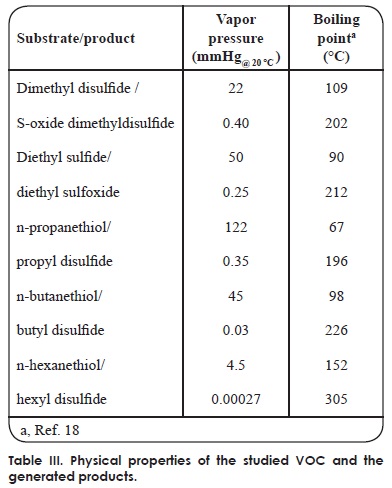
<body><![CDATA[<p align="justify"><font face="verdana" size="2"><b>Kinetic characterization of CPO&#45;catalyzed oxidation of VOC.</b> Biocatalytic oxidation of organosulfur compounds was performed at 25&deg;C in closed vials, to prevent volatilization of the substrates. Kinetic characterization was performed using substrate concentrations of up to 5 mM, due to insolubility of the compounds. The reaction mixture contained 10% acetonitrile, 60 mM phosphate buffer pH 6 and 1 mM H<sub>2</sub>O<sub>2</sub>. The reaction was started by addition of the enzyme (0.05&#45;0.1 nmol). Substrate conversion was monitored by UV absorbance (typically 220&#45;250 nm in a Perkin Elmer DAD) through reverse phase HPLC (Hypersil ODS 2.1 X 100 &#956;m column from Agilent), using a 30% acetonitrile/70% water isocratic phase. Reduction in the area of the UV signal was used to calculate substrate conversion. Reaction rate was calculated as the ratio of substrate conversion to reaction time. Controls with peroxide and without enzyme were also performed, in order to calculate the non&#45;enzymatic conversion. Kinetic characterization was performed using substrate concentrations of up to 5 mM, due to insolubility of the compounds. Given that saturation could not be achieved in all cases, the value of k<sub>cat</sub>/K<sub>m</sub> was calculated from the slope of the linear section in the initial rate vs substrate concentration plot. For the control reactions, in the absence of the enzyme and in the presence of peroxide, the rate constant of non&#45;enzymatic conversion (k<sub>non</sub>) was also calculated from the slope of rate vs substrate concentration plot. Results shown are the average of at least three independent reactions.</font></p>  	    <p align="justify"><font face="verdana" size="2"><b>Product identification.</b> For product identification, 10&#45;mL reactions were monitored until at least 70% substrate conversion was achieved. The reaction mixture was extracted with methylene chloride, dried through an anhydride Na<sub>2</sub>SO<sub>4</sub> bead and analyzed through gas chromatography (Agilent 6890N) coupled to a mass selective detector (Agilent 5973). A nonpolar HP&#45;5ms column (30m x 0.25 mm x 0.25 &#956;m) operating at low temperature (typically 40&deg;C) was used to separate and identify the products.</font></p>  	    <p align="justify"><font face="verdana" size="2"><b>Reactor operation.</b> A two&#45;phase reactor was assembled as follows. An air stream was passed through a reservoir containing 2 mL of 226.1 mM of dimethyl disulfide (DMDS) in acetonitrile and the resulting DMDS&#45;enriched stream was bubbled at the bottom of a glass vessel containing 70 mL of the liquid reaction medium (15% <i>tert</i>&#45;butanol and 85% 60 mM phosphate buffer pH 6). Gas flow was maintained between 40&#45;60 mL/min, total duration of each experiment (i.e. until the reservoir was exhausted) was around 80&#45;90 min. Enzyme (1 &#956;mol CPO = 40,000 enzyme units) and peroxide were successively added and samples were taken from the liquid phase to be analyzed by HPLC. The reaction was monitored using 230 nm for product detection, as substrate concentration in the liquid medium was extremely low and could not be accurately determined.</font></p>  	    <p align="justify"><font face="verdana" size="2"><b>Conversion calculations of the enzymatic reaction in the reactor.</b> Product concentration in the system was calculated form a calibration curve. The ratio of total product accumulated in the liquid phase to the total amount of enzyme added to the liquid phase was calculated for each condition tested in this study. Substrate conversion was referred to the theoretically limiting substrate, H<sub>2</sub>O<sub>2</sub> in most cases. Experiments were performed at least in duplicate.</font></p>  	    <p>&nbsp;</p>  	    <p align="justify"><font face="verdana" size="2"><b>Results and discussion</b></font></p>  	    <p align="justify"><font face="verdana" size="2">All compounds tested in this work were transformed in the presence of CPO at pH 6 in a reaction medium containing 10% organic solvent. Under these conditions, non&#45;enzymatic oxidation of the substrates also occurred. The rate of the enzyme&#45;catalyzed reaction was calculated as the difference between the total rate in the presence of the enzyme and peroxide minus the control rate in the presence of only peroxide. In some cases, enzyme saturation could not be achieved due to low substrate solubility. However, the pseudo&#45;first order rate constants of the catalyzed (k<sub>cat</sub>/K<sub>m</sub>) and non&#45;enzymatic (k<sub>non</sub>) reactions were calculated from the linear section of the rate <i>vs</i> substrate concentration plot, as described in the experimental section, and are shown in <a href="/img/revistas/tip/v18n1/a1t1.jpg" target="_blank">Table I</a>. The catalytic proficiency, also shown in <a href="/img/revistas/tip/v18n1/a1t1.jpg" target="_blank">Table I</a>, is the ratio of these rate constants and has been interpreted by other authors as the ability of enzymes to lower the activation barrier of the reaction<sup>&#91;17&#93;</sup>. In units of concentration, the catalytic proficiency relates to the affinity between the enzyme and the chemically distorted substrate in the transition state. According to our data, the dissociation constant of VOCs is in the range of 100 nM or less, suggesting a mild interaction within the active center of the enzyme.</font></p>  	    <p align="justify"><font face="verdana" size="2">The reaction products, identified by mass spectrometry, are shown in <a href="/img/revistas/tip/v18n1/a1t2.jpg" target="_blank">Table II</a> and <a href="/img/revistas/tip/v18n1/a1f1.jpg" target="_blank">Figure 1</a>; no other products could be detected. Physical properties of substrates and products are shown in <a href="#t3">Table III</a>. The oxidation generates compounds with higher boiling points, reduced vapor pressures and thus decreased volatility. Consequently, the oxidation decreases the atmospheric pollutant character of the studied sulfur compounds. We observed that the oxidation of sulfides generated the corresponding sulfoxides, as expected. It is well known that the CPO catalytic mechanism for the oxidation of sulfides involves a direct oxygen transfer within the active site of the enzyme, as evidenced by almost quantitative incorporation of labeled oxygen from H<sub>2</sub>O<sub>2</sub><sup>&#91;18&#93;</sup> into the sulfoxide<sup>&#91;19&#93;</sup>. The formation of a short&#45;lived sulfur&#45;based free radical has also been invoked, but has not been demonstrated yet<sup>&#91;20&#93;</sup>. On the other hand, we observed that thiols were oxidized to the corresponding disulfides. This reaction has not been described before for CPO. The non&#45;enzymatic formation of a disulfide has been reported as a consequence of CPO&#45;catalyzed halogenation of thiols at acidic pH<sup>&#91;21&#93;</sup>, thus ruling out a similar mechanism under the peroxidatic conditions (i.e pH 6 and absence of KCl) used in the present study. In order to further confirm this type of reaction being catalyzed by CPO, we also identified diphenyl disulfide (see <a href="/img/revistas/tip/v18n1/a1t2.jpg" target="_blank">Table II</a>) as the product of the oxidation of an aromatic thiol, benzenethiol. This reaction has been reported for other heme proteins such as myeloperoxidase (MPO) and horseradish peroxidase (HRP) using aliphatic thiols as substrates; it has been noted that oxidation rate is widely variable for these enzymes. For example, HRP&#45;catalyzed oxidation of cysteine and cysteine derivatives showed rate constants in the range of 24&#45;660 M<sup>&#45;1</sup> s<sup>&#45;1</sup>; only cysteine methyl ester and 2,3&#45;dimercaptopropanol showed higher oxidation rate constants, in the order of 10<sup>3</sup> and 10<sup>4</sup> M<sup>&#45;1</sup> s<sup>&#45;1</sup>, respectively<sup>&#91;22&#93;</sup>. On the other hand, MPO seemed less sensitive to the nature and charge of the substrate, which were oxidized with rate constants in the range of 10<sup>3</sup>&#45;10<sup>4</sup> M<sup>&#45;1</sup> s<sup>&#45;1</sup><sup>&#91;23&#93;</sup>. In the case of the substrates analyzed in this work, the rate constants of the CPO&#45;catalyzed reaction are in the range of 10<sup>3</sup>&#45;10<sup>4</sup> M<sup>&#45;1</sup> s<sup>&#45;1</sup> (<a href="/img/revistas/tip/v18n1/a1t1.jpg" target="_blank">Table I</a>), thus highlighting the potential of this versatile enzyme. Regarding the possible mechanism, the reaction could involve the formation of free radicals; it has been suggested that the first enzymatic intermediary of the catalytic cycle, an oxo&#45;ferryl radical cation called Compound I, may be able to subtract an electron from the thiol group; the free radical, after losing a proton, combines with a second free thyl radical to form the disulfide (<a href="/img/revistas/tip/v18n1/a1f2.jpg" target="_blank">Figure 2</a>).</font></p>  	    <p align="center"><font face="verdana" size="2"><a name="t3"></a></font></p>  	    <p align="center"><font face="verdana" size="2"><img src="/img/revistas/tip/v18n1/a1t3.jpg"></font></p>  	    ]]></body>
<body><![CDATA[<p align="justify"><font face="verdana" size="2">In order to test the ability of CPO to detoxify a gaseous effluent, an air stream was enriched with dimethyl disulfide (DMDS) as described in the experimental section and contacted with an aqueous reaction medium containing pH 6 phosphate buffer and 15% <i>tert</i>&#45;butanol in order to favor the solubility of the substrate and stability of the enzyme; for this system <i>tert</i>&#45;butanol was chosen as organic solvent because it has been reported to be less deactivating for the enzyme, compared to acetonitrile. The system is schematized in <a href="/img/revistas/tip/v18n1/a1f3.jpg" target="_blank">Figure 3A</a>. DMDS was selected as model substrate due to a higher enzymatic conversion compared to the non&#45;enzymatic conversion (<a href="/img/revistas/tip/v18n1/a1t1.jpg" target="_blank">Table I</a>). Different enzyme and hydrogen peroxide concentrations were assayed and product formation was monitored through HPLC, obtaining profiles similar to the one shown in <a href="/img/revistas/tip/v18n1/a1f3.jpg" target="_blank">Figure 3B</a>. Product formation was attributed solely to enzyme catalysis, as proper controls showed little chemical oxidation in the absence of enzyme (less than 0.1 mM product), probably due to low substrate concentration in the system. The maximum amount of product found in the aqueous solution was 1.46 mM. The ratio of mol of product per mol of added enzyme (P/E) was calculated under different conditions, as shown in <a href="/img/revistas/tip/v18n1/a1t4.jpg" target="_blank">Table IV</a>. The P/E ratio increased with enzyme concentration, up to a maximum value near 12,100 mol of product/mol of enzyme (condition A and B); further addition of enzyme resulted in lower P/E ratio (condition E). These observations suggest that the reaction is not limited by the amount of enzyme present in the reaction. If all of the substrate in the reservoir was transferred to the liquid phase and converted to product, a maximum concentration of 6.46 mM would be expected. As total H<sub>2</sub>O<sub>2</sub> is 4 mM, the oxidant could be limiting the substrate conversion, thus successive additions of 2 mM H<sub>2</sub>O<sub>2</sub> (total 8 mM) were tested (condition C); however, higher concentrations of H<sub>2</sub>O<sub>2</sub> led to extremely low concentrations of product. It is known that in the absence of an efficient electron donor substrate, peroxidases are inactivated in a suicide&#45;like fashion<sup>&#91;24,25&#93;</sup>. Finally, in order to test whether addition of a similar amount of H<sub>2</sub>O<sub>2</sub> (3.5 mM) but dosified in more additions (7 additions of 0.5 mM) could lead to higher P/E ratios, the amount of H<sub>2</sub>O<sub>2</sub> was dosified in condition D. However, similar product concentration and P/E ratio was obtained, although a smoother profile for product generation was noticed.</font></p>  	    <p>&nbsp;</p>  	    <p align="justify"><font face="verdana" size="2"><b>Conclusions</b></font></p>  	    <p align="justify"><font face="verdana" size="2">In conclusion, CPO from <i>C. fumago</i> is able to catalyze the oxidation of short&#45;chain sulfides and mercaptans to generate the corresponding sulfoxides and disulfides. The products are less volatile compounds, and its ability to pollute the atmosphere is thus reduced by oxidation. Based on limiting concentrations of peroxide, a ca. 40% conversion of the volatile compound contained in a gaseous stream was achieved, by controlling the concentration of enzyme in the reactor.</font></p>  	    <p align="justify"><font face="verdana" size="2">This example of a peroxidase able to catalyze the oxidation of volatile sulfur hydrocarbons highlights the versatility of low specificity enzymes in the environmental field; this reaction could be of practical application in the remediation of gaseous effluents. Further improvement of the system is necessary, through reactor engineering, in order to improve substrate transfer to the liquid medium.</font></p>  	    <p>&nbsp;</p>  	    <p align="justify"><font face="verdana" size="2"><b>Acknowledgments</b></font></p>  	    <p align="justify"><font face="verdana" size="2">The results presented in this work are part of the master thesis of Julio C. Cruz (UNAM) and bachelor thesis of Jes&uacute;s Garc&iacute;a (Universidad Polit&eacute;cnica del Estado de Morelos). This work was supported by PAPIIT UNAM IN212510, BIOCATEM Network (Grant 245413) and Conacyt 179241. The authors thank Rosa Rom&aacute;n from Institute of Biotechnology, UNAM and Ren&eacute; Guardi&aacute;n Tapia from CIICAp&#45;UAEM for technical support.</font></p>  	    <p>&nbsp;</p>  	    <p align="justify"><font face="verdana" size="2"><b>References</b></font></p>  	    ]]></body>
<body><![CDATA[<!-- ref --><p align="justify"><font face="verdana" size="2">1. Casella, L., Monzani, E. &amp; Nicolis, S. Potential applications of peroxidases in the fine chemical industries, in Biocatalysis based on heme peroxidases (eds. Torres, E. &amp; Ayala, M.) 111&#45;153 (Springer&#45;Verlag; 2010).    &nbsp;&nbsp;&nbsp;&nbsp;&nbsp;&nbsp;&nbsp;&nbsp;[&#160;<a href="javascript:void(0);" onclick="javascript: window.open('/scielo.php?script=sci_nlinks&ref=9918669&pid=S1405-888X201500010000100001&lng=','','width=640,height=500,resizable=yes,scrollbars=1,menubar=yes,');">Links</a>&#160;]<!-- end-ref --></font></p>  	    <!-- ref --><p align="justify"><font face="verdana" size="2">2. M&aacute;rquez&#45;Rocha, F.J., Pica&#45;Granados, Y., Sandoval&#45;Villasana, A.M. &amp; V&aacute;zquez&#45;Duhalt, R. Determination of genotoxicity using a chloroperoxidase&#45;mediated model of PAH&#45;DNA adduct formation. <i>Bull. Environ. Contam. Toxicol.</i> <b>59</b>, 788&#45;795 (1997).    &nbsp;&nbsp;&nbsp;&nbsp;&nbsp;&nbsp;&nbsp;&nbsp;[&#160;<a href="javascript:void(0);" onclick="javascript: window.open('/scielo.php?script=sci_nlinks&ref=9918671&pid=S1405-888X201500010000100002&lng=','','width=640,height=500,resizable=yes,scrollbars=1,menubar=yes,');">Links</a>&#160;]<!-- end-ref --></font></p>  	    <!-- ref --><p align="justify"><font face="verdana" size="2">3. Ayala, M. &amp; V&aacute;zquez&#45;Duhalt, R. Enzymatic catalysis on petroleum products in Petroleum biotechnology (eds. V&aacute;zquez&#45;Duhalt, R. &amp; Quintero&#45;Ram&iacute;rez, R.) 67&#45;111 (Amsterdam, Elsevier Science, 2004).    &nbsp;&nbsp;&nbsp;&nbsp;&nbsp;&nbsp;&nbsp;&nbsp;[&#160;<a href="javascript:void(0);" onclick="javascript: window.open('/scielo.php?script=sci_nlinks&ref=9918673&pid=S1405-888X201500010000100003&lng=','','width=640,height=500,resizable=yes,scrollbars=1,menubar=yes,');">Links</a>&#160;]<!-- end-ref --></font></p>  	    <!-- ref --><p align="justify"><font face="verdana" size="2">4. Torres, R., Bustos&#45;Jaimes, I. &amp; Le Borgne, S. Potential use of oxidative enzymes for the detoxification of organic pollutants. <i>Appl. Catal. Environ</i>. <b>46</b>, 1&#45;15 (2003).    &nbsp;&nbsp;&nbsp;&nbsp;&nbsp;&nbsp;&nbsp;&nbsp;[&#160;<a href="javascript:void(0);" onclick="javascript: window.open('/scielo.php?script=sci_nlinks&ref=9918675&pid=S1405-888X201500010000100004&lng=','','width=640,height=500,resizable=yes,scrollbars=1,menubar=yes,');">Links</a>&#160;]<!-- end-ref --></font></p>  	    <!-- ref --><p align="justify"><font face="verdana" size="2">5. Torres, C. &amp; V&aacute;zquez&#45;Duhalt, R. Applications and prospective of peroxidase biocatalysis in the environmental field in Biocatalysis based on heme peroxidases (eds. Torres, E. &amp; Ayala, M.) 179&#45;206 (Springer&#45;Verlag, 2010).    &nbsp;&nbsp;&nbsp;&nbsp;&nbsp;&nbsp;&nbsp;&nbsp;[&#160;<a href="javascript:void(0);" onclick="javascript: window.open('/scielo.php?script=sci_nlinks&ref=9918677&pid=S1405-888X201500010000100005&lng=','','width=640,height=500,resizable=yes,scrollbars=1,menubar=yes,');">Links</a>&#160;]<!-- end-ref --></font></p>  	    ]]></body>
<body><![CDATA[<!-- ref --><p align="justify"><font face="verdana" size="2">6. Hofrichter, M. &amp; Ullrich, R. Heme&#45;thiolate haloperoxidases: versatile biocatalysts with biotechnological and environmental significance. <i>Appl. Microbiol. Biotechnol.</i> <b>71</b>, 276&#45;288 (2006).    &nbsp;&nbsp;&nbsp;&nbsp;&nbsp;&nbsp;&nbsp;&nbsp;[&#160;<a href="javascript:void(0);" onclick="javascript: window.open('/scielo.php?script=sci_nlinks&ref=9918679&pid=S1405-888X201500010000100006&lng=','','width=640,height=500,resizable=yes,scrollbars=1,menubar=yes,');">Links</a>&#160;]<!-- end-ref --></font></p>  	    <!-- ref --><p align="justify"><font face="verdana" size="2">7. Allenmark, G.A. &amp; Andersson, M.A. Chloroperoxidase&#45;induced asymmetric sulfoxidation of some conformationally restricted sulfides. <i>Chirality</i> <b>10</b>, 246&#45;252 (1998).    &nbsp;&nbsp;&nbsp;&nbsp;&nbsp;&nbsp;&nbsp;&nbsp;[&#160;<a href="javascript:void(0);" onclick="javascript: window.open('/scielo.php?script=sci_nlinks&ref=9918681&pid=S1405-888X201500010000100007&lng=','','width=640,height=500,resizable=yes,scrollbars=1,menubar=yes,');">Links</a>&#160;]<!-- end-ref --></font></p>  	    <!-- ref --><p align="justify"><font face="verdana" size="2">8. Colonna, S., Gaggero, N., Carrea, G. &amp; Pasta, P. A new enzymatic enantioselective synthesis of dialkyl sulfoxides catalysed by monooxygenases. <i>Chem. Commun</i>. 439&#45;440 (1997).    &nbsp;&nbsp;&nbsp;&nbsp;&nbsp;&nbsp;&nbsp;&nbsp;[&#160;<a href="javascript:void(0);" onclick="javascript: window.open('/scielo.php?script=sci_nlinks&ref=9918683&pid=S1405-888X201500010000100008&lng=','','width=640,height=500,resizable=yes,scrollbars=1,menubar=yes,');">Links</a>&#160;]<!-- end-ref --></font></p>  	    <!-- ref --><p align="justify"><font face="verdana" size="2">9. Vargas, R.R., Bechara, E.J.H., Marzorati, L. &amp; Wladislaw, B. Asymmetric sulfoxidation of a &#91;beta&#93;&#45;carbonyl sulfide series by chloroperoxidase. <i>Tetrahedron: Asymmetry</i> <b>10</b>, 3219&#45;3227 (1999).    &nbsp;&nbsp;&nbsp;&nbsp;&nbsp;&nbsp;&nbsp;&nbsp;[&#160;<a href="javascript:void(0);" onclick="javascript: window.open('/scielo.php?script=sci_nlinks&ref=9918685&pid=S1405-888X201500010000100009&lng=','','width=640,height=500,resizable=yes,scrollbars=1,menubar=yes,');">Links</a>&#160;]<!-- end-ref --></font></p>  	    <!-- ref --><p align="justify"><font face="verdana" size="2">10. Pasta, P., Carrea, G., Colonna, S. &amp; Gaggero, N. Effects of chloride on the kinetics and stereochemistry of chloroperoxidase catalyzed oxidation of sulfides. <i>Biochim. Biophys. Acta Protein Struct. Mol. Enzymol.</i> <b>1209</b>, 203&#45;208 (1994).    &nbsp;&nbsp;&nbsp;&nbsp;&nbsp;&nbsp;&nbsp;&nbsp;[&#160;<a href="javascript:void(0);" onclick="javascript: window.open('/scielo.php?script=sci_nlinks&ref=9918687&pid=S1405-888X201500010000100010&lng=','','width=640,height=500,resizable=yes,scrollbars=1,menubar=yes,');">Links</a>&#160;]<!-- end-ref --></font></p>  	    ]]></body>
<body><![CDATA[<!-- ref --><p align="justify"><font face="verdana" size="2">11. Ayala, M., Robledo, N.R., L&oacute;pez&#45;Mungu&iacute;a, A. &amp; V&aacute;zquez&#45;Duhalt, R. Substrate specificity and ionization potential in chloroperoxidase&#45;catalyzed oxidation of diesel fuel. <i>Environ. Sci. Technol.</i> <b>34</b>, 2804&#45;2809 (2000).    &nbsp;&nbsp;&nbsp;&nbsp;&nbsp;&nbsp;&nbsp;&nbsp;[&#160;<a href="javascript:void(0);" onclick="javascript: window.open('/scielo.php?script=sci_nlinks&ref=9918689&pid=S1405-888X201500010000100011&lng=','','width=640,height=500,resizable=yes,scrollbars=1,menubar=yes,');">Links</a>&#160;]<!-- end-ref --></font></p>  	    <!-- ref --><p align="justify"><font face="verdana" size="2">12. Ayala, M., Tinoco, R., Hern&aacute;ndez, V., Bremauntz, P. &amp; V&aacute;zquez&#45;Duhalt, R. Biocatalytic oxidation of fuel as an alternative to biodesulfurization. <i>Fuel Process. Technol.</i> <b>57</b>, 101&#45;111 (1998).    &nbsp;&nbsp;&nbsp;&nbsp;&nbsp;&nbsp;&nbsp;&nbsp;[&#160;<a href="javascript:void(0);" onclick="javascript: window.open('/scielo.php?script=sci_nlinks&ref=9918691&pid=S1405-888X201500010000100012&lng=','','width=640,height=500,resizable=yes,scrollbars=1,menubar=yes,');">Links</a>&#160;]<!-- end-ref --></font></p>  	    <!-- ref --><p align="justify"><font face="verdana" size="2">13. Schiffman, S.S. &amp; Williams, C.M. Science of odor as a potential health issue. <i>J. Environ. Qual</i>. <b>34</b>, 129&#45;138 (2005).    &nbsp;&nbsp;&nbsp;&nbsp;&nbsp;&nbsp;&nbsp;&nbsp;[&#160;<a href="javascript:void(0);" onclick="javascript: window.open('/scielo.php?script=sci_nlinks&ref=9918693&pid=S1405-888X201500010000100013&lng=','','width=640,height=500,resizable=yes,scrollbars=1,menubar=yes,');">Links</a>&#160;]<!-- end-ref --></font></p>  	    <!-- ref --><p align="justify"><font face="verdana" size="2">14. Andersson, F., Annika, T.S., Karlsson, A., Svensson, B.H. &amp; Ejlertsson, J.R. Occurrence and abatement of volatile sulfur compounds during biogas production. <i>J. Air Waste Manage. Assoc.</i> <b>54</b>, 855&#45;861 (2004).    &nbsp;&nbsp;&nbsp;&nbsp;&nbsp;&nbsp;&nbsp;&nbsp;[&#160;<a href="javascript:void(0);" onclick="javascript: window.open('/scielo.php?script=sci_nlinks&ref=9918695&pid=S1405-888X201500010000100014&lng=','','width=640,height=500,resizable=yes,scrollbars=1,menubar=yes,');">Links</a>&#160;]<!-- end-ref --></font></p>  	    <!-- ref --><p align="justify"><font face="verdana" size="2">15. Smet, E., Lens, P. &amp; Van Langenhove, H. Treatment of waste gases contaminated with odorous sulfur compounds. <i>Crit. Rev. Environ. Sci. Technol.</i> <b>28</b>, 89&#45;117 (1998).    &nbsp;&nbsp;&nbsp;&nbsp;&nbsp;&nbsp;&nbsp;&nbsp;[&#160;<a href="javascript:void(0);" onclick="javascript: window.open('/scielo.php?script=sci_nlinks&ref=9918697&pid=S1405-888X201500010000100015&lng=','','width=640,height=500,resizable=yes,scrollbars=1,menubar=yes,');">Links</a>&#160;]<!-- end-ref --></font></p>  	    ]]></body>
<body><![CDATA[<!-- ref --><p align="justify"><font face="verdana" size="2">16. Pickard, M.A., Kadima, T.A. &amp; Carmichael, R.D. Chloroperoxidase, a peroxidase with potential. <i>J. Ind. Microbiol. Biotechnol.</i> <b>7</b>, 235&#45;241 (1991).    &nbsp;&nbsp;&nbsp;&nbsp;&nbsp;&nbsp;&nbsp;&nbsp;[&#160;<a href="javascript:void(0);" onclick="javascript: window.open('/scielo.php?script=sci_nlinks&ref=9918699&pid=S1405-888X201500010000100016&lng=','','width=640,height=500,resizable=yes,scrollbars=1,menubar=yes,');">Links</a>&#160;]<!-- end-ref --></font></p>  	    <!-- ref --><p align="justify"><font face="verdana" size="2">17. Radzicka, A. &amp; Wolfenden, R. A proficient enzyme. <i>Science</i> <b>267</b>, 90&#45;93 (1995).    &nbsp;&nbsp;&nbsp;&nbsp;&nbsp;&nbsp;&nbsp;&nbsp;[&#160;<a href="javascript:void(0);" onclick="javascript: window.open('/scielo.php?script=sci_nlinks&ref=9918701&pid=S1405-888X201500010000100017&lng=','','width=640,height=500,resizable=yes,scrollbars=1,menubar=yes,');">Links</a>&#160;]<!-- end-ref --></font></p>  	    <!-- ref --><p align="justify"><font face="verdana" size="2">18. Brown, R.L. &amp; Stein, S.E. Boiling point data in NIST Chemistry WebBook, NIST Standard Reference Database Number 69 (eds. Linstrom, P.J. &amp; Mallards, W.G.) National Institute of Standards and Technology <a href="http://webbook.nist.gov" target="_blank">http://webbook.nist.gov</a> (last seen on 2012).    &nbsp;&nbsp;&nbsp;&nbsp;&nbsp;&nbsp;&nbsp;&nbsp;[&#160;<a href="javascript:void(0);" onclick="javascript: window.open('/scielo.php?script=sci_nlinks&ref=9918703&pid=S1405-888X201500010000100018&lng=','','width=640,height=500,resizable=yes,scrollbars=1,menubar=yes,');">Links</a>&#160;]<!-- end-ref --></font></p>  	    <!-- ref --><p align="justify"><font face="verdana" size="2">19. Goto, Y., Matsui, T., Ozaki, S.I., Watanabe, Y. &amp; Fukuzumi, S. Mechanisms of sulfoxidation catalyzed by high&#45;valent intermediates of heme enzymes: electron&#45;transfer <i>vs</i> oxygen&#45;transfer mechanism. <i>J. Am. Chem. Soc.</i> <b>121</b>, 9497&#45;9502 (1999).    &nbsp;&nbsp;&nbsp;&nbsp;&nbsp;&nbsp;&nbsp;&nbsp;[&#160;<a href="javascript:void(0);" onclick="javascript: window.open('/scielo.php?script=sci_nlinks&ref=9918705&pid=S1405-888X201500010000100019&lng=','','width=640,height=500,resizable=yes,scrollbars=1,menubar=yes,');">Links</a>&#160;]<!-- end-ref --></font></p>  	    <!-- ref --><p align="justify"><font face="verdana" size="2">20. Kobayashi, S., Nakano, M., Kimura, T. &amp; Schaap, A.P. On the mechanism of the peroxidase&#45;catalyzed oxygen&#45;transfer reaction. <i>Biochemistry</i> <b>26</b>, 5019&#45;5022 (1987).    &nbsp;&nbsp;&nbsp;&nbsp;&nbsp;&nbsp;&nbsp;&nbsp;[&#160;<a href="javascript:void(0);" onclick="javascript: window.open('/scielo.php?script=sci_nlinks&ref=9918707&pid=S1405-888X201500010000100020&lng=','','width=640,height=500,resizable=yes,scrollbars=1,menubar=yes,');">Links</a>&#160;]<!-- end-ref --></font></p>  	    ]]></body>
<body><![CDATA[<!-- ref --><p align="justify"><font face="verdana" size="2">21. Silverstein, R.M.&amp; Hager, L.P. Chloroperoxidase&#45;catalyzed oxidation of thiols and disulfides to sulfenyl chlorides. <i>Biochemistry</i> <b>13</b>, 5069&#45;5073 (1974).    &nbsp;&nbsp;&nbsp;&nbsp;&nbsp;&nbsp;&nbsp;&nbsp;[&#160;<a href="javascript:void(0);" onclick="javascript: window.open('/scielo.php?script=sci_nlinks&ref=9918709&pid=S1405-888X201500010000100021&lng=','','width=640,height=500,resizable=yes,scrollbars=1,menubar=yes,');">Links</a>&#160;]<!-- end-ref --></font></p>  	    <!-- ref --><p align="justify"><font face="verdana" size="2">22. Burner, U. &amp; Obinger, C. Transient&#45;state and steady&#45;state kinetics of the oxidation of aliphatic and aromatic thiols by horseradish peroxidase. <i>FEBS Lett</i>. <b>411</b>, 269&#45;274 (1997).    &nbsp;&nbsp;&nbsp;&nbsp;&nbsp;&nbsp;&nbsp;&nbsp;[&#160;<a href="javascript:void(0);" onclick="javascript: window.open('/scielo.php?script=sci_nlinks&ref=9918711&pid=S1405-888X201500010000100022&lng=','','width=640,height=500,resizable=yes,scrollbars=1,menubar=yes,');">Links</a>&#160;]<!-- end-ref --></font></p>  	    <!-- ref --><p align="justify"><font face="verdana" size="2">23. Burner, U., Jantschko, W. &amp; Obinger, C. Kinetics of oxidation of aliphatic and aromatic thiols by myeloperoxidase compounds I and II. <i>FEBS Lett</i>. <b>443</b>, 290&#45;296 (1994).    &nbsp;&nbsp;&nbsp;&nbsp;&nbsp;&nbsp;&nbsp;&nbsp;[&#160;<a href="javascript:void(0);" onclick="javascript: window.open('/scielo.php?script=sci_nlinks&ref=9918713&pid=S1405-888X201500010000100023&lng=','','width=640,height=500,resizable=yes,scrollbars=1,menubar=yes,');">Links</a>&#160;]<!-- end-ref --></font></p>  	    <!-- ref --><p align="justify"><font face="verdana" size="2">24. Valderrama, B., Ayala, M. &amp; V&aacute;zquez&#45;Duhalt, R. Suicide inactivation of peroxidases and the challenge of engineering more robust enzymes. <i>Chem. Biol.</i> <b>9</b>, 555&#45;565 (2000).    &nbsp;&nbsp;&nbsp;&nbsp;&nbsp;&nbsp;&nbsp;&nbsp;[&#160;<a href="javascript:void(0);" onclick="javascript: window.open('/scielo.php?script=sci_nlinks&ref=9918715&pid=S1405-888X201500010000100024&lng=','','width=640,height=500,resizable=yes,scrollbars=1,menubar=yes,');">Links</a>&#160;]<!-- end-ref --></font></p>  	    <!-- ref --><p align="justify"><font face="verdana" size="2">25. Ayala, M., Batista, C.V. &amp; V&aacute;zquez&#45;Duhalt, R. Heme destruction, the main molecular event during the peroxide&#45;mediated inactivation of chloroperoxidase from <i>Caldariomyces fumago</i>. <i>J. Biol. Inorg. Chem</i>. <b>16</b>, 63&#45;68 (2011).    &nbsp;&nbsp;&nbsp;&nbsp;&nbsp;&nbsp;&nbsp;&nbsp;[&#160;<a href="javascript:void(0);" onclick="javascript: window.open('/scielo.php?script=sci_nlinks&ref=9918717&pid=S1405-888X201500010000100025&lng=','','width=640,height=500,resizable=yes,scrollbars=1,menubar=yes,');">Links</a>&#160;]<!-- end-ref --></font></p> 	    ]]></body>
<body><![CDATA[<p align="justify">&nbsp;</p> 	    <p align="justify"><font face="verdana" size="2"><b>Informaci&oacute;n sobre los autores</b></font></p> 	    <p align="justify"><font face="verdana" size="2"><b>Julio C&eacute;sar Cruz</b></font>    </p> 	    <p align="justify"><font face="verdana" size="2">Julio C&eacute;sar Cruz es Ingeniero bioqu&iacute;mico, con especialidad en biotecnolog&iacute;a, egresado en 2007 del Instituto Tecnol&oacute;gico de Villahermosa, Tabasco, donde se titul&oacute; con la tesis basada en la caracterizaci&oacute;n bioqu&iacute;mica de una enzima tipo peroxidasa. Al t&eacute;rmino de la licenciatura realiz&oacute; sus estudios de maestr&iacute;a en el Posgrado en Ciencias Bioqu&iacute;micas del Instituto de Biotecnolog&iacute;a de la Universidad Nacional Aut&oacute;noma de M&eacute;xico, y obtuvo el grado de Maestro en Ciencias en 2010. Durante ese periodo desarroll&oacute; la tesis sobre la oxidaci&oacute;n de compuestos azufrados vol&aacute;tiles en fase s&oacute;lido&#45;gas, usando como biocatalizador la enzima cloroperoxidasa. Posteriormente, en 2011 ingres&oacute; a la Escuela de Salud P&uacute;blica de M&eacute;xico del Instituto Nacional de Salud P&uacute;blica, donde a la fecha est&aacute; por concluir el doctorado en Ciencias en Salud P&uacute;blica y Epidemiolog&iacute;a, el tema de su tesis es el estudio de la interacci&oacute;n entre contaminaci&oacute;n ambiental (medida a trav&eacute;s de la exposici&oacute;n a part&iacute;culas finas suspendidas en el aire menores a 2.5 &#956;m), obesidad y el polimorfismo gen&eacute;tico del gen SERPINE 1 ( &#45;675 4g/5g), as&iacute; como su efecto en la inflamaci&oacute;n de v&iacute;as a&eacute;reas y funci&oacute;n pulmonar en poblaci&oacute;n infantil/adolescente. Las &aacute;reas de su inter&eacute;s son la investigaci&oacute;n sobre temas ambientales, como la contaminaci&oacute;n atmosf&eacute;rica, biorremediaci&oacute;n y salud p&uacute;blica.</font></p>         <p align="justify"><font face="verdana" size="2"><b>Jes&uacute;s Garc&iacute;a</b></font>    </p>         <p align="justify"><font face="verdana" size="2">Jes&uacute;s Garc&iacute;a estudi&oacute; Ingenier&iacute;a en Tecnolog&iacute;a Ambiental en la Universidad Polit&eacute;cnica del Estado de Morelos. Realiz&oacute; su tesis en el laboratorio de Biocat&aacute;lisis Ambiental que </font><font face="verdana" size="2">dirig&iacute;a el Dr. Rafael V&aacute;zquez Duhalt y bajo la tutor&iacute;a de la Dra. Marcela AyalaAceves se titul&oacute; con la tesis "Oxidaci&oacute;n de compuestos azufrados vol&aacute;tiles en un sistema en fase gas&#45;l&iacute;quido catalizada por la cloroperoxidasa de <i>Caldariomyces fumago",</i> en marzo de 2012.</font></p>     <p align="justify"><font face="verdana" size="2"><b>Marcela Ayala</b></font>    </p>     <p align="justify"><font face="verdana" size="2">Marcela Ayala realiz&oacute; sus estudios profesionales en la Facultad de Qu&iacute;mica de la Universidad Nacional Aut&oacute;noma de M&eacute;xico, en donde obtuvo el t&iacute;tulo de Ingeniera Qu&iacute;mica. Al terminar su licenciatura, ingres&oacute; al Instituto de Biotecnolog&iacute;a de la misma universidad para realizar sus estudios de doctorado, obteniendo el grado de Doctora en Ciencias. Ingres&oacute; como investigadora al Instituto Mexicano del Petr&oacute;leo, en donde trabaj&oacute; hasta el 2005, a&ntilde;o en que se incorpor&oacute; como Investigadora Asociada en el Instituto de Biotecnolog&iacute;a de la UNAM y desde 2009 es Investigadora Titular "A" en esta instituci&oacute;n.</font></p>     <p align="justify"><font face="verdana" size="2">Actualmente es Investigadora de Tiempo Completo en la UNAM. Su especialidad es la obtenci&oacute;n y caracterizaci&oacute;n de biocatalizadores basados en oxidoreductasas. Este tipo de enzimas tienen una diversidad de aplicaciones, desde campos como el ambiental hasta industrias de alto valor agregado como la farmac&eacute;utica. Dentro de las l&iacute;neas de investigaci&oacute;n de su inter&eacute;s est&aacute;n el estudio de la transferencia intramolecular de electrones en las peroxidasas y lacasas, cat&aacute;lisis de reacciones enzim&aacute;ticas redox utilizando peroxidasas y lacasas y biocat&aacute;lisis oxidativa en solventes org&aacute;nicos. Miembro del SNI, Nivel 1, con 20 publicaciones en revistas internacionales indizadas, ha escrito varios cap&iacute;tulos de libros y es editora de un libro sobre aplicaciones de peroxidasas.</font></p>     <p align="justify"><font face="verdana" size="2">Ha sido distinguida con la menci&oacute;n honor&iacute;fica en el <i>Certamen Juvenil de Ciencia y Tecnolog&iacute;a 2002,</i> por </font><font face="verdana" size="2">el Instituto Mexicano de la Juventud (SEP), con el <i>Premio Alfredo S&aacute;nchez Marroqu&iacute;n 2003</i> otorgado a la mejor tesis doctoral en el &aacute;rea de biotecnolog&iacute;a, por la Sociedad Mexicana de Biotecnolog&iacute;a y Bioingenier&iacute;a y con la <i>Distinci&oacute;n Universidad Nacional para J&oacute;venes Acad&eacute;micos 2011,</i> en el &aacute;rea de Innovaci&oacute;n Tecnol&oacute;gica (DUNJA2011).</font></p>     ]]></body>
<body><![CDATA[ ]]></body><back>
<ref-list>
<ref id="B1">
<label>1</label><nlm-citation citation-type="book">
<person-group person-group-type="author">
<name>
<surname><![CDATA[Casella]]></surname>
<given-names><![CDATA[L.]]></given-names>
</name>
<name>
<surname><![CDATA[Monzani]]></surname>
<given-names><![CDATA[E.]]></given-names>
</name>
<name>
<surname><![CDATA[Nicolis]]></surname>
<given-names><![CDATA[S.]]></given-names>
</name>
</person-group>
<article-title xml:lang="en"><![CDATA[Potential applications of peroxidases in the fine chemical industries]]></article-title>
<person-group person-group-type="editor">
<name>
<surname><![CDATA[Torres]]></surname>
<given-names><![CDATA[E.]]></given-names>
</name>
<name>
<surname><![CDATA[Ayala]]></surname>
<given-names><![CDATA[M.]]></given-names>
</name>
</person-group>
<source><![CDATA[Biocatalysis based on heme peroxidases]]></source>
<year>2010</year>
<page-range>111-153</page-range><publisher-name><![CDATA[Springer-Verlag]]></publisher-name>
</nlm-citation>
</ref>
<ref id="B2">
<label>2</label><nlm-citation citation-type="journal">
<person-group person-group-type="author">
<name>
<surname><![CDATA[Márquez-Rocha]]></surname>
<given-names><![CDATA[F.J.]]></given-names>
</name>
<name>
<surname><![CDATA[Pica-Granados]]></surname>
<given-names><![CDATA[Y.]]></given-names>
</name>
<name>
<surname><![CDATA[Sandoval-Villasana]]></surname>
<given-names><![CDATA[A.M.]]></given-names>
</name>
<name>
<surname><![CDATA[Vázquez-Duhalt]]></surname>
<given-names><![CDATA[R.]]></given-names>
</name>
</person-group>
<article-title xml:lang="en"><![CDATA[Determination of genotoxicity using a chloroperoxidase-mediated model of PAH-DNA adduct formation]]></article-title>
<source><![CDATA[Bull. Environ. Contam. Toxicol.]]></source>
<year>1997</year>
<volume>59</volume>
<page-range>788-795</page-range></nlm-citation>
</ref>
<ref id="B3">
<label>3</label><nlm-citation citation-type="book">
<person-group person-group-type="author">
<name>
<surname><![CDATA[Ayala]]></surname>
<given-names><![CDATA[M.]]></given-names>
</name>
<name>
<surname><![CDATA[Vázquez-Duhalt]]></surname>
<given-names><![CDATA[R.]]></given-names>
</name>
<name>
<surname><![CDATA[Vázquez-Duhalt]]></surname>
<given-names><![CDATA[R.]]></given-names>
</name>
<name>
<surname><![CDATA[Quintero-Ramírez]]></surname>
<given-names><![CDATA[R.]]></given-names>
</name>
</person-group>
<source><![CDATA[Enzymatic catalysis on petroleum products in Petroleum biotechnology]]></source>
<year>2004</year>
<page-range>67-111</page-range><publisher-loc><![CDATA[Amsterdam ]]></publisher-loc>
<publisher-name><![CDATA[Elsevier Science]]></publisher-name>
</nlm-citation>
</ref>
<ref id="B4">
<label>4</label><nlm-citation citation-type="journal">
<person-group person-group-type="author">
<name>
<surname><![CDATA[Torres]]></surname>
<given-names><![CDATA[R.]]></given-names>
</name>
<name>
<surname><![CDATA[Bustos-Jaimes]]></surname>
<given-names><![CDATA[I.]]></given-names>
</name>
<name>
<surname><![CDATA[Le Borgne]]></surname>
<given-names><![CDATA[S.]]></given-names>
</name>
</person-group>
<article-title xml:lang="en"><![CDATA[Potential use of oxidative enzymes for the detoxification of organic pollutants]]></article-title>
<source><![CDATA[Appl. Catal. Environ]]></source>
<year>2003</year>
<volume>46</volume>
<page-range>1-15</page-range></nlm-citation>
</ref>
<ref id="B5">
<label>5</label><nlm-citation citation-type="book">
<person-group person-group-type="author">
<name>
<surname><![CDATA[Torres]]></surname>
<given-names><![CDATA[C.]]></given-names>
</name>
<name>
<surname><![CDATA[Vázquez-Duhalt]]></surname>
<given-names><![CDATA[R.]]></given-names>
</name>
<name>
<surname><![CDATA[Torres]]></surname>
<given-names><![CDATA[E.]]></given-names>
</name>
<name>
<surname><![CDATA[Ayala]]></surname>
<given-names><![CDATA[M.]]></given-names>
</name>
</person-group>
<source><![CDATA[Applications and prospective of peroxidase biocatalysis in the environmental field in Biocatalysis based on heme peroxidases]]></source>
<year>2010</year>
<page-range>179-206</page-range><publisher-name><![CDATA[Springer-Verlag]]></publisher-name>
</nlm-citation>
</ref>
<ref id="B6">
<label>6</label><nlm-citation citation-type="journal">
<person-group person-group-type="author">
<name>
<surname><![CDATA[Hofrichter]]></surname>
<given-names><![CDATA[M.]]></given-names>
</name>
<name>
<surname><![CDATA[Ullrich]]></surname>
<given-names><![CDATA[R.]]></given-names>
</name>
</person-group>
<article-title xml:lang="en"><![CDATA[Heme-thiolate haloperoxidases: versatile biocatalysts with biotechnological and environmental significance]]></article-title>
<source><![CDATA[Appl. Microbiol. Biotechnol]]></source>
<year>2006</year>
<volume>71</volume>
<page-range>276-288</page-range></nlm-citation>
</ref>
<ref id="B7">
<label>7</label><nlm-citation citation-type="journal">
<person-group person-group-type="author">
<name>
<surname><![CDATA[Allenmark]]></surname>
<given-names><![CDATA[G.A.]]></given-names>
</name>
<name>
<surname><![CDATA[Andersson]]></surname>
<given-names><![CDATA[M.A.]]></given-names>
</name>
</person-group>
<article-title xml:lang="en"><![CDATA[Chloroperoxidase-induced asymmetric sulfoxidation of some conformationally restricted sulfides]]></article-title>
<source><![CDATA[Chirality]]></source>
<year>1998</year>
<volume>10</volume>
<page-range>246-252</page-range></nlm-citation>
</ref>
<ref id="B8">
<label>8</label><nlm-citation citation-type="journal">
<person-group person-group-type="author">
<name>
<surname><![CDATA[Colonna]]></surname>
<given-names><![CDATA[S.]]></given-names>
</name>
<name>
<surname><![CDATA[Gaggero]]></surname>
<given-names><![CDATA[N.]]></given-names>
</name>
<name>
<surname><![CDATA[Carrea]]></surname>
<given-names><![CDATA[G.]]></given-names>
</name>
<name>
<surname><![CDATA[Pasta]]></surname>
<given-names><![CDATA[P.]]></given-names>
</name>
</person-group>
<article-title xml:lang="en"><![CDATA[A new enzymatic enantioselective synthesis of dialkyl sulfoxides catalysed by monooxygenases]]></article-title>
<source><![CDATA[Chem. Commun.]]></source>
<year>1997</year>
<page-range>439-440</page-range></nlm-citation>
</ref>
<ref id="B9">
<label>9</label><nlm-citation citation-type="journal">
<person-group person-group-type="author">
<name>
<surname><![CDATA[Vargas]]></surname>
<given-names><![CDATA[R.R.]]></given-names>
</name>
<name>
<surname><![CDATA[Bechara]]></surname>
<given-names><![CDATA[E.J.H.]]></given-names>
</name>
<name>
<surname><![CDATA[Marzorati]]></surname>
<given-names><![CDATA[L.]]></given-names>
</name>
<name>
<surname><![CDATA[Wladislaw]]></surname>
<given-names><![CDATA[B.]]></given-names>
</name>
</person-group>
<article-title xml:lang="en"><![CDATA[Asymmetric sulfoxidation of a [beta]-carbonyl sulfide series by chloroperoxidase]]></article-title>
<source><![CDATA[Tetrahedron: Asymmetry]]></source>
<year>1999</year>
<volume>10</volume>
<page-range>3219-3227</page-range></nlm-citation>
</ref>
<ref id="B10">
<label>10</label><nlm-citation citation-type="journal">
<person-group person-group-type="author">
<name>
<surname><![CDATA[Pasta]]></surname>
<given-names><![CDATA[P.]]></given-names>
</name>
<name>
<surname><![CDATA[Carrea]]></surname>
<given-names><![CDATA[G.]]></given-names>
</name>
<name>
<surname><![CDATA[Colonna]]></surname>
<given-names><![CDATA[S.]]></given-names>
</name>
<name>
<surname><![CDATA[Gaggero]]></surname>
<given-names><![CDATA[N.]]></given-names>
</name>
</person-group>
<article-title xml:lang="en"><![CDATA[Effects of chloride on the kinetics and stereochemistry of chloroperoxidase catalyzed oxidation of sulfides]]></article-title>
<source><![CDATA[Biochim. Biophys. Acta Protein Struct. Mol. Enzymol.]]></source>
<year>1994</year>
<volume>1209</volume>
<page-range>203-208</page-range></nlm-citation>
</ref>
<ref id="B11">
<label>11</label><nlm-citation citation-type="journal">
<person-group person-group-type="author">
<name>
<surname><![CDATA[Ayala]]></surname>
<given-names><![CDATA[M.]]></given-names>
</name>
<name>
<surname><![CDATA[Robledo]]></surname>
<given-names><![CDATA[N.R.]]></given-names>
</name>
<name>
<surname><![CDATA[López-Munguía]]></surname>
<given-names><![CDATA[A.]]></given-names>
</name>
<name>
<surname><![CDATA[Vázquez-Duhalt]]></surname>
<given-names><![CDATA[R.]]></given-names>
</name>
</person-group>
<article-title xml:lang="en"><![CDATA[Substrate specificity and ionization potential in chloroperoxidase-catalyzed oxidation of diesel fuel]]></article-title>
<source><![CDATA[Environ. Sci. Technol.]]></source>
<year>2000</year>
<volume>34</volume>
<page-range>2804-2809</page-range></nlm-citation>
</ref>
<ref id="B12">
<label>12</label><nlm-citation citation-type="journal">
<person-group person-group-type="author">
<name>
<surname><![CDATA[Ayala]]></surname>
<given-names><![CDATA[M.]]></given-names>
</name>
<name>
<surname><![CDATA[Tinoco]]></surname>
<given-names><![CDATA[R.]]></given-names>
</name>
<name>
<surname><![CDATA[Hernández]]></surname>
<given-names><![CDATA[V.]]></given-names>
</name>
<name>
<surname><![CDATA[Bremauntz]]></surname>
<given-names><![CDATA[P.]]></given-names>
</name>
<name>
<surname><![CDATA[Vázquez-Duhalt]]></surname>
<given-names><![CDATA[R.]]></given-names>
</name>
</person-group>
<article-title xml:lang="en"><![CDATA[Biocatalytic oxidation of fuel as an alternative to biodesulfurization]]></article-title>
<source><![CDATA[Fuel Process. Technol.]]></source>
<year>1998</year>
<volume>57</volume>
<page-range>101-111</page-range></nlm-citation>
</ref>
<ref id="B13">
<label>13</label><nlm-citation citation-type="journal">
<person-group person-group-type="author">
<name>
<surname><![CDATA[Schiffman]]></surname>
<given-names><![CDATA[S.S.]]></given-names>
</name>
<name>
<surname><![CDATA[Williams]]></surname>
<given-names><![CDATA[C.M.]]></given-names>
</name>
</person-group>
<article-title xml:lang="en"><![CDATA[Science of odor as a potential health issue.]]></article-title>
<source><![CDATA[J. Environ. Qual.]]></source>
<year>2005</year>
<volume>34</volume>
<page-range>129-138</page-range></nlm-citation>
</ref>
<ref id="B14">
<label>14</label><nlm-citation citation-type="journal">
<person-group person-group-type="author">
<name>
<surname><![CDATA[Andersson]]></surname>
<given-names><![CDATA[F.]]></given-names>
</name>
<name>
<surname><![CDATA[Annika]]></surname>
<given-names><![CDATA[T.S.]]></given-names>
</name>
<name>
<surname><![CDATA[Karlsson]]></surname>
<given-names><![CDATA[A.]]></given-names>
</name>
<name>
<surname><![CDATA[Svensson]]></surname>
<given-names><![CDATA[B.H.]]></given-names>
</name>
<name>
<surname><![CDATA[Ejlertsson]]></surname>
<given-names><![CDATA[J.R.]]></given-names>
</name>
</person-group>
<article-title xml:lang="en"><![CDATA[Occurrence and abatement of volatile sulfur compounds during biogas production.]]></article-title>
<source><![CDATA[J. Air Waste Manage. Assoc.]]></source>
<year>2004</year>
<volume>54</volume>
<page-range>855-861</page-range></nlm-citation>
</ref>
<ref id="B15">
<label>15</label><nlm-citation citation-type="journal">
<person-group person-group-type="author">
<name>
<surname><![CDATA[Smet]]></surname>
<given-names><![CDATA[E.]]></given-names>
</name>
<name>
<surname><![CDATA[Lens]]></surname>
<given-names><![CDATA[P.]]></given-names>
</name>
<name>
<surname><![CDATA[Van Langenhove]]></surname>
<given-names><![CDATA[H.]]></given-names>
</name>
</person-group>
<article-title xml:lang="en"><![CDATA[Treatment of waste gases contaminated with odorous sulfur compounds]]></article-title>
<source><![CDATA[Crit. Rev. Environ. Sci. Technol.]]></source>
<year>1998</year>
<volume>28</volume>
<page-range>89-117</page-range></nlm-citation>
</ref>
<ref id="B16">
<label>16</label><nlm-citation citation-type="journal">
<person-group person-group-type="author">
<name>
<surname><![CDATA[Pickard]]></surname>
<given-names><![CDATA[M.A.]]></given-names>
</name>
<name>
<surname><![CDATA[Kadima]]></surname>
<given-names><![CDATA[T.A.]]></given-names>
</name>
<name>
<surname><![CDATA[Carmichael]]></surname>
<given-names><![CDATA[R.D.]]></given-names>
</name>
</person-group>
<article-title xml:lang="en"><![CDATA[Chloroperoxidase, a peroxidase with potential.]]></article-title>
<source><![CDATA[J. Ind. Microbiol. Biotechnol.]]></source>
<year>1991</year>
<volume>7</volume>
<page-range>235-241</page-range></nlm-citation>
</ref>
<ref id="B17">
<label>17</label><nlm-citation citation-type="journal">
<person-group person-group-type="author">
<name>
<surname><![CDATA[Radzicka]]></surname>
<given-names><![CDATA[A.]]></given-names>
</name>
<name>
<surname><![CDATA[Wolfenden]]></surname>
<given-names><![CDATA[R.]]></given-names>
</name>
</person-group>
<article-title xml:lang="en"><![CDATA[A proficient enzyme]]></article-title>
<source><![CDATA[Science]]></source>
<year>1995</year>
<volume>267</volume>
<page-range>90-93</page-range></nlm-citation>
</ref>
<ref id="B18">
<label>18</label><nlm-citation citation-type="book">
<person-group person-group-type="author">
<name>
<surname><![CDATA[Brown]]></surname>
<given-names><![CDATA[R.L.]]></given-names>
</name>
<name>
<surname><![CDATA[Stein]]></surname>
<given-names><![CDATA[S.E.]]></given-names>
</name>
<name>
<surname><![CDATA[Linstrom]]></surname>
<given-names><![CDATA[P.J.]]></given-names>
</name>
<name>
<surname><![CDATA[Mallards]]></surname>
<given-names><![CDATA[W.G.]]></given-names>
</name>
</person-group>
<source><![CDATA[Boiling point data in NIST Chemistry WebBook, NIST Standard Reference Database Number 69]]></source>
<year></year>
<publisher-name><![CDATA[National Institute of Standards and Technology]]></publisher-name>
</nlm-citation>
</ref>
<ref id="B19">
<label>19</label><nlm-citation citation-type="journal">
<person-group person-group-type="author">
<name>
<surname><![CDATA[Goto]]></surname>
<given-names><![CDATA[Y.]]></given-names>
</name>
<name>
<surname><![CDATA[Matsui]]></surname>
<given-names><![CDATA[T.]]></given-names>
</name>
<name>
<surname><![CDATA[Ozaki]]></surname>
<given-names><![CDATA[S.I.]]></given-names>
</name>
<name>
<surname><![CDATA[Watanabe]]></surname>
<given-names><![CDATA[Y.]]></given-names>
</name>
<name>
<surname><![CDATA[Fukuzumi]]></surname>
<given-names><![CDATA[S.]]></given-names>
</name>
</person-group>
<article-title xml:lang="en"><![CDATA[Mechanisms of sulfoxidation catalyzed by high-valent intermediates of heme enzymes: electron-transfer vs oxygen-transfer mechanism.]]></article-title>
<source><![CDATA[J. Am. Chem. Soc.]]></source>
<year>1999</year>
<volume>121</volume>
<page-range>9497-9502</page-range></nlm-citation>
</ref>
<ref id="B20">
<label>20</label><nlm-citation citation-type="journal">
<person-group person-group-type="author">
<name>
<surname><![CDATA[Kobayashi]]></surname>
<given-names><![CDATA[S.]]></given-names>
</name>
<name>
<surname><![CDATA[Nakano]]></surname>
<given-names><![CDATA[M.]]></given-names>
</name>
<name>
<surname><![CDATA[Kimura]]></surname>
<given-names><![CDATA[T.]]></given-names>
</name>
<name>
<surname><![CDATA[Schaap]]></surname>
<given-names><![CDATA[A.P.]]></given-names>
</name>
</person-group>
<article-title xml:lang="en"><![CDATA[On the mechanism of the peroxidase-catalyzed oxygen-transfer reaction.]]></article-title>
<source><![CDATA[Biochemistry]]></source>
<year>1987</year>
<volume>26</volume>
<page-range>5019-5022</page-range></nlm-citation>
</ref>
<ref id="B21">
<label>21</label><nlm-citation citation-type="journal">
<person-group person-group-type="author">
<name>
<surname><![CDATA[Silverstein]]></surname>
<given-names><![CDATA[R.M.]]></given-names>
</name>
<name>
<surname><![CDATA[Hager]]></surname>
<given-names><![CDATA[L.P.]]></given-names>
</name>
</person-group>
<article-title xml:lang="en"><![CDATA[Chloroperoxidase-catalyzed oxidation of thiols and disulfides to sulfenyl chlorides.]]></article-title>
<source><![CDATA[Biochemistry]]></source>
<year>1974</year>
<volume>13</volume>
<page-range>5069-5073</page-range></nlm-citation>
</ref>
<ref id="B22">
<label>22</label><nlm-citation citation-type="journal">
<person-group person-group-type="author">
<name>
<surname><![CDATA[Burner]]></surname>
<given-names><![CDATA[U.]]></given-names>
</name>
<name>
<surname><![CDATA[Obinger]]></surname>
<given-names><![CDATA[C.]]></given-names>
</name>
</person-group>
<article-title xml:lang="en"><![CDATA[Transient-state and steady-state kinetics of the oxidation of aliphatic and aromatic thiols by horseradish peroxidase.]]></article-title>
<source><![CDATA[FEBS Lett.]]></source>
<year>1997</year>
<volume>411</volume>
<page-range>269-274</page-range></nlm-citation>
</ref>
<ref id="B23">
<label>23</label><nlm-citation citation-type="journal">
<person-group person-group-type="author">
<name>
<surname><![CDATA[Burner]]></surname>
<given-names><![CDATA[U.]]></given-names>
</name>
<name>
<surname><![CDATA[Jantschko]]></surname>
<given-names><![CDATA[W.]]></given-names>
</name>
<name>
<surname><![CDATA[Obinger]]></surname>
<given-names><![CDATA[C.]]></given-names>
</name>
</person-group>
<article-title xml:lang="en"><![CDATA[Kinetics of oxidation of aliphatic and aromatic thiols by myeloperoxidase compounds I and II.]]></article-title>
<source><![CDATA[FEBS Lett.]]></source>
<year>1994</year>
<volume>443</volume>
<page-range>290-296</page-range></nlm-citation>
</ref>
<ref id="B24">
<label>24</label><nlm-citation citation-type="journal">
<person-group person-group-type="author">
<name>
<surname><![CDATA[Valderrama]]></surname>
<given-names><![CDATA[B.]]></given-names>
</name>
<name>
<surname><![CDATA[Ayala]]></surname>
<given-names><![CDATA[M.]]></given-names>
</name>
<name>
<surname><![CDATA[Vázquez-Duhalt]]></surname>
<given-names><![CDATA[R.]]></given-names>
</name>
</person-group>
<article-title xml:lang="en"><![CDATA[Suicide inactivation of peroxidases and the challenge of engineering more robust enzymes.]]></article-title>
<source><![CDATA[Chem. Biol.]]></source>
<year>2000</year>
<volume>9</volume>
<page-range>555-565</page-range></nlm-citation>
</ref>
<ref id="B25">
<label>25</label><nlm-citation citation-type="journal">
<person-group person-group-type="author">
<name>
<surname><![CDATA[Ayala]]></surname>
<given-names><![CDATA[M.]]></given-names>
</name>
<name>
<surname><![CDATA[Batista]]></surname>
<given-names><![CDATA[C.V.]]></given-names>
</name>
<name>
<surname><![CDATA[Vázquez-Duhalt]]></surname>
<given-names><![CDATA[R.]]></given-names>
</name>
</person-group>
<article-title xml:lang="en"><![CDATA[Heme destruction, the main molecular event during the peroxide-mediated inactivation of chloroperoxidase from Caldariomyces fumago]]></article-title>
<source><![CDATA[J. Biol. Inorg. Chem.]]></source>
<year>2011</year>
<volume>16</volume>
<page-range>63-68</page-range></nlm-citation>
</ref>
</ref-list>
</back>
</article>
