<?xml version="1.0" encoding="ISO-8859-1"?><article xmlns:mml="http://www.w3.org/1998/Math/MathML" xmlns:xlink="http://www.w3.org/1999/xlink" xmlns:xsi="http://www.w3.org/2001/XMLSchema-instance">
<front>
<journal-meta>
<journal-id>1405-7743</journal-id>
<journal-title><![CDATA[Ingeniería, investigación y tecnología]]></journal-title>
<abbrev-journal-title><![CDATA[Ing. invest. y tecnol.]]></abbrev-journal-title>
<issn>1405-7743</issn>
<publisher>
<publisher-name><![CDATA[Universidad Nacional Autónoma de México, Facultad de Ingeniería]]></publisher-name>
</publisher>
</journal-meta>
<article-meta>
<article-id>S1405-77432014000300011</article-id>
<title-group>
<article-title xml:lang="en"><![CDATA[Ground-Wave Propagation Effects on Transmission Lines through Error Images]]></article-title>
<article-title xml:lang="es"><![CDATA[Efectos de la propagación de ondas en tierra en líneas de transmisión a través de imágenes de error]]></article-title>
</title-group>
<contrib-group>
<contrib contrib-type="author">
<name>
<surname><![CDATA[Uribe-Campos]]></surname>
<given-names><![CDATA[Felipe Alejandro]]></given-names>
</name>
<xref ref-type="aff" rid="A01"/>
</contrib>
</contrib-group>
<aff id="A01">
<institution><![CDATA[,Universidad de Guadalajara División de Ingenierías Departamento de Mecánica Eléctrica]]></institution>
<addr-line><![CDATA[ ]]></addr-line>
</aff>
<pub-date pub-type="pub">
<day>00</day>
<month>09</month>
<year>2014</year>
</pub-date>
<pub-date pub-type="epub">
<day>00</day>
<month>09</month>
<year>2014</year>
</pub-date>
<volume>15</volume>
<numero>3</numero>
<fpage>457</fpage>
<lpage>468</lpage>
<copyright-statement/>
<copyright-year/>
<self-uri xlink:href="http://www.scielo.org.mx/scielo.php?script=sci_arttext&amp;pid=S1405-77432014000300011&amp;lng=en&amp;nrm=iso"></self-uri><self-uri xlink:href="http://www.scielo.org.mx/scielo.php?script=sci_abstract&amp;pid=S1405-77432014000300011&amp;lng=en&amp;nrm=iso"></self-uri><self-uri xlink:href="http://www.scielo.org.mx/scielo.php?script=sci_pdf&amp;pid=S1405-77432014000300011&amp;lng=en&amp;nrm=iso"></self-uri><abstract abstract-type="short" xml:lang="en"><p><![CDATA[Electromagnetic transient calculation of overhead transmission lines is strongly influenced by the natural resistivity of the ground. This varies from 1-10K (&#937;·m) depending on several media factors and on the physical composition of the ground. The accuracy on the calculation of a system transient response depends in part in the ground return model, which should consider the line geometry, the electrical resistivity and the frequency dependence of the power source. Up to date, there are only a few reports on the specialized literature about analyzing the effects produced by the presence of an imperfectly conducting ground of transmission lines in a transient state. A broad range analysis of three of the most often used ground-return models for calculating electromagnetic transients of overhead transmission lines is performed in this paper. The behavior of modal propagation in ground is analyzed here into effects of first and second order. Finally, a numerical tool based on relative error images is proposed in this paper as an aid for the analyst engineer to estimate the incurred error by using approximate ground-return models when calculating transients of overhead transmission lines.]]></p></abstract>
<abstract abstract-type="short" xml:lang="es"><p><![CDATA[El cálculo de transitorios electromagnéticos en líneas aéreas de transmisión está fuertemente influenciado por la resistividad natural eléctrica del suelo. Esta puede variar de 1-10K (&#937;·m) dependiendo de diversos factores en el medio y de la composición física del suelo. La precisión en el cálculo de la respuesta transitoria en un sistema depende en parte del modelo de retorno por tierra, el cual debe considerar la geometría de la línea, la resistividad eléctrica y la dependencia frecuencial de la fuente de alimentación. Hasta la fecha hay pocos reportes en la literatura especializada acerca del análisis de los efectos producidos por la presencia de un suelo conductor imperfecto de líneas de transmisión en estado transitorio. En este artículo se realiza un análisis de amplio rango a tres de los modelos de tierra actualmente más utilizados para cálculo de transitorios electromagnéticos en líneas aéreas de transmisión. El comportamiento de la propagación modal en tierra se analiza aquí en dos tipos de efectos de retorno por tierra. Finalmente, se propone en este artículo una herramienta numérica basada en imágenes de error relativo como una ayuda para que el ingeniero analista pueda estimar el error incurrido por utilizar modelos aproximados de tierra para el cálculo de transitorios en líneas aéreas de transmisión.]]></p></abstract>
<kwd-group>
<kwd lng="en"><![CDATA[ground-return effects]]></kwd>
<kwd lng="en"><![CDATA[earth impedances]]></kwd>
<kwd lng="en"><![CDATA[low frequency effects]]></kwd>
<kwd lng="en"><![CDATA[electromagnetic transients]]></kwd>
<kwd lng="en"><![CDATA[error images]]></kwd>
<kwd lng="es"><![CDATA[efectos de retorno por tierra]]></kwd>
<kwd lng="es"><![CDATA[impedancias de tierra]]></kwd>
<kwd lng="es"><![CDATA[efectos de baja frecuencia]]></kwd>
<kwd lng="es"><![CDATA[transitorios electromagnéticos]]></kwd>
<kwd lng="es"><![CDATA[imágenes de error]]></kwd>
</kwd-group>
</article-meta>
</front><body><![CDATA[  	    <p align="center"><font face="verdana" size="4"><b>Ground&#45;Wave Propagation Effects on Transmission Lines through Error Images</b></font></p>      <p align="center"><font face="verdana" size="2">&nbsp;</font></p>  	    <p align="center"><font face="verdana" size="3"><b>Efectos de la propagaci&oacute;n de ondas en tierra en l&iacute;neas de transmisi&oacute;n a trav&eacute;s de im&aacute;genes de error</b></font></p>      <p align="center"><font face="verdana" size="2">&nbsp;</font></p>  	    <p align="center"><font face="verdana" size="2"><b>Uribe&#45;Campos Felipe Alejandro</b></font></p>  	    <p align="justify"><font face="verdana" size="2">&nbsp;</font></p>  	    <p align="justify"><font face="verdana" size="2"><i>Departamento de Mec&aacute;nica El&eacute;ctrica, Divisi&oacute;n de Ingenier&iacute;as Universidad de Guadalajara, CUCEI</i>. Correo: <a href="mailto:fauribe@ieee.org">fauribe@ieee.org</a></font></p>  	    <p align="justify"><font face="verdana" size="2">&nbsp;    <br> 	Received: March 2013,    ]]></body>
<body><![CDATA[<br> 	Reevaluated: April 2013,    <br> 	Accepted: June 2013</font></p>  	    <p align="justify"><font face="verdana" size="2">&nbsp;</font></p>  	    <p align="justify"><font face="verdana" size="2"><b>Abstract</b></font></p>  	    <p align="justify"><font face="verdana" size="2">Electromagnetic transient calculation of overhead transmission lines is strongly influenced by the natural resistivity of the ground. This varies from 1&#45;10K (&#937;&#183;m) depending on several media factors and on the physical composition of the ground. The accuracy on the calculation of a system transient response depends in part in the ground return model, which should consider the line geometry, the electrical resistivity and the frequency dependence of the power source. Up to date, there are only a few reports on the specialized literature about analyzing the effects produced by the presence of an imperfectly conducting ground of transmission lines in a transient state. A broad range analysis of three of the most often used ground&#45;return models for calculating electromagnetic transients of overhead transmission lines is performed in this paper. The behavior of modal propagation in ground is analyzed here into effects of first and second order. Finally, a numerical tool based on relative error images is proposed in this paper as an aid for the analyst engineer to estimate the incurred error by using approximate ground&#45;return models when calculating transients of overhead transmission lines.</font></p>  	    <p align="justify"><font face="verdana" size="2"><b>Keywords:</b>&nbsp;ground&#45;return effects, earth impedances, low frequency effects, electromagnetic transients, error images.</font></p>  	    <p align="justify"><font face="verdana" size="2">&nbsp;</font></p>  	    <p align="justify"><font face="verdana" size="2"><b>Resumen</b></font></p>  	    <p align="justify"><font face="verdana" size="2">El c&aacute;lculo de transitorios electromagn&eacute;ticos en l&iacute;neas a&eacute;reas de transmisi&oacute;n est&aacute; fuertemente influenciado por la resistividad natural el&eacute;ctrica del suelo. Esta puede variar de 1&#45;10K (&#937;&#183;m) dependiendo de diversos factores en el medio y de la composici&oacute;n f&iacute;sica del suelo. La precisi&oacute;n en el c&aacute;lculo de la respuesta transitoria en un sistema depende en parte del modelo de retorno por tierra, el cual debe considerar la geometr&iacute;a de la l&iacute;nea, la resistividad el&eacute;ctrica y la dependencia frecuencial de la fuente de alimentaci&oacute;n. Hasta la fecha hay pocos reportes en la literatura especializada acerca del an&aacute;lisis de los efectos producidos por la presencia de un suelo conductor imperfecto de l&iacute;neas de transmisi&oacute;n en estado transitorio. En este art&iacute;culo se realiza un an&aacute;lisis de amplio rango a tres de los modelos de tierra actualmente m&aacute;s utilizados para c&aacute;lculo de transitorios electromagn&eacute;ticos en l&iacute;neas a&eacute;reas de transmisi&oacute;n. El comportamiento de la propagaci&oacute;n modal en tierra se analiza aqu&iacute; en dos tipos de efectos de retorno por tierra. Finalmente, se propone en este art&iacute;culo una herramienta num&eacute;rica basada en im&aacute;genes de error relativo como una ayuda para que el ingeniero analista pueda estimar el error incurrido por utilizar modelos aproximados de tierra para el c&aacute;lculo de transitorios en l&iacute;neas a&eacute;reas de transmisi&oacute;n.</font></p>  	    <p align="justify"><font face="verdana" size="2"><b>Descriptores:</b>&nbsp;efectos de retorno por tierra, impedancias de tierra, efectos de baja frecuencia, transitorios electromagn&eacute;ticos, im&aacute;genes de error.</font></p>  	    ]]></body>
<body><![CDATA[<p align="justify"><font face="verdana" size="2">&nbsp;</font></p>  	    <p align="justify"><font face="verdana" size="2"><b>Introduction</b></font></p>  	    <p align="justify"><font face="verdana" size="2">The analysis of wave propagation effects on overhead transmission systems due to the presence of an imperfectly conducting ground, is critically important to assess the frequency dependent losses and phase delay of ground modes. By its own structure, the electric line parameters&nbsp;<i>Z</i>&nbsp;(series&#45;impedance) and&nbsp;<i>&#947;</i>&nbsp;(shunt&#45;admittance) characterize the ground&#45;return effects on a first and second order, respectively.    <br> 	First order effects arise when the influence of the ground prevails over the geometric influence of the line. This is the case when the characteristic impedance of the system,&nbsp;<img src="/img/revistas/iit/v15n3/a11i1.jpg">, plays an important role in the simulation;&nbsp;<i>e. g.,</i>&nbsp;on transient short&#45;circuit currents calculation (Marti and Uribe, 2002). In this case, the frequency dependence of&nbsp;<i>ZC</i>&nbsp;is entirely due to the ground&#45;return path (Wedepohl, 1965).</font></p>  	    <p align="justify"><font face="verdana" size="2">The second order effects arise in the calculation of the modal voltage propagation function of the lin <i>e</i>&nbsp;<sup>&#150;</sup><sup>&#947;</sup><sup>&#183;&#955;</sup> where&nbsp;<img src="/img/revistas/iit/v15n3/a11i2.jpg">&nbsp;and&nbsp;<i>l</i>&nbsp;is the line length. In terms of propagation functions, when forming the product&nbsp;<i>Z&times;</i>&#978;&nbsp;the geometric effects tend to cancel out each other, except for the different influence of the ground (Marti and Uribe, 2002).</font></p>  	    <p align="justify"><font face="verdana" size="2">The problem here is that, up&#45;to&#45;date, there is no general criterion to evaluate the ground conduction effects on transmission line propagation. Another problem is the evaluation of how the ground&#45;return conduction effects impact on transmission line systems when switching transients occur.</font></p>  	    <p align="justify"><font face="verdana" size="2">Thus, it is the main idea of this paper to perform a new algorithmic methodology to analyze the first and second order ground&#45;return conduction effects on voltage and current transient waveforms of overhead transmission systems.</font></p>  	    <p align="justify"><font face="verdana" size="2">First, a broad range solution of the Carson's integral (Carson, 1926) is developed and implemented in this paper based on a previously established algorithmic technique published in (Uribe&nbsp;<i>et al</i>., 2004; Ramirez and Uribe, 2007). In addition, normalized dimensionless parameter comparisons with the Carson's series and complex&#45;depth closed&#45;form approximations (Gari, 1976; Kostenko, 1955; Deri&nbsp;<i>et al</i>., 1981; Alvarado and Betancourt, 1983) are obtained here through the relative error criterion. This methodology yields a new technique proposed here as an aid to estimate ground&#45;return modeling error on transients calculation through error images.</font></p>  	    <p align="justify"><font face="verdana" size="2">Finally, the impact of ground&#45;return modeling errors on transients calculation is identified here with an application example accurately solved via the Numerical Laplace Transform (Uribe&nbsp;<i>et al</i>., 2002).</font></p>  	    <p align="justify"><font face="verdana" size="2">&nbsp;</font></p>  	    ]]></body>

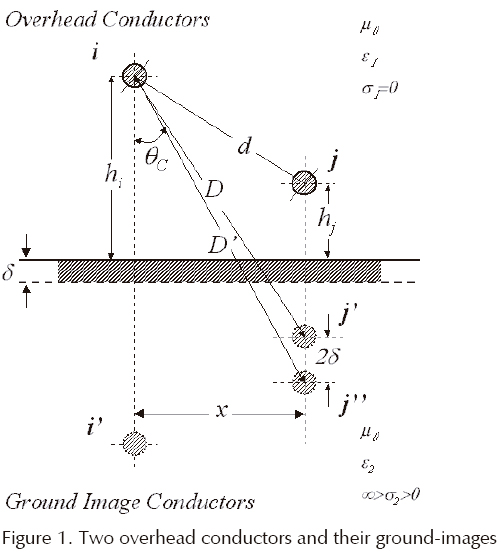
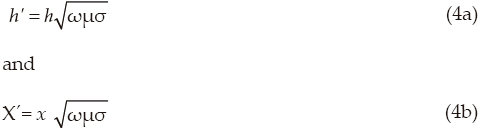
<body><![CDATA[<p align="justify"><font face="verdana" size="2"><b>Algorithmic solution of Carson's integral</b></font></p>  	    <p align="justify"><font face="verdana" size="2"><a href="#f1">Figure 1</a>&nbsp;shows two overhead infinite thin perfect conductors over an imperfectly conducting ground 0&nbsp;&#60;&nbsp;&#963;<sub>2</sub>&nbsp;&#60;&nbsp;&#8734;. The series&#45;impedances contribution (in &#937;&#8729;m) is given by (Marti and Uribe, 2002).</font></p> 	    <p align="center"><font face="verdana" size="2"><i><img src="/img/revistas/iit/v15n3/a11e1.jpg"></i></font></p>  	    <p align="center"><font face="verdana" size="2"><i><a name="f1"></a>    <br> 	<img src="/img/revistas/iit/v15n3/a11f1.jpg"></i></font></p>     <p align="justify"><font face="verdana" size="2"><i>where&nbsp;</i>P<sub>M</sub>&nbsp;is the dimension less Maxwell's potential&#45;coefficient,&nbsp;<i>Z</i><sub>Con</sub>&nbsp;is the internal conductor impedance and&nbsp;<i>ZE</i>&nbsp;introduces the ground&#45;return impedance contribution. Assuming a uniform line, homogeneous soil and neglecting inner displacement currents, the self or mutual ground&#45;return impedances are given by the Carson's integral (in MKS system) (Carson, 1926)</font></p>  	    <p align="center"><font face="verdana" size="2"><img src="/img/revistas/iit/v15n3/a11e2.jpg"></font></p>  	    <p align="justify"><font face="verdana" size="2">where</font></p>  	    <p align="center"><font face="verdana" size="2"><img src="/img/revistas/iit/v15n3/a11e3.jpg"></font></p>  	    <p align="justify"><font face="verdana" size="2">A characterization of the Carson's dimensionless parameters&nbsp;<i>p</i>&nbsp;and<i>&nbsp;q</i>&nbsp;is useful to analyze the regular oscillating pattern of the integrand where&nbsp;&#945;<i>&nbsp;</i>is the dummy variable. Carson introduced in (Carson, 1926) the following physical variables of the medium properties according to <a href="#f1">Figure 1</a>:</font></p>  	    ]]></body>
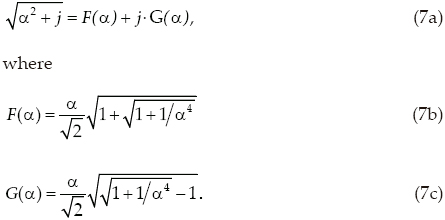
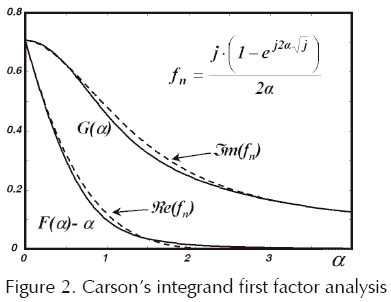
<body><![CDATA[<p align="center"><font face="verdana" size="2"><img src="/img/revistas/iit/v15n3/a11e4.jpg"></font></p>  	    <p align="justify"><font face="verdana" size="2">Expression (4a) and (4b) are normalized by the magnitude of the Skin Effect (Marti and Uribe, 2002; Wedepohl, 1965; Carson, 1926; Uribe&nbsp;<i>et al</i>., 2004; Ram&iacute;rez and Uribe, 2007; Gari, 1976; Kostenko, 1955; Deri&nbsp;<i>et al</i>., 1981; Alvarado and Betancourt, 1983; Uribe&nbsp;<i>et al</i>., 2002; Piessens&nbsp;<i>et al</i>., 1983; Using MATLAB, 2011; Dommel, 1986). Now, Carson's dimensionless parameter&nbsp;<i>p</i>&nbsp;and&nbsp;<i>q</i>&nbsp;for the self&#45;impedance case are given by</font></p>  	    <p align="center"><font face="verdana" size="2"><img src="/img/revistas/iit/v15n3/a11e5.jpg"></font></p>  	    <p align="justify"><font face="verdana" size="2">and for mutual impedances:</font></p>  	    <p align="center"><font face="verdana" size="2"><img src="/img/revistas/iit/v15n3/a11e6.jpg"></font></p>  	    <p align="justify"><font face="verdana" size="2">The integrand in (3) contains three factors. The first two are of the damping type while the third is regular oscillatory. The pattern of these factors suggests a new strategy for its numerical efficient solution. Consider the solution of the first factor radical function in (3) as (Uribe&nbsp;<i>et al</i>., 2004; Ramirez and Uribe, 2007)</font></p>  	    <p align="center"><font face="verdana" size="2"><img src="/img/revistas/iit/v15n3/a11e7.jpg"></font></p>  	    <p align="justify"><font face="verdana" size="2">Functions&nbsp;<i>F(</i>&#945;<i>)</i>&nbsp;and&nbsp;<i>G(</i>&#945;<i>)</i>&nbsp;provide the additional damping components to the integrand. Substituting (7b) and (7c) in (3) and decomposing into real and imaginary components, (3) becomes</font></p>  	    <p align="center"><font face="verdana" size="2"><img src="/img/revistas/iit/v15n3/a11e8.jpg"></font></p>  	    <p align="justify"><font face="verdana" size="2">Functions&nbsp;<i>F</i>(&#945;) &#150; &#945; and&nbsp;<i>G</i>(&#945;) in the first complex factor of (8) are monotonically decreasing. <a href="#f2">Figure 2</a>&nbsp;illustrates the behavior of these functions that for &#945; &#62; 1 1tends asymptotically to "1/(8&#945;<sup>3</sup>)" and "1/(2&#945;)", respectively (Uribe&nbsp;<i>et al</i>., 2004; Ramirez and Uribe, 2007).</font></p>  	    ]]></body>
<body><![CDATA[<p align="center"><font face="verdana" size="2"><a name="f2"></a>    <br> 	<img src="/img/revistas/iit/v15n3/a11f2.jpg"></font></p>  	    <p align="justify"><font face="verdana" size="2">The second complex factor in (8) only depends on the normalized parameter&nbsp;<i>p</i>. This factor is a pure damping exponential function. The truncation criterion developed in (Uribe&nbsp;<i>et al</i>., 2004; Ramirez and Uribe, 2007) with a relative error control can be extracted from its properties as</font></p>  	    <p align="center"><font face="verdana" size="2"><img src="/img/revistas/iit/v15n3/a11e9.jpg"></font></p>  	    <p align="justify"><font face="verdana" size="2">and the truncating criterion by approximating&nbsp;<i>"J</i>(<i>p,q</i>)<i>"</i>&nbsp;for the new truncated range would be (Uribe&nbsp;<i>et al</i>., 2004; Ram&iacute;rez and Uribe, 2007)</font></p>  	    <p align="center"><font face="verdana" size="2"><img src="/img/revistas/iit/v15n3/a11e10.jpg"></font></p>  	    <p align="justify"><font face="verdana" size="2">The error level can be controlled refining&nbsp;&#955;. A value of&nbsp;&#955;&nbsp;&#61; 10 has proved satisfactory enough for many practical application cases.</font></p>  	    <p align="justify"><font face="verdana" size="2">The third factor in (8) provides regular oscillations to the integrand which increases equal times as the argument&nbsp;<i>q</i>&times;&#945;&nbsp;exceeds the value of&nbsp;&#960;/2. This argument is related to the horizontal distance between conductors (<i>x</i>&nbsp;in <a href="#f1">Figure1</a>) and to the magnitude of Skin Effect Layer Thickness (Carson, 1926; Uribe&nbsp;<i>et al</i>., 2004; Ram&iacute;rez and Uribe, 2007). Within the range &#91;0, &#945;<sub>max</sub>&#93; this factor will not oscillate if</font></p>  	    <p align="center"><font face="verdana" size="2"><img src="/img/revistas/iit/v15n3/a11e11.jpg"></font></p>  	    <p align="justify"><font face="verdana" size="2">If condition (11a) is not satisfied, the integrand oscillations would produce magnified round&#45;off errors when integrating with generic quadrature routines (Piessens&nbsp;<i>et al</i>., 1983). To avoid this problem, it is necessary to detect the zero crossings with:</font></p>  	    ]]></body>
<body><![CDATA[<p align="center"><font face="verdana" size="2"><img src="/img/revistas/iit/v15n3/a11e11b.jpg"></font></p>  	    <p align="justify"><font face="verdana" size="2">where&nbsp;<i>k</i>&nbsp;is the corresponding oscillation sequence, "int" is the complete integer value and&nbsp;<i>K</i><sub>max</sub> indicates the maximum number of oscillations that are given by</font></p>  	    <p align="center"><font face="verdana" size="2"><img src="/img/revistas/iit/v15n3/a11e11c.jpg"></font></p>  	    <p align="justify"><font face="verdana" size="2">Notice in (11c) that (<i>q</i>/<i>p</i>)<i>&nbsp;=&nbsp;</i>(<i>x'</i>/<i>h'</i>). Obviously, from (11b) for each value of&nbsp;<i>k</i>&nbsp;the integrand zero crossing would be</font></p>  	    <p align="center"><font face="verdana" size="2"><img src="/img/revistas/iit/v15n3/a11e11d.jpg"></font></p>  	    <p align="justify"><font face="verdana" size="2">A new reliable and efficient broad range algorithmic evaluation of the Carson's integral has been obtained by using the truncating criterion in (10) with the zero crossing identification in (11) for 10&nbsp;&times;&nbsp;532 samples inside <a href="#t1">Table 1</a> ranges (Uribe&nbsp;<i>et al</i>., 2004; Ramirez and Uribe, 2007).</font></p>  	    <p align="center"><font face="verdana" size="2"><a name="t1"></a>    <br> 	<img src="/img/revistas/iit/v15n3/a11t1.jpg"></font></p>  	    <p align="justify"><font face="verdana" size="2">The physical variable ranges in&nbsp;<a href="#t1">Table 1</a>&nbsp;have been used to calculate the normalized Carson parameters shown in&nbsp;<a href="#t2">Table 2</a>&nbsp;to perform the algorithmic calculation of (8).</font></p>  	    <p align="center"><font face="verdana" size="2"><a name="t2"></a>    ]]></body>
<body><![CDATA[<br> 	<img src="/img/revistas/iit/v15n3/a11t2.jpg"></font></p>  	    <p align="justify"><font face="verdana" size="2"><a href="/img/revistas/iit/v15n3/a11f3.jpg" target="_blank">Figures 3a</a> and <a href="/img/revistas/iit/v15n3/a11f3.jpg" target="_blank">3b</a>&nbsp;depict the broad solution set obtained with the algorithmic technique proposed in this paper.</font></p>  	    <p align="justify"><font face="verdana" size="2">The figures were generated solving Carson's integral 10&nbsp;&times;&nbsp;532 timeswhich takes about more than one second on a 3.4GHz, 8GB RAM computer, running MATLAB<sup>&#174;</sup> V. 7.12 (Using MATLAB<sup>&#174;</sup>, 2001).</font></p>  	    <p align="justify"><font face="verdana" size="2">&nbsp;</font></p>  	    <p align="justify"><font face="verdana" size="2"><b>Implementation of Carson's series and complex depth formulae</b></font></p>  	    <p align="justify"><font face="verdana" size="2">In the synthesis of frequency dependent electromagnetic transients the need of a higher sampling refinement interval is often required (Wedepohl, 1965; Uribe&nbsp;<i>et al</i>., 2002). There are cases when it is necessary to handle very small or high ground conductivity values;&nbsp;<i>e.g.,&nbsp;</i>from rocky to moist ground (Dommel, 1986). Also there are other cases when the distance between conductors is wider (&#952;<sub>C</sub>&nbsp;&#62;&nbsp;&#960;/4);&nbsp;<i>e.g.,</i>&nbsp;interference on communication lines due to a power line fault (Dommel, 1986). In all these cases, it is highly convenient to have an accurate methodology for calculating the mutual ground&#45;return impedances between both energy systems.</font></p>  	    <p align="justify"><font face="verdana" size="2">A numerical version of the Carson's series has been also implemented here to test and verify the efficiency and accuracy of the algorithmic solution proposed in this paper (Carson, 1926; Dommel, 1986). However, in the treated application case, the series solution presented some serious disadvantages; the number of terms is practically unpredictable, numerical discontinuities emerges when switching from infinite to finite convergence ranges and also, it turns time consuming. For these reasons, the original series solution in Carson (1926) cannot be used to generate the error images proposed in the following paper section.</font></p>  	    <p align="justify"><font face="verdana" size="2">Thus, using the original Carson's parameters the following normalized distance according to&nbsp;<a href="#f1">Figure 1</a>&nbsp;is introduced as (Carson, 1926)</font></p>  	    <p align="center"><font face="verdana" size="2"><img src="/img/revistas/iit/v15n3/a11e12.jpg"></font></p>  	    <p align="justify"><font face="verdana" size="2">with a Carson's angle between vectors of</font></p>  	    ]]></body>
<body><![CDATA[<p align="center"><font face="verdana" size="2"><img src="/img/revistas/iit/v15n3/a11e12b.jpg"></font></p>  	    <p align="justify"><font face="verdana" size="2">Regarding the component partition (8), one can infer that</font></p>  	    <p align="center"><font face="verdana" size="2"><img src="/img/revistas/iit/v15n3/a11e12c.jpg"></font></p>  	    <p align="justify"><font face="verdana" size="2">and according to this paper nomenclature</font></p>  	    <p align="center"><font face="verdana" size="2"><img src="/img/revistas/iit/v15n3/a11e12e.jpg"></font></p>  	    <p align="justify"><font face="verdana" size="2">The following Carson parameter introduces the normalized distance between a real conductor in the air and the image of the other conductor inside the ground. This parameter also was used as a boundary quantity to adjust the switching process of the series when changing from a finite range&nbsp;<i>a</i>&nbsp;&#8804;&nbsp;5 into an infinite one&nbsp;<i>a</i>&nbsp;&#62;&nbsp;5 (Carson, 1926; Dommel, 1986):</font></p>  	    <p align="center"><font face="verdana" size="2"><img src="/img/revistas/iit/v15n3/a11e12f.jpg"></font></p>  	    <p align="justify"><font face="verdana" size="2">As an application example, consider an aerial transmission line with conductor height&nbsp;<i>h</i>&nbsp;&#61;&nbsp;20&nbsp;m. The distance between conductors is 0 &#8804;&nbsp;<i>x</i>&nbsp;&#8804;&nbsp;1&nbsp;Km. The ground conductivity is 0.01&nbsp;S/m and the frequency range is 1&nbsp;&#8804; &#969;/2&#960;&nbsp;&#8804;&nbsp;10<sup>6</sup> Hz.</font></p>  	    <p align="justify"><font face="verdana" size="2">To test accuracy and efficiency of the here developed algorithmic technique, an equivalent solution of&nbsp;<i>J</i>(<i>p</i>,<i>q</i>) in (12c) has been calculated using the Carson series (Carson, 1926). The real and imaginary components are shown in&nbsp;<a href="/img/revistas/iit/v15n3/a11f4.jpg" target="_blank">Figure 4</a>. At first sight the differences appear to be indistinguishable, but in&nbsp;<a href="/img/revistas/iit/v15n3/a11f5.jpg" target="_blank">Figure 5</a>, two types of numeric discontinuities arise when calculating the relative error (Ramirez and Uribe, 2007).</font></p>  	    <p align="justify"><font face="verdana" size="2">The first one is due to the series adjustment, while the second (in the form of peak discontinuities) is due to the switching series process, when changing from an infinite range into the new truncated range (Dommel, 1986).</font></p>  	    ]]></body>
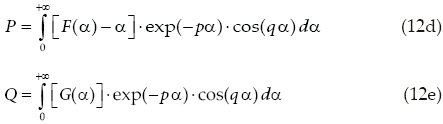
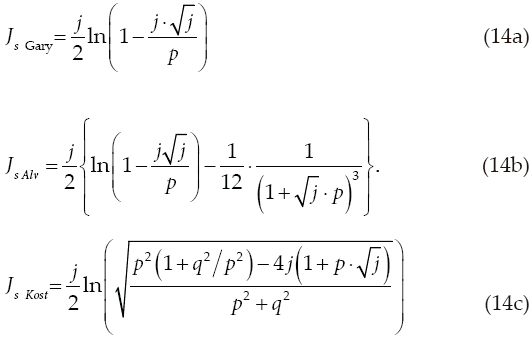
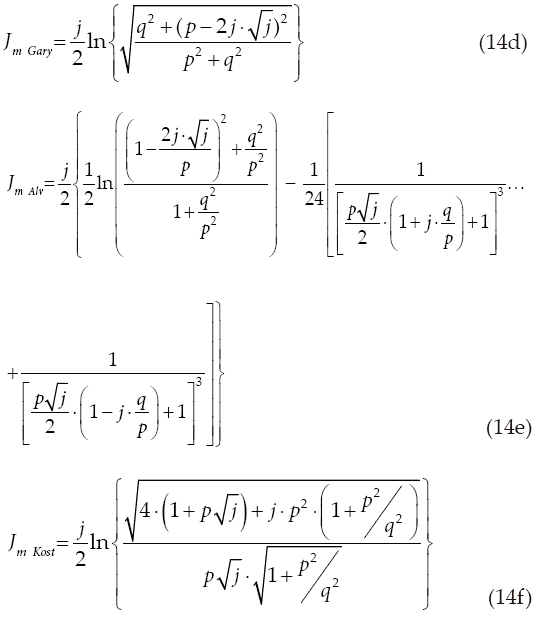
<body><![CDATA[<p align="justify"><font face="verdana" size="2">For this example layout,&nbsp;<a href="/img/revistas/iit/v15n3/a11f6.jpg" target="_blank">Figure 6</a>&nbsp;shows the magnitude and angle relationship between the vector components&nbsp;<i>P</i>&nbsp;and&nbsp;<i>Q</i>&nbsp;from (12d, e) calculated with the Carson series varying parameter&nbsp;<i>D</i>. The here obtained curves match with the obtained ones in Carson's paper confirming the accuracy of the method (Carson, 1926).</font></p>  	    <p align="justify"><font face="verdana" size="2">In addition, the obtained algorithmic solution set is used to confirm the accuracy ranges of the complex&#45;depth based formulas of Gary (1976), Kostenko (1955), Deri&nbsp;<i>et al</i>. (1981)and Alvarado&nbsp;<i>et al.</i>&nbsp;(1983).</font></p>  	    <p align="justify"><font face="verdana" size="2">Basically, classical images complex depth formulas are based in the following expression</font></p>  	    <p align="center"><font face="verdana" size="2"><img src="/img/revistas/iit/v15n3/a11e13.jpg"></font></p>  	    <p align="justify"><font face="verdana" size="2">where&nbsp;<img src="/img/revistas/iit/v15n3/a11i3.jpg">. After some algebraic manipulations (13a) is transformed into (Ramirez and Uribe, 2007)</font></p>  	    <p align="center"><font face="verdana" size="2"><img src="/img/revistas/iit/v15n3/a11e13b.jpg"></font></p>  	    <p align="justify"><font face="verdana" size="2">The behavior of&nbsp;<i>F</i>(&#945;) and&nbsp;<i>G</i>(&#945;) is shown in <a href="#f2">Figure 2</a>, as well as for&nbsp;<i>&#402;<sub>n</sub></i>. On introducing the right side of (13b) into (8) we have</font></p>  	    <p align="center"><font face="verdana" size="2"><img src="/img/revistas/iit/v15n3/a11e13c.jpg"></font></p>  	    <p align="justify"><font face="verdana" size="2">An analytical solution can be obtained directly from (13c) (Gary, 1976; Kostenko, 1955; Deri&nbsp;<i>et al</i>., 1981; Alvarado&nbsp;<i>et al</i>., 1983). Now, the complex depth formulae are transformed into a normalized dimensionless parameter expression of&nbsp;<i>p</i>&nbsp;and&nbsp;<i>q</i>. Thus, according to&nbsp;<i>Z<sub>E</sub></i>&nbsp;in (2) the self&#45;impedance&nbsp;<i>J<sub>s</sub></i>&nbsp;and the mutual&#45;impedance&nbsp;<i>J<sub>m</sub></i>&nbsp;for the Gary, Kostenko, Deri&nbsp;<i>et. al.,&nbsp;</i>and Alvarado&nbsp;<i>et. al.</i>&nbsp;formulae becomes</font></p>  	    <p align="center"><font face="verdana" size="2"><img src="/img/revistas/iit/v15n3/a11e14.jpg"></font></p>  	    ]]></body>
<body><![CDATA[<p align="justify"><font face="verdana" size="2">And for the mutual impedance case</font></p>  	    <p align="center"><font face="verdana" size="2"><img src="/img/revistas/iit/v15n3/a11e14d.jpg"></font></p>  	    <p align="justify"><font face="verdana" size="2">The approximation (14) for self or mutual&nbsp;<i>Z<sub>E</sub></i>&nbsp;in (2), substitutes&nbsp;<i>J</i>(<i>p,q</i>) in (8). In essence Gary, Kostenko, Deri&nbsp;<i>et al.</i>&nbsp;formulas have presented almost identical behavior between each other when plotting their error images. In consequence, only the images formed with the Gary and Alvarado&nbsp;<i>et al.</i>&nbsp;expressions are the only ones studied in this paper. Thus, the broad range result set is used now to generate the curves shown in&nbsp;<a href="/img/revistas/iit/v15n3/a11f7.jpg" target="_blank">Figure 7</a>&nbsp;for the&nbsp;<i>P</i>&nbsp;and&nbsp;<i>Q</i>&nbsp;components of (12c) in a parametric version of (14d) and (14e).</font></p>  	    <p align="justify"><font face="verdana" size="2">&nbsp;</font></p>  	    <p align="justify"><font face="verdana" size="2"><b>Error images estimation of ground models</b></font></p>  	    <p align="justify"><font face="verdana" size="2">The ground resistivity magnitude is introduced here into the electromagnetic transient calculation via the&nbsp;<i>Z<sub>E</sub></i>&nbsp;model. Thus, an important problem arises when estimating the ground modeling error. A new technique to estimate ground modeling errors on electromagnetic transient calculation is proposed in this paper section through error images. First, the broad range algorithmic solution (8), the approximated formulas by Gary in (14d) and the one by Alvarado&nbsp;<i>et al.</i>&nbsp;in (14e) are compared here through the relative error criterion as (Uribe&nbsp;<i>et al</i>., 2004; Ramirez and Uribe, 2007)</font></p>  	    <p align="center"><font face="verdana" size="2"><img src="/img/revistas/iit/v15n3/a11e15.jpg"></font></p>  	    <p align="justify"><font face="verdana" size="2">where&nbsp;<i>Z<sub>E</sub></i>&nbsp;is the algorithmic solution ground impedance and&nbsp;<i>Z<sub>E, Approx</sub>,&nbsp;</i>Approx is the approximate images ground impedance formula. <a href="/img/revistas/iit/v15n3/a11f8.jpg" target="_blank">Figure 8</a>&nbsp;shows the generated error images (15a) using 10<sup>2</sup> samples inside data in&nbsp;<a href="#t2">Table 2</a>. Each image shows five error regions. The error levels lie in the range of 1&#37;&nbsp;&#8804;&nbsp;&#949;<i><sub>rel</sub></i>&nbsp;&#8804;&nbsp;10&#37;.</font></p>  	    <p align="justify"><font face="verdana" size="2">Thus, a practical ground&#45;modeling error estimation algorithm through images is proposed as follows:</font></p>  	    <p align="justify"><font face="verdana" size="2"><b>First step.</b>&nbsp;Using physical variables (<i>h<sub>i</sub></i>,&nbsp;<i>h<sub>j</sub></i>,&nbsp;<i>x</i>,&nbsp;<i>r) </i>and relative medium properties (&#956;<i><sub>r</sub></i>, &#963;, &#949;<i><sub>r</sub></i>), evaluate the parameter relation&nbsp;<i>q/p</i>&nbsp;for each voltage coupling loop inside the system. The larger number of circuit loops, the more error line paths images are generated.</font></p>  	    ]]></body>
<body><![CDATA[<p align="justify"><font face="verdana" size="2"><b>Second step.</b>&nbsp;Calculate the NLT parameters (Uribe&nbsp;<i>et al</i>., 2002). Set the observation time&nbsp;<i>T<sub>obs</sub></i> and the number of samples&nbsp;<i>N<sub>samo</sub></i>, then the other parameters can be calculated as</font></p>  	    <p align="center"><font face="verdana" size="2"><img src="/img/revistas/iit/v15n3/a11e15b.jpg"></font></p>  	    <p align="justify"><font face="verdana" size="2">where&nbsp;<i>&#969;</i>&nbsp;is the angular frequency,&nbsp;&#916;<i>t</i>&nbsp;is the sampled time increment,&nbsp;&#937;&nbsp;is the truncating frequency,&nbsp;&#916;<i>&#969;</i>&nbsp;is the sampled frequency increment,&nbsp;<i>c</i>&nbsp;is the complex frequency damping coefficient and&nbsp;<i>n</i>&nbsp;is the discretization relative error level. Further, evaluate the complex frequency variable</font></p>  	    <p align="center"><font face="verdana" size="2"><img src="/img/revistas/iit/v15n3/a11e15f.jpg"></font></p>  	    <p align="justify"><font face="verdana" size="2"><b>Third step.</b>&nbsp;Find the maxima and minima boundary values of the transient Skin Effect variable using (15f) for calculating &#948;</font></p>  	    <p align="center"><font face="verdana" size="2"><img src="/img/revistas/iit/v15n3/a11e15g.jpg"></font></p>  	    <p align="justify"><font face="verdana" size="2">then, evaluate the normalized function&nbsp;<i>p<sub>max/min</sub></i> as</font></p>  	    <p align="center"><font face="verdana" size="2"><img src="/img/revistas/iit/v15n3/a11e15h.jpg"></font></p>  	    <p align="justify"><font face="verdana" size="2"><b>Fourth step</b>. Plot the previously generated error image for the ground&#45;model and trace the error line paths according&nbsp;<i>q</i>/<i>p</i>&nbsp;sorting min and max frequency samples.</font></p>  	    <p align="justify"><font face="verdana" size="2"><b>Fifth step.</b>&nbsp;Check the sampled error points region in the images. Their influence area would be their corresponding error levels.</font></p>  	    ]]></body>
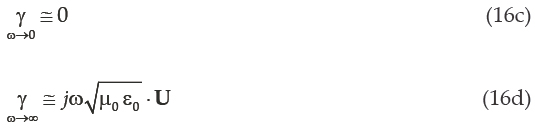
<body><![CDATA[<p align="justify"><font face="verdana" size="2">&nbsp;</font></p>  	    <p align="justify"><font face="verdana" size="2"><b>Ground&#45;return conduction effects in transients</b>    <br></font></p>  	    <p align="justify"><font face="verdana" size="2">In this research paper, the ground&#45;return effects are analyzed according to a first and second order kind. On one hand, first order effects are given when the influence of the ground prevails over the geometric influence of the line. This is the case when&nbsp;<i>Z<sub>C</sub></i> has an important role in the numerical simulation. In the frequency limits&nbsp;<i>Z<sub>C</sub></i>&nbsp;becomes</font></p>  	    <p align="center"><font face="verdana" size="2"><img src="/img/revistas/iit/v15n3/a11e16.jpg"></font></p>  	    <p align="justify"><font face="verdana" size="2">The frequency dependency of (16a) is entirely due to the ground&#45;return contribution, since&nbsp;<i>Z<sub>Con</sub></i> &nbsp;&#8594; 0.</font></p>  	    <p align="justify"><font face="verdana" size="2">On the other hand, the second order effects arise when forming the product&nbsp;<i>Z&#183;&#978;</i>, because the geometric effects tend to cancel out each other, except for the different influence of the ground (Marti, 2002).</font></p>  	    <p align="justify"><font face="verdana" size="2">This is the case of the voltage propagation function&nbsp;<i>e</i><sup>&#150;&#978;xl</sup>g&times;<i>l</i>. Thus, <i>&#978;</i> tends asymptotically to</font></p>  	    <p align="center"><font face="verdana" size="2"><img src="/img/revistas/iit/v15n3/a11e16c.jpg"></font></p>  	    <p align="justify"><font face="verdana" size="2">where&nbsp;U&nbsp;is the unit matrix (Wedepohl, 1965).</font></p>  	    ]]></body>
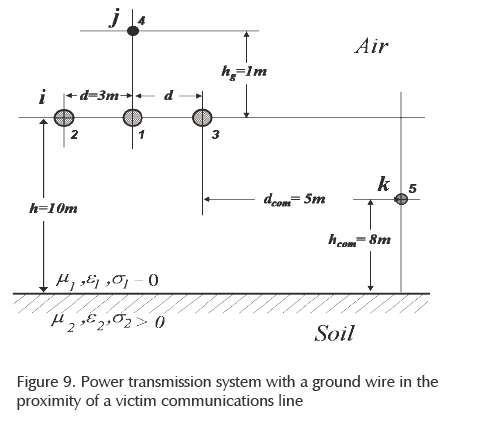
<body><![CDATA[<p align="justify"><font face="verdana" size="2">Consider a typical overhead transmission system as the one depicted in&nbsp;<a href="#f9">Figure 9</a>. This is a homogeneous three&#45;phase power line with a ground wire and a single communications line sharing a common right of way. The system length is 10&nbsp;Km. The corresponding conductors radii are&nbsp;<i>r<sub>i</sub></i>&#61; 3.20 cm,&nbsp;<i>r<sub>j</sub></i>&#61; 2.5 cm and<i>&nbsp;r<sub>k</sub></i>&nbsp;&#61; 1.5 cm. The soil conductivity is&nbsp;&#963;&nbsp;= 0.005 S/m.</font></p>  	    <p align="center"><font face="verdana" size="2"><a name="f9"></a>    <br> 	<img src="/img/revistas/iit/v15n3/a11f9.jpg"></font></p>  	    <p align="justify"><font face="verdana" size="2">The frequency dependent behavior of modal propagation functions&nbsp;<i>Z<sub>C</sub></i>&nbsp;and&nbsp;e<sup>&#150;<i>&#978;&#183;l</i></sup> for each numbered conductor in&nbsp;<a href="#f9">Figure 9</a>&nbsp;is illustrated in&nbsp;<a href="/img/revistas/iit/v15n3/a11f10.jpg" target="_blank">Figure 10</a>. The impact of Gary and Alvarado ground&#45;return models (Gary, 1976; Kostenko, 1955; Deri&nbsp;<i>et al</i>., 1981; Alvarado&nbsp;<i>et al</i>., 1983) in the transient step response is illustrated here the by means of a two circuit test using the NLT for the energy system shown in&nbsp;<a href="#f9">Figure 9</a>&nbsp;(Uribe&nbsp;<i>et al</i>., 2002).</font></p>  	    <p align="justify"><font face="verdana" size="2">The first test is the calculation of the transient step voltage&#45;response at the remote end with an open circuit condition of the system using the here treated ground&#45;return models for comparison.</font></p>  	    <p align="justify"><font face="verdana" size="2"><a href="/img/revistas/iit/v15n3/a11f11.jpg" target="_blank">Figures 11a</a> and <a href="/img/revistas/iit/v15n3/a11f11.jpg" target="_blank">11b</a>&nbsp;show the receiving end voltage response at the energized conductor (No. 1 in&nbsp;<a href="#f9">Figure 9</a>) and the induced voltage response at the communications line (No. 5 in&nbsp;<a href="#f9">Figure 9</a>), respectively<i>.</i></font></p>  	    <p align="justify"><font face="verdana" size="2"><a href="/img/revistas/iit/v15n3/a11f11.jpg" target="_blank">Figure 11c</a> and <a href="/img/revistas/iit/v15n3/a11f11.jpg" target="_blank">11d</a>&nbsp;show the corresponding relative errors (15a) calculated for the obtained voltages, for the Gary and Alvarado&#45;Betancourt models with respect to the Carson solution (Gary, 1976; Kostenko, 1955; Deri&nbsp;<i>et al</i>., 1981; Alvarado&nbsp;<i>et al</i>., 1983). In this case the Gary model is amazingly accurate.</font></p>  	    <p align="justify"><font face="verdana" size="2">The second test consists in the calculation of the transient step current response at the remote end with a short circuit condition of the system calculated with the here treated approximated ground&#45;return models.</font></p>  	    <p align="justify"><font face="verdana" size="2"><a href="/img/revistas/iit/v15n3/a11f12.jpg" target="_blank">Figure 12a</a>&nbsp;show the current transient step response calculated at the energized conductor (No. 1), while&nbsp;<a href="/img/revistas/iit/v15n3/a11f12.jpg" target="_blank">Figure 12b</a>&nbsp;depicts the corresponding circulating current at the victim circuit of communications line (No. 5).</font></p>  	    <p align="justify"><font face="verdana" size="2"><a href="/img/revistas/iit/v15n3/a11f12.jpg" target="_blank">Figures 12c</a> and <a href="/img/revistas/iit/v15n3/a11f12.jpg" target="_blank">12d</a>, show the calculated relative errors (15a) for the circulating currents at the energized conductor and at the induced communications line, respectively. One more time the accuracy of the Gary model can be noticed from these figures.</font></p>  	    ]]></body>
<body><![CDATA[<p align="justify"><font face="verdana" size="2">As ground&#45;return models are strong frequency dependent as can be seen in&nbsp;<a href="/img/revistas/iit/v15n3/a11f10.jpg" target="_blank">Figure 10b</a>, a better general tool for analyzing the effects of a ground&#45;return model in electromagnetic transients calculation is the images methodology proposed in&nbsp;<a href="/img/revistas/iit/v15n3/a11f13.jpg" target="_blank">Figure 13</a>.</font></p>  	    <p align="justify"><font face="verdana" size="2">Consider the error images in&nbsp;<a href="/img/revistas/iit/v15n3/a11f8.jpg" target="_blank">Figure 8</a>&nbsp;calculated in magnitude quantities for the Deri&nbsp;<i>et al.</i>(1981) and Alvarado&nbsp;<i>et al.</i>&nbsp;(1983)models. Two sets of error line paths have been traced in each of both figures. The horizontal error line path, represents a particular coupling circuit loop for any set of two specific conductors present in the transmission system shown in&nbsp;<a href="#f9">Figure 9</a>.</font></p>  	    <p align="justify"><font face="verdana" size="2">As an application example, consider the two sets of traced error line paths shown in&nbsp;<a href="/img/revistas/iit/v15n3/a11f13.jpg" target="_blank">Figure 13</a>. The first set&nbsp;<i>p<sub>1</sub>&#45;p<sub>2</sub></i> &nbsp;and&nbsp;<i>p<sub>5</sub>&#45;p<sub>6</sub>&nbsp;</i>corresponds to the loop formed between the energized power conductor and the victim communications line.</font></p>  	    <p align="justify"><font face="verdana" size="2">The second set of error line paths&nbsp;<i>p<sub>3</sub>&#45;p<sub>4</sub></i> and&nbsp;<i>p<sub>7</sub>&#45;p<sub>8</sub></i> correspond to the hypothetical case of calculating four times the magnitude&nbsp;<i>q</i>/<i>p</i>. An error less than 1&#37; corresponds to the image points&nbsp;<i>p<sub>5</sub></i> and&nbsp;<i>p<sub>7</sub></i>, which have an implicit frequency of 220 Hz. The error of <i>p<sub>6</sub></i>&nbsp;lies well within 1&#37; and 2&#37;. Points&nbsp;<i>p<sub>1</sub></i>,<i>&nbsp;p<sub>2</sub></i> and&nbsp;<i>p<sub>3</sub></i> have an error between 4&#37; and 6&#37;. The image points&nbsp;<i>p<sub>4</sub></i> and&nbsp;<i>p<sub>8</sub></i> lie into region five, having an error greater than 10&#37;. In this application case, any other image point has an implicit truncating frequency of 102 KHz.</font></p>  	    <p align="justify"><font face="verdana" size="2">&nbsp;</font></p>  	    <p align="justify"><font face="verdana" size="2"><b>Conclusions</b></font></p>  	    <p align="justify"><font face="verdana" size="2">An accurate numerical algorithm for solving the Carson's integral, their classical series expansion and complex&#45;depth approximate formulae, has been implemented in this paper for a broad range of applications, emphasizing the case&nbsp;&#952;<i><sub>C</sub></i>&nbsp;&#62;&nbsp;&#960;/2.</font></p>  	    <p align="justify"><font face="verdana" size="2">In the specific application example presented in this paper the transient&#45;step responses calculated at the remote end of open&#45;circuit voltages and short&#45;circuit circulating currents, the ground&#45;return model of Gary presented a more accurate result than the Alvarado&nbsp;<i>et al. </i>model. The main differences are probably due to the validity ranges of the implicit frequency in the transient calculation and, of the separation distance between conductors of the latter model.</font></p>  	    <p align="justify"><font face="verdana" size="2">A new technique for estimating ground&#45;return modeling errors on electromagnetic transients calculation is proposed in this paper through error images.</font></p>  	    <p align="justify"><font face="verdana" size="2">The frequency dependence of the ground has been separated here into effects of first and second order. These are mainly due to the modal propagation functions in the ground&nbsp;&#978;(&#969;) and to the characteristic impedance function&nbsp;<i>Z<sub>C</sub></i>(&#969;).</font></p>  	    ]]></body>
<body><![CDATA[<p align="justify"><font face="verdana" size="2">A methodology to analyze the impact of ground modeling errors on low frequency transients has been proposed here through error images, tracing simple error line paths on each image for a certain ground model having a universal applicability.</font></p>  	    <p align="justify"><font face="verdana" size="2">&nbsp;</font></p>  	    <p align="justify"><font face="verdana" size="2"><img src="/img/revistas/iit/v15n3/a11i4.jpg"></font></p>  	    <p align="justify"><font face="verdana" size="2">&nbsp;</font></p>  	    <p align="justify"><font face="verdana" size="2"><b>References</b></font></p>  	    <!-- ref --><p align="justify"><font face="verdana" size="2">Alvarado F., Betancourt R. An Accurate Closed&#45;Form Approx. For Ground Return Impedance Calculations. <i>Proc.of the IEEE</i>, volume 71 (issue 2), 1983: 279&#45;280.    &nbsp;&nbsp;&nbsp;&nbsp;&nbsp;&nbsp;&nbsp;&nbsp;[&#160;<a href="javascript:void(0);" onclick="javascript: window.open('/scielo.php?script=sci_nlinks&ref=4287704&pid=S1405-7743201400030001100001&lng=','','width=640,height=500,resizable=yes,scrollbars=1,menubar=yes,');">Links</a>&#160;]<!-- end-ref --></font></p>  	    <!-- ref --><p align="justify"><font face="verdana" size="2">Carson &nbsp;J.R. Wave propagation in overhead wires with ground return. <i>Bell Systems Tech. J</i>., 1926: 539&#45;554.    &nbsp;&nbsp;&nbsp;&nbsp;&nbsp;&nbsp;&nbsp;&nbsp;[&#160;<a href="javascript:void(0);" onclick="javascript: window.open('/scielo.php?script=sci_nlinks&ref=4287706&pid=S1405-7743201400030001100002&lng=','','width=640,height=500,resizable=yes,scrollbars=1,menubar=yes,');">Links</a>&#160;]<!-- end-ref --></font></p>  	    <!-- ref --><p align="justify"><font face="verdana" size="2">Deri A., Tevan G., Semlyen A. and Castanheira A. The Complex Ground Return Plane: a Simplified Model for Homogeneous and Multi&#45;Layer Earth Return. <i>IEEE Transactions on Power Apparatus and Systems</i>, volume PAS&#45;100 (issue 8), August 1981: 3686&#45;3693.    &nbsp;&nbsp;&nbsp;&nbsp;&nbsp;&nbsp;&nbsp;&nbsp;[&#160;<a href="javascript:void(0);" onclick="javascript: window.open('/scielo.php?script=sci_nlinks&ref=4287708&pid=S1405-7743201400030001100003&lng=','','width=640,height=500,resizable=yes,scrollbars=1,menubar=yes,');">Links</a>&#160;]<!-- end-ref --></font></p>  	    <!-- ref --><p align="justify"><font face="verdana" size="2">Dommel W. Electromagnetic Transients Program Reference Manual (EMTP Theory Book), Prepared for Bonneville Power Administration, P.O. Box 3621, Portland, Ore., 97208, USA, 1986.    &nbsp;&nbsp;&nbsp;&nbsp;&nbsp;&nbsp;&nbsp;&nbsp;[&#160;<a href="javascript:void(0);" onclick="javascript: window.open('/scielo.php?script=sci_nlinks&ref=4287710&pid=S1405-7743201400030001100004&lng=','','width=640,height=500,resizable=yes,scrollbars=1,menubar=yes,');">Links</a>&#160;]<!-- end-ref --></font></p>  	    <!-- ref --><p align="justify"><font face="verdana" size="2">Gary C. Approche Complete de la Propagation Multifilaire en Haute Frequence par Utilisation des Matrices Complexes. <i>E.D.F Bulletin de la Direction des Etudes et Recherches</i>, serie B, (issues 3/4), 1976&nbsp;: 5&#45;20.    &nbsp;&nbsp;&nbsp;&nbsp;&nbsp;&nbsp;&nbsp;&nbsp;[&#160;<a href="javascript:void(0);" onclick="javascript: window.open('/scielo.php?script=sci_nlinks&ref=4287712&pid=S1405-7743201400030001100005&lng=','','width=640,height=500,resizable=yes,scrollbars=1,menubar=yes,');">Links</a>&#160;]<!-- end-ref --></font></p>  	    <!-- ref --><p align="justify"><font face="verdana" size="2">Kostenko M.V. Mutual Impedance of Earth&#45;Return Overhead Lines Taking into Account the Skin&#45;Effect. <i>Elektritchestvo,&nbsp;</i>(issue 10), 1955: 29&#45;34.    &nbsp;&nbsp;&nbsp;&nbsp;&nbsp;&nbsp;&nbsp;&nbsp;[&#160;<a href="javascript:void(0);" onclick="javascript: window.open('/scielo.php?script=sci_nlinks&ref=4287714&pid=S1405-7743201400030001100006&lng=','','width=640,height=500,resizable=yes,scrollbars=1,menubar=yes,');">Links</a>&#160;]<!-- end-ref --></font></p>  	    <!-- ref --><p align="justify"><font face="verdana" size="2">Marti J.R. Thesis Report Uribe F.A. Algorithmic Evaluation of Pollaczek Integral and its Application to EM Transient Analysis of Underground Transmission Systems, (Ph.D. dissertation), Dept. Electrical. Eng., Cinvestav, Unidad Guadalajara, Jalisco, November 2002.    &nbsp;&nbsp;&nbsp;&nbsp;&nbsp;&nbsp;&nbsp;&nbsp;[&#160;<a href="javascript:void(0);" onclick="javascript: window.open('/scielo.php?script=sci_nlinks&ref=4287716&pid=S1405-7743201400030001100007&lng=','','width=640,height=500,resizable=yes,scrollbars=1,menubar=yes,');">Links</a>&#160;]<!-- end-ref --></font></p>  	    <!-- ref --><p align="justify"><font face="verdana" size="2">Piessens R., Doncker E., Ueberhuber C.W., Kahaner D.K. <i>Quad Pack&#45; A Subroutine Package for Automatic Integration</i>, Springer&#45;Verlag, Berlin Heidelberg, New York Tokyo, 1983.    &nbsp;&nbsp;&nbsp;&nbsp;&nbsp;&nbsp;&nbsp;&nbsp;[&#160;<a href="javascript:void(0);" onclick="javascript: window.open('/scielo.php?script=sci_nlinks&ref=4287718&pid=S1405-7743201400030001100008&lng=','','width=640,height=500,resizable=yes,scrollbars=1,menubar=yes,');">Links</a>&#160;]<!-- end-ref --></font></p>  	    <!-- ref --><p align="justify"><font face="verdana" size="2">Ramirez A. and Uribe F. A Broad Range Algorithm for the Evaluation of Carson's Integral. <i>IEEE Trans. on Pow. Del.</i>, volume 22 (issue 2), 2007: 1188&#45;1193.    &nbsp;&nbsp;&nbsp;&nbsp;&nbsp;&nbsp;&nbsp;&nbsp;[&#160;<a href="javascript:void(0);" onclick="javascript: window.open('/scielo.php?script=sci_nlinks&ref=4287720&pid=S1405-7743201400030001100009&lng=','','width=640,height=500,resizable=yes,scrollbars=1,menubar=yes,');">Links</a>&#160;]<!-- end-ref --></font></p>  	    <!-- ref --><p align="justify"><font face="verdana" size="2">Uribe F.A., Naredo J.L., Moreno P. and Guardado L. Algorithmic Evaluation of Underground Cable Earth Impedances. <i>IEEE Transactions on Power Delivery</i>, volume 19 (issue 1), January 2004: 316&#45;322.    &nbsp;&nbsp;&nbsp;&nbsp;&nbsp;&nbsp;&nbsp;&nbsp;[&#160;<a href="javascript:void(0);" onclick="javascript: window.open('/scielo.php?script=sci_nlinks&ref=4287722&pid=S1405-7743201400030001100010&lng=','','width=640,height=500,resizable=yes,scrollbars=1,menubar=yes,');">Links</a>&#160;]<!-- end-ref --></font></p>  	    <!-- ref --><p align="justify"><font face="verdana" size="2">Uribe F.A., Naredo J.L., Moreno P. and Guardado L. Electromagnetic Transients in Underground Transmission Systems Trough The Numerical Laplace Transform. <i>Elsevier Science Ltd, Electrical Power and Energy Systems</i>, volume 24, &nbsp;2002: 215&#45;221.    &nbsp;&nbsp;&nbsp;&nbsp;&nbsp;&nbsp;&nbsp;&nbsp;[&#160;<a href="javascript:void(0);" onclick="javascript: window.open('/scielo.php?script=sci_nlinks&ref=4287724&pid=S1405-7743201400030001100011&lng=','','width=640,height=500,resizable=yes,scrollbars=1,menubar=yes,');">Links</a>&#160;]<!-- end-ref --></font></p>  	    <!-- ref --><p align="justify"><font face="verdana" size="2">Using MATLAB, Matrix&#45;Laboratory, The Math Works Inc., Natick, MA, Matlab&#45;7.12 (R2011a).    &nbsp;&nbsp;&nbsp;&nbsp;&nbsp;&nbsp;&nbsp;&nbsp;[&#160;<a href="javascript:void(0);" onclick="javascript: window.open('/scielo.php?script=sci_nlinks&ref=4287726&pid=S1405-7743201400030001100012&lng=','','width=640,height=500,resizable=yes,scrollbars=1,menubar=yes,');">Links</a>&#160;]<!-- end-ref --></font></p>  	    <!-- ref --><p align="justify"><font face="verdana" size="2">Wedepohl L.M. Electrical Characteristics of Polyphase Transmission Systems with Special Reference to Boundary&#45;Value Calculations at Power&#45;Line Carrier Frequencies. <i>Proceedings of the IEE</i>, volume 112 (isuue 11), November 1965.    &nbsp;&nbsp;&nbsp;&nbsp;&nbsp;&nbsp;&nbsp;&nbsp;[&#160;<a href="javascript:void(0);" onclick="javascript: window.open('/scielo.php?script=sci_nlinks&ref=4287728&pid=S1405-7743201400030001100013&lng=','','width=640,height=500,resizable=yes,scrollbars=1,menubar=yes,');">Links</a>&#160;]<!-- end-ref --></font></p>  	    <p align="justify">&nbsp;</p>     <p align="justify"><font face="verdana" size="2"><b>About the author</b></font></p>  	    <p align="justify"><font face="verdana" size="2"><i><b>Felipe Alejandro Uribe&#45;Campos.</b>&nbsp;</i>Received the B.Sc. and M.Sc. degrees of Electrical Engineering, both from the State University of Guadalajara, in 1994 and 1998, respectively. During 2001 he was a visiting researcher at the University of British Columbia, B.C. Canada. In 2002 he received the Dr.Sc. degree in Electrical Engineering from the Center for Research and Advanced Studies of Mexico. The dissertation was awarded with the Arturo Rosenblueth prize. From 2003 to 2006 he was a full professor with the Electrical Graduate Program at the state University of Nuevo Leon, M&eacute;xico. From May 2006, he joined the Electrical Engineering Graduate Program at the State University of Guadalajara, M&eacute;xico, where he is currently a full time researcher. Since 2004, he is a member of the Mexico's National System of Researchers (SNI). His primary interest is the electromagnetic simulation of biological tissues for early cancer detection and power system harmonic and transient analysis.</font></p>      ]]></body><back>
<ref-list>
<ref id="B1">
<nlm-citation citation-type="journal">
<person-group person-group-type="author">
<name>
<surname><![CDATA[Alvarado]]></surname>
<given-names><![CDATA[F.]]></given-names>
</name>
<name>
<surname><![CDATA[Betancourt]]></surname>
<given-names><![CDATA[R.]]></given-names>
</name>
</person-group>
<article-title xml:lang="en"><![CDATA[An Accurate Closed-Form Approx. For Ground Return Impedance Calculations]]></article-title>
<source><![CDATA[Proc.of the IEEE]]></source>
<year>1983</year>
<volume>71</volume>
<numero>2</numero>
<issue>2</issue>
<page-range>279-280</page-range></nlm-citation>
</ref>
<ref id="B2">
<nlm-citation citation-type="journal">
<person-group person-group-type="author">
<name>
<surname><![CDATA[Carson]]></surname>
<given-names><![CDATA[J.R.]]></given-names>
</name>
</person-group>
<article-title xml:lang="en"><![CDATA[Wave propagation in overhead wires with ground return]]></article-title>
<source><![CDATA[Bell Systems Tech. J.]]></source>
<year>1926</year>
<page-range>539-554</page-range></nlm-citation>
</ref>
<ref id="B3">
<nlm-citation citation-type="journal">
<person-group person-group-type="author">
<name>
<surname><![CDATA[Deri]]></surname>
<given-names><![CDATA[A.]]></given-names>
</name>
<name>
<surname><![CDATA[Tevan]]></surname>
<given-names><![CDATA[G.]]></given-names>
</name>
<name>
<surname><![CDATA[Semlyen]]></surname>
<given-names><![CDATA[A.]]></given-names>
</name>
<name>
<surname><![CDATA[Castanheira]]></surname>
<given-names><![CDATA[A.]]></given-names>
</name>
</person-group>
<article-title xml:lang="en"><![CDATA[The Complex Ground Return Plane: a Simplified Model for Homogeneous and Multi-Layer Earth Return]]></article-title>
<source><![CDATA[IEEE Transactions on Power Apparatus and Systems]]></source>
<year>Augu</year>
<month>st</month>
<day> 1</day>
<volume>PAS-100</volume>
<numero>8</numero>
<issue>8</issue>
<page-range>3686-3693</page-range></nlm-citation>
</ref>
<ref id="B4">
<nlm-citation citation-type="">
<person-group person-group-type="author">
<name>
<surname><![CDATA[Dommel]]></surname>
<given-names><![CDATA[W.]]></given-names>
</name>
</person-group>
<source><![CDATA[Electromagnetic Transients Program Reference Manual (EMTP Theory Book), Prepared for Bonneville Power Administration, P.O. Box 3621]]></source>
<year>1986</year>
<publisher-loc><![CDATA[Portland^eOre. Ore.]]></publisher-loc>
</nlm-citation>
</ref>
<ref id="B5">
<nlm-citation citation-type="journal">
<person-group person-group-type="author">
<name>
<surname><![CDATA[Gary]]></surname>
<given-names><![CDATA[C.]]></given-names>
</name>
</person-group>
<article-title xml:lang="en"><![CDATA[Approche Complete de la Propagation Multifilaire en Haute Frequence par Utilisation des Matrices Complexes]]></article-title>
<source><![CDATA[E.D.F Bulletin de la Direction des Etudes et Recherches]]></source>
<year>1976</year>
<numero>3</numero><numero>4</numero>
<issue>3</issue><issue>4</issue>
<page-range>5-20</page-range></nlm-citation>
</ref>
<ref id="B6">
<nlm-citation citation-type="journal">
<person-group person-group-type="author">
<name>
<surname><![CDATA[Kostenko]]></surname>
<given-names><![CDATA[M.V.]]></given-names>
</name>
</person-group>
<article-title xml:lang="en"><![CDATA[Mutual Impedance of Earth-Return Overhead Lines Taking into Account the Skin-Effect]]></article-title>
<source><![CDATA[Elektritchestvo]]></source>
<year>1955</year>
<numero>10</numero>
<issue>10</issue>
<page-range>29-34</page-range></nlm-citation>
</ref>
<ref id="B7">
<nlm-citation citation-type="">
<person-group person-group-type="author">
<name>
<surname><![CDATA[Marti]]></surname>
<given-names><![CDATA[J.R.]]></given-names>
</name>
</person-group>
<source><![CDATA[Thesis Report Uribe F.A. Algorithmic Evaluation of Pollaczek Integral and its Application to EM Transient Analysis of Underground Transmission Systems]]></source>
<year></year>
</nlm-citation>
</ref>
<ref id="B8">
<nlm-citation citation-type="book">
<person-group person-group-type="author">
<name>
<surname><![CDATA[Piessens]]></surname>
<given-names><![CDATA[R.]]></given-names>
</name>
<name>
<surname><![CDATA[Doncker]]></surname>
<given-names><![CDATA[E.]]></given-names>
</name>
<name>
<surname><![CDATA[Ueberhuber]]></surname>
<given-names><![CDATA[C.W.]]></given-names>
</name>
<name>
<surname><![CDATA[Kahaner]]></surname>
<given-names><![CDATA[D.K.]]></given-names>
</name>
</person-group>
<source><![CDATA[Quad Pack- A Subroutine Package for Automatic Integration]]></source>
<year>1983</year>
<publisher-loc><![CDATA[BerlinHeidelbergNew YorkTokyo ]]></publisher-loc>
<publisher-name><![CDATA[Springer-Verlag]]></publisher-name>
</nlm-citation>
</ref>
<ref id="B9">
<nlm-citation citation-type="journal">
<person-group person-group-type="author">
<name>
<surname><![CDATA[Ramirez]]></surname>
<given-names><![CDATA[A.]]></given-names>
</name>
<name>
<surname><![CDATA[Uribe]]></surname>
<given-names><![CDATA[F.]]></given-names>
</name>
</person-group>
<article-title xml:lang="en"><![CDATA[A Broad Range Algorithm for the Evaluation of Carson's Integral]]></article-title>
<source><![CDATA[IEEE Trans. on Pow. Del.]]></source>
<year>2007</year>
<volume>22</volume>
<numero>2</numero>
<issue>2</issue>
<page-range>1188-1193</page-range></nlm-citation>
</ref>
<ref id="B10">
<nlm-citation citation-type="journal">
<person-group person-group-type="author">
<name>
<surname><![CDATA[Uribe]]></surname>
<given-names><![CDATA[F.A.]]></given-names>
</name>
<name>
<surname><![CDATA[Naredo]]></surname>
<given-names><![CDATA[J.L.]]></given-names>
</name>
<name>
<surname><![CDATA[Moreno]]></surname>
<given-names><![CDATA[P.]]></given-names>
</name>
<name>
<surname><![CDATA[Guardado]]></surname>
<given-names><![CDATA[L.]]></given-names>
</name>
</person-group>
<article-title xml:lang="en"><![CDATA[Algorithmic Evaluation of Underground Cable Earth Impedances]]></article-title>
<source><![CDATA[IEEE Transactions on Power Delivery]]></source>
<year>Janu</year>
<month>ar</month>
<day>y </day>
<volume>19</volume>
<numero>1</numero>
<issue>1</issue>
<page-range>316-322</page-range></nlm-citation>
</ref>
<ref id="B11">
<nlm-citation citation-type="journal">
<person-group person-group-type="author">
<name>
<surname><![CDATA[Uribe]]></surname>
<given-names><![CDATA[F.A.]]></given-names>
</name>
<name>
<surname><![CDATA[Naredo]]></surname>
<given-names><![CDATA[J.L.]]></given-names>
</name>
<name>
<surname><![CDATA[Moreno]]></surname>
<given-names><![CDATA[P.]]></given-names>
</name>
<name>
<surname><![CDATA[Guardado]]></surname>
<given-names><![CDATA[L.]]></given-names>
</name>
</person-group>
<article-title xml:lang="en"><![CDATA[Electromagnetic Transients in Underground Transmission Systems Trough The Numerical Laplace Transform]]></article-title>
<source><![CDATA[Elsevier Science Ltd, Electrical Power and Energy Systems]]></source>
<year>2002</year>
<volume>24</volume>
<page-range>215-221</page-range></nlm-citation>
</ref>
<ref id="B12">
<nlm-citation citation-type="book">
<source><![CDATA[Using MATLAB]]></source>
<year></year>
<volume>R2011</volume>
<publisher-loc><![CDATA[Natick^eMA MA]]></publisher-loc>
<publisher-name><![CDATA[Matrix-LaboratoryThe Math Works Inc.]]></publisher-name>
</nlm-citation>
</ref>
<ref id="B13">
<nlm-citation citation-type="journal">
<person-group person-group-type="author">
<name>
<surname><![CDATA[Wedepohl]]></surname>
<given-names><![CDATA[L.M.]]></given-names>
</name>
</person-group>
<source><![CDATA[Proceedings of the IEEElectrical Characteristics of Polyphase Transmission Systems with Special Reference to Boundary-Value Calculations at Power-Line Carrier Frequencies]]></source>
<year>Nove</year>
<month>mb</month>
<day>er</day>
<volume>112</volume>
<numero>11</numero>
<issue>11</issue>
</nlm-citation>
</ref>
</ref-list>
</back>
</article>