<?xml version="1.0" encoding="ISO-8859-1"?><article xmlns:mml="http://www.w3.org/1998/Math/MathML" xmlns:xlink="http://www.w3.org/1999/xlink" xmlns:xsi="http://www.w3.org/2001/XMLSchema-instance">
<front>
<journal-meta>
<journal-id>1405-7743</journal-id>
<journal-title><![CDATA[Ingeniería, investigación y tecnología]]></journal-title>
<abbrev-journal-title><![CDATA[Ing. invest. y tecnol.]]></abbrev-journal-title>
<issn>1405-7743</issn>
<publisher>
<publisher-name><![CDATA[Universidad Nacional Autónoma de México, Facultad de Ingeniería]]></publisher-name>
</publisher>
</journal-meta>
<article-meta>
<article-id>S1405-77432011000400004</article-id>
<title-group>
<article-title xml:lang="en"><![CDATA[Clay-Brick Firing in a High-Temperature Solar Furnace]]></article-title>
<article-title xml:lang="es"><![CDATA[Cocción de tabiques de arcilla en un horno solar de alta temperatura]]></article-title>
</title-group>
<contrib-group>
<contrib contrib-type="author">
<name>
<surname><![CDATA[Villeda-Muñoz]]></surname>
<given-names><![CDATA[G]]></given-names>
</name>
<xref ref-type="aff" rid="A01"/>
</contrib>
<contrib contrib-type="author">
<name>
<surname><![CDATA[Castañeda-Miranda]]></surname>
<given-names><![CDATA[A]]></given-names>
</name>
<xref ref-type="aff" rid="A02"/>
</contrib>
<contrib contrib-type="author">
<name>
<surname><![CDATA[Pless]]></surname>
<given-names><![CDATA[R.C.]]></given-names>
</name>
<xref ref-type="aff" rid="A03"/>
</contrib>
<contrib contrib-type="author">
<name>
<surname><![CDATA[Vega-Durán]]></surname>
<given-names><![CDATA[J.T]]></given-names>
</name>
<xref ref-type="aff" rid="A04"/>
</contrib>
<contrib contrib-type="author">
<name>
<surname><![CDATA[Pineda-Piñón]]></surname>
<given-names><![CDATA[J]]></given-names>
</name>
<xref ref-type="aff" rid="A05"/>
</contrib>
</contrib-group>
<aff id="A01">
<institution><![CDATA[,Instituto Politécnico Nacional Centro de Investigación en Ciencia Aplicada y Tecnología Avanzada Unidad Querétaro]]></institution>
<addr-line><![CDATA[ ]]></addr-line>
</aff>
<aff id="A02">
<institution><![CDATA[,Universidad Politécnica de Querétaro Computation & Mechatronic Studies Division ]]></institution>
<addr-line><![CDATA[ ]]></addr-line>
</aff>
<aff id="A03">
<institution><![CDATA[,Instituto Politécnico Nacional Centro de Investigación en Ciencia Aplicada y Tecnología Avanzada Unidad Querétaro]]></institution>
<addr-line><![CDATA[ ]]></addr-line>
</aff>
<aff id="A04">
<institution><![CDATA[,Instituto Politécnico Nacional Centro de Investigación en Ciencia Aplicada y Tecnología Avanzada Unidad Querétaro]]></institution>
<addr-line><![CDATA[ ]]></addr-line>
</aff>
<aff id="A05">
<institution><![CDATA[,Instituto Politécnico Nacional Centro de Investigación en Ciencia Aplicada y Tecnología Avanzada Unidad Querétaro]]></institution>
<addr-line><![CDATA[ ]]></addr-line>
</aff>
<pub-date pub-type="pub">
<day>00</day>
<month>12</month>
<year>2011</year>
</pub-date>
<pub-date pub-type="epub">
<day>00</day>
<month>12</month>
<year>2011</year>
</pub-date>
<volume>12</volume>
<numero>4</numero>
<fpage>395</fpage>
<lpage>408</lpage>
<copyright-statement/>
<copyright-year/>
<self-uri xlink:href="http://www.scielo.org.mx/scielo.php?script=sci_arttext&amp;pid=S1405-77432011000400004&amp;lng=en&amp;nrm=iso"></self-uri><self-uri xlink:href="http://www.scielo.org.mx/scielo.php?script=sci_abstract&amp;pid=S1405-77432011000400004&amp;lng=en&amp;nrm=iso"></self-uri><self-uri xlink:href="http://www.scielo.org.mx/scielo.php?script=sci_pdf&amp;pid=S1405-77432011000400004&amp;lng=en&amp;nrm=iso"></self-uri><abstract abstract-type="short" xml:lang="en"><p><![CDATA[The firing process for clay-brick production in traditional kilns generates atmospheric pollution when industrial and domestic scrap is used as fuel. An alternative is presented here, using the solar energy for clay-brick firing. We are developing a system for clay-brick firing to reach temperatures between 900°C and 1050°C; these temperatures are sufficiently high to fire bricks or similar ceramic products. The present paper describes the design and characterization of the components of a solar furnace for clay-brick firing with inner chamber dimensions of 0.48 × 0.61 × 0.64 m. To convey the sunlight to the firing chamber, a heliostat with nine 1 × 1 m mirrors is used to send the rays of the sun to an off-axis parabolic concentrator that focuses the light on the entrance of the firing chamber. The heliostat has a solar-tracking system which makes primary and secondary adjustments to assure that the reflected solar radiation always arrives at the concentrator. The firing chamber contains a prismatic cavity that absorbs the solar radiation to generate the heat which is needed for baking the bricks inside the firing chamber.]]></p></abstract>
<abstract abstract-type="short" xml:lang="es"><p><![CDATA[El proceso de cocción para la producción de tabiques de arcilla en hornos tradicionales genera contaminación atmosférica cuando los desechos industriales y domésticos se usan como combustibles. Aquí se presenta una alternativa, utilizando la energía solar para la cocción de tabiques de arcilla. Estamos desarrollando un sistema para la cocción de tabiques de arcilla para alcanzar temperaturas entre 900°C y 1050°C; estas temperaturas son suficientemente altas para cocer tabiques o productos cerámicos similares. El presente artículo describe el diseño y caracterización de los componentes de un horno solar para la cocción de tabiques de arcilla con una cámara con dimensiones internas de 0.48 × 0.61 × 0.64 m. Para dirigir los rayos solares a la cámara de cocción, un helióstato con nueve espejos de 1 × 1 m se usa para enviar los rayos del Sol a un concentrador parabólico fuera de eje que concentra la luz en la entrada la cámara de cocción. El helióstato tiene un sistema de seguimiento solar que realiza los ajustes para asegurar que la radiación solar siempre llegue al concentrador. La cámara de cocción tiene una cavidad prismática que absorbe la radiación solar para generar el calor, el cual es necesario en la cocción de los tabiques dentro de la cámara de cocción.]]></p></abstract>
<kwd-group>
<kwd lng="en"><![CDATA[atmospheric pollution]]></kwd>
<kwd lng="en"><![CDATA[clay-brick firing]]></kwd>
<kwd lng="en"><![CDATA[fossil fuels]]></kwd>
<kwd lng="en"><![CDATA[heliostat]]></kwd>
<kwd lng="en"><![CDATA[high-temperature solar furnace]]></kwd>
<kwd lng="en"><![CDATA[solar energy]]></kwd>
<kwd lng="es"><![CDATA[contaminación atmosférica]]></kwd>
<kwd lng="es"><![CDATA[cocción de tabique de arcilla]]></kwd>
<kwd lng="es"><![CDATA[combustibles fósiles]]></kwd>
<kwd lng="es"><![CDATA[helióstato]]></kwd>
<kwd lng="es"><![CDATA[horno solar de alta temperatura]]></kwd>
<kwd lng="es"><![CDATA[energía solar]]></kwd>
</kwd-group>
</article-meta>
</front><body><![CDATA[ <p align="center"><font face="verdana" size="4"><b>Clay&#150;Brick Firing in a High&#150;Temperature Solar Furnace</b></font></p>     <p align="center"><font face="verdana" size="2">&nbsp;</font></p>     <p align="center"><font face="verdana" size="3"><b>Cocci&oacute;n de tabiques de arcilla en un horno solar de alta temperatura</b></font></p>     <p align="center"><font face="verdana" size="2">&nbsp;</font></p>     <p align="center"><font face="verdana" size="2"><b>Villeda&#150;Mu&ntilde;oz G.<sup>1</sup>, Casta&ntilde;eda&#150;Miranda A.<sup>2</sup>, Pless R.C.<sup>3</sup>, Vega&#150;Dur&aacute;n J.T<sup>4</sup>&#8224; and Pineda&#150;Pi&ntilde;&oacute;n J.<sup>5</sup></b></font></p>     <p align="justify"><font face="verdana" size="2">&nbsp;</font></p>     <p align="justify"><font face="verdana" size="2"><i><sup>1</sup> Centro de Investigaci&oacute;n en Ciencia Aplicada y Tecnolog&iacute;a Avanzada Instituto Polit&eacute;cnico Nacional, Unidad Quer&eacute;taro.</i> E&#150;mail: <a href="mailto:gvilledam@ipn.mx">gvilledam@ipn.mx</a></font></p>     <p align="justify"><font face="verdana" size="2"><i><sup>2</sup> Computation &amp; Mechatronic Studies Division Universidad Polit&eacute;cnica de Quer&eacute;taro.</i> E&#150;mail: <a href="mailto:acastaneda@upq.edu.mx">acastaneda@upq.edu.mx</a></font></p>     <p align="justify"><font face="verdana" size="2"><i><sup>3</sup> Centro de Investigaci&oacute;n en Ciencia Aplicada y Tecnolog&iacute;a Avanzada Instituto Polit&eacute;cnico Nacional, Unidad Quer&eacute;taro.</i> E&#150;mail: <a href="mailto:rpless@ipn.mx">rpless@ipn.mx</a></font></p>     <p align="justify"><font face="verdana" size="2"><i><sup>4</sup> Centro de Investigaci&oacute;n en Ciencia Aplicada y Tecnolog&iacute;a Avanzada Instituto Polit&eacute;cnico Nacional, Unidad Quer&eacute;taro. &dagger; Deceased.</i></font></p>     ]]></body>
<body><![CDATA[<p align="justify"><font face="verdana" size="2"><i><sup>5</sup> Centro de Investigaci&oacute;n en Ciencia Aplicada y Tecnolog&iacute;a Avanzada Instituto Polit&eacute;cnico Nacional, Unidad Quer&eacute;taro.</i> E&#150;mail: <a href="mailto:jpinedap@ipn.mx">jpinedap@ipn.mx</a></font></p>     <p align="justify"><font face="verdana" size="2">&nbsp;</font></p>     <p align="justify"><font face="verdana" size="2">Article information: received: june 2009.    <br> Reevaluated: march and may 2010.    <br> Accepted: december 2010.</font></p>     <p align="justify"><font face="verdana" size="2">&nbsp;</font></p>     <p align="justify"><font face="verdana" size="2"><b>Abstract</b></font></p>     <p align="justify"><font face="verdana" size="2">The firing process for clay&#150;brick production in traditional kilns generates atmospheric pollution when industrial and domestic scrap is used as fuel. An alternative is presented here, using the solar energy for clay&#150;brick firing. We are developing a system for clay&#150;brick firing to reach temperatures between 900&deg;C and 1050&deg;C; these temperatures are sufficiently high to fire bricks or similar ceramic products. The present paper describes the design and characterization of the components of a solar furnace for clay&#150;brick firing with inner chamber dimensions of 0.48 &times; 0.61 &times; 0.64 m. To convey the sunlight to the firing chamber, a heliostat with nine 1 &times; 1 m mirrors is used to send the rays of the sun to an off&#150;axis parabolic concentrator that focuses the light on the entrance of the firing chamber. The heliostat has a solar&#150;tracking system which makes primary and secondary adjustments to assure that the reflected solar radiation always arrives at the concentrator. The firing chamber contains a prismatic cavity that absorbs the solar radiation to generate the heat which is needed for baking the bricks inside the firing chamber.</font></p>     <p align="justify"><font face="verdana" size="2"><b>Keywords: </b>atmospheric pollution, clay&#150;brick firing, fossil fuels, heliostat, high&#150;temperature solar furnace, solar energy.</font></p>     <p align="justify"><font face="verdana" size="2">&nbsp;</font></p>     ]]></body>
<body><![CDATA[<p align="justify"><font face="verdana" size="2"><b>Resumen</b></font></p>     <p align="justify"><font face="verdana" size="2"><i>El proceso de cocci&oacute;n para la producci&oacute;n de tabiques de arcilla en hornos tradicionales genera contaminaci&oacute;n atmosf&eacute;rica cuando los desechos industriales y dom&eacute;sticos se usan como combustibles. Aqu&iacute; se presenta una alternativa, utilizando la energ&iacute;a solar para la cocci&oacute;n de tabiques de arcilla. Estamos desarrollando un sistema para la cocci&oacute;n de tabiques de arcilla para alcanzar temperaturas entre 900&deg;C y 1050&deg;C; estas temperaturas son suficientemente altas para cocer tabiques o productos cer&aacute;micos similares. El presente art&iacute;culo describe el dise&ntilde;o y caracterizaci&oacute;n de los componentes de un horno solar para la cocci&oacute;n de tabiques de arcilla con una c&aacute;mara con dimensiones internas de 0.48 &times; 0.61 &times; 0.64 m. Para dirigir los rayos solares a la c&aacute;mara de cocci&oacute;n, un heli&oacute;stato con nueve espejos de 1 &times; 1 m se usa para enviar los rayos del Sol a un concentrador parab&oacute;lico fuera de eje que concentra la luz en la entrada la c&aacute;mara de cocci&oacute;n. El heli&oacute;stato tiene un sistema de seguimiento solar que realiza los ajustes para asegurar que la radiaci&oacute;n solar siempre llegue al concentrador. La c&aacute;mara de cocci&oacute;n tiene una cavidad prism&aacute;tica que absorbe la radiaci&oacute;n solar para generar el calor, el cual es necesario en la cocci&oacute;n de los tabiques dentro de la c&aacute;mara de cocci&oacute;n.</i></font></p>     <p align="justify"><font face="verdana" size="2"><b>Descriptores: </b>contaminaci&oacute;n atmosf&eacute;rica, cocci&oacute;n de tabique de arcilla, combustibles f&oacute;siles, heli&oacute;stato, horno solar de alta temperatura, energ&iacute;a solar.</font></p>     <p align="justify"><font face="verdana" size="2">&nbsp;</font></p>     <p align="justify"><font face="verdana" size="2"><b>Introduction</b></font></p>     <p align="justify"><font face="verdana" size="2">Production of clay bricks is a cottage industry on which many third&#150;world families depend. In Mexico there are around 8000 traditional kilns for clay&#150;brick firing. The manual process involves the preparation of a clayey mixture, which is then molded, dried, and finally fired. The firing process generates atmospheric pollution, as tires, firewood, wood residues, diesel oil, and fuel oil are used as the fuel. The use of solar energy would help alleviate environmental pollution; the present paper describes the design and partial testing of a solar system for clay&#150;brick firing.</font></p>     <p align="justify"><font face="verdana" size="2">The combination of a stationary parabolic&#150;dish concentrator and a heliostat has come to be known as solar furnace (Ries <i>et al., </i>1990). Worldwide there are several solar furnaces, for example the heliostats in Albuquerque, New Mexico, USA (Alpert <i>et al., </i>1991), the High&#150; Flux solar furnace in Golden, Colorado, USA (Lewandowski <i>et al., </i>1991), the solar furnace of 1000 kW thermal power in Uzbekistan (Riskiev <i>et al., </i>1991), the solar furnace in Odeillo, France (Hernandez <i>et al., </i>2006), the solar furnace in Almer&iacute;a, Spain (Fern&aacute;ndez&#150;Reche <i>et al. </i>, 2006), and the non&#150;imaging focusing heliostat with rotation&#150;elevation tracking system in Malaysia (Chen <i>et </i>al., 2001; Chen <i>et al., </i>2002). The present paper describes the design for a solar furnace, with a rectangular&#150;prism cavity which is heated to 1000&deg;C by the introduction of the reflected solar radiation.</font></p>     <p align="justify"><font face="verdana" size="2">A heliostat with nine mirrors, each with dimensions of 1 x 1 m, is used to reflect sunlight to an off&#150;axis, parabolic out&#150;of&#150;focus concentrator. This concentrator focuses the light into a firing chamber. The off&#150;axis geometry is employed to avoid the firing chamber shadowing the concentrator. All reflecting surfaces are made of anodized aluminum.</font></p>     <p align="justify"><font face="verdana" size="2">Inside the firing chamber is the cavity of rectangular prismatic shape that absorbs the solar radiation and emits the generated heat to bricks placed around the cavity. In order to reduce heat losses, the firing chamber has a composite wall, consisting of an innermost layer of solid refractory ceramic material, followed by an insulating blanket of ceramic fibers, and outermost a carbon&#150;steel sheet cover. The solar furnace was designed to fire 'green' (unfired) bricks obtained from towns like La Solana, Amazcala, and others, all in the state of Quer&eacute;taro.</font></p>     <p align="justify"><font face="verdana" size="2">&nbsp;</font></p>     ]]></body>
<body><![CDATA[<p align="justify"><font face="verdana" size="2"><b>The clay&#150;brick firing process</b></font></p>     <p align="justify"><font face="verdana" size="2">Brick manufacturing uses similar processes in different areas, although the raw material and fuel used may vary by region. The ingredients included in the clayey mixture may differ from area to area, as also the drying time employed, to compensate for varying ambient temperatures. Also, different regions use different arrangements of bricks within the kiln. The brick manufacture process used in the town of La Solana in Quer&eacute;taro State starts by extracting dry clay from the soil; this is then crushed and coarsely sieved to obtain particles smaller than approximately 0.01 m. The clayey mixture is prepared with the following proportions: 0.2 m<sup>3</sup> of clay, 0.1 m<sup>3</sup> of sawdust or straw, 0.1 m<sup>3</sup> of cow dung, 0.05 m<sup>3</sup> of water. These materials are mixed with a shovel until an easy&#150;to&#150;mold material is obtained. The clayey mixture is poured into wooden molds containing six cavities (each with the dimensions of the brick to be formed), previously rinsed with water to eliminate any clay remainders and prevent the later adherence of the bricks. Next, a moistened metal rule is slid across the top face of the bricks to remove any excess material and to obtain a smooth, level surface. The mud&#150;filled forms are then inverted on a clean, moist floor covered with clay dust, to later on facilitate the detachment of the bricks.</font></p>     <p align="justify"><font face="verdana" size="2">During the next two days, the bricks are dried in the sunlight. For this purpose, they are placed on end, in loose lines (with about 0.02 m separation between bricks). Once dry, the bricks are stacked in the traditional kiln, which has one or two shallow ditches, to hold the burning fuel.</font></p>     <p align="justify"><font face="verdana" size="2">The kiln is fired for 12 hours (from the morning to afternoon), with continuous feeding of fuel; it requires 0.8 m<sup>3</sup> of burnt oil to fire 10000 bricks. Once the heat has reached the top of the kiln, the latter is covered with a layer of dung, trash, or sawdust. Three days after the beginning of the firing process, the kiln is emptied.</font></p>     <p align="justify"><font face="verdana" size="2">The production of traditional kilns is from 9000 to 13000 bricks per run, with usually only one run per month. The use of fuels such as burnt oil, domestic or industrial scrap, trash, tires, or diesel oil results in major damage to the environment. Alternatively, kilns use wood, thus contributing to deforestation.</font></p>     <p align="justify"><font face="verdana" size="2">&nbsp;</font></p>     <p align="justify"><font face="verdana" size="2"><b>Materials and Methods</b></font></p>     <p align="justify"><font face="verdana" size="2">This section describes the tests used to determine the clay&#150;brick parameters and the design of the solar clay brick&#150;firing system prototype.</font></p>     <p align="justify"><font face="verdana" size="2">Study of Clay&#150;Brick Firing Parameters</font></p>     <p align="justify"><font face="verdana" size="2">The following parameters of the clay bricks were determined: color, weight, compression strength, water absorption, and plasticity. To examine these properties, dry raw clay bricks made by the traditional method at La Solana in Quer&eacute;taro State were fired in an electric muffle oven (Barnstead/Thermolyne, Model F48055, 120 V, 15 A, 1800 W, 50/60 Hz, monophasic) at different temperatures (800&deg;C, 850&deg;C, 900&deg;C, 950&deg;C, 1000&deg;C, 1050&deg;C, or 1100&deg;C) for 12 hours, simulating a solar day in Quer&eacute;taro City.</font></p>     ]]></body>
<body><![CDATA[<p align="justify"><font face="verdana" size="2">Color was measured with a spectrocolorimeter (Hunter Lab, MiniScan XE); the instrument has a scale in three axes: the <i>L </i>axis, whose maximum value is 100, which would be the case for a perfect reflecting diffuser and the minimum value is zero, which would be black; the <i>a </i>axis has no specific numerical limits, positive is red and negative is green; the <i>b </i>axis has no specific numerical limits, positive is yellow and negative is blue.</font></p>     <p align="justify"><font face="verdana" size="2">The weight difference of the fired brick relative to the 'green' brick was determined with a triple&#150;beam balance (Ohaus, Series 700/800).</font></p>     <p align="justify"><font face="verdana" size="2">The compression strength was determined according to Mexican Norm NMX&#150;C&#150;036&#150;1983 (Direcci&oacute;n General de Normas, 1983). To this end, fired&#150;brick test samples with parallel surfaces were made (with dimensions of 0.055 &times; 0.06 &times; 0.07 m); next, molten sulfur was applied to the surfaces where the plates of the universal test machine (Forney, Model LT&#150;1150 with capacity of 150 tons) make contact; finally, the test samples were put under load, starting from 0 kg and gradually increasing until the sample was broken, and the rupture value was recorded.</font></p>     <p align="justify"><font face="verdana" size="2">The water absorption test was performed according to Mexican Norm NMX&#150;C&#150;037&#150;1986 (Direcci&oacute;n General de Normas, 1986). First, test samples of dry fired brick (Ms) were weighed, then they were kept under water for 24 hours, after which time they were taken out of the water, dried superficially and weighed (Msss), and finally the test samples were weighed when submerged in water (<i>Pa</i>). The water absorption (<i>A</i>) is determined with the following equation:</font></p>     <p align="center"><font face="verdana" size="2"><img src="/img/revistas/iit/v12n4/a4s1.jpg"></font></p>     <p align="justify"><font face="verdana" size="2">To evaluate the plasticity of the clay used to make the green bricks, its liquid limit and its plastic limit were determined. The liquid limit was measured by the mechanical method, using the appropriate device. The plastic limit was determined as the moisture content of the oven&#150;dried mass derived from clay which had been reworked between the plastic and semisolid states. With the data thus obtained the plastic index of the clay was calculated, using the formula given by Jim&eacute;nez de Salas and de Justo Alpa&ntilde;es (1975):</font></p>     <p align="center"><font face="verdana" size="2"><img src="/img/revistas/iit/v12n4/a4s2.jpg"></font></p>     <p align="justify"><font face="verdana" size="2">where</font></p>     <p align="justify"><font face="verdana" size="2"><i>IP </i>= plastic index of the clay, % </font></p>     <p align="justify"><font face="verdana" size="2"><i>WL </i>= liquid limit of the clay, % </font></p>     ]]></body>
<body><![CDATA[<p align="justify"><font face="verdana" size="2"><i>WP</i> = plastic limit of the clay, %.</font></p>     <p align="center"><font face="verdana" size="2"><img src="/img/revistas/iit/v12n4/a4t1.jpg"></font></p>     <p align="justify"><font face="verdana" size="2">Thus, the plastic index of the clay used in this work was 15.7%. This clay is suitable for use in the manufacture of bricks, as it is an inorganic clay of low plasticity (type CL), with a significant sand content, which makes for a low linear contraction, and it is a clay of intermediate resilience.</font></p>     <p align="justify"><font face="verdana" size="2">Design of the prototype</font></p>     <p align="justify"><font face="verdana" size="2">The solar system for clay&#150;brick production has three basic components: the heliostat, the off&#150;axis parabolic concentrator, and the firing chamber. A heliostat with nine mirrors of 1 &times; 1 m each is used; that means a total area of 9 m<sup>2</sup>. Tracking mechanisms are required in the heliostat for following the trajectory of the sun in the sky with the necessary accuracy (Kalogirou, 2007). The heliostat has a solar&#150;tracking system where each mirror is rotatable about two axes (rotation&#150;elevation), to assure that the solar radiation always arrives at the off&#150;axis parabolic concentrator, which receives the rays of the sun in a smaller area and in turn sends them on into the firing chamber. <a href="/img/revistas/iit/v12n4/a4f1.jpg" target="_blank">Figure 1</a> shows the scheme of the solar furnace with the three basic components: the heliostat mounted on a sun&#150;tracking system, the parabolic surface, and the firing chamber.</font></p>     <p align="justify"><font face="verdana" size="2">The movement of the heliostat occurs at two levels: primary tracking by the entire heliostat and secondary tracking by the slave mirrors (Chen <i>et al., </i>2001).</font></p>     <p align="justify"><font face="verdana" size="2">Primary tracking of the heliostat is based on two movements (<a href="/img/revistas/iit/v12n4/a4f2.jpg" target="_blank">figure 2c</a>): rotation of the heliostat about the <b>T </b>axis (rotation angle p) and rotation of the heliostat about the <b>U </b>axis (elevation angle &#952;).</font></p>     <p align="justify"><font face="verdana" size="2">The correction movements of the slave mirrors constitute the secondary tracking in the focusing heliostat, and they serve to minimize the first&#150;order aberration effects (Chen <i>et al., </i>2006). The slave mirrors are grouped into rows and columns; those belonging to the same row are moved as a group by the same motor for their horizontal rotation, as are the slave mirrors within a given column for their vertical rotation (Chen <i>et al., </i>2001). <a href="/img/revistas/iit/v12n4/a4f3.jpg" target="_blank">Figure 3a</a> shows a heliostat with three rows and three columns; the master mirror is located in row 2 and the slave mirrors in rows 1 and 3. The slave mirrors located in the rows rotate about the pivot point through an angle &#963; in order to assure that the solar rays arrive at the same site (<a href="/img/revistas/iit/v12n4/a4f3.jpg" target="_blank">figure 3b</a>); the slave mirrors placed in the columns rotate through an angle &#947; (<a href="/img/revistas/iit/v12n4/a4f3.jpg" target="_blank">figure 3c</a>).</font></p>     <p align="justify"><font face="verdana" size="2">Optical concentrators for solar energy can be made with flat mirrors, and in any case every type of concentrator can be approximated with flat surfaces of sufficiently small area (Pancotti, 2007). Nonetheless, in the present work we opted for fashioning the paraboloid&#150;type concentrator from unidimensionally curved strips made of anodized aluminum, to obtain a Scheffler&#150;type reflector (Scheffler, 2006). The reflector eventually built is shown in <a href="/img/revistas/iit/v12n4/a4f4.jpg" target="_blank">figure 4</a>.</font></p>     <p align="justify"><font face="verdana" size="2">The design of the firing chamber, shown in <a href="#f5">figure 5</a>, is a box which has in its center a cavity of rectangular prismatic shape, made from Hastelloy X plates of 0.013 m thickness. The solar rays enter the cavity through a circular opening; the energy is absorbed by the Hastelloy X walls (in part after multiple reflections), which then transmit the heat by convection and radiation to the bricks stacked around the prismatic cavity. In order to reduce heat losses, the firing chamber is lined with an innermost layer of ceramic refractory material of 0.05 m thickness, an insulating blanket of ceramic fibers of 0.05 m thickness, and, outermost, a 22&#150;gauge carbon&#150;steel sheet cover.</font></p>     ]]></body>
<body><![CDATA[<p align="center"><font face="verdana" size="2"><a name="f5"></a></font></p>     <p align="center"><font face="verdana" size="2"><img src="/img/revistas/iit/v12n4/a4f5.jpg"></font></p>     <p align="justify"><font face="verdana" size="2"><a href="#f6">Figure 6</a> shows the assembled firing chamber before the installation of the insulating blanket and the outermost steel sheet.</font></p>     <p align="center"><font face="verdana" size="2"><a name="f6"></a></font></p>     <p align="center"><font face="verdana" size="2"><img src="/img/revistas/iit/v12n4/a4f6.jpg"></font></p>     <p align="justify"><font face="verdana" size="2">The high&#150;temperature solar furnace is designed to fire 10 clay bricks with dimensions of 0.07 &times; 0.14 &times; 0.28 m to temperatures between 950&deg;C and 1050&deg;C. For the design of the prototype we considered the following parameters:</font></p>     <blockquote>       <p align="justify"><font face="verdana" size="2">&#150;&nbsp;Material for the reflecting surface,</font></p>       <p align="justify"><font face="verdana" size="2">&#150;&nbsp;Energy required to fire one brick,</font></p>       <p align="justify"><font face="verdana" size="2">&#150;&nbsp;Solar radiation throughout a day in Quer&eacute;taro City,</font></p>       ]]></body>
<body><![CDATA[<p align="justify"><font face="verdana" size="2">&#150;&nbsp;Heliostat dimensions,</font></p>       <p align="justify"><font face="verdana" size="2">&#150;&nbsp;Internal temperature for the firing chamber,</font></p>       <p align="justify"><font face="verdana" size="2">&#150;&nbsp;Off&#150;axis parabolic concentrator dimensions.</font></p> </blockquote>     <p align="justify"><font face="verdana" size="2">Material for the reflecting surface</font></p>     <p align="justify"><font face="verdana" size="2">For the reflecting surface four materials were considered:</font></p>     <blockquote>       <p align="justify"><font face="verdana" size="2">&#150;&nbsp;Anodized aluminum (Ultrabrite 0.020"), from Aluminum Coil Anodizing Corporation,</font></p>       <p align="justify"><font face="verdana" size="2">&#150;&nbsp;Reflecting film (Decora 23002), from Betterware,</font></p>       <p align="justify"><font face="verdana" size="2">&#150;&nbsp;Reflecting film (P&#150;18ARL), from 3M,</font></p>       <p align="justify"><font face="verdana" size="2">&#150;&nbsp;Back&#150;silvered glass mirror (with a glass thickness of 0.006 m).</font></p> </blockquote>     ]]></body>
<body><![CDATA[<p align="justify"><font face="verdana" size="2">The specular reflectance was determined with a spectrophotometer (Varian, Model Cary 5E) from the ultraviolet to the infrared, as shown in <a href="#f7">figure 7</a>, because, as a result of almost total absorption of solar energy by ozone at wavelengths below 300 nm and by carbon dioxide at wavelengths beyond 2500 nm, the radiation on the earth's surface is effectively limited to wavelengths between 300 and 2500 nm (Goswami <i>et al., </i>2000).</font></p>     <p align="center"><font face="verdana" size="2"><a name="f7"></a></font></p>     <p align="center"><font face="verdana" size="2"><img src="/img/revistas/iit/v12n4/a4f7.jpg"></font></p>     <p align="justify"><font face="verdana" size="2">The materials with the best reflectance throughout the wavelength range examined were the Ultrabrite 0.020" anodized aluminum and the Decora 23002 reflecting film. The back&#150;silvered glass mirror has low reflectance in the infrared, while the P18&#150;ARL reflecting film showed a relatively low reflectance value of 0.6 throughout the range. The anodized aluminum and the Decora reflecting film have specular reflectance of about 0.9 for the entire range from 300 nm to 2500 nm; we selected the anodized aluminum because of its better durability in the environment.</font></p>     <p align="justify"><font face="verdana" size="2">Energy to fire one brick</font></p>     <p align="justify"><font face="verdana" size="2">To calculate the energy required to fire one brick we used the following methodology (Mason, 1998). First the drying energy is determined, considering that, as determined by us, the mass of 10000 'green' bricks would be 27290 kg before the drying process, and 25920 kg after the drying process, giving a difference, or total moisture content, of 1370 kg, and that the value for the specific drying energy is 2591 kJ/kg of moisture (Mason, 1998):</font></p>     <p align="center"><font face="verdana" size="2"><img src="/img/revistas/iit/v12n4/a4s3.jpg"></font></p>     <p align="justify"><font face="verdana" size="2">Next, the total energy expended in the traditional firing process is calculated, considering that the fuel used is 680 kg of burnt oil and the net calorific value of burnt oil is 40000 kJ/kg:</font></p>     <p align="center"><font face="verdana" size="2"><img src="/img/revistas/iit/v12n4/a4s4.jpg"></font></p>     <p align="justify"><font face="verdana" size="2">The energy to fire one brick is calculated with the following equation:</font></p>     ]]></body>
<body><![CDATA[<p align="center"><font face="verdana" size="2"><img src="/img/revistas/iit/v12n4/a4s5.jpg"></font></p>     <p align="justify"><font face="verdana" size="2">Therefore, the energy to fire a brick obtained from La Solana is 2365 kJ (657 Wh); however, this value will to some extent depend on the kind of clay, the moisture content of 'green' bricks, the type of fuel used, and the design of the kiln. Differential scanning calorimetry experiments carried out on various 0.5&#150;g samples of raw brick material gave results between 614 kJ/kg and 780 kJ/kg, for heating from room temperature to 700&deg;C (data not shown), these values are compatible with the value of 985.4 kJ/kg calculated above, which refers to heating up to 1000&deg;C.</font></p>     <p align="justify"><font face="verdana" size="2">Solar radiation throughout a day in Quer&eacute;taro City </font></p>     <p align="justify"><font face="verdana" size="2">The average daily direct normal radiation in Quer&eacute;taro City (20.58&deg;N, 100.37&deg;W) is 6680 Wh/m<sup>2</sup>/day (NASA. Atmospheric Science Data Center, 2009). </font></p>     <p align="justify"><font face="verdana" size="2">Heliostat dimensions</font></p>     <p align="justify"><font face="verdana" size="2">To calculate the dimensions of the heliostat to fire 10 clay bricks to temperatures between 950&deg;C and 1050&deg;C the following methodology is used. First the energy flux reflected from the parabolic concentrator and intercepted by the prismatic cavity during a solar day (8 hours) is calculated with the following equation:</font></p>     <p align="center"><font face="verdana" size="2"><img src="/img/revistas/iit/v12n4/a4s6.jpg"></font></p>     <p align="justify"><font face="verdana" size="2">The rate of net energy transfer to fire 10 bricks is calculated with the following equation:</font></p>     <p align="center"><font face="verdana" size="2"><img src="/img/revistas/iit/v12n4/a4s7.jpg"></font></p>     <p align="justify"><font face="verdana" size="2">The heat loss rate of the rectangular&#150;prism cavity is calculated with equation (8):</font></p>     ]]></body>
<body><![CDATA[<p align="center"><font face="verdana" size="2"><img src="/img/revistas/iit/v12n4/a4s8.jpg"></font></p>     <p align="justify"><font face="verdana" size="2">The radiative loss of thermal energy occurs mainly through the orifice of the prismatic cavity; it is calculated with equation (9), considering that <i>A<sub>orif</sub> </i>= 0.115 x 0.115 m, &#963; = 5.67 x 10<sup>&#150;8</sup> W/m<sup>2</sup>K<sup>4</sup>, &#949;<i><sub>orif</sub> </i>= 1, <i>T<sub>rpc</sub> </i>= 1273.16 K, <i>T<sub>amb </sub></i>= 298.16 K:</font></p>     <p align="center"><font face="verdana" size="2"><img src="/img/revistas/iit/v12n4/a4s9.jpg"></font></p>     <p align="justify"><font face="verdana" size="2">The rate of thermal energy loss by conduction and convection is calculated with the following equation:</font></p>     <p align="center"><font face="verdana" size="2"><img src="/img/revistas/iit/v12n4/a4s10.jpg"></font></p>     <p align="justify"><font face="verdana" size="2">where</font></p>     <p align="center"><font face="verdana" size="2"><img src="/img/revistas/iit/v12n4/a4s11.jpg"></font></p>     <p align="justify"><font face="verdana" size="2"><i>R<sub>total</sub> </i>is 14.24 K/W, considering that the values for <i>h<i><sub>rpc&#150;int</sub> </i> </i>and <i>hf<sub>fc&#150;ext</sub> </i>used in this equation (5 W/m<sup>2</sup>&#183;K and 40 W/m<sup>2</sup>&#183;K) were estimated from the ranges given by &Ccedil;engel (2004a) for free convection of gases and forced gas convection, respectively. The thermal conductivity values are <i>k<sub>rpc</sub> </i>= 27.4 W/m&middot;K (High Temp Metals, 2009), <i>k<sub>air</sub> </i>= 0.026 W/m&middot;K (&Ccedil;engel, 2004c), <i>k<sub>brick</sub> </i>= 0.64 W/m&middot;K (determined experimentally by the authors), <i>k<sub>refractory</sub> </i>= 0.6 W/m&middot;K (&Ccedil;engel, 2004c), <i>k<sub>blanket</sub> </i>= 0.4 W/m&middot;K (Thermal Ceramics, 2009), <i>k<sub>sheet</sub> <sub>co</sub><sub>v</sub><sub>e</sub><sub>r</sub> </i>= 15 W/m&middot;K (&Ccedil;engel, 2004c). Area values are <i>A<sub>rpc,int</sub></i> = 0.045 m<sup>2</sup>, <i>A<sub>rpc,ext</sub> </i>= 0.057 m<sup>2</sup>, <i>A<sub>fc,int</sub> </i>= 0.449 m<sup>2</sup>, <i>A<sub>blanket</sub></i> = 0.696 m<sup>2</sup>, <i>A<sub>sheet</sub> <sub>co</sub><sub>v</sub><sub>e</sub><sub>r</sub></i> = 0.797 m<sup>2</sup>. Thickness values are <i>L<sub>rpc</sub> </i>= 0.015 m, <i>L<sub>air,1</sub> </i>= 0.01 m, <i>L<sub>air,2</sub> </i>= 0.093 m, <i>L<sub>brick</sub></i> = 0.07 m,  <i>L<sub>refractory</sub></i>=0.1 m, <i>L<sub>blanket</sub> </i>= 0.1 m, <i> <i>L<sub>sheet</sub> <sub>cover</sub> </i>= </i>0.001 m. </font></p>     <p align="justify"><font face="verdana" size="2">The arbitrariness inherent in the estimate of <i>h<sub>rpc&#150;int </sub></i>and <i>h<sub>fc&#150;ext</sub> </i>will not significantly affect the value finally calculated for the total rate of heat loss because, as will be seen below in equation (8), losses by convection are very much lower than the radiative energy loss.</font></p>     <p align="justify"><font face="verdana" size="2">With this, the rate of heat loss calculated from equation (10) becomes <img src="/img/revistas/iit/v12n4/a4s27.jpg"><i><sub>loss,c</sub> = </i>68.45 <i>W</i>.</font></p>     ]]></body>
<body><![CDATA[<p align="justify"><font face="verdana" size="2">As can be seen by comparison with the rate of radiative heat loss (1964.28 W), already calculated from equation (9), by far the largest part of the heat loss occurs by radiation.</font></p>     <p align="justify"><font face="verdana" size="2">The rate of thermal energy loss is calculated from equation (8) of <img src="/img/revistas/iit/v12n4/a4s27.jpg"><i><sub></sub><sub>l</sub><sub>oss</sub> = </i>2032.73 <i>W</i>.</font></p>     <p align="justify"><font face="verdana" size="2">Therefore, <img src="/img/revistas/iit/v12n4/a4s27.jpg"><i><sub></sub><sub>int</sub> </i>is obtained from equation (6) as <img src="/img/revistas/iit/v12n4/a4s27.jpg"><i><sub></sub><sub>int</sub> </i>= 2853.89 <i>W</i>.</font></p>     <p align="justify"><font face="verdana" size="2">The equations given by Stine and Geyer (2001) are used to calculate the heliostat dimensions. To this end, the parabolic concentrator is considered divided into 21 strips, each one covering an angle of &Delta;&Psi; = 0.038 radians:</font></p>     <p align="center"><font face="verdana" size="2"><img src="/img/revistas/iit/v12n4/a4s12.jpg"></font></p>     <p align="justify"><font face="verdana" size="2">The total radiant flux reflected from a given strip is calculated with the equation given by Stine and Geyer (2001), considering <i>&#961;<sub>c</sub> </i>= 0.9, &#945;<i><sub>rpc</sub></i>= 0.9:</font></p>     <p align="center"><font face="verdana" size="2"><img src="/img/revistas/iit/v12n4/a4s13.jpg"></font></p>     <p align="justify"><font face="verdana" size="2">To calculate &#915;, we consider the following. To ensure that 95 percent of all possible energy is captured, the number of standard deviations must be <i>n </i>= 4. The standard deviation considers slope errors of the heliostat surface, tracking errors, errors in the alignment of the off&#150;axis parabolic concentrator, the non&#150;specular reflectance of the heliostat and the off&#150;axis parabolic concentrator, and the angular width of the sun.</font></p>     <p align="justify"><font face="verdana" size="2">The fraction of reflected flux which will be intercepted by the prismatic cavity is calculated as follows (Abramowite <i>et al., </i>1972; Stine <i>et al., </i>2001):</font></p>     <p align="center"><font face="verdana" size="2"><img src="/img/revistas/iit/v12n4/a4s14.jpg"></font></p>     ]]></body>
<body><![CDATA[<p align="justify"><font face="verdana" size="2">where</font></p>     <p align="center"><font face="verdana" size="2"><img src="/img/revistas/iit/v12n4/a4s15.jpg"></font></p>     <p align="center"><font face="verdana" size="2"><img src="/img/revistas/iit/v12n4/a4s16.jpg"></font></p>     <p align="center"><font face="verdana" size="2"><img src="/img/revistas/iit/v12n4/a4s17.jpg"></font></p>     <p align="center"><font face="verdana" size="2"><img src="/img/revistas/iit/v12n4/a4s18.jpg"></font></p>     <p align="justify"><font face="verdana" size="2">with <i>r </i>= 0.2316419; <i>b<sub>1</sub> </i>= 0.319381530; <i>b<sub>2</sub> </i>= &#150;0.356563782; <i>b<sub>3 </sub></i>= 1.781477937; <i>b<sub>4</sub> </i>= &#150;1.821255978; and <i>b<sub>5</sub> </i>= 1.330274429.</font></p>     <p align="justify"><font face="verdana" size="2">Substituting the preceding parameters into equations (14) to (18), and setting <i>n </i>at 4, we obtain &#915;,= 0.95.</font></p>     <p align="justify"><font face="verdana" size="2">Therefore,</font></p>     <p align="center"><font face="verdana" size="2"><img src="/img/revistas/iit/v12n4/a4s28.jpg"></font></p>     <p align="justify"><font face="verdana" size="2">Finally, the heliostat area is calculated considering that I<sub>b</sub> = 6680 Wh/m<sup>2</sup>/day = G<sub>b</sub> = 835 W/m<sup>2</sup> (NASA. Atmospheric Science Data Center, 2009), &#961;<sub>h</sub> = 0.9, and &#952;<sub>i</sub>= 44.25&deg; (average incident angle in the worst case, June 21):</font></p>     ]]></body>
<body><![CDATA[<p align="center"><font face="verdana" size="2"><img src="/img/revistas/iit/v12n4/a4s19.jpg"></font></p>     <p align="justify"><font face="verdana" size="2">To obtain the heliostat area the following equation is used:</font></p>     <p align="center"><font face="verdana" size="2"><img src="/img/revistas/iit/v12n4/a4s20.jpg"></font></p>     <p align="justify"><font face="verdana" size="2">Thus, the heliostat area required to fire 10 bricks is 9 m<sup>2</sup>.</font></p>     <p align="justify"><font face="verdana" size="2">Internal temperature for the firing chamber</font></p>     <p align="justify"><font face="verdana" size="2">To consider whether the proposed arrangement could deliver the requisite high temperature in the solar oven under the local conditions, we measured the direct solar radiation data normal irradiance with a pyrheliometer (The Eppley Laboratory, Model NIP) on a sun tracker (The Eppley Laboratory, Model ST&#150;1) throughout a summer solstice day (June 21, 2006), which from geometric considerations would be the most unfavorable date for our planned system, and then we calculated the intercepted radiation flux <img src="/img/revistas/iit/v12n4/a4s27.jpg"><i><sub>int</sub></i> corresponding to these data. The results are summarized in <a href="#t2">table 2</a>.</font></p>     <p align="center"><font face="verdana" size="2"><a name="t2"></a></font></p>     <p align="center"><font face="verdana" size="2"><img src="/img/revistas/iit/v12n4/a4t2.jpg"></font></p>     <p align="justify"><font face="verdana" size="2">From the calculated <img src="/img/revistas/iit/v12n4/a4s27.jpg"><i><sub>int</sub></i> data, the external temperature of the firing chamber is computed with the following equation, considering that &#949;<sub>fc</sub> = 0.9, <i>A<sub>fc</sub><sub>,ext</sub> </i>= 4.43 m<sup>2</sup>, <i>h<sub>fc&#150;int</sub></i> = 5 W/m<sup>2</sup>K, <i>h<sub>fc&#150;ext </sub></i>= 40 W/m<sup>2</sup>K, <i>T<sub>s </sub></i>= 293.16 K, and <i>T<sub>amb</sub></i>= 298.16 K:</font></p>     <p align="center"><font face="verdana" size="2"><img src="/img/revistas/iit/v12n4/a4s21.jpg"></font></p>     ]]></body>
<body><![CDATA[<p align="justify"><font face="verdana" size="2">where</font></p>     <p align="center"><font face="verdana" size="2"><img src="/img/revistas/iit/v12n4/a4s22.jpg"></font></p>     <p align="justify"><font face="verdana" size="2"><i>R<sub>total </sub></i> is 0.143 K/W, considering that <i>R<sub>conv,fc&#150;int</sub> </i>= 0.045 K/W, <i>R<sub>refractory</sub> </i>=   0.038   K/W,&nbsp;=   0.055   K/W, <i>R<sub>blanket </sub></i>= 0.055 K/W, <i>R<sub>sheet cover </sub></i>= 0.000015 K/W, <i>R<sub>conv,fc&#150;ext</sub></i>= 0.006 K/W.</font></p>     <p align="justify"><font face="verdana" size="2">From this, we obtain the external temperature of the firing chamber <i>T<sub>fc</sub> </i>for each hour.</font></p>     <p align="justify"><font face="verdana" size="2">From the values for the external temperature thus obtained, the internal temperature of the firing chamber is calculated with equation (23), considering &#949;<sub>rpc</sub> = 0.9, <i>A<sub>orif</sub> </i>= 0.013 m<sup>2</sup>, <i>F<sub>rpc,fc </sub></i> = 1,<i> h<sub>rpc&#150;int</sub></i> = 5 W/m<sup>2</sup>K, <i>m<sub>cb</sub> </i>= 25.92 kg (10 bricks), and <i>C<sub>p</sub> </i>= 1067 J/kgK:</font></p>     <p align="center"><font face="verdana" size="2"><img src="/img/revistas/iit/v12n4/a4s23.jpg"></font></p>     <p align="justify"><font face="verdana" size="2">where</font></p>     <p align="center"><font face="verdana" size="2"><img src="/img/revistas/iit/v12n4/a4s24.jpg"></font></p>     <p align="justify"><font face="verdana" size="2">The internal temperature of the firing chamber in the transient state <i>T(t) </i>is determined with the following equation (&Ccedil;engel, 2004b):</font></p>     <p align="center"><font face="verdana" size="2"><img src="/img/revistas/iit/v12n4/a4s25.jpg"></font></p>     ]]></body>
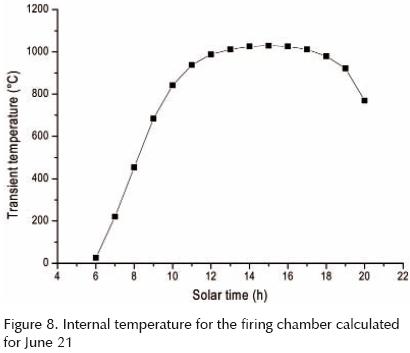
<body><![CDATA[<p align="justify"><font face="verdana" size="2">where the exponent <i>b </i>is determined with equation (26), considering, &#961;<sub>cb</sub> = 1922 kg/m<sup>3</sup>, <i>V<sub>fc</sub> </i>= 0.22 m<sup>3</sup>:</font></p>     <p align="center"><font face="verdana" size="2"><img src="/img/revistas/iit/v12n4/a4s26.jpg"></font></p>     <p align="justify"><font face="verdana" size="2">The reciprocal of <i>b </i>is the time constant:</font></p>     <p align="center"><font face="verdana" size="2"><img src="/img/revistas/iit/v12n4/a4s29.jpg"></font></p>     <p align="justify"><font face="verdana" size="2"><a href="#f8">Figure 8</a> shows the calculated values for the internal temperature of the firing chamber in the transient state throughout June 21.</font></p>     <p align="center"><font face="verdana" size="2"><a name="f8"></a></font></p>     <p align="center"><font face="verdana" size="2"><img src="/img/revistas/iit/v12n4/a4f8.jpg"></font></p>     <p align="justify"><font face="verdana" size="2">Off&#150;axis parabolic concentrator dimensions</font></p>     <p align="justify"><font face="verdana" size="2">Ray&#150;tracing diagrams were drawn to determine the size of the solar spot for the system heliostat + parabolic concentrator, on the orifice of the prismatic cavity, and the dimensions of the parabolic concentrator aperture. In these ray&#150;tracing diagrams, the angular dimension of the solar disk (10 milliradians in diameter) was taken into account.</font></p>     <p align="justify"><font face="verdana" size="2">To design the parabolic concentrator, we worked with different focal lengths (0.5, 0.75, 1, 1.25 and 2 m) to find the smallest solar&#150;spot size on the aperture of the rectangular&#150;prism cavity. The best result was obtained for a focal length of 1 m. <a href="#t3">Table 3</a> shows the solar spot size for different focal lengths of the parabolic concentrator. For the focal length of 1 m, <a href="/img/revistas/iit/v12n4/a4f9.jpg" target="_blank">figure 9</a> shows the ray&#150;tracing diagram for March 21, and <a href="#t4">table 4</a> shows the solar&#150;spot size on the aperture of the rectangular&#150;prism cavity for different days of the year, when the firing chamber is fixed or when it is moved to find the smallest spot size.</font></p>     ]]></body>
<body><![CDATA[<p align="center"><font face="verdana" size="2"><a name="t3"></a></font></p>     <p align="center"><font face="verdana" size="2"><img src="/img/revistas/iit/v12n4/a4t3.jpg"></font></p>     <p align="center"><font face="verdana" size="2"><a name="t4"></a></font></p>     <p align="center"><font face="verdana" size="2"><img src="/img/revistas/iit/v12n4/a4t4.jpg"></font></p>     <p align="justify"><font face="verdana" size="2">The parabolic concentrator aperture is 1.58 m (<a href="/img/revistas/iit/v12n4/a4f9.jpg" target="_blank">figure 9b</a>), this dimension was determined selecting the day with the smallest angle of incidence of beam radiation on the heliostat (December 21), when the maximum spot size produced by the heliostat is intercepted by the parabolic concentrator.</font></p>     <p align="justify"><font face="verdana" size="2">&nbsp;</font></p>     <p align="justify"><font face="verdana" size="2"><b>Results and discussion</b></font></p>     <p align="justify"><font face="verdana" size="2">Pieces of 'green' clay brick obtained at La Solana were fired in a laboratory furnace to 800 &deg;C, 850 &deg;C, 900 &deg;C, 950 &deg;C, 1000 &deg;C, 1050 &deg;C, and 1100&deg;C; the properties of the clay bricks baked in the muffle oven are shown in <a href="/img/revistas/iit/v12n4/a4t5.jpg" target="_blank">table 5</a>. As a result of these tests the appropriate firing temperature was found to be between 950&deg;C and 1050&deg;C. Lower baking temperatures resulted in bricks with an unacceptably low compression strength and high water absorption.</font></p>     <p align="justify"><font face="verdana" size="2">Calculations were performed to determine the dimensions of the heliostat and the parabolic concentrator, for a solar furnace with a capacity to fire 10 bricks simultaneously to temperatures between 950&deg;C and 1050&deg;C.</font></p>     <p align="justify"><font face="verdana" size="2">In these calculations, anodized aluminum was considered as the reflective material, for both the heliostat and the parabolic concentrator, as this material has a specular reflectance of around 0.9, for wavelengths between 300 nm and 2500 nm.</font></p>     ]]></body>
<body><![CDATA[<p align="justify"><font face="verdana" size="2">The required heliostat area was calculated at 9 m<sup>2</sup>, considering that the energy to fire a brick obtained from La Solana is 657 Wh, and the average daily direct normal radiation in Quer&eacute;taro City is 6680 Wh/m<sup>2</sup>/day. The heliostat design includes nine mirrors, each with dimensions of 1 m &times; 1 m, arranged in three rows and three columns. A rotation&#150;elevation sun tracking system is used because it produces fewer aberrations than an azimuth&#150;elevation system (Chen <i>et al., </i>2004); therefore, the heat flow is more uniform in time. Moreover, only M + N = six motors are required with the rotation&#150;elevation tracking system, two for primary tracking and four for secondary tracking.</font></p>     <p align="justify"><font face="verdana" size="2">An off&#150;axis parabolic concentrator with an aperture of 1.58 m and a focal length of 1 m is used. This kind of concentrator avoids any shading of the concentrator surface by the firing chamber, as happens with the axial concentrators. The system consisting of heliostat plus parabolic concentrator produces a spot size of 0.13 to 0.24 m on the firing chamber. A larger prototype can be designed to fire 110 clay bricks per day. With daily use it would then be possible to obtain 3300 bricks per month; the area of the heliostat was calculated using equations (6) to (20), the result is 46.63 m<sup>2</sup>, thus, the heliostat area required to fire 110 bricks is 49 m<sup>2</sup>. The heliostat design includes 49 mirrors, each with dimensions of 1 x 1 m, arranged in seven rows and seven columns; 28 motors are required with the rotation&#150;elevation tracking system for the two heliostats, four for primary tracking and 24 for secondary tracking. An off&#150;axis parabolic concentrator with an aperture of 1.58 m and focal length of 1 m is required, as are two firing chambers, each with inner dimensions of 0.51 x 0.67 x 1.48 m and outer dimensions of 0.81 x 0.97 x 1.58 m; while one chamber is in the firing process, the other one is in the cooling process. Equations (21) to (26) are used to obtain the time constant (1<i>/b </i>= 28770.04 s = 7.99 h) and the time to obtain 1000&deg;C for 110 bricks (t = 9 hours).</font></p>     <p align="justify"><font face="verdana" size="2">It should be emphasized that these considerations of scale are based on calculations, using equations (6) through (20), not on experimental data. The same holds true of the earlier consideration of a furnace to bake 10 bricks at a time.</font></p>     <p align="justify"><font face="verdana" size="2">&nbsp;</font></p>     <p align="justify"><font face="verdana" size="2"><b>Nomenclature</b></font></p>     <p align="center"><font face="verdana" size="2"><img src="/img/revistas/iit/v12n4/a4s30.jpg"></font></p>     <p align="justify"><font face="verdana" size="2">&nbsp;</font></p>     <p align="justify"><font face="verdana" size="2"><b>Conclusions</b></font></p>     <p align="justify"><font face="verdana" size="2">With the characterization of material properties, new and better construction materials are being developed every day (Custodio <i>et al., </i>2005). Nevertheless, fired clay bricks will still be used on a very large scale in the future. The use of solar furnaces for clay&#150;brick firing would avoid the air and soil pollution caused by the present cottage&#150;industry brick production methods, which are based on the combustion of domestic or industrial wastes. The use of solar energy will entail a cost reduction for the bricks because it will obviate the need to purchase fuels for the firing process.</font></p>     <p align="justify"><font face="verdana" size="2">The sun&#150;tracking system calculates the primary and the secondary tracking of the heliostat, in dependence of solar time.</font></p>     ]]></body>
<body><![CDATA[<p align="justify"><font face="verdana" size="2">The quality of bricks should improve due to the fact that the heat inside the firing chamber is uniform, in contrast to the situation which obtains with the traditional kilns.</font></p>     <p align="justify"><font face="verdana" size="2">Design and construction of the prototype was carried out for 10 bricks; however, a larger prototype can be designed to fire 110 bricks per day. The solar furnace can be used daily as long as there is a sufficient sunshine quality, which would provide for the firing of maximally 3300 bricks per month.</font></p>     <p align="justify"><font face="verdana" size="2">&nbsp;</font></p>     <p align="justify"><font face="verdana" size="2"><b>Acknowledgments</b></font></p>     <p align="justify"><font face="verdana" size="2">We express our gratitude to SIP&#150;IPN (Project numbers 20050945, 20060844, 20070731, and 20080064), CONCYTEQ&#150;IPN (Funding Cycle 2008), and ASA de M&eacute;xico for their support in the development of this project.</font></p>     <p align="justify"><font face="verdana" size="2">&nbsp;</font></p>     <p align="justify"><font face="verdana" size="2"><b>References</b></font></p>     <!-- ref --><p align="justify"><font face="verdana" size="2">Abramowitz M., Stegun I.A. <i>Handbook of Mathematical Functions with Formulas, Graphs and Mathematical Tables, </i>10th printing, Washington, D.C. National Bureau of Standards, 1972, pp. 932.    &nbsp;&nbsp;&nbsp;&nbsp;&nbsp;&nbsp;&nbsp;&nbsp;[&#160;<a href="javascript:void(0);" onclick="javascript: window.open('/scielo.php?script=sci_nlinks&ref=4262384&pid=S1405-7743201100040000400001&lng=','','width=640,height=500,resizable=yes,scrollbars=1,menubar=yes,');">Links</a>&#160;]<!-- end-ref --></font></p>     <!-- ref --><p align="justify"><font face="verdana" size="2">Alpert D.J., Mancini T.R., Houser R.M., Grossman J.W., Schissel P., Carasso M., Jorgensen G., Scheve M. Solar Concentrator Development in the Unites States. <i>Solar Energy Materials, </i>24:307&#150;319. 1991.    &nbsp;&nbsp;&nbsp;&nbsp;&nbsp;&nbsp;&nbsp;&nbsp;[&#160;<a href="javascript:void(0);" onclick="javascript: window.open('/scielo.php?script=sci_nlinks&ref=4262386&pid=S1405-7743201100040000400002&lng=','','width=640,height=500,resizable=yes,scrollbars=1,menubar=yes,');">Links</a>&#160;]<!-- end-ref --></font></p>     <!-- ref --><p align="justify"><font face="verdana" size="2">Chen Y.T., Chong K.K., Bligh T.P., Chen L.C., Yunus J., Kannan K.S., Lim B.H., Lim C.S., Alias M.A., Bidin N., Aliman O., Salehan S., Shk. Abd. Rezan S.A.H., Tam C.M., Tan K.K. Non&#150;Imaging, Focusing Heliostat. <i>Solar Energy, </i>71(3):155&#150;164. 2001.    &nbsp;&nbsp;&nbsp;&nbsp;&nbsp;&nbsp;&nbsp;&nbsp;[&#160;<a href="javascript:void(0);" onclick="javascript: window.open('/scielo.php?script=sci_nlinks&ref=4262388&pid=S1405-7743201100040000400003&lng=','','width=640,height=500,resizable=yes,scrollbars=1,menubar=yes,');">Links</a>&#160;]<!-- end-ref --></font></p>     <!-- ref --><p align="justify"><font face="verdana" size="2">Chen Y.T., Chong K.K., Lim C.S., Lim B.H., Tan K.K., Aliman O., Bligh T.P., Tan B.K., Ismail G. Report of the First Prototype of Non&#150;Imaging Focusing Heliostat and its Application in High Temperature Solar Furnace. <i>Solar Energy, </i>72(6):531&#150;544. 2002.    &nbsp;&nbsp;&nbsp;&nbsp;&nbsp;&nbsp;&nbsp;&nbsp;[&#160;<a href="javascript:void(0);" onclick="javascript: window.open('/scielo.php?script=sci_nlinks&ref=4262390&pid=S1405-7743201100040000400004&lng=','','width=640,height=500,resizable=yes,scrollbars=1,menubar=yes,');">Links</a>&#160;]<!-- end-ref --></font></p>     <!-- ref --><p align="justify"><font face="verdana" size="2">Chen Y.T., Kribus A., Lim B.H., Lim C.S., Chong K.K., Karni J., Buck R., Pfahl A., Bligh T.P. Comparison of Two Sun Tracking Methods in the Application of a Heliostat Field. <i>Journal of Solar Energy Engineering, </i>126:638&#150;644. February 2004. ISSN: 0199&#150;6231.    &nbsp;&nbsp;&nbsp;&nbsp;&nbsp;&nbsp;&nbsp;&nbsp;[&#160;<a href="javascript:void(0);" onclick="javascript: window.open('/scielo.php?script=sci_nlinks&ref=4262392&pid=S1405-7743201100040000400005&lng=','','width=640,height=500,resizable=yes,scrollbars=1,menubar=yes,');">Links</a>&#160;]<!-- end-ref --></font></p>     <!-- ref --><p align="justify"><font face="verdana" size="2">Chen Y.T., Lim B.H., Lim C.S. Off&#150;Axis Aberration Correction Surface in Solar Energy Application. <i>Solar Energy, </i>80:268&#150;271. 2006.    &nbsp;&nbsp;&nbsp;&nbsp;&nbsp;&nbsp;&nbsp;&nbsp;[&#160;<a href="javascript:void(0);" onclick="javascript: window.open('/scielo.php?script=sci_nlinks&ref=4262394&pid=S1405-7743201100040000400006&lng=','','width=640,height=500,resizable=yes,scrollbars=1,menubar=yes,');">Links</a>&#160;]<!-- end-ref --></font></p>     <!-- ref --><p align="justify"><font face="verdana" size="2">&Ccedil;engel Y.A. <i>Transferencia de calor, </i>2<sup>nd</sup> edition, Mexico, DF, McGraw Hill, 2004a, p. 26.    &nbsp;&nbsp;&nbsp;&nbsp;&nbsp;&nbsp;&nbsp;&nbsp;[&#160;<a href="javascript:void(0);" onclick="javascript: window.open('/scielo.php?script=sci_nlinks&ref=4262396&pid=S1405-7743201100040000400007&lng=','','width=640,height=500,resizable=yes,scrollbars=1,menubar=yes,');">Links</a>&#160;]<!-- end-ref --></font></p>     <!-- ref --><p align="justify"><font face="verdana" size="2">&Ccedil;engel Y.A. <i>Transferencia de calor, </i>2<sup>nd</sup> edition, Mexico, DF, McGraw Hill, 2004b, pp. 210&#150;211.    &nbsp;&nbsp;&nbsp;&nbsp;&nbsp;&nbsp;&nbsp;&nbsp;[&#160;<a href="javascript:void(0);" onclick="javascript: window.open('/scielo.php?script=sci_nlinks&ref=4262398&pid=S1405-7743201100040000400008&lng=','','width=640,height=500,resizable=yes,scrollbars=1,menubar=yes,');">Links</a>&#160;]<!-- end-ref --></font></p>     <!-- ref --><p align="justify"><font face="verdana" size="2">&Ccedil;engel Y.A. <i>Transferencia de calor, </i>2<sup>nd</sup> edition, Mexico DF, McGraw Hill, 2004c, pp. 725&#150;736.    &nbsp;&nbsp;&nbsp;&nbsp;&nbsp;&nbsp;&nbsp;&nbsp;[&#160;<a href="javascript:void(0);" onclick="javascript: window.open('/scielo.php?script=sci_nlinks&ref=4262400&pid=S1405-7743201100040000400009&lng=','','width=640,height=500,resizable=yes,scrollbars=1,menubar=yes,');">Links</a>&#160;]<!-- end-ref --></font></p>     <!-- ref --><p align="justify"><font face="verdana" size="2">Custodio&#150;Garc&iacute;a E., Sebastian P.J., Campos&#150;Alvarez J., Trevi&ntilde;o&#150;Palacios C.G., Zarate E.A., C&oacute;rdova Q.A., De la O&#150;Le&oacute;n H. Solar Conduction Heat Transfer in Fired Clay Bricks. <i>Solar Energy Materials &amp; Solar Cells, </i>88:169&#150;178. 2005.    &nbsp;&nbsp;&nbsp;&nbsp;&nbsp;&nbsp;&nbsp;&nbsp;[&#160;<a href="javascript:void(0);" onclick="javascript: window.open('/scielo.php?script=sci_nlinks&ref=4262402&pid=S1405-7743201100040000400010&lng=','','width=640,height=500,resizable=yes,scrollbars=1,menubar=yes,');">Links</a>&#160;]<!-- end-ref --></font></p>     <!-- ref --><p align="justify"><font face="verdana" size="2">Direcci&oacute;n General de Normas. Norma Mexicana NMX&#150;C&#150;036&#150;1983, Industria de la construcci&oacute;n&#150;ladrillos, bloques y adoquines de concreto&#150;resistencia a la compresi&oacute;n&#150;m&eacute;todos de prueba. Naucalpan de Ju&aacute;rez, Estado de M&eacute;xico, Secretar&iacute;a de Comercio y Fomento Industrial, 1983, Mexico.    &nbsp;&nbsp;&nbsp;&nbsp;&nbsp;&nbsp;&nbsp;&nbsp;[&#160;<a href="javascript:void(0);" onclick="javascript: window.open('/scielo.php?script=sci_nlinks&ref=4262404&pid=S1405-7743201100040000400011&lng=','','width=640,height=500,resizable=yes,scrollbars=1,menubar=yes,');">Links</a>&#160;]<!-- end-ref --></font></p>     <!-- ref --><p align="justify"><font face="verdana" size="2">Direcci&oacute;n General de Normas. Norma Mexicana NMX&#150;C&#150;037&#150;1986. Industria de la construcci&oacute;n&#150;concreto&#150;bloques, ladrillos o tabiques y tabicones de concreto&#150;determinaci&oacute;n de la absorci&oacute;n de agua, M&eacute;xico, DF, Secretar&iacute;a de Comercio y Fomento Industrial, 1986, Mexico.    &nbsp;&nbsp;&nbsp;&nbsp;&nbsp;&nbsp;&nbsp;&nbsp;[&#160;<a href="javascript:void(0);" onclick="javascript: window.open('/scielo.php?script=sci_nlinks&ref=4262406&pid=S1405-7743201100040000400012&lng=','','width=640,height=500,resizable=yes,scrollbars=1,menubar=yes,');">Links</a>&#160;]<!-- end-ref --></font></p>     <!-- ref --><p align="justify"><font face="verdana" size="2">Fern&aacute;ndez&#150;Reche J., Ca&ntilde;adas I., S&aacute;nchez M., Ballestr&iacute;n J., Yebra L., Monterreal R., Rodr&iacute;guez J., Garc&iacute;a G., Alonso M., Chenlo F. PSA Solar Furnace: A Facility for Testing PV Cells Under Concentrated Solar Radiation. <i>Solar Energy Materials &amp; Solar Cells, </i>90:2480&#150;2488. 2006.    &nbsp;&nbsp;&nbsp;&nbsp;&nbsp;&nbsp;&nbsp;&nbsp;[&#160;<a href="javascript:void(0);" onclick="javascript: window.open('/scielo.php?script=sci_nlinks&ref=4262408&pid=S1405-7743201100040000400013&lng=','','width=640,height=500,resizable=yes,scrollbars=1,menubar=yes,');">Links</a>&#160;]<!-- end-ref --></font></p>     <!-- ref --><p align="justify"><font face="verdana" size="2">Goswami D.Y., Kreith F., Kreider J.F. <i>Principles of Solar Engineering, </i>2<sup>nd</sup> edition, Philadelphia, PA. Taylor &amp; Francis, 2000, pp. 6.    &nbsp;&nbsp;&nbsp;&nbsp;&nbsp;&nbsp;&nbsp;&nbsp;[&#160;<a href="javascript:void(0);" onclick="javascript: window.open('/scielo.php?script=sci_nlinks&ref=4262410&pid=S1405-7743201100040000400014&lng=','','width=640,height=500,resizable=yes,scrollbars=1,menubar=yes,');">Links</a>&#160;]<!-- end-ref --></font></p>     <!-- ref --><p align="justify"><font face="verdana" size="2">Hernandez D., Olalde G. Solar Experimental Methods for Observing Melting Plateaux and Associated Temperature Measurements for Refractory Oxides from 2000 to 3000&deg;C. <i>Journal of the European Ceramic Society, </i>26:1043&#150;1049. 2006.    &nbsp;&nbsp;&nbsp;&nbsp;&nbsp;&nbsp;&nbsp;&nbsp;[&#160;<a href="javascript:void(0);" onclick="javascript: window.open('/scielo.php?script=sci_nlinks&ref=4262412&pid=S1405-7743201100040000400015&lng=','','width=640,height=500,resizable=yes,scrollbars=1,menubar=yes,');">Links</a>&#160;]<!-- end-ref --></font></p>     <!-- ref --><p align="justify"><font face="verdana" size="2">High Temp Metals. Hastelloy X Technical Data. <i>High Temp Metals </i>&#91;on line&#93;. 2009 &#91;consultation date February 27, 2009&#93;. Available on: <a href="http://www.hightempmetals.com/techdata/hitempHastX&#150;data.php" target="_blank">http://www.hightempmetals.com/techdata/hitempHastXÂ–data.php</a></font>&nbsp;&nbsp;&nbsp;&nbsp;&nbsp;&nbsp;&nbsp;&nbsp;[&#160;<a href="javascript:void(0);" onclick="javascript: window.open('/scielo.php?script=sci_nlinks&ref=4262414&pid=S1405-7743201100040000400016&lng=','','width=640,height=500,resizable=yes,scrollbars=1,menubar=yes,');">Links</a>&#160;]<!-- end-ref --><!-- ref --><p align="justify"><font face="verdana" size="2">Jim&eacute;nez de Salas J.A., De Justo&#150;Alpa&ntilde;es J.L. <i>Geotecnia y cimientos I. Propiedades de los suelos y de las rocas, </i>2nd edition, Rueda, 1975.    &nbsp;&nbsp;&nbsp;&nbsp;&nbsp;&nbsp;&nbsp;&nbsp;[&#160;<a href="javascript:void(0);" onclick="javascript: window.open('/scielo.php?script=sci_nlinks&ref=4262415&pid=S1405-7743201100040000400017&lng=','','width=640,height=500,resizable=yes,scrollbars=1,menubar=yes,');">Links</a>&#160;]<!-- end-ref --></font></p>     ]]></body>
<body><![CDATA[<!-- ref --><p align="justify"><font face="verdana" size="2">Kalogirou S. Recent Patents in Solar Energy Collectors and Applications. <i>Recent Patents on Engineering, </i>1: 23&#150;33.2007.    &nbsp;&nbsp;&nbsp;&nbsp;&nbsp;&nbsp;&nbsp;&nbsp;[&#160;<a href="javascript:void(0);" onclick="javascript: window.open('/scielo.php?script=sci_nlinks&ref=4262417&pid=S1405-7743201100040000400018&lng=','','width=640,height=500,resizable=yes,scrollbars=1,menubar=yes,');">Links</a>&#160;]<!-- end-ref --></font></p>     <!-- ref --><p align="justify"><font face="verdana" size="2">Lewandowski A., Bingham C., O'Gallagher J., Winston R., Sagie D. Performance Characterization of the SERI High&#150;Flux Solar Furnace. <i>Solar Energy Materials, </i>24:550&#150;563. 1991.    &nbsp;&nbsp;&nbsp;&nbsp;&nbsp;&nbsp;&nbsp;&nbsp;[&#160;<a href="javascript:void(0);" onclick="javascript: window.open('/scielo.php?script=sci_nlinks&ref=4262419&pid=S1405-7743201100040000400019&lng=','','width=640,height=500,resizable=yes,scrollbars=1,menubar=yes,');">Links</a>&#160;]<!-- end-ref --></font></p>     <!-- ref --><p align="justify"><font face="verdana" size="2">Mason K. <i>How to Measure the Energy Used to Fire Clay Bricks, </i>Rugby, UK, Practical Action, Intermediate Technology Development Group, Ltd., 1998.    &nbsp;&nbsp;&nbsp;&nbsp;&nbsp;&nbsp;&nbsp;&nbsp;[&#160;<a href="javascript:void(0);" onclick="javascript: window.open('/scielo.php?script=sci_nlinks&ref=4262421&pid=S1405-7743201100040000400020&lng=','','width=640,height=500,resizable=yes,scrollbars=1,menubar=yes,');">Links</a>&#160;]<!-- end-ref --></font></p>     <!-- ref --><p align="justify"><font face="verdana" size="2">NASA. Atmospheric Science Data Center. NASA Surface Meteorology and Solar Energy&#150;Available Tables. <i>NASA </i>&#91;on line&#93;. 2009 &#91;consultation date February 3, 2009&#93;. Available on: <a href="http://eosweb.larc.nasa.gov/sse/" target="_blank">http://eosweb.larc.nasa.gov/sse/</a></font>&nbsp;&nbsp;&nbsp;&nbsp;&nbsp;&nbsp;&nbsp;&nbsp;[&#160;<a href="javascript:void(0);" onclick="javascript: window.open('/scielo.php?script=sci_nlinks&ref=4262423&pid=S1405-7743201100040000400021&lng=','','width=640,height=500,resizable=yes,scrollbars=1,menubar=yes,');">Links</a>&#160;]<!-- end-ref --><!-- ref --><p align="justify"><font face="verdana" size="2">Pancotti L. Optical Simulation Model for Flat Mirror Concentrators, <i>Solar Energy Materials &amp; Solar Cells, </i>91:551&#150;559. 2007.    &nbsp;&nbsp;&nbsp;&nbsp;&nbsp;&nbsp;&nbsp;&nbsp;[&#160;<a href="javascript:void(0);" onclick="javascript: window.open('/scielo.php?script=sci_nlinks&ref=4262424&pid=S1405-7743201100040000400022&lng=','','width=640,height=500,resizable=yes,scrollbars=1,menubar=yes,');">Links</a>&#160;]<!-- end-ref --></font></p>     <!-- ref --><p align="justify"><font face="verdana" size="2">Ries H., Schubnell M. The Optics of a Two&#150;Stage Solar Furnace. <i>Solar Energy Materials, </i>21:213&#150;217. 1990.    &nbsp;&nbsp;&nbsp;&nbsp;&nbsp;&nbsp;&nbsp;&nbsp;[&#160;<a href="javascript:void(0);" onclick="javascript: window.open('/scielo.php?script=sci_nlinks&ref=4262426&pid=S1405-7743201100040000400023&lng=','','width=640,height=500,resizable=yes,scrollbars=1,menubar=yes,');">Links</a>&#160;]<!-- end-ref --></font></p>     <!-- ref --><p align="justify"><font face="verdana" size="2">Riskiev T.T., Suleimanov S.K.H. Double Mirror Polyheliostat Solar Furnace of 1000 kW Thermal Power. <i>Solar Energy Materials, </i>24:625&#150;632. 1991.    &nbsp;&nbsp;&nbsp;&nbsp;&nbsp;&nbsp;&nbsp;&nbsp;[&#160;<a href="javascript:void(0);" onclick="javascript: window.open('/scielo.php?script=sci_nlinks&ref=4262428&pid=S1405-7743201100040000400024&lng=','','width=640,height=500,resizable=yes,scrollbars=1,menubar=yes,');">Links</a>&#160;]<!-- end-ref --></font></p>     <!-- ref --><p align="justify"><font face="verdana" size="2">Scheffler W. Introduction to the Revolutionary Design of Scheffler Reflectors. SCIs International Solar Cooker Conference (2006, Granada, Spain).    &nbsp;&nbsp;&nbsp;&nbsp;&nbsp;&nbsp;&nbsp;&nbsp;[&#160;<a href="javascript:void(0);" onclick="javascript: window.open('/scielo.php?script=sci_nlinks&ref=4262430&pid=S1405-7743201100040000400025&lng=','','width=640,height=500,resizable=yes,scrollbars=1,menubar=yes,');">Links</a>&#160;]<!-- end-ref --></font></p>     <!-- ref --><p align="justify"><font face="verdana" size="2">Stine W.B., Geyer M. Power from the Sun &#91;on line&#93;. USA. Power from the Sun, 2001 &#91;consultation date January 15, 2009&#93;. Available on: <a href="http://www.powerfromthesun.net/book.htm" target="_blank">http://www.powerfromthesun.net/book.htm</a></font>&nbsp;&nbsp;&nbsp;&nbsp;&nbsp;&nbsp;&nbsp;&nbsp;[&#160;<a href="javascript:void(0);" onclick="javascript: window.open('/scielo.php?script=sci_nlinks&ref=4262432&pid=S1405-7743201100040000400026&lng=','','width=640,height=500,resizable=yes,scrollbars=1,menubar=yes,');">Links</a>&#160;]<!-- end-ref --><!-- ref --><p align="justify"><font face="verdana" size="2">Thermal Ceramics. Technical Datasheets. <i>Thermal Ceramics </i>&#91;on line&#93;. 2009 &#91;consultation date February 27, 2009&#93;. Available on: <a href="http://www.thermalceramics.com/datasheets.asp?filter=all&amp;filter2=Blanket&amp;region=" target="_blank">http://www.thermalceramics.com/datasheets.asp?filter=all&amp;filter2=Blanket&amp;region=</a></font>&nbsp;&nbsp;&nbsp;&nbsp;&nbsp;&nbsp;&nbsp;&nbsp;[&#160;<a href="javascript:void(0);" onclick="javascript: window.open('/scielo.php?script=sci_nlinks&ref=4262433&pid=S1405-7743201100040000400027&lng=','','width=640,height=500,resizable=yes,scrollbars=1,menubar=yes,');">Links</a>&#160;]<!-- end-ref --><p align="justify"><font face="verdana" size="2">&nbsp;</font></p>     <p align="justify"><font face="verdana" size="2"><b>About the authors</b></font></p>     <p align="justify"><font face="verdana" size="2"><i>Gabriel Villeda&#150;Mu&ntilde;oz. </i>Mechanical engineer's degree from the Escuela Superior de Ingenier&iacute;a Mec&aacute;nica y El&eacute;ctrica del Instituto Polit&eacute;cnico Nacional (ESIME&#150;IPN, School of Mechanical and Electrical Engineering of the National Politechnic Institute), Campus Culhuacan (2000), and Master's degree in Systems Engineering from the same Institution, Campus Zacatenco (2004). At present he is a doctoral student in the advanced technology program at CICATA&#150;IPN Quer&eacute;taro. Areas of expertise: Alternative energies, high&#150;temperature solar furnaces.</font></p>     ]]></body>
<body><![CDATA[<p align="justify"><font face="verdana" size="2"><i>Alejandro Casta&ntilde;eda&#150;Miranda. </i>Engineer's degree in Communications and Electronics from the University of Zacatecas (1995). Master's degree in Advanced Technology from CICATA&#150;IPN Legaria (2003). Doctoral degree in Engineering with specialty in mechatronics and instrumentation from the Autonomous University of Quer&eacute;taro (2004). Postdoctoral studies in the area of materials science with specialty in materials at CINVESTAV&#150;IPN Quer&eacute;taro. At present he is a research professor in mechatronics and instrumentation at the Polytechnical University of Quer&eacute;taro. Areas of expertise: electronics, automation, mechatronics, instrumentation, artificial neural networks, biomechatronics embedded systems, image processing, and three&#150;dimensional reconstruction with precision lasers.</font></p>     <p align="justify"><font face="verdana" size="2"><i>Pless R.C. </i>Doctoral degree in Chemistry from Northwestern University, Evanston, Illinois, USA. After postdoctoral work at the Johns Hopkins University, Baltimore, Maryland, and at the Polish Academy of Sciences in Warsaw, he joined the Ohio State University in Columbus, Ohio, as chemistry professor. He later moved to Life Technologies, Inc., in the state of Maryland, to head the Product Development Group. He has been research professor at CICATA&#150;IPN since 1997, initially in Mexico City and later in Quer&eacute;taro. Areas of expertise: alternative energies, chemical and physical changes in the maize kernel during alkaline cooking, chemistry of nucleic acids. At present, he is a member of the National System of Researchers, level II.</font></p>     <p align="justify"><font face="verdana" size="2"><i>Jos&eacute; Trinidad Vega&#150;Dur&aacute;n. </i>Bachelor of Solid State Physics by ESFM&#150;IPN (1992). Doctoral degree in Optics from the University of Guanajuato (2000). After that, he was research professor in advanced technology at CICATA&#150;IPN Quer&eacute;taro, working in his areas of expertise: optical and electrical metrology, optoelectronic, optical properties of materials, and industrial applications of lasers. Dr. Vega&#150;Dur&aacute;n died at the conclusion of the present work. This article is dedicated to his memory.</font></p>     <p align="justify"><font face="verdana" size="2"><i>Jorge Pineda&#150;Pi&ntilde;&oacute;n. </i>Researcher&#150;professor at CICATA Quer&eacute;taro since January 2005. Master's degree in Architecture from the School of Engineering and Architecture of the National Polytechnic Institute and Doctoral degree in Engineering from the Autonomous University of Quer&eacute;taro. Areas of expertise: construction materials, high&#150;temperature solar furnaces, and bioclimatic houses. Professional area: designer and builder of residential homes. Professional experience: He was technical subdirector of the Technological Research Center 1 "Walter Cross Buchanan" of the Instituto Polit&eacute;cnico Nacional. Publications: Six published book articles, one published paper in a scientific journal, two papers under review by scientific journals, and one patent in progress. At present he is a member of the National System of Researchers, level I.</font></p>      ]]></body><back>
<ref-list>
<ref id="B1">
<nlm-citation citation-type="book">
<person-group person-group-type="author">
<name>
<surname><![CDATA[Abramowitz]]></surname>
<given-names><![CDATA[M]]></given-names>
</name>
<name>
<surname><![CDATA[Stegun]]></surname>
<given-names><![CDATA[I.A.]]></given-names>
</name>
</person-group>
<source><![CDATA[Handbook of Mathematical Functions with Formulas, Graphs and Mathematical Tables]]></source>
<year>1972</year>
<edition>10</edition>
<page-range>932</page-range><publisher-loc><![CDATA[Washington, D.C. ]]></publisher-loc>
<publisher-name><![CDATA[National Bureau of Standards]]></publisher-name>
</nlm-citation>
</ref>
<ref id="B2">
<nlm-citation citation-type="journal">
<person-group person-group-type="author">
<name>
<surname><![CDATA[Alpert]]></surname>
<given-names><![CDATA[D.J.]]></given-names>
</name>
<name>
<surname><![CDATA[Mancini]]></surname>
<given-names><![CDATA[T.R.]]></given-names>
</name>
<name>
<surname><![CDATA[Houser]]></surname>
<given-names><![CDATA[R.M.]]></given-names>
</name>
<name>
<surname><![CDATA[Grossman]]></surname>
<given-names><![CDATA[J.W.]]></given-names>
</name>
<name>
<surname><![CDATA[Schissel]]></surname>
<given-names><![CDATA[P]]></given-names>
</name>
<name>
<surname><![CDATA[Carasso]]></surname>
<given-names><![CDATA[M]]></given-names>
</name>
<name>
<surname><![CDATA[Jorgensen]]></surname>
<given-names><![CDATA[G]]></given-names>
</name>
<name>
<surname><![CDATA[Scheve]]></surname>
<given-names><![CDATA[M]]></given-names>
</name>
</person-group>
<article-title xml:lang="en"><![CDATA[Solar Concentrator Development in the Unites States]]></article-title>
<source><![CDATA[Solar Energy Materials]]></source>
<year>1991</year>
<volume>24</volume>
<page-range>307-319</page-range></nlm-citation>
</ref>
<ref id="B3">
<nlm-citation citation-type="journal">
<person-group person-group-type="author">
<name>
<surname><![CDATA[Chen]]></surname>
<given-names><![CDATA[Y.T.]]></given-names>
</name>
<name>
<surname><![CDATA[Chong]]></surname>
<given-names><![CDATA[K.K.]]></given-names>
</name>
<name>
<surname><![CDATA[Bligh]]></surname>
<given-names><![CDATA[T.P.]]></given-names>
</name>
<name>
<surname><![CDATA[Chen]]></surname>
<given-names><![CDATA[L.C.]]></given-names>
</name>
<name>
<surname><![CDATA[Yunus]]></surname>
<given-names><![CDATA[J]]></given-names>
</name>
<name>
<surname><![CDATA[Kannan]]></surname>
<given-names><![CDATA[K.S.]]></given-names>
</name>
<name>
<surname><![CDATA[Lim]]></surname>
<given-names><![CDATA[B.H.]]></given-names>
</name>
<name>
<surname><![CDATA[Lim]]></surname>
<given-names><![CDATA[C.S.]]></given-names>
</name>
<name>
<surname><![CDATA[Alias]]></surname>
<given-names><![CDATA[M.A.]]></given-names>
</name>
<name>
<surname><![CDATA[Bidin]]></surname>
<given-names><![CDATA[N]]></given-names>
</name>
<name>
<surname><![CDATA[Aliman]]></surname>
<given-names><![CDATA[O]]></given-names>
</name>
<name>
<surname><![CDATA[Salehan]]></surname>
<given-names><![CDATA[S]]></given-names>
</name>
<name>
<surname><![CDATA[Tam]]></surname>
<given-names><![CDATA[C.M.]]></given-names>
</name>
<name>
<surname><![CDATA[Tan]]></surname>
<given-names><![CDATA[K.K.]]></given-names>
</name>
</person-group>
<article-title xml:lang="en"><![CDATA[Non-Imaging, Focusing Heliostat]]></article-title>
<source><![CDATA[Solar Energy]]></source>
<year>2001</year>
<volume>71</volume>
<numero>3</numero>
<issue>3</issue>
<page-range>155-164</page-range></nlm-citation>
</ref>
<ref id="B4">
<nlm-citation citation-type="journal">
<person-group person-group-type="author">
<name>
<surname><![CDATA[Chen]]></surname>
<given-names><![CDATA[Y.T.]]></given-names>
</name>
<name>
<surname><![CDATA[Chong]]></surname>
<given-names><![CDATA[K.K.]]></given-names>
</name>
<name>
<surname><![CDATA[Lim]]></surname>
<given-names><![CDATA[C.S.]]></given-names>
</name>
<name>
<surname><![CDATA[Lim]]></surname>
<given-names><![CDATA[B.H.]]></given-names>
</name>
<name>
<surname><![CDATA[Tan]]></surname>
<given-names><![CDATA[K.K.]]></given-names>
</name>
<name>
<surname><![CDATA[Aliman]]></surname>
<given-names><![CDATA[O]]></given-names>
</name>
<name>
<surname><![CDATA[Bligh]]></surname>
<given-names><![CDATA[T.P.]]></given-names>
</name>
<name>
<surname><![CDATA[Tan]]></surname>
<given-names><![CDATA[B.K.]]></given-names>
</name>
<name>
<surname><![CDATA[Ismail]]></surname>
<given-names><![CDATA[G]]></given-names>
</name>
</person-group>
<article-title xml:lang="en"><![CDATA[Report of the First Prototype of Non-Imaging Focusing Heliostat and its Application in High Temperature Solar Furnace]]></article-title>
<source><![CDATA[Solar Energy]]></source>
<year>2002</year>
<volume>72</volume>
<numero>6</numero>
<issue>6</issue>
<page-range>531-544</page-range></nlm-citation>
</ref>
<ref id="B5">
<nlm-citation citation-type="journal">
<person-group person-group-type="author">
<name>
<surname><![CDATA[Chen]]></surname>
<given-names><![CDATA[Y.T.]]></given-names>
</name>
<name>
<surname><![CDATA[Kribus]]></surname>
<given-names><![CDATA[A]]></given-names>
</name>
<name>
<surname><![CDATA[Lim]]></surname>
<given-names><![CDATA[B.H.]]></given-names>
</name>
<name>
<surname><![CDATA[Lim]]></surname>
<given-names><![CDATA[C.S.]]></given-names>
</name>
<name>
<surname><![CDATA[Chong]]></surname>
<given-names><![CDATA[K.K.]]></given-names>
</name>
<name>
<surname><![CDATA[Karni]]></surname>
<given-names><![CDATA[J]]></given-names>
</name>
<name>
<surname><![CDATA[Buck]]></surname>
<given-names><![CDATA[R]]></given-names>
</name>
<name>
<surname><![CDATA[Pfahl]]></surname>
<given-names><![CDATA[A]]></given-names>
</name>
<name>
<surname><![CDATA[Bligh]]></surname>
<given-names><![CDATA[T.P.]]></given-names>
</name>
</person-group>
<article-title xml:lang="en"><![CDATA[Comparison of Two Sun Tracking Methods in the Application of a Heliostat Field]]></article-title>
<source><![CDATA[Journal of Solar Energy Engineering]]></source>
<year></year>
<volume>126</volume>
<page-range>638-644</page-range></nlm-citation>
</ref>
<ref id="B6">
<nlm-citation citation-type="journal">
<person-group person-group-type="author">
<name>
<surname><![CDATA[Chen]]></surname>
<given-names><![CDATA[Y.T.]]></given-names>
</name>
<name>
<surname><![CDATA[Lim]]></surname>
<given-names><![CDATA[B.H.]]></given-names>
</name>
<name>
<surname><![CDATA[Lim]]></surname>
<given-names><![CDATA[C.S.]]></given-names>
</name>
</person-group>
<article-title xml:lang="en"><![CDATA[Off-Axis Aberration Correction Surface in Solar Energy Application]]></article-title>
<source><![CDATA[Solar Energy]]></source>
<year>2006</year>
<volume>80</volume>
<page-range>268-271</page-range></nlm-citation>
</ref>
<ref id="B7">
<nlm-citation citation-type="book">
<person-group person-group-type="author">
<name>
<surname><![CDATA[Çengel]]></surname>
<given-names><![CDATA[Y.A.]]></given-names>
</name>
</person-group>
<source><![CDATA[Transferencia de calor]]></source>
<year>2004</year>
<edition>2</edition>
<page-range>26</page-range><publisher-loc><![CDATA[^eDF DF]]></publisher-loc>
<publisher-name><![CDATA[McGraw Hill]]></publisher-name>
</nlm-citation>
</ref>
<ref id="B8">
<nlm-citation citation-type="book">
<person-group person-group-type="author">
<name>
<surname><![CDATA[Çengel]]></surname>
<given-names><![CDATA[Y.A.]]></given-names>
</name>
</person-group>
<source><![CDATA[Transferencia de calor]]></source>
<year>2004</year>
<edition>2</edition>
<page-range>210-211</page-range><publisher-loc><![CDATA[^eDF DF]]></publisher-loc>
<publisher-name><![CDATA[McGraw Hill]]></publisher-name>
</nlm-citation>
</ref>
<ref id="B9">
<nlm-citation citation-type="book">
<person-group person-group-type="author">
<name>
<surname><![CDATA[Çengel]]></surname>
<given-names><![CDATA[Y.A.]]></given-names>
</name>
</person-group>
<source><![CDATA[Transferencia de calor]]></source>
<year>2004</year>
<edition>2</edition>
<page-range>725-736</page-range><publisher-loc><![CDATA[^eDF DF]]></publisher-loc>
<publisher-name><![CDATA[McGraw Hill]]></publisher-name>
</nlm-citation>
</ref>
<ref id="B10">
<nlm-citation citation-type="journal">
<person-group person-group-type="author">
<name>
<surname><![CDATA[Custodio-García]]></surname>
<given-names><![CDATA[E]]></given-names>
</name>
<name>
<surname><![CDATA[Sebastian]]></surname>
<given-names><![CDATA[P.J.]]></given-names>
</name>
<name>
<surname><![CDATA[Campos-Alvarez]]></surname>
<given-names><![CDATA[J]]></given-names>
</name>
<name>
<surname><![CDATA[Treviño-Palacios]]></surname>
<given-names><![CDATA[C.G.]]></given-names>
</name>
<name>
<surname><![CDATA[Zarate]]></surname>
<given-names><![CDATA[E.A.]]></given-names>
</name>
<name>
<surname><![CDATA[Córdova]]></surname>
<given-names><![CDATA[Q.A.]]></given-names>
</name>
<name>
<surname><![CDATA[De la O-León]]></surname>
<given-names><![CDATA[H]]></given-names>
</name>
</person-group>
<article-title xml:lang="en"><![CDATA[Solar Conduction Heat Transfer in Fired Clay Bricks]]></article-title>
<source><![CDATA[Solar Energy Materials & Solar Cells]]></source>
<year>2005</year>
<volume>88</volume>
<page-range>169-178</page-range></nlm-citation>
</ref>
<ref id="B11">
<nlm-citation citation-type="book">
<collab>Dirección General de Normas</collab>
<source><![CDATA[Norma Mexicana NMX-C-036-1983, Industria de la construcción-ladrillos, bloques y adoquines de concreto-resistencia a la compresión-métodos de prueba]]></source>
<year>1983</year>
<publisher-loc><![CDATA[Naucalpan de Juárez^eEstado de México Estado de México]]></publisher-loc>
<publisher-name><![CDATA[Secretaría de Comercio y Fomento Industrial]]></publisher-name>
</nlm-citation>
</ref>
<ref id="B12">
<nlm-citation citation-type="book">
<collab>Dirección General de Normas</collab>
<source><![CDATA[Norma Mexicana NMX-C-037-1986. Industria de la construcción-concreto-bloques, ladrillos o tabiques y tabicones de concreto-determinación de la absorción de agua]]></source>
<year>1986</year>
<publisher-loc><![CDATA[^eDF DF]]></publisher-loc>
<publisher-name><![CDATA[Secretaría de Comercio y Fomento Industrial]]></publisher-name>
</nlm-citation>
</ref>
<ref id="B13">
<nlm-citation citation-type="journal">
<person-group person-group-type="author">
<name>
<surname><![CDATA[Fernández-Reche]]></surname>
<given-names><![CDATA[J]]></given-names>
</name>
<name>
<surname><![CDATA[Cañadas]]></surname>
<given-names><![CDATA[I]]></given-names>
</name>
<name>
<surname><![CDATA[Sánchez]]></surname>
<given-names><![CDATA[M]]></given-names>
</name>
<name>
<surname><![CDATA[Ballestrín]]></surname>
<given-names><![CDATA[J]]></given-names>
</name>
<name>
<surname><![CDATA[Yebra]]></surname>
<given-names><![CDATA[L]]></given-names>
</name>
<name>
<surname><![CDATA[Monterreal]]></surname>
<given-names><![CDATA[R]]></given-names>
</name>
<name>
<surname><![CDATA[Rodríguez]]></surname>
<given-names><![CDATA[J]]></given-names>
</name>
<name>
<surname><![CDATA[García]]></surname>
<given-names><![CDATA[G]]></given-names>
</name>
<name>
<surname><![CDATA[Alonso]]></surname>
<given-names><![CDATA[M]]></given-names>
</name>
<name>
<surname><![CDATA[Chenlo]]></surname>
<given-names><![CDATA[F]]></given-names>
</name>
</person-group>
<article-title xml:lang="en"><![CDATA[PSA Solar Furnace: A Facility for Testing PV Cells Under Concentrated Solar Radiation]]></article-title>
<source><![CDATA[Solar Energy Materials & Solar Cells]]></source>
<year>2006</year>
<volume>90</volume>
<page-range>2480-2488</page-range></nlm-citation>
</ref>
<ref id="B14">
<nlm-citation citation-type="book">
<person-group person-group-type="author">
<name>
<surname><![CDATA[Goswami]]></surname>
<given-names><![CDATA[D.Y.]]></given-names>
</name>
<name>
<surname><![CDATA[Kreith]]></surname>
<given-names><![CDATA[F]]></given-names>
</name>
<name>
<surname><![CDATA[Kreider]]></surname>
<given-names><![CDATA[J.F.]]></given-names>
</name>
</person-group>
<source><![CDATA[Principles of Solar Engineering]]></source>
<year>2000</year>
<edition>2</edition>
<page-range>6</page-range><publisher-loc><![CDATA[Philadelphia^ePA PA]]></publisher-loc>
<publisher-name><![CDATA[Taylor & Francis]]></publisher-name>
</nlm-citation>
</ref>
<ref id="B15">
<nlm-citation citation-type="journal">
<person-group person-group-type="author">
<name>
<surname><![CDATA[Hernandez]]></surname>
<given-names><![CDATA[D]]></given-names>
</name>
<name>
<surname><![CDATA[Olalde]]></surname>
<given-names><![CDATA[G]]></given-names>
</name>
</person-group>
<article-title xml:lang="en"><![CDATA[Solar Experimental Methods for Observing Melting Plateaux and Associated Temperature Measurements for Refractory Oxides from 2000 to 3000°C]]></article-title>
<source><![CDATA[Journal of the European Ceramic Society]]></source>
<year>2006</year>
<volume>26</volume>
<page-range>1043-1049</page-range></nlm-citation>
</ref>
<ref id="B16">
<nlm-citation citation-type="">
<collab>High Temp Metals</collab>
<collab>Hastelloy X Technical Data</collab>
<source><![CDATA[High Temp Metals]]></source>
<year>2009</year>
</nlm-citation>
</ref>
<ref id="B17">
<nlm-citation citation-type="book">
<person-group person-group-type="author">
<name>
<surname><![CDATA[Jiménez de Salas]]></surname>
<given-names><![CDATA[J.A.]]></given-names>
</name>
<name>
<surname><![CDATA[De Justo-Alpañes]]></surname>
<given-names><![CDATA[J.L.]]></given-names>
</name>
</person-group>
<source><![CDATA[Geotecnia y cimientos I. Propiedades de los suelos y de las rocas]]></source>
<year>1975</year>
<edition>2</edition>
<publisher-name><![CDATA[Rueda]]></publisher-name>
</nlm-citation>
</ref>
<ref id="B18">
<nlm-citation citation-type="journal">
<person-group person-group-type="author">
<name>
<surname><![CDATA[Kalogirou]]></surname>
<given-names><![CDATA[S]]></given-names>
</name>
</person-group>
<article-title xml:lang="en"><![CDATA[Recent Patents in Solar Energy Collectors and Applications]]></article-title>
<source><![CDATA[Recent Patents on Engineering]]></source>
<year>2007</year>
<volume>1</volume>
<page-range>23-33</page-range></nlm-citation>
</ref>
<ref id="B19">
<nlm-citation citation-type="journal">
<person-group person-group-type="author">
<name>
<surname><![CDATA[Lewandowski]]></surname>
<given-names><![CDATA[A]]></given-names>
</name>
<name>
<surname><![CDATA[Bingham]]></surname>
<given-names><![CDATA[C]]></given-names>
</name>
<name>
<surname><![CDATA[O'Gallagher]]></surname>
<given-names><![CDATA[J]]></given-names>
</name>
<name>
<surname><![CDATA[Winston]]></surname>
<given-names><![CDATA[R]]></given-names>
</name>
<name>
<surname><![CDATA[Sagie]]></surname>
<given-names><![CDATA[D]]></given-names>
</name>
</person-group>
<article-title xml:lang="en"><![CDATA[Performance Characterization of the SERI High-Flux Solar Furnace]]></article-title>
<source><![CDATA[Solar Energy Materials]]></source>
<year>1991</year>
<volume>24</volume>
<page-range>550-563</page-range></nlm-citation>
</ref>
<ref id="B20">
<nlm-citation citation-type="book">
<person-group person-group-type="author">
<name>
<surname><![CDATA[Mason]]></surname>
<given-names><![CDATA[K]]></given-names>
</name>
</person-group>
<source><![CDATA[How to Measure the Energy Used to Fire Clay Bricks]]></source>
<year>1998</year>
<publisher-loc><![CDATA[Rugby ]]></publisher-loc>
<publisher-name><![CDATA[Intermediate Technology Development Group]]></publisher-name>
</nlm-citation>
</ref>
<ref id="B21">
<nlm-citation citation-type="book">
<collab>NASA^dAtmospheric Science Data Center</collab>
<source><![CDATA[NASA Surface Meteorology and Solar Energy-Available Tables]]></source>
<year>2009</year>
<publisher-name><![CDATA[NASA]]></publisher-name>
</nlm-citation>
</ref>
<ref id="B22">
<nlm-citation citation-type="journal">
<person-group person-group-type="author">
<name>
<surname><![CDATA[Pancotti]]></surname>
<given-names><![CDATA[L]]></given-names>
</name>
</person-group>
<article-title xml:lang="en"><![CDATA[Optical Simulation Model for Flat Mirror Concentrators]]></article-title>
<source><![CDATA[Solar Energy Materials & Solar Cells]]></source>
<year>2007</year>
<volume>91</volume>
<page-range>551-559</page-range></nlm-citation>
</ref>
<ref id="B23">
<nlm-citation citation-type="journal">
<person-group person-group-type="author">
<name>
<surname><![CDATA[Ries]]></surname>
<given-names><![CDATA[H]]></given-names>
</name>
<name>
<surname><![CDATA[Schubnell]]></surname>
<given-names><![CDATA[M]]></given-names>
</name>
</person-group>
<article-title xml:lang="en"><![CDATA[The Optics of a Two-Stage Solar Furnace]]></article-title>
<source><![CDATA[Solar Energy Materials]]></source>
<year>1990</year>
<volume>21</volume>
<page-range>213-217</page-range></nlm-citation>
</ref>
<ref id="B24">
<nlm-citation citation-type="journal">
<person-group person-group-type="author">
<name>
<surname><![CDATA[Riskiev]]></surname>
<given-names><![CDATA[T.T.]]></given-names>
</name>
<name>
<surname><![CDATA[Suleimanov]]></surname>
<given-names><![CDATA[S.K.H.]]></given-names>
</name>
</person-group>
<article-title xml:lang="en"><![CDATA[Double Mirror Polyheliostat Solar Furnace of 1000 kW Thermal Power]]></article-title>
<source><![CDATA[Solar Energy Materials]]></source>
<year>1991</year>
<volume>24</volume>
<page-range>625-632</page-range></nlm-citation>
</ref>
<ref id="B25">
<nlm-citation citation-type="confpro">
<person-group person-group-type="author">
<name>
<surname><![CDATA[Scheffler]]></surname>
<given-names><![CDATA[W]]></given-names>
</name>
</person-group>
<source><![CDATA[Introduction to the Revolutionary Design of Scheffler Reflectors]]></source>
<year></year>
<conf-name><![CDATA[ SCIs International Solar Cooker Conference]]></conf-name>
<conf-date>2006</conf-date>
<conf-loc>Granada </conf-loc>
</nlm-citation>
</ref>
<ref id="B26">
<nlm-citation citation-type="">
<person-group person-group-type="author">
<name>
<surname><![CDATA[Stine]]></surname>
<given-names><![CDATA[W.B.]]></given-names>
</name>
<name>
<surname><![CDATA[Geyer]]></surname>
<given-names><![CDATA[M]]></given-names>
</name>
</person-group>
<source><![CDATA[Power from the Sun]]></source>
<year>2001</year>
</nlm-citation>
</ref>
<ref id="B27">
<nlm-citation citation-type="">
<collab>Thermal Ceramics</collab>
<collab>Technical Datasheets</collab>
<source><![CDATA[Thermal Ceramics]]></source>
<year>2009</year>
</nlm-citation>
</ref>
</ref-list>
</back>
</article>