<?xml version="1.0" encoding="ISO-8859-1"?><article xmlns:mml="http://www.w3.org/1998/Math/MathML" xmlns:xlink="http://www.w3.org/1999/xlink" xmlns:xsi="http://www.w3.org/2001/XMLSchema-instance">
<front>
<journal-meta>
<journal-id>1405-7743</journal-id>
<journal-title><![CDATA[Ingeniería, investigación y tecnología]]></journal-title>
<abbrev-journal-title><![CDATA[Ing. invest. y tecnol.]]></abbrev-journal-title>
<issn>1405-7743</issn>
<publisher>
<publisher-name><![CDATA[Universidad Nacional Autónoma de México, Facultad de Ingeniería]]></publisher-name>
</publisher>
</journal-meta>
<article-meta>
<article-id>S1405-77432008000300006</article-id>
<title-group>
<article-title xml:lang="en"><![CDATA[Frame, bit and chip error rate evaluation for a DSSS communication system]]></article-title>
<article-title xml:lang="es"><![CDATA[Evaluación de la tasa de errores en bit, chip y tramas para un sistema de comunicaciones DSSS]]></article-title>
</title-group>
<contrib-group>
<contrib contrib-type="author">
<name>
<surname><![CDATA[Castillo-Soria]]></surname>
<given-names><![CDATA[F.R.]]></given-names>
</name>
<xref ref-type="aff" rid="A01"/>
</contrib>
<contrib contrib-type="author">
<name>
<surname><![CDATA[Pacheco-Bautista]]></surname>
<given-names><![CDATA[D.]]></given-names>
</name>
<xref ref-type="aff" rid="A01"/>
</contrib>
<contrib contrib-type="author">
<name>
<surname><![CDATA[Sánchez-Meraz]]></surname>
<given-names><![CDATA[M.]]></given-names>
</name>
<xref ref-type="aff" rid="A02"/>
</contrib>
</contrib-group>
<aff id="A01">
<institution><![CDATA[,Universidad del Istmo Campus Ixtepec ]]></institution>
<addr-line><![CDATA[Oaxaca ]]></addr-line>
<country>México</country>
</aff>
<aff id="A02">
<institution><![CDATA[,Unidad Profesional Adolfo López Mateos Departamento de Telecomunicaciones SEPI-ESIME-IPN ]]></institution>
<addr-line><![CDATA[México DF ]]></addr-line>
</aff>
<pub-date pub-type="pub">
<day>00</day>
<month>09</month>
<year>2008</year>
</pub-date>
<pub-date pub-type="epub">
<day>00</day>
<month>09</month>
<year>2008</year>
</pub-date>
<volume>9</volume>
<numero>3</numero>
<fpage>271</fpage>
<lpage>277</lpage>
<copyright-statement/>
<copyright-year/>
<self-uri xlink:href="http://www.scielo.org.mx/scielo.php?script=sci_arttext&amp;pid=S1405-77432008000300006&amp;lng=en&amp;nrm=iso"></self-uri><self-uri xlink:href="http://www.scielo.org.mx/scielo.php?script=sci_abstract&amp;pid=S1405-77432008000300006&amp;lng=en&amp;nrm=iso"></self-uri><self-uri xlink:href="http://www.scielo.org.mx/scielo.php?script=sci_pdf&amp;pid=S1405-77432008000300006&amp;lng=en&amp;nrm=iso"></self-uri><abstract abstract-type="short" xml:lang="en"><p><![CDATA[The relation between chips, bits and frames error rates in the Additive White Gaussian Noise (AWGN) channel for a Direct Sequence Spread Spectrum (DSSS) system, in Multiple Access Interference (MAI) conditions is evaluated. A simple error-correction code (ECC ) for the Frame Error Rate (FER) evaluation is used. 64 bits (chips) Pseudo Noise (PN) sequences are employed for the spread spectrum transmission. An iterative Montecarlo (stochastic) simulation is used to evaluate how many errors on chips are introduced for channel effects and how they are related to the bit errors. It can be observed how the bit errors may eventually cause a frame error, i. e. CODEC or communication error. These results are useful for academics, engineers, or professionals alike.]]></p></abstract>
<abstract abstract-type="short" xml:lang="es"><p><![CDATA[Se presenta la evaluación de la relación que tienen las tasas de chip, bits y tramas erróneas en un canal con Ruido Blanco Gaussiano Aditivo (RBGA) para un sistema de comunicaciones de espectro disperso de secuencia directa (DSSS) en Condiciones de Acceso Múltiple (CAM). La simulación emplea secuencias de Pseudo Ruido (PN) de 64 bits para la transmisión de espectro disperso. Se utiliza una simulación de montecarlo (estocástica) para evaluar la cantidad de chips erróneos introducidos por los efectos del canal y cómo éstos se relacionan con los errores en bits. Se puede observar cómo los bits erróneos pueden causar eventualmente una trama errónea, es decir, un error en el CODEC o en la comunicación. Estos resultados pueden ser utilizados por académicos, ingenieros o profesionales del área.]]></p></abstract>
<kwd-group>
<kwd lng="en"><![CDATA[simulation]]></kwd>
<kwd lng="en"><![CDATA[spread spectrum]]></kwd>
<kwd lng="en"><![CDATA[multiple access]]></kwd>
<kwd lng="en"><![CDATA[frame error rate]]></kwd>
<kwd lng="es"><![CDATA[simulación]]></kwd>
<kwd lng="es"><![CDATA[espectro disperso]]></kwd>
<kwd lng="es"><![CDATA[acceso múltiple]]></kwd>
<kwd lng="es"><![CDATA[tasa de tramas erróneas]]></kwd>
</kwd-group>
</article-meta>
</front><body><![CDATA[ <p align="justify"><font face="verdana" size="4">Ingenier&iacute;a en M&eacute;xico y en el mundo</font></p>     <p align="justify"><font face="verdana" size="2">&nbsp;</font></p>     <p align="center"><font face="verdana" size="4"><b>Frame, bit and chip error rate evaluation for a DSSS communication system</b></font></p>     <p align="justify"><font face="verdana" size="2">&nbsp;</font></p>     <p align="center"><font face="verdana" size="3"><b>Evaluaci&oacute;n de la tasa de errores en bit, chip y tramas para un sistema de  comunicaciones   DSSS</b></font></p>     <p align="justify"><font face="verdana" size="2">&nbsp;</font></p>     <p align="center"><font face="verdana" size="2"><b>F.R. Castillo&#150;Soria<sup>1</sup>, D. Pacheco&#150;Bautista<sup>1</sup> y  M. S&aacute;nchez&#150;Meraz<sup>2</sup></b></font></p>     <p align="justify"><font face="verdana" size="2">&nbsp;</font></p>     <p align="justify"><font face="verdana" size="2"><i><sup>1</sup> Universidad del Istmo, Campus Ixtepec, Oaxaca, M&eacute;xico E&#150; mail: </i><a href="mailto:frcsoria@bianni.unistmo.edu.mx">frcsoria@bianni.unistmo.edu.mx</a></font></p>     <p align="justify"><font face="verdana" size="2"><i><sup>2</sup> Departamento  de Telecomunicaciones SEPI&#150;ESIME&#150;IPN, Unidad Profesional Adolfo L&oacute;pez Mateos, M&eacute;xico DF E&#150;mail: </i><a href="mailto:mmeraz@ipn.mx">mmeraz@ipn.mx</a></font></p>     ]]></body>
<body><![CDATA[<p align="justify"><font face="verdana" size="2">&nbsp;</font></p>     <p align="justify"><font face="verdana" size="2">Recibido: mayo de 2006    <br> Aceptado: junio de 2007</font></p>     <p align="justify"><font face="verdana" size="2">&nbsp;</font></p>     <p align="justify"><font face="verdana" size="2"><b><i>Abstract</i></b></font></p>     <p align="justify"><font face="verdana" size="2"><i>The relation between chips, bits and frames error rates in the Additive White Gaussian Noise (AWGN) channel for a Direct Sequence Spread Spectrum (DSSS) system, in Multiple </i>Access <i>Interference (MAI) conditions is evaluated. A simple error&#150;correction code (ECC ) for the Frame Error Rate (FER) evaluation is used. 64 bits (chips) Pseudo Noise (PN) sequences are employed for the spread spectrum transmission.</i></font></p>     <p align="justify"><font face="verdana" size="2"><i>An iterative Montecarlo (stochastic) simulation is used to evaluate how many errors on chips are introduced for channel effects and how they are related to the bit errors. It can be observed how the bit errors may eventually cause a frame error, i. e. CODEC or communication error. These results are useful for academics, engineers, or professionals alike.</i></font></p>     <p align="justify"><font face="verdana" size="2"><b><i>Keywords: </i></b><i>simulation, spread spectrum, multiple access, frame error rate.</i></font></p>     <p align="justify"><font face="verdana" size="2">&nbsp;</font></p>     <p align="justify"><font face="verdana" size="2"><b>Resumen</b></font></p>     ]]></body>
<body><![CDATA[<p align="justify"><font face="verdana" size="2">Se presenta la evaluaci&oacute;n de la relaci&oacute;n que tienen las tasas de chip, bits y tramas err&oacute;neas en un canal con Ruido Blanco Gaussiano Aditivo (RBGA) para un sistema de comunicaciones de espectro disperso de secuencia directa (DSSS) en Condiciones de Acceso M&uacute;ltiple (CAM). La simulaci&oacute;n emplea secuencias de Pseudo Ruido (PN) de 64 bits para la transmisi&oacute;n de espectro disperso.</font></p>     <p align="justify"><font face="verdana" size="2">Se utiliza una simulaci&oacute;n de montecarlo (estoc&aacute;stica) para evaluar la cantidad de chips err&oacute;neos introducidos por los efectos del canal y c&oacute;mo &eacute;stos se relacionan con los errores en bits. Se puede observar c&oacute;mo los bits err&oacute;neos pueden causar eventualmente una trama err&oacute;nea, es decir, un error en el CODEC o en la comunicaci&oacute;n. Estos resultados pueden ser utilizados por acad&eacute;micos, ingenieros o profesionales del &aacute;rea.</font></p>     <p align="justify"><font face="verdana" size="2"><b>Descriptores: </b>simulaci&oacute;n, espectro disperso, acceso m&uacute;ltiple, tasa de tramas err&oacute;neas.</font></p>     <p align="justify"><font face="verdana" size="2">&nbsp;</font></p>     <p align="justify"><font face="verdana" size="2"><b>Introduction</b></font></p>     <p align="justify"><font face="verdana" size="2">&nbsp;</font></p>     <p align="justify"><font face="verdana" size="2">Simulation of communication systems has changed the way we design and implement communication systems.</font></p>     <p align="justify"><font face="verdana" size="2">Currently, there exists a great interest in modeling and simulation of communication systems. One can either evaluate a small part of the system, or evaluate general characteristics of different design situations in order to reduce the high cost of system testing and even decrease the human risks. However, the researcher should keep in mind that simulation results are reality approaches in the same way that the model would adequately describe the system in question. The bit error rate can be considered a fundamental part in design and implementation of communication systems.</font></p>     <p align="justify"><font face="verdana" size="2">DSSS systems have been widely accepted in the commercial world of mobile communications; nonetheless, simulating this kind of system requires high signal processes, it is in the best interest of the researcher to utilize the fastest processors at one's disposal, as well as the adequate software (Harada, et al., 2002). In this paper we present a software tool named SisCom, which can be used to evaluate Bit Error Rate (BER), Chip Error Rate (CER) and Frame Error Rate (FER) in DSSS Systems.</font></p>     <p align="justify"><font face="verdana" size="2">&nbsp;</font></p>     ]]></body>
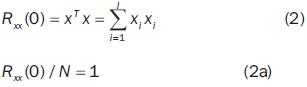
<body><![CDATA[<p align="justify"><font face="verdana" size="2"><b>System characteristics</b></font></p>     <p align="justify"><font face="verdana" size="2">In the transmitter, information data frame is fed into a channel encoder, which is a linear block code (10, 6). The 10 bits codeword is then expanded for a spread spectrum code, as can be seen in <a href="#f1">figure 1</a>. Next, the digital data is fed into a BPSK modulator.</font></p>     <p align="center"><font face="verdana" size="2"><a name="f1"></a></font></p>     <p align="center"><font face="verdana" size="2"><img src="/img/revistas/iit/v9n3/a6f1.jpg"></font></p>     <p align="justify"><font face="verdana" size="2">Characteristics for codes in order to be used in CDMA are (Yang, 1998):</font></p>     <blockquote>       <p align="justify"><font face="verdana" size="2">1. The cross&#150;correlation should be zero or very small:</font></p>     <p align="justify"><font face="verdana" size="2"><img src="/img/revistas/iit/v9n3/a6s1.jpg"></font></p> </blockquote>     <p align="justify"><font face="verdana" size="2">where x and y are two sequences or codes.</font></p>     <blockquote>       ]]></body>
<body><![CDATA[<p align="justify"><font face="verdana" size="2">2. Each sequence in the set has an equal number of 1s and &#150;1s, or the number of 1s differs from the number of &#150;1s by at most 1.</font></p>       <p align="justify"><font face="verdana" size="2">3. The scaled dot product of each code should be equal to 1:</font></p>       <p align="justify"><font face="verdana" size="2"><img src="/img/revistas/iit/v9n3/a6s2.jpg"></font></p> </blockquote>     <p align="justify"><font face="verdana" size="2">The SisCom program has two types of code options for generating spread spectrum signals: Walsh codes and Pseudo Noise (PN) sequences. Walsh codes are generated using a 64 order Hadamard matrix (4), whose rows and columns are mutually orthogonal. The basic Hadamard matrix is (Lee, <i>et al., </i>1998):</font></p>     <p align="justify"><font face="verdana" size="2"><img src="/img/revistas/iit/v9n3/a6s3.jpg"></font></p>     <p align="justify"><font face="verdana" size="2">One can find higher order matrices as follows:</font></p>     <p align="justify"><font face="verdana" size="2"><img src="/img/revistas/iit/v9n3/a6s4.jpg"></font></p>     <p align="justify"><font face="verdana" size="2">PN Sequences are generated with a MSRG (Modular Shift Register Generator) mechanization, known as Galois configuration. The sequence generation starts with the initial state vector: &#91; 1 1 1 1 1 1 &#93;.</font></p>     <p align="justify"><font face="verdana" size="2"><a href="#f2">Figure 2</a> shows the MSRG mechanization used to generate PN sequences. <a href="#f3">Figure 3</a> shows the correlation function of PN sequences used (Lee et al., 1998; Harada <i>et al., </i>2002).</font></p>     <p align="center"><font face="verdana" size="2"><a name="f2"></a></font></p>     ]]></body>
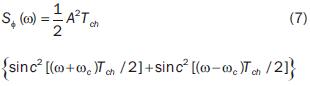
<body><![CDATA[<p align="center"><font face="verdana" size="2"><img src="/img/revistas/iit/v9n3/a6f2.jpg"></font></p>     <p align="center"><font face="verdana" size="2"><a name="f3"></a></font></p>     <p align="center"><font face="verdana" size="2"><img src="/img/revistas/iit/v9n3/a6f3.jpg"></font></p>     <p align="justify"><font face="verdana" size="2">The output PN sequence is:</font></p>     <p align="justify"><font face="verdana" size="2">PN<sub>1</sub> =&#91;0,1,0,1,0,1,1,0,0,1,1,0,1,1,1,0,1,1,0, 1,0,0,1,0,0,1,1,1,0,0,0,1,0,1,1,1,1,0,0,1,0,1,0, 0,0,1,1,0,0,0,0,1,0,0,0,0,0,1,1,1,1,1,1&#93;. The other 62 vectors are delayed versions of the output sequence. Besides, this sequence has been added by an extra zero.</font></p>     <p align="justify"><font face="verdana" size="2">Continuous time analysis (for simplification) shows that the system wideband is mainly controlled by PN sequences as shown in (5), (6) and (7). The transmitter output signal <i>X</i> (t) is (Stremler, 1998):</font></p>     <p align="justify"><font face="verdana" size="2"><i>X(t) = Ac(t) p (t) cos&omega;<sub>c</sub>t </i>&nbsp;&nbsp;&nbsp;&nbsp;&nbsp;&nbsp;&nbsp;&nbsp;&nbsp;&nbsp;&nbsp;&nbsp;&nbsp;(5)</font></p>     <p align="justify"><font face="verdana" size="2">Where</font></p>     <p align="justify"><font face="verdana" size="2">A     : Signal amplitude </font></p>     <p align="justify"><font face="verdana" size="2">c(t) : Spread signal</font></p>     ]]></body>
<body><![CDATA[<p align="justify"><font face="verdana" size="2">p(t) :   Binary function representing the transmitted data </font></p>     <p align="justify"><font face="verdana" size="2">&omega;<sub>c</sub> :  Carrier Frequency</font></p>     <p align="justify"><font face="verdana" size="2">The power spectral density S<sub>ch</sub>(&omega;) of the spread signal <i>c(t) </i>is:</font></p>     <p align="justify"><font face="verdana" size="2"><img src="/img/revistas/iit/v9n3/a6s6.jpg"></font></p>     <p align="justify"><font face="verdana" size="2">where</font></p>     <p align="justify"><font face="verdana" size="2"><i>T<sub>ch</sub>: </i>Chip time</font></p>     <p align="justify"><font face="verdana" size="2">So that the power spectral density SO(co) of SS&#150;BPSK modulated signal can be described as:</font></p>     <p align="justify"><font face="verdana" size="2"><img src="/img/revistas/iit/v9n3/a6s7.jpg"></font></p>     <p align="justify"><font face="verdana" size="2">In the channel module of the SisCom program, the AWGN model and some other empirical and mathematical attenuation models are available; however, the most important quantity in this simulation is the Signal to Noise (S/N) ratio.</font></p>     <p align="justify"><font face="verdana" size="2"><a href="#f4">Figure 4</a> illustrates the correlation receiver used. In this block, chips, bits and frames are recovered. After one frame is recovered, the program goes back to the channel where noise and attenuation are added to the data signal in an iterative way.</font></p>     ]]></body>
<body><![CDATA[<p align="center"><font face="verdana" size="2"><a name="f4"></a></font></p>     <p align="center"><font face="verdana" size="2"><img src="/img/revistas/iit/v9n3/a6f4.jpg"></font></p>     <p align="justify"><font face="verdana" size="2">As shown in <a href="#f4">figure 4</a>, only one frame is recovered at the receiver, the other 19 frames are added only as interferers in the channel for this simulation.</font></p>     <p align="justify"><font face="verdana" size="2">&nbsp;</font></p>     <p align="justify"><font face="verdana" size="2"><b>Simulation</b></font></p>     <p align="justify"><font face="verdana" size="2">A very important characteristic of DSSS systems is the high noise tolerance. This simulation uses S/N ratios from 0.02 to 0.04 into the channel; it means that the noise amplitude is over 30 times greater than the data amplitude. This characteristic is known as "spread spectrum jamming margin", which is directly proportional to the spread codes longitude. Even though the CER is high, the BER is maintained low.</font></p>     <p align="justify"><font face="verdana" size="2">When the amount of channel noise causes a bit error, the channel CODEC can offer a bigger link confidence. However, if more than one bit error occurs in one frame, we will have one error in the communication system. Therefore error randomness is a very important characteristic for a good CODEC performance. In this case, "block interleaving" may be included to offer better performance in the case of burst errors (Proakis, 2000).</font></p>     <p align="justify"><font face="verdana" size="2">Instead of using perfect orthogonal codes, we use PN sequences with a low correlation. Simulation shows how this non&#150;perfect characteristic causes extra interference in the channel due to the fact that more users are connected. Synchronization facilities and easier electronic implementation justify the employment of PN sequences; the extra interference is in this case the downside of using them (<a href="/img/revistas/iit/v9n3/a6f5.jpg" target="_blank">Figure 5</a>).</font></p>     <blockquote>       <p align="justify"><font face="verdana" size="2">Simulation characteristics:</font></p>       ]]></body>
<body><![CDATA[<p align="justify"><font face="verdana" size="2">1) Frames:  10 bits (640 chips)</font></p>       <p align="justify"><font face="verdana" size="2">2) CODEC: linear block (10,6)</font></p>       <p align="justify"><font face="verdana" size="2">3) Multiple access: PN20&#150;PN40 sequences</font></p>       <p align="justify"><font face="verdana" size="2">4) Modulation:  BPSK</font></p>       <p align="justify"><font face="verdana" size="2">5) Channel: AWGN</font></p>       <p align="justify"><font face="verdana" size="2">6) Demodulator:   correlator</font></p>       <p align="justify"><font face="verdana" size="2">7) Perfect synchrony   Tx&#150;Rx, is assumed</font></p> </blockquote>     <p align="justify"><font face="verdana" size="2">SisCom program was developed in MATLAB and requires from 30 minutes to 40 hours for one 10<sup>&#150;4 </sup>error rate simulation running in a Pentium 4 CPU, 2.8 GHz personal computer. This occurs because ten or more of the statistical events (errors) are needed in order to guarantee the results significance.</font></p>     <p align="justify"><font face="verdana" size="2">&nbsp;</font></p>     <p align="justify"><font face="verdana" size="2"><b>Results</b></font></p>     ]]></body>
<body><![CDATA[<p align="justify"><font face="verdana" size="2"><a href="#f6">Figure 6</a> illustrates the CODEC performance in multiple access conditions for 1, 10, and 20 users (blue, red, and black respectively). It is very difficult to compare these results to others. Because this software tool is unique, it is referenced only to underlying mathematics.</font></p>     <p align="center"><font face="verdana" size="2"><a name="f6"></a></font></p>     <p align="center"><font face="verdana" size="2"><img src="/img/revistas/iit/v9n3/a6f6.jpg"></font></p>     <p align="justify"><font face="verdana" size="2"><a href="#f7">Figure 7</a> illustrates the FER (blue), BER (red) and CER (black) relations. FER is higher than BER for very low rates however, the convenience of using a CODEC is observed for high S/N ratios, where the CODEC takes advantage of random errors on bits; at the same time the CER maintains very high error rates.</font></p>     <p align="center"><font face="verdana" size="2"><a name="f7"></a></font></p>     <p align="center"><font face="verdana" size="2"><img src="/img/revistas/iit/v9n3/a6f7.jpg"></font></p>     <p align="justify"><font face="verdana" size="2">&nbsp;</font></p>     <p align="justify"><font face="verdana" size="2"><b>Conclusions</b></font></p>     <p align="justify"><font face="verdana" size="2">We studied the behavior and the relation between chips, bits, and frames errors in the AWGN channel for a DSSS system in MAI conditions. It can be observed that low variations in CER, cause important variations in FER.  Randomness of errors in the channel is the key for good CODEC performance.</font></p>     <p align="justify"><font face="verdana" size="2">&nbsp;</font></p>     ]]></body>
<body><![CDATA[<p align="justify"><font face="verdana" size="2"><b>Acknowledgments</b></font></p>     <p align="justify"><font face="verdana" size="2">We wish to thank the professors M.A. Arash Farzaneh and M.A. William Jurdan Davis III for their valuable contributions in revising the english version of this paper.</font></p>     <p align="justify"><font face="verdana" size="2">&nbsp;</font></p>     <p align="justify"><font face="verdana" size="2"><b>References</b></font></p>     <!-- ref --><p align="justify"><font face="verdana" size="2">Castillo&#150;Soria F.R. Simulaci&oacute;n del canal de comunicaciones del sistema de espectro disperso de secuencia directa. Master thesis, Research &amp; Graduate Section. Mexico DF. ESIME IPN. 2004.</font>&nbsp;&nbsp;&nbsp;&nbsp;&nbsp;&nbsp;&nbsp;&nbsp;[&#160;<a href="javascript:void(0);" onclick="javascript: window.open('/scielo.php?script=sci_nlinks&ref=4243122&pid=S1405-7743200800030000600001&lng=','','width=640,height=500,resizable=yes,scrollbars=1,menubar=yes,');">Links</a>&#160;]<!-- end-ref --><!-- ref --><p align="justify"><font face="verdana" size="2">Harada H. and Prasad R. Simulation and software radio for mobile communications. Boston, London. Artech House. 254 p. 2002.</font>&nbsp;&nbsp;&nbsp;&nbsp;&nbsp;&nbsp;&nbsp;&nbsp;[&#160;<a href="javascript:void(0);" onclick="javascript: window.open('/scielo.php?script=sci_nlinks&ref=4243123&pid=S1405-7743200800030000600002&lng=','','width=640,height=500,resizable=yes,scrollbars=1,menubar=yes,');">Links</a>&#160;]<!-- end-ref --><!-- ref --><p align="justify"><font face="verdana" size="2">Proakis J.G. Digital communications. Fourth edition. NY. McGraw Hill. 155 p. 2000.</font>&nbsp;&nbsp;&nbsp;&nbsp;&nbsp;&nbsp;&nbsp;&nbsp;[&#160;<a href="javascript:void(0);" onclick="javascript: window.open('/scielo.php?script=sci_nlinks&ref=4243124&pid=S1405-7743200800030000600003&lng=','','width=640,height=500,resizable=yes,scrollbars=1,menubar=yes,');">Links</a>&#160;]<!-- end-ref --><!-- ref --><p align="justify"><font face="verdana" size="2">Lee J.S. and Miller L.E. CDMA Systems engineering handbook. London. Artech House. 357 p. 1998.</font>&nbsp;&nbsp;&nbsp;&nbsp;&nbsp;&nbsp;&nbsp;&nbsp;[&#160;<a href="javascript:void(0);" onclick="javascript: window.open('/scielo.php?script=sci_nlinks&ref=4243125&pid=S1405-7743200800030000600004&lng=','','width=640,height=500,resizable=yes,scrollbars=1,menubar=yes,');">Links</a>&#160;]<!-- end-ref --><!-- ref --><p align="justify"><font face="verdana" size="2">Yang S.C. CDMA RF system engineering. London. Artech House. 214 p. 1998. </font>&nbsp;&nbsp;&nbsp;&nbsp;&nbsp;&nbsp;&nbsp;&nbsp;[&#160;<a href="javascript:void(0);" onclick="javascript: window.open('/scielo.php?script=sci_nlinks&ref=4243126&pid=S1405-7743200800030000600005&lng=','','width=640,height=500,resizable=yes,scrollbars=1,menubar=yes,');">Links</a>&#160;]<!-- end-ref --><!-- ref --><p align="justify"><font face="verdana" size="2">Nakamura S. Numerical analysis and graphic visualization with  MATLAB.  2nd edition.  Prentice Hall, 2001. </font>&nbsp;&nbsp;&nbsp;&nbsp;&nbsp;&nbsp;&nbsp;&nbsp;[&#160;<a href="javascript:void(0);" onclick="javascript: window.open('/scielo.php?script=sci_nlinks&ref=4243127&pid=S1405-7743200800030000600006&lng=','','width=640,height=500,resizable=yes,scrollbars=1,menubar=yes,');">Links</a>&#160;]<!-- end-ref --><!-- ref --><p align="justify"><font face="verdana" size="2">Moon T.K. Error correction coding, mathematical methods  and  algorithms.   New Jersey,   USA. Wiley &amp; Sons. 132 p. 2005. </font>&nbsp;&nbsp;&nbsp;&nbsp;&nbsp;&nbsp;&nbsp;&nbsp;[&#160;<a href="javascript:void(0);" onclick="javascript: window.open('/scielo.php?script=sci_nlinks&ref=4243128&pid=S1405-7743200800030000600007&lng=','','width=640,height=500,resizable=yes,scrollbars=1,menubar=yes,');">Links</a>&#160;]<!-- end-ref --><!-- ref --><p align="justify"><font face="verdana" size="2">Stremler F.G. Introducci&oacute;n a los sistemas de comunicaci&oacute;n. Mexico. Spanish edition. Addison Wesley. 70 p. 1998.</font>&nbsp;&nbsp;&nbsp;&nbsp;&nbsp;&nbsp;&nbsp;&nbsp;[&#160;<a href="javascript:void(0);" onclick="javascript: window.open('/scielo.php?script=sci_nlinks&ref=4243129&pid=S1405-7743200800030000600008&lng=','','width=640,height=500,resizable=yes,scrollbars=1,menubar=yes,');">Links</a>&#160;]<!-- end-ref --><p align="justify"><font face="verdana" size="2">&nbsp;</font></p>     <p align="justify"><font face="verdana" size="2"><b>About the authors</b></font></p>     <p align="justify"><font face="verdana" size="2"><i>Francisco Ruben Castillo&#150;Soria. </i>Received his master of science in telecommunications engineering from IPN&#150;ESIME, Research and Graduate Section in Mexico City, 2004. From 2001 to 2004 he was the telecommunications and computer science engineering major director of the Technological University of Baja California S.C. Campus La Paz in B.C.S. He has participated in Argentina, Mexico and also the Acapulco International Congress. Since 2005 he has been research&#150;professor at the Universidad del Istmo, Oaxaca. His current research interests include simulation of telecommunications systems, proto cols and multiple access for future generations of mobile communication systems.</font></p>     <p align="justify"><font face="verdana" size="2"><i>Daniel Pacheco&#150;Bautista. </i>Received the master of science from the National Institute of Astrophysics, Optics and Electronics in Puebla, Mexico, 2003. Since 2004 he has been professor at Universidad del Istmo, Oaxaca, Mexico. He has presented his work in many national and international congresses. His current research includes wire less trans ceivers, frequency synthesizer, phase&#150;locking and clock recovery for high&#150;speed data communications and programming logic circuits.</font></p>     <p align="justify"><font face="verdana" size="2"><i>Miguel S&aacute;nchez&#150;Meraz. </i>Received his master of science from the National Polytechnic Institute in Mexico. Since 1994 he has been research&#150;professor at the Superior School of Mechanic and Electric Engineering, Research and Graduate section IPN. Professor Sanchez has been responsible for many academic and industrially&#150;founded projects. His current research interests lie in simulation, digital signal processing based communications systems and security.</font></p>      ]]></body><back>
<ref-list>
<ref id="B1">
<nlm-citation citation-type="book">
<person-group person-group-type="author">
<name>
<surname><![CDATA[Castillo-Soria]]></surname>
<given-names><![CDATA[F.R.]]></given-names>
</name>
</person-group>
<source><![CDATA[Simulación del canal de comunicaciones del sistema de espectro disperso de secuencia directa]]></source>
<year>2004</year>
<publisher-name><![CDATA[ESIME IPN]]></publisher-name>
</nlm-citation>
</ref>
<ref id="B2">
<nlm-citation citation-type="book">
<person-group person-group-type="author">
<name>
<surname><![CDATA[Harada]]></surname>
<given-names><![CDATA[H.]]></given-names>
</name>
<name>
<surname><![CDATA[Prasad]]></surname>
<given-names><![CDATA[R.]]></given-names>
</name>
</person-group>
<source><![CDATA[Simulation and software radio for mobile communications.]]></source>
<year></year>
<page-range>254</page-range><publisher-loc><![CDATA[London ]]></publisher-loc>
<publisher-name><![CDATA[Artech House]]></publisher-name>
</nlm-citation>
</ref>
<ref id="B3">
<nlm-citation citation-type="book">
<person-group person-group-type="author">
<name>
<surname><![CDATA[Proakis]]></surname>
<given-names><![CDATA[J.G.]]></given-names>
</name>
</person-group>
<source><![CDATA[Digital communications]]></source>
<year>2000</year>
<edition>Fourth</edition>
<page-range>155</page-range><publisher-loc><![CDATA[NY. ]]></publisher-loc>
<publisher-name><![CDATA[McGraw Hill]]></publisher-name>
</nlm-citation>
</ref>
<ref id="B4">
<nlm-citation citation-type="book">
<person-group person-group-type="author">
<name>
<surname><![CDATA[Lee]]></surname>
<given-names><![CDATA[J.S.]]></given-names>
</name>
<name>
<surname><![CDATA[Miller]]></surname>
<given-names><![CDATA[L.E.]]></given-names>
</name>
</person-group>
<source><![CDATA[CDMA Systems engineering handbook]]></source>
<year>1998</year>
<page-range>357</page-range><publisher-loc><![CDATA[London ]]></publisher-loc>
<publisher-name><![CDATA[Artech House]]></publisher-name>
</nlm-citation>
</ref>
<ref id="B5">
<nlm-citation citation-type="book">
<person-group person-group-type="author">
<name>
<surname><![CDATA[Yang]]></surname>
<given-names><![CDATA[S.C.]]></given-names>
</name>
</person-group>
<source><![CDATA[CDMA RF system engineering]]></source>
<year>1998</year>
<page-range>214</page-range><publisher-loc><![CDATA[London ]]></publisher-loc>
<publisher-name><![CDATA[Artech House]]></publisher-name>
</nlm-citation>
</ref>
<ref id="B6">
<nlm-citation citation-type="book">
<person-group person-group-type="author">
<name>
<surname><![CDATA[Nakamura]]></surname>
<given-names><![CDATA[S.]]></given-names>
</name>
</person-group>
<source><![CDATA[Numerical analysis and graphic visualization with MATLAB.]]></source>
<year>2001</year>
<edition>2</edition>
<publisher-name><![CDATA[Prentice Hall]]></publisher-name>
</nlm-citation>
</ref>
<ref id="B7">
<nlm-citation citation-type="book">
<person-group person-group-type="author">
<name>
<surname><![CDATA[Moon]]></surname>
<given-names><![CDATA[T.K.]]></given-names>
</name>
</person-group>
<source><![CDATA[Error correction coding, mathematical methods and algorithms]]></source>
<year>2005</year>
<page-range>132</page-range><publisher-loc><![CDATA[New Jersey ]]></publisher-loc>
<publisher-name><![CDATA[Wiley & Sons.]]></publisher-name>
</nlm-citation>
</ref>
<ref id="B8">
<nlm-citation citation-type="book">
<person-group person-group-type="author">
<name>
<surname><![CDATA[Stremler]]></surname>
<given-names><![CDATA[F.G.]]></given-names>
</name>
</person-group>
<source><![CDATA[Introducción a los sistemas de comunicación]]></source>
<year>1998</year>
<page-range>70</page-range><publisher-name><![CDATA[Addison Wesley]]></publisher-name>
</nlm-citation>
</ref>
</ref-list>
</back>
</article>