<?xml version="1.0" encoding="ISO-8859-1"?><article xmlns:mml="http://www.w3.org/1998/Math/MathML" xmlns:xlink="http://www.w3.org/1999/xlink" xmlns:xsi="http://www.w3.org/2001/XMLSchema-instance">
<front>
<journal-meta>
<journal-id>1405-7743</journal-id>
<journal-title><![CDATA[Ingeniería, investigación y tecnología]]></journal-title>
<abbrev-journal-title><![CDATA[Ing. invest. y tecnol.]]></abbrev-journal-title>
<issn>1405-7743</issn>
<publisher>
<publisher-name><![CDATA[Universidad Nacional Autónoma de México, Facultad de Ingeniería]]></publisher-name>
</publisher>
</journal-meta>
<article-meta>
<article-id>S1405-77432008000200004</article-id>
<title-group>
<article-title xml:lang="en"><![CDATA[Theoretical model of discontinuities behavior in structural steel]]></article-title>
<article-title xml:lang="es"><![CDATA[Modelo teórico del comportamiento de discontinuidades en acero estructural]]></article-title>
</title-group>
<contrib-group>
<contrib contrib-type="author">
<name>
<surname><![CDATA[Casanova del Angel]]></surname>
<given-names><![CDATA[F]]></given-names>
</name>
<xref ref-type="aff" rid="A01"/>
</contrib>
<contrib contrib-type="author">
<name>
<surname><![CDATA[Arteaga-Arcos]]></surname>
<given-names><![CDATA[J.C]]></given-names>
</name>
<xref ref-type="aff" rid="A02"/>
</contrib>
</contrib-group>
<aff id="A02">
<institution><![CDATA[,IPN SEPI - ESIA ALM ]]></institution>
<addr-line><![CDATA[México ]]></addr-line>
</aff>
<aff id="A01">
<institution><![CDATA[,IPN CITEC ]]></institution>
<addr-line><![CDATA[México ]]></addr-line>
</aff>
<pub-date pub-type="pub">
<day>00</day>
<month>06</month>
<year>2008</year>
</pub-date>
<pub-date pub-type="epub">
<day>00</day>
<month>06</month>
<year>2008</year>
</pub-date>
<volume>9</volume>
<numero>2</numero>
<fpage>131</fpage>
<lpage>148</lpage>
<copyright-statement/>
<copyright-year/>
<self-uri xlink:href="http://www.scielo.org.mx/scielo.php?script=sci_arttext&amp;pid=S1405-77432008000200004&amp;lng=en&amp;nrm=iso"></self-uri><self-uri xlink:href="http://www.scielo.org.mx/scielo.php?script=sci_abstract&amp;pid=S1405-77432008000200004&amp;lng=en&amp;nrm=iso"></self-uri><self-uri xlink:href="http://www.scielo.org.mx/scielo.php?script=sci_pdf&amp;pid=S1405-77432008000200004&amp;lng=en&amp;nrm=iso"></self-uri><abstract abstract-type="short" xml:lang="en"><p><![CDATA[The theoretical development of discontinuities behavior model using the complex variable theory by means of the elliptical coordinate system in order to calculate stress in a microhole in structural steel is discussed. It is shown that discontinuities, observed at micrometric levels, grow in a fractal manner and that when discontinuity has already a hyperbolic shape, with a branch attaining an angle of 60 in relation to the horizontal line, stress value is zero. By means of comparing values of stress intensity factors obtained in the laboratory with those obtained using the theoretical model, it may be asserted that experimental values result from the overall effect of the test on the probe.]]></p></abstract>
<abstract abstract-type="short" xml:lang="es"><p><![CDATA[Se presenta el desarrollo teórico del modelo de comportamiento de discontinuidades que hace uso de la teoría de variable compleja, mediante el sistema de coordenadas elípticas para el cálculo del esfuerzo en un micro agujero en acero estructural. Se muestra que la forma del crecimiento de las discontinuidades, observadas éstas a niveles micrométricos, es del tipo fractal, y que cuando la discontinuidad ha tomado ya una forma hiperbólica, donde alguna de sus ramas alcanza un ángulo igual a 60 con respecto a la horizontal, el valor del esfuerzo vale cero. Comparando los valores de los factores de intensidad de esfuerzos obtenidos en laboratorio y los obtenidos con el modelo teórico, se puede afirmar que los valores experimentales son el resultado de los efectos globales de la prueba sobre la probeta.]]></p></abstract>
<kwd-group>
<kwd lng="en"><![CDATA[Micro discontinuities]]></kwd>
<kwd lng="en"><![CDATA[fractal]]></kwd>
<kwd lng="en"><![CDATA[structural steel]]></kwd>
<kwd lng="en"><![CDATA[stress intensity factor]]></kwd>
<kwd lng="en"><![CDATA[Chevron-type notch]]></kwd>
<kwd lng="es"><![CDATA[Micro discontinuidades]]></kwd>
<kwd lng="es"><![CDATA[fractal]]></kwd>
<kwd lng="es"><![CDATA[acero estructural]]></kwd>
<kwd lng="es"><![CDATA[factor de intensidad de esfuerzos]]></kwd>
<kwd lng="es"><![CDATA[muesca tipo Chevron]]></kwd>
</kwd-group>
</article-meta>
</front><body><![CDATA[ <p align="justify"><font face="verdana" size="4">Estudios e investigaciones recientes</font></p>     <p align="justify"><font face="verdana" size="2">&nbsp;</font></p>     <p align="center"><font face="verdana" size="4"><b>Theoretical model of discontinuities behavior in structural steel</b></font></p>     <p align="justify"><font face="verdana" size="2">&nbsp;</font></p>     <p align="center"><font face="verdana" size="3"><b>Modelo te&oacute;rico del comportamiento de discontinuidades en acero estructural</b></font></p>     <p align="justify"><font face="verdana" size="2">&nbsp;</font></p>     <p align="center"><font face="verdana" size="2"><b>F. Casanova del Angel<sup>1</sup> and  J.C. Arteaga&#150;Arcos<sup>2</sup></b></font></p>     <p align="justify"><font face="verdana" size="2">&nbsp;</font></p>     <p align="justify"><font face="verdana" size="2"><i><sup>1</sup>SEPI &#150; ESIA ALM&#150; IPN, M&eacute;xico    <br>       </i><a href="mailto:jcarteaga_mx@yahoo.com.mx">jcarteaga_mx@yahoo.com.mx</a></font></p>     ]]></body>
<body><![CDATA[<p align="justify"><font face="verdana" size="2"><i><sup>2</sup>CITEC &#150; IPN, M&eacute;xico and    <br> </i><a href="mailto:fcasanova@ipn.mx"> fcasanova@ipn.mx</a></font></p>     <p align="justify"><font face="verdana" size="2">&nbsp;</font></p>     <p align="justify"><font face="verdana" size="2">Recibido: junio de 2006    <br> Aceptado: octubre de 2007</font></p>     <p align="justify"><font face="verdana" size="2">&nbsp;</font></p>     <p align="justify"><font face="verdana" size="2"><b><i>Abstract</i></b></font></p>     <p align="justify"><font face="verdana" size="2"><i>The theoretical development of discontinuities behavior model using the complex variable theory by means of the elliptical coordinate system in order to calculate stress in a microhole in structural steel is discussed. It is shown that discontinuities, observed at micrometric levels, grow in a fractal manner and that when discontinuity has already a hyperbolic shape, with a branch attaining an angle of 60 in relation to the horizontal line, stress value is zero. By means of comparing values of stress intensity factors obtained in the laboratory with those obtained using the theoretical model, it may be asserted that experimental values result from the overall effect of the test on the probe.</i></font></p>     <p align="justify"><font face="verdana" size="2"><b><i>Keywords: </i></b><i>Micro discontinuities, fractal, structural steel, stress intensity factor, Chevron&#150;type notch.</i></font></p>     <p align="justify"><font face="verdana" size="2">&nbsp;</font></p>     ]]></body>
<body><![CDATA[<p align="justify"><font face="verdana" size="2"><b>Resumen</b></font></p>     <p align="justify"><font face="verdana" size="2">Se presenta el desarrollo te&oacute;rico del modelo de comportamiento de discontinuidades que hace uso de la teor&iacute;a de variable compleja, mediante el sistema de coordenadas el&iacute;pticas para el c&aacute;lculo del esfuerzo en un micro agujero en acero estructural. Se muestra que la forma del crecimiento de las discontinuidades, observadas &eacute;stas a niveles microm&eacute;tricos, es del tipo fractal, y que cuando la discontinuidad ha tomado ya una forma hiperb&oacute;lica, donde alguna de sus ramas alcanza un &aacute;ngulo igual a 60 con respecto a la horizontal, el valor del esfuerzo vale cero. Comparando los valores de los factores de intensidad de esfuerzos obtenidos en laboratorio y los obtenidos con el modelo te&oacute;rico, se puede afirmar que los valores experimentales son el resultado de los efectos globales de la prueba sobre la probeta.</font></p>     <p align="justify"><font face="verdana" size="2"><b>Descriptores: </b>Micro discontinuidades, fractal, acero estructural, factor de intensidad de esfuerzos, muesca tipo Chevron.</font></p>     <p align="justify"><font face="verdana" size="2">&nbsp;</font></p>     <p align="justify"><font face="verdana" size="2"><b>Introduction</b></font></p>     <p align="justify"><font face="verdana" size="2">Based on the idea that every structure might crack, this research is the result of observing appearing cracks and their corresponding structural consequences. This allows us to better understand the apparition and behavior of fissures, which phenomenon in structural engineering is very interesting for many researchers.</font></p>     <p align="justify"><font face="verdana" size="2">The development of &nbsp;the theoretical model of &nbsp;micro discontinuities behavior in structural steel by means of the complex variable theory, using the elliptical coordinate system to calculate stress on a microhole on evenly loaded plates is shown. As stress on the fracture point is singular, focal location takes place for any &sigma;<sub>0</sub> stress other than zero, and predictive structural stability methods based on Tresca and Von Mises theories to locate them are inappropriate. This has allowed the development of a complex function to calculate micro discontinuities. The fact that the Westergaard stresses function satisfies the biharmonic equation &Delta;<sup>4<img src="/img/revistas/iit/v9n2/a4s55.jpg"></sup>= 0, obtaining equations of stress Cartesian components in terms of actual and imaginary parts of the Westergaard stresses function is proven.</font></p>     <p align="justify"><font face="verdana" size="2">&nbsp;</font></p>     <p align="justify"><font face="verdana" size="2"><b>Stress due to an elliptical microhole on an evenly loaded plate</b></font></p>     <p align="justify"><font face="verdana" size="2">Elasticity problems involving elliptical or hyperbolic boundaries are dealt with using the elliptical coordinate system, <a href="/img/revistas/iit/v9n2/a4f1.jpg" target="_blank">figure 1</a>. Thus:</font></p>     ]]></body>
<body><![CDATA[<p align="justify"><font face="verdana" size="2"><img src="/img/revistas/iit/v9n2/a4s1.jpg"></font></p>     <p align="justify"><font face="verdana" size="2">where &xi; <u>&gt;</u> 0, 0 <u>&lt;</u> &eta;<i> &lt; </i>2<img src="/img/revistas/iit/v9n2/a4s57.jpg"> and &#150;&infin; &lt; z &lt;  &infin; with c as a constant and scale factors defined by: <i>h<sub>&xi;</sub> = h<sub>&eta;</sub> = </i>a <img src="/img/revistas/iit/v9n2/a4s59.jpg">and <i>h<sub>z</sub>=1. </i><a href="/img/revistas/iit/v9n2/a4f1.jpg" target="_blank">Figure 1</a> also shows the surface polar plots on plane <i>XY. </i>Eliminating &eta; from the above equation:</font></p>     <p align="justify"><font face="verdana" size="2"><img src="/img/revistas/iit/v9n2/a4s3.jpg"></font></p>     <p align="justify"><font face="verdana" size="2">for the case &xi;, = &xi;,<sub>0</sub>, the above equation is that of an ellipse whose major and minor axes are given by: a = c cosh &xi;,<sub>0</sub> and <i>b = c </i>sinh &xi;,<sub>0</sub>.</font></p>     <p align="justify"><font face="verdana" size="2">Ellipse foci are x <i>= &plusmn; c. </i>The ellipse shape ratio varies as a function of &xi;,<sub>0</sub>. If &xi;,<sub>0</sub> is very long and has a trend towards the infinite, the ellipse comes close to a circle with a <i>= b. </i>In addition, if &xi;,<sub>0</sub> <img src="/img/revistas/iit/v9n2/a4s4.jpg"> 0, the ellipse becomes a line 2c <i>= 2a = 2b </i>long, which represents a crack. This case is shown as part of the study on the intragranular fracture of a sample 16 &micro;m long. Theoretically, an infinite plate with an elliptical micro discontinuity subject to a uniaxial load, <a href="/img/revistas/iit/v9n2/a4f1.jpg" target="_blank">figure 1a</a>, should be taken into account to find that &sigma;<sub>&eta;</sub> stresses around micro discontinuity are given by:</font></p>     <p align="justify"><font face="verdana" size="2">&sigma;<sub>&eta; = </sub>&sigma;<sub>0 </sub>e<sup>2&xi;</sup></font></p>     <p align="justify"><font face="verdana" size="2"><img src="/img/revistas/iit/v9n2/a4s5.jpg"></font></p>     <p align="justify"><font face="verdana" size="2">the boundary for stresses &sigma;<sub>&eta;</sub><i> </i>is a maximum at the end of the major axis, where cos 2&eta; <i>= </i>1. Replacing &eta; in equation 2:</font></p>     <p align="justify">(&sigma;<sub>&eta;</sub>) <sub>max</sub> = &sigma;<sub>0</sub> (1+ 2a / )b            (3)</p>     <p align="justify"><font face="verdana" size="2">After examining the result of equation 3 for two limits, we find that when <i>a=b </i>or large &xi;,<sub>0</sub>, the elliptical microhole becomes circular and that (&sigma;<sub>&eta;</sub>)<sub>max</sub> = 3&sigma;<sub>0</sub>. This result confirms that stresses concentration for a circular microhole on an infinite plate with uniaxial load</font></p>     ]]></body>
<body><![CDATA[<p align="justify"><font face="verdana" size="2"><img src="/img/revistas/iit/v9n2/a4s6.1.jpg"></font></p>     <p align="justify"><font face="verdana" size="2">may be described as:</font></p>     <p align="justify"><font face="verdana" size="2"><img src="/img/revistas/iit/v9n2/a4s6.2.jpg"></font></p>     <p align="justify"><font face="verdana" size="2">which represents &sigma;<sub>00</sub> distribution around the micro discontinuity boundary for <i>r = a.</i></font></p>     <p align="justify"><font face="verdana" size="2">The second result appears when <i>b</i> <img src="/img/revistas/iit/v9n2/a4s4.jpg"> or &xi;,<sub>0</sub>=0 and the elliptical micro discontinuity spreads openly, showing a fracture. In this case, equation 3 proves that &#91;&sigma;<sub>&eta;</sub>&#93;<sub> max</sub> &infin; as <i>b </i> <img src="/img/revistas/iit/v9n2/a4s4.jpg">0. It should be noticed that the maximum stress at the tip of the micro discontinuity at the end of the ellipse major axis tends towards the infinite, without considering the magnitude of the &sigma;<sub>0</sub> applied stress, which shows that location takes place at the tip of the micro discontinuity for any load other than zero. When the &sigma;<sub>0</sub> applied stress is parallel to the major axis of the elliptical micro discontinuity, <a href="/img/revistas/iit/v9n2/a4f1.jpg" target="_blank">figure 1b</a>, the  &sigma;<sub>&eta;</sub> maximum value on the micro discontinuity boundary is the extreme point of the minor axis, and</font></p>     <p align="justify"><font face="verdana" size="2"><img src="/img/revistas/iit/v9n2/a4s7.jpg"></font></p>     <p align="justify"><font face="verdana" size="2">At the limit when b <img src="/img/revistas/iit/v9n2/a4s4.jpg"> 0 and when the ellipse represents a micro discontinuity, stress is (&sigma;<sub>n</sub>)<sub>max</sub><i> = </i>a<sub>0</sub>. This does not apply at the extreme points of the micro discontinuity major axis, equation 4, but &sigma;<i><sub>v</sub> = &#150; </i>&sigma;<sub>0</sub> for any <i>b/a </i>value. The theoretical solution for the plate elliptical micro discontinuity at the limit when b <img src="/img/revistas/iit/v9n2/a4s4.jpg"> 0 proves distribution of stresses for the plate elliptical micro discontinuity. It is evident that stresses at the tip of the micro discontinuity are singular when the micro discontinuity is perpendicular to the &sigma;<sub>0</sub> applied stress. The fact that stresses at the tip of the micro discontinuity are singular, shows that focal location takes place for any &sigma;<sub>0 </sub>stress other than zero and that predictive structural stability methods based on Tresca and Von Mises theories to locate them, are inappropriate.</font></p>     <p align="justify"><font face="verdana" size="2">&nbsp;</font></p>     <p align="justify"><font face="verdana" size="2"><b>Complex stress function for micro discontinuities</b></font></p>     <p align="justify"><font face="verdana" size="2">Let us now introduce a complex stress function, Z(z), pertaining to Airy stress function <i>,<img src="/img/revistas/iit/v9n2/a4s55.jpg"> </i>given by:</font></p>     ]]></body>
<body><![CDATA[<p align="justify"><font face="verdana" size="2"><img src="/img/revistas/iit/v9n2/a4s8.jpg"></font></p>     <p align="justify"><font face="verdana" size="2">as Z is a complex variable function, then: </font></p>     <p align="justify"><font face="verdana" size="2"><img src="/img/revistas/iit/v9n2/a4s9.jpg"></font></p>     <p align="justify"><font face="verdana" size="2">Where z is defined as:</font></p>     <p align="justify"><font face="verdana" size="2"><img src="/img/revistas/iit/v9n2/a4s10.jpg"></font></p>     <p align="justify"><font face="verdana" size="2">In order that Z is analytical in z<sub>0</sub>, it must be defined in a z<sub>0</sub> environment, indefinitely derivable in the point given environment and must meet that given positive numbers &delta; and <i>M, </i>such as and that the following is true for any natural <i>k </i>number:</font></p>     <p align="justify"><font face="verdana" size="2"><img src="/img/revistas/iit/v9n2/a4s10.1.jpg"></font></p>     <p align="justify"><font face="verdana" size="2">The analyticity criterion set by 7.1 is satisfactory as it may be determined in an absolute manner, but it is rather inconvenient in applications because it is based on knowledge of the behavior of any type of derivative in a certain environment, given the z<sub>0</sub> point.</font></p>     <p align="justify"><font face="verdana" size="2">In order that Z satisfies analyticity on the area of interest, it must meet with the following: in order that a Z(z) = <i>u(x, y) + jv(x, y) </i>= &phi;(x, y) + j &psi; (x, y) function defined in a G domain is derivable at z point of the domain as a complex variable function, and <i>u(x, y) </i>and <i>v(x, y) </i>functions must be able to be differentiated at this point (as functions of two actual variables) and the following conditions must be met at this point:</font></p>     <p align="justify"><font face="verdana" size="2">&part;u / &part;x/ = &part;v &part;y &amp; &part;u/ &part;y = &#150;&part;v / &part;x</font></p>     ]]></body>

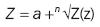
<body><![CDATA[<p align="justify"><font face="verdana" size="2">If all the theorem conditions are met, the Z'(z) derivative may be expressed using one of the following forms, known as Cauchy&#150;Riemann conditions<sup>1</sup> .</font></p>     <p align="justify"><font face="verdana" size="2"><img src="/img/revistas/iit/v9n2/a4s10.2.jpg"></font></p>     <p align="justify"><font face="verdana" size="2">Transformation is <img src="/img/revistas/iit/v9n2/a4s56.jpg"> This inequality transforms the extended plane on itself, so that each Z(z) point has <i>n </i>pre&#150;images in the z plane. Thus:</font></p>     <p align="justify"><font face="verdana" size="2"><img src="/img/revistas/iit/v9n2/a4s11.jpg"></font></p>     <p align="justify"><font face="verdana" size="2">with <i>n </i>points located on the apexes of a regular polygon with <i>n </i>sides and center point at a. The proposed transformation goes in accordance with all points, except z <i>= </i>a and z <i>= </i>&infin;. In this case, the angles with apexes at the last two points increase <i>n </i>times. It should be taken into account that |Z(z) | = | z &#150; a <i><sup>n</sup></i> | and that Arg (Z(z)) = <i>n </i>Arg(z &#150; a), from which it may be deduced that every circumference with an a = <i>b </i>radius, <a href="/img/revistas/iit/v9n2/a4f1.jpg" target="_blank">figure 1</a>, with center point atz = a is transformed into a circumference with an <i>r </i>radius. If point z displacing the <i>| z &#150; a| =r </i>circumference in a positive direction, that is, the continually expanding Arg(z &#150; a) increases by 2<i><img src="/img/revistas/iit/v9n2/a4s57.jpg">, </i>a Z(z) point will displace <i>n </i>times the circumference defined by |Z(z) | =r<sup>n</sup> in the same direction. The continually expanding Arg (Z(z)) will increase by 2<i><i><img src="/img/revistas/iit/v9n2/a4s57.jpg"></i>n.</i></font></p>     <p align="justify"><font face="verdana" size="2">Now let us consider Joukowski's function (Kochin et al, 1958) Z(z) = &frac12; (z <i>+ </i>1/z) <i>=</i>&lambda; (z), a second order function that meets the &lambda; (z)<i> = </i>&lambda;, (1/z) condition, which means that each point of the Z(z) plane has a Z(z) = &lambda; (z) transformation of less than two <i>z<sub>1</sub> </i>and z<sub>2</sub>, pre&#150;images, related to each other by z<sub>1</sub>z<sub>2 </sub><b><i>= </i></b>1.</font></p>     <p align="justify"><font face="verdana" size="2">If one of them belongs to the inside of the unit circle, the other belongs to the outside and vice versa, while they have the same values. The Z(z) <i>= </i>&lambda; (z) function remains in the <i><img src="/img/revistas/iit/v9n2/a4s12.jpg"></i>domain and takes various values at the <i>| z | &lt; </i>1 (o <i>| z | &gt; </i>1) points, and is biunivocally and continuously transformed in a certain G domain of the Z(z) plane.</font></p>     <p align="justify"><font face="verdana" size="2">&nbsp;</font></p>     <p align="justify"><font face="verdana" size="2"><b>Theorem</b></font></p>     <p align="justify"><font face="verdana" size="2">The image of a &gamma; unit circumference is the segment of the actual &#91;&#150;1,1&#93; axis displaced twice (images of | z | <i>= r </i>circumferences and Argz <i>= </i>&alpha; + 2<i>k<img src="/img/revistas/iit/v9n2/a4s57.jpg"></i>radii), in such a manner that G domain is formed by every point of Z(z) plane, except for those belonging to the segment of the actual &Gamma; axis meeting the values of the &#150;1 <u>&lt;</u> x <u>&lt;</u> 1 interval.</font></p>     ]]></body>
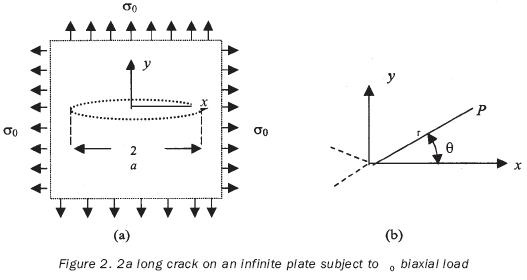
<body><![CDATA[<p align="justify"><font face="verdana" size="2">&nbsp;</font></p>     <p align="justify"><font face="verdana" size="2"><b>Dem</b></font></p>     <p align="justify"><font face="verdana" size="2">In order to obtain the domain's r boundary, the image of the &gamma; : <i>| </i>z<i> | = </i>1 unit circumference must be obtained. If <i><img src="/img/revistas/iit/v9n2/a4s58.jpg">, </i><a href="#f2">figure 2</a>, then if</font></p>     <p align="justify"><font face="verdana" size="2"><img src="/img/revistas/iit/v9n2/a4s14.jpg"></font></p>     <p align="center"><font face="verdana" size="2"><a name="f2"></a></font></p>     <p align="center"><font face="verdana" size="2"><img src="/img/revistas/iit/v9n2/a4f2.jpg"></font></p>     <p align="justify"><font face="verdana" size="2">and the images of the <i>| </i>z<i> | = r </i>circumferences and the Argz <i>= </i>&alpha; + 2k<img src="/img/revistas/iit/v9n2/a4s57.jpg"> radii</font></p>     <p align="justify"><font face="verdana" size="2">If we consider only the inside of the <i>| </i>z<i> |&lt; </i>1 unit circumference and the definition of z given in equation 7, that is:</font></p>     <p align="justify"><font face="verdana" size="2"><img src="/img/revistas/iit/v9n2/a4s15.jpg"></font></p>     <p align="justify"><font face="verdana" size="2">then:</font></p>     ]]></body>

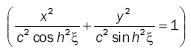
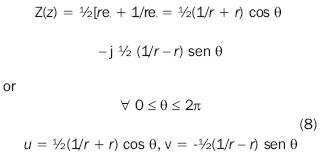
<body><![CDATA[<p align="justify"><font face="verdana" size="2"><img src="/img/revistas/iit/v9n2/a4s16.jpg"></font></p>     <p align="justify"><font face="verdana" size="2">eliminating &theta; parameter we obtain:</font></p>     <p align="justify"><font face="verdana" size="2"><img src="/img/revistas/iit/v9n2/a4s17.jpg"></font></p>     <p align="justify"><font face="verdana" size="2">micro ellipse equation with</font></p>     <p align="justify"><font face="verdana" size="2"><img src="/img/revistas/iit/v9n2/a4s18.jpg"></font></p>     <p align="justify"><font face="verdana" size="2">It may be inferred from equation 8 that when 9 increases continuously from 0 to 2<img src="/img/revistas/iit/v9n2/a4s57.jpg">or, which is the same, that point z traces the entire <i>| </i>z |<i>= r </i>circumference only once in a positive direction, the corresponding point traces the entire ellipse only once, represented by equation 9, in a negative direction. As a matter of fact, when 0 &lt; &theta; &lt; <i><img src="/img/revistas/iit/v9n2/a4s57.jpg">/2, u </i>is positive and decreases from a down to 0, while <i>v </i>is negative and decreases from 0 down to <i>&#150;b. </i>When <img src="/img/revistas/iit/v9n2/a4s57.jpg"><i>/ </i>2<i> &lt; </i>&theta; &lt; <img src="/img/revistas/iit/v9n2/a4s57.jpg"><i>, u </i>continues decreasing from 0 down to &#150;a, while <i>v </i>increases from&#150;b up to 0. When <i><img src="/img/revistas/iit/v9n2/a4s57.jpg"> &lt; </i>&theta; &lt; 3 <img src="/img/revistas/iit/v9n2/a4s57.jpg"><i>/ </i>2<i>, u </i>increases from &#150;a up to 0, while <i>v </i>increases from 0 up to <i>b. </i>Finally, when 3<img src="/img/revistas/iit/v9n2/a4s57.jpg"><i> / 2 &lt; </i>&theta;&lt; 2 <img src="/img/revistas/iit/v9n2/a4s57.jpg"><i>, u </i>increases from 0 up to a, while <i>v </i>decreases from <i>b </i>up to 0.</font></p>     <p align="justify"><font face="verdana" size="2">If <i>r </i>radius of the | z | <i>= r </i>circumference varies from &infin; to 1, a is decreased from &infin; down to 1 and <i>b </i>is decreased from &infin; down to 0; the corresponding ellipses will trace the entire group of ellipses of w = <i>Z(z) </i>plane with &plusmn; 1 foci. From the above may be deduced that <i>w = </i>&gamma; (z) transforms biunivocally the unit circle in the G domain representing the outside of the r segment. In addition, the image of the center of the unit circle is the infinite point and the image of the unit circumference is the &Gamma; segment displaced twice.</font></p>     <p align="justify"><font face="verdana" size="2">For the image of the</font></p>     <p align="justify"><font face="verdana" size="2"><img src="/img/revistas/iit/v9n2/a4s19.jpg"></font></p>     <p align="justify"><font face="verdana" size="2">radius, first we obtain the equation:</font></p>     ]]></body>
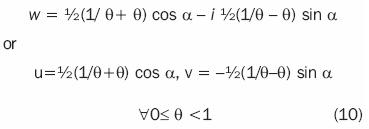
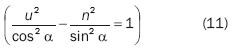
<body><![CDATA[<p align="justify"><font face="verdana" size="2"><img src="/img/revistas/iit/v9n2/a4s20.jpg"></font></p>     <p align="justify"><font face="verdana" size="2">This shows that the images of two radii symmetrical to the actual axis (if &alpha; angle corresponds to one of them, &#150;&alpha; angle are also symmetrical in relation to the actual axis; while the images of two radii symmetrical to the imaginary axis (if a angle corresponds to one of them, <i><img src="/img/revistas/iit/v9n2/a4s57.jpg"> &#150; </i>&alpha; angle corresponds to the other one) are symmetrical to the imaginary axis. Therefore, it is only necessary to take into account the images of the radii belonging, for instance, to the first quadrant: 0 <u>&lt;</u> &alpha; <img src="/img/revistas/iit/v9n2/a4s57.jpg"><u>&lt;</u>   /2.</font></p>     <p align="justify"><font face="verdana" size="2">It should be noticed that for &alpha; <i>= </i>0, it is necessary that: <img src="/img/revistas/iit/v9n2/a4s21.jpg">This is an infinite semi&#150;interval of the actual axis: 1 <&nbsp; <i>u <u>&lt;</u> </i>&infin;. The interval that is symmetrical to this &#150;&infin; <i><u>&lt;</u></i>&nbsp;<i>u &lt; </i>&#150;1, is the radius image corresponding to a <i>= <img src="/img/revistas/iit/v9n2/a4s57.jpg">. </i>For <img src="/img/revistas/iit/v9n2/a4s22.jpg">&lt;&nbsp; 1. This is the imaginary semi&#150;axis: &#150; &infin; <u>&lt;</u> v &lt; 0. The other imaginary semi&#150;axis 0 &lt; <i>v  </i><i><u>&lt;</u></i> &infin;, is the radius image corresponding to a = &#150;<i><img src="/img/revistas/iit/v9n2/a4s57.jpg"></i> /2.</font></p>     <p align="justify"><font face="verdana" size="2">To summarize, the image of the unit circumference horizontal diameter is the infinite interval of the actual axis that goes from point &#150;1 up to point + 1, passing through &infin;; while the image of the unit circumference vertical diameter is the whole length of the imaginary axis, except for coordinates origin, including the infinite point.</font></p>     <p align="justify"><font face="verdana" size="2">Let us, now, suppose that &theta; &lt; &alpha; &lt; <i><img src="/img/revistas/iit/v9n2/a4s57.jpg"></i>/2. If we eliminate the 6 parameter from equations in number 10, we obtain:</font></p>     <p align="justify"><font face="verdana" size="2"><img src="/img/revistas/iit/v9n2/a4s23.jpg"></font></p>     <p align="justify"><font face="verdana" size="2">This is the equation of the hyperbola with actual semi&#150;axis a = cos &alpha;, the imaginary semi&#150;axis <i>b = </i>sin &alpha; and &plusmn; 1 foci. Nevertheless, point <i>w </i>does not completely trace the hyperbola when point z describes the whole length of <img src="/img/revistas/iit/v9n2/a4s24.jpg">radius. As a matter of fact, it might be deduced, based on equations in number 10, that when t increases from 0 up to 1, <i>u </i>decreases from &infin; down to cos &alpha;, while and <i>v </i>increases from &#150;&infin; to 0. Therefore, the point traces only a fourth of the hyperbola belonging to the fourth quadrant. Based on this observation, the fourth belonging to the first quadrant, i.e., the part symmetrical to the one given in relation to the actual axis, will be the image of the radius symmetrical to the given radius, in relation to the actual axis, i.e. of the radius corresponding to the &#150;&alpha; angle. However, it would be unfair to say that the entire branch of the hyperbola that passes through the first and fourth quadrants is the image of the pair of radii referred to. In fact, the apex of hyperbola <i>u = </i>a, <i>v = </i>0 does not belong to this image. The images of the radii corresponding to the <i><img src="/img/revistas/iit/v9n2/a4s57.jpg"> &#150; </i>&alpha; and &alpha; + <i><img src="/img/revistas/iit/v9n2/a4s57.jpg"></i> or &alpha; &#150; <i><img src="/img/revistas/iit/v9n2/a4s57.jpg"></i> angles are fourths of the same hyperbola, located in the third and second quadrants. The complete hyperbola, except its two apexes, is the image of the radii quatern: &plusmn; &alpha;, <i><i><img src="/img/revistas/iit/v9n2/a4s57.jpg"></i> &plusmn; </i>&alpha;. It must be noticed that the image of each of the diameters formed by these radii will be part of the hyperbola formed by the pairs of its fourths, which are symmetrical to the coordinates point of origin and that are interlinked at the infinite point.</font></p>     <p align="justify"><font face="verdana" size="2">To summarize, the w = &lambda; (z) = &frac12; (z<i> + </i>1/z) function biunivocally transforms both the inside and the outside of the unit circle on the outside of the second case &#150;1 <u>&lt;</u> <i>u <u>&lt;</u> </i>1 of the actual axis. The <i>| z| = r </i>circumferences are transformed into ellipses with &plusmn; 1 foci and similar (semi&#150;axes): &frac12;<i><i>|</i></i>1<i> /r </i>&plusmn; <i>r|</i>, and the pairs of diameters symmetrical to the coordinate axes formed by radii <img src="/img/revistas/iit/v9n2/a4s60.jpg"> are transformed into hyperbolas with &plusmn;1 foci and |cos &alpha;|, |sin &alpha;| semi&#150;axes, except for the apexes of these hyperbolas.</font></p>     <p align="justify"><font face="verdana" size="2">Cauchy&#150;Riemann conditions 7.2 lead us to:</font></p>     <p align="justify"><font face="verdana" size="2"><img src="/img/revistas/iit/v9n2/a4s25.jpg"></font></p>     ]]></body>


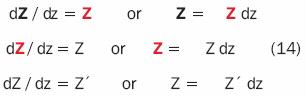
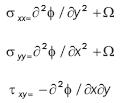
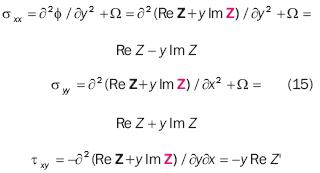
<body><![CDATA[<p align="justify"><font face="verdana" size="2">This result proves that the Westergaard stress function automatically satisfies biharmonic equation:   <img src="/img/revistas/iit/v9n2/a4s61.jpg"><sup>4</sup> <i> <img src="/img/revistas/iit/v9n2/a4s55.jpg">= </i>0, which may be written as follows:</font></p>     <p align="justify"><font face="verdana" size="2"><img src="/img/revistas/iit/v9n2/a4s26.jpg"></font></p>     <p align="justify"><font face="verdana" size="2">Highlighted functions and functions in bold type of the Z stress function in equation 5 indicate integration, i.e.:</font></p>     <p align="justify"><font face="verdana" size="2"><img src="/img/revistas/iit/v9n2/a4s27.jpg"></font></p>     <p align="justify"><font face="verdana" size="2">where bold type and the differential indicate integration and differentiation, respectively. If represent stress by a <img src="/img/revistas/iit/v9n2/a4s55.jpg">stress function such as:</font></p>     <p align="justify"><font face="verdana" size="2"><img src="/img/revistas/iit/v9n2/a4s28.jpg"></font></p>     <p align="justify"><font face="verdana" size="2">where &Omega; (x, y) is a stress&#150;body field.</font></p>     <p align="justify"><font face="verdana" size="2">Substituting in equation 12, equations of stress Cartesian components are given in terms of the actual and imaginary parts of the Westergaard stress function:</font></p>     <p align="justify"><font face="verdana" size="2"><img src="/img/revistas/iit/v9n2/a4s29.jpg"></font></p>     <p align="justify"><font face="verdana" size="2">Equations in number 15 produce stress for <i>Z</i>(z) analytical functions. Besides, the stress function may be selected to meet the corresponding boundary conditions of the problem under study. The formula provided in number 15, originally proposed by Westergaard, relates correctly stress singularity to the tip of the crack. In addition, terms may be added to correctly represent the stress field in regions adjacent to the tip of the micro discontinuity. These additional terms may be introduced in later sections distributed with experimental methods to measure K<i><sub>l</sub></i>.</font></p>     ]]></body>
<body><![CDATA[<p align="justify"><font face="verdana" size="2">The typical problem in fracture mechanics, <a href="/img/revistas/iit/v9n2/a4f1.jpg" target="_blank">figure 1a</a>, is an infinite plate with a central crack 2a long. The plate is subject to biaxial stress. The Z stress function applied in order to solve this problem is:</font></p>     <p align="justify"><font face="verdana" size="2"><img src="/img/revistas/iit/v9n2/a4s30.jpg"></font></p>     <p align="justify"><font face="verdana" size="2">Substituting equation 16 in equation 15 for z <img src="/img/revistas/iit/v9n2/a4s62.jpg">&infin; , we obtain &sigma;<sub>xx</sub> = &sigma;<sub>yy</sub></sub> and &tau; ' <sub>xy = </sub>0 and &sigma;<sub>xx</sub> = &tau; <sub>xy</sub> = 0 as it is needed to meet the boundary conditions of the external field. On the discontinuity surface, where y <i>= </i>0 and z <i>= x, </i>for &#150;a <i><u>&lt;</u> x <i><u>&lt;</u></i> a, </i>Re<i> Z = </i>0 and &sigma;<sub>xx</sub> <i>= &tau; <sub>xy</sub> = </i>0. It is clear that the Z stress function given in equation 16 meets the boundary conditions on the surface free from micro discontinuities.</font></p>     <p align="justify"><font face="verdana" size="2">It is more convenient to relocate the point of origin of the coordinate system and the plate at the tip of the micro discontinuity, <a href="#f2">figure 2b</a>. To translate the point of origin, z must be replaced in equation 16 by z + a, the new function being:</font></p>     <p align="justify"><font face="verdana" size="2"><img src="/img/revistas/iit/v9n2/a4s31.jpg"></font></p>     <p align="justify"><font face="verdana" size="2">A small region near the tip of the micro discontinuity, where z &lt;&lt; a, should then be taken into consideration. As a result, equation 17 is reduced to:</font></p>     <p align="justify"><font face="verdana" size="2"><img src="/img/revistas/iit/v9n2/a4s32.jpg"></font></p>     <p align="justify"><font face="verdana" size="2">Substituting equation 6 in equation 18:</font></p>     <p align="justify"><font face="verdana" size="2"><img src="/img/revistas/iit/v9n2/a4s33.jpg"></font></p>     <p align="justify"><font face="verdana" size="2">remembering that:</font></p>     ]]></body>

<body><![CDATA[<p align="justify"><font face="verdana" size="2"><img src="/img/revistas/iit/v9n2/a4s34.jpg"></font></p>     <p align="justify"><font face="verdana" size="2">and replacing equation 20 in equation 19, it is proven that the actual part of Z is:</font></p>     <p align="justify"><font face="verdana" size="2"><img src="/img/revistas/iit/v9n2/a4s35.jpg"></font></p>     <p align="justify"><font face="verdana" size="2">Along the line of the crack, where &theta; and y are both equal to zero, from 21 and 13:</font></p>     <p align="justify"><font face="verdana" size="2"><img src="/img/revistas/iit/v9n2/a4s36.jpg"></font></p>     <p align="justify"><font face="verdana" size="2">This result proves that <i> </i>&sigma;<sub>yy</sub>  <img src="/img/revistas/iit/v9n2/a4s62.jpg"> &infin; stress is of a <img src="/img/revistas/iit/v9n2/a4s63.jpg"> singular order as it gets closer to the tip of the micro discontinuity along the x axis. At last, equation 22 may be substituted in the following equation</font></p>     <p align="justify"><font face="verdana" size="2"><img src="/img/revistas/iit/v9n2/a4s37.jpg"></font></p>     <p align="justify"><font face="verdana" size="2">which is the treatment in the singular stress field introducing a known quantity as a stress intensity factor, <i>K<sub>l</sub> </i>where the coordinate system shown in <a href="#f2">figure 2a</a> and &sigma;<sub>yy</sub><i> </i>is evaluated at the limit along the &theta; = 0 line. Therefore:</font></p>     <p align="justify"><font face="verdana" size="2"><img src="/img/revistas/iit/v9n2/a4s38.jpg"></font></p>     <p align="justify"><font face="verdana" size="2">This result proves that K<i><sub>I</sub></i> stress intensity factor varies as a lineal function of &sigma;<sub>0</sub> applied stress and increases along with the length of the micro discontinuity as a function of <img src="/img/revistas/iit/v9n2/a4s64.jpg">, as shown in <a href="/img/revistas/iit/v9n2/a4f3.jpg" target="_blank">figure 3</a>.</font></p>     ]]></body>
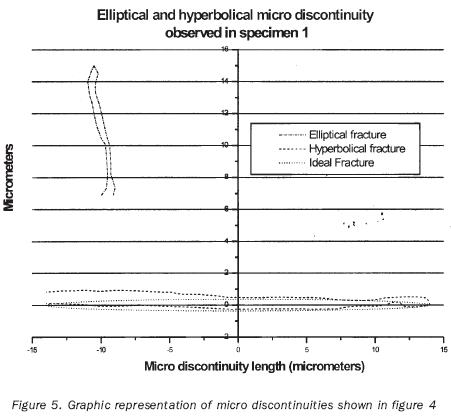
<body><![CDATA[<p align="justify"><font face="verdana" size="2">&nbsp;</font></p>     <p align="justify"><font face="verdana" size="2"><b>Application to laboratory tests</b></font></p>     <p align="justify"><font face="verdana" size="2">Usually, every theoretical solution to a physical problem must be proven in an experimental manner. That is why it is necessary to carry out laboratory tests in order to verify an analytical model. In this research, it is necessary to verify that the proposed solution model goes in accordance with observations carried out in the laboratory. The type of test was selected in accordance with ASTM E 399&#150;90 (1993) test, which is used in order to determine the fracture resistance value on flat strain for metallic materials. During the preparation of samples was established a structural steel with a % thickness (1.905 cm). The type of material used complies with ASTM A&#150;588 standard. Cutting and machining of samples were carried out by water and abrasive cutting with numerical control. Experimental design took into account a pilot sample in accordance with ASTM requirements, then the samples were instrumented and assayed after Dally y Riley's (1991) recommendations.</font></p>     <p align="justify"><font face="verdana" size="2">The four instrumented samples were assayed in accordance with that programmed in the experimental design, based on the pre&#150;assay test. A metallographic treatment was carried out, which included: sample cutting, trimming and polishing with chemicals in order to make visible the microstructural features of the metal so that it could be subject to observation with digital scanning microscopy.</font></p>     <p align="justify"><font face="verdana" size="2">To apply the developed mathematical model, the elliptical and hyperbolic equations presented by micro discontinuities found during the microscopy session must be established. This has been possible generating a scale grid on the digital photographs obtained with the microscope, in order record the behavior of every micro discontinuity. Coordinates were recorded by scaling each photograph, tracing the contour of the micro discontinuity, placing a reference point of origin and tracing vertical and horizontal lines, depending on the shape of the micro discontinuity, at equal distances (similar to way a seismograph makes records), to read coordinates and create graphs using any type of spreadsheet, and determine the <i>ideal </i>equation for every micro discontinuity.</font></p>     <p align="justify"><font face="verdana" size="2">&nbsp;</font></p>     <p align="justify"><font face="verdana" size="2"><b>Ideal equations of various micro discontinuities</b></font></p>     <p align="justify"><font face="verdana" size="2">From all micro fractures observed in samples studied, it was decided to analyze those shown in <a href="/img/revistas/iit/v9n2/a4f12.jpg" target="_blank">figures 12</a> and <a href="#f13">13</a> (Arteaga and Casanova, 2005), because they appear clearly in photographs. In <a href="/img/revistas/iit/v9n2/a4f4.jpg" target="_blank">figure 4</a>, upper left corner, shows the generation of a micro discontinuity perpendicular to the horizontal fissure. This perpendicular micro discontinuity shows that its behavior coincides with the mathematical model shown in <a href="/img/revistas/iit/v9n2/a4f1.jpg" target="_blank">figure 1</a>. The spreadsheet in <a href="#f5">figure 5</a> shows the tracing of these two micro discontinuities as well as the <i>ideal </i>behavior of the</font></p>     <p align="justify"><font face="verdana" size="2"><img src="/img/revistas/iit/v9n2/a4s39.jpg"></font></p>     <p align="justify"><font face="verdana" size="2">ellipse (with dotted lines) <i>governing </i>the behavior of the lower micro discontinuity.</font></p>     ]]></body>
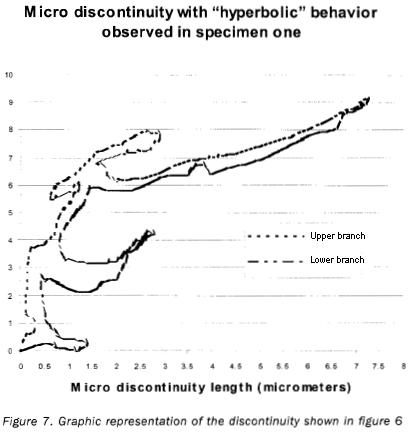
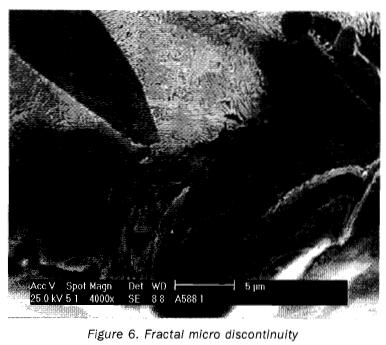
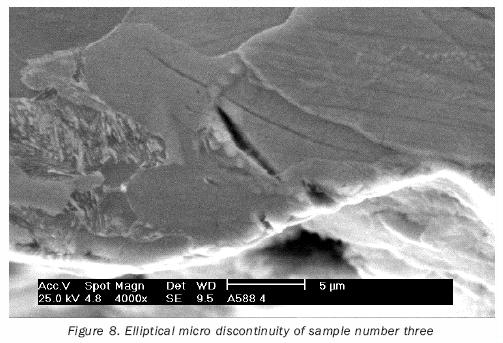
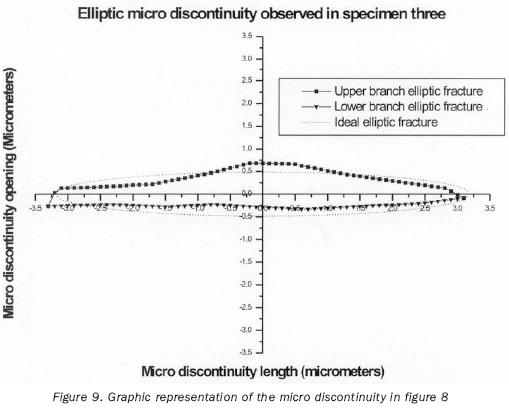
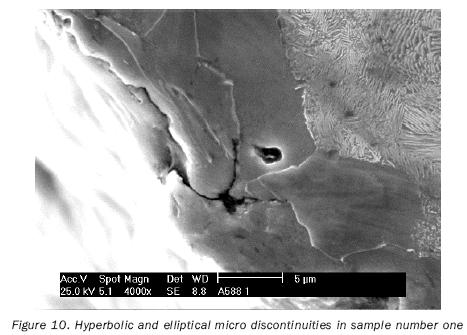
<body><![CDATA[<p align="center"><font face="verdana" size="2"><a name="f13"></a></font></p>     <p align="center"><font face="verdana" size="2"><img src="/img/revistas/iit/v9n2/a4f13.jpg"></font></p>     <p align="center"><font face="verdana" size="2"><a name="f5"></a></font></p>     <p align="center"><font face="verdana" size="2"><img src="/img/revistas/iit/v9n2/a4f5.jpg"></font></p>     <p align="justify"><font face="verdana" size="2"><a href="#f7">Figure 7</a> is the graphic representation of the image in <a href="#f6">figure 6</a>. It was not possible to establish the ideal equation or behavior equation for this micro discontinuity, because its starting point coincides with the upper boundary of the notch, as shown in the figure. Therefore, it is not possible to obtain reference parameters, which renders it virtually impossible to establish their equation without resorting to a greater number of suppositions, which could lead to obtaining incorrect data regarding the behavior of such micro fracture.</font></p>     <p align="center"><font face="verdana" size="2"><a name="f7"></a></font></p>     <p align="center"><font face="verdana" size="2"><img src="/img/revistas/iit/v9n2/a4f7.jpg"></font></p>     <p align="center"><font face="verdana" size="2"><a name="f6"></a></font></p>     <p align="center"><font face="verdana" size="2"><img src="/img/revistas/iit/v9n2/a4f6.jpg"></font></p>     <p align="justify"><font face="verdana" size="2"><a href="#f8">Figure 8</a> shows a micro fracture in sample number three, which has an elliptical behavior, while <a href="#f9">figure 9</a> shows its graphic representation. This micro fracture appeared on its own, without any hyperbolic behavior micro fractures. <a href="#f10">Figure 10</a> shows a series of micro fractures appearing in sample number one in an intergranular manner.</font></p>     ]]></body>
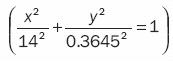
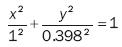
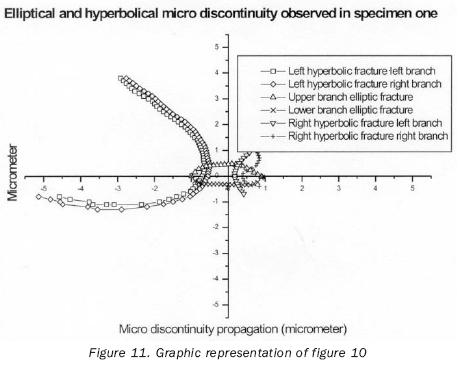
<body><![CDATA[<p align="center"><font face="verdana" size="2"><a name="f8"></a></font></p>     <p align="center"><font face="verdana" size="2"><img src="/img/revistas/iit/v9n2/a4f8.jpg"></font></p>     <p align="center"><font face="verdana" size="2"><a name="f9"></a></font></p>     <p align="center"><font face="verdana" size="2"><img src="/img/revistas/iit/v9n2/a4f9.jpg"></font></p>     <p align="center"><font face="verdana" size="2"><a name="f10"></a></font></p>     <p align="center"><font face="verdana" size="2"><img src="/img/revistas/iit/v9n2/a4f10.jpg"></font></p>     <p align="justify"><font face="verdana" size="2">This figure shows generation of an elliptical micro fracture and the branches of hyperbolic micro fractures. Their ideal or particular equations were calculated, equations in number 15 were calculated afterwards. <a href="#f11">Figure 11</a> shows their graphic representation. On the other hand, <a href="/img/revistas/iit/v9n2/a4f12.jpg" target="_blank">figure 12</a> shows the left branch of the hyperbolic micro fracture, its ideal mirror, and the elliptical micro fracture and its ideal equation given by</font></p>     <p align="justify"><font face="verdana" size="2"><img src="/img/revistas/iit/v9n2/a4s40.jpg"></font></p>     <p align="center"><font face="verdana" size="2"><a name="f11"></a></font></p>     <p align="center"><font face="verdana" size="2"><img src="/img/revistas/iit/v9n2/a4f11.jpg"></font></p>     ]]></body>
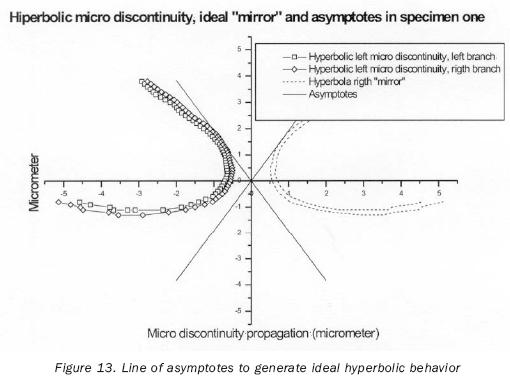
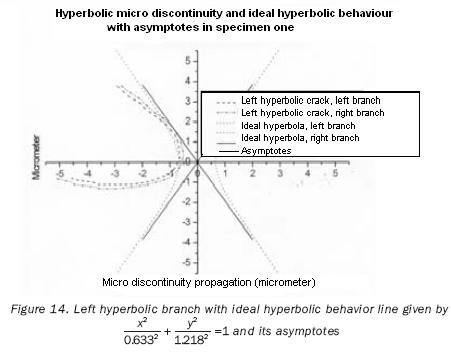
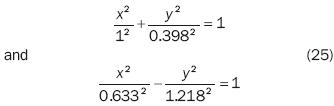
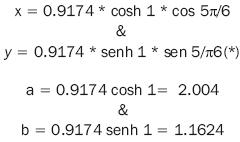
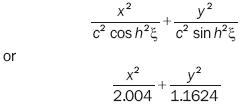
<body><![CDATA[<p align="justify"><font face="verdana" size="2"><a href="#f13">Figure 13</a> shows the hyperbolic micro discontinuity with its two branches, the ideal mirror and the line of asymptotes needed to establish the equation of such hyperbola. Finally, <a href="#f14">figure 14</a> shows the left branch of the hyperbolic micro discontinuity and the hyperbolic function graph representing the ideal behavior of the micro fracture accompanied by its asymptotes.</font></p>     <p align="center"><font face="verdana" size="2"><a name="f13"></a></font></p>     <p align="center"><font face="verdana" size="2"><img src="/img/revistas/iit/v9n2/a4f13.jpg"></font></p>     <p align="center"><font face="verdana" size="2"><a name="f14"></a></font></p>     <p align="center"><font face="verdana" size="2"><img src="/img/revistas/iit/v9n2/a4f14.jpg"></font></p>     <p align="justify"><font face="verdana" size="2">Calculation of stress on micro discontinuities in terms of the actual and imaginary parts of the Westergaard stress function, equation 15, uses equations obtained from the elliptical and hyperbolic representation of micro discontinuities shown in <a href="#f10">figure 10</a>. Therefore, the equations of the ellipse and hyperbola to be transformed to the complex plane are, respectively:</font></p>     <p align="justify"><font face="verdana" size="2"><img src="/img/revistas/iit/v9n2/a4s41.jpg"></font></p>     <p align="justify"><font face="verdana" size="2">&nbsp;</font></p>     <p align="justify"><font face="verdana" size="2">where a =1, <i>b </i>= 0.398 and c = 0.9174. The &sigma;<sub>x</sub> = &sigma;<sub>0</sub> applied stress is:</font></p>     <p align="justify"><font face="verdana" size="2">&nbsp;</font></p>     ]]></body>
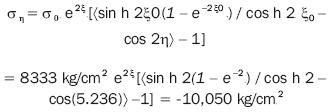
<body><![CDATA[<p align="justify"><font face="verdana" size="2">The measured value of the <i>r </i>radius is equal to 0.79993, i.e.: a = <i>b = </i>2.00083 * 0.398 = <i>r.</i></font></p>     <p align="justify"><font face="verdana" size="2">&nbsp;</font></p>     <p align="justify"><font face="verdana" size="2"><b>Stress and actual stress intensity factors based on the complex variable model</b></font></p>     <p align="justify"><font face="verdana" size="2">To calculate the equation of the micro fracture, the following is substituted in equation 1:</font></p>     <p align="justify"><font face="verdana" size="2"><img src="/img/revistas/iit/v9n2/a4s43.jpg"></font></p>     <p align="justify"><font face="verdana" size="2">we must remember that &xi;<sub>0</sub> <i>= </i>1, is the starting point of the micro fracture and that the equation of the ellipse is:</font></p>     <p align="justify"><font face="verdana" size="2"><img src="/img/revistas/iit/v9n2/a4s44.jpg"></font></p>     <p align="justify"><font face="verdana" size="2">Theoretically, the &sigma;<sub>&eta;</sub> stress around the micro&#150;hole understudy is:</font></p>     <p align="justify"><font face="verdana" size="2"><img src="/img/revistas/iit/v9n2/a4s45.jpg"></font></p>     <p align="justify"><font face="verdana" size="2">The &sigma;<sub>&eta;</sub>  stress boundary is a maximum at the end of the major axis when cos 2<sub>&eta;</sub><i> = </i>1; in this case: cos(10<img src="/img/revistas/iit/v9n2/a4s57.jpg">/6) = 0.5000106.</font></p>     ]]></body>
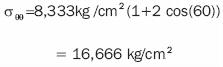
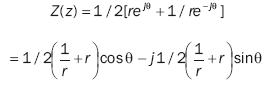
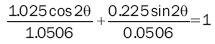
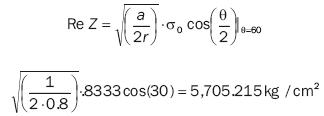
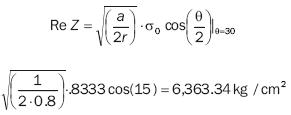
<body><![CDATA[<p align="justify"><font face="verdana" size="2">To calculate &sigma;<sub>&theta;&theta;</sub>= &sigma;<sub>o</sub>(l + 2cos 20) radial stress, the value of the 0 angle on the upper branch has been measured directly from graph 12, this angle being 60&deg;, thus:</font></p>     <p align="justify"><font face="verdana" size="2"><img src="/img/revistas/iit/v9n2/a4s46.jpg"></font></p>     <p align="justify"><font face="verdana" size="2">On the lower branch, &theta; value is 30&deg;, thus: </font></p>     <p align="justify"><font face="verdana" size="2"><img src="/img/revistas/iit/v9n2/a4s47.jpg"></font></p>     <p align="justify"><font face="verdana" size="2">Therefore, the Z(z) function is:</font></p>     <p align="justify"><font face="verdana" size="2"><img src="/img/revistas/iit/v9n2/a4s48.jpg"></font></p>     <p align="justify"><font face="verdana" size="2">For &theta; = 60&deg;</font></p>     <p align="justify"><font face="verdana" size="2"><img src="/img/revistas/iit/v9n2/a4s49.jpg"></font></p>     <p align="justify"><font face="verdana" size="2">and   the   equation   of  the   micro   ellipse   with semi&#150;axes a = 1.025 and b = 0.225 is:</font></p>     <p align="justify"><font face="verdana" size="2"><img src="/img/revistas/iit/v9n2/a4s50.jpg"></font></p>     ]]></body>
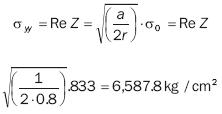
<body><![CDATA[<p align="justify"><font face="verdana" size="2">and</font></p>     <p align="justify"><font face="verdana" size="2">0.9756 cos<sup>2</sup>&theta; + 4.4466 sin<sup>2 </sup>&theta; = 1</font></p>     <p align="justify"><font face="verdana" size="2">For &theta; =30&deg;</font></p>     <p align="justify"><font face="verdana" size="2">Z(z) = 1.025 cos 30 &#150; 0.225 j sin 30</font></p>     <p align="justify"><font face="verdana" size="2">Equations for stress Cartesian components in terms of the actual and imaginary parts of the stress function are:</font></p>     <p align="justify"><font face="verdana" size="2"><img src="/img/revistas/iit/v9n2/a4s51.jpg"></font></p>     <p align="justify"><font face="verdana" size="2">and</font></p>     <p align="justify"><font face="verdana" size="2"><img src="/img/revistas/iit/v9n2/a4s52.jpg"></font></p>     <p align="justify"><font face="verdana" size="2">&nbsp;</font></p>     <p align="justify"><font face="verdana" size="2">Along the line where &theta; and y are both zero, we obtain:</font></p>     ]]></body>
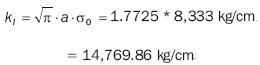
<body><![CDATA[<p align="justify"><font face="verdana" size="2"><img src="/img/revistas/iit/v9n2/a4s53.jpg"></font></p>     <p align="justify"><font face="verdana" size="2">and its stress intensity factor is:</font></p>     <p align="justify"><font face="verdana" size="2"><img src="/img/revistas/iit/v9n2/a4s54.jpg"></font></p>     <p align="justify"><font face="verdana" size="2">It must be noticed that, when observing <a href="#f14">figure 14</a> and comparing it with <a href="/img/revistas/iit/v9n2/a4f1.jpg" target="_blank">figure 1</a>, becomes evident that a branch of the hyperbola has an angle such as that of the fracture under study, namely 60&deg;, and that radial stress value is zero. This happens because when this hyperbola exists, the tip of the crack has disappeared and stress begins to be distributed over a much greater surface, leading to a decrease of such value and bringing about a change of sign. It may also be observed that, the smaller the hyperbola branch angle is, the greater the stress will be, which will tend to increase the closer the stress gets to zero (which means that it gets closer to the tip of the fracture), confirming the singularity of the stress at the tip of the fracture.</font></p>     <p align="justify"><font face="verdana" size="2">&nbsp;</font></p>     <p align="justify"><font face="verdana" size="2"><b>Conclusions</b></font></p>     <p align="justify"><font face="verdana" size="2">In micro fracture in <a href="/img/revistas/iit/v9n2/a4f12.jpg" target="_blank">figure 12</a> may be observed that the expansion of the crack at micrometric levels behaves in a fractal manner. Its equation is not presented. The distribution of particles close to the tip of the Chevron&#150;type notch is circular in the well defined area of the plastic zone, which shows that the probe was subject to a high stress concentration. Applying the complex variable theory provides a complete view of the complexity of the theoretical problem involved. The <i>w = </i>&lambda; (z) = &frac12; (z  + 1/z) function transforms biunivocally both the inside and the outside of the unit circle on the outside of the second case &#150;1 <u>&lt;</u> <i>u <u>&lt;</u> </i>1 of the actual axis. It may be observed that, when there is a micro fracture that has already taken a hyperbolic shape and when the angle of some of its branches is 60&deg; to the horizontal, the stress value is zero. Comparing the values of stress intensity factors taken at the laboratory and the theoretical results obtained, it may be ascertained that experimental values are the result of the overall effect of the test on the probe.</font></p>     <p align="justify"><font face="verdana" size="2">&nbsp;</font></p>     <p align="justify"><font face="verdana" size="2"><b>Acknowledgments</b></font></p>     <p align="justify"><font face="verdana" size="2">The authors want to thank research projects named Fractal and Fracture in Structural Samples No. 20040225 and No. 20050900. Financed by the Instituto Polit&eacute;cnico Nacional, Mexico.</font></p>     ]]></body>
<body><![CDATA[<p align="justify"><font face="verdana" size="2">&nbsp;</font></p>     <p align="justify"><font face="verdana" size="2"><b>References</b></font></p>     <!-- ref --><p align="justify"><font face="verdana" size="2">Arteaga&#150;Arcos, J.C and Casanova del Angel, F. (2005). Pruebas de laboratorio para el an&aacute;lisis de micro discontinuidades en acero estructural. <i>El Portulano de la Ciencia. </i>A&ntilde;o V, 1(14):543&#150;558. House Logiciels. M&eacute;xico.</font>&nbsp;&nbsp;&nbsp;&nbsp;&nbsp;&nbsp;&nbsp;&nbsp;[&#160;<a href="javascript:void(0);" onclick="javascript: window.open('/scielo.php?script=sci_nlinks&ref=4241473&pid=S1405-7743200800020000400001&lng=','','width=640,height=500,resizable=yes,scrollbars=1,menubar=yes,');">Links</a>&#160;]<!-- end-ref --><!-- ref --><p align="justify"><font face="verdana" size="2">American Society of Testing Materials (ASTM) (1993). Standard E 813&#150;89: Standard Test Method for Plane&#150;Strain Fractures Toughness of Metallic Materials.</font>&nbsp;&nbsp;&nbsp;&nbsp;&nbsp;&nbsp;&nbsp;&nbsp;[&#160;<a href="javascript:void(0);" onclick="javascript: window.open('/scielo.php?script=sci_nlinks&ref=4241474&pid=S1405-7743200800020000400002&lng=','','width=640,height=500,resizable=yes,scrollbars=1,menubar=yes,');">Links</a>&#160;]<!-- end-ref --><!-- ref --><p align="justify"><font face="verdana" size="2">Dally, J.Wand Riley W.F. <i>Experimental Stress Analysis. </i>McGraw&#150;Hill. USA. 1991.</font>&nbsp;&nbsp;&nbsp;&nbsp;&nbsp;&nbsp;&nbsp;&nbsp;[&#160;<a href="javascript:void(0);" onclick="javascript: window.open('/scielo.php?script=sci_nlinks&ref=4241475&pid=S1405-7743200800020000400003&lng=','','width=640,height=500,resizable=yes,scrollbars=1,menubar=yes,');">Links</a>&#160;]<!-- end-ref --><!-- ref --><p align="justify"><font face="verdana" size="2">Kochin N.E., Kibell A. and Ros&eacute; N.V. <i>Hidrodin&aacute;mica te&oacute;rica. MIR. </i>1958.</font>&nbsp;&nbsp;&nbsp;&nbsp;&nbsp;&nbsp;&nbsp;&nbsp;[&#160;<a href="javascript:void(0);" onclick="javascript: window.open('/scielo.php?script=sci_nlinks&ref=4241476&pid=S1405-7743200800020000400004&lng=','','width=640,height=500,resizable=yes,scrollbars=1,menubar=yes,');">Links</a>&#160;]<!-- end-ref --><p align="justify"><font face="verdana" size="2">&nbsp;</font></p>     <p align="justify"><font face="verdana" size="2"><b>Suggesting biography</b></font></p>     <!-- ref --><p align="justify"><font face="verdana" size="2">Anderson T.L. <i>Fracture mechanics. </i>CRC Press. USA. 1995.</font>&nbsp;&nbsp;&nbsp;&nbsp;&nbsp;&nbsp;&nbsp;&nbsp;[&#160;<a href="javascript:void(0);" onclick="javascript: window.open('/scielo.php?script=sci_nlinks&ref=4241479&pid=S1405-7743200800020000400005&lng=','','width=640,height=500,resizable=yes,scrollbars=1,menubar=yes,');">Links</a>&#160;]<!-- end-ref --><!-- ref --><p align="justify"><font face="verdana" size="2">American Society of Testing Materials (ASTM) Standard E 399&#150;90: Standard test method for plane&#150;strain fractures toughness of metallic materials. 1993.</font>&nbsp;&nbsp;&nbsp;&nbsp;&nbsp;&nbsp;&nbsp;&nbsp;[&#160;<a href="javascript:void(0);" onclick="javascript: window.open('/scielo.php?script=sci_nlinks&ref=4241480&pid=S1405-7743200800020000400006&lng=','','width=640,height=500,resizable=yes,scrollbars=1,menubar=yes,');">Links</a>&#160;]<!-- end-ref --><!-- ref --><p align="justify"><font face="verdana" size="2">Casanova del Angel F. La conceptualizaci&oacute;n matem&aacute;tica del pasado, el presente y el futuro de la arquitectura y su estructura fractal. <i>El portulano de la ciencia, </i>A&ntilde;o II, 1(4): 127&#150;148, Mayo de 2003. 2001.</font>&nbsp;&nbsp;&nbsp;&nbsp;&nbsp;&nbsp;&nbsp;&nbsp;[&#160;<a href="javascript:void(0);" onclick="javascript: window.open('/scielo.php?script=sci_nlinks&ref=4241481&pid=S1405-7743200800020000400007&lng=','','width=640,height=500,resizable=yes,scrollbars=1,menubar=yes,');">Links</a>&#160;]<!-- end-ref --><!-- ref --><p align="justify"><font face="verdana" size="2">Drexler E. <i>Engines of creation. </i>Anchor Books. USA. 1986.</font>&nbsp;&nbsp;&nbsp;&nbsp;&nbsp;&nbsp;&nbsp;&nbsp;[&#160;<a href="javascript:void(0);" onclick="javascript: window.open('/scielo.php?script=sci_nlinks&ref=4241482&pid=S1405-7743200800020000400008&lng=','','width=640,height=500,resizable=yes,scrollbars=1,menubar=yes,');">Links</a>&#160;]<!-- end-ref --><!-- ref --><p align="justify"><font face="verdana" size="2">Ju&aacute;rez&#150;Luna G. y Ayala&#150;Mill&aacute;n A.G. Aplicaci&oacute;n de la mec&aacute;nica de fractura a problemas de la geotecnia. <i>El portulano de la ciencia, </i>A&ntilde;o III, 1(9):303&#150;318. Enero de 2003.</font>&nbsp;&nbsp;&nbsp;&nbsp;&nbsp;&nbsp;&nbsp;&nbsp;[&#160;<a href="javascript:void(0);" onclick="javascript: window.open('/scielo.php?script=sci_nlinks&ref=4241483&pid=S1405-7743200800020000400009&lng=','','width=640,height=500,resizable=yes,scrollbars=1,menubar=yes,');">Links</a>&#160;]<!-- end-ref --><!-- ref --><p align="justify"><font face="verdana" size="2">NASA. <i>Fatigue crack growth computer program Nasgro versi&oacute;n 3.0. Referente Manual. </i>Lyndon B. Johnson Space Center. USA. 2000.</font>&nbsp;&nbsp;&nbsp;&nbsp;&nbsp;&nbsp;&nbsp;&nbsp;[&#160;<a href="javascript:void(0);" onclick="javascript: window.open('/scielo.php?script=sci_nlinks&ref=4241484&pid=S1405-7743200800020000400010&lng=','','width=640,height=500,resizable=yes,scrollbars=1,menubar=yes,');">Links</a>&#160;]<!-- end-ref --><!-- ref --><p align="justify"><font face="verdana" size="2">Regimex. <i>Cat&aacute;logo de productos. </i>M&eacute;xico. 1994.</font>&nbsp;&nbsp;&nbsp;&nbsp;&nbsp;&nbsp;&nbsp;&nbsp;[&#160;<a href="javascript:void(0);" onclick="javascript: window.open('/scielo.php?script=sci_nlinks&ref=4241485&pid=S1405-7743200800020000400011&lng=','','width=640,height=500,resizable=yes,scrollbars=1,menubar=yes,');">Links</a>&#160;]<!-- end-ref --><!-- ref --><p align="justify"><font face="verdana" size="2">Gran Enciclopedia Salvat. Vols. 12 y 19. Salvat Editores S.A. Barcelona. 2000.</font>&nbsp;&nbsp;&nbsp;&nbsp;&nbsp;&nbsp;&nbsp;&nbsp;[&#160;<a href="javascript:void(0);" onclick="javascript: window.open('/scielo.php?script=sci_nlinks&ref=4241486&pid=S1405-7743200800020000400012&lng=','','width=640,height=500,resizable=yes,scrollbars=1,menubar=yes,');">Links</a>&#160;]<!-- end-ref --><!-- ref --><p align="justify"><font face="verdana" size="2">Sears F.W. y Zemansky M.W. <i>F&iacute;sica Universitaria. </i>Vol. 1. Adison Wesley Longman&#150;Pearson Education. M&eacute;xico. 1999.</font>&nbsp;&nbsp;&nbsp;&nbsp;&nbsp;&nbsp;&nbsp;&nbsp;[&#160;<a href="javascript:void(0);" onclick="javascript: window.open('/scielo.php?script=sci_nlinks&ref=4241487&pid=S1405-7743200800020000400013&lng=','','width=640,height=500,resizable=yes,scrollbars=1,menubar=yes,');">Links</a>&#160;]<!-- end-ref --><!-- ref --><p align="justify"><font face="verdana" size="2">Serway R.A. y Faughn J. S. <i>F&iacute;sica. </i>Prentice Hall&#150;Pearson Education. M&eacute;xico. 2001.</font>&nbsp;&nbsp;&nbsp;&nbsp;&nbsp;&nbsp;&nbsp;&nbsp;[&#160;<a href="javascript:void(0);" onclick="javascript: window.open('/scielo.php?script=sci_nlinks&ref=4241488&pid=S1405-7743200800020000400014&lng=','','width=640,height=500,resizable=yes,scrollbars=1,menubar=yes,');">Links</a>&#160;]<!-- end-ref --><!-- ref --><p align="justify"><font face="verdana" size="2">Wilson J.D. <i>F&iacute;sica. </i>Segunda edici&oacute;n. Prentice Hall&#150;Pearson Education. M&eacute;xico. Cap&iacute;tulos 22 al 24. 1996.</font>&nbsp;&nbsp;&nbsp;&nbsp;&nbsp;&nbsp;&nbsp;&nbsp;[&#160;<a href="javascript:void(0);" onclick="javascript: window.open('/scielo.php?script=sci_nlinks&ref=4241489&pid=S1405-7743200800020000400015&lng=','','width=640,height=500,resizable=yes,scrollbars=1,menubar=yes,');">Links</a>&#160;]<!-- end-ref --><p align="justify"><font face="verdana" size="2">&nbsp;</font></p>     ]]></body>
<body><![CDATA[<p align="justify"><font face="verdana" size="2"><b>Notes</b></font></p>     <p align="justify"><font face="verdana" size="2"><sup>1</sup> This universally accepted denomination is historically unfair, as the conditions of 7.2 were studied in the 18th century by D'Alambert and Euler as part of their research on the application of complex variable functions in hydromechanics (D'Alambert and Euler), as well as in cartography and integral calculus (Euler).</font></p>     <p align="justify"><font face="verdana" size="2">&nbsp;</font></p>     <p align="justify"><font face="verdana" size="2"><b>About the authors</b></font></p>     <p align="justify"><font face="verdana" size="2"><i>Francisco Casanova del Angel. </i>Obtuvo el doctorado en estad&iacute;stica matem&aacute;tica en el a&ntilde;o 1981, as&iacute; como los estudios profesionales en estad&iacute;stica matem&aacute;tica en 1978 por la Universit&eacute; Pierre et Marie Curie, Paris VI. Asimismo, su maestr&iacute;a en ciencias en estructuras en 1974 en la Escuela Superior de Ingenier&iacute;a y Arquitectura del IPN&#150;M&eacute;xico. Es licenciado en f&iacute;sica y matem&aacute;ticas desde el a&ntilde;o de 1974 por la Escuela Superior de F&iacute;sica y Matem&aacute;ticas del IPN&#150;M&eacute;xico. Fue asesor matem&aacute;tico de la Organizaci&oacute;n de las Naciones Unidas en 1981. Jefe de Departamento de Procesos y M&eacute;todos Cuantitativos de la Secretar&iacute;a de Agricultura y Recursos Hidr&aacute;ulicos hasta 1985. Jefe del Departamento de Pol&iacute;tica y Gasto Paraestatal y Transferencia de la Secretar&iacute;a de Agricultura y Recursos Hidr&aacute;ulicos hasta 1986. Subdirector de Procesos Estad&iacute;sticos de la Secretar&iacute;a de Turismo en 1987. Profesor del Instituto Polit&eacute;cnico Nacional desde 1971. Director General de Logiciels, SA de CV, desde 1985. Asesor Banco Mexicano SOMEX, SNC 1991&#150;1992. Actualmente es responsable editorial de la revista cient&iacute;fica "El Portulano de la Ciencia" y ha publicado un sin fin de libros y art&iacute;culos en revistas de prestigio. Ha pertenecido a la Sociedad Mexicana Unificada de Egresados en F&iacute;sica y Matem&aacute;ticas del IPN. Miembro de la Asociaci&oacute;n Mexicana de Estad&iacute;stica. Miembro del International Statistical Institute. Miembro de la Classification Society of North America. Ha recibido diversas distinciones acad&eacute;micas y cient&iacute;ficas como el Premio Nacional SERFIN El Medio Ambiente 1990, el Premio Excelencia Profesional 1998, la Medalla al M&eacute;rito Docente 2002, la Medalla Juan de Dios B&aacute;tiz 2002, el Premio a la Investigaci&oacute;n en el Instituto Polit&eacute;cnico Nacional 2002, entre otros.</font></p>     <p align="justify"><font face="verdana" size="2"><i>Juan Carlos Arteaga&#150;Arcos. </i>Civil engineer (IPN, 1995&#150;2000), He postgraduate studies are M in S. with major in structures (IPN, 2001&#150;.2005). Diploma: Desarrollo de proyectos de Innovaci&oacute;n tecnol&oacute;gica (IPN, 2006), Ph Dr (candidate) with major in Advanced Technology (IPN, 2005&#150;current). Someone congresses participation are: "Comportamiento mec&aacute;nico de morteros de alta resistencia elaborados con cemento p&oacute;rtland refinado" xv international material research congress, Canc&uacute;n, Quintana Roo, M&eacute;xico, august 20th to 24th, 2006. "Mechanical behavior and characterization of mortars based on portland cement processed by high&#150;energy milling" 1st International Conference on Advanced Construction Materials, Monterrey, Nvo. Le&oacute;n M&eacute;xico, December 3rd to 6th, 2006. High energy ball milling as an alternative route to obtain ultrafine portalnd cement. 14th International Symposium on Metastable and Nano&#150;Materials, Corfu, Greece, October 26th to 30th, 2007. High energy milling of portland&#150;cement mortars precursors for enhacing its mechanical strength. 14th International Symposium on Metastable and Nano&#150;Materials and "caracterizacion de cemento ultrafino obtenido a nivel laboratorio por molienda de alta energ&iacute;a" L Congreso Nacional de F&iacute;sica, Boca del R&iacute;o, Veracruz, M&eacute;xico, 29 de octubre al 2 de noviembre de 2007.</font></p>      ]]></body><back>
<ref-list>
<ref id="B1">
<nlm-citation citation-type="book">
<person-group person-group-type="author">
<name>
<surname><![CDATA[Arteaga-Arcos]]></surname>
<given-names><![CDATA[J.C]]></given-names>
</name>
<name>
<surname><![CDATA[Casanova del Angel]]></surname>
<given-names><![CDATA[F]]></given-names>
</name>
</person-group>
<source><![CDATA[Pruebas de laboratorio para el análisis de micro discontinuidades en acero estructural]]></source>
<year>2005</year>
<volume>1</volume>
<page-range>543-558</page-range><publisher-name><![CDATA[House Logiciels]]></publisher-name>
</nlm-citation>
</ref>
<ref id="B2">
<nlm-citation citation-type="">
<collab>American Society of Testing Materials (ASTM)</collab>
<source><![CDATA[Standard E 813-89: Standard Test Method for Plane-Strain Fractures Toughness of Metallic Materials]]></source>
<year>1993</year>
</nlm-citation>
</ref>
<ref id="B3">
<nlm-citation citation-type="book">
<person-group person-group-type="author">
<name>
<surname><![CDATA[Dally]]></surname>
<given-names><![CDATA[J]]></given-names>
</name>
<name>
<surname><![CDATA[Wand Riley]]></surname>
<given-names><![CDATA[W.F]]></given-names>
</name>
</person-group>
<source><![CDATA[Experimental Stress Analysis]]></source>
<year>1991</year>
<publisher-name><![CDATA[McGraw-Hill]]></publisher-name>
</nlm-citation>
</ref>
<ref id="B4">
<nlm-citation citation-type="book">
<person-group person-group-type="author">
<name>
<surname><![CDATA[Kochin N]]></surname>
<given-names><![CDATA[E]]></given-names>
</name>
<name>
<surname><![CDATA[Kibell]]></surname>
<given-names><![CDATA[A]]></given-names>
</name>
<name>
<surname><![CDATA[Rosé N]]></surname>
<given-names><![CDATA[V]]></given-names>
</name>
</person-group>
<source><![CDATA[Hidrodinámica teórica]]></source>
<year>1958</year>
<publisher-name><![CDATA[MIR]]></publisher-name>
</nlm-citation>
</ref>
<ref id="B5">
<nlm-citation citation-type="book">
<person-group person-group-type="author">
<name>
<surname><![CDATA[Anderson T]]></surname>
<given-names><![CDATA[L]]></given-names>
</name>
</person-group>
<source><![CDATA[Fracture mechanics]]></source>
<year>1995</year>
<publisher-name><![CDATA[CRC Press]]></publisher-name>
</nlm-citation>
</ref>
<ref id="B6">
<nlm-citation citation-type="">
<source><![CDATA[American Society of Testing Materials (ASTM) Standard E 399-90: Standard test method for plane-strain fractures toughness of metallic materials]]></source>
<year>1993</year>
</nlm-citation>
</ref>
<ref id="B7">
<nlm-citation citation-type="">
<person-group person-group-type="author">
<name>
<surname><![CDATA[Casanova del Angel]]></surname>
<given-names><![CDATA[F]]></given-names>
</name>
</person-group>
<source><![CDATA[La conceptualización matemática del pasado, el presente y el futuro de la arquitectura y su estructura fractal]]></source>
<year>2001</year>
<volume>1</volume>
<page-range>127-148</page-range></nlm-citation>
</ref>
<ref id="B8">
<nlm-citation citation-type="book">
<person-group person-group-type="author">
<name>
<surname><![CDATA[Drexler]]></surname>
<given-names><![CDATA[E]]></given-names>
</name>
</person-group>
<source><![CDATA[Engines of creation]]></source>
<year>1986</year>
<publisher-name><![CDATA[Anchor Books]]></publisher-name>
</nlm-citation>
</ref>
<ref id="B9">
<nlm-citation citation-type="">
<person-group person-group-type="author">
<name>
<surname><![CDATA[Juárez-Luna]]></surname>
<given-names><![CDATA[G]]></given-names>
</name>
<name>
<surname><![CDATA[Ayala-Millán]]></surname>
<given-names><![CDATA[A.G]]></given-names>
</name>
</person-group>
<source><![CDATA[Aplicación de la mecánica de fractura a problemas de la geotecnia: El portulano de la ciencia]]></source>
<year>2003</year>
<volume>1</volume>
<page-range>303-318</page-range></nlm-citation>
</ref>
<ref id="B10">
<nlm-citation citation-type="book">
<collab>NASA</collab>
<source><![CDATA[Fatigue crack growth computer program Nasgro versión 3.0. Referente Manual]]></source>
<year>2000</year>
<publisher-name><![CDATA[Lyndon B. Johnson Space Center]]></publisher-name>
</nlm-citation>
</ref>
<ref id="B11">
<nlm-citation citation-type="">
<collab>Regimex</collab>
<source><![CDATA[Catálogo de productos]]></source>
<year>1994</year>
</nlm-citation>
</ref>
<ref id="B12">
<nlm-citation citation-type="book">
<source><![CDATA[Gran Enciclopedia Salvat]]></source>
<year>2000</year>
<volume>12</volume><volume>19</volume>
<publisher-loc><![CDATA[Barcelona ]]></publisher-loc>
<publisher-name><![CDATA[Salvat Editores S.A]]></publisher-name>
</nlm-citation>
</ref>
<ref id="B13">
<nlm-citation citation-type="book">
<person-group person-group-type="author">
<name>
<surname><![CDATA[Sears F]]></surname>
<given-names><![CDATA[W]]></given-names>
</name>
<name>
<surname><![CDATA[Zemansky M]]></surname>
<given-names><![CDATA[W]]></given-names>
</name>
</person-group>
<source><![CDATA[Física Universitaria]]></source>
<year>1999</year>
<volume>1</volume>
<publisher-name><![CDATA[Adison Wesley Longman-Pearson Education]]></publisher-name>
</nlm-citation>
</ref>
<ref id="B14">
<nlm-citation citation-type="book">
<person-group person-group-type="author">
<name>
<surname><![CDATA[Serway R]]></surname>
<given-names><![CDATA[A]]></given-names>
</name>
<name>
<surname><![CDATA[Faughn J]]></surname>
<given-names><![CDATA[S]]></given-names>
</name>
</person-group>
<source><![CDATA[Física]]></source>
<year>2001</year>
<publisher-name><![CDATA[Prentice Hall-Pearson Education]]></publisher-name>
</nlm-citation>
</ref>
<ref id="B15">
<nlm-citation citation-type="book">
<person-group person-group-type="author">
<name>
<surname><![CDATA[Wilson J]]></surname>
<given-names><![CDATA[D]]></given-names>
</name>
</person-group>
<source><![CDATA[Física]]></source>
<year>1996</year>
<edition>Segunda</edition>
<publisher-name><![CDATA[Prentice Hall-Pearson Education]]></publisher-name>
</nlm-citation>
</ref>
</ref-list>
</back>
</article>