<?xml version="1.0" encoding="ISO-8859-1"?><article xmlns:mml="http://www.w3.org/1998/Math/MathML" xmlns:xlink="http://www.w3.org/1999/xlink" xmlns:xsi="http://www.w3.org/2001/XMLSchema-instance">
<front>
<journal-meta>
<journal-id>1405-7743</journal-id>
<journal-title><![CDATA[Ingeniería, investigación y tecnología]]></journal-title>
<abbrev-journal-title><![CDATA[Ing. invest. y tecnol.]]></abbrev-journal-title>
<issn>1405-7743</issn>
<publisher>
<publisher-name><![CDATA[Universidad Nacional Autónoma de México, Facultad de Ingeniería]]></publisher-name>
</publisher>
</journal-meta>
<article-meta>
<article-id>S1405-77432007000300001</article-id>
<title-group>
<article-title xml:lang="en"><![CDATA[A Mixed distribution with EV1 and GEV components for analyzing heterogeneous samples]]></article-title>
</title-group>
<contrib-group>
<contrib contrib-type="author">
<name>
<surname><![CDATA[Escalante-Sandoval]]></surname>
<given-names><![CDATA[C.]]></given-names>
</name>
<xref ref-type="aff" rid="A01"/>
</contrib>
</contrib-group>
<aff id="A01">
<institution><![CDATA[,UNAM Facultad de Ingeniería División de Ingeniería Civil y Geomática]]></institution>
<addr-line><![CDATA[ ]]></addr-line>
</aff>
<pub-date pub-type="pub">
<day>00</day>
<month>09</month>
<year>2007</year>
</pub-date>
<pub-date pub-type="epub">
<day>00</day>
<month>09</month>
<year>2007</year>
</pub-date>
<volume>8</volume>
<numero>3</numero>
<fpage>123</fpage>
<lpage>133</lpage>
<copyright-statement/>
<copyright-year/>
<self-uri xlink:href="http://www.scielo.org.mx/scielo.php?script=sci_arttext&amp;pid=S1405-77432007000300001&amp;lng=en&amp;nrm=iso"></self-uri><self-uri xlink:href="http://www.scielo.org.mx/scielo.php?script=sci_abstract&amp;pid=S1405-77432007000300001&amp;lng=en&amp;nrm=iso"></self-uri><self-uri xlink:href="http://www.scielo.org.mx/scielo.php?script=sci_pdf&amp;pid=S1405-77432007000300001&amp;lng=en&amp;nrm=iso"></self-uri><abstract abstract-type="short" xml:lang="en"><p><![CDATA[Flood characteristics are required to solve several water-engineering problems. Traditional flood frequency analysis in volves the as sumption of homogeneity of the flood distribution. How ever, floods are of ten generated by distributions composed of a mixture of two or more populations. Differences between the populations may be the result, for instance, of the ENSO phenomenon. If these physical processes are not considered in conventional flood frequency analysis, the T-year flood estimate can be inefficient for design purposes. In order to model heterogeneous samples, a mixed distribution with Extreme Value Type I (EV1 or Gumbel) and General Extreme Value (GEV) components is proposed. A region in North western Mexico with 35 gauging stations has been selected to apply the model and at-site quantiles were estimated based on the maximum likelihood procedure. Results produced by fitting the EV1-GE V distribution were compared through the use of a goodness-of-fit test with those obtained by the mixed Gumbel and mixed GEV distributions. The EV1 -GEV distribution was the best op tion for the 40% of analyzed samples and thus it is suggested its application when modeling heterogeneous series in flood frequency analysis.]]></p></abstract>
<abstract abstract-type="short" xml:lang="es"><p><![CDATA[Muchos problemas en ingeniería hidráulica requieren conocer las características de una creciente. El análisis tradicional de frecuencias implica la consideración de homogeneidad de la serie. Sin embargo, en ocasiones los gastos máximos anuales son generados por distribuciones formadas por dos o más poblaciones. La diferencia entre poblaciones puede ser el resultado, entre otros, de la presencia del fenómeno ENSO. Si estos procesos físicos no se consideran en el análisis convencional, el evento estimado de cierto período de retorno puede ser ineficiente para propósitos de diseño. Con el fin de modelar muestras heterogéneas se propone la aplicación de una distribución mezclada, cuyas componentes son la distribución de Valores Extremos Tipo 1 (VE1 o Gumbel) y la General de Valores Extremos (GVE). Para aplicar el modelo se eligió una región del Noroeste de México que cuenta con 35 estaciones de aforos y se empleó la técnica de máxima verosimilitud para la estimación de los eventos de diseño. Los resultados de la distribución VE1-GVE, se compararon con aquellos obtenidos con las distribuciones Gumbel mixta y GVE mixta, a través de un criterio de bondad de ajuste. La distribución EV1-GVE fue la de mejor ajuste en el 40% de las muestras analizadas, por lo que se sugiere su aplicación en el caso de requerir estimar eventos de diseño a partir de series no homogéneas.]]></p></abstract>
<kwd-group>
<kwd lng="en"><![CDATA[Heterogeneous samples]]></kwd>
<kwd lng="en"><![CDATA[flood frequency analysis]]></kwd>
<kwd lng="en"><![CDATA[mixed distributions]]></kwd>
<kwd lng="en"><![CDATA[maximum likelihood parameter estimation]]></kwd>
<kwd lng="es"><![CDATA[Muestras heterogéneas]]></kwd>
<kwd lng="es"><![CDATA[análisis de frecuencias de crecientes]]></kwd>
<kwd lng="es"><![CDATA[distribuciones mezcladas]]></kwd>
<kwd lng="es"><![CDATA[estimación de parámetros por máxima verosimilitud]]></kwd>
</kwd-group>
</article-meta>
</front><body><![CDATA[ <p align="justify"><font face="verdana" size="4">Ingenier&iacute;a en M&eacute;xico y en el mundo</font></p>     <p align="justify"><font face="verdana" size="2">&nbsp;</font></p>     <p align="center"><font face="verdana" size="4"><b>A Mixed distribution with EV1 and GEV components for analyzing heterogeneous samples</b></font></p>     <p align="center"><font face="verdana" size="2">&nbsp;</font></p>     <p align="center"><font face="verdana" size="2"><b>C. Escalante&#150;Sandoval</b></font></p>     <p align="justify"><font face="verdana" size="2">&nbsp;</font></p>     <p align="justify"><font face="verdana" size="2"><i>Divisi&oacute;n de Ingenier&iacute;a Civil y Geom&aacute;tica Facultad de Ingenier&iacute;a, UNAM    <br> </i><b>E&#150;mail:</b> <a href="mailto:caes@servidor.unam.mx">caes@servidor.unam.mx</a></font></p>     <p align="justify"><font face="verdana" size="2">&nbsp;</font></p>     <p align="justify"><font face="verdana" size="2">Recibido: agosto de 2006    ]]></body>
<body><![CDATA[<br> Aceptado: abril de 2007</font></p>     <p align="justify"><font face="verdana" size="2">&nbsp;</font></p>     <p align="justify"><font face="verdana" size="2"><b>Abstract</b></font></p>     <p align="justify"><font face="verdana" size="2">Flood characteristics are required to solve several water&#150;engineering problems. Traditional flood frequency analysis in volves the as sumption of homogeneity of the flood distribution. How ever, floods are of ten generated by distributions composed of a mixture of two or more populations. Differences between the populations may be the result, for instance, of the ENSO phenomenon. If these physical processes are not considered in conventional flood frequency analysis, the T&#150;year flood estimate can be inefficient for design purposes. In order to model heterogeneous samples, a mixed distribution with Extreme Value Type I (EV1 or Gumbel) and General Extreme Value (GEV) components is proposed. A region in North western Mexico with 35 gauging stations has been selected to apply the model and at&#150;site quantiles were estimated based on the maximum likelihood procedure. Results produced by fitting the EV1&#150;GE V distribution were compared through the use of a goodness&#150;of&#150;fit test with those obtained by the mixed Gumbel and mixed GEV distributions. The EV1 &#150;GEV distribution was the best op tion for the 40% of analyzed samples and thus it is suggested its application when modeling heterogeneous series in flood frequency analysis.</font></p>     <p align="justify"><font face="verdana" size="2"><b>Keywords: </b>Heterogeneous samples, flood frequency analysis, mixed distributions, maximum likelihood parameter estimation.</font></p>     <p align="justify"><font face="verdana" size="2">&nbsp;</font></p>     <p align="justify"><font face="verdana" size="2"><b><i>Resumen</i></b></font></p>     <p align="justify"><font face="verdana" size="2"><i>Muchos problemas en ingenier&iacute;a hidr&aacute;ulica requieren conocer las caracter&iacute;sticas de una creciente. El an&aacute;lisis tradicional de frecuencias implica la consideraci&oacute;n de homogeneidad de la serie. Sin embargo, en ocasiones los gastos m&aacute;ximos anuales son generados por distribuciones formadas por dos o m&aacute;s poblaciones. La diferencia entre poblaciones puede ser el resultado, entre otros, de la presencia del fen&oacute;meno ENSO. Si estos procesos f&iacute;sicos no se consideran en el an&aacute;lisis convencional, el evento estimado de cierto per&iacute;odo de retorno puede ser ineficiente para prop&oacute;sitos de dise&ntilde;o. Con el fin de modelar muestras heterog&eacute;neas se propone la aplicaci&oacute;n de una distribuci&oacute;n mezclada, cuyas componentes son la distribuci&oacute;n de Valores Extremos Tipo 1 (VE1 o Gumbel) y la General de Valores Extremos (GVE). Para aplicar el modelo se eligi&oacute; una regi&oacute;n del Noroeste de M&eacute;xico que cuenta con 35 estaciones de aforos y se emple&oacute; la t&eacute;cnica de m&aacute;xima verosimilitud para la estimaci&oacute;n de los eventos de dise&ntilde;o. Los resultados de la distribuci&oacute;n VE1&#150;GVE, se compararon con aquellos obtenidos con las distribuciones Gumbel mixta y GVE mixta, a trav&eacute;s de un criterio de bondad de ajuste. La distribuci&oacute;n EV1&#150;GVE fue la de mejor ajuste en el 40% de las muestras analizadas, por lo que se sugiere su aplicaci&oacute;n en el caso de requerir estimar eventos de dise&ntilde;o a partir de series no homog&eacute;neas.</i></font></p>     <p align="justify"><font face="verdana" size="2"><i><b>Descriptores: </b>Muestras heterog&eacute;neas, an&aacute;lisis de frecuencias de crecientes, distribuciones mezcladas, estimaci&oacute;n de par&aacute;metros por m&aacute;xima verosimilitud.</i></font></p>     <p align="justify"><font face="verdana" size="2">&nbsp;</font></p>     ]]></body>
<body><![CDATA[<p align="justify"><font face="verdana" size="2"><b>Introduction</b></font></p>     <p align="justify"><font face="verdana" size="2">The objective of flood frequency analysis is to estimate the flood magnitude corresponding to any return period of occurrence through the use of probability distributions, which are needed in many studies and projects such as flood plain delineation, flood protection works, river crossings, and channel improvements.</font></p>     <p align="justify"><font face="verdana" size="2">Most flood studies have been analyzed through the use univariate distributions. Several efforts have been made to provide physical and statistical basics for selecting the type of probability distribution function that best fits the frequency distribution of the actual data. One common assumption in statistical analysis of flood frequency is the homogeneity of flood distributions. However, floods are often generated by distributions composed of a mixture of two or more populations. Differences between the populations may be the result of El Ni&ntilde;o or La Ni&ntilde;a oscillations. The occurrences of this phenomenon modify the normal precipitation patterns in Mexico (Cavazos and Hastenrath, 1990; Maga&ntilde;a <i>et al, </i>2003; Maga&ntilde;a and Ambrizzi, 2005). Its signal reflects in more intense winter precipitation in the Northern states, particularly in Northwestern Mexico. As mentioned by Alila and Mtiraoui (2002) if these physical processes are not considered in conventional flood frequency analysis, the T&#150;year flood estimate can be inefficient for design purposes.</font></p>     <p align="justify"><font face="verdana" size="2">The Mexican government has recognized that climate variability affects many of the its socio&#150;economical activities and has begun to implement actions to diminish the negative effects of extreme climate conditions (floods and droughts). However, poverty has forced people to live almost on the water of rivers, situation that becomes an additional problem for the local governments. In order to protect their lives and goods is very important to account with an additional mathematical tool that might reduce the uncertainties in computing the design events for different return periods, which are needed in many studies and projects such as flood plain delineation.</font></p>     <p align="justify"><font face="verdana" size="2">In order to estimate more efficient quantiles of short or heterogeneous samples, a mixed distribution with Extreme Value Type I (EV1 or Gumbel) and General Extreme Value (GEV) components for the maxima is proposed and it will be called EV1&#150;GEV distribution.</font></p>     <p align="justify"><font face="verdana" size="2">&nbsp;</font></p>     <p align="justify"><font face="verdana" size="2"><b>Mixed distributions</b></font></p>     <p align="justify"><font face="verdana" size="2">The use of a mixture of probability distributions functions for modeling samples of data coming from two populations have been proposed long time ago (Mood <i>et al, </i>1974):</font></p>     <p align="justify"><font face="verdana" size="2"><img src="/img/revistas/iit/v8n3/a1e1.jpg">..................................................(1)</font></p>     <p align="justify"><font face="verdana" size="2">Where <i>p</i> is a factor used to weigh the relative contribution of each population (0&lt;<i>p</i>&lt;1), and <i>F(x)</i> is the composite exceedance probability. <i>F<sub>1</sub>(x) </i>and <i>F<sub>2</sub>(x) </i>are the components in the mixture.</font></p>     ]]></body>
<body><![CDATA[<p align="justify"><font face="verdana" size="2">&nbsp;</font></p>     <p align="justify"><font face="verdana" size="2"><i>Mixed Gumbel Distribution</i></font></p>     <p align="justify"><font face="verdana" size="2">If <i>F<sub>1</sub>(x)</i> and <i>F<sub>2</sub>(x)</i><i> </i>of equation (1) are Gumbel distributions (NERC, 1975) then the five&#150;parameter mixture model of annual floods is (Raynal and Guevara, 1997):</font></p>     <p align="justify"><font face="verdana" size="2"><img src="/img/revistas/iit/v8n3/a1e2.jpg">...........................................(2)</font></p>     <p align="justify"><font face="verdana" size="2">where <i>v<sub>1</sub>, &alpha;<sub>1</sub> </i>and <i>v<sub>2</sub>, &alpha;<sub>2</sub></i> are the location and scale parameters for the first and second population, respectively</font></p>     <p align="justify"><font face="verdana" size="2">The corresponding probability density function is</font></p>     <p align="justify"><font face="verdana" size="2"><img src="/img/revistas/iit/v8n3/a1e3.jpg">...........(3)</font></p>     <p align="justify"><font face="verdana" size="2">&nbsp;</font></p>     <p align="justify"><font face="verdana" size="2"><i>Mixed General Extreme Value Distribution</i></font></p>     <p align="justify"><font face="verdana" size="2">If <i>F<sub>1</sub>(x) </i>and <i>F<sub>2</sub>(x)</i> of equation (1) are GEV distributions (NERC, 1975) then the seven&#150; parameter mixture model of annual floods is (Raynal and Santillan, 1986):</font></p>     ]]></body>
<body><![CDATA[<p align="justify"><font face="verdana" size="2"><img src="/img/revistas/iit/v8n3/a1e4.jpg">.....(4)</font></p>     <p align="justify"><font face="verdana" size="2">Where &omega;<sub>1</sub>, &lambda;<sub>1</sub>, &beta;<sub>1</sub> and &omega;<sub>2</sub>, &lambda;<sub>2</sub>, &beta;<sub>2 </sub> are the location, scale and shape parameters for the first and second population, respectively.</font></p>     <p align="justify"><font face="verdana" size="2">The corre sponding prob a bility density func tion is</font></p>     <p align="justify"><font face="verdana" size="2"><img src="/img/revistas/iit/v8n3/a1e5.jpg">................(5)</font></p>     <p align="justify"><font face="verdana" size="2">&nbsp;</font></p>     <p align="justify"><font face="verdana" size="2"><i>EV1&#150;GEV Distribution </i></font></p>     <p align="justify"><font face="verdana" size="2">Assuming that first and second populations behave as EV1 and GEV distributions, respectively, equation (1) yields to the six&#150;parameter mixture model of annual floods:</font></p>     <p align="justify"><font face="verdana" size="2"><img src="/img/revistas/iit/v8n3/a1e6.jpg">.............................(6)</font></p>     <p align="justify"><font face="verdana" size="2">Where <i>v, &alpha;</i> and <i>&omega;, &lambda;</i> are the location and scale parameters for the first and second population, respectively; &beta;  is the shape parameter for the second population.</font></p>     <p align="justify"><font face="verdana" size="2">The corresponding probability density function is</font></p>     ]]></body>
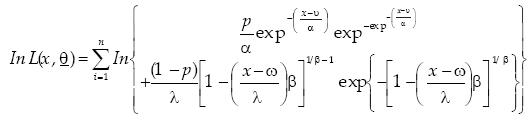
<body><![CDATA[<p align="justify"><font face="verdana" size="2"><img src="/img/revistas/iit/v8n3/a1e7.jpg">............(7)</font></p>     <p align="justify"><font face="verdana" size="2">&nbsp;</font></p>     <p align="justify"><font face="verdana" size="2"><i>Estimation of parameters by maximum likelihood</i></font></p>     <p align="justify"><font face="verdana" size="2">The likelihood function of <i>n </i>random variables is defined to be the joint density of <i>n </i>random variables and it is a function of the parameters. If <i>X<sub>1</sub> ,X<sub>2</sub>,...,X<sub>n</sub> </i>is a random sample of a univariate density function, the corresponding likelihood function is (Mood <i>et al., </i>1974):</font></p>     <p align="justify"><font face="verdana" size="2"><img src="/img/revistas/iit/v8n3/a1e8.jpg">.............................................................................(8)</font></p>     <p align="justify"><font face="verdana" size="2">The logarithmic function will be used instead of the likelihood function because it is easier to handle. So, equation (8) is transformed:</font></p>     <p align="justify"><font face="verdana" size="2"><img src="/img/revistas/iit/v8n3/a1e9.jpg" width="183" height="52">.............................................................................(9)</font></p>     <p align="justify"><font face="verdana" size="2">Where <i>L</i> is called the likelihood function, ln is the natural logarithm, <u>&theta;</u> is the set of parameters to be estimated and <i>f(x,<u>&theta;</u>)</i> is the EV1&#150;GEV density function, thus</font></p>     <p align="justify"><font face="verdana" size="2"><img src="/img/revistas/iit/v8n3/a1e10.jpg">......................(10)</font></p>     <p align="justify"><font face="verdana" size="2">And the corresponding first order partial derivatives of such function with respect to each of the parameters are</font></p>     ]]></body>
<body><![CDATA[<p align="justify"><font face="verdana" size="2"><img src="/img/revistas/iit/v8n3/a1e11.jpg">.............................................(11)</font></p>     <p align="justify"><font face="verdana" size="2"><img src="/img/revistas/iit/v8n3/a1e12.jpg">...........................(12)</font></p>     <p align="justify"><font face="verdana" size="2"><img src="/img/revistas/iit/v8n3/a1e13.jpg">..................(13)</font></p>     <p align="justify"><font face="verdana" size="2"><img src="/img/revistas/iit/v8n3/a1e14.jpg">.............................(14)</font></p>     <p align="justify"><font face="verdana" size="2"><img src="/img/revistas/iit/v8n3/a1e15.jpg">...............(15)</font></p>     <p align="justify"><font face="verdana" size="2"><img src="/img/revistas/iit/v8n3/a1e16.jpg">................(16)</font></p>     <p align="justify"><font face="verdana" size="2">The exact solution provided by the system of equations (11)&#150;(16) is not known, so the maximum likelihood estimators of the parameters were obtained by the direct maximization of the log&#150;likelihood function (eq. 10), which is constrained to <i>&alpha;</i>&gt;0, <i>&lambda;</i>&gt;0, 0&lt;<i>p&lt;</i>1, and <i>x</i>&gt;0. The suggested procedure is the constrained multivariable Rosenbrock method (Kuester and Mize, 1973).</font></p>     <p align="justify"><font face="verdana" size="2">As it is known, in any of the multivariable constrained non&#150;linear optimization techniques, global optimality is never assured. Therefore, care must be taken in order to avoid a local optimum. It is suggested to start always with values of the location, scale and shape parameters computed by considering the sample divided into two equal parts. If sample is sorted in decreasing order of magnitude, the first set of data is fitted to the univariate GEV distribution (Prescott and Walden, 1980), and the second one to the univariate Gumbel distribution (NERC, 1975). The initial value of the association parameter p will be equal to 0.5.</font></p>     <p align="justify"><font face="verdana" size="2">For the mixed Gumbel and the mixed GEV distributions parameters are estimated following the same optimization procedure.</font></p>     <p align="justify"><font face="verdana" size="2">&nbsp;</font></p>     ]]></body>
<body><![CDATA[<p align="justify"><font face="verdana" size="2"><b>Case study</b></font></p>     <p align="justify"><font face="verdana" size="2">A region located in Northwestern Mexico, with a total of 35 gauging stations was selected to apply the EV1&#150;GEV distribution to flood frequency analysis. <a href="/img/revistas/iit/v8n3/a1t1.jpg" target="_blank">Table 1</a> shows statistical characteristics of data for each station in the region.</font></p>     <p align="justify"><font face="verdana" size="2">In the area considered in this study, flood outliers correspond to observed rainfall values much higher  than the  other  annual maxima. Such extremely heavy rainfall is due to special meteorological conditions in connection with ENSO events in the Pacific Ocean. In the analyzed area, 62% of the highest annual maximum discharges gauged were generated in an El Ni&ntilde;o year and 38% for its counterpart, La Ni&ntilde;a.</font></p>     <p align="justify"><font face="verdana" size="2">Results provided by the EV1&#150;GEV distribution were compared with those produced by the mixed Gumbel and mixed GEV distributions. For each station the best one was chosen according to the criterion of minimum standard error of fit <i>(SE), </i>as defined by Kite (1988):</font></p>     <p align="justify"><font face="verdana" size="2"><img src="/img/revistas/iit/v8n3/a1e17.jpg">...............................................................(17)</font></p>     <p align="justify"><font face="verdana" size="2">Where <i>g<sub>i</sub>,i=</i>1,...<i>n</i> are the <i>h<sub>i</sub>,i=</i>1,...<i>n</i> recorded events; are the event magnitudes computed from the probability distribution at probabilities obtained from the sorted ranks of, <i>g<sub>i</sub>,i=</i>1,...<i>n</i><i>,n </i>is the length of record, and <i>q </i>is the number of parameters estimated for the mixed distribution. For the mixed distributions, Gumbel, GEV and EV1&#150;GEV <i>q </i>will be equal to 5, 7 and 6, respectively.</font></p>     <p align="justify"><font face="verdana" size="2">In <a href="/img/revistas/iit/v8n3/a1t2.jpg" target="_blank">table 2</a> is depicted the <i>SE </i>for all mixed distributions along with the best model for the sample of data considered.</font></p>     <p align="justify"><font face="verdana" size="2">The final at&#150;site design events Q (m<sup>3</sup>/s) for different return periods T(years) in each station are presented in <a href="/img/revistas/iit/v8n3/a1t3.jpg" target="_blank">Table 3</a>.</font></p>     <p align="justify"><font face="verdana" size="2">In some sites a comparison is made among different at&#150;site design events <a href="/img/revistas/iit/v8n3/a1t4.jpg" target="_blank">(Table 4)</a>. For instance, in station Chinipas the computed SE are very similar, however, as return period increases, differences among flood estimates are more significant. A bad selection of the best distribution in the analyzed site can substantially modify the design event and that the hydraulic project might become economically unfeasible or unsafe.</font></p>     <p align="justify"><font face="verdana" size="2">An additional problem is when a short record is used (less than 30 years), because there is an increased risk that the flood estimate will not provide adequate protection of designated uses. One way to reduce the bias or uncertainty in the flood estimate is to use a regional data set with observations from several sites.</font></p>     ]]></body>
<body><![CDATA[<p align="justify"><font face="verdana" size="2">Mixed Gumbel, GEV and EV1&#150;GEV distributions can be easily used to obtain regional at&#150;site estimates of floods by using the station&#150;year method in regions with heterogeneous sample data. The general procedure of this regional technique can be found in paper written by Cunnane (1988).</font></p>     <p align="justify"><font face="verdana" size="2">This regional technique was not applied in the paper and it just was mentioned to be considered for users in their hydrological analyses.</font></p>     <p align="justify"><font face="verdana" size="2">&nbsp;</font></p>     <p align="justify"><font face="verdana" size="2"><b>Conclusions</b></font></p>     <p align="justify"><font face="verdana" size="2">Floods are often generated by heterogeneous distributions composed of a mixture of two populations. Differences between the populations may be the result of a number of factors such as the El Ni&ntilde;o/La Ni&ntilde;a oscillations. In the analyzed area 62% of the highest annual maximum discharges (outliers) were generated in an El Ni&ntilde;o year. The magnitude of these events is very important and floods can seriously affect people. For this reason, it is necessary to account with an additional mathematical tool that be able to reduce the uncertainty in estimating of design events, which are needed in many water&#150;engineering studies and projects.</font></p>     <p align="justify"><font face="verdana" size="2">In this paper a mixed distribution has been derived by considering different components in an opposite way as usually do. <i>F<sub>1</sub>(x) </i>and <i>F<sub>2</sub>(x)</i>of equation (1) were the EV1 and the GEV distributions, respectively.</font></p>     <p align="justify"><font face="verdana" size="2">Results shown that there exists a reduction in the standard error of fit when using the EV1&#150;GEV distribution in comparison with the mixed Gumbel or mixed GEV distributions, and just in one out of the 35 analyzed cases, the proposed distribution could not reach convergence in the estimation of parameters process. By contrast, the Mixed GEV distribution had seven failures with the same estimation process.</font></p>     <p align="justify"><font face="verdana" size="2">In 13 sample data the EV1&#150;GEV distribution produced the least standard error of fit  (40%  of analyzed  cases)  and in other different cases it was very close to the mixed Gumbel and mixed GEV distributions, However, as it was shown, differences between at&#150;site design events can be significant as return period increases. A bad selection of the best distribution in the analyzed site can substantially modify the design event and also that the hydraulic project might become economically unfeasible or unsafe. Thus, by taking into consideration the mixed flood distributions a more accurate, physically based flood frequency analysis can be obtained and sensible savings in costs of construction of flood protection structures can be expected. This can also improve the setting of flood plain limits and the safety of control structures.</font></p>     <p align="justify"><font face="verdana" size="2">&nbsp;</font></p>     <p align="justify"><font face="verdana" size="2"><b>References</b></font></p>     ]]></body>
<body><![CDATA[<!-- ref --><p align="justify"><font face="verdana" size="2">Alila Y. and Mtiraoui A. (2002). Implications of Heterogeneous Flood&#150;Frequency Distributions on Traditional Stream&#150;Discharge Prediction Techniques. <i>Hydrological Processes, </i>16:1065&#150;1084.</font>&nbsp;&nbsp;&nbsp;&nbsp;&nbsp;&nbsp;&nbsp;&nbsp;[&#160;<a href="javascript:void(0);" onclick="javascript: window.open('/scielo.php?script=sci_nlinks&ref=4237392&pid=S1405-7743200700030000100001&lng=','','width=640,height=500,resizable=yes,scrollbars=1,menubar=yes,');">Links</a>&#160;]<!-- end-ref --><!-- ref --><p align="justify"><font face="verdana" size="2">Cavazos  T.   and  Hastenrath  S.   (1990). Convection and Rainfall Over Mexico and their Modulation by the Southern Oscillation. <i>International Journal    of Climatology, </i>10: 377&#150;386.</font>&nbsp;&nbsp;&nbsp;&nbsp;&nbsp;&nbsp;&nbsp;&nbsp;[&#160;<a href="javascript:void(0);" onclick="javascript: window.open('/scielo.php?script=sci_nlinks&ref=4237393&pid=S1405-7743200700030000100002&lng=','','width=640,height=500,resizable=yes,scrollbars=1,menubar=yes,');">Links</a>&#160;]<!-- end-ref --><!-- ref --><p align="justify"><font face="verdana" size="2">Kite   G.W.   (1988). <i>Frequency   and   Risk </i><i>Analyses in Hydrology. </i>Water Resources Publications, Littleton, Colorado, USA.</font>&nbsp;&nbsp;&nbsp;&nbsp;&nbsp;&nbsp;&nbsp;&nbsp;[&#160;<a href="javascript:void(0);" onclick="javascript: window.open('/scielo.php?script=sci_nlinks&ref=4237394&pid=S1405-7743200700030000100003&lng=','','width=640,height=500,resizable=yes,scrollbars=1,menubar=yes,');">Links</a>&#160;]<!-- end-ref --><!-- ref --><p align="justify"><font face="verdana" size="2">Kuester J.L. and Mize J.H. (1973). <i>Optimization    Techniques   with   FORTRAN. </i>McGraw&#150;Hill.</font>&nbsp;&nbsp;&nbsp;&nbsp;&nbsp;&nbsp;&nbsp;&nbsp;[&#160;<a href="javascript:void(0);" onclick="javascript: window.open('/scielo.php?script=sci_nlinks&ref=4237395&pid=S1405-7743200700030000100004&lng=','','width=640,height=500,resizable=yes,scrollbars=1,menubar=yes,');">Links</a>&#160;]<!-- end-ref --><!-- ref --><p align="justify"><font face="verdana" size="2">Maga&ntilde;a V. and Ambrizzi T. (2005). Dynamics of Subtropical Vertical Motions Over the Americas During El Ni&ntilde;o Boreal Winters. <i>Atm&oacute;sfera, </i>18(4): 211&#150;233.</font>&nbsp;&nbsp;&nbsp;&nbsp;&nbsp;&nbsp;&nbsp;&nbsp;[&#160;<a href="javascript:void(0);" onclick="javascript: window.open('/scielo.php?script=sci_nlinks&ref=4237396&pid=S1405-7743200700030000100005&lng=','','width=640,height=500,resizable=yes,scrollbars=1,menubar=yes,');">Links</a>&#160;]<!-- end-ref --><!-- ref --><p align="justify"><font face="verdana" size="2">Maga&ntilde;a V., V&aacute;zquez J., P&eacute;rez J. and P&eacute;rez J.B.   (2003).   Impact   of   El   Ni&ntilde;o   on Precipitation in Mexico. <i>Geof&iacute;sica Internacional, </i>42(3): 313&#150;330.</font>&nbsp;&nbsp;&nbsp;&nbsp;&nbsp;&nbsp;&nbsp;&nbsp;[&#160;<a href="javascript:void(0);" onclick="javascript: window.open('/scielo.php?script=sci_nlinks&ref=4237397&pid=S1405-7743200700030000100006&lng=','','width=640,height=500,resizable=yes,scrollbars=1,menubar=yes,');">Links</a>&#160;]<!-- end-ref --><!-- ref --><p align="justify"><font face="verdana" size="2">Mood A., Graybill F. and Boes D. (1974). <i>Introduction to the Theory of Statistics. </i>Third Ed., McGraw&#150;Hill.</font>&nbsp;&nbsp;&nbsp;&nbsp;&nbsp;&nbsp;&nbsp;&nbsp;[&#160;<a href="javascript:void(0);" onclick="javascript: window.open('/scielo.php?script=sci_nlinks&ref=4237398&pid=S1405-7743200700030000100007&lng=','','width=640,height=500,resizable=yes,scrollbars=1,menubar=yes,');">Links</a>&#160;]<!-- end-ref --><!-- ref --><p align="justify"><font face="verdana" size="2">NERC (1975). <i>Natural Environment Research Council. Flood Studies Report I, Hydrologic Studies. </i>Whitefriars Press Ltd., London, United Kingdom.</font>&nbsp;&nbsp;&nbsp;&nbsp;&nbsp;&nbsp;&nbsp;&nbsp;[&#160;<a href="javascript:void(0);" onclick="javascript: window.open('/scielo.php?script=sci_nlinks&ref=4237399&pid=S1405-7743200700030000100008&lng=','','width=640,height=500,resizable=yes,scrollbars=1,menubar=yes,');">Links</a>&#160;]<!-- end-ref --><!-- ref --><p align="justify"><font face="verdana" size="2">Prescott P. and Walden A. (1980). Maximum Likelihood Estimation of the Parameters of the Generalized Extreme Value Distribution. <i>Biometrika, </i>67(3): 723&#150;724.</font>&nbsp;&nbsp;&nbsp;&nbsp;&nbsp;&nbsp;&nbsp;&nbsp;[&#160;<a href="javascript:void(0);" onclick="javascript: window.open('/scielo.php?script=sci_nlinks&ref=4237400&pid=S1405-7743200700030000100009&lng=','','width=640,height=500,resizable=yes,scrollbars=1,menubar=yes,');">Links</a>&#160;]<!-- end-ref --><!-- ref --><p align="justify"><font face="verdana" size="2">Raynal J. and Guevara J. (1997). Maximum Likelihood Estimators for the two Populations Gumbel distribution. <i>Hydrological Science and Technology Journal, </i>13(1&#150;4):47&#150;56.</font>&nbsp;&nbsp;&nbsp;&nbsp;&nbsp;&nbsp;&nbsp;&nbsp;[&#160;<a href="javascript:void(0);" onclick="javascript: window.open('/scielo.php?script=sci_nlinks&ref=4237401&pid=S1405-7743200700030000100010&lng=','','width=640,height=500,resizable=yes,scrollbars=1,menubar=yes,');">Links</a>&#160;]<!-- end-ref --><!-- ref --><p align="justify"><font face="verdana" size="2">Raynal J. and Santillan O. (1986). Maximum Likelihood Estimators of the Parameters of the Mixed GE V Distribution. IX Congreso Nacional de Hidr&aacute;ulica. AMH. Quer&eacute;taro, Qro., Mex. pp. 79&#150;90. (In Spanish)</font>&nbsp;&nbsp;&nbsp;&nbsp;&nbsp;&nbsp;&nbsp;&nbsp;[&#160;<a href="javascript:void(0);" onclick="javascript: window.open('/scielo.php?script=sci_nlinks&ref=4237402&pid=S1405-7743200700030000100011&lng=','','width=640,height=500,resizable=yes,scrollbars=1,menubar=yes,');">Links</a>&#160;]<!-- end-ref --><p align="justify"><font face="verdana" size="2">&nbsp;</font></p>     <p align="justify"><font face="verdana" size="2"><b><a></a>Semblanza del autor</b></font></p>     <p align="justify"><font face="verdana" size="2"><i>Dr. Carlos Agust&iacute;n Escalante&#150;Sandoval. </i>Es doctor en ingenier&iacute;a hidr&aacute;ulica por la Facultad de Ingenier&iacute;a de la UNAM. Actualmente es profesor titular "C" de tiempo completo definitivo. Ha impartido 85 cursos en el Posgrado de la UNAM; dirigido 38 tesis de maestr&iacute;a y cinco de doctorado. Dentro de su producci&oacute;n acad&eacute;mica se encuentran: 30 publicaciones en revistas con arbitraje, 45 en congresos nacionales e internacionales, 3 cap&iacute;tulos en libro, 2 libros como autor y otro como co&#150;editor. Recibi&oacute; la medalla Gabino Barreda por sus estudios de doctorado, el premio Distinci&oacute;n Universidad Nacional para J&oacute;venes Acad&eacute;micos en Docencia en Ciencias Exactas 1999 que otorga la UNAM y el Premio Nacional Enzo Levi "Investigaci&oacute;n y Docencia en Hidr&aacute;ulica 2002", por parte de la Asociaci&oacute;n Mexicana de Hidr&aacute;ulica. Es miembro del Sistema Nacional de Investigadores, Academia Mexicana de Ciencias, Academia de Ingenier&iacute;a, Colegio de Ingenieros Civiles de M&eacute;xico y la Asociaci&oacute;n Mexicana de Hidr&aacute;ulica.</font></p>      ]]></body><back>
<ref-list>
<ref id="B1">
<nlm-citation citation-type="journal">
<person-group person-group-type="author">
<name>
<surname><![CDATA[Alila]]></surname>
<given-names><![CDATA[Y]]></given-names>
</name>
<name>
<surname><![CDATA[Mtiraoui]]></surname>
<given-names><![CDATA[A]]></given-names>
</name>
</person-group>
<article-title xml:lang="en"><![CDATA[Implications of Heterogeneous Flood-Frequency Distributions on Traditional Stream-Discharge Prediction Techniques]]></article-title>
<source><![CDATA[Hydrological Processes]]></source>
<year>2002</year>
<numero>16</numero>
<issue>16</issue>
<page-range>1065-1084</page-range></nlm-citation>
</ref>
<ref id="B2">
<nlm-citation citation-type="journal">
<person-group person-group-type="author">
<name>
<surname><![CDATA[Cavazos]]></surname>
<given-names><![CDATA[T]]></given-names>
</name>
<name>
<surname><![CDATA[Hastenrath]]></surname>
<given-names><![CDATA[S]]></given-names>
</name>
</person-group>
<article-title xml:lang="en"><![CDATA[Convection and Rainfall Over Mexico and their Modulation by the Southern Oscillation]]></article-title>
<source><![CDATA[International Journal of Climatology]]></source>
<year>1990</year>
<numero>10</numero>
<issue>10</issue>
<page-range>377-386</page-range></nlm-citation>
</ref>
<ref id="B3">
<nlm-citation citation-type="book">
<person-group person-group-type="author">
<name>
<surname><![CDATA[Kite]]></surname>
<given-names><![CDATA[G.W.]]></given-names>
</name>
</person-group>
<source><![CDATA[Frequency and Risk Analyses in Hydrology]]></source>
<year>1988</year>
<publisher-loc><![CDATA[Littleton^eColorado Colorado]]></publisher-loc>
<publisher-name><![CDATA[Water Resources Publications]]></publisher-name>
</nlm-citation>
</ref>
<ref id="B4">
<nlm-citation citation-type="book">
<person-group person-group-type="author">
<name>
<surname><![CDATA[Kuester]]></surname>
<given-names><![CDATA[J.L.]]></given-names>
</name>
<name>
<surname><![CDATA[Mize]]></surname>
<given-names><![CDATA[J.H.]]></given-names>
</name>
</person-group>
<source><![CDATA[Optimization Techniques with FORTRAN]]></source>
<year>1973</year>
<publisher-name><![CDATA[McGraw-Hill]]></publisher-name>
</nlm-citation>
</ref>
<ref id="B5">
<nlm-citation citation-type="journal">
<person-group person-group-type="author">
<name>
<surname><![CDATA[Magaña]]></surname>
<given-names><![CDATA[V.]]></given-names>
</name>
<name>
<surname><![CDATA[Ambrizzi]]></surname>
<given-names><![CDATA[T.]]></given-names>
</name>
</person-group>
<article-title xml:lang="en"><![CDATA[Dynamics of Subtropical Vertical Motions Over the Americas During El Niño Boreal Winters]]></article-title>
<source><![CDATA[Atmósfera]]></source>
<year>2005</year>
<volume>18</volume>
<numero>4</numero>
<issue>4</issue>
<page-range>211-233</page-range></nlm-citation>
</ref>
<ref id="B6">
<nlm-citation citation-type="journal">
<person-group person-group-type="author">
<name>
<surname><![CDATA[Magaña]]></surname>
<given-names><![CDATA[V.]]></given-names>
</name>
<name>
<surname><![CDATA[Vázquez]]></surname>
<given-names><![CDATA[J.]]></given-names>
</name>
<name>
<surname><![CDATA[Pérez]]></surname>
<given-names><![CDATA[J.]]></given-names>
</name>
<name>
<surname><![CDATA[Pérez]]></surname>
<given-names><![CDATA[J.B.]]></given-names>
</name>
</person-group>
<article-title xml:lang="en"><![CDATA[Impact of El Niño on Precipitation in Mexico]]></article-title>
<source><![CDATA[Geofísica Internacional]]></source>
<year>2003</year>
<volume>42</volume>
<numero>3</numero>
<issue>3</issue>
<page-range>313-330</page-range></nlm-citation>
</ref>
<ref id="B7">
<nlm-citation citation-type="book">
<person-group person-group-type="author">
<name>
<surname><![CDATA[Mood]]></surname>
<given-names><![CDATA[A.]]></given-names>
</name>
<name>
<surname><![CDATA[Graybill]]></surname>
<given-names><![CDATA[F.]]></given-names>
</name>
<name>
<surname><![CDATA[Boes]]></surname>
<given-names><![CDATA[D.]]></given-names>
</name>
</person-group>
<source><![CDATA[Introduction to the Theory of Statistics]]></source>
<year>1974</year>
<edition>Third</edition>
<publisher-name><![CDATA[McGraw-Hill]]></publisher-name>
</nlm-citation>
</ref>
<ref id="B8">
<nlm-citation citation-type="book">
<collab>Natural Environment Research Council</collab>
<source><![CDATA[Flood Studies Report I: Hydrologic Studies]]></source>
<year>1975</year>
<publisher-loc><![CDATA[London ]]></publisher-loc>
<publisher-name><![CDATA[Whitefriars Press Ltd]]></publisher-name>
</nlm-citation>
</ref>
<ref id="B9">
<nlm-citation citation-type="journal">
<person-group person-group-type="author">
<name>
<surname><![CDATA[Prescott]]></surname>
<given-names><![CDATA[P.]]></given-names>
</name>
<name>
<surname><![CDATA[Walden]]></surname>
<given-names><![CDATA[A.]]></given-names>
</name>
</person-group>
<article-title xml:lang="en"><![CDATA[Maximum Likelihood Estimation of the Parameters of the Generalized Extreme Value Distribution]]></article-title>
<source><![CDATA[Biometrika]]></source>
<year>1980</year>
<volume>67</volume>
<numero>3</numero>
<issue>3</issue>
<page-range>723-724</page-range></nlm-citation>
</ref>
<ref id="B10">
<nlm-citation citation-type="journal">
<person-group person-group-type="author">
<name>
<surname><![CDATA[Raynal]]></surname>
<given-names><![CDATA[J.]]></given-names>
</name>
<name>
<surname><![CDATA[Guevara]]></surname>
<given-names><![CDATA[J.]]></given-names>
</name>
</person-group>
<article-title xml:lang="en"><![CDATA[Maximum Likelihood Estimators for the two Populations Gumbel distribution]]></article-title>
<source><![CDATA[Hydrological Science and Technology Journal]]></source>
<year>1997</year>
<volume>13</volume>
<numero>1-4</numero>
<issue>1-4</issue>
<page-range>47-56</page-range></nlm-citation>
</ref>
<ref id="B11">
<nlm-citation citation-type="">
<person-group person-group-type="author">
<name>
<surname><![CDATA[Raynal]]></surname>
<given-names><![CDATA[J.]]></given-names>
</name>
<name>
<surname><![CDATA[Santillan]]></surname>
<given-names><![CDATA[O.]]></given-names>
</name>
</person-group>
<article-title xml:lang="en"><![CDATA[Maximum Likelihood Estimators of the Parameters of the Mixed GE V Distribution]]></article-title>
<source><![CDATA[IX Congreso Nacional de Hidráulica. AMH. Querétaro, Qro., Mex]]></source>
<year>1986</year>
<page-range>79-90</page-range></nlm-citation>
</ref>
</ref-list>
</back>
</article>