<?xml version="1.0" encoding="ISO-8859-1"?><article xmlns:mml="http://www.w3.org/1998/Math/MathML" xmlns:xlink="http://www.w3.org/1999/xlink" xmlns:xsi="http://www.w3.org/2001/XMLSchema-instance">
<front>
<journal-meta>
<journal-id>1405-7743</journal-id>
<journal-title><![CDATA[Ingeniería, investigación y tecnología]]></journal-title>
<abbrev-journal-title><![CDATA[Ing. invest. y tecnol.]]></abbrev-journal-title>
<issn>1405-7743</issn>
<publisher>
<publisher-name><![CDATA[Universidad Nacional Autónoma de México, Facultad de Ingeniería]]></publisher-name>
</publisher>
</journal-meta>
<article-meta>
<article-id>S1405-77432007000100005</article-id>
<title-group>
<article-title xml:lang="en"><![CDATA[A Performance Study of the IEEE 802.11g PHY and MAC Layers over Heterogeneous and Homogeneous WLANs]]></article-title>
</title-group>
<contrib-group>
<contrib contrib-type="author">
<name>
<surname><![CDATA[Villaseñor-González]]></surname>
<given-names><![CDATA[L.]]></given-names>
</name>
<xref ref-type="aff" rid="A01"/>
</contrib>
<contrib contrib-type="author">
<name>
<surname><![CDATA[Portillo-Jiménez]]></surname>
<given-names><![CDATA[C.]]></given-names>
</name>
<xref ref-type="aff" rid="A01"/>
</contrib>
<contrib contrib-type="author">
<name>
<surname><![CDATA[Sánchez-García]]></surname>
<given-names><![CDATA[J.]]></given-names>
</name>
<xref ref-type="aff" rid="A01"/>
</contrib>
</contrib-group>
<aff id="A01">
<institution><![CDATA[,CICESE Electronics and Telecommunications Department ]]></institution>
<addr-line><![CDATA[Ensenada Baja California]]></addr-line>
</aff>
<pub-date pub-type="pub">
<day>00</day>
<month>03</month>
<year>2007</year>
</pub-date>
<pub-date pub-type="epub">
<day>00</day>
<month>03</month>
<year>2007</year>
</pub-date>
<volume>8</volume>
<numero>1</numero>
<fpage>45</fpage>
<lpage>57</lpage>
<copyright-statement/>
<copyright-year/>
<self-uri xlink:href="http://www.scielo.org.mx/scielo.php?script=sci_arttext&amp;pid=S1405-77432007000100005&amp;lng=en&amp;nrm=iso"></self-uri><self-uri xlink:href="http://www.scielo.org.mx/scielo.php?script=sci_abstract&amp;pid=S1405-77432007000100005&amp;lng=en&amp;nrm=iso"></self-uri><self-uri xlink:href="http://www.scielo.org.mx/scielo.php?script=sci_pdf&amp;pid=S1405-77432007000100005&amp;lng=en&amp;nrm=iso"></self-uri><abstract abstract-type="short" xml:lang="es"><p><![CDATA[Las redes locales inalámbricas (WLANs) basadas en el estándar 802.11 se han extendido con mucho éxito dentro de una gran variedad de ambientes, incluyendo el hogar, las oficinas y las corporaciones. Iniciando con la introducción del estándar 802.11, a la fecha se han propuesto y aprobado diversas extensiones por la IEEE, éstas incluyen los estándares 802.11a, 802.11b y 802.11g. En este trabajo se presenta el análisis de desempeño de las capas físicas (PHY) y de control de acceso al medio (MAC) del estándar IEEE 802.11g. El estándar 802.11g opera en la banda de frecuencia de los 2.4 GHz y es compatible con el estándar 802.11b. Por lo tanto, resulta de gran interés presentar un estudio relacionado con el desempeño de las capas PHY y MAC que se utilizan en 802.11g, incluyendo el desempeño de los modos de operación de la capa física que fueron diseñados para preservar la compatibilidad con 802.11b (i.e. WLANs heterogéneas).]]></p></abstract>
<abstract abstract-type="short" xml:lang="en"><p><![CDATA[Wireless local area networks (WLANs) based on the 802.11 standard are being deployed with great success in a great variety of home, office and corporate environments. Since the introduction of the 802.11 standard, multiple extensions have been proposed and approved by the IEEE, namely the 802.11a, 802.11b and 802.11g standards. This work is related to the study and performance analysis of the IEEE 802.11g physical (PHY) and MAC layers. The 802.11g is defined to operate in the 2.4 GHz band and it was designed to preserve backward compatibility with the 802.11b standard. Hence it is important to present a study related to the performance of the MAC and the PHY operational modes in 802.11g, including the performance issues related to the PHY operational modes which are designed to be compatible with 802.11b (i.e. Heterogeneous WLANs).]]></p></abstract>
<kwd-group>
<kwd lng="es"><![CDATA[802.11g]]></kwd>
<kwd lng="es"><![CDATA[Protocolo MAC]]></kwd>
<kwd lng="es"><![CDATA[análisis de desempeño]]></kwd>
<kwd lng="es"><![CDATA[mecanismo de protección]]></kwd>
<kwd lng="es"><![CDATA[RTS/CTS]]></kwd>
<kwd lng="es"><![CDATA[WLAN]]></kwd>
<kwd lng="en"><![CDATA[802.11g]]></kwd>
<kwd lng="en"><![CDATA[MAC Protocol]]></kwd>
<kwd lng="en"><![CDATA[Performance Analysis]]></kwd>
<kwd lng="en"><![CDATA[Protection Mechanism]]></kwd>
<kwd lng="en"><![CDATA[RTS/CTS]]></kwd>
<kwd lng="en"><![CDATA[WLAN]]></kwd>
</kwd-group>
</article-meta>
</front><body><![CDATA[ <p align="justify"><font face="verdana" size="4">Educaci&oacute;n en ingenier&iacute;a</font></p>     <p align="justify"><font face="verdana" size="2">&nbsp;</font></p>     <p align="center"><font face="verdana" size="4"><b>A Performance Study of the IEEE 802.11g PHY and MAC Layers over Heterogeneous and Homogeneous WLANs</b></font></p>     <p align="center"><font face="verdana" size="2">&nbsp;</font></p>     <p align="center"><font face="verdana" size="2"><b><a href="#autor1">L. Villase&ntilde;or&#150;Gonz&aacute;lez</a><sup>1</sup>, <a href="#autor2">C. Portillo&#150;Jim&eacute;nez</a><sup>2</sup> y <a href="#autor3">J. S&aacute;nchez&#150;Garc&iacute;a</a><sup>3</sup></b></font></p>     <p align="center"><font face="verdana" size="2">&nbsp;</font></p>     <p align="justify"><font face="verdana" size="2"> <b>1</b><i> Electronics and Telecommunications Department CICESE Research Center, Ensenada, Baja California    <br> </i><b>E&#150;mail:</b> <a href="mailto:luisvi@cicese.mx">luisvi@cicese.mx</a></font></p>     <p align="justify"><font face="verdana" size="2"><b>2</b><i> Electronics and Telecommunications Department CICESE Research Center, Ensenada, Baja California    <br> </i><b>E&#150;mail</b>: <a href="mailto:cportill@cicese.mx">cportill@cicese.mx</a></font></p>     ]]></body>
<body><![CDATA[<p align="justify"><font face="verdana" size="2"><b>3</b><i> Electronics and Telecommunications Department CICESE Research Center, Ensenada, Baja California    <br> </i><b>E&#150;mail</b>: <a href="mailto:jasan@cicese.mx">jasan@cicese.mx</a></font></p>     <p align="justify"><font face="verdana" size="2">&nbsp;</font></p>     <p align="justify"><font face="verdana" size="2">Recibido: enero de 2006    <br> Aceptado: junio de 2006</font></p>     <p align="justify"><font face="verdana" size="2">&nbsp;</font></p>     <p align="justify"><font face="verdana" size="2"><b>Resumen</b></font></p>     <p align="justify"><font face="verdana" size="2">Las redes locales inal&aacute;mbricas (WLANs) basadas en el est&aacute;ndar 802.11 se han extendido con mucho &eacute;xito dentro de una gran variedad de ambientes, incluyendo el hogar, las oficinas y las corporaciones. Iniciando con la introducci&oacute;n del est&aacute;ndar 802.11, a la fecha se han propuesto y aprobado diversas extensiones por la IEEE, &eacute;stas incluyen los est&aacute;ndares 802.11a, 802.11b y 802.11g. En este trabajo se presenta el an&aacute;lisis de desempe&ntilde;o de las capas f&iacute;sicas (PHY) y de control de acceso al medio (MAC) del est&aacute;ndar IEEE 802.11g. El est&aacute;ndar 802.11g opera en la banda de frecuencia de los 2.4 GHz y es compatible con el est&aacute;ndar 802.11b. Por lo tanto, resulta de gran inter&eacute;s presentar un estudio relacionado con el desempe&ntilde;o de las capas PHY y MAC que se utilizan en 802.11g, incluyendo el desempe&ntilde;o de los modos de operaci&oacute;n de la capa f&iacute;sica que fueron dise&ntilde;ados para preservar la compatibilidad con 802.11b (i.e. WLANs heterog&eacute;neas).</font></p>     <p align="justify"><font face="verdana" size="2"><b>Descriptores: </b>802.11g, Protocolo MAC, an&aacute;lisis de desempe&ntilde;o, mecanismo de protecci&oacute;n, RTS/CTS, WLAN.</font></p>     <p align="justify"><font face="verdana" size="2">&nbsp;</font></p>     ]]></body>
<body><![CDATA[<p align="justify"><font face="verdana" size="2"><b>Abstract</b></font></p>     <p align="justify"><font face="verdana" size="2"><i>Wireless local area networks (WLANs) based on the 802.11 standard are being deployed with great success in a great variety of home, office and corporate environments. Since the introduction of the 802.11 standard, multiple extensions have been proposed and approved by the IEEE, namely the 802.11a, 802.11b and 802.11g standards. This work is related to the study and performance analysis of the IEEE 802.11g physical (PHY) and MAC layers. The 802.11g is defined to operate in the 2.4 GHz band and it was designed to preserve backward compatibility with the 802.11b standard. Hence it is important to present a study related to the performance of the MAC and the PHY operational modes in 802.11g, including the performance issues related to the PHY operational modes which are designed to be compatible with 802.11b (i.e. Heterogeneous WLANs).</i></font></p>     <p align="justify"><font face="verdana" size="2"><i><b>Key words:</b> 802.11g, MAC Protocol, Performance Analysis, Protection Mechanism, RTS/CTS, WLAN.</i></font></p>     <p align="justify"><font face="verdana" size="2">&nbsp;</font></p>     <p align="justify"><font face="verdana" size="2"><b>Introduction</b></font></p>     <p align="justify"><font face="verdana" size="2">Recent advances on wireless local area networks (WLAN) technologies are making possible  the  deployment  of  a  large  number  of WLANs in a great variety of home, office and corporate   environments.   In   particular,   the success of the 802.11  standard has made it possible for a great number of products to be readily available at a large number of electronic retail stores. Since the initial introduction of the IEEE 802.11 standard, defined in (IEEE Std. 802.11&#150;1999), several extensions have been approved by the IEEE. These extensions include the 802.11a (IEEE Std. 802.11a, 1999), 802.11b (IEEE Std. 802.11b, 1999) and 802.11g (IEEE Std. 802. 11g, 2003) versions.</font></p>     <p align="justify"><font face="verdana" size="2">The 802.11g standard defines the extensions to the medium access control <i>(MAC) </i>mechanism, as well as, the physical layer <i>(PHY). </i>One of the main characteristics of the 802.1 1g standard is that it defines a <i>PHY </i> layer operating in the 2.4 GHz band, thus allowing backward compatibility with legacy 802.11b equipment (Vassis <i>et al., </i>2005). As a result, the 802.11g standard defines several <i>PHY </i>operational modes to support the compatibility with 802.11b (Choi <i>et al, </i>2003). In addition, a protection mechanism is proposed in the 802.1 1g standard to avoid interoperability issues within a heterogeneous <i>WLAN </i>environment composed of 802.11b and 802.11g devices. Hence it is important to present a study on the performance of the 802.1 1g standard to have a clear understanding of the operational issues related to the multiple <i>PHY </i>operational modes, as well as, the implications or the impact introduced by the protection mechanism proposed in section 9.10 of (IEEE Std. 802.11g, 2003). There are a couple of articles in the literature that present some aspects of the performance of the 802.11g standard. Some related work includes the work by (Wang, S.&#150;C. <i>et al., </i>2005) which presents a mathematical model to evaluate the network throughput of 802.11g wireless networks; however they do not include a complete analysis of the multiple operational <i>PHY </i>modes defined in the 802.11g standard. (Wijesinha <i>et al., </i>2005) present throughput performance of UDP traffic in a 802.1 1g wireless network, while (Medepalli <i>et al., </i>2004) presents the call carrying capacity of 802.11 wireless networks including 802.11g; however they too fail to include a comprehensive performance evaluation of all the mandatory 802.11g extended data rates. (Boulmalf <i>et al., </i>2005) presents the throughput and SNR measurements of an 802.11g wireless network for an indoor environment which includes the coexistence with 802.11b devices; however their work does not provide a detailed analysis of 802.11g by accounting for all the PHY and MAC layers functionalities implemented to support the coexistence with 802.11b and 802.11g devices. (Rao <i>et al., </i>2005) investigates the performance of 802.1 1g through computer simulations using a realistic channel model for various modulation schemes, like BPSK, QPSK, 16&#150;QAM and 64&#150;QAM; however they only present Bit Error Rate (BER) results as a function of the channel SNR for the different supported modulation schemes. (Wang <i>et al., </i>2005) present empirical network performance results for 802.1 1g networks and in their work they present packet delay, data loss and throughput measurement results as a function of the channel SNR; however they only consider an homogeneous 802.11g network environment and do not provide performance results for the backward compatibility operational modes of 802.11g. In an earlier work, (Doufexi <i>et al., </i>2003) presents a performance comparison between 802.11a and 802.11g wireless networks and they describe some performance issues related to the interoperability of 802.11b and 802.1 1g devices; however they only provide performance analysis results as a function of the packet error rate <i>PER. </i>The main contribution of this work is to include a comprehensive performance study of all the mandatory operational modes of the 802.11g <i>PHY </i>layer, including the performance issues in heterogeneous 802.11b and 802.11g wireless networks.</font></p>     <p align="justify"><font face="verdana" size="2">This work is divided in five sections. The next section presents a description of the new features introduced in the <i>IEEE </i>802.11g standard.   Following we present  a performance study and analysis of the 802.11g <i>MAC </i>protocol.  Later,  the numerical results  are presented followed by the conclusions.</font></p>     <p align="justify"><font face="verdana" size="2">&nbsp;</font></p>     <p align="justify"><font face="verdana" size="2"><b>The 802.11g Standard</b></font></p>     ]]></body>
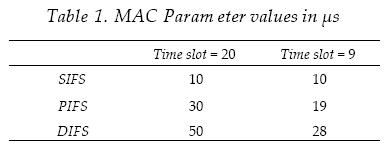
<body><![CDATA[<p align="justify"><font face="verdana" size="2">The <i>IEEE </i>802.11g standard was approved on June 2003. This standard builds on the <i>MAC </i>protocol specifications defined for legacy 802.11 networks, as defined in (IEEE Std. 802.11&#150;1999), (IEEE Std. 802.11a, 1999) and (IEEE Std. 802.11b, 1999). In addition, it also defines multiple operational modes for the  <i>PHY </i>layer. This section presents a basic description of some of the <i>MAC </i>functionalities, as well as, the operational modes defined for the 802.1 1g <i>PHY </i>layer.</font></p>     <p align="justify"><font face="verdana" size="2">&nbsp;</font></p>     <p align="justify"><font face="verdana" size="2"><i>The 802.11 MAC Protocol</i></font></p>     <p align="justify"><font face="verdana" size="2">The 802.11 <i>MAC </i>defines two basic methods to access the medium, the <i>Distributed Coordination Function (DCF) </i>and the <i>Point Coordination Function (PCF), </i>as described in chapter 9 of (IEEE Std. 802.11&#150;1999). The <i>DCF </i>defines a randomized access mechanism, which is based on the <i>Carrier Sense Multiple Access /Collision Avoidance (CSMA/CA) </i>scheme, where each mobile node has a fair chance to access the wireless medium. On the other hand, the <i>PCF </i>defines a centrally controlled access mechanism for the wireless medium. It should be noted that the 802.11 standard defines the <i>PCF </i>as an optional access method. The study and analysis presented in this work is based on the <i>DCF </i>access mechanism.</font></p>     <p align="justify"><font face="verdana" size="2">As part of the coordination procedure to gain access to the transmission medium, the 802.11 standard uses four different inter&#150;frame spacing, section 9.2.3 of (IEEE Std. 802.11&#150;1999). <a href="/img/revistas/iit/v8n1/a05f1.jpg" target="_blank">Figure 1</a> shows a diagram of the different <i>Inter&#150;Frame Spacing (IFS) </i>used in 802.11. The Short Inter&#150;Frame Space <i>(SIFS) </i>is used for the transmission of high priority 802.11 frames, such as, the <i>Request&#150;To&#150;Send (RTS), Clear&#150;To&#150;Send (CTS </i>) and <i>Acknowledgement (ACK) </i>frames.</font></p>     <p align="justify"><font face="verdana" size="2">The <i>PCF Inter&#150;Frame Space (PIFS) </i>is used during <i>PCF </i>contention&#150;free operation. The <i>DCF </i>contention&#150;based operation. An <i>Extended Inter&#150;Frame Space (EIFS), </i>not shown, is also defined in the 802.11 standard and it is used when there is an error  during  a frame  transmission.   The <i>Contention Window (CW) </i>size is defined as a multiple of a time slot, and it plays a major role during the <i>Backoff </i>procedure that each mobile node must execute before transmission.</font></p>     <p align="justify"><font face="verdana" size="2">The use of the IFS and <i>CW </i>is important in the coordination of the access to the wireless medium, as described by (Gast, 2002). <a href="#t1">Table 1</a>, shows the different inter&#150;frame space values defined in the 802.11g standard which are defined in (IEEE Std. 802.11g, 2003). It should be noted that an optional time slot of 9 <i>&micro;s </i>has been defined for those cases in which the wireless network is composed of only 802.1 1g complying devices, as indicated in section 19.4.4 of (IEEE Std. 802.11g, 2003).</font></p>     <p align="center"><font face="verdana" size="2"><a name="t1"></a></font></p>     <p align="center"><font face="verdana" size="2"><img src="/img/revistas/iit/v8n1/a05t1.jpg"></font></p>     <p align="justify"><font face="verdana" size="2">The minimum size of the <i>CW, </i>as defined in the 802.11g standard, is dependant on the requestor's characteristic rate. If the <i>WLAN </i>supports only rates in the set 1, 2, <i>5.5 </i>and 11 Mbps, then the minimum size of the <i>CW, </i>denoted by <i>CW<sub>min</sub></i>, is equal to the length of 31 time slots, as defined in section 18.3.4 of (IEEE Std. 802.11b, 1999); otherwise, <i>CW<sub>min</sub></i> is set to be equal to the length of 15 time slots, as defined in section 19.8.4 of (IEEE Std. 802.11g, 2003).</font></p>     ]]></body>
<body><![CDATA[<p align="justify"><font face="verdana" size="2">&nbsp;</font></p>     <p align="justify"><font face="verdana" size="2"><i>The 802.11g PHY Layer</i></font></p>     <p align="justify"><font face="verdana" size="2">The   802.11g   standard   defines   several  rate extensions, as part of the <i>Extended Rate PHY (ERP) </i>specification, to the <i>PHY </i>for the <i>Direct </i><i>Sequence Spread Spectrum (DSSS) </i>implementation. The 802.11g <i>PHY </i>specification includes four sets of modulation schemes <i>ERP&#150;DSSS/CCK </i>(Mandatory), <i>ERP&#150;OFDM </i>(Mandatory), <i>ERP&#150;PBCC </i>(Optional) and <i>DSSS&#150;OFDM </i>(Optional) (Vassis <i>et al. </i>2005). <a href="/img/revistas/iit/v8n1/a05f2.jpg" target="_blank">Figure 2</a> shows the <i>PHY </i>layer <i>PLCP&#150;PDU (PPDU) </i>packet format of the 802.11g <i>ERP&#150;DSSS/CCK PHY, </i>from section 19.3.2.3 of (IEEE Std. 802.11g, 2003). The initial 802.11 standard (IEEE Std. 802.11&#150;1999) defines a long preamble PLCP framing and later in standard   (IEEE   Std.   802.11b,   1999)   a  short (optional) preamble for the <i>PPDU </i>w as defined; however in the 802.1 1g standard the  short preamble <i>PPDU </i>capability has been defined as mandatory.</font></p>     <p align="justify"><font face="verdana" size="2"><a href="/img/revistas/iit/v8n1/a05f3.jpg" target="_blank">Figure 3</a> shows the <i>ERP&#150;OFDM PHY </i>layer <i>PPDU </i>packet format, which is the same as in 802.11a and it is illustrated in section 17.3.2 of (IEEE Std. 802.11a, 1999). An important observation should be made at this point; as part of the operational description of the <i>ERP&#150;OFDM </i>modulation scheme, the 802.11g standard specifies that an <i>ERP </i>packet is going to be followed by a period of no transmission with a length of 6 <i>&micro;s. </i>This period is called the <i>signal extension. The </i>logic behind this is that in the 802.11a standard the <i>SIFS </i>length is defined to be 16 <i>&micro;s, </i>this is to allow for the convolutional decode process to finish, as it is described in section 19.3.2.3 of (IEEE Std. 802.11g, 2003). This assumption also applies to the <i>ERP&#150;OFDM </i>in 802.11g, however in the 802.11g standard the <i>SIFS </i>length is defined to be 10 <i>&micro;s, </i>presumably to preserve backward compatibility with 802.11b. Nonetheless, in 802.11g, the <i>ERP&#150;OFDM </i>modulation scheme still requires 16 <i>&micro;s </i>to ensure the convolutional decoding process to be finished on time. Therefore a signal extension of 6 <i>&micro;s </i>is included so that the transmitting station can compute the <i>Duration </i>field in the <i>MAC </i>header. This will ensure that the <i>NAV </i>value of 802.11b stations is set correctly, as described in section 19.3.2.3 of (IEEE Std. 802.11g, 2003). The performance study presented in this work is based on the two mandatory <i>ERP PHY </i>specifications, namely the <i>ERP&#150;DSSS/CCK </i>and the <i>ERP&#150;OFDM </i>modulation scheme.</font></p>     <p align="justify"><font face="verdana" size="2">&nbsp;</font></p>     <p align="justify"><font face="verdana" size="2"><i>Protection Mechanism</i></font></p>     <p align="justify"><font face="verdana" size="2">The   <i>MAC   </i>sublayer   functional   description, presented in section 9 of (IEEE Std. 802.11g, 2003), includes a proposal to allow for the interoperability of 802.11b and 802.11g devices. The protection mechanism is introduced to ensure that 802.11g stations, using one of the <i>ERP </i>modulation schemes, do not transmit unless they have updated the <i>Network Allocation Vector(NAV) </i>of the receiving non&#150;ERP stations, as described in section 9.10 of (IEEE Std. 802.11g, 2003). The protection mechanism proposes that <i>ERP </i>complying stations should transmit <i>RTS/CTS </i>or CTS&#150;to&#150;self frames before transmitting an <i>ERP&#150;OFDM </i>packet. <a href="/img/revistas/iit/v8n1/a05f4.jpg" target="_blank">Figure 4</a>, illustrates a time diagram to describe the <i>RTS/CTS </i>protection mechanism proposed in the 802.11g standard.</font></p>     <p align="justify"><font face="verdana" size="2">As indicated in section 9.2 of (IEEE Std. 802.11&#150;1999), to support the proper operation of the <i>RTS/CTS </i>and the virtual carrier sense mechanisms, all the mobile stations in the <i>WLAN </i>shall be able to detect the <i>RTS </i>and <i>CTS </i>frames. As a result the <i>RTS </i>and the <i>CTS </i>frames shall be transmitted using one of the rates in the <i>BSSBasicRateSet </i>parameter. In addition, the 802.11g standard defines that if the protection mechanism is enabled and if the frame is a protection frame (i.e., <i>RTS/CTS) </i>then there are special rules for the transmission rate of these frames. In this case, if any of the rates in the <i>BSSBasicRateSet </i>parameter corresponds to an 802.11 or 802.11b rate, then the protection frames should be sent at one of the 802.11 or 802.11b basic rates, as described in section 9.10 of (IEEE Std. 802.11g, 2003). It should be noted that the protection mechanism is not required for the optional <i>ERP&#150;PBCC </i>or <i>DSSS&#150;OFDM </i>modulation schemes, as these frames start with a <i>DSSS </i>header which can be detected and processed by non&#150;ERP (e.g. 802.11b) complying devices.</font></p>     <p align="justify"><font face="verdana" size="2">&nbsp;</font></p>     <p align="justify"><font face="verdana" size="2"><b>Performance Analysis</b></font></p>     ]]></body>
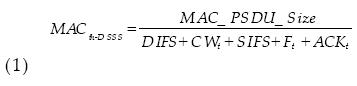
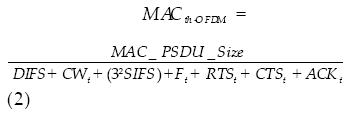
<body><![CDATA[<p align="justify"><font face="verdana" size="2">This section presents the methodology used in the performance study of the 802.1 1g standard. The analysis takes into account a variety of issues of the mandatory <i>PHY </i>operational modes defined in the 802.11g standard.</font></p>     <p align="justify"><font face="verdana" size="2">The performance study is divided in two scenarios:</font></p>     <blockquote>       <p align="justify"><font face="verdana" size="2">1. The <i>WLAN </i> is composed by 802.11b and   802.11g   devices   (i.e.,   a   heterogenenous <i>WLAN).</i></font></p>       <p align="justify"><font face="verdana" size="2">2. The   <i>WLAN   </i>is   composed   of   only 802.11g   devices   (i.e.,    a   homogeneous <i>WLAN).</i></font></p> </blockquote>     <p align="justify"><font face="verdana" size="2">The analysis presented in this section is focused on the upper bound performance that can be achieved at the <i>MAC </i>layer as a result of the framing structure and the overhead introduced at the <i>MAC </i>and PHY layers. In this work we are not concerned with the performance degradation due to network load and we only consider a scenario where a single station is transmitting data to another station, thus it is assumed that the station makes a successful transmission immediately after the <i>CW </i>period.</font></p>     <p align="justify"><font face="verdana" size="2">&nbsp;</font></p>     <p align="justify"><font face="verdana" size="2"><i>WLAN with 802.11b and 802.11g devices</i></font></p>     <p align="justify"><font face="verdana" size="2">In this scenario the <i>WLAN </i>is composed by 802.11b and 802.11g devices. Thus an 802.11g complying device can operate in any of the <i>ERP&#150;DSSS/CCK, ERP&#150;OFDM </i>mandatory modulation schemes. Recall that the 802.11b stations can detect <i>ERP&#150;DSSS/CCK PPDU packets. </i>However, this is not the case when <i>ERP&#150;OFDM PPDU </i>packets are transmitted by the 802.11g stations. In this case, the 802.11g devices must introduce the protection mechanism, described in (IEEE Std. 802.11g, 2003), or an alternative one as described by (Choi, 2003); this will ensure that the 802.11b devices will not transmit while the channel is busy.</font></p>     <p align="justify"><font face="verdana" size="2">The <i>MAC </i>throughput, <i>MACth&#150;DSSS, </i>for the <i>ERP&#150;DSSS/CCK </i>modulation scheme is defined in <a href="#e1">equation 1</a>, while the <i>MAC </i>throughput, <i>MACth&#150;OFDM, </i>for the <i>ERP&#150;OFDM </i>scheme with protection mechanism (e.g., in a heterogeneous <i>WLAN) </i>is defined in <a href="#e2">equation 2</a>,</font></p>     ]]></body>
<body><![CDATA[<p align="center"><font face="verdana" size="2"><a name="e1" id="e1"></a></font></p>     <p align="center"><font face="verdana" size="2"><img src="/img/revistas/iit/v8n1/a05e1.jpg"></font></p>     <p align="center"><font face="verdana" size="2"><a name="e2"></a></font></p>     <p align="center"><font face="verdana" size="2"><img src="/img/revistas/iit/v8n1/a05e2.jpg"></font></p>     <p align="justify"><font face="verdana" size="2">where, <i>DIFS </i>represents the <i>DCF </i>inter&#150;frame spacing time, <i>CW<sub>t</sub> </i>is the average time length of the contention window, <i>SIFS </i>is the short inter&#150;frame spacing time, <i>F<sub>t</sub> </i>represents the time it takes to transmit the <i>PPDU </i>frame, <i>RTS<sub>t</sub>, CTS<sub>t</sub> </i>and <i>ACK<sub>t</sub> </i>represents the time it takes to transmit an <i>RTS, CTS and ACK </i>frame respectively. It should be noted that expressions (1) and (2) do not account for those cases where the <i>MAC </i><i>PSDU </i>must be fragmented at the <i>PLCP </i>sublayer, in which case, each <i>PPDU </i>frame fragment is fallowed by a <i>SIFS </i>plus <i>an ACK </i>frame.</font></p>     <p align="justify"><font face="verdana" size="2">&nbsp;</font></p>     <p align="justify"><font face="verdana" size="2"><i>WLAN with only 802.11g devices</i></font></p>     <p align="justify"><font face="verdana" size="2">In this scenario the <i>WLAN </i>is entirely composed by 802.11g complying devices. In this case there is no requirement to use the <i>RTS/CTS </i>protection mechanism, other than to guarantee reservation of the wireless medium and to avoid the hidden node problem.</font></p>     <p align="justify"><font face="verdana" size="2"><a href="/img/revistas/iit/v8n1/a05f5.jpg" target="_blank">Figure 5</a>, shows a time diagram of the transmission of an <i>ERP&#150;OFDM PPDU. </i>In this case the <i>MAC </i>throughput is evaluated as indicated in expression (1).</font></p>     <p align="justify"><font face="verdana" size="2">&nbsp;</font></p>     ]]></body>
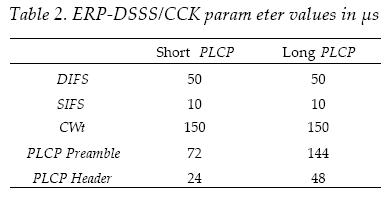
<body><![CDATA[<p align="justify"><font face="verdana" size="2"><b>Numerical Results</b></font></p>     <p align="justify"><font face="verdana" size="2">This section presents the numerical results of the <i>MAC </i>throughput for a heterogeneous and a homogeneous 802.11g wireless network. This section is divided in two subsections. The first subsection deals with a heterogeneous 802.11b and 802.11g wireless network scenario. The second subsection deals with a homogeneous 802.11g wireless network scenario.</font></p>     <p align="justify"><font face="verdana" size="2">&nbsp;</font></p>     <p align="justify"><font face="verdana" size="2"><i>Heterogeneous 802.11b and 802.11g WLAN</i></font></p>     <p align="justify"><font face="verdana" size="2">This section presents the performance analysis results of the <i>MAC </i>throughput for the two mandatory modulation schemes defined in the 802.11g standard, namely the <i>ERP&#150;DSSS/CCK </i>and the <i>ERP&#150;OFDM </i>modulation schemes.</font></p>     <p align="justify"><font face="verdana" size="2">&nbsp;</font></p>     <p align="justify"><font face="verdana" size="2"><i>ERP&#150;DSSS/CCK Results</i></font></p>     <p align="justify"><font face="verdana" size="2">In this scenario the 802.11g complying devices transmit using the <i>ERP &#150;DSSS /CCK </i>modulation scheme. As the non&#150;802.11g complying devices can detect the <i>ERP&#150;DSSS/CCK </i>messages, there is no need to introduce the <i>RTS/CTS </i>protection mechanism. <a href="#t2">Table 2 </a>shows the <i>MAC </i>parameter values used for calculations in this section. The numerical results are presented for the case of short and long preambles.</font></p>     <p align="center"><font face="verdana" size="2"><a name="t2"></a></font></p>     <p align="center"><font face="verdana" size="2"><img src="/img/revistas/iit/v8n1/a05t2.jpg"></font></p>     ]]></body>
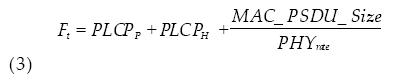
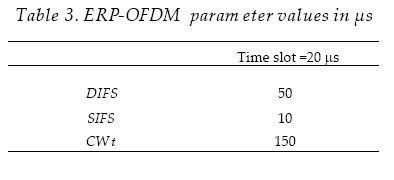
<body><![CDATA[<p align="justify"><font face="verdana" size="2">T<i></i>he   average   length   of   the   contention window, <i>CW<sub>t</sub>, </i>is calculated as the expected value of a uniform random variable in the range &#91;0, <i>CW<sub>min</sub></i>&#93;<i>. </i>The value of <i>CW<sub>min </sub></i>increases with the number of retransmissions. It should be noted that the 802.11g standard defines an initial <i>CW<sub>min</sub></i> value of 15 time slots, while the maximum value of the contention window is limited by the physical layer. For the case of a direct sequence <i>(DS) PHY </i> Layer the maximum length of the contention windows is 1,023. For the purpose of the analysis presented in this section, the value of <i> CW<sub>min</sub></i> is 15 time slots and the time slot duration is equal to 20 <i>&micro;s.</i></font></p>     <p align="justify"><font face="verdana" size="2">The value of <i>F<sub>t</sub>, </i>which represents the time it takes to transmit the <i>PPDU </i>frame, is defined as,</font></p>     <p align="center"><font face="verdana" size="2"><img src="/img/revistas/iit/v8n1/a05e3.jpg"></font></p>     <p align="justify"><font face="verdana" size="2">where, <i>PLCP<sub>P</sub> </i>and <i>PLCP<sub>H</sub> </i>represent the length of time required to transmit the <i>PLCP</i> preamble and the <i>PLCP </i>header, respectively. The <i>MAC_PSDU_Size </i>can have a maximum size of 2,346 bytes, which includes a variable size <i>Frame Body </i>of 0 &#150; 2312 bytes and several control fields with a total length of 34 bytes (Heiskala et <i>al., </i>2002). The set of <i>PHY </i>layer data rates, <i>PHY<sub>rate</sub>, </i>considered for this scenario include 1, 2, <i>5.5 </i>and 11 Mbps.</font></p>     <p align="justify"><font face="verdana" size="2"><a href="/img/revistas/iit/v8n1/a05f6.jpg" target="_blank">Figure  6</a>  shows  the  MAC  performance results   of   the <i>ERP&#150;DSSS/CCK   </i>modulation scheme using the Long Preamble <i>PLCP </i>Framing format. The numerical results are presented for different lengths of the <i>MPDU </i>and at the four <i>ERP&#150;DSSS/CCK </i>date rates: 1 Mbps, 2 Mbps, <i>5.5 </i>Mbps and 11 Mbps. <a href="/img/revistas/iit/v8n1/a05f7.jpg" target="_blank">Figure 7</a>, shows the <i>MAC </i>performance results assuming the Short Preamble <i>PLCP   </i>framing  format.   The numerical results are presented for different lengths of the <i>MPDU </i>and at date rates of 2, <i>5.5 </i>and 11 Mbps, which are supported with the short preamble framing format, as described in section 18.2.2.2 of (IEEE Std. 802.11b, 1999).</font></p>     <p align="justify"><font face="verdana" size="2">&nbsp;</font></p>     <p align="justify"><font face="verdana" size="2"><i>ERP&#150;OFDM Results</i></font></p>     <p align="justify"><font face="verdana" size="2">In this scenario the 802.11g complying devices transmit using the <i>ERP&#150;OFDM </i>modulation scheme. As the non&#150;802.11g complying devices cannot detect the ERP&#150;OFDM messages, there is a need to introduce the <i>RTS/CTS </i>protection mechanism. It should be noted that the <i>RTS </i>and <i>CTS </i>frames are transmitted at one of the basic rates defined in 802.11b. For the purpose of this work only the 2 Mbps and 11 Mbps basic rates of 802.11b  are considered.  In addition, the numerical results include the two possible cases in which the <i>RTS/CTS </i>frames are transmitted with a short or a long <i>PLCP </i>framing. <a href="#t3">Table 3</a> shows   the   <i>MAC  </i>parameter   values   of   the <i>ERP&#150;OFDM   </i>modulation   scheme   used   for calculations   in   this   section.   The   numerical results  are presented assuming a time  slot length of 20 <i>&micro;s.</i></font></p>     <p align="center"><font face="verdana" size="2"><i><a name="t3"></a></i></font></p>     <p align="center"><font face="verdana" size="2"><i><img src="/img/revistas/iit/v8n1/a05t3.jpg"></i></font></p>     ]]></body>
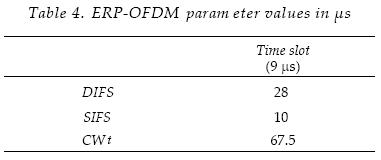
<body><![CDATA[<p align="justify"><font face="verdana" size="2">The average length of the contention window, <i>CW<sub>t</sub>, </i>is calculated as the expected value of a uniform random variable in the range &#91;0, <i>CW<sub>min</sub></i>&#93;<i>. </i>For the purpose of the analysis presented in this section, the value of <i>CW<sub>min</sub></i> is 15 time slots. It should be noted that the numerical results account for the extended service period of 6 <i>&micro;s </i>after each <i>ERP&#150;OFDM PPDU </i>frame transmission.</font></p>     <p align="justify"><font face="verdana" size="2">From the results presented in <a href="/img/revistas/iit/v8n1/a05f8.jpg" target="_blank">figure 8</a> <a href="/img/revistas/iit/v8n1/a05f11.jpg" target="_blank">to figure 11</a> <a href="/img/revistas/iit/v8n1/a05f8.jpg" target="_blank">(8,</a> <a href="/img/revistas/iit/v8n1/a05f9.jpg" target="_blank">9,</a> <a href="/img/revistas/iit/v8n1/a05f10.jpg" target="_blank">10,</a> <a href="/img/revistas/iit/v8n1/a05f11.jpg" target="_blank">11)</a>, it is clear that the <i>MAC </i>Throughput is not significantly affected by transmitting the <i>RTS/CTS </i>frames at 2 or 11 Mbps. This is explained by the fact that only the <i>RTS/CTS </i>frame body is transmitted at 2 or 11 Mbps and the <i>RTS/CTS </i>payload field is small. On the other hand, the use of a short or a long preamble has a greater impact on the  <i>MAC </i>Throughput; this is especially true for high <i>PPDU </i>payload data rates.</font></p>     <p align="justify"><font face="verdana" size="2">&nbsp;</font></p>     <p align="justify"><font face="verdana" size="2"><i>Homogeneous 802.11 g WLAN</i></font></p>     <p align="justify"><font face="verdana" size="2">In this scenario the 802.11g complying devices transmit using the <i>ERP&#150;OFDM </i>modulation scheme in an 802.11g homogeneous environment (i.e., the <i>WLAN </i>is composed only by 802.11g complying devices).</font></p>     <p align="justify"><font face="verdana" size="2">Then the 802.11g devices can transmit at any of the <i>ERP&#150;OFDM </i>data rates without the need of an <i>RTS/CTS </i>protection scheme, unless there is a need for the reservation of the channel or to avoid the hidden node problem.</font></p>     <p align="justify"><font face="verdana" size="2">&nbsp;</font></p>     <p align="justify"><font face="verdana" size="2"><i>ERP&#150;OFDM Results</i></font></p>     <p align="justify"><font face="verdana" size="2">The <i>MAC </i>performance results assume a time slot length of 9 <i>&micro;s, </i>as described in (IEEE Std. 802.11g, 2003). The average length of the contention window, <i>CW<sub>t</sub>, </i>is calculated as the expected value of a uniform random variable in the range &#91;0, <i>CW<sub>min</sub></i>&#93;<i>. </i>For the purpose of the analysis presented in this section, the value of <i>CW<sub>min</sub></i> is 15 time slots. In addition, the <i>MAC </i>performance results account for the extended service period of 6 <i>&micro;s </i>after each <i>PPDU </i>frame transmission.</font></p>     <p align="justify"><font face="verdana" size="2"><a href="#t4">Table 4</a> shows the <i>MAC </i>parameter values used for calculations in this section. The numerical results  are presented  assuming a time  slot length of 9 <i>&micro;s.</i></font></p>     ]]></body>
<body><![CDATA[<p align="center"><a name="t4"></a></p>     <p align="center"><font face="verdana" size="2"><i><img src="/img/revistas/iit/v8n1/a05t4.jpg"></i></font></p>     <p align="justify"><font face="verdana" size="2">The results presented in <a href="/img/revistas/iit/v8n1/a05f12.jpg" target="_blank">figure 12</a> show an increased <i>MAC </i>Throughput, compared to the <i>ERP&#150;OFDM </i>scheme in a heterogeneous <i>WLAN. </i>The <i>MAC </i>Throughput is almost twice in the <i>ERP&#150;OFDM in </i>a homogeneous <i>WLAN </i>than that in a heterogeneous <i>WLAN </i>for a <i>MPDU </i>size of 2,346 and payload data rate of 54 Mbps. This result clearly indicates that the introduction of the <i>RTS/CTS </i>protection mechanism has a major impact on the performance of the <i>ERP&#150;OFDM </i>modulation scheme, especially for high payload data rates.</font></p>     <p align="justify"><font face="verdana" size="2">&nbsp;</font></p>     <p align="justify"><font face="verdana" size="2"><b>Conclusions and Future Work</b></font></p>     <p align="justify"><font face="verdana" size="2">A performance study and analysis of the 802.11g  <i>MAC  </i>protocol  is  presented  in  this article. The most recent extension to the 802.11 standard, namely the 802.11g, defines multiple <i>PHY </i>operational modes. Some of these <i>PHY </i>operational modes are backward compatible with the 802.11b standard, while other   <i>PHY </i>operational modes will require some sort of protection mechanism  to   allow  for  the  interoperability of 802.11b and 802.11g devices within a heterogeneous <i>WLAN, </i>as described in (IEEE Std. 802.11g, 2003). In a heterogeneous <i>WLAN </i>an 802.11g complying device can operate using the   <i>ERP&#150;DSSS/CCK  </i>or the   <i>ERP&#150;OFDM </i>modulation   schemes.   In   general,   a higher <i>MAC </i>efficiency is achieved under the <i>ERP&#150;DSSS/CCK </i>modulation scheme. This result is explained by the fact that 802.11g complying devices must introduce the <i>RTS/CTS </i>protection mechanism when operating under the   <i>ERP&#150;OFDM </i>modulation scheme. On the other hand, in a homogeneous <i>WLAN</i>, the 802.11g devices can operate in the  <i>ERP&#150;OFDM  </i>modulation scheme without the need of introducing the <i>RTS/CTS </i>protection mechanism, unless there is a need to guarantee the reservation of the wireless medium or to avoid the hidden node problem. In addition, in the case of a homogeneous <i>WLAN, </i>the <i>CW<sub>min </sub></i>size and the time slot length can be reduced, to 15 and 9 <i>&micro;s </i>respectively, to allow for an improved <i>MAC </i>efficiency. Future work will consider the performance analysis of the 802.11g standard by accounting for the wireless network load and the impact that the wireless fading channel has on the transmission of 802.11g frames.</font></p>     <p align="justify"><font face="verdana" size="2">&nbsp;</font></p>     <p align="justify"><font face="verdana" size="2"><b>References</b></font></p>     <!-- ref --><p align="justify"><font face="verdana" size="2">Boulmalf M., El&#150;Sayed H., Soufyane A. (2005). Measured Throughput and SNR of IEEE 802.11g in a Small Enterprise Environment. The 61st IEEE Vehicular Technology Conference, Stockholm, Sweden, May.</font>&nbsp;&nbsp;&nbsp;&nbsp;&nbsp;&nbsp;&nbsp;&nbsp;[&#160;<a href="javascript:void(0);" onclick="javascript: window.open('/scielo.php?script=sci_nlinks&ref=4260171&pid=S1405-7743200700010000500001&lng=','','width=640,height=500,resizable=yes,scrollbars=1,menubar=yes,');">Links</a>&#160;]<!-- end-ref --><!-- ref --><p align="justify"><font face="verdana" size="2">Choi S., Del Prado&#150;Pavon J. (2003). 802.11g CP: A solution for IEEE 802.11g and 802.11b Inter Working. The 57<sup>th</sup> IEEE Vehicular Technology Conference, Jeju, Korea, April.</font>&nbsp;&nbsp;&nbsp;&nbsp;&nbsp;&nbsp;&nbsp;&nbsp;[&#160;<a href="javascript:void(0);" onclick="javascript: window.open('/scielo.php?script=sci_nlinks&ref=4260172&pid=S1405-7743200700010000500002&lng=','','width=640,height=500,resizable=yes,scrollbars=1,menubar=yes,');">Links</a>&#160;]<!-- end-ref --><!-- ref --><p align="justify"><font face="verdana" size="2">Doufexi A., Armour S., Beng&#150;Sin L., Nix A., Bull D. (2003). An Evaluation of the Performance of IEEE 802.11a and 802.11g Wireless Local Area Networks in a Corporate Office Environment. IEEE International Conference on Communications, Anchorage, United States, May.</font>&nbsp;&nbsp;&nbsp;&nbsp;&nbsp;&nbsp;&nbsp;&nbsp;[&#160;<a href="javascript:void(0);" onclick="javascript: window.open('/scielo.php?script=sci_nlinks&ref=4260173&pid=S1405-7743200700010000500003&lng=','','width=640,height=500,resizable=yes,scrollbars=1,menubar=yes,');">Links</a>&#160;]<!-- end-ref --><!-- ref --><p align="justify"><font face="verdana" size="2">Gast M.S. (2002). <i>802.11 Wireless Networks, The Definitive Guide. </i>O'reilly &amp; Associates Inc. United States, p. 29.</font>&nbsp;&nbsp;&nbsp;&nbsp;&nbsp;&nbsp;&nbsp;&nbsp;[&#160;<a href="javascript:void(0);" onclick="javascript: window.open('/scielo.php?script=sci_nlinks&ref=4260174&pid=S1405-7743200700010000500004&lng=','','width=640,height=500,resizable=yes,scrollbars=1,menubar=yes,');">Links</a>&#160;]<!-- end-ref --><!-- ref --><p align="justify"><font face="verdana" size="2">Heiskala J., Terry J. (2002). <i>OFDM Wireless LANs: A Theoretical and Practical Guide. </i>Sams Publishing, United States, p. 223.</font>&nbsp;&nbsp;&nbsp;&nbsp;&nbsp;&nbsp;&nbsp;&nbsp;[&#160;<a href="javascript:void(0);" onclick="javascript: window.open('/scielo.php?script=sci_nlinks&ref=4260175&pid=S1405-7743200700010000500005&lng=','','width=640,height=500,resizable=yes,scrollbars=1,menubar=yes,');">Links</a>&#160;]<!-- end-ref --><!-- ref --><p align="justify"><font face="verdana" size="2">IEEE Std. 802.11&#150;1999. <i>Part 11: Wireless LAN </i><i>Medium Access Control (MAC) and Physical Laye   (PHY) Specifications. </i>Reference number  ISO/IEC  8802&#150;11:1999(E),  IEEE Std. 802.11, 1999 Edition.</font>&nbsp;&nbsp;&nbsp;&nbsp;&nbsp;&nbsp;&nbsp;&nbsp;[&#160;<a href="javascript:void(0);" onclick="javascript: window.open('/scielo.php?script=sci_nlinks&ref=4260176&pid=S1405-7743200700010000500006&lng=','','width=640,height=500,resizable=yes,scrollbars=1,menubar=yes,');">Links</a>&#160;]<!-- end-ref --><!-- ref --><p align="justify"><font face="verdana" size="2">IEEE Std. 802.11a. <i>Supplement to Part 11: Wireless   LAN   Medium   Access   Control (MAC) and Physical Layer (PHY) Specifications: High&#150;speed Physical Layer in the 5 GHz Band, </i>IEEE Std. 802.11a&#150;1999.</font>&nbsp;&nbsp;&nbsp;&nbsp;&nbsp;&nbsp;&nbsp;&nbsp;[&#160;<a href="javascript:void(0);" onclick="javascript: window.open('/scielo.php?script=sci_nlinks&ref=4260177&pid=S1405-7743200700010000500007&lng=','','width=640,height=500,resizable=yes,scrollbars=1,menubar=yes,');">Links</a>&#160;]<!-- end-ref --><!-- ref --><p align="justify"><font face="verdana" size="2">IEEE Std. 802.11b. <i>Supplement to Part 11: Wireless LAN Medium Access Control (MAC) and Physical Layer (PHY) Specifica</i><i>tions: Higher&#150;speed Physical Layer in the 2.4 GHz Band, </i>IEEE Std. 802.11b&#150;1999.</font>&nbsp;&nbsp;&nbsp;&nbsp;&nbsp;&nbsp;&nbsp;&nbsp;[&#160;<a href="javascript:void(0);" onclick="javascript: window.open('/scielo.php?script=sci_nlinks&ref=4260178&pid=S1405-7743200700010000500008&lng=','','width=640,height=500,resizable=yes,scrollbars=1,menubar=yes,');">Links</a>&#160;]<!-- end-ref --><!-- ref --><p align="justify"><font face="verdana" size="2">IEEE Std. 802.11g. <i>Supplement to Part 11: Wireless </i><i>LAN Medium Access Control (MAC) and Physical Layer (PHY) Specifications: Higher&#150;speed Physical Layer Extensions in the 2.4 GHz Band, </i>IEEE Std. 802.11g&#150;2003.</font>&nbsp;&nbsp;&nbsp;&nbsp;&nbsp;&nbsp;&nbsp;&nbsp;[&#160;<a href="javascript:void(0);" onclick="javascript: window.open('/scielo.php?script=sci_nlinks&ref=4260179&pid=S1405-7743200700010000500009&lng=','','width=640,height=500,resizable=yes,scrollbars=1,menubar=yes,');">Links</a>&#160;]<!-- end-ref --><!-- ref --><p align="justify"><font face="verdana" size="2">Medepalli K., Gopalakrishnan P., Famolari D., Kodama T. (2004). Voice Capacity of IEEE 802.11b, 802.11a and 802.11g Wireless LANs. IEEE Global Telecommunications Conference (GLOBECOM), 2004, Dallas, Texas, United States, November.</font>&nbsp;&nbsp;&nbsp;&nbsp;&nbsp;&nbsp;&nbsp;&nbsp;[&#160;<a href="javascript:void(0);" onclick="javascript: window.open('/scielo.php?script=sci_nlinks&ref=4260180&pid=S1405-7743200700010000500010&lng=','','width=640,height=500,resizable=yes,scrollbars=1,menubar=yes,');">Links</a>&#160;]<!-- end-ref --><!-- ref --><p align="justify"><font face="verdana" size="2">Rao T.R., Giulietti A. (2005). A Performance Study on the 802.11g WLAN OFDM System. The International Conference on Computer as a Tool, Belgrade, Serbia &amp; Montenegro,November.</font>&nbsp;&nbsp;&nbsp;&nbsp;&nbsp;&nbsp;&nbsp;&nbsp;[&#160;<a href="javascript:void(0);" onclick="javascript: window.open('/scielo.php?script=sci_nlinks&ref=4260181&pid=S1405-7743200700010000500011&lng=','','width=640,height=500,resizable=yes,scrollbars=1,menubar=yes,');">Links</a>&#160;]<!-- end-ref --><!-- ref --><p align="justify"><font face="verdana" size="2">Vassis   D.,   Kormentzas   G.,   Rouskas   A., Maglogiannis I. (2005). The IEEE 802.11g Standard for High Data Rate WLANs. <i>IEEE Network, </i>Vol. 19, No. 3, pp. 21&#150;26.</font>&nbsp;&nbsp;&nbsp;&nbsp;&nbsp;&nbsp;&nbsp;&nbsp;[&#160;<a href="javascript:void(0);" onclick="javascript: window.open('/scielo.php?script=sci_nlinks&ref=4260182&pid=S1405-7743200700010000500012&lng=','','width=640,height=500,resizable=yes,scrollbars=1,menubar=yes,');">Links</a>&#160;]<!-- end-ref --><!-- ref --><p align="justify"><font face="verdana" size="2">Wang S.C., Chen Y.M., Tsern&#150;Huei L., Helmy A. (2005). Performance Evaluation for Hybrid IEEE 802.11b and 802.11g Wireless Networks. IEEE International Performance, Computing and Communications Conference, Phoenix, Arizona, United States, April.</font>&nbsp;&nbsp;&nbsp;&nbsp;&nbsp;&nbsp;&nbsp;&nbsp;[&#160;<a href="javascript:void(0);" onclick="javascript: window.open('/scielo.php?script=sci_nlinks&ref=4260183&pid=S1405-7743200700010000500013&lng=','','width=640,height=500,resizable=yes,scrollbars=1,menubar=yes,');">Links</a>&#160;]<!-- end-ref --><!-- ref --><p align="justify"><font face="verdana" size="2">Wang T., Refai H.H. (2005). Empirical Network Performance Analysis on IEEE 802.11g with Different Protocols and Signal to Noise Ratio Values. Second IFIP International Conference on Wireless and Optical Communications Networks, Dubai, United Arab Emirates, March.</font>&nbsp;&nbsp;&nbsp;&nbsp;&nbsp;&nbsp;&nbsp;&nbsp;[&#160;<a href="javascript:void(0);" onclick="javascript: window.open('/scielo.php?script=sci_nlinks&ref=4260184&pid=S1405-7743200700010000500014&lng=','','width=640,height=500,resizable=yes,scrollbars=1,menubar=yes,');">Links</a>&#160;]<!-- end-ref --><!-- ref --><p align="justify"><font face="verdana" size="2">Wijesinha A.L., Song Y., Krishnan M., Mathur V., Ahn J., Shyamasundar V. (2005). Throughput Measurements for UDP Traffic in an IEEE 802.11g WLAN. Sixth International Conference on Software Engineering, Artificial Intelligence, Networking and Parallel/Distributed Computing and First ACIS International Workshop on Self&#150;Assembling Wireless Networks, Maryland, United States, May.</font>&nbsp;&nbsp;&nbsp;&nbsp;&nbsp;&nbsp;&nbsp;&nbsp;[&#160;<a href="javascript:void(0);" onclick="javascript: window.open('/scielo.php?script=sci_nlinks&ref=4260185&pid=S1405-7743200700010000500015&lng=','','width=640,height=500,resizable=yes,scrollbars=1,menubar=yes,');">Links</a>&#160;]<!-- end-ref --><p align="justify"><font face="verdana" size="2">&nbsp;</font></p>     <p align="justify"><font face="verdana" size="2"><b>Author's biographies</b></font></p>     <p align="justify"><font face="verdana" size="2"><i><a name="autor1"></a>Luis Villase&ntilde;or&#150;Gonz&aacute;lez. </i>Received an Engineering degree in Electronics from UABC, Mexico (1993); M. Sc. in Electronics and Telecommunications from CICESE, Mexico (1997); and Ph.D. in Electrical Engineering from the University of Ottawa, Canada (2002). He is currently a Research Associate Professor at the CICESE Research Center. He collaborated as a Network Research Engineer at the Communications Research Centre (CRC) in Ottawa, Canada. At CRC he was involved in a variety of research activities in network technologies for the Government of Canada between 1999 and 2003. His current research interests include mobile Ad&#150;Hoc networks, wireless communications networks, QoS protocol architectures, performance analysis and evaluation of Internet technologies and computer networks. He is currently a member of the IEEE.</font></p>     <p align="justify"><font face="verdana" size="2"><i><a name="autor2"></a>Canek Portillo&#150;Jim&eacute;nez. </i>Received his M. Sc. in Electronics and Telecommunications from CICESE, Mexico (2004). He graduated from the Instituto Tecnologico de Culiacan with a B.Sc. in Electronics Engineering in 2002. His research interests include wireless LANs performance analysis and evaluation and OFDM systems.</font></p>     <p align="justify"><font face="verdana" size="2"><i><a name="autor3"></a>Jaime S&aacute;nchez&#150;Garc&iacute;a. </i>Received an Engineering degree in Electronics from IPN&#150;ESIME, M&eacute;xico (1976); M.Sc. in Electronics and Telecommunications from CICESE Ensenada M&eacute;xico (1979); and D.Sc. in Electrical Engineering (major in Communications) from The George Washington University (2001). Since 1979, he has a research and faculty position at the Electronics and Telecommunications Department CICESE. Dr. S&aacute;nchez spent nine months (1997) as Visiting Scholar at School of Engineering and Mines, University of Arizona Tucson. He won the 1st place in III Ericsson Yearly Award (1988), Teleindustria Ericsson M&eacute;xico. His publications include several IEEE articles and international conferences. Current research interests include wireless networks, advanced modulation and access techniques, software radio, multipath propagation, and multicarrier modulation (OFDM). He is an IEEE member.</font></p>      ]]></body><back>
<ref-list>
<ref id="B1">
<nlm-citation citation-type="confpro">
<person-group person-group-type="author">
<name>
<surname><![CDATA[Boulmalf]]></surname>
<given-names><![CDATA[M.]]></given-names>
</name>
<name>
<surname><![CDATA[El-Sayed]]></surname>
<given-names><![CDATA[H.]]></given-names>
</name>
<name>
<surname><![CDATA[Soufyane]]></surname>
<given-names><![CDATA[A.]]></given-names>
</name>
</person-group>
<article-title xml:lang="en"><![CDATA[Measured Throughput and SNR of IEEE 802.11g in a Small Enterprise Environment]]></article-title>
<source><![CDATA[]]></source>
<year>2005</year>
<conf-name><![CDATA[61st IEEE Vehicular Technology Conference]]></conf-name>
<conf-loc>Stockholm </conf-loc>
</nlm-citation>
</ref>
<ref id="B2">
<nlm-citation citation-type="confpro">
<person-group person-group-type="author">
<name>
<surname><![CDATA[Choi]]></surname>
<given-names><![CDATA[S.]]></given-names>
</name>
<name>
<surname><![CDATA[Del Prado-Pavon]]></surname>
<given-names><![CDATA[J.]]></given-names>
</name>
</person-group>
<article-title xml:lang="en"><![CDATA[802.11g CP: A solution for IEEE 802.11g and 802.11b Inter Working]]></article-title>
<source><![CDATA[]]></source>
<year>2003</year>
<conf-name><![CDATA[57 IEEE Vehicular Technology Conference]]></conf-name>
<conf-loc>Jeju </conf-loc>
</nlm-citation>
</ref>
<ref id="B3">
<nlm-citation citation-type="confpro">
<person-group person-group-type="author">
<name>
<surname><![CDATA[Doufexi]]></surname>
<given-names><![CDATA[A.]]></given-names>
</name>
<name>
<surname><![CDATA[Armour]]></surname>
<given-names><![CDATA[S.]]></given-names>
</name>
<name>
<surname><![CDATA[Beng-Sin]]></surname>
<given-names><![CDATA[L.]]></given-names>
</name>
<name>
<surname><![CDATA[Nix]]></surname>
<given-names><![CDATA[A.]]></given-names>
</name>
<name>
<surname><![CDATA[Bull]]></surname>
<given-names><![CDATA[D.]]></given-names>
</name>
</person-group>
<article-title xml:lang="en"><![CDATA[An Evaluation of the Performance of IEEE 802.11a and 802.11g Wireless Local Area Networks in a Corporate Office Environment]]></article-title>
<source><![CDATA[]]></source>
<year>2003</year>
<conf-name><![CDATA[ IEEE International Conference on Communications]]></conf-name>
<conf-loc>Anchorage </conf-loc>
</nlm-citation>
</ref>
<ref id="B4">
<nlm-citation citation-type="book">
<person-group person-group-type="author">
<name>
<surname><![CDATA[Gast]]></surname>
<given-names><![CDATA[M.S.]]></given-names>
</name>
</person-group>
<source><![CDATA[802.11 Wireless Networks, The Definitive Guide]]></source>
<year>2002</year>
<page-range>29</page-range><publisher-name><![CDATA[O'reilly & Associates Inc.]]></publisher-name>
</nlm-citation>
</ref>
<ref id="B5">
<nlm-citation citation-type="book">
<person-group person-group-type="author">
<name>
<surname><![CDATA[Heiskala]]></surname>
<given-names><![CDATA[J.]]></given-names>
</name>
<name>
<surname><![CDATA[Terry]]></surname>
<given-names><![CDATA[J.]]></given-names>
</name>
</person-group>
<source><![CDATA[OFDM Wireless LANs: A Theoretical and Practical Guide]]></source>
<year>2002</year>
<page-range>223</page-range><publisher-name><![CDATA[Sams Publishing]]></publisher-name>
</nlm-citation>
</ref>
<ref id="B6">
<nlm-citation citation-type="">
<source><![CDATA[IEEE Std. 802.11-1999: Part 11: Wireless LAN Medium Access Control (MAC) and Physical Laye (PHY) Specifications]]></source>
<year>1999</year>
<volume>Reference number ISO/IEC 8802-11:1999(E)</volume>
</nlm-citation>
</ref>
<ref id="B7">
<nlm-citation citation-type="">
<source><![CDATA[IEEE Std. 802.11a: Supplement to Part 11: Wireless LAN Medium Access Control (MAC) and Physical Layer (PHY) Specifications: High-speed Physical Layer in the 5 GHz Band]]></source>
<year>1999</year>
</nlm-citation>
</ref>
<ref id="B8">
<nlm-citation citation-type="">
<source><![CDATA[IEEE Std. 802.11b: Supplement to Part 11: Wireless LAN Medium Access Control (MAC) and Physical Layer (PHY) Specifications: Higher-speed Physical Layer in the 2.4 GHz Band]]></source>
<year>1999</year>
</nlm-citation>
</ref>
<ref id="B9">
<nlm-citation citation-type="">
<source><![CDATA[IEEE Std. 802.11g: Supplement to Part 11: Wireless LAN Medium Access Control (MAC) and Physical Layer (PHY) Specifications: Higher-speed Physical Layer Extensions in the 2.4 GHz Band]]></source>
<year>2003</year>
</nlm-citation>
</ref>
<ref id="B10">
<nlm-citation citation-type="confpro">
<person-group person-group-type="author">
<name>
<surname><![CDATA[Medepalli]]></surname>
<given-names><![CDATA[K.]]></given-names>
</name>
<name>
<surname><![CDATA[Gopalakrishnan]]></surname>
<given-names><![CDATA[P.]]></given-names>
</name>
<name>
<surname><![CDATA[Famolari]]></surname>
<given-names><![CDATA[D.]]></given-names>
</name>
<name>
<surname><![CDATA[Kodama]]></surname>
<given-names><![CDATA[T.]]></given-names>
</name>
</person-group>
<article-title xml:lang="en"><![CDATA[Voice Capacity of IEEE 802.11b, 802.11a and 802.11g Wireless LANs]]></article-title>
<source><![CDATA[]]></source>
<year>2004</year>
<conf-name><![CDATA[ IEEE Global Telecommunications Conference (GLOBECOM)]]></conf-name>
<conf-date>2004</conf-date>
<conf-loc>Dallas Texas</conf-loc>
</nlm-citation>
</ref>
<ref id="B11">
<nlm-citation citation-type="confpro">
<person-group person-group-type="author">
<name>
<surname><![CDATA[Rao]]></surname>
<given-names><![CDATA[T.R.]]></given-names>
</name>
<name>
<surname><![CDATA[Giulietti]]></surname>
<given-names><![CDATA[A.]]></given-names>
</name>
</person-group>
<article-title xml:lang="en"><![CDATA[A Performance Study on the 802.11g WLAN OFDM System]]></article-title>
<source><![CDATA[]]></source>
<year>2005</year>
<conf-name><![CDATA[ The International Conference on Computer as a Tool]]></conf-name>
<conf-loc>Belgrade </conf-loc>
</nlm-citation>
</ref>
<ref id="B12">
<nlm-citation citation-type="journal">
<person-group person-group-type="author">
<name>
<surname><![CDATA[Vassis]]></surname>
<given-names><![CDATA[D.]]></given-names>
</name>
<name>
<surname><![CDATA[Kormentzas]]></surname>
<given-names><![CDATA[G.]]></given-names>
</name>
<name>
<surname><![CDATA[Rouskas]]></surname>
<given-names><![CDATA[A.]]></given-names>
</name>
<name>
<surname><![CDATA[Maglogiannis]]></surname>
<given-names><![CDATA[I.]]></given-names>
</name>
</person-group>
<article-title xml:lang="en"><![CDATA[The IEEE 802.11g Standard for High Data Rate WLANs]]></article-title>
<source><![CDATA[IEEE Network]]></source>
<year>2005</year>
<volume>19</volume>
<numero>3</numero>
<issue>3</issue>
<page-range>21-26</page-range></nlm-citation>
</ref>
<ref id="B13">
<nlm-citation citation-type="confpro">
<person-group person-group-type="author">
<name>
<surname><![CDATA[Wang]]></surname>
<given-names><![CDATA[S.C.]]></given-names>
</name>
<name>
<surname><![CDATA[Chen]]></surname>
<given-names><![CDATA[Y.M.]]></given-names>
</name>
<name>
<surname><![CDATA[Tsern-Huei]]></surname>
<given-names><![CDATA[L.]]></given-names>
</name>
<name>
<surname><![CDATA[Helmy]]></surname>
<given-names><![CDATA[A.]]></given-names>
</name>
</person-group>
<article-title xml:lang="en"><![CDATA[Performance Evaluation for Hybrid IEEE 802.11b and 802.11g Wireless Networks]]></article-title>
<source><![CDATA[]]></source>
<year>2005</year>
<conf-name><![CDATA[ IEEE International Performance, Computing and Communications Conference]]></conf-name>
<conf-loc>Phoenix Arizona</conf-loc>
</nlm-citation>
</ref>
<ref id="B14">
<nlm-citation citation-type="confpro">
<person-group person-group-type="author">
<name>
<surname><![CDATA[Wang]]></surname>
<given-names><![CDATA[T.]]></given-names>
</name>
<name>
<surname><![CDATA[Refai]]></surname>
<given-names><![CDATA[H.H.]]></given-names>
</name>
</person-group>
<article-title xml:lang="en"><![CDATA[Empirical Network Performance Analysis on IEEE 802.11g with Different Protocols and Signal to Noise Ratio Values]]></article-title>
<source><![CDATA[]]></source>
<year>2005</year>
<conf-name><![CDATA[Second IFIP International Conference on Wireless and Optical Communications Networks]]></conf-name>
<conf-loc>Dubai </conf-loc>
</nlm-citation>
</ref>
<ref id="B15">
<nlm-citation citation-type="confpro">
<person-group person-group-type="author">
<name>
<surname><![CDATA[Wijesinha]]></surname>
<given-names><![CDATA[A.L.]]></given-names>
</name>
<name>
<surname><![CDATA[Song]]></surname>
<given-names><![CDATA[Y.]]></given-names>
</name>
<name>
<surname><![CDATA[Krishnan]]></surname>
<given-names><![CDATA[M.]]></given-names>
</name>
<name>
<surname><![CDATA[Mathur]]></surname>
<given-names><![CDATA[V.]]></given-names>
</name>
<name>
<surname><![CDATA[Ahn]]></surname>
<given-names><![CDATA[J.]]></given-names>
</name>
<name>
<surname><![CDATA[Shyamasundar]]></surname>
<given-names><![CDATA[V.]]></given-names>
</name>
</person-group>
<article-title xml:lang="en"><![CDATA[Throughput Measurements for UDP Traffic in an IEEE 802.11g WLAN]]></article-title>
<source><![CDATA[]]></source>
<year>2005</year>
<conf-name><![CDATA[Sixth International Conference on Software Engineering, Artificial Intelligence, Networking and Parallel/Distributed Computing and First ACIS International Workshop on Self-Assembling Wireless Networks]]></conf-name>
<conf-loc>Maryland Maryland</conf-loc>
</nlm-citation>
</ref>
</ref-list>
</back>
</article>