<?xml version="1.0" encoding="ISO-8859-1"?><article xmlns:mml="http://www.w3.org/1998/Math/MathML" xmlns:xlink="http://www.w3.org/1999/xlink" xmlns:xsi="http://www.w3.org/2001/XMLSchema-instance">
<front>
<journal-meta>
<journal-id>1405-7743</journal-id>
<journal-title><![CDATA[Ingeniería, investigación y tecnología]]></journal-title>
<abbrev-journal-title><![CDATA[Ing. invest. y tecnol.]]></abbrev-journal-title>
<issn>1405-7743</issn>
<publisher>
<publisher-name><![CDATA[Universidad Nacional Autónoma de México, Facultad de Ingeniería]]></publisher-name>
</publisher>
</journal-meta>
<article-meta>
<article-id>S1405-77432006000200003</article-id>
<title-group>
<article-title xml:lang="en"><![CDATA[Design and Construction of a Blood Flow Detector Probe for a Continuous Wave Bidireccional Doppler Ultrasound System]]></article-title>
</title-group>
<contrib-group>
<contrib contrib-type="author">
<name>
<surname><![CDATA[Fuentes]]></surname>
<given-names><![CDATA[M.]]></given-names>
</name>
<xref ref-type="aff" rid="A01"/>
</contrib>
<contrib contrib-type="author">
<name>
<surname><![CDATA[Sotomayor]]></surname>
<given-names><![CDATA[A.]]></given-names>
</name>
</contrib>
<contrib contrib-type="author">
<name>
<surname><![CDATA[García]]></surname>
<given-names><![CDATA[F.]]></given-names>
</name>
</contrib>
<contrib contrib-type="author">
<name>
<surname><![CDATA[Moreno]]></surname>
<given-names><![CDATA[E.]]></given-names>
</name>
<xref ref-type="aff" rid="A02"/>
</contrib>
<contrib contrib-type="author">
<name>
<surname><![CDATA[Acevedo]]></surname>
<given-names><![CDATA[P.]]></given-names>
</name>
</contrib>
</contrib-group>
<aff id="A01">
<institution><![CDATA[,Universidad Nacional Autónoma de México IIMAS DISCA]]></institution>
<addr-line><![CDATA[ ]]></addr-line>
</aff>
<aff id="A02">
<institution><![CDATA[,CENUS Instituto de Cibernética Matemáticas y Física ]]></institution>
<addr-line><![CDATA[La Habana ]]></addr-line>
<country>Cuba</country>
</aff>
<pub-date pub-type="pub">
<day>00</day>
<month>06</month>
<year>2006</year>
</pub-date>
<pub-date pub-type="epub">
<day>00</day>
<month>06</month>
<year>2006</year>
</pub-date>
<volume>7</volume>
<numero>2</numero>
<fpage>97</fpage>
<lpage>103</lpage>
<copyright-statement/>
<copyright-year/>
<self-uri xlink:href="http://www.scielo.org.mx/scielo.php?script=sci_arttext&amp;pid=S1405-77432006000200003&amp;lng=en&amp;nrm=iso"></self-uri><self-uri xlink:href="http://www.scielo.org.mx/scielo.php?script=sci_abstract&amp;pid=S1405-77432006000200003&amp;lng=en&amp;nrm=iso"></self-uri><self-uri xlink:href="http://www.scielo.org.mx/scielo.php?script=sci_pdf&amp;pid=S1405-77432006000200003&amp;lng=en&amp;nrm=iso"></self-uri><abstract abstract-type="short" xml:lang="en"><p><![CDATA[The design and construction of a blood flow detector probe for a Continuous Wave (CW) Bidirectional Doppler Ultrasound system is presented. This device is based on two piezoelectric ceramics working in continuous mode and using quadrature phase demodulation for detecting the blood flow Doppler signal. The probe generates the I (In phase) and Q (in Quadrature) Doppler signals as audio. These signals are fed to the line in on the PC sound board for further processing. Oscillator-transmitter and detector-demodulator circuits are integrated into a 1.5 x 9 cm printed circuit board (PCB). Piezoelectric ceramics are placed and connected 1 cm apart the PCB, this achieves noise reduction and increases the probe sensibility. The circuit design allows operation at 4, 5, 8 and 10 MHz depending on the blood flow detection depth in arteries or superficial vessels.]]></p></abstract>
<abstract abstract-type="short" xml:lang="es"><p><![CDATA[Se presenta el diseño y construcción de una punta detectora de flujo sanguíneo para un sistema Ultrasónico Doppler Bidireccional de Onda Contiua. Este dispositivo se basa en dos cerámicas piezoeléctricas operando de modo continuo y utiliza demodulación en cuadratura para la detección de la señal Doppler Ultrasónica del flujo sanguíneo. La punta detectora proporciona como salida las señales Doppler I (In phase) y Q (in Quadrature) en rango audible. Estas señales se alimentan a la entrada line in de la tarjeta de sonido en una computadora personal PC, para su procesamiento. Los circuitos oscilador-transmisor y detector-demodulador, han sido integrados en una tablilla de circuito impreso de dimensiones 1.5 x 9 cm . Las cerámicas piezoeléctricas están situadas y conectadas a 1 cm del circuito, logrando con una reducción del ruido y un incremento en la sensibilidad de la punta detectora. El diseño del circuito permite operar a 4,5,8 y 10 MHz, dependiendo de la profundidad de la detección del flujo sanguíneo en arterias o en vasos superficiales.]]></p></abstract>
<kwd-group>
<kwd lng="en"><![CDATA[Ultrasonic Probe]]></kwd>
<kwd lng="en"><![CDATA[Doppler signals]]></kwd>
<kwd lng="en"><![CDATA[Blood flow detector]]></kwd>
<kwd lng="es"><![CDATA[Punta ultrasónica]]></kwd>
<kwd lng="es"><![CDATA[Señales Doppler]]></kwd>
<kwd lng="es"><![CDATA[Detección de flujo sanguíneo]]></kwd>
</kwd-group>
</article-meta>
</front><body><![CDATA[ <p align="justify"><font face="verdana" size="4">Estudios e investigaciones recientes</font></p>     <p align="justify"><font face="verdana" size="2">&nbsp;</font></p>     <p align="center"><font face="verdana" size="4"><b>Design and Construction of a Blood Flow Detector Probe for a Continuous Wave Bidireccional Doppler Ultrasound System</b></font></p>     <p align="center"><font face="verdana" size="2">&nbsp;</font></p>     <p align="center"><font face="verdana" size="2"><b>M. Fuentes*, A. Sotomayor*, F. Garc&iacute;a*, E.   Moreno** y P. Acevedo*</b></font></p>     <p align="justify"><font face="verdana" size="2">&nbsp;</font></p>     <p align="justify"><font face="verdana" size="2"><i>* DISCA&#150;IIMAS. Universidad Nacional Aut&oacute;noma de M&eacute;xico</i></font></p>     <p align="justify"><font face="verdana" size="2"><i>** CENUS, Instituto de Cibern&eacute;tica Matem&aacute;ticas y F&iacute;sica, La Habana, Cuba</i></font></p>     <p align="justify"><font face="verdana" size="2">&nbsp;</font></p>     <p align="justify"><font face="verdana" size="2"><b>E&#150;mails:    ]]></body>
<body><![CDATA[<br> </b><a href="mailto:martin@uxdea4.iimas.unam.mx">martin@uxdea4.iimas.unam.mx</a>    <br> <a href="mailto:soto@uxdea4.iimas.unam.mx">soto@uxdea4.iimas.unam.mx</a>    <br> <a href="mailto:fabian@uxdea4.iimas.unam.mx">fabian@uxdea4.iimas.unam.mx</a>    <br> <a href="mailto:moreno@cidet.icmf.inf.cu">moreno@cidet.icmf.inf.cu</a>    <br> <a href="mailto:pedro@uxdea4.iimas.unam.mx">pedro@uxdea4.iimas.unam.mx1</a></font></p>     <p align="justify"><font face="verdana" size="2">&nbsp;</font></p>     <p align="justify"><font face="verdana" size="2">Recibido: mayo de 2005    <br>   Aceptado: noviembre de 2005</font></p>     <p align="justify"><font face="verdana" size="2">&nbsp;</font></p>     <p align="justify"><font face="verdana" size="2"><b>Abstract</b></font></p>     ]]></body>
<body><![CDATA[<p align="justify"><font face="verdana" size="2">The design and construction of a blood flow detector probe for a Continuous Wave (CW) Bidirectional Doppler Ultrasound system is presented. This device is based on two piezoelectric ceramics working in continuous mode and using quadrature phase demodulation for detecting the blood flow Doppler signal. The probe generates the I (In phase) and Q (in Quadrature) Doppler signals as audio. These signals are fed to the <i>line in </i> on the PC sound board for further processing. Oscillator&#150;transmitter and detector&#150;demodulator circuits are integrated into a 1.5 x 9 cm printed circuit board (PCB). Piezoelectric ceramics are placed and connected 1 cm apart the PCB, this achieves noise reduction and increases the probe sensibility. The circuit design allows operation at 4, 5, 8 and 10 MHz depending on the blood flow detection depth in arteries or superficial vessels.</font></p>     <p align="justify"><font face="verdana" size="2">&nbsp;</font></p>     <p align="justify"><font face="verdana" size="2"><b>Keywords:</b> Ultrasonic Probe, Doppler signals, Blood flow detector.</font></p>     <p align="justify"><font face="verdana" size="2">&nbsp;</font></p>     <p align="justify"><font face="verdana" size="2"><b>Resumen</b></font></p>     <p align="justify"><font face="verdana" size="2">Se presenta el dise&ntilde;o y construcci&oacute;n de una punta detectora de flujo sangu&iacute;neo para un sistema Ultras&oacute;nico Doppler Bidireccional de Onda Contiua. Este dispositivo se basa en dos cer&aacute;micas piezoel&eacute;ctricas operando de modo continuo y utiliza demodulaci&oacute;n en cuadratura para la detecci&oacute;n de la se&ntilde;al Doppler Ultras&oacute;nica del flujo sangu&iacute;neo. La punta detectora proporciona como salida las se&ntilde;ales Doppler I (In phase) y Q (in Quadrature) en rango audible. Estas se&ntilde;ales se alimentan a la entrada <i>line in </i>de la tarjeta de sonido en una computadora personal PC, para su procesamiento. Los circuitos oscilador&#150;transmisor y detector&#150;demodulador, han sido integrados en una tablilla de circuito impreso de dimensiones 1.5 x 9 cm . Las cer&aacute;micas piezoel&eacute;ctricas est&aacute;n situadas y conectadas a 1 cm del circuito, logrando con una reducci&oacute;n del ruido y un incremento en la sensibilidad de la punta detectora. El dise&ntilde;o del circuito permite operar a 4,5,8 y 10 MHz, dependiendo de la profundidad de la detecci&oacute;n del flujo sangu&iacute;neo en arterias o en vasos superficiales.</font></p>     <p align="justify"><font face="verdana" size="2"><b>Descriptores:</b> Punta ultras&oacute;nica, Se&ntilde;ales Doppler, Detecci&oacute;n de flujo sangu&iacute;neo.</font></p>     <p align="justify"><font face="verdana" size="2">&nbsp;</font></p>     <p align="justify"><font face="verdana" size="2"><b>Introduction</b></font></p>     <p align="justify"><font face="verdana" size="2">In medical application, ultrasound is extensively used as a diagnostic tool. There is a wide range of medical instruments which are used in this field from simple fetal phones to very sophisticated imaging systems. The main advantage of ultrasound when applied to diagnostic is that it is non&#150;invasive. In Cardiology, the ultrasonic Doppler probe is a very useful instrument to monitor blood flow.</font></p>     ]]></body>
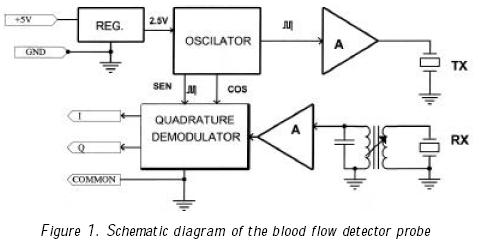
<body><![CDATA[<p align="justify"><font face="verdana" size="2">Blood flow velocity in arteries is periodic in time but its frequency spectrum varies during each cardiac cycle, therefore a blood flow Doppler signal is considered a cycle&#150;stationary stochastic Gaussian signal and in short segments (2&#150;20 ms) is considered a quasi&#150;stationary signal. This signal is commonly analyzed using conventional methods such as the fast Fourier transform (Kay <i>et al. </i>, 1981) and also using spectral estimation parametric methods to obtain a better resolution (Ruano <i>et al. </i>, 1993).</font></p>     <p align="justify"><font face="verdana" size="2">In this paper the design and construction of a Continuous Wave (CW) blood flow detector probe is presented. This device determines the blood velocity, and detects flow disturbance by measuring the Doppler frequency shift of an ultrasound beam scattered from the blood flow, using quadrature phase demodulation. Processing the I and Q Doppler signals may provide information about the presence of stenosis and obstruction in arteries (Fish, 1991) (Gosling <i>et al. </i>, 1975). Stenosis is a disease that affects blood flow velocity and pressure producing turbulence, due to this the velocity profile changes modifying the frequency spectrum of the signal, these changes determine the stenosis level.</font></p>     <p align="justify"><font face="verdana" size="2">This probe is compact, and includes I,Q quadrature blood flow signal as an output. Total circuit is integrated in 1.5 x 9 cm printed circuit board. This device can operate within 4 to 10 MHz range.</font></p>     <p align="justify"><font face="verdana" size="2">The main advantage of CW systems is that they measure blood flow high velocities with a high accuracy.</font></p>     <p align="justify"><font face="verdana" size="2">&nbsp;</font></p>     <p align="justify"><font face="verdana" size="2"><b>Blood Flow Detector Probe</b></font></p>     <p align="justify"><font face="verdana" size="2">The simplest blood flow Doppler detector probe is the one described by Sotomura (1960). At present this kind of probes are more compact and efficient, they are used as diagnostic tools in cardiovascular diseases more often.</font></p>     <p align="justify"><font face="verdana" size="2">The basic elements that build the probe are shown in <a href="#f1">figure 1</a>. This probe is a Continuos Wave (CW) device with coherent demodulation to obtain the I (In phase) and Q (in Quadrature) blood flow Doppler signals.</font></p>     <p align="center"><font face="verdana" size="2"><a name="f1"></a></font></p>     <p align="center"><font face="verdana" size="2"><img src="/img/revistas/iit/v7n2/a03f1.jpg"></font></p>     ]]></body>
<body><![CDATA[<p align="justify"><font face="verdana" size="2">It is worth to mention that the blood flow Doppler signal is actually formed by two components which are the direct and inverse flow. Therefore it is necessary to have two signals in quadrature I<sub>out</sub> and Q<sub>out</sub> to be able to divide the flow direction, this is achieved using signal digital processing in the frequency domain (Evans <i>et al. </i>, 2000).</font></p>     <p align="justify"><font face="verdana" size="2">The transmitter produces an ultrasonic signal that can be defined by the following expression: </font></p>     <p align="justify"><font face="verdana" size="2"><img src="/img/revistas/iit/v7n2/a03e1.jpg">............................................................(1)</font></p>     <p align="justify"><font face="verdana" size="2">where;</font></p>     <p align="justify"><font face="verdana" size="2">&omega;<sub>0</sub>=2&pi; f<sub>0</sub>= angular frequency, and fo=operation frequency of the ultrasonic transducer.</font></p>     <p align="justify"><font face="verdana" size="2">Considering that the ultrasonic signal received <i>S(t) </i>, it is formed by the carrier and the two resultant blood flow signals (forward and reverse), it is possible to express it as:</font></p>     <p align="justify"><font face="verdana" size="2"><img src="/img/revistas/iit/v7n2/a03e2.jpg">..............(2)</font></p>     <p align="justify"><font face="verdana" size="2">where <i>A</i>, &omega; y <i>&Phi;</i> are the amplitude, angular frequency and phase of each signal respectively. <i><sub>0,</sub> f </i> y <i>r</i> are the carrier, the forward flow signal and the reverse flow signal respectively.</font></p>     <p align="justify"><font face="verdana" size="2">With the aim of preserving the real and imaginary components of the Doppler signal, the signal <i>S(t</i>) is demodulated in quadrature.</font></p>     <p align="justify"><font face="verdana" size="2">This demodulation consists in multiplying by a signal of the same frequency from the transmitter Cos(&omega;<sub>0</sub>t) and its signal in quadrature Sen(&omega;<sub>0</sub>t).</font></p>     ]]></body>
<body><![CDATA[<p align="justify"><font face="verdana" size="2"><img src="/img/revistas/iit/v7n2/a03e3.jpg">.......................................................(3)</font></p>     <p align="justify"><font face="verdana" size="2"><img src="/img/revistas/iit/v7n2/a03e4.jpg">..................(4)</font></p>     <p align="justify"><font face="verdana" size="2">filtering high frequency and eliminating the d.c. components we obtain:</font></p>     <p align="justify"><font face="verdana" size="2"><img src="/img/revistas/iit/v7n2/a03e5.jpg">......................(5)</font></p>     <p align="justify"><font face="verdana" size="2">similarly the signal in quadrature is obtained,</font></p>     <p align="justify"><font face="verdana" size="2"><img src="/img/revistas/iit/v7n2/a03e6.jpg">.......................................................(6)</font></p>     <p align="justify"><font face="verdana" size="2"><img src="/img/revistas/iit/v7n2/a03e7.jpg">.....................(7)</font></p>     <p align="justify"><font face="verdana" size="2">then</font></p>     <p align="justify"><font face="verdana" size="2"><img src="/img/revistas/iit/v7n2/a03e7a.jpg"> is the <i>In phase </i> signal and</font></p>     <p align="justify"><font face="verdana" size="2"><img src="/img/revistas/iit/v7n2/a03e7b.jpg"> is the signal in <i>Quadrature</i>.</font></p>     ]]></body>
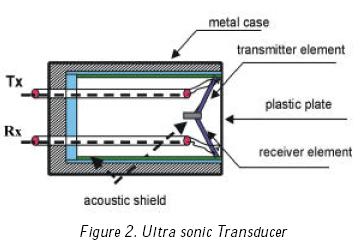
<body><![CDATA[<p align="justify"><font face="verdana" size="2">&nbsp;</font></p>     <p align="justify"><font face="verdana" size="2"><b>Description of the elements of the probe</b></font></p>     <p align="justify"><font face="verdana" size="2"><i>Transducer</i></font></p>     <p align="justify"><font face="verdana" size="2">The transducer used in the design of this probe as it is shown in <a href="#f2">figure 2</a>, it was constructed using two piezoelectric discs PZT&#150;5 with D form, one working as a transmitter and the other as a receiver. The frequency range depends on the application, for example for fetal phones 2 MHz, for blood flow detection in veins and arteries 4&#150;5 MHz and for detection of blood flow in superficial veins 8&#150;10 MHz.</font></p>     <p align="center"><font face="verdana" size="2"><a name="f2"></a></font></p>     <p align="center"><font face="verdana" size="2"><img src="/img/revistas/iit/v7n2/a03f2.jpg"></font></p>     <p align="justify"><font face="verdana" size="2">&nbsp;</font></p>     <p align="justify"><font face="verdana" size="2"><i>Oscilator&#150;transmitter</i></font></p>     <p align="justify"><font face="verdana" size="2">In this stage an ultrasonic continuous wave at the operation frequency is generated (4 ,5, 8 or 10 MHz). Also in this stage the signals in quadrature <i>Cos(&omega;<sub>0</sub>t)</i> and <i>Sin(&omega;<sub>0</sub>t)</i> at the same operation frequency of the transducer are generated. <a href="/img/revistas/iit/v7n2/a03f3.jpg" target="_blank">Figure 3</a> shows a schematic diagram of the circuit, it is worth to mention that when designing the transmitter it is convenient to take into account some characteristics such as power and matching impedance and these must fulfill the security levels recommended by the American Institute of Ultrasound in Medicine (AIUM) (Fish, 1991).</font></p>     <p align="justify"><font face="verdana" size="2">&nbsp;</font></p>     ]]></body>
<body><![CDATA[<p align="justify"><font face="verdana" size="2"><i>Receiver &#150; Demodulator in Quadrature</i></font></p>     <p align="justify"><font face="verdana" size="2">The recuperated Doppler signal is very small, therefore it is necessary an RF amplification. <a href="/img/revistas/iit/v7n2/a03f4.jpg" target="_blank">Figure 4</a> shows the schematic diagram of this section. It consists of a RF transformer tuned to the operation frequency of the ultrasonic transducer, a FET transistor used as an RF amplifier in cascade configuration with two bipolar transistors which function is to mix the received signal with the signal in quadrature <i>Cos(&omega;<sub>0</sub>t)</i> and <i>Sen(&omega;<sub>0</sub>t), </i>advantage is taken of the RC components to limit the frequencies forming a low&#150;pass filter cutting the high frequencies (Equation 4) leaving alone the blood flow Doppler signal. Two miniature trimmers are included in this section to balance <i>Iout </i> and <i>Qout </i>, compensating small errors due to the variation of the electronic components.</font></p>     <p align="justify"><font face="verdana" size="2">If we consider that the human blood flow velocity profile has a range of 20&#150;700 mm/s, and the ultrasonic velocity in tissue is about 1540&#150;1600 m/s (Fish, 1991) (Atkinson, 1975) (Vaitkus <i>et al., </i> 1988), using ultrasonic transducers within 2&#150;10 MHz we are able to estimate the range of the recovered blood flow Doppler signal.</font></p>     <p align="justify"><font face="verdana" size="2">The Doppler signal is given by:</font></p>     <p align="justify"><font face="verdana" size="2"><img src="/img/revistas/iit/v7n2/a03e8.jpg">...........................................................(8)</font></p>     <p align="justify"><font face="verdana" size="2">So the blood flow Doppler signal lies within 200&#150;10,000Hz, that is the audible range and it is relatively easy to divide the high frequencies from the signal of the detector.</font></p>     <p align="justify"><font face="verdana" size="2">&nbsp;</font></p>     <p align="justify"><font face="verdana" size="2"><b>Experiments and Results</b></font></p>     <p align="justify"><font face="verdana" size="2">To verify the performance of the probe <a href="/img/revistas/iit/v7n2/a03f5.jpg" target="_blank">(Figure 5)</a> the I and Q outputs were connected to an amplifier and filter of two channels. The filters used were fifth order band&#150;pass filters with a cut frequency of 300 and 8000 Hz and an amplification of 40&#150;50 dB per channel.</font></p>     <p align="justify"><font face="verdana" size="2">These filters and the probe were designed and constructed as an integral section of a bi&#150;directional blood flow Doppler system at DISCA&#150;IIMAS&#150;UNAM laboratory.</font></p>     ]]></body>
<body><![CDATA[<p align="justify"><font face="verdana" size="2">Using MATLAB 6.1 tools, I, Q blood flow signals coming from the probe were acquired using a PC Pentium III audio board, these signals were stored as WAV files. <a href="/img/revistas/iit/v7n2/a03f6.jpg" target="_blank">Figure 6</a> shows these signals.</font></p>     <p align="justify"><font face="verdana" size="2">To verify the frequency spectrum of the acquired I, Q signals, an specific software was developed to display the spectogram of the blood flow signal as shown in <a href="/img/revistas/iit/v7n2/a03f7.jpg" target="_blank">figure 7</a>.</font></p>     <p align="justify"><font face="verdana" size="2">&nbsp;</font></p>     <p align="justify"><font face="verdana" size="2"><b>Conclusions</b></font></p>     <p align="justify"><font face="verdana" size="2">The blood flow Doppler detector probe has a good performance, having the transmitter and receiver at a short distance from the piezoelectric discs and also having a good shield gives to the probe good sensibility and low noise. The design of the circuit allows the probe to operate within a range of 4 to 10 MHz depending on the depth of the blood flow detection in veins and superficial blood vessels. Validation of the performance of the probe has been made acquiring real signals associated to the blood flow in arteries, and also processing and displaying these signals as spectograms. Comparison of these spectograms with spectograms produced with commercial equipment has shown the good performance of the detector probe.</font></p>     <p align="justify"><font face="verdana" size="2">&nbsp;</font></p>     <p align="justify"><font face="verdana" size="2"><b>Acknowledgements</b></font></p>     <p align="justify"><font face="verdana" size="2">The authors acknowledge the support of DGAPA&#150;UNAM (PAPIIT&#150;IN120103) (PAPIIT&#150;IN111303). </font></p>     <p align="justify"><font face="verdana" size="2">&nbsp;</font></p>     <p align="justify"><font face="verdana" size="2"><b>References</b></font></p>     ]]></body>
<body><![CDATA[<!-- ref --><p align="justify"><font face="verdana" size="2">Atkinson P <i>. </i> (1975). <i> A fundamental Interpretation of Ultrasonic Doppler velocimeter. </i>Ultrasound in Med. Biol., 2, pp. 107&#150;111.</font>&nbsp;&nbsp;&nbsp;&nbsp;&nbsp;&nbsp;&nbsp;&nbsp;[&#160;<a href="javascript:void(0);" onclick="javascript: window.open('/scielo.php?script=sci_nlinks&ref=4233790&pid=S1405-7743200600020000300001&lng=','','width=640,height=500,resizable=yes,scrollbars=1,menubar=yes,');">Links</a>&#160;]<!-- end-ref --><!-- ref --><p align="justify"><font face="verdana" size="2">Evans D.H and Mc Dicken W.N. (2000). <i>Doppler Ultrasound, Physics, Instrumentation and Signal Processing. </i>John Wiley &amp; Sons, LTD. Second Edition, pp. 101&#150;104.</font>&nbsp;&nbsp;&nbsp;&nbsp;&nbsp;&nbsp;&nbsp;&nbsp;[&#160;<a href="javascript:void(0);" onclick="javascript: window.open('/scielo.php?script=sci_nlinks&ref=4233791&pid=S1405-7743200600020000300002&lng=','','width=640,height=500,resizable=yes,scrollbars=1,menubar=yes,');">Links</a>&#160;]<!-- end-ref --><!-- ref --><p align="justify"><font face="verdana" size="2">Fish P.J. (1991). <i>Non&#150;Stationary Broadening in Pulsed Doppler Spectrum Measurements. </i> Ultrasound in Medicine &amp; Biology, Vol. 17, pp. 147&#150;155.</font>&nbsp;&nbsp;&nbsp;&nbsp;&nbsp;&nbsp;&nbsp;&nbsp;[&#160;<a href="javascript:void(0);" onclick="javascript: window.open('/scielo.php?script=sci_nlinks&ref=4233792&pid=S1405-7743200600020000300003&lng=','','width=640,height=500,resizable=yes,scrollbars=1,menubar=yes,');">Links</a>&#160;]<!-- end-ref --><!-- ref --><p align="justify"><font face="verdana" size="2">Gosling R.G. and King D.H. (1975). <i> Ultrasonic Angiography in Arteries and Veins. </i>(Eds. A.W. Hascus and L. Adamson). Edinburgh , pp. 61&#150;98.</font>&nbsp;&nbsp;&nbsp;&nbsp;&nbsp;&nbsp;&nbsp;&nbsp;[&#160;<a href="javascript:void(0);" onclick="javascript: window.open('/scielo.php?script=sci_nlinks&ref=4233793&pid=S1405-7743200600020000300004&lng=','','width=640,height=500,resizable=yes,scrollbars=1,menubar=yes,');">Links</a>&#160;]<!-- end-ref --><!-- ref --><p align="justify"><font face="verdana" size="2">Kay S.M. and Marple S.L. (1981). <i>Spectral Analysis a Modern Perspective. </i>Proc. of the IEEE, 69, pp. 1380&#150;1419.</font>&nbsp;&nbsp;&nbsp;&nbsp;&nbsp;&nbsp;&nbsp;&nbsp;[&#160;<a href="javascript:void(0);" onclick="javascript: window.open('/scielo.php?script=sci_nlinks&ref=4233794&pid=S1405-7743200600020000300005&lng=','','width=640,height=500,resizable=yes,scrollbars=1,menubar=yes,');">Links</a>&#160;]<!-- end-ref --><!-- ref --><p align="justify"><font face="verdana" size="2">Ruano M.G., Garc&iacute;a&#150;Nocetti D.F., Fish P.J. and Fleming P.J. (1993). <i>Alternative Parallel Implementations of an AR&#150;Modified Covariance Spectral Estimator for Diagnostic Ultrasonic Blood Flow Studies. </i>Parallel Computing, 19, pp. 463 &#150; 476.</font>&nbsp;&nbsp;&nbsp;&nbsp;&nbsp;&nbsp;&nbsp;&nbsp;[&#160;<a href="javascript:void(0);" onclick="javascript: window.open('/scielo.php?script=sci_nlinks&ref=4233795&pid=S1405-7743200600020000300006&lng=','','width=640,height=500,resizable=yes,scrollbars=1,menubar=yes,');">Links</a>&#160;]<!-- end-ref --><!-- ref --><p align="justify"><font face="verdana" size="2">Sotomura, S <i>. </i>(1960). <i> Ultrasonic Doppler Method for the Inspection of Cardiac Funtions. </i>Acoust. Soc. Am., Vol. 29, pp. 1181&#150;1185.</font>&nbsp;&nbsp;&nbsp;&nbsp;&nbsp;&nbsp;&nbsp;&nbsp;[&#160;<a href="javascript:void(0);" onclick="javascript: window.open('/scielo.php?script=sci_nlinks&ref=4233796&pid=S1405-7743200600020000300007&lng=','','width=640,height=500,resizable=yes,scrollbars=1,menubar=yes,');">Links</a>&#160;]<!-- end-ref --><!-- ref --><p align="justify"><font face="verdana" size="2">Vaitkus P and Cobbold R. (1988). <i>A Comparative Study and Assessment of Doppler Ultrasound Spectral Estimation Techniques Part 1. </i> Ultrasound in Medicine &amp; Biology, 14, pp. 661&#150;672.</font>&nbsp;&nbsp;&nbsp;&nbsp;&nbsp;&nbsp;&nbsp;&nbsp;[&#160;<a href="javascript:void(0);" onclick="javascript: window.open('/scielo.php?script=sci_nlinks&ref=4233797&pid=S1405-7743200600020000300008&lng=','','width=640,height=500,resizable=yes,scrollbars=1,menubar=yes,');">Links</a>&#160;]<!-- end-ref --><p align="justify"><font face="verdana" size="2">&nbsp;</font></p>     <p align="justify"><font face="verdana" size="2"><b>Semblanza de los autores</b></font></p>     ]]></body>
<body><![CDATA[<p align="justify"><font face="verdana" size="2"><i>Mart&iacute;n Fuentes.</i> Es ingeniero mec&aacute;nico electricista (&aacute;rea de electr&oacute;nica), egresado de la Facultad de Ingenier&iacute;a de la UNAM. Labora en el IIMAS desde 1983. Ha colaborado en diferentes proyectos institucionales dentro y fuera de la UNAM, tales como: Instituto de Ciencias del Mar y Limnolog&iacute;a, Instituto de Biolog&iacute;a, Instituto de Geof&iacute;sica, Museo Universum, Instituto Mexicano del Petr&oacute;leo y el Departamento de Ultras&oacute;nica del ICIMAF&#150;CUBA. Ha realizado estancias de trabajo en Espa&ntilde;a, Cuba y Brasil. Sus &aacute;reas de especialidad son la instrumentaci&oacute;n sismol&oacute;gica, oceanograf&iacute;a, meteorolog&iacute;a y monitoreo atmosf&eacute;rico, as&iacute; como ultras&oacute;nica m&eacute;dica e industrial.</font></p>     <p align="justify"><font face="verdana" size="2"><i>Alejandro Sotomayor.</i> Es licenciado en ingenier&iacute;a electr&oacute;nica por el Instituto Superior Polit&eacute;cnico de la Habana, Cuba, desde 1992. Ingres&oacute; al Instituto de Cibern&eacute;tica Matem&aacute;tica y F&iacute;sica de Cuba, en el Centro de Ultras&oacute;nica en 1994. Posteriormente, obtuvo la maestr&iacute;a en ciencias en la Universidad de la Habana, Cuba. Para el a&ntilde;o de 2001, ingres&oacute; al Instituto de Investigaciones en Matem&aacute;ticas Aplicadas y en Sistemas, UNAM. Las l&iacute;neas de investigaci&oacute;n que desarrolla actualmente son el dise&ntilde;o de transductores, instrumentaci&oacute;n ultras&oacute;nica y procesamiento de se&ntilde;ales para medicina y Pruebas No Destructivas (PND).</font></p>     <p align="justify"><font face="verdana" size="2"><i>Fabi&aacute;n Garc&iacute;a.</i> Egres&oacute; en 1984 de la Facultad de Ingenier&iacute;a de la UNAM con menci&oacute;n honor&iacute;fica. Recibi&oacute; los grados de maestro y doctor en el &aacute;rea de sistemas de c&oacute;mputo por la Universidad de Gales, Bangor, Reino Unido, en 1988 y 1991, respectivamente. Recibi&oacute; el Premio Nacional de Ingenier&iacute;a "Emilio Rosenblueth 1996", otorgado por la Academia Nacional de Ingenier&iacute;a, as&iacute; como el Premio "Ciencia e Ingenier&iacute;a de la Computaci&oacute;n" en el a&ntilde;o 2000. Se especializa principalmente en c&oacute;mputo de alto desempe&ntilde;o, procesamiento de se&ntilde;ales e im&aacute;genes, imagenolog&iacute;a ultras&oacute;nica, tomograf&iacute;a de procesos, computaci&oacute;n m&oacute;vil y redes inal&aacute;mbricas. Actualmente es investigador titular "B" del IIMAS.</font></p>     <p align="justify"><font face="verdana" size="2"><i>Eduardo Moreno.</i> Es f&iacute;sico por la Facultad de Ciencias de la Universidad de la Habana, Cuba. Desde 1980, labora en el Centro de Ultras&oacute;nica (CENUS&#150;ICIMAF), Cuba, con categor&iacute;a de investigador. En 1994, obtuvo su doctorado en ciencias f&iacute;sicas por la Academia de Ciencias de Cuba, y para mayo de 2000 a mayo de 2002, se desempe&ntilde;&oacute; como investigador del IIMAS&#150;UNAM, as&iacute; como profesor en el Posgrado en Ciencia e Ingenier&iacute;a de la Computaci&oacute;n de la UNAM. Actualmente es jefe de proyecto en el CENUS&#150;ICIMAF. Las &aacute;reas de investigaci&oacute;n que estudia son el procesamiento de se&ntilde;ales e im&aacute;genes, as&iacute; como imagenolog&iacute;a ultras&oacute;nica.</font></p>     <p align="justify"><font face="verdana" size="2"><i>Pedro Acevedo.</i> Es egresado de la Facultad de Ingenier&iacute;a de la UNAM en 1984. Recibi&oacute; los grados de maestro (Instrumentaci&oacute;n) y doctor (Ultrasonido) por la Universidad de Gales, Bangor, Reino Unido en 1987 y 1992, respectivamente. Actualmente es investigador titular "A" y jefe del Departamento de Ingenier&iacute;a de Sistemas Computacionales y Automatizaci&oacute;n del IIMAS. Asimismo, es profesor de asignatura en la Facultad de Ingenier&iacute;a de la UNAM. Sus l&iacute;neas de investigaci&oacute;n son el procesamiento de se&ntilde;ales e im&aacute;genes, imagenolog&iacute;a ultras&oacute;nica, dise&ntilde;o, modelado, construcci&oacute;n y caracterizaci&oacute;n de transductores ultras&oacute;nicos. Tambi&eacute;n pertenece al Sistema Nacional de Investigadores del CONACYT.</font></p>      ]]></body><back>
<ref-list>
<ref id="B1">
<nlm-citation citation-type="journal">
<person-group person-group-type="author">
<name>
<surname><![CDATA[Atkinson]]></surname>
<given-names><![CDATA[P .]]></given-names>
</name>
</person-group>
<article-title xml:lang="en"><![CDATA[A fundamental Interpretation of Ultrasonic Doppler velocimeter]]></article-title>
<source><![CDATA[Ultrasound in Med. Biol.]]></source>
<year>1975</year>
<numero>2</numero>
<issue>2</issue>
<page-range>107-111</page-range></nlm-citation>
</ref>
<ref id="B2">
<nlm-citation citation-type="book">
<person-group person-group-type="author">
<name>
<surname><![CDATA[Evans]]></surname>
<given-names><![CDATA[D.H]]></given-names>
</name>
<name>
<surname><![CDATA[Mc Dicken]]></surname>
<given-names><![CDATA[W.N.]]></given-names>
</name>
</person-group>
<source><![CDATA[Doppler Ultrasound, Physics: Instrumentation and Signal Processing]]></source>
<year>2000</year>
<edition>Second</edition>
<page-range>101-104</page-range><publisher-name><![CDATA[John Wiley & Sons]]></publisher-name>
</nlm-citation>
</ref>
<ref id="B3">
<nlm-citation citation-type="journal">
<person-group person-group-type="author">
<name>
<surname><![CDATA[Fish]]></surname>
<given-names><![CDATA[P.J.]]></given-names>
</name>
</person-group>
<article-title xml:lang="en"><![CDATA[Non-Stationary Broadening in Pulsed Doppler Spectrum Measurements]]></article-title>
<source><![CDATA[Ultrasound in Medicine & Biology]]></source>
<year>1991</year>
<volume>17</volume>
<page-range>147-155</page-range></nlm-citation>
</ref>
<ref id="B4">
<nlm-citation citation-type="book">
<person-group person-group-type="author">
<name>
<surname><![CDATA[Gosling]]></surname>
<given-names><![CDATA[R.G.]]></given-names>
</name>
<name>
<surname><![CDATA[King]]></surname>
<given-names><![CDATA[D.H.]]></given-names>
</name>
</person-group>
<source><![CDATA[Ultrasonic Angiography in Arteries and Veins]]></source>
<year>1975</year>
<page-range>61-98</page-range><publisher-name><![CDATA[A.W. HascusL. Adamson]]></publisher-name>
</nlm-citation>
</ref>
<ref id="B5">
<nlm-citation citation-type="journal">
<person-group person-group-type="author">
<name>
<surname><![CDATA[Kay]]></surname>
<given-names><![CDATA[S.M.]]></given-names>
</name>
<name>
<surname><![CDATA[Marple]]></surname>
<given-names><![CDATA[S.L.]]></given-names>
</name>
</person-group>
<article-title xml:lang="en"><![CDATA[Spectral Analysis a Modern Perspective]]></article-title>
<source><![CDATA[Proc. of the IEEE]]></source>
<year>1981</year>
<numero>69</numero>
<issue>69</issue>
<page-range>1380-1419</page-range></nlm-citation>
</ref>
<ref id="B6">
<nlm-citation citation-type="journal">
<person-group person-group-type="author">
<name>
<surname><![CDATA[Ruano]]></surname>
<given-names><![CDATA[M.G.]]></given-names>
</name>
<name>
<surname><![CDATA[García-Nocetti]]></surname>
<given-names><![CDATA[D.F.]]></given-names>
</name>
<name>
<surname><![CDATA[Fish]]></surname>
<given-names><![CDATA[P.J.]]></given-names>
</name>
<name>
<surname><![CDATA[Fleming]]></surname>
<given-names><![CDATA[P.J.]]></given-names>
</name>
</person-group>
<article-title xml:lang="en"><![CDATA[Alternative Parallel Implementations of an AR-Modified Covariance Spectral Estimator for Diagnostic Ultrasonic Blood Flow Studies]]></article-title>
<source><![CDATA[Parallel Computing]]></source>
<year>1993</year>
<numero>19</numero>
<issue>19</issue>
<page-range>463 - 476</page-range></nlm-citation>
</ref>
<ref id="B7">
<nlm-citation citation-type="journal">
<person-group person-group-type="author">
<name>
<surname><![CDATA[Sotomura]]></surname>
<given-names><![CDATA[S .]]></given-names>
</name>
</person-group>
<article-title xml:lang="en"><![CDATA[Ultrasonic Doppler Method for the Inspection of Cardiac Funtions]]></article-title>
<source><![CDATA[Acoust. Soc. Am.]]></source>
<year>1960</year>
<volume>29</volume>
<page-range>1181-1185</page-range></nlm-citation>
</ref>
<ref id="B8">
<nlm-citation citation-type="journal">
<person-group person-group-type="author">
<name>
<surname><![CDATA[Vaitkus]]></surname>
<given-names><![CDATA[P]]></given-names>
</name>
<name>
<surname><![CDATA[Cobbold]]></surname>
<given-names><![CDATA[R.]]></given-names>
</name>
</person-group>
<article-title xml:lang="en"><![CDATA[A Comparative Study and Assessment of Doppler Ultrasound Spectral Estimation Techniques: Part 1]]></article-title>
<source><![CDATA[Ultrasound in Medicine & Biology]]></source>
<year>1988</year>
<numero>14</numero>
<issue>14</issue>
<page-range>661-672</page-range></nlm-citation>
</ref>
</ref-list>
</back>
</article>