<?xml version="1.0" encoding="ISO-8859-1"?><article xmlns:mml="http://www.w3.org/1998/Math/MathML" xmlns:xlink="http://www.w3.org/1999/xlink" xmlns:xsi="http://www.w3.org/2001/XMLSchema-instance">
<front>
<journal-meta>
<journal-id>1405-3586</journal-id>
<journal-title><![CDATA[Ciencia forestal en México]]></journal-title>
<abbrev-journal-title><![CDATA[Rev. Cien. For. Mex]]></abbrev-journal-title>
<issn>1405-3586</issn>
<publisher>
<publisher-name><![CDATA[Instituto Nacional de Investigaciones Forestales, Agrícolas y Pecuarias]]></publisher-name>
</publisher>
</journal-meta>
<article-meta>
<article-id>S1405-35862009000200003</article-id>
<title-group>
<article-title xml:lang="en"><![CDATA[Seeds stored in the forest floor in a natural stand of Pinus montezumae Lamb.]]></article-title>
</title-group>
<contrib-group>
<contrib contrib-type="author">
<name>
<surname><![CDATA[Carrillo-Anzures]]></surname>
<given-names><![CDATA[Fernando]]></given-names>
</name>
<xref ref-type="aff" rid="A01"/>
</contrib>
<contrib contrib-type="author">
<name>
<surname><![CDATA[Vera-Castillo]]></surname>
<given-names><![CDATA[Gil]]></given-names>
</name>
<xref ref-type="aff" rid="A02"/>
</contrib>
<contrib contrib-type="author">
<name>
<surname><![CDATA[Salvador Magaña-Torres]]></surname>
<given-names><![CDATA[Octavio]]></given-names>
</name>
<xref ref-type="aff" rid="A01"/>
</contrib>
<contrib contrib-type="author">
<name>
<surname><![CDATA[Guldin]]></surname>
<given-names><![CDATA[Jim M.]]></given-names>
</name>
<xref ref-type="aff" rid="A03"/>
</contrib>
<contrib contrib-type="author">
<name>
<surname><![CDATA[Guries]]></surname>
<given-names><![CDATA[Raymond P.]]></given-names>
</name>
<xref ref-type="aff" rid="A04"/>
</contrib>
</contrib-group>
<aff id="A01">
<institution><![CDATA[,Instituto Nacional de Investigaciones Forestales, Agrícolas y Pecuarias Centros de Investigación Regional Campo Experimental Valle de México]]></institution>
<addr-line><![CDATA[ ]]></addr-line>
</aff>
<aff id="A02">
<institution><![CDATA[,Universidad Autónoma Chapingo  ]]></institution>
<addr-line><![CDATA[ ]]></addr-line>
</aff>
<aff id="A03">
<institution><![CDATA[,Southern Research Station USDA Forest Service ]]></institution>
<addr-line><![CDATA[ ]]></addr-line>
</aff>
<aff id="A04">
<institution><![CDATA[,University of Wisconsin-Madison  ]]></institution>
<addr-line><![CDATA[ ]]></addr-line>
</aff>
<pub-date pub-type="pub">
<day>00</day>
<month>12</month>
<year>2009</year>
</pub-date>
<pub-date pub-type="epub">
<day>00</day>
<month>12</month>
<year>2009</year>
</pub-date>
<volume>34</volume>
<numero>106</numero>
<fpage>41</fpage>
<lpage>60</lpage>
<copyright-statement/>
<copyright-year/>
<self-uri xlink:href="http://www.scielo.org.mx/scielo.php?script=sci_arttext&amp;pid=S1405-35862009000200003&amp;lng=en&amp;nrm=iso"></self-uri><self-uri xlink:href="http://www.scielo.org.mx/scielo.php?script=sci_abstract&amp;pid=S1405-35862009000200003&amp;lng=en&amp;nrm=iso"></self-uri><self-uri xlink:href="http://www.scielo.org.mx/scielo.php?script=sci_pdf&amp;pid=S1405-35862009000200003&amp;lng=en&amp;nrm=iso"></self-uri><abstract abstract-type="short" xml:lang="en"><p><![CDATA[Seed banks have been studied to a greater extent in agriculture than in forestry due to long-standing concerns about the threat to agricultural crops posed by weed species. However, in forest areas seed banks have an important influence on plant succession since the vegetation that colonizes a space after a major disturbance will arise at least partly from them. Knowledge about this condition can help land managers to prescribe site treatments that produce desired vegetation from the perspectives of wildlife habitat, reduced plant competition with crop tree species, and related management concerns. The variability of the soil seed bank of a Pinus montezumae forest was assessed using seedling-emergence method for soil samples. The number of species and seedling abundance were evaluated by sampling four plots in a natural regeneration area. A total of 43 species were recorded in the seed bank (2 trees, 17 shrubs, 1 grass and 23 herbs). Viable seeds of most species were contained in similar abundance in the humus and mineral soil layers. Dominant species in the stand (P. montezumae) and codominant species (P. ayacahuite, Abies religiosa, and Alnus firmifolia) were poorly represented in the soil seed bank which was dominated by seeds of an array of annual and perennial herbs. Regeneration of commercial species under any silvicultural method must come from current seed production, or seed produced off site, but not from the soil seed bank.]]></p></abstract>
<abstract abstract-type="short" xml:lang="es"><p><![CDATA[Los bancos de semillas han sido estudiados más en la agricultura que en el área forestal debido a la preocupación sobre el peligro de que los cultivos sean dominados por malas hierbas. Tienen una gran influencia en la sucesión vegetal que coloniza un área después de un disturbio. El conocimiento sobre bancos de semillas en el suelo puede ayudar a prescribir los tratamientos que propicien condiciones de vegetación deseadas desde la perspectiva de hábitat de fauna silvestre, reducción de competencia con especies de importancia y otros problemas relacionados con el manejo forestal. La variación del banco de semillas en el suelo de un bosque de Pinus montezumae fue evaluado por medio del método de emergencia en muestras de suelo; se determinó la abundancia y el número de taxa mediante el muestreo en cuatro parcelas en un área de regeneración natural. Los resultados indican 43 especies (dos de árboles, 17 de arbustos, una de pasto y 23 de hierbas). La abundancia de semillas viables fue similar para la mayoría de ellas en la capa de humus y suelo mineral; en tanto que las dominantes del rodal (P. montezumae) y codominantes (P. ayacahuite, Abies religiosa y Alnus firmifolia), no estuvieron presentes en el banco, en el cual dominaron herbáceas anuales y perennes. La regeneración de las especies comerciales para este tipo de bosque, bajo cualquier método silvícola, debe provenir de semilla producida en el año in situ o de áreas aledañas, pero no del banco de semillas.]]></p></abstract>
<kwd-group>
<kwd lng="en"><![CDATA[Abies religiosa]]></kwd>
<kwd lng="en"><![CDATA[Alnus firmifolia]]></kwd>
<kwd lng="en"><![CDATA[natural regeneration]]></kwd>
<kwd lng="en"><![CDATA[Pinus montezumae Lamb.]]></kwd>
<kwd lng="en"><![CDATA[seedling]]></kwd>
<kwd lng="en"><![CDATA[soil seed bank]]></kwd>
<kwd lng="es"><![CDATA[Abies religiosa]]></kwd>
<kwd lng="es"><![CDATA[Alnus firmifolia]]></kwd>
<kwd lng="es"><![CDATA[regeneración natural]]></kwd>
<kwd lng="es"><![CDATA[Pinus montezumae Lamb.]]></kwd>
<kwd lng="es"><![CDATA[plántula]]></kwd>
<kwd lng="es"><![CDATA[banco de semillas en el suelo]]></kwd>
</kwd-group>
</article-meta>
</front><body><![CDATA[ <p align="justify"><font face="verdana" size="4">Art&iacute;culo cient&iacute;fico</font></p>     <p align="justify"><font face="verdana" size="4">&nbsp;</font></p>     <p align="center"><font face="verdana" size="4"><b>Seeds stored in the forest floor in a natural stand of <i>Pinus montezumae </i>Lamb.</b></font></p>     <p align="center"><font face="verdana" size="2">&nbsp;</font></p>     <p align="center"><font face="verdana" size="2"><b>Fernando Carrillo&#150;Anzures<sup>1</sup>, Gil Vera&#150;Castillo<sup>2</sup>, Octavio Salvador Maga&ntilde;a&#150;Torres<sup>1</sup>, Jim M. Guldin<sup>3 </sup>and Raymond P. Guries<sup>4</sup></b></font></p>     <p align="center"><font face="verdana" size="2">&nbsp;</font></p>     <p align="justify"><font face="verdana" size="2"><i><sup>1</sup> Campo Experimental Valle de M&eacute;xico, C.I.R. Centro, INIFAP. Correo&#150;e: <a href="mailto:magana.octavio@inifap.gob.mx">magana.octavio@inifap.gob.mx</a>.</i></font></p>     <p align="justify"><font face="verdana" size="2"><i><sup>2</sup> Universidad Aut&oacute;noma Chapingo. </i></font></p>     <p align="justify"><font face="verdana" size="2"><i><sup>3</sup> USDA FS Southern Research Station. </i></font></p>     <p align="justify"><font face="verdana" size="2"><i><sup>4</sup> University of Wisconsin&#150;Madison.</i></font></p>     ]]></body>
<body><![CDATA[<p align="justify"><font face="verdana" size="2">&nbsp;</font></p>     <p align="justify"><font face="verdana" size="2">Reception date: November 13<sup>th</sup>, 2007.    <br> Acceptance date: August 18<sup>th</sup>, 2009.</font></p>     <p align="justify"><font face="verdana" size="2">&nbsp;</font></p>     <p align="justify"><font face="verdana" size="2"><b>ABSTRACT</b></font></p>     <p align="justify"><font face="verdana" size="2">Seed banks have been studied to a greater extent in agriculture than in forestry due to long&#150;standing concerns about the threat to agricultural crops posed by weed species. However, in forest areas seed banks have an important influence on plant succession since the vegetation that colonizes a space after a major disturbance will arise at least partly from them. Knowledge about this condition can help land managers to prescribe site treatments that produce desired vegetation from the perspectives of wildlife habitat, reduced plant competition with crop tree species, and related management concerns. The variability of the soil seed bank of a <i>Pinus montezumae </i>forest was assessed using seedling&#150;emergence method for soil samples. The number of species and seedling abundance were evaluated by sampling four plots in a natural regeneration area. A total of 43 species were recorded in the seed bank (2 trees, 17 shrubs, 1 grass and 23 herbs). Viable seeds of most species were contained in similar abundance in the humus and mineral soil layers. Dominant species in the stand (<i>P. montezumae) </i>and codominant species <i>(P. ayacahuite</i>, <i>Abies religiosa, </i>and <i>Alnus firmifolia</i>) were poorly represented in the soil seed bank which was dominated by seeds of an array of annual and perennial herbs. Regeneration of commercial species under any silvicultural method must come from current seed production, or seed produced off site, but not from the soil seed bank.</font></p>     <p align="justify"><font face="verdana" size="2"><b>Key words: </b><i>Abies religiosa, Alnus firmifolia</i>, natural regeneration, <i>Pinus montezumae </i>Lamb., seedling, soil seed bank.</font></p>     <p align="justify"><font face="verdana" size="2">&nbsp;</font></p>     <p align="justify"><font face="verdana" size="2"><b>RESUMEN</b></font></p>     <p align="justify"><font face="verdana" size="2">Los bancos de semillas han sido estudiados m&aacute;s en la agricultura que en el &aacute;rea forestal debido a la preocupaci&oacute;n sobre el peligro de que los cultivos sean dominados por malas hierbas. Tienen una gran influencia en la sucesi&oacute;n vegetal que coloniza un &aacute;rea despu&eacute;s de un disturbio. El conocimiento sobre bancos de semillas en el suelo puede ayudar a prescribir los tratamientos que propicien condiciones de vegetaci&oacute;n deseadas desde la perspectiva de h&aacute;bitat de fauna silvestre, reducci&oacute;n de competencia con especies de importancia y otros problemas relacionados con el manejo forestal. La variaci&oacute;n del banco de semillas en el suelo de un bosque de <i>Pinus montezumae </i>fue evaluado por medio del m&eacute;todo de emergencia en muestras de suelo; se determin&oacute; la abundancia y el n&uacute;mero de taxa mediante el muestreo en cuatro parcelas en un &aacute;rea de regeneraci&oacute;n natural. Los resultados indican 43 especies (dos de &aacute;rboles, 17 de arbustos, una de pasto y 23 de hierbas). La abundancia de semillas viables fue similar para la mayor&iacute;a de ellas en la capa de humus y suelo mineral; en tanto que las dominantes del rodal (<i>P. montezumae) </i>y codominantes <i>(P. ayacahuite</i>, <i>Abies religiosa </i>y <i>Alnus firmifolia</i>), no estuvieron presentes en el banco, en el cual dominaron herb&aacute;ceas anuales y perennes. La regeneraci&oacute;n de las especies comerciales para este tipo de bosque, bajo cualquier m&eacute;todo silv&iacute;cola, debe provenir de semilla producida en el a&ntilde;o <i>in situ </i>o de &aacute;reas aleda&ntilde;as, pero no del banco de semillas.</font></p>     ]]></body>
<body><![CDATA[<p align="justify"><font face="verdana" size="2"><b>Palabras clave: </b><i>Abies religiosa, Alnus firmifolia</i>, regeneraci&oacute;n natural, <i>Pinus montezumae </i>Lamb., pl&aacute;ntula, banco de semillas en el suelo.</font></p>     <p align="justify"><font face="verdana" size="2">&nbsp;</font></p>     <p align="justify"><font face="verdana" size="2"><b>INTRODUCTION</b></font></p>     <p align="justify"><font face="verdana" size="2">The soil seed bank is defined as all viable seed present under and on the surface of the soil (Simpson <i>et al.</i>, 1989). Seed banks have been studied to a greater extent in agriculture than in forest lands due to long&#150;standing concerns about the threat to agricultural crops posed by weed species. However, seed banks in forests areas have a great influence on plant succession as the vegetation that colonizes an area following a major disturbance will arise at least partly from them. Some plant species emerging in disturbed forest areas are not found in the mature forest, suggesting an origin from migrant or buried seeds (Strickler and Edgerton, 1976). In fact, some studies suggest that germination of the seed bank is the most important process in contributing to the initial composition of plant communities following a disturbance in forested areas (McGee and Feller, 1993).</font></p>     <p align="justify"><font face="verdana" size="2">Unfortunately, long&#150;term storage of seeds in the forest floor is more characteristic of less desirable pioneer trees, annual plants, and shrubs than of commercial tree species. Many of these species have seeds with hard, nearly impermeable coats that allow the embryos to survive for the many decades that may elapse between major fires or similar disturbances. Examples of such species include representatives from the genera <i>Rubus</i>, <i>Ribes </i>and <i>Ceanothus </i>as well as the short&#150;lived pin cherry (<i>Prunus pensylvanica </i>L.f.) (Marks, 1974).</font></p>     <p align="justify"><font face="verdana" size="2">Seeds of a few forests species may remain viable in the humus layers beneath uncut stands for periods longer than one year. One example is Atlantic white&#150;cedar (<i>Chamaecyparis thyoides </i>(L.) Britton, Stern &amp; Poggenb.), whose seeds are stored in large quantities in the poorly aerated peats in which this species grows (Little, 1950). Another example is yellow&#150;poplar (<i>Liriodendron tulipifera </i>L.) (Clark and Boyce, 1964) which seems to require high temperatures or exposure to light to germinate. The seeds of various ash species (<i>Fraxinus </i>spp.) also remain stored in the forest floor for one or two years because it takes them that long after dispersal to mature. With such species it is often possible to expect a seemingly miraculous regeneration after harvesting the entire seed source (Smith, 1986).</font></p>     <p align="justify"><font face="verdana" size="2">Seeds buried in the soil may be exposed to conditions suitable for germination following logging or other site disturbances. To determine species composition of the stand following such a change, it must be considered that composition, depth distribution and density of seeds buried in the litter and soil, all interact with the environmental factors, especially light and temperature. Pre&#150;disturbance and post&#150;disturbance stand composition may differ dramatically. Such differences emphasize the importance of buried viable seeds and seed dispersal from adjacent stands in the successional dynamics on the disturbed site. To understand the contribution of seed propagules to forest stand dynamics, it is important to know the composition and spatial distribution of seed banks and their responses to environmental conditions (Pratt <i>et al., </i>1984).</font></p>     <p align="justify"><font face="verdana" size="2">Two contrasting techniques are used to estimate soil seed bank composition (Simpson <i>et al.</i>, 1989; Brown, 1992). In the first one, physical extraction of the seeds from the soil by a combination of sieving, flotation, or air flow separation, is followed by manual identification of species using seed characteristics. However, this gives no information about viability, which, subsequently, must be established through the tetrazolium or germination tests. It also requires a 'library' of seeds of known identity in order to compare those removed from soil samples. This method probably over&#150;estimates the soil seed bank, as it detects many unviable seeds.</font></p>     <p align="justify"><font face="verdana" size="2">In contrast, seedling emergence techniques provide an estimate of viable seeds in the soil based on germination of seeds maintained under conditions favorable for germination. These requirements are seldom completely met, as germination patterns are very sensitive to fluctuating temperatures, oxygen availability, soil texture and other factors. Thus, these techniques probably under&#150;estimate viable buried seed abundances. Despite this limitation, for community level studies, especially where the potential number of species is high, it is a useful measure because direct counting is extremely tedious and time&#150;consuming, and also requires that the viability be tested.</font></p>     <p align="justify"><font face="verdana" size="2">A combination of seedling emergence and direct counting methods provides a more precise estimate of the seed bank size than either technique alone (Conn <i>et al., </i>1984), but this is only practical for small samples and where a seed 'library' exists.</font></p>     ]]></body>
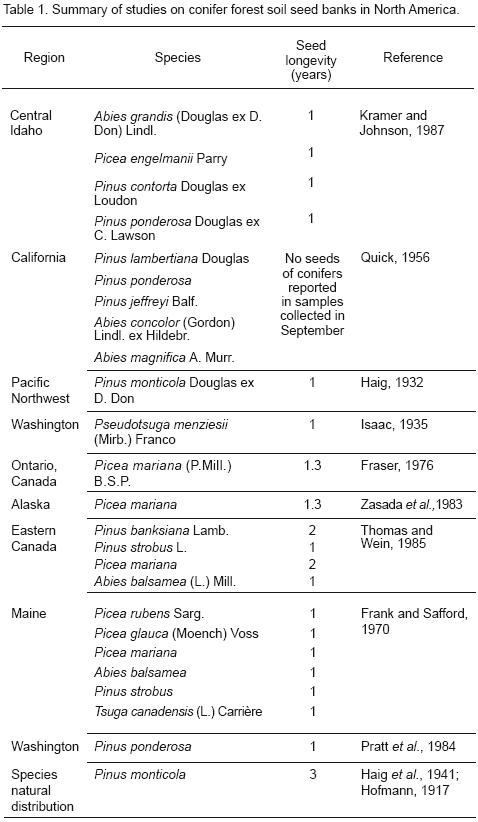
<body><![CDATA[<p align="justify"><font face="verdana" size="2">In the coniferous forest, the severity of the environment and disturbance events determine plant regeneration strategies (Archibold, 1989). Knowledge of forest soil seed banks and their response to changes can help to understand plant succession. It will also help land managers prescribe site treatments that produce desired vegetation conditions from the perspectives of wildlife habitat, reduced plant competition with crop tree species, and related management concerns (McGee and Feller, 1993).</font></p>     <p align="justify"><font face="verdana" size="2">The viability of naturally dispersed seeds of spruces (<i>Picea</i>) and many pines (<i>Pinus</i>) normally extends into the next growing season and rarely into the second growing season (Stein <i>et al., </i>1974). The well known failure of conifer seeds to persist beyond one year in seed banks has been reported for a variety of forest communities in North America, as seed bank composition studies from The United States and Canada have all documented very short resident times for major conifers (<a href="#t1">Table 1</a>).</font></p>     <p align="center"><font face="verdana" size="2"><a name="t1"></a></font></p>     <p align="center"><font face="verdana" size="2"><img src="/img/revistas/cfm/v34n106/a3t1.jpg"></font></p>     <p align="justify"><font face="verdana" size="2">Mercado and Arriaga (1995) report the soil seed bank composition for a Mexican pine&#150;oak ecosystem (<i>Pinus lagunae </i>(Rob.&#150;Pass.) Passini<i>, Quercus devia </i>Goldman and <i>Arbutus peninsularis </i>Rose &amp; Goldman). Other studies have been developed in lower montane forest (transition zone between neartic and neotropical floristic regions) of Mexico (Williams&#150;Linera, 1993). Many studies on soil seed banks exist for tropical regions in Mexico (Guevara and G&oacute;mez&#150;Pompa, 1972; Castro&#150;Acu&ntilde;a and Guevara&#150;Sada, 1976; &Aacute;lvarez&#150;Buylla and Mart&iacute;nez&#150;Ramos, 1990; V&aacute;zquez&#150;Y&aacute;nes and Orozco&#150;Segovia, 1990; Rico&#150;Gray and Garc&iacute;a&#150;Franco, 1992; Quintana&#150;Ascencio <i>et al., </i>1996; V&aacute;zquez&#150;Y&aacute;nes <i>et al.</i>, 1996).</font></p>     <p align="justify"><font face="verdana" size="2">Flores and P&eacute;rez (1990) sampled the forest floor in stands of <i>P. montezumae </i>at San Juan Tetla, Puebla, Mexico, before the seed dispersal season. They found an average of 60 seeds/m<sup>2</sup> of <i>P. montezumae </i>with 0% viable seed, which indicates the short period of time that seeds of this species remain viable.</font></p>     <p align="justify"><font face="verdana" size="2">Several questions about the role of the soil seed bank in stands of this species were identified: What is the abundance and diversity of the soil seed bank? Does one or a few species dominate? Are many species represented? Are species predominantly herbaceous or woody?</font></p>     <p align="justify"><font face="verdana" size="2">In order to provide answers to these questions, the purpose of this study was to characterize the soil seed bank of a <i>Pinus montezumae </i>forest. The specific objectives were:</font></p>     <p align="justify"><font face="verdana" size="2">1. To identify species and estimate seedling abundance that can be expected in a regenerating stand from buried seeds using the seedling&#150;emergence method for soil samples from stands of <i>Pinus montezumae </i>at San Juan Tetla.</font></p>     <p align="justify"><font face="verdana" size="2">2. To determine the depth distribution of buried seeds within the soil profile beneath <i>P. montezumae </i>stands.</font></p>     ]]></body>
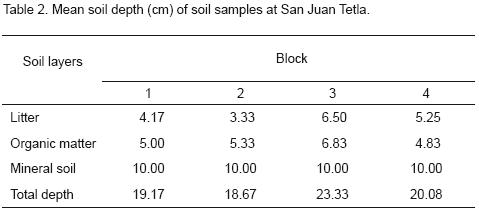
<body><![CDATA[<p align="justify"><font face="verdana" size="2">3. To assess the degree to which seed bank populations reflect the species composition of current stands.</font></p>     <p align="justify"><font face="verdana" size="2">&nbsp;</font></p>     <p align="justify"><font face="verdana" size="2"><b>MATERIALS AND METHODS</b></font></p>     <p align="justify"><font face="verdana" size="2">San Juan Tetla Experimental Station lied on the east slope of the Iztacc&iacute;huatl volcano (19&deg;10'N, 98&deg; 36'W), in the Municipio of Chiautzingo, State of Puebla, Mexico. The station has 15,80 ha approximately and its altitude range goes from 3,000 to 3,600 m; it includes mainly mixed stands of <i>P. montezumae</i>, <i>P. hartwegii </i>Lindl., <i>Abies religiosa</i>, <i>P. ayacahuite </i>var. <i>veitchii </i>(Roezl) Shaw and various hardwood species (Boy&aacute;s, 1993).</font></p>     <p align="justify"><font face="verdana" size="2">The average annual precipitation is 1,169 mm, maximum rainfall occurs in summer (June&#150;August), decreases to very low levels in winter (December&#150;February), and remains low until May.</font></p>     <p align="justify"><font face="verdana" size="2">The stands used in this study were located about 1.5 km east of the station headquarters and were dominated by <i>P. montezumae, </i>with minor and varying proportions of three other conifers: white pine <i>(P. ayacahuite </i>var. <i>veitchii), </i>yellow pine <i>(P. teocote </i>Schiede ex Schltdl. &amp; Cham.) and fir <i>(Abies religiosa).</i>In addition, several species of hardwoods are present, including alder <i>(Alnus firmifolia), </i>willows <i>(Salix oxylepis </i>Schn. and <i>Salix </i>sp.) and an oak <i>(Quercus laurina </i>Humb. <i>et </i>Bonpl.). The understory is dense enough to make it difficult to walk through the stand; it was dominated by small <i>Alnus </i>sp., <i>Quercus </i>sp., <i>Salix </i>sp. and a lush growth of perennial and malodorous <i>Senecio </i>sp. and other herbaceous vegetation. The understory is sufficiently dense to make it difficult walking through the stand.</font></p>     <p align="justify"><font face="verdana" size="2">The inventory indicates that this stand averages 156.1 trees/ha with a basal area of 37.61 m<sup>2</sup>/ha, of which 110.9 trees/ha and 32.75 m<sup>2</sup>/ha were montezuma pine, which made up 70 per cent of the stems ha<sup>&#150;1</sup> and 87 per cent of the basal area ha<sup>&#150;1</sup>.</font></p>     <p align="justify"><font face="verdana" size="2">Soil samples were collected from four blocks in a natural regeneration study area. Soil and litter samples were collected on July from rectangular plots of 0.16 m<sup>2</sup>, after <i>P. montezumae </i>seed dispersion (Acosta and Mus&aacute;lem, 1986). Six systematically distributed samples were taken from each block, and all of them were separated into three layers: litter, organic matter (humus) and mineral soil (horizon A<sub>1</sub>). The litter layer at San Juan Tetla can be deep, as much as 40&#150;50 cm at some sites, but none of the samples in this study had this depth (<a href="#t2">Table 2</a>). A fixed mineral soil depth of 10 cm was also assessed. The samples for each litter, organic matter (humus) and mineral soil depth interval from the 6 plots were kept separate within each block, placed in plastic bags and thoroughly mixed. The six samples were divided into three subsamples (litter, organic matter and mineral soil) from each block (3 soil subsamples &times; 6 plot/block &times; 4 blocks = 72 subsamples total). The total surface area sampled was 3.84 m<sup>2</sup>.</font></p>     <p align="center"><font face="verdana" size="2"><a name="t2"></a></font></p>     <p align="center"><font face="verdana" size="2"><img src="/img/revistas/cfm/v34n106/a3t2.jpg"></font></p>     ]]></body>
<body><![CDATA[<p align="justify"><font face="verdana" size="2">The seedling&#150;emergence method was chosen because it has the advantage over physical separation techniques of being less labor intensive, and does not need additional viability tests (Roberts, 1981). As forest soil contains large amounts of organic material, the seedling&#150;emergence method is the only practical method available, and hence it has been used by most researchers (Kjellson, 1992). Finally, no 'library' of seed samples was available for species likely to be contained in the soil seed bank of San Juan Tetla.</font></p>     <p align="justify"><font face="verdana" size="2">All soil and litter samples were placed in 50 &times; 70 cm wooden flats in a greenhouse. Samples were watered as needed. Number and emergence time of seedlings were recorded weekly for a nine months period. Annual seedlings were removed after species identification to eliminate crowding of new emergents and to prevent seed production from mature plants.</font></p>     <p align="justify"><font face="verdana" size="2"><b>Data analysis</b></font></p>     <p align="justify"><font face="verdana" size="2">Plant identification was based on the checklists made specifically for San Juan Tetla (May&#150;Nah, 1971; Boy&aacute;s, 1993). and the flora of the Valle de M&eacute;xico, according to the similarity of ecosystems (S&aacute;nchez, 1979; Rzedowski and Rzedowski, 1985).</font></p>     <p align="justify"><font face="verdana" size="2">Comparisons between soil samples for different blocks <i>(e.g. </i>1 <i>vs </i>2, 1 <i>vs </i>3, etc.) were tested in order to find differences in species composition among the four blocks. These similarity was calculated through Sorensen's index of similarity (Jonsson, 1993):</font></p>     <p align="center"><font face="verdana" size="2"><i>Cs = 2j </i>/<i> (a+b)</i></font></p>     <p align="justify"><font face="verdana" size="2">Where:</font></p>     <p align="justify"><font face="verdana" size="2"><i>j   </i>= number of species common to both samples and </font></p>     <p align="justify"><font face="verdana" size="2"><i>a   </i>= number of species in the sample a </font></p>     <p align="justify"><font face="verdana" size="2"><i>b   </i>= number of species in the sample b</font></p>     ]]></body>
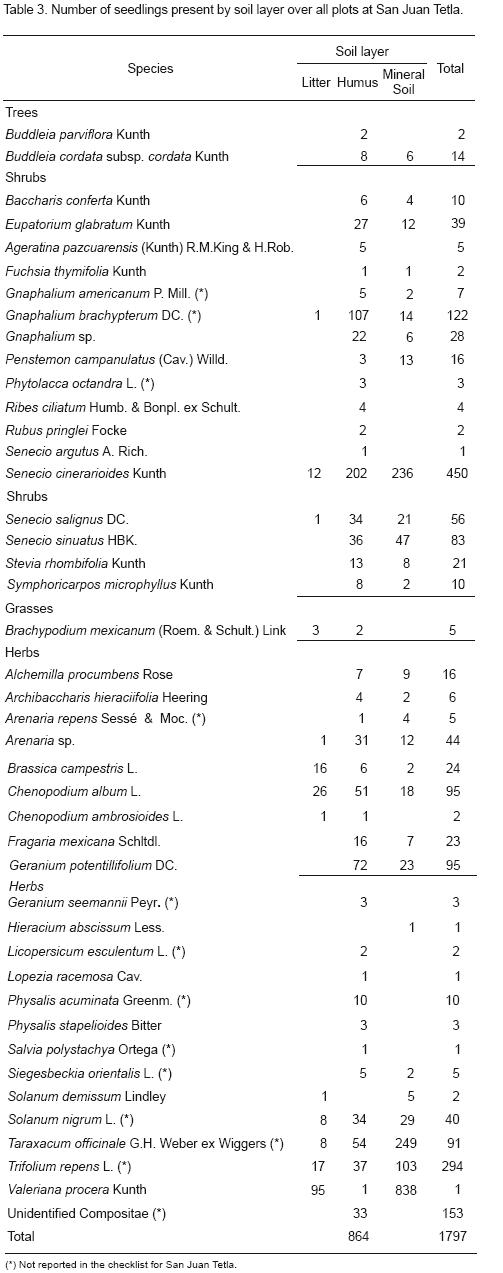
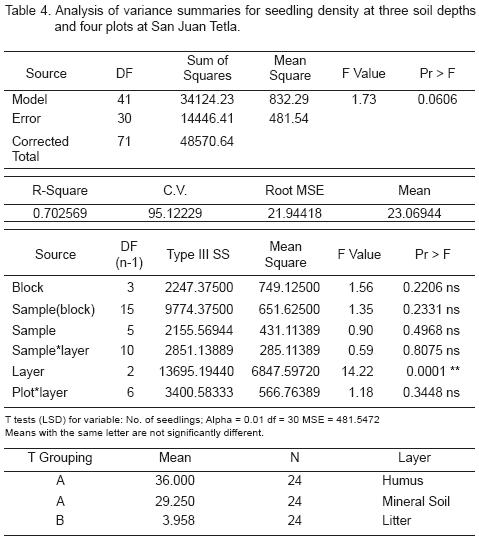
<body><![CDATA[<p align="justify"><font face="verdana" size="2">The index varies from 0 when both samples have no species in common, to 1 when all species occur in common in both samples.</font></p>     <p align="justify"><font face="verdana" size="2">&nbsp;</font></p>     <p align="justify"><font face="verdana" size="2"><b>RESULTS</b></font></p>     <p align="justify"><font face="verdana" size="2">The relationship between soil depth and species density is summarized for all plants in <a href="#t3">Table 3</a>. From the soil samples, a total of 1,797 germinants representing 43 species (2 trees, 17 shrubs, 1 grass and 23 herbs) emerged. Sixteen species occurred in all four blocks (9 herbs and 7 shrubs). The estimated total seed densities varied from 307 m<sup>&#150;2</sup> in block 1 to 595 m<sup>&#150;2</sup> in block 4; the highest densities were found in blocks 3 and 4 and the lowest in blocks 1 and 2. The observed differences in density among blocks were caused primarily by the variable distribution of <i>Senecio cinerarioides </i>Kunth, with large seed banks of 274 seed m<sup>&#150;2</sup> in plot 4. Only one species of grass <i>(Brachypodium mexicanum </i>(Roem. &amp; Schult.) Link) was found in blocks 1 and 2.</font></p>     <p align="center"><font face="verdana" size="2"><a name="t3"></a></font></p>     <p align="center"><font face="verdana" size="2"><img src="/img/revistas/cfm/v34n106/a3t3.jpg"></font></p>     <p align="justify"><font face="verdana" size="2">Seeds of woody species occurred in low densities. The most abundant tree was <i>Buddleia cordata </i>subsp. <i>cordata </i>Kunth, which germinated in three of the four blocks. <i>Dicotyledonous </i>seedlings were much more numerous than monocotyledons in all blocks. Nine herbs and three shrubs found in this study were not reported in the checklist for San Juan Tetla (May&#150;Nah, 1971; Boyas, 1993). Seeds of canopy and shrub layer dominants (<i>Pinus montezumae, P. ayacahuite </i>var. <i>veitchii, Salix </i>sp. and <i>Alnus firmifolia) </i>were completely absent in the buried seed bank.</font></p>     <p align="justify"><font face="verdana" size="2">The qualitative difference between humus and mineral soil is high. Almost all species were present in the humus layer, but only 27 of the 43 species were present inthemineralsoil. The most abundant species (<i>Seneciocinerarioides,</i> <i>Trifoliumrepens </i>and an unidentified Compositae) were most abundant in the mineral soil layer. Thesecond mostabundantgroupofspecies <i>(Gnaphaliumbrachypterum, Taraxacum officinale </i>and <i>Chenopodium album) </i>were more abundant in the humus layer.</font></p>     <p align="justify"><font face="verdana" size="2">The number of germinants was significantly higher (p&lt;0.0001) in humus and mineral soil than litter, but no significant differences between humus and mineral soil or between blocks or samples within plots were found when seed densities were comparised (<a href="#t4">Table 4</a>).</font></p>     <p align="center"><font face="verdana" size="2"><a name="t4"></a></font></p>     ]]></body>
<body><![CDATA[<p align="center"><font face="verdana" size="2"><img src="/img/revistas/cfm/v34n106/a3t4.jpg"></font></p>     <p align="justify"><font face="verdana" size="2">A comparison of the relative abundance of species in seed banks, performed using Sorensen's similarity index, indicated a relatively close correspondence between the four blocks (0.65 to 0.83). The highest similarity was scored for the comparison of blocks 3 and 4, which shared 22 species.</font></p>     <p align="justify"><font face="verdana" size="2">&nbsp;</font></p>     <p align="justify"><font face="verdana" size="2"><b>DISCUSSION</b></font></p>     <p align="justify"><font face="verdana" size="2">Seed bank density.&#150; The densities of buried seeds found in the plots of San Juan Tetla (mean for the four plots = 468 seeds m<sup>&#150;2</sup>) were intermediately relative to densities reported for conifer forests by other authors (Ahlgren, 1979; Granstrom, 1981; Fyles, 1989). Seed densities reported in other studies have been highly variable, where some conifer forests had less than a hundred (Higo <i>et al., </i>1995) to several hundreds of buried seeds m<sup>&#150;2</sup> (Ingersoll and Wilson, 1990; Wlliams&#150;Linera, 1993; Zobel <i>et al., </i>2007). Pratt <i>et al. </i>(1984) quantified over 14,000 seeds m<sup>&#150;2</sup> in the seed bank in an autumn collection in a coniferous forest in central Washington. Kjellsson (1992) described densities over 15,000 seeds m<sup>&#150;2</sup> in Danish deciduous forests. In contrast, Schiffman and Johnson (1992) found an average of 0.43 viable seeds m<sup>&#150;2</sup> at Jefferson National Forest, Virginia, while only 0.23 seeds m<sup>&#150;2</sup> were viable in the mature oak&#150;dominated forest. Clearly, many factors influence soil seed bank densities and generalities about forest soil seed banks are impossible to make.</font></p>     <p align="justify"><font face="verdana" size="2">Seed distribution in relation to soil depth.&#150; Most studies about seed banks in forests soils have reported a decrease of seed density with depth (Pratt <i>et al., </i>1984; Archibold, 1989; McGee and Feller, 1993; Moscoso and Diez, 2005). The vertical distribution of seeds in the soil examined in the present case showed no such general trend, but distinctive distribution patterns were observed for some species. Diverse herb species <i>(Licopersicum esculetum, Lopezia racemosa, Physalis acuminata, Physalis stapelioides, Salvia polystachya </i>and <i>Siegesbeckia orientalis), </i>and several shrubs <i>(Phytolacca octandra, Ribes ciliatum, Rubus pringlei </i>and <i>Senecio argutus) </i>were totally confined to the organic matter (humus) layer, while the most abundant <i>(Senecio cinerarioides, Trifolium repens </i>and one unidentified Compositae) were found, mainly, in the mineral soil layer.</font></p>     <p align="justify"><font face="verdana" size="2">Species recorded deep in the soil generally have seeds with capability for long&#150;term survival. Observations on the longevity of seeds of other <i>Senecio </i>species (22&#150;100 years) (Harrington, 1972; Thompson and Grime, 1979), together with the data presented here, suggest that <i>Senecio cinerarioides </i>may possess a persistent seed bank. The abundance of S. <i>cinerarioides </i>in the soil plots reflects the high production of those plants that do become established.</font></p>     <p align="justify"><font face="verdana" size="2">The depth distributions of the seeds of different species suggest that most of the seeds of S. <i>cinerarioides </i>and <i>Trifolium repens </i>may be quite old. The actual age of even the deepest situated seeds is unknown. Continuous accumulation of plant litter, activities of soil animals, and progressive decomposition of the humus layer may all assist in moving newly produced seeds downwards from the soil surface at an unknown rate (Granstr&ouml;m, 1981).</font></p>     <p align="justify"><font face="verdana" size="2">Small animals have been considered an important factor in herbaceous plant seed dispersal (Mladenoff, 1990; Kjellsson, 1992). Some authors (Granstr&ouml;m, 1981; Turnbull <i>et al., </i>1983) suggest that species with small seeds may have been moved downwards to the mineral soil by the activities of ants or other animals. McRill and Sagar (1973) have demonstrated that earthworms are able to ingest and relocate seeds of many small&#150;seeded species in the soil. Earthworm activity is very low in these <i>Pinus montezumae </i>forests and is probably unimportant in terms of the vertical distribution of seeds. An alternative explanation for the presence of seeds in the mineral soil is that all the seeds registered in this soil layer could be located in the upper part of the mineral soil layer. No partitioning of the mineral soil samples was done, so possible seed stratification at different depths is unknown.</font></p>     <p align="justify"><font face="verdana" size="2">Seed bank composition.&#150; With 43 species, the <i>P. montezumae </i>seed bank community is more diverse than most conifer forest seed banks (Pratt <i>et al., </i>1984). Buried seed reserves are not extensive in coniferous forests where seeds quickly lose viability, and many other seeds are lost to predators. Studies elsewhere, reviewed by Archibold (1989) and Hills and Morris (1992) suggest that early successional plant species are better represented in soil seed banks than later successional species, as such representation allows earlier successional species to be maintained in a region that is prone to periodic disturbance.</font></p>     ]]></body>
<body><![CDATA[<p align="justify"><font face="verdana" size="2">No germinants of conifer tree species were found in this study. Dominant tree species are rarely characterized by abundant buried seed reserves, but the early successional species are well represented. Pratt <i>et al. </i>(1984) discovered in a seed bank of a <i>P. ponderosa&#150;Symphoricarpos albus </i>(L.) Blake habitat a reversal of dominance between the study&#150;area vegetation and the seed bank. Annual forb species, which account for relatively little cover in the stand, comprised most of the seed bank. In contrast, tree and shrub species, which dominated the vegetation, accounted for less than 1% of the seed bank. They estimated the <i>P. ponderosa </i>seed density in spring as 17 seeds m<sup>&#150;2</sup>, and zero seeds m<sup>&#150;2</sup> in autumn prior to seed fall down. Also, in South Africa, De Villiers <i>et al. </i>(2003) concluded that the seed bank site would be a good source of future annual plants, but not of perennial vegetation.</font></p>     <p align="justify"><font face="verdana" size="2">Several other studies of conifer&#150;dominated ecosystems (Kellman, 1970 and 1974; Johnson, 1975; Strickler and Edgerton, 1976; Whipple, 1978; Hill and Stevens, 1981; Mercado and Arriaga&#150;Cabrera, 1995) have reported uncommon germination of conifer seeds. In a <i>Pinus&#150;Quercus </i>forest in the state of Baja California Sur, M&eacute;xico, Mercado and Arriaga (1995) found that the primary species of this forest <i>(Pinus lagunae </i>M.&#150;F. Passini, <i>Quercus devia </i>Goldman and <i>Arbutus peninsularis </i>Rose &amp; Goldman) were not present in the soil seed bank. Zobel <i>et al. </i>(2007) studied a mesophyte mixed spruce forest and found a poor correspondence between the vegetation and the seed bank. <i>P. montezumae, </i>the dominant conifer in the study area, generally produces good seed year crops at 3&#150;5 year intervals (Acosta and Mus&aacute;lem, 1986), and its seeds remain viable for 7&#150;12 months (Flores and P&eacute;rez, 1990). <i>P. ayacahuite </i>produces good seed crops annually, and they remain viable for about the same period mentioned above (Serrano, 1986).</font></p>     <p align="justify"><font face="verdana" size="2">Species of <i>Alnus </i>have been reported to retain their viability for only a short period of time (McGee and Feller, 1993), which could explain why no germinants of alder were found in the study.</font></p>     <p align="justify"><font face="verdana" size="2">The presence of <i>Solanum </i>spp., <i>Fuchsia thymofila </i>and <i>Senecio </i>spp. in the soil seed bank suggest a persistency of these species, while others with low density and in few samples comprise the transient ones.</font></p>     <p align="justify"><font face="verdana" size="2">Sampling was carried out a few years after a good seed crop of P. <i>montezumae, </i>and several months after seeds of <i>P. ayacahuite </i>were dispersed. One important feature of some plants is large seeds, which however makes them susceptible to seed predation (Eriksson, 1995). In a comparative study of small and large seeded species, Reader (1993) found that only species with seeds larger than 0.3 mg were negatively affected by seed predators. Seeds of P. <i>montezumae </i>and P <i>ayacahuite </i>are well above this limit, suggesting that they may suffer from heavy predation.</font></p>     <p align="justify"><font face="verdana" size="2">Increasing seed size makes species more likely to succeed in recruitment under litter, but less likely to be preserved in persistent seed banks. Seed predators are more likely to affect large seeded species, so decreasing seed size enhances development of seed banks, but makes species dependent on factors which temporarily remove the limiting effects of litter.</font></p>     <p align="justify"><font face="verdana" size="2">The results of the experiment suggest that for all species examined here, mineral soil was equal to forest floor (litter and humus) as a germination substrate. Removal of the forest litter and organic matter would remove about one&#150;half of the soil seed bank. If exposure of mineral soil provides a generally superiorsubstrate for seed germination, loss of half of the seed bank might not necessarily lead to a reduction in vegetation cover in the early successional plant community. Only a few species were restricted to just litter and organic matter, so species diversity would not be changed dramatically.</font></p>     <p align="justify"><font face="verdana" size="2">Caution must be applied in extrapolating seed bank studies to potential seedling populations in the field, partly because of problems in determining soil seed banks and because species establishment from a seed bank is a function of the depth to which the soil is disturbed. Burning, removal, or redistribution of the forest floor will result in different impacts on the seed bank and different potential plant populations (McGee and Feller, 1993). Burning alone can remove different amounts of forest floor depending on the severity of the fire, as has been found in southwestern British Columbia and elsewhere (Feller, 1989).</font></p>     <p align="justify"><font face="verdana" size="2">&nbsp;</font></p>     <p align="justify"><font face="verdana" size="2"><b>CONCLUSIONS</b></font></p>     ]]></body>
<body><![CDATA[<p align="justify"><font face="verdana" size="2">Seed density and species diversity of the seed bank in <i>Pinus montezumae </i>stands sampled for this study compared with literature reports were average, facts that are attributed to the high density of shrubs and herbs.</font></p>     <p align="justify"><font face="verdana" size="2">Dominant species (<i>P. montezumae</i>) and codominant species (<i>P. ayacahuite </i>var. <i>veitchii</i>, <i>Abies religiosa </i>and <i>Alnus firmifolia</i>) in the stand were not comparable with species dominance in the seed bank.</font></p>     <p align="justify"><font face="verdana" size="2">Viable seeds of most species were contained in similar abundance in the humus and mineral soil layers.</font></p>     <p align="justify"><font face="verdana" size="2">Regeneration of desirable (commercial) species under any regeneration cutting method will be expected from seed production in the current or future years, or few seeds produced off site, but none will be expected from the soil seed bank.</font></p>     <p align="justify"><font face="verdana" size="2">&nbsp;</font></p>     <p align="justify"><font face="verdana" size="2"><b>REFERENCES</b></font></p>     <!-- ref --><p align="justify"><font face="verdana" size="2">Acosta M., M. y M. A. Mus&aacute;lem. 1986. Dispersi&oacute;n de semillas de <i>Pinus montezumae </i>Lamb., en dos matarrasas del Campo Experimental Forestal San Juan Tetla, Puebla. Revista Chapingo 52: 35&#150;40.    &nbsp;&nbsp;&nbsp;&nbsp;&nbsp;&nbsp;&nbsp;&nbsp;[&#160;<a href="javascript:void(0);" onclick="javascript: window.open('/scielo.php?script=sci_nlinks&ref=1856724&pid=S1405-3586200900020000300001&lng=','','width=640,height=500,resizable=yes,scrollbars=1,menubar=yes,');">Links</a>&#160;]<!-- end-ref --> </font></p>     <!-- ref --><p align="justify"><font face="verdana" size="2">Ahlgren, C. E. 1979. Buried seed in the forest floor of the boundary waters canoe area. Minn. For. Res. Note 271. 4 p.    &nbsp;&nbsp;&nbsp;&nbsp;&nbsp;&nbsp;&nbsp;&nbsp;[&#160;<a href="javascript:void(0);" onclick="javascript: window.open('/scielo.php?script=sci_nlinks&ref=1856726&pid=S1405-3586200900020000300002&lng=','','width=640,height=500,resizable=yes,scrollbars=1,menubar=yes,');">Links</a>&#160;]<!-- end-ref --> </font></p>     ]]></body>
<body><![CDATA[<!-- ref --><p align="justify"><font face="verdana" size="2">&Aacute;lvarez&#150;Buylla, E. R. and M. Mart&iacute;nez&#150;Ramos. 1990. Seed bank versus seed rain in the regeneration of a tropical pioneer tree. Oecologia 84(3):314&#150;325.    &nbsp;&nbsp;&nbsp;&nbsp;&nbsp;&nbsp;&nbsp;&nbsp;[&#160;<a href="javascript:void(0);" onclick="javascript: window.open('/scielo.php?script=sci_nlinks&ref=1856728&pid=S1405-3586200900020000300003&lng=','','width=640,height=500,resizable=yes,scrollbars=1,menubar=yes,');">Links</a>&#160;]<!-- end-ref --> </font></p>     <!-- ref --><p align="justify"><font face="verdana" size="2">Archibold, O. W. 1989. Seed banks and vegetation processes in coniferous forests. <i>In</i>: Leck, M. A., Parker, V. T. and R. L. Simpson (Eds.). Ecology of Soil Seed Banks.  Academic Press, San Diego, Calif., pp. 107&#150;122.    &nbsp;&nbsp;&nbsp;&nbsp;&nbsp;&nbsp;&nbsp;&nbsp;[&#160;<a href="javascript:void(0);" onclick="javascript: window.open('/scielo.php?script=sci_nlinks&ref=1856730&pid=S1405-3586200900020000300004&lng=','','width=640,height=500,resizable=yes,scrollbars=1,menubar=yes,');">Links</a>&#160;]<!-- end-ref --> </font></p>     <!-- ref --><p align="justify"><font face="verdana" size="2">Boy&aacute;s D., J. C. 1993. Flora fanerog&aacute;mica del Campo Experimental Forestal San Juan Tetla, Puebla. Bolet&iacute;n T&eacute;cnico No.114. (2a. Ed.) INIFAP. M&eacute;xico, D. F. M&eacute;xico. 103 p.    &nbsp;&nbsp;&nbsp;&nbsp;&nbsp;&nbsp;&nbsp;&nbsp;[&#160;<a href="javascript:void(0);" onclick="javascript: window.open('/scielo.php?script=sci_nlinks&ref=1856732&pid=S1405-3586200900020000300005&lng=','','width=640,height=500,resizable=yes,scrollbars=1,menubar=yes,');">Links</a>&#160;]<!-- end-ref --> </font></p>     <!-- ref --><p align="justify"><font face="verdana" size="2">Brown, D. 1992. Estimating the composition of a forest seed bank: a comparison of the seed extraction and seedling emergence methods. Can. J. Bot. 70: 1603&#150;1612.    &nbsp;&nbsp;&nbsp;&nbsp;&nbsp;&nbsp;&nbsp;&nbsp;[&#160;<a href="javascript:void(0);" onclick="javascript: window.open('/scielo.php?script=sci_nlinks&ref=1856734&pid=S1405-3586200900020000300006&lng=','','width=640,height=500,resizable=yes,scrollbars=1,menubar=yes,');">Links</a>&#160;]<!-- end-ref --></font></p>     <!-- ref --><p align="justify"><font face="verdana" size="2">Castro&#150;Acu&ntilde;a, R. y S. Guevara&#150;Sada. 1976. Viabilidad de semillas en muestras de suelo almacenado de 'Los Tuxtlas', Veracruz. <i>In: </i>G&oacute;mez&#150;Pompa, A., C. V&aacute;zquez&#150;Yanes, S. del Amo&#150;Rodr&iacute;guez y A. Butanda&#150;Cervera (Eds.). Investigaciones sobre la regeneraci&oacute;n de selvas altas en Veracruz, M&eacute;xico.   INIREB/Compa&ntilde;&iacute;a Editorial Continental, M&eacute;xico, D. F. M&eacute;xico. pp. 233&#150;249.    &nbsp;&nbsp;&nbsp;&nbsp;&nbsp;&nbsp;&nbsp;&nbsp;[&#160;<a href="javascript:void(0);" onclick="javascript: window.open('/scielo.php?script=sci_nlinks&ref=1856736&pid=S1405-3586200900020000300007&lng=','','width=640,height=500,resizable=yes,scrollbars=1,menubar=yes,');">Links</a>&#160;]<!-- end-ref --> </font></p>     ]]></body>
<body><![CDATA[<!-- ref --><p align="justify"><font face="verdana" size="2">Clark, B. F. and S. G. Boyce. 1964. Yellow&#150;poplar seed remain viable in the forest litter. J. For. 62: 564&#150;567.    &nbsp;&nbsp;&nbsp;&nbsp;&nbsp;&nbsp;&nbsp;&nbsp;[&#160;<a href="javascript:void(0);" onclick="javascript: window.open('/scielo.php?script=sci_nlinks&ref=1856738&pid=S1405-3586200900020000300008&lng=','','width=640,height=500,resizable=yes,scrollbars=1,menubar=yes,');">Links</a>&#160;]<!-- end-ref --> </font></p>     <!-- ref --><p align="justify"><font face="verdana" size="2">Conn, J. S., C. L. Cochrane and J. A. DeLapp. 1984. Soil seed bank changes after forest  clearing   and   agricultural   use   in  Alaska.   Weed   Sci. 32: 343&#150;347.    &nbsp;&nbsp;&nbsp;&nbsp;&nbsp;&nbsp;&nbsp;&nbsp;[&#160;<a href="javascript:void(0);" onclick="javascript: window.open('/scielo.php?script=sci_nlinks&ref=1856740&pid=S1405-3586200900020000300009&lng=','','width=640,height=500,resizable=yes,scrollbars=1,menubar=yes,');">Links</a>&#160;]<!-- end-ref --> </font></p>     <!-- ref --><p align="justify"><font face="verdana" size="2">De Villiers, A. J., M. W. Van Rooyen and G. K. Theron. 2003. Similarity between the soil seed bank and the standing vegetation in the Strandveld Succulent Karoo, South Africa. Land Degradation &amp; Development 14(6): 527&#150;540.    &nbsp;&nbsp;&nbsp;&nbsp;&nbsp;&nbsp;&nbsp;&nbsp;[&#160;<a href="javascript:void(0);" onclick="javascript: window.open('/scielo.php?script=sci_nlinks&ref=1856742&pid=S1405-3586200900020000300010&lng=','','width=640,height=500,resizable=yes,scrollbars=1,menubar=yes,');">Links</a>&#160;]<!-- end-ref --> </font></p>     <!-- ref --><p align="justify"><font face="verdana" size="2">Eriksson, O. 1995. Seedling recruitment in deciduous forest herbs: the effects of litter, soil chemistry and seed bank. Flora 190: 65&#150;70.    &nbsp;&nbsp;&nbsp;&nbsp;&nbsp;&nbsp;&nbsp;&nbsp;[&#160;<a href="javascript:void(0);" onclick="javascript: window.open('/scielo.php?script=sci_nlinks&ref=1856744&pid=S1405-3586200900020000300011&lng=','','width=640,height=500,resizable=yes,scrollbars=1,menubar=yes,');">Links</a>&#160;]<!-- end-ref --> </font></p>     <!-- ref --><p align="justify"><font face="verdana" size="2">Feller, M. C. 1989. Estimation of nutrient loss to the atmosphere from slashburns in British Columbia. <i>In: </i>Maclver, D. C, H. Auld and R. Whitewood (Eds.). Proceedings of the 10th. Conference on Fire and Forest Meteorology. Environment Canada, Ottawa, Canada, pp. 126&#150;135.    &nbsp;&nbsp;&nbsp;&nbsp;&nbsp;&nbsp;&nbsp;&nbsp;[&#160;<a href="javascript:void(0);" onclick="javascript: window.open('/scielo.php?script=sci_nlinks&ref=1856746&pid=S1405-3586200900020000300012&lng=','','width=640,height=500,resizable=yes,scrollbars=1,menubar=yes,');">Links</a>&#160;]<!-- end-ref --> </font></p>     ]]></body>
<body><![CDATA[<!-- ref --><p align="justify"><font face="verdana" size="2">Flores A., E. y J. L. P&eacute;rez B. 1990. Evaluaci&oacute;n del banco de semillas en un rodal de <i>Pinus montezumae </i>Lamb. <i>In: </i>Memoria de la Reuni&oacute;n de los 10 a&ntilde;os de investigaci&oacute;n forestal en  la Regi&oacute;n Central de M&eacute;xico. SARH&#150; INIFAP&#150;CIRCE. Metepec, Edo. de M&eacute;x. M&eacute;xico, pp. 11.    &nbsp;&nbsp;&nbsp;&nbsp;&nbsp;&nbsp;&nbsp;&nbsp;[&#160;<a href="javascript:void(0);" onclick="javascript: window.open('/scielo.php?script=sci_nlinks&ref=1856748&pid=S1405-3586200900020000300013&lng=','','width=640,height=500,resizable=yes,scrollbars=1,menubar=yes,');">Links</a>&#160;]<!-- end-ref --> </font></p>     <!-- ref --><p align="justify"><font face="verdana" size="2">Frank, R. M. and I. O. Safford. 1970. Lack of viable seeds in the forest floor after clearcutting. J. For. 68: 776&#150;778.    &nbsp;&nbsp;&nbsp;&nbsp;&nbsp;&nbsp;&nbsp;&nbsp;[&#160;<a href="javascript:void(0);" onclick="javascript: window.open('/scielo.php?script=sci_nlinks&ref=1856750&pid=S1405-3586200900020000300014&lng=','','width=640,height=500,resizable=yes,scrollbars=1,menubar=yes,');">Links</a>&#160;]<!-- end-ref --> </font></p>     <!-- ref --><p align="justify"><font face="verdana" size="2">Fraser, J. W. 1976. Viability of black spruce seed in or on a boreal forest seedbed. For. Chron. 52:229&#150;231.    &nbsp;&nbsp;&nbsp;&nbsp;&nbsp;&nbsp;&nbsp;&nbsp;[&#160;<a href="javascript:void(0);" onclick="javascript: window.open('/scielo.php?script=sci_nlinks&ref=1856752&pid=S1405-3586200900020000300015&lng=','','width=640,height=500,resizable=yes,scrollbars=1,menubar=yes,');">Links</a>&#160;]<!-- end-ref --> </font></p>     <!-- ref --><p align="justify"><font face="verdana" size="2">Fyles, W. M. 1989. Seed bank populations in upland coniferous forest in central Alberta. Can. J. Bot. 67: 274&#150;278.    &nbsp;&nbsp;&nbsp;&nbsp;&nbsp;&nbsp;&nbsp;&nbsp;[&#160;<a href="javascript:void(0);" onclick="javascript: window.open('/scielo.php?script=sci_nlinks&ref=1856754&pid=S1405-3586200900020000300016&lng=','','width=640,height=500,resizable=yes,scrollbars=1,menubar=yes,');">Links</a>&#160;]<!-- end-ref --> </font></p>     <!-- ref --><p align="justify"><font face="verdana" size="2">Granstr&ouml;m, A. 1981. Seed banks in five boreal forest stands originating between 1810 and 1963. Can. J. Bot. 60:1815&#150;1821.    &nbsp;&nbsp;&nbsp;&nbsp;&nbsp;&nbsp;&nbsp;&nbsp;[&#160;<a href="javascript:void(0);" onclick="javascript: window.open('/scielo.php?script=sci_nlinks&ref=1856756&pid=S1405-3586200900020000300017&lng=','','width=640,height=500,resizable=yes,scrollbars=1,menubar=yes,');">Links</a>&#160;]<!-- end-ref --> </font></p>     ]]></body>
<body><![CDATA[<!-- ref --><p align="justify"><font face="verdana" size="2">Guevara S., S. and A. G&oacute;mez&#150;Pompa. 1972. Seeds from surface soils in a tropical region of Veracruz, Mexico. J.Arnold Arbor. 53: 312&#150;335.    &nbsp;&nbsp;&nbsp;&nbsp;&nbsp;&nbsp;&nbsp;&nbsp;[&#160;<a href="javascript:void(0);" onclick="javascript: window.open('/scielo.php?script=sci_nlinks&ref=1856758&pid=S1405-3586200900020000300018&lng=','','width=640,height=500,resizable=yes,scrollbars=1,menubar=yes,');">Links</a>&#160;]<!-- end-ref --> </font></p>     <!-- ref --><p align="justify"><font face="verdana" size="2">Haig, I. T. 1932. Premature germination of forest tree seed during natural storage in the duff. Ecology 13:311&#150;312.    &nbsp;&nbsp;&nbsp;&nbsp;&nbsp;&nbsp;&nbsp;&nbsp;[&#160;<a href="javascript:void(0);" onclick="javascript: window.open('/scielo.php?script=sci_nlinks&ref=1856760&pid=S1405-3586200900020000300019&lng=','','width=640,height=500,resizable=yes,scrollbars=1,menubar=yes,');">Links</a>&#160;]<!-- end-ref --> </font></p>     <!-- ref --><p align="justify"><font face="verdana" size="2">Haig, I. T., K. P. David and R. H. Weidman. 1941. Natural regeneration in the Western white pine type. U.S. Dept. Agr. Tech. Bui. 767. 99 p.    &nbsp;&nbsp;&nbsp;&nbsp;&nbsp;&nbsp;&nbsp;&nbsp;[&#160;<a href="javascript:void(0);" onclick="javascript: window.open('/scielo.php?script=sci_nlinks&ref=1856762&pid=S1405-3586200900020000300020&lng=','','width=640,height=500,resizable=yes,scrollbars=1,menubar=yes,');">Links</a>&#160;]<!-- end-ref --> </font></p>     <!-- ref --><p align="justify"><font face="verdana" size="2">Harrington, J. F 1972. Seed storage and longevity. <i>In: </i>Kozlowski, T. T. (Ed). Seed Biology, Vol. 3. Academic Press, New York, NY. USA. pp. 145&#150;245.    &nbsp;&nbsp;&nbsp;&nbsp;&nbsp;&nbsp;&nbsp;&nbsp;[&#160;<a href="javascript:void(0);" onclick="javascript: window.open('/scielo.php?script=sci_nlinks&ref=1856764&pid=S1405-3586200900020000300021&lng=','','width=640,height=500,resizable=yes,scrollbars=1,menubar=yes,');">Links</a>&#160;]<!-- end-ref --></font></p>     <!-- ref --><p align="justify"><font face="verdana" size="2">Higo, M., A. Shinohara and S. Kodama. 1995. The regeneration behavior of major component species in the secondary forest dominated by <i>Pinus densiflora </i>and <i>Quercus serrata </i>in central Japan. Forest Ecology and Management 76:1&#150;10.    &nbsp;&nbsp;&nbsp;&nbsp;&nbsp;&nbsp;&nbsp;&nbsp;[&#160;<a href="javascript:void(0);" onclick="javascript: window.open('/scielo.php?script=sci_nlinks&ref=1856766&pid=S1405-3586200900020000300022&lng=','','width=640,height=500,resizable=yes,scrollbars=1,menubar=yes,');">Links</a>&#160;]<!-- end-ref --> </font></p>     ]]></body>
<body><![CDATA[<!-- ref --><p align="justify"><font face="verdana" size="2">Hill, M. O. and P. A. Stevens. 1981. The density of viable seed in soils of forest plantations in upland Britain. J. Ecol. 69: 693&#150;709.    &nbsp;&nbsp;&nbsp;&nbsp;&nbsp;&nbsp;&nbsp;&nbsp;[&#160;<a href="javascript:void(0);" onclick="javascript: window.open('/scielo.php?script=sci_nlinks&ref=1856768&pid=S1405-3586200900020000300023&lng=','','width=640,height=500,resizable=yes,scrollbars=1,menubar=yes,');">Links</a>&#160;]<!-- end-ref --> </font></p>     <!-- ref --><p align="justify"><font face="verdana" size="2">Hills, S. C. and D. M. Morris. 1992. The function of seed banks in northern forest ecosystems: a literature review. Ont. Minist. Nat. Resour. For. Res. Inf. Pap. No. 107. 25 p.    &nbsp;&nbsp;&nbsp;&nbsp;&nbsp;&nbsp;&nbsp;&nbsp;[&#160;<a href="javascript:void(0);" onclick="javascript: window.open('/scielo.php?script=sci_nlinks&ref=1856770&pid=S1405-3586200900020000300024&lng=','','width=640,height=500,resizable=yes,scrollbars=1,menubar=yes,');">Links</a>&#160;]<!-- end-ref --></font></p>     <!-- ref --><p align="justify"><font face="verdana" size="2">Hofmann, J. V. 1917. Natural reproduction from seed stored in the forest floor. Jour. Agr. Res. 11:1&#150;26.    &nbsp;&nbsp;&nbsp;&nbsp;&nbsp;&nbsp;&nbsp;&nbsp;[&#160;<a href="javascript:void(0);" onclick="javascript: window.open('/scielo.php?script=sci_nlinks&ref=1856772&pid=S1405-3586200900020000300025&lng=','','width=640,height=500,resizable=yes,scrollbars=1,menubar=yes,');">Links</a>&#160;]<!-- end-ref --> </font></p>     <!-- ref --><p align="justify"><font face="verdana" size="2">Ingersoll, C. A. and M. V. Wilson. 1990. Buried propagules in an old&#150;growth forest and their response to experimental disturbances. Can. J. Bot. 68:1156&#150;1162.    &nbsp;&nbsp;&nbsp;&nbsp;&nbsp;&nbsp;&nbsp;&nbsp;[&#160;<a href="javascript:void(0);" onclick="javascript: window.open('/scielo.php?script=sci_nlinks&ref=1856774&pid=S1405-3586200900020000300026&lng=','','width=640,height=500,resizable=yes,scrollbars=1,menubar=yes,');">Links</a>&#160;]<!-- end-ref --> </font></p>     <!-- ref --><p align="justify"><font face="verdana" size="2">Isaac, L. A. 1935. Life of Douglas fir seed in the forest floor. J. For. 33:61&#150;66.    &nbsp;&nbsp;&nbsp;&nbsp;&nbsp;&nbsp;&nbsp;&nbsp;[&#160;<a href="javascript:void(0);" onclick="javascript: window.open('/scielo.php?script=sci_nlinks&ref=1856776&pid=S1405-3586200900020000300027&lng=','','width=640,height=500,resizable=yes,scrollbars=1,menubar=yes,');">Links</a>&#160;]<!-- end-ref --> </font></p>     ]]></body>
<body><![CDATA[<!-- ref --><p align="justify"><font face="verdana" size="2">Johnson, A. E. 1975. Buried seed populations in the subartic forest east of Great Slave Lake, Northwest Territories. Can. J. Bot. 48: 2933&#150;2941.    &nbsp;&nbsp;&nbsp;&nbsp;&nbsp;&nbsp;&nbsp;&nbsp;[&#160;<a href="javascript:void(0);" onclick="javascript: window.open('/scielo.php?script=sci_nlinks&ref=1856778&pid=S1405-3586200900020000300028&lng=','','width=640,height=500,resizable=yes,scrollbars=1,menubar=yes,');">Links</a>&#160;]<!-- end-ref --> </font></p>     <!-- ref --><p align="justify"><font face="verdana" size="2">Jonsson, B. G. 1993. The bryophyte  diaspore bank and its role after small&#150;scale disturbance in a boreal forest. Journal of Vegetation Science Vol. 4(6): 819&#150;826.    &nbsp;&nbsp;&nbsp;&nbsp;&nbsp;&nbsp;&nbsp;&nbsp;[&#160;<a href="javascript:void(0);" onclick="javascript: window.open('/scielo.php?script=sci_nlinks&ref=1856780&pid=S1405-3586200900020000300029&lng=','','width=640,height=500,resizable=yes,scrollbars=1,menubar=yes,');">Links</a>&#160;]<!-- end-ref --> </font></p>     <!-- ref --><p align="justify"><font face="verdana" size="2">Kellman, M. C. 1970. The viable seed content of some forest soils in coastal British Columbia. Can. J. Bot. 48: 1383&#150;1385.    &nbsp;&nbsp;&nbsp;&nbsp;&nbsp;&nbsp;&nbsp;&nbsp;[&#160;<a href="javascript:void(0);" onclick="javascript: window.open('/scielo.php?script=sci_nlinks&ref=1856782&pid=S1405-3586200900020000300030&lng=','','width=640,height=500,resizable=yes,scrollbars=1,menubar=yes,');">Links</a>&#160;]<!-- end-ref --> </font></p>     <!-- ref --><p align="justify"><font face="verdana" size="2">Kellman, M. C. 1974. Preliminary seed budgets for two plant communities in coastal British Columbia. J. Biogeogr. 1: 123&#150;133.    &nbsp;&nbsp;&nbsp;&nbsp;&nbsp;&nbsp;&nbsp;&nbsp;[&#160;<a href="javascript:void(0);" onclick="javascript: window.open('/scielo.php?script=sci_nlinks&ref=1856784&pid=S1405-3586200900020000300031&lng=','','width=640,height=500,resizable=yes,scrollbars=1,menubar=yes,');">Links</a>&#160;]<!-- end-ref --> </font></p>     <!-- ref --><p align="justify"><font face="verdana" size="2">Kjellson, G. 1992. Seed banks in Danish deciduous forests: species composition, seed influx and distribution pattern in soil. Ecography 15:86&#150;100.    &nbsp;&nbsp;&nbsp;&nbsp;&nbsp;&nbsp;&nbsp;&nbsp;[&#160;<a href="javascript:void(0);" onclick="javascript: window.open('/scielo.php?script=sci_nlinks&ref=1856786&pid=S1405-3586200900020000300032&lng=','','width=640,height=500,resizable=yes,scrollbars=1,menubar=yes,');">Links</a>&#160;]<!-- end-ref --> </font></p>     ]]></body>
<body><![CDATA[<!-- ref --><p align="justify"><font face="verdana" size="2">Kramer, N. B. and F. D. Johnson. 1987. Mature forest seed banks of three habitat types in central Idaho. Can. J. Bot. Vol. 65 (9): 1961&#150;1966.    &nbsp;&nbsp;&nbsp;&nbsp;&nbsp;&nbsp;&nbsp;&nbsp;[&#160;<a href="javascript:void(0);" onclick="javascript: window.open('/scielo.php?script=sci_nlinks&ref=1856788&pid=S1405-3586200900020000300033&lng=','','width=640,height=500,resizable=yes,scrollbars=1,menubar=yes,');">Links</a>&#160;]<!-- end-ref --> </font></p>     <!-- ref --><p align="justify"><font face="verdana" size="2">Little, S. Jr. 1950. Ecology and silviculture of white cedar and associated species in southern New Jersey. Yale Univ. Sch. For. Bull. 56. 103 p.    &nbsp;&nbsp;&nbsp;&nbsp;&nbsp;&nbsp;&nbsp;&nbsp;[&#160;<a href="javascript:void(0);" onclick="javascript: window.open('/scielo.php?script=sci_nlinks&ref=1856790&pid=S1405-3586200900020000300034&lng=','','width=640,height=500,resizable=yes,scrollbars=1,menubar=yes,');">Links</a>&#160;]<!-- end-ref --> </font></p>     <!-- ref --><p align="justify"><font face="verdana" size="2">Marks, P. L. 1974. The role of Pin cherry (<i>Prunus pensylvanica </i>L.) in the maintenance of stability in northern hardwood ecosystems. Ecol. Monogr. 44: 73&#150;88.    &nbsp;&nbsp;&nbsp;&nbsp;&nbsp;&nbsp;&nbsp;&nbsp;[&#160;<a href="javascript:void(0);" onclick="javascript: window.open('/scielo.php?script=sci_nlinks&ref=1856792&pid=S1405-3586200900020000300035&lng=','','width=640,height=500,resizable=yes,scrollbars=1,menubar=yes,');">Links</a>&#160;]<!-- end-ref --> </font></p>     <!-- ref --><p align="justify"><font face="verdana" size="2">May&#150;Nah, A. 1971. Estudio fitosociol&oacute;gico del Campo Experimental Forestal San Juan Tetla, Estado de Puebla, M&eacute;xico. Tesis Profesional. Escuela Nacional de Ciencias Biol&oacute;gicas. Instituto Polit&eacute;cnico Nacional.    M&eacute;xico, D. F. M&eacute;xico. 130 p.    &nbsp;&nbsp;&nbsp;&nbsp;&nbsp;&nbsp;&nbsp;&nbsp;[&#160;<a href="javascript:void(0);" onclick="javascript: window.open('/scielo.php?script=sci_nlinks&ref=1856794&pid=S1405-3586200900020000300036&lng=','','width=640,height=500,resizable=yes,scrollbars=1,menubar=yes,');">Links</a>&#160;]<!-- end-ref --> </font></p>     <!-- ref --><p align="justify"><font face="verdana" size="2">McGee, A. and M. C. Feller. 1993. Seed banks of forested and disturbed soils in southwestern British Columbia. Can. J. Bot. 71: 1574&#150;1583.    &nbsp;&nbsp;&nbsp;&nbsp;&nbsp;&nbsp;&nbsp;&nbsp;[&#160;<a href="javascript:void(0);" onclick="javascript: window.open('/scielo.php?script=sci_nlinks&ref=1856796&pid=S1405-3586200900020000300037&lng=','','width=640,height=500,resizable=yes,scrollbars=1,menubar=yes,');">Links</a>&#160;]<!-- end-ref --> </font></p>     ]]></body>
<body><![CDATA[<!-- ref --><p align="justify"><font face="verdana" size="2">McRill, M. and G. R. Sagar. 1973. The ingestion of weed seed by earthworms. Proceedings of the 12th. British Weed Control Conference, Brighton, UK. Vol II: 519&#150;524.    &nbsp;&nbsp;&nbsp;&nbsp;&nbsp;&nbsp;&nbsp;&nbsp;[&#160;<a href="javascript:void(0);" onclick="javascript: window.open('/scielo.php?script=sci_nlinks&ref=1856798&pid=S1405-3586200900020000300038&lng=','','width=640,height=500,resizable=yes,scrollbars=1,menubar=yes,');">Links</a>&#160;]<!-- end-ref --></font></p>     <!-- ref --><p align="justify"><font face="verdana" size="2">Mercado, C. and L. Arriaga&#150;Cabrera. 1995. Seed bank and treefall gaps in a Mexican temperate forest. <i>In: </i>DeBano, L. F., P. F. Ffolliott, A. Ortega&#150;Rubio, G. J. Gottfried, R. H. Hamre and C. B. Edminster (Eds.): Conference on the Biodiversity and Management of the Madrean Archipelago: The Sky Islands of the Southwestern United States and Northwestern Mexico. U.S.D.A. Rocky Mountain Forest and Range Experimental Station. General Technical Report RM&#150;GTR&#150;264. Fort Collins, CO. USA. pp. 599&#150;601.    &nbsp;&nbsp;&nbsp;&nbsp;&nbsp;&nbsp;&nbsp;&nbsp;[&#160;<a href="javascript:void(0);" onclick="javascript: window.open('/scielo.php?script=sci_nlinks&ref=1856800&pid=S1405-3586200900020000300039&lng=','','width=640,height=500,resizable=yes,scrollbars=1,menubar=yes,');">Links</a>&#160;]<!-- end-ref --> </font></p>     <!-- ref --><p align="justify"><font face="verdana" size="2">Mladenoff, D. J. 1990. The relationship of the soil seed bank and understory vegetation in old&#150;growth northern hardwood&#150;hemlock treefall gaps. Can. J. Bot. 68:2714&#150;2721.    &nbsp;&nbsp;&nbsp;&nbsp;&nbsp;&nbsp;&nbsp;&nbsp;[&#160;<a href="javascript:void(0);" onclick="javascript: window.open('/scielo.php?script=sci_nlinks&ref=1856802&pid=S1405-3586200900020000300040&lng=','','width=640,height=500,resizable=yes,scrollbars=1,menubar=yes,');">Links</a>&#160;]<!-- end-ref --> </font></p>     <!-- ref --><p align="justify"><font face="verdana" size="2">Moscoso M., L. V. y M. C. Diez G. 2005. Banco de semillas en un bosque de roble de la cordillera central colombiana. Rev Fac. Nal. Agr. 58(2): 2931&#150;2944.    &nbsp;&nbsp;&nbsp;&nbsp;&nbsp;&nbsp;&nbsp;&nbsp;[&#160;<a href="javascript:void(0);" onclick="javascript: window.open('/scielo.php?script=sci_nlinks&ref=1856804&pid=S1405-3586200900020000300041&lng=','','width=640,height=500,resizable=yes,scrollbars=1,menubar=yes,');">Links</a>&#160;]<!-- end-ref --> </font></p>     <!-- ref --><p align="justify"><font face="verdana" size="2">Pratt, D. W, R. A. Black and B. A. Zamora. 1984. Buried viable seed in a ponderosa pine community. Can. J. Bot. 62: 44&#150;52.    &nbsp;&nbsp;&nbsp;&nbsp;&nbsp;&nbsp;&nbsp;&nbsp;[&#160;<a href="javascript:void(0);" onclick="javascript: window.open('/scielo.php?script=sci_nlinks&ref=1856806&pid=S1405-3586200900020000300042&lng=','','width=640,height=500,resizable=yes,scrollbars=1,menubar=yes,');">Links</a>&#160;]<!-- end-ref --> </font></p>     ]]></body>
<body><![CDATA[<!-- ref --><p align="justify"><font face="verdana" size="2">Quick, C. R. 1956. Viable seeds from the duff and soil of sugar pine forest. For. Sci. 2:36&#150;42.    &nbsp;&nbsp;&nbsp;&nbsp;&nbsp;&nbsp;&nbsp;&nbsp;[&#160;<a href="javascript:void(0);" onclick="javascript: window.open('/scielo.php?script=sci_nlinks&ref=1856808&pid=S1405-3586200900020000300043&lng=','','width=640,height=500,resizable=yes,scrollbars=1,menubar=yes,');">Links</a>&#160;]<!-- end-ref --> </font></p>     <!-- ref --><p align="justify"><font face="verdana" size="2">Quintana&#150;Ascencio,   P.   F.,   M.   Gonz&aacute;lez&#150;Espinoza,   N.   Ram&iacute;rez&#150;Marcial,   G. Dom&iacute;nguez&#150;V&aacute;zquez and M. Mart&iacute;nez&#150;Ico. 1996. Soil seed banks and regeneration of tropical rain forest from milpa fields at the Selva Lacandona, Chiapas, Mexico. Biotropica 28(2): 192&#150;209.    &nbsp;&nbsp;&nbsp;&nbsp;&nbsp;&nbsp;&nbsp;&nbsp;[&#160;<a href="javascript:void(0);" onclick="javascript: window.open('/scielo.php?script=sci_nlinks&ref=1856810&pid=S1405-3586200900020000300044&lng=','','width=640,height=500,resizable=yes,scrollbars=1,menubar=yes,');">Links</a>&#160;]<!-- end-ref --> </font></p>     <!-- ref --><p align="justify"><font face="verdana" size="2">Reader, R. J. 1993. Control of seedling emergence by ground cover and seed predation in relation to seed size for some old&#150;field species. J. Ecol. 81:169&#150;175.    &nbsp;&nbsp;&nbsp;&nbsp;&nbsp;&nbsp;&nbsp;&nbsp;[&#160;<a href="javascript:void(0);" onclick="javascript: window.open('/scielo.php?script=sci_nlinks&ref=1856812&pid=S1405-3586200900020000300045&lng=','','width=640,height=500,resizable=yes,scrollbars=1,menubar=yes,');">Links</a>&#160;]<!-- end-ref --> </font></p>     <!-- ref --><p align="justify"><font face="verdana" size="2">Rico&#150;Gray, V and J. G. Garc&iacute;a&#150;Franco. 1992. Vegetation and soil seed bank of successional stages in tropical lowland deciduous forest. J. Veg. Sci. 3:617&#150;624.    &nbsp;&nbsp;&nbsp;&nbsp;&nbsp;&nbsp;&nbsp;&nbsp;[&#160;<a href="javascript:void(0);" onclick="javascript: window.open('/scielo.php?script=sci_nlinks&ref=1856814&pid=S1405-3586200900020000300046&lng=','','width=640,height=500,resizable=yes,scrollbars=1,menubar=yes,');">Links</a>&#160;]<!-- end-ref --> </font></p>     <!-- ref --><p align="justify"><font face="verdana" size="2">Roberts, H. A. 1981. Seed banks in soils. <i>In: </i>Coaker, T. H. (Ed.). Advances in Applied Biology VI. Academic Press, Ltd. London, UK. pp. 1&#150;55.    &nbsp;&nbsp;&nbsp;&nbsp;&nbsp;&nbsp;&nbsp;&nbsp;[&#160;<a href="javascript:void(0);" onclick="javascript: window.open('/scielo.php?script=sci_nlinks&ref=1856816&pid=S1405-3586200900020000300047&lng=','','width=640,height=500,resizable=yes,scrollbars=1,menubar=yes,');">Links</a>&#160;]<!-- end-ref --> </font></p>     ]]></body>
<body><![CDATA[<!-- ref --><p align="justify"><font face="verdana" size="2">Rzedowski, J. y G. C. de Rzedowski. 1985. Flora fanerog&aacute;mica del Valle de M&eacute;xico I. Instituto de Ecolog&iacute;a. A. C. P&aacute;tzcuaro, Mich., M&eacute;xico. 1406 p.    &nbsp;&nbsp;&nbsp;&nbsp;&nbsp;&nbsp;&nbsp;&nbsp;[&#160;<a href="javascript:void(0);" onclick="javascript: window.open('/scielo.php?script=sci_nlinks&ref=1856818&pid=S1405-3586200900020000300048&lng=','','width=640,height=500,resizable=yes,scrollbars=1,menubar=yes,');">Links</a>&#160;]<!-- end-ref --> </font></p>     <!-- ref --><p align="justify"><font face="verdana" size="2">S&aacute;nchez S., C. 1979. La flora del Valle de M&eacute;xico. Editorial Herrero, S. A. de C. V M&eacute;xico, D. F. M&eacute;xico. 519 p.    &nbsp;&nbsp;&nbsp;&nbsp;&nbsp;&nbsp;&nbsp;&nbsp;[&#160;<a href="javascript:void(0);" onclick="javascript: window.open('/scielo.php?script=sci_nlinks&ref=1856820&pid=S1405-3586200900020000300049&lng=','','width=640,height=500,resizable=yes,scrollbars=1,menubar=yes,');">Links</a>&#160;]<!-- end-ref --> </font></p>     <!-- ref --><p align="justify"><font face="verdana" size="2">Schiffman, P. M. and W. C. Johnson. 1992. Sparse buried seed bank in a Southern Appalachian  oak forest:  Implications for succession. Am.  Midi.  Nat. 127:258&#150;267.    &nbsp;&nbsp;&nbsp;&nbsp;&nbsp;&nbsp;&nbsp;&nbsp;[&#160;<a href="javascript:void(0);" onclick="javascript: window.open('/scielo.php?script=sci_nlinks&ref=1856822&pid=S1405-3586200900020000300050&lng=','','width=640,height=500,resizable=yes,scrollbars=1,menubar=yes,');">Links</a>&#160;]<!-- end-ref --> </font></p>     <!-- ref --><p align="justify"><font face="verdana" size="2">Serrano J., M. S. 1986. Efecto de algunos factores ambientales en la germinaci&oacute;n de semillas de <i>Pinus ayacahuite </i>var. <i>veitchii, </i>bajo condiciones controladas. Tesis Profesional. Universidad Aut&oacute;noma Chapingo. Chapingo, Edo. de M&eacute;x. M&eacute;xico. 72 p.    &nbsp;&nbsp;&nbsp;&nbsp;&nbsp;&nbsp;&nbsp;&nbsp;[&#160;<a href="javascript:void(0);" onclick="javascript: window.open('/scielo.php?script=sci_nlinks&ref=1856824&pid=S1405-3586200900020000300051&lng=','','width=640,height=500,resizable=yes,scrollbars=1,menubar=yes,');">Links</a>&#160;]<!-- end-ref --></font></p>     <!-- ref --><p align="justify"><font face="verdana" size="2">Simpson, R. L., M. A. Leck and V. T. Parker. 1989. Seed banks: general concepts and methodological issues. <i>In: </i>M. A. Leck, V. T. Parker and R. L. Simpson (Eds.): Ecology of Soil Seed Banks. Academic Press. New York, NY. USA. pp. 3&#150;8.    &nbsp;&nbsp;&nbsp;&nbsp;&nbsp;&nbsp;&nbsp;&nbsp;[&#160;<a href="javascript:void(0);" onclick="javascript: window.open('/scielo.php?script=sci_nlinks&ref=1856826&pid=S1405-3586200900020000300052&lng=','','width=640,height=500,resizable=yes,scrollbars=1,menubar=yes,');">Links</a>&#160;]<!-- end-ref --> </font></p>     ]]></body>
<body><![CDATA[<!-- ref --><p align="justify"><font face="verdana" size="2">Smith, D. M. 1986. The practice of silviculture. John Wiley &amp; Sons. Inc. New York, NY. USA. 527 p.    &nbsp;&nbsp;&nbsp;&nbsp;&nbsp;&nbsp;&nbsp;&nbsp;[&#160;<a href="javascript:void(0);" onclick="javascript: window.open('/scielo.php?script=sci_nlinks&ref=1856828&pid=S1405-3586200900020000300053&lng=','','width=640,height=500,resizable=yes,scrollbars=1,menubar=yes,');">Links</a>&#160;]<!-- end-ref --> </font></p>     <!-- ref --><p align="justify"><font face="verdana" size="2">Stein, W. I., P. E. Slabaugh and A. P. Plummer. 1974. Harvesting, processing and storage of fruits and seeds. <i>In</i>: Schopmeyer, C. S. (Technical Coordinator). Seeds of woody plants in the United States., Agriculture Handbook No. 450, U.S. Department of Agriculture. Washington, DC. USA. pp. 98&#150;125.    &nbsp;&nbsp;&nbsp;&nbsp;&nbsp;&nbsp;&nbsp;&nbsp;[&#160;<a href="javascript:void(0);" onclick="javascript: window.open('/scielo.php?script=sci_nlinks&ref=1856830&pid=S1405-3586200900020000300054&lng=','','width=640,height=500,resizable=yes,scrollbars=1,menubar=yes,');">Links</a>&#160;]<!-- end-ref --> </font></p>     <!-- ref --><p align="justify"><font face="verdana" size="2">Strickler, G. S. and P. J. Edgerton. 1976. Emergent seedlings from coniferous litter and soil in Eastern Oregon. Ecology 57(4): 801&#150;807.    &nbsp;&nbsp;&nbsp;&nbsp;&nbsp;&nbsp;&nbsp;&nbsp;[&#160;<a href="javascript:void(0);" onclick="javascript: window.open('/scielo.php?script=sci_nlinks&ref=1856832&pid=S1405-3586200900020000300055&lng=','','width=640,height=500,resizable=yes,scrollbars=1,menubar=yes,');">Links</a>&#160;]<!-- end-ref --> </font></p>     <!-- ref --><p align="justify"><font face="verdana" size="2">Thomas, P. A. and R. W. Wein. 1985. Delayed emergency of four conifer species on postfire seedbeds in eastern Canada. Can. J. For. Res. 15: 727&#150;729.    &nbsp;&nbsp;&nbsp;&nbsp;&nbsp;&nbsp;&nbsp;&nbsp;[&#160;<a href="javascript:void(0);" onclick="javascript: window.open('/scielo.php?script=sci_nlinks&ref=1856834&pid=S1405-3586200900020000300056&lng=','','width=640,height=500,resizable=yes,scrollbars=1,menubar=yes,');">Links</a>&#160;]<!-- end-ref --> </font></p>     <!-- ref --><p align="justify"><font face="verdana" size="2">Thompson, K. and J. P. Grime. 1979. Seasonal variation in the seed banks of herbaceous species in ten contrasting habitats. The Journal of Ecology. Vol. 67(3): 893&#150;921.    &nbsp;&nbsp;&nbsp;&nbsp;&nbsp;&nbsp;&nbsp;&nbsp;[&#160;<a href="javascript:void(0);" onclick="javascript: window.open('/scielo.php?script=sci_nlinks&ref=1856836&pid=S1405-3586200900020000300057&lng=','','width=640,height=500,resizable=yes,scrollbars=1,menubar=yes,');">Links</a>&#160;]<!-- end-ref --> </font></p>     ]]></body>
<body><![CDATA[<!-- ref --><p align="justify"><font face="verdana" size="2">Turnbull, C. L., A. J. Beattie and F. M. Hanzawa. 1983. Seed dispersal by ants in the Rocky Mountains. Southwest. Nat. 28:289&#150;293.    &nbsp;&nbsp;&nbsp;&nbsp;&nbsp;&nbsp;&nbsp;&nbsp;[&#160;<a href="javascript:void(0);" onclick="javascript: window.open('/scielo.php?script=sci_nlinks&ref=1856838&pid=S1405-3586200900020000300058&lng=','','width=640,height=500,resizable=yes,scrollbars=1,menubar=yes,');">Links</a>&#160;]<!-- end-ref --> </font></p>     <!-- ref --><p align="justify"><font face="verdana" size="2">V&aacute;zquez&#150;Y&aacute;nes,   C.   and  A.   Orozco&#150;Segovia.   1990.   Seed   dormancy   in the tropical rain forest. <i>In</i>: Bawa, K. S. and M. Hadley. (Eds.) Reproductive ecology of tropical rainforest plants. UNESCO and Parthenon. MAB Vol. 7. pp. 247&#150;259.    &nbsp;&nbsp;&nbsp;&nbsp;&nbsp;&nbsp;&nbsp;&nbsp;[&#160;<a href="javascript:void(0);" onclick="javascript: window.open('/scielo.php?script=sci_nlinks&ref=1856840&pid=S1405-3586200900020000300059&lng=','','width=640,height=500,resizable=yes,scrollbars=1,menubar=yes,');">Links</a>&#160;]<!-- end-ref --> </font></p>     <!-- ref --><p align="justify"><font face="verdana" size="2">V&aacute;zquez&#150;Y&aacute;nes, C. and M. Rojas&#150;Ar&eacute;chiga. 1996. <i>Ex situ </i>conservation of tropical rain forest seed: problems and perspectives. Interciencia 21: 293&#150;298.    &nbsp;&nbsp;&nbsp;&nbsp;&nbsp;&nbsp;&nbsp;&nbsp;[&#160;<a href="javascript:void(0);" onclick="javascript: window.open('/scielo.php?script=sci_nlinks&ref=1856842&pid=S1405-3586200900020000300060&lng=','','width=640,height=500,resizable=yes,scrollbars=1,menubar=yes,');">Links</a>&#160;]<!-- end-ref --> </font></p>     <!-- ref --><p align="justify"><font face="verdana" size="2">Whipple, S. A. 1978. The relationship of buried germinating seeds to vegetation in an old&#150;growth Colorado subalpine forest. Can. J. Bot. 56: 1505&#150;1509.    &nbsp;&nbsp;&nbsp;&nbsp;&nbsp;&nbsp;&nbsp;&nbsp;[&#160;<a href="javascript:void(0);" onclick="javascript: window.open('/scielo.php?script=sci_nlinks&ref=1856844&pid=S1405-3586200900020000300061&lng=','','width=640,height=500,resizable=yes,scrollbars=1,menubar=yes,');">Links</a>&#160;]<!-- end-ref --> </font></p>     <!-- ref --><p align="justify"><font face="verdana" size="2">Williams&#150;Linera, L. G. 1993. Soil seed banks in four lower montane forest of Mexico. Journal of Trop. Ecol. 9: 321&#150;337.    &nbsp;&nbsp;&nbsp;&nbsp;&nbsp;&nbsp;&nbsp;&nbsp;[&#160;<a href="javascript:void(0);" onclick="javascript: window.open('/scielo.php?script=sci_nlinks&ref=1856846&pid=S1405-3586200900020000300062&lng=','','width=640,height=500,resizable=yes,scrollbars=1,menubar=yes,');">Links</a>&#160;]<!-- end-ref --> </font></p>     ]]></body>
<body><![CDATA[<!-- ref --><p align="justify"><font face="verdana" size="2">Zasada, J. C., R. A. Norum, R. M. Van Veldhuisen and C. E. Teutsch. 1983. Artificial regeneration of trees and tall shrubs in experimentally burned upland black spruce/feather moss stands in Alaska. Can. J. For. Res. 13: 903&#150;913.    &nbsp;&nbsp;&nbsp;&nbsp;&nbsp;&nbsp;&nbsp;&nbsp;[&#160;<a href="javascript:void(0);" onclick="javascript: window.open('/scielo.php?script=sci_nlinks&ref=1856848&pid=S1405-3586200900020000300063&lng=','','width=640,height=500,resizable=yes,scrollbars=1,menubar=yes,');">Links</a>&#160;]<!-- end-ref --> </font></p>     <!-- ref --><p align="justify"><font face="verdana" size="2">Zobel, M., R. Kalamees, K. P&uuml;ssa, E. Roosaluste and M. Moora. 2007. Soil seed bank and vegetation in mixed coniferous forests stands with different disturbance regimes. Forest Ecology and Management 250(1&#150;2): 71&#150;76.    &nbsp;&nbsp;&nbsp;&nbsp;&nbsp;&nbsp;&nbsp;&nbsp;[&#160;<a href="javascript:void(0);" onclick="javascript: window.open('/scielo.php?script=sci_nlinks&ref=1856850&pid=S1405-3586200900020000300064&lng=','','width=640,height=500,resizable=yes,scrollbars=1,menubar=yes,');">Links</a>&#160;]<!-- end-ref --></font></p>      ]]></body><back>
<ref-list>
<ref id="B1">
<nlm-citation citation-type="journal">
<person-group person-group-type="author">
<name>
<surname><![CDATA[Acosta]]></surname>
<given-names><![CDATA[M., M.]]></given-names>
</name>
<name>
<surname><![CDATA[Musálem]]></surname>
<given-names><![CDATA[M. A.]]></given-names>
</name>
</person-group>
<article-title xml:lang="es"><![CDATA[Dispersión de semillas de Pinus montezumae Lamb., en dos matarrasas del Campo Experimental Forestal San Juan Tetla, Puebla]]></article-title>
<source><![CDATA[Revista Chapingo]]></source>
<year>1986</year>
<volume>52</volume>
<page-range>35-40</page-range></nlm-citation>
</ref>
<ref id="B2">
<nlm-citation citation-type="">
<person-group person-group-type="author">
<name>
<surname><![CDATA[Ahlgren]]></surname>
<given-names><![CDATA[C. E.]]></given-names>
</name>
</person-group>
<source><![CDATA[Buried seed in the forest floor of the boundary waters canoe area. Minn. For. Res.]]></source>
<year>1979</year>
<volume>271</volume>
<page-range>4</page-range></nlm-citation>
</ref>
<ref id="B3">
<nlm-citation citation-type="journal">
<person-group person-group-type="author">
<name>
<surname><![CDATA[Álvarez-Buylla]]></surname>
<given-names><![CDATA[E. R.]]></given-names>
</name>
<name>
<surname><![CDATA[Martínez-Ramos]]></surname>
<given-names><![CDATA[M.]]></given-names>
</name>
</person-group>
<article-title xml:lang="en"><![CDATA[Seed bank versus seed rain in the regeneration of a tropical pioneer tree]]></article-title>
<source><![CDATA[Oecologia]]></source>
<year>1990</year>
<volume>84</volume>
<numero>3</numero>
<issue>3</issue>
<page-range>314-325</page-range></nlm-citation>
</ref>
<ref id="B4">
<nlm-citation citation-type="book">
<person-group person-group-type="author">
<name>
<surname><![CDATA[Archibold]]></surname>
<given-names><![CDATA[O. W.]]></given-names>
</name>
</person-group>
<article-title xml:lang="en"><![CDATA[Seed banks and vegetation processes in coniferous forests]]></article-title>
<person-group person-group-type="editor">
<name>
<surname><![CDATA[Leck]]></surname>
<given-names><![CDATA[M. A.]]></given-names>
</name>
<name>
<surname><![CDATA[Parker]]></surname>
<given-names><![CDATA[V. T.]]></given-names>
</name>
<name>
<surname><![CDATA[Simpson]]></surname>
<given-names><![CDATA[R. L.]]></given-names>
</name>
</person-group>
<source><![CDATA[Ecology of Soil Seed Banks]]></source>
<year>1989</year>
<page-range>107-122</page-range><publisher-loc><![CDATA[San Diego^eCalif Calif]]></publisher-loc>
<publisher-name><![CDATA[Academic Press]]></publisher-name>
</nlm-citation>
</ref>
<ref id="B5">
<nlm-citation citation-type="book">
<person-group person-group-type="author">
<name>
<surname><![CDATA[Boyás D.]]></surname>
<given-names><![CDATA[J. C.]]></given-names>
</name>
</person-group>
<source><![CDATA[Flora fanerogámica del Campo Experimental Forestal San Juan Tetla, Puebla]]></source>
<year>1993</year>
<volume>114</volume>
<edition>2a</edition>
<page-range>103</page-range><publisher-loc><![CDATA[México^eD. F. D. F.]]></publisher-loc>
<publisher-name><![CDATA[INIFAP]]></publisher-name>
</nlm-citation>
</ref>
<ref id="B6">
<nlm-citation citation-type="journal">
<person-group person-group-type="author">
<name>
<surname><![CDATA[Brown]]></surname>
<given-names><![CDATA[D.]]></given-names>
</name>
</person-group>
<article-title xml:lang="en"><![CDATA[Estimating the composition of a forest seed bank: a comparison of the seed extraction and seedling emergence methods]]></article-title>
<source><![CDATA[Can. J. Bot.]]></source>
<year>1992</year>
<volume>70</volume>
<page-range>1603-1612</page-range></nlm-citation>
</ref>
<ref id="B7">
<nlm-citation citation-type="book">
<person-group person-group-type="author">
<name>
<surname><![CDATA[Castro-Acuña]]></surname>
<given-names><![CDATA[R.]]></given-names>
</name>
<name>
<surname><![CDATA[Guevara-Sada]]></surname>
<given-names><![CDATA[S.]]></given-names>
</name>
</person-group>
<article-title xml:lang="es"><![CDATA[Viabilidad de semillas en muestras de suelo almacenado de 'Los Tuxtlas', Veracruz]]></article-title>
<person-group person-group-type="editor">
<name>
<surname><![CDATA[Gómez-Pompa]]></surname>
<given-names><![CDATA[A.]]></given-names>
</name>
<name>
<surname><![CDATA[Vázquez-Yanes]]></surname>
<given-names><![CDATA[C.]]></given-names>
</name>
<name>
<surname><![CDATA[del Amo-Rodríguez]]></surname>
<given-names><![CDATA[S.]]></given-names>
</name>
<name>
<surname><![CDATA[Butanda-Cervera]]></surname>
<given-names><![CDATA[A.]]></given-names>
</name>
</person-group>
<source><![CDATA[Investigaciones sobre la regeneración de selvas altas en Veracruz, México]]></source>
<year>1976</year>
<page-range>233-249</page-range><publisher-loc><![CDATA[México^eD. F. D. F.]]></publisher-loc>
<publisher-name><![CDATA[INIREBCompañía Editorial Continental]]></publisher-name>
</nlm-citation>
</ref>
<ref id="B8">
<nlm-citation citation-type="journal">
<person-group person-group-type="author">
<name>
<surname><![CDATA[Clark]]></surname>
<given-names><![CDATA[B. F.]]></given-names>
</name>
<name>
<surname><![CDATA[Boyce]]></surname>
<given-names><![CDATA[S. G.]]></given-names>
</name>
</person-group>
<article-title xml:lang="en"><![CDATA[Yellow-poplar seed remain viable in the forest litter]]></article-title>
<source><![CDATA[J. For.]]></source>
<year>1964</year>
<volume>62</volume>
<page-range>564-567</page-range></nlm-citation>
</ref>
<ref id="B9">
<nlm-citation citation-type="journal">
<person-group person-group-type="author">
<name>
<surname><![CDATA[Conn]]></surname>
<given-names><![CDATA[J. S.]]></given-names>
</name>
<name>
<surname><![CDATA[Cochrane]]></surname>
<given-names><![CDATA[C. L.]]></given-names>
</name>
<name>
<surname><![CDATA[DeLapp]]></surname>
<given-names><![CDATA[J. A.]]></given-names>
</name>
</person-group>
<article-title xml:lang="en"><![CDATA[Soil seed bank changes after forest clearing and agricultural use in Alaska]]></article-title>
<source><![CDATA[Weed Sci.]]></source>
<year>1984</year>
<volume>32</volume>
<page-range>343-347</page-range></nlm-citation>
</ref>
<ref id="B10">
<nlm-citation citation-type="journal">
<person-group person-group-type="author">
<name>
<surname><![CDATA[De Villiers]]></surname>
<given-names><![CDATA[A. J.]]></given-names>
</name>
<name>
<surname><![CDATA[M. W. Van]]></surname>
<given-names><![CDATA[Rooyen]]></given-names>
</name>
<name>
<surname><![CDATA[Theron]]></surname>
<given-names><![CDATA[G. K.]]></given-names>
</name>
</person-group>
<article-title xml:lang="en"><![CDATA[Similarity between the soil seed bank and the standing vegetation in the Strandveld Succulent Karoo, South Africa]]></article-title>
<source><![CDATA[Land Degradation & Development]]></source>
<year>2003</year>
<volume>14</volume>
<numero>6</numero>
<issue>6</issue>
<page-range>527-540</page-range></nlm-citation>
</ref>
<ref id="B11">
<nlm-citation citation-type="journal">
<person-group person-group-type="author">
<name>
<surname><![CDATA[Eriksson]]></surname>
<given-names><![CDATA[O.]]></given-names>
</name>
</person-group>
<article-title xml:lang="en"><![CDATA[Seedling recruitment in deciduous forest herbs: the effects of litter, soil chemistry and seed bank]]></article-title>
<source><![CDATA[Flora]]></source>
<year>1995</year>
<volume>190</volume>
<page-range>65-70</page-range></nlm-citation>
</ref>
<ref id="B12">
<nlm-citation citation-type="confpro">
<person-group person-group-type="author">
<name>
<surname><![CDATA[Feller]]></surname>
<given-names><![CDATA[M. C.]]></given-names>
</name>
</person-group>
<article-title xml:lang="en"><![CDATA[Estimation of nutrient loss to the atmosphere from slashburns in British Columbia]]></article-title>
<person-group person-group-type="editor">
<name>
<surname><![CDATA[Maclver]]></surname>
<given-names><![CDATA[D. C]]></given-names>
</name>
<name>
<surname><![CDATA[Auld]]></surname>
<given-names><![CDATA[H.]]></given-names>
</name>
<name>
<surname><![CDATA[Whitewood]]></surname>
<given-names><![CDATA[R.]]></given-names>
</name>
</person-group>
<source><![CDATA[]]></source>
<year>1989</year>
<conf-name><![CDATA[10th Conference on Fire and Forest Meteorology. Environment Canada]]></conf-name>
<conf-loc>Ottawa </conf-loc>
<page-range>126-135</page-range></nlm-citation>
</ref>
<ref id="B13">
<nlm-citation citation-type="confpro">
<person-group person-group-type="author">
<name>
<surname><![CDATA[Flores A.]]></surname>
<given-names><![CDATA[E.]]></given-names>
</name>
<name>
<surname><![CDATA[Pérez B.]]></surname>
<given-names><![CDATA[J. L.]]></given-names>
</name>
</person-group>
<article-title xml:lang="es"><![CDATA[Evaluación del banco de semillas en un rodal de Pinus montezumae Lamb]]></article-title>
<source><![CDATA[]]></source>
<year>1990</year>
<conf-name><![CDATA[ Memoria de la Reunión de los 10 años de investigación forestal en la Región Central de México]]></conf-name>
<conf-loc>Metepec Edo. de Méx</conf-loc>
<page-range>11</page-range></nlm-citation>
</ref>
<ref id="B14">
<nlm-citation citation-type="journal">
<person-group person-group-type="author">
<name>
<surname><![CDATA[Frank]]></surname>
<given-names><![CDATA[R. M.]]></given-names>
</name>
<name>
<surname><![CDATA[Safford]]></surname>
<given-names><![CDATA[I. O.]]></given-names>
</name>
</person-group>
<article-title xml:lang="en"><![CDATA[Lack of viable seeds in the forest floor after clearcutting]]></article-title>
<source><![CDATA[J. For.]]></source>
<year>1970</year>
<volume>68</volume>
<page-range>776-778</page-range></nlm-citation>
</ref>
<ref id="B15">
<nlm-citation citation-type="journal">
<person-group person-group-type="author">
<name>
<surname><![CDATA[Fraser]]></surname>
<given-names><![CDATA[J. W.]]></given-names>
</name>
</person-group>
<article-title xml:lang="en"><![CDATA[Viability of black spruce seed in or on a boreal forest seedbed]]></article-title>
<source><![CDATA[For. Chron.]]></source>
<year>1976</year>
<volume>52</volume>
<page-range>229-231</page-range></nlm-citation>
</ref>
<ref id="B16">
<nlm-citation citation-type="journal">
<person-group person-group-type="author">
<name>
<surname><![CDATA[Fyles]]></surname>
<given-names><![CDATA[W. M.]]></given-names>
</name>
</person-group>
<article-title xml:lang="en"><![CDATA[Seed bank populations in upland coniferous forest in central Alberta]]></article-title>
<source><![CDATA[Can. J. Bot.]]></source>
<year>1989</year>
<volume>67</volume>
<page-range>274-278</page-range></nlm-citation>
</ref>
<ref id="B17">
<nlm-citation citation-type="journal">
<person-group person-group-type="author">
<name>
<surname><![CDATA[Granström]]></surname>
<given-names><![CDATA[A.]]></given-names>
</name>
</person-group>
<article-title xml:lang="en"><![CDATA[Seed banks in five boreal forest stands originating between 1810 and 1963]]></article-title>
<source><![CDATA[Can. J. Bot.]]></source>
<year>1981</year>
<volume>60</volume>
<page-range>1815-1821</page-range></nlm-citation>
</ref>
<ref id="B18">
<nlm-citation citation-type="journal">
<person-group person-group-type="author">
<name>
<surname><![CDATA[Guevara S.]]></surname>
<given-names><![CDATA[S.]]></given-names>
</name>
<name>
<surname><![CDATA[Gómez-Pompa]]></surname>
<given-names><![CDATA[A.]]></given-names>
</name>
</person-group>
<article-title xml:lang="en"><![CDATA[Seeds from surface soils in a tropical region of Veracruz, Mexico]]></article-title>
<source><![CDATA[J.Arnold Arbor]]></source>
<year>1972</year>
<volume>53</volume>
<page-range>312-335</page-range></nlm-citation>
</ref>
<ref id="B19">
<nlm-citation citation-type="journal">
<person-group person-group-type="author">
<name>
<surname><![CDATA[Haig]]></surname>
<given-names><![CDATA[I. T.]]></given-names>
</name>
</person-group>
<article-title xml:lang="en"><![CDATA[Premature germination of forest tree seed during natural storage in the duff]]></article-title>
<source><![CDATA[Ecology]]></source>
<year>1932</year>
<volume>13</volume>
<page-range>311-312</page-range></nlm-citation>
</ref>
<ref id="B20">
<nlm-citation citation-type="book">
<person-group person-group-type="author">
<name>
<surname><![CDATA[Haig]]></surname>
<given-names><![CDATA[I. T.]]></given-names>
</name>
<name>
<surname><![CDATA[David]]></surname>
<given-names><![CDATA[K. P.]]></given-names>
</name>
<name>
<surname><![CDATA[Weidman]]></surname>
<given-names><![CDATA[R. H.]]></given-names>
</name>
</person-group>
<source><![CDATA[Natural regeneration in the Western white pine type]]></source>
<year>1941</year>
<volume>767</volume>
<page-range>99</page-range><publisher-name><![CDATA[U.S. Dept. Agr. Tech.]]></publisher-name>
</nlm-citation>
</ref>
<ref id="B21">
<nlm-citation citation-type="book">
<person-group person-group-type="author">
<name>
<surname><![CDATA[Harrington]]></surname>
<given-names><![CDATA[J. F]]></given-names>
</name>
</person-group>
<article-title xml:lang="en"><![CDATA[Seed storage and longevity]]></article-title>
<person-group person-group-type="editor">
<name>
<surname><![CDATA[Kozlowski]]></surname>
<given-names><![CDATA[T. T.]]></given-names>
</name>
</person-group>
<source><![CDATA[Seed Biology]]></source>
<year>1972</year>
<volume>3</volume>
<page-range>145-245</page-range><publisher-loc><![CDATA[New York^eNY NY]]></publisher-loc>
<publisher-name><![CDATA[Academic Press]]></publisher-name>
</nlm-citation>
</ref>
<ref id="B22">
<nlm-citation citation-type="journal">
<person-group person-group-type="author">
<name>
<surname><![CDATA[Higo]]></surname>
<given-names><![CDATA[M.]]></given-names>
</name>
<name>
<surname><![CDATA[Shinohara]]></surname>
<given-names><![CDATA[A.]]></given-names>
</name>
<name>
<surname><![CDATA[Kodama]]></surname>
<given-names><![CDATA[S.]]></given-names>
</name>
</person-group>
<article-title xml:lang="en"><![CDATA[The regeneration behavior of major component species in the secondary forest dominated by Pinus densiflora and Quercus serrata in central Japan]]></article-title>
<source><![CDATA[Forest Ecology and Management]]></source>
<year>1995</year>
<volume>76</volume>
<page-range>1-10</page-range></nlm-citation>
</ref>
<ref id="B23">
<nlm-citation citation-type="journal">
<person-group person-group-type="author">
<name>
<surname><![CDATA[Hill]]></surname>
<given-names><![CDATA[M. O.]]></given-names>
</name>
<name>
<surname><![CDATA[Stevens]]></surname>
<given-names><![CDATA[P. A.]]></given-names>
</name>
</person-group>
<article-title xml:lang="en"><![CDATA[The density of viable seed in soils of forest plantations in upland Britain]]></article-title>
<source><![CDATA[J. Ecol.]]></source>
<year>1981</year>
<volume>69</volume>
<page-range>693-709</page-range></nlm-citation>
</ref>
<ref id="B24">
<nlm-citation citation-type="book">
<person-group person-group-type="author">
<name>
<surname><![CDATA[Hills]]></surname>
<given-names><![CDATA[S. C.]]></given-names>
</name>
<name>
<surname><![CDATA[Morris]]></surname>
<given-names><![CDATA[D. M.]]></given-names>
</name>
</person-group>
<source><![CDATA[The function of seed banks in northern forest ecosystems: a literature review]]></source>
<year>1992</year>
<volume>107</volume>
<page-range>25</page-range><publisher-name><![CDATA[Ont. Minist. Nat. Resour. For. Res. Inf.]]></publisher-name>
</nlm-citation>
</ref>
<ref id="B25">
<nlm-citation citation-type="journal">
<person-group person-group-type="author">
<name>
<surname><![CDATA[Hofmann]]></surname>
<given-names><![CDATA[J. V.]]></given-names>
</name>
</person-group>
<article-title xml:lang="en"><![CDATA[Natural reproduction from seed stored in the forest floor]]></article-title>
<source><![CDATA[Jour. Agr. Res.]]></source>
<year>1917</year>
<volume>11</volume>
<page-range>1-26</page-range></nlm-citation>
</ref>
<ref id="B26">
<nlm-citation citation-type="journal">
<person-group person-group-type="author">
<name>
<surname><![CDATA[Ingersoll]]></surname>
<given-names><![CDATA[C. A.]]></given-names>
</name>
<name>
<surname><![CDATA[Wilson]]></surname>
<given-names><![CDATA[M. V.]]></given-names>
</name>
</person-group>
<article-title xml:lang="en"><![CDATA[Buried propagules in an old-growth forest and their response to experimental disturbances]]></article-title>
<source><![CDATA[Can. J. Bot.]]></source>
<year>1990</year>
<volume>68</volume>
<page-range>1156-1162</page-range></nlm-citation>
</ref>
<ref id="B27">
<nlm-citation citation-type="journal">
<person-group person-group-type="author">
<name>
<surname><![CDATA[Isaac]]></surname>
<given-names><![CDATA[L. A.]]></given-names>
</name>
</person-group>
<article-title xml:lang="en"><![CDATA[Life of Douglas fir seed in the forest floor]]></article-title>
<source><![CDATA[J. For.]]></source>
<year>1935</year>
<volume>33</volume>
<page-range>61-66</page-range></nlm-citation>
</ref>
<ref id="B28">
<nlm-citation citation-type="journal">
<person-group person-group-type="author">
<name>
<surname><![CDATA[Johnson]]></surname>
<given-names><![CDATA[A. E.]]></given-names>
</name>
</person-group>
<article-title xml:lang="en"><![CDATA[Buried seed populations in the subartic forest east of Great Slave Lake, Northwest Territories]]></article-title>
<source><![CDATA[Can. J. Bot.]]></source>
<year>1975</year>
<volume>48</volume>
<page-range>2933-2941</page-range></nlm-citation>
</ref>
<ref id="B29">
<nlm-citation citation-type="journal">
<person-group person-group-type="author">
<name>
<surname><![CDATA[Jonsson]]></surname>
<given-names><![CDATA[B. G.]]></given-names>
</name>
</person-group>
<article-title xml:lang="en"><![CDATA[The bryophyte diaspore bank and its role after small-scale disturbance in a boreal forest]]></article-title>
<source><![CDATA[Journal of Vegetation Science]]></source>
<year>1993</year>
<volume>4</volume>
<numero>6</numero>
<issue>6</issue>
<page-range>819-826</page-range></nlm-citation>
</ref>
<ref id="B30">
<nlm-citation citation-type="journal">
<person-group person-group-type="author">
<name>
<surname><![CDATA[Kellman]]></surname>
<given-names><![CDATA[M. C.]]></given-names>
</name>
</person-group>
<article-title xml:lang="en"><![CDATA[The viable seed content of some forest soils in coastal British Columbia]]></article-title>
<source><![CDATA[Can. J. Bot.]]></source>
<year>1970</year>
<volume>48</volume>
<page-range>1383-1385</page-range></nlm-citation>
</ref>
<ref id="B31">
<nlm-citation citation-type="journal">
<person-group person-group-type="author">
<name>
<surname><![CDATA[Kellman]]></surname>
<given-names><![CDATA[M. C.]]></given-names>
</name>
</person-group>
<article-title xml:lang="en"><![CDATA[Preliminary seed budgets for two plant communities in coastal British Columbia]]></article-title>
<source><![CDATA[J. Biogeogr.]]></source>
<year>1974</year>
<volume>1</volume>
<page-range>123-133</page-range></nlm-citation>
</ref>
<ref id="B32">
<nlm-citation citation-type="journal">
<person-group person-group-type="author">
<name>
<surname><![CDATA[Kjellson]]></surname>
<given-names><![CDATA[G.]]></given-names>
</name>
</person-group>
<article-title xml:lang="en"><![CDATA[Seed banks in Danish deciduous forests: species composition, seed influx and distribution pattern in soil]]></article-title>
<source><![CDATA[Ecography]]></source>
<year>1992</year>
<volume>15</volume>
<page-range>86-100</page-range></nlm-citation>
</ref>
<ref id="B33">
<nlm-citation citation-type="journal">
<person-group person-group-type="author">
<name>
<surname><![CDATA[Kramer]]></surname>
<given-names><![CDATA[N. B.]]></given-names>
</name>
<name>
<surname><![CDATA[Johnson]]></surname>
<given-names><![CDATA[F. D.]]></given-names>
</name>
</person-group>
<article-title xml:lang="en"><![CDATA[Mature forest seed banks of three habitat types in central Idaho]]></article-title>
<source><![CDATA[Can. J. Bot.]]></source>
<year>1987</year>
<volume>65</volume>
<numero>9</numero>
<issue>9</issue>
<page-range>1961-1966</page-range></nlm-citation>
</ref>
<ref id="B34">
<nlm-citation citation-type="journal">
<person-group person-group-type="author">
<name>
<surname><![CDATA[Little]]></surname>
<given-names><![CDATA[S.]]></given-names>
</name>
</person-group>
<article-title xml:lang="en"><![CDATA[Ecology and silviculture of white cedar and associated species in southern New Jersey]]></article-title>
<source><![CDATA[Yale Univ. Sch. For. Bull.]]></source>
<year>1950</year>
<volume>56</volume>
<page-range>103</page-range></nlm-citation>
</ref>
<ref id="B35">
<nlm-citation citation-type="journal">
<person-group person-group-type="author">
<name>
<surname><![CDATA[Marks]]></surname>
<given-names><![CDATA[P. L.]]></given-names>
</name>
</person-group>
<article-title xml:lang="en"><![CDATA[The role of Pin cherry (Prunus pensylvanica L.) in the maintenance of stability in northern hardwood ecosystems]]></article-title>
<source><![CDATA[Ecol. Monogr.]]></source>
<year>1974</year>
<volume>44</volume>
<page-range>73-88</page-range></nlm-citation>
</ref>
<ref id="B36">
<nlm-citation citation-type="">
<person-group person-group-type="author">
<name>
<surname><![CDATA[May-Nah]]></surname>
<given-names><![CDATA[A.]]></given-names>
</name>
</person-group>
<source><![CDATA[Estudio fitosociológico del Campo Experimental Forestal San Juan Tetla, Estado de Puebla, México]]></source>
<year>1971</year>
<page-range>130</page-range></nlm-citation>
</ref>
<ref id="B37">
<nlm-citation citation-type="journal">
<person-group person-group-type="author">
<name>
<surname><![CDATA[McGee]]></surname>
<given-names><![CDATA[A.]]></given-names>
</name>
<name>
<surname><![CDATA[Feller]]></surname>
<given-names><![CDATA[M. C.]]></given-names>
</name>
</person-group>
<article-title xml:lang="en"><![CDATA[Seed banks of forested and disturbed soils in southwestern British Columbia]]></article-title>
<source><![CDATA[Can. J. Bot.]]></source>
<year>1993</year>
<volume>71</volume>
<page-range>1574-1583</page-range></nlm-citation>
</ref>
<ref id="B38">
<nlm-citation citation-type="confpro">
<person-group person-group-type="author">
<name>
<surname><![CDATA[McRill]]></surname>
<given-names><![CDATA[M.]]></given-names>
</name>
<name>
<surname><![CDATA[Sagar]]></surname>
<given-names><![CDATA[G. R.]]></given-names>
</name>
</person-group>
<source><![CDATA[The ingestion of weed seed by earthworms]]></source>
<year>1973</year>
<volume>II</volume>
<conf-name><![CDATA[12th British Weed Control Conference]]></conf-name>
<conf-loc>Brighton </conf-loc>
<page-range>519-524</page-range></nlm-citation>
</ref>
<ref id="B39">
<nlm-citation citation-type="confpro">
<person-group person-group-type="author">
<name>
<surname><![CDATA[Mercado]]></surname>
<given-names><![CDATA[C.]]></given-names>
</name>
<name>
<surname><![CDATA[Arriaga-Cabrera]]></surname>
<given-names><![CDATA[L.]]></given-names>
</name>
</person-group>
<article-title xml:lang="en"><![CDATA[Seed bank and treefall gaps in a Mexican temperate forest]]></article-title>
<person-group person-group-type="editor">
<name>
<surname><![CDATA[DeBano]]></surname>
<given-names><![CDATA[L. F.]]></given-names>
</name>
<name>
<surname><![CDATA[Ffolliott]]></surname>
<given-names><![CDATA[P. F.]]></given-names>
</name>
<name>
<surname><![CDATA[Ortega-Rubio]]></surname>
<given-names><![CDATA[A.]]></given-names>
</name>
<name>
<surname><![CDATA[Gottfried]]></surname>
<given-names><![CDATA[G. J.]]></given-names>
</name>
<name>
<surname><![CDATA[Hamre]]></surname>
<given-names><![CDATA[R. H.]]></given-names>
</name>
<name>
<surname><![CDATA[Edminster]]></surname>
<given-names><![CDATA[C. B.]]></given-names>
</name>
</person-group>
<source><![CDATA[]]></source>
<year>1995</year>
<volume>264</volume>
<conf-name><![CDATA[ Conference on the Biodiversity and Management of the Madrean Archipelago: The Sky Islands of the Southwestern United States and Northwestern Mexico]]></conf-name>
<conf-loc> </conf-loc>
<page-range>599-601</page-range><publisher-loc><![CDATA[Fort Collins^eCO CO]]></publisher-loc>
</nlm-citation>
</ref>
<ref id="B40">
<nlm-citation citation-type="journal">
<person-group person-group-type="author">
<name>
<surname><![CDATA[Mladenoff]]></surname>
<given-names><![CDATA[D. J.]]></given-names>
</name>
</person-group>
<article-title xml:lang="en"><![CDATA[The relationship of the soil seed bank and understory vegetation in old-growth northern hardwood-hemlock treefall gaps]]></article-title>
<source><![CDATA[Can. J. Bot.]]></source>
<year>1990</year>
<volume>68</volume>
<page-range>2714-2721</page-range></nlm-citation>
</ref>
<ref id="B41">
<nlm-citation citation-type="journal">
<person-group person-group-type="author">
<name>
<surname><![CDATA[Moscoso M.]]></surname>
<given-names><![CDATA[L. V.]]></given-names>
</name>
<name>
<surname><![CDATA[Diez G.]]></surname>
<given-names><![CDATA[M. C.]]></given-names>
</name>
</person-group>
<article-title xml:lang="es"><![CDATA[Banco de semillas en un bosque de roble de la cordillera central colombiana]]></article-title>
<source><![CDATA[Rev Fac. Nal. Agr.]]></source>
<year>2005</year>
<volume>58</volume>
<numero>2</numero>
<issue>2</issue>
<page-range>2931-2944</page-range></nlm-citation>
</ref>
<ref id="B42">
<nlm-citation citation-type="journal">
<person-group person-group-type="author">
<name>
<surname><![CDATA[Pratt]]></surname>
<given-names><![CDATA[D. W]]></given-names>
</name>
<name>
<surname><![CDATA[Black]]></surname>
<given-names><![CDATA[R. A.]]></given-names>
</name>
<name>
<surname><![CDATA[Zamora]]></surname>
<given-names><![CDATA[B. A.]]></given-names>
</name>
</person-group>
<article-title xml:lang="en"><![CDATA[Buried viable seed in a ponderosa pine community]]></article-title>
<source><![CDATA[Can. J. Bot.]]></source>
<year>1984</year>
<volume>62</volume>
<page-range>44-52</page-range></nlm-citation>
</ref>
<ref id="B43">
<nlm-citation citation-type="journal">
<person-group person-group-type="author">
<name>
<surname><![CDATA[Quick]]></surname>
<given-names><![CDATA[C. R.]]></given-names>
</name>
</person-group>
<article-title xml:lang="en"><![CDATA[Viable seeds from the duff and soil of sugar pine forest]]></article-title>
<source><![CDATA[For. Sci.]]></source>
<year>1956</year>
<volume>2</volume>
<page-range>36-42</page-range></nlm-citation>
</ref>
<ref id="B44">
<nlm-citation citation-type="journal">
<person-group person-group-type="author">
<name>
<surname><![CDATA[Quintana-Ascencio]]></surname>
<given-names><![CDATA[P. F.]]></given-names>
</name>
<name>
<surname><![CDATA[González-Espinoza]]></surname>
<given-names><![CDATA[M.]]></given-names>
</name>
<name>
<surname><![CDATA[Ramírez-Marcial]]></surname>
<given-names><![CDATA[N.]]></given-names>
</name>
<name>
<surname><![CDATA[Domínguez-Vázquez]]></surname>
<given-names><![CDATA[G.]]></given-names>
</name>
<name>
<surname><![CDATA[Martínez-Ico]]></surname>
<given-names><![CDATA[M.]]></given-names>
</name>
</person-group>
<article-title xml:lang="en"><![CDATA[Soil seed banks and regeneration of tropical rain forest from milpa fields at the Selva Lacandona, Chiapas, Mexico]]></article-title>
<source><![CDATA[Biotropica]]></source>
<year>1996</year>
<volume>28</volume>
<numero>2</numero>
<issue>2</issue>
<page-range>192-209</page-range></nlm-citation>
</ref>
<ref id="B45">
<nlm-citation citation-type="journal">
<person-group person-group-type="author">
<name>
<surname><![CDATA[Reader]]></surname>
<given-names><![CDATA[R. J.]]></given-names>
</name>
</person-group>
<article-title xml:lang="en"><![CDATA[Control of seedling emergence by ground cover and seed predation in relation to seed size for some old-field species]]></article-title>
<source><![CDATA[J. Ecol.]]></source>
<year>1993</year>
<volume>81</volume>
<page-range>169-175</page-range></nlm-citation>
</ref>
<ref id="B46">
<nlm-citation citation-type="journal">
<person-group person-group-type="author">
<name>
<surname><![CDATA[Rico-Gray]]></surname>
<given-names><![CDATA[V]]></given-names>
</name>
<name>
<surname><![CDATA[García-Franco]]></surname>
<given-names><![CDATA[J. G.]]></given-names>
</name>
</person-group>
<article-title xml:lang="en"><![CDATA[Vegetation and soil seed bank of successional stages in tropical lowland deciduous forest]]></article-title>
<source><![CDATA[J. Veg. Sci.]]></source>
<year>1992</year>
<volume>3</volume>
<page-range>617-624</page-range></nlm-citation>
</ref>
<ref id="B47">
<nlm-citation citation-type="book">
<person-group person-group-type="author">
<name>
<surname><![CDATA[Roberts]]></surname>
<given-names><![CDATA[H. A.]]></given-names>
</name>
</person-group>
<article-title xml:lang="en"><![CDATA[Seed banks in soils]]></article-title>
<person-group person-group-type="editor">
<name>
<surname><![CDATA[Coaker]]></surname>
<given-names><![CDATA[T. H.]]></given-names>
</name>
</person-group>
<source><![CDATA[Advances in Applied Biology VI]]></source>
<year>1981</year>
<page-range>1-55</page-range><publisher-loc><![CDATA[London ]]></publisher-loc>
<publisher-name><![CDATA[Academic Press, Ltd.]]></publisher-name>
</nlm-citation>
</ref>
<ref id="B48">
<nlm-citation citation-type="book">
<person-group person-group-type="author">
<name>
<surname><![CDATA[Rzedowski]]></surname>
<given-names><![CDATA[J.]]></given-names>
</name>
<name>
<surname><![CDATA[de Rzedowski]]></surname>
<given-names><![CDATA[G. C.]]></given-names>
</name>
</person-group>
<source><![CDATA[Flora fanerogámica del Valle de México I]]></source>
<year>1985</year>
<page-range>1406</page-range><publisher-loc><![CDATA[Pátzcuaro^eMich Mich]]></publisher-loc>
<publisher-name><![CDATA[Instituto de Ecología. A. C.]]></publisher-name>
</nlm-citation>
</ref>
<ref id="B49">
<nlm-citation citation-type="book">
<person-group person-group-type="author">
<name>
<surname><![CDATA[Sánchez S.]]></surname>
<given-names><![CDATA[C.]]></given-names>
</name>
</person-group>
<source><![CDATA[La flora del Valle de México]]></source>
<year>1979</year>
<page-range>519</page-range><publisher-loc><![CDATA[México^eD. F. D. F.]]></publisher-loc>
<publisher-name><![CDATA[Editorial Herrero, S. A. de C. V]]></publisher-name>
</nlm-citation>
</ref>
<ref id="B50">
<nlm-citation citation-type="journal">
<person-group person-group-type="author">
<name>
<surname><![CDATA[Schiffman]]></surname>
<given-names><![CDATA[P. M.]]></given-names>
</name>
<name>
<surname><![CDATA[Johnson]]></surname>
<given-names><![CDATA[W. C.]]></given-names>
</name>
</person-group>
<article-title xml:lang="en"><![CDATA[Sparse buried seed bank in a Southern Appalachian oak forest: Implications for succession]]></article-title>
<source><![CDATA[Am. Midi. Nat.]]></source>
<year>1992</year>
<volume>127</volume>
<page-range>258-267</page-range></nlm-citation>
</ref>
<ref id="B51">
<nlm-citation citation-type="">
<person-group person-group-type="author">
<name>
<surname><![CDATA[Serrano J.]]></surname>
<given-names><![CDATA[M. S.]]></given-names>
</name>
</person-group>
<source><![CDATA[Efecto de algunos factores ambientales en la germinación de semillas de Pinus ayacahuite var. veitchii, bajo condiciones controladas]]></source>
<year>1986</year>
<page-range>72</page-range></nlm-citation>
</ref>
<ref id="B52">
<nlm-citation citation-type="book">
<person-group person-group-type="author">
<name>
<surname><![CDATA[Simpson]]></surname>
<given-names><![CDATA[R. L.]]></given-names>
</name>
<name>
<surname><![CDATA[Leck]]></surname>
<given-names><![CDATA[M. A.]]></given-names>
</name>
<name>
<surname><![CDATA[Parker]]></surname>
<given-names><![CDATA[V. T.]]></given-names>
</name>
</person-group>
<article-title xml:lang="en"><![CDATA[Seed banks: general concepts and methodological issues]]></article-title>
<person-group person-group-type="editor">
<name>
<surname><![CDATA[Leck]]></surname>
<given-names><![CDATA[M. A.]]></given-names>
</name>
<name>
<surname><![CDATA[Parker]]></surname>
<given-names><![CDATA[V. T.]]></given-names>
</name>
<name>
<surname><![CDATA[Simpson]]></surname>
<given-names><![CDATA[R. L.]]></given-names>
</name>
</person-group>
<source><![CDATA[Ecology of Soil Seed Banks]]></source>
<year>1989</year>
<page-range>3-8</page-range><publisher-loc><![CDATA[New York^eNY NY]]></publisher-loc>
<publisher-name><![CDATA[Academic Press]]></publisher-name>
</nlm-citation>
</ref>
<ref id="B53">
<nlm-citation citation-type="book">
<person-group person-group-type="author">
<name>
<surname><![CDATA[Smith]]></surname>
<given-names><![CDATA[D. M.]]></given-names>
</name>
</person-group>
<source><![CDATA[The practice of silviculture]]></source>
<year>1986</year>
<page-range>527</page-range><publisher-loc><![CDATA[New York^eNY NY]]></publisher-loc>
<publisher-name><![CDATA[John Wiley & Sons. Inc.]]></publisher-name>
</nlm-citation>
</ref>
<ref id="B54">
<nlm-citation citation-type="book">
<person-group person-group-type="author">
<name>
<surname><![CDATA[Stein]]></surname>
<given-names><![CDATA[W. I.]]></given-names>
</name>
<name>
<surname><![CDATA[Slabaugh]]></surname>
<given-names><![CDATA[P. E.]]></given-names>
</name>
<name>
<surname><![CDATA[Plummer]]></surname>
<given-names><![CDATA[A. P.]]></given-names>
</name>
</person-group>
<article-title xml:lang="en"><![CDATA[Harvesting, processing and storage of fruits and seeds]]></article-title>
<person-group person-group-type="editor">
<name>
<surname><![CDATA[Schopmeyer]]></surname>
<given-names><![CDATA[C. S.]]></given-names>
</name>
</person-group>
<source><![CDATA[Seeds of woody plants in the United States]]></source>
<year>1974</year>
<volume>450</volume>
<page-range>98-125</page-range><publisher-loc><![CDATA[Washington^eDC DC]]></publisher-loc>
<publisher-name><![CDATA[U.S. Department of Agriculture]]></publisher-name>
</nlm-citation>
</ref>
<ref id="B55">
<nlm-citation citation-type="journal">
<person-group person-group-type="author">
<name>
<surname><![CDATA[Strickler]]></surname>
<given-names><![CDATA[G. S.]]></given-names>
</name>
<name>
<surname><![CDATA[Edgerton]]></surname>
<given-names><![CDATA[P. J.]]></given-names>
</name>
</person-group>
<article-title xml:lang="en"><![CDATA[Emergent seedlings from coniferous litter and soil in Eastern Oregon]]></article-title>
<source><![CDATA[Ecology]]></source>
<year>1976</year>
<volume>57</volume>
<numero>4</numero>
<issue>4</issue>
<page-range>801-807</page-range></nlm-citation>
</ref>
<ref id="B56">
<nlm-citation citation-type="journal">
<person-group person-group-type="author">
<name>
<surname><![CDATA[Thomas]]></surname>
<given-names><![CDATA[P. A.]]></given-names>
</name>
<name>
<surname><![CDATA[Wein]]></surname>
<given-names><![CDATA[R. W.]]></given-names>
</name>
</person-group>
<article-title xml:lang="en"><![CDATA[Delayed emergency of four conifer species on postfire seedbeds in eastern Canada]]></article-title>
<source><![CDATA[Can. J. For. Res.]]></source>
<year>1985</year>
<volume>15</volume>
<page-range>727-729</page-range></nlm-citation>
</ref>
<ref id="B57">
<nlm-citation citation-type="journal">
<person-group person-group-type="author">
<name>
<surname><![CDATA[Thompson]]></surname>
<given-names><![CDATA[K.]]></given-names>
</name>
<name>
<surname><![CDATA[Grime]]></surname>
<given-names><![CDATA[J. P.]]></given-names>
</name>
</person-group>
<article-title xml:lang="en"><![CDATA[Seasonal variation in the seed banks of herbaceous species in ten contrasting habitats]]></article-title>
<source><![CDATA[The Journal of Ecology]]></source>
<year>1979</year>
<volume>67</volume>
<numero>3</numero>
<issue>3</issue>
<page-range>893-921</page-range></nlm-citation>
</ref>
<ref id="B58">
<nlm-citation citation-type="journal">
<person-group person-group-type="author">
<name>
<surname><![CDATA[Turnbull]]></surname>
<given-names><![CDATA[C. L.]]></given-names>
</name>
<name>
<surname><![CDATA[Beattie]]></surname>
<given-names><![CDATA[A. J.]]></given-names>
</name>
<name>
<surname><![CDATA[Hanzawa]]></surname>
<given-names><![CDATA[F. M.]]></given-names>
</name>
</person-group>
<article-title xml:lang="en"><![CDATA[Seed dispersal by ants in the Rocky Mountains]]></article-title>
<source><![CDATA[Southwest. Nat.]]></source>
<year>1983</year>
<volume>28</volume>
<page-range>289-293</page-range></nlm-citation>
</ref>
<ref id="B59">
<nlm-citation citation-type="book">
<person-group person-group-type="author">
<name>
<surname><![CDATA[Vázquez-Yánes]]></surname>
<given-names><![CDATA[C.]]></given-names>
</name>
<name>
<surname><![CDATA[Orozco-Segovia]]></surname>
<given-names><![CDATA[A.]]></given-names>
</name>
</person-group>
<article-title xml:lang="en"><![CDATA[Seed dormancy in the tropical rain forest]]></article-title>
<person-group person-group-type="editor">
<name>
<surname><![CDATA[Bawa]]></surname>
<given-names><![CDATA[K. S.]]></given-names>
</name>
<name>
<surname><![CDATA[Hadley]]></surname>
<given-names><![CDATA[M.]]></given-names>
</name>
</person-group>
<source><![CDATA[Reproductive ecology of tropical rainforest plants]]></source>
<year>1990</year>
<volume>7</volume>
<page-range>247-259</page-range><publisher-name><![CDATA[UNESCO and Parthenon]]></publisher-name>
</nlm-citation>
</ref>
<ref id="B60">
<nlm-citation citation-type="journal">
<person-group person-group-type="author">
<name>
<surname><![CDATA[Vázquez-Yánes]]></surname>
<given-names><![CDATA[C.]]></given-names>
</name>
<name>
<surname><![CDATA[Rojas-Aréchiga]]></surname>
<given-names><![CDATA[M.]]></given-names>
</name>
</person-group>
<article-title xml:lang="en"><![CDATA[Ex situ conservation of tropical rain forest seed: problems and perspectives]]></article-title>
<source><![CDATA[Interciencia]]></source>
<year>1996</year>
<volume>21</volume>
<page-range>293-298</page-range></nlm-citation>
</ref>
<ref id="B61">
<nlm-citation citation-type="journal">
<person-group person-group-type="author">
<name>
<surname><![CDATA[Whipple]]></surname>
<given-names><![CDATA[S. A.]]></given-names>
</name>
</person-group>
<article-title xml:lang="en"><![CDATA[The relationship of buried germinating seeds to vegetation in an old-growth Colorado subalpine forest]]></article-title>
<source><![CDATA[Can. J. Bot.]]></source>
<year>1978</year>
<volume>56</volume>
<page-range>1505-1509</page-range></nlm-citation>
</ref>
<ref id="B62">
<nlm-citation citation-type="journal">
<person-group person-group-type="author">
<name>
<surname><![CDATA[Williams-Linera]]></surname>
<given-names><![CDATA[L. G.]]></given-names>
</name>
</person-group>
<article-title xml:lang="en"><![CDATA[Soil seed banks in four lower montane forest of Mexico]]></article-title>
<source><![CDATA[Journal of Trop. Ecol.]]></source>
<year>1993</year>
<volume>9</volume>
<page-range>321-337</page-range></nlm-citation>
</ref>
<ref id="B63">
<nlm-citation citation-type="journal">
<person-group person-group-type="author">
<name>
<surname><![CDATA[Zasada]]></surname>
<given-names><![CDATA[J. C.]]></given-names>
</name>
<name>
<surname><![CDATA[Norum]]></surname>
<given-names><![CDATA[R. A.]]></given-names>
</name>
<name>
<surname><![CDATA[Veldhuisen]]></surname>
<given-names><![CDATA[R. M. Van]]></given-names>
</name>
<name>
<surname><![CDATA[Teutsch]]></surname>
<given-names><![CDATA[C. E.]]></given-names>
</name>
</person-group>
<article-title xml:lang="en"><![CDATA[Artificial regeneration of trees and tall shrubs in experimentally burned upland black spruce/feather moss stands in Alaska]]></article-title>
<source><![CDATA[Can. J. For. Res.]]></source>
<year>1983</year>
<volume>13</volume>
<page-range>903-913</page-range></nlm-citation>
</ref>
<ref id="B64">
<nlm-citation citation-type="journal">
<person-group person-group-type="author">
<name>
<surname><![CDATA[Zobel]]></surname>
<given-names><![CDATA[M.]]></given-names>
</name>
<name>
<surname><![CDATA[Kalamees]]></surname>
<given-names><![CDATA[R.]]></given-names>
</name>
<name>
<surname><![CDATA[Püssa]]></surname>
<given-names><![CDATA[K.]]></given-names>
</name>
<name>
<surname><![CDATA[Roosaluste]]></surname>
<given-names><![CDATA[E.]]></given-names>
</name>
<name>
<surname><![CDATA[Moora]]></surname>
<given-names><![CDATA[M.]]></given-names>
</name>
</person-group>
<article-title xml:lang="en"><![CDATA[Soil seed bank and vegetation in mixed coniferous forests stands with different disturbance regimes]]></article-title>
<source><![CDATA[Forest Ecology and Management]]></source>
<year>2007</year>
<volume>250</volume><volume>1-2</volume>
<page-range>71-76</page-range></nlm-citation>
</ref>
</ref-list>
</back>
</article>