<?xml version="1.0" encoding="ISO-8859-1"?><article xmlns:mml="http://www.w3.org/1998/Math/MathML" xmlns:xlink="http://www.w3.org/1999/xlink" xmlns:xsi="http://www.w3.org/2001/XMLSchema-instance">
<front>
<journal-meta>
<journal-id>1405-3322</journal-id>
<journal-title><![CDATA[Boletín de la Sociedad Geológica Mexicana]]></journal-title>
<abbrev-journal-title><![CDATA[Bol. Soc. Geol. Mex]]></abbrev-journal-title>
<issn>1405-3322</issn>
<publisher>
<publisher-name><![CDATA[Sociedad Geológica Mexicana A.C.]]></publisher-name>
</publisher>
</journal-meta>
<article-meta>
<article-id>S1405-33222015000200015</article-id>
<title-group>
<article-title xml:lang="en"><![CDATA[Description of mastodons (Mammut americanum) from the late Pleistocene of southeastern Hidalgo, central Mexico]]></article-title>
<article-title xml:lang="es"><![CDATA[Descripción de mastodontes (Mammut americanum) del Pleistoceno tardío del sureste de Hidalgo, México central]]></article-title>
</title-group>
<contrib-group>
<contrib contrib-type="author">
<name>
<surname><![CDATA[Bravo-Cuevas]]></surname>
<given-names><![CDATA[Victor M.]]></given-names>
</name>
<xref ref-type="aff" rid="A01"/>
</contrib>
<contrib contrib-type="author">
<name>
<surname><![CDATA[Morales-García]]></surname>
<given-names><![CDATA[Nuria M.]]></given-names>
</name>
<xref ref-type="aff" rid="A01"/>
</contrib>
<contrib contrib-type="author">
<name>
<surname><![CDATA[Cabral-Perdomo]]></surname>
<given-names><![CDATA[Miguel A.]]></given-names>
</name>
<xref ref-type="aff" rid="A01"/>
</contrib>
</contrib-group>
<aff id="A01">
<institution><![CDATA[,Universidad Autónoma del Estado de Hidalgo Museo de Paleontología Área Académica de Biología]]></institution>
<addr-line><![CDATA[Pachuca Hidalgo]]></addr-line>
<country>México</country>
</aff>
<pub-date pub-type="pub">
<day>00</day>
<month>00</month>
<year>2015</year>
</pub-date>
<pub-date pub-type="epub">
<day>00</day>
<month>00</month>
<year>2015</year>
</pub-date>
<volume>67</volume>
<numero>2</numero>
<fpage>337</fpage>
<lpage>347</lpage>
<copyright-statement/>
<copyright-year/>
<self-uri xlink:href="http://www.scielo.org.mx/scielo.php?script=sci_arttext&amp;pid=S1405-33222015000200015&amp;lng=en&amp;nrm=iso"></self-uri><self-uri xlink:href="http://www.scielo.org.mx/scielo.php?script=sci_abstract&amp;pid=S1405-33222015000200015&amp;lng=en&amp;nrm=iso"></self-uri><self-uri xlink:href="http://www.scielo.org.mx/scielo.php?script=sci_pdf&amp;pid=S1405-33222015000200015&amp;lng=en&amp;nrm=iso"></self-uri><abstract abstract-type="short" xml:lang="es"><p><![CDATA[Fossil specimens of American mastodons (Mammut americanum) that have been recovered from fluvial sedimentary deposits of the late Pleistocene of southeastern Hidalgo, central Mexico, are formally described. The sample includes cranial and postcranial remains of an adult male that represents one of the most complete mastodons that have been found in Mexico, as well as a molar belonging to an old individual. The material from Hidalgo shows the following diagnostic features of M. americanum: well-developed tusks that curved upward; upper and lower molars with a simple occlusal pattern; last molars with four to five lophs/ids; a medial sulcus between the lophs/ids; a scapula with a straight caudal border, a short and expanded neck, and a glenoid cavity that is oval in outline; a short and robust humerus with a prominent epicondylar crest; a radius with a wide distal end; and an ulna with a well-developed olecranon process and a deep trochlear notch. The dental size of the mastodon from Hidalgo is comparable to that of mastodons from the Gulf Coastal Plain and the Great Lakes region, whereas the limb dimensions are similar to those of the Watkins Glen Mastodon from the late Pleistocene of New York. In order to characterize the diet and habitat of the mastodons from Hidalgo, a stable carbon and oxygen isotope analysis in tooth enamel apatite was performed. The results indicate that studied specimens were mainly C3 browsers (mean &#948;13C isotope value of -10.06 &#8240;) that thrived in closed habitats covered by high vegetation, such as trees (mean &#948;18O isotope value of -4.31 &#8240;). This information suggests the presence of closed habitats in the southeastern region of Hidalgo, during the second half of the Pleistocene.]]></p></abstract>
<abstract abstract-type="short" xml:lang="en"><p><![CDATA[Se describen formalmente ejemplares de mastodontes Americanos (Mammut americanum) recuperados de depósitos sedimentarios fluviales del Pleistoceno tardío del sureste de Hidalgo, centro de México. La muestra incluye elementos craneales y postcraneales pertenecientes a un macho adulto, el cual representa uno de los mastodontes más completos encontrados en México; así como un molar aislado perteneciente a un individuo viejo. El material de Hidalgo muestra las siguientes características diagnósticas de M. americanum: defensas bien desarrolladas que se curvan hacia arriba; molares superiores e inferiores con un patrón oclusal simple; últimos molares con cuatro a cinco lofos/idos; un surco medial entre los lofos/idos; escápula con un borde caudal recto, cuello corto y expandido, así como con una cavidad glenoidea de forma ovalada; húmero corto y robusto con una cresta epicondilar prominente; radio expandido en su extremo distal; y ulna con un proceso olecraneal bien desarrollado que sobresale de la diáfisis, así como con un surco troclear profundo. El tamaño de los elementos dentales del mastodonte de Hidalgo es comparable con el de mastodontes de la Planicie Costera del Golfo y la región de los Grandes Lagos, mientras que las dimensiones de los huesos de las extremidades son similares con las del Mastodonte Watkins Glen del Pleistoceno tardío de Nueva York. Por otra parte, se realizó un análisis de isótopos estables de carbono y oxígeno en esmalte dental para caracterizar la dieta y el hábitat de los mastodontes de Hidalgo. Los resultados de este análisis indican que los ejemplares estudiados fueron ramoneadores de plantas C3 (valor promedio de &#948;13C de -10.06 &#8240;) y que habitaron en ambientes cerrados cubiertos por vegetación alta, como los árboles (valor promedio de &#948;18O de -4.31 &#8240;). Esta información sugiere la presencia de hábitats cerrados en la región sureste de Hidalgo durante la segunda mitad del Pleistoceno.]]></p></abstract>
<kwd-group>
<kwd lng="es"><![CDATA[mastodons]]></kwd>
<kwd lng="es"><![CDATA[taxonomy]]></kwd>
<kwd lng="es"><![CDATA[palaeoecology]]></kwd>
<kwd lng="es"><![CDATA[Hidalgo]]></kwd>
<kwd lng="es"><![CDATA[central Mexico]]></kwd>
<kwd lng="en"><![CDATA[mastodontes]]></kwd>
<kwd lng="en"><![CDATA[taxonomía]]></kwd>
<kwd lng="en"><![CDATA[paleoecología]]></kwd>
<kwd lng="en"><![CDATA[Hidalgo]]></kwd>
<kwd lng="en"><![CDATA[centro de México]]></kwd>
</kwd-group>
</article-meta>
</front><body><![CDATA[  	    <p align="justify"><font face="verdana" size="4">Art&iacute;culos regulares</font></p>  	    <p>&nbsp;</p>  	    <p align="center"><font face="verdana" size="4"><b>Description of mastodons (<i>Mammut americanum</i>) from the late Pleistocene of southeastern Hidalgo, central Mexico</b></font></p>  	    <p>&nbsp;</p>  	    <p align="center"><font face="verdana" size="3"><b>Descripci&oacute;n de mastodontes (<i>Mammut americanum</i>) del Pleistoceno tard&iacute;o del sureste de Hidalgo, M&eacute;xico central</b></font></p>  	    <p>&nbsp;</p>  	    <p align="center"><font face="verdana" size="2"><b>Victor M. Bravo&#45;Cuevas<sup>1,*</sup>, Nuria M. Morales&#45;Garc&iacute;a<sup>1</sup>, Miguel A. Cabral&#45;Perdomo<sup>1</sup></b></font></p>  	    <p>&nbsp;</p>  	    <p align="justify"><font face="verdana" size="2"><sup><i>1</i></sup> <i>Museo de Paleontolog&iacute;a, &Aacute;rea Acad&eacute;mica de Biolog&iacute;a, Universidad Aut&oacute;noma del Estado de Hidalgo, Ciudad del Conocimiento, Carretera Pachuca&#45;Tulancingo km 4.5, CP 42184, Pachuca, Hidalgo, M&eacute;xico.</i> <sup>*</sup> <a href="mailto:vmbc1@yahoo.com">vmbc1@yahoo.com</a></font></p>  	    ]]></body>
<body><![CDATA[<p>&nbsp;</p>  	    <p align="justify"><font face="verdana" size="2">Manuscript received: May 13, 2014.    <br> 	Corrected manuscript received: June 24, 2014.    <br> 	Manuscript accepted: June 30, 2014.</font></p>  	    <p>&nbsp;</p>  	    <p align="justify"><font face="verdana" size="2"><b>Abstract</b></font></p>  	    <p align="justify"><font face="verdana" size="2">Fossil specimens of American mastodons (<i>Mammut americanum</i>) that have been recovered from fluvial sedimentary deposits of the late Pleistocene of southeastern Hidalgo, central Mexico, are formally described. The sample includes cranial and postcranial remains of an adult male that represents one of the most complete mastodons that have been found in Mexico, as well as a molar belonging to an old individual. The material from Hidalgo shows the following diagnostic features of <i>M. americanum</i>: well&#45;developed tusks that curved upward; upper and lower molars with a simple occlusal pattern; last molars with four to five lophs/ids; a medial sulcus between the lophs/ids; a scapula with a straight caudal border, a short and expanded neck, and a glenoid cavity that is oval in outline; a short and robust humerus with a prominent epicondylar crest; a radius with a wide distal end; and an ulna with a well&#45;developed olecranon process and a deep trochlear notch. The dental size of the mastodon from Hidalgo is comparable to that of mastodons from the Gulf Coastal Plain and the Great Lakes region, whereas the limb dimensions are similar to those of the Watkins Glen Mastodon from the late Pleistocene of New York. In order to characterize the diet and habitat of the mastodons from Hidalgo, a stable carbon and oxygen isotope analysis in tooth enamel apatite was performed. The results indicate that studied specimens were mainly C3 browsers (mean &#948;<sup>13</sup>C isotope value of &#45;10.06 &permil;) that thrived in closed habitats covered by high vegetation, such as trees (mean &#948;<sup>18</sup>O isotope value of &#45;4.31 &permil;). This information suggests the presence of closed habitats in the southeastern region of Hidalgo, during the second half of the Pleistocene.</font></p>  	    <p align="justify"><font face="verdana" size="2"><b>Keywords:</b> mastodons, taxonomy, palaeoecology, Hidalgo, central Mexico.</font></p>  	    <p>&nbsp;</p>  	    <p align="justify"><font face="verdana" size="2"><b>Resumen</b></font></p>  	    ]]></body>
<body><![CDATA[<p align="justify"><font face="verdana" size="2">Se describen formalmente ejemplares de mastodontes Americanos (<i>Mammut americanum</i>) recuperados de dep&oacute;sitos sedimentarios fluviales del Pleistoceno tard&iacute;o del sureste de Hidalgo, centro de M&eacute;xico. La muestra incluye elementos craneales y postcraneales pertenecientes a un macho adulto, el cual representa uno de los mastodontes m&aacute;s completos encontrados en M&eacute;xico; as&iacute; como un molar aislado perteneciente a un individuo viejo. El material de Hidalgo muestra las siguientes caracter&iacute;sticas diagn&oacute;sticas de <i>M. americanum</i>: defensas bien desarrolladas que se curvan hacia arriba; molares superiores e inferiores con un patr&oacute;n oclusal simple; &uacute;ltimos molares con cuatro a cinco lofos/idos; un surco medial entre los lofos/idos; esc&aacute;pula con un borde caudal recto, cuello corto y expandido, as&iacute; como con una cavidad glenoidea de forma ovalada; h&uacute;mero corto y robusto con una cresta epicondilar prominente; radio expandido en su extremo distal; y ulna con un proceso olecraneal bien desarrollado que sobresale de la di&aacute;fisis, as&iacute; como con un surco troclear profundo. El tama&ntilde;o de los elementos dentales del mastodonte de Hidalgo es comparable con el de mastodontes de la Planicie Costera del Golfo y la regi&oacute;n de los Grandes Lagos, mientras que las dimensiones de los huesos de las extremidades son similares con las del Mastodonte Watkins Glen del Pleistoceno tard&iacute;o de Nueva York. Por otra parte, se realiz&oacute; un an&aacute;lisis de is&oacute;topos estables de carbono y ox&iacute;geno en esmalte dental para caracterizar la dieta y el h&aacute;bitat de los mastodontes de Hidalgo. Los resultados de este an&aacute;lisis indican que los ejemplares estudiados fueron ramoneadores de plantas C3 (valor promedio de &#948;<sup>13</sup>C de &#45;10.06 &permil;) y que habitaron en ambientes cerrados cubiertos por vegetaci&oacute;n alta, como los &aacute;rboles (valor promedio de &#948;<sup>18</sup>O de &#45;4.31 &permil;). Esta informaci&oacute;n sugiere la presencia de h&aacute;bitats cerrados en la regi&oacute;n sureste de Hidalgo durante la segunda mitad del Pleistoceno.</font></p>  	    <p align="justify"><font face="verdana" size="2"><b>Palabras clave:</b> mastodontes, taxonom&iacute;a, paleoecolog&iacute;a, Hidalgo, centro de M&eacute;xico.</font></p>  	    <p>&nbsp;</p>  	    <p align="justify"><font face="verdana" size="2"><b>1. Introduction</b></font></p>  	    <p align="justify"><font face="verdana" size="2">The Proboscidea includes the extant elephants (<i>Loxodonta africana</i>, <i>L. cyclotis</i>, and <i>Elephas maximus</i>) (Macdonald, 2006) and their extinct relatives such as the gomphotheres, mammoths, and mastodons, among others (Rose, 2006). Proboscideans were an important component of the late Pleistocene megafauna of North America, including the genera <i>Cuvieronius</i>, <i>Stegomastodon</i> s.l., <i>Mammuthus</i>, and <i>Mammut</i>. At the end of the Pleistocene all these taxa were monospecific except for <i>Mammuthus</i>, with three to four species (Graham, 2001; Arroyo&#45;Cabrales <i>et al</i>., 2007).</font></p>  	    <p align="justify"><font face="verdana" size="2">Particularly, <i>Mammut americanum</i> (American mastodon) was one of the most widespread proboscideans during the late Pleistocene, and went extinct <i>ca</i>. 9000 years ago (King and Saunders, 1984; Barnosky <i>et al</i>., 2004). In that age this mastodon is known throughout North America, including areas of Alaska, southeastern Canada, eastern United States, northeastern and central Mexico, and a southernmost occurrence in Honduras (Kurt&eacute;n and Anderson, 1980; Lucas and Alvarado, 1991; Saunders, 1996; Graham, 2001; Lange, 2002). It has been considered that mastodons preferred forested areas where they browsed on twigs, leaves, and stems (Kurt&eacute;n and Anderson, 1980; Saunders, 1996; Lange, 2002).</font></p>  	    <p align="justify"><font face="verdana" size="2">The record of <i>Mammut americanum</i> from the late Pleistocene of Mexico is less abundant in comparison to that of <i>Cuvieronius</i> and <i>Mammuthus</i> (Polaco <i>et al</i>., 2001; Arroyo&#45;Cabrales <i>et al</i>., 2007); although it is more abundant than that of <i>Stegomastodon</i>, which has a record from the state of Jalisco, western Mexico (Alberdi <i>et al</i>., 2009). This mastodon has been reported in localities unevenly distributed within the Mexican Plateau (states of Nuevo Le&oacute;n, Tamaulipas, Zacatecas, Aguascalientes, San Luis Potos&iacute;, Hidalgo, M&eacute;xico, and Puebla). The material includes skull elements, tusks, isolated teeth, mandible elements, and postcranial remains (Polaco <i>et al</i>., 2001). However, the available sample has not been formally described and, in several instances, its precise precedence is unknown.</font></p>  	    <p align="justify"><font face="verdana" size="2">Castillo&#45;Cer&oacute;n <i>et al</i>. (1996) mentioned the presence of a skull fragment and a mandible of an American mastodon, recovered from a site located near the town of Actopan in central Hidalgo; the authors assumed a late Pleistocene age for the fossil&#45;bearing unit. One of the coauthors reported in his master's degree thesis (unpublished) a set of specimens referable to <i>Mammut americanum</i> from a locality in southeastern Hidalgo (Cabral&#45;Perdomo, 2001); this sample and supplementary fossil material is considered in the present study.</font></p>  	    <p align="justify"><font face="verdana" size="2">In this study, a set of fossil remains belonging to mastodons from the late Pleistocene of southeastern Hidalgo is formally described. The material is compared with selected specimens of American mastodons, and we comment on some aspects of its dietary behavior and habitat preferences.</font></p>  	    <p>&nbsp;</p>  	    ]]></body>
<body><![CDATA[<p align="justify"><font face="verdana" size="2"><b>2. Study area</b></font></p>  	    <p align="justify"><font face="verdana" size="2">The material was recovered from a locality formally known as Ventoquipa (HGO&#45;9: 20&ordm; 00.895' N &#45; 98&ordm; 20.757' W; 2289 m.a.s.l.), southeastern Hidalgo (<a href="/img/revistas/bsgm/v67n2/a15f1.jpg" target="_blank">Figure 1</a>). The specimens are from Quaternary alluvial deposits consisting of gravel, sand, and clay deposited in a fluvial environment.</font></p>  	    <p align="justify"><font face="verdana" size="2">Associated fossil material from Ventoquipa (HGO&#45;9) includes a mandible fragment and an isolated lower molariform referable to <i>Equus conversidens</i>, as well as two vertebrae (one cervical and one lumbar) belonging to <i>Bison</i> sp. The presence of <i>Bison</i> is indicative of a Rancholabrean Land Mammal Age (Bell <i>et al</i>., 2004).</font></p>  	    <p>&nbsp;</p>  	    <p align="justify"><font face="verdana" size="2"><b>3. Materials and Methods</b></font></p>  	    <p align="justify"><font face="verdana" size="2">3.1. Studied sample and taxonomic identification</font></p>  	    <p align="justify"><font face="verdana" size="2">The sample includes maxillary and mandibular fragments, and several postcranial elements belonging to a same individual (<a href="/img/revistas/bsgm/v67n2/a15f2.jpg" target="_blank">Figure 2</a>), as well as an isolated upper molar. The material is housed at the Secci&oacute;n de Macrovertebrados, Museo de Paleontolog&iacute;a, Universidad Aut&oacute;noma del Estado de Hidalgo, M&eacute;xico (UAHMP), with the numbers: UAHMP&#45;283, and UAHMP&#45;311.</font></p>  	    <p align="justify"><font face="verdana" size="2">The material was compared with specimens of <i>Mammut</i> <i>americanum</i> reported in Olsen (1972), Harington <i>et al</i>. (1974), Saunders (1996), Green (2006), Hodgson <i>et al</i>. (2008), Woodman and Branstrator (2008), and Smith and Fisher (2013).</font></p>  	    <p align="justify"><font face="verdana" size="2">The lexicon of Tassy (1996) is used for dental terminology. The maximum length and width of each tooth were measured at the occlusal surface (modified from Corona and Alberdi, 2006: fig. 2, p. 359). The tusk measurements are from previous works (modified from Smith and Fisher, 2013: fig. 2, p. 344), including maximum length, maximum tusk circumference, and circumference of tusk each 10 cm for the first 90 cm (from tip to base). The maximum length, proximal width, transverse width, and distal width of each limb bone (humerus, radius, and ulna) were measured.</font></p>  	    <p align="justify"><font face="verdana" size="2">Measurements were taken using a 3 m flexible tape measure. In some instances, dental measurements were taken with a digital caliper with a measuring range of 0 &#150; 150 mm, a resolution of 0.01 mm, and an accuracy of 0.003 mm. All measurements are in mm.</font></p>  	    ]]></body>
<body><![CDATA[<p align="justify"><font face="verdana" size="2">The tooth wear stages were categorized as follows (modified from Simpson and Paula&#45;Couto (1957: table 1, p. 137): (0) Unworn, unworn lophs/ids and pattern clearly discernible; (1) Light wear, wear on anterior lophs/ids; (2) Moderate wear, light wear on all lophs (ids); (3) Early late wear, extensive wear but pattern still clear; and (4) Late wear, severe wear and pattern partly or wholly obliterated. The criteria for age classes (juvenile, youth, adult) are modified from Green (2006: table 1, p. 32), considering molar wear and tooth replacement. The shoulder height (mm) was estimated from the length of humerus following Harington <i>et al</i>. (1974).</font></p>  	    <p>&nbsp;</p>  	    <p align="justify"><font face="verdana" size="2">3.2. Stable isotope analysis</font></p>  	    <p align="justify"><font face="verdana" size="2">In order to characterize dietary behavior and habitat preferences of the individual, we sampled two teeth for &#948;<sup>13</sup>C and &#948;<sup>18</sup>O isotopic analysis. Tooth enamel flakes were extracted and chemically treated following MacFadden and Cerling (1996) and Koch <i>et al</i>. (1997) protocols. The samples were analyzed by using a Finnigan MAT 253 mass spectrometer attached to a Finnigan Gas Bench II on&#45;line gas preparation system within the Laboratorio Universitario de Geoqu&iacute;mica Isot&oacute;pica (LUGIS), Universidad Nacional Aut&oacute;noma de M&eacute;xico. The sample was dissolved in 100 &#37; orthophosphoric acid at 25 &ordm;C for 54 hours to create CO<sub>2</sub>. Isotopic values are expressed in standard &#948;&#45;notation and are reported relative to the V&#45;PDB standard (Vienna Pee Dee Belemnite) (after Craig, 1957).</font></p>  	    <p align="justify"><font face="verdana" size="2">The carbon isotope values are related to a particular dietary preference as follows: values of &#948;<sup>13</sup>C &lt; &#45;10 &permil; indicate a diet consisting primarily of C3 plants (= browsers); values of &#948;<sup>13</sup>C &gt; &#45;1 &permil; indicate a diet consisting primarily of C4 plants (= grazers); and values of &#948;<sup>13</sup>C ranging between &#45;1 &permil; and &#45;10 &permil; indicate a diet consisting of both C3/C4 plants (= mixed feeders) (Koch <i>et al</i>., 1992; Quade <i>et al</i>., 1992; Cerling <i>et al</i>., 1997). The percentage of C4 plant consumption was estimated using the mass balance equation of Koch <i>et al</i>. (2004).</font></p>  	    <p align="justify"><font face="verdana" size="2">The oxygen isotope values were used for the characterization of potential habitat preference. The oxygen isotope composition in tooth enamel is mainly controlled by the composition of ingested water and the metabolism of a particular organism (Luz <i>et al</i>., 1984; Luz and Kolodny, 1985). The water ingested by a herbivore derives from meteoric water and from water contained in plant resources. The meteoric water is affected by local precipitation, temperature, and humidity, such that &#948;<sup>18</sup>O values are more positive in warmer conditions and more negative in colder conditions (Rozanski <i>et al</i>., 1992). It has been shown that leaves show an important enrichment of &#948;<sup>18</sup>O in warmer and arid conditions (Ometto <i>et al</i>., 2005); thus, it should be expected that animals of open habitats ingest plant sources with more positive &#948;<sup>18</sup>O, in comparison to those inhabitants of cooler and closed habitats (Feranec and Macfadden, 2006). The oxygen isotope values were used cautiously, considering that the composition of this element in biogenic materials is dependent on several environmental factors.</font></p>  	    <p>&nbsp;</p>  	    <p align="justify"><font face="verdana" size="2">3.3. Anatomical abbreviations</font></p>  	    <p align="justify"><font face="verdana" size="2">C: tusk circumference each 10 cm (from tip to base); DW: distal width; L: left; M/m: upper/lower molar; ML: maximum length; MTC: maximum tusk circumference; MW: maximum width; PW: proximal width; R: right; TL: tusk length; TW: transverse width.</font></p>  	    <p>&nbsp;</p>  	    ]]></body>
<body><![CDATA[<p align="justify"><font face="verdana" size="2">3.4. Other abbreviations</font></p>  	    <p align="justify"><font face="verdana" size="2">Ky, thousand years; my, million years; NALMA, North American Land Mammal Age.</font></p>  	    <p>&nbsp;</p>  	    <p align="justify"><font face="verdana" size="2"><b>4. Systematic Paleontology</b></font></p>  	    <p>&nbsp;</p>  	    <p align="center"><font face="verdana" size="2">Order Proboscidea Illiger, 1811    <br> 	Family Mammutidae Hay, 1922    <br> 	Subfamily Mammutinae Hay, 1922    <br> 	Genus <i>Mammut</i> Blumenbach, 1799</font></p>  	    <p align="center"><font face="verdana" size="2"><i>Mammut americanum</i> Kerr, 1792    ]]></body>
<body><![CDATA[<br> 	Figures 3 &#150; 9    <br> 	Tables 1 &#150; 4</font></p>  	    <p>&nbsp;</p>  	    <p align="justify"><font face="verdana" size="2">4.1. Emended Diagnosis</font></p>  	    <p align="justify"><font face="verdana" size="2">Long and low skull with upper tusks long and curved upward. Short&#45;snouted (brevirostrine) mandible with lower tusks variably persistent. Simple molariforms. A median sulcus separates the cusps along the tooth. Last molars with four to five lophs/ids. Body low, long, and stocky (Saunders, 1996; Lucas and Alvarado, 2010).</font></p>  	    <p>&nbsp;</p>  	    <p align="justify"><font face="verdana" size="2">4.2. Description</font></p>  	    <p align="justify"><font face="verdana" size="2"><i>4.2.1. Skull and upper dentition</i></font></p>  	    <p align="justify"><font face="verdana" size="2">The specimen includes the posterior&#45;most portion of the maxilla with the LM2&#45;M3 and RM3. The palatine is broad and it extends along the M3s (breadth anterior to M3 = 334 mm; breadth posterior to M3 = 214 mm) (<a href="#f3">Figure 3A</a>).</font></p>  	    <p align="center"><font face="verdana" size="2"><a name="f3"></a></font></p>  	    ]]></body>
<body><![CDATA[<p align="center"><font face="verdana" size="2"><img src="/img/revistas/bsgm/v67n2/a15f3.jpg"></font></p>  	    <p align="justify"><font face="verdana" size="2">The LM2 is broken anteriorly, the tooth is severely worn and its occlusal surface is wholly obliterated, indicating a late wear stage (Stage 4). The M3s are trapezoidal&#45;like with four and a half lophs; the pretrites and posttrites are simple and rhomboidal in shape; a median sulcus is observed along the first three lophs; there is a cingulum on the labial and lingual side; all lophs show a light wear, indicating a moderate wear stage (Stage 2) (<a href="#f3">Figure 3B</a>).</font></p>  	    <p>&nbsp;</p>  	    <p align="justify"><font face="verdana" size="2"><i>4.2.2. Mandible and lower dentition</i></font></p>  	    <p align="justify"><font face="verdana" size="2">The mandible is broken resulting in two unequal fragments. The right fragment includes part of the body and the ramus, whereas the left is preserved from the symphysis to the proximal half of the ramus (<a href="/img/revistas/bsgm/v67n2/a15f4.jpg" target="_blank">Figure 4A</a> &#150; <a href="/img/revistas/bsgm/v67n2/a15f4.jpg" target="_blank">4B</a>). The mental foramen is large, rounded, and deep; it is located ventral to the anterior portion of the m2. The body is robust and maintains its height along the longitudinal axis (210 mm), although its transverse width increases towards its posterior end (mean transverse width anterior to m2 = 60.69 mm; mean transverse width posterior to m3 = 130.39 mm). The ramus is broad, short, and rectangular. The articular process is short and flattened antero&#45;posteriorly; the coronoid process is broken. The mandibular notch is expanded and occupies a great portion of the ramus. The mandibular foramen is well defined, deep, and elongate&#45;oval in shape.</font></p>  	    <p align="justify"><font face="verdana" size="2">The m2s have three lophids. The first lophid is severely worn; whereas the second and third lophids show extensive wear, indicating an early late wear stage (Stage 3). The occlusal pattern is simple. The pretrites are triangular and the posttrites are roughly quadrangular in shape (<a href="/img/revistas/bsgm/v67n2/a15f4.jpg" target="_blank">Figure 4C</a>).</font></p>  	    <p align="justify"><font face="verdana" size="2">The m3s have four and a half lophids and are in a light wear stage (Stage 1). The occlusal pattern of these teeth is closely comparable to that of the upper third molars, although the last lophid is well developed (<a href="/img/revistas/bsgm/v67n2/a15f4.jpg" target="_blank">Figure 4D</a>). The specimen UAHMP&#45;283 is an isolated and severely worn m3, its occlusal pattern is almost obliterated and only the enamel bands of the third and fourth lophids are preserved; the tooth is in a late wear stage (Stage 4).</font></p>  	    <p>&nbsp;</p>  	    <p align="justify"><font face="verdana" size="2"><i>4.2.3. Tusks</i></font></p>  	    <p align="justify"><font face="verdana" size="2">The sample includes sections of both right and left tusks of the same individual; the specimens show extensive damage along their length. The left tusk is broken into two pieces of similar length, which comprise two&#45;thirds of the anterior&#45;most portion of the element (<a href="/img/revistas/bsgm/v67n2/a15f5.jpg" target="_blank">Figure 5</a>). The right tusk is almost complete, although it is broken at the tip; it is long and moderately curved upwards; and its diameter decreases toward the tip (<a href="/img/revistas/bsgm/v67n2/a15f5.jpg" target="_blank">Figure 5</a>, <a href="/img/revistas/bsgm/v67n2/a15t1.jpg" target="_blank">Table 1</a>). The tusk elements are long, robust, and circular in cross&#45;section; they are composed of a series of dentin fibers.</font></p>  	    ]]></body>
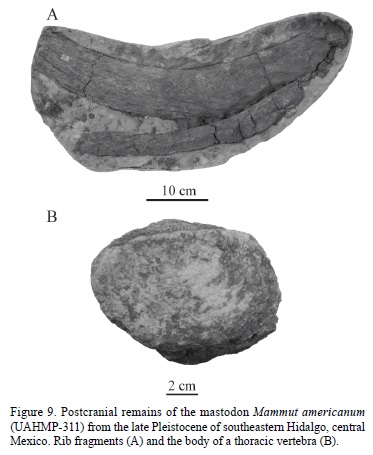
<body><![CDATA[<p>&nbsp;</p>  	    <p align="justify"><font face="verdana" size="2"><i>4.2.4. Postcranial elements</i></font></p>  	    <p align="justify"><font face="verdana" size="2">The sample includes associated postcranial remains belonging to the same individual, including a scapula, limb elements, ribs, and a vertebra (<a href="#f6">Figures 6</a>, <a href="/img/revistas/bsgm/v67n2/a15f7.jpg" target="_blank">7</a>, <a href="/img/revistas/bsgm/v67n2/a15f8.jpg" target="_blank">8</a> and <a href="#f9">9</a>).</font></p>  	    <p align="center"><font face="verdana" size="2"><a name="f6"></a></font></p>  	    <p align="center"><font face="verdana" size="2"><img src="/img/revistas/bsgm/v67n2/a15f6.jpg"></font></p>  	    <p align="center"><font face="verdana" size="2"><a name="f9"></a></font></p>  	    <p align="center"><font face="verdana" size="2"><img src="/img/revistas/bsgm/v67n2/a15f9.jpg"></font></p>  	    <p align="justify"><font face="verdana" size="2"><i>Scapula</i>. The element is subtriangular and flattened latero&#45;medially. The dorsal border is broken anteriorly, although it is slightly curved posteriorly. The cranial border is concave ventrally. The caudal border is straight. Almost the entire supraspinous fossa is broken, and only the base, which is short, is preserved. The infraspinous fossa is broad and expanded antero&#45;ventrally. The neck is short, robust, and unconstricted (ML = 210 mm). The supraglenoid tubercle is relatively prominent and its surface is roughly trapezoidal. The glenoid cavity is elongate&#45;oval, transversely wide, and deep. The spine, the acromion and mid&#45;spinous process are not preserved (<a href="#f6">Figure 6</a>).</font></p>  	    <p align="justify"><font face="verdana" size="2"><i>Humerus</i>. The element is stout and it is longer than it is wide (<a href="/img/revistas/bsgm/v67n2/a15f7.jpg" target="_blank">Figure 7</a>). At the proximal end, the humeral head is large and rounded, the neck is incipient, and the tubercles are not preserved. The diaphysis is proportionally short and robust; it is shorter below the deltoid tuberosity and its widest section is across the lateral epicondylar crest. The deltoid tuberosity is partially broken and protrudes antero&#45;laterally, whereas the lateral epicondylar crest is prominent and protrudes postero&#45;laterally. The radial fossa is well developed and it is elongate&#45;oval in shape. At the distal end, the capitulum is shorter than the trochlea, although both are similar in width; these articular surfaces are separated by a shallow groove. The olecranon fossa is semicircular. The lateral epicondyle is flattened and its surface is roughly similar to an isosceles triangle. The medial epicondyle is poorly preserved and its surface is suboval in shape.</font></p>  	    <p align="justify"><font face="verdana" size="2"><i>Ulna</i>. At the proximal epiphysis, the olecranon process is rounded and it is strongly curved postero&#45;laterally, whereas the anconeal process protrudes anteriorly. The trochlear notch is wide and semicircular. The coronoid process is large, circular, and protrudes antero&#45;medially; the radial notch is small, narrow, and protrudes antero&#45;laterally. The coronoid process and the radial notch are separated by a deep and wide groove. The diaphysis is long and maintains its width along the shaft. The distal epiphysis is not preserved (<a href="/img/revistas/bsgm/v67n2/a15f8.jpg" target="_blank">Figure 8A</a> &#150; <a href="/img/revistas/bsgm/v67n2/a15f8.jpg" target="_blank">8A'</a>).</font></p>  	    ]]></body>
<body><![CDATA[<p align="justify"><font face="verdana" size="2"><i>Radius</i>. About 75 &#37; of the element is preserved, including a great portion of the diaphysis and the distal epiphysis (<a href="/img/revistas/bsgm/v67n2/a15f8.jpg" target="_blank">Figure 8B</a> &#150; <a href="/img/revistas/bsgm/v67n2/a15f8.jpg" target="_blank">8B'</a>). The diaphysis is slender at the proximal region and widens towards its distal end, it is flat latero&#45;medially and curves laterally towards the proximal end. The articular surface for the ulna is flat and triangular, occupying about 50 &#37; of the preserved diaphysis. At the distal end, the styloid process is oval, rounded, and prominent; it is separated from the diaphysis by a deep groove. The articular surface for the scaphoid occupies the greater portion of the distal end and its surface is roughly trapezoidal. The articular surface for the lunar is smaller and it is broken antero&#45;medially.</font></p>  	    <p align="justify"><font face="verdana" size="2"><i>Ribs</i>. The sample consists of two rib fragments (<a href="#f9">Figure 9A</a>). One fragment includes about two&#45;thirds of the rib; the body is relatively straight and flattened latero&#45;medially; it shows a shallow groove and its width is constant. The other fragment is cylindrical at its proximal portion and it is flattened at the distal end. Considering the shape and size of these elements it is probable that they belong to the last set of ribs.</font></p>  	    <p align="justify"><font face="verdana" size="2"><i>Vertebra</i>. The sample includes the body of a thoracic vertebra (<a href="#f9">Figure 9B</a>), which shows an oval anterior surface and a roughly triangular posterior surface; the element is widened ventrally.</font></p>  	    <p>&nbsp;</p>  	    <p align="justify"><font face="verdana" size="2">4.3. Age and sex categories</font></p>  	    <p align="justify"><font face="verdana" size="2">The mandible belonging to the partial skeleton catalogued as UAHMP&#45;311 has the second and third molars erupted, indicating an adult individual (Age Class 6 <i>sensu</i> Green, 2006). The specimen UAHMP&#45;283, an isolated m3, is severely worn; thus, the position and stage of wear are indicative of an old individual.</font></p>  	    <p align="justify"><font face="verdana" size="2">The tusk size and the anterior mandibular height are features that have been used for establishing sexual dimorphism in American mastodons, revealing that males are usually larger than females (Green, 2006; Smith and Fisher, 2013). The mean mandibular height of UAHMP&#45;311 (210 mm) is within the observed range for adult male specimens of <i>Mammut americanum</i> from several Rancholabrean localities of Florida (200 &#150; 225 mm) (Green, 2006: fig. 11, p. 48).</font></p>  	    <p align="justify"><font face="verdana" size="2">The maximum tusk circumference of UAHMP&#45;311 (<i>ca</i>. 450 mm) is comparable to that of the specimen I2SE&#45;113, a tusk of an American mastodon housed at the Buffalo Museum of Science; however the specimen from Hidalgo is 25 &#37; larger. The tusk length of the sample from Hidalgo (2392 mm) is intermediate between several male specimens of <i>Mammut americanum</i> from post&#45;Last Glacial Maximum of the Great Lakes Region, USA (Smith and Fisher, 2013: table 5, p. 351). Hence, the partial skeleton from Hidalgo is considered an adult male individual.</font></p>  	    <p>&nbsp;</p>  	    <p align="justify"><font face="verdana" size="2">4.4. Size</font></p>  	    ]]></body>
<body><![CDATA[<p align="justify"><font face="verdana" size="2">We used the humerus length &#45; shoulder height ratio to characterize the size of the specimen UAHMP&#45;311, considering that humerus length represents about 36 &#37; of the shoulder height (see Harington <i>et al</i>., 1974). The estimated shoulder height of the mastodon from Hidalgo is 2445 mm, which is comparable to the Whitfield Mastodon (2450 mm) (New York) and the Peale Mastodon (2389 mm) (New York), and it is smaller than the Denver Mastodon (Indiana) (2700 mm) and the Warren Mastodon (New York) (2635 mm); all these specimens are male individuals. However, the mastodon from Hidalgo is larger than the Overmyer Mastodon (Indiana) (2302 mm) and the Neath Mastodon (Wisconsin) (2300 mm), which are female individuals (Woodman and Branstrator, 2008: table 2, p.134). We provide additional evidence that males are usually larger than females.</font></p>  	    <p>&nbsp;</p>  	    <p align="justify"><font face="verdana" size="2">4.5. Referred material</font></p>  	    <p align="justify"><font face="verdana" size="2">Ventoquipa (HGO&#45;9): UAHMP&#45;283, an isolated m3; UAHMP&#45;311 (a partial skeleton), maxillary fragment with LM2&#45;M3 and RM3, broken mandible with L/Rm2s and L/Rm3s, two incomplete tusks, R scapula, R humerus, R ulna, R radius, two rib fragments, a vertebra fragment.</font></p>  	    <p>&nbsp;</p>  	    <p align="justify"><font face="verdana" size="2">4.6. Age and occurrence</font></p>  	    <p align="justify"><font face="verdana" size="2">The earliest records of <i>Mammut americanum</i>are from Blancan sites in the Pacific Northwest and Florida. It is known from the Irvingtonian of Nebraska, Maryland, Pennsylvania, and Florida (Kurt&eacute;n and Anderson, 1980). During the Rancholabrean its distribution spread throughout North America from Alaska to central Mexico (Saunders, 1996). There is an isolated record from the Pleistocene of Central America in Honduras (Lucas and Alvarado, 1991).</font></p>  	    <p>&nbsp;</p>  	    <p align="justify"><font face="verdana" size="2"><b>5. Discussion</b></font></p>  	    <p align="justify"><font face="verdana" size="2">5.1. Taxonomic assessment</font></p>  	    ]]></body>
<body><![CDATA[<p align="justify"><font face="verdana" size="2">The taxonomic identity of American mastodons has been mainly based on its tusk configuration and dental morphology. On this regard, the sample from Hidalgo shows several diagnostic features of <i>Mammut americanum</i>, including well&#45;developed tusks that curved upward, upper and lower molars with a simple occlusal pattern, M3/m3s with four to five lophs/ids, and a medial sulcus between the lophs/ids (Kurt&eacute;n and Anderson, 1980; Saunders, 1996).</font></p>  	    <p align="justify"><font face="verdana" size="2">We compared the dental size of upper and lower molars of the mastodon from Hidalgo with selected specimens of <i>Mammut americanum</i>from the late Pleistocene of the Great Lakes and the Gulf Coastal Plain. The dental size of the M3s from Hidalgo is close to the lower limit of the observed range for last molars of mastodons from Florida (Aucilla River and Wacassa River localities) and the Trolinger Spring site in Missouri; however, it is smaller than that observed in mastodons from localities of the Great Lakes region (<a href="#t2">Table 2</a>). The length of the lower molars of Hidalgo is close to or within the range of mastodon molars from the late Pleistocene of Indiana and Missouri, although the studied specimens are narrower than the compared datasets (Table 3). The observed differences can be the result of intraspecific variation probably related to age, sex, and/or geographic variation.</font></p>  	    <p align="center"><font face="verdana" size="2"><img src="/img/revistas/bsgm/v67n2/a15t2.jpg"></font></p>  	    <p align="justify"><font face="verdana" size="2">Olsen (1972) recognized that postcranial remains of <i>Mammut americanum</i> show some particular features. As in mastodons, the scapula of UAHMP&#45;311 shows a straight caudal border, a short and expanded neck, and a glenoid cavity that is oval in outline (Olsen, 1972; Hodgson <i>et al</i>., 2008). The limb elements of the individual from Hidalgo resemble those of American mastodons in several aspects: the humerus by having a short and robust diaphysis and a prominent epicondylar crest; the radius by having a robust and wide distal end; and the ulna by having a well&#45;developed olecranon process that protrudes from the diaphysis, and a deep trochlear notch (Olsen, 1972; Hodgson <i>et al</i>., 2008).</font></p>  	    <p align="justify"><font face="verdana" size="2">The length/width ratio (&asymp; 4.0) of limb bones of UAHMP&#45;311 suggests stocky and robust forelimbs. It has been shown that limb bones of <i>Mammut</i> are usually shorter and more robust than those of <i>Mammuthus</i> and modern elephants (Hodgson <i>et al</i>., 2008); this condition is observed in the studied specimens. The sizes of the limb bones of the mastodon of Hidalgo are comparable to those of the Watkins Glen Mastodon and larger to those of the Overmyer Mastodon (Table 4); differences may be due to sex variation, considering that the latter individual is a female.</font></p>  	    <p>&nbsp;</p>  	    <p align="justify"><font face="verdana" size="2">5.2. Dietary behavior and habitat preferences</font></p>  	    <p align="justify"><font face="verdana" size="2">The &#948;<sup>13</sup>C isotope values of <i>Mammut americanum</i> from Hidalgo vary from &#45;11.87 &permil; to &#45;8.25 &permil; and with a mean value of &#45;10.06 &permil;. The mean relative percentage of C4 plants is of about 16 &#37; with maximum and minimum values of 28.3 &#37; and 4.20 &#37;, respectively. The observed data are indicative of a diet mainly consisting of C3 plants, which in turn is related to a browsing dietary behavior. It should be stated that gastrointestinal contents, palynological associations, phytolithic analysis, carbon isotopic analyses, and microwear analysis have shown that <i>Mammut</i> <i>americanum</i> was mainly a browser (Green <i>et al</i>., 2005 and references therein). The isotopic values and percent of C4 plants consumed by the American Mastodon of Hidalgo are comparable to those observed in several populations of mastodons from the Pleistocene of Florida (Koch <i>et al</i>., 1998: table 1, p. 126). Thus, we provide additional evidence regarding the feeding behavior of this mastodon, indicating a focused&#45;feeding strategy equivalent to that of C3 browsers.</font></p>  	    <p align="justify"><font face="verdana" size="2">The &#948;<sup>18</sup>O isotope values vary from &#45;4.44 &permil; to &#45;4.18 &permil; with a mean value of &#45;4.31 &permil;. These negative values suggest that <i>M. americanum</i> from Hidalgo developed in a closed habitat. It has been shown that American mastodons preferred temperate woodland areas (Kurt&eacute;n and Anderson, 1980; Green <i>et al</i>., 2005; Woodman and Branstrator, 2008). The data of oxygen isotope values for the mastodon from Hidalgo are suggestive of a comparable habitat, and provide information on the presence of closed environments in southeastern sector of Hidalgo during the late Pleistocene, covered by high vegetation such as trees.</font></p>  	    <p>&nbsp;</p>  	    ]]></body>
<body><![CDATA[<p align="justify"><font face="verdana" size="2"><b>6. Conclusions</b></font></p>  	    <p align="justify"><font face="verdana" size="2">A collection of fossil material referable to <i>Mammut</i> <i>americanum</i>from the late Pleistocene (Rancholabrean) of Hidalgo is formally described. The sample includes a partial skeleton of an adult male individual, which represents one of the most complete mastodons from the late Pleistocene of Mexico; in addition, an isolated tooth of an old individual is reported.</font></p>  	    <p align="justify"><font face="verdana" size="2">The size and proportions of the dental elements from Hidalgo are similar to those observed in samples of mastodons from the late Pleistocene of Gulf Coastal Plain and the Great Lakes region. The estimated size of the American mastodon of Hidalgo is near to that of the Whitfield Mastodon and the Peale Mastodon, both male individuals from the Pleistocene of New York.</font></p>  	    <p align="justify"><font face="verdana" size="2">The &#948;<sup>13</sup>C and &#948;<sup>18</sup>O isotope values indicate that the American mastodon from Hidalgo was mainly a C3 browser that thrived in temperate closed habitats covered by high vegetation, such as trees, hence, suggesting the presence of forested areas in southeastern Hidalgo during the second half of the Pleistocene.</font></p>  	    <p>&nbsp;</p>  	    <p align="justify"><font face="verdana" size="2"><b>Acknowledgments</b></font></p>  	    <p align="justify"><font face="verdana" size="2">We thank the reviewers Dick Mol (Natural History Museum, Rotterdam, the Netherlands) and Evangelia S. Tsoukala (Aristotle University, School of Geology), whose comments and suggestions significantly improved the final version of the manuscript. Thanks to Pedro Morales Puente and Edith Cienfuegos Alvarado, of the Laboratorio Universitario de Geoqu&iacute;mica Isot&oacute;pica, Universidad Nacional Aut&oacute;noma de M&eacute;xico (LUGIS&#45;UNAM), for their help with the isotopic analysis procedure. At last but not the least, we thank Richard G. Bailey and Ana Lorena Morales Garc&iacute;a (The University of Sheffield, United Kingdom) for their kind support with the linguistic review. This study is part of the project CONACyT&#45;Ciencia B&aacute;sica (CB&#45;2009&#45;01, No. 130712): El registro de ungulados terrestres en el Pleistoceno de Hidalgo, Puebla y Tlaxcala, centro de M&eacute;xico: Interpretaci&oacute;n de h&aacute;bitos alimentarios y caracterizaci&oacute;n de paleocomunidades terrestres.</font></p>  	    <p>&nbsp;</p>  	    <p align="justify"><font face="verdana" size="2"><b>References</b></font></p>  	    <!-- ref --><p align="justify"><font face="verdana" size="2">Alberdi, M.T., Ju&aacute;rez&#45;Woo, J., Polaco, O.J., Arroyo&#45;Cabrales, J., 2009, Description of the most complete skeleton of Stegomastodon (Mammalia, Gomphotheriidae) recorded for the Mexican Late Pleistocene: Neues Jahrbuch f&uuml;r Geologie und Pal&auml;ontologie, 251, 239&#150;255.    &nbsp;&nbsp;&nbsp;&nbsp;&nbsp;&nbsp;&nbsp;&nbsp;[&#160;<a href="javascript:void(0);" onclick="javascript: window.open('/scielo.php?script=sci_nlinks&ref=1439512&pid=S1405-3322201500020001500001&lng=','','width=640,height=500,resizable=yes,scrollbars=1,menubar=yes,');">Links</a>&#160;]<!-- end-ref --></font></p>  	    <!-- ref --><p align="justify"><font face="verdana" size="2">Arroyo&#45;Cabrales, J., Polaco, O.J., Laurito, C., Johnson, E., Alberdi, M.T., Valerio Zamora, A.L., 2007, The proboscideans (Mammalia) from Mesoamerica: Quaternary International, 169&#150;170, 17&#150;23.    &nbsp;&nbsp;&nbsp;&nbsp;&nbsp;&nbsp;&nbsp;&nbsp;[&#160;<a href="javascript:void(0);" onclick="javascript: window.open('/scielo.php?script=sci_nlinks&ref=1439514&pid=S1405-3322201500020001500002&lng=','','width=640,height=500,resizable=yes,scrollbars=1,menubar=yes,');">Links</a>&#160;]<!-- end-ref --></font></p>  	    <!-- ref --><p align="justify"><font face="verdana" size="2">Barnosky, A.D., Koch, P.L., Feranec, R.S., Wing, S.L., Shabel, A.B., 2004, Assessing the causes of late Pleistocene extinctions on the continents: Science, 300, 70&#150;75.    &nbsp;&nbsp;&nbsp;&nbsp;&nbsp;&nbsp;&nbsp;&nbsp;[&#160;<a href="javascript:void(0);" onclick="javascript: window.open('/scielo.php?script=sci_nlinks&ref=1439516&pid=S1405-3322201500020001500003&lng=','','width=640,height=500,resizable=yes,scrollbars=1,menubar=yes,');">Links</a>&#160;]<!-- end-ref --></font></p>  	    <!-- ref --><p align="justify"><font face="verdana" size="2">Bell, C.J., Lundelius Jr., E.L., Barnosky, A.D., Graham, R.W., Lindsay, E.H., Ruez Jr., D.R., Semken Jr., H.A., Webb, S.D., Zakrzewski, R.J., 2004, The Blancan, Irvingtonian, and Rancholabrean mammal ages, <i>in</i> Woodburne, M.O. (ed.), Late Cretaceous and Cenozoic mammals of North America: New York, Columbia University Press, 232&#150;314.    &nbsp;&nbsp;&nbsp;&nbsp;&nbsp;&nbsp;&nbsp;&nbsp;[&#160;<a href="javascript:void(0);" onclick="javascript: window.open('/scielo.php?script=sci_nlinks&ref=1439518&pid=S1405-3322201500020001500004&lng=','','width=640,height=500,resizable=yes,scrollbars=1,menubar=yes,');">Links</a>&#160;]<!-- end-ref --></font></p>  	    <!-- ref --><p align="justify"><font face="verdana" size="2">Blumenbach, J.F., 1799, Handbuch der Naturgeschichte (6<sup>th</sup>ed.): Dieterich, G&ouml;ttingen, 668 p.    &nbsp;&nbsp;&nbsp;&nbsp;&nbsp;&nbsp;&nbsp;&nbsp;[&#160;<a href="javascript:void(0);" onclick="javascript: window.open('/scielo.php?script=sci_nlinks&ref=1439520&pid=S1405-3322201500020001500005&lng=','','width=640,height=500,resizable=yes,scrollbars=1,menubar=yes,');">Links</a>&#160;]<!-- end-ref --></font></p>  	    <!-- ref --><p align="justify"><font face="verdana" size="2">Cabral&#45;Perdomo, M.A., 2001, Vertebrados pleistoc&eacute;nicos de la regi&oacute;n Pachuca&#45;Tulancingo, estado de Hidalgo: M&eacute;xico, Distrito Federal, Facultad de Ciencias, Universidad Nacional Aut&oacute;noma de M&eacute;xico, MSc. Dissertation, 85 p.    &nbsp;&nbsp;&nbsp;&nbsp;&nbsp;&nbsp;&nbsp;&nbsp;[&#160;<a href="javascript:void(0);" onclick="javascript: window.open('/scielo.php?script=sci_nlinks&ref=1439522&pid=S1405-3322201500020001500006&lng=','','width=640,height=500,resizable=yes,scrollbars=1,menubar=yes,');">Links</a>&#160;]<!-- end-ref --></font></p>  	    <!-- ref --><p align="justify"><font face="verdana" size="2">Castillo&#45;Cer&oacute;n, J.M., Cabral&#45;Perdomo, M.A., Carranza&#45;Casta&ntilde;eda, O. 1996, Vertebrados f&oacute;siles del Estado de Hidalgo: M&eacute;xico, Hidalgo, Universidad Aut&oacute;noma del Estado de Hidalgo, 127 p.    &nbsp;&nbsp;&nbsp;&nbsp;&nbsp;&nbsp;&nbsp;&nbsp;[&#160;<a href="javascript:void(0);" onclick="javascript: window.open('/scielo.php?script=sci_nlinks&ref=1439524&pid=S1405-3322201500020001500007&lng=','','width=640,height=500,resizable=yes,scrollbars=1,menubar=yes,');">Links</a>&#160;]<!-- end-ref --></font></p>  	    <!-- ref --><p align="justify"><font face="verdana" size="2">Cerling, T.E., Harris, J.M., Macfadden, B.J., Leakey, M.G., Quade, J., Eisenmann, V., Ehlinger, J.R., 1997, Global vegetation change through the Miocene/Pliocene boundary: Nature, 389, 153&#150;158.    &nbsp;&nbsp;&nbsp;&nbsp;&nbsp;&nbsp;&nbsp;&nbsp;[&#160;<a href="javascript:void(0);" onclick="javascript: window.open('/scielo.php?script=sci_nlinks&ref=1439526&pid=S1405-3322201500020001500008&lng=','','width=640,height=500,resizable=yes,scrollbars=1,menubar=yes,');">Links</a>&#160;]<!-- end-ref --></font></p>  	    <!-- ref --><p align="justify"><font face="verdana" size="2">Corona, M.E., Alberdi, M.T., 2006, Two new records of Gomphotheriidae (Mammalia: Proboscidea) in southern Mexico and some biogeographic implications: Journal of Paleontology, 80, 357&#150;366.    &nbsp;&nbsp;&nbsp;&nbsp;&nbsp;&nbsp;&nbsp;&nbsp;[&#160;<a href="javascript:void(0);" onclick="javascript: window.open('/scielo.php?script=sci_nlinks&ref=1439528&pid=S1405-3322201500020001500009&lng=','','width=640,height=500,resizable=yes,scrollbars=1,menubar=yes,');">Links</a>&#160;]<!-- end-ref --></font></p>  	    <!-- ref --><p align="justify"><font face="verdana" size="2">Craig, H., 1957, Isotopic Standards for Carbon and Oxygen and correction factors for mass spectrometric analysis of carbon dioxide: Geochimica et Cosmochimica Acta, 12, 133&#150;149.    &nbsp;&nbsp;&nbsp;&nbsp;&nbsp;&nbsp;&nbsp;&nbsp;[&#160;<a href="javascript:void(0);" onclick="javascript: window.open('/scielo.php?script=sci_nlinks&ref=1439530&pid=S1405-3322201500020001500010&lng=','','width=640,height=500,resizable=yes,scrollbars=1,menubar=yes,');">Links</a>&#160;]<!-- end-ref --></font></p>  	    <!-- ref --><p align="justify"><font face="verdana" size="2">Feranec, R.S., Macfadden, B.J., 2006, Isotopic discrimination of resource partitioning among ungulates in C3&#45;dominated communities from the Miocene of Florida and California: Paleobiology, 32, 191&#150;205.    &nbsp;&nbsp;&nbsp;&nbsp;&nbsp;&nbsp;&nbsp;&nbsp;[&#160;<a href="javascript:void(0);" onclick="javascript: window.open('/scielo.php?script=sci_nlinks&ref=1439532&pid=S1405-3322201500020001500011&lng=','','width=640,height=500,resizable=yes,scrollbars=1,menubar=yes,');">Links</a>&#160;]<!-- end-ref --></font></p>  	    <!-- ref --><p align="justify"><font face="verdana" size="2">Graham, R.Wm., 2001, Late Quaternary biogeography and extinction of proboscideans in North America, in The World of Elephants&#45;International Congress, Rome, 707&#150;709.    &nbsp;&nbsp;&nbsp;&nbsp;&nbsp;&nbsp;&nbsp;&nbsp;[&#160;<a href="javascript:void(0);" onclick="javascript: window.open('/scielo.php?script=sci_nlinks&ref=1439534&pid=S1405-3322201500020001500012&lng=','','width=640,height=500,resizable=yes,scrollbars=1,menubar=yes,');">Links</a>&#160;]<!-- end-ref --></font></p>  	    <!-- ref --><p align="justify"><font face="verdana" size="2">Green, J.L., 2006, Chronoclinal variation and sexual dimorphism in <i>Mammut americanum</i> (American mastodon) from the Pleistocene of Florida: The Bulletin of the Florida Museum of Natural History, 46, 29&#150;59.    &nbsp;&nbsp;&nbsp;&nbsp;&nbsp;&nbsp;&nbsp;&nbsp;[&#160;<a href="javascript:void(0);" onclick="javascript: window.open('/scielo.php?script=sci_nlinks&ref=1439536&pid=S1405-3322201500020001500013&lng=','','width=640,height=500,resizable=yes,scrollbars=1,menubar=yes,');">Links</a>&#160;]<!-- end-ref --></font></p>  	    <!-- ref --><p align="justify"><font face="verdana" size="2">Green, J.L., Semprebon, G.M., Solounias, N., 2005, Reconstructing the palaeodiet of Florida <i>Mammut americanum</i>via low&#45;magnification stereomicroscopy: Palaeogeography Palaeoclimatology Palaeoecology, 223, 34&#150;48.    &nbsp;&nbsp;&nbsp;&nbsp;&nbsp;&nbsp;&nbsp;&nbsp;[&#160;<a href="javascript:void(0);" onclick="javascript: window.open('/scielo.php?script=sci_nlinks&ref=1439538&pid=S1405-3322201500020001500014&lng=','','width=640,height=500,resizable=yes,scrollbars=1,menubar=yes,');">Links</a>&#160;]<!-- end-ref --></font></p>  	    <!-- ref --><p align="justify"><font face="verdana" size="2">Harington, C.R., Tipper, H.W., Mott, R.J., 1974, Mammoth from Babine Lake, British Columbia: Canadian Journal of Earth Sciences, 11, 285&#150;303.    &nbsp;&nbsp;&nbsp;&nbsp;&nbsp;&nbsp;&nbsp;&nbsp;[&#160;<a href="javascript:void(0);" onclick="javascript: window.open('/scielo.php?script=sci_nlinks&ref=1439540&pid=S1405-3322201500020001500015&lng=','','width=640,height=500,resizable=yes,scrollbars=1,menubar=yes,');">Links</a>&#160;]<!-- end-ref --></font></p>  	    <!-- ref --><p align="justify"><font face="verdana" size="2">Hay, O.P., 1922, Further observations on some extinct elephants: Proceedings of the Biological Society (Washington), 35, 97&#150;102.    &nbsp;&nbsp;&nbsp;&nbsp;&nbsp;&nbsp;&nbsp;&nbsp;[&#160;<a href="javascript:void(0);" onclick="javascript: window.open('/scielo.php?script=sci_nlinks&ref=1439542&pid=S1405-3322201500020001500016&lng=','','width=640,height=500,resizable=yes,scrollbars=1,menubar=yes,');">Links</a>&#160;]<!-- end-ref --></font></p>  	    <!-- ref --><p align="justify"><font face="verdana" size="2">Hodgson, J.A., Allmon, W.D., Nester, P.L., Sherpa, J.M., Chiment, J.J., 2008, Comparative osteology of late Pleistocene mammoth and mastodon remains from the Watkins Glen site, Chemung County, New York, <i>in</i> Allmon, W.D., Peter, L.N. (eds.) Mastodon Paleobiology, taphonomy, and paleoenvironment in the late Pleistocene of New York State: Studies on the Hyde Park, Chemung, and North Java Sites: Palaeontographica Americana,    &nbsp;&nbsp;&nbsp;&nbsp;&nbsp;&nbsp;&nbsp;&nbsp;[&#160;<a href="javascript:void(0);" onclick="javascript: window.open('/scielo.php?script=sci_nlinks&ref=1439544&pid=S1405-3322201500020001500017&lng=','','width=640,height=500,resizable=yes,scrollbars=1,menubar=yes,');">Links</a>&#160;]<!-- end-ref --><!-- ref --> 61, 301&#150;367.    &nbsp;&nbsp;&nbsp;&nbsp;&nbsp;&nbsp;&nbsp;&nbsp;[&#160;<a href="javascript:void(0);" onclick="javascript: window.open('/scielo.php?script=sci_nlinks&ref=1439545&pid=S1405-3322201500020001500018&lng=','','width=640,height=500,resizable=yes,scrollbars=1,menubar=yes,');">Links</a>&#160;]<!-- end-ref --></font></p>  	    <!-- ref --><p align="justify"><font face="verdana" size="2">Illiger, J.K.W, 1811, Prodromus Systematis Mammalium et Avium: additis terminis zoographicis utriusque classis, eorumque versione germanica: Berlin, Berolini: Sumptibus C. Salfeld, 301 p.    &nbsp;&nbsp;&nbsp;&nbsp;&nbsp;&nbsp;&nbsp;&nbsp;[&#160;<a href="javascript:void(0);" onclick="javascript: window.open('/scielo.php?script=sci_nlinks&ref=1439547&pid=S1405-3322201500020001500019&lng=','','width=640,height=500,resizable=yes,scrollbars=1,menubar=yes,');">Links</a>&#160;]<!-- end-ref --></font></p>  	    <!-- ref --><p align="justify"><font face="verdana" size="2">Kerr, R., 1792, The animal kingdom or zoological system, of the celebrated Sir Charles Linnaeus, London (complete citation together with C. Linnaeus and J. F. Gmelin, in Osborn 1936, p. 782).    &nbsp;&nbsp;&nbsp;&nbsp;&nbsp;&nbsp;&nbsp;&nbsp;[&#160;<a href="javascript:void(0);" onclick="javascript: window.open('/scielo.php?script=sci_nlinks&ref=1439549&pid=S1405-3322201500020001500020&lng=','','width=640,height=500,resizable=yes,scrollbars=1,menubar=yes,');">Links</a>&#160;]<!-- end-ref --></font></p>  	    <!-- ref --><p align="justify"><font face="verdana" size="2">King, J.E., Saunders, J.J., 1984, Environmental insularity and the extinction of the American mastodon, <i>in</i> Martin, P.S., Klein, R.G. (eds.), Quaternary Extinctions a Prehistoric Revolution: Arizona, University of Arizona Press, 315&#150;339.    &nbsp;&nbsp;&nbsp;&nbsp;&nbsp;&nbsp;&nbsp;&nbsp;[&#160;<a href="javascript:void(0);" onclick="javascript: window.open('/scielo.php?script=sci_nlinks&ref=1439551&pid=S1405-3322201500020001500021&lng=','','width=640,height=500,resizable=yes,scrollbars=1,menubar=yes,');">Links</a>&#160;]<!-- end-ref --></font></p>  	    ]]></body>
<body><![CDATA[<!-- ref --><p align="justify"><font face="verdana" size="2">Koch, P.L., Zachos, J.C., Gingerich, P.D., 1992, Correlation between isotope records in marine and continental carbon reservoirs near the Palaeocene/Eocene boundary: Nature, 358, 319&#150;322.    &nbsp;&nbsp;&nbsp;&nbsp;&nbsp;&nbsp;&nbsp;&nbsp;[&#160;<a href="javascript:void(0);" onclick="javascript: window.open('/scielo.php?script=sci_nlinks&ref=1439553&pid=S1405-3322201500020001500022&lng=','','width=640,height=500,resizable=yes,scrollbars=1,menubar=yes,');">Links</a>&#160;]<!-- end-ref --></font></p>  	    <!-- ref --><p align="justify"><font face="verdana" size="2">Koch, P.L., Tuross, N., Fogel, M.L., 1997, The effects of sample treatment and diagenesis on the isotopic integrity of carbonate in biogenic hydroxylapatite: Journal of Archaeological Science, 24, 417&#150;429.    &nbsp;&nbsp;&nbsp;&nbsp;&nbsp;&nbsp;&nbsp;&nbsp;[&#160;<a href="javascript:void(0);" onclick="javascript: window.open('/scielo.php?script=sci_nlinks&ref=1439555&pid=S1405-3322201500020001500023&lng=','','width=640,height=500,resizable=yes,scrollbars=1,menubar=yes,');">Links</a>&#160;]<!-- end-ref --></font></p>  	    <!-- ref --><p align="justify"><font face="verdana" size="2">Koch, P.L., Hoppe, K.A., Webb, S.D., 1998, The isotopic ecology of late Pleistocene mammals in North America Part 1. Florida: Chemical Geology, 152, 119&#150;138.    &nbsp;&nbsp;&nbsp;&nbsp;&nbsp;&nbsp;&nbsp;&nbsp;[&#160;<a href="javascript:void(0);" onclick="javascript: window.open('/scielo.php?script=sci_nlinks&ref=1439557&pid=S1405-3322201500020001500024&lng=','','width=640,height=500,resizable=yes,scrollbars=1,menubar=yes,');">Links</a>&#160;]<!-- end-ref --></font></p>  	    <!-- ref --><p align="justify"><font face="verdana" size="2">Koch, P.L., Diffenbaugh, N.S., Hoppe, K.A., 2004, The effects of late Quaternary climate and pCO<sub>2</sub> change on C4 plant abundance in the south&#45;central United States: Palaeogeography Palaeoclimatology Palaeoecology, 207, 331&#150;357.    &nbsp;&nbsp;&nbsp;&nbsp;&nbsp;&nbsp;&nbsp;&nbsp;[&#160;<a href="javascript:void(0);" onclick="javascript: window.open('/scielo.php?script=sci_nlinks&ref=1439559&pid=S1405-3322201500020001500025&lng=','','width=640,height=500,resizable=yes,scrollbars=1,menubar=yes,');">Links</a>&#160;]<!-- end-ref --></font></p>  	    <!-- ref --><p align="justify"><font face="verdana" size="2">Kurt&eacute;n, B., Anderson, E., 1980, The Pleistocene Mammals of North America: United States, Columbia University Press, 442 p.    &nbsp;&nbsp;&nbsp;&nbsp;&nbsp;&nbsp;&nbsp;&nbsp;[&#160;<a href="javascript:void(0);" onclick="javascript: window.open('/scielo.php?script=sci_nlinks&ref=1439561&pid=S1405-3322201500020001500026&lng=','','width=640,height=500,resizable=yes,scrollbars=1,menubar=yes,');">Links</a>&#160;]<!-- end-ref --></font></p>  	    ]]></body>
<body><![CDATA[<!-- ref --><p align="justify"><font face="verdana" size="2">Lange, I.M., 2002, Ice Age mammals of North America: Missoula, Montana, Mountain Press Publishing Company, 226 p.    &nbsp;&nbsp;&nbsp;&nbsp;&nbsp;&nbsp;&nbsp;&nbsp;[&#160;<a href="javascript:void(0);" onclick="javascript: window.open('/scielo.php?script=sci_nlinks&ref=1439563&pid=S1405-3322201500020001500027&lng=','','width=640,height=500,resizable=yes,scrollbars=1,menubar=yes,');">Links</a>&#160;]<!-- end-ref --></font></p>  	    <!-- ref --><p align="justify"><font face="verdana" size="2">Lucas, S.G., Alvarado, G.E., 1991, El hallazgo m&aacute;s austral de un <i>Mammut</i> <i>americanum</i>: el caso del mastodonte de San Pedro Sula, Honduras: Revista Geol&oacute;gica de Am&eacute;rica Central, 13, 85&#150;89.    &nbsp;&nbsp;&nbsp;&nbsp;&nbsp;&nbsp;&nbsp;&nbsp;[&#160;<a href="javascript:void(0);" onclick="javascript: window.open('/scielo.php?script=sci_nlinks&ref=1439565&pid=S1405-3322201500020001500028&lng=','','width=640,height=500,resizable=yes,scrollbars=1,menubar=yes,');">Links</a>&#160;]<!-- end-ref --></font></p>  	    <!-- ref --><p align="justify"><font face="verdana" size="2">Lucas, S.G., Alvarado, G.E., 2010, Fossil Proboscidea from the upper Cenozoic of Central America: Taxonomy, evolutionary and paleobiogeographic significance: Revista Geol&oacute;gica de Am&eacute;rica Central, 42, 9&#150;42.    &nbsp;&nbsp;&nbsp;&nbsp;&nbsp;&nbsp;&nbsp;&nbsp;[&#160;<a href="javascript:void(0);" onclick="javascript: window.open('/scielo.php?script=sci_nlinks&ref=1439567&pid=S1405-3322201500020001500029&lng=','','width=640,height=500,resizable=yes,scrollbars=1,menubar=yes,');">Links</a>&#160;]<!-- end-ref --></font></p>  	    <!-- ref --><p align="justify"><font face="verdana" size="2">Luz, B., Kolodny, Y., 1985, Oxygen isotope variations in phosphate of biogenic apatites: IV. Mammal teeth and bones: Earth Planetary Science Letters 75, 29&#150;36.    &nbsp;&nbsp;&nbsp;&nbsp;&nbsp;&nbsp;&nbsp;&nbsp;[&#160;<a href="javascript:void(0);" onclick="javascript: window.open('/scielo.php?script=sci_nlinks&ref=1439569&pid=S1405-3322201500020001500030&lng=','','width=640,height=500,resizable=yes,scrollbars=1,menubar=yes,');">Links</a>&#160;]<!-- end-ref --></font></p>  	    <!-- ref --><p align="justify"><font face="verdana" size="2">Luz, B., Kolodny, Y., Horowitz, M., 1984, Fractionation of oxygen isotopes between mammalian bone&#45;phosphate and environmental drinking water: Geochimica et Cosmochimica Acta, 48, 1689&#150;1693.    &nbsp;&nbsp;&nbsp;&nbsp;&nbsp;&nbsp;&nbsp;&nbsp;[&#160;<a href="javascript:void(0);" onclick="javascript: window.open('/scielo.php?script=sci_nlinks&ref=1439571&pid=S1405-3322201500020001500031&lng=','','width=640,height=500,resizable=yes,scrollbars=1,menubar=yes,');">Links</a>&#160;]<!-- end-ref --></font></p>  	    ]]></body>
<body><![CDATA[<!-- ref --><p align="justify"><font face="verdana" size="2">Macdonald, D.W., 2006, The Princeton Encyclopedia of Mammals: China, Princeton University Press, 936 p.    &nbsp;&nbsp;&nbsp;&nbsp;&nbsp;&nbsp;&nbsp;&nbsp;[&#160;<a href="javascript:void(0);" onclick="javascript: window.open('/scielo.php?script=sci_nlinks&ref=1439573&pid=S1405-3322201500020001500032&lng=','','width=640,height=500,resizable=yes,scrollbars=1,menubar=yes,');">Links</a>&#160;]<!-- end-ref --></font></p>  	    <!-- ref --><p align="justify"><font face="verdana" size="2">MacFadden, B.J., Cerling, T.E., 1996, Mammalian herbivore communities, ancient feeding ecology, and carbon isotopes: a 10 million years sequence from the Neogene of Florida: Journal of Vertebrate Paleontology, 16, 103&#150;115.    &nbsp;&nbsp;&nbsp;&nbsp;&nbsp;&nbsp;&nbsp;&nbsp;[&#160;<a href="javascript:void(0);" onclick="javascript: window.open('/scielo.php?script=sci_nlinks&ref=1439575&pid=S1405-3322201500020001500033&lng=','','width=640,height=500,resizable=yes,scrollbars=1,menubar=yes,');">Links</a>&#160;]<!-- end-ref --></font></p>  	    <!-- ref --><p align="justify"><font face="verdana" size="2">Olsen, S.J., 1972, Osteology for the Archaeologist: No. 3: the American Mastodon and the Woolly Mammoth; No. 4: North American Birds: United States: Papers of the Peabody Museum of Archaeology and Ethnology, Harvard University, 58, 1&#150;87.    &nbsp;&nbsp;&nbsp;&nbsp;&nbsp;&nbsp;&nbsp;&nbsp;[&#160;<a href="javascript:void(0);" onclick="javascript: window.open('/scielo.php?script=sci_nlinks&ref=1439577&pid=S1405-3322201500020001500034&lng=','','width=640,height=500,resizable=yes,scrollbars=1,menubar=yes,');">Links</a>&#160;]<!-- end-ref --></font></p>  	    <!-- ref --><p align="justify"><font face="verdana" size="2">Ometto, J.P.H.B., Flanagan, L.B., Martinelli, L.A., Ehleringer, J.H., 2005, Oxygen isotope ratios of waters and respired CO<sub>2</sub> in Amazonian forest and pasture ecosystems: Ecological Applications, 15, 58&#150;70.    &nbsp;&nbsp;&nbsp;&nbsp;&nbsp;&nbsp;&nbsp;&nbsp;[&#160;<a href="javascript:void(0);" onclick="javascript: window.open('/scielo.php?script=sci_nlinks&ref=1439579&pid=S1405-3322201500020001500035&lng=','','width=640,height=500,resizable=yes,scrollbars=1,menubar=yes,');">Links</a>&#160;]<!-- end-ref --></font></p>  	    <!-- ref --><p align="justify"><font face="verdana" size="2">Polaco, O.J., Arroyo&#45;Cabrales, J., Corona&#45;M., E., L&oacute;pez&#45;Oliva, J.G., 2001, The American Mastodon <i>Mammut americanum</i> in Mexico, <i>in</i> The World of Elephants&#45;International Congress, Rome, 237&#150;242.    &nbsp;&nbsp;&nbsp;&nbsp;&nbsp;&nbsp;&nbsp;&nbsp;[&#160;<a href="javascript:void(0);" onclick="javascript: window.open('/scielo.php?script=sci_nlinks&ref=1439581&pid=S1405-3322201500020001500036&lng=','','width=640,height=500,resizable=yes,scrollbars=1,menubar=yes,');">Links</a>&#160;]<!-- end-ref --></font></p>  	    ]]></body>
<body><![CDATA[<!-- ref --><p align="justify"><font face="verdana" size="2">Quade, J., Cerling, T.E., Barry, J.C., Morgan, M.E., Pilbeam, D.R., Chivas, A.R., Lee&#45;Thorp, J.A., van der Merwe, N.J., 1992, A 16 million year record of paleodiet using carbon and oxygen isotopes in fossil teeth from Pakistan: Chemical Geology, 94, 183&#150;192.    &nbsp;&nbsp;&nbsp;&nbsp;&nbsp;&nbsp;&nbsp;&nbsp;[&#160;<a href="javascript:void(0);" onclick="javascript: window.open('/scielo.php?script=sci_nlinks&ref=1439583&pid=S1405-3322201500020001500037&lng=','','width=640,height=500,resizable=yes,scrollbars=1,menubar=yes,');">Links</a>&#160;]<!-- end-ref --></font></p>  	    <!-- ref --><p align="justify"><font face="verdana" size="2">Rose, K.D., 2006, The beginning of the age of mammals: Baltimore, Johns Hopkins University Press, 428 p.    &nbsp;&nbsp;&nbsp;&nbsp;&nbsp;&nbsp;&nbsp;&nbsp;[&#160;<a href="javascript:void(0);" onclick="javascript: window.open('/scielo.php?script=sci_nlinks&ref=1439585&pid=S1405-3322201500020001500038&lng=','','width=640,height=500,resizable=yes,scrollbars=1,menubar=yes,');">Links</a>&#160;]<!-- end-ref --></font></p>  	    <!-- ref --><p align="justify"><font face="verdana" size="2">Rozanski, K., Aragu&aacute;s&#45;Aragu&aacute;s, L., Gonfiantini, R., 1992, Relation Between Long&#45;Term Trends of Oxygen&#45;18 Isotope Composition of Precipitation and Climate: Science, New Series, 258, 981&#150;985.    &nbsp;&nbsp;&nbsp;&nbsp;&nbsp;&nbsp;&nbsp;&nbsp;[&#160;<a href="javascript:void(0);" onclick="javascript: window.open('/scielo.php?script=sci_nlinks&ref=1439587&pid=S1405-3322201500020001500039&lng=','','width=640,height=500,resizable=yes,scrollbars=1,menubar=yes,');">Links</a>&#160;]<!-- end-ref --></font></p>  	    <!-- ref --><p align="justify"><font face="verdana" size="2">Saunders. J.J, 1996, North American Mammutidae, <i>in</i> Shoshani, J., Tassy, P. (eds.), The Proboscidea: Evolution and Palaeoecology of Elephants and their Relatives: Great Britain, Oxford University Press, 271&#150;279.    &nbsp;&nbsp;&nbsp;&nbsp;&nbsp;&nbsp;&nbsp;&nbsp;[&#160;<a href="javascript:void(0);" onclick="javascript: window.open('/scielo.php?script=sci_nlinks&ref=1439589&pid=S1405-3322201500020001500040&lng=','','width=640,height=500,resizable=yes,scrollbars=1,menubar=yes,');">Links</a>&#160;]<!-- end-ref --></font></p>  	    <!-- ref --><p align="justify"><font face="verdana" size="2">Simpson, G.G., Paula&#45;Couto, C., 1957, The Mastodons of Brazil: American Museum of Natural History, 112, 131&#150;145.    &nbsp;&nbsp;&nbsp;&nbsp;&nbsp;&nbsp;&nbsp;&nbsp;[&#160;<a href="javascript:void(0);" onclick="javascript: window.open('/scielo.php?script=sci_nlinks&ref=1439591&pid=S1405-3322201500020001500041&lng=','','width=640,height=500,resizable=yes,scrollbars=1,menubar=yes,');">Links</a>&#160;]<!-- end-ref --></font></p>  	    ]]></body>
<body><![CDATA[<!-- ref --><p align="justify"><font face="verdana" size="2">Smith, K.M., Fisher, D.C., 2013, Sexual dimorphism and inter&#45;generic variation in proboscidean tusks: Multivariate assessment of American Mastodons (<i>Mammut americanum</i>) and extant African Elephants: Journal of Mammal Evolution, 20, 337&#150;355.    &nbsp;&nbsp;&nbsp;&nbsp;&nbsp;&nbsp;&nbsp;&nbsp;[&#160;<a href="javascript:void(0);" onclick="javascript: window.open('/scielo.php?script=sci_nlinks&ref=1439593&pid=S1405-3322201500020001500042&lng=','','width=640,height=500,resizable=yes,scrollbars=1,menubar=yes,');">Links</a>&#160;]<!-- end-ref --></font></p>  	    <!-- ref --><p align="justify"><font face="verdana" size="2">Tassy, P, 1996, Dental homologies and nomenclature in the Proboscidea, <i>in</i> Shoshani, J., Tassy, P. (eds.), The Proboscidea: Evolution and Palaecology of Elephants and their Relatives: Great Britain, Oxford University Press, 21&#150;25.    &nbsp;&nbsp;&nbsp;&nbsp;&nbsp;&nbsp;&nbsp;&nbsp;[&#160;<a href="javascript:void(0);" onclick="javascript: window.open('/scielo.php?script=sci_nlinks&ref=1439595&pid=S1405-3322201500020001500043&lng=','','width=640,height=500,resizable=yes,scrollbars=1,menubar=yes,');">Links</a>&#160;]<!-- end-ref --></font></p>  	    <!-- ref --><p align="justify"><font face="verdana" size="2">Woodman, N., Branstrator, J.W., 2008, The Overmyer Mastodon (<i>Mammut</i> <i>americanum</i>) from Fulton County Indiana: American Midland Naturalist, 159, 125&#150;146.    &nbsp;&nbsp;&nbsp;&nbsp;&nbsp;&nbsp;&nbsp;&nbsp;[&#160;<a href="javascript:void(0);" onclick="javascript: window.open('/scielo.php?script=sci_nlinks&ref=1439597&pid=S1405-3322201500020001500044&lng=','','width=640,height=500,resizable=yes,scrollbars=1,menubar=yes,');">Links</a>&#160;]<!-- end-ref --></font></p>      ]]></body><back>
<ref-list>
<ref id="B1">
<nlm-citation citation-type="journal">
<person-group person-group-type="author">
<name>
<surname><![CDATA[Alberdi]]></surname>
<given-names><![CDATA[M.T.]]></given-names>
</name>
<name>
<surname><![CDATA[Juárez-Woo]]></surname>
<given-names><![CDATA[J.]]></given-names>
</name>
<name>
<surname><![CDATA[Polaco]]></surname>
<given-names><![CDATA[O.J.]]></given-names>
</name>
<name>
<surname><![CDATA[Arroyo-Cabrales]]></surname>
<given-names><![CDATA[J.]]></given-names>
</name>
</person-group>
<article-title xml:lang="en"><![CDATA[Description of the most complete skeleton of Stegomastodon (Mammalia, Gomphotheriidae) recorded for the Mexican Late Pleistocene]]></article-title>
<source><![CDATA[Neues Jahrbuch für Geologie und Paläontologie]]></source>
<year>2009</year>
<volume>251</volume>
<page-range>239-255</page-range></nlm-citation>
</ref>
<ref id="B2">
<nlm-citation citation-type="journal">
<person-group person-group-type="author">
<name>
<surname><![CDATA[Arroyo-Cabrales]]></surname>
<given-names><![CDATA[J.]]></given-names>
</name>
<name>
<surname><![CDATA[Polaco]]></surname>
<given-names><![CDATA[O.J.]]></given-names>
</name>
<name>
<surname><![CDATA[Laurito]]></surname>
<given-names><![CDATA[C.]]></given-names>
</name>
<name>
<surname><![CDATA[Johnson]]></surname>
<given-names><![CDATA[E.]]></given-names>
</name>
<name>
<surname><![CDATA[Alberdi]]></surname>
<given-names><![CDATA[M.T.]]></given-names>
</name>
<name>
<surname><![CDATA[Valerio Zamora]]></surname>
<given-names><![CDATA[A.L.]]></given-names>
</name>
</person-group>
<article-title xml:lang="en"><![CDATA[The proboscideans (Mammalia) from Mesoamerica]]></article-title>
<source><![CDATA[Quaternary International]]></source>
<year>2007</year>
<volume>169</volume><volume>170</volume>
<page-range>17-23</page-range></nlm-citation>
</ref>
<ref id="B3">
<nlm-citation citation-type="journal">
<person-group person-group-type="author">
<name>
<surname><![CDATA[Barnosky]]></surname>
<given-names><![CDATA[A.D.]]></given-names>
</name>
<name>
<surname><![CDATA[Koch]]></surname>
<given-names><![CDATA[P.L.]]></given-names>
</name>
<name>
<surname><![CDATA[Feranec]]></surname>
<given-names><![CDATA[R.S.]]></given-names>
</name>
<name>
<surname><![CDATA[Wing]]></surname>
<given-names><![CDATA[S.L.]]></given-names>
</name>
<name>
<surname><![CDATA[Shabel]]></surname>
<given-names><![CDATA[A.B.]]></given-names>
</name>
</person-group>
<article-title xml:lang="en"><![CDATA[Assessing the causes of late Pleistocene extinctions on the continents]]></article-title>
<source><![CDATA[Science]]></source>
<year>2004</year>
<volume>300</volume>
<page-range>70-75</page-range></nlm-citation>
</ref>
<ref id="B4">
<nlm-citation citation-type="book">
<person-group person-group-type="author">
<name>
<surname><![CDATA[Bell,]]></surname>
<given-names><![CDATA[C.J.]]></given-names>
</name>
<name>
<surname><![CDATA[Lundelius Jr.]]></surname>
<given-names><![CDATA[E.L.]]></given-names>
</name>
<name>
<surname><![CDATA[Barnosky]]></surname>
<given-names><![CDATA[A.D.]]></given-names>
</name>
<name>
<surname><![CDATA[Graham]]></surname>
<given-names><![CDATA[R.W.]]></given-names>
</name>
<name>
<surname><![CDATA[Lindsay]]></surname>
<given-names><![CDATA[E.H.]]></given-names>
</name>
<name>
<surname><![CDATA[Ruez Jr.]]></surname>
<given-names><![CDATA[D.R.]]></given-names>
</name>
<name>
<surname><![CDATA[Semken Jr.]]></surname>
<given-names><![CDATA[H.A.]]></given-names>
</name>
<name>
<surname><![CDATA[Webb]]></surname>
<given-names><![CDATA[S.D.]]></given-names>
</name>
<name>
<surname><![CDATA[Zakrzewski]]></surname>
<given-names><![CDATA[R.J.]]></given-names>
</name>
</person-group>
<article-title xml:lang="en"><![CDATA[The Blancan, Irvingtonian, and Rancholabrean mammal ages]]></article-title>
<person-group person-group-type="editor">
<name>
<surname><![CDATA[Woodburne]]></surname>
</name>
</person-group>
<source><![CDATA[Late Cretaceous and Cenozoic mammals of North America]]></source>
<year>2004</year>
<page-range>232-314</page-range><publisher-loc><![CDATA[New York ]]></publisher-loc>
<publisher-name><![CDATA[Columbia University Press]]></publisher-name>
</nlm-citation>
</ref>
<ref id="B5">
<nlm-citation citation-type="book">
<person-group person-group-type="author">
<name>
<surname><![CDATA[Blumenbach]]></surname>
<given-names><![CDATA[J.F.]]></given-names>
</name>
</person-group>
<source><![CDATA[Handbuch der Naturgeschichte]]></source>
<year>1799</year>
<edition>6th</edition>
<page-range>668</page-range><publisher-loc><![CDATA[Göttingen ]]></publisher-loc>
<publisher-name><![CDATA[Dieterich]]></publisher-name>
</nlm-citation>
</ref>
<ref id="B6">
<nlm-citation citation-type="">
<person-group person-group-type="author">
<name>
<surname><![CDATA[Cabral-Perdomo]]></surname>
<given-names><![CDATA[M.A.]]></given-names>
</name>
</person-group>
<source><![CDATA[Vertebrados pleistocénicos de la región Pachuca-Tulancingo, estado de Hidalgo]]></source>
<year>2001</year>
<page-range>85</page-range></nlm-citation>
</ref>
<ref id="B7">
<nlm-citation citation-type="book">
<person-group person-group-type="author">
<name>
<surname><![CDATA[Castillo-Cerón]]></surname>
<given-names><![CDATA[J.M.]]></given-names>
</name>
<name>
<surname><![CDATA[Cabral-Perdomo]]></surname>
<given-names><![CDATA[M.A.]]></given-names>
</name>
<name>
<surname><![CDATA[Carranza-Castañeda]]></surname>
<given-names><![CDATA[O.]]></given-names>
</name>
</person-group>
<source><![CDATA[Vertebrados fósiles del Estado de Hidalgo]]></source>
<year>1996</year>
<page-range>127</page-range><publisher-loc><![CDATA[México^eHidalgo Hidalgo]]></publisher-loc>
<publisher-name><![CDATA[Universidad Autónoma del Estado de Hidalgo]]></publisher-name>
</nlm-citation>
</ref>
<ref id="B8">
<nlm-citation citation-type="journal">
<person-group person-group-type="author">
<name>
<surname><![CDATA[Cerling]]></surname>
<given-names><![CDATA[T.E.]]></given-names>
</name>
<name>
<surname><![CDATA[Harris]]></surname>
<given-names><![CDATA[J.M.]]></given-names>
</name>
<name>
<surname><![CDATA[Macfadden]]></surname>
<given-names><![CDATA[B.J.]]></given-names>
</name>
<name>
<surname><![CDATA[Leakey]]></surname>
<given-names><![CDATA[M.G.]]></given-names>
</name>
<name>
<surname><![CDATA[Quade]]></surname>
<given-names><![CDATA[J.]]></given-names>
</name>
<name>
<surname><![CDATA[Eisenmann]]></surname>
<given-names><![CDATA[V.]]></given-names>
</name>
<name>
<surname><![CDATA[Ehlinger]]></surname>
<given-names><![CDATA[J.R.]]></given-names>
</name>
</person-group>
<article-title xml:lang="en"><![CDATA[Global vegetation change through the Miocene/Pliocene boundary]]></article-title>
<source><![CDATA[Nature]]></source>
<year>1997</year>
<volume>389</volume>
<page-range>153-158</page-range></nlm-citation>
</ref>
<ref id="B9">
<nlm-citation citation-type="journal">
<person-group person-group-type="author">
<name>
<surname><![CDATA[Corona]]></surname>
<given-names><![CDATA[M.E.]]></given-names>
</name>
<name>
<surname><![CDATA[Alberdi]]></surname>
<given-names><![CDATA[M.T.]]></given-names>
</name>
</person-group>
<article-title xml:lang="en"><![CDATA[Two new records of Gomphotheriidae (Mammalia: Proboscidea) in southern Mexico and some biogeographic implications]]></article-title>
<source><![CDATA[Journal of Paleontology]]></source>
<year>2006</year>
<volume>80</volume>
<page-range>357-366</page-range></nlm-citation>
</ref>
<ref id="B10">
<nlm-citation citation-type="journal">
<person-group person-group-type="author">
<name>
<surname><![CDATA[Craig]]></surname>
<given-names><![CDATA[H.]]></given-names>
</name>
</person-group>
<article-title xml:lang="en"><![CDATA[Isotopic Standards for Carbon and Oxygen and correction factors for mass spectrometric analysis of carbon dioxide]]></article-title>
<source><![CDATA[Geochimica et Cosmochimica Acta]]></source>
<year>1957</year>
<volume>12</volume>
<page-range>133-149</page-range></nlm-citation>
</ref>
<ref id="B11">
<nlm-citation citation-type="journal">
<person-group person-group-type="author">
<name>
<surname><![CDATA[Feranec]]></surname>
<given-names><![CDATA[R.S.]]></given-names>
</name>
<name>
<surname><![CDATA[Macfadden]]></surname>
<given-names><![CDATA[B.J.]]></given-names>
</name>
</person-group>
<article-title xml:lang="en"><![CDATA[Isotopic discrimination of resource partitioning among ungulates in C3-dominated communities from the Miocene of Florida and California]]></article-title>
<source><![CDATA[Paleobiology]]></source>
<year>2006</year>
<volume>32</volume>
<page-range>191-205</page-range></nlm-citation>
</ref>
<ref id="B12">
<nlm-citation citation-type="">
<person-group person-group-type="author">
<name>
<surname><![CDATA[Graham]]></surname>
<given-names><![CDATA[R.Wm.]]></given-names>
</name>
</person-group>
<article-title xml:lang="en"><![CDATA[Late Quaternary biogeography and extinction of proboscideans in North America]]></article-title>
<source><![CDATA[The World of Elephants-International Congress]]></source>
<year>2001</year>
<page-range>707-709</page-range><publisher-loc><![CDATA[Rome ]]></publisher-loc>
</nlm-citation>
</ref>
<ref id="B13">
<nlm-citation citation-type="journal">
<person-group person-group-type="author">
<name>
<surname><![CDATA[Green]]></surname>
<given-names><![CDATA[J.L.]]></given-names>
</name>
</person-group>
<article-title xml:lang="en"><![CDATA[Chronoclinal variation and sexual dimorphism in Mammut americanum (American mastodon) from the Pleistocene of Florida]]></article-title>
<source><![CDATA[The Bulletin of the Florida Museum of Natural History]]></source>
<year>2006</year>
<volume>46</volume>
<page-range>29-59</page-range></nlm-citation>
</ref>
<ref id="B14">
<nlm-citation citation-type="journal">
<person-group person-group-type="author">
<name>
<surname><![CDATA[Green]]></surname>
<given-names><![CDATA[J.L.]]></given-names>
</name>
<name>
<surname><![CDATA[Semprebon]]></surname>
<given-names><![CDATA[G.M.]]></given-names>
</name>
<name>
<surname><![CDATA[Solounias]]></surname>
<given-names><![CDATA[N.]]></given-names>
</name>
</person-group>
<article-title xml:lang="en"><![CDATA[Reconstructing the palaeodiet of Florida Mammut americanumvia low-magnification stereomicroscopy]]></article-title>
<source><![CDATA[Palaeogeography Palaeoclimatology Palaeoecology]]></source>
<year>2005</year>
<volume>223</volume>
<page-range>34-48</page-range></nlm-citation>
</ref>
<ref id="B15">
<nlm-citation citation-type="journal">
<person-group person-group-type="author">
<name>
<surname><![CDATA[Harington]]></surname>
<given-names><![CDATA[C.R.]]></given-names>
</name>
<name>
<surname><![CDATA[Tipper]]></surname>
<given-names><![CDATA[H.W.]]></given-names>
</name>
<name>
<surname><![CDATA[Mott]]></surname>
<given-names><![CDATA[R.J.]]></given-names>
</name>
</person-group>
<article-title xml:lang="en"><![CDATA[Mammoth from Babine Lake, British Columbia]]></article-title>
<source><![CDATA[Canadian Journal of Earth Sciences]]></source>
<year>1974</year>
<volume>11</volume>
<page-range>285-303</page-range></nlm-citation>
</ref>
<ref id="B16">
<nlm-citation citation-type="journal">
<person-group person-group-type="author">
<name>
<surname><![CDATA[Hay]]></surname>
<given-names><![CDATA[O.P.]]></given-names>
</name>
</person-group>
<article-title xml:lang="en"><![CDATA[Further observations on some extinct elephants]]></article-title>
<source><![CDATA[Proceedings of the Biological Society]]></source>
<year>1922</year>
<volume>35</volume>
<page-range>97-102</page-range></nlm-citation>
</ref>
<ref id="B17">
<nlm-citation citation-type="">
<person-group person-group-type="author">
<name>
<surname><![CDATA[Hodgson]]></surname>
<given-names><![CDATA[J.A.]]></given-names>
</name>
<name>
<surname><![CDATA[Allmon]]></surname>
<given-names><![CDATA[W.D.]]></given-names>
</name>
<name>
<surname><![CDATA[Nester]]></surname>
<given-names><![CDATA[P.L.]]></given-names>
</name>
<name>
<surname><![CDATA[Sherpa]]></surname>
<given-names><![CDATA[J.M.]]></given-names>
</name>
<name>
<surname><![CDATA[Chiment]]></surname>
<given-names><![CDATA[J.J.]]></given-names>
</name>
</person-group>
<article-title xml:lang="en"><![CDATA[Comparative osteology of late Pleistocene mammoth and mastodon remains from the Watkins Glen site, Chemung County, New York]]></article-title>
<person-group person-group-type="editor">
<name>
<surname><![CDATA[Allmon]]></surname>
<given-names><![CDATA[W.D.]]></given-names>
</name>
<name>
<surname><![CDATA[Peter]]></surname>
<given-names><![CDATA[L.N.]]></given-names>
</name>
</person-group>
<source><![CDATA[Mastodon Paleobiology, taphonomy, and paleoenvironment in the late Pleistocene of New York State: Studies on the Hyde Park, Chemung, and North Java Sites]]></source>
<year>2008</year>
</nlm-citation>
</ref>
<ref id="B18">
<nlm-citation citation-type="journal">
<source><![CDATA[Palaeontographica Americana]]></source>
<year></year>
<volume>61</volume>
<page-range>301-367</page-range></nlm-citation>
</ref>
<ref id="B19">
<nlm-citation citation-type="book">
<person-group person-group-type="author">
<name>
<surname><![CDATA[Illiger]]></surname>
<given-names><![CDATA[J.K.W]]></given-names>
</name>
</person-group>
<source><![CDATA[Prodromus Systematis Mammalium et Avium: additis terminis zoographicis utriusque classis, eorumque versione germanica]]></source>
<year>1811</year>
<page-range>301</page-range><publisher-loc><![CDATA[Berlin ]]></publisher-loc>
<publisher-name><![CDATA[Sumptibus C. Salfeld]]></publisher-name>
</nlm-citation>
</ref>
<ref id="B20">
<nlm-citation citation-type="">
<person-group person-group-type="author">
<name>
<surname><![CDATA[Kerr]]></surname>
<given-names><![CDATA[R.]]></given-names>
</name>
</person-group>
<source><![CDATA[The animal kingdom or zoological system, of the celebrated Sir Charles Linnaeus]]></source>
<year>1792</year>
<publisher-loc><![CDATA[London ]]></publisher-loc>
</nlm-citation>
</ref>
<ref id="B21">
<nlm-citation citation-type="book">
<person-group person-group-type="author">
<name>
<surname><![CDATA[King]]></surname>
<given-names><![CDATA[J.E.]]></given-names>
</name>
<name>
<surname><![CDATA[Saunders]]></surname>
<given-names><![CDATA[J.J.]]></given-names>
</name>
</person-group>
<article-title xml:lang="en"><![CDATA[Environmental insularity and the extinction of the American mastodon]]></article-title>
<person-group person-group-type="editor">
<name>
<surname><![CDATA[Martin]]></surname>
<given-names><![CDATA[P.S.]]></given-names>
</name>
<name>
<surname><![CDATA[Klein]]></surname>
<given-names><![CDATA[R.G.]]></given-names>
</name>
</person-group>
<source><![CDATA[Quaternary Extinctions a Prehistoric Revolution]]></source>
<year>1984</year>
<page-range>315-339</page-range><publisher-loc><![CDATA[Arizona ]]></publisher-loc>
<publisher-name><![CDATA[University of Arizona Press]]></publisher-name>
</nlm-citation>
</ref>
<ref id="B22">
<nlm-citation citation-type="journal">
<person-group person-group-type="author">
<name>
<surname><![CDATA[Koch]]></surname>
<given-names><![CDATA[P.L.]]></given-names>
</name>
<name>
<surname><![CDATA[Zachos]]></surname>
<given-names><![CDATA[J.C.]]></given-names>
</name>
<name>
<surname><![CDATA[Gingerich]]></surname>
<given-names><![CDATA[P.D.]]></given-names>
</name>
</person-group>
<article-title xml:lang="en"><![CDATA[Correlation between isotope records in marine and continental carbon reservoirs near the Palaeocene/Eocene boundary]]></article-title>
<source><![CDATA[Nature]]></source>
<year>1992</year>
<volume>358</volume>
<page-range>319-322</page-range></nlm-citation>
</ref>
<ref id="B23">
<nlm-citation citation-type="journal">
<person-group person-group-type="author">
<name>
<surname><![CDATA[Koch]]></surname>
<given-names><![CDATA[P.L.]]></given-names>
</name>
<name>
<surname><![CDATA[Tuross]]></surname>
<given-names><![CDATA[N.]]></given-names>
</name>
<name>
<surname><![CDATA[Fogel]]></surname>
<given-names><![CDATA[M.L.]]></given-names>
</name>
</person-group>
<article-title xml:lang="en"><![CDATA[The effects of sample treatment and diagenesis on the isotopic integrity of carbonate in biogenic hydroxylapatite]]></article-title>
<source><![CDATA[Journal of Archaeological Science]]></source>
<year>1997</year>
<volume>24</volume>
<page-range>417-429</page-range></nlm-citation>
</ref>
<ref id="B24">
<nlm-citation citation-type="journal">
<person-group person-group-type="author">
<name>
<surname><![CDATA[Koch]]></surname>
<given-names><![CDATA[P.L.]]></given-names>
</name>
<name>
<surname><![CDATA[Hoppe]]></surname>
<given-names><![CDATA[K.A.]]></given-names>
</name>
<name>
<surname><![CDATA[Webb]]></surname>
<given-names><![CDATA[S.D.]]></given-names>
</name>
</person-group>
<article-title xml:lang="en"><![CDATA[The isotopic ecology of late Pleistocene mammals in North America Part 1. Florida]]></article-title>
<source><![CDATA[Chemical Geology]]></source>
<year>1998</year>
<volume>152</volume>
<page-range>119-138</page-range></nlm-citation>
</ref>
<ref id="B25">
<nlm-citation citation-type="journal">
<person-group person-group-type="author">
<name>
<surname><![CDATA[Koch]]></surname>
<given-names><![CDATA[P.L.]]></given-names>
</name>
<name>
<surname><![CDATA[Diffenbaugh]]></surname>
<given-names><![CDATA[N.S.]]></given-names>
</name>
<name>
<surname><![CDATA[Hoppe]]></surname>
<given-names><![CDATA[K.A.]]></given-names>
</name>
</person-group>
<article-title xml:lang="en"><![CDATA[The effects of late Quaternary climate and pCO2 change on C4 plant abundance in the south-central United States]]></article-title>
<source><![CDATA[Palaeogeography Palaeoclimatology Palaeoecology]]></source>
<year>2004</year>
<volume>207</volume>
<page-range>331-357</page-range></nlm-citation>
</ref>
<ref id="B26">
<nlm-citation citation-type="book">
<person-group person-group-type="author">
<name>
<surname><![CDATA[Kurtén]]></surname>
<given-names><![CDATA[B.]]></given-names>
</name>
<name>
<surname><![CDATA[Anderson]]></surname>
<given-names><![CDATA[E.]]></given-names>
</name>
</person-group>
<source><![CDATA[The Pleistocene Mammals of North America]]></source>
<year>1980</year>
<page-range>442</page-range><publisher-name><![CDATA[Columbia University Press]]></publisher-name>
</nlm-citation>
</ref>
<ref id="B27">
<nlm-citation citation-type="book">
<person-group person-group-type="author">
<name>
<surname><![CDATA[Lange]]></surname>
<given-names><![CDATA[I.M.]]></given-names>
</name>
</person-group>
<source><![CDATA[Ice Age mammals of North America]]></source>
<year>2002</year>
<page-range>226</page-range><publisher-loc><![CDATA[Missoula^eMontana Montana]]></publisher-loc>
<publisher-name><![CDATA[Mountain Press Publishing Company]]></publisher-name>
</nlm-citation>
</ref>
<ref id="B28">
<nlm-citation citation-type="journal">
<person-group person-group-type="author">
<name>
<surname><![CDATA[Lucas]]></surname>
<given-names><![CDATA[S.G.]]></given-names>
</name>
<name>
<surname><![CDATA[Alvarado]]></surname>
<given-names><![CDATA[G.E.]]></given-names>
</name>
</person-group>
<article-title xml:lang="es"><![CDATA[El hallazgo más austral de un Mammut americanum: el caso del mastodonte de San Pedro Sula, Honduras]]></article-title>
<source><![CDATA[Revista Geológica de América Central]]></source>
<year>1991</year>
<volume>13</volume>
<page-range>85-89</page-range></nlm-citation>
</ref>
<ref id="B29">
<nlm-citation citation-type="journal">
<person-group person-group-type="author">
<name>
<surname><![CDATA[Lucas]]></surname>
<given-names><![CDATA[S.G.]]></given-names>
</name>
<name>
<surname><![CDATA[Alvarado]]></surname>
<given-names><![CDATA[G.E.]]></given-names>
</name>
</person-group>
<article-title xml:lang="en"><![CDATA[Fossil Proboscidea from the upper Cenozoic of Central America: Taxonomy, evolutionary and paleobiogeographic significance]]></article-title>
<source><![CDATA[Revista Geológica de América Central]]></source>
<year>2010</year>
<volume>42</volume>
<page-range>9-42</page-range></nlm-citation>
</ref>
<ref id="B30">
<nlm-citation citation-type="journal">
<person-group person-group-type="author">
<name>
<surname><![CDATA[Luz]]></surname>
<given-names><![CDATA[B.]]></given-names>
</name>
<name>
<surname><![CDATA[Kolodny]]></surname>
<given-names><![CDATA[Y.]]></given-names>
</name>
</person-group>
<article-title xml:lang="en"><![CDATA[Oxygen isotope variations in phosphate of biogenic apatites: IV. Mammal teeth and bones]]></article-title>
<source><![CDATA[Earth Planetary Science Letters]]></source>
<year>1985</year>
<volume>75</volume>
<page-range>29-36</page-range></nlm-citation>
</ref>
<ref id="B31">
<nlm-citation citation-type="journal">
<person-group person-group-type="author">
<name>
<surname><![CDATA[Luz]]></surname>
<given-names><![CDATA[B.]]></given-names>
</name>
<name>
<surname><![CDATA[Kolodny]]></surname>
<given-names><![CDATA[Y.]]></given-names>
</name>
<name>
<surname><![CDATA[Horowitz]]></surname>
<given-names><![CDATA[M.]]></given-names>
</name>
</person-group>
<article-title xml:lang="en"><![CDATA[Fractionation of oxygen isotopes between mammalian bone-phosphate and environmental drinking water]]></article-title>
<source><![CDATA[Geochimica et Cosmochimica Acta]]></source>
<year>1984</year>
<volume>48</volume>
<page-range>1689-1693</page-range></nlm-citation>
</ref>
<ref id="B32">
<nlm-citation citation-type="book">
<person-group person-group-type="author">
<name>
<surname><![CDATA[Macdonald]]></surname>
<given-names><![CDATA[D.W.]]></given-names>
</name>
</person-group>
<source><![CDATA[The Princeton Encyclopedia of Mammals]]></source>
<year>2006</year>
<page-range>936</page-range><publisher-name><![CDATA[Princeton University Press]]></publisher-name>
</nlm-citation>
</ref>
<ref id="B33">
<nlm-citation citation-type="journal">
<person-group person-group-type="author">
<name>
<surname><![CDATA[MacFadden]]></surname>
<given-names><![CDATA[B.J.]]></given-names>
</name>
<name>
<surname><![CDATA[Cerling]]></surname>
<given-names><![CDATA[T.E.]]></given-names>
</name>
</person-group>
<article-title xml:lang="en"><![CDATA[Mammalian herbivore communities, ancient feeding ecology, and carbon isotopes: a 10 million years sequence from the Neogene of Florida]]></article-title>
<source><![CDATA[Journal of Vertebrate Paleontology]]></source>
<year>1996</year>
<volume>16</volume>
<page-range>103-115</page-range></nlm-citation>
</ref>
<ref id="B34">
<nlm-citation citation-type="journal">
<person-group person-group-type="author">
<name>
<surname><![CDATA[Olsen]]></surname>
<given-names><![CDATA[S.J.]]></given-names>
</name>
</person-group>
<article-title xml:lang="en"><![CDATA[Osteology for the Archaeologist: No. 3: the American Mastodon and the Woolly Mammoth; No. 4: North American Birds: United States]]></article-title>
<source><![CDATA[Papers of the Peabody Museum of Archaeology and Ethnology]]></source>
<year>1972</year>
<volume>58</volume>
<page-range>1-87</page-range><publisher-name><![CDATA[Harvard University]]></publisher-name>
</nlm-citation>
</ref>
<ref id="B35">
<nlm-citation citation-type="journal">
<person-group person-group-type="author">
<name>
<surname><![CDATA[Ometto]]></surname>
<given-names><![CDATA[J.P.H.B.]]></given-names>
</name>
<name>
<surname><![CDATA[Flanagan]]></surname>
<given-names><![CDATA[L.B.]]></given-names>
</name>
<name>
<surname><![CDATA[Martinelli]]></surname>
<given-names><![CDATA[L.A.]]></given-names>
</name>
<name>
<surname><![CDATA[Ehleringer]]></surname>
<given-names><![CDATA[J.H.]]></given-names>
</name>
</person-group>
<article-title xml:lang="en"><![CDATA[Oxygen isotope ratios of waters and respired CO2 in Amazonian forest and pasture ecosystems]]></article-title>
<source><![CDATA[Ecological Applications]]></source>
<year>2005</year>
<volume>15</volume>
<page-range>58-70</page-range></nlm-citation>
</ref>
<ref id="B36">
<nlm-citation citation-type="">
<person-group person-group-type="author">
<name>
<surname><![CDATA[Polaco]]></surname>
<given-names><![CDATA[O.J.]]></given-names>
</name>
<name>
<surname><![CDATA[Arroyo-Cabrales]]></surname>
<given-names><![CDATA[J.]]></given-names>
</name>
<name>
<surname><![CDATA[Corona-M.]]></surname>
<given-names><![CDATA[E.]]></given-names>
</name>
<name>
<surname><![CDATA[López-Oliva]]></surname>
<given-names><![CDATA[J.G.]]></given-names>
</name>
</person-group>
<article-title xml:lang="en"><![CDATA[The American Mastodon Mammut americanum in Mexico]]></article-title>
<source><![CDATA[The World of Elephants-International Congress]]></source>
<year>2001</year>
<page-range>237-242</page-range><publisher-loc><![CDATA[Rome ]]></publisher-loc>
</nlm-citation>
</ref>
<ref id="B37">
<nlm-citation citation-type="journal">
<person-group person-group-type="author">
<name>
<surname><![CDATA[Quade]]></surname>
<given-names><![CDATA[J.]]></given-names>
</name>
<name>
<surname><![CDATA[Cerling]]></surname>
<given-names><![CDATA[T.E.]]></given-names>
</name>
<name>
<surname><![CDATA[Barry]]></surname>
<given-names><![CDATA[J.C.]]></given-names>
</name>
<name>
<surname><![CDATA[Morgan]]></surname>
<given-names><![CDATA[M.E.]]></given-names>
</name>
<name>
<surname><![CDATA[Pilbeam]]></surname>
<given-names><![CDATA[D.R.]]></given-names>
</name>
<name>
<surname><![CDATA[Chivas]]></surname>
<given-names><![CDATA[A.R.]]></given-names>
</name>
<name>
<surname><![CDATA[Lee-Thorp]]></surname>
<given-names><![CDATA[J.A.]]></given-names>
</name>
<name>
<surname><![CDATA[van der Merwe]]></surname>
<given-names><![CDATA[N.J.]]></given-names>
</name>
</person-group>
<article-title xml:lang="en"><![CDATA[A 16 million year record of paleodiet using carbon and oxygen isotopes in fossil teeth from Pakistan]]></article-title>
<source><![CDATA[Chemical Geology]]></source>
<year>1992</year>
<volume>94</volume>
<page-range>183-192</page-range></nlm-citation>
</ref>
<ref id="B38">
<nlm-citation citation-type="book">
<person-group person-group-type="author">
<name>
<surname><![CDATA[Rose]]></surname>
<given-names><![CDATA[K.D.]]></given-names>
</name>
</person-group>
<source><![CDATA[The beginning of the age of mammals]]></source>
<year>2006</year>
<page-range>428</page-range><publisher-loc><![CDATA[Baltimore ]]></publisher-loc>
<publisher-name><![CDATA[Johns Hopkins University Press]]></publisher-name>
</nlm-citation>
</ref>
<ref id="B39">
<nlm-citation citation-type="journal">
<person-group person-group-type="author">
<name>
<surname><![CDATA[Rozanski]]></surname>
<given-names><![CDATA[K.]]></given-names>
</name>
<name>
<surname><![CDATA[Araguás-Araguás]]></surname>
<given-names><![CDATA[L.]]></given-names>
</name>
<name>
<surname><![CDATA[Gonfiantini]]></surname>
<given-names><![CDATA[R.]]></given-names>
</name>
</person-group>
<article-title xml:lang="en"><![CDATA[Relation Between Long-Term Trends of Oxygen-18 Isotope Composition of Precipitation and Climate]]></article-title>
<source><![CDATA[Science]]></source>
<year>1992</year>
<volume>258</volume>
<page-range>981-985</page-range></nlm-citation>
</ref>
<ref id="B40">
<nlm-citation citation-type="book">
<person-group person-group-type="author">
<name>
<surname><![CDATA[Saunders]]></surname>
<given-names><![CDATA[J.J]]></given-names>
</name>
</person-group>
<article-title xml:lang="en"><![CDATA[North American Mammutidae]]></article-title>
<person-group person-group-type="editor">
<name>
<surname><![CDATA[Shoshani]]></surname>
<given-names><![CDATA[J.]]></given-names>
</name>
<name>
<surname><![CDATA[Tassy]]></surname>
<given-names><![CDATA[P.]]></given-names>
</name>
</person-group>
<source><![CDATA[The Proboscidea: Evolution and Palaeoecology of Elephants and their Relatives]]></source>
<year>1996</year>
<page-range>271-279</page-range><publisher-name><![CDATA[Oxford University Press]]></publisher-name>
</nlm-citation>
</ref>
<ref id="B41">
<nlm-citation citation-type="journal">
<person-group person-group-type="author">
<name>
<surname><![CDATA[Simpson]]></surname>
<given-names><![CDATA[G.G.]]></given-names>
</name>
<name>
<surname><![CDATA[Paula-Couto]]></surname>
<given-names><![CDATA[C.]]></given-names>
</name>
</person-group>
<article-title xml:lang="en"><![CDATA[The Mastodons of Brazil]]></article-title>
<source><![CDATA[American Museum of Natural History]]></source>
<year>1957</year>
<volume>112</volume>
<page-range>131-145</page-range></nlm-citation>
</ref>
<ref id="B42">
<nlm-citation citation-type="journal">
<person-group person-group-type="author">
<name>
<surname><![CDATA[Smith]]></surname>
<given-names><![CDATA[K.M.]]></given-names>
</name>
<name>
<surname><![CDATA[Fisher]]></surname>
<given-names><![CDATA[D.C.]]></given-names>
</name>
</person-group>
<article-title xml:lang="en"><![CDATA[Sexual dimorphism and inter-generic variation in proboscidean tusks: Multivariate assessment of American Mastodons (Mammut americanum) and extant African Elephants]]></article-title>
<source><![CDATA[Journal of Mammal Evolution]]></source>
<year>2013</year>
<volume>20</volume>
<page-range>337-355</page-range></nlm-citation>
</ref>
<ref id="B43">
<nlm-citation citation-type="book">
<person-group person-group-type="author">
<name>
<surname><![CDATA[Tassy]]></surname>
<given-names><![CDATA[P]]></given-names>
</name>
</person-group>
<article-title xml:lang="en"><![CDATA[Dental homologies and nomenclature in the Proboscidea]]></article-title>
<person-group person-group-type="editor">
<name>
<surname><![CDATA[Shoshani]]></surname>
<given-names><![CDATA[J.]]></given-names>
</name>
<name>
<surname><![CDATA[Tassy]]></surname>
<given-names><![CDATA[P.]]></given-names>
</name>
</person-group>
<source><![CDATA[The Proboscidea: Evolution and Palaecology of Elephants and their Relatives]]></source>
<year>1996</year>
<page-range>21-25</page-range><publisher-name><![CDATA[Oxford University Press]]></publisher-name>
</nlm-citation>
</ref>
<ref id="B44">
<nlm-citation citation-type="journal">
<person-group person-group-type="author">
<name>
<surname><![CDATA[Woodman]]></surname>
<given-names><![CDATA[N.]]></given-names>
</name>
<name>
<surname><![CDATA[Branstrator]]></surname>
<given-names><![CDATA[J.W.]]></given-names>
</name>
</person-group>
<article-title xml:lang="en"><![CDATA[The Overmyer Mastodon (Mammut americanum) from Fulton County Indiana]]></article-title>
<source><![CDATA[American Midland Naturalist]]></source>
<year>2008</year>
<volume>159</volume>
<page-range>125-146</page-range></nlm-citation>
</ref>
</ref-list>
</back>
</article>