<?xml version="1.0" encoding="ISO-8859-1"?><article xmlns:mml="http://www.w3.org/1998/Math/MathML" xmlns:xlink="http://www.w3.org/1999/xlink" xmlns:xsi="http://www.w3.org/2001/XMLSchema-instance">
<front>
<journal-meta>
<journal-id>1405-3322</journal-id>
<journal-title><![CDATA[Boletín de la Sociedad Geológica Mexicana]]></journal-title>
<abbrev-journal-title><![CDATA[Bol. Soc. Geol. Mex]]></abbrev-journal-title>
<issn>1405-3322</issn>
<publisher>
<publisher-name><![CDATA[Sociedad Geológica Mexicana A.C.]]></publisher-name>
</publisher>
</journal-meta>
<article-meta>
<article-id>S1405-33222015000100008</article-id>
<title-group>
<article-title xml:lang="en"><![CDATA[A new species of Diaulax Bell, 1863 (Brachyura: Dialucidae) in the Early Cretaceous of the Rosablanca Formation, Colombia]]></article-title>
<article-title xml:lang="es"><![CDATA[Una nueva especie de Diaulax Bell, 1863 (Brachyura: Dromoidea) en el Cretácico Inferior de la Formación Rosablanca, Colombia]]></article-title>
</title-group>
<contrib-group>
<contrib contrib-type="author">
<name>
<surname><![CDATA[Gómez-Cruz]]></surname>
<given-names><![CDATA[Arley de Jesús]]></given-names>
</name>
<xref ref-type="aff" rid="A01"/>
</contrib>
<contrib contrib-type="author">
<name>
<surname><![CDATA[Bermúdez]]></surname>
<given-names><![CDATA[Hermann D.]]></given-names>
</name>
<xref ref-type="aff" rid="A02"/>
</contrib>
<contrib contrib-type="author">
<name>
<surname><![CDATA[Vega]]></surname>
<given-names><![CDATA[Francisco J.]]></given-names>
</name>
<xref ref-type="aff" rid="A03"/>
</contrib>
</contrib-group>
<aff id="A01">
<institution><![CDATA[,Universidad de Caldas Facultad de Ciencias ]]></institution>
<addr-line><![CDATA[Manizales Caldas]]></addr-line>
<country>Colombia</country>
</aff>
<aff id="A02">
<institution><![CDATA[,Paleoexplorer S.A.S.  ]]></institution>
<addr-line><![CDATA[Bogotá D.C.]]></addr-line>
<country>Colombia</country>
</aff>
<aff id="A03">
<institution><![CDATA[,Universidad Nacional Autónoma de México Instituto de Geología ]]></institution>
<addr-line><![CDATA[México Distrito Federal]]></addr-line>
<country>México</country>
</aff>
<pub-date pub-type="pub">
<day>00</day>
<month>00</month>
<year>2015</year>
</pub-date>
<pub-date pub-type="epub">
<day>00</day>
<month>00</month>
<year>2015</year>
</pub-date>
<volume>67</volume>
<numero>1</numero>
<fpage>103</fpage>
<lpage>112</lpage>
<copyright-statement/>
<copyright-year/>
<self-uri xlink:href="http://www.scielo.org.mx/scielo.php?script=sci_arttext&amp;pid=S1405-33222015000100008&amp;lng=en&amp;nrm=iso"></self-uri><self-uri xlink:href="http://www.scielo.org.mx/scielo.php?script=sci_abstract&amp;pid=S1405-33222015000100008&amp;lng=en&amp;nrm=iso"></self-uri><self-uri xlink:href="http://www.scielo.org.mx/scielo.php?script=sci_pdf&amp;pid=S1405-33222015000100008&amp;lng=en&amp;nrm=iso"></self-uri><abstract abstract-type="short" xml:lang="en"><p><![CDATA[The oldest record of the brachyuran Diaulax Bell, 1863 is based on the description of Diaulax rosablanca n. sp. from the middle part of the Rosablanca Formation (Early Cretaceous, early Valanginian, Department of Santander, Colombia). This is also the oldest record for fossil crustaceans from Colombia. The new species is represented by numerous specimens showing ontogenic variation in size and shape, with adults becoming larger and wider at the anterior portion of carapace. Differences with the other five species of the genus are subtle but sufficient to erect a new species. The associated ammonites Lissonia riveroi (Lisson, 1907), Acantholissonia gerthi (Weaver, 1931) and Raimondiceras sp. confirm an age corresponding to the middle part of the early Valanginian. The paleoenvironment is interpreted as a shallow, restricted low-energy carbonate platform or lagoon within well-oxygenated warm waters. The outcrop includes other decapod remains, too incomplete to offer a preliminary identification.]]></p></abstract>
<abstract abstract-type="short" xml:lang="es"><p><![CDATA[El registro más antiguo del género Diaulax Bell, 1863 se basa en la descripción de Diaulax rosablanca n. sp. de la parte media de la Formación Rosablanca (Cretácico Temprano, Valanginiano temprano, Departamento de Santander, Colombia). El reporte representa también el registro más antiguo de crustáceos fósiles para Colombia. La nueva especie está representada por numerosos especímenes que muestran variación ontogénica en tamaño y forma, con adultos que presentan un caparazón más grande y ancho en la porción anterior. Las diferencias con las otras cinco especies del género son sutiles pero suficientes para proponer una nueva especie. Los ammonites asociados Lissonia riveroi (Lisson, 1907), Acantholissonia gerthi (Weaver, 1931) y Raimondiceras sp. confirman una edad correspondiente a la parte media del Valanginiano temprano. El paleoambiente es interpretado como una plataforma carbonatada restringida somera, de baja energía o una laguna con aguas bien oxigenadas. La localidad de estudio incluye restos de otros decápodos, muy incompletos para ofrecer una identificación preliminar.]]></p></abstract>
<kwd-group>
<kwd lng="en"><![CDATA[Brachyura]]></kwd>
<kwd lng="en"><![CDATA[Dialucidae]]></kwd>
<kwd lng="en"><![CDATA[Diaulax]]></kwd>
<kwd lng="en"><![CDATA[ammonites]]></kwd>
<kwd lng="en"><![CDATA[Valanginian]]></kwd>
<kwd lng="en"><![CDATA[Colombia]]></kwd>
<kwd lng="es"><![CDATA[Brachyura]]></kwd>
<kwd lng="es"><![CDATA[Dialucidae]]></kwd>
<kwd lng="es"><![CDATA[Diaulax]]></kwd>
<kwd lng="es"><![CDATA[ammonites]]></kwd>
<kwd lng="es"><![CDATA[Valanginiano]]></kwd>
<kwd lng="es"><![CDATA[Colombia]]></kwd>
</kwd-group>
</article-meta>
</front><body><![CDATA[  	    <p align="justify"><font face="verdana" size="4">Art&iacute;culos regulares</font></p>  	    <p align="justify"><font face="verdana" size="2">&nbsp;</font></p>  	    <p align="center"><font face="verdana" size="4"><b>A new species of <i>Diaulax</i> Bell, 1863 (Brachyura: Dialucidae) in the Early Cretaceous of the Rosablanca Formation, Colombia</b></font></p>  	    <p align="justify"><font face="verdana" size="2">&nbsp;</font></p>              <p align="center"><font face="verdana" size="3"><b>Una nueva especie de Diaulax Bell, 1863 (Brachyura: Dromoidea) en el Cret&aacute;cico Inferior de la Formaci&oacute;n Rosablanca, Colombia</b></font></p>  	    <p align="justify"><font face="verdana" size="2">&nbsp;</font></p>  	    <p align="center"><font face="verdana" size="2"><b>Arley de Jes&uacute;s G&oacute;mez&#45;Cruz<sup>1</sup>, Hermann D. Berm&uacute;dez<sup>2</sup>, Francisco J. Vega<sup>3,*</sup></b></font></p>  	    <p align="justify"><font face="verdana" size="2">&nbsp;</font></p>  	    <p align="justify"><font face="verdana" size="2"><sup><i>1</i></sup> <i>Universidad de Caldas, Facultad de Ciencias, Departamento de Ciencias Geol&oacute;gicas, Calle 65, No. 26&#45;10, Manizales, Caldas, Colombia.</i></font></p>  	    ]]></body>
<body><![CDATA[<p align="justify"><font face="verdana" size="2"><i><sup>2</sup> Paleoexplorer S.A.S., Carrera 32A No. 25&#45;10. Bogot&aacute; D.C., Colombia.</i></font></p>  	    <p align="justify"><font face="verdana" size="2"><i><sup>3</sup> Instituto de Geolog&iacute;a, UNAM, Ciudad Universitaria, Coyoac&aacute;n, M&eacute;xico DF 04510, Mexico.</i><sup>*</sup><a href="mailto:vegver@unam.mx">vegver@unam.mx</a></font></p>  	    <p align="justify"><font face="verdana" size="2">&nbsp;</font></p>  	    <p align="justify"><font face="verdana" size="2">Manuscript received: November 12, 2014.    <br> 	Corrected manuscript received: November 26, 2014.    <br> 	Manuscript accepted: November 30, 2014.</font></p>  	    <p align="justify"><font face="verdana" size="2">&nbsp;</font></p>  	    <p align="justify"><font face="verdana" size="2"><b>Abstract</b></font></p>  	    <p align="justify"><font face="verdana" size="2">The oldest record of the brachyuran <i>Diaulax</i> Bell, 1863 is based on the description of <i>Diaulax rosablanca</i> n. sp. from the middle part of the Rosablanca Formation (Early Cretaceous, early Valanginian, Department of Santander, Colombia). This is also the oldest record for fossil crustaceans from Colombia. The new species is represented by numerous specimens showing ontogenic variation in size and shape, with adults becoming larger and wider at the anterior portion of carapace. Differences with the other five species of the genus are subtle but sufficient to erect a new species. The associated ammonites <i>Lissonia riveroi</i> (Lisson, 1907), <i>Acantholissonia</i> <i>gerthi</i> (Weaver, 1931) and <i>Raimondiceras</i> sp. confirm an age corresponding to the middle part of the early Valanginian. The paleoenvironment is interpreted as a shallow, restricted low&#45;energy carbonate platform or lagoon within well&#45;oxygenated warm waters. The outcrop includes other decapod remains, too incomplete to offer a preliminary identification.</font></p>  	    <p align="justify"><font face="verdana" size="2"><b>Keywords</b>: Brachyura, Dialucidae, <i>Diaulax</i>, ammonites, Valanginian, Colombia.</font></p>  	    ]]></body>
<body><![CDATA[<p align="justify"><font face="verdana" size="2">&nbsp;</font></p>  	    <p align="justify"><font face="verdana" size="2"><b>Resumen</b></font></p>  	    <p align="justify"><font face="verdana" size="2">El registro m&aacute;s antiguo del g&eacute;nero <i>Diaulax</i> Bell, 1863 se basa en la descripci&oacute;n de <i>Diaulax rosablanca</i> n. sp. de la parte media de la Formaci&oacute;n Rosablanca (Cret&aacute;cico Temprano, Valanginiano temprano, Departamento de Santander, Colombia). El reporte representa tambi&eacute;n el registro m&aacute;s antiguo de crust&aacute;ceos f&oacute;siles para Colombia. La nueva especie est&aacute; representada por numerosos espec&iacute;menes que muestran variaci&oacute;n ontog&eacute;nica en tama&ntilde;o y forma, con adultos que presentan un caparaz&oacute;n m&aacute;s grande y ancho en la porci&oacute;n anterior. Las diferencias con las otras cinco especies del g&eacute;nero son sutiles pero suficientes para proponer una nueva especie. Los ammonites asociados <i>Lissonia riveroi</i> (Lisson, 1907), <i>Acantholissonia gerthi</i> (Weaver, 1931) y <i>Raimondiceras</i> sp. confirman una edad correspondiente a la parte media del Valanginiano temprano. El paleoambiente es interpretado como una plataforma carbonatada restringida somera, de baja energ&iacute;a o una laguna con aguas bien oxigenadas. La localidad de estudio incluye restos de otros dec&aacute;podos, muy incompletos para ofrecer una identificaci&oacute;n preliminar.</font></p>  	    <p align="justify"><font face="verdana" size="2"><b>Palabras clave</b>: Brachyura, Dialucidae, <i>Diaulax</i>, ammonites, Valanginiano, Colombia.</font></p>  	    <p align="justify"><font face="verdana" size="2">&nbsp;</font></p>  	    <p align="justify"><font face="verdana" size="2"><b>1. Introduction</b></font></p>  	    <p align="justify"><font face="verdana" size="2">The collection and description of Cretaceous crustaceans from Colombia have notably increased in recent years (Vega <i>et al</i>., 2007; Vega <i>et al</i>., 2010; Luque <i>et al</i>., 2013; Berm&uacute;dez <i>et al</i>., 2013), providing valuable information about the evolution and distribution of these organisms in tropical seas. Collections made from a new fossiliferous locality in the middle part of the Rosablanca Formation (Lower Cretaceous) produced numerous specimens of a new species of <i>Diaulax</i> Bell, 1863, <i>Diaulax rosablanca</i> n. sp. (Brachyura: Dialucidae). The new discovery and subsequent description herein represents the oldest record and first report of the genus in South America.</font></p>  	    <p align="justify"><font face="verdana" size="2">&nbsp;</font></p>  	    <p align="justify"><font face="verdana" size="2"><b>2. Geographic and stratigraphic setting</b></font></p>  	    <p align="justify"><font face="verdana" size="2">The studied locality is located in Loma del Corral, near the Bucaramanga &#150; Zapatoca road, Department of Santander, about 260 km northeast of Bogot&aacute; D.C., Colombia (<a href="/img/revistas/bsgm/v67n1/a8f1.jpg" target="_blank">Figure 1</a>). In this area, the Early Cretaceous deposits represent the beginnings of a regional transgressive event, which deposited mudstones and marine limestones of the Rosablanca Formation over the fluvial sandstones of the Los Santos Formation. Outcrop exposures are located in the middle part of the Rosablanca Formation within the Zapatoca Syncline, a part of the hanging wall of Suarez Fault (<a href="/img/revistas/bsgm/v67n1/a8f2.jpg" target="_blank">Figure 2</a>).</font></p>  	    ]]></body>
<body><![CDATA[<p align="justify"><font face="verdana" size="2">The Rosablanca Formation consists of Early Cretaceous (Valanginian &#150; Hauterivian) mudstones and marine limestones (Morales, 1958; Guzm&aacute;n, 1985; Rojas&#45;Brice&ntilde;o and Patarroyo, 2009). In the studied area the formation consists of interbedded mudstones, wackestones, packstones and dolomites (which predominate towards the base of unit), fossiliferous mudstones and marls (which predominate towards the middle part of unit) and by arenaceous limestones, fossiliferous sandstones and lumachellic limestones (which predominate in the upper unit) (<a href="/img/revistas/bsgm/v67n1/a8f3.jpg" target="_blank">Figure 3</a>). The formation is highly fossiliferous with an abundant fauna of ostracods, foraminifera, mollusks and echinoderms.</font></p>  	    <p align="justify"><font face="verdana" size="2">Abundant <i>Diaulax</i> specimens were collected within the middle unit, although occasional specimens were collected within the lower and upper units. The associated fauna includes other crustacean remains, gastropods, ammonites and articulated bivalves. There is no evidence of reworking or abrasion of the fossils. The paleoenvironment is interpreted as a shallow, restricted low&#45;energy carbonate platform or lagoon within well&#45;oxygenated warm waters.</font></p>  	    <p align="justify"><font face="verdana" size="2">&nbsp;</font></p>  	    <p align="justify"><font face="verdana" size="2">2.1. Ammonite biostratigraphy</font></p>  	    <p align="justify"><font face="verdana" size="2">Ammonites are present in the study area. They include <i>Lissonia riveroi</i> (Lisson, 1907), <i>Acantholissonia gerthi</i> (Weaver, 1931) and <i>Raimondiceras</i> sp. (<a href="/img/revistas/bsgm/v67n1/a8f4.jpg" target="_blank">Figure 4</a>). The ammonoid assemblage composed of <i>L. riveroi</i> and <i>A. gerthi</i> has been documented in Argentina and has been assigned to the <i>L. riveroi</i> Zone (<i>e.g</i>. Aguirre&#45;Urreta and Rawson, 1999; Aguirre&#45;Urreta <i>et al</i>., 2005, 2007; Rawson, 2007), which has been dated to the middle part of the early Valanginian. Therefore, we assign an age corresponding to the middle part of the early Valanginian to the Colombian ammonite assemblage.</font></p>  	    <p align="justify"><font face="verdana" size="2">Specimens are deposited at the Paleontological Collection of Caldas University, Facultad de Ciencias Exactas y Naturales, Departamento de Ciencias Geol&oacute;gicas, Calle 65 No. 26&#45;10, Manizales, Colombia, under the acronym CAL.</font></p>  	    <p align="justify"><font face="verdana" size="2">&nbsp;</font></p>  	    <p align="justify"><font face="verdana" size="2"><b>3. Systematic palaeontology</b></font></p>  	    <p align="center"><font face="verdana" size="2">Order Decapoda Latreille, 1802    <br> 	Infraorder Brachyura Linnaeus, 1758    ]]></body>
<body><![CDATA[<br> 	Superfamily Dromioidea de Haan, 1833    <br> 	Family Dialucidae Wright and Collins, 1972    <br> 	Genus <i>Diaulax</i> Bell, 1863</font></p>  	    <p align="justify"><font face="verdana" size="2"><b>Type species.</b> <i>Diaulax carteriana</i> Bell, 1863 &#91;= <i>D.</i> <i>oweni</i> (Bell, 1850)&#93;.</font></p>  	    <p align="justify"><font face="verdana" size="2"><b>Other species.</b> <i>Diaulax oweni</i> (Bell, 1850); <i>D. feliceps</i> Wright and Collins, 1972; <i>D. roddai</i> Bishop, 1983; <i>D.</i> <i>millerae</i> Bishop, 1992; <i>D. yokoii</i> Collins, Kanie and Karasawa, 1993.</font></p>  	    <p align="center"><font face="verdana" size="2"><i>Diaulax rosablanca</i> n. sp.    <br> 	<a href="/img/revistas/bsgm/v67n1/a8f5.jpg" target="_blank">Figure 5</a></font></p>  	    <p align="justify"><font face="verdana" size="2"><b>Diagnosis.</b>Octagonal&#45;shaped dorsal carapace, slightly wider than long, widest part at epibranchial region. Rostrum triangular. Rimmed, large orbital sockets oval. Fronto&#45;orbital width ~75 % of maximum width. Concavely rimmed anterolateral margin slightly convex. Posterolateral margin straight in middle part. Rimmed posterior margin straight to slightly concave, ~45 % of maximum width. Epigastric, protogastric and hepatic regions undifferentiated. Pyriform mesogastric region. Longitudinally narrow meta&#45;/urogastric region slightly concave forward. Epibranchial with prominent node. Mesobranchial region strongly inflated. Metabranchial regions connect axially. Cardiac region hexagonal. Subhepatic region inflated. Cervical groove straight and deepest in axial portion. Postcervical groove parallels and equally strong as cervical groove. Branchiocardiac groove nearly straight. Circular granules present on gastric, cardiac, epibranchial, subhepatic, and mesobranchial regions. Female abdominal somites wide and short.</font></p>  	    <p align="justify"><font face="verdana" size="2">&nbsp;</font></p>  	    <p align="justify"><font face="verdana" size="2"><b>Description.</b>Octagonal&#45;shaped dorsal carapace usually slightly wider than long (l/w = 0.83, SD = 0.08, n = 59), widest part at epibranchial region, slightly&#45;moderately convex transversely, moderately convex longitudinally, maximum measured width 12.8 mm. Rostrum downturned obliquely, triangular with blunt, rounded at tip, lateral and smooth margins flared up, with sulcus in dorsal view. Rimmed, large orbital sockets oval. In dorsal view, upper orbital margin exhibiting nick toward outer edge; lower orbital margin slightly convex, extending beyond upper orbital margin in dorsal view. Upper and lower orbital margin end in blunt, forwardly directed spine. Fronto&#45;orbital width ~75 % of maximum width. Concavely rimmed anterolateral margin slightly convex, flaring upwards, with notch from intersection of cervical groove. Posterolateral margin straight in middle part, but convex near transition to anterolateral and posterior margins. Rimmed posterior margin straight to slightly concave, ~45 % of maximum width. Epigastric protogastric, and hepatic regions undifferentiated. Pyriform mesogastric region with narrow, longitudinal ridge nearly originating at cervical groove and continuing as mesogastric process. Longitudinally narrow meta&#45;/urogastric region slightly concave forward. Epibranchial region characterized by prominent node. Mesobranchial region strongly inflated just posterior to cervical groove; less toward branchiocardiac groove. Metabranchial regions connect axially: intestinal region undifferentiated. Cardiac region hexagonal, with apex directed posteriorly, usually with three tubercles. Subhepatic region inflated. Cervical groove straight and deepest in axial portion, sinuous thereafter, intersects anterolateral margin, initially vertically oriented on lateral flank, then curves around subhepatic region below orbit. Postcervical groove parallels and equally strong as cervical groove, concave forward. Branchiocardiac groove nearly straight, shallower than axial parts postcervical and cervical grooves, intersects lateral margin just posterior to epibranchial node, then curves forward to join cervical groove. Circular granules present on gastric, cardiac, epibranchial, subhepatic, and mesobranchial regions. Granules on posterior part metabranchial region may appear elongated transversely. Female abdominal somites rectangular, narrow, short. Sternum triangular, sternite 3 narrow, subpentagonal; sternite 4 subtrapeoidal, much wider and longer than sternite 3; sternite 5 subpentagonal, episternites 5 subovate, elongated, posteriorly inclined. Right chela massive, height of palm about 85 % of maximum carapace length; fixed finger triangular, half the length of palm; movable finger triangular, slightly wider at base than fixed finger. Meri of middle pereiopods long and slender.</font></p>  	    ]]></body>
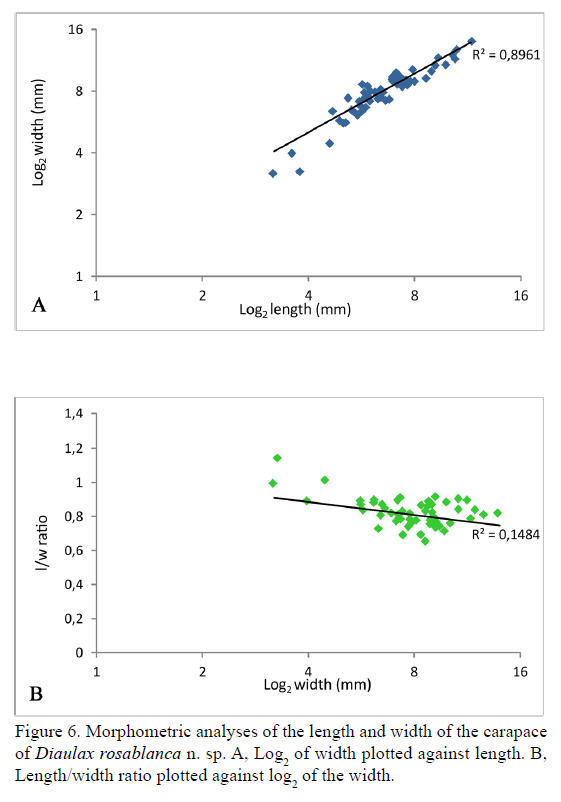
<body><![CDATA[<p align="justify"><font face="verdana" size="2"><b>Locality and stratigraphic position.</b> Loma del Corral sector, near the Bucaramanga &#150; Zapatoca road, Department of Santander, Colombia, about 260 km northeast of Bogot&aacute; D.C. middle part of the early Valanginian (Early Cretaceous).</font></p>  	    <p align="justify"><font face="verdana" size="2"><b>Repository.</b> 59 specimens, holotype CAL 4141&#45;8, paratypes CAL 4141&#45;9 to CAL 4141&#45;66.</font></p>  	    <p align="justify"><font face="verdana" size="2"><b>Measurements.</b> Measurements for each specimen are given in <a href="#t1">Table 1</a>.</font></p>  	    <p align="center"><font face="verdana" size="2"><a name="t1"></a></font></p>  	    <p align="center"><font face="verdana" size="2"><img src="/img/revistas/bsgm/v67n1/a8t1.jpg"></font></p>  	    <p align="justify"><font face="verdana" size="2"><b>Etymology.</b> The trivial name alludes to the Rosablanca Formation, lithostratigraphic unit.</font></p>  	    <p align="justify"><font face="verdana" size="2"><b>Discussion.</b> Jagt <i>et al</i>. (2010) considered <i>Diaulax</i> to be represented by five species: <i>D. oweni</i> (Bell, 1850); <i>D.</i> <i>feliceps</i> Wright and Collins, 1972; <i>D. millerae</i> Bishop, 1992; <i>D. roddai</i> Bishop, 1983 and <i>D. yokoii</i> Collins, Kanie and Karasawa, 1993. <i>D. carteriana</i> Bell, 1863 is a junior subjective synonym of <i>D. oweni</i>, according to Wright and Collins, 1972.</font></p>  	    <p align="justify"><font face="verdana" size="2"><i>Diaulax oweni</i> Bell, 1850 from the Cenomanian of England has a wider carapace at the anterior fourth, the anterolateral margin lacks notches, two small tubercles are found on the protogastric region and it has a stronger cervical groove; <i>D. feliceps</i> Wright and Collins, 1972 from the Albian of England has a wider anterior margin and stronger cervical groove; <i>D. millerae</i> Bishop, 1992 from the Campanian of Delaware has a more elongated carapace with stronger branchiocardiac groove and well&#45;defined dorsal carapace regions; <i>D. roddai</i> Bishop, 1983 from the Albian of Texas has a more elongated carapace with stronger cervical groove; <i>D. yokoii</i> Collins, Kanie and Karasawa, 1993 from the Santonian of Japan has a stronger protogastric process and well&#45;defined carapace regions.</font></p>  	    <p align="justify"><font face="verdana" size="2"><i>Diaulax</i>? <i>italica</i> Beschin, Busulini, De Angeli and Tessier, 2007 from the early Eocene of Italy has a narrower carapace with stronger cervical and branchiocardiac grooves, and its affinity with <i>Diaulax</i> is uncertain.</font></p>  	    <p align="justify"><font face="verdana" size="2">The carapace on the new species becomes relatively wider compared to the length with ontogeny (<a href="#f6">Figure 6</a>). A similar type ontogenetic variation was suggested by Klompmaker (2013) for <i>Graptocarcinus texanus</i> Roemer, 1887 and Klompmaker, Feldmann and Schweitzer (2012) for <i>Distefania incerta</i> (Bell, 1863), <i>Eodromites grandis</i> (von Meyer, 1857), <i>Goniodromites laevis</i> (Van Straelen, 1940) and <i>Navarradromites pedroartali</i> Klompmaker, Feldmann and Schweitzer (2012).</font></p>  	    ]]></body>
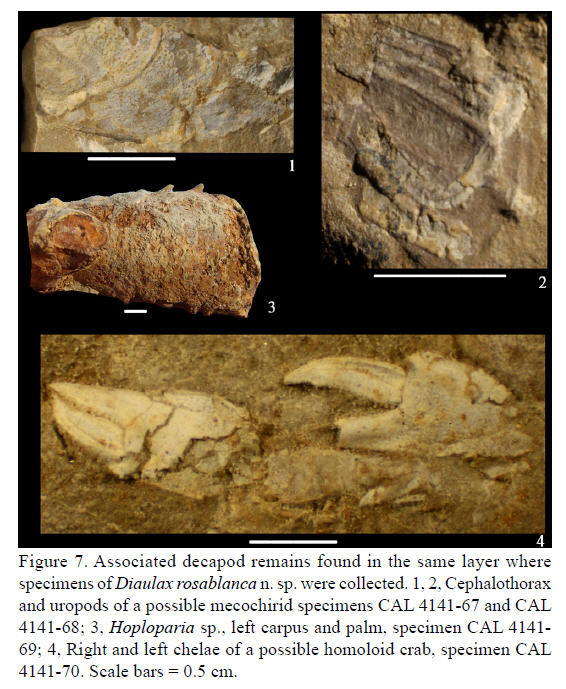
<body><![CDATA[<p align="center"><font face="verdana" size="2"><a name="f6"></a></font></p>  	    <p align="center"><font face="verdana" size="2"><img src="/img/revistas/bsgm/v67n1/a8f6.jpg"></font></p>  	    <p align="justify"><font face="verdana" size="2">Occurrence of a well&#45;represented population of <i>D.</i> <i>rosablanca</i> n. sp. might be the result of either a mass mortality event or an increase of population members as a result of favorable conditions. Along with the numerous specimens of the new species, incomplete remains of other crustacean taxa are found, such as disarticulated chelae, too slender to belong to <i>Diaulax</i>. Most specimens of <i>D. rosablanca</i> n. sp. are represented only by dorsal carapaces, which suggest a certain amount of transport from the place where specimens died however there is no evidence of reworking or transportation of the other fossils from this locality therefore it is possible the specimens represent molts. A relatively rapid burial of the specimens is suggested, since most carapaces do not show traces of abrasion.</font></p>  	    <p align="justify"><font face="verdana" size="2"><i>Diaulax rosablanca</i> n. sp. represents the oldest record for the genus and the first record in South America, where a center for origin of primitive Eubrachyura has been proposed (Luque <i>et al</i>., 2013).</font></p>  	    <p align="justify"><font face="verdana" size="2">Other crustacean remains (<a href="#f7">Figure 7</a>), found along with specimens of the new species, indicate the locality has potential for future reports on other associated decapod species.</font></p>  	    <p align="center"><font face="verdana" size="2"><a name="f7"></a></font></p>  	    <p align="center"><font face="verdana" size="2"><img src="/img/revistas/bsgm/v67n1/a8f7.jpg"></font></p>  	    <p align="justify"><font face="verdana" size="2">    <br> <b>Acknowledgements</b></font></p>  	    <p align="justify"><font face="verdana" size="2">Fieldwork of H. D. Berm&uacute;dez and F. J. Vega was funded by the research group of Paleoexplorer S.A.S, as part of the project "Fossil crustaceans of Colombia". Thanks to the staff of Paleoexplorer, geologist J. A. Rey, who collaborated on the collection of fossils during one of the visits to the fossiliferous locality in 2013, as well as the GIS Engineer Liliana Bol&iacute;var, for the elaboration of the cartographic material and the stratigraphic column. J. A. Moreno&#45;Bedmar (Instituto de Geolog&iacute;a, UNAM, Mexico) and M. Company (Universidad de Granada, Spain) helped with ammonite biostratigraphy. Support and advice of Adi&euml;l Klompmaker (Florida Museum of Natural History) is highly appreciated. Our sincere gratitude to Alessandro Garassino (Museo di Storia Naturale, Milano, Italy), Matus Hy&#382;n&yacute; (Department of Geology and Palaeontology, Faculty of Natural Sciences, Comenius University, Slovakia) and Torrey Nyborg (Loma Linda University) for detailed review and suggestions to improve the original manuscript.</font></p>  	    ]]></body>
<body><![CDATA[<p align="justify"><font face="verdana" size="2">&nbsp;</font></p>  	    <p align="justify"><font face="verdana" size="2"><b>References</b></font></p>  	    <!-- ref --><p align="justify"><font face="verdana" size="2">Aguirre&#45;Urreta, M.B., Rawson, P.F., 1999, Stratigraphic position of <i>Valanginites</i>, <i>Lissonia</i> and <i>Acantholissonia</i> in the Lower Valanginian (Lower Cretaceous) ammonite sequence of the Neuqu&eacute;n basin, Argentina, <i>in</i> Ol&oacute;riz, F., Rodr&iacute;guez&#45;Tovar, R. (eds), Advancing Research on Living and Fossil Cephalopods: New York, Kluwer Academic/Plenum Publishers, 521&#150;529.    &nbsp;&nbsp;&nbsp;&nbsp;&nbsp;&nbsp;&nbsp;&nbsp;[&#160;<a href="javascript:void(0);" onclick="javascript: window.open('/scielo.php?script=sci_nlinks&ref=1438691&pid=S1405-3322201500010000800001&lng=','','width=640,height=500,resizable=yes,scrollbars=1,menubar=yes,');">Links</a>&#160;]<!-- end-ref --></font></p>  	    <!-- ref --><p align="justify"><font face="verdana" size="2">Aguirre&#45;Urreta, M.B., Rawson, P.F., Concheyro, G.A., Bown, P.R., Ottone, E.G., 2005, Lower Cretaceous (Berriasian&#45;Aptian) biostratigraphy of the Neuqu&eacute;n Basin, <i>in</i> Veiga G.D., Spalletti, L.A., Howel, J.A., Schwarz, E. (eds.), The Neuqu&eacute;n Basin: A Case Study in Sequence Stratigraphy and Basin Dynamics: Geological Society of London, Special Publication 252, 57&#150;81.    &nbsp;&nbsp;&nbsp;&nbsp;&nbsp;&nbsp;&nbsp;&nbsp;[&#160;<a href="javascript:void(0);" onclick="javascript: window.open('/scielo.php?script=sci_nlinks&ref=1438693&pid=S1405-3322201500010000800002&lng=','','width=640,height=500,resizable=yes,scrollbars=1,menubar=yes,');">Links</a>&#160;]<!-- end-ref --></font></p>  	    <!-- ref --><p align="justify"><font face="verdana" size="2">Aguirre&#45;Urreta, M.B., Mourgues, F.A., Rawson, P.F., Bulot, L.G., Jaillard, E., 2007, The Lower Cretaceous Cha&ntilde;arcillo and Neuqu&eacute;n Andean basins: ammonoid biostratigraphy and correlations: Geological Journal, 42, 143&#150;173.    &nbsp;&nbsp;&nbsp;&nbsp;&nbsp;&nbsp;&nbsp;&nbsp;[&#160;<a href="javascript:void(0);" onclick="javascript: window.open('/scielo.php?script=sci_nlinks&ref=1438695&pid=S1405-3322201500010000800003&lng=','','width=640,height=500,resizable=yes,scrollbars=1,menubar=yes,');">Links</a>&#160;]<!-- end-ref --></font></p>  	    <!-- ref --><p align="justify"><font face="verdana" size="2">Bell, T., 1850, Notes on the Crustacea of the Chalk Formation, <i>in</i> Dixon, F. (ed.), The geology and fossils of the Tertiary and Cretaceous formations of Sussex: London, Brown, Green and Longmans, 344&#150;345.    &nbsp;&nbsp;&nbsp;&nbsp;&nbsp;&nbsp;&nbsp;&nbsp;[&#160;<a href="javascript:void(0);" onclick="javascript: window.open('/scielo.php?script=sci_nlinks&ref=1438697&pid=S1405-3322201500010000800004&lng=','','width=640,height=500,resizable=yes,scrollbars=1,menubar=yes,');">Links</a>&#160;]<!-- end-ref --></font></p>  	    ]]></body>
<body><![CDATA[<!-- ref --><p align="justify"><font face="verdana" size="2">Bell, T., 1863, A Monograph of the Fossil Malacostracous Crustacea of Great Britain, Pt. II, Crustacea of the Gault and Greensand: Palaeontographical Society Monograph, London.    &nbsp;&nbsp;&nbsp;&nbsp;&nbsp;&nbsp;&nbsp;&nbsp;[&#160;<a href="javascript:void(0);" onclick="javascript: window.open('/scielo.php?script=sci_nlinks&ref=1438699&pid=S1405-3322201500010000800005&lng=','','width=640,height=500,resizable=yes,scrollbars=1,menubar=yes,');">Links</a>&#160;]<!-- end-ref --></font></p>  	    <!-- ref --><p align="justify"><font face="verdana" size="2">Berm&uacute;dez, H.D., G&oacute;mez&#45;Cruz, A.J., Hy&#382;n&yacute;, M., Moreno&#45;Bedmar, J.A., Barrag&aacute;n, R., Moreno&#45;S&aacute;nchez, M., Vega, F.J., 2013, Decapod crustaceans from the Cretaceous (Aptian&#150;Albian) San Gil Group in the Villa de Leyva section, central Colombia: Neues Jahrbuch f&uuml;r Geologie und Pal&auml;ontologie Abhandlungen, 267, 255&#150;272.    &nbsp;&nbsp;&nbsp;&nbsp;&nbsp;&nbsp;&nbsp;&nbsp;[&#160;<a href="javascript:void(0);" onclick="javascript: window.open('/scielo.php?script=sci_nlinks&ref=1438701&pid=S1405-3322201500010000800006&lng=','','width=640,height=500,resizable=yes,scrollbars=1,menubar=yes,');">Links</a>&#160;]<!-- end-ref --></font></p>  	    <!-- ref --><p align="justify"><font face="verdana" size="2">Beschin, C., Busulini, A., De Angeli, A., Tessier, G., 2007, I Decapodi dell'Eocene Inferiore di Contrada Gecchelina (Vicenza &#150; Italia settentrionale) (Anomura e Brachiura): Museo di Archeologia e Scienze Naturali "G. Zannato": Montecchio Maggiore (Vicenza), 9&#150;76.    &nbsp;&nbsp;&nbsp;&nbsp;&nbsp;&nbsp;&nbsp;&nbsp;[&#160;<a href="javascript:void(0);" onclick="javascript: window.open('/scielo.php?script=sci_nlinks&ref=1438703&pid=S1405-3322201500010000800007&lng=','','width=640,height=500,resizable=yes,scrollbars=1,menubar=yes,');">Links</a>&#160;]<!-- end-ref --></font></p>  	    <!-- ref --><p align="justify"><font face="verdana" size="2">Bishop, G.A., 1983, Fossil decapod crustaceans from the Lower Cretaceous, Glen Rose Limestone of central Texas: Transactions of the San Diego Society of Natural History, 20, 27&#150;55.    &nbsp;&nbsp;&nbsp;&nbsp;&nbsp;&nbsp;&nbsp;&nbsp;[&#160;<a href="javascript:void(0);" onclick="javascript: window.open('/scielo.php?script=sci_nlinks&ref=1438705&pid=S1405-3322201500010000800008&lng=','','width=640,height=500,resizable=yes,scrollbars=1,menubar=yes,');">Links</a>&#160;]<!-- end-ref --></font></p>  	    <!-- ref --><p align="justify"><font face="verdana" size="2">Bishop, G.A., 1992, A new Cretaceous crab <i>Diaulax millerae</i> (Crustacea: Decapoda), from the northern Atlantic Coastal Plain, U.S.A: Proceedings of the Biological Society of Washington, 105, 555&#150;561.    &nbsp;&nbsp;&nbsp;&nbsp;&nbsp;&nbsp;&nbsp;&nbsp;[&#160;<a href="javascript:void(0);" onclick="javascript: window.open('/scielo.php?script=sci_nlinks&ref=1438707&pid=S1405-3322201500010000800009&lng=','','width=640,height=500,resizable=yes,scrollbars=1,menubar=yes,');">Links</a>&#160;]<!-- end-ref --></font></p>  	    ]]></body>
<body><![CDATA[<!-- ref --><p align="justify"><font face="verdana" size="2">Collins, J.S.H., Kanie, Y., Karasawa, H., 1993, Late Cretaceous crabs from Japan: Transactions and Proceedings of the Palaeontological Society of Japan, (new series), 172, 292&#150;310.    &nbsp;&nbsp;&nbsp;&nbsp;&nbsp;&nbsp;&nbsp;&nbsp;[&#160;<a href="javascript:void(0);" onclick="javascript: window.open('/scielo.php?script=sci_nlinks&ref=1438709&pid=S1405-3322201500010000800010&lng=','','width=640,height=500,resizable=yes,scrollbars=1,menubar=yes,');">Links</a>&#160;]<!-- end-ref --></font></p>  	    <!-- ref --><p align="justify"><font face="verdana" size="2">de Haan,W., 1833&#45;1850, Crustacea, pp. i&#45;xvii, i&#45;xxxi, ix&#45;xvi, 1&#45;243, pls. AJ, L&#45;Q, 1&#45;55, circ. table 2, <i>in</i>, von Siebold, P.F. (ed.), Fauna Japonica sive Descriptio Animalium, quae in Itinere per Japoniam, Jussu et Auspiciis Superiorum, qui summum in India Batava Imperium Tenent, Suscepto, Annis 1823&#45;1830 Collegit, Notis, Observationibus et Adumbrationibus Illustravit. J. M&uuml;ller et Co., Lugduni Batavorum &#91;= Leyden&#93;    &nbsp;&nbsp;&nbsp;&nbsp;&nbsp;&nbsp;&nbsp;&nbsp;[&#160;<a href="javascript:void(0);" onclick="javascript: window.open('/scielo.php?script=sci_nlinks&ref=1438711&pid=S1405-3322201500010000800011&lng=','','width=640,height=500,resizable=yes,scrollbars=1,menubar=yes,');">Links</a>&#160;]<!-- end-ref -->.</font></p>  	    <!-- ref --><p align="justify"><font face="verdana" size="2">Guzm&aacute;n, G., 1985, Los Griferidos Infracret&aacute;cicos <i>Aetostreon couloni</i> y <i>Ceratostreon boussingaulti</i>, de la Formaci&oacute;n Rosablanca, como Indicadores de oscilaciones marinas. Proyecto Cret&aacute;cico: Publicaciones Geol&oacute;gicas especiales del Ingeominas, 16, Cap&iacute;tulo XI, 1&#150;16.    &nbsp;&nbsp;&nbsp;&nbsp;&nbsp;&nbsp;&nbsp;&nbsp;[&#160;<a href="javascript:void(0);" onclick="javascript: window.open('/scielo.php?script=sci_nlinks&ref=1438713&pid=S1405-3322201500010000800012&lng=','','width=640,height=500,resizable=yes,scrollbars=1,menubar=yes,');">Links</a>&#160;]<!-- end-ref --></font></p>  	    <!-- ref --><p align="justify"><font face="verdana" size="2">Jagt, J.W.M., Fraaije, R.H.B., Van Bakel, B.W.M., Artal, P., 2010, <i>Necrocarcinus ornatissimus</i> Forir, 1887, and <i>Prehepatus werneri</i> Fraaye &amp; Collins, 1987 (Upper Maastrichtian, The Netherlands) revisited, with Notes on other Cretaceous dynomenid crabs (Decapoda, Brachyura): Crustaceana Monographs, 11, 173&#150;195.    &nbsp;&nbsp;&nbsp;&nbsp;&nbsp;&nbsp;&nbsp;&nbsp;[&#160;<a href="javascript:void(0);" onclick="javascript: window.open('/scielo.php?script=sci_nlinks&ref=1438715&pid=S1405-3322201500010000800013&lng=','','width=640,height=500,resizable=yes,scrollbars=1,menubar=yes,');">Links</a>&#160;]<!-- end-ref --></font></p>  	    <!-- ref --><p align="justify"><font face="verdana" size="2">Klompmaker, A.A., 2013, Extreme diversity of decapod crustaceans from the mid&#45;Cretaceous (late Albian) of Spain: implications for Cretaceous decapod paleoecology: Cretaceous Research, 41, 150&#150;185.    &nbsp;&nbsp;&nbsp;&nbsp;&nbsp;&nbsp;&nbsp;&nbsp;[&#160;<a href="javascript:void(0);" onclick="javascript: window.open('/scielo.php?script=sci_nlinks&ref=1438717&pid=S1405-3322201500010000800014&lng=','','width=640,height=500,resizable=yes,scrollbars=1,menubar=yes,');">Links</a>&#160;]<!-- end-ref --></font></p>  	    ]]></body>
<body><![CDATA[<!-- ref --><p align="justify"><font face="verdana" size="2">Klompmaker, A.A., Feldmann, R.M., Schweitzer, C.E., 2012, A hotspot for Cretaceous goniodromitids (Decapoda, Brachyura) from reef associated strata in Spain: Journal of Crustacean Biology, 32, 780&#150;801.    &nbsp;&nbsp;&nbsp;&nbsp;&nbsp;&nbsp;&nbsp;&nbsp;[&#160;<a href="javascript:void(0);" onclick="javascript: window.open('/scielo.php?script=sci_nlinks&ref=1438719&pid=S1405-3322201500010000800015&lng=','','width=640,height=500,resizable=yes,scrollbars=1,menubar=yes,');">Links</a>&#160;]<!-- end-ref --></font></p>  	    <!-- ref --><p align="justify"><font face="verdana" size="2">Latreille, P.A., 1802&#45;1803, Histoire naturelle, g&eacute;n&eacute;rale et particuli&egrave;re, des Crustac&eacute;s et des Insectes: Paris, F. Dufart, 3, 1&#150;468.    &nbsp;&nbsp;&nbsp;&nbsp;&nbsp;&nbsp;&nbsp;&nbsp;[&#160;<a href="javascript:void(0);" onclick="javascript: window.open('/scielo.php?script=sci_nlinks&ref=1438721&pid=S1405-3322201500010000800016&lng=','','width=640,height=500,resizable=yes,scrollbars=1,menubar=yes,');">Links</a>&#160;]<!-- end-ref --></font></p>  	    <!-- ref --><p align="justify"><font face="verdana" size="2">Linnaeus, C. &#91;von&#93;., 1758, Systema Naturae per Regna tria Naturae, secundum classes, ordines, genera, species, cum characteribus, differentiis, synonymis, locis (ed. 10) 1: 1&#150;824. Laurentii Salvii, Holmiae &#91;= Stockholm&#93;    &nbsp;&nbsp;&nbsp;&nbsp;&nbsp;&nbsp;&nbsp;&nbsp;[&#160;<a href="javascript:void(0);" onclick="javascript: window.open('/scielo.php?script=sci_nlinks&ref=1438723&pid=S1405-3322201500010000800017&lng=','','width=640,height=500,resizable=yes,scrollbars=1,menubar=yes,');">Links</a>&#160;]<!-- end-ref -->.</font></p>  	    <!-- ref --><p align="justify"><font face="verdana" size="2">Lisson, C.I., 1907, Contribuci&oacute;n a la Geolog&iacute;a de Lima y sus alrededores: Lima, Gil, 1&#150;123.    &nbsp;&nbsp;&nbsp;&nbsp;&nbsp;&nbsp;&nbsp;&nbsp;[&#160;<a href="javascript:void(0);" onclick="javascript: window.open('/scielo.php?script=sci_nlinks&ref=1438725&pid=S1405-3322201500010000800018&lng=','','width=640,height=500,resizable=yes,scrollbars=1,menubar=yes,');">Links</a>&#160;]<!-- end-ref --></font></p>  	    <!-- ref --><p align="justify"><font face="verdana" size="2">Luque, J., Feldmann, R.M., Schweitzer, C.E., Karasawa, H., Jaramillo, C., 2013, On the origin and evolution of true crabs: insights from northern South America: Geological Society of America, Abstracts with Programs, 45, 459.    &nbsp;&nbsp;&nbsp;&nbsp;&nbsp;&nbsp;&nbsp;&nbsp;[&#160;<a href="javascript:void(0);" onclick="javascript: window.open('/scielo.php?script=sci_nlinks&ref=1438727&pid=S1405-3322201500010000800019&lng=','','width=640,height=500,resizable=yes,scrollbars=1,menubar=yes,');">Links</a>&#160;]<!-- end-ref --></font></p>  	    ]]></body>
<body><![CDATA[<!-- ref --><p align="justify"><font face="verdana" size="2">Morales, L.G., 1958, General geology and oil occurrences of the Middle Magdalena Valley, Colombia, <i>in</i> Weeks, L.G. (ed.), Habitat of Oil: A Symposium: Tulsa, Oklahoma, American Association of Petroleum Geologists, 641&#150;695.    &nbsp;&nbsp;&nbsp;&nbsp;&nbsp;&nbsp;&nbsp;&nbsp;[&#160;<a href="javascript:void(0);" onclick="javascript: window.open('/scielo.php?script=sci_nlinks&ref=1438729&pid=S1405-3322201500010000800020&lng=','','width=640,height=500,resizable=yes,scrollbars=1,menubar=yes,');">Links</a>&#160;]<!-- end-ref --></font></p>  	    <!-- ref --><p align="justify"><font face="verdana" size="2">Rawson, P.F., 2007, Global relationships of Argentine (Neuqu&eacute;n Basin) Early Cretaceous ammonite faunas: Geological Journal, 42, 175&#150;183.    &nbsp;&nbsp;&nbsp;&nbsp;&nbsp;&nbsp;&nbsp;&nbsp;[&#160;<a href="javascript:void(0);" onclick="javascript: window.open('/scielo.php?script=sci_nlinks&ref=1438731&pid=S1405-3322201500010000800021&lng=','','width=640,height=500,resizable=yes,scrollbars=1,menubar=yes,');">Links</a>&#160;]<!-- end-ref --></font></p>  	    <!-- ref --><p align="justify"><font face="verdana" size="2">Roemer, F.A., 1887, <i>Graptocarcinus texanus</i>, ein Brachyure aus der Kreide von Texas: Neues Jahrbuch f&uuml;r Mineralogie, Geologie, und Pal&auml;ontologie, 1887, 173&#150;176.    &nbsp;&nbsp;&nbsp;&nbsp;&nbsp;&nbsp;&nbsp;&nbsp;[&#160;<a href="javascript:void(0);" onclick="javascript: window.open('/scielo.php?script=sci_nlinks&ref=1438733&pid=S1405-3322201500010000800022&lng=','','width=640,height=500,resizable=yes,scrollbars=1,menubar=yes,');">Links</a>&#160;]<!-- end-ref --></font></p>  	    <!-- ref --><p align="justify"><font face="verdana" size="2">Rojas&#45;Brice&ntilde;o, A., Patarroyo, P., 2009, Occurrence of <i>Sellithyris sella</i> (Brachiopoda) in the Rosablanca Formation, Boyac&aacute;&#45;Colombia: Bolet&iacute;n de Geolog&iacute;a, Universidad Industrial de Santander, 31, 129&#150;132.    &nbsp;&nbsp;&nbsp;&nbsp;&nbsp;&nbsp;&nbsp;&nbsp;[&#160;<a href="javascript:void(0);" onclick="javascript: window.open('/scielo.php?script=sci_nlinks&ref=1438735&pid=S1405-3322201500010000800023&lng=','','width=640,height=500,resizable=yes,scrollbars=1,menubar=yes,');">Links</a>&#160;]<!-- end-ref --></font></p>  	    <!-- ref --><p align="justify"><font face="verdana" size="2">Van Straelen, V., 1940, Crustac&eacute;s D&eacute;capodes nouveaux du Cr&eacute;tacique de la Navarre: Bulletin du Mus&eacute;e Royal d'Histoire Naturelle de Belgique, 16, 1&#150;5.    &nbsp;&nbsp;&nbsp;&nbsp;&nbsp;&nbsp;&nbsp;&nbsp;[&#160;<a href="javascript:void(0);" onclick="javascript: window.open('/scielo.php?script=sci_nlinks&ref=1438737&pid=S1405-3322201500010000800024&lng=','','width=640,height=500,resizable=yes,scrollbars=1,menubar=yes,');">Links</a>&#160;]<!-- end-ref --></font></p>  	    ]]></body>
<body><![CDATA[<!-- ref --><p align="justify"><font face="verdana" size="2">Vega, F.J., Nyborg, T.G., Rojas, A., Patarroyo, P., Luque, J., Porras&#45;M&uacute;zquiz, H., Stinnesbeck, W., 2007, Upper Cretaceous Crustacea from Mexico and Colombia: common faunas and environments during Turonian times: Revista Mexicana de Ciencias Geol&oacute;gicas, 24, 403&#150;422.    &nbsp;&nbsp;&nbsp;&nbsp;&nbsp;&nbsp;&nbsp;&nbsp;[&#160;<a href="javascript:void(0);" onclick="javascript: window.open('/scielo.php?script=sci_nlinks&ref=1438739&pid=S1405-3322201500010000800025&lng=','','width=640,height=500,resizable=yes,scrollbars=1,menubar=yes,');">Links</a>&#160;]<!-- end-ref --></font></p>  	    <!-- ref --><p align="justify"><font face="verdana" size="2">Vega, F.J., Nyborg, T., Kovalchuk, G., Luque, J., Rojas&#45;Brice&ntilde;o, A., Patarroyo, P., Porras&#45;M&uacute;zquiz, H., Armstrong, A., Berm&uacute;dez, H., Garibay, L., 2010, On some Panamerican Cretaceous crabs (Decapoda: Raninoida): Bolet&iacute;n de la Sociedad Geol&oacute;gica Mexicana, 62, 263&#150;279.    &nbsp;&nbsp;&nbsp;&nbsp;&nbsp;&nbsp;&nbsp;&nbsp;[&#160;<a href="javascript:void(0);" onclick="javascript: window.open('/scielo.php?script=sci_nlinks&ref=1438741&pid=S1405-3322201500010000800026&lng=','','width=640,height=500,resizable=yes,scrollbars=1,menubar=yes,');">Links</a>&#160;]<!-- end-ref --></font></p>  	    <!-- ref --><p align="justify"><font face="verdana" size="2">von Meyer, H., 1857, Briefliche Mitteilungen: Jahrbuch f&uuml;r Mineralogie, Geologie, Geognosie und Petrefaktenkunde, 556.    &nbsp;&nbsp;&nbsp;&nbsp;&nbsp;&nbsp;&nbsp;&nbsp;[&#160;<a href="javascript:void(0);" onclick="javascript: window.open('/scielo.php?script=sci_nlinks&ref=1438743&pid=S1405-3322201500010000800027&lng=','','width=640,height=500,resizable=yes,scrollbars=1,menubar=yes,');">Links</a>&#160;]<!-- end-ref --></font></p>  	    <!-- ref --><p align="justify"><font face="verdana" size="2">Ward, D.E., Goldsmith, R., Jimeno, A., Cruz, J., Restrepo, H., G&oacute;mez, E., 1973, Mapa geol&oacute;gico del Cuadr&aacute;ngulo H&#45;12 Bucaramanga, 1:100000: Bogot&aacute;, INGEOMINAS, 1 mapa.    &nbsp;&nbsp;&nbsp;&nbsp;&nbsp;&nbsp;&nbsp;&nbsp;[&#160;<a href="javascript:void(0);" onclick="javascript: window.open('/scielo.php?script=sci_nlinks&ref=1438745&pid=S1405-3322201500010000800028&lng=','','width=640,height=500,resizable=yes,scrollbars=1,menubar=yes,');">Links</a>&#160;]<!-- end-ref --></font></p>  	    <!-- ref --><p align="justify"><font face="verdana" size="2">Weaver, C.E., 1931, Paleontology of the Jurassic and Cretaceous of West Central Argentina: Memories of the University of Washington, 1, 1&#150;469.    &nbsp;&nbsp;&nbsp;&nbsp;&nbsp;&nbsp;&nbsp;&nbsp;[&#160;<a href="javascript:void(0);" onclick="javascript: window.open('/scielo.php?script=sci_nlinks&ref=1438747&pid=S1405-3322201500010000800029&lng=','','width=640,height=500,resizable=yes,scrollbars=1,menubar=yes,');">Links</a>&#160;]<!-- end-ref --></font></p>  	    ]]></body>
<body><![CDATA[<!-- ref --><p align="justify"><font face="verdana" size="2">Wright, C.W., Collins, J.S.H., 1972, British Cretaceous crabs: Palaeontographical Society Monographs, 126 (533), 1&#150;113.    &nbsp;&nbsp;&nbsp;&nbsp;&nbsp;&nbsp;&nbsp;&nbsp;[&#160;<a href="javascript:void(0);" onclick="javascript: window.open('/scielo.php?script=sci_nlinks&ref=1438749&pid=S1405-3322201500010000800030&lng=','','width=640,height=500,resizable=yes,scrollbars=1,menubar=yes,');">Links</a>&#160;]<!-- end-ref --></font></p>      ]]></body><back>
<ref-list>
<ref id="B1">
<nlm-citation citation-type="book">
<person-group person-group-type="author">
<name>
<surname><![CDATA[Aguirre-Urreta]]></surname>
<given-names><![CDATA[M.B.]]></given-names>
</name>
<name>
<surname><![CDATA[Rawson]]></surname>
<given-names><![CDATA[P.F.]]></given-names>
</name>
</person-group>
<article-title xml:lang="en"><![CDATA[Stratigraphic position of Valanginites, Lissonia and Acantholissonia in the Lower Valanginian (Lower Cretaceous) ammonite sequence of the Neuquén basin, Argentina]]></article-title>
<person-group person-group-type="editor">
<name>
<surname><![CDATA[Olóriz]]></surname>
<given-names><![CDATA[F.]]></given-names>
</name>
<name>
<surname><![CDATA[Rodríguez-Tovar]]></surname>
<given-names><![CDATA[R.]]></given-names>
</name>
</person-group>
<source><![CDATA[Advancing Research on Living and Fossil Cephalopods]]></source>
<year>1999</year>
<page-range>521-529</page-range><publisher-loc><![CDATA[New York ]]></publisher-loc>
<publisher-name><![CDATA[Kluwer AcademicPlenum Publishers]]></publisher-name>
</nlm-citation>
</ref>
<ref id="B2">
<nlm-citation citation-type="journal">
<person-group person-group-type="author">
<name>
<surname><![CDATA[Aguirre-Urreta]]></surname>
<given-names><![CDATA[M.B.]]></given-names>
</name>
<name>
<surname><![CDATA[Rawson]]></surname>
<given-names><![CDATA[P.F.]]></given-names>
</name>
<name>
<surname><![CDATA[Concheyro]]></surname>
<given-names><![CDATA[G.A.]]></given-names>
</name>
<name>
<surname><![CDATA[Bown]]></surname>
<given-names><![CDATA[P.R.]]></given-names>
</name>
<name>
<surname><![CDATA[Ottone]]></surname>
<given-names><![CDATA[E.G.]]></given-names>
</name>
</person-group>
<article-title xml:lang="en"><![CDATA[Lower Cretaceous (Berriasian-Aptian) biostratigraphy of the Neuquén Basin]]></article-title>
<person-group person-group-type="editor">
<name>
<surname><![CDATA[Veiga]]></surname>
<given-names><![CDATA[G.D.]]></given-names>
</name>
<name>
<surname><![CDATA[Spalletti]]></surname>
<given-names><![CDATA[L.A.]]></given-names>
</name>
<name>
<surname><![CDATA[Howel]]></surname>
<given-names><![CDATA[J.A.]]></given-names>
</name>
<name>
<surname><![CDATA[Schwarz]]></surname>
<given-names><![CDATA[E.]]></given-names>
</name>
</person-group>
<source><![CDATA[Geological Society of LondonThe Neuquén Basin: A Case Study in Sequence Stratigraphy and Basin Dynamics]]></source>
<year>2005</year>
<numero>252</numero>
<issue>252</issue>
<page-range>57-81</page-range></nlm-citation>
</ref>
<ref id="B3">
<nlm-citation citation-type="journal">
<person-group person-group-type="author">
<name>
<surname><![CDATA[Aguirre-Urreta]]></surname>
<given-names><![CDATA[M.B.]]></given-names>
</name>
<name>
<surname><![CDATA[Mourgues]]></surname>
<given-names><![CDATA[F.A.]]></given-names>
</name>
<name>
<surname><![CDATA[Rawson]]></surname>
<given-names><![CDATA[P.F.]]></given-names>
</name>
<name>
<surname><![CDATA[Bulot]]></surname>
<given-names><![CDATA[L.G.]]></given-names>
</name>
<name>
<surname><![CDATA[Jaillard]]></surname>
<given-names><![CDATA[E.]]></given-names>
</name>
</person-group>
<article-title xml:lang="en"><![CDATA[The Lower Cretaceous Chañarcillo and Neuquén Andean basins: ammonoid biostratigraphy and correlations]]></article-title>
<source><![CDATA[Geological Journal]]></source>
<year>2007</year>
<volume>42</volume>
<page-range>143-173</page-range></nlm-citation>
</ref>
<ref id="B4">
<nlm-citation citation-type="book">
<person-group person-group-type="author">
<name>
<surname><![CDATA[Bell]]></surname>
<given-names><![CDATA[T.]]></given-names>
</name>
</person-group>
<article-title xml:lang="en"><![CDATA[Notes on the Crustacea of the Chalk Formation]]></article-title>
<person-group person-group-type="editor">
<name>
<surname><![CDATA[Dixon]]></surname>
<given-names><![CDATA[F.]]></given-names>
</name>
</person-group>
<source><![CDATA[The geology and fossils of the Tertiary and Cretaceous formations of Sussex]]></source>
<year>1850</year>
<page-range>344-345</page-range><publisher-loc><![CDATA[London ]]></publisher-loc>
<publisher-name><![CDATA[Brown, Green and Longmans]]></publisher-name>
</nlm-citation>
</ref>
<ref id="B5">
<nlm-citation citation-type="book">
<person-group person-group-type="author">
<name>
<surname><![CDATA[Bell]]></surname>
<given-names><![CDATA[T.]]></given-names>
</name>
</person-group>
<source><![CDATA[A Monograph of the Fossil Malacostracous Crustacea of Great Britain]]></source>
<year>1863</year>
<publisher-loc><![CDATA[London ]]></publisher-loc>
<publisher-name><![CDATA[Palaeontographical Society Monograph]]></publisher-name>
</nlm-citation>
</ref>
<ref id="B6">
<nlm-citation citation-type="journal">
<person-group person-group-type="author">
<name>
<surname><![CDATA[Bermúdez]]></surname>
<given-names><![CDATA[H.D.]]></given-names>
</name>
<name>
<surname><![CDATA[Gómez-Cruz]]></surname>
<given-names><![CDATA[A.J.]]></given-names>
</name>
<name>
<surname><![CDATA[Hy&#382;ný]]></surname>
<given-names><![CDATA[M.]]></given-names>
</name>
<name>
<surname><![CDATA[Moreno-Bedmar]]></surname>
<given-names><![CDATA[J.A.]]></given-names>
</name>
<name>
<surname><![CDATA[Barragán]]></surname>
<given-names><![CDATA[R.]]></given-names>
</name>
<name>
<surname><![CDATA[Moreno-Sánchez]]></surname>
<given-names><![CDATA[M.]]></given-names>
</name>
<name>
<surname><![CDATA[Vega]]></surname>
<given-names><![CDATA[F.J.]]></given-names>
</name>
</person-group>
<article-title xml:lang="en"><![CDATA[Decapod crustaceans from the Cretaceous (Aptian-Albian) San Gil Group in the Villa de Leyva section, central Colombia]]></article-title>
<source><![CDATA[Neues Jahrbuch für Geologie und Paläontologie Abhandlungen]]></source>
<year>2013</year>
<volume>267</volume>
<page-range>255-272</page-range></nlm-citation>
</ref>
<ref id="B7">
<nlm-citation citation-type="">
<person-group person-group-type="author">
<name>
<surname><![CDATA[Beschin]]></surname>
<given-names><![CDATA[C.]]></given-names>
</name>
<name>
<surname><![CDATA[Busulini]]></surname>
<given-names><![CDATA[A.]]></given-names>
</name>
<name>
<surname><![CDATA[De Angeli]]></surname>
<given-names><![CDATA[A.]]></given-names>
</name>
<name>
<surname><![CDATA[Tessier]]></surname>
<given-names><![CDATA[G.]]></given-names>
</name>
</person-group>
<source><![CDATA[I Decapodi dell'Eocene Inferiore di Contrada Gecchelina (Vicenza - Italia settentrionale) (Anomura e Brachiura)]]></source>
<year>2007</year>
</nlm-citation>
</ref>
<ref id="B8">
<nlm-citation citation-type="journal">
<person-group person-group-type="author">
<name>
<surname><![CDATA[Bishop]]></surname>
<given-names><![CDATA[G.A.]]></given-names>
</name>
</person-group>
<article-title xml:lang="en"><![CDATA[Fossil decapod crustaceans from the Lower Cretaceous, Glen Rose Limestone of central Texas]]></article-title>
<source><![CDATA[Transactions of the San Diego Society of Natural History]]></source>
<year>1983</year>
<volume>20</volume>
<page-range>27-55</page-range></nlm-citation>
</ref>
<ref id="B9">
<nlm-citation citation-type="journal">
<person-group person-group-type="author">
<name>
<surname><![CDATA[Bishop]]></surname>
<given-names><![CDATA[G.A.]]></given-names>
</name>
</person-group>
<article-title xml:lang="en"><![CDATA[A new Cretaceous crab Diaulax millerae (Crustacea: Decapoda), from the northern Atlantic Coastal Plain, U.S.A]]></article-title>
<source><![CDATA[Proceedings of the Biological Society of Washington]]></source>
<year>1992</year>
<volume>105</volume>
<page-range>555-561</page-range></nlm-citation>
</ref>
<ref id="B10">
<nlm-citation citation-type="journal">
<person-group person-group-type="author">
<name>
<surname><![CDATA[Collins]]></surname>
<given-names><![CDATA[J.S.H.]]></given-names>
</name>
<name>
<surname><![CDATA[Kanie]]></surname>
<given-names><![CDATA[Y.]]></given-names>
</name>
<name>
<surname><![CDATA[Karasawa]]></surname>
<given-names><![CDATA[H.]]></given-names>
</name>
</person-group>
<article-title xml:lang="en"><![CDATA[Late Cretaceous crabs from Japan]]></article-title>
<source><![CDATA[Transactions and Proceedings of the Palaeontological Society of Japan]]></source>
<year>1993</year>
<volume>172</volume>
<page-range>292-310</page-range></nlm-citation>
</ref>
<ref id="B11">
<nlm-citation citation-type="book">
<person-group person-group-type="author">
<name>
<surname><![CDATA[de Haan]]></surname>
<given-names><![CDATA[W.]]></given-names>
</name>
</person-group>
<article-title xml:lang="fr"><![CDATA[Crustacea]]></article-title>
<person-group person-group-type="editor">
<name>
<surname><![CDATA[von Siebold]]></surname>
<given-names><![CDATA[P.F.]]></given-names>
</name>
</person-group>
<source><![CDATA[Fauna Japonica sive Descriptio Animalium, quae in Itinere per Japoniam, Jussu et Auspiciis Superiorum, qui summum in India Batava Imperium Tenent, Suscepto]]></source>
<year>1833</year>
<publisher-loc><![CDATA[Lugduni Batavorum ]]></publisher-loc>
<publisher-name><![CDATA[J. Müller et Co.]]></publisher-name>
</nlm-citation>
</ref>
<ref id="B12">
<nlm-citation citation-type="">
<person-group person-group-type="author">
<name>
<surname><![CDATA[Guzmán]]></surname>
<given-names><![CDATA[G.]]></given-names>
</name>
</person-group>
<source><![CDATA[Los Griferidos Infracretácicos Aetostreon couloni y Ceratostreon boussingaulti, de la Formación Rosablanca, como Indicadores de oscilaciones marinas. Proyecto Cretácico]]></source>
<year>1985</year>
</nlm-citation>
</ref>
<ref id="B13">
<nlm-citation citation-type="">
<person-group person-group-type="author">
<name>
<surname><![CDATA[Jagt]]></surname>
<given-names><![CDATA[J.W.M.]]></given-names>
</name>
<name>
<surname><![CDATA[Fraaije]]></surname>
<given-names><![CDATA[R.H.B.]]></given-names>
</name>
<name>
<surname><![CDATA[Van Bakel]]></surname>
<given-names><![CDATA[B.W.M.]]></given-names>
</name>
<name>
<surname><![CDATA[Artal]]></surname>
<given-names><![CDATA[P.]]></given-names>
</name>
</person-group>
<source><![CDATA[Necrocarcinus ornatissimus Forir, 1887, and Prehepatus werneri Fraaye & Collins, 1987 (Upper Maastrichtian, The Netherlands) revisited, with Notes on other Cretaceous dynomenid crabs (Decapoda, Brachyura)]]></source>
<year>2010</year>
<page-range>173-195</page-range></nlm-citation>
</ref>
<ref id="B14">
<nlm-citation citation-type="journal">
<person-group person-group-type="author">
<name>
<surname><![CDATA[Klompmaker]]></surname>
<given-names><![CDATA[A.A.]]></given-names>
</name>
</person-group>
<article-title xml:lang="en"><![CDATA[Extreme diversity of decapod crustaceans from the mid-Cretaceous (late Albian) of Spain: implications for Cretaceous decapod paleoecology]]></article-title>
<source><![CDATA[Cretaceous Research]]></source>
<year>2013</year>
<volume>41</volume>
<page-range>150-185</page-range></nlm-citation>
</ref>
<ref id="B15">
<nlm-citation citation-type="journal">
<person-group person-group-type="author">
<name>
<surname><![CDATA[Klompmaker]]></surname>
<given-names><![CDATA[A.A.]]></given-names>
</name>
<name>
<surname><![CDATA[Feldmann]]></surname>
<given-names><![CDATA[R.M.]]></given-names>
</name>
<name>
<surname><![CDATA[Schweitzer]]></surname>
<given-names><![CDATA[C.E.]]></given-names>
</name>
</person-group>
<article-title xml:lang="en"><![CDATA[A hotspot for Cretaceous goniodromitids (Decapoda, Brachyura) from reef associated strata in Spain]]></article-title>
<source><![CDATA[Journal of Crustacean Biology]]></source>
<year>2012</year>
<volume>32</volume>
<page-range>780-801</page-range></nlm-citation>
</ref>
<ref id="B16">
<nlm-citation citation-type="book">
<person-group person-group-type="author">
<name>
<surname><![CDATA[Latreille]]></surname>
<given-names><![CDATA[P.A.]]></given-names>
</name>
</person-group>
<source><![CDATA[Histoire naturelle, générale et particulière, des Crustacés et des Insectes]]></source>
<year>1802</year>
<page-range>1-468</page-range><publisher-loc><![CDATA[Paris ]]></publisher-loc>
<publisher-name><![CDATA[F. Dufart]]></publisher-name>
</nlm-citation>
</ref>
<ref id="B17">
<nlm-citation citation-type="book">
<person-group person-group-type="author">
<name>
<surname><![CDATA[Linnaeus]]></surname>
<given-names><![CDATA[C.]]></given-names>
</name>
</person-group>
<source><![CDATA[Systema Naturae per Regna tria Naturae, secundum classes, ordines, genera, species, cum characteribus, differentiis, synonymis, locis]]></source>
<year>1758</year>
<edition>10</edition>
<page-range>1-824</page-range><publisher-loc><![CDATA[Stockholm ]]></publisher-loc>
<publisher-name><![CDATA[Laurentii Salvii]]></publisher-name>
</nlm-citation>
</ref>
<ref id="B18">
<nlm-citation citation-type="book">
<person-group person-group-type="author">
<name>
<surname><![CDATA[Lisson]]></surname>
<given-names><![CDATA[C.I.]]></given-names>
</name>
</person-group>
<source><![CDATA[Contribución a la Geología de Lima y sus alrededores]]></source>
<year>1907</year>
<page-range>1-123</page-range><publisher-loc><![CDATA[Lima ]]></publisher-loc>
<publisher-name><![CDATA[Gil]]></publisher-name>
</nlm-citation>
</ref>
<ref id="B19">
<nlm-citation citation-type="journal">
<person-group person-group-type="author">
<name>
<surname><![CDATA[Luque]]></surname>
<given-names><![CDATA[J.]]></given-names>
</name>
<name>
<surname><![CDATA[Feldmann]]></surname>
<given-names><![CDATA[R.M.]]></given-names>
</name>
<name>
<surname><![CDATA[Schweitzer]]></surname>
<given-names><![CDATA[C.E.]]></given-names>
</name>
<name>
<surname><![CDATA[Karasawa]]></surname>
<given-names><![CDATA[H.]]></given-names>
</name>
<name>
<surname><![CDATA[Jaramillo]]></surname>
<given-names><![CDATA[C.]]></given-names>
</name>
</person-group>
<article-title xml:lang="en"><![CDATA[On the origin and evolution of true crabs: insights from northern South America]]></article-title>
<source><![CDATA[Geological Society of America]]></source>
<year>2013</year>
<volume>45</volume>
<page-range>459</page-range></nlm-citation>
</ref>
<ref id="B20">
<nlm-citation citation-type="book">
<person-group person-group-type="author">
<name>
<surname><![CDATA[Morales]]></surname>
<given-names><![CDATA[L.G.]]></given-names>
</name>
</person-group>
<article-title xml:lang="en"><![CDATA[General geology and oil occurrences of the Middle Magdalena Valley, Colombia]]></article-title>
<person-group person-group-type="editor">
<name>
<surname><![CDATA[Weeks]]></surname>
<given-names><![CDATA[L.G.]]></given-names>
</name>
</person-group>
<source><![CDATA[Habitat of Oil: A Symposium]]></source>
<year>1958</year>
<page-range>641-695</page-range><publisher-loc><![CDATA[Tulsa^eOklahoma Oklahoma]]></publisher-loc>
<publisher-name><![CDATA[American Association of Petroleum Geologists]]></publisher-name>
</nlm-citation>
</ref>
<ref id="B21">
<nlm-citation citation-type="journal">
<person-group person-group-type="author">
<name>
<surname><![CDATA[Rawson]]></surname>
<given-names><![CDATA[P.F.]]></given-names>
</name>
</person-group>
<article-title xml:lang="en"><![CDATA[Global relationships of Argentine (Neuquén Basin) Early Cretaceous ammonite faunas]]></article-title>
<source><![CDATA[Geological Journal]]></source>
<year>2007</year>
<volume>42</volume>
<page-range>175-183</page-range></nlm-citation>
</ref>
<ref id="B22">
<nlm-citation citation-type="journal">
<person-group person-group-type="author">
<name>
<surname><![CDATA[Roemer]]></surname>
<given-names><![CDATA[F.A.]]></given-names>
</name>
</person-group>
<article-title xml:lang="de"><![CDATA[Graptocarcinus texanus, ein Brachyure aus der Kreide von Texas]]></article-title>
<source><![CDATA[Neues Jahrbuch für Mineralogie, Geologie, und Paläontologie]]></source>
<year>1887</year>
<numero>1887</numero>
<issue>1887</issue>
<page-range>173-176</page-range></nlm-citation>
</ref>
<ref id="B23">
<nlm-citation citation-type="journal">
<person-group person-group-type="author">
<name>
<surname><![CDATA[Rojas-Briceño]]></surname>
<given-names><![CDATA[A.]]></given-names>
</name>
<name>
<surname><![CDATA[Patarroyo]]></surname>
<given-names><![CDATA[P.]]></given-names>
</name>
</person-group>
<article-title xml:lang="en"><![CDATA[Occurrence of Sellithyris sella (Brachiopoda) in the Rosablanca Formation, Boyacá-Colombia]]></article-title>
<source><![CDATA[Boletín de Geología]]></source>
<year>2009</year>
<volume>31</volume>
<page-range>129-132</page-range><publisher-name><![CDATA[Universidad Industrial de Santander]]></publisher-name>
</nlm-citation>
</ref>
<ref id="B24">
<nlm-citation citation-type="journal">
<person-group person-group-type="author">
<name>
<surname><![CDATA[Van Straelen]]></surname>
<given-names><![CDATA[V.]]></given-names>
</name>
</person-group>
<article-title xml:lang="fr"><![CDATA[Crustacés Décapodes nouveaux du Crétacique de la Navarre]]></article-title>
<source><![CDATA[Bulletin du Musée Royal d'Histoire Naturelle de Belgique]]></source>
<year>1940</year>
<volume>16</volume>
<page-range>1-5</page-range></nlm-citation>
</ref>
<ref id="B25">
<nlm-citation citation-type="journal">
<person-group person-group-type="author">
<name>
<surname><![CDATA[Vega]]></surname>
<given-names><![CDATA[F.J.]]></given-names>
</name>
<name>
<surname><![CDATA[Nyborg]]></surname>
<given-names><![CDATA[T.G.]]></given-names>
</name>
<name>
<surname><![CDATA[Rojas]]></surname>
<given-names><![CDATA[A.]]></given-names>
</name>
<name>
<surname><![CDATA[Patarroyo]]></surname>
<given-names><![CDATA[P.]]></given-names>
</name>
<name>
<surname><![CDATA[Luque]]></surname>
<given-names><![CDATA[J.]]></given-names>
</name>
<name>
<surname><![CDATA[Porras-Múzquiz]]></surname>
<given-names><![CDATA[H.]]></given-names>
</name>
<name>
<surname><![CDATA[Stinnesbeck]]></surname>
<given-names><![CDATA[W.]]></given-names>
</name>
</person-group>
<article-title xml:lang="en"><![CDATA[Upper Cretaceous Crustacea from Mexico and Colombia: common faunas and environments during Turonian times]]></article-title>
<source><![CDATA[Revista Mexicana de Ciencias Geológicas]]></source>
<year>2007</year>
<volume>24</volume>
<page-range>403-422</page-range></nlm-citation>
</ref>
<ref id="B26">
<nlm-citation citation-type="journal">
<person-group person-group-type="author">
<name>
<surname><![CDATA[Vega]]></surname>
<given-names><![CDATA[F.J.]]></given-names>
</name>
<name>
<surname><![CDATA[Nyborg]]></surname>
<given-names><![CDATA[T.]]></given-names>
</name>
<name>
<surname><![CDATA[Kovalchuk]]></surname>
<given-names><![CDATA[G.]]></given-names>
</name>
<name>
<surname><![CDATA[Luque]]></surname>
<given-names><![CDATA[J.]]></given-names>
</name>
<name>
<surname><![CDATA[Rojas-Briceño]]></surname>
<given-names><![CDATA[A.]]></given-names>
</name>
<name>
<surname><![CDATA[Patarroyo]]></surname>
<given-names><![CDATA[P.]]></given-names>
</name>
<name>
<surname><![CDATA[Porras-Múzquiz]]></surname>
<given-names><![CDATA[H.]]></given-names>
</name>
<name>
<surname><![CDATA[Armstrong]]></surname>
<given-names><![CDATA[A.]]></given-names>
</name>
<name>
<surname><![CDATA[Bermúdez]]></surname>
<given-names><![CDATA[H.]]></given-names>
</name>
<name>
<surname><![CDATA[Garibay]]></surname>
<given-names><![CDATA[L.]]></given-names>
</name>
</person-group>
<article-title xml:lang="en"><![CDATA[On some Panamerican Cretaceous crabs (Decapoda: Raninoida)]]></article-title>
<source><![CDATA[Boletín de la Sociedad Geológica Mexicana]]></source>
<year>2010</year>
<volume>62</volume>
<page-range>263-279</page-range></nlm-citation>
</ref>
<ref id="B27">
<nlm-citation citation-type="journal">
<person-group person-group-type="author">
<name>
<surname><![CDATA[von Meyer]]></surname>
<given-names><![CDATA[H.]]></given-names>
</name>
</person-group>
<article-title xml:lang="de"><![CDATA[Briefliche Mitteilungen]]></article-title>
<source><![CDATA[Jahrbuch für Mineralogie, Geologie, Geognosie und Petrefaktenkunde]]></source>
<year>1857</year>
<volume>556</volume>
</nlm-citation>
</ref>
<ref id="B28">
<nlm-citation citation-type="book">
<person-group person-group-type="author">
<name>
<surname><![CDATA[Ward]]></surname>
<given-names><![CDATA[D.E.]]></given-names>
</name>
<name>
<surname><![CDATA[Goldsmith]]></surname>
<given-names><![CDATA[R.]]></given-names>
</name>
<name>
<surname><![CDATA[Jimeno]]></surname>
<given-names><![CDATA[A.]]></given-names>
</name>
<name>
<surname><![CDATA[Cruz]]></surname>
<given-names><![CDATA[J.]]></given-names>
</name>
<name>
<surname><![CDATA[Restrepo]]></surname>
<given-names><![CDATA[H.]]></given-names>
</name>
<name>
<surname><![CDATA[Gómez]]></surname>
<given-names><![CDATA[E.]]></given-names>
</name>
</person-group>
<source><![CDATA[Mapa geológico del Cuadrángulo H-12 Bucaramanga, 1:100000]]></source>
<year>1973</year>
<publisher-loc><![CDATA[Bogotá ]]></publisher-loc>
<publisher-name><![CDATA[INGEOMINAS]]></publisher-name>
</nlm-citation>
</ref>
<ref id="B29">
<nlm-citation citation-type="journal">
<person-group person-group-type="author">
<name>
<surname><![CDATA[Weaver]]></surname>
<given-names><![CDATA[C.E.]]></given-names>
</name>
</person-group>
<article-title xml:lang="en"><![CDATA[Paleontology of the Jurassic and Cretaceous of West Central Argentina]]></article-title>
<source><![CDATA[Memories of the University of Washington]]></source>
<year>1931</year>
<volume>1</volume>
<page-range>1-469</page-range></nlm-citation>
</ref>
<ref id="B30">
<nlm-citation citation-type="journal">
<person-group person-group-type="author">
<name>
<surname><![CDATA[Wright]]></surname>
<given-names><![CDATA[C.W.]]></given-names>
</name>
<name>
<surname><![CDATA[Collins]]></surname>
<given-names><![CDATA[J.S.H.]]></given-names>
</name>
</person-group>
<article-title xml:lang="en"><![CDATA[British Cretaceous crabs]]></article-title>
<source><![CDATA[Palaeontographical Society Monographs]]></source>
<year>1972</year>
<volume>126</volume>
<numero>533</numero>
<issue>533</issue>
<page-range>1-113</page-range></nlm-citation>
</ref>
</ref-list>
</back>
</article>