<?xml version="1.0" encoding="ISO-8859-1"?><article xmlns:mml="http://www.w3.org/1998/Math/MathML" xmlns:xlink="http://www.w3.org/1999/xlink" xmlns:xsi="http://www.w3.org/2001/XMLSchema-instance">
<front>
<journal-meta>
<journal-id>1405-3322</journal-id>
<journal-title><![CDATA[Boletín de la Sociedad Geológica Mexicana]]></journal-title>
<abbrev-journal-title><![CDATA[Bol. Soc. Geol. Mex]]></abbrev-journal-title>
<issn>1405-3322</issn>
<publisher>
<publisher-name><![CDATA[Sociedad Geológica Mexicana A.C.]]></publisher-name>
</publisher>
</journal-meta>
<article-meta>
<article-id>S1405-33222015000100002</article-id>
<title-group>
<article-title xml:lang="en"><![CDATA[First reported occurrence of Palaeolama mirifica (Camelidae, Lamini) from the Late Pleistocene (Rancholabrean) of Puebla, central Mexico]]></article-title>
<article-title xml:lang="es"><![CDATA[Primera localización de Paleolama mirifica (Camelidae, Lamini) en el Pleistoceno (Rancholabreano) de Puebla, México central]]></article-title>
</title-group>
<contrib-group>
<contrib contrib-type="author">
<name>
<surname><![CDATA[Bravo-Cuevas]]></surname>
<given-names><![CDATA[Victor M.]]></given-names>
</name>
<xref ref-type="aff" rid="A01"/>
</contrib>
<contrib contrib-type="author">
<name>
<surname><![CDATA[Jiménez-Hidalgo]]></surname>
<given-names><![CDATA[Eduardo]]></given-names>
</name>
<xref ref-type="aff" rid="A02"/>
</contrib>
</contrib-group>
<aff id="A01">
<institution><![CDATA[,Universidad Autónoma del Estado de Hidalgo  ]]></institution>
<addr-line><![CDATA[Pachuca Hidalgo]]></addr-line>
<country>México</country>
</aff>
<aff id="A02">
<institution><![CDATA[,Universidad del Mar Instituto de Recursos ]]></institution>
<addr-line><![CDATA[Puerto Escondido Oaxaca]]></addr-line>
<country>México</country>
</aff>
<pub-date pub-type="pub">
<day>00</day>
<month>00</month>
<year>2015</year>
</pub-date>
<pub-date pub-type="epub">
<day>00</day>
<month>00</month>
<year>2015</year>
</pub-date>
<volume>67</volume>
<numero>1</numero>
<fpage>13</fpage>
<lpage>20</lpage>
<copyright-statement/>
<copyright-year/>
<self-uri xlink:href="http://www.scielo.org.mx/scielo.php?script=sci_arttext&amp;pid=S1405-33222015000100002&amp;lng=en&amp;nrm=iso"></self-uri><self-uri xlink:href="http://www.scielo.org.mx/scielo.php?script=sci_abstract&amp;pid=S1405-33222015000100002&amp;lng=en&amp;nrm=iso"></self-uri><self-uri xlink:href="http://www.scielo.org.mx/scielo.php?script=sci_pdf&amp;pid=S1405-33222015000100002&amp;lng=en&amp;nrm=iso"></self-uri><abstract abstract-type="short" xml:lang="en"><p><![CDATA[Palaeolama was a relatively rare camelid in North America during the Pleistocene. Here we report the first occurrence of P. mirifica in the Late Pleistocene of Puebla, central Mexico. This is the southernmost record of P. mirifica in North America, and fills in a geographic gap with a record of the species in Costa Rica. The fossil-bearing unit is composed of silt, fine sand, and scarce pebbles. This unit is partially correlative with the alluvial sequence of Axamilpa, Puebla, considered to be MIS 2 - 3 in age. Isotopic data and Mesowear III values indicate that P. mirifica from Barranca Xocoa was an intermediate feeder.]]></p></abstract>
<abstract abstract-type="short" xml:lang="es"><p><![CDATA[Palaeolama fue un camélido poco común en Norteamérica durante el Pleistoceno. En este trabajo damos a conocer el primer registro de P. mirifica en el Pleistoceno tardío de Puebla, México. Se trata del registro más austral de P. mirifica en Norteamérica y complementa su distribución geográfica con el registro de esta especie en Costa Rica. La unidad fosilífera consiste de limo, arena fina y escasa grava, la cual es parcialmente correlacionable con la secuencia de Axamilpa, Puebla, considerada de edad MIS 2-3. Datos isotópicos y de Mesodesgaste III indican que P. mirifica de Barranca Xocoa tuvo hábito alimentario mixto.]]></p></abstract>
<kwd-group>
<kwd lng="en"><![CDATA[Camelidae]]></kwd>
<kwd lng="en"><![CDATA[Palaeolama]]></kwd>
<kwd lng="en"><![CDATA[Puebla]]></kwd>
<kwd lng="en"><![CDATA[Late Pleistocene]]></kwd>
<kwd lng="en"><![CDATA[central Mexico]]></kwd>
<kwd lng="es"><![CDATA[Camelidae]]></kwd>
<kwd lng="es"><![CDATA[Palaeolama]]></kwd>
<kwd lng="es"><![CDATA[Puebla]]></kwd>
<kwd lng="es"><![CDATA[Pleistoceno tardío]]></kwd>
<kwd lng="es"><![CDATA[centro de México]]></kwd>
</kwd-group>
</article-meta>
</front><body><![CDATA[  	    <p align="justify"><font face="verdana" size="4">Art&iacute;culos regulares</font></p>  	    <p align="justify"><font face="verdana" size="2">&nbsp;</font></p>  	    <p align="center"><font face="verdana" size="4"><b>First reported occurrence of <i>Palaeolama mirifica</i> (Camelidae, Lamini) from the Late Pleistocene (Rancholabrean) of Puebla, central Mexico</b></font></p>  	    <p align="justify"><font face="verdana" size="2">&nbsp;</font></p>              <p align="center"><font face="verdana" size="3"><b>Primera localizaci&oacute;n de Paleolama mirifica (Camelidae, Lamini) en el Pleistoceno (Rancholabreano) de Puebla, M&eacute;xico central</b></font></p>  	    <p align="justify"><font face="verdana" size="2">&nbsp;</font></p>  	    <p align="center"><font face="verdana" size="2"><b>Victor M. Bravo&#45;Cuevas<sup>1,*</sup>, Eduardo Jim&eacute;nez&#45;Hidalgo<sup>2</sup></b></font></p>  	    <p align="justify"><font face="verdana" size="2">&nbsp;</font></p>  	    <p align="justify"><font face="verdana" size="2"><sup><i>1</i></sup> <i>Museo de Paleontolog&iacute;a, &Aacute;rea Acad&eacute;mica de Biolog&iacute;a, Universidad Aut&oacute;noma del Estado de Hidalgo, Ciudad del Conocimiento, Carretera Pachuca&#45;Tulancingo, km 4.5, C. P. 42184, Pachuca, Hidalgo, M&eacute;xico.</i> <sup>*</sup><a href="mailto:vmbc1@yahoo.com">vmbc1@yahoo.com</a></font></p>  	    ]]></body>
<body><![CDATA[<p align="justify"><font face="verdana" size="2"><i><sup>2</sup> Laboratorio de Paleobiolog&iacute;a, </i></font></p> 	    <p align="justify"><font face="verdana" size="2"><i>Instituto de Recursos, Campus Puerto Escondido, Universidad del Mar, Carretera Puerto Escondido&#45;Oaxaca km 2.5, C.P. 71980, Oaxaca, M&eacute;xico.</i></font></p>      <p align="justify"><font face="verdana" size="2">&nbsp;</font></p>  	    <p align="justify"><font face="verdana" size="2">Manuscript received: August 28, 2014    <br> 	Corrected manuscript received: October 14, 2014    <br> 	Manuscript accepted: October 20, 2014</font></p>  	    <p align="justify"><font face="verdana" size="2">&nbsp;</font></p>  	    <p align="justify"><font face="verdana" size="2"><b>Abstract</b></font></p>  	    <p align="justify"><font face="verdana" size="2"><i>Palaeolama</i> was a relatively rare camelid in North America during the Pleistocene. Here we report the first occurrence of <i>P. mirifica</i> in the Late Pleistocene of Puebla, central Mexico. This is the southernmost record of <i>P. mirifica</i> in North America, and fills in a geographic gap with a record of the species in Costa Rica. The fossil&#45;bearing unit is composed of silt, fine sand, and scarce pebbles. This unit is partially correlative with the alluvial sequence of Axamilpa, Puebla, considered to be MIS 2 &#150; 3 in age. Isotopic data and Mesowear III values indicate that <i>P. mirifica</i> from Barranca Xocoa was an intermediate feeder.</font></p>  	    <p align="justify"><font face="verdana" size="2"><b>Keywords</b>: Camelidae, <i>Palaeolama</i>, Puebla, Late Pleistocene, central Mexico.</font></p>  	    ]]></body>
<body><![CDATA[<p align="justify"><font face="verdana" size="2">&nbsp;</font></p>  	    <p align="justify"><font face="verdana" size="2"><b>Resumen</b></font></p>  	    <p align="justify"><font face="verdana" size="2"><i>Palaeolama</i> fue un cam&eacute;lido poco com&uacute;n en Norteam&eacute;rica durante el Pleistoceno. En este trabajo damos a conocer el primer registro de <i>P. mirifica</i> en el Pleistoceno tard&iacute;o de Puebla, M&eacute;xico. Se trata del registro m&aacute;s austral de <i>P. mirifica</i> en Norteam&eacute;rica y complementa su distribuci&oacute;n geogr&aacute;fica con el registro de esta especie en Costa Rica. La unidad fosil&iacute;fera consiste de limo, arena fina y escasa grava, la cual es parcialmente correlacionable con la secuencia de Axamilpa, Puebla, considerada de edad MIS 2&#45;3. Datos isot&oacute;picos y de Mesodesgaste III indican que <i>P. mirifica</i> de Barranca Xocoa tuvo h&aacute;bito alimentario mixto.</font></p>  	    <p align="justify"><font face="verdana" size="2"><b>Palabras clave</b>: Camelidae, Palaeolama, Puebla, Pleistoceno tard&iacute;o, centro de M&eacute;xico.</font></p>  	    <p align="justify"><font face="verdana" size="2">&nbsp;</font></p>  	    <p align="justify"><font face="verdana" size="2"><b>1. Introduction</b></font></p>  	    <p align="justify"><font face="verdana" size="2">The family Camelidae includes the extant dromedary and bactrian camels of the Old World and llamas, alpacas, vicu&ntilde;as, and guanacos of the New World (Wilson and Reeder, 2005). Camelids first appeared in North America during the Middle Eocene and were present for about 40 million years (Honey <i>et al.</i>, 1998; Prothero and Schoch, 2002). The lamines (Tribe Lamini), commonly referred as llamas, radiated during the Miocene and Pliocene and became extinct in North America at the end of the Pleistocene, but continued to survive in South America until the present (Carroll, 1988; Honey <i>et al.</i>, 1998; Prothero and Schoch, 2002). Three genera of lamines, <i>Camelops</i>, <i>Hemiauchenia</i> and <i>Palaeolama</i>, inhabited North America during the Pleistocene (Kurt&eacute;n and Anderson, 1980; Lange, 2002). <i>Palaeolama</i> seems to have been relatively uncommon in comparison to the other known North American lamines and is considered to be closely related to the living South American genus <i>Lama</i> (Webb, 1974; Honey <i>et al.</i>, 1998).</font></p>  	    <p align="justify"><font face="verdana" size="2">The genus <i>Palaeolama</i> appears to have evolved in South America and is represented by multiple species, <i>P.</i> <i>weddelli</i>, <i>P. major</i>, <i>P. aequatorialis</i> and <i>P. niedae</i> (Webb, 1974). Currently the genus is considered to be monotypic in NorthAmericaand allPleistocenespecimens arereferred to <i>P.</i> <i>mirifica</i> <i>(stout&#45;legged llama). The chronological range of this species in North America goes from about 1.9 million to 10000 years ago (Kurt&eacute;n and Anderson, 1980; Lange, 2002; Ruez, 2005). The oldest record of the genus in</i> Mexico is a single occurrence referable to <i>Palaeolama</i> sp. from the Irvingtonian of Sonora, northern Mexico (Croxen <i>et al.</i>, 2007). Previous to this record, this species in North America is known from South Carolina (Sanders, 2002), Coastal California, and several localities at the Gulf Coastal Plain (Texas and Florida) (Kurt&eacute;n and Anderson, 1980), but the species has been reported as far south as Costa Rica (P&eacute;rez, 2013).</font></p>  	    <p align="justify"><font face="verdana" size="2">The purpose of this report is to describe the dental material of <i>Palaeolama mirifica</i> from the Late Pleistocene of Puebla, central Mexico, and comment on aspects of its geographic distribution and dietary behavior.</font></p>  	    <p align="justify"><font face="verdana" size="2">&nbsp;</font></p>  	    ]]></body>
<body><![CDATA[<p align="justify"><font face="verdana" size="2"><b>2. Study Area</b></font></p>  	    <p align="justify"><font face="verdana" size="2">The material studied here was recovered from the Barranca Xocoa (PUE&#45;7) (18&ordm; 57' 39.7'' N, 97&ordm; 59' 55.2'' W, 2091 m.a.s.l.), located 21 km northeast of the Valsequillo Basin and approximately 24 km southeast of the city of Puebla de Zaragoza, capital of Puebla state (<a href="/img/revistas/bsgm/v67n1/a2f1.jpg" target="_blank">Figure 1</a>). The fossil&#45;bearing unit consists of silt, fine sand, and scarce pebbles, which are cemented with calcium carbonate, including travertine deposited from surface waters and consolidated to varying degrees. The fossil material reported here was recovered at the Valsequillo Basin by the staff of Museo de Paleontolog&iacute;a, Universidad Aut&oacute;noma del Estado de Hidalgo, during field seasons in 2000 and 2001. The sedimentary sequence at Barranca Xocoa is correlative to some extent with the Quaternary alluvial sequence of Axamilpa, southern Puebla, which is considered to be MIS (Marine Isotope Stage) 3&#45;2 in age (59000&#45;27000 years) (Tovar <i>et al.</i>, 2014).</font></p>  	    <p align="justify"><font face="verdana" size="2">Associated fauna includes fossil remains of turtles (Testudine indet.), horses (<i>Equus</i> sp.), mammoths (<i>Mammuthus</i> sp.), antilocaprids (cf. <i>Stockoceros</i> sp.), and bisons (<i>Bison</i> sp.). The presence of a 5th/6th thoracic vertebra of <i>Bison</i> is indicative of the Rancholabrean North American Land Mammal Age (NALMA) (Bell <i>et al.</i>, 2004).</font></p>  	    <p align="justify"><font face="verdana" size="2">&nbsp;</font></p>  	    <p align="justify"><font face="verdana" size="2"><b>3. Materials and Methods</b></font></p>  	    <p align="justify"><font face="verdana" size="2">The sample includes two isolated teeth that are housed at the Secci&oacute;n de Macrovertebrados, in Museo de Paleontolog&iacute;a, Universidad Aut&oacute;noma del Estado de Hidalgo, M&eacute;xico (UAHMP) with the numbers: UAHMP&#45;552 and UAHMP&#45;553. Acomparison of the material from Puebla with the dental morphology of the genera <i>Camelops</i> and <i>Hemiauchenia</i> is provided. The mexican specimens were compared with teeth of <i>Palaeolama mirifica</i> housed at the vertebrate paleontology collections of Los Angeles County Museum (LACM), Los Angeles, California; the Fossil Mammal Collection of the American Museum of Natural History (F:AM), New York; Texas Memorial Museum, Austin, Texas (TMM); and the Florida Museum of Natural History (UF), Gainesville, Florida, U. S. A.</font></p>  	    <p align="justify"><font face="verdana" size="2">The dental nomenclature follows the scheme designed by B&auml;rmann and R&ouml;ssner (2011). The crown height, anteroposterior length, and transverse width of each tooth were measured at the occlusal surface using a digital caliper. All measurements are in millimeters.</font></p>  	    <p align="justify"><font face="verdana" size="2">To establish the geographic distribution of <i>Palaeolama</i> <i>mirifica</i> in North America during the Pleistocene, its occurrences were compiled from FAUNMAP database of NeoMap (Graham and Lundelius, 2010) and the Paleobiology Database (PaleoDB, 2014).</font></p>  	    <p align="justify"><font face="verdana" size="2">The dietary behavior of <i>Palaeolama mirifica</i> from the Pleistocene of Puebla was characterized through a carbon isotope analysis in tooth enamel, and applying the new method of tooth mesowear proposed by Solounias <i>et al.</i> (2014).</font></p>  	    <p align="justify"><font face="verdana" size="2">A bulk sample of enamel was obtained for both teeth. The enamel flake extraction and its chemical treatment were performed following the protocols of MacFadden and Cerling (1996) and Koch <i>et al.</i> (1997). The samples were analyzed using a Finnigan MAT 253 mass spectrometer, attached to a Finnigan Gas Bench II on&#45;line gas preparation system within the Laboratorio Universitario de Geoqu&iacute;mica Isot&oacute;pica (LUGIS), Universidad Nacional Aut&oacute;noma de M&eacute;xico. Isotopic values are expressed in standard &#948;&#45;notation and are reported relative to the V&#45;PDB standard (Vienna Pee Dee Belemnite) (after Craig, 1957).</font></p>  	    ]]></body>
<body><![CDATA[<p align="justify"><font face="verdana" size="2">In order to differentiate between a browsing and a grazing diet, the new method of tooth mesowear known as Mesowear III was applied (Solounias <i>et al.</i>, 2014). We evaluated the mesial and distal surfaces of enamel band 2 in the paracone and metacone of the third upper molar. The mesowear scores of Solounias <i>et al.</i> (2014) were used to characterize a particular dietary behavior. A mesowear score of 1 indicates a typical browser (planar surfaces and junction point well differentiated), and a mesowear score of 4 indicates a typical grazer (rounded surfaces and junction point undistinguishable); mesowear scores of 2 and 3 indicate intermediate feeders (Solounias <i>et al.</i>, 2014, fig. 2, p. 113).</font></p>  	    <p align="justify"><font face="verdana" size="2">&nbsp;</font></p>  	    <p align="justify"><font face="verdana" size="2">3.1. Abbreviations</font></p>  	    <p align="justify"><font face="verdana" size="2">APL/apl, upper/lower anteroposterior tooth length; CH/ ch, upper/lower crown height; L, left; M/m, upper/lower molar; R, right; TW/tw, upper/lower transverse tooth width.</font></p>  	    <p align="justify"><font face="verdana" size="2">&nbsp;</font></p>  	    <p align="justify"><font face="verdana" size="2"><b>4. Systematic paleontology</b></font></p>  	    <p align="center"><font face="verdana" size="2">Order Artiodactyla Owen, 1848    <br> 	Family Camelidae Gray, 1821    <br> 	Tribe Lamini Webb, 1965    <br> 	Genus <i>Palaeolama</i> Gervais, 1869</font></p>  	    ]]></body>
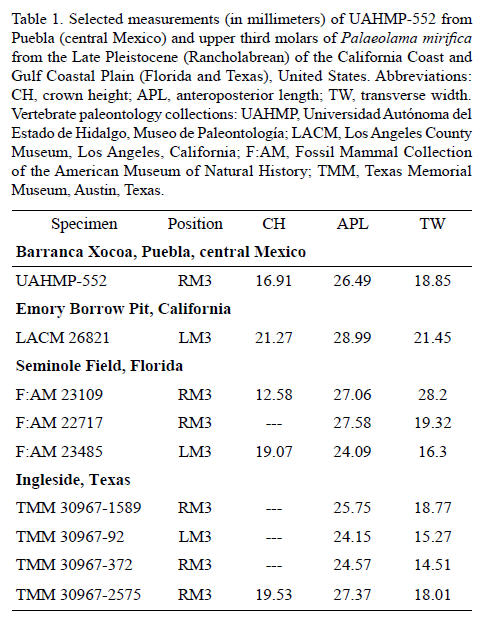
<body><![CDATA[<p align="justify"><font face="verdana" size="2">&nbsp;</font></p>  	    <p align="center"><font face="verdana" size="2"><i>Palaeolama mirifica</i> Simpson, 1929    <br> 	<a href="#f2">Figures 2</a>&#45;<a href="#f3">3</a>, <a href="#t1">Tables 1</a>&#45;<a href="#t2">2</a></font></p>  	    <p align="center"><font face="verdana" size="2"><a name="f2"></a></font></p>  	    <p align="center"><font face="verdana" size="2"><img src="/img/revistas/bsgm/v67n1/a2f2.jpg"></font></p>  	    <p align="center"><font face="verdana" size="2"><a name="f3"></a></font></p>  	    <p align="center"><font face="verdana" size="2"><img src="/img/revistas/bsgm/v67n1/a2f3.jpg"></font></p>  	    <p align="center"><font face="verdana" size="2"><a name="t1"></a></font></p>  	    <p align="center"><font face="verdana" size="2"><img src="/img/revistas/bsgm/v67n1/a2t1.jpg"></font></p>  	    <p align="center"><font face="verdana" size="2"><a name="t2"></a></font></p>  	    ]]></body>
<body><![CDATA[<p align="center"><font face="verdana" size="2"><img src="/img/revistas/bsgm/v67n1/a2t2.jpg"></font></p>  	    <p align="justify"><font face="verdana" size="2">&nbsp;</font></p>  	    <p align="justify"><font face="verdana" size="2">4.1. Description</font></p>  	    <p align="justify"><font face="verdana" size="2"><i>4.1.1.</i> <i>Upper tooth</i></font></p>  	    <p align="justify"><font face="verdana" size="2">The specimen UAHMP&#45; 552 is a third upper molar. It is brachyodont, lacks a layer of cementum, and the enamel is crenulated; the styles and ribs are well developed; the protocone is V&#45;shaped with a blunt tip, whereas the metaconule is U&#45;shaped; the protocone is wider than the metaconule; and the anterior and posterior fossettes are simple and sinuous in outline (<a href="#f2">Figure 2</a>).</font></p>  	    <p align="justify"><font face="verdana" size="2">&nbsp;</font></p>  	    <p align="justify"><font face="verdana" size="2"><i>4.1.2.</i> <i>Lower tooth</i></font></p>  	    <p align="justify"><font face="verdana" size="2">The specimen UAHMP&#45;553 is a third lower molar. The tooth is also brachyodont, lacks cementum, and has crenulated enamel. The fossettes are simple, elongated anteroposteriorly, and constricted in the middle. The anterior stylid and metastylid are somewhat developed. The protoconid is broken; the hypoconid is U&#45;shaped; the hypoconulid is rounded, well developed, and is separated from the second crescent by a pronounced constriction. The roots are deep and well developed (<a href="#f3">Figure 3</a>).</font></p> 	    <p align="justify">&nbsp;</p>      <p align="justify"><font face="verdana" size="2">4.2. Referred material</font></p>  	    ]]></body>
<body><![CDATA[<p align="justify"><font face="verdana" size="2">Locality Barranca Xocoa (PUE&#45;7): UAHMP&#45;552, RM3; UAHMP&#45;553, Lm3.</font></p>  	    <p align="justify"><font face="verdana" size="2">&nbsp;</font></p>  	    <p align="justify"><font face="verdana" size="2">4.3. Age and ocurrence</font></p>  	    <p align="justify"><font face="verdana" size="2">Earliest occurrence of <i>Palaeolama mirifica</i> is from the latest Blancan of Florida (Bell <i>et al.</i>, 2004; Ruez, 2005). Although rare in North American Pleistocene faunas, the species distribution was widespread during the Rancholabrean, including localities in California, Texas, Florida (Kurt&eacute;n and Anderson, 1980), South Carolina (Sanders, 2002) as well as the new locality, reported here, in Puebla, central Mexico, and Costa Rica (P&eacute;rez, 2013).</font></p>  	    <p align="justify"><font face="verdana" size="2">&nbsp;</font></p>  	    <p align="justify"><font face="verdana" size="2"><b>5. Discussion</b></font></p>  	    <p align="justify"><font face="verdana" size="2">5.1. Taxonomic assessment</font></p>  	    <p align="justify"><font face="verdana" size="2">The specimens from Puebla show several diagnostic features of the teeth characteristic of <i>Palaeolama</i>, including: (1) low crowned cheek teeth with an angular appearance; (2) upper molars with strong external styles and ribs; (3) teeth lacking cementum; and (4) crenulated enamel (Kurt&eacute;n and Anderson, 1980; Honey <i>et al.</i>, 1998). The genus <i>Camelops</i> is distinguished from the study sample by having cheek teeth very hypsodont and upper molars with reduced external styles (Kurt&eacute;n and Anderson, 1980; Honey <i>et al.</i>, 1998). In addition, the genus <i>Hemiauchenia</i> differs from the Puebla material in having cheek teeth covered by cementum with a small degree of crenulation (Webb, 1974).</font></p>  	    <p align="justify"><font face="verdana" size="2">The dental morphology of UAHMP&#45;552 (RM3) corresponds to that of M3s of <i>Palaeolama mirifica</i> in possessing acute and not rounded crescents, protocone that is wider than metaconule, and simple fossettes that are sinuous in outline. The specimens LACM 28821 (LM3 from Emory Borrow Pit, California, Late Pleistocene), F:AM 28821 (LM3 from Seminole Field, Florida, Late Pleistocene), and TMM 30967&#45;2575 (RM3 from Ingleside, Texas, Late Pleistocene) all have well developed roots; a similar condition is observed in the isolated upper third molar described here. The mesostyle crown height of UAHMP&#45;552 (RM3) is about 16 mm, which is close to that of the specimens F:AM 23485 (LM3) from Seminole Field, Florida (Late Pleistocene) and TMM 30967&#45;2575 (RM3) from Ingleside, Texas (Late Pleistocene), it is slightly different to the specimens LACM 2682 (LM3) from Emory Borrow Pit, California (Late Pleistocene) and F:AM 23109 (RM3) from Seminole Field, Florida (Late Pleistocene). The size of the teeth of the material from Puebla is similar to that of specimens from the Late Pleistocene of Coastal California and Gulf Coastal Plain, considering that average differences in the anteroposterior length and transverse width are 2 mm and 4 mm, respectively (<a href="#t1">Table 1</a>).</font></p>  	    <p align="justify"><font face="verdana" size="2">The dental morphology of UAHMP&#45;553 (Lm3) is similar to that of <i>Palaeolama mirifica</i> represented by TMM 30967&#45;944 (Rm3) and TMM 30967&#45;2567 (Lm3) from Ingleside, Texas (Late Pleistocene), as well as the m3 of F:AM 22717 (associated maxilla with RM1&#45;RM3 and LP4&#45;M3 and a mandible fragment with Rm3) from Seminole Field, Florida (Late Pleistocene) and the Lm3 of UF 1093 (left mandible with p3&#45;m3) from Arredondo 1B, Florida (Late Pleistocene). These specimens share the presence of a somewhat developed mesostylid, simple fossettids that are elongated anteroposteriorly, and a well&#45;developed hypoconulid, separated by the second crescent by a marked constriction. The size of the tooth from Puebla is similar to that of the specimens from the Gulf Coastal Plain of Florida and Texas (<a href="#t2">Table 2</a>).</font></p>  	    ]]></body>
<body><![CDATA[<p align="justify"><font face="verdana" size="2">The comparisons show that the size and morphology of the teeth from the Late Pleistocene of Puebla, are closely similar to the M3s/m3s of <i>Palaeolama mirifica</i>. Hence, the dental sample considered here has been formally referred to that species.</font></p>  	    <p align="justify"><font face="verdana" size="2">&nbsp;</font></p>  	    <p align="justify"><font face="verdana" size="2">5.2. Geographic distribution and biochronology</font></p>  	    <p align="justify"><font face="verdana" size="2">The oldest records of <i>Palaeolama mirifica</i> are from the latest Blancan of Florida (Ruez, 2005). There are records in California and Florida (<a href="/img/revistas/bsgm/v67n1/a2f4.jpg" target="_blank">Figure 4</a>), and in the Rancholabrean the records of this llama are from South Carolina, Texas, and Florida (<a href="/img/revistas/bsgm/v67n1/a2f4.jpg" target="_blank">Figure 4</a>); in addition there a record from Costa Rica (P&eacute;rez, 2013). Thus, the presence of this llama in Puebla extends its former Pleistocene geographic distribution southwardly, from southern United States to central Mexico, representing the most southern occurrence within North America (<a href="/img/revistas/bsgm/v67n1/a2f4.jpg" target="_blank">Figure 4</a>) and fills the geographic gap with the Costa Rican record.</font></p>  	    <p align="justify"><font face="verdana" size="2">In Mexico, there is a record referable to <i>Palaeolama</i> sp. from the Early Pleistocene (Irvingtonian) of Sonora, northern Mexico (Croxen <i>et al.</i>, 2007). The material described here constitutes the youngest record of the genus in this country, extending its biochronological range from the Irvingtonian to Rancholabrean.</font></p>  	    <p align="justify"><font face="verdana" size="2">According to the major biogeographic corridors of Ceballos <i>et al.</i> (2010), the records of <i>Palaeolama</i> from the Irvingtonian of Sonora (northern Mexico) (Croxen <i>et al.</i>, 2007), and those of South Carolina, Texas, and Florida, as well as that described in the present study from the Rancholabrean of Puebla (central Mexico), suggest that this llama used the tropical corridors of Sonora&#45;Central America Pacific lowlands (western route) and the Tamaulipas&#45;Central America Gulf lowlands (eastern route) during the Pleistocene.</font></p>  	    <p align="justify"><font face="verdana" size="2">&nbsp;</font></p>  	    <p align="justify"><font face="verdana" size="2">5.3. Dietary behavior</font></p>  	    <p align="justify"><font face="verdana" size="2"><i>5.3.1.</i> <i>Carbon isotope analysis</i></font></p>  	    <p align="justify"><font face="verdana" size="2">A diet consisting primarily of C3 plants (= browsers and high latitude grazers) is indicated by &#948;<sup>13</sup>C values of less than &#45;10&permil;, whereas a diet consisting primarily of C4 plants (= tropical and sub&#45;tropical grazers) is indicated by &#948;<sup>13</sup>C values greater than &#45;1&permil;; intermediate values of &#948;<sup>13</sup>C from &#45;1&permil; to &#45;10&permil;, indicate a diet consisting of both C3/C4 plants (= mixed feeders) (Koch <i>et al.</i>, 1992; Quade <i>et al.</i>, 1992; Cerling <i>et al.</i>, 1997). The relative percentage of C4 plants incorporated into the diet was estimated using the mass balance equation of Koch <i>et al.</i> (2004).</font></p>  	    ]]></body>
<body><![CDATA[<p align="justify"><font face="verdana" size="2">The minimum and maximum &#948;<sup>13</sup>C isotope values of <i>Palaeolama mirifica</i> from Puebla are &#45;2.08&permil; and &#45;1.83&permil; respectively, with a mean value of &#45;1.96&permil;. The estimated percentage of C4 plants intake is of about 70%. The data are suggestive of a mixed diet consisting of both C3/C4 plants, with an emphasis on C4 plants.</font></p>  	    <p align="justify"><font face="verdana" size="2"><i>Palaeolama mirifica</i> has been considered as a browser that dwelled in forested environments (Kurt&eacute;n and Anderson, 1980; Kohn <i>et al.</i>, 2005; Semprebon and Rivals, 2010). The &#948;<sup>13</sup>C isotope values of <i>P. mirifica</i> from Leisey Shell Pit, Florida (Irvingtonian) range from &#45;12&permil; to &#45;15&permil;, indicating a diet consisting primarily of C3 plants (DeSantis <i>et al.</i>, 2009). The carbon isotope values for the sample studied here are more positive (with a mean difference of &#45;11&permil;) and indicate a mixed dietary behavior with increased consumption of C4 plants. This difference may be explained as flexibility in dietary behavior of this llama, which in turn suggests an adaptable dietary regime related to local environmental conditions, but there is clearly a need to broaden the carbon isotope data of mexican <i>Palaeolama</i> upon which this issue could be suitable discernible.</font></p>  	    <p align="justify"><font face="verdana" size="2">&nbsp;</font></p>  	    <p align="justify"><font face="verdana" size="2"><i>5.3.2.</i> <i>Dental wear pattern (Mesowear III)</i></font></p>  	    <p align="justify"><font face="verdana" size="2">The second enamel bands on the paracone and metacone of UAHMP&#45;552 are planar, the mid&#45;point junction among these enamel bands (j&#45;point) is distinguishable and shows a rounded surface; furthermore, both enamel bands have gouges on the buccal side. This description corresponds to the mesowear score 2 of the scoring for Mesowear III (Solounias <i>et al.</i>, 2014). According to Solounias <i>et al.</i> (2014) the mesowear scores 2 and 3 are indicative of intermediate feeders. Particularly, the mesowear score of the tooth belonging to <i>Palaeolama mirifica</i> from the Pleistocene of Puebla is in the lower limit of Mesowear III scores for extant mixed feeders (Solounias <i>et al.</i>, 2014, Fig. 3, p. 115).</font></p>  	    <p align="justify"><font face="verdana" size="2">Asample of <i>Palaeolama mirifica</i> from the Rancholabrean of California was interpreted as an intermediate feeder by SEM (scanning electron microscopy) microwear analysis (Dompierre, 1995). Hence, the observed dental mesowear pattern of the studied sample, gives additional information of the potential capability of <i>P. mirifica</i> for exploiting both browsing (succulent) and grazing (abrasive) resources.</font></p>  	    <p align="justify"><font face="verdana" size="2">&nbsp;</font></p>  	    <p align="justify"><font face="verdana" size="2"><b>6. Conclusions</b></font></p>  	    <p align="justify"><font face="verdana" size="2">The comparative study of a dental sample from the Late Pleistocene (Rancholabrean) of Puebla, central Mexico, recognizes the presence of the stout&#45;legged llama <i>Palaeolama mirifica</i>. This material represents the first record in Mexico formally described and assigned to that species.</font></p>  	    <p align="justify"><font face="verdana" size="2">The record of <i>Palaeolama mirifica</i> from Puebla constitutes (so far) the southernmost occurrence of this llama within North America, and fills the geographic gap of the record of this species in Costa Rica, whereas in Mexico is the youngest occurrence of the genus.</font></p>  	    ]]></body>
<body><![CDATA[<p align="justify"><font face="verdana" size="2">The carbon isotope analysis in tooth enamel and the evaluation of dental mesowear pattern (Mesowear III) of the material studied here showed that the sample of <i>Palaeolama mirifica</i> from the Late Pleistocene of Puebla, central Mexico, ate both C3 and C4 (succulent/abrasive) plant resources. Hence, this sample indicates it was an intermediate feeder and was capable of exploiting different kinds of plant resources.</font></p>  	    <p align="justify"><font face="verdana" size="2">&nbsp;</font></p>  	    <p align="justify"><font face="verdana" size="2"><b>Acknowledgements</b></font></p>  	    <p align="justify"><font face="verdana" size="2">We thank to Grant D. Zazula (Government of Yukon Paleontology Program) and Hugh Gregory McDonald (National Park Service) for their comments and suggestions to the manuscript. Thanks to Pedro Morales Puente and Edith Cienfuegos Alvarado (Laboratorio de Geoqu&iacute;mica Isot&oacute;pica, Universidad Nacional Aut&oacute;noma de M&eacute;xico) for their support with the isotopic analysis. VMBC thanks Samuel A. McLeod and Vanessa R. Rhue, and Chris Sagebiel for their kindly support during his visits to the Vertebrate Paleontology collections at the Natural History Museum of Los Angeles County and at the Texas Memorial Museum respectively. EJH thanks Jin Meng for the approval to visit the Fossil Mammal Collection of the American Museum of Natural History and to Judy Galkin for their kind help during that visit. Thanks to E. Lundelius for sharing information on Pleistocene mammalian faunas of Texas Gulf Coastal Plain. This study is part of the project CONACyT&#45;Ciencia B&aacute;sica (CB&#45;2009&#45;130712): "El registro de ungulados terrestres en el Pleistoceno de Hidalgo, Puebla y Tlaxcala, centro de M&eacute;xico: Interpretaci&oacute;n de h&aacute;bitos alimentarios y caracterizaci&oacute;n de paleocomunidades terrestres".</font></p>  	    <p align="justify"><font face="verdana" size="2">&nbsp;</font></p>  	    <p align="justify"><font face="verdana" size="2"><b>References</b></font></p>  	    <!-- ref --><p align="justify"><font face="verdana" size="2">B&auml;rmann, E.V., R&ouml;ssner, G.E., 2011, Dental nomenclature in Ruminantia: Towards a standard terminological framework: Mammalian Biology, 76, 762&#150;768.    &nbsp;&nbsp;&nbsp;&nbsp;&nbsp;&nbsp;&nbsp;&nbsp;[&#160;<a href="javascript:void(0);" onclick="javascript: window.open('/scielo.php?script=sci_nlinks&ref=1433458&pid=S1405-3322201500010000200001&lng=','','width=640,height=500,resizable=yes,scrollbars=1,menubar=yes,');">Links</a>&#160;]<!-- end-ref --></font></p>  	    <!-- ref --><p align="justify"><font face="verdana" size="2">Bell, C.J., Lundelius, E.L. Jr., Barnosky, A.D., Graham, R.W., Lindsay, E.H., Ruez, D.R. Jr., Semken, H.A. Jr., Webb, S.D., Zakrzewski, R.J., 2004, The Blancan, Irvingtonian, and Rancholabrean mammal ages, <i>in</i> Woodburne, M.O. (ed.), Late Cretaceous and Cenozoic mammals of North America: New York, Columbia University Press, 232&#150;314.    &nbsp;&nbsp;&nbsp;&nbsp;&nbsp;&nbsp;&nbsp;&nbsp;[&#160;<a href="javascript:void(0);" onclick="javascript: window.open('/scielo.php?script=sci_nlinks&ref=1433460&pid=S1405-3322201500010000200002&lng=','','width=640,height=500,resizable=yes,scrollbars=1,menubar=yes,');">Links</a>&#160;]<!-- end-ref --></font></p>  	    ]]></body>
<body><![CDATA[<!-- ref --><p align="justify"><font face="verdana" size="2">Carroll, R.L., 1988, Vertebrate paleontology and evolution: New York, W. H. Freeman and Company, 698 p.    &nbsp;&nbsp;&nbsp;&nbsp;&nbsp;&nbsp;&nbsp;&nbsp;[&#160;<a href="javascript:void(0);" onclick="javascript: window.open('/scielo.php?script=sci_nlinks&ref=1433462&pid=S1405-3322201500010000200003&lng=','','width=640,height=500,resizable=yes,scrollbars=1,menubar=yes,');">Links</a>&#160;]<!-- end-ref --></font></p>  	    <!-- ref --><p align="justify"><font face="verdana" size="2">Ceballos, G., Arroyo&#45;Cabrales, J., Ponce, E., 2010, Effects of Pleistocene environmental changes on the distribution and community structure of the mammalian fauna of Mexico: Quaternary Research, 73, 464&#150;473.    &nbsp;&nbsp;&nbsp;&nbsp;&nbsp;&nbsp;&nbsp;&nbsp;[&#160;<a href="javascript:void(0);" onclick="javascript: window.open('/scielo.php?script=sci_nlinks&ref=1433464&pid=S1405-3322201500010000200004&lng=','','width=640,height=500,resizable=yes,scrollbars=1,menubar=yes,');">Links</a>&#160;]<!-- end-ref --></font></p>  	    <!-- ref --><p align="justify"><font face="verdana" size="2">Cerling, T.E., Harris, J.M., MacFadden, B.J., Leakey, M.G., Quade, J., Eisenmann, V., Ehlinger, J.R., 1997, Global vegetation change through the Miocene/Pliocene boundary: Nature, 389, 153&#150;158.    &nbsp;&nbsp;&nbsp;&nbsp;&nbsp;&nbsp;&nbsp;&nbsp;[&#160;<a href="javascript:void(0);" onclick="javascript: window.open('/scielo.php?script=sci_nlinks&ref=1433466&pid=S1405-3322201500010000200005&lng=','','width=640,height=500,resizable=yes,scrollbars=1,menubar=yes,');">Links</a>&#160;]<!-- end-ref --></font></p>  	    <!-- ref --><p align="justify"><font face="verdana" size="2">Craig, H., 1957, Isotopic standards for carbon and oxygen and correction factors for mass spectrometric analysis of carbon dioxide: Geochimica et Cosmochimica Acta, 12, 133&#150;149.    &nbsp;&nbsp;&nbsp;&nbsp;&nbsp;&nbsp;&nbsp;&nbsp;[&#160;<a href="javascript:void(0);" onclick="javascript: window.open('/scielo.php?script=sci_nlinks&ref=1433468&pid=S1405-3322201500010000200006&lng=','','width=640,height=500,resizable=yes,scrollbars=1,menubar=yes,');">Links</a>&#160;]<!-- end-ref --></font></p>  	    <!-- ref --><p align="justify"><font face="verdana" size="2">Croxen, F.W. III, Shaw, C.A., Sussman, D.R., 2007, Pleistocene Geology and Paleontology of the Colorado River Delta at Golfo de Santa Clara, Sonora, Mexico, <i>in</i> Reynolds, R.E. (ed.), Wild, Scenic and Rapid: a Trip Down the Colorado River Trough: The 2007 Desert Symposium Field Guide and Abstracts from Proceedings, California State University, Fullerton, Desert Studies Consortium, 84&#150;89.    &nbsp;&nbsp;&nbsp;&nbsp;&nbsp;&nbsp;&nbsp;&nbsp;[&#160;<a href="javascript:void(0);" onclick="javascript: window.open('/scielo.php?script=sci_nlinks&ref=1433470&pid=S1405-3322201500010000200007&lng=','','width=640,height=500,resizable=yes,scrollbars=1,menubar=yes,');">Links</a>&#160;]<!-- end-ref --></font></p>  	    ]]></body>
<body><![CDATA[<!-- ref --><p align="justify"><font face="verdana" size="2">DeSantis, L.R.G., Feranec, R.S., MacFadden, B.J., 2009, Effects of global warming on ancient mammalian communities and their environments: PlosOne, 4(6), e5750.    &nbsp;&nbsp;&nbsp;&nbsp;&nbsp;&nbsp;&nbsp;&nbsp;[&#160;<a href="javascript:void(0);" onclick="javascript: window.open('/scielo.php?script=sci_nlinks&ref=1433472&pid=S1405-3322201500010000200008&lng=','','width=640,height=500,resizable=yes,scrollbars=1,menubar=yes,');">Links</a>&#160;]<!-- end-ref --></font></p>  	    <!-- ref --><p align="justify"><font face="verdana" size="2">Dompierre, H., 1995, Observations on the diets of six Late Cenozoic North American camelids: <i>Camelops</i>, <i>Hemiauchenia</i>, <i>Palaeolama</i>, <i>Procamelus</i>, <i>Alforjas</i>, and <i>Megatylopus</i>: Toronto, University of Toronto, tesis doctoral, 478 p.    &nbsp;&nbsp;&nbsp;&nbsp;&nbsp;&nbsp;&nbsp;&nbsp;[&#160;<a href="javascript:void(0);" onclick="javascript: window.open('/scielo.php?script=sci_nlinks&ref=1433474&pid=S1405-3322201500010000200009&lng=','','width=640,height=500,resizable=yes,scrollbars=1,menubar=yes,');">Links</a>&#160;]<!-- end-ref --></font></p>  	    <!-- ref --><p align="justify"><font face="verdana" size="2">Gervais, P., 1869, Zoologie et Pal&eacute;ontologie G&eacute;n&eacute;rales. Nouvelles Recherches sur les Animaux Vert&eacute;br&eacute;s Vivants et Fossiles. Premi&egrave;re S&eacute;rie: Paris, France, Arthus Bertrand, Libraire&#45;&Eacute;diteur, Libraire de la Soci&eacute;t&eacute; de G&eacute;ographie, 263 p.    &nbsp;&nbsp;&nbsp;&nbsp;&nbsp;&nbsp;&nbsp;&nbsp;[&#160;<a href="javascript:void(0);" onclick="javascript: window.open('/scielo.php?script=sci_nlinks&ref=1433476&pid=S1405-3322201500010000200010&lng=','','width=640,height=500,resizable=yes,scrollbars=1,menubar=yes,');">Links</a>&#160;]<!-- end-ref --></font></p>  	    <!-- ref --><p align="justify"><font face="verdana" size="2">Graham, R.W., Lundelius, E.L. Jr., 2010, FAUNMAP II: New data for North America with a temporal extension for the Blancan, Irvingtonian and Early Rancholabrean. FAUNMAP II Database, version 1.0, <i>available at</i> &lt;<a href="http://www.ucmp.berkeley.edu/neomap/" target="_blank">http://www.ucmp.berkeley.edu/neomap/</a>&gt;, <i>consulted</i> July 2014.    &nbsp;&nbsp;&nbsp;&nbsp;&nbsp;&nbsp;&nbsp;&nbsp;[&#160;<a href="javascript:void(0);" onclick="javascript: window.open('/scielo.php?script=sci_nlinks&ref=1433478&pid=S1405-3322201500010000200011&lng=','','width=640,height=500,resizable=yes,scrollbars=1,menubar=yes,');">Links</a>&#160;]<!-- end-ref --></font></p>  	    <!-- ref --><p align="justify"><font face="verdana" size="2">Gray, J.E., 1821, On the natural arrangement of vertebrose animals: London Medical Repository, 5, 296&#150;310.    &nbsp;&nbsp;&nbsp;&nbsp;&nbsp;&nbsp;&nbsp;&nbsp;[&#160;<a href="javascript:void(0);" onclick="javascript: window.open('/scielo.php?script=sci_nlinks&ref=1433480&pid=S1405-3322201500010000200012&lng=','','width=640,height=500,resizable=yes,scrollbars=1,menubar=yes,');">Links</a>&#160;]<!-- end-ref --></font></p>  	    ]]></body>
<body><![CDATA[<!-- ref --><p align="justify"><font face="verdana" size="2">Honey, J.G., Harrison, A.J., Prothero, D.R., Stevens, M.S., 1998, Camelidae, <i>in</i> Janis, C.M., Scott, K.M., Jacobs, L.L. (eds.), Evolution of Tertiary Mammals of North America. Volume 1: Carnivores, ungulates and ungulate&#45;like mammals: New York, Cambridge University Press, 439&#150;462.    &nbsp;&nbsp;&nbsp;&nbsp;&nbsp;&nbsp;&nbsp;&nbsp;[&#160;<a href="javascript:void(0);" onclick="javascript: window.open('/scielo.php?script=sci_nlinks&ref=1433482&pid=S1405-3322201500010000200013&lng=','','width=640,height=500,resizable=yes,scrollbars=1,menubar=yes,');">Links</a>&#160;]<!-- end-ref --></font></p>  	    <!-- ref --><p align="justify"><font face="verdana" size="2">Koch, P.L., Zachos, J.C., Gingerich, P.D., 1992, Correlation between isotope records in marine and continental carbon reservoirs near the Paleocene/Eocene boundary: Nature, 358, 319&#150;322.    &nbsp;&nbsp;&nbsp;&nbsp;&nbsp;&nbsp;&nbsp;&nbsp;[&#160;<a href="javascript:void(0);" onclick="javascript: window.open('/scielo.php?script=sci_nlinks&ref=1433484&pid=S1405-3322201500010000200014&lng=','','width=640,height=500,resizable=yes,scrollbars=1,menubar=yes,');">Links</a>&#160;]<!-- end-ref --></font></p>  	    <!-- ref --><p align="justify"><font face="verdana" size="2">Koch, P.L., Tuross, N., Fogel, M.L., 1997, The effects of sample treatment and diagenesis on the isotopic integrity of carbonate in biogenic hydroxylapatite: Journal of Archaeological Science, 24, 417&#150;429.    &nbsp;&nbsp;&nbsp;&nbsp;&nbsp;&nbsp;&nbsp;&nbsp;[&#160;<a href="javascript:void(0);" onclick="javascript: window.open('/scielo.php?script=sci_nlinks&ref=1433486&pid=S1405-3322201500010000200015&lng=','','width=640,height=500,resizable=yes,scrollbars=1,menubar=yes,');">Links</a>&#160;]<!-- end-ref --></font></p>  	    <!-- ref --><p align="justify"><font face="verdana" size="2">Koch, P.L., Diffenbaugh, N.S., Hoppe, K.A., 2004, The effects of Late Quaternary climate and pCO<sup>2</sup> change on C4 plant abundance in the south&#45;central United States: Palaeogeography Palaeoclimatology Palaeoecology, 207, 331&#150;357.    &nbsp;&nbsp;&nbsp;&nbsp;&nbsp;&nbsp;&nbsp;&nbsp;[&#160;<a href="javascript:void(0);" onclick="javascript: window.open('/scielo.php?script=sci_nlinks&ref=1433488&pid=S1405-3322201500010000200016&lng=','','width=640,height=500,resizable=yes,scrollbars=1,menubar=yes,');">Links</a>&#160;]<!-- end-ref --></font></p>  	    <!-- ref --><p align="justify"><font face="verdana" size="2">Kohn, M.J., McKay, M.P., Knight, J.L., 2005, Dining in the Pleistocene &#150; who's on the menu: Geology, 33, 649&#150;652.    &nbsp;&nbsp;&nbsp;&nbsp;&nbsp;&nbsp;&nbsp;&nbsp;[&#160;<a href="javascript:void(0);" onclick="javascript: window.open('/scielo.php?script=sci_nlinks&ref=1433490&pid=S1405-3322201500010000200017&lng=','','width=640,height=500,resizable=yes,scrollbars=1,menubar=yes,');">Links</a>&#160;]<!-- end-ref --></font></p>  	    ]]></body>
<body><![CDATA[<!-- ref --><p align="justify"><font face="verdana" size="2">Kurt&eacute;n, B., Anderson, E., 1980, The Pleistocene Mammals of North America: New York, United States, Columbia University Press, 442 p.    &nbsp;&nbsp;&nbsp;&nbsp;&nbsp;&nbsp;&nbsp;&nbsp;[&#160;<a href="javascript:void(0);" onclick="javascript: window.open('/scielo.php?script=sci_nlinks&ref=1433492&pid=S1405-3322201500010000200018&lng=','','width=640,height=500,resizable=yes,scrollbars=1,menubar=yes,');">Links</a>&#160;]<!-- end-ref --></font></p>  	    <!-- ref --><p align="justify"><font face="verdana" size="2">Lange, I.M., 2002, Ice Age mammals of North America: Missoula, Montana, Mountain Press Publishing Company, 226 p.    &nbsp;&nbsp;&nbsp;&nbsp;&nbsp;&nbsp;&nbsp;&nbsp;[&#160;<a href="javascript:void(0);" onclick="javascript: window.open('/scielo.php?script=sci_nlinks&ref=1433494&pid=S1405-3322201500010000200019&lng=','','width=640,height=500,resizable=yes,scrollbars=1,menubar=yes,');">Links</a>&#160;]<!-- end-ref --></font></p>  	    <!-- ref --><p align="justify"><font face="verdana" size="2">MacFadden, B.J., Cerling, T.E., 1996, Mammalian herbivore communities, ancient feeding ecology, and carbon isotopes: a 10 million years sequence from the Neogene of Florida: Journal of Vertebrate Paleontology, 16, 103&#150;115.    &nbsp;&nbsp;&nbsp;&nbsp;&nbsp;&nbsp;&nbsp;&nbsp;[&#160;<a href="javascript:void(0);" onclick="javascript: window.open('/scielo.php?script=sci_nlinks&ref=1433496&pid=S1405-3322201500010000200020&lng=','','width=640,height=500,resizable=yes,scrollbars=1,menubar=yes,');">Links</a>&#160;]<!-- end-ref --></font></p>  	    <!-- ref --><p align="justify"><font face="verdana" size="2">Owen, R., 1848, Description of teeth and portions of jaws of two extinct anthracotherioid quadrupeds (<i>Hyopotamys vectianus</i> and <i>Hyopotamys bovinus</i>) discovered by the Marchioness of Hasting in the Eocene deposits on the N.W. coast of the Island of Wright: With an attempt to develop Cuvier's idea of the classification of pachyderms by the number of their toes: Quarterly Journal of the Geological Society of London, 4, 103&#150;141.    &nbsp;&nbsp;&nbsp;&nbsp;&nbsp;&nbsp;&nbsp;&nbsp;[&#160;<a href="javascript:void(0);" onclick="javascript: window.open('/scielo.php?script=sci_nlinks&ref=1433498&pid=S1405-3322201500010000200021&lng=','','width=640,height=500,resizable=yes,scrollbars=1,menubar=yes,');">Links</a>&#160;]<!-- end-ref --></font></p>  	    <p align="justify"><font face="verdana" size="2">PaleoDB (Paleobiology database), 2014, <i>available at</i> &lt;<a href="http://paleodb.org/" target="_blank">http://paleodb.org/</a>&gt;, <i>consulted</i> July 2014.</font></p>  	    <!-- ref --><p align="justify"><font face="verdana" size="2">P&eacute;rez, E.A., 2013, Los mam&iacute;feros f&oacute;siles de la localidad de Puente de Piedra (Xenarthra, Glyptodontidae; Artiodactyla, Camelidae, Lamini) Grecia, Provincia de Alajuela, Costa Rica: Revista Geolog&iacute;a Am&eacute;rica Central, 49, 33&#150;44.    &nbsp;&nbsp;&nbsp;&nbsp;&nbsp;&nbsp;&nbsp;&nbsp;[&#160;<a href="javascript:void(0);" onclick="javascript: window.open('/scielo.php?script=sci_nlinks&ref=1433501&pid=S1405-3322201500010000200022&lng=','','width=640,height=500,resizable=yes,scrollbars=1,menubar=yes,');">Links</a>&#160;]<!-- end-ref --></font></p>  	    <!-- ref --><p align="justify"><font face="verdana" size="2">Prothero, D.R., Schoch, R.M., 2002, Horns, tusks &amp; flippers. The evolution of hoofed mammals: Baltimore and London, The Johns Hopkins University Press, 311 p.    &nbsp;&nbsp;&nbsp;&nbsp;&nbsp;&nbsp;&nbsp;&nbsp;[&#160;<a href="javascript:void(0);" onclick="javascript: window.open('/scielo.php?script=sci_nlinks&ref=1433503&pid=S1405-3322201500010000200023&lng=','','width=640,height=500,resizable=yes,scrollbars=1,menubar=yes,');">Links</a>&#160;]<!-- end-ref --></font></p>  	    <!-- ref --><p align="justify"><font face="verdana" size="2">Quade, J., Cerling, T.E., Barry, J.C., Morgan, M.E., Pilbeam, D.R., Chivas, A.R., Lee&#45;Thorp, J.A.,van der Merwe, N.J., 1992, A 16 million year record of paleodiet using carbon and oxygen isotopes in fossil teeth from Pakistan: Chemical Geology, 94, 183&#150;192.    &nbsp;&nbsp;&nbsp;&nbsp;&nbsp;&nbsp;&nbsp;&nbsp;[&#160;<a href="javascript:void(0);" onclick="javascript: window.open('/scielo.php?script=sci_nlinks&ref=1433505&pid=S1405-3322201500010000200024&lng=','','width=640,height=500,resizable=yes,scrollbars=1,menubar=yes,');">Links</a>&#160;]<!-- end-ref --></font></p>  	    <!-- ref --><p align="justify"><font face="verdana" size="2">Ruez, D.R., 2005, Earliest record of <i>Palaeolama</i> (Mammalia, Camelidae) with comments on "<i>Palaeolama</i>" <i>guanajuatensis</i>: Journal of Vertebrate Paleontology, 25(3), 741&#150;744.    &nbsp;&nbsp;&nbsp;&nbsp;&nbsp;&nbsp;&nbsp;&nbsp;[&#160;<a href="javascript:void(0);" onclick="javascript: window.open('/scielo.php?script=sci_nlinks&ref=1433507&pid=S1405-3322201500010000200025&lng=','','width=640,height=500,resizable=yes,scrollbars=1,menubar=yes,');">Links</a>&#160;]<!-- end-ref --></font></p>  	    <!-- ref --><p align="justify"><font face="verdana" size="2">Sanders, A.E., 2002, Additions to the Pleistocene faunas of South Carolina, North Carolina, and Georgia: Transactions of the American Philosophical Society, New Series, 92(5), 1&#150;152.    &nbsp;&nbsp;&nbsp;&nbsp;&nbsp;&nbsp;&nbsp;&nbsp;[&#160;<a href="javascript:void(0);" onclick="javascript: window.open('/scielo.php?script=sci_nlinks&ref=1433509&pid=S1405-3322201500010000200026&lng=','','width=640,height=500,resizable=yes,scrollbars=1,menubar=yes,');">Links</a>&#160;]<!-- end-ref --></font></p>  	    <!-- ref --><p align="justify"><font face="verdana" size="2">Semprebon, G.M., Rivals, F., 2010, Trends in the paleodietary habits of fossil camels from the Tertiary and Quaternary of North America: Palaeogeography Palaeoclimatology Palaeoecology, 295, 131&#150;145.    &nbsp;&nbsp;&nbsp;&nbsp;&nbsp;&nbsp;&nbsp;&nbsp;[&#160;<a href="javascript:void(0);" onclick="javascript: window.open('/scielo.php?script=sci_nlinks&ref=1433511&pid=S1405-3322201500010000200027&lng=','','width=640,height=500,resizable=yes,scrollbars=1,menubar=yes,');">Links</a>&#160;]<!-- end-ref --></font></p>  	    <!-- ref --><p align="justify"><font face="verdana" size="2">Simpson, G.G., 1929, Pleistocene mammalian fauna of the Seminole Field, Pinellas County, Florida: Bulletin of the American Museum of Natural History, 56(2), 561&#150;599.    &nbsp;&nbsp;&nbsp;&nbsp;&nbsp;&nbsp;&nbsp;&nbsp;[&#160;<a href="javascript:void(0);" onclick="javascript: window.open('/scielo.php?script=sci_nlinks&ref=1433513&pid=S1405-3322201500010000200028&lng=','','width=640,height=500,resizable=yes,scrollbars=1,menubar=yes,');">Links</a>&#160;]<!-- end-ref --></font></p>  	    <!-- ref --><p align="justify"><font face="verdana" size="2">Solounias, N., Tariq, M., Hou, S., Danowitz, M., Harrison, M., 2014, A new method of tooth mesowear and a test of it on domestic goats: Annales Zoologici Fennici, 51, 111&#150;118.    &nbsp;&nbsp;&nbsp;&nbsp;&nbsp;&nbsp;&nbsp;&nbsp;[&#160;<a href="javascript:void(0);" onclick="javascript: window.open('/scielo.php?script=sci_nlinks&ref=1433515&pid=S1405-3322201500010000200029&lng=','','width=640,height=500,resizable=yes,scrollbars=1,menubar=yes,');">Links</a>&#160;]<!-- end-ref --></font></p>  	    <!-- ref --><p align="justify"><font face="verdana" size="2">Tovar, R.E., Sedov, S., Montellano&#45;Ballesteros, M., Solleiro, E., Benammi, M., 2014, Paleosols, bones, phytoliths, and &#948;<sup>13</sup>C signatures of humus and teeth in the alluvial sequence of Axamilpa, Puebla: Inferences for landscape evolution and megafauna paleoecology during MIS 3&#45;2 in southern Mexico: Catena, 112, 25&#150;37.    &nbsp;&nbsp;&nbsp;&nbsp;&nbsp;&nbsp;&nbsp;&nbsp;[&#160;<a href="javascript:void(0);" onclick="javascript: window.open('/scielo.php?script=sci_nlinks&ref=1433517&pid=S1405-3322201500010000200030&lng=','','width=640,height=500,resizable=yes,scrollbars=1,menubar=yes,');">Links</a>&#160;]<!-- end-ref --></font></p>  	    <!-- ref --><p align="justify"><font face="verdana" size="2">Webb, S.D., 1965, The osteology of <i>Camelops</i>: Los Angeles County Museum Bulletin, 1, 1&#150;54.    &nbsp;&nbsp;&nbsp;&nbsp;&nbsp;&nbsp;&nbsp;&nbsp;[&#160;<a href="javascript:void(0);" onclick="javascript: window.open('/scielo.php?script=sci_nlinks&ref=1433519&pid=S1405-3322201500010000200031&lng=','','width=640,height=500,resizable=yes,scrollbars=1,menubar=yes,');">Links</a>&#160;]<!-- end-ref --></font></p>  	    <!-- ref --><p align="justify"><font face="verdana" size="2">Webb, S.D., 1974, Pleistocene llamas of Florida, with a brief review of the Lamini, <i>in</i> Webb, S.D. (ed.), Pleistocene Mammals of Florida: Gainesville, Florida, The University Press of Florida, 170&#150;213.    &nbsp;&nbsp;&nbsp;&nbsp;&nbsp;&nbsp;&nbsp;&nbsp;[&#160;<a href="javascript:void(0);" onclick="javascript: window.open('/scielo.php?script=sci_nlinks&ref=1433521&pid=S1405-3322201500010000200032&lng=','','width=640,height=500,resizable=yes,scrollbars=1,menubar=yes,');">Links</a>&#160;]<!-- end-ref --></font></p>  	    <!-- ref --><p align="justify"><font face="verdana" size="2">Wilson, D.E., Reeder, D.M. (eds.), 2005, Mammal Species of the World. A Taxonomic and Geographic Reference: Baltimore, Maryland, Johns Hopkins University Press, 2142 p.    &nbsp;&nbsp;&nbsp;&nbsp;&nbsp;&nbsp;&nbsp;&nbsp;[&#160;<a href="javascript:void(0);" onclick="javascript: window.open('/scielo.php?script=sci_nlinks&ref=1433523&pid=S1405-3322201500010000200033&lng=','','width=640,height=500,resizable=yes,scrollbars=1,menubar=yes,');">Links</a>&#160;]<!-- end-ref --></font></p>      ]]></body><back>
<ref-list>
<ref id="B1">
<nlm-citation citation-type="journal">
<person-group person-group-type="author">
<name>
<surname><![CDATA[Bärmann]]></surname>
<given-names><![CDATA[E.V.]]></given-names>
</name>
<name>
<surname><![CDATA[Rössner]]></surname>
<given-names><![CDATA[G.E.]]></given-names>
</name>
</person-group>
<article-title xml:lang="en"><![CDATA[Dental nomenclature in Ruminantia: Towards a standard terminological framework]]></article-title>
<source><![CDATA[Mammalian Biology]]></source>
<year>2011</year>
<volume>76</volume>
<page-range>762-768</page-range></nlm-citation>
</ref>
<ref id="B2">
<nlm-citation citation-type="book">
<person-group person-group-type="author">
<name>
<surname><![CDATA[Bell]]></surname>
<given-names><![CDATA[C.J.]]></given-names>
</name>
<name>
<surname><![CDATA[Lundelius]]></surname>
<given-names><![CDATA[E.L. Jr.]]></given-names>
</name>
<name>
<surname><![CDATA[Barnosky]]></surname>
<given-names><![CDATA[A.D.]]></given-names>
</name>
<name>
<surname><![CDATA[Graham]]></surname>
<given-names><![CDATA[R.W.]]></given-names>
</name>
<name>
<surname><![CDATA[Lindsay]]></surname>
<given-names><![CDATA[E.H.]]></given-names>
</name>
<name>
<surname><![CDATA[Ruez]]></surname>
<given-names><![CDATA[D.R. Jr.]]></given-names>
</name>
<name>
<surname><![CDATA[Semken]]></surname>
<given-names><![CDATA[H.A. Jr.]]></given-names>
</name>
<name>
<surname><![CDATA[Webb]]></surname>
<given-names><![CDATA[S.D.]]></given-names>
</name>
<name>
<surname><![CDATA[Zakrzewski]]></surname>
<given-names><![CDATA[R.J.]]></given-names>
</name>
</person-group>
<article-title xml:lang="en"><![CDATA[The Blancan, Irvingtonian, and Rancholabrean mammal ages]]></article-title>
<person-group person-group-type="editor">
<name>
<surname><![CDATA[Woodburne]]></surname>
<given-names><![CDATA[M.O.]]></given-names>
</name>
</person-group>
<source><![CDATA[Late Cretaceous and Cenozoic mammals of North America]]></source>
<year>2004</year>
<page-range>232-314</page-range><publisher-loc><![CDATA[New York ]]></publisher-loc>
<publisher-name><![CDATA[Columbia University Press]]></publisher-name>
</nlm-citation>
</ref>
<ref id="B3">
<nlm-citation citation-type="book">
<person-group person-group-type="author">
<name>
<surname><![CDATA[Carroll]]></surname>
<given-names><![CDATA[R.L.]]></given-names>
</name>
</person-group>
<source><![CDATA[Vertebrate paleontology and evolution]]></source>
<year>1988</year>
<page-range>698</page-range><publisher-loc><![CDATA[New York ]]></publisher-loc>
<publisher-name><![CDATA[W. H. Freeman and Company]]></publisher-name>
</nlm-citation>
</ref>
<ref id="B4">
<nlm-citation citation-type="journal">
<person-group person-group-type="author">
<name>
<surname><![CDATA[Ceballos]]></surname>
<given-names><![CDATA[G.]]></given-names>
</name>
<name>
<surname><![CDATA[Arroyo-Cabrales]]></surname>
<given-names><![CDATA[J.]]></given-names>
</name>
<name>
<surname><![CDATA[Ponce]]></surname>
<given-names><![CDATA[E.]]></given-names>
</name>
</person-group>
<article-title xml:lang="en"><![CDATA[Effects of Pleistocene environmental changes on the distribution and community structure of the mammalian fauna of Mexico]]></article-title>
<source><![CDATA[Quaternary Research]]></source>
<year>2010</year>
<volume>73</volume>
<page-range>464-473</page-range></nlm-citation>
</ref>
<ref id="B5">
<nlm-citation citation-type="journal">
<person-group person-group-type="author">
<name>
<surname><![CDATA[Cerling]]></surname>
<given-names><![CDATA[T.E.]]></given-names>
</name>
<name>
<surname><![CDATA[Harris]]></surname>
<given-names><![CDATA[J.M.]]></given-names>
</name>
<name>
<surname><![CDATA[MacFadden]]></surname>
<given-names><![CDATA[B.J.]]></given-names>
</name>
<name>
<surname><![CDATA[Leakey]]></surname>
<given-names><![CDATA[M.G.]]></given-names>
</name>
<name>
<surname><![CDATA[Quade]]></surname>
<given-names><![CDATA[J.]]></given-names>
</name>
<name>
<surname><![CDATA[Eisenmann]]></surname>
<given-names><![CDATA[V.]]></given-names>
</name>
<name>
<surname><![CDATA[Ehlinger]]></surname>
<given-names><![CDATA[J.R.]]></given-names>
</name>
</person-group>
<article-title xml:lang="en"><![CDATA[Global vegetation change through the Miocene/Pliocene boundary]]></article-title>
<source><![CDATA[Nature]]></source>
<year>1997</year>
<volume>389</volume>
<page-range>153-158</page-range></nlm-citation>
</ref>
<ref id="B6">
<nlm-citation citation-type="journal">
<person-group person-group-type="author">
<name>
<surname><![CDATA[Craig]]></surname>
<given-names><![CDATA[H.]]></given-names>
</name>
</person-group>
<article-title xml:lang="en"><![CDATA[Isotopic standards for carbon and oxygen and correction factors for mass spectrometric analysis of carbon dioxide]]></article-title>
<source><![CDATA[Geochimica et Cosmochimica Acta]]></source>
<year>1957</year>
<volume>12</volume>
<page-range>133-149</page-range></nlm-citation>
</ref>
<ref id="B7">
<nlm-citation citation-type="book">
<person-group person-group-type="author">
<name>
<surname><![CDATA[Croxen]]></surname>
<given-names><![CDATA[F.W. III]]></given-names>
</name>
<name>
<surname><![CDATA[Shaw]]></surname>
<given-names><![CDATA[C.A.]]></given-names>
</name>
<name>
<surname><![CDATA[Sussman]]></surname>
<given-names><![CDATA[D.R.]]></given-names>
</name>
</person-group>
<article-title xml:lang="en"><![CDATA[Pleistocene Geology and Paleontology of the Colorado River Delta at Golfo de Santa Clara]]></article-title>
<person-group person-group-type="editor">
<name>
<surname><![CDATA[Reynolds]]></surname>
<given-names><![CDATA[R.E.]]></given-names>
</name>
</person-group>
<source><![CDATA[Wild, Scenic and Rapid: a Trip Down the Colorado River Trough: The 2007 Desert Symposium Field Guide and Abstracts from Proceedings]]></source>
<year>2007</year>
<page-range>84-89</page-range><publisher-loc><![CDATA[Fullerton ]]></publisher-loc>
<publisher-name><![CDATA[California State University]]></publisher-name>
</nlm-citation>
</ref>
<ref id="B8">
<nlm-citation citation-type="journal">
<person-group person-group-type="author">
<name>
<surname><![CDATA[DeSantis]]></surname>
<given-names><![CDATA[L.R.G.]]></given-names>
</name>
<name>
<surname><![CDATA[Feranec]]></surname>
<given-names><![CDATA[R.S.]]></given-names>
</name>
<name>
<surname><![CDATA[MacFadden]]></surname>
<given-names><![CDATA[B.J.]]></given-names>
</name>
</person-group>
<article-title xml:lang="en"><![CDATA[Effects of global warming on ancient mammalian communities and their environments]]></article-title>
<source><![CDATA[PlosOne]]></source>
<year>2009</year>
<volume>4</volume>
<numero>6</numero>
<issue>6</issue>
<page-range>e5750</page-range></nlm-citation>
</ref>
<ref id="B9">
<nlm-citation citation-type="">
<person-group person-group-type="author">
<name>
<surname><![CDATA[Dompierre]]></surname>
<given-names><![CDATA[H.]]></given-names>
</name>
</person-group>
<source><![CDATA[Observations on the diets of six Late Cenozoic North American camelids: Camelops, Hemiauchenia, Palaeolama, Procamelus, Alforjas, and Megatylopus]]></source>
<year>1995</year>
<page-range>478</page-range></nlm-citation>
</ref>
<ref id="B10">
<nlm-citation citation-type="book">
<person-group person-group-type="author">
<name>
<surname><![CDATA[Gervais]]></surname>
<given-names><![CDATA[P.]]></given-names>
</name>
</person-group>
<source><![CDATA[Zoologie et Paléontologie Générales. Nouvelles Recherches sur les Animaux Vertébrés Vivants et Fossiles]]></source>
<year>1869</year>
<page-range>263</page-range><publisher-loc><![CDATA[Paris ]]></publisher-loc>
<publisher-name><![CDATA[Libraire de la Société de Géographie]]></publisher-name>
</nlm-citation>
</ref>
<ref id="B11">
<nlm-citation citation-type="book">
<person-group person-group-type="author">
<name>
<surname><![CDATA[Graham]]></surname>
<given-names><![CDATA[R.W.]]></given-names>
</name>
<name>
<surname><![CDATA[Lundelius]]></surname>
<given-names><![CDATA[E.L. Jr.]]></given-names>
</name>
</person-group>
<source><![CDATA[FAUNMAP II: New data for North America with a temporal extension for the Blancan, Irvingtonian and Early Rancholabrean]]></source>
<year>2010</year>
<publisher-name><![CDATA[FAUNMAP]]></publisher-name>
</nlm-citation>
</ref>
<ref id="B12">
<nlm-citation citation-type="journal">
<person-group person-group-type="author">
<name>
<surname><![CDATA[Gray]]></surname>
<given-names><![CDATA[J.E.]]></given-names>
</name>
</person-group>
<article-title xml:lang="fr"><![CDATA[On the natural arrangement of vertebrose animals]]></article-title>
<source><![CDATA[London Medical Repository]]></source>
<year>1821</year>
<volume>5</volume>
<page-range>296-310</page-range></nlm-citation>
</ref>
<ref id="B13">
<nlm-citation citation-type="book">
<person-group person-group-type="author">
<name>
<surname><![CDATA[Honey]]></surname>
<given-names><![CDATA[J.G.]]></given-names>
</name>
<name>
<surname><![CDATA[Harrison]]></surname>
<given-names><![CDATA[A.J.]]></given-names>
</name>
<name>
<surname><![CDATA[Prothero]]></surname>
<given-names><![CDATA[D.R.]]></given-names>
</name>
<name>
<surname><![CDATA[Stevens]]></surname>
<given-names><![CDATA[M.S.]]></given-names>
</name>
</person-group>
<article-title xml:lang="en"><![CDATA[Camelidae]]></article-title>
<person-group person-group-type="editor">
<name>
<surname><![CDATA[Janis]]></surname>
<given-names><![CDATA[C.M.]]></given-names>
</name>
<name>
<surname><![CDATA[Scott]]></surname>
<given-names><![CDATA[K.M.]]></given-names>
</name>
<name>
<surname><![CDATA[Jacobs]]></surname>
<given-names><![CDATA[L.L.]]></given-names>
</name>
</person-group>
<source><![CDATA[Evolution of Tertiary Mammals of North America]]></source>
<year>1998</year>
<volume>1</volume>
<page-range>439-462</page-range><publisher-loc><![CDATA[New York ]]></publisher-loc>
<publisher-name><![CDATA[Cambridge University Press]]></publisher-name>
</nlm-citation>
</ref>
<ref id="B14">
<nlm-citation citation-type="journal">
<person-group person-group-type="author">
<name>
<surname><![CDATA[Koch]]></surname>
<given-names><![CDATA[P.L.]]></given-names>
</name>
<name>
<surname><![CDATA[Zachos]]></surname>
<given-names><![CDATA[J.C.]]></given-names>
</name>
<name>
<surname><![CDATA[Gingerich]]></surname>
<given-names><![CDATA[P.D.]]></given-names>
</name>
</person-group>
<article-title xml:lang="en"><![CDATA[Correlation between isotope records in marine and continental carbon reservoirs near the Paleocene/Eocene boundary]]></article-title>
<source><![CDATA[Nature]]></source>
<year>1992</year>
<volume>358</volume>
<page-range>319-322</page-range></nlm-citation>
</ref>
<ref id="B15">
<nlm-citation citation-type="journal">
<person-group person-group-type="author">
<name>
<surname><![CDATA[Koch]]></surname>
<given-names><![CDATA[P.L.]]></given-names>
</name>
<name>
<surname><![CDATA[Tuross]]></surname>
<given-names><![CDATA[N.]]></given-names>
</name>
<name>
<surname><![CDATA[Fogel]]></surname>
<given-names><![CDATA[M.L.]]></given-names>
</name>
</person-group>
<article-title xml:lang="en"><![CDATA[The effects of sample treatment and diagenesis on the isotopic integrity of carbonate in biogenic hydroxylapatite]]></article-title>
<source><![CDATA[Journal of Archaeological Science]]></source>
<year>1997</year>
<volume>24</volume>
<page-range>417-429</page-range></nlm-citation>
</ref>
<ref id="B16">
<nlm-citation citation-type="journal">
<person-group person-group-type="author">
<name>
<surname><![CDATA[Koch]]></surname>
<given-names><![CDATA[P.L.]]></given-names>
</name>
<name>
<surname><![CDATA[Diffenbaugh]]></surname>
<given-names><![CDATA[N.S.]]></given-names>
</name>
<name>
<surname><![CDATA[Hoppe]]></surname>
<given-names><![CDATA[K.A.]]></given-names>
</name>
</person-group>
<article-title xml:lang="en"><![CDATA[The effects of Late Quaternary climate and pCO² change on C4 plant abundance in the south-central United States]]></article-title>
<source><![CDATA[Palaeogeography Palaeoclimatology Palaeoecology]]></source>
<year>2004</year>
<volume>207</volume>
<page-range>331-357</page-range></nlm-citation>
</ref>
<ref id="B17">
<nlm-citation citation-type="journal">
<person-group person-group-type="author">
<name>
<surname><![CDATA[Kohn]]></surname>
<given-names><![CDATA[M.J.]]></given-names>
</name>
<name>
<surname><![CDATA[McKay]]></surname>
<given-names><![CDATA[M.P.]]></given-names>
</name>
<name>
<surname><![CDATA[Knight]]></surname>
<given-names><![CDATA[J.L.]]></given-names>
</name>
</person-group>
<article-title xml:lang="en"><![CDATA[Dining in the Pleistocene - who's on the menu]]></article-title>
<source><![CDATA[Geology]]></source>
<year>2005</year>
<volume>33</volume>
<page-range>649-652</page-range></nlm-citation>
</ref>
<ref id="B18">
<nlm-citation citation-type="book">
<person-group person-group-type="author">
<name>
<surname><![CDATA[Kurtén]]></surname>
<given-names><![CDATA[B.]]></given-names>
</name>
<name>
<surname><![CDATA[Anderson]]></surname>
<given-names><![CDATA[E.]]></given-names>
</name>
</person-group>
<source><![CDATA[The Pleistocene Mammals of North America]]></source>
<year>1980</year>
<page-range>442</page-range><publisher-loc><![CDATA[New York ]]></publisher-loc>
<publisher-name><![CDATA[Columbia University Press]]></publisher-name>
</nlm-citation>
</ref>
<ref id="B19">
<nlm-citation citation-type="book">
<person-group person-group-type="author">
<name>
<surname><![CDATA[Lange]]></surname>
<given-names><![CDATA[I.M.]]></given-names>
</name>
</person-group>
<source><![CDATA[Ice Age mammals of North America]]></source>
<year>2002</year>
<page-range>226</page-range><publisher-loc><![CDATA[Missoula^eMontana Montana]]></publisher-loc>
<publisher-name><![CDATA[Mountain Press Publishing Company]]></publisher-name>
</nlm-citation>
</ref>
<ref id="B20">
<nlm-citation citation-type="journal">
<person-group person-group-type="author">
<name>
<surname><![CDATA[MacFadden]]></surname>
<given-names><![CDATA[B.J.]]></given-names>
</name>
<name>
<surname><![CDATA[Cerling]]></surname>
<given-names><![CDATA[T.E.]]></given-names>
</name>
</person-group>
<article-title xml:lang="en"><![CDATA[Mammalian herbivore communities, ancient feeding ecology, and carbon isotopes: a 10 million years sequence from the Neogene of Florida]]></article-title>
<source><![CDATA[Journal of Vertebrate Paleontology]]></source>
<year>1996</year>
<volume>16</volume>
<page-range>103-115</page-range></nlm-citation>
</ref>
<ref id="B21">
<nlm-citation citation-type="journal">
<person-group person-group-type="author">
<name>
<surname><![CDATA[Owen]]></surname>
<given-names><![CDATA[R.]]></given-names>
</name>
</person-group>
<article-title xml:lang="en"><![CDATA[Description of teeth and portions of jaws of two extinct anthracotherioid quadrupeds (Hyopotamys vectianus and Hyopotamys bovinus) discovered by the Marchioness of Hasting in the Eocene deposits on the N.W. coast of the Island of Wright: With an attempt to develop Cuvier's idea of the classification of pachyderms by the number of their toes]]></article-title>
<source><![CDATA[Quarterly Journal of the Geological Society of London]]></source>
<year>1848</year>
<volume>4</volume>
<page-range>103-141</page-range></nlm-citation>
</ref>
<ref id="B22">
<nlm-citation citation-type="journal">
<person-group person-group-type="author">
<name>
<surname><![CDATA[Pérez]]></surname>
<given-names><![CDATA[E.A.]]></given-names>
</name>
</person-group>
<article-title xml:lang="es"><![CDATA[Los mamíferos fósiles de la localidad de Puente de Piedra (Xenarthra, Glyptodontidae; Artiodactyla, Camelidae, Lamini) Grecia, Provincia de Alajuela, Costa Rica]]></article-title>
<source><![CDATA[Revista Geología América Central]]></source>
<year>2013</year>
<volume>49</volume>
<page-range>33-44</page-range></nlm-citation>
</ref>
<ref id="B23">
<nlm-citation citation-type="book">
<person-group person-group-type="author">
<name>
<surname><![CDATA[Prothero]]></surname>
<given-names><![CDATA[D.R.]]></given-names>
</name>
<name>
<surname><![CDATA[Schoch]]></surname>
<given-names><![CDATA[R.M.]]></given-names>
</name>
</person-group>
<source><![CDATA[Horns, tusks & flippers. The evolution of hoofed mammals]]></source>
<year>2002</year>
<page-range>311</page-range><publisher-loc><![CDATA[BaltimoreLondon ]]></publisher-loc>
<publisher-name><![CDATA[The Johns Hopkins University Press]]></publisher-name>
</nlm-citation>
</ref>
<ref id="B24">
<nlm-citation citation-type="journal">
<person-group person-group-type="author">
<name>
<surname><![CDATA[Quade]]></surname>
<given-names><![CDATA[J.]]></given-names>
</name>
<name>
<surname><![CDATA[Cerling]]></surname>
<given-names><![CDATA[T.E.]]></given-names>
</name>
<name>
<surname><![CDATA[Barry]]></surname>
<given-names><![CDATA[J.C.]]></given-names>
</name>
<name>
<surname><![CDATA[Morgan]]></surname>
<given-names><![CDATA[M.E.]]></given-names>
</name>
<name>
<surname><![CDATA[Pilbeam]]></surname>
<given-names><![CDATA[D.R.]]></given-names>
</name>
<name>
<surname><![CDATA[Chivas]]></surname>
<given-names><![CDATA[A.R.]]></given-names>
</name>
<name>
<surname><![CDATA[Lee-Thorp]]></surname>
<given-names><![CDATA[J.A.]]></given-names>
</name>
<name>
<surname><![CDATA[van der Merwe]]></surname>
<given-names><![CDATA[N.J.]]></given-names>
</name>
</person-group>
<article-title xml:lang="en"><![CDATA[A 16 million year record of paleodiet using carbon and oxygen isotopes in fossil teeth from Pakistan]]></article-title>
<source><![CDATA[Chemical Geology]]></source>
<year>1992</year>
<volume>94</volume>
<page-range>183-192</page-range></nlm-citation>
</ref>
<ref id="B25">
<nlm-citation citation-type="journal">
<person-group person-group-type="author">
<name>
<surname><![CDATA[Ruez]]></surname>
<given-names><![CDATA[D.R.]]></given-names>
</name>
</person-group>
<article-title xml:lang="en"><![CDATA[Earliest record of Palaeolama (Mammalia, Camelidae) with comments on "Palaeolama" guanajuatensis]]></article-title>
<source><![CDATA[Journal of Vertebrate Paleontology]]></source>
<year>2005</year>
<volume>25</volume>
<numero>3</numero>
<issue>3</issue>
<page-range>741-744</page-range></nlm-citation>
</ref>
<ref id="B26">
<nlm-citation citation-type="journal">
<person-group person-group-type="author">
<name>
<surname><![CDATA[Sanders]]></surname>
<given-names><![CDATA[A.E.]]></given-names>
</name>
</person-group>
<article-title xml:lang="en"><![CDATA[Additions to the Pleistocene faunas of South Carolina, North Carolina, and Georgia]]></article-title>
<source><![CDATA[Transactions of the American Philosophical Society]]></source>
<year>2002</year>
<volume>92</volume>
<numero>5</numero>
<issue>5</issue>
<page-range>1-152</page-range></nlm-citation>
</ref>
<ref id="B27">
<nlm-citation citation-type="journal">
<person-group person-group-type="author">
<name>
<surname><![CDATA[Semprebon]]></surname>
<given-names><![CDATA[G.M.]]></given-names>
</name>
<name>
<surname><![CDATA[Rivals]]></surname>
<given-names><![CDATA[F.]]></given-names>
</name>
</person-group>
<article-title xml:lang="en"><![CDATA[Trends in the paleodietary habits of fossil camels from the Tertiary and Quaternary of North America]]></article-title>
<source><![CDATA[Palaeogeography Palaeoclimatology Palaeoecology]]></source>
<year>2010</year>
<volume>295</volume>
<page-range>131-145</page-range></nlm-citation>
</ref>
<ref id="B28">
<nlm-citation citation-type="journal">
<person-group person-group-type="author">
<name>
<surname><![CDATA[Simpson]]></surname>
<given-names><![CDATA[G.G.]]></given-names>
</name>
</person-group>
<article-title xml:lang="en"><![CDATA[Pleistocene mammalian fauna of the Seminole Field, Pinellas County, Florida]]></article-title>
<source><![CDATA[Bulletin of the American Museum of Natural History]]></source>
<year>1929</year>
<volume>56</volume>
<numero>2</numero>
<issue>2</issue>
<page-range>561-599</page-range></nlm-citation>
</ref>
<ref id="B29">
<nlm-citation citation-type="journal">
<person-group person-group-type="author">
<name>
<surname><![CDATA[Solounias]]></surname>
<given-names><![CDATA[N.]]></given-names>
</name>
<name>
<surname><![CDATA[Tariq]]></surname>
<given-names><![CDATA[M.]]></given-names>
</name>
<name>
<surname><![CDATA[Hou]]></surname>
<given-names><![CDATA[S.]]></given-names>
</name>
<name>
<surname><![CDATA[Danowitz]]></surname>
<given-names><![CDATA[M.]]></given-names>
</name>
<name>
<surname><![CDATA[Harrison]]></surname>
<given-names><![CDATA[M.]]></given-names>
</name>
</person-group>
<article-title xml:lang="en"><![CDATA[A new method of tooth mesowear and a test of it on domestic goats]]></article-title>
<source><![CDATA[Annales Zoologici Fennici]]></source>
<year>2014</year>
<volume>51</volume>
<page-range>111-118</page-range></nlm-citation>
</ref>
<ref id="B30">
<nlm-citation citation-type="journal">
<person-group person-group-type="author">
<name>
<surname><![CDATA[Tovar]]></surname>
<given-names><![CDATA[R.E.]]></given-names>
</name>
<name>
<surname><![CDATA[Sedov]]></surname>
<given-names><![CDATA[S.]]></given-names>
</name>
<name>
<surname><![CDATA[Montellano-Ballesteros]]></surname>
<given-names><![CDATA[M.]]></given-names>
</name>
<name>
<surname><![CDATA[Solleiro]]></surname>
<given-names><![CDATA[E.]]></given-names>
</name>
<name>
<surname><![CDATA[Benammi]]></surname>
<given-names><![CDATA[M.]]></given-names>
</name>
</person-group>
<article-title xml:lang="en"><![CDATA[Paleosols, bones, phytoliths, and &#948;13C signatures of humus and teeth in the alluvial sequence of Axamilpa, Puebla: Inferences for landscape evolution and megafauna paleoecology during MIS 3-2 in southern Mexico]]></article-title>
<source><![CDATA[Catena]]></source>
<year>2014</year>
<volume>112</volume>
<page-range>25-37</page-range></nlm-citation>
</ref>
<ref id="B31">
<nlm-citation citation-type="journal">
<person-group person-group-type="author">
<name>
<surname><![CDATA[Webb]]></surname>
<given-names><![CDATA[S.D.]]></given-names>
</name>
</person-group>
<article-title xml:lang="en"><![CDATA[The osteology of Camelops]]></article-title>
<source><![CDATA[Los Angeles County Museum Bulletin]]></source>
<year>1965</year>
<volume>1</volume>
<page-range>1-54</page-range></nlm-citation>
</ref>
<ref id="B32">
<nlm-citation citation-type="book">
<person-group person-group-type="author">
<name>
<surname><![CDATA[Webb]]></surname>
<given-names><![CDATA[S.D.]]></given-names>
</name>
</person-group>
<article-title xml:lang="en"><![CDATA[Pleistocene llamas of Florida, with a brief review of the Lamini]]></article-title>
<person-group person-group-type="editor">
<name>
<surname><![CDATA[Webb]]></surname>
<given-names><![CDATA[S.D.]]></given-names>
</name>
</person-group>
<source><![CDATA[Pleistocene Mammals of Florida]]></source>
<year>1974</year>
<page-range>170-213</page-range><publisher-loc><![CDATA[Gainesville^eFlorida Florida]]></publisher-loc>
<publisher-name><![CDATA[The University Press of Florida]]></publisher-name>
</nlm-citation>
</ref>
<ref id="B33">
<nlm-citation citation-type="book">
<person-group person-group-type="author">
<name>
<surname><![CDATA[Wilson]]></surname>
<given-names><![CDATA[D.E.]]></given-names>
</name>
<name>
<surname><![CDATA[Reeder]]></surname>
<given-names><![CDATA[D.M.]]></given-names>
</name>
</person-group>
<source><![CDATA[Mammal Species of the World. A Taxonomic and Geographic Reference]]></source>
<year>2005</year>
<page-range>2142</page-range><publisher-loc><![CDATA[Baltimore^eMaryland Maryland]]></publisher-loc>
<publisher-name><![CDATA[Johns Hopkins University Press]]></publisher-name>
</nlm-citation>
</ref>
</ref-list>
</back>
</article>