<?xml version="1.0" encoding="ISO-8859-1"?><article xmlns:mml="http://www.w3.org/1998/Math/MathML" xmlns:xlink="http://www.w3.org/1999/xlink" xmlns:xsi="http://www.w3.org/2001/XMLSchema-instance">
<front>
<journal-meta>
<journal-id>1405-3322</journal-id>
<journal-title><![CDATA[Boletín de la Sociedad Geológica Mexicana]]></journal-title>
<abbrev-journal-title><![CDATA[Bol. Soc. Geol. Mex]]></abbrev-journal-title>
<issn>1405-3322</issn>
<publisher>
<publisher-name><![CDATA[Sociedad Geológica Mexicana A.C.]]></publisher-name>
</publisher>
</journal-meta>
<article-meta>
<article-id>S1405-33222013000200016</article-id>
<title-group>
<article-title xml:lang="en"><![CDATA[The bathyal decapod crustacean community from the Poggio i Sodi quarries (Siena Basin, Tuscany, Italy)]]></article-title>
<article-title xml:lang="es"><![CDATA[La comunidad de crustáceos decápodos batiales en las canteras de Poggio i Sodi (Cuenca de Siena, Toscana, Italia)]]></article-title>
</title-group>
<contrib-group>
<contrib contrib-type="author">
<name>
<surname><![CDATA[Baldanza]]></surname>
<given-names><![CDATA[Angela]]></given-names>
</name>
<xref ref-type="aff" rid="A01"/>
</contrib>
<contrib contrib-type="author">
<name>
<surname><![CDATA[Bizzarri]]></surname>
<given-names><![CDATA[Roberto]]></given-names>
</name>
<xref ref-type="aff" rid="A01"/>
</contrib>
<contrib contrib-type="author">
<name>
<surname><![CDATA[Famiani]]></surname>
<given-names><![CDATA[Federico]]></given-names>
</name>
<xref ref-type="aff" rid="A02"/>
</contrib>
<contrib contrib-type="author">
<name>
<surname><![CDATA[Garassino]]></surname>
<given-names><![CDATA[Alessandro]]></given-names>
</name>
<xref ref-type="aff" rid="A03"/>
</contrib>
<contrib contrib-type="author">
<name>
<surname><![CDATA[Hy&#382;ný]]></surname>
<given-names><![CDATA[Matú&#353;]]></given-names>
</name>
<xref ref-type="aff" rid="A04"/>
</contrib>
<contrib contrib-type="author">
<name>
<surname><![CDATA[Pasini]]></surname>
<given-names><![CDATA[Giovanni]]></given-names>
</name>
</contrib>
</contrib-group>
<aff id="A01">
<institution><![CDATA[,Università di Perugia Earth Science Department ]]></institution>
<addr-line><![CDATA[Perugia ]]></addr-line>
<country>Italy</country>
</aff>
<aff id="A02">
<institution><![CDATA[,Università di Camerino Geology Division School of Science and Technology]]></institution>
<addr-line><![CDATA[Camerino ]]></addr-line>
<country>Italy</country>
</aff>
<aff id="A03">
<institution><![CDATA[,Natural History Museum Paleontology Department ]]></institution>
<addr-line><![CDATA[Milan ]]></addr-line>
<country>Italy</country>
</aff>
<aff id="A04">
<institution><![CDATA[,Comenius University Faculty of Natural Sciences Department of Geology and Paleontology]]></institution>
<addr-line><![CDATA[Bratislava ]]></addr-line>
<country>Slovakia</country>
</aff>
<pub-date pub-type="pub">
<day>00</day>
<month>08</month>
<year>2013</year>
</pub-date>
<pub-date pub-type="epub">
<day>00</day>
<month>08</month>
<year>2013</year>
</pub-date>
<volume>65</volume>
<numero>2</numero>
<fpage>335</fpage>
<lpage>353</lpage>
<copyright-statement/>
<copyright-year/>
<self-uri xlink:href="http://www.scielo.org.mx/scielo.php?script=sci_arttext&amp;pid=S1405-33222013000200016&amp;lng=en&amp;nrm=iso"></self-uri><self-uri xlink:href="http://www.scielo.org.mx/scielo.php?script=sci_abstract&amp;pid=S1405-33222013000200016&amp;lng=en&amp;nrm=iso"></self-uri><self-uri xlink:href="http://www.scielo.org.mx/scielo.php?script=sci_pdf&amp;pid=S1405-33222013000200016&amp;lng=en&amp;nrm=iso"></self-uri><abstract abstract-type="short" xml:lang="en"><p><![CDATA[A rich decapod fauna from the Early Pleistocene (late Gelasian-early Calabrian) of Poggio i Sodi quarries (Siena, Tuscany, central Italy) is here reported. Integrated biostratigraphical, sedimentological and paleoecological analyses have been carried out, and some paleoenvironmental inferences are also proposed. The studied decapod community is herein assigned to the upper bathyal; several paleoenvironmental factors (cool water conditions at the sea floor, clay soft bottom, nutrients, very low environmental energy and sedimentation rate) influenced and promoted the crustacean settlement.]]></p></abstract>
<abstract abstract-type="short" xml:lang="es"><p><![CDATA[Se reporta una fauna diversa del Pleistoceno Temprano (Gelasiano tardío-Calabriano temprano) de las canteras Poggio i Sodi (Siena, Toscana, Italia central). Se realizaron análisis integrados de bioestratigrafía, sedimentología y paleocología y algunas inferencias paleoeoambientales son propuestas. La comunidad de decápodos estudiada es aqui referida a la zona batial superior; varios factores paleoambientales (condiciones de agua fría en el fondo marino, fondo de arcilla suave, nutrientes, energía ambiental muy baja y tasa de sedimentación) influyeron y promovieron el asentamiento de los crustáceos.]]></p></abstract>
<kwd-group>
<kwd lng="en"><![CDATA[Crustacea]]></kwd>
<kwd lng="en"><![CDATA[Decapoda]]></kwd>
<kwd lng="en"><![CDATA[Astacidea]]></kwd>
<kwd lng="en"><![CDATA[Axiidea]]></kwd>
<kwd lng="en"><![CDATA[Anomura]]></kwd>
<kwd lng="en"><![CDATA[Brachyura]]></kwd>
<kwd lng="en"><![CDATA[Early Pleistocene]]></kwd>
<kwd lng="en"><![CDATA[Italy]]></kwd>
<kwd lng="es"><![CDATA[Crustacea]]></kwd>
<kwd lng="es"><![CDATA[Decapoda]]></kwd>
<kwd lng="es"><![CDATA[Astacidea]]></kwd>
<kwd lng="es"><![CDATA[Axiidea]]></kwd>
<kwd lng="es"><![CDATA[Brachyura]]></kwd>
<kwd lng="es"><![CDATA[Pleistoceno temprano]]></kwd>
<kwd lng="es"><![CDATA[Italia]]></kwd>
</kwd-group>
</article-meta>
</front><body><![CDATA[  	    <p align="justify"><font face="verdana" size="4">Art&iacute;culos</font></p>  	    <p align="justify"><font face="verdana" size="2">&nbsp;</font></p>  	    <p align="center"><font face="verdana" size="4"><b>The bathyal decapod crustacean community from the Poggio i Sodi quarries (Siena Basin, Tuscany, Italy)</b></font></p>  	    <p align="justify"><font face="verdana" size="2">&nbsp;</font></p>  	    <p align="center"><font face="verdana" size="3"><b>La comunidad de crust&aacute;ceos dec&aacute;podos batiales en las canteras de Poggio i Sodi (Cuenca de Siena, Toscana, Italia)</b></font></p>  	    <p align="justify"><font face="verdana" size="2">&nbsp;</font></p>  	    <p align="center"><font face="verdana" size="2"><b>Angela Baldanza<sup>1</sup>, Roberto Bizzarri<sup>1</sup>, Federico Famiani<sup>2</sup>, Alessandro Garassino<sup>3,*</sup>, Mat&uacute;&#353; Hy&#382;n&yacute;<sup>4</sup>, Giovanni Pasini<sup>5</sup></b></font></p>  	    <p align="justify"><font face="verdana" size="2">&nbsp;</font></p>  	    <p align="justify"><font face="verdana" size="2"><sup><i>1</i></sup> <i>Earth Science Department, Universit&agrave; di Perugia, Piazza Universit&agrave; 1, 06123 Perugia, Italy.</i></font></p>  	    ]]></body>
<body><![CDATA[<p align="justify"><font face="verdana" size="2"><i><sup>2</sup> School of Science and Technology, Geology Division, Universit&agrave; di Camerino, Via Gentile III da Varano, 62032 Camerino, Italy.</i></font></p>  	    <p align="justify"><font face="verdana" size="2"><i><sup>3</sup> Natural History Museum, Paleontology Department, Corso Venezia 55, 20121 Milan, Italy.</i> *<a href="mailto:alegarassino@gmail.com">alegarassino@gmail.com</a></font></p>  	    <p align="justify"><font face="verdana" size="2"><sup><i>4</i></sup> <i>Department of Geology and Paleontology, Faculty of Natural Sciences, Comenius University, Mlynsk&aacute; dolina G1, 842 15 Bratislava, Slovakia.</i></font></p>  	    <p align="justify"><font face="verdana" size="2"><i><sup>5</sup> Via Alessandro Volta 16, 22070 Appiano Gentile (Como), Italy.</i></font></p>  	    <p align="justify"><font face="verdana" size="2">&nbsp;</font></p>  	    <p align="justify"><font face="verdana" size="2">Manuscript received: November 25, 2012.    <br> 	Corrected manuscript received: February 14, 2013.    <br> 	Manuscript accepted: February 14, 2013.</font></p>  	    <p align="justify"><font face="verdana" size="2">&nbsp;</font></p>  	    <p align="justify"><font face="verdana" size="2"><b>Abstract</b></font></p>  	    ]]></body>
<body><![CDATA[<p align="justify"><font face="verdana" size="2">A rich decapod fauna from the Early Pleistocene (late Gelasian&#45;early Calabrian) of Poggio i Sodi quarries (Siena, Tuscany, central Italy) is here reported. Integrated biostratigraphical, sedimentological and paleoecological analyses have been carried out, and some paleoenvironmental inferences are also proposed. The studied decapod community is herein assigned to the upper bathyal; several paleoenvironmental factors (cool water conditions at the sea floor, clay soft bottom, nutrients, very low environmental energy and sedimentation rate) influenced and promoted the crustacean settlement.</font></p>  	    <p align="justify"><font face="verdana" size="2"><b>Keywords:</b> Crustacea, Decapoda, Astacidea, Axiidea, Anomura, Brachyura, Early Pleistocene, Italy.</font></p>  	    <p align="justify"><font face="verdana" size="2">&nbsp;</font></p>  	    <p align="justify"><font face="verdana" size="2"><b>Resumen</b></font></p>  	    <p align="justify"><font face="verdana" size="2">Se reporta una fauna diversa del Pleistoceno Temprano (Gelasiano tard&iacute;o&#45;Calabriano temprano) de las canteras Poggio i Sodi (Siena, Toscana, Italia central). Se realizaron an&aacute;lisis integrados de bioestratigraf&iacute;a, sedimentolog&iacute;a y paleocolog&iacute;a y algunas inferencias paleoeoambientales son propuestas. La comunidad de dec&aacute;podos estudiada es aqui referida a la zona batial superior; varios factores paleoambientales (condiciones de agua fr&iacute;a en el fondo marino, fondo de arcilla suave, nutrientes, energ&iacute;a ambiental muy baja y tasa de sedimentaci&oacute;n) influyeron y promovieron el asentamiento de los crust&aacute;ceos.</font></p>  	    <p align="justify"><font face="verdana" size="2"><b>Palabras clave:</b> Crustacea, Decapoda, Astacidea, Axiidea, Brachyura, Pleistoceno temprano, Italia.</font></p>  	    <p align="justify"><font face="verdana" size="2">&nbsp;</font></p>  	    <p align="justify"><font face="verdana" size="2"><b>1. Introduction</b></font></p>  	    <p align="justify"><font face="verdana" size="2">"Deep&#45;water" decapod crustacean assemblages are relatively rare in the fossil record. Such reports include those by Beurlen (1939), Takeda <i>et al</i>. (1986), Feldmann <i>et al</i>. (1991), Karasawa (1991, 1993), Kato (1996) and Hy&#382;n&yacute; and Schl&ouml;gl (2011). Special cases are the fossilized hydrocarbon seep and hydrothermal vent decapod associations (Bishop and Williams, 2000; Campbell, 2006; Peckmann <i>et al</i>., 2007; Schweitzer and Feldmann, 2008; Karasawa, 2011). Herein, we report a rich decapod fauna collected in different levels of the Poggio i Sodi area, close to Castelnuovo Berardenga&#45;Scalo, east of Siena (Tuscany, central Italy). In this area several quarries cut clay and marly clay deposits for brick production, and the landscape is continuously modified. These deposits are already known for the rich malacofauna and fossil vertebrates (Bogi <i>et al</i>., 2002; Manganelli and Spadini, 2001, 2003). Among the marine vertebrates, loose teeth of the deep&#45;water shark <i>Clamydoselachus lawleyi</i> (Davis, 1887) have been reported from lowermost layers of the Poggio i Sodi succession (Cigala Fulgosi <i>et al</i>., 2009), and an upper bathyal palaeoenvironment was inferred. Recently, De Angeli <i>et al</i>. (2009) have reported from the same quarry <i>Lysirude paronae</i> (Crema, 1895).</font></p>  	    <p align="justify"><font face="verdana" size="2">Since the study of the Poggio i Sodi samples has implied geological, sedimentological, systematic and palaeoenvironmental aspects, the authors of each section are designated by their initials: Angela Baldanza (A.B.), Roberto Bizzarri (R.B.), Federico Famiani (F.F.), Alessandro Garassino (A.G.), Mat&uacute;&#353; Hy&#382;n&yacute; (M.H.), and Giovanni Pasini (G.P.).</font></p>  	    ]]></body>
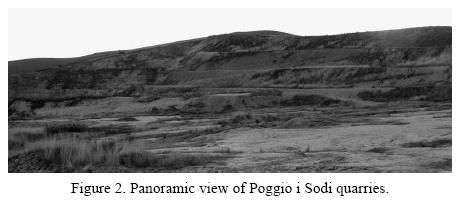
<body><![CDATA[<p align="justify"><font face="verdana" size="2">&nbsp;</font></p>  	    <p align="justify"><font face="verdana" size="2"><b>2. Sedimentological, stratigraphical and palaeoecological framework (A.B., R.B., F.F.)</b></font></p>  	    <p align="justify"><font face="verdana" size="2">The Castelnuovo Berardenga Scalo area is part of a wide clayey hill countryside, affected by intensive quarry activity. At present, three main quarry fronts are open along the Poggio i Sodi hill, between 220 and 280 m a.s.l., over an area of about 1 km<sup>2</sup>. The study area pertains to the Neogene Siena Basin (Bossio <i>et al</i>., 1993; Martini and Sagri, 1993; Aruta <i>et al</i>., 2004), and it is reconprised in the F. 297 "Asciano" (CARG Project: AA.VV., in press).</font></p>  	    <p align="justify"><font face="verdana" size="2">The Siena Basin (<a href="/img/revistas/bsgm/v65n2/a16f1.jpg" target="_blank">Figure 1</a>) is a NW&#45;SE oriented tectonic basin, bordered eastward by the Rapolano&#45;Cetona Range and westward by the Montagnola Senese high; it accommodated a continental sedimentation during late Miocene (Messinian) time, marine deposition starting from the Early Pliocene (Zanclean), and finally renewed continental sedimentation from the Pleistocene onward. Marine deposits are mainly represented by grey&#45;blue clay and marly clay, and are ascribed to the "Formazione delle Argille Azzurre" (FAA Fm.: Zanclean&#45;Piacenzian). In their uppermost part, offshore marine clay deposits are laterally eteropic to nearshore sand and conglomerates ("Sabbie di S. Vivaldo", "Conglomerati di Gambassi", "Sabbie di Chiusure" formations), and are still assigned to the Zanclean&#45;Piacenzian interval (Costantini <i>et al</i>., 2009; CARG Project, AA.VV., in press).</font></p>  	    <p align="justify"><font face="verdana" size="2">The Poggio i Sodi stratigraphic succession is still poorly studied. The most recent data are reported by Cigala Fulgosi <i>et al</i>. (2009), who assign the lowermost clay, containing the <i>Chlamydoselachus lawleyi</i>, to the late Piacenzian&#45;earliest Gelasian stage (Late Pliocene&#45;Early Pleistocene).</font></p>  	    <p align="justify"><font face="verdana" size="2">Along the northern flank of the hill, a composite section is described (<a href="#f2">figures 2</a>, <a href="/img/revistas/bsgm/v65n2/a16f3.jpg" target="_blank">3</a>). Deposits are mainly massive to locally laminated clay and silty clay, with local occurrence of fine sand and centimetric nodules of altered sulphides. Beds gently dip northeastward (attitude: 060/06). The whole quarry front is strongly affected by the occurrence of two main sets of sub&#45;vertical shear planes (oriented 130&#45;310 and 060&#45;240 respectively), disturbing the stratigraphic continuity.</font></p>  	    <p align="center"><font face="verdana" size="2"><a name="f2"></a></font></p>  	    <p align="center"><font face="verdana" size="2"><img src="/img/revistas/bsgm/v65n2/a16f2.jpg"></font></p>  	    <p align="justify"><font face="verdana" size="2">At the base, a thick shell bed occurs, prevailing <i>Ostrea</i> <i>lamellosa</i>, <i>Venus multilamella</i>, <i>Cerithium</i> sp., <i>Anadara</i> <i>diluvii</i>, <i>Dentalium sexangulum</i>, <i>Dentalium rectum</i>, Naticidae, rare solitary corals (<i>Flabellum</i> sp.), serpulids, and common vegetal remains. Crab remains are scattered between 235 and 260 m a.s.l., frequently associated with Spatangidae echinids (<a href="/img/revistas/bsgm/v65n2/a16f3.jpg" target="_blank">Figure 3</a>).</font></p>  	    <p align="justify"><font face="verdana" size="2">The decapod crustaceans here described were collected over time and unfortunately the exact location of the sample is lacking. Nevertheless, the comparison between the calcareous nannofossil assemblages found on decapod samples and the new sampling data allow to relocating the decapod&#45;bearing samples in the stratigraphic section (<a href="/img/revistas/bsgm/v65n2/a16f3.jpg" target="_blank">Figure 3</a>).</font></p>  	    ]]></body>
<body><![CDATA[<p align="justify"><font face="verdana" size="2">The latter have been processed for sedimentological characterization and biostratigraphic analyses (micropalaeontological washed residues and calcareous nannofossil smear slides). The mud fraction percentages (&#966; &lt; 63 &#956;m) are comprised between 96 and 99%, and deposits are regarded as clay/silty clay. The sand fraction (2mm &lt; &#966; &lt; 63 &#956;m) is mainly bioclastic, with rare lithics and quartz. In all fractions, abundant laminae of mica occur. Some samples contain small cylindrical pyrite concretions, black to dark brown in colour, in the range of medium sand.</font></p>  	    <p align="justify"><font face="verdana" size="2">The analyses of smear slides and washed residues highlight rich assemblages useful for stratigraphical assessment. The calcareous nannofossil rich assemblages, in good preservation state, are represented by small <i>Gephyrocapsa</i> spp. and medium <i>Gephyrocapsa</i> spp. (<i>sensu</i> Raffi, 2002), <i>Helicosphaera sellii</i>, <i>Helicosphaera</i> <i>carteri</i>, <i>Coccolithus pelagicus</i>, <i>Calcidiscus leptoporus</i>, rare <i>Reticulofenestra</i> sp., <i>Braarudosphaera bigelowii</i> and <i>Pseudoemiliania lacunosa</i>. The reworked specimens, rarely found in the assemblages, and in a poor state of preservation, are <i>Micula</i> sp., <i>Discoaster broweri</i>, <i>Discoaster</i> <i>asymmetricus</i> and <i>Sphenolithus</i> sp.</font></p>  	    <p align="justify"><font face="verdana" size="2">The presence of medium <i>Gephyrocapsa</i> allows identification of the MNN19 b subzone (<i>sensu</i> Rio <i>et al</i>., 1990) of the Early Pleistocene (Calabrian), and expansion of the stratigraphic documentation identified up to now for the FAA formation in the Poggio i Sodi area (Zanclean&#45;Piacenzian: Costantini <i>et al</i>., 2009; AA.VV., in press; late Piacenzian&#45;earliest Gelasian: Cigala Fulgosi <i>et al</i>., 2009).</font></p>  	    <p align="justify"><font face="verdana" size="2">The washed residue analyses are in a good state of preservation and are rich in microfossil assemblages, numerically dominated by planktonic foraminifera species with low species diversity and a smaller benthic foraminifera population with high values of species diversity. Rare fragments of echinoids (mainly radioles and plaques), fish otoliths and scales are present sporadically.</font></p>  	    <p align="justify"><font face="verdana" size="2">Among the planktonic foraminifera the most common are Globigerinids and Neogloquadrinids, the species <i>Orbulina&nbsp;universa</i>, <i>Globorotalia crassaformis viola</i>, <i>Globigerinoides ruber</i> and <i>Globigerinoides sacculifer</i>, <i>Globorotalia apertura</i>, <i>Neogloboquadrina dutertrei</i>, <i>Globigerinella siphonifera</i>, <i>Neogloboquadrina pachiderma</i> and <i>Neogloboquadrina incompta</i>, are present in all the assemblages. The Neogloboquadrinids species frequently occur with sinistral and dextral specimens. The species <i>Globorotalia inflata</i> is rarer and occurs only in a few samples.</font></p>  	    <p align="justify"><font face="verdana" size="2">Among the benthic foraminifera, the infaunal species such as <i>Brizalina spathulata</i>, <i>Bolivina carinata</i>, <i>Bulimina</i> <i>marginata</i>, <i>Bulimina spinata marginata</i>, <i>Cassidulina</i> <i>carinata</i>, <i>Melonis padanum</i>, <i>Uvigerina mediterranea</i> and <i>Uvigerina pygmaea</i> are usually present in assemblages. The epifaunal benthic foraminifera are represented by <i>Cancris</i> <i>auriculus</i>, <i>Cibicidoides ungerianus</i>, <i>Gyroidina altiformis</i>, <i>Heterolepa floridana</i>, <i>Hyalinea balthica</i>, <i>Lenticulina</i> sp., <i>Lobatula lobatula</i>, <i>Nonion depressulum</i>, <i>Planulina</i> <i>ariminensis</i>, <i>Quinqueloculina seminula</i>, <i>Spiroloculina</i> sp. and <i>Textularia</i> sp. The overall presence of <i>H. balthica</i> is consistent with an Early Pleistocene (Calabrian) age for the study samples (Baldanza <i>et al</i>., 2011).</font></p>  	    <p align="justify"><font face="verdana" size="2">The rare ostracod fauna is characterized by <i>Henryhowella</i> <i>sarsi profunda</i>, <i>Henryhowella sarsi sarsi</i>, <i>Krithe</i> cfr. <i>K.</i> <i>exigua</i>, <i>Cytherella gibba</i>, and <i>Xestoleberis communis</i>. These species are all extant in the Mediterranean, except for <i>C.</i> <i>gibba</i>, distributed from Zanclean to Calabrian (Faranda and Gliozzi, 2008).</font></p>  	    <p align="justify"><font face="verdana" size="2">2.1. Paleoenvironmental inferences</font></p>  	    <p align="justify"><font face="verdana" size="2">Sedimentological features point to a low&#45;energy sedimentary environment. The lack of lithic grains and the dominance of mud fraction are indicative of sedimentation below the storm wave base: thus, a distal and relatively deep offshore environment is inferred for Poggio i Sodi clays. According to Dunbar and Barrett (2005), a percentage of fines &gt; 80 % is indicative of a minimum 60 m depth in wave&#45;dominated coasts. On the other hand, nearshore deposits crop out all&#45;around, and the emerged areas were also not so far. Clay recorded the sedimentation in the open shelf, far from the coastal influence, and an up to 200 m deep upper bathyal rather than abyssal environment is more likely. Sulphide nodules probably derive from the primary common occurrence of unaltered organic matter, and testify for redox conditions on the sea floor.</font></p>  	    <p align="justify"><font face="verdana" size="2">The benthic foraminifera assemblages and the rare ostracods lead to some important considerations about the sea floor condition as depth, temperature, nutrients, oxygen concentration and vegetation cover, following Murray (1991, 2006) and Kaiho (1999).</font></p>  	    ]]></body>
<body><![CDATA[<p align="justify"><font face="verdana" size="2"><i>2.1.1. Depth</i></font></p>  	    <p align="justify"><font face="verdana" size="2">The benthic foraminifera assemblages contain numerous species that live in bathyal environments, such as <i>Brizalina</i> <i>spathulata</i>, <i>Bolivina alata</i>, <i>Bulimina marginata</i>, <i>Bulimina</i> <i>basispinosa</i>, <i>Uvigerina mediterranea</i>, and <i>Uvigerina</i> <i>pygmaea</i>. The ostracods <i>H. sarsi profunda</i> and <i>Krithe</i> cfr. <i>K. exigua</i> are also assigned to an upper bathyal environment (Bonaduce <i>et al</i>., 1999; Sciuto and Rosso, 2008). Consequently, the decapods fauna could live in upper bathyal paleoenvironment.</font></p>  	    <p align="justify"><font face="verdana" size="2"><i>2.1.2. Temperature</i></font></p>  	    <p align="justify"><font face="verdana" size="2">The presence in all the assemblages of several taxa (<i>Hyalinea balthica</i>, <i>Lenticulina</i> spp., <i>Gyroidina altiformis</i>, <i>Cibicidoides ungerianus</i>, <i>Nonion depressulum</i> and <i>Melonis</i> <i>padanum</i>) that live in cold water indicates cool conditions at the interface water&#45;sediment. The presence of left&#45;coiling Neogloboquadrinids, according to Serrano and Guerra&#45;Merch&aacute;n (2012), also marks a sea&#45;surface cooling trend.</font></p>  	    <p align="justify"><font face="verdana" size="2"><i>2.1.3. Nutrients</i></font></p>  	    <p align="justify"><font face="verdana" size="2">The presence in assemblages of a well structured planktonic community, with taxa that inhabit the surficial and deep parts of photic zone, and the dominance of Neogloboquadrinids added with the abundance of phytoplankton give evidence that the water column was rich in nutrients. Moreover, the dominance of epifaunal benthic foraminifera taxa is evidence of a bottom floor rich in nutrients.</font></p>  	    <p align="justify"><font face="verdana" size="2"><i>2.1.4. Oxygen concentration</i></font></p>  	    <p align="justify"><font face="verdana" size="2">In specific samples, the presence of infaunal taxa indicative of low oxygen content (Stefanelli, 2004), such as <i>Cassidulina carinata</i>, <i>Lenticulina</i>, <i>Pullenia</i>, <i>Sphaeroidina</i> <i>bulloides</i>, <i>Uvigerina</i>, and <i>Valvulineria</i> gives evidence of depletion at the sea floor. Moreover, the presence of the deep infaunal species <i>Melonis</i> spp. indicates that also the oxygen values are low in the bottom sediments (for almost the first 4 cm).</font></p>  	    <p align="justify"><font face="verdana" size="2"><i>2.1.5. Vegetation cover</i></font></p>  	    <p align="justify"><font face="verdana" size="2">The sea&#45;floor was not covered by sea grass due to the cool conditions at the bottom, as evidenced by the presence of benthic foraminifera that live in cold water; the scarcity of <i>Lobatula lobatula</i>, characteristic epifaunal species that lives on vegetation, could be considered as reworked from shallow environments.</font></p>  	    ]]></body>
<body><![CDATA[<p align="justify"><font face="verdana" size="2">&nbsp;</font></p>  	    <p align="justify"><font face="verdana" size="2"><b>3. Material</b></font></p>  	    <p align="justify"><font face="verdana" size="2">Twenty decapod crustaceans were studied from Poggio i Sodi quarries (Siena, Tuscany, central Italy). They were embedded in small loose blocks of grey marly clays, coming from undefined levels of the quarries. The biostratigraphic analyses of decapods&#45;bearing blocks allow assigning all the specimens to the late Gelasian&#45;early Calabrian interval. Crustaceans are preserved, either as slightly compressed or having a three&#45;dimensional shape. Due to the delicate nature of the fossils and the loose matrix, all specimens were fixed with a film of polyvinyl acetate for study and preservation. The infraorder Astacidea Latreille, 1802, includes <i>Nephrops</i> cfr. <i>N. norvegicus</i> (Linnaeus, 1758) (Nephropidae Dana, 1852) (one specimen). The infraorder Axiidea de Saint Laurent, 1979, includes <i>Bathycalliax mediterranea</i> n. sp. (Callianassidae Dana, 1852) (three specimens). The infraorder Anomura MacLeay, 1838, includes <i>Galathea</i> sp. (Galatheidae Samouelle, 1819) (one specimen). The infraorder Brachyura Linnaeus, 1758, includes <i>Lysirude</i> <i>paronae</i> (Crema, 1895) (Lyreididae Guinot, 1993) (one specimen), <i>Calappa</i> cfr. <i>C. granulata</i> (Calappidae De Haan, 1833) (one specimen), <i>Retropluma craverii</i> (Crema, 1895) (Retroplumidae Gill, 1894) (five specimens), <i>Lobocarcinus</i> <i>sismondai</i> (von Meyer, 1843) (Cancridae Latreille, 1802) (one specimen), <i>Bathynectes longipes</i> (Risso, 1816) (Polybiidae Ortmann, 1893) (three specimens), <i>Monodaeus</i> <i>bortolottii</i> Delle Cave, 1988 (Xanthidae MacLeay, 1838) (one specimen), <i>Eriphia</i> sp. (one specimen) (Eriphiidae MacLeay, 1838), <i>Goneplax rhomboides</i> (Linnaeus, 1758) (one specimen) and <i>Albaidaplax ispalensis</i> Garassino, Pasini and Castro, 2013 (one specimen) (Goneplacidae MacLeay, 1838). Moreover some very poorly preserved chelipeds, probably belonging to <i>Jaxea</i> cfr. <i>J. nocturna</i> (Laomediidae Borradaile, 1903), already known from the Pliocene of Tuscany, were also observed in the rich fauna but not included in this work. Finally, some well&#45;preserved moulds of the cirolanid isopod, <i>Palaega sismondai</i> Ristori, 1891, have been discovered, associated with decapod crustacean community.</font></p>  	    <p align="justify"><font face="verdana" size="2">The specimens are deposited in the palaeontological collections of the Gruppo Paleontologico "C. De Giuli", Biblioteca Comunale Vallesiana, Castelfiorentino, Firenze (GPDG) and in the Geological Section of the Museo di Storia Naturale dell'Accademia dei Fisiocritici, Siena (MUSNAF). Compared specimens are deposited in the Museo di Storia Naturale di Milano (MSNM).</font></p>  	    <p align="justify"><font face="verdana" size="2">For higher&#45;level classification, we follow the recent arrangement proposed by Ng <i>et al</i>. (2008), Baba <i>et al</i>. (2008), De Grave <i>et al</i>. (2009), and Van Bakel <i>et al</i>. (2012).</font></p>  	    <p align="justify"><font face="verdana" size="2">&nbsp;</font></p>  	    <p align="justify"><font face="verdana" size="2"><b>4. Abbreviations</b></font></p>  	    <p align="justify"><font face="verdana" size="2">hc: height of the carpus; hi: height of the ischium; hm: height of the merus; hpa: height of the palm; lc: length of the carpus; lcxp: length of the carapace (excluding rostrum); ld: length of the dactylus; li: length of the ischium; lm: length of the merus; lpa: length of the palm; lpr: length of the propodus (including fixed finger); lr: length of the rostrum; P2&#45;P4: pereiopods 2 to 4; s1&#45;s6: abdominal somites 1 to 6; st4&#45;st8: thoracic sternites 4 to 8; wcxp: width of the carapace.</font></p>  	    <p align="justify"><font face="verdana" size="2">&nbsp;</font></p>  	    <p align="justify"><font face="verdana" size="2"><b>5. Systematic Palaeontology</b> (A.G., M.H., G.P.)</font></p>  	    ]]></body>
<body><![CDATA[<blockquote> 		    <p align="center"><font face="verdana" size="2">Order Decapoda Latreille, 1802    <br> 		</font><font face="verdana" size="2">Infraorder Astacidea Latreille, 1802    <br> 		</font><font face="verdana" size="2">Superfamily Nephropoidea Dana, 1852    <br> 		</font><font face="verdana" size="2">Family Nephropidae Dana, 1852    <br> 		</font><font face="verdana" size="2">Genus <i>Nephrops</i> Leach, 1814</font></p> </blockquote>  	    <p align="justify"><font face="verdana" size="2"><b>Type species:</b> <i>Cancer norvegicus</i> Linnaeus, 1758, by monotypy.</font></p>  	    <p align="justify"><font face="verdana" size="2"><b>Fossil species:</b> see Schweitzer <i>et al</i>. (2010).</font></p>  	    <blockquote> 		    <p align="center"><font face="verdana" size="2"><i>Nephrops</i> cfr. <i>N. norvegicus</i> (Linnaeus, 1758)    ]]></body>
<body><![CDATA[<br> 		</font><font face="verdana" size="2"><a href="/img/revistas/bsgm/v65n2/a16f4.jpg" target="_blank">Figure 4.A, 4.B</a></font></p> </blockquote>  	    <p align="justify"><font face="verdana" size="2"><b>Material and measurements:</b> One single block of marly clays, including one complete propodus with major chela and minor chela in lateral view; sparse remains of the crushed carapace poorly preserved; one incomplete ambulatory leg could be assigned to palinurids (MUSNAF 7060 &#150; major chela, ld: 51 mm; hpa: 27 mm; lpa: ?60 mm; lc: 29 mm; lm: 42 mm; minor chela, ld: 30 mm; hpa: 17 mm; ?P4, dactylus: 35 mm; propodus: 31 mm).</font></p>  	    <p align="justify"><font face="verdana" size="2"><b>Description:</b> Slender, very elongate propodus; heterochely chelae, with a strong, elongate subrectangular crushing major chela and a smaller cutting left chela; chelae with a longitudinal ridge running along the middle lower part of the palm bearing a row of robust spines and forming two broad longitudinal grooves; dorsal margin not preserved in the major chela, dentate in the minor chela, with a rim of pointed spines forward&#45;directed; smooth lower margin; elongate dactylus and index equal in length both; pointed, curved distally with converging tips; occlusal margins with strong molariform teeth alternate with smaller ones in the major chela; reduced and more triangular in the slender minor chela; subrectangular carpus, subtriangular in cross section, with some pointed spines forward&#45;directed along the margins; elongate, subrectangular merus, longer than the carpus with triangular spines pointed anteriorly on the distal dorsal margins; ?carapace (or parts of the body) very crushed and undeterminable; an incomplete pereiopod (P4?) with a very elongate slender pointed dactylus; elongate, subrectangular propodus and carpus, both bearing a row of strong triangular spines forward&#45;directed along the lateral margins.</font></p>  	    <p align="justify"><font face="verdana" size="2"><b>Discussion:</b> The main characters and shape of the chelipeds of the specimen are typical of Nephropidae. Moreover, the elongate chelae with occlusal margins of the dactylus and index with strong and small molariform teeth is also a typical character of the extant and fossil <i>Nephrops</i> Leach, 1814. Indeed, the extant <i>N. norvegicus</i> (Linnaeus, 1758), shares some affinities with the specimen, as follows: the form and ornamentation of the heterochely chelae; the presence of molariform teeth on occlusal margins of dactylus and index of the right chela; the shape of the elongate dactylus and index gently curved distally converging at the tip; the rows of the strong pointed spines along the palms, the carpus, and the propodus; the lower median serrate ridge and the distinct longitudinal grooves along the palms of both chelae. Based upon these characteristics we ascribe the specimen to <i>Nephrops</i> cfr. <i>N. norvegicus</i> (Linnaeus, 1758), remarking on the unusually large size of the specimen if compared to an extant standard individual of this species from the Adriatic Sea (MSNM cr 2440 &#150; total length 130 mm, from the rostrum to the telson; major chela: ld: 25 mm; hp: 12 mm; lp: 30 mm; lc: 15 mm; lm: 25 mm). This is the first report for the species in the fossil record, enlarging the knowledge on the distribution and presence of the species in the paleo&#45;Mediterranean basin.</font></p>  	    <p align="justify"><font face="verdana" size="2">Finally, we point out that the single ambulatory leg strongly spinate, preserved in the same block of marly clays, does not fit into the nephropidae, having more slender and not spinate ambulatory legs, remembering instead the ornamentation of the legs representatives of the palinuridae, especially in the achelate P4. Probably this propodus and perhaps the crushed body remains do not belong to the same specimen, but they could belong to two different taxa. This chaotic assemblage might represent the remains of the feeding behaviour of an indeterminate predator that selected the softer parts of these crustacean preys (body), excluding the robust chelipeds (<i>Nephrops</i>) and the spinate legs (Palinuridae).</font></p>  	    <blockquote> 		    <p align="center"><font face="verdana" size="2">Infraorder Axiidea de Saint Laurent, 1979    <br> 		</font><font face="verdana" size="2">Family Callianassidae Dana, 1852    <br> 		</font><font face="verdana" size="2">Subfamily Bathycalliacinae Sakai and T&uuml;rkay, 1999    <br> 		</font><font face="verdana" size="2">Genus <i>Bathycalliax</i> Sakai and T&uuml;rkay, 1999</font></p> </blockquote>  	    ]]></body>
<body><![CDATA[<p align="justify"><font face="verdana" size="2"><b>Type species:</b> <i>Bathycalliax geomar</i> Sakai and T&uuml;rkay, 1999, by original designation.</font></p>  	    <p align="justify"><font face="verdana" size="2"><b>Fossil species:</b> <i>Bathycalliax mediterranea</i> n. sp.</font></p>  	    <blockquote> 		    <p align="center"><font face="verdana" size="2"><i>Bathycalliax mediterranea</i> n. sp.    <br> 		</font><font face="verdana" size="2"><a href="/img/revistas/bsgm/v65n2/a16f5.jpg" target="_blank">Figures 5</a>, <a href="/img/revistas/bsgm/v65n2/a16f6.jpg" target="_blank">6.A&#45;C</a></font></p> </blockquote>  	    <p align="justify"><font face="verdana" size="2"><b>Diagnosis:</b> <i>Bathycalliax</i> with major cheliped merus with a small distal lobe followed with a concavity on the lower margin.</font></p>  	    <p align="justify"><font face="verdana" size="2"><b>Holotype:</b> MUSNAF 7061.</font></p>  	    <p align="justify"><font face="verdana" size="2"><b>Paratypes:</b> MUSNAF 7062, 7063.</font></p>  	    <p align="justify"><font face="verdana" size="2"><b>Material and measurements:</b> One near&#45;complete major cheliped in outer lateral view (MUSNAF 7061 &#150; hi: 5.5 mm; li: 10.8 mm; hm: 8.3 mm; lm: 14 mm; hc: not measurable; lc: 13 mm; hpa: 17.8 mm; lpa: 19.9 mm; lpr: 23 mm); one complete major cheliped in inner lateral view with associated minor cheliped (MUSNAF 7062 a, b &#150; hi: 3.9 mm; li: 10.5 mm; hm: 5.4 mm; lm: 11 mm; hc: 14 mm; lc: 12 mm; hpa: 14.9 mm; lpa: 14 mm; lpr: 21.7 mm; minor cheliped not measurable); one minor cheliped in inner lateral view (MUSNAF 7063 &#150;hm: 3.3 mm; lm: 6 mm; hc: 6.8 mm; lc: 6.2 mm; hpa: 6 mm; lpa: 6 mm; lpr: ?11.5 mm; ld: 6.9 mm).</font></p>  	    <p align="justify"><font face="verdana" size="2"><b>Description:</b> Chelipeds (first pereiopods) unequal in size and dissimilar in shape.</font></p>  	    ]]></body>
<body><![CDATA[<p align="justify"><font face="verdana" size="2">Major cheliped massive; ischium slender with spinulous lower margin, upper margin unarmed; merus longer than high, approximately as long as ischium, arcuate and unarmed upper margin, lower margin with small distal lobe followed with a concavity and armed with nine spines along its length, the largest being the most proximal; carpus higher than long, shorter than manus, proximolower margin regularly rounded and smooth in outline; heavy propodus, upper margin slightly converging distally, straight and smooth lower margin; index approximately half the length of manus, occlusal margin concave distally, with a large tooth positioned proximally, tip of index curved slightly upward; massive dactylus, sinuous and unarmed occlusal margin, terminated with sharp curved hook.</font></p>  	    <p align="justify"><font face="verdana" size="2">Minor cheliped more slender and less massive than major one; ischium not preserved sufficiently; merus with arcuate upper margin, lower margin insufficiently preserved, possibly with several spines; subtriangular carpus, approximately as long as high, proximal lower margin regularly rounded and smooth, straight upper margin; subrectangular manus, index distinctly shorter than dactylus, occlusal margin with a large blunt tooth at its base and sharp tip distally; dactylus long and slender, sinuous and unarmed occlusal margin, with blunt tip.</font></p>  	    <p align="justify"><font face="verdana" size="2">Other appendages, carapace and pleon preserved insufficiently or not preserved at all.</font></p>  	    <p align="justify"><font face="verdana" size="2"><b>Discussion:</b> The preservation of the material allows its assignment to <i>Bathycalliax</i>, which is a monotypic genus known so far only from the recent deep&#45;water cold seeps off Oregon (Sakai and T&uuml;rkay, 1999). The genus was diagnosed mainly based upon the soft part morphology as is usual for biologically defined taxa. However, the comparison of published figures (Sakai and T&uuml;rkay, 1999: figs. 1&#150;3) with other callianassid taxa allows identifying the combination of characters present on chelipeds which is unique for the genus (and its subfamily). Thus, it can be successfully used for identification of <i>Bathycalliax</i> in the fossil record where usually only chelipeds are preserved. Chelipeds of <i>Bathycalliax</i> are unequal in size and dissimilar in shape (Sakai and T&uuml;rkay, 1999). Major cheliped of <i>Bathycalliax</i> typically possesses ischium and merus which have spiny lower margins. Carpus is higher than long, with the lower and proximal margins forming one single rounded edge. Propodus is rectangular with the index possessing a tooth (median triangular denticle <i>sensu</i> Sakai and T&uuml;rkay, 1999) positioned on the midlength of its occlusal edge. The index possesses faint ridge. Dactylus has hooked tip, otherwise it is unarmed. Minor cheliped has also spiny lower margins of ischium and merus. Carpus is triangular in shape, as long as high and typically is slightly higher than propodus. The index is distinctly shorter than dactylus. All above&#45;mentioned characters are present in our material, thus securing its generic assignment to <i>Bathycalliax</i>.</font></p>  	    <p align="justify"><font face="verdana" size="2">Several other callianassid genera possess some of the above&#45;mentioned characters but not all of them. <i>Glypturus</i> Stimpson, 1866 (subfamily Callichirinae) has spiny merus, similar to <i>Bathycalliax</i>, but it has several spines also on the upper margin (Hy&#382;n&yacute; and M&uuml;ller, 2012). Other Callichirinae taxa usually possess much longer minor cheliped carpus than <i>Bathycalliax</i> does and the same is true for the subfamily Callianassinae. In the nature of chelipeds, only few members of Callianassinae can be directly compared to <i>Bathycalliax</i>. Spiny merus is very untypical for Callianassinae. <i>Callianassa spinophthalma</i> Sakai, 1970, and <i>C. intermedia</i> Man, 1905, have such merus, but in other aspects are completely dissimilar to <i>Bathycalliax</i>. As already noted by Sakai and T&uuml;rkay (1999), the subfamily Eucalliacinae seems to be close to <i>Bathycalliax</i>. When comparing cheliped morphology of the Eucalliacinae taxa, <i>Calliax</i> shows most similarities to <i>Bathycalliax</i>, specifically the proportions of major cheliped elements and possession of minor cheliped dactylus distinctly longer than the index (Ngoc&#45;Ho, 2003). <i>Calliax</i>, however, has only a few small spines on the lower margin of merus and apart from the dactylus length, the minor cheliped is differently shaped: typically, it possesses a wide gap between fingers with a tooth forward&#45;directed in between (see Sakai, 1999: Fig. 29C; Ngoc&#45;Ho, 2003: Fig. 17E).</font></p>  	    <p align="justify"><font face="verdana" size="2"><i>Bathycalliax mediterranea</i> n. sp. is very similar to the type species of <i>Bathycalliax</i>. The only observable difference between <i>Bathycalliax geomar</i> and <i>B. mediterranea</i> n. sp. is a small distal lobe followed with a concavity on the lower margin of merus. Otherwise, both taxa possess the same number (9) of meral spines on its lower margin. <i>Bathycalliax</i> <i>mediterranea</i> n. sp., from the Early Pleistocene deposits of Poggio i Sodi, is the first report of <i>Bathycalliax</i> (and its subfamily) in the fossil record.</font></p>  	    <blockquote> 		    <p align="center"><font face="verdana" size="2">Infraorder Anomura MacLeay, 1838    <br> 		</font><font face="verdana" size="2">Superfamily Galatheoidea Samouelle, 1819    <br> 		</font><font face="verdana" size="2">Family Galatheidae Samouelle, 1819    ]]></body>
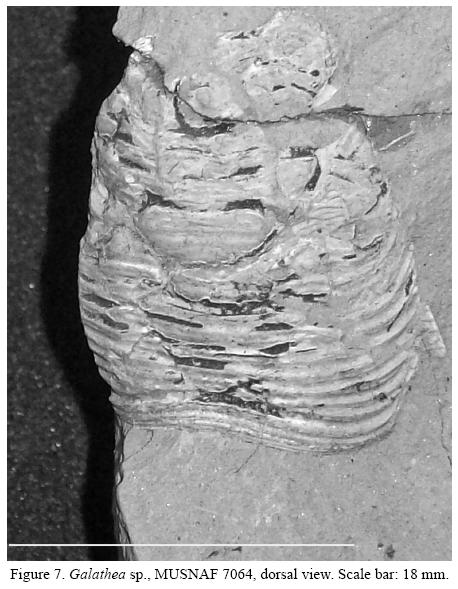
<body><![CDATA[<br> 		</font><font face="verdana" size="2">Genus <i>Galathea</i> Fabricius, 1793</font></p> </blockquote>  	    <p align="justify"><font face="verdana" size="2"><b>Type species:</b> <i>Cancer strigosus</i> Linnaeus, 1761.</font></p>  	    <p align="justify"><font face="verdana" size="2"><b>Fossil species:</b> see Schweitzer <i>et al</i>. (2010).</font></p>  	    <blockquote> 		    <p align="center"><font face="verdana" size="2"><i>Galathea</i> sp.    <br> 		</font><font face="verdana" size="2"><a href="#f7">Figure 7</a></font></p> </blockquote>  	    <p align="center"><font face="verdana" size="2"><a name="f7"></a></font></p>  	    <p align="center"><font face="verdana" size="2"><img src="/img/revistas/bsgm/v65n2/a16f7.jpg"></font></p>  	    <p align="justify"><font face="verdana" size="2"><b>Material and measurements:</b> One incomplete specimen in dorsal view, without rostrum (MUSNAF 7064 a, b &#150; lcxp: 16.7 mm; wcxp: 18 mm).</font></p>  	    <p align="justify"><font face="verdana" size="2"><b>Discussion:</b> Although the rostrum is not preserved, the specimen could show affinities with <i>Galathea affinis</i> Ristori, 1886, as follows: the well&#45;developed cardiac and branchiocardiac grooves, the restricted epibranchial regions weakly raised, and all regions of the carapace with continuous uninterrupted striae. Ristori (1886) described this species based upon one complete carapace from the Late Pliocene of Bianchi locality (Sicily). Later, L&#337;renthey (1909) reported the same species from the Miocene of Capo S. Marco (Oristano, Sardinia). A real comparison, however, with the specimen is difficult because of the loss of the holotype and additional sample. Moreover, the perfunctory description by Ristori (1886: 126, 127) and the poor quality of the line drawing by Ristori (1886: pl. 2, Fig. 18) do not allow establishing the peculiar diagnostic characters of <i>G. affinis</i>. Based upon these observations, we consider <i>G.</i> <i>affinis</i> a <i>nomen dubium</i>. Therefore, we prefer to leave the Tuscany specimen in open nomenclature, waiting for more complete material.</font></p>  	    ]]></body>
<body><![CDATA[<blockquote> 		    <p align="center"><font face="verdana" size="2">Infraorder Brachyura Linnaeus, 1758    <br> 		</font><font face="verdana" size="2">Section Podotremata Guinot, 1977    <br> 		</font><font face="verdana" size="2">Subsection Raninoidia De Haan, 1839    <br> 		</font><font face="verdana" size="2">Superfamily Raninoidea De Haan, 1839    <br> 		</font><font face="verdana" size="2">Family Lyreididae Guinot, 1993    <br> 		</font><font face="verdana" size="2">Subfamily Lyreidinae Guinot, 1993    <br> </font><font face="verdana" size="2">Genus <i>Lysirude</i> Goeke, 1986</font></p> </blockquote>  	    <p align="justify"><font face="verdana" size="2"><b>Type species:</b> <i>Lysirude nitidus</i> (A. Milne&#45;Edwards, 1880), by original designation.</font></p>  	    <p align="justify"><font face="verdana" size="2"><b>Fossil species:</b> see Van Bakel <i>et al</i>. (2012).</font></p>  	    ]]></body>
<body><![CDATA[<blockquote> 		    <p align="center"><font face="verdana" size="2"><i>Lysirude paronae</i> (Crema, 1895)    <br> 		</font><font face="verdana" size="2"><a href="#f8">Figure 8</a></font></p>     <p align="center"><font face="verdana" size="2"><a name="f8"></a></font></p>  		    <p align="center"><font face="verdana" size="2"><img src="/img/revistas/bsgm/v65n2/a16f8.jpg"></font></p>  		    <p align="justify"><font face="verdana" size="2"><i>Lyreidus paronae</i> Crema, 1895: 671, Fig. 11.</font></p>  		    <p align="justify"><font face="verdana" size="2"><i>Lysirude paronae</i> De Angeli <i>et al</i>. 2009: 170, 171, Fig. 4.</font></p> 	</blockquote>  	    <p align="justify"><font face="verdana" size="2"><b>Material and measurements:</b> One nearly complete specimen in dorsal view, preserving chelipeds and ambulatory legs partially (MUSNAF 7065 a, b &#150; lcxp: 32.7 mm; wcxp: 19.5 mm).</font></p>  	    <p align="justify"><font face="verdana" size="2"><b>Description:</b> Carapace: narrow anterior margin with elongate, protruding triangular rostrum, and a pair of supraorbital spine. One extraorbital spine as long as the rostrum; elongate, divergent anterolateral margins slightly convex medially, with an oblique triangular spine pointed forward. Cheliped: flat ovoidal palm higher anteriorly, convex smooth dorsal margin and nearly straight ventrally; pointed index deflected downward and directed&#45;upward distally; slender dactylus gently curved downward, with small, short, pointed teeth on occlusal margin; subrectangular carpus, with a rim of small teeth along the dorsal margin; rectangular merus, notably elongate, longer than the double of the carpus.</font></p>  	    <p align="justify"><font face="verdana" size="2"><b>Discussion:</b> The above&#45;mentioned characters allow assigning the specimens to <i>Lysirude paronae</i> (Crema, 1895), already reported from the same area by De Angeli <i>et al</i>. (2009). This species is known from the "Helvetian" (late Miocene) of Sciolze and from the Langhian (middle Miocene) of S. Margherita (Turin) and from the Pliocene of Orta San Giulio (Novara, Piedmont) (Garassino <i>et al</i>., 2004).</font></p>  	    ]]></body>
<body><![CDATA[<p align="justify"><font face="verdana" size="2">This finding in the Early Pleistocene sediments of Poggio i Sodi increases the stratigraphical range of this genus.</font></p>  	    <blockquote> 		    <p align="center"><font face="verdana" size="2">Section Eubrachyura de Saint Laurent, 1980    <br> 		</font><font face="verdana" size="2">Superfamily Calappoidea De Haan, 1833    <br> 		</font><font face="verdana" size="2">Family Calappidae De Haan, 1833    <br> 		</font><font face="verdana" size="2">Genus <i>Calappa</i> Weber, 1795</font></p> </blockquote>  	    <p align="justify"><font face="verdana" size="2"><b>Type species:</b> <i>Cancer granulatus</i> Linnaeus, 1758, subsequent designation by Latreille (1810).</font></p>  	    <p align="justify"><font face="verdana" size="2"><b>Fossil species:</b> see Schweitzer <i>et al</i>. (2010).</font></p>  	    <blockquote> 		    <blockquote> 		      ]]></body>
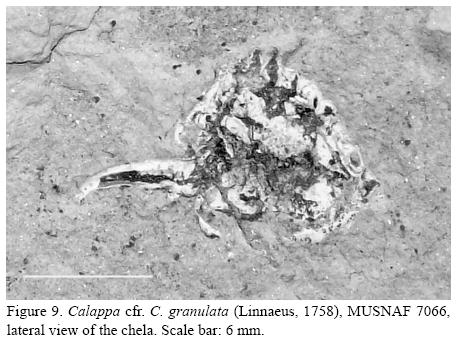
<body><![CDATA[<p align="center"><font face="verdana" size="2"><i>Calappa</i> cfr. <i>C. granulata</i> (Linnaeus, 1758)    <br> 	      </font><font face="verdana" size="2"><a href="#f9">Figure 9</a></font></p> 	  </blockquote> </blockquote>      <p align="center"><font face="verdana" size="2"><a name="f9"></a></font></p>  	    <p align="center"><font face="verdana" size="2"><img src="/img/revistas/bsgm/v65n2/a16f9.jpg"></font></p>  	    <p align="justify"><font face="verdana" size="2"><b>Material and measurements:</b> One left propodus in lateral view (MUSNAF 7066 a, b &#150; ld: 6 mm; lpa: 8 mm; hpa: 8 mm).</font></p>  	    <p align="justify"><font face="verdana" size="2"><b>Description:</b> Small left propodus strongly convex dorsally, palm higher anteriorly, with nearly straight ventral margin; dorsal margin bearing a rim of almost seven pointed acute spines. Thin, slender, pointed dactylus, nearly straight proximally, directed&#45;downward distally.</font></p>  	    <p align="justify"><font face="verdana" size="2"><b>Discussion:</b> The above&#45;mentioned characters are typical of the left propodus of <i>Calappa</i> Weber, 1795, including the extant and fossil <i>C. granulata</i> (Linnaeus, 1758), the only fossil species reported to date from the Pliocene of Tuscany, Piedmont, Emilia Romagna, and Sicily and from the Pleistocene of Monte Pellegrino (Sicily) (Ristori, 1891, Gemmellaro, 1914; Garassino and De Angeli, 2004; Garassino <i>et al</i>., 2004; De Angeli <i>et al</i>., 2009; Pasini and Garassino, 2013; Garassino and Pasini, 2013). Based upon the poor state of preservation of the specimen, it is prudentially compared with <i>Calappa granulata</i>.</font></p>  	    <blockquote> 		    <p align="center"><font face="verdana" size="2">Superfamily Retroplumoidea Gill, 1894    <br> 		</font><font face="verdana" size="2">Family Retroplumidae Gill, 1894    ]]></body>
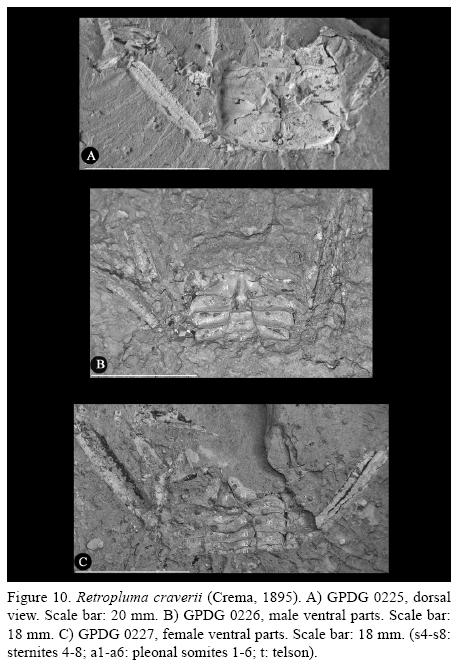
<body><![CDATA[<br> 		</font><font face="verdana" size="2">Genus <i>Retropluma</i> Gill, 1894</font></p> </blockquote>  	    <p align="justify"><font face="verdana" size="2"><b>Type species:</b> <i>Archaeoplax notopus</i> Alcock and Anderson, 1894, by monotypy.</font></p>  	    <p align="justify"><font face="verdana" size="2"><b>Fossil species:</b> see Schweitzer <i>et al</i>. (2010).</font></p>  	    <blockquote> 		    <p align="center"><font face="verdana" size="2"><i>Retropluma craverii</i> (Crema, 1895)    <br> 		</font><font face="verdana" size="2"><a href="#f10">Figure 10.A&#45;C</a></font></p>     <p align="center"><font face="verdana" size="2"><a name="f10"></a></font></p>  		    <p align="center"><font face="verdana" size="2"><img src="/img/revistas/bsgm/v65n2/a16f10.jpg"></font></p>  		    <p align="justify"><font face="verdana" size="2"><i>Goneplax craverii</i> Crema, 1895: 675, Fig. 16.</font></p>  		    <p align="justify"><font face="verdana" size="2"><i>Retropluma craverii</i> V&iacute;a Boada, 1980: 52, 53, Fig. 1. &#150; V&iacute;a Boada, 1982: 116, Fig. 1. &#150; De Angeli <i>et al</i>., 2011: 38&#45;41, Figs. 2&#45;4.</font></p> 	</blockquote>  	    ]]></body>
<body><![CDATA[<p align="justify"><font face="verdana" size="2"><b>Material and measurements:</b> Five specimens in dorsal and ventral views (GPDG 0223 &#150; lcxp: 4.6 mm; lr: 0.5 mm; wcxp: 6 mm; GPDG 0224 &#150; lcxp: 13 mm; lr: 1.5 mm; wcxp: 18.3 mm; GPDG 0225 &#150; lcxp: 20 mm; lr: 2.5 mm; wcxp: 24.5 mm; GPDG 0226, 0227 not measurable).</font></p>  	    <p align="justify"><font face="verdana" size="2"><b>Description:</b> Carapace: subrectangular carapace, weakly convex longitudinally, wider than long, almost flat in transverse section; very elongate, narrow, cylindrical rostrum slightly spatulated in the proximal part; broad, sinuous supraorbital margin, with small supraorbital projection; postorbital tooth well developed, forwardly directed; short anterolateral margin slightly concave; smooth frontal margin and lateral margins; posterolateral margin considerably longer and arched; gently rounded, rimmed posterior margin distinctly broader than the orbitofrontal margin; dorsal surface of carapace with three sharp&#45;crested, smooth transverse ridges; continuous, straight anterior ridge, parallel to anterior margin, crossing the entire dorsal surface; median transverse ridge slightly inclined, well developed at the lateral flanks only, interrupted at level of urogastric region; continuous, straight posterior ridge, parallel to the anterior one, located in the posterior region; dorsal surface of carapace covered with delicate, small granules uniformly distributed; regions of carapace weakly marked; weak cervical groove, located between anterior and median ridges, separating gastric regions from branchial ones; distal part of cervical groove ornamented with a ridge of small aligned tubercles. Mesogastric region with two blunt tubercles. &#150; Thoracic sternum subtriangular anteriorly in both sexes, rounded at the tip, enlarging abruptly posteriorly, specially in female; deep sternal cavity in male; wide triangular st4 with a deep lateral concave sinus at the first coxa joint, ending anteriorly with a rounded triangular tooth forwardly directed (in male); petaloid st5&#45;st7 in both sexes, slightly shorter and higher in female, each bearing a granulate, transverse, sinuous ridge posteriorly; st8 very reduced, poorly preserved. &#150; Male pleon: subtrapezoidal pleonal somites, with smooth, median, longitudinal, granulate ridge; s3&#45;s4 and s5? fused; triangular telson, elongate, rounded anteriorly; pleonal shield outline slightly concave laterally. &#150; Female pleon: subrectangular s1&#45;s6 frees, articulated and wider than male, decreasing anteriorly, laterally convex, with concave posterior margin; a very weak median transverse ridge present in s1&#45;s6; s1 reduced; triangular telson wider than male. &#150; Thoracic appendages: chelipeds with elongate merus, short, subtriangular carpus, propodus ventrally flatted; elongate subrectangular chelae shorter in male, rounded dorsally, with slender elongate pointed dactyli; dactylus gently curved distally; index straight ventrally, slightly curved distally; index longer than palm in female; occlusal margins nearly smooth; P2&#45;P4 slender, notably elongate, flattened laterally, granulate dorsally and ventrally, with a smooth depressed longitudinal median ridge; P3 longer than P2, both slightly longer than P4.</font></p>  	    <p align="justify"><font face="verdana" size="2"><b>Discussion:</b> Usually the fossil record of Retroplumidae from the Pliocene of Italy is rare. Indeed this family was known to date only with two genera, <i>Bathypluma</i> (de Saint Laurent, 1989) from Tuscany (central Italy) (Garassino <i>et al</i>., 2012) and <i>Retropluma</i> (Gill, 1894) from Piedmont and Emilia Romagna (N Italy). The last one is known by the only <i>Retropluma craverii</i>, described for the first time by Crema (1895) from the Late Pliocene (Piacenzian) of Bra (Piedmont, N Italy). De Angeli <i>et al</i>. (2011) revised <i>Retropluma craverii</i> by two retroplumids from the Pliocene of Reggio Emilia (northern Italy), with a well&#45;preserved pleon that allows describing morphological characters of the sternum and pleon in both sexes, and identifying some morphological characters, such as the very elongate and narrow rostrum, the wide orbitofrontal margin distinctly sinuous, ending with a well&#45;developed tooth forwardly directed, and the dorsal surface of the carapace with three transverse ridges, similar to those of the specimens that are assigned to <i>R. craverii</i>.</font></p>  	    <p align="justify"><font face="verdana" size="2">The report of this species from the Early Pleistocene of Tuscany further enlarges its geological range and geographical distribution southwards, in the paleo&#45;Mediterranean basin, pointing out the paleo&#45;biostratigraphic problem in the reconstruction of the fossil distribution of Retroplumidae, as already reported by de Saint Laurent (1989, p. 150).</font></p>  	    <blockquote> 		    <p align="center"><font face="verdana" size="2">Superfamily Cancroidea Latreille, 1802    <br> 		</font><font face="verdana" size="2">Family Cancridae Latreille, 1802    <br> 		</font><font face="verdana" size="2">Subfamily Lobocarcininae Beurlen, 1930    <br> 		</font><font face="verdana" size="2">Genus <i>Lobocarcinus</i> Reuss, 1857</font></p> </blockquote>  	    <p align="justify"><font face="verdana" size="2"><b>Type species:</b> <i>Cancer paulino&#45;w&uuml;rtembergensis</i> von Meyer, 1847, by original designation.</font></p>  	    ]]></body>
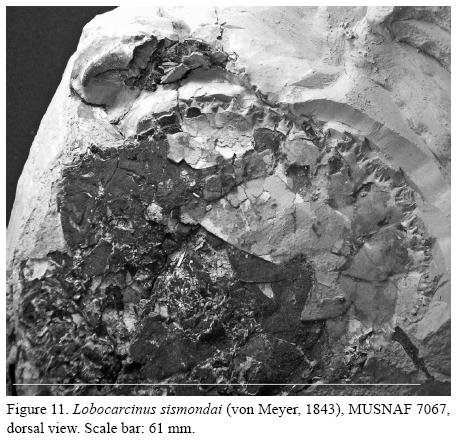
<body><![CDATA[<p align="justify"><font face="verdana" size="2"><b>Fossil species:</b> see Schweitzer <i>et al</i>. (2010).</font></p>  	    <blockquote> 		    <p align="center"><font face="verdana" size="2"><i>Lobocarcinus sismondai</i> (von Meyer, 1843)    <br> 		</font><font face="verdana" size="2"><a href="#f11">Figure 11</a></font></p>     <p align="center"><font face="verdana" size="2"><a name="f11"></a></font></p>  		    <p align="center"><font face="verdana" size="2"><img src="/img/revistas/bsgm/v65n2/a16f11.jpg"></font></p>  		    <p align="justify"><font face="verdana" size="2"><i>Cancer Sismondae</i> von Meyer, 1843, p. 590.</font></p>  		    <p align="justify"><font face="verdana" size="2"><i>Cancer punctulatus</i> Desmarest, 1822, p. 92, pl. 7, figs. 3&#45;4.</font></p>  		    <p align="justify"><font face="verdana" size="2"><i>Platycarcinus antiquus</i> Sismonda, 1846, p. 58&#45;60, pl. 3, figs. 1, 2. &#150; Meneghini, 1857, p. 528, pl. H, fig. 11.</font></p>  		    <p align="justify"><font face="verdana" size="2"><i>Platycarcinus sismondai</i> Vinassa de Regny, 1896, p. 124&#45;127, pl. 2, fig. 1 a, b.</font></p>  		    ]]></body>
<body><![CDATA[<p align="justify"><font face="verdana" size="2"><i>Cancer deshayesii</i> A. Milne&#45;Edwards, 1864, p. 314, pl. 22, figs. 1, 2, pl. 23, fig. 1. &#150; Couffon, 1908, p. 5, pl. 2, fig. 11. &#150;Van Straelen, 1927, p. 87, pl. 3, Ffig. 2, pl. 4, figs. 1, 2.</font></p>  		    <p align="justify"><font face="verdana" size="2"><i>Cancer sismondai</i> A. Milne&#45;Edwards, 1864, p. 316, pls. 24, 25. &#150; Ristori, 1886, p. 95&#45;99, pl. 2, fig. 1. &#150; Varola, 1981, p. 16&#45;26, pl. 3, figs. 5, 6, pl. 4, figs. 1, 2, pl. 5, figs. 1, 2, pl. 6, figs. 2, 4. &#150; Bonfiglio and Donadeo, 1982, p. 270&#45;291, figs. 5&#45;27, pls. 33&#45;44. &#150; Bonfiglio, 1982, p. 5&#45;18, figs. 1&#45;4, pls. 1&#45;7. &#150; Moisette and M&uuml;ller, 1990, p. 739, 740, pl. 1, Ffig. 1, pl. 2, figs. 1, 2. &#150; Beschin and Santi, 1997, p. 13, fig. 2, pl. 1, figs. 1, 2. &#150; Garassino and Fornaciari, 2000, p. 29, fig. 1.</font></p>  		    <p align="justify"><font face="verdana" size="2"><i>Lobocarcinus sismondai</i> Reuss, 1858, p. 41, pl. 9, figs. 1, 2. &#150; Garassino and De Angeli, 2004, p. 42, 43, figs. 9&#45;11.</font></p>  		    <p align="justify"><font face="verdana" size="2"><i>Lobocarcinus imperator</i> Reuss, 1858, p. 41, pls. 7, 8, pl. 9, fig. 1.</font></p>  		    <p align="justify"><font face="verdana" size="2"><i>Cancer sismondai</i> var. <i>antiatina</i> Maxia, 1946, p. 134&#45;147, fig. 1, pl. 1, figs. 2&#45;5.</font></p> 	</blockquote>  	    <p align="justify"><font face="verdana" size="2"><b>Material and measurements:</b> One incomplete specimen in dorsal view (MUSNAF 7067 a, b &#150; lcxp: 116 mm; wcxp: 61 mm).</font></p>  	    <p align="justify"><font face="verdana" size="2"><b>Discussion:</b> The presence of three&#45;fid front, the orbits very close, the anterolateral margin with ten spiny lobes, the posterolateral margin with a series of tubercles, and the dorsal surface of the carapace with well&#45;marked grooves allow assigning the specimen to <i>Lobocarcinus sismondai</i> (von Meyer, 1843). This species is widely spread in the fossil record from the Miocene to the Pleistocene of Italy (Piedmont, Emilia Romagna, Lazio, Puglia, Calabria, Sardinia, Sicily) and Europe (Great Britain, the Netherlands, Spain, Hungary, Greece, Austria), and Algeria (see De Angeli and Garassino, 2006 for references). This is the first report of this species from the Early Pleistocene of Tuscany. As already pointed out by Fornaciari and Garassino (1996), the presence of this species from the Pleistocene of Italy questions the real systematic validity of the extant <i>Cancer&nbsp;bellianus</i> Johnson, 1861, widespread in the Mediterranean Sea and Atlantic Ocean (Falciai and Minervini, 1992; Zariquiey &Aacute;lvarez, 1968). Indeed, the fossil and extant species share numerous morphological characters, such as the shape of the carapace, the shape and distribution of the dorsal areas of the carapace, the number of the spiny lobes in the anterolateral margins (each lobe armed with three teeth, of which the middle one is larger), the posterolateral margin with a series of tubercles, the shape and location of the eyes, and the shape and ornamentation of the chelipeds (Johnson, 1861). Further re&#45;evaluation of both taxa <i>L. sismondai</i> and <i>C. bellianus</i> is needed to resolve this taxonomic bias.</font></p>  	    <blockquote> 		    <p align="center"><font face="verdana" size="2">Superfamily Portunoidea Rafinesque, 1815    <br> 		</font><font face="verdana" size="2">Family Polybiidae Ortmann, 1893    ]]></body>
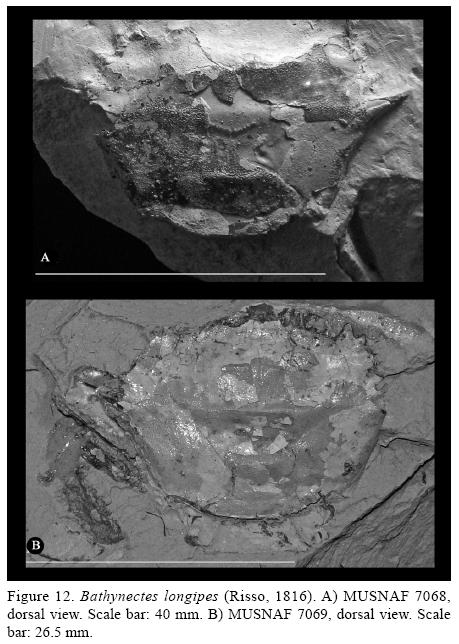
<body><![CDATA[<br> 		</font><font face="verdana" size="2">Genus <i>Bathynectes</i> Stimpson, 1871</font></p> </blockquote>  	    <p align="justify"><font face="verdana" size="2"><b>Type species:</b> <i>Bathynectes longispina</i> Stimpson, 1871, by subsequent designation by Fowler (1912).</font></p>  	    <p align="justify"><font face="verdana" size="2"><b>Fossil species:</b> <i>Bathynectes muelleri</i> Oss&oacute; and Stalennuy, 2011.</font></p>  	    <blockquote> 		    <p align="center"><font face="verdana" size="2"><i>Bathynectes longipes</i> (Risso, 1816)    <br> 		</font><font face="verdana" size="2"><a href="#f12">Figure 12</a></font></p>     <p align="center"><font face="verdana" size="2"><a name="f12"></a></font></p>  		    <p align="center"><font face="verdana" size="2"><img src="/img/revistas/bsgm/v65n2/a16f12.jpg"></font></p>  		    <p align="justify"><font face="verdana" size="2"><i>Portunus longipes</i> Risso, 1816: , p. 30, pl. 1, fig. 5.</font></p>  		    <p align="justify"><font face="verdana" size="2"><i>Bathynectes longipes</i> Lebour, 1928, p. 516, pl. 4, fig. 7. &#150; Lebour, 1931, p. 93, pl. 1, fig. 1.&#150; Bouvier, 1940, p. 246, fig. 158, pl. 9, fig. 12. &#150; Nobre, 1936, p. 40, pl. 15, fig. 36.&#150; Zariquey &Aacute;lvarez, 1946, p. 158, pl. 15, fig. a. &#150; Zariquey &Aacute;lvarez, 1968, 392, figs. 14e, 122a, 125b, c, 126b, 127e, f. &#150; Oss&oacute; and Stalennuy, 2011, p. 41, 44, fig. 8.1&#45;5.</font></p> 	</blockquote>  	    ]]></body>
<body><![CDATA[<p align="justify"><font face="verdana" size="2"><b>Material and measurements:</b> Three specimens in dorsal view (one carapace lacking the front, MUSNAF 7068 &#150; wcxp: 40 mm; one nearly complete flattened carapace, MUSNAF 7069 &#150; lcxp: 20.5 mm; wcxp: 26.5 mm (excluding epibranchial tooth); one fragmentary carapace, MUSNAF 7070 &#150; not measurable).</font></p>  	    <p align="justify"><font face="verdana" size="2"><b>Description:</b> Subhexagonal carapace, with maximum width at level of epibranchial tooth; dorsal surface slightly convex longitudinally, slightly vaulted at anterior third; front and orbits poorly preserved, except for the prominent triangular outer orbital tooth; anterolateral margin convex, with four teeth, excluding outer orbital tooth; prominent, triangular first, second, and third teeth, anteriorly directed; sharp, spiniform fourth (epibranchial tooth), curved, directed laterally; posterolateral margin slightly concave, converging posteriorly, weak re&#45;entrant of P5 about one&#45;third of total length of posterolateral margin; straight posterior margin, slightly rimmed; dorsal regions poorly defined, cervical and brachiocardiac grooves not well marked; two small epigastric swellings present at the base of the front; large, swollen protogastric lobes with transverse ridges; mesogastric region not well marked; hepatic region slightly swollen; inflated metagastric region; depressed urogastric region; metagastric and urogastric regions separated by a pair of submedian gastric pits; well marked and continuous transverse ridge connecting both epibranchial teeth; slightly swollen epibranchial, mesobranchial, and metabranchial regions; large cardiac region, very swollen; intestinal region flat.</font></p>  	    <p align="justify"><font face="verdana" size="2"><b>Discussion:</b> The specimens have been compared with the genera of Polybiidae Ortmann, 1893 (<i>sensu</i> Schubart and Reuschel, 2009) and <i>Bathynectes</i> is the only genus in which to accommodate them, considering morphological affinities with the fossil and extant species: four anterolateral teeth (excluding the outer orbital tooth), a marked transverse ridge connecting the prominent epibranchial teeth, and a short cardiac ridge. The only fossil species known to date is <i>B. muelleri</i> Oss&oacute; and Stalennuy, 2011, from the Miocene of Ukraine (Oss&oacute; and Stalennuy, 2011). The Miocene species differs from the Early Pleistocene species (coralgal reefs the first, soft bottom the second) by two morphological characters of the carapace: indeed in <i>B.</i> <i>muelleri</i>, the transverse ridges of protogastric lobes are absent and the transverse ridge connecting both epibranchial teeth is weak and interrupted at the metagastric level, whereas in the Early Pleistocene species, the transverse ridges of protogastric lobes are present and the transverse ridge connecting both epibranchial teeth is well marked and continuous. As reported by Zariquey &Aacute;lvarez (1968) and Falciai and Minervini (1992), two extant species of <i>Bathynectes</i> live in Mediterranean Sea, <i>B. longipes</i> (Risso, 1816) and <i>B. maravigna</i> (Prestandrea, 1839). The specimens are excluded from <i>B. maravigna</i> because the extant species has anterolateral teeth relatively longer and sharper, and the epibranchial tooth is extremely long and directed almost horizontally. We accommodate the specimens in <i>B.</i> <i>longipes</i> because they have the same size, and also triangular anterolateral teeth, moderately elongate epibranchial tooth, slightly curved forward, the two transverse ridges of the protogastric lobes, and the continuous and well&#45;marked transverse ridge connecting both epibranchial teeth. <i>Bathynectes longipes</i> is reported herein for the first time from the fossil record, attesting that the environment of the extant Mediterranean species was colonized almost since the Early Pleistocene.</font></p>  	    <blockquote> 		    <p align="center"><font face="verdana" size="2">Superfamily Xanthoidea MacLeay, 1838    <br> 		</font><font face="verdana" size="2">Family Xantidae MacLeay, 1838    <br> 		</font><font face="verdana" size="2">Subfamily Euxanthinae Alcock, 1898    <br> 		</font><font face="verdana" size="2">Genus <i>Monodaeus</i> Guinot, 1967</font></p> </blockquote>  	    <p align="justify"><font face="verdana" size="2"><b>Type species:</b> <i>Xanto couchii</i> Couch, 1851, by original designation.</font></p>  	    <p align="justify"><font face="verdana" size="2"><b>Fossil species:</b> <i>Monodaeus bortolottii</i> Delle Cave, 1988.</font></p>  	    ]]></body>
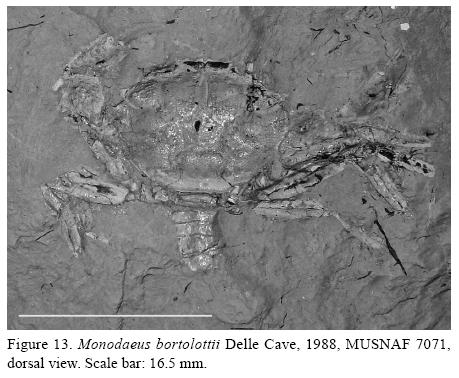
<body><![CDATA[<blockquote> 		    <p align="center"><font face="verdana" size="2"><i>Monodaeus bortolottii</i> Delle Cave, 1988    <br> 		</font><font face="verdana" size="2"><a href="#f13">Figure 13</a></font></p>     <p align="center"><font face="verdana" size="2"><a name="f13"></a></font></p>  		    <p align="center"><font face="verdana" size="2"><img src="/img/revistas/bsgm/v65n2/a16f13.jpg"></font></p>  		    <p align="justify"><font face="verdana" size="2"><i>Monodaeus bortolottii</i> Delle Cave, 1988, p. 123&#45;126, pl. 1 ( figs. 1, 2), pl. 2 ( figs. 1&#45;5).</font></p>  		    <p align="justify"><font face="verdana" size="2"><i>Monodaeus bortolottii</i> De Angeli <i>et al</i>., 2009, p. 185, 195, fig. 16. &#150; Pasini and Garassino, 2013</font></p> </blockquote>  	    <p align="justify"><font face="verdana" size="2"><b>Material and measurements:</b> One carapace three&#45;dimensionally preserved with counterpart (MUSNAF 7071 a, b &#150; lcxp: 20 mm; wcxp: 16.5 mm).</font></p>  	    <p align="justify"><font face="verdana" size="2"><b>Description:</b> Suboctagonal carapace slightly convex, wider than long; straight front margin, with a weak median incision; short, convex anterolateral margin; long, convergent posterolateral margin; posterior margin straight medially and convex on margins with a granular ridge; dorsal region well marked by grooves, with wide, raised epigastric lobes; suboval protogastric regions well marked; subpentagonal mesogastric regions with narrow, elongate anterior process between protogastric regions; cardiac region well marked by branchiocardiac grooves; small hepatic regions poorly marked; wide branchial regions well marked.</font></p>  	    <p align="justify"><font face="verdana" size="2"><b>Discussion:</b> The specimen is assigned to <i>Monodaeus</i> <i>bortolottii</i> Delle Cave, 1988, already reported from the Pliocene of Volterra (Delle Cave, 1988) and Grosseto (De Angeli <i>et al</i>., 2009). Recently Pasini and Garassino (2013) reported this species from the Pliocene (Piacenzian) of Castellarano and Monticelli di Quattro Castella (Reggio Emilia, N Italy). The presence of this species from the Early Pleistocene clay sediments of Poggio i Sodi quarries increases the stratigraphical range of this species.</font></p>  	    ]]></body>
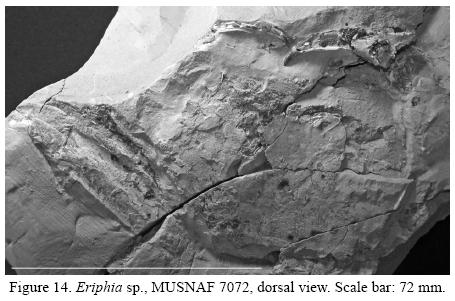
<body><![CDATA[<blockquote> 		    <p align="center"><font face="verdana" size="2">Superfamily Eriphioidea MacLeay, 1838    <br> 		</font><font face="verdana" size="2">Family Eriphiidae MacLeay, 1838    <br> 		</font><font face="verdana" size="2">Genus <i>Eriphia</i> Latreille, 1817</font></p> </blockquote>  	    <p align="justify"><font face="verdana" size="2"><b>Type species:</b> <i>Cancer spinifrons</i> Herbst, 1785, by subsequent designation by H. Milne Edwards (1842).</font></p>  	    <p align="justify"><font face="verdana" size="2"><b>Fossil species:</b> see Schweitzer <i>et al</i>. (2010).</font></p>  	    <blockquote> 		    <p align="center"><font face="verdana" size="2"><i>Eriphia</i> sp.    <br> 		</font><font face="verdana" size="2"><a href="#f14">Figure 14</a></font></p>     <p align="center"><font face="verdana" size="2"><a name="f14"></a></font></p>  		    ]]></body>
<body><![CDATA[<p align="center"><font face="verdana" size="2"><img src="/img/revistas/bsgm/v65n2/a16f14.jpg"></font></p> 	</blockquote>  	    <p align="justify"><font face="verdana" size="2"><b>Material and measurements:</b> One incomplete carapace in dorsal view (MUSNAF 7072 &#150; lcxp: 44 mm; wcxp: 72 mm).</font></p>  	    <p align="justify"><font face="verdana" size="2"><b>Discussion:</b> The specimen consists in a dorsally compressed, crushed carapace and partial chelipeds. Unfortunately the anterolateral and frontal margins are poorly preserved and do not allow any specific comparison. We point out, however, that the general form of the carapace, preserving some spines along the anterolateral margins, the slightly granulate surface with the regions not well marked, the developed chelae, and the rounded globular carpus having some spines, resemble the general characters of <i>Eriphia cocchi</i> Ristori, 1886, already reported from the Pliocene of Lombardy (northern Italy) (Pasini and Garassino, 2011) and widespread in the Pliocene of Tuscany (Garassino <i>et al</i>., 2012).</font></p>  	    <blockquote> 		    <p align="center"><font face="verdana" size="2">Superfamily Goneplacoidea MacLeay, 1838    <br> 		</font><font face="verdana" size="2">Family Goneplacidae MacLeay, 1838    <br> 		</font><font face="verdana" size="2">Subfamily Goneplacinae MacLeay, 1838    <br> 		</font><font face="verdana" size="2">Genus <i>Goneplax</i> Leach, 1814</font></p> </blockquote>  	    <p align="justify"><font face="verdana" size="2"><b>Type species:</b> <i>Ocypoda bispinosa</i> Lamarck, 1801, by original designation.</font></p>  	    <p align="justify"><font face="verdana" size="2"><b>Fossil species:</b> see Schweitzer <i>et al</i>. (2010).</font></p>  	    ]]></body>
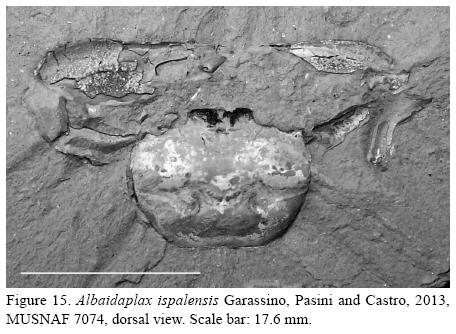
<body><![CDATA[<p align="justify"><font face="verdana" size="2">Remark &#150; <i>Goneplax</i> Leach, 1814 has been the subject of a recent review (see Garassino <i>et al</i>., 2013, in this volume).</font></p>  	    <blockquote> 		    <p align="justify"><font face="verdana" size="2"><i>Goneplax rhomboides</i> (Linnaeus, 1758)</font></p>  		    <p align="justify"><font face="verdana" size="2"><i>Cancer rhomboides</i> Linnaeus, 1758, p. 626.</font></p>  		    <p align="justify"><font face="verdana" size="2"><i>Goneplax rhomboides</i> Heller, 1863, p. 104, pl. 3, figs. 3, 4. &#150; Ristori, 1886, p. 111&#45;113. &#150; Zariquiey &Aacute;lvarez, 1968, p. 414&#45;416, fig. 138 a, b. &#150; Rice and Chapman, 1971, p. 336, 337, 339, figs. 5&#45;7. &#150; Falciai and Minervini, 1992, p. 238, pl. 17, fig. 1. &#150; Karasawa and Kato, 2003, tab, 1, tab. 6. &#150; Garassino and De Angeli, 2004, p. 44, 45, figs. 12&#150;15. &#150; Garassino <i>et al</i>., 2004, p. 274, 275, fig. 14. &#150; Castro, 2007, p. 686&#45;690, 692, fig. 27. &#150; Garassino <i>et al</i>., 2012, p. 45&#45;47, 53, fig. 20 C, D. &#150; Garassino <i>et al</i>., 2013.</font></p> 	</blockquote>  	    <p align="justify"><font face="verdana" size="2"><b>Material and measurements:</b> One specimen in dorsal view (MUSNAF 7073 &#150; lcxp: 18.7 mm; wcxp: 14 mm)</font></p>  	    <p align="justify"><font face="verdana" size="2"><b>Discussion:</b> According to Garassino <i>et al</i>. (2013) the main characters of the specimen are typical of <i>G.</i> <i>rhomboides</i> is known to date only in the fossil record of Italy from the Miocene to Pleistocene of Piedmont, Emilia Romagna, Tuscany, Lazio, and Sicily, as reported by many authors (for complete references see Garassino <i>et al</i>., 2013). This species is widespread in the eastern Atlantic, western Africa, and Mediterranean Sea, burrowing in sublittoral shallow muddy and sandy bottoms from a few meters to about 100 m depth (Falciai and Minervini, 1992; Zariquey &Aacute;lvarez, 1968).</font></p>  	    <p align="justify"><font face="verdana" size="2">Genus <i>Albaidaplax</i> Garassino, Pasini and Castro, 2013</font></p>  	    <p align="justify"><font face="verdana" size="2"><b>Type species:</b> <i>Albaidaplax ispalensis</i> Garassino, Pasini and Castro, 2013, by monotypy.</font></p>  	    <p align="justify"><font face="verdana" size="2"><b>Fossil species:</b> <i>Albaidaplax ispalensis</i> Garassino, Pasini and Castro, 2013.</font></p>  	    ]]></body>
<body><![CDATA[<blockquote> 		    <p align="center"><font face="verdana" size="2"><i>Albaidaplax ispalensis</i> Garassino, Pasini and Castro, 2013    <br> 		</font><font face="verdana" size="2"><a href="#f15">Figure 15</a></font></p> </blockquote>  	    <p align="center"><font face="verdana" size="2"><a name="f15"></a></font></p>  	    <p align="center"><font face="verdana" size="2"><img src="/img/revistas/bsgm/v65n2/a16f15.jpg"></font></p>  	    <p align="justify"><font face="verdana" size="2"><b>Material and measurements:</b> One specimen in dorsal view (MUSNAF 7074 &#150; lcxp: 17.6 mm; wcxp: 14 mm).</font></p>  	    <p align="justify"><font face="verdana" size="2"><b>Description:</b> Carapace transversely rectangular, slightly wider than long; straight front; front as wide as the orbits; inner edge of supraorbital margin distinct; wide, orbits expanded distally, with one short tooth on outer orbital angle; supraorbital margins gently sinuous, without fissures; anterolateral margins slightly convex, apparently toothless; long, gently rounded posterolateral margins, strongly converging posteriorly; long, straight posterior margin; deep gastric pits; smooth dorsal surface of carapace; slight subhorizontal ridge, moderately convex, all level of antero&#45; posterolateral margins, without clear indication of regions; stout, heavy chelipeds (P1), with moderately long merus; subtriangular, spineless carpus; stout, globular palm; dactylus and index slender, as long as the propodus, with toothless occlusal margin.</font></p>  	    <p align="justify"><font face="verdana" size="2"><b>Discussion:</b> The main morphological characters of the carapace, such as the shape, the wide orbits gently expanded distally, with one short tooth on outer orbital angle, and the supraorbital margins gently sinuous, are shared with the representatives of <i>Albaidaplax</i>, recently erected by Garassino <i>et al</i>. (2013, see this volume), with the type species <i>A. ispalensis</i> Garassino, Pasini and Castro, 2013, from the Pliocene of Spain and Italy. As reported by Garassino <i>et al</i>. (2013) this species has the anterolateral margins with a short tooth, not visible in the specimen having anterolateral margins apparently toothless. Since this tooth is very small, probably the state of preservation of the specimen compromises its observation. This finding in the sediments of Poggio i Sodi the stratigraphical range of this genus to the Early Pleistocene.</font></p>  	    <p align="justify"><font face="verdana" size="2">&nbsp;</font></p>  	    <p align="justify"><font face="verdana" size="2"><b>6. Paleoenvironmental implications (A.B., R.B., F.F., A.G., M.H., G.P.)</b></font></p>  	    ]]></body>
<body><![CDATA[<p align="justify"><font face="verdana" size="2">The comparison between the calcareous nannofossil assemblages found in decapod samples and the new sampling data allow to date the decapods&#45;rich fauna of Poggio i Sodi to the late Gelasian&#45;early Calabrian interval. The monotonous clay sedimentation clearly indicates stable environmental conditions through time. The sedimentological data highlight a very low energy, distal and relatively deep offshore environment. The presence, in assemblage, of benthic foraminifera and ostracods living in bathyal environment reinforces the sedimentological evidences, and a 200&#45;300 m depth is reliable. In fact, these data only partially agree with the depth record, inferred in the literature, for described crustaceans. Decapod fauna presented herein consists of several taxa that can be considered as typical inhabitants of cool deep&#45;water environment. The callianassid <i>Bathycalliax</i> has so far been known only from chemoautotrophic communities of the deep sea, approximately 625 m (Sakai and T&uuml;rkay, 1999). Similarly, the presence of <i>Lysirude</i>, <i>Retropluma</i>, and isopod crustacean <i>Palaega sismondai</i> Ristori, 1891, can be considered as indicating deep, soft bottoms. Moreover, also the extant <i>Nephrops norvegicus</i> is recorded from deep&#45;waters in the Mediterranean area living from 20 to 800 m on muddy bottoms in which it digs its burrows (Holthuis, 1991). Concerning <i>Bathynectes</i>, as reported by Politou <i>et al</i>. (2005) and Oss&oacute; and Stalennuy (2011) stated that the extant species inhabit soft, deep bottoms of the Mediterranean basin and the Atlantic Ocean, living from 90 m to 620 m (<i>B. longipes</i>), and from 322 m to 1003 m (<i>B. maravigna</i>). Moreover, the same taxa (i.e. <i>Nephrops</i>, <i>Retropluma</i>, <i>Bathynectes</i>, <i>Goneplax</i>, <i>Lobocarcinus</i>) are also reported as cool&#45;water inhabitants (Zariquey &Aacute;lvarez, 1968; Holthuis, 1991; Sakai and T&uuml;rkay, 1999).</font></p>  	    <p align="justify"><font face="verdana" size="2">The foraminifera and ostracod assemblages allow indicate an upper bathyal environment, rich in nutrients, with fresh and low oxygenated condition at the sea floor. Thus, the occurrence of this unusual and extremely rich decapod fauna in the Poggio i Sodi area seems to be influenced by complex paleoenvironmental factors, and not exclusively by water depth. Cool water conditions at the sea floor, clayey soft bottom, nutrients and very low environmental energy and sedimentation rate, promoted the development of the rich decapod community, at least during Early Pleistocene.</font></p>  	    <p align="justify"><font face="verdana" size="2">&nbsp;</font></p>  	    <p align="justify"><font face="verdana" size="2"><b>Acknowledgements</b></font></p>  	    <p align="justify"><font face="verdana" size="2">We wish to thank F. Pizzolato (Arezzo), M. Cresti, A. Petri and P. Frediani of the Gruppo Paleontologico "C. De Giuli", Castelfiorentino (Firenze), for useful information and suggestion of Cava I Sodi quarries; A. De Angeli, Associazione degli Amici "Museo Civico G. Zannato", Montecchio Maggiore (Vicenza), for useful advice about systematics of some groups of crabs; G. Manganelli, Dipartimento Scienze Ambientali (UNISIENA) and F. Farsi, Sezione Geologica, Museo di Storia Naturale dell'Accademia dei Fisiocritici, Siena, Italy, for permission to study the specimens; F. J. Vega, Instituto de Geolog&iacute;a, Universidad Nacional Aut&oacute;noma de M&eacute;xico, Ciudad Universitaria, Coyoac&aacute;n, M&eacute;xico, and an anonymous referee, for the critical reading of the manuscript and the careful review.</font></p>  	    <p align="justify"><font face="verdana" size="2">&nbsp;</font></p>  	    <p align="justify"><font face="verdana" size="2"><b>References</b></font></p>  	    <!-- ref --><p align="justify"><font face="verdana" size="2">AAVV, in press, CARG &#45; Foglio 297 "Asciano". ISPRA, Roma.    &nbsp;&nbsp;&nbsp;&nbsp;&nbsp;&nbsp;&nbsp;&nbsp;[&#160;<a href="javascript:void(0);" onclick="javascript: window.open('/scielo.php?script=sci_nlinks&ref=1416542&pid=S1405-3322201300020001600001&lng=','','width=640,height=500,resizable=yes,scrollbars=1,menubar=yes,');">Links</a>&#160;]<!-- end-ref --></font></p>  	    <!-- ref --><p align="justify"><font face="verdana" size="2">Alcock, A., 1898, Materials for a carcinological fauna of India. No. 3. The Brachyura Cyclometopa. Part I. The family Xanthidae: Journal of the Asiatic Society of Bengal, 67(1), 67&#45;233.    &nbsp;&nbsp;&nbsp;&nbsp;&nbsp;&nbsp;&nbsp;&nbsp;[&#160;<a href="javascript:void(0);" onclick="javascript: window.open('/scielo.php?script=sci_nlinks&ref=1416544&pid=S1405-3322201300020001600002&lng=','','width=640,height=500,resizable=yes,scrollbars=1,menubar=yes,');">Links</a>&#160;]<!-- end-ref --></font></p>  	    <!-- ref --><p align="justify"><font face="verdana" size="2">Alcock, A., Anderson, A.R.J., 1894, Illustrations of the Zoology of the Royal Indian Marine Survey Ship Investigator, under the command of Commander T.H. Heming, R.N. Published under the Authority of Captain W. S. Goodridge, R.N., C.I.E. Director of the Royal Indian Marine: Crustacea Calcutta, India, Office of the Superintendent of Government Printing.    &nbsp;&nbsp;&nbsp;&nbsp;&nbsp;&nbsp;&nbsp;&nbsp;[&#160;<a href="javascript:void(0);" onclick="javascript: window.open('/scielo.php?script=sci_nlinks&ref=1416546&pid=S1405-3322201300020001600003&lng=','','width=640,height=500,resizable=yes,scrollbars=1,menubar=yes,');">Links</a>&#160;]<!-- end-ref --></font></p>  	    <!-- ref --><p align="justify"><font face="verdana" size="2">Aruta, G., Borgia, A., Bruni, P., Cecchi, G., Cipriani, N., Tredici, Y., 2004, Pliocene and Pleistocene unconformity bounded stratigraphic units (UBSU) in Val di Chiana, <i>in</i>: Morini, D., Bruni, P. (eds.), The "Regione Toscana" project of geological mapping, Firenze, 133&#45;136.    &nbsp;&nbsp;&nbsp;&nbsp;&nbsp;&nbsp;&nbsp;&nbsp;[&#160;<a href="javascript:void(0);" onclick="javascript: window.open('/scielo.php?script=sci_nlinks&ref=1416548&pid=S1405-3322201300020001600004&lng=','','width=640,height=500,resizable=yes,scrollbars=1,menubar=yes,');">Links</a>&#160;]<!-- end-ref --></font></p>  	    <!-- ref --><p align="justify"><font face="verdana" size="2">Baba, K., MacPherson, E., Poore, G.C.B., Ahyong, S.T., Bermudez, A., Cabezas, P., Lin, C.&#45;W., Nizinski, M., Rodrigues, C., Schnabel, K. E., 2008, Catalogue of squat lobsters of the world (Crustacea: Decapoda: Anomura &#150; families Chirostylidae, Galatheidae and Kiwaidae): Zootaxa, 1905, 1&#45;220.    &nbsp;&nbsp;&nbsp;&nbsp;&nbsp;&nbsp;&nbsp;&nbsp;[&#160;<a href="javascript:void(0);" onclick="javascript: window.open('/scielo.php?script=sci_nlinks&ref=1416550&pid=S1405-3322201300020001600005&lng=','','width=640,height=500,resizable=yes,scrollbars=1,menubar=yes,');">Links</a>&#160;]<!-- end-ref --></font></p>  	    <!-- ref --><p align="justify"><font face="verdana" size="2">Baldanza, A., Bizzarri, R., Hepach, H., 2011, New biostratigraphic data from the Early Pleistocene tyrrhenian palaeocoast (western Umbria, central Italy): Geologia Croatica, 64(2), 133&#45;142.    &nbsp;&nbsp;&nbsp;&nbsp;&nbsp;&nbsp;&nbsp;&nbsp;[&#160;<a href="javascript:void(0);" onclick="javascript: window.open('/scielo.php?script=sci_nlinks&ref=1416552&pid=S1405-3322201300020001600006&lng=','','width=640,height=500,resizable=yes,scrollbars=1,menubar=yes,');">Links</a>&#160;]<!-- end-ref --></font></p>  	    <!-- ref --><p align="justify"><font face="verdana" size="2">Beschin, C., Santi, L., 1997, <i>Cancer sismondai</i> Meyer (Crustacea, Decapoda) nelle argille plioceniche di Vignola e Marano sul Panaro (Modena): Studi e Ricerche &#150; Associazione Amici del Museo Civico "G. Zannato", 1997, 11&#45;16.    &nbsp;&nbsp;&nbsp;&nbsp;&nbsp;&nbsp;&nbsp;&nbsp;[&#160;<a href="javascript:void(0);" onclick="javascript: window.open('/scielo.php?script=sci_nlinks&ref=1416554&pid=S1405-3322201300020001600007&lng=','','width=640,height=500,resizable=yes,scrollbars=1,menubar=yes,');">Links</a>&#160;]<!-- end-ref --></font></p>  	    <!-- ref --><p align="justify"><font face="verdana" size="2">Beurlen, K., 1930, Vergleichende Stammesgeschichte, Grundlagen, Methoden, Probleme unter besonderer Ber&uuml;cksichtigung der h&ouml;heren Krebse: Fortschritte in der Geologie und Pal&auml;ontologie, 8, 317&#45;586.    &nbsp;&nbsp;&nbsp;&nbsp;&nbsp;&nbsp;&nbsp;&nbsp;[&#160;<a href="javascript:void(0);" onclick="javascript: window.open('/scielo.php?script=sci_nlinks&ref=1416556&pid=S1405-3322201300020001600008&lng=','','width=640,height=500,resizable=yes,scrollbars=1,menubar=yes,');">Links</a>&#160;]<!-- end-ref --></font></p>  	    <!-- ref --><p align="justify"><font face="verdana" size="2">Beurlen, K., 1939, Neue Dekapoden&#45;Krebse aus dem ungarischen Terti&auml;r: Pal&auml;ontologische Zeitschrift, 21, 135&#45;161.    &nbsp;&nbsp;&nbsp;&nbsp;&nbsp;&nbsp;&nbsp;&nbsp;[&#160;<a href="javascript:void(0);" onclick="javascript: window.open('/scielo.php?script=sci_nlinks&ref=1416558&pid=S1405-3322201300020001600009&lng=','','width=640,height=500,resizable=yes,scrollbars=1,menubar=yes,');">Links</a>&#160;]<!-- end-ref --></font></p>  	    <!-- ref --><p align="justify"><font face="verdana" size="2">Bishop, G.A., Williams, A.B., 2000, Fossil crabs from Tepee Buttes, submarine deposits of the Late Cretaceous Pierre Shale, South Dakota and Colorado, United States of America: Journal of Crustacean Biology, 20 (Special Number 2), 286&#45;300.    &nbsp;&nbsp;&nbsp;&nbsp;&nbsp;&nbsp;&nbsp;&nbsp;[&#160;<a href="javascript:void(0);" onclick="javascript: window.open('/scielo.php?script=sci_nlinks&ref=1416560&pid=S1405-3322201300020001600010&lng=','','width=640,height=500,resizable=yes,scrollbars=1,menubar=yes,');">Links</a>&#160;]<!-- end-ref --></font></p>  	    <!-- ref --><p align="justify"><font face="verdana" size="2">Bogi, C., Cauli, L., Pagli, F., 2002, Le Architectonicidae Gray J. E., 1840 del Pliocene toscano: Bollettino Malacologico, 38, 31&#45;40.    &nbsp;&nbsp;&nbsp;&nbsp;&nbsp;&nbsp;&nbsp;&nbsp;[&#160;<a href="javascript:void(0);" onclick="javascript: window.open('/scielo.php?script=sci_nlinks&ref=1416562&pid=S1405-3322201300020001600011&lng=','','width=640,height=500,resizable=yes,scrollbars=1,menubar=yes,');">Links</a>&#160;]<!-- end-ref --></font></p>  	    <!-- ref --><p align="justify"><font face="verdana" size="2">Bonaduce, G., Barra, D., Aiello, G., 1999, The genus <i>Henryhowella</i> Puri, 1957 (Crustacea, Oastracoda) in the Atlantic and the Mediterranean from Miocene to recent: Bollettino della Societ&agrave; Paleontologica Italiana, 38(1), 59&#45;72.    &nbsp;&nbsp;&nbsp;&nbsp;&nbsp;&nbsp;&nbsp;&nbsp;[&#160;<a href="javascript:void(0);" onclick="javascript: window.open('/scielo.php?script=sci_nlinks&ref=1416564&pid=S1405-3322201300020001600012&lng=','','width=640,height=500,resizable=yes,scrollbars=1,menubar=yes,');">Links</a>&#160;]<!-- end-ref --></font></p>  	    <!-- ref --><p align="justify"><font face="verdana" size="2">Bonfiglio, L., 1982, Strutture dell'esoscheletro di <i>Cancer sismondai</i> Meyer osservate al SEM: Bollettino della Societ&agrave; Paleontologica Italiaina, 21(1), 5&#45;20.    &nbsp;&nbsp;&nbsp;&nbsp;&nbsp;&nbsp;&nbsp;&nbsp;[&#160;<a href="javascript:void(0);" onclick="javascript: window.open('/scielo.php?script=sci_nlinks&ref=1416566&pid=S1405-3322201300020001600013&lng=','','width=640,height=500,resizable=yes,scrollbars=1,menubar=yes,');">Links</a>&#160;]<!-- end-ref --></font></p>  	    <!-- ref --><p align="justify"><font face="verdana" size="2">Bonfiglio, L., Donadeo, G., 1982, <i>Cancer sismondai</i> Meyer nel Pliocene di Torre dell'Orso (Puglia): Atti della Societ&agrave; italiana di Scienze naturali e del Museo civico di Storia naturale in Milano, 123, 255&#45;296.    &nbsp;&nbsp;&nbsp;&nbsp;&nbsp;&nbsp;&nbsp;&nbsp;[&#160;<a href="javascript:void(0);" onclick="javascript: window.open('/scielo.php?script=sci_nlinks&ref=1416568&pid=S1405-3322201300020001600014&lng=','','width=640,height=500,resizable=yes,scrollbars=1,menubar=yes,');">Links</a>&#160;]<!-- end-ref --></font></p>  	    <!-- ref --><p align="justify"><font face="verdana" size="2">Borradaile, L.A., 1903, On the classification of the Thalassinidea: The Annals and Magazine of Natural History, 7(12), 534&#45;551.    &nbsp;&nbsp;&nbsp;&nbsp;&nbsp;&nbsp;&nbsp;&nbsp;[&#160;<a href="javascript:void(0);" onclick="javascript: window.open('/scielo.php?script=sci_nlinks&ref=1416570&pid=S1405-3322201300020001600015&lng=','','width=640,height=500,resizable=yes,scrollbars=1,menubar=yes,');">Links</a>&#160;]<!-- end-ref --></font></p>  	    <!-- ref --><p align="justify"><font face="verdana" size="2">Bossio, A., Costantini, A., Lazzarotto, A., Liotta, D., Mazzanti, R., Mazzei, R., Salvatorini, G., Sandrelli, F. 1993, Rassegna delle conoscenze sulla stratigrafia del Neoautoctono toscano: Memorie della Societ&agrave; Geologica Italiana, 49, 17&#45;98.    &nbsp;&nbsp;&nbsp;&nbsp;&nbsp;&nbsp;&nbsp;&nbsp;[&#160;<a href="javascript:void(0);" onclick="javascript: window.open('/scielo.php?script=sci_nlinks&ref=1416572&pid=S1405-3322201300020001600016&lng=','','width=640,height=500,resizable=yes,scrollbars=1,menubar=yes,');">Links</a>&#160;]<!-- end-ref --></font></p>  	    <!-- ref --><p align="justify"><font face="verdana" size="2">Bouvier, E.&#45;L., 1940, D&eacute;capodes marcheurs, <i>in</i>: Faune de France, 37, 1&#45;404.    &nbsp;&nbsp;&nbsp;&nbsp;&nbsp;&nbsp;&nbsp;&nbsp;[&#160;<a href="javascript:void(0);" onclick="javascript: window.open('/scielo.php?script=sci_nlinks&ref=1416574&pid=S1405-3322201300020001600017&lng=','','width=640,height=500,resizable=yes,scrollbars=1,menubar=yes,');">Links</a>&#160;]<!-- end-ref --></font></p>  	    <!-- ref --><p align="justify"><font face="verdana" size="2">Campbell, K.A., 2006, Hydrocarbon seep and hydrothermal vent paleoenvironments and paleontology: past developments and future research directions: Palaeogeography, Palaeoclimatology, Palaeoecology, 232, 362&#45;407.    &nbsp;&nbsp;&nbsp;&nbsp;&nbsp;&nbsp;&nbsp;&nbsp;[&#160;<a href="javascript:void(0);" onclick="javascript: window.open('/scielo.php?script=sci_nlinks&ref=1416576&pid=S1405-3322201300020001600018&lng=','','width=640,height=500,resizable=yes,scrollbars=1,menubar=yes,');">Links</a>&#160;]<!-- end-ref --></font></p>  	    <!-- ref --><p align="justify"><font face="verdana" size="2">Castro, P., 2007, A reappraisal of the family Goneplacidae MacLeay, 1838 (Crustacea, Decapoda, Brachyura) and revision of the subfamily Goneplacinae, with the description of 10 new genera and 18 new species: Zoosystema, 29(4), 609&#45;774.    &nbsp;&nbsp;&nbsp;&nbsp;&nbsp;&nbsp;&nbsp;&nbsp;[&#160;<a href="javascript:void(0);" onclick="javascript: window.open('/scielo.php?script=sci_nlinks&ref=1416578&pid=S1405-3322201300020001600019&lng=','','width=640,height=500,resizable=yes,scrollbars=1,menubar=yes,');">Links</a>&#160;]<!-- end-ref --></font></p>  	    <!-- ref --><p align="justify"><font face="verdana" size="2">Cigala Fulgosi, F., Casati, S., Orlandini, A., Persico, D., 2009, A small fossil fish fauna, rich in <i>Chlamydoselachus</i> teeth, from the late Pliocene of Tuscany (Siena, central Italy): Cainozoic Research, 6 (1&#45;2), 3&#45;23.    &nbsp;&nbsp;&nbsp;&nbsp;&nbsp;&nbsp;&nbsp;&nbsp;[&#160;<a href="javascript:void(0);" onclick="javascript: window.open('/scielo.php?script=sci_nlinks&ref=1416580&pid=S1405-3322201300020001600020&lng=','','width=640,height=500,resizable=yes,scrollbars=1,menubar=yes,');">Links</a>&#160;]<!-- end-ref --></font></p>  	    <!-- ref --><p align="justify"><font face="verdana" size="2">Costantini, A., Decandia, F.A., Lazzarotto, A., Liotta, D., Mazzei, R., Pascucci, V., Salvatorini, G., Sandrelli, F., Barazzuoli, P., Dringoli, R., Ghetti, P., Mellini, M., Mocenni, B., Rigati, R., Salleolini, M., 2009, Note Illustrative della Carta Geologica d'Italia alla scala 1:50000 &#45; Foglio 296 "Siena": Ispra, 134 p.    &nbsp;&nbsp;&nbsp;&nbsp;&nbsp;&nbsp;&nbsp;&nbsp;[&#160;<a href="javascript:void(0);" onclick="javascript: window.open('/scielo.php?script=sci_nlinks&ref=1416582&pid=S1405-3322201300020001600021&lng=','','width=640,height=500,resizable=yes,scrollbars=1,menubar=yes,');">Links</a>&#160;]<!-- end-ref --></font></p>  	    <!-- ref --><p align="justify"><font face="verdana" size="2">Couch, R.Q., 1851, Notice of a crustacean, new to Cornwall: Transactions of the Natural History and Antiquarian Society of Penzance, 2, 13&#45;14.    &nbsp;&nbsp;&nbsp;&nbsp;&nbsp;&nbsp;&nbsp;&nbsp;[&#160;<a href="javascript:void(0);" onclick="javascript: window.open('/scielo.php?script=sci_nlinks&ref=1416584&pid=S1405-3322201300020001600022&lng=','','width=640,height=500,resizable=yes,scrollbars=1,menubar=yes,');">Links</a>&#160;]<!-- end-ref --></font></p>  	    <!-- ref --><p align="justify"><font face="verdana" size="2">Couffon, O., 1908, Sur quelques Crustac&eacute;s des faluns de Touraine et d'Anjou: Feuille des Jeunes Naturalists, 39, 5.    &nbsp;&nbsp;&nbsp;&nbsp;&nbsp;&nbsp;&nbsp;&nbsp;[&#160;<a href="javascript:void(0);" onclick="javascript: window.open('/scielo.php?script=sci_nlinks&ref=1416586&pid=S1405-3322201300020001600023&lng=','','width=640,height=500,resizable=yes,scrollbars=1,menubar=yes,');">Links</a>&#160;]<!-- end-ref --></font></p>  	    <!-- ref --><p align="justify"><font face="verdana" size="2">Crema, C., 1895, Sopra alcuni Decapodi terziarii del Piemonte: Atti della Reale Accademia delle Scienze di Torino, 30, 664&#45;681.    &nbsp;&nbsp;&nbsp;&nbsp;&nbsp;&nbsp;&nbsp;&nbsp;[&#160;<a href="javascript:void(0);" onclick="javascript: window.open('/scielo.php?script=sci_nlinks&ref=1416588&pid=S1405-3322201300020001600024&lng=','','width=640,height=500,resizable=yes,scrollbars=1,menubar=yes,');">Links</a>&#160;]<!-- end-ref --></font></p>  	    <!-- ref --><p align="justify"><font face="verdana" size="2">Dana, J.D., 1852, Conspectus Crustaceorum, &amp; Conspectus of the Crustacea of the Exploring Expedition under Capt. Wilkes, U.S.N. Macroura: Proceedings of the Academy of Natural Sciences of Philadelphia, 6, 10&#45;28.    &nbsp;&nbsp;&nbsp;&nbsp;&nbsp;&nbsp;&nbsp;&nbsp;[&#160;<a href="javascript:void(0);" onclick="javascript: window.open('/scielo.php?script=sci_nlinks&ref=1416590&pid=S1405-3322201300020001600025&lng=','','width=640,height=500,resizable=yes,scrollbars=1,menubar=yes,');">Links</a>&#160;]<!-- end-ref --></font></p>  	    <!-- ref --><p align="justify"><font face="verdana" size="2">Davis, J.W., 1887, Note on a Fossil Species of <i>Chlamydoselachus</i>: Proceedings of the Yorkshire Geological and Polytechnic Society, 9, 392&#45;393.    &nbsp;&nbsp;&nbsp;&nbsp;&nbsp;&nbsp;&nbsp;&nbsp;[&#160;<a href="javascript:void(0);" onclick="javascript: window.open('/scielo.php?script=sci_nlinks&ref=1416592&pid=S1405-3322201300020001600026&lng=','','width=640,height=500,resizable=yes,scrollbars=1,menubar=yes,');">Links</a>&#160;]<!-- end-ref --></font></p>  	    <!-- ref --><p align="justify"><font face="verdana" size="2">De Angeli, A., Garassino, A., 2006, Catalog and bibliography of fossil stomatopoda and decapoda from Italy: Memorie della Societ&agrave; italiana di Scienze naturali e del Museo civico di Storia naturale di Milano, 35(1), 3&#45;96.    &nbsp;&nbsp;&nbsp;&nbsp;&nbsp;&nbsp;&nbsp;&nbsp;[&#160;<a href="javascript:void(0);" onclick="javascript: window.open('/scielo.php?script=sci_nlinks&ref=1416594&pid=S1405-3322201300020001600027&lng=','','width=640,height=500,resizable=yes,scrollbars=1,menubar=yes,');">Links</a>&#160;]<!-- end-ref --></font></p>  	    <!-- ref --><p align="justify"><font face="verdana" size="2">De Angeli, A., Garassino, A., Pasini, G., 2009, New reports of anomurans and brachyurans from Cenozoic of Tuscany (Italy): Atti della Societ&agrave; italiana di Scienze naturali e del Museo civico di Storia naturale in Milano, 150(2), 163&#45;196.    &nbsp;&nbsp;&nbsp;&nbsp;&nbsp;&nbsp;&nbsp;&nbsp;[&#160;<a href="javascript:void(0);" onclick="javascript: window.open('/scielo.php?script=sci_nlinks&ref=1416596&pid=S1405-3322201300020001600028&lng=','','width=640,height=500,resizable=yes,scrollbars=1,menubar=yes,');">Links</a>&#160;]<!-- end-ref --></font></p>  	    <!-- ref --><p align="justify"><font face="verdana" size="2">De Angeli, A., Garassino, A., Pasini, G., 2011, <i>Retropluma craverii</i> (Crema, 1895) (Crustacea, Decapoda, Brachyura, Retroplumidae) from the Pliocene of Reggio Emilia (N Italy): Atti della Societ&agrave; italiana di Scienze naturali e del Museo civico di Storia naturale in Milano, 152(1), 37&#45;44.    &nbsp;&nbsp;&nbsp;&nbsp;&nbsp;&nbsp;&nbsp;&nbsp;[&#160;<a href="javascript:void(0);" onclick="javascript: window.open('/scielo.php?script=sci_nlinks&ref=1416598&pid=S1405-3322201300020001600029&lng=','','width=640,height=500,resizable=yes,scrollbars=1,menubar=yes,');">Links</a>&#160;]<!-- end-ref --></font></p>  	    <!-- ref --><p align="justify"><font face="verdana" size="2">De Grave, S., Pentcheff, N.D., Ahyong, S.T., Chan, T.&#45;Y., Crandall, K.A., Dworschak, P.C., Felder, D.L., Feldmann, R.M., Fransen, C.H.J.M., Goulding, L.Y.D., Lemaitre, R., Low, M.E.Y., Martin, J.W., Ng, P.K.L., Schweitzer, C.E., Tan, S.H., Tshudy, D., Wetzer, R., 2009, A classification of living and fossil genera of decapod crustaceans: The Raffles Bulletin of Zoology, Supplements 21, 1&#45;109.    &nbsp;&nbsp;&nbsp;&nbsp;&nbsp;&nbsp;&nbsp;&nbsp;[&#160;<a href="javascript:void(0);" onclick="javascript: window.open('/scielo.php?script=sci_nlinks&ref=1416600&pid=S1405-3322201300020001600030&lng=','','width=640,height=500,resizable=yes,scrollbars=1,menubar=yes,');">Links</a>&#160;]<!-- end-ref --></font></p>  	    <!-- ref --><p align="justify"><font face="verdana" size="2">De Haan, H.M., 1833&#45;1849, Crustacea, <i>in</i>: von Siebold, P.F. (ed.), Faunas Japonica, sive Descriptio animalium, quae in itinere per Japoniam, jussu et auspiciis superiorum, qui summum in India Batavia imperium tenet, suscepto, annis 1823&#45;1830 collegit, notis, observationibus a adumbrationibus illustravit: J. M&uuml;ller et Co., Lugduni Batavorum, 1&#45;8, 1&#45;243.    &nbsp;&nbsp;&nbsp;&nbsp;&nbsp;&nbsp;&nbsp;&nbsp;[&#160;<a href="javascript:void(0);" onclick="javascript: window.open('/scielo.php?script=sci_nlinks&ref=1416602&pid=S1405-3322201300020001600031&lng=','','width=640,height=500,resizable=yes,scrollbars=1,menubar=yes,');">Links</a>&#160;]<!-- end-ref --></font></p>  	    <!-- ref --><p align="justify"><font face="verdana" size="2">de Saint Laurent, M., 1979, Sur la classification et la phylog&eacute;nie des Thalassinides: definitions de la superfamille des Axioidea, de la sous&#45;famille des Thomassiniinae et de deux genres nouveaux (Crustacea, Decapoda): Comptes Rendus Hebdomadaires des S&eacute;ances de l'Academie des Sciences, s&eacute;rie D288(31), 1395&#45;1397.    &nbsp;&nbsp;&nbsp;&nbsp;&nbsp;&nbsp;&nbsp;&nbsp;[&#160;<a href="javascript:void(0);" onclick="javascript: window.open('/scielo.php?script=sci_nlinks&ref=1416604&pid=S1405-3322201300020001600032&lng=','','width=640,height=500,resizable=yes,scrollbars=1,menubar=yes,');">Links</a>&#160;]<!-- end-ref --></font></p>  	    <!-- ref --><p align="justify"><font face="verdana" size="2">de Saint Laurent, M., 1980, Sur la classification et la phylogenie des Crustac&eacute;s D&eacute;capodes brachyoures. I. Podotremata Guinot, 1977, et Eubrachyura sect. nov. : Comptes Rendus Hebdomadaires des S&eacute;ances de l'Academie des Sciences, s&eacute;rie D290, 1265&#45;1268.    &nbsp;&nbsp;&nbsp;&nbsp;&nbsp;&nbsp;&nbsp;&nbsp;[&#160;<a href="javascript:void(0);" onclick="javascript: window.open('/scielo.php?script=sci_nlinks&ref=1416606&pid=S1405-3322201300020001600033&lng=','','width=640,height=500,resizable=yes,scrollbars=1,menubar=yes,');">Links</a>&#160;]<!-- end-ref --></font></p>  	    <!-- ref --><p align="justify"><font face="verdana" size="2">de Saint Laurent, M., 1989, La nouvelle famille des Retroplumoidea Gill, 1894 (Decapoda, Brachyura): syst&eacute;matique, affinities et &eacute;volution, <i>in</i>: Forest, J. (ed.), R&eacute;sultats des Campagnes MUSORSTOM: 5, M&eacute;moire du Mus&eacute;e National d'Histoire Naturelle, 44, 103&#45;179.    &nbsp;&nbsp;&nbsp;&nbsp;&nbsp;&nbsp;&nbsp;&nbsp;[&#160;<a href="javascript:void(0);" onclick="javascript: window.open('/scielo.php?script=sci_nlinks&ref=1416608&pid=S1405-3322201300020001600034&lng=','','width=640,height=500,resizable=yes,scrollbars=1,menubar=yes,');">Links</a>&#160;]<!-- end-ref --></font></p>  	    <!-- ref --><p align="justify"><font face="verdana" size="2">Delle Cave, L., 1988, <i>Monodaeus bortolottii</i>, a new species of Brachyura (Crustacea, Decapoda) from the Pliocene of Tuscany (Italy): Bollettino della Societ&agrave; Paleontologica Italiana, 27(2), 123&#45;127.    &nbsp;&nbsp;&nbsp;&nbsp;&nbsp;&nbsp;&nbsp;&nbsp;[&#160;<a href="javascript:void(0);" onclick="javascript: window.open('/scielo.php?script=sci_nlinks&ref=1416610&pid=S1405-3322201300020001600035&lng=','','width=640,height=500,resizable=yes,scrollbars=1,menubar=yes,');">Links</a>&#160;]<!-- end-ref --></font></p>  	    <!-- ref --><p align="justify"><font face="verdana" size="2">Desmarest, A.G., 1822, Les crustac&eacute;s proprement dits, <i>in</i>: Brongniart, A., Desmarest, A.G. (eds.), Histoire naturelle des crustac&eacute;s fossiles sous les rapports zoologiques et g&eacute;ologiques: Paris, F.G. Levrault, Libraire, 67&#150;142.    &nbsp;&nbsp;&nbsp;&nbsp;&nbsp;&nbsp;&nbsp;&nbsp;[&#160;<a href="javascript:void(0);" onclick="javascript: window.open('/scielo.php?script=sci_nlinks&ref=1416612&pid=S1405-3322201300020001600036&lng=','','width=640,height=500,resizable=yes,scrollbars=1,menubar=yes,');">Links</a>&#160;]<!-- end-ref --></font></p>  	    <!-- ref --><p align="justify"><font face="verdana" size="2">Dunbar, G.B., Barrett, P.J., 2005, Estimating palaeobathymetry of wave&#45;graded continental shelves from sediment texture: Sedimentology, 52(2), 253&#45;270.    &nbsp;&nbsp;&nbsp;&nbsp;&nbsp;&nbsp;&nbsp;&nbsp;[&#160;<a href="javascript:void(0);" onclick="javascript: window.open('/scielo.php?script=sci_nlinks&ref=1416614&pid=S1405-3322201300020001600037&lng=','','width=640,height=500,resizable=yes,scrollbars=1,menubar=yes,');">Links</a>&#160;]<!-- end-ref --></font></p>  	    <!-- ref --><p align="justify"><font face="verdana" size="2">Fabricius, J.C., 1793, Entomologia sistematica emendata et aucta. Secundum classes, ordines, genera, species adjectis synonymis, locis, observationibus, descriptionibus: Hafniae, 2, 1&#45;519.    &nbsp;&nbsp;&nbsp;&nbsp;&nbsp;&nbsp;&nbsp;&nbsp;[&#160;<a href="javascript:void(0);" onclick="javascript: window.open('/scielo.php?script=sci_nlinks&ref=1416616&pid=S1405-3322201300020001600038&lng=','','width=640,height=500,resizable=yes,scrollbars=1,menubar=yes,');">Links</a>&#160;]<!-- end-ref --></font></p>  	    <!-- ref --><p align="justify"><font face="verdana" size="2">Falciai, L., Minervini, R., 1992, Guida dei Crostacei Decapodi d'Europa: Roma, Muzzio Editore, 282 p.    &nbsp;&nbsp;&nbsp;&nbsp;&nbsp;&nbsp;&nbsp;&nbsp;[&#160;<a href="javascript:void(0);" onclick="javascript: window.open('/scielo.php?script=sci_nlinks&ref=1416618&pid=S1405-3322201300020001600039&lng=','','width=640,height=500,resizable=yes,scrollbars=1,menubar=yes,');">Links</a>&#160;]<!-- end-ref --></font></p>  	    <!-- ref --><p align="justify"><font face="verdana" size="2">Faranda, C., Gliozzi, E., 2008, The ostracod fauna of the Plio&#45;Pleistocene Monte Mario succession (Roma, Italy): Bollettino della Societ&agrave; Paleontologica Italiana, 47(3), 215&#45;267.    &nbsp;&nbsp;&nbsp;&nbsp;&nbsp;&nbsp;&nbsp;&nbsp;[&#160;<a href="javascript:void(0);" onclick="javascript: window.open('/scielo.php?script=sci_nlinks&ref=1416620&pid=S1405-3322201300020001600040&lng=','','width=640,height=500,resizable=yes,scrollbars=1,menubar=yes,');">Links</a>&#160;]<!-- end-ref --></font></p>  	    <!-- ref --><p align="justify"><font face="verdana" size="2">Feldmann, R.M., Tucker, A.B., Berglund, R.E., 1991, Fossil Crustaceans: Paleobathymetry of decapod crustaceans: Washington, National Geographic Research &amp; Exploration, 7, 352&#45;363.    &nbsp;&nbsp;&nbsp;&nbsp;&nbsp;&nbsp;&nbsp;&nbsp;[&#160;<a href="javascript:void(0);" onclick="javascript: window.open('/scielo.php?script=sci_nlinks&ref=1416622&pid=S1405-3322201300020001600041&lng=','','width=640,height=500,resizable=yes,scrollbars=1,menubar=yes,');">Links</a>&#160;]<!-- end-ref --></font></p>  	    <!-- ref --><p align="justify"><font face="verdana" size="2">Fornaciari, A., Garassino, A., 1996, La specie Cancer sismondai Meyer, 1843 (Crustacea, Brachyura) nei depositi pleistocenici del fiume Enza (Parma, Italia). Atti XIII Convegno Societ&agrave; Paleontologica Italiana, 89&#45;90.    &nbsp;&nbsp;&nbsp;&nbsp;&nbsp;&nbsp;&nbsp;&nbsp;[&#160;<a href="javascript:void(0);" onclick="javascript: window.open('/scielo.php?script=sci_nlinks&ref=1416624&pid=S1405-3322201300020001600042&lng=','','width=640,height=500,resizable=yes,scrollbars=1,menubar=yes,');">Links</a>&#160;]<!-- end-ref --></font></p>  	    <!-- ref --><p align="justify"><font face="verdana" size="2">Fowler, H.W., 1912, The Crustaea of New Jersey: Reports of the New Jersey Museum, 1911, 29&#45;650.    &nbsp;&nbsp;&nbsp;&nbsp;&nbsp;&nbsp;&nbsp;&nbsp;[&#160;<a href="javascript:void(0);" onclick="javascript: window.open('/scielo.php?script=sci_nlinks&ref=1416626&pid=S1405-3322201300020001600043&lng=','','width=640,height=500,resizable=yes,scrollbars=1,menubar=yes,');">Links</a>&#160;]<!-- end-ref --></font></p>  	    <!-- ref --><p align="justify"><font face="verdana" size="2">Garassino, A, De Angeli, A., 2004, Decapod crustacean fauna from the Pliocene and Pleistocene of Arda, Stirone and Enza Rivers (Piacenza, Parma and Reggio Emilia Provinces, N Italy): Atti della Societ&agrave; italiana di Scienze naturali e del Museo civico di Storia naturale in Milano, 145, (1), 29&#45;57.    &nbsp;&nbsp;&nbsp;&nbsp;&nbsp;&nbsp;&nbsp;&nbsp;[&#160;<a href="javascript:void(0);" onclick="javascript: window.open('/scielo.php?script=sci_nlinks&ref=1416628&pid=S1405-3322201300020001600044&lng=','','width=640,height=500,resizable=yes,scrollbars=1,menubar=yes,');">Links</a>&#160;]<!-- end-ref --></font></p>  	    <!-- ref --><p align="justify"><font face="verdana" size="2">Garassino, A., De Angeli, A., Gallo, L.M., Pasini, G., 2004, Brachyuran and anomuran fauna from the Cenozoic of Piedmont (NW Italy): Atti della Societ&agrave; Italiana di Scienze Naturali e del Museo Civico di Storia Naturale di Milano, 145(2), 251&#45;281.    &nbsp;&nbsp;&nbsp;&nbsp;&nbsp;&nbsp;&nbsp;&nbsp;[&#160;<a href="javascript:void(0);" onclick="javascript: window.open('/scielo.php?script=sci_nlinks&ref=1416630&pid=S1405-3322201300020001600045&lng=','','width=640,height=500,resizable=yes,scrollbars=1,menubar=yes,');">Links</a>&#160;]<!-- end-ref --></font></p>  	    <!-- ref --><p align="justify"><font face="verdana" size="2">Garassino, A., Fornaciari, A., 2000, <i>Cancer sismondai</i> Meyer, 1843 (Crustacea, Brachyura) in the Pleistocene deposists of Enza River (Parma, Italy): Studi e Ricerche, Associazione Amici del Museo &#150; Museo Civico "G. Zannato", 1<sup>st</sup> Workshop on Mesozoic and Tertiary decapod crustaceans, 29&#45;30.    &nbsp;&nbsp;&nbsp;&nbsp;&nbsp;&nbsp;&nbsp;&nbsp;[&#160;<a href="javascript:void(0);" onclick="javascript: window.open('/scielo.php?script=sci_nlinks&ref=1416632&pid=S1405-3322201300020001600046&lng=','','width=640,height=500,resizable=yes,scrollbars=1,menubar=yes,');">Links</a>&#160;]<!-- end-ref --></font></p>  	    <!-- ref --><p align="justify"><font face="verdana" size="2">Garassino, A., Pasini, G., De Angeli, A., Charbonnier, S., Famiani, F., Baldanza, A., Bizzarri, R., 2012, The decapod community from the Early Pliocene (Zanclean) of "La Serra" quarry (San Miniato, central Italy): sedimentology, systematics, and palaeoenvironmental implications: Annales de Pal&eacute;ontologie, 98, 1&#45;61.    &nbsp;&nbsp;&nbsp;&nbsp;&nbsp;&nbsp;&nbsp;&nbsp;[&#160;<a href="javascript:void(0);" onclick="javascript: window.open('/scielo.php?script=sci_nlinks&ref=1416634&pid=S1405-3322201300020001600047&lng=','','width=640,height=500,resizable=yes,scrollbars=1,menubar=yes,');">Links</a>&#160;]<!-- end-ref --></font></p>  	    <!-- ref --><p align="justify"><font face="verdana" size="2">Garassino, A., Pasini, G., Marini, F., 2012, <i>Bathypluma pliocenica</i> n. sp. (Decapoda, Brachyura, Retroplumidae) from the Zanclean (Early Pliocene) of Volterra (Pisa, Toscana, Italy): Atti della Societ&agrave; italiana di Scienze naturali e del Museo civico di Storia naturale in Milano, 153(1), 63&#45;69.    &nbsp;&nbsp;&nbsp;&nbsp;&nbsp;&nbsp;&nbsp;&nbsp;[&#160;<a href="javascript:void(0);" onclick="javascript: window.open('/scielo.php?script=sci_nlinks&ref=1416636&pid=S1405-3322201300020001600048&lng=','','width=640,height=500,resizable=yes,scrollbars=1,menubar=yes,');">Links</a>&#160;]<!-- end-ref --></font></p>  	    <!-- ref --><p align="justify"><font face="verdana" size="2">Garassino, A., Pasini, G., 2013, <i>Calappa granulata</i> (Linnaeus, 1758) (Crustacea, Decapoda, Brachyura, Calappidae) and <i>Astiplax</i> n. gen., n. sp. (Crustacea, Decapoda, Brachyura, Goneplacidae) from the Asti sand Fm. (Late Pliocene) of S. Pietro (Asti, Piemonte, NW Italy): Bolet&iacute;n de la Sociedad Geol&oacute;gica Mexicana, 65(2), 329&#45;334.    &nbsp;&nbsp;&nbsp;&nbsp;&nbsp;&nbsp;&nbsp;&nbsp;[&#160;<a href="javascript:void(0);" onclick="javascript: window.open('/scielo.php?script=sci_nlinks&ref=1416638&pid=S1405-3322201300020001600049&lng=','','width=640,height=500,resizable=yes,scrollbars=1,menubar=yes,');">Links</a>&#160;]<!-- end-ref --></font></p>  	    <!-- ref --><p align="justify"><font face="verdana" size="2">Garassino, A., Pasini, G., Castro, P., 2013, Revision of the fossil species of Goneplax Leach, 1814 (Crustacea, Decapoda, Brachyura, Goneplacidae): Bolet&iacute;n de la Sociedad Geol&oacute;gica Mexicana, 65(2), 355&#45;368.    &nbsp;&nbsp;&nbsp;&nbsp;&nbsp;&nbsp;&nbsp;&nbsp;[&#160;<a href="javascript:void(0);" onclick="javascript: window.open('/scielo.php?script=sci_nlinks&ref=1416640&pid=S1405-3322201300020001600050&lng=','','width=640,height=500,resizable=yes,scrollbars=1,menubar=yes,');">Links</a>&#160;]<!-- end-ref --></font></p>  	    <!-- ref --><p align="justify"><font face="verdana" size="2">Gemmellaro, M., 1914, Crostacei e pesci fossili del "Piano Siciliano" dei dintorni di Palermo: Giornale di Scienze Naturali ed Economiche di Palermo, 30, 73&#45;94.    &nbsp;&nbsp;&nbsp;&nbsp;&nbsp;&nbsp;&nbsp;&nbsp;[&#160;<a href="javascript:void(0);" onclick="javascript: window.open('/scielo.php?script=sci_nlinks&ref=1416642&pid=S1405-3322201300020001600051&lng=','','width=640,height=500,resizable=yes,scrollbars=1,menubar=yes,');">Links</a>&#160;]<!-- end-ref --></font></p>  	    <!-- ref --><p align="justify"><font face="verdana" size="2">Gill, T., 1894, A new bassalian type of crabs: American Naturalist, 28, 1043&#45;1045.    &nbsp;&nbsp;&nbsp;&nbsp;&nbsp;&nbsp;&nbsp;&nbsp;[&#160;<a href="javascript:void(0);" onclick="javascript: window.open('/scielo.php?script=sci_nlinks&ref=1416644&pid=S1405-3322201300020001600052&lng=','','width=640,height=500,resizable=yes,scrollbars=1,menubar=yes,');">Links</a>&#160;]<!-- end-ref --></font></p>  	    <!-- ref --><p align="justify"><font face="verdana" size="2">Goeke, G.D., 1986, Decapod Crustacea: Raninidae, <i>in</i>: Forest, J. (ed.), R&eacute;sultats des Campagnes MUSORTOM I et II, Philippines 2: M&eacute;moires du Mus&eacute;um national d'Histoire naturelle, 133, 205&#45;228.    &nbsp;&nbsp;&nbsp;&nbsp;&nbsp;&nbsp;&nbsp;&nbsp;[&#160;<a href="javascript:void(0);" onclick="javascript: window.open('/scielo.php?script=sci_nlinks&ref=1416646&pid=S1405-3322201300020001600053&lng=','','width=640,height=500,resizable=yes,scrollbars=1,menubar=yes,');">Links</a>&#160;]<!-- end-ref --></font></p>  	    <!-- ref --><p align="justify"><font face="verdana" size="2">Guinot, D., 1967, Recherches preliminaries sur les groupements naturels chez les Crustac&eacute;s D&eacute;capodes Brachyoures, II: Les anciens genres Micropanope Stimpson et Medaeus Dana: Bulletin du Mus&eacute;um national d'Histoire naturelle, 39, 345&#45;374.    &nbsp;&nbsp;&nbsp;&nbsp;&nbsp;&nbsp;&nbsp;&nbsp;[&#160;<a href="javascript:void(0);" onclick="javascript: window.open('/scielo.php?script=sci_nlinks&ref=1416648&pid=S1405-3322201300020001600054&lng=','','width=640,height=500,resizable=yes,scrollbars=1,menubar=yes,');">Links</a>&#160;]<!-- end-ref --></font></p>  	    <!-- ref --><p align="justify"><font face="verdana" size="2">Guinot, D., 1977, Propositions pour une nouvelle classification des Crustac&eacute;s D&eacute;capodes Brachyoures: Comptes Rendus des Seances Hebdomadaires de l'Academie des Sciences, D285, 1049&#45;1052.    &nbsp;&nbsp;&nbsp;&nbsp;&nbsp;&nbsp;&nbsp;&nbsp;[&#160;<a href="javascript:void(0);" onclick="javascript: window.open('/scielo.php?script=sci_nlinks&ref=1416650&pid=S1405-3322201300020001600055&lng=','','width=640,height=500,resizable=yes,scrollbars=1,menubar=yes,');">Links</a>&#160;]<!-- end-ref --></font></p>  	    <!-- ref --><p align="justify"><font face="verdana" size="2">Guinot, D., 1993, Donn&eacute;es nouvelles sur les Ranonoidea De Haan, 1841 (Crustacea, Decapoda, Brachyura, Podotremata): Comptes Rendus de l'Academie des Sciences, III, 316(11), 1324&#45;1331.    &nbsp;&nbsp;&nbsp;&nbsp;&nbsp;&nbsp;&nbsp;&nbsp;[&#160;<a href="javascript:void(0);" onclick="javascript: window.open('/scielo.php?script=sci_nlinks&ref=1416652&pid=S1405-3322201300020001600056&lng=','','width=640,height=500,resizable=yes,scrollbars=1,menubar=yes,');">Links</a>&#160;]<!-- end-ref --></font></p>  	    <!-- ref --><p align="justify"><font face="verdana" size="2">Heller, C., 1863, Die Crustaceen des s&uuml;dlichen Europa. Crustacea Podophthalmia. Mit einer &Uuml;bersicht &uuml;ber die horizontale Verbreitung s&auml;mtlicher europ&auml;ischer Arten: Wien, Wilhelm Braum&uuml;ller, 336 p.    &nbsp;&nbsp;&nbsp;&nbsp;&nbsp;&nbsp;&nbsp;&nbsp;[&#160;<a href="javascript:void(0);" onclick="javascript: window.open('/scielo.php?script=sci_nlinks&ref=1416654&pid=S1405-3322201300020001600057&lng=','','width=640,height=500,resizable=yes,scrollbars=1,menubar=yes,');">Links</a>&#160;]<!-- end-ref --></font></p>  	    <!-- ref --><p align="justify"><font face="verdana" size="2">Herbst, J.F.W., 1782&#45;1804, Versuch einer Naturgeschichte der Krabben und Krebse nebst einer Systematischen Beschreibung ihrer Verschiedemen Arten: Berlin, Gottlieb August Lange; Z&uuml;rich, J. C. Fuessly, 515 p.    &nbsp;&nbsp;&nbsp;&nbsp;&nbsp;&nbsp;&nbsp;&nbsp;[&#160;<a href="javascript:void(0);" onclick="javascript: window.open('/scielo.php?script=sci_nlinks&ref=1416656&pid=S1405-3322201300020001600058&lng=','','width=640,height=500,resizable=yes,scrollbars=1,menubar=yes,');">Links</a>&#160;]<!-- end-ref --></font></p>  	    <!-- ref --><p align="justify"><font face="verdana" size="2">Holthuis, L.B., 1991, FAO species catalogue. Marine lobsters of the world: an annotated and illustrated catalogue of species of interest to fisheries known to date: Rome, Food and Agriculture Organitazion of the United Nations Fisheries Synopsis, 125, 13, 1&#45;276.    &nbsp;&nbsp;&nbsp;&nbsp;&nbsp;&nbsp;&nbsp;&nbsp;[&#160;<a href="javascript:void(0);" onclick="javascript: window.open('/scielo.php?script=sci_nlinks&ref=1416658&pid=S1405-3322201300020001600059&lng=','','width=640,height=500,resizable=yes,scrollbars=1,menubar=yes,');">Links</a>&#160;]<!-- end-ref --></font></p>  	    <!-- ref --><p align="justify"><font face="verdana" size="2">Hy&#382;n&yacute;, M., M&uuml;ller, P.M., 2012, The fossil record of <i>Glypturus</i> Stimpson, 1866 (Crustacea, Decapoda, Axiidea, Callianassidae) revisited, with notes on palaeoecology and palaeobiogeography: Palaeontology, 55(5), 967&#45;993.    &nbsp;&nbsp;&nbsp;&nbsp;&nbsp;&nbsp;&nbsp;&nbsp;[&#160;<a href="javascript:void(0);" onclick="javascript: window.open('/scielo.php?script=sci_nlinks&ref=1416660&pid=S1405-3322201300020001600060&lng=','','width=640,height=500,resizable=yes,scrollbars=1,menubar=yes,');">Links</a>&#160;]<!-- end-ref --></font></p>  	    <!-- ref --><p align="justify"><font face="verdana" size="2">Hy&#382;n&yacute;, M., Schl&ouml;gl, J., 2011, An early Miocene deep&#45;water decapod crustacean faunule from the Vienna Basin (Western Carpathians, Slovakia): Palaeontology, 54(2), 323&#45;349.    &nbsp;&nbsp;&nbsp;&nbsp;&nbsp;&nbsp;&nbsp;&nbsp;[&#160;<a href="javascript:void(0);" onclick="javascript: window.open('/scielo.php?script=sci_nlinks&ref=1416662&pid=S1405-3322201300020001600061&lng=','','width=640,height=500,resizable=yes,scrollbars=1,menubar=yes,');">Links</a>&#160;]<!-- end-ref --></font></p>  	    <!-- ref --><p align="justify"><font face="verdana" size="2">Johnson, J.Y., 1861, Description of a new species of <i>Cancer</i> obtained at Madeira: Proceedings of the Scientific Meetings of the Zoological Society of London, 16, 240&#45;242.    &nbsp;&nbsp;&nbsp;&nbsp;&nbsp;&nbsp;&nbsp;&nbsp;[&#160;<a href="javascript:void(0);" onclick="javascript: window.open('/scielo.php?script=sci_nlinks&ref=1416664&pid=S1405-3322201300020001600062&lng=','','width=640,height=500,resizable=yes,scrollbars=1,menubar=yes,');">Links</a>&#160;]<!-- end-ref --></font></p>  	    <!-- ref --><p align="justify"><font face="verdana" size="2">Kaiho, K., 1999, Effect of organic carbon flux and dissolved oxygen on the benthic foraminiferal oxygen index (BFOI): Marine Micropaleontology, 37, 67&#45;76.    &nbsp;&nbsp;&nbsp;&nbsp;&nbsp;&nbsp;&nbsp;&nbsp;[&#160;<a href="javascript:void(0);" onclick="javascript: window.open('/scielo.php?script=sci_nlinks&ref=1416666&pid=S1405-3322201300020001600063&lng=','','width=640,height=500,resizable=yes,scrollbars=1,menubar=yes,');">Links</a>&#160;]<!-- end-ref --></font></p>  	    <!-- ref --><p align="justify"><font face="verdana" size="2">Karasawa, H., 1991, Decapod Crustaceans from the Miocene Mizunami Group, Central Japan Part 3. Decapod Crustacean Assemblage and Paleoecology, with Descriptions of Two Species: Bulletin of the Mizunami Fossil Museum, 18, 1&#45;18.    &nbsp;&nbsp;&nbsp;&nbsp;&nbsp;&nbsp;&nbsp;&nbsp;[&#160;<a href="javascript:void(0);" onclick="javascript: window.open('/scielo.php?script=sci_nlinks&ref=1416668&pid=S1405-3322201300020001600064&lng=','','width=640,height=500,resizable=yes,scrollbars=1,menubar=yes,');">Links</a>&#160;]<!-- end-ref --></font></p>  	    <!-- ref --><p align="justify"><font face="verdana" size="2">Karasawa, H., 1993, Cenozoic decapod Crustacea from southwest Japan: Bulletin of the Mizunami Fossil Museum, 20, 1&#45;92.    &nbsp;&nbsp;&nbsp;&nbsp;&nbsp;&nbsp;&nbsp;&nbsp;[&#160;<a href="javascript:void(0);" onclick="javascript: window.open('/scielo.php?script=sci_nlinks&ref=1416670&pid=S1405-3322201300020001600065&lng=','','width=640,height=500,resizable=yes,scrollbars=1,menubar=yes,');">Links</a>&#160;]<!-- end-ref --></font></p>  	    <!-- ref --><p align="justify"><font face="verdana" size="2">Karasawa, H., 2011, New axiidean Decapoda from the Albian (Lower Cretaceous) chemosynthetic community of Hokkaido, Japan: Bulletin of the Mizunami Fossil Museum, 37, 27&#45;29.    &nbsp;&nbsp;&nbsp;&nbsp;&nbsp;&nbsp;&nbsp;&nbsp;[&#160;<a href="javascript:void(0);" onclick="javascript: window.open('/scielo.php?script=sci_nlinks&ref=1416672&pid=S1405-3322201300020001600066&lng=','','width=640,height=500,resizable=yes,scrollbars=1,menubar=yes,');">Links</a>&#160;]<!-- end-ref --></font></p>  	    <!-- ref --><p align="justify"><font face="verdana" size="2">Karasawa, H., Kato, H., 2003, The family Goneplacidae MacLeay, 1838 (Crustacea: Decapoda: Brachyura): systematics, phylogeny, and fossil records: Paleontological Research, 7(2), 129&#45;151.    &nbsp;&nbsp;&nbsp;&nbsp;&nbsp;&nbsp;&nbsp;&nbsp;[&#160;<a href="javascript:void(0);" onclick="javascript: window.open('/scielo.php?script=sci_nlinks&ref=1416674&pid=S1405-3322201300020001600067&lng=','','width=640,height=500,resizable=yes,scrollbars=1,menubar=yes,');">Links</a>&#160;]<!-- end-ref --></font></p>  	    <!-- ref --><p align="justify"><font face="verdana" size="2">Kato, H., 1996, Miocene decapod crustacea from the Chichibu Basin, Central Japan: Transactions and Proceedings of the Palaeontological Society of Japan, new series, 183, 500&#45;521.    &nbsp;&nbsp;&nbsp;&nbsp;&nbsp;&nbsp;&nbsp;&nbsp;[&#160;<a href="javascript:void(0);" onclick="javascript: window.open('/scielo.php?script=sci_nlinks&ref=1416676&pid=S1405-3322201300020001600068&lng=','','width=640,height=500,resizable=yes,scrollbars=1,menubar=yes,');">Links</a>&#160;]<!-- end-ref --></font></p>  	    <!-- ref --><p align="justify"><font face="verdana" size="2">Lamarck, J.B.P.A., 1801, Syst&eacute;me des animaux sans vert&eacute;bres ou Tableau g&eacute;n&eacute;ral des classes, des ordres et des genres de ces animaux; Pr&eacute;sentant leurs caract&egrave;res essentiels et leur distribution, d'apr&egrave;s la consid&eacute;ration de leurs rapports naturels et de leur organisation, et suivant l'arrangement &eacute;tabli dans les galeries du Mus&eacute;um d'Hist. Naturelle, parmi leurs d&eacute;pouilles conserv&eacute;es; Pr&eacute;c&eacute;d&eacute; du discours d'ouverture du Cours de Zoologie donn&eacute; dans le Mus&eacute;um National d'Histoire Naturelle l'an 8 de la R&eacute;publique: Paris, D&eacute;terville, 432 p.    &nbsp;&nbsp;&nbsp;&nbsp;&nbsp;&nbsp;&nbsp;&nbsp;[&#160;<a href="javascript:void(0);" onclick="javascript: window.open('/scielo.php?script=sci_nlinks&ref=1416678&pid=S1405-3322201300020001600069&lng=','','width=640,height=500,resizable=yes,scrollbars=1,menubar=yes,');">Links</a>&#160;]<!-- end-ref --></font></p>  	    <!-- ref --><p align="justify"><font face="verdana" size="2">Latreille, P.A., 1802, Histoire naturelle, g&eacute;n&eacute;rale et particuli&egrave;re des Crustac&eacute;s et des Insectes. Ouvrage faisant suite &agrave; l'Histoire naturelle, g&eacute;n&eacute;rale et particuli&egrave;re, compos&eacute;e par Leclerc de Buffon, et r&eacute;dig&eacute;e par C.S. Sonini, membre de plusieurs soci&eacute;t&eacute;s savantes. Famille naturelles des genres: Paris, Dufart, 3, 1&#45;467.    &nbsp;&nbsp;&nbsp;&nbsp;&nbsp;&nbsp;&nbsp;&nbsp;[&#160;<a href="javascript:void(0);" onclick="javascript: window.open('/scielo.php?script=sci_nlinks&ref=1416680&pid=S1405-3322201300020001600070&lng=','','width=640,height=500,resizable=yes,scrollbars=1,menubar=yes,');">Links</a>&#160;]<!-- end-ref --></font></p>  	    <!-- ref --><p align="justify"><font face="verdana" size="2">Latreille, P.A., 1810, Consid&eacute;ration g&eacute;n&eacute;rales sur l'Ordre naturel des Animaux composant les Classes des Crustac&eacute;s, des Arachnides et des Insectes; avec un tableau M&eacute;thodique de leurs genres, disposes en familles, Paris, 144 p.    &nbsp;&nbsp;&nbsp;&nbsp;&nbsp;&nbsp;&nbsp;&nbsp;[&#160;<a href="javascript:void(0);" onclick="javascript: window.open('/scielo.php?script=sci_nlinks&ref=1416682&pid=S1405-3322201300020001600071&lng=','','width=640,height=500,resizable=yes,scrollbars=1,menubar=yes,');">Links</a>&#160;]<!-- end-ref --></font></p>  	    <!-- ref --><p align="justify"><font face="verdana" size="2">Latreille, P.A., 1817, Les Crustac&eacute;s, les Arachnides et les Insectes, <i>in</i>: Cuvier, G., Le r&eacute;gne animal distribu&eacute; d'apr&eacute;s son organisation, pour servir de base &agrave; l'histoire naturelle des animaux et d'introduction &agrave; l'anatomie compar&eacute;e, 3, 1&#45;653.    &nbsp;&nbsp;&nbsp;&nbsp;&nbsp;&nbsp;&nbsp;&nbsp;[&#160;<a href="javascript:void(0);" onclick="javascript: window.open('/scielo.php?script=sci_nlinks&ref=1416684&pid=S1405-3322201300020001600072&lng=','','width=640,height=500,resizable=yes,scrollbars=1,menubar=yes,');">Links</a>&#160;]<!-- end-ref --></font></p>  	    <!-- ref --><p align="justify"><font face="verdana" size="2">Leach, W.E., 1813&#45;1815, Crustaceology, <i>in</i>: Webster, D., The Edinburgh Encyclopedia: Edinburgh, Balfour, 7, 385&#45;437, 765&#45;766.    &nbsp;&nbsp;&nbsp;&nbsp;&nbsp;&nbsp;&nbsp;&nbsp;[&#160;<a href="javascript:void(0);" onclick="javascript: window.open('/scielo.php?script=sci_nlinks&ref=1416686&pid=S1405-3322201300020001600073&lng=','','width=640,height=500,resizable=yes,scrollbars=1,menubar=yes,');">Links</a>&#160;]<!-- end-ref --></font></p>  	    <!-- ref --><p align="justify"><font face="verdana" size="2">Lebour, M.L., 1928, Larval stages of the Plymouth Brachyura: Proceedings of the Zoological Society of London, 1928, 473&#45;560.    &nbsp;&nbsp;&nbsp;&nbsp;&nbsp;&nbsp;&nbsp;&nbsp;[&#160;<a href="javascript:void(0);" onclick="javascript: window.open('/scielo.php?script=sci_nlinks&ref=1416688&pid=S1405-3322201300020001600074&lng=','','width=640,height=500,resizable=yes,scrollbars=1,menubar=yes,');">Links</a>&#160;]<!-- end-ref --></font></p>  	    <!-- ref --><p align="justify"><font face="verdana" size="2">Lebour, M.L., 1931, Further notes on larval Brachyura: Proceedings of the Zoological Society of London, 1931, 93&#45;96.    &nbsp;&nbsp;&nbsp;&nbsp;&nbsp;&nbsp;&nbsp;&nbsp;[&#160;<a href="javascript:void(0);" onclick="javascript: window.open('/scielo.php?script=sci_nlinks&ref=1416690&pid=S1405-3322201300020001600075&lng=','','width=640,height=500,resizable=yes,scrollbars=1,menubar=yes,');">Links</a>&#160;]<!-- end-ref --></font></p>  	    <!-- ref --><p align="justify"><font face="verdana" size="2">Linnaeus, C., 1758, Systema Naturae per Regna Tria Naturae, Secundum Classes, Ordines, Genera, Species, cum Characteribus, Differentiis, Synonymis, Locis, 10(1), 1&#45;824.    &nbsp;&nbsp;&nbsp;&nbsp;&nbsp;&nbsp;&nbsp;&nbsp;[&#160;<a href="javascript:void(0);" onclick="javascript: window.open('/scielo.php?script=sci_nlinks&ref=1416692&pid=S1405-3322201300020001600076&lng=','','width=640,height=500,resizable=yes,scrollbars=1,menubar=yes,');">Links</a>&#160;]<!-- end-ref --></font></p>  	    <!-- ref --><p align="justify"><font face="verdana" size="2">Linnaeus, C., 1761, Fauna Suecica sistens Animalia Sueciae Regni: Mammalia, Aves, Amphibia, Pisces, Insecta, Vermes. Distributa per Classes, Ordines, Genera, Species, cum Differentiis Specierum, Synonymis Auctorum, Nominibus Incolarum, Locis Natalium, Descriptionibus Insectorum: Stockholmiae, L. Salvii, 578 p.    &nbsp;&nbsp;&nbsp;&nbsp;&nbsp;&nbsp;&nbsp;&nbsp;[&#160;<a href="javascript:void(0);" onclick="javascript: window.open('/scielo.php?script=sci_nlinks&ref=1416694&pid=S1405-3322201300020001600077&lng=','','width=640,height=500,resizable=yes,scrollbars=1,menubar=yes,');">Links</a>&#160;]<!-- end-ref --></font></p>  	    <!-- ref --><p align="justify"><font face="verdana" size="2">L&#337;renthey, I., 1909, Beitr&auml;ge zur Terti&auml;ren Dekapodenfauna Sardiniens: Mathematische und Naturwissenschaftlichen Berichte aus Ungarn, 24, 202&#45;259.    &nbsp;&nbsp;&nbsp;&nbsp;&nbsp;&nbsp;&nbsp;&nbsp;[&#160;<a href="javascript:void(0);" onclick="javascript: window.open('/scielo.php?script=sci_nlinks&ref=1416696&pid=S1405-3322201300020001600078&lng=','','width=640,height=500,resizable=yes,scrollbars=1,menubar=yes,');">Links</a>&#160;]<!-- end-ref --></font></p>  	    <!-- ref --><p align="justify"><font face="verdana" size="2">MacLeay, W.S., 1838, Illustrations of the Annulosa of South Africa; being a portion of objects of natural history chiefly collected during an expedition into the interior of South Africa, under the direction of Dr. Andrew Smith, in the years 1834, 1835, and 1836; fitted out by "The Cape of Good Hope Association for exploring Central Africa": Illustrations of the zoology of South Africa (Invertebrate), 75 p.    &nbsp;&nbsp;&nbsp;&nbsp;&nbsp;&nbsp;&nbsp;&nbsp;[&#160;<a href="javascript:void(0);" onclick="javascript: window.open('/scielo.php?script=sci_nlinks&ref=1416698&pid=S1405-3322201300020001600079&lng=','','width=640,height=500,resizable=yes,scrollbars=1,menubar=yes,');">Links</a>&#160;]<!-- end-ref --></font></p>  	    <!-- ref --><p align="justify"><font face="verdana" size="2">Man, J.G., de, 1905, Diagnoses of new species of macrurous decapod Crustacea from the "Siboga&#45;Expedition": Tijdschrift der Nederlandsche Dierkundige Vereeniging, 9(3/4), 587&#45;614.    &nbsp;&nbsp;&nbsp;&nbsp;&nbsp;&nbsp;&nbsp;&nbsp;[&#160;<a href="javascript:void(0);" onclick="javascript: window.open('/scielo.php?script=sci_nlinks&ref=1416700&pid=S1405-3322201300020001600080&lng=','','width=640,height=500,resizable=yes,scrollbars=1,menubar=yes,');">Links</a>&#160;]<!-- end-ref --></font></p>  	    <!-- ref --><p align="justify"><font face="verdana" size="2">Manganelli, G., Spadini, V., 2001, I molluschi marini pliocenici dei dintorni di Siena negli scritti di Carlo De Stefani e Carlo Pantanelli: Accademia dei Fisiocritici, Memorie, 8, 1&#45;336.    &nbsp;&nbsp;&nbsp;&nbsp;&nbsp;&nbsp;&nbsp;&nbsp;[&#160;<a href="javascript:void(0);" onclick="javascript: window.open('/scielo.php?script=sci_nlinks&ref=1416702&pid=S1405-3322201300020001600081&lng=','','width=640,height=500,resizable=yes,scrollbars=1,menubar=yes,');">Links</a>&#160;]<!-- end-ref --></font></p>  	    <!-- ref --><p align="justify"><font face="verdana" size="2">Manganelli, G., Spadini, V., 2003, Gli squali del Pliocene Senese: Sistema Musei Senesi Quaderni Scientifico&#45;Naturalistici, 80 p.    &nbsp;&nbsp;&nbsp;&nbsp;&nbsp;&nbsp;&nbsp;&nbsp;[&#160;<a href="javascript:void(0);" onclick="javascript: window.open('/scielo.php?script=sci_nlinks&ref=1416704&pid=S1405-3322201300020001600082&lng=','','width=640,height=500,resizable=yes,scrollbars=1,menubar=yes,');">Links</a>&#160;]<!-- end-ref --></font></p>  	    <!-- ref --><p align="justify"><font face="verdana" size="2">Martini, I.P., Sagri, M., 1993, Tectono&#45;sedimentary characteristics of Late Miocene &#45; Quaternary extensional basins of the North Appennines, Italy: Earth Science Review, 34, 197&#45;223.    &nbsp;&nbsp;&nbsp;&nbsp;&nbsp;&nbsp;&nbsp;&nbsp;[&#160;<a href="javascript:void(0);" onclick="javascript: window.open('/scielo.php?script=sci_nlinks&ref=1416706&pid=S1405-3322201300020001600083&lng=','','width=640,height=500,resizable=yes,scrollbars=1,menubar=yes,');">Links</a>&#160;]<!-- end-ref --></font></p>  	    <!-- ref --><p align="justify"><font face="verdana" size="2">Maxia, C., 1946, Su alcuni crostacei dei dintorni di Roma: Bollettino del R. Ufficio geologico d'Italia, 69(7), 129&#45;150.    &nbsp;&nbsp;&nbsp;&nbsp;&nbsp;&nbsp;&nbsp;&nbsp;[&#160;<a href="javascript:void(0);" onclick="javascript: window.open('/scielo.php?script=sci_nlinks&ref=1416708&pid=S1405-3322201300020001600084&lng=','','width=640,height=500,resizable=yes,scrollbars=1,menubar=yes,');">Links</a>&#160;]<!-- end-ref --></font></p>  	    <!-- ref --><p align="justify"><font face="verdana" size="2">Meneghini, G., 1857, Pal&eacute;ontologie de l'Ile de Sardaigne, <i>in</i>: La Marmora, A Voyage en Sardaigne: Turin, Imprimerie Royal, 1&#45;584.    &nbsp;&nbsp;&nbsp;&nbsp;&nbsp;&nbsp;&nbsp;&nbsp;[&#160;<a href="javascript:void(0);" onclick="javascript: window.open('/scielo.php?script=sci_nlinks&ref=1416710&pid=S1405-3322201300020001600085&lng=','','width=640,height=500,resizable=yes,scrollbars=1,menubar=yes,');">Links</a>&#160;]<!-- end-ref --></font></p>  	    <!-- ref --><p align="justify"><font face="verdana" size="2">Milne Edwards, H., 1836&#45;1844, Les Crustac&eacute;s, <i>in</i>: Cuvier, G., Le R&eacute;gne Animal distribu&eacute; d'apr&egrave;s son organisation, pour servir de base &agrave; l'anatomie compar&eacute;e, 17, 1&#45;278.    &nbsp;&nbsp;&nbsp;&nbsp;&nbsp;&nbsp;&nbsp;&nbsp;[&#160;<a href="javascript:void(0);" onclick="javascript: window.open('/scielo.php?script=sci_nlinks&ref=1416712&pid=S1405-3322201300020001600086&lng=','','width=640,height=500,resizable=yes,scrollbars=1,menubar=yes,');">Links</a>&#160;]<!-- end-ref --></font></p>  	    <!-- ref --><p align="justify"><font face="verdana" size="2">Milne&#45;Edwards, A., 1864, Monographie des Crustac&eacute;s de la famille Canc&eacute;riens: Annales des Sciences Naturelles, Zoologie, 1, 31&#45;88.    &nbsp;&nbsp;&nbsp;&nbsp;&nbsp;&nbsp;&nbsp;&nbsp;[&#160;<a href="javascript:void(0);" onclick="javascript: window.open('/scielo.php?script=sci_nlinks&ref=1416714&pid=S1405-3322201300020001600087&lng=','','width=640,height=500,resizable=yes,scrollbars=1,menubar=yes,');">Links</a>&#160;]<!-- end-ref --></font></p>  	    <!-- ref --><p align="justify"><font face="verdana" size="2">Milne&#45;Edwards, A., 1880, Reports on the results of dredging under the supervision of Alexander Agassiz, in the Gulf of Mexico, and in the Caribbean Sea, 1877, '78, '79, by the U.S. Coast Survey Steamer "Blake", Lieut.&#45;Commander C.D. Sigsbee, U.S.N., and Commander J.R. Bartlett, U.S.N., commanding. VIII. &Eacute;tudes pr&eacute;liminaires sur les crustac&eacute;s, 1&egrave;re partie: Bulletin of the Museum of Comparative Zoology Harvard, 8(1), 1&#45;68.    &nbsp;&nbsp;&nbsp;&nbsp;&nbsp;&nbsp;&nbsp;&nbsp;[&#160;<a href="javascript:void(0);" onclick="javascript: window.open('/scielo.php?script=sci_nlinks&ref=1416716&pid=S1405-3322201300020001600088&lng=','','width=640,height=500,resizable=yes,scrollbars=1,menubar=yes,');">Links</a>&#160;]<!-- end-ref --></font></p>  	    <!-- ref --><p align="justify"><font face="verdana" size="2">Moissette, P., M&uuml;ller, P., 1990, Crustac&eacute;s decapodes des facies Marno&#45;Diatomitiques du Messinien d'Iranie (Algerie Occidentale): Geobios, 23(6), 737&#45;747.    &nbsp;&nbsp;&nbsp;&nbsp;&nbsp;&nbsp;&nbsp;&nbsp;[&#160;<a href="javascript:void(0);" onclick="javascript: window.open('/scielo.php?script=sci_nlinks&ref=1416718&pid=S1405-3322201300020001600089&lng=','','width=640,height=500,resizable=yes,scrollbars=1,menubar=yes,');">Links</a>&#160;]<!-- end-ref --></font></p>  	    <!-- ref --><p align="justify"><font face="verdana" size="2">Murray, J.W., 1991, Ecology and palaeoecology of benthic foraminifera: Longman Scientific and Technical, Wiley in Harlow, Essex, England, New York, 397 p.    &nbsp;&nbsp;&nbsp;&nbsp;&nbsp;&nbsp;&nbsp;&nbsp;[&#160;<a href="javascript:void(0);" onclick="javascript: window.open('/scielo.php?script=sci_nlinks&ref=1416720&pid=S1405-3322201300020001600090&lng=','','width=640,height=500,resizable=yes,scrollbars=1,menubar=yes,');">Links</a>&#160;]<!-- end-ref --></font></p>  	    <!-- ref --><p align="justify"><font face="verdana" size="2">Murray, J.W., 2006, Ecology and applications of benthic foraminifera. : Cambridge, Cambridge University Press, 426 p.    &nbsp;&nbsp;&nbsp;&nbsp;&nbsp;&nbsp;&nbsp;&nbsp;[&#160;<a href="javascript:void(0);" onclick="javascript: window.open('/scielo.php?script=sci_nlinks&ref=1416722&pid=S1405-3322201300020001600091&lng=','','width=640,height=500,resizable=yes,scrollbars=1,menubar=yes,');">Links</a>&#160;]<!-- end-ref --></font></p>  	    <!-- ref --><p align="justify"><font face="verdana" size="2">Ng, P.K.L., Guinot, D., Davie, P.J., 2008, Systema Brachyurorum: Part I. An annotated checklist of extant brachyuran crabs of the world: The Raffles Bulletin of Zoology, Supplement 17, 1&#45;286.    &nbsp;&nbsp;&nbsp;&nbsp;&nbsp;&nbsp;&nbsp;&nbsp;[&#160;<a href="javascript:void(0);" onclick="javascript: window.open('/scielo.php?script=sci_nlinks&ref=1416724&pid=S1405-3322201300020001600092&lng=','','width=640,height=500,resizable=yes,scrollbars=1,menubar=yes,');">Links</a>&#160;]<!-- end-ref --></font></p>  	    <!-- ref --><p align="justify"><font face="verdana" size="2">Ngoc&#45;Ho, N., 2003, European and Mediterranean Thalassinidea (Crustacea, Decapoda): Zoosystema, 25, 439&#150;555.    &nbsp;&nbsp;&nbsp;&nbsp;&nbsp;&nbsp;&nbsp;&nbsp;[&#160;<a href="javascript:void(0);" onclick="javascript: window.open('/scielo.php?script=sci_nlinks&ref=1416726&pid=S1405-3322201300020001600093&lng=','','width=640,height=500,resizable=yes,scrollbars=1,menubar=yes,');">Links</a>&#160;]<!-- end-ref --></font></p>  	    <!-- ref --><p align="justify"><font face="verdana" size="2">Nobre, A., 1936, Crust&aacute;ceos Dec&aacute;podos e Stomat&oacute;podes Marinhos de Portugal, <i>in</i>: Fauna Marinha de Portugal, 4, 1&#45;213.    &nbsp;&nbsp;&nbsp;&nbsp;&nbsp;&nbsp;&nbsp;&nbsp;[&#160;<a href="javascript:void(0);" onclick="javascript: window.open('/scielo.php?script=sci_nlinks&ref=1416728&pid=S1405-3322201300020001600094&lng=','','width=640,height=500,resizable=yes,scrollbars=1,menubar=yes,');">Links</a>&#160;]<!-- end-ref --></font></p>  	    <!-- ref --><p align="justify"><font face="verdana" size="2">Ortmann, A.E., 1893, Die Decapoden&#45;Krebse des Strassburger Museums, mit besonderer Ber&uuml;cksichtigung der von Herrn Dr. D&ouml;derlein bei Japan und bei den Liu&#45;Kiu Inseln gesammelten und zur Zeit im Strassburger Museum aufbewahrten Formen. VI Theil. Abtheilung: Brachyura (Brachyura genuine Boas). I. Unterabtheilung: Majoidea und Cancroidea, 1: Section Portuninea.: Zoologische Jahrb&uuml;cher, Abteilung f&uuml;r Systematik, Geographie und Biologie der Thiere, 7(1), 23&#45;88.    &nbsp;&nbsp;&nbsp;&nbsp;&nbsp;&nbsp;&nbsp;&nbsp;[&#160;<a href="javascript:void(0);" onclick="javascript: window.open('/scielo.php?script=sci_nlinks&ref=1416730&pid=S1405-3322201300020001600095&lng=','','width=640,height=500,resizable=yes,scrollbars=1,menubar=yes,');">Links</a>&#160;]<!-- end-ref --></font></p>  	    <!-- ref --><p align="justify"><font face="verdana" size="2">Oss&oacute;, A., Stalennuy, O., 2011, Description of the first fossil species of <i>Bathynectes</i> (Brachyura, Polybiidae) in the Badenian (middle Miocene) of the Medobory Hills (Ukraine, Central Parathetys), with remarks on its habitat ecology: Treballs del Museu de Geolog&iacute;a de Barcelona, 18, 37&#45;46.    &nbsp;&nbsp;&nbsp;&nbsp;&nbsp;&nbsp;&nbsp;&nbsp;[&#160;<a href="javascript:void(0);" onclick="javascript: window.open('/scielo.php?script=sci_nlinks&ref=1416732&pid=S1405-3322201300020001600096&lng=','','width=640,height=500,resizable=yes,scrollbars=1,menubar=yes,');">Links</a>&#160;]<!-- end-ref --></font></p>  	    <!-- ref --><p align="justify"><font face="verdana" size="2">Pasini, G., Garassino, A., 2011, Record of <i>Eriphia</i> cfr. <i>E cocchi</i> Ristori, 1886 (Crustacea, Brachyura, Eriphiidae) from the Early Pliocene of Cheglio (Taino, Varese) (N Italy): Atti della Societ&agrave; italiana di Scienze naturali e del Museo civico di Storia naturale in Milano, 152(2), 240&#45;245.    &nbsp;&nbsp;&nbsp;&nbsp;&nbsp;&nbsp;&nbsp;&nbsp;[&#160;<a href="javascript:void(0);" onclick="javascript: window.open('/scielo.php?script=sci_nlinks&ref=1416734&pid=S1405-3322201300020001600097&lng=','','width=640,height=500,resizable=yes,scrollbars=1,menubar=yes,');">Links</a>&#160;]<!-- end-ref --></font></p>  	    <!-- ref --><p align="justify"><font face="verdana" size="2">Pasini, G., Garassino, A., 2013, Records of brachyuran crabs from the Pliocene (Piacenzian) of Reggio Emilia (Emilia Romagna, N Italy): Bolet&iacute;n de la Sociedad Geol&oacute;gica Mexicana, 65(2), 319&#45;328.    &nbsp;&nbsp;&nbsp;&nbsp;&nbsp;&nbsp;&nbsp;&nbsp;[&#160;<a href="javascript:void(0);" onclick="javascript: window.open('/scielo.php?script=sci_nlinks&ref=1416736&pid=S1405-3322201300020001600098&lng=','','width=640,height=500,resizable=yes,scrollbars=1,menubar=yes,');">Links</a>&#160;]<!-- end-ref --></font></p>  	    <!-- ref --><p align="justify"><font face="verdana" size="2">Peckmann, J., Senowbari&#45;Daryan, B., Birgel, D., Goedert, J.L., 2007, The crustacean ichnofossil <i>Palaxius</i> associated with callianassid body fossils in an Eocene methane&#45;seep limestone, Humptulips Formation, Olympic Peninsula, Washington: Lethaia, 40, 273&#45;280.    &nbsp;&nbsp;&nbsp;&nbsp;&nbsp;&nbsp;&nbsp;&nbsp;[&#160;<a href="javascript:void(0);" onclick="javascript: window.open('/scielo.php?script=sci_nlinks&ref=1416738&pid=S1405-3322201300020001600099&lng=','','width=640,height=500,resizable=yes,scrollbars=1,menubar=yes,');">Links</a>&#160;]<!-- end-ref --></font></p>  	    <!-- ref --><p align="justify"><font face="verdana" size="2">Politou, C.Y., Maiorano, P., D'Onghia, G., Mytilineou, C., 2005, Deep&#45;water decapod crustacean fauna of the Eastern Ionian Sea: Belgian Journal of Zoology, 135(2), 235&#45;241.    &nbsp;&nbsp;&nbsp;&nbsp;&nbsp;&nbsp;&nbsp;&nbsp;[&#160;<a href="javascript:void(0);" onclick="javascript: window.open('/scielo.php?script=sci_nlinks&ref=1416740&pid=S1405-3322201300020001600100&lng=','','width=640,height=500,resizable=yes,scrollbars=1,menubar=yes,');">Links</a>&#160;]<!-- end-ref --></font></p>  	    <!-- ref --><p align="justify"><font face="verdana" size="2">Prestandrea, N., 1839, Descrizione di due nuovi Crostacei dei Mari di Messina: Atti dell'Accademia Gioenia di Scienze Naturali di Catania, ser. 1, 14, 131&#45;136.    &nbsp;&nbsp;&nbsp;&nbsp;&nbsp;&nbsp;&nbsp;&nbsp;[&#160;<a href="javascript:void(0);" onclick="javascript: window.open('/scielo.php?script=sci_nlinks&ref=1416742&pid=S1405-3322201300020001600101&lng=','','width=640,height=500,resizable=yes,scrollbars=1,menubar=yes,');">Links</a>&#160;]<!-- end-ref --></font></p>  	    <!-- ref --><p align="justify"><font face="verdana" size="2">Raffi, I., 2002, Revision of the early&#150;middle Pleistocene calcareous nannofossil biochronology (1.75 &#45; 0.85 Ma): Marine Micropaleontology, 45, 25&#45;55.    &nbsp;&nbsp;&nbsp;&nbsp;&nbsp;&nbsp;&nbsp;&nbsp;[&#160;<a href="javascript:void(0);" onclick="javascript: window.open('/scielo.php?script=sci_nlinks&ref=1416744&pid=S1405-3322201300020001600102&lng=','','width=640,height=500,resizable=yes,scrollbars=1,menubar=yes,');">Links</a>&#160;]<!-- end-ref --></font></p>  	    <!-- ref --><p align="justify"><font face="verdana" size="2">Rafinesque, C.S., 1815, Analyse de la nature, ou tableau de l'univers et des corps organis&eacute;e: Palermo, L'imprimerie de Jean Barravecchia, 224 p.    &nbsp;&nbsp;&nbsp;&nbsp;&nbsp;&nbsp;&nbsp;&nbsp;[&#160;<a href="javascript:void(0);" onclick="javascript: window.open('/scielo.php?script=sci_nlinks&ref=1416746&pid=S1405-3322201300020001600103&lng=','','width=640,height=500,resizable=yes,scrollbars=1,menubar=yes,');">Links</a>&#160;]<!-- end-ref --></font></p>  	    <!-- ref --><p align="justify"><font face="verdana" size="2">Reuss, A.E., 1857, Zur Kenntnis fossiler Krabben: Sitzungsberichte der Akademie der Wissenschaften, 27, 161&#45;166.    &nbsp;&nbsp;&nbsp;&nbsp;&nbsp;&nbsp;&nbsp;&nbsp;[&#160;<a href="javascript:void(0);" onclick="javascript: window.open('/scielo.php?script=sci_nlinks&ref=1416748&pid=S1405-3322201300020001600104&lng=','','width=640,height=500,resizable=yes,scrollbars=1,menubar=yes,');">Links</a>&#160;]<!-- end-ref --></font></p>  	    <!-- ref --><p align="justify"><font face="verdana" size="2">Reuss, A.E., 1858, &Uuml;ber kurzschw&auml;nzige Krebse im Jurakalke M&auml;hrens: Sitzungsberichte der Kaiserlichen Akademie der Wissenschaften, 31, 5&#45;13.    &nbsp;&nbsp;&nbsp;&nbsp;&nbsp;&nbsp;&nbsp;&nbsp;[&#160;<a href="javascript:void(0);" onclick="javascript: window.open('/scielo.php?script=sci_nlinks&ref=1416750&pid=S1405-3322201300020001600105&lng=','','width=640,height=500,resizable=yes,scrollbars=1,menubar=yes,');">Links</a>&#160;]<!-- end-ref --></font></p>  	    <!-- ref --><p align="justify"><font face="verdana" size="2">Rice, A.L., Chapman, C.J., 1971, Observations on the burrows behaviour of two mud&#45;dwelling decapod crustaceans, <i>Nephrops norvegicus</i> and <i>Goneplax rhomboides</i>: Marine Biology, 10, 330&#45;342.    &nbsp;&nbsp;&nbsp;&nbsp;&nbsp;&nbsp;&nbsp;&nbsp;[&#160;<a href="javascript:void(0);" onclick="javascript: window.open('/scielo.php?script=sci_nlinks&ref=1416752&pid=S1405-3322201300020001600106&lng=','','width=640,height=500,resizable=yes,scrollbars=1,menubar=yes,');">Links</a>&#160;]<!-- end-ref --></font></p>  	    <!-- ref --><p align="justify"><font face="verdana" size="2">Rio, D., Raffi, I., Villa, G., 1990, Pliocene&#45;Pleistocene calcareous nannofossil distribution patterns in the Western Mediterranean, <i>in</i>: Kastens, K., Mascle, J. (eds.), Proceedings of the Ocean Drilling Project Science Results, 107, 513&#45;533.    &nbsp;&nbsp;&nbsp;&nbsp;&nbsp;&nbsp;&nbsp;&nbsp;[&#160;<a href="javascript:void(0);" onclick="javascript: window.open('/scielo.php?script=sci_nlinks&ref=1416754&pid=S1405-3322201300020001600107&lng=','','width=640,height=500,resizable=yes,scrollbars=1,menubar=yes,');">Links</a>&#160;]<!-- end-ref --></font></p>  	    <!-- ref --><p align="justify"><font face="verdana" size="2">Risso, A., 1816, Histoire naturelle des Crustac&eacute;s des environs de Nice. Paris, 175 p.    &nbsp;&nbsp;&nbsp;&nbsp;&nbsp;&nbsp;&nbsp;&nbsp;[&#160;<a href="javascript:void(0);" onclick="javascript: window.open('/scielo.php?script=sci_nlinks&ref=1416756&pid=S1405-3322201300020001600108&lng=','','width=640,height=500,resizable=yes,scrollbars=1,menubar=yes,');">Links</a>&#160;]<!-- end-ref --></font></p>  	    <!-- ref --><p align="justify"><font face="verdana" size="2">Ristori, G., 1886, I crostacei brachiuri e anomuri del Pliocene italiano: Bollettino della Societ&agrave; Geologica Italiana, 5, 93&#45;128.    &nbsp;&nbsp;&nbsp;&nbsp;&nbsp;&nbsp;&nbsp;&nbsp;[&#160;<a href="javascript:void(0);" onclick="javascript: window.open('/scielo.php?script=sci_nlinks&ref=1416758&pid=S1405-3322201300020001600109&lng=','','width=640,height=500,resizable=yes,scrollbars=1,menubar=yes,');">Links</a>&#160;]<!-- end-ref --></font></p>  	    <!-- ref --><p align="justify"><font face="verdana" size="2">Ristori, G., 1891, Contributo alla fauna carcinologica del Pliocene italiano: Atti della Societ&agrave; Toscana di Scienze Naturali, 11, 3&#45;18.    &nbsp;&nbsp;&nbsp;&nbsp;&nbsp;&nbsp;&nbsp;&nbsp;[&#160;<a href="javascript:void(0);" onclick="javascript: window.open('/scielo.php?script=sci_nlinks&ref=1416760&pid=S1405-3322201300020001600110&lng=','','width=640,height=500,resizable=yes,scrollbars=1,menubar=yes,');">Links</a>&#160;]<!-- end-ref --></font></p>  	    <!-- ref --><p align="justify"><font face="verdana" size="2">Sakai, K., 1970, A small collection of thalassinids from the waters around Tsushima Islands, Japan, including a new species of <i>Callianassa</i> (Crustacea, Anomura): Publications of the Seto Marine Biological Laboratory, 18, 37&#45;47.    &nbsp;&nbsp;&nbsp;&nbsp;&nbsp;&nbsp;&nbsp;&nbsp;[&#160;<a href="javascript:void(0);" onclick="javascript: window.open('/scielo.php?script=sci_nlinks&ref=1416762&pid=S1405-3322201300020001600111&lng=','','width=640,height=500,resizable=yes,scrollbars=1,menubar=yes,');">Links</a>&#160;]<!-- end-ref --></font></p>  	    <!-- ref --><p align="justify"><font face="verdana" size="2">Sakai, K., 1999, Synopsis of the family Callianassidae, with keys to subfamilies, genera and species, and the description of new taxa (Crustacea: Decapoda: Thalassinidea): Zoologische Verhandelingen, 326, 1&#45;152.    &nbsp;&nbsp;&nbsp;&nbsp;&nbsp;&nbsp;&nbsp;&nbsp;[&#160;<a href="javascript:void(0);" onclick="javascript: window.open('/scielo.php?script=sci_nlinks&ref=1416764&pid=S1405-3322201300020001600112&lng=','','width=640,height=500,resizable=yes,scrollbars=1,menubar=yes,');">Links</a>&#160;]<!-- end-ref --></font></p>  	    <!-- ref --><p align="justify"><font face="verdana" size="2">Sakai, K., T&uuml;rkay, M., 1999, A new subfamily, Bathycalliacinae n. subfam., for <i>Bathycalliax geomar</i> n. gen., n. sp. from deep water cold seeps off Oregon, USA: Senckenbergiana biologica, 79, 203&#45;209.    &nbsp;&nbsp;&nbsp;&nbsp;&nbsp;&nbsp;&nbsp;&nbsp;[&#160;<a href="javascript:void(0);" onclick="javascript: window.open('/scielo.php?script=sci_nlinks&ref=1416766&pid=S1405-3322201300020001600113&lng=','','width=640,height=500,resizable=yes,scrollbars=1,menubar=yes,');">Links</a>&#160;]<!-- end-ref --></font></p>  	    <!-- ref --><p align="justify"><font face="verdana" size="2">Samouelle, G., 1819, The entomologists' useful compendium; or an introduction to the knowledge of British insects, comprising the best means of obtaining and preserving them, and a description of the apparatus generally used; together with the genera of Linn&eacute;, and modern methods of arranging the Classes Crustacea, Myriapoda, spiders, mites and insects, from their affinities and structure, according to the views of Dr. Leach. Also an explanation of the terms used in entomology; a calendar of the times of appearance and usual situations of near 3000 species of British Insects; with instructions for collecting and fitting up objects for the microscope: London, 496 p.    &nbsp;&nbsp;&nbsp;&nbsp;&nbsp;&nbsp;&nbsp;&nbsp;[&#160;<a href="javascript:void(0);" onclick="javascript: window.open('/scielo.php?script=sci_nlinks&ref=1416768&pid=S1405-3322201300020001600114&lng=','','width=640,height=500,resizable=yes,scrollbars=1,menubar=yes,');">Links</a>&#160;]<!-- end-ref --></font></p>  	    <!-- ref --><p align="justify"><font face="verdana" size="2">Schubart, C.D., Reuschel, S., 2009, A proposal for a new classification of Portunoidea and Cancroidea (Brachyura: Heterotremata) based on two independent molecular phylogenies, <i>in</i>: Martin J. W., Crandall K. A., Felder D. L., Decapod Crustacean Phylogenetics: Crustacean Issues, 18, 533&#45;549.    &nbsp;&nbsp;&nbsp;&nbsp;&nbsp;&nbsp;&nbsp;&nbsp;[&#160;<a href="javascript:void(0);" onclick="javascript: window.open('/scielo.php?script=sci_nlinks&ref=1416770&pid=S1405-3322201300020001600115&lng=','','width=640,height=500,resizable=yes,scrollbars=1,menubar=yes,');">Links</a>&#160;]<!-- end-ref --></font></p>  	    <!-- ref --><p align="justify"><font face="verdana" size="2">Schweitzer, C.E., Feldmann, R.M., 2008, New Eocene hydrocarbon seep decapod crustacean (Anomura: Galatheidae: Shinkaiinae) and its paleobiology: Journal of Paleontology, 82, 1021&#45;1029.    &nbsp;&nbsp;&nbsp;&nbsp;&nbsp;&nbsp;&nbsp;&nbsp;[&#160;<a href="javascript:void(0);" onclick="javascript: window.open('/scielo.php?script=sci_nlinks&ref=1416772&pid=S1405-3322201300020001600116&lng=','','width=640,height=500,resizable=yes,scrollbars=1,menubar=yes,');">Links</a>&#160;]<!-- end-ref --></font></p>  	    <!-- ref --><p align="justify"><font face="verdana" size="2">Schweitzer, C.E, Feldmann, R.M., Garassino, A., Karasawa, H., Schweigert, G., 2010, Systematic list of fossil decapod crustacean species: Crustaceana Monographs, 10, 1&#45;222.    &nbsp;&nbsp;&nbsp;&nbsp;&nbsp;&nbsp;&nbsp;&nbsp;[&#160;<a href="javascript:void(0);" onclick="javascript: window.open('/scielo.php?script=sci_nlinks&ref=1416774&pid=S1405-3322201300020001600117&lng=','','width=640,height=500,resizable=yes,scrollbars=1,menubar=yes,');">Links</a>&#160;]<!-- end-ref --></font></p>  	    <!-- ref --><p align="justify"><font face="verdana" size="2">Sciuto, F., Rosso A., 2008, Distribution pattern of deep&#45;water ostracod assemblages from Lower Pleistocene sediments from Furnari, Sicily: Bollettino della Societ&agrave; Paleontologica Italiana, 47(1), 33&#45;43.    &nbsp;&nbsp;&nbsp;&nbsp;&nbsp;&nbsp;&nbsp;&nbsp;[&#160;<a href="javascript:void(0);" onclick="javascript: window.open('/scielo.php?script=sci_nlinks&ref=1416776&pid=S1405-3322201300020001600118&lng=','','width=640,height=500,resizable=yes,scrollbars=1,menubar=yes,');">Links</a>&#160;]<!-- end-ref --></font></p>  	    <!-- ref --><p align="justify"><font face="verdana" size="2">Serrano, F., Guerra&#45;Merch&aacute;n, A., 2012, Sea surface temperature for left coiling <i>Neogloboquadrina</i> population inhabiting the westernmost Mediterranean in the middle Pleistocene and the Pleistocene&#45;Pliocene transition: Geobios, 45, 231&#45;240.    &nbsp;&nbsp;&nbsp;&nbsp;&nbsp;&nbsp;&nbsp;&nbsp;[&#160;<a href="javascript:void(0);" onclick="javascript: window.open('/scielo.php?script=sci_nlinks&ref=1416778&pid=S1405-3322201300020001600119&lng=','','width=640,height=500,resizable=yes,scrollbars=1,menubar=yes,');">Links</a>&#160;]<!-- end-ref --></font></p>  	    <!-- ref --><p align="justify"><font face="verdana" size="2">Sismonda, E., 1846, Descrizione dei pesci e dei crostacei fossili nel Piemonte: Memorie della Reale Accademia delle Scienze di Torino, series 2, 10, 1&#45;89.    &nbsp;&nbsp;&nbsp;&nbsp;&nbsp;&nbsp;&nbsp;&nbsp;[&#160;<a href="javascript:void(0);" onclick="javascript: window.open('/scielo.php?script=sci_nlinks&ref=1416780&pid=S1405-3322201300020001600120&lng=','','width=640,height=500,resizable=yes,scrollbars=1,menubar=yes,');">Links</a>&#160;]<!-- end-ref --></font></p>  	    <!-- ref --><p align="justify"><font face="verdana" size="2">Stefanelli, S., 2004, Cyclic changes in oxygenation based on foraminiferal microhabitats: Early&#45;Middle Pleistocene, Lucania Basin (southern Italy): Journal of Micropalaeontology, 23, 81&#45;95.    &nbsp;&nbsp;&nbsp;&nbsp;&nbsp;&nbsp;&nbsp;&nbsp;[&#160;<a href="javascript:void(0);" onclick="javascript: window.open('/scielo.php?script=sci_nlinks&ref=1416782&pid=S1405-3322201300020001600121&lng=','','width=640,height=500,resizable=yes,scrollbars=1,menubar=yes,');">Links</a>&#160;]<!-- end-ref --></font></p>  	    <!-- ref --><p align="justify"><font face="verdana" size="2">Stimpson, W., 1866, Description of new genera and species of macrurous Crustacea from the coasts of North America: Proceedings of the Chicago Academy of Sciences, 1, 46&#45;48.    &nbsp;&nbsp;&nbsp;&nbsp;&nbsp;&nbsp;&nbsp;&nbsp;[&#160;<a href="javascript:void(0);" onclick="javascript: window.open('/scielo.php?script=sci_nlinks&ref=1416784&pid=S1405-3322201300020001600122&lng=','','width=640,height=500,resizable=yes,scrollbars=1,menubar=yes,');">Links</a>&#160;]<!-- end-ref --></font></p>  	    <!-- ref --><p align="justify"><font face="verdana" size="2">Stimpson, W., 1871, Preliminary Report on the Crustacea dredged in the Gulf Stream in the Straits of Florida, by L.F. de Pourtale&egrave;s, Assist. U.S. Coast Survey. Part I. Brachyura: Bulletin of the Museum of Comparative Zoology, 2, 109&#45;160.    &nbsp;&nbsp;&nbsp;&nbsp;&nbsp;&nbsp;&nbsp;&nbsp;[&#160;<a href="javascript:void(0);" onclick="javascript: window.open('/scielo.php?script=sci_nlinks&ref=1416786&pid=S1405-3322201300020001600123&lng=','','width=640,height=500,resizable=yes,scrollbars=1,menubar=yes,');">Links</a>&#160;]<!-- end-ref --></font></p>  	    <!-- ref --><p align="justify"><font face="verdana" size="2">Takeda, M., Mizuno, Y., Yamaoka, M., 1986, Some fossil crustaceans from the Miocene Morozaki Group in the Chita peninsula, Central Japan: Kaseki no Tomo (Publication of the Tokai Fossil Society), 28, 12&#45;22. &#91;in Japanese&#93;    &nbsp;&nbsp;&nbsp;&nbsp;&nbsp;&nbsp;&nbsp;&nbsp;[&#160;<a href="javascript:void(0);" onclick="javascript: window.open('/scielo.php?script=sci_nlinks&ref=1416788&pid=S1405-3322201300020001600124&lng=','','width=640,height=500,resizable=yes,scrollbars=1,menubar=yes,');">Links</a>&#160;]<!-- end-ref --></font></p>  	    <!-- ref --><p align="justify"><font face="verdana" size="2">Van Bakel, B.W.M., Guinot, D., Artal, P., Fraaije, R.H.B., Jagt J.W.M., 2012, A revision of the Palaeocorystoidea and the phylogeny of raninoidian crabs (Crustacea, Decapoda, Brachyura, Podotremata): Zootaxa, 3215, 1&#45;216.    &nbsp;&nbsp;&nbsp;&nbsp;&nbsp;&nbsp;&nbsp;&nbsp;[&#160;<a href="javascript:void(0);" onclick="javascript: window.open('/scielo.php?script=sci_nlinks&ref=1416790&pid=S1405-3322201300020001600125&lng=','','width=640,height=500,resizable=yes,scrollbars=1,menubar=yes,');">Links</a>&#160;]<!-- end-ref --></font></p>  	    <!-- ref --><p align="justify"><font face="verdana" size="2">Van Straelen, V., 1927, Contribution &agrave; l'&eacute;tude des Crustac&eacute;s d&eacute;capodes fossiles de la P&eacute;ninsule Ib&eacute;rique: Eos, 3, 79&#45;94.    &nbsp;&nbsp;&nbsp;&nbsp;&nbsp;&nbsp;&nbsp;&nbsp;[&#160;<a href="javascript:void(0);" onclick="javascript: window.open('/scielo.php?script=sci_nlinks&ref=1416792&pid=S1405-3322201300020001600126&lng=','','width=640,height=500,resizable=yes,scrollbars=1,menubar=yes,');">Links</a>&#160;]<!-- end-ref --></font></p>  	    <!-- ref --><p align="justify"><font face="verdana" size="2">Varola, A., 1981, Crostacei decapodi neogenici della Penisola Salentina (Italia): Thalassia Salentina, 1&#45;37.    &nbsp;&nbsp;&nbsp;&nbsp;&nbsp;&nbsp;&nbsp;&nbsp;[&#160;<a href="javascript:void(0);" onclick="javascript: window.open('/scielo.php?script=sci_nlinks&ref=1416794&pid=S1405-3322201300020001600127&lng=','','width=640,height=500,resizable=yes,scrollbars=1,menubar=yes,');">Links</a>&#160;]<!-- end-ref --></font></p>  	    <!-- ref --><p align="justify"><font face="verdana" size="2">V&iacute;a Boada, L., 1980, Ocypodoidea (Crustac&eacute;s D&eacute;capodes) du C&eacute;nozoique M&eacute;diterran&eacute;en. Origine et evolution de cette superfamille: Annales de Pal&eacute;ontologie, Invert&eacute;br&eacute;s, 66(1), 51&#45;66.    &nbsp;&nbsp;&nbsp;&nbsp;&nbsp;&nbsp;&nbsp;&nbsp;[&#160;<a href="javascript:void(0);" onclick="javascript: window.open('/scielo.php?script=sci_nlinks&ref=1416796&pid=S1405-3322201300020001600128&lng=','','width=640,height=500,resizable=yes,scrollbars=1,menubar=yes,');">Links</a>&#160;]<!-- end-ref --></font></p>  	    <!-- ref --><p align="justify"><font face="verdana" size="2">V&iacute;a Boada, L., 1982, Nueva contribuci&oacute;n al estudio paleontol&oacute;gico de la superfamilia Ocypodoidea (Crust&aacute;ceos Dec&aacute;podos): Bolet&iacute;n Geol&oacute;gico y Minero, 93(2), 115&#45;119.    &nbsp;&nbsp;&nbsp;&nbsp;&nbsp;&nbsp;&nbsp;&nbsp;[&#160;<a href="javascript:void(0);" onclick="javascript: window.open('/scielo.php?script=sci_nlinks&ref=1416798&pid=S1405-3322201300020001600129&lng=','','width=640,height=500,resizable=yes,scrollbars=1,menubar=yes,');">Links</a>&#160;]<!-- end-ref --></font></p>  	    <!-- ref --><p align="justify"><font face="verdana" size="2">Vinassa de Regny, P.E., 1896, <i>Platycarcinus sismondai</i> del Museo Parmense e il <i>Palaeocarpilius macrocheilus</i> del Museo Pisano. : Rivista Italiana di Paleontologia, 2, 124&#45;129.    &nbsp;&nbsp;&nbsp;&nbsp;&nbsp;&nbsp;&nbsp;&nbsp;[&#160;<a href="javascript:void(0);" onclick="javascript: window.open('/scielo.php?script=sci_nlinks&ref=1416800&pid=S1405-3322201300020001600130&lng=','','width=640,height=500,resizable=yes,scrollbars=1,menubar=yes,');">Links</a>&#160;]<!-- end-ref --></font></p>  	    <!-- ref --><p align="justify"><font face="verdana" size="2">Von Meyer, H., 1843, Briefliche Mitteilungen, <i>in</i>: Leonhardt und Bronn: Neues Jahrbuch f&uuml;r Mineralogie, Geognosie und Geologie, Stuttgart, C.F. Winter, 579&#45;590.    &nbsp;&nbsp;&nbsp;&nbsp;&nbsp;&nbsp;&nbsp;&nbsp;[&#160;<a href="javascript:void(0);" onclick="javascript: window.open('/scielo.php?script=sci_nlinks&ref=1416802&pid=S1405-3322201300020001600131&lng=','','width=640,height=500,resizable=yes,scrollbars=1,menubar=yes,');">Links</a>&#160;]<!-- end-ref --></font></p>  	    <!-- ref --><p align="justify"><font face="verdana" size="2">Von Meyer, H., 1847, <i>Cancer paulino&#45;w&uuml;rttembergensis</i> aus einem jungern Kalkstein in Aegypten: Palaeontographica, 1, 91&#45;98.    &nbsp;&nbsp;&nbsp;&nbsp;&nbsp;&nbsp;&nbsp;&nbsp;[&#160;<a href="javascript:void(0);" onclick="javascript: window.open('/scielo.php?script=sci_nlinks&ref=1416804&pid=S1405-3322201300020001600132&lng=','','width=640,height=500,resizable=yes,scrollbars=1,menubar=yes,');">Links</a>&#160;]<!-- end-ref --></font></p>  	    <!-- ref --><p align="justify"><font face="verdana" size="2">Weber, F., 1795, Nomenclator entomologicus secundum Entomologiam systematicam ill. Fabricii adjectis speciebus recens detectis et varietatibus: C.E. Bohn, Chilonii et Hamburgi, 171 p.    &nbsp;&nbsp;&nbsp;&nbsp;&nbsp;&nbsp;&nbsp;&nbsp;[&#160;<a href="javascript:void(0);" onclick="javascript: window.open('/scielo.php?script=sci_nlinks&ref=1416806&pid=S1405-3322201300020001600133&lng=','','width=640,height=500,resizable=yes,scrollbars=1,menubar=yes,');">Links</a>&#160;]<!-- end-ref --></font></p>  	    <!-- ref --><p align="justify"><font face="verdana" size="2">Zariquiey &Aacute;lvarez, R., 1946, Crust&aacute;ceos Dec&aacute;podos Mediterr&aacute;neos: Barcelona, Instituto Espa&ntilde;ol de l'est Mediterr&aacute;neo, 181 p.    &nbsp;&nbsp;&nbsp;&nbsp;&nbsp;&nbsp;&nbsp;&nbsp;[&#160;<a href="javascript:void(0);" onclick="javascript: window.open('/scielo.php?script=sci_nlinks&ref=1416808&pid=S1405-3322201300020001600134&lng=','','width=640,height=500,resizable=yes,scrollbars=1,menubar=yes,');">Links</a>&#160;]<!-- end-ref --></font></p>  	    <!-- ref --><p align="justify"><font face="verdana" size="2">Zariquiey &Aacute;lvarez, R., 1968, Crust&aacute;ceos Dec&aacute;podos Ib&eacute;ricos: Investigaci&oacute;n Pesquera, 32, 1&#45;499.    &nbsp;&nbsp;&nbsp;&nbsp;&nbsp;&nbsp;&nbsp;&nbsp;[&#160;<a href="javascript:void(0);" onclick="javascript: window.open('/scielo.php?script=sci_nlinks&ref=1416810&pid=S1405-3322201300020001600135&lng=','','width=640,height=500,resizable=yes,scrollbars=1,menubar=yes,');">Links</a>&#160;]<!-- end-ref --></font></p>      ]]></body><back>
<ref-list>
<ref id="B1">
<nlm-citation citation-type="book">
<collab>AAVV</collab>
<source><![CDATA[Asciano]]></source>
<year></year>
<publisher-loc><![CDATA[Roma ]]></publisher-loc>
<publisher-name><![CDATA[ISPRA]]></publisher-name>
</nlm-citation>
</ref>
<ref id="B2">
<nlm-citation citation-type="journal">
<person-group person-group-type="author">
<name>
<surname><![CDATA[Alcock]]></surname>
<given-names><![CDATA[A.]]></given-names>
</name>
</person-group>
<article-title xml:lang="en"><![CDATA[Materials for a carcinological fauna of India. No. 3. The Brachyura Cyclometopa. Part I. The family Xanthidae]]></article-title>
<source><![CDATA[Journal of the Asiatic Society of Benga]]></source>
<year>1898</year>
<volume>67</volume>
<numero>1</numero>
<issue>1</issue>
<page-range>67-233</page-range></nlm-citation>
</ref>
<ref id="B3">
<nlm-citation citation-type="book">
<person-group person-group-type="author">
<name>
<surname><![CDATA[Alcock]]></surname>
<given-names><![CDATA[A.]]></given-names>
</name>
<name>
<surname><![CDATA[Anderson]]></surname>
<given-names><![CDATA[A.R.J.]]></given-names>
</name>
</person-group>
<source><![CDATA[Illustrations of the Zoology of the Royal Indian Marine Survey Ship Investigator, under the command of Commander T.H. Heming, R.N. Published under the Authority of Captain W. S. Goodridge, R.N., C.I.E. Director of the Royal Indian Marine]]></source>
<year>1894</year>
<publisher-loc><![CDATA[Crustacea Calcutta ]]></publisher-loc>
<publisher-name><![CDATA[Office of the Superintendent of Government Printing]]></publisher-name>
</nlm-citation>
</ref>
<ref id="B4">
<nlm-citation citation-type="book">
<person-group person-group-type="author">
<name>
<surname><![CDATA[Aruta]]></surname>
<given-names><![CDATA[G.]]></given-names>
</name>
<name>
<surname><![CDATA[Borgia]]></surname>
<given-names><![CDATA[A.]]></given-names>
</name>
<name>
<surname><![CDATA[Bruni]]></surname>
<given-names><![CDATA[P.]]></given-names>
</name>
<name>
<surname><![CDATA[Cecchi]]></surname>
<given-names><![CDATA[G.]]></given-names>
</name>
<name>
<surname><![CDATA[Cipriani]]></surname>
<given-names><![CDATA[N.]]></given-names>
</name>
<name>
<surname><![CDATA[Tredici]]></surname>
<given-names><![CDATA[Y.]]></given-names>
</name>
</person-group>
<article-title xml:lang="en"><![CDATA[Pliocene and Pleistocene unconformity bounded stratigraphic units (UBSU) in Val di Chiana]]></article-title>
<person-group person-group-type="editor">
<name>
<surname><![CDATA[Morini]]></surname>
<given-names><![CDATA[D.]]></given-names>
</name>
<name>
<surname><![CDATA[Bruni]]></surname>
<given-names><![CDATA[P.]]></given-names>
</name>
</person-group>
<source><![CDATA[The "Regione Toscana" project of geological mapping]]></source>
<year>2004</year>
<page-range>133-136</page-range><publisher-name><![CDATA[Firenze]]></publisher-name>
</nlm-citation>
</ref>
<ref id="B5">
<nlm-citation citation-type="journal">
<person-group person-group-type="author">
<name>
<surname><![CDATA[Baba]]></surname>
<given-names><![CDATA[K.]]></given-names>
</name>
<name>
<surname><![CDATA[MacPherson]]></surname>
<given-names><![CDATA[E.]]></given-names>
</name>
<name>
<surname><![CDATA[Poore]]></surname>
<given-names><![CDATA[G.C.B.]]></given-names>
</name>
<name>
<surname><![CDATA[Ahyong]]></surname>
<given-names><![CDATA[S.T.]]></given-names>
</name>
<name>
<surname><![CDATA[Bermudez]]></surname>
<given-names><![CDATA[A.]]></given-names>
</name>
<name>
<surname><![CDATA[Cabezas]]></surname>
<given-names><![CDATA[P.]]></given-names>
</name>
<name>
<surname><![CDATA[Lin]]></surname>
<given-names><![CDATA[C.-W.]]></given-names>
</name>
<name>
<surname><![CDATA[Nizinski]]></surname>
<given-names><![CDATA[M.]]></given-names>
</name>
<name>
<surname><![CDATA[Rodrigues]]></surname>
<given-names><![CDATA[C.]]></given-names>
</name>
<name>
<surname><![CDATA[Schnabel]]></surname>
<given-names><![CDATA[K. E.]]></given-names>
</name>
</person-group>
<article-title xml:lang="en"><![CDATA[Catalogue of squat lobsters of the world (Crustacea: Decapoda: Anomura - families Chirostylidae, Galatheidae and Kiwaidae)]]></article-title>
<source><![CDATA[Zootaxa]]></source>
<year>2008</year>
<volume>1905</volume>
<page-range>1-220</page-range></nlm-citation>
</ref>
<ref id="B6">
<nlm-citation citation-type="journal">
<person-group person-group-type="author">
<name>
<surname><![CDATA[Baldanza]]></surname>
<given-names><![CDATA[A.]]></given-names>
</name>
<name>
<surname><![CDATA[Bizzarri]]></surname>
<given-names><![CDATA[R.]]></given-names>
</name>
<name>
<surname><![CDATA[Hepach]]></surname>
<given-names><![CDATA[H.]]></given-names>
</name>
</person-group>
<article-title xml:lang="en"><![CDATA[New biostratigraphic data from the Early Pleistocene tyrrhenian palaeocoast (western Umbria, central Italy)]]></article-title>
<source><![CDATA[Geologia Croatica]]></source>
<year>2011</year>
<volume>64</volume>
<numero>2</numero>
<issue>2</issue>
<page-range>133-142</page-range></nlm-citation>
</ref>
<ref id="B7">
<nlm-citation citation-type="book">
<person-group person-group-type="author">
<name>
<surname><![CDATA[Beschin]]></surname>
<given-names><![CDATA[C.]]></given-names>
</name>
<name>
<surname><![CDATA[Santi]]></surname>
<given-names><![CDATA[L.]]></given-names>
</name>
</person-group>
<source><![CDATA[Cancer sismondai Meyer (Crustacea, Decapoda) nelle argille plioceniche di Vignola e Marano sul Panaro (Modena)]]></source>
<year>1997</year>
<page-range>11-16</page-range><publisher-name><![CDATA[Associazione Amici del Museo Civico "G. Zannato"]]></publisher-name>
</nlm-citation>
</ref>
<ref id="B8">
<nlm-citation citation-type="journal">
<person-group person-group-type="author">
<name>
<surname><![CDATA[Beurlen]]></surname>
<given-names><![CDATA[K.]]></given-names>
</name>
</person-group>
<article-title xml:lang="de"><![CDATA[Vergleichende Stammesgeschichte, Grundlagen, Methoden, Probleme unter besonderer Berücksichtigung der höheren Krebse]]></article-title>
<source><![CDATA[Fortschritte in der Geologie und Paläontologie]]></source>
<year>1930</year>
<volume>8</volume>
<page-range>317-586</page-range></nlm-citation>
</ref>
<ref id="B9">
<nlm-citation citation-type="journal">
<person-group person-group-type="author">
<name>
<surname><![CDATA[Beurlen]]></surname>
<given-names><![CDATA[K.]]></given-names>
</name>
</person-group>
<article-title xml:lang="de"><![CDATA[Neue Dekapoden-Krebse aus dem ungarischen Tertiär]]></article-title>
<source><![CDATA[Paläontologische Zeitschrift]]></source>
<year>1939</year>
<volume>21</volume>
<page-range>135-161</page-range></nlm-citation>
</ref>
<ref id="B10">
<nlm-citation citation-type="journal">
<person-group person-group-type="author">
<name>
<surname><![CDATA[Bishop]]></surname>
<given-names><![CDATA[G.A.]]></given-names>
</name>
<name>
<surname><![CDATA[Williams]]></surname>
<given-names><![CDATA[A.B.]]></given-names>
</name>
</person-group>
<article-title xml:lang="en"><![CDATA[Fossil crabs from Tepee Buttes, submarine deposits of the Late Cretaceous Pierre Shale, South Dakota and Colorado, United States of America]]></article-title>
<source><![CDATA[Journal of Crustacean Biology]]></source>
<year>2000</year>
<volume>20</volume><volume>2</volume>
<page-range>286-300</page-range></nlm-citation>
</ref>
<ref id="B11">
<nlm-citation citation-type="journal">
<person-group person-group-type="author">
<name>
<surname><![CDATA[Bogi]]></surname>
<given-names><![CDATA[C.]]></given-names>
</name>
<name>
<surname><![CDATA[Cauli]]></surname>
<given-names><![CDATA[L.]]></given-names>
</name>
<name>
<surname><![CDATA[Pagli]]></surname>
<given-names><![CDATA[F.]]></given-names>
</name>
</person-group>
<article-title xml:lang="it"><![CDATA[Le Architectonicidae Gray J. E., 1840 del Pliocene toscano]]></article-title>
<source><![CDATA[Bollettino Malacologico]]></source>
<year>2002</year>
<volume>38</volume>
<page-range>31-40</page-range></nlm-citation>
</ref>
<ref id="B12">
<nlm-citation citation-type="journal">
<person-group person-group-type="author">
<name>
<surname><![CDATA[Bonaduce]]></surname>
<given-names><![CDATA[G.]]></given-names>
</name>
<name>
<surname><![CDATA[Barra]]></surname>
<given-names><![CDATA[D.]]></given-names>
</name>
<name>
<surname><![CDATA[Aiello]]></surname>
<given-names><![CDATA[G.]]></given-names>
</name>
</person-group>
<article-title xml:lang="en"><![CDATA[The genus Henryhowella Puri, 1957 (Crustacea, Oastracoda) in the Atlantic and the Mediterranean from Miocene to recent]]></article-title>
<source><![CDATA[Bollettino della Società Paleontologica Italiana]]></source>
<year>1999</year>
<volume>38</volume>
<numero>1</numero>
<issue>1</issue>
<page-range>59-72</page-range></nlm-citation>
</ref>
<ref id="B13">
<nlm-citation citation-type="journal">
<person-group person-group-type="author">
<name>
<surname><![CDATA[Bonfiglio]]></surname>
<given-names><![CDATA[L.]]></given-names>
</name>
</person-group>
<article-title xml:lang="it"><![CDATA[Strutture dell'esoscheletro di Cancer sismondai Meyer osservate al SEM]]></article-title>
<source><![CDATA[Bollettino della Società Paleontologica Italiaina]]></source>
<year>1982</year>
<volume>21</volume>
<numero>1</numero>
<issue>1</issue>
<page-range>5-20</page-range></nlm-citation>
</ref>
<ref id="B14">
<nlm-citation citation-type="journal">
<person-group person-group-type="author">
<name>
<surname><![CDATA[Bonfiglio]]></surname>
<given-names><![CDATA[L.]]></given-names>
</name>
<name>
<surname><![CDATA[Donadeo]]></surname>
<given-names><![CDATA[G.]]></given-names>
</name>
</person-group>
<article-title xml:lang="it"><![CDATA[Cancer sismondai Meyer nel Pliocene di Torre dell'Orso (Puglia)]]></article-title>
<source><![CDATA[Atti della Società italiana di Scienze naturali e del Museo civico di Storia naturale in Milano]]></source>
<year>1982</year>
<volume>123</volume>
<page-range>255-296</page-range></nlm-citation>
</ref>
<ref id="B15">
<nlm-citation citation-type="journal">
<person-group person-group-type="author">
<name>
<surname><![CDATA[Borradaile]]></surname>
<given-names><![CDATA[L.A.]]></given-names>
</name>
</person-group>
<article-title xml:lang="en"><![CDATA[On the classification of the Thalassinidea]]></article-title>
<source><![CDATA[The Annals and Magazine of Natural History]]></source>
<year>1903</year>
<volume>7</volume>
<numero>12</numero>
<issue>12</issue>
<page-range>534-551</page-range></nlm-citation>
</ref>
<ref id="B16">
<nlm-citation citation-type="journal">
<person-group person-group-type="author">
<name>
<surname><![CDATA[Bossio]]></surname>
<given-names><![CDATA[A.]]></given-names>
</name>
<name>
<surname><![CDATA[Costantini]]></surname>
<given-names><![CDATA[A.]]></given-names>
</name>
<name>
<surname><![CDATA[Lazzarotto]]></surname>
<given-names><![CDATA[A.]]></given-names>
</name>
<name>
<surname><![CDATA[Liotta]]></surname>
<given-names><![CDATA[D.]]></given-names>
</name>
<name>
<surname><![CDATA[Mazzanti]]></surname>
<given-names><![CDATA[R.]]></given-names>
</name>
<name>
<surname><![CDATA[Mazzei]]></surname>
<given-names><![CDATA[R.]]></given-names>
</name>
<name>
<surname><![CDATA[Salvatorini]]></surname>
<given-names><![CDATA[G.]]></given-names>
</name>
<name>
<surname><![CDATA[Sandrelli]]></surname>
<given-names><![CDATA[F.]]></given-names>
</name>
</person-group>
<article-title xml:lang="it"><![CDATA[Rassegna delle conoscenze sulla stratigrafia del Neoautoctono toscano]]></article-title>
<source><![CDATA[Memorie della Società Geologica Italiana]]></source>
<year>1993</year>
<volume>49</volume>
<page-range>17-98</page-range></nlm-citation>
</ref>
<ref id="B17">
<nlm-citation citation-type="journal">
<person-group person-group-type="author">
<name>
<surname><![CDATA[Bouvier]]></surname>
<given-names><![CDATA[E.-L.]]></given-names>
</name>
</person-group>
<article-title xml:lang="fr"><![CDATA[Décapodes marcheurs]]></article-title>
<source><![CDATA[Faune de France]]></source>
<year>1940</year>
<volume>37</volume>
<page-range>1-404</page-range></nlm-citation>
</ref>
<ref id="B18">
<nlm-citation citation-type="journal">
<person-group person-group-type="author">
<name>
<surname><![CDATA[Campbell]]></surname>
<given-names><![CDATA[K.A.]]></given-names>
</name>
</person-group>
<article-title xml:lang="en"><![CDATA[Hydrocarbon seep and hydrothermal vent paleoenvironments and paleontology: past developments and future research directions]]></article-title>
<source><![CDATA[Palaeogeography, Palaeoclimatology, Palaeoecology]]></source>
<year>2006</year>
<volume>232</volume>
<page-range>362-407</page-range></nlm-citation>
</ref>
<ref id="B19">
<nlm-citation citation-type="journal">
<person-group person-group-type="author">
<name>
<surname><![CDATA[Castro]]></surname>
<given-names><![CDATA[P.]]></given-names>
</name>
</person-group>
<article-title xml:lang="en"><![CDATA[A reappraisal of the family Goneplacidae MacLeay, 1838 (Crustacea, Decapoda, Brachyura) and revision of the subfamily Goneplacinae, with the description of 10 new genera and 18 new species]]></article-title>
<source><![CDATA[Zoosystema]]></source>
<year>2007</year>
<volume>29</volume>
<numero>4</numero>
<issue>4</issue>
<page-range>609-774</page-range></nlm-citation>
</ref>
<ref id="B20">
<nlm-citation citation-type="journal">
<person-group person-group-type="author">
<name>
<surname><![CDATA[Cigala Fulgosi]]></surname>
<given-names><![CDATA[F.]]></given-names>
</name>
<name>
<surname><![CDATA[Casati]]></surname>
<given-names><![CDATA[S.]]></given-names>
</name>
<name>
<surname><![CDATA[Orlandini]]></surname>
<given-names><![CDATA[A.]]></given-names>
</name>
<name>
<surname><![CDATA[Persico]]></surname>
<given-names><![CDATA[D.]]></given-names>
</name>
</person-group>
<article-title xml:lang="en"><![CDATA[A small fossil fish fauna, rich in Chlamydoselachus teeth, from the late Pliocene of Tuscany (Siena, central Italy)]]></article-title>
<source><![CDATA[Cainozoic Research]]></source>
<year>2009</year>
<volume>6</volume>
<numero>1</numero><numero>2</numero>
<issue>1</issue><issue>2</issue>
<page-range>3-23</page-range></nlm-citation>
</ref>
<ref id="B21">
<nlm-citation citation-type="">
<person-group person-group-type="author">
<name>
<surname><![CDATA[Costantini]]></surname>
<given-names><![CDATA[A.]]></given-names>
</name>
<name>
<surname><![CDATA[Decandia]]></surname>
<given-names><![CDATA[F.A.]]></given-names>
</name>
<name>
<surname><![CDATA[Lazzarotto]]></surname>
<given-names><![CDATA[A.]]></given-names>
</name>
<name>
<surname><![CDATA[Liotta]]></surname>
<given-names><![CDATA[D.]]></given-names>
</name>
<name>
<surname><![CDATA[Mazzei]]></surname>
<given-names><![CDATA[R.]]></given-names>
</name>
<name>
<surname><![CDATA[Pascucci]]></surname>
<given-names><![CDATA[V.]]></given-names>
</name>
<name>
<surname><![CDATA[Salvatorini]]></surname>
<given-names><![CDATA[G.]]></given-names>
</name>
<name>
<surname><![CDATA[Sandrelli]]></surname>
<given-names><![CDATA[F.]]></given-names>
</name>
<name>
<surname><![CDATA[Barazzuoli]]></surname>
<given-names><![CDATA[P.]]></given-names>
</name>
<name>
<surname><![CDATA[Dringoli]]></surname>
<given-names><![CDATA[R.]]></given-names>
</name>
<name>
<surname><![CDATA[Ghetti]]></surname>
<given-names><![CDATA[P.]]></given-names>
</name>
<name>
<surname><![CDATA[Mellini]]></surname>
<given-names><![CDATA[M.]]></given-names>
</name>
<name>
<surname><![CDATA[Mocenni]]></surname>
<given-names><![CDATA[B.]]></given-names>
</name>
<name>
<surname><![CDATA[Rigati]]></surname>
<given-names><![CDATA[R.]]></given-names>
</name>
<name>
<surname><![CDATA[Salleolini]]></surname>
<given-names><![CDATA[M.]]></given-names>
</name>
</person-group>
<source><![CDATA[Note Illustrative della Carta Geologica d'Italia alla scala 1:50000 - Foglio 296 "Siena"]]></source>
<year>2009</year>
<page-range>134</page-range><publisher-loc><![CDATA[Ispra ]]></publisher-loc>
</nlm-citation>
</ref>
<ref id="B22">
<nlm-citation citation-type="journal">
<person-group person-group-type="author">
<name>
<surname><![CDATA[Couch]]></surname>
<given-names><![CDATA[R.Q.]]></given-names>
</name>
</person-group>
<article-title xml:lang="en"><![CDATA[Notice of a crustacean, new to Cornwall]]></article-title>
<source><![CDATA[Transactions of the Natural History and Antiquarian Society of Penzance]]></source>
<year>1851</year>
<volume>2</volume>
<page-range>13-14</page-range></nlm-citation>
</ref>
<ref id="B23">
<nlm-citation citation-type="journal">
<person-group person-group-type="author">
<name>
<surname><![CDATA[Couffon]]></surname>
<given-names><![CDATA[O.]]></given-names>
</name>
</person-group>
<article-title xml:lang="fr"><![CDATA[Sur quelques Crustacés des faluns de Touraine et d'Anjou]]></article-title>
<source><![CDATA[Feuille des Jeunes Naturalists]]></source>
<year>1908</year>
<volume>39</volume>
<page-range>5</page-range></nlm-citation>
</ref>
<ref id="B24">
<nlm-citation citation-type="journal">
<person-group person-group-type="author">
<name>
<surname><![CDATA[Crema]]></surname>
<given-names><![CDATA[C.]]></given-names>
</name>
</person-group>
<article-title xml:lang="it"><![CDATA[Sopra alcuni Decapodi terziarii del Piemonte]]></article-title>
<source><![CDATA[Atti della Reale Accademia delle Scienze di Torino]]></source>
<year>1895</year>
<volume>30</volume>
<page-range>664-681</page-range></nlm-citation>
</ref>
<ref id="B25">
<nlm-citation citation-type="journal">
<person-group person-group-type="author">
<name>
<surname><![CDATA[Dana]]></surname>
<given-names><![CDATA[J.D.]]></given-names>
</name>
</person-group>
<article-title xml:lang="en"><![CDATA[Conspectus Crustaceorum, & Conspectus of the Crustacea of the Exploring Expedition under Capt. Wilkes, U.S.N. Macroura]]></article-title>
<source><![CDATA[Proceedings of the Academy of Natural Sciences of Philadelphia]]></source>
<year>1852</year>
<volume>6</volume>
<page-range>10-28</page-range></nlm-citation>
</ref>
<ref id="B26">
<nlm-citation citation-type="journal">
<person-group person-group-type="author">
<name>
<surname><![CDATA[Davis]]></surname>
<given-names><![CDATA[J.W.]]></given-names>
</name>
</person-group>
<article-title xml:lang="en"><![CDATA[Note on a Fossil Species of Chlamydoselachus]]></article-title>
<source><![CDATA[Proceedings of the Yorkshire Geological and Polytechnic Society]]></source>
<year>1887</year>
<volume>9</volume>
<page-range>392-393</page-range></nlm-citation>
</ref>
<ref id="B27">
<nlm-citation citation-type="journal">
<person-group person-group-type="author">
<name>
<surname><![CDATA[De Angeli]]></surname>
<given-names><![CDATA[A.]]></given-names>
</name>
<name>
<surname><![CDATA[Garassino]]></surname>
<given-names><![CDATA[A.]]></given-names>
</name>
</person-group>
<article-title xml:lang="en"><![CDATA[Catalog and bibliography of fossil stomatopoda and decapoda from Italy]]></article-title>
<source><![CDATA[Memorie della Società italiana di Scienze naturali e del Museo civico di Storia naturale di Milano]]></source>
<year>2006</year>
<volume>35</volume>
<numero>1</numero>
<issue>1</issue>
<page-range>3-96</page-range></nlm-citation>
</ref>
<ref id="B28">
<nlm-citation citation-type="journal">
<person-group person-group-type="author">
<name>
<surname><![CDATA[De Angeli]]></surname>
<given-names><![CDATA[A.]]></given-names>
</name>
<name>
<surname><![CDATA[Garassino]]></surname>
<given-names><![CDATA[A.]]></given-names>
</name>
<name>
<surname><![CDATA[Pasini]]></surname>
<given-names><![CDATA[G.]]></given-names>
</name>
</person-group>
<article-title xml:lang="en"><![CDATA[New reports of anomurans and brachyurans from Cenozoic of Tuscany (Italy)]]></article-title>
<source><![CDATA[Atti della Società italiana di Scienze naturali e del Museo civico di Storia naturale in Milano]]></source>
<year>2009</year>
<volume>150</volume>
<numero>2</numero>
<issue>2</issue>
<page-range>163-196</page-range></nlm-citation>
</ref>
<ref id="B29">
<nlm-citation citation-type="journal">
<person-group person-group-type="author">
<name>
<surname><![CDATA[De Angeli]]></surname>
<given-names><![CDATA[A.]]></given-names>
</name>
<name>
<surname><![CDATA[Garassino]]></surname>
<given-names><![CDATA[A.]]></given-names>
</name>
<name>
<surname><![CDATA[Pasini]]></surname>
<given-names><![CDATA[G.]]></given-names>
</name>
</person-group>
<article-title xml:lang="en"><![CDATA[Retropluma craverii (Crema, 1895) (Crustacea, Decapoda, Brachyura, Retroplumidae) from the Pliocene of Reggio Emilia (N Italy)]]></article-title>
<source><![CDATA[Atti della Società italiana di Scienze naturali e del Museo civico di Storia naturale in Milano]]></source>
<year>2011</year>
<volume>152</volume>
<numero>1</numero>
<issue>1</issue>
<page-range>37-44</page-range></nlm-citation>
</ref>
<ref id="B30">
<nlm-citation citation-type="journal">
<person-group person-group-type="author">
<name>
<surname><![CDATA[De Grave]]></surname>
<given-names><![CDATA[S.]]></given-names>
</name>
<name>
<surname><![CDATA[Pentcheff]]></surname>
<given-names><![CDATA[N.D.]]></given-names>
</name>
<name>
<surname><![CDATA[Ahyong]]></surname>
<given-names><![CDATA[S.T.]]></given-names>
</name>
<name>
<surname><![CDATA[Chan]]></surname>
<given-names><![CDATA[T.-Y.]]></given-names>
</name>
<name>
<surname><![CDATA[Crandall]]></surname>
<given-names><![CDATA[K.A.]]></given-names>
</name>
<name>
<surname><![CDATA[Dworschak]]></surname>
<given-names><![CDATA[P.C.]]></given-names>
</name>
<name>
<surname><![CDATA[Felder]]></surname>
<given-names><![CDATA[D.L.]]></given-names>
</name>
<name>
<surname><![CDATA[Feldmann]]></surname>
<given-names><![CDATA[R.M.]]></given-names>
</name>
<name>
<surname><![CDATA[Fransen]]></surname>
<given-names><![CDATA[C.H.J.M.]]></given-names>
</name>
<name>
<surname><![CDATA[Goulding]]></surname>
<given-names><![CDATA[L.Y.D.]]></given-names>
</name>
<name>
<surname><![CDATA[Lemaitre]]></surname>
<given-names><![CDATA[R.]]></given-names>
</name>
<name>
<surname><![CDATA[Low]]></surname>
<given-names><![CDATA[M.E.Y.]]></given-names>
</name>
<name>
<surname><![CDATA[Martin]]></surname>
<given-names><![CDATA[J.W.]]></given-names>
</name>
<name>
<surname><![CDATA[Ng]]></surname>
<given-names><![CDATA[P.K.L.]]></given-names>
</name>
<name>
<surname><![CDATA[Schweitzer]]></surname>
<given-names><![CDATA[C.E.]]></given-names>
</name>
<name>
<surname><![CDATA[Tan]]></surname>
<given-names><![CDATA[S.H.]]></given-names>
</name>
<name>
<surname><![CDATA[Tshudy]]></surname>
<given-names><![CDATA[D.]]></given-names>
</name>
<name>
<surname><![CDATA[Wetzer]]></surname>
<given-names><![CDATA[R.]]></given-names>
</name>
</person-group>
<article-title xml:lang="en"><![CDATA[A classification of living and fossil genera of decapod crustaceans]]></article-title>
<source><![CDATA[The Raffles Bulletin of Zoology]]></source>
<year>2009</year>
<numero>^s21</numero>
<issue>^s21</issue>
<supplement>21</supplement>
<page-range>1-109</page-range></nlm-citation>
</ref>
<ref id="B31">
<nlm-citation citation-type="book">
<person-group person-group-type="author">
<name>
<surname><![CDATA[De Haan]]></surname>
<given-names><![CDATA[H.M.]]></given-names>
</name>
</person-group>
<article-title xml:lang="en"><![CDATA[Crustacea]]></article-title>
<person-group person-group-type="editor">
<name>
<surname><![CDATA[von Siebold]]></surname>
<given-names><![CDATA[P.F.]]></given-names>
</name>
</person-group>
<source><![CDATA[Faunas Japonica, sive Descriptio animalium, quae in itinere per Japoniam, jussu et auspiciis superiorum, qui summum in India Batavia imperium tenet, suscepto, annis 1823-1830 collegit, notis, observationibus a adumbrationibus illustravit]]></source>
<year>1833</year>
<page-range>1-243</page-range><publisher-loc><![CDATA[Lugduni Batavorum ]]></publisher-loc>
<publisher-name><![CDATA[J. Müller et Co.]]></publisher-name>
</nlm-citation>
</ref>
<ref id="B32">
<nlm-citation citation-type="journal">
<person-group person-group-type="author">
<name>
<surname><![CDATA[de Saint Laurent]]></surname>
<given-names><![CDATA[M.]]></given-names>
</name>
</person-group>
<article-title xml:lang="fr"><![CDATA[Sur la classification et la phylogénie des Thalassinides: definitions de la superfamille des Axioidea, de la sous-famille des Thomassiniinae et de deux genres nouveaux (Crustacea, Decapoda)]]></article-title>
<source><![CDATA[Comptes Rendus Hebdomadaires des Séances de l'Academie des Sciences]]></source>
<year>1979</year>
<numero>31</numero>
<issue>31</issue>
<page-range>1395-1397</page-range></nlm-citation>
</ref>
<ref id="B33">
<nlm-citation citation-type="journal">
<person-group person-group-type="author">
<name>
<surname><![CDATA[de Saint Laurent]]></surname>
<given-names><![CDATA[M.]]></given-names>
</name>
</person-group>
<article-title xml:lang="fr"><![CDATA[Sur la classification et la phylogenie des Crustacés Décapodes brachyoures. I. Podotremata Guinot, 1977, et Eubrachyura sect. nov.]]></article-title>
<source><![CDATA[Comptes Rendus Hebdomadaires des Séances de l'Academie des Sciences]]></source>
<year>1980</year>
<page-range>1265-1268</page-range></nlm-citation>
</ref>
<ref id="B34">
<nlm-citation citation-type="">
<person-group person-group-type="author">
<name>
<surname><![CDATA[de Saint Laurent]]></surname>
<given-names><![CDATA[M.]]></given-names>
</name>
</person-group>
<article-title xml:lang="fr"><![CDATA[La nouvelle famille des Retroplumoidea Gill, 1894 (Decapoda, Brachyura): systématique, affinities et évolution]]></article-title>
<person-group person-group-type="editor">
<name>
<surname><![CDATA[Forest]]></surname>
<given-names><![CDATA[J.]]></given-names>
</name>
</person-group>
<source><![CDATA[Résultats des Campagnes MUSORSTOM: 5, Mémoire du Musée National d'Histoire Naturelle]]></source>
<year>1989</year>
<volume>44</volume>
<page-range>103-179</page-range></nlm-citation>
</ref>
<ref id="B35">
<nlm-citation citation-type="journal">
<person-group person-group-type="author">
<name>
<surname><![CDATA[Delle Cave]]></surname>
<given-names><![CDATA[L.]]></given-names>
</name>
</person-group>
<article-title xml:lang="en"><![CDATA[Monodaeus bortolottii, a new species of Brachyura (Crustacea, Decapoda) from the Pliocene of Tuscany (Italy)]]></article-title>
<source><![CDATA[Bollettino della Società Paleontologica Italiana]]></source>
<year>1988</year>
<volume>27</volume>
<numero>2</numero>
<issue>2</issue>
<page-range>123-127</page-range></nlm-citation>
</ref>
<ref id="B36">
<nlm-citation citation-type="book">
<person-group person-group-type="author">
<name>
<surname><![CDATA[Desmarest]]></surname>
<given-names><![CDATA[A.G.]]></given-names>
</name>
</person-group>
<article-title xml:lang="fr"><![CDATA[Les crustacés proprement dits]]></article-title>
<person-group person-group-type="editor">
<name>
<surname><![CDATA[Brongniart]]></surname>
<given-names><![CDATA[A.]]></given-names>
</name>
<name>
<surname><![CDATA[Desmarest]]></surname>
<given-names><![CDATA[A.G.]]></given-names>
</name>
</person-group>
<source><![CDATA[Histoire naturelle des crustacés fossiles sous les rapports zoologiques et géologiques]]></source>
<year>1822</year>
<page-range>67-142</page-range><publisher-loc><![CDATA[Paris ]]></publisher-loc>
<publisher-name><![CDATA[F.G. Levrault, Libraire]]></publisher-name>
</nlm-citation>
</ref>
<ref id="B37">
<nlm-citation citation-type="journal">
<person-group person-group-type="author">
<name>
<surname><![CDATA[Dunbar]]></surname>
<given-names><![CDATA[G.B.]]></given-names>
</name>
<name>
<surname><![CDATA[Barrett]]></surname>
<given-names><![CDATA[P.J.]]></given-names>
</name>
</person-group>
<article-title xml:lang="en"><![CDATA[Estimating palaeobathymetry of wave-graded continental shelves from sediment texture]]></article-title>
<source><![CDATA[Sedimentology]]></source>
<year>2005</year>
<volume>52</volume>
<numero>2</numero>
<issue>2</issue>
<page-range>253-270</page-range></nlm-citation>
</ref>
<ref id="B38">
<nlm-citation citation-type="journal">
<person-group person-group-type="author">
<name>
<surname><![CDATA[Fabricius]]></surname>
<given-names><![CDATA[J.C.]]></given-names>
</name>
</person-group>
<article-title xml:lang="la"><![CDATA[Entomologia sistematica emendata et aucta. Secundum classes, ordines, genera, species adjectis synonymis, locis, observationibus, descriptionibus]]></article-title>
<source><![CDATA[Hafniae]]></source>
<year>1793</year>
<volume>2</volume>
<page-range>1-519</page-range></nlm-citation>
</ref>
<ref id="B39">
<nlm-citation citation-type="book">
<person-group person-group-type="author">
<name>
<surname><![CDATA[Falciai]]></surname>
<given-names><![CDATA[L.]]></given-names>
</name>
<name>
<surname><![CDATA[Minervini]]></surname>
<given-names><![CDATA[R.]]></given-names>
</name>
</person-group>
<source><![CDATA[Guida dei Crostacei Decapodi d'Europa]]></source>
<year>1992</year>
<page-range>282</page-range><publisher-loc><![CDATA[Roma ]]></publisher-loc>
<publisher-name><![CDATA[Muzzio Editore]]></publisher-name>
</nlm-citation>
</ref>
<ref id="B40">
<nlm-citation citation-type="journal">
<person-group person-group-type="author">
<name>
<surname><![CDATA[Faranda]]></surname>
<given-names><![CDATA[C.]]></given-names>
</name>
<name>
<surname><![CDATA[Gliozzi]]></surname>
<given-names><![CDATA[E.]]></given-names>
</name>
</person-group>
<article-title xml:lang="en"><![CDATA[The ostracod fauna of the Plio-Pleistocene Monte Mario succession (Roma, Italy)]]></article-title>
<source><![CDATA[Bollettino della Società Paleontologica Italiana]]></source>
<year>2008</year>
<volume>47</volume>
<numero>3</numero>
<issue>3</issue>
<page-range>215-267</page-range></nlm-citation>
</ref>
<ref id="B41">
<nlm-citation citation-type="book">
<person-group person-group-type="author">
<name>
<surname><![CDATA[Feldmann]]></surname>
<given-names><![CDATA[R.M.]]></given-names>
</name>
<name>
<surname><![CDATA[Tucker]]></surname>
<given-names><![CDATA[A.B.]]></given-names>
</name>
<name>
<surname><![CDATA[Berglund]]></surname>
<given-names><![CDATA[R.E.]]></given-names>
</name>
</person-group>
<source><![CDATA[Fossil Crustaceans: Paleobathymetry of decapod crustaceans]]></source>
<year>1991</year>
<volume>7</volume>
<page-range>352-363</page-range><publisher-loc><![CDATA[^eWashington Washington]]></publisher-loc>
<publisher-name><![CDATA[National Geographic Research & Exploration]]></publisher-name>
</nlm-citation>
</ref>
<ref id="B42">
<nlm-citation citation-type="">
<person-group person-group-type="author">
<name>
<surname><![CDATA[Fornaciari]]></surname>
<given-names><![CDATA[A.]]></given-names>
</name>
<name>
<surname><![CDATA[Garassino]]></surname>
<given-names><![CDATA[A.]]></given-names>
</name>
</person-group>
<source><![CDATA[La specie Cancer sismondai Meyer, 1843 (Crustacea, Brachyura) nei depositi pleistocenici del fiume Enza (Parma, Italia). Atti XIII Convegno Società Paleontologica Italiana]]></source>
<year>1996</year>
<page-range>89-90</page-range></nlm-citation>
</ref>
<ref id="B43">
<nlm-citation citation-type="journal">
<person-group person-group-type="author">
<name>
<surname><![CDATA[Fowler]]></surname>
<given-names><![CDATA[H.W.]]></given-names>
</name>
</person-group>
<article-title xml:lang="en"><![CDATA[The Crustaea of New Jersey]]></article-title>
<source><![CDATA[Reports of the New Jersey Museum]]></source>
<year>1912</year>
<volume>1911</volume>
<page-range>29-650</page-range></nlm-citation>
</ref>
<ref id="B44">
<nlm-citation citation-type="journal">
<person-group person-group-type="author">
<name>
<surname><![CDATA[Garassino]]></surname>
<given-names><![CDATA[A]]></given-names>
</name>
<name>
<surname><![CDATA[De Angeli]]></surname>
<given-names><![CDATA[A.]]></given-names>
</name>
</person-group>
<article-title xml:lang="en"><![CDATA[Decapod crustacean fauna from the Pliocene and Pleistocene of Arda, Stirone and Enza Rivers (Piacenza, Parma and Reggio Emilia Provinces, N Italy)]]></article-title>
<source><![CDATA[Atti della Società italiana di Scienze naturali e del Museo civico di Storia naturale in Milano]]></source>
<year>2004</year>
<volume>145</volume>
<numero>1</numero>
<issue>1</issue>
<page-range>29-57</page-range></nlm-citation>
</ref>
<ref id="B45">
<nlm-citation citation-type="journal">
<person-group person-group-type="author">
<name>
<surname><![CDATA[Garassino]]></surname>
<given-names><![CDATA[A.]]></given-names>
</name>
<name>
<surname><![CDATA[De Angeli]]></surname>
<given-names><![CDATA[A.]]></given-names>
</name>
<name>
<surname><![CDATA[Gallo]]></surname>
<given-names><![CDATA[L.M.]]></given-names>
</name>
<name>
<surname><![CDATA[Pasini]]></surname>
<given-names><![CDATA[G.]]></given-names>
</name>
</person-group>
<article-title xml:lang="en"><![CDATA[Brachyuran and anomuran fauna from the Cenozoic of Piedmont (NW Italy)]]></article-title>
<source><![CDATA[Atti della Società Italiana di Scienze Naturali e del Museo Civico di Storia Naturale di Milano]]></source>
<year>2004</year>
<volume>145</volume>
<numero>2</numero>
<issue>2</issue>
<page-range>251-281</page-range></nlm-citation>
</ref>
<ref id="B46">
<nlm-citation citation-type="">
<person-group person-group-type="author">
<name>
<surname><![CDATA[Garassino]]></surname>
<given-names><![CDATA[A.]]></given-names>
</name>
<name>
<surname><![CDATA[Fornaciari]]></surname>
<given-names><![CDATA[A.]]></given-names>
</name>
</person-group>
<source><![CDATA[Cancer sismondai Meyer, 1843 (Crustacea, Brachyura) in the Pleistocene deposists of Enza River (Parma, Italy): Studi e Ricerche, Associazione Amici del Museo - Museo Civico "G. Zannato", 1st Workshop on Mesozoic and Tertiary decapod crustaceans]]></source>
<year>2000</year>
<page-range>29-30</page-range></nlm-citation>
</ref>
<ref id="B47">
<nlm-citation citation-type="journal">
<person-group person-group-type="author">
<name>
<surname><![CDATA[Garassino]]></surname>
<given-names><![CDATA[A.]]></given-names>
</name>
<name>
<surname><![CDATA[Pasini]]></surname>
<given-names><![CDATA[G.]]></given-names>
</name>
<name>
<surname><![CDATA[De Angeli]]></surname>
<given-names><![CDATA[A.]]></given-names>
</name>
<name>
<surname><![CDATA[Charbonnier]]></surname>
<given-names><![CDATA[S.]]></given-names>
</name>
<name>
<surname><![CDATA[Famiani]]></surname>
<given-names><![CDATA[F.]]></given-names>
</name>
<name>
<surname><![CDATA[Baldanza]]></surname>
<given-names><![CDATA[A.]]></given-names>
</name>
<name>
<surname><![CDATA[Bizzarri]]></surname>
<given-names><![CDATA[R.]]></given-names>
</name>
</person-group>
<article-title xml:lang="en"><![CDATA[The decapod community from the Early Pliocene (Zanclean) of "La Serra" quarry (San Miniato, central Italy): sedimentology, systematics, and palaeoenvironmental implications]]></article-title>
<source><![CDATA[Annales de Paléontologie]]></source>
<year>2012</year>
<volume>98</volume>
<page-range>1-61</page-range></nlm-citation>
</ref>
<ref id="B48">
<nlm-citation citation-type="journal">
<person-group person-group-type="author">
<name>
<surname><![CDATA[Garassino]]></surname>
<given-names><![CDATA[A.]]></given-names>
</name>
<name>
<surname><![CDATA[Pasini]]></surname>
<given-names><![CDATA[G.]]></given-names>
</name>
<name>
<surname><![CDATA[Marini]]></surname>
<given-names><![CDATA[F.]]></given-names>
</name>
</person-group>
<article-title xml:lang="en"><![CDATA[Bathypluma pliocenica n. sp. (Decapoda, Brachyura, Retroplumidae) from the Zanclean (Early Pliocene) of Volterra (Pisa, Toscana, Italy)]]></article-title>
<source><![CDATA[Atti della Società italiana di Scienze naturali e del Museo civico di Storia naturale in Milano]]></source>
<year>2012</year>
<volume>153</volume>
<numero>1</numero>
<issue>1</issue>
<page-range>63-69</page-range></nlm-citation>
</ref>
<ref id="B49">
<nlm-citation citation-type="journal">
<person-group person-group-type="author">
<name>
<surname><![CDATA[Garassino]]></surname>
<given-names><![CDATA[A.]]></given-names>
</name>
<name>
<surname><![CDATA[Pasini]]></surname>
<given-names><![CDATA[G.]]></given-names>
</name>
</person-group>
<article-title xml:lang="en"><![CDATA[Calappa granulata (Linnaeus, 1758) (Crustacea, Decapoda, Brachyura, Calappidae) and Astiplax n. gen., n. sp. (Crustacea, Decapoda, Brachyura, Goneplacidae) from the Asti sand Fm. (Late Pliocene) of S. Pietro (Asti, Piemonte, NW Italy)]]></article-title>
<source><![CDATA[Boletín de la Sociedad Geológica Mexicana]]></source>
<year>2013</year>
<volume>65</volume>
<numero>2</numero>
<issue>2</issue>
<page-range>329-334</page-range></nlm-citation>
</ref>
<ref id="B50">
<nlm-citation citation-type="journal">
<person-group person-group-type="author">
<name>
<surname><![CDATA[Garassino]]></surname>
<given-names><![CDATA[A.]]></given-names>
</name>
<name>
<surname><![CDATA[Pasini]]></surname>
<given-names><![CDATA[G.]]></given-names>
</name>
<name>
<surname><![CDATA[Castro]]></surname>
<given-names><![CDATA[P.]]></given-names>
</name>
</person-group>
<article-title xml:lang="en"><![CDATA[Revision of the fossil species of Goneplax Leach, 1814 (Crustacea, Decapoda, Brachyura, Goneplacidae)]]></article-title>
<source><![CDATA[Boletín de la Sociedad Geológica Mexicana]]></source>
<year>2013</year>
<volume>65</volume>
<numero>2</numero>
<issue>2</issue>
<page-range>355-368</page-range></nlm-citation>
</ref>
<ref id="B51">
<nlm-citation citation-type="journal">
<person-group person-group-type="author">
<name>
<surname><![CDATA[Gemmellaro]]></surname>
<given-names><![CDATA[M.]]></given-names>
</name>
</person-group>
<article-title xml:lang="it"><![CDATA[Crostacei e pesci fossili del "Piano Siciliano" dei dintorni di Palermo]]></article-title>
<source><![CDATA[Giornale di Scienze Naturali ed Economiche di Palermo]]></source>
<year>1914</year>
<volume>30</volume>
<page-range>73-94</page-range></nlm-citation>
</ref>
<ref id="B52">
<nlm-citation citation-type="journal">
<person-group person-group-type="author">
<name>
<surname><![CDATA[Gill]]></surname>
<given-names><![CDATA[T.]]></given-names>
</name>
</person-group>
<article-title xml:lang="en"><![CDATA[A new bassalian type of crabs]]></article-title>
<source><![CDATA[American Naturalist]]></source>
<year>1894</year>
<volume>28</volume>
<page-range>1043-1045</page-range></nlm-citation>
</ref>
<ref id="B53">
<nlm-citation citation-type="journal">
<person-group person-group-type="author">
<name>
<surname><![CDATA[Goeke]]></surname>
<given-names><![CDATA[G.D.]]></given-names>
</name>
</person-group>
<article-title xml:lang="en"><![CDATA[Decapod Crustacea: Raninidae]]></article-title>
<person-group person-group-type="editor">
<name>
<surname><![CDATA[Forest]]></surname>
<given-names><![CDATA[J.]]></given-names>
</name>
</person-group>
<source><![CDATA[Mémoires du Muséum national d'Histoire naturelleRésultats des Campagnes MUSORTOM I et II, Philippines 2]]></source>
<year>1986</year>
<volume>133</volume>
<page-range>205-228</page-range></nlm-citation>
</ref>
<ref id="B54">
<nlm-citation citation-type="journal">
<person-group person-group-type="author">
<name>
<surname><![CDATA[Guinot]]></surname>
<given-names><![CDATA[D.]]></given-names>
</name>
</person-group>
<article-title xml:lang="fr"><![CDATA[Recherches preliminaries sur les groupements naturels chez les Crustacés Décapodes Brachyoures, II: Les anciens genres Micropanope Stimpson et Medaeus Dana]]></article-title>
<source><![CDATA[Bulletin du Muséum national d'Histoire naturelle]]></source>
<year>1967</year>
<volume>39</volume>
<page-range>345-374</page-range></nlm-citation>
</ref>
<ref id="B55">
<nlm-citation citation-type="journal">
<person-group person-group-type="author">
<name>
<surname><![CDATA[Guinot]]></surname>
<given-names><![CDATA[D.]]></given-names>
</name>
</person-group>
<article-title xml:lang="fr"><![CDATA[Propositions pour une nouvelle classification des Crustacés Décapodes Brachyoures]]></article-title>
<source><![CDATA[Comptes Rendus des Seances Hebdomadaires de l'Academie des Sciences]]></source>
<year>1977</year>
<volume>D285</volume>
<page-range>1049-1052</page-range></nlm-citation>
</ref>
<ref id="B56">
<nlm-citation citation-type="journal">
<person-group person-group-type="author">
<name>
<surname><![CDATA[Guinot]]></surname>
<given-names><![CDATA[D.]]></given-names>
</name>
</person-group>
<article-title xml:lang="fr"><![CDATA[Données nouvelles sur les Ranonoidea De Haan, 1841 (Crustacea, Decapoda, Brachyura, Podotremata)]]></article-title>
<source><![CDATA[Comptes Rendus de l'Academie des Sciences, III]]></source>
<year>1993</year>
<volume>316</volume>
<numero>11</numero>
<issue>11</issue>
<page-range>1324-1331</page-range></nlm-citation>
</ref>
<ref id="B57">
<nlm-citation citation-type="book">
<person-group person-group-type="author">
<name>
<surname><![CDATA[Heller]]></surname>
<given-names><![CDATA[C.]]></given-names>
</name>
</person-group>
<source><![CDATA[Die Crustaceen des südlichen Europa. Crustacea Podophthalmia. Mit einer Übersicht über die horizontale Verbreitung sämtlicher europäischer Arten]]></source>
<year>1863</year>
<page-range>336</page-range><publisher-loc><![CDATA[Wien ]]></publisher-loc>
<publisher-name><![CDATA[Wilhelm Braumüller]]></publisher-name>
</nlm-citation>
</ref>
<ref id="B58">
<nlm-citation citation-type="book">
<person-group person-group-type="author">
<name>
<surname><![CDATA[Herbst]]></surname>
<given-names><![CDATA[J.F.W.]]></given-names>
</name>
</person-group>
<source><![CDATA[Versuch einer Naturgeschichte der Krabben und Krebse nebst einer Systematischen Beschreibung ihrer Verschiedemen Arten]]></source>
<year>1782</year>
<page-range>515</page-range><publisher-loc><![CDATA[BerlinZürich ]]></publisher-loc>
<publisher-name><![CDATA[Gottlieb August LangeJ. C. Fuessly]]></publisher-name>
</nlm-citation>
</ref>
<ref id="B59">
<nlm-citation citation-type="book">
<person-group person-group-type="author">
<name>
<surname><![CDATA[Holthuis]]></surname>
<given-names><![CDATA[L.B.]]></given-names>
</name>
</person-group>
<source><![CDATA[FAO species catalogue. Marine lobsters of the world: an annotated and illustrated catalogue of species of interest to fisheries known to date]]></source>
<year>1991</year>
<volume>125</volume><volume>13</volume>
<page-range>1-276</page-range><publisher-loc><![CDATA[Rome ]]></publisher-loc>
<publisher-name><![CDATA[Food and Agriculture Organitazion of the United Nations Fisheries Synopsis]]></publisher-name>
</nlm-citation>
</ref>
<ref id="B60">
<nlm-citation citation-type="journal">
<person-group person-group-type="author">
<name>
<surname><![CDATA[Hy&#382;ný]]></surname>
<given-names><![CDATA[M.]]></given-names>
</name>
<name>
<surname><![CDATA[Müller]]></surname>
<given-names><![CDATA[P.M.]]></given-names>
</name>
</person-group>
<article-title xml:lang="en"><![CDATA[The fossil record of Glypturus Stimpson, 1866 (Crustacea, Decapoda, Axiidea, Callianassidae) revisited, with notes on palaeoecology and palaeobiogeography]]></article-title>
<source><![CDATA[Palaeontology]]></source>
<year>2012</year>
<volume>55</volume>
<numero>5</numero>
<issue>5</issue>
<page-range>967-993</page-range></nlm-citation>
</ref>
<ref id="B61">
<nlm-citation citation-type="journal">
<person-group person-group-type="author">
<name>
<surname><![CDATA[Hy&#382;ný]]></surname>
<given-names><![CDATA[M.]]></given-names>
</name>
<name>
<surname><![CDATA[Schlögl]]></surname>
<given-names><![CDATA[J.]]></given-names>
</name>
</person-group>
<article-title xml:lang="en"><![CDATA[An early Miocene deep-water decapod crustacean faunule from the Vienna Basin (Western Carpathians, Slovakia)]]></article-title>
<source><![CDATA[Palaeontology]]></source>
<year>2011</year>
<volume>54</volume>
<numero>2</numero>
<issue>2</issue>
<page-range>323-349</page-range></nlm-citation>
</ref>
<ref id="B62">
<nlm-citation citation-type="journal">
<person-group person-group-type="author">
<name>
<surname><![CDATA[Johnson]]></surname>
<given-names><![CDATA[J.Y.]]></given-names>
</name>
</person-group>
<article-title xml:lang="en"><![CDATA[Description of a new species of Cancer obtained at Madeira]]></article-title>
<source><![CDATA[Proceedings of the Scientific Meetings of the Zoological Society of London]]></source>
<year>1861</year>
<volume>16</volume>
<page-range>240-242</page-range></nlm-citation>
</ref>
<ref id="B63">
<nlm-citation citation-type="journal">
<person-group person-group-type="author">
<name>
<surname><![CDATA[Kaiho]]></surname>
<given-names><![CDATA[K.]]></given-names>
</name>
</person-group>
<article-title xml:lang="en"><![CDATA[Effect of organic carbon flux and dissolved oxygen on the benthic foraminiferal oxygen index (BFOI)]]></article-title>
<source><![CDATA[Marine Micropaleontology]]></source>
<year>1999</year>
<volume>37</volume>
<page-range>67-76</page-range></nlm-citation>
</ref>
<ref id="B64">
<nlm-citation citation-type="journal">
<person-group person-group-type="author">
<name>
<surname><![CDATA[Karasawa]]></surname>
<given-names><![CDATA[H.]]></given-names>
</name>
</person-group>
<article-title xml:lang="en"><![CDATA[Decapod Crustaceans from the Miocene Mizunami Group, Central Japan Part 3. Decapod Crustacean Assemblage and Paleoecology, with Descriptions of Two Species]]></article-title>
<source><![CDATA[Bulletin of the Mizunami Fossil Museum]]></source>
<year>1991</year>
<volume>18</volume>
<page-range>1-18</page-range></nlm-citation>
</ref>
<ref id="B65">
<nlm-citation citation-type="journal">
<person-group person-group-type="author">
<name>
<surname><![CDATA[Karasawa]]></surname>
<given-names><![CDATA[H.]]></given-names>
</name>
</person-group>
<article-title xml:lang="en"><![CDATA[Cenozoic decapod Crustacea from southwest Japan]]></article-title>
<source><![CDATA[Bulletin of the Mizunami Fossil Museum]]></source>
<year>1993</year>
<volume>20</volume>
<page-range>1-92</page-range></nlm-citation>
</ref>
<ref id="B66">
<nlm-citation citation-type="journal">
<person-group person-group-type="author">
<name>
<surname><![CDATA[Karasawa]]></surname>
<given-names><![CDATA[H.]]></given-names>
</name>
</person-group>
<article-title xml:lang="en"><![CDATA[New axiidean Decapoda from the Albian (Lower Cretaceous) chemosynthetic community of Hokkaido, Japan]]></article-title>
<source><![CDATA[Bulletin of the Mizunami Fossil Museum]]></source>
<year>2011</year>
<volume>37</volume>
<page-range>27-29</page-range></nlm-citation>
</ref>
<ref id="B67">
<nlm-citation citation-type="journal">
<person-group person-group-type="author">
<name>
<surname><![CDATA[Karasawa]]></surname>
<given-names><![CDATA[H.]]></given-names>
</name>
<name>
<surname><![CDATA[Kato]]></surname>
<given-names><![CDATA[H.]]></given-names>
</name>
</person-group>
<article-title xml:lang="en"><![CDATA[The family Goneplacidae MacLeay, 1838 (Crustacea: Decapoda: Brachyura): systematics, phylogeny, and fossil records]]></article-title>
<source><![CDATA[Paleontological Research]]></source>
<year>2003</year>
<volume>7</volume>
<numero>2</numero>
<issue>2</issue>
<page-range>129-151</page-range></nlm-citation>
</ref>
<ref id="B68">
<nlm-citation citation-type="journal">
<person-group person-group-type="author">
<name>
<surname><![CDATA[Kato]]></surname>
<given-names><![CDATA[H.]]></given-names>
</name>
</person-group>
<article-title xml:lang="en"><![CDATA[Miocene decapod crustacea from the Chichibu Basin, Central Japan]]></article-title>
<source><![CDATA[Transactions and Proceedings of the Palaeontological Society of Japan]]></source>
<year>1996</year>
<volume>183</volume>
<page-range>500-521</page-range></nlm-citation>
</ref>
<ref id="B69">
<nlm-citation citation-type="book">
<person-group person-group-type="author">
<name>
<surname><![CDATA[Lamarck]]></surname>
<given-names><![CDATA[J.B.P.A.]]></given-names>
</name>
</person-group>
<source><![CDATA[Systéme des animaux sans vertébres ou Tableau général des classes, des ordres et des genres de ces animaux; Présentant leurs caractères essentiels et leur distribution, d'après la considération de leurs rapports naturels et de leur organisation, et suivant l'arrangement établi dans les galeries du Muséum d'Hist. Naturelle, parmi leurs dépouilles conservées; Précédé du discours d'ouverture du Cours de Zoologie donné dans le Muséum National d'Histoire Naturelle l'an 8 de la République]]></source>
<year>1801</year>
<page-range>432</page-range><publisher-loc><![CDATA[Paris ]]></publisher-loc>
<publisher-name><![CDATA[Déterville]]></publisher-name>
</nlm-citation>
</ref>
<ref id="B70">
<nlm-citation citation-type="book">
<person-group person-group-type="author">
<name>
<surname><![CDATA[Latreille]]></surname>
<given-names><![CDATA[P.A.]]></given-names>
</name>
</person-group>
<source><![CDATA[Histoire naturelle, générale et particulière des Crustacés et des Insectes. Ouvrage faisant suite à l'Histoire naturelle, générale et particulière, composée par Leclerc de Buffon, et rédigée par C.S. Sonini, membre de plusieurs sociétés savantes. Famille naturelles des genres]]></source>
<year>1802</year>
<volume>3</volume>
<page-range>1-467</page-range><publisher-loc><![CDATA[Paris ]]></publisher-loc>
<publisher-name><![CDATA[Dufart]]></publisher-name>
</nlm-citation>
</ref>
<ref id="B71">
<nlm-citation citation-type="">
<person-group person-group-type="author">
<name>
<surname><![CDATA[Latreille]]></surname>
<given-names><![CDATA[P.A.]]></given-names>
</name>
</person-group>
<source><![CDATA[Considération générales sur l'Ordre naturel des Animaux composant les Classes des Crustacés, des Arachnides et des Insectes; avec un tableau Méthodique de leurs genres, disposes en familles]]></source>
<year>1810</year>
<page-range>144</page-range><publisher-loc><![CDATA[Paris ]]></publisher-loc>
</nlm-citation>
</ref>
<ref id="B72">
<nlm-citation citation-type="">
<person-group person-group-type="author">
<name>
<surname><![CDATA[Latreille]]></surname>
<given-names><![CDATA[P.A.]]></given-names>
</name>
</person-group>
<article-title xml:lang="fr"><![CDATA[Les Crustacés, les Arachnides et les Insectes]]></article-title>
<person-group person-group-type="editor">
<name>
<surname><![CDATA[Cuvier]]></surname>
<given-names><![CDATA[G.]]></given-names>
</name>
</person-group>
<source><![CDATA[Le régne animal distribué d'aprés son organisation, pour servir de base à l'histoire naturelle des animaux et d'introduction à l'anatomie comparée]]></source>
<year>1817</year>
<volume>3</volume>
<page-range>1-653</page-range></nlm-citation>
</ref>
<ref id="B73">
<nlm-citation citation-type="book">
<person-group person-group-type="author">
<name>
<surname><![CDATA[Leach]]></surname>
<given-names><![CDATA[W.E.]]></given-names>
</name>
</person-group>
<article-title xml:lang="en"><![CDATA[Crustaceology]]></article-title>
<person-group person-group-type="editor">
<name>
<surname><![CDATA[Webster]]></surname>
<given-names><![CDATA[D.]]></given-names>
</name>
</person-group>
<source><![CDATA[The Edinburgh Encyclopedia]]></source>
<year>1813</year>
<volume>7</volume>
<page-range>385-437, 765-766</page-range><publisher-loc><![CDATA[Edinburgh ]]></publisher-loc>
<publisher-name><![CDATA[Balfour]]></publisher-name>
</nlm-citation>
</ref>
<ref id="B74">
<nlm-citation citation-type="journal">
<person-group person-group-type="author">
<name>
<surname><![CDATA[Lebour]]></surname>
<given-names><![CDATA[M.L.]]></given-names>
</name>
</person-group>
<article-title xml:lang="en"><![CDATA[Larval stages of the Plymouth Brachyura]]></article-title>
<source><![CDATA[Proceedings of the Zoological Society of London]]></source>
<year>1928</year>
<month>19</month>
<day>28</day>
<page-range>473-560</page-range></nlm-citation>
</ref>
<ref id="B75">
<nlm-citation citation-type="journal">
<person-group person-group-type="author">
<name>
<surname><![CDATA[Lebour]]></surname>
<given-names><![CDATA[M.L.]]></given-names>
</name>
</person-group>
<article-title xml:lang="en"><![CDATA[Further notes on larval Brachyura]]></article-title>
<source><![CDATA[Proceedings of the Zoological Society of London]]></source>
<year>1931</year>
<month>19</month>
<day>31</day>
<page-range>93-96</page-range></nlm-citation>
</ref>
<ref id="B76">
<nlm-citation citation-type="journal">
<person-group person-group-type="author">
<name>
<surname><![CDATA[Linnaeus]]></surname>
<given-names><![CDATA[C.]]></given-names>
</name>
</person-group>
<article-title xml:lang="en"><![CDATA[Systema Naturae per Regna Tria Naturae, Secundum Classes, Ordines, Genera, Species, cum Characteribus, Differentiis, Synonymis]]></article-title>
<source><![CDATA[Locis]]></source>
<year>1758</year>
<volume>10</volume>
<numero>1</numero>
<issue>1</issue>
<page-range>1-824</page-range></nlm-citation>
</ref>
<ref id="B77">
<nlm-citation citation-type="book">
<person-group person-group-type="author">
<name>
<surname><![CDATA[Linnaeus]]></surname>
<given-names><![CDATA[C.]]></given-names>
</name>
</person-group>
<source><![CDATA[Fauna Suecica sistens Animalia Sueciae Regni: Mammalia, Aves, Amphibia, Pisces, Insecta, Vermes. Distributa per Classes, Ordines, Genera, Species, cum Differentiis Specierum, Synonymis Auctorum, Nominibus Incolarum, Locis Natalium, Descriptionibus Insectorum]]></source>
<year>1761</year>
<page-range>578</page-range><publisher-loc><![CDATA[Stockholmiae ]]></publisher-loc>
<publisher-name><![CDATA[L. Salvii]]></publisher-name>
</nlm-citation>
</ref>
<ref id="B78">
<nlm-citation citation-type="journal">
<person-group person-group-type="author">
<name>
<surname><![CDATA[L&#337;renthey]]></surname>
<given-names><![CDATA[I.]]></given-names>
</name>
</person-group>
<article-title xml:lang="de"><![CDATA[Beiträge zur Tertiären Dekapodenfauna Sardiniens]]></article-title>
<source><![CDATA[Mathematische und Naturwissenschaftlichen Berichte aus Ungarn]]></source>
<year>1909</year>
<volume>24</volume>
<page-range>202-259</page-range></nlm-citation>
</ref>
<ref id="B79">
<nlm-citation citation-type="">
<person-group person-group-type="author">
<name>
<surname><![CDATA[MacLeay]]></surname>
<given-names><![CDATA[W.S.]]></given-names>
</name>
</person-group>
<source><![CDATA[Illustrations of the Annulosa of South Africa; being a portion of objects of natural history chiefly collected during an expedition into the interior of South Africa, under the direction of Dr. Andrew Smith, in the years 1834, 1835, and 1836; fitted out by "The Cape of Good Hope Association for exploring Central Africa": Illustrations of the zoology of South Africa (Invertebrate)]]></source>
<year>1838</year>
<page-range>75</page-range></nlm-citation>
</ref>
<ref id="B80">
<nlm-citation citation-type="journal">
<person-group person-group-type="author">
<name>
<surname><![CDATA[Man]]></surname>
<given-names><![CDATA[J.G.]]></given-names>
</name>
</person-group>
<article-title xml:lang="en"><![CDATA[Diagnoses of new species of macrurous decapod Crustacea from the "Siboga-Expedition"]]></article-title>
<source><![CDATA[Tijdschrift der Nederlandsche Dierkundige Vereeniging]]></source>
<year>1905</year>
<volume>9</volume>
<numero>3</numero><numero>4</numero>
<issue>3</issue><issue>4</issue>
<page-range>587-614</page-range></nlm-citation>
</ref>
<ref id="B81">
<nlm-citation citation-type="journal">
<person-group person-group-type="author">
<name>
<surname><![CDATA[Manganelli]]></surname>
<given-names><![CDATA[G.]]></given-names>
</name>
<name>
<surname><![CDATA[Spadini]]></surname>
<given-names><![CDATA[V.]]></given-names>
</name>
</person-group>
<article-title xml:lang="it"><![CDATA[I molluschi marini pliocenici dei dintorni di Siena negli scritti di Carlo De Stefani e Carlo Pantanelli]]></article-title>
<source><![CDATA[Accademia dei Fisiocritici]]></source>
<year>2001</year>
<volume>8</volume>
<page-range>1-336</page-range></nlm-citation>
</ref>
<ref id="B82">
<nlm-citation citation-type="">
<person-group person-group-type="author">
<name>
<surname><![CDATA[Manganelli]]></surname>
<given-names><![CDATA[G.]]></given-names>
</name>
<name>
<surname><![CDATA[Spadini]]></surname>
<given-names><![CDATA[V.]]></given-names>
</name>
</person-group>
<source><![CDATA[Gli squali del Pliocene Senese: Sistema Musei Senesi Quaderni Scientifico-Naturalistici]]></source>
<year>2003</year>
<page-range>80</page-range></nlm-citation>
</ref>
<ref id="B83">
<nlm-citation citation-type="journal">
<person-group person-group-type="author">
<name>
<surname><![CDATA[Martini]]></surname>
<given-names><![CDATA[I.P.]]></given-names>
</name>
<name>
<surname><![CDATA[Sagri]]></surname>
<given-names><![CDATA[M.]]></given-names>
</name>
</person-group>
<article-title xml:lang="en"><![CDATA[Tectono-sedimentary characteristics of Late Miocene - Quaternary extensional basins of the North Appennines, Italy]]></article-title>
<source><![CDATA[Earth Science Review]]></source>
<year>1993</year>
<volume>34</volume>
<page-range>197-223</page-range></nlm-citation>
</ref>
<ref id="B84">
<nlm-citation citation-type="journal">
<person-group person-group-type="author">
<name>
<surname><![CDATA[Maxia]]></surname>
<given-names><![CDATA[C.]]></given-names>
</name>
</person-group>
<article-title xml:lang="it"><![CDATA[Su alcuni crostacei dei dintorni di Roma]]></article-title>
<source><![CDATA[Bollettino del R. Ufficio geologico d'Italia]]></source>
<year>1946</year>
<volume>69</volume>
<numero>7</numero>
<issue>7</issue>
<page-range>129-150</page-range></nlm-citation>
</ref>
<ref id="B85">
<nlm-citation citation-type="book">
<person-group person-group-type="author">
<name>
<surname><![CDATA[Meneghini]]></surname>
<given-names><![CDATA[G.]]></given-names>
</name>
</person-group>
<article-title xml:lang="fr"><![CDATA[Paléontologie de l'Ile de Sardaigne]]></article-title>
<source><![CDATA[La Marmora, A Voyage en Sardaigne]]></source>
<year>1857</year>
<page-range>1-584</page-range><publisher-loc><![CDATA[Turin ]]></publisher-loc>
<publisher-name><![CDATA[Imprimerie Royal]]></publisher-name>
</nlm-citation>
</ref>
<ref id="B86">
<nlm-citation citation-type="">
<person-group person-group-type="author">
<name>
<surname><![CDATA[Milne Edwards]]></surname>
<given-names><![CDATA[H.]]></given-names>
</name>
</person-group>
<article-title xml:lang="fr"><![CDATA[Les Crustacés]]></article-title>
<person-group person-group-type="editor">
<name>
<surname><![CDATA[Cuvier]]></surname>
<given-names><![CDATA[G.]]></given-names>
</name>
</person-group>
<source><![CDATA[Le Régne Animal distribué d'après son organisation, pour servir de base à l'anatomie comparée]]></source>
<year>1836</year>
<volume>17</volume>
<page-range>1-278</page-range></nlm-citation>
</ref>
<ref id="B87">
<nlm-citation citation-type="journal">
<person-group person-group-type="author">
<name>
<surname><![CDATA[Milne-Edwards]]></surname>
<given-names><![CDATA[A.]]></given-names>
</name>
</person-group>
<article-title xml:lang="fr"><![CDATA[Monographie des Crustacés de la famille Cancériens]]></article-title>
<source><![CDATA[Annales des Sciences Naturelles, Zoologie]]></source>
<year>1864</year>
<volume>1</volume>
<page-range>31-88</page-range></nlm-citation>
</ref>
<ref id="B88">
<nlm-citation citation-type="journal">
<person-group person-group-type="author">
<name>
<surname><![CDATA[Milne-Edwards]]></surname>
<given-names><![CDATA[A.]]></given-names>
</name>
</person-group>
<article-title xml:lang="en"><![CDATA[Reports on the results of dredging under the supervision of Alexander Agassiz, in the Gulf of Mexico, and in the Caribbean Sea, 1877, '78, '79, by the U.S. Coast Survey Steamer "Blake", Lieut.-Commander C.D. Sigsbee, U.S.N., and Commander J.R. Bartlett, U.S.N., commanding. VIII. Études préliminaires sur les crustacés, 1ère partie]]></article-title>
<source><![CDATA[Bulletin of the Museum of Comparative Zoology Harvard]]></source>
<year>1880</year>
<volume>8</volume>
<numero>1</numero>
<issue>1</issue>
<page-range>1-68</page-range></nlm-citation>
</ref>
<ref id="B89">
<nlm-citation citation-type="journal">
<person-group person-group-type="author">
<name>
<surname><![CDATA[Moissette]]></surname>
<given-names><![CDATA[P.]]></given-names>
</name>
<name>
<surname><![CDATA[Müller]]></surname>
<given-names><![CDATA[P.]]></given-names>
</name>
</person-group>
<article-title xml:lang="fr"><![CDATA[Crustacés decapodes des facies Marno-Diatomitiques du Messinien d'Iranie (Algerie Occidentale)]]></article-title>
<source><![CDATA[Geobios]]></source>
<year>1990</year>
<volume>23</volume>
<numero>6</numero>
<issue>6</issue>
<page-range>737-747</page-range></nlm-citation>
</ref>
<ref id="B90">
<nlm-citation citation-type="">
<person-group person-group-type="author">
<name>
<surname><![CDATA[Murray]]></surname>
<given-names><![CDATA[J.W.]]></given-names>
</name>
</person-group>
<source><![CDATA[Ecology and palaeoecology of benthic foraminifera: Longman Scientific and Technical, Wiley in Harlow, Essex, England, New York]]></source>
<year>1991</year>
<page-range>397</page-range></nlm-citation>
</ref>
<ref id="B91">
<nlm-citation citation-type="book">
<person-group person-group-type="author">
<name>
<surname><![CDATA[Murray]]></surname>
<given-names><![CDATA[J.W.]]></given-names>
</name>
</person-group>
<source><![CDATA[Ecology and applications of benthic foraminifera]]></source>
<year>2006</year>
<page-range>426</page-range><publisher-loc><![CDATA[Cambridge ]]></publisher-loc>
<publisher-name><![CDATA[Cambridge University Press]]></publisher-name>
</nlm-citation>
</ref>
<ref id="B92">
<nlm-citation citation-type="journal">
<person-group person-group-type="author">
<name>
<surname><![CDATA[Ng]]></surname>
<given-names><![CDATA[P.K.L.]]></given-names>
</name>
<name>
<surname><![CDATA[Guinot]]></surname>
<given-names><![CDATA[D.]]></given-names>
</name>
<name>
<surname><![CDATA[Davie]]></surname>
<given-names><![CDATA[P.J.]]></given-names>
</name>
</person-group>
<article-title xml:lang="en"><![CDATA[Systema Brachyurorum: Part I. An annotated checklist of extant brachyuran crabs of the world]]></article-title>
<source><![CDATA[The Raffles Bulletin of Zoology]]></source>
<year>2008</year>
<numero>^s17</numero>
<issue>^s17</issue>
<supplement>17</supplement>
<page-range>1-286</page-range></nlm-citation>
</ref>
<ref id="B93">
<nlm-citation citation-type="journal">
<person-group person-group-type="author">
<name>
<surname><![CDATA[Ngoc-Ho]]></surname>
<given-names><![CDATA[N.]]></given-names>
</name>
</person-group>
<article-title xml:lang="en"><![CDATA[European and Mediterranean Thalassinidea (Crustacea, Decapoda)]]></article-title>
<source><![CDATA[Zoosystema]]></source>
<year>2003</year>
<volume>25</volume>
<page-range>439-555</page-range></nlm-citation>
</ref>
<ref id="B94">
<nlm-citation citation-type="journal">
<person-group person-group-type="author">
<name>
<surname><![CDATA[Nobre]]></surname>
<given-names><![CDATA[A.]]></given-names>
</name>
</person-group>
<article-title xml:lang="pt"><![CDATA[Crustáceos Decápodos e Stomatópodes Marinhos de Portugal]]></article-title>
<source><![CDATA[Fauna Marinha de Portugal]]></source>
<year>1936</year>
<volume>4</volume>
<page-range>1-213</page-range></nlm-citation>
</ref>
<ref id="B95">
<nlm-citation citation-type="journal">
<person-group person-group-type="author">
<name>
<surname><![CDATA[Ortmann]]></surname>
<given-names><![CDATA[A.E.]]></given-names>
</name>
</person-group>
<article-title xml:lang="de"><![CDATA[Die Decapoden-Krebse des Strassburger Museums, mit besonderer Berücksichtigung der von Herrn Dr. Döderlein bei Japan und bei den Liu-Kiu Inseln gesammelten und zur Zeit im Strassburger Museum aufbewahrten Formen. VI Theil. Abtheilung: Brachyura (Brachyura genuine Boas). I. Unterabtheilung: Majoidea und Cancroidea, 1: Section Portuninea]]></article-title>
<source><![CDATA[Zoologische Jahrbücher, Abteilung für Systematik, Geographie und Biologie der Thiere]]></source>
<year>1893</year>
<volume>7</volume>
<numero>1</numero>
<issue>1</issue>
<page-range>23-88</page-range></nlm-citation>
</ref>
<ref id="B96">
<nlm-citation citation-type="journal">
<person-group person-group-type="author">
<name>
<surname><![CDATA[Ossó]]></surname>
<given-names><![CDATA[A.]]></given-names>
</name>
<name>
<surname><![CDATA[Stalennuy]]></surname>
<given-names><![CDATA[O.]]></given-names>
</name>
</person-group>
<article-title xml:lang="en"><![CDATA[Description of the first fossil species of Bathynectes (Brachyura, Polybiidae) in the Badenian (middle Miocene) of the Medobory Hills (Ukraine, Central Parathetys), with remarks on its habitat ecology]]></article-title>
<source><![CDATA[Treballs del Museu de Geología de Barcelona]]></source>
<year>2011</year>
<volume>18</volume>
<page-range>37-46</page-range></nlm-citation>
</ref>
<ref id="B97">
<nlm-citation citation-type="journal">
<person-group person-group-type="author">
<name>
<surname><![CDATA[Pasini]]></surname>
<given-names><![CDATA[G.]]></given-names>
</name>
<name>
<surname><![CDATA[Garassino]]></surname>
<given-names><![CDATA[A.]]></given-names>
</name>
</person-group>
<article-title xml:lang="en"><![CDATA[Record of Eriphia cfr. E cocchi Ristori, 1886 (Crustacea, Brachyura, Eriphiidae) from the Early Pliocene of Cheglio (Taino, Varese) (N Italy)]]></article-title>
<source><![CDATA[Atti della Società italiana di Scienze naturali e del Museo civico di Storia naturale in Milano]]></source>
<year>2011</year>
<volume>152</volume>
<numero>2</numero>
<issue>2</issue>
<page-range>240-245</page-range></nlm-citation>
</ref>
<ref id="B98">
<nlm-citation citation-type="journal">
<person-group person-group-type="author">
<name>
<surname><![CDATA[Pasini]]></surname>
<given-names><![CDATA[G.]]></given-names>
</name>
<name>
<surname><![CDATA[Garassino]]></surname>
<given-names><![CDATA[A.]]></given-names>
</name>
</person-group>
<article-title xml:lang="en"><![CDATA[Records of brachyuran crabs from the Pliocene (Piacenzian) of Reggio Emilia (Emilia Romagna, N Italy)]]></article-title>
<source><![CDATA[Boletín de la Sociedad Geológica Mexicana]]></source>
<year>2013</year>
<volume>65</volume>
<numero>2</numero>
<issue>2</issue>
<page-range>319-328</page-range></nlm-citation>
</ref>
<ref id="B99">
<nlm-citation citation-type="journal">
<person-group person-group-type="author">
<name>
<surname><![CDATA[Peckmann]]></surname>
<given-names><![CDATA[J.]]></given-names>
</name>
<name>
<surname><![CDATA[Senowbari-Daryan]]></surname>
<given-names><![CDATA[B.]]></given-names>
</name>
<name>
<surname><![CDATA[Birgel]]></surname>
<given-names><![CDATA[D.]]></given-names>
</name>
<name>
<surname><![CDATA[Goedert]]></surname>
<given-names><![CDATA[J.L.]]></given-names>
</name>
</person-group>
<article-title xml:lang="en"><![CDATA[The crustacean ichnofossil Palaxius associated with callianassid body fossils in an Eocene methane-seep limestone, Humptulips Formation, Olympic Peninsula, Washington]]></article-title>
<source><![CDATA[Lethaia]]></source>
<year>2007</year>
<volume>40</volume>
<page-range>273-280</page-range></nlm-citation>
</ref>
<ref id="B100">
<nlm-citation citation-type="journal">
<person-group person-group-type="author">
<name>
<surname><![CDATA[Politou]]></surname>
<given-names><![CDATA[C.Y.]]></given-names>
</name>
<name>
<surname><![CDATA[Maiorano]]></surname>
<given-names><![CDATA[P.]]></given-names>
</name>
<name>
<surname><![CDATA[D'Onghia]]></surname>
<given-names><![CDATA[G.]]></given-names>
</name>
<name>
<surname><![CDATA[Mytilineou]]></surname>
<given-names><![CDATA[C.]]></given-names>
</name>
</person-group>
<article-title xml:lang="en"><![CDATA[Deep-water decapod crustacean fauna of the Eastern Ionian Sea]]></article-title>
<source><![CDATA[Belgian Journal of Zoology]]></source>
<year>2005</year>
<volume>135</volume>
<numero>2</numero>
<issue>2</issue>
<page-range>235-241</page-range></nlm-citation>
</ref>
<ref id="B101">
<nlm-citation citation-type="journal">
<person-group person-group-type="author">
<name>
<surname><![CDATA[Prestandrea]]></surname>
<given-names><![CDATA[N.]]></given-names>
</name>
</person-group>
<article-title xml:lang="it"><![CDATA[Descrizione di due nuovi Crostacei dei Mari di Messina]]></article-title>
<source><![CDATA[Atti dell'Accademia Gioenia di Scienze Naturali di Catania, ser. 1]]></source>
<year>1839</year>
<volume>14</volume>
<page-range>131-136</page-range></nlm-citation>
</ref>
<ref id="B102">
<nlm-citation citation-type="journal">
<person-group person-group-type="author">
<name>
<surname><![CDATA[Raffi]]></surname>
<given-names><![CDATA[I.]]></given-names>
</name>
</person-group>
<article-title xml:lang="en"><![CDATA[Revision of the early-middle Pleistocene calcareous nannofossil biochronology (1.75 - 0.85 Ma)]]></article-title>
<source><![CDATA[Marine Micropaleontology]]></source>
<year>2002</year>
<volume>45</volume>
<page-range>25-55</page-range></nlm-citation>
</ref>
<ref id="B103">
<nlm-citation citation-type="book">
<person-group person-group-type="author">
<name>
<surname><![CDATA[Rafinesque]]></surname>
<given-names><![CDATA[C.S.]]></given-names>
</name>
</person-group>
<source><![CDATA[Analyse de la nature, ou tableau de l'univers et des corps organisée]]></source>
<year>1815</year>
<page-range>224</page-range><publisher-loc><![CDATA[Palermo ]]></publisher-loc>
<publisher-name><![CDATA[L'imprimerie de Jean Barravecchia]]></publisher-name>
</nlm-citation>
</ref>
<ref id="B104">
<nlm-citation citation-type="journal">
<person-group person-group-type="author">
<name>
<surname><![CDATA[Reuss]]></surname>
<given-names><![CDATA[A.E.]]></given-names>
</name>
</person-group>
<article-title xml:lang="de"><![CDATA[Zur Kenntnis fossiler Krabben]]></article-title>
<source><![CDATA[Sitzungsberichte der Akademie der Wissenschaften]]></source>
<year>1857</year>
<volume>27</volume>
<page-range>161-166</page-range></nlm-citation>
</ref>
<ref id="B105">
<nlm-citation citation-type="journal">
<person-group person-group-type="author">
<name>
<surname><![CDATA[Reuss]]></surname>
<given-names><![CDATA[A.E.]]></given-names>
</name>
</person-group>
<article-title xml:lang="de"><![CDATA[Über kurzschwänzige Krebse im Jurakalke Mährens]]></article-title>
<source><![CDATA[Sitzungsberichte der Kaiserlichen Akademie der Wissenschaften]]></source>
<year>1858</year>
<volume>31</volume>
<page-range>5-13</page-range></nlm-citation>
</ref>
<ref id="B106">
<nlm-citation citation-type="journal">
<person-group person-group-type="author">
<name>
<surname><![CDATA[Rice]]></surname>
<given-names><![CDATA[A.L.]]></given-names>
</name>
<name>
<surname><![CDATA[Chapman]]></surname>
<given-names><![CDATA[C.J.]]></given-names>
</name>
</person-group>
<article-title xml:lang="en"><![CDATA[Observations on the burrows behaviour of two mud-dwelling decapod crustaceans, Nephrops norvegicus and Goneplax rhomboides]]></article-title>
<source><![CDATA[Marine Biology]]></source>
<year>1971</year>
<volume>10</volume>
<page-range>330-342</page-range></nlm-citation>
</ref>
<ref id="B107">
<nlm-citation citation-type="">
<person-group person-group-type="author">
<name>
<surname><![CDATA[Rio]]></surname>
<given-names><![CDATA[D.]]></given-names>
</name>
<name>
<surname><![CDATA[Raffi]]></surname>
<given-names><![CDATA[I.]]></given-names>
</name>
<name>
<surname><![CDATA[Villa]]></surname>
<given-names><![CDATA[G.]]></given-names>
</name>
</person-group>
<article-title xml:lang="en"><![CDATA[Pliocene-Pleistocene calcareous nannofossil distribution patterns in the Western Mediterranean]]></article-title>
<person-group person-group-type="editor">
<name>
<surname><![CDATA[Kastens]]></surname>
<given-names><![CDATA[K.]]></given-names>
</name>
<name>
<surname><![CDATA[Mascle]]></surname>
<given-names><![CDATA[J.]]></given-names>
</name>
</person-group>
<source><![CDATA[Proceedings of the Ocean Drilling Project Science Results]]></source>
<year>1990</year>
<volume>107</volume>
<page-range>513-533</page-range></nlm-citation>
</ref>
<ref id="B108">
<nlm-citation citation-type="">
<person-group person-group-type="author">
<name>
<surname><![CDATA[Risso]]></surname>
<given-names><![CDATA[A.]]></given-names>
</name>
</person-group>
<source><![CDATA[Histoire naturelle des Crustacés des environs de Nice]]></source>
<year>1816</year>
<page-range>175</page-range><publisher-loc><![CDATA[Paris ]]></publisher-loc>
</nlm-citation>
</ref>
<ref id="B109">
<nlm-citation citation-type="journal">
<person-group person-group-type="author">
<name>
<surname><![CDATA[Ristori]]></surname>
<given-names><![CDATA[G.]]></given-names>
</name>
</person-group>
<article-title xml:lang="it"><![CDATA[I crostacei brachiuri e anomuri del Pliocene italiano]]></article-title>
<source><![CDATA[Bollettino della Società Geologica Italiana]]></source>
<year>1886</year>
<volume>5</volume>
<page-range>93-128</page-range></nlm-citation>
</ref>
<ref id="B110">
<nlm-citation citation-type="journal">
<person-group person-group-type="author">
<name>
<surname><![CDATA[Ristori]]></surname>
<given-names><![CDATA[G.]]></given-names>
</name>
</person-group>
<article-title xml:lang="it"><![CDATA[Contributo alla fauna carcinologica del Pliocene italiano]]></article-title>
<source><![CDATA[Atti della Società Toscana di Scienze Naturali]]></source>
<year>1891</year>
<volume>11</volume>
<page-range>3-18</page-range></nlm-citation>
</ref>
<ref id="B111">
<nlm-citation citation-type="journal">
<person-group person-group-type="author">
<name>
<surname><![CDATA[Sakai]]></surname>
<given-names><![CDATA[K.]]></given-names>
</name>
</person-group>
<article-title xml:lang="en"><![CDATA[A small collection of thalassinids from the waters around Tsushima Islands, Japan, including a new species of Callianassa (Crustacea, Anomura)]]></article-title>
<source><![CDATA[Publications of the Seto Marine Biological Laboratory]]></source>
<year>1970</year>
<volume>18</volume>
<page-range>37-47</page-range></nlm-citation>
</ref>
<ref id="B112">
<nlm-citation citation-type="journal">
<person-group person-group-type="author">
<name>
<surname><![CDATA[Sakai]]></surname>
<given-names><![CDATA[K.]]></given-names>
</name>
</person-group>
<article-title xml:lang="en"><![CDATA[Synopsis of the family Callianassidae, with keys to subfamilies, genera and species, and the description of new taxa (Crustacea: Decapoda: Thalassinidea)]]></article-title>
<source><![CDATA[Zoologische Verhandelingen]]></source>
<year>1999</year>
<volume>326</volume>
<page-range>1-152</page-range></nlm-citation>
</ref>
<ref id="B113">
<nlm-citation citation-type="journal">
<person-group person-group-type="author">
<name>
<surname><![CDATA[Sakai]]></surname>
<given-names><![CDATA[K.]]></given-names>
</name>
<name>
<surname><![CDATA[Türkay]]></surname>
<given-names><![CDATA[M.]]></given-names>
</name>
</person-group>
<article-title xml:lang="en"><![CDATA[A new subfamily, Bathycalliacinae n. subfam., for Bathycalliax geomar n. gen., n. sp. from deep water cold seeps off Oregon, USA]]></article-title>
<source><![CDATA[Senckenbergiana biologica]]></source>
<year>1999</year>
<volume>79</volume>
<page-range>203-209</page-range></nlm-citation>
</ref>
<ref id="B114">
<nlm-citation citation-type="">
<person-group person-group-type="author">
<name>
<surname><![CDATA[Samouelle]]></surname>
<given-names><![CDATA[G.]]></given-names>
</name>
</person-group>
<source><![CDATA[The entomologists' useful compendium; or an introduction to the knowledge of British insects, comprising the best means of obtaining and preserving them, and a description of the apparatus generally used; together with the genera of Linné, and modern methods of arranging the Classes Crustacea, Myriapoda, spiders, mites and insects, from their affinities and structure, according to the views of Dr. Leach. Also an explanation of the terms used in entomology; a calendar of the times of appearance and usual situations of near 3000 species of British Insects; with instructions for collecting and fitting up objects for the microscope]]></source>
<year>1819</year>
<page-range>496</page-range><publisher-loc><![CDATA[London ]]></publisher-loc>
</nlm-citation>
</ref>
<ref id="B115">
<nlm-citation citation-type="journal">
<person-group person-group-type="author">
<name>
<surname><![CDATA[Schubart]]></surname>
<given-names><![CDATA[C.D.]]></given-names>
</name>
<name>
<surname><![CDATA[Reuschel]]></surname>
<given-names><![CDATA[S.]]></given-names>
</name>
</person-group>
<article-title xml:lang="en"><![CDATA[A proposal for a new classification of Portunoidea and Cancroidea (Brachyura: Heterotremata) based on two independent molecular phylogenies]]></article-title>
<person-group person-group-type="editor">
<name>
<surname><![CDATA[Martin]]></surname>
<given-names><![CDATA[J. W.]]></given-names>
</name>
<name>
<surname><![CDATA[Crandall]]></surname>
<given-names><![CDATA[K. A.]]></given-names>
</name>
<name>
<surname><![CDATA[Felder]]></surname>
<given-names><![CDATA[D. L.]]></given-names>
</name>
</person-group>
<source><![CDATA[Crustacean IssuesDecapod Crustacean Phylogenetics]]></source>
<year>2009</year>
<volume>18</volume>
<page-range>533-549</page-range></nlm-citation>
</ref>
<ref id="B116">
<nlm-citation citation-type="journal">
<person-group person-group-type="author">
<name>
<surname><![CDATA[Schweitzer]]></surname>
<given-names><![CDATA[C.E.]]></given-names>
</name>
<name>
<surname><![CDATA[Feldmann]]></surname>
<given-names><![CDATA[R.M.]]></given-names>
</name>
</person-group>
<article-title xml:lang="en"><![CDATA[New Eocene hydrocarbon seep decapod crustacean (Anomura: Galatheidae: Shinkaiinae) and its paleobiology]]></article-title>
<source><![CDATA[Journal of Paleontology]]></source>
<year>2008</year>
<volume>82</volume>
<page-range>1021-1029</page-range></nlm-citation>
</ref>
<ref id="B117">
<nlm-citation citation-type="journal">
<person-group person-group-type="author">
<name>
<surname><![CDATA[Schweitzer]]></surname>
<given-names><![CDATA[C.E]]></given-names>
</name>
<name>
<surname><![CDATA[Feldmann]]></surname>
<given-names><![CDATA[R.M.]]></given-names>
</name>
<name>
<surname><![CDATA[Garassino]]></surname>
<given-names><![CDATA[A.]]></given-names>
</name>
<name>
<surname><![CDATA[Karasawa]]></surname>
<given-names><![CDATA[H.]]></given-names>
</name>
<name>
<surname><![CDATA[Schweigert]]></surname>
<given-names><![CDATA[G.]]></given-names>
</name>
</person-group>
<article-title xml:lang="en"><![CDATA[Systematic list of fossil decapod crustacean species]]></article-title>
<source><![CDATA[Crustaceana Monographs]]></source>
<year>2010</year>
<volume>10</volume>
<page-range>1-222</page-range></nlm-citation>
</ref>
<ref id="B118">
<nlm-citation citation-type="journal">
<person-group person-group-type="author">
<name>
<surname><![CDATA[Sciuto]]></surname>
<given-names><![CDATA[F.]]></given-names>
</name>
<name>
<surname><![CDATA[Rosso]]></surname>
<given-names><![CDATA[A.]]></given-names>
</name>
</person-group>
<article-title xml:lang="en"><![CDATA[Distribution pattern of deep-water ostracod assemblages from Lower Pleistocene sediments from Furnari, Sicily]]></article-title>
<source><![CDATA[Bollettino della Società Paleontologica Italiana]]></source>
<year>2008</year>
<volume>47</volume>
<numero>1</numero>
<issue>1</issue>
<page-range>33-43</page-range></nlm-citation>
</ref>
<ref id="B119">
<nlm-citation citation-type="journal">
<person-group person-group-type="author">
<name>
<surname><![CDATA[Serrano]]></surname>
<given-names><![CDATA[F.]]></given-names>
</name>
<name>
<surname><![CDATA[Guerra-Merchán]]></surname>
<given-names><![CDATA[A.]]></given-names>
</name>
</person-group>
<article-title xml:lang="en"><![CDATA[Sea surface temperature for left coiling Neogloboquadrina population inhabiting the westernmost Mediterranean in the middle Pleistocene and the Pleistocene-Pliocene transition]]></article-title>
<source><![CDATA[Geobios]]></source>
<year>2012</year>
<volume>45</volume>
<page-range>231-240</page-range></nlm-citation>
</ref>
<ref id="B120">
<nlm-citation citation-type="journal">
<person-group person-group-type="author">
<name>
<surname><![CDATA[Sismonda]]></surname>
<given-names><![CDATA[E.]]></given-names>
</name>
</person-group>
<article-title xml:lang="it"><![CDATA[Descrizione dei pesci e dei crostacei fossili nel Piemonte]]></article-title>
<source><![CDATA[Memorie della Reale Accademia delle Scienze di Torino]]></source>
<year>1846</year>
<volume>10</volume>
<page-range>1-89</page-range></nlm-citation>
</ref>
<ref id="B121">
<nlm-citation citation-type="journal">
<person-group person-group-type="author">
<name>
<surname><![CDATA[Stefanelli]]></surname>
<given-names><![CDATA[S.]]></given-names>
</name>
</person-group>
<article-title xml:lang="en"><![CDATA[Cyclic changes in oxygenation based on foraminiferal microhabitats: Early-Middle Pleistocene, Lucania Basin (southern Italy)]]></article-title>
<source><![CDATA[Journal of Micropalaeontology]]></source>
<year>2004</year>
<volume>23</volume>
<page-range>81-95</page-range></nlm-citation>
</ref>
<ref id="B122">
<nlm-citation citation-type="journal">
<person-group person-group-type="author">
<name>
<surname><![CDATA[Stimpson]]></surname>
<given-names><![CDATA[W.]]></given-names>
</name>
</person-group>
<article-title xml:lang="en"><![CDATA[Description of new genera and species of macrurous Crustacea from the coasts of North America]]></article-title>
<source><![CDATA[Proceedings of the Chicago Academy of Sciences]]></source>
<year>1866</year>
<volume>1</volume>
<page-range>46-48</page-range></nlm-citation>
</ref>
<ref id="B123">
<nlm-citation citation-type="journal">
<person-group person-group-type="author">
<name>
<surname><![CDATA[Stimpson]]></surname>
<given-names><![CDATA[W.]]></given-names>
</name>
</person-group>
<article-title xml:lang="en"><![CDATA[Preliminary Report on the Crustacea dredged in the Gulf Stream in the Straits of Florida, by L.F. de Pourtaleès, Assist. U.S. Coast Survey. Part I. Brachyura]]></article-title>
<source><![CDATA[Bulletin of the Museum of Comparative Zoology]]></source>
<year>1871</year>
<volume>2</volume>
<page-range>109-160</page-range></nlm-citation>
</ref>
<ref id="B124">
<nlm-citation citation-type="book">
<person-group person-group-type="author">
<name>
<surname><![CDATA[Takeda]]></surname>
<given-names><![CDATA[M.]]></given-names>
</name>
<name>
<surname><![CDATA[Mizuno]]></surname>
<given-names><![CDATA[Y.]]></given-names>
</name>
<name>
<surname><![CDATA[Yamaoka]]></surname>
<given-names><![CDATA[M.]]></given-names>
</name>
</person-group>
<source><![CDATA[Some fossil crustaceans from the Miocene Morozaki Group in the Chita peninsula, Central Japan: Kaseki no Tomo]]></source>
<year>1986</year>
<volume>28</volume>
<page-range>12-22</page-range><publisher-name><![CDATA[Publication of the Tokai Fossil Society]]></publisher-name>
</nlm-citation>
</ref>
<ref id="B125">
<nlm-citation citation-type="journal">
<person-group person-group-type="author">
<name>
<surname><![CDATA[Van Bakel]]></surname>
<given-names><![CDATA[B.W.M.]]></given-names>
</name>
<name>
<surname><![CDATA[Guinot]]></surname>
<given-names><![CDATA[D.]]></given-names>
</name>
<name>
<surname><![CDATA[Artal]]></surname>
<given-names><![CDATA[P.]]></given-names>
</name>
<name>
<surname><![CDATA[Fraaije]]></surname>
<given-names><![CDATA[R.H.B.]]></given-names>
</name>
<name>
<surname><![CDATA[Jagt]]></surname>
<given-names><![CDATA[J.W.M.]]></given-names>
</name>
</person-group>
<article-title xml:lang="en"><![CDATA[A revision of the Palaeocorystoidea and the phylogeny of raninoidian crabs (Crustacea, Decapoda, Brachyura, Podotremata)]]></article-title>
<source><![CDATA[Zootaxa]]></source>
<year>2012</year>
<volume>3215</volume>
<page-range>1-216</page-range></nlm-citation>
</ref>
<ref id="B126">
<nlm-citation citation-type="journal">
<person-group person-group-type="author">
<name>
<surname><![CDATA[Van Straelen]]></surname>
<given-names><![CDATA[V.]]></given-names>
</name>
</person-group>
<article-title xml:lang="fr"><![CDATA[Contribution à l'étude des Crustacés décapodes fossiles de la Péninsule Ibérique]]></article-title>
<source><![CDATA[Eos]]></source>
<year>1927</year>
<volume>3</volume>
<page-range>79-94</page-range></nlm-citation>
</ref>
<ref id="B127">
<nlm-citation citation-type="journal">
<person-group person-group-type="author">
<name>
<surname><![CDATA[Varola]]></surname>
<given-names><![CDATA[A.]]></given-names>
</name>
</person-group>
<article-title xml:lang="it"><![CDATA[Crostacei decapodi neogenici della Penisola Salentina (Italia)]]></article-title>
<source><![CDATA[Thalassia Salentina]]></source>
<year>1981</year>
<page-range>1-37</page-range></nlm-citation>
</ref>
<ref id="B128">
<nlm-citation citation-type="journal">
<person-group person-group-type="author">
<name>
<surname><![CDATA[Vía Boada]]></surname>
<given-names><![CDATA[L.]]></given-names>
</name>
</person-group>
<article-title xml:lang="fr"><![CDATA[Ocypodoidea (Crustacés Décapodes) du Cénozoique Méditerranéen. Origine et evolution de cette superfamille]]></article-title>
<source><![CDATA[Annales de Paléontologie, Invertébrés]]></source>
<year>1980</year>
<volume>66</volume>
<numero>1</numero>
<issue>1</issue>
<page-range>51-66</page-range></nlm-citation>
</ref>
<ref id="B129">
<nlm-citation citation-type="journal">
<person-group person-group-type="author">
<name>
<surname><![CDATA[Vía Boada]]></surname>
<given-names><![CDATA[L.]]></given-names>
</name>
</person-group>
<article-title xml:lang="es"><![CDATA[Nueva contribución al estudio paleontológico de la superfamilia Ocypodoidea (Crustáceos Decápodos)]]></article-title>
<source><![CDATA[Boletín Geológico y Minero]]></source>
<year>1982</year>
<volume>93</volume>
<numero>2</numero>
<issue>2</issue>
<page-range>115-119</page-range></nlm-citation>
</ref>
<ref id="B130">
<nlm-citation citation-type="journal">
<person-group person-group-type="author">
<name>
<surname><![CDATA[Vinassa de Regny]]></surname>
<given-names><![CDATA[P.E.]]></given-names>
</name>
</person-group>
<article-title xml:lang="es"><![CDATA[Platycarcinus sismondai del Museo Parmense e il Palaeocarpilius macrocheilus del Museo Pisano]]></article-title>
<source><![CDATA[Rivista Italiana di Paleontologia]]></source>
<year>1896</year>
<volume>2</volume>
<page-range>124-129</page-range></nlm-citation>
</ref>
<ref id="B131">
<nlm-citation citation-type="book">
<person-group person-group-type="author">
<name>
<surname><![CDATA[Von Meyer]]></surname>
<given-names><![CDATA[H.]]></given-names>
</name>
</person-group>
<article-title xml:lang="de"><![CDATA[Briefliche Mitteilungen]]></article-title>
<person-group person-group-type="editor">
<name>
<surname><![CDATA[Leonhardt]]></surname>
</name>
<name>
<surname><![CDATA[Bronn]]></surname>
</name>
</person-group>
<source><![CDATA[Neues Jahrbuch für Mineralogie, Geognosie und Geologie]]></source>
<year>1843</year>
<page-range>579-590</page-range><publisher-loc><![CDATA[Stuttgart ]]></publisher-loc>
<publisher-name><![CDATA[C.F. Winter]]></publisher-name>
</nlm-citation>
</ref>
<ref id="B132">
<nlm-citation citation-type="journal">
<person-group person-group-type="author">
<name>
<surname><![CDATA[Von Meyer]]></surname>
<given-names><![CDATA[H.]]></given-names>
</name>
</person-group>
<article-title xml:lang="de"><![CDATA[Cancer paulino-württembergensis aus einem jungern Kalkstein in Aegypten]]></article-title>
<source><![CDATA[Palaeontographica]]></source>
<year>1847</year>
<volume>1</volume>
<page-range>91-98</page-range></nlm-citation>
</ref>
<ref id="B133">
<nlm-citation citation-type="book">
<person-group person-group-type="author">
<name>
<surname><![CDATA[Weber]]></surname>
<given-names><![CDATA[F.]]></given-names>
</name>
</person-group>
<source><![CDATA[Nomenclator entomologicus secundum Entomologiam systematicam ill. Fabricii adjectis speciebus recens detectis et varietatibus]]></source>
<year>1795</year>
<page-range>171</page-range><publisher-name><![CDATA[C.E. Bohn]]></publisher-name>
</nlm-citation>
</ref>
<ref id="B134">
<nlm-citation citation-type="book">
<person-group person-group-type="author">
<name>
<surname><![CDATA[Zariquiey Álvarez]]></surname>
<given-names><![CDATA[R.]]></given-names>
</name>
</person-group>
<source><![CDATA[Crustáceos Decápodos Mediterráneos]]></source>
<year>1946</year>
<page-range>181</page-range><publisher-loc><![CDATA[Barcelona ]]></publisher-loc>
<publisher-name><![CDATA[Instituto Español de l'est Mediterráneo]]></publisher-name>
</nlm-citation>
</ref>
<ref id="B135">
<nlm-citation citation-type="journal">
<person-group person-group-type="author">
<name>
<surname><![CDATA[Zariquiey Álvarez]]></surname>
<given-names><![CDATA[R.]]></given-names>
</name>
</person-group>
<article-title xml:lang="es"><![CDATA[Crustáceos Decápodos Ibéricos]]></article-title>
<source><![CDATA[Investigación Pesquera]]></source>
<year>1968</year>
<volume>32</volume>
<page-range>1-499</page-range></nlm-citation>
</ref>
</ref-list>
</back>
</article>