<?xml version="1.0" encoding="ISO-8859-1"?><article xmlns:mml="http://www.w3.org/1998/Math/MathML" xmlns:xlink="http://www.w3.org/1999/xlink" xmlns:xsi="http://www.w3.org/2001/XMLSchema-instance">
<front>
<journal-meta>
<journal-id>1405-3322</journal-id>
<journal-title><![CDATA[Boletín de la Sociedad Geológica Mexicana]]></journal-title>
<abbrev-journal-title><![CDATA[Bol. Soc. Geol. Mex]]></abbrev-journal-title>
<issn>1405-3322</issn>
<publisher>
<publisher-name><![CDATA[Sociedad Geológica Mexicana A.C.]]></publisher-name>
</publisher>
</journal-meta>
<article-meta>
<article-id>S1405-33222013000200010</article-id>
<title-group>
<article-title xml:lang="en"><![CDATA[Isolated mantis shrimp dactyli from the Pliocene of North Carolina and their bearing on the history of Stomatopoda]]></article-title>
<article-title xml:lang="es"><![CDATA[Dactilos aislados de camarones mantis del Plioceno de Carolina del Norte y su rol en la historia de Stomatopoda]]></article-title>
</title-group>
<contrib-group>
<contrib contrib-type="author">
<name>
<surname><![CDATA[Haug]]></surname>
<given-names><![CDATA[Carolin]]></given-names>
</name>
<xref ref-type="aff" rid="A01"/>
</contrib>
<contrib contrib-type="author">
<name>
<surname><![CDATA[Shannon]]></surname>
<given-names><![CDATA[Kevin R.]]></given-names>
</name>
</contrib>
<contrib contrib-type="author">
<name>
<surname><![CDATA[Nyborg]]></surname>
<given-names><![CDATA[Torrey]]></given-names>
</name>
<xref ref-type="aff" rid="A02"/>
</contrib>
<contrib contrib-type="author">
<name>
<surname><![CDATA[Vega]]></surname>
<given-names><![CDATA[Francisco J.]]></given-names>
</name>
<xref ref-type="aff" rid="A03"/>
</contrib>
</contrib-group>
<aff id="A01">
<institution><![CDATA[,University of Greifswald Zoological Institute and Museum Department of Cytology and Evolutionary Biology]]></institution>
<addr-line><![CDATA[Greifswald ]]></addr-line>
<country>Germany</country>
</aff>
<aff id="A02">
<institution><![CDATA[,Loma Linda University Department of Earth and Biological Sciences ]]></institution>
<addr-line><![CDATA[Loma Linda CA]]></addr-line>
<country>USA</country>
</aff>
<aff id="A03">
<institution><![CDATA[,Universidad Nacional Autónoma de México Instituto de Geología ]]></institution>
<addr-line><![CDATA[México DF]]></addr-line>
<country>México</country>
</aff>
<pub-date pub-type="pub">
<day>00</day>
<month>08</month>
<year>2013</year>
</pub-date>
<pub-date pub-type="epub">
<day>00</day>
<month>08</month>
<year>2013</year>
</pub-date>
<volume>65</volume>
<numero>2</numero>
<fpage>273</fpage>
<lpage>284</lpage>
<copyright-statement/>
<copyright-year/>
<self-uri xlink:href="http://www.scielo.org.mx/scielo.php?script=sci_arttext&amp;pid=S1405-33222013000200010&amp;lng=en&amp;nrm=iso"></self-uri><self-uri xlink:href="http://www.scielo.org.mx/scielo.php?script=sci_abstract&amp;pid=S1405-33222013000200010&amp;lng=en&amp;nrm=iso"></self-uri><self-uri xlink:href="http://www.scielo.org.mx/scielo.php?script=sci_pdf&amp;pid=S1405-33222013000200010&amp;lng=en&amp;nrm=iso"></self-uri><abstract abstract-type="short" xml:lang="en"><p><![CDATA[We describe 54 fragmentary specimens from the Pliocene of North Carolina that represent isolated dactyli of mantis shrimps. These specimens are preserved uncompressed within three dimensions in calcium phosphate. The dactyli have an estimated maximum length of 15 millimeters and bear six spines. The specimens appear to be hollow and preserve fine details, especially a narrow crest on the dorsal side of the spines, a functional blade edge that has not been previously found on any fossil stomatopod. The specimens are provisionally attributed to the species Squilla empusa, found nowadays along the entire East coast of the United States of America. Fossil occurrences are known from the Pleistocene of Maryland and from the late Pleistocene or early Holocene of Connecticut. Though isolated dactyli are less informative on the taxonomic level, they can be important on the paleo-ecological level, positively demonstrating the presence of ambush predators in an investigated paleo-community. Given the scarce stomatopod fossil record and the exceptional three-dimensional preservation, the finding of these specimens, despite their fragmentary nature, is regarded as significant.]]></p></abstract>
<abstract abstract-type="short" xml:lang="es"><p><![CDATA[Se describen 54 especímenes fragmentarios del Plioceno de Carolina del Norte, los cuales representan dactilos aislados de mantis marinas. Estos ejemplares se preservaron tridimensionalmenteen fosfato de calcio, sin compresión alguna. Los dactilos tienen una longitud máxima estimada de 15 milímetros y tienen seis espinas. Los especímenes parecen estar huecos y preservan detalles finos, especialmente una cresta estrecha en el lado dorsal de las espinas, que es una hoja afilada funcional no reportada previamente para ningún estomatópodo fósil. Los especímenes son provisionalmente asignados a la especie Squilla empusa, la cual se encuentra actualmente a lo largo de la costa Este de los Estados Unidos de América. Se conocen registros fósiles de esta especie del Pleistoceno de Maryland y del Pleistoceno u Holoceno temprano de Connecticut. Aunque los dáctilos aislados son poco significativos a nivel taxonómico, pueden ser importantes a nivel paleoecológico, puesto que demuestran la presencia de depredadores en una paleocomunidad en estudio. Dado el escaso registro fósil de estomatópodos y la excepcional preservación tridimensional, el hallazgo de estos especímenes, a pesar de su naturaleza fragmentaria, se considera significativo.]]></p></abstract>
<kwd-group>
<kwd lng="en"><![CDATA[Squilla empusa]]></kwd>
<kwd lng="en"><![CDATA[three-dimensional preservation]]></kwd>
<kwd lng="en"><![CDATA[imaging]]></kwd>
<kwd lng="en"><![CDATA[phosphatized fossils]]></kwd>
<kwd lng="en"><![CDATA[paleoecology]]></kwd>
<kwd lng="en"><![CDATA[predators]]></kwd>
<kwd lng="es"><![CDATA[Squilla empusa]]></kwd>
<kwd lng="es"><![CDATA[preservación tridimensional]]></kwd>
<kwd lng="es"><![CDATA[manipulación de imágenes]]></kwd>
<kwd lng="es"><![CDATA[fósiles fosfatizados]]></kwd>
<kwd lng="es"><![CDATA[paleoecología]]></kwd>
<kwd lng="es"><![CDATA[depredadores]]></kwd>
</kwd-group>
</article-meta>
</front><body><![CDATA[  	    <p align="justify"><font face="verdana" size="4">Art&iacute;culos</font></p>  	    <p align="justify"><font face="verdana" size="2">&nbsp;</font></p>  	    <p align="center"><font face="verdana" size="4"><b>Isolated mantis shrimp dactyli from the Pliocene of North Carolina and their bearing on the history of Stomatopoda</b></font></p>  	    <p align="justify"><font face="verdana" size="2">&nbsp;</font></p>  	    <p align="center"><font face="verdana" size="3"><b>Dactilos aislados de camarones mantis del Plioceno de Carolina del Norte y su rol en la historia de Stomatopoda</b></font></p>  	    <p align="justify"><font face="verdana" size="2">&nbsp;</font></p>  	    <p align="center"><font face="verdana" size="2"><b>Carolin Haug<sup>1,*</sup>, Kevin R. Shannon<sup>2</sup>, Torrey Nyborg<sup>3</sup>, Francisco J. Vega<sup>4</sup></b></font></p>  	    <p align="justify"><font face="verdana" size="2">&nbsp;</font></p>  	    <p align="justify"><font face="verdana" size="2"><sup><i>1</i></sup> <i>Department of Cytology and Evolutionary Biology, Zoological Institute and Museum, University of Greifswald, Soldmannstrasse 23, 17487 Greifswald, Germany.</i> *<a href="mailto:adielklompmaker@gmail.com">carolin.haug@palaeo&#45;evo&#45;devo.info</a></font></p>  	    ]]></body>
<body><![CDATA[<p align="justify"><font face="verdana" size="2"><sup><i>2</i></sup> <i>4137 Sunset Drive, Martinsville VA, 24112, USA.</i></font></p>  	    <p align="justify"><font face="verdana" size="2"><i><sup>3</sup> Department of Earth and Biological Sciences, Loma Linda University, Loma Linda CA, 92350, USA.</i></font></p>  	    <p align="justify"><font face="verdana" size="2"><i><sup>4</sup> Instituto de Geolog&iacute;a, UNAM, Ciudad Universitaria, M&eacute;xico DF, 04510, M&eacute;xico.</i></font></p>  	    <p align="justify"><font face="verdana" size="2">&nbsp;</font></p>  	    <p align="justify"><font face="verdana" size="2">Manuscript received: September 2, 2012.    <br> 	Corrected manuscript received: October 21, 2012.    <br> 	Manuscript accepted: October 22, 2012.</font></p>  	    <p align="justify"><font face="verdana" size="2">&nbsp;</font></p>  	    <p align="justify"><font face="verdana" size="2"><b>Abstract</b></font></p>  	    <p align="justify"><font face="verdana" size="2">We describe 54 fragmentary specimens from the Pliocene of North Carolina that represent isolated dactyli of mantis shrimps. These specimens are preserved uncompressed within three dimensions in calcium phosphate. The dactyli have an estimated maximum length of 15 millimeters and bear six spines. The specimens appear to be hollow and preserve fine details, especially a narrow crest on the dorsal side of the spines, a functional blade edge that has not been previously found on any fossil stomatopod. The specimens are provisionally attributed to the species <i>Squilla empusa</i>, found nowadays along the entire East coast of the United States of America. Fossil occurrences are known from the Pleistocene of Maryland and from the late Pleistocene or early Holocene of Connecticut. Though isolated dactyli are less informative on the taxonomic level, they can be important on the paleo&#45;ecological level, positively demonstrating the presence of ambush predators in an investigated paleo&#45;community. Given the scarce stomatopod fossil record and the exceptional three&#45;dimensional preservation, the finding of these specimens, despite their fragmentary nature, is regarded as significant.</font></p>  	    ]]></body>
<body><![CDATA[<p align="justify"><font face="verdana" size="2"><b>Keywords:</b> <i>Squilla empusa</i>, three&#45;dimensional preservation, imaging, phosphatized fossils, paleoecology, predators.</font></p>  	    <p align="justify"><font face="verdana" size="2">&nbsp;</font></p>  	    <p align="justify"><font face="verdana" size="2"><b>Resumen</b></font></p>  	    <p align="justify"><font face="verdana" size="2">Se describen 54 espec&iacute;menes fragmentarios del Plioceno de Carolina del Norte, los cuales representan dactilos aislados de mantis marinas. Estos ejemplares se preservaron tridimensionalmenteen fosfato de calcio, sin compresi&oacute;n alguna. Los dactilos tienen una longitud m&aacute;xima estimada de 15 mil&iacute;metros y tienen seis espinas. Los espec&iacute;menes parecen estar huecos y preservan detalles finos, especialmente una cresta estrecha en el lado dorsal de las espinas, que es una hoja afilada funcional no reportada previamente para ning&uacute;n estomat&oacute;podo f&oacute;sil. Los espec&iacute;menes son provisionalmente asignados a la especie <i>Squilla empusa</i>, la cual se encuentra actualmente a lo largo de la costa Este de los Estados Unidos de Am&eacute;rica. Se conocen registros f&oacute;siles de esta especie del Pleistoceno de Maryland y del Pleistoceno u Holoceno temprano de Connecticut. Aunque los d&aacute;ctilos aislados son poco significativos a nivel taxon&oacute;mico, pueden ser importantes a nivel paleoecol&oacute;gico, puesto que demuestran la presencia de depredadores en una paleocomunidad en estudio. Dado el escaso registro f&oacute;sil de estomat&oacute;podos y la excepcional preservaci&oacute;n tridimensional, el hallazgo de estos espec&iacute;menes, a pesar de su naturaleza fragmentaria, se considera significativo.</font></p>  	    <p align="justify"><font face="verdana" size="2"><b>Palabras clave:</b> <i>Squilla empusa</i>, preservaci&oacute;n tridimensional, manipulaci&oacute;n de im&aacute;genes, f&oacute;siles fosfatizados, paleoecolog&iacute;a, depredadores.</font></p>  	    <p align="justify"><font face="verdana" size="2">&nbsp;</font></p>  	    <p align="justify"><font face="verdana" size="2"><b>1. Introduction</b></font></p>  	    <p align="justify"><font face="verdana" size="2">Mantis shrimps, Stomatopoda (Latreille, 1816), are impressive representatives of the "higher crustaceans", Malacostraca (Latreille, 1802). Extant mantis shrimps are characterized by several morphological peculiarities that differentiate them from other malacostracans. Among these features are the highly specialized eyes (Kleinlogel and Marshall, 2006; Chiou <i>et al</i>., 2008) and, of course, the ferocious raptorial appendages (<i>e.g</i>., Patek <i>et al</i>., 2004). Other unique features are the possession of feathery gills on the pleopods (Boxshall and Jaume, 2009; Maas <i>et al</i>., 2009) and the structure of the tail fan (<i>e.g</i>., Schram, 1986).</font></p>  	    <p align="justify"><font face="verdana" size="2">While modern mantis shrimps are so different from other crustaceans, fossil representatives have provided insight into their evolutionary history, bridging these morphological differences (<i>e.g</i>., Schram, 2007; Haug J.T. <i>et al</i>., 2010). Fossil mantis shrimps are well known from the Carboniferous, Jurassic, Cretaceous, and Cenozoic (for a recent summary, see Schram, 2010). Most forms from pre&#45;Cenozoic times represent offshoots of the evolutionary lineage towards the modern representatives of stomatopods, Verunipeltata Haug J.T., Haug, C., Maas, Kutschera, and Waloszek, 2010 (Haug J.T. <i>et al</i>., 2010). Very few representatives of Verunipeltata are present in the Cretaceous, yet all Cenozoic findings fall into this monophyletic group.</font></p>  	    <p align="justify"><font face="verdana" size="2">In general, the fossil record of stomatopods is considered to be scarce and fragmentary. Therefore, new findings provide additional information. We describe here isolated stomatopod dactyli from the Pliocene of North Carolina. We furthermore discuss how this finding will influence future search for fossil stomatopod material and which biological questions can be possibly addressed with the material presented here.</font></p>  	    ]]></body>
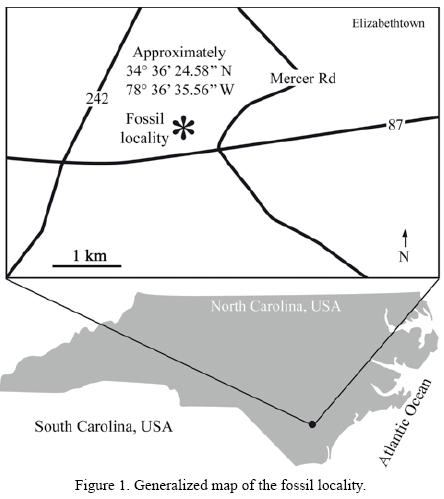
<body><![CDATA[<p align="justify"><font face="verdana" size="2">&nbsp;</font></p>  	    <p align="justify"><font face="verdana" size="2"><b>2. Material and Methods</b></font></p>  	    <p align="justify"><font face="verdana" size="2">2.1. Site location</font></p>  	    <p align="justify"><font face="verdana" size="2">The Upper Pliocene shell bed site that provided the background for this study is located at the Bladen County Landfill Annex site, Bladen County, south of Elizabethtown, North Carolina. The approximate coordinates for the site are 34&deg; 36' 24.58'' N, 78&deg; 36' 35.56'' W (<a href="#f1">Figure 1</a>). The Pliocene layer at this locality overlies the Upper Cretaceous Bladen Formation (Campanian) pebble lag deposit (<a href="/img/revistas/bsgm/v65n2/a10f2.jpg" target="_blank">Figure 2</a>). The Annex site has been claimed and is now closed until further notice.</font></p>  	    <p align="center"><font face="verdana" size="2"><a name="f1"></a></font></p>  	    <p align="center"><font face="verdana" size="2"><img src="/img/revistas/bsgm/v65n2/a10f1.jpg"></font></p>  	    <p align="justify"><font face="verdana" size="2">2.2. Age of the shell beds at Elizabethtown, North Carolina</font></p>  	    <p align="justify"><font face="verdana" size="2">Carter <i>et al</i>. (1988) list three distinct Pliocene shell beds assigned to the Bear Bluff Formation overlying the Campanian Black Creek (now Tar Heel) Formation at their Elizabethtown locality. Stratigraphic provenance of the stomatopod fossils is inferred to be from an aragonite leached section of Bed 1 of Carter <i>et al</i>. (1988) (lower unit in <a href="/img/revistas/bsgm/v65n2/a10f2.jpg" target="_blank">Figure 2</a>). Ward and Gilinsky (1993) state that the well&#45;preserved mollusk beds at Elizabethtown are the lateral shoreward equivalent of the leached calcarenites at Bear Bluff on the Waccamaw River near Conway South Carolina. Campbell and Campbell (1995) synonymize the Bear Bluff with the Upper Goose Creek Limestone. In that same publication, they place the age of the Elizabethtown mollusk beds as older than the Lower Waccamaw, but younger than the Duplin or between 2.7 and 2.9 Ma approximately. They also note the similarity of the fauna to the stratotype Chowan River Formation.</font></p>  	    <p align="justify"><font face="verdana" size="2">2.3. Collections and processing</font></p>  	    <p align="justify"><font face="verdana" size="2">Bulk sediment samples were collected from the Upper Pliocene Bear Bluff Formation (equivalent to Chowan River Formation) shell hash layer at the Elizabethtown Annex dumpsite. The majority of the samples were collected during the period of 1996&#45;2001. The first stomatopod element, a raptorial dactylus, was recovered in 1996 with additional specimens recovered afterwards.</font></p>  	    ]]></body>
<body><![CDATA[<p align="justify"><font face="verdana" size="2">The sediments were first dried and gently fractionated through nested sieves of # 4 mesh (4.75 mm) down to # 35 mesh (0.500 mm) to remove smaller clay and sand particulates. The fractions were rinsed with copious amounts of water until the supernatant ran clear and the fractions were then dried. Further fractioning was not performed in order to reduce any undue breakage of the more delicate fossils present.</font></p>  	    <p align="justify"><font face="verdana" size="2">Larger sediment fractions were scanned and specimens picked macroscopically. Sediment fractions of # 5 mesh (4.0 mm) and lower were scanned and picked with the aid of an American Optical Series Forty binocular microscope.</font></p>  	    <p align="justify"><font face="verdana" size="2">The stomatopod raptorial claws and fragments were found throughout all the Pliocene shell hash fractions. Since there is a definite bioturbated contact layer between the Pliocene shell hash bed and the underlying Cretaceous basal Bladen Formation (pebble lag) (<a href="/img/revistas/bsgm/v65n2/a10f2.jpg" target="_blank">Figure 2A</a>), some of the claw fragments have the rust&#45;colored, fine sand of the underlying Cretaceous layer embedded in the cavities of the dactyli fragments. Other dactyli fragments possess fine carbonate film and fine quartz sand matrix in some cavities as a result of deposition in the upper sections of the shell hash layer. Eventhough the fractioning process may have caused breakage of the stomatopod elements, there was no real evidence of fresh breakage during the scanning process.</font></p>  	    <p align="justify"><font face="verdana" size="2">Notation of the more numerous smaller mollusks found during the above mentioned fractionation process can serve as a horizon marker. The more prominent gastropods found were a large number of <i>Prunum limatulum</i> (Conrad, 1834) and <i>Turbonilla</i> sp. (Risso, 1826). Bivalves include <i>Crassatella</i> sp. (Lamarck, 1799) and abundant fragments of <i>Raeta</i> sp. cf. <i>undulata</i> (Gould, 1851) throughout the entire shell hash layer (see Ward and Gilinsky, 1993).</font></p>  	    <p align="justify"><font face="verdana" size="2">Some of the more outstanding Pliocene fish elements found in the shell hash layer include a high number of well&#45;preserved otoliths along with well&#45;preserved tiny teeth. These otoliths exhibit characteristics associated with Scianenidae (<i>e.g</i>., <i>Sciaenops</i> sp. Gill, 1863, <i>Cynoscion</i> sp. Gill, 1861, <i>Equetus</i> sp. Rafinesque, 1815, and/or <i>Micropogonias</i> sp. Bonaparte, 1831; see Fitch and Lavenberg, 1983).</font></p>  	    <p align="justify"><font face="verdana" size="2">2.4. Documentation</font></p>  	    <p align="justify"><font face="verdana" size="2">All specimens were documented on a Leica DM 2500 P compound microscope, with a 2.5x pol objective and a Scopetek DCM 510 ocular camera, resulting in an effective magnification of 25 times. Due to the limited depth of field, image stacks (50 micron z&#45;distance) were recorded and later fused with the freely available program CombineZP. Due to the limited field of view and the larger size of some of the specimens, these were recorded with several stacks. The fused images were then stitched with the photomerge function of Adobe Photoshop CS3. The resulting image is a composite image <i>sensu</i> Haug C. <i>et al</i>. (2009a).</font></p>  	    <p align="justify"><font face="verdana" size="2">As the surface of the specimens is highly reflective, all images were recorded under crossed polarized light (Schaarschmidt, 1973; Bengtson S., 2000; Haug C. <i>et al</i>., 2011; Haug J.T. <i>et al</i>., 2011; Kerp and Bomfleur, 2011). The light was provided by four independent fiber light sources in an evenly arranged pattern.</font></p>  	    <p align="justify"><font face="verdana" size="2">Some specimens have a very wide range of brightness, from very dark brown to bright white areas. Although polarized light partly equalizes such differences, the brightness range of the camera could not document these specimens satisfactorily with a single exposure setting. Therefore, these specimens were documented in two steps. First, they were documented with a "normal" exposure time, which left the darker areas almost invisible, but provided structural details for the bright areas. In a second step, the same image detail was overexposed, which left the bright areas without information, but provided the details of the dark areas. The overexposed image was placed as a separate layer on top of the normally exposed image in Adobe Photoshop CS3. The white (uninformative) areas of the top layer were marked with the magic wand tool; the selection was assigned a feather and cut out. In this way, the brighter areas with structural details of the underlying layer became visible. The final image combines surface information for both very bright and very dark areas, resulting in a fully informative image. This procedure roughly equals an HDR&#45;treatment.</font></p>  	    <p align="justify"><font face="verdana" size="2">Large specimens were documented from three directions, from both lateral sides and from the adorned side (<a href="/img/revistas/bsgm/v65n2/a10f3.jpg" target="_blank">Figures 3A&#45;D</a>, <a href="/img/revistas/bsgm/v65n2/a10f4.jpg" target="_blank">4A&#45;H, 4J&#45;N</a>). Smaller specimens were documented from two directions (<a href="/img/revistas/bsgm/v65n2/a10f4.jpg" target="_blank">Figures 4I</a>, <a href="/img/revistas/bsgm/v65n2/a10f5.jpg" target="_blank">5</a>). Specimens representing broken off spines or smaller pieces of the dactylus were documented from the two lateral views. Broken pieces of the main dactylus body were documented from the outer and inner side. For better comparison, all specimens were depicted in the same scale (<a href="/img/revistas/bsgm/v65n2/a10f3.jpg" target="_blank">Figures 3</a>&#45;<a href="/img/revistas/bsgm/v65n2/a10f5.jpg" target="_blank">5</a>). Additionally, details of the "cutting" edges of the spines and preservational peculiarities were documented as detailed views (<a href="/img/revistas/bsgm/v65n2/a10f6.jpg" target="_blank">Figure 6</a>).</font></p>  	    ]]></body>
<body><![CDATA[<p align="justify"><font face="verdana" size="2">One specimen was analyzed with X&#45;ray&#45;fluorescence with a Bruker Tracer 3V+, which measures the elemental composition of a specimen. The same specimen was documented under optical macro&#45;fluorescence settings, with a cyan filter in front of the light sources and a red filter in front of the camera (Canon Rebel T3i; for details see Haug J.T. and Haug C., 2011; Haug J.T. <i>et al</i>., 2011). To restrict the information of the image to the light emitted due to autofluorescence of the specimen, the remaining green light that was not absorbed entirely by the filters was artificially removed by reducing the green saturation in Adobe Photoshop CS3 (<a href="/img/revistas/bsgm/v65n2/a10f3.jpg" target="_blank">Figure 3E</a>).</font></p>  	    <p align="justify"><font face="verdana" size="2">The four largest and most complete specimens were additionally documented as stereo images (Haug C. <i>et&nbsp;al</i>., 2009a, 2011), also in three directions (<a href="/img/revistas/bsgm/v65n2/a10f7.jpg" target="_blank">Figure 7</a>). As the natural color of the specimens interferes with the red channel, a disturbing flickering is perceived when observing red&#45;cyan stereo images produced from the original color images, which dampens the depth effect of the images. Therefore, the images were reduced to gray scale before assembling the red&#45;cyan stereo images.</font></p>  	    <p align="justify"><font face="verdana" size="2">&nbsp;</font></p>  	    <p align="justify"><font face="verdana" size="2"><b>3. Results</b></font></p>  	    <p align="justify"><font face="verdana" size="2">Fifty&#45;four fragmentary specimens identified as parts of stomatopod dactyli have been investigated (Accession number NCSM 12837, specimens NCSM 11642 to 11675, 11677 to 11686 and 11689 to 11698). Specimens are deposited at the North Carolina Museum of Natural Sciences, Raleigh, NC. Due to the presence of spines, specimens are identified as dactyli parts of the large pair of raptorial appendages, as the three succeeding pairs of smaller raptorial appendages lack such spines in any stomatopod species. Four of the 54 specimens are rather complete (<a href="/img/revistas/bsgm/v65n2/a10f3.jpg" target="_blank">Figure 3</a>). The dactyli have an estimated maximum length of up to 15 mm and carry six spines. Two of these specimens represent the dactylus of the right appendage and two represent the left appendage.</font></p>  	    <p align="justify"><font face="verdana" size="2">Fourteen specimens are identified as a central part of a dactylus, ranging from larger pieces to smaller fragments, in which only two insertions of the spines are recognizable (<a href="/img/revistas/bsgm/v65n2/a10f4.jpg" target="_blank">Figure 4</a>). Of these specimens, five can be identified as parts of dactyli of the right appendage, three as parts of dactyli of the left appendage; six cannot be attributed to the left or the right appendage.</font></p>  	    <p align="justify"><font face="verdana" size="2">Thirty&#45;six more specimens that are fragmentary represent isolated spines or cuticle parts of the main part of the dactylus (<a href="/img/revistas/bsgm/v65n2/a10f5.jpg" target="_blank">Figure 5</a>). Due to the fragmentary nature of these specimens, they cannot be attributed to a particular body side.</font></p>  	    <p align="justify"><font face="verdana" size="2">An observed surface detail that represents the original morphology is a narrow crest on the functionally dorsal side of the spines of the dactyli (<a href="/img/revistas/bsgm/v65n2/a10f6.jpg" target="_blank">Figure 6A, B</a>). This structure can be found on all four well&#45;preserved specimens, but also on some of the isolated spines (<i>e.g</i>., <a href="/img/revistas/bsgm/v65n2/a10f5.jpg" target="_blank">Figure 5B, D</a>), which supports the hypothesis of the isolated spines and the better&#45;preserved dactyli as being conspecific.</font></p>  	    <p align="justify"><font face="verdana" size="2">Another surface detail observable on many specimens is a pattern of grooves running in smooth spirals (<a href="/img/revistas/bsgm/v65n2/a10f6.jpg" target="_blank">Figure 6C, D</a>). This pattern is present in many of the isolated spines (specimens in <a href="/img/revistas/bsgm/v65n2/a10f5.jpg" target="_blank">Figure 5H, I, M&#150;P, R&#150;U</a>). Such pattern has no equivalent in any other stomatopod known, fossil or extant, and is here considered because of the quality of preservation found at the study site.</font></p>  	    <p align="justify"><font face="verdana" size="2">With the length of the more complete dactyli as reference, the estimated body size of the entire animal is calculated to 100&#150;120 mm roughly, based upon our own unpublished comparative measurements of complete extant squillids (see discussion below for supposed systematic affinities). The dactyli represent a certain size range, yet not a very pronounced one. Due to the small variation, we assume that the size of the dactyli represents the final adult size, given that the estimated body size corresponds to that of the adult stage.</font></p>  	    ]]></body>
<body><![CDATA[<p align="justify"><font face="verdana" size="2">The composition material measured on the largest dactylus (<a href="/img/revistas/bsgm/v65n2/a10f3.jpg" target="_blank">Figure 3C, E</a>) seems to be calcium phosphate, according to the X&#45;ray fluorescence analysis. The presence of relatively strong autofluorescence detected with optical macro&#45;fluorescence settings supports the presence of calcium phosphate (<a href="/img/revistas/bsgm/v65n2/a10f3.jpg" target="_blank">Figure 3E</a>) (Haug C. <i>et al</i>., 2009a; Haug J.T. and Haug C., 2011; Haug J.T. <i>et al</i>., 2011).</font></p>  	    <p align="justify"><font face="verdana" size="2">&nbsp;</font></p>  	    <p align="justify"><font face="verdana" size="2"><b>4. Discussion</b></font></p>  	    <p align="justify"><font face="verdana" size="2">4.1. Systematic affinities</font></p>  	    <p align="justify"><font face="verdana" size="2">Due to the fragmentary nature of the specimens, it is difficult to attribute the described dactyli to a particular species. We therefore compare the dactyli to those of stomatopods that live on the coast of North Carolina today.</font></p>  	    <p align="justify"><font face="verdana" size="2"><i>Neogonodactylus bredini</i> (Manning, 1969), <i>N. oerstedii</i> (Hansen, 1895), and <i>N. torus</i> (Manning, 1969) are boxer&#45;type stomatopods, thus they do not possess spine&#45;bearing dactyli and cannot be the species represented in the here&#45;described material (Schwartz and Porter, 1977; Morgan and Goy, 1987; M&uuml;ller, 1994). <i>Coronis scolopendra</i> Latreille, 1828, <i>Nannosquilla carolinensis</i> (Manning, 1970), <i>Platysquilloides enodis</i> (Manning, 1962), and <i>Squilla deceptrix</i> (Manning, 1969) all do not exceed 70 mm in total length (Manning, 1970; Schram, 2010). The herein described dactyli are therefore too large to belong to representatives of these species.</font></p>  	    <p align="justify"><font face="verdana" size="2"><i>Gibbesia neglecta</i> (Gibbes, 1850) and <i>Meiosquilla</i> <i>quadridens</i> (Bigelow, 1893) both reach a size between 100&#45;110 mm, thus correspond in size to the estimated body size for the animals bearing the dactyli described herein. Yet, in these species the dactyli bear five and four spines respectively (Werding and M&uuml;ller, 1990; Foster <i>et al</i>., 2004), whereas the dactyli described herein always possess six spines.</font></p>  	    <p align="justify"><font face="verdana" size="2"><i>Squilla empusa</i> (Say, 1818) reaches larger body size up to 185 mm (Schram, 2010). Additionally, <i>S. empusa</i> is known not only from extant forms, but the record reaches back into the Pleistocene of Maryland (Blake, 1953; trace fossils) and the late Pleistocene or early Holocene of Connecticut (Waage <i>et al</i>., 2001). The specimens described herein are relatively small, but still fit into the size range of <i>S. empusa</i> and closely resemble a fairly completely preserved dactylus in the material of Waage <i>et al</i>. (2001, their <a href="/img/revistas/bsgm/v65n2/a10f4.jpg" target="_blank">fig. 4C</a>). An affinity based on the available characters cannot directly be shown. Yet, there is no character excluding an assumed affinity of the specimens described herein to <i>S. empusa</i>, which is also true for the size, and the Pleistocene&#150;Holocene occurrences also bridge the time gap between the Pliocene material and the extant fauna. Until further evidence, the specimens should therefore be assigned to <i>Squilla</i>? <i>empusa</i>? (following the open nomenclature of Bengtson, 1988).</font></p>  	    <p align="justify"><font face="verdana" size="2">4.2. Scarcity of stomatopod fossil record</font></p>  	    <p align="justify"><font face="verdana" size="2">The fossil record of Stomatopoda begins in the Carboniferous (Schram, 2007 and references therein). A single fragmentary specimen from the Silurian was interpreted by Wetzel (1973) as a possible part of a stomatopod telson. Attempts at locating the specimen have not yet been successful; however, based upon the image published it is doubtful that the specimen has a stomatopod affinity. In the Carboniferous numerous sites have yielded stomatopod fossils, <i>e.g</i>., the deposits of Mazon Creek and Bear Gulch, both North America, Hagen&#45;Vorhalle in Germany, East Kilbride in Scotland, and Argenteau in Belgium. Fourteen species are currently recognized from this period, representing various evolutionary levels (<i>e.g</i>., Peach, 1908; van Straelen, 1922; Sch&ouml;llmann, 2004; Schram, 2007, 2010; Haug J.T. <i>et al</i>., 2010).</font></p>  	    ]]></body>
<body><![CDATA[<p align="justify"><font face="verdana" size="2">There is no report of stomatopod fossils in the Permian and Triassic to date. Stomatopods have been found in the Lower Jurassic fossil in Osteno, Italy (Hof, 1998a) and they are currently under study by Italian and Australian researchers (Ahyong, pers. comm.). From the Upper Jurassic, four species have been described from lithographic limestones of southern Germany and a new species is yet to be named (summaries in Haug J.T. <i>et al</i>., 2008, 2010; Haug C. <i>et al.</i>, 2009b). However, the taxonomic status of some of the species is currently under debate and it is most likely that some of these species will be synonymized (Haug J.T. <i>et al</i>., 2010).</font></p>  	    <p align="justify"><font face="verdana" size="2">In the Cretaceous, fossil stomatopods have been found in Lebanon (three species; Dames, 1886; Ahyong <i>et al</i>., 2007; Haug J.T. <i>et al</i>., 2010), USA (one species; Fran&#355;escu, 2012), Mexico (one possible, but not yet named species; Vega <i>et al</i>., 2007) and Colombia (one possible, but still to be named species; Feldmann <i>et al</i>., 1999). Furthermore, two verunipeltatan species are known from the Cretaceous of Colombia (Schram, 1968) and Nigeria (F&ouml;rster, 1982). Five fossil specimens representing stomatopod tail ends from Israel and Jordan have been attributed to another ingroup species of Verunipelta, <i>Ursquilla yehoachi</i> (Remy and Avnimelech, 1955) (Hof, 1998b; Haug C. <i>et al.</i>, 2013). <i>Squilla cretacea</i> (Schl&uuml;ter, 1868) could not be successfully tracked yet, and its stratigraphic attribution has been considered as doubtful (Schram, 2010).</font></p>  	    <p align="justify"><font face="verdana" size="2">All Cenozoic occurrences appear to represent verunipeltatan species as well. No stomatopods have been found from the Palaeocene. From the Eocene to the Pleistocene, 30 species are known (five of them not yet formally described), with peaks in the Eocene and Miocene (although marine strata from the Oligocene are generally rare). Three of these species have survived until today (Schram, 2010). Deposits in northern Italy, mainly the famous lagerst&auml;tte Monte Bolca and the nearby Monte Postale, have yielded several stomatopod species (Secretan, 1975; Angeli and Beschin, 2006; Angeli and Garassino, 2008).</font></p>  	    <p align="justify"><font face="verdana" size="2">Given the relative incompleteness of the stomatopod fossil record, the finding of the here described isolated dactyli not only marks an additional occurrence, but it also gives the perspective that many stomatopod fossils could be represented by fragments, especially dactyli including by other parts, <i>e.g</i>., the telson (cf. <i>Ursquilla yehoachi</i>). Many fragments like the dactyli described will most likely not be identified to genus or even species level, yet they can still provide a source of data for answering different scientific questions.</font></p>  	    <p align="justify"><font face="verdana" size="2">4.3. Impact on reconstructing the paleoenvironment</font></p>  	    <p align="justify"><font face="verdana" size="2">Stomatopods represent important predators within their ecotope. Predators of this ecotype have been identified indirectly as trace fossils, back to Cambrian strata (Pratt, 1998). Yet, such an indirect finding often remains ambiguous. Finding isolated dactyli provides positive evidence that such predators were present in the paleoecosystem, <i>i.e</i>., a representative of the guild "ambush predator" was present. Additionally, it is difficult to estimate the population size from trace fossils such as hitting marks. Although it is also challenging to make such estimations based on fragmentary material, the amount of fragments found in North Carolina indicates that there was possibly a large population of mantis shrimps back in the Pliocene. Nevertheless, it must be considered that part of the material might stem from molts, which would distort the estimation of the population size.</font></p>  	    <p align="justify"><font face="verdana" size="2">As explained above, the number of stomatopod species is rather low in the fossil record, and individual fossils are relatively rare. Certain Carboniferous, Jurassic or Eocene species are known from numerous specimens (<i>e.g</i>., Secretan, 1975; Jenner <i>et al</i>., 1998; Angeli and Garassino, 2008; Haug J.T. <i>et al</i>., 2010), but other fossil stomatopods are only known from very few individuals (Hof, 1998b; Haug C. <i>et&nbsp;al.</i>, 2009b, 2013) or in some cases from a single one (Ahyong <i>et&nbsp;al.</i>, 2007; Schram, 2007).</font></p>  	    <p align="justify"><font face="verdana" size="2">Fragmentary specimens, which could have been overlooked, can add significantly more specimens and provide additional information for estimating population sizes. The potential for drawing scientific conclusions from isolated dactyli of decapod crustaceans has been proposed by Agnew (2008). Larger sample sizes could be used in a similar fashion with stomatopods. Despite of being important predators, stomatopods are also an attractive food source for larger predators (see Grimes, 1979 for an extant example). Regarding the Pliocene fish species found in the shell hash bed, evidenced by the presence of otoliths, the juveniles may well have been a food source for the larger spearer stomatopods at that time. In addition, the larger fishes could have used the juvenile stomatopods as a food source, thus contributing to the high degree of element fragmentation. As many paleo&#45;food webs are not necessarily based on distinct species but more on ecotypes or guilds, the simple presence of these predators as indicated by such fragmentary specimens represents an important data point for such a kind of analysis.</font></p>  	    <p align="justify"><font face="verdana" size="2">The scarcity of the stomatopod fossil record has hampered a paleo&#45;biogeographical approach, <i>i.e</i>., revealing possible connections between specific paleo&#45;biotas. The presence of the dactyli described herein, that possibly belong to <i>Squilla empusa</i>, could imply that its modern distribution along the East coast of the United States of America was already established back in the Pliocene. Yet, the scarcity and fragmentary nature of both the fossils and the fossil record of mantis shrimps in general should lead to conclusions that are more cautious. The species affinity of the presented material to <i>S. empusa</i> is only likely, but not definitive. Even if this statement should be accepted, it could also be explained by a migration northwards from the Pliocene in North Carolina over the Pleistocene in Maryland on to the late Pleistocene or early Holocene in Connecticut, followed by a rather recent distribution along the entire coast. More material is needed before such conclusions can be drawn; yet, the presented material definitely yields potential for such approaches.</font></p>  	    <p align="justify"><font face="verdana" size="2">4.4. Preservation</font></p>  	    ]]></body>
<body><![CDATA[<p align="justify"><font face="verdana" size="2">Being preserved in calcium phosphate and representing a three&#45;dimensional hollow replicate of the non&#45;calcified cuticle, the here described specimens could be characterized as being preserved in an "Orsten"&#45;<i>sensu&#45;lato</i>&#45;type preservation (Maas <i>et al</i>., 2006), which especially favors cuticle&#45;bearing, unmineralized animals, and is restricted to a maximum size of <i>ca</i>. 2 mm; however, the dacytli are significantly larger. Further insight is needed on whether other minerals besides calcium phosphate can be found in the specimens that facilitated the preservation in this size range. The usual question, regarding to calcium phosphatic preservation, is where the phosphate was originated. One possibility is that another decaying organism could have provided this material (Bate, 1972; Weitschat, 1983). In this case, perhaps the body of the stomatopod could have provided the phosphate to preserve just a tiny part of itself. More details on the paleoenvironment could provide further insight on this mode of preservation.</font></p>  	    <p align="justify"><font face="verdana" size="2">Other stomatopod fossils are also preserved in calcium phosphate, <i>e.g</i>., the specimens from the Upper Jurassic lithographic limestones of southern Germany (Solnhofen, Nusplingen). These fossils can also preserve their three&#45;dimensionality to a certain degree (Haug J.T. <i>et al.</i>, 2010), but are usually affected by compaction (one notable exception of a decapod in Haug <i>et al</i>., 2009a, their <a href="/img/revistas/bsgm/v65n2/a10f4.jpg" target="_blank">figures 4.6&#150;4.8</a>).</font></p>  	    <p align="justify"><font face="verdana" size="2">The isolated dactyli therefore represent an exceptional example from a preservational point of view, being relatively large, but with high detail and three&#45;dimensionally preserved in "Orsten"<i>&#45;sensu&#45;lato</i>&#45; preservation. This special preservation may be partly coupled to the comparably young age of the dactyli. Other specimens in "Orsten"<i>&#45;sensu&#45;lato&#45;</i> preservation found in the Cenozoic, have been described from Australia, with preserved insects, <i>i.e</i>., terrestrial fauna (Duncan <i>et al</i>., 1998).</font></p>  	    <p align="justify"><font face="verdana" size="2">The preservation of the specimens described herein may not appear extraordinarily spectacular due to the fragmentary nature of the specimens. Yet, this is the first example in which the narrow crest on the functionally dorsal side of the spines is preserved on a fossil stomatopod. This crest acts mechanically as a knife&#45;edge. The finding of this structure on the specimens presented herein emphasizes the exceptional preservation of these specimens.</font></p>  	    <p align="justify"><font face="verdana" size="2">&nbsp;</font></p>  	    <p align="justify"><font face="verdana" size="2"><b>5. Conclusions and outlook</b></font></p>  	    <p align="justify"><font face="verdana" size="2">The exceptionally preserved specimens of isolated stomatopod dactyli indicate that the fragmentary fossil record of stomatopods could be significantly amended with the search and description of additional fossil dactyli. Although such specimens do not allow exact taxonomic treatments, this kind of findings could be an important and underestimated data source for paleoenvironmental and paleobiogeographical studies.</font></p>  	    <p align="justify"><font face="verdana" size="2">&nbsp;</font></p>  	    <p align="justify"><font face="verdana" size="2"><b>Acknowledgments</b></font></p>  	    <p align="justify"><font face="verdana" size="2">We would like to thank Mr. Donald Clements for the study site specifics. Mr. Clements is a fellow fossil enthusiast that was instrumental in stressing the paleobiological importance of the Bladen County Annex site. Along with Mr. Clements, we would like to thank all amateur paleontologists that dedicated their time for supporting paleontological research. Joachim T. Haug at University of Greifswald photographed the specimens and processed the images, for which we are very thankful. CH expresses her thanks to her host during her time at Yale University, Derek E.G. Briggs. She is currently funded by a DAAD return fellowship. Many thanks also to her host Steffen Harzsch at the University of Greifswald. We are grateful to Yukiko Tonoike for performing the material analysis, and to Catherine Skinner for inspiring discussions on calcium phosphate occurrences in the environment, both at Yale University. We thank all people involved in providing free software that was used in the course of these studies, such as CombineZM, CombineZP, Microsoft ICE, and OpenOffice. Patricia G. Weaver (Collections Manager Geology/Paleontology, North Carolina Museum of Natural Sciences, Raleigh, NC) provided accession numbers for specimens here described. Reviews on the original document by Lothar Sch&ouml;llmann, LWL&#45;Museum f&uuml;r Naturkunde M&uuml;nster, and Mat&uacute;&scaron; Hy&#382;n&yacute;, University of Bratislava, are highly appreciated.</font></p>  	    ]]></body>
<body><![CDATA[<p align="justify"><font face="verdana" size="2">&nbsp;</font></p>  	    <p align="justify"><font face="verdana" size="2"><b>References</b></font></p>  	    <!-- ref --><p align="justify"><font face="verdana" size="2">Agnew, J.G., 2008, Dactyls reveal evolutionary patterns in decapod crustaceans: Baton Rouge, Los Angeles, Department of Geology and Geophysics, Louisiana State University and Agricultural and Mechanical College, 193p.    &nbsp;&nbsp;&nbsp;&nbsp;&nbsp;&nbsp;&nbsp;&nbsp;[&#160;<a href="javascript:void(0);" onclick="javascript: window.open('/scielo.php?script=sci_nlinks&ref=1408636&pid=S1405-3322201300020001000001&lng=','','width=640,height=500,resizable=yes,scrollbars=1,menubar=yes,');">Links</a>&#160;]<!-- end-ref --></font></p>  	    <!-- ref --><p align="justify"><font face="verdana" size="2">Ahyong, S.T., Garassino, A., Gironi, B., 2007, <i>Archaeosculda phoenicia</i> n. gen., n. sp. (Crustacea, Stomatopoda, Pseudosculdidae) from the Upper Cretaceous (Cenomanian) of Lebanon: Atti della Societ&agrave; italiana di Scienze naturali e del Museo civico di Storia naturale in Milano 2007, 148(I), 3&#45;15.    &nbsp;&nbsp;&nbsp;&nbsp;&nbsp;&nbsp;&nbsp;&nbsp;[&#160;<a href="javascript:void(0);" onclick="javascript: window.open('/scielo.php?script=sci_nlinks&ref=1408638&pid=S1405-3322201300020001000002&lng=','','width=640,height=500,resizable=yes,scrollbars=1,menubar=yes,');">Links</a>&#160;]<!-- end-ref --></font></p>  	    <!-- ref --><p align="justify"><font face="verdana" size="2">Angeli, de A., Beschin, C., 2006, Stomatopodi terziari del Veneto (Italia settentrionale): Studi e Ricerche &#150; Associazione Amici del Museo &#150; Museo Civico "G. Zannato" Montecchio Maggiore (Vicenza), 13, 25&#45;34.    &nbsp;&nbsp;&nbsp;&nbsp;&nbsp;&nbsp;&nbsp;&nbsp;[&#160;<a href="javascript:void(0);" onclick="javascript: window.open('/scielo.php?script=sci_nlinks&ref=1408640&pid=S1405-3322201300020001000003&lng=','','width=640,height=500,resizable=yes,scrollbars=1,menubar=yes,');">Links</a>&#160;]<!-- end-ref --></font></p>  	    <!-- ref --><p align="justify"><font face="verdana" size="2">Angeli, de A., Garassino, A., 2008, <i>Pseudosquilla lessinea</i> n. sp. (Crustacea, Stomatopoda, Pseudosquillidae) and <i>Scyllarides</i> <i>bolcensis</i> n. sp. (Crustacea, Decapoda, Scyllaridae) from the lower Eocene (Ypresian) of Monte Postale (Altissimo, Vicenza, NE Italy): Atti della Societ&agrave; italiana di Scienze naturali e del Museo civico di Storia naturale in Milano 2008, 149(II), 167&#45;178.    &nbsp;&nbsp;&nbsp;&nbsp;&nbsp;&nbsp;&nbsp;&nbsp;[&#160;<a href="javascript:void(0);" onclick="javascript: window.open('/scielo.php?script=sci_nlinks&ref=1408642&pid=S1405-3322201300020001000004&lng=','','width=640,height=500,resizable=yes,scrollbars=1,menubar=yes,');">Links</a>&#160;]<!-- end-ref --></font></p>  	    ]]></body>
<body><![CDATA[<!-- ref --><p align="justify"><font face="verdana" size="2">Bate, R.H., 1972, Phosphatized ostracods with appendages from the Lower Cretaceous of Brazil: Palaeontology, 15, 379&#45;393.    &nbsp;&nbsp;&nbsp;&nbsp;&nbsp;&nbsp;&nbsp;&nbsp;[&#160;<a href="javascript:void(0);" onclick="javascript: window.open('/scielo.php?script=sci_nlinks&ref=1408644&pid=S1405-3322201300020001000005&lng=','','width=640,height=500,resizable=yes,scrollbars=1,menubar=yes,');">Links</a>&#160;]<!-- end-ref --></font></p>  	    <!-- ref --><p align="justify"><font face="verdana" size="2">Bengtson, P., 1988, Open nomenclature: Palaeontology, 31(1), 223&#45;227.    &nbsp;&nbsp;&nbsp;&nbsp;&nbsp;&nbsp;&nbsp;&nbsp;[&#160;<a href="javascript:void(0);" onclick="javascript: window.open('/scielo.php?script=sci_nlinks&ref=1408646&pid=S1405-3322201300020001000006&lng=','','width=640,height=500,resizable=yes,scrollbars=1,menubar=yes,');">Links</a>&#160;]<!-- end-ref --></font></p>  	    <!-- ref --><p align="justify"><font face="verdana" size="2">Bengtson, S., 2000, Teasing fossils out of shales with cameras and computers: Palaeontologia Electronica, 3(1), art.4, published 15 April 2000, available in &lt;<a href="http://palaeo&#45;electronica.org/2000_1/fossils/issue1_00.htm" target="_blank">http://palaeo&#45;electronica.org/2000_1/fossils/issue1_00.htm</a>&gt;, consulted 30 June 2013.    &nbsp;&nbsp;&nbsp;&nbsp;&nbsp;&nbsp;&nbsp;&nbsp;[&#160;<a href="javascript:void(0);" onclick="javascript: window.open('/scielo.php?script=sci_nlinks&ref=1408648&pid=S1405-3322201300020001000007&lng=','','width=640,height=500,resizable=yes,scrollbars=1,menubar=yes,');">Links</a>&#160;]<!-- end-ref --></font></p>  	    <!-- ref --><p align="justify"><font face="verdana" size="2">Bigelow, R.P., 1893, The Stomatopoda of Bimini: Johns Hopkins University Circular, 12(106), 102&#45;103.    &nbsp;&nbsp;&nbsp;&nbsp;&nbsp;&nbsp;&nbsp;&nbsp;[&#160;<a href="javascript:void(0);" onclick="javascript: window.open('/scielo.php?script=sci_nlinks&ref=1408650&pid=S1405-3322201300020001000008&lng=','','width=640,height=500,resizable=yes,scrollbars=1,menubar=yes,');">Links</a>&#160;]<!-- end-ref --></font></p>  	    <!-- ref --><p align="justify"><font face="verdana" size="2">Blake, S.F., 1953, The Pleistocene fauna of Wailes Bluff and Langleys Bluff, Maryland: Smithsonian Miscellaneous Collection, 121(12), 1&#45;32.    &nbsp;&nbsp;&nbsp;&nbsp;&nbsp;&nbsp;&nbsp;&nbsp;[&#160;<a href="javascript:void(0);" onclick="javascript: window.open('/scielo.php?script=sci_nlinks&ref=1408652&pid=S1405-3322201300020001000009&lng=','','width=640,height=500,resizable=yes,scrollbars=1,menubar=yes,');">Links</a>&#160;]<!-- end-ref --></font></p>  	    ]]></body>
<body><![CDATA[<!-- ref --><p align="justify"><font face="verdana" size="2">Bonaparte, C.L., 1831, Saggio di una distribuzione metodica degli animali vertebrati: Antonio Boulzaler, Roma, 78 p.    &nbsp;&nbsp;&nbsp;&nbsp;&nbsp;&nbsp;&nbsp;&nbsp;[&#160;<a href="javascript:void(0);" onclick="javascript: window.open('/scielo.php?script=sci_nlinks&ref=1408654&pid=S1405-3322201300020001000010&lng=','','width=640,height=500,resizable=yes,scrollbars=1,menubar=yes,');">Links</a>&#160;]<!-- end-ref --></font></p>  	    <!-- ref --><p align="justify"><font face="verdana" size="2">Boxshall, G.A., Jaume, D., 2009, Exopodites, epipodites and gills in crustaceans: Arthropod Systematics and Phylogeny, 67, 229&#150;254.    &nbsp;&nbsp;&nbsp;&nbsp;&nbsp;&nbsp;&nbsp;&nbsp;[&#160;<a href="javascript:void(0);" onclick="javascript: window.open('/scielo.php?script=sci_nlinks&ref=1408656&pid=S1405-3322201300020001000011&lng=','','width=640,height=500,resizable=yes,scrollbars=1,menubar=yes,');">Links</a>&#160;]<!-- end-ref --></font></p>  	    <!-- ref --><p align="justify"><font face="verdana" size="2">Campbell, M.R., Campbell, L.D., 1995, Preliminary Biostratigraphy and Molluscan Fauna of the Goose Creek Limestone of Eastern South Carolina: Tulane Studies in Geology and Paleontology, 27, 53&#45;100.    &nbsp;&nbsp;&nbsp;&nbsp;&nbsp;&nbsp;&nbsp;&nbsp;[&#160;<a href="javascript:void(0);" onclick="javascript: window.open('/scielo.php?script=sci_nlinks&ref=1408658&pid=S1405-3322201300020001000012&lng=','','width=640,height=500,resizable=yes,scrollbars=1,menubar=yes,');">Links</a>&#160;]<!-- end-ref --></font></p>  	    <!-- ref --><p align="justify"><font face="verdana" size="2">Carter, J.G., Gallagher, P.E., Vallone, R.E., Rossbach, T.J., Gensel, P.G., Wheeler, W.H., Whitman, D., 1988, Fossil collecting in North Carolina: North Carolina Geological Survey Bulletin, 89, 89 p.    &nbsp;&nbsp;&nbsp;&nbsp;&nbsp;&nbsp;&nbsp;&nbsp;[&#160;<a href="javascript:void(0);" onclick="javascript: window.open('/scielo.php?script=sci_nlinks&ref=1408660&pid=S1405-3322201300020001000013&lng=','','width=640,height=500,resizable=yes,scrollbars=1,menubar=yes,');">Links</a>&#160;]<!-- end-ref --></font></p>  	    <!-- ref --><p align="justify"><font face="verdana" size="2">Chiou, T&#45;H., Kleinlogel, S., Cronin, T., Caldwell, R., Loeffler, B., Siddiqi, A., Goldizen, A., Marshall, J., 2008, Circular polarization vision in a stomatopod crustacean: Current Biology, 18, 429&#45;434.    &nbsp;&nbsp;&nbsp;&nbsp;&nbsp;&nbsp;&nbsp;&nbsp;[&#160;<a href="javascript:void(0);" onclick="javascript: window.open('/scielo.php?script=sci_nlinks&ref=1408662&pid=S1405-3322201300020001000014&lng=','','width=640,height=500,resizable=yes,scrollbars=1,menubar=yes,');">Links</a>&#160;]<!-- end-ref --></font></p>  	    ]]></body>
<body><![CDATA[<!-- ref --><p align="justify"><font face="verdana" size="2">Conrad, T.A., 1834, Descriptions of new Tertiary fossils from the Southern States: Journal of the Academy of Natural Sciences of Philadelphia, 7(1), 130&#45;157.    &nbsp;&nbsp;&nbsp;&nbsp;&nbsp;&nbsp;&nbsp;&nbsp;[&#160;<a href="javascript:void(0);" onclick="javascript: window.open('/scielo.php?script=sci_nlinks&ref=1408664&pid=S1405-3322201300020001000015&lng=','','width=640,height=500,resizable=yes,scrollbars=1,menubar=yes,');">Links</a>&#160;]<!-- end-ref --></font></p>  	    <!-- ref --><p align="justify"><font face="verdana" size="2">Dames, W., 1886, Ueber einige Crustaceen aus den Kreideablagerungen des Libanon: Zeitschrift der Deutschen Geologischen Gesellschaft, 38(3), 551&#45;576.    &nbsp;&nbsp;&nbsp;&nbsp;&nbsp;&nbsp;&nbsp;&nbsp;[&#160;<a href="javascript:void(0);" onclick="javascript: window.open('/scielo.php?script=sci_nlinks&ref=1408666&pid=S1405-3322201300020001000016&lng=','','width=640,height=500,resizable=yes,scrollbars=1,menubar=yes,');">Links</a>&#160;]<!-- end-ref --></font></p>  	    <!-- ref --><p align="justify"><font face="verdana" size="2">Duncan, I.J., Briggs, D.E.G., Archer, M., 1998, Three&#45;dimensionally mineralized insects and millipedes from the Tertiary of Riversleigh, Queensland, Australia: Palaeontology, 41, 835&#45;851.    &nbsp;&nbsp;&nbsp;&nbsp;&nbsp;&nbsp;&nbsp;&nbsp;[&#160;<a href="javascript:void(0);" onclick="javascript: window.open('/scielo.php?script=sci_nlinks&ref=1408668&pid=S1405-3322201300020001000017&lng=','','width=640,height=500,resizable=yes,scrollbars=1,menubar=yes,');">Links</a>&#160;]<!-- end-ref --></font></p>  	    <!-- ref --><p align="justify"><font face="verdana" size="2">Feldmann, R.M., Villamil, T., Kauffman, E.G., 1999, Decapod and stomatopod crustaceans from mass mortality lagerstatten: Turonian (Cretaceous) of Colombia: Journal of Paleontology, 73, 91&#45;101.    &nbsp;&nbsp;&nbsp;&nbsp;&nbsp;&nbsp;&nbsp;&nbsp;[&#160;<a href="javascript:void(0);" onclick="javascript: window.open('/scielo.php?script=sci_nlinks&ref=1408670&pid=S1405-3322201300020001000018&lng=','','width=640,height=500,resizable=yes,scrollbars=1,menubar=yes,');">Links</a>&#160;]<!-- end-ref --></font></p>  	    <!-- ref --><p align="justify"><font face="verdana" size="2">Fitch, J.E., Lavenberg, R.J., 1983, Teleost Fish Otoliths from Lee Creek Mine, Aurora, North Carolina, <i>in</i> Ray, C.E. (ed.) Geology and Paleontology of the Lee Creek Mine, North Carolina, I: Whashington, D.C., Smithsonian Contributions to Paleobiology, 53, 509&#45;529.    &nbsp;&nbsp;&nbsp;&nbsp;&nbsp;&nbsp;&nbsp;&nbsp;[&#160;<a href="javascript:void(0);" onclick="javascript: window.open('/scielo.php?script=sci_nlinks&ref=1408672&pid=S1405-3322201300020001000019&lng=','','width=640,height=500,resizable=yes,scrollbars=1,menubar=yes,');">Links</a>&#160;]<!-- end-ref --></font></p>  	    ]]></body>
<body><![CDATA[<!-- ref --><p align="justify"><font face="verdana" size="2">F&ouml;rster, R., 1982, Heuschreckenkrebse (Crustacea: Stomatopoda) aus dem Altterti&auml;r von Helmstedt und Handorf (Niedersachsen) und der Oberkreide von Nigeria: Neues Jahrbuch fuer Geologie und Pal&auml;ontologie Monatschafte, 1982, 321&#45;335.    &nbsp;&nbsp;&nbsp;&nbsp;&nbsp;&nbsp;&nbsp;&nbsp;[&#160;<a href="javascript:void(0);" onclick="javascript: window.open('/scielo.php?script=sci_nlinks&ref=1408674&pid=S1405-3322201300020001000020&lng=','','width=640,height=500,resizable=yes,scrollbars=1,menubar=yes,');">Links</a>&#160;]<!-- end-ref --></font></p>  	    <!-- ref --><p align="justify"><font face="verdana" size="2">Foster, J.M., Thoma, B.P., Heard, R.W., 2004, Stomatopoda (Crustacea: Hoplocarida) from the shallow, inshore waters of the northern Gulf of Mexico (Apalachicola River, Florida to Port Arkansas, Texas): Gulf and Caribbean Research, 16, 49&#45;58.    &nbsp;&nbsp;&nbsp;&nbsp;&nbsp;&nbsp;&nbsp;&nbsp;[&#160;<a href="javascript:void(0);" onclick="javascript: window.open('/scielo.php?script=sci_nlinks&ref=1408676&pid=S1405-3322201300020001000021&lng=','','width=640,height=500,resizable=yes,scrollbars=1,menubar=yes,');">Links</a>&#160;]<!-- end-ref --></font></p>  	    <!-- ref --><p align="justify"><font face="verdana" size="2">Fran&#355;escu, O.D., 2012, <i>Nodosculda fisherorum</i>, new genus and new species of mantis shrimp (Stomatopoda: Sculdidae) from the Cretaceous (Late Albian) of Texas, USA: Journal of Crustacean Biology, 32, 774&#45;779.    &nbsp;&nbsp;&nbsp;&nbsp;&nbsp;&nbsp;&nbsp;&nbsp;[&#160;<a href="javascript:void(0);" onclick="javascript: window.open('/scielo.php?script=sci_nlinks&ref=1408678&pid=S1405-3322201300020001000022&lng=','','width=640,height=500,resizable=yes,scrollbars=1,menubar=yes,');">Links</a>&#160;]<!-- end-ref --></font></p>  	    <!-- ref --><p align="justify"><font face="verdana" size="2">Gibbes, L.R., 1850, On the carcinological collections of the cabinets of natural history in the United States, with an enumeration of the species contained therein, and descriptions of new species: Proceedings of the American Association for Advancement of Science, 3rd meeting, 167&#45;201.    &nbsp;&nbsp;&nbsp;&nbsp;&nbsp;&nbsp;&nbsp;&nbsp;[&#160;<a href="javascript:void(0);" onclick="javascript: window.open('/scielo.php?script=sci_nlinks&ref=1408680&pid=S1405-3322201300020001000023&lng=','','width=640,height=500,resizable=yes,scrollbars=1,menubar=yes,');">Links</a>&#160;]<!-- end-ref --></font></p>  	    <!-- ref --><p align="justify"><font face="verdana" size="2">Gill, T., 1861, Revision of the genera of North American Sciaeninae: Proceedings of the Academy of Natural Sciences of Philadelphia, 13, 79&#45;89.    &nbsp;&nbsp;&nbsp;&nbsp;&nbsp;&nbsp;&nbsp;&nbsp;[&#160;<a href="javascript:void(0);" onclick="javascript: window.open('/scielo.php?script=sci_nlinks&ref=1408682&pid=S1405-3322201300020001000024&lng=','','width=640,height=500,resizable=yes,scrollbars=1,menubar=yes,');">Links</a>&#160;]<!-- end-ref --></font></p>  	    ]]></body>
<body><![CDATA[<!-- ref --><p align="justify"><font face="verdana" size="2">Gill, T., 1863, Catalogue of the North American sciaenoid fishes: Proceedings of the Academy of Natural Sciences of Philadelphia, 15, 28&#45;32.    &nbsp;&nbsp;&nbsp;&nbsp;&nbsp;&nbsp;&nbsp;&nbsp;[&#160;<a href="javascript:void(0);" onclick="javascript: window.open('/scielo.php?script=sci_nlinks&ref=1408684&pid=S1405-3322201300020001000025&lng=','','width=640,height=500,resizable=yes,scrollbars=1,menubar=yes,');">Links</a>&#160;]<!-- end-ref --></font></p>  	    <!-- ref --><p align="justify"><font face="verdana" size="2">Gould, A.A., 1851, Dr. Samuel Cabot in the Chair: Proceedings of the Boston Society of Natural History, 4, 87&#45;95.    &nbsp;&nbsp;&nbsp;&nbsp;&nbsp;&nbsp;&nbsp;&nbsp;[&#160;<a href="javascript:void(0);" onclick="javascript: window.open('/scielo.php?script=sci_nlinks&ref=1408686&pid=S1405-3322201300020001000026&lng=','','width=640,height=500,resizable=yes,scrollbars=1,menubar=yes,');">Links</a>&#160;]<!-- end-ref --></font></p>  	    <!-- ref --><p align="justify"><font face="verdana" size="2">Grimes, C.B., 1979, Diet and feeding ecology of the vermillion snapper, <i>Rhomboplites aurorubens</i> (Cuvier) from North Carolina and South Carolina waters: Bulletin of Marine Science, 29, 53&#45;61.    &nbsp;&nbsp;&nbsp;&nbsp;&nbsp;&nbsp;&nbsp;&nbsp;[&#160;<a href="javascript:void(0);" onclick="javascript: window.open('/scielo.php?script=sci_nlinks&ref=1408688&pid=S1405-3322201300020001000027&lng=','','width=640,height=500,resizable=yes,scrollbars=1,menubar=yes,');">Links</a>&#160;]<!-- end-ref --></font></p>  	    <!-- ref --><p align="justify"><font face="verdana" size="2">Hansen, H.J., 1895, Isopoden, Cumaceen und Stomatopoden der Plankton&#45;Expedition: Ergebnisse der in dem Atlantischen Ocean von Mitte Juli bis Anfang November 1889 ausgef&uuml;hrten Plankton&#45;Expedition der Humboldt&#45;Stiftung 2, 1&#45;105.    &nbsp;&nbsp;&nbsp;&nbsp;&nbsp;&nbsp;&nbsp;&nbsp;[&#160;<a href="javascript:void(0);" onclick="javascript: window.open('/scielo.php?script=sci_nlinks&ref=1408690&pid=S1405-3322201300020001000028&lng=','','width=640,height=500,resizable=yes,scrollbars=1,menubar=yes,');">Links</a>&#160;]<!-- end-ref --></font></p>  	    <!-- ref --><p align="justify"><font face="verdana" size="2">Haug, C., Haug, J.T., Waloszek, D., Maas, A., Frattigiani, R., Liebau, S., 2009a, New methods to document fossils from lithographic limestones of southern Germany and Lebanon: Palaeontologia Electronica, 12(3), art.6T, published December 2009, available in &lt;<a href="http://palaeo&#45;electronica.org/2009_3/193/index.html" target="_blank">http://palaeo&#45;electronica.org/2009_3/193/index.html</a>&gt;, consulted 30 June 2013.    &nbsp;&nbsp;&nbsp;&nbsp;&nbsp;&nbsp;&nbsp;&nbsp;[&#160;<a href="javascript:void(0);" onclick="javascript: window.open('/scielo.php?script=sci_nlinks&ref=1408692&pid=S1405-3322201300020001000029&lng=','','width=640,height=500,resizable=yes,scrollbars=1,menubar=yes,');">Links</a>&#160;]<!-- end-ref --></font></p>  	    ]]></body>
<body><![CDATA[<!-- ref --><p align="justify"><font face="verdana" size="2">Haug, C., Haug, J.T., Waloszek, D., 2009b, Morphology and ontogeny of the Upper Jurassic mantis shrimp <i>Spinosculda ehrlichi</i> n. gen. n. sp. from southern Germany: Palaeodiversity, 2, 111&#45;118.    &nbsp;&nbsp;&nbsp;&nbsp;&nbsp;&nbsp;&nbsp;&nbsp;[&#160;<a href="javascript:void(0);" onclick="javascript: window.open('/scielo.php?script=sci_nlinks&ref=1408694&pid=S1405-3322201300020001000030&lng=','','width=640,height=500,resizable=yes,scrollbars=1,menubar=yes,');">Links</a>&#160;]<!-- end-ref --></font></p>  	    <!-- ref --><p align="justify"><font face="verdana" size="2">Haug, C., Kutschera, V., Ahyong, S.T., Vega, F.J., Maas, A., Waloszek, D., Haug, J.T., 2013, Re&#45;description of the Mesozoic mantis shrimp <i>Ursquilla yehoachi</i> based on new material and the virtual peel technique: Palaeontologia Electronica, 16, 2, art. 5T.    &nbsp;&nbsp;&nbsp;&nbsp;&nbsp;&nbsp;&nbsp;&nbsp;[&#160;<a href="javascript:void(0);" onclick="javascript: window.open('/scielo.php?script=sci_nlinks&ref=1408696&pid=S1405-3322201300020001000031&lng=','','width=640,height=500,resizable=yes,scrollbars=1,menubar=yes,');">Links</a>&#160;]<!-- end-ref --></font></p>  	    <!-- ref --><p align="justify"><font face="verdana" size="2">Haug, C., Mayer, G., Kutschera, V., Waloszek, D., Maas, A., Haug, J.T., 2011, Imaging and documenting gammarideans: International Journal of Zoology, art. 380829.    &nbsp;&nbsp;&nbsp;&nbsp;&nbsp;&nbsp;&nbsp;&nbsp;[&#160;<a href="javascript:void(0);" onclick="javascript: window.open('/scielo.php?script=sci_nlinks&ref=1408698&pid=S1405-3322201300020001000032&lng=','','width=640,height=500,resizable=yes,scrollbars=1,menubar=yes,');">Links</a>&#160;]<!-- end-ref --></font></p>  	    <!-- ref --><p align="justify"><font face="verdana" size="2">Haug, J.T., Haug, C., 2011, Fossilien unter langwelligem Licht: Gr&uuml;n&#45;Orange&#45;Fluoreszenz an makroskopischen Objekten: Archaeopteryx, 29, 20&#45;23.    &nbsp;&nbsp;&nbsp;&nbsp;&nbsp;&nbsp;&nbsp;&nbsp;[&#160;<a href="javascript:void(0);" onclick="javascript: window.open('/scielo.php?script=sci_nlinks&ref=1408700&pid=S1405-3322201300020001000033&lng=','','width=640,height=500,resizable=yes,scrollbars=1,menubar=yes,');">Links</a>&#160;]<!-- end-ref --></font></p>  	    <!-- ref --><p align="justify"><font face="verdana" size="2">Haug, J.T., Haug, C., Ehrlich, M., 2008, First fossil stomatopod larva (Arthropoda: Crustacea) and a new way of documenting Solnhofen fossils (Upper Jurassic, Southern Germany): Palaeodiversity, 1, 103&#45;109.    &nbsp;&nbsp;&nbsp;&nbsp;&nbsp;&nbsp;&nbsp;&nbsp;[&#160;<a href="javascript:void(0);" onclick="javascript: window.open('/scielo.php?script=sci_nlinks&ref=1408702&pid=S1405-3322201300020001000034&lng=','','width=640,height=500,resizable=yes,scrollbars=1,menubar=yes,');">Links</a>&#160;]<!-- end-ref --></font></p>  	    ]]></body>
<body><![CDATA[<!-- ref --><p align="justify"><font face="verdana" size="2">Haug, J.T., Haug, C., Maas, A., Kutschera, V., Waloszek, D., 2010, Evolution of mantis shrimps (Stomatopoda, Malacostraca) in the light of new Mesozoic fossils: BMC Evolutionary Biology, 10, 290, 17 p.    &nbsp;&nbsp;&nbsp;&nbsp;&nbsp;&nbsp;&nbsp;&nbsp;[&#160;<a href="javascript:void(0);" onclick="javascript: window.open('/scielo.php?script=sci_nlinks&ref=1408704&pid=S1405-3322201300020001000035&lng=','','width=640,height=500,resizable=yes,scrollbars=1,menubar=yes,');">Links</a>&#160;]<!-- end-ref --></font></p>  	    <!-- ref --><p align="justify"><font face="verdana" size="2">Haug, J.T., Haug, C., Kutschera, V., Mayer, G., Maas, A., Liebau, S., Castellani, C., Wolfram, U., Clarkson, E.N.K., Waloszek, D., 2011, Autofluorescence imaging, an excellent tool for comparative morphology: Journal of Microscopy, 244, 259&#45;272.    &nbsp;&nbsp;&nbsp;&nbsp;&nbsp;&nbsp;&nbsp;&nbsp;[&#160;<a href="javascript:void(0);" onclick="javascript: window.open('/scielo.php?script=sci_nlinks&ref=1408706&pid=S1405-3322201300020001000036&lng=','','width=640,height=500,resizable=yes,scrollbars=1,menubar=yes,');">Links</a>&#160;]<!-- end-ref --></font></p>  	    <!-- ref --><p align="justify"><font face="verdana" size="2">Hof, C.H.J., 1998a, Fossil stomatopods (Crustacea: Malacostraca) and their phylogenetic impact: Journal of Natural History, 32, 1567&#45;1576.    &nbsp;&nbsp;&nbsp;&nbsp;&nbsp;&nbsp;&nbsp;&nbsp;[&#160;<a href="javascript:void(0);" onclick="javascript: window.open('/scielo.php?script=sci_nlinks&ref=1408708&pid=S1405-3322201300020001000037&lng=','','width=640,height=500,resizable=yes,scrollbars=1,menubar=yes,');">Links</a>&#160;]<!-- end-ref --></font></p>  	    <!-- ref --><p align="justify"><font face="verdana" size="2">Hof, C.H.J., 1998b, Late Cretaceous stomatopods (Crustacea: Malacostraca) from Israel and Jordan: Contributions to Zoology, 67(4), 257&#45;266.    &nbsp;&nbsp;&nbsp;&nbsp;&nbsp;&nbsp;&nbsp;&nbsp;[&#160;<a href="javascript:void(0);" onclick="javascript: window.open('/scielo.php?script=sci_nlinks&ref=1408710&pid=S1405-3322201300020001000038&lng=','','width=640,height=500,resizable=yes,scrollbars=1,menubar=yes,');">Links</a>&#160;]<!-- end-ref --></font></p>  	    <!-- ref --><p align="justify"><font face="verdana" size="2">Jenner, R.A., Hof, C.H.J.,Schram, F.R., 1998, Palaeo&#45; and archaeostomatopods (Hoplocarida, Crustacea) from the Bear Gulch Limestone, Mississipian (Namurian), of Central Montana: Contributions to Zoology, 67(3), 155&#45;185.    &nbsp;&nbsp;&nbsp;&nbsp;&nbsp;&nbsp;&nbsp;&nbsp;[&#160;<a href="javascript:void(0);" onclick="javascript: window.open('/scielo.php?script=sci_nlinks&ref=1408712&pid=S1405-3322201300020001000039&lng=','','width=640,height=500,resizable=yes,scrollbars=1,menubar=yes,');">Links</a>&#160;]<!-- end-ref --></font></p>  	    ]]></body>
<body><![CDATA[<!-- ref --><p align="justify"><font face="verdana" size="2">Kerp, H., Bomfleur, B., 2011, Photography of plant fossils&#150;New techniques, old tricks: Review of Palaeobotany and Palynology, 166, 117&#45;151.    &nbsp;&nbsp;&nbsp;&nbsp;&nbsp;&nbsp;&nbsp;&nbsp;[&#160;<a href="javascript:void(0);" onclick="javascript: window.open('/scielo.php?script=sci_nlinks&ref=1408714&pid=S1405-3322201300020001000040&lng=','','width=640,height=500,resizable=yes,scrollbars=1,menubar=yes,');">Links</a>&#160;]<!-- end-ref --></font></p>  	    <!-- ref --><p align="justify"><font face="verdana" size="2">Kleinlogel, S., Marshall, N.J., 2006, Electrophysiological evidence for linear polarization sensitivity in the compound eyes of the stomatopod crustacean <i>Gonodactylus chiragra</i>: Journal of Experimental Biology, 209, 4262&#45;4272.    &nbsp;&nbsp;&nbsp;&nbsp;&nbsp;&nbsp;&nbsp;&nbsp;[&#160;<a href="javascript:void(0);" onclick="javascript: window.open('/scielo.php?script=sci_nlinks&ref=1408716&pid=S1405-3322201300020001000041&lng=','','width=640,height=500,resizable=yes,scrollbars=1,menubar=yes,');">Links</a>&#160;]<!-- end-ref --></font></p>  	    <!-- ref --><p align="justify"><font face="verdana" size="2">Lamarck, J.&#45;B., 1799, Tome second, <i>in</i> Encyclop&eacute;die m&eacute;thodique: Histoire naturelle des vers, par Brugui&egrave;re, J.G., Lamarck, J. B. de, continu&eacute;e par G. P. Deshayes, Paris, Panckoucke, 1789&#45;1832.    &nbsp;&nbsp;&nbsp;&nbsp;&nbsp;&nbsp;&nbsp;&nbsp;[&#160;<a href="javascript:void(0);" onclick="javascript: window.open('/scielo.php?script=sci_nlinks&ref=1408718&pid=S1405-3322201300020001000042&lng=','','width=640,height=500,resizable=yes,scrollbars=1,menubar=yes,');">Links</a>&#160;]<!-- end-ref --></font></p>  	    <!-- ref --><p align="justify"><font face="verdana" size="2">Latreille, P.A., 1802, Histoire naturelle, g&eacute;n&eacute;rale et particuli&egrave;re, des Crustac&eacute;s et des Insectes 3. F. Dufart, Paris, 653p</font>&nbsp;&nbsp;&nbsp;&nbsp;&nbsp;&nbsp;&nbsp;&nbsp;[&#160;<a href="javascript:void(0);" onclick="javascript: window.open('/scielo.php?script=sci_nlinks&ref=1408720&pid=S1405-3322201300020001000043&lng=','','width=640,height=500,resizable=yes,scrollbars=1,menubar=yes,');">Links</a>&#160;]<!-- end-ref --><!-- ref --><p align="justify"><font face="verdana" size="2">Latreille, P.A., 1816, Les crustac&eacute;s, les arachnides et les insectes, <i>in</i> Cuvier, G. (ed.), Le r&egrave;gne animal distribu&eacute; d'apr&egrave;s son organisation, pour servir de base &agrave; l'histoire naturelle des animaux et d'introduction &agrave; l'anatomie compar&eacute;e, 3, Paris, D&eacute;terville, 432p.    &nbsp;&nbsp;&nbsp;&nbsp;&nbsp;&nbsp;&nbsp;&nbsp;[&#160;<a href="javascript:void(0);" onclick="javascript: window.open('/scielo.php?script=sci_nlinks&ref=1408721&pid=S1405-3322201300020001000044&lng=','','width=640,height=500,resizable=yes,scrollbars=1,menubar=yes,');">Links</a>&#160;]<!-- end-ref --></font></p>  	    <!-- ref --><p align="justify"><font face="verdana" size="2">Latreille, P.A., 1828, Squille, <i>Squilla</i>, Encyclop&eacute;die m&eacute;thodique histoire naturelle, insectes, 10, 467&#45;475.    &nbsp;&nbsp;&nbsp;&nbsp;&nbsp;&nbsp;&nbsp;&nbsp;[&#160;<a href="javascript:void(0);" onclick="javascript: window.open('/scielo.php?script=sci_nlinks&ref=1408723&pid=S1405-3322201300020001000045&lng=','','width=640,height=500,resizable=yes,scrollbars=1,menubar=yes,');">Links</a>&#160;]<!-- end-ref --></font></p>  	    <!-- ref --><p align="justify"><font face="verdana" size="2">Maas, A., Braun, A., Dong, Xi&#45;P., Donoghue, P.C.J., M&uuml;ller, K.J., Olempska, E., Repetski, J.E., Siveter, D.J., Stein, M., Waloszek, D., 2006, The 'Orsten' &#150; more than a Cambrian Konservat&#45;Lagerstatte yielding exceptional preservation: Palaeoworld, 15, 266&#45;282.    &nbsp;&nbsp;&nbsp;&nbsp;&nbsp;&nbsp;&nbsp;&nbsp;[&#160;<a href="javascript:void(0);" onclick="javascript: window.open('/scielo.php?script=sci_nlinks&ref=1408725&pid=S1405-3322201300020001000046&lng=','','width=640,height=500,resizable=yes,scrollbars=1,menubar=yes,');">Links</a>&#160;]<!-- end-ref --></font></p>  	    <!-- ref --><p align="justify"><font face="verdana" size="2">Maas, A., Haug, C., Haug, J.T., Olesen, J., Zhang, X., Waloszek, D., 2009, Early crustacean evolution and the appearance of epipodites and gills: Arthropod Systematics and Phylogeny, 67, 255&#45;273.    &nbsp;&nbsp;&nbsp;&nbsp;&nbsp;&nbsp;&nbsp;&nbsp;[&#160;<a href="javascript:void(0);" onclick="javascript: window.open('/scielo.php?script=sci_nlinks&ref=1408727&pid=S1405-3322201300020001000047&lng=','','width=640,height=500,resizable=yes,scrollbars=1,menubar=yes,');">Links</a>&#160;]<!-- end-ref --></font></p>  	    <!-- ref --><p align="justify"><font face="verdana" size="2">Manning, R.B., 1962, Seven new species of stomatopod crustaceans from the northwestern Atlantic: Proceedings of the Biological Society of Washington, 75, 215&#45;222.    &nbsp;&nbsp;&nbsp;&nbsp;&nbsp;&nbsp;&nbsp;&nbsp;[&#160;<a href="javascript:void(0);" onclick="javascript: window.open('/scielo.php?script=sci_nlinks&ref=1408729&pid=S1405-3322201300020001000048&lng=','','width=640,height=500,resizable=yes,scrollbars=1,menubar=yes,');">Links</a>&#160;]<!-- end-ref --></font></p>  	    <!-- ref --><p align="justify"><font face="verdana" size="2">Manning, R.B., 1969, Stomatopod Crustacea from the Western Atlantic: Studies in Tropical Oceanography 8, Institute of Marine Science, University of Miami, 380 p.    &nbsp;&nbsp;&nbsp;&nbsp;&nbsp;&nbsp;&nbsp;&nbsp;[&#160;<a href="javascript:void(0);" onclick="javascript: window.open('/scielo.php?script=sci_nlinks&ref=1408731&pid=S1405-3322201300020001000049&lng=','','width=640,height=500,resizable=yes,scrollbars=1,menubar=yes,');">Links</a>&#160;]<!-- end-ref --></font></p>  	    <!-- ref --><p align="justify"><font face="verdana" size="2">Manning, R.B., 1970, Nine new American stomatopod crustaceans: Proceedings of the Biological Society of Washington, 83, 8, 99&#45;l14.    &nbsp;&nbsp;&nbsp;&nbsp;&nbsp;&nbsp;&nbsp;&nbsp;[&#160;<a href="javascript:void(0);" onclick="javascript: window.open('/scielo.php?script=sci_nlinks&ref=1408733&pid=S1405-3322201300020001000050&lng=','','width=640,height=500,resizable=yes,scrollbars=1,menubar=yes,');">Links</a>&#160;]<!-- end-ref --></font></p>  	    <!-- ref --><p align="justify"><font face="verdana" size="2">Morgan, S.G., Goy, J.W., 1987, Reproduction and larval development of the mantis shrimp <i>Gonodactylus bredini</i> (Crustacea: Stomatopoda) maintained in the laboratory: Journal of Crustacean Biology, 7, 4, 595&#45;618.    &nbsp;&nbsp;&nbsp;&nbsp;&nbsp;&nbsp;&nbsp;&nbsp;[&#160;<a href="javascript:void(0);" onclick="javascript: window.open('/scielo.php?script=sci_nlinks&ref=1408735&pid=S1405-3322201300020001000051&lng=','','width=640,height=500,resizable=yes,scrollbars=1,menubar=yes,');">Links</a>&#160;]<!-- end-ref --></font></p>  	    <!-- ref --><p align="justify"><font face="verdana" size="2">M&uuml;ller, H.&#45;G., 1994, World catalogue and bibliography of the Recent Stomatopoda: Berlin, Wissenschaftlicher Verlag, 228 p.    &nbsp;&nbsp;&nbsp;&nbsp;&nbsp;&nbsp;&nbsp;&nbsp;[&#160;<a href="javascript:void(0);" onclick="javascript: window.open('/scielo.php?script=sci_nlinks&ref=1408737&pid=S1405-3322201300020001000052&lng=','','width=640,height=500,resizable=yes,scrollbars=1,menubar=yes,');">Links</a>&#160;]<!-- end-ref --></font></p>  	    <!-- ref --><p align="justify"><font face="verdana" size="2">Patek, S.N., Korff, W.L., Caldwell, R.L., 2004, Deadly strike mechanism of a mantis shrimp: Nature, 428, 819&#45;820.    &nbsp;&nbsp;&nbsp;&nbsp;&nbsp;&nbsp;&nbsp;&nbsp;[&#160;<a href="javascript:void(0);" onclick="javascript: window.open('/scielo.php?script=sci_nlinks&ref=1408739&pid=S1405-3322201300020001000053&lng=','','width=640,height=500,resizable=yes,scrollbars=1,menubar=yes,');">Links</a>&#160;]<!-- end-ref --></font></p>  	    <!-- ref --><p align="justify"><font face="verdana" size="2">Peach, B.N., 1908, A monograph on the higher Crustacea on the Carboniferous rocks of Scotland: Geological Survey of Great Britain, Memoirs, 1908, 82 p.    &nbsp;&nbsp;&nbsp;&nbsp;&nbsp;&nbsp;&nbsp;&nbsp;[&#160;<a href="javascript:void(0);" onclick="javascript: window.open('/scielo.php?script=sci_nlinks&ref=1408741&pid=S1405-3322201300020001000054&lng=','','width=640,height=500,resizable=yes,scrollbars=1,menubar=yes,');">Links</a>&#160;]<!-- end-ref --></font></p>  	    <!-- ref --><p align="justify"><font face="verdana" size="2">Pratt, B.R., 1998, Probable predation on Upper Cambrian trilobites and its relevance for the extinction of soft&#45;bodied Burgess Shale&#45;type animals: Lethaia, 31, 73&#45;88.    &nbsp;&nbsp;&nbsp;&nbsp;&nbsp;&nbsp;&nbsp;&nbsp;[&#160;<a href="javascript:void(0);" onclick="javascript: window.open('/scielo.php?script=sci_nlinks&ref=1408743&pid=S1405-3322201300020001000055&lng=','','width=640,height=500,resizable=yes,scrollbars=1,menubar=yes,');">Links</a>&#160;]<!-- end-ref --></font></p>  	    <!-- ref --><p align="justify"><font face="verdana" size="2">Rafinesque, C.S., 1815, Analyse de la nature, ou tableau de l'univers et des corps organis&eacute;s. Palerme, 1&#45;224.    &nbsp;&nbsp;&nbsp;&nbsp;&nbsp;&nbsp;&nbsp;&nbsp;[&#160;<a href="javascript:void(0);" onclick="javascript: window.open('/scielo.php?script=sci_nlinks&ref=1408745&pid=S1405-3322201300020001000056&lng=','','width=640,height=500,resizable=yes,scrollbars=1,menubar=yes,');">Links</a>&#160;]<!-- end-ref --></font></p>  	    <!-- ref --><p align="justify"><font face="verdana" size="2">Remy, J.&#45;M., Avnimelech, M., 1955, <i>Eryon yehoachi</i> nov. sp. et <i>Cenomanocarcinus</i> cf. <i>vanstraeleni</i> Stenzel Crustac&eacute;s d&eacute;capodes du Cr&eacute;tac&eacute; sup&eacute;rieur de l'&eacute;tat de l'Isra&euml;l: Bulletin de la Soci&eacute;t&eacute; G&eacute;ologique de France, 5, 311&#45;314.    &nbsp;&nbsp;&nbsp;&nbsp;&nbsp;&nbsp;&nbsp;&nbsp;[&#160;<a href="javascript:void(0);" onclick="javascript: window.open('/scielo.php?script=sci_nlinks&ref=1408747&pid=S1405-3322201300020001000057&lng=','','width=640,height=500,resizable=yes,scrollbars=1,menubar=yes,');">Links</a>&#160;]<!-- end-ref --></font></p>  	    <!-- ref --><p align="justify"><font face="verdana" size="2">Risso, A., 1826, Histoire naturelle des principales productions de l'Europe M&eacute;ridionale et particuli&egrave;rement de celles des environs de Nice et des Alpes Maritimes,4(IV), 439 p., 12 pl. Paris, Levrault.    &nbsp;&nbsp;&nbsp;&nbsp;&nbsp;&nbsp;&nbsp;&nbsp;[&#160;<a href="javascript:void(0);" onclick="javascript: window.open('/scielo.php?script=sci_nlinks&ref=1408749&pid=S1405-3322201300020001000058&lng=','','width=640,height=500,resizable=yes,scrollbars=1,menubar=yes,');">Links</a>&#160;]<!-- end-ref --></font></p>  	    <!-- ref --><p align="justify"><font face="verdana" size="2">Say, T., 1818, An account of the Crustacea of the United States: Journal of the Academy of Natural Sciences of Philadelphia, 1, 235&#45;253.    &nbsp;&nbsp;&nbsp;&nbsp;&nbsp;&nbsp;&nbsp;&nbsp;[&#160;<a href="javascript:void(0);" onclick="javascript: window.open('/scielo.php?script=sci_nlinks&ref=1408751&pid=S1405-3322201300020001000059&lng=','','width=640,height=500,resizable=yes,scrollbars=1,menubar=yes,');">Links</a>&#160;]<!-- end-ref --></font></p>  	    <!-- ref --><p align="justify"><font face="verdana" size="2">Schaarschmidt, F., 1973, Pflanzenfossilien in ungew&ouml;hnlichem Licht: Natur und Museum, 103, 247&#45;253.    &nbsp;&nbsp;&nbsp;&nbsp;&nbsp;&nbsp;&nbsp;&nbsp;[&#160;<a href="javascript:void(0);" onclick="javascript: window.open('/scielo.php?script=sci_nlinks&ref=1408753&pid=S1405-3322201300020001000060&lng=','','width=640,height=500,resizable=yes,scrollbars=1,menubar=yes,');">Links</a>&#160;]<!-- end-ref --></font></p>  	    <!-- ref --><p align="justify"><font face="verdana" size="2">Schl&uuml;ter, C., 1868, Neue Fische und Krebse aus der Kreide von Westphalen: Palaeontographica 15, 303&#45;304.    &nbsp;&nbsp;&nbsp;&nbsp;&nbsp;&nbsp;&nbsp;&nbsp;[&#160;<a href="javascript:void(0);" onclick="javascript: window.open('/scielo.php?script=sci_nlinks&ref=1408755&pid=S1405-3322201300020001000061&lng=','','width=640,height=500,resizable=yes,scrollbars=1,menubar=yes,');">Links</a>&#160;]<!-- end-ref --></font></p>  	    <!-- ref --><p align="justify"><font face="verdana" size="2">Sch&ouml;llmann, L., 2004, Archaeostomatopodea (Malacostraca, Hoplocarida) aus dem Namur B (h&ouml;heres Marsdenium, Karbon) von Hagen&#45;Vorhalle (NRW, Deutschland) und eine Neudefinition einiger Arten der Familie Tyrannophontidae): Geologie und Pal&auml;ontologie in Westfalen, 62, 111&#45;141.    &nbsp;&nbsp;&nbsp;&nbsp;&nbsp;&nbsp;&nbsp;&nbsp;[&#160;<a href="javascript:void(0);" onclick="javascript: window.open('/scielo.php?script=sci_nlinks&ref=1408757&pid=S1405-3322201300020001000062&lng=','','width=640,height=500,resizable=yes,scrollbars=1,menubar=yes,');">Links</a>&#160;]<!-- end-ref --></font></p>  	    <!-- ref --><p align="justify"><font face="verdana" size="2">Schram, F.R., 1968, <i>Paleosquilla</i> gen. nov.&#150;a stomatopod (Crustacea) from the Cretaceous of Colombia: Journal of Paleontology, 42, 5, 1297&#45;1301.    &nbsp;&nbsp;&nbsp;&nbsp;&nbsp;&nbsp;&nbsp;&nbsp;[&#160;<a href="javascript:void(0);" onclick="javascript: window.open('/scielo.php?script=sci_nlinks&ref=1408759&pid=S1405-3322201300020001000063&lng=','','width=640,height=500,resizable=yes,scrollbars=1,menubar=yes,');">Links</a>&#160;]<!-- end-ref --></font></p>  	    <!-- ref --><p align="justify"><font face="verdana" size="2">Schram, F.R., 1986, Crustacea. Oxford University Press, New York, Oxford, 606 p.    &nbsp;&nbsp;&nbsp;&nbsp;&nbsp;&nbsp;&nbsp;&nbsp;[&#160;<a href="javascript:void(0);" onclick="javascript: window.open('/scielo.php?script=sci_nlinks&ref=1408761&pid=S1405-3322201300020001000064&lng=','','width=640,height=500,resizable=yes,scrollbars=1,menubar=yes,');">Links</a>&#160;]<!-- end-ref --></font></p>  	    <!-- ref --><p align="justify"><font face="verdana" size="2">Schram, F.R., 2007, Paleozoic proto&#45;mantis shrimp revisited: Journal of Paleontology, 81, 895&#45;916.    &nbsp;&nbsp;&nbsp;&nbsp;&nbsp;&nbsp;&nbsp;&nbsp;[&#160;<a href="javascript:void(0);" onclick="javascript: window.open('/scielo.php?script=sci_nlinks&ref=1408763&pid=S1405-3322201300020001000065&lng=','','width=640,height=500,resizable=yes,scrollbars=1,menubar=yes,');">Links</a>&#160;]<!-- end-ref --></font></p>  	    <!-- ref --><p align="justify"><font face="verdana" size="2">Schram, F.R., 2010, Catalog of the Fossil and Recent Stomatopoda. Bay Ridge Press, Langley, Washington, USA, 294 p.    &nbsp;&nbsp;&nbsp;&nbsp;&nbsp;&nbsp;&nbsp;&nbsp;[&#160;<a href="javascript:void(0);" onclick="javascript: window.open('/scielo.php?script=sci_nlinks&ref=1408765&pid=S1405-3322201300020001000066&lng=','','width=640,height=500,resizable=yes,scrollbars=1,menubar=yes,');">Links</a>&#160;]<!-- end-ref --></font></p>  	    <!-- ref --><p align="justify"><font face="verdana" size="2">Schwartz, F.J., Porter, H.J., 1977, Fishes, macroinvertebrates, and their ecological interrelationships with a calico scallop bed off North Carolina: Fishery Bulletin, 75, 427&#45;446.    &nbsp;&nbsp;&nbsp;&nbsp;&nbsp;&nbsp;&nbsp;&nbsp;[&#160;<a href="javascript:void(0);" onclick="javascript: window.open('/scielo.php?script=sci_nlinks&ref=1408767&pid=S1405-3322201300020001000067&lng=','','width=640,height=500,resizable=yes,scrollbars=1,menubar=yes,');">Links</a>&#160;]<!-- end-ref --></font></p>  	    <!-- ref --><p align="justify"><font face="verdana" size="2">Secretan, S., 1975. Les crustac&eacute;s du Monte Bolca: Studi e Ricerche sui giacimenti terziari di Bolca. Miscellanea paleontologica. Museo Civico di Storia Naturale di Verona, 2, 315&#45;388.    &nbsp;&nbsp;&nbsp;&nbsp;&nbsp;&nbsp;&nbsp;&nbsp;[&#160;<a href="javascript:void(0);" onclick="javascript: window.open('/scielo.php?script=sci_nlinks&ref=1408769&pid=S1405-3322201300020001000068&lng=','','width=640,height=500,resizable=yes,scrollbars=1,menubar=yes,');">Links</a>&#160;]<!-- end-ref --></font></p>  	    <!-- ref --><p align="justify"><font face="verdana" size="2">Straelen, V. van, 1922, Quelques eumalacostrac&eacute;s nouveaux inf&eacute;rieur &#271;Argenteau pr&eacute;s Li&egrave;ge: Annales de la Soci&eacute;t&eacute; geologique de Belgique, 45, M35&#45;M40.    &nbsp;&nbsp;&nbsp;&nbsp;&nbsp;&nbsp;&nbsp;&nbsp;[&#160;<a href="javascript:void(0);" onclick="javascript: window.open('/scielo.php?script=sci_nlinks&ref=1408771&pid=S1405-3322201300020001000069&lng=','','width=640,height=500,resizable=yes,scrollbars=1,menubar=yes,');">Links</a>&#160;]<!-- end-ref --></font></p>  	    <!-- ref --><p align="justify"><font face="verdana" size="2">Vega, F.J., Nyborg, T., Brice&ntilde;o, A.R., Patarroyo, P., Luque, J., Porras&#45;M&uacute;zquiz, H., Stinnesbeck, W., 2007, Upper Cretaceous Crustacea from Mexico and Colombia: Similar faunas and environments during Turonian times: Revista Mexicana de Ciencias Geol&oacute;gicas, 24(3), 403&#45;422.    &nbsp;&nbsp;&nbsp;&nbsp;&nbsp;&nbsp;&nbsp;&nbsp;[&#160;<a href="javascript:void(0);" onclick="javascript: window.open('/scielo.php?script=sci_nlinks&ref=1408773&pid=S1405-3322201300020001000070&lng=','','width=640,height=500,resizable=yes,scrollbars=1,menubar=yes,');">Links</a>&#160;]<!-- end-ref --></font></p>  	    <!-- ref --><p align="justify"><font face="verdana" size="2">Waage, K.M., MacClintock, C., Hickey, L.J., 2001, Post&#45;glacial fossils from Long Island Sound off West Haven, Connecticut: Postilla, 225, 1&#45;26.    &nbsp;&nbsp;&nbsp;&nbsp;&nbsp;&nbsp;&nbsp;&nbsp;[&#160;<a href="javascript:void(0);" onclick="javascript: window.open('/scielo.php?script=sci_nlinks&ref=1408775&pid=S1405-3322201300020001000071&lng=','','width=640,height=500,resizable=yes,scrollbars=1,menubar=yes,');">Links</a>&#160;]<!-- end-ref --></font></p>  	    <!-- ref --><p align="justify"><font face="verdana" size="2">Ward, L.W., Gilinsky, N.L., 1993, Molluscan Assemblages of the Chowan River Formation, Part A: Virginia Museum Natural History Memoir, 3, 34 p.    &nbsp;&nbsp;&nbsp;&nbsp;&nbsp;&nbsp;&nbsp;&nbsp;[&#160;<a href="javascript:void(0);" onclick="javascript: window.open('/scielo.php?script=sci_nlinks&ref=1408777&pid=S1405-3322201300020001000072&lng=','','width=640,height=500,resizable=yes,scrollbars=1,menubar=yes,');">Links</a>&#160;]<!-- end-ref --></font></p>  	    <!-- ref --><p align="justify"><font face="verdana" size="2">Weitschat, W., 1983, Ostracoden (O. Myodocopida) mit Weichk&ouml;rper&#45;Erhaltung aus der Unter&#45;Trias von Spitzbergen: Pal&auml;ontologische Zeitschrift, 57, 309&#45;323.    &nbsp;&nbsp;&nbsp;&nbsp;&nbsp;&nbsp;&nbsp;&nbsp;[&#160;<a href="javascript:void(0);" onclick="javascript: window.open('/scielo.php?script=sci_nlinks&ref=1408779&pid=S1405-3322201300020001000073&lng=','','width=640,height=500,resizable=yes,scrollbars=1,menubar=yes,');">Links</a>&#160;]<!-- end-ref --></font></p>  	    <!-- ref --><p align="justify"><font face="verdana" size="2">Werding, B., M&uuml;ller, H.&#45;G., 1990, Estomat&oacute;podos (Crustacea: Stomatopoda) de la costa norte de Colombia: Caribbean Journal of Science, 26, 104&#45;121.    &nbsp;&nbsp;&nbsp;&nbsp;&nbsp;&nbsp;&nbsp;&nbsp;[&#160;<a href="javascript:void(0);" onclick="javascript: window.open('/scielo.php?script=sci_nlinks&ref=1408781&pid=S1405-3322201300020001000074&lng=','','width=640,height=500,resizable=yes,scrollbars=1,menubar=yes,');">Links</a>&#160;]<!-- end-ref --></font></p>  	    <!-- ref --><p align="justify"><font face="verdana" size="2">Wetzel, W., 1973, Zwei altpal&auml;ozoische Geschiebe mit neuartigen problematischen Fossilien: Schriften des Naturwissenschaftlichen Vereins f&uuml;r Schleswig&#45;Holstein, 43, 44&#45;45.    &nbsp;&nbsp;&nbsp;&nbsp;&nbsp;&nbsp;&nbsp;&nbsp;[&#160;<a href="javascript:void(0);" onclick="javascript: window.open('/scielo.php?script=sci_nlinks&ref=1408783&pid=S1405-3322201300020001000075&lng=','','width=640,height=500,resizable=yes,scrollbars=1,menubar=yes,');">Links</a>&#160;]<!-- end-ref --></font></p>      ]]></body><back>
<ref-list>
<ref id="B1">
<nlm-citation citation-type="book">
<person-group person-group-type="author">
<name>
<surname><![CDATA[Agnew]]></surname>
<given-names><![CDATA[J.G.]]></given-names>
</name>
</person-group>
<source><![CDATA[Dactyls reveal evolutionary patterns in decapod crustaceans]]></source>
<year>2008</year>
<page-range>193</page-range><publisher-loc><![CDATA[Baton RougeLos Angeles ]]></publisher-loc>
<publisher-name><![CDATA[Department of Geology and GeophysicsLouisiana State University and Agricultural and Mechanical College]]></publisher-name>
</nlm-citation>
</ref>
<ref id="B2">
<nlm-citation citation-type="journal">
<person-group person-group-type="author">
<name>
<surname><![CDATA[Ahyong]]></surname>
<given-names><![CDATA[S.T.]]></given-names>
</name>
<name>
<surname><![CDATA[Garassino]]></surname>
<given-names><![CDATA[A.]]></given-names>
</name>
<name>
<surname><![CDATA[Gironi]]></surname>
<given-names><![CDATA[B.]]></given-names>
</name>
</person-group>
<article-title xml:lang="en"><![CDATA[Archaeosculda phoenicia n. gen., n. sp. (Crustacea, Stomatopoda, Pseudosculdidae) from the Upper Cretaceous (Cenomanian) of Lebanon]]></article-title>
<source><![CDATA[Atti della Società italiana di Scienze naturali e del Museo civico di Storia naturale in Milano]]></source>
<year>2007</year>
<month>20</month>
<day>07</day>
<volume>148</volume>
<numero>I</numero>
<issue>I</issue>
<page-range>3-15</page-range></nlm-citation>
</ref>
<ref id="B3">
<nlm-citation citation-type="journal">
<person-group person-group-type="author">
<name>
<surname><![CDATA[Angeli]]></surname>
<given-names><![CDATA[de A.]]></given-names>
</name>
<name>
<surname><![CDATA[Beschin]]></surname>
<given-names><![CDATA[C.]]></given-names>
</name>
</person-group>
<article-title xml:lang="it"><![CDATA[Stomatopodi terziari del Veneto (Italia settentrionale)]]></article-title>
<source><![CDATA[Studi e Ricerche]]></source>
<year>2006</year>
<volume>13</volume>
<page-range>25-34</page-range></nlm-citation>
</ref>
<ref id="B4">
<nlm-citation citation-type="journal">
<person-group person-group-type="author">
<name>
<surname><![CDATA[Angeli]]></surname>
<given-names><![CDATA[de A.]]></given-names>
</name>
<name>
<surname><![CDATA[Garassino]]></surname>
<given-names><![CDATA[A.]]></given-names>
</name>
</person-group>
<article-title xml:lang="en"><![CDATA[Pseudosquilla lessinea n. sp. (Crustacea, Stomatopoda, Pseudosquillidae) and Scyllarides bolcensis n. sp. (Crustacea, Decapoda, Scyllaridae) from the lower Eocene (Ypresian) of Monte Postale (Altissimo, Vicenza, NE Italy)]]></article-title>
<source><![CDATA[Atti della Società italiana di Scienze naturali e del Museo civico di Storia naturale in Milano]]></source>
<year>2008</year>
<month>20</month>
<day>08</day>
<volume>149</volume>
<numero>II</numero>
<issue>II</issue>
<page-range>167-178</page-range></nlm-citation>
</ref>
<ref id="B5">
<nlm-citation citation-type="journal">
<person-group person-group-type="author">
<name>
<surname><![CDATA[Bate]]></surname>
<given-names><![CDATA[R.H.]]></given-names>
</name>
</person-group>
<article-title xml:lang="en"><![CDATA[Phosphatized ostracods with appendages from the Lower Cretaceous of Brazil]]></article-title>
<source><![CDATA[Palaeontology]]></source>
<year>1972</year>
<volume>15</volume>
<page-range>379-393</page-range></nlm-citation>
</ref>
<ref id="B6">
<nlm-citation citation-type="journal">
<person-group person-group-type="author">
<name>
<surname><![CDATA[Bengtson]]></surname>
<given-names><![CDATA[P.]]></given-names>
</name>
</person-group>
<article-title xml:lang="en"><![CDATA[Open nomenclature]]></article-title>
<source><![CDATA[Palaeontology]]></source>
<year>1988</year>
<volume>31</volume>
<numero>1</numero>
<issue>1</issue>
<page-range>223-227</page-range></nlm-citation>
</ref>
<ref id="B7">
<nlm-citation citation-type="journal">
<person-group person-group-type="author">
<name>
<surname><![CDATA[Bengtson]]></surname>
<given-names><![CDATA[S.]]></given-names>
</name>
</person-group>
<article-title xml:lang="en"><![CDATA[Teasing fossils out of shales with cameras and computers]]></article-title>
<source><![CDATA[Palaeontologia Electronica]]></source>
<year>2000</year>
<month>15</month>
<day> A</day>
<volume>3</volume>
<numero>1</numero>
<issue>1</issue>
</nlm-citation>
</ref>
<ref id="B8">
<nlm-citation citation-type="journal">
<person-group person-group-type="author">
<name>
<surname><![CDATA[Bigelow]]></surname>
<given-names><![CDATA[R.P.]]></given-names>
</name>
</person-group>
<article-title xml:lang="en"><![CDATA[The Stomatopoda of Bimini]]></article-title>
<source><![CDATA[Johns Hopkins University Circular]]></source>
<year>1893</year>
<volume>12</volume>
<numero>106</numero>
<issue>106</issue>
<page-range>102-103</page-range></nlm-citation>
</ref>
<ref id="B9">
<nlm-citation citation-type="journal">
<person-group person-group-type="author">
<name>
<surname><![CDATA[Blake]]></surname>
<given-names><![CDATA[S.F.]]></given-names>
</name>
</person-group>
<article-title xml:lang="en"><![CDATA[The Pleistocene fauna of Wailes Bluff and Langleys Bluff, Maryland]]></article-title>
<source><![CDATA[Smithsonian Miscellaneous Collection]]></source>
<year>1953</year>
<volume>121</volume>
<numero>12</numero>
<issue>12</issue>
<page-range>1-32</page-range></nlm-citation>
</ref>
<ref id="B10">
<nlm-citation citation-type="book">
<person-group person-group-type="author">
<name>
<surname><![CDATA[Bonaparte]]></surname>
<given-names><![CDATA[C.L.]]></given-names>
</name>
</person-group>
<source><![CDATA[Saggio di una distribuzione metodica degli animali vertebrati]]></source>
<year>1831</year>
<page-range>78</page-range><publisher-loc><![CDATA[Roma ]]></publisher-loc>
<publisher-name><![CDATA[Antonio Boulzaler]]></publisher-name>
</nlm-citation>
</ref>
<ref id="B11">
<nlm-citation citation-type="journal">
<person-group person-group-type="author">
<name>
<surname><![CDATA[Boxshall]]></surname>
<given-names><![CDATA[G.A.]]></given-names>
</name>
<name>
<surname><![CDATA[Jaume]]></surname>
<given-names><![CDATA[D.]]></given-names>
</name>
</person-group>
<article-title xml:lang="en"><![CDATA[Exopodites, epipodites and gills in crustaceans]]></article-title>
<source><![CDATA[Arthropod Systematics and Phylogeny]]></source>
<year>2009</year>
<volume>67</volume>
<page-range>229-254</page-range></nlm-citation>
</ref>
<ref id="B12">
<nlm-citation citation-type="journal">
<person-group person-group-type="author">
<name>
<surname><![CDATA[Campbell]]></surname>
<given-names><![CDATA[M.R.]]></given-names>
</name>
<name>
<surname><![CDATA[Campbell]]></surname>
<given-names><![CDATA[L.D.]]></given-names>
</name>
</person-group>
<article-title xml:lang="en"><![CDATA[Preliminary Biostratigraphy and Molluscan Fauna of the Goose Creek Limestone of Eastern South Carolina]]></article-title>
<source><![CDATA[Tulane Studies in Geology and Paleontology]]></source>
<year>1995</year>
<volume>27</volume>
<page-range>53-100</page-range></nlm-citation>
</ref>
<ref id="B13">
<nlm-citation citation-type="journal">
<person-group person-group-type="author">
<name>
<surname><![CDATA[Carter]]></surname>
<given-names><![CDATA[J.G.]]></given-names>
</name>
<name>
<surname><![CDATA[Gallagher]]></surname>
<given-names><![CDATA[P.E.]]></given-names>
</name>
<name>
<surname><![CDATA[Vallone]]></surname>
<given-names><![CDATA[R.E.]]></given-names>
</name>
<name>
<surname><![CDATA[Rossbach]]></surname>
<given-names><![CDATA[T.J.]]></given-names>
</name>
<name>
<surname><![CDATA[Gensel]]></surname>
<given-names><![CDATA[P.G.]]></given-names>
</name>
<name>
<surname><![CDATA[Wheeler]]></surname>
<given-names><![CDATA[W.H.]]></given-names>
</name>
<name>
<surname><![CDATA[Whitman]]></surname>
<given-names><![CDATA[D.]]></given-names>
</name>
</person-group>
<article-title xml:lang="en"><![CDATA[Fossil collecting in North Carolina]]></article-title>
<source><![CDATA[North Carolina Geological Survey Bulletin]]></source>
<year>1988</year>
<volume>89</volume>
<page-range>89</page-range></nlm-citation>
</ref>
<ref id="B14">
<nlm-citation citation-type="journal">
<person-group person-group-type="author">
<name>
<surname><![CDATA[Chiou]]></surname>
<given-names><![CDATA[T-H.]]></given-names>
</name>
<name>
<surname><![CDATA[Kleinlogel]]></surname>
<given-names><![CDATA[S.]]></given-names>
</name>
<name>
<surname><![CDATA[Cronin]]></surname>
<given-names><![CDATA[T.]]></given-names>
</name>
<name>
<surname><![CDATA[Caldwell]]></surname>
<given-names><![CDATA[R.]]></given-names>
</name>
<name>
<surname><![CDATA[Loeffler]]></surname>
<given-names><![CDATA[B.]]></given-names>
</name>
<name>
<surname><![CDATA[Siddiqi]]></surname>
<given-names><![CDATA[A.]]></given-names>
</name>
<name>
<surname><![CDATA[Goldizen]]></surname>
<given-names><![CDATA[A.]]></given-names>
</name>
<name>
<surname><![CDATA[Marshall]]></surname>
<given-names><![CDATA[J.]]></given-names>
</name>
</person-group>
<article-title xml:lang="en"><![CDATA[Circular polarization vision in a stomatopod crustacean]]></article-title>
<source><![CDATA[Current Biology]]></source>
<year>2008</year>
<volume>18</volume>
<page-range>429-434</page-range></nlm-citation>
</ref>
<ref id="B15">
<nlm-citation citation-type="journal">
<person-group person-group-type="author">
<name>
<surname><![CDATA[Conrad]]></surname>
<given-names><![CDATA[T.A.]]></given-names>
</name>
</person-group>
<article-title xml:lang="en"><![CDATA[Descriptions of new Tertiary fossils from the Southern States]]></article-title>
<source><![CDATA[Journal of the Academy of Natural Sciences of Philadelphia]]></source>
<year>1834</year>
<volume>7</volume>
<numero>1</numero>
<issue>1</issue>
<page-range>130-157</page-range></nlm-citation>
</ref>
<ref id="B16">
<nlm-citation citation-type="journal">
<person-group person-group-type="author">
<name>
<surname><![CDATA[Dames]]></surname>
<given-names><![CDATA[W.]]></given-names>
</name>
</person-group>
<article-title xml:lang="de"><![CDATA[Ueber einige Crustaceen aus den Kreideablagerungen des Libanon]]></article-title>
<source><![CDATA[Zeitschrift der Deutschen Geologischen Gesellschaft]]></source>
<year>1886</year>
<volume>38</volume>
<numero>3</numero>
<issue>3</issue>
<page-range>551-576</page-range></nlm-citation>
</ref>
<ref id="B17">
<nlm-citation citation-type="journal">
<person-group person-group-type="author">
<name>
<surname><![CDATA[Duncan]]></surname>
<given-names><![CDATA[I.J.]]></given-names>
</name>
<name>
<surname><![CDATA[Briggs]]></surname>
<given-names><![CDATA[D.E.G.]]></given-names>
</name>
<name>
<surname><![CDATA[Archer]]></surname>
<given-names><![CDATA[M.]]></given-names>
</name>
</person-group>
<article-title xml:lang="en"><![CDATA[Three-dimensionally mineralized insects and millipedes from the Tertiary of Riversleigh, Queensland, Australia]]></article-title>
<source><![CDATA[Palaeontology]]></source>
<year>1998</year>
<volume>41</volume>
<page-range>835-851</page-range></nlm-citation>
</ref>
<ref id="B18">
<nlm-citation citation-type="journal">
<person-group person-group-type="author">
<name>
<surname><![CDATA[Feldmann]]></surname>
<given-names><![CDATA[R.M.]]></given-names>
</name>
<name>
<surname><![CDATA[Villamil]]></surname>
<given-names><![CDATA[T.]]></given-names>
</name>
<name>
<surname><![CDATA[Kauffman]]></surname>
<given-names><![CDATA[E.G.]]></given-names>
</name>
</person-group>
<article-title xml:lang="en"><![CDATA[Decapod and stomatopod crustaceans from mass mortality lagerstatten: Turonian (Cretaceous) of Colombia]]></article-title>
<source><![CDATA[Journal of Paleontology]]></source>
<year>1999</year>
<volume>73</volume>
<page-range>91-101</page-range></nlm-citation>
</ref>
<ref id="B19">
<nlm-citation citation-type="journal">
<person-group person-group-type="author">
<name>
<surname><![CDATA[Fitch]]></surname>
<given-names><![CDATA[J.E.]]></given-names>
</name>
<name>
<surname><![CDATA[Lavenberg]]></surname>
<given-names><![CDATA[R.J.]]></given-names>
</name>
</person-group>
<article-title xml:lang="en"><![CDATA[Teleost Fish Otoliths from Lee Creek Mine, Aurora, North Carolina]]></article-title>
<person-group person-group-type="editor">
<name>
<surname><![CDATA[Ray]]></surname>
<given-names><![CDATA[C.E.]]></given-names>
</name>
</person-group>
<source><![CDATA[Smithsonian Contributions to PaleobiologyGeology and Paleontology of the Lee Creek Mine, North Carolina, I]]></source>
<year>1983</year>
<volume>53</volume>
<page-range>509-529</page-range><publisher-loc><![CDATA[Whashington^eD.C. D.C.]]></publisher-loc>
</nlm-citation>
</ref>
<ref id="B20">
<nlm-citation citation-type="journal">
<person-group person-group-type="author">
<name>
<surname><![CDATA[Förster]]></surname>
<given-names><![CDATA[R.]]></given-names>
</name>
</person-group>
<article-title xml:lang="de"><![CDATA[Heuschreckenkrebse (Crustacea: Stomatopoda) aus dem Alttertiär von Helmstedt und Handorf (Niedersachsen) und der Oberkreide von Nigeria]]></article-title>
<source><![CDATA[Neues Jahrbuch fuer Geologie und Paläontologie Monatschafte]]></source>
<year>1982</year>
<month>19</month>
<day>82</day>
<page-range>321-335</page-range></nlm-citation>
</ref>
<ref id="B21">
<nlm-citation citation-type="journal">
<person-group person-group-type="author">
<name>
<surname><![CDATA[Foster]]></surname>
<given-names><![CDATA[J.M.]]></given-names>
</name>
<name>
<surname><![CDATA[Thoma]]></surname>
<given-names><![CDATA[B.P.]]></given-names>
</name>
<name>
<surname><![CDATA[Heard]]></surname>
<given-names><![CDATA[R.W.]]></given-names>
</name>
</person-group>
<article-title xml:lang="en"><![CDATA[Stomatopoda (Crustacea: Hoplocarida) from the shallow, inshore waters of the northern Gulf of Mexico (Apalachicola River, Florida to Port Arkansas, Texas)]]></article-title>
<source><![CDATA[Gulf and Caribbean Research]]></source>
<year>2004</year>
<volume>16</volume>
<page-range>49-58</page-range></nlm-citation>
</ref>
<ref id="B22">
<nlm-citation citation-type="journal">
<person-group person-group-type="author">
<name>
<surname><![CDATA[Fran&#355;escu]]></surname>
<given-names><![CDATA[O.D.]]></given-names>
</name>
</person-group>
<article-title xml:lang="en"><![CDATA[Nodosculda fisherorum, new genus and new species of mantis shrimp (Stomatopoda: Sculdidae) from the Cretaceous (Late Albian) of Texas, USA]]></article-title>
<source><![CDATA[Journal of Crustacean Biology]]></source>
<year>2012</year>
<volume>32</volume>
<page-range>774-779</page-range></nlm-citation>
</ref>
<ref id="B23">
<nlm-citation citation-type="journal">
<person-group person-group-type="author">
<name>
<surname><![CDATA[Gibbes]]></surname>
<given-names><![CDATA[L.R.]]></given-names>
</name>
</person-group>
<article-title xml:lang="en"><![CDATA[On the carcinological collections of the cabinets of natural history in the United States, with an enumeration of the species contained therein, and descriptions of new species]]></article-title>
<source><![CDATA[Proceedings of the American Association for Advancement of Science]]></source>
<year>1850</year>
<page-range>167-201</page-range></nlm-citation>
</ref>
<ref id="B24">
<nlm-citation citation-type="journal">
<person-group person-group-type="author">
<name>
<surname><![CDATA[Gill]]></surname>
<given-names><![CDATA[T.]]></given-names>
</name>
</person-group>
<article-title xml:lang="en"><![CDATA[Revision of the genera of North American Sciaeninae]]></article-title>
<source><![CDATA[Proceedings of the Academy of Natural Sciences of Philadelphia]]></source>
<year>1861</year>
<volume>13</volume>
<page-range>79-89</page-range></nlm-citation>
</ref>
<ref id="B25">
<nlm-citation citation-type="journal">
<person-group person-group-type="author">
<name>
<surname><![CDATA[Gill]]></surname>
<given-names><![CDATA[T.]]></given-names>
</name>
</person-group>
<article-title xml:lang="en"><![CDATA[Catalogue of the North American sciaenoid fishes]]></article-title>
<source><![CDATA[Proceedings of the Academy of Natural Sciences of Philadelphia]]></source>
<year>1863</year>
<volume>15</volume>
<page-range>28-32</page-range></nlm-citation>
</ref>
<ref id="B26">
<nlm-citation citation-type="journal">
<person-group person-group-type="author">
<name>
<surname><![CDATA[Gould]]></surname>
<given-names><![CDATA[A.A.]]></given-names>
</name>
</person-group>
<article-title xml:lang="en"><![CDATA[Dr. Samuel Cabot in the Chair]]></article-title>
<source><![CDATA[Proceedings of the Boston Society of Natural History]]></source>
<year>1851</year>
<volume>4</volume>
<page-range>87-95</page-range></nlm-citation>
</ref>
<ref id="B27">
<nlm-citation citation-type="journal">
<person-group person-group-type="author">
<name>
<surname><![CDATA[Grimes]]></surname>
<given-names><![CDATA[C.B.]]></given-names>
</name>
</person-group>
<article-title xml:lang="en"><![CDATA[Diet and feeding ecology of the vermillion snapper, Rhomboplites aurorubens (Cuvier) from North Carolina and South Carolina waters]]></article-title>
<source><![CDATA[Bulletin of Marine Science]]></source>
<year>1979</year>
<volume>29</volume>
<page-range>53-61</page-range></nlm-citation>
</ref>
<ref id="B28">
<nlm-citation citation-type="">
<person-group person-group-type="author">
<name>
<surname><![CDATA[Hansen]]></surname>
<given-names><![CDATA[H.J.]]></given-names>
</name>
</person-group>
<article-title xml:lang="en"><![CDATA[Isopoden, Cumaceen und Stomatopoden der Plankton-Expedition]]></article-title>
<source><![CDATA[Ergebnisse der in dem Atlantischen Ocean von Mitte Juli bis Anfang November 1889 ausgeführten Plankton-Expedition der Humboldt-Stiftung 2]]></source>
<year>1895</year>
<page-range>1-105</page-range></nlm-citation>
</ref>
<ref id="B29">
<nlm-citation citation-type="journal">
<person-group person-group-type="author">
<name>
<surname><![CDATA[Haug]]></surname>
<given-names><![CDATA[C.]]></given-names>
</name>
<name>
<surname><![CDATA[Haug]]></surname>
<given-names><![CDATA[J.T.]]></given-names>
</name>
<name>
<surname><![CDATA[Waloszek]]></surname>
<given-names><![CDATA[D.]]></given-names>
</name>
<name>
<surname><![CDATA[Maas]]></surname>
<given-names><![CDATA[A.]]></given-names>
</name>
<name>
<surname><![CDATA[Frattigiani]]></surname>
<given-names><![CDATA[R.]]></given-names>
</name>
<name>
<surname><![CDATA[Liebau]]></surname>
<given-names><![CDATA[S.]]></given-names>
</name>
</person-group>
<article-title xml:lang="en"><![CDATA[New methods to document fossils from lithographic limestones of southern Germany and Lebanon]]></article-title>
<source><![CDATA[Palaeontologia Electronica]]></source>
<year>2009</year>
<month>De</month>
<day>ce</day>
<volume>12</volume>
<numero>3</numero>
<issue>3</issue>
</nlm-citation>
</ref>
<ref id="B30">
<nlm-citation citation-type="journal">
<person-group person-group-type="author">
<name>
<surname><![CDATA[Haug]]></surname>
<given-names><![CDATA[C.]]></given-names>
</name>
<name>
<surname><![CDATA[Haug]]></surname>
<given-names><![CDATA[J.T.]]></given-names>
</name>
<name>
<surname><![CDATA[Waloszek]]></surname>
<given-names><![CDATA[D.]]></given-names>
</name>
</person-group>
<article-title xml:lang="en"><![CDATA[Morphology and ontogeny of the Upper Jurassic mantis shrimp Spinosculda ehrlichi n. gen. n. sp. from southern Germany]]></article-title>
<source><![CDATA[Palaeodiversity]]></source>
<year>2009</year>
<volume>2</volume>
<page-range>111-118</page-range></nlm-citation>
</ref>
<ref id="B31">
<nlm-citation citation-type="journal">
<person-group person-group-type="author">
<name>
<surname><![CDATA[Haug]]></surname>
<given-names><![CDATA[C.]]></given-names>
</name>
<name>
<surname><![CDATA[Kutschera]]></surname>
<given-names><![CDATA[V.]]></given-names>
</name>
<name>
<surname><![CDATA[Ahyong]]></surname>
<given-names><![CDATA[S.T.]]></given-names>
</name>
<name>
<surname><![CDATA[Vega]]></surname>
<given-names><![CDATA[F.J.]]></given-names>
</name>
<name>
<surname><![CDATA[Maas]]></surname>
<given-names><![CDATA[A.]]></given-names>
</name>
<name>
<surname><![CDATA[Waloszek]]></surname>
<given-names><![CDATA[D.]]></given-names>
</name>
<name>
<surname><![CDATA[Haug]]></surname>
<given-names><![CDATA[J.T.]]></given-names>
</name>
</person-group>
<article-title xml:lang="en"><![CDATA[Re-description of the Mesozoic mantis shrimp Ursquilla yehoachi based on new material and the virtual peel technique]]></article-title>
<source><![CDATA[Palaeontologia Electronica]]></source>
<year>2013</year>
<volume>16</volume>
<page-range>2</page-range></nlm-citation>
</ref>
<ref id="B32">
<nlm-citation citation-type="journal">
<person-group person-group-type="author">
<name>
<surname><![CDATA[Haug]]></surname>
<given-names><![CDATA[C.]]></given-names>
</name>
<name>
<surname><![CDATA[Mayer]]></surname>
<given-names><![CDATA[G.]]></given-names>
</name>
<name>
<surname><![CDATA[Kutschera]]></surname>
<given-names><![CDATA[V.]]></given-names>
</name>
<name>
<surname><![CDATA[Waloszek]]></surname>
<given-names><![CDATA[D.]]></given-names>
</name>
<name>
<surname><![CDATA[Maas]]></surname>
<given-names><![CDATA[A.]]></given-names>
</name>
<name>
<surname><![CDATA[Haug]]></surname>
<given-names><![CDATA[J.T.]]></given-names>
</name>
</person-group>
<article-title xml:lang="en"><![CDATA[Imaging and documenting gammarideans]]></article-title>
<source><![CDATA[International Journal of Zoology]]></source>
<year>2011</year>
</nlm-citation>
</ref>
<ref id="B33">
<nlm-citation citation-type="journal">
<person-group person-group-type="author">
<name>
<surname><![CDATA[Haug]]></surname>
<given-names><![CDATA[J.T.]]></given-names>
</name>
<name>
<surname><![CDATA[Haug]]></surname>
<given-names><![CDATA[C.]]></given-names>
</name>
</person-group>
<article-title xml:lang="de"><![CDATA[Fossilien unter langwelligem Licht: Grün-Orange-Fluoreszenz an makroskopischen Objekten]]></article-title>
<source><![CDATA[Archaeopteryx]]></source>
<year>2011</year>
<volume>29</volume>
<page-range>20-23</page-range></nlm-citation>
</ref>
<ref id="B34">
<nlm-citation citation-type="journal">
<person-group person-group-type="author">
<name>
<surname><![CDATA[Haug]]></surname>
<given-names><![CDATA[J.T.]]></given-names>
</name>
<name>
<surname><![CDATA[Haug]]></surname>
<given-names><![CDATA[C.]]></given-names>
</name>
<name>
<surname><![CDATA[Ehrlich]]></surname>
<given-names><![CDATA[M.]]></given-names>
</name>
</person-group>
<article-title xml:lang="en"><![CDATA[First fossil stomatopod larva (Arthropoda: Crustacea) and a new way of documenting Solnhofen fossils (Upper Jurassic, Southern Germany)]]></article-title>
<source><![CDATA[Palaeodiversity]]></source>
<year>2008</year>
<volume>1</volume>
<page-range>103-109</page-range></nlm-citation>
</ref>
<ref id="B35">
<nlm-citation citation-type="journal">
<person-group person-group-type="author">
<name>
<surname><![CDATA[Haug]]></surname>
<given-names><![CDATA[J.T.]]></given-names>
</name>
<name>
<surname><![CDATA[Haug]]></surname>
<given-names><![CDATA[C.]]></given-names>
</name>
<name>
<surname><![CDATA[Maas]]></surname>
<given-names><![CDATA[A.]]></given-names>
</name>
<name>
<surname><![CDATA[Kutschera]]></surname>
<given-names><![CDATA[V.]]></given-names>
</name>
<name>
<surname><![CDATA[Waloszek]]></surname>
<given-names><![CDATA[D.]]></given-names>
</name>
</person-group>
<article-title xml:lang="en"><![CDATA[Evolution of mantis shrimps (Stomatopoda, Malacostraca) in the light of new Mesozoic fossils]]></article-title>
<source><![CDATA[BMC Evolutionary Biology]]></source>
<year>2010</year>
<volume>10</volume>
<numero>290</numero>
<issue>290</issue>
<page-range>17</page-range></nlm-citation>
</ref>
<ref id="B36">
<nlm-citation citation-type="journal">
<person-group person-group-type="author">
<name>
<surname><![CDATA[Haug]]></surname>
<given-names><![CDATA[J.T.]]></given-names>
</name>
<name>
<surname><![CDATA[Haug]]></surname>
<given-names><![CDATA[C.]]></given-names>
</name>
<name>
<surname><![CDATA[Kutschera]]></surname>
<given-names><![CDATA[V.]]></given-names>
</name>
<name>
<surname><![CDATA[Mayer]]></surname>
<given-names><![CDATA[G.]]></given-names>
</name>
<name>
<surname><![CDATA[Maas]]></surname>
<given-names><![CDATA[A.]]></given-names>
</name>
<name>
<surname><![CDATA[Liebau]]></surname>
<given-names><![CDATA[S.]]></given-names>
</name>
<name>
<surname><![CDATA[Castellani]]></surname>
<given-names><![CDATA[C.]]></given-names>
</name>
<name>
<surname><![CDATA[Wolfram]]></surname>
<given-names><![CDATA[U.]]></given-names>
</name>
<name>
<surname><![CDATA[Clarkson]]></surname>
<given-names><![CDATA[E.N.K.]]></given-names>
</name>
<name>
<surname><![CDATA[Waloszek]]></surname>
<given-names><![CDATA[D.]]></given-names>
</name>
</person-group>
<article-title xml:lang="en"><![CDATA[Autofluorescence imaging, an excellent tool for comparative morphology]]></article-title>
<source><![CDATA[Journal of Microscopy]]></source>
<year>2011</year>
<volume>244</volume>
<page-range>259-272</page-range></nlm-citation>
</ref>
<ref id="B37">
<nlm-citation citation-type="journal">
<person-group person-group-type="author">
<name>
<surname><![CDATA[Hof]]></surname>
<given-names><![CDATA[C.H.J.]]></given-names>
</name>
</person-group>
<article-title xml:lang="en"><![CDATA[Fossil stomatopods (Crustacea: Malacostraca) and their phylogenetic impact]]></article-title>
<source><![CDATA[Journal of Natural History]]></source>
<year>1998</year>
<volume>32</volume>
<page-range>1567-1576</page-range></nlm-citation>
</ref>
<ref id="B38">
<nlm-citation citation-type="journal">
<person-group person-group-type="author">
<name>
<surname><![CDATA[Hof]]></surname>
<given-names><![CDATA[C.H.J.]]></given-names>
</name>
</person-group>
<article-title xml:lang="en"><![CDATA[Late Cretaceous stomatopods (Crustacea: Malacostraca) from Israel and Jordan]]></article-title>
<source><![CDATA[Contributions to Zoology]]></source>
<year>1998</year>
<volume>67</volume>
<numero>4</numero>
<issue>4</issue>
<page-range>257-266</page-range></nlm-citation>
</ref>
<ref id="B39">
<nlm-citation citation-type="journal">
<person-group person-group-type="author">
<name>
<surname><![CDATA[Jenner]]></surname>
<given-names><![CDATA[R.A.]]></given-names>
</name>
<name>
<surname><![CDATA[Hof]]></surname>
<given-names><![CDATA[C.H.J.]]></given-names>
</name>
<name>
<surname><![CDATA[Schram]]></surname>
<given-names><![CDATA[F.R.]]></given-names>
</name>
</person-group>
<article-title xml:lang="en"><![CDATA[Palaeo- and archaeostomatopods (Hoplocarida, Crustacea) from the Bear Gulch Limestone, Mississipian (Namurian), of Central Montana]]></article-title>
<source><![CDATA[Contributions to Zoology]]></source>
<year>1998</year>
<volume>67</volume>
<numero>3</numero>
<issue>3</issue>
<page-range>155-185</page-range></nlm-citation>
</ref>
<ref id="B40">
<nlm-citation citation-type="journal">
<person-group person-group-type="author">
<name>
<surname><![CDATA[Kerp]]></surname>
<given-names><![CDATA[H.]]></given-names>
</name>
<name>
<surname><![CDATA[Bomfleur]]></surname>
<given-names><![CDATA[B.]]></given-names>
</name>
</person-group>
<article-title xml:lang="en"><![CDATA[Photography of plant fossils-New techniques, old tricks]]></article-title>
<source><![CDATA[Review of Palaeobotany and Palynology]]></source>
<year>2011</year>
<volume>166</volume>
<page-range>117-151</page-range></nlm-citation>
</ref>
<ref id="B41">
<nlm-citation citation-type="journal">
<person-group person-group-type="author">
<name>
<surname><![CDATA[Kleinlogel]]></surname>
<given-names><![CDATA[S.]]></given-names>
</name>
<name>
<surname><![CDATA[Marshall]]></surname>
<given-names><![CDATA[N.J.]]></given-names>
</name>
</person-group>
<article-title xml:lang="en"><![CDATA[Electrophysiological evidence for linear polarization sensitivity in the compound eyes of the stomatopod crustacean Gonodactylus chiragra]]></article-title>
<source><![CDATA[Journal of Experimental Biology]]></source>
<year>2006</year>
<volume>209</volume>
<page-range>4262-4272</page-range></nlm-citation>
</ref>
<ref id="B42">
<nlm-citation citation-type="book">
<person-group person-group-type="author">
<name>
<surname><![CDATA[Lamarck]]></surname>
<given-names><![CDATA[J.-B.]]></given-names>
</name>
</person-group>
<person-group person-group-type="editor">
<name>
<surname><![CDATA[Lamarck]]></surname>
<given-names><![CDATA[J.G.]]></given-names>
</name>
<name>
<surname><![CDATA[J. B. de]]></surname>
</name>
<name>
<surname><![CDATA[Deshayes]]></surname>
<given-names><![CDATA[G. P.]]></given-names>
</name>
</person-group>
<source><![CDATA[Encyclopédie méthodique: Histoire naturelle des vers, par Bruguière]]></source>
<year>1799</year>
<page-range>1789-1832</page-range><publisher-loc><![CDATA[Paris ]]></publisher-loc>
<publisher-name><![CDATA[Panckoucke]]></publisher-name>
</nlm-citation>
</ref>
<ref id="B43">
<nlm-citation citation-type="book">
<person-group person-group-type="author">
<name>
<surname><![CDATA[Latreille]]></surname>
<given-names><![CDATA[P.A.]]></given-names>
</name>
</person-group>
<source><![CDATA[Histoire naturelle, générale et particulière, des Crustacés et des Insectes 3]]></source>
<year>1802</year>
<page-range>653</page-range><publisher-loc><![CDATA[Paris ]]></publisher-loc>
<publisher-name><![CDATA[F. Dufart]]></publisher-name>
</nlm-citation>
</ref>
<ref id="B44">
<nlm-citation citation-type="book">
<person-group person-group-type="author">
<name>
<surname><![CDATA[Latreille]]></surname>
<given-names><![CDATA[P.A.]]></given-names>
</name>
</person-group>
<article-title xml:lang="fr"><![CDATA[Les crustacés, les arachnides et les insectes]]></article-title>
<person-group person-group-type="editor">
<name>
<surname><![CDATA[Cuvier]]></surname>
<given-names><![CDATA[G.]]></given-names>
</name>
</person-group>
<source><![CDATA[Le règne animal distribué d'après son organisation, pour servir de base à l'histoire naturelle des animaux et d'introduction à l'anatomie comparée]]></source>
<year>1816</year>
<volume>3</volume>
<page-range>432</page-range><publisher-loc><![CDATA[Paris ]]></publisher-loc>
<publisher-name><![CDATA[Déterville]]></publisher-name>
</nlm-citation>
</ref>
<ref id="B45">
<nlm-citation citation-type="">
<person-group person-group-type="author">
<name>
<surname><![CDATA[Latreille]]></surname>
<given-names><![CDATA[P.A.]]></given-names>
</name>
</person-group>
<source><![CDATA[Squille, Squilla, Encyclopédie méthodique histoire naturelle, insectes]]></source>
<year>1828</year>
<volume>10</volume>
<page-range>467-475</page-range></nlm-citation>
</ref>
<ref id="B46">
<nlm-citation citation-type="journal">
<person-group person-group-type="author">
<name>
<surname><![CDATA[Maas]]></surname>
<given-names><![CDATA[A.]]></given-names>
</name>
<name>
<surname><![CDATA[Braun]]></surname>
<given-names><![CDATA[A.]]></given-names>
</name>
<name>
<surname><![CDATA[Dong]]></surname>
<given-names><![CDATA[Xi-P.]]></given-names>
</name>
<name>
<surname><![CDATA[Donoghue]]></surname>
<given-names><![CDATA[P.C.J.]]></given-names>
</name>
<name>
<surname><![CDATA[Müller]]></surname>
<given-names><![CDATA[K.J.]]></given-names>
</name>
<name>
<surname><![CDATA[Olempska]]></surname>
<given-names><![CDATA[E.]]></given-names>
</name>
<name>
<surname><![CDATA[Repetski]]></surname>
<given-names><![CDATA[J.E.]]></given-names>
</name>
<name>
<surname><![CDATA[Siveter]]></surname>
<given-names><![CDATA[D.J.]]></given-names>
</name>
<name>
<surname><![CDATA[Stein]]></surname>
<given-names><![CDATA[M.]]></given-names>
</name>
<name>
<surname><![CDATA[Waloszek]]></surname>
<given-names><![CDATA[D.]]></given-names>
</name>
</person-group>
<article-title xml:lang="en"><![CDATA[The 'Orsten' - more than a Cambrian Konservat-Lagerstatte yielding exceptional preservation]]></article-title>
<source><![CDATA[Palaeoworld]]></source>
<year>2006</year>
<volume>15</volume>
<page-range>266-282</page-range></nlm-citation>
</ref>
<ref id="B47">
<nlm-citation citation-type="journal">
<person-group person-group-type="author">
<name>
<surname><![CDATA[Maas]]></surname>
<given-names><![CDATA[A.]]></given-names>
</name>
<name>
<surname><![CDATA[Haug]]></surname>
<given-names><![CDATA[C.]]></given-names>
</name>
<name>
<surname><![CDATA[Haug]]></surname>
<given-names><![CDATA[J.T.]]></given-names>
</name>
<name>
<surname><![CDATA[Olesen]]></surname>
<given-names><![CDATA[J.]]></given-names>
</name>
<name>
<surname><![CDATA[Zhang]]></surname>
<given-names><![CDATA[X.]]></given-names>
</name>
<name>
<surname><![CDATA[Waloszek]]></surname>
<given-names><![CDATA[D.]]></given-names>
</name>
</person-group>
<article-title xml:lang="en"><![CDATA[Early crustacean evolution and the appearance of epipodites and gills]]></article-title>
<source><![CDATA[Arthropod Systematics and Phylogeny]]></source>
<year>2009</year>
<volume>67</volume>
<page-range>255-273</page-range></nlm-citation>
</ref>
<ref id="B48">
<nlm-citation citation-type="journal">
<person-group person-group-type="author">
<name>
<surname><![CDATA[Manning]]></surname>
<given-names><![CDATA[R.B.]]></given-names>
</name>
</person-group>
<article-title xml:lang="en"><![CDATA[Seven new species of stomatopod crustaceans from the northwestern Atlantic]]></article-title>
<source><![CDATA[Proceedings of the Biological Society of Washington]]></source>
<year>1962</year>
<volume>75</volume>
<page-range>215-222</page-range></nlm-citation>
</ref>
<ref id="B49">
<nlm-citation citation-type="book">
<person-group person-group-type="author">
<name>
<surname><![CDATA[Manning]]></surname>
<given-names><![CDATA[R.B.]]></given-names>
</name>
</person-group>
<article-title xml:lang="en"><![CDATA[Stomatopod Crustacea from the Western Atlantic]]></article-title>
<source><![CDATA[Studies in Tropical Oceanography]]></source>
<year>1969</year>
<volume>8</volume>
<page-range>380</page-range><publisher-name><![CDATA[Institute of Marine ScienceUniversity of Miami]]></publisher-name>
</nlm-citation>
</ref>
<ref id="B50">
<nlm-citation citation-type="journal">
<person-group person-group-type="author">
<name>
<surname><![CDATA[Manning]]></surname>
<given-names><![CDATA[R.B.]]></given-names>
</name>
</person-group>
<article-title xml:lang="en"><![CDATA[Nine new American stomatopod crustaceans]]></article-title>
<source><![CDATA[Proceedings of the Biological Society of Washington]]></source>
<year>1970</year>
<volume>83</volume>
<numero>8</numero>
<issue>8</issue>
<page-range>99-l14</page-range></nlm-citation>
</ref>
<ref id="B51">
<nlm-citation citation-type="journal">
<person-group person-group-type="author">
<name>
<surname><![CDATA[Morgan]]></surname>
<given-names><![CDATA[S.G.]]></given-names>
</name>
<name>
<surname><![CDATA[Goy]]></surname>
<given-names><![CDATA[J.W.]]></given-names>
</name>
</person-group>
<article-title xml:lang="en"><![CDATA[Reproduction and larval development of the mantis shrimp Gonodactylus bredini (Crustacea: Stomatopoda) maintained in the laboratory]]></article-title>
<source><![CDATA[Journal of Crustacean Biology]]></source>
<year>1987</year>
<volume>7</volume>
<numero>4</numero>
<issue>4</issue>
<page-range>595-618</page-range></nlm-citation>
</ref>
<ref id="B52">
<nlm-citation citation-type="book">
<person-group person-group-type="author">
<name>
<surname><![CDATA[Müller]]></surname>
<given-names><![CDATA[H.-G.]]></given-names>
</name>
</person-group>
<source><![CDATA[World catalogue and bibliography of the Recent Stomatopoda]]></source>
<year>1994</year>
<page-range>228</page-range><publisher-loc><![CDATA[Berlin ]]></publisher-loc>
<publisher-name><![CDATA[Wissenschaftlicher Verlag]]></publisher-name>
</nlm-citation>
</ref>
<ref id="B53">
<nlm-citation citation-type="journal">
<person-group person-group-type="author">
<name>
<surname><![CDATA[Patek]]></surname>
<given-names><![CDATA[S.N.]]></given-names>
</name>
<name>
<surname><![CDATA[Korff]]></surname>
<given-names><![CDATA[W.L.]]></given-names>
</name>
<name>
<surname><![CDATA[Caldwell]]></surname>
<given-names><![CDATA[R.L.]]></given-names>
</name>
</person-group>
<article-title xml:lang="en"><![CDATA[Deadly strike mechanism of a mantis shrimp]]></article-title>
<source><![CDATA[Nature]]></source>
<year>2004</year>
<volume>428</volume>
<page-range>819-820</page-range></nlm-citation>
</ref>
<ref id="B54">
<nlm-citation citation-type="">
<person-group person-group-type="author">
<name>
<surname><![CDATA[Peach]]></surname>
<given-names><![CDATA[B.N.]]></given-names>
</name>
</person-group>
<source><![CDATA[A monograph on the higher Crustacea on the Carboniferous rocks of Scotland: Geological Survey of Great Britain, Memoirs]]></source>
<year>1908</year>
<page-range>82</page-range></nlm-citation>
</ref>
<ref id="B55">
<nlm-citation citation-type="journal">
<person-group person-group-type="author">
<name>
<surname><![CDATA[Pratt]]></surname>
<given-names><![CDATA[B.R.]]></given-names>
</name>
</person-group>
<article-title xml:lang="en"><![CDATA[Probable predation on Upper Cambrian trilobites and its relevance for the extinction of soft-bodied Burgess Shale-type animals]]></article-title>
<source><![CDATA[Lethaia]]></source>
<year>1998</year>
<volume>31</volume>
<page-range>73-88</page-range></nlm-citation>
</ref>
<ref id="B56">
<nlm-citation citation-type="">
<person-group person-group-type="author">
<name>
<surname><![CDATA[Rafinesque]]></surname>
<given-names><![CDATA[C.S.]]></given-names>
</name>
</person-group>
<source><![CDATA[Analyse de la nature, ou tableau de l'univers et des corps organisés]]></source>
<year>1815</year>
<page-range>1-224</page-range><publisher-loc><![CDATA[Palerme ]]></publisher-loc>
</nlm-citation>
</ref>
<ref id="B57">
<nlm-citation citation-type="journal">
<person-group person-group-type="author">
<name>
<surname><![CDATA[Remy]]></surname>
<given-names><![CDATA[J.-M.]]></given-names>
</name>
<name>
<surname><![CDATA[Avnimelech]]></surname>
<given-names><![CDATA[M.]]></given-names>
</name>
</person-group>
<article-title xml:lang="fr"><![CDATA[Eryon yehoachi nov. sp. et Cenomanocarcinus cf. vanstraeleni Stenzel Crustacés décapodes du Crétacé supérieur de l'état de l'Israël]]></article-title>
<source><![CDATA[Bulletin de la Société Géologique de France]]></source>
<year>1955</year>
<volume>5</volume>
<page-range>311-314</page-range></nlm-citation>
</ref>
<ref id="B58">
<nlm-citation citation-type="book">
<person-group person-group-type="author">
<name>
<surname><![CDATA[Risso]]></surname>
<given-names><![CDATA[A.]]></given-names>
</name>
</person-group>
<source><![CDATA[Histoire naturelle des principales productions de l'Europe Méridionale et particulièrement de celles des environs de Nice et des Alpes Maritimes]]></source>
<year>1826</year>
<volume>4</volume>
<page-range>439</page-range><publisher-loc><![CDATA[Paris ]]></publisher-loc>
<publisher-name><![CDATA[Levrault]]></publisher-name>
</nlm-citation>
</ref>
<ref id="B59">
<nlm-citation citation-type="journal">
<person-group person-group-type="author">
<name>
<surname><![CDATA[Say]]></surname>
<given-names><![CDATA[T.]]></given-names>
</name>
</person-group>
<article-title xml:lang="en"><![CDATA[An account of the Crustacea of the United States]]></article-title>
<source><![CDATA[Journal of the Academy of Natural Sciences of Philadelphia]]></source>
<year>1818</year>
<volume>1</volume>
<page-range>235-253</page-range></nlm-citation>
</ref>
<ref id="B60">
<nlm-citation citation-type="journal">
<person-group person-group-type="author">
<name>
<surname><![CDATA[Schaarschmidt]]></surname>
<given-names><![CDATA[F.]]></given-names>
</name>
</person-group>
<article-title xml:lang="de"><![CDATA[Pflanzenfossilien in ungewöhnlichem Licht]]></article-title>
<source><![CDATA[Natur und Museum]]></source>
<year>1973</year>
<volume>103</volume>
<page-range>247-253</page-range></nlm-citation>
</ref>
<ref id="B61">
<nlm-citation citation-type="journal">
<person-group person-group-type="author">
<name>
<surname><![CDATA[Schlüter]]></surname>
<given-names><![CDATA[C.]]></given-names>
</name>
</person-group>
<article-title xml:lang="de"><![CDATA[Neue Fische und Krebse aus der Kreide von Westphalen]]></article-title>
<source><![CDATA[Palaeontographica]]></source>
<year>1868</year>
<volume>15</volume>
<page-range>303-304</page-range></nlm-citation>
</ref>
<ref id="B62">
<nlm-citation citation-type="journal">
<person-group person-group-type="author">
<name>
<surname><![CDATA[Schöllmann]]></surname>
<given-names><![CDATA[L.]]></given-names>
</name>
</person-group>
<article-title xml:lang="de"><![CDATA[Archaeostomatopodea (Malacostraca, Hoplocarida) aus dem Namur B (höheres Marsdenium, Karbon) von Hagen-Vorhalle (NRW, Deutschland) und eine Neudefinition einiger Arten der Familie Tyrannophontidae)]]></article-title>
<source><![CDATA[Geologie und Paläontologie in Westfalen]]></source>
<year>2004</year>
<volume>62</volume>
<page-range>111-141</page-range></nlm-citation>
</ref>
<ref id="B63">
<nlm-citation citation-type="journal">
<person-group person-group-type="author">
<name>
<surname><![CDATA[Schram]]></surname>
<given-names><![CDATA[F.R.]]></given-names>
</name>
</person-group>
<article-title xml:lang="en"><![CDATA[Paleosquilla gen. nov.-a stomatopod (Crustacea) from the Cretaceous of Colombia]]></article-title>
<source><![CDATA[Journal of Paleontology]]></source>
<year>1968</year>
<volume>42</volume>
<numero>5</numero>
<issue>5</issue>
<page-range>1297-1301</page-range></nlm-citation>
</ref>
<ref id="B64">
<nlm-citation citation-type="book">
<person-group person-group-type="author">
<name>
<surname><![CDATA[Schram]]></surname>
<given-names><![CDATA[F.R.]]></given-names>
</name>
</person-group>
<source><![CDATA[Crustacea]]></source>
<year>1986</year>
<page-range>606</page-range><publisher-loc><![CDATA[New YorkOxford ]]></publisher-loc>
<publisher-name><![CDATA[Oxford University Press]]></publisher-name>
</nlm-citation>
</ref>
<ref id="B65">
<nlm-citation citation-type="journal">
<person-group person-group-type="author">
<name>
<surname><![CDATA[Schram]]></surname>
<given-names><![CDATA[F.R.]]></given-names>
</name>
</person-group>
<source><![CDATA[Journal of Paleontology]]></source>
<year>2007</year>
<volume>81</volume>
<page-range>895-916</page-range></nlm-citation>
</ref>
<ref id="B66">
<nlm-citation citation-type="book">
<person-group person-group-type="author">
<name>
<surname><![CDATA[Schram]]></surname>
<given-names><![CDATA[F.R.]]></given-names>
</name>
</person-group>
<source><![CDATA[Catalog of the Fossil and Recent Stomatopoda]]></source>
<year>2010</year>
<page-range>294</page-range><publisher-loc><![CDATA[Langley^eWashington Washington]]></publisher-loc>
<publisher-name><![CDATA[Bay Ridge Press]]></publisher-name>
</nlm-citation>
</ref>
<ref id="B67">
<nlm-citation citation-type="journal">
<person-group person-group-type="author">
<name>
<surname><![CDATA[Schwartz]]></surname>
<given-names><![CDATA[F.J.]]></given-names>
</name>
<name>
<surname><![CDATA[Porter]]></surname>
<given-names><![CDATA[H.J.]]></given-names>
</name>
</person-group>
<article-title xml:lang="en"><![CDATA[Fishes, macroinvertebrates, and their ecological interrelationships with a calico scallop bed off North Carolina]]></article-title>
<source><![CDATA[Fishery Bulletin]]></source>
<year>1977</year>
<volume>75</volume>
<page-range>427-446</page-range></nlm-citation>
</ref>
<ref id="B68">
<nlm-citation citation-type="journal">
<person-group person-group-type="author">
<name>
<surname><![CDATA[Secretan]]></surname>
<given-names><![CDATA[S.]]></given-names>
</name>
</person-group>
<article-title xml:lang="it"><![CDATA[Les crustacés du Monte Bolca: Studi e Ricerche sui giacimenti terziari di Bolca. Miscellanea paleontologica]]></article-title>
<source><![CDATA[Museo Civico di Storia Naturale di Verona]]></source>
<year>1975</year>
<volume>2</volume>
<page-range>315-388</page-range></nlm-citation>
</ref>
<ref id="B69">
<nlm-citation citation-type="journal">
<person-group person-group-type="author">
<name>
<surname><![CDATA[Straelen]]></surname>
<given-names><![CDATA[V. van]]></given-names>
</name>
</person-group>
<article-title xml:lang="fr"><![CDATA[Quelques eumalacostracés nouveaux inférieur &#271;Argenteau prés Liège]]></article-title>
<source><![CDATA[Annales de la Société geologique de Belgique]]></source>
<year>1922</year>
<volume>45</volume>
<page-range>M35-M40</page-range></nlm-citation>
</ref>
<ref id="B70">
<nlm-citation citation-type="journal">
<person-group person-group-type="author">
<name>
<surname><![CDATA[Vega]]></surname>
<given-names><![CDATA[F.J.]]></given-names>
</name>
<name>
<surname><![CDATA[Nyborg]]></surname>
<given-names><![CDATA[T.]]></given-names>
</name>
<name>
<surname><![CDATA[Briceño]]></surname>
<given-names><![CDATA[A.R.]]></given-names>
</name>
<name>
<surname><![CDATA[Patarroyo]]></surname>
<given-names><![CDATA[P.]]></given-names>
</name>
<name>
<surname><![CDATA[Luque]]></surname>
<given-names><![CDATA[J.]]></given-names>
</name>
<name>
<surname><![CDATA[Porras-Múzquiz]]></surname>
<given-names><![CDATA[H.]]></given-names>
</name>
<name>
<surname><![CDATA[Stinnesbeck]]></surname>
<given-names><![CDATA[W.]]></given-names>
</name>
</person-group>
<article-title xml:lang="en"><![CDATA[Upper Cretaceous Crustacea from Mexico and Colombia: Similar faunas and environments during Turonian times]]></article-title>
<source><![CDATA[Revista Mexicana de Ciencias Geológicas]]></source>
<year>2007</year>
<volume>24</volume>
<numero>3</numero>
<issue>3</issue>
<page-range>403-422</page-range></nlm-citation>
</ref>
<ref id="B71">
<nlm-citation citation-type="journal">
<person-group person-group-type="author">
<name>
<surname><![CDATA[Waage]]></surname>
<given-names><![CDATA[K.M.]]></given-names>
</name>
<name>
<surname><![CDATA[MacClintock]]></surname>
<given-names><![CDATA[C.]]></given-names>
</name>
<name>
<surname><![CDATA[Hickey]]></surname>
<given-names><![CDATA[L.J.]]></given-names>
</name>
</person-group>
<article-title xml:lang="en"><![CDATA[Post-glacial fossils from Long Island Sound off West Haven, Connecticut]]></article-title>
<source><![CDATA[Postilla]]></source>
<year>2001</year>
<volume>225</volume>
<page-range>1-26</page-range></nlm-citation>
</ref>
<ref id="B72">
<nlm-citation citation-type="journal">
<person-group person-group-type="author">
<name>
<surname><![CDATA[Ward]]></surname>
<given-names><![CDATA[L.W.]]></given-names>
</name>
<name>
<surname><![CDATA[Gilinsky]]></surname>
<given-names><![CDATA[N.L.]]></given-names>
</name>
</person-group>
<article-title xml:lang="en"><![CDATA[Molluscan Assemblages of the Chowan River Formation, Part A]]></article-title>
<source><![CDATA[Virginia Museum Natural History Memoir]]></source>
<year>1993</year>
<volume>3</volume>
<page-range>34</page-range></nlm-citation>
</ref>
<ref id="B73">
<nlm-citation citation-type="journal">
<person-group person-group-type="author">
<name>
<surname><![CDATA[Weitschat]]></surname>
<given-names><![CDATA[W.]]></given-names>
</name>
</person-group>
<article-title xml:lang="de"><![CDATA[Ostracoden (O. Myodocopida) mit Weichkörper-Erhaltung aus der Unter-Trias von Spitzbergen]]></article-title>
<source><![CDATA[Paläontologische Zeitschrift]]></source>
<year>1983</year>
<volume>57</volume>
<page-range>309-323</page-range></nlm-citation>
</ref>
<ref id="B74">
<nlm-citation citation-type="journal">
<person-group person-group-type="author">
<name>
<surname><![CDATA[Werding]]></surname>
<given-names><![CDATA[B.]]></given-names>
</name>
<name>
<surname><![CDATA[Müller]]></surname>
<given-names><![CDATA[H.-G.]]></given-names>
</name>
</person-group>
<article-title xml:lang="es"><![CDATA[Estomatópodos (Crustacea: Stomatopoda) de la costa norte de Colombia]]></article-title>
<source><![CDATA[Caribbean Journal of Science]]></source>
<year>1990</year>
<volume>26</volume>
<page-range>104-121</page-range></nlm-citation>
</ref>
<ref id="B75">
<nlm-citation citation-type="journal">
<person-group person-group-type="author">
<name>
<surname><![CDATA[Wetzel]]></surname>
<given-names><![CDATA[W.]]></given-names>
</name>
</person-group>
<article-title xml:lang="de"><![CDATA[Zwei altpaläozoische Geschiebe mit neuartigen problematischen Fossilien]]></article-title>
<source><![CDATA[Schriften des Naturwissenschaftlichen Vereins für Schleswig-Holstein]]></source>
<year>1973</year>
<volume>43</volume>
<page-range>44-45</page-range></nlm-citation>
</ref>
</ref-list>
</back>
</article>
