<?xml version="1.0" encoding="ISO-8859-1"?><article xmlns:mml="http://www.w3.org/1998/Math/MathML" xmlns:xlink="http://www.w3.org/1999/xlink" xmlns:xsi="http://www.w3.org/2001/XMLSchema-instance">
<front>
<journal-meta>
<journal-id>1405-3322</journal-id>
<journal-title><![CDATA[Boletín de la Sociedad Geológica Mexicana]]></journal-title>
<abbrev-journal-title><![CDATA[Bol. Soc. Geol. Mex]]></abbrev-journal-title>
<issn>1405-3322</issn>
<publisher>
<publisher-name><![CDATA[Sociedad Geológica Mexicana A.C.]]></publisher-name>
</publisher>
</journal-meta>
<article-meta>
<article-id>S1405-33222013000200009</article-id>
<title-group>
<article-title xml:lang="en"><![CDATA[A new homolid crab, Zygastrocarcinus carolinasensis n. sp., from the Cretaceous (Campanian) of NE Mexico: implications for paleobiogeography]]></article-title>
<article-title xml:lang="es"><![CDATA[Un nuevo cangrejo homólide, Zygastrocarcinus carolinasensis n. sp. del Cretácico (Campaniano) de NE México: implicaciones en paleobiogeografía]]></article-title>
</title-group>
<contrib-group>
<contrib contrib-type="author">
<name>
<surname><![CDATA[Klompmaker]]></surname>
<given-names><![CDATA[Adiël A.]]></given-names>
</name>
<xref ref-type="aff" rid="A01"/>
<xref ref-type="aff" rid="A02"/>
</contrib>
<contrib contrib-type="author">
<name>
<surname><![CDATA[Flores-Ventura]]></surname>
<given-names><![CDATA[José]]></given-names>
</name>
</contrib>
<contrib contrib-type="author">
<name>
<surname><![CDATA[Vega]]></surname>
<given-names><![CDATA[Francisco J.]]></given-names>
</name>
<xref ref-type="aff" rid="A03"/>
</contrib>
</contrib-group>
<aff id="A01">
<institution><![CDATA[,University of Florida Florida Museum of Natural History ]]></institution>
<addr-line><![CDATA[Gainesville FL]]></addr-line>
<country>USA</country>
</aff>
<aff id="A02">
<institution><![CDATA[,Kent State University Department of Geology ]]></institution>
<addr-line><![CDATA[Kent OH]]></addr-line>
<country>USA</country>
</aff>
<aff id="A03">
<institution><![CDATA[,Universidad Nacional Autónoma de México Instituto de Geología ]]></institution>
<addr-line><![CDATA[México D.F.]]></addr-line>
<country>México</country>
</aff>
<pub-date pub-type="pub">
<day>00</day>
<month>08</month>
<year>2013</year>
</pub-date>
<pub-date pub-type="epub">
<day>00</day>
<month>08</month>
<year>2013</year>
</pub-date>
<volume>65</volume>
<numero>2</numero>
<fpage>265</fpage>
<lpage>271</lpage>
<copyright-statement/>
<copyright-year/>
<self-uri xlink:href="http://www.scielo.org.mx/scielo.php?script=sci_arttext&amp;pid=S1405-33222013000200009&amp;lng=en&amp;nrm=iso"></self-uri><self-uri xlink:href="http://www.scielo.org.mx/scielo.php?script=sci_abstract&amp;pid=S1405-33222013000200009&amp;lng=en&amp;nrm=iso"></self-uri><self-uri xlink:href="http://www.scielo.org.mx/scielo.php?script=sci_pdf&amp;pid=S1405-33222013000200009&amp;lng=en&amp;nrm=iso"></self-uri><abstract abstract-type="short" xml:lang="en"><p><![CDATA[A new species of the homolid crab, Zygastrocarcinus carolinasensis n. sp., is reported from the Upper Cretaceous (upper Campanian) strata of Coahuila, NE Mexico. Only the anterior part of the ~8 mm wide carapace was preserved in addition to a part of the sternum (sternites 1-6). The sternum is the oldest figured example of a fossil homolid sternum, and also of the entire section of fossil Homoloida. The sternum seems to be similar to extant homolids in general outline, and to an earlier described Eocene homolid. Hitherto, Zygastrocarcinus spp. were only known from the northern part of the USA (Wyoming, Montana, and South Dakota). Thus, the new species extends the geographic range of the genus during the Cretaceous to much of North America. Additionally, this is the second fossil homolid known from Mexico.]]></p></abstract>
<abstract abstract-type="short" xml:lang="es"><p><![CDATA[Se reporta una nueva especie del cangrejo homólido, Zygastrocarcinus carolinasensis n. sp., en estratos del Cretácico Superior (Campaniano superior) de Coahuila, NE de México. Únicamente se preservó la porción anterior del caparazón de ~8 mm de ancho, además de parte del esternón (esternitos 1-6). El esternón es el ejemplar ilustrado más antiguo para un homólido fósil, así como para toda la sección de los Homoloida fósiles. El esternón es muy parecido a los de homólidos existentes en cuanto a su forma general, y a un homólido del Eoceno descrito previamente. Hasta ahora, se conocían Zygastrocarcinus spp., solamente en la región norte de los EUA (Wyoming, Montana, Dakota del Sur). Por lo tanto, la nueva especie amplía la distribución geográfica del género durante el Cretácico a gran parte de Norteamérica. Además, éste es el segundo homólido fósil reportado para México.]]></p></abstract>
<kwd-group>
<kwd lng="en"><![CDATA[Crustacea]]></kwd>
<kwd lng="en"><![CDATA[Decapoda]]></kwd>
<kwd lng="en"><![CDATA[Brachyura]]></kwd>
<kwd lng="en"><![CDATA[Campanian]]></kwd>
<kwd lng="en"><![CDATA[Mexico]]></kwd>
<kwd lng="en"><![CDATA[Zygastrocarcinus]]></kwd>
<kwd lng="es"><![CDATA[Crustacea]]></kwd>
<kwd lng="es"><![CDATA[Decapoda]]></kwd>
<kwd lng="es"><![CDATA[Brachyura]]></kwd>
<kwd lng="es"><![CDATA[Campaniano]]></kwd>
<kwd lng="es"><![CDATA[México]]></kwd>
<kwd lng="es"><![CDATA[Zygastrocarcinus]]></kwd>
</kwd-group>
</article-meta>
</front><body><![CDATA[  	    <p align="justify"><font face="verdana" size="4">Art&iacute;culos</font></p>  	    <p align="justify"><font face="verdana" size="2">&nbsp;</font></p>  	    <p align="center"><font face="verdana" size="4"><b>A new homolid crab, <i>Zygastrocarcinus carolinasensis</i> n. sp., from the Cretaceous (Campanian) of NE Mexico: implications for paleobiogeography</b></font></p>  	    <p align="justify"><font face="verdana" size="2">&nbsp;</font></p>  	    <p align="center"><font face="verdana" size="3"><b>Un nuevo cangrejo hom&oacute;lide, <i>Zygastrocarcinus carolinasensis</i> n. sp. del Cret&aacute;cico (Campaniano) de NE M&eacute;xico: implicaciones en paleobiogeograf&iacute;a</b></font></p>  	    <p align="justify"><font face="verdana" size="2">&nbsp;</font></p>  	    <p align="center"><font face="verdana" size="2"><b>Adi&euml;l A. Klompmaker<sup>1,2,*</sup>, Jos&eacute; Flores&#45;Ventura<sup>3</sup>, Francisco J. Vega<sup>4</sup></b></font></p>  	    <p align="justify"><font face="verdana" size="2">&nbsp;</font></p>  	    <p align="justify"><font face="verdana" size="2"><sup><i>1</i></sup> <i>Florida Museum of Natural History, University of Florida, 1659 Museum Road, PO Box 117800, Gainesville, FL 32611, USA.</i> *<a href="mailto:adielklompmaker@gmail.com">adielklompmaker@gmail.com</a></font></p>  	    ]]></body>
<body><![CDATA[<p align="justify"><font face="verdana" size="2"><sup><i>2</i></sup> <i>Department of Geology, Kent State University, 221 McGilvrey Hall, Kent, OH 44242, USA.</i></font></p>  	    <p align="justify"><font face="verdana" size="2"><i><sup>3</sup> Santa Engracia 257, Fraccionamiento Santa Elena, 25015 Saltillo, Coahuila, M&eacute;xico.</i></font></p>  	    <p align="justify"><font face="verdana" size="2"><i><sup>4</sup> Instituto de Geolog&iacute;a, UNAM, Ciudad Universitaria, M&eacute;xico, D.F., M&eacute;xico.</i></font></p>  	    <p align="justify"><font face="verdana" size="2">&nbsp;</font></p>  	    <p align="justify"><font face="verdana" size="2">Manuscript received: September 16, 2012.    <br> 	Corrected manuscript received: October 21, 2012.    <br> 	Manuscript accepted: October 22, 2012.</font></p>  	    <p align="justify"><font face="verdana" size="2">&nbsp;</font></p>  	    <p align="justify"><font face="verdana" size="2"><b>Abstract</b></font></p>  	    <p align="justify"><font face="verdana" size="2">A new species of the homolid crab, <i>Zygastrocarcinus carolinasensis</i> n. sp., is reported from the Upper Cretaceous (upper Campanian) strata of Coahuila, NE Mexico. Only the anterior part of the ~8 mm wide carapace was preserved in addition to a part of the sternum (sternites 1&#45;6). The sternum is the oldest figured example of a fossil homolid sternum, and also of the entire section of fossil Homoloida. The sternum seems to be similar to extant homolids in general outline, and to an earlier described Eocene homolid. Hitherto, <i>Zygastrocarcinus</i> spp. were only known from the northern part of the USA (Wyoming, Montana, and South Dakota). Thus, the new species extends the geographic range of the genus during the Cretaceous to much of North America. Additionally, this is the second fossil homolid known from Mexico.</font></p>  	    ]]></body>
<body><![CDATA[<p align="justify"><font face="verdana" size="2"><b>Keywords:</b> Crustacea, Decapoda, Brachyura, Campanian, Mexico, <i>Zygastrocarcinus</i>.</font></p>  	    <p align="justify"><font face="verdana" size="2">&nbsp;</font></p>  	    <p align="justify"><font face="verdana" size="2"><b>Resumen</b></font></p>  	    <p align="justify"><font face="verdana" size="2">Se reporta una nueva especie del cangrejo hom&oacute;lido, <i>Zygastrocarcinus carolinasensis</i> n. sp., en estratos del Cret&aacute;cico Superior (Campaniano superior) de Coahuila, NE de M&eacute;xico. &Uacute;nicamente se preserv&oacute; la porci&oacute;n anterior del caparaz&oacute;n de ~8 mm de ancho, adem&aacute;s de parte del estern&oacute;n (esternitos 1&#45;6). El estern&oacute;n es el ejemplar ilustrado m&aacute;s antiguo para un hom&oacute;lido f&oacute;sil, as&iacute; como para toda la secci&oacute;n de los Homoloida f&oacute;siles. El estern&oacute;n es muy parecido a los de hom&oacute;lidos existentes en cuanto a su forma general, y a un hom&oacute;lido del Eoceno descrito previamente. Hasta ahora, se conoc&iacute;an <i>Zygastrocarcinus</i> spp., solamente en la regi&oacute;n norte de los EUA (Wyoming, Montana, Dakota del Sur). Por lo tanto, la nueva especie ampl&iacute;a la distribuci&oacute;n geogr&aacute;fica del g&eacute;nero durante el Cret&aacute;cico a gran parte de Norteam&eacute;rica. Adem&aacute;s, &eacute;ste es el segundo hom&oacute;lido f&oacute;sil reportado para M&eacute;xico.</font></p>  	    <p align="justify"><font face="verdana" size="2"><b>Palabras clave:</b> Crustacea, Decapoda, Brachyura, Campaniano, M&eacute;xico, <i>Zygastrocarcinus</i>.</font></p>  	    <p align="justify"><font face="verdana" size="2">&nbsp;</font></p>  	    <p align="justify"><font face="verdana" size="2"><b>1. Introduction</b></font></p>  	    <p align="justify"><font face="verdana" size="2">Homolid crabs appeared in the Late Jurassic, were fairly common in the late Early and Late Cretaceous, and are only marginally known from the Cenozoic with the exception of extant homolids (<i>e.g</i>., Karasawa <i>et al</i>., 2011, fig. 13). The less common occurrence of homolids in Cenozoic marine sediments may be related to a migration to deeper waters after the Cretaceous (Schweitzer <i>et al</i>., 2004) in the Early Cenozoic (Collins, 1997), because deep water strata are not often preserved in the fossil record. Extant homolids generally inhabit waters of 100&#45;1000 m depth, although many species of <i>Homologenus</i> A. Milne&#45;Edwards <i>in</i> Henderson, 1888, live in even deeper waters (Guinot and Richer de Forges, 1995, fig. 76). Members of the homolid family are believed to have originated from Late Jurassic prosopid crabs (Collins, 1997). The genus <i>Laeviprosopon</i> Glaessner, 1933, seems to play a crucial role in the discussion as this genus has been assigned to both the Prosopidae (Glaessner, 1933; Schweitzer and Feldmann, 2008) and the Homolidae (Patrulius, 1966; Wright and Collins, 1972; Collins and Wierzbowski, 1985; Wehner, 1988). The central discussion point is the presence or absence of a <i>linea homolica</i>, a longitudinal line of weakness near the lateral margins where the carapace breaks during the molting process. Recently, Klompmaker (2013) suggested that mid&#45;Cretaceous (late Albian) species of <i>Laeviprosopon</i> from Spain may exhibit a <i>linea homolica</i>, although the number of specimens was limited. Currently, <i>Laeviprosopon</i> is placed within the Prosopidae (Schweitzer <i>et al</i>., 2010; Karasawa <i>et al</i>., 2011). Given the current placement of <i>Laeviprosopon</i>, it may be speculated that early species of <i>Laeviprosopon</i> could have given rise to the first true homolids. Here, we report on a new species of a different homolid genus, <i>Zygastrocarcinus</i>, exhibiting an unambiguous <i>linea homolica</i>. The discovery of the new species has implications for paleobiogeography. Additionally, the specimen exhibits a sternum, very rarely preserved in fossil Homoloida.</font></p>  	    <p align="justify"><font face="verdana" size="2">&nbsp;</font></p>  	    <p align="justify"><font face="verdana" size="2"><b>2. Locality</b></font></p>  	    ]]></body>
<body><![CDATA[<p align="justify"><font face="verdana" size="2">The study locality is situated in the northern edge of the Parras Basin Coahuila (<a href="/img/revistas/bsgm/v65n2/a9f1.jpg" target="_blank">Figure 1</a>) and exposes siliciclastic sediments of the upper Campanian Cerro del Pueblo Formation (Eberth <i>et al</i>., 2004; Lawton <i>et al</i>., 2009; among many others). A previous study (Rodr&iacute;guez de la Rosa and Cevallos&#45;Ferriz, 1998) reported on plant remains, invertebrates, and vertebrate remains from the El Pelillal locality, which yields beds of about the same stratigraphic level and is located 3.6 km NE of the locality reported on here (26&deg;06'06.11'' N, 101&deg;09'22.33'' W). Rodr&iacute;guez de la Rosa and Cevallos&#45;Ferriz (1998, p. 751) suggested a tide&#45;influenced, freshwater environment for the El Pelillal locality. The specimen of this study is found in association with the ammonite <i>Sphenodiscus</i> sp. and other marine invertebrates, and thus was likely a marine decapod, which is consistent with extant and other fossil homolids.</font></p>  	    <p align="justify"><font face="verdana" size="2">&nbsp;</font></p>  	    <p align="justify"><font face="verdana" size="2"><b>3. Systematic Palaeontology</b></font></p>  	    <blockquote> 		    <p align="center"><font face="verdana" size="2">Order Decapoda Latreille, 1802    <br> 		</font><font face="verdana" size="2">Infraorder Brachyura Linnaeus, 1758    <br> 		</font><font face="verdana" size="2">Section Homoloida Karasawa, Schweitzer and Feldmann, 2011    <br> 		</font><font face="verdana" size="2">Superfamily Homoloidea De Haan, 1839    <br> 		</font><font face="verdana" size="2">Family Homolidae De Haan, 1839    <br> 		</font><font face="verdana" size="2">Genus <i>Zygastrocarcinus</i> Bishop, 1983</font></p> </blockquote>  	    ]]></body>
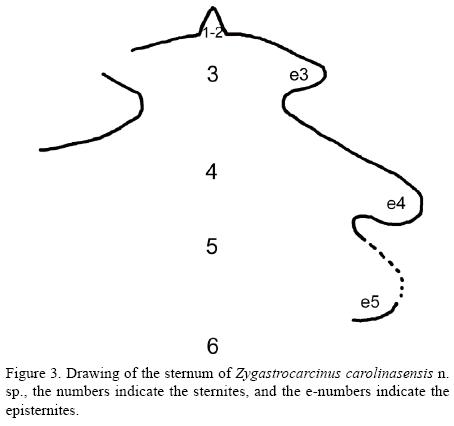
<body><![CDATA[<p align="justify"><font face="verdana" size="2"><b>Type Species.</b> <i>Zygastrocarcinus griesi</i> Bishop, 1983, by original designation.</font></p>  	    <p align="justify"><font face="verdana" size="2"><b>Other Species.</b> <i>Zygastrocarcinus cardsmithi</i> Bishop, 1986; <i>Z. griesi</i> Bishop, 1983; <i>Z. mendryki</i> (Bishop, 1982); <i>Z. waagei</i> Feldmann <i>et al.</i>, 2008, <i>Z. carolinasensis</i> Klompmaker, Ventura, and Vega n. sp.</font></p>  	    <blockquote> 		    <p align="center"><font face="verdana" size="2"><i>Zygastrocarcinus carolinasensis</i> Klompmaker, Ventura, and Vega n. sp.    <br> 		</font><font face="verdana" size="2"><a href="/img/revistas/bsgm/v65n2/a9f2.jpg" target="_blank">Figures 2</a>, <a href="#f3">3</a></font></p> </blockquote>  	    <p align="center"><font face="verdana" size="2"><a name="f3"></a></font></p>  	    <p align="center"><font face="verdana" size="2"><img src="/img/revistas/bsgm/v65n2/a9f3.jpg"></font></p>  	    <p align="justify"><font face="verdana" size="2"><b>Diagnosis.</b> Carapace small; exhibiting tumid regions, tubercles, and strong grooves; moderately convex transversely; lateral side subvertical. Rostrum axially downturned. Front with large concavity adjacent to rostral area. Confluent hepatic and protogastric regions exhibiting four tubercles arranged in a diamond shape with most prominent angle directed posteriorly. Epibranchial region exhibits strong, directed anterolaterally spine. Strong cervical groove broadly V&#45;shaped, anterolaterally directed, straight until approaching epibranchial region. Sternites 1 and 2 forming minute triangle; larger sternite 3 exhibiting raised, laterally directed episternites; sternite 4 larger than sternite 3, exhibiting raised, posterolaterally directed episternites.</font></p>  	    <p align="justify"><font face="verdana" size="2"><b>Description.</b> Carapace small (width ~8 mm); exhibiting tumid regions, tubercles, and strong grooves; moderately convex transversely; lateral side subvertical.</font></p>  	    <p align="justify"><font face="verdana" size="2">Rostrum axially downturned, without spines. Front with large concavity adjacent to rostral area in which eye can rest as is typical of extant homolids (see Guinot and Richer de Forges, 1995). Epigastric regions defined by two rounded tubercles adjacent to tip of long anterior process of mesogastric region, anteriormost one being smallest. Pyriform mesogastric region tumid in posterior portion due to three swellings arranged in a triangle pointing anteriorly in dorsal view, anterior process and posterior portion separated by depression at narrowest part, with two setal pits just lateral to axis of posteriormost portion. Confluent hepatic and protogastric regions exhibiting four tubercles arranged in a diamond shape with most prominent angle directed posteriorly. Uro&#45; and/or metagastric region as wide as mesogastric region. Epibranchial region with strong, anterolaterally directed spine and smaller tubercles posterior to it. Mesobranchial region exhibiting two tubercles lateral to uro&#45; and/or metagastric region, with another branch posterior to uro&#45; and/or metagastric region. Metabranchial region incompletely preserved. Lateral margin rounded.</font></p>  	    ]]></body>
<body><![CDATA[<p align="justify"><font face="verdana" size="2">Grooves generally strong and well developed. Cervical groove broadly V&#45;shaped, directed anterolaterally, straight until approaching epibranchial region, where it bends anteriorly, then curves into anterolateral concavity surrounding anterior part of epibranchial region. Groove defining boundary between epibranchial region and confluent protogastric and hepatic regions connects cervical and branchiocardiac grooves, appears also to be part of longitudinal <i>linea homolica</i>, which is also visible on metabranchial region. Post&#45;cervical groove parallels cervical groove axially, but connects to cervical groove at lateralmost position. Branchiocardiac groove equally strong as and parallels cervical groove dorsally, appears to widen on lateral side.</font></p>  	    <p align="justify"><font face="verdana" size="2">Ventral side showing incompletely preserved, triangular sternum. Sternites 1 and 2 forming minute triangle, curving upward at tip in ventral view. Sternite 3 larger, exhibiting raised, laterally directed episternites. Sternite 4 larger than sternite 3, exhibiting raised, posterolaterally directed episternites. Episternites of sternite 5 not well preserved. Central portion of sternites 5 and 6 preserved. All visible sternites appear fused.</font></p>  	    <p align="justify"><font face="verdana" size="2">Granules (defined as smaller tubercles) present near tubercles on confluent hepatic and protogastric regions, on posterior part of mesogastric region, on uro&#45; and/or metagastric region, and on mesobranchial region.</font></p>  	    <p align="justify"><font face="verdana" size="2">Posterior carapace, subhepatic region, orbits, cuticle, abdomen, sternites 7 and 8, and appendages not preserved.</font></p>  	    <p align="justify"><font face="verdana" size="2"><b>Etymology.</b> The species name refers to the Carolinas, an old, abandoned hacienda near the place where the crab was found.</font></p>  	    <p align="justify"><font face="verdana" size="2"><b>Holotype.</b> CPC&#45;903, Colecci&oacute;n Paleontol&oacute;gica de Coahuila, Museo del Desierto, Saltillo, Coahuila, Mexico.</font></p>  	    <p align="justify"><font face="verdana" size="2"><b>Measurements.</b> Preserved carapace length = 5.2 mm, width = 7.1 mm.</font></p>  	    <p align="justify"><font face="verdana" size="2"><b>Occurrence.</b> Upper portion of the Cerro del Pueblo Formation (upper Campanian), Parras Basin, Difunta Group, Coahuila, NE Mexico.</font></p>  	    <p align="justify"><font face="verdana" size="2"><b>Discussion.</b> The characters of the species fit the genus diagnosis provided by Feldmann <i>et al</i>. (2008): the carapace is ornamented with large tubercles, an extra&#45;lineal area is preserved, the cervical and branchiocardiac grooves are deep and about equally well developed, and the rostrum appears downturned. The latter distinguishes it from <i>Latheticocarcinus</i> Bishop, 1988, which shows the same general outline of regions and ornamentation, but exhibits a bifid or singular rostrum according to Schweitzer <i>et al</i>. (2004).</font></p>  	    <p align="justify"><font face="verdana" size="2">To distinguish species within <i>Zygastrocarcinus</i>, length/width ratios, the widest part of the carapace, tumidity of regions, the ornamentation on the carapace, the cardiac region, the protogastric region, the mesogastric region, and the branchial regions have been used (Bishop, 1982, 1983, 1986; Feldmann <i>et al</i>., 2008). Part of these characters cannot be used in this case because the carapace lacks most of the metabranchial and cardiac regions. Consequently, the focus for differentiating <i>Zygastrocarcinus carolinasensis</i> n. sp. from other species is on the anterior half of the carapace. A combination of three characters can be used to distinguish <i>Z. carolinasensis</i> n. sp. from congeneric species: the distribution pattern of the tubercles on the confluent hepatic and protogastric regions, the course of the cervical groove, and the strong spine on the epibranchial region. The strong tubercles on the hepatic and protogastric regions do not vary in position for species represented by multiple specimens (Bishop, 1983; Feldmann <i>et al</i>., 2008, and casts of <i>Z. waagei</i> stored at Kent State University # 912), suggesting that intraspecific variation is limited for this character along a growth series. This is also true for other homolids known from multiple specimens such as <i>Homolopsis edwardsii</i> (Bell, 1863) and <i>Latheticocarcinus</i> <i>brightoni</i> (Wright and Collins, 1972). Thus, this character can be used to distinguish species here. <i>Zygastrocarcinus</i> <i>carolinasensis</i> n. sp. contains four tubercles that have a different distribution pattern compared to other species (see <a href="#f4">Figure 4</a>). Additionally, <i>Z. waagei</i> appears to exhibit only three strong tubercles instead of four in other, congeneric species. The course of the cervical groove also appears stable over a growth series (Bishop, 1983; Feldmann <i>et al</i>., 2008, and casts of <i>Z. waagei</i> stored at Kent State University # 912). The course of the cervical groove adjacent to the mesogastric region is more laterally directed in <i>Z. griesi</i> and <i>Z. cardsmithi</i> compared to that in <i>Z. carolinasensis</i> n. sp. Lastly, <i>Zygastrocarcinus carolinasensis</i> n. sp. contains a very strong, anterolaterally directed spine on the epibranchial region. This spine appears less prominent in <i>Z.</i> <i>cardsmithi</i> and upwardly oriented in <i>Z. griesi</i>.</font></p>  	    ]]></body>
<body><![CDATA[<p align="center"><font face="verdana" size="2"><a name="f4"></a></font></p>  	    <p align="center"><font face="verdana" size="2"><img src="/img/revistas/bsgm/v65n2/a9f4.jpg"></font></p>  	    <p align="justify"><font face="verdana" size="2">Many species appear relatively flat on the dorsal carapace compared to <i>Z. carolinasensis</i> n. sp., notably <i>Z.</i> <i>cardsmithi</i>, <i>Z. mendryki</i>, and <i>Z. waagei</i>. These are, however, relatively large specimens that cannot be compared directly to the small specimen of <i>Z. carolinasensis</i> n. sp. because decapods can become less convex transversely with age (<i>e.g</i>., Klompmaker <i>et al</i>., 2012; Klompmaker, 2013).</font></p>  	    <p align="justify"><font face="verdana" size="2">Ventral characters are sparsely known from fossil homolids. From the 41 homolids listed by Schweitzer et al. (2010) plus the new species described herein, <i>Navarrahomola hispanica</i> Artal <i>et al</i>. (2012) and <i>'Rathhunopon' atherfieldensis</i> Wright, 1997, and minus <i>Rathbunopon tuberculatum</i> (Van Straelen, 1936) (see Klompmaker <i>et al</i>., 2011 for rationale for the latter two), only seven have an abdomen preserved (<i>Homolopsis</i> <i>chilensis</i> F&ouml;rster and Stinnesbeck, 1987; <i>H. edwardsii</i>; <i>H.</i> <i>spinulosa</i> Glaessner, 1980; <i>Latheticocarcinus&nbsp;brightoni</i>; <i>Zygastrocarcinus griesi</i>; and <i>Z. waagei</i>). This equals 14 % (6/43). On the section level (Homoloida), it is also 14&nbsp;% (7/50) as <i>Mithracites vectensis</i> Gould, 1859, has an abdomen preserved as well. Since the abdomen covers the sternum completely in homolids (see Garassino, 2009, p. 6), it is no surprise that no data on the sterna is available from those species. Even less is known about sterna compared to abdomina. Wright and Collins (1972: p. 36) mentioned about the sternum of <i>Homolopsis spinosa</i> Van Straelen, 1936, from the Albian of Great Britain that "&#91;...&#93; the sternum, partly seen in a single specimen, is long, tongue&#45;shaped in front and concave in cross section with strongly upturned edges." The sternum is not figured. <i>Londinimola williamsi</i> Collins and Saward, 2006, from the Early Eocene of Great Britain is the only figured sternum from a homolid previous to this publication (see their Pl. 1.2b), and appears nearly complete. It is also the oldest known, figured fossil specimen with a sternum preserved from the entire section of the Homoloida until this paper. This Eocene specimen contains a 'homolid press button' on the fourth sternite, a feature to hold the abdomen in place as known from extant homolids (Guinot, 1979; Garassino, 2009). Apparently, this feature had already been developed by the Eocene (Ypresian) ~50 million years ago. The sternum from <i>Z. carolinasensis</i> n. sp. is the oldest known figured sternum of homolids, and thus, of particular importance. The general outline of the sternum with the first two sternites forming a small triangle and the third through fifth sternites containing (postero)laterally directed episternites and being subsequently larger to form a triangular sternum, appears similar to the sternum of extant homolids and the sternum of the Eocene <i>Londinimola williamsi</i>, suggesting that sternal outline remained fairly stable through time within this family and section. Unfortunately, the homolid press button cannot be seen in this specimen due to preservation of the specimen. No sterna and abdomina are known from the Prosopidae from which the homolids would have originated (Collins, 1997).</font></p>  	    <p align="justify"><font face="verdana" size="2">The new taxon is of further importance because it is the first species (and specimen) of the genus known outside the USA. Hitherto, <i>Zygastrocarcinus</i> spp. was only known from the northern part of the USA (Wyoming, Montana, South Dakota) (<a href="/img/revistas/bsgm/v65n2/a9t1.jpg" target="_blank">Table 1</a>). Thus, <i>Z. carolinasensis</i> n. sp. broadens the geographic range during the Cretaceous to a great part of the North American continent. Additionally, this is the second known fossil homolid from Mexico after <i>Homola</i> <i>bajaensis</i> Schweitzer <i>et al</i>., 2006, from the Eocene of Baja California Sur, northwestern Mexico.</font></p>  	    <p align="justify"><font face="verdana" size="2">&nbsp;</font></p>  	    <p align="justify"><font face="verdana" size="2"><b>Acknowledgments</b></font></p>  	    <p align="justify"><font face="verdana" size="2">We are grateful to reviewers Hiroaki Karasawa (Mizunami Fossil Museum, Japan) and Alessandro Garassino (Museo di Storia Naturale, Italy) for constructive comments. We thank Laura Luna&#45;Gonz&aacute;lez (Instituto de Geolog&iacute;a, UNAM, M&eacute;xico) for her kind support with maps and images. Jos&eacute; Manuel Padilla (Museo del Desierto, M&eacute;xico) provided a number for the specimen. This work was supported by the Jon L. and Beverly A. Thompson Endowment Fund to A.A.K. This is University of Florida Contribution to Paleobiology 661.</font></p>  	    <p align="justify"><font face="verdana" size="2">&nbsp;</font></p>  	    <p align="justify"><font face="verdana" size="2"><b>References</b></font></p>  	    ]]></body>
<body><![CDATA[<!-- ref --><p align="justify"><font face="verdana" size="2">Artal, P., Van Bakel, B.W.M., Fraaije, R.H.B., Jagt, J.W.M., Klompmaker, A.A., 2012, New mid&#45;Cretaceous crabs (Crustacea, Decapoda, Podotremata) from Monte Orobe (Navarra, northern Spain): Revista Mexicana de Ciencias Geol&oacute;gicas, 29, 398&#45;410.    &nbsp;&nbsp;&nbsp;&nbsp;&nbsp;&nbsp;&nbsp;&nbsp;[&#160;<a href="javascript:void(0);" onclick="javascript: window.open('/scielo.php?script=sci_nlinks&ref=1413844&pid=S1405-3322201300020000900001&lng=','','width=640,height=500,resizable=yes,scrollbars=1,menubar=yes,');">Links</a>&#160;]<!-- end-ref --></font></p>  	    <!-- ref --><p align="justify"><font face="verdana" size="2">Bell, T., 1863, A monograph of the fossil malacostracous Crustacea of Great Britain, Pt. II, Crustacea of the Gault and Greensand: Palaeontographical Society Monograph, London, 1&#45;40, 11 pls.    &nbsp;&nbsp;&nbsp;&nbsp;&nbsp;&nbsp;&nbsp;&nbsp;[&#160;<a href="javascript:void(0);" onclick="javascript: window.open('/scielo.php?script=sci_nlinks&ref=1413846&pid=S1405-3322201300020000900002&lng=','','width=640,height=500,resizable=yes,scrollbars=1,menubar=yes,');">Links</a>&#160;]<!-- end-ref --></font></p>  	    <!-- ref --><p align="justify"><font face="verdana" size="2">Bishop, G.A., 1982, <i>Homolopsis mendryki</i>: a new fossil crab (Crustacea, Decapoda) from the Late Cretaceous <i>Dakoticancer</i> assemblage, Pierre Shale (Maastrichtian) of South Dakota: Journal of Paleontology, 56, 221&#45;225.    &nbsp;&nbsp;&nbsp;&nbsp;&nbsp;&nbsp;&nbsp;&nbsp;[&#160;<a href="javascript:void(0);" onclick="javascript: window.open('/scielo.php?script=sci_nlinks&ref=1413848&pid=S1405-3322201300020000900003&lng=','','width=640,height=500,resizable=yes,scrollbars=1,menubar=yes,');">Links</a>&#160;]<!-- end-ref --></font></p>  	    <!-- ref --><p align="justify"><font face="verdana" size="2">Bishop, G.A., 1983, Two new species of crabs, <i>Notopocorystes</i> (<i>Eucorystes</i>) <i>eichhorni</i> and <i>Zygastrocarcinus griesi</i> (Decapoda: Brachyura) from the Bearpaw Shale (Campanian) of north&#45;central Montana: Journal of Paleontology, 57, 900&#45;910.    &nbsp;&nbsp;&nbsp;&nbsp;&nbsp;&nbsp;&nbsp;&nbsp;[&#160;<a href="javascript:void(0);" onclick="javascript: window.open('/scielo.php?script=sci_nlinks&ref=1413850&pid=S1405-3322201300020000900004&lng=','','width=640,height=500,resizable=yes,scrollbars=1,menubar=yes,');">Links</a>&#160;]<!-- end-ref --></font></p>  	    <!-- ref --><p align="justify"><font face="verdana" size="2">Bishop, G.A., 1986, A new crab, <i>Zygastrocarcinus cardsmithi</i> (Crustacea, Decapoda), from the lower Pierre Shale, southeastern Montana: Journal of Paleontology, 60, 1097&#45;1102.    &nbsp;&nbsp;&nbsp;&nbsp;&nbsp;&nbsp;&nbsp;&nbsp;[&#160;<a href="javascript:void(0);" onclick="javascript: window.open('/scielo.php?script=sci_nlinks&ref=1413852&pid=S1405-3322201300020000900005&lng=','','width=640,height=500,resizable=yes,scrollbars=1,menubar=yes,');">Links</a>&#160;]<!-- end-ref --></font></p>  	    ]]></body>
<body><![CDATA[<!-- ref --><p align="justify"><font face="verdana" size="2">Bishop, G.A., 1988, New fossil crabs, <i>Plagiophthalmus izetti</i>, <i>Latheticocarcinus shapiroi</i>, and <i>Sagittiformosus carabus</i> (Crustacea, Decapoda), from the Western Interior Cretaceous, U.S.A.: Proceedings of the Biological Society of Washington, 101, 375&#45;381.    &nbsp;&nbsp;&nbsp;&nbsp;&nbsp;&nbsp;&nbsp;&nbsp;[&#160;<a href="javascript:void(0);" onclick="javascript: window.open('/scielo.php?script=sci_nlinks&ref=1413854&pid=S1405-3322201300020000900006&lng=','','width=640,height=500,resizable=yes,scrollbars=1,menubar=yes,');">Links</a>&#160;]<!-- end-ref --></font></p>  	    <!-- ref --><p align="justify"><font face="verdana" size="2">Collins, J.S.H., 1997, Fossil Homolidae (Crustacea; Decapoda): Bulletin of the Mizunami Fossil Museum, 24, 51&#45;71.    &nbsp;&nbsp;&nbsp;&nbsp;&nbsp;&nbsp;&nbsp;&nbsp;[&#160;<a href="javascript:void(0);" onclick="javascript: window.open('/scielo.php?script=sci_nlinks&ref=1413856&pid=S1405-3322201300020000900007&lng=','','width=640,height=500,resizable=yes,scrollbars=1,menubar=yes,');">Links</a>&#160;]<!-- end-ref --></font></p>  	    <!-- ref --><p align="justify"><font face="verdana" size="2">Collins, J.S.H., Wierzbowski, A., 1985, Crabs from the Oxfordian sponge megafacies of Poland: Acta Geologica Polonica, 35, 73&#45;88.    &nbsp;&nbsp;&nbsp;&nbsp;&nbsp;&nbsp;&nbsp;&nbsp;[&#160;<a href="javascript:void(0);" onclick="javascript: window.open('/scielo.php?script=sci_nlinks&ref=1413858&pid=S1405-3322201300020000900008&lng=','','width=640,height=500,resizable=yes,scrollbars=1,menubar=yes,');">Links</a>&#160;]<!-- end-ref --></font></p>  	    <!-- ref --><p align="justify"><font face="verdana" size="2">Collins, J.S.H., Saward, J., 2006, Three new genera and species of crabs from the Lower Eocene of London Clay of Essex, England: Bulletin of the Mizunami Fossil Museum, 33, 67&#45;76.    &nbsp;&nbsp;&nbsp;&nbsp;&nbsp;&nbsp;&nbsp;&nbsp;[&#160;<a href="javascript:void(0);" onclick="javascript: window.open('/scielo.php?script=sci_nlinks&ref=1413860&pid=S1405-3322201300020000900009&lng=','','width=640,height=500,resizable=yes,scrollbars=1,menubar=yes,');">Links</a>&#160;]<!-- end-ref --></font></p>  	    <!-- ref --><p align="justify"><font face="verdana" size="2">De Haan, W., 1833&#45;1850, Crustacea, <i>in</i> von Siebold, P.F. (ed.), Fauna Japonica sive Descriptio Animalium, quae in Itinere per Japoniam, Jussu et Auspiciis Superiorum, qui summum in India Batava Imperium Tenent, Suscepto, Annis 1823&#45;1830 Collegit, Notis, Observationibus et Adumbrationibus Illustravit: i&#45;xvii, i&#45;xxxi, ix&#45;xvi, 1&#45;243, pls. A&#45;J, L&#45;Q, 1&#45;55, circ. table 2. (J. M&uuml;ller et Co., Lugduni Batavorum &#91;=Leyden&#93;    &nbsp;&nbsp;&nbsp;&nbsp;&nbsp;&nbsp;&nbsp;&nbsp;[&#160;<a href="javascript:void(0);" onclick="javascript: window.open('/scielo.php?script=sci_nlinks&ref=1413862&pid=S1405-3322201300020000900010&lng=','','width=640,height=500,resizable=yes,scrollbars=1,menubar=yes,');">Links</a>&#160;]<!-- end-ref -->).</font></p>  	    ]]></body>
<body><![CDATA[<!-- ref --><p align="justify"><font face="verdana" size="2">Eberth, D.A., Delgado de Jes&uacute;s, C.R., Lerbekmo, J.F., Brinkman, D.B., Rodr&iacute;guez de La Rosa, R., Sampson, S.D., 2004, Cerro del Pueblo Fm (Difunta Group, Upper Cretaceous), Parras Basin, southern Coahuila, Mexico: reference sections, age, and correlation: Revista Mexicana de Ciencias Geol&oacute;gicas, 21, 335&#45;352.    &nbsp;&nbsp;&nbsp;&nbsp;&nbsp;&nbsp;&nbsp;&nbsp;[&#160;<a href="javascript:void(0);" onclick="javascript: window.open('/scielo.php?script=sci_nlinks&ref=1413864&pid=S1405-3322201300020000900011&lng=','','width=640,height=500,resizable=yes,scrollbars=1,menubar=yes,');">Links</a>&#160;]<!-- end-ref --></font></p>  	    <!-- ref --><p align="justify"><font face="verdana" size="2">Feldmann, R.M., Schweitzer, C.E., Green, R.M., 2008, Unusual Albian (Early Cretaceous) Brachyura (Homoloidea: Componocancroidea new superfamily) from Montana and Wyoming, U.S.A.: Journal of Crustacean Biology, 28, 502&#45;509.    &nbsp;&nbsp;&nbsp;&nbsp;&nbsp;&nbsp;&nbsp;&nbsp;[&#160;<a href="javascript:void(0);" onclick="javascript: window.open('/scielo.php?script=sci_nlinks&ref=1413866&pid=S1405-3322201300020000900012&lng=','','width=640,height=500,resizable=yes,scrollbars=1,menubar=yes,');">Links</a>&#160;]<!-- end-ref --></font></p>  	    <!-- ref --><p align="justify"><font face="verdana" size="2">F&ouml;rster, R., Stinnesbeck, W., 1987, Zwei neue Krebse, <i>Callianasssa</i> <i>saetosa</i> n. sp. und <i>Homolopsis chilensis</i> n. sp. (Crustacea, Decapoda) aus der Oberkreide Zentral&#45;Chiles: Mitteilungen der Bayerischen Staatssammlung f&uuml;r Pal&auml;ontologie und Historische Geologie, 27, 51&#45;65.    &nbsp;&nbsp;&nbsp;&nbsp;&nbsp;&nbsp;&nbsp;&nbsp;[&#160;<a href="javascript:void(0);" onclick="javascript: window.open('/scielo.php?script=sci_nlinks&ref=1413868&pid=S1405-3322201300020000900013&lng=','','width=640,height=500,resizable=yes,scrollbars=1,menubar=yes,');">Links</a>&#160;]<!-- end-ref --></font></p>  	    <!-- ref --><p align="justify"><font face="verdana" size="2">Garassino, A., 2009, The thoracic sternum and spermatheca in the extant genera of the family Homolidae De Haan, 1839 (Crustacea, Decapoda, Brachyura): Memorie della Societ&agrave; italiana di Scienze naturali e del Museo civico di Storia natural di Milano, 36, 3, 1&#45;80.    &nbsp;&nbsp;&nbsp;&nbsp;&nbsp;&nbsp;&nbsp;&nbsp;[&#160;<a href="javascript:void(0);" onclick="javascript: window.open('/scielo.php?script=sci_nlinks&ref=1413870&pid=S1405-3322201300020000900014&lng=','','width=640,height=500,resizable=yes,scrollbars=1,menubar=yes,');">Links</a>&#160;]<!-- end-ref --></font></p>  	    <!-- ref --><p align="justify"><font face="verdana" size="2">Glaessner, M.F., 1933, Die Krabben der Juraformation: Zentralblatt f&uuml;r Mineralogie, Geologie und Pal&auml;ontologie, (B), 3, 178&#45;191.    &nbsp;&nbsp;&nbsp;&nbsp;&nbsp;&nbsp;&nbsp;&nbsp;[&#160;<a href="javascript:void(0);" onclick="javascript: window.open('/scielo.php?script=sci_nlinks&ref=1413872&pid=S1405-3322201300020000900015&lng=','','width=640,height=500,resizable=yes,scrollbars=1,menubar=yes,');">Links</a>&#160;]<!-- end-ref --></font></p>  	    ]]></body>
<body><![CDATA[<!-- ref --><p align="justify"><font face="verdana" size="2">Glaessner, M.F., 1980, New Cretaceous and Tertiary crabs (Crustacea: Brachyura) from Australia and New Zealand: Transactions of the Royal Society of South Australia, 104, 171&#45;192.    &nbsp;&nbsp;&nbsp;&nbsp;&nbsp;&nbsp;&nbsp;&nbsp;[&#160;<a href="javascript:void(0);" onclick="javascript: window.open('/scielo.php?script=sci_nlinks&ref=1413874&pid=S1405-3322201300020000900016&lng=','','width=640,height=500,resizable=yes,scrollbars=1,menubar=yes,');">Links</a>&#160;]<!-- end-ref --></font></p>  	    <!-- ref --><p align="justify"><font face="verdana" size="2">Gould, C., 1859, Description of a new fossil crustacean from the lower Greensand: Quarterly Journal of the Geological Society, 15, 237&#45;238.    &nbsp;&nbsp;&nbsp;&nbsp;&nbsp;&nbsp;&nbsp;&nbsp;[&#160;<a href="javascript:void(0);" onclick="javascript: window.open('/scielo.php?script=sci_nlinks&ref=1413876&pid=S1405-3322201300020000900017&lng=','','width=640,height=500,resizable=yes,scrollbars=1,menubar=yes,');">Links</a>&#160;]<!-- end-ref --></font></p>  	    <!-- ref --><p align="justify"><font face="verdana" size="2">Guinot, D., 1979, Donn&eacute;es nouvelles sur la morphologie, la phylogen&egrave;se et la taxonomie des Crustac&eacute;s D&eacute;capodes Brachyoures: M&eacute;moires du Mus&eacute;um national d'Histoire naturelle, Nouvelle S&eacute;rie, S&eacute;rie A, Zoologie, 112, 1&#45;354.    &nbsp;&nbsp;&nbsp;&nbsp;&nbsp;&nbsp;&nbsp;&nbsp;[&#160;<a href="javascript:void(0);" onclick="javascript: window.open('/scielo.php?script=sci_nlinks&ref=1413878&pid=S1405-3322201300020000900018&lng=','','width=640,height=500,resizable=yes,scrollbars=1,menubar=yes,');">Links</a>&#160;]<!-- end-ref --></font></p>  	    <!-- ref --><p align="justify"><font face="verdana" size="2">Guinot, D., Richer de Forges, B., 1995, Crustacea Decapoda Brachyura: r&eacute;vision de la famille des Homolidae De Haan, 1839, <i>in</i> Crosnier, A. (ed.), R&eacute;sultats des Campagnes MUSORSTOM, 13: M&eacute;moires du Mus&eacute;um National d'Histoire Naturelle, Paris, 163, 283&#45;517.    &nbsp;&nbsp;&nbsp;&nbsp;&nbsp;&nbsp;&nbsp;&nbsp;[&#160;<a href="javascript:void(0);" onclick="javascript: window.open('/scielo.php?script=sci_nlinks&ref=1413880&pid=S1405-3322201300020000900019&lng=','','width=640,height=500,resizable=yes,scrollbars=1,menubar=yes,');">Links</a>&#160;]<!-- end-ref --></font></p>  	    <!-- ref --><p align="justify"><font face="verdana" size="2">Karasawa, H., Schweitzer, C.E., Feldmann, R.M., 2011, Phylogenetic analysis and revised classification of podotrematous Brachyura (Decapoda) including extinct and extant families: Journal of Crustacean Biology, 31, 523&#45;565.    &nbsp;&nbsp;&nbsp;&nbsp;&nbsp;&nbsp;&nbsp;&nbsp;[&#160;<a href="javascript:void(0);" onclick="javascript: window.open('/scielo.php?script=sci_nlinks&ref=1413882&pid=S1405-3322201300020000900020&lng=','','width=640,height=500,resizable=yes,scrollbars=1,menubar=yes,');">Links</a>&#160;]<!-- end-ref --></font></p>  	    ]]></body>
<body><![CDATA[<!-- ref --><p align="justify"><font face="verdana" size="2">Klompmaker, A.A., 2013, Extreme diversity of decapod crustaceans from the mid&#45;Cretaceous (late Albian) of Spain: implications for Cretaceous decapod paleoecology: Cretaceous Research, 41, 150&#45;185.    &nbsp;&nbsp;&nbsp;&nbsp;&nbsp;&nbsp;&nbsp;&nbsp;[&#160;<a href="javascript:void(0);" onclick="javascript: window.open('/scielo.php?script=sci_nlinks&ref=1413884&pid=S1405-3322201300020000900021&lng=','','width=640,height=500,resizable=yes,scrollbars=1,menubar=yes,');">Links</a>&#160;]<!-- end-ref --></font></p>  	    <!-- ref --><p align="justify"><font face="verdana" size="2">Klompmaker, A.A., Artal, P., Gulisano, G., 2011, The Cretaceous crab <i>Rathbunopon</i>: revision, a new species and new localities: Neues Jahrbuch f&uuml;r Geologie und Pal&auml;ontologie Abhandlungen, 260, 191&#45;202.    &nbsp;&nbsp;&nbsp;&nbsp;&nbsp;&nbsp;&nbsp;&nbsp;[&#160;<a href="javascript:void(0);" onclick="javascript: window.open('/scielo.php?script=sci_nlinks&ref=1413886&pid=S1405-3322201300020000900022&lng=','','width=640,height=500,resizable=yes,scrollbars=1,menubar=yes,');">Links</a>&#160;]<!-- end-ref --></font></p>  	    <!-- ref --><p align="justify"><font face="verdana" size="2">Klompmaker, A.A., Feldmann, R.M., Schweitzer, C.E., 2012, A hotspot for Cretaceous goniodromitids (Decapoda: Brachyura) from reef associated strata in Spain: Journal of Crustacean Biology, 32, 780&#45;801.    &nbsp;&nbsp;&nbsp;&nbsp;&nbsp;&nbsp;&nbsp;&nbsp;[&#160;<a href="javascript:void(0);" onclick="javascript: window.open('/scielo.php?script=sci_nlinks&ref=1413888&pid=S1405-3322201300020000900023&lng=','','width=640,height=500,resizable=yes,scrollbars=1,menubar=yes,');">Links</a>&#160;]<!-- end-ref --></font></p>  	    <!-- ref --><p align="justify"><font face="verdana" size="2">Latreille, P.A., 1802&#45;1803, Histoire naturelle, g&eacute;n&eacute;rale et particuli&egrave;re, des crustac&eacute;s et des insects, 3. F. Dufart, Paris.    &nbsp;&nbsp;&nbsp;&nbsp;&nbsp;&nbsp;&nbsp;&nbsp;[&#160;<a href="javascript:void(0);" onclick="javascript: window.open('/scielo.php?script=sci_nlinks&ref=1413890&pid=S1405-3322201300020000900024&lng=','','width=640,height=500,resizable=yes,scrollbars=1,menubar=yes,');">Links</a>&#160;]<!-- end-ref --></font></p>  	    <!-- ref --><p align="justify"><font face="verdana" size="2">Lawton, T.F., Bradford, I.A., Vega, F.J., Gehrels, G.E., Giles, K.A., Amato, J.M., 2009, Provenance of Upper Cretaceous&#45;Paleogene sandstones in the foreland basin system of the Sierra Madre Oriental, northwestern Mexico, and its bearing on fluvial dispersal systems of the Mexican Laramide Province: Geological Society of America Bulletin, 121, 820&#45;836.    &nbsp;&nbsp;&nbsp;&nbsp;&nbsp;&nbsp;&nbsp;&nbsp;[&#160;<a href="javascript:void(0);" onclick="javascript: window.open('/scielo.php?script=sci_nlinks&ref=1413892&pid=S1405-3322201300020000900025&lng=','','width=640,height=500,resizable=yes,scrollbars=1,menubar=yes,');">Links</a>&#160;]<!-- end-ref --></font></p>  	    ]]></body>
<body><![CDATA[<!-- ref --><p align="justify"><font face="verdana" size="2">Linnaeus, C. &#91;von&#93;, 1758, Systema Naturae per Regna tria Naturae, secundum classes, ordines, genera, species, cum characteribus, differentiis, synonymis, locis (ed. 10), 1, 1&#45;824. Laurentii Salvii, Holmiae &#91;=Stockholm&#93;    &nbsp;&nbsp;&nbsp;&nbsp;&nbsp;&nbsp;&nbsp;&nbsp;[&#160;<a href="javascript:void(0);" onclick="javascript: window.open('/scielo.php?script=sci_nlinks&ref=1413894&pid=S1405-3322201300020000900026&lng=','','width=640,height=500,resizable=yes,scrollbars=1,menubar=yes,');">Links</a>&#160;]<!-- end-ref -->.</font></p>  	    <!-- ref --><p align="justify"><font face="verdana" size="2">Milne&#45;Edwards, A., <i>in</i> Henderson, J.R., 1888, Report on the Anomura collected by H.M.S Challenger during the years 1873&#45;1876,    &nbsp;&nbsp;&nbsp;&nbsp;&nbsp;&nbsp;&nbsp;&nbsp;[&#160;<a href="javascript:void(0);" onclick="javascript: window.open('/scielo.php?script=sci_nlinks&ref=1413896&pid=S1405-3322201300020000900027&lng=','','width=640,height=500,resizable=yes,scrollbars=1,menubar=yes,');">Links</a>&#160;]<!-- end-ref --><!-- ref --> <i>in</i> Murray, J., Zoology. Wyville Thomson, C., Murray, J., Report on the Scientific Results of the Voyage of H.M.S. Challenger During the Years 1873&#45;76 Under the Command of Captain George S. Nares, R.N., F.R.S. and the Late Captain Frank Tourle Thomson, R.N. Vol. 27. Edinburgh, Neill and Company, Pp. i&#45;xi, 1&#45;221, Plates 1&#45;21.    &nbsp;&nbsp;&nbsp;&nbsp;&nbsp;&nbsp;&nbsp;&nbsp;[&#160;<a href="javascript:void(0);" onclick="javascript: window.open('/scielo.php?script=sci_nlinks&ref=1413897&pid=S1405-3322201300020000900028&lng=','','width=640,height=500,resizable=yes,scrollbars=1,menubar=yes,');">Links</a>&#160;]<!-- end-ref --></font></p>  	    <!-- ref --><p align="justify"><font face="verdana" size="2">Patrulius, D., 1966, Les D&eacute;capodes du Tithonique Inf&eacute;rieur de Wo&#378;niki (Carpates Polonaises Occidentales): Annales de la Soci&eacute;t&eacute; G&eacute;ologique de Pologne, 36, 4, 495&#45;517.    &nbsp;&nbsp;&nbsp;&nbsp;&nbsp;&nbsp;&nbsp;&nbsp;[&#160;<a href="javascript:void(0);" onclick="javascript: window.open('/scielo.php?script=sci_nlinks&ref=1413899&pid=S1405-3322201300020000900029&lng=','','width=640,height=500,resizable=yes,scrollbars=1,menubar=yes,');">Links</a>&#160;]<!-- end-ref --></font></p>  	    <!-- ref --><p align="justify"><font face="verdana" size="2">Rodr&iacute;guez&#45;de la Rosa, R., Cevallos&#45;Ferriz, S.R.S., 1998, Vertebrates of the El Pelillal locality (Campanian, Cerro del Pueblo Formation), southeastern Coahuila, Mexico: Journal of Vertebrate Paleontology, 18, 751&#45;764.    &nbsp;&nbsp;&nbsp;&nbsp;&nbsp;&nbsp;&nbsp;&nbsp;[&#160;<a href="javascript:void(0);" onclick="javascript: window.open('/scielo.php?script=sci_nlinks&ref=1413901&pid=S1405-3322201300020000900030&lng=','','width=640,height=500,resizable=yes,scrollbars=1,menubar=yes,');">Links</a>&#160;]<!-- end-ref --></font></p>  	    <!-- ref --><p align="justify"><font face="verdana" size="2">Schweitzer, C.E., Nyborg, T.G., Feldmann, R.M., Ross, R.L.M., 2004, Homolidae De Haan, 1839 and Homolodromiidae Alcock, 1900 (Crustacea: Decapoda: Brachyura) from the Pacific Northwest of North America and a reassessment of their fossil records: Journal of Paleontology, 78, 133&#45;149.    &nbsp;&nbsp;&nbsp;&nbsp;&nbsp;&nbsp;&nbsp;&nbsp;[&#160;<a href="javascript:void(0);" onclick="javascript: window.open('/scielo.php?script=sci_nlinks&ref=1413903&pid=S1405-3322201300020000900031&lng=','','width=640,height=500,resizable=yes,scrollbars=1,menubar=yes,');">Links</a>&#160;]<!-- end-ref --></font></p>  	    <!-- ref --><p align="justify"><font face="verdana" size="2">Schweitzer, C.E., Feldmann, R.M., Gonzalez&#45;Barba, G., &#262;osovi&#263;, V., 2006, New Decapoda (Anomura, Brachyura) from the Eocene Bateque and Tepetate Formations, Baja California Sur, Mexico: Bulletin of the Mizunami Fossil Museum, 33, 21&#45;45.    &nbsp;&nbsp;&nbsp;&nbsp;&nbsp;&nbsp;&nbsp;&nbsp;[&#160;<a href="javascript:void(0);" onclick="javascript: window.open('/scielo.php?script=sci_nlinks&ref=1413905&pid=S1405-3322201300020000900032&lng=','','width=640,height=500,resizable=yes,scrollbars=1,menubar=yes,');">Links</a>&#160;]<!-- end-ref --></font></p>  	    <!-- ref --><p align="justify"><font face="verdana" size="2">Schweitzer, C.E., Feldmann, R.M., 2008, Revision of the genus <i>Laeviprosopon</i> Glaessner, 1933 (Decapoda: Brachyura: Homolodromioidea: Prosopidae) including two new species: Neues Jahrbuch f&uuml;r Geologie und Pal&auml;ontologie Abhandlungen, 250, 273&#45;285.    &nbsp;&nbsp;&nbsp;&nbsp;&nbsp;&nbsp;&nbsp;&nbsp;[&#160;<a href="javascript:void(0);" onclick="javascript: window.open('/scielo.php?script=sci_nlinks&ref=1413907&pid=S1405-3322201300020000900033&lng=','','width=640,height=500,resizable=yes,scrollbars=1,menubar=yes,');">Links</a>&#160;]<!-- end-ref --></font></p>  	    <!-- ref --><p align="justify"><font face="verdana" size="2">Schweitzer, C.E., Feldmann, R.M., Garassino, A., Karasawa, H., Schweigert, G., 2010, Systematic list of fossil decapod crustaceans species: Crustaceana Monographs, 10, 1&#45;222.    &nbsp;&nbsp;&nbsp;&nbsp;&nbsp;&nbsp;&nbsp;&nbsp;[&#160;<a href="javascript:void(0);" onclick="javascript: window.open('/scielo.php?script=sci_nlinks&ref=1413909&pid=S1405-3322201300020000900034&lng=','','width=640,height=500,resizable=yes,scrollbars=1,menubar=yes,');">Links</a>&#160;]<!-- end-ref --></font></p>  	    <!-- ref --><p align="justify"><font face="verdana" size="2">Van Straelen, V., 1936, Crustac&eacute;s D&eacute;capodes nouveaux ou peu connus de l'&eacute;poque Cr&eacute;tacique: Bulletin du Mus&eacute;e Royal d'Histoire Naturelle de Belgique, 12, 45, 1&#45;49.    &nbsp;&nbsp;&nbsp;&nbsp;&nbsp;&nbsp;&nbsp;&nbsp;[&#160;<a href="javascript:void(0);" onclick="javascript: window.open('/scielo.php?script=sci_nlinks&ref=1413911&pid=S1405-3322201300020000900035&lng=','','width=640,height=500,resizable=yes,scrollbars=1,menubar=yes,');">Links</a>&#160;]<!-- end-ref --></font></p>  	    <!-- ref --><p align="justify"><font face="verdana" size="2">Wehner, G., 1988, &Uuml;ber die Prosoponiden (Crustacea, Decapoda) des Jura: Ph.D. Dissertation, Ludwig&#45; Maximilians&#45;Universit&auml;t, M&uuml;nchen, 154 p., 8 pls., 1 insert.    &nbsp;&nbsp;&nbsp;&nbsp;&nbsp;&nbsp;&nbsp;&nbsp;[&#160;<a href="javascript:void(0);" onclick="javascript: window.open('/scielo.php?script=sci_nlinks&ref=1413913&pid=S1405-3322201300020000900036&lng=','','width=640,height=500,resizable=yes,scrollbars=1,menubar=yes,');">Links</a>&#160;]<!-- end-ref --></font></p>  	    <!-- ref --><p align="justify"><font face="verdana" size="2">Wright, C.W., 1997, New information on Cretaceous crabs: Bulletin of the Natural History Museum, London, 53, 135&#45;138.    &nbsp;&nbsp;&nbsp;&nbsp;&nbsp;&nbsp;&nbsp;&nbsp;[&#160;<a href="javascript:void(0);" onclick="javascript: window.open('/scielo.php?script=sci_nlinks&ref=1413915&pid=S1405-3322201300020000900037&lng=','','width=640,height=500,resizable=yes,scrollbars=1,menubar=yes,');">Links</a>&#160;]<!-- end-ref --></font></p>  	    <!-- ref --><p align="justify"><font face="verdana" size="2">Wright, C.W., Collins, J.S.H., 1972, British Cretaceous crabs: Monograph of the Palaeontographical Society London, 126(533), 1&#45;113.    &nbsp;&nbsp;&nbsp;&nbsp;&nbsp;&nbsp;&nbsp;&nbsp;[&#160;<a href="javascript:void(0);" onclick="javascript: window.open('/scielo.php?script=sci_nlinks&ref=1413917&pid=S1405-3322201300020000900038&lng=','','width=640,height=500,resizable=yes,scrollbars=1,menubar=yes,');">Links</a>&#160;]<!-- end-ref --></font></p>      ]]></body><back>
<ref-list>
<ref id="B1">
<nlm-citation citation-type="journal">
<person-group person-group-type="author">
<name>
<surname><![CDATA[Artal]]></surname>
<given-names><![CDATA[P.]]></given-names>
</name>
<name>
<surname><![CDATA[Van Bakel]]></surname>
<given-names><![CDATA[B.W.M.]]></given-names>
</name>
<name>
<surname><![CDATA[Fraaije]]></surname>
<given-names><![CDATA[R.H.B.]]></given-names>
</name>
<name>
<surname><![CDATA[Jagt]]></surname>
<given-names><![CDATA[J.W.M.]]></given-names>
</name>
<name>
<surname><![CDATA[Klompmaker]]></surname>
<given-names><![CDATA[A.A.]]></given-names>
</name>
</person-group>
<article-title xml:lang="en"><![CDATA[New mid-Cretaceous crabs (Crustacea, Decapoda, Podotremata) from Monte Orobe (Navarra, northern Spain)]]></article-title>
<source><![CDATA[Revista Mexicana de Ciencias Geológicas]]></source>
<year>2012</year>
<volume>29</volume>
<page-range>398-410</page-range></nlm-citation>
</ref>
<ref id="B2">
<nlm-citation citation-type="book">
<person-group person-group-type="author">
<name>
<surname><![CDATA[Bell]]></surname>
<given-names><![CDATA[T.]]></given-names>
</name>
</person-group>
<source><![CDATA[A monograph of the fossil malacostracous Crustacea of Great Britain, Pt. II, Crustacea of the Gault and Greensand]]></source>
<year>1863</year>
<page-range>1-40</page-range><publisher-loc><![CDATA[London ]]></publisher-loc>
<publisher-name><![CDATA[Palaeontographical Society Monograph]]></publisher-name>
</nlm-citation>
</ref>
<ref id="B3">
<nlm-citation citation-type="journal">
<person-group person-group-type="author">
<name>
<surname><![CDATA[Bishop]]></surname>
<given-names><![CDATA[G.A.]]></given-names>
</name>
</person-group>
<article-title xml:lang="en"><![CDATA[Homolopsis mendryki: a new fossil crab (Crustacea, Decapoda) from the Late Cretaceous Dakoticancer assemblage, Pierre Shale (Maastrichtian) of South Dakota]]></article-title>
<source><![CDATA[Journal of Paleontology]]></source>
<year>1982</year>
<volume>56</volume>
<page-range>221-225</page-range></nlm-citation>
</ref>
<ref id="B4">
<nlm-citation citation-type="journal">
<person-group person-group-type="author">
<name>
<surname><![CDATA[Bishop]]></surname>
<given-names><![CDATA[G.A.]]></given-names>
</name>
</person-group>
<article-title xml:lang="en"><![CDATA[Two new species of crabs, Notopocorystes (Eucorystes) eichhorni and Zygastrocarcinus griesi (Decapoda: Brachyura) from the Bearpaw Shale (Campanian) of north-central Montana]]></article-title>
<source><![CDATA[Journal of Paleontology]]></source>
<year>1983</year>
<volume>57</volume>
<page-range>900-910</page-range></nlm-citation>
</ref>
<ref id="B5">
<nlm-citation citation-type="journal">
<person-group person-group-type="author">
<name>
<surname><![CDATA[Bishop]]></surname>
<given-names><![CDATA[G.A.]]></given-names>
</name>
</person-group>
<article-title xml:lang="en"><![CDATA[A new crab, Zygastrocarcinus cardsmithi (Crustacea, Decapoda), from the lower Pierre Shale, southeastern Montana]]></article-title>
<source><![CDATA[Journal of Paleontology]]></source>
<year>1986</year>
<volume>60</volume>
<page-range>1097-1102</page-range></nlm-citation>
</ref>
<ref id="B6">
<nlm-citation citation-type="journal">
<person-group person-group-type="author">
<name>
<surname><![CDATA[Bishop]]></surname>
<given-names><![CDATA[G.A.]]></given-names>
</name>
</person-group>
<article-title xml:lang="en"><![CDATA[New fossil crabs, Plagiophthalmus izetti, Latheticocarcinus shapiroi, and Sagittiformosus carabus (Crustacea, Decapoda), from the Western Interior Cretaceous, U.S.A.]]></article-title>
<source><![CDATA[Proceedings of the Biological Society of Washington]]></source>
<year>1988</year>
<volume>101</volume>
<page-range>375-381</page-range></nlm-citation>
</ref>
<ref id="B7">
<nlm-citation citation-type="journal">
<person-group person-group-type="author">
<name>
<surname><![CDATA[Collins]]></surname>
<given-names><![CDATA[J.S.H.]]></given-names>
</name>
</person-group>
<article-title xml:lang="en"><![CDATA[Fossil Homolidae (Crustacea; Decapoda)]]></article-title>
<source><![CDATA[Bulletin of the Mizunami Fossil Museum]]></source>
<year>1997</year>
<volume>24</volume>
<page-range>51-71</page-range></nlm-citation>
</ref>
<ref id="B8">
<nlm-citation citation-type="journal">
<person-group person-group-type="author">
<name>
<surname><![CDATA[Collins]]></surname>
<given-names><![CDATA[J.S.H.]]></given-names>
</name>
<name>
<surname><![CDATA[Wierzbowski]]></surname>
<given-names><![CDATA[A.]]></given-names>
</name>
</person-group>
<article-title xml:lang="en"><![CDATA[Crabs from the Oxfordian sponge megafacies of Poland]]></article-title>
<source><![CDATA[Acta Geologica Polonica]]></source>
<year>1985</year>
<volume>35</volume>
<page-range>73-88</page-range></nlm-citation>
</ref>
<ref id="B9">
<nlm-citation citation-type="journal">
<person-group person-group-type="author">
<name>
<surname><![CDATA[Collins]]></surname>
<given-names><![CDATA[J.S.H.]]></given-names>
</name>
<name>
<surname><![CDATA[Saward]]></surname>
<given-names><![CDATA[J.]]></given-names>
</name>
</person-group>
<article-title xml:lang="en"><![CDATA[Three new genera and species of crabs from the Lower Eocene of London Clay of Essex, England]]></article-title>
<source><![CDATA[Bulletin of the Mizunami Fossil Museum]]></source>
<year>2006</year>
<volume>33</volume>
<page-range>67-76</page-range></nlm-citation>
</ref>
<ref id="B10">
<nlm-citation citation-type="">
<person-group person-group-type="author">
<name>
<surname><![CDATA[De Haan]]></surname>
<given-names><![CDATA[W.]]></given-names>
</name>
</person-group>
<article-title xml:lang="en"><![CDATA[Crustacea]]></article-title>
<person-group person-group-type="editor">
<name>
<surname><![CDATA[von Siebold]]></surname>
<given-names><![CDATA[P.F.]]></given-names>
</name>
</person-group>
<source><![CDATA[Fauna Japonica sive Descriptio Animalium, quae in Itinere per Japoniam, Jussu et Auspiciis Superiorum, qui summum in India Batava Imperium Tenent, Suscepto, Annis 1823-1830 Collegit, Notis, Observationibus et Adumbrationibus Illustravit: i-xvii, i-xxxi, ix-xvi, 1-243, pls. A-J, L-Q, 1-55, circ. table 2.]]></source>
<year>1833</year>
</nlm-citation>
</ref>
<ref id="B11">
<nlm-citation citation-type="journal">
<person-group person-group-type="author">
<name>
<surname><![CDATA[Eberth]]></surname>
<given-names><![CDATA[D.A.]]></given-names>
</name>
<name>
<surname><![CDATA[Delgado de Jesús]]></surname>
<given-names><![CDATA[C.R.]]></given-names>
</name>
<name>
<surname><![CDATA[Lerbekmo]]></surname>
<given-names><![CDATA[J.F.]]></given-names>
</name>
<name>
<surname><![CDATA[Brinkman]]></surname>
<given-names><![CDATA[D.B.]]></given-names>
</name>
<name>
<surname><![CDATA[Rodríguez de La Rosa]]></surname>
<given-names><![CDATA[R.]]></given-names>
</name>
<name>
<surname><![CDATA[Sampson]]></surname>
<given-names><![CDATA[S.D.]]></given-names>
</name>
</person-group>
<article-title xml:lang="es"><![CDATA[Cerro del Pueblo Fm (Difunta Group, Upper Cretaceous), Parras Basin, southern Coahuila, Mexico: reference sections, age, and correlation]]></article-title>
<source><![CDATA[Revista Mexicana de Ciencias Geológicas]]></source>
<year>2004</year>
<volume>21</volume>
<page-range>335-352</page-range></nlm-citation>
</ref>
<ref id="B12">
<nlm-citation citation-type="journal">
<person-group person-group-type="author">
<name>
<surname><![CDATA[Feldmann]]></surname>
<given-names><![CDATA[R.M.]]></given-names>
</name>
<name>
<surname><![CDATA[Schweitzer]]></surname>
<given-names><![CDATA[C.E.]]></given-names>
</name>
<name>
<surname><![CDATA[Green]]></surname>
<given-names><![CDATA[R.M.]]></given-names>
</name>
</person-group>
<article-title xml:lang="en"><![CDATA[Unusual Albian (Early Cretaceous) Brachyura (Homoloidea: Componocancroidea new superfamily) from Montana and Wyoming, U.S.A.]]></article-title>
<source><![CDATA[Journal of Crustacean Biology]]></source>
<year>2008</year>
<volume>28</volume>
<page-range>502-509</page-range></nlm-citation>
</ref>
<ref id="B13">
<nlm-citation citation-type="journal">
<person-group person-group-type="author">
<name>
<surname><![CDATA[Förster]]></surname>
<given-names><![CDATA[R.]]></given-names>
</name>
<name>
<surname><![CDATA[Stinnesbeck]]></surname>
<given-names><![CDATA[W.]]></given-names>
</name>
</person-group>
<article-title xml:lang="de"><![CDATA[Zwei neue Krebse, Callianasssa saetosa n. sp. und Homolopsis chilensis n. sp. (Crustacea, Decapoda) aus der Oberkreide Zentral-Chiles]]></article-title>
<source><![CDATA[Mitteilungen der Bayerischen Staatssammlung für Paläontologie und Historische Geologie]]></source>
<year>1987</year>
<volume>27</volume>
<page-range>51-65</page-range></nlm-citation>
</ref>
<ref id="B14">
<nlm-citation citation-type="journal">
<person-group person-group-type="author">
<name>
<surname><![CDATA[Garassino]]></surname>
<given-names><![CDATA[A.]]></given-names>
</name>
</person-group>
<article-title xml:lang="en"><![CDATA[The thoracic sternum and spermatheca in the extant genera of the family Homolidae De Haan, 1839 (Crustacea, Decapoda, Brachyura)]]></article-title>
<source><![CDATA[Memorie della Società italiana di Scienze naturali e del Museo civico di Storia natural di Milano]]></source>
<year>2009</year>
<volume>36</volume>
<numero>3</numero>
<issue>3</issue>
<page-range>1-80</page-range></nlm-citation>
</ref>
<ref id="B15">
<nlm-citation citation-type="journal">
<person-group person-group-type="author">
<name>
<surname><![CDATA[Glaessner]]></surname>
<given-names><![CDATA[M.F.]]></given-names>
</name>
</person-group>
<article-title xml:lang="de"><![CDATA[Die Krabben der Juraformation]]></article-title>
<source><![CDATA[Zentralblatt für Mineralogie, Geologie und Paläontologie, (B)]]></source>
<year>1933</year>
<volume>3</volume>
<page-range>178-191</page-range></nlm-citation>
</ref>
<ref id="B16">
<nlm-citation citation-type="journal">
<person-group person-group-type="author">
<name>
<surname><![CDATA[Glaessner]]></surname>
<given-names><![CDATA[M.F.]]></given-names>
</name>
</person-group>
<article-title xml:lang="en"><![CDATA[New Cretaceous and Tertiary crabs (Crustacea: Brachyura) from Australia and New Zealand]]></article-title>
<source><![CDATA[Transactions of the Royal Society of South Australia]]></source>
<year>1980</year>
<volume>104</volume>
<page-range>171-192</page-range></nlm-citation>
</ref>
<ref id="B17">
<nlm-citation citation-type="journal">
<person-group person-group-type="author">
<name>
<surname><![CDATA[Gould]]></surname>
<given-names><![CDATA[C.]]></given-names>
</name>
</person-group>
<article-title xml:lang="en"><![CDATA[Description of a new fossil crustacean from the lower Greensand]]></article-title>
<source><![CDATA[Quarterly Journal of the Geological Society]]></source>
<year>1859</year>
<volume>15</volume>
<page-range>237-238</page-range></nlm-citation>
</ref>
<ref id="B18">
<nlm-citation citation-type="">
<person-group person-group-type="author">
<name>
<surname><![CDATA[Guinot]]></surname>
<given-names><![CDATA[D.]]></given-names>
</name>
</person-group>
<article-title xml:lang="fr"><![CDATA[Données nouvelles sur la morphologie, la phylogenèse et la taxonomie des Crustacés Décapodes Brachyoures]]></article-title>
<source><![CDATA[Mémoires du Muséum national d'Histoire naturelle]]></source>
<year>1979</year>
<volume>112</volume>
<page-range>1-354</page-range></nlm-citation>
</ref>
<ref id="B19">
<nlm-citation citation-type="journal">
<person-group person-group-type="author">
<name>
<surname><![CDATA[Guinot]]></surname>
<given-names><![CDATA[D.]]></given-names>
</name>
<name>
<surname><![CDATA[Richer de Forges]]></surname>
<given-names><![CDATA[B.]]></given-names>
</name>
</person-group>
<article-title xml:lang="zz"><![CDATA[Crustacea Decapoda Brachyura: révision de la famille des Homolidae De Haan, 1839]]></article-title>
<person-group person-group-type="editor">
<name>
<surname><![CDATA[Crosnier]]></surname>
<given-names><![CDATA[A.]]></given-names>
</name>
</person-group>
<source><![CDATA[Mémoires du Muséum National d'Histoire NaturelleRésultats des Campagnes MUSORSTOM, 13]]></source>
<year>1995</year>
<volume>163</volume>
<page-range>283-517</page-range><publisher-loc><![CDATA[Paris ]]></publisher-loc>
</nlm-citation>
</ref>
<ref id="B20">
<nlm-citation citation-type="journal">
<person-group person-group-type="author">
<name>
<surname><![CDATA[Karasawa]]></surname>
<given-names><![CDATA[H.]]></given-names>
</name>
<name>
<surname><![CDATA[Schweitzer]]></surname>
<given-names><![CDATA[C.E.]]></given-names>
</name>
<name>
<surname><![CDATA[Feldmann]]></surname>
<given-names><![CDATA[R.M.]]></given-names>
</name>
</person-group>
<article-title xml:lang="en"><![CDATA[Phylogenetic analysis and revised classification of podotrematous Brachyura (Decapoda) including extinct and extant families]]></article-title>
<source><![CDATA[Journal of Crustacean Biology]]></source>
<year>2011</year>
<volume>31</volume>
<page-range>523-565</page-range></nlm-citation>
</ref>
<ref id="B21">
<nlm-citation citation-type="journal">
<person-group person-group-type="author">
<name>
<surname><![CDATA[Klompmaker]]></surname>
<given-names><![CDATA[A.A.]]></given-names>
</name>
</person-group>
<article-title xml:lang="en"><![CDATA[Extreme diversity of decapod crustaceans from the mid-Cretaceous (late Albian) of Spain: implications for Cretaceous decapod paleoecology]]></article-title>
<source><![CDATA[Cretaceous Research]]></source>
<year>2013</year>
<volume>41</volume>
<page-range>150-185</page-range></nlm-citation>
</ref>
<ref id="B22">
<nlm-citation citation-type="journal">
<person-group person-group-type="author">
<name>
<surname><![CDATA[Klompmaker]]></surname>
<given-names><![CDATA[A.A.]]></given-names>
</name>
<name>
<surname><![CDATA[Artal]]></surname>
<given-names><![CDATA[P.]]></given-names>
</name>
<name>
<surname><![CDATA[Gulisano]]></surname>
<given-names><![CDATA[G.]]></given-names>
</name>
</person-group>
<article-title xml:lang="en"><![CDATA[The Cretaceous crab Rathbunopon: revision, a new species and new localities]]></article-title>
<source><![CDATA[Neues Jahrbuch für Geologie und Paläontologie Abhandlungen]]></source>
<year>2011</year>
<volume>260</volume>
<page-range>191-202</page-range></nlm-citation>
</ref>
<ref id="B23">
<nlm-citation citation-type="journal">
<person-group person-group-type="author">
<name>
<surname><![CDATA[Klompmaker]]></surname>
<given-names><![CDATA[A.A.]]></given-names>
</name>
<name>
<surname><![CDATA[Feldmann]]></surname>
<given-names><![CDATA[R.M.]]></given-names>
</name>
<name>
<surname><![CDATA[Schweitzer]]></surname>
<given-names><![CDATA[C.E.]]></given-names>
</name>
</person-group>
<article-title xml:lang="en"><![CDATA[A hotspot for Cretaceous goniodromitids (Decapoda: Brachyura) from reef associated strata in Spain]]></article-title>
<source><![CDATA[Journal of Crustacean Biology]]></source>
<year>2012</year>
<volume>32</volume>
<page-range>780-801</page-range></nlm-citation>
</ref>
<ref id="B24">
<nlm-citation citation-type="book">
<person-group person-group-type="author">
<name>
<surname><![CDATA[Latreille]]></surname>
<given-names><![CDATA[P.A.]]></given-names>
</name>
</person-group>
<source><![CDATA[Histoire naturelle, générale et particulière, des crustacés et des insects, 3]]></source>
<year>1802</year>
<publisher-loc><![CDATA[Paris ]]></publisher-loc>
<publisher-name><![CDATA[F. Dufart]]></publisher-name>
</nlm-citation>
</ref>
<ref id="B25">
<nlm-citation citation-type="journal">
<person-group person-group-type="author">
<name>
<surname><![CDATA[Lawton]]></surname>
<given-names><![CDATA[T.F.]]></given-names>
</name>
<name>
<surname><![CDATA[Bradford]]></surname>
<given-names><![CDATA[I.A.]]></given-names>
</name>
<name>
<surname><![CDATA[Vega]]></surname>
<given-names><![CDATA[F.J.]]></given-names>
</name>
<name>
<surname><![CDATA[Gehrels]]></surname>
<given-names><![CDATA[G.E.]]></given-names>
</name>
<name>
<surname><![CDATA[Giles]]></surname>
<given-names><![CDATA[K.A.]]></given-names>
</name>
<name>
<surname><![CDATA[Amato]]></surname>
<given-names><![CDATA[J.M.]]></given-names>
</name>
</person-group>
<article-title xml:lang="en"><![CDATA[Provenance of Upper Cretaceous-Paleogene sandstones in the foreland basin system of the Sierra Madre Oriental, northwestern Mexico, and its bearing on fluvial dispersal systems of the Mexican Laramide Province]]></article-title>
<source><![CDATA[Geological Society of America Bulletin]]></source>
<year>2009</year>
<volume>121</volume>
<page-range>820-836</page-range></nlm-citation>
</ref>
<ref id="B26">
<nlm-citation citation-type="book">
<person-group person-group-type="author">
<name>
<surname><![CDATA[Linnaeus]]></surname>
<given-names><![CDATA[C.]]></given-names>
</name>
</person-group>
<source><![CDATA[Systema Naturae per Regna tria Naturae, secundum classes, ordines, genera, species, cum characteribus, differentiis, synonymis, locis]]></source>
<year>1758</year>
<volume>1</volume>
<edition>10</edition>
<page-range>1-824</page-range><publisher-loc><![CDATA[Stockholm ]]></publisher-loc>
<publisher-name><![CDATA[Laurentii SalviiHolmiae]]></publisher-name>
</nlm-citation>
</ref>
<ref id="B27">
<nlm-citation citation-type="">
<person-group person-group-type="author">
<name>
<surname><![CDATA[Milne-Edwards]]></surname>
<given-names><![CDATA[A.]]></given-names>
</name>
</person-group>
<person-group person-group-type="editor">
<name>
<surname><![CDATA[Henderson]]></surname>
<given-names><![CDATA[J.R.]]></given-names>
</name>
</person-group>
<source><![CDATA[Report on the Anomura collected by H.M.S Challenger during the years 1873-1876]]></source>
<year>1888</year>
</nlm-citation>
</ref>
<ref id="B28">
<nlm-citation citation-type="book">
<person-group person-group-type="author">
<name>
<surname><![CDATA[Murray]]></surname>
<given-names><![CDATA[J.]]></given-names>
</name>
</person-group>
<source><![CDATA[Zoology. Wyville Thomson, C., Murray, J., Report on the Scientific Results of the Voyage of H.M.S. Challenger During the Years 1873-76 Under the Command of Captain George S. Nares, R.N., F.R.S. and the Late Captain Frank Tourle Thomson, R.N.]]></source>
<year></year>
<volume>27</volume>
<page-range>i-xi, 1-221</page-range><publisher-loc><![CDATA[Edinburgh ]]></publisher-loc>
<publisher-name><![CDATA[Neill and Company]]></publisher-name>
</nlm-citation>
</ref>
<ref id="B29">
<nlm-citation citation-type="journal">
<person-group person-group-type="author">
<name>
<surname><![CDATA[Patrulius]]></surname>
<given-names><![CDATA[D.]]></given-names>
</name>
</person-group>
<article-title xml:lang="fr"><![CDATA[Les Décapodes du Tithonique Inférieur de Wo&#378;niki (Carpates Polonaises Occidentales)]]></article-title>
<source><![CDATA[Annales de la Société Géologique de Pologne]]></source>
<year>1966</year>
<volume>36</volume>
<numero>4</numero>
<issue>4</issue>
<page-range>495-517</page-range></nlm-citation>
</ref>
<ref id="B30">
<nlm-citation citation-type="journal">
<person-group person-group-type="author">
<name>
<surname><![CDATA[Rodríguez-de la Rosa]]></surname>
<given-names><![CDATA[R.]]></given-names>
</name>
<name>
<surname><![CDATA[Cevallos-Ferriz]]></surname>
<given-names><![CDATA[S.R.S.]]></given-names>
</name>
</person-group>
<article-title xml:lang="en"><![CDATA[Vertebrates of the El Pelillal locality (Campanian, Cerro del Pueblo Formation), southeastern Coahuila, Mexico]]></article-title>
<source><![CDATA[Journal of Vertebrate Paleontology]]></source>
<year>1998</year>
<volume>18</volume>
<page-range>751-764</page-range></nlm-citation>
</ref>
<ref id="B31">
<nlm-citation citation-type="journal">
<person-group person-group-type="author">
<name>
<surname><![CDATA[Schweitzer]]></surname>
<given-names><![CDATA[C.E.]]></given-names>
</name>
<name>
<surname><![CDATA[Nyborg]]></surname>
<given-names><![CDATA[T.G.]]></given-names>
</name>
<name>
<surname><![CDATA[Feldmann]]></surname>
<given-names><![CDATA[R.M.]]></given-names>
</name>
<name>
<surname><![CDATA[Ross]]></surname>
<given-names><![CDATA[R.L.M.]]></given-names>
</name>
</person-group>
<article-title xml:lang="en"><![CDATA[Homolidae De Haan, 1839 and Homolodromiidae Alcock, 1900 (Crustacea: Decapoda: Brachyura) from the Pacific Northwest of North America and a reassessment of their fossil records]]></article-title>
<source><![CDATA[Journal of Paleontology]]></source>
<year>2004</year>
<volume>78</volume>
<page-range>133-149</page-range></nlm-citation>
</ref>
<ref id="B32">
<nlm-citation citation-type="journal">
<person-group person-group-type="author">
<name>
<surname><![CDATA[Schweitzer]]></surname>
<given-names><![CDATA[C.E.]]></given-names>
</name>
<name>
<surname><![CDATA[Feldmann]]></surname>
<given-names><![CDATA[R.M.]]></given-names>
</name>
<name>
<surname><![CDATA[Gonzalez-Barba]]></surname>
<given-names><![CDATA[G.]]></given-names>
</name>
<name>
<surname><![CDATA[&#262;osovi&#263;]]></surname>
<given-names><![CDATA[V.]]></given-names>
</name>
</person-group>
<article-title xml:lang="en"><![CDATA[New Decapoda (Anomura, Brachyura) from the Eocene Bateque and Tepetate Formations, Baja California Sur, Mexico]]></article-title>
<source><![CDATA[Bulletin of the Mizunami Fossil Museum]]></source>
<year>2006</year>
<volume>33</volume>
<page-range>21-45</page-range></nlm-citation>
</ref>
<ref id="B33">
<nlm-citation citation-type="journal">
<person-group person-group-type="author">
<name>
<surname><![CDATA[Schweitzer]]></surname>
<given-names><![CDATA[C.E.]]></given-names>
</name>
<name>
<surname><![CDATA[Feldmann]]></surname>
<given-names><![CDATA[R.M.]]></given-names>
</name>
</person-group>
<article-title xml:lang="en"><![CDATA[Revision of the genus Laeviprosopon Glaessner, 1933 (Decapoda: Brachyura: Homolodromioidea: Prosopidae) including two new species]]></article-title>
<source><![CDATA[Neues Jahrbuch für Geologie und Paläontologie Abhandlungen]]></source>
<year>2008</year>
<volume>250</volume>
<page-range>273-285</page-range></nlm-citation>
</ref>
<ref id="B34">
<nlm-citation citation-type="journal">
<person-group person-group-type="author">
<name>
<surname><![CDATA[Schweitzer]]></surname>
<given-names><![CDATA[C.E.]]></given-names>
</name>
<name>
<surname><![CDATA[Feldmann]]></surname>
<given-names><![CDATA[R.M.]]></given-names>
</name>
<name>
<surname><![CDATA[Garassino]]></surname>
<given-names><![CDATA[A.]]></given-names>
</name>
<name>
<surname><![CDATA[Karasawa]]></surname>
<given-names><![CDATA[H.]]></given-names>
</name>
<name>
<surname><![CDATA[Schweigert]]></surname>
<given-names><![CDATA[G.]]></given-names>
</name>
</person-group>
<article-title xml:lang="en"><![CDATA[Systematic list of fossil decapod crustaceans species]]></article-title>
<source><![CDATA[Crustaceana Monographs]]></source>
<year>2010</year>
<volume>10</volume>
<page-range>1-222</page-range></nlm-citation>
</ref>
<ref id="B35">
<nlm-citation citation-type="journal">
<person-group person-group-type="author">
<name>
<surname><![CDATA[Van Straelen]]></surname>
<given-names><![CDATA[V.]]></given-names>
</name>
</person-group>
<article-title xml:lang="fr"><![CDATA[Crustacés Décapodes nouveaux ou peu connus de l'époque Crétacique]]></article-title>
<source><![CDATA[Bulletin du Musée Royal d'Histoire Naturelle de Belgique]]></source>
<year>1936</year>
<volume>12</volume>
<numero>45</numero>
<issue>45</issue>
<page-range>1-49</page-range></nlm-citation>
</ref>
<ref id="B36">
<nlm-citation citation-type="book">
<person-group person-group-type="author">
<name>
<surname><![CDATA[Wehner]]></surname>
<given-names><![CDATA[G.]]></given-names>
</name>
</person-group>
<source><![CDATA[Über die Prosoponiden (Crustacea, Decapoda) des Jura: Ph.D. Dissertation]]></source>
<year>1988</year>
<page-range>154</page-range><publisher-loc><![CDATA[München ]]></publisher-loc>
<publisher-name><![CDATA[Ludwig- Maximilians-Universität]]></publisher-name>
</nlm-citation>
</ref>
<ref id="B37">
<nlm-citation citation-type="journal">
<person-group person-group-type="author">
<name>
<surname><![CDATA[Wright]]></surname>
<given-names><![CDATA[C.W.]]></given-names>
</name>
</person-group>
<article-title xml:lang="en"><![CDATA[New information on Cretaceous crabs]]></article-title>
<source><![CDATA[Bulletin of the Natural History Museum]]></source>
<year>1997</year>
<volume>53</volume>
<page-range>135-138</page-range><publisher-loc><![CDATA[London ]]></publisher-loc>
</nlm-citation>
</ref>
<ref id="B38">
<nlm-citation citation-type="journal">
<person-group person-group-type="author">
<name>
<surname><![CDATA[Wright]]></surname>
<given-names><![CDATA[C.W.]]></given-names>
</name>
<name>
<surname><![CDATA[Collins]]></surname>
<given-names><![CDATA[J.S.H.]]></given-names>
</name>
</person-group>
<article-title xml:lang="en"><![CDATA[British Cretaceous crabs]]></article-title>
<source><![CDATA[Monograph of the Palaeontographical Society London]]></source>
<year>1972</year>
<volume>126</volume>
<numero>533</numero>
<issue>533</issue>
<page-range>1-113</page-range></nlm-citation>
</ref>
</ref-list>
</back>
</article>
