<?xml version="1.0" encoding="ISO-8859-1"?><article xmlns:mml="http://www.w3.org/1998/Math/MathML" xmlns:xlink="http://www.w3.org/1999/xlink" xmlns:xsi="http://www.w3.org/2001/XMLSchema-instance">
<front>
<journal-meta>
<journal-id>1405-3322</journal-id>
<journal-title><![CDATA[Boletín de la Sociedad Geológica Mexicana]]></journal-title>
<abbrev-journal-title><![CDATA[Bol. Soc. Geol. Mex]]></abbrev-journal-title>
<issn>1405-3322</issn>
<publisher>
<publisher-name><![CDATA[Sociedad Geológica Mexicana A.C.]]></publisher-name>
</publisher>
</journal-meta>
<article-meta>
<article-id>S1405-33222012000200002</article-id>
<title-group>
<article-title xml:lang="en"><![CDATA[The study of biogenic silica in animal dung deposits from the Moscow Kremlin, Russia]]></article-title>
<article-title xml:lang="es"><![CDATA[Estudio de sílice biogánica en depósitos de heces animales en el Kremlin de Moscú, Rusia]]></article-title>
</title-group>
<contrib-group>
<contrib contrib-type="author">
<name>
<surname><![CDATA[Golyeva]]></surname>
<given-names><![CDATA[Alexandra A.]]></given-names>
</name>
<xref ref-type="aff" rid="A01"/>
</contrib>
</contrib-group>
<aff id="A01">
<institution><![CDATA[,Russian Academy of Sciences Institute of Geography ]]></institution>
<addr-line><![CDATA[Moscow ]]></addr-line>
<country>Russia</country>
</aff>
<pub-date pub-type="pub">
<day>00</day>
<month>08</month>
<year>2012</year>
</pub-date>
<pub-date pub-type="epub">
<day>00</day>
<month>08</month>
<year>2012</year>
</pub-date>
<volume>64</volume>
<numero>2</numero>
<fpage>171</fpage>
<lpage>176</lpage>
<copyright-statement/>
<copyright-year/>
<self-uri xlink:href="http://www.scielo.org.mx/scielo.php?script=sci_arttext&amp;pid=S1405-33222012000200002&amp;lng=en&amp;nrm=iso"></self-uri><self-uri xlink:href="http://www.scielo.org.mx/scielo.php?script=sci_abstract&amp;pid=S1405-33222012000200002&amp;lng=en&amp;nrm=iso"></self-uri><self-uri xlink:href="http://www.scielo.org.mx/scielo.php?script=sci_pdf&amp;pid=S1405-33222012000200002&amp;lng=en&amp;nrm=iso"></self-uri><abstract abstract-type="short" xml:lang="en"><p><![CDATA[Several ancient settlements from Central Russia contain animal dung deposits as a part of their cultural layers. This research was focused on animal dung of different ages sampled in the archeological dig in Taynitsky Garden, Moscow Kremlin, Russia. The method of research was microbiomorphic analysis. The distribution of silica microbiomorphs and the composition of phytolith complexes were analyzed as the most informative. It is possible to see that indicators of open waters (diatoms and spicules) were identified only in one sample (the earliest one dated to the beginning of the 15th century). Phytolith complexes also changed: the samples from layers dated to the late 15th and the early 16th centuries include a lot of cereal straw phytoliths. This fact definitely indicates changes in the animals' diet. Phytoliths from mosses and reeds show that those plants were used as animal bedding. An abundance of fragments and unformed silica particles suggests that grasses and herbs were mowed in summer, when the phytolith formation process had not yet completed. It is possible to say that at the end of the 15th century animals consumed water from wells, suggesting that the construction of the Kremlin wall was finished and the area became isolated from the bank of the Moscow River. Also, the animals' diet changed - straw became dominant instead of hay, possibly linked to a political and economical situation in the country. Conclusions are in reasonable agreement with archeological and historical data.]]></p></abstract>
<abstract abstract-type="short" xml:lang="es"><p><![CDATA[Diversos asentamientos antiguos de Rusia Central contienen depósitos de excremento de animales como parte de sus capas culturales. Esta investigación se enfoca al estiércol animal de diferentes edades, muestreado en una excavación arqueológica en el jardín Tanytsky, dentro del Kremlin de Moscú, Rusia. El método de la investigación fue el análisis microbiomórfico. La distribución de microbiomorfos de sílice y la composición de los complejos de fitolitos fueron analizadas como las más informativas. Es posible observar que los indicadores de aguas abiertas (diatomeas y espículas) fueron identificados únicamente en una muestra (la más joven perteneciente al inicio del siglo 15). Los complejos de fitolitos también cambiaron: las muestras de las capas que corresponden a finales del siglo 15 e inicios del 16 incluyen una gran cantidad de fitolitos de paja de cereal. Este hecho definitivamente indica cambios en la dieta de los animales. Los fitolitos de musgos y carrizos muestran que estas plantas fueron usadas como paja para el ganado. La abundancia de fragmentos y partículas de sílice amorfas sugiere que los pastos y hierbas eran podados en el verano, cuando el proceso de formación de fitolitos no se había completado todavía. Es posible decir que a finales del siglo 15, los animales tomaban agua de pozos, lo que significa que la construcción del muro del Kremlin fue terminado y que el área quedó aislada del banco del río Moscú. También cambió la dieta de los animales - la paja se volvió dominante en lugar del heno, posiblemente en relación con la situación política y económica de la región. Las conclusiones son acordes con los datos arqueológicos e históricos.]]></p></abstract>
<kwd-group>
<kwd lng="en"><![CDATA[Moscow Kremlin]]></kwd>
<kwd lng="en"><![CDATA[dung]]></kwd>
<kwd lng="en"><![CDATA[phytoliths]]></kwd>
<kwd lng="en"><![CDATA[diatoms]]></kwd>
<kwd lng="en"><![CDATA[reconstructions]]></kwd>
<kwd lng="es"><![CDATA[Kremlin de Moscú]]></kwd>
<kwd lng="es"><![CDATA[estiércol]]></kwd>
<kwd lng="es"><![CDATA[fitolitos]]></kwd>
<kwd lng="es"><![CDATA[diatomeas]]></kwd>
<kwd lng="es"><![CDATA[reconstrucción]]></kwd>
</kwd-group>
</article-meta>
</front><body><![CDATA[  	    <p align="justify"><font face="verdana" size="4">Art&iacute;culos</font></p>  	    <p align="justify"><font face="verdana" size="2">&nbsp;</font></p>  	    <p align="center"><font face="verdana" size="4"><b>The study of biogenic silica in animal dung deposits from the Moscow Kremlin, Russia</b></font></p>  	    <p align="center"><font face="verdana" size="2">&nbsp;</font></p>  	    <p align="center"><font face="verdana" size="3"><b>Estudio de s&iacute;lice biog&aacute;nica en dep&oacute;sitos de heces animales en el Kremlin de Mosc&uacute;, Rusia</b></font></p>  	    <p align="center"><font face="verdana" size="2">&nbsp;</font></p>  	    <p align="center"><font face="verdana" size="2"><b>Alexandra A. Golyeva<sup>1,*</sup></b></font></p>  	    <p align="justify"><font face="verdana" size="2">&nbsp;</font></p>  	    <p align="justify"><font face="verdana" size="2"><sup><i>1</i></sup> <i>Institute of Geography, Russian Academy of Sciences, Moscow, Russia, 119017.</i> <sup>*</sup><a href="mailto:alexandragolyeva@rambler.ru">alexandragolyeva@rambler.ru</a></font></p>  	    ]]></body>
<body><![CDATA[<p align="justify"><font face="verdana" size="2">&nbsp;</font></p>  	    <p align="justify"><font face="verdana" size="2">Manuscript received: November 15, 2010.    <br> 	Corrected manuscript received: June 10, 2011.    <br> 	Manuscript accepted: January 10, 2012.</font></p>  	    <p align="justify"><font face="verdana" size="2">&nbsp;</font></p>  	    <p align="justify"><font face="verdana" size="2"><b>Abstract</b></font></p>  	    <p align="justify"><font face="verdana" size="2">Several ancient settlements from Central Russia contain animal dung deposits as a part of their cultural layers. This research was focused on animal dung of different ages sampled in the archeological dig in Taynitsky Garden, Moscow Kremlin, Russia. The method of research was microbiomorphic analysis. The distribution of silica microbiomorphs and the composition of phytolith complexes were analyzed as the most informative. It is possible to see that indicators of open waters (diatoms and spicules) were identified only in one sample (the earliest one dated to the beginning of the 15<sup>th</sup> century). Phytolith complexes also changed: the samples from layers dated to the late 15<sup>th</sup> and the early 16<sup>th</sup> centuries include a lot of cereal straw phytoliths. This fact definitely indicates changes in the animals' diet. Phytoliths from mosses and reeds show that those plants were used as animal bedding. An abundance of fragments and unformed silica particles suggests that grasses and herbs were mowed in summer, when the phytolith formation process had not yet completed. It is possible to say that at the end of the 15<sup>th</sup> century animals consumed water from wells, suggesting that the construction of the Kremlin wall was finished and the area became isolated from the bank of the Moscow River. Also, the animals' diet changed &#150; straw became dominant instead of hay, possibly linked to a political and economical situation in the country. Conclusions are in reasonable agreement with archeological and historical data.</font></p>  	    <p align="justify"><font face="verdana" size="2"><b>Keywords:</b> Moscow Kremlin, dung, phytoliths, diatoms, reconstructions.</font></p>  	    <p align="justify"><font face="verdana" size="2">&nbsp;</font></p>  	    <p align="justify"><font face="verdana" size="2"><b>Resumen</b></font></p>  	    ]]></body>
<body><![CDATA[<p align="justify"><font face="verdana" size="2">Diversos asentamientos antiguos de Rusia Central contienen dep&oacute;sitos de excremento de animales como parte de sus capas culturales. Esta investigaci&oacute;n se enfoca al esti&eacute;rcol animal de diferentes edades, muestreado en una excavaci&oacute;n arqueol&oacute;gica en el jard&iacute;n Tanytsky, dentro del Kremlin de Mosc&uacute;, Rusia. El m&eacute;todo de la investigaci&oacute;n fue el an&aacute;lisis microbiom&oacute;rfico. La distribuci&oacute;n de microbiomorfos de s&iacute;lice y la composici&oacute;n de los complejos de fitolitos fueron analizadas como las m&aacute;s informativas. Es posible observar que los indicadores de aguas abiertas (diatomeas y esp&iacute;culas) fueron identificados &uacute;nicamente en una muestra (la m&aacute;s joven perteneciente al inicio del siglo 15). Los complejos de fitolitos tambi&eacute;n cambiaron: las muestras de las capas que corresponden a finales del siglo 15 e inicios del 16 incluyen una gran cantidad de fitolitos de paja de cereal. Este hecho definitivamente indica cambios en la dieta de los animales. Los fitolitos de musgos y carrizos muestran que estas plantas fueron usadas como paja para el ganado. La abundancia de fragmentos y part&iacute;culas de s&iacute;lice amorfas sugiere que los pastos y hierbas eran podados en el verano, cuando el proceso de formaci&oacute;n de fitolitos no se hab&iacute;a completado todav&iacute;a. Es posible decir que a finales del siglo 15, los animales tomaban agua de pozos, lo que significa que la construcci&oacute;n del muro del Kremlin fue terminado y que el &aacute;rea qued&oacute; aislada del banco del r&iacute;o Mosc&uacute;. Tambi&eacute;n cambi&oacute; la dieta de los animales &#150; la paja se volvi&oacute; dominante en lugar del heno, posiblemente en relaci&oacute;n con la situaci&oacute;n pol&iacute;tica y econ&oacute;mica de la regi&oacute;n. Las conclusiones son acordes con los datos arqueol&oacute;gicos e hist&oacute;ricos.</font></p>  	    <p align="justify"><font face="verdana" size="2"><b>Palabras clave:</b> Kremlin de Mosc&uacute;, esti&eacute;rcol, fitolitos, diatomeas, reconstrucci&oacute;n.</font></p>  	    <p align="justify"><font face="verdana" size="2">&nbsp;</font></p>  	    <p align="justify"><font face="verdana" size="2"><b>1. Introduction</b></font></p>  	    <p align="justify"><font face="verdana" size="2">When excavating medieval settlements of ancient Russia, dung deposits of various thicknesses and degrees of preservation are often found. These layers are usually described (Khoroshev, 1998; Sycheva <i>et al</i>., 2000) as a part of the sequence, but unlike other types of cultural layers, they are not otherwise investigated in any way. As a result, the present&#45;day situation in Russia is such that specialists in natural sciences have studied in great detail even the thinnest interlayers and laminas within cultural layers of the settlements, while thicker layers (occasionally several meters thick) are neglected. There are no Russian papers in which the dung deposits are considered either as a constituent of the cultural layers of a particular settlement or as an independent source of information (Sergina, 2004; Passek, 2006; Lapshin, 2009). Contrary to this, the international scientific literature provides many examples of those deposits studied thoroughly and meticulously and producing interesting results. (Bryant, 1974; Rheinhard and Bryant, 1992; Carri&oacute;n, 2002; Karkanas <i>et al</i>., 2002; Horrocks <i>et al</i>., 2003; Prasad <i>et al</i>., 2005; Bird <i>et al</i>., 2007; Bryant and Dean, 2006; Ghosh <i>et al</i>., 2008; S&aacute;nchez <i>et al</i>., 2010; Lewis, 2011; Shahack&#45;Gross, 2011).</font></p>  	    <p align="justify"><font face="verdana" size="2">In the light of all the above, the goal of the work may be stated as follows: to estimate the potentialities of dung deposits within medieval cultural layers of Moscow as information resources.</font></p>  	    <p align="justify"><font face="verdana" size="2">A series of chemical and microbiomorphic analyses were performed in order to reveal general and specific characteristics of every sample taken.</font></p>  	    <p align="justify"><font face="verdana" size="2">&nbsp;</font></p>  	    <p align="justify"><font face="verdana" size="2"><b>2. Materials and methods</b></font></p>  	    <p align="justify"><font face="verdana" size="2">In 2007 protective excavations were undertaken in the Taynitsky Garden area of the Moscow Kremlin territory (<a href="#f1">Figure 1</a>) under the guidance of the archaeologists V.Yu, Koval, T.D. Panova, and D.O. Osipov. In the course of digging, dung deposits of different age were exposed and described in unit A5, excavation II, and sampled for laboratory analysis. Altogether five samples were taken from archeologically dated dung layers (from the bottom upwards) as follows: beginning, middle and end of the 15<sup>th</sup> century (approximately 1470); and beginning and middle of the 16<sup>th</sup> century.</font></p>  	    ]]></body>
<body><![CDATA[<p align="center"><font face="verdana" size="2"><a name="f1"></a></font></p>  	    <p align="center"><font face="verdana" size="2"><img src="/img/revistas/bsgm/v64n2/a2f1.jpg"></font></p>  	    <p align="justify"><font face="verdana" size="2">&nbsp;</font></p>  	    <p align="justify"><font face="verdana" size="2">2.1. Morphological characteristics of the studied profile</font></p>  	    <p align="justify"><font face="verdana" size="2">As seen clearly in <a href="#f1">Figure 1</a>, the exposure demonstrates heterogeneous, loose laminated sediments having a predominantly grey colour. Archeologists assume that the whole deposit consists mainly of dung, whereas lamination is caused by the admixtures typical of dung sediments. The lowest two samples (beginning and middle of the 15<sup>th</sup> century) are taken from a darker homogeneous material without coarse organic or mineral inclusions. The material does not react with HCl.</font></p>  	    <p align="justify"><font face="verdana" size="2">The samples corresponding to the strata dated to the end of the 15<sup>th</sup> and beginning of the 16<sup>th</sup> centuries originate from a somewhat compacted light&#45;grey layer with a number of yellowish&#45;white inclusions. An intensive reaction with HCl points to the presence of carbonates.</font></p>  	    <p align="justify"><font face="verdana" size="2">The material of the uppermost sample (middle of 16<sup>th</sup> century) contains abundant wood fragments that are characterized by a lighter colour and less compaction compared to the underlying strata. Presence of fine carbonate particles is the reason for a strong reaction with HCl.</font></p>  	    <p align="justify"><font face="verdana" size="2">Standard chemical analyses for archeological soil studies were carried out. Chemical properties of samples were determined using conventional procedures (Arinushkina, 1970; Vorobiova, 1998, 2006).</font></p>  	    <p align="justify"><font face="verdana" size="2">pH was determined by potentiometry in a soil:water (or 1 M KCl) suspension with a ratio of 1: 2.5 and single shaking followed by settling for 30 minutes (pH<sub>H2O</sub>) or 18 to 20 hours with periodical mixing (pH<sub>KCl</sub>) (Arinushkina, 1970).</font></p>  	    <p align="justify"><font face="verdana" size="2">Organic carbon was determined by the Tyurin method, which included the wet digestion of organic substance in a mixture of 0.4 N K<sub>2</sub>Cr<sub>2</sub>O<sub>7</sub> and concentrated H<sub>2</sub>SO<sub>4</sub> (1:1) heated to 150 &ordm;C for 20 minutes. Later on, measurements were performed by photometry on a SPECOL 211 spectrometer at 590 nm (Arinushkina, 1970).</font></p>  	    ]]></body>
<body><![CDATA[<p align="justify"><font face="verdana" size="2">Carbonates in the sample were determined by alkalimetry using the Kozlovskii procedure. A soil sample was treated with 2 M HCl; the released CO<sub>2</sub> was absorbed by a 0.4 M NaOH solution. Then, a saturated BaCl<sub>2</sub> solution was added to the tube with NaOH, and the excess of alkali was titrated with 0.2 M HCl (Vorobiova, 1998, 2006).</font></p>  	    <p align="justify"><font face="verdana" size="2">Total phosphorus. The procedure includes a sample burned with concentrated sulfuric acid on the heater. Phosphate in the extract is evaluated colorimetrically using a spectrophotometer SPECOL 211 with the blue ammonium molybdate method and ascorbic acid as the reducing agent (Vorobiova, 1998, 2006).</font></p>  	    <p align="justify"><font face="verdana" size="2">The main method was phytolith analysis using the standard procedure (Piperno, 1988, 2006; Sudbury, 2011a). After treatment with hot 30 % solution of H<sub>2</sub>O<sub>2</sub>, samples (about 50 g) were separated from sands and clay and subjected to flotation in heavy liquid (cadmium iodide and potassium iodide solution with a gravity of about 2.3). After centrifugation, the floating phytoliths and other biomorphs were collected in a tube, washed several times with distilled water and studied under the optical microscope. Quantitative and qualitative analyses were made according Golyeva (2007) and Sudbury (2011a).</font></p>  	    <p align="justify"><font face="verdana" size="2">Biomorph studies were employed using a multi&#45;disciplinary approach and including a number of specific microscopic analyses. The biomorphic analysis is the microscopic investigation of plant tissue, detritus, phytoliths, pollen and other macro and micro remains of biota for the reconstruction of ancient pedogenic conditions. Each of the biomorph types is intimately associated with certain types of landscapes and provides information about soil development conditions and landscape evolution. In every particular case, one of the analyses appears to be most informative, all the rest providing additional and corrective information or an independent control of the results obtained. Every type of deposit forms its own biomorph assemblages. Deposits of different stages can be studied separately (Golyeva, 2001, 2008).</font></p>  	    <p align="justify"><font face="verdana" size="2">The analyses were performed in the Chemical Laboratory of the Institute of Geography (Russian Academy of Sciences) by analysts A.M. Chugunova, E.A. Agafonova, and I.V. Turova. Microbiomorphs were studied in four samples only; the sample dated to the mid&#45;15<sup>th</sup> century was not analyzed for technical reasons.</font></p>  	    <p align="justify"><font face="verdana" size="2">&nbsp;</font></p>  	    <p align="justify"><font face="verdana" size="2"><b>3. Results and discussion</b></font></p>  	    <p align="justify"><font face="verdana" size="2">3.1. Data of chemical analyses</font></p>  	    <p align="justify"><font face="verdana" size="2">Results of chemical analyses are shown in <a href="#f2">Figure 2</a>. The acidity is neutral throughout the sequence (pH 7), although other characteristics (total phosphorus content and that of carbon fixed in carbonates) vary over a wide range. It may be safely stated that the entire series presents a well&#45;balanced neutral medium, which accounts for excellent agrochemical properties of decomposed dung.</font></p>  	    <p align="center"><font face="verdana" size="2"><a name="f2"></a></font></p>  	    ]]></body>
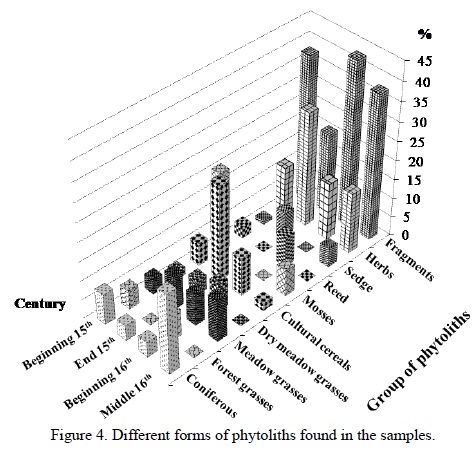
<body><![CDATA[<p align="center"><font face="verdana" size="2"><img src="/img/revistas/bsgm/v64n2/a2f2.jpg"></font></p>  	    <p align="justify"><font face="verdana" size="2">Organic carbon is present in abundance, which is typical both of cultural layers and of organic deposits such as dung. The proportion of organic constituents decreases towards the middle of the 16<sup>th</sup> century; that may be attributed to a considerable admixture of practically undecomposed sawdust in the dung layer, as well as to presence of construction debris mixed with the dung.</font></p>  	    <p align="justify"><font face="verdana" size="2">Total phosphorus is found in all the samples in quantities exceeding standard; that suggests the whole sequence formed as a result of human activities. It is noteworthy that, even in the oldest of the studied layers (dated to the beginning of the 15<sup>th</sup> century), phosphorus content is four times greater than in natural soils; consequently, the layer was not the first in the formation history of the cultural layers. Maximum values of phosphorus content are recorded in the layer dated to the late 15<sup>th</sup> century. Most likely, it was a result of fires, when organic layers subjected to compaction and absolute accumulation of many biogenic elements took place. That conjecture is supported by the maximum of organic matter content in the same layer. Minimum values of phosphorus are found in the layer dated to the middle of 16<sup>th</sup> century, and the data are in reasonable agreement with lowered values of organic carbon. That may be attributed to the same factor, namely a sizeable admixture of phosphorus&#45;deficient construction waste and sawdust. It should be noted, however, that even those lower values are 1.5 &#150; 2 times higher than those in natural soils; therefore, the upper layer, in common with all the others, is a product of human activities and not of natural factors.</font></p>  	    <p align="justify"><font face="verdana" size="2">Content and distribution of carbon fixed in carbonates is also interesting and informative. Two blocks are distinctly recognized in the studied series: the first, including the beginning and middle of the 15<sup>th</sup> century, is practically devoid of carbonates, while the second block, spanning the end of the 15<sup>th</sup> to the middle of the 16<sup>th</sup> centuries, abounds in them. As the older layers occur lower in the sequence, it is quite possible that initially the carbonate content was even less than at present, and that today's values resulted from diagenetic carbonates being gradually illuviated with rainwater. The suggestion is substantiated with the somewhat higher carbonate content in the layer dated to the middle of the 15<sup>th</sup> century as compared with underlying ones. The sharp increase recorded in carbonates is directly related to the beginning of stone house&#45;building. The limestone used in construction enriched the cultural layers with carbonates. The same construction material &#150; limestone &#150; was commonly in use at this place ever since.</font></p>  	    <p align="justify"><font face="verdana" size="2">&nbsp;</font></p>  	    <p align="justify"><font face="verdana" size="2">3.2. Biomorphic studies</font></p>  	    <p align="justify"><font face="verdana" size="2">All the samples contained a great quantity of various detritus, cuticle casts of grass and amorphous organic matter, as is typical of cultural layers.</font></p>  	    <p align="justify"><font face="verdana" size="2">The most valuable sources of information turned out to be the content and distribution of siliceous biomorphs (phytoliths, diatom testae, sponge spicules), as well as the dynamics of the phytolith assemblage composition. Below are considered all of the analyses in greater detail.</font></p>  	    <p align="justify"><font face="verdana" size="2">The amount and distribution of biogenic silica is shown in <a href="#f3">Figure 3</a>. It is clear that only one sample contains diatom algae and sponge spicules &#150;that is the oldest of the studied layers, dated to the early 15<sup>th</sup> century. Both diatoms and sponge spicules are indicative of open water bodies (Battarbee, 1986; Sudbury, 2011b; Winsborough, 2011). Their presence in the dung samples is logical, as animals need water. Much more interesting is the fact that diatoms and spicules are absent from later samples. As all the samples are animal dung and the animals had to be given water regularly, the lack of open water indicators suggests the water was obtained from closed (isolated) sources. Diatoms and sponges could not survive in such conditions because of insufficient light and organic matter supply. One of explanations for the changes in water sources could be construction of a defensive wall at the studied site which barred direct access to river water.</font></p>  	    <p align="center"><font face="verdana" size="2"><a name="f3"></a></font></p>  	    ]]></body>
<body><![CDATA[<p align="center"><font face="verdana" size="2"><img src="/img/revistas/bsgm/v64n2/a2f3.jpg"></font></p>  	    <p align="justify"><font face="verdana" size="2">As is typical of dung layers, phytoliths are abundant in the samples. The only exception is the latest layer dated to the middle of the 16<sup>th</sup> century, where phytoliths are less than half as abundant as in other samples. That may be attributed to a considerable proportion of wood debris (sawdust and wood shavings) in the layer; the proportion of phytoliths being accordingly reduced.</font></p>  	    <p align="justify"><font face="verdana" size="2">Distribution of various groups of phytoliths also provided interesting data (<a href="#f3">Figure 3</a>). Phytoliths of mosses, ferns and coniferous plants are present in all the samples; that is likely attributable to the composition of animal bedding. This is also true for reed phytoliths. That is to say, the layers described as animal dung in the field consist actually both of dung and of decomposed animal bedding. Besides, the high proportion of coniferous phytoliths in the sample dated to the mid&#45;16<sup>th</sup> century (21 % of the total number of phytoliths) is definitely related to a noticeable presence of wood remains (including those of coniferous trees) in the layer.</font></p>  	    <p align="justify"><font face="verdana" size="2">The diversity of phytolith assemblages (<a href="#f4">Figure 4</a>) suggests that the grass for hay was cut in different environments, including forest, meadow, dry hill&#45;sides, and probably sedge wetlands.</font></p>  	    <p align="center"><font face="verdana" size="2"><a name="f4"></a></font></p>  	    <p align="center"><font face="verdana" size="2"><img src="/img/revistas/bsgm/v64n2/a2f4.jpg"></font></p>  	    <p align="justify"><font face="verdana" size="2">The proportion of cultivated grass (Gramineae) phytoliths amounts to 6 % in the earliest sample (beginning of the 15<sup>th</sup> century), increases sharply to 25 % at the end of the 15<sup>th</sup> century, and decreases again by the beginning of the 16<sup>th</sup> century. In cultivated grasses phytoliths develop in stems, leaves and grain husks. In the studied assemblages, there are only phytoliths of stems and leaves, that is, of straw. Such dynamics in the Gramineae phytoliths indicates some changes in the animal diet &#150;from hay in early 15<sup>th</sup> century to mostly straw by the end of the century; later the proportion of hay in the animal feed gradually rises. The reason for such dynamics is still unclear; it is not inconceivable that it may be related to changes in the economic situation.</font></p>  	    <p align="justify"><font face="verdana" size="2">A relatively high proportion of underdeveloped phytoliths is typical of dung, as grass for haymaking is cut in the middle of summer when the process of phytolith development in plant cells is not completed.</font></p>  	    <p align="justify"><font face="verdana" size="2">&nbsp;</font></p>  	    <p align="justify"><font face="verdana" size="2"><b>4. Conclusions</b></font></p>  	    ]]></body>
<body><![CDATA[<p align="justify"><font face="verdana" size="2">1. Dung layers included in the series of cultural layers are complex from the standpoint of information. On one hand, they are animal waste products and therefore provide data on the animals' diet. On the other, as a part of the total cultural layer in the excavated settlement, they acquire certain characteristics that may provide information on the environments at the time of the layer deposition: pine forests and arable lands on watershed and terraces, meadow and reeds near the river.</font></p>  	    <p align="justify"><font face="verdana" size="2">2. The studied deposits represent a chemically balanced organic mass; besides the dung itself, they include livestock bedding and domestic waste (in the 15<sup>th</sup> century in particular), and later (the 16<sup>th</sup> century) construction waste as well. Variations in total phosphorus content clearly indicate the increase of domestic activities throughout the 15<sup>th</sup> century and the onset of active usage of stone (limestone) in construction since the end of the 15<sup>th</sup> century (the latter was inferred from dynamics of inorganic carbon fixed in carbonates). Stages of construction using wood and stone are clearly distinguishable; it may be safely suggested that limestone came into use instead of timber about 1470.</font></p>  	    <p align="justify"><font face="verdana" size="2">3. The high content of total phosphorus in the earliest samples studied indicates that the area was inhabited long before the beginning of the 15<sup>th</sup> century (age of the lowest sample), and the studied deposits lie over older cultural layers.</font></p>  	    <p align="justify"><font face="verdana" size="2">4. Content and distribution of chemical elements and biomorphs provide adequate information on stages of domestic activities and construction: it has been shown, for example, that in the early 15<sup>th</sup> century drinking water for animals was taken from the river, while later from a well as the river became inaccessible.</font></p>  	    <p align="justify"><font face="verdana" size="2">5. The analysis of phytolith distributions in dung layers of different age reveals changes in animal diet with time and provides evidence for cattle management practices at certain time intervals: for example, the predominance of straw in the animals' diet typical of the end of the 15<sup>th</sup> and beginning of the 16<sup>th</sup> centuries (unlike the previous and subsequent periods) may be attributed to some economic problems.</font></p>  	    <p align="justify"><font face="verdana" size="2">6. It may be seen, therefore, that dung deposits contain a substantial volume of information and represent a more complicated and ambiguous object for study as compared with typical ("classic") cultural layers.</font></p>  	    <p align="justify"><font face="verdana" size="2">&nbsp;</font></p>  	    <p align="justify"><font face="verdana" size="2"><b>References</b></font></p>  	    <!-- ref --><p align="justify"><font face="verdana" size="2">Arinushkina, E.V., 1970, Guide on the Chemical Analysis of Soils: Moscow, Moscow State University Publishing House, 487 p. (in Russian).    &nbsp;&nbsp;&nbsp;&nbsp;&nbsp;&nbsp;&nbsp;&nbsp;[&#160;<a href="javascript:void(0);" onclick="javascript: window.open('/scielo.php?script=sci_nlinks&ref=1406547&pid=S1405-3322201200020000200001&lng=','','width=640,height=500,resizable=yes,scrollbars=1,menubar=yes,');">Links</a>&#160;]<!-- end-ref --></font></p>  	    ]]></body>
<body><![CDATA[<!-- ref --><p align="justify"><font face="verdana" size="2">Battarbee, R.W., 1986, Diatom analysis, <i>in</i> Berglund, B.E. (ed), Handbook of Holocene Palaeoecology and Palaeohydrology: Chichester, U.K., Wiley, 527&#45;570.    &nbsp;&nbsp;&nbsp;&nbsp;&nbsp;&nbsp;&nbsp;&nbsp;[&#160;<a href="javascript:void(0);" onclick="javascript: window.open('/scielo.php?script=sci_nlinks&ref=1406549&pid=S1405-3322201200020000200002&lng=','','width=640,height=500,resizable=yes,scrollbars=1,menubar=yes,');">Links</a>&#160;]<!-- end-ref --></font></p>  	    <!-- ref --><p align="justify"><font face="verdana" size="2">Bird, M.I., Boobyer, E.M., Bryant, C., Lewis, H.A., Paz, V., Stephens, W.E., 2007, A long record of environmental change from bat guano deposits in Makangit Cave, Palawan, Philippines: Earth and Environmental Science Transactions of the Royal Society of Edinburgh, 98, 59&#45;69.    &nbsp;&nbsp;&nbsp;&nbsp;&nbsp;&nbsp;&nbsp;&nbsp;[&#160;<a href="javascript:void(0);" onclick="javascript: window.open('/scielo.php?script=sci_nlinks&ref=1406551&pid=S1405-3322201200020000200003&lng=','','width=640,height=500,resizable=yes,scrollbars=1,menubar=yes,');">Links</a>&#160;]<!-- end-ref --></font></p>  	    <!-- ref --><p align="justify"><font face="verdana" size="2">Bryant, V.M., 1974, Pollen analysis of prehistoric human feces from Mammoth Cave, Kentucky, <i>in</i> Watson, P.J. (ed.), Archaeology of the Mammoth Cave Area: New York, Academic Press, 203&#45;209.    &nbsp;&nbsp;&nbsp;&nbsp;&nbsp;&nbsp;&nbsp;&nbsp;[&#160;<a href="javascript:void(0);" onclick="javascript: window.open('/scielo.php?script=sci_nlinks&ref=1406553&pid=S1405-3322201200020000200004&lng=','','width=640,height=500,resizable=yes,scrollbars=1,menubar=yes,');">Links</a>&#160;]<!-- end-ref --></font></p>  	    <!-- ref --><p align="justify"><font face="verdana" size="2">Bryant, V.M., Dean, G.W., 2006, Archaeological coprolite science: The legacy of Eric O. Callen (1912&#45;1970): Palaeogeography, Palaeoclimatology, Palaeoecology, 237, 51&#45;66.    &nbsp;&nbsp;&nbsp;&nbsp;&nbsp;&nbsp;&nbsp;&nbsp;[&#160;<a href="javascript:void(0);" onclick="javascript: window.open('/scielo.php?script=sci_nlinks&ref=1406555&pid=S1405-3322201200020000200005&lng=','','width=640,height=500,resizable=yes,scrollbars=1,menubar=yes,');">Links</a>&#160;]<!-- end-ref --></font></p>  	    <!-- ref --><p align="justify"><font face="verdana" size="2">Carri&oacute;n, J.S., 2002, A taphonomic study of modern pollen assemblages from dung and surface sediments in arid environments of Spain: Review of Palaeobotany and Palynology, 120, 217&#45;232.    &nbsp;&nbsp;&nbsp;&nbsp;&nbsp;&nbsp;&nbsp;&nbsp;[&#160;<a href="javascript:void(0);" onclick="javascript: window.open('/scielo.php?script=sci_nlinks&ref=1406557&pid=S1405-3322201200020000200006&lng=','','width=640,height=500,resizable=yes,scrollbars=1,menubar=yes,');">Links</a>&#160;]<!-- end-ref --></font></p>  	    ]]></body>
<body><![CDATA[<!-- ref --><p align="justify"><font face="verdana" size="2">Ghosh, R., Gupta, S., Bera, S., Jiang, H., Li, X., Li, C.S., 2008, Ovicaprid dung as an indicator of paleovegetation and paleoclimate in northwestern China: Quaternary Research, 70, 149&#45;157.    &nbsp;&nbsp;&nbsp;&nbsp;&nbsp;&nbsp;&nbsp;&nbsp;[&#160;<a href="javascript:void(0);" onclick="javascript: window.open('/scielo.php?script=sci_nlinks&ref=1406559&pid=S1405-3322201200020000200007&lng=','','width=640,height=500,resizable=yes,scrollbars=1,menubar=yes,');">Links</a>&#160;]<!-- end-ref --></font></p>  	    <!-- ref --><p align="justify"><font face="verdana" size="2">Golyeva, A., 2001, Biomorphic analysis as a part of soil morphological investigations: Catena, 43, 217&#45;230.    &nbsp;&nbsp;&nbsp;&nbsp;&nbsp;&nbsp;&nbsp;&nbsp;[&#160;<a href="javascript:void(0);" onclick="javascript: window.open('/scielo.php?script=sci_nlinks&ref=1406561&pid=S1405-3322201200020000200008&lng=','','width=640,height=500,resizable=yes,scrollbars=1,menubar=yes,');">Links</a>&#160;]<!-- end-ref --></font></p>  	    <!-- ref --><p align="justify"><font face="verdana" size="2">Golyeva, A., 2007, Various phytolith types as bearers of different kinds of ecological information, <i>in</i> Madella M., Zurro D. (eds.), Plants, People and Places. Recent Studies in Phytolith Analysis: Oakville, Connecticut, Oxbow Books, 196&#45;201.    &nbsp;&nbsp;&nbsp;&nbsp;&nbsp;&nbsp;&nbsp;&nbsp;[&#160;<a href="javascript:void(0);" onclick="javascript: window.open('/scielo.php?script=sci_nlinks&ref=1406563&pid=S1405-3322201200020000200009&lng=','','width=640,height=500,resizable=yes,scrollbars=1,menubar=yes,');">Links</a>&#160;]<!-- end-ref --></font></p>  	    <!-- ref --><p align="justify"><font face="verdana" size="2">Golyeva, A., 2008, Microbiomorphic Analysis as a Tool for Natural and Anthropogenic Landscape Investigations: Genesis, Geography, Interpretation: Moscow, URSS Press, 240p. (in Russian).    &nbsp;&nbsp;&nbsp;&nbsp;&nbsp;&nbsp;&nbsp;&nbsp;[&#160;<a href="javascript:void(0);" onclick="javascript: window.open('/scielo.php?script=sci_nlinks&ref=1406565&pid=S1405-3322201200020000200010&lng=','','width=640,height=500,resizable=yes,scrollbars=1,menubar=yes,');">Links</a>&#160;]<!-- end-ref --></font></p>  	    <!-- ref --><p align="justify"><font face="verdana" size="2">Horrocks, M., Irwin, G.J., McGlone, M.S., Nichol, S.L., Williams, L.J., 2003, Pollen, Phytoliths and diatoms in prehistoric coprolites from Kohika, Bay of Plenty, New Zealand: Journal of Archaeological Science, 30, 13&#45;20.    &nbsp;&nbsp;&nbsp;&nbsp;&nbsp;&nbsp;&nbsp;&nbsp;[&#160;<a href="javascript:void(0);" onclick="javascript: window.open('/scielo.php?script=sci_nlinks&ref=1406567&pid=S1405-3322201200020000200011&lng=','','width=640,height=500,resizable=yes,scrollbars=1,menubar=yes,');">Links</a>&#160;]<!-- end-ref --></font></p>  	    ]]></body>
<body><![CDATA[<!-- ref --><p align="justify"><font face="verdana" size="2">Karkanas, P., Riguad. J.Ph., Simek, J.F., Albert, R.M., Weiner, S., 2002, Ash bones and guano: a study of the minerals and phytoliths in the sediments of Grotte XVI, Dordogne, France: Journal of Archaeological Science, 29, 721&#45;732.    &nbsp;&nbsp;&nbsp;&nbsp;&nbsp;&nbsp;&nbsp;&nbsp;[&#160;<a href="javascript:void(0);" onclick="javascript: window.open('/scielo.php?script=sci_nlinks&ref=1406569&pid=S1405-3322201200020000200012&lng=','','width=640,height=500,resizable=yes,scrollbars=1,menubar=yes,');">Links</a>&#160;]<!-- end-ref --></font></p>  	    <!-- ref --><p align="justify"><font face="verdana" size="2">Khoroshev, A.S., 1998, Cultural layer of Novgorod as an ecological structure: Culture and Nature of the Ancient Town, 83&#45;84 (in Russian).    &nbsp;&nbsp;&nbsp;&nbsp;&nbsp;&nbsp;&nbsp;&nbsp;[&#160;<a href="javascript:void(0);" onclick="javascript: window.open('/scielo.php?script=sci_nlinks&ref=1406571&pid=S1405-3322201200020000200013&lng=','','width=640,height=500,resizable=yes,scrollbars=1,menubar=yes,');">Links</a>&#160;]<!-- end-ref --></font></p>  	    <!-- ref --><p align="justify"><font face="verdana" size="2">Lapshin, V.A., 2009, Tver in 13<sup>th</sup>&#45;15<sup>th</sup> century (on results of excavation on the Tver kremlin&#45;11, 1993&#45;1997): St. Petersburg, Publishing House of the Philological Faculty of St. Petersburg University, 342 p. (in Russian).    &nbsp;&nbsp;&nbsp;&nbsp;&nbsp;&nbsp;&nbsp;&nbsp;[&#160;<a href="javascript:void(0);" onclick="javascript: window.open('/scielo.php?script=sci_nlinks&ref=1406573&pid=S1405-3322201200020000200014&lng=','','width=640,height=500,resizable=yes,scrollbars=1,menubar=yes,');">Links</a>&#160;]<!-- end-ref --></font></p>  	    <!-- ref --><p align="justify"><font face="verdana" size="2">Lewis, M.D., 2011, Pleistocene Hyaena coprolite palynology in Britain: Implications for the environments of early humans: Developments in Quaternary Science, 14, 263&#45;278.    &nbsp;&nbsp;&nbsp;&nbsp;&nbsp;&nbsp;&nbsp;&nbsp;[&#160;<a href="javascript:void(0);" onclick="javascript: window.open('/scielo.php?script=sci_nlinks&ref=1406575&pid=S1405-3322201200020000200015&lng=','','width=640,height=500,resizable=yes,scrollbars=1,menubar=yes,');">Links</a>&#160;]<!-- end-ref --></font></p>  	    <!-- ref --><p align="justify"><font face="verdana" size="2">Passek, T.S., 2006, Cultural layers of ancient Moscow (on&#45;line document): available at &lt;<a href="http://www.rusarch.ru/passek1.htm" target="_blank">www.rusarch.ru/passek1.htm</a>&gt;, retrieved 15 May 2012.    &nbsp;&nbsp;&nbsp;&nbsp;&nbsp;&nbsp;&nbsp;&nbsp;[&#160;<a href="javascript:void(0);" onclick="javascript: window.open('/scielo.php?script=sci_nlinks&ref=1406577&pid=S1405-3322201200020000200016&lng=','','width=640,height=500,resizable=yes,scrollbars=1,menubar=yes,');">Links</a>&#160;]<!-- end-ref --></font></p>  	    ]]></body>
<body><![CDATA[<!-- ref --><p align="justify"><font face="verdana" size="2">Piperno, D.R., 1988, Phytolith Analysis: an Archaeological and Geological Perspective: San Diego, California, Academic Press, 280 p.    &nbsp;&nbsp;&nbsp;&nbsp;&nbsp;&nbsp;&nbsp;&nbsp;[&#160;<a href="javascript:void(0);" onclick="javascript: window.open('/scielo.php?script=sci_nlinks&ref=1406579&pid=S1405-3322201200020000200017&lng=','','width=640,height=500,resizable=yes,scrollbars=1,menubar=yes,');">Links</a>&#160;]<!-- end-ref --></font></p>  	    <!-- ref --><p align="justify"><font face="verdana" size="2">Piperno, D.R., 2006, Phytoliths: A Comprehensive Guide for Archaeologists and Paleoecologists: Lanham, Maryland, AltaMira Press, 238 p.    &nbsp;&nbsp;&nbsp;&nbsp;&nbsp;&nbsp;&nbsp;&nbsp;[&#160;<a href="javascript:void(0);" onclick="javascript: window.open('/scielo.php?script=sci_nlinks&ref=1406581&pid=S1405-3322201200020000200018&lng=','','width=640,height=500,resizable=yes,scrollbars=1,menubar=yes,');">Links</a>&#160;]<!-- end-ref --></font></p>  	    <!-- ref --><p align="justify"><font face="verdana" size="2">Prasad, V., Str&ouml;mberg, C.A.E., Alimohammadian, H., Sahni, A., 2005, Dinosaur coprolites and the early evolution of grasses and grazers: Science, 310, 1177&#45;1180.    &nbsp;&nbsp;&nbsp;&nbsp;&nbsp;&nbsp;&nbsp;&nbsp;[&#160;<a href="javascript:void(0);" onclick="javascript: window.open('/scielo.php?script=sci_nlinks&ref=1406583&pid=S1405-3322201200020000200019&lng=','','width=640,height=500,resizable=yes,scrollbars=1,menubar=yes,');">Links</a>&#160;]<!-- end-ref --></font></p>  	    <!-- ref --><p align="justify"><font face="verdana" size="2">Rheinhard, K.J. and Bryant, V.M., 1992, Coprolite analysis: a biological perspective on archaeology, <i>in</i> Schiffer, M.B. (ed.), Archaeological Method and Theory: Tucson, Arizona, University of Arizona Press, 245&#45;288.    &nbsp;&nbsp;&nbsp;&nbsp;&nbsp;&nbsp;&nbsp;&nbsp;[&#160;<a href="javascript:void(0);" onclick="javascript: window.open('/scielo.php?script=sci_nlinks&ref=1406585&pid=S1405-3322201200020000200020&lng=','','width=640,height=500,resizable=yes,scrollbars=1,menubar=yes,');">Links</a>&#160;]<!-- end-ref --></font></p>  	    <!-- ref --><p align="justify"><font face="verdana" size="2">S&aacute;nchez, M.V., Gonz&aacute;lez, M.G., Genise, J.F., 2010, Phytolith analysis of <i>Coprinisphaera</i>, unlocking dung beetle behavior, herbivore diets and palaeoenvironments along the Middle Eocene&#45;Early Miocene of Patagonia: Palaeogeography, Palaeoclimatology, Palaeoecology, 285, 224&#45;236.    &nbsp;&nbsp;&nbsp;&nbsp;&nbsp;&nbsp;&nbsp;&nbsp;[&#160;<a href="javascript:void(0);" onclick="javascript: window.open('/scielo.php?script=sci_nlinks&ref=1406587&pid=S1405-3322201200020000200021&lng=','','width=640,height=500,resizable=yes,scrollbars=1,menubar=yes,');">Links</a>&#160;]<!-- end-ref --></font></p>  	    ]]></body>
<body><![CDATA[<!-- ref --><p align="justify"><font face="verdana" size="2">Sergina, T.V., 2004, The project of protection zones of the cultural layer of Vyazma and problems of conservation of the archaeological heritage of the Smolensk region: Archaeology and History of Pskov and Pskov Lands, 396&#45;409 (in Russian).    &nbsp;&nbsp;&nbsp;&nbsp;&nbsp;&nbsp;&nbsp;&nbsp;[&#160;<a href="javascript:void(0);" onclick="javascript: window.open('/scielo.php?script=sci_nlinks&ref=1406589&pid=S1405-3322201200020000200022&lng=','','width=640,height=500,resizable=yes,scrollbars=1,menubar=yes,');">Links</a>&#160;]<!-- end-ref --></font></p>  	    <!-- ref --><p align="justify"><font face="verdana" size="2">Shahack&#45;Gross, R., 2011, Herbivorous livestock dung: formation, taphonomy, methods for identification, and archaeological significance: Journal of Archaeological Science, 38, 205&#45;218.    &nbsp;&nbsp;&nbsp;&nbsp;&nbsp;&nbsp;&nbsp;&nbsp;[&#160;<a href="javascript:void(0);" onclick="javascript: window.open('/scielo.php?script=sci_nlinks&ref=1406591&pid=S1405-3322201200020000200023&lng=','','width=640,height=500,resizable=yes,scrollbars=1,menubar=yes,');">Links</a>&#160;]<!-- end-ref --></font></p>  	    <!-- ref --><p align="justify"><font face="verdana" size="2">Sudbury, J.B., 2011a, Quantitative Phytolith Analysis &#150; A Working Example from Modern Prairie Soils and Buried Holocene A Horizons: Ponca City, Oklahoma, Phytolith Press, 288 p.    &nbsp;&nbsp;&nbsp;&nbsp;&nbsp;&nbsp;&nbsp;&nbsp;[&#160;<a href="javascript:void(0);" onclick="javascript: window.open('/scielo.php?script=sci_nlinks&ref=1406593&pid=S1405-3322201200020000200024&lng=','','width=640,height=500,resizable=yes,scrollbars=1,menubar=yes,');">Links</a>&#160;]<!-- end-ref --></font></p>  	    <!-- ref --><p align="justify"><font face="verdana" size="2">Sudbury, J.B., 2011b, Sponge spicules in the Opossum Creek soil profile, Nowata County, Northeastern Oklahoma, <i>in</i> Sudbury, J.B. (ed.), Biogenic Silica from an Opossum Creek soil profile, Nowata County, Oklahoma USA: Ponca City, Oklahoma, Phytolith Press, 75&#45;103.    &nbsp;&nbsp;&nbsp;&nbsp;&nbsp;&nbsp;&nbsp;&nbsp;[&#160;<a href="javascript:void(0);" onclick="javascript: window.open('/scielo.php?script=sci_nlinks&ref=1406595&pid=S1405-3322201200020000200025&lng=','','width=640,height=500,resizable=yes,scrollbars=1,menubar=yes,');">Links</a>&#160;]<!-- end-ref --></font></p>  	    <!-- ref --><p align="justify"><font face="verdana" size="2">Sycheva, S.A., Leonova, N.B., Usianov, A.A., Alexandrovskii, A.L., Pustovoitov, K.Eu., 2000, The evolution of the cultural layers of the Holocene age: Izvestia of the Russian Academy of Sciences, Geography Series, 4, 29&#45;37 (in Russian).    &nbsp;&nbsp;&nbsp;&nbsp;&nbsp;&nbsp;&nbsp;&nbsp;[&#160;<a href="javascript:void(0);" onclick="javascript: window.open('/scielo.php?script=sci_nlinks&ref=1406597&pid=S1405-3322201200020000200026&lng=','','width=640,height=500,resizable=yes,scrollbars=1,menubar=yes,');">Links</a>&#160;]<!-- end-ref --></font></p>  	    ]]></body>
<body><![CDATA[<!-- ref --><p align="justify"><font face="verdana" size="2">Vorobiova, L.A., 1998, Chemical Analysis of Soils: Moscow, Moscow State University Publishing House, 272 p. (in Russian).    &nbsp;&nbsp;&nbsp;&nbsp;&nbsp;&nbsp;&nbsp;&nbsp;[&#160;<a href="javascript:void(0);" onclick="javascript: window.open('/scielo.php?script=sci_nlinks&ref=1406599&pid=S1405-3322201200020000200027&lng=','','width=640,height=500,resizable=yes,scrollbars=1,menubar=yes,');">Links</a>&#160;]<!-- end-ref --></font></p>  	    <!-- ref --><p align="justify"><font face="verdana" size="2">Vorobiova, L.A., 2006, Theory and Practice of the Chemical Analysis of Soils: Moscow, Geos, 400 p. (in Russian).    &nbsp;&nbsp;&nbsp;&nbsp;&nbsp;&nbsp;&nbsp;&nbsp;[&#160;<a href="javascript:void(0);" onclick="javascript: window.open('/scielo.php?script=sci_nlinks&ref=1406601&pid=S1405-3322201200020000200028&lng=','','width=640,height=500,resizable=yes,scrollbars=1,menubar=yes,');">Links</a>&#160;]<!-- end-ref --></font></p>  	    <!-- ref --><p align="justify"><font face="verdana" size="2">Winsborough, B.M., 2011, Paleoenvironmental analysis of the Opossum Creek diatom assemblage, <i>in</i> Sudbury, J.B. (ed.), Biogenic Silica from an Opossum Creek Soil Profile, Nowata County, Oklahoma USA: Ponca City, Oklahoma, Phytolith Press, 43&#45;75.    &nbsp;&nbsp;&nbsp;&nbsp;&nbsp;&nbsp;&nbsp;&nbsp;[&#160;<a href="javascript:void(0);" onclick="javascript: window.open('/scielo.php?script=sci_nlinks&ref=1406603&pid=S1405-3322201200020000200029&lng=','','width=640,height=500,resizable=yes,scrollbars=1,menubar=yes,');">Links</a>&#160;]<!-- end-ref --></font></p>      ]]></body><back>
<ref-list>
<ref id="B1">
<nlm-citation citation-type="book">
<person-group person-group-type="author">
<name>
<surname><![CDATA[Arinushkina]]></surname>
<given-names><![CDATA[E.V.]]></given-names>
</name>
</person-group>
<source><![CDATA[Guide on the Chemical Analysis of Soils]]></source>
<year>1970</year>
<page-range>487</page-range><publisher-loc><![CDATA[Moscow ]]></publisher-loc>
<publisher-name><![CDATA[Moscow State University Publishing House]]></publisher-name>
</nlm-citation>
</ref>
<ref id="B2">
<nlm-citation citation-type="book">
<person-group person-group-type="author">
<name>
<surname><![CDATA[Battarbee]]></surname>
<given-names><![CDATA[R.W.]]></given-names>
</name>
</person-group>
<article-title xml:lang="en"><![CDATA[Diatom analysis]]></article-title>
<person-group person-group-type="editor">
<name>
<surname><![CDATA[Berglund]]></surname>
<given-names><![CDATA[B.E.]]></given-names>
</name>
</person-group>
<source><![CDATA[Handbook of Holocene Palaeoecology and Palaeohydrology]]></source>
<year>1986</year>
<page-range>527-570</page-range><publisher-loc><![CDATA[Chichester ]]></publisher-loc>
<publisher-name><![CDATA[Wiley]]></publisher-name>
</nlm-citation>
</ref>
<ref id="B3">
<nlm-citation citation-type="journal">
<person-group person-group-type="author">
<name>
<surname><![CDATA[Bird]]></surname>
<given-names><![CDATA[M.I.]]></given-names>
</name>
<name>
<surname><![CDATA[Boobyer]]></surname>
<given-names><![CDATA[E.M.]]></given-names>
</name>
<name>
<surname><![CDATA[Bryant]]></surname>
<given-names><![CDATA[C.]]></given-names>
</name>
<name>
<surname><![CDATA[Lewis]]></surname>
<given-names><![CDATA[H.A.]]></given-names>
</name>
<name>
<surname><![CDATA[Paz]]></surname>
<given-names><![CDATA[V.]]></given-names>
</name>
<name>
<surname><![CDATA[Stephens]]></surname>
<given-names><![CDATA[W.E.]]></given-names>
</name>
</person-group>
<article-title xml:lang="en"><![CDATA[A long record of environmental change from bat guano deposits in Makangit Cave, Palawan, Philippines]]></article-title>
<source><![CDATA[Earth and Environmental Science Transactions of the Royal Society of Edinburgh]]></source>
<year>2007</year>
<volume>98</volume>
<page-range>59-69</page-range></nlm-citation>
</ref>
<ref id="B4">
<nlm-citation citation-type="book">
<person-group person-group-type="author">
<name>
<surname><![CDATA[Bryant]]></surname>
<given-names><![CDATA[V.M.]]></given-names>
</name>
</person-group>
<article-title xml:lang="en"><![CDATA[Pollen analysis of prehistoric human feces from Mammoth Cave, Kentucky]]></article-title>
<person-group person-group-type="editor">
<name>
<surname><![CDATA[Watson]]></surname>
<given-names><![CDATA[P.J.]]></given-names>
</name>
</person-group>
<source><![CDATA[Archaeology of the Mammoth Cave Area]]></source>
<year>1974</year>
<page-range>203-209</page-range><publisher-loc><![CDATA[New York ]]></publisher-loc>
<publisher-name><![CDATA[Academic Press]]></publisher-name>
</nlm-citation>
</ref>
<ref id="B5">
<nlm-citation citation-type="journal">
<person-group person-group-type="author">
<name>
<surname><![CDATA[Bryant]]></surname>
<given-names><![CDATA[V.M.]]></given-names>
</name>
<name>
<surname><![CDATA[Dean]]></surname>
<given-names><![CDATA[G.W.]]></given-names>
</name>
</person-group>
<article-title xml:lang="en"><![CDATA[Archaeological coprolite science: The legacy of Eric O. Callen (1912-1970)]]></article-title>
<source><![CDATA[Palaeogeography, Palaeoclimatology, Palaeoecology]]></source>
<year>2006</year>
<volume>237</volume>
<page-range>51-66</page-range></nlm-citation>
</ref>
<ref id="B6">
<nlm-citation citation-type="journal">
<person-group person-group-type="author">
<name>
<surname><![CDATA[Carrión]]></surname>
<given-names><![CDATA[J.S.]]></given-names>
</name>
</person-group>
<article-title xml:lang="en"><![CDATA[A taphonomic study of modern pollen assemblages from dung and surface sediments in arid environments of Spain]]></article-title>
<source><![CDATA[Review of Palaeobotany and Palynology]]></source>
<year>2002</year>
<volume>120</volume>
<page-range>217-232</page-range></nlm-citation>
</ref>
<ref id="B7">
<nlm-citation citation-type="journal">
<person-group person-group-type="author">
<name>
<surname><![CDATA[Ghosh]]></surname>
<given-names><![CDATA[R.]]></given-names>
</name>
<name>
<surname><![CDATA[Gupta]]></surname>
<given-names><![CDATA[S.]]></given-names>
</name>
<name>
<surname><![CDATA[Bera]]></surname>
<given-names><![CDATA[S.]]></given-names>
</name>
<name>
<surname><![CDATA[Jiang]]></surname>
<given-names><![CDATA[H.]]></given-names>
</name>
<name>
<surname><![CDATA[Li]]></surname>
<given-names><![CDATA[X.]]></given-names>
</name>
<name>
<surname><![CDATA[Li]]></surname>
<given-names><![CDATA[C.S.]]></given-names>
</name>
</person-group>
<article-title xml:lang="en"><![CDATA[Ovicaprid dung as an indicator of paleovegetation and paleoclimate in northwestern China]]></article-title>
<source><![CDATA[Quaternary Research]]></source>
<year>2008</year>
<volume>70</volume>
<page-range>149-157</page-range></nlm-citation>
</ref>
<ref id="B8">
<nlm-citation citation-type="journal">
<person-group person-group-type="author">
<name>
<surname><![CDATA[Golyeva]]></surname>
<given-names><![CDATA[A.]]></given-names>
</name>
</person-group>
<article-title xml:lang="en"><![CDATA[Biomorphic analysis as a part of soil morphological investigations]]></article-title>
<source><![CDATA[Catena]]></source>
<year>2001</year>
<volume>43</volume>
<page-range>217-230</page-range></nlm-citation>
</ref>
<ref id="B9">
<nlm-citation citation-type="book">
<person-group person-group-type="author">
<name>
<surname><![CDATA[Golyeva]]></surname>
<given-names><![CDATA[A.]]></given-names>
</name>
</person-group>
<article-title xml:lang="en"><![CDATA[Various phytolith types as bearers of different kinds of ecological information]]></article-title>
<person-group person-group-type="editor">
<name>
<surname><![CDATA[Madella]]></surname>
<given-names><![CDATA[M.]]></given-names>
</name>
<name>
<surname><![CDATA[Zurro]]></surname>
<given-names><![CDATA[D.]]></given-names>
</name>
</person-group>
<source><![CDATA[Plants, People and Places. Recent Studies in Phytolith Analysis]]></source>
<year>2007</year>
<page-range>196-201</page-range><publisher-loc><![CDATA[Oakville^eConnecticut Connecticut]]></publisher-loc>
<publisher-name><![CDATA[Oxbow Books]]></publisher-name>
</nlm-citation>
</ref>
<ref id="B10">
<nlm-citation citation-type="book">
<person-group person-group-type="author">
<name>
<surname><![CDATA[Golyeva]]></surname>
<given-names><![CDATA[A.]]></given-names>
</name>
</person-group>
<source><![CDATA[Microbiomorphic Analysis as a Tool for Natural and Anthropogenic Landscape Investigations: Genesis, Geography, Interpretation]]></source>
<year>2008</year>
<page-range>240</page-range><publisher-loc><![CDATA[Moscow ]]></publisher-loc>
<publisher-name><![CDATA[URSS Press]]></publisher-name>
</nlm-citation>
</ref>
<ref id="B11">
<nlm-citation citation-type="journal">
<person-group person-group-type="author">
<name>
<surname><![CDATA[Horrocks]]></surname>
<given-names><![CDATA[M.]]></given-names>
</name>
<name>
<surname><![CDATA[Irwin]]></surname>
<given-names><![CDATA[G.J.]]></given-names>
</name>
<name>
<surname><![CDATA[McGlone]]></surname>
<given-names><![CDATA[M.S.]]></given-names>
</name>
<name>
<surname><![CDATA[Nichol]]></surname>
<given-names><![CDATA[S.L.]]></given-names>
</name>
<name>
<surname><![CDATA[Williams]]></surname>
<given-names><![CDATA[L.J.]]></given-names>
</name>
</person-group>
<article-title xml:lang="en"><![CDATA[Pollen, Phytoliths and diatoms in prehistoric coprolites from Kohika, Bay of Plenty, New Zealand]]></article-title>
<source><![CDATA[Journal of Archaeological Science]]></source>
<year>2003</year>
<volume>30</volume>
<page-range>13-20</page-range></nlm-citation>
</ref>
<ref id="B12">
<nlm-citation citation-type="journal">
<person-group person-group-type="author">
<name>
<surname><![CDATA[Karkanas]]></surname>
<given-names><![CDATA[P.]]></given-names>
</name>
<name>
<surname><![CDATA[Riguad]]></surname>
<given-names><![CDATA[J.Ph.]]></given-names>
</name>
<name>
<surname><![CDATA[Simek]]></surname>
<given-names><![CDATA[J.F.]]></given-names>
</name>
<name>
<surname><![CDATA[Albert]]></surname>
<given-names><![CDATA[R.M.]]></given-names>
</name>
<name>
<surname><![CDATA[Weiner]]></surname>
<given-names><![CDATA[S.]]></given-names>
</name>
</person-group>
<article-title xml:lang="en"><![CDATA[Ash bones and guano: a study of the minerals and phytoliths in the sediments of Grotte XVI, Dordogne, France]]></article-title>
<source><![CDATA[Journal of Archaeological Science]]></source>
<year>2002</year>
<volume>29</volume>
<page-range>721-732</page-range></nlm-citation>
</ref>
<ref id="B13">
<nlm-citation citation-type="book">
<person-group person-group-type="author">
<name>
<surname><![CDATA[Khoroshev]]></surname>
<given-names><![CDATA[A.S.]]></given-names>
</name>
</person-group>
<source><![CDATA[Cultural layer of Novgorod as an ecological structure]]></source>
<year>1998</year>
<page-range>83-84</page-range><publisher-name><![CDATA[Culture and Nature of the Ancient Town]]></publisher-name>
</nlm-citation>
</ref>
<ref id="B14">
<nlm-citation citation-type="book">
<person-group person-group-type="author">
<name>
<surname><![CDATA[Lapshin]]></surname>
<given-names><![CDATA[V.A.]]></given-names>
</name>
</person-group>
<source><![CDATA[Tver in 13th-15th century (on results of excavation on the Tver kremlin-11, 1993-1997)]]></source>
<year>2009</year>
<page-range>342</page-range><publisher-loc><![CDATA[St. Petersburg ]]></publisher-loc>
<publisher-name><![CDATA[Publishing House of the Philological Faculty of St. Petersburg University]]></publisher-name>
</nlm-citation>
</ref>
<ref id="B15">
<nlm-citation citation-type="journal">
<person-group person-group-type="author">
<name>
<surname><![CDATA[Lewis]]></surname>
<given-names><![CDATA[M.D.]]></given-names>
</name>
</person-group>
<article-title xml:lang="en"><![CDATA[Pleistocene Hyaena coprolite palynology in Britain: Implications for the environments of early humans]]></article-title>
<source><![CDATA[Developments in Quaternary Science]]></source>
<year>2011</year>
<volume>14</volume>
<page-range>263-278</page-range></nlm-citation>
</ref>
<ref id="B16">
<nlm-citation citation-type="">
<person-group person-group-type="author">
<name>
<surname><![CDATA[Passek]]></surname>
<given-names><![CDATA[T.S.]]></given-names>
</name>
</person-group>
<source><![CDATA[Cultural layers of ancient Moscow (on-line document)]]></source>
<year>2006</year>
</nlm-citation>
</ref>
<ref id="B17">
<nlm-citation citation-type="book">
<person-group person-group-type="author">
<name>
<surname><![CDATA[Piperno]]></surname>
<given-names><![CDATA[D.R.]]></given-names>
</name>
</person-group>
<source><![CDATA[Phytolith Analysis: an Archaeological and Geological Perspective]]></source>
<year>1988</year>
<page-range>280</page-range><publisher-loc><![CDATA[San Diego^eCalifornia California]]></publisher-loc>
<publisher-name><![CDATA[Academic Press]]></publisher-name>
</nlm-citation>
</ref>
<ref id="B18">
<nlm-citation citation-type="book">
<person-group person-group-type="author">
<name>
<surname><![CDATA[Piperno]]></surname>
<given-names><![CDATA[D.R.]]></given-names>
</name>
</person-group>
<source><![CDATA[Phytoliths: A Comprehensive Guide for Archaeologists and Paleoecologists]]></source>
<year>2006</year>
<page-range>238</page-range><publisher-loc><![CDATA[Lanham^eMaryland Maryland]]></publisher-loc>
<publisher-name><![CDATA[AltaMira Press]]></publisher-name>
</nlm-citation>
</ref>
<ref id="B19">
<nlm-citation citation-type="journal">
<person-group person-group-type="author">
<name>
<surname><![CDATA[Prasad]]></surname>
<given-names><![CDATA[V.]]></given-names>
</name>
<name>
<surname><![CDATA[Strömberg]]></surname>
<given-names><![CDATA[C.A.E.]]></given-names>
</name>
<name>
<surname><![CDATA[Alimohammadian]]></surname>
<given-names><![CDATA[H.]]></given-names>
</name>
<name>
<surname><![CDATA[Sahni]]></surname>
<given-names><![CDATA[A.]]></given-names>
</name>
</person-group>
<article-title xml:lang="en"><![CDATA[Dinosaur coprolites and the early evolution of grasses and grazers]]></article-title>
<source><![CDATA[Science]]></source>
<year>2005</year>
<volume>310</volume>
<page-range>1177-1180</page-range></nlm-citation>
</ref>
<ref id="B20">
<nlm-citation citation-type="book">
<person-group person-group-type="author">
<name>
<surname><![CDATA[Rheinhard]]></surname>
<given-names><![CDATA[K.J.]]></given-names>
</name>
<name>
<surname><![CDATA[Bryant]]></surname>
<given-names><![CDATA[V.M.]]></given-names>
</name>
</person-group>
<article-title xml:lang="en"><![CDATA[Coprolite analysis: a biological perspective on archaeology]]></article-title>
<person-group person-group-type="editor">
<name>
<surname><![CDATA[Schiffer]]></surname>
<given-names><![CDATA[M.B.]]></given-names>
</name>
</person-group>
<source><![CDATA[Archaeological Method and Theory]]></source>
<year>1992</year>
<page-range>245-288</page-range><publisher-loc><![CDATA[Tucson^eArizona Arizona]]></publisher-loc>
<publisher-name><![CDATA[University of Arizona Press]]></publisher-name>
</nlm-citation>
</ref>
<ref id="B21">
<nlm-citation citation-type="journal">
<person-group person-group-type="author">
<name>
<surname><![CDATA[Sánchez]]></surname>
<given-names><![CDATA[M.V.]]></given-names>
</name>
<name>
<surname><![CDATA[González]]></surname>
<given-names><![CDATA[M.G.]]></given-names>
</name>
<name>
<surname><![CDATA[Genise]]></surname>
<given-names><![CDATA[J.F.]]></given-names>
</name>
</person-group>
<article-title xml:lang="en"><![CDATA[Phytolith analysis of Coprinisphaera, unlocking dung beetle behavior, herbivore diets and palaeoenvironments along the Middle Eocene-Early Miocene of Patagonia]]></article-title>
<source><![CDATA[Palaeogeography, Palaeoclimatology, Palaeoecology]]></source>
<year>2010</year>
<volume>285</volume>
<page-range>224-236</page-range></nlm-citation>
</ref>
<ref id="B22">
<nlm-citation citation-type="book">
<person-group person-group-type="author">
<name>
<surname><![CDATA[Sergina]]></surname>
<given-names><![CDATA[T.V.]]></given-names>
</name>
</person-group>
<source><![CDATA[The project of protection zones of the cultural layer of Vyazma and problems of conservation of the archaeological heritage of the Smolensk region]]></source>
<year>2004</year>
<page-range>396-409</page-range><publisher-name><![CDATA[Archaeology and History of Pskov and Pskov Lands]]></publisher-name>
</nlm-citation>
</ref>
<ref id="B23">
<nlm-citation citation-type="journal">
<person-group person-group-type="author">
<name>
<surname><![CDATA[Shahack-Gross]]></surname>
<given-names><![CDATA[R.]]></given-names>
</name>
</person-group>
<article-title xml:lang="en"><![CDATA[Herbivorous livestock dung: formation, taphonomy, methods for identification, and archaeological significance]]></article-title>
<source><![CDATA[Journal of Archaeological Science]]></source>
<year>2011</year>
<volume>38</volume>
<page-range>205-218</page-range></nlm-citation>
</ref>
<ref id="B24">
<nlm-citation citation-type="book">
<person-group person-group-type="author">
<name>
<surname><![CDATA[Sudbury]]></surname>
<given-names><![CDATA[J.B.]]></given-names>
</name>
</person-group>
<source><![CDATA[Quantitative Phytolith Analysis - A Working Example from Modern Prairie Soils and Buried Holocene A Horizons]]></source>
<year>2011</year>
<page-range>288</page-range><publisher-loc><![CDATA[Ponca City ]]></publisher-loc>
<publisher-name><![CDATA[Oklahoma, Phytolith Press]]></publisher-name>
</nlm-citation>
</ref>
<ref id="B25">
<nlm-citation citation-type="book">
<person-group person-group-type="author">
<name>
<surname><![CDATA[Sudbury]]></surname>
<given-names><![CDATA[J.B.]]></given-names>
</name>
</person-group>
<article-title xml:lang="en"><![CDATA[Sponge spicules in the Opossum Creek soil profile, Nowata County, Northeastern Oklahoma]]></article-title>
<person-group person-group-type="editor">
<name>
<surname><![CDATA[Sudbury]]></surname>
<given-names><![CDATA[J.B.]]></given-names>
</name>
</person-group>
<source><![CDATA[Biogenic Silica from an Opossum Creek soil profile, Nowata County, Oklahoma USA: Ponca City]]></source>
<year>2011</year>
<page-range>75-103</page-range><publisher-name><![CDATA[Oklahoma, Phytolith Press]]></publisher-name>
</nlm-citation>
</ref>
<ref id="B26">
<nlm-citation citation-type="journal">
<person-group person-group-type="author">
<name>
<surname><![CDATA[Sycheva]]></surname>
<given-names><![CDATA[S.A.]]></given-names>
</name>
<name>
<surname><![CDATA[Leonova]]></surname>
<given-names><![CDATA[N.B.]]></given-names>
</name>
<name>
<surname><![CDATA[Usianov]]></surname>
<given-names><![CDATA[A.A.]]></given-names>
</name>
<name>
<surname><![CDATA[Alexandrovskii]]></surname>
<given-names><![CDATA[A.L.]]></given-names>
</name>
<name>
<surname><![CDATA[Pustovoitov]]></surname>
<given-names><![CDATA[K.Eu.]]></given-names>
</name>
</person-group>
<article-title xml:lang="en"><![CDATA[The evolution of the cultural layers of the Holocene age]]></article-title>
<source><![CDATA[Izvestia of the Russian Academy of Sciences, Geography Series]]></source>
<year>2000</year>
<volume>4</volume>
<page-range>29-37</page-range></nlm-citation>
</ref>
<ref id="B27">
<nlm-citation citation-type="book">
<person-group person-group-type="author">
<name>
<surname><![CDATA[Vorobiova]]></surname>
<given-names><![CDATA[L.A.]]></given-names>
</name>
</person-group>
<source><![CDATA[Chemical Analysis of Soils]]></source>
<year>1998</year>
<page-range>272</page-range><publisher-loc><![CDATA[Moscow ]]></publisher-loc>
<publisher-name><![CDATA[Moscow State University Publishing House]]></publisher-name>
</nlm-citation>
</ref>
<ref id="B28">
<nlm-citation citation-type="book">
<person-group person-group-type="author">
<name>
<surname><![CDATA[Vorobiova]]></surname>
<given-names><![CDATA[L.A.]]></given-names>
</name>
</person-group>
<source><![CDATA[Theory and Practice of the Chemical Analysis of Soils]]></source>
<year>2006</year>
<page-range>400</page-range><publisher-loc><![CDATA[Moscow ]]></publisher-loc>
<publisher-name><![CDATA[Geos]]></publisher-name>
</nlm-citation>
</ref>
<ref id="B29">
<nlm-citation citation-type="book">
<person-group person-group-type="author">
<name>
<surname><![CDATA[Winsborough]]></surname>
<given-names><![CDATA[B.M.]]></given-names>
</name>
</person-group>
<article-title xml:lang="en"><![CDATA[Paleoenvironmental analysis of the Opossum Creek diatom assemblage]]></article-title>
<person-group person-group-type="editor">
<name>
<surname><![CDATA[Sudbury]]></surname>
<given-names><![CDATA[J.B.]]></given-names>
</name>
</person-group>
<source><![CDATA[Biogenic Silica from an Opossum Creek Soil Profile, Nowata County, Oklahoma USA]]></source>
<year>2011</year>
<page-range>43-75</page-range><publisher-loc><![CDATA[Ponca City^eOklahoma Oklahoma]]></publisher-loc>
<publisher-name><![CDATA[Phytolith Press]]></publisher-name>
</nlm-citation>
</ref>
</ref-list>
</back>
</article>