<?xml version="1.0" encoding="ISO-8859-1"?><article xmlns:mml="http://www.w3.org/1998/Math/MathML" xmlns:xlink="http://www.w3.org/1999/xlink" xmlns:xsi="http://www.w3.org/2001/XMLSchema-instance">
<front>
<journal-meta>
<journal-id>1405-3322</journal-id>
<journal-title><![CDATA[Boletín de la Sociedad Geológica Mexicana]]></journal-title>
<abbrev-journal-title><![CDATA[Bol. Soc. Geol. Mex]]></abbrev-journal-title>
<issn>1405-3322</issn>
<publisher>
<publisher-name><![CDATA[Sociedad Geológica Mexicana A.C.]]></publisher-name>
</publisher>
</journal-meta>
<article-meta>
<article-id>S1405-33222011000300007</article-id>
<title-group>
<article-title xml:lang="en"><![CDATA[The first mandible fragment of Deinosuchus (Eusuchia: Alligatoroidea) discovered in Coahuila, Mexico]]></article-title>
<article-title xml:lang="es"><![CDATA[El primer fragmento de mandíbula de Deinosuchus (Eusuchia: Alligatoroidea) descubierto en Coahuila, México]]></article-title>
</title-group>
<contrib-group>
<contrib contrib-type="author">
<name>
<surname><![CDATA[Rivera-Sylva]]></surname>
<given-names><![CDATA[Héctor E.]]></given-names>
</name>
<xref ref-type="aff" rid="A01"/>
</contrib>
<contrib contrib-type="author">
<name>
<surname><![CDATA[Frey]]></surname>
<given-names><![CDATA[Eberhard]]></given-names>
</name>
<xref ref-type="aff" rid="A02"/>
</contrib>
</contrib-group>
<aff id="A01">
<institution><![CDATA[,Museo del Desierto Departamento de Paleontología ]]></institution>
<addr-line><![CDATA[Saltillo Coahuila]]></addr-line>
<country>México</country>
</aff>
<aff id="A02">
<institution><![CDATA[,Staatliches Museum für Naturkunde Karlsruhe Geowissenschaftliche Abteilung ]]></institution>
<addr-line><![CDATA[Karlsruhe ]]></addr-line>
<country>Alemania</country>
</aff>
<pub-date pub-type="pub">
<day>00</day>
<month>12</month>
<year>2011</year>
</pub-date>
<pub-date pub-type="epub">
<day>00</day>
<month>12</month>
<year>2011</year>
</pub-date>
<volume>63</volume>
<numero>3</numero>
<fpage>459</fpage>
<lpage>462</lpage>
<copyright-statement/>
<copyright-year/>
<self-uri xlink:href="http://www.scielo.org.mx/scielo.php?script=sci_arttext&amp;pid=S1405-33222011000300007&amp;lng=en&amp;nrm=iso"></self-uri><self-uri xlink:href="http://www.scielo.org.mx/scielo.php?script=sci_abstract&amp;pid=S1405-33222011000300007&amp;lng=en&amp;nrm=iso"></self-uri><self-uri xlink:href="http://www.scielo.org.mx/scielo.php?script=sci_pdf&amp;pid=S1405-33222011000300007&amp;lng=en&amp;nrm=iso"></self-uri><abstract abstract-type="short" xml:lang="en"><p><![CDATA[Here we report on the first mandible fragment of the giant alligatoroid eusuchian crocodyliform Deinosuchus found in Mexico. The specimen comes from Las Jicoteas locality, northwestern Coahuila. It was collected in 2007 by the first author. The fragment is from a left surangular, coming from the mandible of a Deinosuchus between six and seven metres in length.]]></p></abstract>
<abstract abstract-type="short" xml:lang="es"><p><![CDATA[Aquí reportamos sobre el primer fragmento craneal de aligatorido eusuchio crocodiliforme gigante Deinosuchus, que ha sido encontrado en México. El espécimen proviene de la localidad de Las Jicoteas, noroeste de Coahuila. Fue colectado en 2007 por el primer autor. El fragmento es un surangular izquierdo, de la mandíbula de un Deinosuchus el cual tendría una longitud de entre 6 y 7 metros.]]></p></abstract>
<kwd-group>
<kwd lng="en"><![CDATA[Deinosuchus]]></kwd>
<kwd lng="en"><![CDATA[Alligatoroidea]]></kwd>
<kwd lng="en"><![CDATA[Eusuchia]]></kwd>
<kwd lng="en"><![CDATA[late Campanian]]></kwd>
<kwd lng="en"><![CDATA[Coahuila]]></kwd>
<kwd lng="en"><![CDATA[Mexico]]></kwd>
<kwd lng="es"><![CDATA[Deinosuchus]]></kwd>
<kwd lng="es"><![CDATA[Alligatoroidea]]></kwd>
<kwd lng="es"><![CDATA[Eusuchia]]></kwd>
<kwd lng="es"><![CDATA[Campaniano tardío]]></kwd>
<kwd lng="es"><![CDATA[Coahuila]]></kwd>
<kwd lng="es"><![CDATA[México]]></kwd>
</kwd-group>
</article-meta>
</front><body><![CDATA[  	    <p align="justify"><font face="verdana" size="4">Art&iacute;culos</font></p> 	    <p align="center"><font face="verdana" size="2">&nbsp;</font></p> 	    <p align="center"><font face="verdana" size="4"><b>The first mandible fragment of <i>Deinosuchus</i> (Eusuchia: Alligatoroidea) discovered in Coahuila, Mexico</b></font></p> 	    <p align="center"><font face="verdana" size="2">&nbsp;</font></p> 	    <p align="center"><font face="verdana" size="3"><b>El primer fragmento de mand&iacute;bula de Deinosuchus (Eusuchia: Alligatoroidea) descubierto en Coahuila, M&eacute;xico </b></font></p> 	    <p align="center"><font face="verdana" size="2">&nbsp;</font></p> 	    <p align="center"><font face="verdana" size="2"><b>H&eacute;ctor E. Rivera&#150;Sylva<sup>1,*</sup> y Eberhard Frey<sup>2</sup></b></font></p> 	    <p align="justify"><font face="verdana" size="2">&nbsp;</font></p> 	    <p align="justify"><font face="verdana" size="2"><sup><i>1</i></sup><i> Departamento de Paleontolog&iacute;a, Museo del Desierto, Prolongaci&oacute;n P&eacute;rez Trevi&ntilde;o 3745, 25015 Saltillo, Coahuila, M&eacute;xico</i>.*<a href="mailto:hrivera@museodeldesierto.org">hrivera@museodeldesierto.org</a>.</font></p> 	    ]]></body>
<body><![CDATA[<p align="justify"><font face="verdana" size="2"><sup><i>2</i></sup><i> Geowissenschaftliche Abteilung, Staatliches Museum f&uuml;r Naturkunde Karlsruhe, Karlsruhe, Alemania.</i></font></p> 	    <p align="justify"><font face="verdana" size="2">&nbsp;</font></p> 	    <p align="justify"><font face="verdana" size="2">Manuscript received: February 25, 2009.    <br>     Corrected manuscript received: April 15, 2009.    <br>     Manuscript accepted: June 15, 2009.</font></p> 	    <p align="justify"><font face="verdana" size="2">&nbsp;</font></p> 	    <p align="justify"><font face="verdana" size="2"><b>Abstract</b></font></p> 	    <p align="justify"><font face="verdana" size="2">Here we report on the first mandible fragment of the giant alligatoroid eusuchian crocodyliform <i>Deinosuchus</i> found in Mexico. The specimen comes from Las Jicoteas locality, northwestern Coahuila. It was collected in 2007 by the first author. The fragment is from a left surangular, coming from the mandible of a <i>Deinosuchus</i> between six and seven metres in length.</font></p> 	    <p align="justify"><font face="verdana" size="2"><b>Keywords:</b> <i>Deinosuchus</i>, Alligatoroidea, Eusuchia, late Campanian, Coahuila, Mexico.</font></p> 	    <p align="justify"><font face="verdana" size="2">&nbsp;</font></p> 	    ]]></body>
<body><![CDATA[<p align="justify"><font face="verdana" size="2"><b>Resumen</b></font></p> 	    <p align="justify"><font face="verdana" size="2">Aqu&iacute; reportamos sobre el primer fragmento craneal de aligatorido eusuchio crocodiliforme gigante <i>Deinosuchus</i>, que ha sido encontrado en M&eacute;xico. El esp&eacute;cimen proviene de la localidad de Las Jicoteas, noroeste de Coahuila. Fue colectado en 2007 por el primer autor. El fragmento es un surangular izquierdo, de la mand&iacute;bula de un <i>Deinosuchus</i> el cual tendr&iacute;a una longitud de entre 6 y 7 metros.</font></p> 	    <p align="justify"><font face="verdana" size="2"><b>Palabras clave:</b> <i>Deinosuchus</i>, Alligatoroidea, Eusuchia, Campaniano tard&iacute;o, Coahuila, M&eacute;xico.</font></p> 	    <p align="justify"><font face="verdana" size="2">&nbsp;</font></p> 	    <p align="justify"><font face="verdana" size="2"><b>1. Introduction</b></font></p> 	    <p align="justify"><font face="verdana" size="2">Fossil remains of Mesozoic crocodyliforms are scarce in Mexico. <i>Thalattosuchia</i> has been reported from Late Jurassic marine sediments of Oaxaca (Ferrusqu&iacute;a and Comas, 1988), Puebla (Frey <i>et al</i>., 2002), Nuevo Le&oacute;n (Buchy <i>et al</i>., 2006a; Velasco&#150;Segura, 2007; Buchy, 2008) and Coahuila (Buchy <i>et al</i>., 2006b). From Cantera Tlayua (Albian, Early Cretaceous), Puebla, a crocodilian similar to the pholidosaurid <i>Crocodileimus</i> has been reported (Reynoso <i>et al</i>., 2000). Moreover, a few Late Cretaceous crocodyliforms have been discovered. From the San Carlos and Aguja formations, in Chihuahua, fossil remains assigned to <i>Deinosuchus</i> cf. <i>D. riograndensis</i> were described by Brown <i>et al</i>. (2004). Other crocodyliforms have been reported from Coahuila, including goniopholids and Brachychampsa from the Cerro del Pueblo Formation (Rodr&iacute;guez&#150;de la Rosa and Cevallos, 1998) and <i>Deinosuchus riograndensis</i> from the Aguja Formation (Rivera&#150;Sylva <i>et al</i>., 2011).</font></p> 	    <p align="justify"><font face="verdana" size="2">Our understanding of fossil crocodyliforms in Mexico is still developing. Therefore, the description of newly discovered remains, no matter how small, is important to establish a database that later will allow reconstruction of the evolutionary history of those crocodyliforms that inhabited the area of today&rsquo;s Mexico.</font></p> 	    <p align="justify"><font face="verdana" size="2">The mandible fragment described here was recovered from a site located in the municipality of Ocampo, in the western part of Coahuila, close to the border with Chihuahua, 22 km northwest of the town of El Carricito (<a href="/img/revistas/bsgm/v63n3/a7f1.jpg" target="_blank">Figure 1</a>).</font></p> 	    <p align="justify"><font face="verdana" size="2">&nbsp;</font></p> 	    <p align="justify"><font face="verdana" size="2"><b>2. Geology</b></font></p> 	    ]]></body>
<body><![CDATA[<p align="justify"><font face="verdana" size="2">The structural tectonics of northwest Coahuila consists of narrow anticlines and wide synclines. Both are affected by normal and lateral faults. Lateral faulting puts in discordant contact the marine sequence of limestones and mudstones containing lamellibranchs and abundant foraminifers that could correspond to the marine member of the Aguja Formation with the transitional sequence of sandstones, mudstones and siltstones, which correlate with the continental sequence where many dinosaur remains occur.</font></p> 	    <p align="justify"><font face="verdana" size="2">The Aguja Formation comprises mainly irregularly interbedded clay and sandstone, ranging from a few tens of millimetres to more than twelve metres in thickness. Beds of arenaceous and rudaceous, coquina sandstone, carbonaceous clay, lignite, and a rare fresh&#150;water limestone appear in parts of the section. The formation is characterized by rapid vertical and lateral facies changes, as well as by a proportion of sand that is present in either the overlying or the underlying units (Hopkins, 1965).</font></p> 	    <p align="justify"><font face="verdana" size="2">Based on the colour variation of the clay, the formation is roughly divided into three parts. The basal part consists of a grey&#150;green clay, which weathers to a buff&#150;yellow colour, and resembles the clays of the underlying Pen Formation. The clay of central part is green with some buff&#150;yellow beds. In the top part, the clay shows a melange of pale maroons, greens, blue&#150;blacks, and reds much resembling the clay in the overlying Javelina Formation. The change in clay colour probably correlates with a change from open water marine conditions, through intertidal marine, brackish and fresh water conditions with terrestrial conditions in the centre of the formation, where lignites and carbonaceous clay form the dominant lithology. This lithology also occurs throughout the lower part of the Aguja Formation.</font></p> 	    <p align="justify"><font face="verdana" size="2">Hopkins (1965) recognised oscillating marine transgressions in the Aguja Formation alternating with non&#150;marine episodes as the result of local intermittent delta progression, and subsequent subsidence due to the compaction of the underlying clays.</font></p> 	    <p align="justify"><font face="verdana" size="2">The system was deltaic with a narrow pro&#150;delta seam with marshes, oxbows, and near shore lagoons with sandy or silty bars (Hopkins, 1965; Weide <i>et al</i>., 1972; Lehman, 1982).</font></p> 	    <p align="justify"><font face="verdana" size="2">&nbsp;</font></p> 	    <p align="justify"><font face="verdana" size="2"><b>3. Systematic palaeontology</b></font></p> 	    <p align="center"><font face="verdana" size="2">Crocodyliformes Benton and Clark, 1988    <br> 	Eusuchia Huxley, 1875    <br> 	Alligatoroidea Gray, 1844    ]]></body>
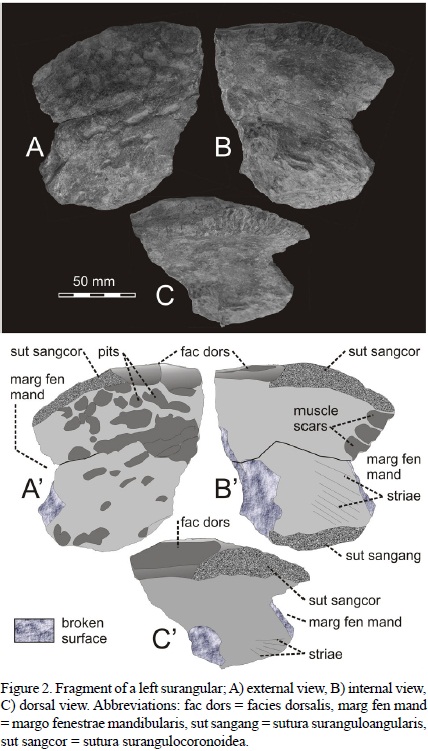
<body><![CDATA[<br> 	<i>Deinosuchus</i> Holland, 1909</font></p> 	    <p align="center"><font face="verdana" size="2"><i>Deinosuchus</i> indet.</font></p> 	    <p align="justify"><font face="verdana" size="2">3.1. Material. Fragmentary left surangular of <i>Deinosuchus</i> (<a href="#f2">Figure 2A&#150;C</a>), which is housed in the Museo del Desierto, Saltillo, Coahuila, Mexico under the collection number CPC 485 (CPC: Colecci&oacute;n Paleontol&oacute;gica de Coahuila).</font></p> 	    <p align="center"><font face="verdana" size="2"><a name="f2"></a></font></p> 	    <p align="center"><font face="verdana" size="2"><img src="/img/revistas/bsgm/v63n3/a7f2.jpg"></font></p> 	    <p align="justify"><font face="verdana" size="2">3.2. Horizon and Locality. The material was recovered from the upper member of the Aguja Formation (Upper Cretaceous, Campanian), west of the El Carricito, Township of Ocampo, Coahuila, Mexico.</font></p> 	    <p align="justify"><font face="verdana" size="2">3.3 Preservation. The bone is uncrushed, but the rostal and caudal margin show sub&#150;vertical breaks, exposing spongiosa encased by a dense compacta. The specimen was broken horizontally in two halves of approximately the same size, which were glued together (<a href="#f2">Figure 2A, B</a>).</font></p> 	    <p align="justify"><font face="verdana" size="2">3.4 Description. The fragment is identified as coming from a left surangular based on a smooth, slightly convex dorsal surface that would normally occur immediately rostral to the mandibular glenoid fossa (<a href="#f3">Figure 3</a>). This surface is an elongate oval three times as long as wide in the preserved portion (<a href="#f2">Figure 2C, C&acute;</a>). This is the insertion place of the caudal&#150;most portion of m. adductor mandibulae externus superficialis (Holliday and Wittmer, 2007) and has the typical morphology for eusuchian crocodyliforms. The transversely striated, rugose face of the surangular&#150;coracoid suture, where the caudal process of the coronoid contacted the surangular, lies rostrally (<a href="#f2">Figure 2A, A&acute;</a>). The rostral process that formed the caudodorsal margin of the mandibular fenestra has broken off, as has the entire caudal part of the bone (<a href="#f3">Figure 3</a>).</font></p> 	    <p align="center"><font face="verdana" size="2"><a name="f3"></a></font></p> 	    <p align="center"><font face="verdana" size="2"><img src="/img/revistas/bsgm/v63n3/a7f3.jpg"></font></p> 	    ]]></body>
<body><![CDATA[<p align="justify"><font face="verdana" size="2">The external face is deeply and irregularly pitted. The dorsolateral margin is slightly bulged, where the lateral fibres of m. adductor mandibulae externus superficialis inserted (<a href="#f2">Figure 2A, A&acute;</a>). The internal face shows a faint horizontal sub&#150;parallel striation in its dorsal half and a pronounced caudally radiating striation in its ventral half. In the caudoventral third a breakage with the spongiosa is exposed (<a href="#f2">Figure 2B, B&acute;</a>). Adjacent to the cranial margin of the bone there are three depressions with rounded cranial margins and longitudinal dorsal and ventral margins running parallel to each other (<a href="#f2">Figure 2B, B&acute;</a>). The bone wall tapers from a thickness of approximately 25 millimetres cranially to a 2 millimetre thick edge that formed the caudal margin of the mandibular fenestra. Both striae and depressions from the insertion place of m. pterygoideus dorsalis (Holliday and Wittmer, 2007) are deduced from their orientation on the internal surface of the surangular (<a href="#f2">Figure 2B, B&acute;</a>).</font></p> 	    <p align="justify"><font face="verdana" size="2">The caudoventral face of the surangular represents the cranial&#150;most portion of the surangular angular suture, which as a rugose, has a slightly transversally&#150;striated structure (<a href="#f2">Figure 2 B, B&acute;</a>). The cranionventral portion of the bone is missing (<a href="#f3">Figure 3</a>).</font></p> 	    <p align="justify"><font face="verdana" size="2">3.5 Comments. Previously discovered specimens of <i>Deinosuchus</i> in Mexico come from the Late Cretaceous (Campanian) of Chihuahua (Westgate <i>et al</i>., 2002; Brown <i>et al</i>., 2004).</font></p> 	    <p align="justify"><font face="verdana" size="2">The specimens from Coahuila are likely conspecific with <i>Deinosuchus (Phobosuchus) riograndensis</i>, which is known from the Aguja Formation, Big Bend National Park, Texas (Colbert and Bird, 1954; Schwimmer, 2010).</font></p> 	    <p align="justify"><font face="verdana" size="2">The specimen presented here is the fragment of a left surangular (<a href="#f2">Figure 2</a>), which is diagnosed as coming from <i>Deinosuchus</i> by its coarse and irregular pitting on its external much resembling that of the osteoderms and its massiveness (Colbert and Bird, 1954). Identification beyond genus level is not possible based on the given material, despite the likelihood that the material comes from <i>D. riograndensis </i>(Schwimmer, 2010).</font></p> 	    <p align="justify"><font face="verdana" size="2">&nbsp;</font></p> 	    <p align="justify"><font face="verdana" size="2"><b>4. Discussion</b></font></p> 	    <p align="justify"><font face="verdana" size="2">Cranial remains of <i>Deinosuchus</i> are generally sparse in the fossil record and only comprise fragments. The fragments which were used by Colbert and Bird (1954) to reconstruct the <i>Deinosuchus</i> skull formerly on display at the American Museum of Natural History in New York refer to the most complete cranial material of <i>Deinosuchus</i> discovered to date. This skull reconstruction is based on that of a modern Cuban crocodile (<i>Crocodylus rhombifer</i>). The American Museum specimen preserves a portion of the left surangular that does not reach the mandibular fenestra. We superimposed the surangular fragment described here onto the mandible of an American Alligator (<i>Alligator mississippiensis</i>) and found a perfect match including the direction and distance of the sutures with the coronoid and the angular (<a href="#f3">Figure 3</a>). Scaling the bone up based on the skull of <i>A. mississippiensis</i>, the skull of the <i>Deinosuchus</i>, to which the articular belonged, had a length between 0.9 and 1.0 m. For the entire animal this would have meant a total length of 6.5 to 7 m, a predator that certainly attacked medium&#150;sized dinosaurs as is evidenced by bite marks in dinosaur bones (Rivera&#150;Sylva <i>et al</i>., 2009).</font></p> 	    <p align="justify"><font face="verdana" size="2">&nbsp;</font></p> 	    <p align="justify"><font face="verdana" size="2"><b>Acknowledgements</b></font></p> 	    ]]></body>
<body><![CDATA[<p align="justify"><font face="verdana" size="2">We would like to thank the following individuals for their contribution to this project: Ileana de la Pe&ntilde;a, Elizabeth Jard&oacute;n, and Rub&eacute;n Guzm&aacute;n for their help during the field season. Jorge Ortiz Mendieta is thanked for illustrating the locality map. The <i>Museo del Desierto </i>is also thanked for supporting this investigation. In the same manner we wish to thank Francisco Palomino from INEGI (now retired). We cordially thank David R. Schwimmer (Columbus State University) and Christopher Brochu (University of Iowa) for their constructive and very helpful comments. They substantially enhanced the manuscript.</font></p> 	    <p align="justify"><font face="verdana" size="2">&nbsp;</font></p> 	    <p align="justify"><font face="verdana" size="2"><b>References</b></font></p> 	    <!-- ref --><p align="justify"><font face="verdana" size="2">Benton, M.J., Clark, J.M., 1988, Archosaur phylogeny and relationships of the Crocodylia, in Benton, M.J. (ed.), The phylogeny and classification of the Tetrapods Vol. 1: Oxford, U.K., Clarendon Press, 295&#150;338.    &nbsp;&nbsp;&nbsp;&nbsp;&nbsp;&nbsp;&nbsp;&nbsp;[&#160;<a href="javascript:void(0);" onclick="javascript: window.open('/scielo.php?script=sci_nlinks&ref=1396880&pid=S1405-3322201100030000700001&lng=','','width=640,height=500,resizable=yes,scrollbars=1,menubar=yes,');">Links</a>&#160;]<!-- end-ref --></font></p> 	    <!-- ref --><p align="justify"><font face="verdana" size="2">Brown, R.B., Westgate, J.W., Cope, D.A., 2004, Primer registro del cocodrilo gigante <i>Deinosuchus</i> cf. <i>riograndensis</i> en M&eacute;xico (resumen), in IX Congreso Nacional de Paleontolog&iacute;a: Tuxtla Guti&eacute;rrez, Chiapas, M&eacute;xico, Sociedad Mexicana de Paleontolog&iacute;a, 25.    &nbsp;&nbsp;&nbsp;&nbsp;&nbsp;&nbsp;&nbsp;&nbsp;[&#160;<a href="javascript:void(0);" onclick="javascript: window.open('/scielo.php?script=sci_nlinks&ref=1396882&pid=S1405-3322201100030000700002&lng=','','width=640,height=500,resizable=yes,scrollbars=1,menubar=yes,');">Links</a>&#160;]<!-- end-ref --></font></p> 	    <!-- ref --><p align="justify"><font face="verdana" size="2">Buchy, M.C., 2008, Reevaluation of the holotype of <i>Plesiosaurus (Polyptychodon) mexicanus</i> Wieland, 1910 from the ?Upper Jurassic of Mexico: a talattosuchian, not a sauropterygian: Revista Mexicana de Ciencias Geol&oacute;gicas, 25, 517&#150;522.    &nbsp;&nbsp;&nbsp;&nbsp;&nbsp;&nbsp;&nbsp;&nbsp;[&#160;<a href="javascript:void(0);" onclick="javascript: window.open('/scielo.php?script=sci_nlinks&ref=1396884&pid=S1405-3322201100030000700003&lng=','','width=640,height=500,resizable=yes,scrollbars=1,menubar=yes,');">Links</a>&#160;]<!-- end-ref --></font></p> 	    <!-- ref --><p align="justify"><font face="verdana" size="2">Buchy, M.C., Frey, E., Stinnesbeck, W., Gonz&aacute;lez Gonz&aacute;lez, A.H., 2006b, A new Tithonian (Upper Jurassic) marine vertebrate concentration Lagerst&auml;tte in north&#150;eastern Mexico: Hantkeniana, 5, 17&#150;19.    &nbsp;&nbsp;&nbsp;&nbsp;&nbsp;&nbsp;&nbsp;&nbsp;[&#160;<a href="javascript:void(0);" onclick="javascript: window.open('/scielo.php?script=sci_nlinks&ref=1396886&pid=S1405-3322201100030000700004&lng=','','width=640,height=500,resizable=yes,scrollbars=1,menubar=yes,');">Links</a>&#160;]<!-- end-ref --></font></p> 	    <!-- ref --><p align="justify"><font face="verdana" size="2">Buchy, M.C., Vignaud, P., Frey, E., Stinnesbeck, W., Gonz&aacute;lez Gonz&aacute;lez, A.H., 2006a, A new thalattosuchian crocodyliform from the Tithonian (Upper Jurassic) of northeastern Mexico: Comptes Rendus Paleovol, 5, 785&#150;794.    &nbsp;&nbsp;&nbsp;&nbsp;&nbsp;&nbsp;&nbsp;&nbsp;[&#160;<a href="javascript:void(0);" onclick="javascript: window.open('/scielo.php?script=sci_nlinks&ref=1396888&pid=S1405-3322201100030000700005&lng=','','width=640,height=500,resizable=yes,scrollbars=1,menubar=yes,');">Links</a>&#160;]<!-- end-ref --></font></p> 	    <!-- ref --><p align="justify"><font face="verdana" size="2">Colbert, E.C., Bird, R.T., 1954, A gigantic crocodile from the Upper Cretaceous beds of Texas: American Museum of Natural History Novitates, 1688, 22 p.    &nbsp;&nbsp;&nbsp;&nbsp;&nbsp;&nbsp;&nbsp;&nbsp;[&#160;<a href="javascript:void(0);" onclick="javascript: window.open('/scielo.php?script=sci_nlinks&ref=1396890&pid=S1405-3322201100030000700006&lng=','','width=640,height=500,resizable=yes,scrollbars=1,menubar=yes,');">Links</a>&#160;]<!-- end-ref --></font></p> 	    <!-- ref --><p align="justify"><font face="verdana" size="2">Ferrusqu&iacute;a, I., Comas, O., 1988, Reptiles marinos mesozoicos en el Sureste de M&eacute;xico y su significaci&oacute;n geol&oacute;gico&#150;paleontol&oacute;gica: Revista del Instituto de Geolog&iacute;a UNAM, 7, 168&#150;181.    &nbsp;&nbsp;&nbsp;&nbsp;&nbsp;&nbsp;&nbsp;&nbsp;[&#160;<a href="javascript:void(0);" onclick="javascript: window.open('/scielo.php?script=sci_nlinks&ref=1396892&pid=S1405-3322201100030000700007&lng=','','width=640,height=500,resizable=yes,scrollbars=1,menubar=yes,');">Links</a>&#160;]<!-- end-ref --></font></p> 	    <!-- ref --><p align="justify"><font face="verdana" size="2">Frey, E., Buchy, M.C., Stinnesbeck, W., L&oacute;pez&#150;Oliva, J.G., 2002, <i>Geosaurus vignaudi</i> n.sp. (Crocodyliformes: <i>Thalattosuchia</i>), first evidence of metriorhynchid crocodilians in the Late Jurassic (Tithonian) of central&#150;east Mexico (State of Puebla): Canadian Journal of Earth Sciences, 39, 1467&#150;1483.    &nbsp;&nbsp;&nbsp;&nbsp;&nbsp;&nbsp;&nbsp;&nbsp;[&#160;<a href="javascript:void(0);" onclick="javascript: window.open('/scielo.php?script=sci_nlinks&ref=1396894&pid=S1405-3322201100030000700008&lng=','','width=640,height=500,resizable=yes,scrollbars=1,menubar=yes,');">Links</a>&#160;]<!-- end-ref --></font></p> 	    <!-- ref --><p align="justify"><font face="verdana" size="2">Gray, J.E., 1844, Catalogue of Tortoises, Crocodilians, and Amphisbaenians in the Collection of the British Museum: British Museum (Natural History), London, 8, 8.    &nbsp;&nbsp;&nbsp;&nbsp;&nbsp;&nbsp;&nbsp;&nbsp;[&#160;<a href="javascript:void(0);" onclick="javascript: window.open('/scielo.php?script=sci_nlinks&ref=1396896&pid=S1405-3322201100030000700009&lng=','','width=640,height=500,resizable=yes,scrollbars=1,menubar=yes,');">Links</a>&#160;]<!-- end-ref --></font></p> 	    <!-- ref --><p align="justify"><font face="verdana" size="2">Holland, W.J., 1909, <i>Deinosuchus hatcheri</i>, a new genus and species of crocodile from the Judith River beds of Montana: Annals of the Carnegie Museum, 6, 281&#150;294.    &nbsp;&nbsp;&nbsp;&nbsp;&nbsp;&nbsp;&nbsp;&nbsp;[&#160;<a href="javascript:void(0);" onclick="javascript: window.open('/scielo.php?script=sci_nlinks&ref=1396898&pid=S1405-3322201100030000700010&lng=','','width=640,height=500,resizable=yes,scrollbars=1,menubar=yes,');">Links</a>&#160;]<!-- end-ref --></font></p> 	    <!-- ref --><p align="justify"><font face="verdana" size="2">Holliday, C.M., Wittmer, L.M., 2007, Archosaur adductor chamber evolution: integration of musculoskeletal and topological criteria in jaw muscle homology: Journal of Morphology, 268, 457&#150;484.    &nbsp;&nbsp;&nbsp;&nbsp;&nbsp;&nbsp;&nbsp;&nbsp;[&#160;<a href="javascript:void(0);" onclick="javascript: window.open('/scielo.php?script=sci_nlinks&ref=1396900&pid=S1405-3322201100030000700011&lng=','','width=640,height=500,resizable=yes,scrollbars=1,menubar=yes,');">Links</a>&#160;]<!-- end-ref --></font></p> 	    <!-- ref --><p align="justify"><font face="verdana" size="2">Hopkins, E.M., 1965, Sedimentology of the Aguja Formation, Big Bend National Park, Brewster County, Texas: Austin, Texas, The University of Texas at Austin, master thesis, 165 p.    &nbsp;&nbsp;&nbsp;&nbsp;&nbsp;&nbsp;&nbsp;&nbsp;[&#160;<a href="javascript:void(0);" onclick="javascript: window.open('/scielo.php?script=sci_nlinks&ref=1396902&pid=S1405-3322201100030000700012&lng=','','width=640,height=500,resizable=yes,scrollbars=1,menubar=yes,');">Links</a>&#160;]<!-- end-ref --></font></p> 	    <!-- ref --><p align="justify"><font face="verdana" size="2">Huxley, T.H., 1875, On <i>Stagonolepis robertsoni</i>, and on the evolution of the Crocodilia, Q.: Journal of the Geological Society, 31, 423&#150;438.    &nbsp;&nbsp;&nbsp;&nbsp;&nbsp;&nbsp;&nbsp;&nbsp;[&#160;<a href="javascript:void(0);" onclick="javascript: window.open('/scielo.php?script=sci_nlinks&ref=1396904&pid=S1405-3322201100030000700013&lng=','','width=640,height=500,resizable=yes,scrollbars=1,menubar=yes,');">Links</a>&#160;]<!-- end-ref --></font></p> 	    <!-- ref --><p align="justify"><font face="verdana" size="2">Lehman, T.L., 1982, A ceratopsian bone bed from the Aguja Formation (Upper Cretaceous), Big Bend National Park, Texas: Austin, Texas, The University of Texas at Austin, master thesis, 209 p.    &nbsp;&nbsp;&nbsp;&nbsp;&nbsp;&nbsp;&nbsp;&nbsp;[&#160;<a href="javascript:void(0);" onclick="javascript: window.open('/scielo.php?script=sci_nlinks&ref=1396906&pid=S1405-3322201100030000700014&lng=','','width=640,height=500,resizable=yes,scrollbars=1,menubar=yes,');">Links</a>&#160;]<!-- end-ref --></font></p> 	    <!-- ref --><p align="justify"><font face="verdana" size="2">Reynoso, V.H., Cabral Perdomo, M.A., Clark, J.M., 2000, The reptiles of the Tlay&uacute;a Formation, in Espinosa&#150;Arrubarrena, L., Montellano&#150;Ballesteros, M., Applegate, S.P., (eds.), Guide Book of the Field Trips of the 60th Meeting of the Society of Vertebrate Paleontology: Avances en investigaci&oacute;n, Universidad Aut&oacute;noma del Estado de Hidalgo Special Publication, 106&#150;110.    &nbsp;&nbsp;&nbsp;&nbsp;&nbsp;&nbsp;&nbsp;&nbsp;[&#160;<a href="javascript:void(0);" onclick="javascript: window.open('/scielo.php?script=sci_nlinks&ref=1396908&pid=S1405-3322201100030000700015&lng=','','width=640,height=500,resizable=yes,scrollbars=1,menubar=yes,');">Links</a>&#160;]<!-- end-ref --></font></p> 	    <!-- ref --><p align="justify"><font face="verdana" size="2">Rivera&#150;Sylva, H.E., Frey, E., Guzm&aacute;n&#150;Guti&eacute;rrez, R., 2009, Evidence of predation on the vertebra of a hadrosaurid dinosaur from the Late Cretaceous (Campanian) of Coahuila, Mexico (letter): Carnets de G&eacute;ologie/Notebooks on Geology, 2, 1&#150;6.    &nbsp;&nbsp;&nbsp;&nbsp;&nbsp;&nbsp;&nbsp;&nbsp;[&#160;<a href="javascript:void(0);" onclick="javascript: window.open('/scielo.php?script=sci_nlinks&ref=1396910&pid=S1405-3322201100030000700016&lng=','','width=640,height=500,resizable=yes,scrollbars=1,menubar=yes,');">Links</a>&#160;]<!-- end-ref --></font></p> 	    <!-- ref --><p align="justify"><font face="verdana" size="2">Rivera&#150;Sylva, H.E., Frey, E., Guzm&aacute;n&#150;Guti&eacute;rrez, R., Palomino&#150;S&aacute;nchez, F., Stinnesbeck, W., A., 2011, <i>Deinosuchus riograndensis</i> (Eusuchia: Alligatoroidea) from Coahuila, Mexico: Revista Mexicana de Ciencias Geol&oacute;gicas, 28, 267&#150;274.    &nbsp;&nbsp;&nbsp;&nbsp;&nbsp;&nbsp;&nbsp;&nbsp;[&#160;<a href="javascript:void(0);" onclick="javascript: window.open('/scielo.php?script=sci_nlinks&ref=1396912&pid=S1405-3322201100030000700017&lng=','','width=640,height=500,resizable=yes,scrollbars=1,menubar=yes,');">Links</a>&#160;]<!-- end-ref --></font></p> 	    <!-- ref --><p align="justify"><font face="verdana" size="2">Rodr&iacute;guez&#150;de la Rosa, R.A., Cevallos&#150;Ferr&iacute;s, S.R.S., 1998, Vertebrates from the El Pelillal locality (Campanian, Cerro del Pueblo Formation), southeastern Coahuila, Mexico: Journal of Vertebrate Paleontology, 18, 751&#150;764.    &nbsp;&nbsp;&nbsp;&nbsp;&nbsp;&nbsp;&nbsp;&nbsp;[&#160;<a href="javascript:void(0);" onclick="javascript: window.open('/scielo.php?script=sci_nlinks&ref=1396914&pid=S1405-3322201100030000700018&lng=','','width=640,height=500,resizable=yes,scrollbars=1,menubar=yes,');">Links</a>&#160;]<!-- end-ref --></font></p> 	    <!-- ref --><p align="justify"><font face="verdana" size="2">Schwimmer, D.R., 2010, One or two species of the giant crocodylian <i>Deinosuchus</i>?: Journal of Vertebrate Paleontology, 30 , 161A.    &nbsp;&nbsp;&nbsp;&nbsp;&nbsp;&nbsp;&nbsp;&nbsp;[&#160;<a href="javascript:void(0);" onclick="javascript: window.open('/scielo.php?script=sci_nlinks&ref=1396916&pid=S1405-3322201100030000700019&lng=','','width=640,height=500,resizable=yes,scrollbars=1,menubar=yes,');">Links</a>&#160;]<!-- end-ref --></font></p> 	    <!-- ref --><p align="justify"><font face="verdana" size="2">Velazco Segura, J., 2007, Cocodrilos marinos del Jur&aacute;sico tard&iacute;o de la formaci&oacute;n La Casita en Coahuila y Nuevo Le&oacute;n, M&eacute;xico: Linares, Universidad Aut&oacute;noma de Nuevo Le&oacute;n, master thesis, 105 p.    &nbsp;&nbsp;&nbsp;&nbsp;&nbsp;&nbsp;&nbsp;&nbsp;[&#160;<a href="javascript:void(0);" onclick="javascript: window.open('/scielo.php?script=sci_nlinks&ref=1396918&pid=S1405-3322201100030000700020&lng=','','width=640,height=500,resizable=yes,scrollbars=1,menubar=yes,');">Links</a>&#160;]<!-- end-ref --></font></p> 	    <!-- ref --><p align="justify"><font face="verdana" size="2">Weide A.E., Wolleben J.A., McBride E.F., 1972, Late Cretaceous depositional systems in northeastern Mexico: Gulf Coast Association of Geological Societies Transactions, 22, 323&#150;329.    &nbsp;&nbsp;&nbsp;&nbsp;&nbsp;&nbsp;&nbsp;&nbsp;[&#160;<a href="javascript:void(0);" onclick="javascript: window.open('/scielo.php?script=sci_nlinks&ref=1396920&pid=S1405-3322201100030000700021&lng=','','width=640,height=500,resizable=yes,scrollbars=1,menubar=yes,');">Links</a>&#160;]<!-- end-ref --></font></p> 	    <!-- ref --><p align="justify"><font face="verdana" size="2">Westgate, J., Pittman, J., Brown, R.B., Cope, D., 2002, Continued Excavation of the first dinosaur community from Chihuahua, Mexico: Journal of Vertebrate Paleontology, 26, 138A.    &nbsp;&nbsp;&nbsp;&nbsp;&nbsp;&nbsp;&nbsp;&nbsp;[&#160;<a href="javascript:void(0);" onclick="javascript: window.open('/scielo.php?script=sci_nlinks&ref=1396922&pid=S1405-3322201100030000700022&lng=','','width=640,height=500,resizable=yes,scrollbars=1,menubar=yes,');">Links</a>&#160;]<!-- end-ref --></font></p>      ]]></body><back>
<ref-list>
<ref id="B1">
<nlm-citation citation-type="book">
<person-group person-group-type="author">
<name>
<surname><![CDATA[Benton]]></surname>
<given-names><![CDATA[M.J.]]></given-names>
</name>
<name>
<surname><![CDATA[Clark]]></surname>
<given-names><![CDATA[J.M.]]></given-names>
</name>
</person-group>
<article-title xml:lang="en"><![CDATA[Archosaur phylogeny and relationships of the Crocodylia]]></article-title>
<person-group person-group-type="editor">
<name>
<surname><![CDATA[Benton]]></surname>
<given-names><![CDATA[M.J.]]></given-names>
</name>
</person-group>
<source><![CDATA[The phylogeny and classification of the Tetrapods]]></source>
<year>1988</year>
<volume>1</volume>
<page-range>295-338</page-range><publisher-loc><![CDATA[Oxford ]]></publisher-loc>
<publisher-name><![CDATA[Clarendon Press]]></publisher-name>
</nlm-citation>
</ref>
<ref id="B2">
<nlm-citation citation-type="confpro">
<person-group person-group-type="author">
<name>
<surname><![CDATA[Brown]]></surname>
<given-names><![CDATA[R.B.]]></given-names>
</name>
<name>
<surname><![CDATA[Westgate]]></surname>
<given-names><![CDATA[J.W.]]></given-names>
</name>
<name>
<surname><![CDATA[Cope]]></surname>
<given-names><![CDATA[D.A.]]></given-names>
</name>
</person-group>
<source><![CDATA[Primer registro del cocodrilo gigante Deinosuchus cf. riograndensis en México (resumen)]]></source>
<year>2004</year>
<conf-name><![CDATA[IX Congreso Nacional de Paleontología]]></conf-name>
<conf-loc>Tuxtla Gutiérrez Chiapas</conf-loc>
<page-range>25</page-range></nlm-citation>
</ref>
<ref id="B3">
<nlm-citation citation-type="journal">
<person-group person-group-type="author">
<name>
<surname><![CDATA[Buchy]]></surname>
<given-names><![CDATA[M.C.]]></given-names>
</name>
</person-group>
<article-title xml:lang="en"><![CDATA[Reevaluation of the holotype of Plesiosaurus (Polyptychodon) mexicanus Wieland, 1910 from the ?Upper Jurassic of Mexico: a talattosuchian, not a sauropterygian]]></article-title>
<source><![CDATA[Revista Mexicana de Ciencias Geológicas]]></source>
<year>2008</year>
<volume>25</volume>
<page-range>517-522</page-range></nlm-citation>
</ref>
<ref id="B4">
<nlm-citation citation-type="journal">
<person-group person-group-type="author">
<name>
<surname><![CDATA[Buchy]]></surname>
<given-names><![CDATA[M.C.]]></given-names>
</name>
<name>
<surname><![CDATA[Frey]]></surname>
<given-names><![CDATA[E]]></given-names>
</name>
<name>
<surname><![CDATA[Stinnesbeck]]></surname>
<given-names><![CDATA[W]]></given-names>
</name>
<name>
<surname><![CDATA[González González]]></surname>
<given-names><![CDATA[A.H.]]></given-names>
</name>
</person-group>
<article-title xml:lang="en"><![CDATA[A new Tithonian (Upper Jurassic) marine vertebrate concentration Lagerstätte in north-eastern Mexico]]></article-title>
<source><![CDATA[Hantkeniana]]></source>
<year>2006</year>
<volume>5</volume>
<page-range>17-19</page-range></nlm-citation>
</ref>
<ref id="B5">
<nlm-citation citation-type="journal">
<person-group person-group-type="author">
<name>
<surname><![CDATA[Buchy]]></surname>
<given-names><![CDATA[M.C.]]></given-names>
</name>
<name>
<surname><![CDATA[Vignaud]]></surname>
<given-names><![CDATA[P]]></given-names>
</name>
<name>
<surname><![CDATA[Frey]]></surname>
<given-names><![CDATA[E]]></given-names>
</name>
<name>
<surname><![CDATA[Stinnesbeck]]></surname>
<given-names><![CDATA[W]]></given-names>
</name>
<name>
<surname><![CDATA[González González]]></surname>
<given-names><![CDATA[A.H.]]></given-names>
</name>
</person-group>
<article-title xml:lang="en"><![CDATA[A new thalattosuchian crocodyliform from the Tithonian (Upper Jurassic) of northeastern Mexico]]></article-title>
<source><![CDATA[Comptes Rendus Paleovol]]></source>
<year>2006</year>
<volume>5</volume>
<page-range>785-794</page-range></nlm-citation>
</ref>
<ref id="B6">
<nlm-citation citation-type="book">
<person-group person-group-type="author">
<name>
<surname><![CDATA[Colbert]]></surname>
<given-names><![CDATA[E.C.]]></given-names>
</name>
<name>
<surname><![CDATA[Bird]]></surname>
<given-names><![CDATA[R.T.]]></given-names>
</name>
</person-group>
<source><![CDATA[A gigantic crocodile from the Upper Cretaceous beds of Texas]]></source>
<year>1954</year>
<volume>1688</volume>
<page-range>22</page-range><publisher-name><![CDATA[American Museum of Natural History Novitates]]></publisher-name>
</nlm-citation>
</ref>
<ref id="B7">
<nlm-citation citation-type="journal">
<person-group person-group-type="author">
<name>
<surname><![CDATA[Ferrusquía]]></surname>
<given-names><![CDATA[I]]></given-names>
</name>
<name>
<surname><![CDATA[Comas]]></surname>
<given-names><![CDATA[O]]></given-names>
</name>
</person-group>
<article-title xml:lang="es"><![CDATA[Reptiles marinos mesozoicos en el Sureste de México y su significación geológico-paleontológica]]></article-title>
<source><![CDATA[Revista del Instituto de Geología UNAM]]></source>
<year>1988</year>
<volume>7</volume>
<page-range>168-181</page-range></nlm-citation>
</ref>
<ref id="B8">
<nlm-citation citation-type="journal">
<person-group person-group-type="author">
<name>
<surname><![CDATA[Frey]]></surname>
<given-names><![CDATA[E]]></given-names>
</name>
<name>
<surname><![CDATA[Buchy]]></surname>
<given-names><![CDATA[M.C.]]></given-names>
</name>
<name>
<surname><![CDATA[Stinnesbeck]]></surname>
<given-names><![CDATA[W]]></given-names>
</name>
<name>
<surname><![CDATA[López-Oliva]]></surname>
<given-names><![CDATA[J.G.]]></given-names>
</name>
</person-group>
<article-title xml:lang="en"><![CDATA[Geosaurus vignaudi n.sp. (Crocodyliformes: Thalattosuchia), first evidence of metriorhynchid crocodilians in the Late Jurassic (Tithonian) of central-east Mexico (State of Puebla)]]></article-title>
<source><![CDATA[Canadian Journal of Earth Sciences]]></source>
<year>2002</year>
<volume>39</volume>
<page-range>1467-1483</page-range></nlm-citation>
</ref>
<ref id="B9">
<nlm-citation citation-type="book">
<person-group person-group-type="author">
<name>
<surname><![CDATA[Gray]]></surname>
<given-names><![CDATA[J.E.]]></given-names>
</name>
</person-group>
<source><![CDATA[Catalogue of Tortoises, Crocodilians, and Amphisbaenians in the Collection of the British Museum]]></source>
<year>1844</year>
<volume>8</volume>
<page-range>8</page-range><publisher-loc><![CDATA[London ]]></publisher-loc>
<publisher-name><![CDATA[British Museum (Natural History)]]></publisher-name>
</nlm-citation>
</ref>
<ref id="B10">
<nlm-citation citation-type="journal">
<person-group person-group-type="author">
<name>
<surname><![CDATA[Holland]]></surname>
<given-names><![CDATA[W.J.]]></given-names>
</name>
</person-group>
<article-title xml:lang="en"><![CDATA[Deinosuchus hatcheri, a new genus and species of crocodile from the Judith River beds of Montana]]></article-title>
<source><![CDATA[Annals of the Carnegie Museum]]></source>
<year>1909</year>
<volume>6</volume>
<page-range>281-294</page-range></nlm-citation>
</ref>
<ref id="B11">
<nlm-citation citation-type="journal">
<person-group person-group-type="author">
<name>
<surname><![CDATA[Holliday]]></surname>
<given-names><![CDATA[C.M.]]></given-names>
</name>
<name>
<surname><![CDATA[Wittmer]]></surname>
<given-names><![CDATA[L.M.]]></given-names>
</name>
</person-group>
<article-title xml:lang="en"><![CDATA[Archosaur adductor chamber evolution: integration of musculoskeletal and topological criteria in jaw muscle homology]]></article-title>
<source><![CDATA[Journal of Morphology]]></source>
<year>2007</year>
<volume>268</volume>
<page-range>457-484</page-range></nlm-citation>
</ref>
<ref id="B12">
<nlm-citation citation-type="book">
<person-group person-group-type="author">
<name>
<surname><![CDATA[Hopkins]]></surname>
<given-names><![CDATA[E.M.]]></given-names>
</name>
</person-group>
<source><![CDATA[Sedimentology of the Aguja Formation, Big Bend National Park, Brewster County, Texas]]></source>
<year>1965</year>
<page-range>165</page-range><publisher-loc><![CDATA[Austin^eTexas Texas]]></publisher-loc>
<publisher-name><![CDATA[The University of Texas at Austin]]></publisher-name>
</nlm-citation>
</ref>
<ref id="B13">
<nlm-citation citation-type="journal">
<person-group person-group-type="author">
<name>
<surname><![CDATA[Huxley]]></surname>
<given-names><![CDATA[T.H.]]></given-names>
</name>
</person-group>
<article-title xml:lang="en"><![CDATA[On Stagonolepis robertsoni, and on the evolution of the Crocodilia, Q]]></article-title>
<source><![CDATA[Journal of the Geological Society]]></source>
<year>1875</year>
<volume>31</volume>
<page-range>423-438</page-range></nlm-citation>
</ref>
<ref id="B14">
<nlm-citation citation-type="book">
<person-group person-group-type="author">
<name>
<surname><![CDATA[Lehman]]></surname>
<given-names><![CDATA[T.L.]]></given-names>
</name>
</person-group>
<source><![CDATA[A ceratopsian bone bed from the Aguja Formation (Upper Cretaceous), Big Bend National Park, Texas]]></source>
<year>1982</year>
<page-range>209</page-range><publisher-loc><![CDATA[Austin^eTexas Texas]]></publisher-loc>
<publisher-name><![CDATA[The University of Texas at Austin]]></publisher-name>
</nlm-citation>
</ref>
<ref id="B15">
<nlm-citation citation-type="book">
<person-group person-group-type="author">
<name>
<surname><![CDATA[Reynoso]]></surname>
<given-names><![CDATA[V.H.]]></given-names>
</name>
<name>
<surname><![CDATA[Cabral Perdomo]]></surname>
<given-names><![CDATA[M.A.]]></given-names>
</name>
<name>
<surname><![CDATA[Clark]]></surname>
<given-names><![CDATA[J.M.]]></given-names>
</name>
</person-group>
<article-title xml:lang="en"><![CDATA[The reptiles of the Tlayúa Formation]]></article-title>
<person-group person-group-type="editor">
<name>
<surname><![CDATA[Espinosa-Arrubarrena]]></surname>
<given-names><![CDATA[L]]></given-names>
</name>
<name>
<surname><![CDATA[Montellano-Ballesteros]]></surname>
<given-names><![CDATA[M]]></given-names>
</name>
<name>
<surname><![CDATA[Applegate]]></surname>
<given-names><![CDATA[S.P.]]></given-names>
</name>
</person-group>
<source><![CDATA[Guide Book of the Field Trips of the 60th Meeting of the Society of Vertebrate Paleontology: Avances en investigación]]></source>
<year>2000</year>
<page-range>106-110</page-range><publisher-name><![CDATA[Universidad Autónoma del Estado de Hidalgo]]></publisher-name>
</nlm-citation>
</ref>
<ref id="B16">
<nlm-citation citation-type="">
<person-group person-group-type="author">
<name>
<surname><![CDATA[Rivera-Sylva]]></surname>
<given-names><![CDATA[H.E.]]></given-names>
</name>
<name>
<surname><![CDATA[Frey]]></surname>
<given-names><![CDATA[E]]></given-names>
</name>
<name>
<surname><![CDATA[Guzmán-Gutiérrez]]></surname>
<given-names><![CDATA[R]]></given-names>
</name>
</person-group>
<article-title xml:lang="en"><![CDATA[Evidence of predation on the vertebra of a hadrosaurid dinosaur from the Late Cretaceous (Campanian) of Coahuila, Mexico (letter)]]></article-title>
<source><![CDATA[Carnets de Géologie/Notebooks on Geology]]></source>
<year>2009</year>
<volume>2</volume>
<page-range>1-6</page-range></nlm-citation>
</ref>
<ref id="B17">
<nlm-citation citation-type="journal">
<person-group person-group-type="author">
<name>
<surname><![CDATA[Rivera-Sylva]]></surname>
<given-names><![CDATA[H.E.]]></given-names>
</name>
<name>
<surname><![CDATA[Frey]]></surname>
<given-names><![CDATA[E]]></given-names>
</name>
<name>
<surname><![CDATA[Guzmán-Gutiérrez]]></surname>
<given-names><![CDATA[R]]></given-names>
</name>
<name>
<surname><![CDATA[Palomino-Sánchez]]></surname>
<given-names><![CDATA[F]]></given-names>
</name>
<name>
<surname><![CDATA[Stinnesbeck]]></surname>
<given-names><![CDATA[W., A.]]></given-names>
</name>
</person-group>
<article-title xml:lang="en"><![CDATA[Deinosuchus riograndensis (Eusuchia: Alligatoroidea) from Coahuila, Mexico]]></article-title>
<source><![CDATA[Revista Mexicana de Ciencias Geológicas]]></source>
<year>2011</year>
<volume>28</volume>
<page-range>267-274</page-range></nlm-citation>
</ref>
<ref id="B18">
<nlm-citation citation-type="journal">
<person-group person-group-type="author">
<name>
<surname><![CDATA[Rodríguez-de la Rosa]]></surname>
<given-names><![CDATA[R.A.]]></given-names>
</name>
<name>
<surname><![CDATA[Cevallos-Ferrís]]></surname>
<given-names><![CDATA[S.R.S.]]></given-names>
</name>
</person-group>
<article-title xml:lang="en"><![CDATA[Vertebrates from the El Pelillal locality (Campanian, Cerro del Pueblo Formation), southeastern Coahuila, Mexico]]></article-title>
<source><![CDATA[Journal of Vertebrate Paleontology]]></source>
<year>1998</year>
<volume>18</volume>
<page-range>751-764</page-range></nlm-citation>
</ref>
<ref id="B19">
<nlm-citation citation-type="journal">
<person-group person-group-type="author">
<name>
<surname><![CDATA[Schwimmer]]></surname>
<given-names><![CDATA[D.R.]]></given-names>
</name>
</person-group>
<article-title xml:lang="en"><![CDATA[One or two species of the giant crocodylian Deinosuchus?]]></article-title>
<source><![CDATA[Journal of Vertebrate Paleontology]]></source>
<year>2010</year>
<volume>30</volume>
<page-range>161A</page-range></nlm-citation>
</ref>
<ref id="B20">
<nlm-citation citation-type="book">
<person-group person-group-type="author">
<name>
<surname><![CDATA[Velazco Segura]]></surname>
<given-names><![CDATA[J]]></given-names>
</name>
</person-group>
<source><![CDATA[Cocodrilos marinos del Jurásico tardío de la formación La Casita en Coahuila y Nuevo León, México]]></source>
<year>2007</year>
<page-range>105</page-range><publisher-loc><![CDATA[Linares ]]></publisher-loc>
<publisher-name><![CDATA[Universidad Autónoma de Nuevo León]]></publisher-name>
</nlm-citation>
</ref>
<ref id="B21">
<nlm-citation citation-type="journal">
<person-group person-group-type="author">
<name>
<surname><![CDATA[Weide]]></surname>
<given-names><![CDATA[A.E.]]></given-names>
</name>
<name>
<surname><![CDATA[Wolleben]]></surname>
<given-names><![CDATA[J.A.]]></given-names>
</name>
<name>
<surname><![CDATA[McBride]]></surname>
<given-names><![CDATA[E.F.]]></given-names>
</name>
</person-group>
<article-title xml:lang="en"><![CDATA[Late Cretaceous depositional systems in northeastern Mexico]]></article-title>
<source><![CDATA[Gulf Coast Association of Geological Societies Transactions]]></source>
<year>1972</year>
<volume>22</volume>
<page-range>323-329</page-range></nlm-citation>
</ref>
<ref id="B22">
<nlm-citation citation-type="journal">
<person-group person-group-type="author">
<name>
<surname><![CDATA[Westgate]]></surname>
<given-names><![CDATA[J]]></given-names>
</name>
<name>
<surname><![CDATA[Pittman]]></surname>
<given-names><![CDATA[J]]></given-names>
</name>
<name>
<surname><![CDATA[Brown]]></surname>
<given-names><![CDATA[R.B.]]></given-names>
</name>
<name>
<surname><![CDATA[Cope]]></surname>
<given-names><![CDATA[D]]></given-names>
</name>
</person-group>
<article-title xml:lang="en"><![CDATA[Continued Excavation of the first dinosaur community from Chihuahua, Mexico]]></article-title>
<source><![CDATA[Journal of Vertebrate Paleontology]]></source>
<year>2002</year>
<volume>26</volume>
<page-range>138A</page-range></nlm-citation>
</ref>
</ref-list>
</back>
</article>
