<?xml version="1.0" encoding="ISO-8859-1"?><article xmlns:mml="http://www.w3.org/1998/Math/MathML" xmlns:xlink="http://www.w3.org/1999/xlink" xmlns:xsi="http://www.w3.org/2001/XMLSchema-instance">
<front>
<journal-meta>
<journal-id>1405-3322</journal-id>
<journal-title><![CDATA[Boletín de la Sociedad Geológica Mexicana]]></journal-title>
<abbrev-journal-title><![CDATA[Bol. Soc. Geol. Mex]]></abbrev-journal-title>
<issn>1405-3322</issn>
<publisher>
<publisher-name><![CDATA[Sociedad Geológica Mexicana A.C.]]></publisher-name>
</publisher>
</journal-meta>
<article-meta>
<article-id>S1405-33222011000300002</article-id>
<title-group>
<article-title xml:lang="en"><![CDATA[Presence of a maniraptoriform dinosaur in the Late Cretaceous (Maastrichtian) of Chiapas, southern Mexico]]></article-title>
<article-title xml:lang="es"><![CDATA[Presencia de un dinosaurio maniraptoriforme en el Cretácico tardío (Maastrichtiano) de Chiapas, sur de México]]></article-title>
</title-group>
<contrib-group>
<contrib contrib-type="author">
<name>
<surname><![CDATA[Carbot-Chanona]]></surname>
<given-names><![CDATA[Gerardo]]></given-names>
</name>
<xref ref-type="aff" rid="A01"/>
</contrib>
<contrib contrib-type="author">
<name>
<surname><![CDATA[Rivera-Sylva]]></surname>
<given-names><![CDATA[Héctor E.]]></given-names>
</name>
<xref ref-type="aff" rid="A02"/>
</contrib>
</contrib-group>
<aff id="A01">
<institution><![CDATA[,Secretaría de Medio Ambiente e Historia Natural Dirección de Paleontología Museo de Paleontología Eliseo Palacios Aguilera]]></institution>
<addr-line><![CDATA[Tuxtla Gutiérrez Chiapas]]></addr-line>
<country>México</country>
</aff>
<aff id="A02">
<institution><![CDATA[,Museo del Desierto Departamento de Paleontología ]]></institution>
<addr-line><![CDATA[Saltillo Coahuila]]></addr-line>
<country>México</country>
</aff>
<pub-date pub-type="pub">
<day>00</day>
<month>12</month>
<year>2011</year>
</pub-date>
<pub-date pub-type="epub">
<day>00</day>
<month>12</month>
<year>2011</year>
</pub-date>
<volume>63</volume>
<numero>3</numero>
<fpage>393</fpage>
<lpage>398</lpage>
<copyright-statement/>
<copyright-year/>
<self-uri xlink:href="http://www.scielo.org.mx/scielo.php?script=sci_arttext&amp;pid=S1405-33222011000300002&amp;lng=en&amp;nrm=iso"></self-uri><self-uri xlink:href="http://www.scielo.org.mx/scielo.php?script=sci_abstract&amp;pid=S1405-33222011000300002&amp;lng=en&amp;nrm=iso"></self-uri><self-uri xlink:href="http://www.scielo.org.mx/scielo.php?script=sci_pdf&amp;pid=S1405-33222011000300002&amp;lng=en&amp;nrm=iso"></self-uri><abstract abstract-type="short" xml:lang="en"><p><![CDATA[Here is described the first dinosaur evidence from Chiapas, and also the southernmost evidence of dinosaurs in Mexico. A small theropod tooth, identified as Richardoestesia isosceles, based on its shape and the presence of small denticles on the mesial and distal carinae with rounded outline, was collected in the Ocozocoautla Formation (Late Cretaceous, Maastrichtian). These results extend the fossil record of this taxon in North America, as it is the southernmost record of Richardoestesia and the first report of this genus in Mexico.]]></p></abstract>
<abstract abstract-type="short" xml:lang="es"><p><![CDATA[Se describe la primera evidencia de dinosaurios para Chiapas, que también es la evidencia más sureña de dinosaurios en México. Un pequeño diente de terópodo, identificado como Richardoestesia isosceles, basado en la forma del diente y la presencia de pequeños dentículos con contorno redondeado en las carenas mesial y distal, fue colectado en la Formación Ocozocoautla (Cretácico Tardío, Maastrichtiano). Los resultados extienden el registro fósil de este taxón en América del Norte, siendo el registro más sureño de Richardoestesia, así como el primer registro de este género en México.]]></p></abstract>
<kwd-group>
<kwd lng="en"><![CDATA[Dinosaur]]></kwd>
<kwd lng="en"><![CDATA[Theropoda]]></kwd>
<kwd lng="en"><![CDATA[Richardoestesia]]></kwd>
<kwd lng="en"><![CDATA[Maastrichtian]]></kwd>
<kwd lng="en"><![CDATA[Chiapas]]></kwd>
<kwd lng="en"><![CDATA[Mexico]]></kwd>
<kwd lng="es"><![CDATA[Dinosaurio]]></kwd>
<kwd lng="es"><![CDATA[Theropoda]]></kwd>
<kwd lng="es"><![CDATA[Richardoestesia]]></kwd>
<kwd lng="es"><![CDATA[Maastrichtiano]]></kwd>
<kwd lng="es"><![CDATA[Chiapas]]></kwd>
<kwd lng="es"><![CDATA[México]]></kwd>
</kwd-group>
</article-meta>
</front><body><![CDATA[  	    <p align="justify"><font face="verdana" size="4">Art&iacute;culos</font></p>  	    <p align="center"><font face="verdana" size="2">&nbsp;</font></p> 	    <p align="center"><font face="verdana" size="4"><b>Presence of a maniraptoriform dinosaur in the Late Cretaceous (Maastrichtian) of Chiapas, southern Mexico</b></font></p> 	    <p align="center"><font face="verdana" size="2">&nbsp;</font></p> 	    <p align="center"><font face="verdana" size="3"><b>Presencia de un dinosaurio maniraptoriforme en el Cret&aacute;cico tard&iacute;o (Maastrichtiano) de Chiapas, sur de M&eacute;xico</b></font></p> 	    <p align="center"><font face="verdana" size="2">&nbsp;</font></p> 	    <p align="center"><font face="verdana" size="2"><b>Gerardo Carbot&#150;Chanona<sup>1,*</sup> y H&eacute;ctor E. Rivera&#150;Sylva<sup>2</sup></b></font></p> 	    <p align="justify"><font face="verdana" size="2">&nbsp;</font></p> 	    <p align="justify"><font face="verdana" size="2"><sup><i>1</i></sup><i> Museo de Paleontolog&iacute;a "Eliseo Palacios Aguilera", Direcci&oacute;n de Paleontolog&iacute;a, Secretar&iacute;a de Medio Ambiente e Historia Natural. Calzada de los Hombres Ilustres s/n, 29000, Tuxtla Guti&eacute;rrez, Chiapas, M&eacute;xico</i>. *<a href="mailto:carbotsaurus@yahoo.com">carbotsaurus@yahoo.com</a>.</font></p> 	    ]]></body>
<body><![CDATA[<p align="justify"><font face="verdana" size="2"><sup><i>2</i></sup><i> Departamento de Paleontolog&iacute;a, Museo del Desierto, Carlos Abedrop D&aacute;vila 3745, 25022, Saltillo, Coahuila, M&eacute;xico.</i></font></p>  	    <p align="justify"><font face="verdana" size="2">&nbsp;</font></p> 	    <p align="justify"><font face="verdana" size="2">Manuscript received: February 24, 2011.    <br>     Corrected manuscript received: June 17, 2011.    <br>     Manuscript accepted: June 20, 2011.</font></p> 	    <p align="justify"><font face="verdana" size="2">&nbsp;</font></p> 	    <p align="justify"><font face="verdana" size="2"><b>Abstract</b></font></p> 	    <p align="justify"><font face="verdana" size="2">Here is described the first dinosaur evidence from Chiapas, and also the southernmost evidence of dinosaurs in Mexico. A small theropod tooth, identified as <i>Richardoestesia isosceles</i>, based on its shape and the presence of small denticles on the mesial and distal carinae with rounded outline, was collected in the Ocozocoautla Formation (Late Cretaceous, Maastrichtian). These results extend the fossil record of this taxon in North America, as it is the southernmost record of <i>Richardoestesia</i> and the first report of this genus in Mexico.</font></p>  	    <p align="justify"><font face="verdana" size="2"><b>Keywords</b>: Dinosaur, Theropoda, <i>Richardoestesia</i>, Maastrichtian, Chiapas, Mexico.</font></p>  	    <p align="justify"><font face="verdana" size="2">&nbsp;</font></p>  	    ]]></body>
<body><![CDATA[<p align="justify"><font face="verdana" size="2"><b>Resumen</b></font></p>  	    <p align="justify"><font face="verdana" size="2">Se describe la primera evidencia de dinosaurios para Chiapas, que tambi&eacute;n es la evidencia m&aacute;s sure&ntilde;a de dinosaurios en M&eacute;xico. Un peque&ntilde;o diente de ter&oacute;podo, identificado como <i>Richardoestesia isosceles</i>, basado en la forma del diente y la presencia de peque&ntilde;os dent&iacute;culos con contorno redondeado en las carenas mesial y distal, fue colectado en la Formaci&oacute;n Ocozocoautla (Cret&aacute;cico Tard&iacute;o, Maastrichtiano). Los resultados extienden el registro f&oacute;sil de este tax&oacute;n en Am&eacute;rica del Norte, siendo el registro m&aacute;s sure&ntilde;o de <i>Richardoestesia</i>, as&iacute; como el primer registro de este g&eacute;nero en M&eacute;xico.</font></p>  	    <p align="justify"><font face="verdana" size="2"><b>Palabras clave</b>: Dinosaurio, Theropoda, <i>Richardoestesia</i>, Maastrichtiano, Chiapas, M&eacute;xico.</font></p>  	    <p align="justify"><font face="verdana" size="2">&nbsp;</font></p>  	    <p align="justify"><font face="verdana" size="2"><b>1. Introduction</b></font></p>  	    <p align="justify"><font face="verdana" size="2">In Mexico, several localities with dinosaur remains have been found principally in the central and northern part of the country. Bones, teeth and footprints of dinosaurs come from Baja California, Coahuila, Chihuahua, Sonora, Tamaulipas, Michoac&aacute;n, Puebla and Oaxaca (Rivera&#150;Sylva <i>et al</i>., 2006). The southernmost record of dinosaurs in Mexico is from Chiapas. Carbot&#150;Chanona and Avenda&ntilde;o&#150;Gil (2002) mention the "raptor" theropod tooth from Ocozocoautla Formation (Maastrichtian, Late Cretaceous) in a preliminary report on Chiapas. In this paper we describe in detail the specimen and assign it to the genus <i>Richardoestesia</i>, a maniraptoriform dinosaur first described from the Campanian Judith River Formation (Currie <i>et al</i>., 1990). The fossil record of Maniraptoriformes in Mexico is rather scarce, apart from the material from El Gallo Formation in Baja California (Hern&aacute;ndez&#150;Rivera,1997), the Aguja Formation in Chihuahua (Weishampel <i>et al</i>., 2004), and the Cerro del Pueblo Formation in Coahuila (Torres&#150;Rodr&iacute;guez <i>et al</i>., 2010). The only genus recognized in these localities is Saurornitholestes, and this is only documented by teeth. Therefore, the presence of the genus <i>Richardoestesia</i> is new for Mexico.</font></p>  	    <p align="justify"><font face="verdana" size="2">&nbsp;</font></p>  	    <p align="justify"><font face="verdana" size="2"><b>2. Geological and paleontological setting</b></font></p>  	    <p align="justify"><font face="verdana" size="2">The Ocozocoautla Formation is a stratigraphic sequence of carbonate sediments that was deposited during the Late Cretaceous in southeast Mexico (Feldmann <i>et al</i>., 1996). Underlying this unit are the limestones from the Sierra Madre, which are Early to Middle Cretaceous in age (Steele and Waite, 1986), and above it lies the Soyal&oacute; Formation, from the Paleocene (Ferrusqu&iacute;a&#150;Villafranca, 1996). The Ocozocoautla Formation is approximately 630 m thick, and is formed of red and brown prodeltaic sandstones and some conglomerates at its base (<a href="/img/revistas/bsgm/v63n3/a2f1.jpg" target="_blank">Figure 1</a>). Towards the upper part of the formation the lithology changes to shales, marls, and limestones that are beige in color (Frost and Langenheim, 1974; Guti&eacute;rrez&#150;Gil, 1956). The lithology changes laterally within the formation indicating that the environment of deposition changed from a shallow lagoon environment to very deep waters (Vega <i>et al</i>., 2001).</font></p>  	    <p align="justify"><font face="verdana" size="2">The marine invertebrate fauna of the Ocozocoautla Formation is very similar to that of other regions of the Late Cretaceous such as Jamaica, Cuba, Guatemala and Saint Croix (Vega <i>et al</i>., 2001). Some limestone layers in the Ocozocoautla Formation have abundant foraminifers, corals, rudists, gastropods, crabs and indeterminate ostracods (Alenc&aacute;ster, 1971; Filkorn <i>et al</i>., 2005; Oma&ntilde;a, 2006; Puckett <i>et al</i>., 2010; Vega <i>et al</i>., 2001). The vertebrate fauna included sharks (Gonz&aacute;lez&#150;Barba <i>et al</i>., 2001), indeterminate turtles and one gavialoid crocodile (Carbot&#150;Chanona, 2009).</font></p>  	    ]]></body>
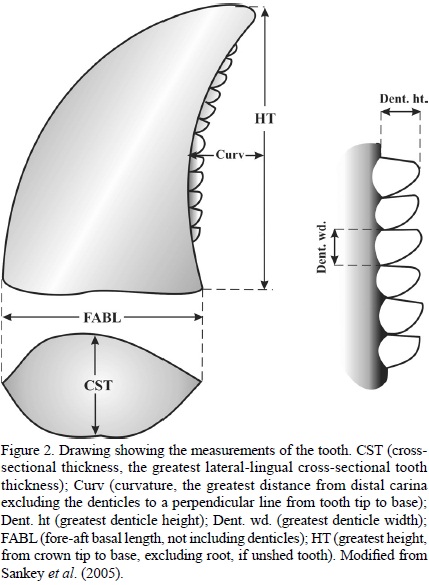
<body><![CDATA[<p align="justify"><font face="verdana" size="2">The Maastrichtian age is consistent for the Ocozocoautla Formation, based mainly on the stratigraphic ranges of corals, rudists, crabs and planktonic foraminifers found there.</font></p>  	    <p align="justify"><font face="verdana" size="2">&nbsp;</font></p>  	    <p align="justify"><font face="verdana" size="2"><b>3. Material and methods</b></font></p>  	    <p align="justify"><font face="verdana" size="2">The specimen comes from a vertebrate microfossil site in the Ocozocoautla Formation. The tooth was collected by surface collection. The specimen is housed in the Museo de Paleontolog&iacute;a "Eliseo Palacios Aguilera", where detailed locality information is on file.</font></p>  	    <p align="justify"><font face="verdana" size="2">Location of tooth measurements are illustrated in <a href="#f2">Figure 2</a>. A stereoscopic microscope with an ocular micrometer was used. Measurements are given in millimeters (mm) and are abbreviated as follows: FABL, fore&#150;aft basal length; HT, height; Curv, curvature; CST, cross&#150;sectional thickness; CSS, cross&#150;sectional shape; and dent/mm, denticles/mm.</font></p> 	    <p align="center"><font face="verdana" size="2"><a name="f2"></a></font></p> 	    <p align="center"><font face="verdana" size="2"><img src="/img/revistas/bsgm/v63n3/a2f2.jpg"></font></p> 	    <p align="justify"><font face="verdana" size="2">Institutional abbreviations: IHNFG, Instituto de Historia Natural, Geographic Collection.</font></p>  	    <p align="justify"><font face="verdana" size="2">&nbsp;</font></p>  	    <p align="justify"><font face="verdana" size="2"><b>4. Systematic paleontology</b></font></p>  	 		    ]]></body>
<body><![CDATA[<p align="justify"><font face="verdana" size="2">Order Saurischia Seeley, 1888    <br> 		Suborder Theropoda Marsh, 1881    <br> 		Infraorder Maniraptora Gauthier, 1986    <br> 		Genus Richardoestesia Currie, Rigby and Sloan, 1990</font></p> 	  	    <p align="justify"><font face="verdana" size="2"><i>Richardoestesia isosceles</i> Sankey, 2001</font></p>  	    <p align="justify"><font face="verdana" size="2">Type species: <i>Richardoestesia</i> gilmorei Currie, Rigby and Sloan, 1990</font></p>  	    <p align="justify"><font face="verdana" size="2">Original diagnosis: Teeth straight, narrow, shaped like an isosceles triangle in lateral view. Shape of tooth in basal cross&#150;section is labio&#150;lingually flattened oval. Denticles minute (0.1 mm in height and in anteroposterior width), square, uniformly&#150;sized from base to tip of tooth; extended length of carine. Anterior denticles, if present, often considerably smaller than posterior denticles. Interdenticle spaces usually minute and barely visible; denticles closely spaced. Denticle tips straight or faintly rounded, but not pointed; 7&#150;11 denticles per millimeter (Sankey, 2001).</font></p>  	    <p align="justify"><font face="verdana" size="2">4.1. Material</font></p>  	    <p align="justify"><font face="verdana" size="2">IHNFG&#150;0537, isolated maxilar tooth.</font></p>  	    <p align="justify"><font face="verdana" size="2">4.2. Horizon and locality</font></p>  	    ]]></body>
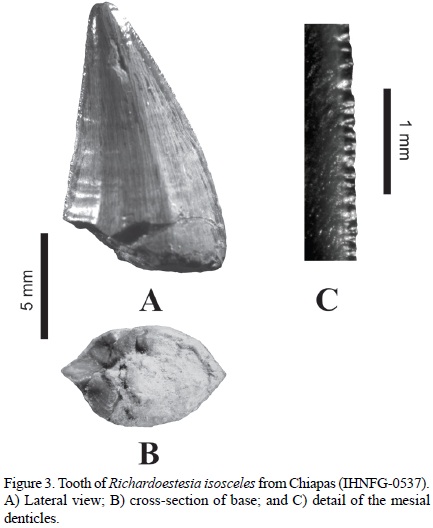
<body><![CDATA[<p align="justify"><font face="verdana" size="2">Ocozocoautla Formation (Late Cretaceous, Maastrichtian), Ocozocouatla, Chiapas, southern Mexico.</font></p>  	    <p align="justify"><font face="verdana" size="2">4.3. Description</font></p>  	    <p align="justify"><font face="verdana" size="2">Small tooth, triangular in shape, with the mesial border slightly curved; labio&#150;lingually flattened oval in cross section. Small denticles present on mesial and distal carinae. The mesial denticles are much more distinct than the distal, and generally 7 to 9 denticles per millimeter are present; denticles are 0.13&#150;0.17 mm wide and 0.13&#150;0.2 mm high. The denticles are approximately uniform in size from halfway to the tip of tooth, but are not observed near the base. The denticles are nearly square, with rounded outline. Interdenticle spaces are not present (<a href="#f3">Figure 3</a>, <a href="/img/revistas/bsgm/v63n3/a2t1.jpg" target="_blank">Table 1</a>).</font></p> 	    <p align="center"><font face="verdana" size="2"><a name="f3"></a></font></p> 	    <p align="center"><font face="verdana" size="2"><img src="/img/revistas/bsgm/v63n3/a2f3.jpg"></font></p> 	    <p align="justify"><font face="verdana" size="2">&nbsp;</font></p>  	    <p align="justify"><font face="verdana" size="2"><b>5. Discussion</b></font></p>  	    <p align="justify"><font face="verdana" size="2">Among all Late Cretaceous theropods, <i>Richardoestesia</i> is the genus with the smallest denticles in its teeth. Currently, two species of <i>Richardoestesia</i> are recognized, <i>R. gilmorei</i> and <i>R. isosceles. Richardoestesia gilmorei</i> was erected upon some teeth from the Judith River Formation by Currie <i>et al</i>. (1990), and <i>R. isosceles</i> was erected later by Sankey (2001), based on isolated teeth from the Aguja Formation in Texas. Sankey <i>et al</i>. (2002) noted that <i>Richardoestesia gilmorei</i> and <i>R. isosceles</i> differ in the curvature of the proximal part of the tooth. Tooth shape of <i>R. gilmorei</i> is more strongly recurved and resembles the teeth of <i>Saurornitholestes</i>, while in <i>R. isosceles</i> the tooth shape resembles an isosceles triangle. The shape of IHNFG&#150;0537 is more similar to that of <i>R. isosceles</i> than that of <i>R. gilmorei</i>. The denticles in <i>R. gilmorei</i> are pointed, and interdenticles spaces are present, whereas in <i>R. isosceles</i> denticles are present along both edges, and are not pointed (Sankey <i>et al</i>., 2005), as seen in IHNFG&#150;0537. All the morphological characteristics suggest that the tooth described in this paper belongs to <i>Richardoestesia isosceles</i>.</font></p>  	    <p align="justify"><font face="verdana" size="2">Longrich (2008) considered there to be only one species of <i>Richardoestesia</i>, and further considered <i>Paranychodon</i> to be a junior synonym (the difference being variation associated with heterodont dentition). But until more material is found, we have assigned specimen IHNFG&#150;0537 to <i>Richardoestesia isosceles</i>, following Larson (2008), who mentions contradictions to a monospecific <i>Richardoestesia</i>.</font></p>  	    <p align="justify"><font face="verdana" size="2"><i>Richardoestesia</i> has been identified in the Milk River Formation, the Horseshoe Canyon Formation, the Scollard Formation and the Dinosaur Park Formation in Alberta; the Frenchman Formation in Saskatchewan; the Judith River Formation in Montana; the Hell Creek Formation in Montana, North Dakota and South Dakota; the Lance Formation in Wyoming; and in the Aguja Formation in Texas (Currie <i>et al</i>., 1990; Baszio, 1997; Sankey, 2001). Prieto&#150;M&aacute;rquez <i>et al</i>. (2000) reported <i>Richardoestesia</i> based on a tooth from the Pyrenees, Spain. As for Mexico, this is the first report of the genus. The record for Chiapas extends considerably the geographic range of <i>Richardoestesia</i>, becoming the southernmost record in North America by almost two thousand kilometers.</font></p>  	    ]]></body>
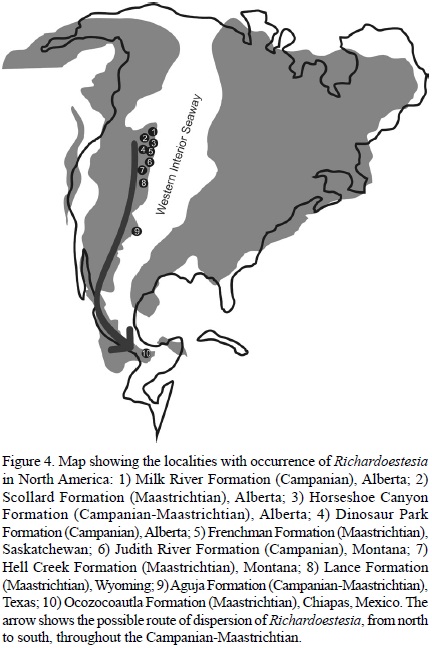
<body><![CDATA[<p align="justify"><font face="verdana" size="2">Several authors have suggested that the central region of Chiapas was completely covered with a shallow sea during the Late Cretaceous (e.g. Filkorn <i>et al</i>., 2005; Vega <i>et al</i>., 2001). However, the presence of <i>Richardoestesia</i> in Chiapas considerably changes the perception previously held regarding this region of the country, since it suggests the existence of continental zones connections to northern Mexico, the United States and Canada (<a href="#f4">Figure 4</a>). Possibly, the continental areas were close to the coast line, as suggested by the vertebrate nonmarine taxa found in the Ocozocoautla Formation (crocodiles and turtles). This kind of environment also agrees with the kind of lifestyle proposed by Baszio (1997), who suggests that <i>Richardoestesia</i> had a piscivorous diet on account of the small and punctuated shape of its teeth, features that occur in long&#150;snouted piscivores. The wear pattern of <i>Richardoestesia</i> teeth is also consistent with piscivory (Longrich, 2008).</font></p> 	    <p align="center"><font face="verdana" size="2"><a name="f4"></a></font></p> 	    <p align="center"><font face="verdana" size="2"><img src="/img/revistas/bsgm/v63n3/a2f4.jpg"></font></p> 	    <p align="justify"><font face="verdana" size="2">&nbsp;</font></p>  	    <p align="justify"><font face="verdana" size="2"><b>6. Conclusions</b></font></p>  	    <p align="justify"><font face="verdana" size="2">Based on the comparison of the tooth IHNFG&#150;0537 from the Ocozocoautla Formation with teeth from other Late Cretaceous localities in North America described by Currie <i>et al</i>. (1990) and Sankey (2001), we identify it as the genus <i>Richardoestesia</i>. This is the southernmost record of the genus for North America. The presence of dinosaurs in Chiapas suggests a near&#150;shore environment, in contrast to the previously held idea of the region being a shallow sea, reinforcing the suggestion that <i>Richardoestesia</i> had a piscivorous life style.</font></p>  	    <p align="justify"><font face="verdana" size="2">&nbsp;</font></p>  	    <p align="justify"><font face="verdana" size="2"><b>Acknowledgements</b></font></p>  	    <p align="justify"><font face="verdana" size="2">We thank Jos&eacute; Rub&eacute;n Guzm&aacute;n&#150;Guti&eacute;rrez for providing bibliography, and Marco A. Couti&ntilde;o&#150;Jos&eacute; and Javier Avenda&ntilde;o&#150;Gil for their support during the field seasons. The material described here was rescued thanks to financial aid provided by the government of Chiapas, through the project "Rescate del Patrimonio Paleontol&oacute;gico de la carretera Ocozocoautla&#150;Cosoleacaque, Chiapas". We also thank Thomas Holtz (University of Maryland), Don Brinkman (Royal Tyrell Museum) and Jos&eacute; Ignacio Canudo (Universidad de Zaragoza) for their reviews and helpful comments that improved this manuscript, and Francisco Sour (Museo de Paleontolog&iacute;a, UNAM) for his support in the editorial process.</font></p>  	    <p align="justify"><font face="verdana" size="2">&nbsp;</font></p>  	    ]]></body>
<body><![CDATA[<p align="justify"><font face="verdana" size="2"><b>References</b></font></p>  	    <!-- ref --><p align="justify"><font face="verdana" size="2">Alenc&aacute;ster, G., 1971, Rudistas del Cret&aacute;cico Superior de Chiapas, Parte I: Paleontolog&iacute;a Mexicana, 34, 1&#150;91.    &nbsp;&nbsp;&nbsp;&nbsp;&nbsp;&nbsp;&nbsp;&nbsp;[&#160;<a href="javascript:void(0);" onclick="javascript: window.open('/scielo.php?script=sci_nlinks&ref=1395579&pid=S1405-3322201100030000200001&lng=','','width=640,height=500,resizable=yes,scrollbars=1,menubar=yes,');">Links</a>&#160;]<!-- end-ref --></font></p>  	    <!-- ref --><p align="justify"><font face="verdana" size="2">Baszio, S., 1997, Systematic paleontology of isolated dinosaur teeth from the Latest Cretaceous of south Alberta, Canada: Courier Forschungsinstitut Senckenberg, 196, 33&#150;77.    &nbsp;&nbsp;&nbsp;&nbsp;&nbsp;&nbsp;&nbsp;&nbsp;[&#160;<a href="javascript:void(0);" onclick="javascript: window.open('/scielo.php?script=sci_nlinks&ref=1395581&pid=S1405-3322201100030000200002&lng=','','width=640,height=500,resizable=yes,scrollbars=1,menubar=yes,');">Links</a>&#160;]<!-- end-ref --></font></p>  	    <!-- ref --><p align="justify"><font face="verdana" size="2">Carbot&#150;Chanona, G., 2009, Una nueva especie de gavial primitivo del Maastrichtiano de Chiapas y su significaci&oacute;n paleobiogeogr&aacute;fica (abstract), in XI Congreso Nacional de Paleontolog&iacute;a: Juriquilla, Quer&eacute;taro, Sociedad Mexicana de Paleontolog&iacute;a, 12.    &nbsp;&nbsp;&nbsp;&nbsp;&nbsp;&nbsp;&nbsp;&nbsp;[&#160;<a href="javascript:void(0);" onclick="javascript: window.open('/scielo.php?script=sci_nlinks&ref=1395583&pid=S1405-3322201100030000200003&lng=','','width=640,height=500,resizable=yes,scrollbars=1,menubar=yes,');">Links</a>&#160;]<!-- end-ref --></font></p>  	    <!-- ref --><p align="justify"><font face="verdana" size="2">Carbot&#150;Chanona, G., Avenda&ntilde;o&#150;Gil, M.J., 2002, Dinosaurios en Chiapas: Revista de la Universidad Aut&oacute;noma de Chiapas, 4, 99&#150;107.    &nbsp;&nbsp;&nbsp;&nbsp;&nbsp;&nbsp;&nbsp;&nbsp;[&#160;<a href="javascript:void(0);" onclick="javascript: window.open('/scielo.php?script=sci_nlinks&ref=1395585&pid=S1405-3322201100030000200004&lng=','','width=640,height=500,resizable=yes,scrollbars=1,menubar=yes,');">Links</a>&#160;]<!-- end-ref --></font></p>  	    <!-- ref --><p align="justify"><font face="verdana" size="2">Currie, P.J., Rigby Jr., J.K., Sloan, R.E., 1990, Theropod teeth from the Judith River Formation of southern Alberta, Canada, in Carpenter, K., Currie, P.J. (eds.), Dinosaur Systematics: Approaches and Perspectives: Cambridge, U.K., Cambridge University Press, 107&#150;125.    &nbsp;&nbsp;&nbsp;&nbsp;&nbsp;&nbsp;&nbsp;&nbsp;[&#160;<a href="javascript:void(0);" onclick="javascript: window.open('/scielo.php?script=sci_nlinks&ref=1395587&pid=S1405-3322201100030000200005&lng=','','width=640,height=500,resizable=yes,scrollbars=1,menubar=yes,');">Links</a>&#160;]<!-- end-ref --></font></p>  	    <!-- ref --><p align="justify"><font face="verdana" size="2">Feldmann, R.M., Vega, F., Tucker, A.B., Garc&iacute;a&#150;Barrera, P., Avenda&ntilde;o, J., 1996, The oldest record of <i>Lophoranina</i> (Decapoda: Raninidae) from the Late Cretaceous of Chiapas, southeastern Mexico: Journal of Paleontology, 70, 296&#150;303.    &nbsp;&nbsp;&nbsp;&nbsp;&nbsp;&nbsp;&nbsp;&nbsp;[&#160;<a href="javascript:void(0);" onclick="javascript: window.open('/scielo.php?script=sci_nlinks&ref=1395589&pid=S1405-3322201100030000200006&lng=','','width=640,height=500,resizable=yes,scrollbars=1,menubar=yes,');">Links</a>&#160;]<!-- end-ref --></font></p>  	    <!-- ref --><p align="justify"><font face="verdana" size="2">Ferrusqu&iacute;a&#150;Villafranca, I., 1996, Contribuci&oacute;n al conocimiento geol&oacute;gico de Chiapas &#8212; el &aacute;rea Ixtapa&#150;Soyal&oacute;: Bolet&iacute;n del Instituto de Geolog&iacute;a UNAM, 109, 1&#150;130.    &nbsp;&nbsp;&nbsp;&nbsp;&nbsp;&nbsp;&nbsp;&nbsp;[&#160;<a href="javascript:void(0);" onclick="javascript: window.open('/scielo.php?script=sci_nlinks&ref=1395591&pid=S1405-3322201100030000200007&lng=','','width=640,height=500,resizable=yes,scrollbars=1,menubar=yes,');">Links</a>&#160;]<!-- end-ref --></font></p>  	    <!-- ref --><p align="justify"><font face="verdana" size="2">Filkorn, H.F., Avenda&ntilde;o&#150;Gil, J., Couti&ntilde;o&#150;Jos&eacute;, M.A., Vega&#150;Vera, F.J., 2005, Corals from the Upper Cretaceous (Maastrichtian) Ocozocoautla Formation, Chiapas, Mexico: Revista Mexicana de Ciencias Geol&oacute;gicas, 22, 115&#150;128.    &nbsp;&nbsp;&nbsp;&nbsp;&nbsp;&nbsp;&nbsp;&nbsp;[&#160;<a href="javascript:void(0);" onclick="javascript: window.open('/scielo.php?script=sci_nlinks&ref=1395593&pid=S1405-3322201100030000200008&lng=','','width=640,height=500,resizable=yes,scrollbars=1,menubar=yes,');">Links</a>&#160;]<!-- end-ref --></font></p>  	    <!-- ref --><p align="justify"><font face="verdana" size="2">Frost, S.H., Langenheim, R.L., 1974, Cenozoic reef biofacies; Tertiary larger foraminifera and scleractinian corals from Chiapas, Mexico: DeKalb, Illinois, U.S.A., Northern Illinois University Press, 388 p.    &nbsp;&nbsp;&nbsp;&nbsp;&nbsp;&nbsp;&nbsp;&nbsp;[&#160;<a href="javascript:void(0);" onclick="javascript: window.open('/scielo.php?script=sci_nlinks&ref=1395595&pid=S1405-3322201100030000200009&lng=','','width=640,height=500,resizable=yes,scrollbars=1,menubar=yes,');">Links</a>&#160;]<!-- end-ref --></font></p>  	    <!-- ref --><p align="justify"><font face="verdana" size="2">Gauthier, J., 1986, Saurischian monophyly and the origin of birds: California Academy of Science Memoirs, 8, 1&#150;55.    &nbsp;&nbsp;&nbsp;&nbsp;&nbsp;&nbsp;&nbsp;&nbsp;[&#160;<a href="javascript:void(0);" onclick="javascript: window.open('/scielo.php?script=sci_nlinks&ref=1395597&pid=S1405-3322201100030000200010&lng=','','width=640,height=500,resizable=yes,scrollbars=1,menubar=yes,');">Links</a>&#160;]<!-- end-ref --></font></p>  	    <!-- ref --><p align="justify"><font face="verdana" size="2">Gonz&aacute;lez&#150;Barba, G., Couti&ntilde;o, M.A., Ovalles&#150;Dami&aacute;n, E., Vega&#150;Vera, F.J., 2001, New Maastrichtian elasmobranch faunas from Baja California Peninsula, Nuevo Le&oacute;n and Chiapas state, Mexico (abstract), in Tintoti A., Arriata, G. (eds.), III Internacional Meeting on Mesozoic Fishes: Systematic, Paleoenvironments and Biodiversity: Serpiano&#150;Monte San Giorgio, Verlag Dr. Friedrich Pfeil, 33.    &nbsp;&nbsp;&nbsp;&nbsp;&nbsp;&nbsp;&nbsp;&nbsp;[&#160;<a href="javascript:void(0);" onclick="javascript: window.open('/scielo.php?script=sci_nlinks&ref=1395599&pid=S1405-3322201100030000200011&lng=','','width=640,height=500,resizable=yes,scrollbars=1,menubar=yes,');">Links</a>&#160;]<!-- end-ref --></font></p>  	    <!-- ref --><p align="justify"><font face="verdana" size="2">Guti&eacute;rrez&#150;Gil, R., 1956, Geolog&iacute;a del Mesozoico y estratigraf&iacute;a p&eacute;rmica del Estado de Chiapas, in XX Congreso Geol&oacute;gico Internacional, Guidebook, Excursion C&#150;15: Mexico, D.F., 1&#8211;82.    &nbsp;&nbsp;&nbsp;&nbsp;&nbsp;&nbsp;&nbsp;&nbsp;[&#160;<a href="javascript:void(0);" onclick="javascript: window.open('/scielo.php?script=sci_nlinks&ref=1395601&pid=S1405-3322201100030000200012&lng=','','width=640,height=500,resizable=yes,scrollbars=1,menubar=yes,');">Links</a>&#160;]<!-- end-ref --></font></p>  	    <!-- ref --><p align="justify"><font face="verdana" size="2">Hern&aacute;ndez&#150;Rivera, R., 1997, Mexican dinosaurs, in Currie, P., Padian, K. (eds.), Encyclopedia of Dinosaurs: New York, Academic Press, 433&#150;437.    &nbsp;&nbsp;&nbsp;&nbsp;&nbsp;&nbsp;&nbsp;&nbsp;[&#160;<a href="javascript:void(0);" onclick="javascript: window.open('/scielo.php?script=sci_nlinks&ref=1395603&pid=S1405-3322201100030000200013&lng=','','width=640,height=500,resizable=yes,scrollbars=1,menubar=yes,');">Links</a>&#160;]<!-- end-ref --></font></p>  	    <!-- ref --><p align="justify"><font face="verdana" size="2">Larson, D.W., 2008, Diversity and variation of theropod dinosaur teeth from the uppermost Santonian Milk River Formation (Upper Cretaceous), Alberta: a quantitative method supporting identification of the oldest dinosaur tooth assemblage in Canada: Canadian Journal of Earth Sciences, 45, 1455&#150;1468.    &nbsp;&nbsp;&nbsp;&nbsp;&nbsp;&nbsp;&nbsp;&nbsp;[&#160;<a href="javascript:void(0);" onclick="javascript: window.open('/scielo.php?script=sci_nlinks&ref=1395605&pid=S1405-3322201100030000200014&lng=','','width=640,height=500,resizable=yes,scrollbars=1,menubar=yes,');">Links</a>&#160;]<!-- end-ref --></font></p>  	    <!-- ref --><p align="justify"><font face="verdana" size="2">Longrich, N., 2008, Small theropod teeth from the Lance Formation of Wyoming, USA, in Sankey, J.T., Baszio, S. (eds.), Vertebrate microfossil assemblages: their role in paleoecology and paleobiogeography: Bloomington, Indiana, Indiana University Press, 135&#150;158.    &nbsp;&nbsp;&nbsp;&nbsp;&nbsp;&nbsp;&nbsp;&nbsp;[&#160;<a href="javascript:void(0);" onclick="javascript: window.open('/scielo.php?script=sci_nlinks&ref=1395607&pid=S1405-3322201100030000200015&lng=','','width=640,height=500,resizable=yes,scrollbars=1,menubar=yes,');">Links</a>&#160;]<!-- end-ref --></font></p>  	    <!-- ref --><p align="justify"><font face="verdana" size="2">Oma&ntilde;a, L., 2006, Late Cretaceous (Maastrichtian) foraminiferal assemblage from the inoceramid beds, Ocozocoautla Formation, central Chiapas, SE Mexico: Revista Mexicana de Ciencias Geol&oacute;gicas, 23, 125&#150;132.    &nbsp;&nbsp;&nbsp;&nbsp;&nbsp;&nbsp;&nbsp;&nbsp;[&#160;<a href="javascript:void(0);" onclick="javascript: window.open('/scielo.php?script=sci_nlinks&ref=1395609&pid=S1405-3322201100030000200016&lng=','','width=640,height=500,resizable=yes,scrollbars=1,menubar=yes,');">Links</a>&#160;]<!-- end-ref --></font></p>  	    <!-- ref --><p align="justify"><font face="verdana" size="2">Prieto&#150;M&aacute;rquez, A., Gaete, R., Galobart, A., Ardevol, L., 2000, A <i>Richardoestesia</i>&#150;like theropod tooth from the Late Cretaceous foredeep, south&#150;central Pyrenees, Spain: Eglogae Geologicae Helvetiae, 93, 497&#150;501.    &nbsp;&nbsp;&nbsp;&nbsp;&nbsp;&nbsp;&nbsp;&nbsp;[&#160;<a href="javascript:void(0);" onclick="javascript: window.open('/scielo.php?script=sci_nlinks&ref=1395611&pid=S1405-3322201100030000200017&lng=','','width=640,height=500,resizable=yes,scrollbars=1,menubar=yes,');">Links</a>&#160;]<!-- end-ref --></font></p>  	    <!-- ref --><p align="justify"><font face="verdana" size="2">Puckett, T.M., Arnett, B., Carbot&#150;Chanona, G., 2010, Paleobiogeographical and plate tectonic significance of Late Cretaceous Ostracodes (Crustaceans) from Chiapas, Mexico (abstract), in 87th Annual Meeting of the Alabama Academy of Science: Alabama, Alabama A&amp;M University Normal, 68.    &nbsp;&nbsp;&nbsp;&nbsp;&nbsp;&nbsp;&nbsp;&nbsp;[&#160;<a href="javascript:void(0);" onclick="javascript: window.open('/scielo.php?script=sci_nlinks&ref=1395613&pid=S1405-3322201100030000200018&lng=','','width=640,height=500,resizable=yes,scrollbars=1,menubar=yes,');">Links</a>&#160;]<!-- end-ref --></font></p>  	    <!-- ref --><p align="justify"><font face="verdana" size="2">Rivera&#150;Sylva, H.E., Rodr&iacute;guez&#150;De La Rosa, R., Ortiz&#150;Medieta, J.A., 2006, A review of the dinosaurian record from Mexico, in Vega, F.J, Nyborg, T.G., Perrilliat, M.C., Montellano&#150;Ballesteros, M., Cevallos&#150;Ferriz, S.R.S., Quiroz&#150;Barroso, S.A. (eds.), Studies on Mexican paleontology: Dordrecht, The Netherlands, Springer, 233&#150;248.    &nbsp;&nbsp;&nbsp;&nbsp;&nbsp;&nbsp;&nbsp;&nbsp;[&#160;<a href="javascript:void(0);" onclick="javascript: window.open('/scielo.php?script=sci_nlinks&ref=1395615&pid=S1405-3322201100030000200019&lng=','','width=640,height=500,resizable=yes,scrollbars=1,menubar=yes,');">Links</a>&#160;]<!-- end-ref --></font></p>  	    <!-- ref --><p align="justify"><font face="verdana" size="2">Sankey, J.T., 2001, Late Campanian southern dinosaurs, Aguja Formation, Big Bend, Texas: Journal of Paleontology, 75, 208&#150;215.    &nbsp;&nbsp;&nbsp;&nbsp;&nbsp;&nbsp;&nbsp;&nbsp;[&#160;<a href="javascript:void(0);" onclick="javascript: window.open('/scielo.php?script=sci_nlinks&ref=1395617&pid=S1405-3322201100030000200020&lng=','','width=640,height=500,resizable=yes,scrollbars=1,menubar=yes,');">Links</a>&#160;]<!-- end-ref --></font></p>  	    <!-- ref --><p align="justify"><font face="verdana" size="2">Sankey, J.T., Brinkman, D.B., Guenther, M., Currie, P.J., 2002, Small theropod and bird teeth from the Judith River Group (late Campanian), Alberta: Journal of Paleontology, 76, 751&#150;763.    &nbsp;&nbsp;&nbsp;&nbsp;&nbsp;&nbsp;&nbsp;&nbsp;[&#160;<a href="javascript:void(0);" onclick="javascript: window.open('/scielo.php?script=sci_nlinks&ref=1395619&pid=S1405-3322201100030000200021&lng=','','width=640,height=500,resizable=yes,scrollbars=1,menubar=yes,');">Links</a>&#160;]<!-- end-ref --></font></p>  	    <!-- ref --><p align="justify"><font face="verdana" size="2">Sankey, J.T., Standhardt, B.R., Schiebout, J.A., 2005, Theropod teeth from the Upper Cretaceous (Campanian&#150;Maastrichtian), Big Bend National Park, Texas, in Carpenter, K. (eds.), The Carnivorous Dinosaurs: Bloomington, Indiana, Indiana University Press, 127&#150;152.    &nbsp;&nbsp;&nbsp;&nbsp;&nbsp;&nbsp;&nbsp;&nbsp;[&#160;<a href="javascript:void(0);" onclick="javascript: window.open('/scielo.php?script=sci_nlinks&ref=1395621&pid=S1405-3322201100030000200022&lng=','','width=640,height=500,resizable=yes,scrollbars=1,menubar=yes,');">Links</a>&#160;]<!-- end-ref --></font></p>  	    <!-- ref --><p align="justify"><font face="verdana" size="2">Steele, D.R., Waite, L.E., 1986, Contributions to the stratigraphy of the Sierra Madre Limestone (Cretaceous) of Chiapas, M&eacute;xico: Bolet&iacute;n del Instituto de Geolog&iacute;a UNAM, 102, 1&#150;175.    &nbsp;&nbsp;&nbsp;&nbsp;&nbsp;&nbsp;&nbsp;&nbsp;[&#160;<a href="javascript:void(0);" onclick="javascript: window.open('/scielo.php?script=sci_nlinks&ref=1395623&pid=S1405-3322201100030000200023&lng=','','width=640,height=500,resizable=yes,scrollbars=1,menubar=yes,');">Links</a>&#160;]<!-- end-ref --></font></p>  	    <!-- ref --><p align="justify"><font face="verdana" size="2">Torres&#150;Rodr&iacute;guez, E., Montellano&#150;Ballesteros, M., Hern&aacute;ndez&#150;Rivera, R., Benammi, M., 2010, Dientes de ter&oacute;podos del Cret&aacute;cico Superior del estado de Coahuila, M&eacute;xico: Revista Mexicana de Ciencias Geol&oacute;gicas, 27, 72&#150;83.    &nbsp;&nbsp;&nbsp;&nbsp;&nbsp;&nbsp;&nbsp;&nbsp;[&#160;<a href="javascript:void(0);" onclick="javascript: window.open('/scielo.php?script=sci_nlinks&ref=1395625&pid=S1405-3322201100030000200024&lng=','','width=640,height=500,resizable=yes,scrollbars=1,menubar=yes,');">Links</a>&#160;]<!-- end-ref --></font></p>  	    <!-- ref --><p align="justify"><font face="verdana" size="2">Vega, F.J., Feldmann, R.M., Garc&iacute;a&#150;Barrera, P., Filkorn, H., Pimentel, F., Avenda&ntilde;o, J., 2001, Maastrichtian crustacean (Brachyura: Decapoda) from the Ocozocuautla Formation in Chiapas, southeast Mexico: Journal of Paleontology, 75, 319&#150;329.    &nbsp;&nbsp;&nbsp;&nbsp;&nbsp;&nbsp;&nbsp;&nbsp;[&#160;<a href="javascript:void(0);" onclick="javascript: window.open('/scielo.php?script=sci_nlinks&ref=1395627&pid=S1405-3322201100030000200025&lng=','','width=640,height=500,resizable=yes,scrollbars=1,menubar=yes,');">Links</a>&#160;]<!-- end-ref --></font></p>  	    <!-- ref --><p align="justify"><font face="verdana" size="2">Weishampel, D.B., Barrett, P.M., Coria, R., Le Loeuff, J., Xing, X., Xijin, Z., Gomani, E.M. P., Noto, C.R., 2004, Dinosaur Distribution, in Weishampel, D.B., Dodson, P., Osm&oacute;lska, H. (eds.), The Dinosauria: Berkeley, California, University of California Press, 517&#150;606.    &nbsp;&nbsp;&nbsp;&nbsp;&nbsp;&nbsp;&nbsp;&nbsp;[&#160;<a href="javascript:void(0);" onclick="javascript: window.open('/scielo.php?script=sci_nlinks&ref=1395629&pid=S1405-3322201100030000200026&lng=','','width=640,height=500,resizable=yes,scrollbars=1,menubar=yes,');">Links</a>&#160;]<!-- end-ref --></font></p>      ]]></body><back>
<ref-list>
<ref id="B1">
<nlm-citation citation-type="">
<person-group person-group-type="author">
<name>
<surname><![CDATA[Alencáster]]></surname>
<given-names><![CDATA[G]]></given-names>
</name>
</person-group>
<source><![CDATA[Rudistas del Cretácico Superior de Chiapas]]></source>
<year>1971</year>
<volume>34</volume>
<page-range>1-91</page-range></nlm-citation>
</ref>
<ref id="B2">
<nlm-citation citation-type="book">
<person-group person-group-type="author">
<name>
<surname><![CDATA[Baszio]]></surname>
<given-names><![CDATA[S]]></given-names>
</name>
</person-group>
<source><![CDATA[Systematic paleontology of isolated dinosaur teeth from the Latest Cretaceous of south]]></source>
<year>1997</year>
<volume>196</volume>
<page-range>33-77</page-range><publisher-loc><![CDATA[Alberta ]]></publisher-loc>
<publisher-name><![CDATA[Courier Forschungsinstitut Senckenberg]]></publisher-name>
</nlm-citation>
</ref>
<ref id="B3">
<nlm-citation citation-type="confpro">
<person-group person-group-type="author">
<name>
<surname><![CDATA[Carbot-Chanona]]></surname>
<given-names><![CDATA[G]]></given-names>
</name>
</person-group>
<source><![CDATA[Una nueva especie de gavial primitivo del Maastrichtiano de Chiapas y su significación paleobiogeográfica (abstract)]]></source>
<year>2009</year>
<conf-name><![CDATA[XI Congreso Nacional de Paleontología: Juriquilla]]></conf-name>
<conf-loc>Querétaro Querétaro</conf-loc>
<page-range>12</page-range></nlm-citation>
</ref>
<ref id="B4">
<nlm-citation citation-type="journal">
<person-group person-group-type="author">
<name>
<surname><![CDATA[Carbot-Chanona]]></surname>
<given-names><![CDATA[G]]></given-names>
</name>
<name>
<surname><![CDATA[Avendaño-Gil]]></surname>
<given-names><![CDATA[M.J.]]></given-names>
</name>
</person-group>
<article-title xml:lang="es"><![CDATA[Dinosaurios en Chiapas]]></article-title>
<source><![CDATA[Revista de la Universidad Autónoma de Chiapas]]></source>
<year>2002</year>
<volume>4</volume>
<page-range>99-107</page-range></nlm-citation>
</ref>
<ref id="B5">
<nlm-citation citation-type="book">
<person-group person-group-type="author">
<name>
<surname><![CDATA[Currie]]></surname>
<given-names><![CDATA[P.J.]]></given-names>
</name>
<name>
<surname><![CDATA[Rigby Jr.]]></surname>
<given-names><![CDATA[J.K.]]></given-names>
</name>
<name>
<surname><![CDATA[Sloan]]></surname>
<given-names><![CDATA[R.E.]]></given-names>
</name>
</person-group>
<article-title xml:lang="en"><![CDATA[Theropod teeth from the Judith River Formation of southern Alberta, Canada]]></article-title>
<person-group person-group-type="editor">
<name>
<surname><![CDATA[Carpenter]]></surname>
<given-names><![CDATA[K]]></given-names>
</name>
<name>
<surname><![CDATA[Currie]]></surname>
<given-names><![CDATA[P.J.]]></given-names>
</name>
</person-group>
<source><![CDATA[Dinosaur Systematics: Approaches and Perspectives]]></source>
<year>1990</year>
<page-range>107-125</page-range><publisher-loc><![CDATA[Cambridge ]]></publisher-loc>
<publisher-name><![CDATA[Cambridge University Press]]></publisher-name>
</nlm-citation>
</ref>
<ref id="B6">
<nlm-citation citation-type="journal">
<person-group person-group-type="author">
<name>
<surname><![CDATA[Feldmann]]></surname>
<given-names><![CDATA[R.M.]]></given-names>
</name>
<name>
<surname><![CDATA[Vega]]></surname>
<given-names><![CDATA[F]]></given-names>
</name>
<name>
<surname><![CDATA[Tucker]]></surname>
<given-names><![CDATA[A.B.]]></given-names>
</name>
<name>
<surname><![CDATA[García-Barrera]]></surname>
<given-names><![CDATA[P]]></given-names>
</name>
<name>
<surname><![CDATA[Avendaño]]></surname>
<given-names><![CDATA[J]]></given-names>
</name>
</person-group>
<article-title xml:lang="en"><![CDATA[The oldest record of Lophoranina (Decapoda: Raninidae) from the Late Cretaceous of Chiapas, southeastern Mexico]]></article-title>
<source><![CDATA[Journal of Paleontology]]></source>
<year>1996</year>
<volume>70</volume>
<page-range>296-303</page-range></nlm-citation>
</ref>
<ref id="B7">
<nlm-citation citation-type="journal">
<person-group person-group-type="author">
<name>
<surname><![CDATA[Ferrusquía-Villafranca]]></surname>
<given-names><![CDATA[I]]></given-names>
</name>
</person-group>
<article-title xml:lang="es"><![CDATA[Contribución al conocimiento geológico de Chiapas - el área Ixtapa-Soyaló]]></article-title>
<source><![CDATA[Boletín del Instituto de Geología UNAM]]></source>
<year>1996</year>
<volume>109</volume>
<page-range>1-130</page-range></nlm-citation>
</ref>
<ref id="B8">
<nlm-citation citation-type="journal">
<person-group person-group-type="author">
<name>
<surname><![CDATA[Filkorn]]></surname>
<given-names><![CDATA[H.F.]]></given-names>
</name>
<name>
<surname><![CDATA[Avendaño-Gil]]></surname>
<given-names><![CDATA[J]]></given-names>
</name>
<name>
<surname><![CDATA[Coutiño-José]]></surname>
<given-names><![CDATA[M.A.]]></given-names>
</name>
<name>
<surname><![CDATA[Vega-Vera]]></surname>
<given-names><![CDATA[F.J.]]></given-names>
</name>
</person-group>
<article-title xml:lang="en"><![CDATA[Corals from the Upper Cretaceous (Maastrichtian) Ocozocoautla Formation, Chiapas, Mexico]]></article-title>
<source><![CDATA[Revista Mexicana de Ciencias Geológicas]]></source>
<year>2005</year>
<volume>22</volume>
<page-range>115-128</page-range></nlm-citation>
</ref>
<ref id="B9">
<nlm-citation citation-type="book">
<person-group person-group-type="author">
<name>
<surname><![CDATA[Frost]]></surname>
<given-names><![CDATA[S.H.]]></given-names>
</name>
<name>
<surname><![CDATA[Langenheim]]></surname>
<given-names><![CDATA[R.L.]]></given-names>
</name>
</person-group>
<source><![CDATA[Cenozoic reef biofacies; Tertiary larger foraminifera and scleractinian corals from Chiapas, Mexico]]></source>
<year>1974</year>
<page-range>388</page-range><publisher-loc><![CDATA[DeKalb^eIllinois Illinois]]></publisher-loc>
<publisher-name><![CDATA[Northern Illinois University Press]]></publisher-name>
</nlm-citation>
</ref>
<ref id="B10">
<nlm-citation citation-type="journal">
<person-group person-group-type="author">
<name>
<surname><![CDATA[Gauthier]]></surname>
<given-names><![CDATA[J]]></given-names>
</name>
</person-group>
<article-title xml:lang="en"><![CDATA[Saurischian monophyly and the origin of birds]]></article-title>
<source><![CDATA[California Academy of Science Memoirs]]></source>
<year>1986</year>
<volume>8</volume>
<page-range>1-55</page-range></nlm-citation>
</ref>
<ref id="B11">
<nlm-citation citation-type="confpro">
<person-group person-group-type="author">
<name>
<surname><![CDATA[González-Barba]]></surname>
<given-names><![CDATA[G]]></given-names>
</name>
<name>
<surname><![CDATA[Coutiño]]></surname>
<given-names><![CDATA[M.A.]]></given-names>
</name>
<name>
<surname><![CDATA[Ovalles-Damián]]></surname>
<given-names><![CDATA[E]]></given-names>
</name>
<name>
<surname><![CDATA[Vega-Vera]]></surname>
<given-names><![CDATA[F.J.]]></given-names>
</name>
</person-group>
<article-title xml:lang="en"><![CDATA[New Maastrichtian elasmobranch faunas from Baja California Peninsula, Nuevo León and Chiapas state, Mexico (abstract)]]></article-title>
<person-group person-group-type="editor">
<name>
<surname><![CDATA[Tintoti]]></surname>
<given-names><![CDATA[A]]></given-names>
</name>
<name>
<surname><![CDATA[Arriata]]></surname>
<given-names><![CDATA[G]]></given-names>
</name>
</person-group>
<source><![CDATA[]]></source>
<year>2001</year>
<conf-name><![CDATA[III Internacional Meeting on Mesozoic Fishes: Systematic, Paleoenvironments and Biodiversity]]></conf-name>
<conf-loc>Serpiano-Monte San Giorgio </conf-loc>
<page-range>33</page-range></nlm-citation>
</ref>
<ref id="B12">
<nlm-citation citation-type="confpro">
<person-group person-group-type="author">
<name>
<surname><![CDATA[Gutiérrez-Gil]]></surname>
<given-names><![CDATA[R]]></given-names>
</name>
</person-group>
<source><![CDATA[Geología del Mesozoico y estratigrafía pérmica del Estado de Chiapas]]></source>
<year>1956</year>
<conf-name><![CDATA[XX Congreso Geológico Internacional]]></conf-name>
<conf-loc>D.F. D.F.</conf-loc>
<page-range>1-82</page-range></nlm-citation>
</ref>
<ref id="B13">
<nlm-citation citation-type="book">
<person-group person-group-type="author">
<name>
<surname><![CDATA[Hernández-Rivera]]></surname>
<given-names><![CDATA[R]]></given-names>
</name>
</person-group>
<article-title xml:lang="en"><![CDATA[Mexican dinosaurs]]></article-title>
<person-group person-group-type="editor">
<name>
<surname><![CDATA[Currie]]></surname>
<given-names><![CDATA[P]]></given-names>
</name>
<name>
<surname><![CDATA[Padian]]></surname>
<given-names><![CDATA[K]]></given-names>
</name>
</person-group>
<source><![CDATA[Encyclopedia of Dinosaurs]]></source>
<year>1997</year>
<page-range>433-437</page-range><publisher-loc><![CDATA[New York ]]></publisher-loc>
<publisher-name><![CDATA[Academic Press]]></publisher-name>
</nlm-citation>
</ref>
<ref id="B14">
<nlm-citation citation-type="journal">
<person-group person-group-type="author">
<name>
<surname><![CDATA[Larson]]></surname>
<given-names><![CDATA[D.W.]]></given-names>
</name>
</person-group>
<article-title xml:lang="en"><![CDATA[Diversity and variation of theropod dinosaur teeth from the uppermost Santonian Milk River Formation (Upper Cretaceous), Alberta: a quantitative method supporting identification of the oldest dinosaur tooth assemblage in Canada]]></article-title>
<source><![CDATA[Canadian Journal of Earth Sciences]]></source>
<year>2008</year>
<volume>45</volume>
<page-range>1455-1468</page-range></nlm-citation>
</ref>
<ref id="B15">
<nlm-citation citation-type="book">
<person-group person-group-type="author">
<name>
<surname><![CDATA[Longrich]]></surname>
<given-names><![CDATA[N]]></given-names>
</name>
</person-group>
<article-title xml:lang="en"><![CDATA[Small theropod teeth from the Lance Formation of Wyoming, USA]]></article-title>
<person-group person-group-type="editor">
<name>
<surname><![CDATA[Sankey]]></surname>
<given-names><![CDATA[J.T.]]></given-names>
</name>
<name>
<surname><![CDATA[Baszio]]></surname>
<given-names><![CDATA[S]]></given-names>
</name>
</person-group>
<source><![CDATA[Vertebrate microfossil assemblages: their role in paleoecology and paleobiogeography]]></source>
<year>2008</year>
<page-range>135-158</page-range><publisher-loc><![CDATA[Bloomington ]]></publisher-loc>
<publisher-name><![CDATA[Indiana University Press]]></publisher-name>
</nlm-citation>
</ref>
<ref id="B16">
<nlm-citation citation-type="journal">
<person-group person-group-type="author">
<name>
<surname><![CDATA[Omaña]]></surname>
<given-names><![CDATA[L]]></given-names>
</name>
</person-group>
<article-title xml:lang="en"><![CDATA[Late Cretaceous (Maastrichtian) foraminiferal assemblage from the inoceramid beds, Ocozocoautla Formation, central Chiapas, SE Mexico]]></article-title>
<source><![CDATA[Revista Mexicana de Ciencias Geológicas]]></source>
<year>2006</year>
<volume>23</volume>
<page-range>125-132</page-range></nlm-citation>
</ref>
<ref id="B17">
<nlm-citation citation-type="journal">
<person-group person-group-type="author">
<name>
<surname><![CDATA[Prieto-Márquez]]></surname>
<given-names><![CDATA[A]]></given-names>
</name>
<name>
<surname><![CDATA[Gaete]]></surname>
<given-names><![CDATA[R]]></given-names>
</name>
<name>
<surname><![CDATA[Galobart]]></surname>
<given-names><![CDATA[A]]></given-names>
</name>
<name>
<surname><![CDATA[Ardevol]]></surname>
<given-names><![CDATA[L]]></given-names>
</name>
</person-group>
<article-title xml:lang="en"><![CDATA[A Richardoestesia-like theropod tooth from the Late Cretaceous foredeep, south-central Pyrenees, Spain]]></article-title>
<source><![CDATA[Eglogae Geologicae Helvetiae]]></source>
<year>2000</year>
<volume>93</volume>
<page-range>497-501</page-range></nlm-citation>
</ref>
<ref id="B18">
<nlm-citation citation-type="confpro">
<person-group person-group-type="author">
<name>
<surname><![CDATA[Puckett]]></surname>
<given-names><![CDATA[T.M.]]></given-names>
</name>
<name>
<surname><![CDATA[Arnett]]></surname>
<given-names><![CDATA[B]]></given-names>
</name>
<name>
<surname><![CDATA[Carbot-Chanona]]></surname>
<given-names><![CDATA[G]]></given-names>
</name>
</person-group>
<source><![CDATA[Paleobiogeographical and plate tectonic significance of Late Cretaceous Ostracodes (Crustaceans) from Chiapas, Mexico (abstract)]]></source>
<year>2010</year>
<conf-name><![CDATA[87 Annual Meeting of the Alabama Academy of Science]]></conf-name>
<conf-loc>Alabama Alabama</conf-loc>
<page-range>68</page-range></nlm-citation>
</ref>
<ref id="B19">
<nlm-citation citation-type="book">
<person-group person-group-type="author">
<name>
<surname><![CDATA[Rivera-Sylva]]></surname>
<given-names><![CDATA[H.E.]]></given-names>
</name>
<name>
<surname><![CDATA[Rodríguez-De La Rosa]]></surname>
<given-names><![CDATA[R]]></given-names>
</name>
<name>
<surname><![CDATA[Ortiz-Medieta]]></surname>
<given-names><![CDATA[J.A.]]></given-names>
</name>
</person-group>
<article-title xml:lang="en"><![CDATA[A review of the dinosaurian record from Mexico]]></article-title>
<person-group person-group-type="editor">
<name>
<surname><![CDATA[Vega]]></surname>
<given-names><![CDATA[F.J]]></given-names>
</name>
<name>
<surname><![CDATA[Nyborg]]></surname>
<given-names><![CDATA[T.G.]]></given-names>
</name>
<name>
<surname><![CDATA[Perrilliat]]></surname>
<given-names><![CDATA[M.C.]]></given-names>
</name>
<name>
<surname><![CDATA[Montellano-Ballesteros]]></surname>
<given-names><![CDATA[M]]></given-names>
</name>
<name>
<surname><![CDATA[Cevallos-Ferriz]]></surname>
<given-names><![CDATA[S.R.S.]]></given-names>
</name>
<name>
<surname><![CDATA[Quiroz-Barroso]]></surname>
<given-names><![CDATA[S.A.]]></given-names>
</name>
</person-group>
<source><![CDATA[Studies on Mexican paleontology]]></source>
<year>2006</year>
<page-range>233-248</page-range><publisher-loc><![CDATA[Dordrecht ]]></publisher-loc>
<publisher-name><![CDATA[Springer]]></publisher-name>
</nlm-citation>
</ref>
<ref id="B20">
<nlm-citation citation-type="journal">
<person-group person-group-type="author">
<name>
<surname><![CDATA[Sankey]]></surname>
<given-names><![CDATA[J.T.]]></given-names>
</name>
</person-group>
<article-title xml:lang="en"><![CDATA[Late Campanian southern dinosaurs, Aguja Formation, Big Bend, Texas]]></article-title>
<source><![CDATA[Journal of Paleontology]]></source>
<year>2001</year>
<volume>75</volume>
<page-range>208-215</page-range></nlm-citation>
</ref>
<ref id="B21">
<nlm-citation citation-type="journal">
<person-group person-group-type="author">
<name>
<surname><![CDATA[Sankey]]></surname>
<given-names><![CDATA[J.T.]]></given-names>
</name>
<name>
<surname><![CDATA[Brinkman]]></surname>
<given-names><![CDATA[D.B.]]></given-names>
</name>
<name>
<surname><![CDATA[Guenther]]></surname>
<given-names><![CDATA[M]]></given-names>
</name>
<name>
<surname><![CDATA[Currie]]></surname>
<given-names><![CDATA[P.J.]]></given-names>
</name>
</person-group>
<article-title xml:lang="en"><![CDATA[Small theropod and bird teeth from the Judith River Group (late Campanian), Alberta]]></article-title>
<source><![CDATA[Journal of Paleontology]]></source>
<year>2002</year>
<volume>76</volume>
<page-range>751-763</page-range></nlm-citation>
</ref>
<ref id="B22">
<nlm-citation citation-type="book">
<person-group person-group-type="author">
<name>
<surname><![CDATA[Sankey]]></surname>
<given-names><![CDATA[J.T.]]></given-names>
</name>
<name>
<surname><![CDATA[Standhardt]]></surname>
<given-names><![CDATA[B.R.]]></given-names>
</name>
<name>
<surname><![CDATA[Schiebout]]></surname>
<given-names><![CDATA[J.A.]]></given-names>
</name>
</person-group>
<article-title xml:lang="en"><![CDATA[Theropod teeth from the Upper Cretaceous (Campanian-Maastrichtian), Big Bend National Park, Texas]]></article-title>
<person-group person-group-type="editor">
<name>
<surname><![CDATA[Carpenter]]></surname>
<given-names><![CDATA[K]]></given-names>
</name>
</person-group>
<source><![CDATA[The Carnivorous Dinosaurs]]></source>
<year>2005</year>
<page-range>127-152</page-range><publisher-loc><![CDATA[Bloomington^eIndiana Indiana]]></publisher-loc>
<publisher-name><![CDATA[Indiana University Press]]></publisher-name>
</nlm-citation>
</ref>
<ref id="B23">
<nlm-citation citation-type="journal">
<person-group person-group-type="author">
<name>
<surname><![CDATA[Steele]]></surname>
<given-names><![CDATA[D.R.]]></given-names>
</name>
<name>
<surname><![CDATA[Waite]]></surname>
<given-names><![CDATA[L.E.]]></given-names>
</name>
</person-group>
<article-title xml:lang="en"><![CDATA[Contributions to the stratigraphy of the Sierra Madre Limestone (Cretaceous) of Chiapas, México]]></article-title>
<source><![CDATA[Boletín del Instituto de Geología UNAM]]></source>
<year>1986</year>
<volume>102</volume>
<page-range>1-175</page-range></nlm-citation>
</ref>
<ref id="B24">
<nlm-citation citation-type="journal">
<person-group person-group-type="author">
<name>
<surname><![CDATA[Torres-Rodríguez]]></surname>
<given-names><![CDATA[E]]></given-names>
</name>
<name>
<surname><![CDATA[Montellano-Ballesteros]]></surname>
<given-names><![CDATA[M]]></given-names>
</name>
<name>
<surname><![CDATA[Hernández-Rivera]]></surname>
<given-names><![CDATA[R]]></given-names>
</name>
<name>
<surname><![CDATA[Benammi]]></surname>
<given-names><![CDATA[M]]></given-names>
</name>
</person-group>
<article-title xml:lang="es"><![CDATA[Dientes de terópodos del Cretácico Superior del estado de Coahuila, México]]></article-title>
<source><![CDATA[Revista Mexicana de Ciencias Geológicas]]></source>
<year>2010</year>
<volume>27</volume>
<page-range>72-83</page-range></nlm-citation>
</ref>
<ref id="B25">
<nlm-citation citation-type="journal">
<person-group person-group-type="author">
<name>
<surname><![CDATA[Vega]]></surname>
<given-names><![CDATA[F.J.]]></given-names>
</name>
<name>
<surname><![CDATA[Feldmann]]></surname>
<given-names><![CDATA[R.M.]]></given-names>
</name>
<name>
<surname><![CDATA[García-Barrera]]></surname>
<given-names><![CDATA[P]]></given-names>
</name>
<name>
<surname><![CDATA[Filkorn]]></surname>
<given-names><![CDATA[H]]></given-names>
</name>
<name>
<surname><![CDATA[Pimentel]]></surname>
<given-names><![CDATA[F]]></given-names>
</name>
<name>
<surname><![CDATA[Avendaño]]></surname>
<given-names><![CDATA[J]]></given-names>
</name>
</person-group>
<article-title xml:lang="en"><![CDATA[Maastrichtian crustacean (Brachyura: Decapoda) from the Ocozocuautla Formation in Chiapas, southeast Mexico]]></article-title>
<source><![CDATA[Journal of Paleontology]]></source>
<year>2001</year>
<volume>75</volume>
<page-range>319-329</page-range></nlm-citation>
</ref>
<ref id="B26">
<nlm-citation citation-type="book">
<person-group person-group-type="author">
<name>
<surname><![CDATA[Weishampel]]></surname>
<given-names><![CDATA[D.B.]]></given-names>
</name>
<name>
<surname><![CDATA[Barrett]]></surname>
<given-names><![CDATA[P.M.]]></given-names>
</name>
<name>
<surname><![CDATA[Coria]]></surname>
<given-names><![CDATA[R]]></given-names>
</name>
<name>
<surname><![CDATA[Le Loeuff]]></surname>
<given-names><![CDATA[J]]></given-names>
</name>
<name>
<surname><![CDATA[Xing]]></surname>
<given-names><![CDATA[X]]></given-names>
</name>
<name>
<surname><![CDATA[Xijin]]></surname>
<given-names><![CDATA[Z]]></given-names>
</name>
<name>
<surname><![CDATA[Gomani]]></surname>
<given-names><![CDATA[E.M. P.]]></given-names>
</name>
<name>
<surname><![CDATA[Noto]]></surname>
<given-names><![CDATA[C.R.]]></given-names>
</name>
</person-group>
<article-title xml:lang="en"><![CDATA[Dinosaur Distribution]]></article-title>
<person-group person-group-type="editor">
<name>
<surname><![CDATA[Weishampel]]></surname>
<given-names><![CDATA[D.B.]]></given-names>
</name>
<name>
<surname><![CDATA[Dodson]]></surname>
<given-names><![CDATA[P]]></given-names>
</name>
<name>
<surname><![CDATA[Osmólska]]></surname>
<given-names><![CDATA[H]]></given-names>
</name>
</person-group>
<source><![CDATA[The Dinosauria]]></source>
<year>2004</year>
<page-range>517-606</page-range><publisher-loc><![CDATA[Berkeley^eCalifornia California]]></publisher-loc>
<publisher-name><![CDATA[University of California Press]]></publisher-name>
</nlm-citation>
</ref>
</ref-list>
</back>
</article>