<?xml version="1.0" encoding="ISO-8859-1"?><article xmlns:mml="http://www.w3.org/1998/Math/MathML" xmlns:xlink="http://www.w3.org/1999/xlink" xmlns:xsi="http://www.w3.org/2001/XMLSchema-instance">
<front>
<journal-meta>
<journal-id>1405-3322</journal-id>
<journal-title><![CDATA[Boletín de la Sociedad Geológica Mexicana]]></journal-title>
<abbrev-journal-title><![CDATA[Bol. Soc. Geol. Mex]]></abbrev-journal-title>
<issn>1405-3322</issn>
<publisher>
<publisher-name><![CDATA[Sociedad Geológica Mexicana A.C.]]></publisher-name>
</publisher>
</journal-meta>
<article-meta>
<article-id>S1405-33222010000200006</article-id>
<title-group>
<article-title xml:lang="en"><![CDATA[On some Panamerican Cretaceous crabs (Decapoda: Raninoida)]]></article-title>
<article-title xml:lang="es"><![CDATA[Sobre algunos cangrejos panamericanos del Cretácico (Decapoda: Raninoida)]]></article-title>
</title-group>
<contrib-group>
<contrib contrib-type="author">
<name>
<surname><![CDATA[Vega]]></surname>
<given-names><![CDATA[Francisco J.]]></given-names>
</name>
<xref ref-type="aff" rid="A01"/>
</contrib>
<contrib contrib-type="author">
<name>
<surname><![CDATA[Nyborg]]></surname>
<given-names><![CDATA[Torrey]]></given-names>
</name>
<xref ref-type="aff" rid="A02"/>
</contrib>
<contrib contrib-type="author">
<name>
<surname><![CDATA[Kovalchuk]]></surname>
<given-names><![CDATA[Greg]]></given-names>
</name>
</contrib>
<contrib contrib-type="author">
<name>
<surname><![CDATA[Etayo]]></surname>
<given-names><![CDATA[Fernando]]></given-names>
</name>
<xref ref-type="aff" rid="A04"/>
</contrib>
<contrib contrib-type="author">
<name>
<surname><![CDATA[Luque]]></surname>
<given-names><![CDATA[Javier]]></given-names>
</name>
<xref ref-type="aff" rid="A05"/>
</contrib>
<contrib contrib-type="author">
<name>
<surname><![CDATA[Rojas-Briceño]]></surname>
<given-names><![CDATA[Alexis]]></given-names>
</name>
<xref ref-type="aff" rid="A07"/>
</contrib>
<contrib contrib-type="author">
<name>
<surname><![CDATA[Patarroyo]]></surname>
<given-names><![CDATA[Pedro]]></given-names>
</name>
<xref ref-type="aff" rid="A07"/>
</contrib>
<contrib contrib-type="author">
<name>
<surname><![CDATA[Porras-Múzquiz]]></surname>
<given-names><![CDATA[Héctor]]></given-names>
</name>
<xref ref-type="aff" rid="A08"/>
</contrib>
<contrib contrib-type="author">
<name>
<surname><![CDATA[Armstrong]]></surname>
<given-names><![CDATA[Adam]]></given-names>
</name>
</contrib>
<contrib contrib-type="author">
<name>
<surname><![CDATA[Bermúdez]]></surname>
<given-names><![CDATA[Hermann]]></given-names>
</name>
</contrib>
<contrib contrib-type="author">
<name>
<surname><![CDATA[Garibay]]></surname>
<given-names><![CDATA[Luis]]></given-names>
</name>
<xref ref-type="aff" rid="A11"/>
</contrib>
</contrib-group>
<aff id="A01">
<institution><![CDATA[,Universidad Nacional Autónoma de México (UNAM) Instituto de Geología ]]></institution>
<addr-line><![CDATA[México D.F.]]></addr-line>
<country>Mexico</country>
</aff>
<aff id="A02">
<institution><![CDATA[,Loma Linda University Department of Earth and Biological Sciences ]]></institution>
<addr-line><![CDATA[Loma Linda CA]]></addr-line>
<country>USA</country>
</aff>
<aff id="A04">
<institution><![CDATA[,INGEOMINAS-Museo Geológico José Royo y Gómez  ]]></institution>
<addr-line><![CDATA[Bogota DC]]></addr-line>
<country>Colombia</country>
</aff>
<aff id="A05">
<institution><![CDATA[,Smithsonian Tropical Research Institute Center for Tropical Paleoecology and Archaeology ]]></institution>
<addr-line><![CDATA[Balboa Ancon]]></addr-line>
<country>Panama</country>
</aff>
<aff id="A07">
<institution><![CDATA[,Universidad Nacional de Colombia Departamento de Geociencias ]]></institution>
<addr-line><![CDATA[Bogotá ]]></addr-line>
<country>Colombia</country>
</aff>
<aff id="A08">
<institution><![CDATA[,Museo de Múzquiz A. C.  ]]></institution>
<addr-line><![CDATA[Múzquiz Coahuila]]></addr-line>
<country>Mexico</country>
</aff>
<aff id="A11">
<institution><![CDATA[,Universidad Autónoma de Guerrero (UAG) Unidad Académica de Ciencias de la Tierra ]]></institution>
<addr-line><![CDATA[Taxco el Viejo Guerrero]]></addr-line>
<country>Mexico</country>
</aff>
<pub-date pub-type="pub">
<day>00</day>
<month>08</month>
<year>2010</year>
</pub-date>
<pub-date pub-type="epub">
<day>00</day>
<month>08</month>
<year>2010</year>
</pub-date>
<volume>62</volume>
<numero>2</numero>
<fpage>263</fpage>
<lpage>279</lpage>
<copyright-statement/>
<copyright-year/>
<self-uri xlink:href="http://www.scielo.org.mx/scielo.php?script=sci_arttext&amp;pid=S1405-33222010000200006&amp;lng=en&amp;nrm=iso"></self-uri><self-uri xlink:href="http://www.scielo.org.mx/scielo.php?script=sci_abstract&amp;pid=S1405-33222010000200006&amp;lng=en&amp;nrm=iso"></self-uri><self-uri xlink:href="http://www.scielo.org.mx/scielo.php?script=sci_pdf&amp;pid=S1405-33222010000200006&amp;lng=en&amp;nrm=iso"></self-uri><abstract abstract-type="short" xml:lang="en"><p><![CDATA[Decapod crustacean specimens recently collected from new and previously reported localities of USA, Mexico, and Colombia, as well as a review of species of uncertain affinity, add important information to complete the descriptions and paleobiological knowledge of some Cretaceous primitive crabs. The stratigraphic range for the genus Cenomanocarcinus is formally extended from the upper Albian to Campanian, based on occurrences from Colombia, Oklahoma and Mexico. Specimens of Cenomanocarcinus vanstraeleni from the Turonian of Mexico and Colombia include features not described previously for this species, such as variation in the shape and ornament of chelae. Necrocarcinus renfroae is here included in the genus Cenomanocarcinus, based on features of dorsal and ventral carapaces, as well as shape of pereiopods, and its occurrence is documented from the upper Albian of Colombia. Orithopsis tricarinata is reported for the first time in America from upper Albian deposits of Oregon and Colombia; the shape of the sternum confirms close affinities with the Cenomanocarcinidae and the family Orithopsidae is here included in the section Raninoida and restricted to the genus Orithopsis.]]></p></abstract>
<abstract abstract-type="short" xml:lang="es"><p><![CDATA[Crustáceos decápodos colectados recientemente en localidades nuevas y previamente reportadas de EUA, México y Colombia, así como una revisión a especies de afinidad incierta, proveen información importante para complementar descripciones y conocimiento paleobiológico de algunos cangrejos primitivos cretácicos. El alcance estratigráfico del género Cenomanocarcinus es formalmente extendido del Albiano superior al Campaniano en Colombia, Oklahoma y México. Nuevos ejemplares de Cenomanocarcinus vanstraeleni del Turoniano de México y Colombia incluyen características no reportadas previamente para esta especie, tales como variación en el tamaño y forma de las quelas. Necrocarcinus renfroae es incluído en el género Cenomanocarcinus, con base en la morfología dorsal y ventral del caparazón, así como en la morfología de los pereiópodos y se documenta su presencia en el Albiano superior de Colombia. Orithopsis tricarinata es reportada por vez primera en América, en depósitos del Albiano superior de Colombia y Oregon, EUA; la morfología del esternón confirma su afinidad con la familia Cenomanocarcinidae y la familia Orithopsidae es aquí incluida en la sección Raninoida y restringida al género Orithopsis.]]></p></abstract>
<kwd-group>
<kwd lng="en"><![CDATA[Crustacea, Raninoida]]></kwd>
<kwd lng="en"><![CDATA[Cretaceous]]></kwd>
<kwd lng="en"><![CDATA[North America]]></kwd>
<kwd lng="en"><![CDATA[South America]]></kwd>
<kwd lng="es"><![CDATA[Crustacea]]></kwd>
<kwd lng="es"><![CDATA[Raninoida]]></kwd>
<kwd lng="es"><![CDATA[Cretácico]]></kwd>
<kwd lng="es"><![CDATA[Norteamérica]]></kwd>
<kwd lng="es"><![CDATA[Sudamérica]]></kwd>
</kwd-group>
</article-meta>
</front><body><![CDATA[ <p align="justify"><font face="verdana" size="4">Art&iacute;culos</font></p>     <p align="justify"><font face="verdana" size="4">&nbsp;</font></p>     <p align="center"><font face="verdana" size="4"><b>On some Panamerican Cretaceous crabs (Decapoda: Raninoida)</b></font></p>     <p align="center"><font face="verdana" size="2">&nbsp;</font></p>     <p align="center"><font face="verdana" size="3"><b> Sobre algunos cangrejos panamericanos del Cret&aacute;cico (Decapoda: Raninoida)  </b></font></p>     <p align="center"><font face="verdana" size="2">&nbsp;</font></p>     <p align="center"><font face="verdana" size="2"><b>Francisco J. Vega<sup>1</sup>*, Torrey Nyborg<sup>2</sup>, Greg Kovalchuk<sup>3</sup>, Fernando Etayo<sup>4</sup>, Javier Luque<sup>5,6</sup>, Alexis Rojas&#150;Brice&ntilde;o<sup>7</sup>, Pedro Patarroyo<sup>7</sup>, H&eacute;ctor Porras&#150;M&uacute;zquiz<sup>8</sup>, Adam Armstrong<sup>9</sup>, Hermann Berm&uacute;dez<sup>10</sup>, and Luis Garibay<sup>11</sup></b></font></p>     <p align="justify"><font face="verdana" size="2">&nbsp;</font></p>     <p align="justify"><font face="verdana" size="2"><i><sup>1</sup> Instituto de Geolog&iacute;a, UNAM, Ciudad Universitaria, M&eacute;xico, D.F., Mexico. *E&#150;mail:</i> <a href="mailto:vegver@servidor.unam.mx">vegver@servidor.unam.mx</a></font></p>     <p align="justify"><font face="verdana" size="2"><i><sup>2</sup> Department of Earth and Biological Sciences, Loma Linda University, Loma Linda CA, 92350, USA.</i></font></p>     ]]></body>
<body><![CDATA[<p align="justify"><font face="verdana" size="2"><i><sup>3</sup> 1401 Chinook Street, The Dalles, OR 97058, USA.</i></font></p>     <p align="justify"><font face="verdana" size="2"><i><sup>4</sup> INGEOMINAS&#150;Museo Geol&oacute;gico Jos&eacute; Royo y G&oacute;mez, Dg 5334&#150;53, Bogota DC, Colombia.</i></font></p>     <p align="justify"><font face="verdana" size="2"><i><sup>5</sup> Smithsonian Tropical Research Institute. Center for Tropical Paleoecology and Archaeology. Apartado Postal 0843&#150;03092, Balboa, Ancon, Panama.</i></font></p>     <p align="justify"><font face="verdana" size="2"><i><sup>6</sup> D&eacute;partement de sciences biologiques, Universit&eacute; de Montr&eacute;al, Montr&eacute;al QC, Canada.</i></font></p>     <p align="justify"><font face="verdana" size="2"><i><sup>7</sup> Departamento de Geociencias, Universidad Nacional de Colombia, A. A. 14490, Bogot&aacute;, Colombia.</i></font></p>     <p align="justify"><font face="verdana" size="2"><i><sup>8</sup> Museo de M&uacute;zquiz A. C., Zaragoza 209, M&uacute;zquiz, Coahuila, 26340, Mexico.</i></font></p>     <p align="justify"><font face="verdana" size="2"><i><sup>9</sup> 306 Hilltop Road, Keene, TX, 76059, USA.</i></font></p>     <p align="justify"><font face="verdana" size="2"><i><sup>10</sup> Carrera 57 No 134&#150;20, torre 3 Apto 1004. Bogot&aacute; D.C., Colombia.</i></font></p>     <p align="justify"><font face="verdana" size="2"><i><sup>11</sup> Unidad Acad&eacute;mica de Ciencias de la Tierra, UAG, Exhacienda de San Juan Bautista S/N, Taxco el Viejo, Guerrero, 40200, Mexico.</i></font></p>     <p align="justify"><font face="verdana" size="2">&nbsp;</font></p>     ]]></body>
<body><![CDATA[<p align="justify"><font face="verdana" size="2">Manuscript received: December 7, 2009.     <br> Corrected manuscript received: April 1, 2010.     <br> Manuscript accepted: April 12, 2010.</font></p>     <p align="justify"><font face="verdana" size="2">&nbsp;</font></p>     <p align="justify"><font face="verdana" size="2"><b>Abstract</b></font></p>     <p align="justify"><font face="verdana" size="2">Decapod crustacean specimens recently collected from new and previously reported localities of USA, Mexico, and Colombia, as well as a review of species of uncertain affinity, add important information to complete the descriptions and paleobiological knowledge of some Cretaceous primitive crabs. The stratigraphic range for the genus <i>Cenomanocarcinus </i>is formally extended from the upper Albian to Campanian, based on occurrences from Colombia, Oklahoma and Mexico. Specimens of <i>Cenomanocarcinus vanstraeleni </i>from the Turonian of Mexico and Colombia include features not described previously for this species, such as variation in the shape and ornament of chelae. <i>Necrocarcinus renfroae </i>is here included in the genus <i>Cenomanocarcinus, </i>based on features of dorsal and ventral carapaces, as well as shape of pereiopods, and its occurrence is documented from the upper Albian of Colombia. <i>Orithopsis tricarinata </i>is reported for the first time in America from upper Albian deposits of Oregon and Colombia; the shape of the sternum confirms close affinities with the Cenomanocarcinidae and the family Orithopsidae is here included in the section Raninoida and restricted to the genus <i>Orithopsis.</i></font></p>     <p align="justify"><font face="verdana" size="2"><b>Keywords:</b> Crustacea, Raninoida, Cretaceous, North America, South America.</font></p>     <p align="justify"><font face="verdana" size="2">&nbsp;</font></p>     <p align="justify"><font face="verdana" size="2"><b>Resumen</b></font></p>     <p align="justify"><font face="verdana" size="2">Crust&aacute;ceos dec&aacute;podos colectados recientemente en localidades nuevas y previamente reportadas de EUA, M&eacute;xico y Colombia, as&iacute; como una revisi&oacute;n a especies de afinidad incierta, proveen informaci&oacute;n importante para complementar descripciones y conocimiento paleobiol&oacute;gico de algunos cangrejos primitivos cret&aacute;cicos. El alcance estratigr&aacute;fico del g&eacute;nero <u>Cenomanocarcinus</u> es formalmente extendido del Albiano superior al Campaniano en Colombia, Oklahoma y M&eacute;xico. Nuevos ejemplares de <u>Cenomanocarcinus vanstraeleni </u>del Turoniano de M&eacute;xico y Colombia incluyen caracter&iacute;sticas no reportadas previamente para esta especie, tales como variaci&oacute;n en el tama&ntilde;o y forma de las quelas. <u>Necrocarcinus renfroae</u> es inclu&iacute;do en el g&eacute;nero <u>Cenomanocarcinus,</u> con base en la morfolog&iacute;a dorsal y ventral del caparaz&oacute;n, as&iacute; como en la morfolog&iacute;a de los perei&oacute;podos y se documenta su presencia en el Albiano superior de Colombia. <u>Orithopsis tricarinata</u> es reportada por vez primera en Am&eacute;rica, en dep&oacute;sitos del Albiano superior de Colombia y Oregon, EUA; la morfolog&iacute;a del estern&oacute;n confirma su afinidad con la familia Cenomanocarcinidae y la familia Orithopsidae es aqu&iacute; incluida en la secci&oacute;n Raninoida y restringida al g&eacute;nero <u>Orithopsis</u>.</font></p>     ]]></body>
<body><![CDATA[<p align="justify"><font face="verdana" size="2"><b>Palabras clave:</b> Crustacea, Raninoida, Cret&aacute;cico, Norteam&eacute;rica, Sudam&eacute;rica.</font></p>     <p align="justify"><font face="verdana" size="2">&nbsp;</font></p>     <p align="justify"><font face="verdana" size="2"><b>1. Introduction</b></font></p>     <p align="justify"><font face="verdana" size="2">This report adds important information to the knowledge of several decapod crustacean specimens collected from Cretaceous localities of the United States of America (USA), Mexico and Colombia, which support interpretations recently discussed by Guinot <i>et al. </i>(2008) for the family Cenomanocarcinidae Guinot, Vega and Van Bakel, 2008. Additional data are provided for stratigraphic range, morphological variation, and paleobiogeographic distribution of some primitive Cretaceous crabs from the Americas. <i>Cenomanocarcinus vanstraeleni </i>Stenzel, 1945, known from the Upper Cretaceous of southeastern USA, Mexico and Colombia, is reported from upper Albian strata of Colombia. A single specimen of <i>Cenomanocarcinus </i>sp. is reported from the Campanian of Guerrero, Mexico. These records allow the stratigraphic range of <i>C. vanstraeleni </i>to be extended to the upper Albian, and <i>Cenomanocarcinus </i>to the Campanian in America. One nearly complete specimen from the upper Albian Simit&iacute; Formation of Colombia is identical with <i>Cenomanocarcinus renfroae </i>(Stenzel, 1945), containing impressions of most pereiopods; P4 are slightly reduced, have flat propodi and dactyli, and P5 are much reduced. Its sternum reveals close affinity to the genus <i>Cenomanocarcinus. </i>Several specimens of <i>Orithopsis tricarinata </i>(Bell, 1863) from the upper Albian Hudspeth Formation of Oregon represent the first record in America for that species; a complete sternum is preserved in one specimen, supporting affinities with the family Cenomanocarcinidae Guinot, Vega and Van Bakel, 2008. Examination of the type specimen of <i>Necrocarcinus olssoni </i>(Rathbun, 1937), from the Lower Cretaceous of Colombia, reveals that it actually is a specimen of <i>Orithopsis tricarinata </i>(Bell, 1863).</font></p>     <p align="justify"><font face="verdana" size="2">&nbsp;</font></p>     <p align="justify"><font face="verdana" size="2"><b>2. Localities</b></font></p>     <p align="justify"><font face="verdana" size="2">2.1. Localities in Mexico</font></p>     <p align="justify"><font face="verdana" size="2"><i>2.1.1. Eagle Ford Formation, Coahuila</i></font></p>     <p align="justify"><font face="verdana" size="2">A series of quarries is exposed in the region north of M&uacute;zquiz, northwest of Coahuila, Mexico. The quarries consist of limestones and marls of late Turonian to early Coniacian age (Stinnesbeck <i>et al., </i>2005). These deposits contain plant remains, planktic foraminifera, ammonoids, inoceramid bivalves, crustaceans, fishes, marine reptiles, and a pterosaur. Vega <i>et al. </i>(2007) provided a map and stratigraphic section for Turonian outcrops that yielded numerous specimens of <i>Cenomanocarcinus vanstraeleni, </i>whose exceptional preservation helped clarify the podotreme affinity of this species, and to erect a new family (Guinot <i>et al., </i>2008). Herein we include recently discovered specimens, which further help complete the morphological features of this species.</font></p>     <p align="justify"><font face="verdana" size="2"><i>2.1.2. Mexcala Formation, Guerrero</i></font></p>     ]]></body>
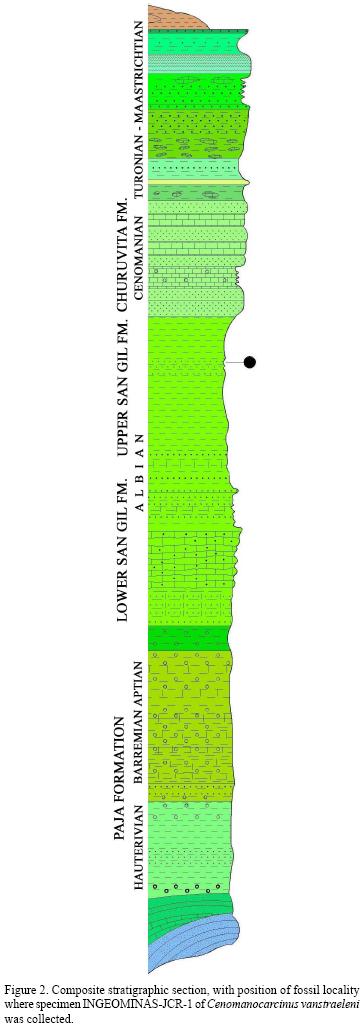
<body><![CDATA[<p align="justify"><font face="verdana" size="2">One specimen of <i>Cenomanocarcinus </i>sp. was collected in sediments of the Mexcala Formation, within shallow marine light brown siltstones and calcareous sandstones near the town of Zoquiapa in northeastern Guerrero State, Mexico. At this locality, a composite section of 25 m contains several species of Campanian gastropods and bivalves. This fossiliferous outcrop was previously reported by Fraaije <i>et al. </i>(2006) as locality IGM&#150;3557, who published a locality map and stratigraphic section.</font></p>     <p align="justify"><font face="verdana" size="2">2.2. Localities in Colombia</font></p>     <p align="justify"><font face="verdana" size="2"><i>2.2.1. Upper San Gil Formation, Cordillera Oriental, Department of Boyac&aacute;</i></font></p>     <p align="justify"><font face="verdana" size="2">The Villa de Leiva area (Cordillera Oriental, Department of Boyac&aacute;), located 127 km northeast of Bogot&aacute;, is one of the most studied fossiliferous localities in Colombia (<a href="/img/revistas/bsgm/v62n2/a6f1.jpg" target="_blank">Figure 1</a>). Ammonites, other mollusks, echinoids, fishes, marine reptiles, and other fossil groups have been reported from Cretaceous strata of this region (Acosta <i>et al., </i>1979; B&uuml;rlg, 1954; Etayo&#150;Serna, 1968, 1979; Jerez&#150;Jaimes and Narv&aacute;ez&#150;Parra, 2001; Patarroyo, 2004; among others). A sole specimen of <i>Cenomanocarcinus vanstraeleni </i>was collected from the middle&#150;upper portion of the Upper San Gil Formation, near the S&aacute;chica &#150; Puente Samac&aacute; highway. The Upper San Gil Formation consists of a lower 230 m&#150;thick segment of mudstones with interstratified horizons of sandstone and limestone and fossiliferous beds that contain gastropods and bivalves. The upper segment of the Upper San Gil Formation is a 390 m&#150;thick unit of dark&#150;gray shales, including clay nodules. Ammonites are the most common fossil found in these deposits. The age for the Upper San Gil Formation has been defined as Albian (Etayo&#150;Serna <i>et al., </i>1986). The section from which the specimen herein described was collected is relatively near the Albian/Cenomanian boundary (<a href="#f2">Figure 2</a>).</font></p>     <p align="center"><font face="verdana" size="2"><a name="f2"></a></font></p>     <p align="center"><font face="verdana" size="2"><img src="/img/revistas/bsgm/v62n2/a6f2.jpg"></font></p>     <p align="justify"><font face="verdana" size="2"><i>2.2.2. Simit&iacute; Formation, boundary between Cundinamarca and Boyac&aacute; Departments</i></font></p>     <p align="justify"><font face="verdana" size="2">The specimen herein described as <i>Cenomanocarcinus renfroae </i>was collected about 100 km north of Bogot&aacute;, between the Departments of Cundinamarca and Boyac&aacute; (<a href="/img/revistas/bsgm/v62n2/a6f3.jpg" target="_blank">Figure 3</a>), in upper Albian to Cenomanian rocks of the Simit&iacute; Formation (Petters, 1954; Ward <i>et al., </i>1973; Etayo&#150;Serna <i>et al., </i>1986). The Simit&iacute; Formation is composed of 250 &#150; 650 m slightly calcareous black to gray shales, with calcareous concretions (several meters in diameter) with thin interstratified layers of sandstone and gray limestone that are argillaceous and fossiliferous (<a href="#f4">Figure 4</a>). Near the top of the unit, thin conglomeratic layers with phosphatic nodules and fish teeth occur (Etayo&#150;Serna <i>et al., </i>1986).</font></p>     <p align="center"><font face="verdana" size="2"><a name="f4"></a></font></p>     <p align="center"><font face="verdana" size="2"><img src="/img/revistas/bsgm/v62n2/a6f4.jpg"></font></p>     ]]></body>
<body><![CDATA[<p align="justify"><font face="verdana" size="2"><i>2.2.3. San Rafael Formation, Samac&aacute; and Pesca, Department of Boyac&aacute;</i></font></p>     <p align="justify"><font face="verdana" size="2">Vega <i>et al. </i>(2007) described details of the stratigraphy, paleoenvironments, and localities that yielded crustacean specimens in the Turonian San Rafael Formation of Colombia (Patarroyo and Rojas&#150;Brice&ntilde;o, 2007). Several new specimens of <i>Cenomanocarcinus vanstraeleni </i>have been collected, and they contain details not described previously for this species. In particular, slender and spiny chelae are observed on several small specimens. This feature may be related to juvenile stages, or sexual dimorphism.</font></p>     <p align="justify"><font face="verdana" size="2"><i>2.2.4. Paja Formation, Samac&aacute; and Pesca, Department of Boyac&aacute;</i></font></p>     <p align="justify"><font face="verdana" size="2">The description given by Rathbun (1937, p. 27) for the locality where the specimen that was originally identified as <i>Dakoticancer olssoni </i>is as follows: "Colombia: Curit&iacute;, Departamento de Santander del Sur, near junction of branch road leading to the village of Curit&iacute;, Eastern Cordillera, from the main auto road from San Gil to Bucaramanga." The locality is found 230 km NE of Bogot&aacute;, Colombia, where rocks of the Paja Formation crop out (<a href="/img/revistas/bsgm/v62n2/a6f5.jpg" target="_blank">Figure 5</a>). The Paja Formation was originally described by Wheeler in Morales et al. (1958) as composed of fossiliferous blue to gray shales, intercalated with yellow&#150;gray, fine&#150;grained sandstones and thin gray limestone beds (Royero and Clavijo, 2001). The age for the Paja Formation has been considered as early Barremian to early Aptian (Etayo&#150;Serna <i>et al., </i>1986), but recent findings of ammonites and other mollusks in the area of the locality reported by Rathbun (1937) suggest that its age extends to the upper Albian (F. Etayo&#150;Serna, personal communication).</font></p>     <p align="justify"><font face="verdana" size="2">2.3. Localities in USA</font></p>     <p align="justify"><font face="verdana" size="2"><i>2.3.1. Hudspeth Formation, Oregon</i></font></p>     <p align="justify"><font face="verdana" size="2">Cretaceous sedimentary rocks within the Mitchell inlier of central Oregon include the Albian Hudspeth Formation (marine mudstone and turbidites) and the Cenomanian Gable Creek Formation (submarine&#150;fan conglomerate and sandstone; see Dorsey and Lenegan, 2007, for detailed description). The Hudspeth Formation was defined by Wilkinson and Oles (1968) whom divided the formation into a basal Member (Khb), main Mudstone Member (Kh1), and a series of stratigraphically higher mudstone members (Kh2 to Kh11) with interbedded units of the Gable Creek Formation. Dorsey and Lenegan (2007) followed the stratigraphic subdivision, but defined a higher unit of mudstone (Khm) instead of the multiple members (Kh2 to Kh11 of Wilkinson and Oles, 1968). The Main Mudstone Member (Kh1) consists of dark gray to black mudstone with minor shale units (Dorsey and Lenegan, 2007). Calcitic concretions containing mainly ammonites with occasional fossil crabs are common within the lower and upper portions of this member as mapped by Dorsey and Lenegan (2007, figs. 2, 3). Ammonites collected from the Main Mudstone Member range from early to late Albian (112&#150;99 Ma) (McKnight, 1964; Kleinhans <i>et al., </i>1984; Dorsey and Lenegan, 2007). Based upon micropaleontologic data, the Hudspeth Formation deposits represent outer neritic to upper bathyal water depths (Kleinhans <i>et al., </i>1984) with slow deposition in a relatively sediment&#150;starved marine basin (Kleinhans <i>et al., </i>1984; Wilkinson and Oles, 1968).</font></p>     <p align="justify"><font face="verdana" size="2">The Mitchell Inlier is a small Cretaceous outcrop within the larger Ochoco basin, which is believed to be part of the Cretaceous Great Valley forearc basin in California and the Hornbrook basin of southern Oregon (Wilkinson and Oles, 1968; Oles and Enlows, 1971; Kleinhans <i>et al., </i>1984; Nilsen, 1986; Dorsey and Lenegan, 2007). The only species of crab previously reported from the Hudspeth Formation is <i>Eucorystes platys </i>Schweitzer and Feldmann, 2001. Five specimens of <i>Orithopsis tricarinata </i>were collected as eroded calcitic concretions from the SE &#188;, Section 23, T115N, R21E of the 1:48,000 geologic map of the Mitchell Quadrangle, Oregon, mapped as part of the Main Mudstone Member (Kh1) by Wilkinson and Oles (1968). Detailed geology of the Cretaceous sedimentary rocks of the Mitchell Inlier, including stratigraphic columns, is illustrated and discussed by Dorsey and Lenegan (2007).</font></p>     <p align="justify"><font face="verdana" size="2"><i>2.3.2. Paw Paw Formation, Texas</i></font></p>     <p align="justify"><font face="verdana" size="2">The Paw Paw Formation (Hill, 1894) is predominately a siliciclastic unit within the limestone&#150;dominated upper Albian to lower Cenomanian Washita Group (Kennedy <i>et al., </i>2005). The Paw Paw Formation correlates with the late Albian European standard ammonite <i>Mortoniceras (Subschloenbachia) rostratum </i>Subzone (Kennedy, 2004; Kennedy <i>et al., </i>2005). Within Tarrant County, Texas, the Paw Paw Formation consists of approximately 8 m of brown arenaceous clay with cross&#150;bedded sandstone and ironstone concretions that crop out along a narrow north&#150;south band across the county (Root, 1975; Kennedy, 2004). The Paw Paw Formation is highly fossiliferous in marine invertebrates (Adkins, 1918; Hendricks, 1967; Blake and Reid, 1998) and vertebrates (Lee, 1994, 1996; Siverson <i>et al., </i>2007). Fossil decapod crustaceans have been previously reported by Rathbun (1935), Hendricks (1967), Schweitzer Hopkins <i>et al. </i>(1999), and Haj and Feldmann (2002). The <i>Necrocarcinus renfroae </i>(Rathbun, 1935) specimen was collected from an outcrop of clay that weathers reddish&#150;brown and is referable to the Paw Paw Formation (<a href="/img/revistas/bsgm/v62n2/a6f6.jpg" target="_blank">Figure 6</a>; McGowen <i>et al., </i>1972). The locality preserves abundant micro ammonites with occasional decapod crustaceans.</font></p>     ]]></body>
<body><![CDATA[<p align="justify"><font face="verdana" size="2">&nbsp;</font></p>     <p align="justify"><font face="verdana" size="2"><b>3. Repository</b></font></p>     <p align="justify"><font face="verdana" size="2">Specimens herein reported are deposited in the following collections: Colecci&oacute;n Nacional de Paleontolog&iacute;a, Instituto de Geolog&iacute;a, UNAM, Mexico, under acronym IGM; Colecci&oacute;n Paleontol&oacute;gica, Museo de M&uacute;zquiz, M&uacute;zquiz, Coahuila, Mexico, under acronym MUZ; Museo Geol&oacute;gico Jos&eacute; Royo y G&oacute;mez, Bogot&aacute;, Colombia, under acronym INGEOMINAS; Colecciones Paleontol&oacute;gicas del Departamento de Geociencias, Universidad Nacional de Colombia, Bogot&aacute;, Colombia, under acronym UN&#150;DG; Burke Museum of Natural History and Culture, University of Washington, Seattle, Washington, under acronym UWBM; Texas Natural Science Center, Austin, Texas (previously Paleontological Collection of the Bureau of Economic Geology, University of Texas), under acronym NPL; National Museum of Natural History, Smithsonian Institution, Washington, DC, under acronym USNM; New Mexico University, Paleontological Collection, under acronym UNM; Museo Civico di Storia Naturale di Milano, under acronym MSNMi. Abbreviations include P2&#150;P5 for second to fifth pereiopods.</font></p>     <p align="justify"><font face="verdana" size="2">&nbsp;</font></p>     <p align="justify"><font face="verdana" size="2"><b>4. Systematic paleontology</b></font></p>     <p align="center"><font face="verdana" size="2">Infraorder Brachyura Latreille, 1802 </font></p>     <p align="center"><font face="verdana" size="2">Section Raninoida De Haan, 1839 </font></p>     <p align="center"><font face="verdana" size="2">Family Cenomanocarcinidae Guinot, Vega and Van Bakel, 2008</font></p>     <p align="center"><font face="verdana" size="2">Genus <i>Cenomanocarcinus </i>Van Straelen, 1936 </font></p>     <p align="center"><font face="verdana" size="2">Type species. <i>Cenomanocarcinus inflatus </i>Van Straelen, 1936 by original designation </font></p>     ]]></body>
<body><![CDATA[<p align="center"><font face="verdana" size="2"><i>Cenomanocarcinus vanstraeleni </i>Stenzel, 1945 </font></p>     <p align="center"><font face="verdana" size="2"><a href="/img/revistas/bsgm/v62n2/a6f7.jpg" target="_blank">Figures 7</a>; <a href="/img/revistas/bsgm/v62n2/a6f8.jpg" target="_blank">8.1&#150;8.5</a> </font></p>     <p align="justify"><font face="verdana" size="2"><i>Cenomanocarcinus vanstraeleni </i>Stenzel, 1945, p. 447450, text&#150;fig. 15; F&ouml;rster, 1968, Abb. 4; Finsley, 1989, p. 98, 99, pl. 78, photos 307, 308; Bishop, Brannen, Hill, Meyer, Pike, and Sampson, 1992, fig. 7c; Vega, Nyborg, Rojas&#150;Brice&ntilde;o, Patarroyo, Luque, Porras&#150;M&uacute;zquiz, and Stinnesbeck, 2007, p. 412, figs. 7.2 &#150; 7.9, 8.1 &#150; 8.11, 9.1 &#150; 9.5; Patarroyo and Rojas&#150;Brice&ntilde;o, 2007, p. 92&#150;93, pl. 2, figs. 1 &#150; 4; Guinot, Vega and Van Bakel, 2008, p. 11, figs. 2, 3A&#150;D, 3F, 4, 5.</font></p>     <p align="justify"><font face="verdana" size="2"><i>Necrocarcinus vanstraeleni </i>(Stenzel, 1945); Kues, 1980, p. 862&#150;864, text&#150;fig. 1.</font></p>     <p align="justify"><font face="verdana" size="2"><i>Necrocarcinus (Cenomanocarcinus) vanstraeleni </i>(Stenzel, 1945)?; Toolson and Kues, 1996, p. 114&#150;115, fig. 1.5.</font></p>     <p align="justify"><font face="verdana" size="2"><i>Ophthalmoplax spinosus </i>Feldmann, Villamil and Kauffman, 1999, p. 96, figs. 3.1, 3.2, 4.1, 4.2.</font></p>     <p align="justify"><font face="verdana" size="2"><i>Cenomanocarcinus </i>sp.; Guinot, Vega and Van Bakel, 2008, p. 694, fig. 3E.</font></p>     <p align="justify"><font face="verdana" size="2"><b>Supplementary description. </b>A complete dorsal carapace description of <i>Cenomanocarcinus vanstraeleni </i>can be found in Stenzel (1945). Vega <i>et al. </i>(2007) expanded the description to include details of pereiopods, female abdomen and sternum. Guinot <i>et al. </i>(2008) provided the most complete description of the sternum and venter of both sexes for this species. Minor additions are given below, including details observed on chelipeds of Turonian specimens from Colombia.</font></p>     <p align="justify"><font face="verdana" size="2">Carapace subovate transversely; anterolateral margin with five to six small spines, not including the outer orbital spine; orbits small, subcircular, with two strong fissures on orbital margin; front tricuspate, projected; dorsal carapace marked by transverse and longitudinal ridges, which bear variable number of tubercles; tubercles lost when cuticle is not preserved, except for posterior tubercle in posterolateral ridges, which is strong. Female sternite 1 not seen; sternite 2 inverted triangle; sutures 2/3 not clear; sternite 3 subtrapezoidal, nearly three times as wide and four times as long as sternite 2; sutures 3/4 well defined; sternite 4 widest, with inclined, ovate external margins, one&#150;third wider and about same length as sternite 2; sutures 4/5 well defined; sternite 5 similar outline as sternite 4, but one&#150;third shorter and narrower; sutures 5/6 well&#150;defined, half the width of precedent sutures; sternite 6 one&#150;third the width and length of sternite 5, external portions inverted&#150;triangular; sternite 7 not seen.</font></p>     <p align="justify"><font face="verdana" size="2">Outer surface of left palm with a medial longitudinal row of tubercles. Some female specimens from Colombia possess long, slender chelipeds that nearly equal carapace width; both fingers downturned, lower margin of dactyl with several, evenly spaced long, sharp spines of similar size; upper and lower margins of fixed finger also with sharp spines. Male abdomen shorter than female abdomen, with rounded terminal margin of telson. Female abdomen three&#150;fourths the length of carapace, abdominal segment 1 the smallest, subtrapezoidal inverted, two&#150;thirds maximum width of abdomen; abdominal segment 2 of similar shape but one&#150;third longer and wider than previous segment, with a median transverse ridge; abdominal segment 3 subrectangular, bearing inclined lateral margins, with median transverse ridge; abdominal segment 4 very similar to segment 3, but slightly shorter, with median transverse ridge; abdominal segment 5 subrectangular, with slightly rounded lateral margins, with median transverse ridge; abdominal segment 6 nearly square, twice the length of segment 5, with central transverse ridge and two small inclined ridges at posterolateral corners; telson nearly triangular.</font></p>     ]]></body>
<body><![CDATA[<p align="justify"><font face="verdana" size="2"><b>Material examined. </b>Hypotypes IGM&#150;6112; MUZ&#150;</font></p>     <p align="justify"><font face="verdana" size="2">571 to MUZ&#150;573 and MUZ&#150;617; INGEOMINAS&#150;JCR&#150;1, INGEOMINAS&#150;JLC&#150;0010, INGEOMINAS&#150;JLC&#150;0019, INGEOMINAS&#150;JLC&#150;0112, INGEOMINAS&#150;JLC&#150;0032; UN&#150;DG&#150;CR&#150;014 to UN&#150;DG&#150;CR&#150;017.</font></p>     <p align="justify"><font face="verdana" size="2"><b>Occurrence. </b>Turonian, Eagle Ford Formation, Texas; lower&#150;middle Turonian, Eagle Ford Group, Rancho El Pilote, Coahuila, Mexico; upper Albian, Upper San Gil Formation, Cordillera Oriental, Department of Boyac&aacute;, Colombia; lower Turonian, San Rafael Formation, Pesca, Department of Boyac&aacute;, Colombia.</font></p>     <p align="justify"><font face="verdana" size="2"><b>Measurements (in mm). </b>Hypotype IGM&#150;6112 carapace length = 28.2, carapace width = 35.8; MUZ&#150;571 carapace length = 22.3, carapace width = 26.7; MUZ&#150;572 carapace length = 22.1, carapace width = 25.4; MUZ&#150;573 = carapace length = 34.7, abdomen length = 22.9, abdomen width = 10.1; MUZ&#150;617 = carapace length = 45.7, width 62.1; INGEOMINAS&#150;JCR&#150;1 carapace length = 32.2, carapace width: 39.8; INGEOMINAS&#150;JLC&#150;0010 carapace length = 21.5, carapace width = 27.7; INGEOMINAS&#150;JLC&#150;0019 carapace length = 13.1, carapace width = 16.4; INGEOMINAS&#150;JLC&#150;0112, abdomen length = 19.4, abdomen width = 13.2; INGEOMINAS&#150;JLC&#150;0032, left chela length = 14.2, left chela width = 5.7; UN&#150;DG&#150;CR&#150;014 carapace length = 26.6, carapace width = 30.3; UN&#150;DG&#150;CR&#150;015 right chela length = 18.2, right chela width = 6.3; UN&#150;DG&#150;CR&#150;16 carapace length = 23.1, carapace width = 30.3; UN&#150;DG&#150;CR&#150;17 carapace length = 20.9, carapace width = 28.5.</font></p>     <p align="justify"><font face="verdana" size="2"><b>Discussion. </b>Guinot <i>et al. </i>(2008) indicated differences in size and shape of abdomen and pereiopods as an expression of sexual dimorphism. Spinose chelipeds in some female specimens from the Turonian of Colombia (<a href="/img/revistas/bsgm/v62n2/a6f8.jpg" target="_blank">Figure 8.1</a> to <a href="/img/revistas/bsgm/v62n2/a6f8.jpg" target="_blank">8.4</a>) may be related to environmental stress, such as anoxia, previously interpreted for these sediments (Feldmann <i>et al., </i>1999). An anterior portion of a female abdomen was preserved next to one specimen from the San Rafael Formation in Colombia (<a href="/img/revistas/bsgm/v62n2/a6f7.jpg" target="_blank">Figure 7.11</a>, <a href="/img/revistas/bsgm/v62n2/a6f7.jpg" target="_blank">7.15</a>). The shape of this female abdomen is identical to that observed in articulated specimens of <i>Cenomanocarcinus vanstraeleni </i>from M&uacute;zquiz and Texas. Although preservation is not as good as in the type material, dorsal carapaces from the San Rafael Formation show the longitudinal and transverse ridges (<a href="/img/revistas/bsgm/v62n2/a6f7.jpg" target="_blank">Figure 7.9</a>, <a href="/img/revistas/bsgm/v62n2/a6f7.jpg" target="_blank">7.10</a>), as well as the tricuspate front typical of <i>C. vanstraeleni.</i></font></p>     <p align="justify"><font face="verdana" size="2">The stratigraphic range for <i>Cenomanocarcinus vanstraeleni </i>was reported to be upper Cenomanian to lower Turonian (Guinot <i>et al., </i>2008). With the report of <i>C. vanstraeleni </i>from the Upper San Gil Formation, the stratigraphic range for this species is extended to the upper Albian. <i>Ophthalmoplax spinosus </i>from the Turonian of Colombia was synonymised with <i>C. vanstraeleni </i>by Vega <i>et al. </i>(2007). We concur.</font></p>     <p align="justify"><font face="verdana" size="2"><i>Cenomanocarcinus oklahomensis </i>(Rathbun, 1935) from the Albian Marietta Formation of Texas (<a href="/img/revistas/bsgm/v62n2/a6f8.jpg" target="_blank">Figure 8.5</a>) is very similar to <i>C. vanstraeleni, </i>but more complete specimens are necessary to suggest a possible synonymy.</font></p>     <p align="center"><font face="verdana" size="2"><i>Cenomanocarcinus renfroae </i>(Stenzel, 1945) new combination </font></p>     <p align="center"><font face="verdana" size="2"><a href="/img/revistas/bsgm/v62n2/a6f8.jpg" target="_blank">Figure 8.6</a>&#150;<a href="/img/revistas/bsgm/v62n2/a6f8.jpg" target="_blank">8.12</a> </font></p>     <p align="justify"><font face="verdana" size="2"><i>Necrocarcinusrenfroae </i>Stenzel, 1945, p. 443, pl. 41, fig. 13; Guinot, Vega and Van Bakel, 2008, p. 698, figs. 8A&#150;8D.</font></p>     ]]></body>
<body><![CDATA[<p align="justify"><font face="verdana" size="2"><b>Emended diagnosis. </b>Carapace small, longer than wide; orbits large; anterolateral margin with at least four spines; posterolateral margin long, smooth; posterior margin straight, about half the maximum width; dorsal carapace subdivided by three subparallel longitudinal tuberculated ridges, the middle one being longer; a short transverse ridge joining lateral ridges with posterior spine of anterolateral margins; cervical groove sinuous; sternum narrow; sternite 1 subcircular, small; sternite 2 inverted triangle; sternite 3 subtrapezoidal; sternite 4 the widest of all sternites, with inclined, ovate external margins; sternite 5 of about the same shape as sternite 4; sternite 6 one&#150;third the width of sternite 5; sternite 7 one&#150;third smaller than sternite 6. Chelipeds robust, similar. P2 elongated. P3 elongated, slightly longer than P2. P4 one&#150;third shorter than P3. P5 not clear but reduced, one&#150;sixth the length of P4.</font></p>     <p align="justify"><font face="verdana" size="2"><b>Description. </b>Carapace small, subhexagonal, slightly longer than wide; anterolateral margin about half the length of carapace; posterolateral margin slightly longer than anterolateral margin; posterolateral margin straight, one&#150;third maximum carapace width; carapace surface marked by three longitudinal, sharp ridges, middle ridge longest, reaches protogastric region, interrupted at level of urogastric region, but continues to cardiac region; lateral ridges parallel to middle ridge, extending from border of posterolateral and posterior margins to gastric area. Sternum narrow, sternite 1 subcircular, small; sternite 2 inverted triangle; sutures 2/3 not clear; sternite 3 subtrapezoidal, nearly four times as long as length of sternite 2; sutures 3/4 well defined; sternite 4 widest of all, with inclined, ovate external margins, one&#150;third wider and of about the same length of sternite 2; sutures 4/5 well defined; sternite 5 of about the same shape as sternite 4, but one&#150;third shorter and narrower than sternite 4; sutures 5/6 well&#150;defined, half the width of preceding sutures; sternite 6 one&#150;third the width of sternite 5 and one&#150;third longer than sternite 5, external portions inverted&#150;triangular; sutures 6/7 deeply impressed, sinuous; sternite 7 one&#150;third smaller than sternite 6, lateral portions ovate, inclined posteriorly. Chelipeds robust, similar in shape and size, palm subrectangular, with two longitudinal ridges seen on inner surface of left chela, dactylus curved, sharp, one&#150;fourth longer than palm, one&#150;third its height. P2 elongated, merus rectangular, two&#150;thirds the length of carapace, height one&#150;sixth its own length; carpus subtriangular, one&#150;fourth the length of merus, narrow at junction with merus, three times wider at junction with propodus; propodus elongated, one&#150;third shorter than merus, lower margin straight, upper margin concave, narrow at junction with carpus, two times higher at junction with dactylus; dactylus lanceolate, half the length of propodus, distal tip sharp. P3 elongated, slightly longer than P2, but with the same proportions of articles, except dactylus which is longer than P2 dactylus. P4 one&#150;third shorter than P3; merus rectangular, elongated, half the height of P3 merus; carpus subcampanulate, narrow at junction with merus, two&#150;times higher at junction with propodus; propodus subcampanulate, one&#150;third longer than carpus, slightly narrower at junction with carpus, one&#150;third wider at junction with dactylus; dactylus lanceolated, nearly as long as propodus, lower margin curved, distal tip sharp. P5 not clear but reduced, one&#150;sixth the length of P4, merus subrectangular, one&#150;fourth the length of P4 merus and one&#150;third its height; carpus subrectangular, nearly as long as merus; propodus sobovate, one&#150;third shorter than carpus; dactylus unciform, half the height of propodus, one&#150;third shorter.</font></p>     <p align="justify"><font face="verdana" size="2"><b>Material examined. </b>Holotype BEG&#150;21093&#150;A3; hypotypes INGEOMINAS&#150;JFO&#150;759, NPL31182 and USNM 233978.</font></p>     <p align="justify"><font face="verdana" size="2"><b>Occurrence. </b>Upper Albian, Simit&iacute; Formation, limit between Departments of Cundinamarca and Boyac&aacute;, Colombia; upper Albian, Paw Paw Formation, Texas.</font></p>     <p align="justify"><font face="verdana" size="2"><b>Measurements (in mm). </b>Holotype BEG&#150;21093&#150;A3 carapace length = 16.4, width = 18.1; hypotypes INGEOMINAS&#150;JFO&#150;759 carapace length = 11.0, width = 13.1; NPL31182 carapace length = 10.9, width = 9.7; USNM 233978 carapace length = 9.0, width = 10.3.</font></p>     <p align="justify"><font face="verdana" size="2"><b>Discussion. </b>Affinity of <i>Necrocarcinus renfroae </i>with <i>Cenomanocarcinus </i>was previously suggested by F&ouml;rster (1968), Bishop (1986) and Schweitzer <i>et al. </i>(2003). Guinot <i>et al. </i>(2008) mentioned a deep branchiocardiac groove, larger orbits, and absence of an epibranchial ridge as features that preclude inclusion of <i>Necrocarcinus renfroae </i>in <i>Cenomanocarcinus. </i>However, sterna of two specimens reveal important similarities with sterna of species within <i>Cenomanocarcinus. </i>Specimens of <i>C. renfroae </i>are very small when compared with the mean size of <i>Cenomanocarcinus </i>spp. One possibility is that <i>C. renfroae </i>represents either a juvenile stage of <i>C. vanstraeleni </i>or sexual dimorphism, but more complete specimens need to be found to confirm this hypothesis.</font></p>     <p align="justify"><font face="verdana" size="2">The single Colombian specimen (<a href="/img/revistas/bsgm/v62n2/a6f8.jpg" target="_blank">Fig. 8.7</a>, <a href="/img/revistas/bsgm/v62n2/a6f8.jpg" target="_blank">8.8</a>) has an elongated carapace with three longitudinal parallel ridges, features observed in specimens of <i>Cenomanocarcinus renfroae </i>from Texas. The robust chelae and elongated pereiopods 2 and 3 are similar to those present in specimens of <i>C. vanstraeleni </i>(Vega <i>et al., </i>2007; Guinot <i>et al, </i>2008), although reduced P4 are not typical of <i>C. vanstraeleni. </i>P4 observed in the specimen from the Simit&iacute; Formation have certain similarities with the P4 seen in <i>Corazzatocarcinus hadjoulae </i>(<a href="/img/revistas/bsgm/v62n2/a6f8.jpg" target="_blank">Figure 8.13</a>, <a href="/img/revistas/bsgm/v62n2/a6f8.jpg" target="_blank">8.15</a>; Roger, 1946), which shares with <i>Cenomanocarcinus </i>a similar shape of abdomen and sternum (<a href="/img/revistas/bsgm/v62n2/a6f8.jpg" target="_blank">Figure 8.14</a>, <a href="/img/revistas/bsgm/v62n2/a6f8.jpg" target="_blank">8.15</a>), tricuspate front and tuberculated ridges on dorsal carapace, and should be included into the Cenomanocarcinidae. Although Guinot <i>et al. </i>(2008, p. 710) indicated that inclusion of the Cenomanocarcinidae within the subsection Raninoidia was supported by P4 expanded, with enlarged and flattened articles, features of P4 observed in <i>Cenomanocarcinus renfroae </i>and <i>Corazzatocarcinus hadjoulae </i>suggest that morphology and development of P4 may vary among members of the Cenomanocarcinidae.</font></p>     <p align="center"><font face="verdana" size="2"><i>Cenomanocarcinus </i>sp. </font></p>     <p align="center"><font face="verdana" size="2"><a href="/img/revistas/bsgm/v62n2/a6f8.jpg" target="_blank">Figure 8.16</a></font></p>     <p align="justify"><font face="verdana" size="2"><b>Description. </b>Carapace of medium size, subhexagonal, nearly as long as wide; cuticle with fine granules of uniform size; front projected, tricuspate; orbits narrow, semicircular, with two median fissures; posterior margin nearly straight, slightly concave medially; three longitudinal, parallel ridges on posterior two&#150;thirds of carapace; four small transverse spines on protogastric region; mesogastric region with two longitudinally aligned spines; cardiac region with one spine on anterior portion; intestinal region with one central small spine; cervical groove deeply impressed; branchial lobes ovate, inclined toward central portion of carapace; urogastric region depressed; cardiac region with three medial, axially and evenly spaced spines; small, acute tubercle medially placed on intestinal region: transverse, arcuate branchial ridges with at least two sharp spines; posterolateral longitudinal ridges with six sharp spines; area between posterolateral and branchial ridges covered by small tubercles.</font></p>     ]]></body>
<body><![CDATA[<p align="justify"><font face="verdana" size="2"><b>Material examined. </b>Hypotype IGM&#150;6113.</font></p>     <p align="justify"><font face="verdana" size="2"><b>Occurrence. </b>Campanian, Mexcala Formation, Zoquiapa, Guerrero, Mexico.</font></p>     <p align="justify"><font face="verdana" size="2"><b>Measurements (in mm). </b>Hypotype IGM&#150;6113 carapace length = 44, width = 45.</font></p>     <p align="justify"><font face="verdana" size="2"><b>Discussion. </b>The specimen from Guerrero differs from the other known species described for the genus in having fewer tubercles on the lateral longitudinal ridges, the presence of tubercles on the posterolateral area between the left lateral ridge and the posterolateral margin, and the branchial lobes are much more strongly marked. The Mexican specimen preserves the typical tricuspate front, left and right posterior longitudinal ridges, a median longitudinal ridge with six tubercles, and a left metabranchial region, with a portion of the transverse branchial ridge. It has well defined epibranchial lobes, and a relatively deep transverse posterior groove parallel to the posterior margin. More complete specimens are needed in order to define with certainty the specific placement of this specimen. However, preservation of the only specimen is too incomplete to assign to species level at this time. Reliable reliably</font></p>     <p align="justify"><font face="verdana" size="2">The specimen of <i>Cenomanocarcinus </i>sp. found in Campanian sediments from Southern Mexico has a similar shape and distribution of ridges and tubercles as seen in <i>Sagittiformosus carabus </i>Bishop, 1988, based on a small, incomplete specimen (<a href="/img/revistas/bsgm/v62n2/a6f8.jpg" target="_blank">Fig. 8.17</a>) from the Cenomanian Frontier Formation of Wyoming, USA. (Ryer, 1977; Holtzclaw, 1987; Bishop, 1988; Winn, 1991; Bhattacharya and Willis, 2001). This specimen should be now considered as a member of <i>Cenomanocarcinus </i>(R. Feldmann, personal communication), based on the presence of three longitudinal tuberculated ridges, two (out of four) transverse tubercles on anterior portion of carapace and straight posterior margin</font></p>     <p align="justify"><font face="verdana" size="2">The stratigraphic and paleobiogeographic range of <i>Cenomanocarcinus </i>is extended to the Campanian in America. <i>Cenomanocarcinus cristatus </i>(Jux, 1971), included in that genus by Guinot <i>et al. </i>(2008), was reported from the upper Campanian of Afghanistan, but the age for the Gholaman Formation is not well constrained. Jux (1971) attributed a Campanian age for that stratigraphic unit based on doubtful identifications of ammonites. The age for the Gholaman Formation needs to be reviewed (A. Shani, personal communication).</font></p>     <p align="justify"><font face="verdana" size="2">Family Orithopsidae Schweitzer, Feldmann, Fam, Hessin, Hetrick, Nyborg and Ross, 2003</font></p>     <p align="justify"><font face="verdana" size="2"><b>Emended diagnosis. </b>Carapace medium to large, sub&#150;hexagonal; orbitofrontal margin half the length of carapace; orbits wide; interior and exterior orbital margins with three small triangular spines; anterolateral margins concave, with four triangular spines; posterolateral margin inclined about 45 degrees from posterior margin; posterior margin nearly straight, half maximum carapace width; three longitudinal ridges on dorsal carapace; cervical and branchiocardiac grooves distinct, curved nearly parallel to each other; gastric region subdivided in subrectangular urogastric portion with rhomboidal metagastric region; hepatic region small; cardiac region elongate; branchial region divided into narrow epibranchial portions; intestinal area flat, wide; surface of carapace covered by uniformly distributed small granules and some large tubercles; sternite 1 small, subpentagonal; sternite 2 inverted triangle; sternite 3 subtrapezoidal; sternite 4 the widest of all; sternite 5 of about the same shape as sternite 4, but one&#150;third shorter and narrower; sternite 6 one&#150;third the width of sternite 5 and one&#150;third longer; sternite 7 one&#150;third smaller than sternite 6.</font></p>     <p align="justify"><font face="verdana" size="2"><b>Discussion. </b>Schweitzer <i>et al. </i>(2003) included the Orithopsidae in the Dorippoidea MacLeay, 1838, based mainly on position of last pereiopods, and on previous interpretations of Glaessner (1969) who referred <i>Orithopsis </i>to the Dorippidae MacLeay, 1838. As no mention of venter or legs existed in the diagnosis of the family given by Schweitzer <i>et al. </i>(2003) and StevciC (2005), Guinot <i>et al. </i>(2008) questioned this placement. Of the six genera <i>(Cherpiocarcinus </i>Maragnon and De Angeli, 1997; <i>Goniochele </i>Bell, 1858; <i>Marycarcinus </i>Schweitzer, Feldmann, Fam, Hessin, Hetrick, Nyborg and Ross, 2003; <i>Orithopsis; Paradoxicarcinus </i>Schweitzer, Feldmann, Fam, Hessin, Hetrick, Nyborg and Ross, 2003 ; and <i>Silvacarcinus </i>Collins and Smith, 1993) included by Schweitzer <i>et al. </i>(2003) in the Orithopsidae, only <i>Silvacarcinus </i>has clear heterotreme affinities, based on vulva position (Collins and Smith, 1993). Guinot <i>et al. </i>(2008) considered relationships of <i>Cherpiocarcinus </i>with the Dorippoidea as problematic, due to anterior ornament of carapace. Several differences in carapace shape, spines on anterior margin, grooves and development of regions in the dorsal carapace, were considered as features that separate <i>Paradoxicarcinus </i>from the cenomanocarcinids and the necrocarcinids (Guinot <i>et </i>al., 2008). Although Collins and Jakobsen (2003, p. 71) suggested affinities of <i>Goniochele </i>with the Calappoidea de Haan, 1841, dorsal position of P4 and P5 along with morphology of sternites on well&#150;preserved specimens of <i>G. madseni </i>Collins and Jakobsen, 2003, from the Lower Eocene of Denmark (Collins and Jakobsen, 2003), indicate its attribution to the Dorippoidea (Guinot <i>et al, </i>2008). A non&#150;eubrachyuran condition for <i>Orithopsis </i>was suggested by Guinot <i>et al. </i>(2008, p. 708), based on morphology of sternites 4 and 5 of a specimen of <i>O. tricarinata </i>deposited at the Institut Royal des Sciences Naturelles de Belgique, Brussels. Thus, the Orithopsidae should only contain for the moment the type genus, with sternum morphology as the main feature to suggest a close relationship with the Raninoida.</font></p>     <p align="center"><font face="verdana" size="2">Genus <i>Orithopsis </i>Carter, 1872 </font></p>     ]]></body>
<body><![CDATA[<p align="center"><font face="verdana" size="2"><b>Type species. </b><i>Orithopsis bonneyi </i>Carter, 1872 by monotypy. </font></p>     <p align="center"><font face="verdana" size="2"><i>Orithopsis tricarinata </i>(Bell, 1863) </font></p>     <p align="center"><font face="verdana" size="2"><a href="/img/revistas/bsgm/v62n2/a6f8.jpg" target="_blank">Figure 8.18</a>&#150;<a href="/img/revistas/bsgm/v62n2/a6f8.jpg" target="_blank">8.23</a> </font></p>     <p align="justify"><font face="verdana" size="2"><i>Orithya labeschii </i>Deslongchamps, 1835, p. 40, pl. 1, fig. 9.</font></p>     <p align="justify"><font face="verdana" size="2"><i>Necrocarcinus tricarinatus </i>Bell, 1863, p. 21, pl. 4, figs. 9 &#150; 11; Woodward, 1868, p. 259, pl. 14, fig. 4; Wright and Collins, 1972, p. 66, pl. 12, figs. 3 &#150; 6, pl. 13, figs. 1 &#150; 3; Ilyin, 2005, p. 202, pl. IX, fig. 5.</font></p>     <p align="justify"><font face="verdana" size="2"><i>Orithopsis Bonneyi </i>Carter, 1872, p. 529, pl. 13, fig. 1.</font></p>     <p align="justify"><font face="verdana" size="2"><i>Dakoticancer olssoni </i>Rathbun, 1937, p. 26, pl. 5, fig. 6.</font></p>     <p align="justify"><font face="verdana" size="2"><i>Necrocarcinus olssoni </i>(Rathbun, 1937); Feldmann, Villamil, and Kauffman, 1999, p. 91.</font></p>     <p align="justify"><font face="verdana" size="2"><i>Orithopsis tricarinatus </i>(Bell); F&ouml;rster, 1968, p. 178; Larghi and Garassino, 2000, p. 54.</font></p>     <p align="justify"><font face="verdana" size="2"><i>Orithopsis tricarinata </i>(Bell); Guinot, Vega and Van Bakel, 2008, p. 63, fig. 9E.</font></p>     ]]></body>
<body><![CDATA[<p align="justify"><font face="verdana" size="2"><b>Emended description. </b>Carapace medium to large, sub&#150;hexagonal. Orbitofrontal margin half the length of carapace. Rostrum long, bifid, with two distal sharp spines directed downwards. Orbits wide, shallow, abruptly directed straight up. Interior and exterior orbital margins with three small triangular spines; larger spine on external margin. Anterolateral margins concave, possessing four relatively large triangular spines. First spine smallest, located about 10 mm from external orbital spine; two medial spines of about equal size, curved toward front; fourth spine the largest, laterally directed, represents border between anterolateral and posterolateral margins, where maximum width of carapace is located. Total length of anterolateral margin about one&#150;half maximum carapace length. Posterolateral margin inclined, about 45 degrees from posterior margin, as long as anterolateral margin. Posterior margin nearly straight, about half maximum carapace width, slightly convex, with elevated rim.</font></p>     <p align="justify"><font face="verdana" size="2">Three longitudinal ridges clearly visible on dorsal carapace surface. Middle ridge located at central axis of carapace, extending from mesogastric region to base of rostrum. Two lateral ridges about the same length, symmetrically located to each side of middle ridge, extending from posterolateral edge of carapace to branchiocardiac grooves.</font></p>     <p align="justify"><font face="verdana" size="2">Cervical and branchiocardiac grooves distinct, curved nearly parallel to each other; maximum depth found at middle portion of carapace. Cervical groove uniformly deep along entire length, slightly wider than branchiocardiac groove, separating protogastric and epigastric regions, terminating at anterolateral margin, between first and second anterolateral spines. Branchiocardiac groove located at central portion of carapace, weakly curved, terminating between third and fourth spines of anterolateral margin, separating epi&#150; and mesobranchial regions.</font></p>     <p align="justify"><font face="verdana" size="2">Gastric region subdivided in subrectangular urogastric portion with rhomboidal metagastric, narrow triangular mesogastric and subtriangular protogastric regions. Hepatic region small. Cardiac region elongate. Branchial region divided into narrow epibranchial portions; meso&#150; and metabranchial regions separated by longitudinal ridge. Intestinal area flat, wide.</font></p>     <p align="justify"><font face="verdana" size="2">Surface of carapace covered by uniformly distributed small granules and some large tubercles. One tubercle located at base of mesogastric region, two other tubercles on each protogastric region, approximately level with mesogastric tubercle, separated about 5.0 mm from each other, and about 5.5 mm from middle ridge. Additional tubercle occupies anterior portion of urogastric region, another tubercle on anterior portion of cardiac region, and other large tubercles on each mesobranchial region, near flexion point of branchiocardiac groove.</font></p>     <p align="justify"><font face="verdana" size="2">Sternite 1 not seen; sternite 2 inverted triangle; sutures 2/3 not clear; sternite 3 subtrapezoidal, nearly three times as wide and four times as long as sternite 2; sutures 3/4 well defined; sternite 4 the widest of all, with inclined, ovate external margins, one&#150;third wider and of about the same length of sternite 2; sutures 4/5 well defined; sternite 5 of about the same shape as sternite 4, but one&#150;third shorter and narrower; sutures 5/6 well&#150;defined, half the width of preceding sutures; sternite 6 one&#150;third the width of sternite 5 and one&#150;third longer, external portions inverted&#150;triangular; sutures 6/7 deeply impressed, sinuous; sternite 7 one&#150;third smaller than sternite 6, lateral portions ovate, inclined posteriorly.</font></p>     <p align="justify"><font face="verdana" size="2"><b>Material examined. </b>Five specimens, deposited in the collection of the Burke Museum of Natural History and Culture, University of Washington, Seattle, Washington, USA, under acronym UWBM; hypotypes UWBM 98678 to UWBM 98682; and one specimen USNM 495104 deposited in the National Museum of Natural History, Smithsonian Institution, Washington, DC.</font></p>     <p align="justify"><font face="verdana" size="2"><b>Occurrence. </b>Upper Albian, Hudspeth Formation, Oregon, USA; upper Aptian, Paja Formation, Colombia.</font></p>     <p align="justify"><font face="verdana" size="2"><b>Measurements (in mm). </b>Hypotypes UWBM 98678 carapace width = 26.8; UWBM 98679 carapace length = 23.7, width = 24.3; UWBM 98680 carapace length = 26.2, width = 28.3; UWBM 98681 carapace length = 22.3, width= 25.1; UWBM 98682 carapace width = 22.0; USNM 495104 carapace length = 18.1, width 22.2.</font></p>     <p align="justify"><font face="verdana" size="2"><b>Discussion. </b>Although the Orithopsidae was previously included in the Dorippoidea (Schweitzer <i>et al., </i>2003; Schweitzer and Feldmann, 2005), Guinot <i>et al. </i>(2008) suggested its inclusion next to the raninoid Paleocorystidae, based on primitive features of sternum. The suspected non&#150;eubrachyran condition of this species suggested by Guinot <i>et al. </i>(2008) is reinforced by the structure of the sternum figured (Guinot <i>et al., </i>2008, fig. 9F), which is very similar to that observed in <i>Cenomanocarcinus. </i>However, differences in dorsal carapace suggest that the Orithopsidae should remain as a separate family, related to the Cenomanocarcinidae and Necrocarcinidae, and should be included in the Raninoida.</font></p>     ]]></body>
<body><![CDATA[<p align="justify"><font face="verdana" size="2"><i>Dakoticancer olssoni </i>Rathbun, 1937 was synonymized with <i>Necrocarcinus </i>by Feldmann <i>et al. </i>(1999, p. 91). The single known specimen (<a href="/img/revistas/bsgm/v62n2/a6f8.jpg" target="_blank">Figure 8.23</a>) is from Lower Cretaceous of Colombia. It occurs in upper Albian sediments of the Paja Formation (F. Etayo, personal communication) and should be considered a synonym of <i>Orithopsis tricarinata. </i>The species had a very wide distribution, including Ukraine, England, Oregon, and Colombia (<a href="/img/revistas/bsgm/v62n2/a6f9.jpg" target="_blank">Figure 9</a>, <a href="#t1">Table 1</a>).</font></p>     <p align="center"><font face="verdana" size="2"><a name="t1"></a></font></p>     <p align="center"><font face="verdana" size="2"><img src="/img/revistas/bsgm/v62n2/a6t1.jpg"></font></p>     <p align="justify"><font face="verdana" size="2">There is an important variation of sizes for the specimens reported from different localities. For example, the specimen illustrated by Ilyin (2005) is twice the size of the specimens from Oregon, while specimens figured by Wright and Collins (1972) are of about the same size as the specimens from Oregon. The projected anterior spines are not seen in any of the Oregon specimens, or in the specimen illustrated by Ilyin (2005). Their absence may be due to incomplete preservation, or possible sexual dimorphism.</font></p>     <p align="justify"><font face="verdana" size="2">&nbsp;</font></p>     <p align="justify"><font face="verdana" size="2"><b>5. Conclusions</b></font></p>     <p align="justify"><font face="verdana" size="2">Several decapod crustacean species had a wide distribution during Aptian&#150;Albian times. In particular, <i>Orithopsis tricarinata </i>extended from the Crimean Peninsula region to England, Oregon and Colombia (<a href="/img/revistas/bsgm/v62n2/a6f9.jpg" target="_blank">Figure 9</a>). Cenomanocarcinus vanstraeleni was present in Colombia and Oklahoma, and <i>C. renfroae </i>was also distributed from Texas to Colombia. <i>C. vanstraeleni </i>is fairly common in Cenomanian and Turonian deposits from Colombia, Mexico and the SE United States. The species has a wide range of morphologic variation, reflected in overall size, shape of anterolateral spines, size and ornament of chelipeds, sternum and abdomen. Thus, it is important to determine those variations, in order to determine whether they really represent intraspecific variation, or if several species were present at the same time in the same geographic areas. Variation in size and cheliped morphology has been observed in specimens from the Turonian of Colombia and Mexico, suggesting that they may be related to environmental stress. Interpreted paleoenvironments for the Turonian localities of Colombia and Mexico indicate an anoxic bottom of relatively deep seas (Feldmann <i>et al., </i>1999; Stinnesbeck <i>et al., </i>2005; Vega <i>et al., </i>2007, among others). Morphology of chelipeds and pereiopods for this species suggests either an infaunal or swimming crab, with sharp chelipeds typical of a carnivorous and or/scavenger (Guinot <i>et al., </i>2008). Relatively large numbers of crabs of this species found in ventral position in the same layers indicate mass mortality events (Feldmann <i>et al., </i>1999; Vega <i>et al., </i>2007). Thus, environmental stress should have played an important role in the morphological variation of this and other species. However, <i>Cenomanocarcinus </i>had a wide distribution in America, with the northernmost representative being <i>C. beardi </i>Schweitzer, Feldmann, Fam, Hessin, Hetrick, Nyborg and Ross, 2003, from the Upper Cretaceous of British Columbia, Canada. The genus persisted from late Albian to Campanian times in the Tethyan realm (<a href="#t1">Table 1</a>).</font></p>     <p align="justify"><font face="verdana" size="2">&nbsp;</font></p>     <p align="justify"><font face="verdana" size="2"><b>Acknowledgments</b></font></p>     <p align="justify"><font face="verdana" size="2">J. F. Osorno of INGEOMINAS, Bogot&aacute;, collected and provided important specimens for this study. D. Montoya and G. Reyes, INGEOMINAS, Bogot&aacute;, offered logistic support. Some photographs were generously given by Ann Molineaux (Texas Natural Science Center, Austin). C. Ifrim and A. Shani provided important stratigraphic information. Alex Tate, Geological Data Manager, British Antarctic Survey, provided images to document this contribution. Our sincere gratitude to Christiano Larghi for his advice, and to Alessandro Garassino, Museo di Storia Naturale, Milano, Italy, who provided images of several specimens. Ronald C. Blakely, Northern Arizona University, generously provided several paleogeographic maps. Special thanks to Rodney M. Feldmann and Hiroaki Karasawa for their valuable suggestions to improve the original manuscript. Support of Jann Thompson of the National Museum of Natural History is highly appreciated. Elena Lounejeva provided translations from Russian to complete the descriptions of genera.</font></p>     ]]></body>
<body><![CDATA[<p align="justify"><font face="verdana" size="2">&nbsp;</font></p>     <p align="justify"><font face="verdana" size="2"><b>References</b></font></p>     <!-- ref --><p align="justify"><font face="verdana" size="2">Acosta, C.E., Huertas, G., Ruiz, P.M., 1979, Noticia preliminar sobre el hallazgo de un presunto <i>Kronosaurus </i>(Reptilia: Dolychorynchopidae) en el Aptiano Superior de Villa de Levia, Columbia: Lozan&iacute;a (Acta Zoologica Columbiana), 28, 1&#150;10.    &nbsp;&nbsp;&nbsp;&nbsp;&nbsp;&nbsp;&nbsp;&nbsp;[&#160;<a href="javascript:void(0);" onclick="javascript: window.open('/scielo.php?script=sci_nlinks&ref=1384642&pid=S1405-3322201000020000600001&lng=','','width=640,height=500,resizable=yes,scrollbars=1,menubar=yes,');">Links</a>&#160;]<!-- end-ref --> </font></p>     <!-- ref --><p align="justify"><font face="verdana" size="2">Adkins, W.S., 1918, The Weno and Paw Paw formations of the Texas Comanchean: University of Texas Bulletin, 1856, 1&#150;172.    &nbsp;&nbsp;&nbsp;&nbsp;&nbsp;&nbsp;&nbsp;&nbsp;[&#160;<a href="javascript:void(0);" onclick="javascript: window.open('/scielo.php?script=sci_nlinks&ref=1384644&pid=S1405-3322201000020000600002&lng=','','width=640,height=500,resizable=yes,scrollbars=1,menubar=yes,');">Links</a>&#160;]<!-- end-ref --> </font></p>     <!-- ref --><p align="justify"><font face="verdana" size="2">Barrero, D., Pardo, A., Vargas, C.A., Mart&iacute;nez, J.F., 2007, Colombian Sedimentary Basins: Nomenclature, Boundaries and Petroleum Geology, a new proposal: Bogot&aacute;, Colombia, Agencia Nacional de Hidrocarburos (ANH), 91 p.    &nbsp;&nbsp;&nbsp;&nbsp;&nbsp;&nbsp;&nbsp;&nbsp;[&#160;<a href="javascript:void(0);" onclick="javascript: window.open('/scielo.php?script=sci_nlinks&ref=1384646&pid=S1405-3322201000020000600003&lng=','','width=640,height=500,resizable=yes,scrollbars=1,menubar=yes,');">Links</a>&#160;]<!-- end-ref --> </font></p>     <!-- ref --><p align="justify"><font face="verdana" size="2">Bell, T., 1858, A Monograph of the fossil malacostracous Crustacea of Great Britain. Part I. Crustacea of the London Clay: London, Palaeontographical Society, 44 p.    &nbsp;&nbsp;&nbsp;&nbsp;&nbsp;&nbsp;&nbsp;&nbsp;[&#160;<a href="javascript:void(0);" onclick="javascript: window.open('/scielo.php?script=sci_nlinks&ref=1384648&pid=S1405-3322201000020000600004&lng=','','width=640,height=500,resizable=yes,scrollbars=1,menubar=yes,');">Links</a>&#160;]<!-- end-ref --> </font></p>     ]]></body>
<body><![CDATA[<!-- ref --><p align="justify"><font face="verdana" size="2">Bell, T., 1863, A Monograph of the fossil malacostracous Crustacea of Great Britain, Part II. Crustacea of the Gault and Greensand: London, Palaeontographical Society, 40 p.    &nbsp;&nbsp;&nbsp;&nbsp;&nbsp;&nbsp;&nbsp;&nbsp;[&#160;<a href="javascript:void(0);" onclick="javascript: window.open('/scielo.php?script=sci_nlinks&ref=1384650&pid=S1405-3322201000020000600005&lng=','','width=640,height=500,resizable=yes,scrollbars=1,menubar=yes,');">Links</a>&#160;]<!-- end-ref --> </font></p>     <!-- ref --><p align="justify"><font face="verdana" size="2">Bhattacharya, J.P., Willis, B.J., 2001, Lowstand Deltas in the Frontier Formation, Powder River Basin, Wyoming: Implications for Sequence Stratigraphic Models: American Association of Petroleum Geologists Bulletin, 85, 261&#150;294.    &nbsp;&nbsp;&nbsp;&nbsp;&nbsp;&nbsp;&nbsp;&nbsp;[&#160;<a href="javascript:void(0);" onclick="javascript: window.open('/scielo.php?script=sci_nlinks&ref=1384652&pid=S1405-3322201000020000600006&lng=','','width=640,height=500,resizable=yes,scrollbars=1,menubar=yes,');">Links</a>&#160;]<!-- end-ref --></font></p>     <!-- ref --><p align="justify"><font face="verdana" size="2">Bishop, G.A., 1986, Occurrence, preservation, and biogeography of the Cretaceous crabs of North America, in Gore, R.H., Heck, K.L. (eds.), Crustacean Issues Vol. 4 Crustacean Biogeography: Boston, Balkema Press, 111&#150;142.    &nbsp;&nbsp;&nbsp;&nbsp;&nbsp;&nbsp;&nbsp;&nbsp;[&#160;<a href="javascript:void(0);" onclick="javascript: window.open('/scielo.php?script=sci_nlinks&ref=1384654&pid=S1405-3322201000020000600007&lng=','','width=640,height=500,resizable=yes,scrollbars=1,menubar=yes,');">Links</a>&#160;]<!-- end-ref --></font></p>     <!-- ref --><p align="justify"><font face="verdana" size="2">Bishop, G.A., 1988, New fossil crabs, <i>Plagiophthalmus izetti, Latheticocarcinus shapiroi, </i>and <i>Sagittiformosus carabus </i>(Crustacea, Decapoda) from the Western Interior Cretaceous, USA.: Proceedings of the Biological Society of Washington, 101, 375&#150;381.    &nbsp;&nbsp;&nbsp;&nbsp;&nbsp;&nbsp;&nbsp;&nbsp;[&#160;<a href="javascript:void(0);" onclick="javascript: window.open('/scielo.php?script=sci_nlinks&ref=1384656&pid=S1405-3322201000020000600008&lng=','','width=640,height=500,resizable=yes,scrollbars=1,menubar=yes,');">Links</a>&#160;]<!-- end-ref --></font></p>     <!-- ref --><p align="justify"><font face="verdana" size="2">Bishop, G.A., Brannen, N.A., Hill, L.E., Meyer, J. P., Pike, A.J., Sampson, C., 1992, The Britton <i>Notopocorystes </i>assemblage: an Eagle Ford decapod assemblage from the Cretaceous of North&#150;Central Texas, in Transactions of the 42nd Annual Convention: Jackson, Massachusetts, USA, Gulf Coast Association of Geological Societies, 413&#150;424.    &nbsp;&nbsp;&nbsp;&nbsp;&nbsp;&nbsp;&nbsp;&nbsp;[&#160;<a href="javascript:void(0);" onclick="javascript: window.open('/scielo.php?script=sci_nlinks&ref=1384658&pid=S1405-3322201000020000600009&lng=','','width=640,height=500,resizable=yes,scrollbars=1,menubar=yes,');">Links</a>&#160;]<!-- end-ref --></font></p>     ]]></body>
<body><![CDATA[<!-- ref --><p align="justify"><font face="verdana" size="2">Blake, D.B., Reid, R., 1998, Some Albian (Cretaceous) asteroids (Echinodermata) from Texas and their paleobiological implications: Journal of Paleontology, 72, 512&#150;532.    &nbsp;&nbsp;&nbsp;&nbsp;&nbsp;&nbsp;&nbsp;&nbsp;[&#160;<a href="javascript:void(0);" onclick="javascript: window.open('/scielo.php?script=sci_nlinks&ref=1384660&pid=S1405-3322201000020000600010&lng=','','width=640,height=500,resizable=yes,scrollbars=1,menubar=yes,');">Links</a>&#160;]<!-- end-ref --></font></p>     <!-- ref --><p align="justify"><font face="verdana" size="2">B&uuml;rlg, H., 1954, El Cret&aacute;ceo inferior en los alrededores de Villa de Leiva (Boyac&aacute;): Bolet&iacute;n Geol&oacute;gico del Instituto Geol&oacute;gico Nacional, 2, 5&#150;22.    &nbsp;&nbsp;&nbsp;&nbsp;&nbsp;&nbsp;&nbsp;&nbsp;[&#160;<a href="javascript:void(0);" onclick="javascript: window.open('/scielo.php?script=sci_nlinks&ref=1384662&pid=S1405-3322201000020000600011&lng=','','width=640,height=500,resizable=yes,scrollbars=1,menubar=yes,');">Links</a>&#160;]<!-- end-ref --></font></p>     <!-- ref --><p align="justify"><font face="verdana" size="2">Carter, J., 1872, On <i>Orithopsis bonneyi, </i>a new fossil crustacean: Geological Magazine, 9, 529&#150;532.    &nbsp;&nbsp;&nbsp;&nbsp;&nbsp;&nbsp;&nbsp;&nbsp;[&#160;<a href="javascript:void(0);" onclick="javascript: window.open('/scielo.php?script=sci_nlinks&ref=1384664&pid=S1405-3322201000020000600012&lng=','','width=640,height=500,resizable=yes,scrollbars=1,menubar=yes,');">Links</a>&#160;]<!-- end-ref --> </font></p>     <!-- ref --><p align="justify"><font face="verdana" size="2">Collins, J.S.H., Jakobsen, S.L., 2003, New crabs (Crustacea, Decapoda) from the Eocene (Ypresian/Lutetian) Lillebaelt Clay Formation of Jutland, Denmark: Bulletin of the Mizunami Fossil Museum, 30, 63&#150;95.    &nbsp;&nbsp;&nbsp;&nbsp;&nbsp;&nbsp;&nbsp;&nbsp;[&#160;<a href="javascript:void(0);" onclick="javascript: window.open('/scielo.php?script=sci_nlinks&ref=1384666&pid=S1405-3322201000020000600013&lng=','','width=640,height=500,resizable=yes,scrollbars=1,menubar=yes,');">Links</a>&#160;]<!-- end-ref --></font></p>     <!-- ref --><p align="justify"><font face="verdana" size="2">Collins, J.S.H., Smith, R., 1993, Ypresian (Lower Eocene) crabs (Decapoda, Crustacea) from Belgium: Bulletin de l'Institut royal des Sciences naturelles de Belgique, Sciences de la Terre, 63, 261&#150;270.    &nbsp;&nbsp;&nbsp;&nbsp;&nbsp;&nbsp;&nbsp;&nbsp;[&#160;<a href="javascript:void(0);" onclick="javascript: window.open('/scielo.php?script=sci_nlinks&ref=1384668&pid=S1405-3322201000020000600014&lng=','','width=640,height=500,resizable=yes,scrollbars=1,menubar=yes,');">Links</a>&#160;]<!-- end-ref --></font></p>     ]]></body>
<body><![CDATA[<!-- ref --><p align="justify"><font face="verdana" size="2">Deslongchamps, J.A.E., 1835, M&eacute;moire pour servir &agrave; l'histoire naturelle des Crustac&eacute;s fossiles: M&eacute;moires de la Soci&eacute;t&eacute; Linn&eacute;enne de Normandie, 5, 37&#150;46.    &nbsp;&nbsp;&nbsp;&nbsp;&nbsp;&nbsp;&nbsp;&nbsp;[&#160;<a href="javascript:void(0);" onclick="javascript: window.open('/scielo.php?script=sci_nlinks&ref=1384670&pid=S1405-3322201000020000600015&lng=','','width=640,height=500,resizable=yes,scrollbars=1,menubar=yes,');">Links</a>&#160;]<!-- end-ref --></font></p>     <!-- ref --><p align="justify"><font face="verdana" size="2">Dorsey, R.J., Lenegan, R.J., 2007, Structural controls on middle Cretaceous sedimentation in the Toney Butte area of the Mitchell inlier, Ochoco basin, central Oregon, in Cloos, M., Carlson, W.D., Gilbert, M.C., Liou, J.G., Sorensen, S.S. (eds.) Convergent margin terranes and associated regions: a tribute to W.G. Ernst: Austin, Texas, USA, The Geological Society of America Special Paper 419, 97&#150;115.    &nbsp;&nbsp;&nbsp;&nbsp;&nbsp;&nbsp;&nbsp;&nbsp;[&#160;<a href="javascript:void(0);" onclick="javascript: window.open('/scielo.php?script=sci_nlinks&ref=1384672&pid=S1405-3322201000020000600016&lng=','','width=640,height=500,resizable=yes,scrollbars=1,menubar=yes,');">Links</a>&#160;]<!-- end-ref --></font></p>     <!-- ref --><p align="justify"><font face="verdana" size="2">Etayo&#150;Serna, F., 1968, El Sistema Cret&aacute;ceo en la regi&oacute;n de Villa de Leiva y zonas pr&oacute;ximas: Geolog&iacute;a Colombiana, 5, 5&#150;74.    &nbsp;&nbsp;&nbsp;&nbsp;&nbsp;&nbsp;&nbsp;&nbsp;[&#160;<a href="javascript:void(0);" onclick="javascript: window.open('/scielo.php?script=sci_nlinks&ref=1384674&pid=S1405-3322201000020000600017&lng=','','width=640,height=500,resizable=yes,scrollbars=1,menubar=yes,');">Links</a>&#160;]<!-- end-ref --></font></p>     <!-- ref --><p align="justify"><font face="verdana" size="2">Etayo&#150;Serna, F., 1979, Zonation of the Cretaceous of Central Colombia by Ammonites: Bogot&aacute;, Colombia, INGEOMINAS, Publicaci&oacute;n Especial 2, 186 p.    &nbsp;&nbsp;&nbsp;&nbsp;&nbsp;&nbsp;&nbsp;&nbsp;[&#160;<a href="javascript:void(0);" onclick="javascript: window.open('/scielo.php?script=sci_nlinks&ref=1384676&pid=S1405-3322201000020000600018&lng=','','width=640,height=500,resizable=yes,scrollbars=1,menubar=yes,');">Links</a>&#160;]<!-- end-ref --></font></p>     <!-- ref --><p align="justify"><font face="verdana" size="2">Etayo&#150;Serna, F., Barrero, D., Lozano, H., Espinosa, A., Gonz&aacute;lez, H., Orrego, A., Ballesteros, I., Forero, H., Ram&iacute;rez, C., Zambrano, F., Duque, H., Vargas, R., N&uacute;&ntilde;ez, A., Alvarez, J., Ropain, C., Cardoso, E., Galvis, N., Sarmiento, L., 1986, Mapa de terrenos geol&oacute;gicos de Colombia: Bogot&aacute;, Colombia, INGEOMINAS, Publicaci&oacute;n Especial 14, 235 p.    &nbsp;&nbsp;&nbsp;&nbsp;&nbsp;&nbsp;&nbsp;&nbsp;[&#160;<a href="javascript:void(0);" onclick="javascript: window.open('/scielo.php?script=sci_nlinks&ref=1384678&pid=S1405-3322201000020000600019&lng=','','width=640,height=500,resizable=yes,scrollbars=1,menubar=yes,');">Links</a>&#160;]<!-- end-ref --> </font></p>     ]]></body>
<body><![CDATA[<!-- ref --><p align="justify"><font face="verdana" size="2">Feldmann, R.M., Villamil, T., Kauffman, E.G., 1999, Decapod and stomatopod crustaceans from mass mortality Lagerstatten: Turonian (Cretaceous) of Colombia: Journal of Paleontology, 73, 91&#150;101.    &nbsp;&nbsp;&nbsp;&nbsp;&nbsp;&nbsp;&nbsp;&nbsp;[&#160;<a href="javascript:void(0);" onclick="javascript: window.open('/scielo.php?script=sci_nlinks&ref=1384680&pid=S1405-3322201000020000600020&lng=','','width=640,height=500,resizable=yes,scrollbars=1,menubar=yes,');">Links</a>&#160;]<!-- end-ref --> </font></p>     <!-- ref --><p align="justify"><font face="verdana" size="2">Finsley, C., 1989, A Field Guide to Fossils of Texas: Austin, Texas, Texas Monthly Press, 188 p.    &nbsp;&nbsp;&nbsp;&nbsp;&nbsp;&nbsp;&nbsp;&nbsp;[&#160;<a href="javascript:void(0);" onclick="javascript: window.open('/scielo.php?script=sci_nlinks&ref=1384682&pid=S1405-3322201000020000600021&lng=','','width=640,height=500,resizable=yes,scrollbars=1,menubar=yes,');">Links</a>&#160;]<!-- end-ref --> </font></p>     <!-- ref --><p align="justify"><font face="verdana" size="2">F&ouml;rster, R., 1968, <i>Paranecrocarcinus libanoticus </i>n. sp. (Decapoda) und die Entwicklung der Calappidae in der Kreide: Mitteilungen der Bayrischen Staatssammlung Pal&auml;ontologische Historische Geologie, 8, 167&#150;195.    &nbsp;&nbsp;&nbsp;&nbsp;&nbsp;&nbsp;&nbsp;&nbsp;[&#160;<a href="javascript:void(0);" onclick="javascript: window.open('/scielo.php?script=sci_nlinks&ref=1384684&pid=S1405-3322201000020000600022&lng=','','width=640,height=500,resizable=yes,scrollbars=1,menubar=yes,');">Links</a>&#160;]<!-- end-ref --></font></p>     <!-- ref --><p align="justify"><font face="verdana" size="2">Fraaije, R.H.B., Vega, F.J., Van Bakel, B.W.M., Garibay&#150;Romero, L.M., 2006, Late Cretaceous dwarf decapods from Guerrero, southern Mexico and their migration patterns: Contributions to Zoology, 75, 121&#150;132.    &nbsp;&nbsp;&nbsp;&nbsp;&nbsp;&nbsp;&nbsp;&nbsp;[&#160;<a href="javascript:void(0);" onclick="javascript: window.open('/scielo.php?script=sci_nlinks&ref=1384686&pid=S1405-3322201000020000600023&lng=','','width=640,height=500,resizable=yes,scrollbars=1,menubar=yes,');">Links</a>&#160;]<!-- end-ref --></font></p>     <!-- ref --><p align="justify"><font face="verdana" size="2">Glaessner, M.F., 1969, Decapoda, in Moore, R.C. (ed.), Treatise on Invertebrate Paleontology, Part R, Arthropoda. Lawrence, Kansas, USA, University of Kansas Press, R399&#150;R533, R626&#150;R628.    &nbsp;&nbsp;&nbsp;&nbsp;&nbsp;&nbsp;&nbsp;&nbsp;[&#160;<a href="javascript:void(0);" onclick="javascript: window.open('/scielo.php?script=sci_nlinks&ref=1384688&pid=S1405-3322201000020000600024&lng=','','width=640,height=500,resizable=yes,scrollbars=1,menubar=yes,');">Links</a>&#160;]<!-- end-ref --></font></p>     ]]></body>
<body><![CDATA[<!-- ref --><p align="justify"><font face="verdana" size="2">Guinot, D., Vega, F.J., Van Bakel, B.W.M., 2008, Cenomanocarcinidae n. fam., a new Cretaceous podotreme family (Crustacea, Decapoda, Brachyura, Raninoidia) with comments on related families: Geodiversitas, 30, 681&#150;719.    &nbsp;&nbsp;&nbsp;&nbsp;&nbsp;&nbsp;&nbsp;&nbsp;[&#160;<a href="javascript:void(0);" onclick="javascript: window.open('/scielo.php?script=sci_nlinks&ref=1384690&pid=S1405-3322201000020000600025&lng=','','width=640,height=500,resizable=yes,scrollbars=1,menubar=yes,');">Links</a>&#160;]<!-- end-ref --></font></p>     <!-- ref --><p align="justify"><font face="verdana" size="2">Haan, W., 1833&#150;1850, Crustacea, in Siebold, P.F. (ed.), Fauna Japonica sive Descriptio animalium, quae in itinere per Japoniam, jussu et auspiciis superiorum, qui summum in India Batava Imperium tenent, suscepto, annis 1823&#150;1830 collegit, notis, observationibus et adumbrationibus illustravit Ph. Fr. De Siebold, i&#150;xvii, i&#150;xxxi, ix&#150;xvi, 1&#150;243: Leiden, J. M&uuml;ller et Co., 109&#150;164.    &nbsp;&nbsp;&nbsp;&nbsp;&nbsp;&nbsp;&nbsp;&nbsp;[&#160;<a href="javascript:void(0);" onclick="javascript: window.open('/scielo.php?script=sci_nlinks&ref=1384692&pid=S1405-3322201000020000600026&lng=','','width=640,height=500,resizable=yes,scrollbars=1,menubar=yes,');">Links</a>&#160;]<!-- end-ref --></font></p>     <!-- ref --><p align="justify"><font face="verdana" size="2">Haj, A.E., Feldmann, R.M., 2002, Functional morphology and taxonomic significance of a novel cuticular structure in Cretaceous raninid crabs (Decapoda: Brachyura: Raninidae): Journal of Paleontology, 76, 472&#150;485.    &nbsp;&nbsp;&nbsp;&nbsp;&nbsp;&nbsp;&nbsp;&nbsp;[&#160;<a href="javascript:void(0);" onclick="javascript: window.open('/scielo.php?script=sci_nlinks&ref=1384694&pid=S1405-3322201000020000600027&lng=','','width=640,height=500,resizable=yes,scrollbars=1,menubar=yes,');">Links</a>&#160;]<!-- end-ref --></font></p>     <!-- ref --><p align="justify"><font face="verdana" size="2">Hendricks, L., 1967, Comanchean stratigraphy of the Cretaceous of north Texas in Hendricks, L. (ed.), Comanchean (Lower Cretaceous) Stratigraphy and Paleontology of Texas: Society of Economic Paleontology and Mineralogy Publication, 67&#150;8, 51&#150;63.    &nbsp;&nbsp;&nbsp;&nbsp;&nbsp;&nbsp;&nbsp;&nbsp;[&#160;<a href="javascript:void(0);" onclick="javascript: window.open('/scielo.php?script=sci_nlinks&ref=1384696&pid=S1405-3322201000020000600028&lng=','','width=640,height=500,resizable=yes,scrollbars=1,menubar=yes,');">Links</a>&#160;]<!-- end-ref --></font></p>     <!-- ref --><p align="justify"><font face="verdana" size="2">Hill, R.T., 1894, Geology of parts of Texas, Indian Territory, and Arkansas adjacent to the Red River: Bulletin of the Geological Society of America, 5, 297&#150;338.    &nbsp;&nbsp;&nbsp;&nbsp;&nbsp;&nbsp;&nbsp;&nbsp;[&#160;<a href="javascript:void(0);" onclick="javascript: window.open('/scielo.php?script=sci_nlinks&ref=1384698&pid=S1405-3322201000020000600029&lng=','','width=640,height=500,resizable=yes,scrollbars=1,menubar=yes,');">Links</a>&#160;]<!-- end-ref --></font></p>     ]]></body>
<body><![CDATA[<!-- ref --><p align="justify"><font face="verdana" size="2">Holtzclaw, S.R., 1987, Stratigraphy and sedimentology of the Lower Frontier Formation (Cretaceous), southwestern Bighorn Basin, Wyoming: El Paso, Texas, USA, The University of Texas, Masters of Science Thesis, 224 p.    &nbsp;&nbsp;&nbsp;&nbsp;&nbsp;&nbsp;&nbsp;&nbsp;[&#160;<a href="javascript:void(0);" onclick="javascript: window.open('/scielo.php?script=sci_nlinks&ref=1384700&pid=S1405-3322201000020000600030&lng=','','width=640,height=500,resizable=yes,scrollbars=1,menubar=yes,');">Links</a>&#160;]<!-- end-ref --></font></p>     <!-- ref --><p align="justify"><font face="verdana" size="2">Ilyin, I.V., 2005, Melovye i paleogenovye desiatinogie rakoobraznye (Crustaceomorpha, Decapoda) zapadnoii chasti Severnoi Evrazii &#91;Cretaceous and Paleogene decapod crustaceans of the western part of Northern Eurasia&#93;: Moscow, Russia, Izdatel'stvo Moskovskogo Universiteta, 295 p.    &nbsp;&nbsp;&nbsp;&nbsp;&nbsp;&nbsp;&nbsp;&nbsp;[&#160;<a href="javascript:void(0);" onclick="javascript: window.open('/scielo.php?script=sci_nlinks&ref=1384702&pid=S1405-3322201000020000600031&lng=','','width=640,height=500,resizable=yes,scrollbars=1,menubar=yes,');">Links</a>&#160;]<!-- end-ref --></font></p>     <!-- ref --><p align="justify"><font face="verdana" size="2">Jerez&#150;Jaimes, J.H., Narv&aacute;ez&#150;Parra, E.X., 2001, <i>Callawayasaurus colombiensis </i>(Welles) Carpenter, 1999. El plesiosaurio de Villa de Leiva (Boyac&aacute;, Colombia) &iquest;Un nuevo esp&eacute;cimen?: Bolet&iacute;n de Geolog&iacute;a de la Universidad Industrial de Santander, 23, 9&#150;19.    &nbsp;&nbsp;&nbsp;&nbsp;&nbsp;&nbsp;&nbsp;&nbsp;[&#160;<a href="javascript:void(0);" onclick="javascript: window.open('/scielo.php?script=sci_nlinks&ref=1384704&pid=S1405-3322201000020000600032&lng=','','width=640,height=500,resizable=yes,scrollbars=1,menubar=yes,');">Links</a>&#160;]<!-- end-ref --></font></p>     <!-- ref --><p align="justify"><font face="verdana" size="2">Jux, U., 1971, Ein Brachyuren&#150;Rest aus der Oberkreide Afghanistans: Pal&auml;ontologische Zeitschrift, 45, 154&#150;166.    &nbsp;&nbsp;&nbsp;&nbsp;&nbsp;&nbsp;&nbsp;&nbsp;[&#160;<a href="javascript:void(0);" onclick="javascript: window.open('/scielo.php?script=sci_nlinks&ref=1384706&pid=S1405-3322201000020000600033&lng=','','width=640,height=500,resizable=yes,scrollbars=1,menubar=yes,');">Links</a>&#160;]<!-- end-ref --></font></p>     <!-- ref --><p align="justify"><font face="verdana" size="2">Kennedy, W. J., 2004, Ammonites from the Pawpaw Shale (Upper Albian) in northeast Texas: Cretaceous Research, 25, 865&#150;905.    &nbsp;&nbsp;&nbsp;&nbsp;&nbsp;&nbsp;&nbsp;&nbsp;[&#160;<a href="javascript:void(0);" onclick="javascript: window.open('/scielo.php?script=sci_nlinks&ref=1384708&pid=S1405-3322201000020000600034&lng=','','width=640,height=500,resizable=yes,scrollbars=1,menubar=yes,');">Links</a>&#160;]<!-- end-ref --></font></p>     ]]></body>
<body><![CDATA[<!-- ref --><p align="justify"><font face="verdana" size="2">Kennedy, W.J., Cobban, W.A., Hancock, J.M., Gale, A.S., 2005, Upper Albian and lower Cenomanian ammonites from the Main Street Limestone, Grayson Marl and Del Rio Clay in northeast Texas: Cretaceous Research, 26, 349&#150;428.    &nbsp;&nbsp;&nbsp;&nbsp;&nbsp;&nbsp;&nbsp;&nbsp;[&#160;<a href="javascript:void(0);" onclick="javascript: window.open('/scielo.php?script=sci_nlinks&ref=1384710&pid=S1405-3322201000020000600035&lng=','','width=640,height=500,resizable=yes,scrollbars=1,menubar=yes,');">Links</a>&#160;]<!-- end-ref --></font></p>     <!-- ref --><p align="justify"><font face="verdana" size="2">Kleinhans, L.C., Barcells&#150;Baldwin, E.A., Jones, R.E., 1984, A paleogeographic reinterpretation of some middle Cretaceous units, north&#150;central Oregon: Evidence for a submarine turbidite system, in Nilsen, T.H. (ed.), Geology of the upper Cretaceous Hornbrook Formation, Oregon and California: Los Angeles, California, USA, Pacific Section SEPM, 42, 239&#150;257.    &nbsp;&nbsp;&nbsp;&nbsp;&nbsp;&nbsp;&nbsp;&nbsp;[&#160;<a href="javascript:void(0);" onclick="javascript: window.open('/scielo.php?script=sci_nlinks&ref=1384712&pid=S1405-3322201000020000600036&lng=','','width=640,height=500,resizable=yes,scrollbars=1,menubar=yes,');">Links</a>&#160;]<!-- end-ref --></font></p>     <!-- ref --><p align="justify"><font face="verdana" size="2">Kues, B.S., 1980, A fossil crab from the Mancos Shale (Upper Cretaceous) of New Mexico: Journal of Paleontology, 54, 862&#150;864.    &nbsp;&nbsp;&nbsp;&nbsp;&nbsp;&nbsp;&nbsp;&nbsp;[&#160;<a href="javascript:void(0);" onclick="javascript: window.open('/scielo.php?script=sci_nlinks&ref=1384714&pid=S1405-3322201000020000600037&lng=','','width=640,height=500,resizable=yes,scrollbars=1,menubar=yes,');">Links</a>&#160;]<!-- end-ref --></font></p>     <!-- ref --><p align="justify"><font face="verdana" size="2">Larghi, C., Garassino, A., 2000, The brachyurans of the Cenomanian (Upper Cretaceous) of Lebanon, in 1st Workshop on Mesozoic and Tertiary Decapod Crustaceans: Montecchio Maggiore, Vicenza, Italy, Studi e Ricerche, Associazione Amici del Museo&#150;Museo Civico "G. Zannato", 53&#150;54.    &nbsp;&nbsp;&nbsp;&nbsp;&nbsp;&nbsp;&nbsp;&nbsp;[&#160;<a href="javascript:void(0);" onclick="javascript: window.open('/scielo.php?script=sci_nlinks&ref=1384716&pid=S1405-3322201000020000600038&lng=','','width=640,height=500,resizable=yes,scrollbars=1,menubar=yes,');">Links</a>&#160;]<!-- end-ref --></font></p>     <!-- ref --><p align="justify"><font face="verdana" size="2">Latreille, P.A., 1802, Histoire naturelle, g&eacute;n&eacute;rale et particuli&egrave;re, des crustac&eacute;s et des insectes, Volume 3. Familles naturelles des genres: Paris, France, Dufart, 467 p.    &nbsp;&nbsp;&nbsp;&nbsp;&nbsp;&nbsp;&nbsp;&nbsp;[&#160;<a href="javascript:void(0);" onclick="javascript: window.open('/scielo.php?script=sci_nlinks&ref=1384718&pid=S1405-3322201000020000600039&lng=','','width=640,height=500,resizable=yes,scrollbars=1,menubar=yes,');">Links</a>&#160;]<!-- end-ref --></font></p>     ]]></body>
<body><![CDATA[<!-- ref --><p align="justify"><font face="verdana" size="2">Lee, Y.N., 1994, The early Cretaceous pterodactyloid pterosaur <i>Coloborhynchus </i>from North America: Palaeontology, 37, 755&#150;763.    &nbsp;&nbsp;&nbsp;&nbsp;&nbsp;&nbsp;&nbsp;&nbsp;[&#160;<a href="javascript:void(0);" onclick="javascript: window.open('/scielo.php?script=sci_nlinks&ref=1384720&pid=S1405-3322201000020000600040&lng=','','width=640,height=500,resizable=yes,scrollbars=1,menubar=yes,');">Links</a>&#160;]<!-- end-ref --></font></p>     <!-- ref --><p align="justify"><font face="verdana" size="2">Lee, Y.N., 1996, A new nodosaurid ankylosaur (Dinosauria: ornithischia) from the Paw Paw Formation (late Albian) of Texas: Journal of Vertebrate Paleontology, 16, 232&#150;245.    &nbsp;&nbsp;&nbsp;&nbsp;&nbsp;&nbsp;&nbsp;&nbsp;[&#160;<a href="javascript:void(0);" onclick="javascript: window.open('/scielo.php?script=sci_nlinks&ref=1384722&pid=S1405-3322201000020000600041&lng=','','width=640,height=500,resizable=yes,scrollbars=1,menubar=yes,');">Links</a>&#160;]<!-- end-ref --></font></p>     <!-- ref --><p align="justify"><font face="verdana" size="2">MacLeay, W.S., 1838, On the Brachyurous Decapod Crustacea brought from the Cape by Dr. Smith, in Smith, A. (ed.), Illustrations of the Annulosa of South Africa; being a portion of the objects of Natural History chiefly collected during an expedition into the interior of South Africa, under the direction of Dr. Andrew Smith, in the years 1834, 1835 and 1836; fitted out by "The Cape of Good Hope Association for Exploring Central Africa": London, Smith, Elder and Co., 53&#150;71.    &nbsp;&nbsp;&nbsp;&nbsp;&nbsp;&nbsp;&nbsp;&nbsp;[&#160;<a href="javascript:void(0);" onclick="javascript: window.open('/scielo.php?script=sci_nlinks&ref=1384724&pid=S1405-3322201000020000600042&lng=','','width=640,height=500,resizable=yes,scrollbars=1,menubar=yes,');">Links</a>&#160;]<!-- end-ref --></font></p>     <!-- ref --><p align="justify"><font face="verdana" size="2">Marangon, S., De Angeli, A, 1997, <i>Cherpiocarcinus, </i>nuovo genere di brachiuro (Decapoda) dell'Oligocene del bacino ligure&#150;piemontese (Italia settentrionale): Lavori Societ&agrave; Veneziana di Scienze Naturali, 22, 97&#150;106.    &nbsp;&nbsp;&nbsp;&nbsp;&nbsp;&nbsp;&nbsp;&nbsp;[&#160;<a href="javascript:void(0);" onclick="javascript: window.open('/scielo.php?script=sci_nlinks&ref=1384726&pid=S1405-3322201000020000600043&lng=','','width=640,height=500,resizable=yes,scrollbars=1,menubar=yes,');">Links</a>&#160;]<!-- end-ref --></font></p>     <!-- ref --><p align="justify"><font face="verdana" size="2">McGowen, J.H., Jr., Proctor, C.V., Haenggi, W.T., Reaser, D.F., Barnes, V.E., 1972, Geologic Atlas of Texas, Dallas Sheet, scale 1:250 000: Austin, Texas, USA, Bureau of Economic Geology&#150;The University of Texas at Austin, 1 map.    &nbsp;&nbsp;&nbsp;&nbsp;&nbsp;&nbsp;&nbsp;&nbsp;[&#160;<a href="javascript:void(0);" onclick="javascript: window.open('/scielo.php?script=sci_nlinks&ref=1384728&pid=S1405-3322201000020000600044&lng=','','width=640,height=500,resizable=yes,scrollbars=1,menubar=yes,');">Links</a>&#160;]<!-- end-ref --></font></p>     ]]></body>
<body><![CDATA[<!-- ref --><p align="justify"><font face="verdana" size="2">McKnight, B.K., 1964, A stratigraphic study of the marine Cretaceous rocks near Mitchell, Oregon: Corvallis, Oregon, USA, Oregon State University, Masters of Science Thesis, 89 p.    &nbsp;&nbsp;&nbsp;&nbsp;&nbsp;&nbsp;&nbsp;&nbsp;[&#160;<a href="javascript:void(0);" onclick="javascript: window.open('/scielo.php?script=sci_nlinks&ref=1384730&pid=S1405-3322201000020000600045&lng=','','width=640,height=500,resizable=yes,scrollbars=1,menubar=yes,');">Links</a>&#160;]<!-- end-ref --></font></p>     <!-- ref --><p align="justify"><font face="verdana" size="2">Morales, L.G., Podesta, D.J., Hatfield, W.C., Tanner, H., Jones, S.H., Barker, M.H., O'Donoghue, D.J., Mohler, C.E., Dubois, E.P., Jacobs, C., Goss, C.R., 1958, General geology and oil ocurrence of the Middle Magdalena Valley, Colombia, in Weeks, L.G. (ed.), Habitat of Oil A Symposium: Tulsa, Oklahoma, USA, American Association of Petroleum Geologists, 641&#150;695.    &nbsp;&nbsp;&nbsp;&nbsp;&nbsp;&nbsp;&nbsp;&nbsp;[&#160;<a href="javascript:void(0);" onclick="javascript: window.open('/scielo.php?script=sci_nlinks&ref=1384732&pid=S1405-3322201000020000600046&lng=','','width=640,height=500,resizable=yes,scrollbars=1,menubar=yes,');">Links</a>&#160;]<!-- end-ref --></font></p>     <!-- ref --><p align="justify"><font face="verdana" size="2">Nilsen, T.H., 1986, Cretaceous Paleogeography of Western North America, in Abbott, P.L. (ed.), Cretaceous Stratigraphy of Western North America: Los Angeles, California, USA, Pacific Section SEPM, 1&#150;39.    &nbsp;&nbsp;&nbsp;&nbsp;&nbsp;&nbsp;&nbsp;&nbsp;[&#160;<a href="javascript:void(0);" onclick="javascript: window.open('/scielo.php?script=sci_nlinks&ref=1384734&pid=S1405-3322201000020000600047&lng=','','width=640,height=500,resizable=yes,scrollbars=1,menubar=yes,');">Links</a>&#160;]<!-- end-ref --></font></p>     <!-- ref --><p align="justify"><font face="verdana" size="2">Oles, K.F., Enlows H.E., 1971, Bedrock geology of the Mitchell quadrangle, Wheeler County: Portland, Oregon, USA, Oregon Department of Geology and Mineral Industry Bulletin 72, 62 p.    &nbsp;&nbsp;&nbsp;&nbsp;&nbsp;&nbsp;&nbsp;&nbsp;[&#160;<a href="javascript:void(0);" onclick="javascript: window.open('/scielo.php?script=sci_nlinks&ref=1384736&pid=S1405-3322201000020000600048&lng=','','width=640,height=500,resizable=yes,scrollbars=1,menubar=yes,');">Links</a>&#160;]<!-- end-ref --></font></p>     <!-- ref --><p align="justify"><font face="verdana" size="2">Patarroyo, P., 2004, Die Entwicklung der Ammoniten der Familie Pulchelliidae aus dem Barr&ecirc;me von Zentral&#150;Kolumbien: Revue de Pal&eacute;obiologie, 23, 1&#150;65.    &nbsp;&nbsp;&nbsp;&nbsp;&nbsp;&nbsp;&nbsp;&nbsp;[&#160;<a href="javascript:void(0);" onclick="javascript: window.open('/scielo.php?script=sci_nlinks&ref=1384738&pid=S1405-3322201000020000600049&lng=','','width=640,height=500,resizable=yes,scrollbars=1,menubar=yes,');">Links</a>&#160;]<!-- end-ref --></font></p>     ]]></body>
<body><![CDATA[<!-- ref --><p align="justify"><font face="verdana" size="2">Patarroyo, P., Rojas&#150;Brice&ntilde;o, A., 2007, La sucesi&oacute;n y la fauna del Turoniano de la Formaci&oacute;n San Rafael en Pesca y su comparaci&oacute;n con la secci&oacute;n tipo en Samac&aacute; (Boyac&aacute;&#150;Colombia&#150;S.A.): Geolog&iacute;a Colombiana, 32, 89&#150;96.    &nbsp;&nbsp;&nbsp;&nbsp;&nbsp;&nbsp;&nbsp;&nbsp;[&#160;<a href="javascript:void(0);" onclick="javascript: window.open('/scielo.php?script=sci_nlinks&ref=1384740&pid=S1405-3322201000020000600050&lng=','','width=640,height=500,resizable=yes,scrollbars=1,menubar=yes,');">Links</a>&#160;]<!-- end-ref --></font></p>     <!-- ref --><p align="justify"><font face="verdana" size="2">Petters, V., 1954, Tertiary and Upper Cretaceous Foraminifera from Colombia: Cushman Foundation for Foraminiferal Research Contributions, 5, 37&#150;41.    &nbsp;&nbsp;&nbsp;&nbsp;&nbsp;&nbsp;&nbsp;&nbsp;[&#160;<a href="javascript:void(0);" onclick="javascript: window.open('/scielo.php?script=sci_nlinks&ref=1384742&pid=S1405-3322201000020000600051&lng=','','width=640,height=500,resizable=yes,scrollbars=1,menubar=yes,');">Links</a>&#160;]<!-- end-ref --></font></p>     <!-- ref --><p align="justify"><font face="verdana" size="2">Rathbun, M.J., 1935, Fossil Crustacea of the Atlantic and Gulf Coastal Plain: Geological Society of America Special Papers, 2, 1&#150;160.    &nbsp;&nbsp;&nbsp;&nbsp;&nbsp;&nbsp;&nbsp;&nbsp;[&#160;<a href="javascript:void(0);" onclick="javascript: window.open('/scielo.php?script=sci_nlinks&ref=1384744&pid=S1405-3322201000020000600052&lng=','','width=640,height=500,resizable=yes,scrollbars=1,menubar=yes,');">Links</a>&#160;]<!-- end-ref --></font></p>     <!-- ref --><p align="justify"><font face="verdana" size="2">Rathbun, M.J., 1937, Cretaceous and Tertiary crabs from Panama and Colombia: Journal of Paleontology, 11, 26&#150;28.    &nbsp;&nbsp;&nbsp;&nbsp;&nbsp;&nbsp;&nbsp;&nbsp;[&#160;<a href="javascript:void(0);" onclick="javascript: window.open('/scielo.php?script=sci_nlinks&ref=1384746&pid=S1405-3322201000020000600053&lng=','','width=640,height=500,resizable=yes,scrollbars=1,menubar=yes,');">Links</a>&#160;]<!-- end-ref --></font></p>     <!-- ref --><p align="justify"><font face="verdana" size="2">Roger, J., 1946, Les invert&eacute;br&eacute;s des couches &agrave; poissons du Cr&eacute;tac&eacute; sup&eacute;rieur du Liban. &Eacute;tude pal&eacute;obiologique des gisements: M&eacute;moires de la Soci&eacute;t&eacute; g&eacute;ologique de France, 23, 1&#150;92.    &nbsp;&nbsp;&nbsp;&nbsp;&nbsp;&nbsp;&nbsp;&nbsp;[&#160;<a href="javascript:void(0);" onclick="javascript: window.open('/scielo.php?script=sci_nlinks&ref=1384748&pid=S1405-3322201000020000600054&lng=','','width=640,height=500,resizable=yes,scrollbars=1,menubar=yes,');">Links</a>&#160;]<!-- end-ref --></font></p>     ]]></body>
<body><![CDATA[<!-- ref --><p align="justify"><font face="verdana" size="2">Root, S.A., 1975, Lithofacies and depositional environments of the Weno and Pawpaw formations (Lower Cretaceous) of north&#150;central Oklahoma: Arlington, Texas, USA, University of Texas at Arlington, Masters Thesis, 114 p.    &nbsp;&nbsp;&nbsp;&nbsp;&nbsp;&nbsp;&nbsp;&nbsp;[&#160;<a href="javascript:void(0);" onclick="javascript: window.open('/scielo.php?script=sci_nlinks&ref=1384750&pid=S1405-3322201000020000600055&lng=','','width=640,height=500,resizable=yes,scrollbars=1,menubar=yes,');">Links</a>&#160;]<!-- end-ref --></font></p>     <!-- ref --><p align="justify"><font face="verdana" size="2">Royero, J.M., Clavijo, J., 2001, Mapa Geol&oacute;gico del Departamento de S antander, Escala 1 : 400 000: Bucaramanga, Colombia, INGEOMINAS, 1 map with text, 92 p.    &nbsp;&nbsp;&nbsp;&nbsp;&nbsp;&nbsp;&nbsp;&nbsp;[&#160;<a href="javascript:void(0);" onclick="javascript: window.open('/scielo.php?script=sci_nlinks&ref=1384752&pid=S1405-3322201000020000600056&lng=','','width=640,height=500,resizable=yes,scrollbars=1,menubar=yes,');">Links</a>&#160;]<!-- end-ref --></font></p>     <!-- ref --><p align="justify"><font face="verdana" size="2">Ryer, T.A., 1977, Age of Frontier Formation in north&#150;central Utah: American Association of Petroleum Geologists Bulletin, 61, 112-116.    &nbsp;&nbsp;&nbsp;&nbsp;&nbsp;&nbsp;&nbsp;&nbsp;[&#160;<a href="javascript:void(0);" onclick="javascript: window.open('/scielo.php?script=sci_nlinks&ref=1384754&pid=S1405-3322201000020000600057&lng=','','width=640,height=500,resizable=yes,scrollbars=1,menubar=yes,');">Links</a>&#160;]<!-- end-ref --></font></p>     <!-- ref --><p align="justify"><font face="verdana" size="2">Schweitzer, C.E., Feldmann, R.M., 2001, New Cretaceous and Tertiary decapod crustaceans from western North America: Bulletin of the Mizunami Fossil Museum, 28, 173&#150;210.    &nbsp;&nbsp;&nbsp;&nbsp;&nbsp;&nbsp;&nbsp;&nbsp;[&#160;<a href="javascript:void(0);" onclick="javascript: window.open('/scielo.php?script=sci_nlinks&ref=1384756&pid=S1405-3322201000020000600058&lng=','','width=640,height=500,resizable=yes,scrollbars=1,menubar=yes,');">Links</a>&#160;]<!-- end-ref --></font></p>     <!-- ref --><p align="justify"><font face="verdana" size="2">Schweitzer, C.E., Feldmann, R.M., 2005, Decapod crustaceans, the K/P event, and Palaeocene recovery in Koenemann, S., Jenner, R.A. (eds.), Crustacean Issues 16. Crustacea and Arthropod relationships: Boca Raton, Florida, USA, Taylor and Francis Group: 17&#150;53.    &nbsp;&nbsp;&nbsp;&nbsp;&nbsp;&nbsp;&nbsp;&nbsp;[&#160;<a href="javascript:void(0);" onclick="javascript: window.open('/scielo.php?script=sci_nlinks&ref=1384758&pid=S1405-3322201000020000600059&lng=','','width=640,height=500,resizable=yes,scrollbars=1,menubar=yes,');">Links</a>&#160;]<!-- end-ref --></font></p>     ]]></body>
<body><![CDATA[<!-- ref --><p align="justify"><font face="verdana" size="2">Schweitzer, C.E., Feldmann, R.M., Fam, J., Hessin, W.A., Hetrick, S.W., Nyborg T.G., Ross, L.M., 2003, Cretaceous and Eocene decapod crustaceans from Southern Vancouver Island, British Columbia, Canada: Ottawa, Ontario, Canada, NRC Research Press, 66 p.    &nbsp;&nbsp;&nbsp;&nbsp;&nbsp;&nbsp;&nbsp;&nbsp;[&#160;<a href="javascript:void(0);" onclick="javascript: window.open('/scielo.php?script=sci_nlinks&ref=1384760&pid=S1405-3322201000020000600060&lng=','','width=640,height=500,resizable=yes,scrollbars=1,menubar=yes,');">Links</a>&#160;]<!-- end-ref --></font></p>     <!-- ref --><p align="justify"><font face="verdana" size="2">Schweitzer Hopkins, C., Salva, E.W., Feldmann, R.M., 1999, Re&#150;evaluation ofthe genus <i>Xanthosia </i>Bell, 1863 (Decapoda: Brachyura: Xanthidae) and description of two new species from the Cretaceous of Texas: Journal of Paleontology, 73, 77&#150;90.    &nbsp;&nbsp;&nbsp;&nbsp;&nbsp;&nbsp;&nbsp;&nbsp;[&#160;<a href="javascript:void(0);" onclick="javascript: window.open('/scielo.php?script=sci_nlinks&ref=1384762&pid=S1405-3322201000020000600061&lng=','','width=640,height=500,resizable=yes,scrollbars=1,menubar=yes,');">Links</a>&#160;]<!-- end-ref --></font></p>     <!-- ref --><p align="justify"><font face="verdana" size="2">Siverson, M., Lindgren, J., Kelley, L.S., 2007, Anacoracid sharks from the Albian (Lower Cretaceous) Pawpaw Shale of Texas: Palaeontology, 50, 939&#150;950.    &nbsp;&nbsp;&nbsp;&nbsp;&nbsp;&nbsp;&nbsp;&nbsp;[&#160;<a href="javascript:void(0);" onclick="javascript: window.open('/scielo.php?script=sci_nlinks&ref=1384764&pid=S1405-3322201000020000600062&lng=','','width=640,height=500,resizable=yes,scrollbars=1,menubar=yes,');">Links</a>&#160;]<!-- end-ref --></font></p>     <!-- ref --><p align="justify"><font face="verdana" size="2">Stenzel, H.B., 1945, Decapod crustaceans from the Cretaceous of Texas: The University of Texas Publication, 4401, 401&#150;477.    &nbsp;&nbsp;&nbsp;&nbsp;&nbsp;&nbsp;&nbsp;&nbsp;[&#160;<a href="javascript:void(0);" onclick="javascript: window.open('/scielo.php?script=sci_nlinks&ref=1384766&pid=S1405-3322201000020000600063&lng=','','width=640,height=500,resizable=yes,scrollbars=1,menubar=yes,');">Links</a>&#160;]<!-- end-ref --></font></p>     <!-- ref --><p align="justify"><font face="verdana" size="2">Stevcic, Z., 2005, The reclassification of brachyuran crabs (Crustacea: Decapoda: Brachyura): Natura Croatica, 14, 1&#150;159.    &nbsp;&nbsp;&nbsp;&nbsp;&nbsp;&nbsp;&nbsp;&nbsp;[&#160;<a href="javascript:void(0);" onclick="javascript: window.open('/scielo.php?script=sci_nlinks&ref=1384768&pid=S1405-3322201000020000600064&lng=','','width=640,height=500,resizable=yes,scrollbars=1,menubar=yes,');">Links</a>&#160;]<!-- end-ref --></font></p>     ]]></body>
<body><![CDATA[<!-- ref --><p align="justify"><font face="verdana" size="2">Stinnesbeck, W., Ifrim, C., Shmidt, H., Rindfleisch, A., Buchy, M.C., Frey, E., Gonz&aacute;lez&#150;Gonz&aacute;lez, A.H., Vega, F.J., Cavin, L., Keller, G., Smith, K.T., 2005, A new lithographic limestone deposit in the Upper Cretaceous Austin Group at El Rosario, county of Muzquiz, Coahuila, northeastern M&eacute;xico: Revista Mexicana de Ciencias Geol&oacute;gicas, 22, 401&#150;418.    &nbsp;&nbsp;&nbsp;&nbsp;&nbsp;&nbsp;&nbsp;&nbsp;[&#160;<a href="javascript:void(0);" onclick="javascript: window.open('/scielo.php?script=sci_nlinks&ref=1384770&pid=S1405-3322201000020000600065&lng=','','width=640,height=500,resizable=yes,scrollbars=1,menubar=yes,');">Links</a>&#160;]<!-- end-ref --></font></p>     <!-- ref --><p align="justify"><font face="verdana" size="2">Toolson, E.K., Kues, B.S., 1996, Decapod crustaceans from the Semilla Sandstone Member, Mancos Shale (Upper Cretaceous), North&#150;Central New Mexico: Journal of Paleontology, 70, 111&#150;116.    &nbsp;&nbsp;&nbsp;&nbsp;&nbsp;&nbsp;&nbsp;&nbsp;[&#160;<a href="javascript:void(0);" onclick="javascript: window.open('/scielo.php?script=sci_nlinks&ref=1384772&pid=S1405-3322201000020000600066&lng=','','width=640,height=500,resizable=yes,scrollbars=1,menubar=yes,');">Links</a>&#160;]<!-- end-ref --></font></p>     <!-- ref --><p align="justify"><font face="verdana" size="2">Van Straelen, V., 1936, Crustac&eacute;s d&eacute;capodes nouveaux ou peu connus de l'&eacute;poque Cr&eacute;tacique: Bulletin du Mus&eacute;e Royal d'Histoire Naturelle de Belgique, 12, 1&#150;49.    &nbsp;&nbsp;&nbsp;&nbsp;&nbsp;&nbsp;&nbsp;&nbsp;[&#160;<a href="javascript:void(0);" onclick="javascript: window.open('/scielo.php?script=sci_nlinks&ref=1384774&pid=S1405-3322201000020000600067&lng=','','width=640,height=500,resizable=yes,scrollbars=1,menubar=yes,');">Links</a>&#160;]<!-- end-ref --></font></p>     <!-- ref --><p align="justify"><font face="verdana" size="2">Vega, F.J., Nyborg, T., Rojas&#150;Brice&ntilde;o, A., Patarroyo, P., Luque, J., Porras&#150;M&uacute;zquiz, H., Stinnesbeck, W., 2007, Upper Cretaceous Crustacea from Mexico and Colombia: common faunas and evironments during Turonian times: Revista Mexicana de Ciencias Geol&oacute;gicas, 24, 403&#150;422.    &nbsp;&nbsp;&nbsp;&nbsp;&nbsp;&nbsp;&nbsp;&nbsp;[&#160;<a href="javascript:void(0);" onclick="javascript: window.open('/scielo.php?script=sci_nlinks&ref=1384776&pid=S1405-3322201000020000600068&lng=','','width=640,height=500,resizable=yes,scrollbars=1,menubar=yes,');">Links</a>&#160;]<!-- end-ref --></font></p>     <!-- ref --><p align="justify"><font face="verdana" size="2">Ward, D., Goldsmith, R., Cruz, J., 1973, Geolog&iacute;a de los cuadr&aacute;ngulos H&#150;12 Bucaramanga y H&#150;13 Pamplona, Departamento de Santander: INGEOMINAS Bolet&iacute;n Geol&oacute;gico, 21, 1&#150;3.    &nbsp;&nbsp;&nbsp;&nbsp;&nbsp;&nbsp;&nbsp;&nbsp;[&#160;<a href="javascript:void(0);" onclick="javascript: window.open('/scielo.php?script=sci_nlinks&ref=1384778&pid=S1405-3322201000020000600069&lng=','','width=640,height=500,resizable=yes,scrollbars=1,menubar=yes,');">Links</a>&#160;]<!-- end-ref --></font></p>     ]]></body>
<body><![CDATA[<!-- ref --><p align="justify"><font face="verdana" size="2">Wilkinson, W.D., Oles, K.F., 1968, Stratigraphy and paleoenvironments of Cretaceous rocks, Mitchell Quadrangle, Oregon: American Association of Petroleum Geologists Bulletin, 52, 129&#150;161.    &nbsp;&nbsp;&nbsp;&nbsp;&nbsp;&nbsp;&nbsp;&nbsp;[&#160;<a href="javascript:void(0);" onclick="javascript: window.open('/scielo.php?script=sci_nlinks&ref=1384780&pid=S1405-3322201000020000600070&lng=','','width=640,height=500,resizable=yes,scrollbars=1,menubar=yes,');">Links</a>&#160;]<!-- end-ref --></font></p>     <!-- ref --><p align="justify"><font face="verdana" size="2">Winn, R.D., 1991, Storm deposition in marine sand sheets; Wall Creek Member, Frontier Formation, Powder River basin, Wyoming: Journal of Sedimentary Research, 61, 86&#150;101.    &nbsp;&nbsp;&nbsp;&nbsp;&nbsp;&nbsp;&nbsp;&nbsp;[&#160;<a href="javascript:void(0);" onclick="javascript: window.open('/scielo.php?script=sci_nlinks&ref=1384782&pid=S1405-3322201000020000600071&lng=','','width=640,height=500,resizable=yes,scrollbars=1,menubar=yes,');">Links</a>&#160;]<!-- end-ref --></font></p>     <!-- ref --><p align="justify"><font face="verdana" size="2">Woodward, H., 1868, Contributions to British fossil Crustacea: Geological Magazine, 5, 258&#150;261.    &nbsp;&nbsp;&nbsp;&nbsp;&nbsp;&nbsp;&nbsp;&nbsp;[&#160;<a href="javascript:void(0);" onclick="javascript: window.open('/scielo.php?script=sci_nlinks&ref=1384784&pid=S1405-3322201000020000600072&lng=','','width=640,height=500,resizable=yes,scrollbars=1,menubar=yes,');">Links</a>&#160;]<!-- end-ref --></font></p>     <!-- ref --><p align="justify"><font face="verdana" size="2">Wright, C.W., Collins, J.S.H., 1972, British Cretaceous Crabs: Palaeontographical Society Monographs, 126, 1&#150;113.    &nbsp;&nbsp;&nbsp;&nbsp;&nbsp;&nbsp;&nbsp;&nbsp;[&#160;<a href="javascript:void(0);" onclick="javascript: window.open('/scielo.php?script=sci_nlinks&ref=1384786&pid=S1405-3322201000020000600073&lng=','','width=640,height=500,resizable=yes,scrollbars=1,menubar=yes,');">Links</a>&#160;]<!-- end-ref --></font></p>      ]]></body><back>
<ref-list>
<ref id="B1">
<nlm-citation citation-type="journal">
<person-group person-group-type="author">
<name>
<surname><![CDATA[Acosta]]></surname>
<given-names><![CDATA[C.E.]]></given-names>
</name>
<name>
<surname><![CDATA[Huertas]]></surname>
<given-names><![CDATA[G.]]></given-names>
</name>
<name>
<surname><![CDATA[Ruiz]]></surname>
<given-names><![CDATA[P.M.]]></given-names>
</name>
</person-group>
<article-title xml:lang="es"><![CDATA[Noticia preliminar sobre el hallazgo de un presunto Kronosaurus (Reptilia: Dolychorynchopidae) en el Aptiano Superior de Villa de Levia, Columbia]]></article-title>
<source><![CDATA[Lozanía (Acta Zoologica Columbiana)]]></source>
<year>1979</year>
<volume>28</volume>
<page-range>1-10</page-range></nlm-citation>
</ref>
<ref id="B2">
<nlm-citation citation-type="journal">
<person-group person-group-type="author">
<name>
<surname><![CDATA[Adkins]]></surname>
<given-names><![CDATA[W.S.]]></given-names>
</name>
</person-group>
<article-title xml:lang="en"><![CDATA[The Weno and Paw Paw formations of the Texas Comanchean]]></article-title>
<source><![CDATA[University of Texas Bulletin]]></source>
<year>1918</year>
<volume>1856</volume>
<page-range>1-172</page-range></nlm-citation>
</ref>
<ref id="B3">
<nlm-citation citation-type="book">
<person-group person-group-type="author">
<name>
<surname><![CDATA[Barrero]]></surname>
<given-names><![CDATA[D.]]></given-names>
</name>
<name>
<surname><![CDATA[Pardo]]></surname>
<given-names><![CDATA[A.]]></given-names>
</name>
<name>
<surname><![CDATA[Vargas]]></surname>
<given-names><![CDATA[C.A.]]></given-names>
</name>
<name>
<surname><![CDATA[Martínez]]></surname>
<given-names><![CDATA[J.F.]]></given-names>
</name>
</person-group>
<source><![CDATA[Colombian Sedimentary Basins: Nomenclature, Boundaries and Petroleum Geology, a new proposal]]></source>
<year>2007</year>
<page-range>91</page-range><publisher-loc><![CDATA[Bogotá ]]></publisher-loc>
<publisher-name><![CDATA[Agencia Nacional de Hidrocarburos (ANH)]]></publisher-name>
</nlm-citation>
</ref>
<ref id="B4">
<nlm-citation citation-type="book">
<person-group person-group-type="author">
<name>
<surname><![CDATA[Bell]]></surname>
<given-names><![CDATA[T.]]></given-names>
</name>
</person-group>
<source><![CDATA[A Monograph of the fossil malacostracous Crustacea of Great Britain: Part I. Crustacea of the London Clay]]></source>
<year>1858</year>
<page-range>44</page-range><publisher-loc><![CDATA[London ]]></publisher-loc>
<publisher-name><![CDATA[Palaeontographical Society]]></publisher-name>
</nlm-citation>
</ref>
<ref id="B5">
<nlm-citation citation-type="book">
<person-group person-group-type="author">
<name>
<surname><![CDATA[Bell]]></surname>
<given-names><![CDATA[T.]]></given-names>
</name>
</person-group>
<source><![CDATA[A Monograph of the fossil malacostracous Crustacea of Great Britain, Part II: Crustacea of the Gault and Greensand]]></source>
<year>1863</year>
<page-range>40</page-range><publisher-loc><![CDATA[London ]]></publisher-loc>
<publisher-name><![CDATA[Palaeontographical Society]]></publisher-name>
</nlm-citation>
</ref>
<ref id="B6">
<nlm-citation citation-type="journal">
<person-group person-group-type="author">
<name>
<surname><![CDATA[Bhattacharya]]></surname>
<given-names><![CDATA[J.P.]]></given-names>
</name>
<name>
<surname><![CDATA[Willis]]></surname>
<given-names><![CDATA[B.J.]]></given-names>
</name>
</person-group>
<article-title xml:lang="en"><![CDATA[Lowstand Deltas in the Frontier Formation, Powder River Basin, Wyoming: Implications for Sequence Stratigraphic Models]]></article-title>
<source><![CDATA[American Association of Petroleum Geologists Bulletin]]></source>
<year>2001</year>
<volume>85</volume>
<page-range>261-294</page-range></nlm-citation>
</ref>
<ref id="B7">
<nlm-citation citation-type="book">
<person-group person-group-type="author">
<name>
<surname><![CDATA[Bishop]]></surname>
<given-names><![CDATA[G.A.]]></given-names>
</name>
</person-group>
<article-title xml:lang="en"><![CDATA[Occurrence, preservation, and biogeography of the Cretaceous crabs of North America]]></article-title>
<person-group person-group-type="editor">
<name>
<surname><![CDATA[Gore]]></surname>
<given-names><![CDATA[R.H.]]></given-names>
</name>
<name>
<surname><![CDATA[Heck]]></surname>
<given-names><![CDATA[K.L.]]></given-names>
</name>
</person-group>
<source><![CDATA[Crustacean Issues Vol. 4 Crustacean Biogeography]]></source>
<year>1986</year>
<page-range>111-142</page-range><publisher-loc><![CDATA[Boston ]]></publisher-loc>
<publisher-name><![CDATA[Balkema Press]]></publisher-name>
</nlm-citation>
</ref>
<ref id="B8">
<nlm-citation citation-type="">
<person-group person-group-type="author">
<name>
<surname><![CDATA[Bishop]]></surname>
<given-names><![CDATA[G.A.]]></given-names>
</name>
</person-group>
<source><![CDATA[New fossil crabs, Plagiophthalmus izetti, Latheticocarcinus shapiroi, and Sagittiformosus carabus (Crustacea, Decapoda) from the Western Interior Cretaceous, USA.]]></source>
<year>1988</year>
<volume>101</volume>
<page-range>375-381</page-range></nlm-citation>
</ref>
<ref id="B9">
<nlm-citation citation-type="confpro">
<person-group person-group-type="author">
<name>
<surname><![CDATA[Bishop]]></surname>
<given-names><![CDATA[G.A.]]></given-names>
</name>
<name>
<surname><![CDATA[Brannen]]></surname>
<given-names><![CDATA[N.A.]]></given-names>
</name>
<name>
<surname><![CDATA[Hill]]></surname>
<given-names><![CDATA[L.E.]]></given-names>
</name>
<name>
<surname><![CDATA[Meyer]]></surname>
<given-names><![CDATA[J. P.]]></given-names>
</name>
<name>
<surname><![CDATA[Pike]]></surname>
<given-names><![CDATA[A.J.]]></given-names>
</name>
<name>
<surname><![CDATA[Sampson]]></surname>
<given-names><![CDATA[C.]]></given-names>
</name>
</person-group>
<article-title xml:lang="en"><![CDATA[The Britton Notopocorystes assemblage: an Eagle Ford decapod assemblage from the Cretaceous of North-Central Texas]]></article-title>
<source><![CDATA[]]></source>
<year>1992</year>
<conf-name><![CDATA[42nd Annual Convention]]></conf-name>
<conf-loc>Jackson Massachusetts</conf-loc>
<page-range>413-424</page-range></nlm-citation>
</ref>
<ref id="B10">
<nlm-citation citation-type="journal">
<person-group person-group-type="author">
<name>
<surname><![CDATA[Blake]]></surname>
<given-names><![CDATA[D.B.]]></given-names>
</name>
<name>
<surname><![CDATA[Reid]]></surname>
<given-names><![CDATA[R.]]></given-names>
</name>
</person-group>
<article-title xml:lang="en"><![CDATA[Some Albian (Cretaceous) asteroids (Echinodermata) from Texas and their paleobiological implications]]></article-title>
<source><![CDATA[Journal of Paleontology]]></source>
<year>1998</year>
<volume>72</volume>
<page-range>512-532</page-range></nlm-citation>
</ref>
<ref id="B11">
<nlm-citation citation-type="journal">
<person-group person-group-type="author">
<name>
<surname><![CDATA[Bürlg]]></surname>
<given-names><![CDATA[H.]]></given-names>
</name>
</person-group>
<article-title xml:lang="es"><![CDATA[El Cretáceo inferior en los alrededores de Villa de Leiva (Boyacá)]]></article-title>
<source><![CDATA[Boletín Geológico del Instituto Geológico Nacional]]></source>
<year>1954</year>
<volume>2</volume>
<page-range>5-22</page-range></nlm-citation>
</ref>
<ref id="B12">
<nlm-citation citation-type="journal">
<person-group person-group-type="author">
<name>
<surname><![CDATA[Carter]]></surname>
<given-names><![CDATA[J.]]></given-names>
</name>
</person-group>
<article-title xml:lang="en"><![CDATA[On Orithopsis bonneyi, a new fossil crustacean]]></article-title>
<source><![CDATA[Geological Magazine]]></source>
<year>1872</year>
<volume>9</volume>
<page-range>529-532</page-range></nlm-citation>
</ref>
<ref id="B13">
<nlm-citation citation-type="journal">
<person-group person-group-type="author">
<name>
<surname><![CDATA[Collins]]></surname>
<given-names><![CDATA[J.S.H.]]></given-names>
</name>
<name>
<surname><![CDATA[Jakobsen]]></surname>
<given-names><![CDATA[S.L.]]></given-names>
</name>
</person-group>
<article-title xml:lang="en"><![CDATA[New crabs (Crustacea, Decapoda) from the Eocene (Ypresian/Lutetian) Lillebaelt Clay Formation of Jutland, Denmark]]></article-title>
<source><![CDATA[Bulletin of the Mizunami Fossil Museum]]></source>
<year>2003</year>
<volume>30</volume>
<page-range>63-95</page-range></nlm-citation>
</ref>
<ref id="B14">
<nlm-citation citation-type="journal">
<person-group person-group-type="author">
<name>
<surname><![CDATA[Collins]]></surname>
<given-names><![CDATA[J.S.H.]]></given-names>
</name>
<name>
<surname><![CDATA[Smith]]></surname>
<given-names><![CDATA[R.]]></given-names>
</name>
</person-group>
<article-title xml:lang="en"><![CDATA[Ypresian (Lower Eocene) crabs (Decapoda, Crustacea) from Belgium]]></article-title>
<source><![CDATA[Bulletin de l'Institut royal des Sciences naturelles de Belgique, Sciences de la Terre]]></source>
<year>1993</year>
<volume>63</volume>
<page-range>261-270</page-range></nlm-citation>
</ref>
<ref id="B15">
<nlm-citation citation-type="journal">
<person-group person-group-type="author">
<name>
<surname><![CDATA[Deslongchamps]]></surname>
<given-names><![CDATA[J.A.E.]]></given-names>
</name>
</person-group>
<article-title xml:lang="fr"><![CDATA[Mémoire pour servir à l'histoire naturelle des Crustacés fossiles]]></article-title>
<source><![CDATA[Mémoires de la Société Linnéenne de Normandie]]></source>
<year>1835</year>
<volume>5</volume>
<page-range>37-46</page-range></nlm-citation>
</ref>
<ref id="B16">
<nlm-citation citation-type="">
<person-group person-group-type="author">
<name>
<surname><![CDATA[Dorsey]]></surname>
<given-names><![CDATA[R.J.]]></given-names>
</name>
<name>
<surname><![CDATA[Lenegan]]></surname>
<given-names><![CDATA[R.J.]]></given-names>
</name>
</person-group>
<article-title xml:lang="en"><![CDATA[Structural controls on middle Cretaceous sedimentation in the Toney Butte area of the Mitchell inlier, Ochoco basin, central Oregon]]></article-title>
<person-group person-group-type="editor">
<name>
<surname><![CDATA[Cloos]]></surname>
<given-names><![CDATA[M.]]></given-names>
</name>
<name>
<surname><![CDATA[Carlson]]></surname>
<given-names><![CDATA[W.D.]]></given-names>
</name>
<name>
<surname><![CDATA[Gilbert]]></surname>
<given-names><![CDATA[M.C.]]></given-names>
</name>
<name>
<surname><![CDATA[Liou]]></surname>
<given-names><![CDATA[J.G.]]></given-names>
</name>
<name>
<surname><![CDATA[Sorensen]]></surname>
<given-names><![CDATA[S.S.]]></given-names>
</name>
</person-group>
<source><![CDATA[Convergent margin terranes and associated regions: a tribute to W.G. Ernst]]></source>
<year>2007</year>
<volume>419</volume>
<page-range>97-115</page-range><publisher-loc><![CDATA[Austin^eTexas Texas]]></publisher-loc>
</nlm-citation>
</ref>
<ref id="B17">
<nlm-citation citation-type="journal">
<person-group person-group-type="author">
<name>
<surname><![CDATA[Etayo-Serna]]></surname>
<given-names><![CDATA[F.]]></given-names>
</name>
</person-group>
<article-title xml:lang="es"><![CDATA[El Sistema Cretáceo en la región de Villa de Leiva y zonas próximas]]></article-title>
<source><![CDATA[Geología Colombiana]]></source>
<year>1968</year>
<volume>5</volume>
<page-range>5-74</page-range></nlm-citation>
</ref>
<ref id="B18">
<nlm-citation citation-type="book">
<person-group person-group-type="author">
<name>
<surname><![CDATA[Etayo-Serna]]></surname>
<given-names><![CDATA[F.]]></given-names>
</name>
</person-group>
<source><![CDATA[Zonation of the Cretaceous of Central Colombia by Ammonites]]></source>
<year>1979</year>
<volume>2</volume>
<page-range>186</page-range><publisher-loc><![CDATA[Bogotá ]]></publisher-loc>
<publisher-name><![CDATA[INGEOMINAS]]></publisher-name>
</nlm-citation>
</ref>
<ref id="B19">
<nlm-citation citation-type="book">
<person-group person-group-type="author">
<name>
<surname><![CDATA[Etayo-Serna]]></surname>
<given-names><![CDATA[F.]]></given-names>
</name>
<name>
<surname><![CDATA[Barrero]]></surname>
<given-names><![CDATA[D.]]></given-names>
</name>
<name>
<surname><![CDATA[Lozano]]></surname>
<given-names><![CDATA[H.]]></given-names>
</name>
<name>
<surname><![CDATA[Espinosa]]></surname>
<given-names><![CDATA[A.]]></given-names>
</name>
<name>
<surname><![CDATA[González]]></surname>
<given-names><![CDATA[H.]]></given-names>
</name>
<name>
<surname><![CDATA[Orrego]]></surname>
<given-names><![CDATA[A.]]></given-names>
</name>
<name>
<surname><![CDATA[Ballesteros]]></surname>
<given-names><![CDATA[I.]]></given-names>
</name>
<name>
<surname><![CDATA[Forero]]></surname>
<given-names><![CDATA[H.]]></given-names>
</name>
<name>
<surname><![CDATA[Ramírez]]></surname>
<given-names><![CDATA[C.]]></given-names>
</name>
<name>
<surname><![CDATA[Zambrano]]></surname>
<given-names><![CDATA[F.]]></given-names>
</name>
<name>
<surname><![CDATA[Duque]]></surname>
<given-names><![CDATA[H.]]></given-names>
</name>
<name>
<surname><![CDATA[Vargas]]></surname>
<given-names><![CDATA[R.]]></given-names>
</name>
<name>
<surname><![CDATA[Núñez]]></surname>
<given-names><![CDATA[A.]]></given-names>
</name>
<name>
<surname><![CDATA[Alvarez]]></surname>
<given-names><![CDATA[J.]]></given-names>
</name>
<name>
<surname><![CDATA[Ropain]]></surname>
<given-names><![CDATA[C.]]></given-names>
</name>
<name>
<surname><![CDATA[Cardoso]]></surname>
<given-names><![CDATA[E.]]></given-names>
</name>
<name>
<surname><![CDATA[Galvis]]></surname>
<given-names><![CDATA[N.]]></given-names>
</name>
<name>
<surname><![CDATA[Sarmiento]]></surname>
<given-names><![CDATA[L.]]></given-names>
</name>
</person-group>
<source><![CDATA[Mapa de terrenos geológicos de Colombia]]></source>
<year>1986</year>
<volume>14</volume>
<page-range>235</page-range><publisher-loc><![CDATA[Bogotá ]]></publisher-loc>
<publisher-name><![CDATA[INGEOMINAS]]></publisher-name>
</nlm-citation>
</ref>
<ref id="B20">
<nlm-citation citation-type="journal">
<person-group person-group-type="author">
<name>
<surname><![CDATA[Feldmann]]></surname>
<given-names><![CDATA[R.M.]]></given-names>
</name>
<name>
<surname><![CDATA[Villamil]]></surname>
<given-names><![CDATA[T.]]></given-names>
</name>
<name>
<surname><![CDATA[Kauffman]]></surname>
<given-names><![CDATA[E.G.]]></given-names>
</name>
</person-group>
<article-title xml:lang="en"><![CDATA[Decapod and stomatopod crustaceans from mass mortality Lagerstatten: Turonian (Cretaceous) of Colombia]]></article-title>
<source><![CDATA[Journal of Paleontology]]></source>
<year>1999</year>
<volume>73</volume>
<page-range>91-101</page-range></nlm-citation>
</ref>
<ref id="B21">
<nlm-citation citation-type="book">
<person-group person-group-type="author">
<name>
<surname><![CDATA[Finsley]]></surname>
<given-names><![CDATA[C.]]></given-names>
</name>
</person-group>
<source><![CDATA[A Field Guide to Fossils of Texas]]></source>
<year>1989</year>
<page-range>188</page-range><publisher-loc><![CDATA[Austin^eTexas Texas]]></publisher-loc>
<publisher-name><![CDATA[Texas Monthly Press]]></publisher-name>
</nlm-citation>
</ref>
<ref id="B22">
<nlm-citation citation-type="journal">
<person-group person-group-type="author">
<name>
<surname><![CDATA[Förster]]></surname>
<given-names><![CDATA[R.]]></given-names>
</name>
</person-group>
<article-title xml:lang="de"><![CDATA[Paranecrocarcinus libanoticus n. sp. (Decapoda) und die Entwicklung der Calappidae in der Kreide]]></article-title>
<source><![CDATA[Mitteilungen der Bayrischen Staatssammlung Paläontologische Historische Geologie]]></source>
<year>1968</year>
<volume>8</volume>
<page-range>167-195</page-range></nlm-citation>
</ref>
<ref id="B23">
<nlm-citation citation-type="journal">
<person-group person-group-type="author">
<name>
<surname><![CDATA[Fraaije]]></surname>
<given-names><![CDATA[R.H.B.]]></given-names>
</name>
<name>
<surname><![CDATA[Vega]]></surname>
<given-names><![CDATA[F.J.]]></given-names>
</name>
<name>
<surname><![CDATA[Van Bakel]]></surname>
<given-names><![CDATA[B.W.M.]]></given-names>
</name>
<name>
<surname><![CDATA[Garibay-Romero]]></surname>
<given-names><![CDATA[L.M.]]></given-names>
</name>
</person-group>
<article-title xml:lang="en"><![CDATA[Late Cretaceous dwarf decapods from Guerrero, southern Mexico and their migration patterns]]></article-title>
<source><![CDATA[Contributions to Zoology]]></source>
<year>2006</year>
<volume>75</volume>
<page-range>121-132</page-range></nlm-citation>
</ref>
<ref id="B24">
<nlm-citation citation-type="book">
<person-group person-group-type="author">
<name>
<surname><![CDATA[Glaessner]]></surname>
<given-names><![CDATA[M.F.]]></given-names>
</name>
</person-group>
<article-title xml:lang="en"><![CDATA[Decapoda]]></article-title>
<person-group person-group-type="editor">
<name>
<surname><![CDATA[Moore]]></surname>
<given-names><![CDATA[R.C.]]></given-names>
</name>
</person-group>
<source><![CDATA[Treatise on Invertebrate Paleontology, Part R, Arthropoda]]></source>
<year>1969</year>
<page-range>R399-R533, R626-R628</page-range><publisher-loc><![CDATA[Kansas ]]></publisher-loc>
<publisher-name><![CDATA[University of Kansas Press]]></publisher-name>
</nlm-citation>
</ref>
<ref id="B25">
<nlm-citation citation-type="journal">
<person-group person-group-type="author">
<name>
<surname><![CDATA[Guinot]]></surname>
<given-names><![CDATA[D.]]></given-names>
</name>
<name>
<surname><![CDATA[Vega]]></surname>
<given-names><![CDATA[F.J.]]></given-names>
</name>
<name>
<surname><![CDATA[Van Bakel]]></surname>
<given-names><![CDATA[B.W.M.]]></given-names>
</name>
</person-group>
<article-title xml:lang="en"><![CDATA[Cenomanocarcinidae n. fam., a new Cretaceous podotreme family (Crustacea, Decapoda, Brachyura, Raninoidia) with comments on related families]]></article-title>
<source><![CDATA[Geodiversitas]]></source>
<year>2008</year>
<volume>30</volume>
<page-range>681-719</page-range></nlm-citation>
</ref>
<ref id="B26">
<nlm-citation citation-type="book">
<person-group person-group-type="author">
<name>
<surname><![CDATA[Haan]]></surname>
<given-names><![CDATA[W.]]></given-names>
</name>
</person-group>
<person-group person-group-type="editor">
<name>
<surname><![CDATA[Siebold]]></surname>
<given-names><![CDATA[P.F.]]></given-names>
</name>
</person-group>
<source><![CDATA[Fauna Japonica sive Descriptio animalium, quae in itinere per Japoniam, jussu et auspiciis superiorum, qui summum in India Batava Imperium tenent, suscepto, annis 1823-1830 collegit, notis, observationibus et adumbrationibus illustravit Ph. Fr. De Siebold, i-xvii, i-xxxi, ix-xvi, 1-243]]></source>
<year>1833</year>
<page-range>109-164</page-range><publisher-name><![CDATA[Leiden, J. Müller et Co.]]></publisher-name>
</nlm-citation>
</ref>
<ref id="B27">
<nlm-citation citation-type="journal">
<person-group person-group-type="author">
<name>
<surname><![CDATA[Haj]]></surname>
<given-names><![CDATA[A.E.]]></given-names>
</name>
<name>
<surname><![CDATA[Feldmann]]></surname>
<given-names><![CDATA[R.M.]]></given-names>
</name>
</person-group>
<article-title xml:lang="en"><![CDATA[Functional morphology and taxonomic significance of a novel cuticular structure in Cretaceous raninid crabs (Decapoda: Brachyura: Raninidae)]]></article-title>
<source><![CDATA[Journal of Paleontology]]></source>
<year>2002</year>
<volume>76</volume>
<page-range>472-485</page-range></nlm-citation>
</ref>
<ref id="B28">
<nlm-citation citation-type="journal">
<person-group person-group-type="author">
<name>
<surname><![CDATA[Hendricks]]></surname>
<given-names><![CDATA[L.]]></given-names>
</name>
</person-group>
<article-title xml:lang="en"><![CDATA[Comanchean stratigraphy of the Cretaceous of north Texas]]></article-title>
<person-group person-group-type="editor">
<name>
<surname><![CDATA[Hendricks]]></surname>
<given-names><![CDATA[L.]]></given-names>
</name>
</person-group>
<source><![CDATA[Society of Economic Paleontology and Mineralogy PublicationComanchean (Lower Cretaceous) Stratigraphy and Paleontology of Texas]]></source>
<year>1967</year>
<volume>67</volume>
<numero>8</numero>
<issue>8</issue>
<page-range>51-63</page-range></nlm-citation>
</ref>
<ref id="B29">
<nlm-citation citation-type="journal">
<person-group person-group-type="author">
<name>
<surname><![CDATA[Hill]]></surname>
<given-names><![CDATA[R.T.]]></given-names>
</name>
</person-group>
<article-title xml:lang="en"><![CDATA[Geology of parts of Texas, Indian Territory, and Arkansas adjacent to the Red River]]></article-title>
<source><![CDATA[Bulletin of the Geological Society of America]]></source>
<year>1894</year>
<volume>5</volume>
<page-range>297-338</page-range></nlm-citation>
</ref>
<ref id="B30">
<nlm-citation citation-type="">
<person-group person-group-type="author">
<name>
<surname><![CDATA[Holtzclaw]]></surname>
<given-names><![CDATA[S.R.]]></given-names>
</name>
</person-group>
<source><![CDATA[Stratigraphy and sedimentology of the Lower Frontier Formation (Cretaceous), southwestern Bighorn Basin, Wyoming]]></source>
<year>1987</year>
<page-range>224</page-range></nlm-citation>
</ref>
<ref id="B31">
<nlm-citation citation-type="book">
<person-group person-group-type="author">
<name>
<surname><![CDATA[Ilyin]]></surname>
<given-names><![CDATA[I.V.]]></given-names>
</name>
</person-group>
<source><![CDATA[Melovye i paleogenovye desiatinogie rakoobraznye (Crustaceomorpha, Decapoda) zapadnoii chasti Severnoi Evrazii [Cretaceous and Paleogene decapod crustaceans of the western part of Northern Eurasia]]]></source>
<year>2005</year>
<page-range>295</page-range><publisher-loc><![CDATA[Moscow ]]></publisher-loc>
<publisher-name><![CDATA[Izdatel'stvo Moskovskogo Universiteta]]></publisher-name>
</nlm-citation>
</ref>
<ref id="B32">
<nlm-citation citation-type="journal">
<person-group person-group-type="author">
<name>
<surname><![CDATA[Jerez-Jaimes]]></surname>
<given-names><![CDATA[J.H.]]></given-names>
</name>
<name>
<surname><![CDATA[Narváez-Parra]]></surname>
<given-names><![CDATA[E.X.]]></given-names>
</name>
</person-group>
<article-title xml:lang="es"><![CDATA[Callawayasaurus colombiensis (Welles) Carpenter, 1999: El plesiosaurio de Villa de Leiva (Boyacá, Colombia) ¿Un nuevo espécimen?]]></article-title>
<source><![CDATA[Boletín de Geología de la Universidad Industrial de Santander]]></source>
<year>2001</year>
<volume>23</volume>
<page-range>9-19</page-range></nlm-citation>
</ref>
<ref id="B33">
<nlm-citation citation-type="journal">
<person-group person-group-type="author">
<name>
<surname><![CDATA[Jux]]></surname>
<given-names><![CDATA[U.]]></given-names>
</name>
</person-group>
<article-title xml:lang="de"><![CDATA[Ein Brachyuren-Rest aus der Oberkreide Afghanistans]]></article-title>
<source><![CDATA[Paläontologische Zeitschrift]]></source>
<year>1971</year>
<volume>45</volume><volume>154-166</volume>
</nlm-citation>
</ref>
<ref id="B34">
<nlm-citation citation-type="journal">
<person-group person-group-type="author">
<name>
<surname><![CDATA[Kennedy]]></surname>
<given-names><![CDATA[W. J.]]></given-names>
</name>
</person-group>
<article-title xml:lang="en"><![CDATA[Ammonites from the Pawpaw Shale (Upper Albian) in northeast Texas]]></article-title>
<source><![CDATA[Cretaceous Research]]></source>
<year>2004</year>
<volume>25</volume>
<page-range>865-905</page-range></nlm-citation>
</ref>
<ref id="B35">
<nlm-citation citation-type="journal">
<person-group person-group-type="author">
<name>
<surname><![CDATA[Kennedy]]></surname>
<given-names><![CDATA[W.J.]]></given-names>
</name>
<name>
<surname><![CDATA[Cobban]]></surname>
<given-names><![CDATA[W.A.]]></given-names>
</name>
<name>
<surname><![CDATA[Hancock]]></surname>
<given-names><![CDATA[J.M.]]></given-names>
</name>
<name>
<surname><![CDATA[Gale]]></surname>
<given-names><![CDATA[A.S.]]></given-names>
</name>
</person-group>
<article-title xml:lang="en"><![CDATA[Upper Albian and lower Cenomanian ammonites from the Main Street Limestone, Grayson Marl and Del Rio Clay in northeast Texas]]></article-title>
<source><![CDATA[Cretaceous Research]]></source>
<year>2005</year>
<volume>26</volume>
<page-range>349-428</page-range></nlm-citation>
</ref>
<ref id="B36">
<nlm-citation citation-type="book">
<person-group person-group-type="author">
<name>
<surname><![CDATA[Kleinhans]]></surname>
<given-names><![CDATA[L.C.]]></given-names>
</name>
<name>
<surname><![CDATA[Barcells-Baldwin]]></surname>
<given-names><![CDATA[E.A.]]></given-names>
</name>
<name>
<surname><![CDATA[Jones]]></surname>
<given-names><![CDATA[R.E.]]></given-names>
</name>
</person-group>
<article-title xml:lang="en"><![CDATA[A paleogeographic reinterpretation of some middle Cretaceous units, north-central Oregon: Evidence for a submarine turbidite system]]></article-title>
<person-group person-group-type="editor">
<name>
<surname><![CDATA[Nilsen]]></surname>
<given-names><![CDATA[T.H.]]></given-names>
</name>
</person-group>
<source><![CDATA[Geology of the upper Cretaceous Hornbrook Formation, Oregon and California]]></source>
<year>1984</year>
<volume>42</volume>
<page-range>239-257</page-range><publisher-loc><![CDATA[Los Angeles^eCalifornia California]]></publisher-loc>
<publisher-name><![CDATA[Pacific Section SEPM]]></publisher-name>
</nlm-citation>
</ref>
<ref id="B37">
<nlm-citation citation-type="journal">
<person-group person-group-type="author">
<name>
<surname><![CDATA[Kues]]></surname>
<given-names><![CDATA[B.S.]]></given-names>
</name>
</person-group>
<article-title xml:lang="en"><![CDATA[A fossil crab from the Mancos Shale (Upper Cretaceous) of New Mexico]]></article-title>
<source><![CDATA[Journal of Paleontology]]></source>
<year>1980</year>
<volume>54</volume>
<page-range>862-864</page-range></nlm-citation>
</ref>
<ref id="B38">
<nlm-citation citation-type="confpro">
<person-group person-group-type="author">
<name>
<surname><![CDATA[Larghi]]></surname>
<given-names><![CDATA[C.]]></given-names>
</name>
<name>
<surname><![CDATA[Garassino]]></surname>
<given-names><![CDATA[A.]]></given-names>
</name>
</person-group>
<article-title xml:lang="en"><![CDATA[The brachyurans of the Cenomanian (Upper Cretaceous) of Lebanon]]></article-title>
<source><![CDATA[]]></source>
<year>2000</year>
<conf-name><![CDATA[1st Workshop on Mesozoic and Tertiary Decapod Crustaceans]]></conf-name>
<conf-loc>Montecchio Maggiore Vicenza</conf-loc>
<page-range>53-54</page-range></nlm-citation>
</ref>
<ref id="B39">
<nlm-citation citation-type="book">
<person-group person-group-type="author">
<name>
<surname><![CDATA[Latreille]]></surname>
<given-names><![CDATA[P.A.]]></given-names>
</name>
</person-group>
<source><![CDATA[Histoire naturelle, générale et particulière, des crustacés et des insectes, Volume 3: Familles naturelles des genres]]></source>
<year>1802</year>
<page-range>467</page-range><publisher-loc><![CDATA[Paris ]]></publisher-loc>
<publisher-name><![CDATA[Dufart]]></publisher-name>
</nlm-citation>
</ref>
<ref id="B40">
<nlm-citation citation-type="journal">
<person-group person-group-type="author">
<name>
<surname><![CDATA[Lee]]></surname>
<given-names><![CDATA[Y.N.]]></given-names>
</name>
</person-group>
<article-title xml:lang="en"><![CDATA[The early Cretaceous pterodactyloid pterosaur Coloborhynchus from North America]]></article-title>
<source><![CDATA[Palaeontology]]></source>
<year>1994</year>
<volume>37</volume>
<page-range>755-763</page-range></nlm-citation>
</ref>
<ref id="B41">
<nlm-citation citation-type="journal">
<person-group person-group-type="author">
<name>
<surname><![CDATA[Lee]]></surname>
<given-names><![CDATA[Y.N.]]></given-names>
</name>
</person-group>
<article-title xml:lang="en"><![CDATA[A new nodosaurid ankylosaur (Dinosauria: ornithischia) from the Paw Paw Formation (late Albian) of Texas]]></article-title>
<source><![CDATA[Journal of Vertebrate Paleontology]]></source>
<year>1996</year>
<volume>16</volume>
<page-range>232-245</page-range></nlm-citation>
</ref>
<ref id="B42">
<nlm-citation citation-type="book">
<person-group person-group-type="author">
<name>
<surname><![CDATA[MacLeay]]></surname>
<given-names><![CDATA[W.S.]]></given-names>
</name>
</person-group>
<article-title xml:lang="en"><![CDATA[On the Brachyurous Decapod Crustacea brought from the Cape by Dr. Smith]]></article-title>
<person-group person-group-type="editor">
<name>
<surname><![CDATA[Smith]]></surname>
<given-names><![CDATA[A.]]></given-names>
</name>
</person-group>
<source><![CDATA[Illustrations of the Annulosa of South Africa; being a portion of the objects of Natural History chiefly collected during an expedition into the interior of South Africa, under the direction of Dr. Andrew Smith, in the years 1834, 1835 and 1836; fitted out by "The Cape of Good Hope Association for Exploring Central Africa"]]></source>
<year>1838</year>
<page-range>53-71</page-range><publisher-loc><![CDATA[London ]]></publisher-loc>
<publisher-name><![CDATA[Smith, Elder and Co.]]></publisher-name>
</nlm-citation>
</ref>
<ref id="B43">
<nlm-citation citation-type="journal">
<person-group person-group-type="author">
<name>
<surname><![CDATA[Marangon]]></surname>
<given-names><![CDATA[S.]]></given-names>
</name>
<name>
<surname><![CDATA[De Angeli]]></surname>
<given-names><![CDATA[A]]></given-names>
</name>
</person-group>
<article-title xml:lang="it"><![CDATA[Cherpiocarcinus, nuovo genere di brachiuro (Decapoda) dell'Oligocene del bacino ligure-piemontese (Italia settentrionale)]]></article-title>
<source><![CDATA[Lavori Società Veneziana di Scienze Naturali]]></source>
<year>1997</year>
<volume>22</volume>
<page-range>97-106</page-range></nlm-citation>
</ref>
<ref id="B44">
<nlm-citation citation-type="book">
<person-group person-group-type="author">
<name>
<surname><![CDATA[McGowen]]></surname>
<given-names><![CDATA[J.H.]]></given-names>
</name>
<name>
<surname><![CDATA[Proctor]]></surname>
<given-names><![CDATA[C.V.]]></given-names>
</name>
<name>
<surname><![CDATA[Haenggi]]></surname>
<given-names><![CDATA[W.T.]]></given-names>
</name>
<name>
<surname><![CDATA[Reaser]]></surname>
<given-names><![CDATA[D.F.]]></given-names>
</name>
<name>
<surname><![CDATA[Barnes]]></surname>
<given-names><![CDATA[V.E.]]></given-names>
</name>
</person-group>
<source><![CDATA[Geologic Atlas of Texas, Dallas Sheet, scale 1:250 000]]></source>
<year>1972</year>
<publisher-loc><![CDATA[Austin^eTexas Texas]]></publisher-loc>
<publisher-name><![CDATA[Bureau of Economic Geology-The University of Texas at Austin]]></publisher-name>
</nlm-citation>
</ref>
<ref id="B45">
<nlm-citation citation-type="">
<person-group person-group-type="author">
<name>
<surname><![CDATA[McKnight]]></surname>
<given-names><![CDATA[B.K.]]></given-names>
</name>
</person-group>
<source><![CDATA[A stratigraphic study of the marine Cretaceous rocks near Mitchell, Oregon]]></source>
<year>1964</year>
<page-range>89</page-range></nlm-citation>
</ref>
<ref id="B46">
<nlm-citation citation-type="book">
<person-group person-group-type="author">
<name>
<surname><![CDATA[Morales]]></surname>
<given-names><![CDATA[L.G.]]></given-names>
</name>
<name>
<surname><![CDATA[Podesta]]></surname>
<given-names><![CDATA[D.J.]]></given-names>
</name>
<name>
<surname><![CDATA[Hatfield]]></surname>
<given-names><![CDATA[W.C.]]></given-names>
</name>
<name>
<surname><![CDATA[Tanner]]></surname>
<given-names><![CDATA[H.]]></given-names>
</name>
<name>
<surname><![CDATA[Jones]]></surname>
<given-names><![CDATA[S.H.]]></given-names>
</name>
<name>
<surname><![CDATA[Barker]]></surname>
<given-names><![CDATA[M.H.]]></given-names>
</name>
<name>
<surname><![CDATA[O'Donoghue]]></surname>
<given-names><![CDATA[D.J.]]></given-names>
</name>
<name>
<surname><![CDATA[Mohler]]></surname>
<given-names><![CDATA[C.E.]]></given-names>
</name>
<name>
<surname><![CDATA[Dubois]]></surname>
<given-names><![CDATA[E.P.]]></given-names>
</name>
<name>
<surname><![CDATA[Jacobs]]></surname>
<given-names><![CDATA[C.]]></given-names>
</name>
<name>
<surname><![CDATA[Goss]]></surname>
<given-names><![CDATA[C.R.]]></given-names>
</name>
</person-group>
<article-title xml:lang="en"><![CDATA[General geology and oil ocurrence of the Middle Magdalena Valley, Colombia]]></article-title>
<person-group person-group-type="editor">
<name>
<surname><![CDATA[Weeks]]></surname>
<given-names><![CDATA[L.G.]]></given-names>
</name>
</person-group>
<source><![CDATA[Habitat of Oil A Symposium]]></source>
<year>1958</year>
<page-range>641-695</page-range><publisher-loc><![CDATA[Tulsa^eOklahoma Oklahoma]]></publisher-loc>
<publisher-name><![CDATA[American Association of Petroleum Geologists]]></publisher-name>
</nlm-citation>
</ref>
<ref id="B47">
<nlm-citation citation-type="book">
<person-group person-group-type="author">
<name>
<surname><![CDATA[Nilsen]]></surname>
<given-names><![CDATA[T.H.]]></given-names>
</name>
</person-group>
<article-title xml:lang="en"><![CDATA[Cretaceous Paleogeography of Western North America]]></article-title>
<person-group person-group-type="editor">
<name>
<surname><![CDATA[Abbott]]></surname>
<given-names><![CDATA[P.L.]]></given-names>
</name>
</person-group>
<source><![CDATA[Cretaceous Stratigraphy of Western North America]]></source>
<year>1986</year>
<page-range>1-39</page-range><publisher-loc><![CDATA[Los Angeles^eCalifornia California]]></publisher-loc>
<publisher-name><![CDATA[Pacific Section SEPM]]></publisher-name>
</nlm-citation>
</ref>
<ref id="B48">
<nlm-citation citation-type="">
<person-group person-group-type="author">
<name>
<surname><![CDATA[Oles]]></surname>
<given-names><![CDATA[K.F.]]></given-names>
</name>
<name>
<surname><![CDATA[Enlows]]></surname>
<given-names><![CDATA[H.E.]]></given-names>
</name>
</person-group>
<source><![CDATA[Bedrock geology of the Mitchell quadrangle, Wheeler County]]></source>
<year>1971</year>
<volume>72</volume>
<page-range>62</page-range><publisher-loc><![CDATA[Portland^eOregon Oregon]]></publisher-loc>
</nlm-citation>
</ref>
<ref id="B49">
<nlm-citation citation-type="journal">
<person-group person-group-type="author">
<name>
<surname><![CDATA[Patarroyo]]></surname>
<given-names><![CDATA[P.]]></given-names>
</name>
</person-group>
<article-title xml:lang="de"><![CDATA[Die Entwicklung der Ammoniten der Familie Pulchelliidae aus dem Barrême von Zentral-Kolumbien]]></article-title>
<source><![CDATA[Revue de Paléobiologie]]></source>
<year>2004</year>
<volume>23</volume>
<page-range>1-65</page-range></nlm-citation>
</ref>
<ref id="B50">
<nlm-citation citation-type="journal">
<person-group person-group-type="author">
<name>
<surname><![CDATA[Patarroyo]]></surname>
<given-names><![CDATA[P.]]></given-names>
</name>
<name>
<surname><![CDATA[Rojas-Briceño]]></surname>
<given-names><![CDATA[A.]]></given-names>
</name>
</person-group>
<article-title xml:lang="es"><![CDATA[La sucesión y la fauna del Turoniano de la Formación San Rafael en Pesca y su comparación con la sección tipo en Samacá (Boyacá-Colombia-S.A.)]]></article-title>
<source><![CDATA[Geología Colombiana]]></source>
<year>2007</year>
<volume>32</volume>
<page-range>89-96</page-range></nlm-citation>
</ref>
<ref id="B51">
<nlm-citation citation-type="journal">
<person-group person-group-type="author">
<name>
<surname><![CDATA[Petters]]></surname>
<given-names><![CDATA[V.]]></given-names>
</name>
</person-group>
<article-title xml:lang="en"><![CDATA[Tertiary and Upper Cretaceous Foraminifera from Colombia]]></article-title>
<source><![CDATA[Cushman Foundation for Foraminiferal Research Contributions]]></source>
<year>1954</year>
<volume>5</volume>
<page-range>37-41</page-range></nlm-citation>
</ref>
<ref id="B52">
<nlm-citation citation-type="journal">
<person-group person-group-type="author">
<name>
<surname><![CDATA[Rathbun]]></surname>
<given-names><![CDATA[M.J.]]></given-names>
</name>
</person-group>
<article-title xml:lang="en"><![CDATA[Fossil Crustacea of the Atlantic and Gulf Coastal Plain]]></article-title>
<source><![CDATA[Geological Society of America]]></source>
<year>1935</year>
<volume>2</volume>
<numero>^sSpecial Papers</numero>
<issue>^sSpecial Papers</issue>
<supplement>Special Papers</supplement>
<page-range>1-160</page-range></nlm-citation>
</ref>
<ref id="B53">
<nlm-citation citation-type="journal">
<person-group person-group-type="author">
<name>
<surname><![CDATA[Rathbun]]></surname>
<given-names><![CDATA[M.J.]]></given-names>
</name>
</person-group>
<article-title xml:lang="en"><![CDATA[Cretaceous and Tertiary crabs from Panama and Colombia]]></article-title>
<source><![CDATA[Journal of Paleontology]]></source>
<year>1937</year>
<volume>11</volume>
<page-range>26-28</page-range></nlm-citation>
</ref>
<ref id="B54">
<nlm-citation citation-type="journal">
<person-group person-group-type="author">
<name>
<surname><![CDATA[Roger]]></surname>
<given-names><![CDATA[J.]]></given-names>
</name>
</person-group>
<article-title xml:lang="fr"><![CDATA[Les invertébrés des couches à poissons du Crétacé supérieur du Liban. Étude paléobiologique des gisements]]></article-title>
<source><![CDATA[Mémoires de la Société géologique de France]]></source>
<year>1946</year>
<volume>23</volume>
<page-range>1-92</page-range></nlm-citation>
</ref>
<ref id="B55">
<nlm-citation citation-type="">
<person-group person-group-type="author">
<name>
<surname><![CDATA[Root]]></surname>
<given-names><![CDATA[S.A.]]></given-names>
</name>
</person-group>
<source><![CDATA[Lithofacies and depositional environments of the Weno and Pawpaw formations (Lower Cretaceous) of north-central Oklahoma]]></source>
<year>1975</year>
<page-range>114</page-range></nlm-citation>
</ref>
<ref id="B56">
<nlm-citation citation-type="book">
<person-group person-group-type="author">
<name>
<surname><![CDATA[Royero]]></surname>
<given-names><![CDATA[J.M.]]></given-names>
</name>
<name>
<surname><![CDATA[Clavijo]]></surname>
<given-names><![CDATA[J.]]></given-names>
</name>
</person-group>
<source><![CDATA[Mapa Geológico del Departamento de S antander, Escala 1 : 400 000]]></source>
<year>2001</year>
<page-range>92</page-range><publisher-loc><![CDATA[Bucaramanga ]]></publisher-loc>
<publisher-name><![CDATA[INGEOMINAS]]></publisher-name>
</nlm-citation>
</ref>
<ref id="B57">
<nlm-citation citation-type="">
<person-group person-group-type="author">
<name>
<surname><![CDATA[Ryer]]></surname>
<given-names><![CDATA[T.A.]]></given-names>
</name>
</person-group>
<source><![CDATA[Age of Frontier Formation in north-central Utah]]></source>
<year>1977</year>
<volume>61</volume>
<page-range>112-116</page-range></nlm-citation>
</ref>
<ref id="B58">
<nlm-citation citation-type="journal">
<person-group person-group-type="author">
<name>
<surname><![CDATA[Schweitzer]]></surname>
<given-names><![CDATA[C.E.]]></given-names>
</name>
<name>
<surname><![CDATA[Feldmann]]></surname>
<given-names><![CDATA[R.M.]]></given-names>
</name>
</person-group>
<article-title xml:lang="en"><![CDATA[New Cretaceous and Tertiary decapod crustaceans from western North America]]></article-title>
<source><![CDATA[Bulletin of the Mizunami Fossil Museum]]></source>
<year>2001</year>
<volume>28</volume>
<page-range>173-210</page-range></nlm-citation>
</ref>
<ref id="B59">
<nlm-citation citation-type="book">
<person-group person-group-type="author">
<name>
<surname><![CDATA[Schweitzer]]></surname>
<given-names><![CDATA[C.E.]]></given-names>
</name>
<name>
<surname><![CDATA[Feldmann]]></surname>
<given-names><![CDATA[R.M.]]></given-names>
</name>
</person-group>
<article-title xml:lang="en"><![CDATA[Decapod crustaceans, the K/P event, and Palaeocene recovery]]></article-title>
<person-group person-group-type="editor">
<name>
<surname><![CDATA[Koenemann]]></surname>
<given-names><![CDATA[S.]]></given-names>
</name>
<name>
<surname><![CDATA[Jenner]]></surname>
<given-names><![CDATA[R.A.]]></given-names>
</name>
</person-group>
<source><![CDATA[Crustacean Issues 16: Crustacea and Arthropod relationships]]></source>
<year>2005</year>
<page-range>17-53</page-range><publisher-loc><![CDATA[Boca Raton^eFlorida Florida]]></publisher-loc>
<publisher-name><![CDATA[Taylor and Francis Group]]></publisher-name>
</nlm-citation>
</ref>
<ref id="B60">
<nlm-citation citation-type="book">
<person-group person-group-type="author">
<name>
<surname><![CDATA[Schweitzer]]></surname>
<given-names><![CDATA[C.E.]]></given-names>
</name>
<name>
<surname><![CDATA[Feldmann]]></surname>
<given-names><![CDATA[R.M.]]></given-names>
</name>
<name>
<surname><![CDATA[Fam]]></surname>
<given-names><![CDATA[J]]></given-names>
</name>
<name>
<surname><![CDATA[Hessin]]></surname>
<given-names><![CDATA[W.A.]]></given-names>
</name>
<name>
<surname><![CDATA[Hetrick]]></surname>
<given-names><![CDATA[S.W.]]></given-names>
</name>
<name>
<surname><![CDATA[Nyborg]]></surname>
<given-names><![CDATA[T.G.]]></given-names>
</name>
<name>
<surname><![CDATA[Ross]]></surname>
<given-names><![CDATA[L.M.]]></given-names>
</name>
</person-group>
<source><![CDATA[Cretaceous and Eocene decapod crustaceans from Southern Vancouver Island, British Columbia, Canada]]></source>
<year>2003</year>
<page-range>66</page-range><publisher-loc><![CDATA[Ottawa^eOntario Ontario]]></publisher-loc>
<publisher-name><![CDATA[NRC Research Press]]></publisher-name>
</nlm-citation>
</ref>
<ref id="B61">
<nlm-citation citation-type="journal">
<person-group person-group-type="author">
<name>
<surname><![CDATA[Schweitzer Hopkins]]></surname>
<given-names><![CDATA[C.]]></given-names>
</name>
<name>
<surname><![CDATA[Salva]]></surname>
<given-names><![CDATA[E.W.]]></given-names>
</name>
<name>
<surname><![CDATA[Feldmann]]></surname>
<given-names><![CDATA[R.M.]]></given-names>
</name>
</person-group>
<article-title xml:lang="en"><![CDATA[Re-evaluation ofthe genus Xanthosia Bell, 1863 (Decapoda: Brachyura: Xanthidae) and description of two new species from the Cretaceous of Texas]]></article-title>
<source><![CDATA[Journal of Paleontology]]></source>
<year>1999</year>
<volume>73</volume>
<page-range>77-90</page-range></nlm-citation>
</ref>
<ref id="B62">
<nlm-citation citation-type="journal">
<person-group person-group-type="author">
<name>
<surname><![CDATA[Siverson]]></surname>
<given-names><![CDATA[M.]]></given-names>
</name>
<name>
<surname><![CDATA[Lindgren]]></surname>
<given-names><![CDATA[J.]]></given-names>
</name>
<name>
<surname><![CDATA[Kelley]]></surname>
<given-names><![CDATA[L.S.]]></given-names>
</name>
</person-group>
<article-title xml:lang="en"><![CDATA[Anacoracid sharks from the Albian (Lower Cretaceous) Pawpaw Shale of Texas]]></article-title>
<source><![CDATA[Palaeontology]]></source>
<year>2007</year>
<volume>50</volume>
<page-range>939-950</page-range></nlm-citation>
</ref>
<ref id="B63">
<nlm-citation citation-type="book">
<person-group person-group-type="author">
<name>
<surname><![CDATA[Stenzel]]></surname>
<given-names><![CDATA[H.B.]]></given-names>
</name>
</person-group>
<source><![CDATA[Decapod crustaceans from the Cretaceous of Texas]]></source>
<year>1945</year>
<volume>4401</volume>
<page-range>401-477</page-range><publisher-name><![CDATA[The University of Texas Publication]]></publisher-name>
</nlm-citation>
</ref>
<ref id="B64">
<nlm-citation citation-type="journal">
<person-group person-group-type="author">
<name>
<surname><![CDATA[Stevcic]]></surname>
<given-names><![CDATA[Z.]]></given-names>
</name>
</person-group>
<article-title xml:lang="en"><![CDATA[The reclassification of brachyuran crabs (Crustacea: Decapoda: Brachyura)]]></article-title>
<source><![CDATA[Natura Croatica]]></source>
<year>2005</year>
<volume>14</volume>
<page-range>1-159</page-range></nlm-citation>
</ref>
<ref id="B65">
<nlm-citation citation-type="journal">
<person-group person-group-type="author">
<name>
<surname><![CDATA[Stinnesbeck]]></surname>
<given-names><![CDATA[W.]]></given-names>
</name>
<name>
<surname><![CDATA[Ifrim]]></surname>
<given-names><![CDATA[C.]]></given-names>
</name>
<name>
<surname><![CDATA[Shmidt]]></surname>
<given-names><![CDATA[H.]]></given-names>
</name>
<name>
<surname><![CDATA[Rindfleisch]]></surname>
<given-names><![CDATA[A.]]></given-names>
</name>
<name>
<surname><![CDATA[Buchy]]></surname>
<given-names><![CDATA[M.C.]]></given-names>
</name>
<name>
<surname><![CDATA[Frey]]></surname>
<given-names><![CDATA[E.]]></given-names>
</name>
<name>
<surname><![CDATA[González-González]]></surname>
<given-names><![CDATA[A.H.]]></given-names>
</name>
<name>
<surname><![CDATA[Vega]]></surname>
<given-names><![CDATA[F.J.]]></given-names>
</name>
<name>
<surname><![CDATA[Cavin]]></surname>
<given-names><![CDATA[L.]]></given-names>
</name>
<name>
<surname><![CDATA[Keller]]></surname>
<given-names><![CDATA[G.]]></given-names>
</name>
<name>
<surname><![CDATA[Smith]]></surname>
<given-names><![CDATA[K.T.]]></given-names>
</name>
</person-group>
<article-title xml:lang="en"><![CDATA[A new lithographic limestone deposit in the Upper Cretaceous Austin Group at El Rosario, county of Muzquiz, Coahuila, northeastern México]]></article-title>
<source><![CDATA[Revista Mexicana de Ciencias Geológicas]]></source>
<year>2005</year>
<volume>22</volume>
<page-range>401-418</page-range></nlm-citation>
</ref>
<ref id="B66">
<nlm-citation citation-type="journal">
<person-group person-group-type="author">
<name>
<surname><![CDATA[Toolson]]></surname>
<given-names><![CDATA[E.K.]]></given-names>
</name>
<name>
<surname><![CDATA[Kues]]></surname>
<given-names><![CDATA[B.S.]]></given-names>
</name>
</person-group>
<article-title xml:lang="en"><![CDATA[Decapod crustaceans from the Semilla Sandstone Member, Mancos Shale (Upper Cretaceous), North-Central New Mexico]]></article-title>
<source><![CDATA[Journal of Paleontology]]></source>
<year>1996</year>
<volume>70</volume>
<page-range>111-116</page-range></nlm-citation>
</ref>
<ref id="B67">
<nlm-citation citation-type="journal">
<person-group person-group-type="author">
<name>
<surname><![CDATA[Van Straelen]]></surname>
<given-names><![CDATA[V.]]></given-names>
</name>
</person-group>
<article-title xml:lang="fr"><![CDATA[Crustacés décapodes nouveaux ou peu connus de l'époque Crétacique]]></article-title>
<source><![CDATA[Bulletin du Musée Royal d'Histoire Naturelle de Belgique]]></source>
<year>1936</year>
<volume>12</volume>
<page-range>1-49</page-range></nlm-citation>
</ref>
<ref id="B68">
<nlm-citation citation-type="journal">
<person-group person-group-type="author">
<name>
<surname><![CDATA[Vega]]></surname>
<given-names><![CDATA[F.J.]]></given-names>
</name>
<name>
<surname><![CDATA[Nyborg]]></surname>
<given-names><![CDATA[T.]]></given-names>
</name>
<name>
<surname><![CDATA[Rojas-Briceño]]></surname>
<given-names><![CDATA[A.]]></given-names>
</name>
<name>
<surname><![CDATA[Patarroyo]]></surname>
<given-names><![CDATA[P.]]></given-names>
</name>
<name>
<surname><![CDATA[Luque]]></surname>
<given-names><![CDATA[J.]]></given-names>
</name>
<name>
<surname><![CDATA[Porras-Múzquiz]]></surname>
<given-names><![CDATA[H.]]></given-names>
</name>
<name>
<surname><![CDATA[Stinnesbeck]]></surname>
<given-names><![CDATA[W.]]></given-names>
</name>
</person-group>
<article-title xml:lang="en"><![CDATA[Upper Cretaceous Crustacea from Mexico and Colombia: common faunas and evironments during Turonian times]]></article-title>
<source><![CDATA[Revista Mexicana de Ciencias Geológicas]]></source>
<year>2007</year>
<volume>24</volume>
<page-range>403-422</page-range></nlm-citation>
</ref>
<ref id="B69">
<nlm-citation citation-type="journal">
<person-group person-group-type="author">
<name>
<surname><![CDATA[Ward]]></surname>
<given-names><![CDATA[D.]]></given-names>
</name>
<name>
<surname><![CDATA[Goldsmith]]></surname>
<given-names><![CDATA[R.]]></given-names>
</name>
<name>
<surname><![CDATA[Cruz]]></surname>
<given-names><![CDATA[J.]]></given-names>
</name>
</person-group>
<article-title xml:lang="es"><![CDATA[Geología de los cuadrángulos H-12 Bucaramanga y H-13 Pamplona, Departamento de Santander]]></article-title>
<source><![CDATA[INGEOMINAS Boletín Geológico]]></source>
<year>1973</year>
<volume>21</volume>
<page-range>1-3</page-range></nlm-citation>
</ref>
<ref id="B70">
<nlm-citation citation-type="journal">
<person-group person-group-type="author">
<name>
<surname><![CDATA[Wilkinson]]></surname>
<given-names><![CDATA[W.D.]]></given-names>
</name>
<name>
<surname><![CDATA[Oles]]></surname>
<given-names><![CDATA[K.F.]]></given-names>
</name>
</person-group>
<article-title xml:lang="en"><![CDATA[Stratigraphy and paleoenvironments of Cretaceous rocks, Mitchell Quadrangle, Oregon]]></article-title>
<source><![CDATA[American Association of Petroleum Geologists Bulletin]]></source>
<year>1968</year>
<volume>52</volume>
<page-range>129-161</page-range></nlm-citation>
</ref>
<ref id="B71">
<nlm-citation citation-type="journal">
<person-group person-group-type="author">
<name>
<surname><![CDATA[Winn]]></surname>
<given-names><![CDATA[R.D.]]></given-names>
</name>
</person-group>
<article-title xml:lang="en"><![CDATA[Storm deposition in marine sand sheets; Wall Creek Member, Frontier Formation, Powder River basin, Wyoming]]></article-title>
<source><![CDATA[Journal of Sedimentary Research]]></source>
<year>1991</year>
<volume>61</volume>
<page-range>86-101</page-range></nlm-citation>
</ref>
<ref id="B72">
<nlm-citation citation-type="journal">
<person-group person-group-type="author">
<name>
<surname><![CDATA[Woodward]]></surname>
<given-names><![CDATA[H.]]></given-names>
</name>
</person-group>
<article-title xml:lang="en"><![CDATA[Contributions to British fossil Crustacea]]></article-title>
<source><![CDATA[Geological Magazine]]></source>
<year>1868</year>
<volume>5</volume>
<page-range>258-261</page-range></nlm-citation>
</ref>
<ref id="B73">
<nlm-citation citation-type="journal">
<person-group person-group-type="author">
<name>
<surname><![CDATA[Wright]]></surname>
<given-names><![CDATA[C.W.]]></given-names>
</name>
<name>
<surname><![CDATA[Collins]]></surname>
<given-names><![CDATA[J.S.H.]]></given-names>
</name>
</person-group>
<article-title xml:lang="en"><![CDATA[British Cretaceous Crabs]]></article-title>
<source><![CDATA[Palaeontographical Society Monographs]]></source>
<year>1972</year>
<volume>126</volume>
<page-range>1-113</page-range></nlm-citation>
</ref>
</ref-list>
</back>
</article>
