<?xml version="1.0" encoding="ISO-8859-1"?><article xmlns:mml="http://www.w3.org/1998/Math/MathML" xmlns:xlink="http://www.w3.org/1999/xlink" xmlns:xsi="http://www.w3.org/2001/XMLSchema-instance">
<front>
<journal-meta>
<journal-id>1405-3322</journal-id>
<journal-title><![CDATA[Boletín de la Sociedad Geológica Mexicana]]></journal-title>
<abbrev-journal-title><![CDATA[Bol. Soc. Geol. Mex]]></abbrev-journal-title>
<issn>1405-3322</issn>
<publisher>
<publisher-name><![CDATA[Sociedad Geológica Mexicana A.C.]]></publisher-name>
</publisher>
</journal-meta>
<article-meta>
<article-id>S1405-33222009000200004</article-id>
<title-group>
<article-title xml:lang="en"><![CDATA[Advances on Stratigraphy and Paleontology of the Muhi Quarry from the Mid-Cretaceous (Albian-Cenomanian) of Hidalgo, Central Mexico]]></article-title>
<article-title xml:lang="es"><![CDATA[Avances en la estratigrafía y paleontología de la cantera Muhi, en el Cretácico Medio (Albiano-Cenomaniano) de Hidalgo, México central]]></article-title>
</title-group>
<contrib-group>
<contrib contrib-type="author">
<name>
<surname><![CDATA[Bravo-Cuevas]]></surname>
<given-names><![CDATA[Víctor M.]]></given-names>
</name>
<xref ref-type="aff" rid="A01"/>
</contrib>
<contrib contrib-type="author">
<name>
<surname><![CDATA[González-Rodríguez]]></surname>
<given-names><![CDATA[Katia A.]]></given-names>
</name>
<xref ref-type="aff" rid="A01"/>
</contrib>
<contrib contrib-type="author">
<name>
<surname><![CDATA[Esquivel-Macías]]></surname>
<given-names><![CDATA[Carlos]]></given-names>
</name>
<xref ref-type="aff" rid="A01"/>
</contrib>
<contrib contrib-type="author">
<name>
<surname><![CDATA[Fielitz]]></surname>
<given-names><![CDATA[Christopher]]></given-names>
</name>
<xref ref-type="aff" rid="A02"/>
</contrib>
</contrib-group>
<aff id="A01">
<institution><![CDATA[,Universidad Autónoma del Estado de Hidalgo Área Académica de Biología Museo de Paleontología]]></institution>
<addr-line><![CDATA[Pachuca Hidalgo]]></addr-line>
<country>México</country>
</aff>
<aff id="A02">
<institution><![CDATA[,Emory & Henry College Department of Biology ]]></institution>
<addr-line><![CDATA[ Virginia]]></addr-line>
<country>USA</country>
</aff>
<pub-date pub-type="pub">
<day>00</day>
<month>00</month>
<year>2009</year>
</pub-date>
<pub-date pub-type="epub">
<day>00</day>
<month>00</month>
<year>2009</year>
</pub-date>
<volume>61</volume>
<numero>2</numero>
<fpage>155</fpage>
<lpage>165</lpage>
<copyright-statement/>
<copyright-year/>
<self-uri xlink:href="http://www.scielo.org.mx/scielo.php?script=sci_arttext&amp;pid=S1405-33222009000200004&amp;lng=en&amp;nrm=iso"></self-uri><self-uri xlink:href="http://www.scielo.org.mx/scielo.php?script=sci_abstract&amp;pid=S1405-33222009000200004&amp;lng=en&amp;nrm=iso"></self-uri><self-uri xlink:href="http://www.scielo.org.mx/scielo.php?script=sci_pdf&amp;pid=S1405-33222009000200004&amp;lng=en&amp;nrm=iso"></self-uri><abstract abstract-type="short" xml:lang="en"><p><![CDATA[The Muhi quarry of Zimapán Hidalgo, Central México, is one of the most important Cretaceous fish localities of the country because of the great diversity of fishes, and the significance of their record in America. Here we present some advances of the stratigraphy, including a litostratigraphic description, a generalized report of the marine fauna recovered, and the depositional environment of the outcrop. The sequence consists of a light gray mudstone/biomicrite, with chert forming nodules and/or thin layers, and additional marls are intercalated; the strata are assigned to La Negra Facies of the Mid-Cretaceous (Albian-Cenomanian) El Doctor Formation from northeastern Querétaro, south-central and northwestern Hidalgo (this report). The lithology and fossils are indicative of open sea shelf to deep shelf margin Standard Facies Zones, comparable to the Standard Micro facies Types SMF 2 (microbioclastic limestone) and SMF 3 (pelagic mudstone).]]></p></abstract>
<abstract abstract-type="short" xml:lang="es"><p><![CDATA[La cantera Muhi de Zimapán, Hidalgo, centro de México, es una de las localidades cretácicas más importantes del país por la gran diversidad de peces que presenta y por su importancia en el registro fósil de América. Aquí se presentan datos adicionales acerca de su caracterización estratigráfica, incluyendo una descripción litoestratigráfica, un reporte generalizado de la fauna marina que porta, así como el ambiente de depósito en cual se desarrollo dicha secuencia. El afloramiento consiste en una secuencia de mudstone de color gris claro / biomicrita, con pedernal formando lentes y/o capas, así como intercalaciones de margas, que pertenecen a la Facies La Negra de la Formación El Doctor, mediados del Cretácico (Albiano-Cenomaniano) del noreste de Querétaro, región centro-meridional y noroccidental de Hidalgo (este reporte). La litología y los fósiles son indicativos de un ambiente de plataforma nerítica externa según la zonación de facies estándar, comparable a las microfacies estándar SMF2 (caliza microbioclástica) y SMF3 (mudstone pelágico).]]></p></abstract>
<kwd-group>
<kwd lng="en"><![CDATA[stratigraphy]]></kwd>
<kwd lng="en"><![CDATA[paleontology]]></kwd>
<kwd lng="en"><![CDATA[Mid-Cretaceous]]></kwd>
<kwd lng="en"><![CDATA[Hidalgo]]></kwd>
<kwd lng="en"><![CDATA[Central México]]></kwd>
<kwd lng="es"><![CDATA[estratigrafía]]></kwd>
<kwd lng="es"><![CDATA[paleontología]]></kwd>
<kwd lng="es"><![CDATA[Cretácico]]></kwd>
<kwd lng="es"><![CDATA[Hidalgo]]></kwd>
<kwd lng="es"><![CDATA[Centro de México]]></kwd>
</kwd-group>
</article-meta>
</front><body><![CDATA[ <p align="justify"><font face="verdana" size="4">Art&iacute;culos</font></p>     <p align="justify"><font face="verdana" size="4">&nbsp;</font></p>     <p align="center"><font face="verdana" size="4"><b>Advances on Stratigraphy and Paleontology of the Muhi Quarry from the Mid&#150;Cretaceous (Albian&#150;Cenomanian) of Hidalgo, Central Mexico</b></font></p>     <p align="center"><font face="verdana" size="4">&nbsp;</font></p>     <p align="center"><font face="verdana" size="3"><b> Avances en la estratigraf&iacute;a y paleontolog&iacute;a de la cantera Muhi, en el Cret&aacute;cico Medio (Albiano&#150;Cenomaniano) de Hidalgo, M&eacute;xico central </b></font></p>     <p align="center"><font face="verdana" size="2">&nbsp;</font></p>     <p align="center"><font face="verdana" size="2"><b>V&iacute;ctor M. Bravo&#150;Cuevas<sup>1</sup>,*, Katia A. Gonz&aacute;lez&#150;Rodr&iacute;guez<sup>1</sup>, Carlos Esquivel&#150;Mac&iacute;as<sup>1</sup> and  Christopher Fielitz<sup>2</sup></b></font></p>     <p align="justify"><font face="verdana" size="2">&nbsp;</font></p>     <p align="justify"><font face="verdana" size="2"><i><sup>1</sup> Museo de Paleontolog&iacute;a, &Aacute;rea Acad&eacute;mica de Biolog&iacute;a, Universidad Aut&oacute;noma del Estado de Hidalgo. Ciudad Universitaria s/n, Carretera Pachuca&#150;Tulancingo km 4.5, CP 42184, Pachuca, Hidalgo, M&eacute;xico. *Email: <a href="mailto:vbravo@uaeh.edu.mx">vbravo@uaeh.edu.mx</a>.</i></font></p>     <p align="justify"><font face="verdana" size="2"><i><sup>2</sup> Department of Biology, Emory &amp; Henry College, Emory, Virginia, 24327, USA.</i></font></p>     ]]></body>
<body><![CDATA[<p align="justify"><font face="verdana" size="2">&nbsp;</font></p>     <p align="justify"><font face="verdana" size="2">Manuscript received: February 27, 2009.    <br> Corrected manuscript received: June 16, 2009.    <br> Manuscript accepted: June 21, 2009.</font></p>     <p align="justify"><font face="verdana" size="2">&nbsp;</font></p>     <p align="justify"><font face="verdana" size="2"><b>Abstract</b></font></p>     <p align="justify"><font face="verdana" size="2">The Muhi quarry of Zimap&aacute;n Hidalgo, Central M&eacute;xico, is one of the most important Cretaceous fish localities of the country because of the great diversity of fishes, and the significance of their record in America. Here we present some advances of the stratigraphy, including a litostratigraphic description, a generalized report of the marine fauna recovered, and the depositional environment of the outcrop. The sequence consists of a light gray mudstone/biomicrite, with chert forming nodules and/or thin layers, and additional marls are intercalated; the strata are assigned to La Negra Facies of the Mid&#150;Cretaceous (Albian&#150;Cenomanian) El Doctor Formation from northeastern Quer&eacute;taro, south&#150;central and northwestern Hidalgo (this report). The lithology and fossils are indicative of open sea shelf to deep shelf margin Standard Facies Zones, comparable to the Standard Micro facies Types SMF 2 (microbioclastic limestone) and SMF 3 (pelagic mudstone).</font></p>     <p align="justify"><font face="verdana" size="2"><b>Keywords:</b> stratigraphy, paleontology, Mid&#150;Cretaceous, Hidalgo, Central M&eacute;xico.</font></p>     <p align="justify"><font face="verdana" size="2">&nbsp;</font></p>     <p align="justify"><font face="verdana" size="2"><b>Resumen</b></font></p>     ]]></body>
<body><![CDATA[<p align="justify"><font face="verdana" size="2">La cantera Muhi de Zimap&aacute;n, Hidalgo, centro de M&eacute;xico, es una de las localidades cret&aacute;cicas m&aacute;s importantes del pa&iacute;s por la gran diversidad de peces que presenta y por su importancia en el registro f&oacute;sil de Am&eacute;rica. Aqu&iacute; se presentan datos adicionales acerca de su caracterizaci&oacute;n estratigr&aacute;fica, incluyendo una descripci&oacute;n litoestratigr&aacute;fica, un reporte generalizado de la fauna marina que porta, as&iacute; como el ambiente de dep&oacute;sito en cual se desarrollo dicha secuencia. El afloramiento consiste en una secuencia de mudstone de color gris claro / biomicrita, con pedernal formando lentes y/o capas, as&iacute; como intercalaciones de margas, que pertenecen a la Facies La Negra de la Formaci&oacute;n El Doctor, mediados del Cret&aacute;cico (Albiano&#150;Cenomaniano) del noreste de Quer&eacute;taro, regi&oacute;n centro&#150;meridional y noroccidental de Hidalgo (este reporte). La litolog&iacute;a y los f&oacute;siles son indicativos de un ambiente de plataforma ner&iacute;tica externa seg&uacute;n la zonaci&oacute;n de facies est&aacute;ndar, comparable a las microfacies est&aacute;ndar SMF2 (caliza microbiocl&aacute;stica) y SMF3 (mudstone pel&aacute;gico).</font></p>     <p align="justify"><font face="verdana" size="2"><b>Palabras clave:</b> estratigraf&iacute;a, paleontolog&iacute;a, Cret&aacute;cico, Hidalgo, Centro de M&eacute;xico.</font></p>     <p align="justify"><font face="verdana" size="2">&nbsp;</font></p>     <p align="justify"><font face="verdana" size="2"><b>1. Introduction</b></font></p>     <p align="justify"><font face="verdana" size="2">Cretaceous calcareous rock units of marine origin, outcrop in the northwestern corner of Hidalgo, central M&eacute;xico (Fries, 1962, 1966; L&oacute;pez&#150;Ramos, 1972; C&oacute;rdoba <i>et al., </i>1992; Yta <i>et al., </i>1999). In this region, there is a fossiliferous sequence known as Muhi quarry, a site which calcareous rock material has been commercially exploited for building purposes since 1950 by the citizens of Zimap&aacute;n: the most important town of the region. Since 1998, we have collected more than 1,000 well&#150;preserved specimens of invertebrates and fishes. The specimens are housed in the Museo de Paleontolog&iacute;a of the Universidad Aut&oacute;noma del Estado de Hidalgo (UAHMP).</font></p>     <p align="justify"><font face="verdana" size="2">The Muhi quarry is one of the most important Cretaceous fish localities from M&eacute;xico, due to the great diversity and excellent preservation of fishes. The real diversity of the fauna is still incomplete because new taxa are discovered every year. Currently, we have more than 15 different groups offish identified, and most species are new records for science.</font></p>     <p align="justify"><font face="verdana" size="2">New Cretaceous localities in M&eacute;xico have been found in recent years, increasing the knowledge of fishes in the western Tethys Ocean and inNorth America. These localities include the famous Tlay&uacute;a quarry in Puebla of Albian age (Applegate, 1996; Applegate <i>et al., </i>2006) the Albian El Espinal quarry in Chiapas State (Vega <i>et al., </i>2006; Alvarado&#150;Ortega and Ovalles, 2008); the Turonian&#150;Maastrichtian quarries in the Guerrero State (Alvarado&#150;Ortega <i>et al., </i>2006); the Turonian Vallecillos quarry in Nuevo Le&oacute;n State (Blanco&#150;Pi&ntilde;&oacute;n <i>et al., </i>2001, 2002); the late Turonian&#150;early Conacian El Rosario quarry in M&uacute;zquiz, Coahuila (Stinnesbeck <i>et al., </i>2005); the Turonian La Mula quarry in Coahuila State (Blanco&#150;Pi&ntilde;&oacute;n and Alvarado&#150;Ortega, 2005); Los Temporales (Turonian) quarries also in the Coahuila State (Gonz&aacute;lez&#150;Barba and Porras&#150;M&uacute;zquiz, 2009); and the Jaboncillos quarry of the Cenomanian&#150;Turonian Boquillas Formation, in the Coahuila State (Gonz&aacute;lez&#150;Barba and Espinosa&#150;Chavez, 2005), among others; nevertheless this is the first Albian&#150;Cenomanian fish locality reported in M&eacute;xico and some of the fossils represent the first record for Western Hemisphere.</font></p>     <p align="justify"><font face="verdana" size="2">Given the above, it is clear that the Muhi quarry has an important paleontological significance; however, the stratigraphic description of this outcrop has not been studied in detail. Previously, Gonz&aacute;lez&#150;Rodr&iacute;guez and Bravo&#150;Cuevas (2005) made the first report of the fauna and some paleoecological considerations of the deposit. In this report we present additional data on the lithology, age and correlation, depositional environment, and paleontology of the Muhi quarry. Additionally, we give some comments about its paleobiological significance.</font></p>     <p align="justify"><font face="verdana" size="2">&nbsp;</font></p>     <p align="justify"><font face="verdana" size="2"><b>2. Material and methods</b></font></p>     ]]></body>
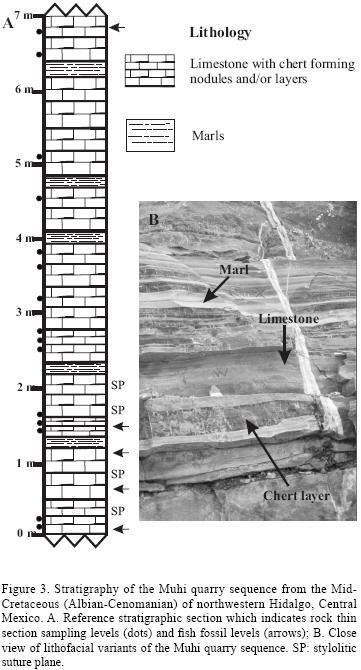
<body><![CDATA[<p align="justify"><font face="verdana" size="2">The geological framework of the Zimap&aacute;n area was based on L&oacute;pez&#150;Ramos (1972), Carrillo&#150;Mart&iacute;nez and Suter&#150;Cargneluti (1982), C&oacute;rdoba et <i>al. </i>(1992), Consejo de Recursos Minerales (1992), and Gonz&aacute;lez&#150;Rodr&iacute;guez and Bravo&#150;Cuevas (2005). The stratigraphy of the Muhi quarry sequence was based on field observations to the locality during 2007, as well as, petrographic description of 15 lithic hand samples and 15 rock thin sections evenly sampled at the lower, middle, and top portion of a reference measured section of 7.2 m thickness. The carbonate rock classification is that of Dunham (1962) and Folk (1968).</font></p>     <p align="justify"><font face="verdana" size="2">Paleontological summary on macrofossils is derived from previously published papers (Gonz&aacute;lez&#150;Rodr&iacute;guez, 2002; Vega <i>et al., </i>2003; Gonz&aacute;lez&#150;Rodr&iacute;guez <i>et al., </i>2005; Gonz&aacute;lez&#150;Rodr&iacute;guez and Bravo&#150;Cuevas, 2005; Feldman <i>et al., </i>2007; Gonz&aacute;lez&#150;Rodr&iacute;guez and Fielitz, 2008; Fielitz and Gonz&aacute;lez&#150;Rodr&iacute;guez, 2008), whereas it is presented additional and preliminary information on the microfossil record. Invertebrates and fish taxonomic descriptions are in progress, and fossil collecting is continuous.</font></p>     <p align="justify"><font face="verdana" size="2">&nbsp;</font></p>     <p align="justify"><font face="verdana" size="2"><b>3. Geologic Setting</b></font></p>     <p align="justify"><font face="verdana" size="2">The Muhi quarry is located in the Zimap&aacute;n area, set in the northwest of the Mexican state of Hidalgo, between 20&deg;40'&#150;20&deg;50' N Lat and 99&deg;15'&#150;99&deg;25' W Long (<a href="/img/revistas/bsgm/v61n2/a4f1.jpg" target="_blank">Figure 1</a>). The published geological information about this area is limited (Segerstrom, 1956, 1961; Fries, 1962, 1966; L&oacute;pez&#150;Ramos, 1972; Carrillo&#150;Mart&iacute;nez and Suter&#150;Cargneluti, 1982; Consejo de Recursos Minerales, 1992; C&oacute;rdoba <i>et al., </i>1992; Suter&#150;Cargneluti <i>et al., </i>1997; Yta <i>et al., </i>1999). The only detailed stratigraphic descriptions were done by Carrillo&#150;Mart&iacute;nez and Suter&#150;Cargneluti (1982) and Carrillo&#150;Mart&iacute;nez (1997). For this reason, the summary presented below is based on these reports and supplemented by the observations of the authors.</font></p>     <p align="justify"><font face="verdana" size="2">Jurassic to Quaternary rock units crop out in the Zimap&aacute;n area. The oldest unit is the Las Trancas Formation of late Jurassic (Kimmeridgian&#150;Portlandian) (Segerstrom, 1956, 1961) to early Cretaceous (Hauterivian&#150;Barremian) (Carrillo&#150;Mart&iacute;nez, 1997) age. It consists of shale, dark yellow slightly metamorphic calcareous siltstone, light gray to dark gray micritic limestone set in thin strata, and rare layers of marl and black chert are intercalated. The thickness observed of the unit is around 200 m, but the lower contact is not exposed.</font></p>     <p align="justify"><font face="verdana" size="2">According to Carrillo&#150;Mart&iacute;nez and Suter&#150;Cargneluti (1982) and Carrillo&#150;Mart&iacute;nez (1997), sediments assigned to the El Doctor Formation include a 200 m thick sequence of light gray micritic limestone set in thin to medium &#150;bedded strata, black chert forming nodules or thin layers, and additional marls are intercalated. This rock unit unconformably overlies the Las Trancas Formation. Outside of the Zimap&aacute;n area, near the type locality at El Doctor in northeastern corner of Quer&eacute;taro (also Central Mexico), the rudists <i>Caprinulaidea gracilis </i>and <i>Mexicaprina </i>sp. are present and suggest a Mid&#150;Cretaceous (Albian&#150;Cenomanian) age of the rock unit (Ward, 1979).</font></p>     <p align="justify"><font face="verdana" size="2">The Soyatal&#150;M&eacute;ndez Formation is Late Cretaceous (Turonian) in age (Fries, 1962), including a 200 m thick sequence of black to dark gray micritic limestone set in thin to medium &#150; bedded strata, calcareous shale, marl, and chert. This unit unconformably overlies the Las Trancas and the El Doctor formations.</font></p>     <p align="justify"><font face="verdana" size="2">The Cenozoic sequence widely covers the Zimap&aacute;n area. The El Morro Formation of late Eocene?&#150;early Oligocene age (Simon and Mapes, 1957) is the oldest continental unit in the area, consisting of a 400 m thick conglomerate with limestone clasts derived from the underlying Cretaceous units, and epiclasts of andesitic to ultramafic composition in a matrix of shale and sand. The Las Espinas Formation includes a 300 to 400 m thick andesitic&#150;basaltic lava flows and felsic tuffs. This unit is late Miocene in age, based on K/Ar analyses of rock samples recovered near Zimap&aacute;n; they have yielded an age of 9.0 &plusmn; 0.3 Ma (Cantagrel and Robin, 1979). The Quaternary is represented by alluvial, colluvial, and soil deposits.</font></p>     <p align="justify"><font face="verdana" size="2">&nbsp;</font></p>     ]]></body>
<body><![CDATA[<p align="justify"><font face="verdana" size="2"><b>4. Stratigraphy of the Muhi Quarry</b></font></p>     <p align="justify"><font face="verdana" size="2">4.1. Lithology</font></p>     <p align="justify"><font face="verdana" size="2">The Muhi quarry is located at 20&deg;49'21.5" N Lat and 99&deg;15'38.3"W Long, about 3 km northeast of the Zimap&aacute;n (<a href="/img/revistas/bsgm/v61n2/a4f1.jpg" target="_blank">Figure 1</a>, <a href="/img/revistas/bsgm/v61n2/a4f2.jpg" target="_blank">Figure 2</a>). A reference section of 7.2 m was measured, that includes gray to light gray, thin bedded, well indurated biomicritic and micritic limestone, which frequently bears chert forming nodules and/or chert bands, 3 &#150;10 cm thick; gray, yellowish and white bluish moderately indurated marls set in thin&#150;bedded strata are also present. Scarce stylolitic suture planes are observed. Macrofossils have been recovered from five limestone strata, whereas microfossils are present in all sampling levels for thin section (<a href="#f3">Figure 3</a>).</font></p>     <p align="center"><font face="verdana" size="2"><a name="f3"></a></font></p>     <p align="center"><font face="verdana" size="2"><img src="/img/revistas/bsgm/v61n2/a4f3.jpg"></font></p>     <p align="justify"><font face="verdana" size="2">The petrographic description of rock thin sections indicates that the Muhi quarry sequence is a mudstone (Dunham, 1962) /biomicrite (Folk, 1968) with abundant calcispheres and nanoplankton, as well as, globigerinids and <i>Gyroidinoides </i>specimens; black chert layers formed by recrystallized radiolarians are also present (<a href="/img/revistas/bsgm/v61n2/a4f4.jpg" target="_blank">Figure 4</a>). The lithology and microfossil record are indicative of open sea shelf to deep shelf margin Standard Facies Zones (Wilson, 1975), and comparable to the Standard Microfacies Types SMF 2 (microbioclastic limestone) and SMF 3 (pelagic mudstone) (Wilson, 1975; Fl&uuml;gel, 1978).</font></p>     <p align="justify"><font face="verdana" size="2">4.2. Paleontology</font></p>     <p align="justify"><font face="verdana" size="2">Fossil remains of ammonoids, crustaceans, echinoderms, and fishes, as well as numerous coprolites have been recovered from strata of the Muhi quarry (Gonz&aacute;lez&#150;Rodr&iacute;guez, 2002; Vega <i>et al., </i>2003; Gonz&aacute;lez&#150;Rodr&iacute;guez <i>et al., </i>2005; Gonz&aacute;lez&#150;Rodr&iacute;guez and Bravo&#150;Cuevas, 2005; Feldman et al., 2007; Gonz&aacute;lez&#150;Rodr&iacute;guez and Fielitz, 2008; Fielitz and Gonz&aacute;lez&#150;Rodr&iacute;guez, 2008).</font></p>     <p align="justify"><font face="verdana" size="2">The specimens of ammonoids are uncommon and not well preserved, but they have been tentatively assigned to <i>?Mortoniceras </i>sp. (<a href="/img/revistas/bsgm/v61n2/a4f5.jpg" target="_blank">Figure 5A</a>). Crustaceans were recently described by Feldman <i>et al. </i>(2007) and include <i>Aeger hidalguensis </i>n. sp. (<a href="/img/revistas/bsgm/v61n2/a4f5.jpg" target="_blank">Figure 5B</a>) and <i>Palinurus </i>sp. Bothtaxa have been previously found in Late Cretaceous deposits of Eastern Tethy s. <i>A. hidalguensis </i>represents the first record of <i>Aeger </i>in America; <i>Aeger libanensis </i>Roger, 1946 is reported in the Cenomanian deposits of Lebanon. <i>Palinurus </i>is the second report for America; the first record comes from the Albian deposits of Chiapas State, Southern M&eacute;xico. Echinoderms consist of abundant planktonic comatulid crinoids (<a href="/img/revistas/bsgm/v61n2/a4f5.jpg" target="_blank">Figure 5C</a>) that completely cover some strata, as well as abundant disarticulated echinoid spines (<a href="/img/revistas/bsgm/v61n2/a4f5.jpg" target="_blank">Figure 5D</a>).</font></p>     <p align="justify"><font face="verdana" size="2">Fishes are the only vertebrates present in the quarry. They consist of chondrichthyans and neopterygians. Chondrichthyans include <i>Squalicorax </i>sp. (<a href="/img/revistas/bsgm/v61n2/a4f5.jpg" target="_blank">Figure 5E</a>) and <i>Ptychodus </i>sp. (<a href="/img/revistas/bsgm/v61n2/a4f5.jpg" target="_blank">Figure 5F</a>); rays have not yet been identified. Gonz&aacute;lez&#150;Rodr&iacute;guez and Bravo Cuevas (2005) reviewed records of <i>Squalicorax </i>and <i>Ptychodus </i>records from M&eacute;xico and found that the Muhi specimens represent the first records for the Albian&#150;Cenomanian of the country. There are reports of these genera in the Guerrero and Coahuila States (Alvarado&#150;Ortega <i>et al. </i>2006; Gonz&aacute;lez&#150;Barba and Espinosa&#150;Ch&aacute;vez, 2005; Gonz&aacute;lez&#150;Barba and Porras&#150;M&uacute;zquiz, 2009) but the Muhi sharks are the oldest of Mexico.</font></p>     ]]></body>
<body><![CDATA[<p align="justify"><font face="verdana" size="2">Neopterygians comprise at least 12 different groups recognized at the moment: Lepisosteidae (<a href="/img/revistas/bsgm/v61n2/a4f5.jpg" target="_blank">Figure 5G</a>), Aspidorhynchidae, Ichthyodectiformes, Megalopidae (<a href="/img/revistas/bsgm/v61n2/a4f5.jpg" target="_blank">Figure 5H</a>), Pachyrhizontidae, Clupeomorpha, Ichthyotringidae <i>(Ichthyotringa mexicana </i>Fielitz and Gonz&aacute;lez Rodr&iacute;guez, 2008) (<a href="/img/revistas/bsgm/v61n2/a4f5.jpg" target="_blank">Figure 5J</a>, <a href="/img/revistas/bsgm/v61n2/a4f5.jpg" target="_blank">L</a>), Dercetidae, Enchodontidae <i>(Enchodus </i>sp.) (<a href="/img/revistas/bsgm/v61n2/a4f5.jpg" target="_blank">Figure 5K</a>), Halecidae, Euteleostei, and Acantomorpha <i>(Muhichthys cordobai </i>Gonz&aacute;lez Rodr&iacute;guez and Fielitz, 2008) (<a href="/img/revistas/bsgm/v61n2/a4f5.jpg" target="_blank">Figure 5I</a>).</font></p>     <p align="justify"><font face="verdana" size="2">The majority offish groups present in the Muhi quarry had a wide distribution along the western Tethys Ocean during late Cretaceous, including other Mexican localities in the Coahuila, Nuevo Le&oacute;n, and Guerrero states. Oldest <i>Enchodus </i>records are from lower Cenomanian of Israel, Adriatic region (Fielitz, 2004); <i>Ichthyotringa </i>was first reported from the Cenomanian of Lebanon and the new species of Muhi quarry <i>Ichthyotringa mexicana </i>Fielitz and Gonz&aacute;lez Rodr&iacute;guez, 2008 represent the first report for the western Tethys; dercetids and halecoids have also their first appearances in the lower Cenomanian of the English Chalk and Lebanon (Goody, 1969); moreover, acanthomorphs first records are from Cenomanian beds of the English Chalk, Morocco, Lebanon, and Israel (Patterson, 1964, 1967, 1993).</font></p>     <p align="justify"><font face="verdana" size="2">Compared with the Late Cretaceous Mexican localities cited above, the Muhi quarry fishes are quite different. The quarry shares the presence of Anacoracidae and Ptychodontidae sharks, as well as some lamniforms, and many groups of teleosts such as clupeomorphs, ichthyodectiformes, enchodontids, pachyrhizontids, dercetids, and acanthomorphs with the mentioned localities, but it lacks tselfatiiforms, cimolichthyioids, and picnodontiforms taxa that are present in the El Rosario quarry in M&uacute;zquiz, Coahuila State (Stinnesbeck <i>et al. </i>2005); the tselfatiiforms, pachycormids, nursallinids and some lamniform sharks of Vallecillo, Nuevo Le&oacute;n (Blanco&#150;Pi&ntilde;on and Cavin, 2003); the tselfatiiforms of the La Mula quarry (Blanco&#150;Pi&ntilde;&oacute;n and Alvarado&#150;Ortega, 2005); or the Cretoxyrhinidae sharks of the Mexcala Formation in the Guerrero State (Alvarado&#150;Ortega <i>et al. </i>2006). Moreover, lepisosteids, ichthyotringoids, aspidorhynchids, and megalopids are present in the Muhi quarry but, not reported in the other Late Cretaceous Mexican localities.</font></p>     <p align="justify"><font face="verdana" size="2">The taxonomic characterization of the Muhi quarry microfauna is in progress. Gonz&aacute;lez&#150;Rodr&iacute;guez and Bravo Cuevas (2005) reported the presence of calcispheres assigned to <i>Calcisphaerula </i>sp. and <i>Pithonella </i>sp. However, nanoplankton, planktonic foraminifera (globigerinids), and benthonic foraminifera <i>(Gyroidinoides </i>sp.) are present, as well as, radiolarians are abundant forming black chert layers (<a href="/img/revistas/bsgm/v61n2/a4f4.jpg" target="_blank">Figure 4B</a>&#150;<a href="/img/revistas/bsgm/v61n2/a4f4.jpg" target="_blank">E</a>).</font></p>     <p align="justify"><font face="verdana" size="2">4.3. Depositional environment</font></p>     <p align="justify"><font face="verdana" size="2">The Muhi quarry depositional environment is based on their lithology and fossil record, both macrofossils and microfossils.</font></p>     <p align="justify"><font face="verdana" size="2"><i>4.3.1. Lithology</i></font></p>     <p align="justify"><font face="verdana" size="2">Based on the strata sequence of the 7.2 meters of micritic limestone exposed in the Muhi quarry, the following lithofacies are detected: a predominant mudstone facies, an intercalated chert facies, and a less common marl facies. The lithofacial variability is interpreted in terms of deposition occurring on the open sea shelf to deep shelf margin or basin margin of the El Doctor Formation according to the Standard Facies Zones of Wilson (1975). This suggests that the site of deposit received alternated neritic waters and open oceanic waters with occasionally influx of near&#150;shore waters maybe during storms. The dark gray mudstone is typical of carbonate neritic platforms and oceanic basin waters (Wilson, 1975; Fl&uuml;gel, 1978), whereas sporadic marls together with unidentified shell fragments suggest incursions of rich terrigenous coastal waters (<a href="/img/revistas/bsgm/v61n2/a4f4.jpg" target="_blank">Figure 4A</a>). Intercalated chert bands represent temporal pulses of pelagic waters mainly composed by recrystallized radiolarians (<a href="/img/revistas/bsgm/v61n2/a4f4.jpg" target="_blank">Figure 4B</a>).</font></p>     <p align="justify"><font face="verdana" size="2"><i>4.3.2. Macrofossil record</i></font></p>     <p align="justify"><font face="verdana" size="2">The Muhi quarry macrofossils could represent a paleocomunity that lived in well oxygenated waters of normal salinity at the limits of an open sea shelf and the deep shelf margin. Most of the fauna could live in the water column above the site of deposit, but others could come from near sites. On occasion, the Muhi deposit received pulses of shallower or deeper waters, as indicated by the lithology, which produced changes in the normal condition of the water leading to mass mortality. Changes in salinity could also affect the bottom of the site, which at least in occasions became hypersaline. Support of hypersaline bottoms is the lack of evidence of bioturbation and scavenging (Maisey, 1994; Martill, 1988) which is a probable phenomena observed in the Muhi quarry.</font></p>     ]]></body>
<body><![CDATA[<p align="justify"><font face="verdana" size="2">Examples of these inhabitants of the Muhi quarry are ammonites remains tentatively assigned to <i>?Mortoniceras </i>sp., this Cretaceous ammonites were demersal forms that had stable buoyancy and inhabited the margin of the slope (Westermann, 1996). On the other hand, some Muhi quarry strata are completely covered by comatulids with their arms coiled; the Commatulida are stenohaline planktonic echinoderms that live in well oxygenated waters and are able to exist only in waters with a very narrow range of salt content (Hess, 2002). Given that, their abundance in many of the Muhi quarry strata suggests mass mortality due to changes in the concentration of oxygen and salt of the oceanic waters. Moreover, their coiled arms indicate dehydration caused by hypersaline waters (Seilacher <i>et al., </i>1985). Crustaceans as <i>Aeger hidalguensis </i>and <i>Palinurus </i>sp. (Feldman <i>et al., </i>2007) were benthonic organisms that could live near the deposit and were washed in the deposit through marine currents.</font></p>     <p align="justify"><font face="verdana" size="2">We believe that some fish could have lived at or near the site of deposit because of the presence of complete fish skeletons, abundant disarticulated fishbones, and numerous coprolites, but others could come from remote coastal or pelagic waters. Isolated skeletal parts such as skulls, fins, and backbones indicate flotation of fish prior to burial (Viohl, 1994). It is remarkable the occurrence of numerous small fish of different sizes belonging to almost all the different taxa recovered in the Muhi quarry. The majority of organisms move distances of meters or kilometers from juvenile to adult habitats. Adult habitats are considered to be areas where juveniles are not found and may encompass sub&#150;adult staging areas (Gillanders <i>et al., </i>2003). Therefore, the presence of juvenile fishes in the Muhi quarry, together with adult specimens makes the outcrop exceptional.</font></p>     <p align="justify"><font face="verdana" size="2"><i>4.3.3. Microfossil record</i></font></p>     <p align="justify"><font face="verdana" size="2">The Muhi quarry sequence bears globigerinids, a group of stenohaline, planktonic foraminifera, typical of the euphotic zone (Molina, 2002), and much more common in the outer shelf (50 &#150; 200 m depth) (Prothero, 2004). On the other hand, test morphology of the benthonic foraminifera <i>Gyroidinoides </i>is also indicative of an outer shelf environment with a typical euphotic depth <i>ca. </i>100 m (Prothero, 2004). Thus suggesting similar depositional conditions to the Muhi quarry sequence; the presence of abundant calcispheres in the considered strata supports this contention (see Monreal <i>et al. </i>1997).</font></p>     <p align="justify"><font face="verdana" size="2">The Muhi quarry black chert layers evidence accumulation pulses of radiolarian organisms. In this regard, it should be noted that highest radiolarian abundances occur at the meeting point between the circulating currents surrounding two water masses, where oceanic upwelling brings up scarce silica from the deeper parts of the ocean and siliceous microorganisms rapidly utilize it (Prothero, 2004). Thus, is suggested that the depositional setting of the Muhi quarry sequence was controlled by influx of siliceous microfossils from pelagic waters.</font></p>     <p align="justify"><font face="verdana" size="2">4.4. Age and correlation</font></p>     <p align="justify"><font face="verdana" size="2">The age of the Muhi quarry strata hinges on its stratigraphic relationship with the other Mesozoic rock units that outcrop in the Zimap&aacute;n area, and the biogeochronologic dating afforded by the marine fish fauna that it bears. Based on stratigraphic relationships of the Muhi quarry, this sequence is post&#150;Las Trancas Formation (late Jurassic <i>&#150; </i>early Cretaceous) and pre&#150;Soyatal&#150;M&eacute;ndez Formation (late Cretaceous); thus the Muhi quarry sequence probably originated during Mid&#150;Cretaceous (late early Cretaceous to early late Cretaceous). Fossil sharks support this age based on the first record of <i>Squalicorax </i>and <i>Ptychodus </i>in Albian&#150;Cenomanian sediments of Texas, North America (Welton and Farris, 1993). Some neopterygian fish such as lepisosteids (WenzandBrito, 1992; CavinandBrito, 2001), pachyrhizontids (Cavin, 2008), and Clupeomorphs (Grande, 1985; Maisey, 1991) are recorded from Albian deposits around the world, but others had their first record during the early and middle Cenomanian, this is the case of dercetids (Goody, 1969), halecoids (Goody, 1969) <i>Enchodus </i>(Fielitz, 2004), <i>Ichthyotringa </i>(Fielitz and Gonz&aacute;lez&#150;Rodr&iacute;guez, 2008), and acanthomorphs (Patterson, 1964, 1967, 1993). Since, the Muhi Quarry would be restricted to an Albian&#150;Cenomanian age.</font></p>     <p align="justify"><font face="verdana" size="2">The Muhi quarry is geochronological correlative with the following Albian&#150;Cenomanian rock units: the El Doctor Formation from northeastern Quer&eacute;taro (Wilson <i>et al., </i>1955; Carrasco, 1970, 1971) and south&#150;central Hidalgo (Segerstom, 1961; Fries, 1962); the El Abra Formation from San Luis Potos&iacute; and Tampico (Garf&iacute;as, 1915; Kellum, 1930; Aguayo&#150;Camargo, 1998); and the Cuesta del Cura Formation from Nuevo Le&oacute;n (Imlay, 1944; &Aacute;ngeles&#150;Villeda <i>et al., </i>2005).</font></p>     <p align="justify"><font face="verdana" size="2">In summary, the Muhi quarry lithology and depositional conditions resemble that of the open sea shelf to deep shelf margin La Negra Facies of the El Doctor Formation from the Albian&#150;Cenomanian of northeastern Quer&eacute;taro (Wilson <i>et al., </i>1955; Carrasco, 1970; Ward, 1979) and south&#150;central Hidalgo (Segerstrom, 1956, 1961; Fries, 1962) respectively. Given that, the Muhi quarry strata would be regarded as part of the El Doctor Formation, indicating lithofacial lateral continuity &#150; partially at least &#150; of La Negra facies in northwestern Hidalgo.</font></p>     <p align="justify"><font face="verdana" size="2">4.5. Comment on the Muhi quarry paleobiological significance</font></p>     ]]></body>
<body><![CDATA[<p align="justify"><font face="verdana" size="2">Fishes are the best known fossils of the Muhi quarry. Fish assemblage is similar to that present in other Cenomanian localities of the Eastern Tethys Ocean, such as Namoura, Hakel and Haula in Lebanon, Jebel Tselfat, Kem Kem beds and Daura in Morocco, Ein&#150;Yabrud in Jerusalem, English Chalk in England, and Comen in Slovenia. These localities correspond to different depth marine environments along the neritic platform, and comprise marine fauna as well as land plants and reptiles (Patterson, 1964, 1967, 1993; Chalifa, 1985, 1989; Raab and Chalifa, 1987; Cavin <i>et al., </i>2001, 2005; Cavin and Dutheil, 1999, Forey <i>et al., </i>2003). Even though the continuity of Mexican waters with the Western Interior Seaway of North America during Cenomanian, and the supraspecific taxa they share, such as sharks, aspidorhynchids, pachyrhizontids, ichthydectids, euteleosts,  and acanthomorphs, which are present in Colorado and Kansas in the United States, and the Black Hills, Pasquia Hills (Saskatchewan), and Alberta in Canada (Cumbaa <i>et al., </i>2006; Cumbaa personal communication, 2009; Wilson and Murray, 1996, Wilson and Bruner, 2004), Muhi neopterygian fish species are different. Moreover groups as megalopids and lepisosteids are not reported in the Cenomanian Western Interior Sea localities.</font></p>     <p align="justify"><font face="verdana" size="2">According to the lithology of the deposit, the Muhi quarry is more like the Lebanese localities of Hakel and Haula where the fish beds consist of thin&#150;bedded, siliceous limestone alternating irregularly with more massive limestone. Occasionally nodules and lenses of impure chert occur throughout the beds (Patterson, 1967). The microfauna consist of abundant radiolarians, moderately abundant pelagic foraminifera <i>(Hedbergella) </i>and rare benthonic foraminifera (textularids). The fish beds were deposited in small basins, only 250 m across, which H&uuml;ckel (1970) interpreted as sinkholes formed by tectonic activity on the contemporary seafloor, at the outer margin of the continental shelf (Forey <i>et al. </i>2003). The abundant well&#150;preserved fishes and crustaceans in some beds is evidence of mass mortality caused by some toxins released in water bloom conditions (Patterson, 1967).</font></p>     <p align="justify"><font face="verdana" size="2">On the other hand, both Hakel and Hajula, contain land plants and terrestrial fauna, a condition that does not occur in the Muhi Quarry. This suggests that the Muhi sequence was not so close to land masses. The resemblance of the lithology and affinity of the Muhi Quarry fish fauna with the Lebanese localities rather than with the Western Interior Sea of North America could be the result of the east&#150;west vicariance and dispersal events, rather than north&#150;south events that occurred during Late Cretaceous (Cavin, 2008). What seems evident is that most of the Muhi quarry fish and crustaceans represent new species of Late Cretaceous in Central Mexico, moreover some of them like <i>Aeger hidalguensis </i>and <i>Ichthyotringa mexicana, </i>constitute the first record for the western Tethys Ocean.</font></p>     <p align="justify"><font face="verdana" size="2">&nbsp;</font></p>     <p align="justify"><font face="verdana" size="2"><b>5. Conclusions</b></font></p>     <p align="justify"><font face="verdana" size="2">The Muhi quarry sequence consists of a mudstone/ biomicrite, which frequently bears chert forming nodules and/or thin layers; intercalated moderately indurated marls are also present. These strata bear diverse groups of invertebrates and fishes; furthermore, calcispheres, nanoplankton, radiolarians, as well as planktonic and benthonic foraminifera are present.</font></p>     <p align="justify"><font face="verdana" size="2">The Muhi quarry is Mid&#150;Cretaceous in age, based on its stratigraphic relationships and the fish fauna record. This sequence is geochronological correlative with the La Negra Facies of the El Doctor Formation from the Albian&#150;Cenomanian of northeastern Quer&eacute;taro and south&#150;central Hidalgo; thus indicating lithofacial lateral continuity &#150; partially at least &#150; of La Negra facies in northwestern Hidalgo.</font></p>     <p align="justify"><font face="verdana" size="2">The Muhi quarry lithology, macro and micro&#150;fossils are indicative of open sea shelf to deep shelf margin Standard Facies Zones (Wilson 1975), comparable to the Standard Microfacies Types SMF 2 (microbioclastic limestone) and SMF 3 (pelagic mudstone) (Fl&uuml;gel, 1978).</font></p>     <p align="justify"><font face="verdana" size="2">The Muhi quarry deposit contains fish fauna that lived in central M&eacute;xico during the Mid&#150;Cretaceous (Albian&#150;Cenomanian). This fauna shows more affinities with the Cenomanian eastern Tethys Ocean localities than to those of the Western Interior Seaway of North America, thus suggesting east&#150;west vicariance and dispersal events, rather than north&#150;south events that occurred during late Cretaceous according to Cavin (2008).</font></p>     <p align="justify"><font face="verdana" size="2">&nbsp;</font></p>     ]]></body>
<body><![CDATA[<p align="justify"><font face="verdana" size="2"><b>Acknowledgments</b></font></p>     <p align="justify"><font face="verdana" size="2">We are indebted to anonymous reviewers for their comments and advice on the original draft of this report. We also thank the Universidad Aut&oacute;noma del Estado de Hidalgo (UAEH) for supporting field work during 2006&#150;2007, Proyecto: Estudio Paleontol&oacute;gico de la Caliza "El Doctor" en el Estado de Hidalgo. Special thanks to Mr. Jose Santiago Bautista and Mr. Arturo Palma Ram&iacute;rez who elaborate the stratigraphic reference section, also we want to thank Mr. Jaime Priego Vargas who prepare the previous version of the <a href="#f3">Figure 3</a>. At last but not to least we thank to Sergio and Ignacio Ya&ntilde;ez, workers of the Muhi quarry for collecting fossil material since 1999.</font></p>     <p align="justify"><font face="verdana" size="2">&nbsp;</font></p>     <p align="justify"><font face="verdana" size="2"><b>References</b></font></p>     <!-- ref --><p align="justify"><font face="verdana" size="2">Aguayo&#150;Camargo, J.E., 1998, The Middle Cretaceous El Abra Limestone at its type locality (Facies, Diagenesis and Oil Emplacement), East Central M&eacute;xico: Revista Mexicana de Ciencias Geol&oacute;gicas, 15(1), 1&#150;8.</font>&nbsp;&nbsp;&nbsp;&nbsp;&nbsp;&nbsp;&nbsp;&nbsp;[&#160;<a href="javascript:void(0);" onclick="javascript: window.open('/scielo.php?script=sci_nlinks&ref=1384992&pid=S1405-3322200900020000400001&lng=','','width=640,height=500,resizable=yes,scrollbars=1,menubar=yes,');">Links</a>&#160;]<!-- end-ref --><!-- ref --><p align="justify"><font face="verdana" size="2">Alvarado&#150;Ortega, J., Ovalles&#150;Dami&aacute;n, E., 2008, <i>Triplomystus applegatei, </i>sp. nov. (Teleostei: Ellimmichthyiformes), a rare "triple armored herring" from el Espinal quarry (Early Cretaceous), Chiapas, southeastern Mexico: Journal of Vertebrate Paleontology, 28(1), 53&#150;60.</font>&nbsp;&nbsp;&nbsp;&nbsp;&nbsp;&nbsp;&nbsp;&nbsp;[&#160;<a href="javascript:void(0);" onclick="javascript: window.open('/scielo.php?script=sci_nlinks&ref=1384993&pid=S1405-3322200900020000400002&lng=','','width=640,height=500,resizable=yes,scrollbars=1,menubar=yes,');">Links</a>&#160;]<!-- end-ref --><!-- ref --><p align="justify"><font face="verdana" size="2">Alvarado&#150;Ortega, J., Garibay&#150;Moreno, L.M., Blanco&#150;Pi&ntilde;&oacute;n, A., Gonz&aacute;lez&#150;Barba, G., Vega&#150;Vera, F., Centeno&#150;Garc&iacute;a, E., 2006, Los f&oacute;siles de la Formaci&oacute;n Mexcala (Cret&aacute;cico Superior) en el estado de Guerrero, M&eacute;xico: Revista Brasileira de Paleontolog&iacute;a, 9(3), 261&#150;272.</font>&nbsp;&nbsp;&nbsp;&nbsp;&nbsp;&nbsp;&nbsp;&nbsp;[&#160;<a href="javascript:void(0);" onclick="javascript: window.open('/scielo.php?script=sci_nlinks&ref=1384994&pid=S1405-3322200900020000400003&lng=','','width=640,height=500,resizable=yes,scrollbars=1,menubar=yes,');">Links</a>&#160;]<!-- end-ref --><!-- ref --><p align="justify"><font face="verdana" size="2">Angeles&#150;Villeda, M.E., Hinojosa&#150;Espinosa, J.J., L&oacute;pez&#150;Oliva, J.G., Vald&eacute;z&#150;Gonz&aacute;lez, A., Livas&#150;Vera, M., 2005, Estratigraf&iacute;a y microfacies de la parte sur del Ca&ntilde;on La Boca, Santiago, Nuevo Le&oacute;n, M&eacute;xico: Revista Mexicana de Ciencias Geol&oacute;gicas, 22, 272&#150;281.</font>&nbsp;&nbsp;&nbsp;&nbsp;&nbsp;&nbsp;&nbsp;&nbsp;[&#160;<a href="javascript:void(0);" onclick="javascript: window.open('/scielo.php?script=sci_nlinks&ref=1384995&pid=S1405-3322200900020000400004&lng=','','width=640,height=500,resizable=yes,scrollbars=1,menubar=yes,');">Links</a>&#160;]<!-- end-ref --><!-- ref --><p align="justify"><font face="verdana" size="2">Applegate, S.P., 1996, An overview of the Cretaceous fishes of the quarries near Tepexi de Rodr&iacute;guez, Puebla, M&eacute;xico, in Arratia, G., Viohl, G. (eds.), Mesozoic Fishes: Systematics and Paleoecology: Verlag Dr. Friedrich Pfeil, M&uuml;nchen, Germany, 529&#150;538.</font>&nbsp;&nbsp;&nbsp;&nbsp;&nbsp;&nbsp;&nbsp;&nbsp;[&#160;<a href="javascript:void(0);" onclick="javascript: window.open('/scielo.php?script=sci_nlinks&ref=1384996&pid=S1405-3322200900020000400005&lng=','','width=640,height=500,resizable=yes,scrollbars=1,menubar=yes,');">Links</a>&#160;]<!-- end-ref --><!-- ref --><p align="justify"><font face="verdana" size="2">Applegate, S.P., Espinosa&#150;Arrubarrena, L., Alvarado&#150;Ortega, J., Benammi, M., 2006, Revision of recent investigations in the Tlay&uacute;a quarry in Vega, F.J., Nyborg, T.G., Perrilliat, M.C., Montellano&#150;Ballesteros, M., Cevallos&#150;Ferriz, S.R.S., Quiroz&#150;Barroso, S.A. (eds.), Studies on Mexican Paleontology: Series Topics on Geobiology, Kluwer Academic Publishers B.V., 24, 276&#150;304.</font>&nbsp;&nbsp;&nbsp;&nbsp;&nbsp;&nbsp;&nbsp;&nbsp;[&#160;<a href="javascript:void(0);" onclick="javascript: window.open('/scielo.php?script=sci_nlinks&ref=1384997&pid=S1405-3322200900020000400006&lng=','','width=640,height=500,resizable=yes,scrollbars=1,menubar=yes,');">Links</a>&#160;]<!-- end-ref --><!-- ref --><p align="justify"><font face="verdana" size="2">Blanco&#150;Pi&ntilde;&oacute;n, A., Alvarado&#150;Ortega, J., 2005, Fishes from La Mula quarries, a new Late Cretaceous locality from the vicinity of M&uacute;zquiz, Coahuila, NE Mexico, in Poyato&#150;Ariza, F.J. (ed.), Fourth International Meeting on Mesozoic Fishes &#150; Systematics, Homology, and Nomenclature, Extended Abstracts: Madrid, Servicio de Publicaciones de la Universidad Aut&oacute;noma de Madrid/U AM Ediciones, 37&#150;41.</font>&nbsp;&nbsp;&nbsp;&nbsp;&nbsp;&nbsp;&nbsp;&nbsp;[&#160;<a href="javascript:void(0);" onclick="javascript: window.open('/scielo.php?script=sci_nlinks&ref=1384998&pid=S1405-3322200900020000400007&lng=','','width=640,height=500,resizable=yes,scrollbars=1,menubar=yes,');">Links</a>&#160;]<!-- end-ref --><!-- ref --><p align="justify"><font face="verdana" size="2">Blanco&#150;Pi&ntilde;&oacute;n, A., Cavin, L., 2003, New Teleostei from the Agua Nueva Formation (Turonian), Vallecillo (NE Mexico): Comptes Rendus Palevol, 2, 299&#150;306.</font>&nbsp;&nbsp;&nbsp;&nbsp;&nbsp;&nbsp;&nbsp;&nbsp;[&#160;<a href="javascript:void(0);" onclick="javascript: window.open('/scielo.php?script=sci_nlinks&ref=1384999&pid=S1405-3322200900020000400008&lng=','','width=640,height=500,resizable=yes,scrollbars=1,menubar=yes,');">Links</a>&#160;]<!-- end-ref --><!-- ref --><p align="justify"><font face="verdana" size="2">Blanco&#150;Pi&ntilde;&oacute;n, A., Stinnesbeck, W., L&oacute;pez&#150;Oliva, J.G., Frey, E., Adatte, T., Gonz&aacute;lez, A.H., 2001, Vallecillo, Nuevo Le&oacute;n: unanueva localidad fosil&iacute;fera del Cret&aacute;cico Tard&iacute;o en el Noreste de M&eacute;xico: Revista Mexicana de Ciencias Geol&oacute;gicas, 18(2), 196&#150;199.</font>&nbsp;&nbsp;&nbsp;&nbsp;&nbsp;&nbsp;&nbsp;&nbsp;[&#160;<a href="javascript:void(0);" onclick="javascript: window.open('/scielo.php?script=sci_nlinks&ref=1385000&pid=S1405-3322200900020000400009&lng=','','width=640,height=500,resizable=yes,scrollbars=1,menubar=yes,');">Links</a>&#160;]<!-- end-ref --><!-- ref --><p align="justify"><font face="verdana" size="2">Blanco&#150;Pi&ntilde;&oacute;n, A., Frey, E. Stinnesbeck, W., L&oacute;pez&#150;Oliva, J.G., 2002, Late Cretaceous (Turonian) fish assemblaje from Vallecillo, northeastern Mexico: Neues Jahrbuch f&uuml;r Geologie und Pal&auml;ontologie, Abhandlungen, 225(1), 39&#150;54.</font>&nbsp;&nbsp;&nbsp;&nbsp;&nbsp;&nbsp;&nbsp;&nbsp;[&#160;<a href="javascript:void(0);" onclick="javascript: window.open('/scielo.php?script=sci_nlinks&ref=1385001&pid=S1405-3322200900020000400010&lng=','','width=640,height=500,resizable=yes,scrollbars=1,menubar=yes,');">Links</a>&#160;]<!-- end-ref --><!-- ref --><p align="justify"><font face="verdana" size="2">Cantagrel, J.M., Robin, C., 1979, K&#150;Ar dating on Eastern Mexican Volcanic Rocks&#150;relations between the andesitic and the alkaline province: Journal of Volcanology and Geothermal Research, 5, 99&#150;114.</font>&nbsp;&nbsp;&nbsp;&nbsp;&nbsp;&nbsp;&nbsp;&nbsp;[&#160;<a href="javascript:void(0);" onclick="javascript: window.open('/scielo.php?script=sci_nlinks&ref=1385002&pid=S1405-3322200900020000400011&lng=','','width=640,height=500,resizable=yes,scrollbars=1,menubar=yes,');">Links</a>&#160;]<!-- end-ref --><!-- ref --><p align="justify"><font face="verdana" size="2">Carrasco, B., 1970, La Formaci&oacute;n El Abra (Formaci&oacute;n el Doctor) en la Plataforma Valles&#150;San Luis Potos&iacute;: Revista del Instituto Mexicano del Petr&oacute;leo, (Julio), 97&#150;99.</font>&nbsp;&nbsp;&nbsp;&nbsp;&nbsp;&nbsp;&nbsp;&nbsp;[&#160;<a href="javascript:void(0);" onclick="javascript: window.open('/scielo.php?script=sci_nlinks&ref=1385003&pid=S1405-3322200900020000400012&lng=','','width=640,height=500,resizable=yes,scrollbars=1,menubar=yes,');">Links</a>&#160;]<!-- end-ref --><!-- ref --><p align="justify"><font face="verdana" size="2">Carrasco, B., 1971, Litofacies de la Formaci&oacute;n El Abra en la Plataforma de Actopan, Hidalgo: Revista del Instituto Mexicano del Petr&oacute;leo, (Enero), 5&#150;26.</font>&nbsp;&nbsp;&nbsp;&nbsp;&nbsp;&nbsp;&nbsp;&nbsp;[&#160;<a href="javascript:void(0);" onclick="javascript: window.open('/scielo.php?script=sci_nlinks&ref=1385004&pid=S1405-3322200900020000400013&lng=','','width=640,height=500,resizable=yes,scrollbars=1,menubar=yes,');">Links</a>&#160;]<!-- end-ref --><!-- ref --><p align="justify"><font face="verdana" size="2">Carrillo&#150;Mart&iacute;nez, M., 1997, Hoja Zimap&aacute;n 14Q&#150;e (7), con Resumen de la Geolog&iacute;a de la hoja Zimap&aacute;n, estados de Hidalgo y Quer&eacute;taro: M&eacute;xico, D.F., Universidad Nacional Aut&oacute;noma de M&eacute;xico, Instituto de Geolog&iacute;a, Carta Geol&oacute;gica de M&eacute;xico serie 1:1,000,000.</font>&nbsp;&nbsp;&nbsp;&nbsp;&nbsp;&nbsp;&nbsp;&nbsp;[&#160;<a href="javascript:void(0);" onclick="javascript: window.open('/scielo.php?script=sci_nlinks&ref=1385005&pid=S1405-3322200900020000400014&lng=','','width=640,height=500,resizable=yes,scrollbars=1,menubar=yes,');">Links</a>&#160;]<!-- end-ref --><!-- ref --><p align="justify"><font face="verdana" size="2">Carrillo&#150;Mart&iacute;nez, M., Suter&#150;Cargneluti, M., 1982, Tect&oacute;nica de los alrededores de Zimap&aacute;n, Hidalgo y Quer&eacute;taro, Libro Gu&iacute;a de la excursi&oacute;n geol&oacute;gica a la regi&oacute;n de Zimap&aacute;n y &aacute;reas circundantes, estados de Hidalgo y Quer&eacute;taro, Hidalgo, M&eacute;xico, in VI Convenci&oacute;n Geol&oacute;gica Nacional: M&eacute;xico, D. F., Sociedad Geol&oacute;gica Mexicana, 1&#150;20.</font>&nbsp;&nbsp;&nbsp;&nbsp;&nbsp;&nbsp;&nbsp;&nbsp;[&#160;<a href="javascript:void(0);" onclick="javascript: window.open('/scielo.php?script=sci_nlinks&ref=1385006&pid=S1405-3322200900020000400015&lng=','','width=640,height=500,resizable=yes,scrollbars=1,menubar=yes,');">Links</a>&#160;]<!-- end-ref --><!-- ref --><p align="justify"><font face="verdana" size="2">Cavin, L., 2008, Palaeobiogeography of Cretaceous bony fishes (Actinistia, Dipnoi and Actinopterygii), in: Cavin, L., Longbottom, A., Richter M. (eds.), Fishes and the break&#150;up of Pangaea: Geological Society, London, Special Publications, 295, 165&#150;183.</font>&nbsp;&nbsp;&nbsp;&nbsp;&nbsp;&nbsp;&nbsp;&nbsp;[&#160;<a href="javascript:void(0);" onclick="javascript: window.open('/scielo.php?script=sci_nlinks&ref=1385007&pid=S1405-3322200900020000400016&lng=','','width=640,height=500,resizable=yes,scrollbars=1,menubar=yes,');">Links</a>&#160;]<!-- end-ref --><!-- ref --><p align="justify"><font face="verdana" size="2">Cavin, L., Brito, P., 2001, A new Lepisosteidae (Actinipterygii: Ginglymodi) from the Cretaceous of the Kem Kem beds, southern Morocco: Bulletin Societ&eacute; G&eacute;ologique de France, 5, 661&#150;670.</font>&nbsp;&nbsp;&nbsp;&nbsp;&nbsp;&nbsp;&nbsp;&nbsp;[&#160;<a href="javascript:void(0);" onclick="javascript: window.open('/scielo.php?script=sci_nlinks&ref=1385008&pid=S1405-3322200900020000400017&lng=','','width=640,height=500,resizable=yes,scrollbars=1,menubar=yes,');">Links</a>&#160;]<!-- end-ref --><!-- ref --><p align="justify"><font face="verdana" size="2">Cavin, L., Dutheil, D.B., 1999, A new Cenomanian ichthyofauna from southeastern Morocco and its relationships with other early Late Cretaceous Moroccan faunas: Geologische Mijnbouwkundige, 78, 261&#150;266.</font>&nbsp;&nbsp;&nbsp;&nbsp;&nbsp;&nbsp;&nbsp;&nbsp;[&#160;<a href="javascript:void(0);" onclick="javascript: window.open('/scielo.php?script=sci_nlinks&ref=1385009&pid=S1405-3322200900020000400018&lng=','','width=640,height=500,resizable=yes,scrollbars=1,menubar=yes,');">Links</a>&#160;]<!-- end-ref --><!-- ref --><p align="justify"><font face="verdana" size="2">Cavin, L., Boudad, L., Duffaud, S., Kabiri, L., Le Loeuff, J., Rouget I., Tong, H., 2001, L'&eacute;volution pal&eacute;oenvironnementale des faunes de poisons du Cr&eacute;tac&eacute; Sup&eacute;rieur du basin du Tafilalt et des regions avoisinantes (Sud&#150;Est du Maroc): implications pal&eacute;obiog&eacute;ographiques, Rendus de l'Acad&eacute;mie des Sciences, Sciences de la Terre et des Plan&egrave;tes, 333, 677&#150;683</font>&nbsp;&nbsp;&nbsp;&nbsp;&nbsp;&nbsp;&nbsp;&nbsp;[&#160;<a href="javascript:void(0);" onclick="javascript: window.open('/scielo.php?script=sci_nlinks&ref=1385010&pid=S1405-3322200900020000400019&lng=','','width=640,height=500,resizable=yes,scrollbars=1,menubar=yes,');">Links</a>&#160;]<!-- end-ref --><!-- ref --><p align="justify"><font face="verdana" size="2">Cavin, L., Jurkovser, B., Kolar&#150;Jurkovsek, T., 2005, The mid&#150;Cretaceous fish assemblages from the Komen&#150;Trieste plateau in Slovenia: its palaeogeographic and palaeoenvironmental significance, in Poyato&#150;Ariza, F. (ed.), Fourth International Meeting on Mesozoic Fishes&#150;Systematics, Homology, and Nomenclature, Extended Abstracts: Servicio de Publicaciones de la Universidad Aut&oacute;noma de Madrid/ UAM Ediciones, 67&#150;68.</font>&nbsp;&nbsp;&nbsp;&nbsp;&nbsp;&nbsp;&nbsp;&nbsp;[&#160;<a href="javascript:void(0);" onclick="javascript: window.open('/scielo.php?script=sci_nlinks&ref=1385011&pid=S1405-3322200900020000400020&lng=','','width=640,height=500,resizable=yes,scrollbars=1,menubar=yes,');">Links</a>&#160;]<!-- end-ref --><!-- ref --><p align="justify"><font face="verdana" size="2">Consejo de Recursos Minerales, 1992, Monograf&iacute;a Geol&oacute;gico&#150;Minera del Estado de Hidalgo, Publicaci&oacute;n M&#150;3e, Pachuca, Hidalgo: Secretar&iacute;a de Energ&iacute;a, Minas e Industria Paraestatal, Subsecretaria de Minas e Industria B&aacute;sica, 9 p.</font>&nbsp;&nbsp;&nbsp;&nbsp;&nbsp;&nbsp;&nbsp;&nbsp;[&#160;<a href="javascript:void(0);" onclick="javascript: window.open('/scielo.php?script=sci_nlinks&ref=1385012&pid=S1405-3322200900020000400021&lng=','','width=640,height=500,resizable=yes,scrollbars=1,menubar=yes,');">Links</a>&#160;]<!-- end-ref --><!-- ref --><p align="justify"><font face="verdana" size="2">C&oacute;rdoba, D.A., Pedrazzini, C., L&oacute;pez&#150;&Aacute;vila, Silva&#150;Mora, L., Castro&#150;Garc&iacute;a, A. (comps.), 1992, Carta Geol&oacute;gica del Estado de Hidalgo, escala 1:250,000: M&eacute;xico D.F., Universidad Aut&oacute;noma del Estado de Hidalgo, Instituto de Geolog&iacute;a, Universidad Nacional Aut&oacute;noma de M&eacute;xico, Secretar&iacute;a de Educaci&oacute;n P&uacute;blica, 1 mapa.</font>&nbsp;&nbsp;&nbsp;&nbsp;&nbsp;&nbsp;&nbsp;&nbsp;[&#160;<a href="javascript:void(0);" onclick="javascript: window.open('/scielo.php?script=sci_nlinks&ref=1385013&pid=S1405-3322200900020000400022&lng=','','width=640,height=500,resizable=yes,scrollbars=1,menubar=yes,');">Links</a>&#160;]<!-- end-ref --><!-- ref --><p align="justify"><font face="verdana" size="2">Cumbaa, S., Schr&ouml;der&#150;Adams, C. Day, R.C., Phillips, A., 2006, Cenomanian bonebed faunas from the Northeastern margin, Western Interior Seaway, Canada, in Lucas, S.G., Sullivan, R.M. (eds.), Late Cretaceous vertebrates from the Wester Interior: New Mexico, Museum of Natural History and Science Bulletin, 5, 139&#150;155.</font>&nbsp;&nbsp;&nbsp;&nbsp;&nbsp;&nbsp;&nbsp;&nbsp;[&#160;<a href="javascript:void(0);" onclick="javascript: window.open('/scielo.php?script=sci_nlinks&ref=1385014&pid=S1405-3322200900020000400023&lng=','','width=640,height=500,resizable=yes,scrollbars=1,menubar=yes,');">Links</a>&#160;]<!-- end-ref --><!-- ref --><p align="justify"><font face="verdana" size="2">Chalifa, Y., 1985, <i>Saurorhampus judeaensis </i>(Salmoniformes: Enchodontidae), a new longirostrine fish from the Cretaceous (Cenomanian) of Ein&#150;Yabrud, near Jerusalem: Journal of Vertebrate Paleontology, 5, 181&#150;193.</font>&nbsp;&nbsp;&nbsp;&nbsp;&nbsp;&nbsp;&nbsp;&nbsp;[&#160;<a href="javascript:void(0);" onclick="javascript: window.open('/scielo.php?script=sci_nlinks&ref=1385015&pid=S1405-3322200900020000400024&lng=','','width=640,height=500,resizable=yes,scrollbars=1,menubar=yes,');">Links</a>&#160;]<!-- end-ref --><!-- ref --><p align="justify"><font face="verdana" size="2">Chalifa, Y., 1989, New species of <i>Enchodus </i>(Pisces: Enchodontoidei) from the Lower Cenomanian of Ein&#150;Yabrud, Israel: Journal of Palaeontology, 63, 356&#150;364.</font>&nbsp;&nbsp;&nbsp;&nbsp;&nbsp;&nbsp;&nbsp;&nbsp;[&#160;<a href="javascript:void(0);" onclick="javascript: window.open('/scielo.php?script=sci_nlinks&ref=1385016&pid=S1405-3322200900020000400025&lng=','','width=640,height=500,resizable=yes,scrollbars=1,menubar=yes,');">Links</a>&#160;]<!-- end-ref --><!-- ref --><p align="justify"><font face="verdana" size="2">Dunham, R.J., 1962, Classification of Carbonate rocks according to depositional texture: American Association of Petroleum Geologist, Memoir, 1, 108&#150;121.</font>&nbsp;&nbsp;&nbsp;&nbsp;&nbsp;&nbsp;&nbsp;&nbsp;[&#160;<a href="javascript:void(0);" onclick="javascript: window.open('/scielo.php?script=sci_nlinks&ref=1385017&pid=S1405-3322200900020000400026&lng=','','width=640,height=500,resizable=yes,scrollbars=1,menubar=yes,');">Links</a>&#160;]<!-- end-ref --><!-- ref --><p align="justify"><font face="verdana" size="2">Feldman, R., Vega, F.J., Mart&iacute;nez&#150;L&oacute;pez, L., Gonz&aacute;lez&#150;Rodr&iacute;guez, K., Gonz&aacute;lez&#150;Le&oacute;n, O., Fern&aacute;ndez&#150;Barajas, M.R., 2007, Crustacea from the Muhi Quarry (Albian&#150;Cenomanian), and a review of Aptian Mecochiridae (Astacidea) from Mexico: Annals of Carnegie Museum, 76(3), 135&#150;144.</font>&nbsp;&nbsp;&nbsp;&nbsp;&nbsp;&nbsp;&nbsp;&nbsp;[&#160;<a href="javascript:void(0);" onclick="javascript: window.open('/scielo.php?script=sci_nlinks&ref=1385018&pid=S1405-3322200900020000400027&lng=','','width=640,height=500,resizable=yes,scrollbars=1,menubar=yes,');">Links</a>&#160;]<!-- end-ref --><!-- ref --><p align="justify"><font face="verdana" size="2">Fielitz, C., 2004, The phylogenetic relationships of the Enchodontidae (Teleostei: Aulopiformes), in Arratia, G., Wilson, M.V.H., Cloutier, R. (eds.), Recent Advances in the Origin and Early Radiation of Vertebrates: Verlag Dr. Friedrich Pfeil, M&uuml;nchen, Germany, 619&#150;634.</font>&nbsp;&nbsp;&nbsp;&nbsp;&nbsp;&nbsp;&nbsp;&nbsp;[&#160;<a href="javascript:void(0);" onclick="javascript: window.open('/scielo.php?script=sci_nlinks&ref=1385019&pid=S1405-3322200900020000400028&lng=','','width=640,height=500,resizable=yes,scrollbars=1,menubar=yes,');">Links</a>&#160;]<!-- end-ref --><!-- ref --><p align="justify"><font face="verdana" size="2">Fielitz, C., Gonz&aacute;lez&#150;Rodr&iacute;guez, K., 2008, Anew species of Ichthyotringa from the El Doctor Formation (Cretaceous), Hidalgo, M&eacute;xico, in Arratia,G., Schultze, H.P., Wilson, M.V.H. (eds.), Mesozoic Fishes 4 &#150;Homology and Phylogeny: Verlag Dr. Pfeil, Munchen Germany, 373&#150;388.</font>&nbsp;&nbsp;&nbsp;&nbsp;&nbsp;&nbsp;&nbsp;&nbsp;[&#160;<a href="javascript:void(0);" onclick="javascript: window.open('/scielo.php?script=sci_nlinks&ref=1385020&pid=S1405-3322200900020000400029&lng=','','width=640,height=500,resizable=yes,scrollbars=1,menubar=yes,');">Links</a>&#160;]<!-- end-ref --><!-- ref --><p align="justify"><font face="verdana" size="2">Fl&uuml;gel, E., 1978, Mikrofazielle untersuchungs&#150;methoden von Valken: Berlin, Springer&#150;Verlag.</font>&nbsp;&nbsp;&nbsp;&nbsp;&nbsp;&nbsp;&nbsp;&nbsp;[&#160;<a href="javascript:void(0);" onclick="javascript: window.open('/scielo.php?script=sci_nlinks&ref=1385021&pid=S1405-3322200900020000400030&lng=','','width=640,height=500,resizable=yes,scrollbars=1,menubar=yes,');">Links</a>&#160;]<!-- end-ref --><!-- ref --><p align="justify"><font face="verdana" size="2">Folk, L.R., 1968, Petrology of Sedmentary Rocks: Hemphills, Texas, United States of America, 170 p.</font>&nbsp;&nbsp;&nbsp;&nbsp;&nbsp;&nbsp;&nbsp;&nbsp;[&#160;<a href="javascript:void(0);" onclick="javascript: window.open('/scielo.php?script=sci_nlinks&ref=1385022&pid=S1405-3322200900020000400031&lng=','','width=640,height=500,resizable=yes,scrollbars=1,menubar=yes,');">Links</a>&#160;]<!-- end-ref --><!-- ref --><p align="justify"><font face="verdana" size="2">Forey, PL., Yi, L., Patterson, C, Davies, C.E., 2003, Fossil fishes from the Cenomanian (Upper Cretaceous) of Namoura, Lebanon, Journal of Systematic Palaeontology, 1(4), 227&#150;330.</font>&nbsp;&nbsp;&nbsp;&nbsp;&nbsp;&nbsp;&nbsp;&nbsp;[&#160;<a href="javascript:void(0);" onclick="javascript: window.open('/scielo.php?script=sci_nlinks&ref=1385023&pid=S1405-3322200900020000400032&lng=','','width=640,height=500,resizable=yes,scrollbars=1,menubar=yes,');">Links</a>&#160;]<!-- end-ref --><!-- ref --><p align="justify"><font face="verdana" size="2">Fries, C.J., 1962, Hoja Pachuca 14q&#150;e(11), con resumen de la geolog&iacute;a de la hoja Pachuca, estados de Hidalgo y M&eacute;xico: M&eacute;xico, D.F., Universidad Nacional Aut&oacute;noma de M&eacute;xico serie 1:100,000, 1 mapa con texto.</font>&nbsp;&nbsp;&nbsp;&nbsp;&nbsp;&nbsp;&nbsp;&nbsp;[&#160;<a href="javascript:void(0);" onclick="javascript: window.open('/scielo.php?script=sci_nlinks&ref=1385024&pid=S1405-3322200900020000400033&lng=','','width=640,height=500,resizable=yes,scrollbars=1,menubar=yes,');">Links</a>&#160;]<!-- end-ref --><!-- ref --><p align="justify"><font face="verdana" size="2">Fries, C. J., 1966, Resumen de la Geolog&iacute;a de la Hoja Pachuca, Estados de Hidalgo y M&eacute;xico: M&eacute;xico, D.F., Instituto de Geolog&iacute;a, Universidad Nacional Aut&oacute;noma de M&eacute;xico, Carta geol&oacute;gica de M&eacute;xico, serie 1:100,000.</font>&nbsp;&nbsp;&nbsp;&nbsp;&nbsp;&nbsp;&nbsp;&nbsp;[&#160;<a href="javascript:void(0);" onclick="javascript: window.open('/scielo.php?script=sci_nlinks&ref=1385025&pid=S1405-3322200900020000400034&lng=','','width=640,height=500,resizable=yes,scrollbars=1,menubar=yes,');">Links</a>&#160;]<!-- end-ref --><!-- ref --><p align="justify"><font face="verdana" size="2">Garfias, V.R., 1915, The oil region of northeastern Mexico: Economical. Geology, 10, 1&#150;195.</font>&nbsp;&nbsp;&nbsp;&nbsp;&nbsp;&nbsp;&nbsp;&nbsp;[&#160;<a href="javascript:void(0);" onclick="javascript: window.open('/scielo.php?script=sci_nlinks&ref=1385026&pid=S1405-3322200900020000400035&lng=','','width=640,height=500,resizable=yes,scrollbars=1,menubar=yes,');">Links</a>&#160;]<!-- end-ref --><!-- ref --><p align="justify"><font face="verdana" size="2">Gillanders, B.M., Able, K.W., Brown, J. A., Eggleston, D.B., Sheridan, P.F., 2003, Evidence of connectivity between juvenile and adult habitats for mobile marine fauna: an important component of nurseries: Marine Ecology Progress Series, 207, 2&#150;81&#150;295.</font>&nbsp;&nbsp;&nbsp;&nbsp;&nbsp;&nbsp;&nbsp;&nbsp;[&#160;<a href="javascript:void(0);" onclick="javascript: window.open('/scielo.php?script=sci_nlinks&ref=1385027&pid=S1405-3322200900020000400036&lng=','','width=640,height=500,resizable=yes,scrollbars=1,menubar=yes,');">Links</a>&#160;]<!-- end-ref --><!-- ref --><p align="justify"><font face="verdana" size="2">Gonz&aacute;lez&#150;Barba, G., Espinosa&#150;Ch&aacute;vez, B., 2005, Cenomanian&#150;Turonian fish fauna from the Boquillas Formation at Jaboncillos, north&#150;west Coahuila, Mexico, in Poyato&#150;Ariza, F.J. (ed.), Fourth International Meeting on Mesozoic Fishes&#150;Systematics, Homology, and Nomenclature, Extended Abstracts: Servicio de Publicaciones de la Universidad Aut&oacute;noma de Madrid/UAM Ediciones, 105&#150;107.</font>&nbsp;&nbsp;&nbsp;&nbsp;&nbsp;&nbsp;&nbsp;&nbsp;[&#160;<a href="javascript:void(0);" onclick="javascript: window.open('/scielo.php?script=sci_nlinks&ref=1385028&pid=S1405-3322200900020000400037&lng=','','width=640,height=500,resizable=yes,scrollbars=1,menubar=yes,');">Links</a>&#160;]<!-- end-ref --><!-- ref --><p align="justify"><font face="verdana" size="2">Gonz&aacute;lez&#150;Barba, G., Porras&#150;M&uacute;zquiz, H., 2009, Primer registro de <i>Squalicorax </i>(Lamniformes: Anacoracidae) en la cantera Los Temporales, Coahuila, M&eacute;xico (abstract), in XI Congreso Nacional de Paleontolog&iacute;a: Quer&eacute;taro, Qro., M&eacute;xico, Sociedad Mexicana de Paleontolog&iacute;a, 29.</font>&nbsp;&nbsp;&nbsp;&nbsp;&nbsp;&nbsp;&nbsp;&nbsp;[&#160;<a href="javascript:void(0);" onclick="javascript: window.open('/scielo.php?script=sci_nlinks&ref=1385029&pid=S1405-3322200900020000400038&lng=','','width=640,height=500,resizable=yes,scrollbars=1,menubar=yes,');">Links</a>&#160;]<!-- end-ref --><!-- ref --><p align="justify"><font face="verdana" size="2">Gonz&aacute;lez&#150;Barba, G., Couti&ntilde;o&#150;Jos&eacute;, M.A., Ovalles&#150;Dami&aacute;n, E., Vega, F.J., 2001, New Maastrichthian elasmobranch faunas from Baja California Pen&iacute;nsula, Nuevo Le&oacute;n and Chiapas States, Mexico (abstract), in III International Meeting on Mesozoic Fishes: Serpiano&#150;Monte San Giorgio, Suiza, 34.</font>&nbsp;&nbsp;&nbsp;&nbsp;&nbsp;&nbsp;&nbsp;&nbsp;[&#160;<a href="javascript:void(0);" onclick="javascript: window.open('/scielo.php?script=sci_nlinks&ref=1385030&pid=S1405-3322200900020000400039&lng=','','width=640,height=500,resizable=yes,scrollbars=1,menubar=yes,');">Links</a>&#160;]<!-- end-ref --><!-- ref --><p align="justify"><font face="verdana" size="2">Gonz&aacute;lez&#150;Rodr&iacute;guez, K. 2002. Paleoictiofauna de la Cantera Muhi en Zimap&aacute;n, Hidalgo (abstract), in VIII Congreso Nacional de Paleontolog&iacute;a: Guadalajara, Jal., M&eacute;xico, Sociedad Mexicana dePaleontolog&iacute;a, 109. </font>&nbsp;&nbsp;&nbsp;&nbsp;&nbsp;&nbsp;&nbsp;&nbsp;[&#160;<a href="javascript:void(0);" onclick="javascript: window.open('/scielo.php?script=sci_nlinks&ref=1385031&pid=S1405-3322200900020000400040&lng=','','width=640,height=500,resizable=yes,scrollbars=1,menubar=yes,');">Links</a>&#160;]<!-- end-ref --><!-- ref --><p align="justify"><font face="verdana" size="2">Gonz&aacute;lez&#150;Rodr&iacute;guez, K. A., Bravo&#150;Cuevas, V.M., 2005, Potencial fosil&iacute;fero de la Cantera Muhi (Formaci&oacute;n El Doctor: Albiano&#150;Cenomaniano) de la regi&oacute;n de Zimap&aacute;n, Estado de Hidalgo: Paleos Antiguo, 1(1), 27&#150;42. </font>&nbsp;&nbsp;&nbsp;&nbsp;&nbsp;&nbsp;&nbsp;&nbsp;[&#160;<a href="javascript:void(0);" onclick="javascript: window.open('/scielo.php?script=sci_nlinks&ref=1385032&pid=S1405-3322200900020000400041&lng=','','width=640,height=500,resizable=yes,scrollbars=1,menubar=yes,');">Links</a>&#160;]<!-- end-ref --><!-- ref --><p align="justify"><font face="verdana" size="2">Gonz&aacute;lez&#150;Rodr&iacute;guez, K., Fielitz, C., 2008, Anew species of acanthomorph fish from the Upper Cretaceous Muhi Quarry, Hidalgo, Central M&eacute;xico, in Arratia, G., Schultze, H.P., Wilson, M.V.H. (eds.), Mesozoic Fishes 4&#150;Homology and Phylogeny: Verlag Dr. Pfeil, Munchen Germany, 399&#150;411. </font>&nbsp;&nbsp;&nbsp;&nbsp;&nbsp;&nbsp;&nbsp;&nbsp;[&#160;<a href="javascript:void(0);" onclick="javascript: window.open('/scielo.php?script=sci_nlinks&ref=1385033&pid=S1405-3322200900020000400042&lng=','','width=640,height=500,resizable=yes,scrollbars=1,menubar=yes,');">Links</a>&#160;]<!-- end-ref --><!-- ref --><p align="justify"><font face="verdana" size="2">Gonz&aacute;lez&#150;Rodr&iacute;guez, K., Bravo&#150;Cuevas, V.M., Esquivel&#150;Mac&iacute;as, C., 2005, ALate Cretaceous locality from the State of Hidalgo, Central M&eacute;xico (abstract), in II Congreso Latino&#150;americano de Paleontolog&iacute;a de Vertebrados: R&iacute;o de Janeiro, Brasil, Serie Livros, 12, 128&#150;129. </font>&nbsp;&nbsp;&nbsp;&nbsp;&nbsp;&nbsp;&nbsp;&nbsp;[&#160;<a href="javascript:void(0);" onclick="javascript: window.open('/scielo.php?script=sci_nlinks&ref=1385034&pid=S1405-3322200900020000400043&lng=','','width=640,height=500,resizable=yes,scrollbars=1,menubar=yes,');">Links</a>&#160;]<!-- end-ref --><!-- ref --><p align="justify"><font face="verdana" size="2">Goody, P.C., 1969, The relationships of Certain Upper Cretaceous teleosts with special reference to the Myctophoids: Bulletin of the British Museum (Natural History) Geology, London, Supplement 7. </font>&nbsp;&nbsp;&nbsp;&nbsp;&nbsp;&nbsp;&nbsp;&nbsp;[&#160;<a href="javascript:void(0);" onclick="javascript: window.open('/scielo.php?script=sci_nlinks&ref=1385035&pid=S1405-3322200900020000400044&lng=','','width=640,height=500,resizable=yes,scrollbars=1,menubar=yes,');">Links</a>&#160;]<!-- end-ref --><!-- ref --><p align="justify"><font face="verdana" size="2">Grande, L., 1985, Recent and fossil clupeomorph fishes with materials for revision of the subgroups of clupeoids: Bulletin of the American Museum of Natural History, 181, 231&#150;372. </font>&nbsp;&nbsp;&nbsp;&nbsp;&nbsp;&nbsp;&nbsp;&nbsp;[&#160;<a href="javascript:void(0);" onclick="javascript: window.open('/scielo.php?script=sci_nlinks&ref=1385036&pid=S1405-3322200900020000400045&lng=','','width=640,height=500,resizable=yes,scrollbars=1,menubar=yes,');">Links</a>&#160;]<!-- end-ref --><!-- ref --><p align="justify"><font face="verdana" size="2">Hess, H., 2002, Upper Jurassic Solnhofen Plattenkalk of Bavaria, Germany, in Hess, H., Ausich, W.I., Brett, C.E., Simms, M.J. (eds.), Fossil crinoids: New York, Cambridge University Press, 216&#150;224. </font>&nbsp;&nbsp;&nbsp;&nbsp;&nbsp;&nbsp;&nbsp;&nbsp;[&#160;<a href="javascript:void(0);" onclick="javascript: window.open('/scielo.php?script=sci_nlinks&ref=1385037&pid=S1405-3322200900020000400046&lng=','','width=640,height=500,resizable=yes,scrollbars=1,menubar=yes,');">Links</a>&#160;]<!-- end-ref --><!-- ref --><p align="justify"><font face="verdana" size="2">H&uuml;ckel, U., 1970, Die Fischschiefer von Haquel und Hjoula in der Oberkreide des Libanon: Neues Jahrbuch f&uuml;r Geologie und Pal&auml;ontologie Abhandlungen, 135, 113&#150;149. </font>&nbsp;&nbsp;&nbsp;&nbsp;&nbsp;&nbsp;&nbsp;&nbsp;[&#160;<a href="javascript:void(0);" onclick="javascript: window.open('/scielo.php?script=sci_nlinks&ref=1385038&pid=S1405-3322200900020000400047&lng=','','width=640,height=500,resizable=yes,scrollbars=1,menubar=yes,');">Links</a>&#160;]<!-- end-ref --><!-- ref --><p align="justify"><font face="verdana" size="2">Imlay, R., 1944, Cretaceous formations of Central America and Mexico: Bulletin of the American Association of Petroleum Geologist, 28, 1077&#150;1195. </font>&nbsp;&nbsp;&nbsp;&nbsp;&nbsp;&nbsp;&nbsp;&nbsp;[&#160;<a href="javascript:void(0);" onclick="javascript: window.open('/scielo.php?script=sci_nlinks&ref=1385039&pid=S1405-3322200900020000400048&lng=','','width=640,height=500,resizable=yes,scrollbars=1,menubar=yes,');">Links</a>&#160;]<!-- end-ref --><!-- ref --><p align="justify"><font face="verdana" size="2">Kellum, L.B., 1930, Similarity of surface geology in front ranges of Sierra Madre Oriental to subsurface in Mexican south fields: American Association of Petroleum Geologist, 140, 73&#150;91. </font>&nbsp;&nbsp;&nbsp;&nbsp;&nbsp;&nbsp;&nbsp;&nbsp;[&#160;<a href="javascript:void(0);" onclick="javascript: window.open('/scielo.php?script=sci_nlinks&ref=1385040&pid=S1405-3322200900020000400049&lng=','','width=640,height=500,resizable=yes,scrollbars=1,menubar=yes,');">Links</a>&#160;]<!-- end-ref --><!-- ref --><p align="justify"><font face="verdana" size="2">L&oacute;pez&#150;Ramos, E., 1972, Carta geol&oacute;gica del Estado de Hidalgo, escala 1:500,000: M&eacute;xico, D.F., Instituto de Geolog&iacute;a, Universidad Nacional Aut&oacute;noma de M&eacute;xico, serie de Cartas Geol&oacute;gicas Estatales, 1 mapa. </font>&nbsp;&nbsp;&nbsp;&nbsp;&nbsp;&nbsp;&nbsp;&nbsp;[&#160;<a href="javascript:void(0);" onclick="javascript: window.open('/scielo.php?script=sci_nlinks&ref=1385041&pid=S1405-3322200900020000400050&lng=','','width=640,height=500,resizable=yes,scrollbars=1,menubar=yes,');">Links</a>&#160;]<!-- end-ref --><!-- ref --><p align="justify"><font face="verdana" size="2">Maisey, J., 1991, Santana Fossils. An Illustrated Atlas: T.F.H. Publications, Inc., USA, 459 p.</font>&nbsp;&nbsp;&nbsp;&nbsp;&nbsp;&nbsp;&nbsp;&nbsp;[&#160;<a href="javascript:void(0);" onclick="javascript: window.open('/scielo.php?script=sci_nlinks&ref=1385042&pid=S1405-3322200900020000400051&lng=','','width=640,height=500,resizable=yes,scrollbars=1,menubar=yes,');">Links</a>&#160;]<!-- end-ref --><!-- ref --><p align="justify"><font face="verdana" size="2">Maisey, J., 1994, Predator&#150;prey relationships and trophic level reconstruction in a fossil fish community: Environmental Biology of fishes, 40, 1&#150;22. </font>&nbsp;&nbsp;&nbsp;&nbsp;&nbsp;&nbsp;&nbsp;&nbsp;[&#160;<a href="javascript:void(0);" onclick="javascript: window.open('/scielo.php?script=sci_nlinks&ref=1385043&pid=S1405-3322200900020000400052&lng=','','width=640,height=500,resizable=yes,scrollbars=1,menubar=yes,');">Links</a>&#160;]<!-- end-ref --><!-- ref --><p align="justify"><font face="verdana" size="2">Martill, D., 1988, Preservation offish in the Cretaceous Santana Formation of Brazil: Palaeontology, 31(1), 1&#150;18. </font>&nbsp;&nbsp;&nbsp;&nbsp;&nbsp;&nbsp;&nbsp;&nbsp;[&#160;<a href="javascript:void(0);" onclick="javascript: window.open('/scielo.php?script=sci_nlinks&ref=1385044&pid=S1405-3322200900020000400053&lng=','','width=640,height=500,resizable=yes,scrollbars=1,menubar=yes,');">Links</a>&#160;]<!-- end-ref --><!-- ref --><p align="justify"><font face="verdana" size="2">Molina, E., 2002, Foramin&iacute;feros planct&oacute;nicos: <i>Globigerinina, </i>en Molina, E. (ed.), Micropaleontolog&iacute;a: Zaragoza, Espa&ntilde;a, Prensas Universitarias de Zaragoza, 109&#150;140. </font>&nbsp;&nbsp;&nbsp;&nbsp;&nbsp;&nbsp;&nbsp;&nbsp;[&#160;<a href="javascript:void(0);" onclick="javascript: window.open('/scielo.php?script=sci_nlinks&ref=1385045&pid=S1405-3322200900020000400054&lng=','','width=640,height=500,resizable=yes,scrollbars=1,menubar=yes,');">Links</a>&#160;]<!-- end-ref --><!-- ref --><p align="justify"><font face="verdana" size="2">Monreal, R., Montijo&#150;Gonz&aacute;lez, A., Almaz&aacute;n&#150;V&aacute;zquez, E., 1997, Gu&iacute;a para el estudio petrogr&aacute;fico de rocas carbonatadas: Sonora, Talleres gr&aacute;ficos de la Universidad de Sonora. </font>&nbsp;&nbsp;&nbsp;&nbsp;&nbsp;&nbsp;&nbsp;&nbsp;[&#160;<a href="javascript:void(0);" onclick="javascript: window.open('/scielo.php?script=sci_nlinks&ref=1385046&pid=S1405-3322200900020000400055&lng=','','width=640,height=500,resizable=yes,scrollbars=1,menubar=yes,');">Links</a>&#160;]<!-- end-ref --><!-- ref --><p align="justify"><font face="verdana" size="2">Patterson, C, 1964, A review of Mesozoic acanthopterygian fishes, with special reference to those of the English Chalk: Philosophical Transactions of the Real Society of London, Serie B 247, 213&#150;482. </font>&nbsp;&nbsp;&nbsp;&nbsp;&nbsp;&nbsp;&nbsp;&nbsp;[&#160;<a href="javascript:void(0);" onclick="javascript: window.open('/scielo.php?script=sci_nlinks&ref=1385047&pid=S1405-3322200900020000400056&lng=','','width=640,height=500,resizable=yes,scrollbars=1,menubar=yes,');">Links</a>&#160;]<!-- end-ref --><!-- ref --><p align="justify"><font face="verdana" size="2">Patterson, C, 1967, New Cretaceous berycoid fishes from the Lebanon: Bulletin of the British Museum (Natural History) Geology, 14(3), 69&#150;109. </font>&nbsp;&nbsp;&nbsp;&nbsp;&nbsp;&nbsp;&nbsp;&nbsp;[&#160;<a href="javascript:void(0);" onclick="javascript: window.open('/scielo.php?script=sci_nlinks&ref=1385048&pid=S1405-3322200900020000400057&lng=','','width=640,height=500,resizable=yes,scrollbars=1,menubar=yes,');">Links</a>&#160;]<!-- end-ref --><!-- ref --><p align="justify"><font face="verdana" size="2">Patterson, C., 1993, An overview of the early fossil record of acanthomorphs: Bulletin of the Marine Science, 52(1), 29&#150;59.</font>&nbsp;&nbsp;&nbsp;&nbsp;&nbsp;&nbsp;&nbsp;&nbsp;[&#160;<a href="javascript:void(0);" onclick="javascript: window.open('/scielo.php?script=sci_nlinks&ref=1385049&pid=S1405-3322200900020000400058&lng=','','width=640,height=500,resizable=yes,scrollbars=1,menubar=yes,');">Links</a>&#160;]<!-- end-ref --><!-- ref --><p align="justify"><font face="verdana" size="2">Prothero, D.R., 2004, Bringing fossils to life: New York, McGrawHill. </font>&nbsp;&nbsp;&nbsp;&nbsp;&nbsp;&nbsp;&nbsp;&nbsp;[&#160;<a href="javascript:void(0);" onclick="javascript: window.open('/scielo.php?script=sci_nlinks&ref=1385050&pid=S1405-3322200900020000400059&lng=','','width=640,height=500,resizable=yes,scrollbars=1,menubar=yes,');">Links</a>&#160;]<!-- end-ref --><!-- ref --><p align="justify"><font face="verdana" size="2">Raab, M., Chalifa, Y, 1987, Anew enchodontid fish genus from the Upper Cenomanian of Jerusalem, Israel: Palaeontology, 30, 717&#150;731. </font>&nbsp;&nbsp;&nbsp;&nbsp;&nbsp;&nbsp;&nbsp;&nbsp;[&#160;<a href="javascript:void(0);" onclick="javascript: window.open('/scielo.php?script=sci_nlinks&ref=1385051&pid=S1405-3322200900020000400060&lng=','','width=640,height=500,resizable=yes,scrollbars=1,menubar=yes,');">Links</a>&#160;]<!-- end-ref --><!-- ref --><p align="justify"><font face="verdana" size="2">Roger, J., 1946, Les invert&eacute;bres des couches &agrave; poissons du Cr&eacute;tac&egrave; sup&eacute;rieur du Liban: M&eacute;moires de la Societ&eacute; G&eacute;ologique de France, 23, 1&#150;92. </font>&nbsp;&nbsp;&nbsp;&nbsp;&nbsp;&nbsp;&nbsp;&nbsp;[&#160;<a href="javascript:void(0);" onclick="javascript: window.open('/scielo.php?script=sci_nlinks&ref=1385052&pid=S1405-3322200900020000400061&lng=','','width=640,height=500,resizable=yes,scrollbars=1,menubar=yes,');">Links</a>&#160;]<!-- end-ref --><!-- ref --><p align="justify"><font face="verdana" size="2">Segerstrom, K., 1956, Estratigraf&iacute;a y Tect&oacute;nica del Cenozoico entre M&eacute;xico, D. F. y Zimap&aacute;n, Hidalgo, in Maldondo&#150;Koerdell, M. (ed.), Estratigraf&iacute;a del Cenozoico y del Mesozoico a lo largo de la carretera entre Reynosa, Tamaulipas y M&eacute;xico, D. F., Tect&oacute;nica de la Sierra Madre Oriental (Gu&iacute;a de Excursiones),    &nbsp;&nbsp;&nbsp;&nbsp;&nbsp;&nbsp;&nbsp;&nbsp;[&#160;<a href="javascript:void(0);" onclick="javascript: window.open('/scielo.php?script=sci_nlinks&ref=1385053&pid=S1405-3322200900020000400062&lng=','','width=640,height=500,resizable=yes,scrollbars=1,menubar=yes,');">Links</a>&#160;]<!-- end-ref --><!-- ref --> en XX Congreso Geol&oacute;gico Internacional, M&eacute;xico, D.F., 311&#150;322.</font>&nbsp;&nbsp;&nbsp;&nbsp;&nbsp;&nbsp;&nbsp;&nbsp;[&#160;<a href="javascript:void(0);" onclick="javascript: window.open('/scielo.php?script=sci_nlinks&ref=1385054&pid=S1405-3322200900020000400063&lng=','','width=640,height=500,resizable=yes,scrollbars=1,menubar=yes,');">Links</a>&#160;]<!-- end-ref --><!-- ref --><p align="justify"><font face="verdana" size="2">Segerstrom, K., 1961, Geolog&iacute;a del suroeste del Estado de Hidalgo y del Noroeste del Estado de M&eacute;xico: Bolet&iacute;n de la Asociaci&oacute;n Mexicana de Ge&oacute;logos Petroleros, 3(3&#150;4), 147&#150;168.</font>&nbsp;&nbsp;&nbsp;&nbsp;&nbsp;&nbsp;&nbsp;&nbsp;[&#160;<a href="javascript:void(0);" onclick="javascript: window.open('/scielo.php?script=sci_nlinks&ref=1385055&pid=S1405-3322200900020000400064&lng=','','width=640,height=500,resizable=yes,scrollbars=1,menubar=yes,');">Links</a>&#160;]<!-- end-ref --><!-- ref --><p align="justify"><font face="verdana" size="2">Seilacher, A., Reif, W.E., Westpha, F., 1985, Sedimentological, ecological and temporal patterns of fossil lagerst&auml;ten: Philosophical Transactions of the Royal Society of London, 311, 5&#150;24.</font>&nbsp;&nbsp;&nbsp;&nbsp;&nbsp;&nbsp;&nbsp;&nbsp;[&#160;<a href="javascript:void(0);" onclick="javascript: window.open('/scielo.php?script=sci_nlinks&ref=1385056&pid=S1405-3322200900020000400065&lng=','','width=640,height=500,resizable=yes,scrollbars=1,menubar=yes,');">Links</a>&#160;]<!-- end-ref --><!-- ref --><p align="justify"><font face="verdana" size="2">Simons, F.S., Mapes, E., 1957, Geolog&iacute;a y yacimientos minerales del distrito minero de Zimap&aacute;n, Hidalgo: Bolet&iacute;n del Instituto Nacional de Investigaciones de Recursos Minerales, 40, 282 p.</font>&nbsp;&nbsp;&nbsp;&nbsp;&nbsp;&nbsp;&nbsp;&nbsp;[&#160;<a href="javascript:void(0);" onclick="javascript: window.open('/scielo.php?script=sci_nlinks&ref=1385057&pid=S1405-3322200900020000400066&lng=','','width=640,height=500,resizable=yes,scrollbars=1,menubar=yes,');">Links</a>&#160;]<!-- end-ref --><!-- ref --><p align="justify"><font face="verdana" size="2">Stinnesbeck, W., Ifrim, C, Scmidt, H., Rindfleisch, A., Buchy, M.C., Frey, E., Gonz&aacute;lez&#150;Gonz&aacute;lez, A.H., Vega, F.J., Cavin, L., Keller, G., Smith, K.T., 2005, A new lithographic limestone deposit in the Upper Cretaceous Austin Group at El Rosario, county of M&uacute;zquiz, Coahuila, northeastern M&eacute;xico: Revista Mexicana de Ciencias Geol&oacute;gicas, 22(3), 401&#150;418.</font>&nbsp;&nbsp;&nbsp;&nbsp;&nbsp;&nbsp;&nbsp;&nbsp;[&#160;<a href="javascript:void(0);" onclick="javascript: window.open('/scielo.php?script=sci_nlinks&ref=1385058&pid=S1405-3322200900020000400067&lng=','','width=640,height=500,resizable=yes,scrollbars=1,menubar=yes,');">Links</a>&#160;]<!-- end-ref --><!-- ref --><p align="justify"><font face="verdana" size="2">Suter&#150;Cargneluti, M., Contreras&#150;P&eacute;rez, J., Ochoa&#150;Camarillo, H., 1997, Structure of the Sierra Madre Oriental fold&#150;thrust belt in east&#150;central M&eacute;xico, Libro&#150;Gu&iacute;a de las excursiones geol&oacute;gicas, Excursi&oacute;n 2, in II Convenci&oacute;n sobre la Evoluci&oacute;n Geol&oacute;gica de M&eacute;xico y Recursos Asociados, Pachuca, Hidalgo: Universidad Aut&oacute;noma del Estado de Hidalgo e Instituto de Geolog&iacute;a de la Universidad Nacional Aut&oacute;noma de M&eacute;xico, 45&#150;63.</font>&nbsp;&nbsp;&nbsp;&nbsp;&nbsp;&nbsp;&nbsp;&nbsp;[&#160;<a href="javascript:void(0);" onclick="javascript: window.open('/scielo.php?script=sci_nlinks&ref=1385059&pid=S1405-3322200900020000400068&lng=','','width=640,height=500,resizable=yes,scrollbars=1,menubar=yes,');">Links</a>&#160;]<!-- end-ref --><!-- ref --><p align="justify"><font face="verdana" size="2">Vega, F.J., Garc&iacute;a Barrera, P., Couti&ntilde;o, M., Nyborg, T., Cifuentes&#150;Ruiz, P., Gonz&aacute;lez&#150;Rodr&iacute;guez, K., Martens, A., Delgado, C.R., Carbot, G., 2003, Early Cretaceous arthropods from plattenkalk facies in M&eacute;xico: Contributions to Zoology, 72(2&#150;3), 187&#150;189.</font>&nbsp;&nbsp;&nbsp;&nbsp;&nbsp;&nbsp;&nbsp;&nbsp;[&#160;<a href="javascript:void(0);" onclick="javascript: window.open('/scielo.php?script=sci_nlinks&ref=1385060&pid=S1405-3322200900020000400069&lng=','','width=640,height=500,resizable=yes,scrollbars=1,menubar=yes,');">Links</a>&#160;]<!-- end-ref --><!-- ref --><p align="justify"><font face="verdana" size="2">Vega, F., Garc&iacute;a&#150;Barrera, P., Perrilliat, M.C. Couti&ntilde;o, M.A., Mari&ntilde;o&#150;P&eacute;rez, R., 2006, El Espinal, a new plattenkalk facies locality from the Lower Cretaceous Sierra Madre Formation, Chiapas, southeastern Mexico: Revista Mexicana de Ciencias Geol&oacute;gicas, 23(3), 323&#150;333.</font>&nbsp;&nbsp;&nbsp;&nbsp;&nbsp;&nbsp;&nbsp;&nbsp;[&#160;<a href="javascript:void(0);" onclick="javascript: window.open('/scielo.php?script=sci_nlinks&ref=1385061&pid=S1405-3322200900020000400070&lng=','','width=640,height=500,resizable=yes,scrollbars=1,menubar=yes,');">Links</a>&#160;]<!-- end-ref --><!-- ref --><p align="justify"><font face="verdana" size="2">Viohl, G., 1994, Fish Taphonomy of the Solnhofen Plattenkalk&#150;An approach to the reconstruction of the paleoenviroment: Geobios, M.S., 16,81&#150;90.</font>&nbsp;&nbsp;&nbsp;&nbsp;&nbsp;&nbsp;&nbsp;&nbsp;[&#160;<a href="javascript:void(0);" onclick="javascript: window.open('/scielo.php?script=sci_nlinks&ref=1385062&pid=S1405-3322200900020000400071&lng=','','width=640,height=500,resizable=yes,scrollbars=1,menubar=yes,');">Links</a>&#160;]<!-- end-ref --><!-- ref --><p align="justify"><font face="verdana" size="2">Ward, J.A., 1979, Stratigraphy, depositional environments, and diagenesis of the El Doctor platform, Quer&eacute;taro, Mexico: Binghampton, State University of New York, PhD. Thesis.</font>&nbsp;&nbsp;&nbsp;&nbsp;&nbsp;&nbsp;&nbsp;&nbsp;[&#160;<a href="javascript:void(0);" onclick="javascript: window.open('/scielo.php?script=sci_nlinks&ref=1385063&pid=S1405-3322200900020000400072&lng=','','width=640,height=500,resizable=yes,scrollbars=1,menubar=yes,');">Links</a>&#160;]<!-- end-ref --><!-- ref --><p align="justify"><font face="verdana" size="2">Welton, B.J., Farris, R.F., 1993, The collector's guide to fossil sharks and rays from the Cretaceous of Texas: Lewisville, Texas, Before Time, 204 p.</font>&nbsp;&nbsp;&nbsp;&nbsp;&nbsp;&nbsp;&nbsp;&nbsp;[&#160;<a href="javascript:void(0);" onclick="javascript: window.open('/scielo.php?script=sci_nlinks&ref=1385064&pid=S1405-3322200900020000400073&lng=','','width=640,height=500,resizable=yes,scrollbars=1,menubar=yes,');">Links</a>&#160;]<!-- end-ref --><!-- ref --><p align="justify"><font face="verdana" size="2">Wenz, S., Brito, P., 1992, Premier&egrave; d&eacute;couverte de Lepisosteidae (Pisces, Actinopterygii) dans le Cr&eacute;tac&eacute; inf&eacute;rieur de la Chapada do Araripe (N&#150;E du Br&eacute;sil), Cons&eacute;quences sur la phylog&eacute;nie des Ginglymodi: C.R. Acad&eacute;mie des Sciences Paris, 314(2), 1519&#150;1525.</font>&nbsp;&nbsp;&nbsp;&nbsp;&nbsp;&nbsp;&nbsp;&nbsp;[&#160;<a href="javascript:void(0);" onclick="javascript: window.open('/scielo.php?script=sci_nlinks&ref=1385065&pid=S1405-3322200900020000400074&lng=','','width=640,height=500,resizable=yes,scrollbars=1,menubar=yes,');">Links</a>&#160;]<!-- end-ref --><!-- ref --><p align="justify"><font face="verdana" size="2">Westermann, G.E.G., 1996, Ammonoid life and habitat, in Landman, N. H., Tanabe, K., Davis, R.A. (eds.), Ammonoid Paleobiology: New York, Plenum Press, 607&#150;707</font>&nbsp;&nbsp;&nbsp;&nbsp;&nbsp;&nbsp;&nbsp;&nbsp;[&#160;<a href="javascript:void(0);" onclick="javascript: window.open('/scielo.php?script=sci_nlinks&ref=1385066&pid=S1405-3322200900020000400075&lng=','','width=640,height=500,resizable=yes,scrollbars=1,menubar=yes,');">Links</a>&#160;]<!-- end-ref --><!-- ref --><p align="justify"><font face="verdana" size="2">Wilson, J.L., 1975, Carbonate Facies in Geologic History: New York, Springer&#150;Verlag.</font>&nbsp;&nbsp;&nbsp;&nbsp;&nbsp;&nbsp;&nbsp;&nbsp;[&#160;<a href="javascript:void(0);" onclick="javascript: window.open('/scielo.php?script=sci_nlinks&ref=1385067&pid=S1405-3322200900020000400076&lng=','','width=640,height=500,resizable=yes,scrollbars=1,menubar=yes,');">Links</a>&#160;]<!-- end-ref --><!-- ref --><p align="justify"><font face="verdana" size="2">Wilson, B.W., Hern&aacute;ndez, J.P., Meave, E.T., 1955, Un Banco Calizo del Cret&aacute;cico en la parte Oriental del Estado de Quer&eacute;taro, M&eacute;xico: Bolet&iacute;n de la Sociedad Geol&oacute;gica de M&eacute;xico, XVIII(1), 1&#150;10.</font>&nbsp;&nbsp;&nbsp;&nbsp;&nbsp;&nbsp;&nbsp;&nbsp;[&#160;<a href="javascript:void(0);" onclick="javascript: window.open('/scielo.php?script=sci_nlinks&ref=1385068&pid=S1405-3322200900020000400077&lng=','','width=640,height=500,resizable=yes,scrollbars=1,menubar=yes,');">Links</a>&#160;]<!-- end-ref --><!-- ref --><p align="justify"><font face="verdana" size="2">Wilson, M.V.H., Murray, A., 1996, Early Cenomanian acanthomorph teleost in the Cretaceous Fish Scale Zone, Albian/Cenomanian boundary, Alberta Canada, inArratia, G., Viohl, G. (eds.), Mesozoic Fishes: Systematics and Paleoecology: Verlag Dr. Friedrich Pfeil, M&uuml;nchen, Germany, 369&#150;382.</font>&nbsp;&nbsp;&nbsp;&nbsp;&nbsp;&nbsp;&nbsp;&nbsp;[&#160;<a href="javascript:void(0);" onclick="javascript: window.open('/scielo.php?script=sci_nlinks&ref=1385069&pid=S1405-3322200900020000400078&lng=','','width=640,height=500,resizable=yes,scrollbars=1,menubar=yes,');">Links</a>&#160;]<!-- end-ref --><!-- ref --><p align="justify"><font face="verdana" size="2">Wilson, M.V.H., Bruner, J.C., 2004, Mesozoic fish assemblages of North America, in Arratia, G., Tintori, A. (eds.), Mesozoic Fishes 3: Systematics, Paleoenvironments and Biodiversity: Verlag Dr. Friedrich Pfeil, M&uuml;nchen, Germany, 575&#150;595).</font>&nbsp;&nbsp;&nbsp;&nbsp;&nbsp;&nbsp;&nbsp;&nbsp;[&#160;<a href="javascript:void(0);" onclick="javascript: window.open('/scielo.php?script=sci_nlinks&ref=1385070&pid=S1405-3322200900020000400079&lng=','','width=640,height=500,resizable=yes,scrollbars=1,menubar=yes,');">Links</a>&#160;]<!-- end-ref --><!-- ref --><p align="justify"><font face="verdana" size="2">Yta, M.J., Galv&aacute;n, C.R., Esparza, C., 1999, Carta Metalog&eacute;nica&#150;Geol&oacute;gica&#150;Estructural del Estado de Hidalgo: Pachuca, Hidalgo, escala 1:250,000: Consejo de Recursos Minerales, Secretaria de Comercio y Fomento Industrial, 1 mapa.</font>&nbsp;&nbsp;&nbsp;&nbsp;&nbsp;&nbsp;&nbsp;&nbsp;[&#160;<a href="javascript:void(0);" onclick="javascript: window.open('/scielo.php?script=sci_nlinks&ref=1385071&pid=S1405-3322200900020000400080&lng=','','width=640,height=500,resizable=yes,scrollbars=1,menubar=yes,');">Links</a>&#160;]<!-- end-ref --> ]]></body><back>
<ref-list>
<ref id="B1">
<nlm-citation citation-type="journal">
<person-group person-group-type="author">
<name>
<surname><![CDATA[Aguayo-Camargo]]></surname>
<given-names><![CDATA[J.E.]]></given-names>
</name>
</person-group>
<article-title xml:lang="en"><![CDATA[The Middle Cretaceous El Abra Limestone at its type locality (Facies, Diagenesis and Oil Emplacement), East Central México]]></article-title>
<source><![CDATA[Revista Mexicana de Ciencias Geológicas]]></source>
<year>1998</year>
<volume>15</volume>
<numero>1</numero>
<issue>1</issue>
<page-range>1-8</page-range></nlm-citation>
</ref>
<ref id="B2">
<nlm-citation citation-type="journal">
<person-group person-group-type="author">
<name>
<surname><![CDATA[Alvarado-Ortega]]></surname>
<given-names><![CDATA[J]]></given-names>
</name>
<name>
<surname><![CDATA[Ovalles-Damián]]></surname>
<given-names><![CDATA[E]]></given-names>
</name>
</person-group>
<article-title xml:lang="en"><![CDATA[Triplomystus applegatei, sp. nov. (Teleostei: Ellimmichthyiformes), a rare "triple armored herring" from el Espinal quarry (Early Cretaceous), Chiapas, southeastern Mexico]]></article-title>
<source><![CDATA[Journal of Vertebrate Paleontology]]></source>
<year>2008</year>
<volume>28</volume>
<numero>1</numero>
<issue>1</issue>
<page-range>53-60</page-range></nlm-citation>
</ref>
<ref id="B3">
<nlm-citation citation-type="journal">
<person-group person-group-type="author">
<name>
<surname><![CDATA[Alvarado-Ortega]]></surname>
<given-names><![CDATA[J]]></given-names>
</name>
<name>
<surname><![CDATA[Garibay-Moreno]]></surname>
<given-names><![CDATA[L.M.]]></given-names>
</name>
<name>
<surname><![CDATA[Blanco-Piñón]]></surname>
<given-names><![CDATA[A]]></given-names>
</name>
<name>
<surname><![CDATA[González-Barba]]></surname>
<given-names><![CDATA[G]]></given-names>
</name>
<name>
<surname><![CDATA[Vega-Vera]]></surname>
<given-names><![CDATA[F]]></given-names>
</name>
<name>
<surname><![CDATA[Centeno-García]]></surname>
<given-names><![CDATA[E]]></given-names>
</name>
</person-group>
<article-title xml:lang="es"><![CDATA[Los fósiles de la Formación Mexcala (Cretácico Superior) en el estado de Guerrero, México]]></article-title>
<source><![CDATA[Revista Brasileira de Paleontología]]></source>
<year>2006</year>
<volume>9</volume>
<numero>3</numero>
<issue>3</issue>
<page-range>261-272</page-range></nlm-citation>
</ref>
<ref id="B4">
<nlm-citation citation-type="journal">
<person-group person-group-type="author">
<name>
<surname><![CDATA[Angeles-Villeda]]></surname>
<given-names><![CDATA[M.E.]]></given-names>
</name>
<name>
<surname><![CDATA[Hinojosa-Espinosa]]></surname>
<given-names><![CDATA[J.J.]]></given-names>
</name>
<name>
<surname><![CDATA[López-Oliva]]></surname>
<given-names><![CDATA[J.G.]]></given-names>
</name>
<name>
<surname><![CDATA[Valdéz-González]]></surname>
<given-names><![CDATA[A]]></given-names>
</name>
<name>
<surname><![CDATA[Livas-Vera]]></surname>
<given-names><![CDATA[M]]></given-names>
</name>
</person-group>
<article-title xml:lang="es"><![CDATA[Estratigrafía y microfacies de la parte sur del Cañon La Boca, Santiago, Nuevo León, México]]></article-title>
<source><![CDATA[Revista Mexicana de Ciencias Geológicas]]></source>
<year>2005</year>
<volume>22</volume>
<page-range>272-281</page-range></nlm-citation>
</ref>
<ref id="B5">
<nlm-citation citation-type="book">
<person-group person-group-type="author">
<name>
<surname><![CDATA[Applegate]]></surname>
<given-names><![CDATA[S.P.]]></given-names>
</name>
</person-group>
<article-title xml:lang="en"><![CDATA[An overview of the Cretaceous fishes of the quarries near Tepexi de Rodríguez, Puebla, México]]></article-title>
<person-group person-group-type="editor">
<name>
<surname><![CDATA[Arratia]]></surname>
<given-names><![CDATA[G]]></given-names>
</name>
<name>
<surname><![CDATA[Viohl]]></surname>
<given-names><![CDATA[G]]></given-names>
</name>
</person-group>
<source><![CDATA[Mesozoic Fishes: Systematics and Paleoecology]]></source>
<year>1996</year>
<page-range>529-538</page-range><publisher-loc><![CDATA[München ]]></publisher-loc>
<publisher-name><![CDATA[Verlag Dr. Friedrich Pfeil]]></publisher-name>
</nlm-citation>
</ref>
<ref id="B6">
<nlm-citation citation-type="book">
<person-group person-group-type="author">
<name>
<surname><![CDATA[Applegate]]></surname>
<given-names><![CDATA[S.P.]]></given-names>
</name>
<name>
<surname><![CDATA[Espinosa-Arrubarrena]]></surname>
<given-names><![CDATA[L]]></given-names>
</name>
<name>
<surname><![CDATA[Alvarado-Ortega]]></surname>
<given-names><![CDATA[J]]></given-names>
</name>
<name>
<surname><![CDATA[Benammi]]></surname>
<given-names><![CDATA[M]]></given-names>
</name>
</person-group>
<article-title xml:lang="en"><![CDATA[Revision of recent investigations in the Tlayúa quarry]]></article-title>
<person-group person-group-type="editor">
<name>
<surname><![CDATA[Vega]]></surname>
<given-names><![CDATA[F.J.]]></given-names>
</name>
<name>
<surname><![CDATA[Nyborg]]></surname>
<given-names><![CDATA[T.G.]]></given-names>
</name>
<name>
<surname><![CDATA[Perrilliat]]></surname>
<given-names><![CDATA[M.C.]]></given-names>
</name>
<name>
<surname><![CDATA[Montellano-Ballesteros]]></surname>
<given-names><![CDATA[M]]></given-names>
</name>
<name>
<surname><![CDATA[Cevallos-Ferriz]]></surname>
<given-names><![CDATA[S.R.S.]]></given-names>
</name>
<name>
<surname><![CDATA[Quiroz-Barroso]]></surname>
<given-names><![CDATA[S.A.]]></given-names>
</name>
</person-group>
<source><![CDATA[Studies on Mexican Paleontology: Series Topics on Geobiology]]></source>
<year>2006</year>
<volume>24</volume>
<page-range>276-304</page-range><publisher-name><![CDATA[Kluwer Academic Publishers B.V.]]></publisher-name>
</nlm-citation>
</ref>
<ref id="B7">
<nlm-citation citation-type="book">
<person-group person-group-type="author">
<name>
<surname><![CDATA[Blanco-Piñón]]></surname>
<given-names><![CDATA[A]]></given-names>
</name>
<name>
<surname><![CDATA[Alvarado-Ortega]]></surname>
<given-names><![CDATA[J]]></given-names>
</name>
</person-group>
<article-title xml:lang="en"><![CDATA[Fishes from La Mula quarries, a new Late Cretaceous locality from the vicinity of Múzquiz, Coahuila, NE Mexico]]></article-title>
<person-group person-group-type="editor">
<name>
<surname><![CDATA[Poyato-Ariza]]></surname>
<given-names><![CDATA[F.J.]]></given-names>
</name>
</person-group>
<source><![CDATA[Fourth International Meeting on Mesozoic Fishes - Systematics, Homology, and Nomenclature, Extended Abstracts]]></source>
<year>2005</year>
<page-range>37-41</page-range><publisher-loc><![CDATA[Madrid ]]></publisher-loc>
<publisher-name><![CDATA[Servicio de Publicaciones de la Universidad Autónoma de MadridU AM Ediciones]]></publisher-name>
</nlm-citation>
</ref>
<ref id="B8">
<nlm-citation citation-type="journal">
<person-group person-group-type="author">
<name>
<surname><![CDATA[Blanco-Piñón]]></surname>
<given-names><![CDATA[A]]></given-names>
</name>
<name>
<surname><![CDATA[Cavin]]></surname>
<given-names><![CDATA[L]]></given-names>
</name>
</person-group>
<article-title xml:lang="en"><![CDATA[New Teleostei from the Agua Nueva Formation (Turonian), Vallecillo (NE Mexico)]]></article-title>
<source><![CDATA[Comptes Rendus Palevol]]></source>
<year>2003</year>
<volume>2</volume>
<page-range>299-306</page-range></nlm-citation>
</ref>
<ref id="B9">
<nlm-citation citation-type="journal">
<person-group person-group-type="author">
<name>
<surname><![CDATA[Blanco-Piñón]]></surname>
<given-names><![CDATA[A]]></given-names>
</name>
<name>
<surname><![CDATA[Stinnesbeck]]></surname>
<given-names><![CDATA[W]]></given-names>
</name>
<name>
<surname><![CDATA[López-Oliva]]></surname>
<given-names><![CDATA[J.G.]]></given-names>
</name>
<name>
<surname><![CDATA[Frey]]></surname>
<given-names><![CDATA[E]]></given-names>
</name>
<name>
<surname><![CDATA[Adatte]]></surname>
<given-names><![CDATA[T]]></given-names>
</name>
<name>
<surname><![CDATA[González]]></surname>
<given-names><![CDATA[A.H.]]></given-names>
</name>
</person-group>
<article-title xml:lang="es"><![CDATA[Vallecillo, Nuevo León: unanueva localidad fosilífera del Cretácico Tardío en el Noreste de México]]></article-title>
<source><![CDATA[Revista Mexicana de Ciencias Geológicas]]></source>
<year>2001</year>
<volume>18</volume>
<numero>2</numero>
<issue>2</issue>
<page-range>196-199</page-range></nlm-citation>
</ref>
<ref id="B10">
<nlm-citation citation-type="journal">
<person-group person-group-type="author">
<name>
<surname><![CDATA[Blanco-Piñón]]></surname>
<given-names><![CDATA[A]]></given-names>
</name>
<name>
<surname><![CDATA[Frey]]></surname>
<given-names><![CDATA[E]]></given-names>
</name>
<name>
<surname><![CDATA[Stinnesbeck]]></surname>
<given-names><![CDATA[W]]></given-names>
</name>
<name>
<surname><![CDATA[López-Oliva]]></surname>
<given-names><![CDATA[J.G.]]></given-names>
</name>
</person-group>
<article-title xml:lang="en"><![CDATA[Late Cretaceous (Turonian) fish assemblaje from Vallecillo, northeastern Mexico]]></article-title>
<source><![CDATA[Neues Jahrbuch für Geologie und Paläontologie, Abhandlungen]]></source>
<year>2002</year>
<volume>225</volume>
<numero>1</numero>
<issue>1</issue>
<page-range>39-54</page-range></nlm-citation>
</ref>
<ref id="B11">
<nlm-citation citation-type="journal">
<person-group person-group-type="author">
<name>
<surname><![CDATA[Cantagrel]]></surname>
<given-names><![CDATA[J.M.]]></given-names>
</name>
<name>
<surname><![CDATA[Robin]]></surname>
<given-names><![CDATA[C]]></given-names>
</name>
</person-group>
<article-title xml:lang="en"><![CDATA[K-Ar dating on Eastern Mexican Volcanic Rocks-relations between the andesitic and the alkaline province]]></article-title>
<source><![CDATA[Journal of Volcanology and Geothermal Research]]></source>
<year>1979</year>
<volume>5</volume>
<page-range>99-114</page-range></nlm-citation>
</ref>
<ref id="B12">
<nlm-citation citation-type="journal">
<person-group person-group-type="author">
<name>
<surname><![CDATA[Carrasco]]></surname>
<given-names><![CDATA[B]]></given-names>
</name>
</person-group>
<article-title xml:lang="es"><![CDATA[La Formación El Abra (Formación el Doctor) en la Plataforma Valles-San Luis Potosí]]></article-title>
<source><![CDATA[Revista del Instituto Mexicano del Petróleo]]></source>
<year>1970</year>
<page-range>97-99</page-range></nlm-citation>
</ref>
<ref id="B13">
<nlm-citation citation-type="journal">
<person-group person-group-type="author">
<name>
<surname><![CDATA[Carrasco]]></surname>
<given-names><![CDATA[B]]></given-names>
</name>
</person-group>
<article-title xml:lang="es"><![CDATA[Litofacies de la Formación El Abra en la Plataforma de Actopan, Hidalgo]]></article-title>
<source><![CDATA[Revista del Instituto Mexicano del Petróleo]]></source>
<year>1971</year>
<page-range>5-26</page-range></nlm-citation>
</ref>
<ref id="B14">
<nlm-citation citation-type="book">
<person-group person-group-type="author">
<name>
<surname><![CDATA[Carrillo-Martínez]]></surname>
<given-names><![CDATA[M]]></given-names>
</name>
</person-group>
<source><![CDATA[Hoja Zimapán 14Q-e (7), con Resumen de la Geología de la hoja Zimapán, estados de Hidalgo y Querétaro]]></source>
<year>1997</year>
<publisher-loc><![CDATA[México^eD.F. D.F.]]></publisher-loc>
<publisher-name><![CDATA[Universidad Nacional Autónoma de MéxicoInstituto de Geología]]></publisher-name>
</nlm-citation>
</ref>
<ref id="B15">
<nlm-citation citation-type="confpro">
<person-group person-group-type="author">
<name>
<surname><![CDATA[Carrillo-Martínez]]></surname>
<given-names><![CDATA[M]]></given-names>
</name>
<name>
<surname><![CDATA[Suter-Cargneluti]]></surname>
<given-names><![CDATA[M]]></given-names>
</name>
</person-group>
<article-title xml:lang="es"><![CDATA[Tectónica de los alrededores de Zimapán, Hidalgo y Querétaro, Libro Guía de la excursión geológica a la región de Zimapán y áreas circundantes, estados de Hidalgo y Querétaro, Hidalgo, México]]></article-title>
<source><![CDATA[]]></source>
<year>1982</year>
<conf-name><![CDATA[VI Convención Geológica Nacional]]></conf-name>
<conf-loc>México D. F.</conf-loc>
<page-range>1-20</page-range></nlm-citation>
</ref>
<ref id="B16">
<nlm-citation citation-type="book">
<person-group person-group-type="author">
<name>
<surname><![CDATA[Cavin]]></surname>
<given-names><![CDATA[L]]></given-names>
</name>
</person-group>
<article-title xml:lang="en"><![CDATA[Palaeobiogeography of Cretaceous bony fishes (Actinistia, Dipnoi and Actinopterygii)]]></article-title>
<person-group person-group-type="editor">
<name>
<surname><![CDATA[Cavin]]></surname>
<given-names><![CDATA[L]]></given-names>
</name>
<name>
<surname><![CDATA[Longbottom]]></surname>
<given-names><![CDATA[A]]></given-names>
</name>
<name>
<surname><![CDATA[Richter]]></surname>
<given-names><![CDATA[M]]></given-names>
</name>
</person-group>
<source><![CDATA[Fishes and the break-up of Pangaea]]></source>
<year>2008</year>
<volume>295</volume>
<page-range>165-183</page-range><publisher-loc><![CDATA[London ]]></publisher-loc>
<publisher-name><![CDATA[Geological Society]]></publisher-name>
</nlm-citation>
</ref>
<ref id="B17">
<nlm-citation citation-type="journal">
<person-group person-group-type="author">
<name>
<surname><![CDATA[Cavin]]></surname>
<given-names><![CDATA[L]]></given-names>
</name>
<name>
<surname><![CDATA[Brito]]></surname>
<given-names><![CDATA[P]]></given-names>
</name>
</person-group>
<article-title xml:lang="en"><![CDATA[A new Lepisosteidae (Actinipterygii: Ginglymodi) from the Cretaceous of the Kem Kem beds, southern Morocco]]></article-title>
<source><![CDATA[Bulletin Societé Géologique de France]]></source>
<year>2001</year>
<volume>5</volume>
<page-range>661-670</page-range></nlm-citation>
</ref>
<ref id="B18">
<nlm-citation citation-type="journal">
<person-group person-group-type="author">
<name>
<surname><![CDATA[Cavin]]></surname>
<given-names><![CDATA[L]]></given-names>
</name>
<name>
<surname><![CDATA[Dutheil]]></surname>
<given-names><![CDATA[D.B.]]></given-names>
</name>
</person-group>
<article-title xml:lang="en"><![CDATA[A new Cenomanian ichthyofauna from southeastern Morocco and its relationships with other early Late Cretaceous Moroccan faunas]]></article-title>
<source><![CDATA[Geologische Mijnbouwkundige]]></source>
<year>1999</year>
<volume>78</volume>
<page-range>261-266</page-range></nlm-citation>
</ref>
<ref id="B19">
<nlm-citation citation-type="journal">
<person-group person-group-type="author">
<name>
<surname><![CDATA[Cavin]]></surname>
<given-names><![CDATA[L]]></given-names>
</name>
<name>
<surname><![CDATA[Boudad]]></surname>
<given-names><![CDATA[L]]></given-names>
</name>
<name>
<surname><![CDATA[Duffaud]]></surname>
<given-names><![CDATA[S]]></given-names>
</name>
<name>
<surname><![CDATA[Kabiri]]></surname>
<given-names><![CDATA[L]]></given-names>
</name>
<name>
<surname><![CDATA[Le Loeuff]]></surname>
<given-names><![CDATA[J]]></given-names>
</name>
<name>
<surname><![CDATA[Rouget]]></surname>
<given-names><![CDATA[I]]></given-names>
</name>
<name>
<surname><![CDATA[Tong]]></surname>
<given-names><![CDATA[H]]></given-names>
</name>
</person-group>
<article-title xml:lang="fr"><![CDATA[L'évolution paléoenvironnementale des faunes de poisons du Crétacé Supérieur du basin du Tafilalt et des regions avoisinantes (Sud-Est du Maroc): implications paléobiogéographiques]]></article-title>
<source><![CDATA[Rendus de l'Académie des Sciences, Sciences de la Terre et des Planètes]]></source>
<year>2001</year>
<volume>333</volume>
<page-range>677-683</page-range></nlm-citation>
</ref>
<ref id="B20">
<nlm-citation citation-type="book">
<person-group person-group-type="author">
<name>
<surname><![CDATA[Cavin]]></surname>
<given-names><![CDATA[L]]></given-names>
</name>
<name>
<surname><![CDATA[Jurkovser]]></surname>
<given-names><![CDATA[B]]></given-names>
</name>
<name>
<surname><![CDATA[Kolar-Jurkovsek]]></surname>
<given-names><![CDATA[T]]></given-names>
</name>
</person-group>
<article-title xml:lang="en"><![CDATA[The mid-Cretaceous fish assemblages from the Komen-Trieste plateau in Slovenia: its palaeogeographic and palaeoenvironmental significance]]></article-title>
<person-group person-group-type="editor">
<name>
<surname><![CDATA[Poyato-Ariza]]></surname>
<given-names><![CDATA[F]]></given-names>
</name>
</person-group>
<source><![CDATA[Fourth International Meeting on Mesozoic Fishes-Systematics, Homology, and Nomenclature, Extended Abstracts]]></source>
<year>2005</year>
<page-range>67-68</page-range><publisher-name><![CDATA[Servicio de Publicaciones de la Universidad Autónoma de MadridUAM Ediciones]]></publisher-name>
</nlm-citation>
</ref>
<ref id="B21">
<nlm-citation citation-type="book">
<collab>Consejo de Recursos Minerales</collab>
<source><![CDATA[Monografía Geológico-Minera del Estado de Hidalgo, Publicación M-3e, Pachuca, Hidalgo]]></source>
<year>1992</year>
<page-range>9</page-range><publisher-name><![CDATA[Secretaría de Energía, Minas e Industria ParaestatalSubsecretaria de Minas e Industria Básica]]></publisher-name>
</nlm-citation>
</ref>
<ref id="B22">
<nlm-citation citation-type="book">
<person-group person-group-type="author">
<name>
<surname><![CDATA[Córdoba]]></surname>
<given-names><![CDATA[D.A.]]></given-names>
</name>
<name>
<surname><![CDATA[Pedrazzini]]></surname>
<given-names><![CDATA[C]]></given-names>
</name>
<name>
<surname><![CDATA[López-Ávila]]></surname>
</name>
<name>
<surname><![CDATA[Silva-Mora]]></surname>
<given-names><![CDATA[L]]></given-names>
</name>
<name>
<surname><![CDATA[Castro-García]]></surname>
<given-names><![CDATA[A]]></given-names>
</name>
</person-group>
<source><![CDATA[Carta Geológica del Estado de Hidalgo, escala 1:250,000]]></source>
<year>1992</year>
<publisher-loc><![CDATA[México^eD.F. D.F.]]></publisher-loc>
<publisher-name><![CDATA[Universidad Autónoma del Estado de HidalgoInstituto de GeologíaUniversidad Nacional Autónoma de MéxicoSecretaría de Educación Pública]]></publisher-name>
</nlm-citation>
</ref>
<ref id="B23">
<nlm-citation citation-type="book">
<person-group person-group-type="author">
<name>
<surname><![CDATA[Cumbaa]]></surname>
<given-names><![CDATA[S]]></given-names>
</name>
<name>
<surname><![CDATA[Schröder-Adams]]></surname>
</name>
<name>
<surname><![CDATA[Day]]></surname>
<given-names><![CDATA[R.C.]]></given-names>
</name>
<name>
<surname><![CDATA[Phillips]]></surname>
<given-names><![CDATA[A]]></given-names>
</name>
</person-group>
<article-title xml:lang="en"><![CDATA[Cenomanian bonebed faunas from the Northeastern margin, Western Interior Seaway, Canada]]></article-title>
<person-group person-group-type="editor">
<name>
<surname><![CDATA[Lucas]]></surname>
<given-names><![CDATA[S.G.]]></given-names>
</name>
<name>
<surname><![CDATA[Sullivan]]></surname>
<given-names><![CDATA[R.M.]]></given-names>
</name>
</person-group>
<source><![CDATA[Late Cretaceous vertebrates from the Wester Interior: New Mexico]]></source>
<year>2006</year>
<volume>5</volume>
<page-range>139-155</page-range><publisher-name><![CDATA[Museum of Natural History and Science Bulletin]]></publisher-name>
</nlm-citation>
</ref>
<ref id="B24">
<nlm-citation citation-type="journal">
<person-group person-group-type="author">
<name>
<surname><![CDATA[Chalifa]]></surname>
<given-names><![CDATA[Y]]></given-names>
</name>
</person-group>
<article-title xml:lang="en"><![CDATA[Saurorhampus judeaensis (Salmoniformes: Enchodontidae), a new longirostrine fish from the Cretaceous (Cenomanian) of Ein-Yabrud, near Jerusalem]]></article-title>
<source><![CDATA[Journal of Vertebrate Paleontology]]></source>
<year>1985</year>
<volume>5</volume>
<page-range>181-193</page-range></nlm-citation>
</ref>
<ref id="B25">
<nlm-citation citation-type="journal">
<person-group person-group-type="author">
<name>
<surname><![CDATA[Chalifa]]></surname>
<given-names><![CDATA[Y]]></given-names>
</name>
</person-group>
<article-title xml:lang="en"><![CDATA[New species of Enchodus (Pisces: Enchodontoidei) from the Lower Cenomanian of Ein-Yabrud, Israel]]></article-title>
<source><![CDATA[Journal of Palaeontology]]></source>
<year>1989</year>
<volume>63</volume>
<page-range>356-364</page-range></nlm-citation>
</ref>
<ref id="B26">
<nlm-citation citation-type="journal">
<person-group person-group-type="author">
<name>
<surname><![CDATA[Dunham]]></surname>
<given-names><![CDATA[R.J.]]></given-names>
</name>
</person-group>
<article-title xml:lang="en"><![CDATA[Classification of Carbonate rocks according to depositional texture]]></article-title>
<source><![CDATA[American Association of Petroleum Geologist, Memoir]]></source>
<year>1962</year>
<volume>1</volume>
<page-range>108-121</page-range></nlm-citation>
</ref>
<ref id="B27">
<nlm-citation citation-type="journal">
<person-group person-group-type="author">
<name>
<surname><![CDATA[Feldman]]></surname>
<given-names><![CDATA[R]]></given-names>
</name>
<name>
<surname><![CDATA[Vega]]></surname>
<given-names><![CDATA[F.J.]]></given-names>
</name>
<name>
<surname><![CDATA[Martínez-López]]></surname>
<given-names><![CDATA[L]]></given-names>
</name>
<name>
<surname><![CDATA[González-Rodríguez]]></surname>
<given-names><![CDATA[K]]></given-names>
</name>
<name>
<surname><![CDATA[González-León]]></surname>
<given-names><![CDATA[O]]></given-names>
</name>
<name>
<surname><![CDATA[Fernández-Barajas]]></surname>
<given-names><![CDATA[M.R.]]></given-names>
</name>
</person-group>
<article-title xml:lang="en"><![CDATA[Crustacea from the Muhi Quarry (Albian-Cenomanian), and a review of Aptian Mecochiridae (Astacidea) from Mexico]]></article-title>
<source><![CDATA[Annals of Carnegie Museum]]></source>
<year>2007</year>
<volume>76</volume>
<numero>3</numero>
<issue>3</issue>
<page-range>135-144</page-range></nlm-citation>
</ref>
<ref id="B28">
<nlm-citation citation-type="book">
<person-group person-group-type="author">
<name>
<surname><![CDATA[Fielitz]]></surname>
<given-names><![CDATA[C]]></given-names>
</name>
</person-group>
<article-title xml:lang="en"><![CDATA[The phylogenetic relationships of the Enchodontidae (Teleostei: Aulopiformes)]]></article-title>
<person-group person-group-type="editor">
<name>
<surname><![CDATA[Arratia]]></surname>
<given-names><![CDATA[G]]></given-names>
</name>
<name>
<surname><![CDATA[Wilson]]></surname>
<given-names><![CDATA[M.V.H.]]></given-names>
</name>
<name>
<surname><![CDATA[Cloutier]]></surname>
<given-names><![CDATA[R]]></given-names>
</name>
</person-group>
<source><![CDATA[Recent Advances in the Origin and Early Radiation of Vertebrates]]></source>
<year>2004</year>
<page-range>619-634</page-range><publisher-loc><![CDATA[München ]]></publisher-loc>
<publisher-name><![CDATA[Verlag Dr. Friedrich Pfeil]]></publisher-name>
</nlm-citation>
</ref>
<ref id="B29">
<nlm-citation citation-type="book">
<person-group person-group-type="author">
<name>
<surname><![CDATA[Fielitz]]></surname>
<given-names><![CDATA[C]]></given-names>
</name>
<name>
<surname><![CDATA[González-Rodríguez]]></surname>
<given-names><![CDATA[K]]></given-names>
</name>
</person-group>
<article-title xml:lang="en"><![CDATA[Anew species of Ichthyotringa from the El Doctor Formation (Cretaceous), Hidalgo, México]]></article-title>
<person-group person-group-type="editor">
<name>
<surname><![CDATA[Arratia]]></surname>
<given-names><![CDATA[G]]></given-names>
</name>
<name>
<surname><![CDATA[Schultze]]></surname>
<given-names><![CDATA[H.P.]]></given-names>
</name>
<name>
<surname><![CDATA[Wilson]]></surname>
<given-names><![CDATA[M.V.H.]]></given-names>
</name>
</person-group>
<source><![CDATA[Mesozoic Fishes 4 -Homology and Phylogeny]]></source>
<year>2008</year>
<page-range>373-388</page-range><publisher-loc><![CDATA[Munchen ]]></publisher-loc>
<publisher-name><![CDATA[Verlag Dr. Pfeil]]></publisher-name>
</nlm-citation>
</ref>
<ref id="B30">
<nlm-citation citation-type="book">
<person-group person-group-type="author">
<name>
<surname><![CDATA[Flügel]]></surname>
<given-names><![CDATA[E]]></given-names>
</name>
</person-group>
<source><![CDATA[Mikrofazielle untersuchungs-methoden von Valken]]></source>
<year>1978</year>
<publisher-loc><![CDATA[Berlin ]]></publisher-loc>
<publisher-name><![CDATA[Springer-Verlag]]></publisher-name>
</nlm-citation>
</ref>
<ref id="B31">
<nlm-citation citation-type="">
<person-group person-group-type="author">
<name>
<surname><![CDATA[Folk]]></surname>
<given-names><![CDATA[L.R.]]></given-names>
</name>
</person-group>
<source><![CDATA[Petrology of Sedmentary Rocks]]></source>
<year>1968</year>
<page-range>170</page-range><publisher-loc><![CDATA[Hemphills^eTexas Texas]]></publisher-loc>
</nlm-citation>
</ref>
<ref id="B32">
<nlm-citation citation-type="journal">
<person-group person-group-type="author">
<name>
<surname><![CDATA[Forey]]></surname>
<given-names><![CDATA[PL]]></given-names>
</name>
<name>
<surname><![CDATA[Yi]]></surname>
<given-names><![CDATA[L]]></given-names>
</name>
<name>
<surname><![CDATA[Patterson]]></surname>
<given-names><![CDATA[C]]></given-names>
</name>
<name>
<surname><![CDATA[Davies]]></surname>
<given-names><![CDATA[C.E.]]></given-names>
</name>
</person-group>
<article-title xml:lang="en"><![CDATA[Fossil fishes from the Cenomanian (Upper Cretaceous) of Namoura, Lebanon]]></article-title>
<source><![CDATA[Journal of Systematic Palaeontology]]></source>
<year>2003</year>
<volume>1</volume>
<numero>4</numero>
<issue>4</issue>
<page-range>227-330</page-range></nlm-citation>
</ref>
<ref id="B33">
<nlm-citation citation-type="book">
<person-group person-group-type="author">
<name>
<surname><![CDATA[Fries]]></surname>
<given-names><![CDATA[C.J.]]></given-names>
</name>
</person-group>
<source><![CDATA[Hoja Pachuca 14q-e(11), con resumen de la geología de la hoja Pachuca, estados de Hidalgo y México]]></source>
<year>1962</year>
<publisher-loc><![CDATA[México^eD.F. D.F.]]></publisher-loc>
<publisher-name><![CDATA[Universidad Nacional Autónoma de México]]></publisher-name>
</nlm-citation>
</ref>
<ref id="B34">
<nlm-citation citation-type="book">
<person-group person-group-type="author">
<name>
<surname><![CDATA[Fries]]></surname>
<given-names><![CDATA[C. J.]]></given-names>
</name>
</person-group>
<source><![CDATA[Resumen de la Geología de la Hoja Pachuca, Estados de Hidalgo y México]]></source>
<year>1966</year>
<publisher-loc><![CDATA[México^eD.F. D.F.]]></publisher-loc>
<publisher-name><![CDATA[Instituto de GeologíaUniversidad Nacional Autónoma de MéxicoCarta geológica de México, serie 1:100,000.]]></publisher-name>
</nlm-citation>
</ref>
<ref id="B35">
<nlm-citation citation-type="">
<person-group person-group-type="author">
<name>
<surname><![CDATA[Garfias]]></surname>
<given-names><![CDATA[V.R.]]></given-names>
</name>
</person-group>
<article-title xml:lang="en"><![CDATA[The oil region of northeastern Mexico]]></article-title>
<source><![CDATA[]]></source>
<year>1915</year>
</nlm-citation>
</ref>
<ref id="B36">
<nlm-citation citation-type="journal">
<person-group person-group-type="author">
<name>
<surname><![CDATA[Gillanders]]></surname>
<given-names><![CDATA[B.M.]]></given-names>
</name>
<name>
<surname><![CDATA[Able]]></surname>
<given-names><![CDATA[K.W.]]></given-names>
</name>
<name>
<surname><![CDATA[Brown]]></surname>
<given-names><![CDATA[J. A.]]></given-names>
</name>
<name>
<surname><![CDATA[Eggleston]]></surname>
<given-names><![CDATA[D.B.]]></given-names>
</name>
<name>
<surname><![CDATA[Sheridan]]></surname>
<given-names><![CDATA[P.F.]]></given-names>
</name>
</person-group>
<article-title xml:lang="en"><![CDATA[Evidence of connectivity between juvenile and adult habitats for mobile marine fauna: an important component of nurseries]]></article-title>
<source><![CDATA[Marine Ecology Progress Series]]></source>
<year>2003</year>
<volume>207</volume>
<page-range>2-81-295</page-range></nlm-citation>
</ref>
<ref id="B37">
<nlm-citation citation-type="confpro">
<person-group person-group-type="author">
<name>
<surname><![CDATA[González-Barba]]></surname>
<given-names><![CDATA[G]]></given-names>
</name>
<name>
<surname><![CDATA[Espinosa-Chávez]]></surname>
<given-names><![CDATA[B]]></given-names>
</name>
</person-group>
<article-title xml:lang="en"><![CDATA[Cenomanian-Turonian fish fauna from the Boquillas Formation at Jaboncillos, north-west Coahuila, Mexico]]></article-title>
<person-group person-group-type="editor">
<name>
<surname><![CDATA[Poyato-Ariza]]></surname>
<given-names><![CDATA[F.J.]]></given-names>
</name>
</person-group>
<source><![CDATA[]]></source>
<year>2005</year>
<conf-name><![CDATA[Fourth Fourth]]></conf-name>
<conf-loc> </conf-loc>
<page-range>105-107</page-range><publisher-name><![CDATA[Servicio de Publicaciones de la Universidad Autónoma de MadridUAM Ediciones]]></publisher-name>
</nlm-citation>
</ref>
<ref id="B38">
<nlm-citation citation-type="confpro">
<person-group person-group-type="author">
<name>
<surname><![CDATA[González-Barba]]></surname>
<given-names><![CDATA[G]]></given-names>
</name>
<name>
<surname><![CDATA[Porras-Múzquiz]]></surname>
<given-names><![CDATA[H]]></given-names>
</name>
</person-group>
<article-title xml:lang="en"><![CDATA[Primer registro de Squalicorax (Lamniformes: Anacoracidae) en la cantera Los Temporales, Coahuila, México (abstract)]]></article-title>
<source><![CDATA[]]></source>
<year>2009</year>
<conf-name><![CDATA[XI Congreso Nacional de Paleontología]]></conf-name>
<conf-loc>Querétaro Qro</conf-loc>
<page-range>29</page-range></nlm-citation>
</ref>
<ref id="B39">
<nlm-citation citation-type="confpro">
<person-group person-group-type="author">
<name>
<surname><![CDATA[González-Barba]]></surname>
<given-names><![CDATA[G]]></given-names>
</name>
<name>
<surname><![CDATA[Coutiño-José]]></surname>
<given-names><![CDATA[M.A.]]></given-names>
</name>
<name>
<surname><![CDATA[Ovalles-Damián]]></surname>
<given-names><![CDATA[E]]></given-names>
</name>
<name>
<surname><![CDATA[Vega]]></surname>
<given-names><![CDATA[F.J.]]></given-names>
</name>
</person-group>
<article-title xml:lang="en"><![CDATA[New Maastrichthian elasmobranch faunas from Baja California Península, Nuevo León and Chiapas States, Mexico (abstract)]]></article-title>
<source><![CDATA[]]></source>
<year>2001</year>
<conf-name><![CDATA[III International Meeting on Mesozoic Fishes]]></conf-name>
<conf-loc>Serpiano-Monte San Giorgio </conf-loc>
<page-range>34</page-range></nlm-citation>
</ref>
<ref id="B40">
<nlm-citation citation-type="confpro">
<person-group person-group-type="author">
<name>
<surname><![CDATA[González-Rodríguez]]></surname>
<given-names><![CDATA[K]]></given-names>
</name>
</person-group>
<article-title xml:lang="en"><![CDATA[Paleoictiofauna de la Cantera Muhi en Zimapán, Hidalgo (abstract)]]></article-title>
<source><![CDATA[]]></source>
<year>2002</year>
<conf-name><![CDATA[VIII Congreso Nacional de Paleontología]]></conf-name>
<conf-loc>Guadalajara Jal</conf-loc>
<page-range>109</page-range></nlm-citation>
</ref>
<ref id="B41">
<nlm-citation citation-type="journal">
<person-group person-group-type="author">
<name>
<surname><![CDATA[González-Rodríguez]]></surname>
<given-names><![CDATA[K. A.]]></given-names>
</name>
<name>
<surname><![CDATA[Bravo-Cuevas]]></surname>
<given-names><![CDATA[V.M.]]></given-names>
</name>
</person-group>
<article-title xml:lang="es"><![CDATA[Potencial fosilífero de la Cantera Muhi (Formación El Doctor: Albiano-Cenomaniano) de la región de Zimapán, Estado de Hidalgo]]></article-title>
<source><![CDATA[Paleos Antiguo]]></source>
<year>2005</year>
<volume>1</volume>
<numero>1</numero>
<issue>1</issue>
<page-range>27-42</page-range></nlm-citation>
</ref>
<ref id="B42">
<nlm-citation citation-type="book">
<person-group person-group-type="author">
<name>
<surname><![CDATA[González-Rodríguez]]></surname>
<given-names><![CDATA[K]]></given-names>
</name>
<name>
<surname><![CDATA[Fielitz]]></surname>
<given-names><![CDATA[C]]></given-names>
</name>
</person-group>
<article-title xml:lang="en"><![CDATA[Anew species of acanthomorph fish from the Upper Cretaceous Muhi Quarry, Hidalgo, Central México]]></article-title>
<person-group person-group-type="editor">
<name>
<surname><![CDATA[Arratia]]></surname>
<given-names><![CDATA[G]]></given-names>
</name>
<name>
<surname><![CDATA[Schultze]]></surname>
<given-names><![CDATA[H.P.]]></given-names>
</name>
<name>
<surname><![CDATA[Wilson]]></surname>
<given-names><![CDATA[M.V.H.]]></given-names>
</name>
</person-group>
<source><![CDATA[Mesozoic Fishes 4-Homology and Phylogeny]]></source>
<year>2008</year>
<page-range>399-411</page-range><publisher-loc><![CDATA[Munchen ]]></publisher-loc>
<publisher-name><![CDATA[Verlag Dr. Pfeil]]></publisher-name>
</nlm-citation>
</ref>
<ref id="B43">
<nlm-citation citation-type="confpro">
<person-group person-group-type="author">
<name>
<surname><![CDATA[González-Rodríguez]]></surname>
<given-names><![CDATA[K]]></given-names>
</name>
<name>
<surname><![CDATA[Bravo-Cuevas]]></surname>
<given-names><![CDATA[V.M.]]></given-names>
</name>
<name>
<surname><![CDATA[Esquivel-Macías]]></surname>
<given-names><![CDATA[C]]></given-names>
</name>
</person-group>
<article-title xml:lang="en"><![CDATA[ALate Cretaceous locality from the State of Hidalgo, Central México (abstract)]]></article-title>
<source><![CDATA[]]></source>
<year>2005</year>
<volume>12</volume>
<conf-name><![CDATA[II Congreso Latino-americano de Paleontología de Vertebrados]]></conf-name>
<conf-loc>Río de Janeiro </conf-loc>
<page-range>128-129</page-range></nlm-citation>
</ref>
<ref id="B44">
<nlm-citation citation-type="journal">
<person-group person-group-type="author">
<name>
<surname><![CDATA[Goody]]></surname>
<given-names><![CDATA[P.C.]]></given-names>
</name>
</person-group>
<article-title xml:lang="en"><![CDATA[The relationships of Certain Upper Cretaceous teleosts with special reference to the Myctophoids]]></article-title>
<source><![CDATA[Bulletin of the British Museum (Natural History) Geology]]></source>
<year>1969</year>
<publisher-loc><![CDATA[London ]]></publisher-loc>
</nlm-citation>
</ref>
<ref id="B45">
<nlm-citation citation-type="journal">
<person-group person-group-type="author">
<name>
<surname><![CDATA[Grande]]></surname>
<given-names><![CDATA[L]]></given-names>
</name>
</person-group>
<article-title xml:lang="en"><![CDATA[Recent and fossil clupeomorph fishes with materials for revision of the subgroups of clupeoids]]></article-title>
<source><![CDATA[Bulletin of the American Museum of Natural History]]></source>
<year>1985</year>
<volume>181</volume>
<page-range>231-372</page-range></nlm-citation>
</ref>
<ref id="B46">
<nlm-citation citation-type="book">
<person-group person-group-type="author">
<name>
<surname><![CDATA[Hess]]></surname>
<given-names><![CDATA[H]]></given-names>
</name>
</person-group>
<article-title xml:lang="en"><![CDATA[Upper Jurassic Solnhofen Plattenkalk of Bavaria, Germany]]></article-title>
<person-group person-group-type="editor">
<name>
<surname><![CDATA[Hess]]></surname>
<given-names><![CDATA[H]]></given-names>
</name>
<name>
<surname><![CDATA[Ausich]]></surname>
<given-names><![CDATA[W.I.]]></given-names>
</name>
<name>
<surname><![CDATA[Brett]]></surname>
<given-names><![CDATA[C.E.]]></given-names>
</name>
<name>
<surname><![CDATA[Simms]]></surname>
<given-names><![CDATA[M.J.]]></given-names>
</name>
</person-group>
<source><![CDATA[Fossil crinoids]]></source>
<year>2002</year>
<page-range>216-224</page-range><publisher-loc><![CDATA[New York ]]></publisher-loc>
<publisher-name><![CDATA[Cambridge University Press]]></publisher-name>
</nlm-citation>
</ref>
<ref id="B47">
<nlm-citation citation-type="journal">
<person-group person-group-type="author">
<name>
<surname><![CDATA[Hückel]]></surname>
<given-names><![CDATA[U]]></given-names>
</name>
</person-group>
<article-title xml:lang="de"><![CDATA[Die Fischschiefer von Haquel und Hjoula in der Oberkreide des Libanon]]></article-title>
<source><![CDATA[Neues Jahrbuch für Geologie und Paläontologie Abhandlungen]]></source>
<year>1970</year>
<volume>135</volume>
<page-range>113-149</page-range></nlm-citation>
</ref>
<ref id="B48">
<nlm-citation citation-type="journal">
<person-group person-group-type="author">
<name>
<surname><![CDATA[Imlay]]></surname>
<given-names><![CDATA[R]]></given-names>
</name>
</person-group>
<article-title xml:lang="en"><![CDATA[Cretaceous formations of Central America and Mexico]]></article-title>
<source><![CDATA[Bulletin of the American Association of Petroleum Geologist]]></source>
<year>1944</year>
<volume>28</volume>
<page-range>1077-1195</page-range></nlm-citation>
</ref>
<ref id="B49">
<nlm-citation citation-type="journal">
<person-group person-group-type="author">
<name>
<surname><![CDATA[Kellum]]></surname>
<given-names><![CDATA[L.B.]]></given-names>
</name>
</person-group>
<article-title xml:lang="en"><![CDATA[Similarity of surface geology in front ranges of Sierra Madre Oriental to subsurface in Mexican south fields]]></article-title>
<source><![CDATA[American Association of Petroleum Geologist]]></source>
<year>1930</year>
<volume>140</volume>
<page-range>73-91</page-range></nlm-citation>
</ref>
<ref id="B50">
<nlm-citation citation-type="book">
<person-group person-group-type="author">
<name>
<surname><![CDATA[López-Ramos]]></surname>
<given-names><![CDATA[E]]></given-names>
</name>
</person-group>
<source><![CDATA[Carta geológica del Estado de Hidalgo, escala 1:500,000]]></source>
<year>1972</year>
<publisher-loc><![CDATA[México^eD.F. D.F.]]></publisher-loc>
<publisher-name><![CDATA[Instituto de Geología, Universidad Nacional Autónoma de México]]></publisher-name>
</nlm-citation>
</ref>
<ref id="B51">
<nlm-citation citation-type="book">
<person-group person-group-type="author">
<name>
<surname><![CDATA[Maisey]]></surname>
<given-names><![CDATA[J]]></given-names>
</name>
</person-group>
<source><![CDATA[Santana Fossils. An Illustrated Atlas]]></source>
<year>1991</year>
<page-range>459</page-range><publisher-name><![CDATA[T.F.H. Publications]]></publisher-name>
</nlm-citation>
</ref>
<ref id="B52">
<nlm-citation citation-type="journal">
<person-group person-group-type="author">
<name>
<surname><![CDATA[Maisey]]></surname>
<given-names><![CDATA[J]]></given-names>
</name>
</person-group>
<article-title xml:lang="en"><![CDATA[Predator-prey relationships and trophic level reconstruction in a fossil fish community]]></article-title>
<source><![CDATA[Environmental Biology of fishes]]></source>
<year>1994</year>
<volume>40</volume>
<page-range>1-22</page-range></nlm-citation>
</ref>
<ref id="B53">
<nlm-citation citation-type="journal">
<person-group person-group-type="author">
<name>
<surname><![CDATA[Martill]]></surname>
<given-names><![CDATA[D]]></given-names>
</name>
</person-group>
<article-title xml:lang="en"><![CDATA[Preservation offish in the Cretaceous Santana Formation of Brazil]]></article-title>
<source><![CDATA[Palaeontology]]></source>
<year>1988</year>
<volume>31</volume>
<numero>1</numero>
<issue>1</issue>
<page-range>1-18</page-range></nlm-citation>
</ref>
<ref id="B54">
<nlm-citation citation-type="book">
<person-group person-group-type="author">
<name>
<surname><![CDATA[Molina]]></surname>
<given-names><![CDATA[E]]></given-names>
</name>
</person-group>
<article-title xml:lang="es"><![CDATA[Foraminíferos planctónicos: Globigerinina]]></article-title>
<person-group person-group-type="editor">
<name>
<surname><![CDATA[Molina]]></surname>
<given-names><![CDATA[E]]></given-names>
</name>
</person-group>
<source><![CDATA[Micropaleontología]]></source>
<year>2002</year>
<page-range>109-140</page-range><publisher-loc><![CDATA[Zaragoza ]]></publisher-loc>
<publisher-name><![CDATA[Prensas Universitarias de Zaragoza]]></publisher-name>
</nlm-citation>
</ref>
<ref id="B55">
<nlm-citation citation-type="book">
<person-group person-group-type="author">
<name>
<surname><![CDATA[Monreal]]></surname>
<given-names><![CDATA[R]]></given-names>
</name>
<name>
<surname><![CDATA[Montijo-González]]></surname>
<given-names><![CDATA[A]]></given-names>
</name>
<name>
<surname><![CDATA[Almazán-Vázquez]]></surname>
<given-names><![CDATA[E]]></given-names>
</name>
</person-group>
<source><![CDATA[Guía para el estudio petrográfico de rocas carbonatadas]]></source>
<year>1997</year>
<publisher-loc><![CDATA[^eSonora Sonora]]></publisher-loc>
<publisher-name><![CDATA[Talleres gráficos de la Universidad de Sonora]]></publisher-name>
</nlm-citation>
</ref>
<ref id="B56">
<nlm-citation citation-type="journal">
<person-group person-group-type="author">
<name>
<surname><![CDATA[Patterson]]></surname>
<given-names><![CDATA[C]]></given-names>
</name>
</person-group>
<article-title xml:lang="en"><![CDATA[A review of Mesozoic acanthopterygian fishes, with special reference to those of the English Chalk]]></article-title>
<source><![CDATA[Philosophical Transactions of the Real Society of London, Serie B]]></source>
<year>1964</year>
<volume>247</volume>
<page-range>213-482</page-range></nlm-citation>
</ref>
<ref id="B57">
<nlm-citation citation-type="journal">
<person-group person-group-type="author">
<name>
<surname><![CDATA[Patterson]]></surname>
<given-names><![CDATA[C]]></given-names>
</name>
</person-group>
<article-title xml:lang="en"><![CDATA[New Cretaceous berycoid fishes from the Lebanon]]></article-title>
<source><![CDATA[Bulletin of the British Museum (Natural History) Geology]]></source>
<year>1967</year>
<volume>14</volume>
<numero>3</numero>
<issue>3</issue>
<page-range>69-109</page-range></nlm-citation>
</ref>
<ref id="B58">
<nlm-citation citation-type="journal">
<person-group person-group-type="author">
<name>
<surname><![CDATA[Patterson]]></surname>
<given-names><![CDATA[C]]></given-names>
</name>
</person-group>
<article-title xml:lang="en"><![CDATA[An overview of the early fossil record of acanthomorphs]]></article-title>
<source><![CDATA[Bulletin of the Marine Science]]></source>
<year>1993</year>
<volume>52</volume>
<numero>1</numero>
<issue>1</issue>
<page-range>29-59</page-range></nlm-citation>
</ref>
<ref id="B59">
<nlm-citation citation-type="book">
<person-group person-group-type="author">
<name>
<surname><![CDATA[Prothero]]></surname>
<given-names><![CDATA[D.R.]]></given-names>
</name>
</person-group>
<source><![CDATA[Bringing fossils to life]]></source>
<year>2004</year>
<publisher-loc><![CDATA[New York ]]></publisher-loc>
<publisher-name><![CDATA[McGrawHill]]></publisher-name>
</nlm-citation>
</ref>
<ref id="B60">
<nlm-citation citation-type="journal">
<person-group person-group-type="author">
<name>
<surname><![CDATA[Raab]]></surname>
<given-names><![CDATA[M]]></given-names>
</name>
<name>
<surname><![CDATA[Chalifa]]></surname>
<given-names><![CDATA[Y]]></given-names>
</name>
</person-group>
<article-title xml:lang="en"><![CDATA[Anew enchodontid fish genus from the Upper Cenomanian of Jerusalem, Israel]]></article-title>
<source><![CDATA[Palaeontology]]></source>
<year>1987</year>
<volume>30</volume>
<page-range>717-731</page-range></nlm-citation>
</ref>
<ref id="B61">
<nlm-citation citation-type="">
<person-group person-group-type="author">
<name>
<surname><![CDATA[Roger]]></surname>
<given-names><![CDATA[J]]></given-names>
</name>
</person-group>
<article-title xml:lang="fr"><![CDATA[Les invertébres des couches à poissons du Crétacè supérieur du Liban]]></article-title>
<source><![CDATA[Mémoires de la Societé Géologique de France]]></source>
<year>1946</year>
<volume>23</volume>
<page-range>1-92</page-range></nlm-citation>
</ref>
<ref id="B62">
<nlm-citation citation-type="">
<person-group person-group-type="author">
<name>
<surname><![CDATA[Segerstrom]]></surname>
<given-names><![CDATA[K]]></given-names>
</name>
</person-group>
<article-title xml:lang="es"><![CDATA[Estratigrafía y Tectónica del Cenozoico entre México, D. F. y Zimapán, Hidalgo]]></article-title>
<person-group person-group-type="editor">
<name>
<surname><![CDATA[Maldondo-Koerdell]]></surname>
<given-names><![CDATA[M]]></given-names>
</name>
</person-group>
<source><![CDATA[Estratigrafía del Cenozoico y del Mesozoico a lo largo de la carretera entre Reynosa, Tamaulipas y México, D. F., Tectónica de la Sierra Madre Oriental]]></source>
<year>1956</year>
</nlm-citation>
</ref>
<ref id="B63">
<nlm-citation citation-type="confpro">
<source><![CDATA[]]></source>
<year></year>
<conf-name><![CDATA[XX Congreso Geológico Internacional]]></conf-name>
<conf-loc>México D.F.</conf-loc>
<page-range>311-322</page-range></nlm-citation>
</ref>
<ref id="B64">
<nlm-citation citation-type="journal">
<person-group person-group-type="author">
<name>
<surname><![CDATA[Segerstrom]]></surname>
<given-names><![CDATA[K]]></given-names>
</name>
</person-group>
<article-title xml:lang="es"><![CDATA[Geología del suroeste del Estado de Hidalgo y del Noroeste del Estado de México]]></article-title>
<source><![CDATA[Boletín de la Asociación Mexicana de Geólogos Petroleros]]></source>
<year>1961</year>
<volume>3</volume>
<numero>3</numero><numero>4</numero>
<issue>3</issue><issue>4</issue>
<page-range>147-168</page-range></nlm-citation>
</ref>
<ref id="B65">
<nlm-citation citation-type="journal">
<person-group person-group-type="author">
<name>
<surname><![CDATA[Seilacher]]></surname>
<given-names><![CDATA[A]]></given-names>
</name>
<name>
<surname><![CDATA[Reif]]></surname>
<given-names><![CDATA[W.E.]]></given-names>
</name>
<name>
<surname><![CDATA[Westpha]]></surname>
<given-names><![CDATA[F]]></given-names>
</name>
</person-group>
<article-title xml:lang="en"><![CDATA[Sedimentological, ecological and temporal patterns of fossil lagerstäten]]></article-title>
<source><![CDATA[Philosophical Transactions of the Royal Society of London]]></source>
<year>1985</year>
<volume>311</volume>
<page-range>5-24</page-range></nlm-citation>
</ref>
<ref id="B66">
<nlm-citation citation-type="journal">
<person-group person-group-type="author">
<name>
<surname><![CDATA[Simons]]></surname>
<given-names><![CDATA[F.S.]]></given-names>
</name>
<name>
<surname><![CDATA[Mapes]]></surname>
<given-names><![CDATA[E]]></given-names>
</name>
</person-group>
<article-title xml:lang="es"><![CDATA[Geología y yacimientos minerales del distrito minero de Zimapán, Hidalgo]]></article-title>
<source><![CDATA[Boletín del Instituto Nacional de Investigaciones de Recursos Minerales]]></source>
<year>1957</year>
<volume>40</volume>
<page-range>282</page-range></nlm-citation>
</ref>
<ref id="B67">
<nlm-citation citation-type="journal">
<person-group person-group-type="author">
<name>
<surname><![CDATA[Stinnesbeck]]></surname>
<given-names><![CDATA[W]]></given-names>
</name>
<name>
<surname><![CDATA[Ifrim]]></surname>
<given-names><![CDATA[C]]></given-names>
</name>
<name>
<surname><![CDATA[Scmidt]]></surname>
<given-names><![CDATA[H]]></given-names>
</name>
<name>
<surname><![CDATA[Rindfleisch]]></surname>
<given-names><![CDATA[A]]></given-names>
</name>
<name>
<surname><![CDATA[Buchy]]></surname>
<given-names><![CDATA[M.C.]]></given-names>
</name>
<name>
<surname><![CDATA[Frey]]></surname>
<given-names><![CDATA[E]]></given-names>
</name>
<name>
<surname><![CDATA[González-González]]></surname>
<given-names><![CDATA[A.H.]]></given-names>
</name>
<name>
<surname><![CDATA[Vega]]></surname>
<given-names><![CDATA[F.J.]]></given-names>
</name>
<name>
<surname><![CDATA[Cavin]]></surname>
<given-names><![CDATA[L]]></given-names>
</name>
<name>
<surname><![CDATA[Keller]]></surname>
<given-names><![CDATA[G]]></given-names>
</name>
<name>
<surname><![CDATA[Smith]]></surname>
<given-names><![CDATA[K.T.]]></given-names>
</name>
</person-group>
<article-title xml:lang="en"><![CDATA[A new lithographic limestone deposit in the Upper Cretaceous Austin Group at El Rosario, county of Múzquiz, Coahuila, northeastern México]]></article-title>
<source><![CDATA[Revista Mexicana de Ciencias Geológicas]]></source>
<year>2005</year>
<volume>22</volume>
<numero>3</numero>
<issue>3</issue>
<page-range>401-418</page-range></nlm-citation>
</ref>
<ref id="B68">
<nlm-citation citation-type="confpro">
<person-group person-group-type="author">
<name>
<surname><![CDATA[Suter-Cargneluti]]></surname>
<given-names><![CDATA[M]]></given-names>
</name>
<name>
<surname><![CDATA[Contreras-Pérez]]></surname>
<given-names><![CDATA[J]]></given-names>
</name>
<name>
<surname><![CDATA[Ochoa-Camarillo]]></surname>
<given-names><![CDATA[H]]></given-names>
</name>
</person-group>
<article-title xml:lang="es"><![CDATA[Structure of the Sierra Madre Oriental fold-thrust belt in east-central México, Libro-Guía de las excursiones geológicas, Excursión 2]]></article-title>
<source><![CDATA[]]></source>
<year>1997</year>
<conf-name><![CDATA[II Convención sobre la Evolución Geológica de México y Recursos Asociados]]></conf-name>
<conf-loc>Pachuca Hidalgo</conf-loc>
<page-range>45-63</page-range></nlm-citation>
</ref>
<ref id="B69">
<nlm-citation citation-type="journal">
<person-group person-group-type="author">
<name>
<surname><![CDATA[Vega]]></surname>
<given-names><![CDATA[F.J.]]></given-names>
</name>
<name>
<surname><![CDATA[García Barrera]]></surname>
<given-names><![CDATA[P]]></given-names>
</name>
<name>
<surname><![CDATA[Coutiño]]></surname>
<given-names><![CDATA[M]]></given-names>
</name>
<name>
<surname><![CDATA[Nyborg]]></surname>
<given-names><![CDATA[T]]></given-names>
</name>
<name>
<surname><![CDATA[Cifuentes-Ruiz]]></surname>
<given-names><![CDATA[P]]></given-names>
</name>
<name>
<surname><![CDATA[González-Rodríguez]]></surname>
<given-names><![CDATA[K]]></given-names>
</name>
<name>
<surname><![CDATA[Martens]]></surname>
<given-names><![CDATA[A]]></given-names>
</name>
<name>
<surname><![CDATA[Delgado]]></surname>
<given-names><![CDATA[C.R.]]></given-names>
</name>
<name>
<surname><![CDATA[Carbot]]></surname>
<given-names><![CDATA[G]]></given-names>
</name>
</person-group>
<article-title xml:lang="en"><![CDATA[Early Cretaceous arthropods from plattenkalk facies in México]]></article-title>
<source><![CDATA[Contributions to Zoology]]></source>
<year>2003</year>
<volume>72</volume>
<numero>2</numero><numero>3</numero>
<issue>2</issue><issue>3</issue>
<page-range>187-189</page-range></nlm-citation>
</ref>
<ref id="B70">
<nlm-citation citation-type="journal">
<person-group person-group-type="author">
<name>
<surname><![CDATA[Vega]]></surname>
<given-names><![CDATA[F]]></given-names>
</name>
<name>
<surname><![CDATA[García-Barrera]]></surname>
<given-names><![CDATA[P]]></given-names>
</name>
<name>
<surname><![CDATA[Perrilliat]]></surname>
<given-names><![CDATA[M.C.]]></given-names>
</name>
<name>
<surname><![CDATA[Coutiño]]></surname>
<given-names><![CDATA[M.A.]]></given-names>
</name>
<name>
<surname><![CDATA[Mariño-Pérez]]></surname>
<given-names><![CDATA[R]]></given-names>
</name>
</person-group>
<article-title xml:lang="en"><![CDATA[El Espinal, a new plattenkalk facies locality from the Lower Cretaceous Sierra Madre Formation, Chiapas, southeastern Mexico]]></article-title>
<source><![CDATA[Revista Mexicana de Ciencias Geológicas]]></source>
<year>2006</year>
<volume>23</volume>
<numero>3</numero>
<issue>3</issue>
<page-range>323-333</page-range></nlm-citation>
</ref>
<ref id="B71">
<nlm-citation citation-type="journal">
<person-group person-group-type="author">
<name>
<surname><![CDATA[Viohl]]></surname>
<given-names><![CDATA[G]]></given-names>
</name>
</person-group>
<article-title xml:lang="en"><![CDATA[Fish Taphonomy of the Solnhofen Plattenkalk-An approach to the reconstruction of the paleoenviroment]]></article-title>
<source><![CDATA[Geobios, M.S.]]></source>
<year>1994</year>
<volume>16</volume>
<page-range>81-90</page-range></nlm-citation>
</ref>
<ref id="B72">
<nlm-citation citation-type="book">
<person-group person-group-type="author">
<name>
<surname><![CDATA[Ward]]></surname>
<given-names><![CDATA[J.A.]]></given-names>
</name>
</person-group>
<source><![CDATA[Stratigraphy, depositional environments, and diagenesis of the El Doctor platform, Querétaro, Mexico]]></source>
<year>1979</year>
<publisher-loc><![CDATA[Binghampton ]]></publisher-loc>
<publisher-name><![CDATA[State University of New York]]></publisher-name>
</nlm-citation>
</ref>
<ref id="B73">
<nlm-citation citation-type="book">
<person-group person-group-type="author">
<name>
<surname><![CDATA[Welton]]></surname>
<given-names><![CDATA[B.J.]]></given-names>
</name>
<name>
<surname><![CDATA[Farris]]></surname>
<given-names><![CDATA[R.F.]]></given-names>
</name>
</person-group>
<source><![CDATA[The collector's guide to fossil sharks and rays from the Cretaceous of Texas]]></source>
<year>1993</year>
<page-range>204</page-range><publisher-loc><![CDATA[Lewisville^eTexas Texas]]></publisher-loc>
<publisher-name><![CDATA[Before Time]]></publisher-name>
</nlm-citation>
</ref>
<ref id="B74">
<nlm-citation citation-type="journal">
<person-group person-group-type="author">
<name>
<surname><![CDATA[Wenz]]></surname>
<given-names><![CDATA[S]]></given-names>
</name>
<name>
<surname><![CDATA[Brito]]></surname>
<given-names><![CDATA[P]]></given-names>
</name>
</person-group>
<article-title xml:lang="en"><![CDATA[Premierè découverte de Lepisosteidae (Pisces, Actinopterygii) dans le Crétacé inférieur de la Chapada do Araripe (N-E du Brésil), Conséquences sur la phylogénie des Ginglymodi]]></article-title>
<source><![CDATA[C.R. Académie des Sciences Paris]]></source>
<year>1992</year>
<volume>314</volume>
<numero>2</numero>
<issue>2</issue>
<page-range>1519-1525</page-range></nlm-citation>
</ref>
<ref id="B75">
<nlm-citation citation-type="book">
<person-group person-group-type="author">
<name>
<surname><![CDATA[Westermann]]></surname>
<given-names><![CDATA[G.E.G.]]></given-names>
</name>
</person-group>
<article-title xml:lang="en"><![CDATA[Ammonoid life and habitat]]></article-title>
<person-group person-group-type="editor">
<name>
<surname><![CDATA[Landman]]></surname>
<given-names><![CDATA[N. H.]]></given-names>
</name>
<name>
<surname><![CDATA[Tanabe]]></surname>
<given-names><![CDATA[K]]></given-names>
</name>
<name>
<surname><![CDATA[Davis]]></surname>
<given-names><![CDATA[R.A.]]></given-names>
</name>
</person-group>
<source><![CDATA[Ammonoid Paleobiology]]></source>
<year>1996</year>
<page-range>607-707</page-range><publisher-loc><![CDATA[New York ]]></publisher-loc>
<publisher-name><![CDATA[Plenum Press]]></publisher-name>
</nlm-citation>
</ref>
<ref id="B76">
<nlm-citation citation-type="book">
<person-group person-group-type="author">
<name>
<surname><![CDATA[Wilson]]></surname>
<given-names><![CDATA[J.L.]]></given-names>
</name>
</person-group>
<source><![CDATA[Carbonate Facies in Geologic History]]></source>
<year>1975</year>
<publisher-loc><![CDATA[New York ]]></publisher-loc>
<publisher-name><![CDATA[Springer-Verlag]]></publisher-name>
</nlm-citation>
</ref>
<ref id="B77">
<nlm-citation citation-type="journal">
<person-group person-group-type="author">
<name>
<surname><![CDATA[Wilson]]></surname>
<given-names><![CDATA[B.W.]]></given-names>
</name>
<name>
<surname><![CDATA[Hernández]]></surname>
<given-names><![CDATA[J.P.]]></given-names>
</name>
<name>
<surname><![CDATA[Meave]]></surname>
<given-names><![CDATA[E.T.]]></given-names>
</name>
</person-group>
<article-title xml:lang="es"><![CDATA[Un Banco Calizo del Cretácico en la parte Oriental del Estado de Querétaro, México]]></article-title>
<source><![CDATA[Boletín de la Sociedad Geológica de México]]></source>
<year>1955</year>
<volume>XVIII</volume>
<numero>1</numero>
<issue>1</issue>
<page-range>1-10</page-range></nlm-citation>
</ref>
<ref id="B78">
<nlm-citation citation-type="book">
<person-group person-group-type="author">
<name>
<surname><![CDATA[Wilson]]></surname>
<given-names><![CDATA[M.V.H.]]></given-names>
</name>
<name>
<surname><![CDATA[Murray]]></surname>
<given-names><![CDATA[A]]></given-names>
</name>
</person-group>
<article-title xml:lang="en"><![CDATA[Early Cenomanian acanthomorph teleost in the Cretaceous Fish Scale Zone, Albian/Cenomanian boundary, Alberta Canada]]></article-title>
<person-group person-group-type="editor">
<name>
<surname><![CDATA[Arratia]]></surname>
<given-names><![CDATA[G]]></given-names>
</name>
<name>
<surname><![CDATA[Viohl]]></surname>
<given-names><![CDATA[G]]></given-names>
</name>
</person-group>
<source><![CDATA[Mesozoic Fishes: Systematics and Paleoecology]]></source>
<year>1996</year>
<page-range>369-382</page-range><publisher-loc><![CDATA[München ]]></publisher-loc>
<publisher-name><![CDATA[Verlag Dr. Friedrich Pfeil]]></publisher-name>
</nlm-citation>
</ref>
<ref id="B79">
<nlm-citation citation-type="book">
<person-group person-group-type="author">
<name>
<surname><![CDATA[Wilson]]></surname>
<given-names><![CDATA[M.V.H.]]></given-names>
</name>
<name>
<surname><![CDATA[Bruner]]></surname>
<given-names><![CDATA[J.C.]]></given-names>
</name>
</person-group>
<article-title xml:lang="en"><![CDATA[Mesozoic fish assemblages of North America]]></article-title>
<person-group person-group-type="editor">
<name>
<surname><![CDATA[Arratia]]></surname>
<given-names><![CDATA[G]]></given-names>
</name>
<name>
<surname><![CDATA[Tintori]]></surname>
<given-names><![CDATA[A]]></given-names>
</name>
</person-group>
<source><![CDATA[Mesozoic Fishes 3: Systematics, Paleoenvironments and Biodiversity]]></source>
<year>2004</year>
<page-range>575-595</page-range><publisher-loc><![CDATA[München ]]></publisher-loc>
<publisher-name><![CDATA[Verlag Dr. Friedrich Pfeil]]></publisher-name>
</nlm-citation>
</ref>
<ref id="B80">
<nlm-citation citation-type="book">
<person-group person-group-type="author">
<name>
<surname><![CDATA[Yta]]></surname>
<given-names><![CDATA[M.J.]]></given-names>
</name>
<name>
<surname><![CDATA[Galván]]></surname>
<given-names><![CDATA[C.R.]]></given-names>
</name>
<name>
<surname><![CDATA[Esparza]]></surname>
<given-names><![CDATA[C]]></given-names>
</name>
</person-group>
<source><![CDATA[Carta Metalogénica-Geológica-Estructural del Estado de Hidalgo: Pachuca, Hidalgo, escala 1:250,000]]></source>
<year>1999</year>
<publisher-name><![CDATA[Consejo de Recursos Minerales, Secretaria de Comercio y Fomento Industrial]]></publisher-name>
</nlm-citation>
</ref>
</ref-list>
</back>
</article>
