<?xml version="1.0" encoding="ISO-8859-1"?><article xmlns:mml="http://www.w3.org/1998/Math/MathML" xmlns:xlink="http://www.w3.org/1999/xlink" xmlns:xsi="http://www.w3.org/2001/XMLSchema-instance">
<front>
<journal-meta>
<journal-id>1405-3322</journal-id>
<journal-title><![CDATA[Boletín de la Sociedad Geológica Mexicana]]></journal-title>
<abbrev-journal-title><![CDATA[Bol. Soc. Geol. Mex]]></abbrev-journal-title>
<issn>1405-3322</issn>
<publisher>
<publisher-name><![CDATA[Sociedad Geológica Mexicana A.C.]]></publisher-name>
</publisher>
</journal-meta>
<article-meta>
<article-id>S1405-33222009000100002</article-id>
<title-group>
<article-title xml:lang="en"><![CDATA[Roundness in quartz grains from inland and coastal dune sands, Altar Desert, Sonora, Mexico]]></article-title>
<article-title xml:lang="es"><![CDATA[Redondez de granos de cuarzo de arenas en dunas costeras e interiores, Desierto del Altar, Sonora, México]]></article-title>
</title-group>
<contrib-group>
<contrib contrib-type="author">
<name>
<surname><![CDATA[Kasper-Zubillaga]]></surname>
<given-names><![CDATA[Juan José]]></given-names>
</name>
<xref ref-type="aff" rid="A01"/>
</contrib>
</contrib-group>
<aff id="A01">
<institution><![CDATA[,Universidad Nacional Autónoma de México Unidad de Geología Marina y Ambiental Instituto de Ciencias del Mar y Limnología]]></institution>
<addr-line><![CDATA[México, D.F. ]]></addr-line>
</aff>
<pub-date pub-type="pub">
<day>00</day>
<month>00</month>
<year>2009</year>
</pub-date>
<pub-date pub-type="epub">
<day>00</day>
<month>00</month>
<year>2009</year>
</pub-date>
<volume>61</volume>
<numero>1</numero>
<fpage>1</fpage>
<lpage>12</lpage>
<copyright-statement/>
<copyright-year/>
<self-uri xlink:href="http://www.scielo.org.mx/scielo.php?script=sci_arttext&amp;pid=S1405-33222009000100002&amp;lng=en&amp;nrm=iso"></self-uri><self-uri xlink:href="http://www.scielo.org.mx/scielo.php?script=sci_abstract&amp;pid=S1405-33222009000100002&amp;lng=en&amp;nrm=iso"></self-uri><self-uri xlink:href="http://www.scielo.org.mx/scielo.php?script=sci_pdf&amp;pid=S1405-33222009000100002&amp;lng=en&amp;nrm=iso"></self-uri><abstract abstract-type="short" xml:lang="en"><p><![CDATA[A roundness analysis of quartz grains (n=54) from dunes from San Luis Río Colorado (SLRC), El Pinacate (EP), Golfo de Santa Clara (GSC) and Puerto Peñasco (PP), Sonora, Mexico, was carried out in order to determine the provenance of quartz grains and their relationship to different quartz types (monocrystalline quartz with straight/undulose extinction, with inclusions and polycrystalline quartz of plutonic origin and with straight/undulose extinction). Aeolian transport and wind selectiveness produces fine-grained and moderately to well sorted sands in SLRC and EP dune sands whereas medium sand sizes and moderately well sorted sands are present at sites GSC and PP suggesting mixing of aeolian/marine processes that generate different grain sizes of different composition. Roundness of quartz grains at sites SLRC and EP suggests fluvial transport in the Colorado River Delta but also to long aeolian transport. Some quartz grains from the GSC and PP sites showed angular and rounded quartz due to a mix of aeolian/marine processes. Samples from sites SLRC and EP concentrate monocrystalline quartz with straight and undulose extinction derived from a near source sediment. Samples from sites GSC and PP are dominated by monocrystalline quartz with straight and undulose extinction derived from plutonic and low-rank metamorphic rocks. Polycrystalline quartz is derived from plutonic and low-rank metamorphic rocks. Correlations between Mz vs. SA/SR (grain-size, subangular/subrounded quartz), VA/A vs. MU (very angular/angular quartz, mono-crystalline quartz with undulose extinction) and Mz vs. SA/SR (grain size, subangular/subrounded quartz) indicate that coarse-sized grains are subangular probably due to little abrasion and rounding of grain edges trough transport, the presence of monocrystalline quartz with undulose extiction probably derived from low-rank metamorphic sources and an increase of grain size in relation to the angularity of the grains.]]></p></abstract>
<abstract abstract-type="short" xml:lang="es"><p><![CDATA[Un análisis de redondez se realizó en granos de cuarzo (n=54) en dunas de San Luis Río Colorado(SLRC), El Pinacate (EP), Golfo de Santa Clara (GSC) y Puerto Peñasco(PP), Sonora, México para determinar la procedencia del cuarzo y la relación con diferentes tipos de cuarzo (monocristalino con extinción recta/ondulante, con inclusiones y policristalino de origen plutónico y extinción recta/ ondulante). El transporte eólico y selectividad del viento produce arena de grano fino moderadamente a bien clasificada en SLRC y EP mientras que para GSC y PP la arena es media y moderadamente clasificada lo cual indica mezcla de procesos eólicos/marinos que generan diferentes tamaños de grano. La redondez del cuarzo en SLRC y EP sugiere transporte fluvial del Delta del Río Colorado pero también transporte eólico prolongado. Algunos granos de cuarzo de los sitios GSC y PP son angulosos y redondeados debido a la mezcla de procesos eólicos y marinos. Las muestras de los sitios SLRC y EP concentran cuarzo monocristalino con extinción recta y ondulante derivado de fuentes cercanas. Las muestras de los sitios GSC y PP están dominadas por cuarzo monocristalino con extinción recta y ondulante derivado de rocas plutónicas y de bajo metamorfismo. El cuarzo policristalino se deriva de rocas plutónicas y metamórficas de bajo grado. Las correlaciones entre Mz vs. SA/SR (tamaño de grano , cuarzo subanguloso/subredondeado), VA/A vs. MU (cuarzo muy anguloso/ anguloso, Cuarzo monocristalino con extinción ondulante) y Mz vs. SA/SR (tamaño de grano, cuarzo subanguloso/subredondeado) indican que los granos de cuarzo gruesos son subangulosos posiblemente por poca abrasión por transporte, la presencia de cuarzo con extinción ondulante derivado de rocas metamórficas de bajo grado y un incremento del tamaño de grano en relación a la angulosidad de los granos.]]></p></abstract>
<kwd-group>
<kwd lng="en"><![CDATA[Roundness]]></kwd>
<kwd lng="en"><![CDATA[Dunes]]></kwd>
<kwd lng="en"><![CDATA[Monocrystalline quartz]]></kwd>
<kwd lng="en"><![CDATA[Polycrystalline quartz]]></kwd>
<kwd lng="en"><![CDATA[Sonora]]></kwd>
<kwd lng="en"><![CDATA[Mexico]]></kwd>
<kwd lng="es"><![CDATA[Redondez]]></kwd>
<kwd lng="es"><![CDATA[Dunas]]></kwd>
<kwd lng="es"><![CDATA[Cuarzo Monocristalino]]></kwd>
<kwd lng="es"><![CDATA[Cuarzo Policristalino]]></kwd>
<kwd lng="es"><![CDATA[Sonora]]></kwd>
<kwd lng="es"><![CDATA[Mexico]]></kwd>
</kwd-group>
</article-meta>
</front><body><![CDATA[ <p align="justify"><font face="verdana" size="4">Art&iacute;culos</font></p>     <p align="justify"><font face="verdana" size="2">&nbsp;</font></p>     <p align="center"><font face="verdana" size="4"><b>Roundness in quartz grains from inland and coastal dune sands, Altar Desert, Sonora, Mexico</b></font></p>     <p align="center"><font face="verdana" size="2">&nbsp;</font></p>     <p align="center"><font face="verdana" size="3"><b>Redondez de granos de cuarzo de arenas en dunas costeras e interiores, Desierto del Altar, Sonora, M&eacute;xico</b></font></p>     <p align="center"><font face="verdana" size="2">&nbsp;</font></p>     <p align="center"><font face="verdana" size="2"><b>Juan Jos&eacute; Kasper&#150;Zubillaga<sup>1</sup>,*</b></font></p>     <p align="justify"><font face="verdana" size="2">&nbsp;</font></p>     <p align="justify"><font face="verdana" size="2"><i><sup>1</sup> Instituto de Ciencias del Mar y Limnolog&iacute;a, Unidad de Geolog&iacute;a Marina y Ambiental, Circuito Exterior s/n Coyoac&aacute;n, M&eacute;xico, D.F., 04510, Universidad Nacional Aut&oacute;noma de M&eacute;xico. *Email <a href="mailto:kasper@icmyl.unam.mx">kasper@icmyl.unam.mx</a></i> . </font></p>     <p align="justify"><font face="verdana" size="2">&nbsp;</font></p>     ]]></body>
<body><![CDATA[<p align="justify"><font face="verdana" size="2">Manuscript received: June 19, 2008.    <br> Corrected Manuscript received: August 21, 2008.    <br> Manuscript accepted: September 3, 2008.</font></p>     <p align="justify"><font face="verdana" size="2">&nbsp;</font></p>     <p align="justify"><font face="verdana" size="2"><b>Abstract</b></font></p>     <p align="justify"><font face="verdana" size="2">A roundness analysis of quartz grains (n=54) from dunes from San Luis R&iacute;o Colorado (SLRC), El Pinacate (EP), Golfo de Santa Clara (GSC) and Puerto Pe&ntilde;asco (PP), Sonora, Mexico, was carried out in order to determine the provenance of quartz grains and their relationship to different quartz types (monocrystalline quartz with straight/undulose extinction, with inclusions and polycrystalline quartz of plutonic origin and with straight/undulose extinction). Aeolian transport and wind selectiveness produces fine&#150;grained and moderately to well sorted sands in SLRC and EP dune sands whereas medium sand sizes and moderately well sorted sands are present at sites GSC and PP suggesting mixing of aeolian/marine processes that generate different grain sizes of different composition. Roundness of quartz grains at sites SLRC and EP suggests fluvial transport in the Colorado River Delta but also to long aeolian transport. Some quartz grains from the GSC and PP sites showed angular and rounded quartz due to a mix of aeolian/marine processes. Samples from sites SLRC and EP concentrate monocrystalline quartz with straight and undulose extinction derived from a near source sediment. Samples from sites GSC and PP are dominated by monocrystalline quartz with straight and undulose extinction derived from plutonic and low&#150;rank metamorphic rocks. Polycrystalline quartz is derived from plutonic and low&#150;rank metamorphic rocks. Correlations between Mz vs. SA/SR (grain&#150;size, subangular/subrounded quartz), VA/A vs. MU (very angular/angular quartz, mono&#150;crystalline quartz with undulose extinction) and Mz vs. SA/SR (grain size, subangular/subrounded quartz) indicate that coarse&#150;sized grains are subangular probably due to little abrasion and rounding of grain edges trough transport, the presence of monocrystalline quartz with undulose extiction probably derived from low&#150;rank metamorphic sources and an increase of grain size in relation to the angularity of the grains.</font></p>     <p align="justify"><font face="verdana" size="2"><b>Key words:</b> Roundness, Dunes, Monocrystalline quartz, Polycrystalline quartz, Sonora, Mexico.</font></p>     <p align="justify"><font face="verdana" size="2">&nbsp;</font></p>     <p align="justify"><font face="verdana" size="2"><b>Resumen</b></font></p>     <p align="justify"><font face="verdana" size="2">Un an&aacute;lisis de redondez se realiz&oacute; en granos de cuarzo (n=54) en dunas de San Luis R&iacute;o Colorado(SLRC), El Pinacate (EP), Golfo de Santa Clara (GSC) y Puerto Pe&ntilde;asco(PP), Sonora, M&eacute;xico para determinar la procedencia del cuarzo y la relaci&oacute;n con diferentes tipos de cuarzo (monocristalino con extinci&oacute;n recta/ondulante, con inclusiones y policristalino de origen plut&oacute;nico y extinci&oacute;n recta/ ondulante). El transporte e&oacute;lico y selectividad del viento produce arena de grano fino moderadamente a bien clasificada en SLRC y EP mientras que para GSC y PP la arena es media y moderadamente clasificada lo cual indica mezcla de procesos e&oacute;licos/marinos que generan diferentes tama&ntilde;os de grano. La redondez del cuarzo en SLRC y EP sugiere transporte fluvial del Delta del R&iacute;o Colorado pero tambi&eacute;n transporte e&oacute;lico prolongado. Algunos granos de cuarzo de los sitios GSC y PP son angulosos y redondeados debido a la mezcla de procesos e&oacute;licos y marinos. Las muestras de los sitios SLRC y EP concentran cuarzo monocristalino con extinci&oacute;n recta y ondulante derivado de fuentes cercanas. Las muestras de los sitios GSC y PP est&aacute;n dominadas por cuarzo monocristalino con extinci&oacute;n recta y ondulante derivado de rocas plut&oacute;nicas y de bajo metamorfismo. El cuarzo policristalino se deriva de rocas plut&oacute;nicas y metam&oacute;rficas de bajo grado. Las correlaciones entre Mz vs. SA/SR (tama&ntilde;o de grano , cuarzo subanguloso/subredondeado), VA/A vs. MU (cuarzo muy anguloso/ anguloso, Cuarzo monocristalino con extinci&oacute;n ondulante) y Mz vs. SA/SR (tama&ntilde;o de grano, cuarzo subanguloso/subredondeado) indican que los granos de cuarzo gruesos son subangulosos posiblemente por poca abrasi&oacute;n por transporte, la presencia de cuarzo con extinci&oacute;n ondulante derivado de rocas metam&oacute;rficas de bajo grado y un incremento del tama&ntilde;o de grano en relaci&oacute;n a la angulosidad de los granos.</font></p>     ]]></body>
<body><![CDATA[<p align="justify"><font face="verdana" size="2"><b>Palabras clave:</b> Redondez, Dunas, Cuarzo Monocristalino, Cuarzo Policristalino, Sonora, Mexico.</font></p>     <p align="justify"><font face="verdana" size="2">&nbsp;</font></p>     <p align="justify"><font face="verdana" size="2"><b>1. Introduction</b></font></p>     <p align="justify"><font face="verdana" size="2">Quartz is one of the most abundant minerals in igneous, metamorphic and sedimentary rocks that makes it useful for roundness and provenance analysis due to its relative durability and diverse varieties (Basu <i>et al., </i>1975; Basu, 1985; Pettijohn <i>et al., </i>1972; Shepard, 1973; Kasper&#150;Zubillaga <i>et al, </i>2005). Roundness is defined as the ratio of radius of curvature at the corners of a solid to the radius of curvature of the maximum inscribed sphere (Wadell, 1932). Roundness is an attribute in quartz that can be used to infer transport and abrasion in different sedimentary environments (Folk, 1978; Sagga, 1993; Kasper&#150;Zubillaga <i>et al. </i>2005). For instance, in beach and dune environments there is an increase in rounded quartz grains from the beach towards the dune crest due to selective transport and abrasion associated with time and distance (Beal and Shepard, 1956; Shepard and Young, 1961; Kasper&#150;Zubillaga <i>et al., </i>2005). The main purpose of this work is to concentrate our roundness study in quartz grains coming from dune systems near the coast and inland. This is to interpret the provenance of sand that compose coastal and inland dune systems based on the quartz characteristics and to see if there is a relationship between quartz roundness and monocrystalline quartz types (i.e. straight and undulose extinction quartz types, quartz with inclusions) probably linked to differences in quartz durability (Blatt and Christie, 1963; Harrell and Blatt, 1978).</font></p>     <p align="justify"><font face="verdana" size="2">&nbsp;</font></p>     <p align="justify"><font face="verdana" size="2"><b>2. Study Area</b></font></p>     <p align="justify"><font face="verdana" size="2">The study area is located in the state of Sonora, Nortwestern Mexico 31&#150;32&deg; 25' and 113&deg; 85' to 115&deg;. Sampling sites are located in San Luis R&iacute;o Colorado (SLRC), El Pinacate (EP), Golfo de Santa Clara (GSC) and Puerto Pe&ntilde;asco (PP) (<a href="/img/revistas/bsgm/v61n1/a2f1.jpg" target="_blank">Fig. 1</a>). The climate in the altar Desert is dry with less than 10 cm of rainfall annually.</font></p>     <p align="justify"><font face="verdana" size="2">Onshore northwesterly, southwesterly, and southeasterly winds occur 20 to 40 percent of the time per month with average velocities between 2 to 6 m/s. Winds generate from 25 to 30 % of annual potential sand transport (Blount and Lancaster, 1990).</font></p>     <p align="justify"><font face="verdana" size="2">Longshore currents in the coastal area of the northern Gulf of California are induced by tides, winds, density gradients and geostrophy (Lavin and Badan&#150;Dangon, 1997; Marinone and Lavin, 1997). Tides are of semidiurnal type (up to ~ 10 m amplitude) that induce current velocities from 1.5 to 3 mseg<sup>&#150;1</sup> (Thompson, 1968; Cupul, 1994).</font></p>     <p align="justify"><font face="verdana" size="2">The Colorado River water annual flow varies from 7.3&#150;24.6 x10<sup>9</sup> m<sup>3</sup> with a mean of 20.3 x 10<sup>9</sup> m<sup>3</sup>. However, the water storage capacity in dams along the river is approximately 4 times the mean annual flow (Andrews, 1991). At present, no direct water flow to the Gulf of California is observed due to the water storage in the Morelos Dam, Mexico (Vandivere and Vorster, 1984). The Sonoyta River flows intermittently throughout the valley in the south and discharges into the Gulf of California. (<a href="/img/revistas/bsgm/v61n1/a2f1.jpg" target="_blank">Fig. 1</a>).</font></p>     ]]></body>
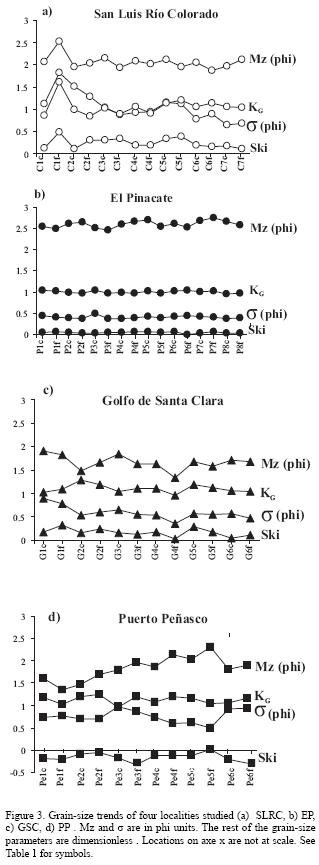
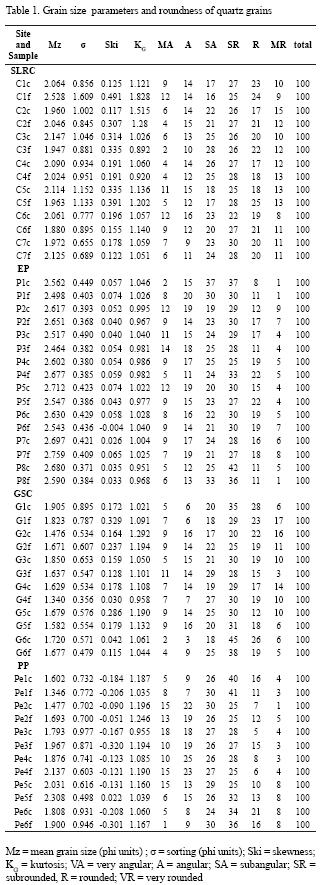
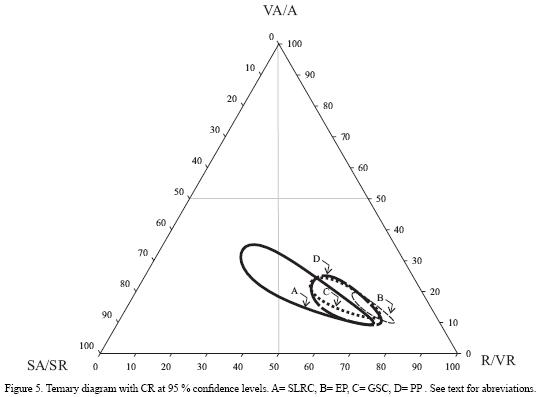
<body><![CDATA[<p align="justify"><font face="verdana" size="2">The geology of the area comprises volcanic, sedimentary, metamorphic and plutonic rocks (<a href="/img/revistas/bsgm/v61n1/a2f2.jpg" target="_blank">Fig. 2</a>).</font></p>     <p align="justify"><font face="verdana" size="2">In the studied area, desert and coastal dunes are of linear and crescentic types (Blount and Lancaster, 1990). According to Blount and Lancaster (1990) and Kasper&#150;Zubillaga <i>et al. </i>(2007) the desert dunes of the Altar Desert were primarily originated from the old and modern flood plain and in the delta of the Colorado River since middle Pleistocene time.</font></p>     <p align="justify"><font face="verdana" size="2">&nbsp;</font></p>     <p align="justify"><font face="verdana" size="2"><b>3. Materials and Methods</b></font></p>     <p align="justify"><font face="verdana" size="2">Fifty four dune sand samples were collected from the Altar Desert and the Golfo de Santa Clara and Puerto Pe&ntilde;asco areas. Samples were collected from the crest and slip face (flank) in longitudinal and crescent dunes of the desert and coastal area of the Altar Desert (<a href="/img/revistas/bsgm/v61n1/a2f1.jpg" target="_blank">Fig. 1</a>). Sampling was carried out in october&#150;november of 2002 (fall&#150;winter season). Approximately 0.1 g of sample was used for grain size determination. Textural parameters like mean graphic size= Mz; sorting= &sigma;; skewness=Ski; kurtosis= K<sub>G</sub> (Folk, 1978) were determined using a Laser Particle Size Analyzer (Model Coulter LS230) (<a href="#f3">Fig. 3</a>; <a href="#t1">Table 1</a>). The Coulter Analyzer is used for grain size determinations of particle sizes between &#150;1.0<img src="/img/revistas/bsgm/v61n1/a2s1.jpg">  to 14.6<img src="/img/revistas/bsgm/v61n1/a2s1.jpg">.</font></p>     <p align="center"><font face="verdana" size="2"><a name="f3"></a></font></p>     <p align="center"><font face="verdana" size="2"><img src="/img/revistas/bsgm/v61n1/a2f3.jpg"></font></p>     <p align="center"><font face="verdana" size="2"><a name="t1"></a></font></p>     <p align="center"><font face="verdana" size="2"><img src="/img/revistas/bsgm/v61n1/a2t1.jpg"></font></p>     <p align="justify"><font face="verdana" size="2">In order to estimate the roundness, 100 quartz grains were point counted in fifty four thin sections using the visual chart by Powers (1953). Quartz grains were classified and counted as VA= very angular, A= angular, SA= subangular, SR= subrounded, R= rounded and VR= very rounded (<a href="#t1">Table 1</a>). Then, roundness ratios VA/A (very angular/angular), SA/SR (subangular/ subrounded) and R/VR (rounded/very rounded) were determined to be used as poles in a ternary diagram (<a href="/img/revistas/bsgm/v61n1/a2f4.jpg" target="_blank">Figs. 4</a> and <a href="#f5">5</a>).</font></p>     ]]></body>
<body><![CDATA[<p align="center"><font face="verdana" size="2"><a name="f5"></a></font></p>     <p align="center"><font face="verdana" size="2"><img src="/img/revistas/bsgm/v61n1/a2f5.jpg"></font></p>     <p align="justify"><font face="verdana" size="2">Additionally twenty four samples were point counted to identify the main quartz&#150;types such as monocrystalline quartz with straight extinction (MS); undulose extinction (MU) and monocrystalline quartz with inclusions (MI); polycrystalline quartz with macrocrystals (~30&#150;40 m) and inclusions (plutonic&#150;type fragments)(PI) and polycrystalline quartz with straight and crenulated boundaries (&gt;2 crystals) (PS) (Blatt and Christie, 1963; Basu, <i>et al., </i>1975; Harrell and Blatt, 1978; Pye and Mazzullo, 1994) (<a href="#t2">Tables 2</a> and <a href="#t3">3</a>; <a href="/img/revistas/bsgm/v61n1/a2f6.jpg" target="_blank">Figs. 6</a> and <a href="#f7">7</a>). It should be clarified that the monocrystalline quartz was the only quartz type used for roundness analysis purposes but polycrystalline quartz was observed for additional provenance interpretation.</font></p>     <p align="center"><font face="verdana" size="2"><a name="f7"></a></font></p>     <p align="center"><font face="verdana" size="2"><img src="/img/revistas/bsgm/v61n1/a2f7.jpg"></font></p>     <p align="center"><font face="verdana" size="2"><a name="t2"></a></font></p>     <p align="center"><font face="verdana" size="2"><img src="/img/revistas/bsgm/v61n1/a2t2.jpg"></font></p>     <p align="center"><font face="verdana" size="2"><a name="t3"></a></font></p>     <p align="center"><font face="verdana" size="2"><img src="/img/revistas/bsgm/v61n1/a2t3.jpg"></font></p>     <p align="justify"><font face="verdana" size="2">Data were normalized to 100% in the same form of modal analysis normalization. Data were plotted in ternary diagrams with the poles VA/A, S A/SR, R/VR and MS, MU and MI. For PI and PS only bivariate diagrams were drawn (<a href="/img/revistas/bsgm/v61n1/a2f6.jpg" target="_blank">Fig.6</a>). In addition, confidence regions (CR) of the whole population at 95 % of confidence level were constructed using the algorithm developed by Weltje (2002) and converted into ellipses using the Sigma Plot software. The ellipses represent the area in which samples might have variations in relation to the whole data limited to three poles of the ternary diagram. Therefore, the CR define rigorously if two data sets are significantly different in the triangle (Weltje, 2002)(<a href="#f5">Figs. 5</a> and <a href="#f7">7</a>).</font></p>     ]]></body>
<body><![CDATA[<p align="justify"><font face="verdana" size="2">A Pearson correlation was carried out for textural (Mz, &sigma; , Ski, K<sub>G</sub>), roundness ratios (VA/A, SA/SR and R/VR) and quartz&#150;types (MS, MU, MI, PI and PS) combining the sites SLRC and EP in one correlation and GSC and PP in other correlation (Tables 4 and 5).</font></p>     <p align="justify"><font face="verdana" size="2">&nbsp;</font></p>     <p align="justify"><font face="verdana" size="2"><b>4. Results</b></font></p>     <p align="justify"><font face="verdana" size="2">4.1. Grain size parameters</font></p>     <p align="justify"><font face="verdana" size="2">Grain size parameters show that dune sands from San Luis Rio Colorado (SLRC) and El Pinacate (EP) are finegrained moderately to well sorted sands. Skewness indicates that the sands are fine&#150;skewed and symmetrical respectively. Kurtosis shows that the sands are leptokurtic with the central part of the distribution better sorted than the tails. Coastal dune sands from Golfo de Santa Clara (GSC) and Puerto Pe&ntilde;asco (PP) are medium moderately well sorted sands (<a href="#t1">Table 1</a>). Skewness indicates that the sands are fine and coarse&#150;skewed respectively. Kurtosis values also reflect the leptokurtic character of the distributions (<a href="#f3">Fig. 3</a>). It can be observed that the El Pinacate dune sands are the finest of all four sites (<a href="#f3">Fig. 3b</a>).</font></p>     <p align="justify"><font face="verdana" size="2">4.2. Roundness of quartz grains</font></p>     <p align="justify"><font face="verdana" size="2">It can be observed that samples from SLRC and EP are slightly better grouped (<a href="/img/revistas/bsgm/v61n1/a2f4.jpg" target="_blank">Figs. 4a, b</a>) than samples from the sites GSC and PP (<a href="/img/revistas/bsgm/v61n1/a2f4.jpg" target="_blank">Figs.4c, d</a>) which are slightly more scattered with trends towards the R/VR pole. The CR for the roundness ratios plotted in the ternary diagram shows that there is a significative difference between roundness of quartz coming from SLRC and roundness from quartz coming from EP (<a href="#f5">Fig. 5</a>). The rest of the sites overlap.</font></p>     <p align="justify"><font face="verdana" size="2">4.3. Quartz types</font></p>     <p align="justify"><font face="verdana" size="2">Dispersal towards the MS&#150;MU poles of quartz coming from EP is observed in the MS&#150;MU&#150;MI ternary plot (<a href="/img/revistas/bsgm/v61n1/a2f6.jpg" target="_blank">Fig. 6b</a>). The rest of the samples are slightly grouped in the middle of the triangle towards the MS&#150;MU poles (<a href="/img/revistas/bsgm/v61n1/a2f6.jpg" target="_blank">Fig. 6 a, c, d</a>). The CR for the four sites overlap and large dispersal in the ternary diagram is due to: a) low number of samples that enhance the CR area; b) dispersal of the whole data set plotted in the triangle (Weltje, 2002) (<a href="#f7">Fig. 7</a>). The bivariate digrams shows that sites EP and PP have polycrystalline quartz with straight and undulose extinction that dominates almost in 100 % the sands (<a href="#f8">Fig. 8a, d</a>). The rest of the sites are composed of mixed policrystalline quartz types such as plutonic and straight&#150;undulose extinction types (<a href="#f8">Fig. 8b, c</a>).</font></p>     <p align="center"><font face="verdana" size="2"><a name="f8"></a></font></p>     ]]></body>
<body><![CDATA[<p align="center"><font face="verdana" size="2"><img src="/img/revistas/bsgm/v61n1/a2f8.jpg"></font></p>     <p align="justify"><font face="verdana" size="2">4.4. Pearson correlations among grain&#150;size parameters, roundness and quartz types</font></p>     <p align="justify"><font face="verdana" size="2">The most significant and meaningful Pearson correlations of samples from sites SLRC and EP are between Mz vs. SA/SR and VA/A vs. MU and between R/VR vs. PI and R/VR vs. PS for GSC and PP sites (Tables 4 and 5).</font></p>     <p align="justify"><font face="verdana" size="2">&nbsp;</font></p>     <p align="justify"><font face="verdana" size="2"><b>5. Discussion</b></font></p>     <p align="justify"><font face="verdana" size="2">5.1. Grain size parameters</font></p>     <p align="justify"><font face="verdana" size="2">Fine&#150;grained sizes in SLRC and EP dune sands may be the result of aeolian transport that carries fine particles onto the dune. Also, wind transport gives selectiveness in the form of moderately to well sorted sands (Kasper&#150;Zubillaga and Carranza&#150;Edwards, 2005). Fine&#150;skewed and symmetrical distributions in SLRC and EP sites respectively indicate the aeolian influence and probably short transport from the source into the SLRC dune fields and long transport from the source into the EP dune fields. This interpretation is supported by the sorting character of the dune sands from each of these two sites (i.e. moderately to well sorted sands respectively) (Khalaf, 1989; Wang <i>et al., </i>2003; Blount and Lancaster, 1990). Sources are in the proximity of alluvial deposits of the Colorado River Delta and plutonic rocks exposed near the US&#150;Mexican Border (Lancaster, 1992; Muhs, <i>et al., </i>2003; Kasper&#150;Zubillaga <i>et al, </i>2007).</font></p>     <p align="justify"><font face="verdana" size="2">The GSC and PP medium moderately well sorted coastal dune sands suggest mixing of aeolian/marine processes that generate different grain sizes of different composition (i.e.terrigenous/biogenic sands). High tidal regimes in the coastal area along the beaches also affect the transport of shell debris and sand landwards during long periods of beach exposure to the southwesterly onshore winds (Kasper&#150;Zubillaga and Carranza&#150;Edwards, 2005). Skewness indicates the coastal processes influence in the characteristics of the coastal dune sands and tke kurtosis still enforces the aeolian mechanisms that prevail in the coastal area. This symmetrical distributions represented by leptokurtic curves have been also observed in dune sands from Kuwait (Khalaf, 1989).</font></p>     <p align="justify"><font face="verdana" size="2">5.2. Roundness of quartz grains.</font></p>     <p align="justify"><font face="verdana" size="2"><i>5.2.1. Inland dune sands</i></font></p>     ]]></body>
<body><![CDATA[<p align="justify"><font face="verdana" size="2">The SLRC and EP are slightly grouped towards the R/ VR pole indicating that quartz grains have been subjected to a) a fluvial transport that has deposited sediments in the Colorado River Delta which may be still inheriting the roundness features from the past b) quartz grains coming from the Colorado River Delta that retain their roundness characteristics until they are deposited by aeolian action in the SLRC site, c) long&#150;lasting transport from the Colorado River Delta to the EP site in which roundness is attributed to inheritance from the source sediments but also to the long aeolian transport. These interpretations are also supported by the findings in scanning electron microscopy analysis (SEM) carried out in quartz grains form SLRC and EP which they evidenced the presence of mechanical surface features in the form of conchoidal fractures and smooth surfaces distinctive of fluvial environments and aeolian transport respectively (Krinsley and Margolis 1969; Margolis and Kennet, 1971;Higgs, 1979; Kasper&#150;Zubillaga and Faustinos Morales, 2007) (<a href="#f9">Fig. 9</a>).</font></p>     <p align="center"><font face="verdana" size="2"><a name="f9"></a></font></p>     <p align="center"><font face="verdana" size="2"><img src="/img/revistas/bsgm/v61n1/a2f9.jpg"></font></p>     <p align="justify"><font face="verdana" size="2">Furthermore, it seems that when the CR is plotted in the ternary diagram a clearer interpretation can be made in terms of roundness ratios. The CR indicate that SLRC and EP are significant different in terms of roundness values being the SLRC site more influenced by angular and subrounded quartz grains (SA/SR ratio) due to the larger dispersal of the CR ellipse compared to the EP site (<a href="#f5">Fig. 5</a>). This suggests that the SLRC indeed concentrates more quartz grains with less aeolian transport compared to the EP which has more rounded and abraded quartz grains. In both sites, quartz may be dominantly sourced from alluvial deposits from the Colorado River Delta by northwesterly and northerly winds as it was evidenced by previous SEM, petrographic and geochemical studies (Kasper&#150;Zubillaga <i>et al., </i>2007; Kasper&#150;Zubillaga and Faustinos Morales, 2007) (<a href="#f9">Fig. 9</a>).</font></p>     <p align="justify"><font face="verdana" size="2"><i>5.2.2. Coastal dune sands</i></font></p>     <p align="justify"><font face="verdana" size="2">The GSC and PP slight dispersal towards the VA/A and R/VR poles indicates that quartz grains have suffered marine/aeolian transport that may caused some samples to retain angulosity due to high energy derived from longshore transport and collision fron one grain to another in a subacqueous and even in aerial environments This interpretation is supported by the fact that some quartz grains experience collisions that leads to angulosity and even conchoidal fractures in the grains in both water and land (Krinsley and Donahue, 1968). Roundness may be produced mainly by aeolian transport in some quartz grains.</font></p>     <p align="justify"><font face="verdana" size="2">The CR from the ternary diagram for sites GSC and PP shows a slight dispersal towards the VA/A poles being the R/VR pole the most significant. Both sites overlap which represents that they are not significantly different. The preceding results suggests that the GSC and PP are influenced by a mix of marine/aeolian processes that gives quartz grains with angularity and roundness attributed to high energy coastal process like longshore currents and wind tranport respectively.</font></p>     <p align="justify"><font face="verdana" size="2">5.3. Quartz types</font></p>     <p align="justify"><font face="verdana" size="2"><i>5.3.1. Inland dune sands</i></font></p>     <p align="justify"><font face="verdana" size="2">Samples from sites SLRC and EP plot in the middle of the ternary diagram with slight dispersal towards the MS and MU poles (<a href="/img/revistas/bsgm/v61n1/a2f6.jpg" target="_blank">Fig. 6 a, b</a>). This represents high content of monocrystalline quartz with straight and undulose extinction. Undulatory quartz is less stable than straight extinction quartz (Blatt and Christie, 1963) but its preservation in the dunes may be due to less transport and closeness to the source sediments in the Colorado River Delta. It is likely that both quartz types are derived from some plutonic and low&#150;rank metamorphic rocks exposed north of the Altar Desert and deposited in the continental sedimentary units (<a href="/img/revistas/bsgm/v61n1/a2f2.jpg" target="_blank">Fig. 2</a>). Also, durability of less stable quartz types like undulatory quartz has been reported in dune sands from New Zealand due to little abrasion exerted by the wind (Kasper&#150;Zubillaga <i>et al., </i>2005).</font></p>     ]]></body>
<body><![CDATA[<p align="justify"><font face="verdana" size="2">The CR for samples coming from EP site shows a narrower area compared to the SLRC site. This can be attributed to the dispersal of the EP site samples towards the poles MS and MU. The CR area of SLRC reflect only the amount of samples analyzed. (<a href="#f7">Fig. 7</a>).</font></p>     <p align="justify"><font face="verdana" size="2">From the binary diagrams it is observed that polycrystalline quartz with straight and crenulated boundaries dominate the samples from the EP site. This quartz type is probably derived from plutonic rocks (<a href="#f8">Fig. 8</a>). The SLRC site shows a relatively mixed percentages of polycrystalline quartz of plutonic origin and low&#150;rank metamorphic sources (<a href="#f8">Fig. 8</a>).</font></p>     <p align="justify"><font face="verdana" size="2"><i>5.3.2. Coastal dune sands</i></font></p>     <p align="justify"><font face="verdana" size="2">Samples from sites GSC and PP are grouped in the middle of the ternary diagram by the side of the MS and MU poles (<a href="/img/revistas/bsgm/v61n1/a2f6.jpg" target="_blank">Fig. 6c, d</a>). Dune sands from these two coastal sites are dominated, like inland dune sands, by monocrystalline quartz with straight and undulose extinction derived from plutonic and low&#150;rank metamorphic rocks.</font></p>     <p align="justify"><font face="verdana" size="2">The CR for samples coming from GSC and PP extend their areas towards the MI pole. However, this pattern only reflects the prediction regions in which the population extends with the little number of samples used for the analysis (Weltje, 2002).</font></p>     <p align="justify"><font face="verdana" size="2">From the binary diagrams it is observed that polycrystalline quartz with straight and crenulated boundaries and plutonic&#150;type fragments are mixed in relatively constant percentages at sites GSC and P.</font></p>     <p align="justify"><font face="verdana" size="2">5.4. Pearson correlations among grain&#150;size parameters, roundness and quartz types.</font></p>     <p align="justify"><font face="verdana" size="2">The SLRC and EP sites showed Mz vs. SA/SR and VA/A vs. MU as significant correlations. The Mz vs. SA/SR negative correlation (&#150;0.70) suggests that coarse&#150;sized grains are subangular probably due to little abrasion and rounding of grain edges trough transport. This interpretation canbe supported by the test&#150;tube experiment by Whalley <i>et al., </i>(1987) in which after 48 hours of mechanical attrition quartz grains become more rounded and finer compared to the initial stages of the test&#150;tube experiment (Tables 4 and 5). The VA/A vs. MU negative correlation (&#150;0.68) suggests that angular grains are mainly monocrystalline quartz with undulose extinction probably derived from low&#150;rank metamorphic sources. Preservation of undulose quartz, which is less stable that non&#150;undulatory quartz, may be due to little transport from the source to the dune fields reflected by the angulosity of the quartz.</font></p>     <p align="justify"><font face="verdana" size="2">The GSC and PP sites show that a meaningful correlation is between Mz vs. SA/SR (0.60) suggesting that increasing of grain size increases angularity of the grains. This may be in opposition to the negative correlation found for the sands coming from SLRC and EP. However, in the case of GSC and PP sites, grain size is coarser than sands from SLRC and EP. Therefore this may have implications in the positive correlation between Mz vs. SA/SR.</font></p>     <p align="justify"><font face="verdana" size="2">&nbsp;</font></p>     ]]></body>
<body><![CDATA[<p align="justify"><font face="verdana" size="2"><b>6. Conclusions</b></font></p>     <p align="justify"><font face="verdana" size="2">Fine&#150;grained and moderately to well sorted sands in SLRC and EP dune sands are generated by aeolian transport and wind selectiveness. In contrast, medium sand sizes and moderately well sorted coastal dune sands at sites GSC and PP indicate a mix of aeolian/marine processes that also generate different grain sizes of different composition (i.e.terrigenous/biogenic detritus).</font></p>     <p align="justify"><font face="verdana" size="2">Roundness of quartz grains at sites SLRC and EP suggests fluvial transport that might inherit their roundness from the Colorado River Delta. However, roundness may be also generated by long wind transport from the Colorado River Delta towards the EP site.</font></p>     <p align="justify"><font face="verdana" size="2">The presence of angular and rounded quartz grains at the GSC and PP may be due to the mixing of aeolian/ marine processes. This is because grain to grain collisions may generate angular quartz grains. In contrast, rounded quartz grains are probably produced by aeolian transport.</font></p>     <p align="justify"><font face="verdana" size="2">Samples from sites SLRC and EP concentrate monocrystalline quartz with straight and undulose extinction probably derived from a near source sediment (i.e. Colorado RiverDelta) since undulatory quartz is more likely to be weathered compared to other quartz types after long transport. Samples from sites GSC and PP are dominated by monocrystalline quartz with straight and undulose extinction derived from plutonic and low&#150;rank metamorphic rocks.</font></p>     <p align="justify"><font face="verdana" size="2">Polycrystalline quartz with straight and crenulated boundaries dominates the samples from the EP site. This quartz type is probably derived from plutonic rocks. The SLRC site shows a relatively mixed percentages of polycrystalline quartz of plutonic origin and low&#150;rank metamorphic sources. Polycrystalline quartz with straight and crenulated boundaries and plutonic&#150;type fragments are mixed in relatively constant percentages at sites GSC and PP.</font></p>     <p align="justify"><font face="verdana" size="2">A negative correlation between Mzvs. SA/SR indicates that coarse&#150;sized grains are subangular probably due to little abrasion and rounding of grain edges trough transport at SLRC and EP sites. The VA/Avs. MU negative correlation suggests that angular grains are mainly monocrystalline quartz with undulose extiction probably derived from low&#150;rank metamorphic sources. The GSC and PP sites show that a meaningful correlation is between Mz vs. SA/SR suggesting an increase of grain size in relation to the angularity of the grains. This may in opposition to the negative correlation found for the sands coming from SLRC and EP due to coarser sizes in sites GPS and PP compared to sites SLRC and EP.</font></p>     <p align="justify"><font face="verdana" size="2">&nbsp;</font></p>     <p align="justify"><font face="verdana" size="2"><b>7. Acknowledgments</b></font></p>     <p align="justify"><font face="verdana" size="2">We appreciate to Eduardo Morales de la Garza for his invaluable assistance in the Particle Size Analysis at the Sedimentological Laboratory of the Instituto de Ciencias del Mar y Limnolog&iacute;a, Universidad Nacional Aut&oacute;noma de M&eacute;xico.</font></p>     ]]></body>
<body><![CDATA[<p align="justify"><font face="verdana" size="2">&nbsp;</font></p>     <p align="justify"><font face="verdana" size="2"><b>8. References</b></font></p>     <!-- ref --><p align="justify"><font face="verdana" size="2">Andrews, E.D., 1991, Sediment transport in the CR basin Colorado River Ecology and Dam Management, in Proceedings of a Symposium National Academic Press: Washington DC, 54&#150;74.</font>&nbsp;&nbsp;&nbsp;&nbsp;&nbsp;&nbsp;&nbsp;&nbsp;[&#160;<a href="javascript:void(0);" onclick="javascript: window.open('/scielo.php?script=sci_nlinks&ref=1373882&pid=S1405-3322200900010000200001&lng=','','width=640,height=500,resizable=yes,scrollbars=1,menubar=yes,');">Links</a>&#160;]<!-- end-ref --><!-- ref --><p align="justify"><font face="verdana" size="2">Basu, A., Young, S.W., Suttner, L.J., James, W.C., Mack, G.H., 1975, Reevaluation of the use of undulatory extinction and polycrystallinity in detrital quartz foe provenance interpretation: Journal of Sedimentary Petrology, 45, 873&#150;882.</font>&nbsp;&nbsp;&nbsp;&nbsp;&nbsp;&nbsp;&nbsp;&nbsp;[&#160;<a href="javascript:void(0);" onclick="javascript: window.open('/scielo.php?script=sci_nlinks&ref=1373883&pid=S1405-3322200900010000200002&lng=','','width=640,height=500,resizable=yes,scrollbars=1,menubar=yes,');">Links</a>&#160;]<!-- end-ref --><!-- ref --><p align="justify"><font face="verdana" size="2">Basu, A., 1985, Reading provenance from detrital quartz, in Zuffa G.G.I., Provenance of Arenites: Nato Series C. 148, 231&#150;247.</font>&nbsp;&nbsp;&nbsp;&nbsp;&nbsp;&nbsp;&nbsp;&nbsp;[&#160;<a href="javascript:void(0);" onclick="javascript: window.open('/scielo.php?script=sci_nlinks&ref=1373884&pid=S1405-3322200900010000200003&lng=','','width=640,height=500,resizable=yes,scrollbars=1,menubar=yes,');">Links</a>&#160;]<!-- end-ref --><!-- ref --><p align="justify"><font face="verdana" size="2">Beal, M.A., Shepard, F.P., 1956, A use of roundness to determine depositional environments: Journal of Sedimentary Petrology, 26:49&#150;60.</font>&nbsp;&nbsp;&nbsp;&nbsp;&nbsp;&nbsp;&nbsp;&nbsp;[&#160;<a href="javascript:void(0);" onclick="javascript: window.open('/scielo.php?script=sci_nlinks&ref=1373885&pid=S1405-3322200900010000200004&lng=','','width=640,height=500,resizable=yes,scrollbars=1,menubar=yes,');">Links</a>&#160;]<!-- end-ref --><!-- ref --><p align="justify"><font face="verdana" size="2">Blatt, H., Christie, J.M., 1963, Undulatory extinction in quartz of igneous and metamorphic rocks and its significance in provenance studies of sedimentary rocks: Journal of Sedimentary Petrology, 33: 559&#150;579.</font>&nbsp;&nbsp;&nbsp;&nbsp;&nbsp;&nbsp;&nbsp;&nbsp;[&#160;<a href="javascript:void(0);" onclick="javascript: window.open('/scielo.php?script=sci_nlinks&ref=1373886&pid=S1405-3322200900010000200005&lng=','','width=640,height=500,resizable=yes,scrollbars=1,menubar=yes,');">Links</a>&#160;]<!-- end-ref --><!-- ref --><p align="justify"><font face="verdana" size="2">Blount, G., Lancaster, N., 1990, Development of the Gran Desierto sand sea: Geology 18: 724&#150;728.</font>&nbsp;&nbsp;&nbsp;&nbsp;&nbsp;&nbsp;&nbsp;&nbsp;[&#160;<a href="javascript:void(0);" onclick="javascript: window.open('/scielo.php?script=sci_nlinks&ref=1373887&pid=S1405-3322200900010000200006&lng=','','width=640,height=500,resizable=yes,scrollbars=1,menubar=yes,');">Links</a>&#160;]<!-- end-ref --><!-- ref --><p align="justify"><font face="verdana" size="2">Cupul, M.A.L.,1994, Flujos de sedimentos en suspensi&oacute;n y nutrientes en la cuenca estuarina del R&iacute;o Colorado Ensenada, B.C., Mexico: Ensenada, Baja Californa, Mexico, Facultad de Ciencias Marinas, Universidad Aut&oacute;noma de Baja California master in science thesis.</font>&nbsp;&nbsp;&nbsp;&nbsp;&nbsp;&nbsp;&nbsp;&nbsp;[&#160;<a href="javascript:void(0);" onclick="javascript: window.open('/scielo.php?script=sci_nlinks&ref=1373888&pid=S1405-3322200900010000200007&lng=','','width=640,height=500,resizable=yes,scrollbars=1,menubar=yes,');">Links</a>&#160;]<!-- end-ref --><!-- ref --><p align="justify"><font face="verdana" size="2">Folk, R.L., 1978, Petrology of Sedimentary Rocks: Austin Texas, Hemphil Public. 182 p.</font>&nbsp;&nbsp;&nbsp;&nbsp;&nbsp;&nbsp;&nbsp;&nbsp;[&#160;<a href="javascript:void(0);" onclick="javascript: window.open('/scielo.php?script=sci_nlinks&ref=1373889&pid=S1405-3322200900010000200008&lng=','','width=640,height=500,resizable=yes,scrollbars=1,menubar=yes,');">Links</a>&#160;]<!-- end-ref --><!-- ref --><p align="justify"><font face="verdana" size="2">Harrell J., Blatt, H., 1978, Polycrystallinity: effect on the durability of detrital quartz: Journal of Sedimentary Petrology, 48: 25&#150;30.</font>&nbsp;&nbsp;&nbsp;&nbsp;&nbsp;&nbsp;&nbsp;&nbsp;[&#160;<a href="javascript:void(0);" onclick="javascript: window.open('/scielo.php?script=sci_nlinks&ref=1373890&pid=S1405-3322200900010000200009&lng=','','width=640,height=500,resizable=yes,scrollbars=1,menubar=yes,');">Links</a>&#160;]<!-- end-ref --><!-- ref --><p align="justify"><font face="verdana" size="2">Higgs, R., 1979, Quartz&#150;grain surface features of Mezosoic&#150;Cenozoic sands from the Labrador and western Greenland continental margins: Journal of Sedimentary Petrology, 49, 599&#150;610.</font>&nbsp;&nbsp;&nbsp;&nbsp;&nbsp;&nbsp;&nbsp;&nbsp;[&#160;<a href="javascript:void(0);" onclick="javascript: window.open('/scielo.php?script=sci_nlinks&ref=1373891&pid=S1405-3322200900010000200010&lng=','','width=640,height=500,resizable=yes,scrollbars=1,menubar=yes,');">Links</a>&#160;]<!-- end-ref --><!-- ref --><p align="justify"><font face="verdana" size="2">Kasper&#150;Zubillaga, J.J., Dickinson, W.W., Carranza&#150;Edwards, A., Hornelas&#150;Orozco, Y., 2005, Petrography of quartz grains in beach and dune sands of Northland, North Island, New Zealand: Journal of Geology and Geophysics, 48, 649&#150;660.</font>&nbsp;&nbsp;&nbsp;&nbsp;&nbsp;&nbsp;&nbsp;&nbsp;[&#160;<a href="javascript:void(0);" onclick="javascript: window.open('/scielo.php?script=sci_nlinks&ref=1373892&pid=S1405-3322200900010000200011&lng=','','width=640,height=500,resizable=yes,scrollbars=1,menubar=yes,');">Links</a>&#160;]<!-- end-ref --><!-- ref --><p align="justify"><font face="verdana" size="2">Kasper&#150;Zubillaga, J.J., Carranza&#150;Edwards, A., 2005, Grain size discrimination between sands of desert and coastal dunes from Northwestern Mexico: Revista Mexicana de Ciencias Geol&oacute;gicas ,22, 383&#150;390.</font>&nbsp;&nbsp;&nbsp;&nbsp;&nbsp;&nbsp;&nbsp;&nbsp;[&#160;<a href="javascript:void(0);" onclick="javascript: window.open('/scielo.php?script=sci_nlinks&ref=1373893&pid=S1405-3322200900010000200012&lng=','','width=640,height=500,resizable=yes,scrollbars=1,menubar=yes,');">Links</a>&#160;]<!-- end-ref --><!-- ref --><p align="justify"><font face="verdana" size="2">Kasper&#150;Zubillaga, J.J., Zolezzi&#150;Ru&iacute;z, H., Carranza&#150;Edwards, A., Gir&oacute;n&#150;Garc&iacute;a, P., Ortiz&#150;Zamora, G., Palma, M., 2007, Sedimentological, modal analysis and geochemical studies of desert and coastal dune sands, Altar Desert, NW Mexico: Earth Surface Processes and Landforms, 32, 489&#150;508.</font>&nbsp;&nbsp;&nbsp;&nbsp;&nbsp;&nbsp;&nbsp;&nbsp;[&#160;<a href="javascript:void(0);" onclick="javascript: window.open('/scielo.php?script=sci_nlinks&ref=1373894&pid=S1405-3322200900010000200013&lng=','','width=640,height=500,resizable=yes,scrollbars=1,menubar=yes,');">Links</a>&#160;]<!-- end-ref --><!-- ref --><p align="justify"><font face="verdana" size="2">Kasper&#150;Zubillaga, J.J., Faustinos Morales, R., 2007, Scanning electron microscopy analysis of quartz grains in desert and coastal dune sands (Altar Desert, NW Mexico): Ciencias Marinas, 33, 11&#150;22.</font>&nbsp;&nbsp;&nbsp;&nbsp;&nbsp;&nbsp;&nbsp;&nbsp;[&#160;<a href="javascript:void(0);" onclick="javascript: window.open('/scielo.php?script=sci_nlinks&ref=1373895&pid=S1405-3322200900010000200014&lng=','','width=640,height=500,resizable=yes,scrollbars=1,menubar=yes,');">Links</a>&#160;]<!-- end-ref --><!-- ref --><p align="justify"><font face="verdana" size="2">Khalaf, F., 1989, Textural characteristics and genesis of the aeolian sediments in the Kuwaiti desert: Sedimentology, 36, 253&#150;271.</font>&nbsp;&nbsp;&nbsp;&nbsp;&nbsp;&nbsp;&nbsp;&nbsp;[&#160;<a href="javascript:void(0);" onclick="javascript: window.open('/scielo.php?script=sci_nlinks&ref=1373896&pid=S1405-3322200900010000200015&lng=','','width=640,height=500,resizable=yes,scrollbars=1,menubar=yes,');">Links</a>&#160;]<!-- end-ref --><!-- ref --><p align="justify"><font face="verdana" size="2">Krinsley, D., Donahue, J., 1968, Environmental interpretation of sand grain surface textures by electron microscopy: Geological Society of America Bulletin, 79, 743&#150;748.</font>&nbsp;&nbsp;&nbsp;&nbsp;&nbsp;&nbsp;&nbsp;&nbsp;[&#160;<a href="javascript:void(0);" onclick="javascript: window.open('/scielo.php?script=sci_nlinks&ref=1373897&pid=S1405-3322200900010000200016&lng=','','width=640,height=500,resizable=yes,scrollbars=1,menubar=yes,');">Links</a>&#160;]<!-- end-ref --><!-- ref --><p align="justify"><font face="verdana" size="2">Krinsley, D., Margolis, S., 1969, Scanning electron microscopy: a new method for studying sand grain surface textures: Transactions of New York Academy of Science, 31, 457&#150;477.</font>&nbsp;&nbsp;&nbsp;&nbsp;&nbsp;&nbsp;&nbsp;&nbsp;[&#160;<a href="javascript:void(0);" onclick="javascript: window.open('/scielo.php?script=sci_nlinks&ref=1373898&pid=S1405-3322200900010000200017&lng=','','width=640,height=500,resizable=yes,scrollbars=1,menubar=yes,');">Links</a>&#160;]<!-- end-ref --><!-- ref --><p align="justify"><font face="verdana" size="2">Lancaster, N., Greeley, R., Christensen, P.R., 1987, Dines of the Gran Desierto sand Sea, Sonora, Mexico: Earth Surface Processes and Landforms, 12, 277&#150;288.</font>&nbsp;&nbsp;&nbsp;&nbsp;&nbsp;&nbsp;&nbsp;&nbsp;[&#160;<a href="javascript:void(0);" onclick="javascript: window.open('/scielo.php?script=sci_nlinks&ref=1373899&pid=S1405-3322200900010000200018&lng=','','width=640,height=500,resizable=yes,scrollbars=1,menubar=yes,');">Links</a>&#160;]<!-- end-ref --><!-- ref --><p align="justify"><font face="verdana" size="2">Lancaster, N., 1992, Relations between dune generations in the Gran Desierto of Mexico: Sedimentology, 39, 631&#150;644. </font>&nbsp;&nbsp;&nbsp;&nbsp;&nbsp;&nbsp;&nbsp;&nbsp;[&#160;<a href="javascript:void(0);" onclick="javascript: window.open('/scielo.php?script=sci_nlinks&ref=1373900&pid=S1405-3322200900010000200019&lng=','','width=640,height=500,resizable=yes,scrollbars=1,menubar=yes,');">Links</a>&#160;]<!-- end-ref --><!-- ref --><p align="justify"><font face="verdana" size="2">Lavin, M.F., Badan&#150;Dangon, A, 1997, Estructura hidrogr&aacute;fica y circulaci&oacute;n del Golfo de California, in Lavin, M.F., Contribuciones a la Oceanograf&iacute;a F&iacute;sica en M&eacute;xico: Monograf&iacute;a 5.</font>&nbsp;&nbsp;&nbsp;&nbsp;&nbsp;&nbsp;&nbsp;&nbsp;[&#160;<a href="javascript:void(0);" onclick="javascript: window.open('/scielo.php?script=sci_nlinks&ref=1373901&pid=S1405-3322200900010000200020&lng=','','width=640,height=500,resizable=yes,scrollbars=1,menubar=yes,');">Links</a>&#160;]<!-- end-ref --><!-- ref --><p align="justify"><font face="verdana" size="2">Margolis, S.V., Kennet, J.P., 1971, Cenozoic paleoglacial history of Antarctica recorded in subantarctic deep&#150;sea cores: American Journal of Science, 271, 1&#150;36.</font>&nbsp;&nbsp;&nbsp;&nbsp;&nbsp;&nbsp;&nbsp;&nbsp;[&#160;<a href="javascript:void(0);" onclick="javascript: window.open('/scielo.php?script=sci_nlinks&ref=1373902&pid=S1405-3322200900010000200021&lng=','','width=640,height=500,resizable=yes,scrollbars=1,menubar=yes,');">Links</a>&#160;]<!-- end-ref --><!-- ref --><p align="justify"><font face="verdana" size="2">Marinone, S.G., Lavin, M.F., 1997, Mareas y corrientes residuales en el Golfo de California, in Lavin M.F., Contribuciones a la Oceanograf&iacute;a F&iacute;sica en M&eacute;xico. Uni&oacute;n Geof&iacute;sica Mexicana, M&eacute;xico, 117&#150;143.</font>&nbsp;&nbsp;&nbsp;&nbsp;&nbsp;&nbsp;&nbsp;&nbsp;[&#160;<a href="javascript:void(0);" onclick="javascript: window.open('/scielo.php?script=sci_nlinks&ref=1373903&pid=S1405-3322200900010000200022&lng=','','width=640,height=500,resizable=yes,scrollbars=1,menubar=yes,');">Links</a>&#160;]<!-- end-ref --><!-- ref --><p align="justify"><font face="verdana" size="2">Muhs, D.R., Reynolds, R.L., Been, J., Skipp, G., 2003, Eolian sand transport pathways in the southwestern United States: importance of the Colorado River and local sources: Quaternary International, 104, 3&#150;18.</font>&nbsp;&nbsp;&nbsp;&nbsp;&nbsp;&nbsp;&nbsp;&nbsp;[&#160;<a href="javascript:void(0);" onclick="javascript: window.open('/scielo.php?script=sci_nlinks&ref=1373904&pid=S1405-3322200900010000200023&lng=','','width=640,height=500,resizable=yes,scrollbars=1,menubar=yes,');">Links</a>&#160;]<!-- end-ref --><!-- ref --><p align="justify"><font face="verdana" size="2">Pettijohn, F.J., Potter, P.E., Siever, R., 1972, Sand and Sandstone: Springer&#150;Verlag, 618 p.</font>&nbsp;&nbsp;&nbsp;&nbsp;&nbsp;&nbsp;&nbsp;&nbsp;[&#160;<a href="javascript:void(0);" onclick="javascript: window.open('/scielo.php?script=sci_nlinks&ref=1373905&pid=S1405-3322200900010000200024&lng=','','width=640,height=500,resizable=yes,scrollbars=1,menubar=yes,');">Links</a>&#160;]<!-- end-ref --><!-- ref --><p align="justify"><font face="verdana" size="2">Powers, M.C., 1953, A new roundness scale for sedimentary particles, Journal of Sedimentary Petrology, 23, 117&#150;119. </font>&nbsp;&nbsp;&nbsp;&nbsp;&nbsp;&nbsp;&nbsp;&nbsp;[&#160;<a href="javascript:void(0);" onclick="javascript: window.open('/scielo.php?script=sci_nlinks&ref=1373906&pid=S1405-3322200900010000200025&lng=','','width=640,height=500,resizable=yes,scrollbars=1,menubar=yes,');">Links</a>&#160;]<!-- end-ref --><!-- ref --><p align="justify"><font face="verdana" size="2">Pye, K., Mazullo, J., 1994, Effects of tropical weathering on quartz shape: an example from northeastern Australia: Journal of Sedimentary Research A, 64, 500&#150;507.</font>&nbsp;&nbsp;&nbsp;&nbsp;&nbsp;&nbsp;&nbsp;&nbsp;[&#160;<a href="javascript:void(0);" onclick="javascript: window.open('/scielo.php?script=sci_nlinks&ref=1373907&pid=S1405-3322200900010000200026&lng=','','width=640,height=500,resizable=yes,scrollbars=1,menubar=yes,');">Links</a>&#160;]<!-- end-ref --><!-- ref --><p align="justify"><font face="verdana" size="2">Sagga, A.M.S., 1993, Roundness of sand grains of longitudinal dunes in Saudi Arabia: Sedimentary Geology, 87, 63&#150;68. </font>&nbsp;&nbsp;&nbsp;&nbsp;&nbsp;&nbsp;&nbsp;&nbsp;[&#160;<a href="javascript:void(0);" onclick="javascript: window.open('/scielo.php?script=sci_nlinks&ref=1373908&pid=S1405-3322200900010000200027&lng=','','width=640,height=500,resizable=yes,scrollbars=1,menubar=yes,');">Links</a>&#160;]<!-- end-ref --><!-- ref --><p align="justify"><font face="verdana" size="2">Shepard, F.P., Young, R., 1961, Distinguishing between beach and dune sands: Journal of Sedimentary Petrology, 31, 196&#150;214.</font>&nbsp;&nbsp;&nbsp;&nbsp;&nbsp;&nbsp;&nbsp;&nbsp;[&#160;<a href="javascript:void(0);" onclick="javascript: window.open('/scielo.php?script=sci_nlinks&ref=1373909&pid=S1405-3322200900010000200028&lng=','','width=640,height=500,resizable=yes,scrollbars=1,menubar=yes,');">Links</a>&#160;]<!-- end-ref --><!-- ref --><p align="justify"><font face="verdana" size="2">Shepard, F.P., 1973, Submarine Geology: Harper and Row, New York, 517 p.</font>&nbsp;&nbsp;&nbsp;&nbsp;&nbsp;&nbsp;&nbsp;&nbsp;[&#160;<a href="javascript:void(0);" onclick="javascript: window.open('/scielo.php?script=sci_nlinks&ref=1373910&pid=S1405-3322200900010000200029&lng=','','width=640,height=500,resizable=yes,scrollbars=1,menubar=yes,');">Links</a>&#160;]<!-- end-ref --><!-- ref --><p align="justify"><font face="verdana" size="2">Thompson, R.W., 1968, Tidal flat sedimentation on the Colorado River Delta, northwestern Gulf of California: Bulletin of the Geological Society of America Memoir, 107.</font>&nbsp;&nbsp;&nbsp;&nbsp;&nbsp;&nbsp;&nbsp;&nbsp;[&#160;<a href="javascript:void(0);" onclick="javascript: window.open('/scielo.php?script=sci_nlinks&ref=1373911&pid=S1405-3322200900010000200030&lng=','','width=640,height=500,resizable=yes,scrollbars=1,menubar=yes,');">Links</a>&#160;]<!-- end-ref --><!-- ref --><p align="justify"><font face="verdana" size="2">Vandivere, W.B., Vorster, P., 1984, Hydrology analysis of the CR floods of 1983: Geojournal, 9, 343&#150;350.</font>&nbsp;&nbsp;&nbsp;&nbsp;&nbsp;&nbsp;&nbsp;&nbsp;[&#160;<a href="javascript:void(0);" onclick="javascript: window.open('/scielo.php?script=sci_nlinks&ref=1373912&pid=S1405-3322200900010000200031&lng=','','width=640,height=500,resizable=yes,scrollbars=1,menubar=yes,');">Links</a>&#160;]<!-- end-ref --><!-- ref --><p align="justify"><font face="verdana" size="2">Whalley, W.B., Smith, B.J., McAlister, J.J., Edwards, A.J., 1987, Aeolian abrasion of quartz particles and the production of silt&#150;size fragments: preliminary results, in Frostick L.,Reis I., Desert sediments: ancient and modern: Geological Society Special Publication, 129&#150;138.</font>&nbsp;&nbsp;&nbsp;&nbsp;&nbsp;&nbsp;&nbsp;&nbsp;[&#160;<a href="javascript:void(0);" onclick="javascript: window.open('/scielo.php?script=sci_nlinks&ref=1373913&pid=S1405-3322200900010000200032&lng=','','width=640,height=500,resizable=yes,scrollbars=1,menubar=yes,');">Links</a>&#160;]<!-- end-ref --><!-- ref --><p align="justify"><font face="verdana" size="2">Wadell, H., 1932, Volume, shape and roundness of rock particles. Journal of Geology, 40, 443&#150;451.</font>&nbsp;&nbsp;&nbsp;&nbsp;&nbsp;&nbsp;&nbsp;&nbsp;[&#160;<a href="javascript:void(0);" onclick="javascript: window.open('/scielo.php?script=sci_nlinks&ref=1373914&pid=S1405-3322200900010000200033&lng=','','width=640,height=500,resizable=yes,scrollbars=1,menubar=yes,');">Links</a>&#160;]<!-- end-ref --><!-- ref --><p align="justify"><font face="verdana" size="2">Weltje, G.J., 2002, Quantitative analysis of detrital modes: statistically rigorous confidence regions in ternary diagrams and their use in sedimentary petrology: Earth Science Review, 57, 211&#150;253.</font>&nbsp;&nbsp;&nbsp;&nbsp;&nbsp;&nbsp;&nbsp;&nbsp;[&#160;<a href="javascript:void(0);" onclick="javascript: window.open('/scielo.php?script=sci_nlinks&ref=1373915&pid=S1405-3322200900010000200034&lng=','','width=640,height=500,resizable=yes,scrollbars=1,menubar=yes,');">Links</a>&#160;]<!-- end-ref --><!-- ref --><p align="justify"><font face="verdana" size="2">Wang, X., Dong, Z., Zhang, J., Qu, J., Zhao, A., 2003, Grain size characteristics of dune sands in the central Taklimakan Sand Sea: Sedimentary Geology, 161, 1&#150;14.</font>&nbsp;&nbsp;&nbsp;&nbsp;&nbsp;&nbsp;&nbsp;&nbsp;[&#160;<a href="javascript:void(0);" onclick="javascript: window.open('/scielo.php?script=sci_nlinks&ref=1373916&pid=S1405-3322200900010000200035&lng=','','width=640,height=500,resizable=yes,scrollbars=1,menubar=yes,');">Links</a>&#160;]<!-- end-ref --> ]]></body><back>
<ref-list>
<ref id="B1">
<nlm-citation citation-type="book">
<person-group person-group-type="author">
<name>
<surname><![CDATA[Andrews]]></surname>
<given-names><![CDATA[E.D.]]></given-names>
</name>
</person-group>
<article-title xml:lang="en"><![CDATA[Sediment transport in the CR basin Colorado River Ecology and Dam Management]]></article-title>
<source><![CDATA[Proceedings of a Symposium National]]></source>
<year>1991</year>
<page-range>54-74</page-range><publisher-loc><![CDATA[Washington DC ]]></publisher-loc>
<publisher-name><![CDATA[Academic Press]]></publisher-name>
</nlm-citation>
</ref>
<ref id="B2">
<nlm-citation citation-type="journal">
<person-group person-group-type="author">
<name>
<surname><![CDATA[Basu]]></surname>
<given-names><![CDATA[A.]]></given-names>
</name>
<name>
<surname><![CDATA[Young]]></surname>
<given-names><![CDATA[S.W.]]></given-names>
</name>
<name>
<surname><![CDATA[Suttner]]></surname>
<given-names><![CDATA[L.J.]]></given-names>
</name>
<name>
<surname><![CDATA[James]]></surname>
<given-names><![CDATA[W.C.]]></given-names>
</name>
<name>
<surname><![CDATA[Mack]]></surname>
<given-names><![CDATA[G.H.]]></given-names>
</name>
</person-group>
<article-title xml:lang="en"><![CDATA[Reevaluation of the use of undulatory extinction and polycrystallinity in detrital quartz foe provenance interpretation]]></article-title>
<source><![CDATA[Journal of Sedimentary Petrology]]></source>
<year>1975</year>
<volume>45</volume>
<page-range>873-882</page-range></nlm-citation>
</ref>
<ref id="B3">
<nlm-citation citation-type="">
<person-group person-group-type="author">
<name>
<surname><![CDATA[Basu]]></surname>
<given-names><![CDATA[A.]]></given-names>
</name>
</person-group>
<article-title xml:lang="en"><![CDATA[Reading provenance from detrital quartz]]></article-title>
<person-group person-group-type="editor">
<name>
<surname><![CDATA[Zuffa]]></surname>
<given-names><![CDATA[G.G.I.]]></given-names>
</name>
</person-group>
<source><![CDATA[Provenance of Arenites]]></source>
<year>1985</year>
<page-range>231-247</page-range></nlm-citation>
</ref>
<ref id="B4">
<nlm-citation citation-type="journal">
<person-group person-group-type="author">
<name>
<surname><![CDATA[Beal]]></surname>
<given-names><![CDATA[M.A.]]></given-names>
</name>
<name>
<surname><![CDATA[Shepard]]></surname>
<given-names><![CDATA[F.P.]]></given-names>
</name>
</person-group>
<article-title xml:lang="en"><![CDATA[A use of roundness to determine depositional environments]]></article-title>
<source><![CDATA[Journal of Sedimentary Petrology]]></source>
<year>1956</year>
<volume>26</volume>
<page-range>49-60</page-range></nlm-citation>
</ref>
<ref id="B5">
<nlm-citation citation-type="journal">
<person-group person-group-type="author">
<name>
<surname><![CDATA[Blatt]]></surname>
<given-names><![CDATA[H.]]></given-names>
</name>
<name>
<surname><![CDATA[Christie]]></surname>
<given-names><![CDATA[J.M.]]></given-names>
</name>
</person-group>
<article-title xml:lang="en"><![CDATA[Undulatory extinction in quartz of igneous and metamorphic rocks and its significance in provenance studies of sedimentary rocks]]></article-title>
<source><![CDATA[Journal of Sedimentary Petrology]]></source>
<year>1963</year>
<volume>33</volume>
<page-range>559-579</page-range></nlm-citation>
</ref>
<ref id="B6">
<nlm-citation citation-type="journal">
<person-group person-group-type="author">
<name>
<surname><![CDATA[Blount]]></surname>
<given-names><![CDATA[G.]]></given-names>
</name>
<name>
<surname><![CDATA[Lancaster]]></surname>
<given-names><![CDATA[N.]]></given-names>
</name>
</person-group>
<article-title xml:lang="en"><![CDATA[Development of the Gran Desierto sand sea]]></article-title>
<source><![CDATA[Geology]]></source>
<year>1990</year>
<volume>18</volume>
<page-range>724-728</page-range></nlm-citation>
</ref>
<ref id="B7">
<nlm-citation citation-type="">
<person-group person-group-type="author">
<name>
<surname><![CDATA[Cupul]]></surname>
<given-names><![CDATA[M.A.L.]]></given-names>
</name>
</person-group>
<source><![CDATA[Flujos de sedimentos en suspensión y nutrientes en la cuenca estuarina del Río Colorado Ensenada, B.C., Mexico]]></source>
<year>1994</year>
<publisher-loc><![CDATA[Ensenada^eBaja Californa Baja Californa]]></publisher-loc>
</nlm-citation>
</ref>
<ref id="B8">
<nlm-citation citation-type="book">
<person-group person-group-type="author">
<name>
<surname><![CDATA[Folk]]></surname>
<given-names><![CDATA[R.L.]]></given-names>
</name>
</person-group>
<source><![CDATA[Petrology of Sedimentary Rocks]]></source>
<year>1978</year>
<page-range>182</page-range><publisher-loc><![CDATA[Austin^eTexas Texas]]></publisher-loc>
<publisher-name><![CDATA[Hemphil Public.]]></publisher-name>
</nlm-citation>
</ref>
<ref id="B9">
<nlm-citation citation-type="journal">
<person-group person-group-type="author">
<name>
<surname><![CDATA[Harrell]]></surname>
<given-names><![CDATA[J.]]></given-names>
</name>
<name>
<surname><![CDATA[Blatt]]></surname>
<given-names><![CDATA[H.]]></given-names>
</name>
</person-group>
<article-title xml:lang="en"><![CDATA[Polycrystallinity: effect on the durability of detrital quartz]]></article-title>
<source><![CDATA[Journal of Sedimentary Petrology]]></source>
<year>1978</year>
<volume>48</volume>
<page-range>25-30</page-range></nlm-citation>
</ref>
<ref id="B10">
<nlm-citation citation-type="journal">
<person-group person-group-type="author">
<name>
<surname><![CDATA[Higgs]]></surname>
<given-names><![CDATA[R.]]></given-names>
</name>
</person-group>
<article-title xml:lang="en"><![CDATA[Quartz-grain surface features of Mezosoic-Cenozoic sands from the Labrador and western Greenland continental margins]]></article-title>
<source><![CDATA[Journal of Sedimentary Petrology]]></source>
<year>1979</year>
<volume>49</volume>
<page-range>599-610</page-range></nlm-citation>
</ref>
<ref id="B11">
<nlm-citation citation-type="journal">
<person-group person-group-type="author">
<name>
<surname><![CDATA[Kasper-Zubillaga]]></surname>
<given-names><![CDATA[J.J.]]></given-names>
</name>
<name>
<surname><![CDATA[Dickinson]]></surname>
<given-names><![CDATA[W.W.]]></given-names>
</name>
<name>
<surname><![CDATA[Carranza-Edwards]]></surname>
<given-names><![CDATA[A.]]></given-names>
</name>
<name>
<surname><![CDATA[Hornelas-Orozco]]></surname>
<given-names><![CDATA[Y.]]></given-names>
</name>
</person-group>
<article-title xml:lang="en"><![CDATA[Petrography of quartz grains in beach and dune sands of Northland, North Island, New Zealand]]></article-title>
<source><![CDATA[Journal of Geology and Geophysics]]></source>
<year>2005</year>
<volume>48</volume>
<page-range>649-660</page-range></nlm-citation>
</ref>
<ref id="B12">
<nlm-citation citation-type="journal">
<person-group person-group-type="author">
<name>
<surname><![CDATA[Kasper-Zubillaga]]></surname>
<given-names><![CDATA[J.J.]]></given-names>
</name>
<name>
<surname><![CDATA[Carranza-Edwards]]></surname>
<given-names><![CDATA[A.]]></given-names>
</name>
</person-group>
<article-title xml:lang="en"><![CDATA[Grain size discrimination between sands of desert and coastal dunes from Northwestern Mexico]]></article-title>
<source><![CDATA[Revista Mexicana de Ciencias Geológicas]]></source>
<year>2005</year>
<volume>22</volume>
<page-range>383-390</page-range></nlm-citation>
</ref>
<ref id="B13">
<nlm-citation citation-type="journal">
<person-group person-group-type="author">
<name>
<surname><![CDATA[Kasper-Zubillaga]]></surname>
<given-names><![CDATA[J.J.]]></given-names>
</name>
<name>
<surname><![CDATA[Zolezzi-Ruíz]]></surname>
<given-names><![CDATA[H.]]></given-names>
</name>
<name>
<surname><![CDATA[Carranza-Edwards]]></surname>
<given-names><![CDATA[A.]]></given-names>
</name>
<name>
<surname><![CDATA[Girón-García]]></surname>
<given-names><![CDATA[P.]]></given-names>
</name>
<name>
<surname><![CDATA[Ortiz-Zamora]]></surname>
<given-names><![CDATA[G.]]></given-names>
</name>
<name>
<surname><![CDATA[Palma]]></surname>
<given-names><![CDATA[M.]]></given-names>
</name>
</person-group>
<article-title xml:lang="en"><![CDATA[Sedimentological, modal analysis and geochemical studies of desert and coastal dune sands, Altar Desert, NW Mexico]]></article-title>
<source><![CDATA[Earth Surface Processes and Landforms]]></source>
<year>2007</year>
<volume>32</volume>
<page-range>489-508</page-range></nlm-citation>
</ref>
<ref id="B14">
<nlm-citation citation-type="journal">
<person-group person-group-type="author">
<name>
<surname><![CDATA[Kasper-Zubillaga]]></surname>
<given-names><![CDATA[J.J.]]></given-names>
</name>
<name>
<surname><![CDATA[Faustinos Morales]]></surname>
<given-names><![CDATA[R.]]></given-names>
</name>
</person-group>
<article-title xml:lang="en"><![CDATA[Scanning electron microscopy analysis of quartz grains in desert and coastal dune sands (Altar Desert, NW Mexico)]]></article-title>
<source><![CDATA[Ciencias Marinas]]></source>
<year>2007</year>
<volume>33</volume>
<page-range>11-22</page-range></nlm-citation>
</ref>
<ref id="B15">
<nlm-citation citation-type="journal">
<person-group person-group-type="author">
<name>
<surname><![CDATA[Khalaf]]></surname>
<given-names><![CDATA[F.]]></given-names>
</name>
</person-group>
<article-title xml:lang="en"><![CDATA[Textural characteristics and genesis of the aeolian sediments in the Kuwaiti desert]]></article-title>
<source><![CDATA[Sedimentology]]></source>
<year>1989</year>
<volume>36</volume>
<page-range>253-271</page-range></nlm-citation>
</ref>
<ref id="B16">
<nlm-citation citation-type="journal">
<person-group person-group-type="author">
<name>
<surname><![CDATA[Krinsley]]></surname>
<given-names><![CDATA[D.]]></given-names>
</name>
<name>
<surname><![CDATA[Donahue]]></surname>
<given-names><![CDATA[J.]]></given-names>
</name>
</person-group>
<article-title xml:lang="en"><![CDATA[Environmental interpretation of sand grain surface textures by electron microscopy]]></article-title>
<source><![CDATA[Geological Society of America Bulletin]]></source>
<year>1968</year>
<volume>79</volume>
<page-range>743-748</page-range></nlm-citation>
</ref>
<ref id="B17">
<nlm-citation citation-type="journal">
<person-group person-group-type="author">
<name>
<surname><![CDATA[Krinsley]]></surname>
<given-names><![CDATA[D.]]></given-names>
</name>
<name>
<surname><![CDATA[Margolis]]></surname>
<given-names><![CDATA[S.]]></given-names>
</name>
</person-group>
<article-title xml:lang="en"><![CDATA[Scanning electron microscopy: a new method for studying sand grain surface textures]]></article-title>
<source><![CDATA[Transactions of New York Academy of Science]]></source>
<year>1969</year>
<volume>31</volume>
<page-range>457-477</page-range></nlm-citation>
</ref>
<ref id="B18">
<nlm-citation citation-type="journal">
<person-group person-group-type="author">
<name>
<surname><![CDATA[Lancaster]]></surname>
<given-names><![CDATA[N.]]></given-names>
</name>
<name>
<surname><![CDATA[Greeley]]></surname>
<given-names><![CDATA[R.]]></given-names>
</name>
<name>
<surname><![CDATA[Christensen]]></surname>
<given-names><![CDATA[P.R.]]></given-names>
</name>
</person-group>
<article-title xml:lang="en"><![CDATA[Dines of the Gran Desierto sand Sea, Sonora, Mexico]]></article-title>
<source><![CDATA[Earth Surface Processes and Landforms]]></source>
<year>1987</year>
<volume>12</volume>
<page-range>277-288</page-range></nlm-citation>
</ref>
<ref id="B19">
<nlm-citation citation-type="journal">
<person-group person-group-type="author">
<name>
<surname><![CDATA[Lancaster]]></surname>
<given-names><![CDATA[N.]]></given-names>
</name>
</person-group>
<article-title xml:lang="en"><![CDATA[Relations between dune generations in the Gran Desierto of Mexico]]></article-title>
<source><![CDATA[Sedimentology]]></source>
<year>1992</year>
<volume>39</volume>
<page-range>631-644</page-range></nlm-citation>
</ref>
<ref id="B20">
<nlm-citation citation-type="">
<person-group person-group-type="author">
<name>
<surname><![CDATA[Lavin]]></surname>
<given-names><![CDATA[M.F.]]></given-names>
</name>
<name>
<surname><![CDATA[Badan-Dangon]]></surname>
<given-names><![CDATA[A]]></given-names>
</name>
</person-group>
<article-title xml:lang="es"><![CDATA[Estructura hidrográfica y circulación del Golfo de California]]></article-title>
<person-group person-group-type="editor">
<name>
<surname><![CDATA[Lavin]]></surname>
<given-names><![CDATA[M.F.]]></given-names>
</name>
</person-group>
<source><![CDATA[Contribuciones a la Oceanografía Física en México]]></source>
<year>1997</year>
</nlm-citation>
</ref>
<ref id="B21">
<nlm-citation citation-type="journal">
<person-group person-group-type="author">
<name>
<surname><![CDATA[Margolis]]></surname>
<given-names><![CDATA[S.V.]]></given-names>
</name>
<name>
<surname><![CDATA[Kennet]]></surname>
<given-names><![CDATA[J.P.]]></given-names>
</name>
</person-group>
<article-title xml:lang="en"><![CDATA[Cenozoic paleoglacial history of Antarctica recorded in subantarctic deep-sea cores]]></article-title>
<source><![CDATA[American Journal of Science]]></source>
<year>1971</year>
<volume>271</volume>
<page-range>1-36</page-range></nlm-citation>
</ref>
<ref id="B22">
<nlm-citation citation-type="book">
<person-group person-group-type="author">
<name>
<surname><![CDATA[Marinone]]></surname>
<given-names><![CDATA[S.G.]]></given-names>
</name>
<name>
<surname><![CDATA[Lavin]]></surname>
<given-names><![CDATA[M.F.]]></given-names>
</name>
</person-group>
<article-title xml:lang="es"><![CDATA[Mareas y corrientes residuales en el Golfo de California]]></article-title>
<person-group person-group-type="editor">
<name>
<surname><![CDATA[Lavin]]></surname>
<given-names><![CDATA[M.F.]]></given-names>
</name>
</person-group>
<source><![CDATA[Contribuciones a la Oceanografía Física en México]]></source>
<year>1997</year>
<page-range>117-143</page-range><publisher-name><![CDATA[Unión Geofísica Mexicana]]></publisher-name>
</nlm-citation>
</ref>
<ref id="B23">
<nlm-citation citation-type="journal">
<person-group person-group-type="author">
<name>
<surname><![CDATA[Muhs]]></surname>
<given-names><![CDATA[D.R.]]></given-names>
</name>
<name>
<surname><![CDATA[Reynolds]]></surname>
<given-names><![CDATA[R.L.]]></given-names>
</name>
<name>
<surname><![CDATA[Been]]></surname>
<given-names><![CDATA[J.]]></given-names>
</name>
<name>
<surname><![CDATA[Skipp]]></surname>
<given-names><![CDATA[G.]]></given-names>
</name>
</person-group>
<article-title xml:lang="en"><![CDATA[Eolian sand transport pathways in the southwestern United States: importance of the Colorado River and local sources]]></article-title>
<source><![CDATA[Quaternary International]]></source>
<year>2003</year>
<volume>104</volume>
<page-range>3-18</page-range></nlm-citation>
</ref>
<ref id="B24">
<nlm-citation citation-type="book">
<person-group person-group-type="author">
<name>
<surname><![CDATA[Pettijohn]]></surname>
<given-names><![CDATA[F.J.]]></given-names>
</name>
<name>
<surname><![CDATA[Potter]]></surname>
<given-names><![CDATA[P.E.]]></given-names>
</name>
<name>
<surname><![CDATA[Siever]]></surname>
<given-names><![CDATA[R.]]></given-names>
</name>
</person-group>
<source><![CDATA[]]></source>
<year>1972</year>
<page-range>618</page-range><publisher-loc><![CDATA[SandSandstone ]]></publisher-loc>
<publisher-name><![CDATA[Springer-Verlag]]></publisher-name>
</nlm-citation>
</ref>
<ref id="B25">
<nlm-citation citation-type="journal">
<person-group person-group-type="author">
<name>
<surname><![CDATA[Powers]]></surname>
<given-names><![CDATA[M.C.]]></given-names>
</name>
</person-group>
<article-title xml:lang="en"><![CDATA[A new roundness scale for sedimentary particles]]></article-title>
<source><![CDATA[Journal of Sedimentary Petrology]]></source>
<year>1953</year>
<volume>23</volume>
<page-range>117-119</page-range></nlm-citation>
</ref>
<ref id="B26">
<nlm-citation citation-type="journal">
<person-group person-group-type="author">
<name>
<surname><![CDATA[Pye]]></surname>
<given-names><![CDATA[K.]]></given-names>
</name>
<name>
<surname><![CDATA[Mazullo]]></surname>
<given-names><![CDATA[J.]]></given-names>
</name>
</person-group>
<article-title xml:lang="en"><![CDATA[Effects of tropical weathering on quartz shape: an example from northeastern Australia]]></article-title>
<source><![CDATA[Journal of Sedimentary Research A]]></source>
<year>1994</year>
<volume>64</volume>
<page-range>500-507</page-range></nlm-citation>
</ref>
<ref id="B27">
<nlm-citation citation-type="journal">
<person-group person-group-type="author">
<name>
<surname><![CDATA[Sagga]]></surname>
<given-names><![CDATA[A.M.S.]]></given-names>
</name>
</person-group>
<article-title xml:lang="en"><![CDATA[Roundness of sand grains of longitudinal dunes in Saudi Arabia]]></article-title>
<source><![CDATA[Sedimentary Geology]]></source>
<year>1993</year>
<volume>87</volume>
<page-range>63-68</page-range></nlm-citation>
</ref>
<ref id="B28">
<nlm-citation citation-type="journal">
<person-group person-group-type="author">
<name>
<surname><![CDATA[Shepard]]></surname>
<given-names><![CDATA[F.P.]]></given-names>
</name>
<name>
<surname><![CDATA[Young]]></surname>
<given-names><![CDATA[R.]]></given-names>
</name>
</person-group>
<article-title xml:lang="en"><![CDATA[Distinguishing between beach and dune sands]]></article-title>
<source><![CDATA[Journal of Sedimentary Petrology]]></source>
<year>1961</year>
<volume>31</volume>
<page-range>196-214</page-range></nlm-citation>
</ref>
<ref id="B29">
<nlm-citation citation-type="book">
<person-group person-group-type="author">
<name>
<surname><![CDATA[Shepard]]></surname>
<given-names><![CDATA[F.P.]]></given-names>
</name>
</person-group>
<source><![CDATA[Submarine Geology]]></source>
<year>1973</year>
<page-range>517</page-range><publisher-loc><![CDATA[New York ]]></publisher-loc>
<publisher-name><![CDATA[Harper and Row]]></publisher-name>
</nlm-citation>
</ref>
<ref id="B30">
<nlm-citation citation-type="journal">
<person-group person-group-type="author">
<name>
<surname><![CDATA[Thompson]]></surname>
<given-names><![CDATA[R.W.]]></given-names>
</name>
</person-group>
<article-title xml:lang="en"><![CDATA[Tidal flat sedimentation on the Colorado River Delta, northwestern Gulf of California]]></article-title>
<source><![CDATA[Bulletin of the Geological Society of America Memoir]]></source>
<year>1968</year>
<volume>107</volume>
</nlm-citation>
</ref>
<ref id="B31">
<nlm-citation citation-type="journal">
<person-group person-group-type="author">
<name>
<surname><![CDATA[Vandivere]]></surname>
<given-names><![CDATA[W.B.]]></given-names>
</name>
<name>
<surname><![CDATA[Vorster]]></surname>
<given-names><![CDATA[P.]]></given-names>
</name>
</person-group>
<article-title xml:lang="en"><![CDATA[Hydrology analysis of the CR floods of 1983]]></article-title>
<source><![CDATA[Geojournal]]></source>
<year>1984</year>
<volume>9</volume>
<page-range>343-350</page-range></nlm-citation>
</ref>
<ref id="B32">
<nlm-citation citation-type="book">
<person-group person-group-type="author">
<name>
<surname><![CDATA[Whalley]]></surname>
<given-names><![CDATA[W.B.]]></given-names>
</name>
<name>
<surname><![CDATA[Smith]]></surname>
<given-names><![CDATA[B.J.]]></given-names>
</name>
<name>
<surname><![CDATA[McAlister]]></surname>
<given-names><![CDATA[J.J.]]></given-names>
</name>
<name>
<surname><![CDATA[Edwards]]></surname>
<given-names><![CDATA[A.J.]]></given-names>
</name>
</person-group>
<article-title xml:lang="en"><![CDATA[Aeolian abrasion of quartz particles and the production of silt-size fragments: preliminary results]]></article-title>
<person-group person-group-type="editor">
<name>
<surname><![CDATA[Frostick]]></surname>
<given-names><![CDATA[L.]]></given-names>
</name>
<name>
<surname><![CDATA[Reis]]></surname>
<given-names><![CDATA[I.]]></given-names>
</name>
</person-group>
<source><![CDATA[Desert sediments: ancient and modern]]></source>
<year>1987</year>
<page-range>129-138</page-range><publisher-name><![CDATA[Geological Society]]></publisher-name>
</nlm-citation>
</ref>
<ref id="B33">
<nlm-citation citation-type="journal">
<person-group person-group-type="author">
<name>
<surname><![CDATA[Wadell]]></surname>
<given-names><![CDATA[H.]]></given-names>
</name>
</person-group>
<article-title xml:lang="en"><![CDATA[Volume, shape and roundness of rock particles]]></article-title>
<source><![CDATA[Journal of Geology]]></source>
<year>1932</year>
<volume>40</volume>
<page-range>443-451</page-range></nlm-citation>
</ref>
<ref id="B34">
<nlm-citation citation-type="journal">
<person-group person-group-type="author">
<name>
<surname><![CDATA[Weltje]]></surname>
<given-names><![CDATA[G.J.]]></given-names>
</name>
</person-group>
<article-title xml:lang="en"><![CDATA[Quantitative analysis of detrital modes: statistically rigorous confidence regions in ternary diagrams and their use in sedimentary petrology]]></article-title>
<source><![CDATA[Earth Science Review]]></source>
<year>2002</year>
<volume>57</volume>
<page-range>211-253</page-range></nlm-citation>
</ref>
<ref id="B35">
<nlm-citation citation-type="journal">
<person-group person-group-type="author">
<name>
<surname><![CDATA[Wang]]></surname>
<given-names><![CDATA[X.]]></given-names>
</name>
<name>
<surname><![CDATA[Dong]]></surname>
<given-names><![CDATA[Z.]]></given-names>
</name>
<name>
<surname><![CDATA[Zhang]]></surname>
<given-names><![CDATA[J.]]></given-names>
</name>
<name>
<surname><![CDATA[Qu]]></surname>
<given-names><![CDATA[J.]]></given-names>
</name>
<name>
<surname><![CDATA[Zhao]]></surname>
<given-names><![CDATA[A.]]></given-names>
</name>
</person-group>
<article-title xml:lang="en"><![CDATA[Grain size characteristics of dune sands in the central Taklimakan Sand Sea]]></article-title>
<source><![CDATA[Sedimentary Geology]]></source>
<year>2003</year>
<volume>161</volume>
<page-range>1-14</page-range></nlm-citation>
</ref>
</ref-list>
</back>
</article>