<?xml version="1.0" encoding="ISO-8859-1"?><article xmlns:mml="http://www.w3.org/1998/Math/MathML" xmlns:xlink="http://www.w3.org/1999/xlink" xmlns:xsi="http://www.w3.org/2001/XMLSchema-instance">
<front>
<journal-meta>
<journal-id>1405-3195</journal-id>
<journal-title><![CDATA[Agrociencia]]></journal-title>
<abbrev-journal-title><![CDATA[Agrociencia]]></abbrev-journal-title>
<issn>1405-3195</issn>
<publisher>
<publisher-name><![CDATA[Colegio de Postgraduados]]></publisher-name>
</publisher>
</journal-meta>
<article-meta>
<article-id>S1405-31952015000800003</article-id>
<title-group>
<article-title xml:lang="en"><![CDATA[Drying kinetics of slices of nopal (Opuntia ficus indica) cladodes in a convective transversal flow dryer]]></article-title>
<article-title xml:lang="es"><![CDATA[Cinética de secado de tiras de cladodios de nopal (Opuntia ficus indica) en un secador convectivo de flujo transversal]]></article-title>
</title-group>
<contrib-group>
<contrib contrib-type="author">
<name>
<surname><![CDATA[Díaz-Ayala]]></surname>
<given-names><![CDATA[Felipe]]></given-names>
</name>
<xref ref-type="aff" rid="A01"/>
</contrib>
<contrib contrib-type="author">
<name>
<surname><![CDATA[Álvarez-García]]></surname>
<given-names><![CDATA[G. del Socorro]]></given-names>
</name>
<xref ref-type="aff" rid="A01"/>
</contrib>
<contrib contrib-type="author">
<name>
<surname><![CDATA[Simá-Moo]]></surname>
<given-names><![CDATA[Efraín]]></given-names>
</name>
<xref ref-type="aff" rid="A01"/>
</contrib>
</contrib-group>
<aff id="A01">
<institution><![CDATA[,Centro Nacional de Investigación y Desarrollo Tecnológico  ]]></institution>
<addr-line><![CDATA[Cuernavaca Morelos]]></addr-line>
<country>México</country>
</aff>
<pub-date pub-type="pub">
<day>00</day>
<month>12</month>
<year>2015</year>
</pub-date>
<pub-date pub-type="epub">
<day>00</day>
<month>12</month>
<year>2015</year>
</pub-date>
<volume>49</volume>
<numero>8</numero>
<fpage>845</fpage>
<lpage>857</lpage>
<copyright-statement/>
<copyright-year/>
<self-uri xlink:href="http://www.scielo.org.mx/scielo.php?script=sci_arttext&amp;pid=S1405-31952015000800003&amp;lng=en&amp;nrm=iso"></self-uri><self-uri xlink:href="http://www.scielo.org.mx/scielo.php?script=sci_abstract&amp;pid=S1405-31952015000800003&amp;lng=en&amp;nrm=iso"></self-uri><self-uri xlink:href="http://www.scielo.org.mx/scielo.php?script=sci_pdf&amp;pid=S1405-31952015000800003&amp;lng=en&amp;nrm=iso"></self-uri><abstract abstract-type="short" xml:lang="en"><p><![CDATA[Opuntia ficus-indica, also known as nopal, is a cactus which grows on arid and semiarid lands of America. Dehydrated nopal is an alternative for food preservation, but drying times of cladodes are very long. The objective of this study was to evaluate dry kinetics of nopal thin slices, of 4 mm thick, 140 mm long and 17 mm wide. We conducted the drying process in a convective cross flow tray dryer at 35 °C, 45 °C and 60 °C and air velocities of 1 m s-1, 1.5 m s-1 and 2 m s-1, under laboratory conditions. Results indicated that the effect of air temperature on the drying time of nopal slices was higher than the air velocity (p&#8804;0.05). The drying time for nopal in thin slices was remarkably lower (99 %) compared to that for whole cladode (p&#8804;0.05 and 50 % lower for cylindrical 25 mm nopal pieces previously reported. Further, the experimental data of drying curve of nopal slices were fitted to different thin layer models and the Midilli model with empirical constants was the best describing the of nopal slices drying. ANOVA analysis indicated that all the tests were significant (p&#8804;0.05) for all drying temperatures and velocities evaluated.]]></p></abstract>
<abstract abstract-type="short" xml:lang="es"><p><![CDATA[Opuntia ficus-indica, también conocido como nopal, es un cactus que crece en zonas áridas y semiáridas de América. La deshidratación del nopal es una alternativa para su conservación como alimento pero el tiempo para secar los cladodios es muy largo. El objetivo de este estudio fue evaluar la cinética de secado de tiras delgadas, de 4 mm de grosor, 140 mm de longitud y 17 mm de anchura de nopal. El secado se realizó en un secador de charola con flujo convectivo cruzado a 35 °C, 45 °C y 60 °C y velocidades de aire de 1 m s-1, 1.5 m s- ¹ y 2 m s- ¹, en condiciones de laboratorio. Los resultados mostraron que el efecto de la temperatura del aire en el tiempo de secado de las tiras de nopal fue mayor que la velocidad del aire (p&#8804; 0.05). El tiempo de secado de las tiras delgadas fue notablemente menor (99 %) en comparación con el del cladodio entero (p&#8804; 0.05) y 50 % menor que para piezas cilíndricas de nopal de 25 mm reportado previamente. Además, los datos experimentales de la curva de secado de las tiras de nopal se ajustaron a diferentes modelos de capa fina, y el modelo Midilli con constantes empíricas describió mejor el secado de nopal en rebanadas. El análisis estadístico ANDEVA indicó que todas las pruebas fueron significativas (p&#8804; 0.05) para todas las temperaturas de secado y velocidades evaluadas.]]></p></abstract>
<kwd-group>
<kwd lng="en"><![CDATA[Food drying]]></kwd>
<kwd lng="en"><![CDATA[nopal cladode drying]]></kwd>
<kwd lng="en"><![CDATA[drying kinetics of cactus]]></kwd>
<kwd lng="en"><![CDATA[thin layer drying]]></kwd>
<kwd lng="en"><![CDATA[drying time]]></kwd>
<kwd lng="es"><![CDATA[Secado de alimentos]]></kwd>
<kwd lng="es"><![CDATA[secado de cladodio de nopal]]></kwd>
<kwd lng="es"><![CDATA[cinética de secado de cactus]]></kwd>
<kwd lng="es"><![CDATA[secado de capa delgada]]></kwd>
<kwd lng="es"><![CDATA[tiempo de secado]]></kwd>
</kwd-group>
</article-meta>
</front><body><![CDATA[  	    <p align="justify"><font face="verdana" size="4">Ciencia de los alimentos</font></p>  	    <p>&nbsp;</p>  	    <p align="center"><font face="verdana" size="4"><b>Drying kinetics of slices of nopal <i>(Opuntia ficus indica)</i> cladodes in a convective transversal flow dryer</b></font></p>  	    <p>&nbsp;</p>  	    <p align="center"><font face="verdana" size="3"><b>Cin&eacute;tica de secado de tiras de cladodios de nopal <i>(Opuntia ficus indica)</i> en un secador convectivo de flujo transversal</b></font></p>  	    <p>&nbsp;</p>  	    <p align="center"><font face="verdana" size="2"><b>Felipe D&iacute;az&#45;Ayala, G. del Socorro &Aacute;lvarez&#45;Garc&iacute;a*, Efra&iacute;n Sim&aacute;&#45;Moo</b></font></p>  	    <p>&nbsp;</p>  	    <p align="justify"><font face="verdana" size="2"><i>Centro Nacional de Investigaci&oacute;n y Desarrollo Tecnol&oacute;gico, CENIDET&#45;TecNM&#45;SEP, Prolongaci&oacute;n Avenida Palmira S/N, Colonia Palmira, 62490. Cuernavaca, Morelos, M&eacute;xico.</i></font></p>  	    ]]></body>
<body><![CDATA[<p>&nbsp;</p>  	    <p align="justify"><font face="verdana" size="2">Received: January 2015.    <br> 	Approved: July, 2015.</font></p>  	    <p>&nbsp;</p>  	    <p align="justify"><font face="verdana" size="2"><b>Abstract</b></font></p>  	    <p align="justify"><font face="verdana" size="2"><i>Opuntia ficus&#45;indica,</i> also known as nopal, is a cactus which grows on arid and semiarid lands of America. Dehydrated nopal is an alternative for food preservation, but drying times of cladodes are very long. The objective of this study was to evaluate dry kinetics of nopal thin slices, of 4 mm thick, 140 mm long and 17 mm wide. We conducted the drying process in a convective cross flow tray dryer at 35 &deg;C, 45 &deg;C and 60 &deg;C and air velocities of 1 m s<sup>&#45;1</sup>, 1.5 m s<sup>&#45;1</sup> and 2 m s<sup>&#45;1</sup>, under laboratory conditions. Results indicated that the effect of air temperature on the drying time of nopal slices was higher than the air velocity (p&le;0.05). The drying time for nopal in thin slices was remarkably lower (99 %) compared to that for whole cladode (p&le;0.05 and 50 % lower for cylindrical 25 mm nopal pieces previously reported. Further, the experimental data of drying curve of nopal slices were fitted to different thin layer models and the Midilli model with empirical constants was the best describing the of nopal slices drying. ANOVA analysis indicated that all the tests were significant (p&le;0.05) for all drying temperatures and velocities evaluated.</font></p>  	    <p align="justify"><font face="verdana" size="2"><b>Keywords:</b> Food drying, <i>nopal</i> cladode drying, drying kinetics of cactus, thin layer drying, drying time.</font></p>  	    <p>&nbsp;</p>  	    <p align="justify"><font face="verdana" size="2"><b>Resumen</b></font></p>  	    <p align="justify"><font face="verdana" size="2"><i>Opuntia ficus&#45;indica,</i> tambi&eacute;n conocido como nopal, es un cactus que crece en zonas &aacute;ridas y semi&aacute;ridas de Am&eacute;rica. La deshidrataci&oacute;n del nopal es una alternativa para su conservaci&oacute;n como alimento pero el tiempo para secar los cladodios es muy largo. El objetivo de este estudio fue evaluar la cin&eacute;tica de secado de tiras delgadas, de 4 mm de grosor, 140 mm de longitud y 17 mm de anchura de nopal. El secado se realiz&oacute; en un secador de charola con flujo convectivo cruzado a 35 &deg;C, 45 &deg;C y 60 &deg;C y velocidades de aire de 1 m s<sup>&#45;1</sup>, 1.5 m s<sup>&#45;</sup> <sup>1</sup> y 2 m s<sup>&#45;</sup> <sup>1</sup>, en condiciones de laboratorio. Los resultados mostraron que el efecto de la temperatura del aire en el tiempo de secado de las tiras de nopal fue mayor que la velocidad del aire (p&le; 0.05). El tiempo de secado de las tiras delgadas fue notablemente menor (99 %) en comparaci&oacute;n con el del cladodio entero (p&le; 0.05) y 50 % menor que para piezas cil&iacute;ndricas de nopal de 25 mm reportado previamente. Adem&aacute;s, los datos experimentales de la curva de secado de las tiras de nopal se ajustaron a diferentes modelos de capa fina, y el modelo Midilli con constantes emp&iacute;ricas describi&oacute; mejor el secado de nopal en rebanadas. El an&aacute;lisis estad&iacute;stico ANDEVA indic&oacute; que todas las pruebas fueron significativas (p&le; 0.05) para todas las temperaturas de secado y velocidades evaluadas.</font></p>  	    ]]></body>
<body><![CDATA[<p align="justify"><font face="verdana" size="2"><b>Palabras clave:</b> Secado de alimentos, secado de cladodio de nopal, cin&eacute;tica de secado de cactus, secado de capa delgada, tiempo de secado.</font></p>  	    <p>&nbsp;</p>  	    <p align="justify"><font face="verdana" size="2"><b>INTRODUCTION</b></font></p>  	    <p align="justify"><font face="verdana" size="2">Cacti belong to the genus <i>Opuntia</i> and they are native of northern desert zones of Mexico and south of USA. In Mexico, there are approximately 100 species among the 258 documented species (Guzm&aacute;n <i>et al.,</i> 2007). For human consumption, only 10 to 12 species are used to produce fruit (pears) and vegetables (cactus). The <i>Opuntia ficus&#45;indica</i> is also called <i>nopal;</i> the <i>nopal</i> cladode is well known for nutritional and healing qualities, it is rich in fiber, minerals, and vitamins (Maki&#45;D&iacute;az <i>et al.,</i> 2015). It is exported (85 % fresh) from Mexico. But the overabundance of fresh <i>nopal</i> in the market causes a price decrease and economic loss to producers FND, (2011).</font></p>  	    <p align="justify"><font face="verdana" size="2">Drying and grinding <i>nopal</i> cladodes are part of a preservation method used as an alternative to increase marketing opportunities, because cladodes shelf life can be extended and the high cost of transport and storage can be reduced (Erechukwu 1999; Midilli <i>et al.</i> 2002). A variety of dry fruits and vegetables with forced convection hot air were reported by Hossain and Bala (2002), Midilli <i>et al.</i> (2002), Kashaninejad and Tabil (2004), Doymaz (2006) and Waewsak <i>et al.</i> (2006), but few studies were found in the literature reviewed about cladode drying. Medina&#45;Torrez <i>et al.</i> (2008) studied the effects of three drying methods (convective, osmotic and osmotic&#45;convection) on the mechanical properties of the <i>nopal.</i> Higher elasticity was observed in the dried tissue using osmotic method showed than by convective hot air and it was harder than that osmotically dried; textural properties of <i>nopal</i> were strongly affected by combining drying processes this increasing brittle, and reducing cohesiveness and springiness. Authors recommended using convective drying to preserve the best mechanical characteristics of the <i>nopal.</i> They reported for a convective area of 0.0578 m<sup>2</sup> dry times of 11 to 18 h, at 65 and 45 &deg;C for 3 and 5 m s<sup>&#45;1</sup>, to reach 2 % humidity, but they did not specify if the cactus cladode had been cut or if the cuticle was eliminated. Vasconcelos <i>et al.</i> (2012) studied osmotic dehydration of whole cladode considering binary and ternary solutions and found that temperature had a greater influence on water loss, the concentration of the osmotic solution (sucrose/NaCl/water) had a greater effect on <i>nopal</i> and the best conditions for osmotic dehydration were in a glucose solution at 40 &deg;C. They did not account for the <i>nopal</i> drying time only for the study of effects of independent variables such as temperature and velocity on the drying process. L&oacute;pez <i>et al.</i> (2009) used a convective dryer tunnel to study the kinetics of drying whole <i>nopal</i> cladodes with and without thorns at 35 &deg;C, 45 &deg;C and 60 &deg;C and 1.5 m s<sup>&#45;1</sup> and 3 m s<sup>&#45;1</sup> air speed. They found that time to dry cladodes was very large; it ranged from 80 to 360 h for those with thorns and from 50 to 260 h for those without thorns. However they did not investigate the slices of cladode drying kinetics. Touil <i>et al.</i> (2010) investigated the effect of three infrared dry temperatures (40, 50, 60 &deg;C, not airflow) on <i>O. ficus indica</i> fruits and cladodes. Drying times of cladode, cut in small cylinders of 25 mm in diameter and 5 mm thick, ranged between 2.5 to 5.5 h. Therefore, the drying time is related to temperature, airflow, <i>nopal</i> geometry and the type of process used. Thus cutting the <i>nopal</i> cladode in small thin strips may diminish significantly the drying time, saving energy for drying.</font></p>  	    <p align="justify"><font face="verdana" size="2">The objective of this study was to evaluate: the drying kinetics of <i>nopal</i> cladode cut in thin slices of 17 mm width, 4 mm thick and 140 mm long, using a convective drier; the influence of the combined effects of varying air temperatures and velocities on the drying process; and ten kinetic models considering the combining effects of drying time, temperature, speed and relative humidity.</font></p>  	    <p>&nbsp;</p>  	    <p align="justify"><font face="verdana" size="2"><b>MATERIALS AND METHODS</b></font></p>  	    <p align="justify"><font face="verdana" size="2">Fresh <i>nopal</i> cladodes harvested during September&#45;October 2008 in Tepoztl&aacute;n, Morelos, Mexico, were used. They were selected according to maturity and geometric dimensions. The cladodes without thorns of 17 mm thick, 140 mm wide and 200 mm long were washed and cut in 10 thin slices of 4 mm thick, 17 mm width, and 140 mm long, approximately. The sample weight was 120 g. The initial moisture content (92.8 %) was determined in a laboratory oven (Imperial Laboratory Lab Oven Model 3478 M&#45;line Instruments) according to AOAC (2000).</font></p>  	    <p align="justify"><font face="verdana" size="2">The experiments were carried out in a cross flow tray dryer designed and built at the Mechanical Engineering Department of Cenidet in Cuernavaca, Mexico (<a href="/img/revistas/agro/v49n8/a3f1.jpg" target="_blank">Figure 1</a>). The dryer provided air at 35 &deg;C, 45 &deg;C and 60 &deg;C and speed between 1.0, 1.5 and 2 m s<sup>&#45;1</sup>. Air was conducted by a centrifugal fan AXC 315B (Elicent) of 300 W and heated by five electric heaters of 600 W. Air temperature was controlled by a heating control unit (0.25 m wide, 0.25 m high and 0.9 m length) located at the entrance of the duct dryer. The test chamber was a transparent box (0.55 m and 0.60 m high) containing a stainless steel grid (0.25 m long and 0.25 m wide). Eleven LM&#45;35 (&plusmn;0.5 &deg;C accuracy) sensors measured the ambient, interior, inlet and outlet air temperatures of the drying test chamber. Five HIH&#45;4000&#45;004 (Honeywell &plusmn; 3.5 % accuracy) sensors measure exterior, interior, inlet and outlet air humidity of the test chamber.</font></p>  	    ]]></body>
<body><![CDATA[<p align="justify"><font face="verdana" size="2">A hot wire digital anemometer (Model 731A; BK Precision; &plusmn; 3 % accuracy) measured the air velocity. A USB&#45;6008 (National Instruments) acquisition system was used to gather and process the data. A J&#45;100 (Reyo) digital scale (&plusmn; 0.01 g accuracy) monitored the weight of <i>nopal</i> slices.</font></p>  	    <p align="justify"><font face="verdana" size="2">After the experimental data were obtained a suitable theoretical model that describes the drying curve of thin <i>nopal</i> slices was selected. Thus the experimental drying curves were fitted by 10 different thin layer models (<a href="/img/revistas/agro/v49n8/a3t1.jpg" target="_blank">Table 1</a>).</font></p>  	    <p align="justify"><font face="verdana" size="2"><b>Experimental procedure</b></font></p>  	    <p align="justify"><font face="verdana" size="2"><i>Nopal</i> sample of 10 thin slices, 4 mm thick, 140 mm long and 17 mm wide, was extended on the grid tray (<a href="#f2">Figure 2</a>). Air temperature and speed were set on the convective dryer. The drying temperature and relative humidity of air at the duct entrance, upper and lower tray and exit were measured and recorded. The samples were weighted manually every 10 min throughout the experiment. The ambient temperature and air relative humidity in the room ranged from 24.9 to 27.5 &deg;C and from 39.9 to 59.6 %. The initial moisture content of the <i>nopal</i> slices ranged from 0.943 to 0.953 <i>kg</i><sub>H2O</sub><i>/kg<sub>dry&#45;</sub></i><sub>matter</sub> and the final <i>nopal</i> moisture content needed to grind the slices should be <i>kg</i><sub><i>H2O</i></sub><i>/kg<sub>dry</sub></i>.</font></p>  	    <p align="center"><font face="verdana" size="2"><a name="f2"></a></font></p>  	    <p align="center"><font face="verdana" size="2"><img src="/img/revistas/agro/v49n8/a3f2.jpg"></font></p>  	    <p>&nbsp;</p>  	    <p align="justify"><font face="verdana" size="2"><b>RESULTS AND DISCUSSION</b></font></p>  	    <p align="justify"><font face="verdana" size="2">In order to determine the variability among the experiments, three experiments were performed for every condition of velocity and temperature. The data of the three experiments were analyzed by computing the average standard deviation. The average standard deviation of these experiments, for all the conditions of velocity and temperature, was 0.024. The maximum standard deviation was 0.032, which happen when the humidity of the product was higher than 60 % and the minimum standard deviation of 0.007 was when the humidity of the product was 4%.</font></p>  	    <p align="justify"><font face="verdana" size="2">Drying times of 4.78, 3.00, 1.68 h, for 1 m s<sup>&#45;1</sup>; 3.8, 2.91, 1.53 h for 1.5 m s<sup>&#45;1</sup> and 2.99, 2.31 and 1.25 h for 2 m s<sup>&#45;1</sup>, respectively (<a href="#f3">Figure 3</a>). For the highest temperature and velocity the drying time was 1.25 h, which was 40 % lower than the drying time for high velocity and lower temperature (2.99 h). Besides the drying constant period was absent, which means that the drying process was carried out only in the falling rate period, indicating that diffusion is the mechanism governing the motion of the moisture migration in <i>nopal</i> slices. This result agrees with that reported by Touil <i>et al.</i> (2010).</font></p>  	    ]]></body>
<body><![CDATA[<p align="center"><font face="verdana" size="2"><a name="f3"></a></font></p>  	    <p align="center"><font face="verdana" size="2"><img src="/img/revistas/agro/v49n8/a3f3.jpg"></font></p>  	    <p align="justify"><font face="verdana" size="2">A comparison (<a href="#f4">Figure 4</a>) between the convective drying times of cladode slices, of the present work, and the whole <i>nopal</i> cladode with and without thorns at 45 &deg;C and speed of 1.5 m s<sup>&#45;1</sup> reported by Lopez <i>et al.</i> (2009) indicated that time to dry slices was substantially lower, 1.25 h against 50 h of Lopez <i>et al.</i> (2009), even when <i>nopal</i> cuticle was reduced by 30 %. Comparing the drying time of cylinders of <i>nopal,</i> reported by Touil <i>et al.</i> (2010), against the drying time of thin strips of 4 mm thick, 140 mm long and 17 mm width was also very low; 1.25 h against 2.5 h. The difference is that they considered 25 mm diameter cylinder and we considered strips of 4 mm thick. It is worth to mention, that drying cladode in thin strips remarkably decreased the drying time compared to the drying time of whole cladodes with or without thorn and cylinders of 25 mm diameter (99 % and 50 %). It seems that geometry and thickness are important to reduce the drying time of <i>nopal.</i></font></p>  	    <p align="center"><font face="verdana" size="2"><a name="f4"></a></font></p>  	    <p align="center"><font face="verdana" size="2"><img src="/img/revistas/agro/v49n8/a3f4.jpg"></font></p>  	    <p align="justify"><font face="verdana" size="2">The drying rate continuously decreased as the moisture ratio drop (<a href="/img/revistas/agro/v49n8/a3f5.jpg" target="_blank">Figure 5</a>). Some overlapping drying rate curves seems that air velocity for these conditions has no effect on the drying kinetics.</font></p>  	    <p align="justify"><font face="verdana" size="2">The drying time at 60 &deg;C decreased significantly (1.75 h) compared to 35 &deg;C (3.5 h) (<a href="#f6">Figure 6</a>). The drying time was almost the same (3 h) at 1 m s<sup>&#45;1</sup> than 1.5 m s<sup>&#45;</sup> <sup>1</sup> and decreases slightly (2.75 h) at 2 m s<sup>&#45;1</sup> (<a href="#f7">Figure 7</a>). As it can be seen, the effect of air temperature was a more significant parameter compared with air velocity.</font></p>  	    <p align="center"><font face="verdana" size="2"><a name="f6"></a></font></p>  	    <p align="center"><font face="verdana" size="2"><img src="/img/revistas/agro/v49n8/a3f6.jpg"></font></p>  	    <p align="center"><font face="verdana" size="2"><a name="f7"></a></font></p>  	    ]]></body>
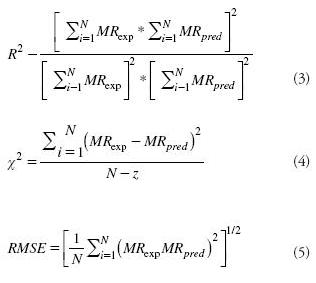
<body><![CDATA[<p align="center"><font face="verdana" size="2"><img src="/img/revistas/agro/v49n8/a3f7.jpg"></font></p>  	    <p align="justify"><font face="verdana" size="2"><b>Thin layer model</b></font></p>  	    <p align="justify"><font face="verdana" size="2">The most suitable theoretical model selected among the 10 thin layer models (<a href="/img/revistas/agro/v49n8/a3t1.jpg" target="_blank">Table 1</a>) was found fitting the drying curves of experimental data (<a href="#f3">Figure 3</a>). In order to determine the best model that describes the experimental data of sliced <i>nopal</i> cladode, statistical parameters (Panchariya <i>et al.,</i> 2002; Ghazanfari <i>et al.,</i> 2006) such as correlation coefficient (equation 3), reduced chi&#45;square (equation 4) and root mean square error (equation 5) were calculated by:</font></p>  	    <p align="center"><font face="verdana" size="2"><img src="/img/revistas/agro/v49n8/a3e3.jpg"></font></p>  	    <p align="justify"><font face="verdana" size="2">where <i>R</i><sup>2</sup> is the correlation coefficient, <i>MR<sub>exp</sub></i> is the experimental humidity relationship, <i>MR<sub>pred</sub></i> is the moisture content calculated, &#948;<sup>2</sup> is the Chi&#45;square, <i>N</i> is the data number, z is the number of constants of the model, and <i>RMSE</i> is the root mean square error. The calculated empirical constants for different conditions of air velocities and temperatures of the 10 equation models are shown in <a href="/img/revistas/agro/v49n8/a3t2.jpg" target="_blank">Table 2</a>. The coefficient of determination (<i>R<sup>2</sup></i>)<i>,</i> coefficient chi&#45;square (<i>x<sup>2</sup></i>) and root mean square error <i>(RMSE)</i> were calculated. <i>R<sup>2</sup></i> was in the range of 0.983&#45;0.999, <i>x<sup>2</sup></i> was in the range of 4.694x10<sup>&#45;5</sup>&#45;6.691x10<sup>&#45;3</sup> and RMSE was between 6.378x10<sup>&#45;3</sup>&#45;4.417x10<sup>&#45;2</sup> (<a href="#t3">Table 3</a>).</font></p>  	    <p align="center"><font face="verdana" size="2"><a name="t3"></a></font></p>  	    <p align="center"><font face="verdana" size="2"><img src="/img/revistas/agro/v49n8/a3t3.jpg"></font></p>  	    <p align="justify"><font face="verdana" size="2">From the Arrhenius equation (equation 2), the four empirical constants for the fitted model equation for <i>nopal</i> cladode slices were:</font></p>  	    <p align="center"><font face="verdana" size="2"><img src="/img/revistas/agro/v49n8/a3e6.jpg"></font></p>  	    <p align="justify"><font face="verdana" size="2">where <i>HR</i> is the air relative humidity, <i>v</i> is the air velocity and <i>T<sub>abs</sub></i> is the air drying temperature.</font></p>  	    ]]></body>
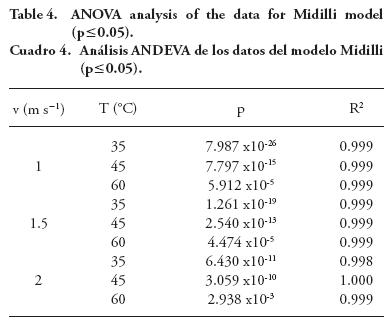
<body><![CDATA[<p align="justify"><font face="verdana" size="2">A good agreement between experimental data and drying model curves for air at 35 &deg;C, 45 &deg;C y 60 &deg;C and air speeds of (a) 2 m s<sup>&#45;1</sup>, (b) 1.5 m s<sup>&#45;1</sup> and (c) 1 m s<sup>&#45;1</sup> were obtained (<a href="/img/revistas/agro/v49n8/a3f8.jpg" target="_blank">Figure 8</a>).</font></p>  	    <p align="justify"><font face="verdana" size="2">The p&#45;values obtained with the ANOVA analysis were lower than 0.05 for all drying temperatures and velocities used (<a href="#t4">Table 4</a>).</font></p>  	    <p align="center"><font face="verdana" size="2"><a name="t4"></a></font></p>  	    <p align="center"><font face="verdana" size="2"><img src="/img/revistas/agro/v49n8/a3t4.jpg"></font></p>  	    <p>&nbsp;</p>  	    <p align="justify"><font face="verdana" size="2"><b>CONCLUSIONS</b></font></p>  	    <p align="justify"><font face="verdana" size="2">The drying time for 4 mm thick <i>nopal</i> slices is remarkably lower than the drying time of the complete cladode (99 %) reported by Lopez <i>et al.</i> (2009). The drying time of cylinder of cladodes reported by Touil <i>et al.</i> (2010) is also high (50 %) than those in rectangular slices of 4mm thick. The difference is the cylindrical geometry, 25 mm diameter in that study and 4 mm thick slices, of cross sectional area of 23.8 cm<sup>2</sup>, in the present study. Also the drying curve showed that the constant rate period of drying is absent, so only the falling drying rate period is present. The combined effects of different temperatures and velocities on the drying time showed that air temperature was more important than the drying air velocity. The variability of experiments showed an average of standard deviation of 0.025. The fitted equation showed that the Midilly model was the best model for the thin layer of 4 mm thick <i>nopal</i> slices with empirical constants presented here.</font></p>  	    <p>&nbsp;</p>  	    <p align="justify"><font face="verdana" size="2"><b>ACKNOWLEDGMENTS</b></font></p>  	    <p align="justify"><font face="verdana" size="2">The authors are grateful to Consejo Nacional de Ciencia y Tecnolog&iacute;a for the support given to this project and to Dr. R. D&iacute;az&#45;Acosta (National Institute of Public Health, Biostatistical Department, Mexico) for sharing his experience for the regression analysis of the experimental data.</font></p>  	    ]]></body>
<body><![CDATA[<p>&nbsp;</p>  	    <p align="justify"><font face="verdana" size="2"><b>LITERATURE CITED</b></font></p>  	    <!-- ref --><p align="justify"><font face="verdana" size="2">AOAC, Association of Official Analytical Chemists. 2000. Official Methods of Analysis. No. 934.06 (17th ed.). International, Maryland.    &nbsp;&nbsp;&nbsp;&nbsp;&nbsp;&nbsp;&nbsp;&nbsp;[&#160;<a href="javascript:void(0);" onclick="javascript: window.open('/scielo.php?script=sci_nlinks&ref=604712&pid=S1405-3195201500080000300001&lng=','','width=640,height=500,resizable=yes,scrollbars=1,menubar=yes,');">Links</a>&#160;]<!-- end-ref --></font></p>  	    <!-- ref --><p align="justify"><font face="verdana" size="2">Diamante, L. M., and P. A. Munro. 1991. Mathematical modeling of hot air drying of sweet potato slices. Int. J. Food Sci. Technol. 26: 99&#45;109.    &nbsp;&nbsp;&nbsp;&nbsp;&nbsp;&nbsp;&nbsp;&nbsp;[&#160;<a href="javascript:void(0);" onclick="javascript: window.open('/scielo.php?script=sci_nlinks&ref=604714&pid=S1405-3195201500080000300002&lng=','','width=640,height=500,resizable=yes,scrollbars=1,menubar=yes,');">Links</a>&#160;]<!-- end-ref --></font></p>  	    <!-- ref --><p align="justify"><font face="verdana" size="2">Doymaz, I. 2006. Thin&#45;layer drying behavior of mint leaves. J. Food Eng. 74: 370&#45;375.    &nbsp;&nbsp;&nbsp;&nbsp;&nbsp;&nbsp;&nbsp;&nbsp;[&#160;<a href="javascript:void(0);" onclick="javascript: window.open('/scielo.php?script=sci_nlinks&ref=604716&pid=S1405-3195201500080000300003&lng=','','width=640,height=500,resizable=yes,scrollbars=1,menubar=yes,');">Links</a>&#160;]<!-- end-ref --></font></p>  	    <!-- ref --><p align="justify"><font face="verdana" size="2">Erechukwu, O. V. 1999. Review of solar&#45;energy drying systems I: an overview of drying principles and theory. Energ. Convers. Manage. 40: 593&#45;613.    &nbsp;&nbsp;&nbsp;&nbsp;&nbsp;&nbsp;&nbsp;&nbsp;[&#160;<a href="javascript:void(0);" onclick="javascript: window.open('/scielo.php?script=sci_nlinks&ref=604718&pid=S1405-3195201500080000300004&lng=','','width=640,height=500,resizable=yes,scrollbars=1,menubar=yes,');">Links</a>&#160;]<!-- end-ref --></font></p>  	    ]]></body>
<body><![CDATA[<!-- ref --><p align="justify"><font face="verdana" size="2">FND. 2011. Financiera Nacional de Desarrollo Agropecuario, Rural, Forestal y Pesquero. Monograf&iacute;a del Nopal y la Tuna. <a href="http://www.financierarural.gob.mx/informacionsectorrural/Documents/Monografias/MonografiaNopal&#45;Tuna%28jul11%29.pdf" target="_blank">http://www.financierarural.gob.mx/informacionsectorrural/Documents/Monografias/MonografiaNopal&#45;Tuna%28jul11%29.pdf</a> (Accessed: May 2015).    &nbsp;&nbsp;&nbsp;&nbsp;&nbsp;&nbsp;&nbsp;&nbsp;[&#160;<a href="javascript:void(0);" onclick="javascript: window.open('/scielo.php?script=sci_nlinks&ref=604720&pid=S1405-3195201500080000300005&lng=','','width=640,height=500,resizable=yes,scrollbars=1,menubar=yes,');">Links</a>&#160;]<!-- end-ref --></font></p>  	    <!-- ref --><p align="justify"><font face="verdana" size="2">Ghazanfari, A. S., L. G. Emami, S. Tabil, and Panigrahi. 2006. Thin&#45;layer drying of flax fiber: II. modeling drying process using semi&#45;theoretical and empirical models. Dry. Technol. 24: 1637&#45;1642.    &nbsp;&nbsp;&nbsp;&nbsp;&nbsp;&nbsp;&nbsp;&nbsp;[&#160;<a href="javascript:void(0);" onclick="javascript: window.open('/scielo.php?script=sci_nlinks&ref=604722&pid=S1405-3195201500080000300006&lng=','','width=640,height=500,resizable=yes,scrollbars=1,menubar=yes,');">Links</a>&#160;]<!-- end-ref --></font></p>  	    <!-- ref --><p align="justify"><font face="verdana" size="2">Guzm&aacute;n, U., S. Arias, and P. D&aacute;vila. 2007. Cat&aacute;logo de Cact&aacute;ceas Mexicanas. Editorial: UNAM. Ciudad Universitaria M&eacute;xico D. F. 320 p.    &nbsp;&nbsp;&nbsp;&nbsp;&nbsp;&nbsp;&nbsp;&nbsp;[&#160;<a href="javascript:void(0);" onclick="javascript: window.open('/scielo.php?script=sci_nlinks&ref=604724&pid=S1405-3195201500080000300007&lng=','','width=640,height=500,resizable=yes,scrollbars=1,menubar=yes,');">Links</a>&#160;]<!-- end-ref --></font></p>  	    <!-- ref --><p align="justify"><font face="verdana" size="2">Hossain, M. A., and B. K. Bala. 2002. Thin&#45;layer drying characteristics for green chilli. Dry. Technol. 20: 489&#45;505.    &nbsp;&nbsp;&nbsp;&nbsp;&nbsp;&nbsp;&nbsp;&nbsp;[&#160;<a href="javascript:void(0);" onclick="javascript: window.open('/scielo.php?script=sci_nlinks&ref=604726&pid=S1405-3195201500080000300008&lng=','','width=640,height=500,resizable=yes,scrollbars=1,menubar=yes,');">Links</a>&#160;]<!-- end-ref --></font></p>  	    <!-- ref --><p align="justify"><font face="verdana" size="2">Karathanos, V. T., and V. G. Belessiotis. 1999. Application of a thin layer equation to drying data fresh and semi&#45;dried fruits. J. Agr. Eng. Res. 74: 355&#45;361.    &nbsp;&nbsp;&nbsp;&nbsp;&nbsp;&nbsp;&nbsp;&nbsp;[&#160;<a href="javascript:void(0);" onclick="javascript: window.open('/scielo.php?script=sci_nlinks&ref=604728&pid=S1405-3195201500080000300009&lng=','','width=640,height=500,resizable=yes,scrollbars=1,menubar=yes,');">Links</a>&#160;]<!-- end-ref --></font></p>  	    ]]></body>
<body><![CDATA[<!-- ref --><p align="justify"><font face="verdana" size="2">Kashaninejad, M., and L. G. Tabil. 2004. Drying characteristics of purslane (portulaca oleraceae L.). Dry. Technol. 22: 2183&#45;2200.    &nbsp;&nbsp;&nbsp;&nbsp;&nbsp;&nbsp;&nbsp;&nbsp;[&#160;<a href="javascript:void(0);" onclick="javascript: window.open('/scielo.php?script=sci_nlinks&ref=604730&pid=S1405-3195201500080000300010&lng=','','width=640,height=500,resizable=yes,scrollbars=1,menubar=yes,');">Links</a>&#160;]<!-- end-ref --></font></p>  	    <!-- ref --><p align="justify"><font face="verdana" size="2">L&oacute;pez, R., A. de Ita and M. Vaca. 2009. Drying of prickly pear cactus cladodes <i>(Opuntia ficus&#45;indica)</i> in a forced tunnel. Ener. Convers. Manage. 50: 2119&#45;2126.    &nbsp;&nbsp;&nbsp;&nbsp;&nbsp;&nbsp;&nbsp;&nbsp;[&#160;<a href="javascript:void(0);" onclick="javascript: window.open('/scielo.php?script=sci_nlinks&ref=604732&pid=S1405-3195201500080000300011&lng=','','width=640,height=500,resizable=yes,scrollbars=1,menubar=yes,');">Links</a>&#160;]<!-- end-ref --></font></p>  	    <!-- ref --><p align="justify"><font face="verdana" size="2">Maki&#45;D&iacute;az, G., C. B. Pe&ntilde;a&#45;Valdivia, R. Garc&iacute;a&#45;Nava, M. L. Ar&eacute;&#45; valo&#45;Galarza, G. Calder&oacute;n&#45;Zavala, y S. Anaya&#45;Rosales. 2015. Caracter&iacute;sticas f&iacute;sicas y qu&iacute;micas de nopal verdura <i>(Opuntia ficus&#45;indica)</i> para exportaci&oacute;n y consumo nacional. Agrociencia 49: 31&#45;51.    &nbsp;&nbsp;&nbsp;&nbsp;&nbsp;&nbsp;&nbsp;&nbsp;[&#160;<a href="javascript:void(0);" onclick="javascript: window.open('/scielo.php?script=sci_nlinks&ref=604734&pid=S1405-3195201500080000300012&lng=','','width=640,height=500,resizable=yes,scrollbars=1,menubar=yes,');">Links</a>&#160;]<!-- end-ref --></font></p>  	    <!-- ref --><p align="justify"><font face="verdana" size="2">Medina&#45;Torrez, L., J. A. Gallegos&#45;Infante, R. F. Gonzalez&#45;Laredo, and N. E. Rocha&#45;Guzman. 2008. Drying kinetics of <i>nopal (opuntia ficus&#45;indica)</i> using three different methods and their effect on their mechanical properties. Food Sci. Technol&#45;Leb. 41: 1183&#45;1188.    &nbsp;&nbsp;&nbsp;&nbsp;&nbsp;&nbsp;&nbsp;&nbsp;[&#160;<a href="javascript:void(0);" onclick="javascript: window.open('/scielo.php?script=sci_nlinks&ref=604736&pid=S1405-3195201500080000300013&lng=','','width=640,height=500,resizable=yes,scrollbars=1,menubar=yes,');">Links</a>&#160;]<!-- end-ref --></font></p>  	    <!-- ref --><p align="justify"><font face="verdana" size="2">Midilli, A. H., Z. Kucuk, and Yapar. 2002. A new model for single&#45;layer drying. Dry. Technol. 20: 1503&#45;1513.    &nbsp;&nbsp;&nbsp;&nbsp;&nbsp;&nbsp;&nbsp;&nbsp;[&#160;<a href="javascript:void(0);" onclick="javascript: window.open('/scielo.php?script=sci_nlinks&ref=604738&pid=S1405-3195201500080000300014&lng=','','width=640,height=500,resizable=yes,scrollbars=1,menubar=yes,');">Links</a>&#160;]<!-- end-ref --></font></p>  	    ]]></body>
<body><![CDATA[<!-- ref --><p align="justify"><font face="verdana" size="2">Panchariya, P. C., D. Popovic, and A. L. Sharma. 2002. Thin&#45;layer modeling of black tea drying process. J. Food Eng. 52: 349&#45;357.    &nbsp;&nbsp;&nbsp;&nbsp;&nbsp;&nbsp;&nbsp;&nbsp;[&#160;<a href="javascript:void(0);" onclick="javascript: window.open('/scielo.php?script=sci_nlinks&ref=604740&pid=S1405-3195201500080000300015&lng=','','width=640,height=500,resizable=yes,scrollbars=1,menubar=yes,');">Links</a>&#160;]<!-- end-ref --></font></p>  	    <!-- ref --><p align="justify"><font face="verdana" size="2">Rahman, M. S., C. O. Perera, and C. Thebaud. 1997. Desorption isotherm and heat pump drying kinetics of peas. Food Res. Int. 30: 485&#45;491.    &nbsp;&nbsp;&nbsp;&nbsp;&nbsp;&nbsp;&nbsp;&nbsp;[&#160;<a href="javascript:void(0);" onclick="javascript: window.open('/scielo.php?script=sci_nlinks&ref=604742&pid=S1405-3195201500080000300016&lng=','','width=640,height=500,resizable=yes,scrollbars=1,menubar=yes,');">Links</a>&#160;]<!-- end-ref --></font></p>  	    <!-- ref --><p align="justify"><font face="verdana" size="2">Touil, A., S. Chemkhi, and F. Zagrouba. 2010. Modelling of the drying kinetics of <i>Opuntia ficus&#45;indica</i> fruits and cladodes. Int. J. Food Eng. 6: 11&#45;21.    &nbsp;&nbsp;&nbsp;&nbsp;&nbsp;&nbsp;&nbsp;&nbsp;[&#160;<a href="javascript:void(0);" onclick="javascript: window.open('/scielo.php?script=sci_nlinks&ref=604744&pid=S1405-3195201500080000300017&lng=','','width=640,height=500,resizable=yes,scrollbars=1,menubar=yes,');">Links</a>&#160;]<!-- end-ref --></font></p>  	    <!-- ref --><p align="justify"><font face="verdana" size="2">Vasconcelos, J. L. A., A. S. C. Andrade, M. I. S. Maciel, N. B. Guerra, and M. A. S. Vasconcelos. 2012. Osmotic dehydration of the indian fig <i>(Opuntia ficus&#45;indica)</i> with binary and ternary solutions. Int. J. Food Sci. Tech. 47: 2359&#45;2365.    &nbsp;&nbsp;&nbsp;&nbsp;&nbsp;&nbsp;&nbsp;&nbsp;[&#160;<a href="javascript:void(0);" onclick="javascript: window.open('/scielo.php?script=sci_nlinks&ref=604746&pid=S1405-3195201500080000300018&lng=','','width=640,height=500,resizable=yes,scrollbars=1,menubar=yes,');">Links</a>&#160;]<!-- end-ref --></font></p>  	    <!-- ref --><p align="justify"><font face="verdana" size="2">Waewsak, J., S. Chindaruksa, and C. Punlek. 2006. A mathematical modeling study of hot air drying for some agricultural products. Thammasat Int. J. Sci. Tech. 11: 1420.    &nbsp;&nbsp;&nbsp;&nbsp;&nbsp;&nbsp;&nbsp;&nbsp;[&#160;<a href="javascript:void(0);" onclick="javascript: window.open('/scielo.php?script=sci_nlinks&ref=604748&pid=S1405-3195201500080000300019&lng=','','width=640,height=500,resizable=yes,scrollbars=1,menubar=yes,');">Links</a>&#160;]<!-- end-ref --></font></p>  	    ]]></body>
<body><![CDATA[<!-- ref --><p align="justify"><font face="verdana" size="2">Westerman, P., G. White, and I. Ross. 1973 Trans. ASAE 16: 1136&#45;1139.    &nbsp;&nbsp;&nbsp;&nbsp;&nbsp;&nbsp;&nbsp;&nbsp;[&#160;<a href="javascript:void(0);" onclick="javascript: window.open('/scielo.php?script=sci_nlinks&ref=604750&pid=S1405-3195201500080000300020&lng=','','width=640,height=500,resizable=yes,scrollbars=1,menubar=yes,');">Links</a>&#160;]<!-- end-ref --></font></p>  	    <!-- ref --><p align="justify"><font face="verdana" size="2">White, G. M., I. J. Ross, and R. Ponelert. 1981. Fully exposed drying of popcorn. Trans. ASAE 24: 466&#45;468.    &nbsp;&nbsp;&nbsp;&nbsp;&nbsp;&nbsp;&nbsp;&nbsp;[&#160;<a href="javascript:void(0);" onclick="javascript: window.open('/scielo.php?script=sci_nlinks&ref=604752&pid=S1405-3195201500080000300021&lng=','','width=640,height=500,resizable=yes,scrollbars=1,menubar=yes,');">Links</a>&#160;]<!-- end-ref --></font></p>  	    <!-- ref --><p align="justify"><font face="verdana" size="2">Yagcioglu, A., A. Degirmencioglu, and F. Cagatay. 1999. Drying characteristic of laurel leaves under different conditions. <i>In:</i> Bascetincelik, A. (ed). Proc. 7th Int. Congress on Agricultural Mechanization and Energy: 565&#45;569.    &nbsp;&nbsp;&nbsp;&nbsp;&nbsp;&nbsp;&nbsp;&nbsp;[&#160;<a href="javascript:void(0);" onclick="javascript: window.open('/scielo.php?script=sci_nlinks&ref=604754&pid=S1405-3195201500080000300022&lng=','','width=640,height=500,resizable=yes,scrollbars=1,menubar=yes,');">Links</a>&#160;]<!-- end-ref --></font></p>  	    <!-- ref --><p align="justify"><font face="verdana" size="2">Yaldiz, O., and C. Ertekin. Thin layer solar drying of some vegetables. 2001. Dry. Technol. 19: 583&#45;597.    &nbsp;&nbsp;&nbsp;&nbsp;&nbsp;&nbsp;&nbsp;&nbsp;[&#160;<a href="javascript:void(0);" onclick="javascript: window.open('/scielo.php?script=sci_nlinks&ref=604756&pid=S1405-3195201500080000300023&lng=','','width=640,height=500,resizable=yes,scrollbars=1,menubar=yes,');">Links</a>&#160;]<!-- end-ref --></font></p>  	    <!-- ref --><p align="justify"><font face="verdana" size="2">Yaldiz, O., C. Ertekin, and H. I. Uzun. 2001. Mathematical modeling of thin layer solar drying of Sultana grapes. Energy 26: 457&#45;465.    &nbsp;&nbsp;&nbsp;&nbsp;&nbsp;&nbsp;&nbsp;&nbsp;[&#160;<a href="javascript:void(0);" onclick="javascript: window.open('/scielo.php?script=sci_nlinks&ref=604758&pid=S1405-3195201500080000300024&lng=','','width=640,height=500,resizable=yes,scrollbars=1,menubar=yes,');">Links</a>&#160;]<!-- end-ref --></font></p>     ]]></body>
<body><![CDATA[ ]]></body><back>
<ref-list>
<ref id="B1">
<nlm-citation citation-type="book">
<collab>Association of Official Analytical Chemists</collab>
<source><![CDATA[Official Methods of Analysis]]></source>
<year>2000</year>
<edition>17</edition>
<publisher-loc><![CDATA[Maryland ]]></publisher-loc>
<publisher-name><![CDATA[International]]></publisher-name>
</nlm-citation>
</ref>
<ref id="B2">
<nlm-citation citation-type="journal">
<person-group person-group-type="author">
<name>
<surname><![CDATA[Diamante]]></surname>
<given-names><![CDATA[L. M.]]></given-names>
</name>
<name>
<surname><![CDATA[Munro]]></surname>
<given-names><![CDATA[P. A.]]></given-names>
</name>
</person-group>
<article-title xml:lang="en"><![CDATA[Mathematical modeling of hot air drying of sweet potato slices]]></article-title>
<source><![CDATA[Int. J. Food Sci. Technol.]]></source>
<year>1991</year>
<volume>26</volume>
<page-range>99-109</page-range></nlm-citation>
</ref>
<ref id="B3">
<nlm-citation citation-type="journal">
<person-group person-group-type="author">
<name>
<surname><![CDATA[Doymaz]]></surname>
<given-names><![CDATA[I]]></given-names>
</name>
</person-group>
<article-title xml:lang="en"><![CDATA[Thin-layer drying behavior of mint leaves]]></article-title>
<source><![CDATA[J. Food Eng.]]></source>
<year>2006</year>
<volume>74</volume>
<page-range>370-375</page-range></nlm-citation>
</ref>
<ref id="B4">
<nlm-citation citation-type="journal">
<person-group person-group-type="author">
<name>
<surname><![CDATA[Erechukwu]]></surname>
<given-names><![CDATA[O. V]]></given-names>
</name>
</person-group>
<article-title xml:lang="en"><![CDATA[Review of solar-energy drying systems I: an overview of drying principles and theory]]></article-title>
<source><![CDATA[Energ. Convers. Manage.]]></source>
<year>1999</year>
<volume>40</volume>
<page-range>593-613</page-range></nlm-citation>
</ref>
<ref id="B5">
<nlm-citation citation-type="book">
<collab>FND</collab>
<source><![CDATA[Monografía del Nopal y la Tuna]]></source>
<year>2011</year>
<publisher-name><![CDATA[Financiera Nacional de Desarrollo Agropecuario, Rural, Forestal y Pesquero]]></publisher-name>
</nlm-citation>
</ref>
<ref id="B6">
<nlm-citation citation-type="journal">
<person-group person-group-type="author">
<name>
<surname><![CDATA[Ghazanfari]]></surname>
<given-names><![CDATA[A. S.]]></given-names>
</name>
<name>
<surname><![CDATA[Emami]]></surname>
<given-names><![CDATA[L. G.]]></given-names>
</name>
<name>
<surname><![CDATA[Tabil]]></surname>
<given-names><![CDATA[S.]]></given-names>
</name>
<name>
<surname><![CDATA[Panigrah]]></surname>
</name>
</person-group>
<article-title xml:lang="en"><![CDATA[Thin-layer drying of flax fiber: II. modeling drying process using semi-theoretical and empirical models]]></article-title>
<source><![CDATA[Dry. Technol.]]></source>
<year>2006</year>
<volume>24</volume>
<page-range>1637-1642</page-range></nlm-citation>
</ref>
<ref id="B7">
<nlm-citation citation-type="book">
<person-group person-group-type="author">
<name>
<surname><![CDATA[Guzmán]]></surname>
<given-names><![CDATA[U.]]></given-names>
</name>
<name>
<surname><![CDATA[Arias]]></surname>
<given-names><![CDATA[S.]]></given-names>
</name>
<name>
<surname><![CDATA[Dávila]]></surname>
<given-names><![CDATA[P.]]></given-names>
</name>
</person-group>
<source><![CDATA[Catálogo de Cactáceas Mexicanas]]></source>
<year>2007</year>
<page-range>320</page-range><publisher-loc><![CDATA[México^eD. F. D. F.]]></publisher-loc>
<publisher-name><![CDATA[UNAM]]></publisher-name>
</nlm-citation>
</ref>
<ref id="B8">
<nlm-citation citation-type="journal">
<person-group person-group-type="author">
<name>
<surname><![CDATA[Hossain]]></surname>
<given-names><![CDATA[M. A.]]></given-names>
</name>
<name>
<surname><![CDATA[Bala]]></surname>
<given-names><![CDATA[B. K.]]></given-names>
</name>
</person-group>
<article-title xml:lang="en"><![CDATA[Thin-layer drying characteristics for green chilli]]></article-title>
<source><![CDATA[Dry. Technol.]]></source>
<year>2002</year>
<volume>20</volume>
<page-range>489-505</page-range></nlm-citation>
</ref>
<ref id="B9">
<nlm-citation citation-type="journal">
<person-group person-group-type="author">
<name>
<surname><![CDATA[Karathanos]]></surname>
<given-names><![CDATA[V. T.]]></given-names>
</name>
<name>
<surname><![CDATA[Belessiotis]]></surname>
<given-names><![CDATA[V. G.]]></given-names>
</name>
</person-group>
<article-title xml:lang="en"><![CDATA[Application of a thin layer equation to drying data fresh and semi-dried fruits]]></article-title>
<source><![CDATA[J. Agr. Eng. Res.]]></source>
<year>1999</year>
<volume>74</volume>
<page-range>355-361</page-range></nlm-citation>
</ref>
<ref id="B10">
<nlm-citation citation-type="journal">
<person-group person-group-type="author">
<name>
<surname><![CDATA[Kashaninejad]]></surname>
<given-names><![CDATA[M.]]></given-names>
</name>
<name>
<surname><![CDATA[Tabil]]></surname>
<given-names><![CDATA[L. G.]]></given-names>
</name>
</person-group>
<article-title xml:lang="en"><![CDATA[Drying characteristics of purslane (portulaca oleraceae L.)]]></article-title>
<source><![CDATA[Dry. Technol.]]></source>
<year>2004</year>
<volume>22</volume>
<page-range>2183-2200</page-range></nlm-citation>
</ref>
<ref id="B11">
<nlm-citation citation-type="journal">
<person-group person-group-type="author">
<name>
<surname><![CDATA[López]]></surname>
</name>
<name>
<surname><![CDATA[de Ita]]></surname>
<given-names><![CDATA[A.]]></given-names>
</name>
<name>
<surname><![CDATA[Vaca]]></surname>
<given-names><![CDATA[M.]]></given-names>
</name>
</person-group>
<article-title xml:lang="en"><![CDATA[Drying of prickly pear cactus cladodes (Opuntia ficus-indica) in a forced tunnel]]></article-title>
<source><![CDATA[Ener. Convers. Manage.]]></source>
<year>2009</year>
<volume>50</volume>
<page-range>2119-2126</page-range></nlm-citation>
</ref>
<ref id="B12">
<nlm-citation citation-type="journal">
<person-group person-group-type="author">
<name>
<surname><![CDATA[Maki-Díaz]]></surname>
<given-names><![CDATA[G.]]></given-names>
</name>
<name>
<surname><![CDATA[Peña-Valdivia]]></surname>
<given-names><![CDATA[C. B.]]></given-names>
</name>
<name>
<surname><![CDATA[García-Nava]]></surname>
<given-names><![CDATA[R.]]></given-names>
</name>
<name>
<surname><![CDATA[Aré- valo-Galarza]]></surname>
<given-names><![CDATA[M. L.]]></given-names>
</name>
<name>
<surname><![CDATA[Calderón-Zavala]]></surname>
<given-names><![CDATA[G.]]></given-names>
</name>
<name>
<surname><![CDATA[Anaya-Rosales]]></surname>
<given-names><![CDATA[S.]]></given-names>
</name>
</person-group>
<article-title xml:lang="es"><![CDATA[Características físicas y químicas de nopal verdura (Opuntia ficus-indica) para exportación y consumo nacional]]></article-title>
<source><![CDATA[Agrociencia]]></source>
<year>2015</year>
<volume>49</volume>
<page-range>31-51</page-range></nlm-citation>
</ref>
<ref id="B13">
<nlm-citation citation-type="journal">
<person-group person-group-type="author">
<name>
<surname><![CDATA[Medina-Torrez]]></surname>
<given-names><![CDATA[L.]]></given-names>
</name>
<name>
<surname><![CDATA[Gallegos-Infante]]></surname>
<given-names><![CDATA[J. A.]]></given-names>
</name>
<name>
<surname><![CDATA[Gonzalez-Laredo]]></surname>
<given-names><![CDATA[R. F.]]></given-names>
</name>
<name>
<surname><![CDATA[Rocha-Guzman]]></surname>
<given-names><![CDATA[N. E.]]></given-names>
</name>
</person-group>
<article-title xml:lang="en"><![CDATA[Drying kinetics of nopal (opuntia ficus-indica) using three different methods and their effect on their mechanical properties]]></article-title>
<source><![CDATA[Food Sci. Technol-Leb.]]></source>
<year>2008</year>
<volume>41</volume>
<page-range>1183-1188</page-range></nlm-citation>
</ref>
<ref id="B14">
<nlm-citation citation-type="journal">
<person-group person-group-type="author">
<name>
<surname><![CDATA[Midilli]]></surname>
<given-names><![CDATA[A. H.]]></given-names>
</name>
<name>
<surname><![CDATA[Kucuk]]></surname>
<given-names><![CDATA[Z.]]></given-names>
</name>
<name>
<surname><![CDATA[Yapar]]></surname>
</name>
</person-group>
<article-title xml:lang="en"><![CDATA[A new model for single-layer drying]]></article-title>
<source><![CDATA[Dry. Technol.]]></source>
<year>2002</year>
<volume>20</volume>
<page-range>1503-1513</page-range></nlm-citation>
</ref>
<ref id="B15">
<nlm-citation citation-type="journal">
<person-group person-group-type="author">
<name>
<surname><![CDATA[Panchariya]]></surname>
<given-names><![CDATA[P. C.]]></given-names>
</name>
<name>
<surname><![CDATA[Popovic]]></surname>
<given-names><![CDATA[D.]]></given-names>
</name>
<name>
<surname><![CDATA[Sharma]]></surname>
<given-names><![CDATA[A. L.]]></given-names>
</name>
</person-group>
<article-title xml:lang="en"><![CDATA[Thin-layer modeling of black tea drying process]]></article-title>
<source><![CDATA[J. Food Eng.]]></source>
<year>2002</year>
<volume>52</volume>
<page-range>349-357</page-range></nlm-citation>
</ref>
<ref id="B16">
<nlm-citation citation-type="journal">
<person-group person-group-type="author">
<name>
<surname><![CDATA[Rahman]]></surname>
<given-names><![CDATA[M. S.]]></given-names>
</name>
<name>
<surname><![CDATA[Perera]]></surname>
<given-names><![CDATA[C. O.]]></given-names>
</name>
<name>
<surname><![CDATA[Thebaud]]></surname>
<given-names><![CDATA[C.]]></given-names>
</name>
</person-group>
<article-title xml:lang="en"><![CDATA[Desorption isotherm and heat pump drying kinetics of peas]]></article-title>
<source><![CDATA[Food Res. Int.]]></source>
<year>1997</year>
<volume>30</volume>
<page-range>485-491</page-range></nlm-citation>
</ref>
<ref id="B17">
<nlm-citation citation-type="journal">
<person-group person-group-type="author">
<name>
<surname><![CDATA[Touil]]></surname>
<given-names><![CDATA[A.]]></given-names>
</name>
<name>
<surname><![CDATA[Chemkhi]]></surname>
<given-names><![CDATA[S.]]></given-names>
</name>
<name>
<surname><![CDATA[Zagrouba]]></surname>
<given-names><![CDATA[F.]]></given-names>
</name>
</person-group>
<article-title xml:lang="en"><![CDATA[Modelling of the drying kinetics of Opuntia ficus-indica fruits and cladodes]]></article-title>
<source><![CDATA[Int. J. Food Eng.]]></source>
<year>2010</year>
<volume>6</volume>
<page-range>11-21</page-range></nlm-citation>
</ref>
<ref id="B18">
<nlm-citation citation-type="journal">
<person-group person-group-type="author">
<name>
<surname><![CDATA[Vasconcelos]]></surname>
<given-names><![CDATA[J. L. A.]]></given-names>
</name>
<name>
<surname><![CDATA[Andrade]]></surname>
<given-names><![CDATA[A. S. C.]]></given-names>
</name>
<name>
<surname><![CDATA[Maciel]]></surname>
<given-names><![CDATA[M. I. S.]]></given-names>
</name>
<name>
<surname><![CDATA[Guerra]]></surname>
<given-names><![CDATA[N. B.]]></given-names>
</name>
<name>
<surname><![CDATA[Vasconcelos]]></surname>
<given-names><![CDATA[M. A. S.]]></given-names>
</name>
</person-group>
<article-title xml:lang="en"><![CDATA[Osmotic dehydration of the indian fig (Opuntia ficus-indica) with binary and ternary solutions]]></article-title>
<source><![CDATA[Int. J. Food Sci. Tech.]]></source>
<year>2012</year>
<volume>47</volume>
<page-range>2359-2365</page-range></nlm-citation>
</ref>
<ref id="B19">
<nlm-citation citation-type="journal">
<person-group person-group-type="author">
<name>
<surname><![CDATA[Waewsak]]></surname>
<given-names><![CDATA[J.]]></given-names>
</name>
<name>
<surname><![CDATA[Chindaruksa]]></surname>
<given-names><![CDATA[S.]]></given-names>
</name>
<name>
<surname><![CDATA[Punlek]]></surname>
<given-names><![CDATA[C.]]></given-names>
</name>
</person-group>
<article-title xml:lang="en"><![CDATA[A mathematical modeling study of hot air drying for some agricultural products]]></article-title>
<source><![CDATA[Thammasat Int. J. Sci. Tech.]]></source>
<year>2006</year>
<volume>11</volume>
<page-range>1420</page-range></nlm-citation>
</ref>
<ref id="B20">
<nlm-citation citation-type="journal">
<person-group person-group-type="author">
<name>
<surname><![CDATA[Westerman]]></surname>
<given-names><![CDATA[P.]]></given-names>
</name>
<name>
<surname><![CDATA[White]]></surname>
<given-names><![CDATA[G.]]></given-names>
</name>
<name>
<surname><![CDATA[Ross]]></surname>
<given-names><![CDATA[I.]]></given-names>
</name>
</person-group>
<source><![CDATA[Trans. ASAE]]></source>
<year>1973</year>
<volume>16</volume>
<page-range>1136-1139</page-range></nlm-citation>
</ref>
<ref id="B21">
<nlm-citation citation-type="journal">
<person-group person-group-type="author">
<name>
<surname><![CDATA[White]]></surname>
<given-names><![CDATA[G. M.]]></given-names>
</name>
<name>
<surname><![CDATA[Ross]]></surname>
<given-names><![CDATA[I. J.]]></given-names>
</name>
<name>
<surname><![CDATA[Ponelert]]></surname>
<given-names><![CDATA[R.]]></given-names>
</name>
</person-group>
<article-title xml:lang="en"><![CDATA[Fully exposed drying of popcorn]]></article-title>
<source><![CDATA[Trans. ASAE]]></source>
<year>1981</year>
<volume>24</volume>
<page-range>466-468</page-range></nlm-citation>
</ref>
<ref id="B22">
<nlm-citation citation-type="book">
<person-group person-group-type="author">
<name>
<surname><![CDATA[Yagcioglu]]></surname>
<given-names><![CDATA[A.]]></given-names>
</name>
<name>
<surname><![CDATA[Degirmencioglu]]></surname>
<given-names><![CDATA[A.]]></given-names>
</name>
<name>
<surname><![CDATA[Cagatay]]></surname>
<given-names><![CDATA[F.]]></given-names>
</name>
</person-group>
<article-title xml:lang="en"><![CDATA[Drying characteristic of laurel leaves under different conditions]]></article-title>
<person-group person-group-type="editor">
<name>
<surname><![CDATA[Bascetincelik]]></surname>
<given-names><![CDATA[A.]]></given-names>
</name>
</person-group>
<source><![CDATA[Proc]]></source>
<year>1999</year>
<page-range>565-569</page-range><publisher-name><![CDATA[7th Int. Congress on Agricultural Mechanization and Energy]]></publisher-name>
</nlm-citation>
</ref>
<ref id="B23">
<nlm-citation citation-type="journal">
<person-group person-group-type="author">
<name>
<surname><![CDATA[aldiz]]></surname>
<given-names><![CDATA[O.]]></given-names>
</name>
<name>
<surname><![CDATA[Ertekin]]></surname>
<given-names><![CDATA[C.]]></given-names>
</name>
</person-group>
<article-title xml:lang="en"><![CDATA[Thin layer solar drying of some vegetables]]></article-title>
<source><![CDATA[Dry. Technol]]></source>
<year>2001</year>
<volume>19</volume>
<page-range>583-597</page-range></nlm-citation>
</ref>
<ref id="B24">
<nlm-citation citation-type="journal">
<person-group person-group-type="author">
<name>
<surname><![CDATA[Yaldiz]]></surname>
<given-names><![CDATA[O.]]></given-names>
</name>
<name>
<surname><![CDATA[Ertekin]]></surname>
<given-names><![CDATA[C.]]></given-names>
</name>
<name>
<surname><![CDATA[Uzun]]></surname>
<given-names><![CDATA[H. I.]]></given-names>
</name>
</person-group>
<article-title xml:lang="en"><![CDATA[Mathematical modeling of thin layer solar drying of Sultana grapes]]></article-title>
<source><![CDATA[Energy]]></source>
<year>2001</year>
<volume>26</volume>
<page-range>457-465</page-range></nlm-citation>
</ref>
</ref-list>
</back>
</article>